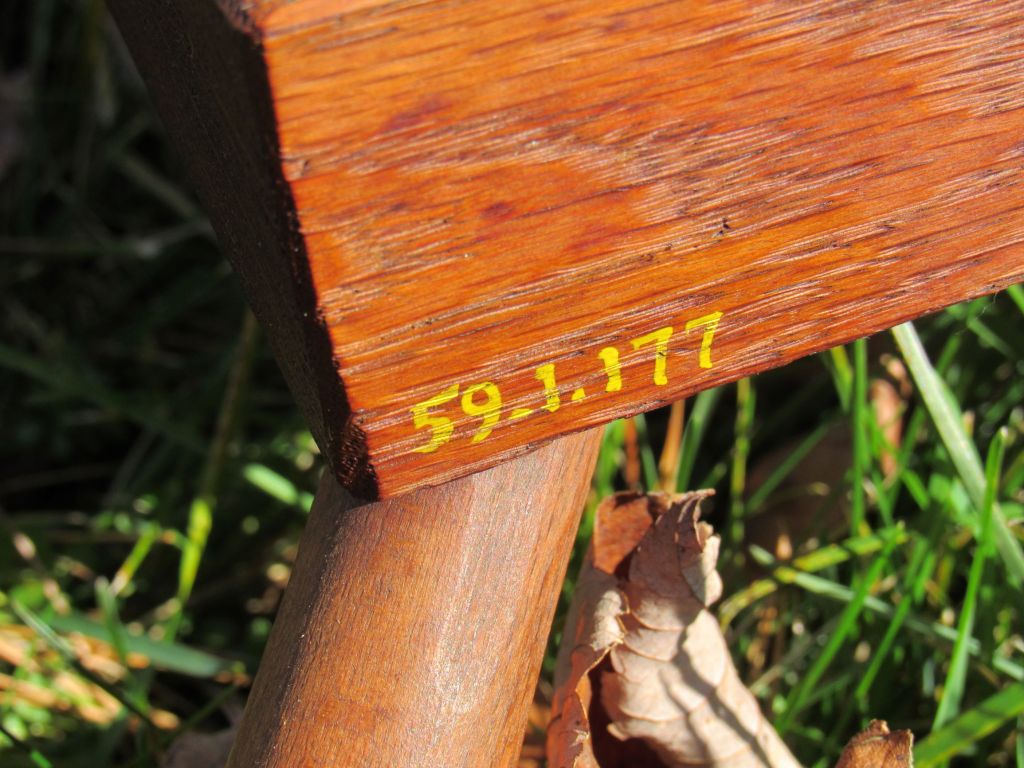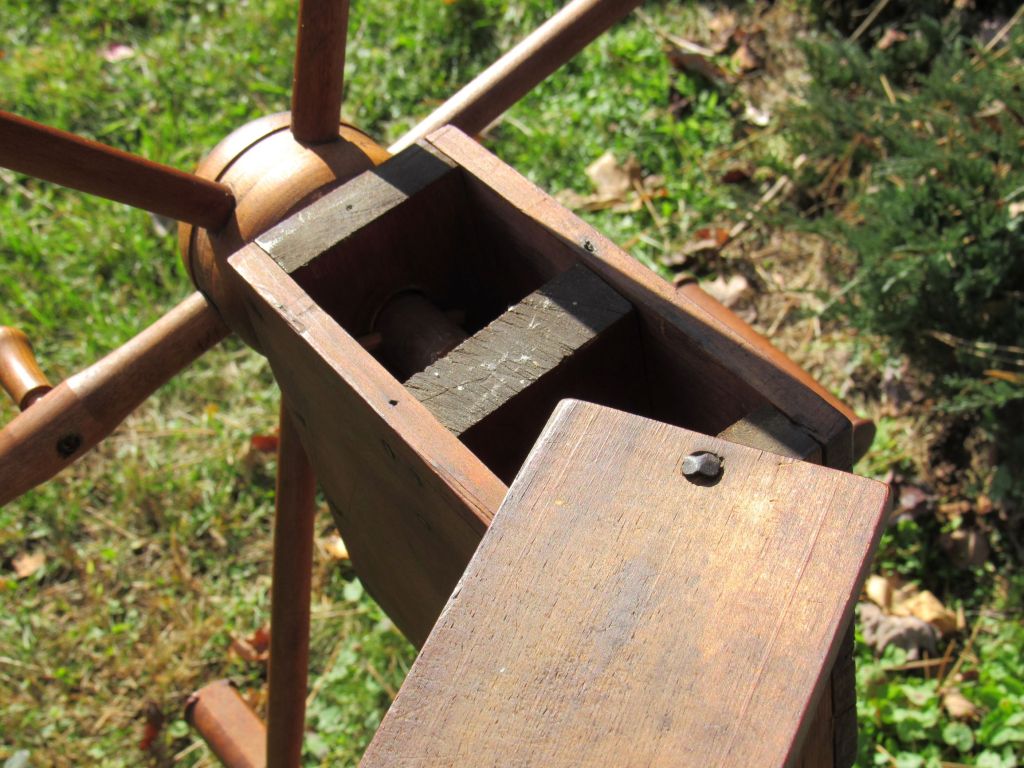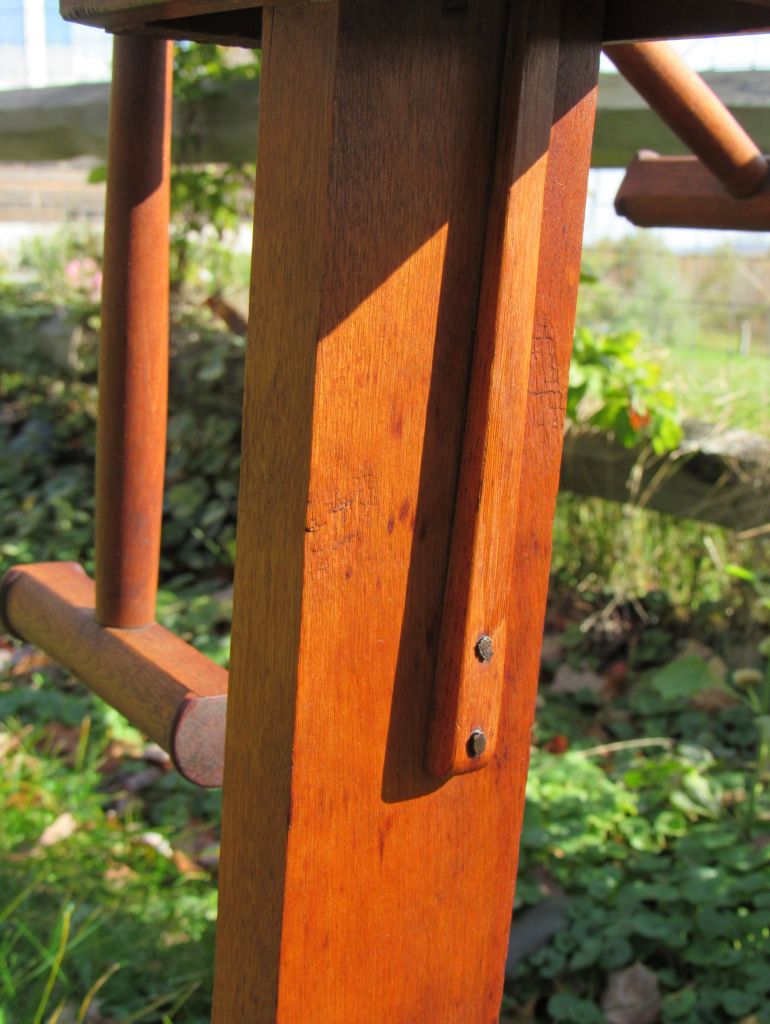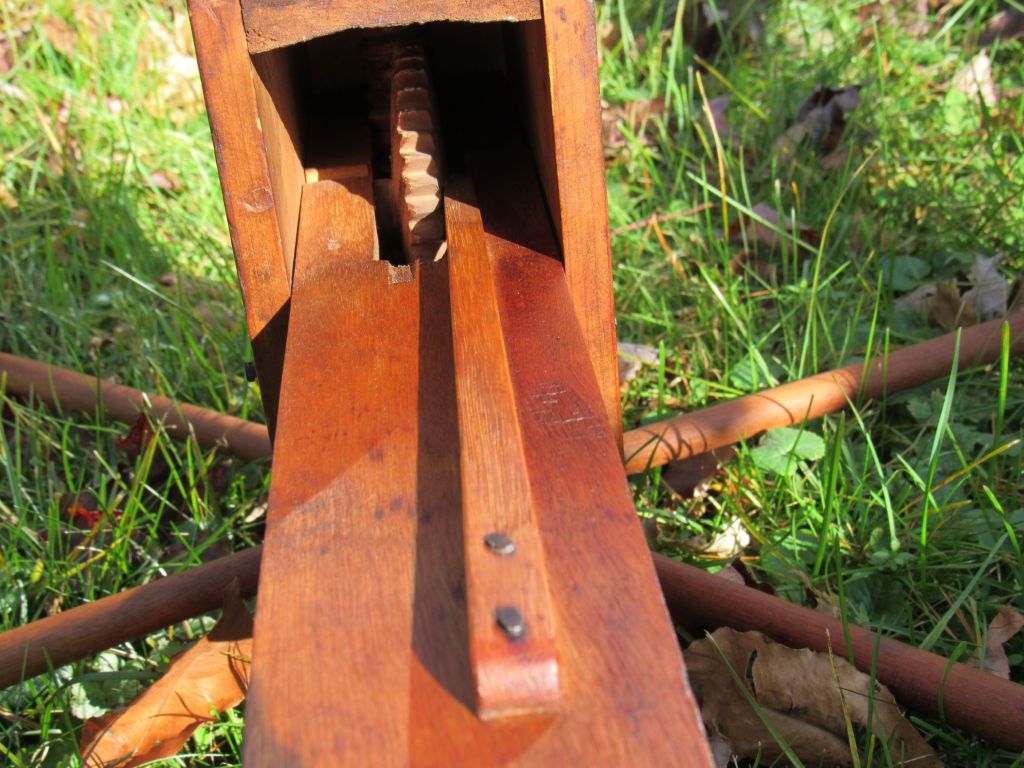
Out-of-the-Ordinary (a Reel, a Wheel, and a Loom)

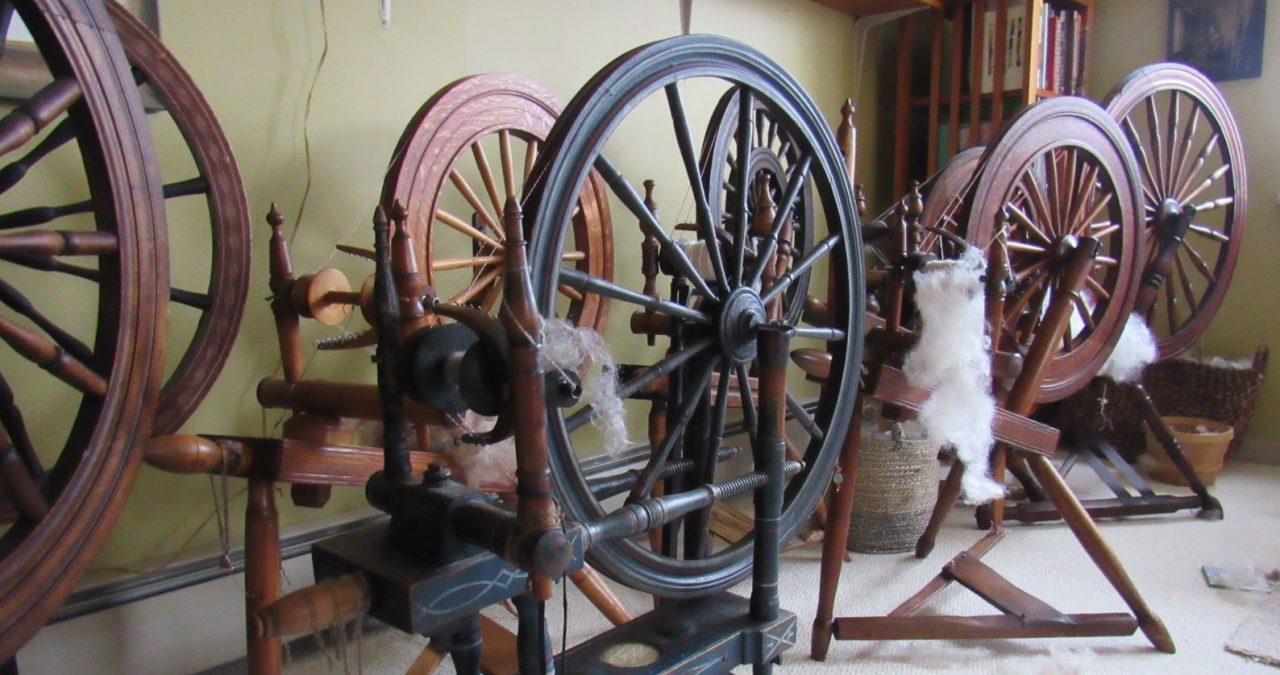
Although these three pieces are now in new homes, I want to include them in this blog because their unusual features should be documented for future reference. 

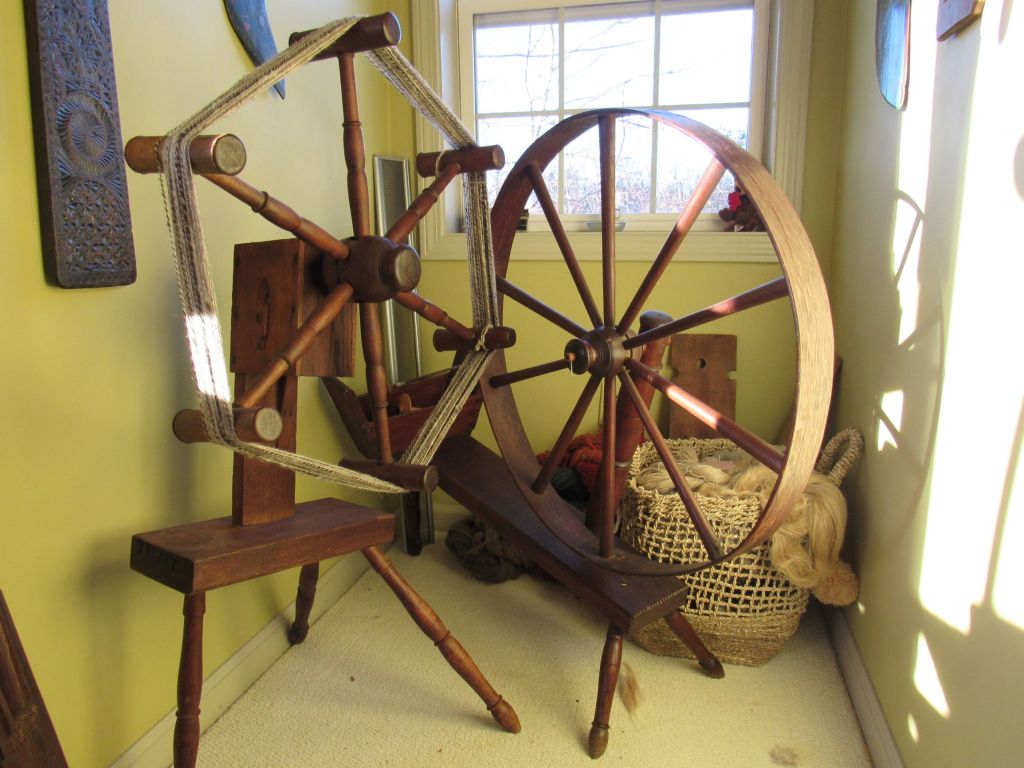
THE REEL

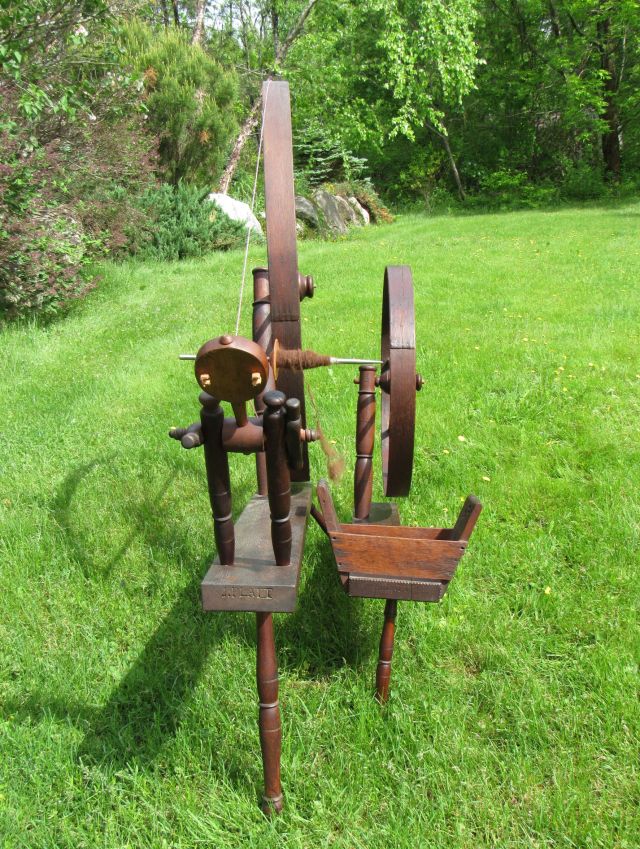
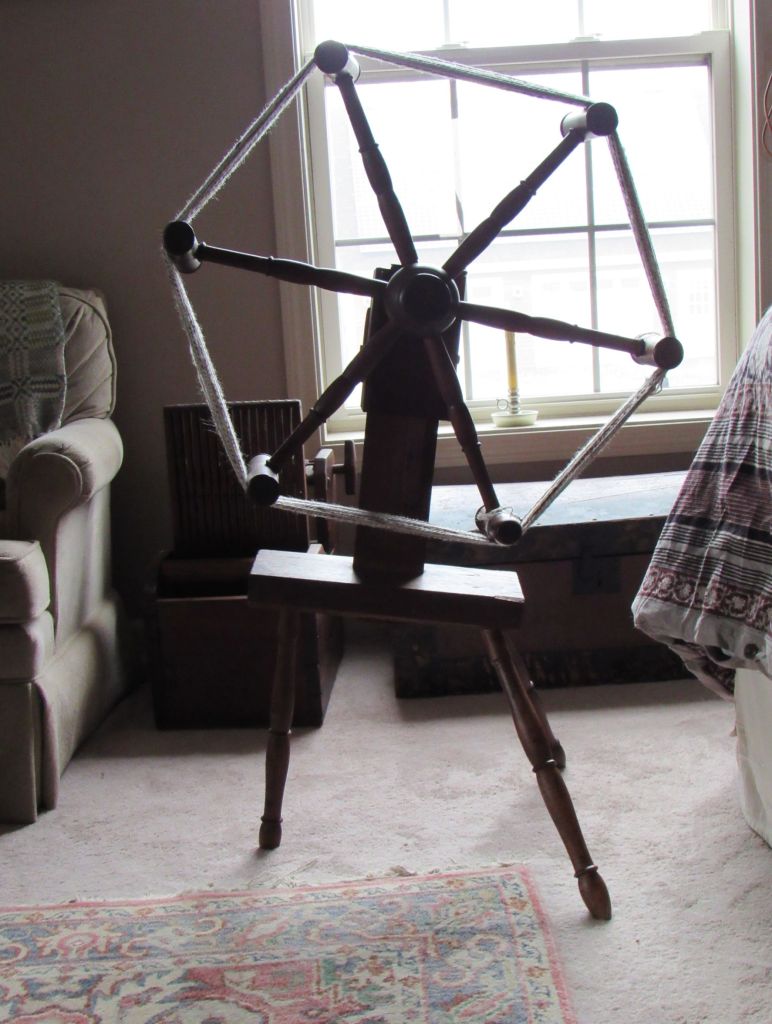
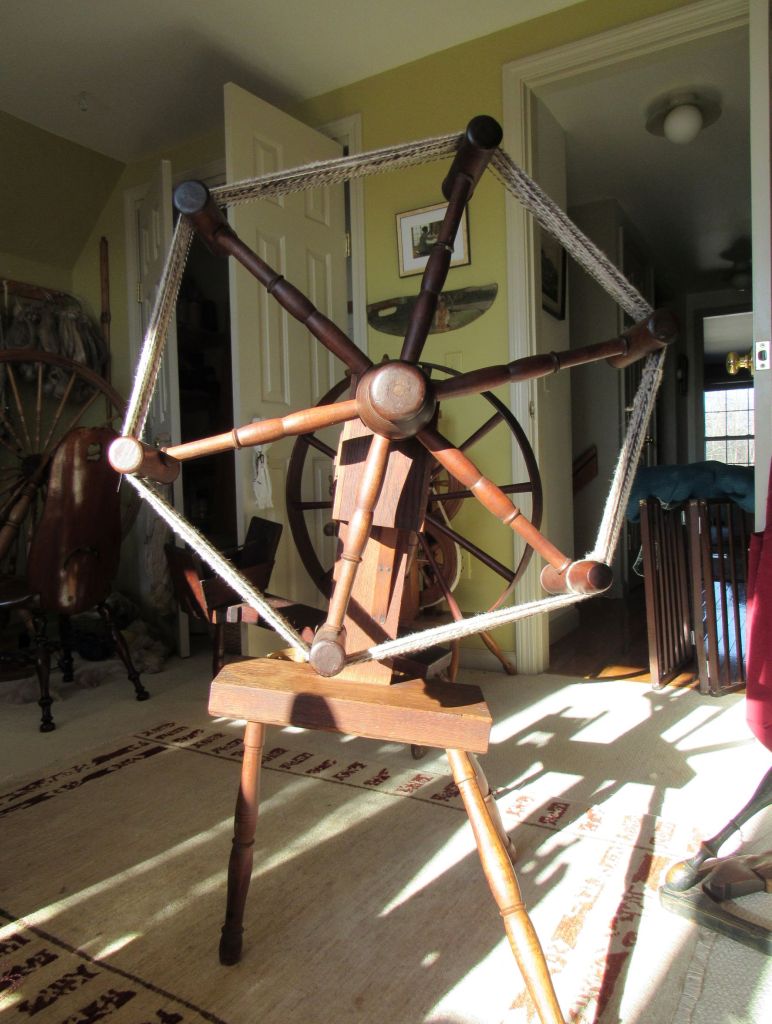
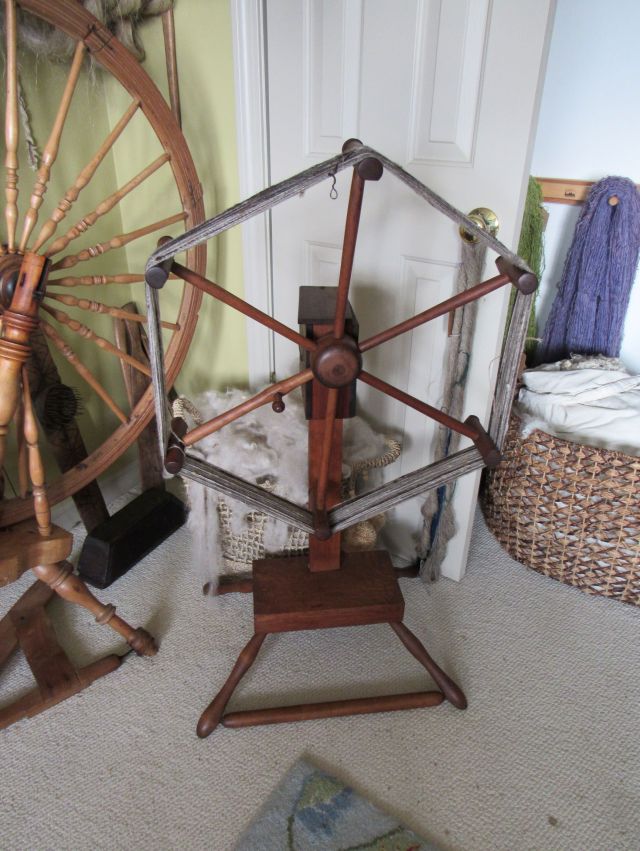
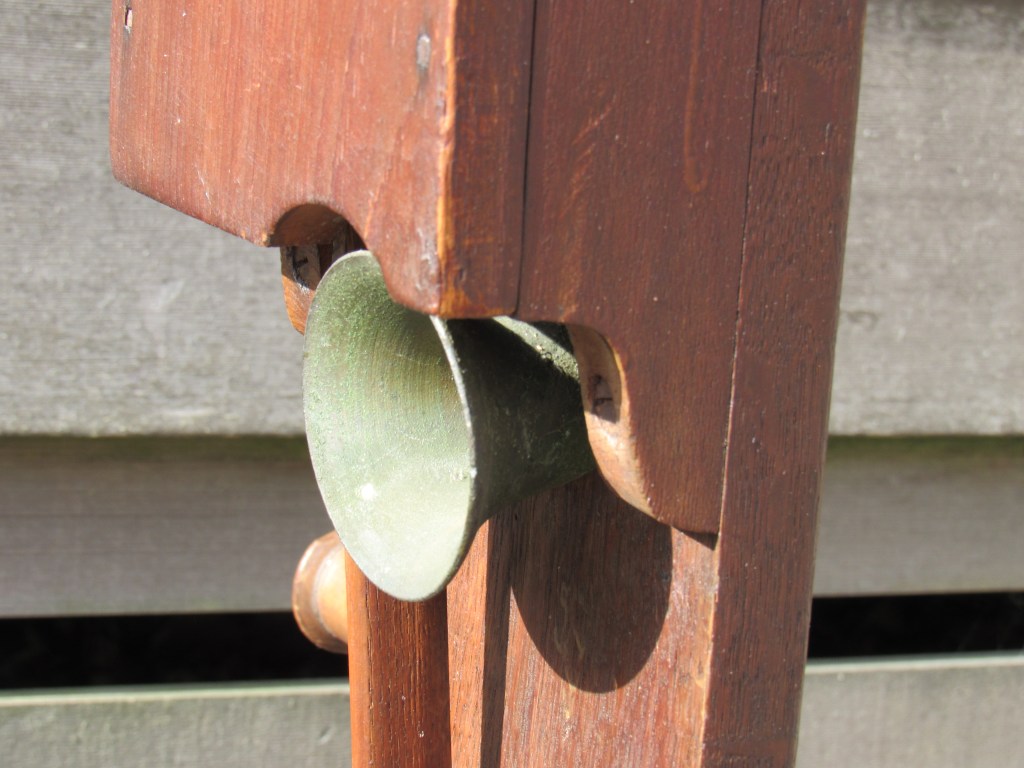
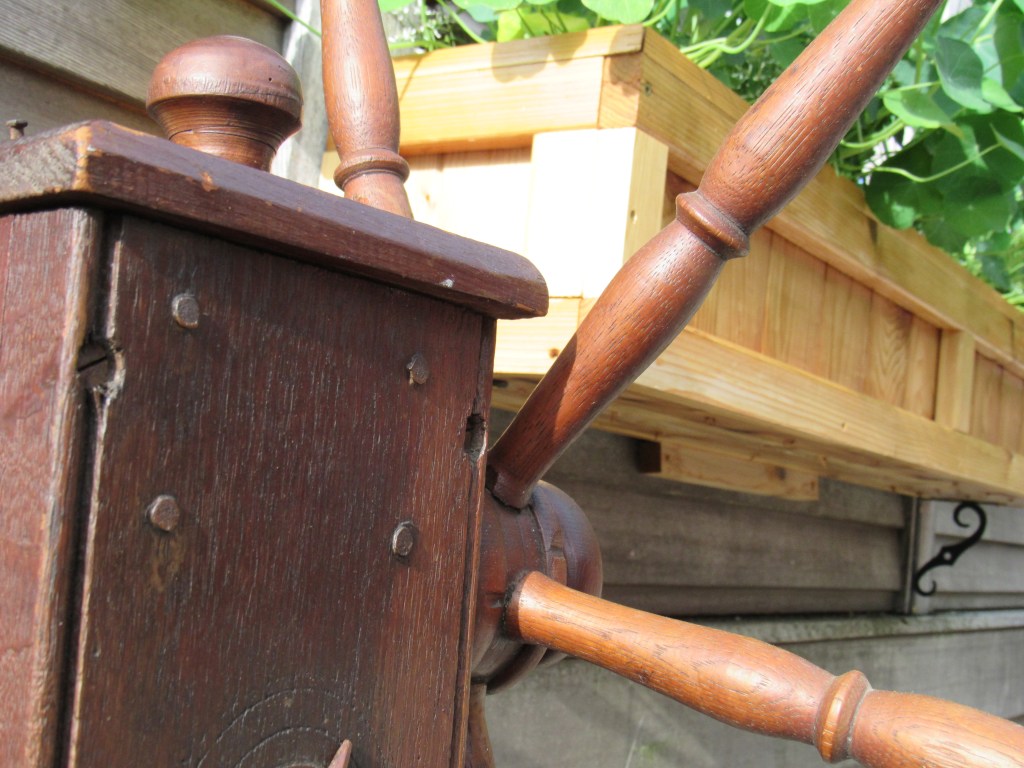
The first, a reel I named “Annabelle,” came as a package deal with two wheels from Canada.  I have no idea if the reel is from Canada, too.  Given that the reel’s shiny glory is a metal bell, and metal was incorporated into many Quebec wheels, it is possible. 
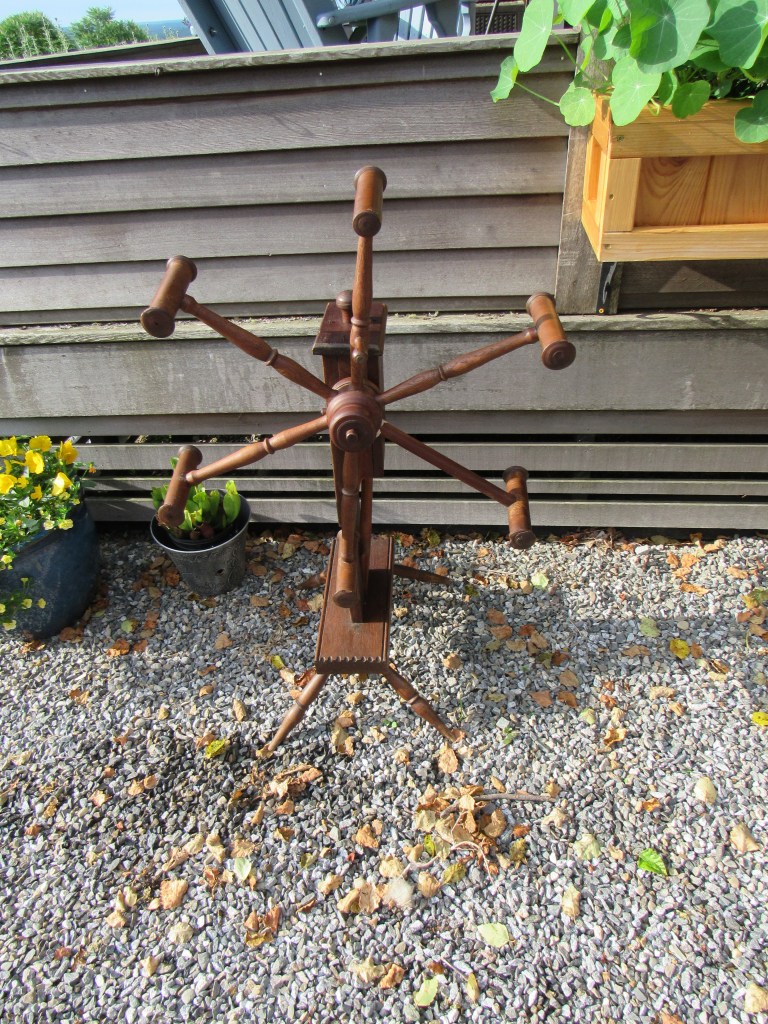
On the other hand, most (but not all) Quebec reels, called “dévidoirs,” unlike this one, are horizontal, barrel style reels, so it may not be from Quebec at all.  Sadly, its origin remains a mystery.  Its vertical design and counting mechanism is generally known as a clock or click reel. 
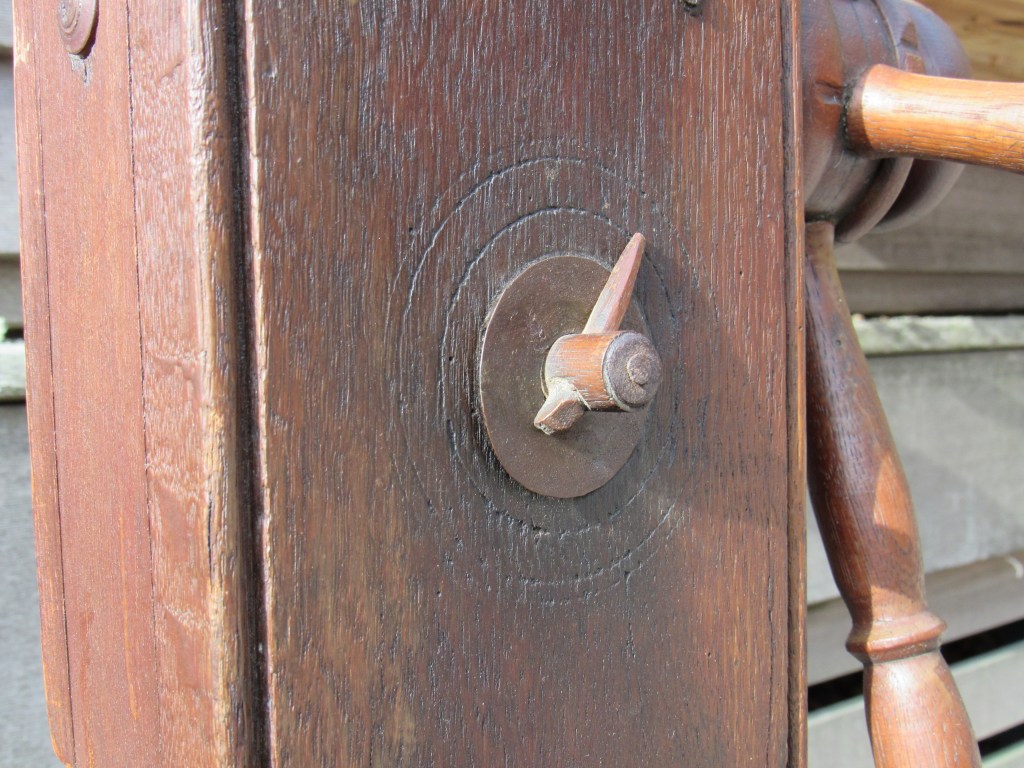
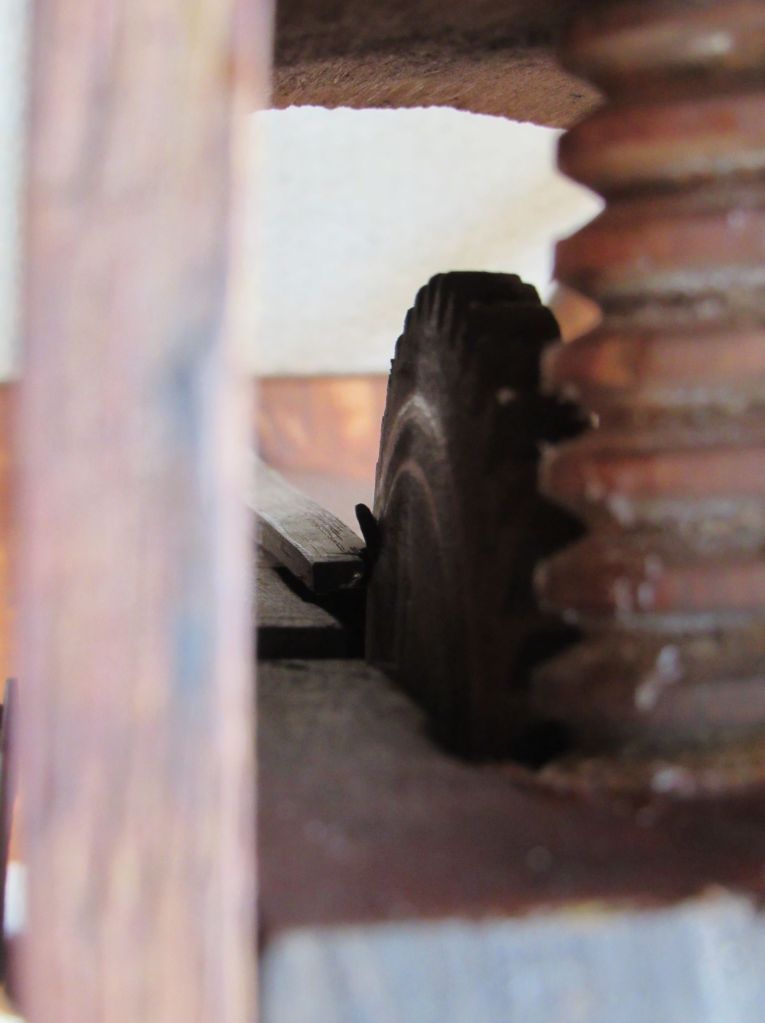
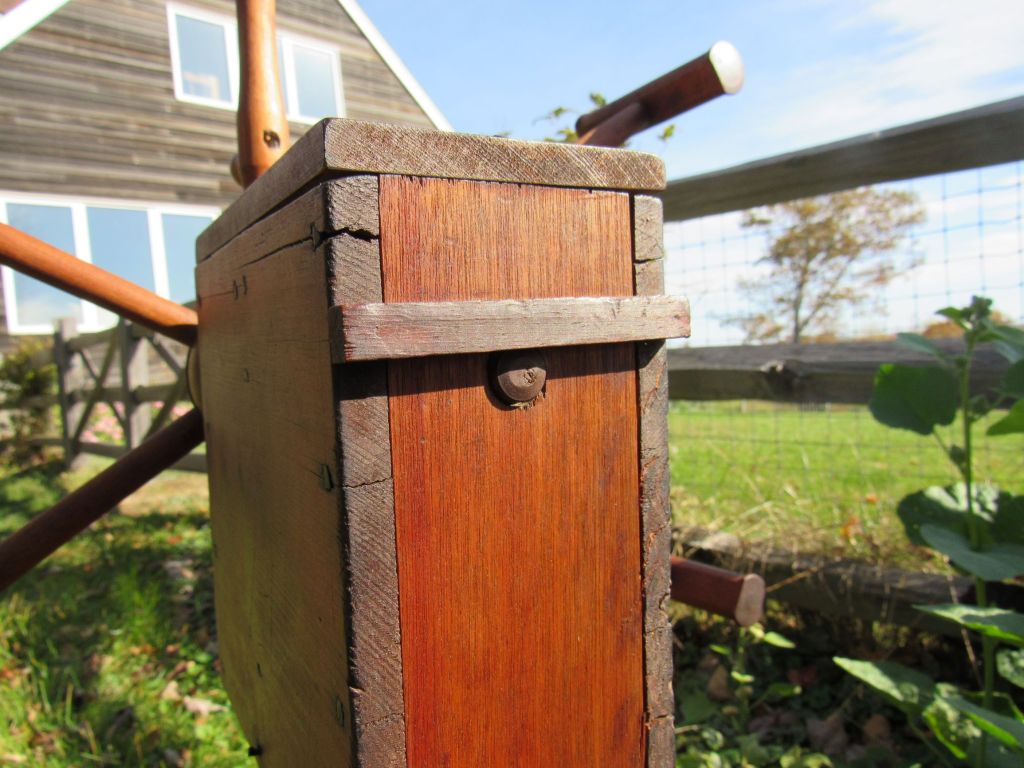
Except in this case, the rotations are marked not by a click but by a ringing sound, because, upon 40 rotations, the wooden clapper hits a bell. 
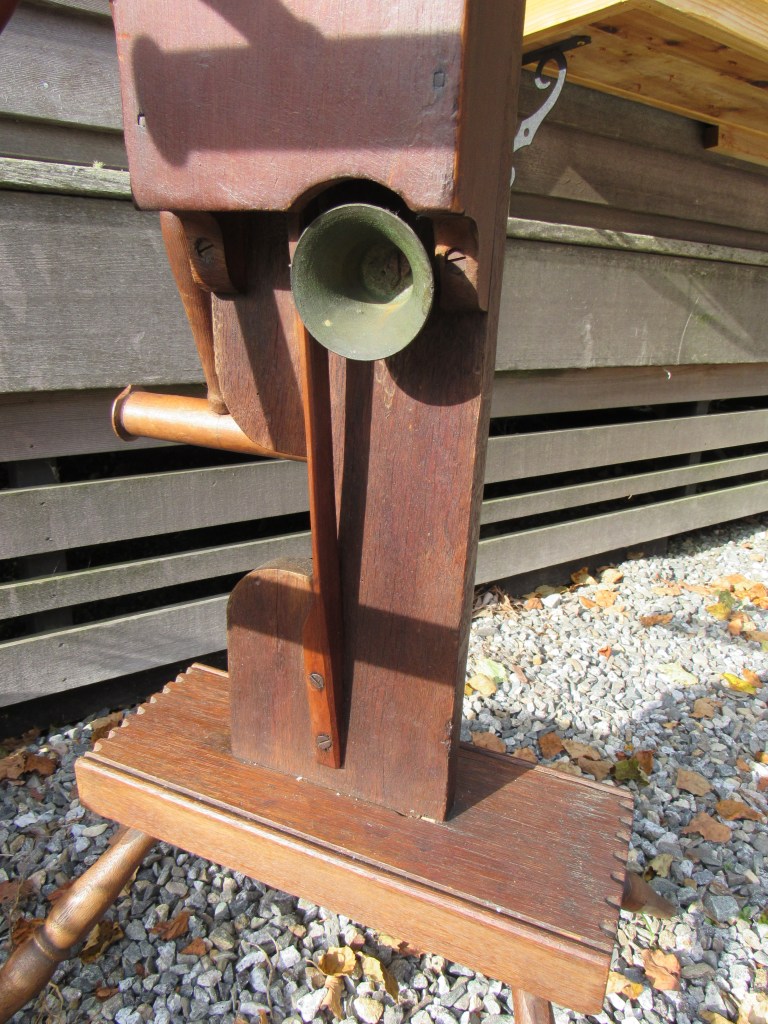
It is a louder and more pleasing way to count rotations, but I suspect having metal work done for a reel was not worth the extra expense for most people. 
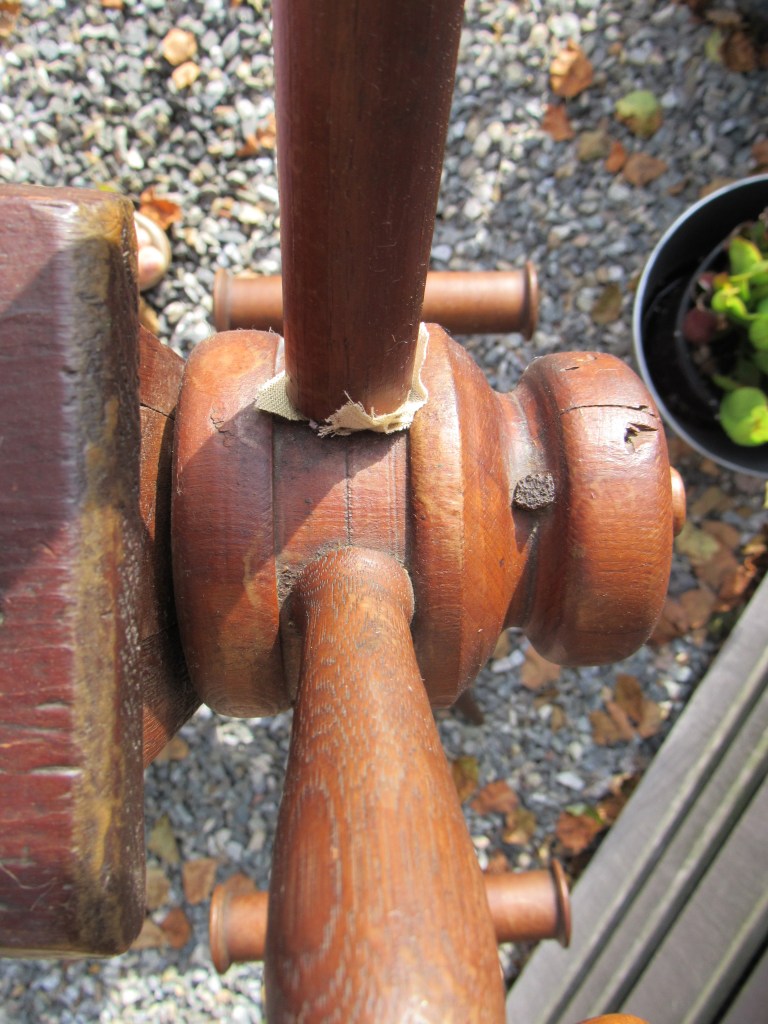
A shame, because it is lovely and practical feature.  And, very rare.
THE WHEEL

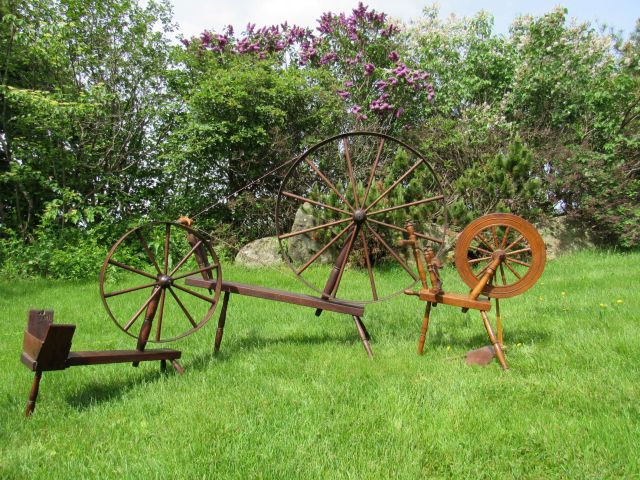
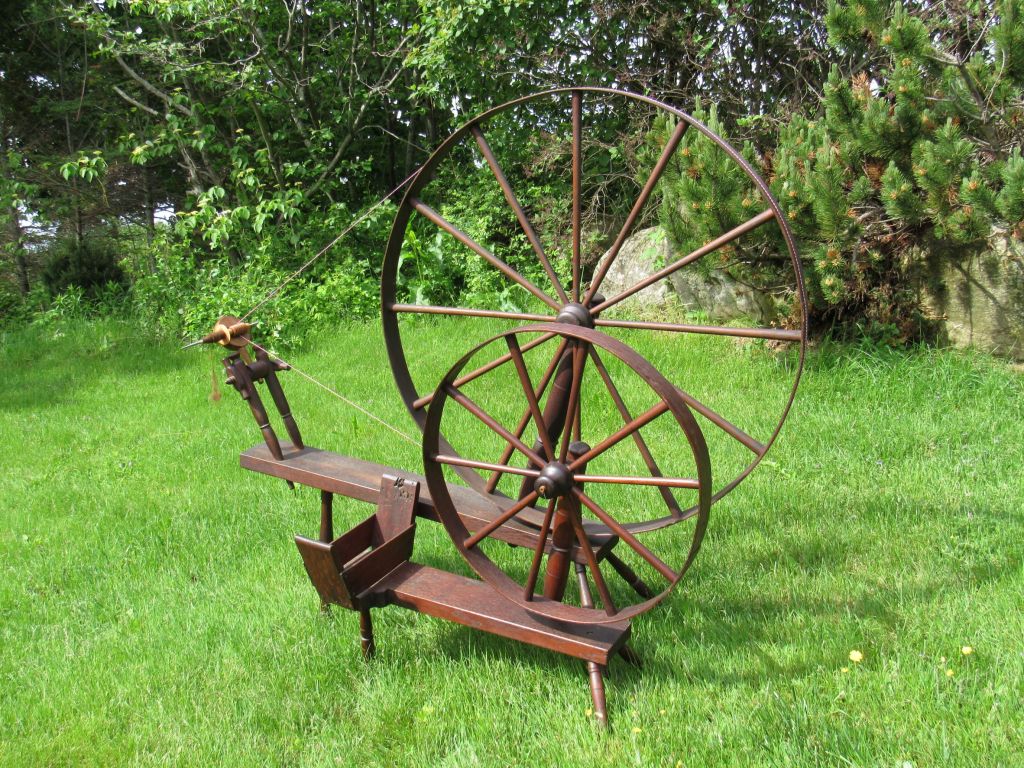
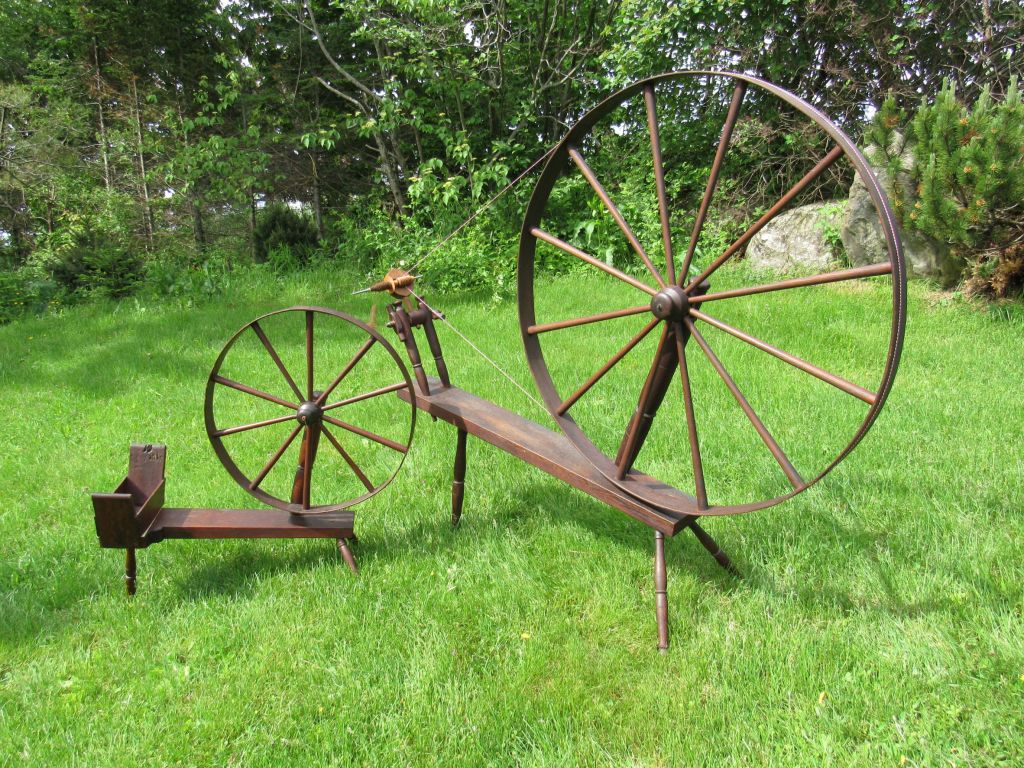
The second out-of-the-ordinary piece, a great wheel I named “Felice,” was the wheel that hooked me on great wheel spinning. 
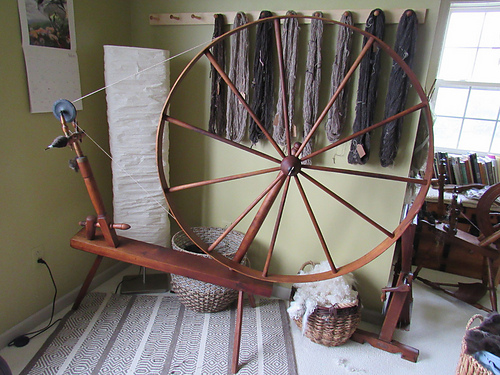
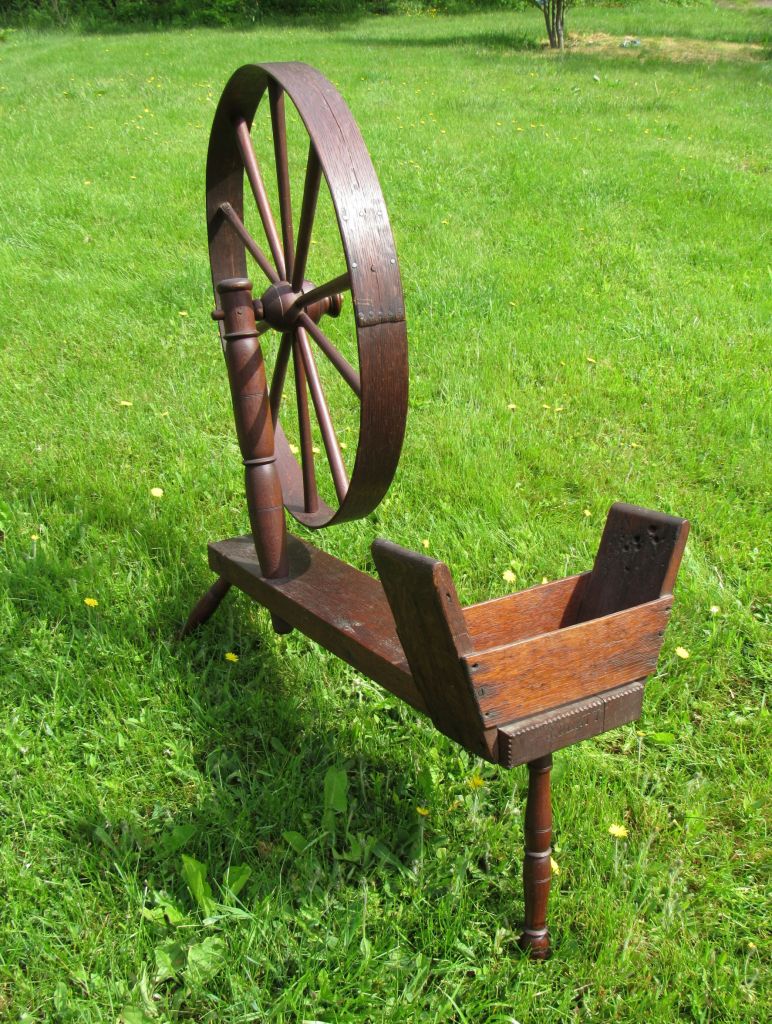
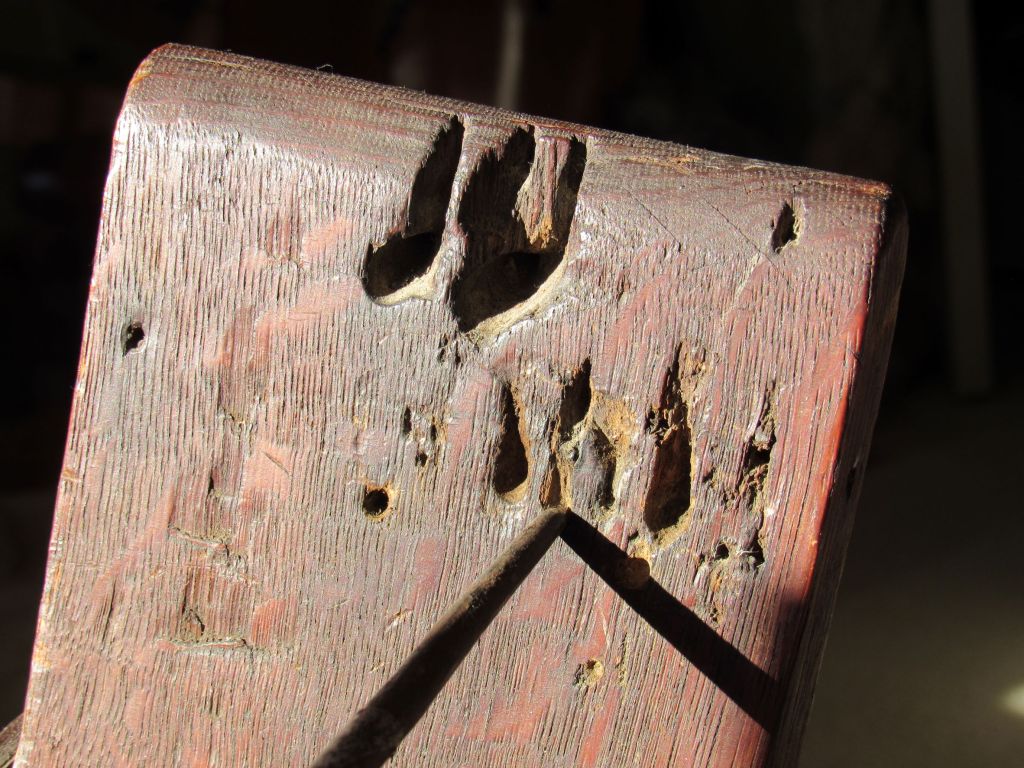
I bought her in southern Maine.  The seller had, in turn, bought the wheel in New Hampshire from a woman who said it was Shaker.  While the beauty, simplicity, and craftsmanship would fit well with the Shaker approach to design and construction, I have not seen any evidence that Shakers make wheels with features similar to this one.
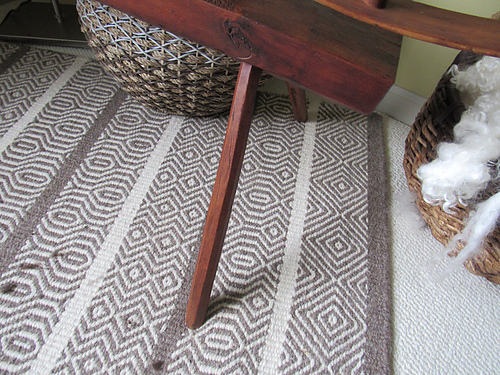
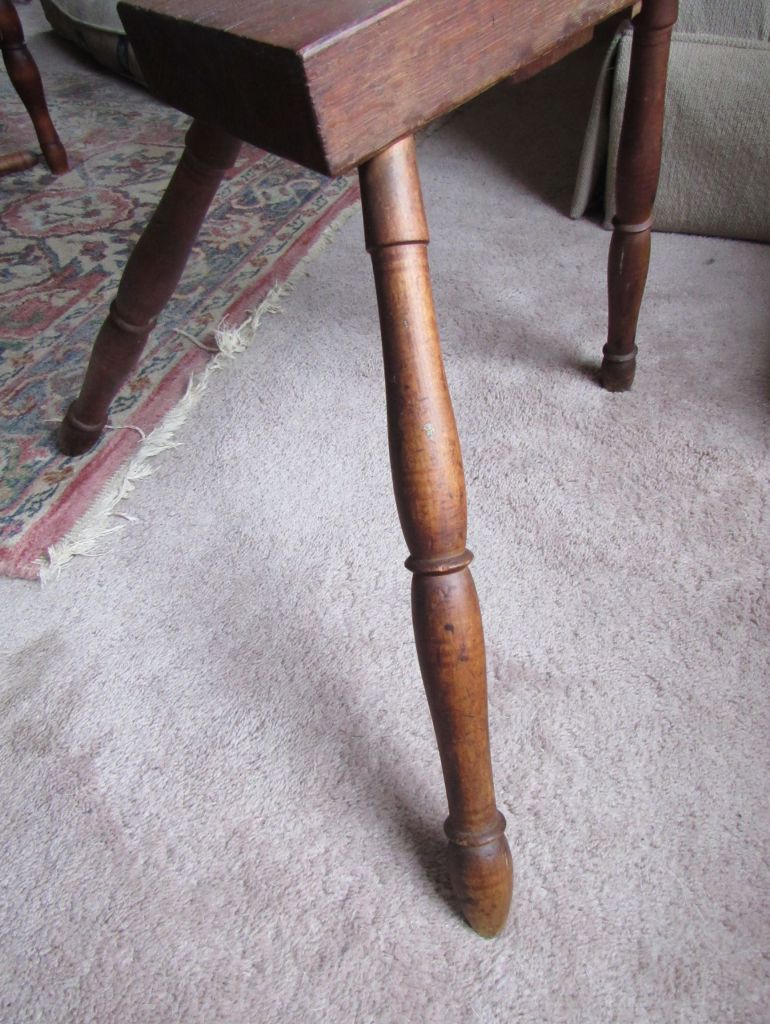
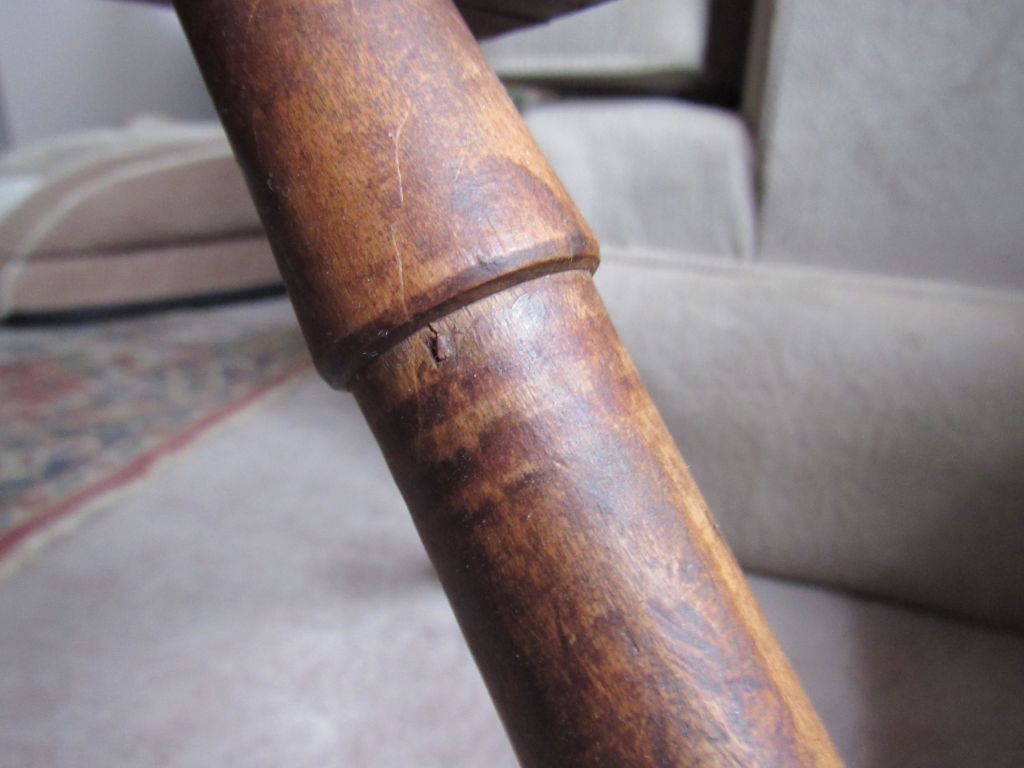
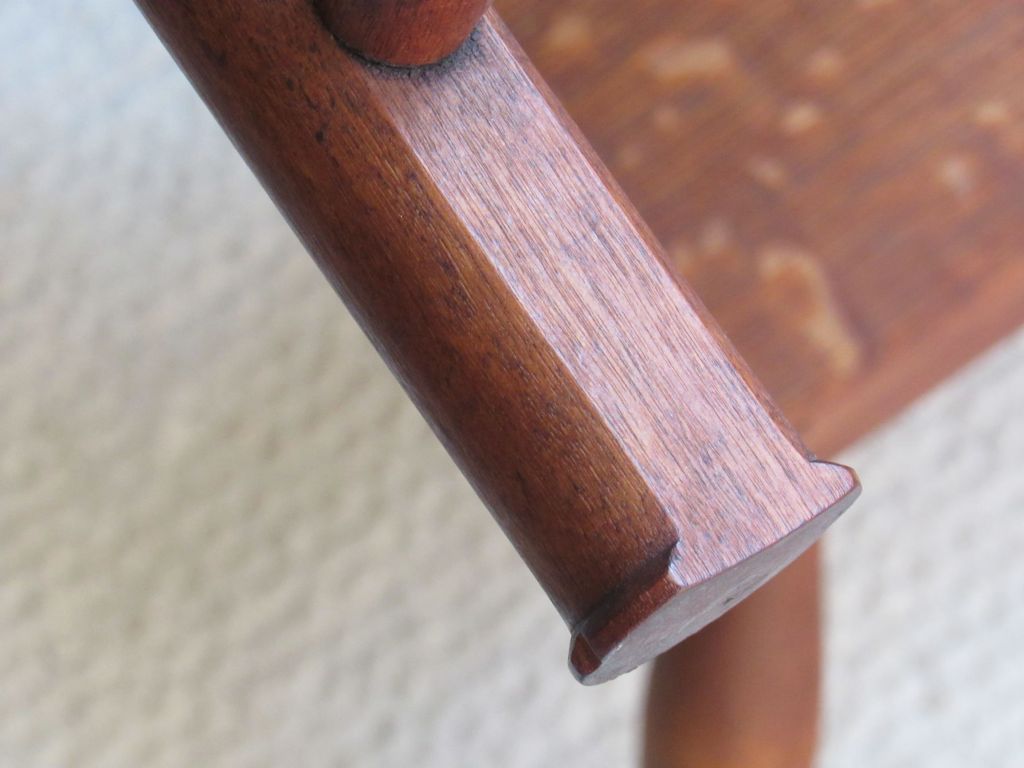
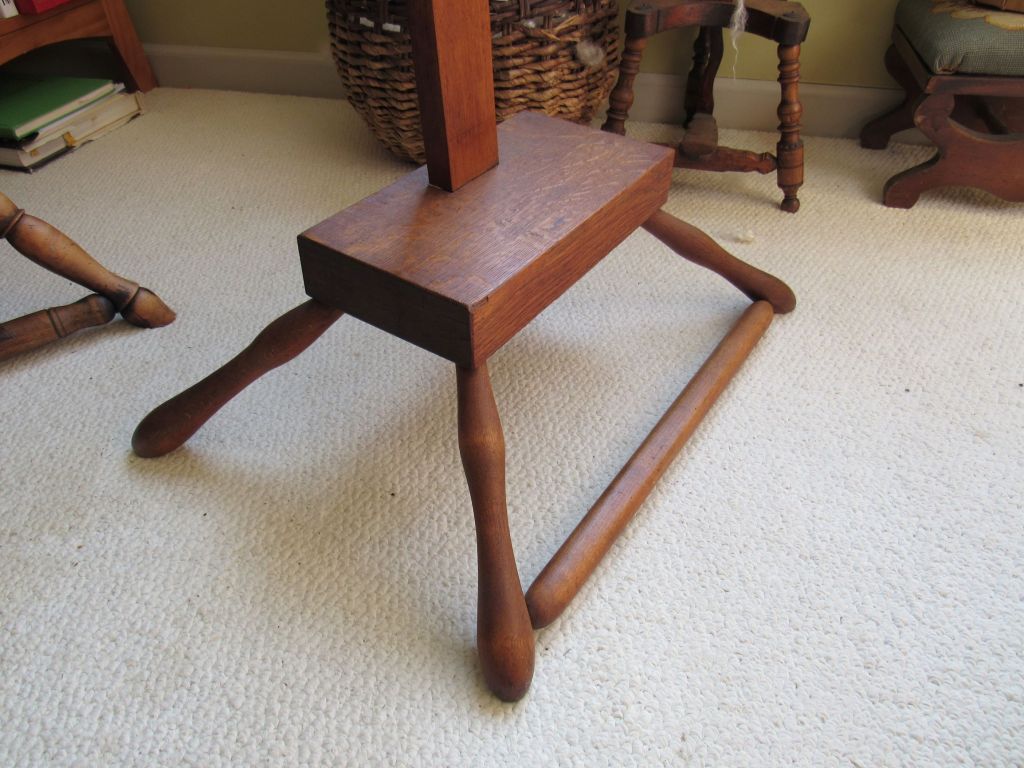
The legs are chamfered rather than turned.* 
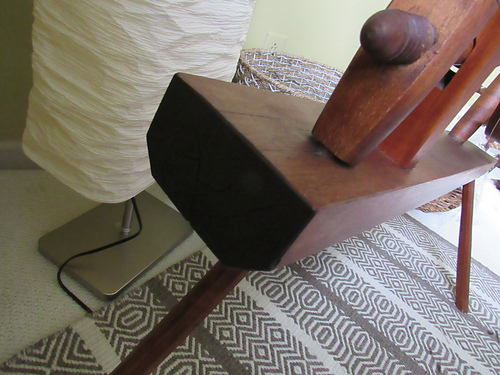
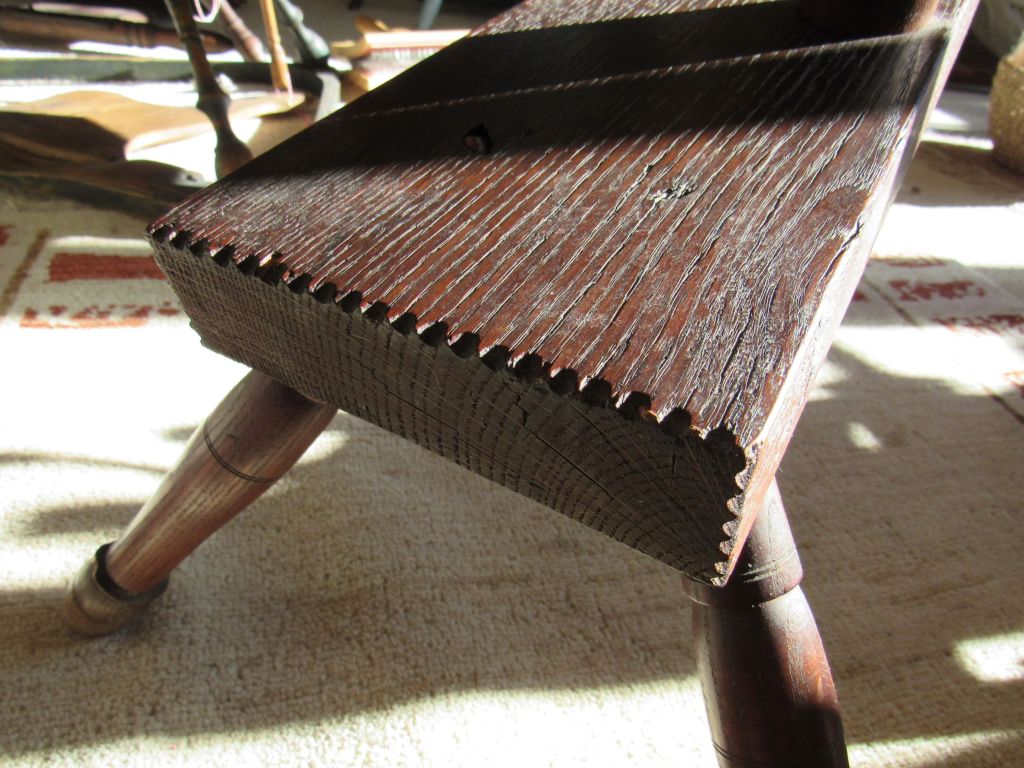
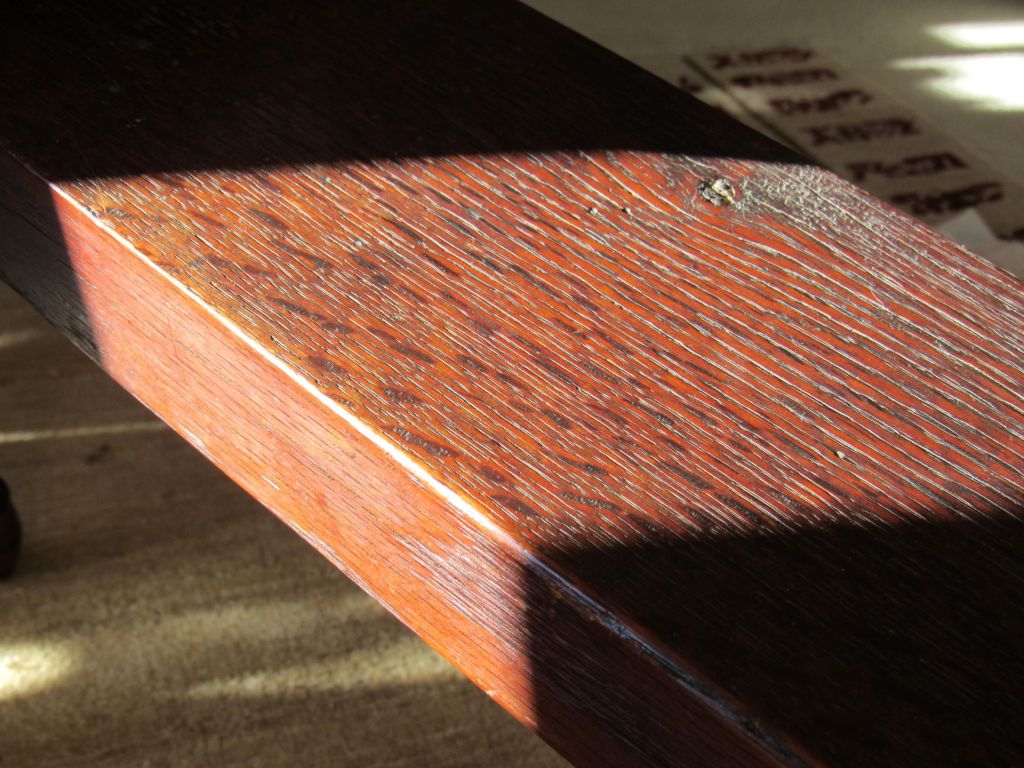
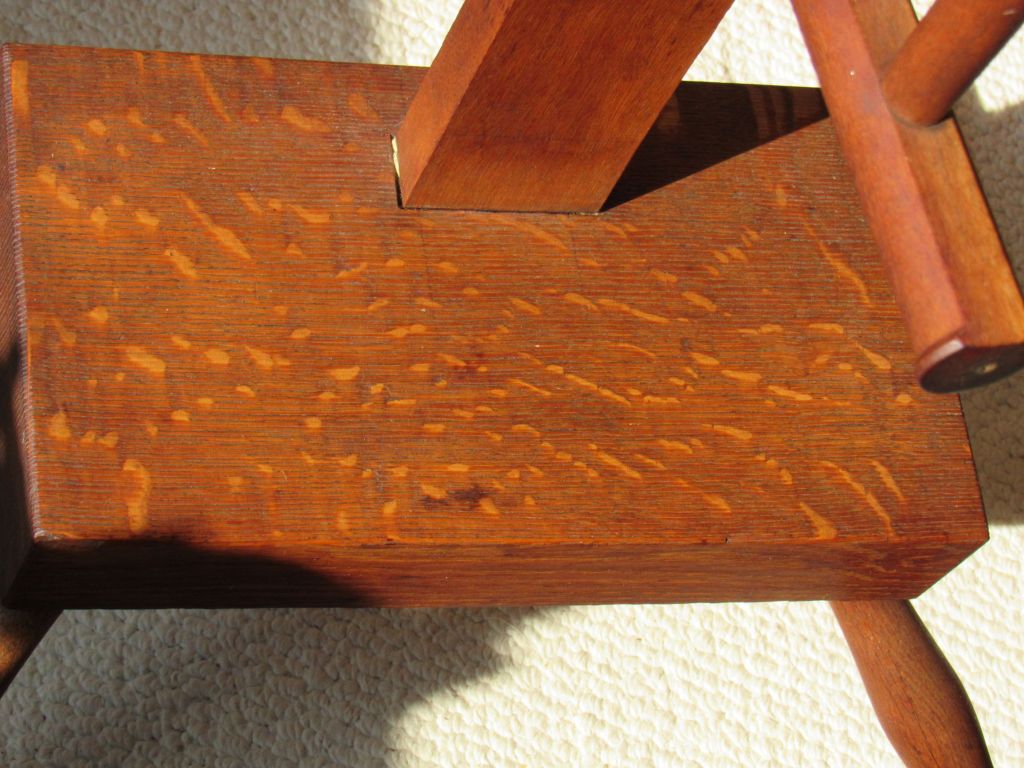
The table also has transitional, chamfered bottom edges. 
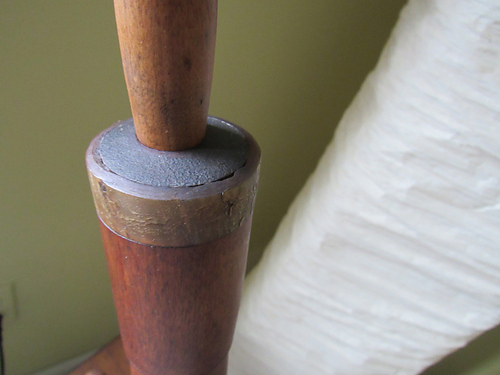
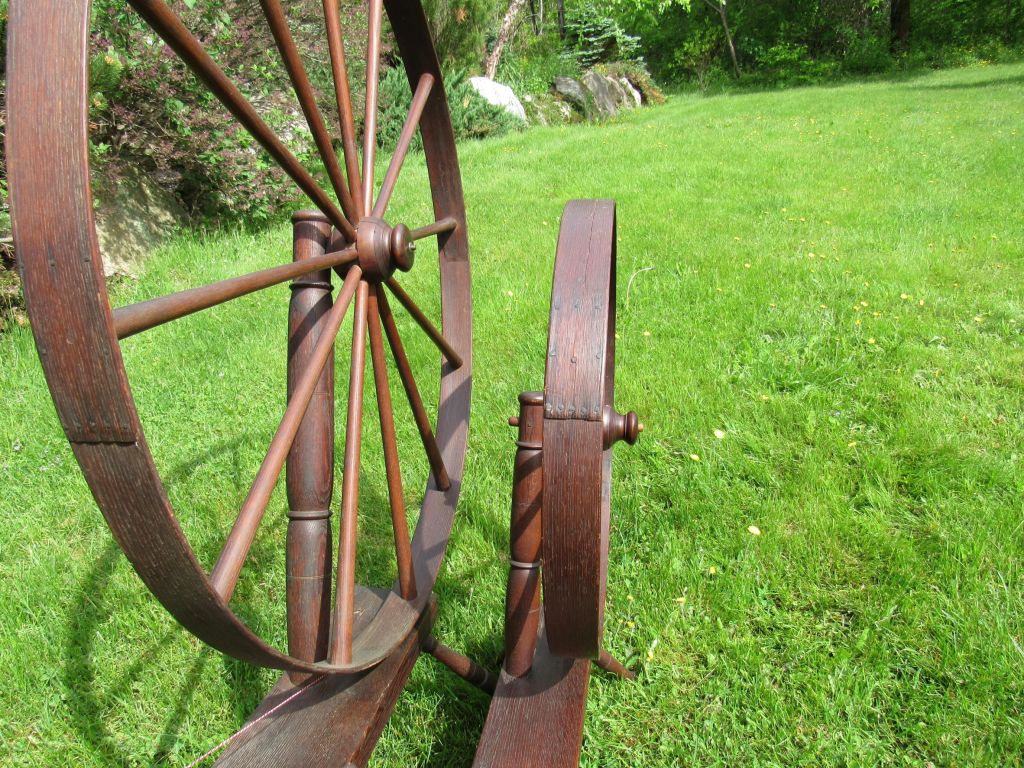
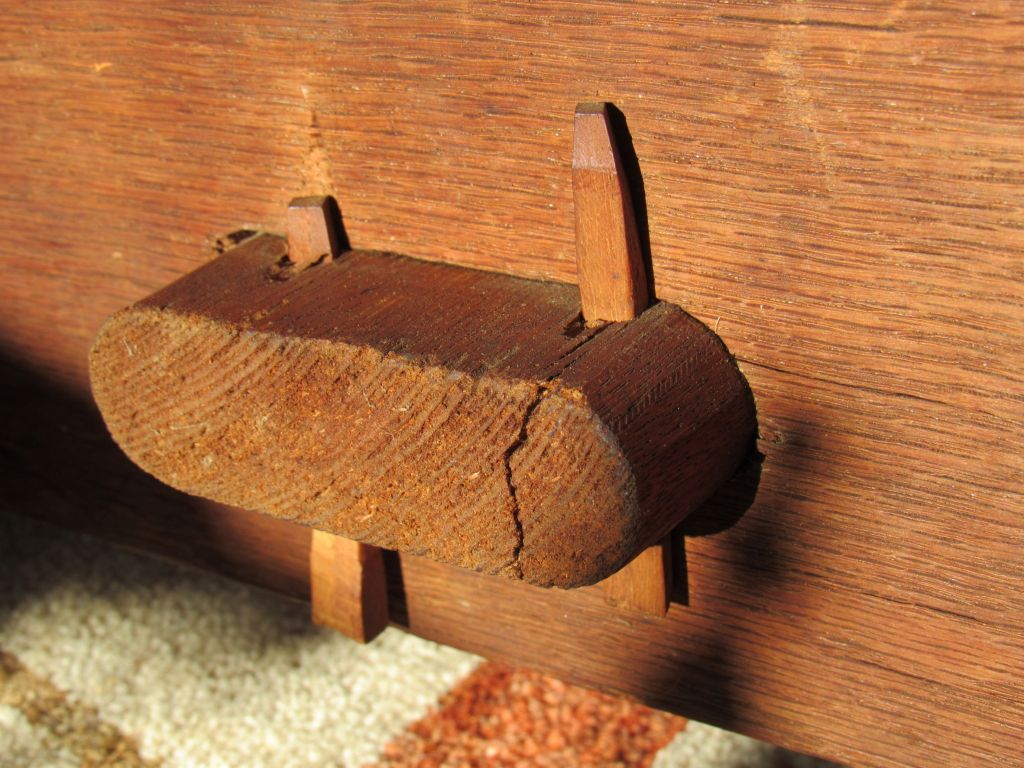
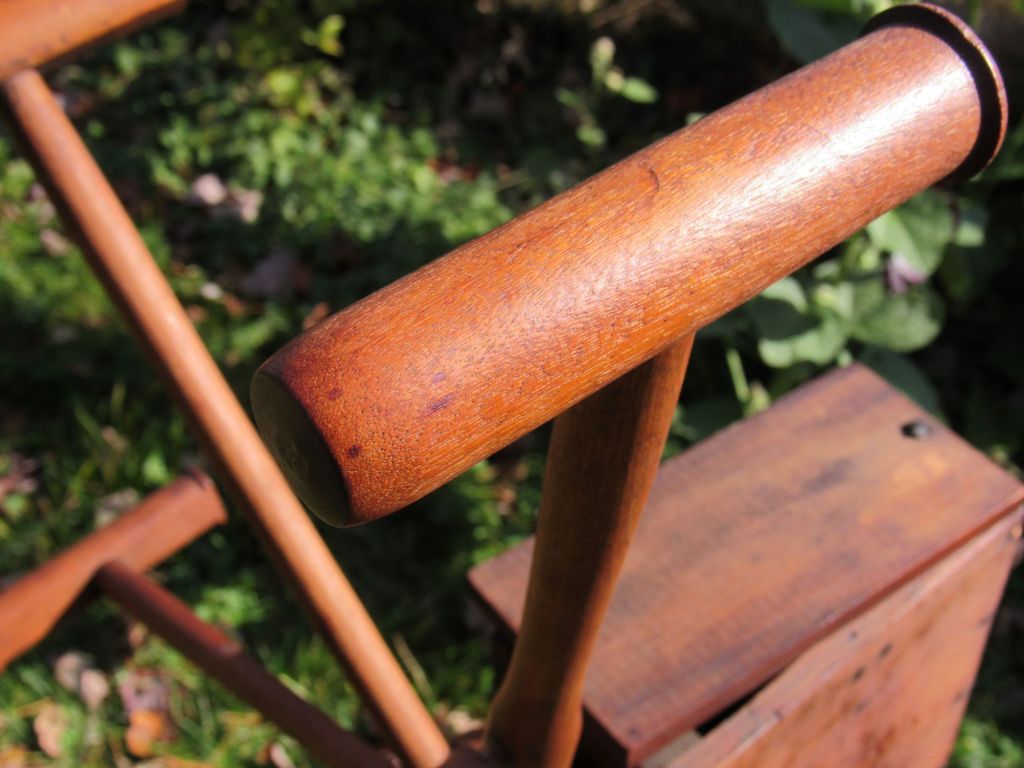
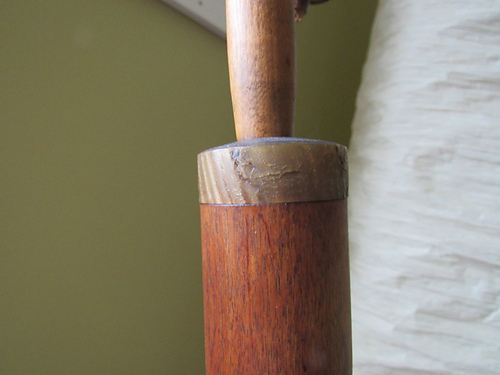
The wheel post has a perfectly fitted thick horn collar, a feature found on some early Shaker wheels.  
 The drive wheel rim has beautifully made joins. 
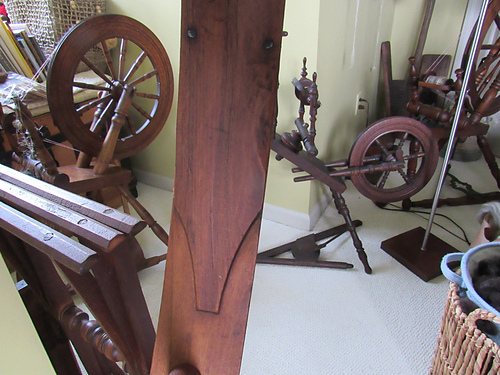
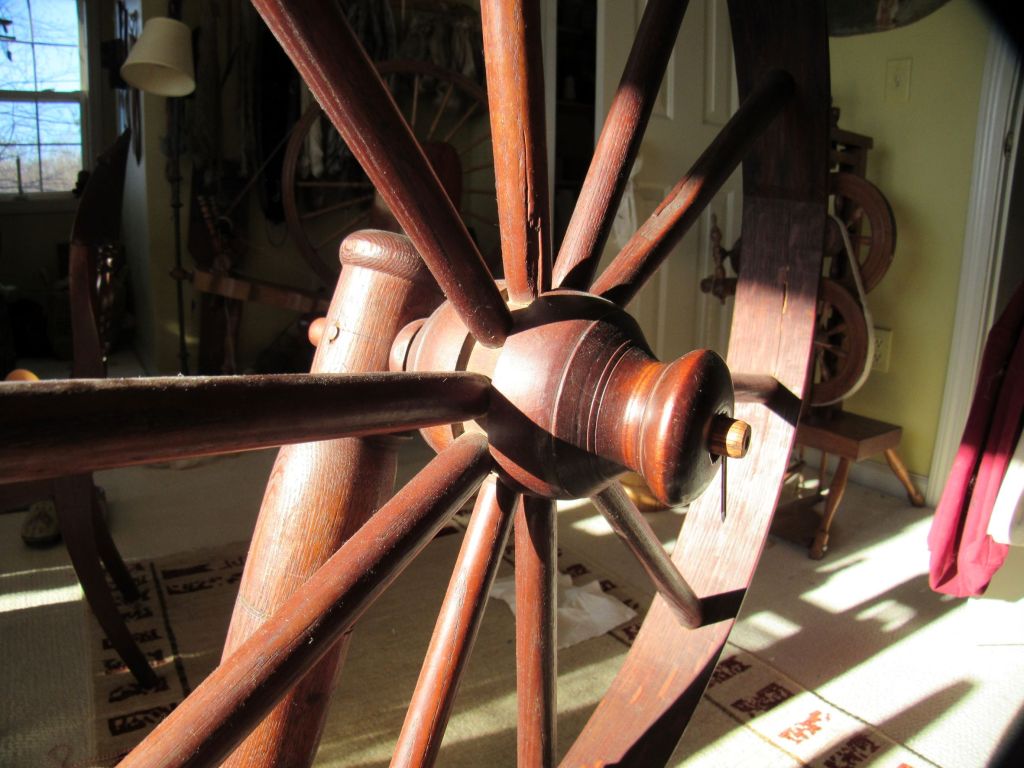
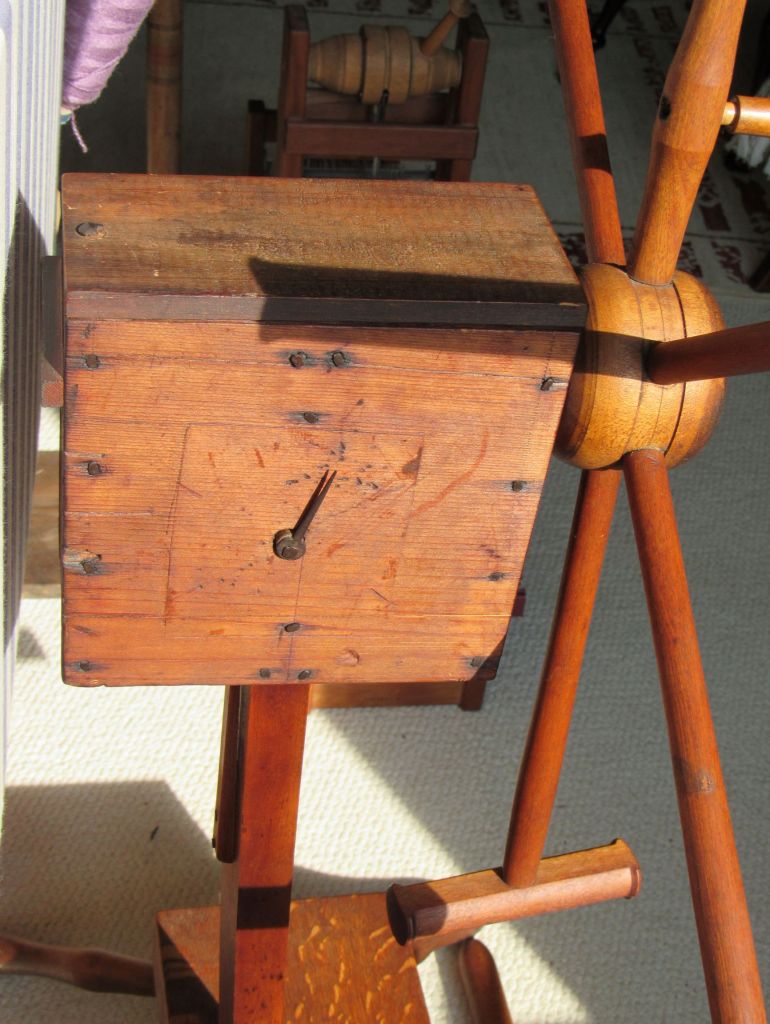
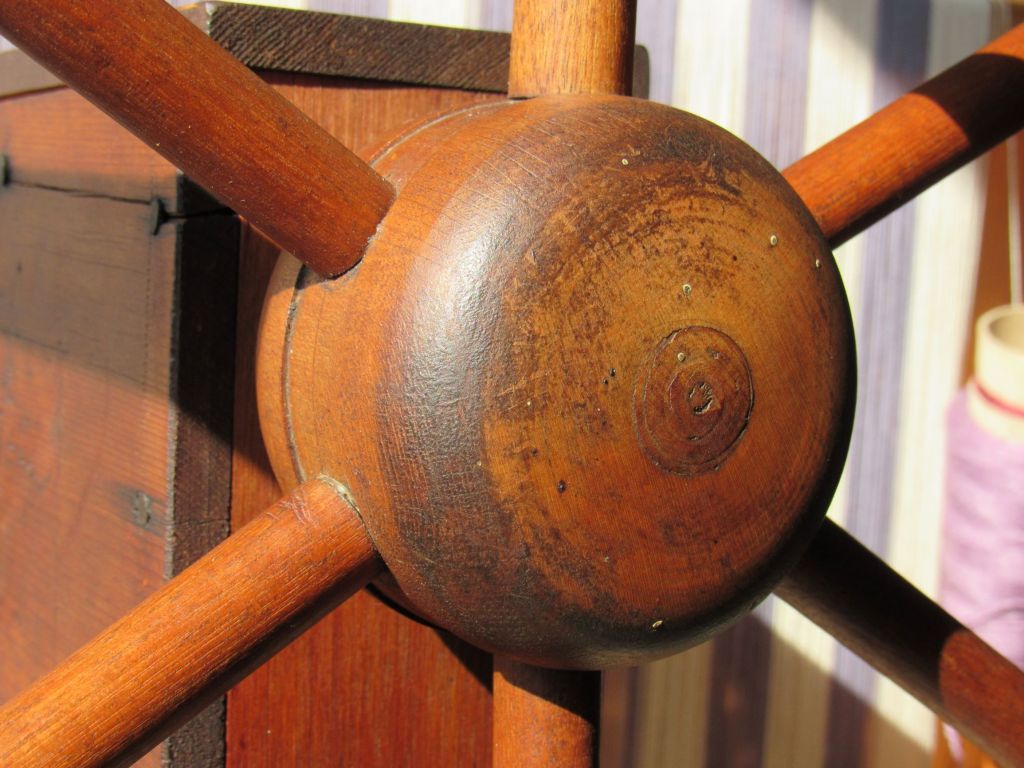
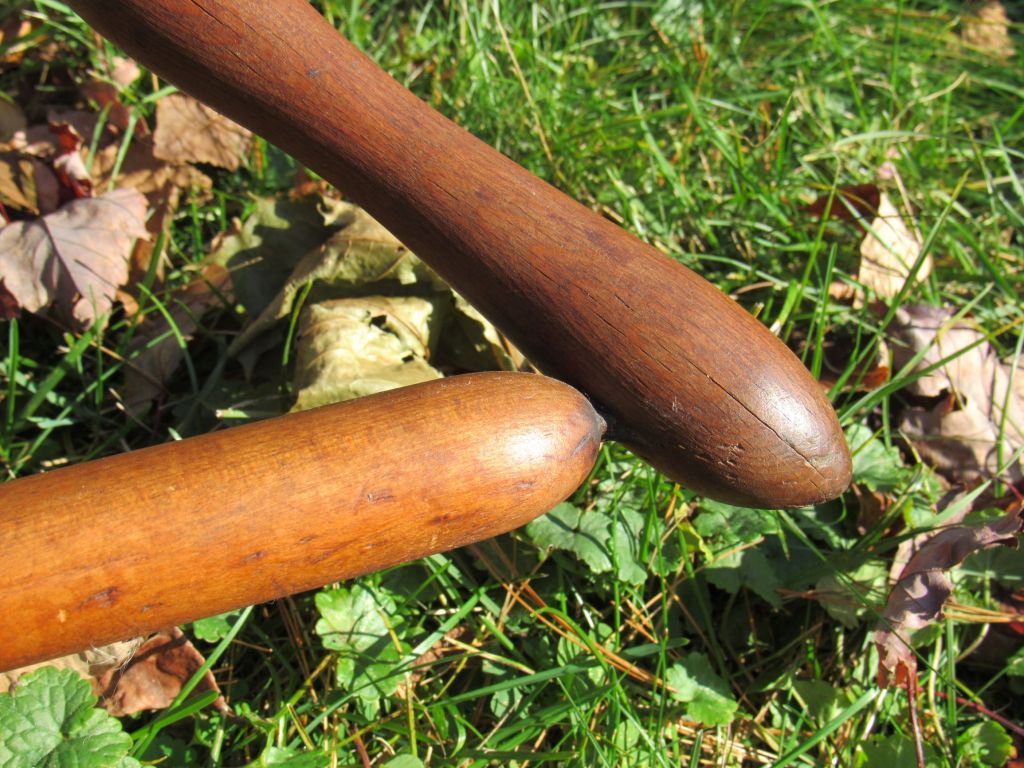
My favorite feature, though, is the hub, which is a perfect pear shape.  I have only run across one other wheel like this one.  It was found in Peachum, Vermont.
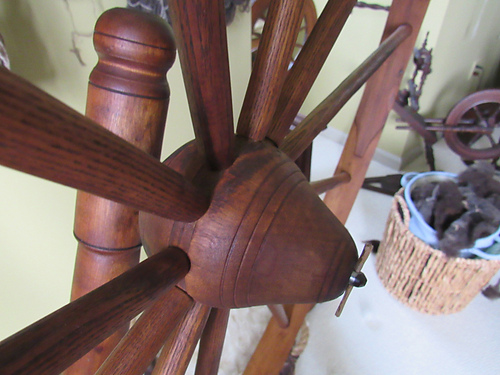
In my mind, these wheels are more beautiful than the typical Shaker great wheels.  Mine also was a joy to spin on. 

THE LOOM
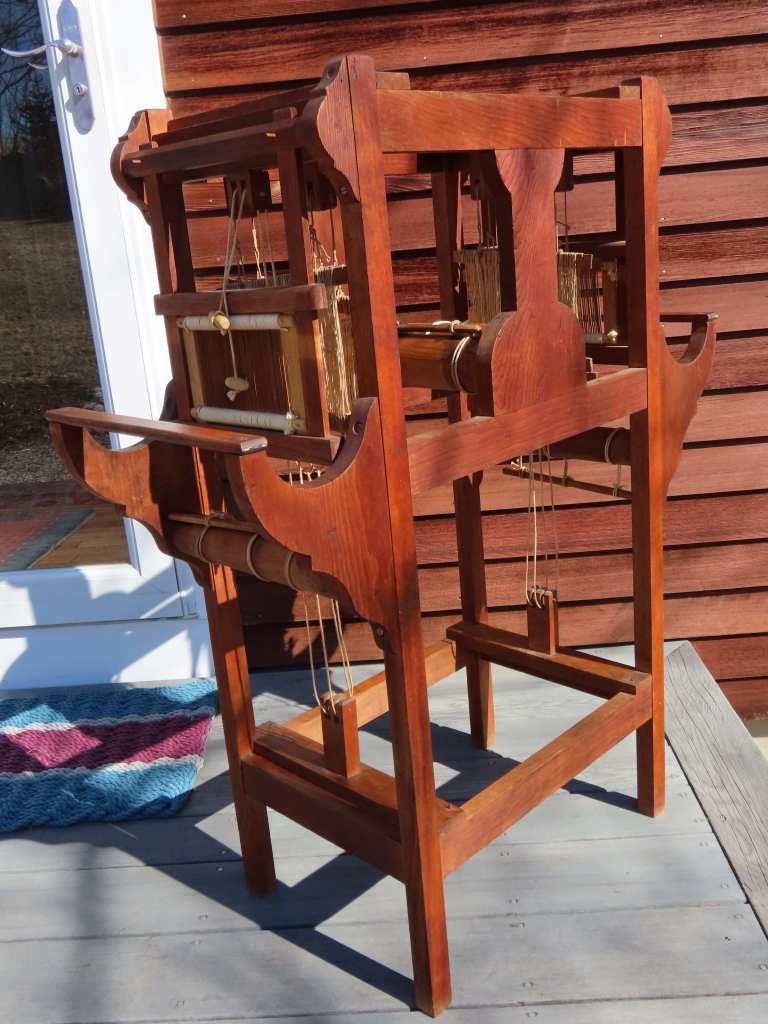
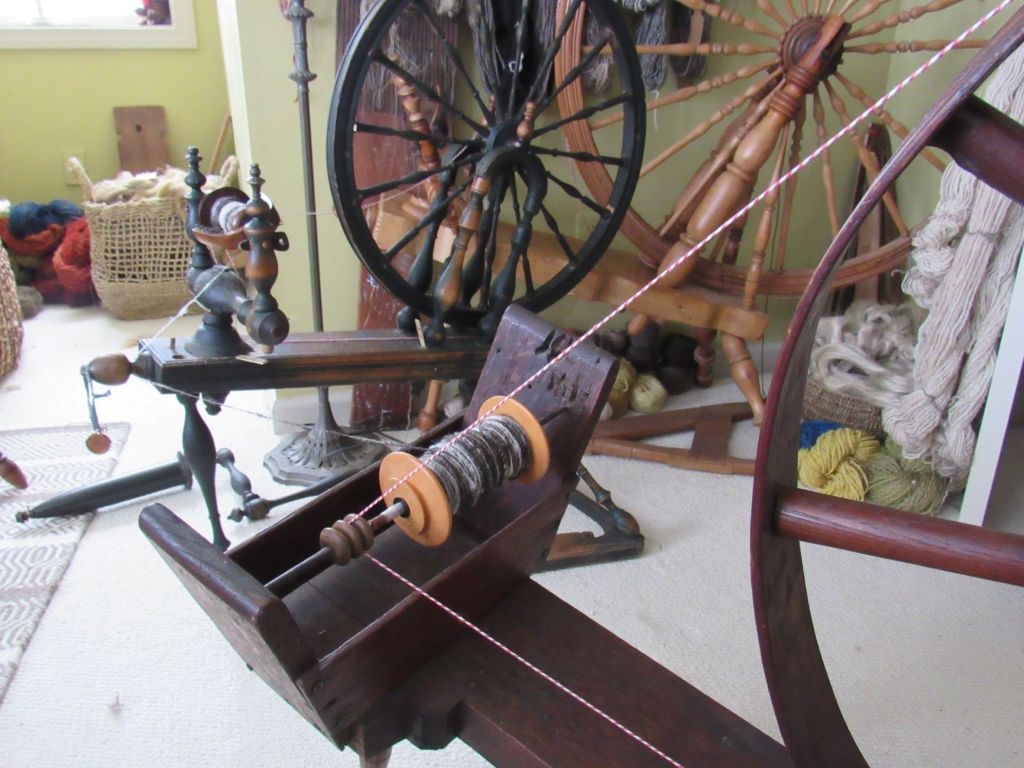
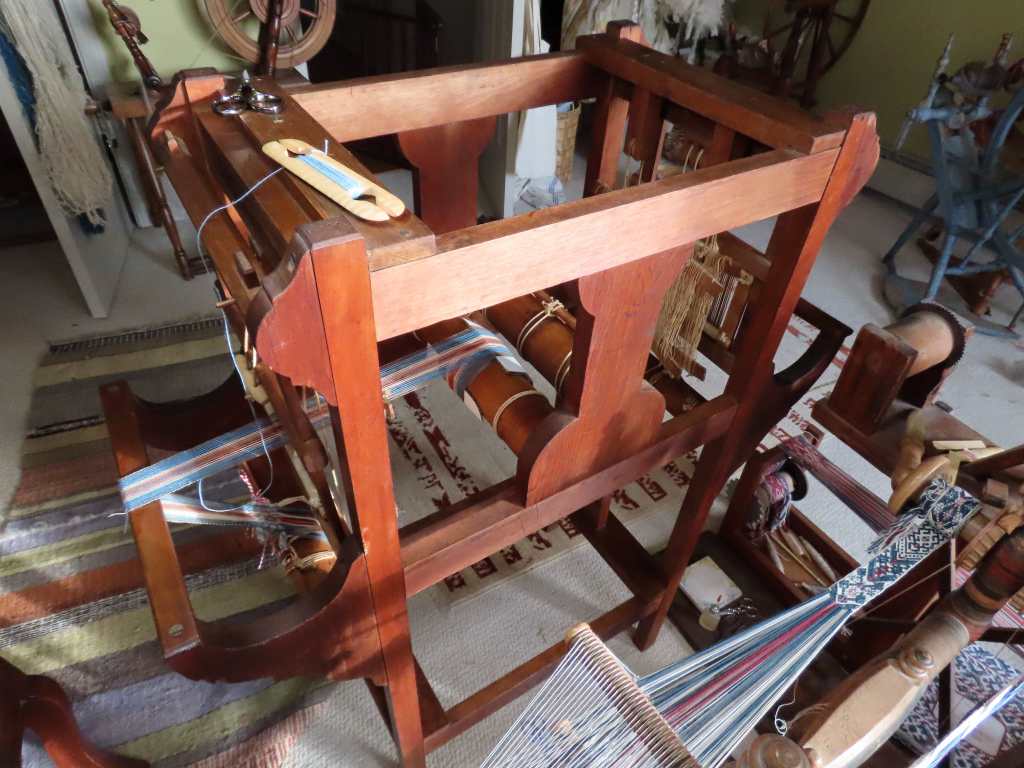
Finally, another piece that may or not be Shaker is a very unusual two-person tape loom.  I wrote an article about it for the Spinning Wheel Sleuth Handloom Supplement Issue #24, but this post will supplement the article with more photographs for those curious about this wonderful little loom. 
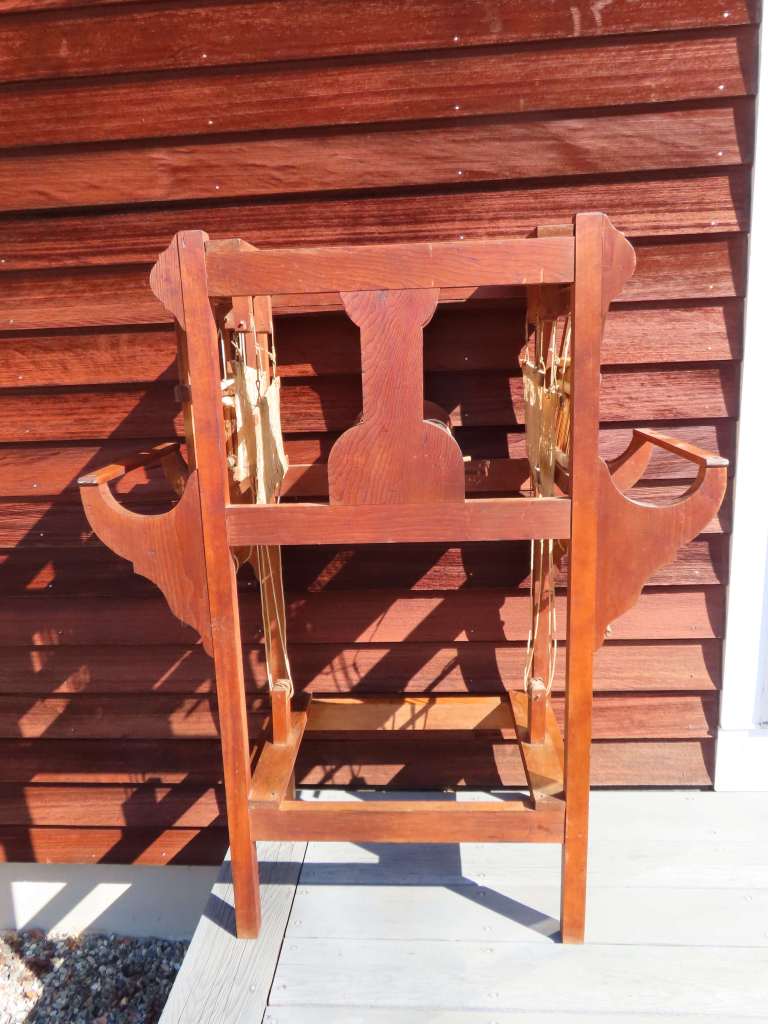
It came up for auction near me last year and I fell head over heels for it at the auction preview.   Designed for two people to weave simultaneously, with a petite, pleasing design, what put it over the top was that it was in fantastic condition, with string heddles and reeds made of actual reed. 
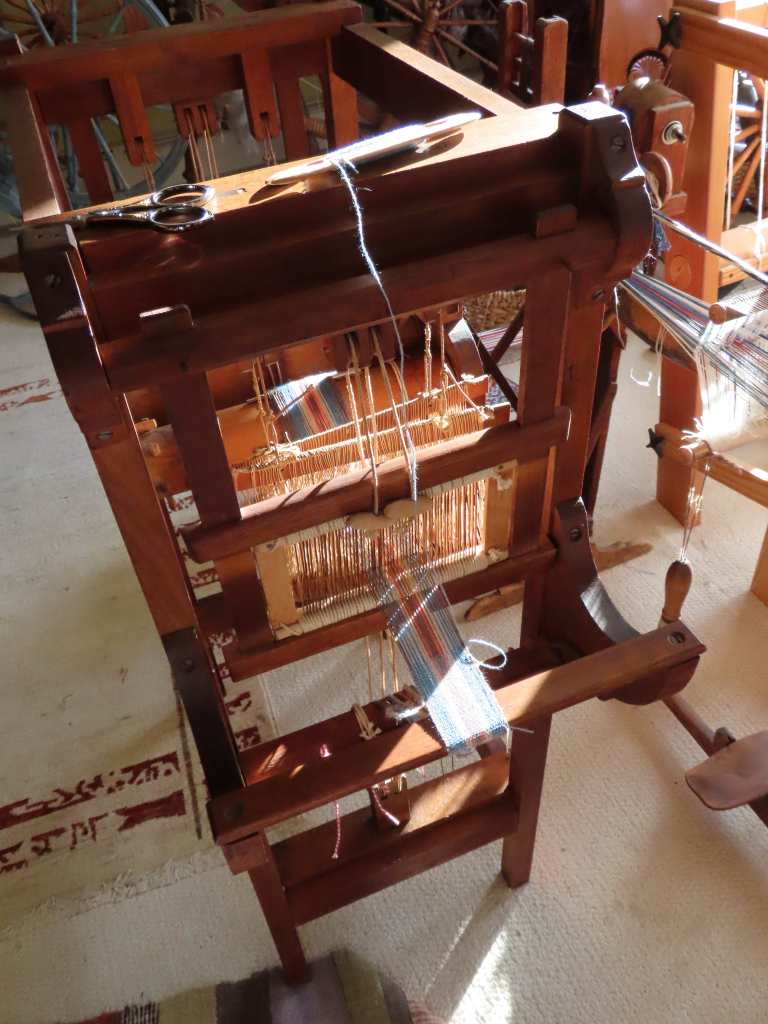
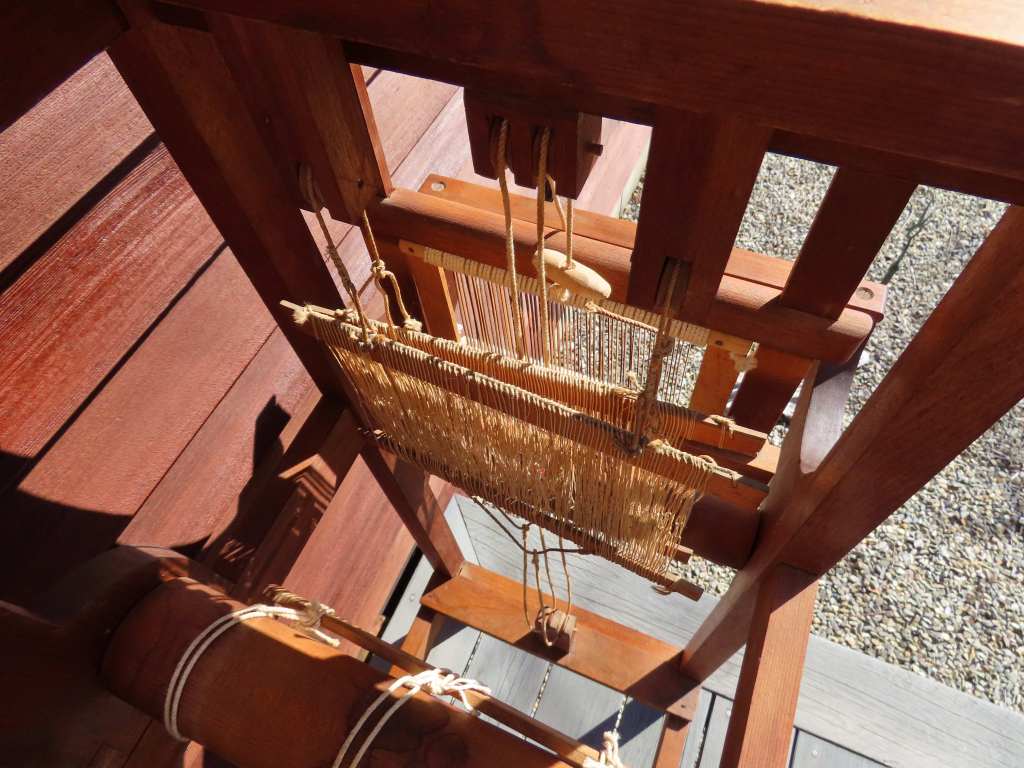
It is only 39 ½ inches tall and 13 ¾ inches wide, but big enough for two people to weave tapes at the same time.  It has no space-hogging treadles, which allows for a compact footprint.  Each side has two shafts, connected by an overhead pulley. 
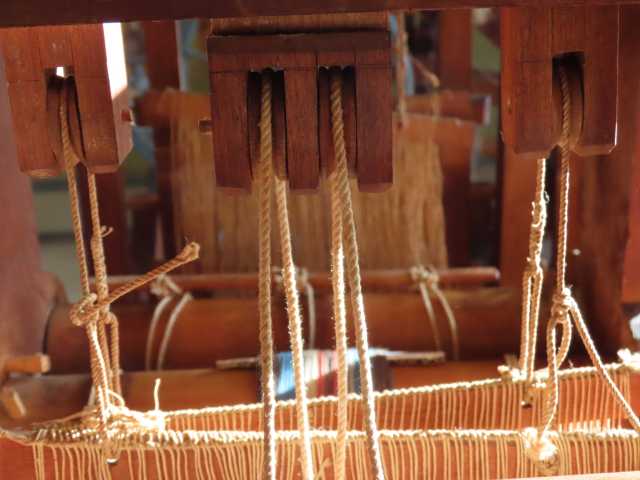
Each shaft also has a cord running down to a lower pulley and then to an upper pulley,
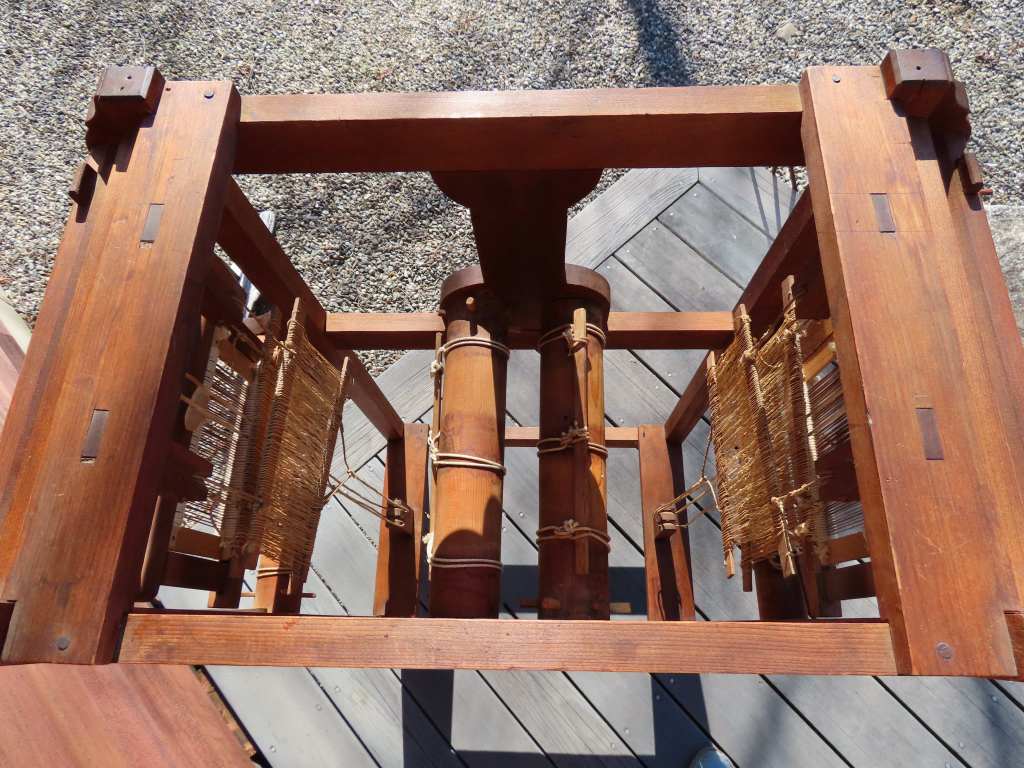
ending with a wooden knob which the weaver pulls to raise each shaft. 
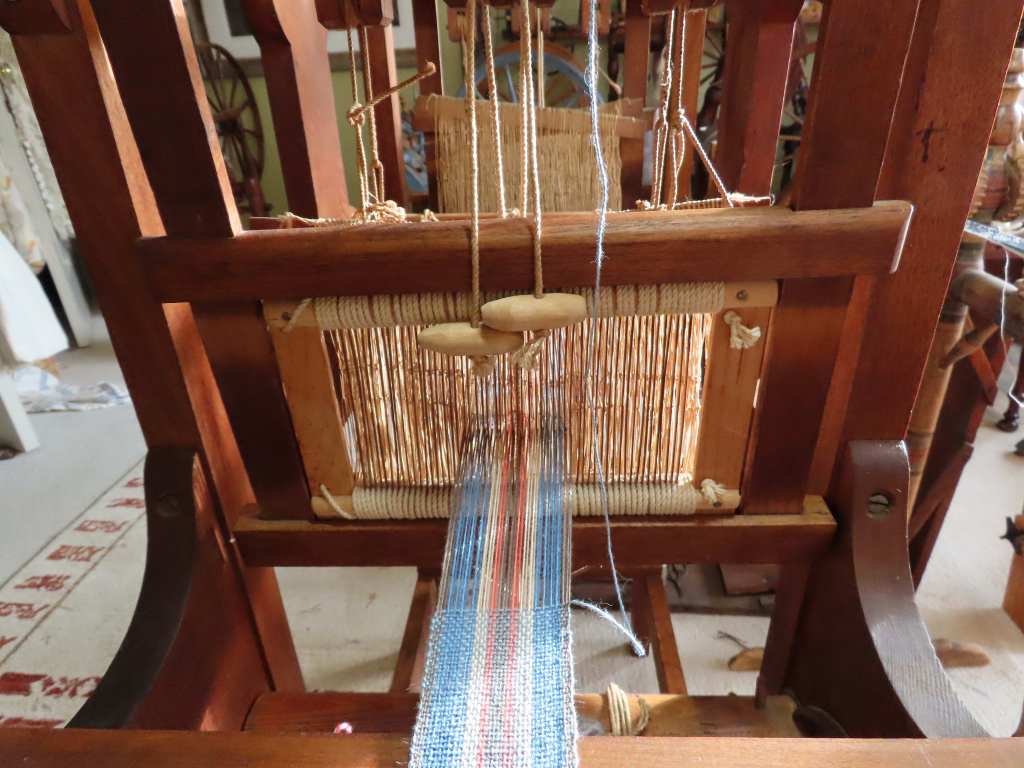
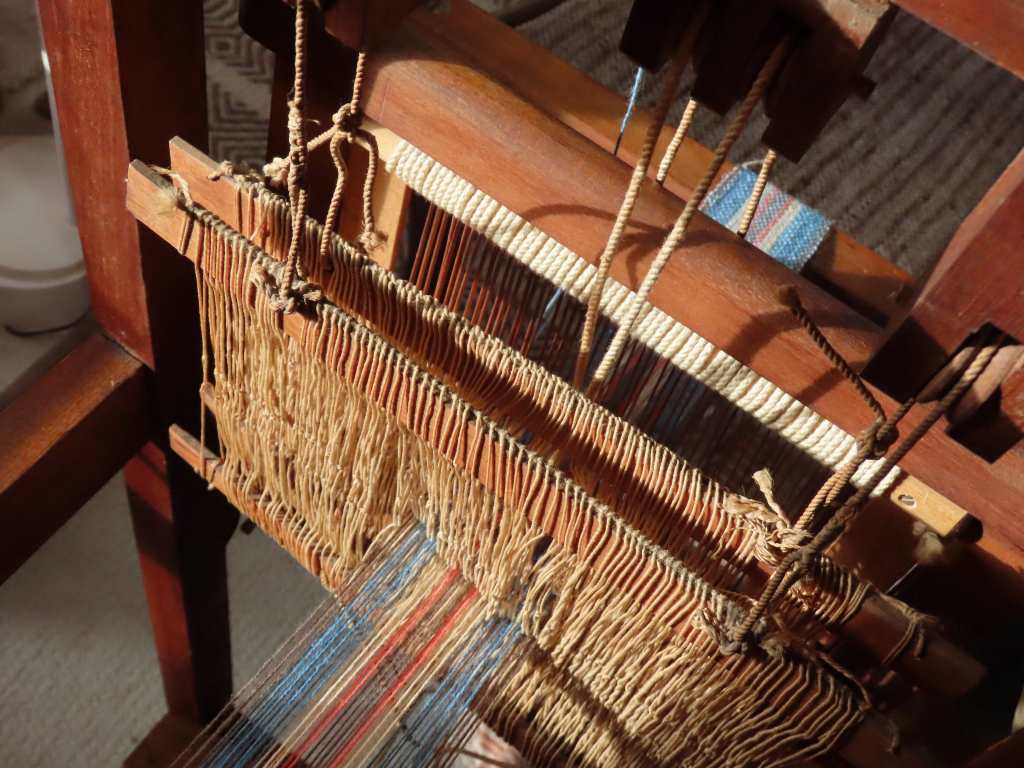
Each side has its own warp and cloth beams, with cords for attaching the warp.  Interestingly, the cords have water stains around them even though the rest of the loom shows no water damage at all. 
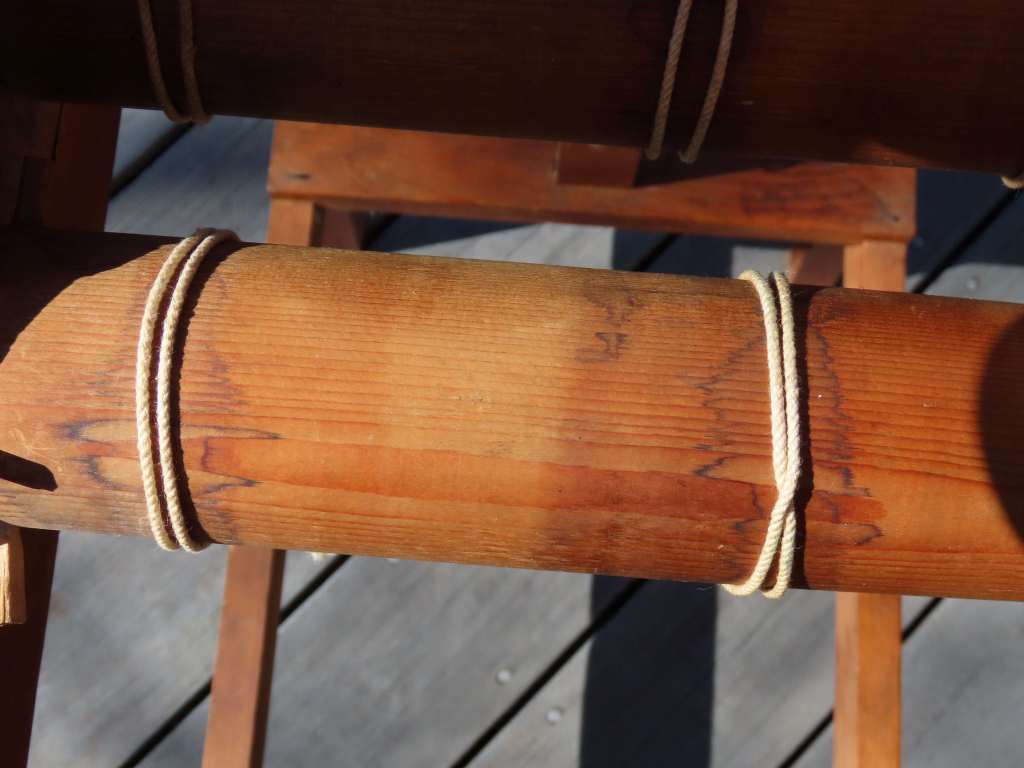
One possible explanation is that the cords were moistened to make them swell and have a tighter grip on the beam when weaving.  I found that without wetting the cords or otherwise securing them, they tended to slip around the beams when under tension. 
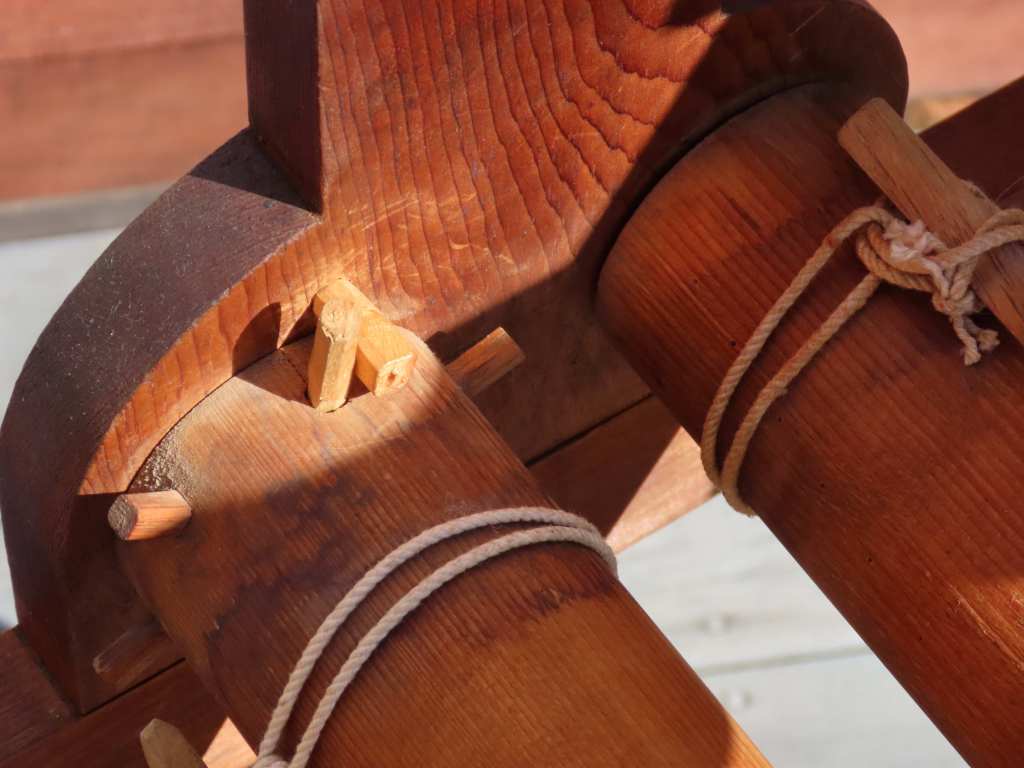
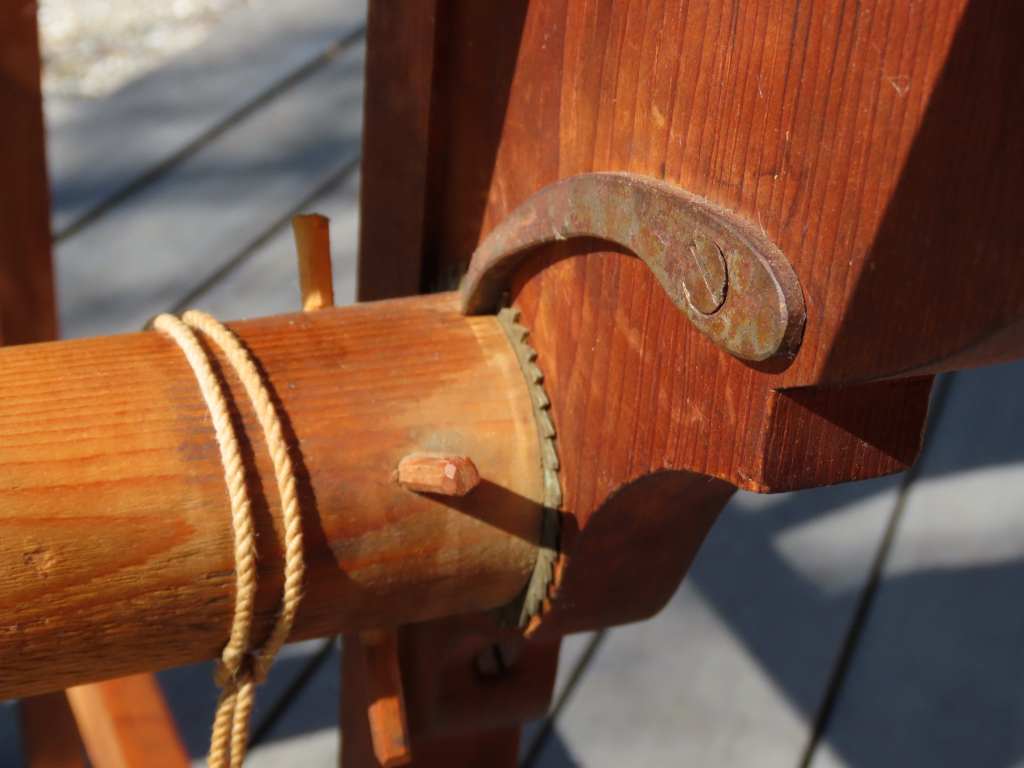
The warp beams are held in place with wooden pegs and the cloth beams have metal ratchets and pawls. 
The reeds in the overhead beaters have some newer cord on them, indicating that they have been repaired or replaced. 
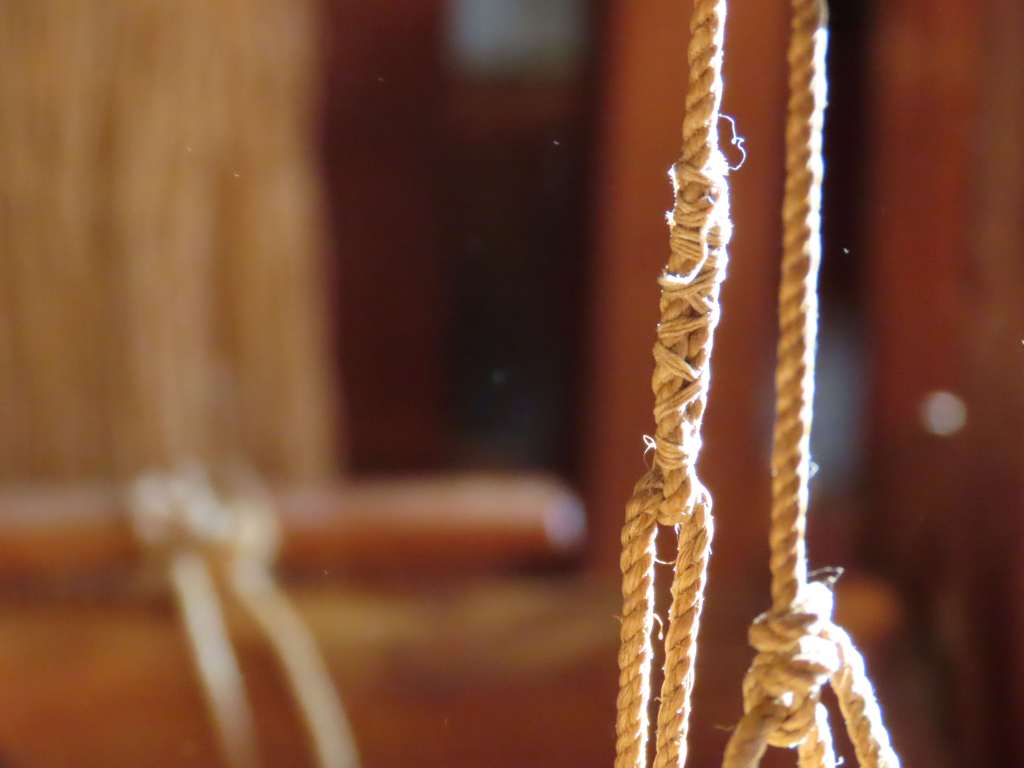
They also appear to be taller than the original reeds, based on the darkening of the wood on the beater sides.
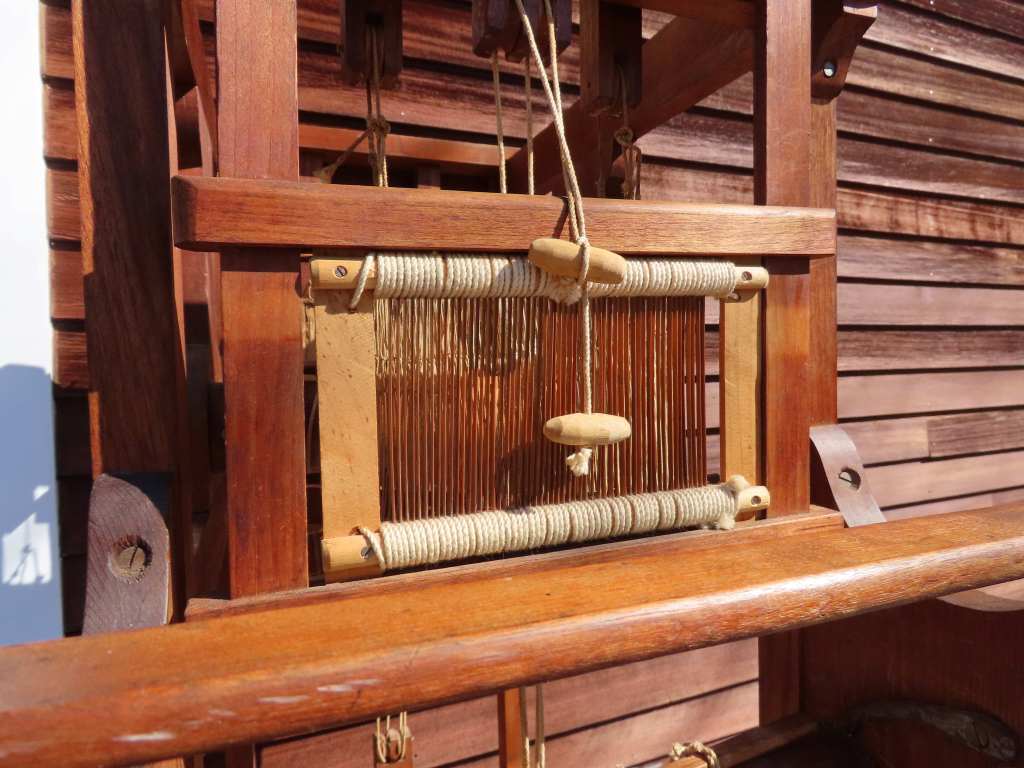
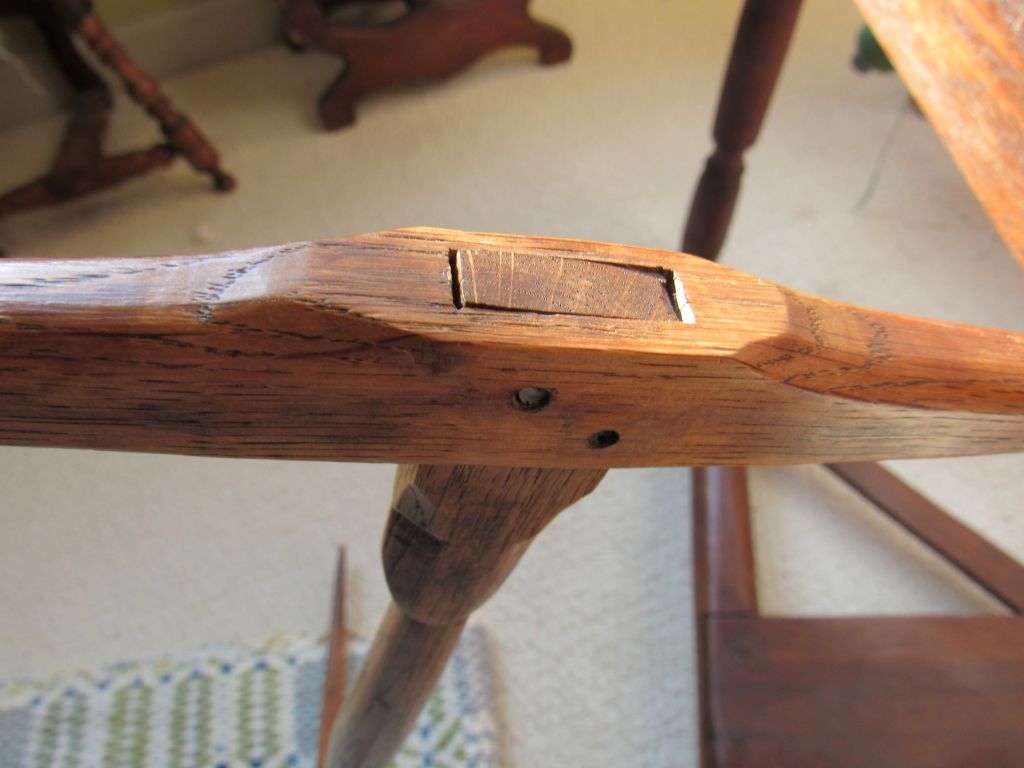
The sides of the beater have lighter patches where the cross bar holding the reed used to rest

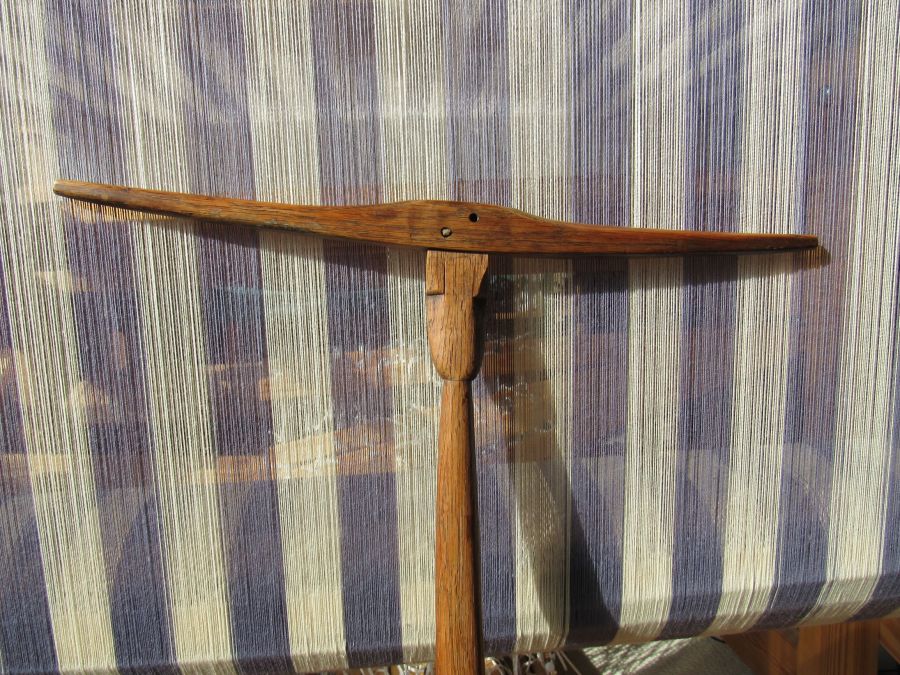
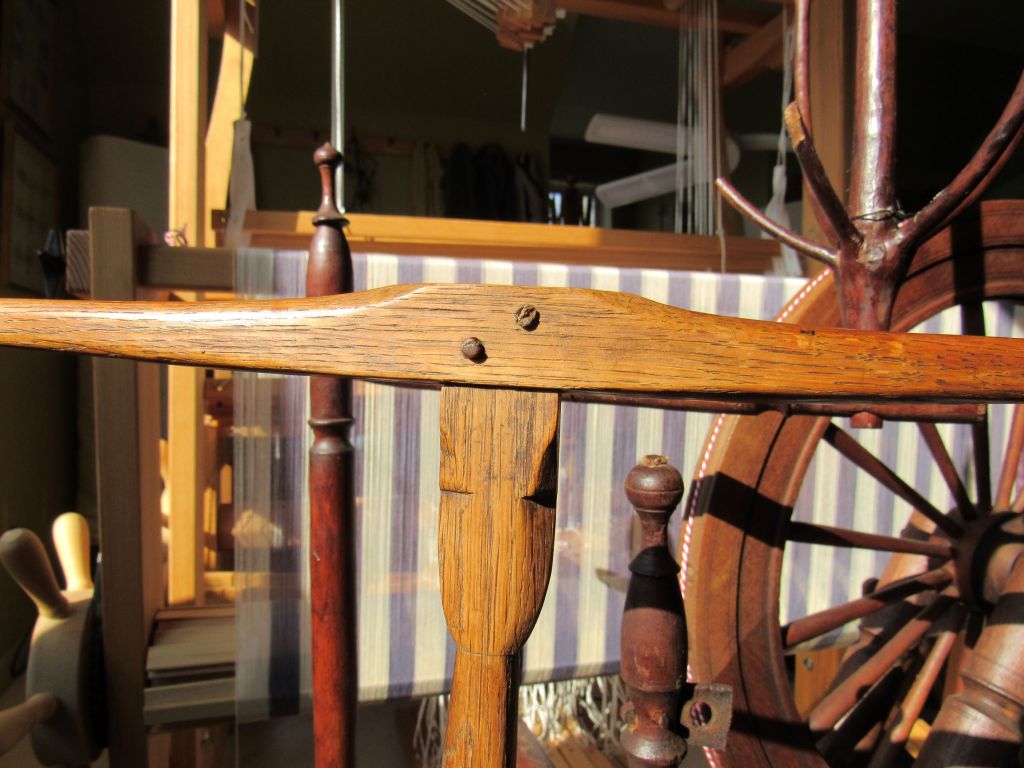
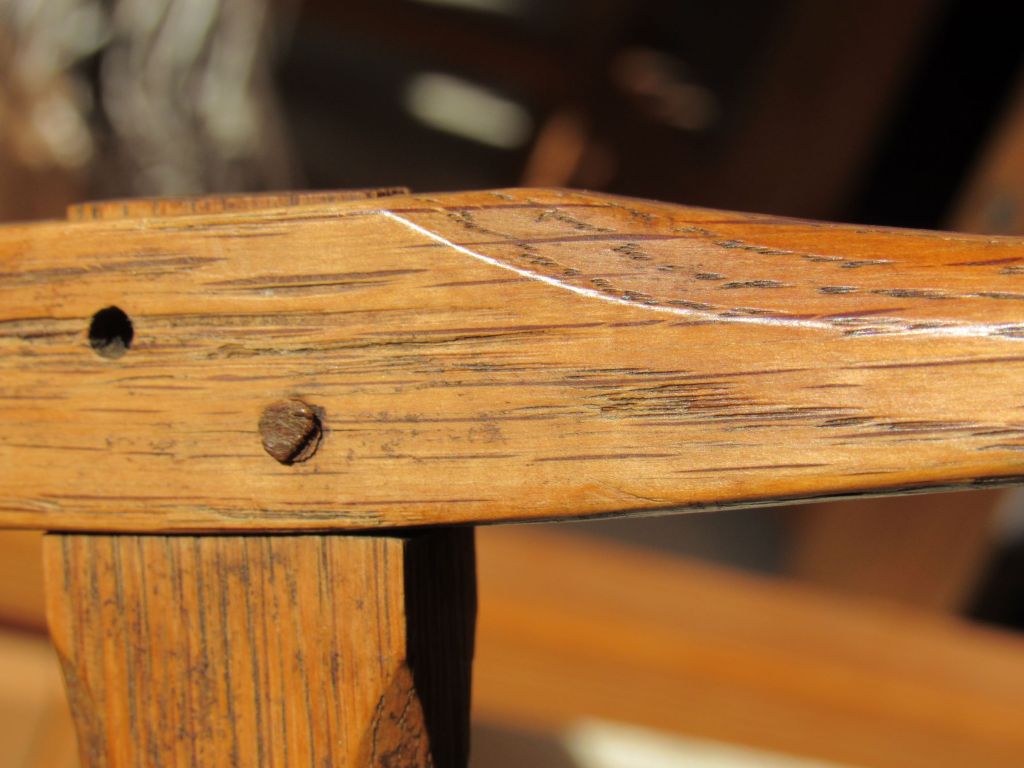
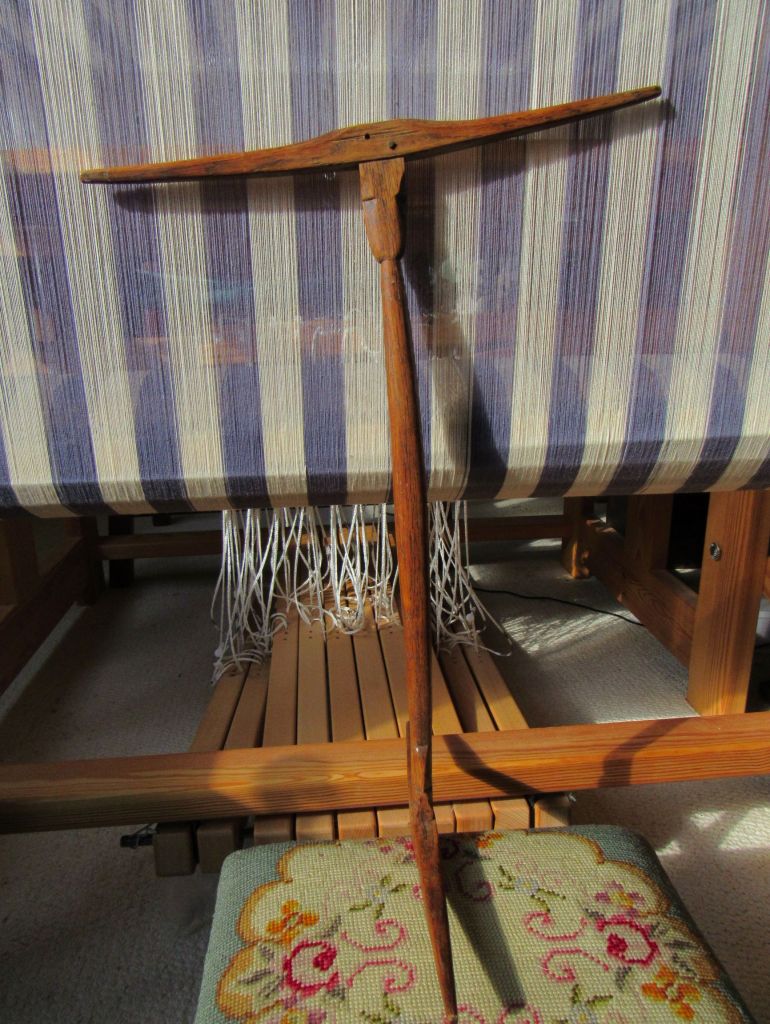
The loom came with two extra pieces that were a total mystery to me. 
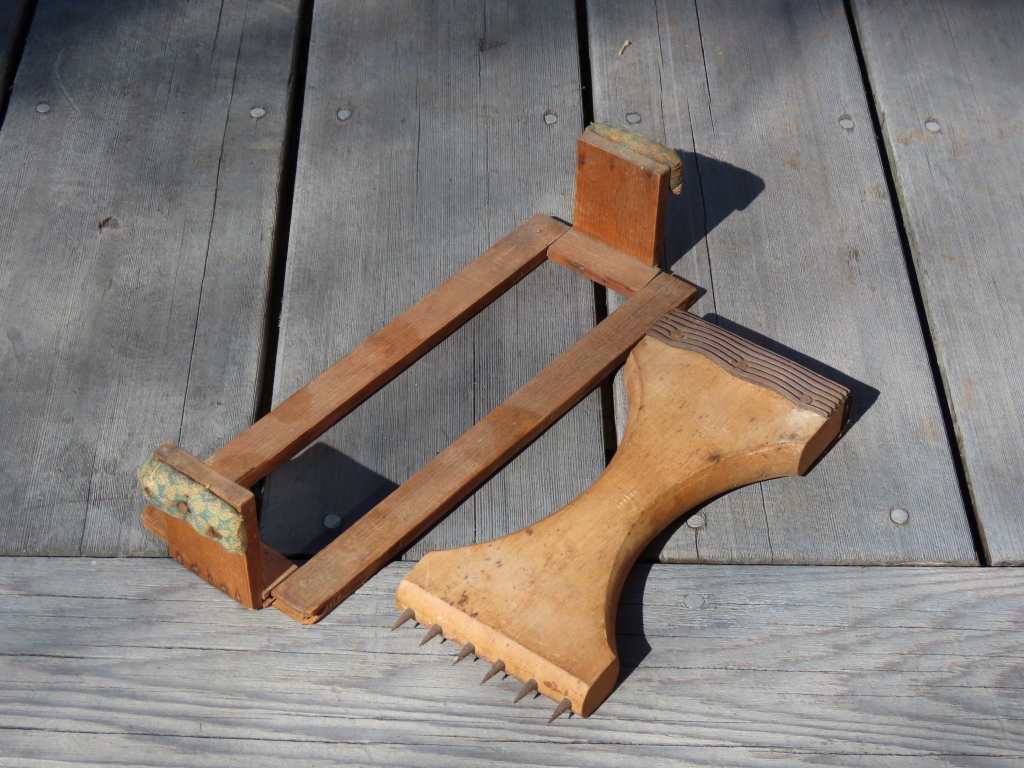
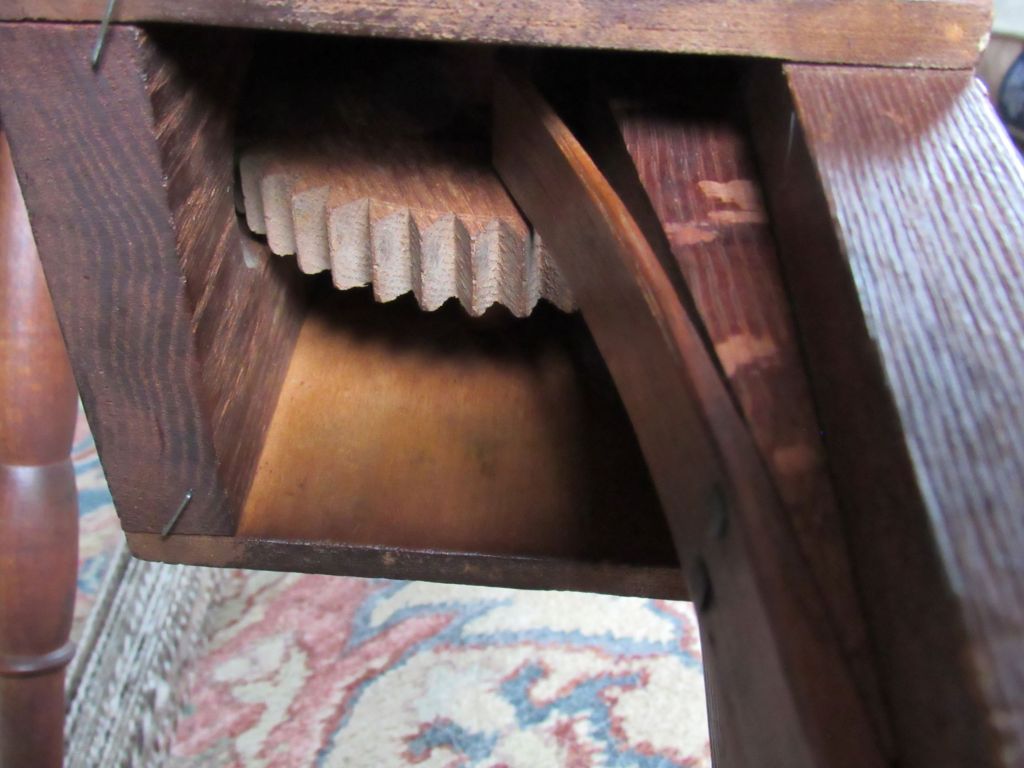
It turns out that the piece with the prongs is a stretcher used to tighten webbing when making chair seats.  The other piece, which looks very old, is something I believe was used to hold the reed in place for sleying.  But, that is just a guess. 
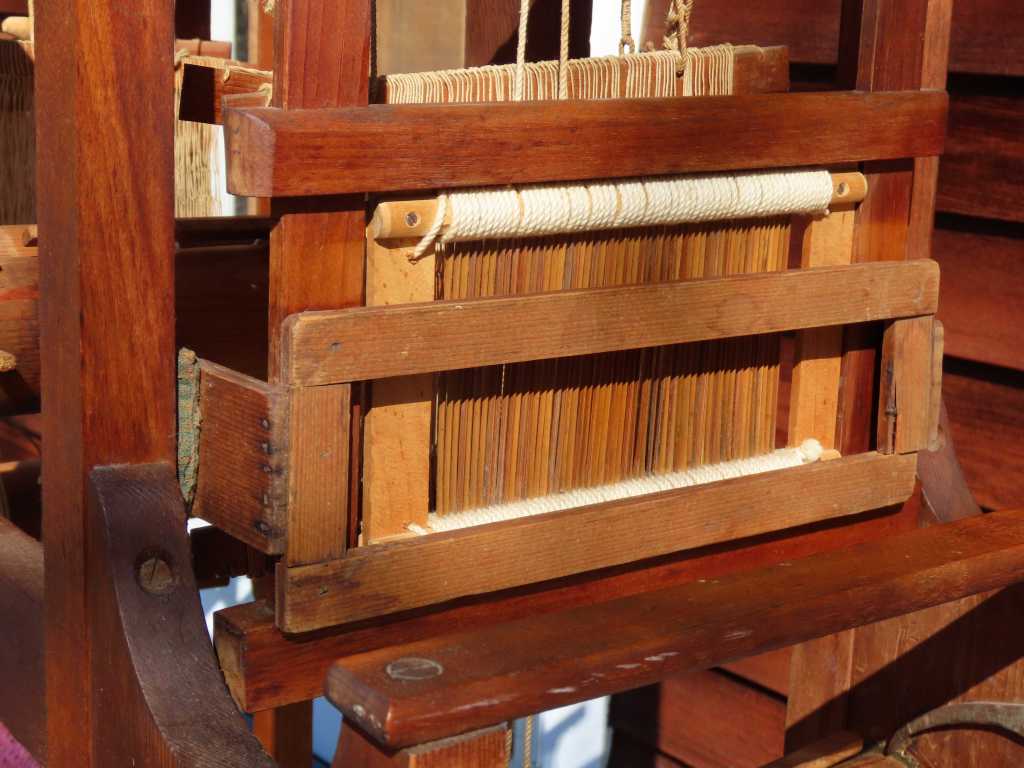
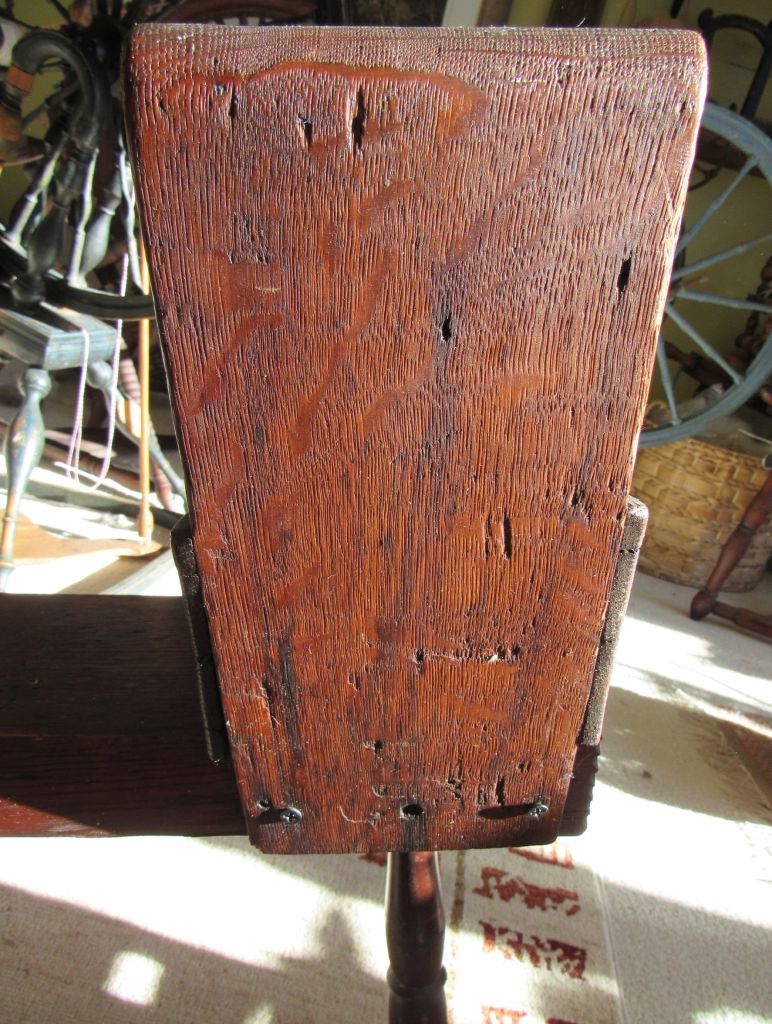
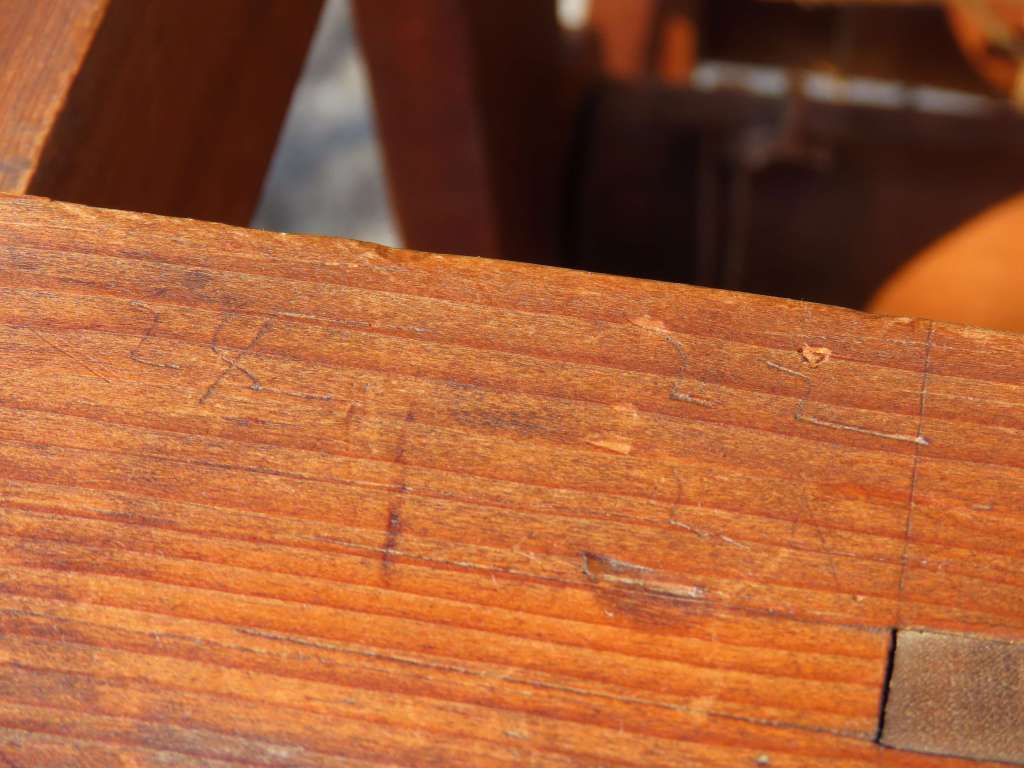
This treasure of a loom was well-cared for and apparently well-used.  There are even numbers scratched on the loom top—24, 22, 24—presumably to keep track of something. 
The auction house said that the loom came from the Baxter estate in Benton, Maine.  Wildly curious about who would design and use a two-person tape loom, I started researching it right away and found that several have turned up.  One other, just like it, but in much worse condition, was at the Fort Ticonderoga Museum and pictured in Bonnie Weidert’s book “Tape Looms Past & Present.”  (photo 2-22, p. 24).  A little research revealed several others—but designed for a single user—at Hancock Shaker Village Collection (1986.024.0001); Enfield Shaker Museum (2018.51); Marshfield School of Weaving Textile Equipment Collection (1959.1.12); and Jeanne Asplundh’s collection, photographed in “Spinning Wheels and Accessories” (fig. 14-67, p. 182). 
Finding that two of the looms were at Shaker museums, I dove into research to see if there was an established Shaker connection (more on that in the SWS article).  Ultimately, I could not find evidence to either prove or disprove that these were used by the Shakers. 
The looms would be perfect for weaving the large amounts of the tape used by Shakers for chairs but the only documented Shaker chair-tape looms that I could find are a different style.  If not Shaker, would they have been used in some other institutional setting such as a rehabilitation facility or a school?  Having hand-operated looms would make sense for those unable to use their legs or for short-legged children. 
Whatever its history, I am just thankful that it was preserved with such care so that it can be appreciated by us and future generations. 

Page, Brenda, “A Two-Person Tape Loom,” The Spinning Wheel Sleuth Handloom Supplement, Issue #24, April 2024

Weidart, Bonnie R., Tape Looms Past and Present, 3rd edit., Bonnie Weidert, Henrietta, NY, 2012

Pennington, David & Taylor, Michael, Spinning Wheels and Accessories, Schiffer Publishing Ltd., Atglen, PA, 2004

*I refer to pieces with multi-angled faces as “chamfered.”  While I understand that others use the term to refer to 45 degree angled edges, until I learn of a more fitting term for the multi-angled faces that we find on legs, spokes, and supports of wheels and reels, I will continue to use the term chamfered. 
Judith and Prudence

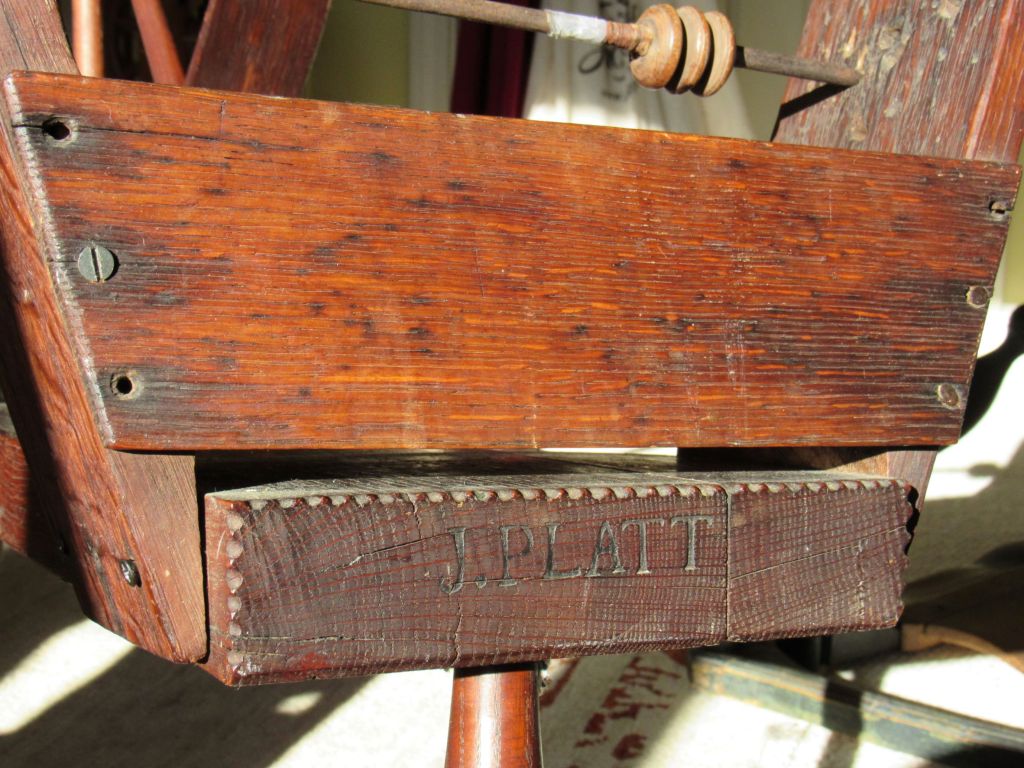
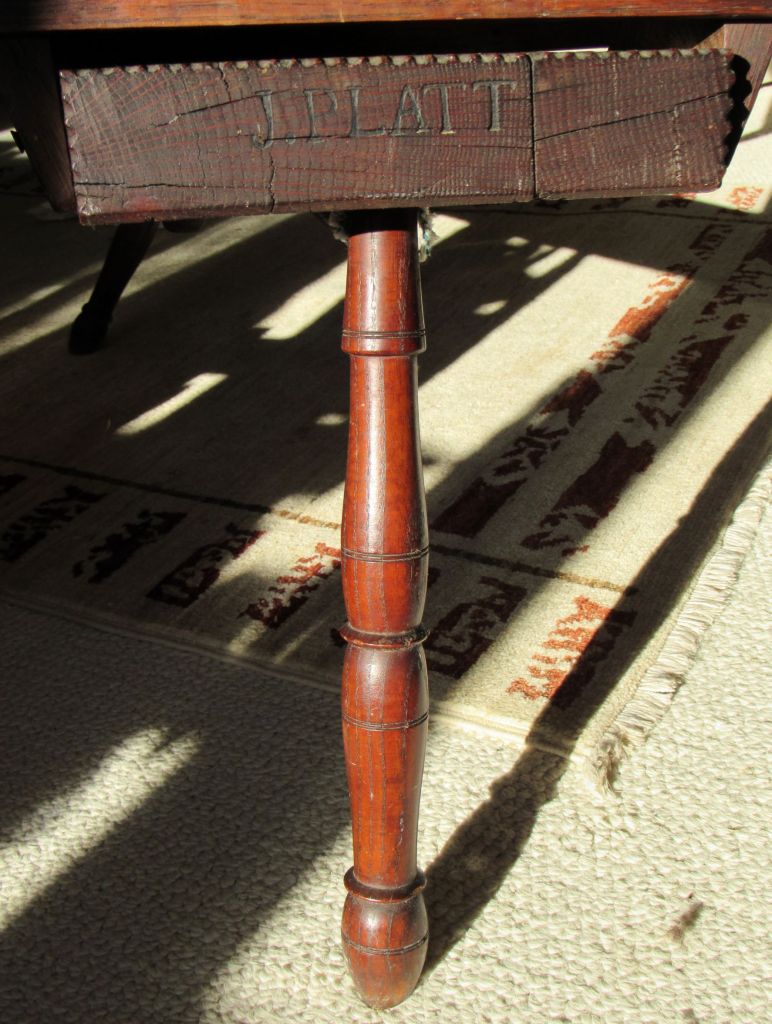
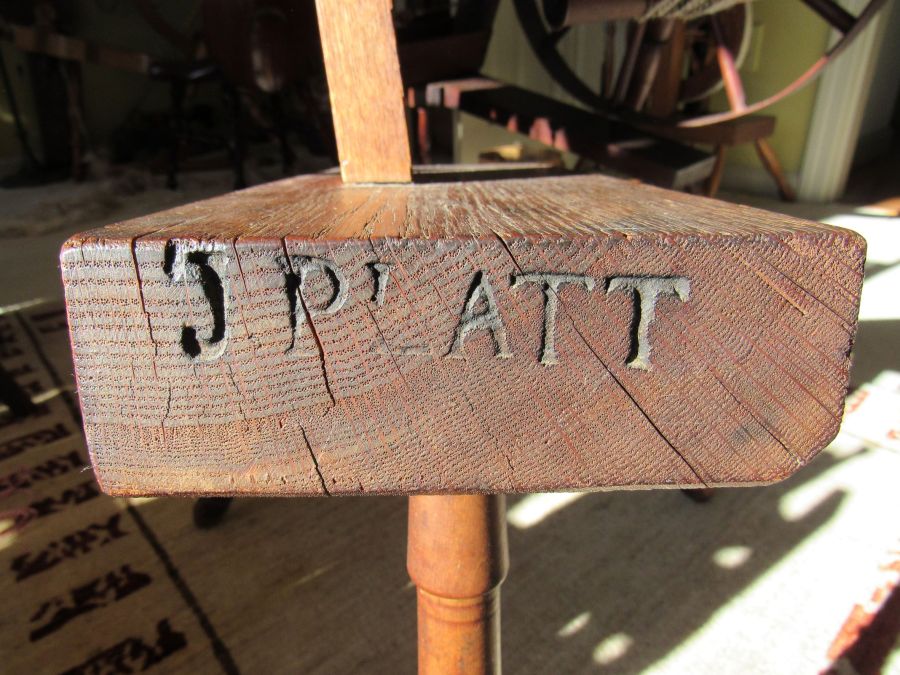
Despite a lot of research, I have not been able to identify the elusive J. Platt. 

It seems pretty certain that he was a Connecticut wheel maker working in the late 18th and early 19th century.  His wheels share characteristics with those made by a group of wheel makers in Fairfield and Litchfield counties, including the Sanfords, the Sturdevants, and Silas Barnum.  Those wheel makers, and various branches of Platts, were connected with a web of marriages through several generations.

Surely, J. Platt fits in with them somehow, but just how remains a mystery. For those interested in more details of my Platt research, I am including a reference below to my article in the Spinning Wheel Sleuth.  In short, there are several candidates, but each possibility lacks that final bit of evidence to put the hunt over the top from theory to probability.

Judith, Mercy, and Katherine the Witch

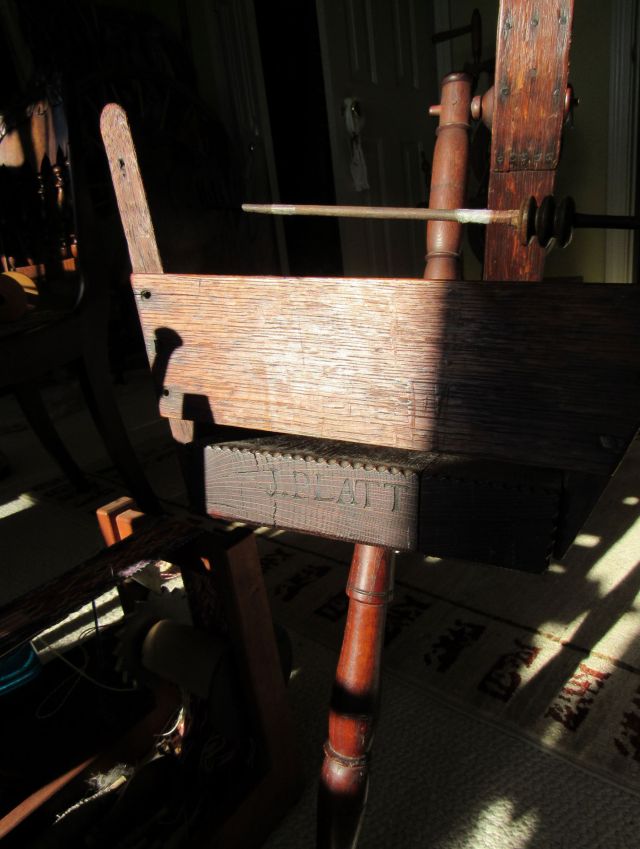
I have already written two posts in this blog about J. Platt wheels.  “Katherine the Witch,” my first wheel, continues to be my workhorse for flax spinning.  “Mercy,” a lovely great wheel, bears a striking resemblance to Silas Barnum’s work.  I never really expected to find any more Platt wheels, so was gobsmacked when a marked bobbin winder turned up in Maryland. 

Bobbin winders are rarely marked, so I could not believe my luck.  And, as it turns out, there was a lot of luck involved.  When I contacted the seller, he said that he would have to see if he still had it because he thought he had thrown it out.  My heart dropped.  Apparently, he cruises estate sales and auctions for things to resell on-line. 
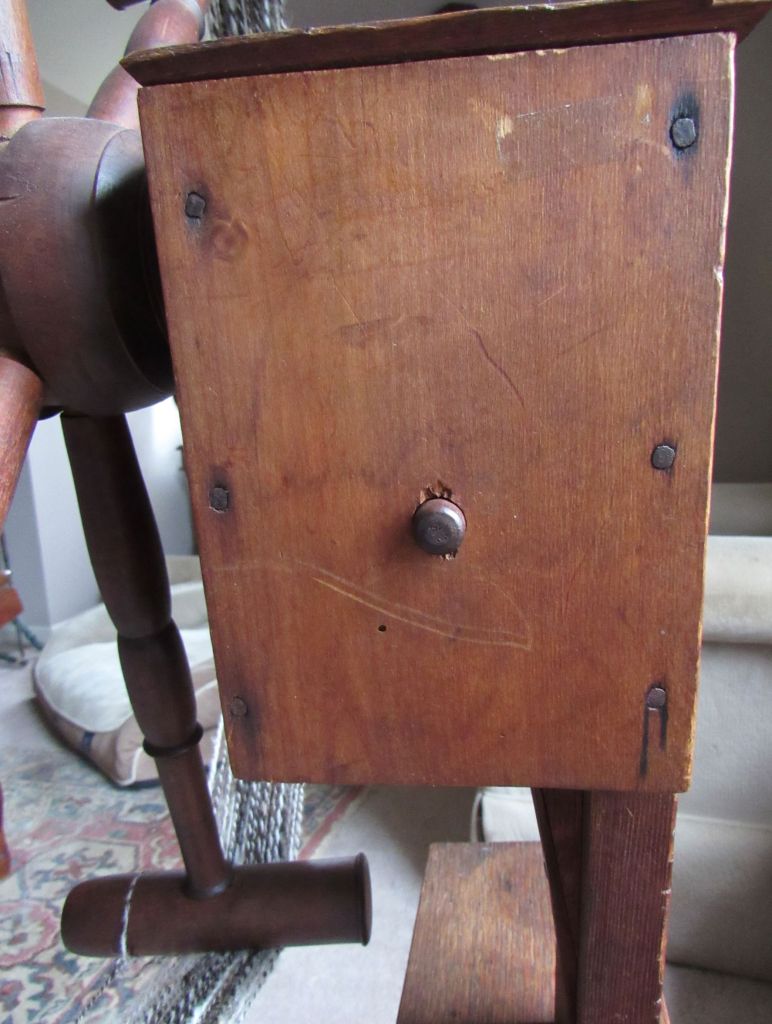
He had been given two bobbin winders at an estate sale and, having no idea what they were, threw them into a storage unit.  When he needed more room, he decided to throw them out.  Fortunately, his wife convinced him to save the one with the name on it and to try to sell it.  I shudder to think how close this winder came to oblivion. 

Instead, it was rescued, named Judith, and joined my family of Platt wheels. Although it could be over two hundred years old, it now works regularly, doing what it was intended to do.

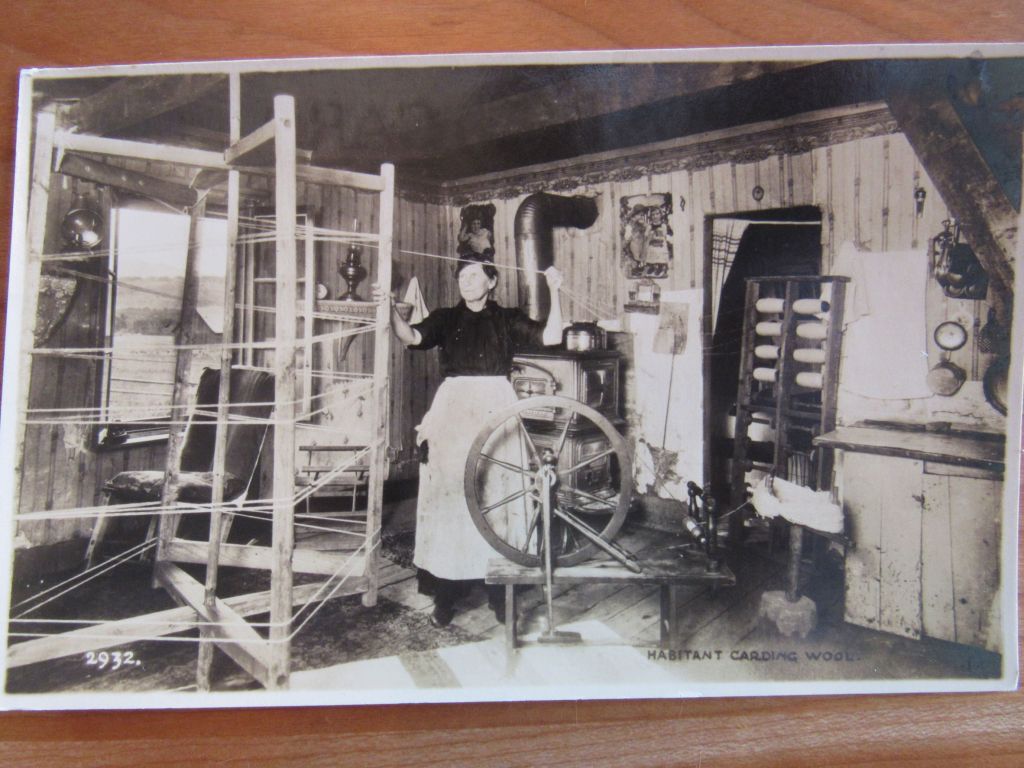
Bobbin winders, such as this one, were used by weavers to wind bobbins (or spools).  Once wound, the bobbins were mounted on a skarne (also called a spool rack or creel), which allowed for efficient warp winding, with multiple threads wound on the warping rods or mill at the same time.  This marvelous photo of a Quebec woman shows her bobbin winder being filled from a skein on a swift and the bobbins mounted on a skarne from which she draws eight warp threads at once to wind on to her huge warping mill. 

Unfortunately, when this photo was made into a postcard, it was inaccurately labeled “Habitant Carding Wool.”   

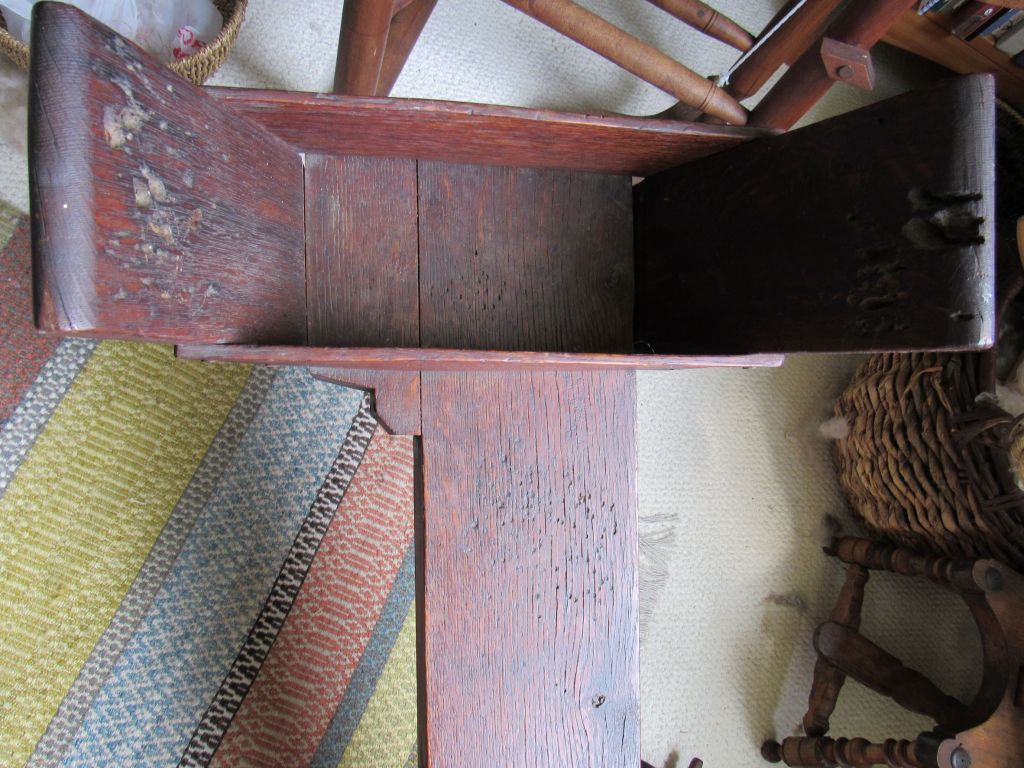
In contrast with the Quebec winder in the photo, J. Platt’s has a flat rim

and a box for the spindle. Box-style winders are often found in New England.  I was fascinated to see a similar winder on a 1792 Conder token from Norwich, England, a town famous for its handweavers who produced the beautiful silk and wool Norwich shawls. 

Platt’s bobbin winder could have been made around the same time.  

The box is convenient for holding empty (or full) bobbins. 

Some boxes have supports for the spindle ends, but many, like Platt’s, are just plain wood with gouges made for the spindle tips through use. 

This bobbin winder did not have a spindle when I got it, but I found one to fit. 

I have not used it yet for winding bobbins for weaving, but regularly use it to wind singles off my wheels onto extra bobbins for plying. 

These winders were also used to fill bobbins for weaving shuttles. Perhaps there were spindles of different diameters or lengths to accommodate the smaller bobbins used in shuttles, which might explain why there is a wide variety of depth and placement of holes in the box ends.  

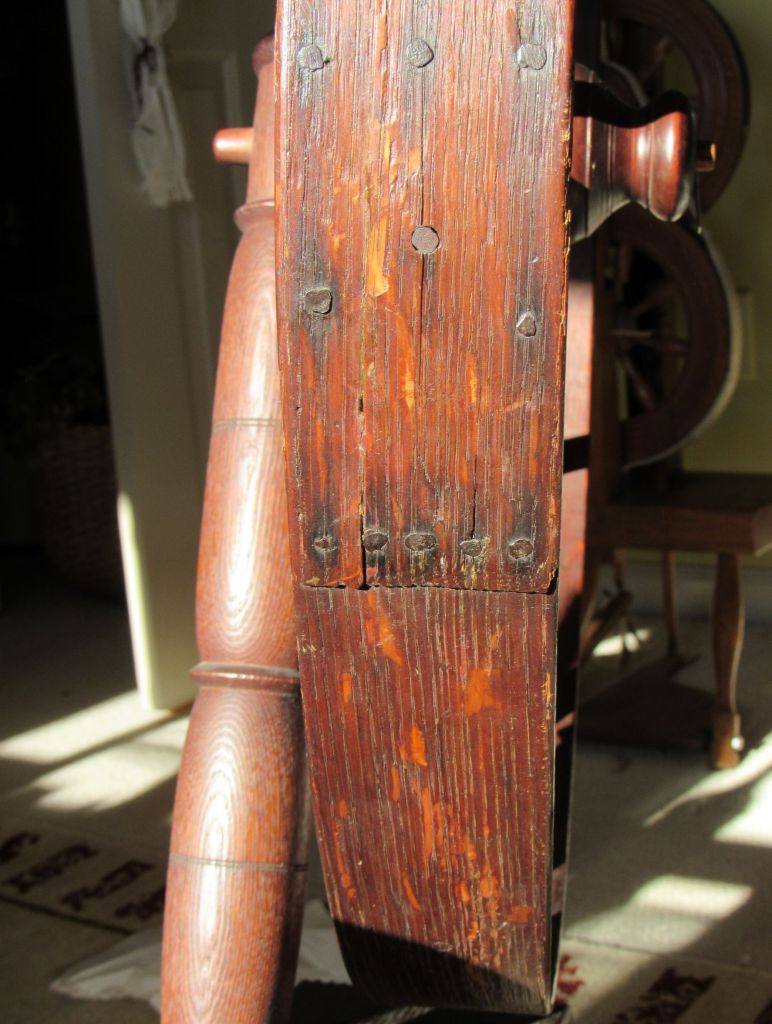
The winder looks a lot like a miniature Platt great wheel, with similar turnings. 

Unlike Platt’s wheels, however, it has scalloped carvings on the table ends. 

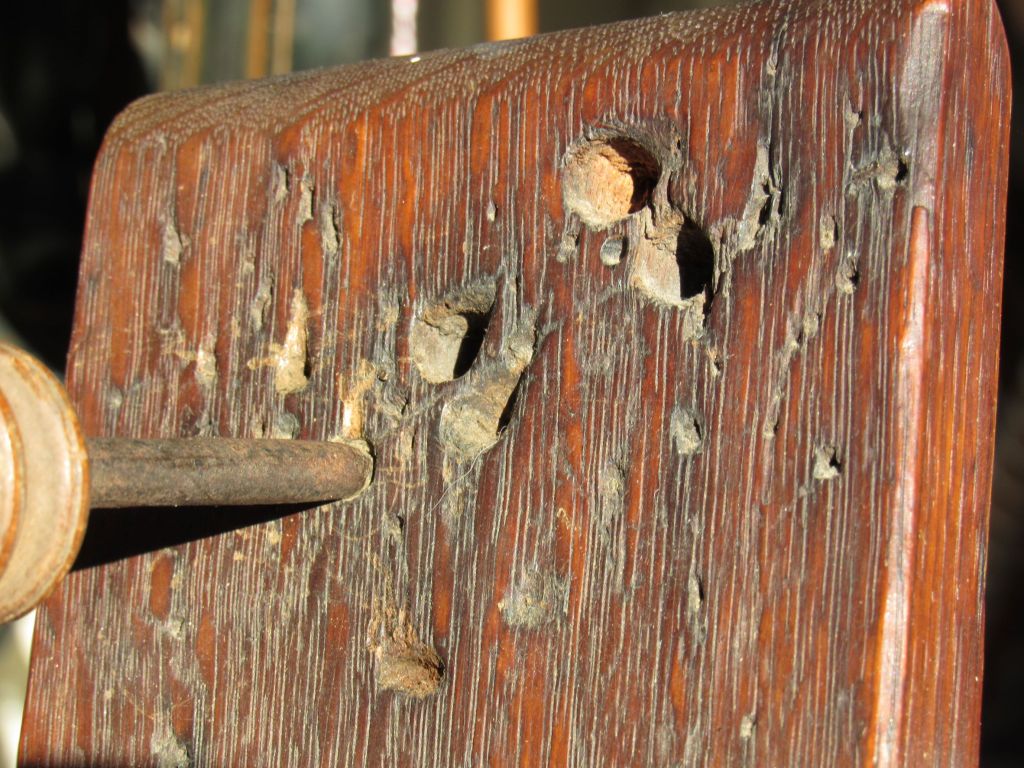
The inside of the box and the table are covered with indentations, perhaps from tapping the spindle end to loosen the bobbin for removal. 

The axle is wooden, with a broken end when I got it. 

My husband made a beautiful repair. 

The inside of the hub is just smooth wood, with no sign of a metal or leather bearing. 

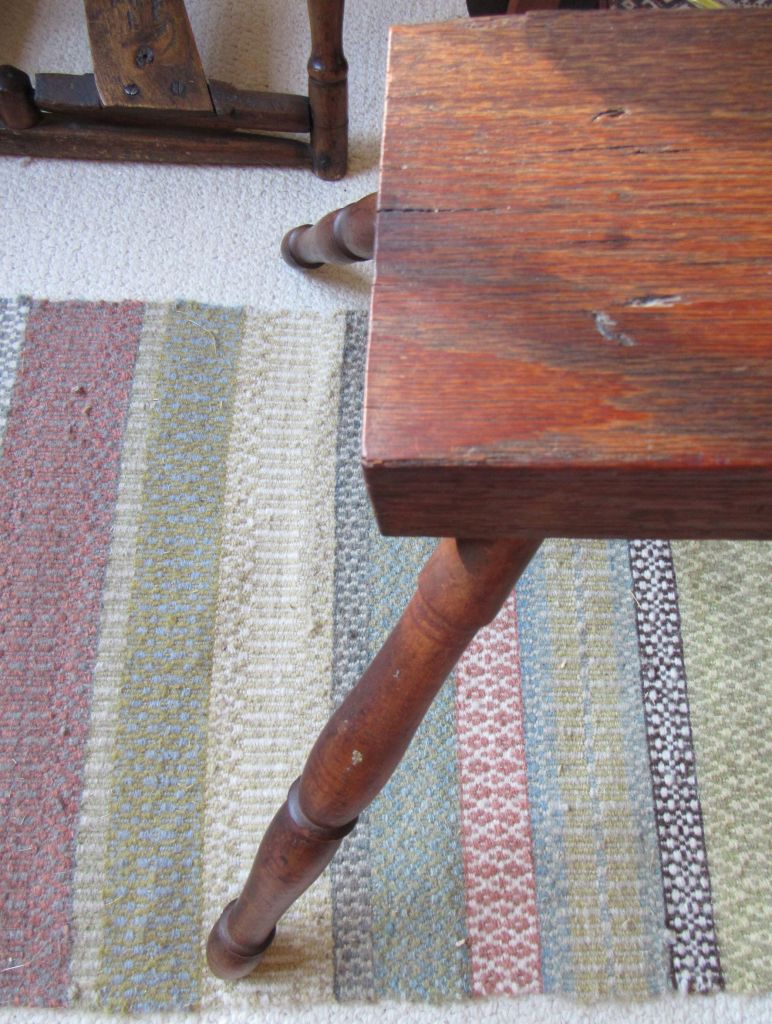
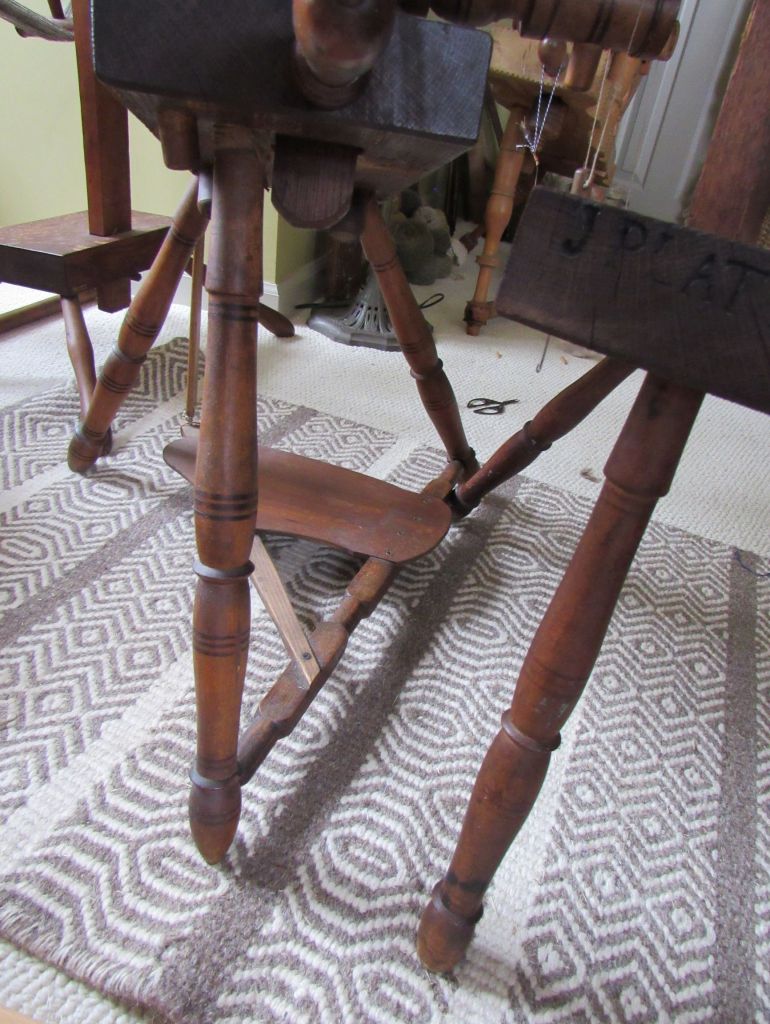
The legs have incised rings, rather than the dark burned-on rings of Platt’s flax wheel and winders. 

Winder leg
Reel legs

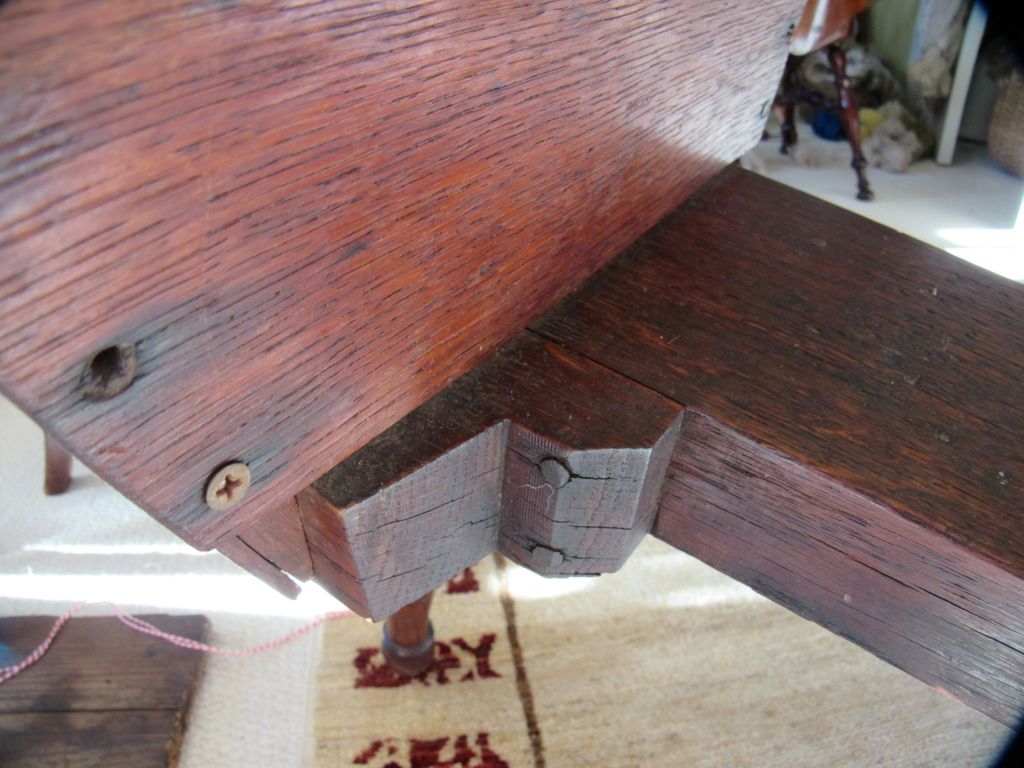
There is an interesting corner piece nailed in next to the box.  I do not know if there is a functional reason for it, but it looks nice.

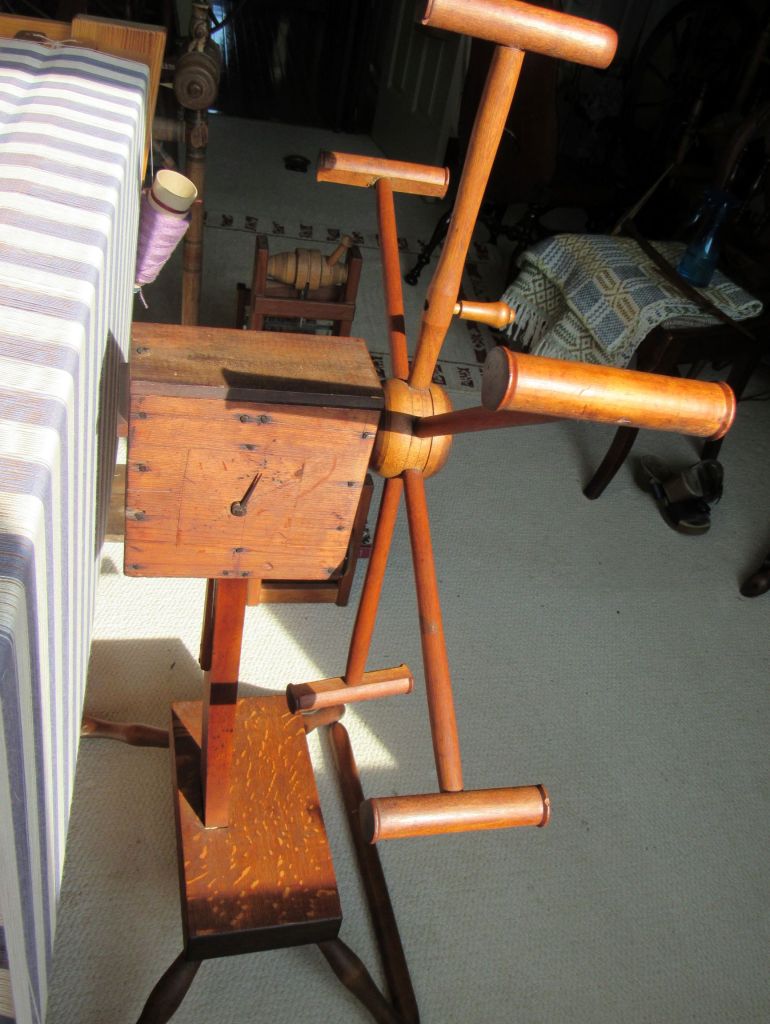
While I had never expected to find a Platt bobbin winder, I had been keeping my eye out for a Platt reel.  When one appeared in Vermont, I jumped on it and, with the help of several people, got it to Maine. 

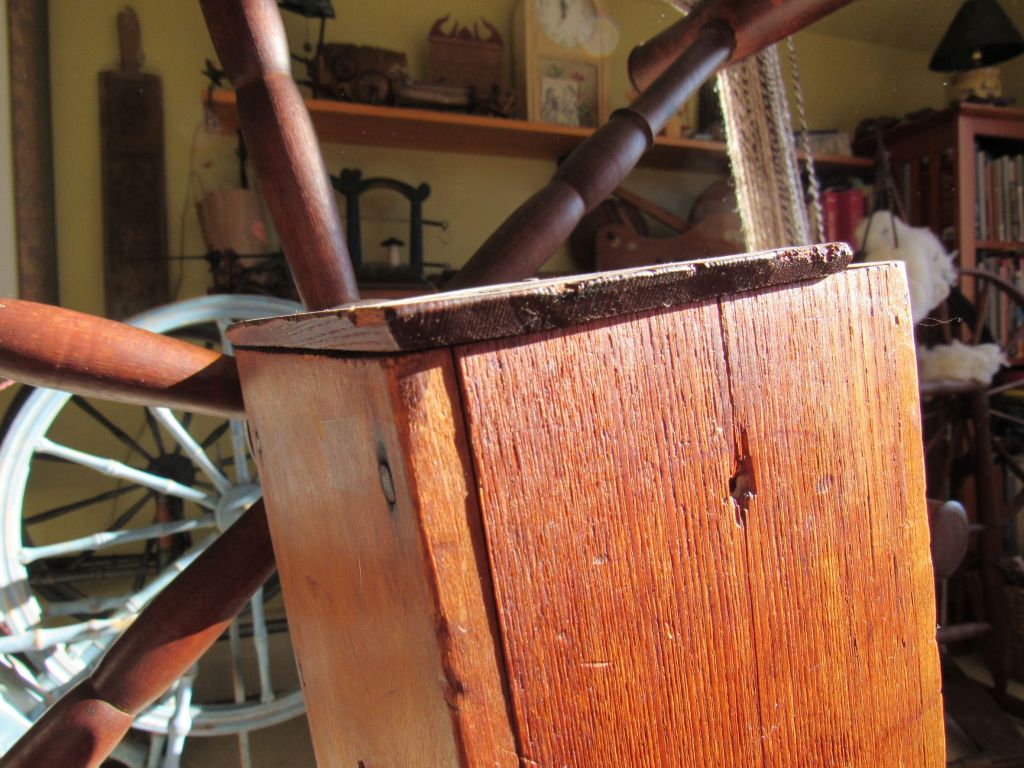
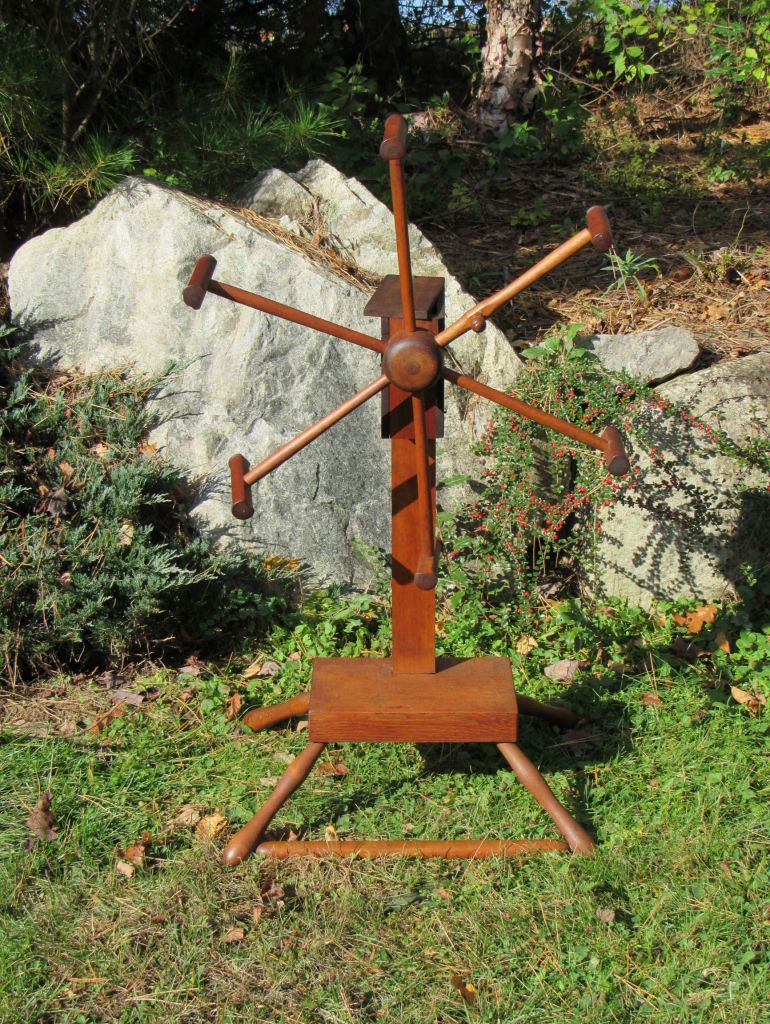
The reel, named Prudence, has six arms and a slanted table—an unusual feature found on some Connecticut reels.  (see Pennington & Taylor, p. 161, Fig 14-6).  I am not sure of the reason for the slant, perhaps for ease of storage or some particular positioning for winding off from a wheel.  It certainly makes for a very stable reel. 

The legs and winder arms have faint traces of dark rings and the legs are, in general, similar to those on Platt’s flax wheel. 

But neither the table nor the legs are the same sizes as those on the wheel. 

The top, which has a broken edge, is flat, without any knob for carrying. 

It holds a two-yard skein and the arms, like the top, are plain, without a handle for turning. 

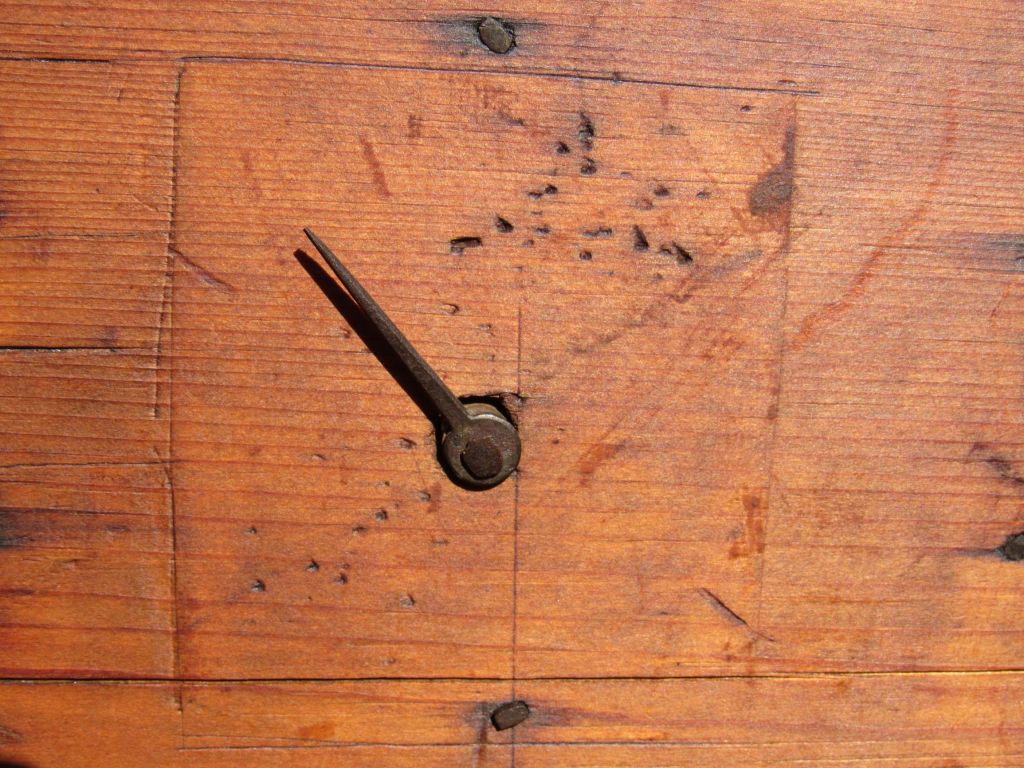
A simple clock hand on one side of the gear box measures rotations. While the reel arms turn clockwise, the clock hand turns counter-clockwise.

The other side of the gear box is unadorned.

The gears run smoothly and the click mechanism still works beautifully, making its “thwack” every forty rotations. 


The wooden clicker being pulled by the metal pin on the gear before the click

After the click–the metal pin that triggers the click

The hub is pegged on the axle and nicely turned. 

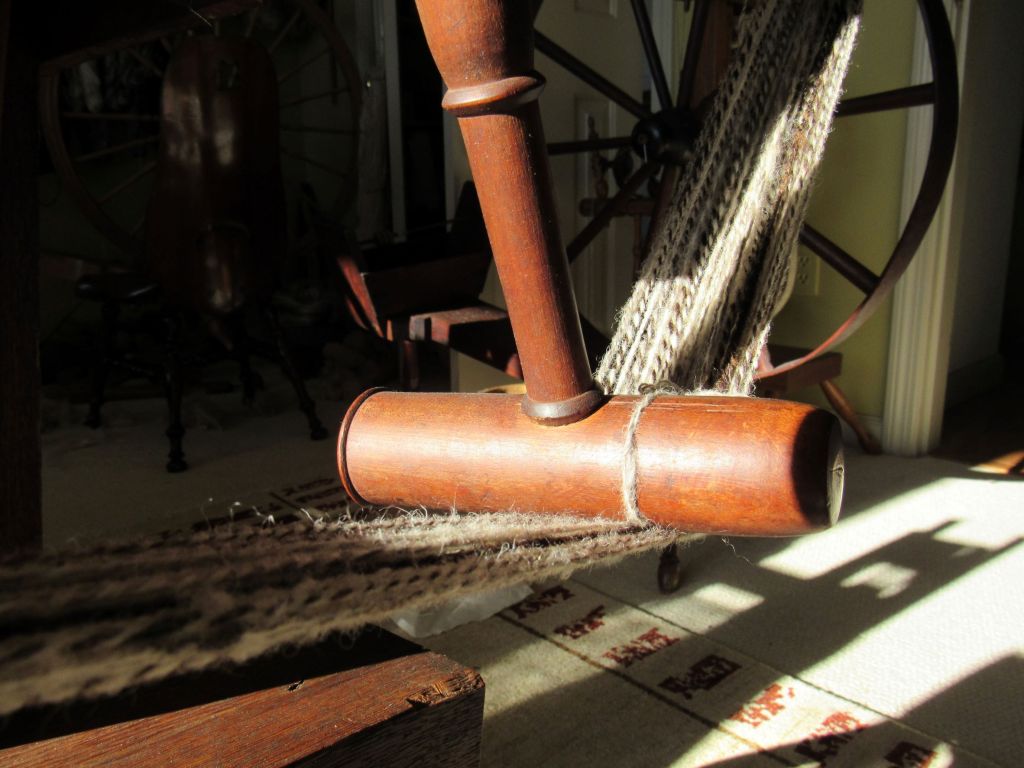
The arm crosspieces have lips on the ends, except for one, “the stranger,” which has one smooth end to allow for removal of the skein.

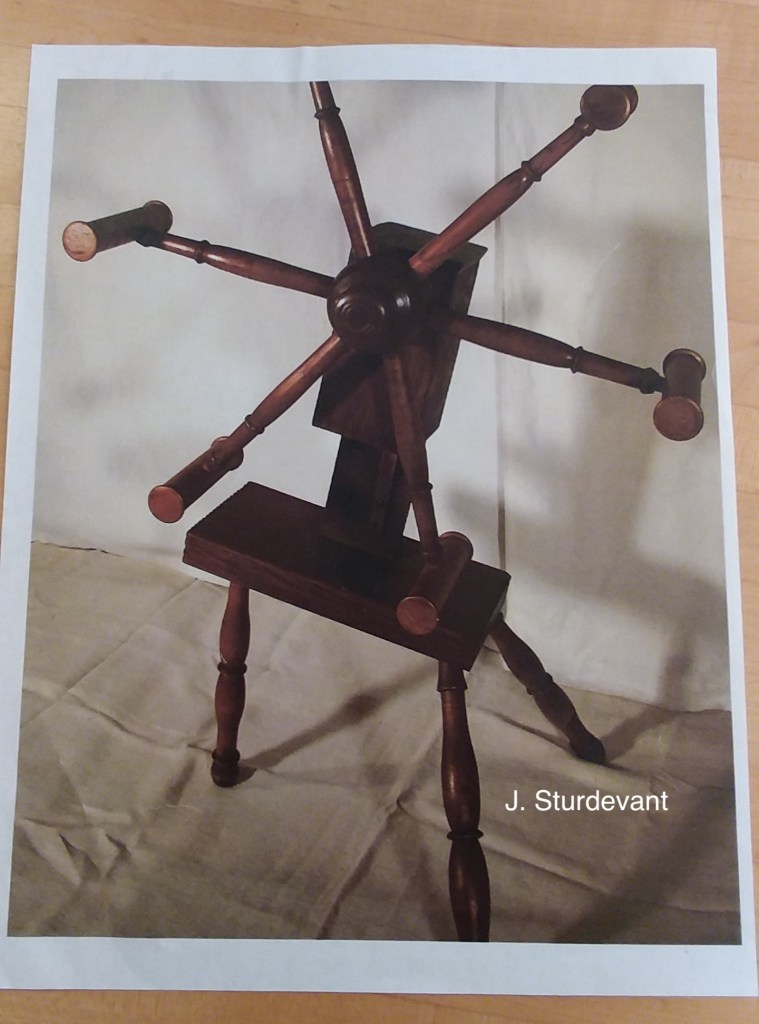
After I got the wheel home and cleaned up, I sent photos of it to another Platt enthusiast, Cindy Lincoln, in Massachusetts. She has been restoring a Platt winder and used this one as a model.  In return, she sent me some photos from Ron Walter in Pennsylvania of a John Sturdevant reel in his collection. 

Ron Walter’s Sturdevant reel

The Platt and Sturdevant winders are remarkably similar, with the tilted bench, and lack of carrying knob and winding handle. It gives another possible clue into the identity of J. Platt.  I now will be digging deep into Platt and Sturdevant connections. 

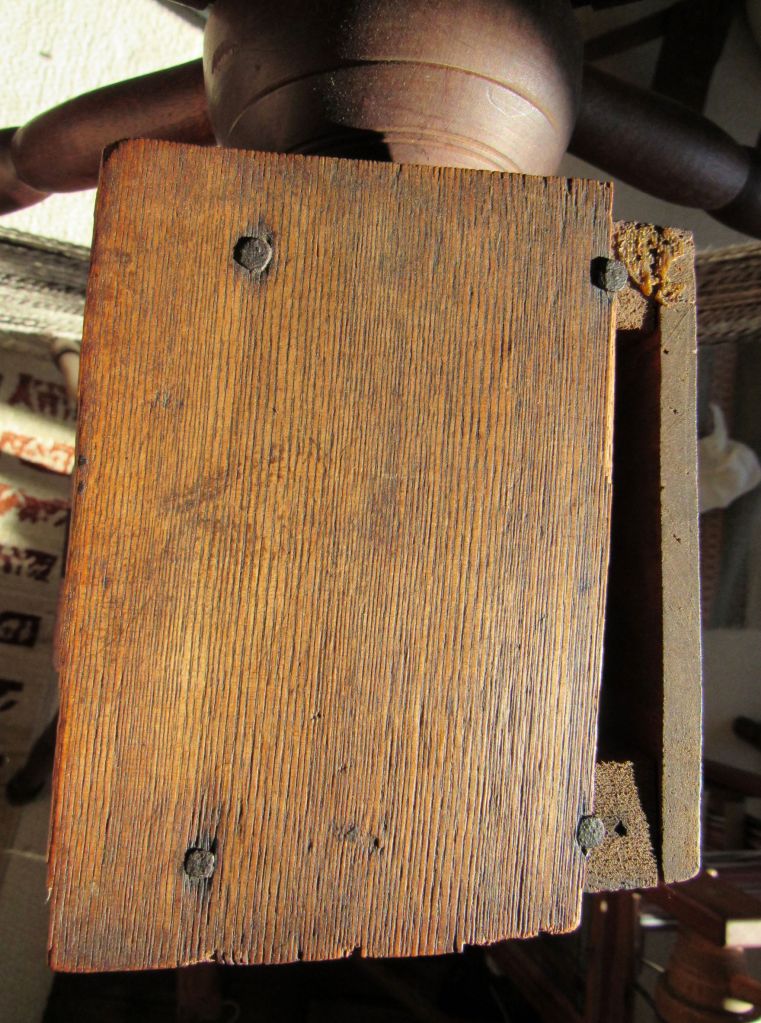
Underside of the Platt reel

Although we still do not know J. Platt’s identity, as far as I know, he is the only Connecticut wheel maker from whom we have marked examples of all of the five major spinning tools. 

We know of several marked great wheels and reels, at least two marked single-flyer flax wheels, one marked double-flyer wheel, and my one bobbin winder.  Quite a legacy.  I am hoping one day to find a Platt double-flyer wheel for a Platt full house.

Thanks to Cindy Lincoln and Ron Walter for the Sturdevant reel photographs, to Tina M. for finding, picking up, and railroading the bobbin winder, to Jessie R. for finding and picking up the reel, to Nora R., Andrea M. and Amy T. for the reel railroad, and to Jan C. for the spindle. 

For more information see:

Page, Brenda, “The Search for J. Platt,” The Spinning Wheel Sleuth, Issue #113, July 2021, pp. 1-6.

Pennington, David A. and Michael B. Taylor. Spinning Wheels and Accessories. Atglen, PA: Schiffer Publishing, Ltd., 2004, p, 161.   

Two Reels

Reels, like wheels, come in a wonderful variety of styles, often reflecting a region and a time.  Within each style, makers used their own ingenuity and personal touches, often to increase ease of use and efficiency.

No matter the style, the function is the same–to take yarn off of a spinning wheel’s spindle or bobbin to create a skein.  The skein can then be washed or dyed in preparation for weaving or knitting. 

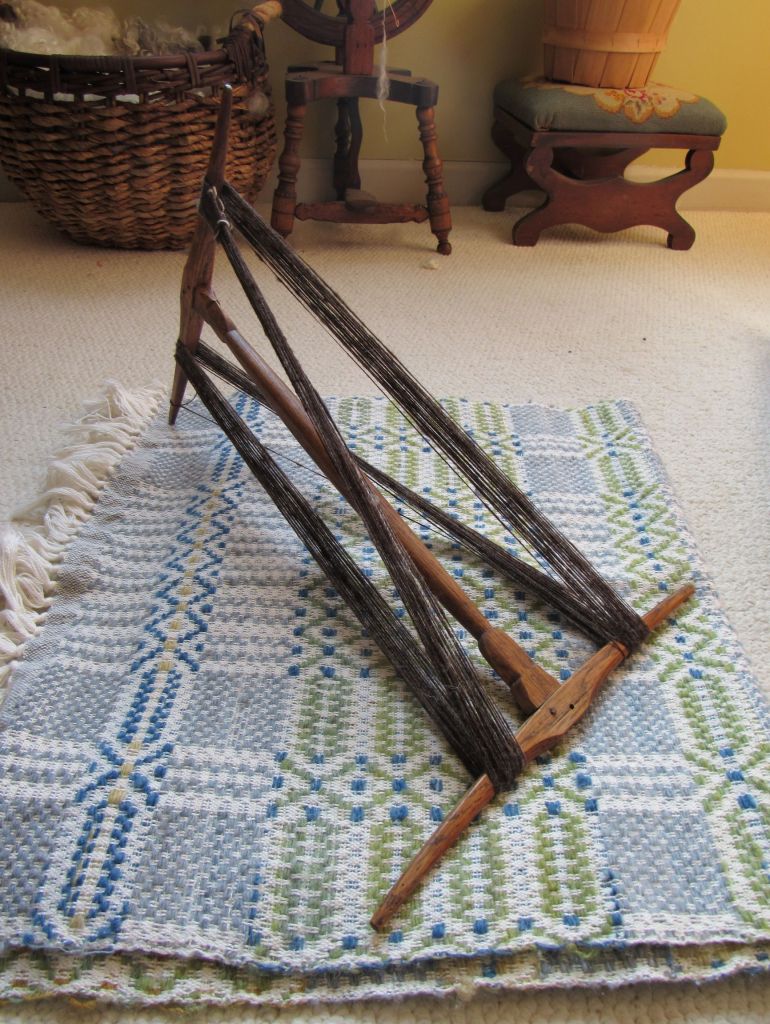
One of the simplest reels is a niddy-noddy.  It is relatively easy to make and is portable and easy to store.  On the down side, it is not particularly fast or efficient and there is no mechanism for counting the rotations of yarn as it is reeled. 

Simple niddy-noddies are easy to find and inexpensive in Maine.  Decorated ones, however, tend to go for high prices.  I was at an auction where a chip-carved niddy-noddy—nice, but nothing awesome—went for $450, while the Shaker wheels at the auction went for less than $50.  Ouch. 

I only have one niddy-noddy and it is the first reel that I bought.  I found it at Elmer’s, a local junk barn, one of four hanging from an overhead beam.  I liked the way it felt in my hand and its simple, swooping lines. 

The length of yarn for one full turn is 72 inches—or two yards.  Its handle, worn to a glass-smooth feel, has a slight curve to the side, which I assume was an intentional design to make for an easier rocking motion when reeling on and easier removal of the skein. 

The next reel I bought (Lucy) came from the American Textile History Museum (ATHM).  I spotted her at one of the auctions of ATHM items and, although I had no intention of buying a reel, was attracted to her small size and simplicity. 

I was the only bidder, brought her home, and she has been my go-to reel ever since. 

One of the nice features of this reel is that the box top opens, making it easy to paraffin the threads for smoother rotation and to troubleshoot any problems with the gear mechanism. 

Another nice feature is the little handle for turning the arms.  It rotates around a center piece, allowing a constant grip as the reel is turned, making for faster reeling. 

The clicker is a long wooden piece that gives a nice thwacking sound when it hits a small metal barb on the gear. 

Five of the six arms have lips on the end-pieces to keep the yarn in place,

with the sixth being smooth for easy removal of the skein. 

In A Book of Spinning Wheels, Joan Cummer refers to the oddball smooth end-piece as “the stranger.”  Cummer, p. 302.  

In addition to the clicker, Lucy has a simple clock mechanism on the side.  Originally the reel may have had a paper label under the arm for rotation count. 

There is a somewhat similar reel in the Mount Lebanon Shaker museum collection, with the same simple clock arm and a paper label.  https://www.shakermuseum.us/object/?id=5542&limit=24&offset=24&sort=name_ref&tags=weaving  

As with my niddy-noddy, the length of yarn for one rotation on this reel is 72 inches, or two yards, and the clock clicks at 40 rotations, making an 80 yard skein. 

Joan Cummer indicates that the distance between clicks is 85 yards on most American reels, which gives an 80 yard skein after washing and shrinkage.  Id.  I am not sure if my reels are outliers or if I am measuring improperly. 

This reel is a typical style found in New England.  I do not know where she is from originally.   An almost identical reel came up for auction in Maine a few years ago and was said to be Shaker made.  

It is probable that the maker also made spinning wheels because the legs, cross bar, and table appear to have come from wheel stock—and do have a Shaker look to them. 

But, who knows? 

In any case, she is beautifully made and her clicker and clock still work perfectly.  And she brought along a piece of what looks like handwoven linen tucked in to tighten a cross piece.

For more information on reels:

Baines, Patricia.  Spinning Wheels, Spinners and Spinning.  New York: Charles Scribner’s Sons, 1977, pp. 302-327. 

Cummer, Joan. A Book of Spinning Wheels, Portsmouth, NH: Peter J. Randall, 1993.