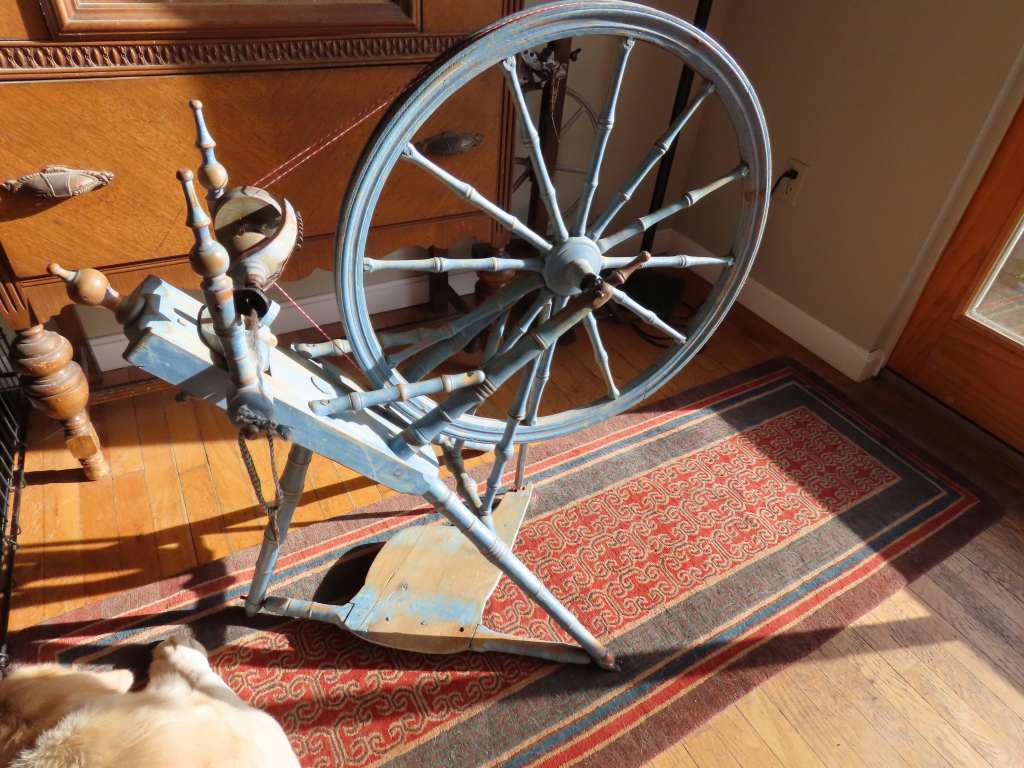
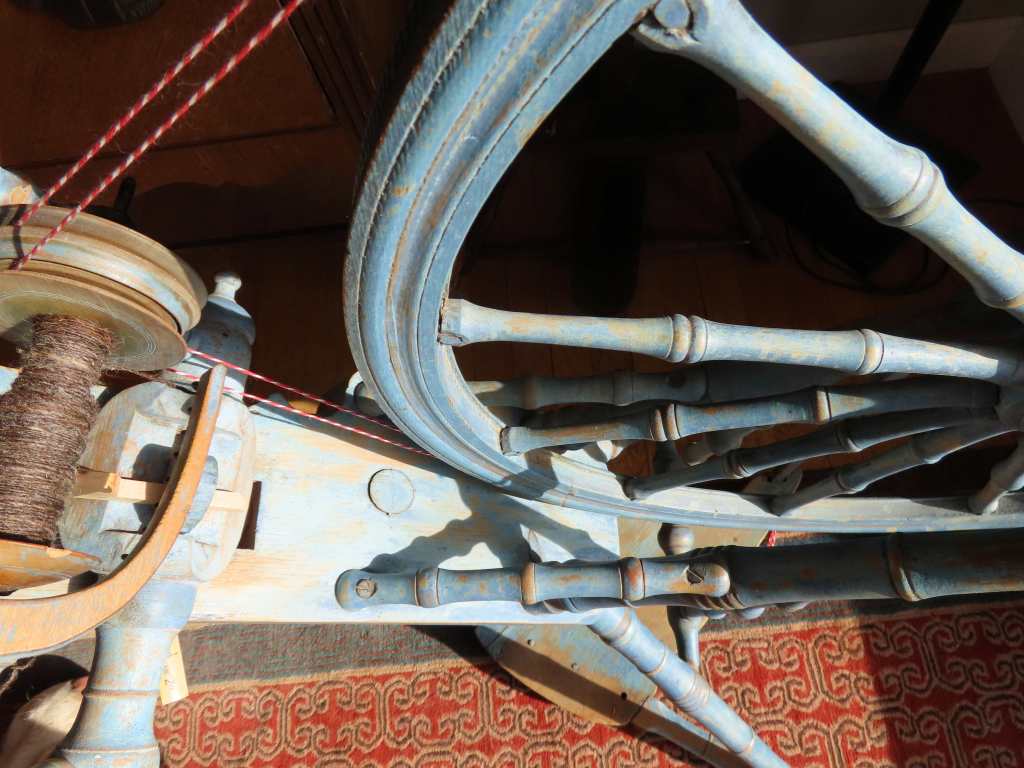
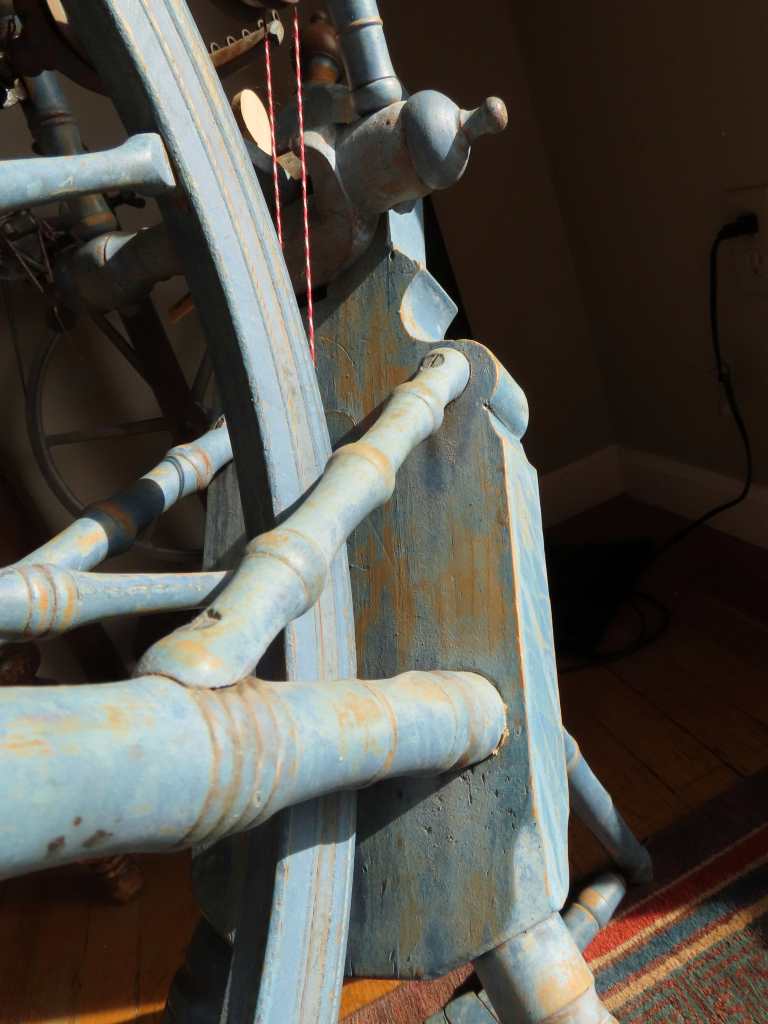
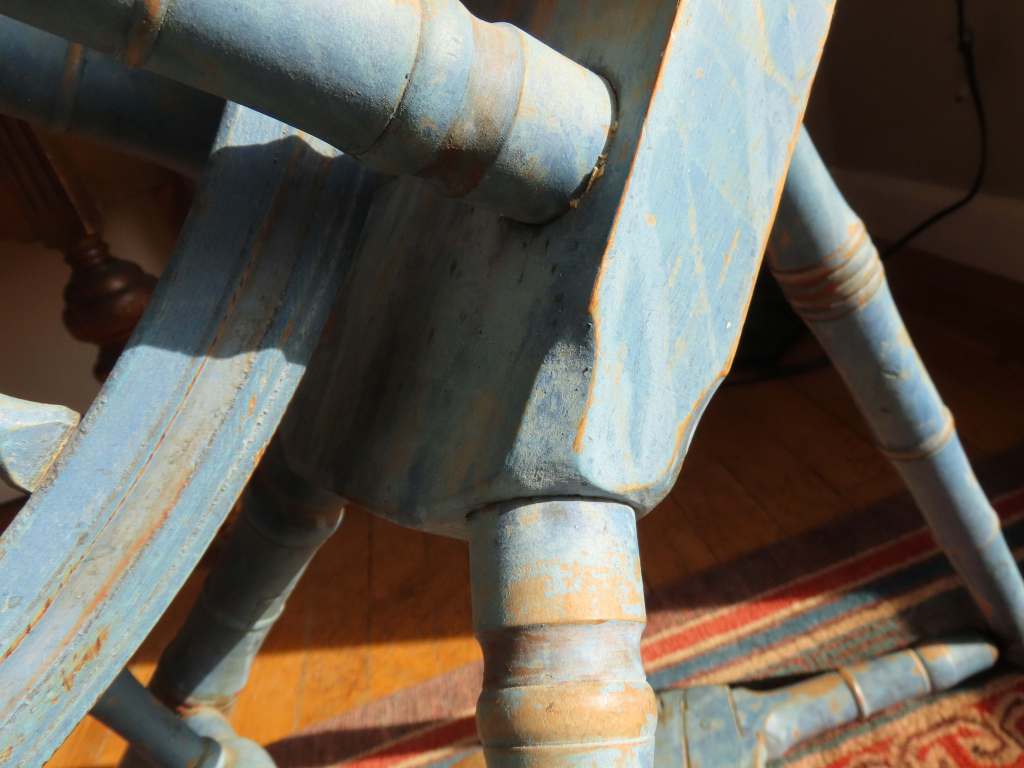
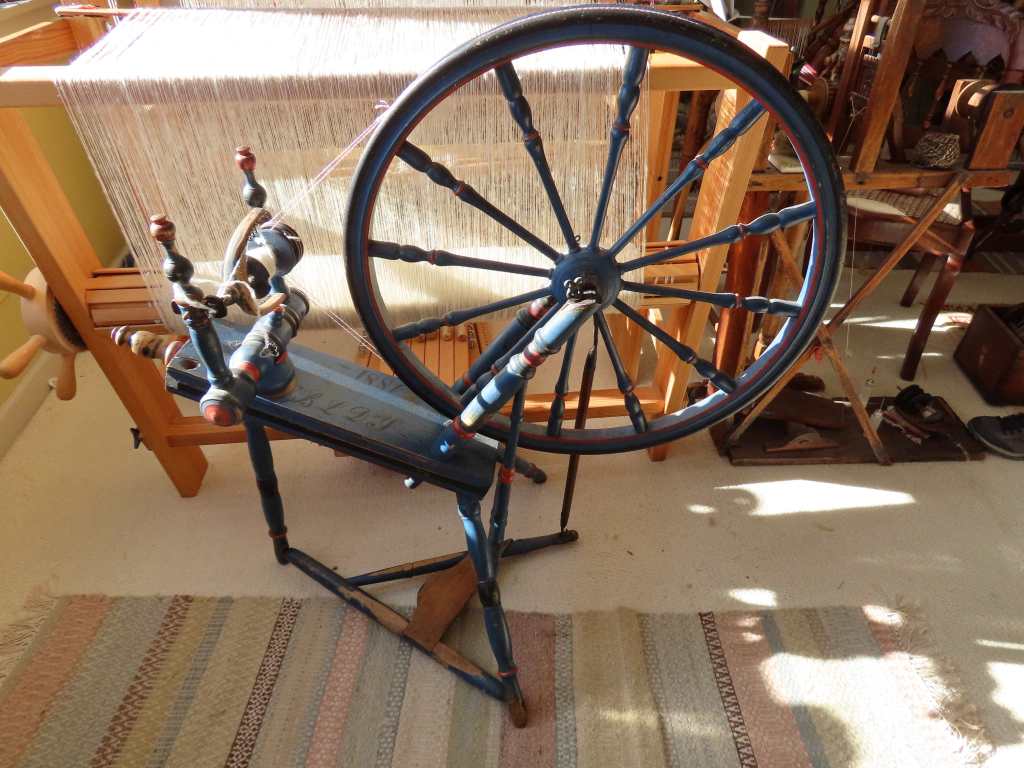
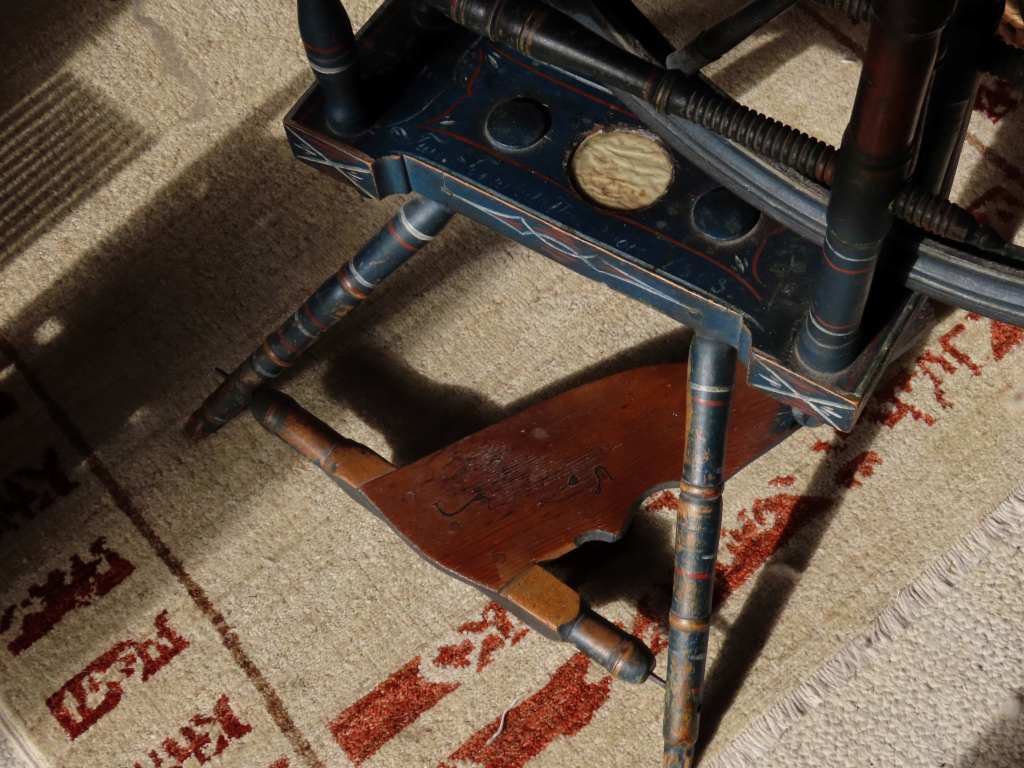
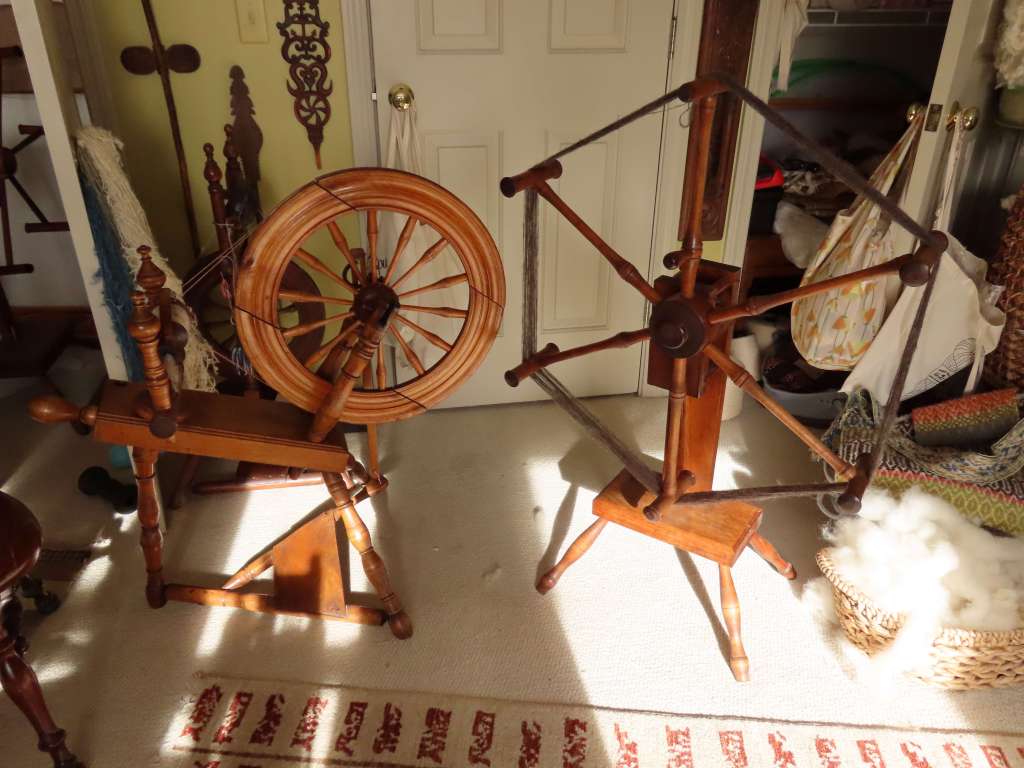
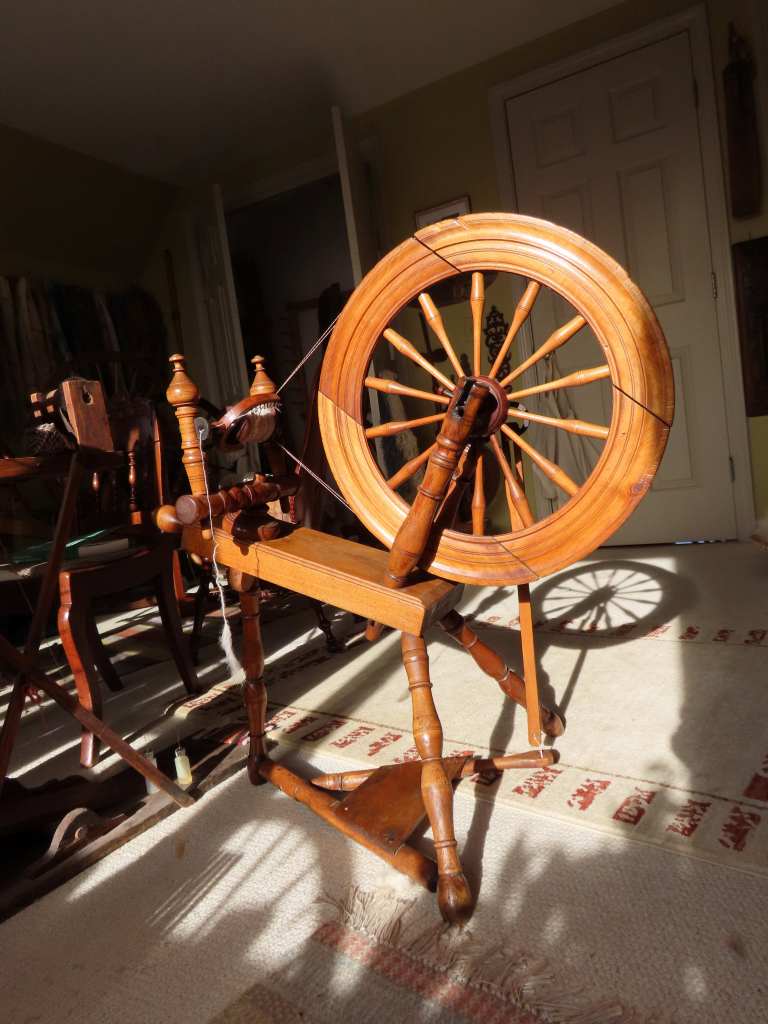
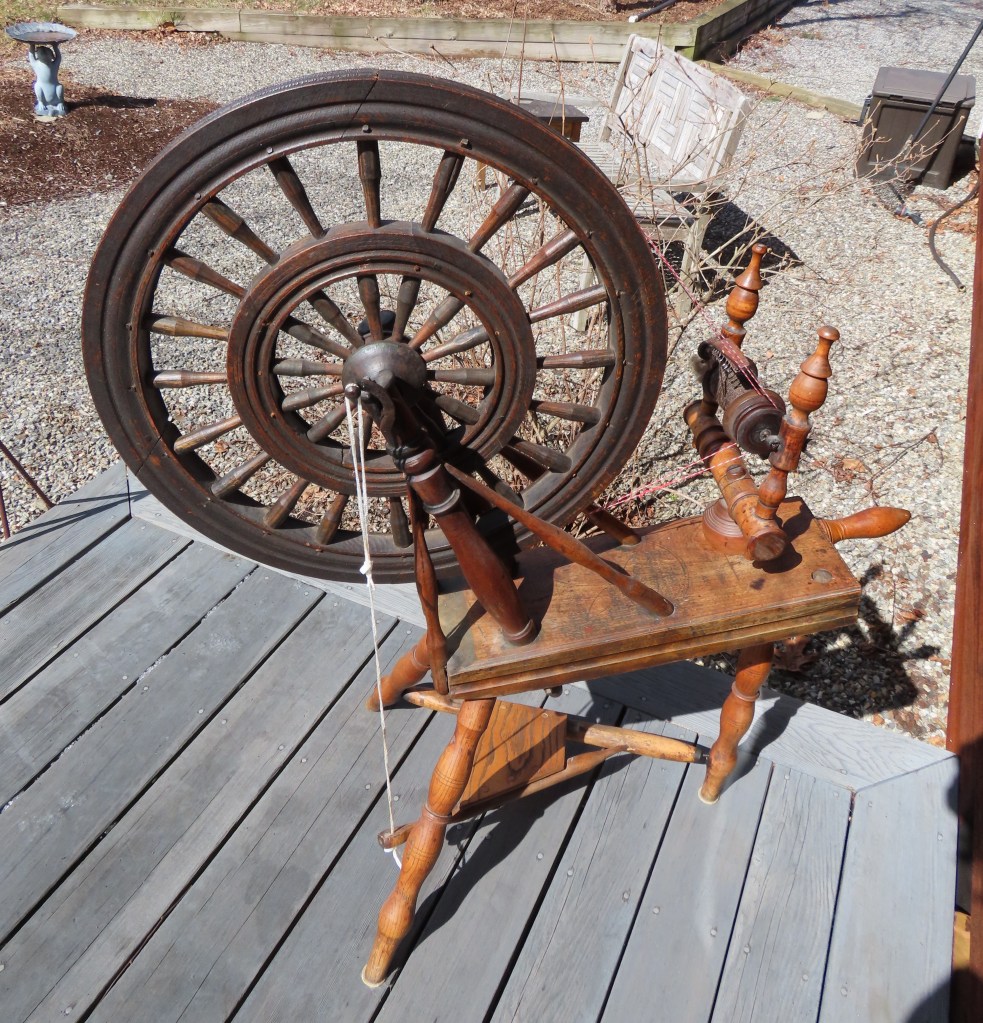
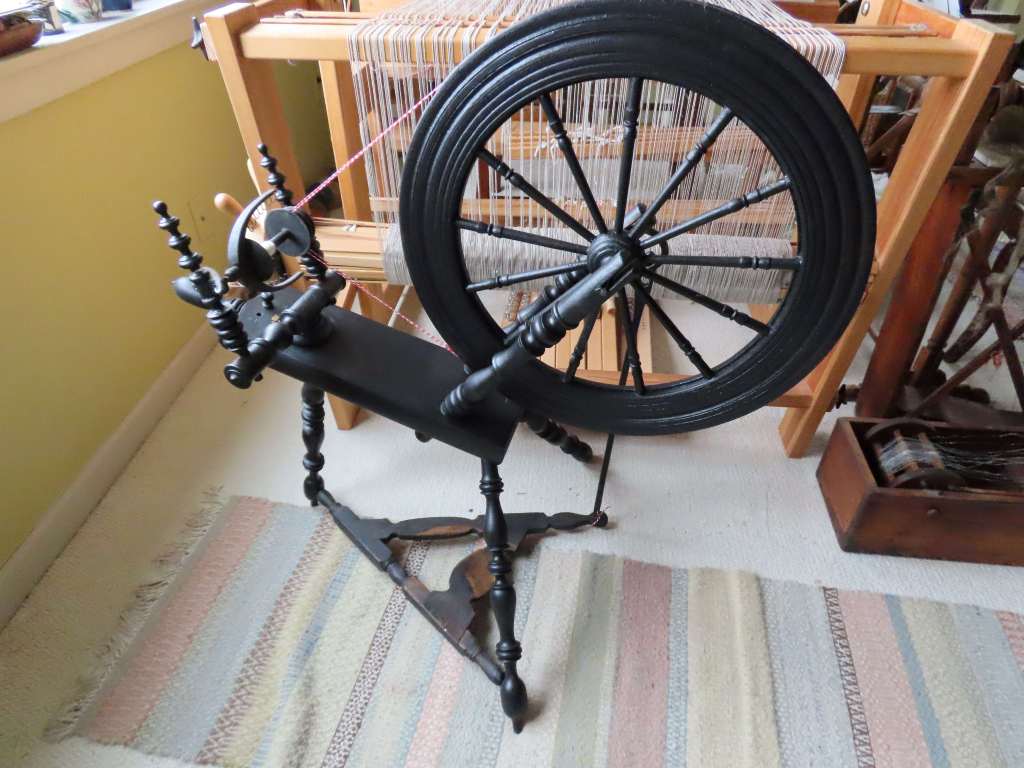
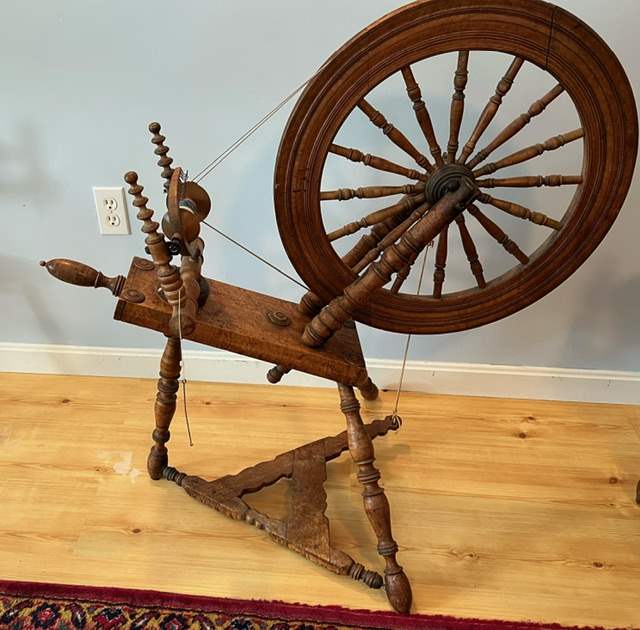
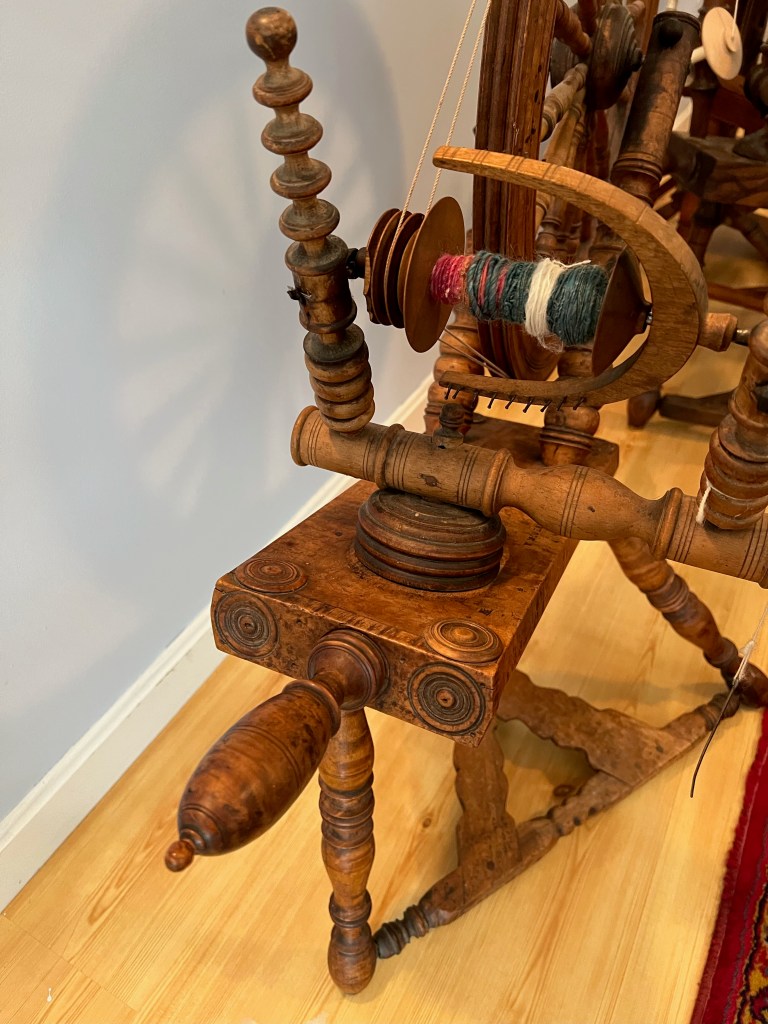
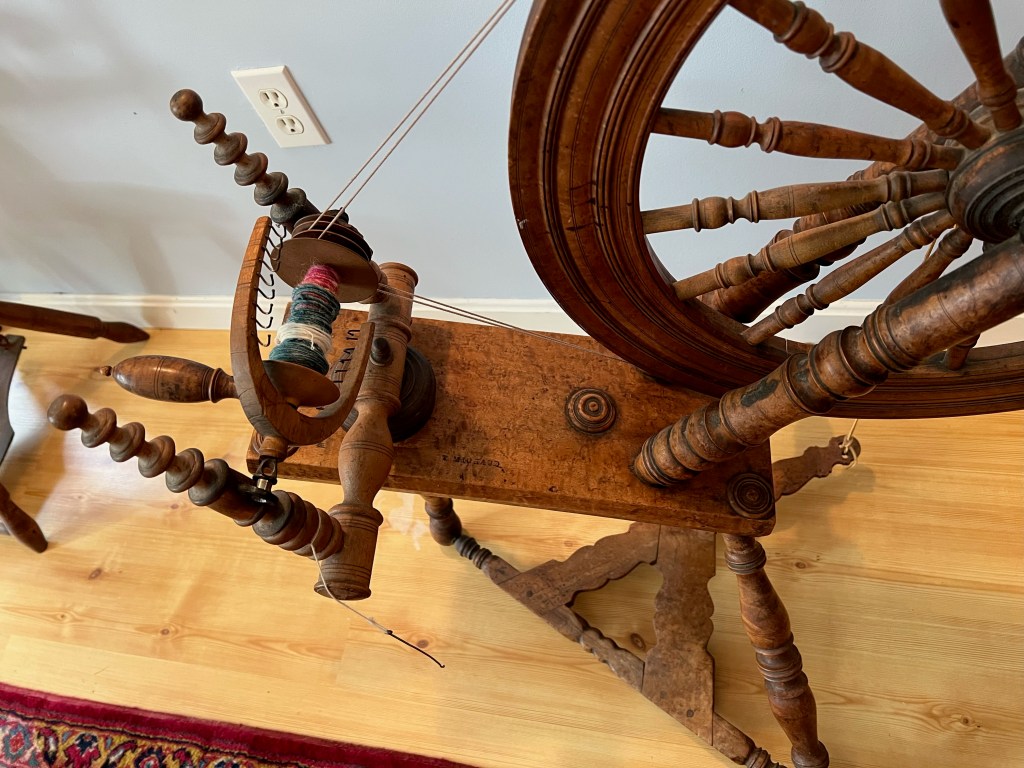
It looks like a combination of two Norwegian styles, with the small table from a double-table style
grafted on to a slanty with decorative bits in between.
It is brilliant, actually, giving the stability of a flat table and a small footprint.
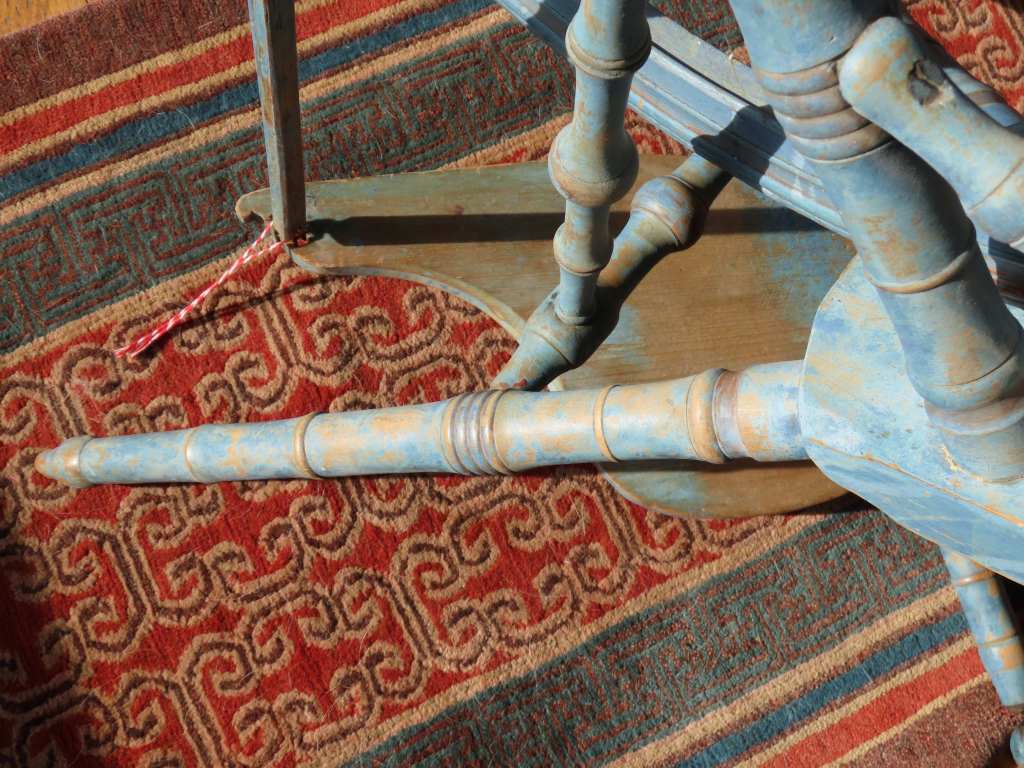
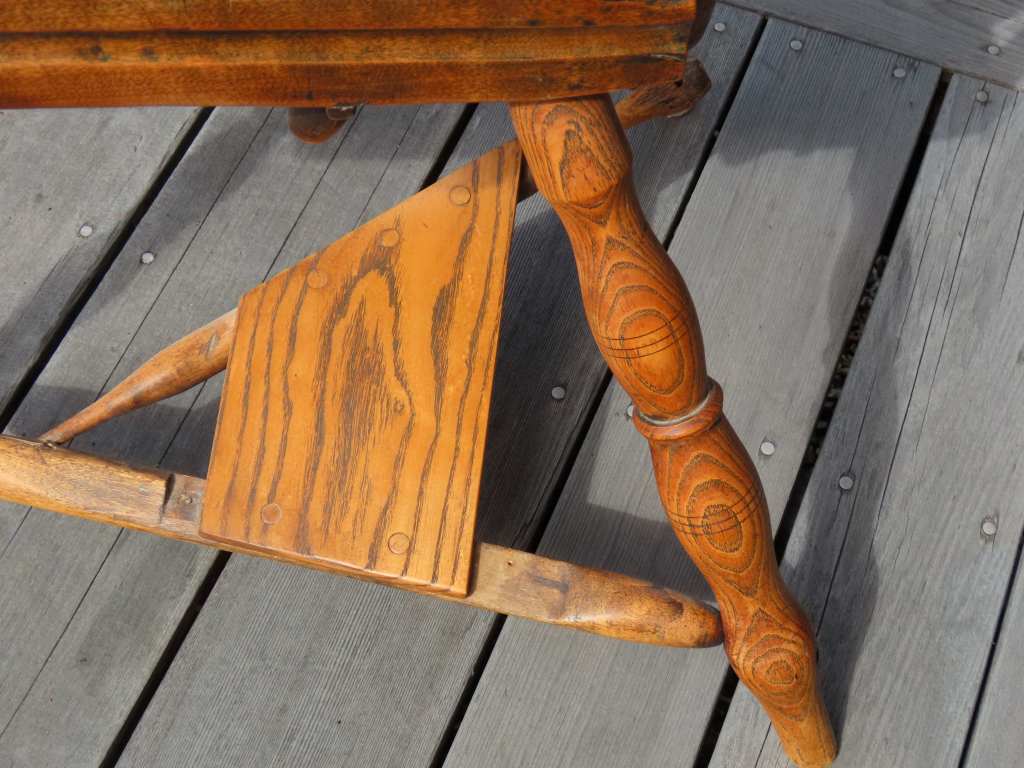
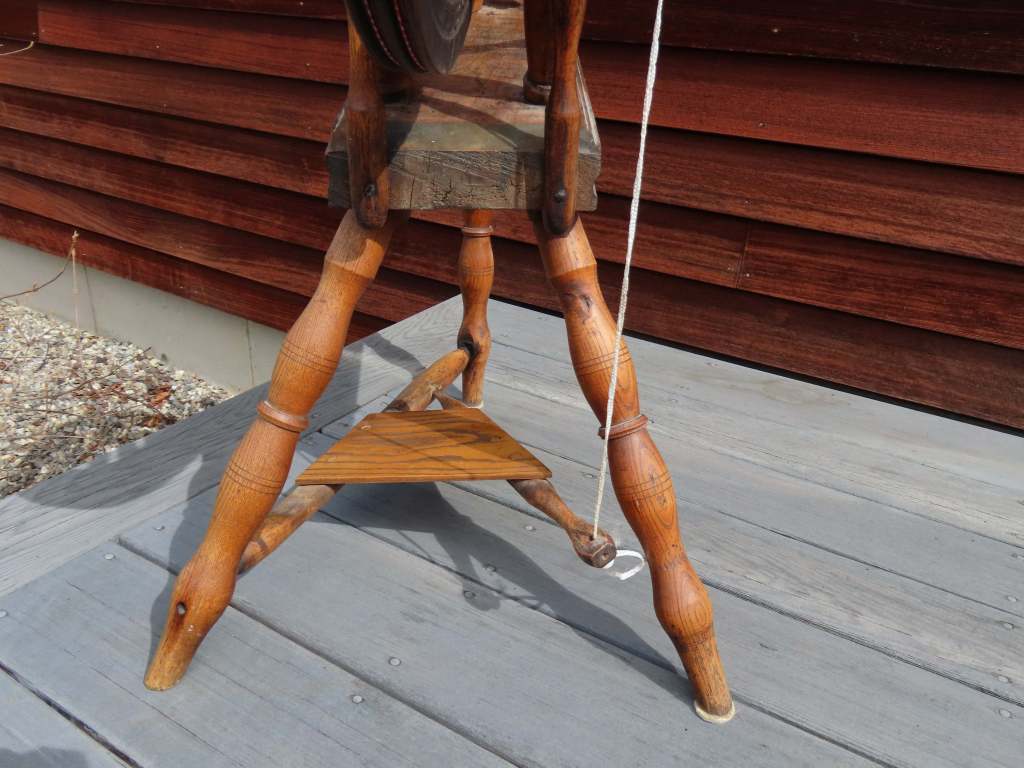
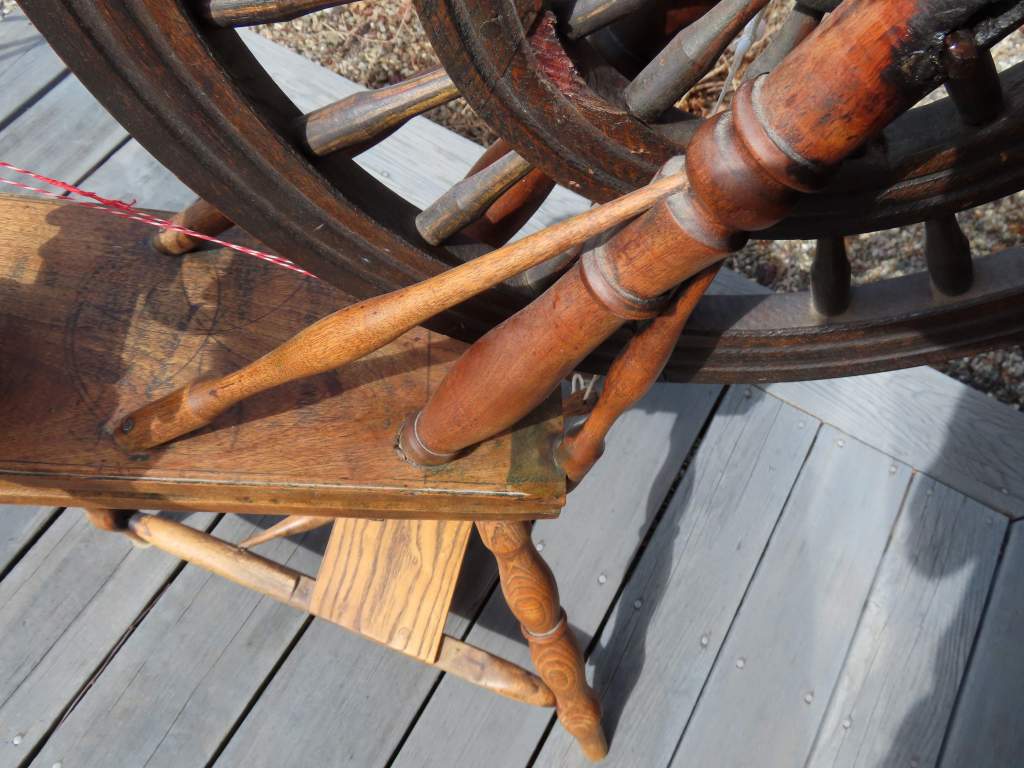
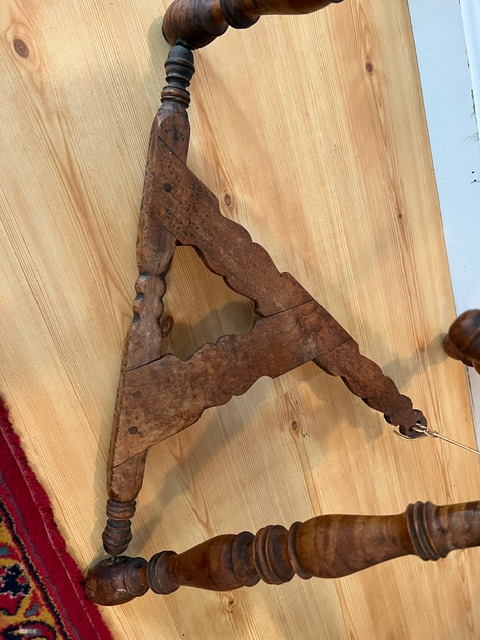
The design requires struts, which makes for a lovely profile.
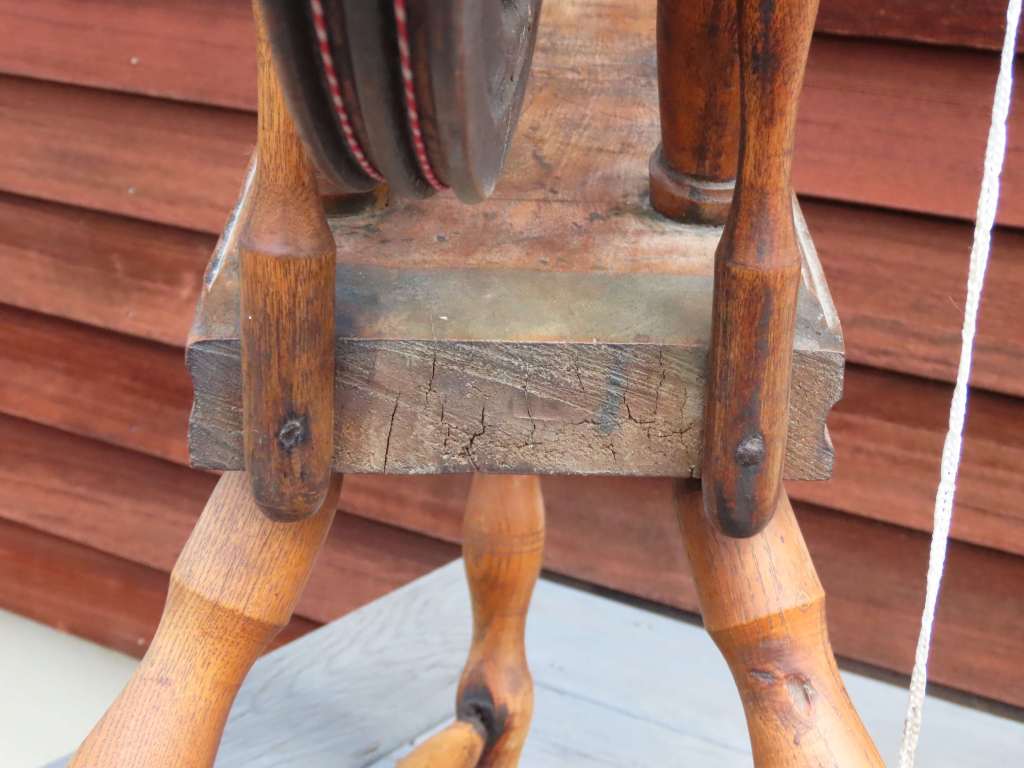
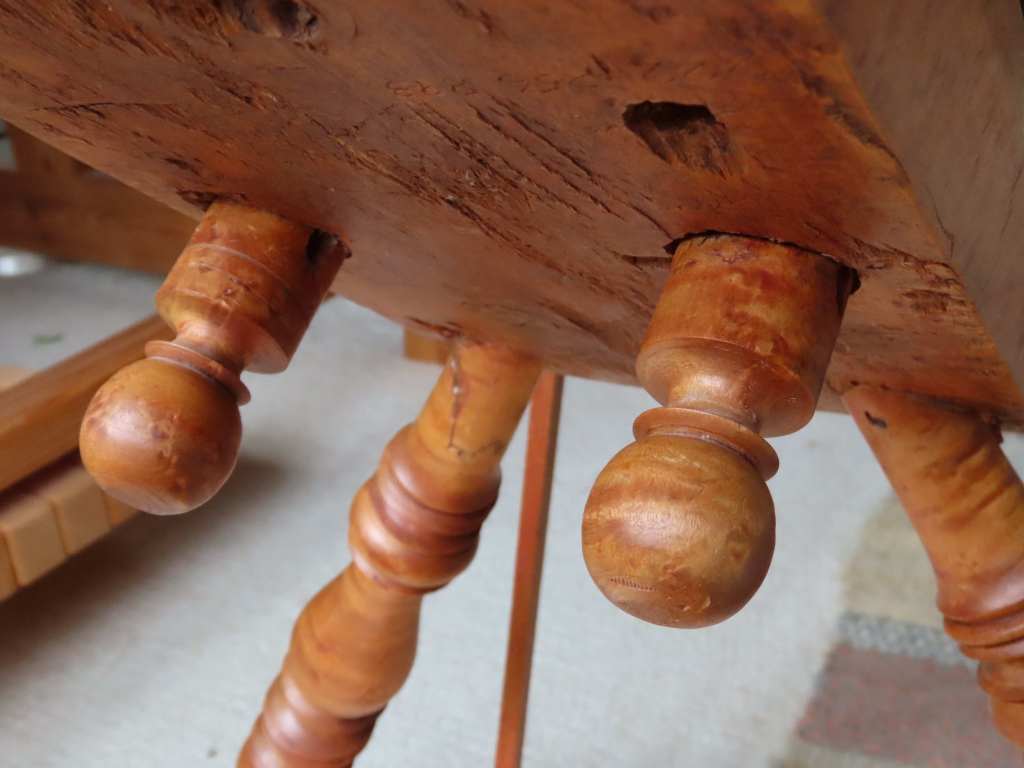
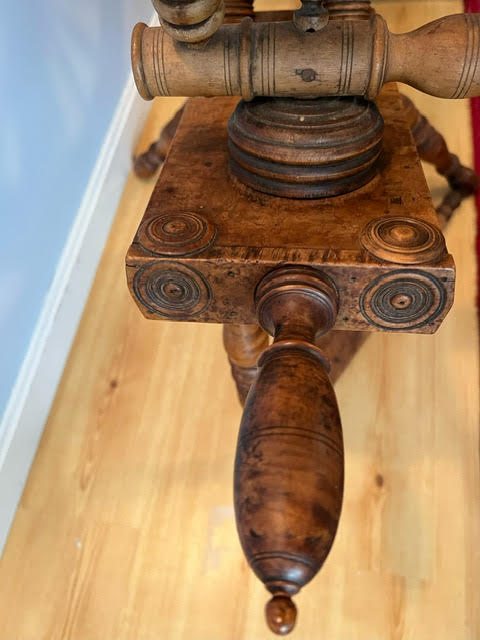
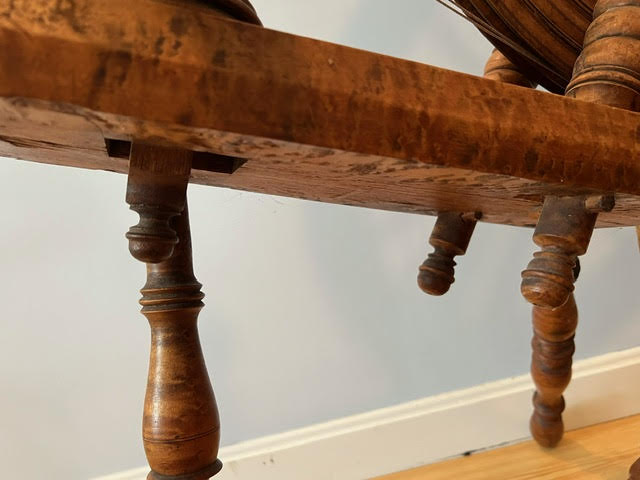
The legs emerge from the end of the table
often with bubble-type turnings.
Unfortunately, as far as I can tell, little is known about these wheels.
They are assumed to be Norwegian, but I do not think any particular region of origin has been identified.
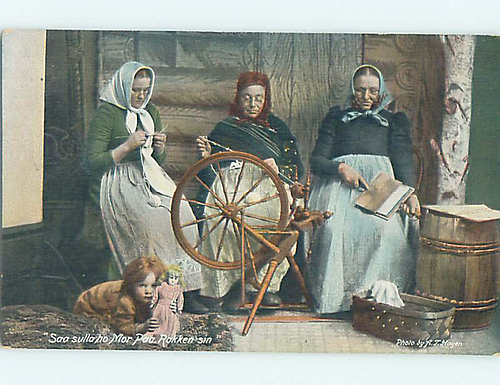
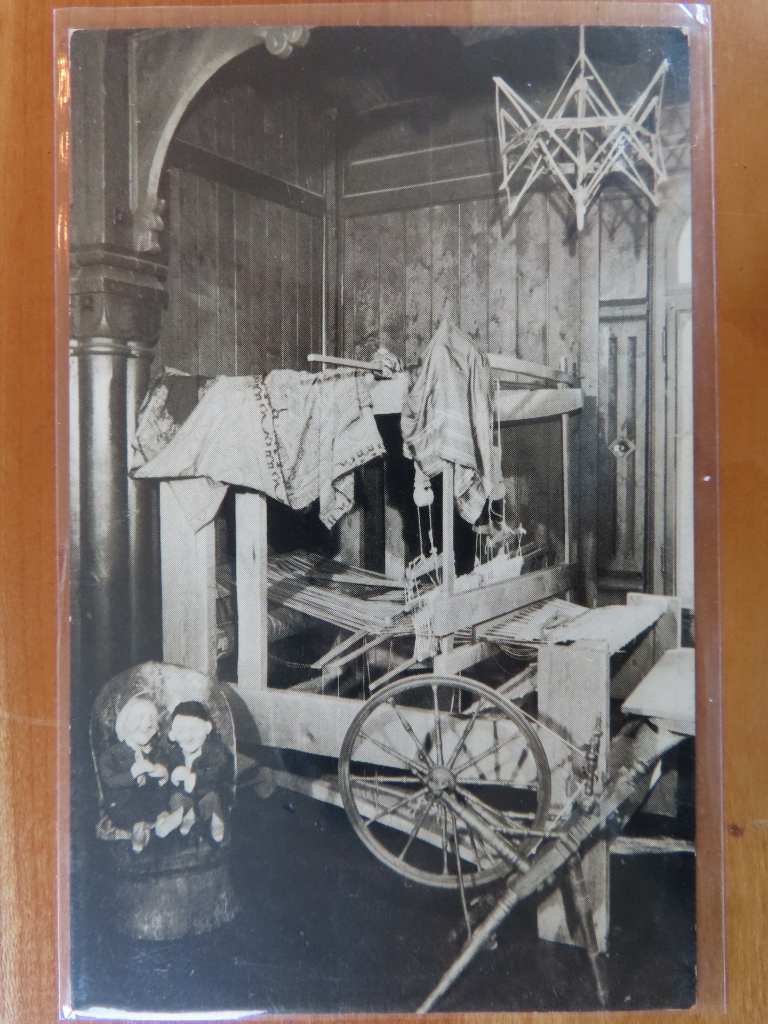
Not sure what the text says on this postcard, except for the words “mother” and “spinning wheel”
Some have maker’s marks, many do not. In the U.S., they are most often referred to as “broken-table” slanties (or super slanties).
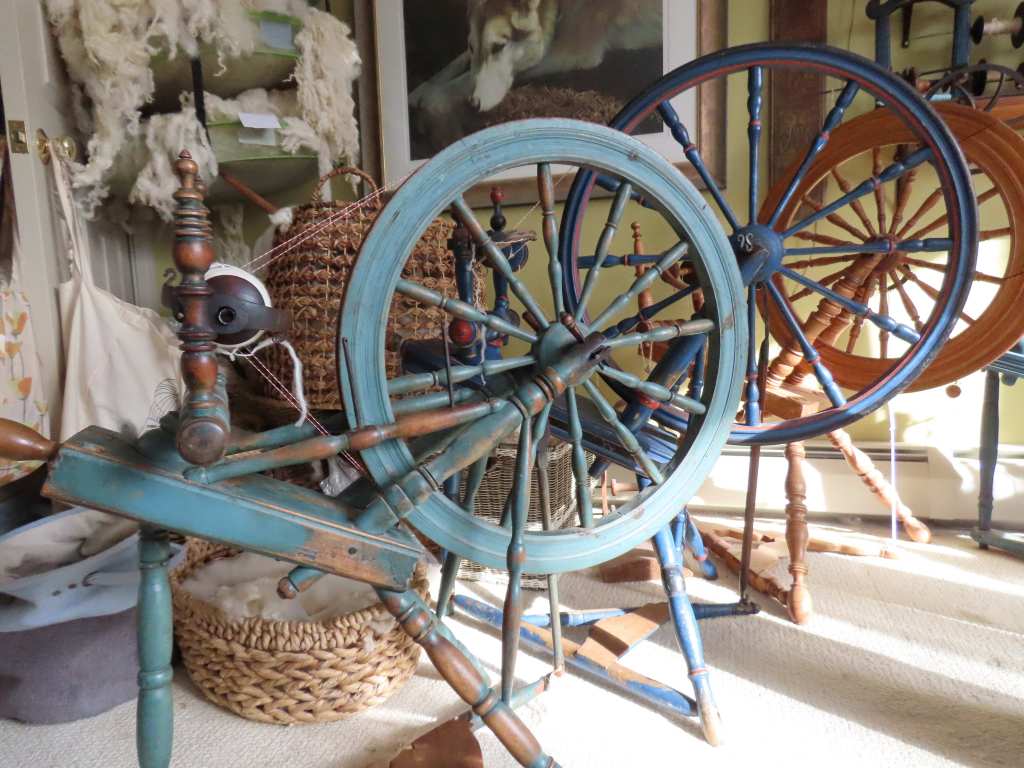
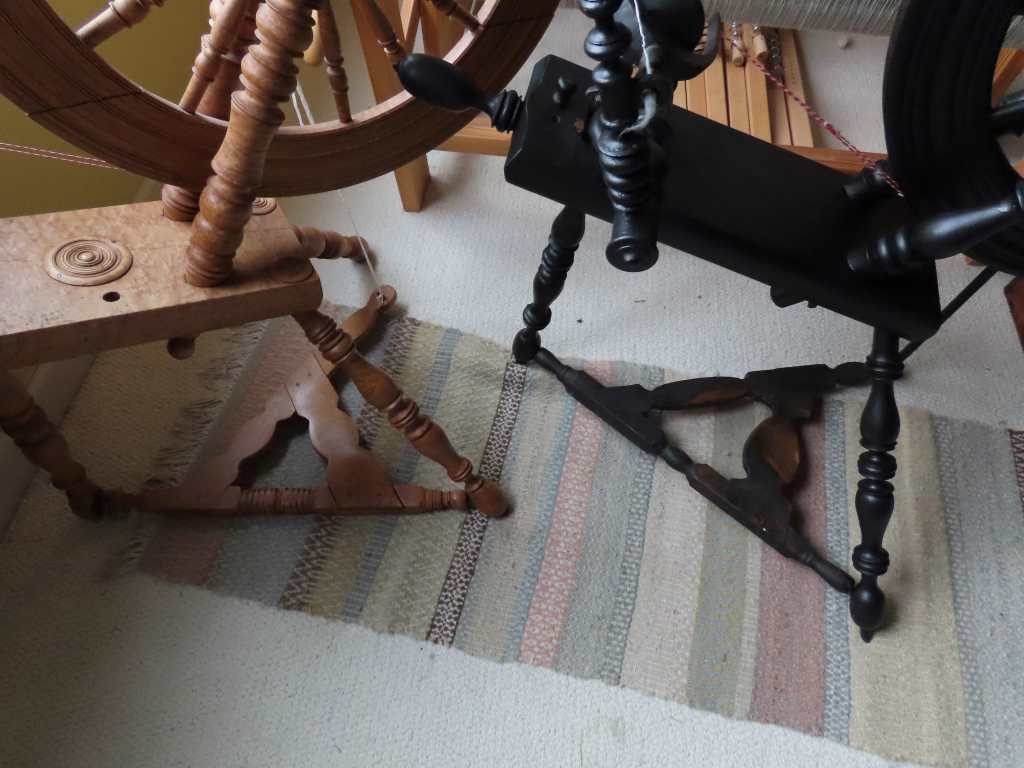
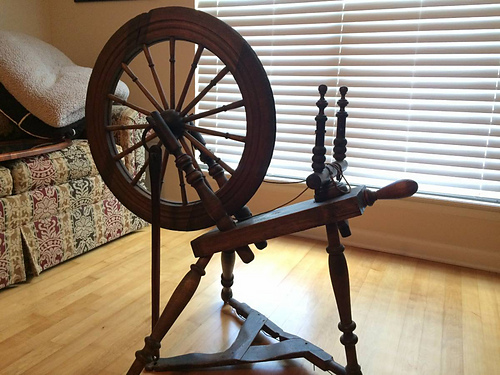
Norwegian broken-table slanty in front, with regular slanty by window
They come in all different styles, many with elaborate turnings.
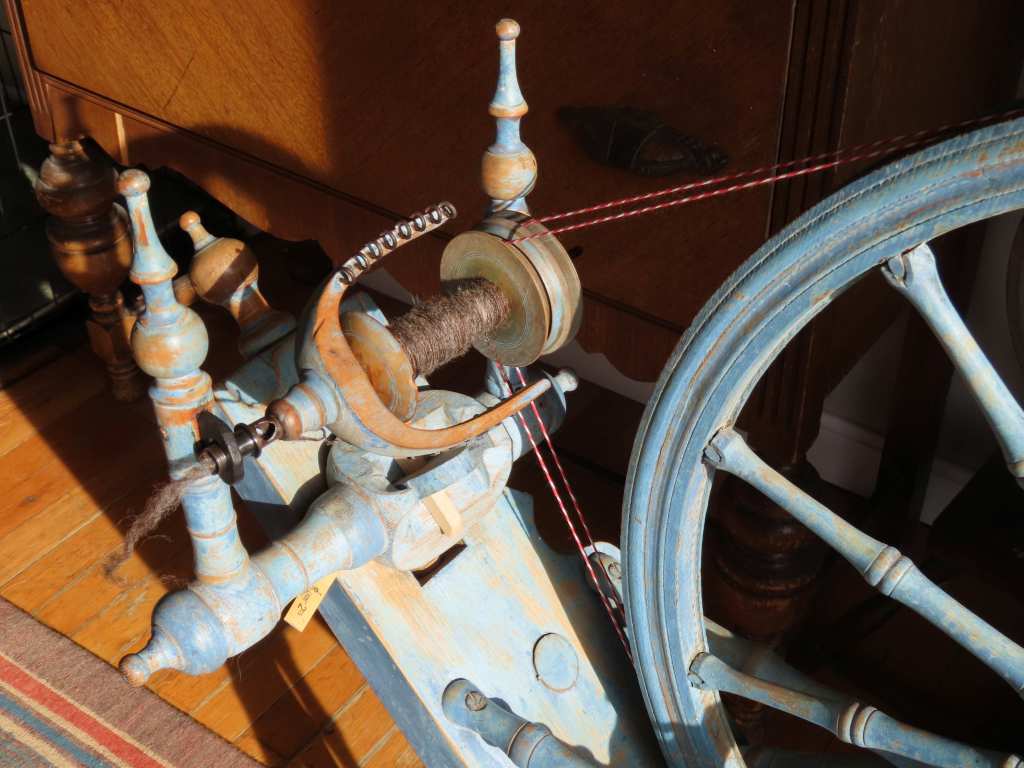
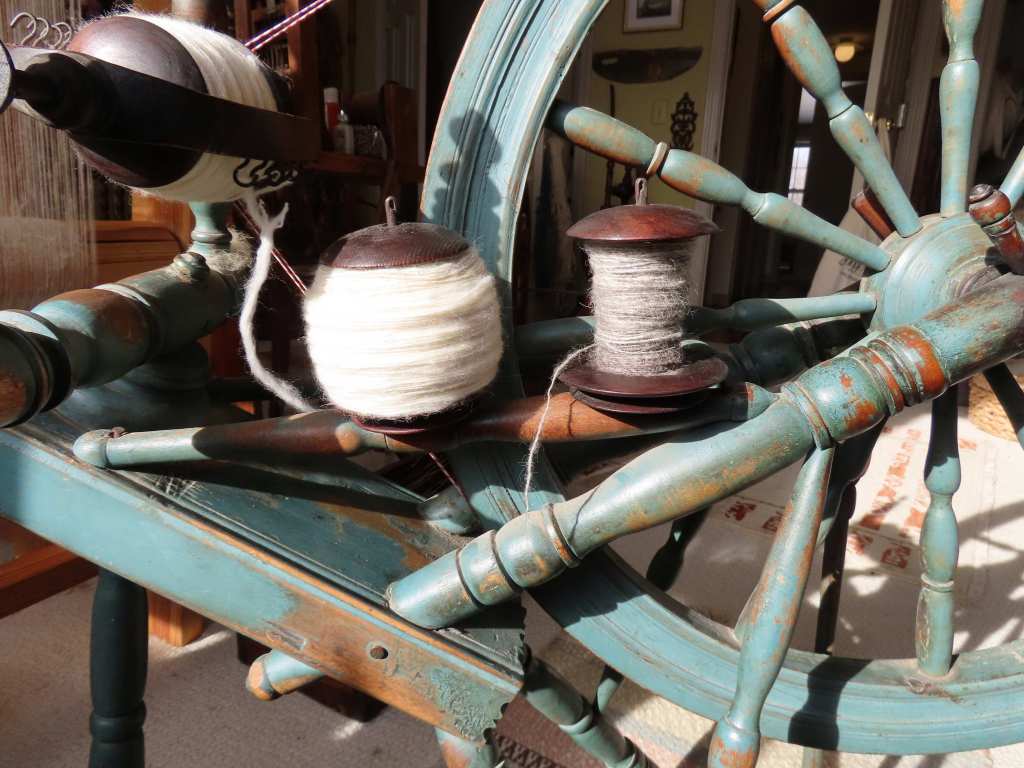
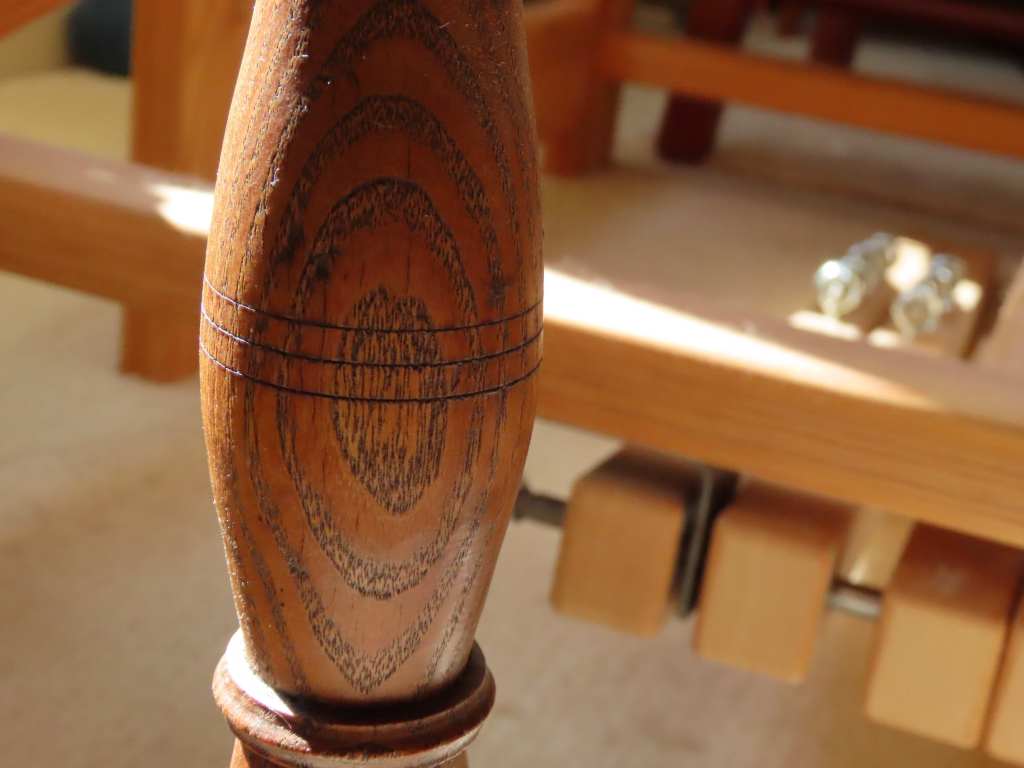
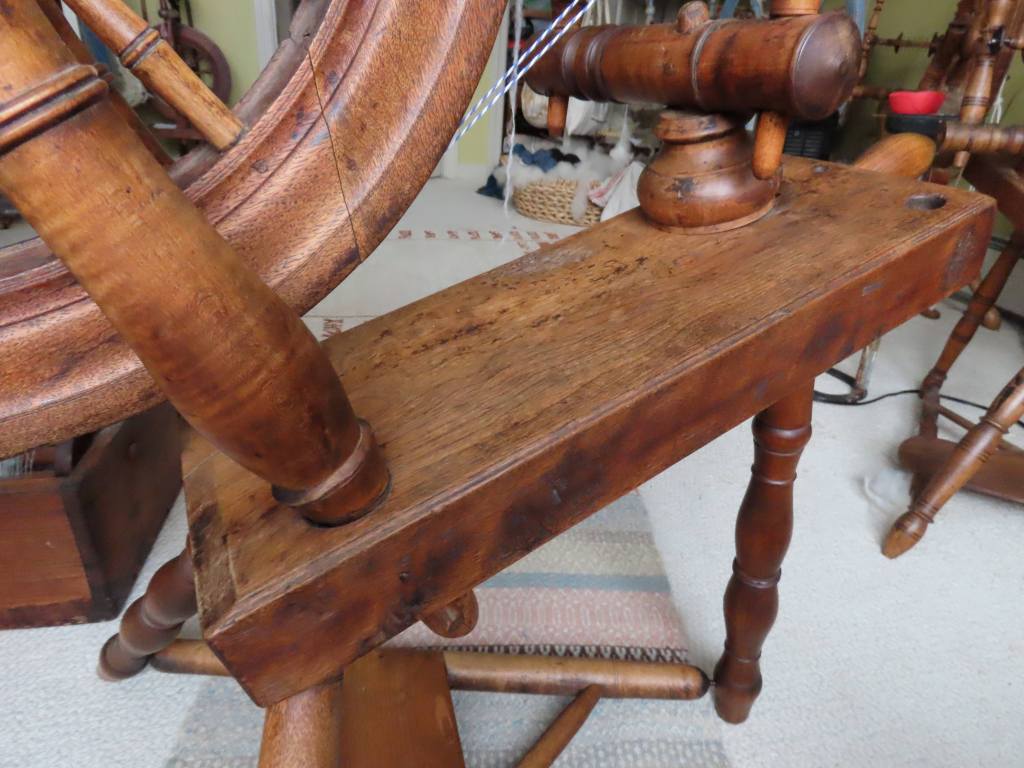
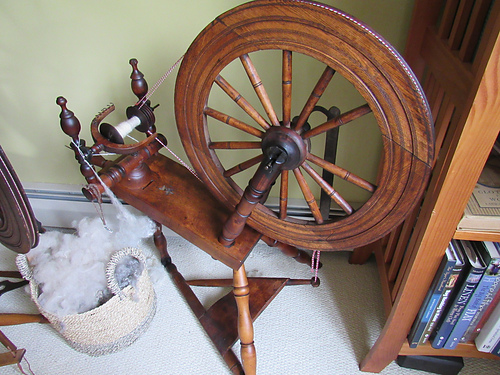
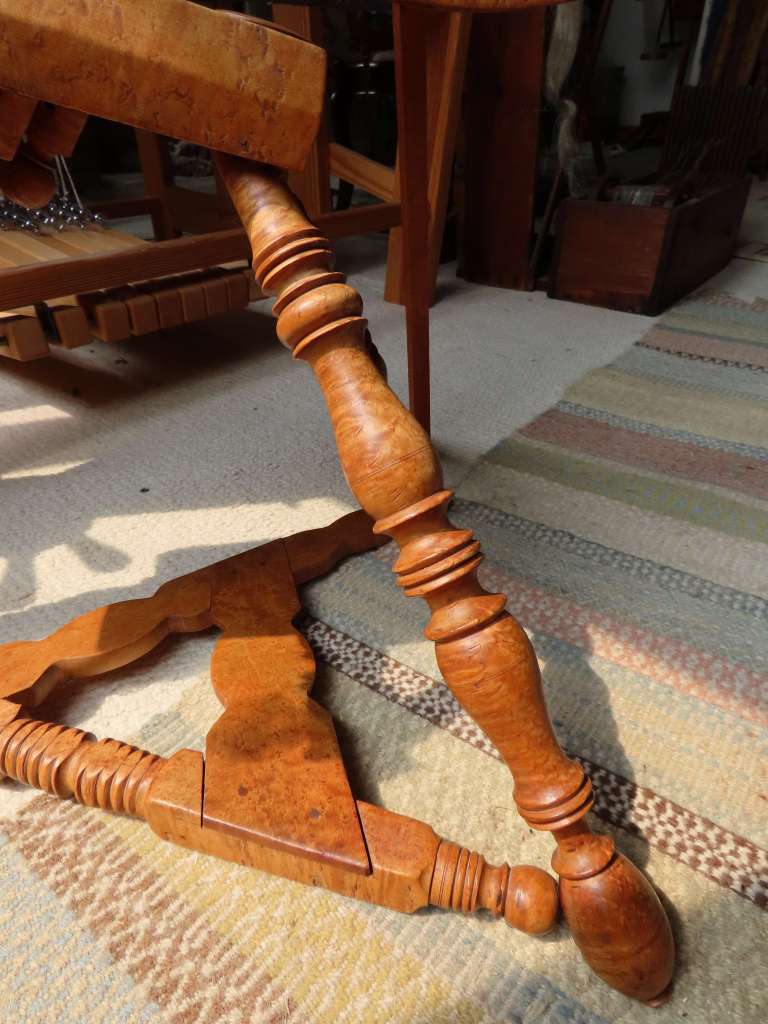
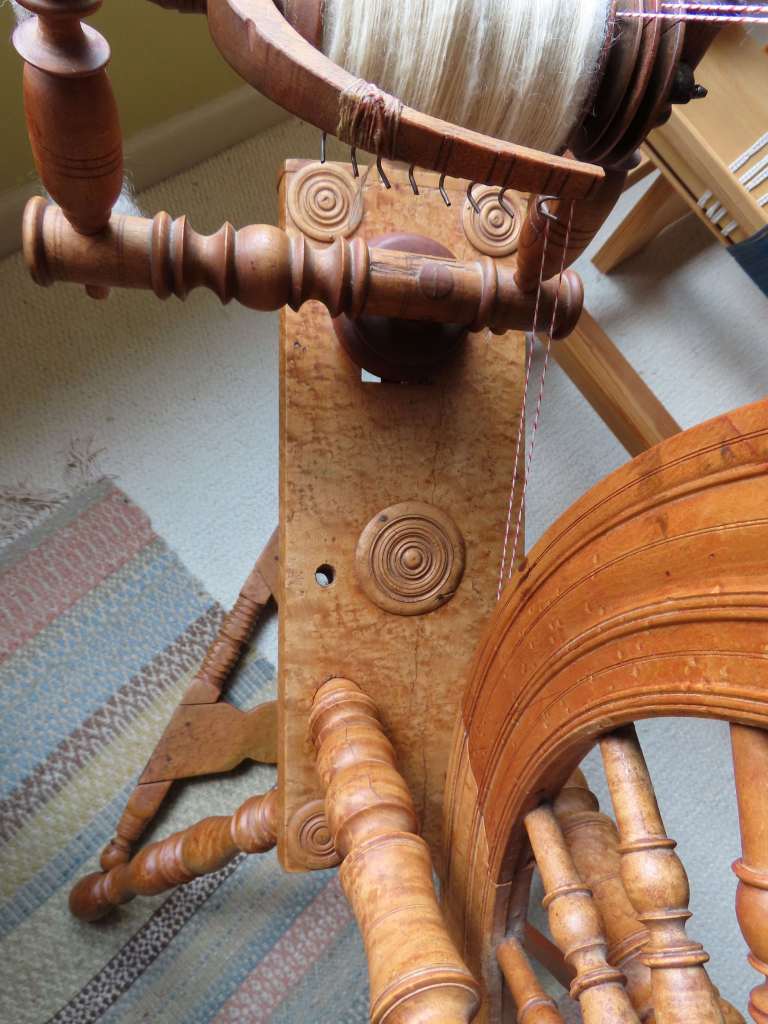
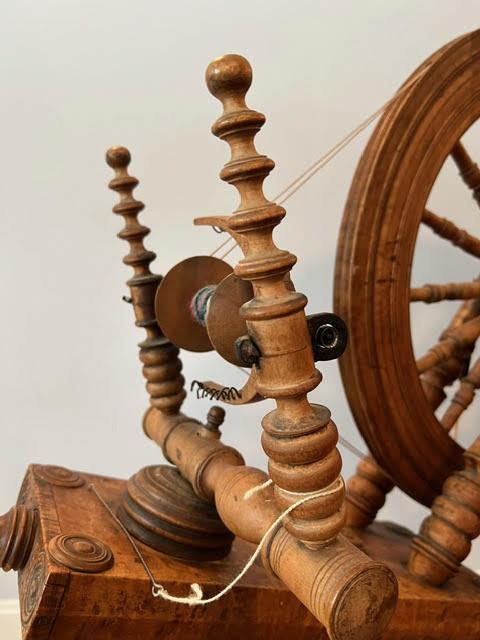
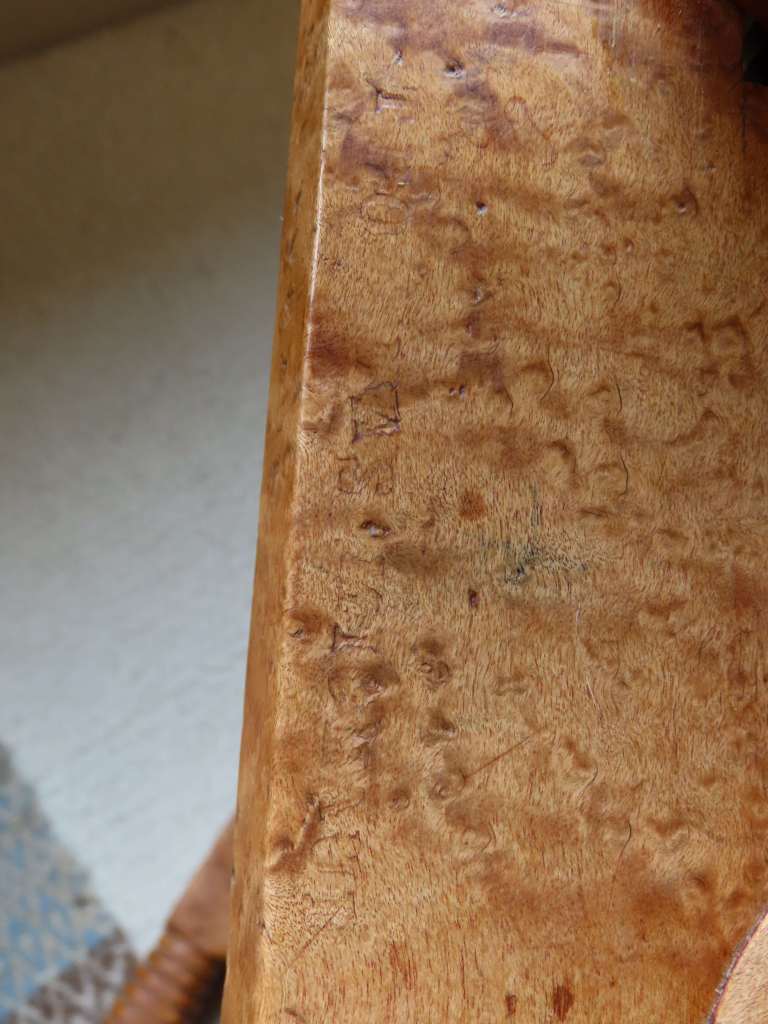
Sif is unlike any other I have seen because of her wood.
It is lightweight but has a very wide, strong grain.
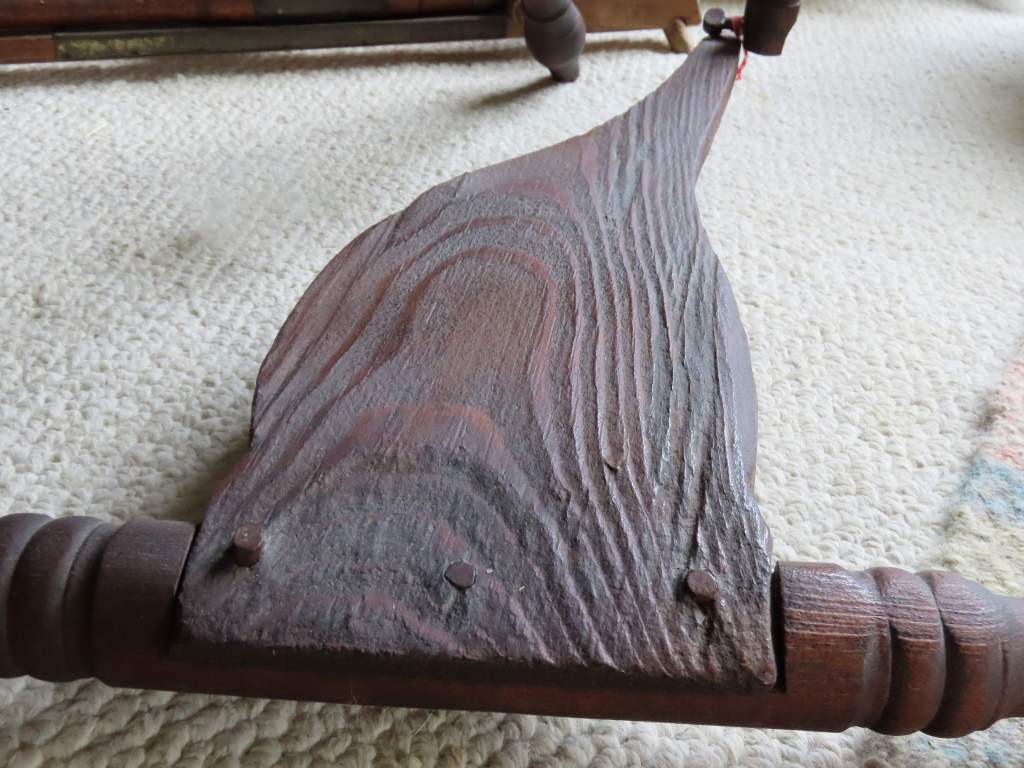
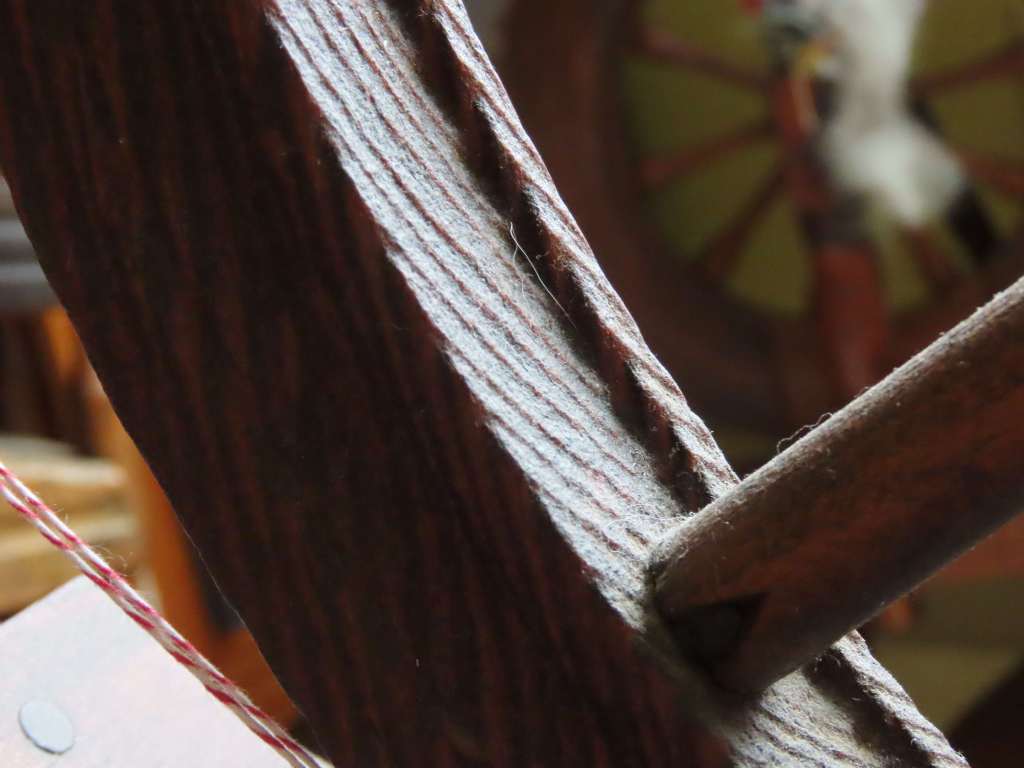
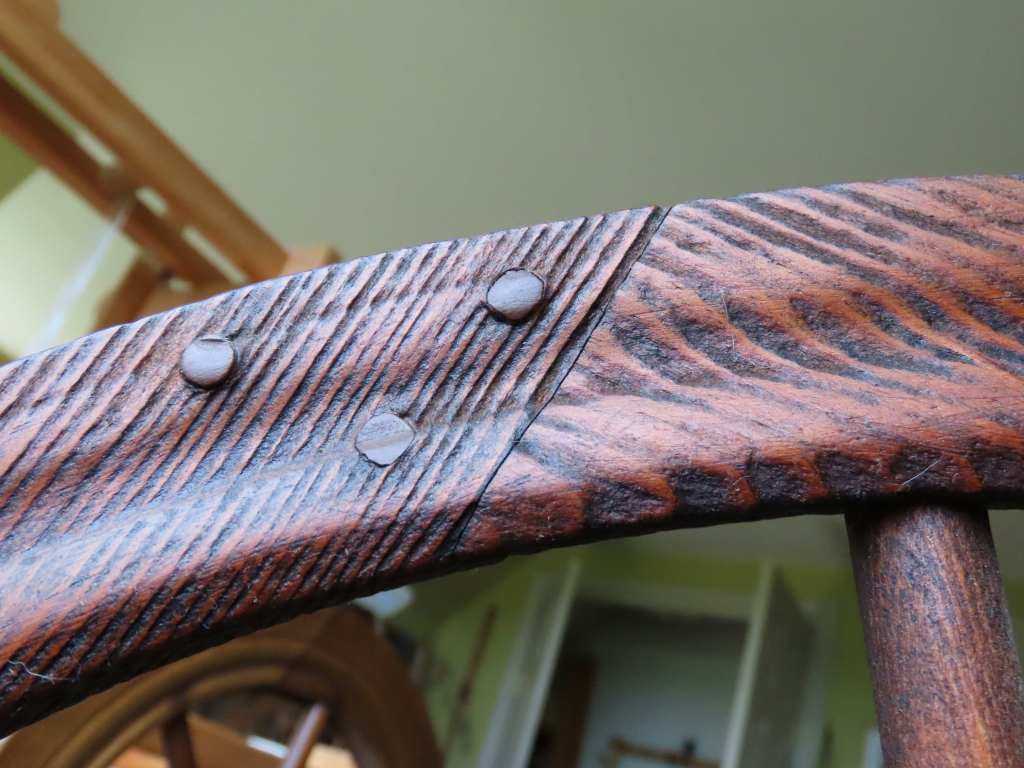
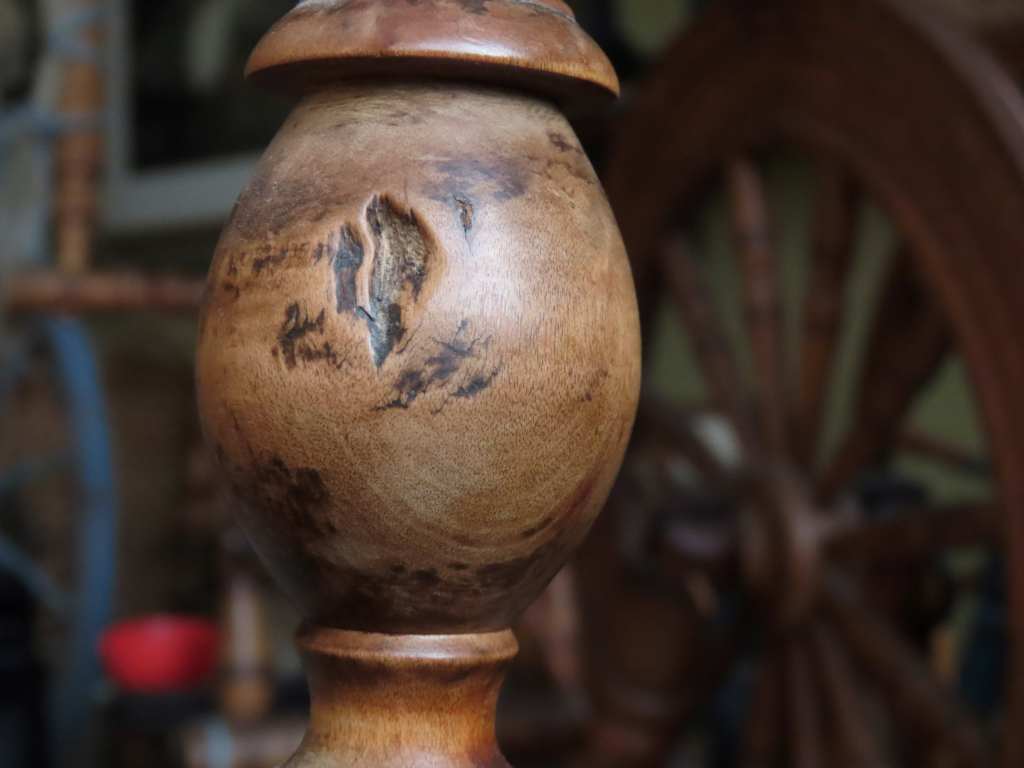
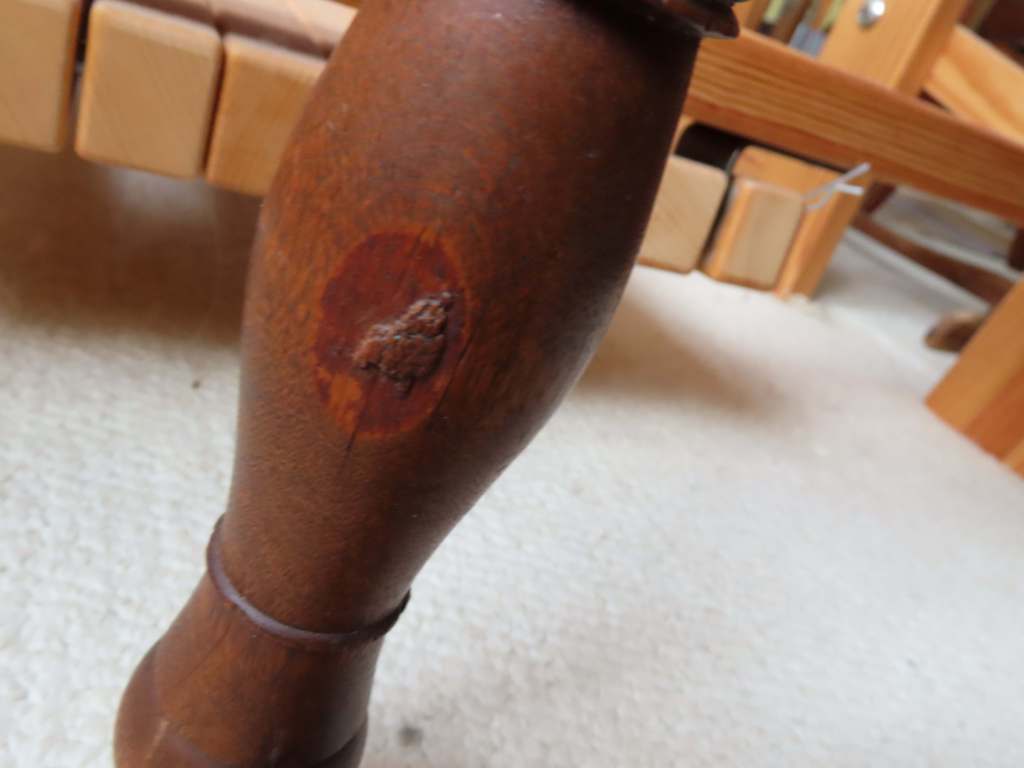
Her surfaces were not varnished or smoothed and the grain is somewhat raised.
It gives her a fantastic texture not found in many wheels.
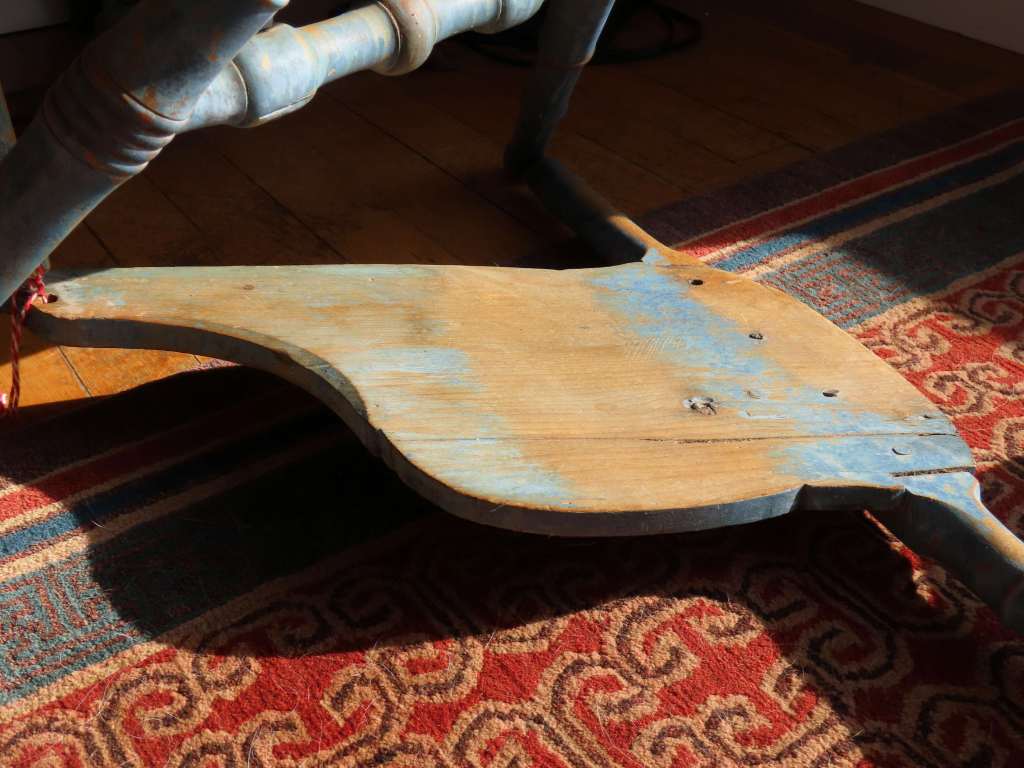
She is an excellent spinner and her light weight makes her easy to transport.
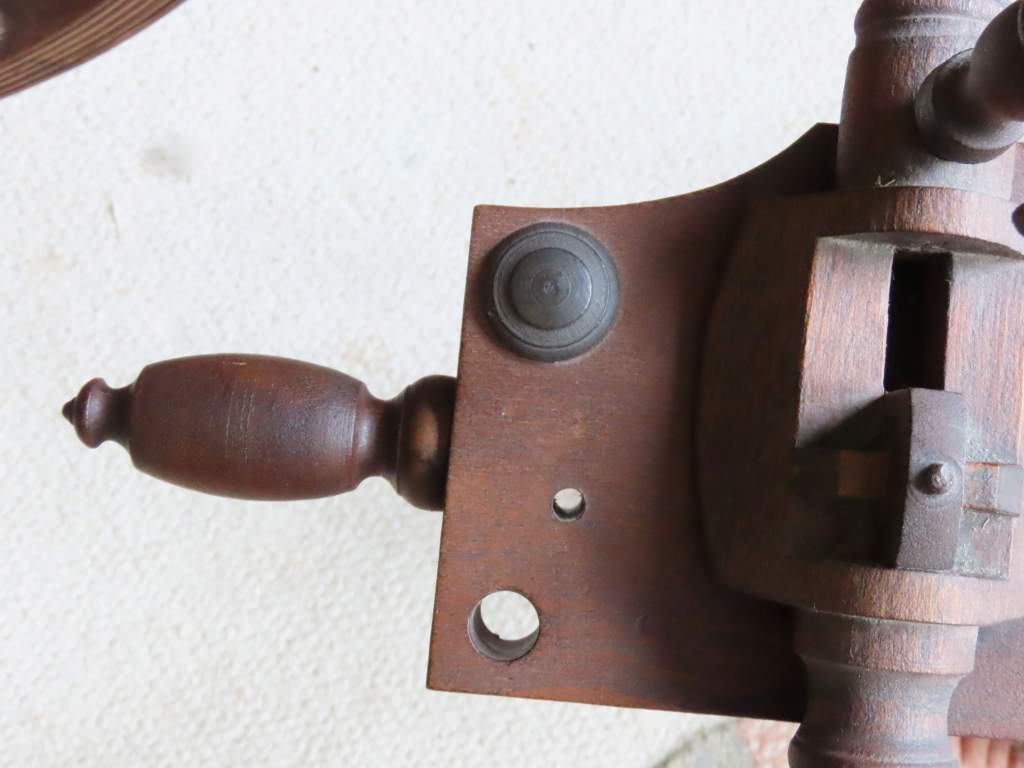
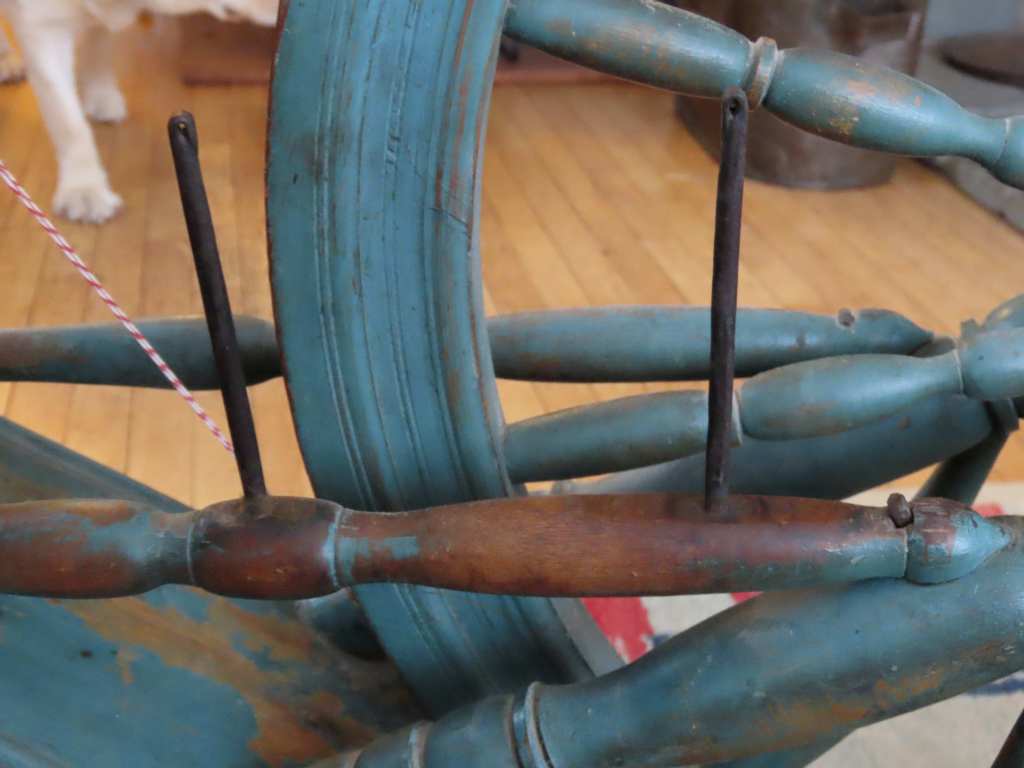
While she did not come with a distaff, there are two distaff holes, one with a cap.
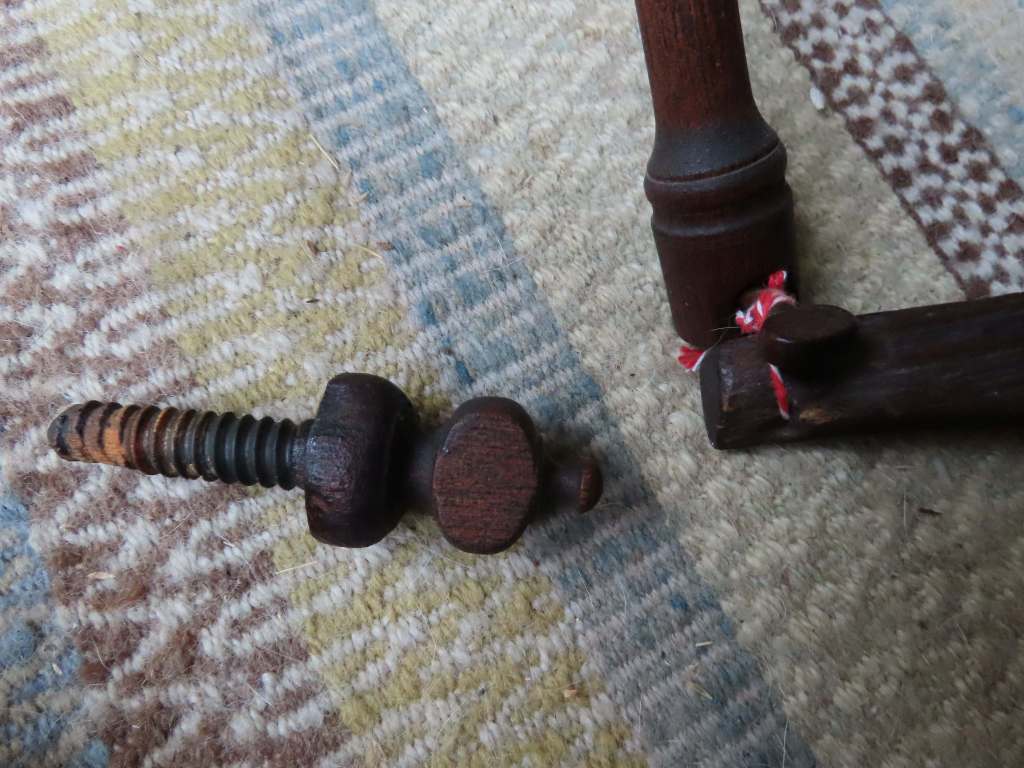
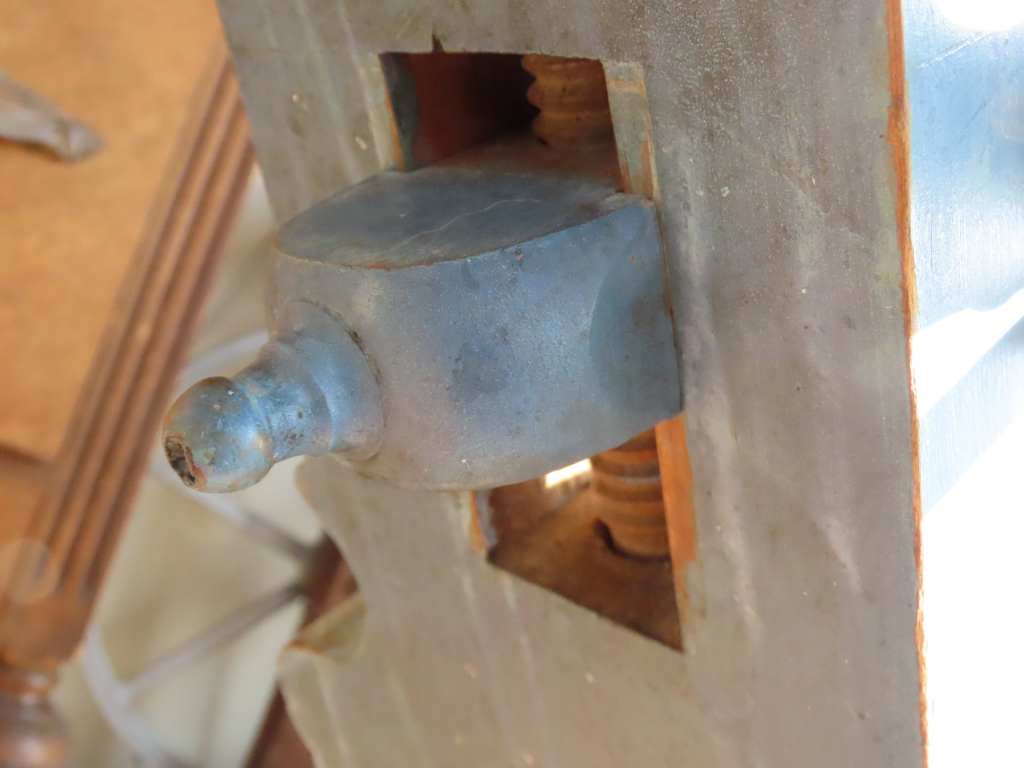
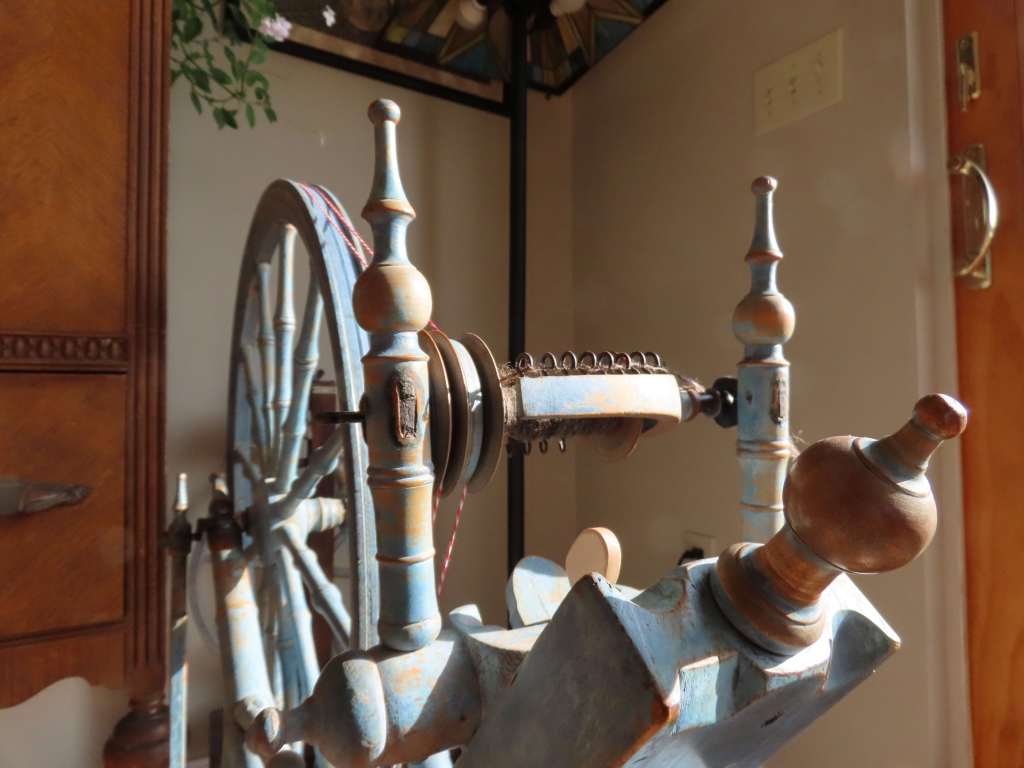
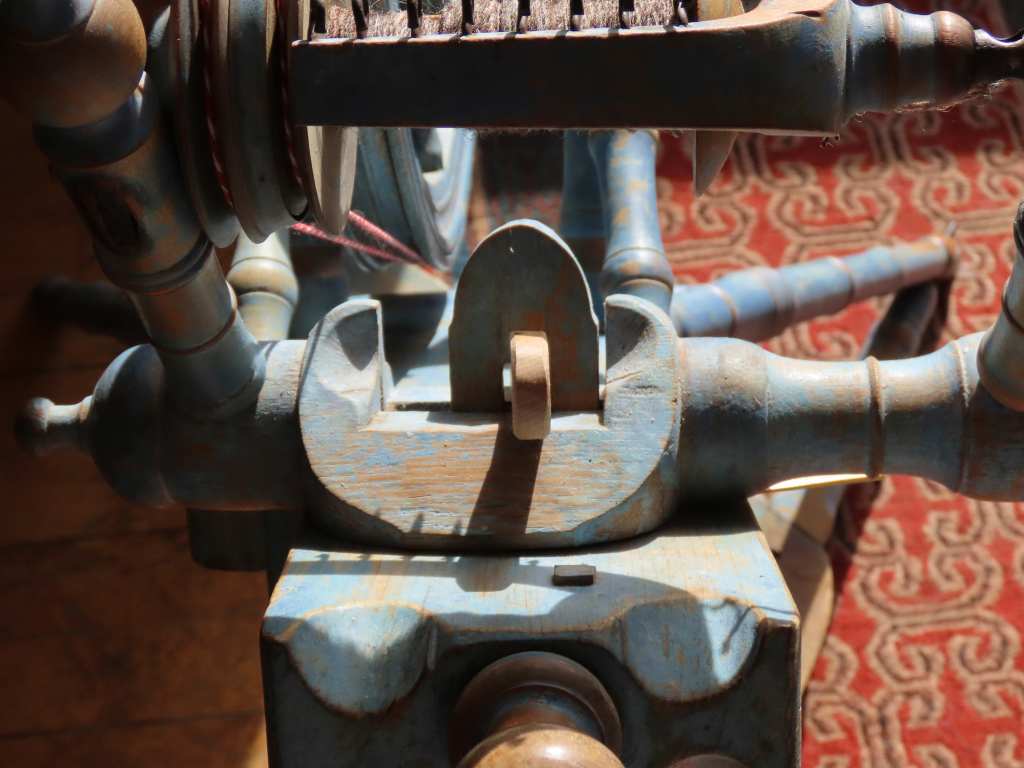
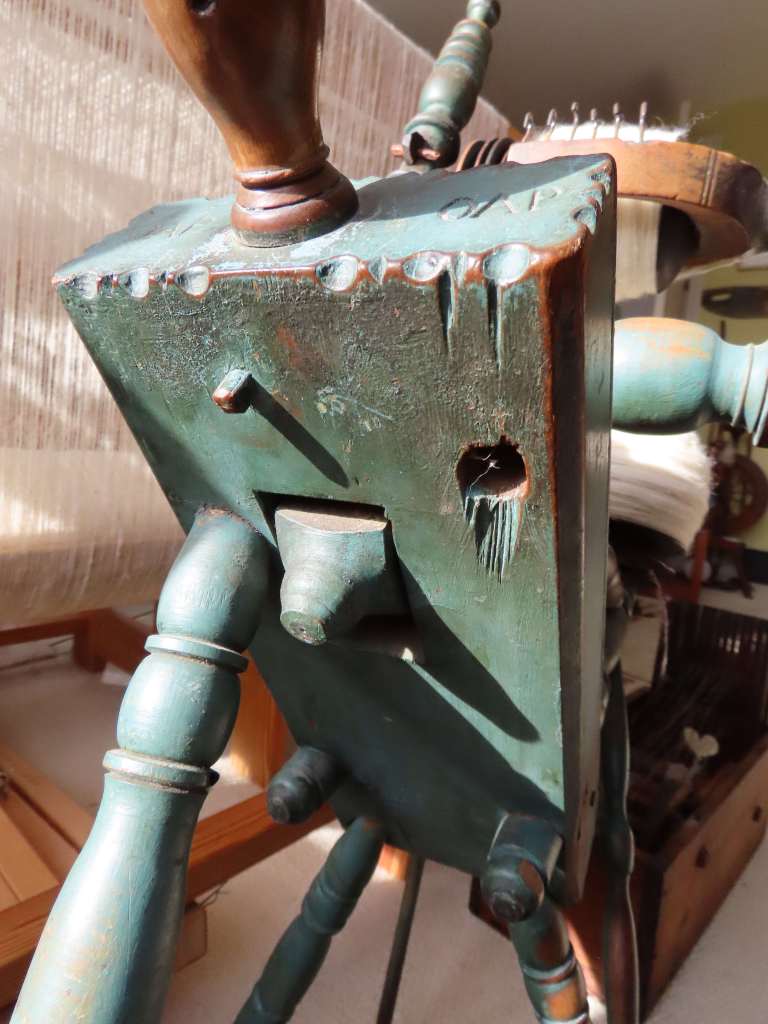
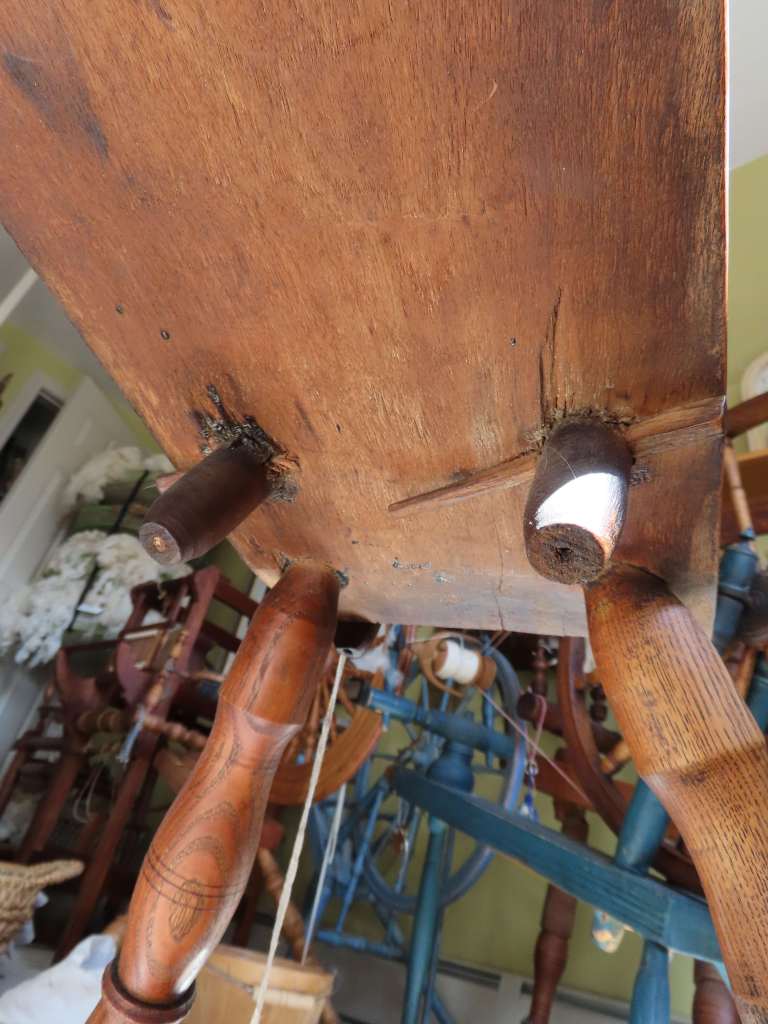
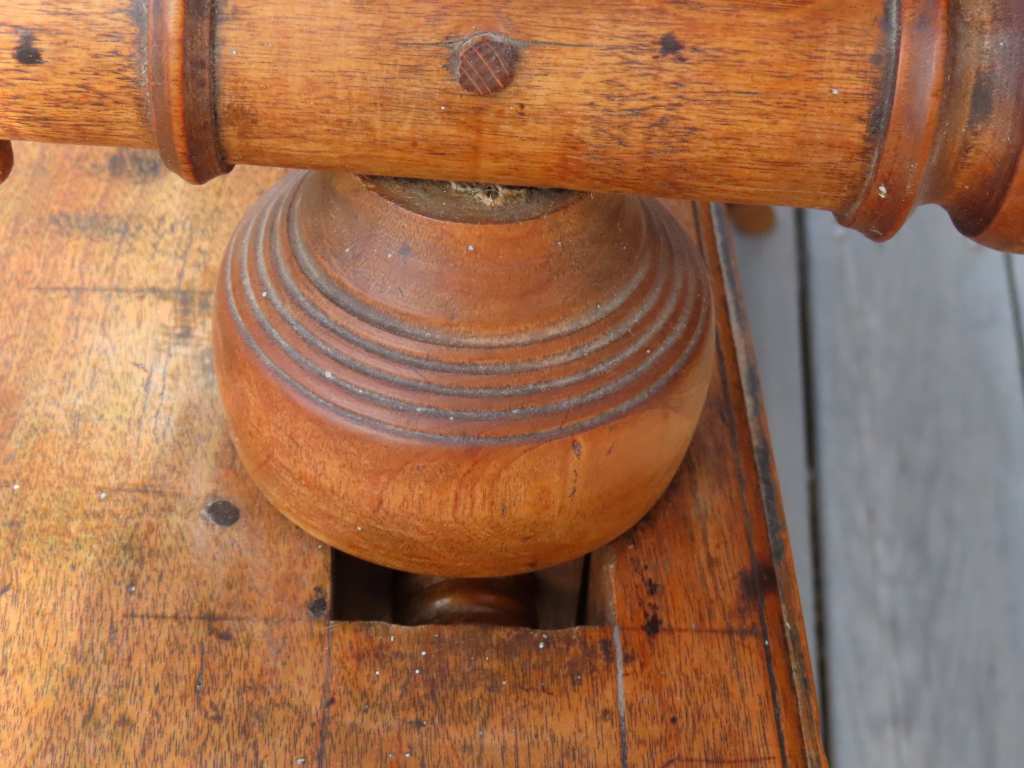
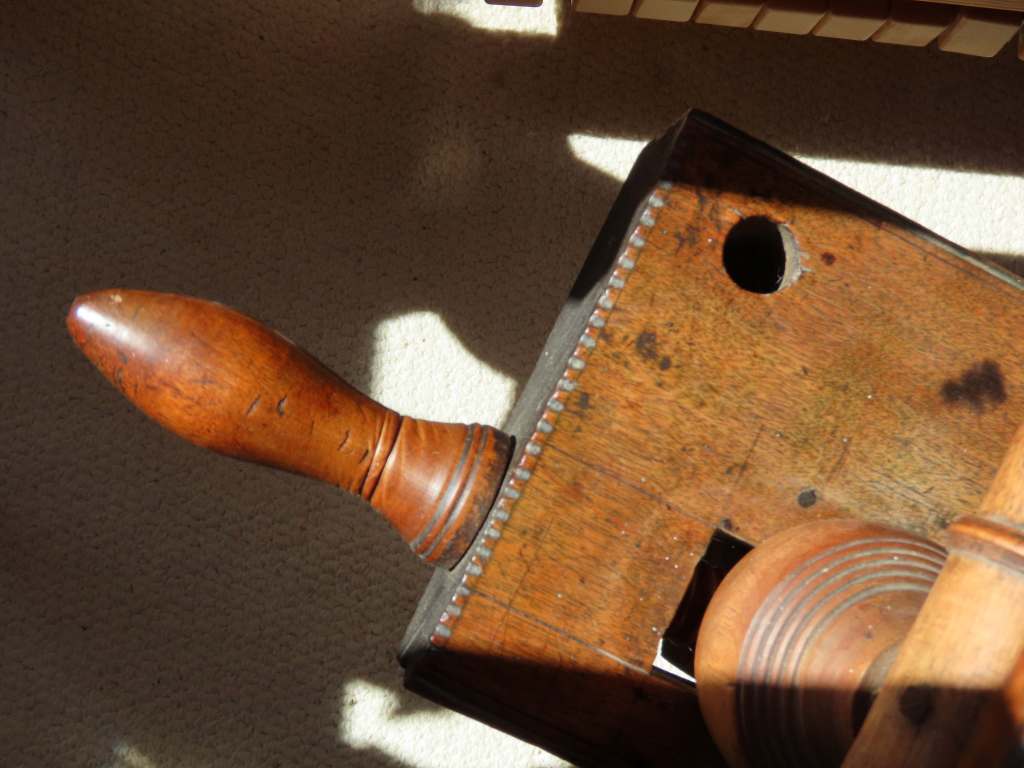
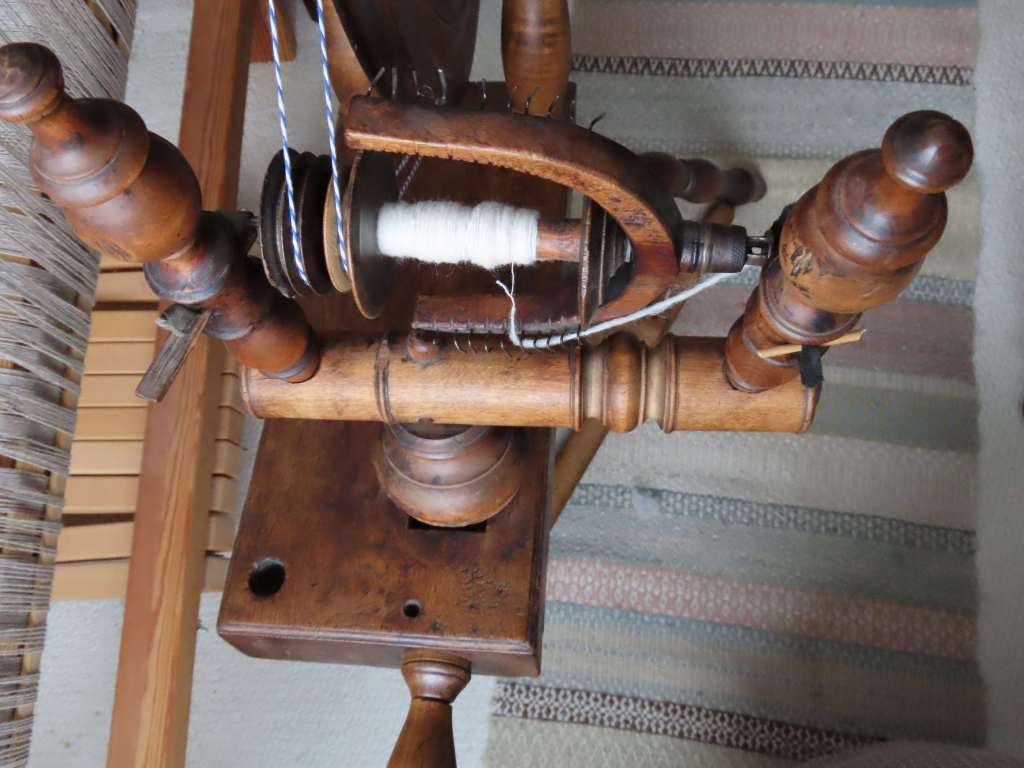
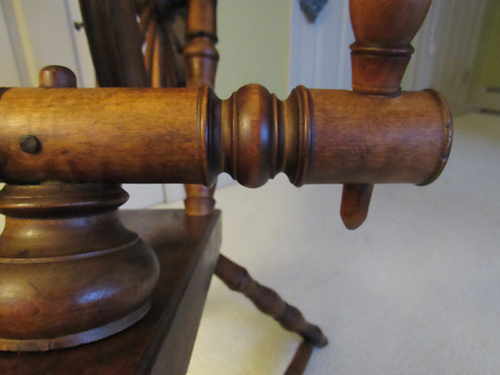
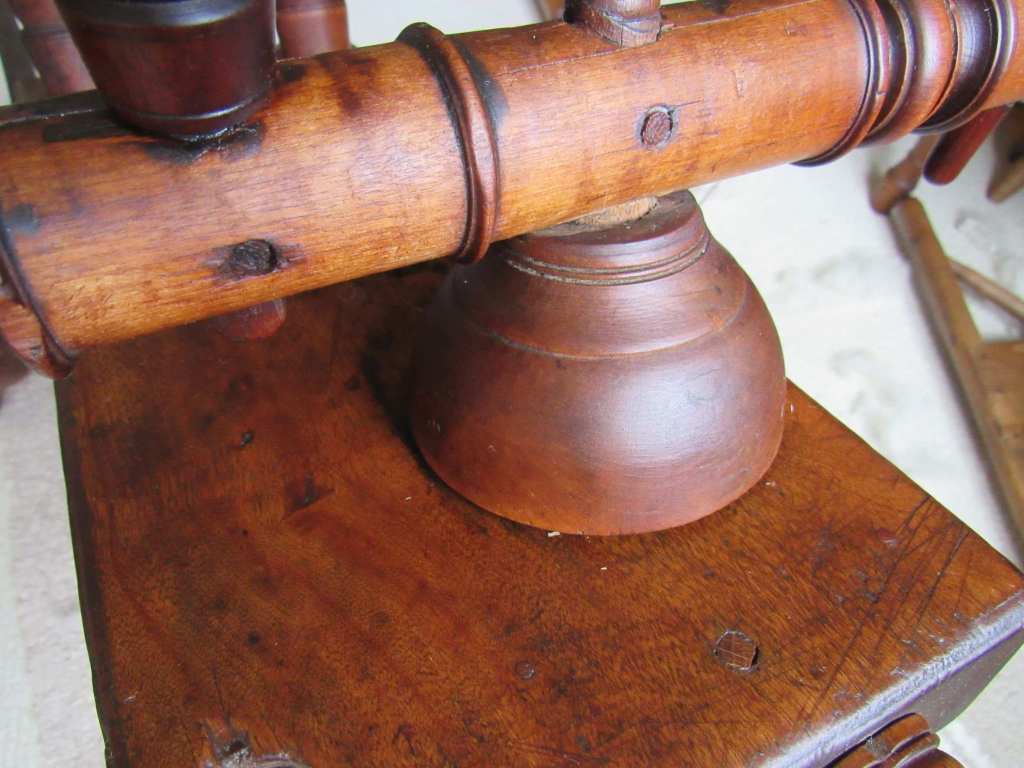
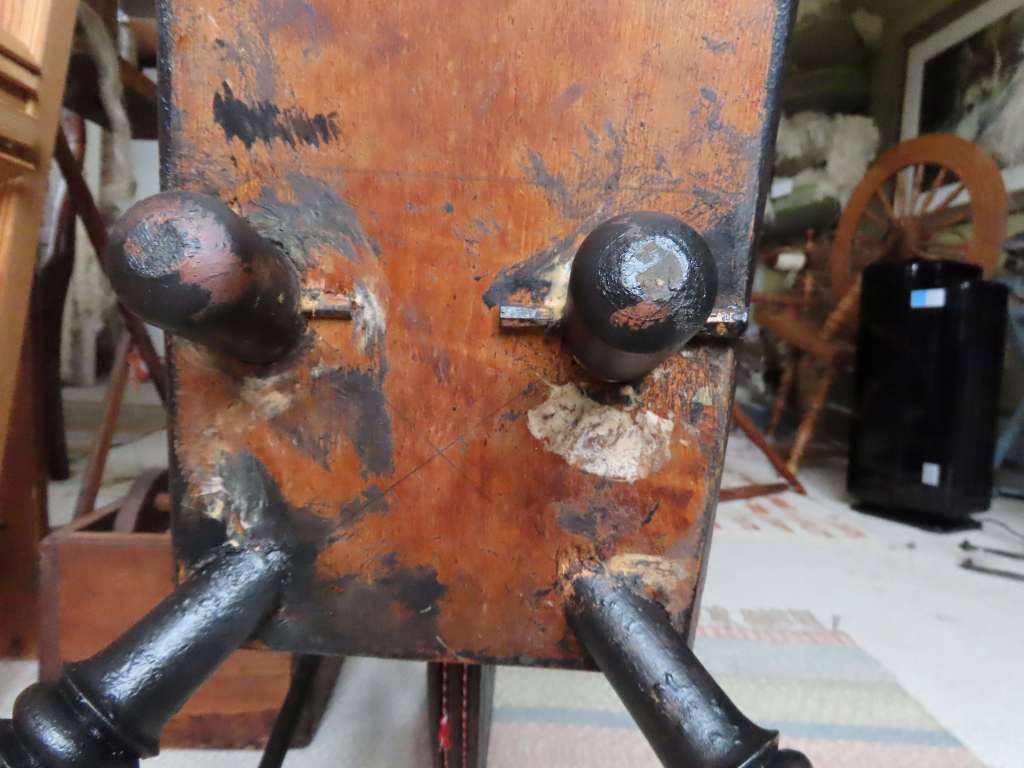
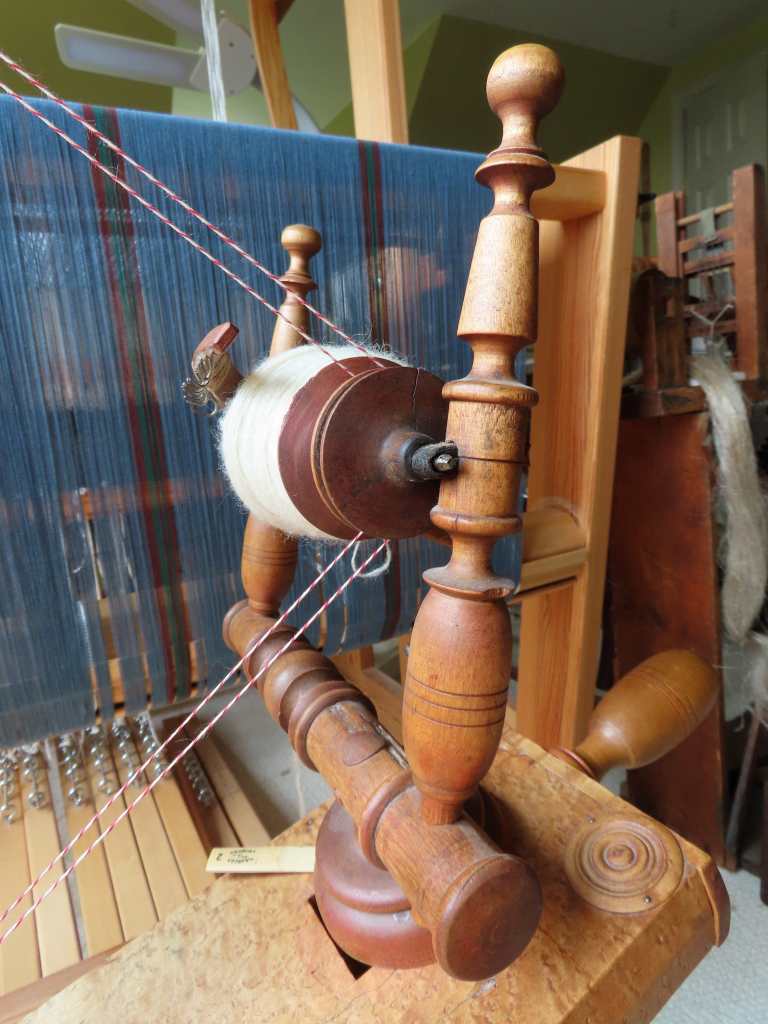
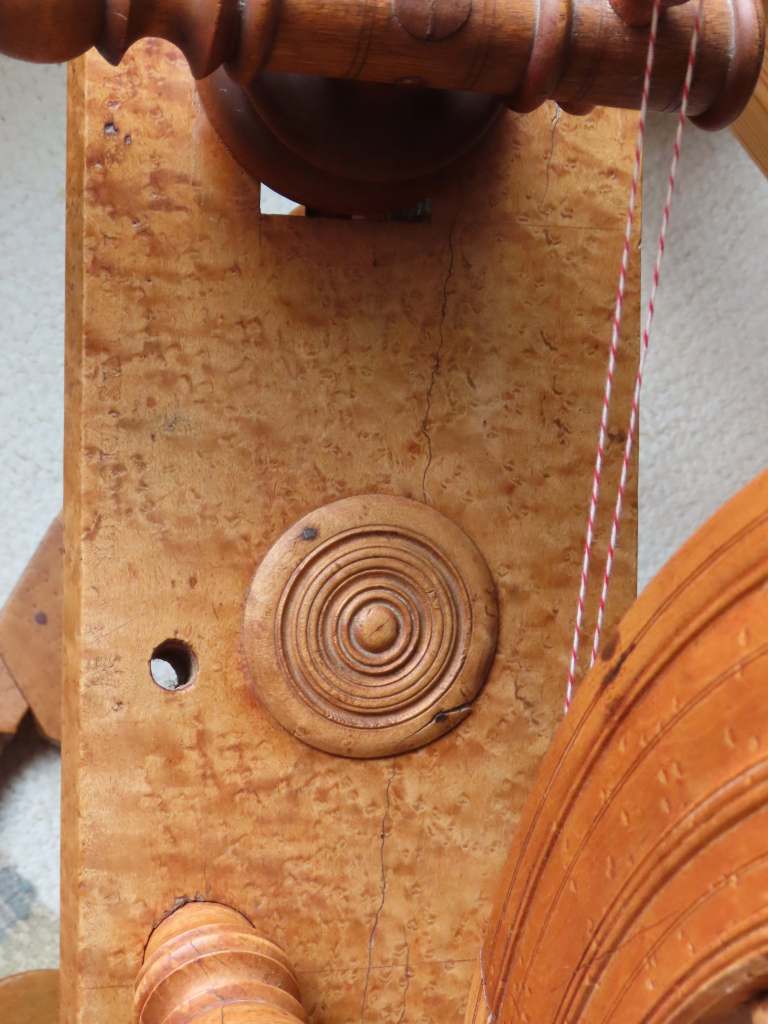
The mother-of-all has a slider for positioning the flyer, similar to the BESS wheels in the previous post. A wooden screw under the table tightens the MOA in place.
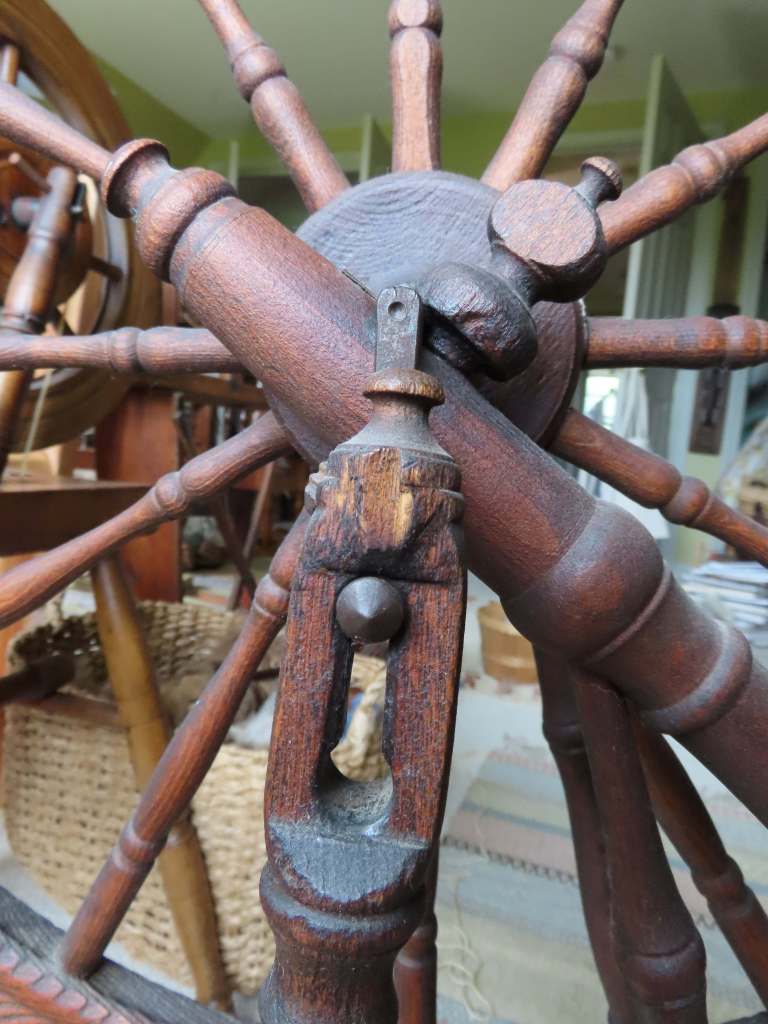
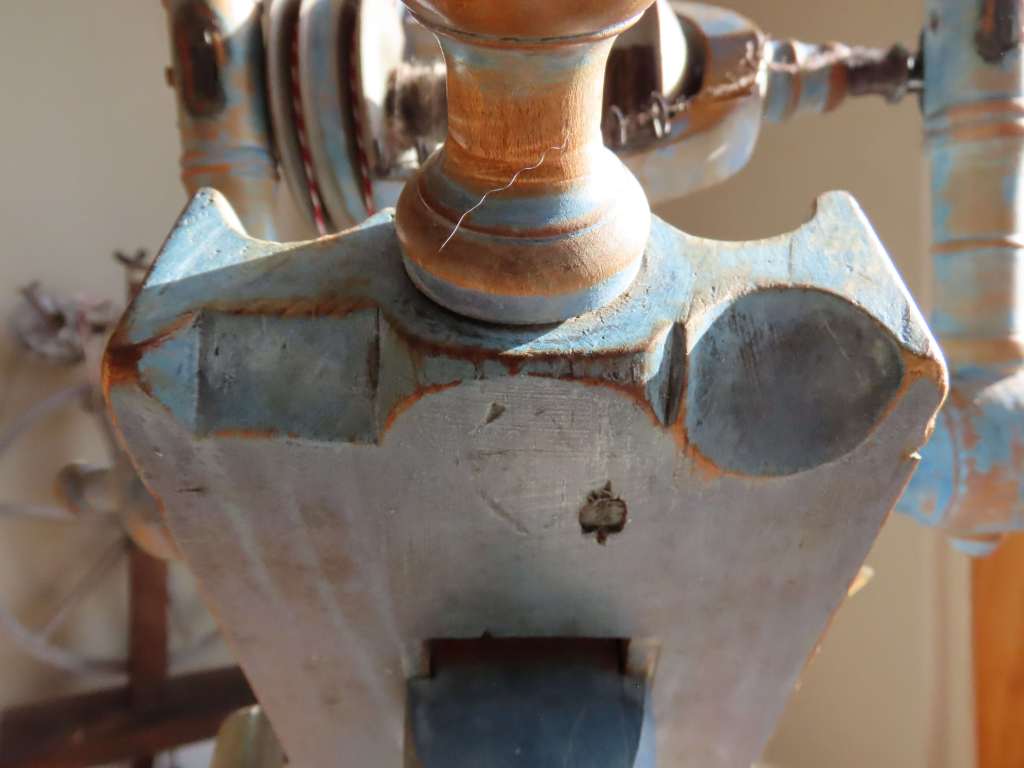
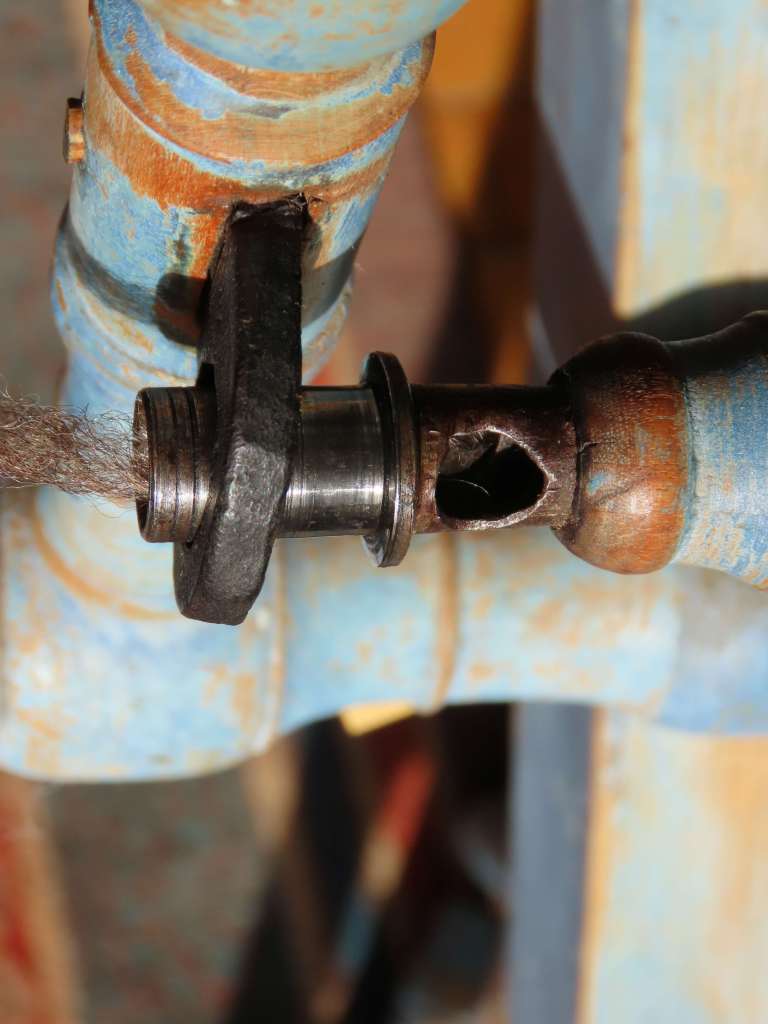
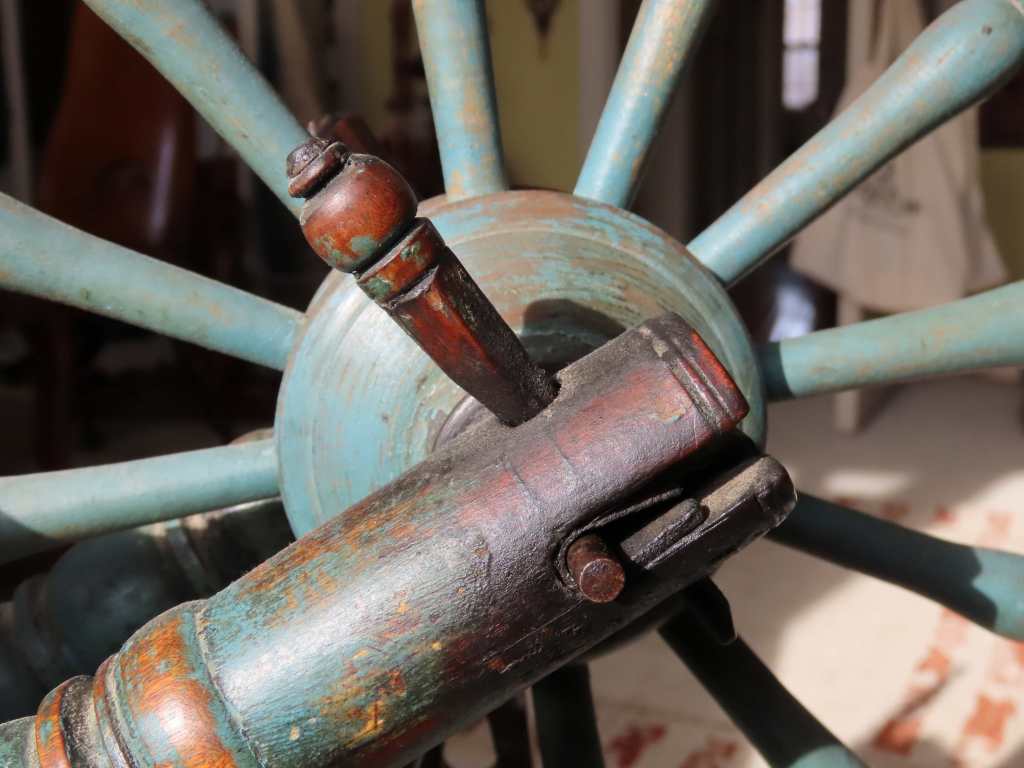
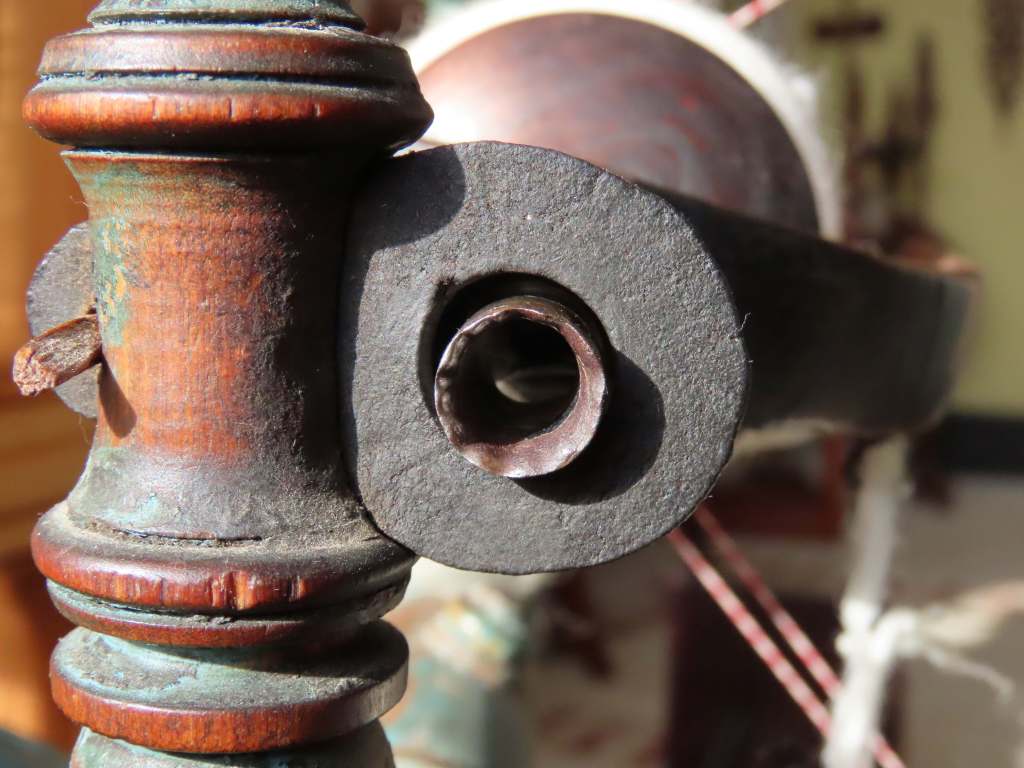
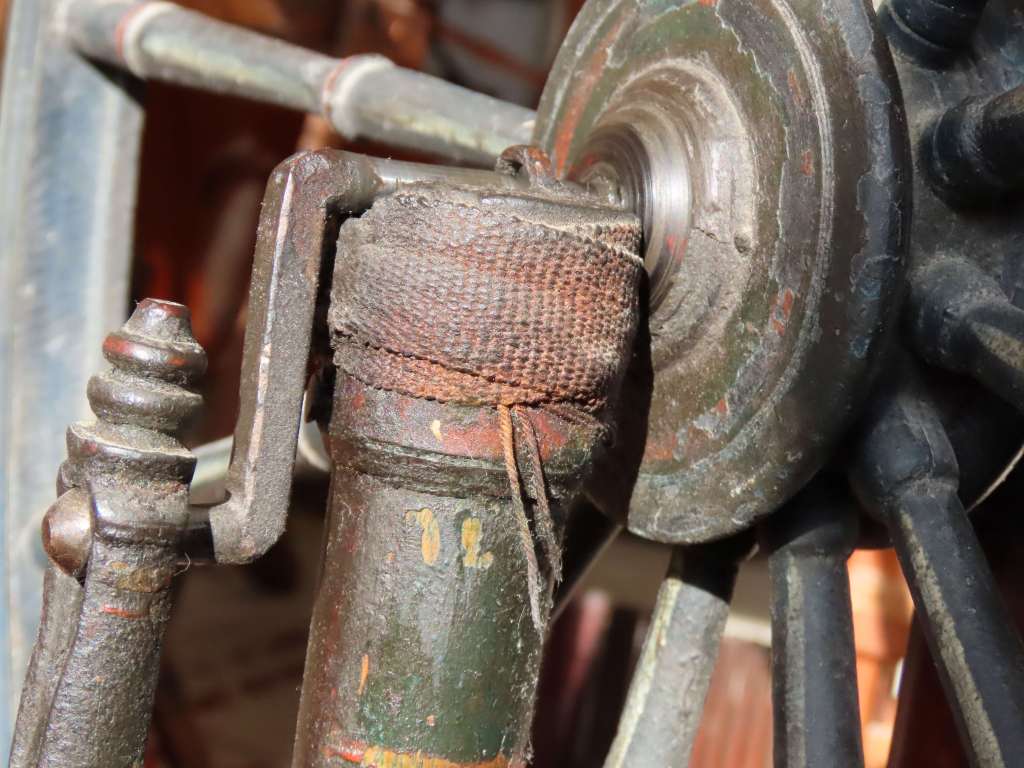
The axle rests in a metal-clad depression in the angled upright supports,
held in place with a wooden screw.
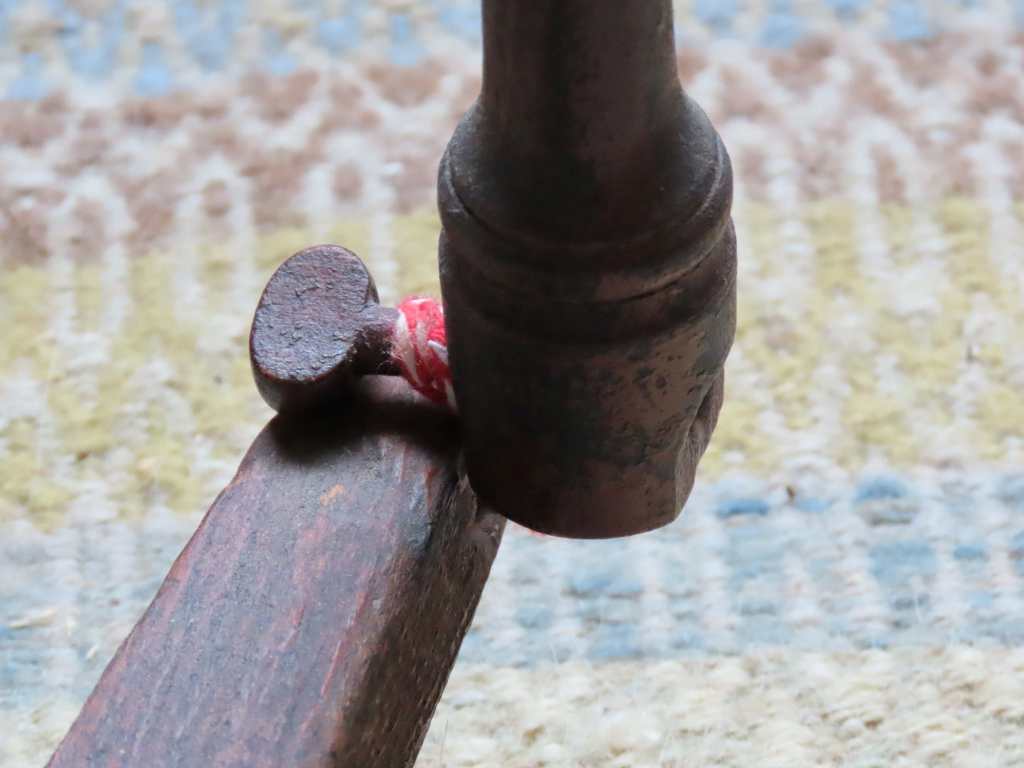
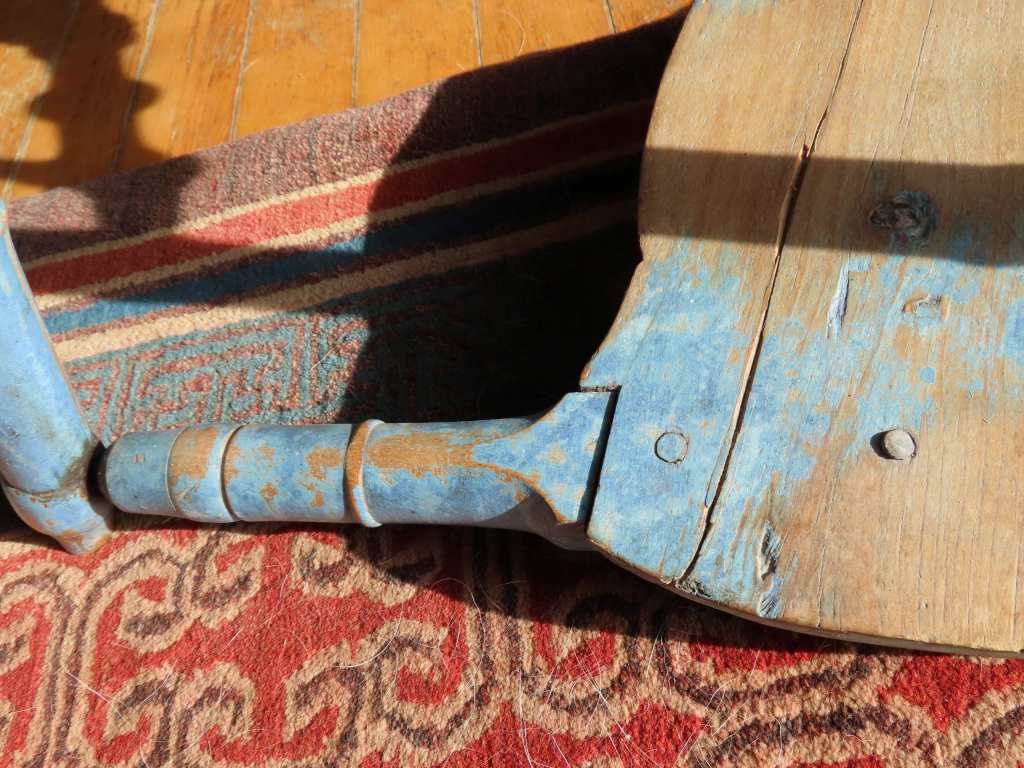
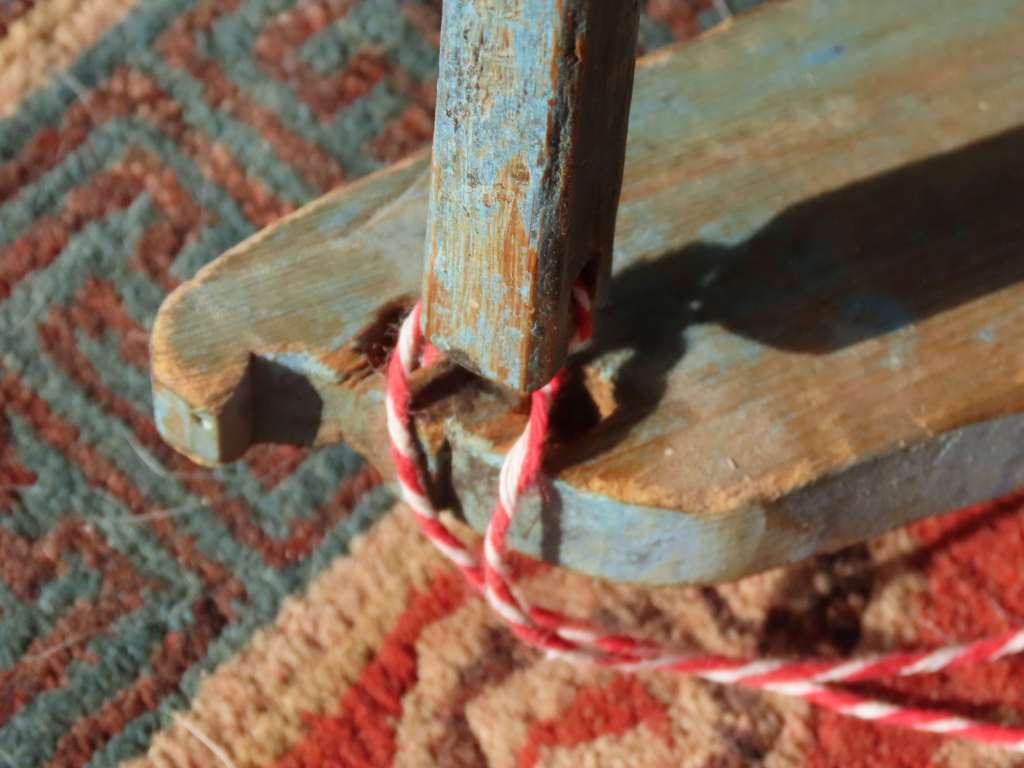
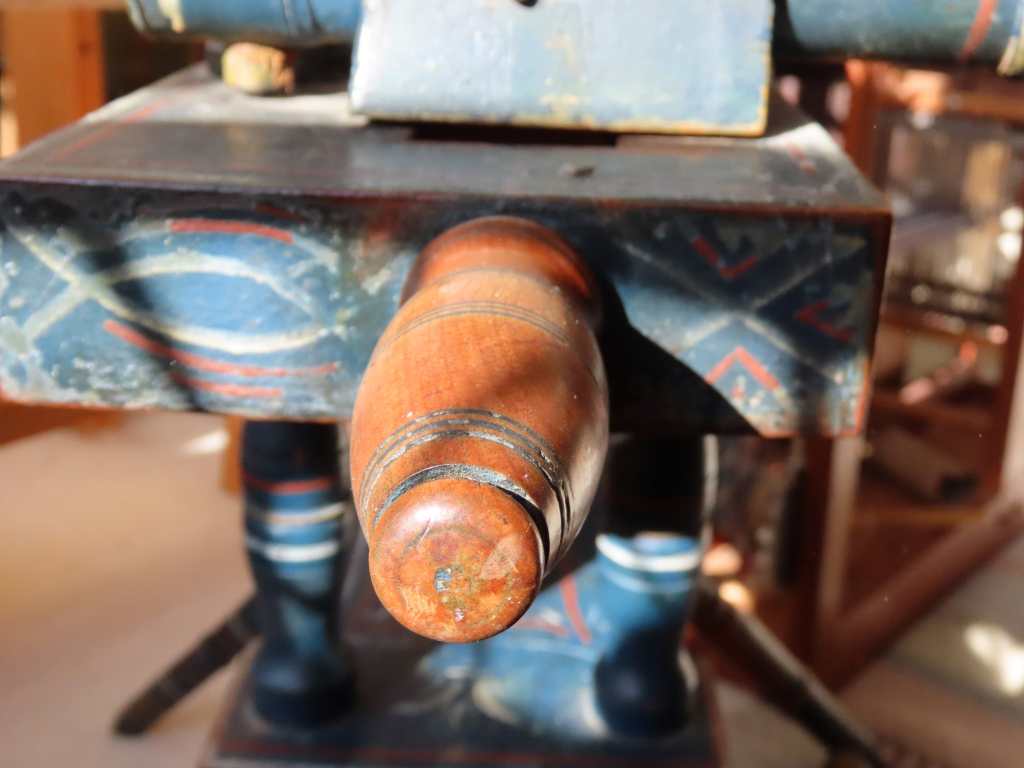
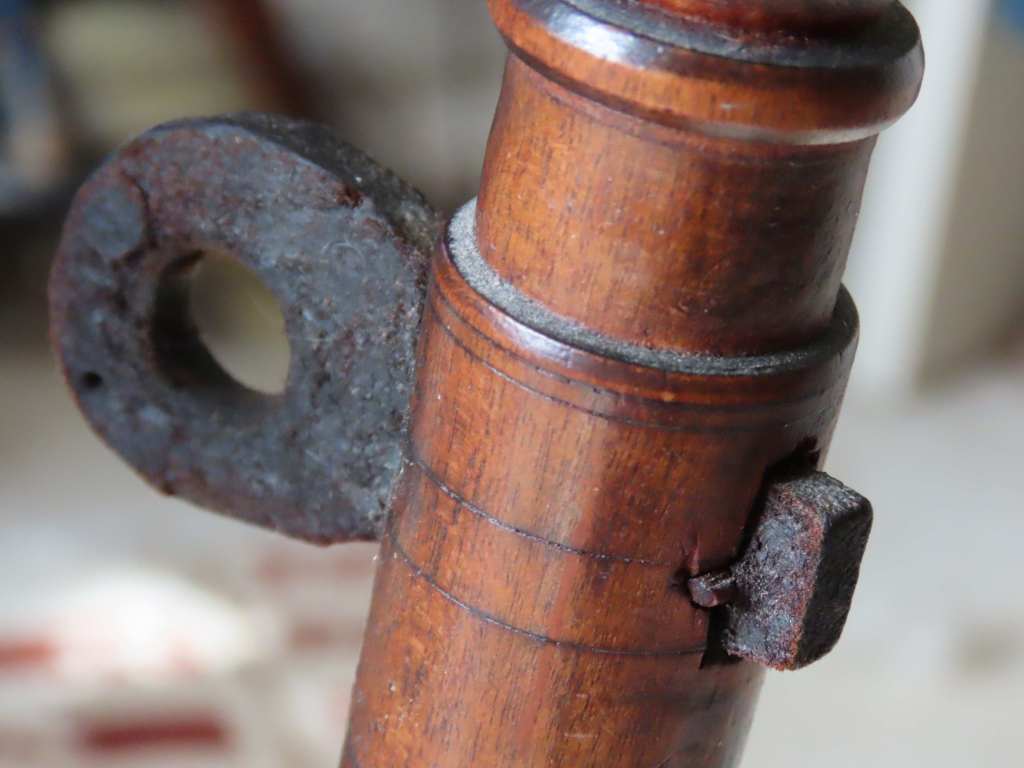
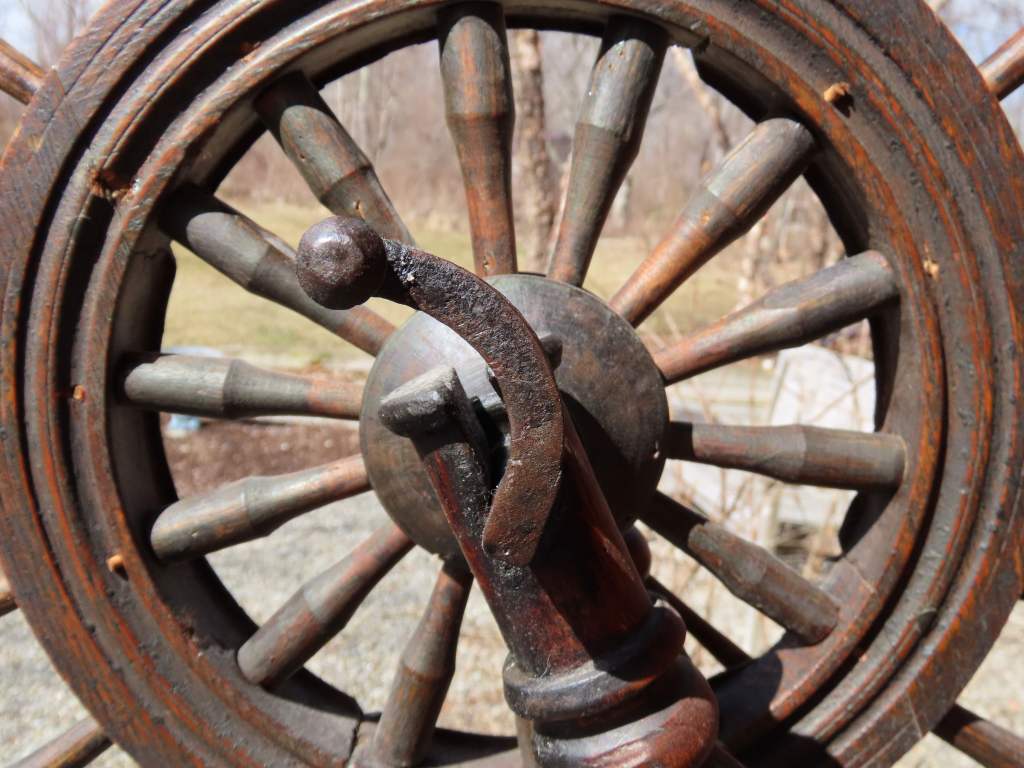
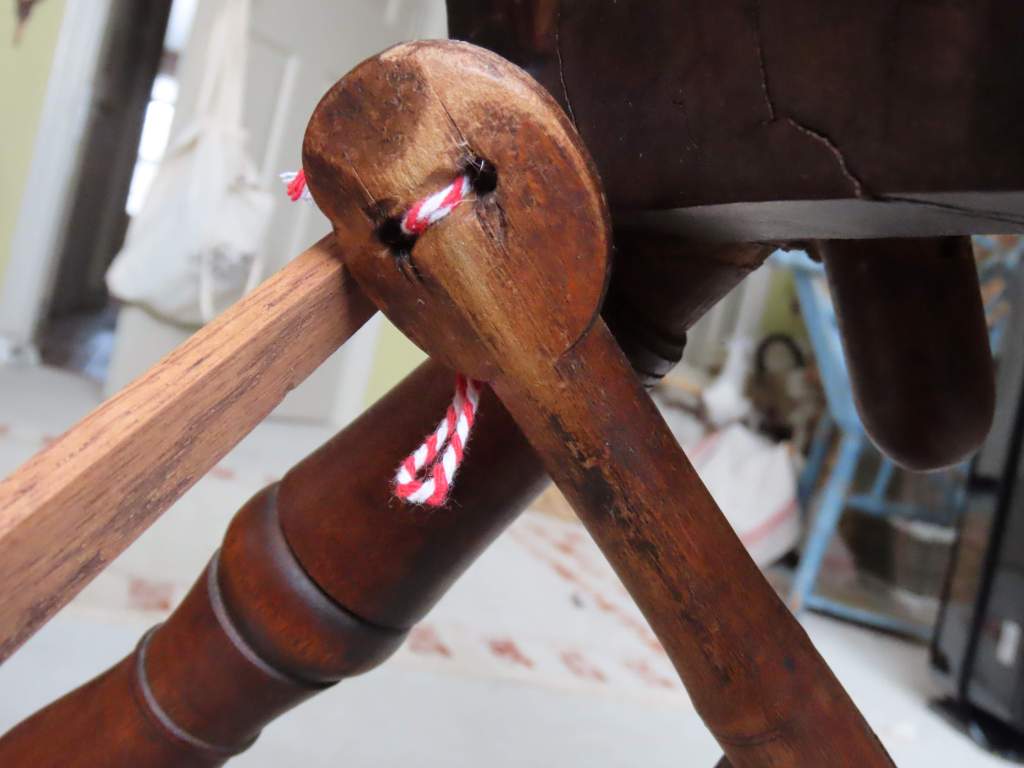
A unique feature to Sif is a little wooden pin for securing the footman to the treadle.
The footman appears to be original.
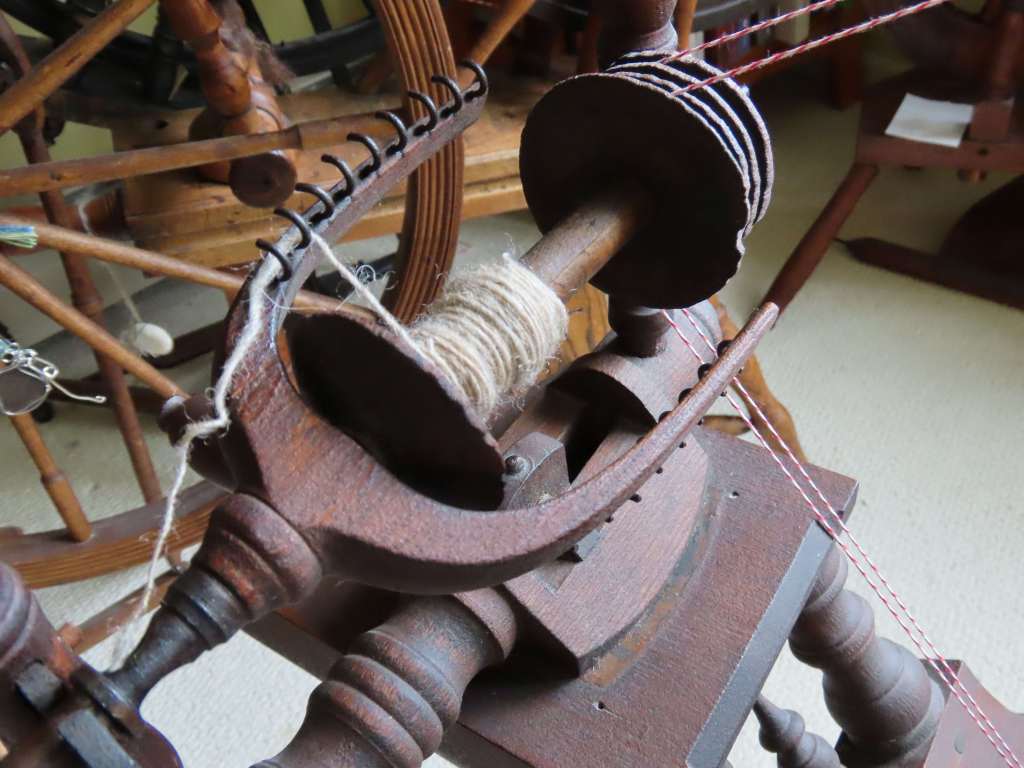
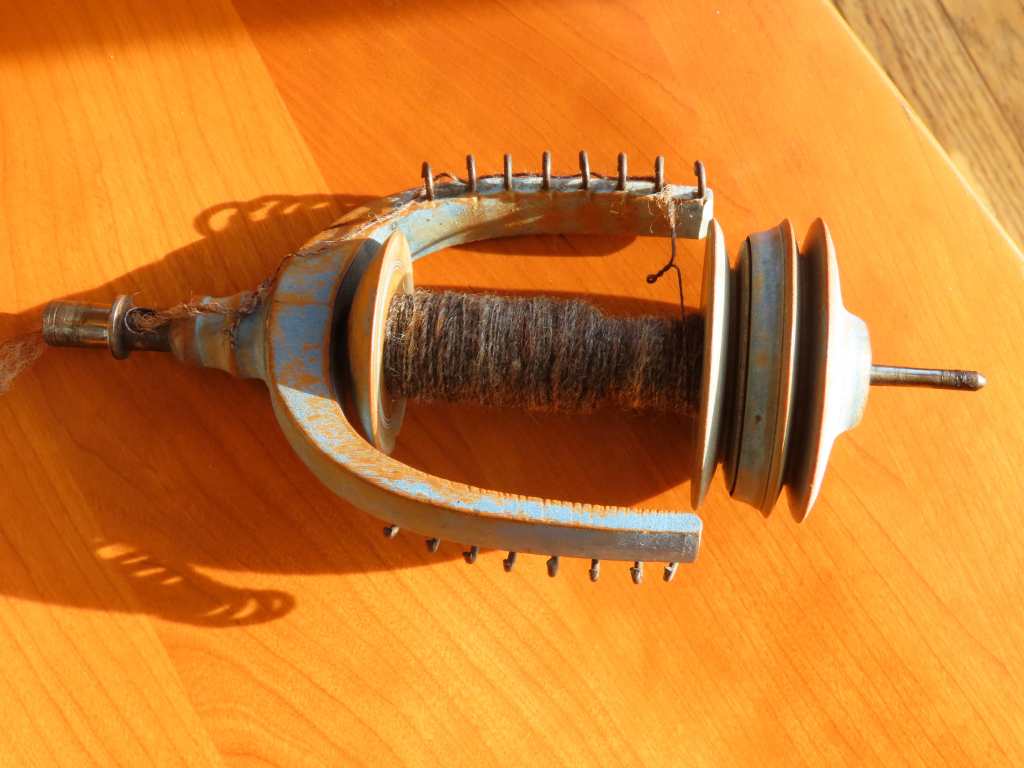
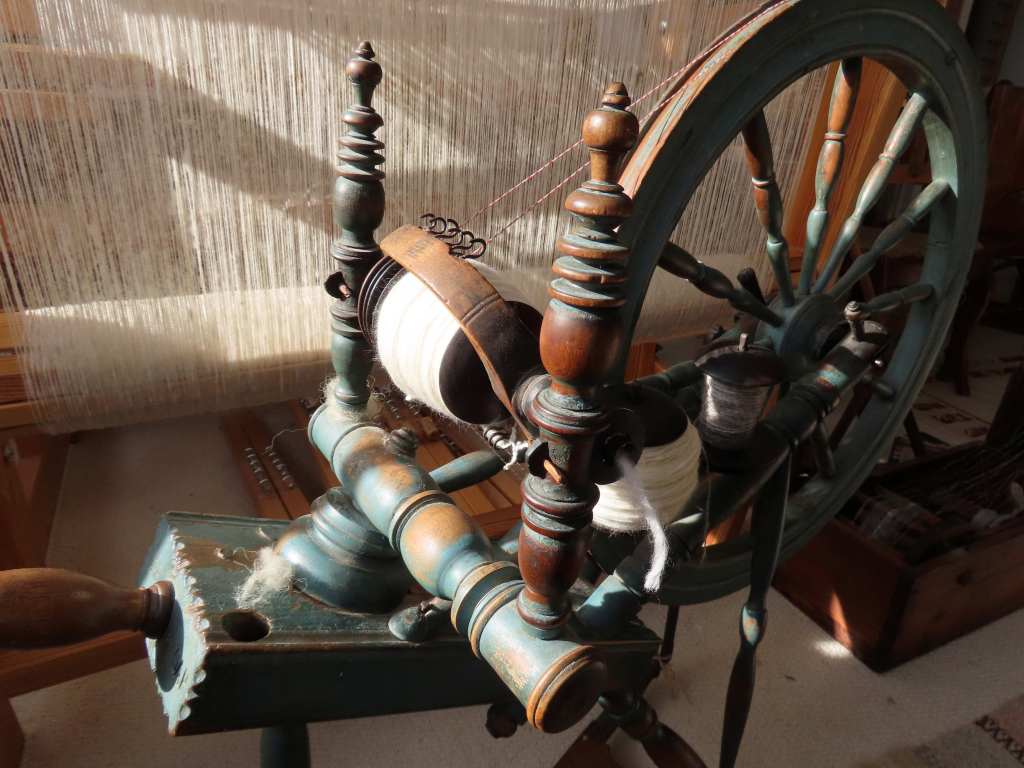
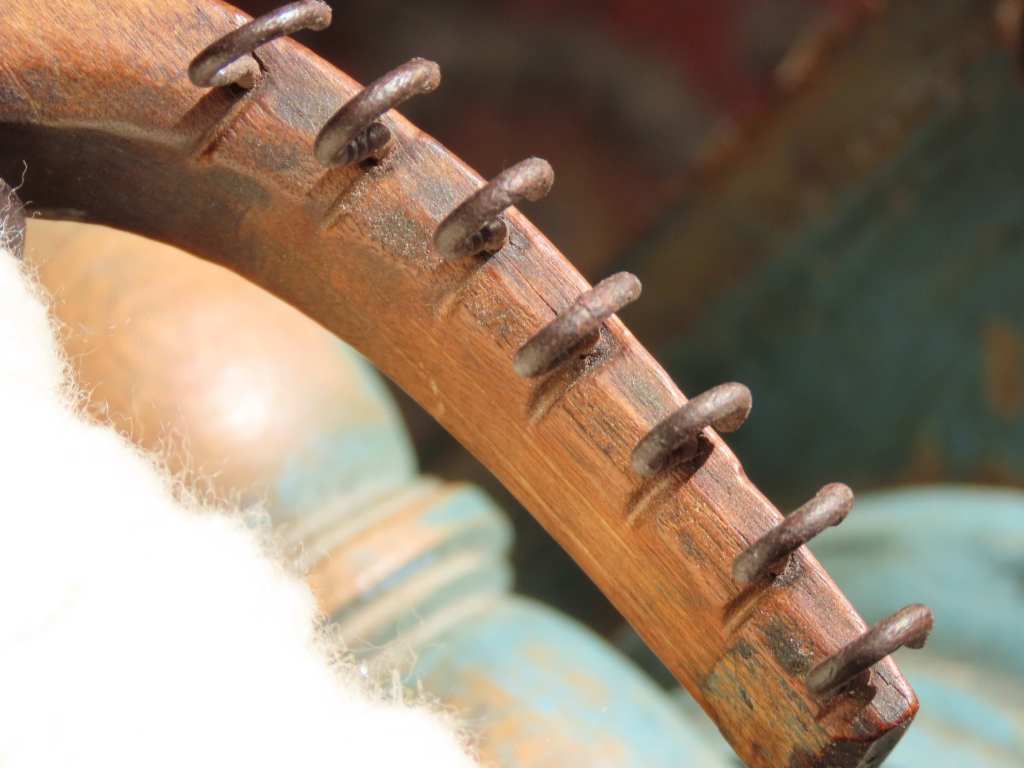
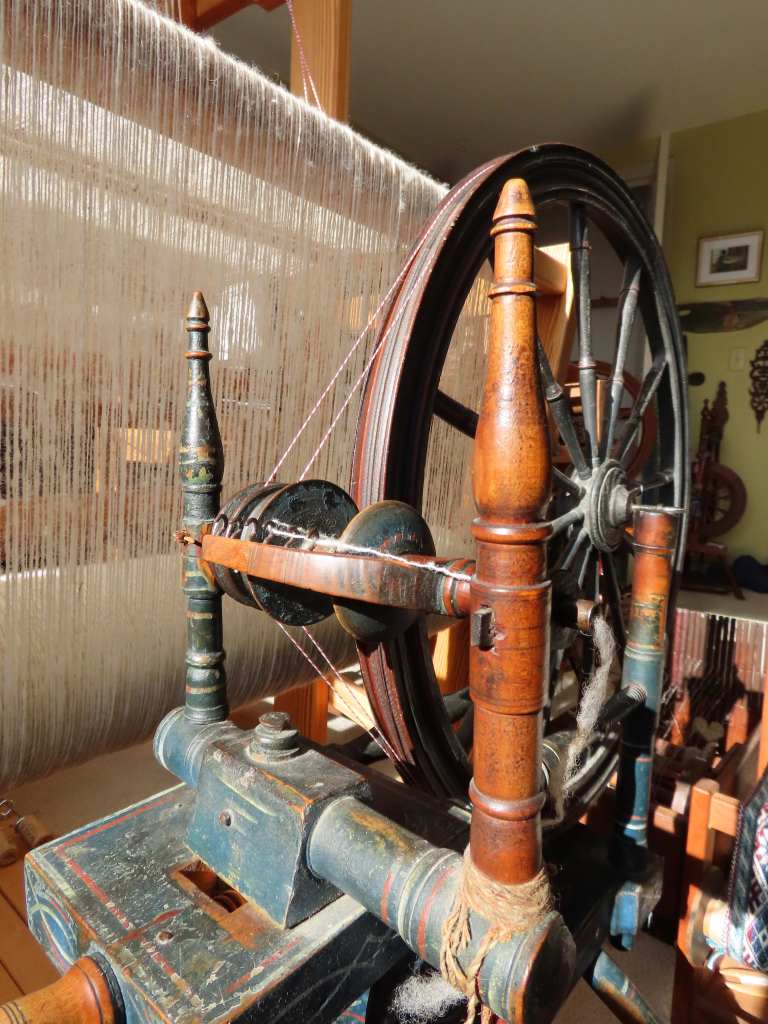
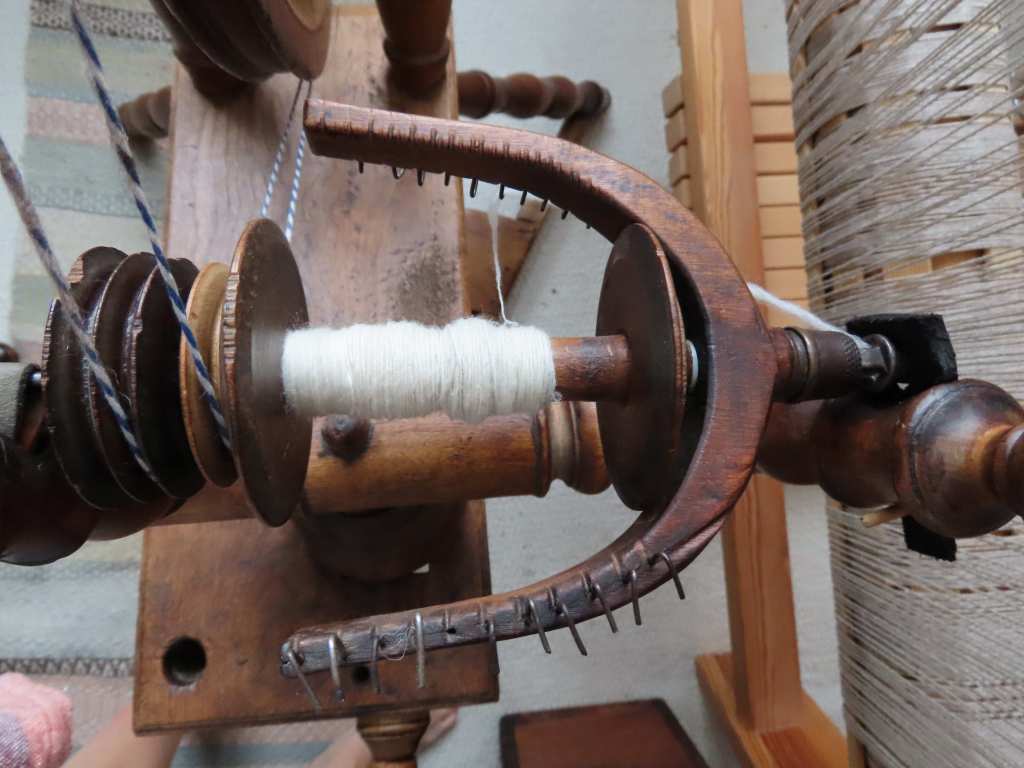
The mid-sized flyer
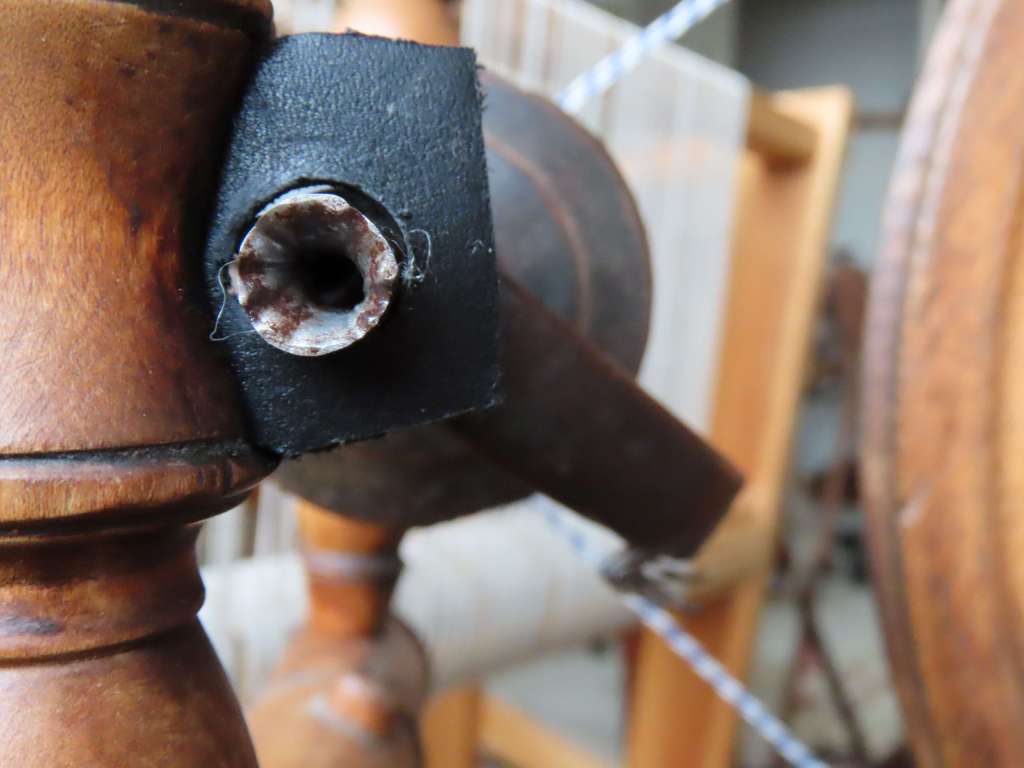
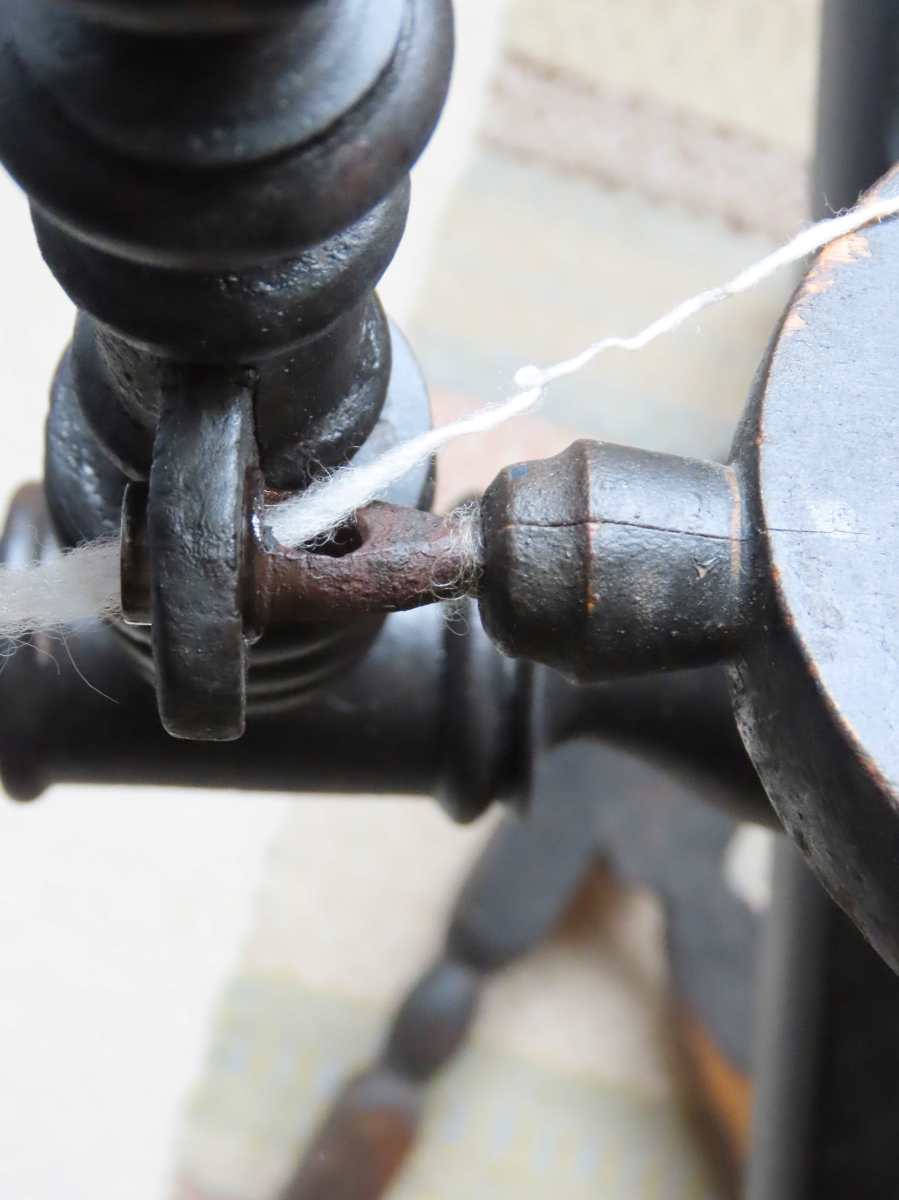
rests in an open-topped leather bearing on the orifice end.
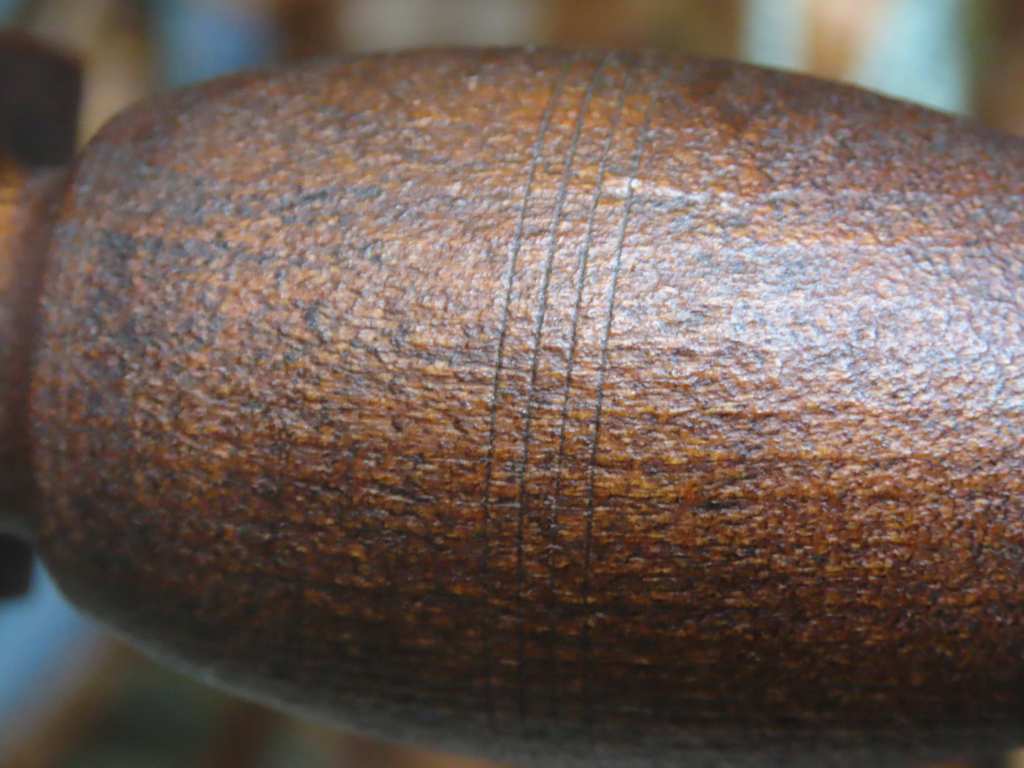
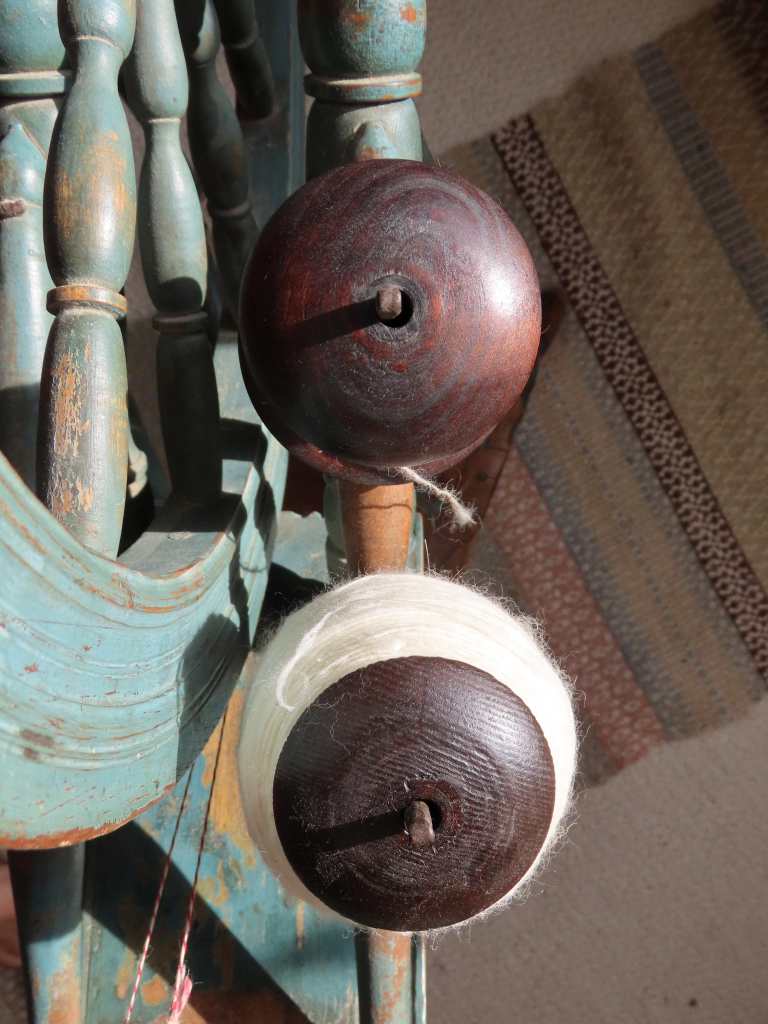
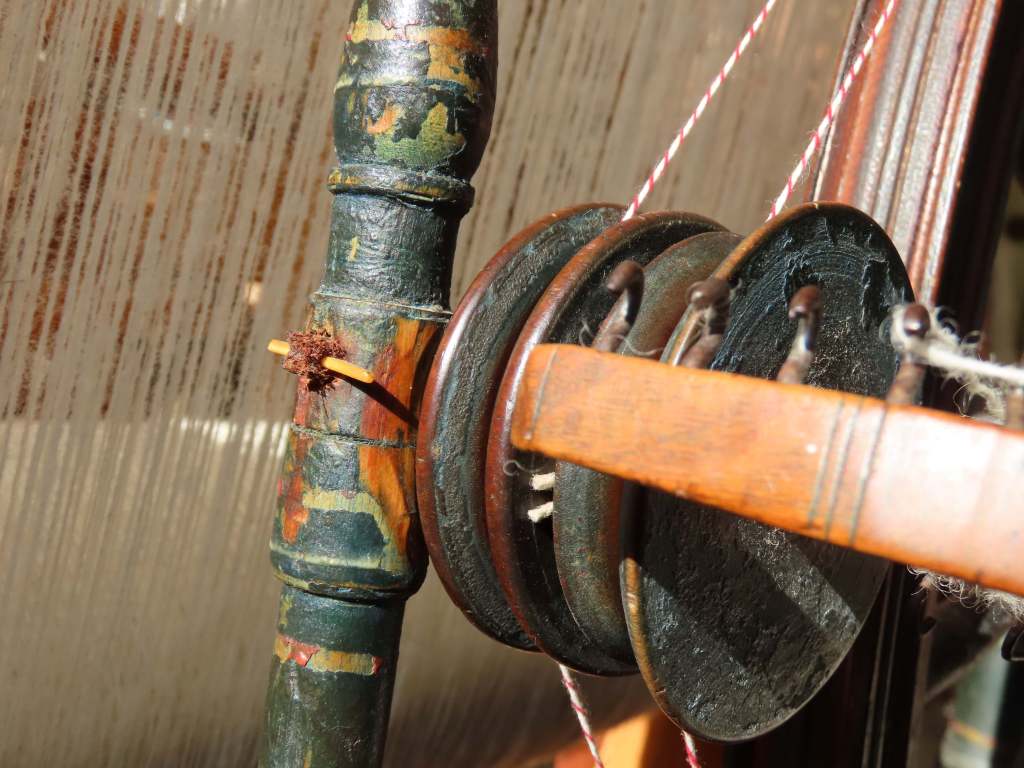
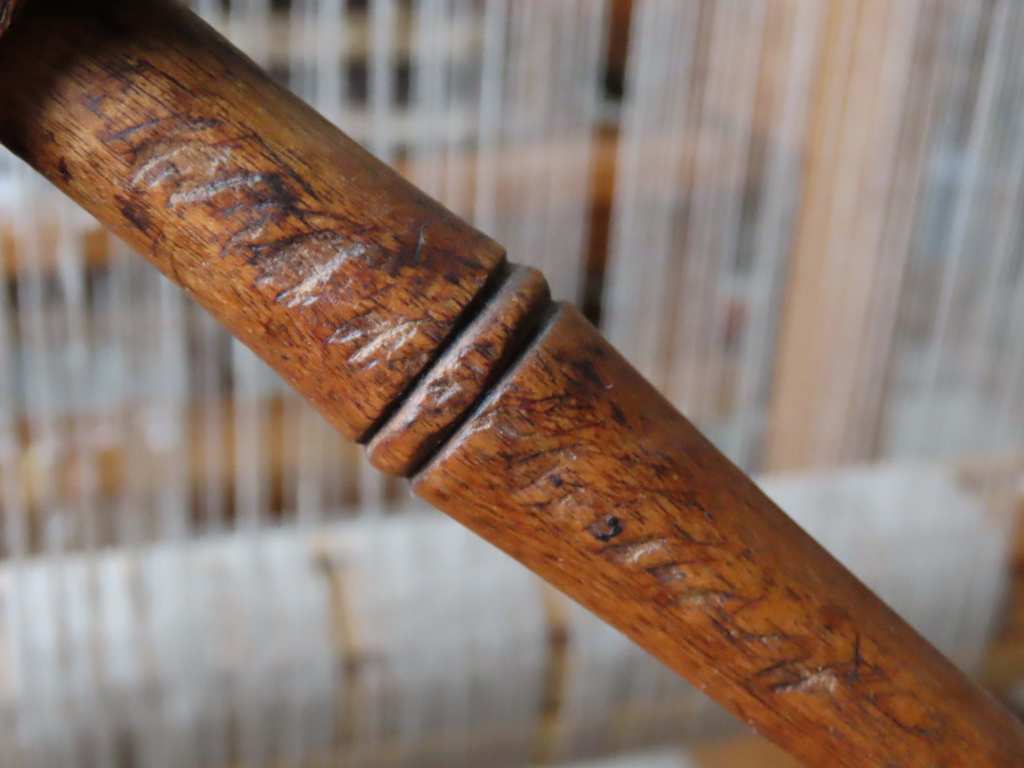
There is some roughness in the bobbin and whorl edges, due to how the coarse-grained wood has worn.
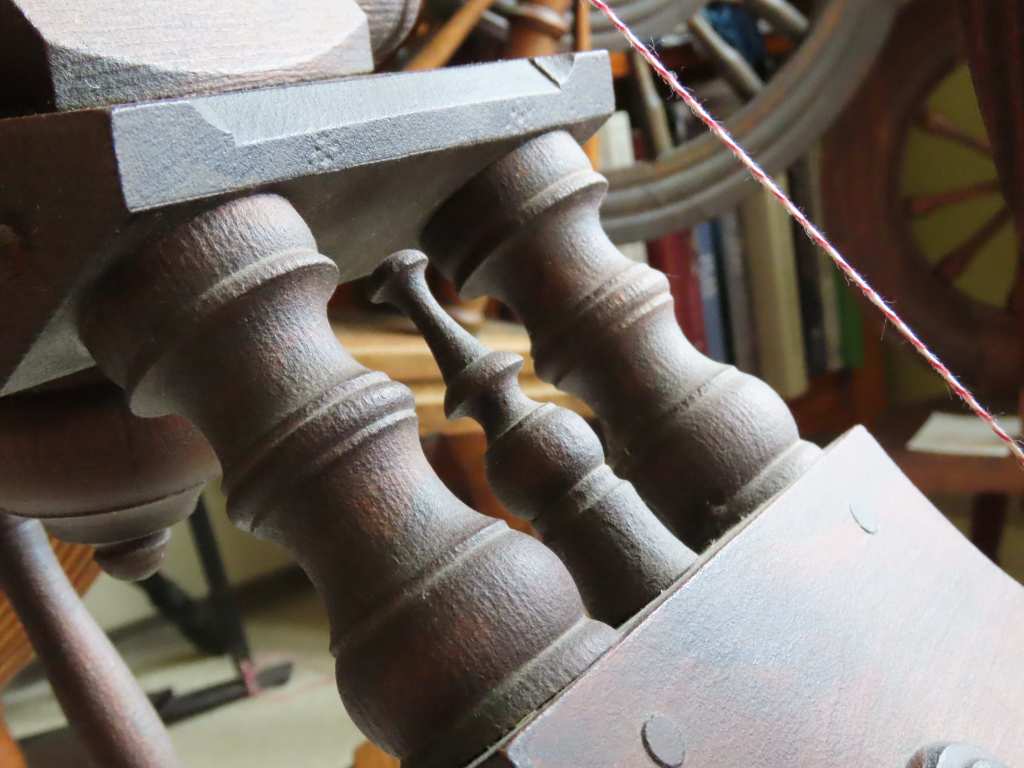
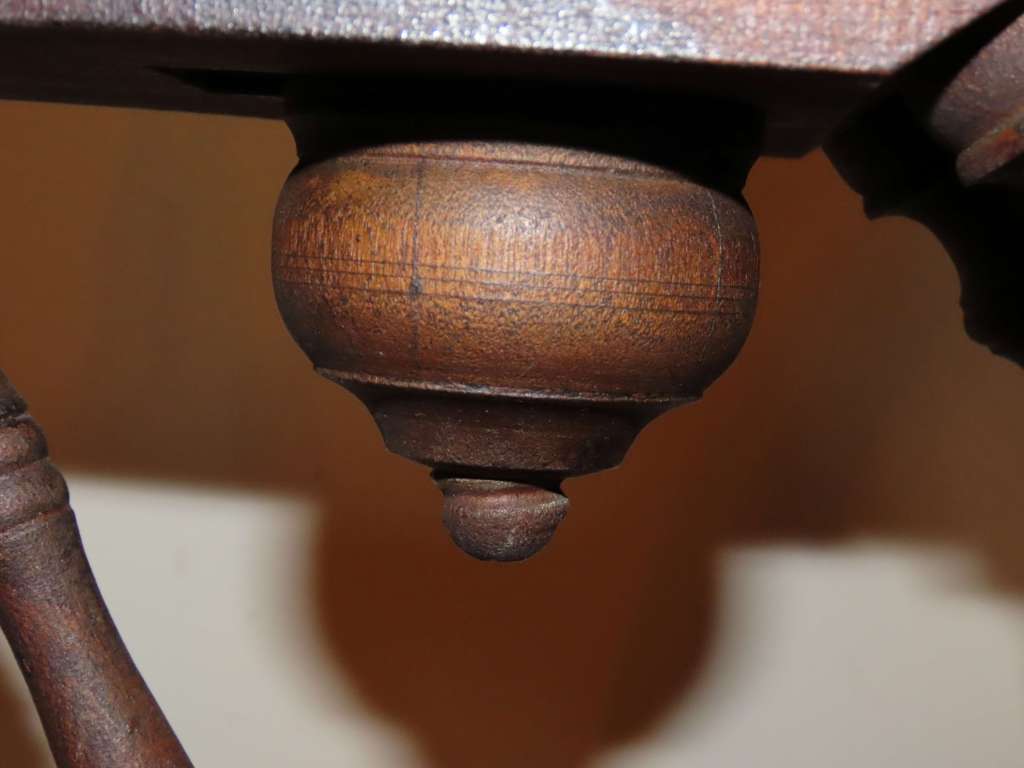
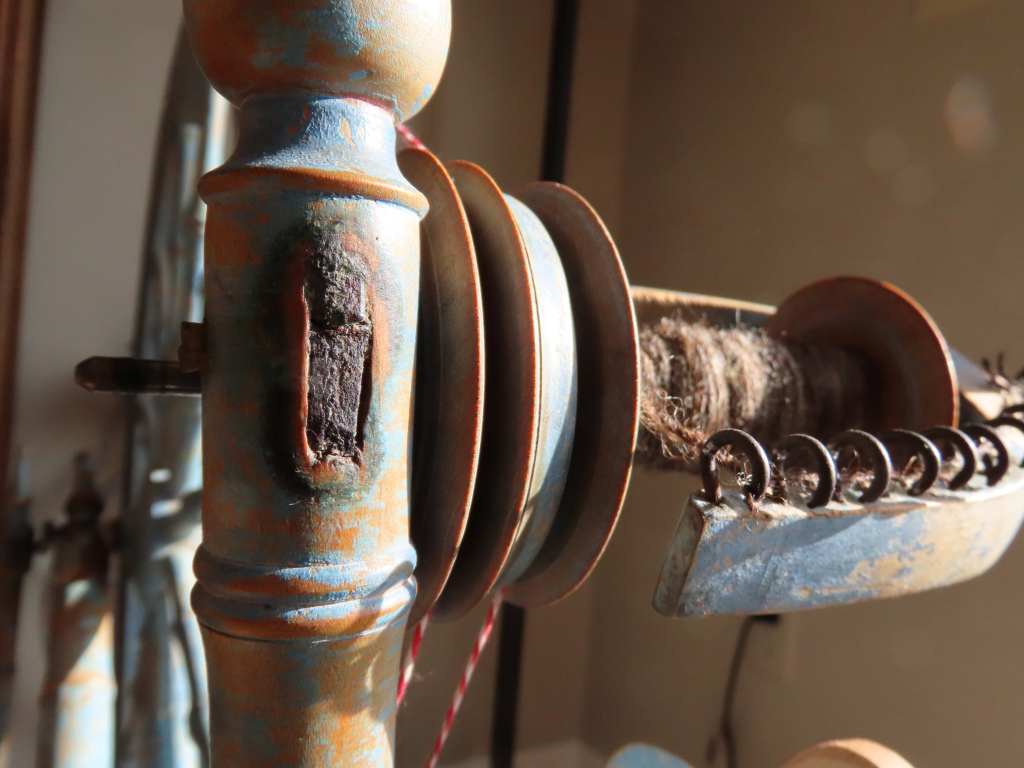
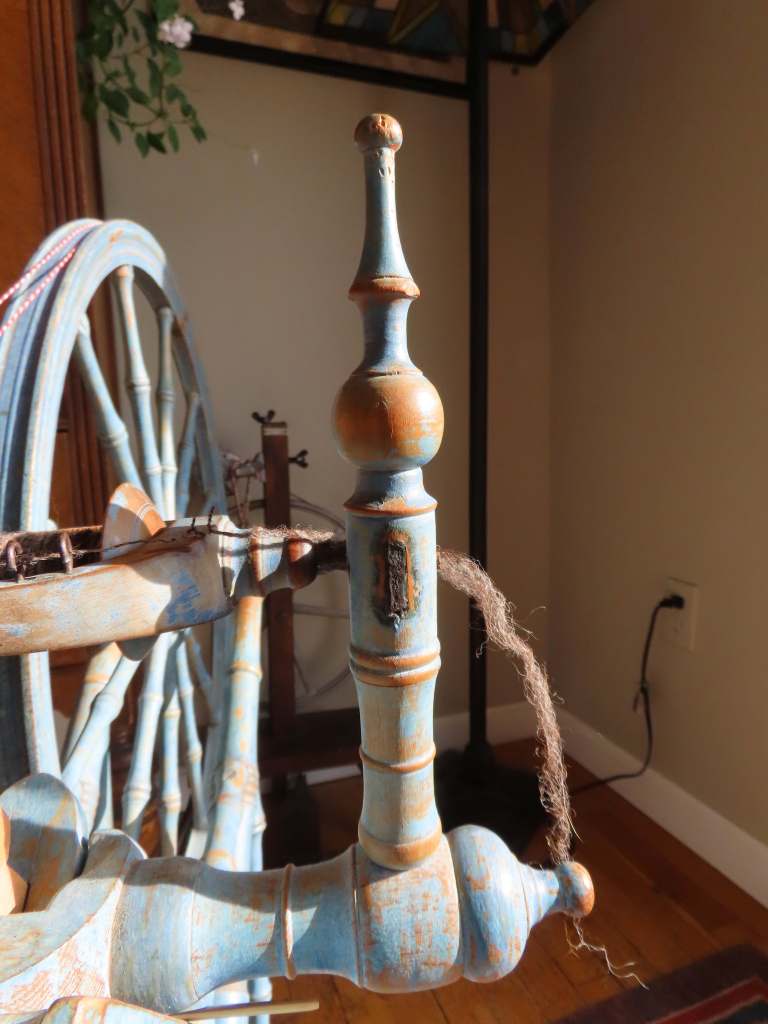
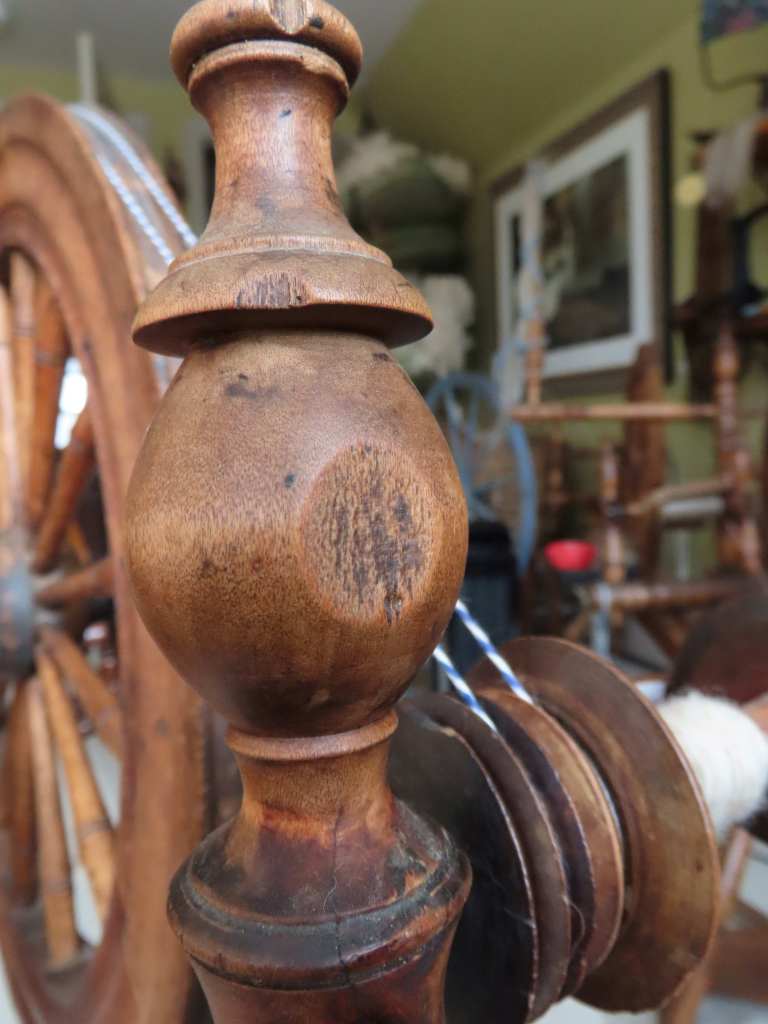
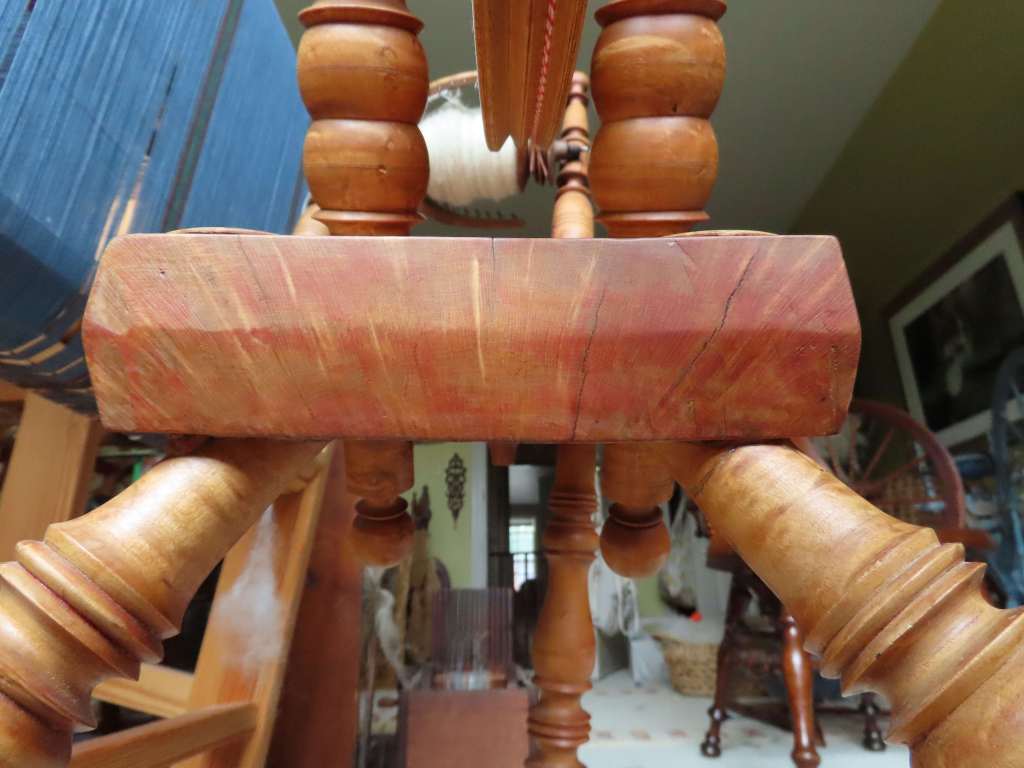
The maidens are simply turned.
Sif was for sale in northern Wisconsin by the manager of a retirement home. He was selling it for one of the residents who needed to downsize her belongings. Sadly, none of her children wanted the wheel. It always feels tremendously satisfying to rescue an unwanted wheel, bring it back to spinning life, and, ultimately, pass it on to another caretaker who will use it and cherish its unique qualities.
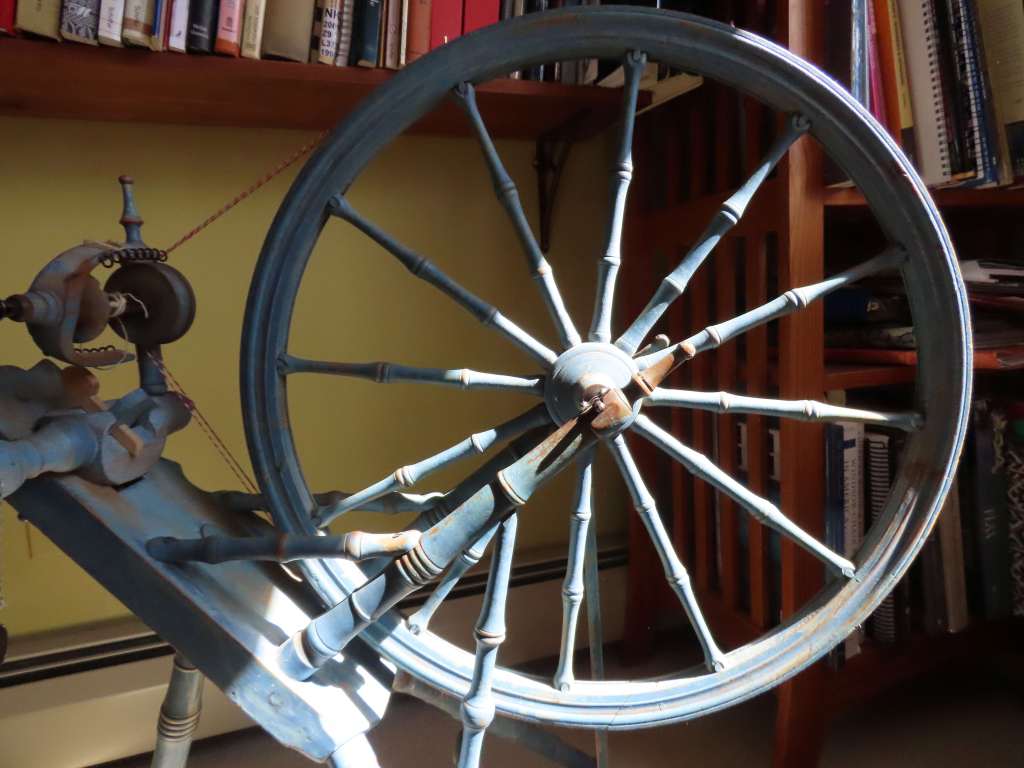
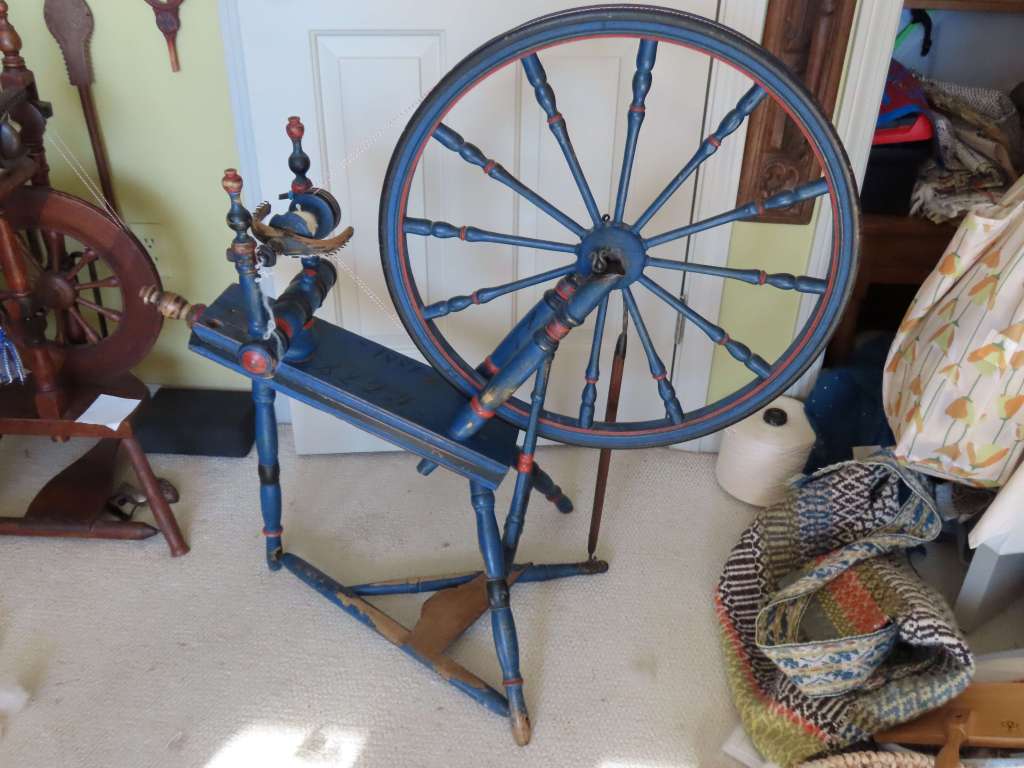
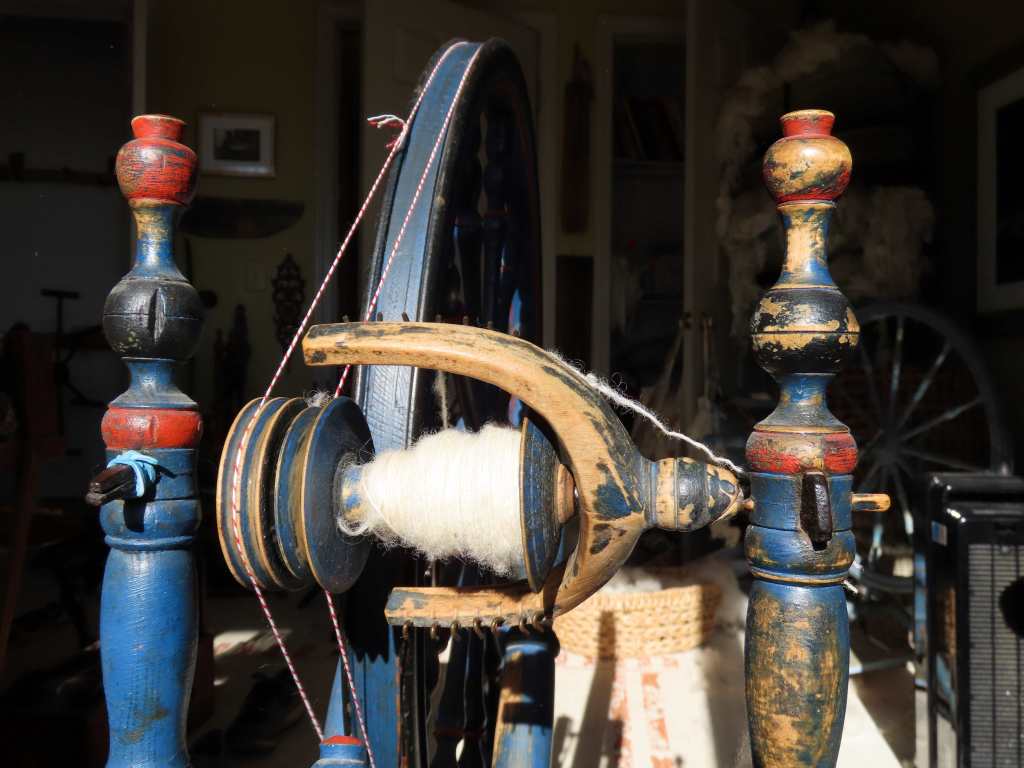
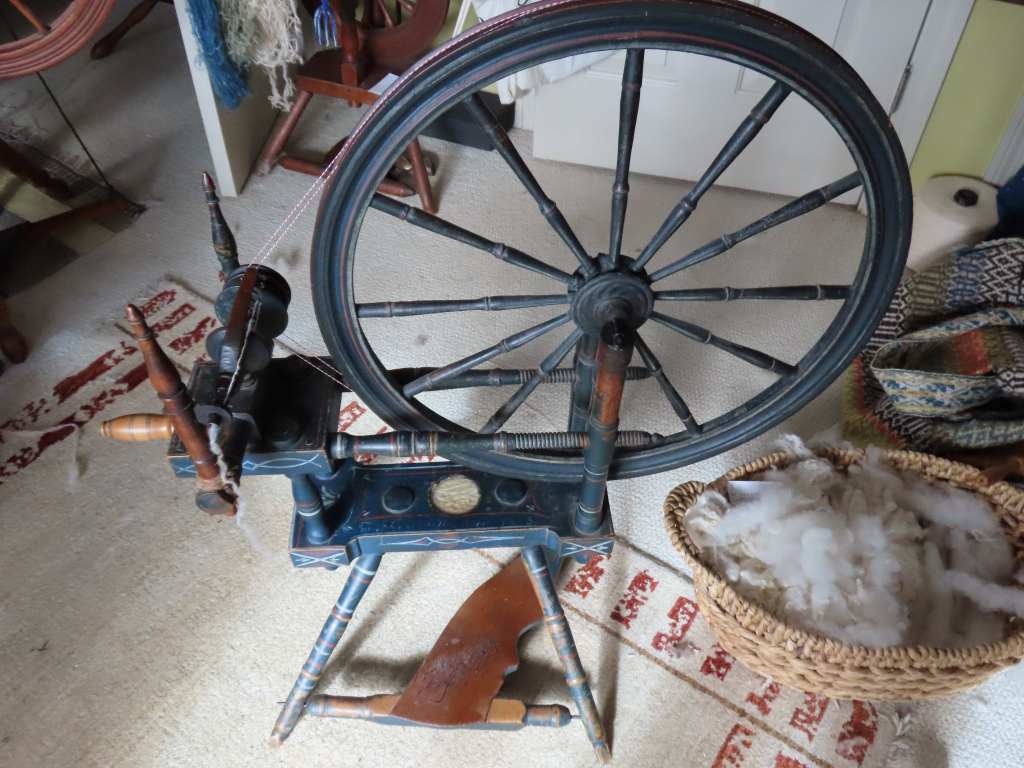
This robin-egg-blue Norwegian wheel is (to borrow from Max Verstappen) simply lovely. As with the OAP wheels in the previous post, this style comes up for sale with some regularity in the US midwest and even Canada.
In fact, the man I bought this wheel from had found it in Ontario, where he said they called them “crowder” wheels. I have not heard that name before, but wonder if it refers to the compact footprint designed to fit in crowded spaces. Just speculation …
The nickname I am familiar with is “BESS,” from the antique spinning wheel folks at Ravelry. “BESS” is an acronym for “Black Earth Super Slanty.” The “Super Slanty” describes the shape–an extremely slanted table with legs protruding from the table end (not bottom) following the same angle as the table. “Black Earth” refers to a photo taken in Black Earth Wisconsin around 1873 of five women in the Rustebakke family. The matriarch, Siri, sits in the middle with hand carders in her lap. Four younger women surround her (likely three daughters and a daughter-in-law), all posed with spinning wheels in front of them. The spinning wheels, each meticulously angled in a way that highlights their elegant style, are what make the photograph so captivating. I wanted to include the photograph in this post, but the Wisconsin Historical Society, which owns rights to the photo, charges too much for me to reproduce it here. ***For my rant about these charges, see below*** Although I cannot post it here, the photo (and a second one that include’s Siri’s husband and a dog) is easily found by doing a search for “Siri Rustebakke.”
What is significant about the Black Earth photo is that all the Rustebakke women are using the same style wheel. Were they all brought from Norway, were they built in the US based on a Norwegian style, or both? The answer remains unclear. The Rustebakke family came from the Valdres area of Norway and evidence shows this style wheel in that area. The Valdres Folkemuseum has several of them in its collection.
The Vesterheim Norwegian American Museum in Iowa also has examples in its collection with “Valdres” frequently appearing in the wheel description (thank you A. Myklebust for this information). Many families from Valdres also settled in Blue Mounds, Wisconsin, about 12 miles from Black Earth, and one of these wheels shows up in this postcard from “Little Norway,” a living museum, there.
Postcard from “Little Norway”
Patricia and Victor Hilts, in their article about Wisconsin spinning wheels suggest that the wheel at Little Norway may actually have been one of the Rustebakke family wheels. Hilts, p. 19, fn. 86. The Hilts also speculate that these wheels may have been made in Wisconsin rather than Norway. Hilts, pp. 18-19.
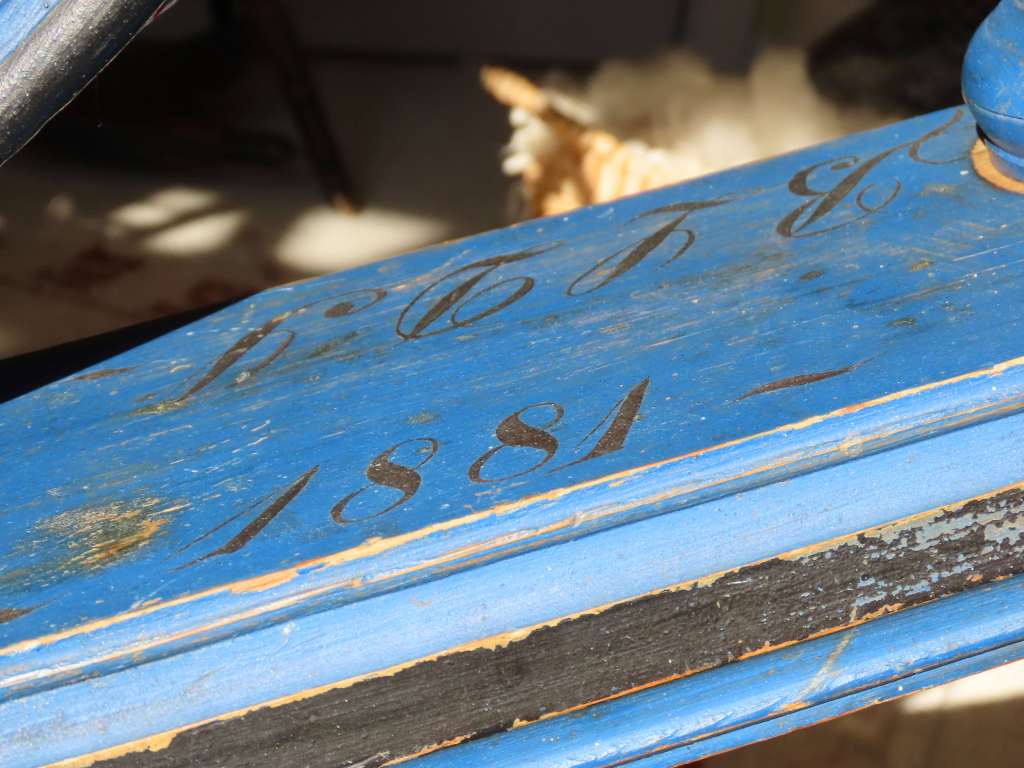
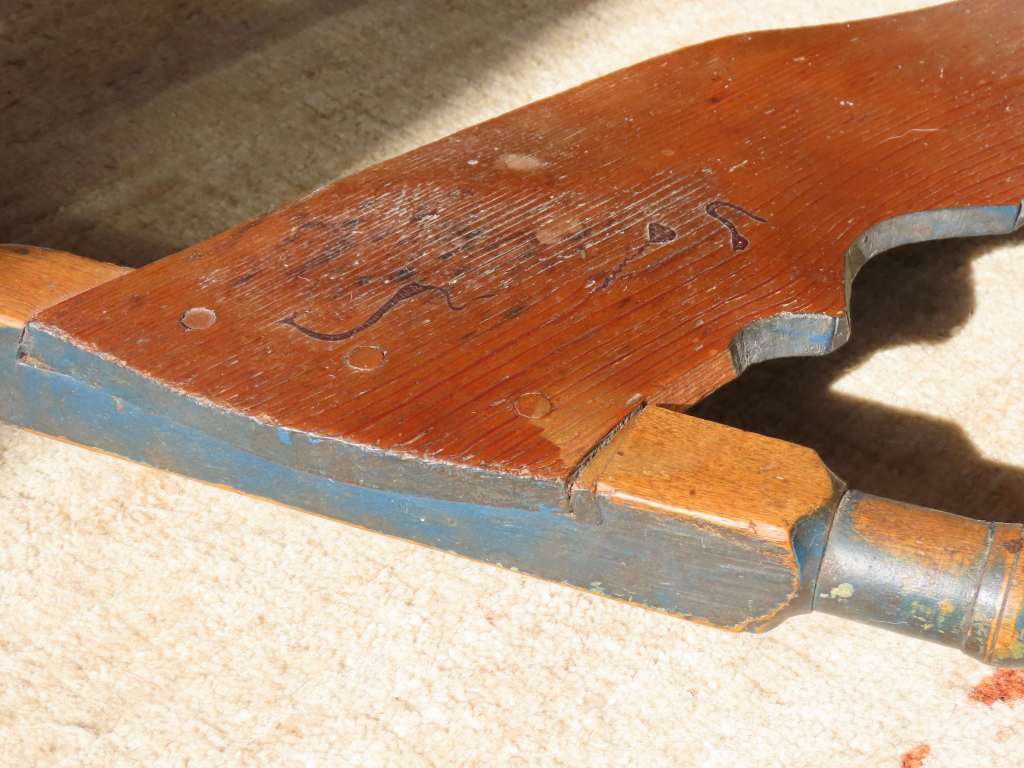
The flat area on the lower left is where the maker’s initials are usually found. Mine has none.
They note that some wheels have maker’s initials of “JS” and that there was a furniture maker named Jacob Schanel advertising in the area. An absolutely fascinating piece in the book “Creators, Collectors, Communities,” discusses Aslak Olsen Lie, a furniture maker from Valdres, who immigrated to Blue Mounds and continued to make furniture in a meld of traditional Norwegian and American popular style. link here (I could not help but notice the robins-egg-blue paint on the back of Lie’s cupboard).
While these furniture makers could also have been making wheels, there is no evidence showing that they did, as far as I know.
We do know, however, that spinning wheels were made in Valdres. A Wisconsin settler, A. O. Eidsmoe, wrote: “I was born in Southern Aurdal in Valders, Norway, the 13th of February, 1814. My first or earlier childhood years passed without anything of importance.
Our parents were poor and with six children (three boys and three girls) were able to make both ends meet, nothing more. As soon as we were old enough, we had to go to work. We boys learned to run a turning lathe and made tynneturer, lobbismarer, peppergrinders, rolling pins, distaffs, and as we learned the trade, we commenced to make spinning wheels.” The Norwegian Settler’s Story.
Perhaps the best evidence that these wheels were made in Norway is that they turn up for sale there. I was delighted to see this recent beauty on Facebook Marketplace for sale in, not surprisingly, Aurdal, Valdres.
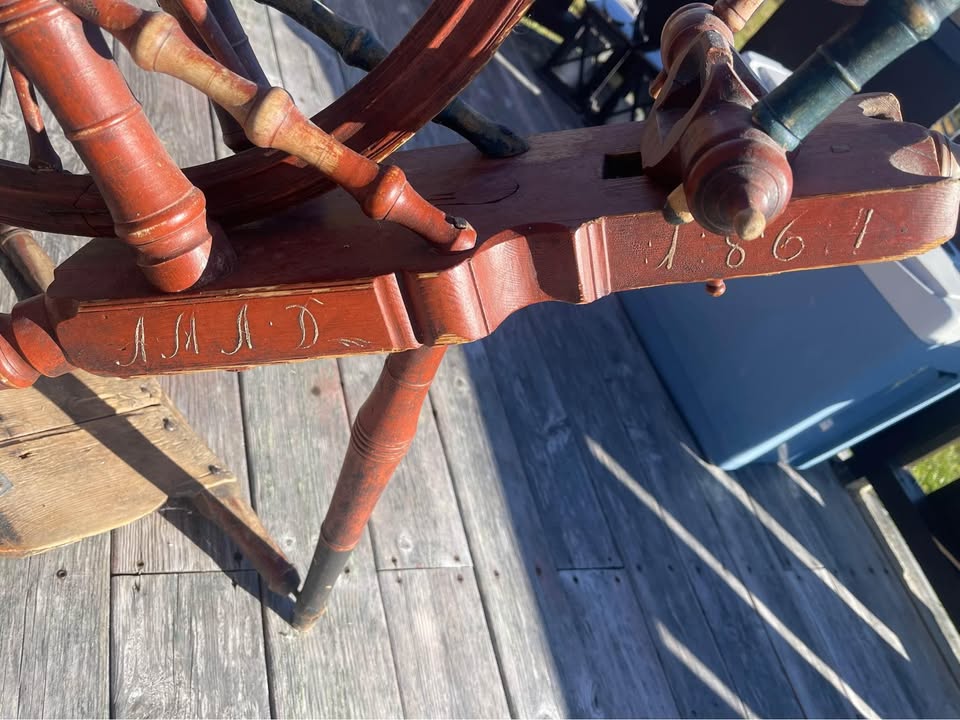
Wheel for sale in Aurdal, NorwayThere’s a maker’s mark but I cannot make it out1861 date, note how similar this wheel is to Sissel
While some have makers’ initials, most seem to be unmarked. It seems likely that, in a pattern typical for many regions of Norway, Finland, and Sweden, Valdres used its abundant water power for furniture and spinning wheel production and there were multiple makers in the area, all producing the same regional style wheel. If that was the case (and it’s purely speculation at this point) it is very possible that one or more of these makers continued to make this style wheel after immigrating to the midwest.
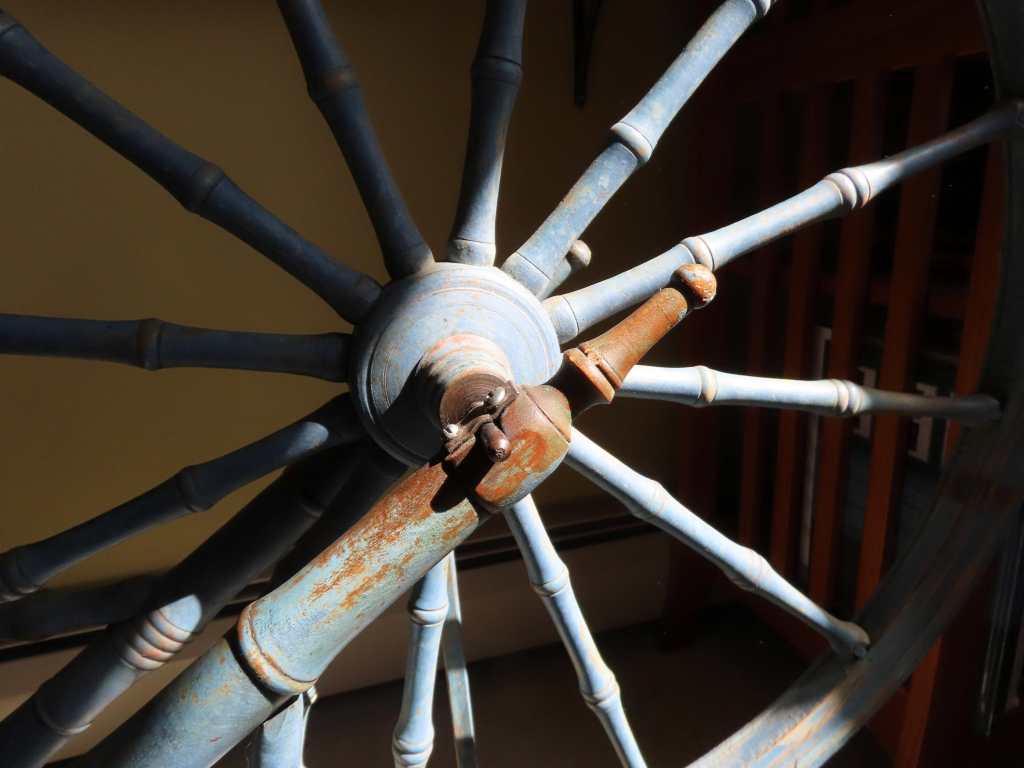
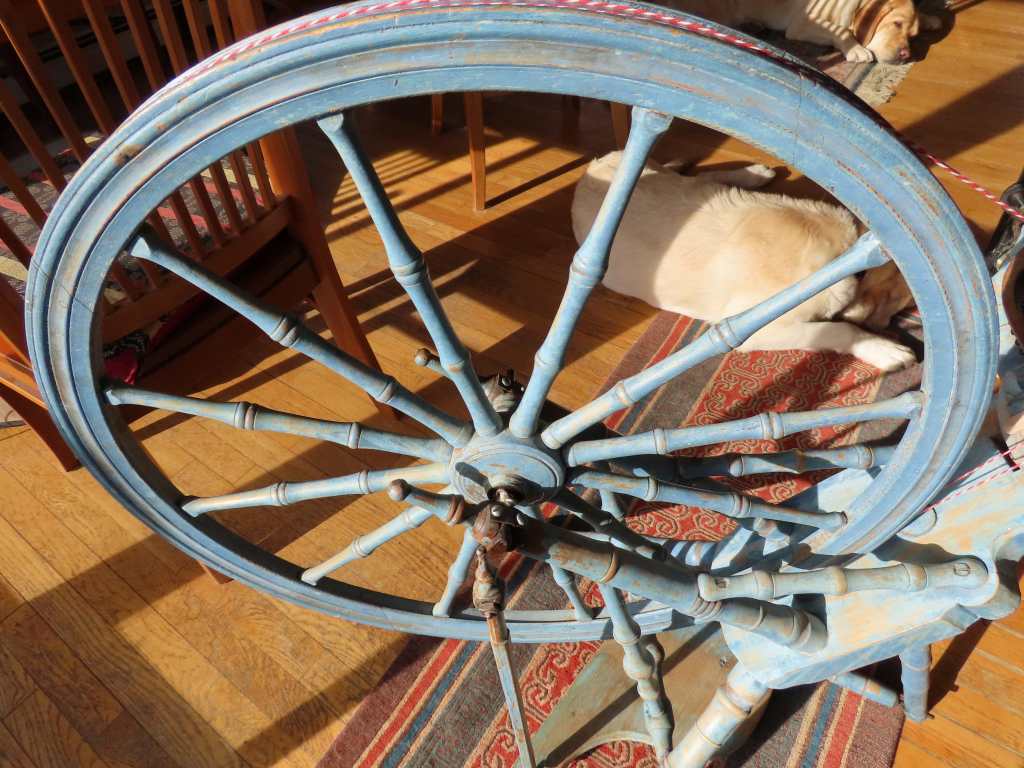
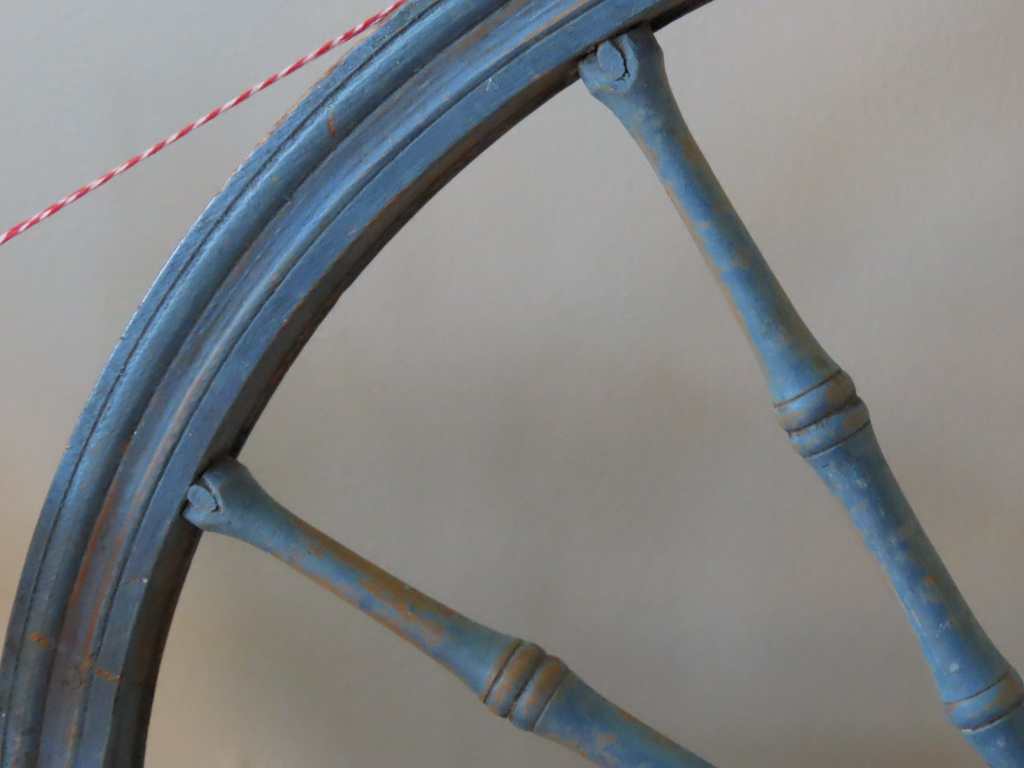
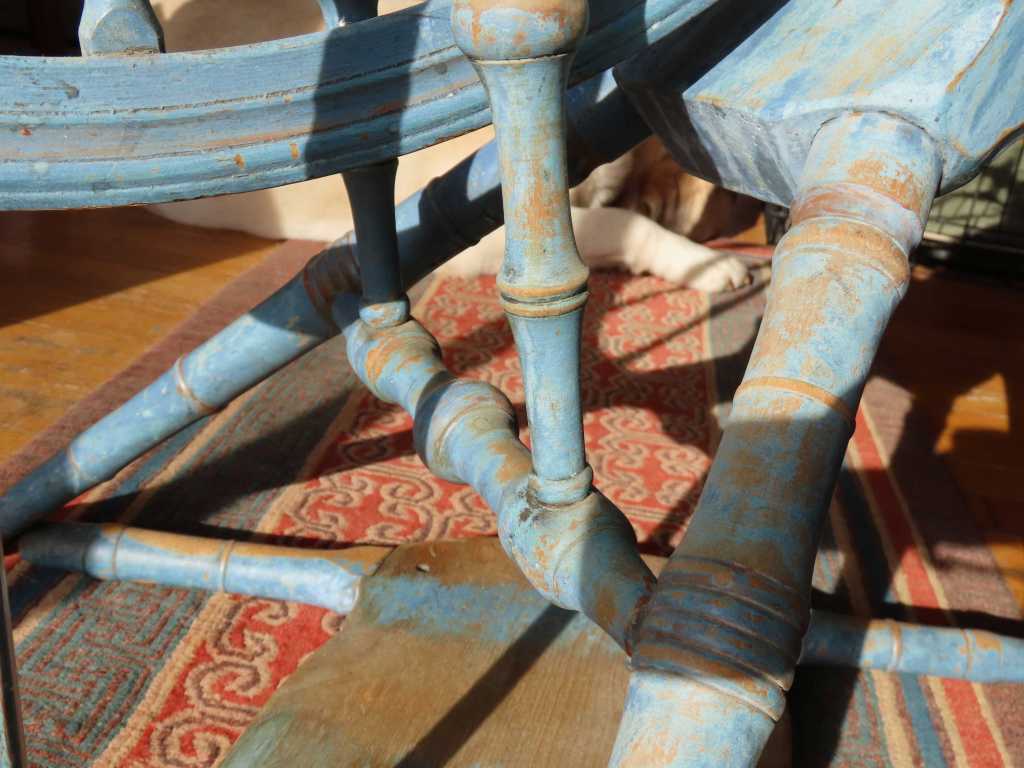
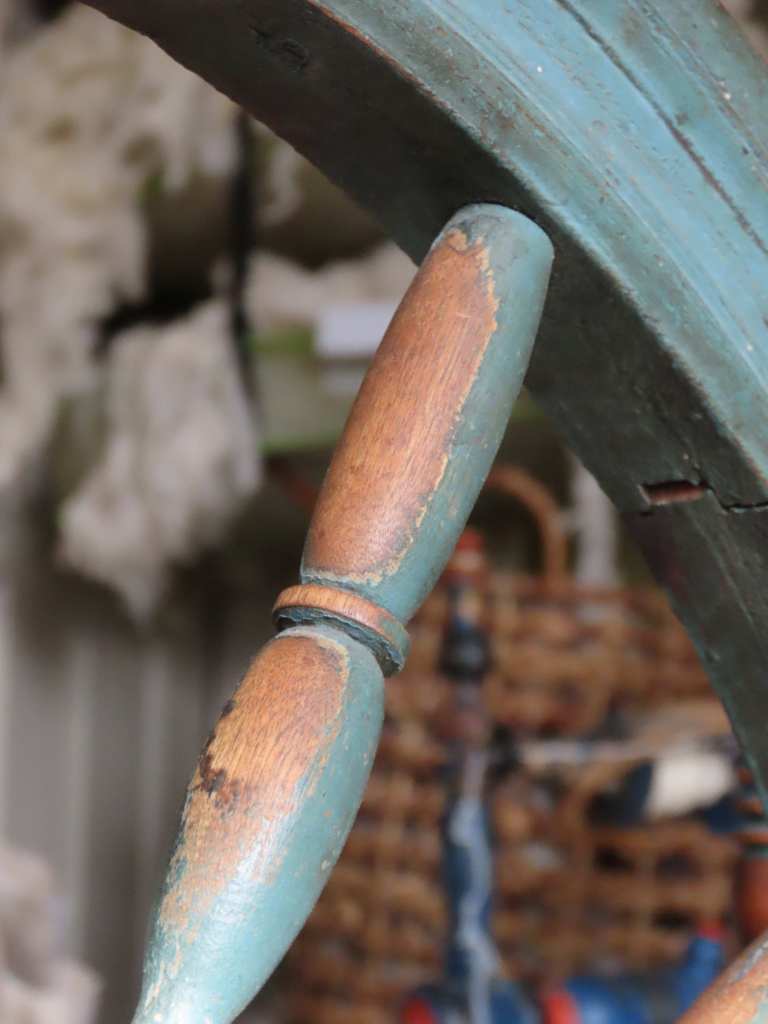
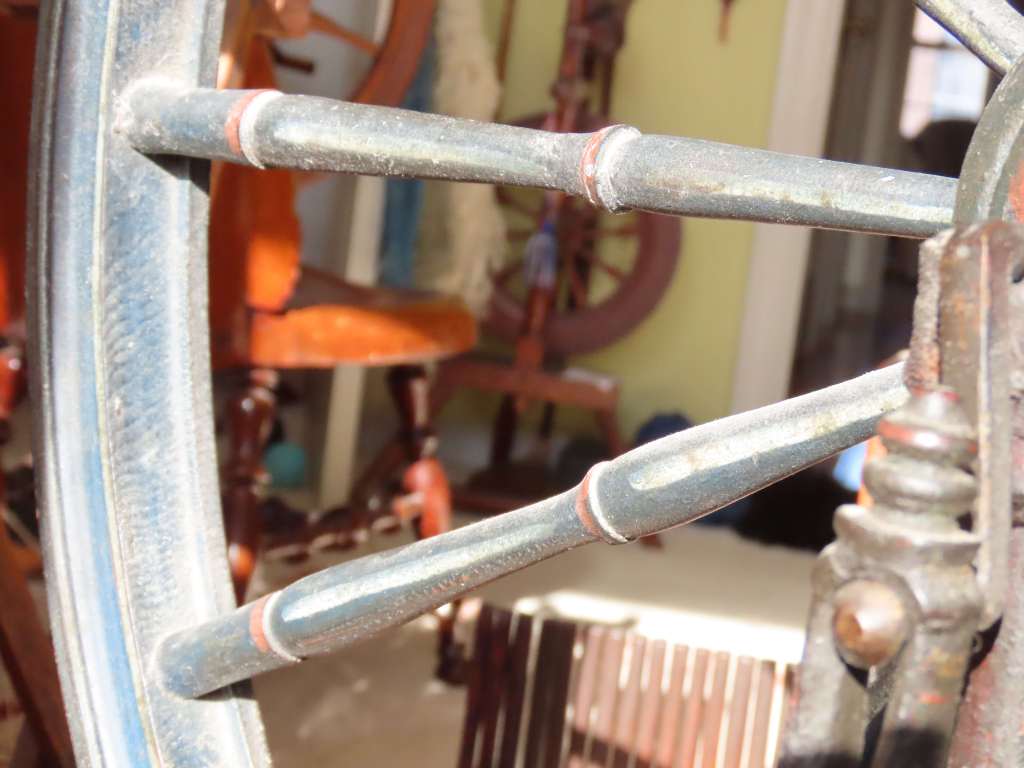
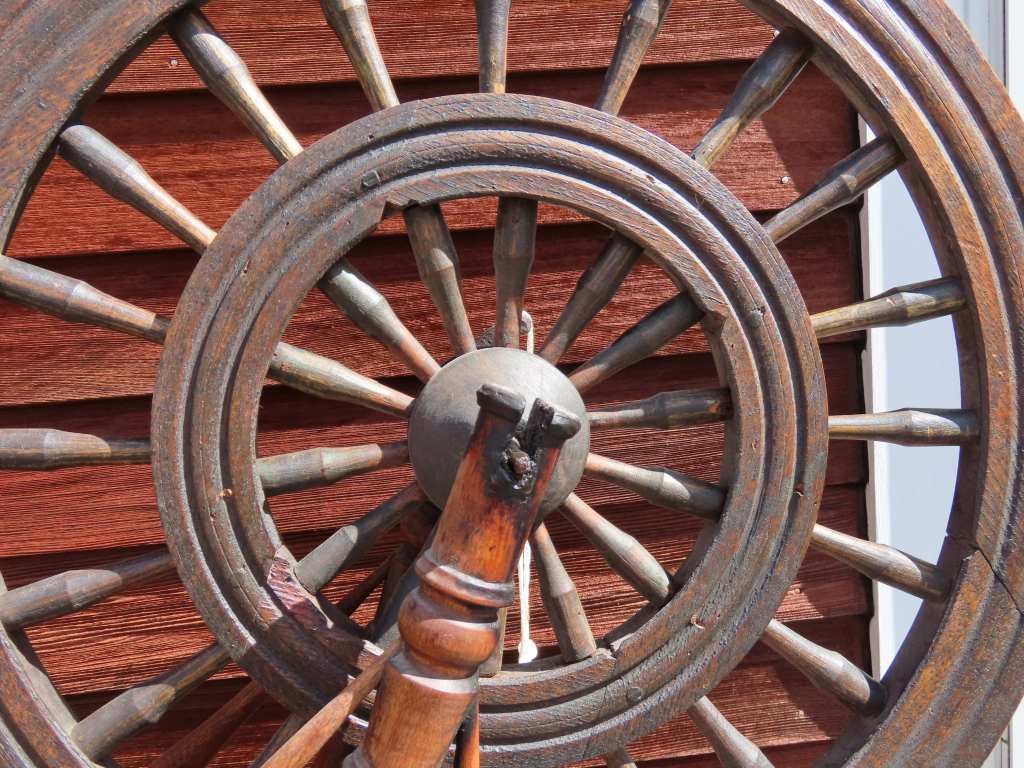
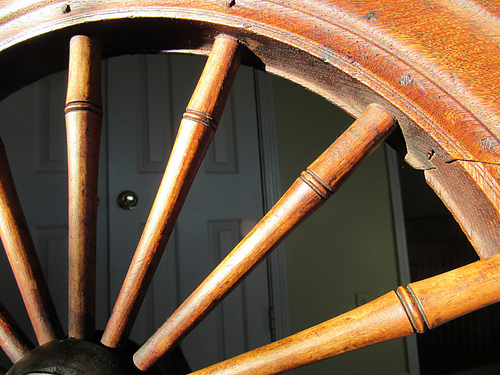
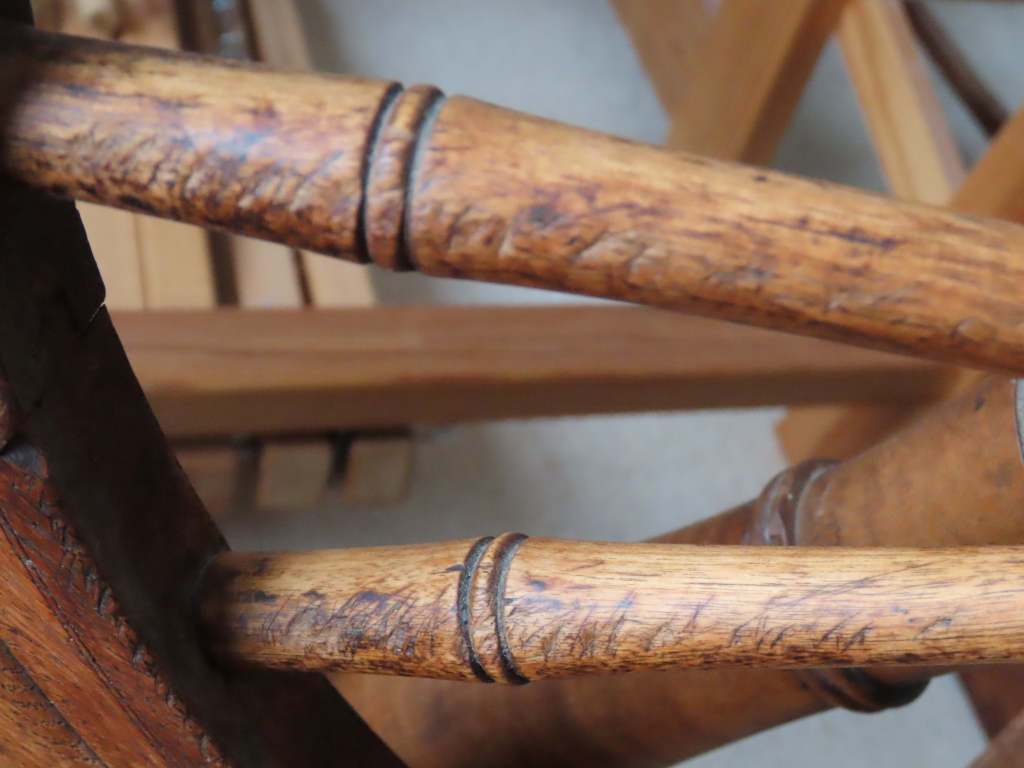
Whether all were made in Norway, or some made here, there do seem be be multiple makers and individual differences between the wheels. Some have fancier turnings and some have internal cranks, for example. But all share certain characteristics. The spokes and legs are turned to resemble bamboo–a style found in late 18th and 19th century furniture, but uncommon in spinning wheels.
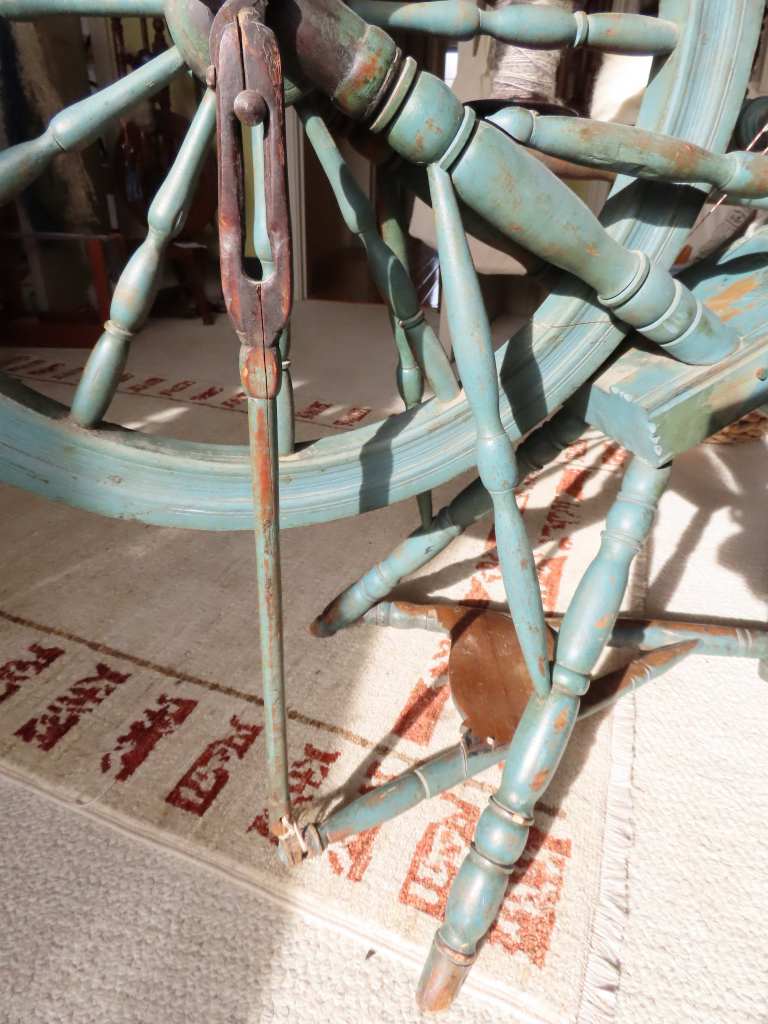
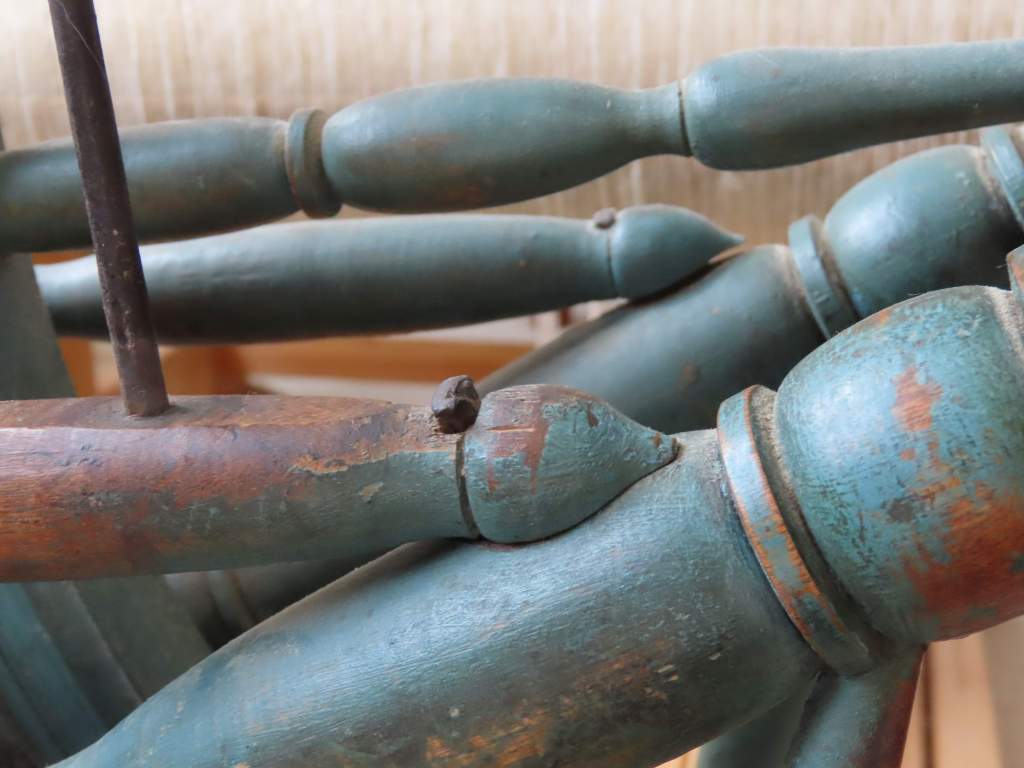
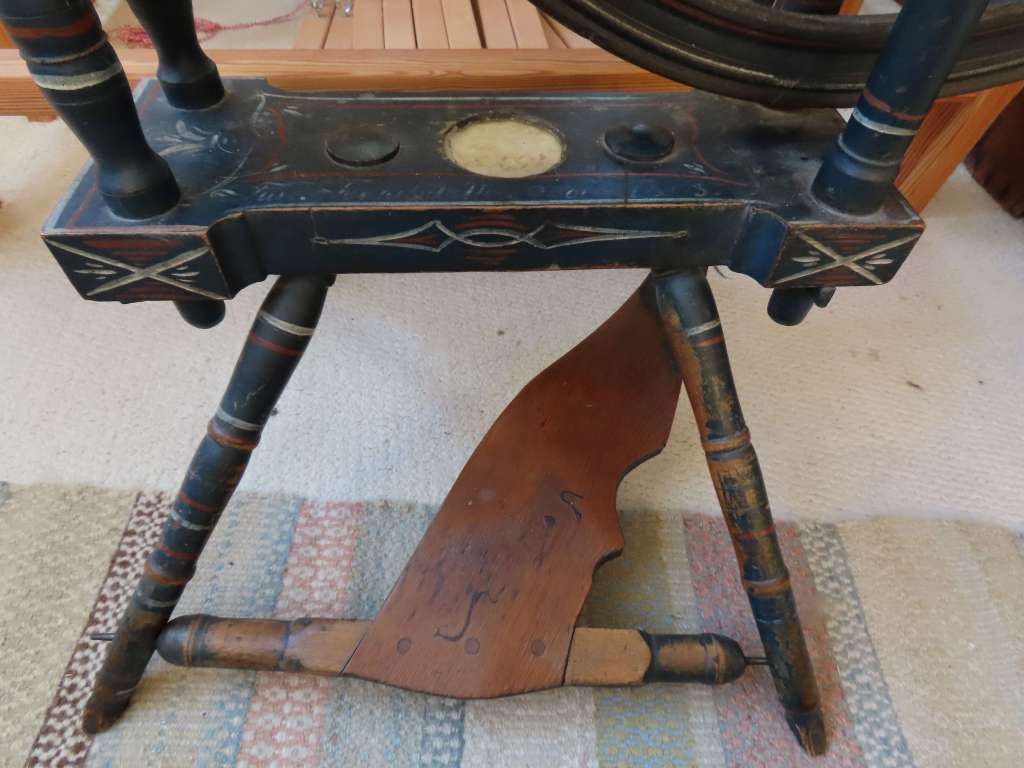
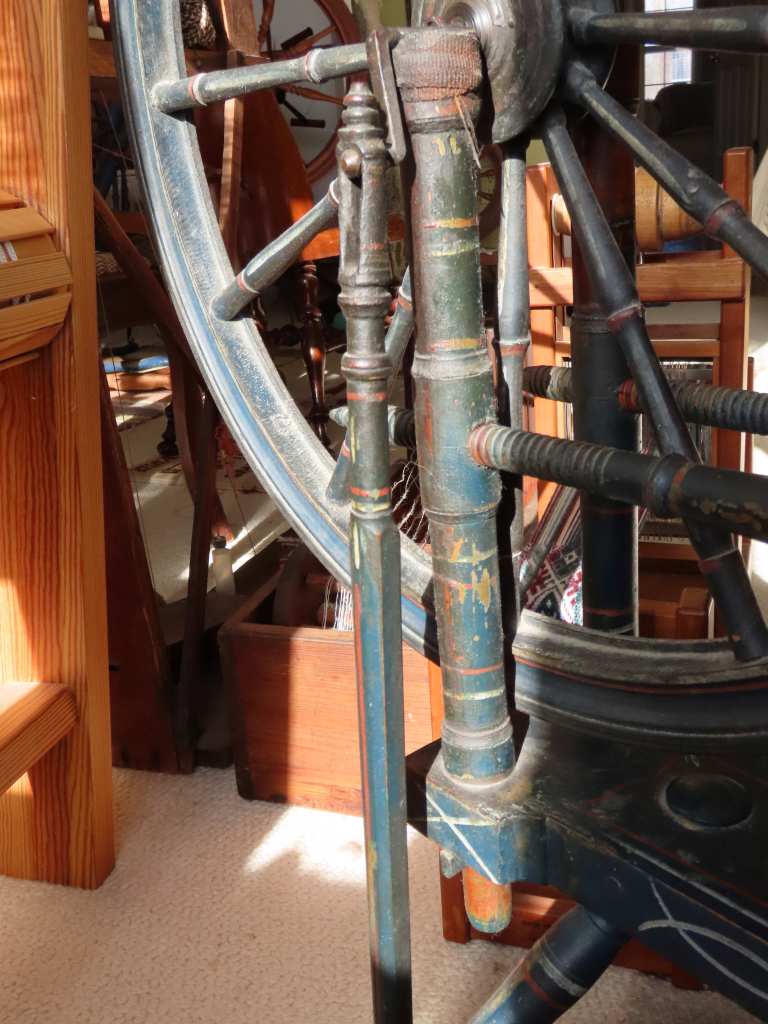
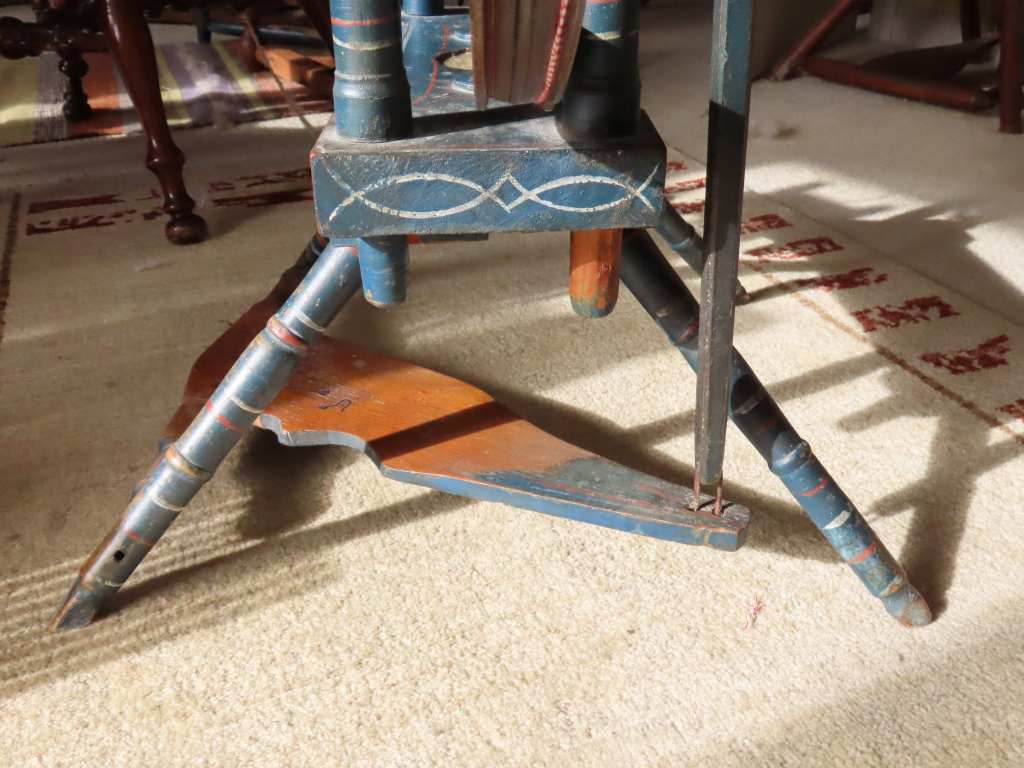
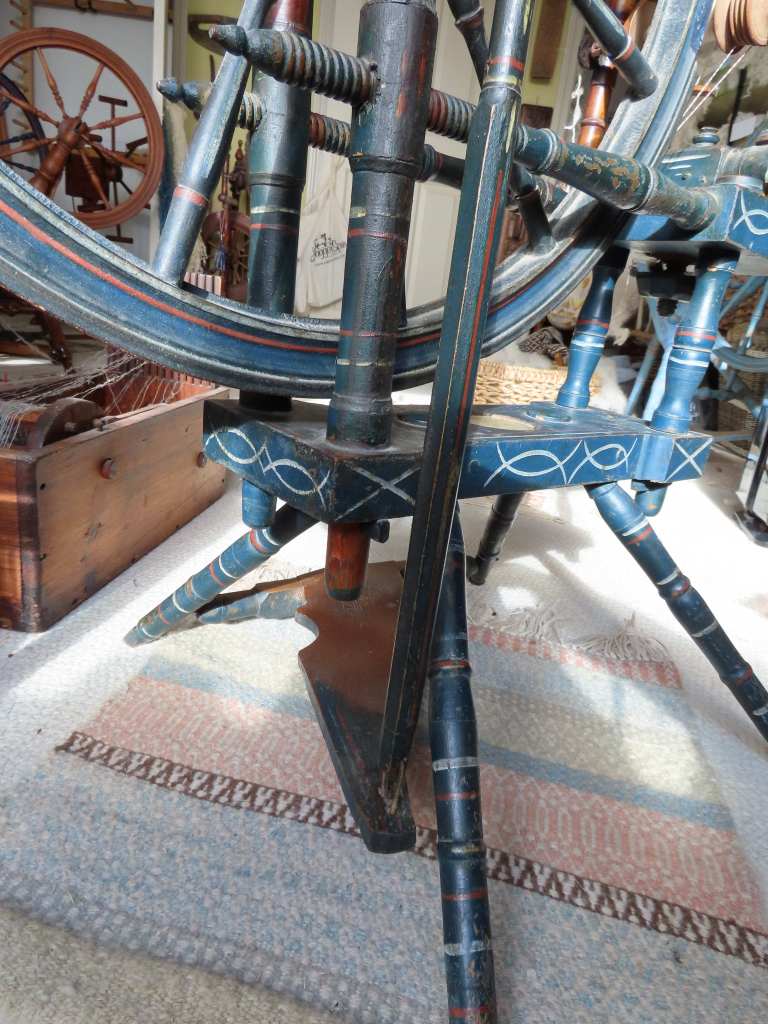
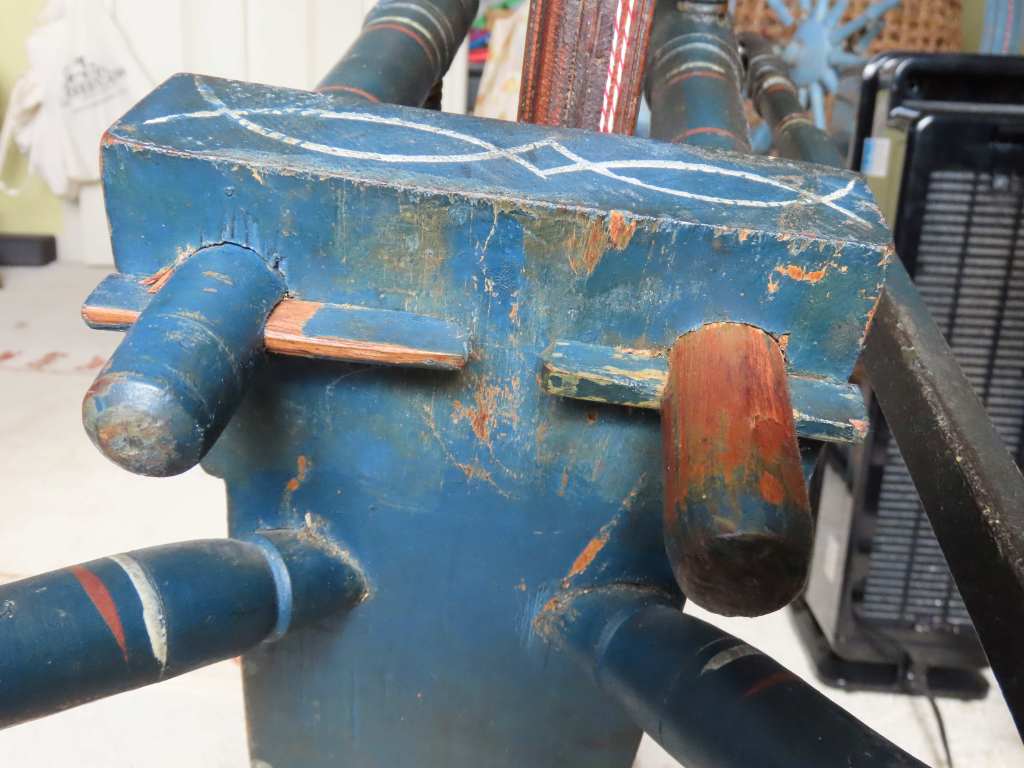
A cross brace between the two downhill legs gives stability to the highly slanted table,
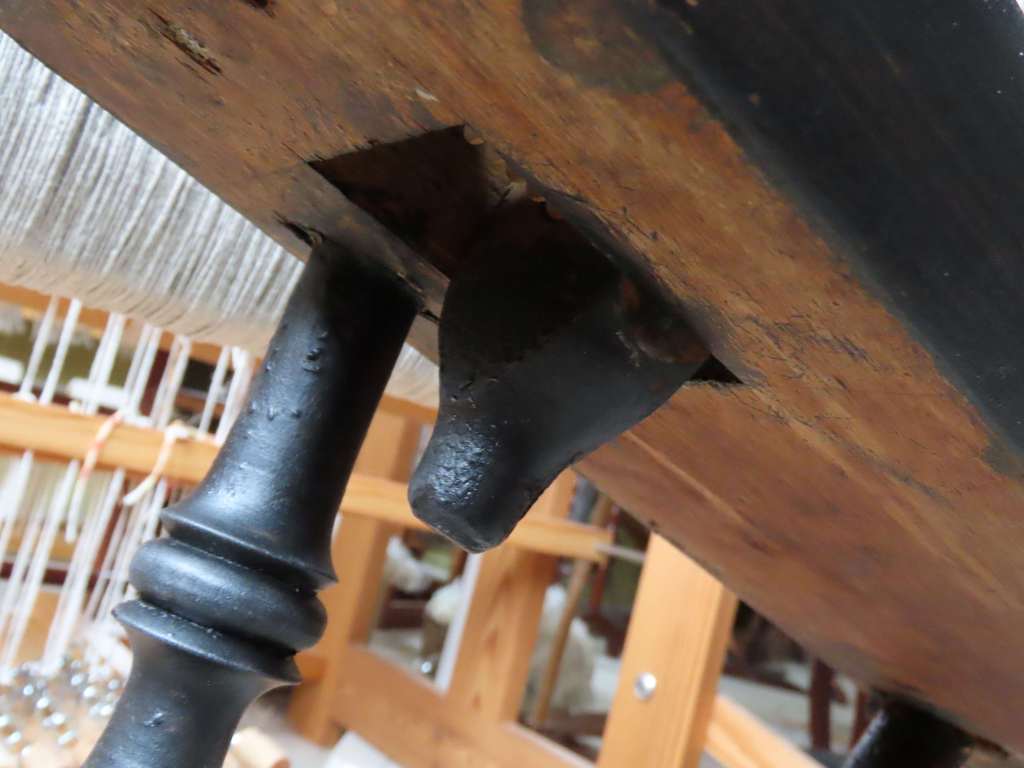
as do the screwed-in struts.
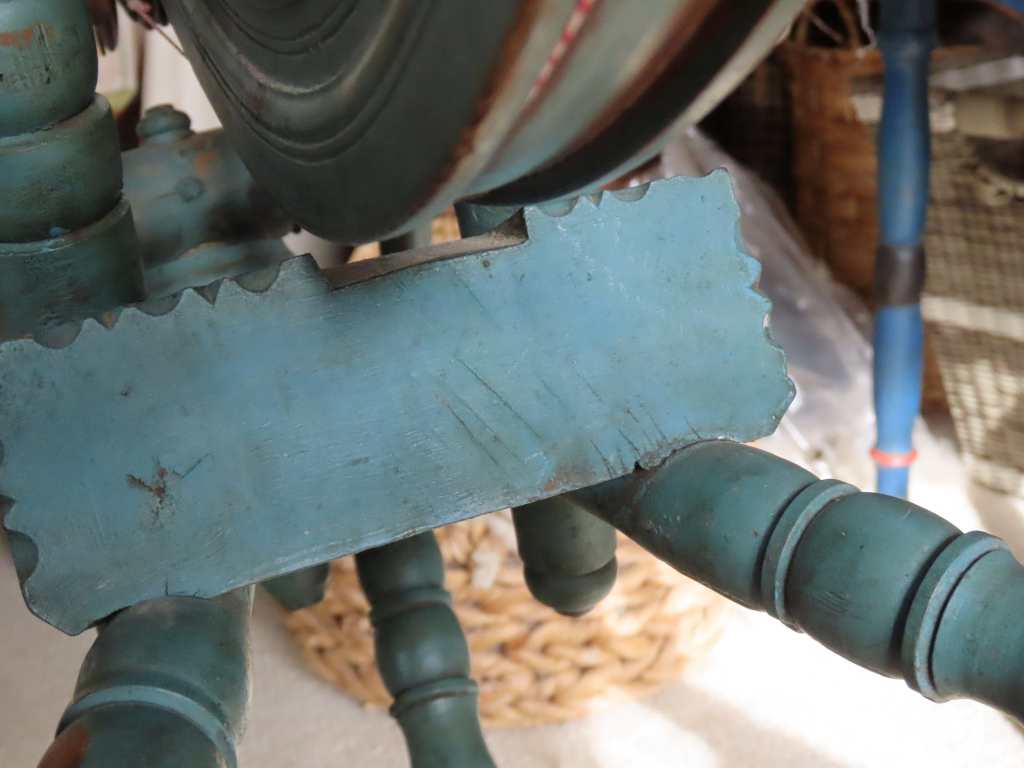
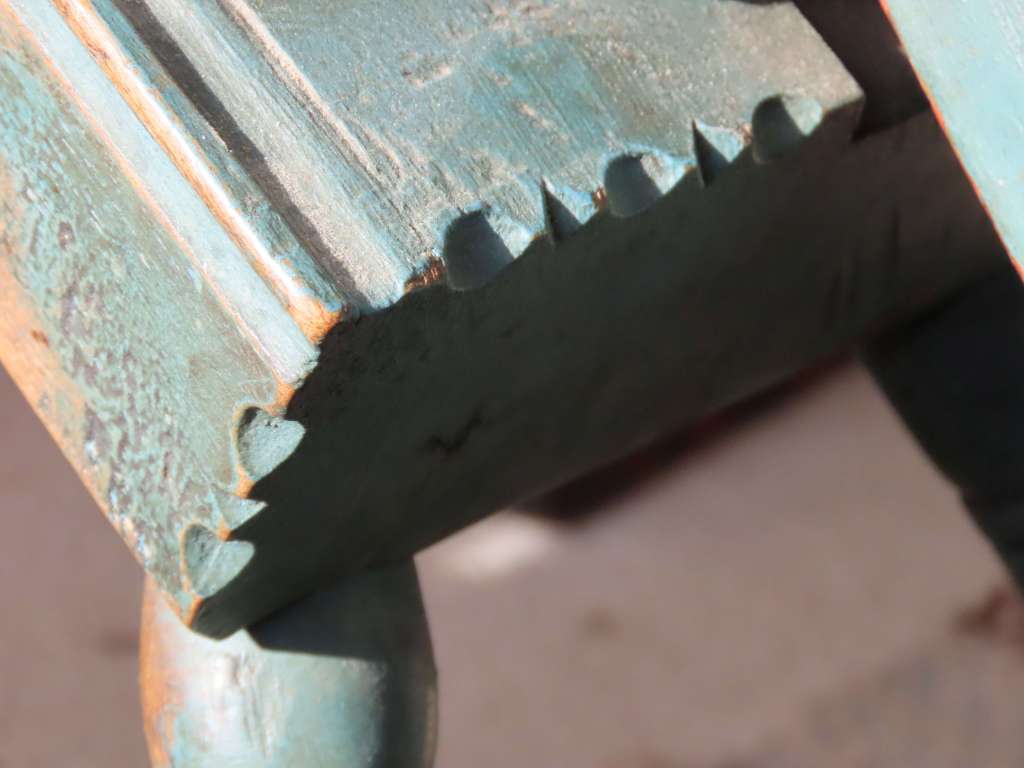
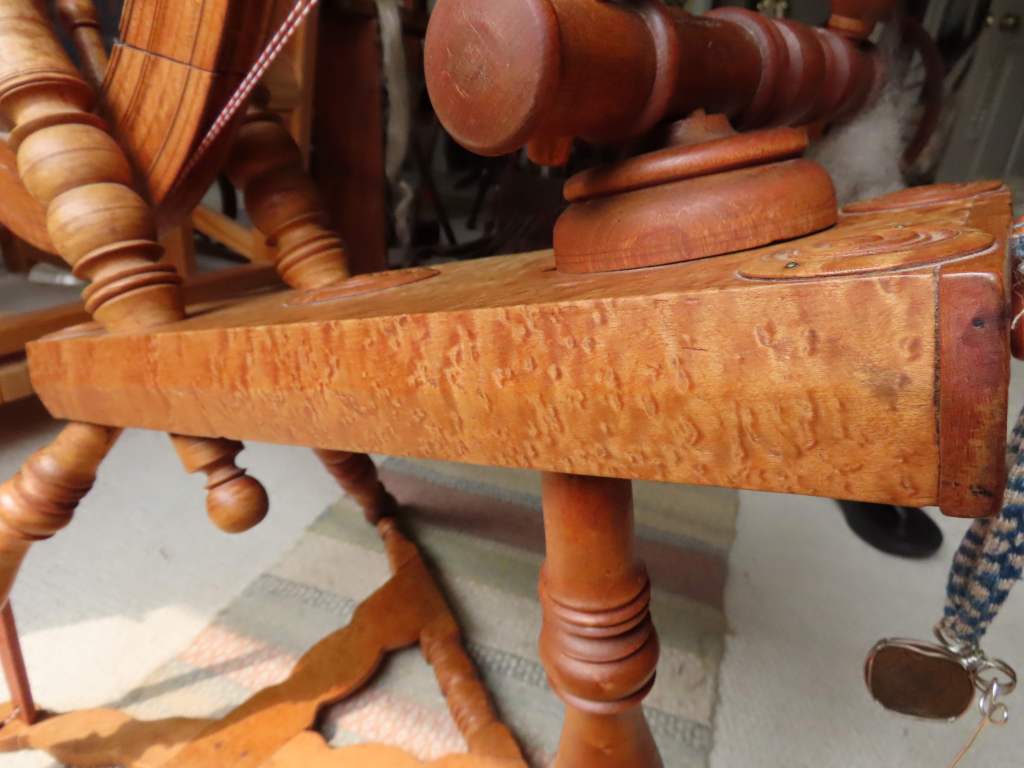
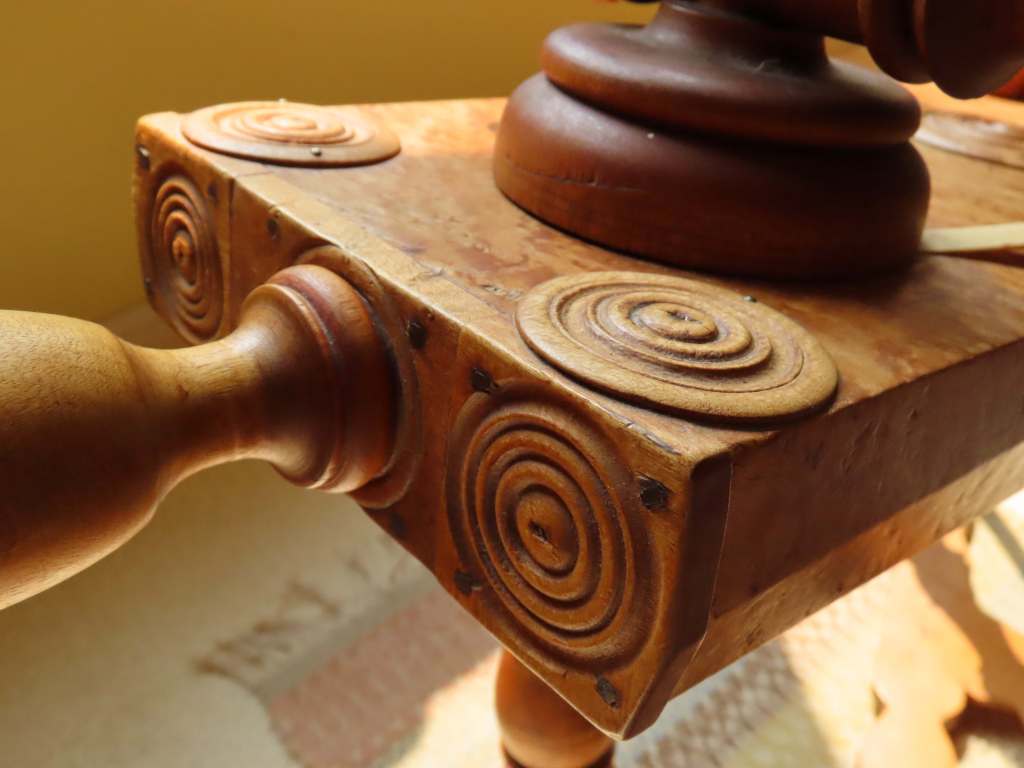
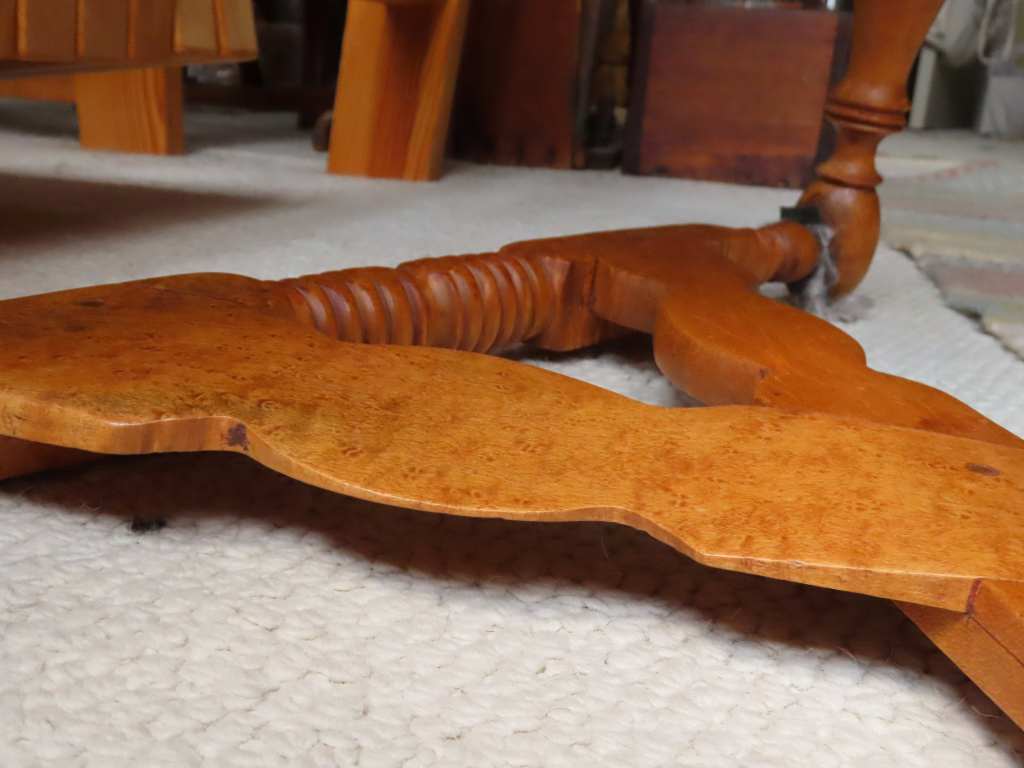
The table itself is adorned with a decorative swirled edge on the non-spinner tension end
and subtle shaping on the other end.
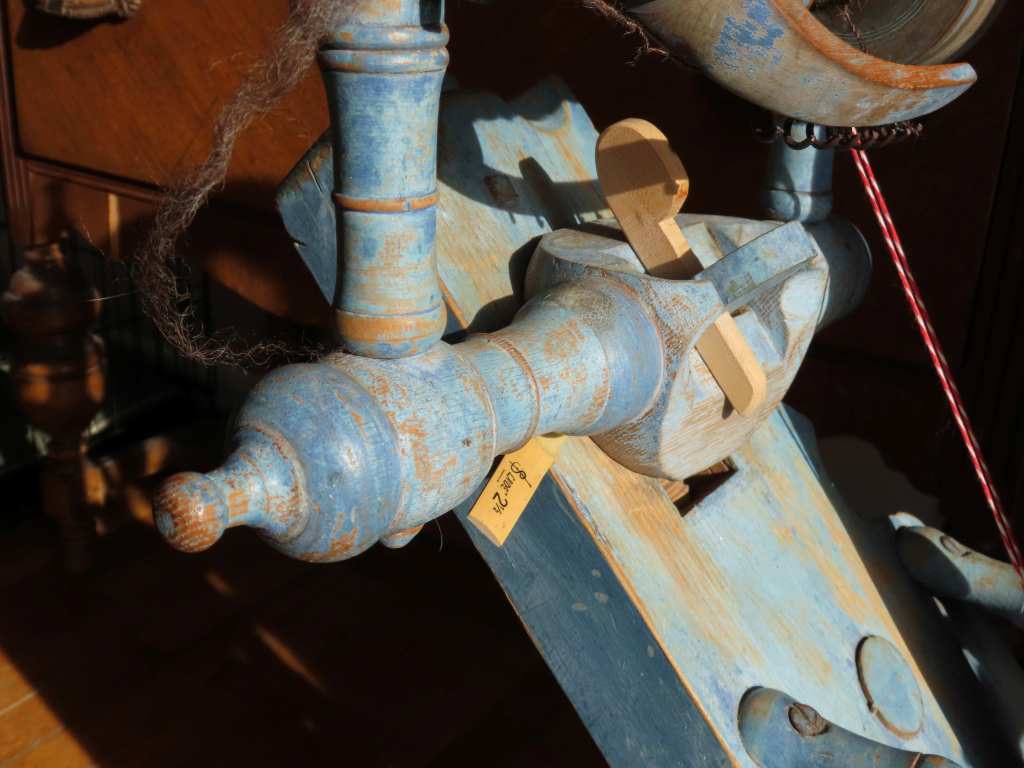
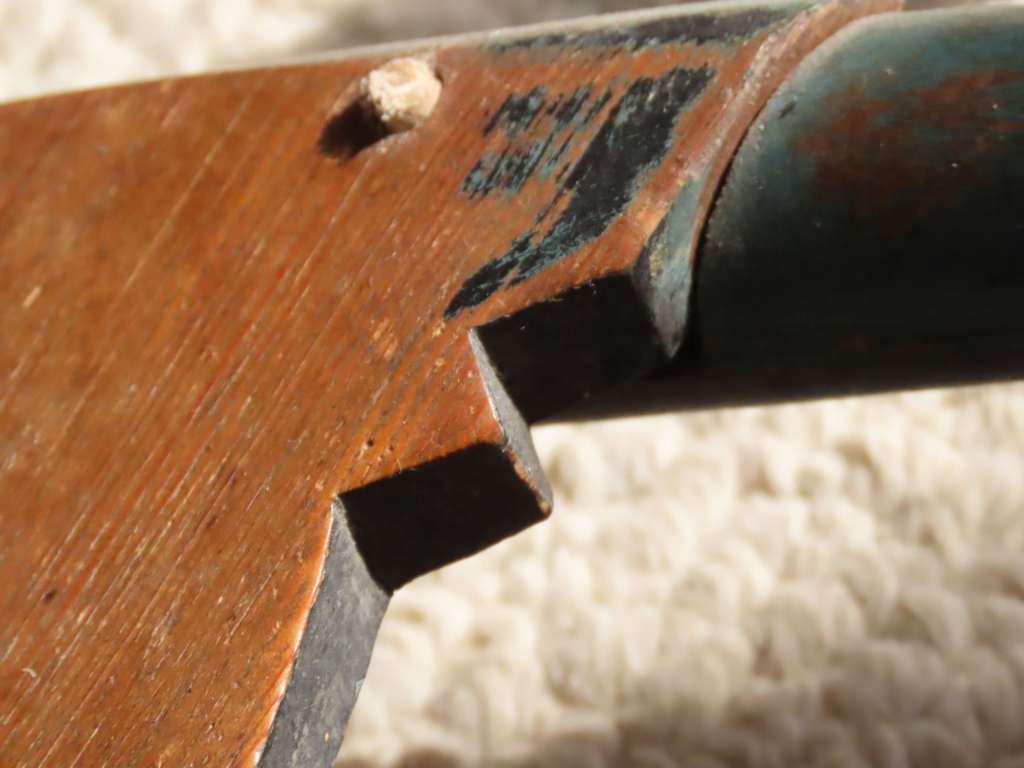
The MOA has a nifty sliding mechanism,
with nicely scooped edges,
for precise adjustment of the drive band angle. It also allows the spinner to easily use different-sized flyers for wool and flax.
The treadle is very wide,
working equally well for one- or two-footed treadling.
The flyer on mine is a generous size,
with a relatively large orifice.
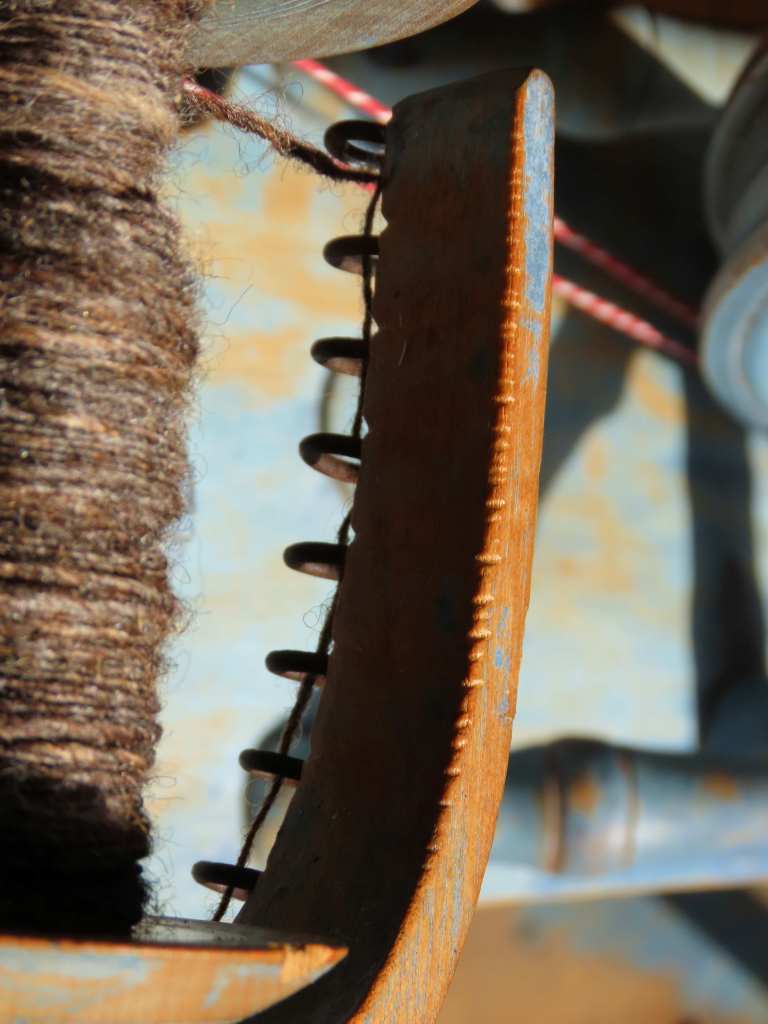
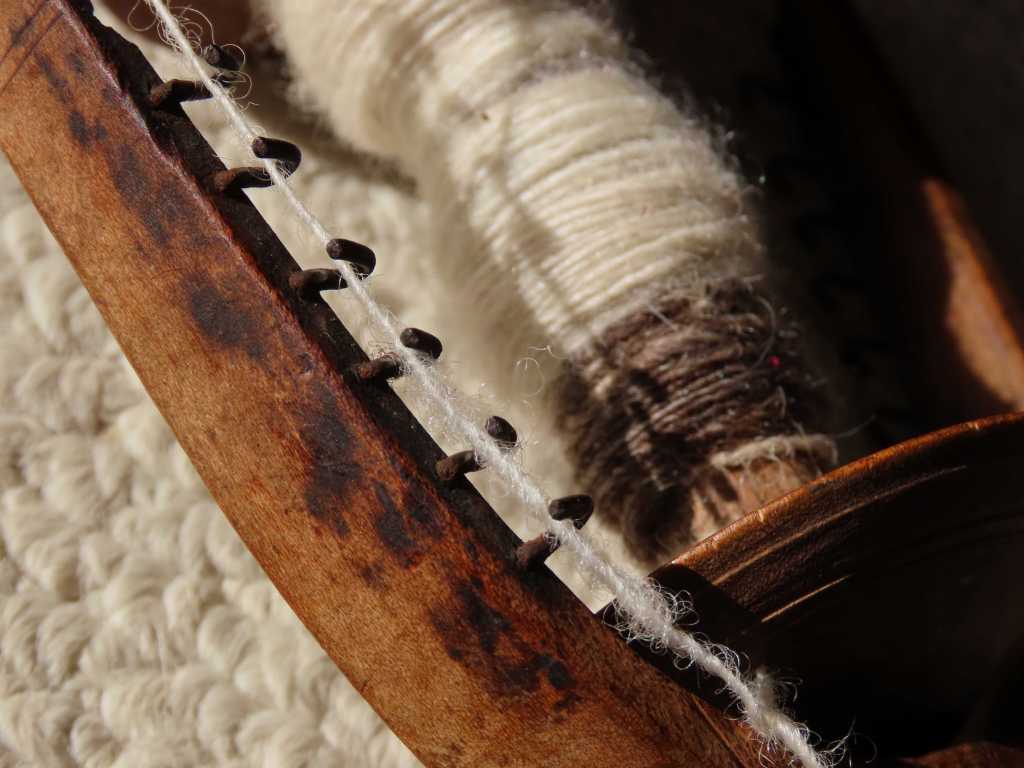
The leather flyer bearings are cut flush with the maidens on the backside.
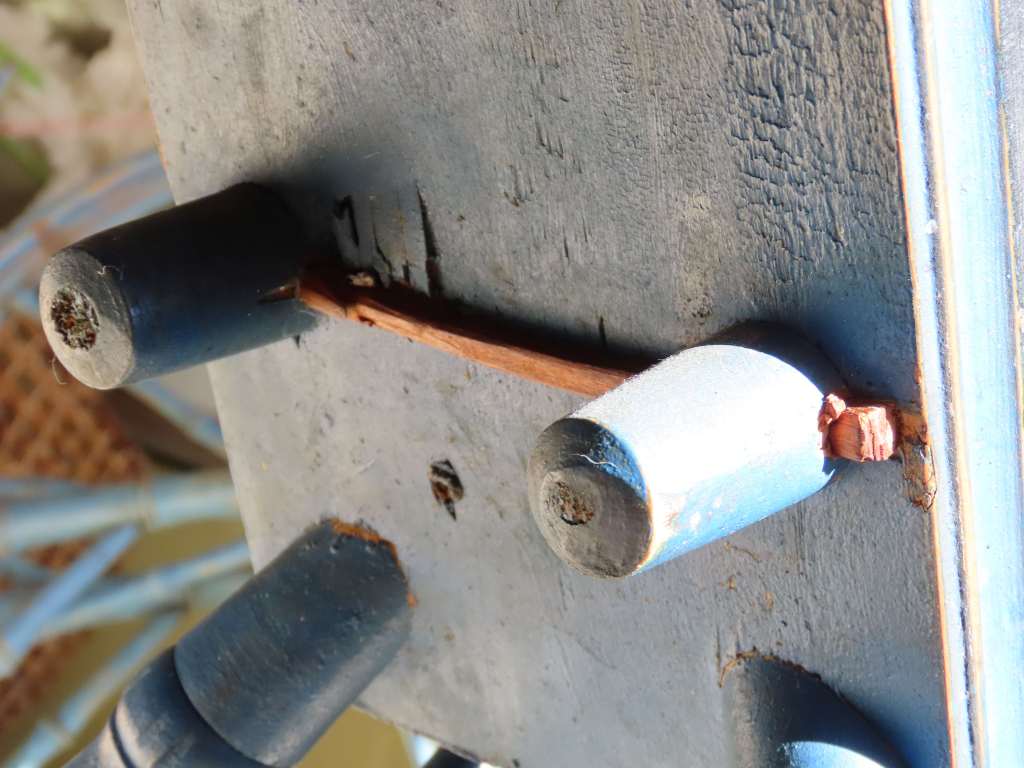
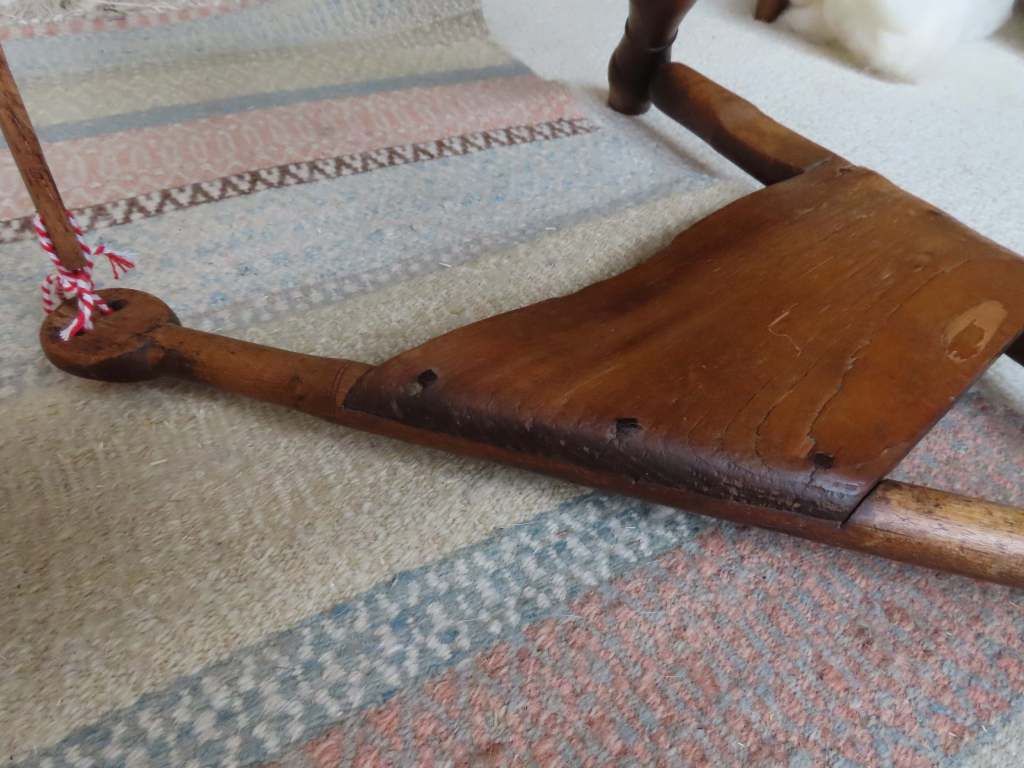
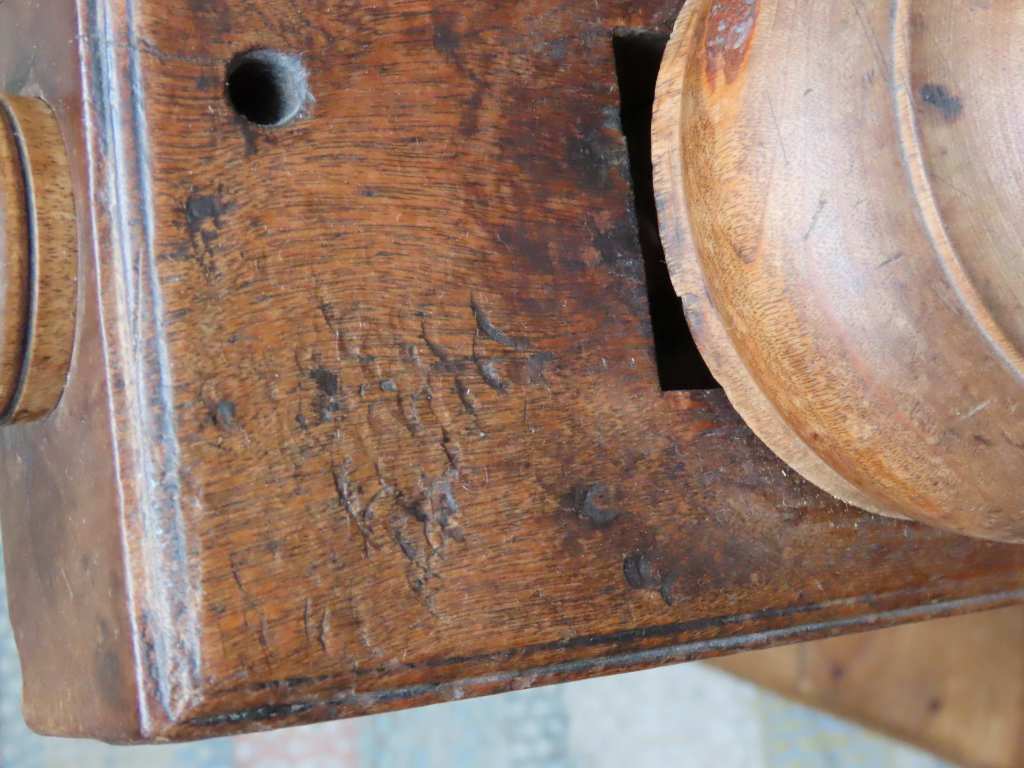
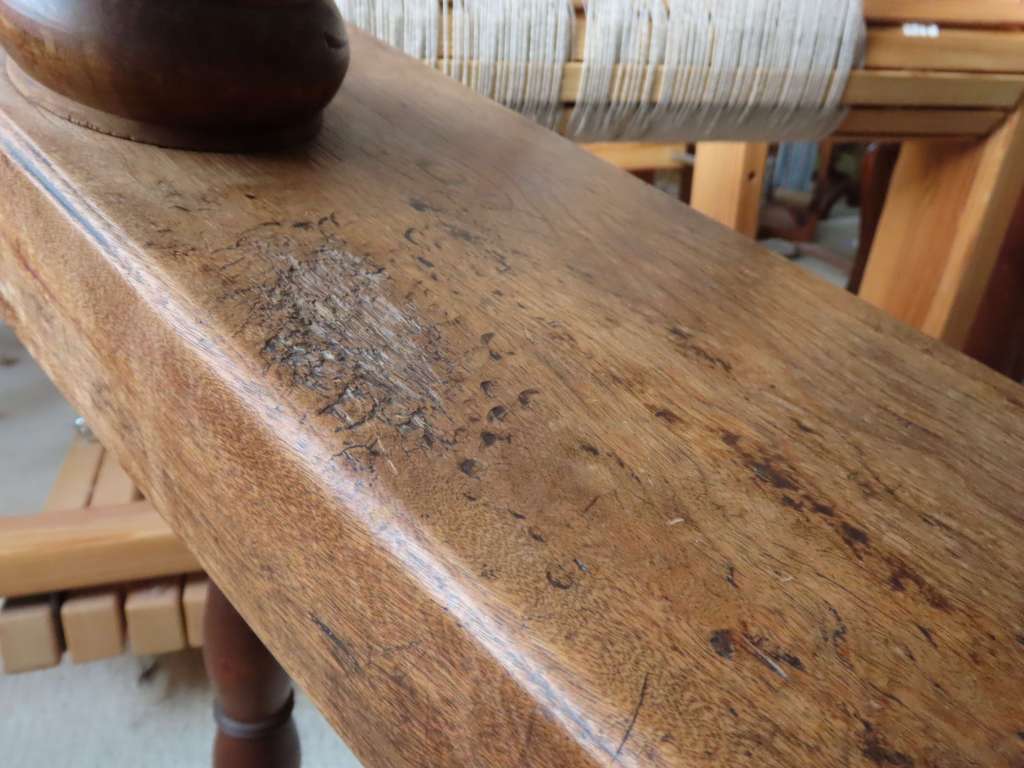
No, the dog chewing marks at various places on this wheel are not from my dogs!
Unlike many Norwegian wheels, the whorl turns righty-loosey.
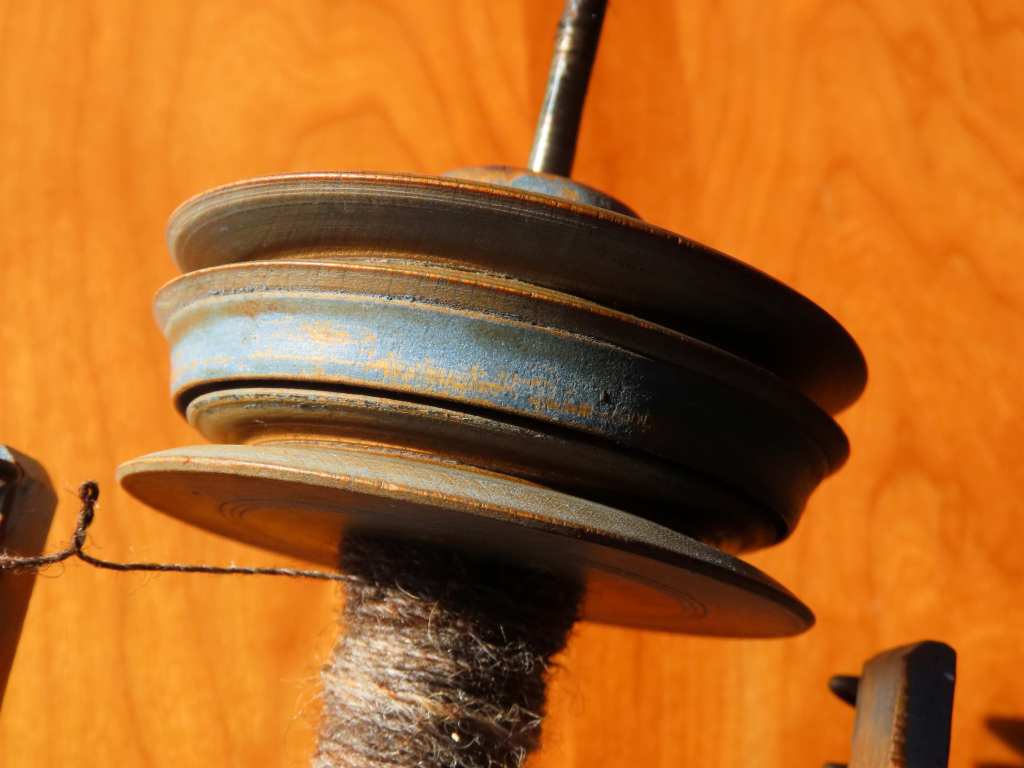
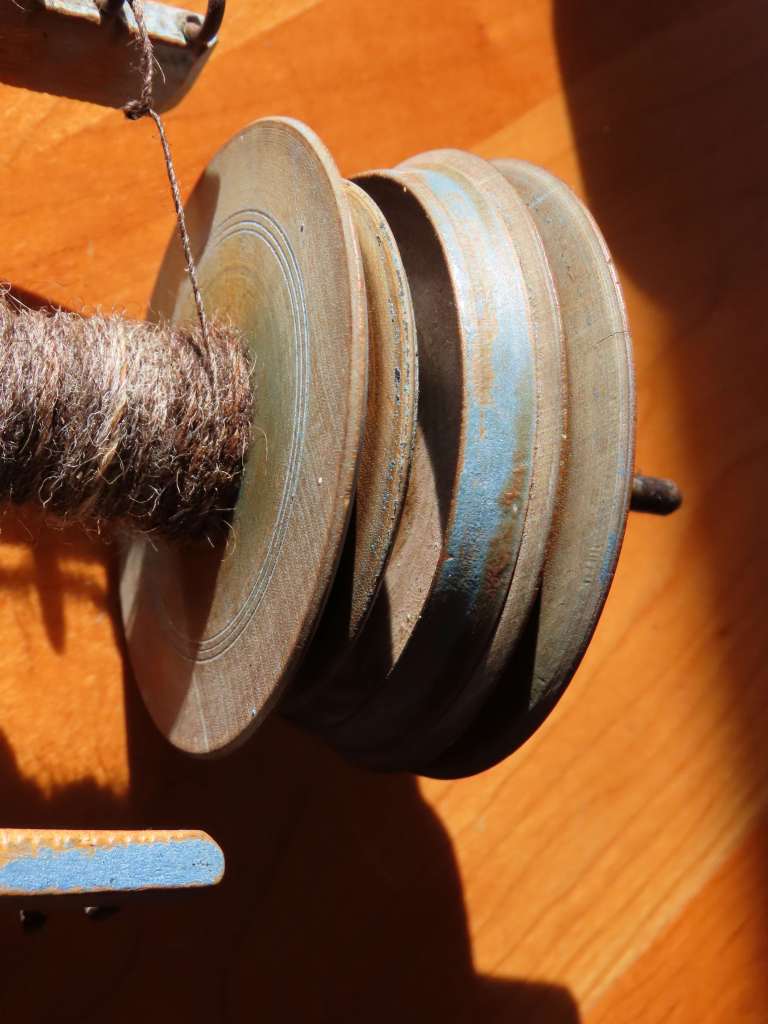
The the bobbin whorl
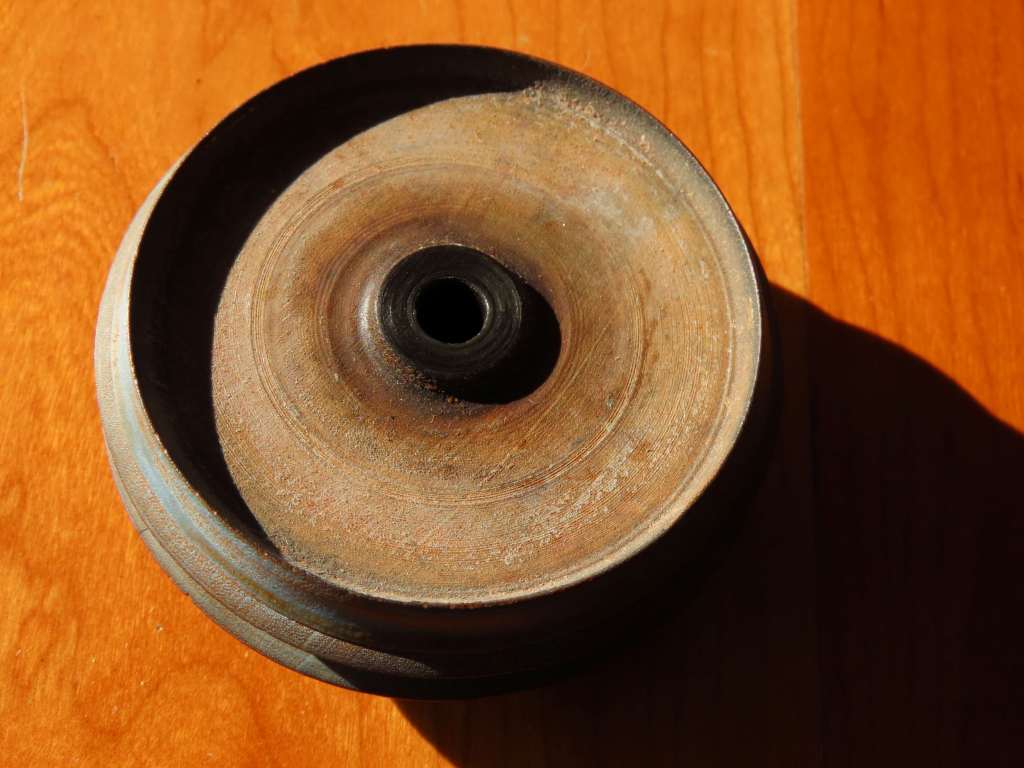
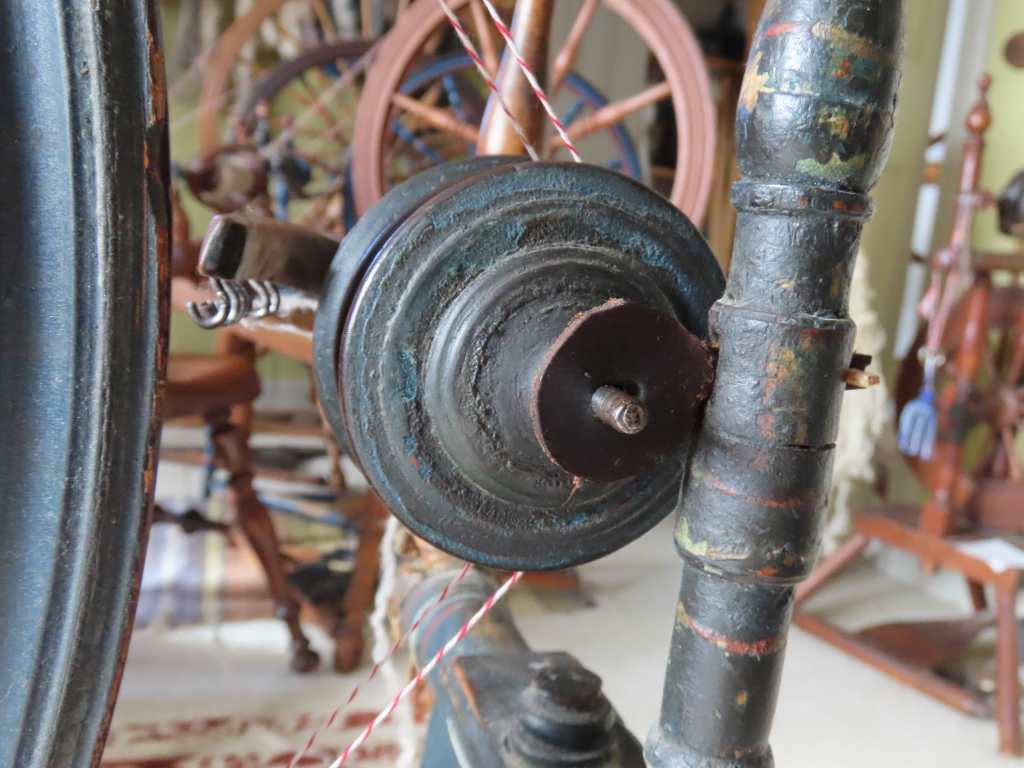
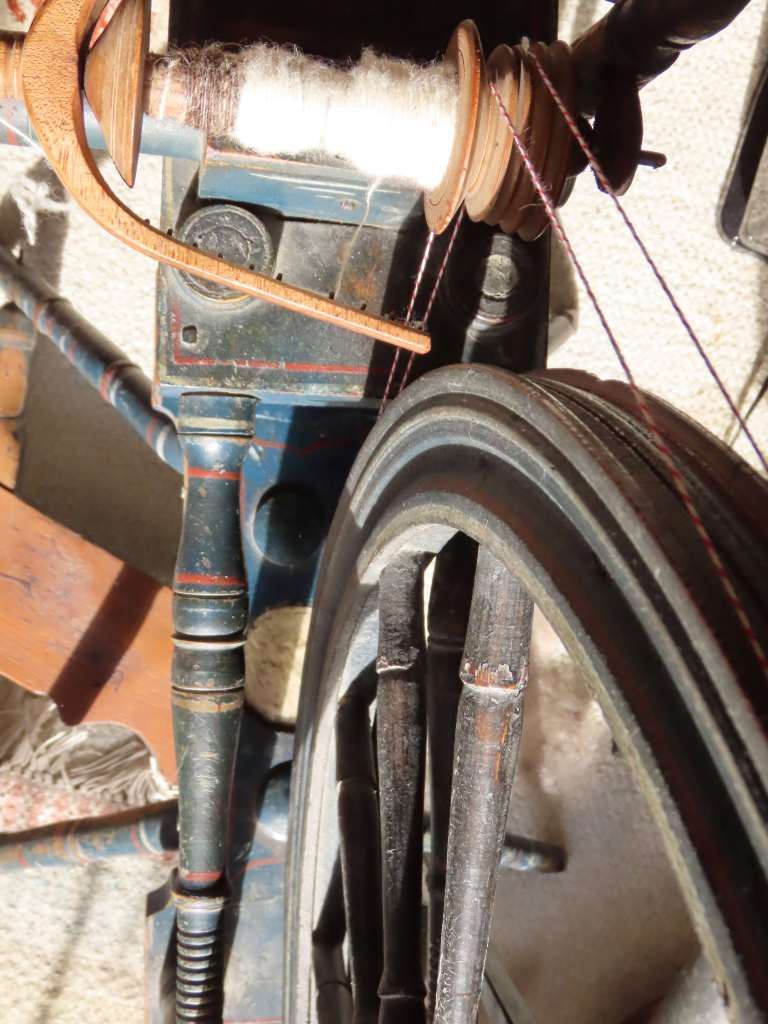
neatly nests into the flyer whorl, a feature found on other styles of Norwegian wheels.
Mine is a good spinner, although it required quite a bit of initial adjustment to properly align the whorl.
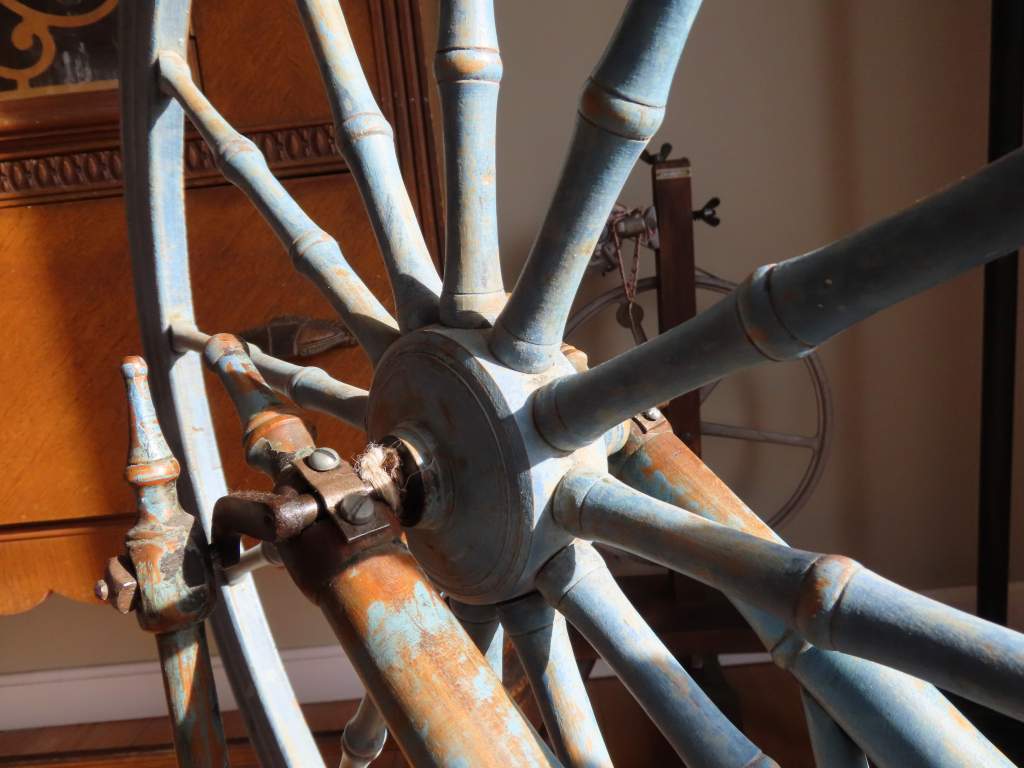
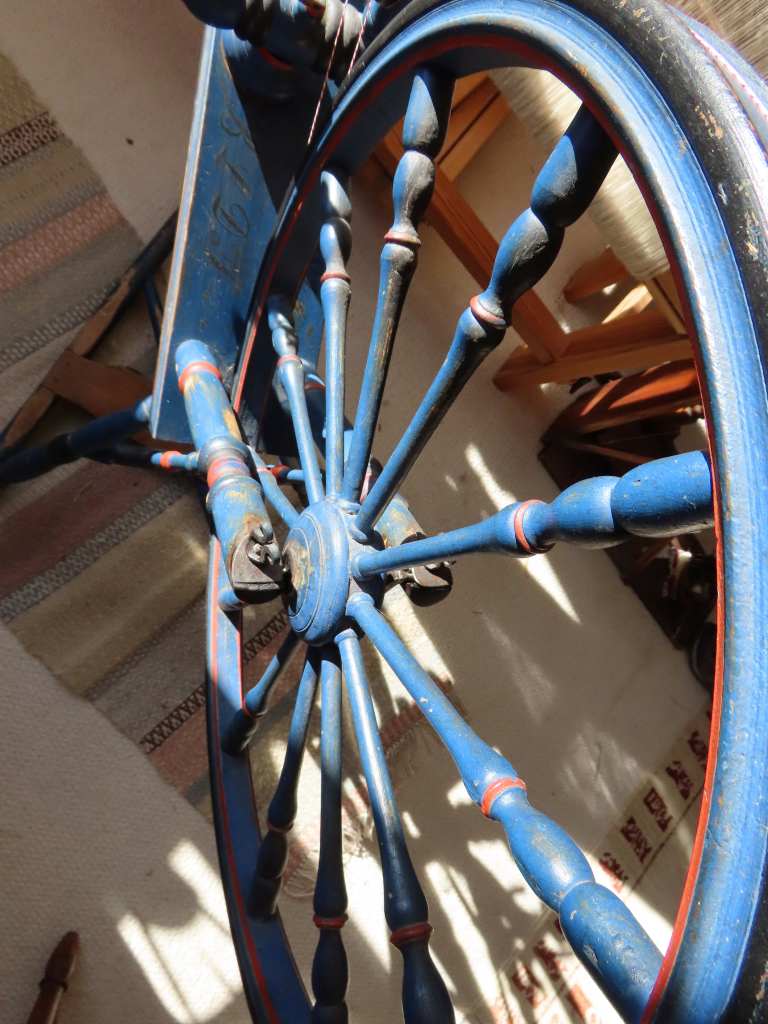
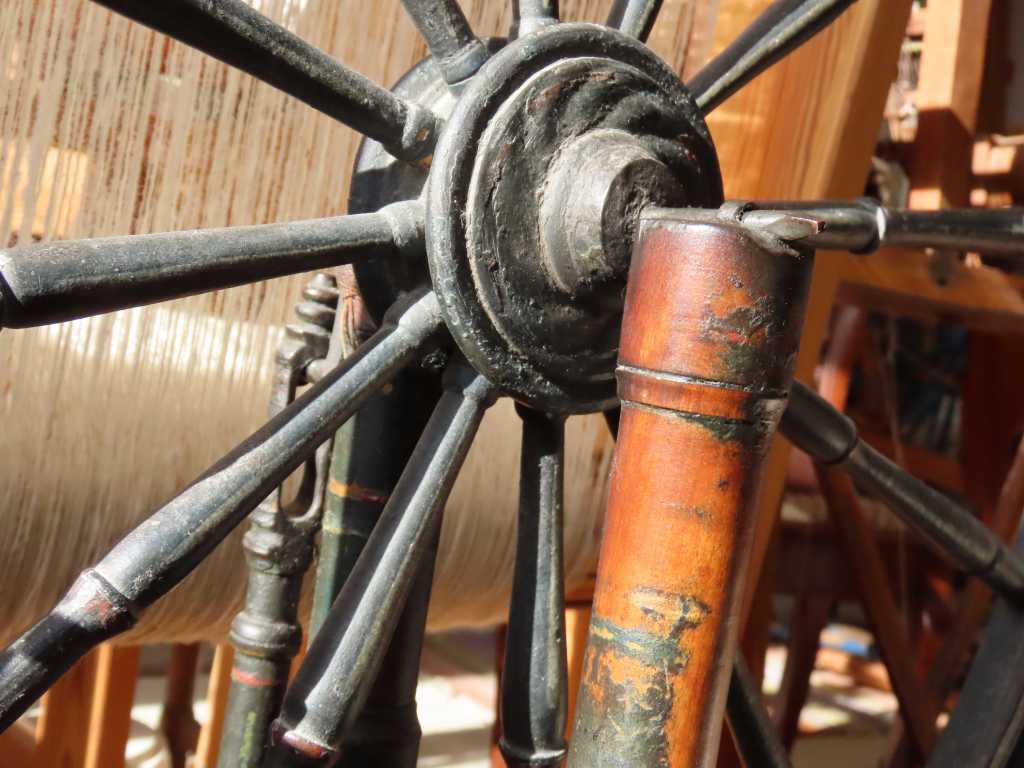
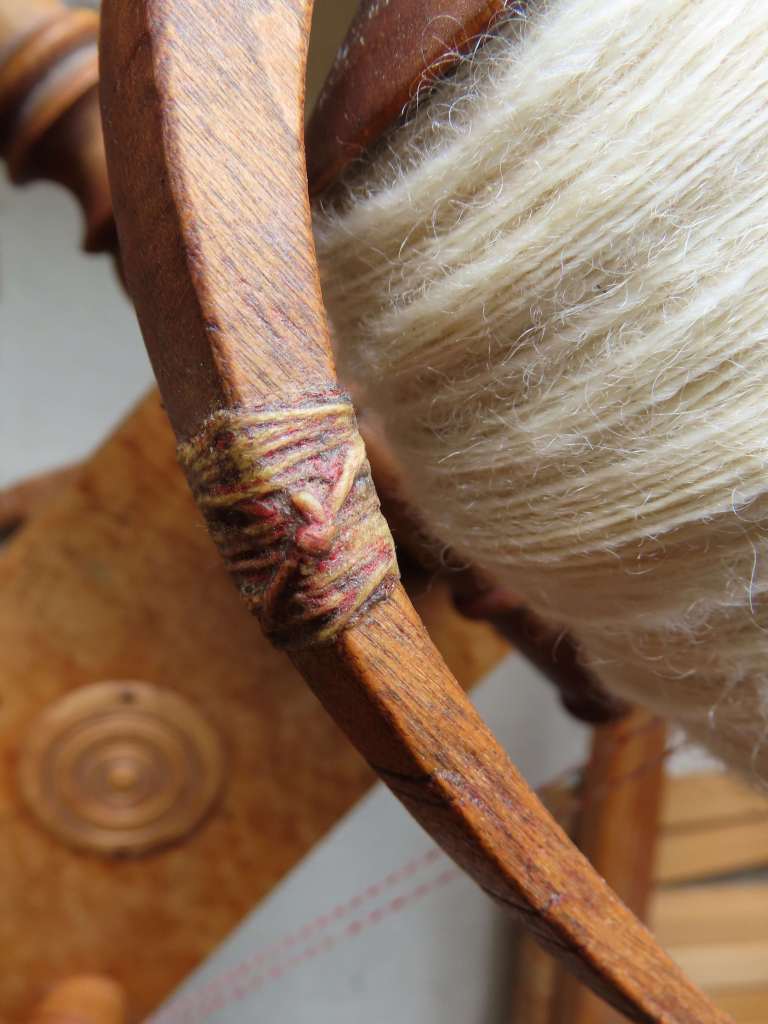
The spokes, which have fat pegs holding them to the rim, are loosey-goosey along the hub, with lots of play.
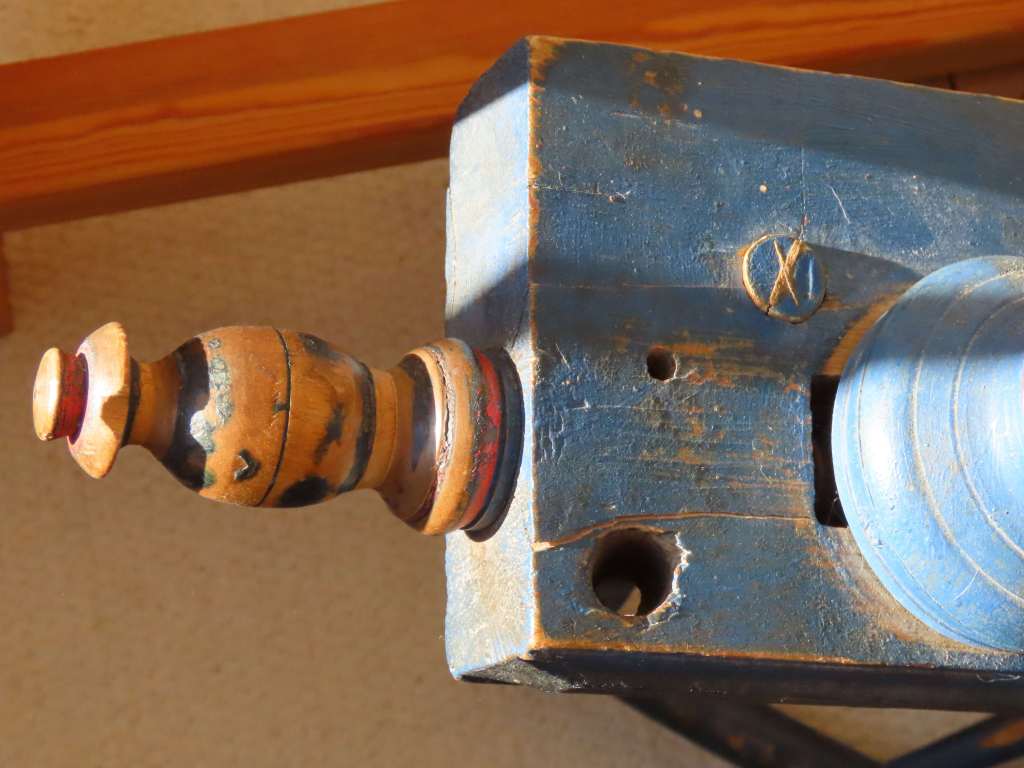
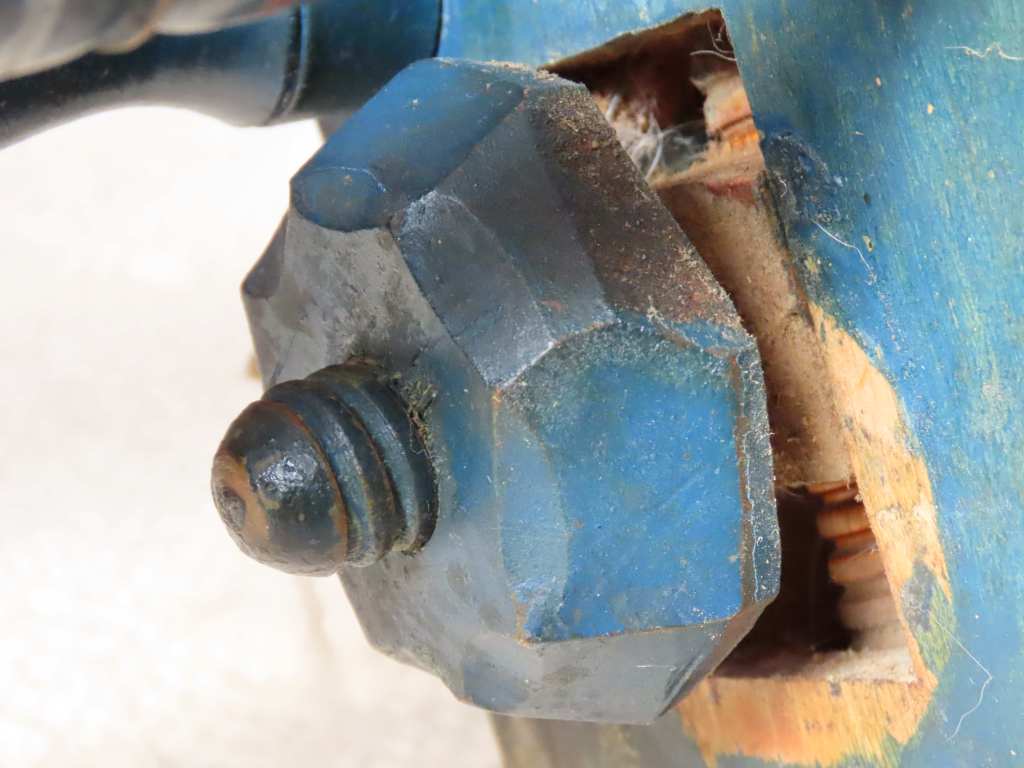
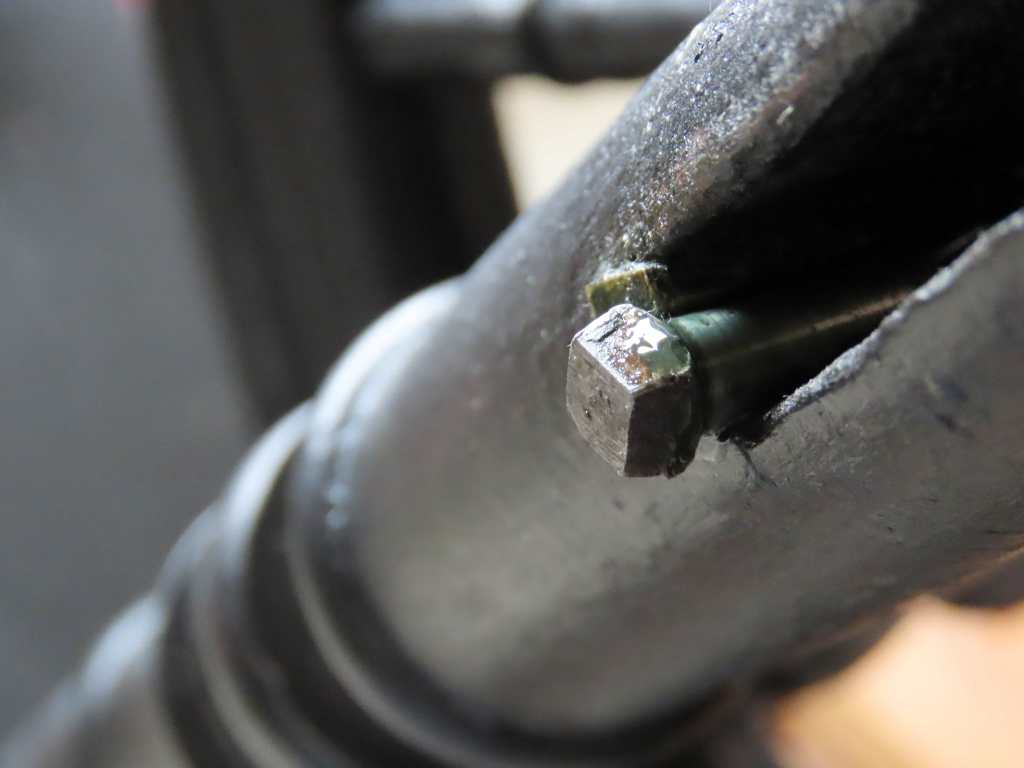
The original hardware keeping the axle ends in place was replaced with clunkier modern hardware, which, while not particularly attractive, works well.
With a little shimming of the rear axle, some leather washers, and a clarinet reed under the MOA,
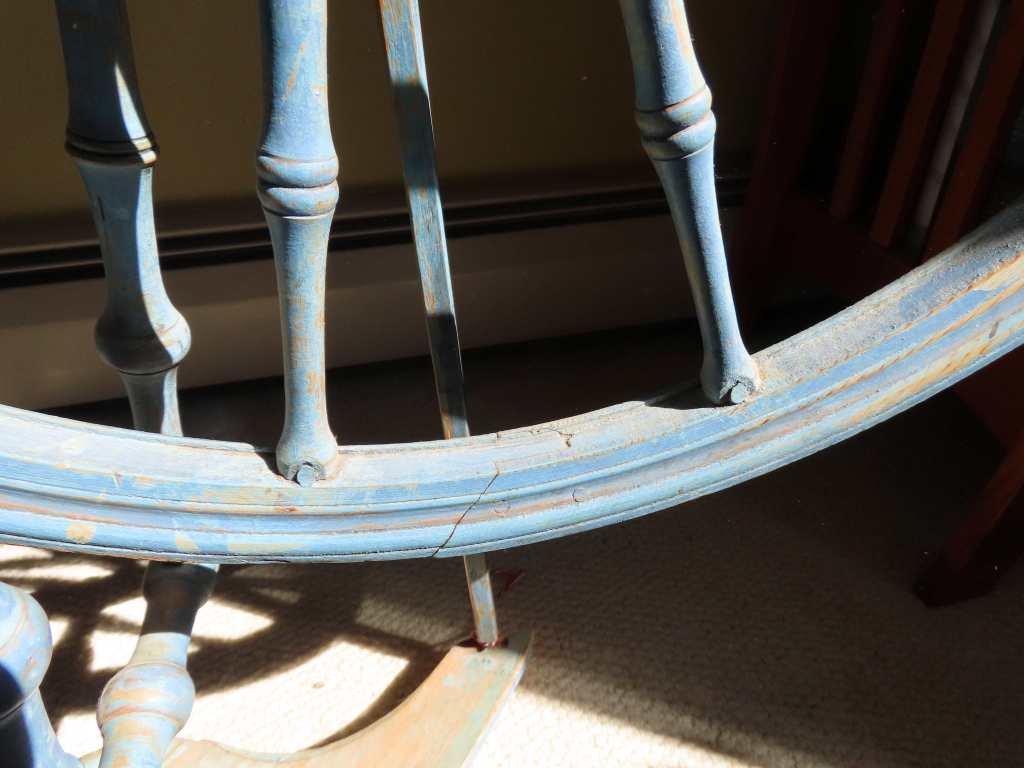
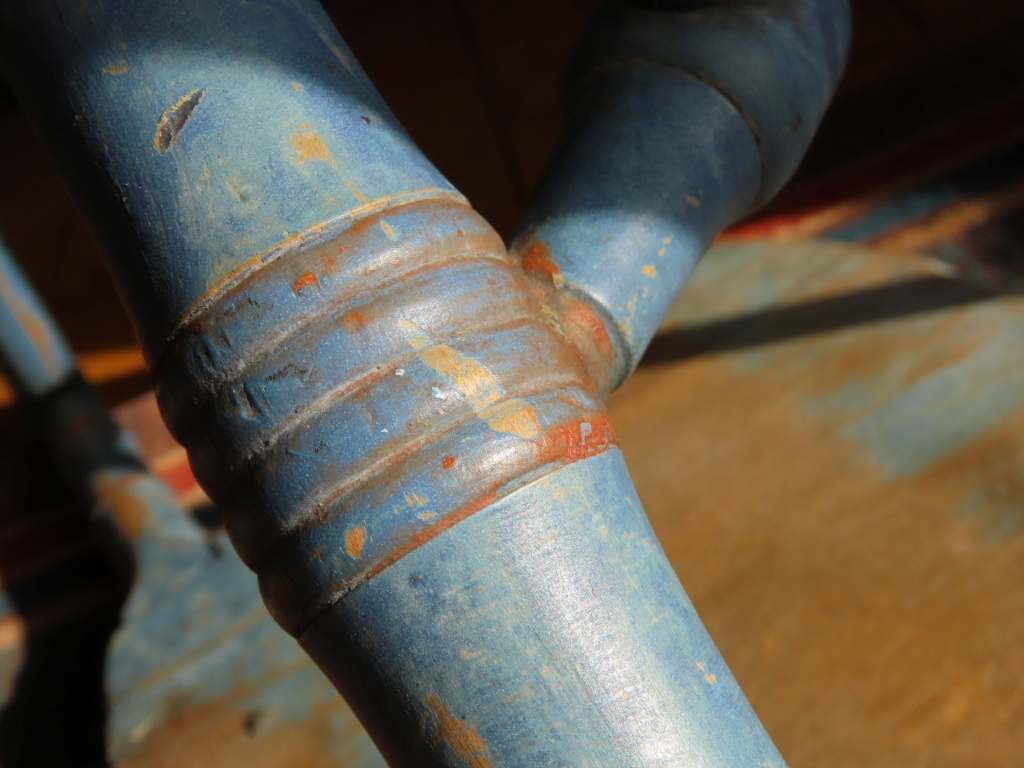
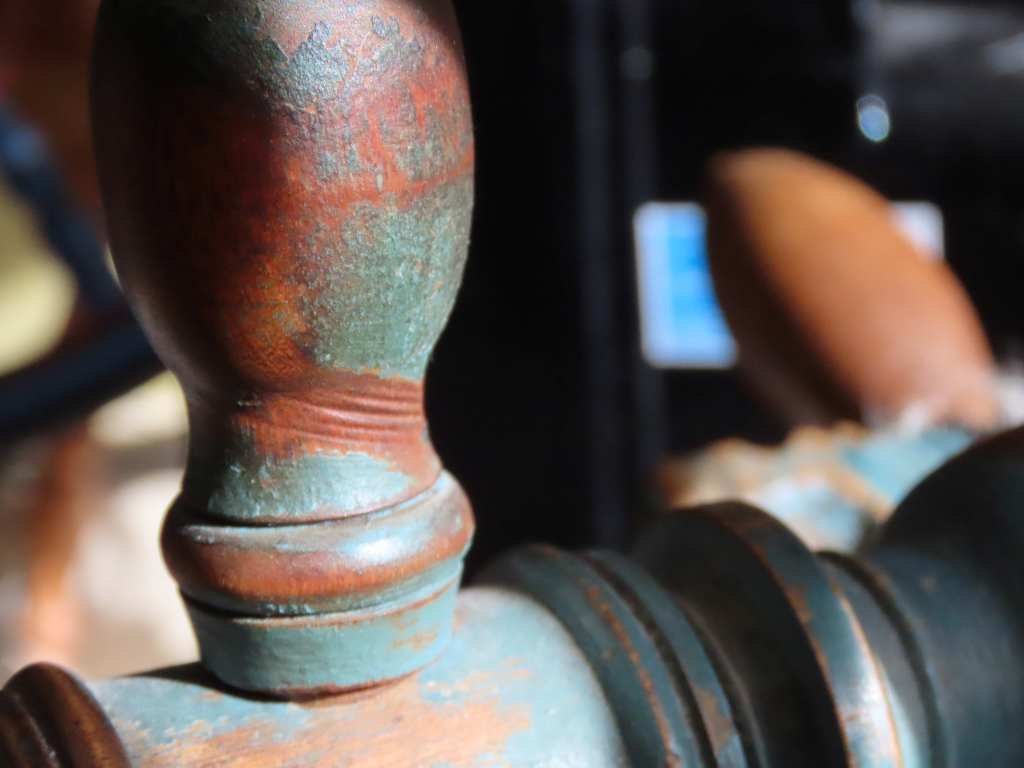
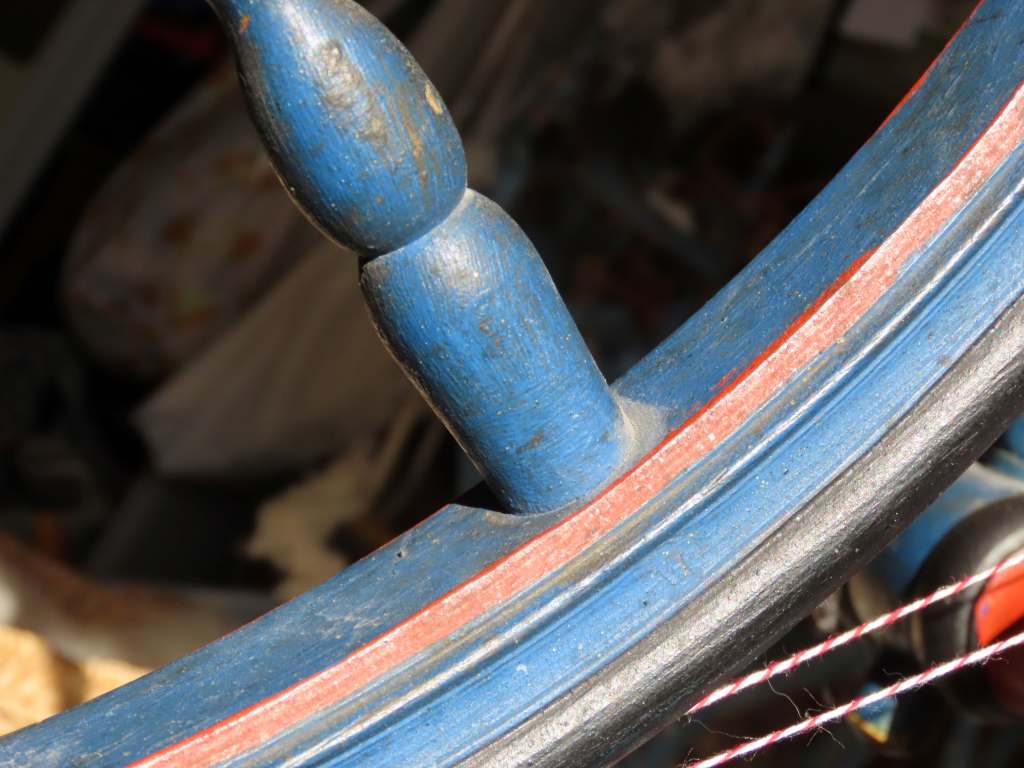
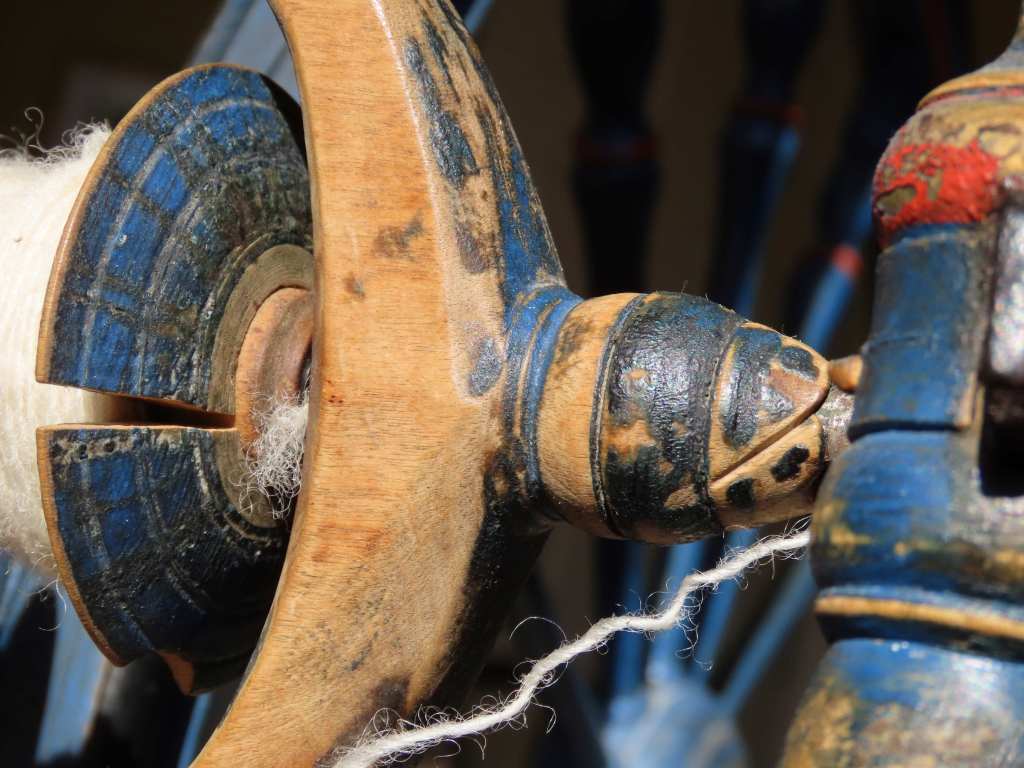
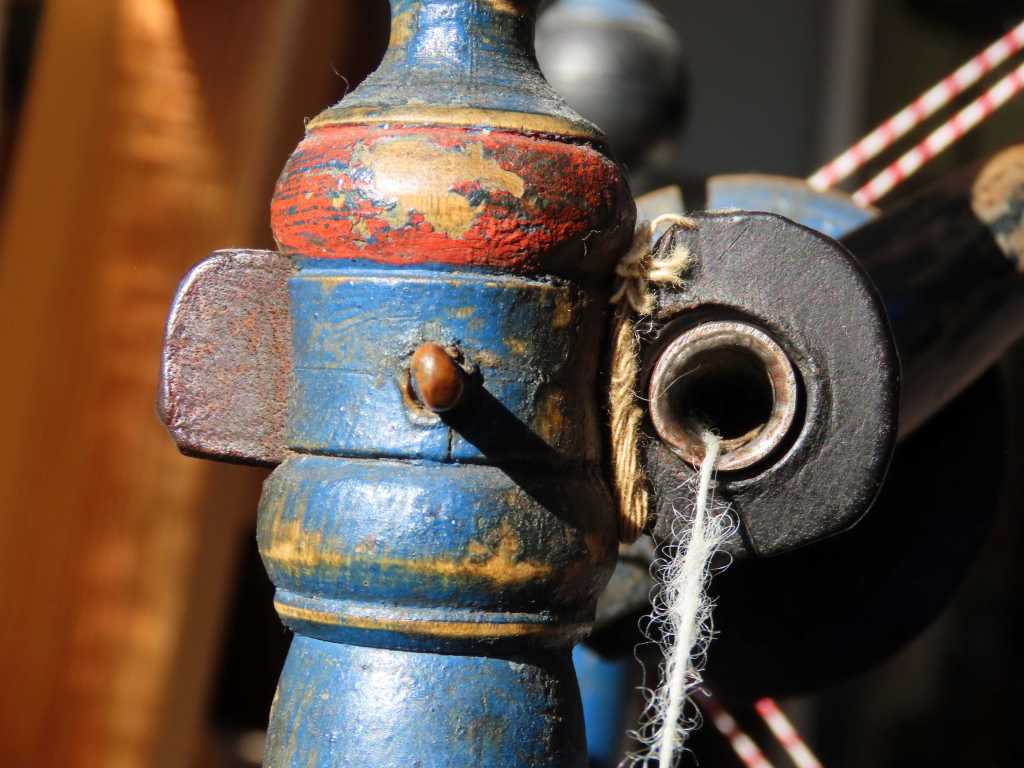
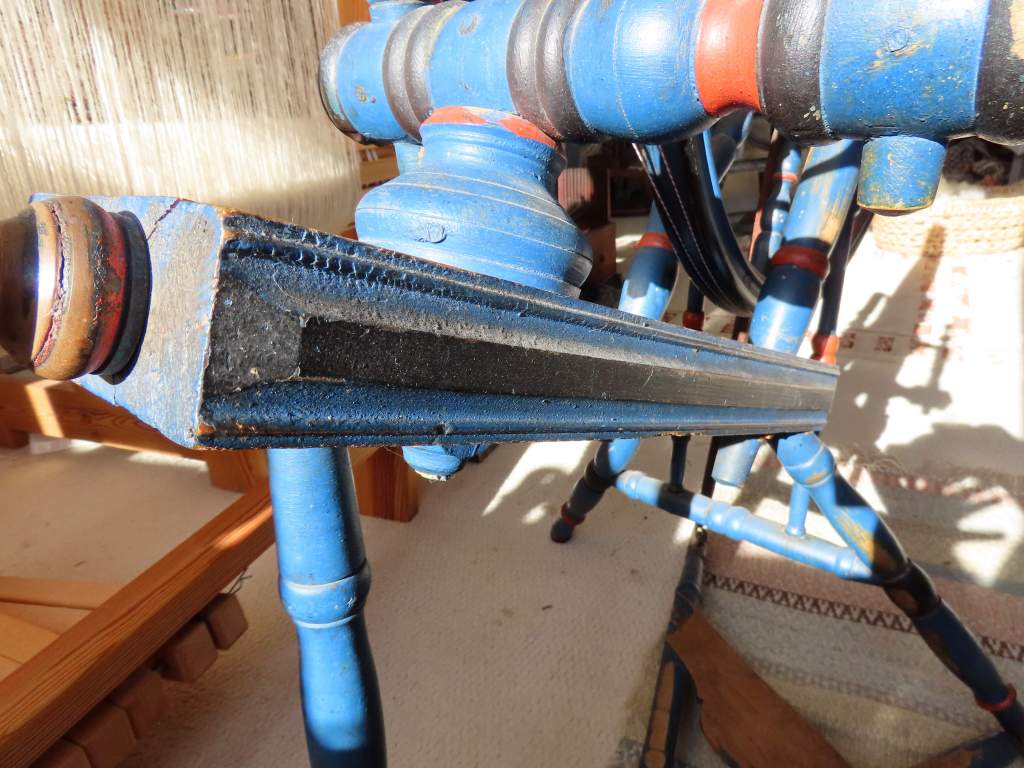
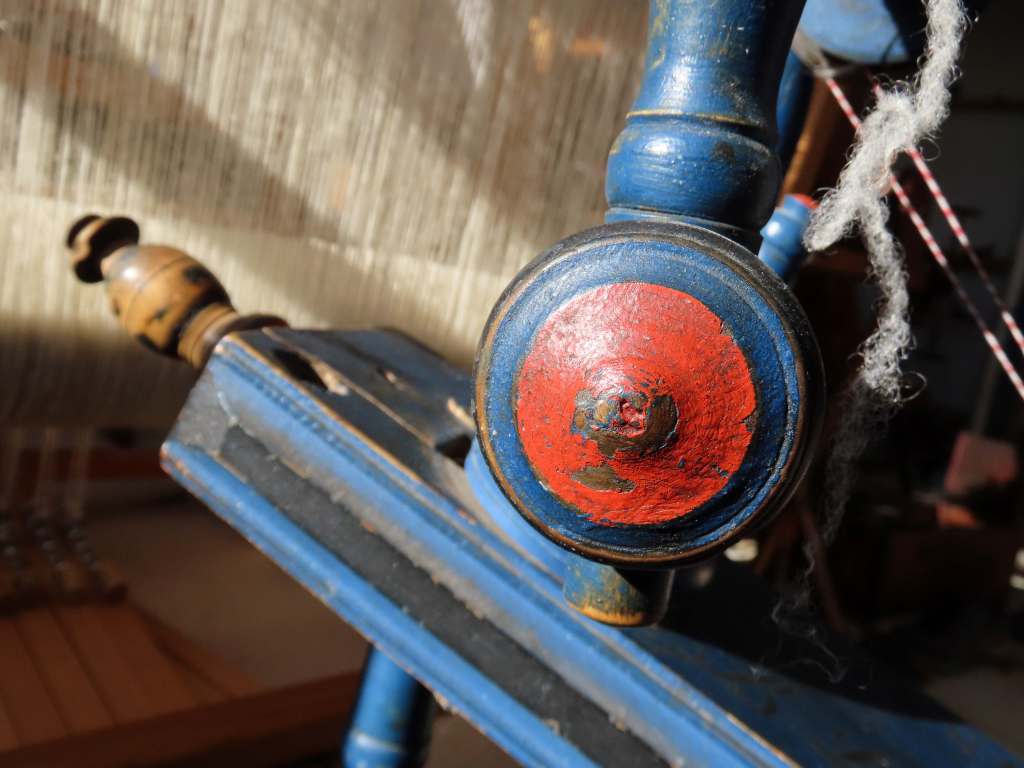
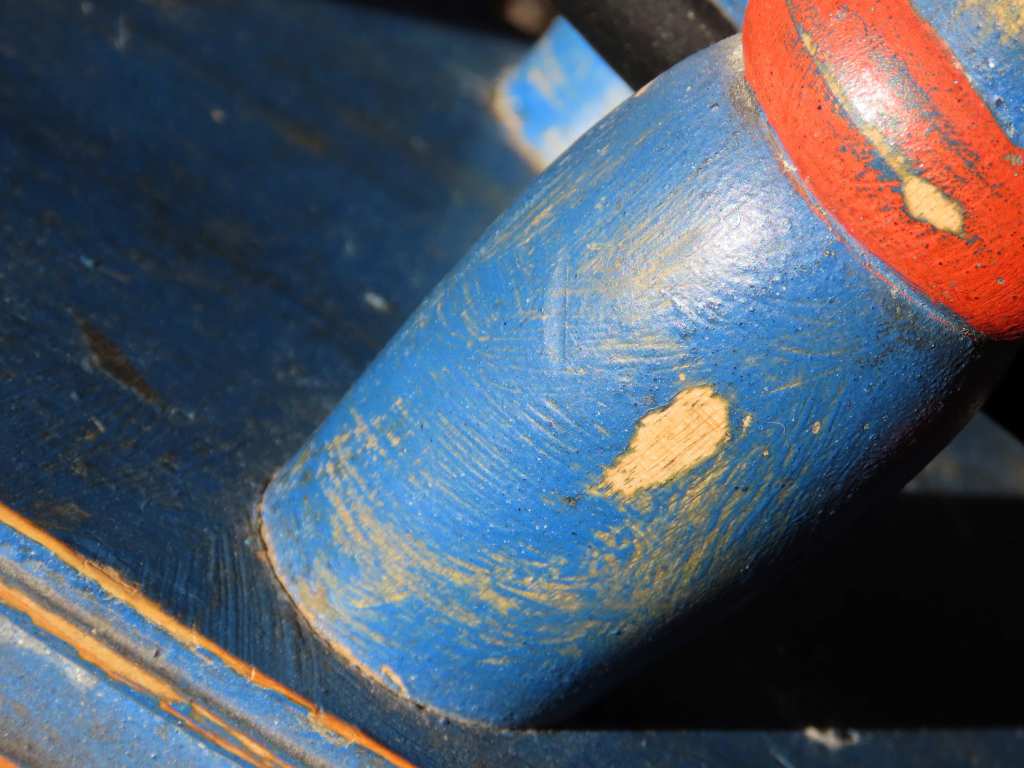
everything aligned eventually and she became a pleasure to spin. And, I have to say, I enjoy just looking at her–such a sublime color. These wheels were often painted, sometimes in multiple colors. I believe that the blue paint on my wheel is original, but there are traces of red highlights, too, which have worn off.
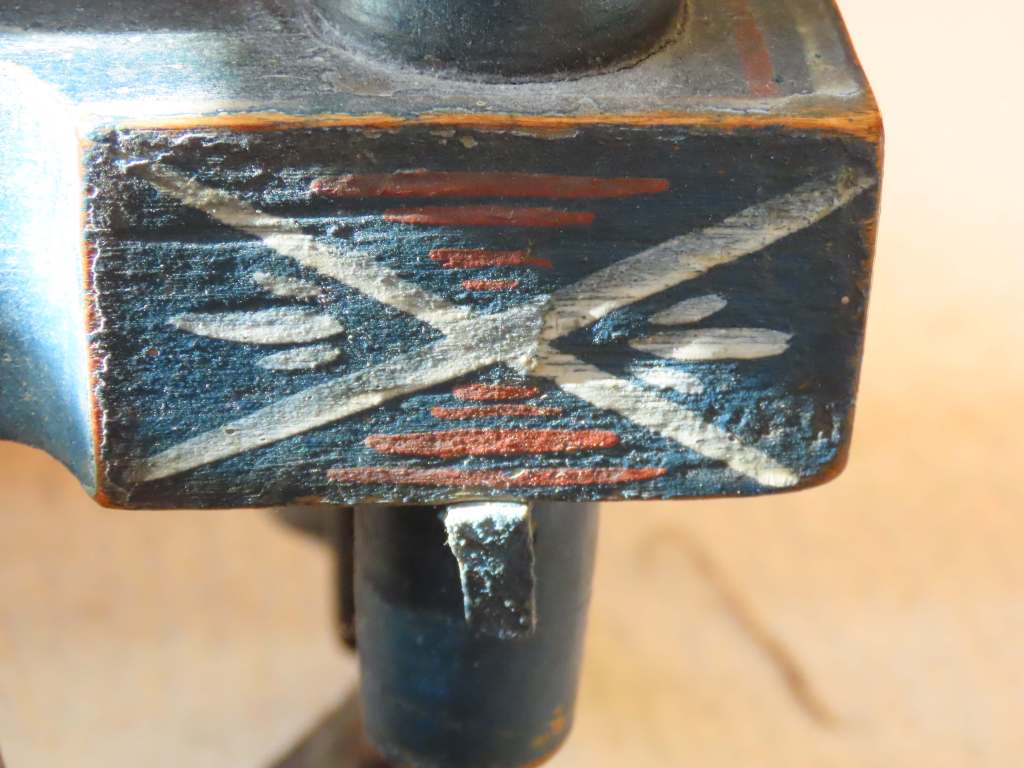
Traces of red paint
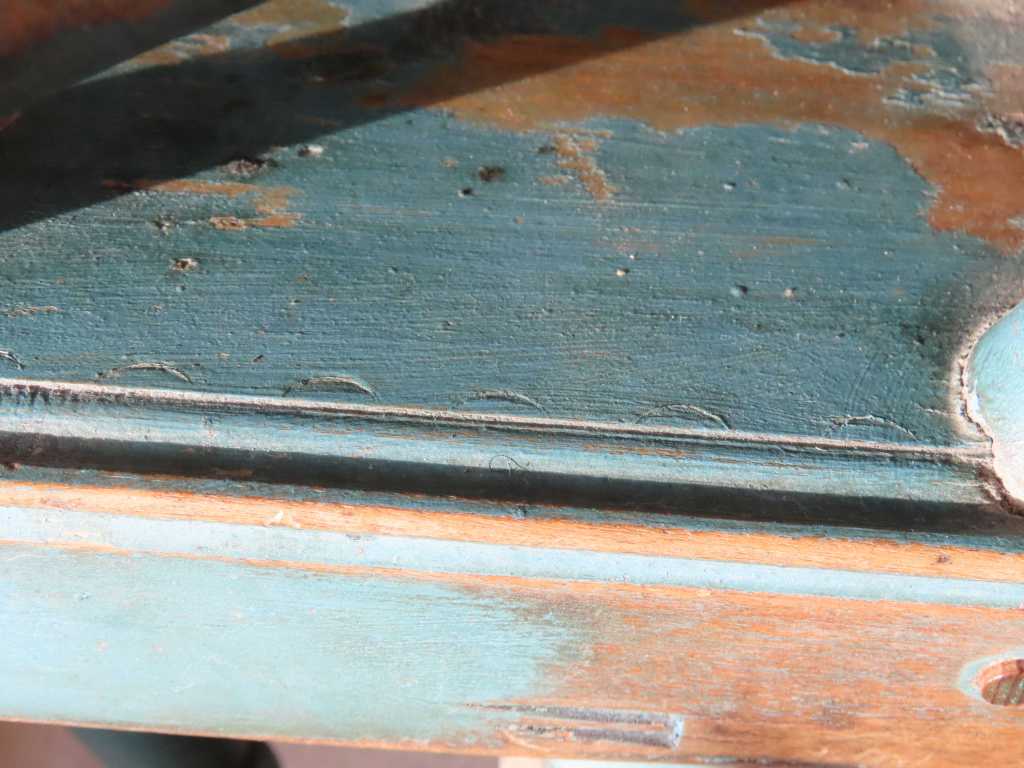
Interestingly, as with some of my other Norwegian wheels, the paint strokes are visible in some areas–it looks like a fast and not-very-meticulous paint job.
But it has lasted for well over a hundred years and makes this wheel especially visually satisfying to me. Combine it with the design features–not too cluttered, clean lines, elegant stance, rounded yet restrained turnings–it is like a sculpture in motion.
References:
Amund O. Eisdmoe’s “Story of His Own Life” is found in “The Norwegian Settlers Story” in the online Norway Heritage–Hands Across the Sea, link here
Hilts, Patricia and Victor, “Not For Pioneers Only: The Story of Wisconsin’s Spinning Wheels,” Wisconsin Magazine of History, Volume 66, #1, Autumn 1982.
Thorlow, Peter, “Aslak Lie Cupboard,” Creators, Creators, Collectors, edited by Ann Smart Martin, Mount Horeb Area Historical Society and UW Madison, 2017. Available online through Creative Commons.
*** I been writing these blog posts for years now and, in doing my research, have been fortunate to deal with a wide variety of generous people and institutions. Most are curious and enthusiastic people who share my love of trying to unravel the history of objects and pass it on to others. In writing posts, I do my best to abide by copyrights, to ask permission to use material, and to properly attribute photographs, research, and quotations. When I contacted the Wisconsin Historical Society for permission to include the two Rustebakke family photographs in this post, I found the fee to post each photograph (special non-profit rate!) was $20, for a total of $40. This is the first time I have ever been asked to pay a fee to use a photograph–other places have simply requested attribution. I fully understand that it costs money to collect, maintain, and digitize a collection and would have no objection to paying a small fee. But $40? I could rescue a wheel for that.
I gladly contribute to small historical societies manned by volunteers and struggling to keep their doors open. But, this historical society (according to its website) has an annual budget of over $35 million dollars, well over 100 paid employees, and is building a $160 million dollar history center. It does not need to charge such high fees for use of its photographs, especially when the user, like me, is unpaid, and making no profit whatsoever from use of the photographs. Such a charge seems outdated in the internet age and a frustrating impediment to further sharing the story of the Rustebakkes and their spinning wheels. Making history accessible to all and connecting people to the past through collecting, preserving, and sharing stories is part of the Society’s mission and vision. They missed an opportunity to do that here.***
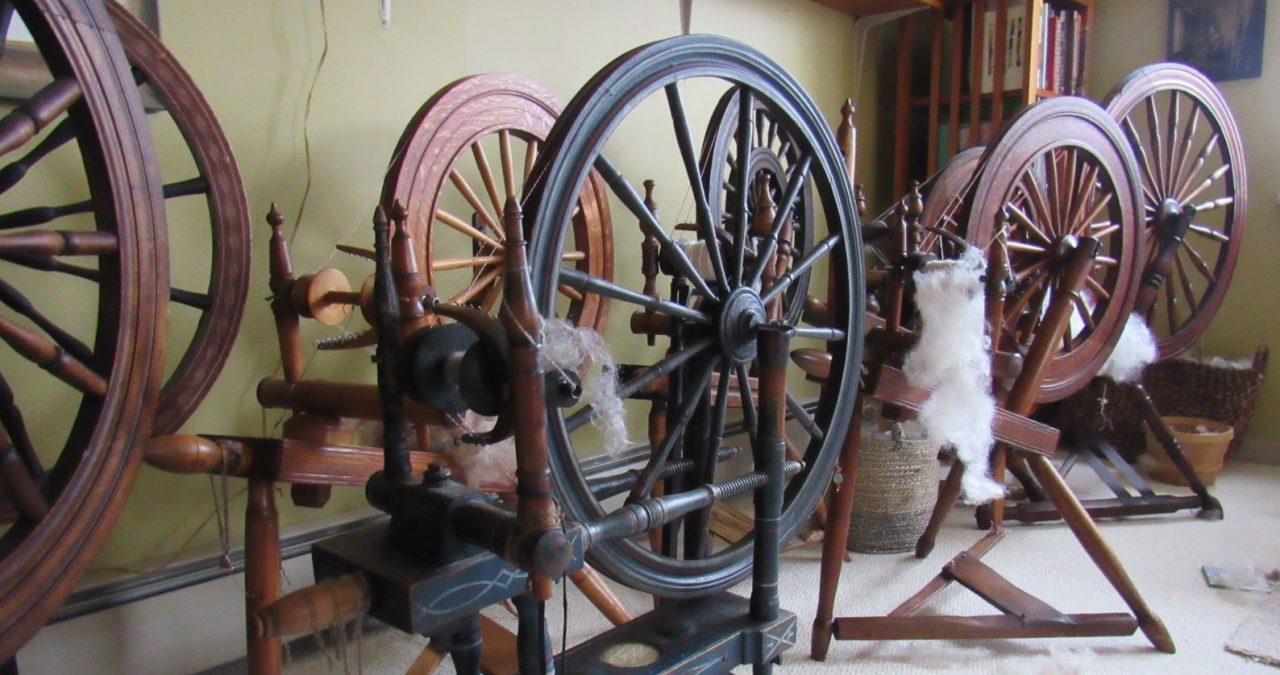
These petite Norwegian wheels turn up regularly in this country, mostly in the Midwest.
An 1851 wheel for sale in Fargo, N.D.
Because they are light and small, they must have been relatively easy to transport to this country from Norway.
Solveig is considerably smaller than Hjordis, the Norwegian wheel from the last post
Because wheel makers often were scarce in the Midwest, “Norwegians who had emigrated earlier strongly recommended in letters to friends and family that women bring spinning wheels to America. The writers also occasionally suggested packing wool carders, looms, sheep shears and shears for cutting woven cloth.” Norwegian American Women, p. 159.
“Most sources indicate that women used the Norwegian treadle spinning wheels they brought or acquired. Kari Bunde Veblen requested a second wheel from Norway after the first one, brought by a newcomer, ‘did not prove satisfactory in that it growled slightly in running.’ ” Id at 162.
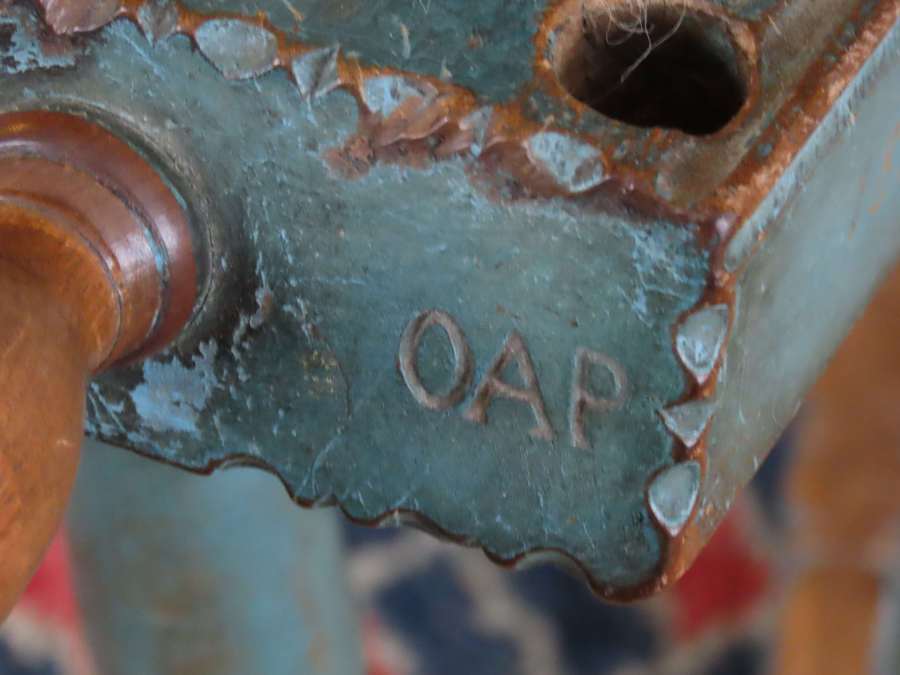
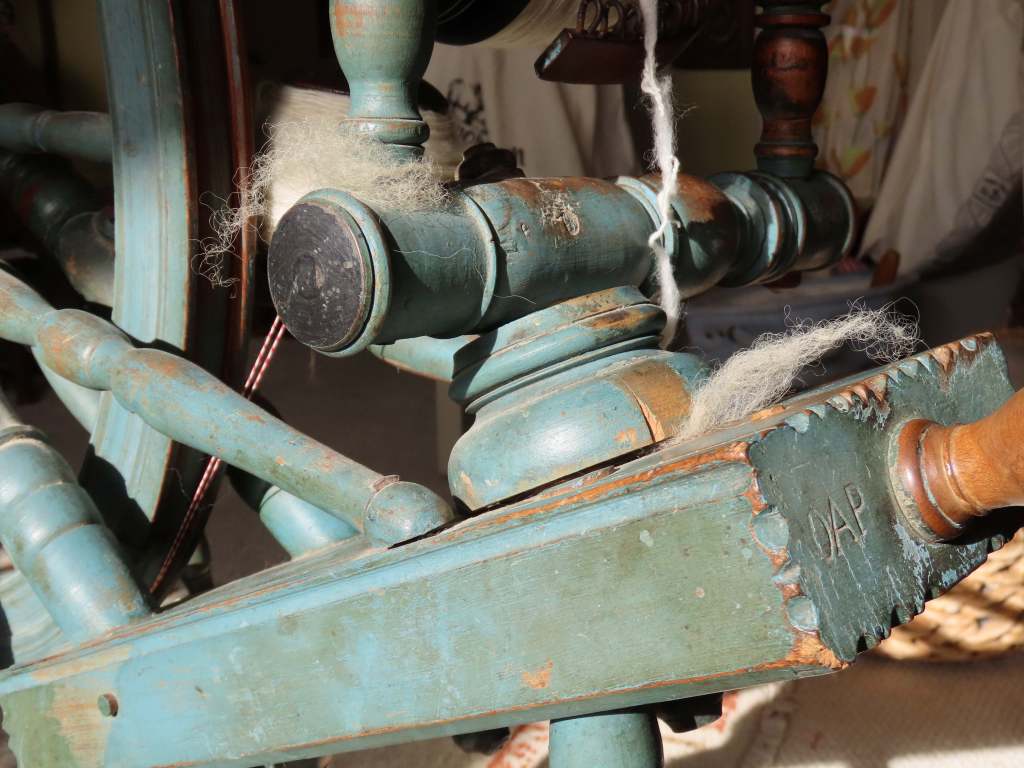
Although these wheels have a clear maker’s mark of OAP, as far as I know, his identity is a mystery.
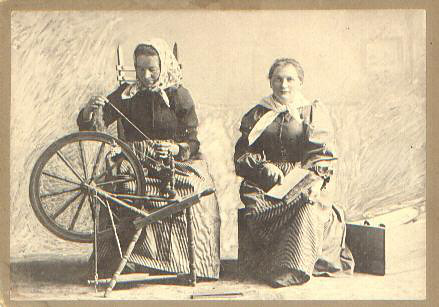
We believe the wheels may have come from the Hordaland area of Norway based on this photo found on an ancestry site, with the caption: “Lofthus, Norway – One lady spins the wool while the other combs 1888.”*
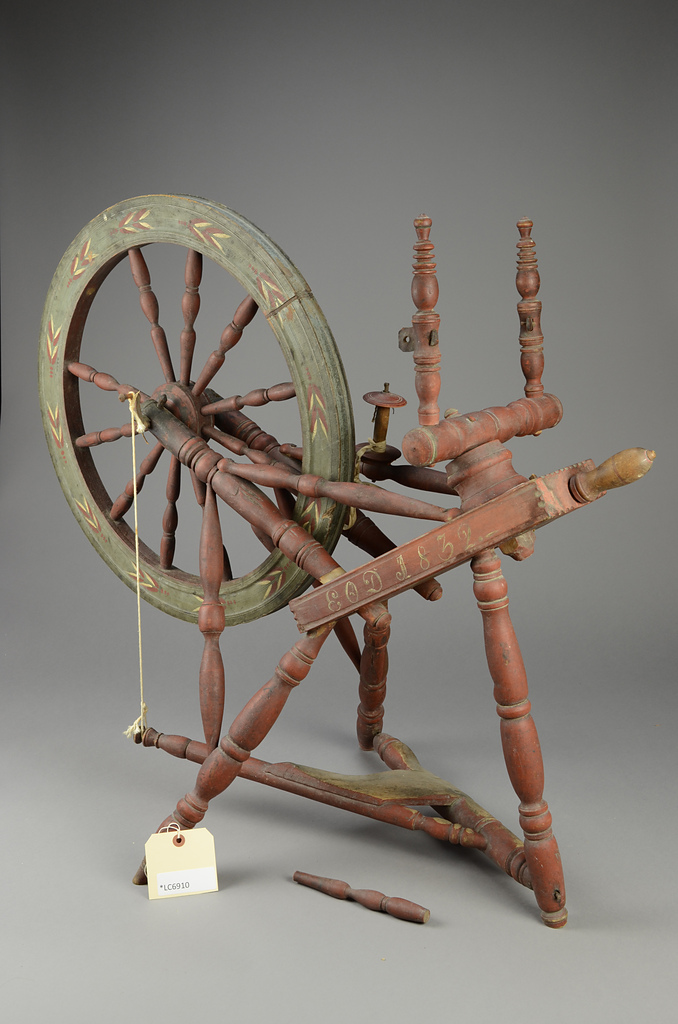
The wheels appear to have been made for decades, with painted dates ranging from the 1830s (and perhaps earlier) to the 1870s.
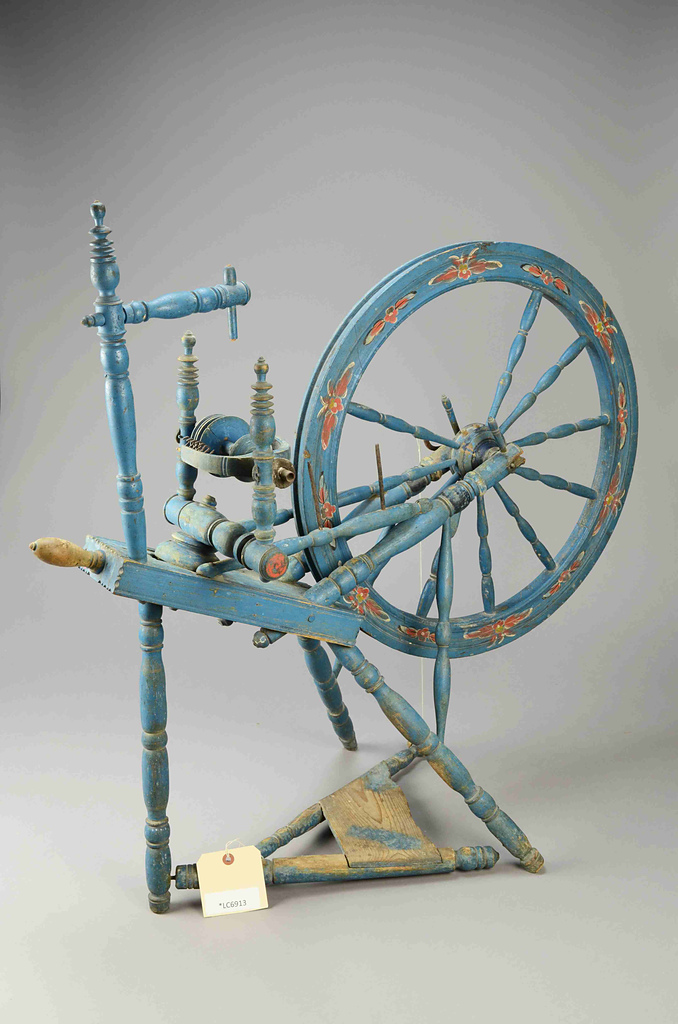
They are usually painted, sometimes with floral designs such as these wheels in the Vesterheim Museum in Decorah, Iowa.
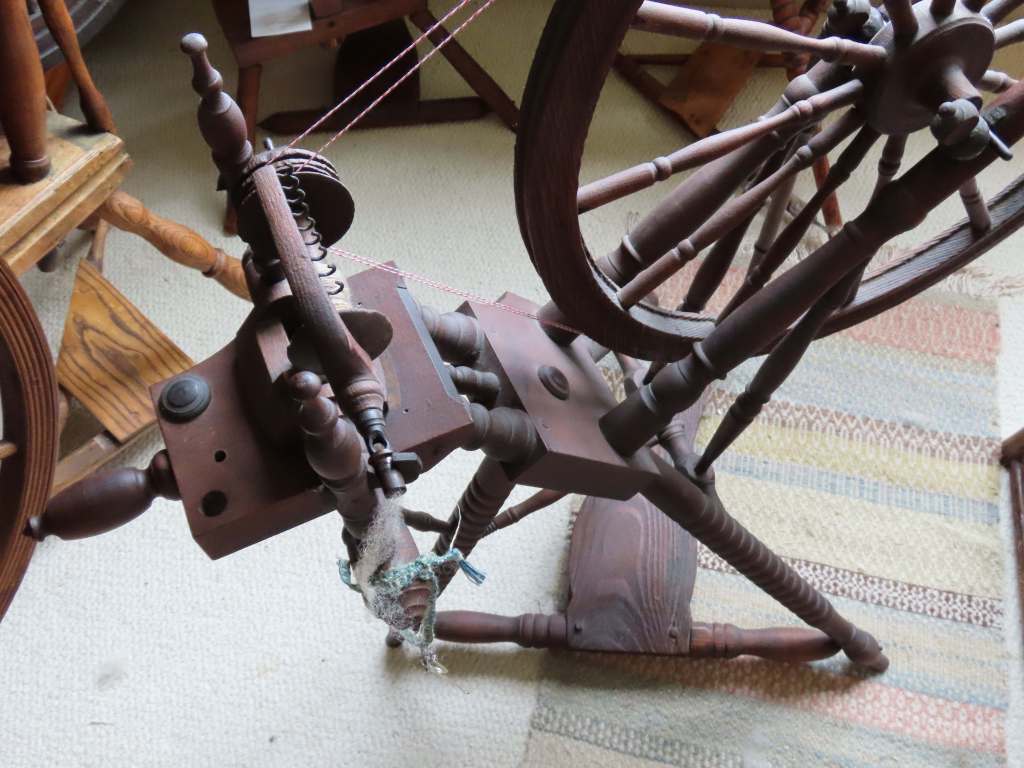
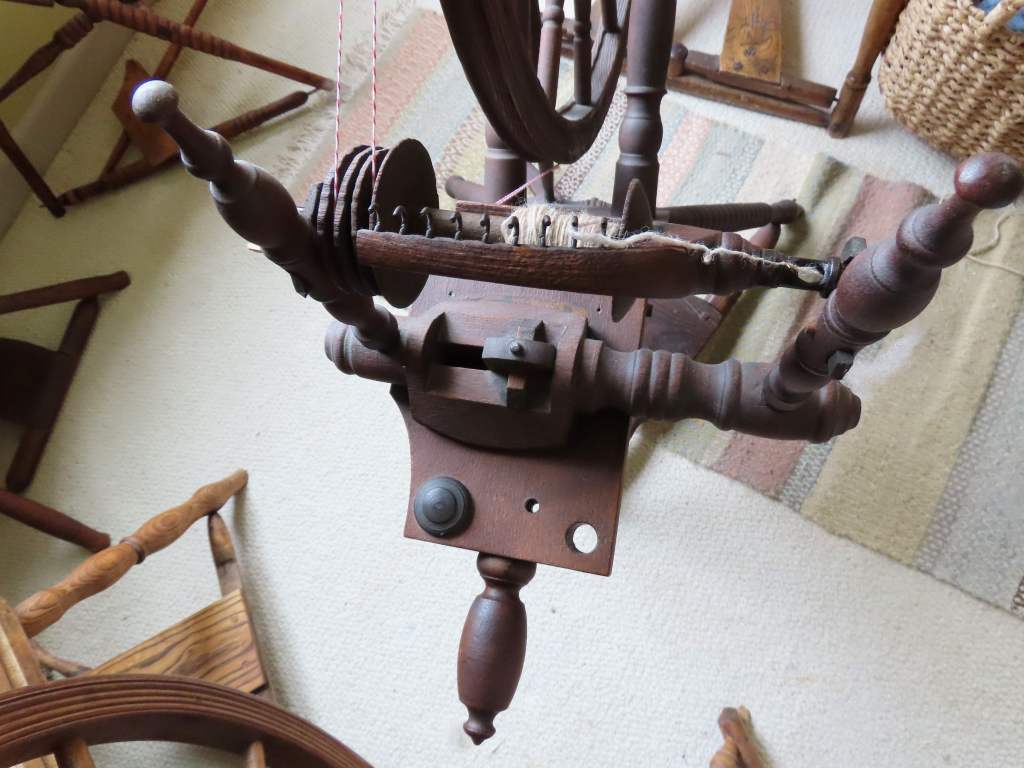
Aside from the lovely paint jobs and compact size, these wheels are immediately recognizable because of an onboard lazy kate.
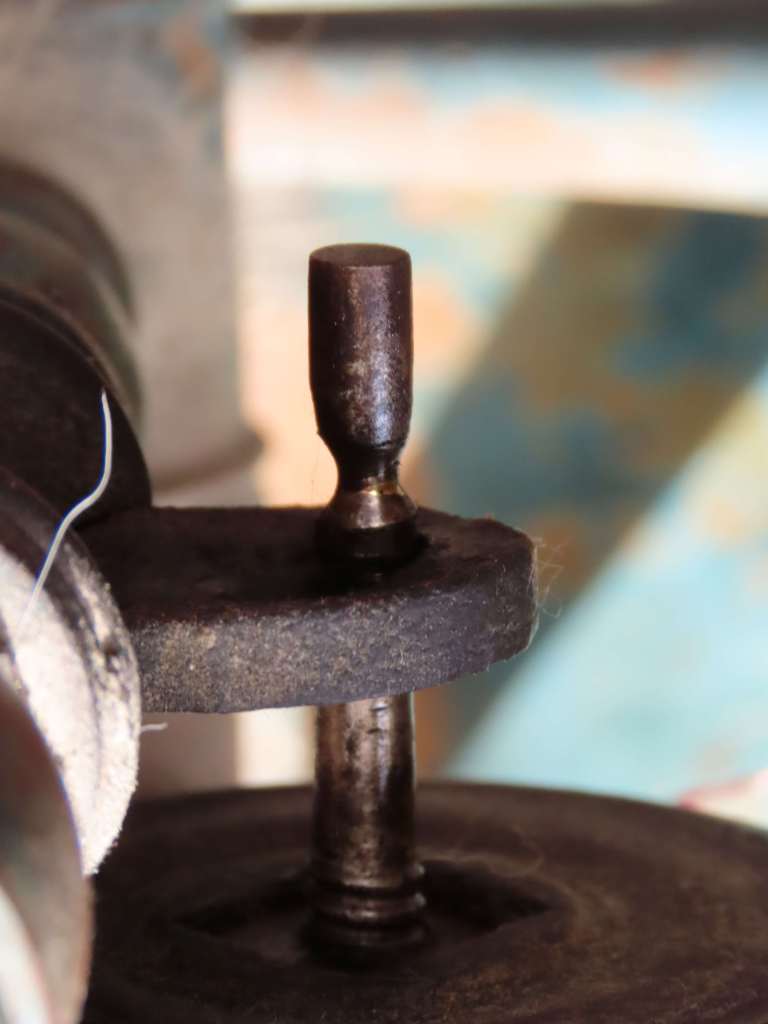
The front cross-bar support has two metal shafts, beautifully worked with folded tops.
These can hold full bobbins, allowing the spinner to ply directly from the wheel.
It is a handy, ingenious feature, made possible by a hub that is flat in the back, but with an extension on the spinner side to make space for the bobbins.
Solveig was found in northern Minnesota.
She is a workhorse, spinning and plying with ease.
While many antique wheels have very little difference in the depth of the bobbin and whorl grooves, Solveig’s bobbin groove is much deeper than her two whorl grooves.
The gorgeous blue-green paint shows the typical wear made by women spinners wearing long skirts.
Paint wear on the spokes confirms that the drive wheel was turned in both directions, using the lazy kate for plying, although there is more wear on spokes indicating clockwise turning.
The front maiden has wear marks in a somewhat unusual place near the bottom, where spun thread was wound around it, probably when unwinding the bobbin.
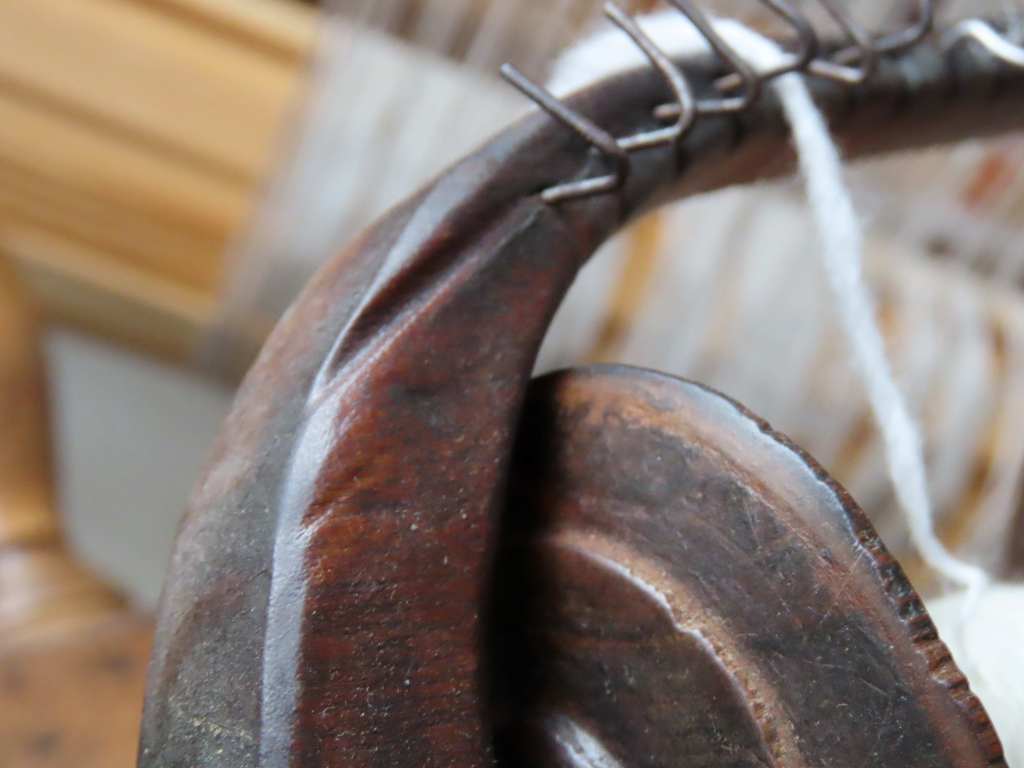
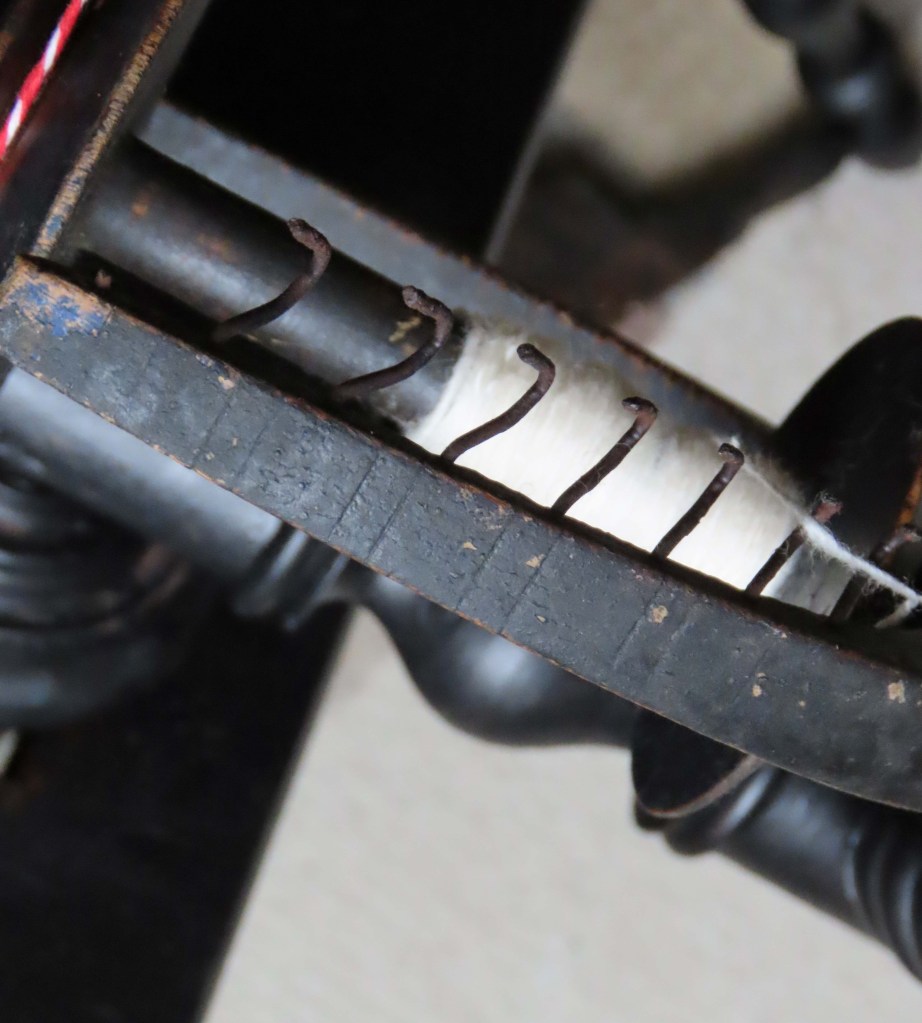
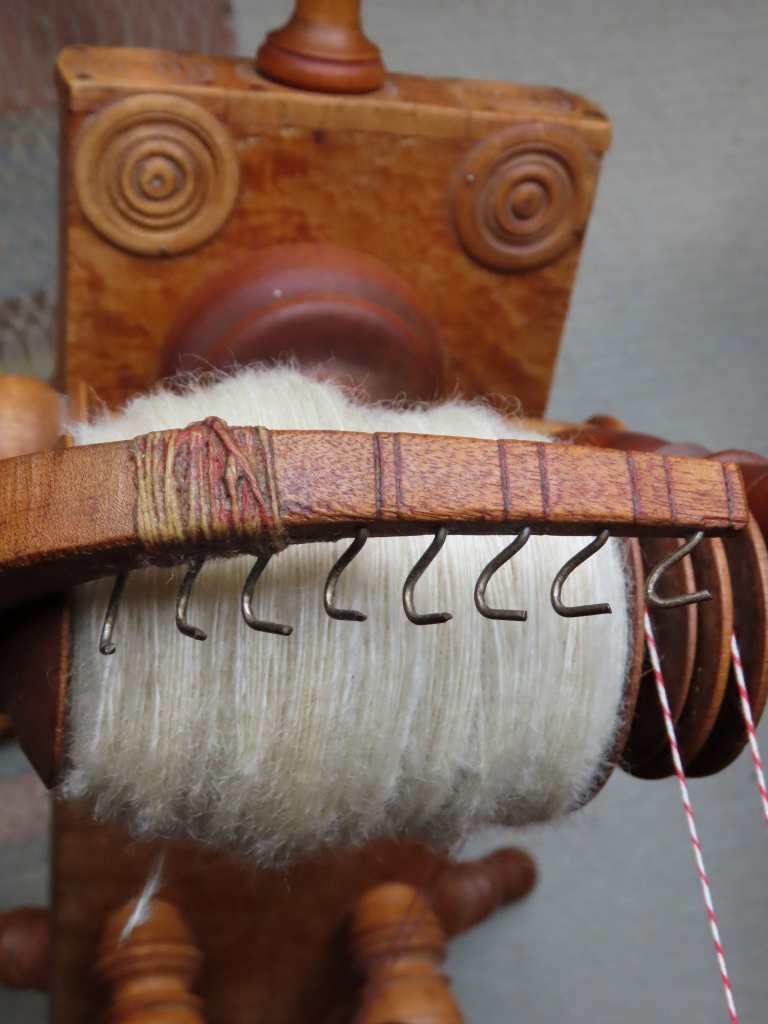
Deep grooves run alongside the flyer hooks–again a wear pattern that is out of the ordinary.
The orifice opening is slightly fluted,
with a opening big enough for easy plying.
and there is wear on the far side of the mandrel where it hits the bearing.
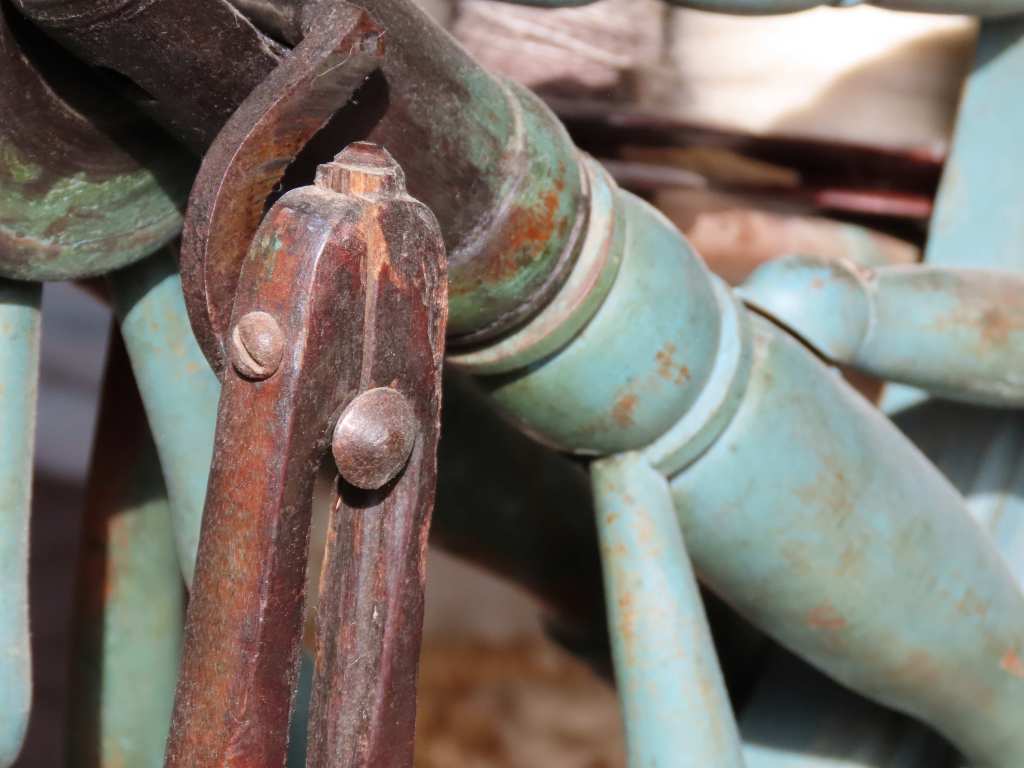
The footman has been repaired with a screw.
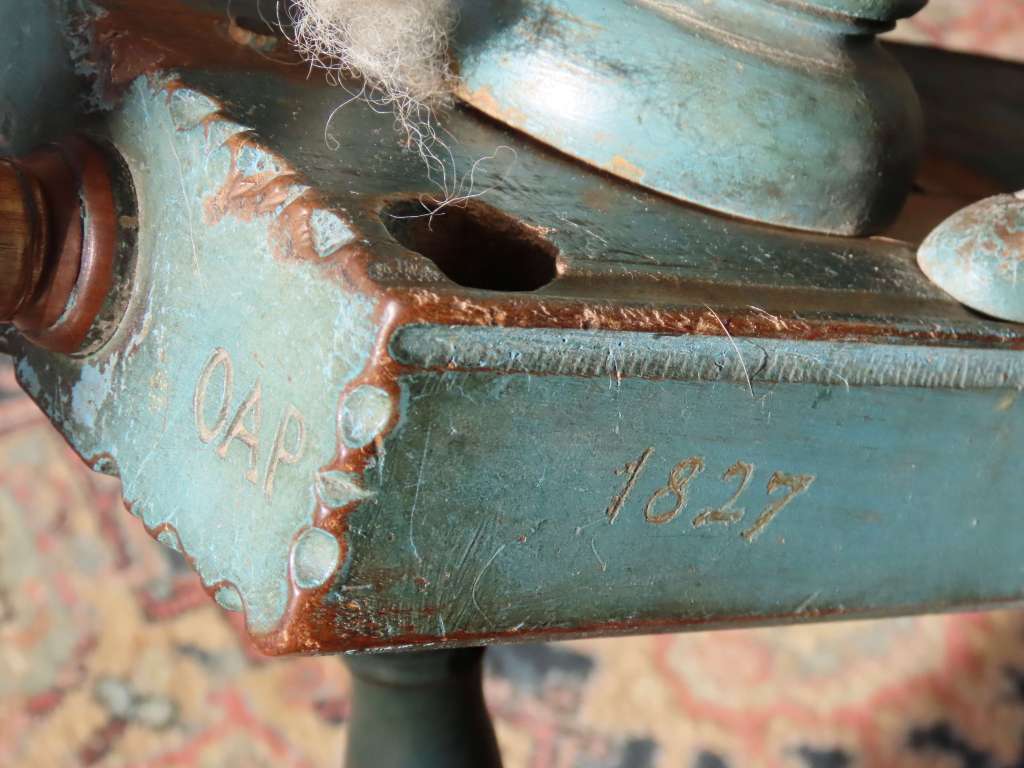
In contrast with many of these wheels, which have painted initials of the owners along with a date, Solveig has the date 1827 scratched into the side of the table.
Since OAP did not routinely apply the date in this way, it likely was added later by an owner and may not be accurate.
But there is not doubt that Solveig was used for many years.
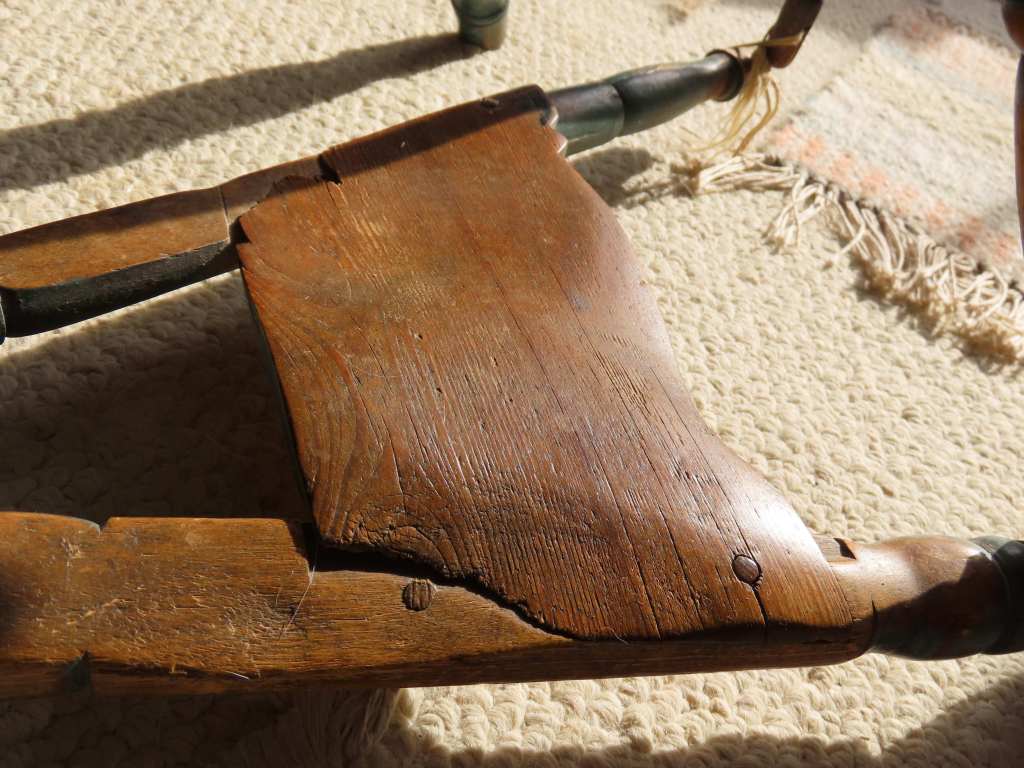
The wear on the treadle is so extreme it created a wooden wave.
The drive wheel construction is typical of Norwegian wheels.
But, every part of the wheel carries special touches from OAP, whoever he was. A small cut-out under the drive wheel,
distinctive maidens,
little touches of decorative design,
and the maker’s signature chip carving are a reminder that he valued beauty along with practicality.
It is no wonder that OAP’s wheels were so popular and remain coveted to this day.
Thank you to Andrea Myklebust for the Norway and Vesterheim photos. And, of course, for this wheel, which will soon be returned to live with Andrea again.
*The photo of the wheel in Norway was accompanied by this explanation: “This picture hangs framed over my mother’s spinning wheel along with a set of cards. Mom doesn’t know who the people in the picture are but thinks they are cousins from Lofthaug. – Wendy Turner ”
The quotations are from:
Bergland, Betty A. and Lahlum, Lori Ann, Norwegian American Women, Migration, Communities, and Identities, Minnesota Historical Society Press, St. Paul, MN 2011.
Collecting and rescuing antique wheels is like hunting or foraging. The hunt starts with scanning a parade of sale and auction photographs in hopes of finding unique and interesting wheel quarry. Because sale photos are often dark, blurry, and taken from a distance, details of construction and decoration can be obscured. It is easy to take a quick look, pass by, and miss out on a treasure.
Hjordis sale photo
Hjordis is a treasure that could easily have been overlooked. The sale photo showed a pretty painted wheel, likely Scandinavian. At first glance, it was hard to make out the gorgeous lyre-shaped nut on top of the upright–an indication that this wheel is something special.
The axle and footman seemed oddly out of whack in the photo, but it was hard to make out why. Fortunately, my friend, Sherran Pak, had spotted this wheel online. The sale price was ridiculously high, but since it was close to where she lived, and our curiosity was high, she went to have a look at it. Curiosity satisfied and interest piqued even more, we waited until the price eventually came down and, with Sherran’s help, I was able to rescue Hjordis.
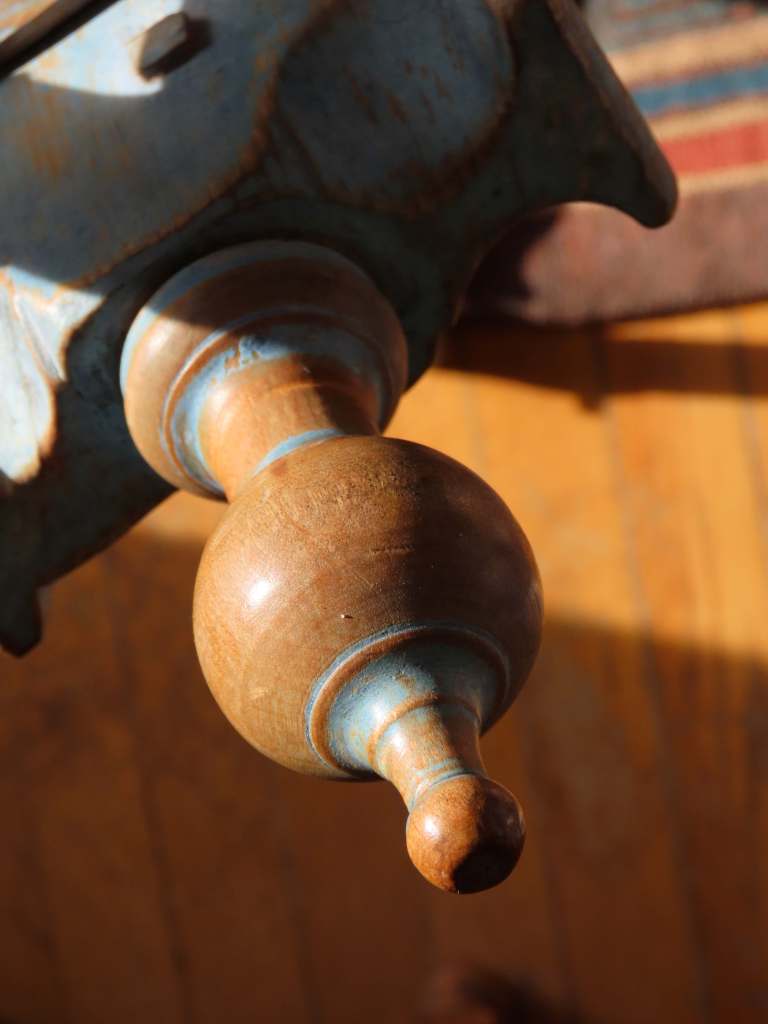
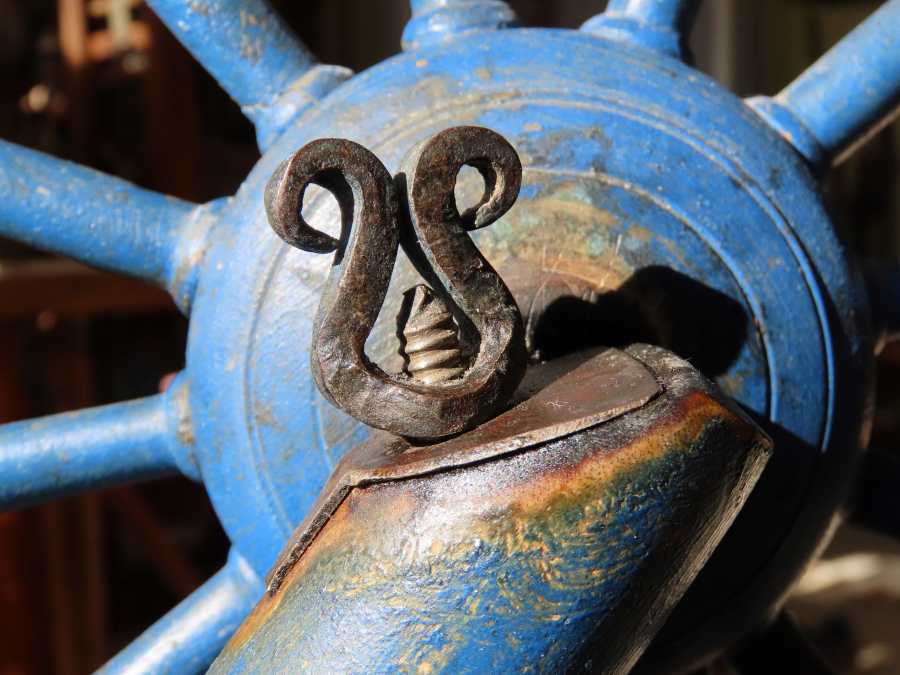
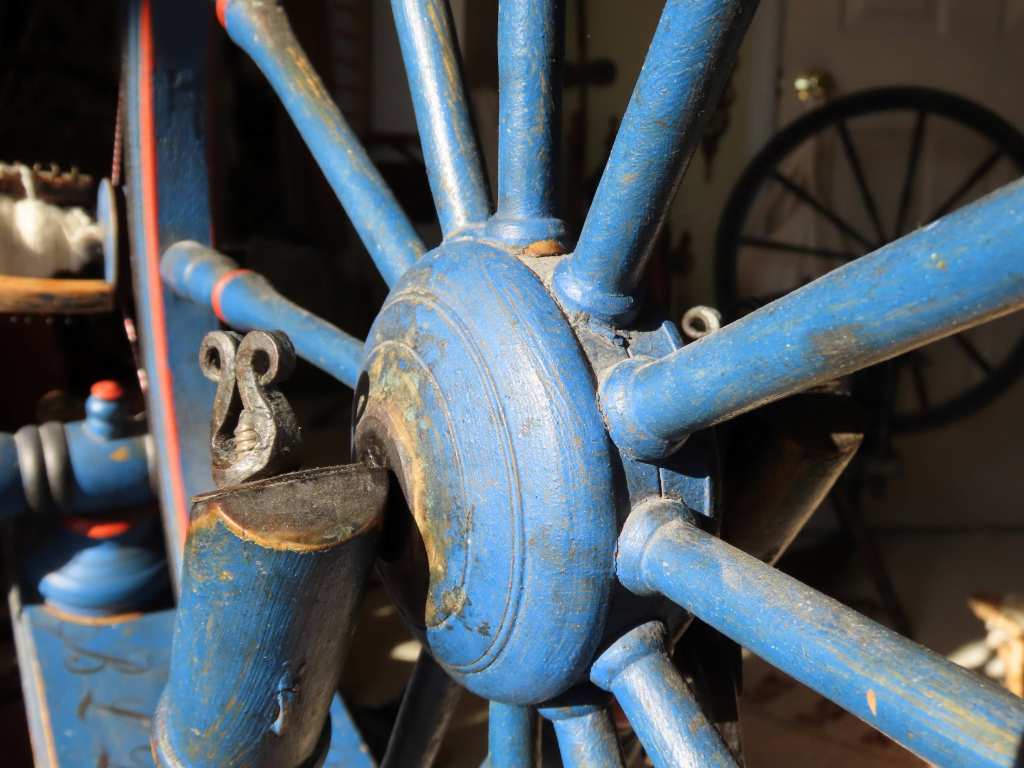
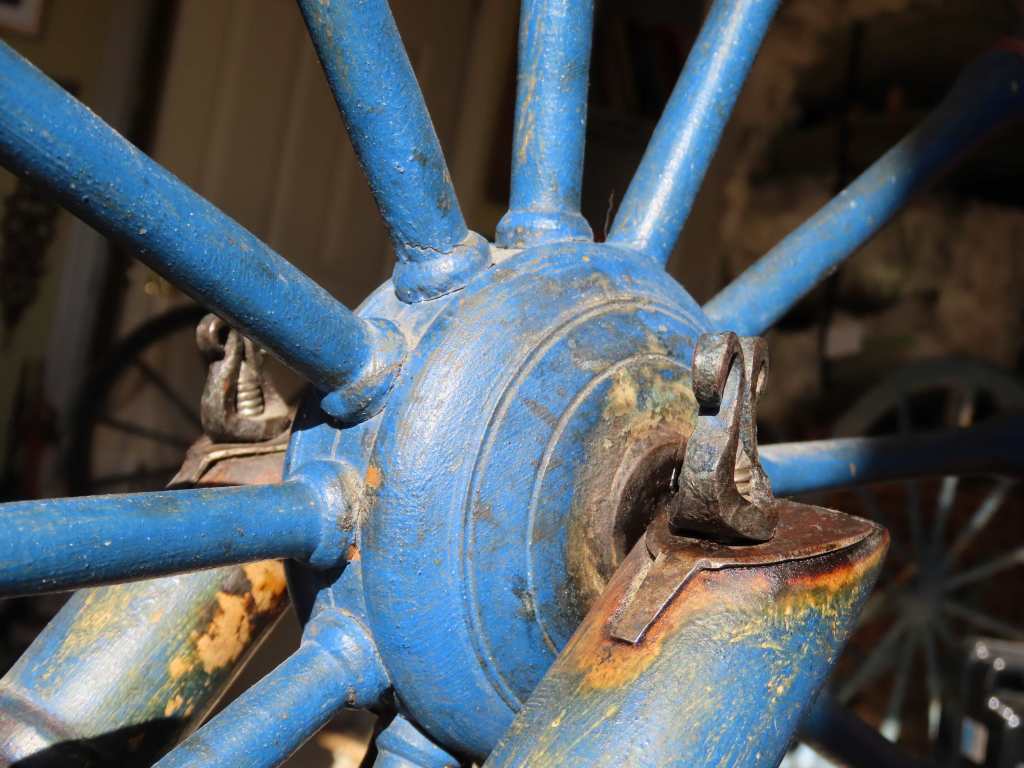
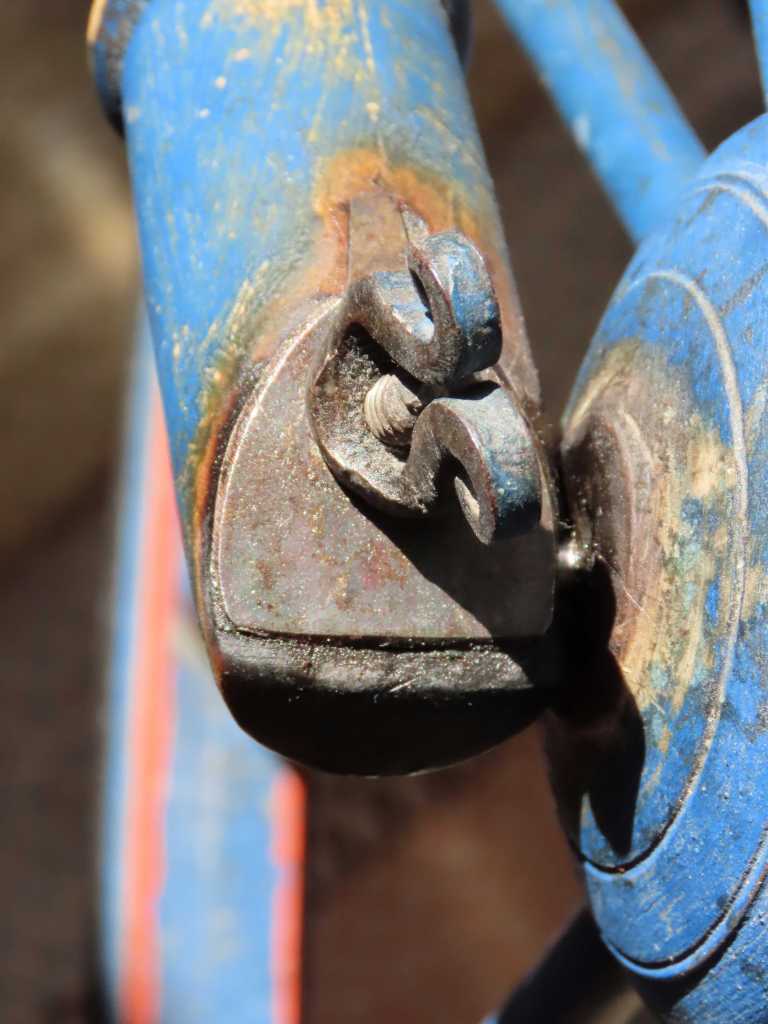
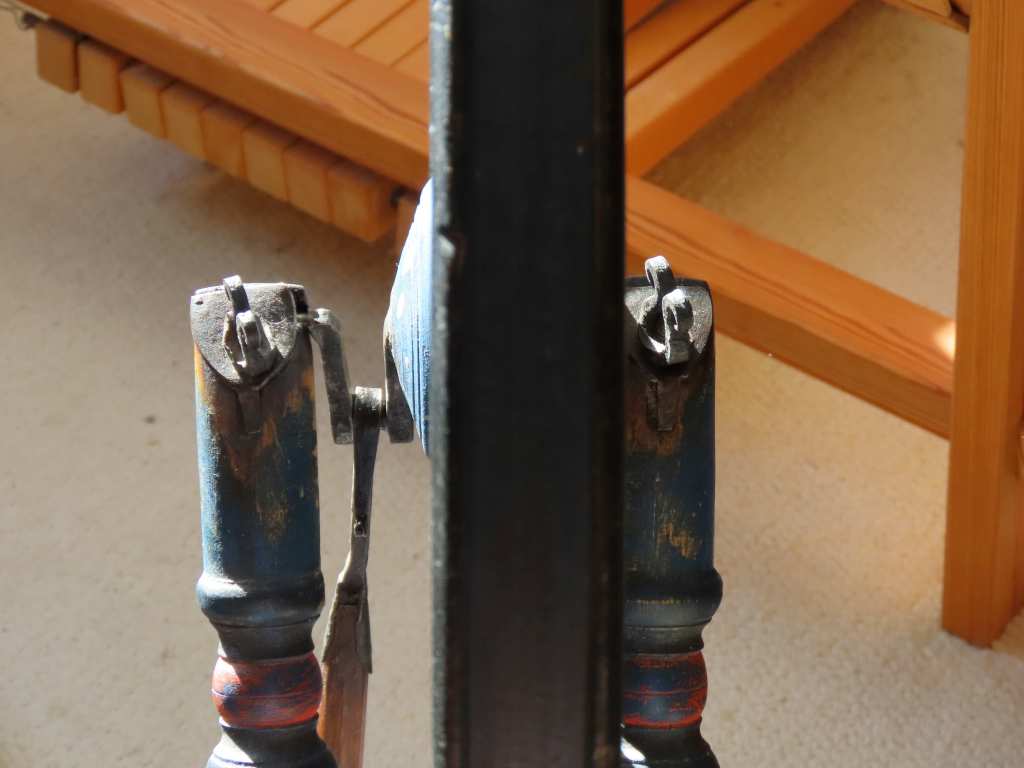
The lyre-shaped nuts were even more stunning in person than I expected. They sit like twin guardians on top of the metal plates securing the axle ends.
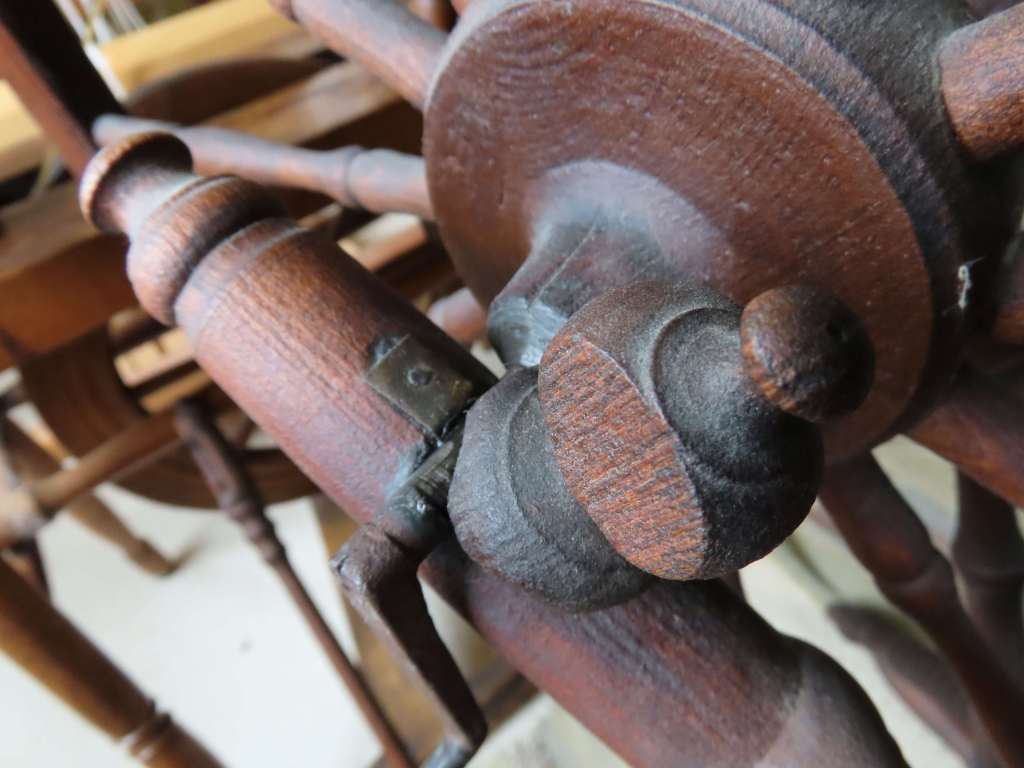
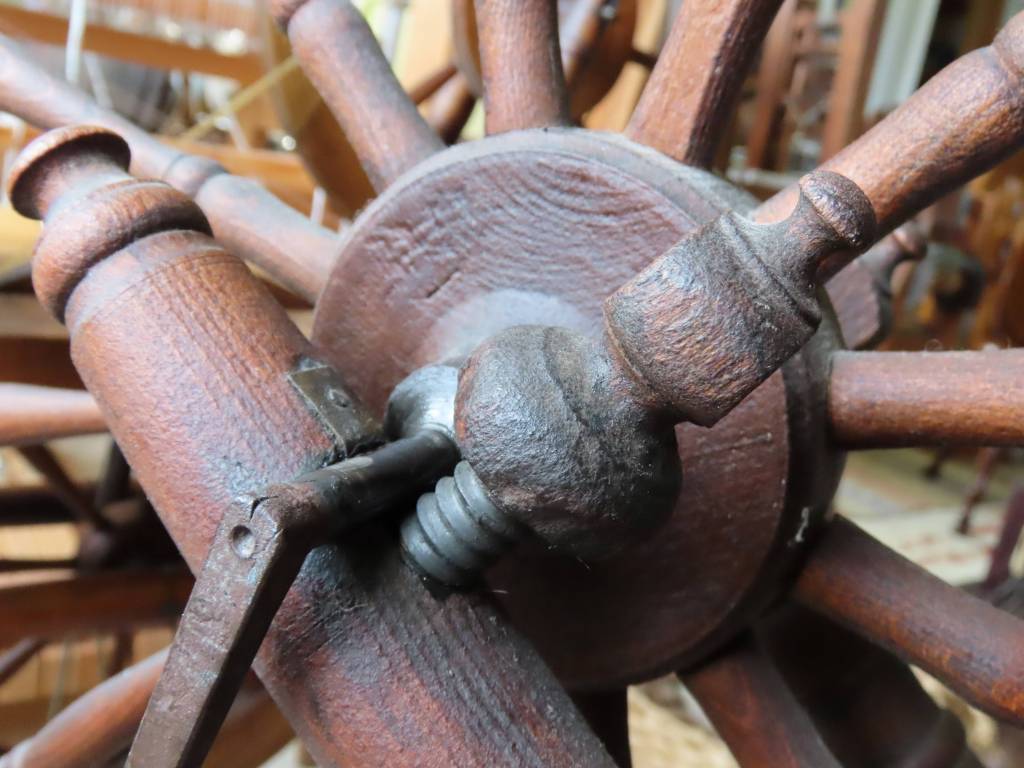
But, an even more unusual feature was the wheel’s internal crank.
It was what confused us in looking at the sale photos. While internal cranks are found on many double-table Norwegian wheels, they are very rare on saxony-style wheels. Samuel Morison, in Vermont, used them on some of his saxony-style wheels, but aside from his wheels, they are scarce. So I was thrilled to find this beautiful example.
The inside part of the crank is actually embedded into the wheel hub. I would love to know why some wheel makers experimented with internal cranks. Is there any advantage to them? One disadvantage is that a traditional style footman is not ideal because it cannot easily be popped on and off the axle.
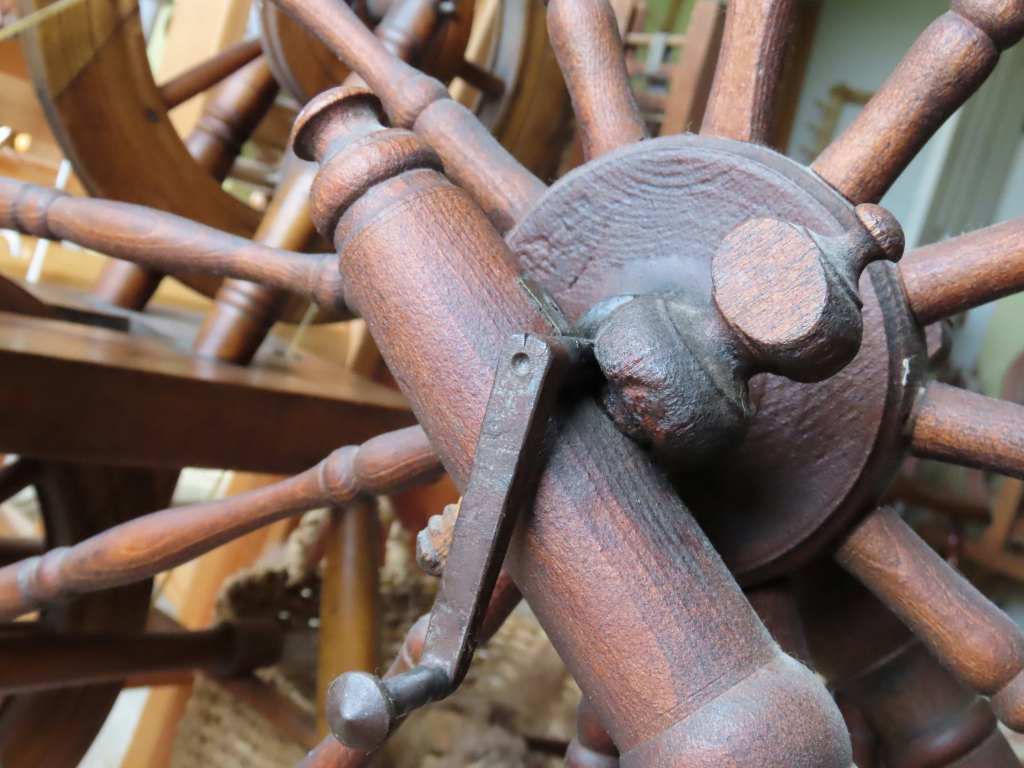
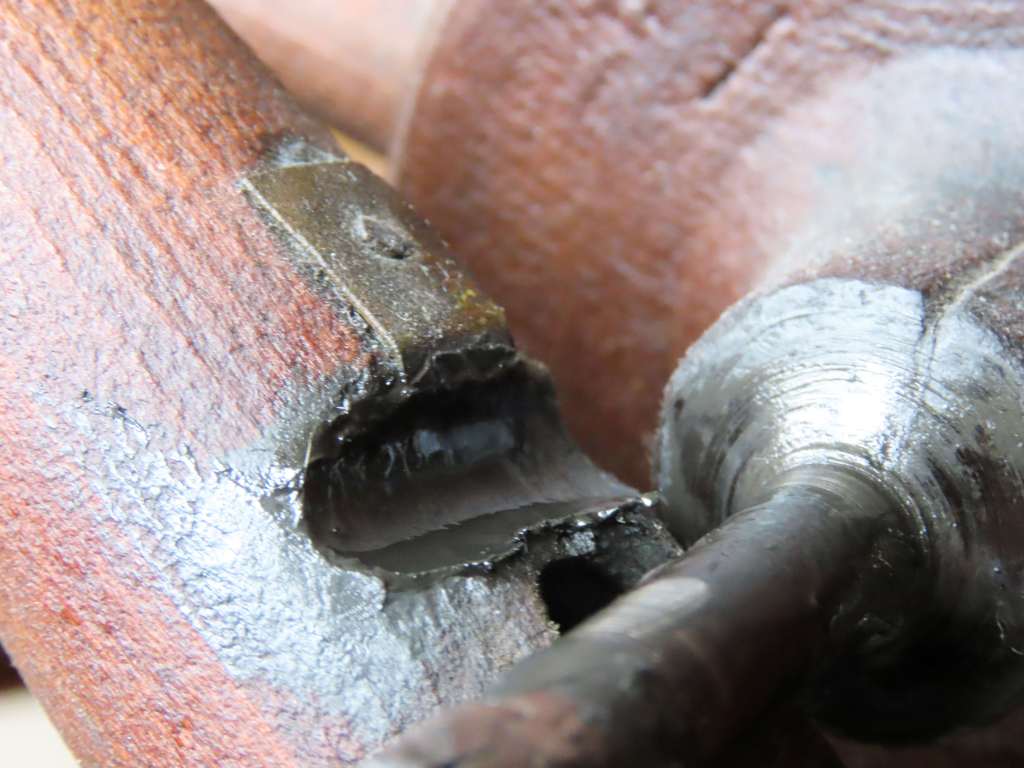
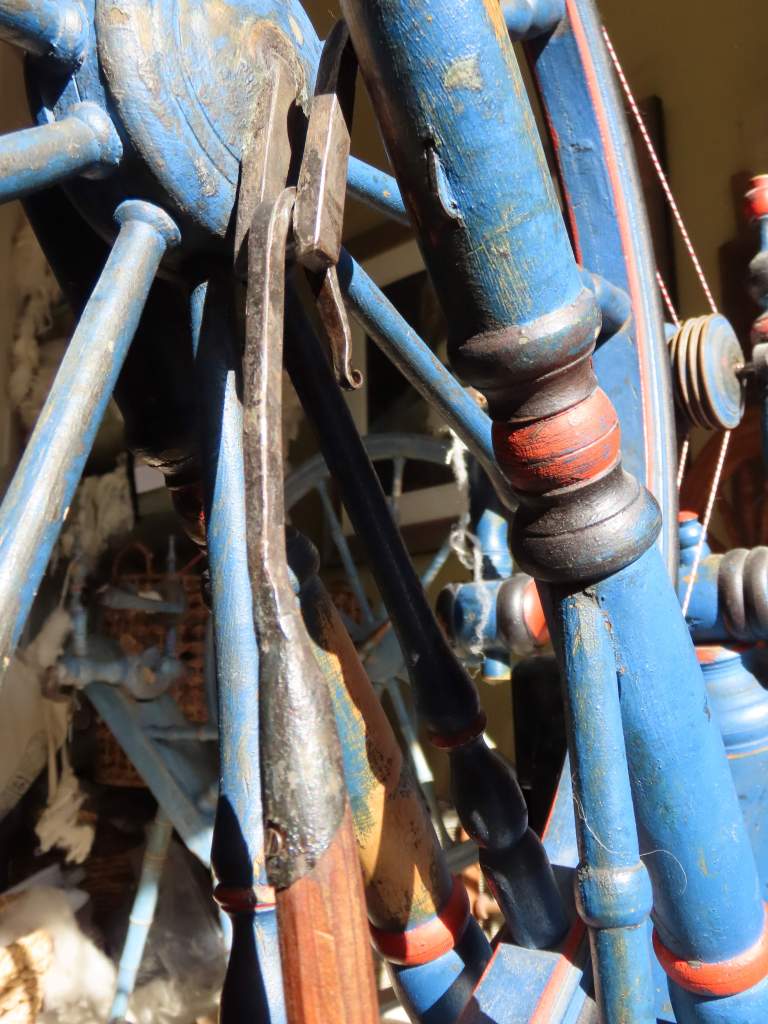
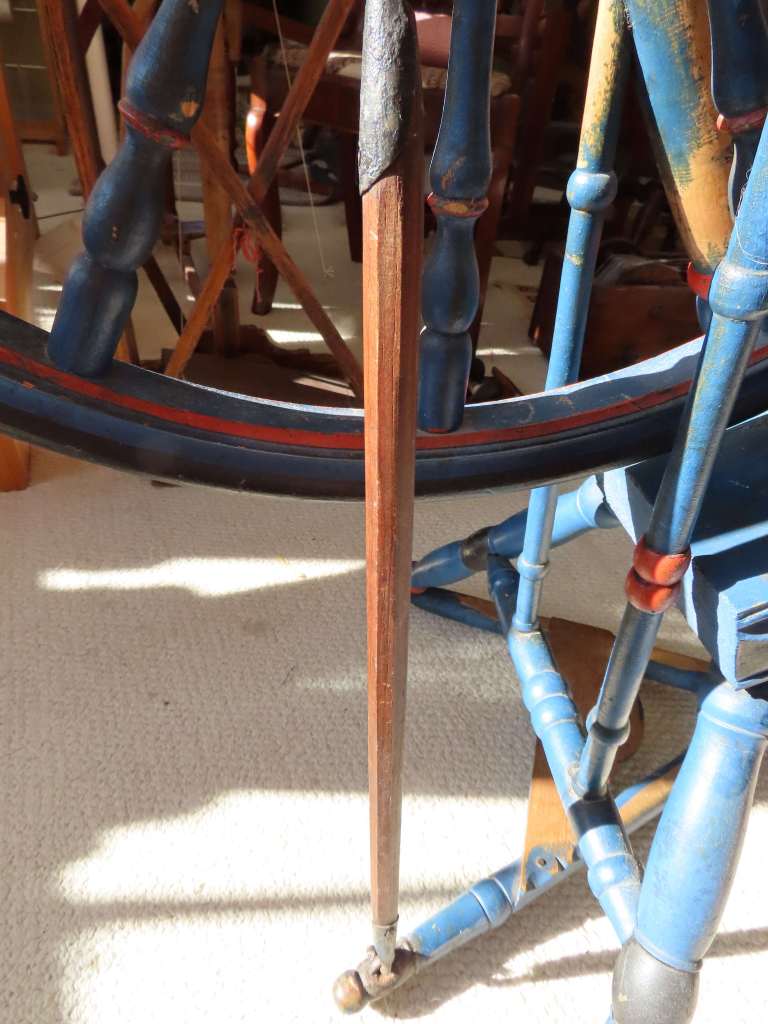
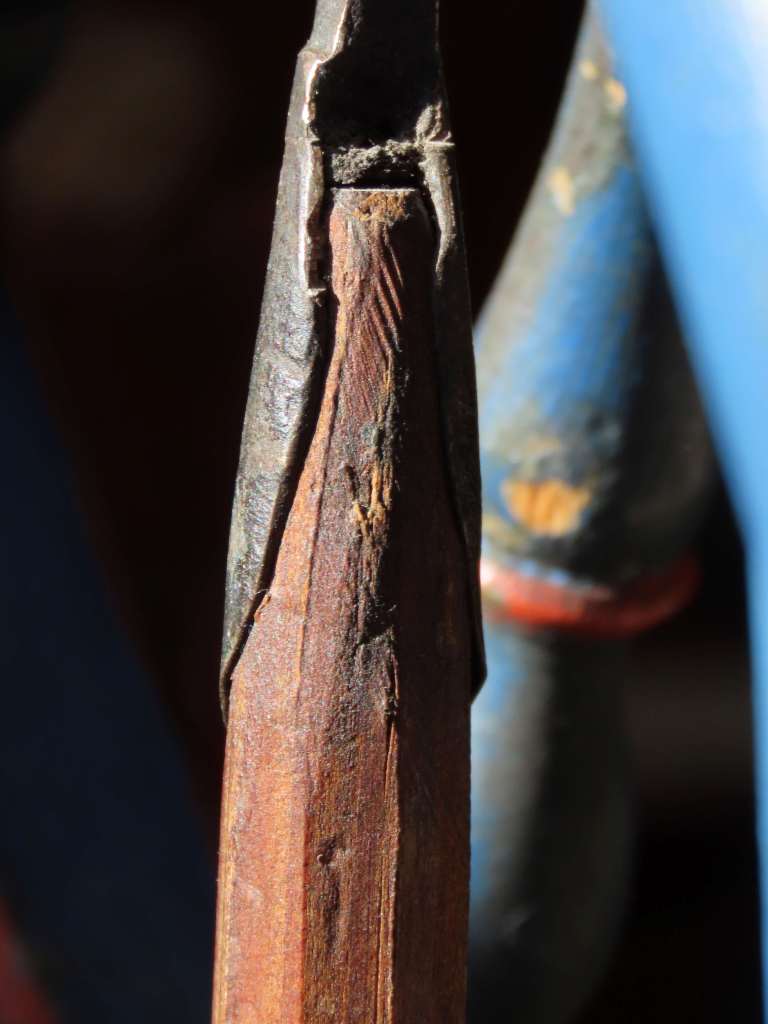
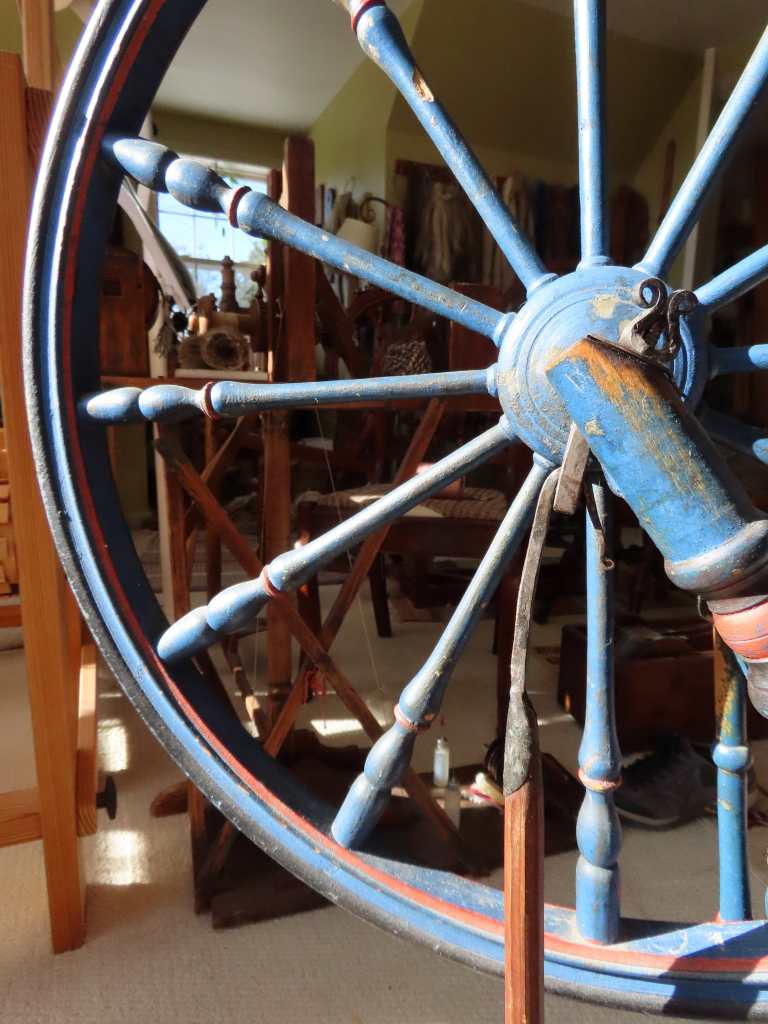
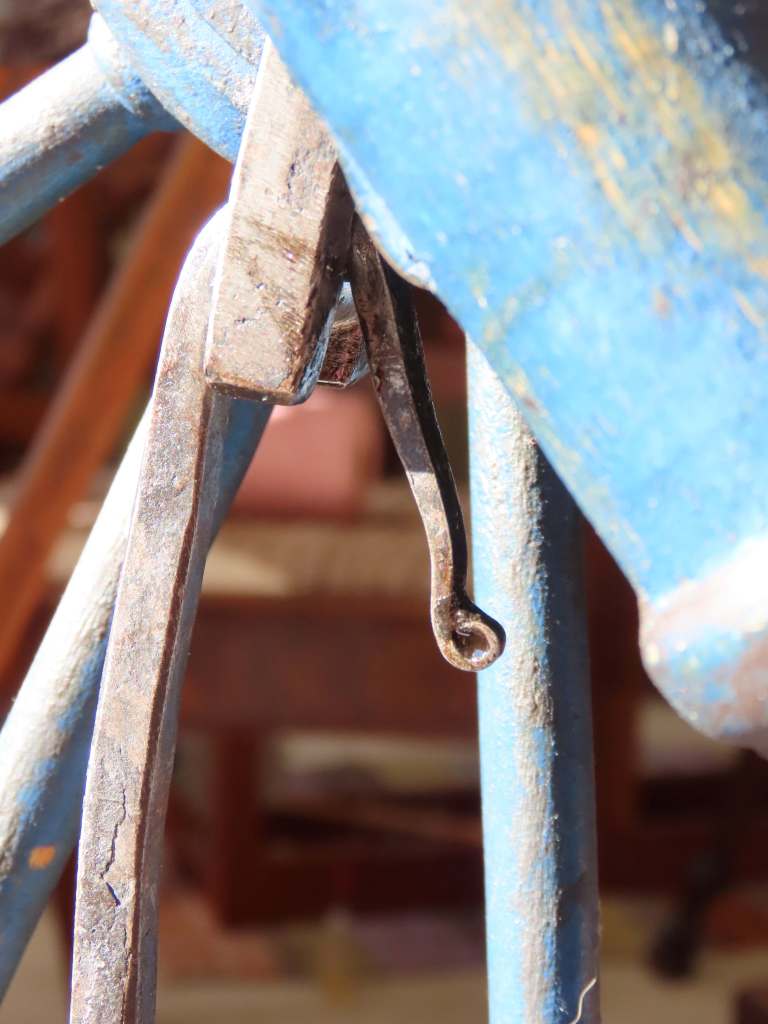
Hjordis’s maker solved that problem by crafting a special footman. A multi-sided wooden shaft is topped with what looks like a metal hood, partially surrounding the wood.
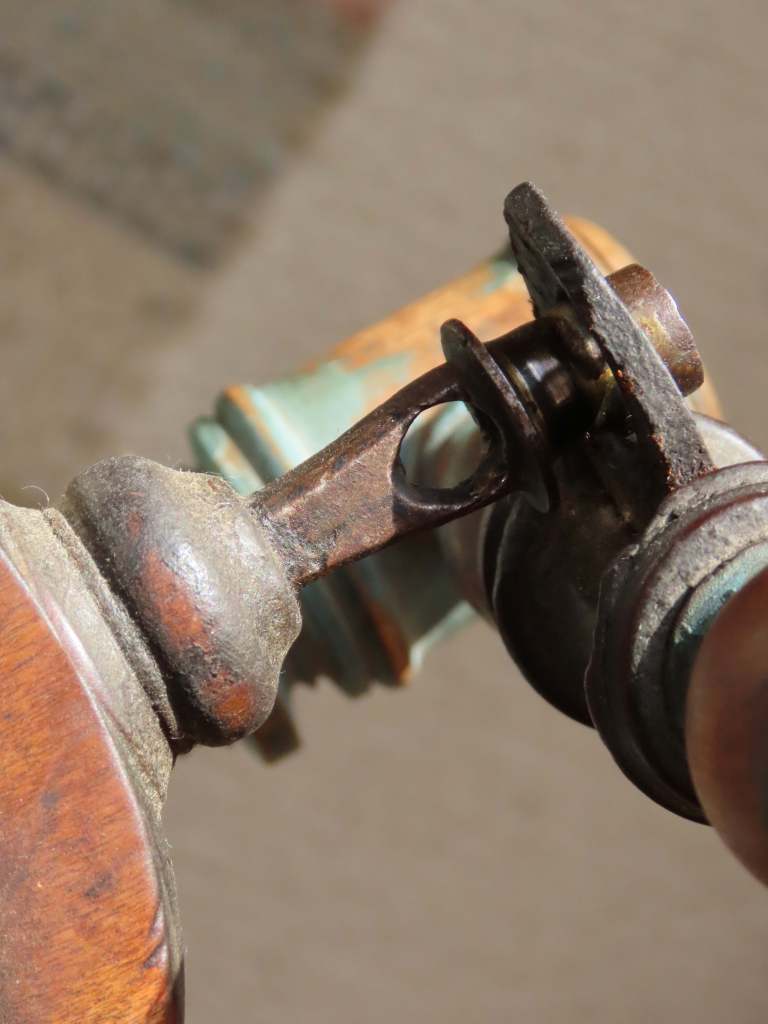
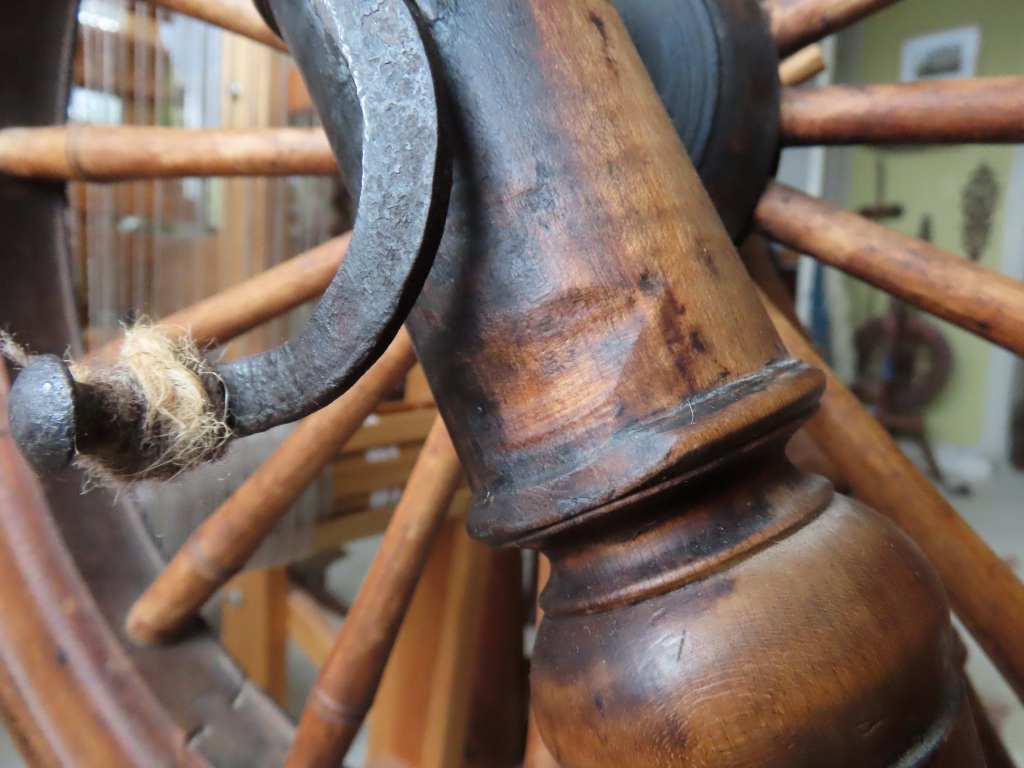
The hood is topped by a long metal piece that hooks over the internal crank and ends in a lovely curl.
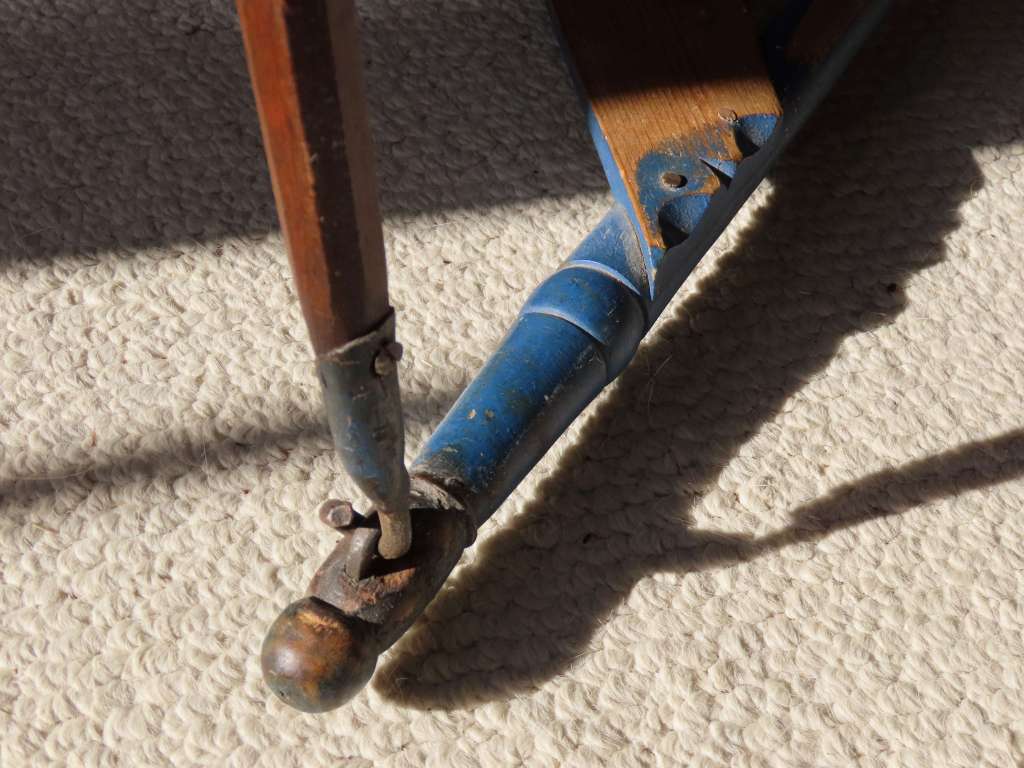
The bottom end of the footman also is encased in metal with a small metal hook attaching it to a metal piece on the treadle bar.
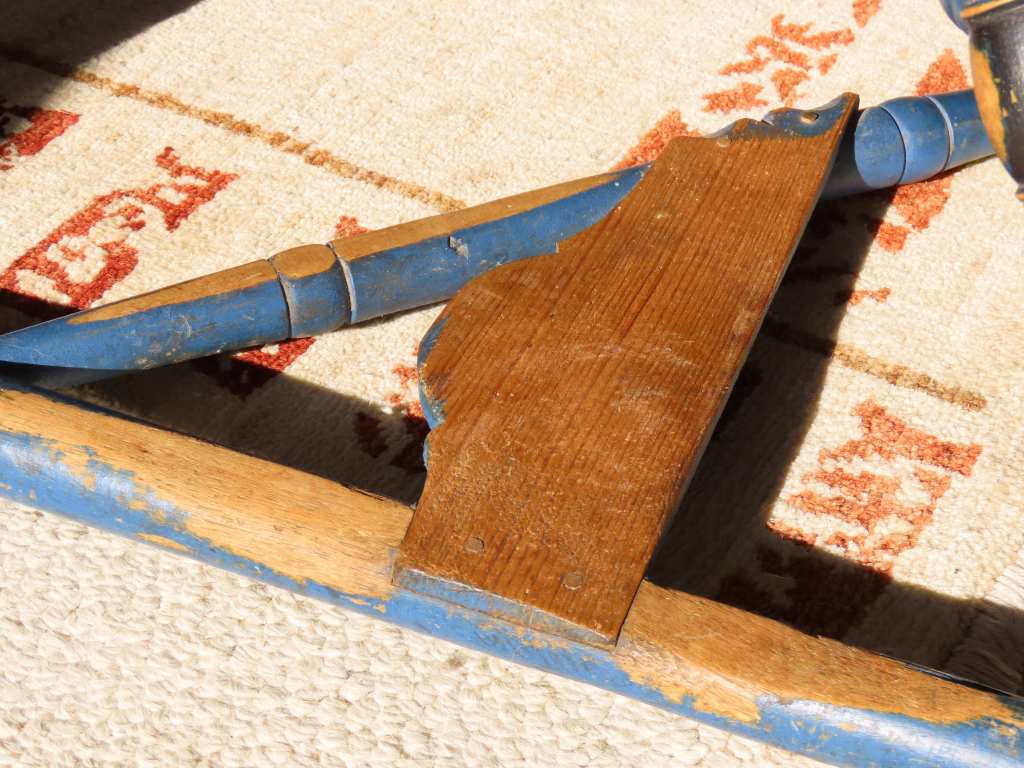
So much beautiful work went into this footman. Likewise, the treadle is no plain wood piece, but shaped with a decorative flourish at the end.
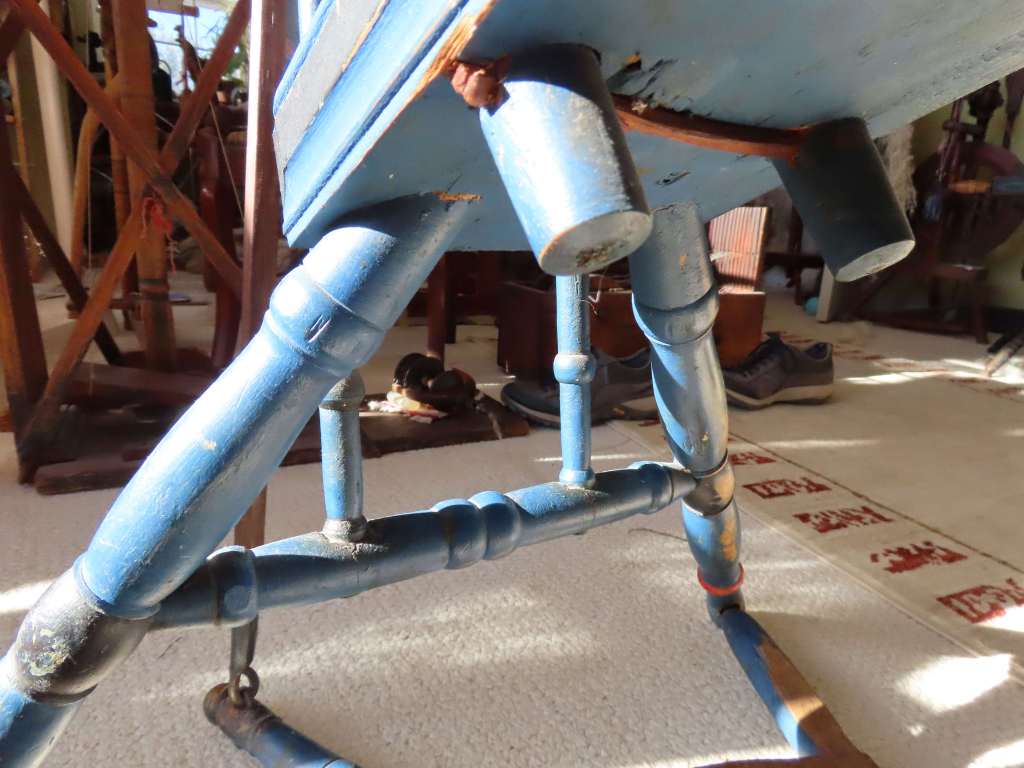
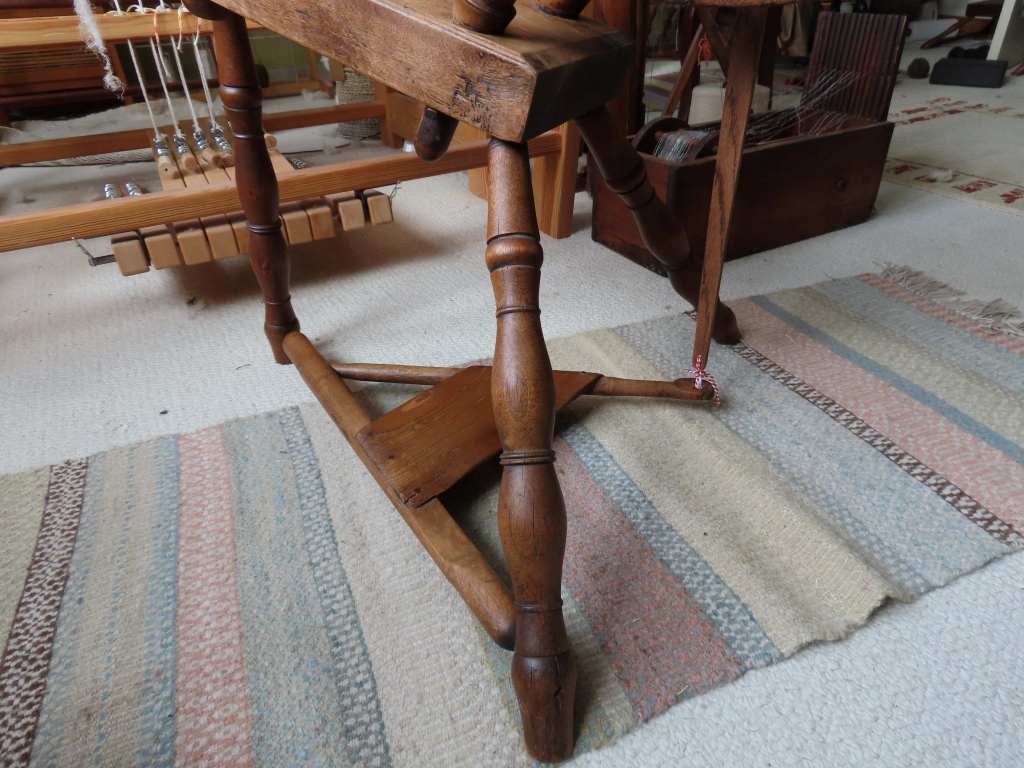
The wheel end has a cross-bar between the wheel-end legs with supports extending to the wheel uprights.
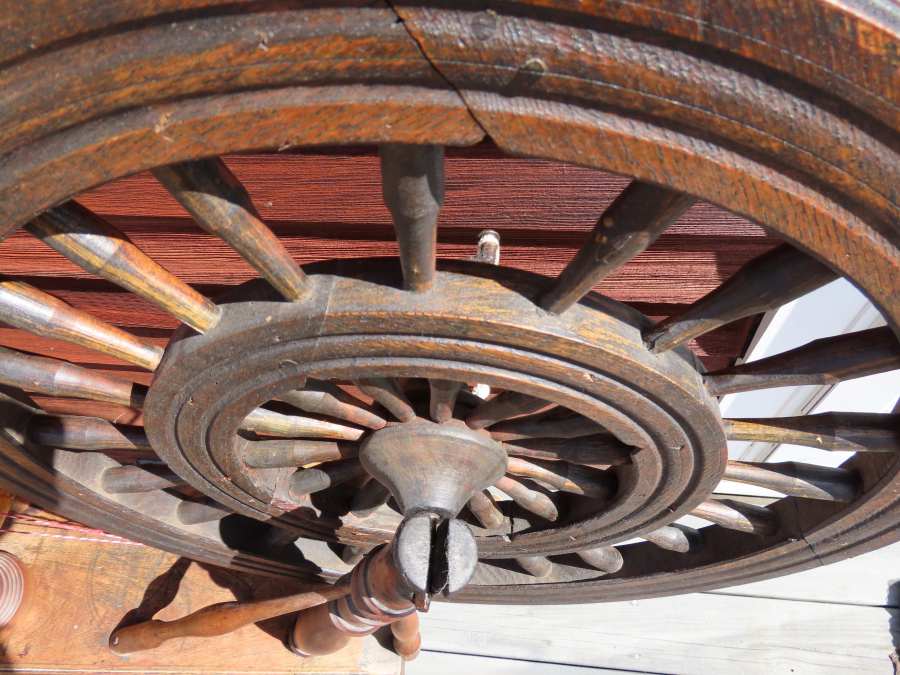
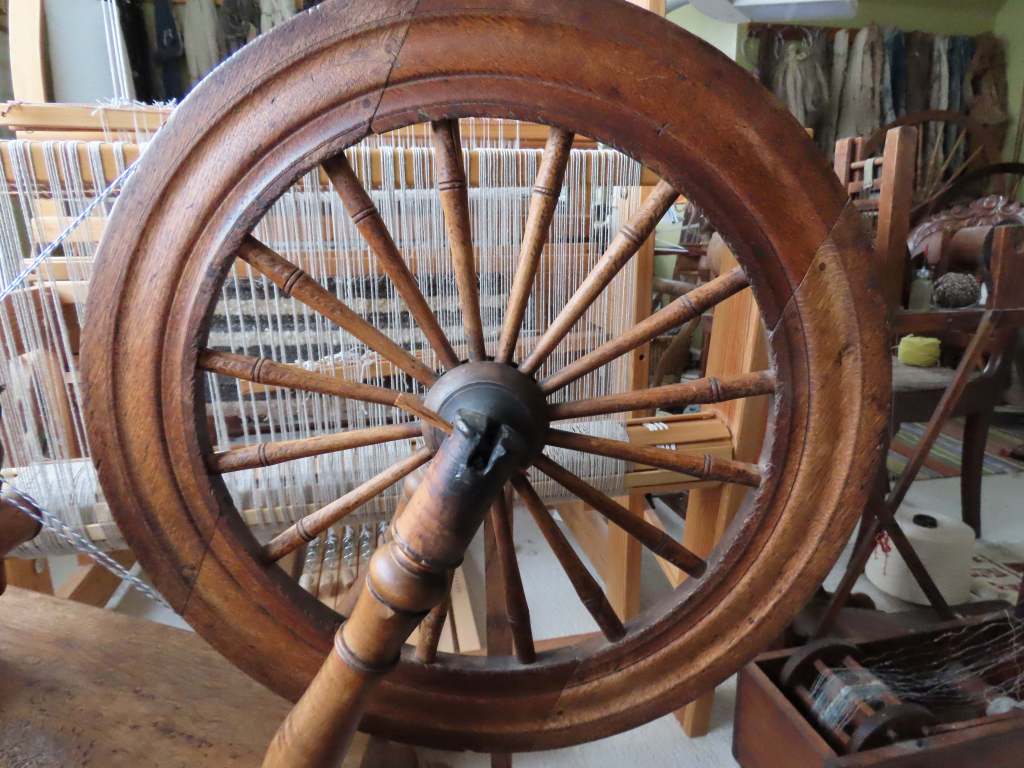
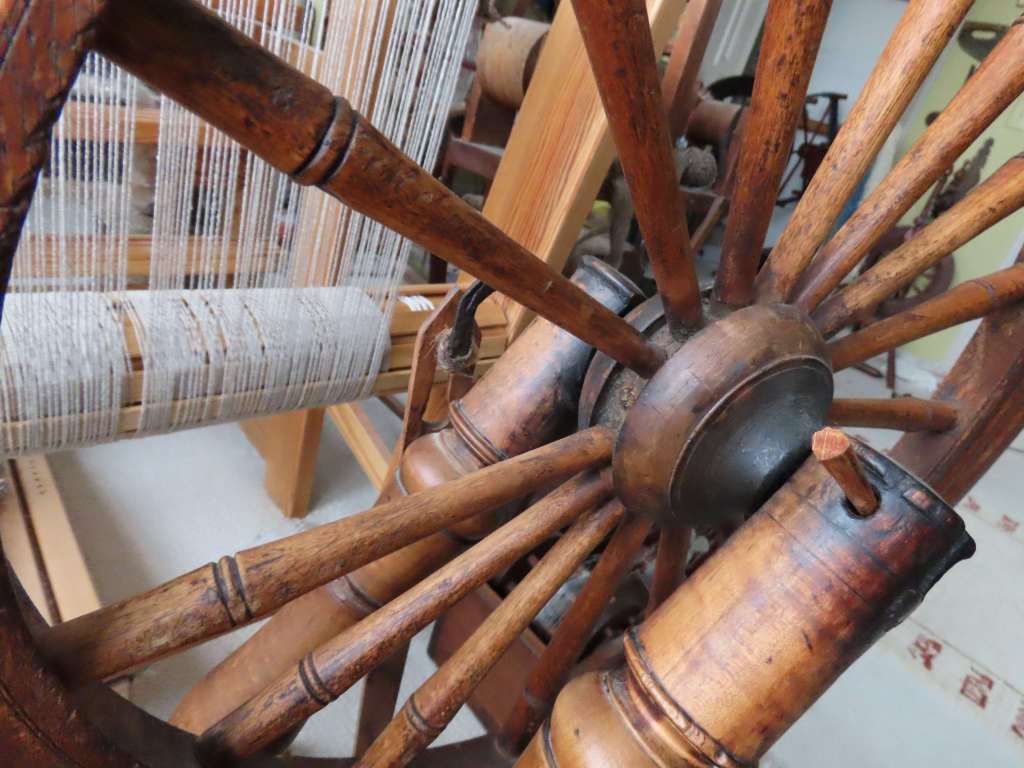
The drive wheel has 12 spokes,
set on the flat inner rim
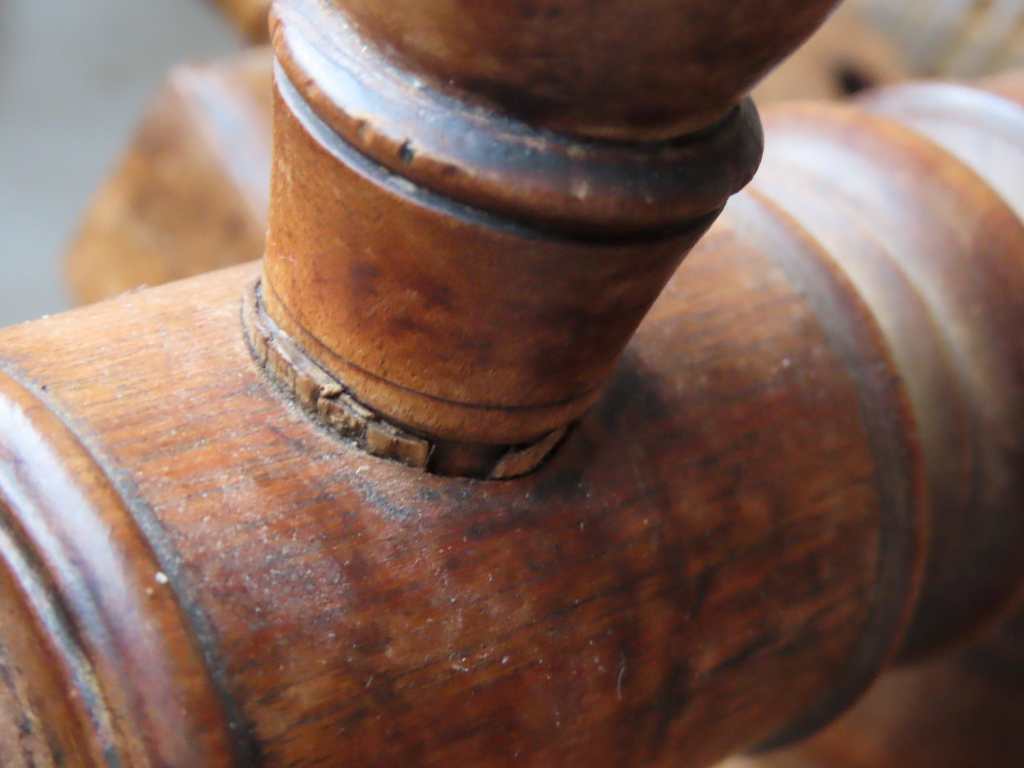
with a nail or peg securing them at an angle through the side of the rim.
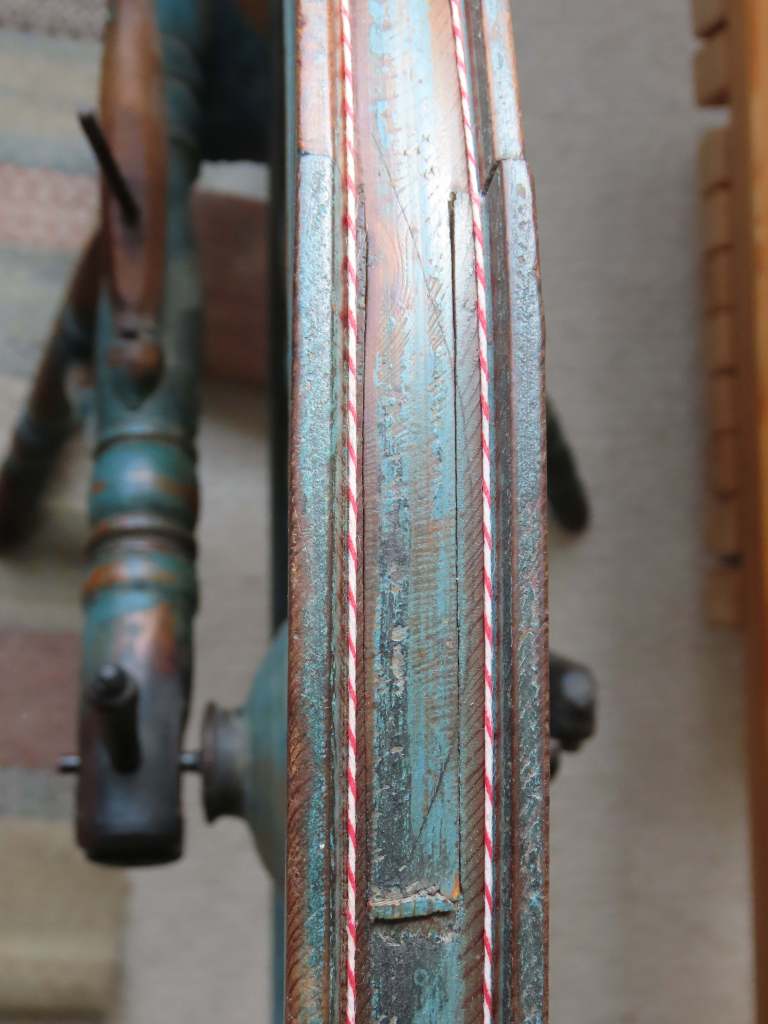
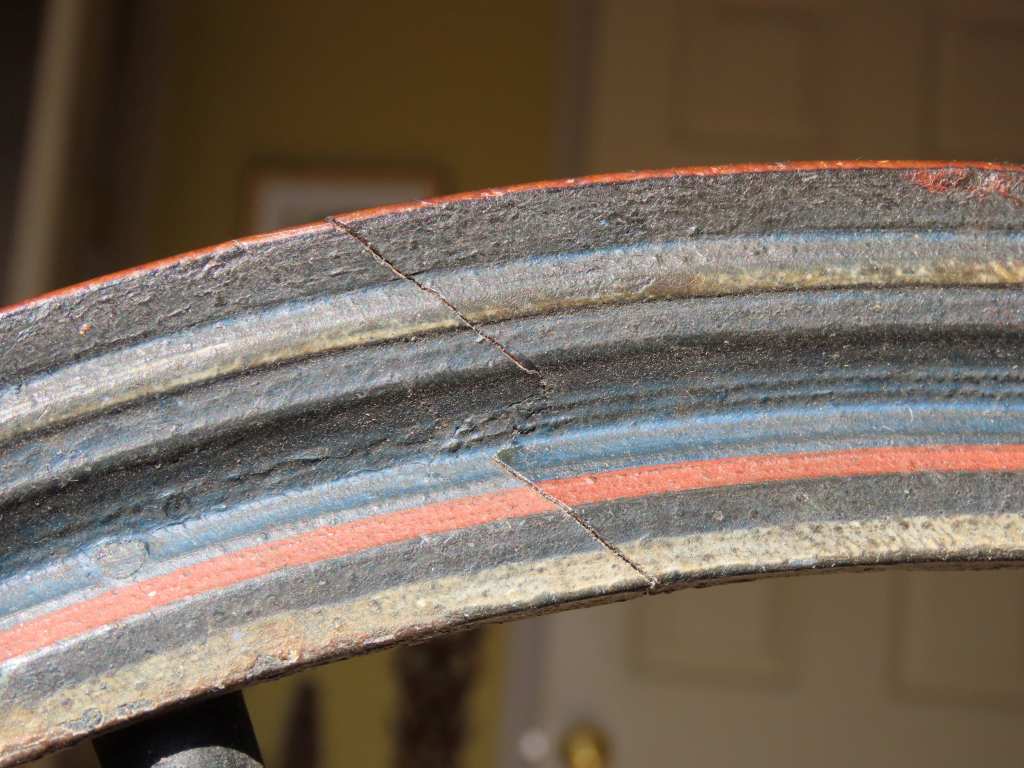
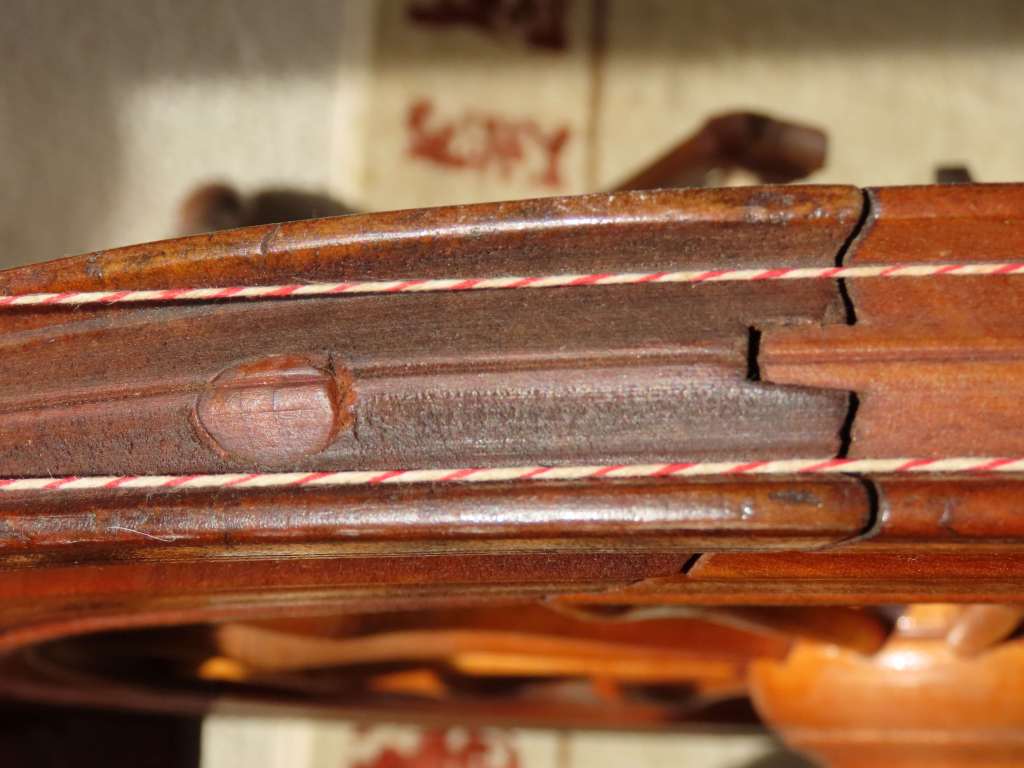
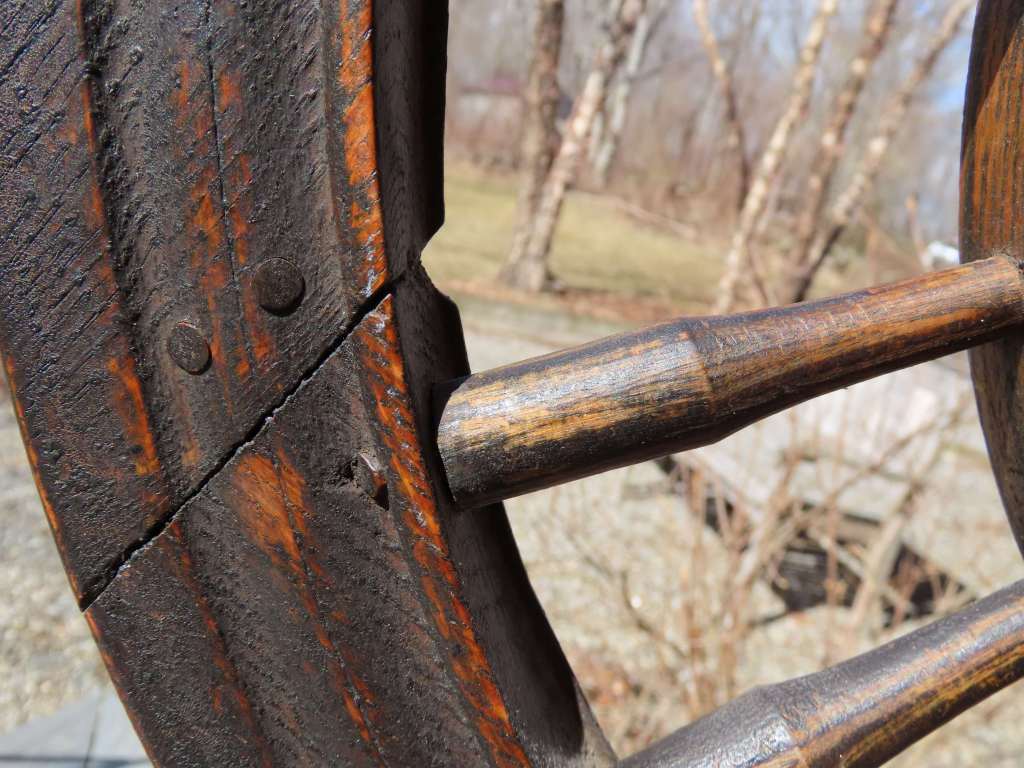
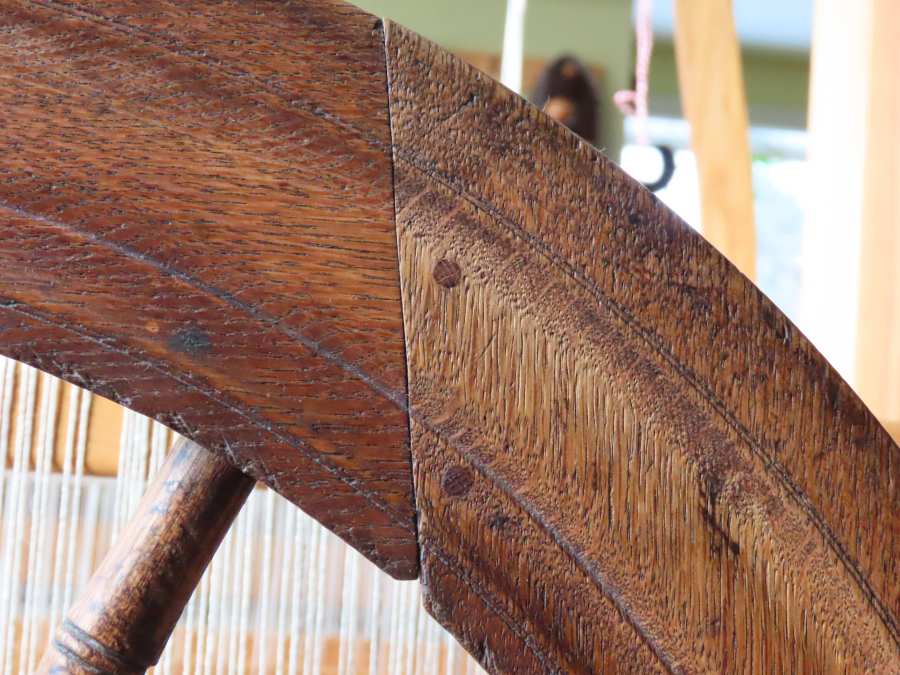
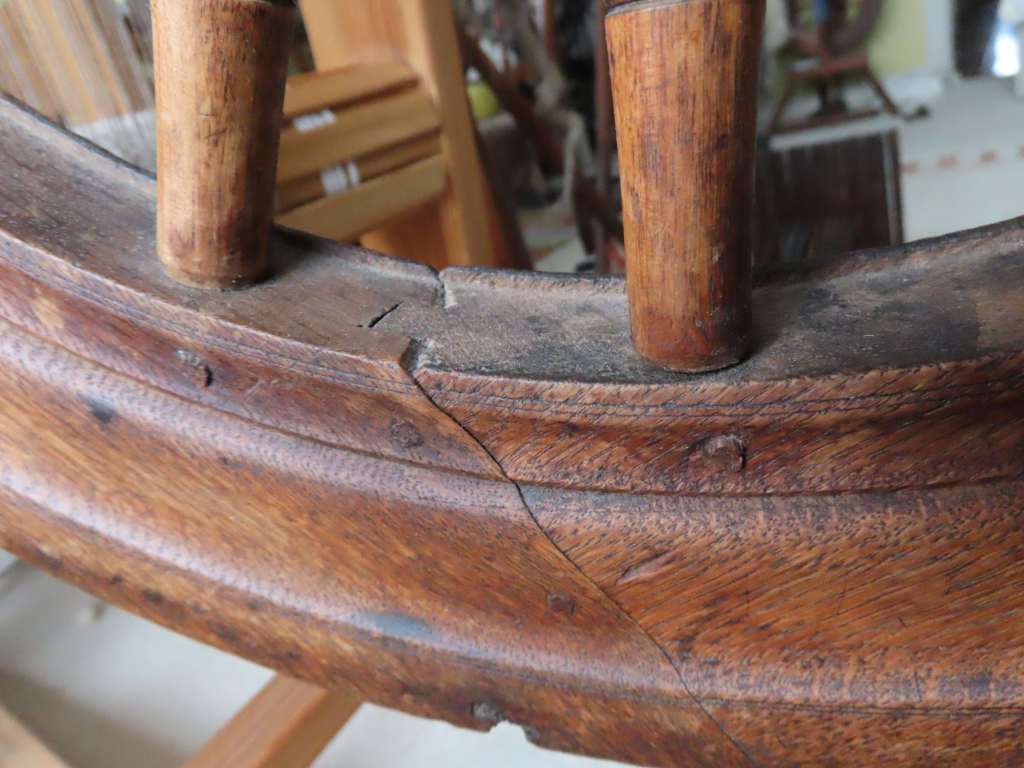
The rim itself is four sections. The sections are fitted together with tongues (long on the top, shorter inside) going in opposite directions on two sections, fitting into grooves on the other two sections.
Hjordis has seen a lot of use but her flyer assembly is still going strong.
Her bobbin is cracked and there is a deep groove in the flyer front near the orifice.
Her whorl screws on righty-tighty, lefty-loosey, the opposite of most North American wheels, but found on many Norwegian wheels.
Her back leather bearing is a little droopy, but works well. The previous owner put an elastic band on it.
The orifice is quite smooth and the front bearing secured with some old yarn or twine.
Her paint colors are vivid,
but, in some areas, applied a little sloppily,
which is interesting, since the underside of the table is painted, something many makers do not bother with.
There is a crack in the table that I need to repair and a distaff hole on the spinner side.
The table bears a date and initials in elegant script.
Aside from the date, I have not been able to find out much about the wheel’s origins. I believe that she is Norwegian for a few reasons. The internal crank and righty-tighty whorl point in that direction and there have been a few other wheels that have come up for sale with sellers indicating they are Norwegian. These wheels do not have an internal crank, but do have the unusual lyre-shaped nuts and metal upright-tops.
For sale in IowaFor sale in Minnesota, no internal crank but the treadle is very similar to Hjordis’s
Although these wheels likely were made by the same maker, only Hjordis has the internal crank and creative footman, which kicks her up a notch. I am very grateful that she was not passed by in the hunt.
Norwegian wheels come in all shapes, sizes, and colors. This one is a “double-table” wheel, a style commonly found in Norway.
But it has several interesting features that make it stand out–its size, festive paint, handwritten note, and fixes.
Size-wise, it is petite compared to most double table wheels. It is more compact and lightweight, making it relatively easy to store and portable, attributes apparently prized in Norway, given the many different styles of slanty wheels made there.
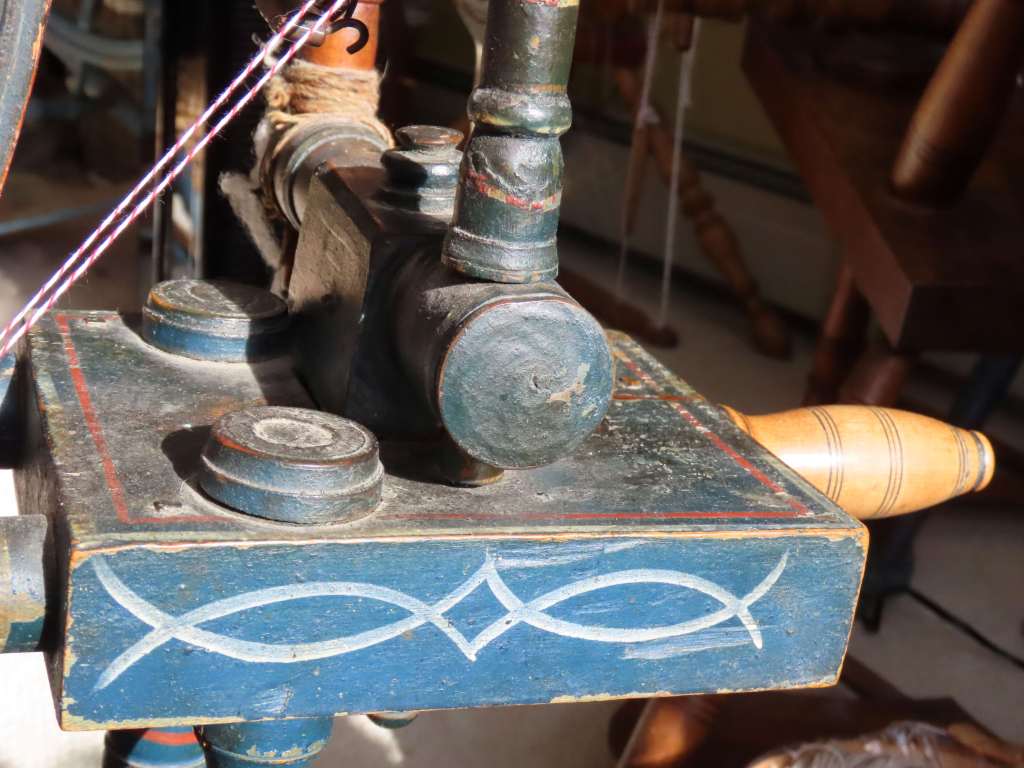
Painted a dark greenish-blue, almost every surface is decorated with red and white designs, which really pop in contrast with the deep background color.
Even the spokes have white stripes running their length–many hard to see through fading.
The hub has an odd wave–like surface.
The footman is ornate
and the treadle is nicely contoured to fit exactly next to the leg.
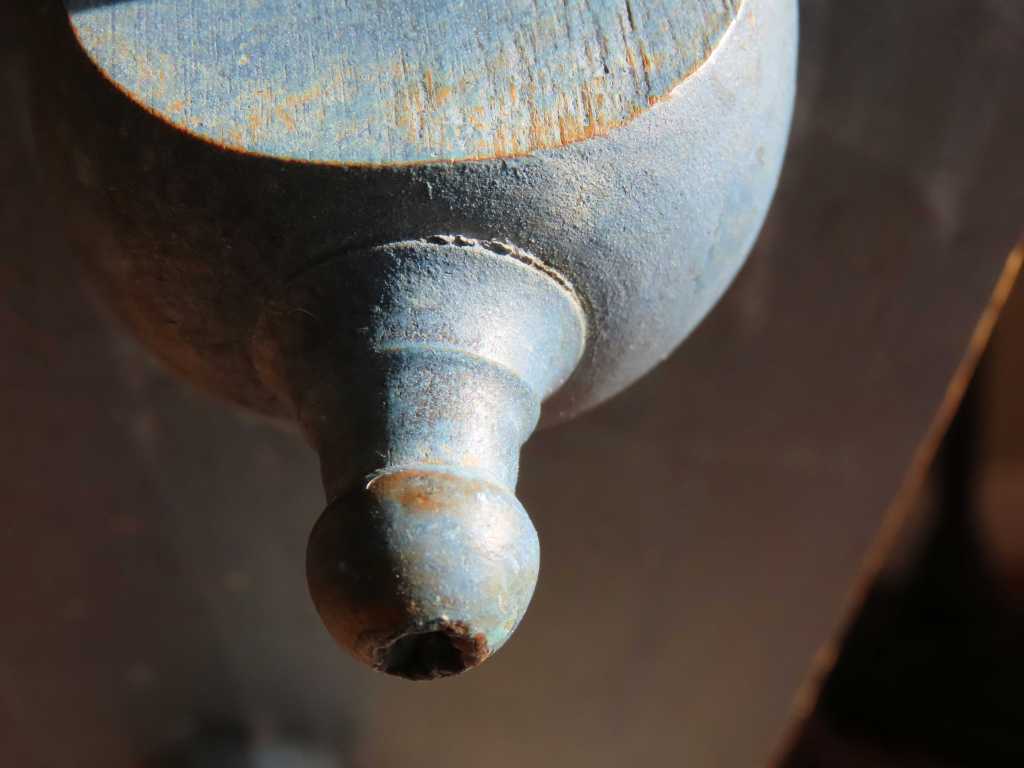
The tension knob was either unpainted or the paint has worn off.
Maybe a touch of old paint left on the end
The treadle is worn
and the paint is mostly worn of of the front maiden.
The back maiden has a recess for the whorl, either through wear or made intentionally.
The underside of the table is painted.
As is the under-table nut tightening the MOA.
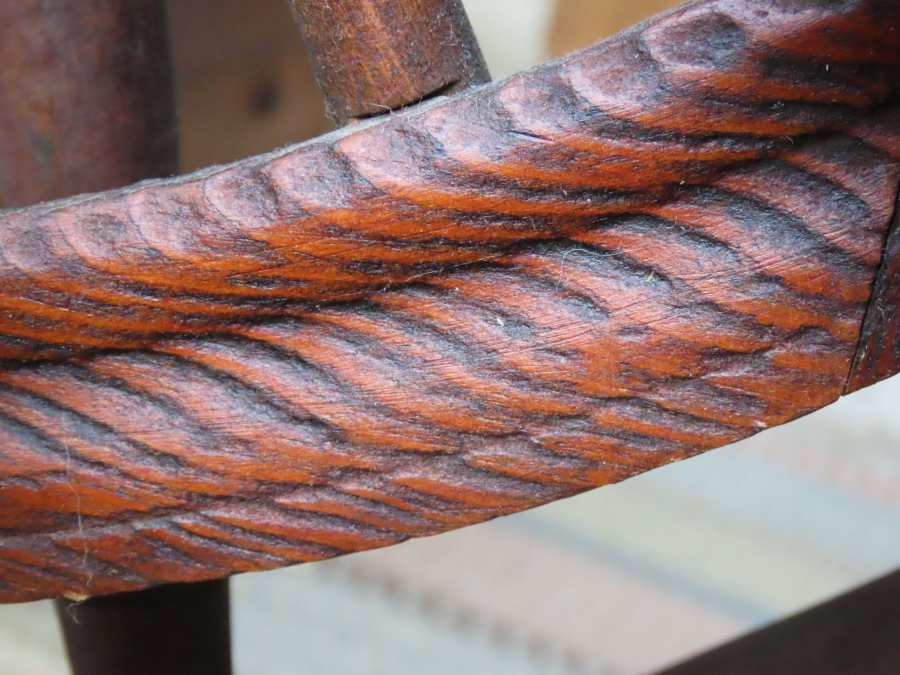
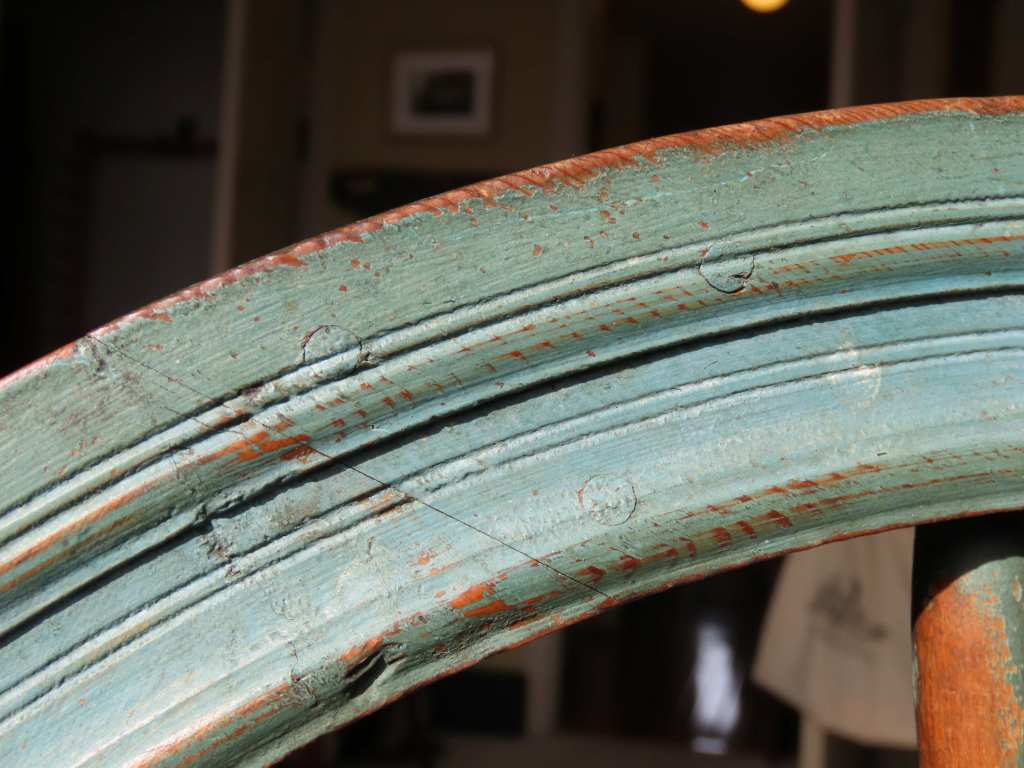
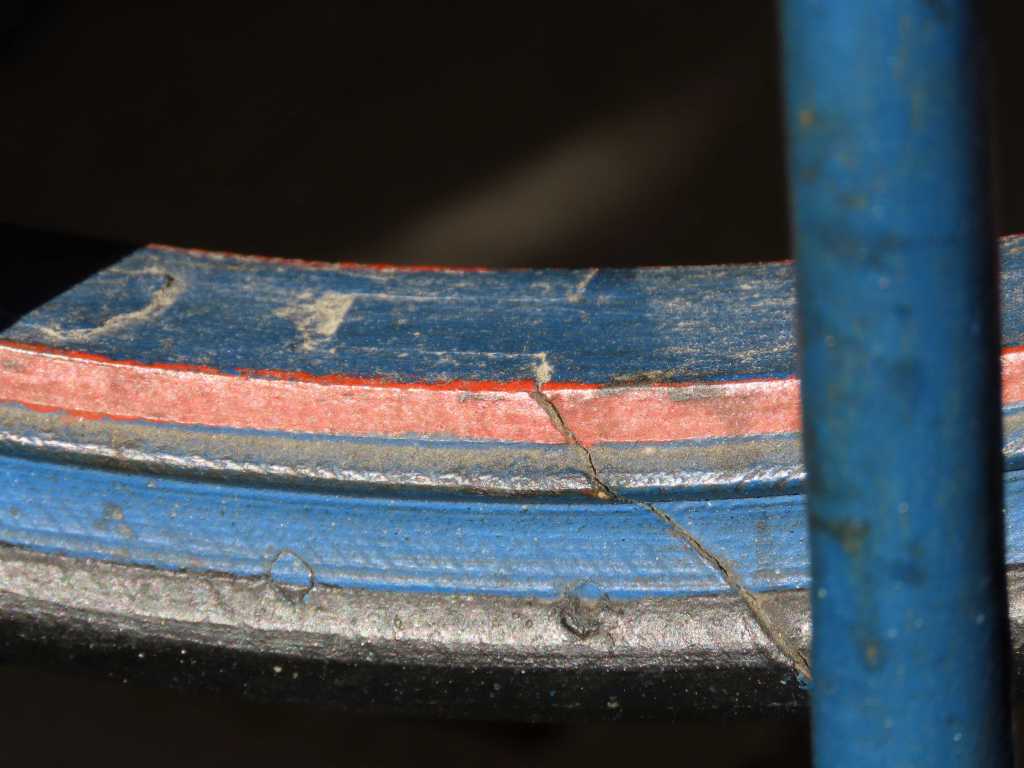
The rim of the drive wheel looks like beautiful snakeskin.
A piece had been broken off the rim and repainted with a blue paint that does not match the original.
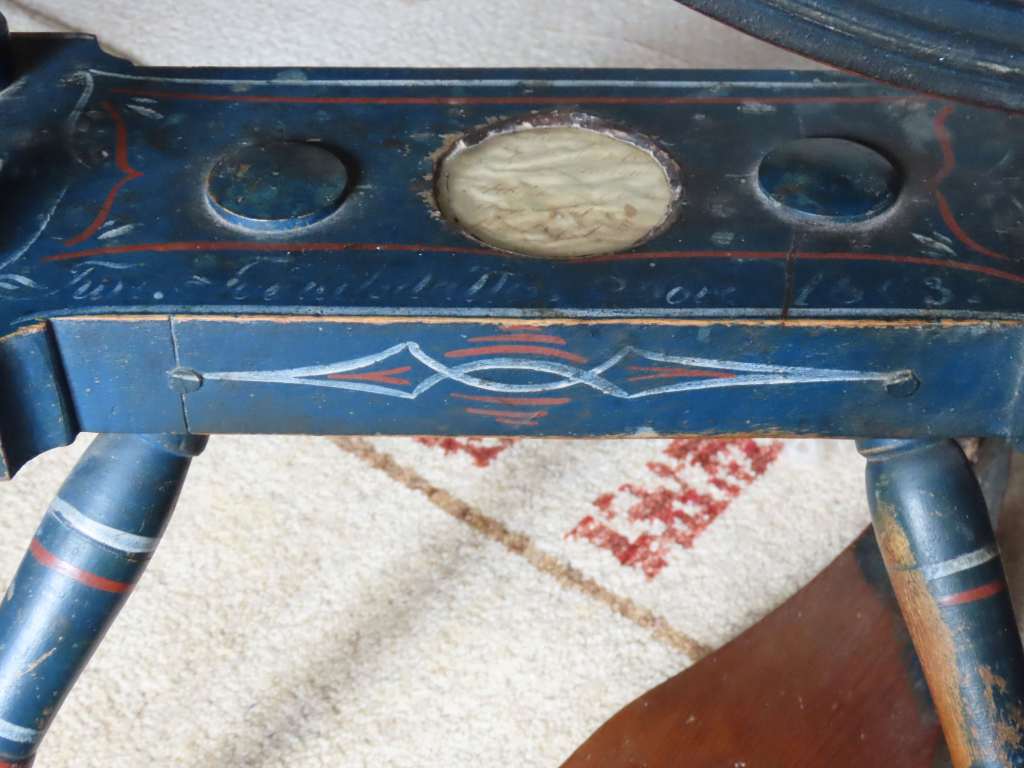
The name of the owner is painted on the top, “Turi Torkelsdatter,”
along with a place name, “Nore,” and date “1863.”
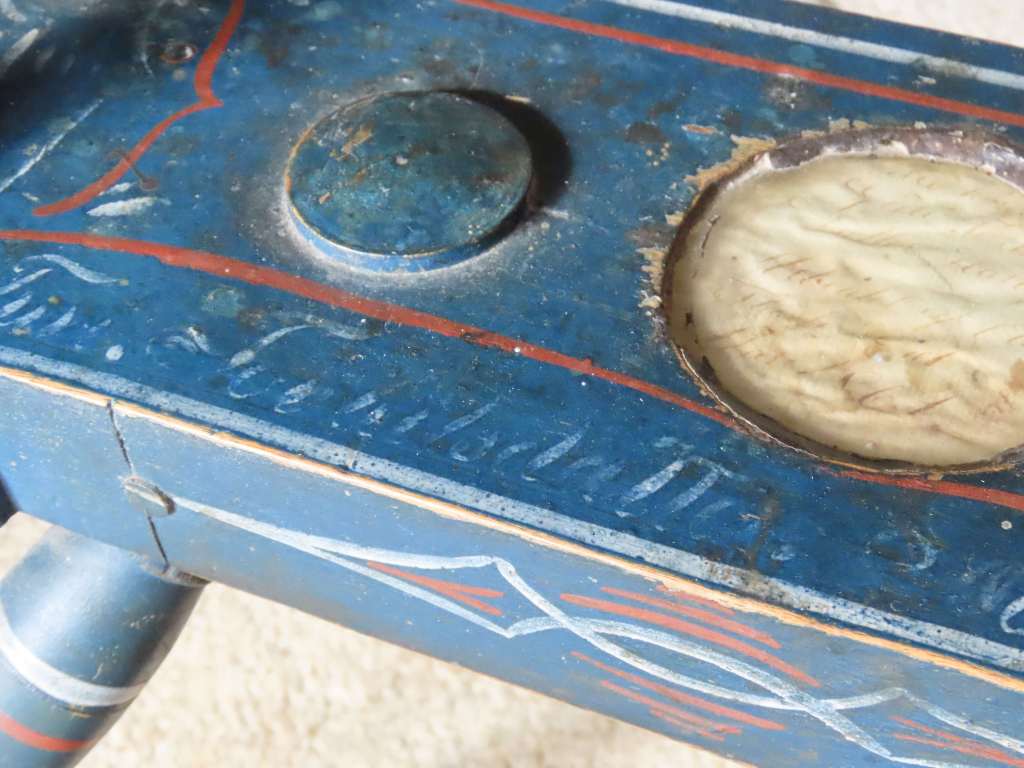
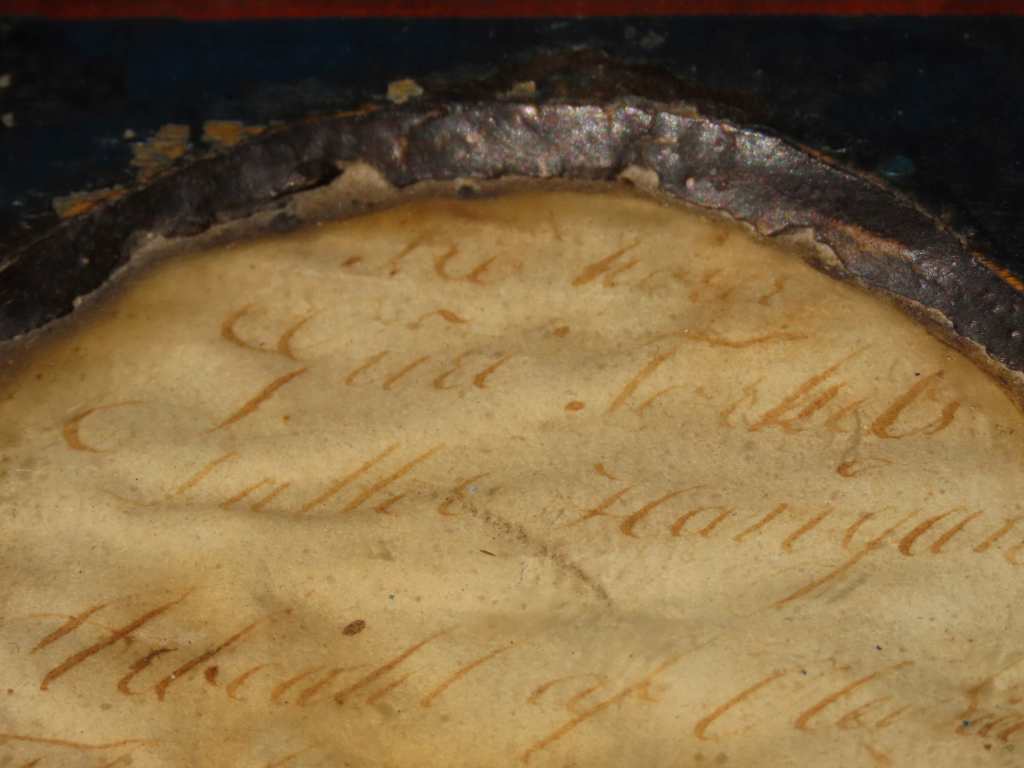
But what sets the wheel apart is a small piece of paper covered with glass sitting in the middle of the table.
The paper is wrinkled now and the handwriting faded.
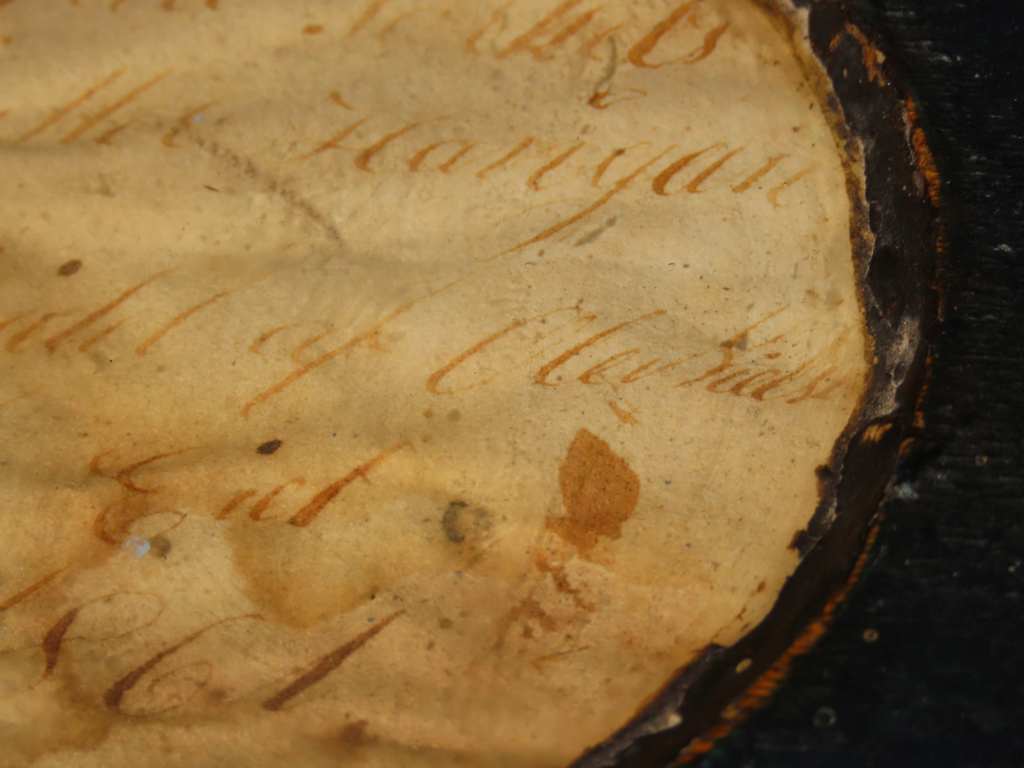
But what a treasure. A note came with the wheel from a previous owner saying that the rough translation of the script is: “For: Turi Torkelsdatter Year: 1863 Place: Nore Valley Norway Made by: Olev Seilsen in 1861.” I cannot read Norwegian and much of the writing is hard to make out. It is pretty easy to make out the “Turi Torkelsdatter,” although there is a word after it that looks like it could be “Harigan” or “Haugan.”
Also, the name of the maker is here. I believe that the name is actually “Ole Neilsen,” because what looks like it could be a “v” at the end on “Ole” is really just a swirl on a capital “N.”
The maker’s name is in the center right
In researching online, I did find several Ole Neilsens who lived in the Nore Valley through the years, although nothing indicating that any of them might have made wheels.
I also found several Turi Torkelsdatters in genealogy sites, but I do not have access to international searches so was not able to pin down this particular Turi.
Nevertheless, what a valuable piece of paper–I am grateful to Ole Neilsen for taking the time to document this wheel. Did he do so out of pride in his beautiful creation, to celebrate Turi, or both? Perhaps someone with the resources could track down more about Ole and Turi.
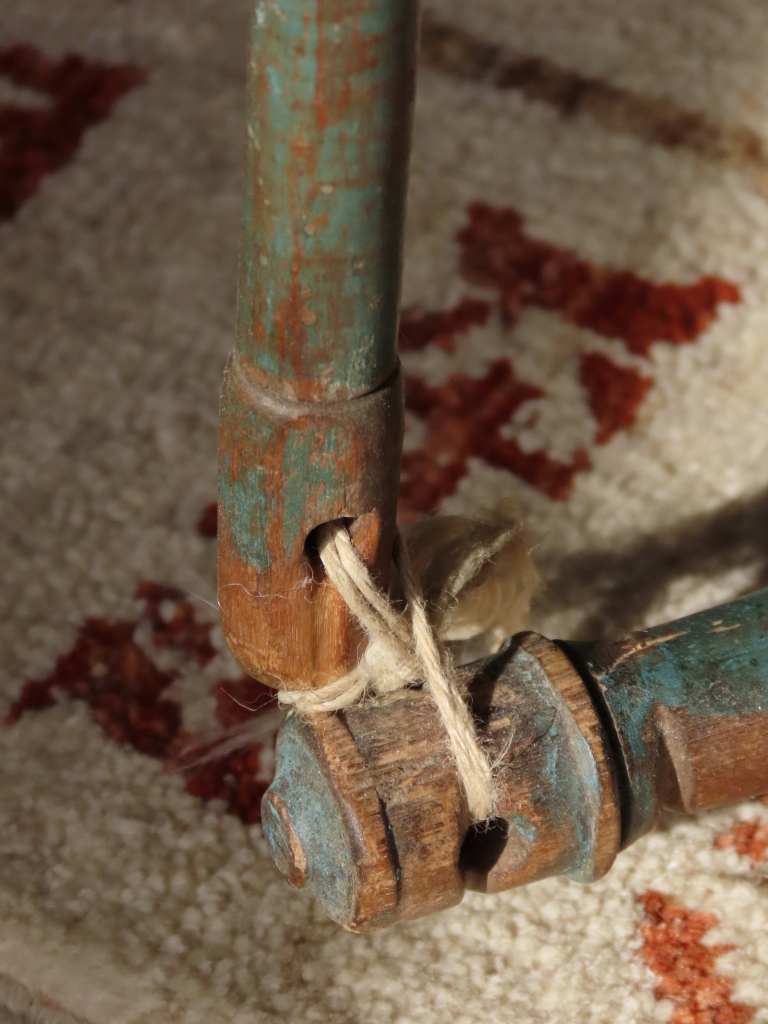
Whoever Turi was, she, and the women who inherited this wheel, used it well and took great pains to keep it spinning. It is a fantastic example of make-do fixes. The front maiden is bound at the bottom with a thick string.
The back axle is bound with what looks like linen tape and secured with nails.
In fact, nails abound.
They are found here in one of the secondary tension screws.
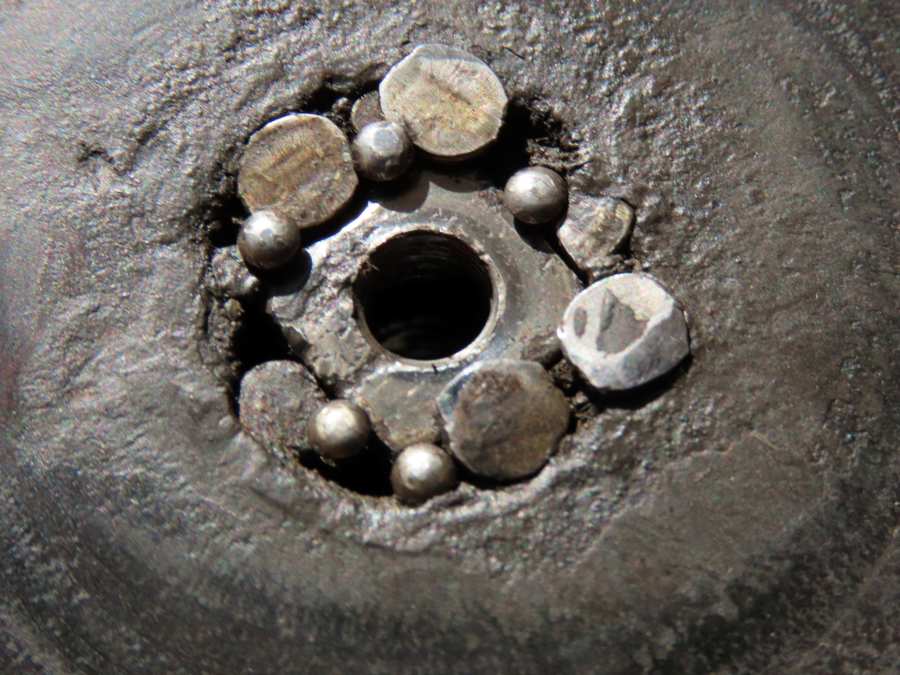
But the biggest nest of nails was hidden. When I got the wheel, it spun okay, but the flyer was a bit funky, turning with a wobbly, thump-ity feel to to it. The whorl looked as if it was a bit askew. I carefully unscrewed it (as an aside, as with many Norwegian wheels, it screws righty-tighty, lefty-loosey, in contrast to most North American wheels) and found this.
I imagine they were to keep the whorl nut in place, but sadly, it is loose again and the nails seem to give an odd unbalanced weight to the whorl. Interestingly, the whorl end of the mandrel shows uneven wear, with one side grooved more deeply than the other.
So, perhaps this unbalanced whorl was used for a while. The flyer arms show grooves on both edges, with interesting deeper grooves right next to the hooks.
Because this flyer is such a marvelous piece of the wheel’s history, I wanted to keep it as is and not have it repaired.
But it spins a bit awkwardly and there is some slippage of the mandrel. I did not want things to get worse, so I found an extra flyer in my collection to replace the original for everyday spinning.
Although it is a very different design than the original, it works beautifully on this wheel, belying the oft-repeated mantra that you cannot substitute flyers on antique wheels.
I do it all the time with great success. On this wheel it was especially satisfying to find a good substitute since the clearance between the flyer arms and drive wheel is very narrow.
The actual clearance is even closer than it looks in these photos
Happily, the substitute flyer looks nice and at home on the wheel.
And, as with all the previous fixes, it will allow this wheel to spin on, without erasing any of its history.
I bought this wheel and reel because they are from Prince Edward Island. Like many, PEI has a place in my heart because of L.M. Montgomery’s books. I discovered an ancient copy of “Anne of Green Gables” when I was about ten (many years before the television series) and there was no looking back. Although Montgomery’s books were not easy to find then, I ferreted out every one I could track down, eventually reading all of them.
I visited PEI when I was 14, and when Montgomery’s journals and letters were published, I devoured them, too. The magic of Montgomery’s writing, to me, is how, through her perceptive lens on the small details of speech, behavior, and customs, she brings a specific time and place to life so vividly that it feels as if I have been there. Her descriptive details also provide rare documentation of everyday practices, passed on orally, which she preserved through her writing.
A wonderful example is when Emily (of New Moon) finishes mopping the kitchen floor, she then sands it in “the beautiful and complicated ‘herring-bone pattern’ which was one of the New Moon traditions, having been invented, so it was said, by [a] great-great-grandmother … New Moon was the only place in Blair Water where the old custom of sanding the floor was kept up; other housewives had long ago begun to use ‘new-fangled’ devices and patent cleaners for making their floors white.” Emily Climbs p. 60.
So, when I bought this wheel, I tried to think of spinning wheel references in Montgomery’s books that might be a helpful starting point for research. I remembered that in “Emily of New Moon,” Aunt Laura wove and spun in the garret. “The walls were hung around with great bundles of soft fluffy rolls, all ready for spinning, and hanks of untwisted yarn. Sometimes Aunt Laura spun on the great wheel at the other end of the garret and Emily loved the whirr of it.” p. 93.
The only other reference I could think of was from “Anne of Windy Poplars,” when the local dressmaker encountered Anne walking in the old graveyard and regaled her with stories of those buried there: “My great-great-grandfather Courtaloe is buried here. He came out in 1760 and he made spinning wheels for a living. I’ve heard he made fourteen hundred in the course of his life. When he died the minister preached from the text, ‘Their works do follow them,’ and old Myrom Pringle said in that case the road to heaven behind my great-great-grandfather would be choked with spinning wheels.” p. 44.
From these tidbits, it appeared that some spinning was still going on into the early 1900s on PEI, including with great wheels (at least in homes that kept up old traditions), and that there must have been some prolific wheelmakers on the island. A promising start.
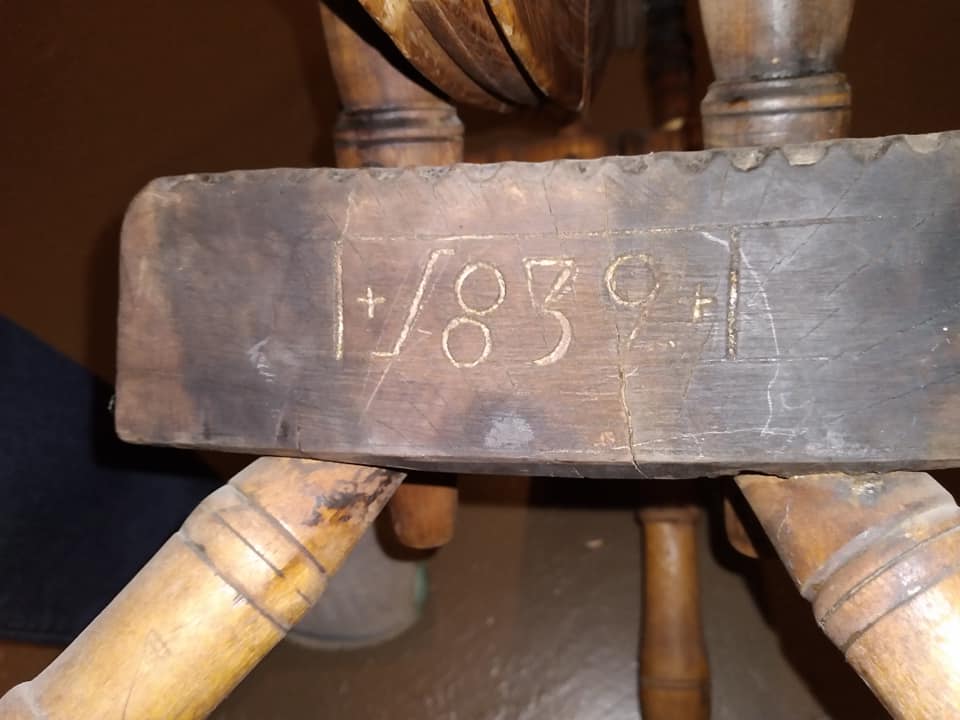
I next checked in my other books and was excited to find a reference to PEI wheels in “Keep Me Warm One Night.” “In Prince Edward Island an unidentified maker incised a number at one end of the platform,
and a date at the other. Some idea of his production may be guessed by the fact that examples numbered in the 600s have been seen.” p. 19.
I also found a reel in Joan Cummer’s book that looks just like my reel. pp. 326-27. Cummer writes: “This click reel came from Prince Edward Island, Canada. Probably made in the early nineteenth century, it had belonged to only one family where it received much use. The family, even in the first quarter of the twentieth century, spun and wove their own cloth. The reel is still in perfect working order. Each single turn takes up 79 inches, and the clicker clicks every 100 turns.” P. 326.
Cummer’s account confirms Montgomery’s portrayal of PEI spinning and weaving into the 20th century, and both support the family history that came with this wheel and reel. The people from whom I bought them kindly wrote up their history within the family.
The wheel and reel have always been together, passed down from parents to son about 1894, when the son was married on PEI.
The family lived in St. Mary’s Road, in Kings County, the easternmost part of the Island. When the family eventually migrated to Massachusetts, the wheel and reel came with them. According to the family, the wheel is made from apple wood.
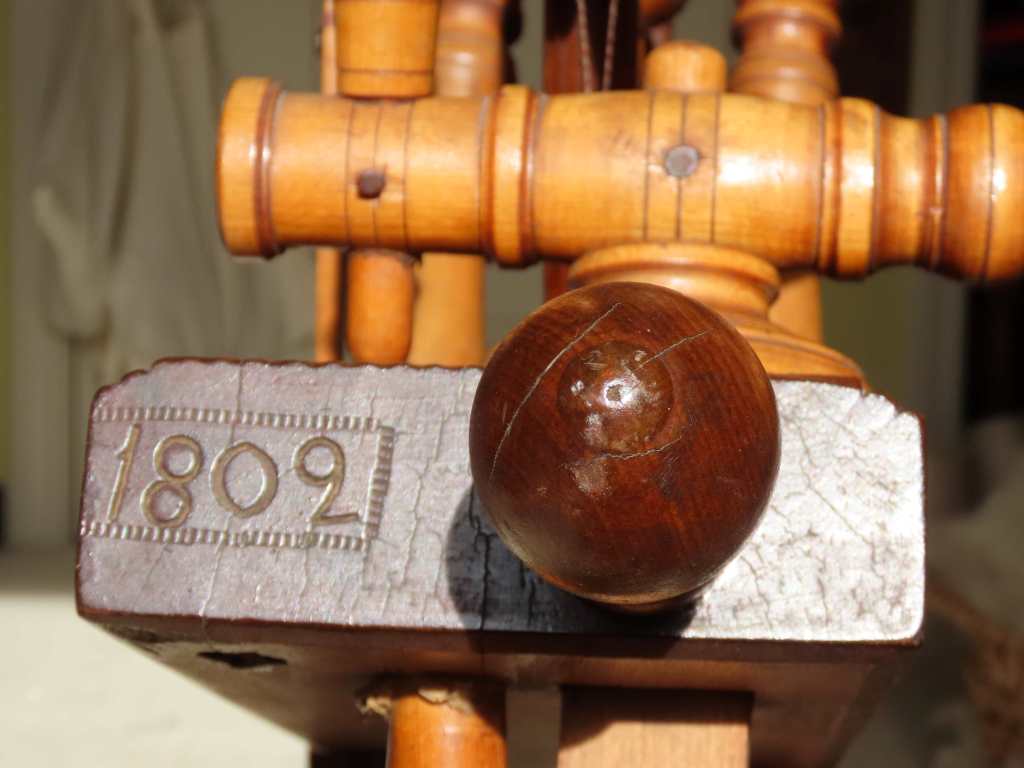
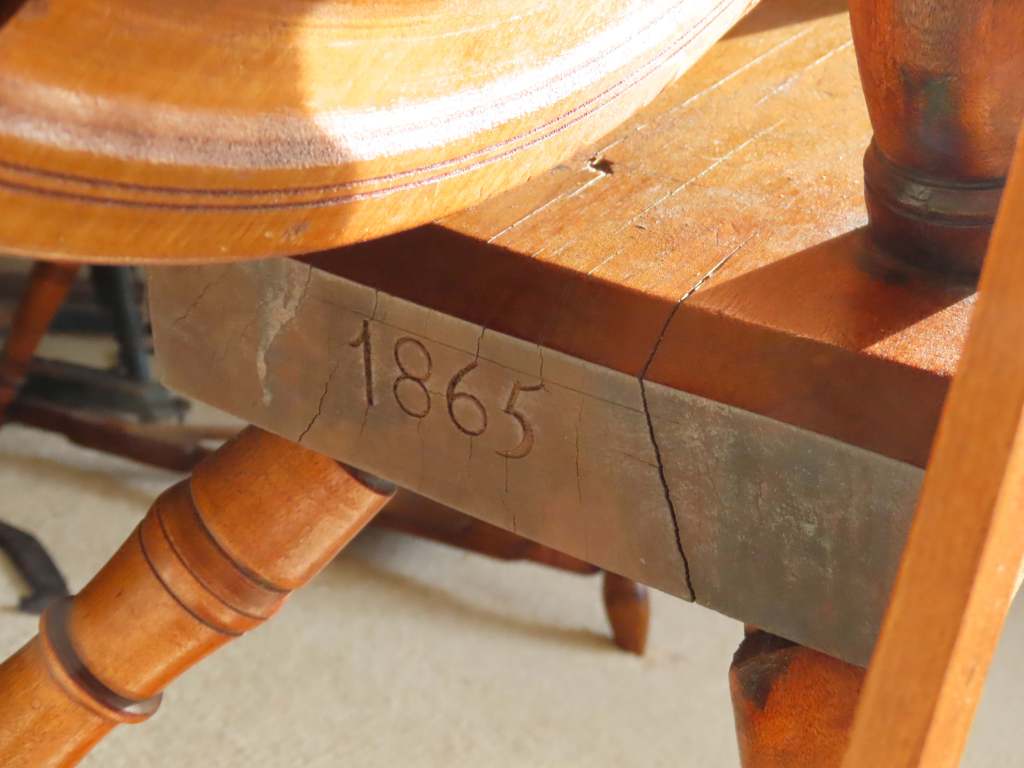
Like the wheels mentioned in “Keep Me Warm One Night” a production number of 1802 is on one end and a date, 1865, on the other.
Presuming that 1802 is a production number, it would seem that such a prolific wheel maker would be well documented. I started out my search with great optimism. But, over and over, my online searches yielded the same name-–Benjamin Chappell.
Chappel was a man of many talents. A wheel wright, machinist, and lay preacher, he came from England to PEI in 1774. He turned his hand to most anything that needed doing, including politics and spinning wheel production, and kept daybooks for many years. His daybooks are a phenomenal resource for anyone interested in spinning wheel production.
He documented the types of wood he used for wheel parts, for example: “took the Oak Rims cut them to their Length. put them over the shop they Amount to 50 wheels. They had been abroad 14 months & 20 days. Very good Oak” “black birch rim” “at more black birch whirls & c” “green beach rims … the old beach log made 20 wheels” “green white maple horses for the wheels” “Green Spokes Rounded with ye chisel was Enough for 20 Wheels” Vol. Two, pp. 11, 26, 76, 82, 98. He made the various wheel parts in batches: “last week finish’d 26 beds for drying. And Spokes 1000 of them some Maiden and Crowntrees all white Birch” “turn’d in all 7 sets of Spokes” “Tuesday Made 12 New treadels” Vol. Two, pp. 41, 90, 273.
Then he assembled and finalized the wheels in batches of three. In May 1818, he finished wheels 864, 865, and 866. Vol. Two, p. 284. I believe those are the last ones mentioned in his day books. In researching Chappell, I came across a 1930 article by PEI historian, Ada MacLeod, entitled “The Oldest Diary in Prince Edward Island.” I had a good laugh when I came across this passage:
“In his spare hours Chappell was always making spinning-wheels and so methodical was he that he numbered them, and the number entered in his book is over 600, which speaks much for the industry of the women of that time. At his funeral the text was the verse ending, ‘For their works do follow them.’ A wag remarked that if this were literally true in Chappell’s case, the road to heaven would be blocked with spinning-wheels.” p. 471. Sound familiar? L.M. Montgomery knew a good line when she saw it.
Chappell died in 1825 and clearly is not the maker of my wheel. Despite being so well-known and making so many wheels, I have not been able to find a single photograph of a Chapell wheel. In fact, I have found PEI to be a tough nut to crack when it comes to tracking down any information on wheelmakers. In addition to online research, I contacted historical societies and museums, and have had those with Island contacts make inquiries, but nothing has borne fruit. Crickets.
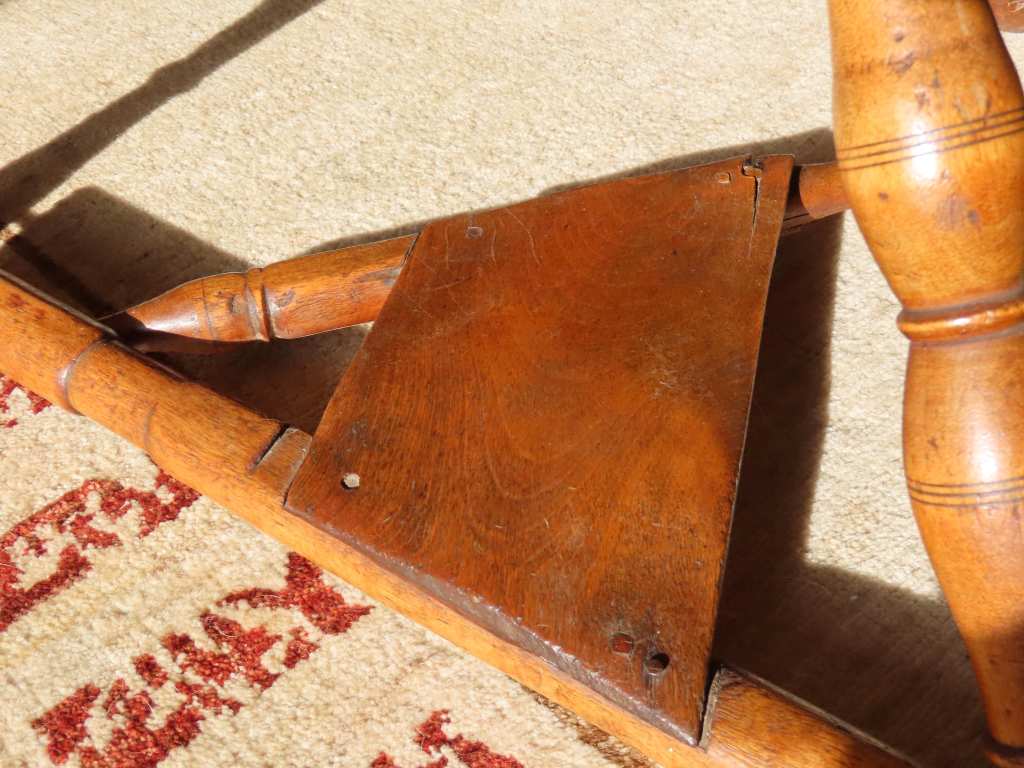
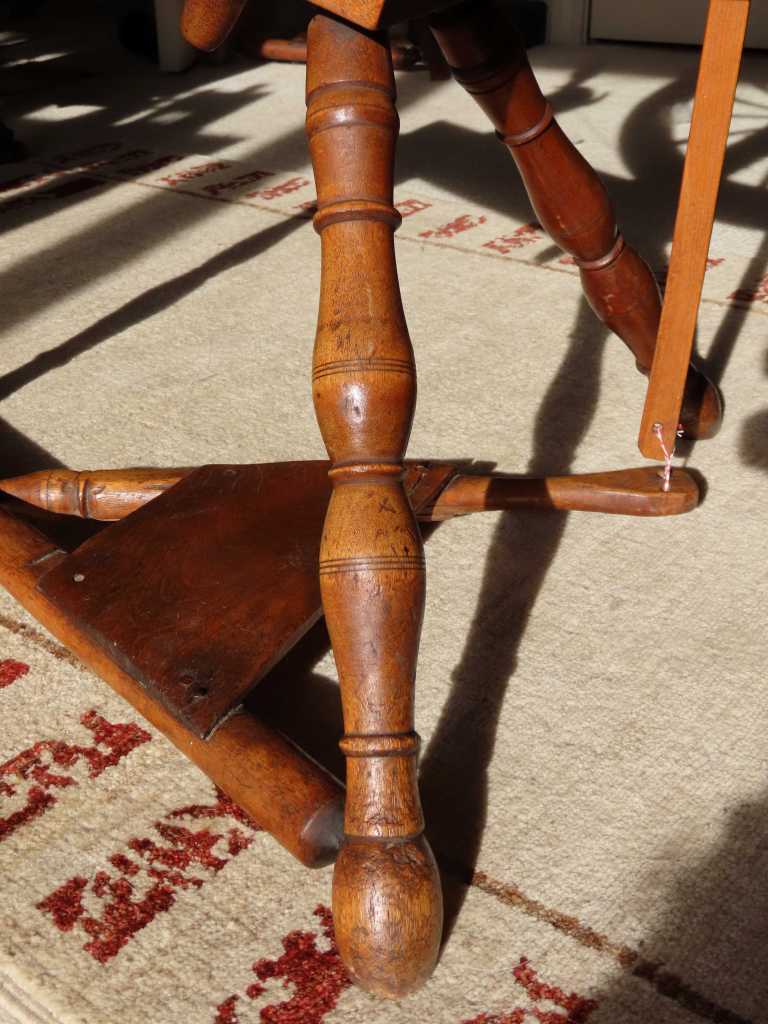
These wheels show up for sale with some regularity in New England, particularly in Massachusetts, where many PEI families migrated to find work. They share some similarities with the Nova Scotia wheels in the previous posts, including the spoon-like end to the treadle bar
and slope on the wheel end of the table.
The lovely generously rounded maidens make these wheels easy to spot and, of course, the numbers are distinctive.
Those on the tension end are bold and thick, surrounded by a box of punched decoration, while those on the wheel end are less robust and more refined looking, with no surrounding decoration. If the numbers indicate the year made and production number of the wheel, this maker must have been making wheels for many years, so I was extremely frustrated that I have not been able to find anyone on PEI with information.
Cheryl’s wheel
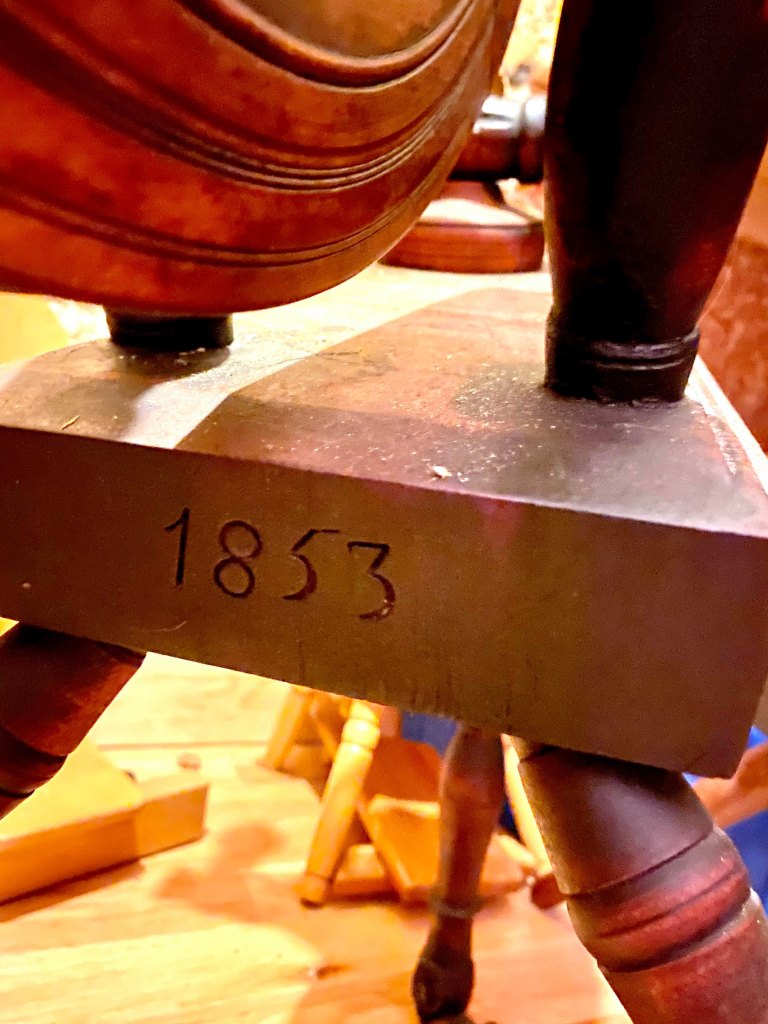
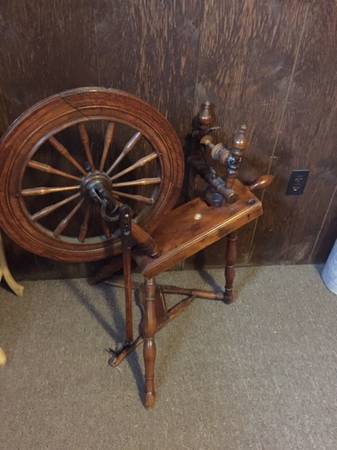
My one lucky break came from someone close to home. A few years ago, a spinner near me in Maine, Cheryl Bubar, was moving out of state and wanted to re-home some of her antique wheels. When I went over to her house, she showed me her family wheel from PEI (which she was keeping). It was a sister to mine, with the numbers 1184 on the tension end and 1853 on the other end. It turned out that Cheryl’s family also was from Kings County and were friends with the family that owned my wheel, PEI and after both families moved to Massachusetts.
Cheryl’s
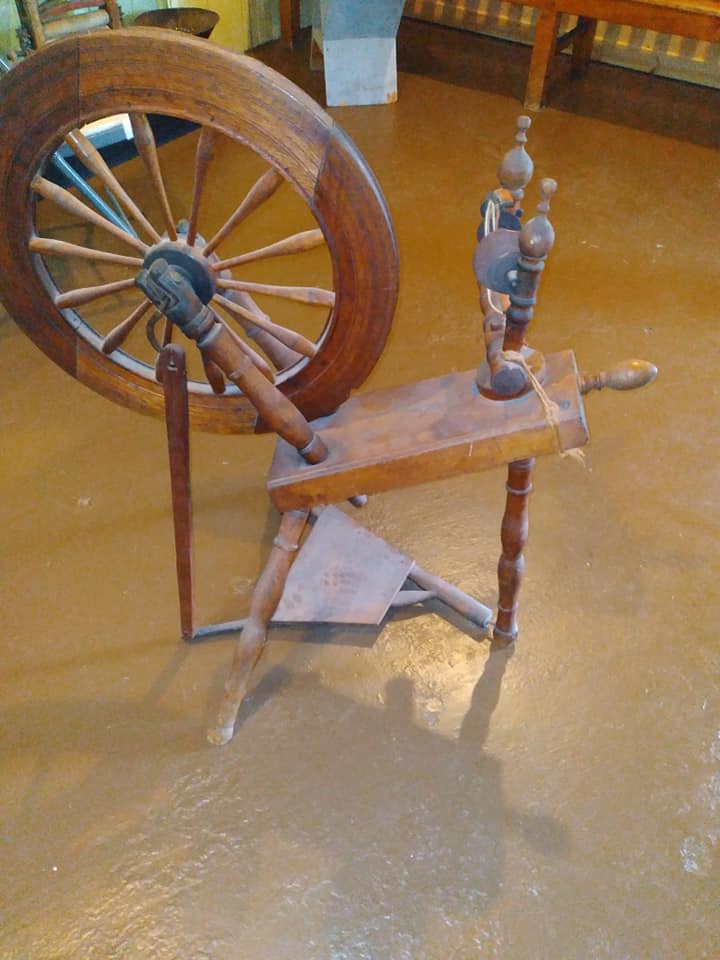
Some time later, a woman posted another of these wheels on Facebook, saying it had been donated to a museum in New Brunswick.
Wheel found in NB, but also from Kings County PEI
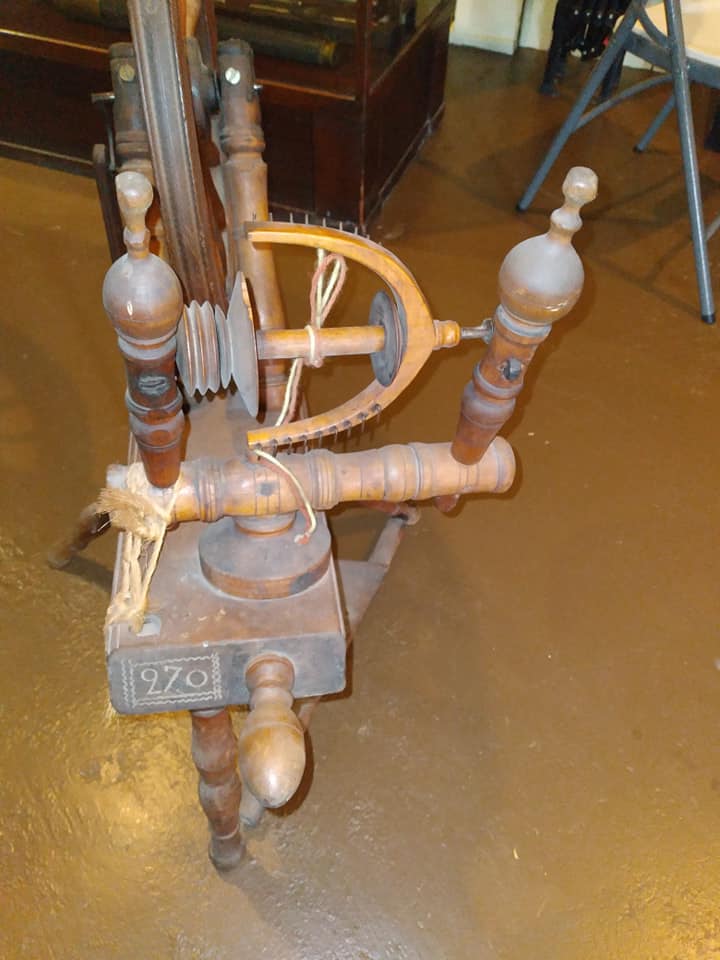
It was numbered 270 with the date 1839.
While the maidens are different on this early wheel, the first number–probably a “2” rather than a “9”–has the same unusual shape as on my wheel
She did some digging and found that the wheel had come from St. Charles, PEI—also in Kings County. While this 1839 wheel has somewhat different maidens and slightly different numbers, it seems likely that it is an early version from the same maker.
Date on the wheel found in NB
Another wheel came up for sale on Craigslist with the number 1170 and date 1853.
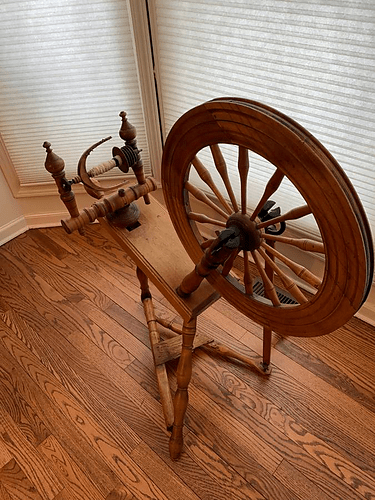
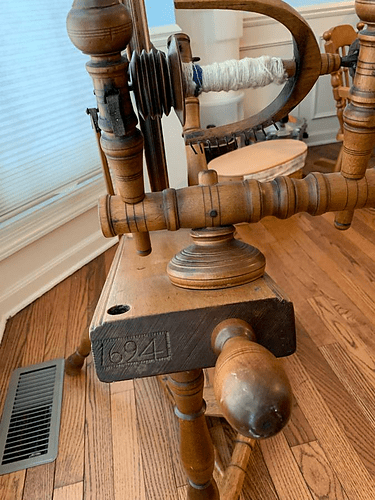
And one showed up in Michigan with the number 1694 and date 1863.
Wheel in Michigan–another beauty
So, it appears this wheel maker (or wheel making family) made over 1800 wheels from the 1830s to at least 1865.
Michigan wheel
In the twelve-year period between Cheryl’s wheel and mine, he would have made about fifty wheels a year.
1863 date on Michigan wheel
Cheryl did some digging and found in the book “Exiles & Islanders” a passage quoting from a letter written by John McNally (Nallen), a furniture maker in East Point PEI to his brother in County Mayo in 1832. McNally wrote, “if you were here you would make a fortune,” and that he was getting “five dollars for a spinning wheel and six pounds for a turned chair.” p. 116. (link to original letter here).
leg held in place with old linen cloth
I have not been able to establish how long John McNally lived, but since three of these wheels came from Kings County, where he was making wheels in 1832, he is the leading candidate for our wheel maker. Try as I might, though, I have not been able to confirm who made these wheels.
shims on far maiden
There is evidence of at least two other wheel makers on PEI at the time, John McQuarrie (or McQuarry) and George Lockerby, but both were working in Charlottetown.
My wheel is probably the heaviest saxony style that I own. Its weight and the wood grain and coloring seems to support that it (or much of it) was made of apple wood.
It has an unusual leather “bumper” on the far maiden,
I imagine to keep the whorl from bumping against it and to help with alignment.
The scribe marks underneath are unusual in that they are doubled, created a sort of plaid diamond pattern.
For the first time, when taking photographs for this post, I noticed marks on the back of the spokes similar to those on the spoke fronts of Marilla, the McIntosh wheel in a previous post.
They are much fainter and fewer on this wheel, but finding them on the back of the spokes just deepens the mystery as to how they were made.
No marks on the spoke fronts
The reel is large. Very large.
In contrast with the reel in Cummer’s book, this one makes a 90” skein and clicks at every 120 turns (giving 900 yards).
It is designed for easy carrying
and has single crossed scribe marks underneath.
Both are beautiful working tools and I would love to know who made them.
If anyone reading this has even the slightest lead that might be helpful in finding our maker, please let me know.
Although, I have not been successful in identifying the maker, or makers, it has been a fascinating journey.
Thank you to Cheryl for her research and to Cheryl, ReBecca, and Susan for use of their wheel photos.
References:
Burnham, Harold B. and Dorothy K., ‘Keep Me Warm One Night,’ Early Handweaving in eastern Canada, University of Toronto Press, Toronto and Buffalo, 1972.
Chappelle, R. LaVerne, The Daybooks of Benjamin Chappell, Volumes One and Two, The Prince Edward Island Genealogical Society Inc., Charlottetown, PEI 1998.
Cummer, Joan, A Book of Spinning Wheels, Peter E. Randall, Portsmouth, N.H. 1984. Accessory 24, pp. 326-27.
L.M. Montgomery, Anne of Windy Poplars, the front pages of my book are missing so I don’t have the edition, but the book was copyrighted in 1936.
Montgomery, L.M., Emily Climbs, Bantam Book, Harper &Row, New York, NY 1925 (Frederick A Stokes Co.), Bantam Ed. 1983.
Montgomery, L.M., Emily of New Moon, Random House Children’s Books, New York, 1923 (Frederick A Stokes Co.)
L.M. Montgomery, Anne of Windy Poplars, the front pages of my book are missing so I don’t have the edition, but the book was copyrighted in 1936.
O’Grady, Brendan, Exiles & Immigrants: The Irish Settlers in Eastern Kings County PEI, McGill Queens University Press, 2004.
Macleod, Ada, “The Oldest Diary on PEI,” The Dalhousie Review, Volume 9 Issue 4, 1930.
Several of my wheels have forged friendships. One of the earliest and best of those wheel friendships came through Granny Ross. When the wheel came up for sale in Cape Breton, Nova Scotia, a woman on Ravelry, Sherran Pak, posted the wheel’s photo, noting some similarities to the McIntosh wheels.
The seller said that the wheel was not in spinning condition and, although Sherran was initially interested in the wheel, she decided not to buy her because of the need for repairs and the difficulties in getting the wheel to her home in the Midwest.
I did not know Sherran and was uncomfortable pursuing the wheel, knowing how much she liked it. So, I contacted her and after her assurances that she was not interested and that I should go for it, I then contacted the seller.
The stars seemed to be aligned because the seller said that he would be taking a trip down to Maine in about a month and could bring the wheel with him. As it turned out, the meetup did not work out and I ended up, ultimately, finding a wonderful woman on Ravelry who, on her annual trip to Cape Breton, was willing to meet up with the seller and railroad the wheel down to me.
During the months it took to get the wheel, I got to know Sherran. Although I still have not met her in person, we have been continually in touch over the years, and she became a friend. She kept a lookout for wheels in the Midwest that might interest me and I helped her out (although to a much lesser extent) with wheels in my part of the world.
Some of my most treasured wheels came my way because of Sherran. She found them, picked them up (even waiting in line at an estate sale during covid), fostered them, arranged railroads, and sent them on their way to me. I am very much in her debt and am so glad that I have gotten to know her. And, it is all thanks to Granny Ross.
When Granny Ross finally arrived here, it was apparent why the seller said that she was not in spinning condition. The drive wheel had been seriously damaged, with a bent axle, spokes that had broken right off, with some clumsily re-glued. It looked as if someone heavy had stepped right on the drive wheel while it was on its side on the ground. I could just imagine the crunch of broken spokes.
Although I do not have photos of the drive wheel when it arrived, trust me, it was a mess. The treadle also was worn to the point of no return. The drive wheel damage was well beyond my repair capabilities, so I shipped it off to wheel-repairer extraordinaire, John Sturtevant. In the meantime, George crafted a beautiful new treadle with strong graining to match the legs.
When the drive wheel came back from John, it looked as good as new. I could not wait to try it out, interested to see how the heavy double rim would spin. I tend to like heavy drive wheels, with their sweet momentum, and Granny Ross did not disappoint. She became one of my favorite spinners.
She is a bit of a puzzle, though. Overall, she has a Scottish look.
As Sherran noted, she shares characteristics with the McIntosh wheels, including a spoon-shaped end to the treadle bar
and a slope at the drive-wheel end of the table.
And, while double rim wheels are most often found in Scandinavia, they do occasionally show up on wheels that appear to be Scottish, or made by Scottish descendants.
But the man from whom I bought the wheel said that his wife had bought it about 50 years ago in an Acadian area of Cape Breton and was told that it was Acadian.
That was intriguing to me because there seems to have been very little research done on Acadian wheels in Nova Scotia, so there is uncertainty as to what wheels were made and used by Acadians there. This photo, found in Judith Buxton-Keenlyside’s book, “Selected Canadian Spinning Wheels in Perspective” (figure 132, p. 278), is captioned “A spinning wheel maker on Ile Madam, Nova Scotia. From Edith A. Davis, “Cape Breton Island”, reprinted from the Canadian Geographical Journal 6, no. 3 (1933).”
Ile Madam is the same general area from which the seller’s wife bought Granny Ross. And, the wheel in the photo looks very similar to Granny Ross—especially the maidens,
and the legs.
To further complicate things, whoever made the wheel decorated the table with a 6-pointed rosette. While these are sometimes found on eastern European wheels, German fiber tools, and houses and barns of various cultures, I do not believe that I have ever seen one on a Scottish wheel.
Perhaps Granny Ross is a charming composite of different influences on Cape Breton—some Scots, some Acadian, a bit of German.
In any case, she is unique, with her attractive web of spokes,
strong stance,
and beautiful angled upright supports.
The shape of her legs highlights the gorgeous wood grain
and there are small lovely touches, such as the tiered MOA collar.
Much as I love this wheel—and she has been a workhorse for me—I have always felt a pang of guilt that Sherran may have deferred to me on the wheel out of her midwestern politeness.
Deep grooves on her tension knob, presumably from unwinding the bobbin
So, when I decided to sell some of my wheels, I was delighted when we were able to arrange to get Granny Ross to Sherran before Sherran moved farther west (to a place where wheels are rare). Granny Ross now resides with Sherran, where she belongs.
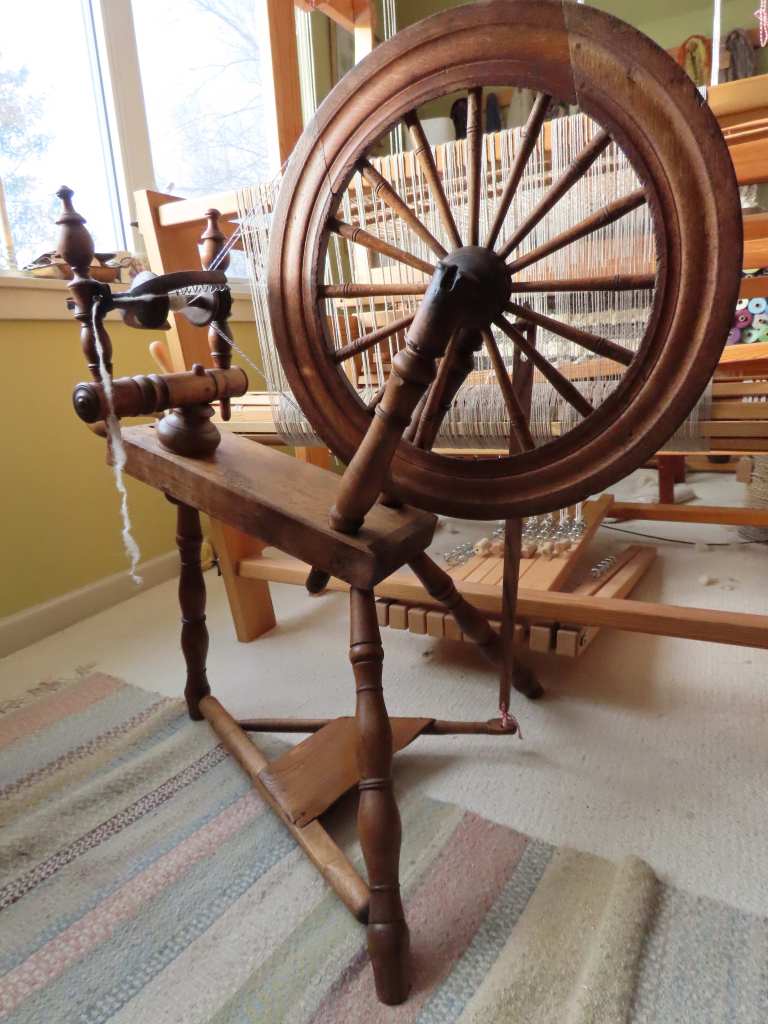
Most antique wheels are a puzzle—wood and metal conundrums. Who made them? Where, when, and how were they made? Who used them? For what and how were they used? Because so little of this information was written down, most often we rely on clues from the wheels themselves to try to answer these questions.
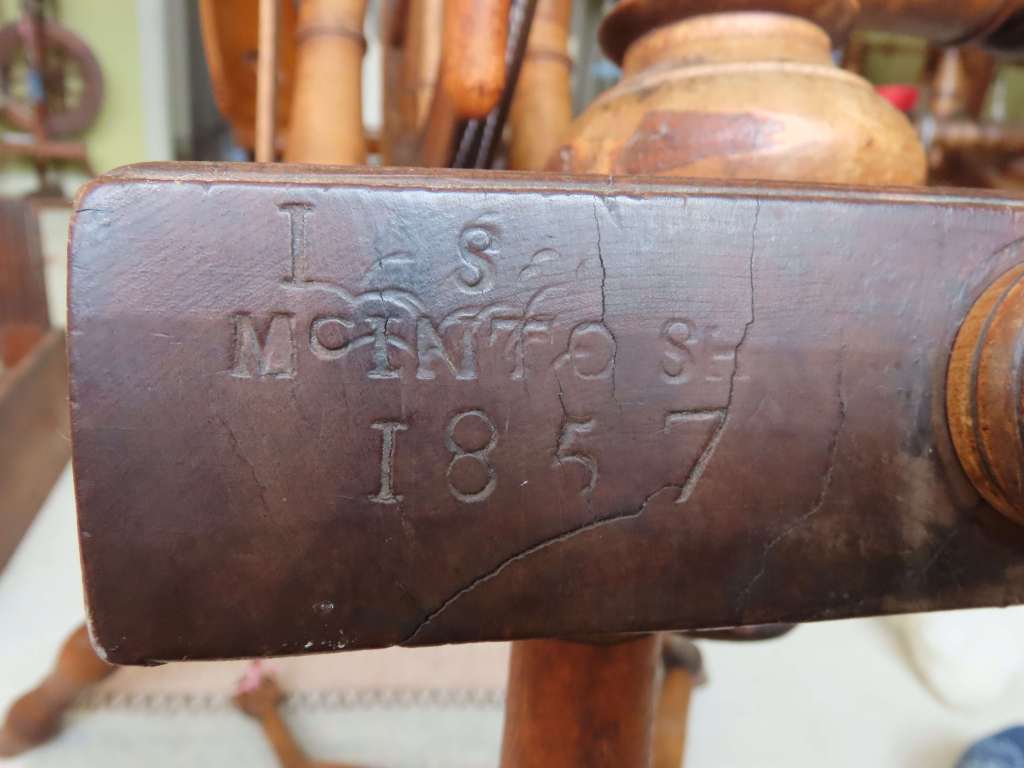
But some clues are confusing. In contrast to most wheels, this one advertises her maker and time—IS McIntosh, 1857.
How exactly she was used, however, is a mystery. There is no doubt that she was heavily used. But, in addition to expected wear, she has unusual scars that are somewhat bewildering. It feels as if she is trying to tell us something, but we lack the ability to translate it.
She is the second wheel that I ever bought and I almost passed her by. I found her deep in a crowded, dark antique store barn one town away. Brand new to antique wheels, I obediently followed the oft-heard instruction to check the drive wheel for wobble, which supposedly indicated a warped wheel. This wheel had an extreme wobble, veering one way and then the other.
So, even though I could see a name and date, I gave the wheel a pass, thinking it would be unusable. In the months that followed, though, I could not get her out of my mind. I decided to check her out more closely and found that whatever the reason for the wobble, it was not due to warping. So, when the owner offered her for a song, I brought her home, determined to get her spinning again.
Old shims on the maiden
She was filthy—absolutely encrusted in black grime. And, it turned out that the wobble was caused by a bend in the straight end of the axle. Thanks to advice from David Maxwell (aka TheSpinDoctor) on Ravelry, after securing the drive wheel in a flat position, I used a pipe for leverage to straighten the axle end. It worked beautifully.
Cleaned up, axle straightened, oiled, with a new footman made by my husband—she was ready to try. And, as those of you who rescue wheels know, that first spin after bringing a neglected wheel back to life is hard to describe without sounding overly romantic and ascribing human-like qualities to the wheel (it feels like she’s thanking me!).
But with your feet and hands feeling the imprint of past users, it is almost intoxicating when the wheel settles into its old work rhythm.
Not only is it satisfying, but there is an undeniable feeling that bringing such a marvelous little machine back to its purpose connects you with all the women who used the wheel in the past. It is a good feeling and an addictive one. This filthy, wobbly wheel set the hook, making me a sucker for wheels that cry out to be rescued.
Mark where the axle had been scraping the upright
Once I had her spinning, I set out to find out more about her maker, IS McIntosh. Coincidentally, the same person who had given advice on the bent axle, David Maxwell, also is the McIntosh wheel specialist. His research is set out in an article in The Spinning Wheel Sleuth, cited below. As David explains, there are three versions of McIntosh marks—”Alexr McIntosh,” “McIntosh,” and “IS McIntosh.”
He has documented marks from 1798 to 1892–almost one hundred years. From genealogical research, David surmises that the “Alexr” marked wheels were made by Alexander McIntosh, born in Scotland, and emigrating to Canada in 1803. The earliest marked “Alexr” wheel, a double flyer, likely was made in Scotland. Alexander eventually settled in Pictou County, Nova Scotia and his known marked Nova Scotia wheels span the years from 1811-1824.
The axle bearing looks like it might be horn
From the wheels David has been documenting, from 1829 until 1886 wheels appeared marked simply with “McIntosh.” From 1852 to 1892, the “IS McIntosh” wheels were being produced. And, starting in 1863 until 1879, the Alexr stamp again was used.
David Maxwell’s research found that Alexander’s son John apparently joined him as a wheel maker, which likely resulted in the mark’s change to simply “McIntosh.” But both Alexander and son John died in 1846. At some point, before or after 1846, Alexander’s grandsons (John’s nephews), named Alexander and James, also became wheel makers.
David’s theory is that Alexander Jr. carried on making wheels under the “McIntosh” stamp after his grandfather and uncle died, joined by his younger brother, James. In 1857, it’s probable that James started marking his wheels with the “IS McIntosh” stamp (the letter “I” often used for the letter “J” in maker’s marks) and then brother Alexander starting using the “Alexr McIntosh” stamp again. For much more detail on this, please refer to David’s article.
No matter which McIntosh was making the wheels, they all share similar features. The treadle bar has a spoon-shaped end, with a ridge underneath.
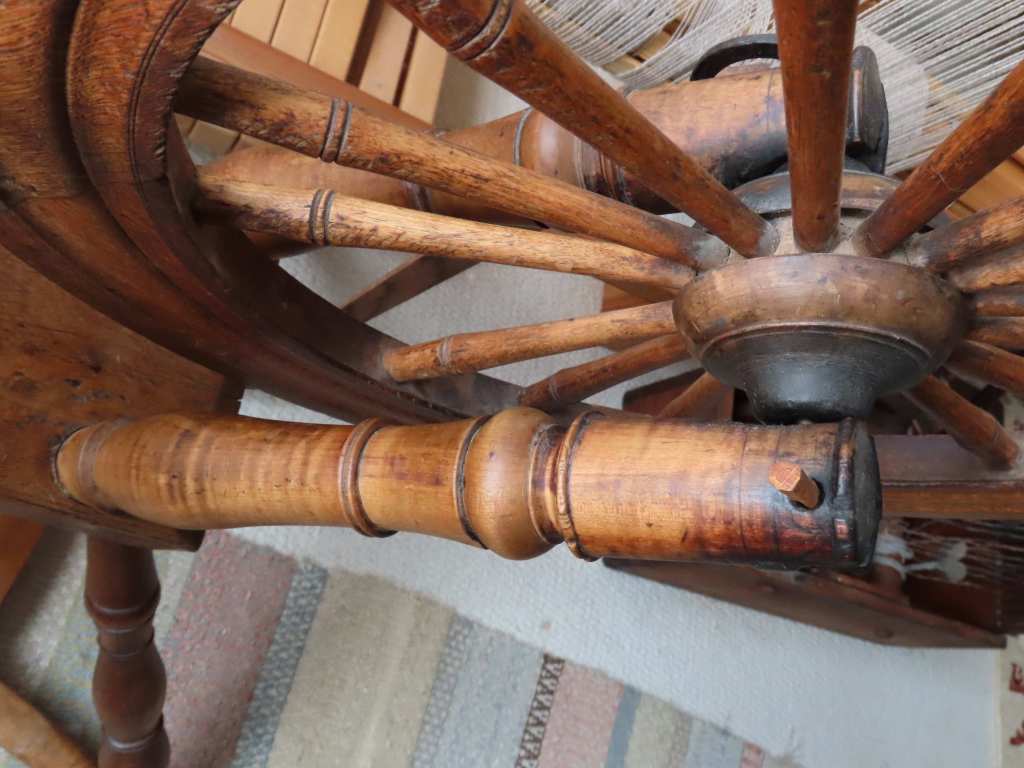
The drive wheels have 14 or 16 spokes—mostly 14 on the earlier wheels and 16 on the later ones, with some exceptions.
Marilla is missing one of her 16 spokes
The tables have a hole for the distaff, an angled end under the drive wheel, and understated, tasteful turnings.
The wheels were popular and well-made, apparently spawning imitators. Unmarked wheels often turn up that look very similar to McIntosh wheels, but with some slight deviation.
My wheel, Marilla, while a typical McIntosh, has her own unique features. Her maker, IS (likely James) was economical with wood and his time.
The wood on one leg and the MOA collar still retain some bark.
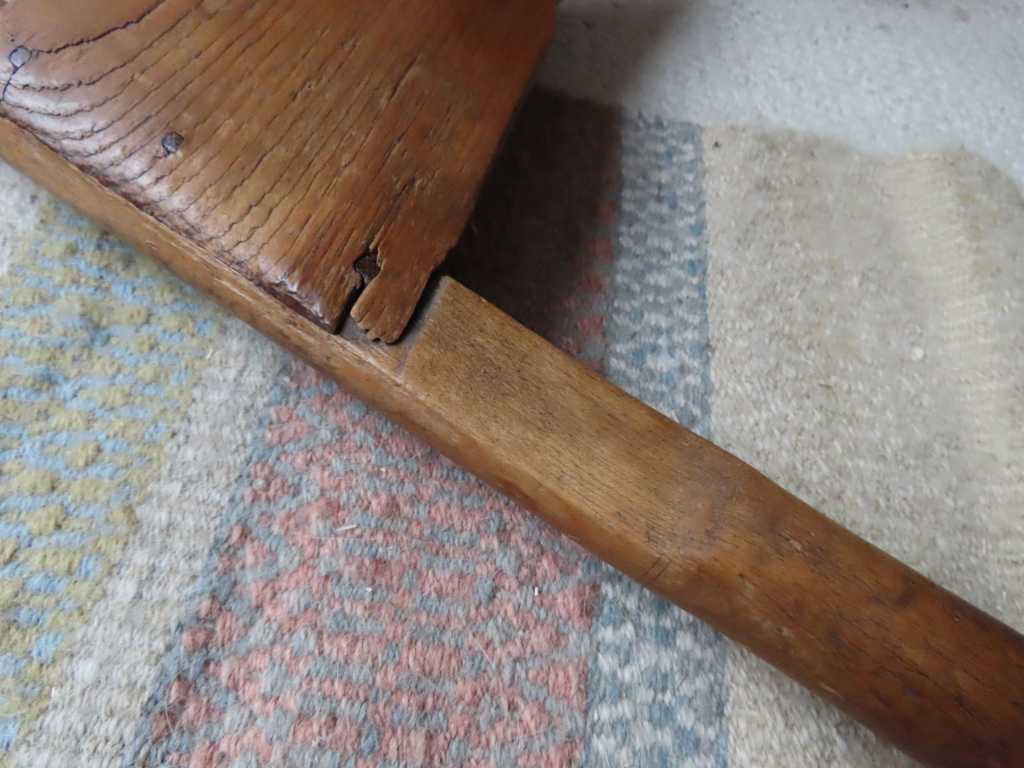
The sides of the table are quite rough
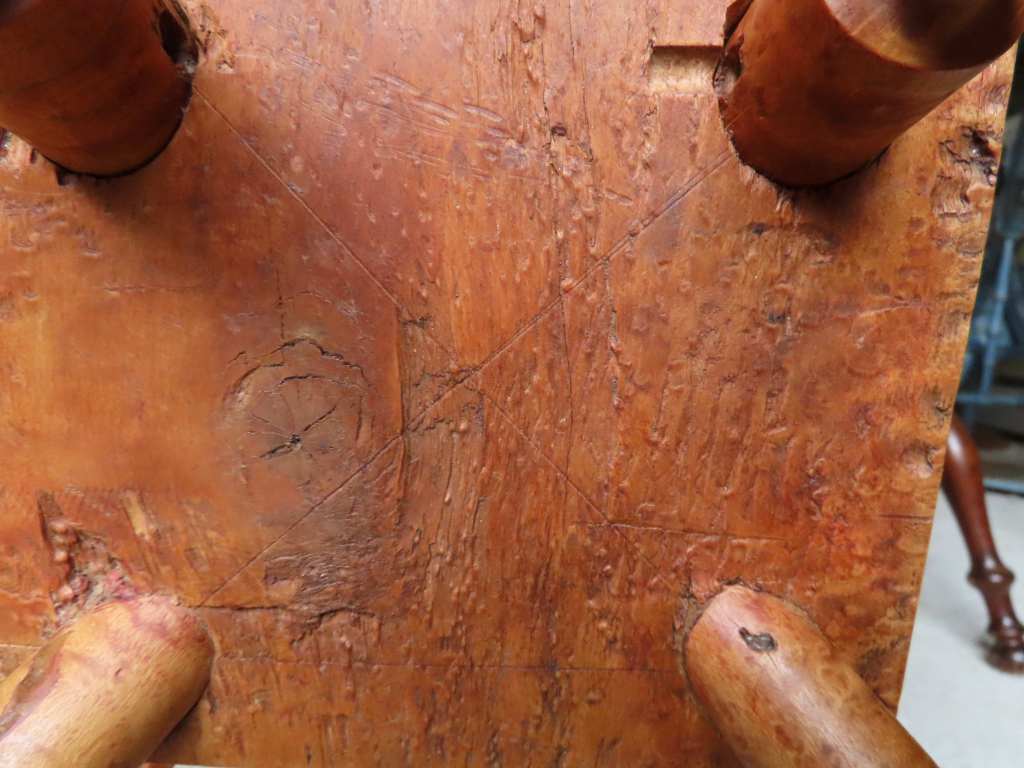
and the underside has a series of indented lines, whether from a saw, a plane, or something else, I do not know.
The wheel is made from heavy wood and the drive rim is quite wide.
There is a nail in the non-spinner side leg, with no apparent purpose (it is not on the bottom to keep the wheel from sliding).
The orifice is fluted, something found on other McIntosh wheels, but not all.
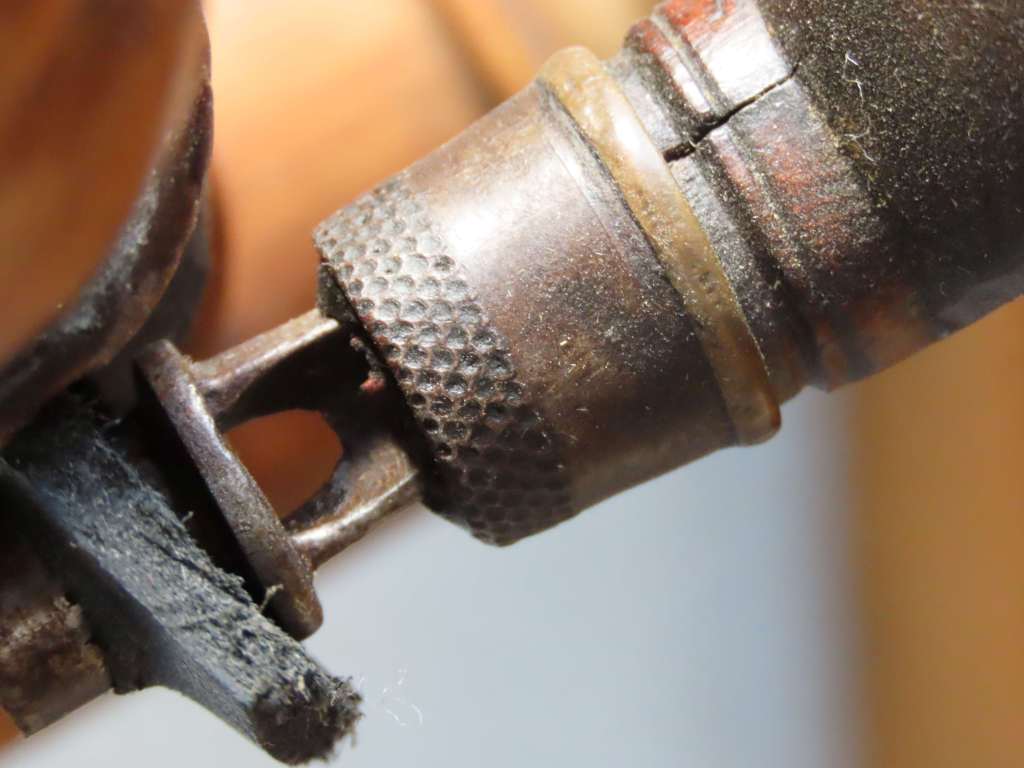
And, probably to “repair” a crack where the mandrel runs into the flyer, a thimble (with the bottom cut out) provides an ingenious and long-lasting binding.
It is such a personal touch, this thimble fix is one of my favorite things I have ever found on an antique wheel.
When I brought the wheel home, the bobbin had some very old, beautifully spun wool on the bobbin—a seriously good spinner last used this wheel. The flyer has typical wear marks
and the treadle a lovely smooth worn curve from years of treadling.
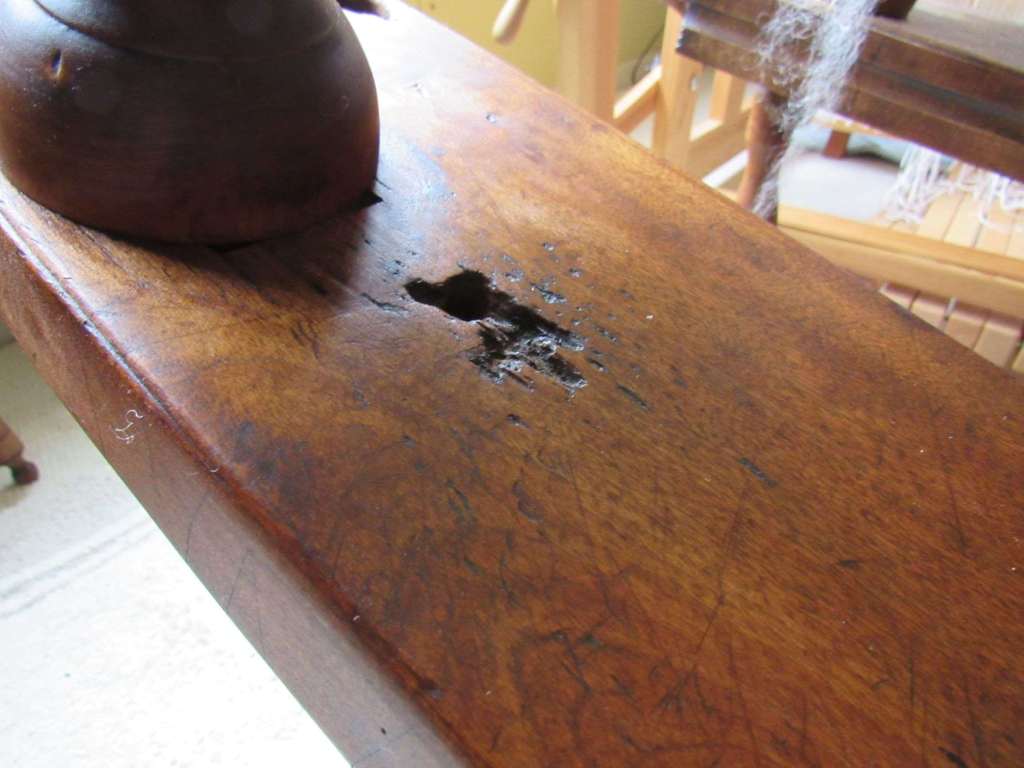
But other wear marks have me flummoxed. On the end of the table around the maker’s mark and on areas of the table, there are crescent moon-shaped gouges.
Occasionally, similar marks are found on other wheels. While no one seems to know with certainty what they are, speculation is that they might be from the spinner tapping the orifice end of the flyer, perhaps to loosen the bobbin for removal.
But, in this case, there is a whole valley gouged out of the table, where apparently something struck the surface repeatedly for a long time.
Even more perplexing are the marks on the spokes.
They are only on the spinner side
no marks on non-spinner side
and are angled, short lines–some straight, some slightly curved–on the outer 2/3 of each spoke.
I have seen two other wheels on Ravelry with somewhat similar marks, one a Norwegian-style wheel found in Saskatchewan and the other a Finnish-style wheel found in Leningrad. There is a thread named “Mystery Scratches” in the Antique Wheel group on Ravelry discussing the marks on these three wheels, with a variety of guesses as to their origins.
While many of the guesses were that they are damage unrelated to spinning (child hitting with a stick, dog chewing, odd storage), I believe they are wear marks from some type of long term use either in spinning, winding off, or warping, but try as I might, I cannot figure out how they came to be. If anyone has suggestions, please let me know. I would love to solve the mystery.
Marilla
Finally, in addition to Marilla, I was fortunate to find another McIntosh wheel several years later, this time an early 1815 Alexander.
Margaret–14 spokes, but like Marilla, she is missing one
I named that wheel Margaret and she has since moved on to another, very good home.
I only took a few photos of her, but it is interesting to compare her to the later IS wheel.
She is a beauty
but has her own table gouge, this time the typical one found under the drive band.
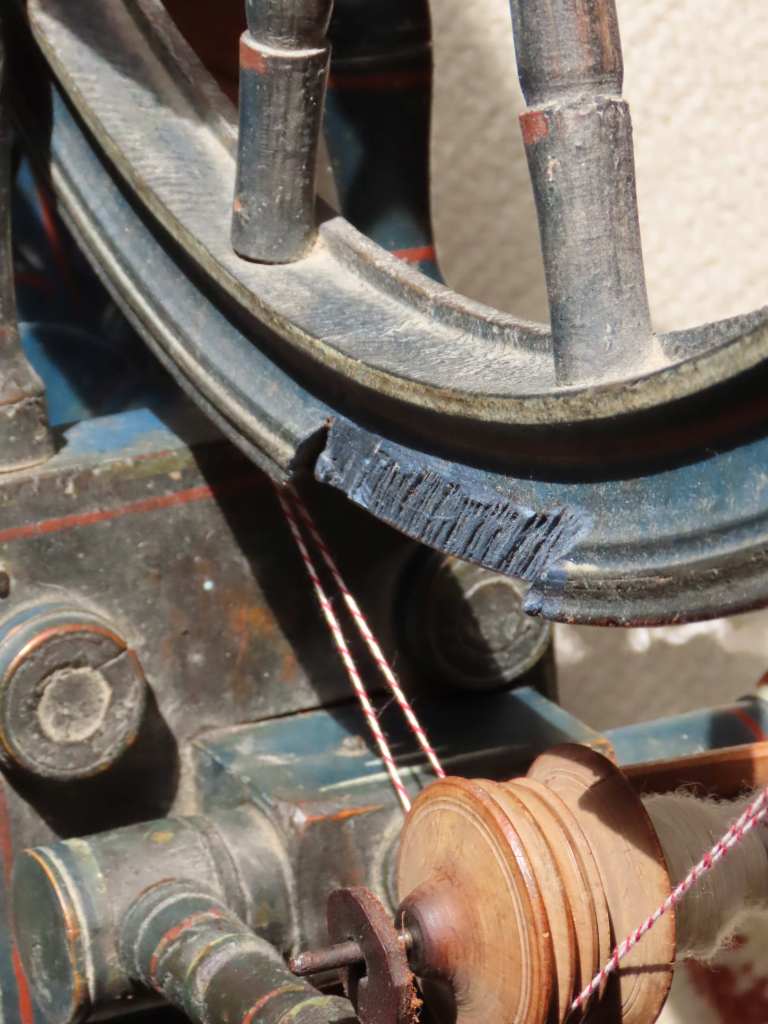
Here is a photo taken in Vörå, Österbotten, Finland sometime between 1920 and 1960 (link here) of a knife used in this way.
There is speculation that the knife kept the drive band cross from migrating to the top when spinning counterclockwise, so that the band would be less likely to grab flax from the distaff. But, at this point, that remains speculation. As this wheel shows, these knife marks are not just found on Scandinavian wheels, as many think, but on wheels from a variety of places and cultures. Whatever the purpose of the knife, it was important enough that spinners did not mind creating a big gouge mark in their wheels. As more and more photographs become available online, I hope that we will discover more about what the marks mean and how these wheels were traditionally used.
Thank you to David Maxwell and his sources for all of the research he has provided on McIntosh wheels.
You can find much more information in the Antique Spinning Wheels group on Ravelry, including a list of all the wheels David has been able to document.
Here is David’s article, with a wealth of information that I did not include here:
Maxwell, David, “The McIntosh Family of Spinning-Wheel Makers,” The Spinning Wheel Sleuth, Issue 108, April 2020, pp. 2-5.
Also thank you to AlltFlyer on Ravelry for the photograph of the knife in the table.
I bought Cocodris years ago from a woman in Bath, Maine. She told me that her grandfather had traded a gun for the wheel somewhere in the northern reaches of Maine.
I was attracted by the beautiful treadle curves, an oddly whimsical touch, especially for a wheel found in Maine.
The paint was a bit startling, though.
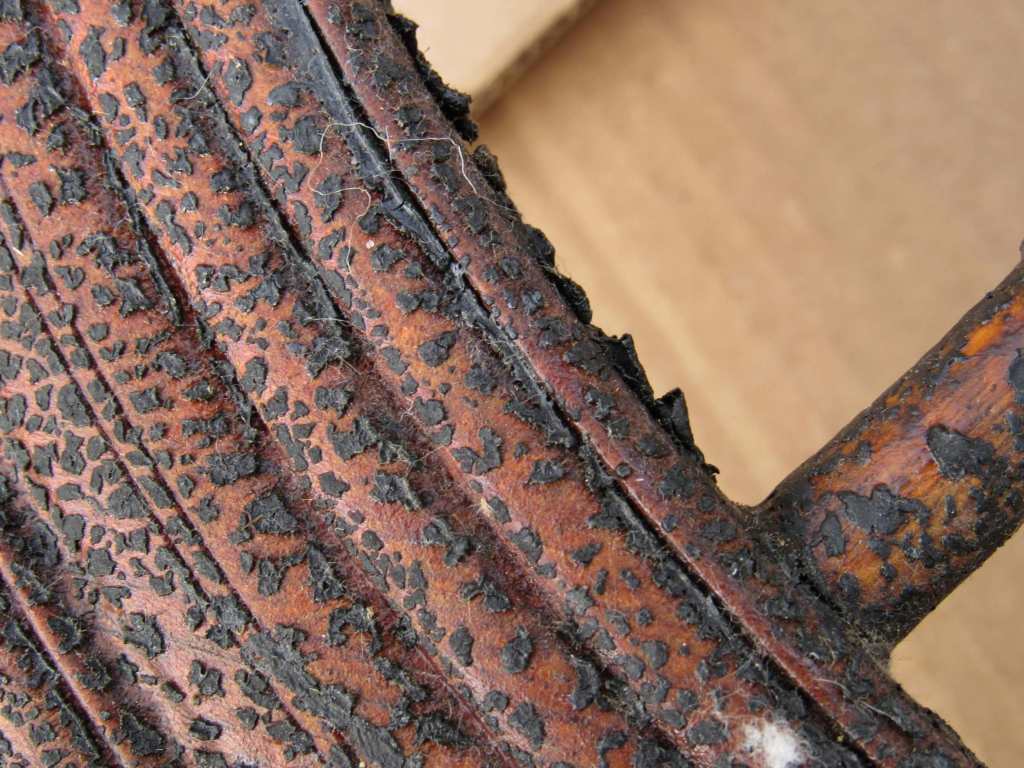
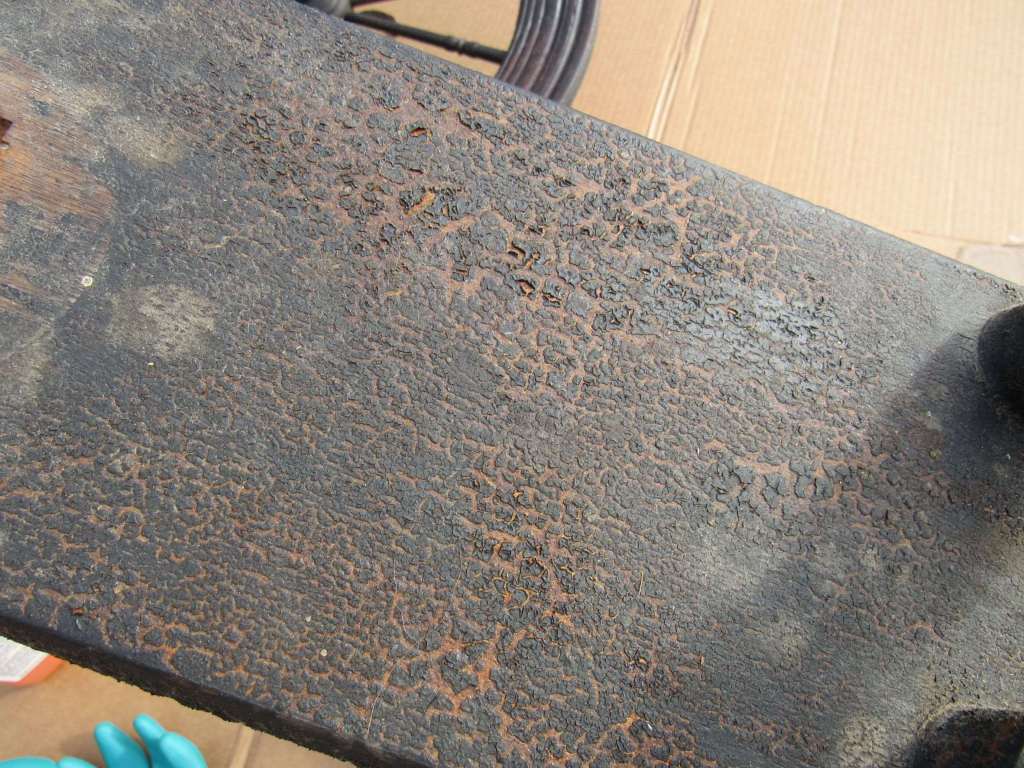
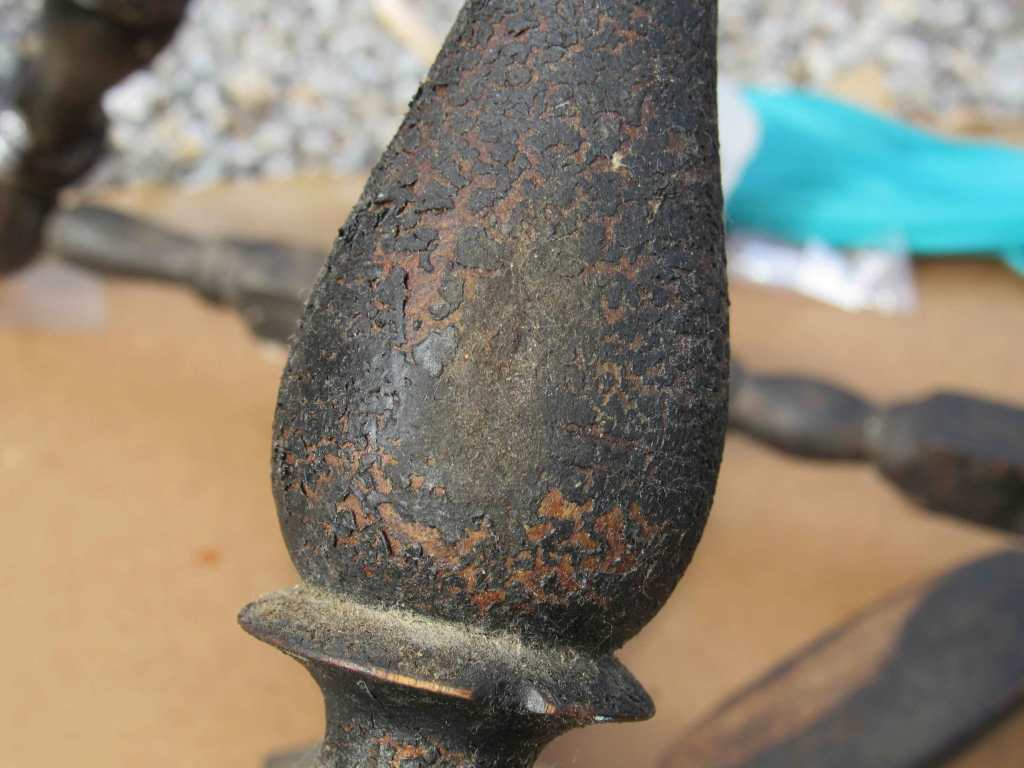
Cracked and peeling, bits almost exploded off the surface,
leaving a trail of black paint crumbs behind. While I rather liked the alligatored look, I was not enthusiastic about the paint litter so decided that I needed to address it.
I tried every suggested non-stripping tactic for alligatored finishes, but nothing worked.
I finally decided to use a citrus stripper and at least remove the worst of the flaking areas.
What a nightmare. Let’s just say that the paint won. I was trying for a mixed look—some parts painted, some showing the wood.
Instead, I ended up with a wheel that looked as if it had a terrible skin disease.
Rather than trying to strip it more, I repainted it, all except for the treadle parts and flyer, which I had not stripped.
They still have the original paint and wear.
It is a bit messy, slightly weird looking, and needs some touch up,
but the black paint highlights the wheel’s beautiful turnings.
And, as is often the case, those turnings started showing up elsewhere. I began to notice similar wheels coming up for sale. While the wheels had individual differences, most had “bowtie” spokes
and legs that resembled the Quebec Paradis wheels.
New Brunswick wheel for sale on kijiji–bowtie spokes and three-tiered maidens
The maidens generally came in two styles—three-tiered like Cocodris’ maidens, or bobble-topped like those on Philomene, the wheel in the previous post.
South Carolina wheel for sale on FB–bowtie spokes, Philomene-style maidens, paintedFor sale on FB–bowtie spokes and Philomene-style maidens
When I acquired Philomene and started researching her maker, Thomas Michaud, it became apparent that this style wheel was commonly found in the upper St. John River Valley, on the border between northern Maine and New Brunswick.
Philomene–made by Thomas Michaud, discussed in previous post
I suspect that most were made by Thomas Michaud and his wheel-making brothers, Hubade/Ubald and Francois Regis (see the previous post “Philomene”). But, since almost none are marked, we can only surmise that they are related based on similarity of features.
Cocodris’ maidens, for example, are like those on Diane Howes’ marked Thomas Michaud wheel (with a few less tiers).
Maidens on Diane’s Michaud wheel, discussed in previous post
The curved table sides,
the under-table MOA post
and scribe marks,
and the flyer scribe marks also are similar.
CocodrisPhilomene
Cocodris and Philomene share somewhat unusual metal work,
CocodrisPhilomene
having distinctive angled knobs at the mandrel ends
CocodrisPhilomene
and squared axle ends.
CocodrisPhilomene
But, the most compelling similarity is the lovely treadle design.
It is so unusual and rare that it makes me think that Cocodris likely was made by Thomas Michaud. Even the wheels’ heavy treadle wear matches.
In fact, Cocodris is an even better spinner than Philomene—quiet and steady, perfect for fine singles.
Although one upright is skewed toward the spinner (it’s in tight) and the drive wheel does not directly align with the whorl, she is smooth, fast, and delightful to use.
While all spinning wheels are exquisite machines, some bring the exquisite aspect up a notch. This wheel is stunning.
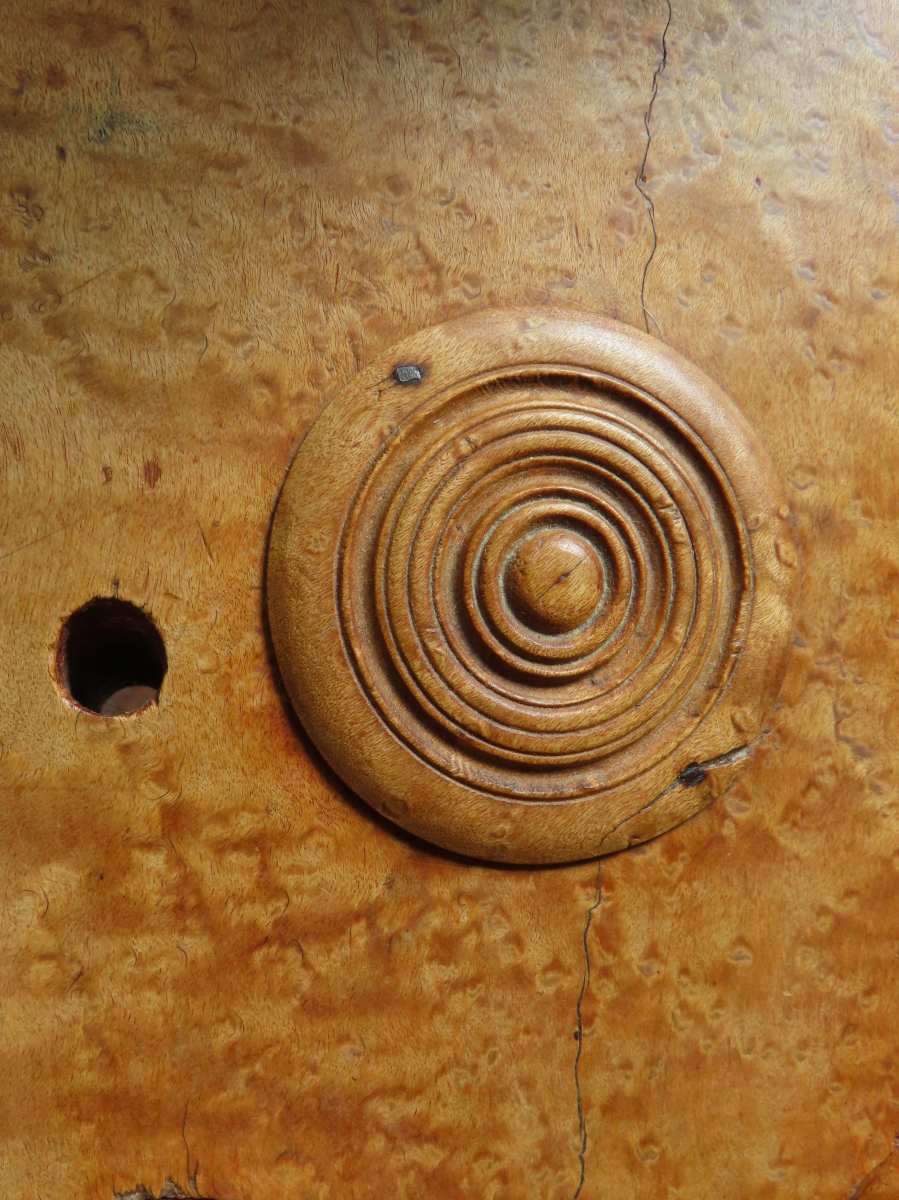
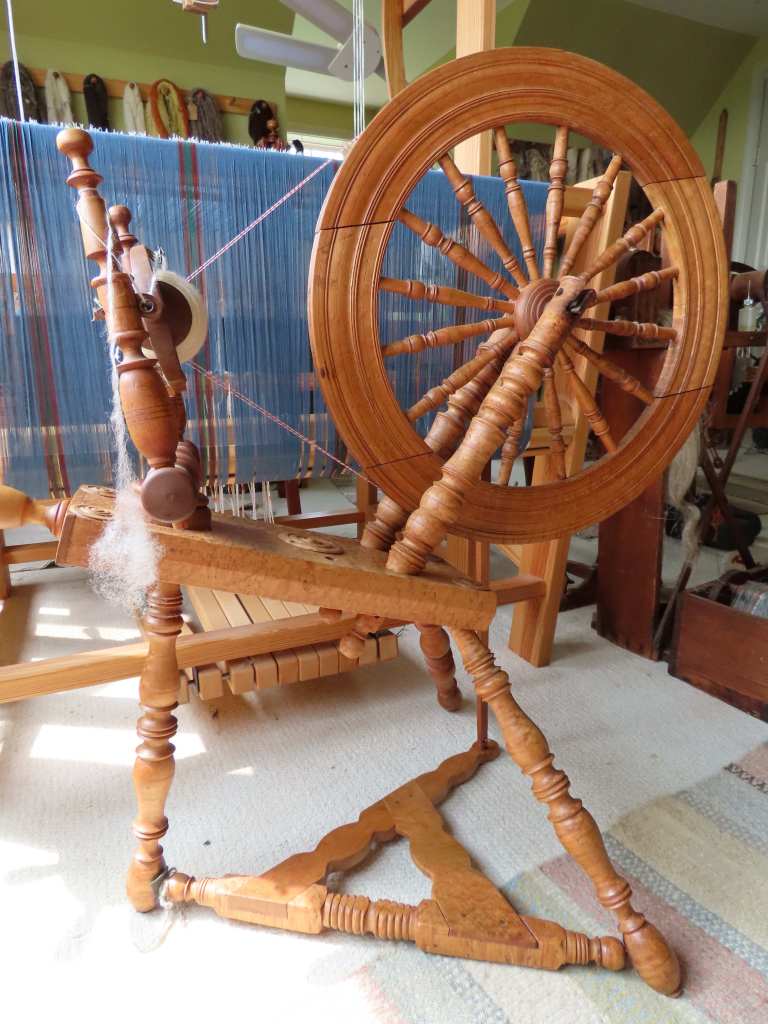
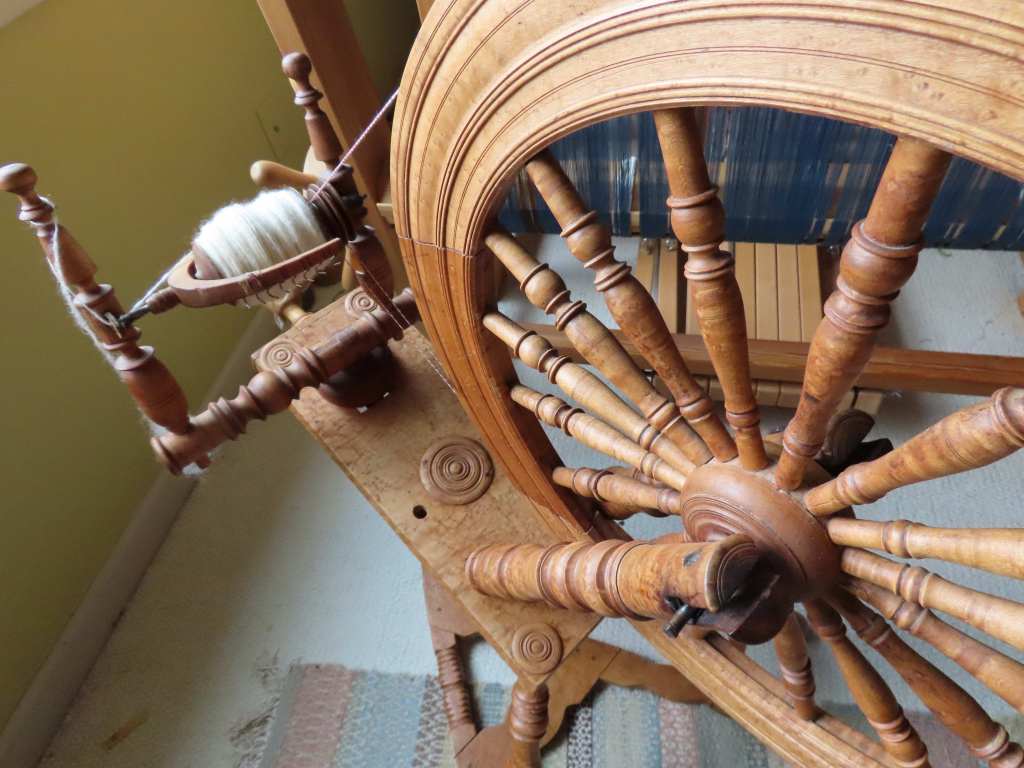
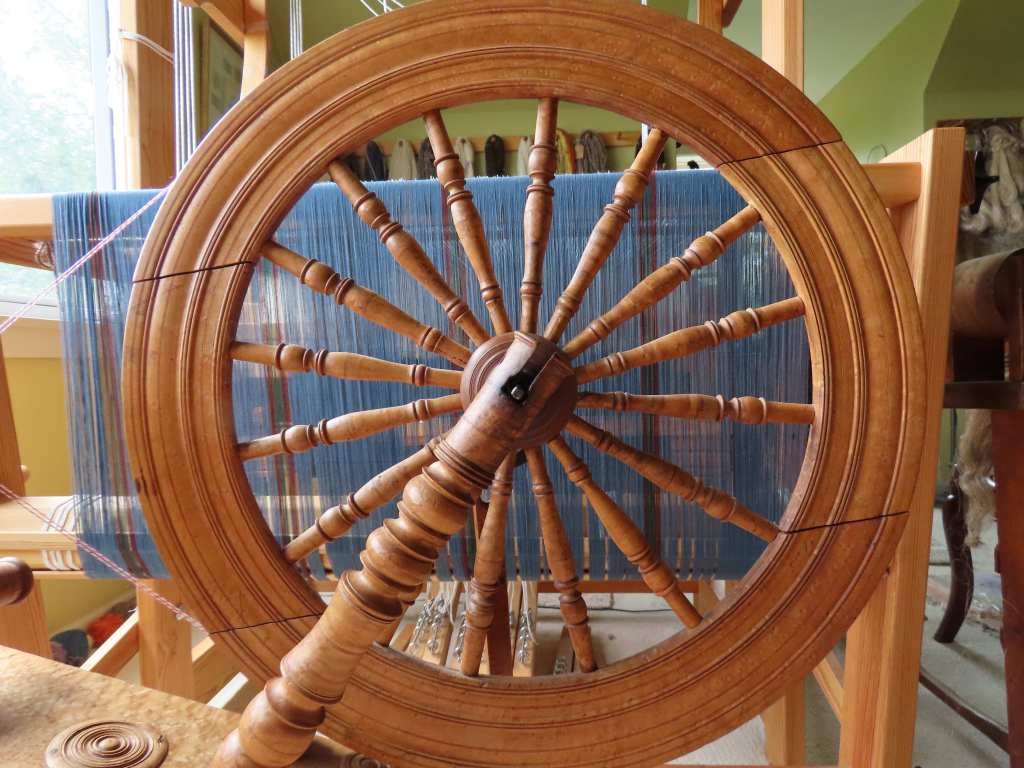
Made almost entirely of birdseye maple, with elaborate turnings and embellishments, it is a showpiece for the skills of its maker, Thomas Michaud.
Unlike many highly decorated wheels, this one also was well-used, coming from the St. John River valley, a region where home spinning continued well into the 20th century.
Where Maine’s upper reaches meet New Brunswick, Canada, the St. John River runs along the border. An area of farmland and timber, it had an interesting mix of settlers in the 1700 and 1800s, with Acadians from the east and Quebecois from the west, joined also by American English, Scots, and Irish.
A book on the ethnic heritage of the region’s furniture is fittingly named “Coalescence of Styles,” but, unfortunately, the book does not mention spinning wheels at all. It is a shame because the area’s wheels are a good example of different influences from Quebec, Scotland, and Acadia.
The 16-spoke drive wheel has a Scottish influence
The Francophone population of the upper St. John River valley (often referred to as Madawaska) was primarily Acadian, but another group of non-Acadian French speakers came from the St. Lawrence River valley in Quebec. The Michauds were among those migrating from Quebec. Thomas Michaud’s father, Prudent, was born in Kamarouska, Quebec in 1815. Those familiar with Quebec wheels may recognize that Kamarouska also was home to the Paradis family of wheelmakers.
The legs have a Paradis influence
While there was intermarriage between the two families (Amable Paradis’ mother was Brigitte Michaud, for example), I was not able to find evidence to show whether any Michauds worked with the Paradis family in making wheels. Nevertheless, the Michaud wheels bear significant similarities to the Paradis wheels, especially in the leg and upright turnings.
Prudent and his wife, Modeste Martin, settled in the upper St. John River valley, specifically in St. Basile, Madawaska, where Thomas was born in 1842. His brothers Ubald (also spelled Ubalde, Hubald, and Hubade) followed in 1844, Joseph Prudent in 1845, and Francois Regis in 1848.
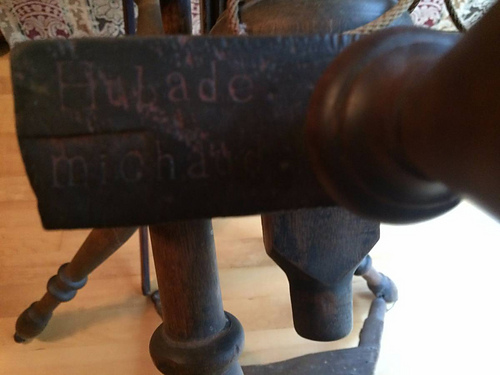
In the 1871 census, Thomas, then 28, is listed as a wheelwright, as is 23-year-old brother, Francois Regis, listed as “Regis.” Brother Ubald, married with children, was listed as a “charron,” or carter in 1871, and as a “wheelwright” by the 1881 census. One wheel likely made by Ubald, signed “Hubade Michaud,” turned up some years ago on Craigslist.
Hubade Michaud wheel
This wheel was discussed on Ravelry and, according to the seller, was from northern Maine and dated 1840. While the photo below shows the maker’s mark, it does not show the supposed date, so perhaps the seller misread a date from 1870, 1880, or 1890 as 1840, since Ubald was not born until 1844. Or, possibly there was another Michaud wheelmaker from an earlier generation, although, as far as I know, no one has found evidence of an earlier Ubald/Hubade.
Hubade’s mark–hard to make out, but it’s there
Despite the poor quality of the “Hubade” wheel photos, the first one does highlight the distinctive maidens, which are characteristic of the upper St. John valley wheels.
From Beatrice Craig’s “Spinning Wheels of the St. John’s River Valley”
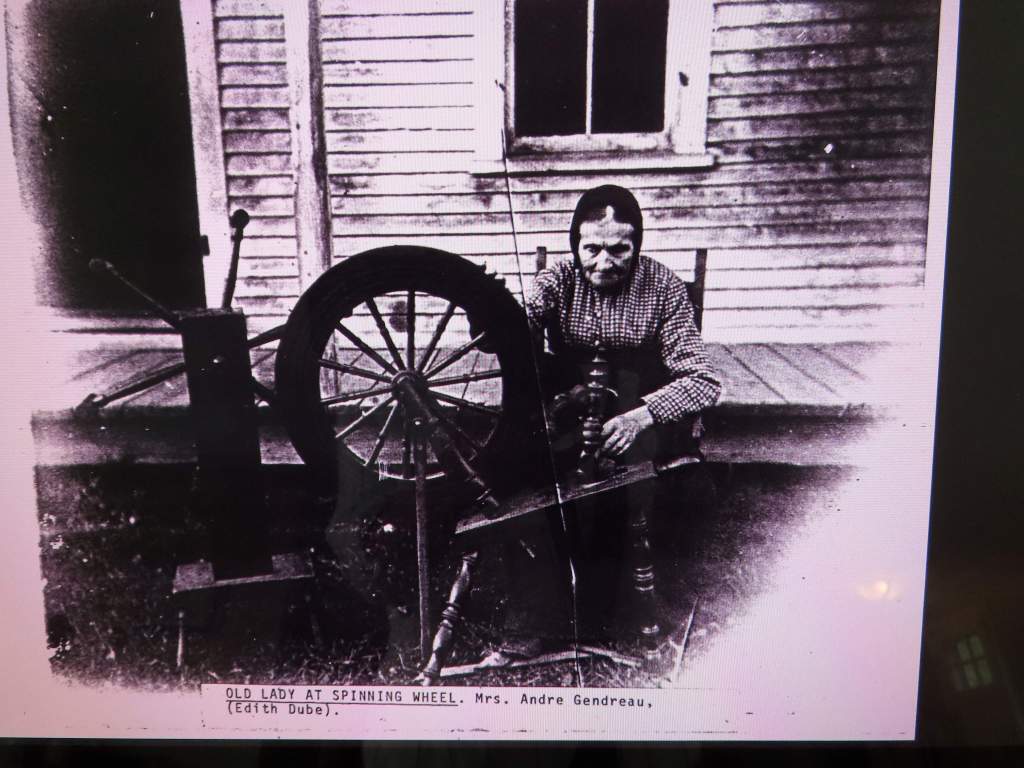
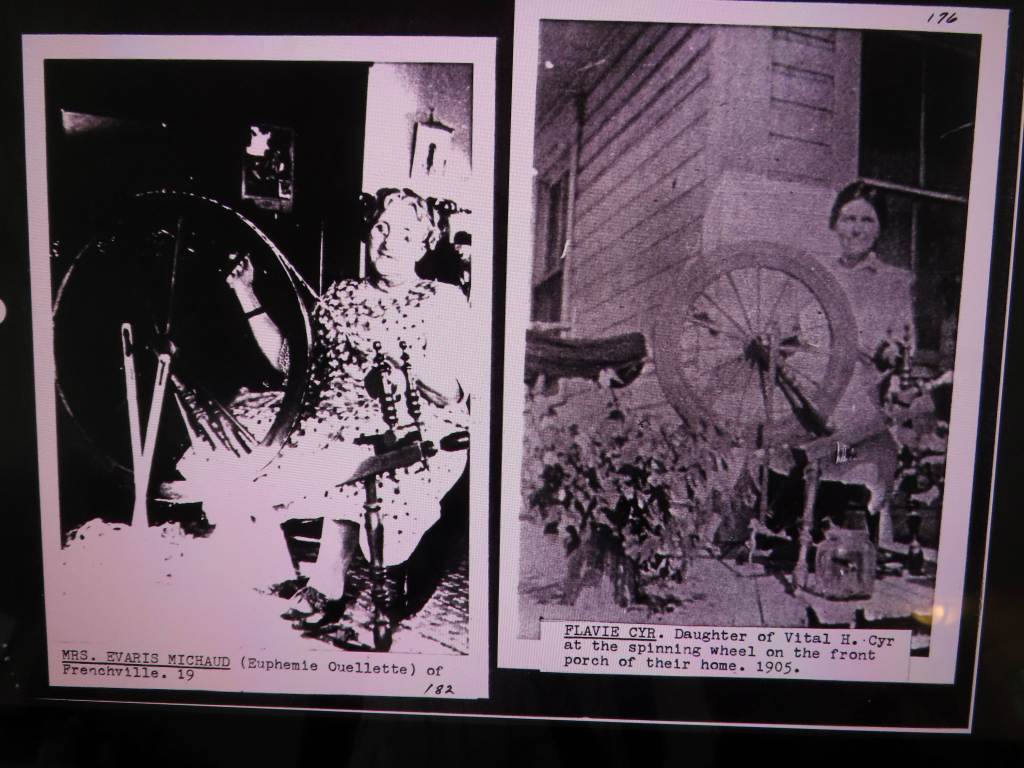
We are fortunate to have quite a few photographs of area spinning wheels in use. There is a wonderful paper, “Survival or Adaptation” (tap for link) on domestic textile production in rural Canada in the late 1800s. One area of focus is Madawaska, where spinning and weaving continued to be economically viable as a domestic industry. One of the paper’s writers, Beatrice Craig, also collected information on “Spinning Wheels of the St. John’s River Valley,” which is at the University of Maine, Fort Kent, Acadian Archives.
From Craig’s “Spinning Wheels”
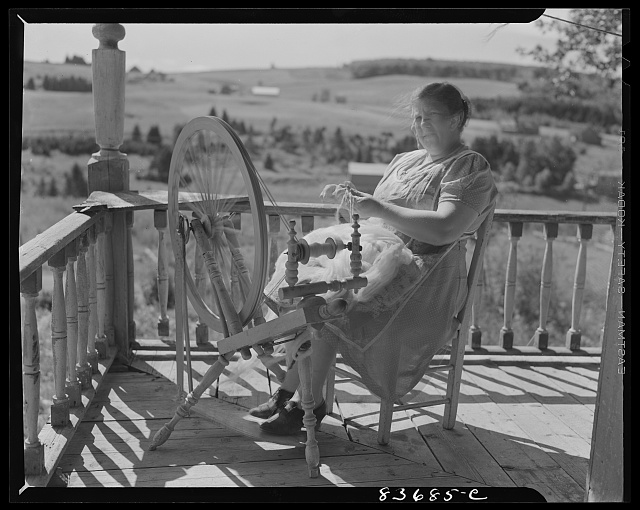
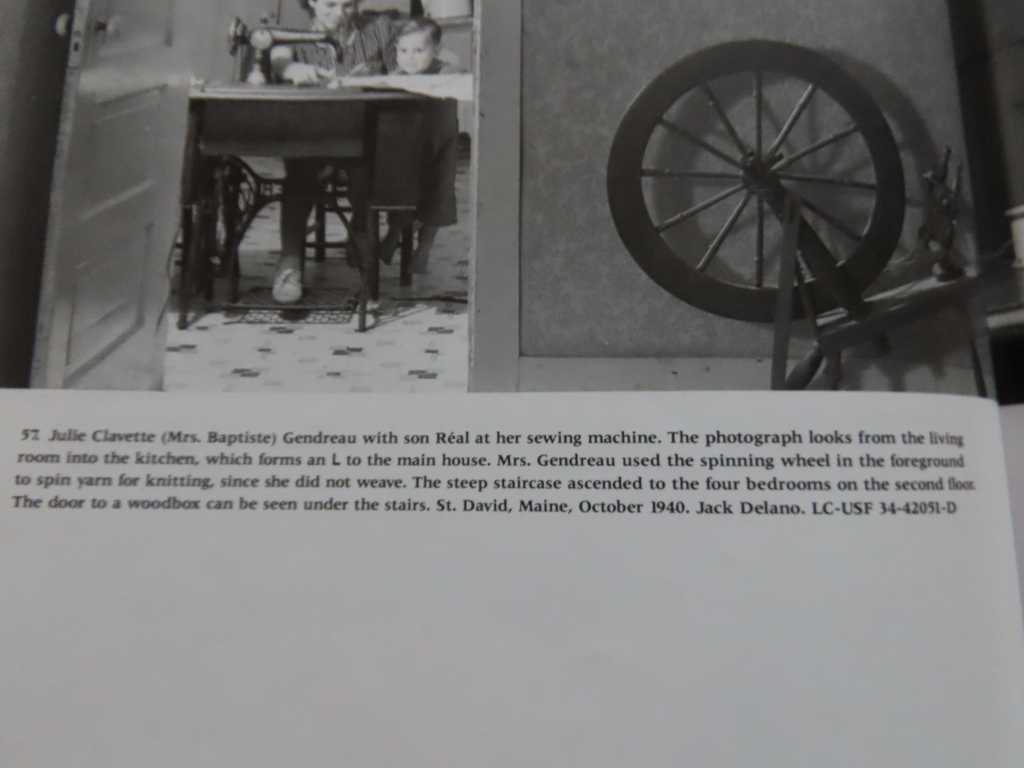
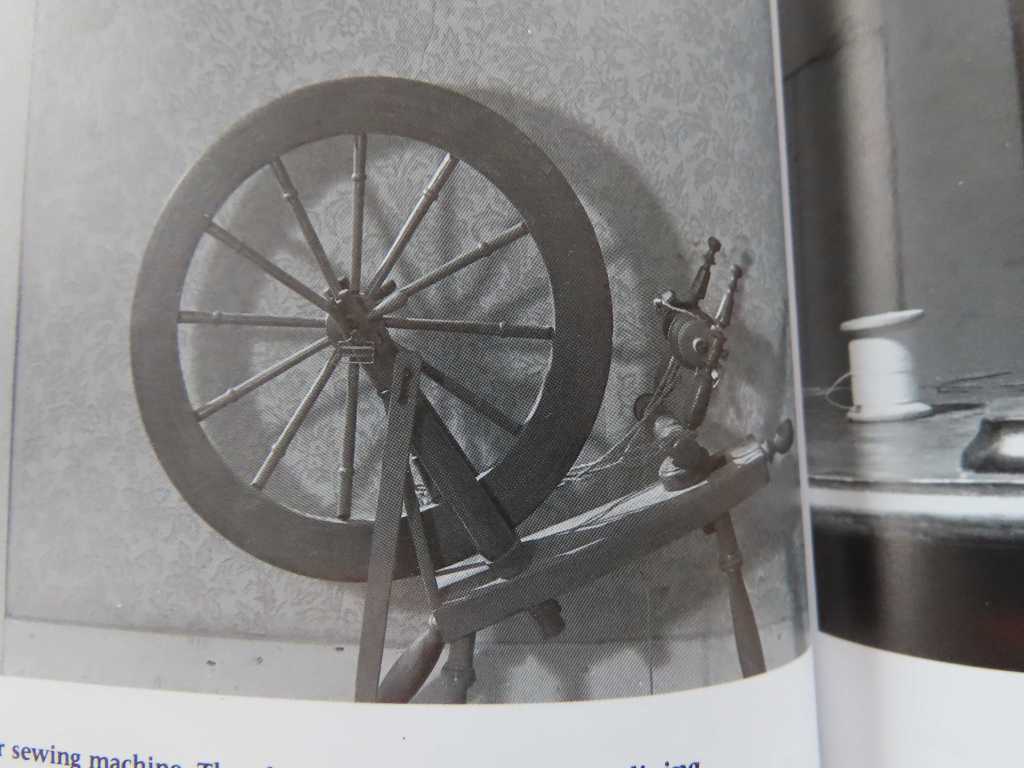
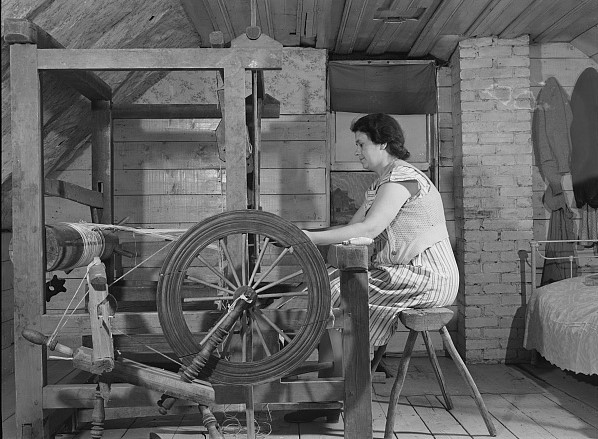
Included in her document are the photos above, from the Madawaska Historical Society’s records, of various wheels from the region. In addition, in the 1940s, the Farm Security Administration sent photographers to the region, whose photos are included in a book “Acadian Hard Times.”
Emma Gagnon, near Fort Kent, Maine, From the Library of Congress Farm Security Administration, Prints and Photos online catalog
It includes several photos of the hand spinning and weaving that was still going on in the area. While no two wheels in these photographs are the same, many share common features, including, most noticeably, the tiered maidens.
From “Acadian Hard Times,” citation below
Oddly, my wheel, Philomene, does not have those maidens, but a different style, which showed up on this area wheel.
Close up of previous photo, showing maidens like Philomene’s
The photo below shows a wheel with some unique features shared with Philomene.
This wheel, adapted for use as a winder, perhaps, has the same angled table sides and under-table turnings as Philomene. Photograph of Marie Albert Dumond, Lille, Maine 1940
I do not know whether either of the wheels pictured above were made by Thomas, but clearly, they do not have the elaborate, exuberant details of Philomene. So, I assumed that my wheel was a one-of-a-kind made for some special person or celebration. I was wrong.
Recently I had lunch with some spinning wheel friends and met Diane Howes, a weaver, spinner, and wheel collector from New Hampshire. She is looking to sell some of her wheels and had some questions about them. I was flabbergasted when the first thing she asked about was a wheel marked “T. Michaud,” because I was not aware of any other wheels with his mark.
Diane’s wheel
When she said it was a really fancy wheel with beautiful wood, I about jumped out of my chair with excitement.
Diane’s wheel is marked with T Michaud on the top of the table, Philomene is marked with Thomas Michaud on the top and side of the table
Diane’s wheel, which she got from collector Sue Burns (Diane says it was one of Sue’s two favorite wheels), is a sister to mine, except for the maidens.
Unsurprisingly, the maidens on her wheel are in the classic style of the valley. As with Philomene, Diane’s wheel is made primarily with birdseye maple.
This rare wood is found in the area and has long been valued for furniture-making there.
Very occasionally antique wheels have some small parts made of birds-eye maple, but these two wheels are the only ones I have come across made almost entirely from this heavy, hard, durable, but oh-so-lovely wood.
Diane’s wheel has some even fancier turnings than mine.
And hers has no hole in the table.
These close-to-the spinner holes—not in the place typical for distaffs–have long been a subject of discussion, with theories that they likely were for a distaff or a water bowl.
Philomene’s hole on the table
Most Quebec wheels do not have them, with the exception of the family of mystery giantess wheels discussed in the blog post “Olympe.” They have been found in wheels associated with the Acadians, however, where a bowl, called a “godet,” could be inserted.
It has usually been assumed that the bowls were used for water for flax spinning, but they seem also to show up on wheels that likely were used for spinning wool. This photo I recently ran across of a woman spinning wool with a bowl sitting on the wheel’s table seems to suggest that the bowls might also have been used for grease or oil for wool spinning.
Juliet Gaultier de la Verendrye with woman at spinning wheel–Canadian Museum of History
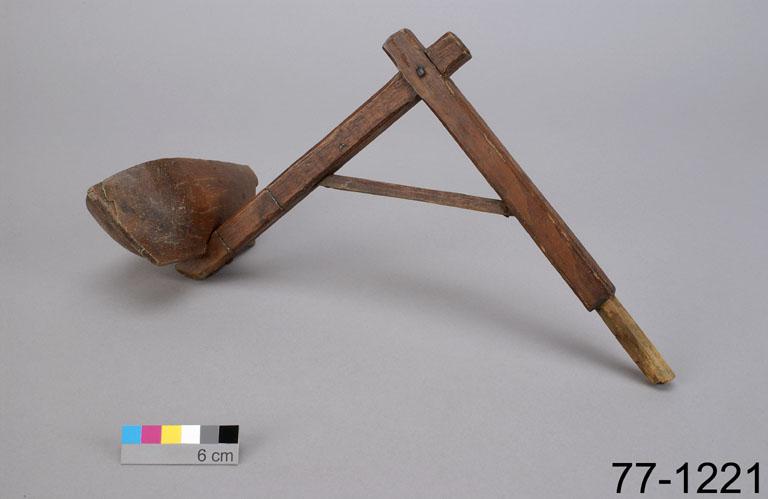
Here are a couple of examples of “spinning wheel bowls” found in the Canadian Museum of History’s online collection.
I do not know if Philomene spun flax, wool, or both, but the treadle, even though made of very hard maple, is smoothly worn down from years of use and one flyer arm has an old repair.
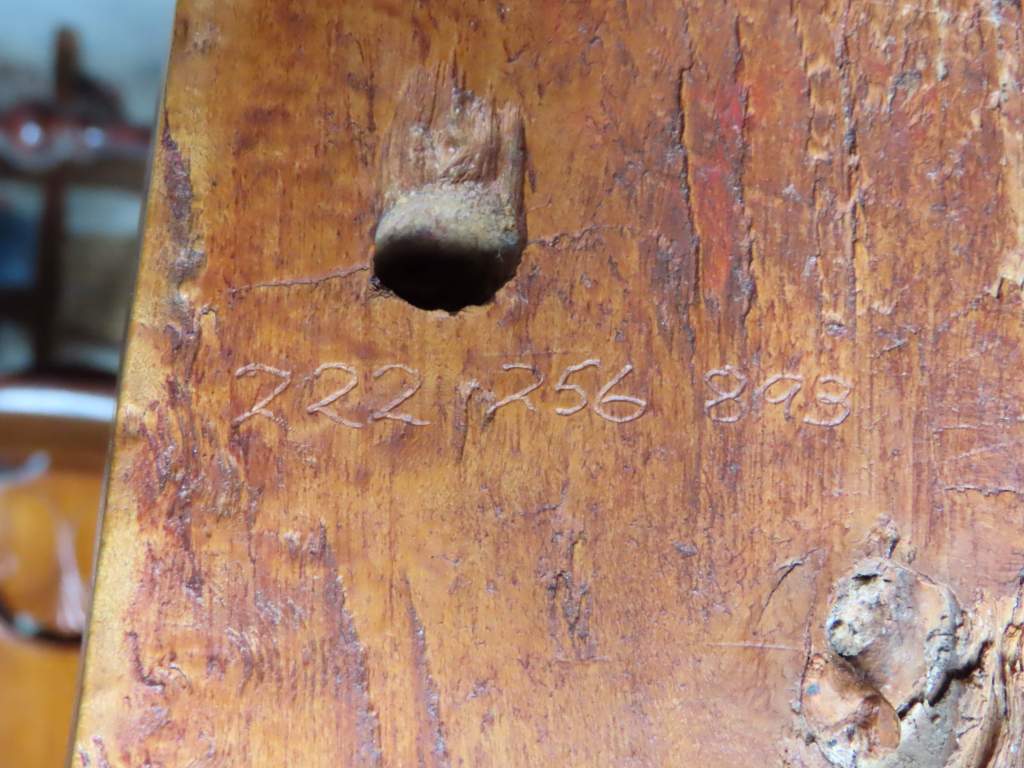
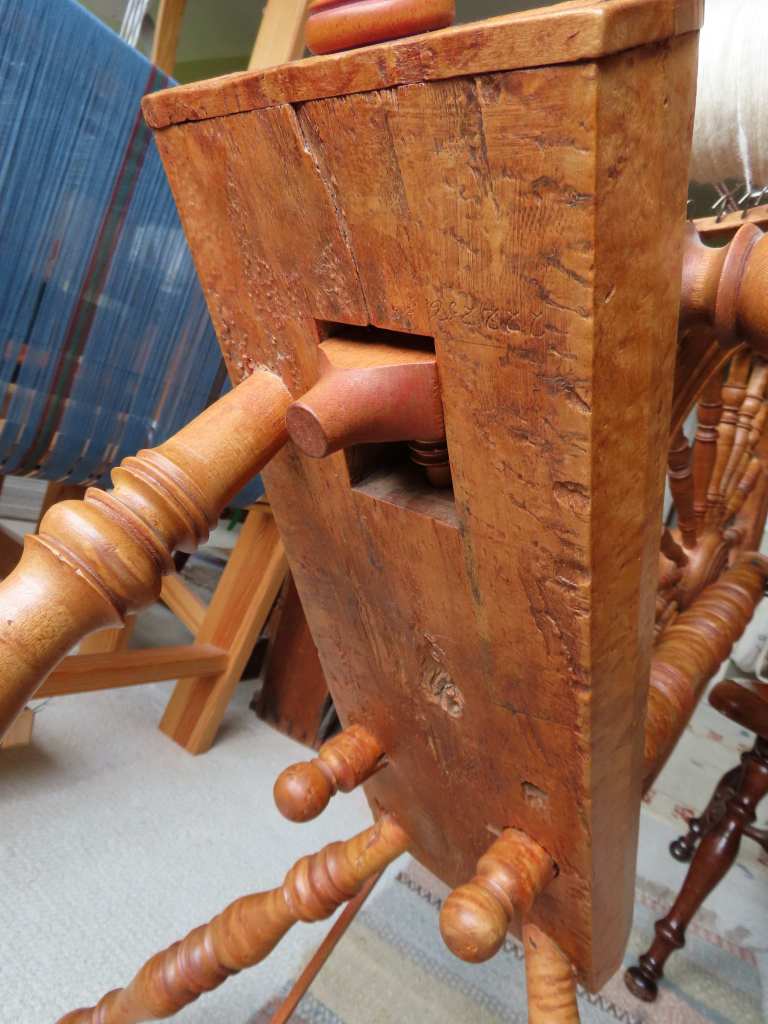
At some point, Philomene must have been in a museum, because there is an accession number carved in two places on her underside.
Little did I know when I first saw a photo of this wheel up for auction that it would open up a whole fascinating world learning about the Upper St. John River Valley and its spinning and weaving tradition.
The wheel itself has turnings similar to Quebec Paradis wheels,
hints of Scottish influence in the stance, size, and spokes,
a possible Acadian touch with a place for a water dish, and several unique features of its own, such as the treadle and angled table sides.
Scribe marks
The combination makes for a wheel that is distinctive to the Upper St. John River Valley and its people. As for Thomas Michaud, aside from census records, I was not able to find any information about him.
The maker’s mark on the table top is very faint
He does not appear to have married and I could not find a record of his death. Fortunately, he left us some remarkable wheels.
Thanks to Diane Howes for the photos of her Michaud wheel, to Carolyn Foty and the people on Ravelry for the research and photos of the Hubade Michaud wheel, to Patrick Lacroix, Director of Acadian Archives at the University of Maine in Fort Kent, and to Gordon Moat for his kindness (as always) in picking up this wheel and getting it to me.
References:
Craig, Béatrice, Spinning wheels in the Valley documentation (15.13.7), Ready Reference files, Acadian Archives/Archives acadiennes, Fort Kent, Maine
Craig, Béatrice, Rygiel, Judith and Turcotte, Elizabeth, Survival or adaptation? Domestic rural textile production in eastern Canada in the later nineteenth century*
Acadian Culture in Maine, North Atlantic Region, National Park Service, 1992
Cook, Jane L., Coalescence of Styles, The ethnic Heritage of St John River Valley Regional Furniture, 1763-1851, McGill-Queen’s Univ. Press, Montreal, 2001
Doty, C. Stewart, 1991 Acadian Hard Times: The Farm Security Administration in Maine’s St. John Valley 1940-1943. Orono, Me.: University of Maine Press, 1991









































































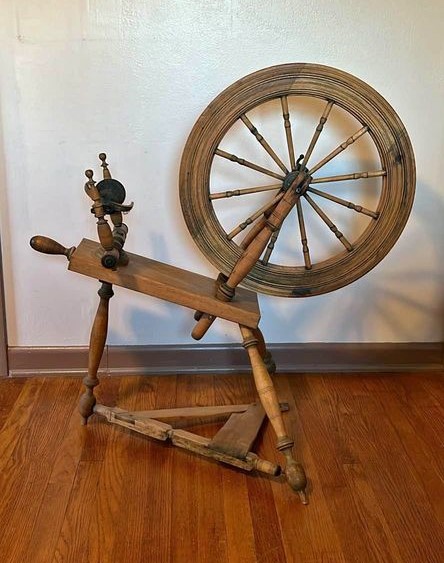

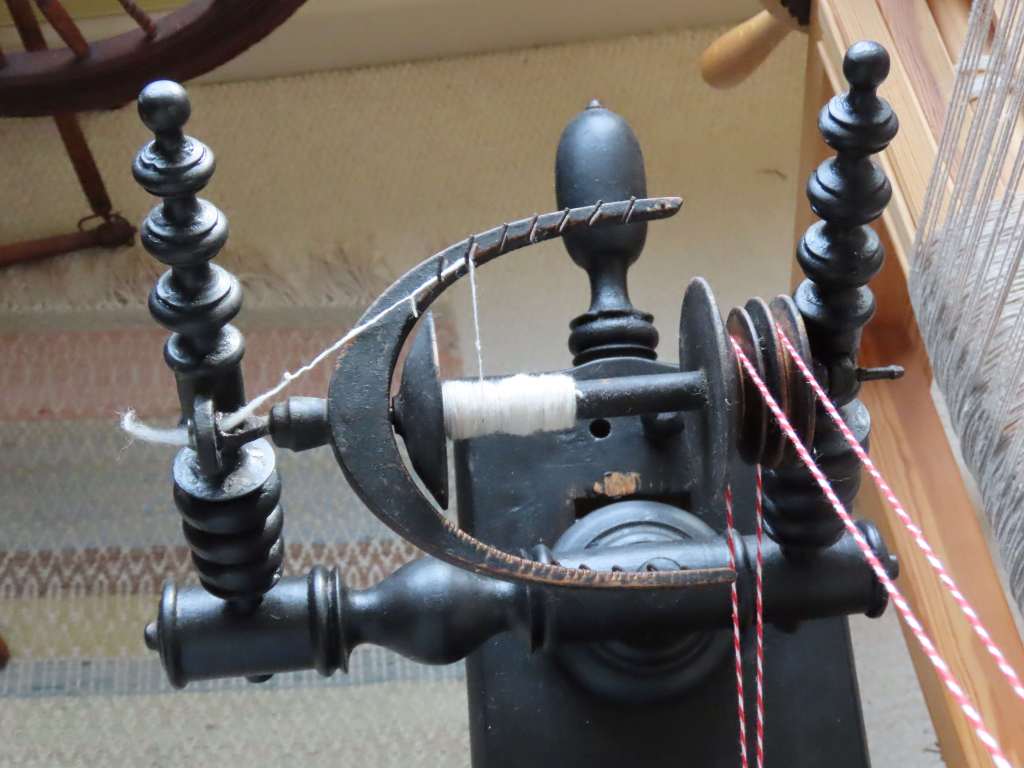
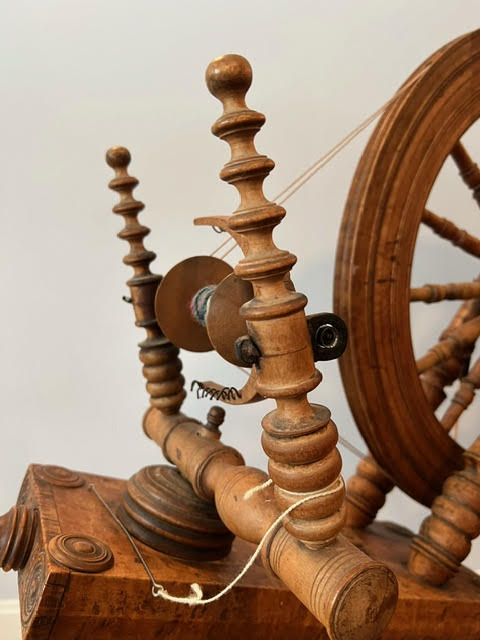
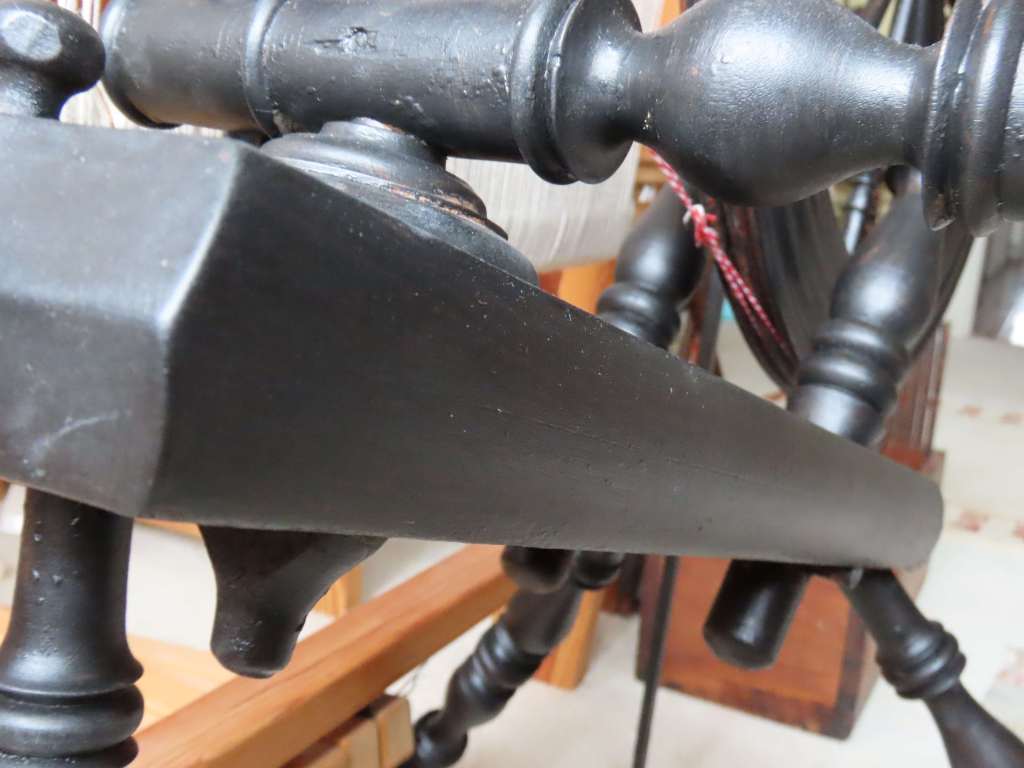










 Exquisite Machinery