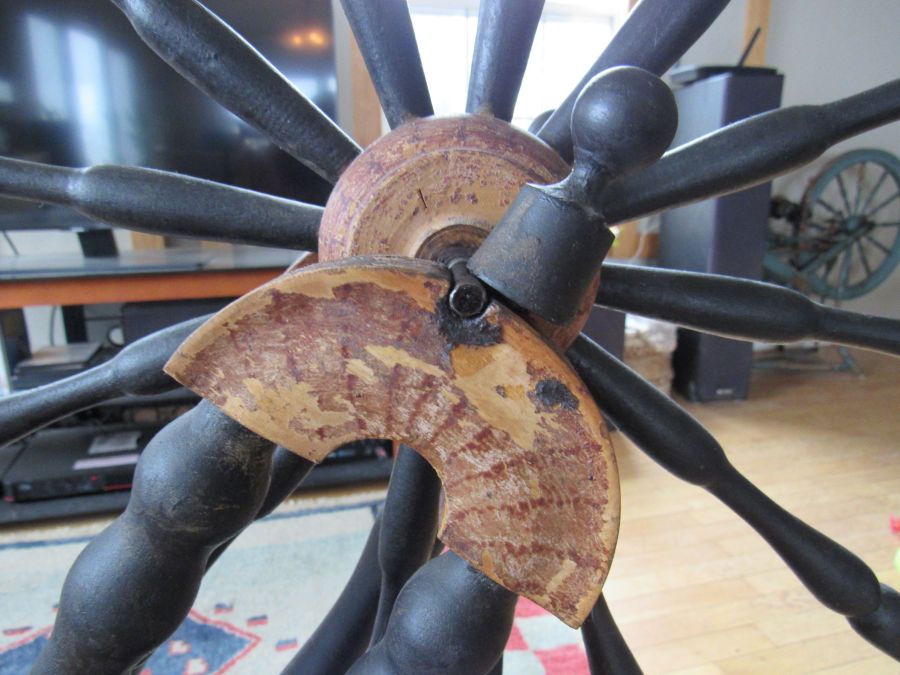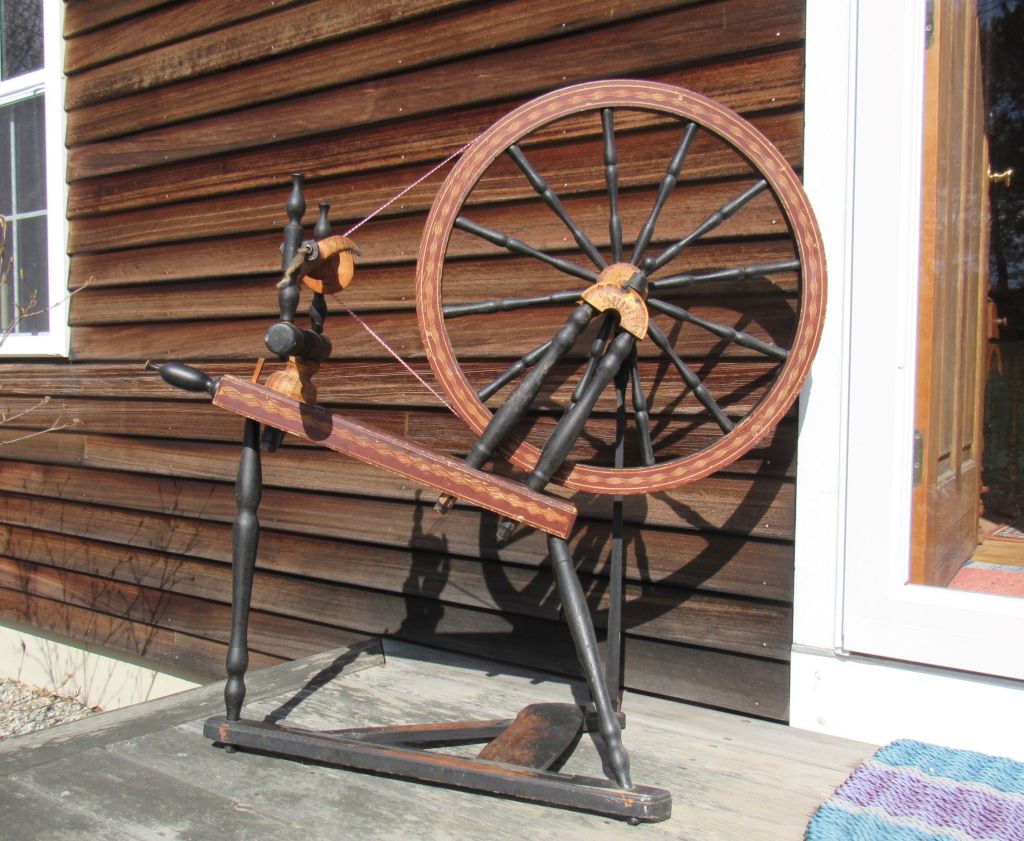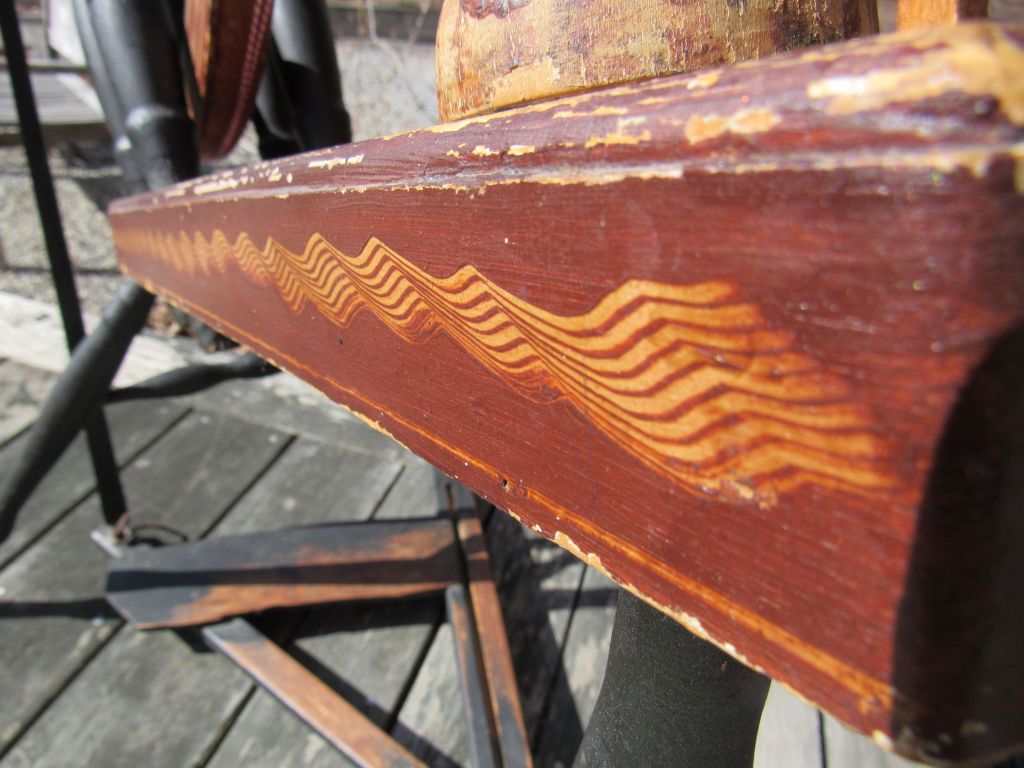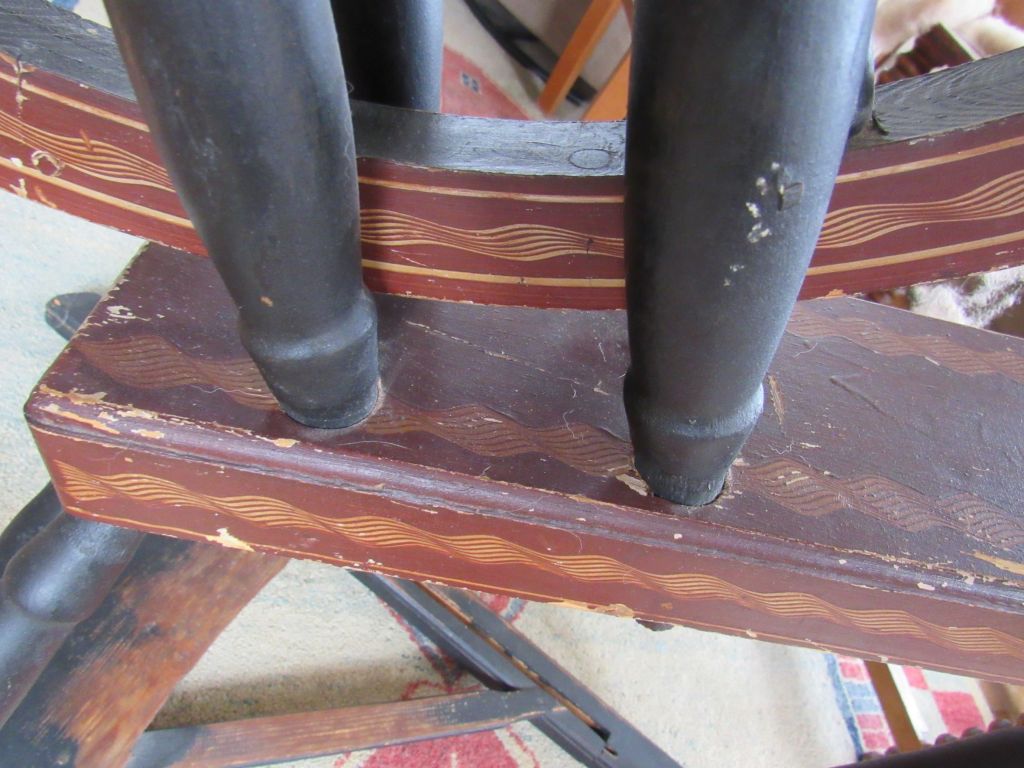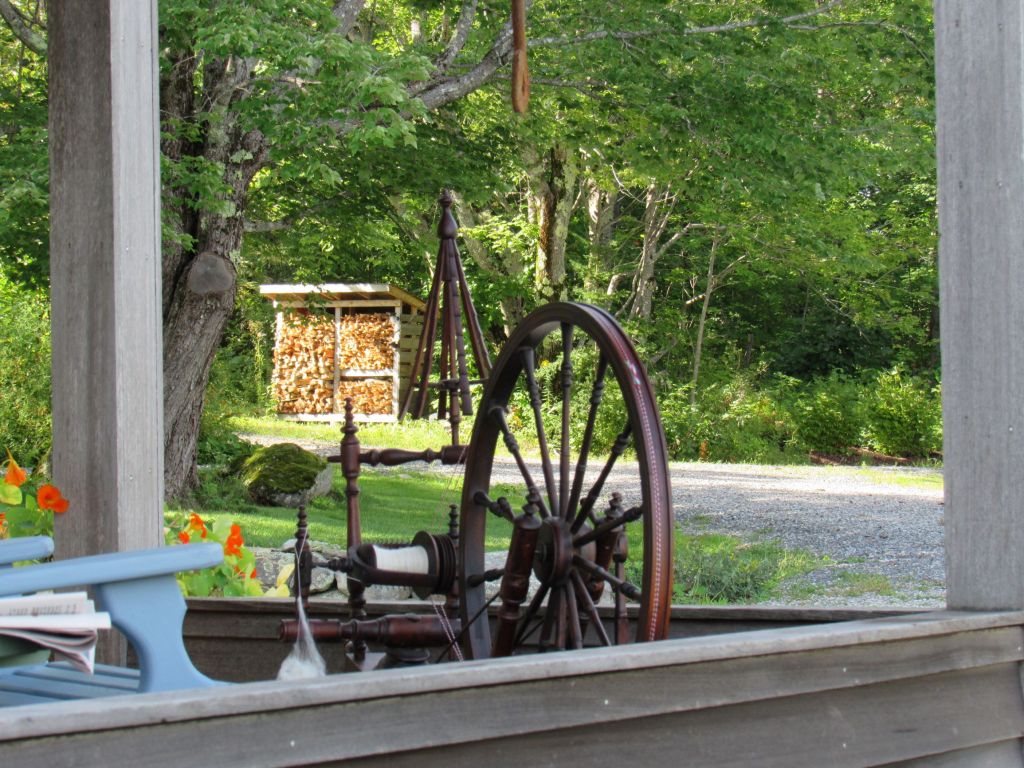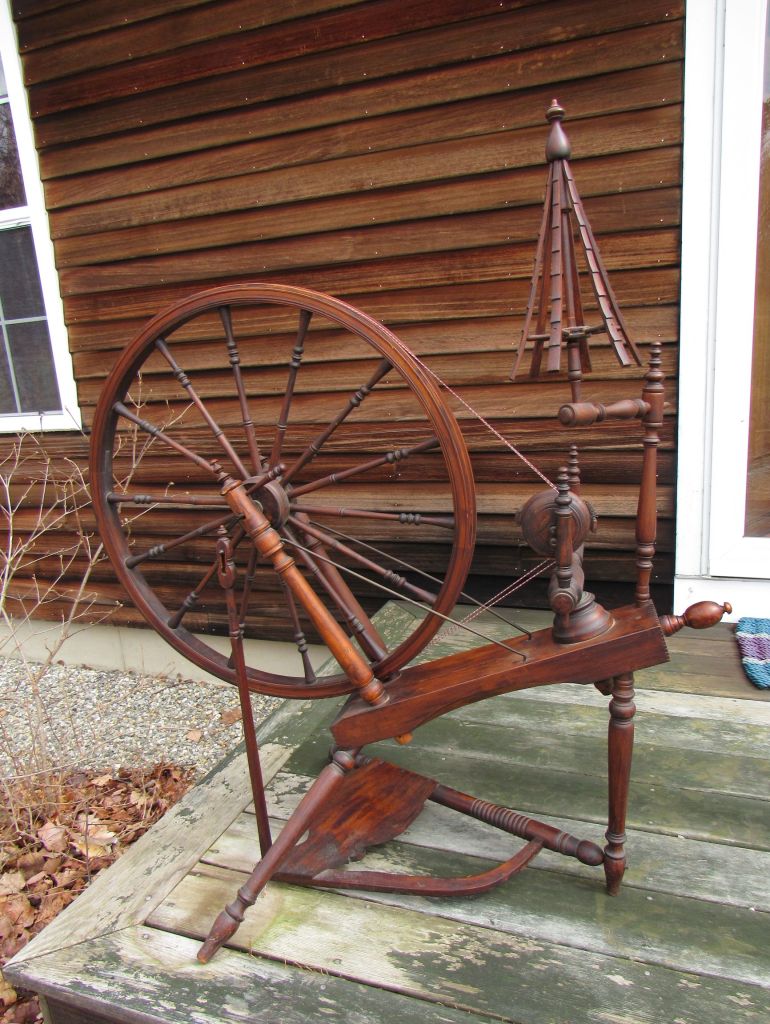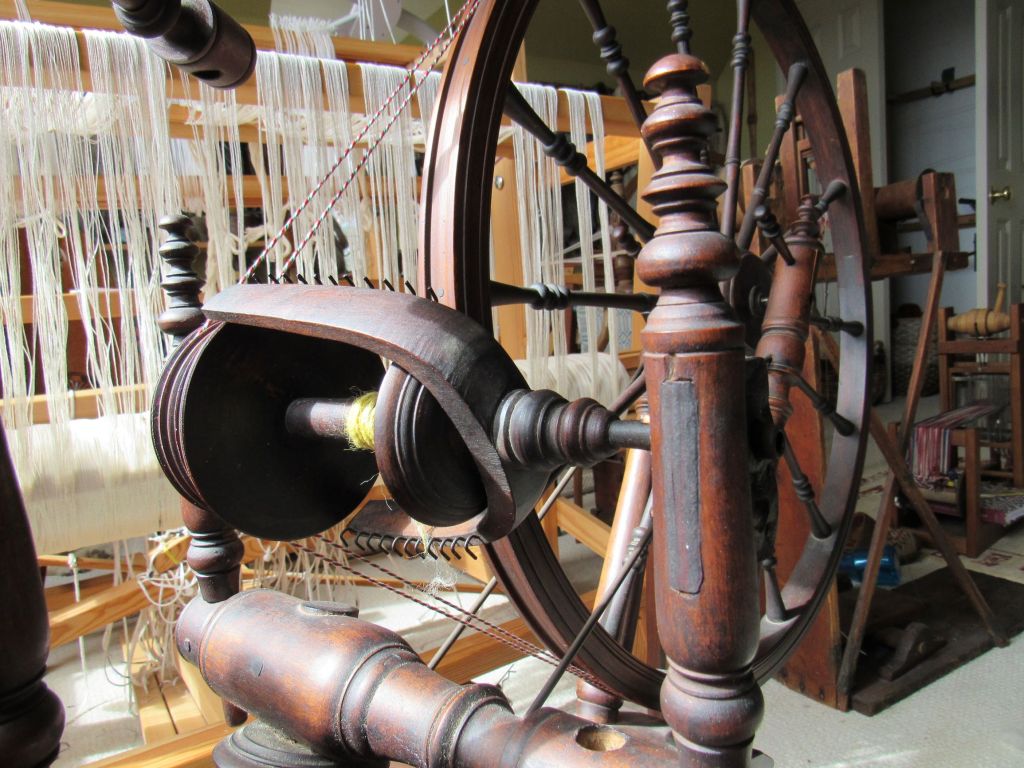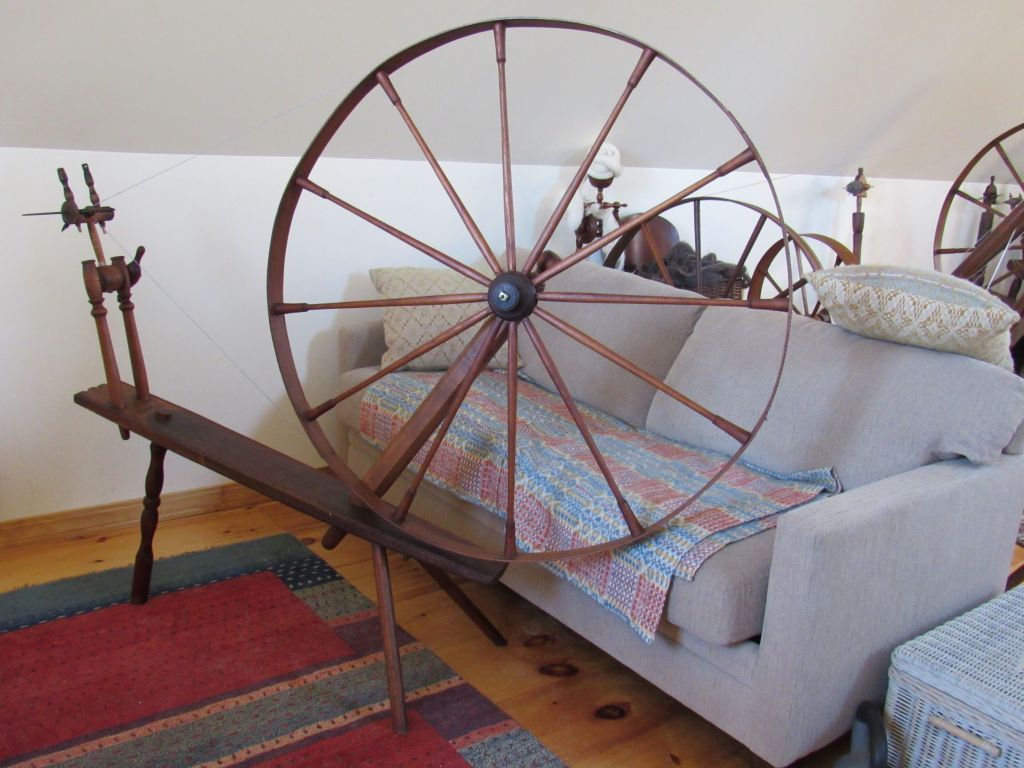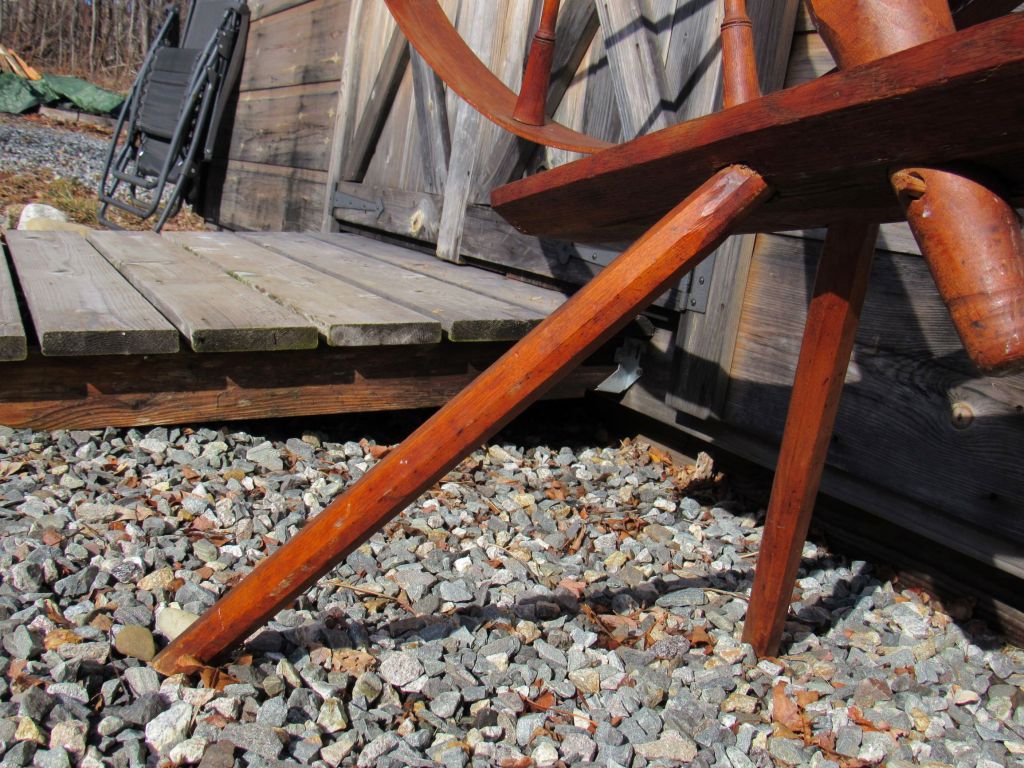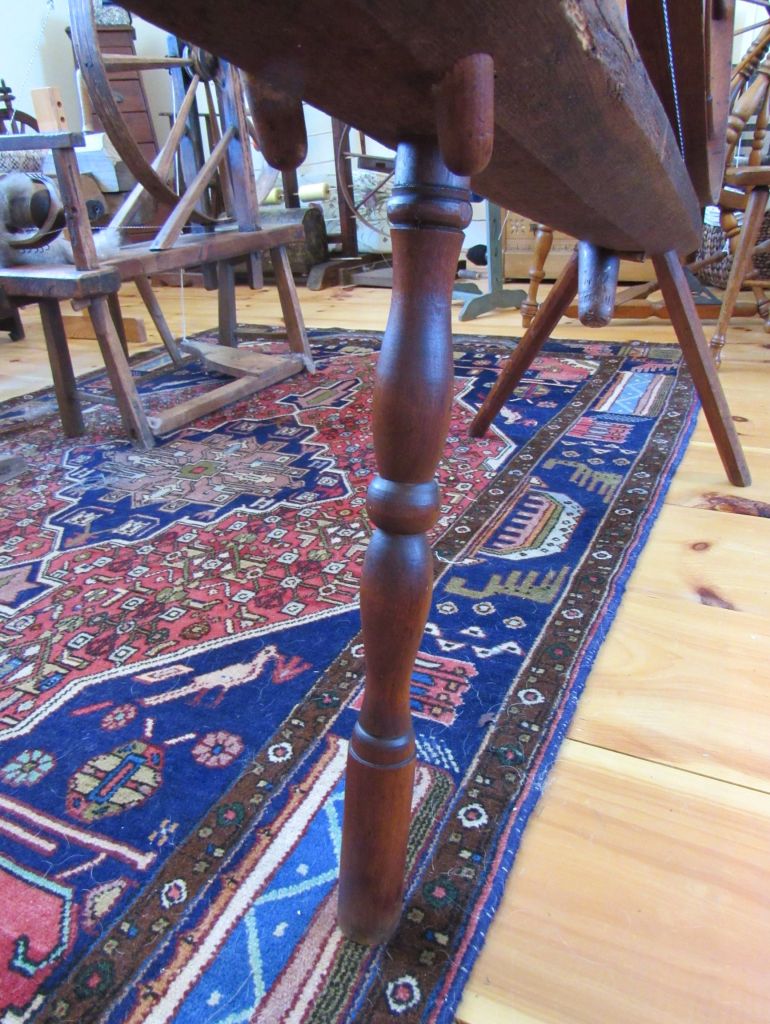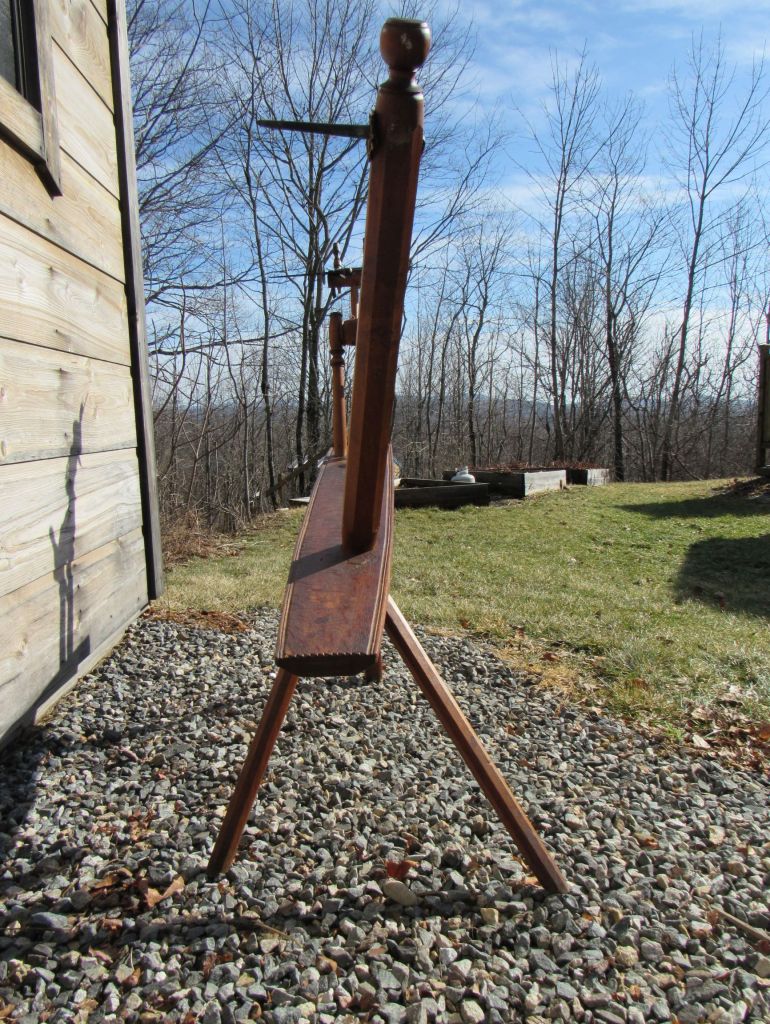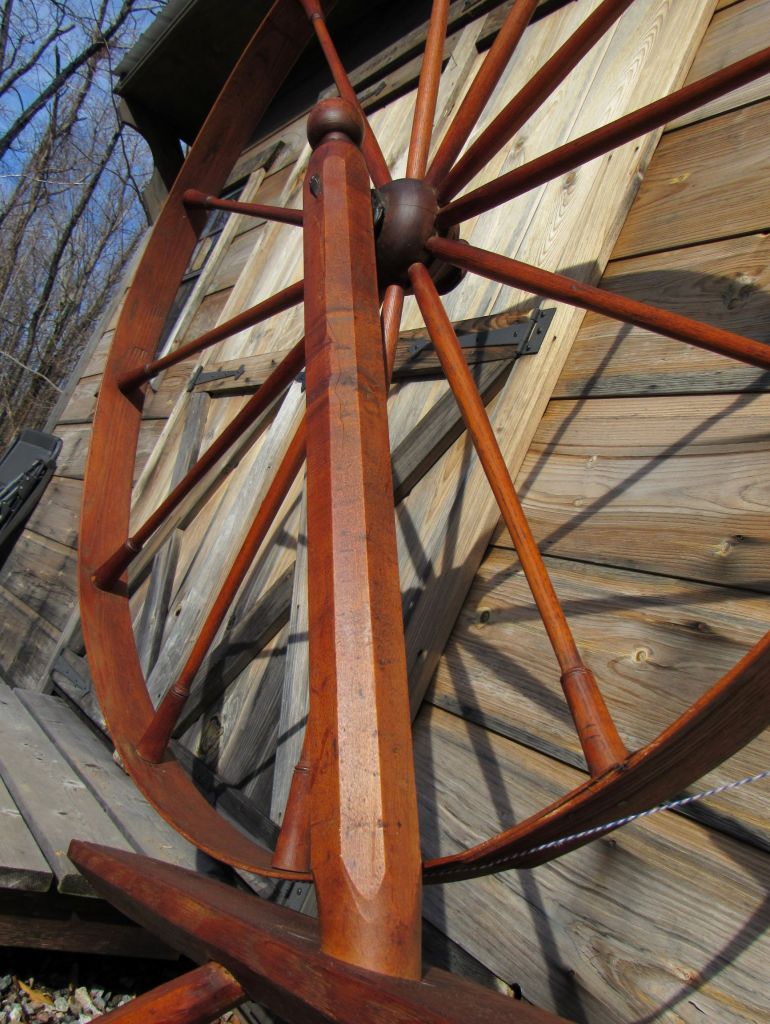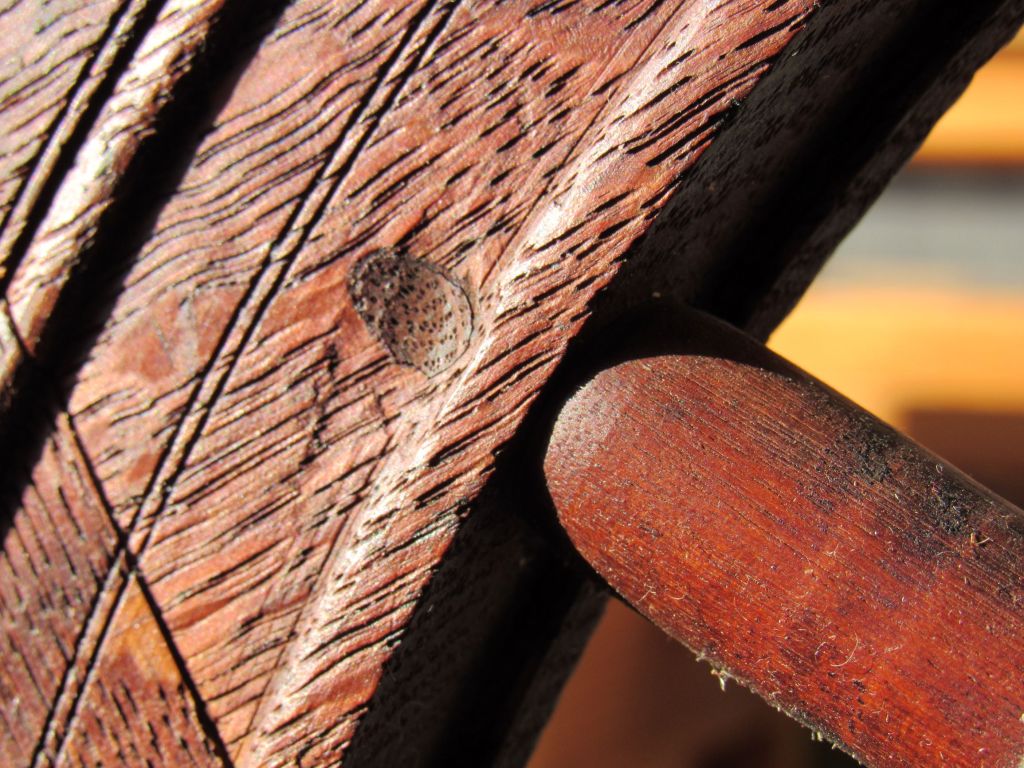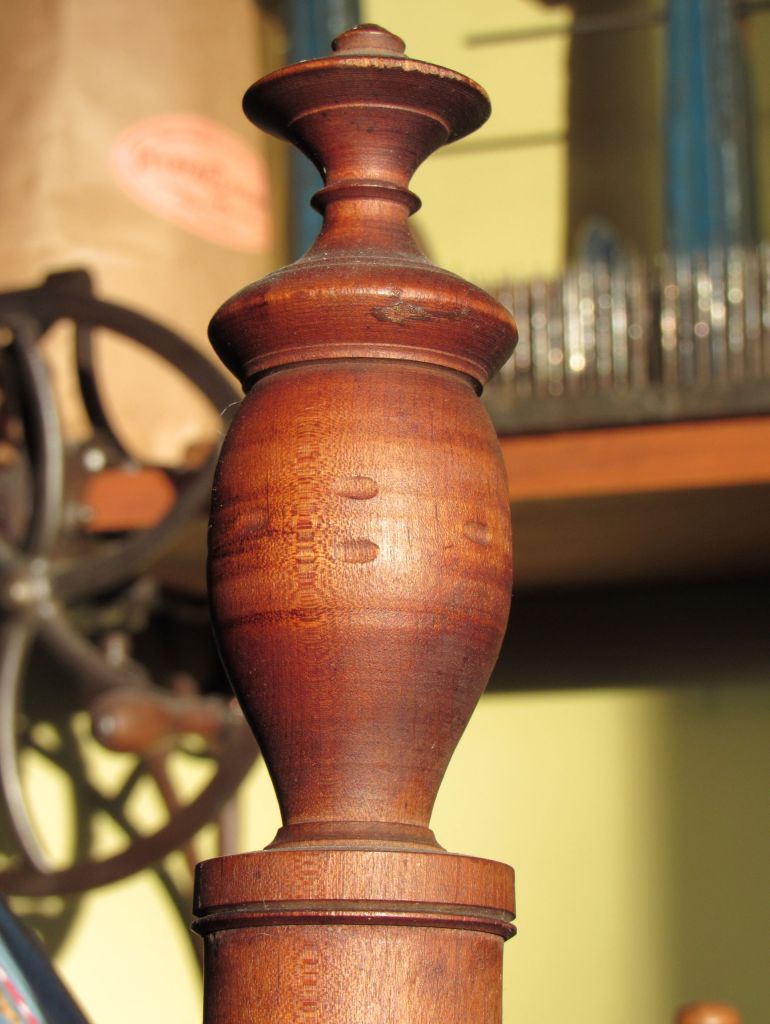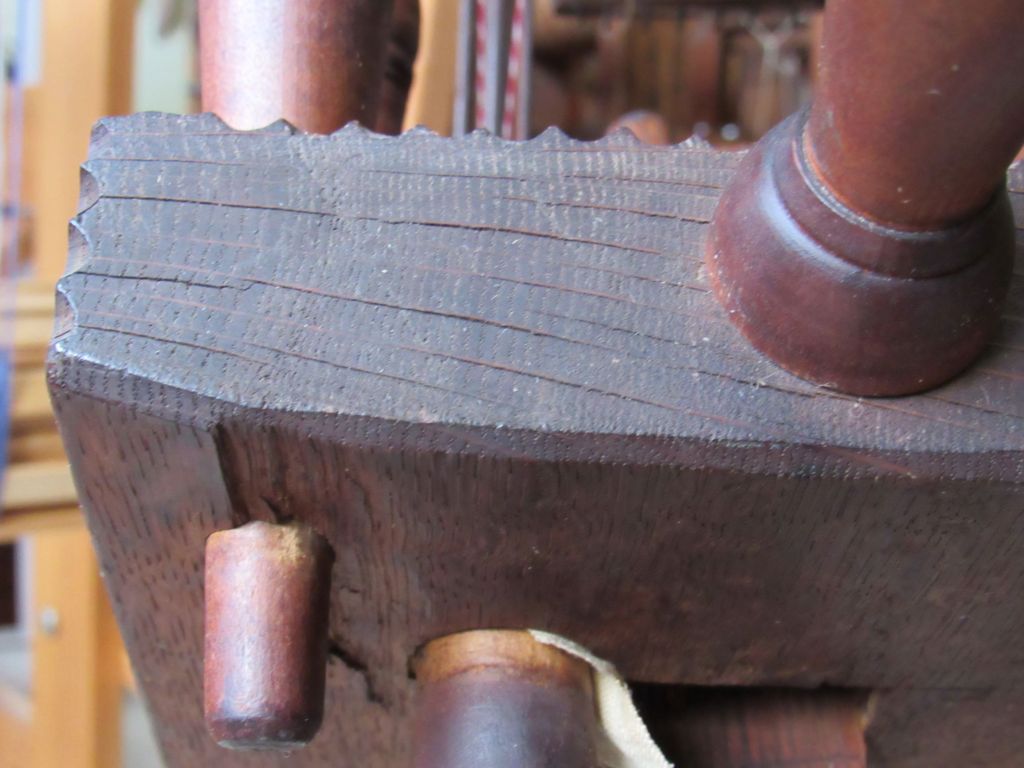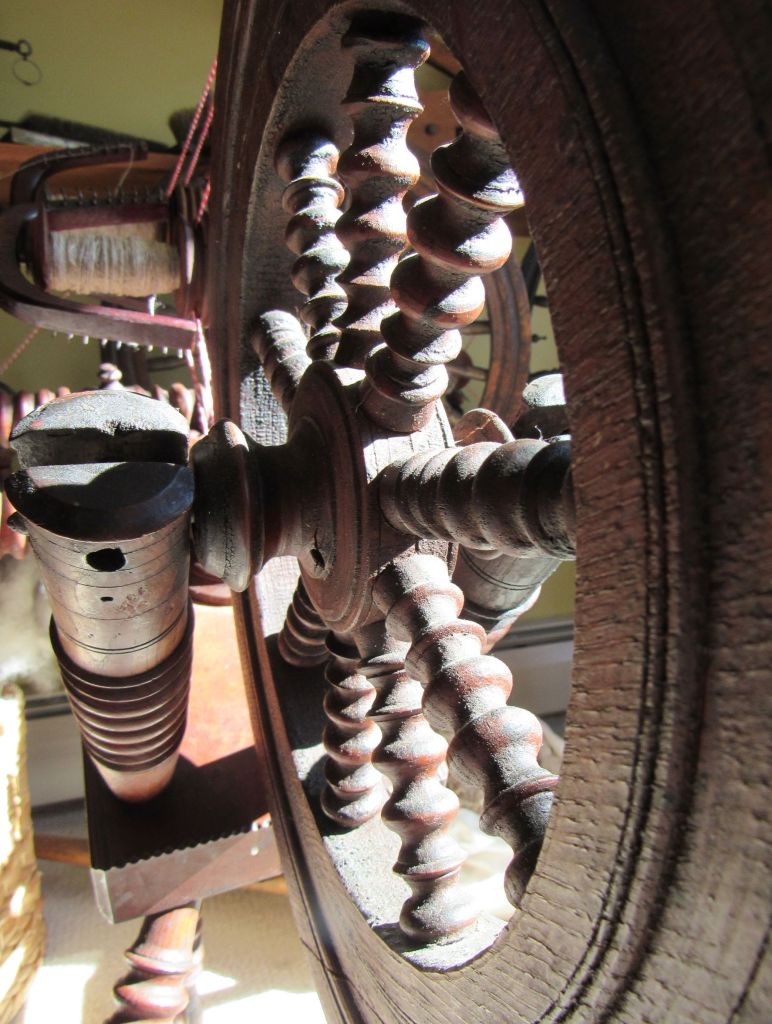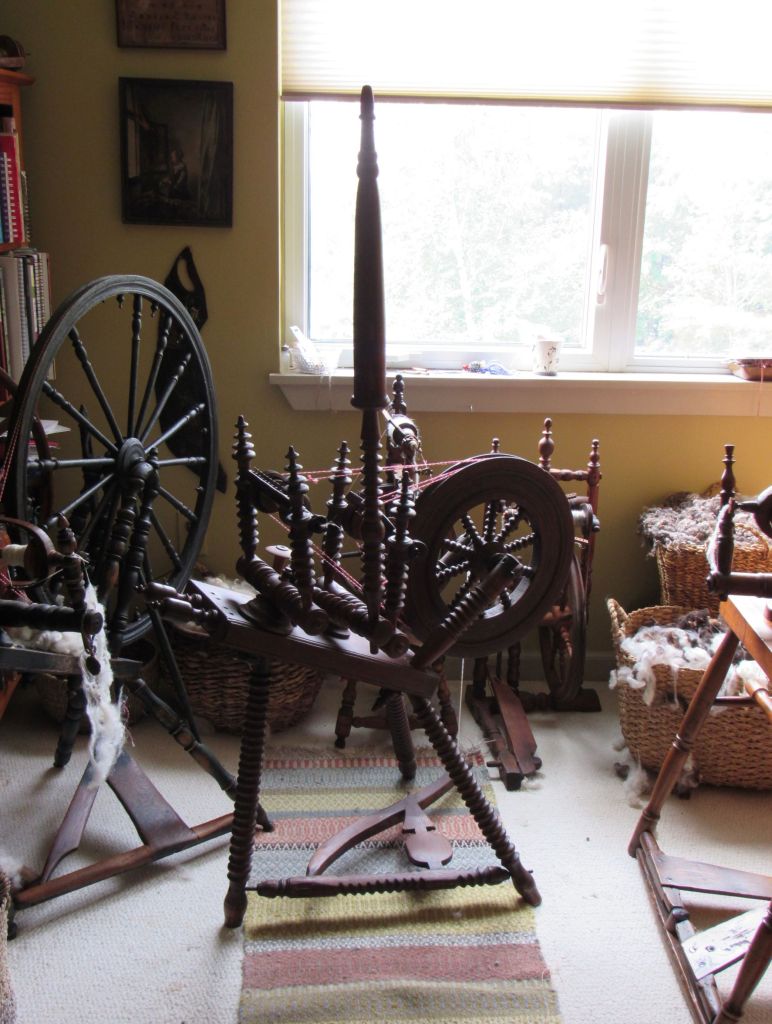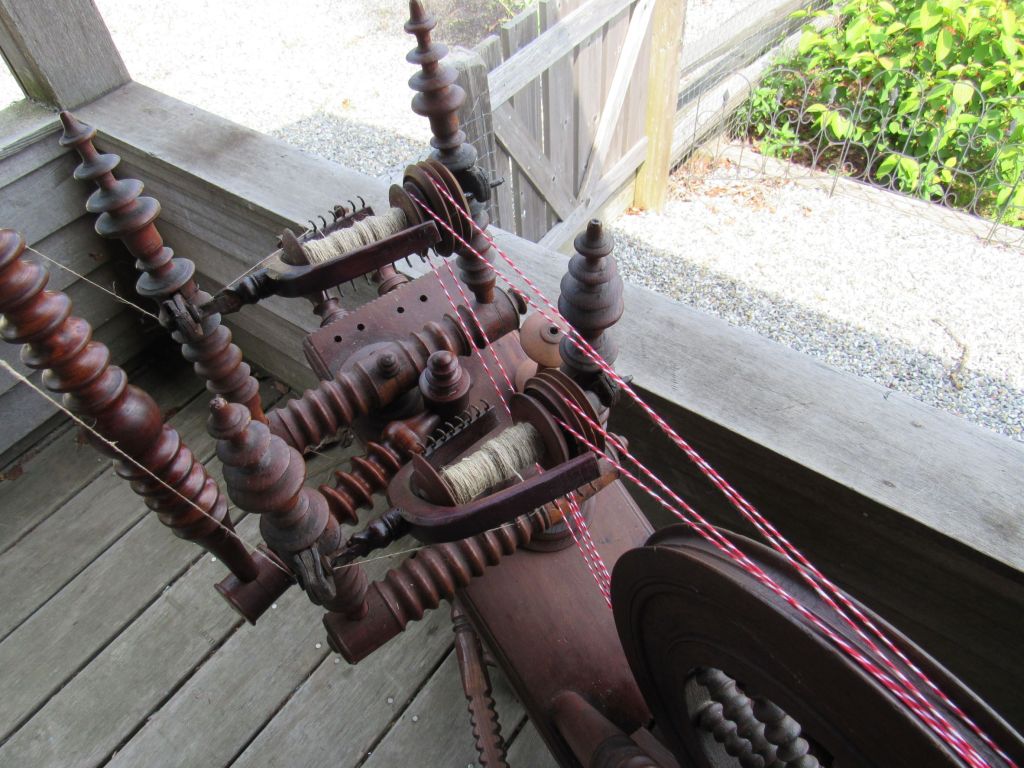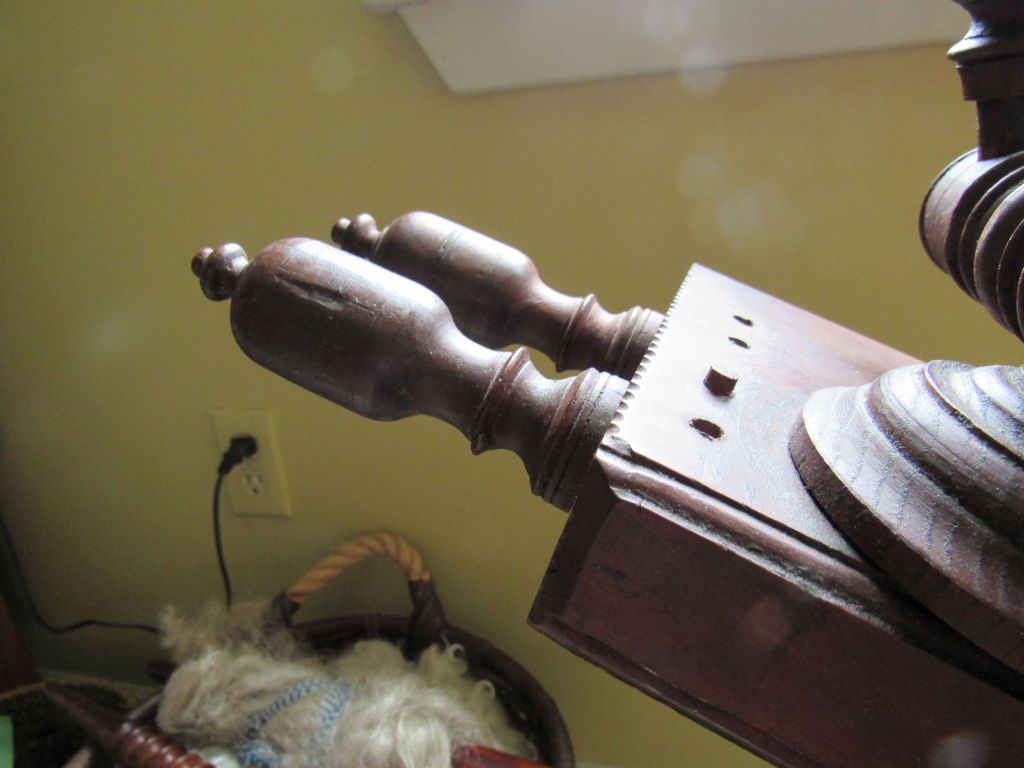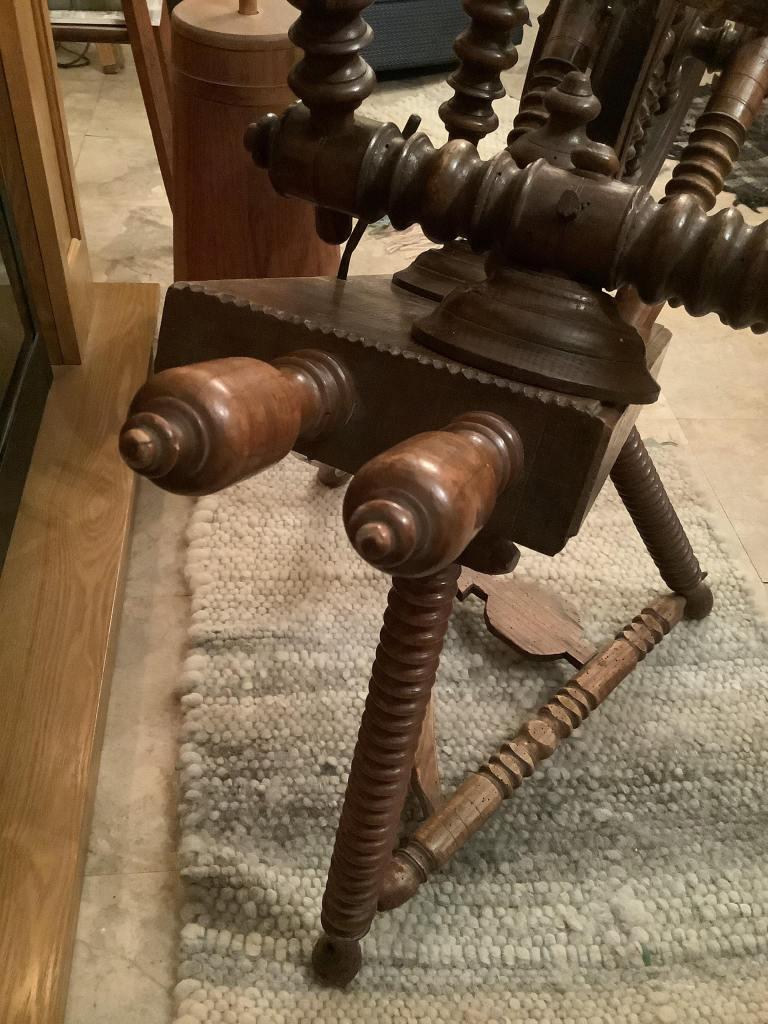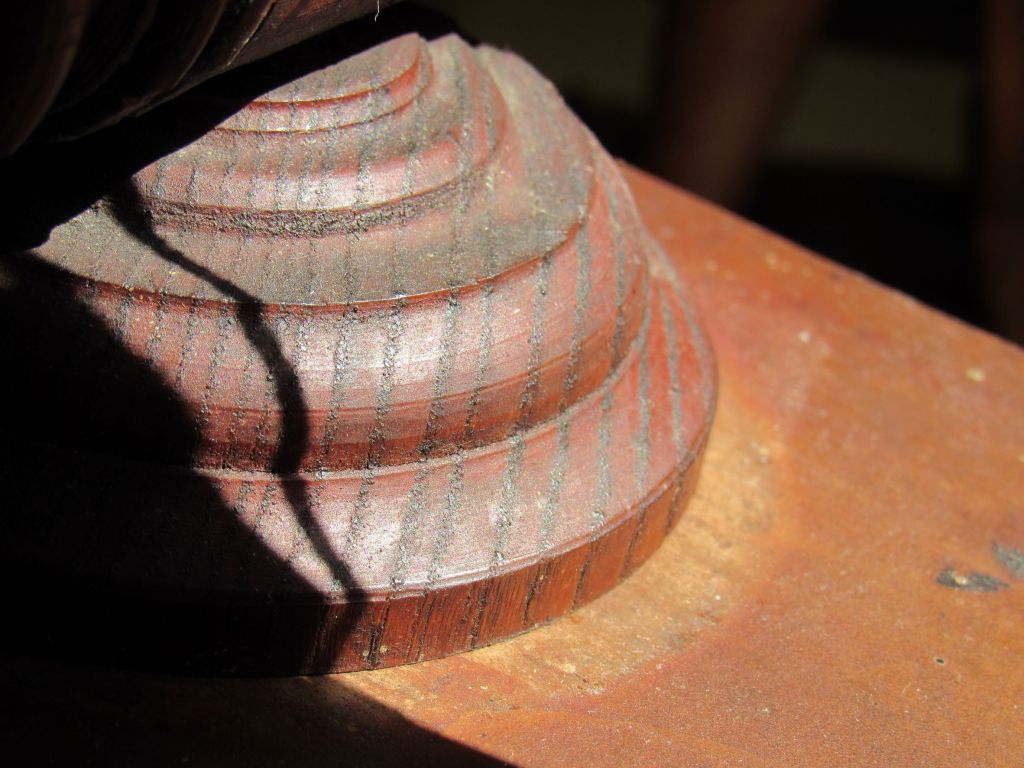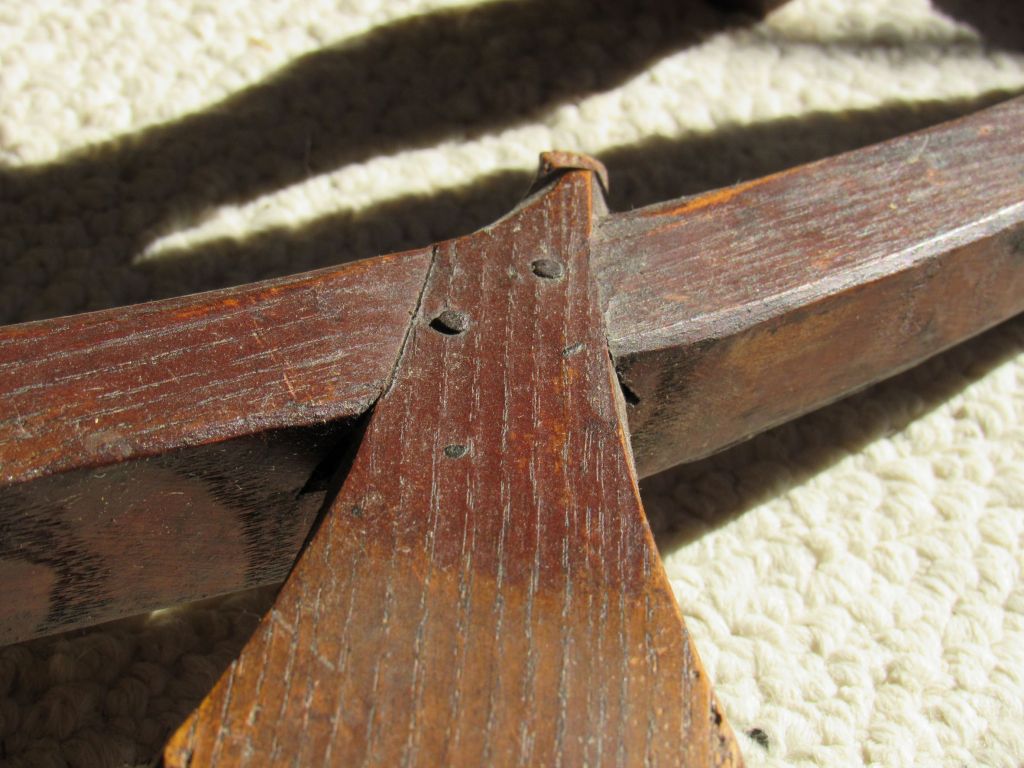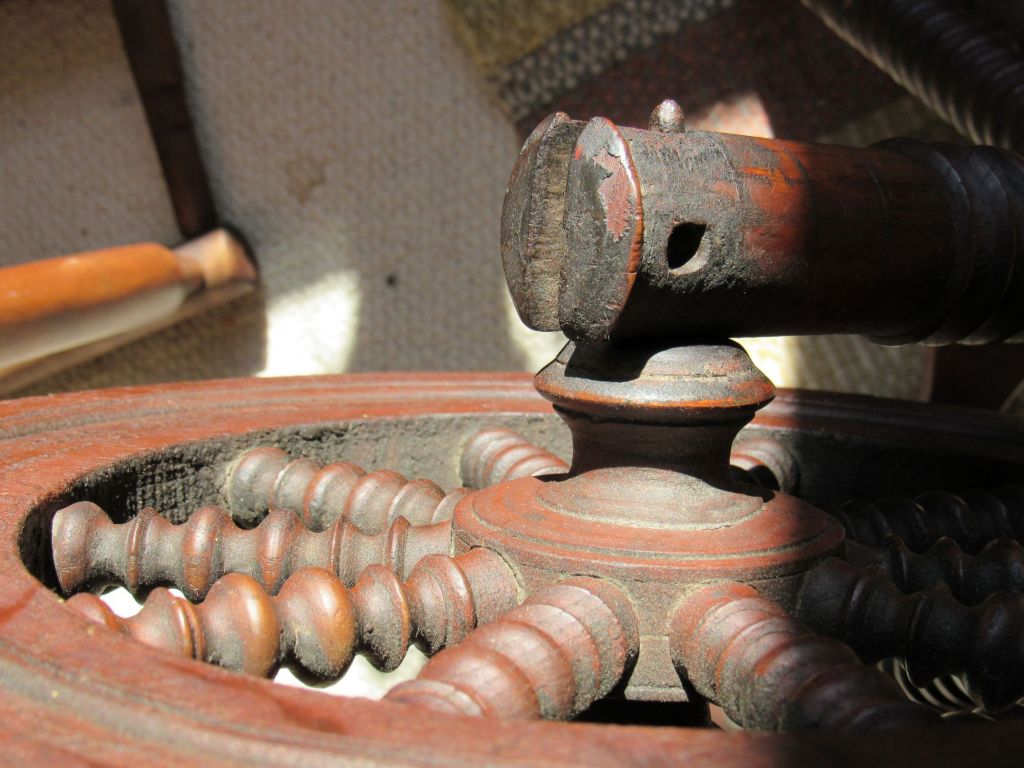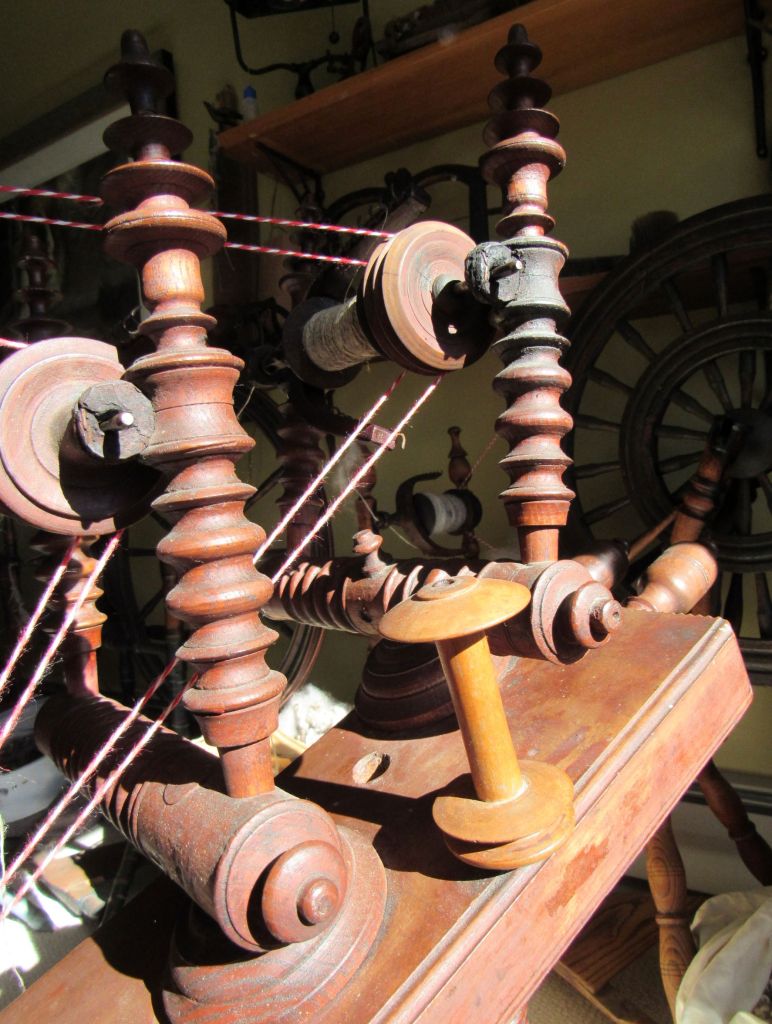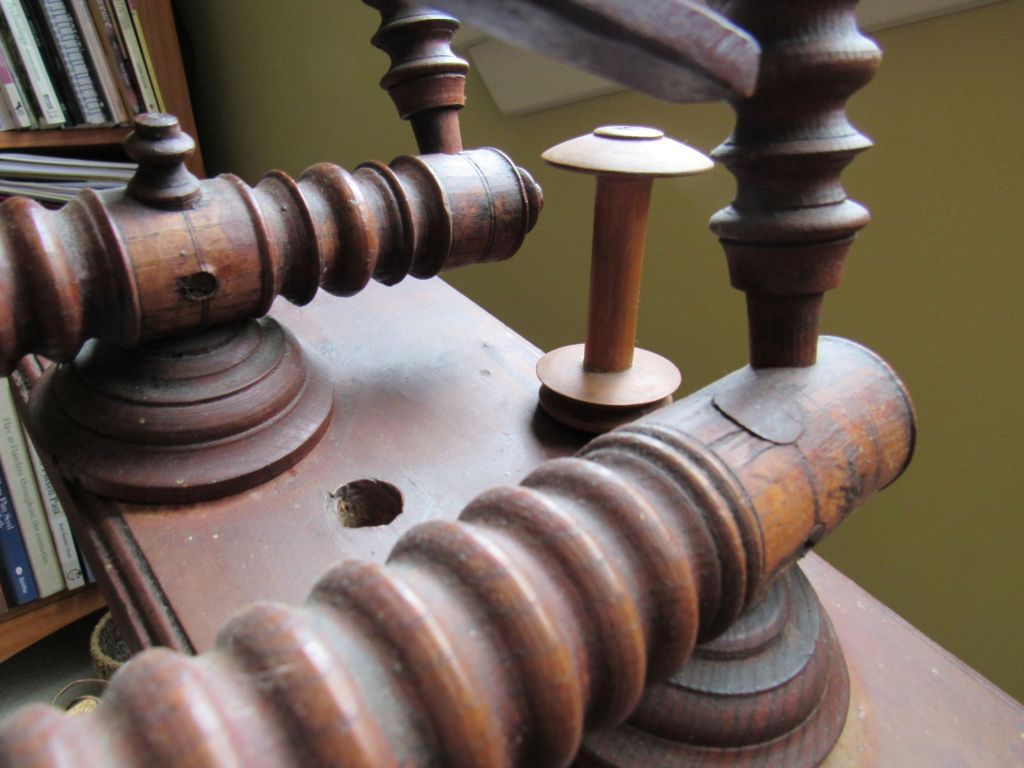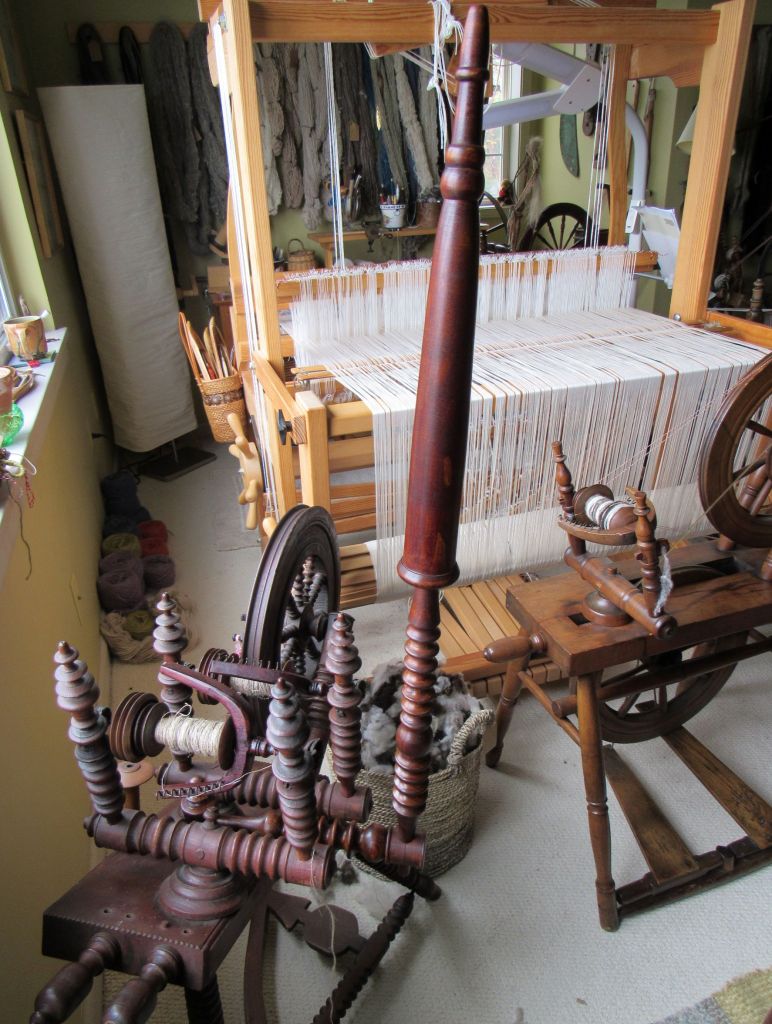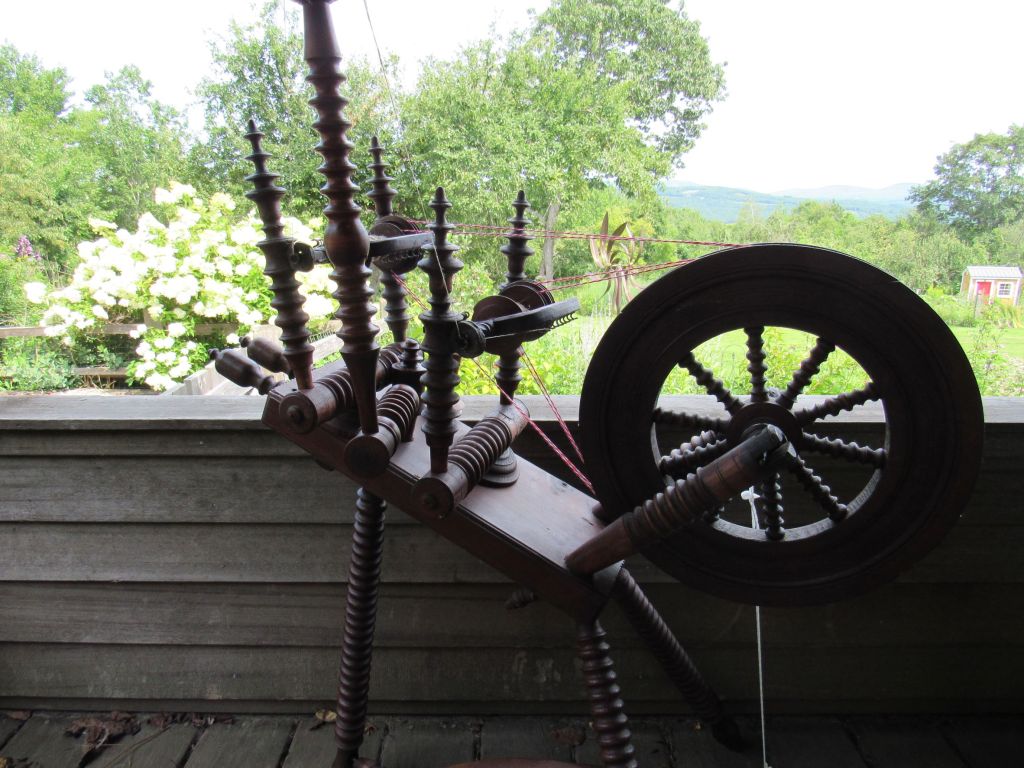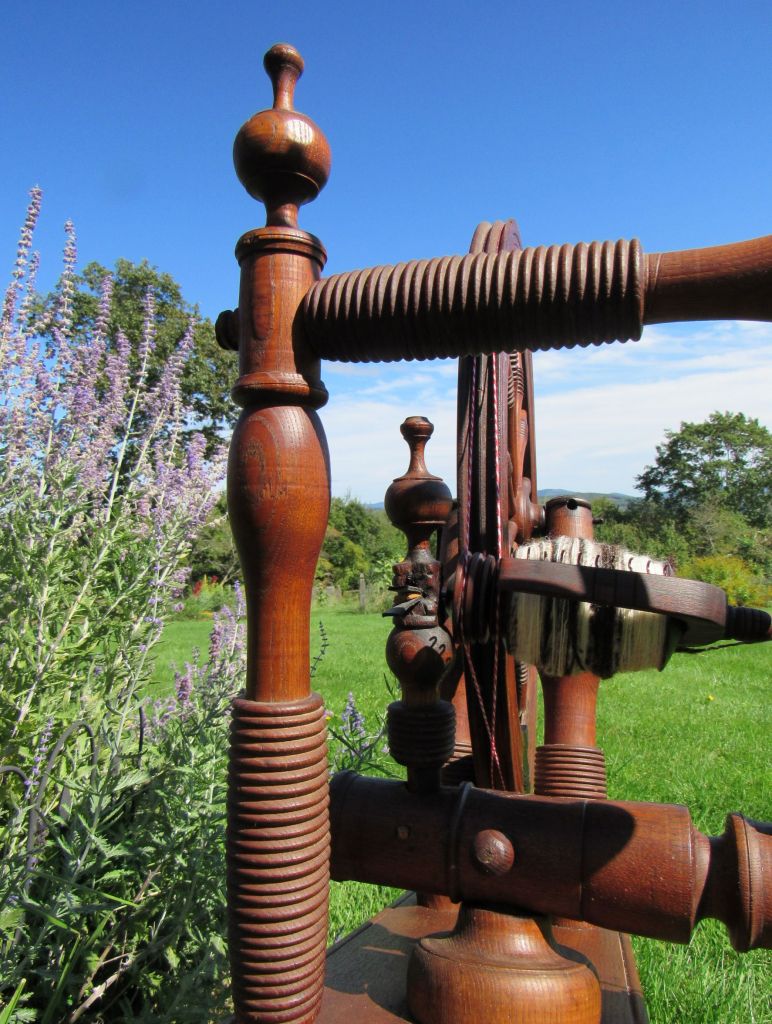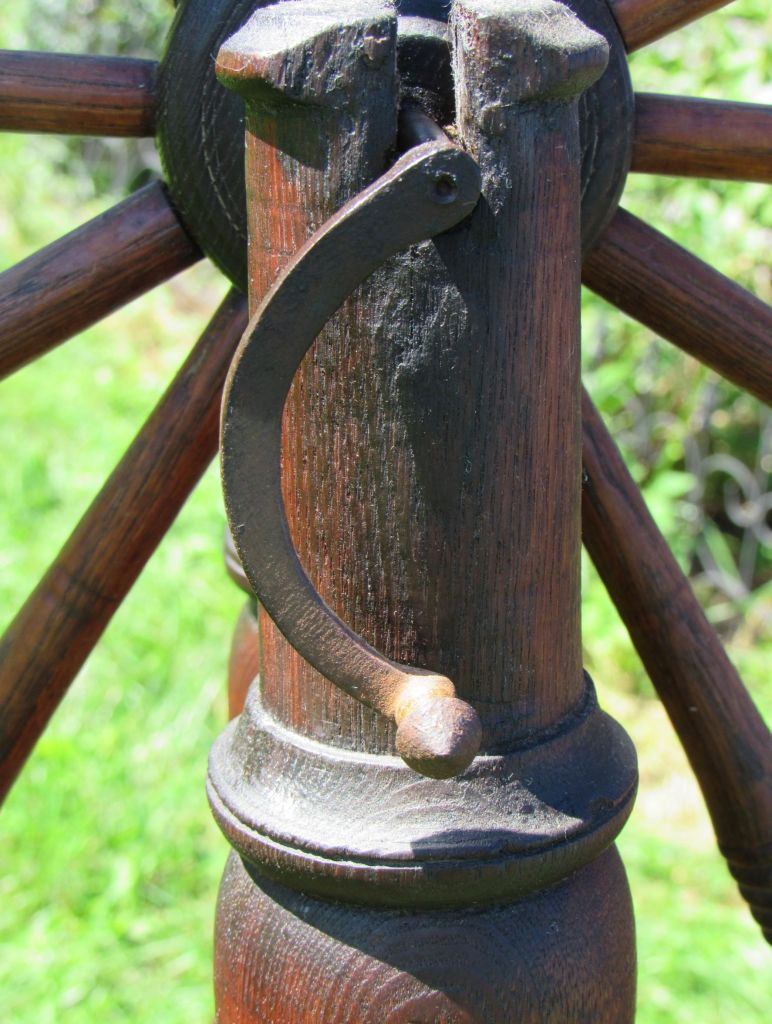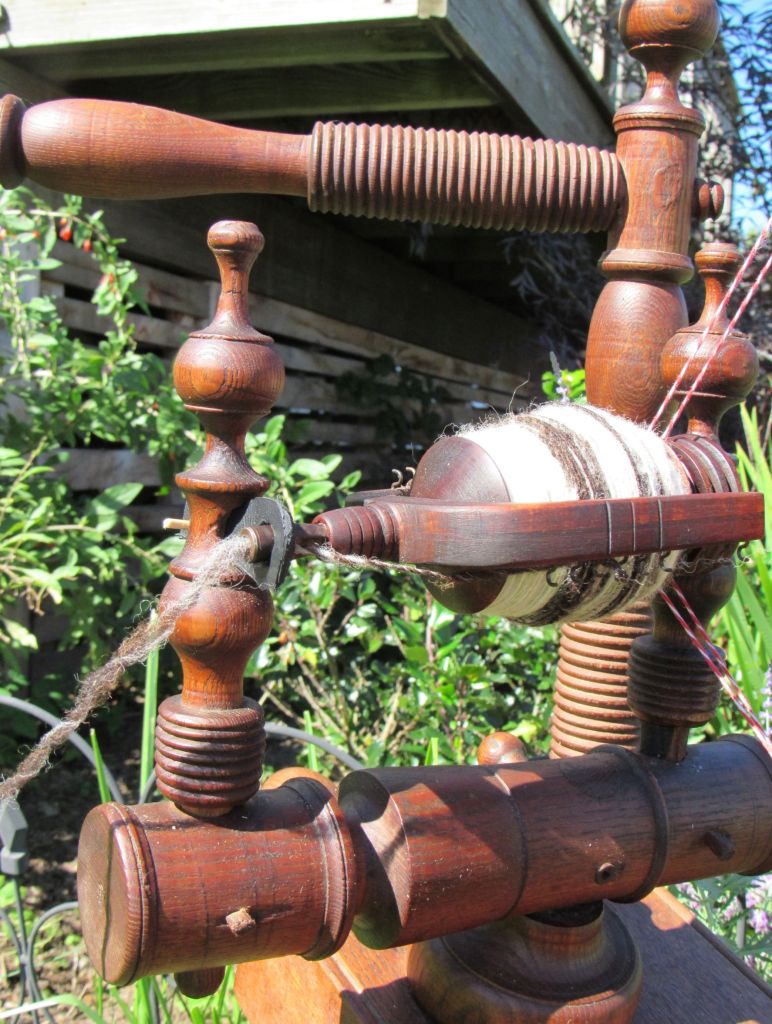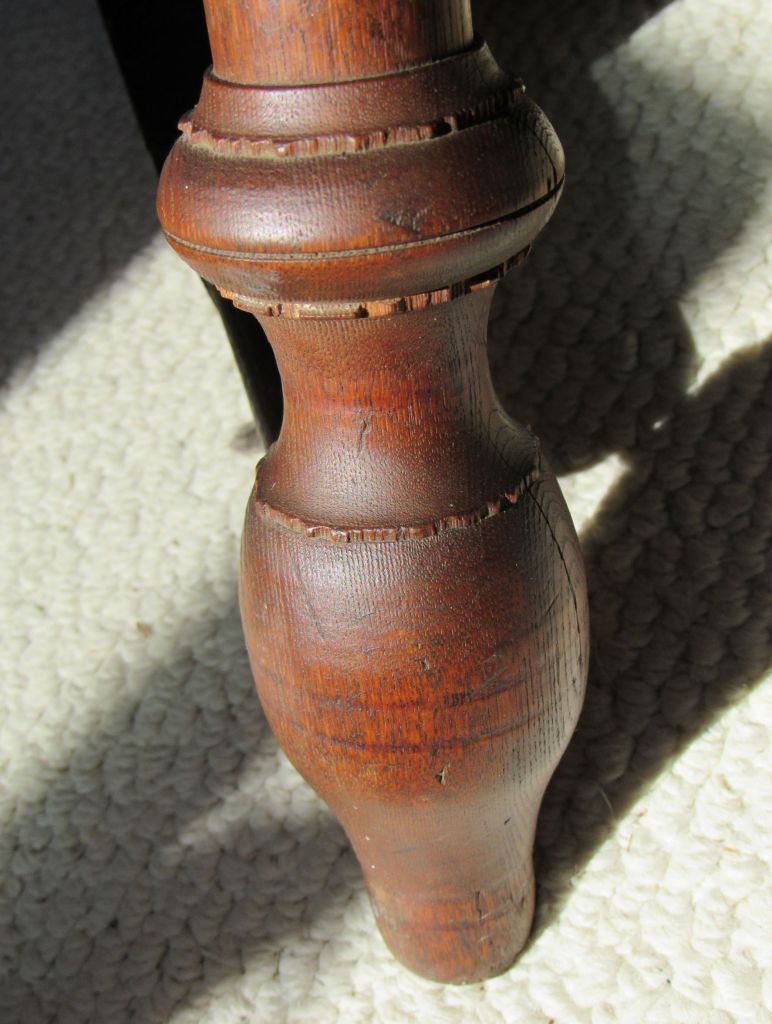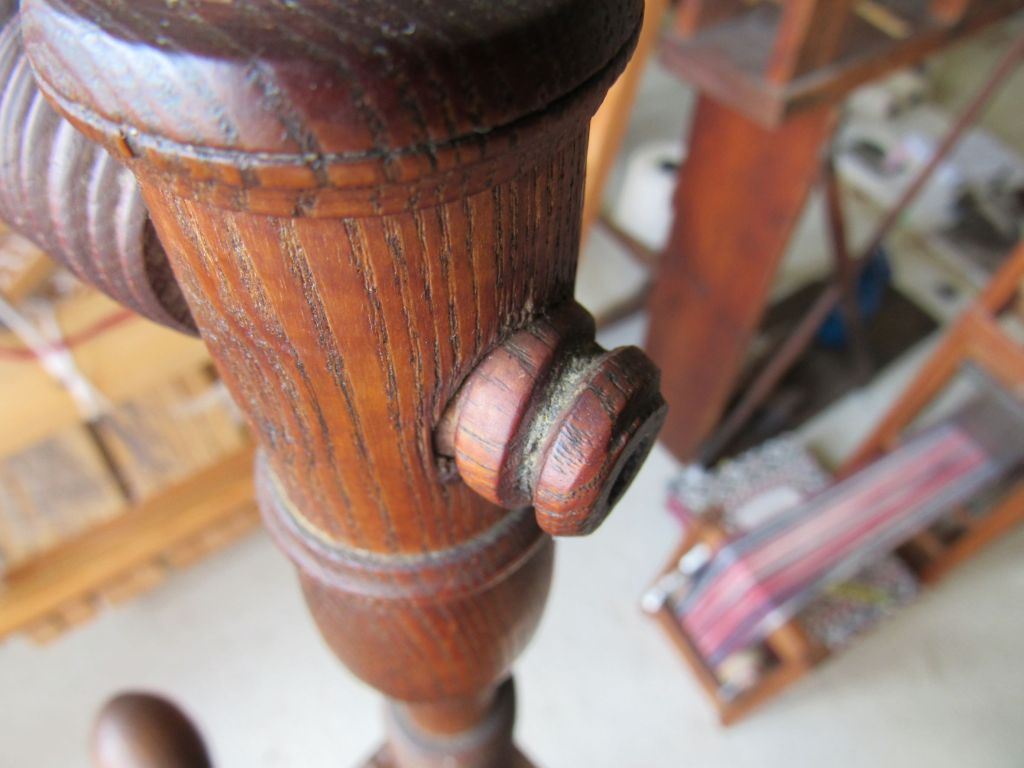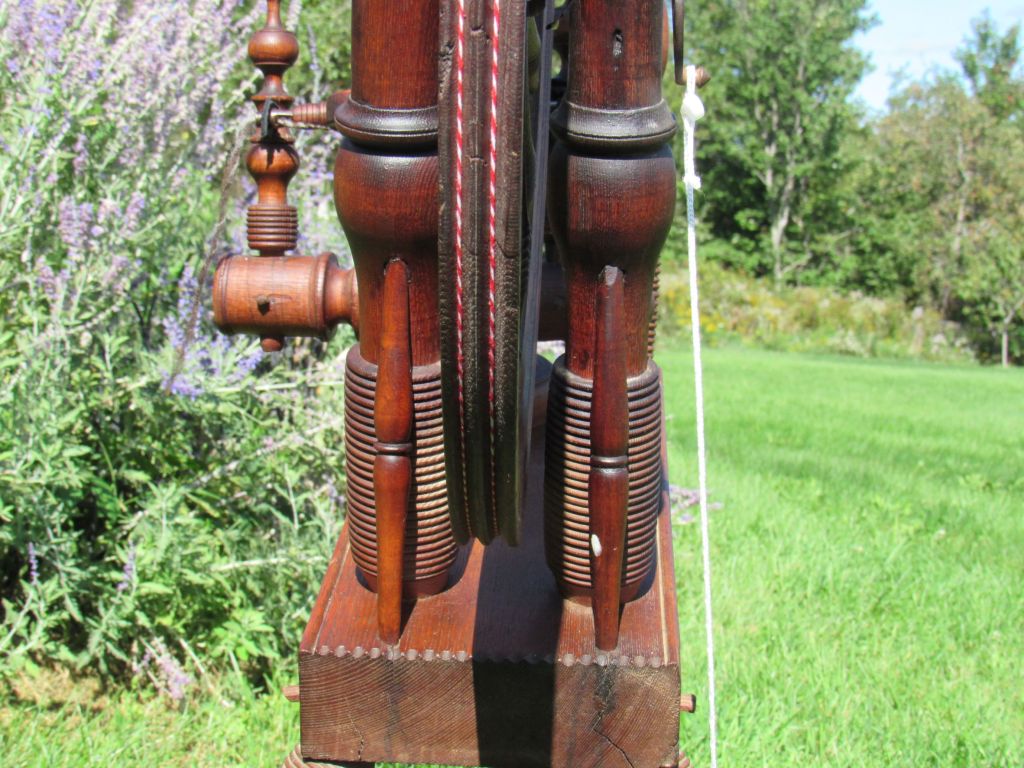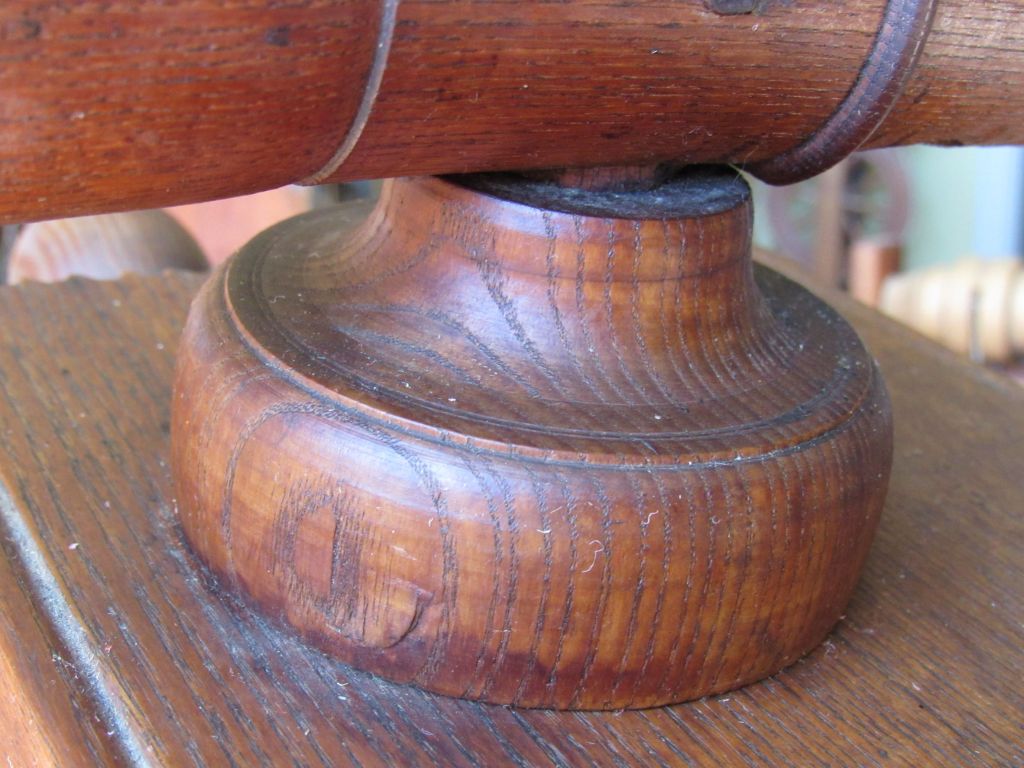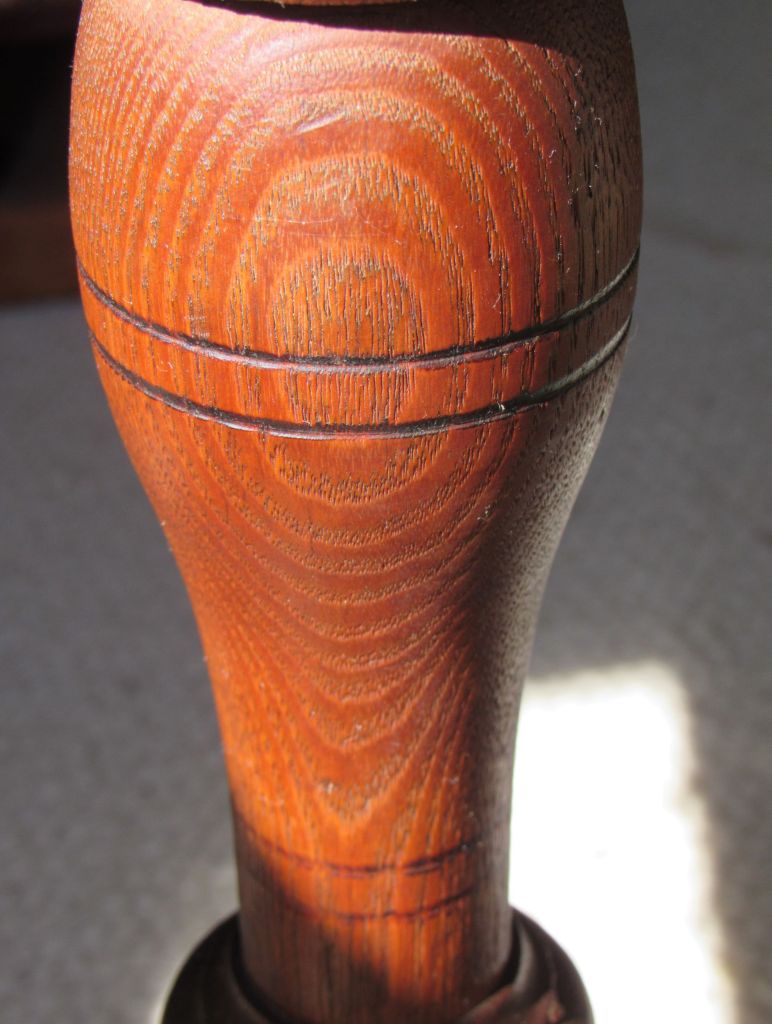
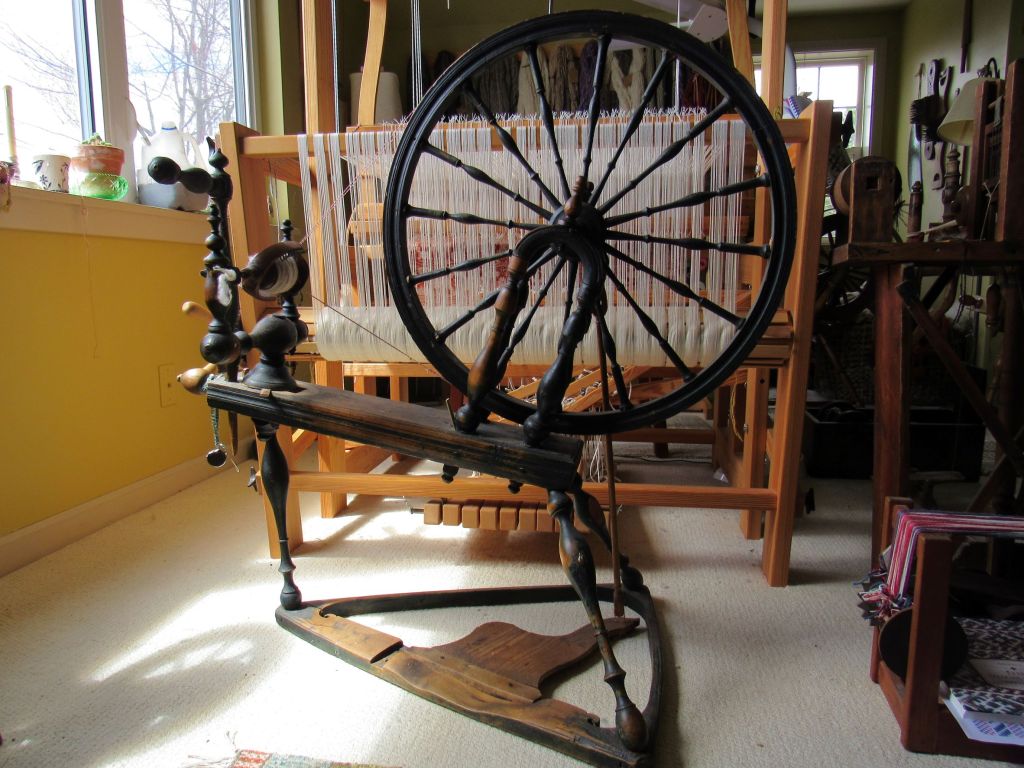
Tuulikki

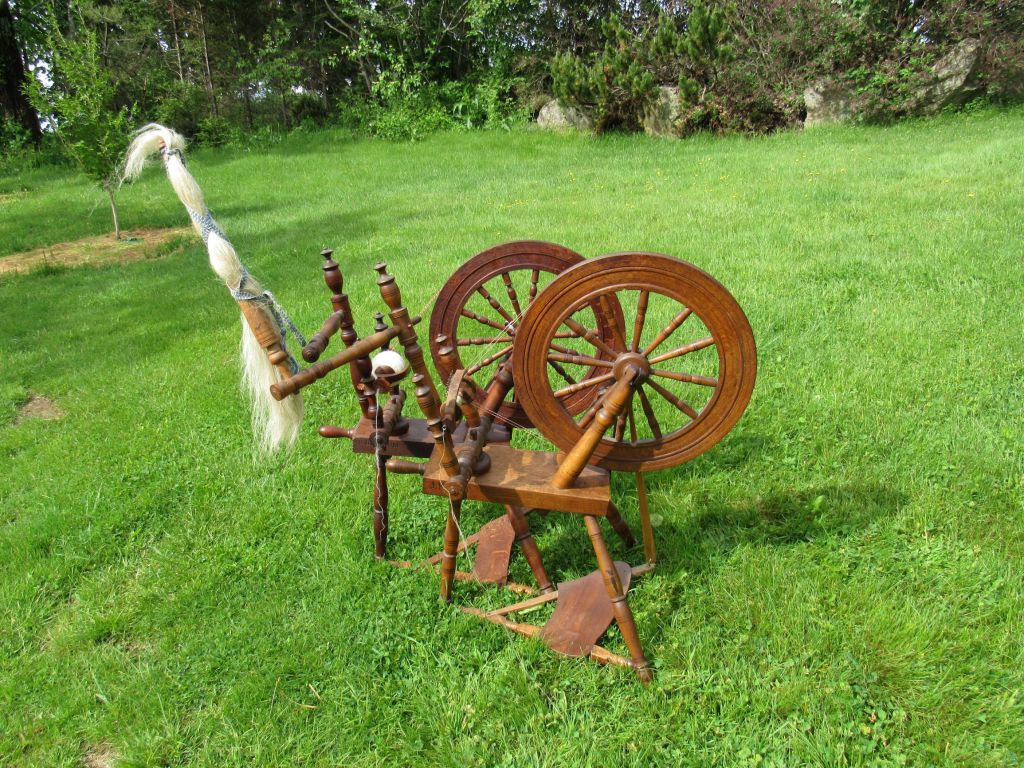
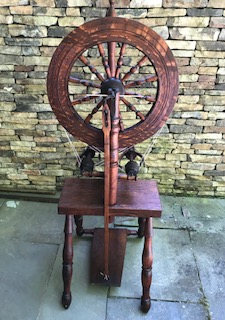
While many Finnish wheels found in North America, including those in the two previous posts, likely were made in the 1900s, occasionally some older ones come along. 

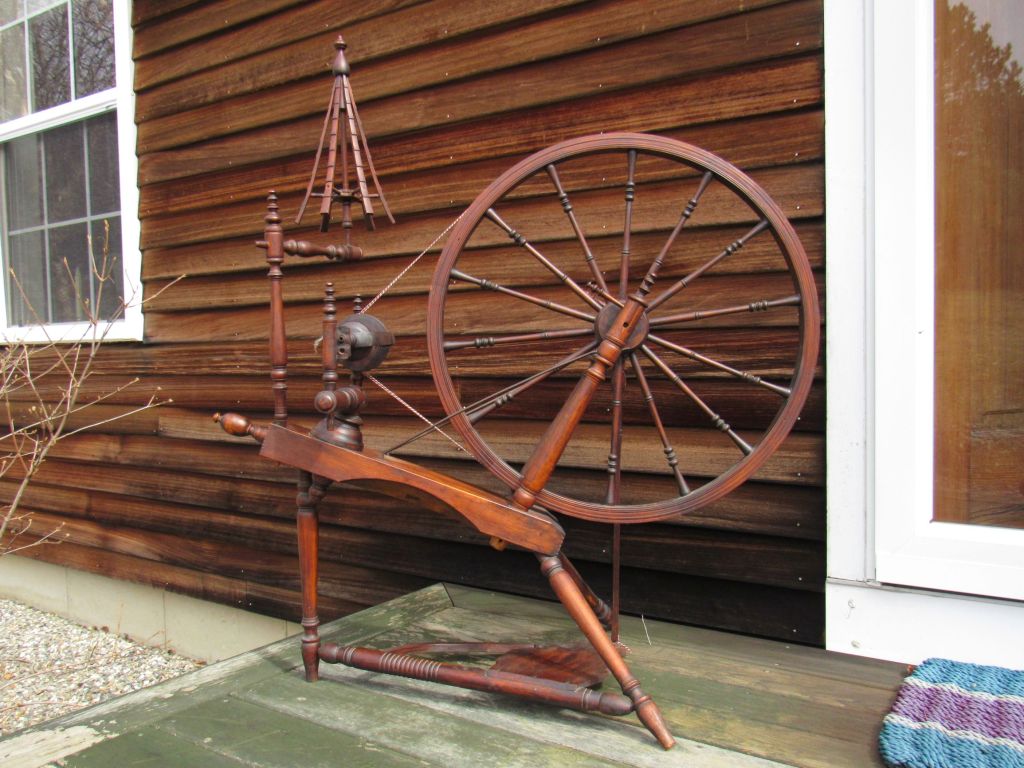
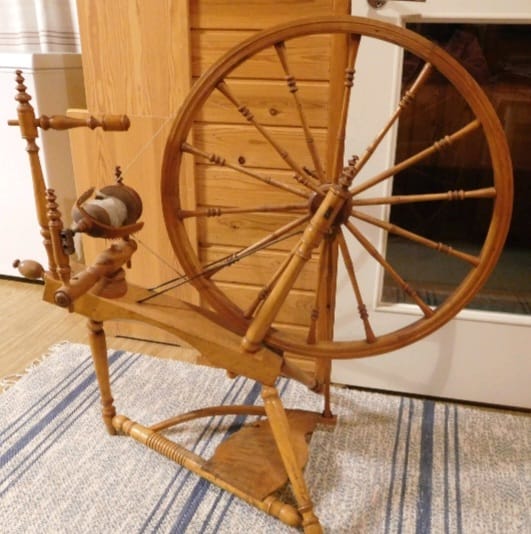
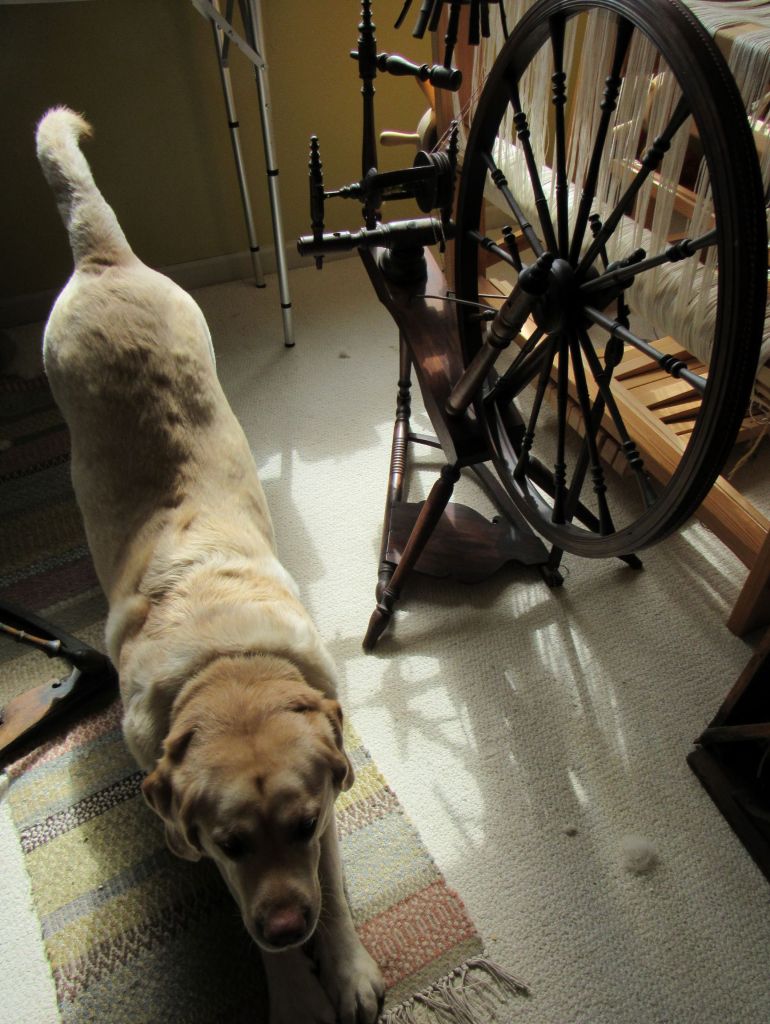
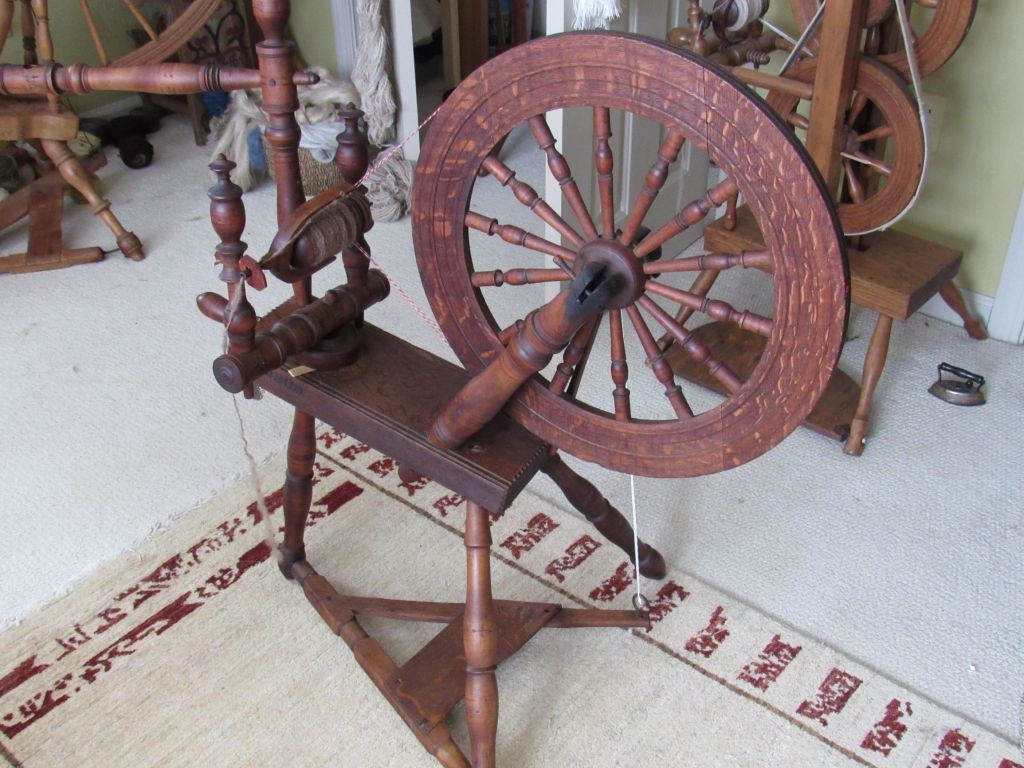
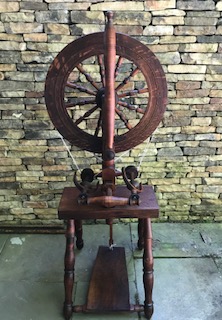
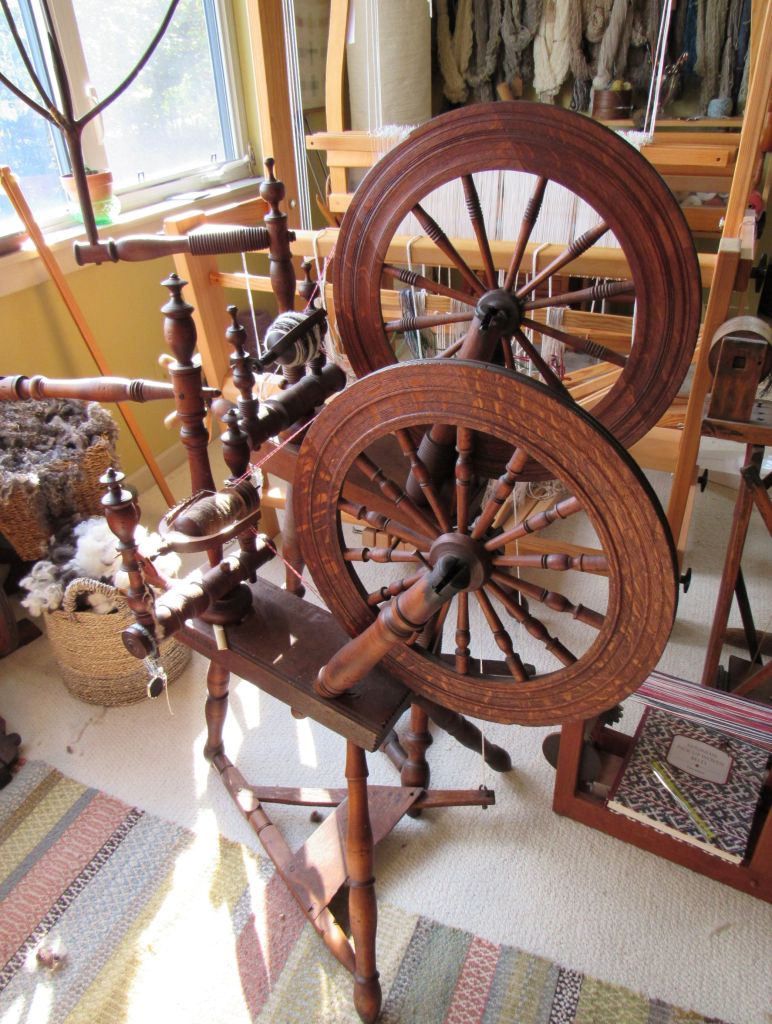
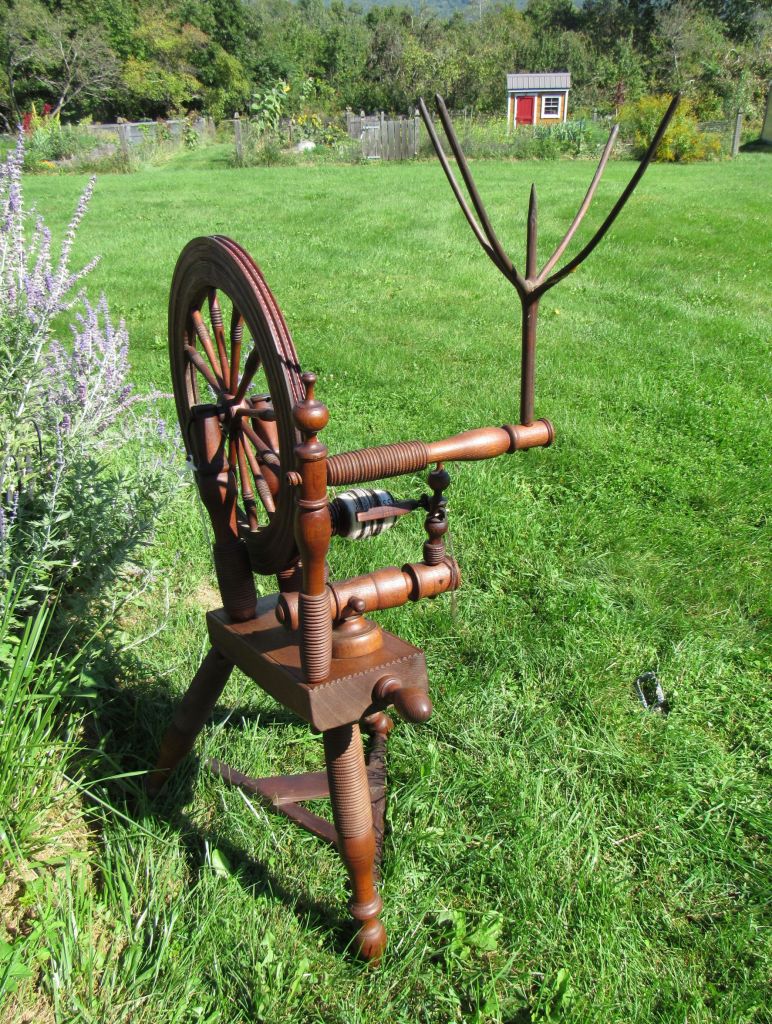
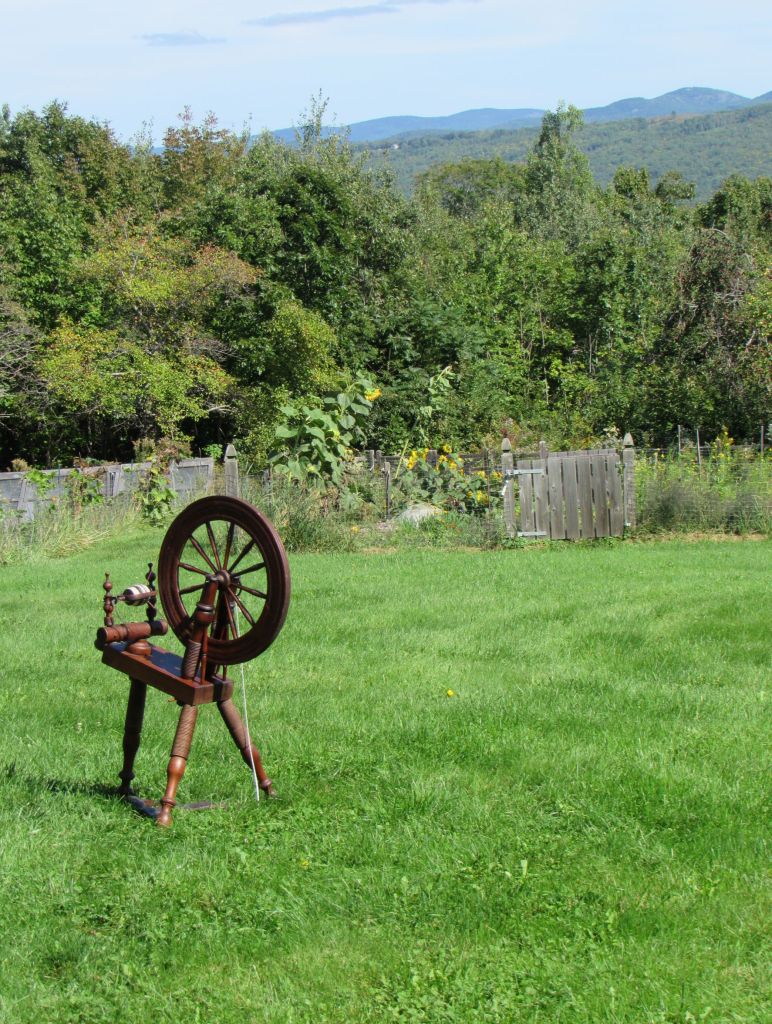
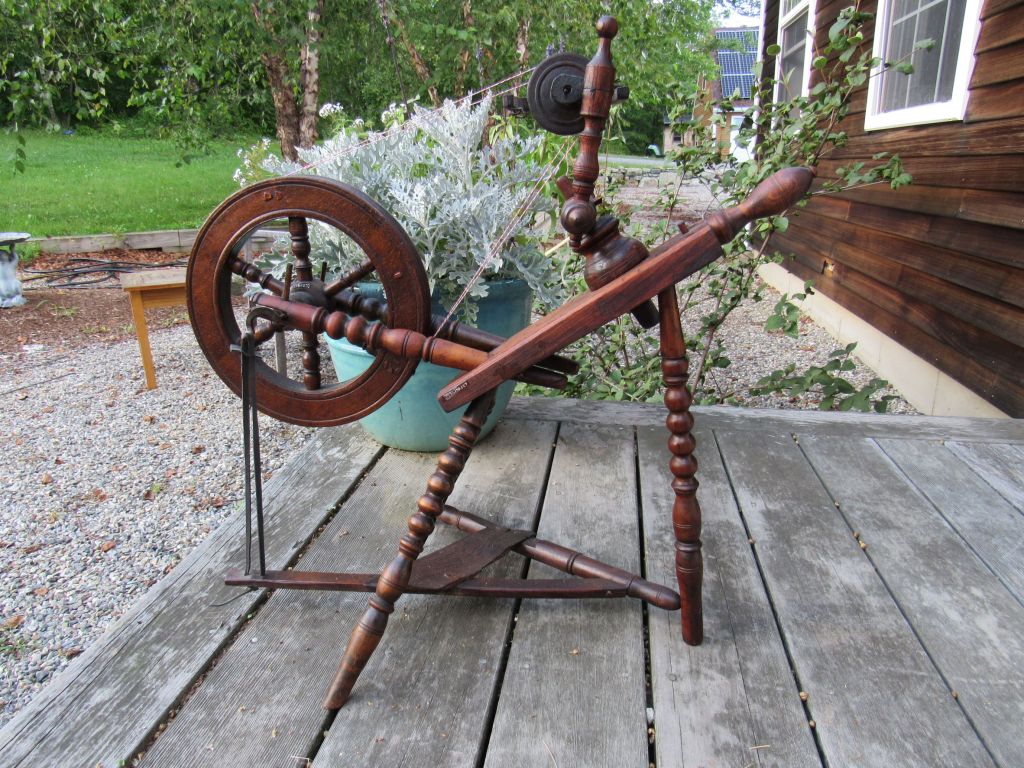
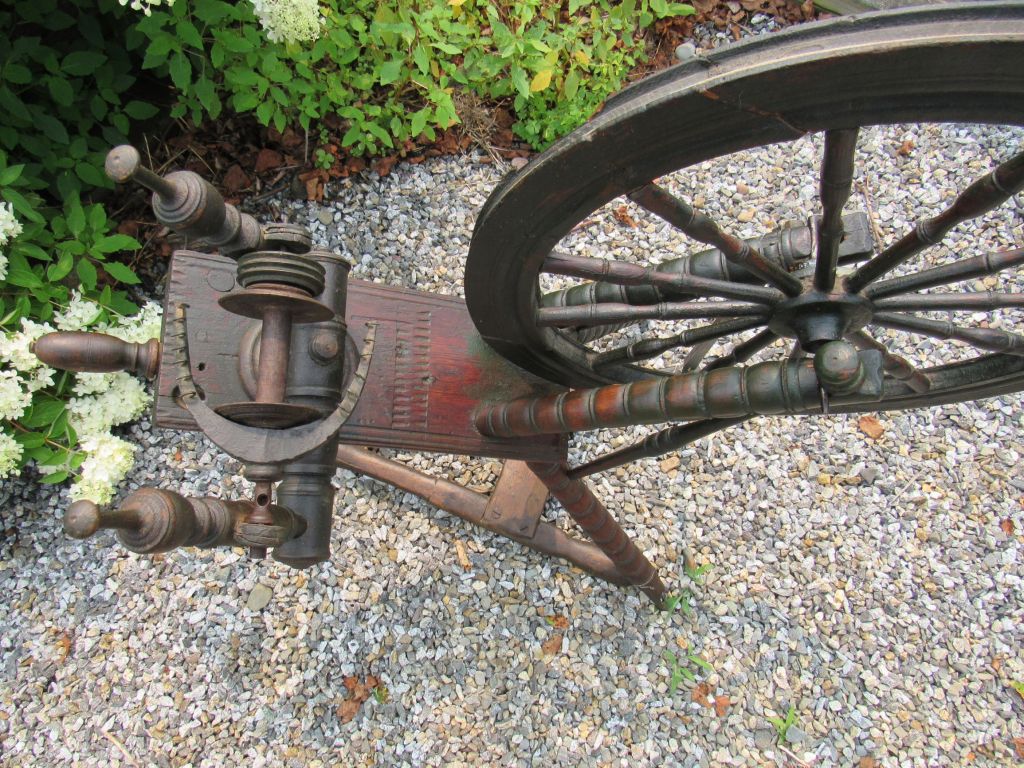
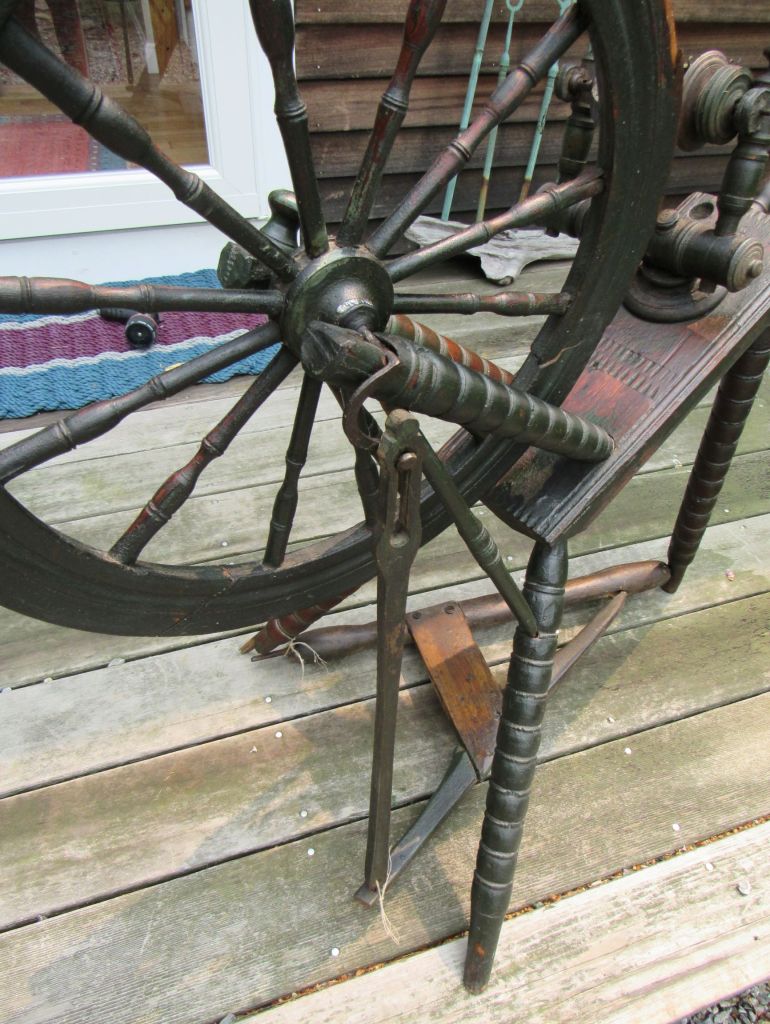
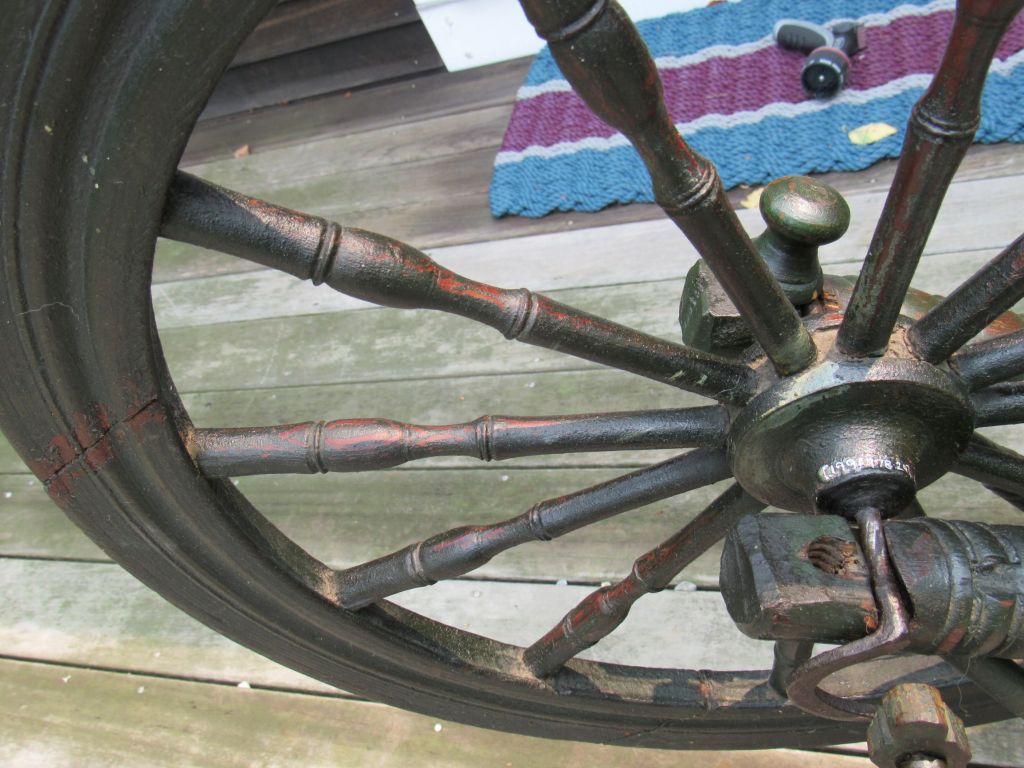
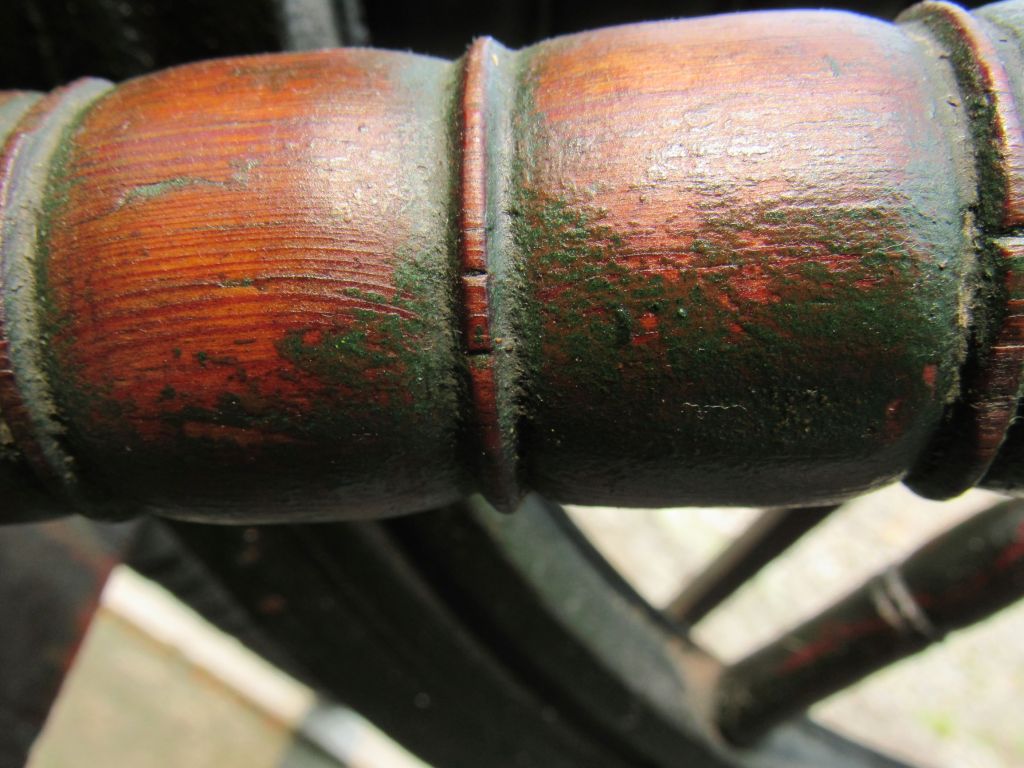
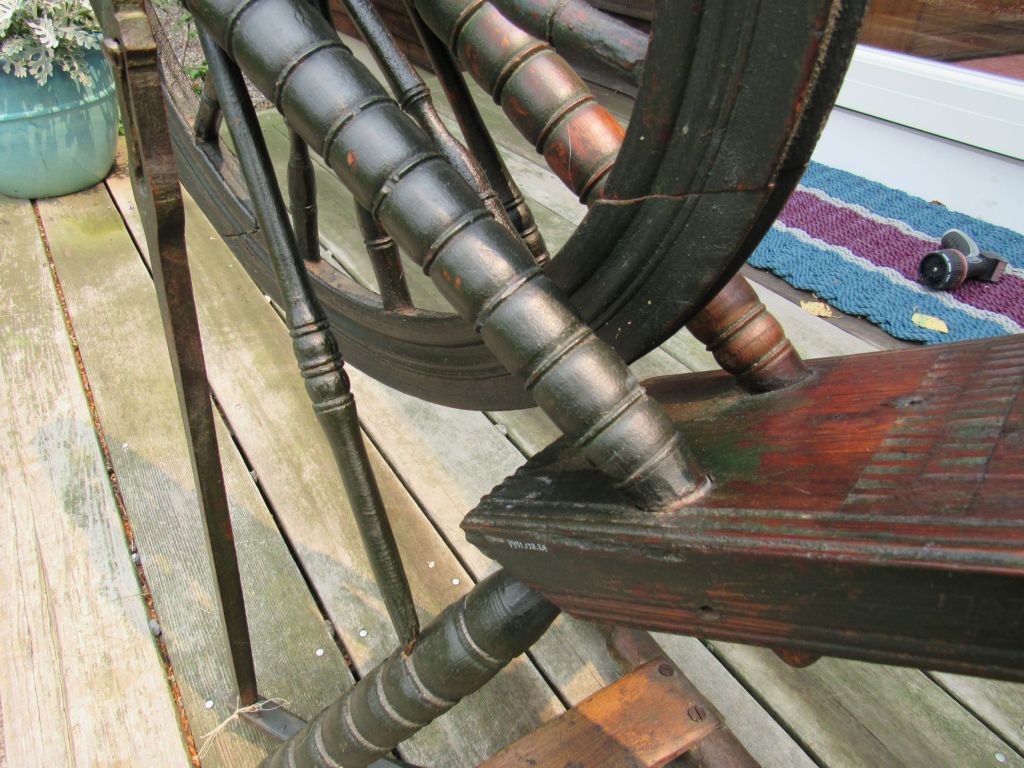
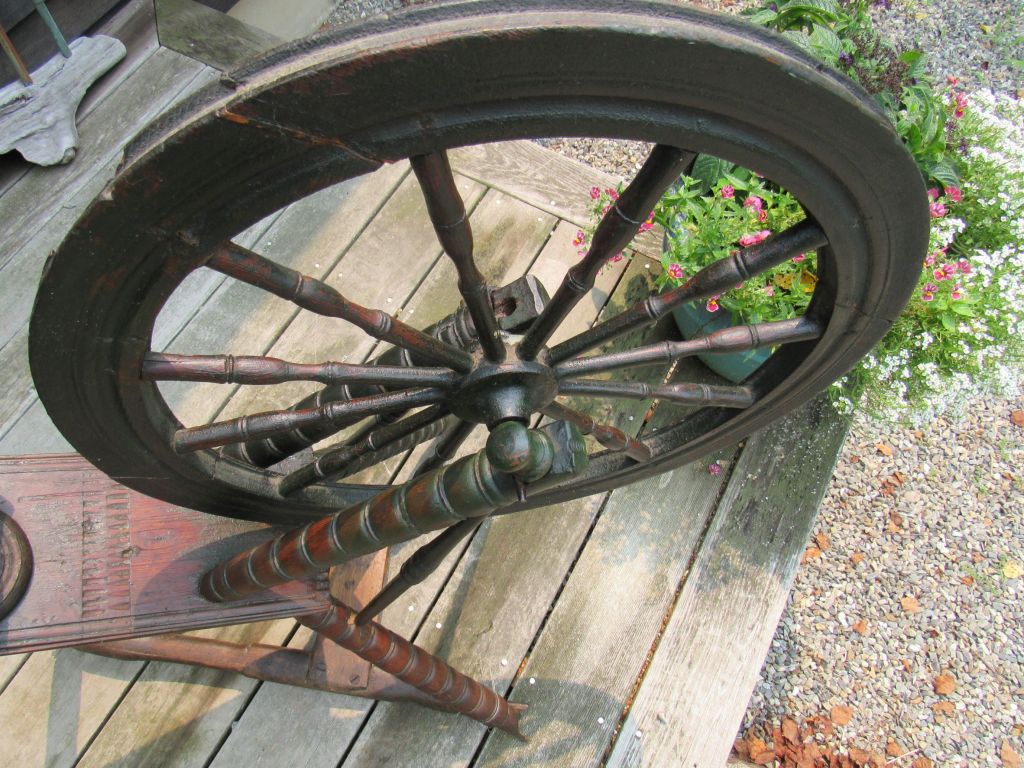
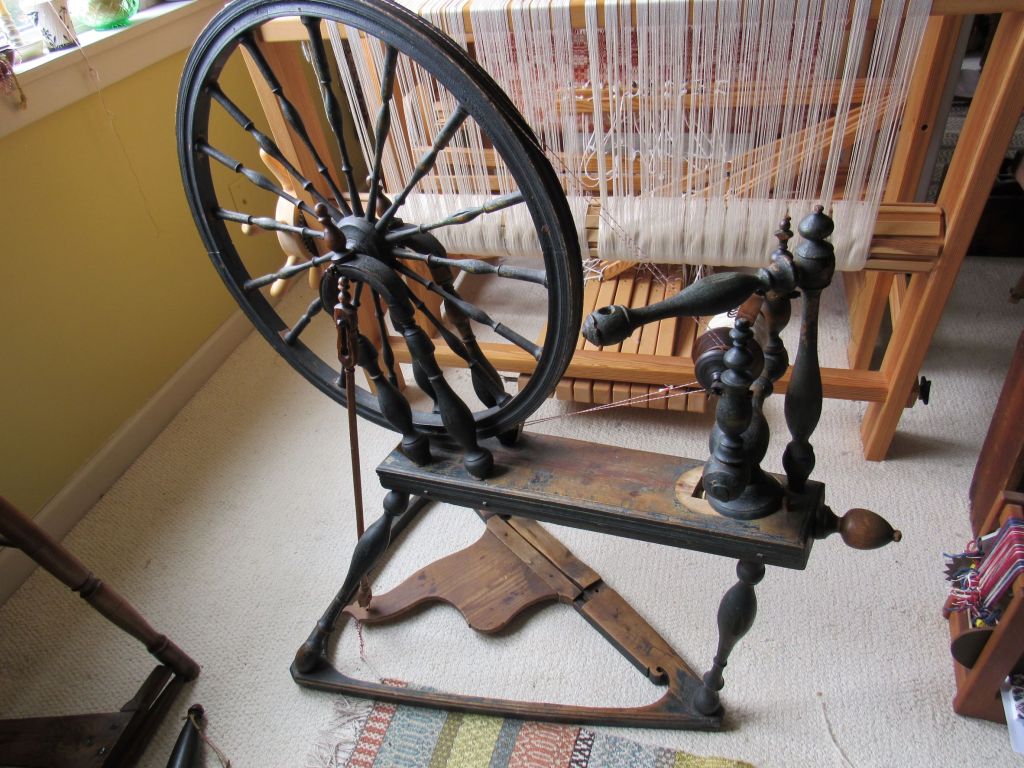
This curvaceous green beauty, which I found in Pennsylvania, was probably made in the mid- to late-1800s. 
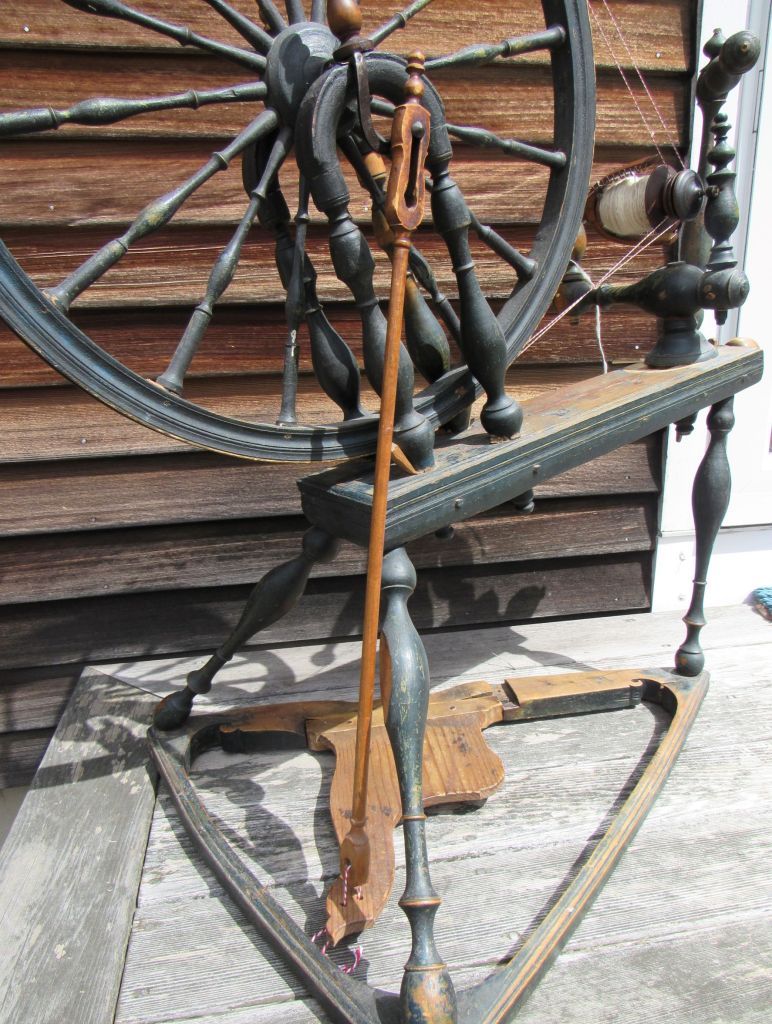
There does not seem to be any dispute that this style wheel, with its distinctive treadle design and abundant curves, is Finnish, but its specific origin remains unclear. 

One advertisement, with a wheel marked 1855, indicated that the wheel was from the southeast coast of Finland, but I have not been able to confirm that. 
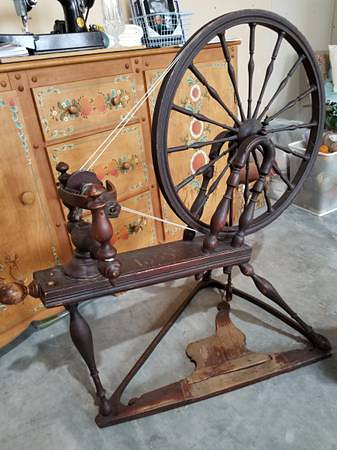
Minneapolis Craigslist wheel, painted 1855 on table

Although several of these wheels have been posted on the Finnish Rukkitaivas Facebook group, so far, as far as I know, no one has identified a maker or region where they were made. 
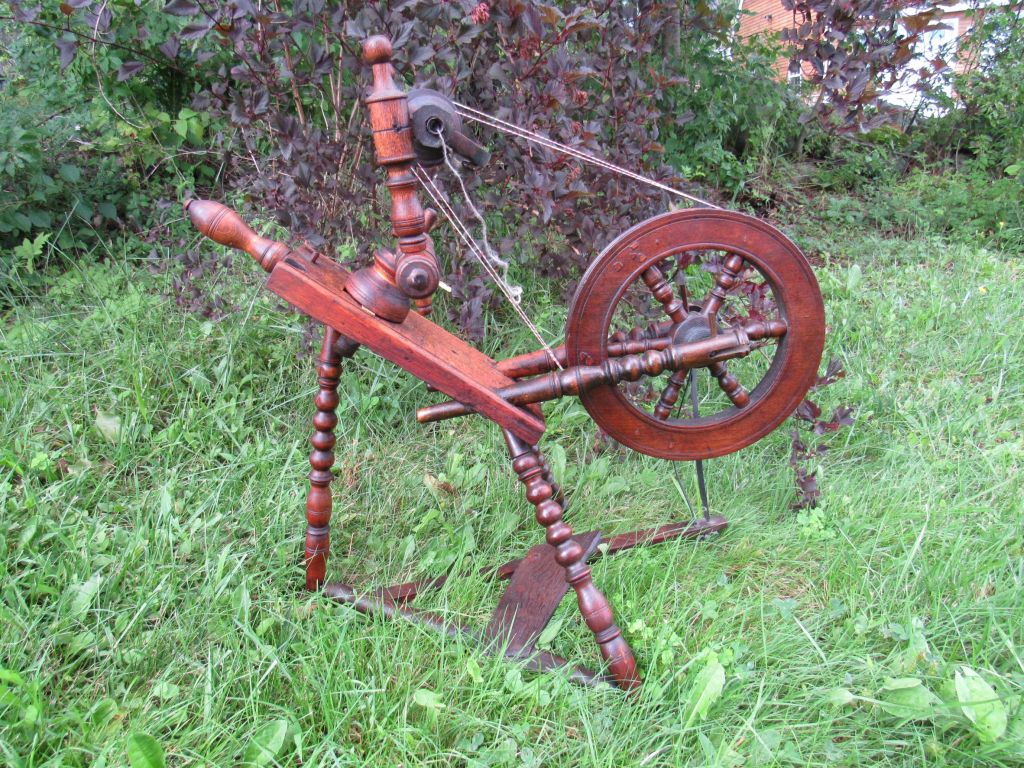
As with many other Finnish wheels, these wheels have double arched uprights and treadles set into the treadle bar, rather than pivoting from the legs. 

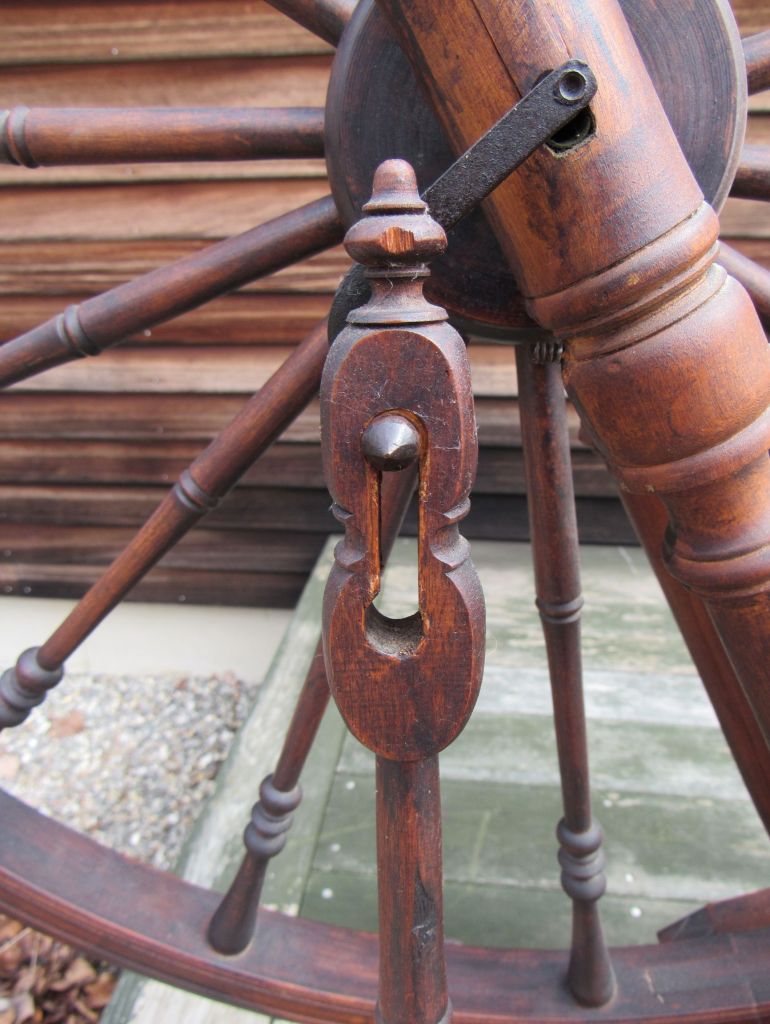
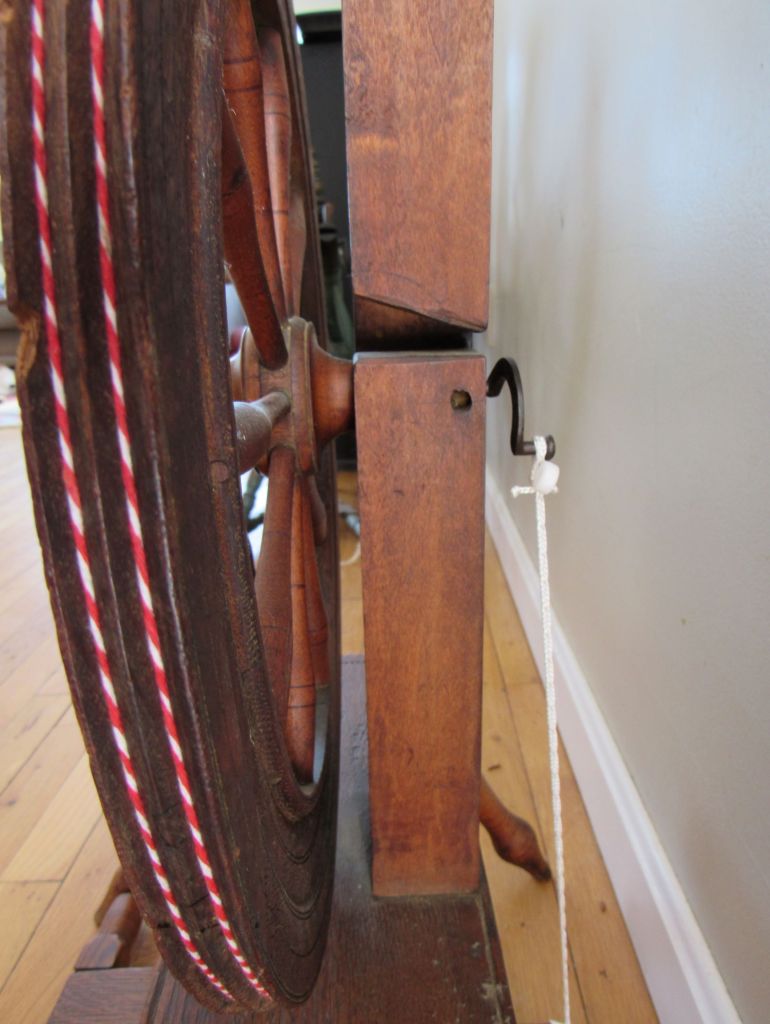
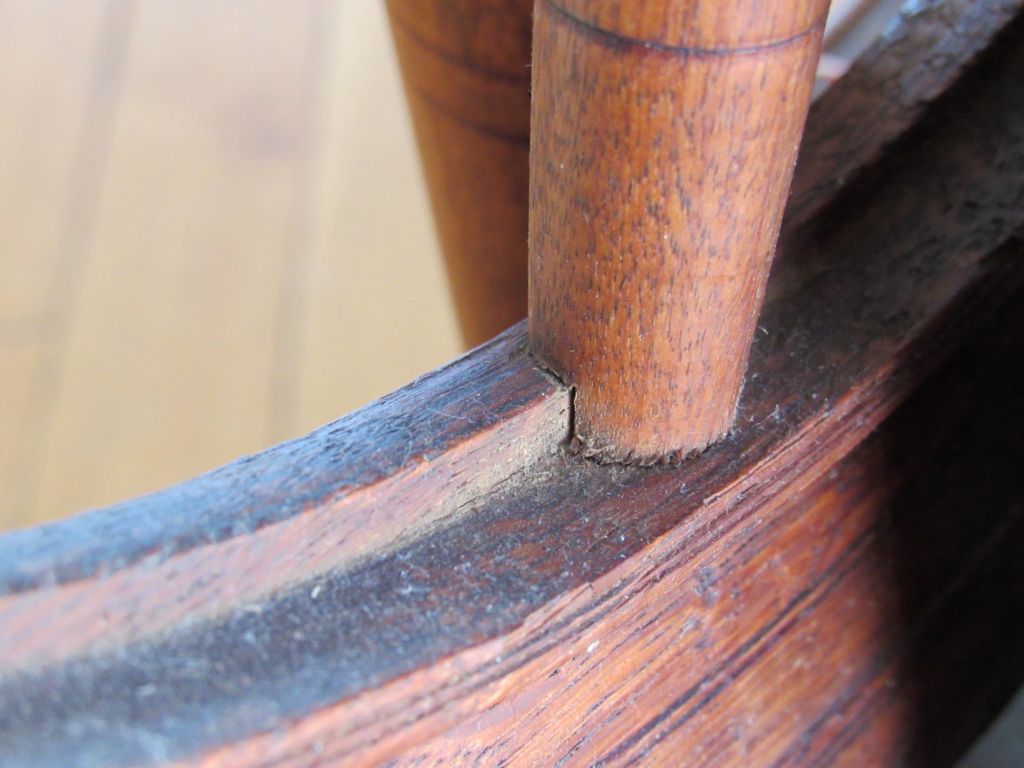
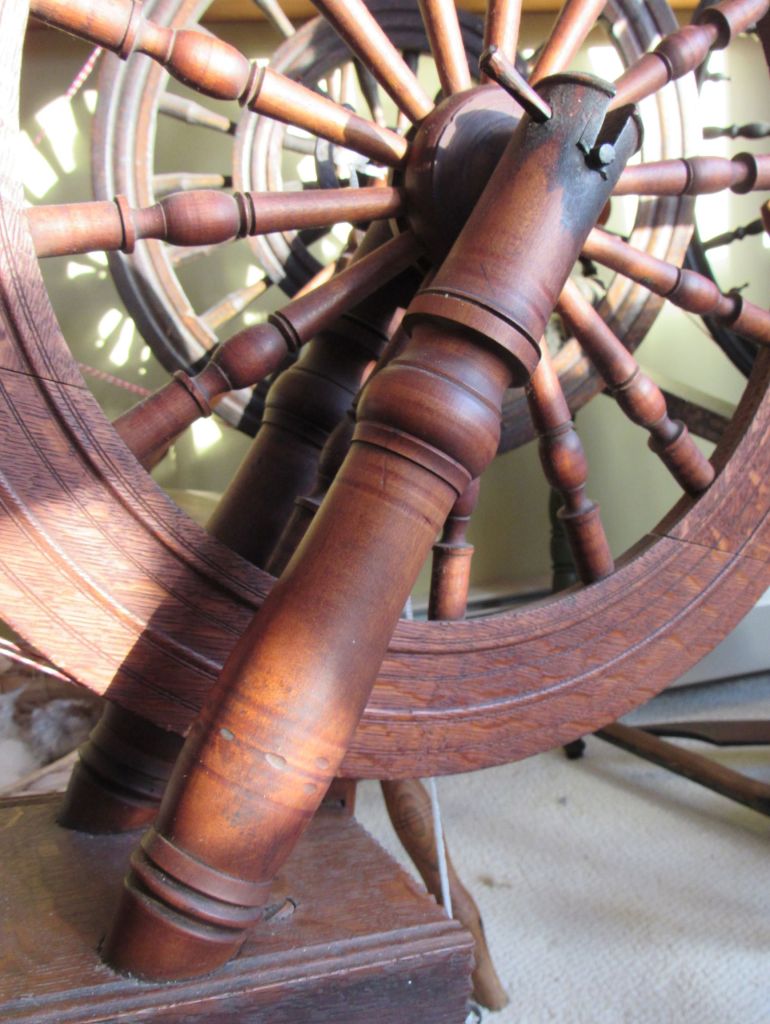
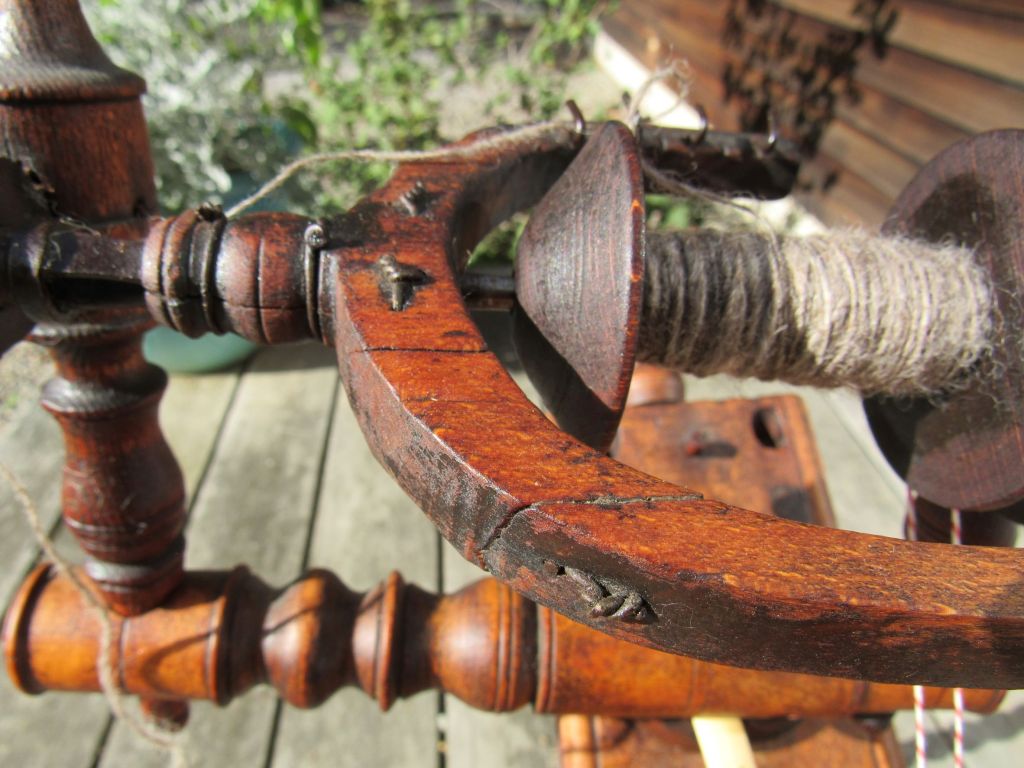
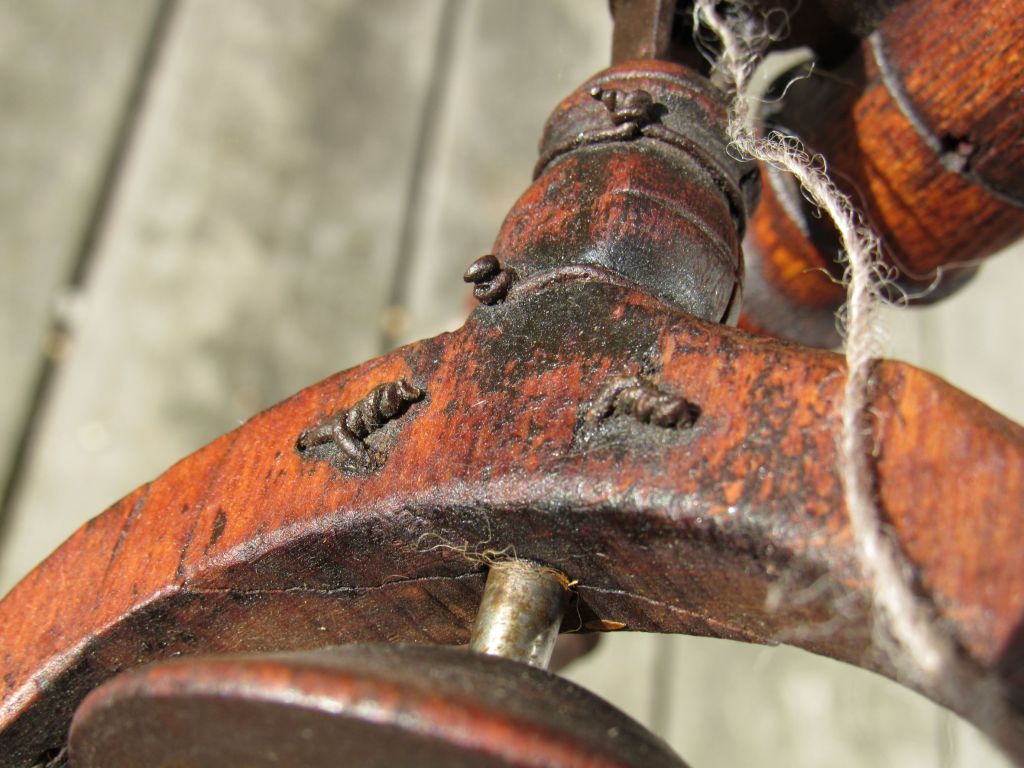
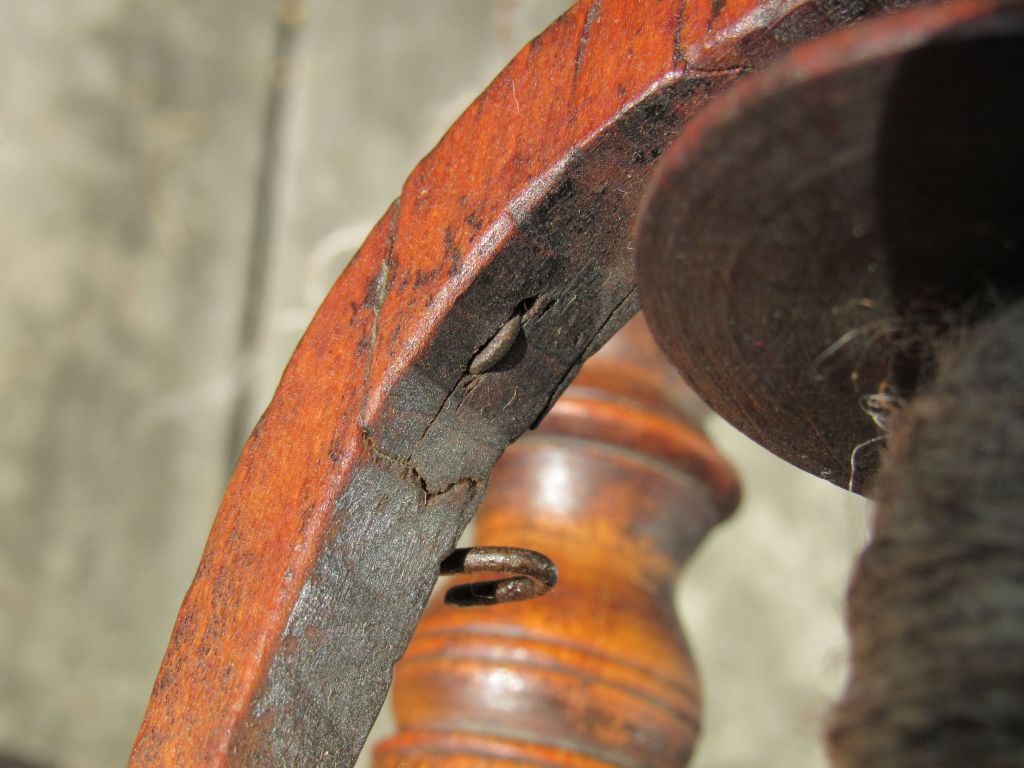
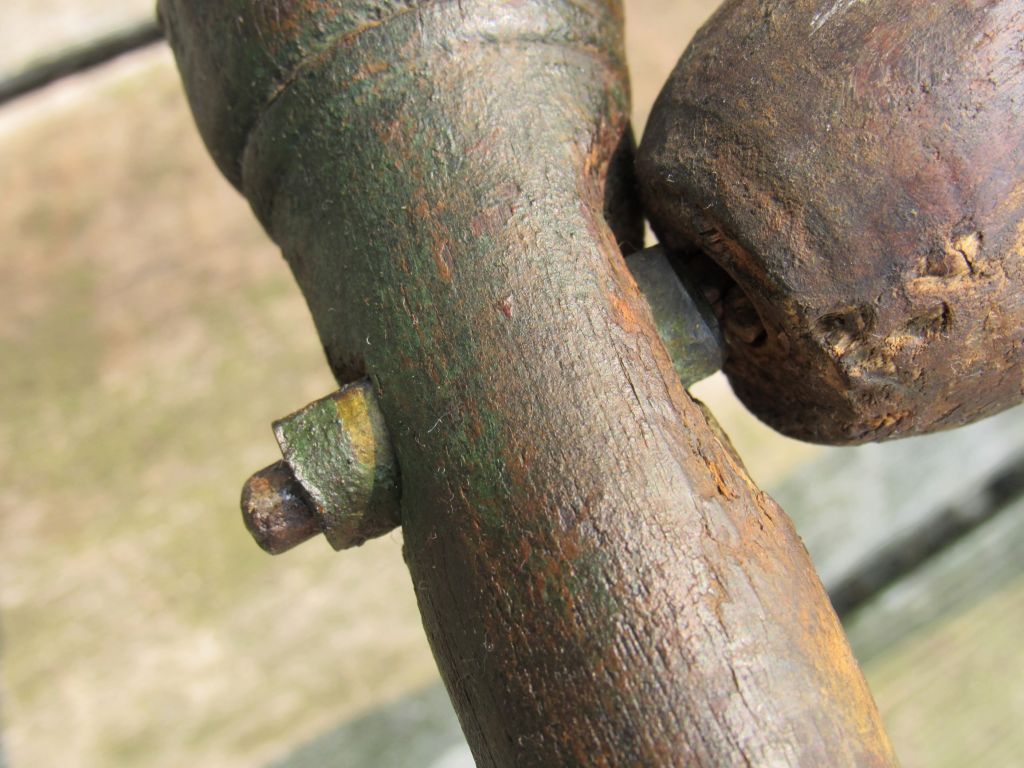
On mine, there are metal pins attaching the uprights to the arch, on the spinner-side only. 
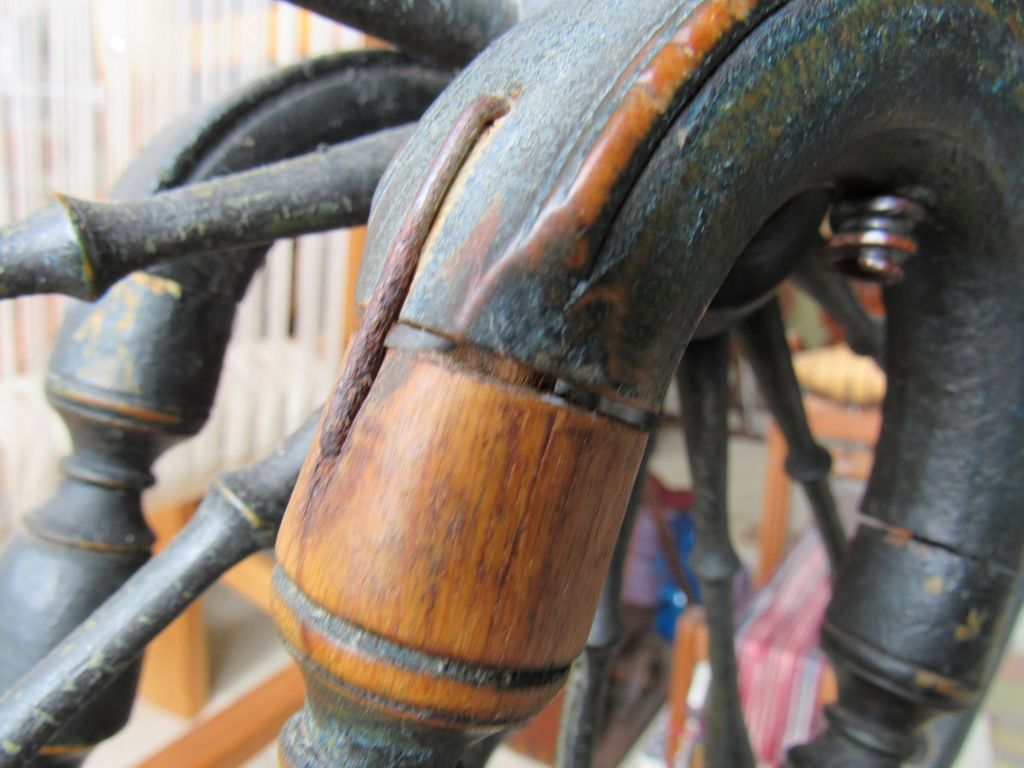
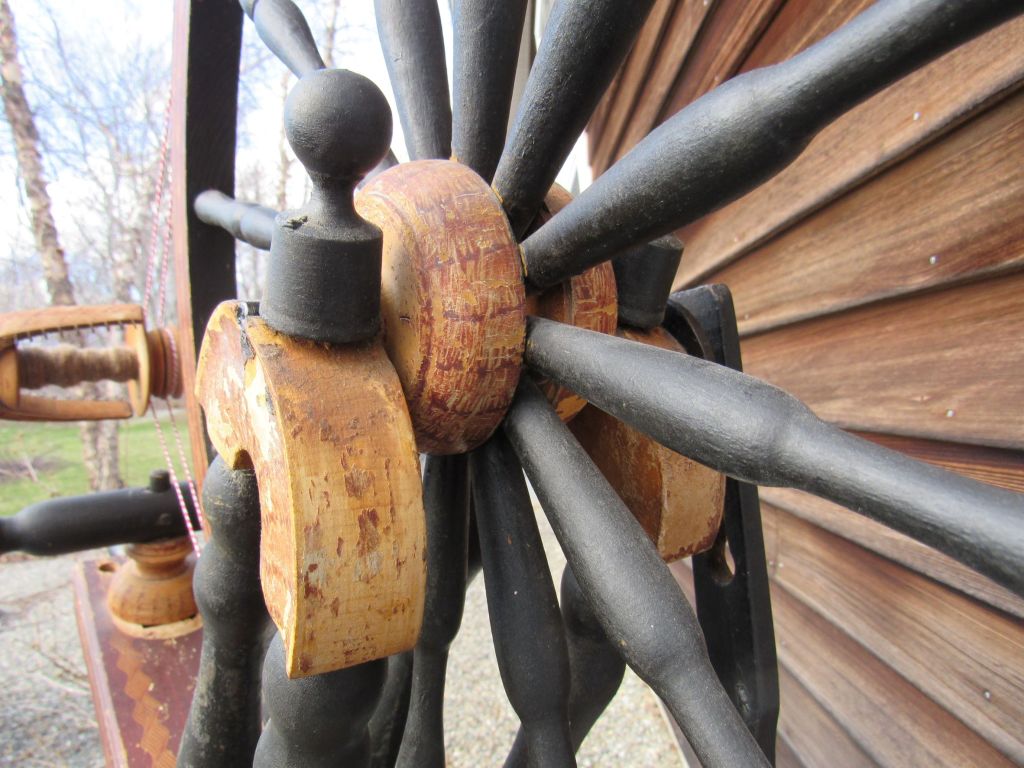
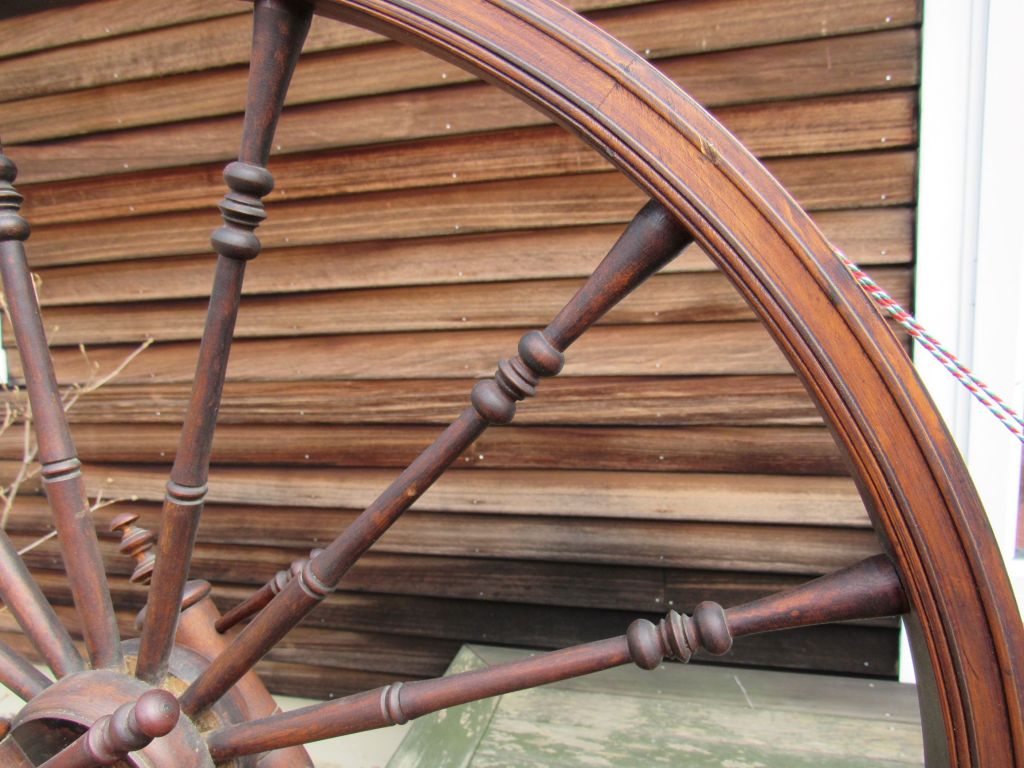
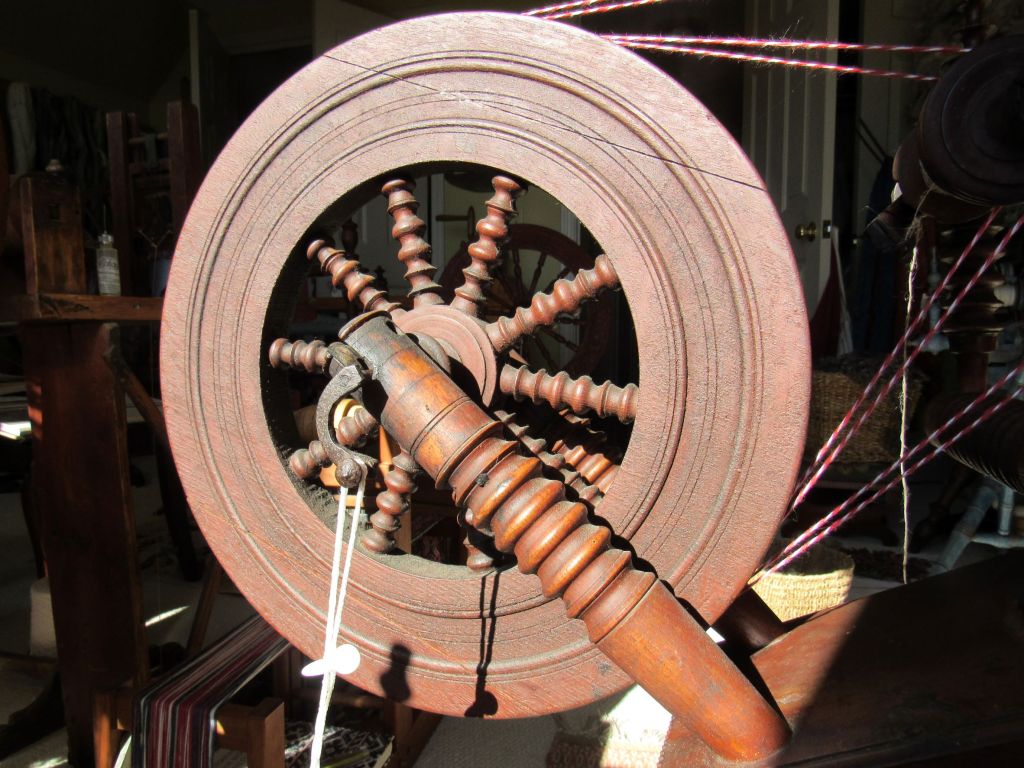
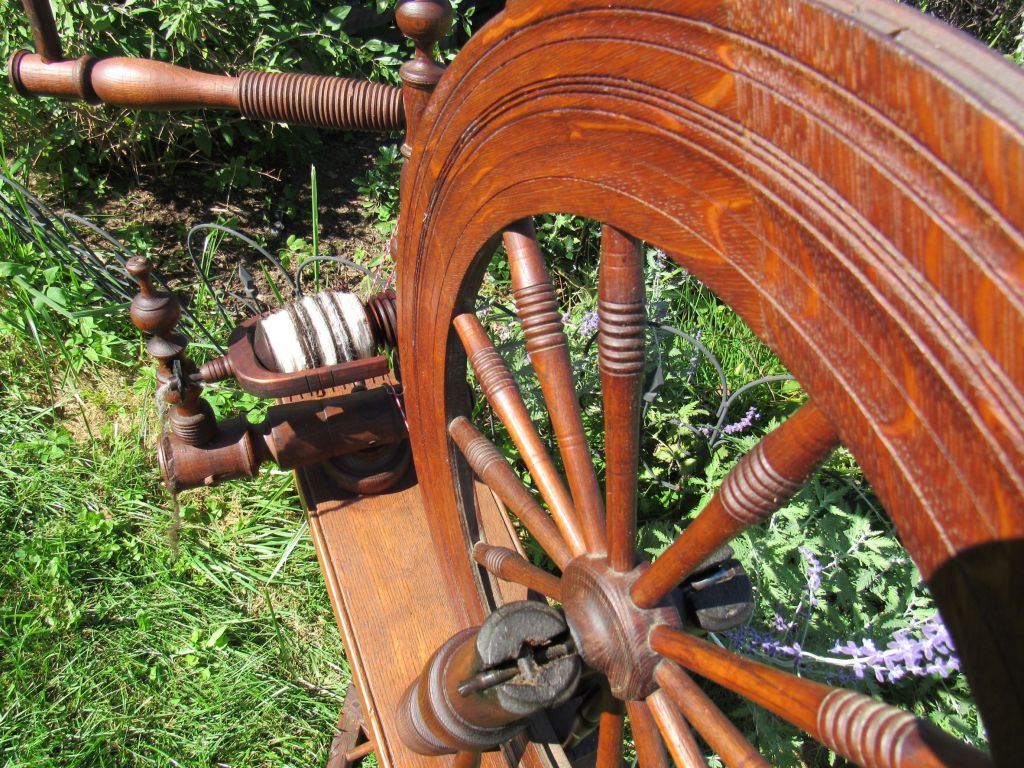
The drive wheels have from 16 to 20 delicate-looking spokes, giving them an almost spider-web look. 

What makes these wheels stand out most, however, is the overall curvaceousness. 

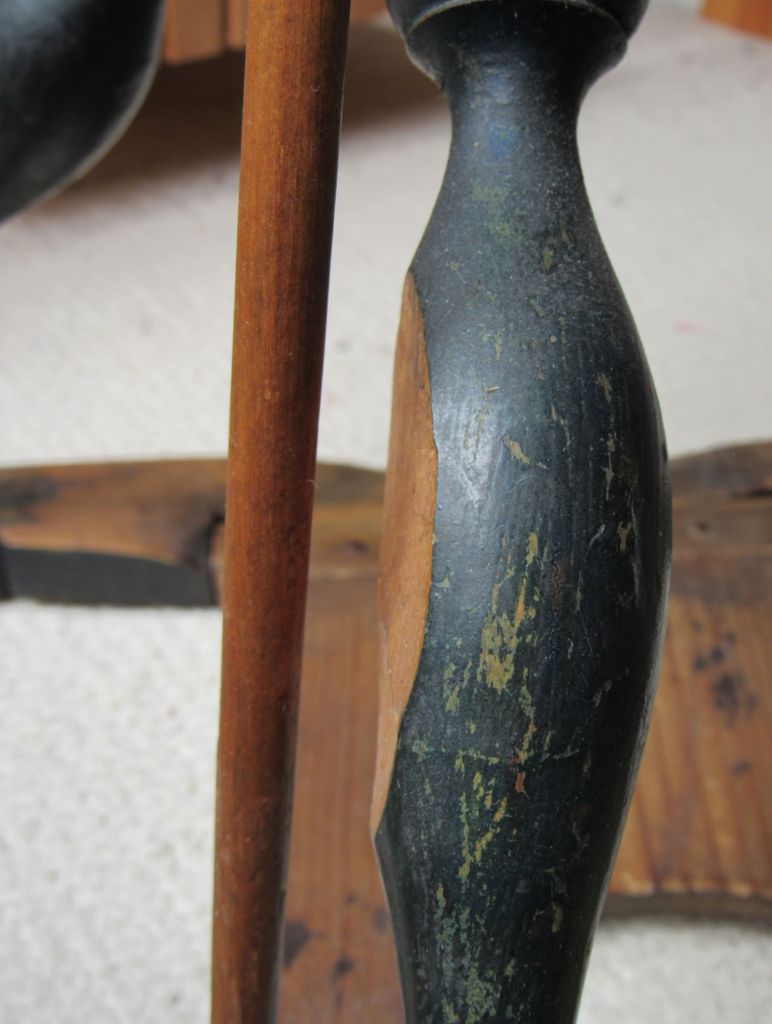
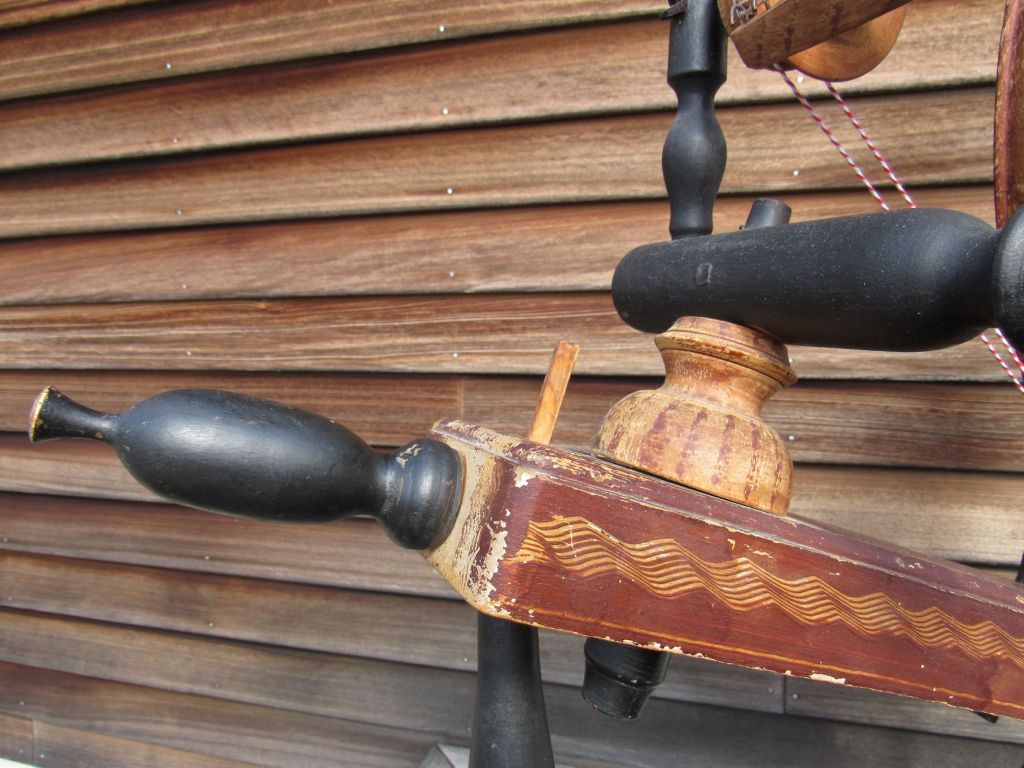
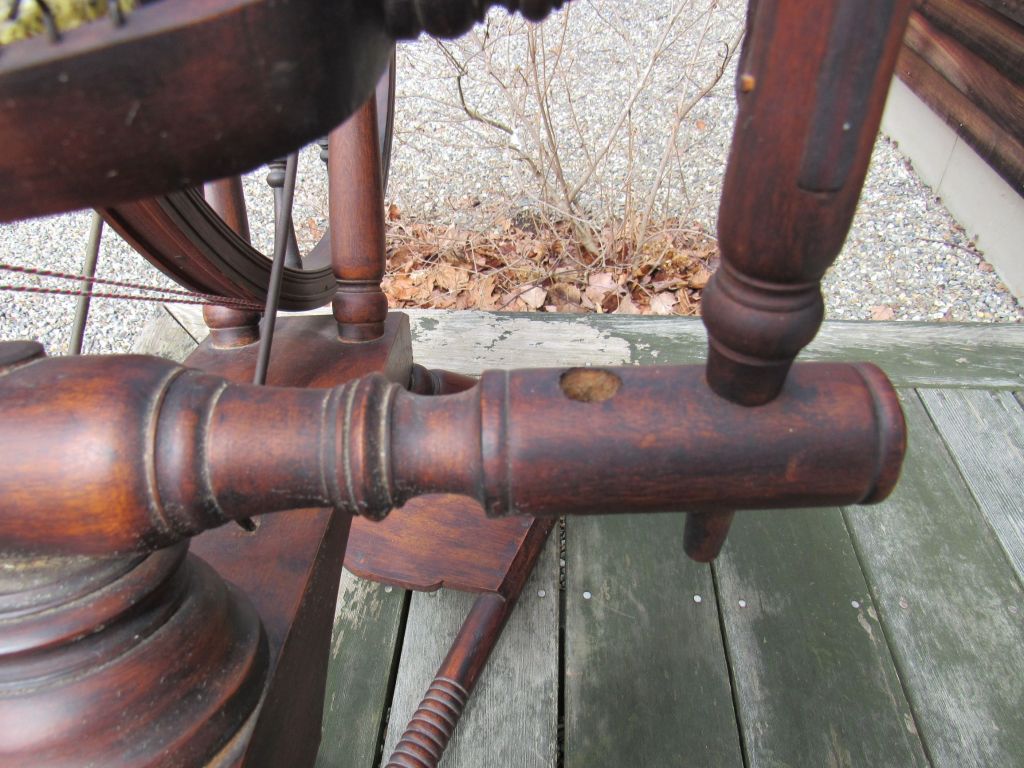
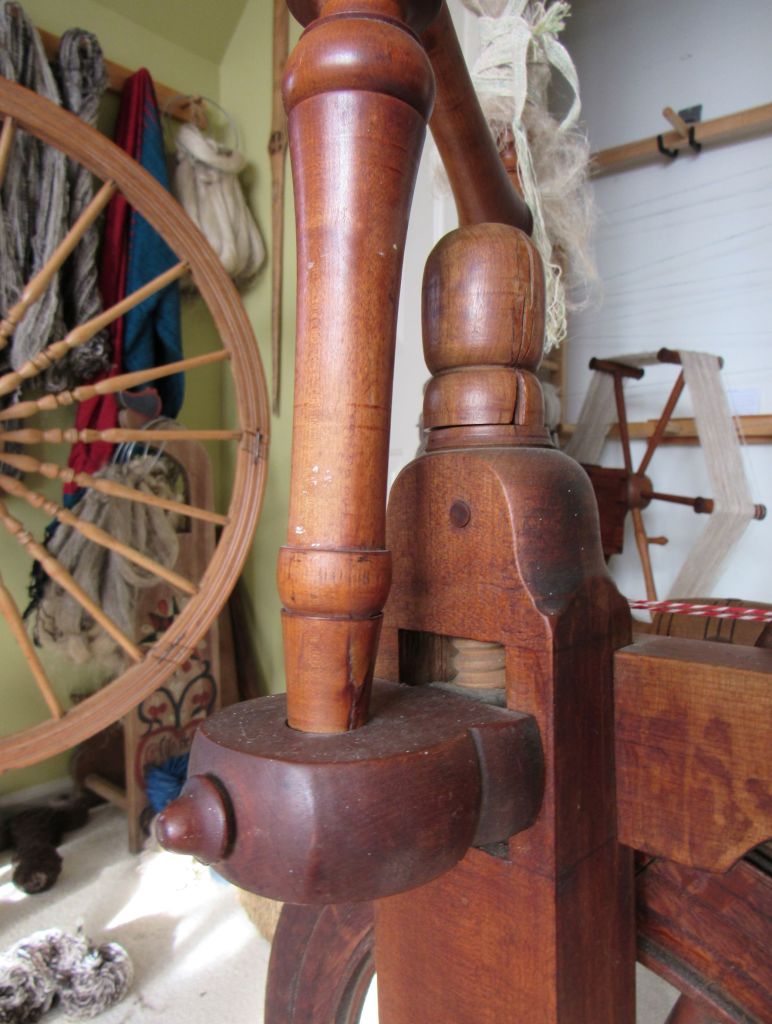
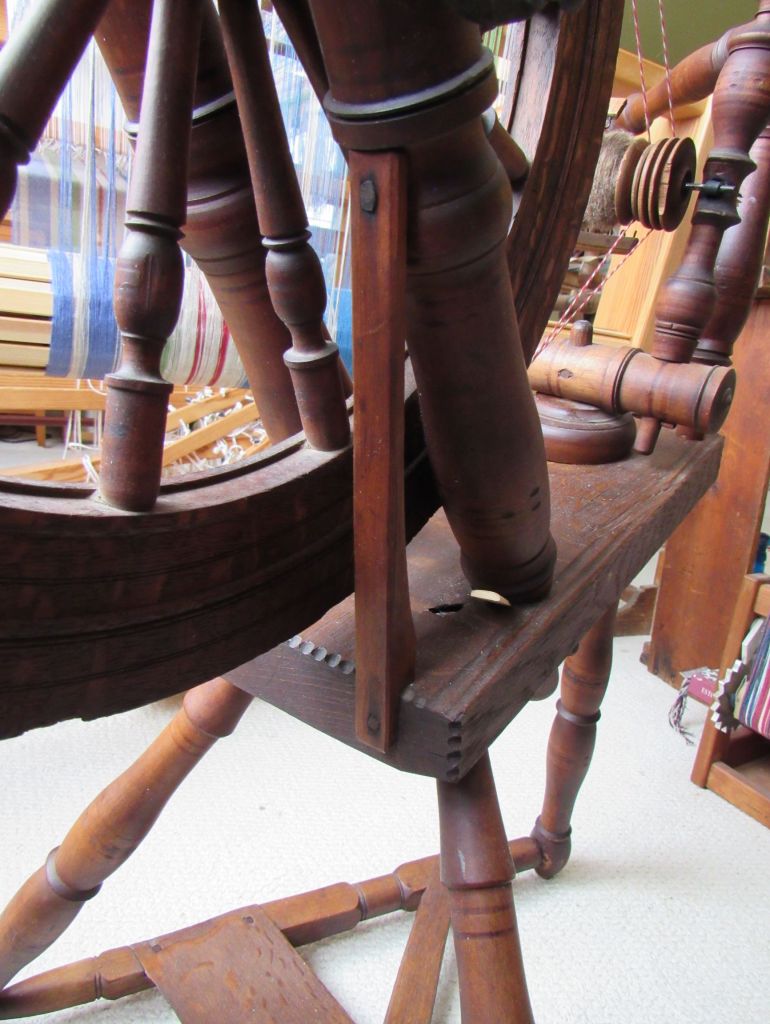
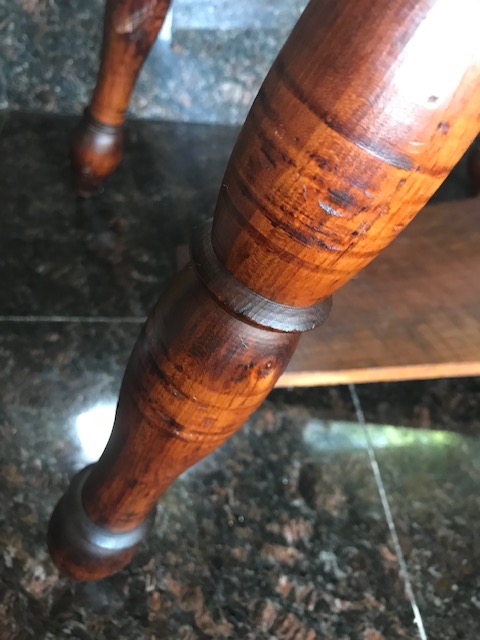
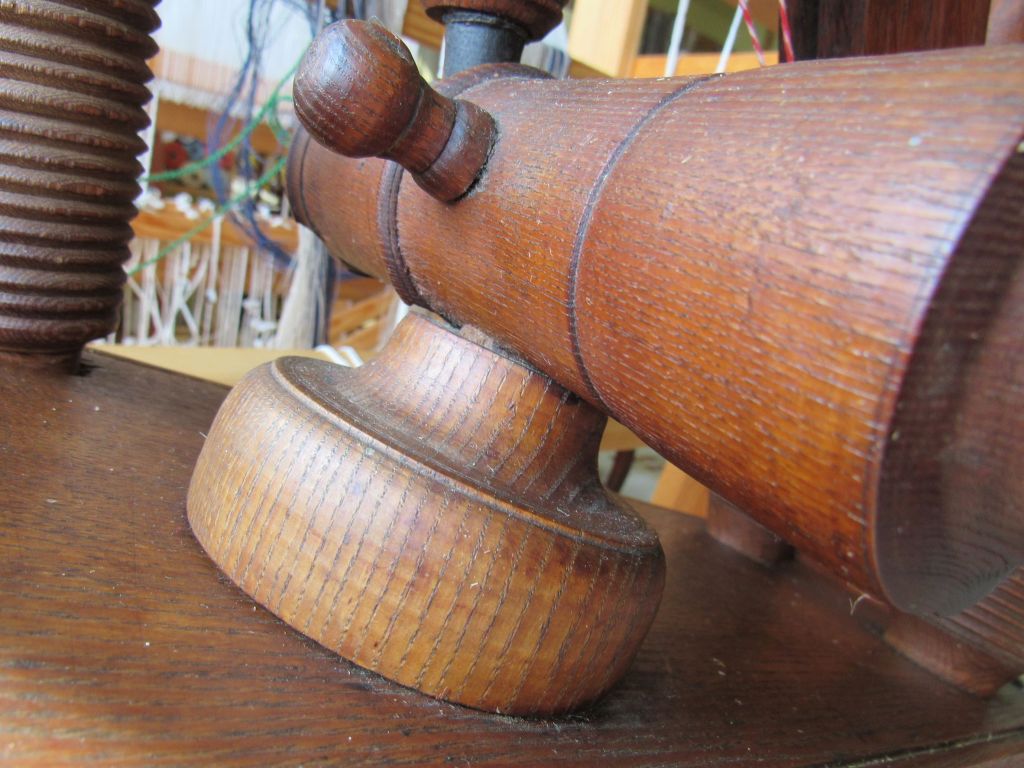
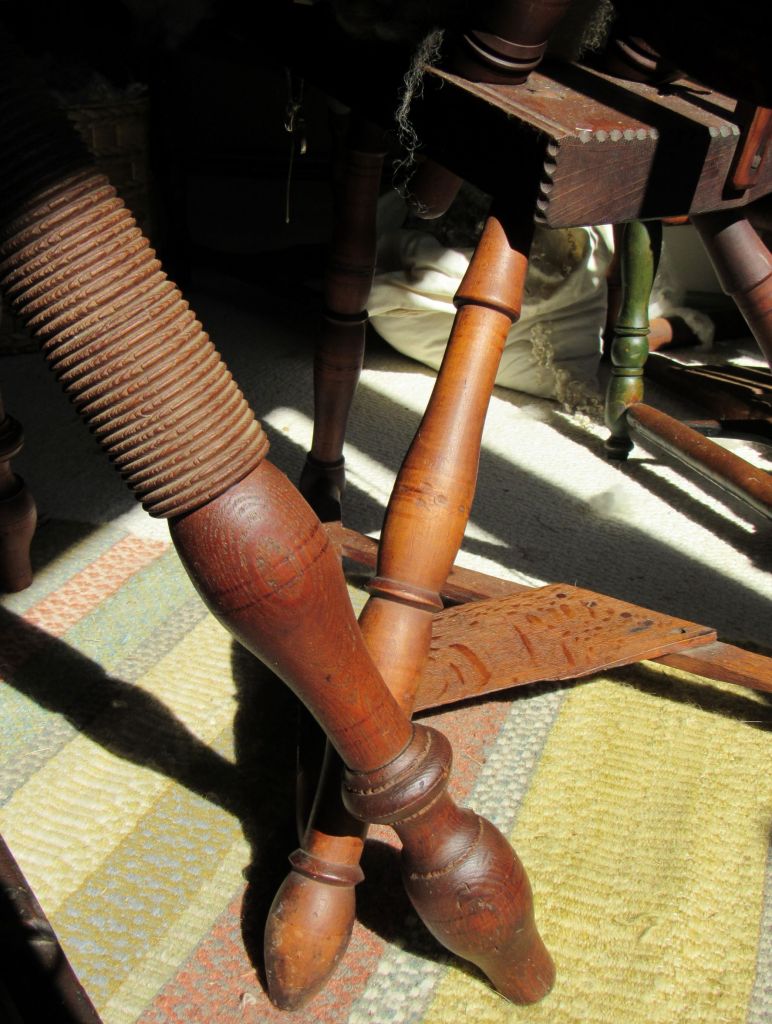
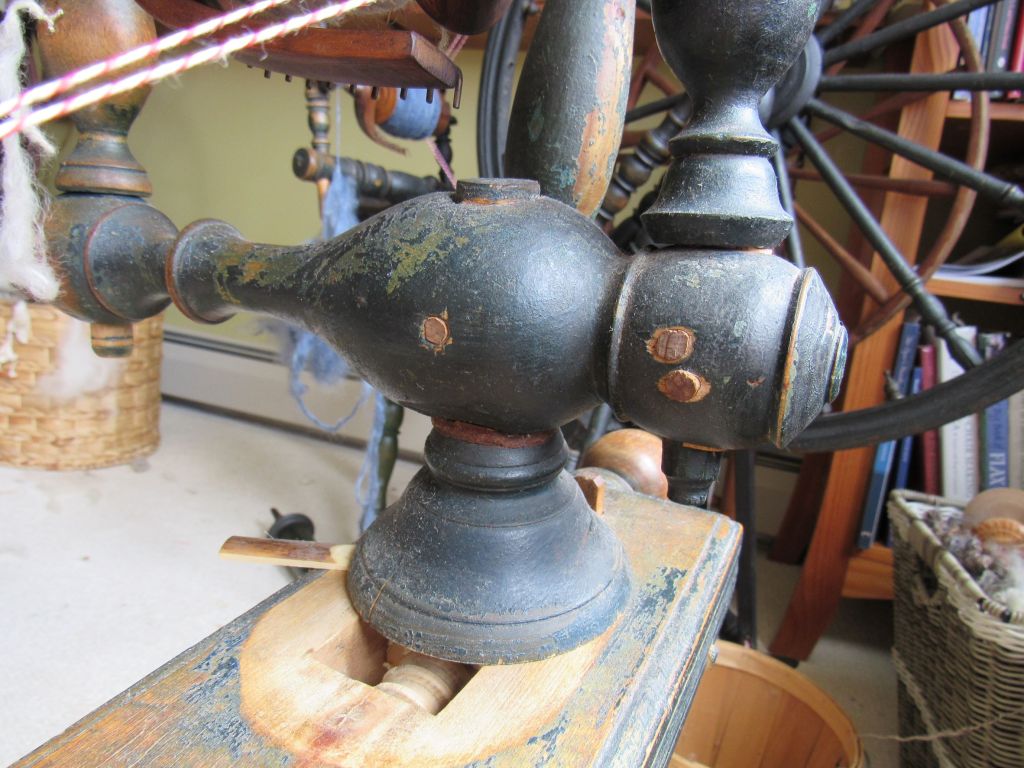
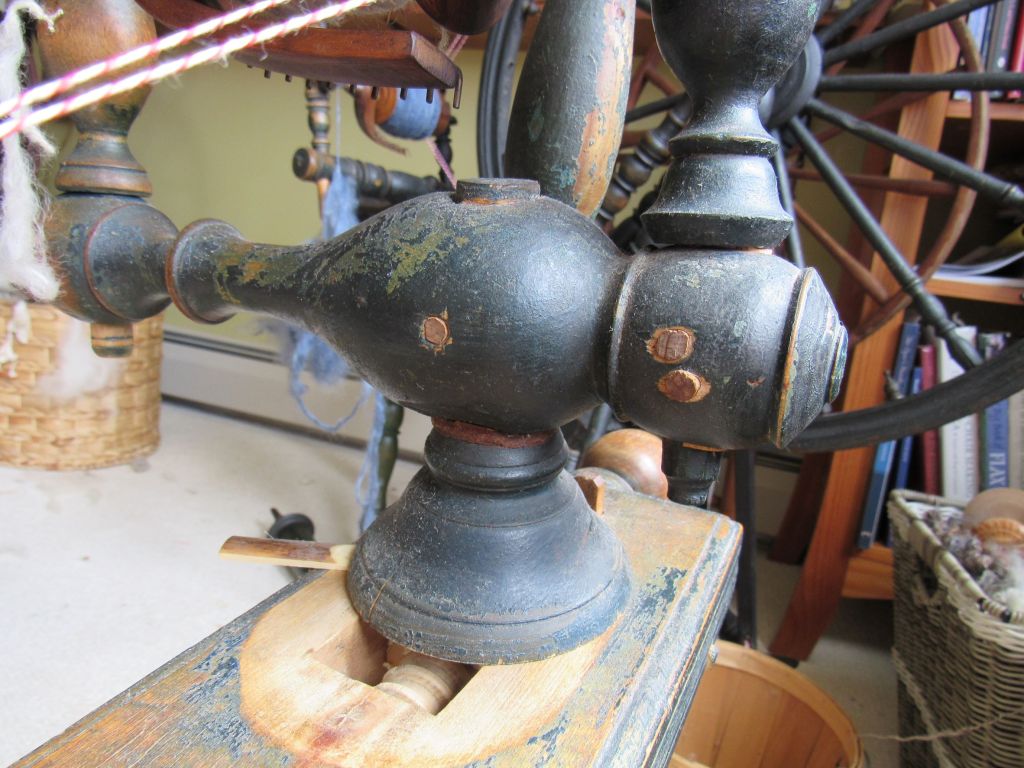
From the bulbous mother-of-all and legs
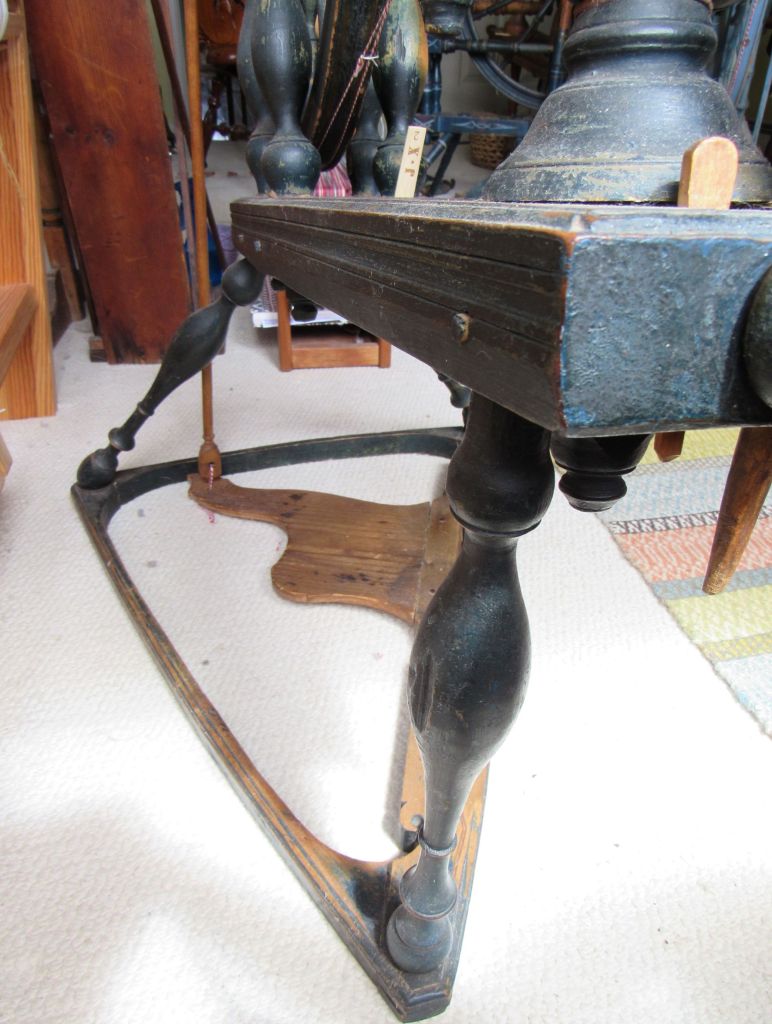
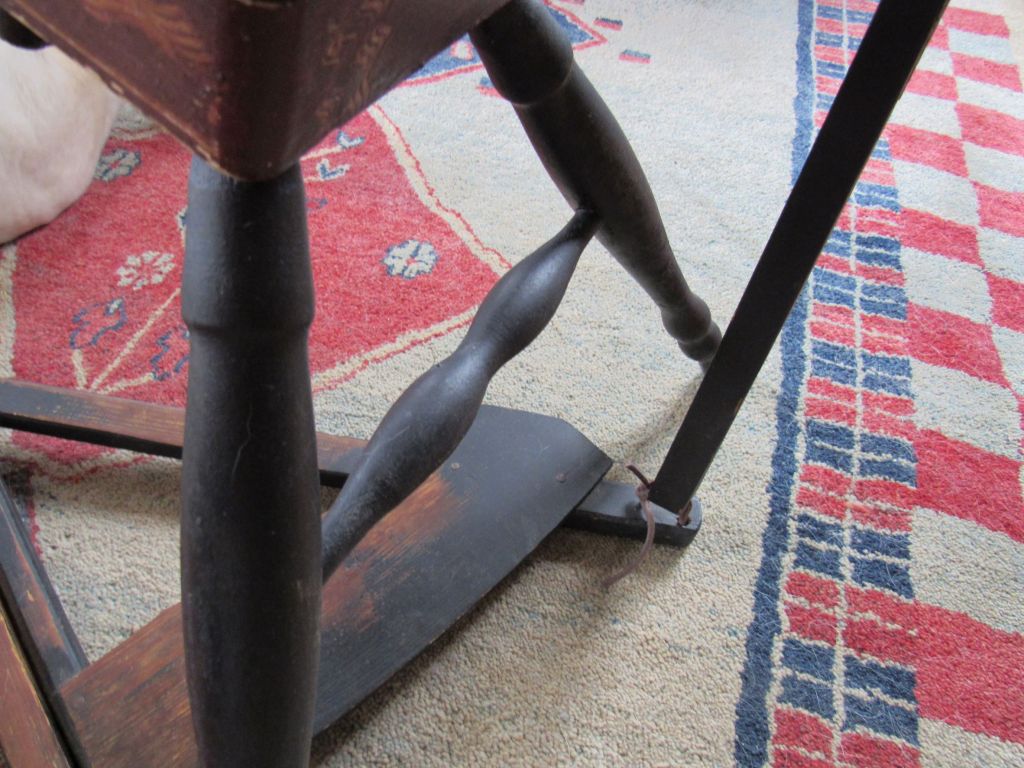
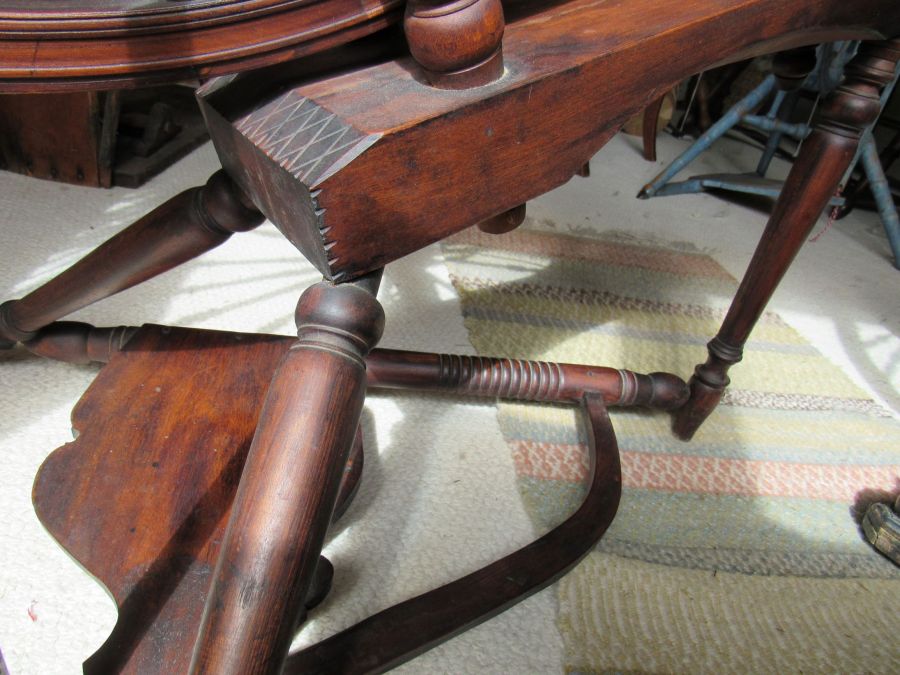
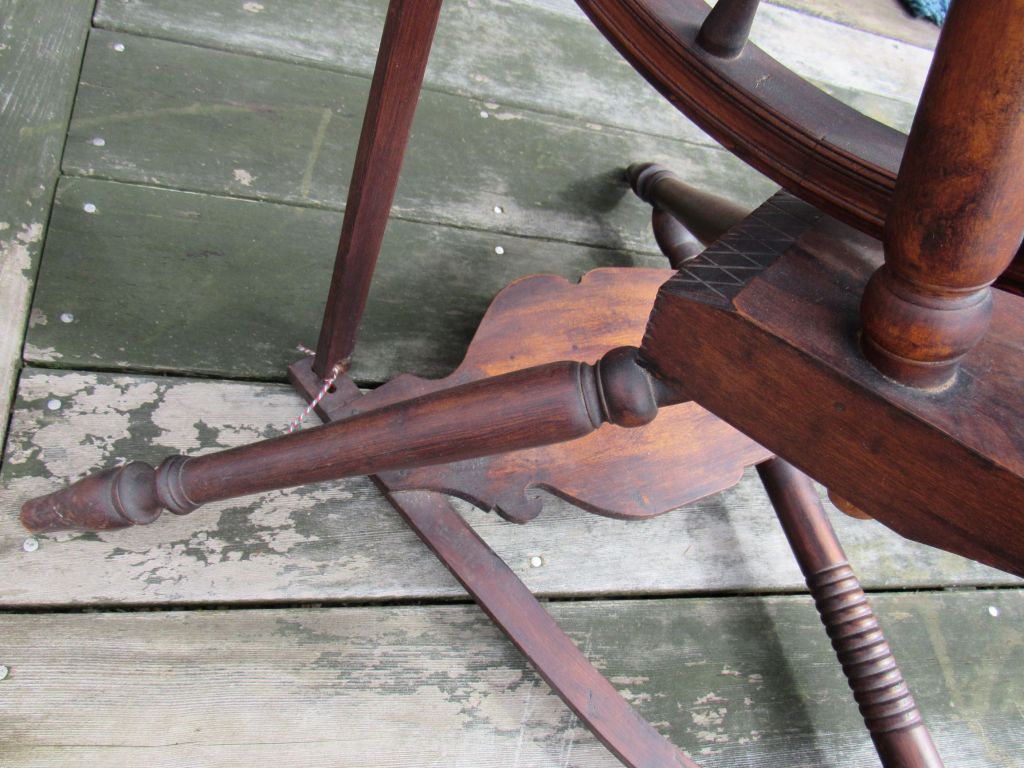
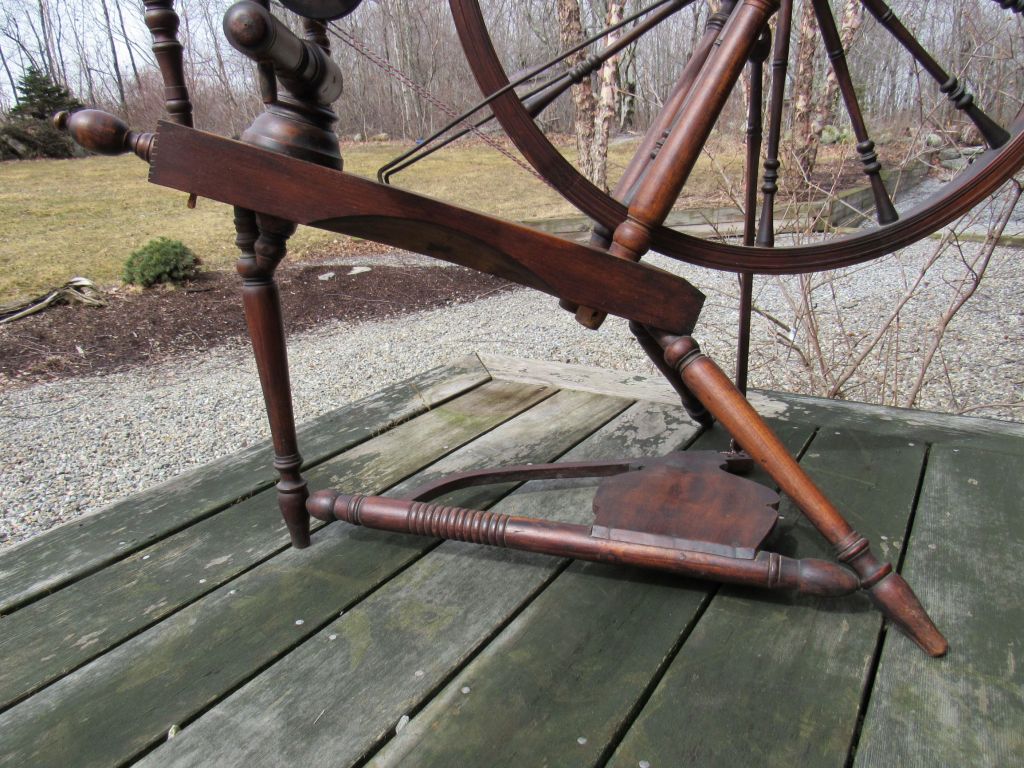
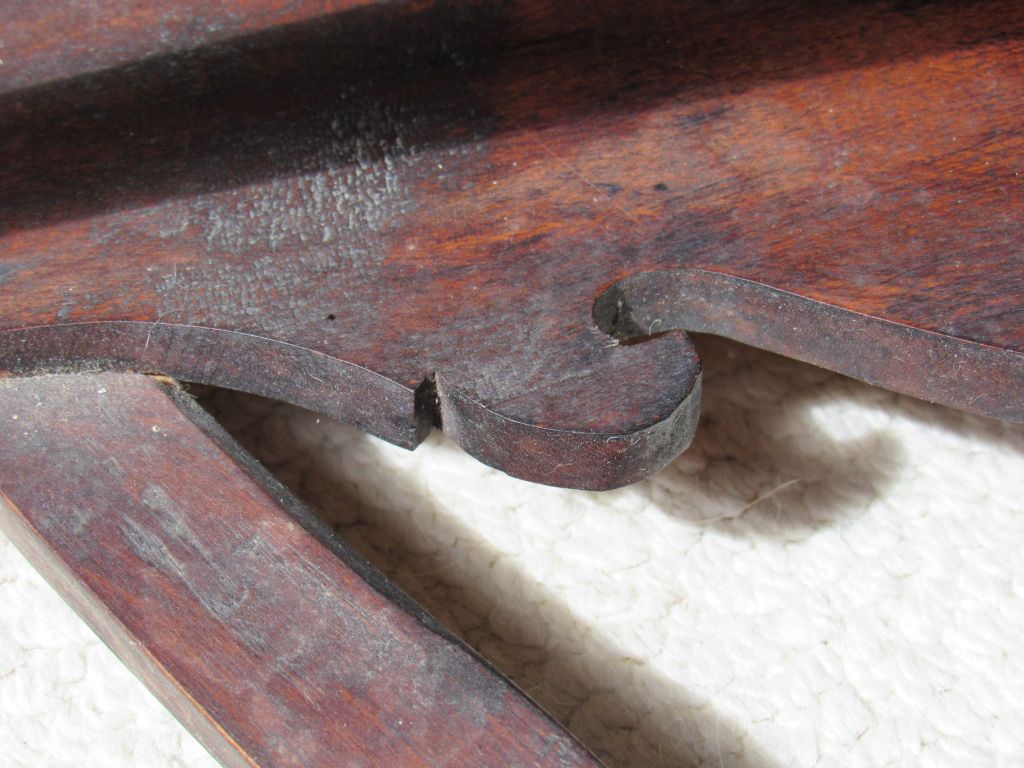
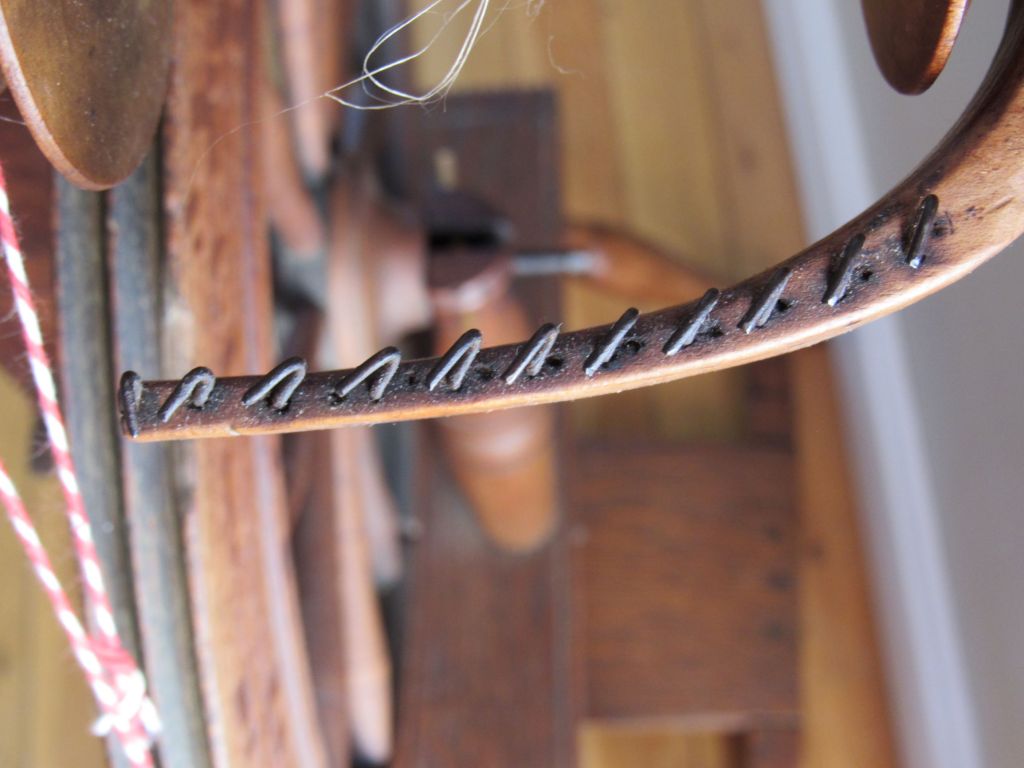
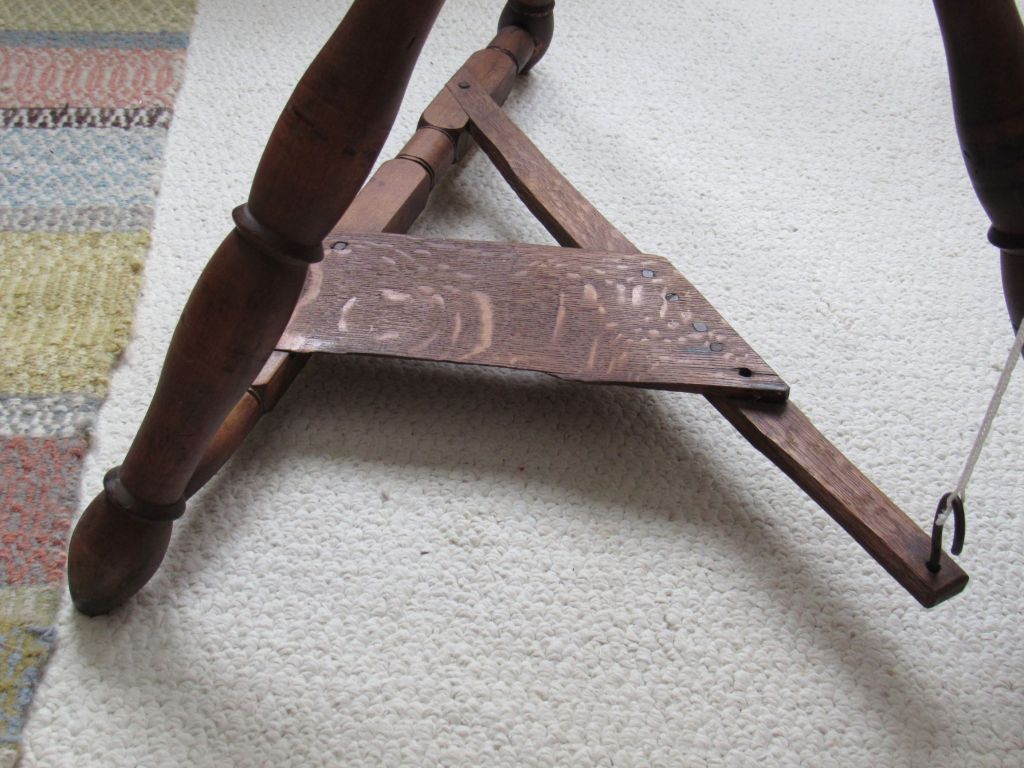
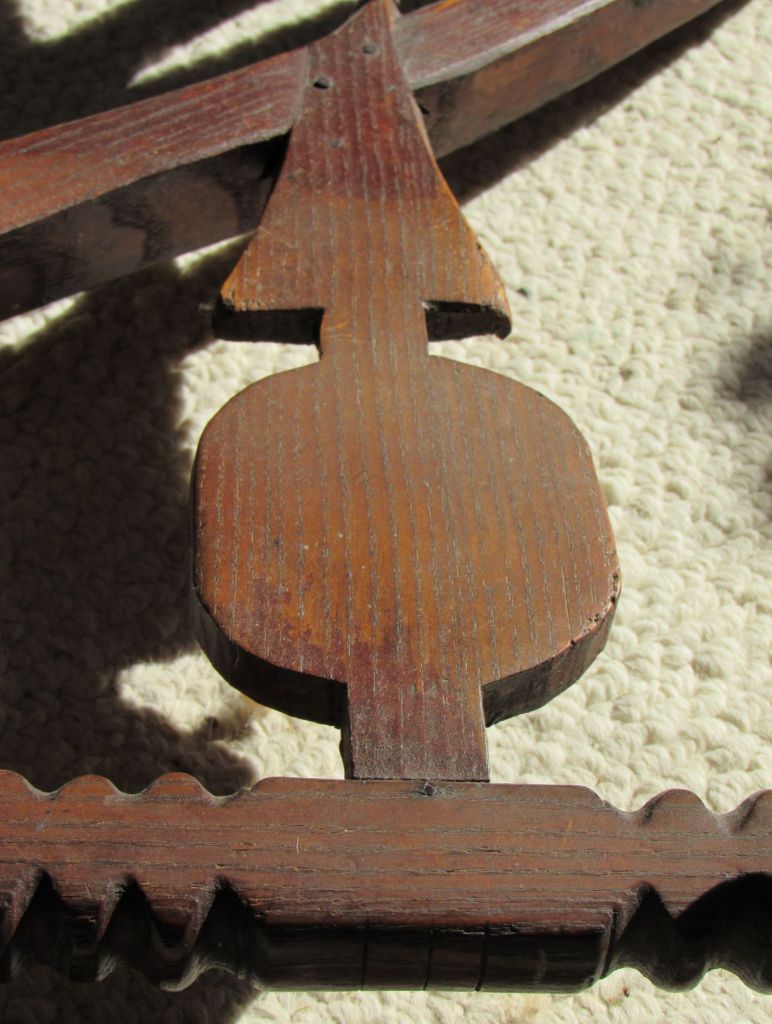
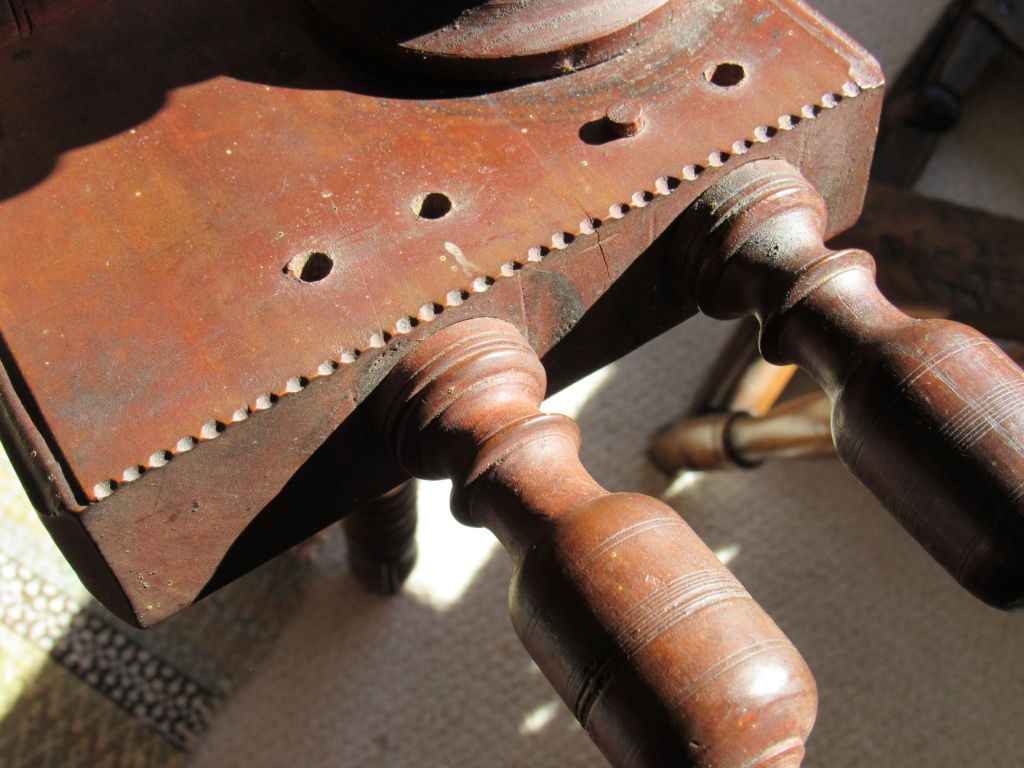
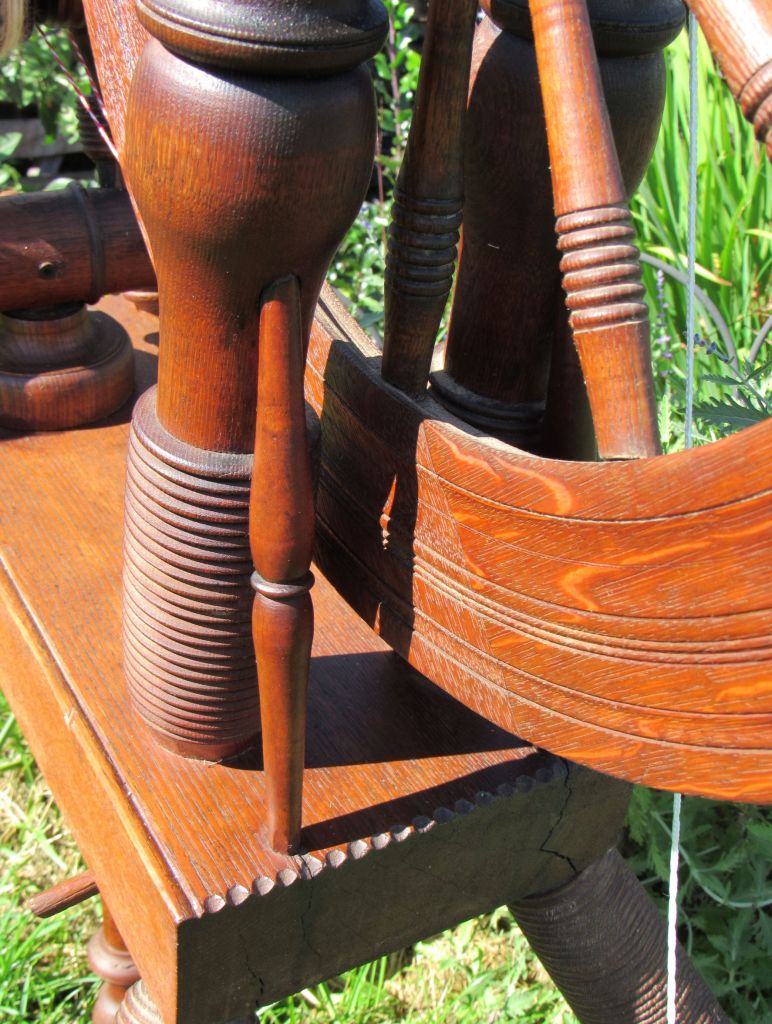
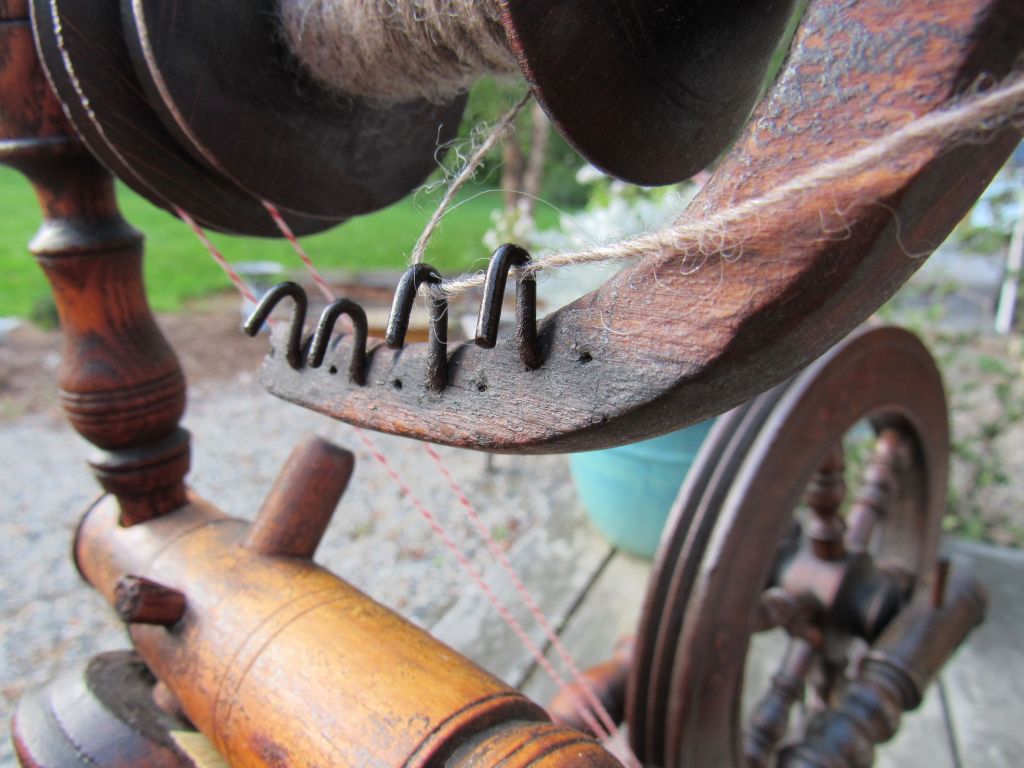
to the swooping treadle triangle embellished with curls,
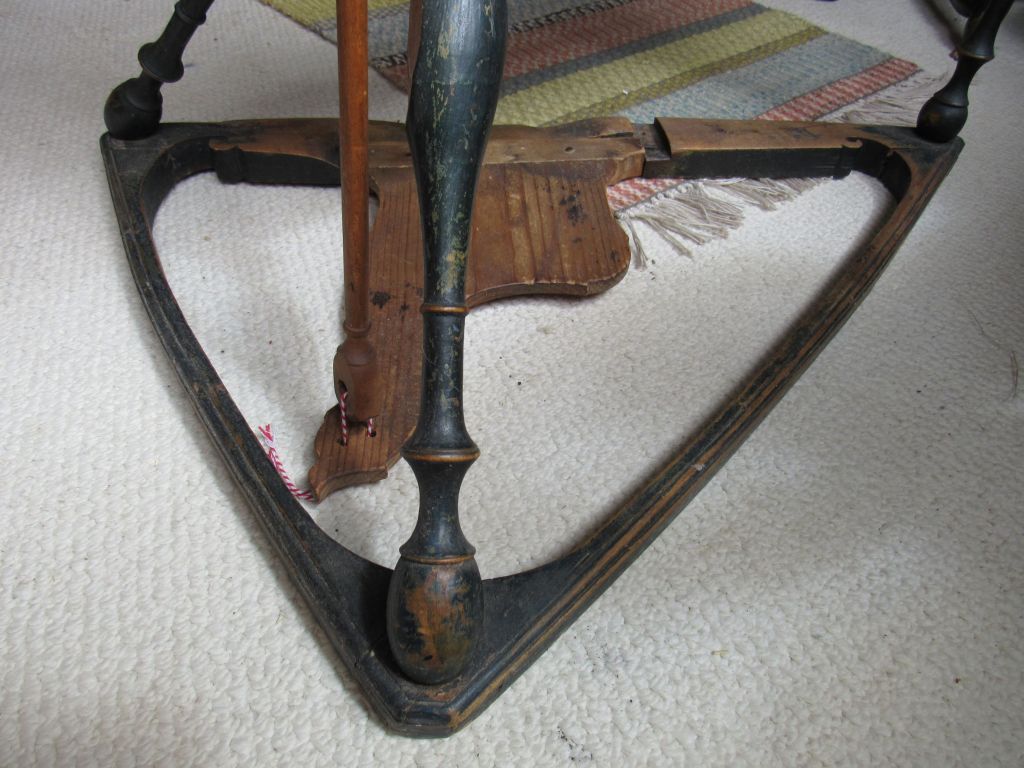
there is not a straight line to be seen. 
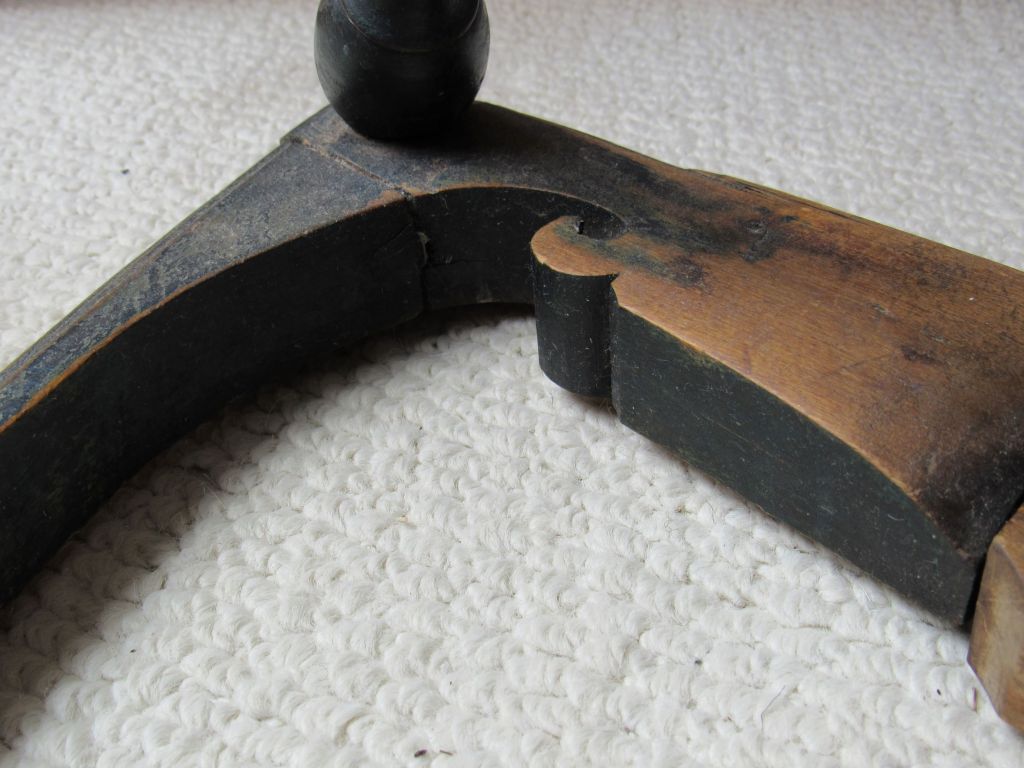
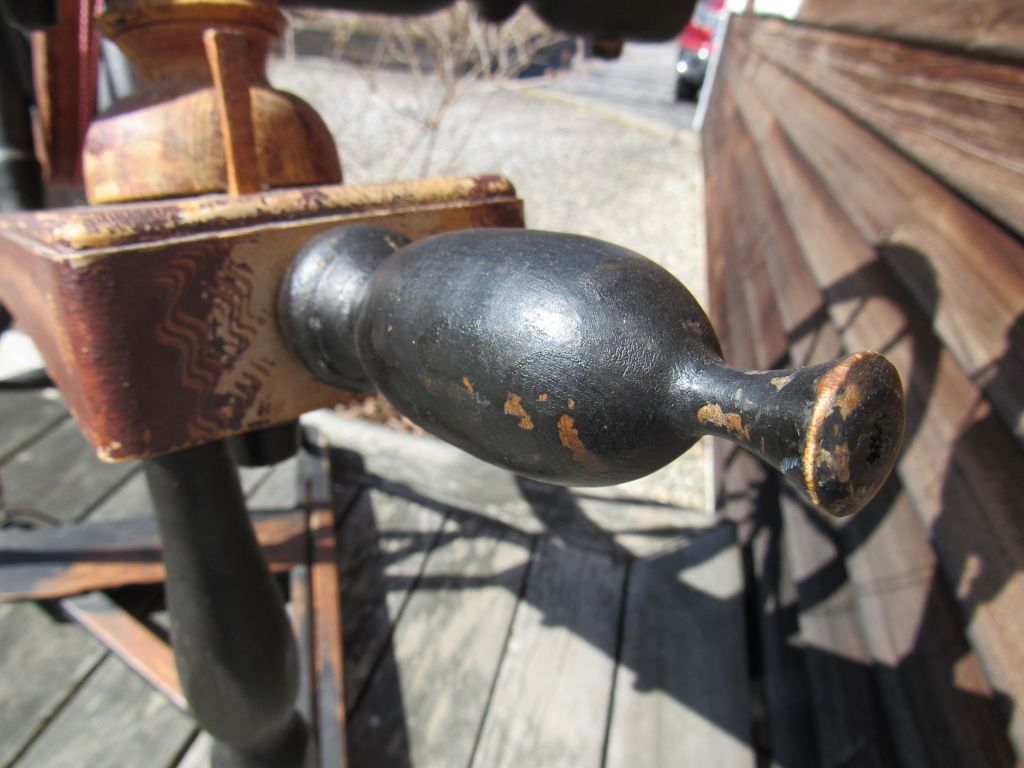
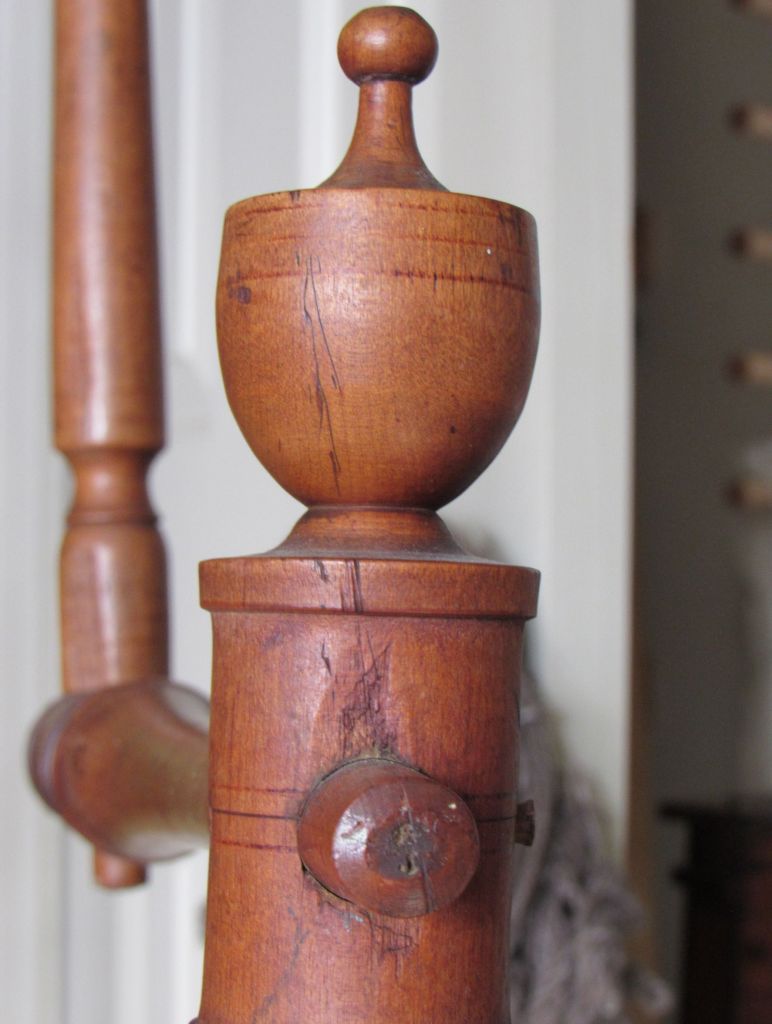
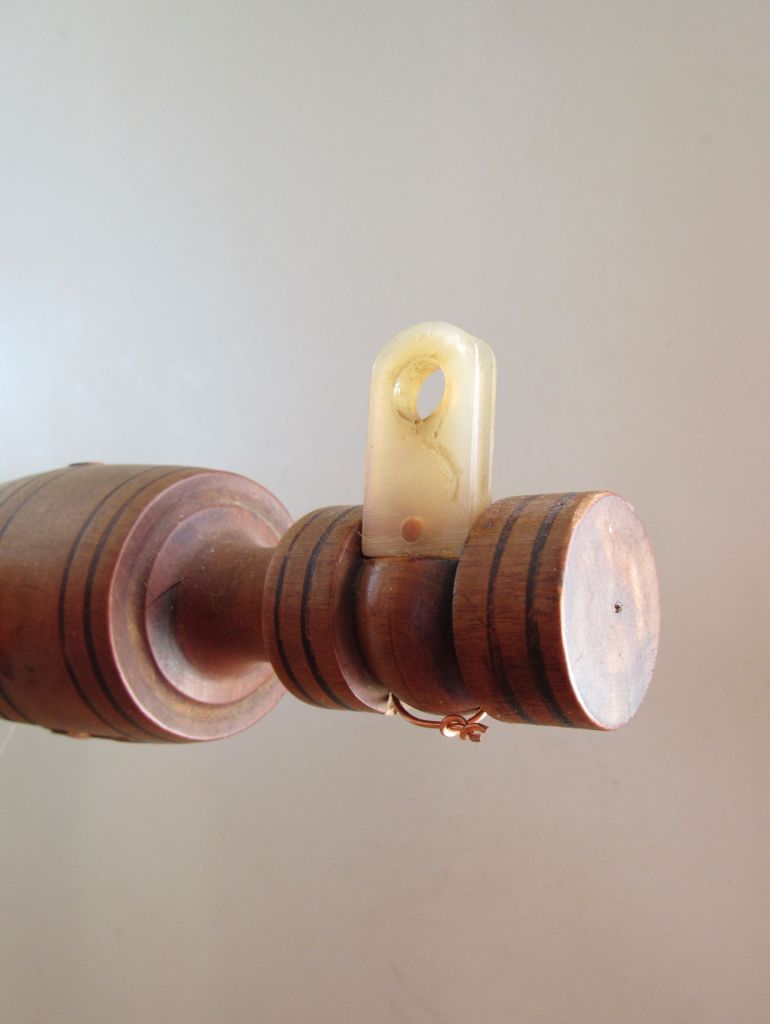
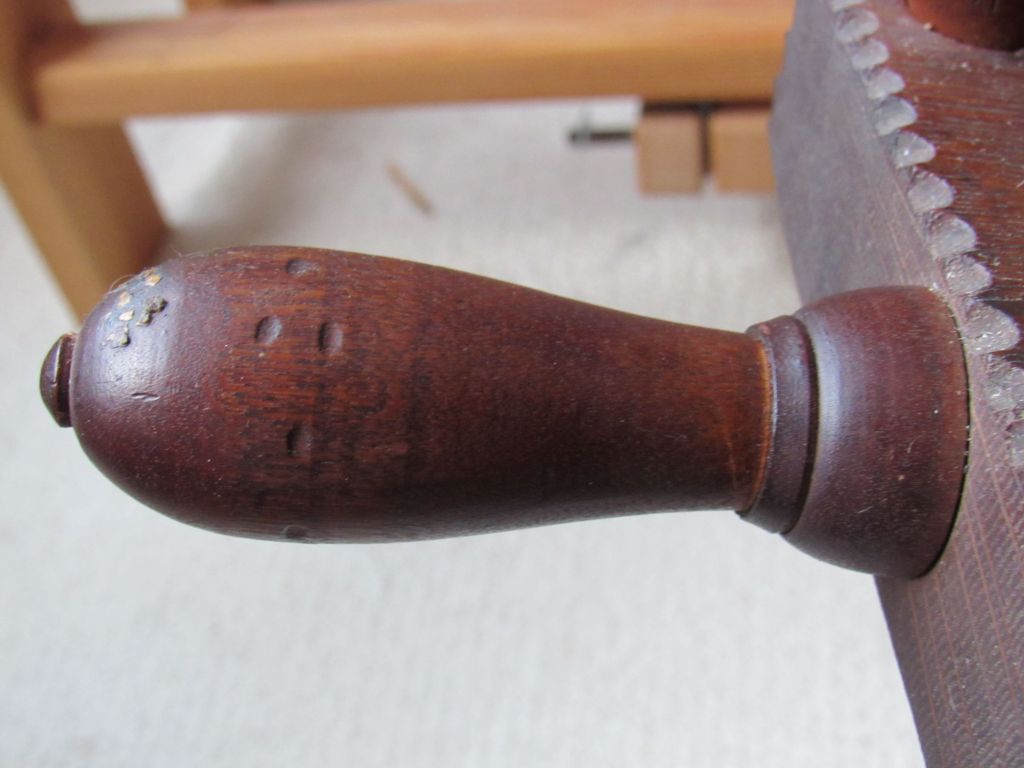
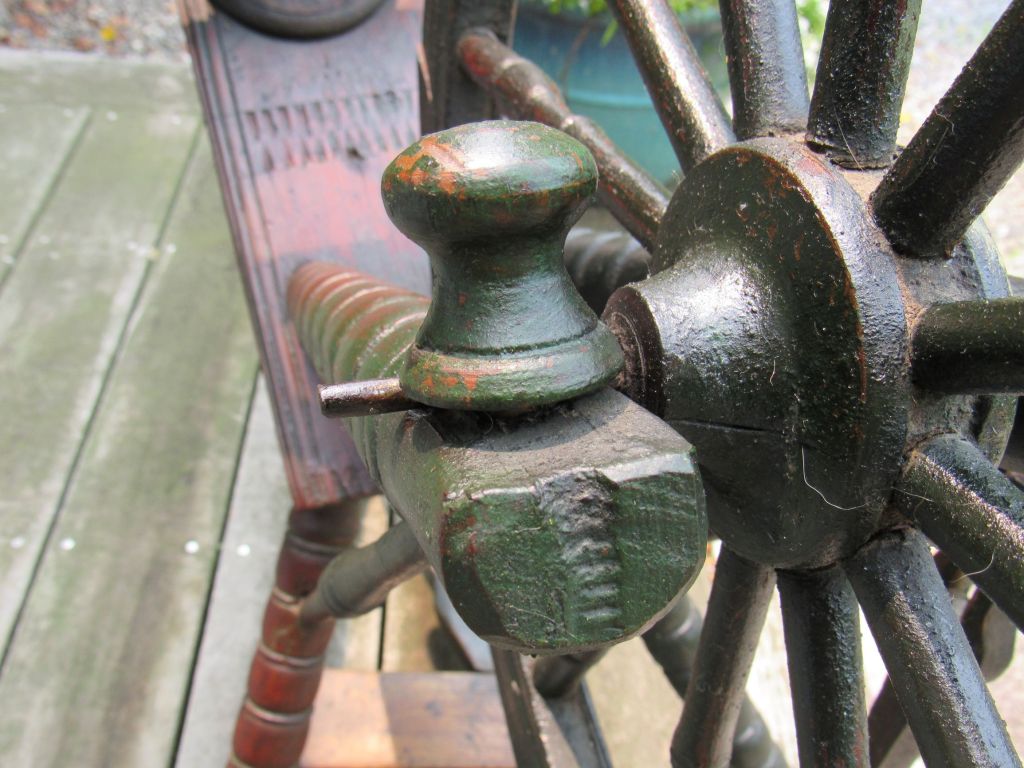
Even the tension knob looks pregnant. 
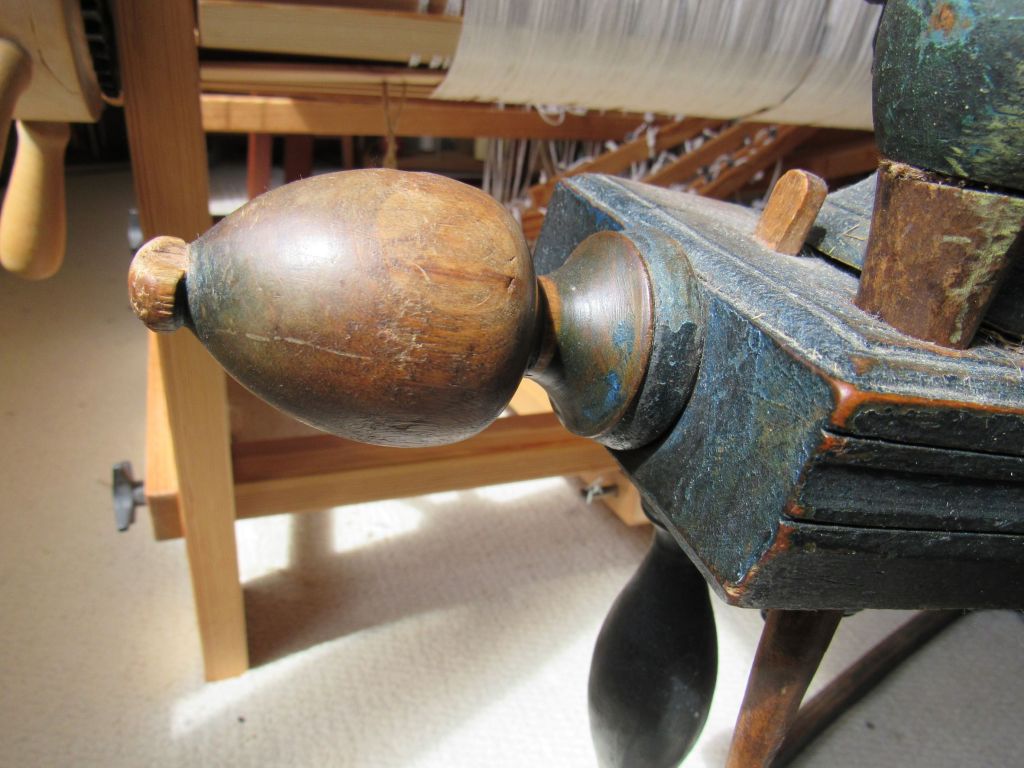
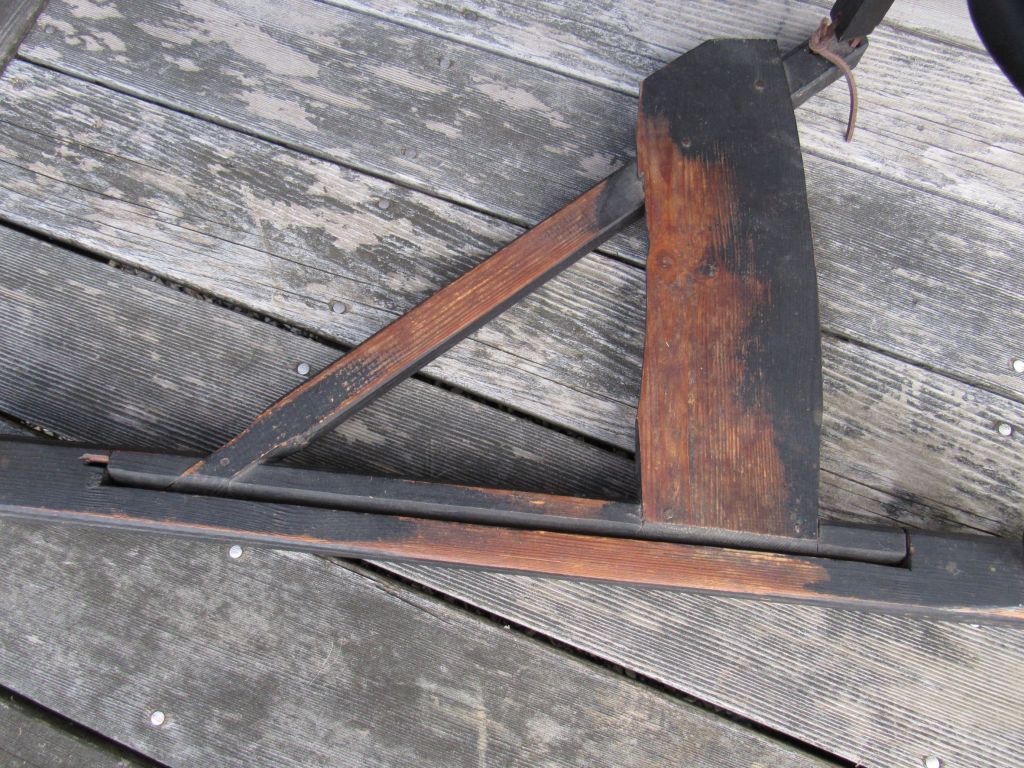
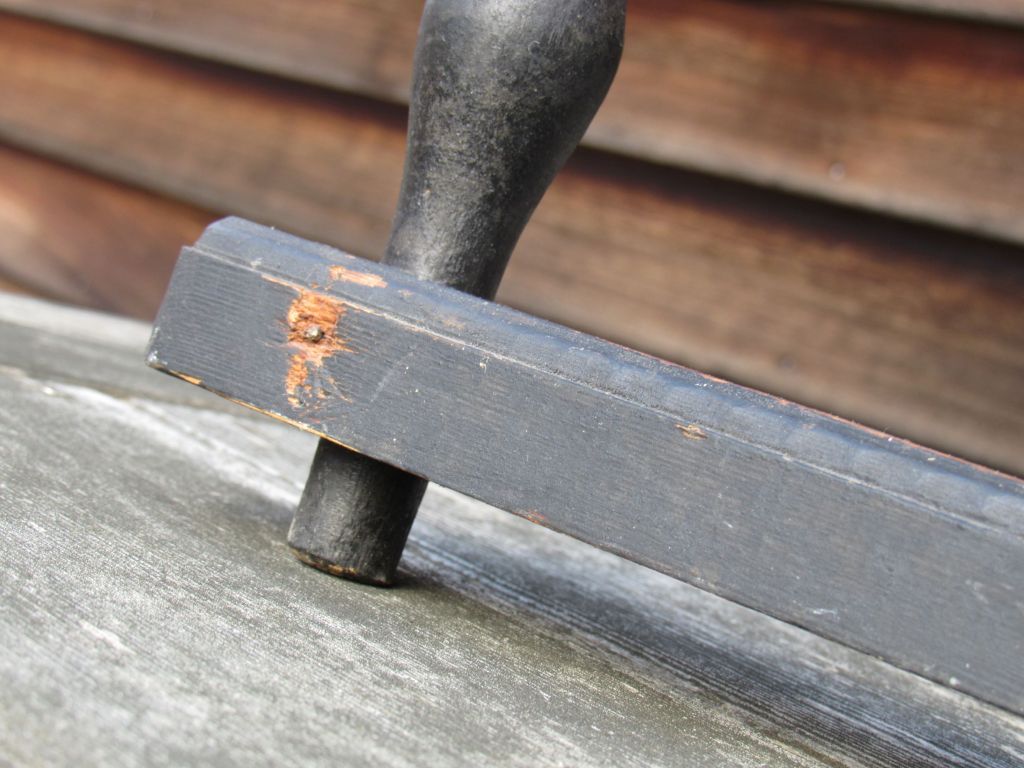
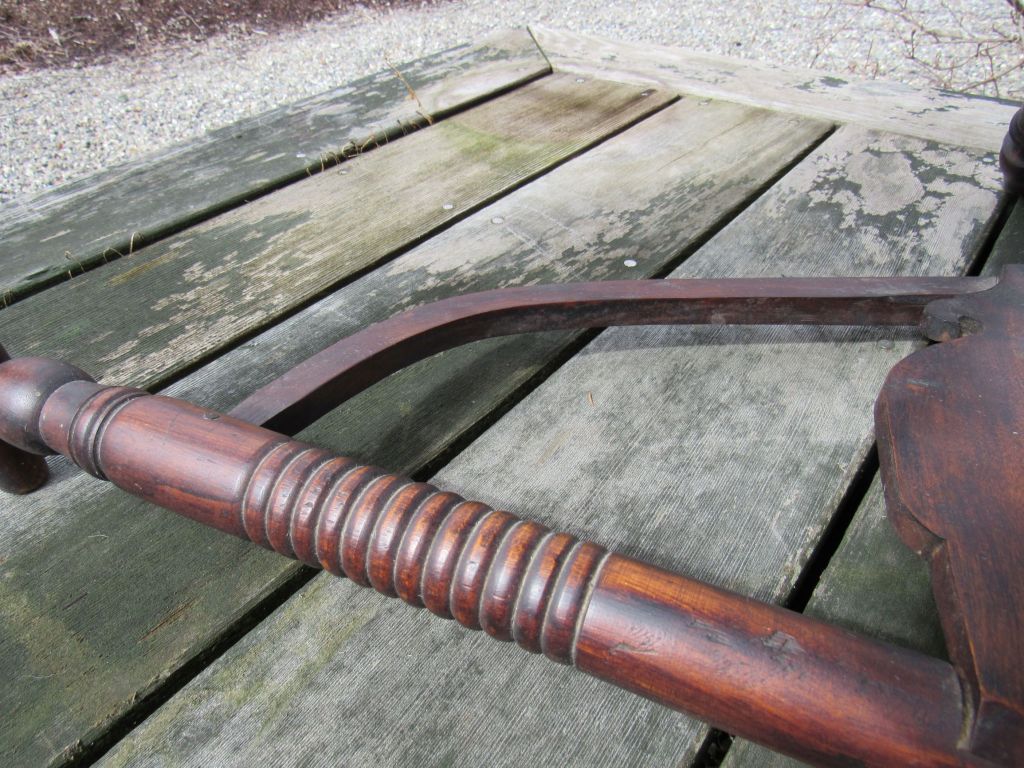
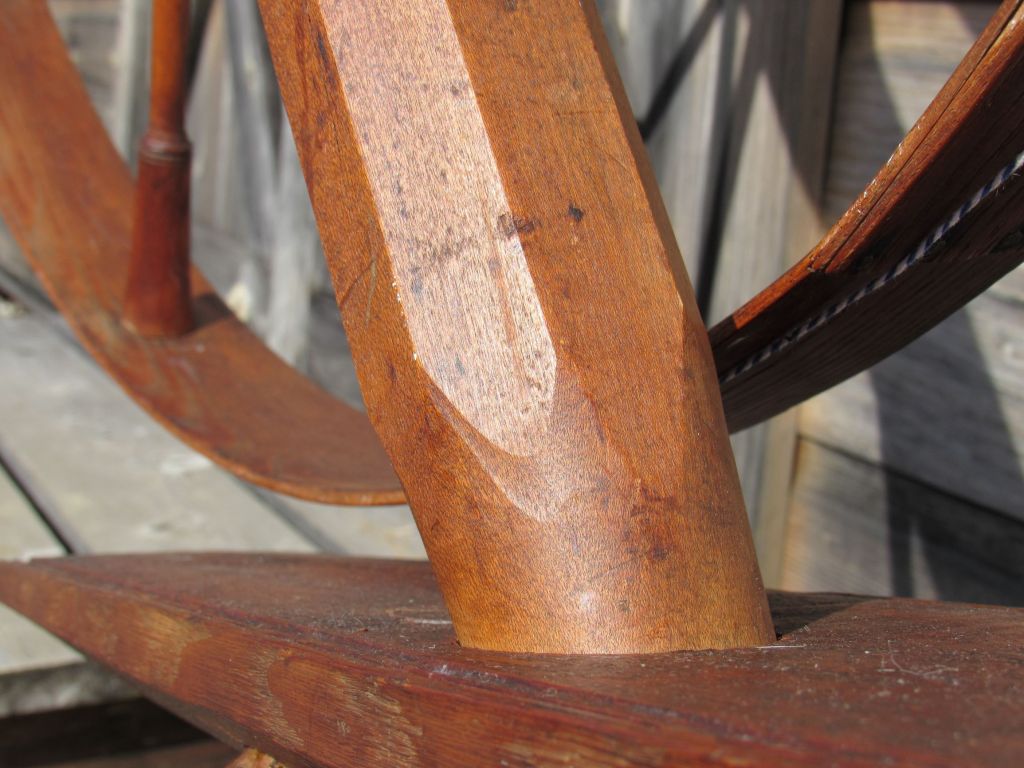
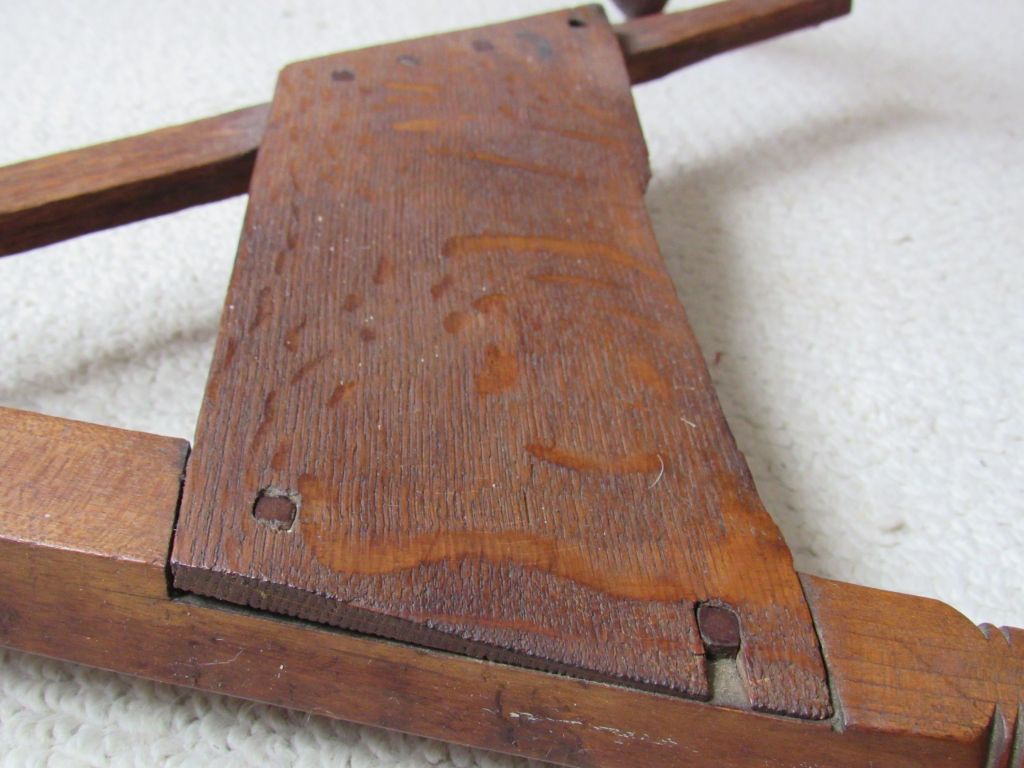
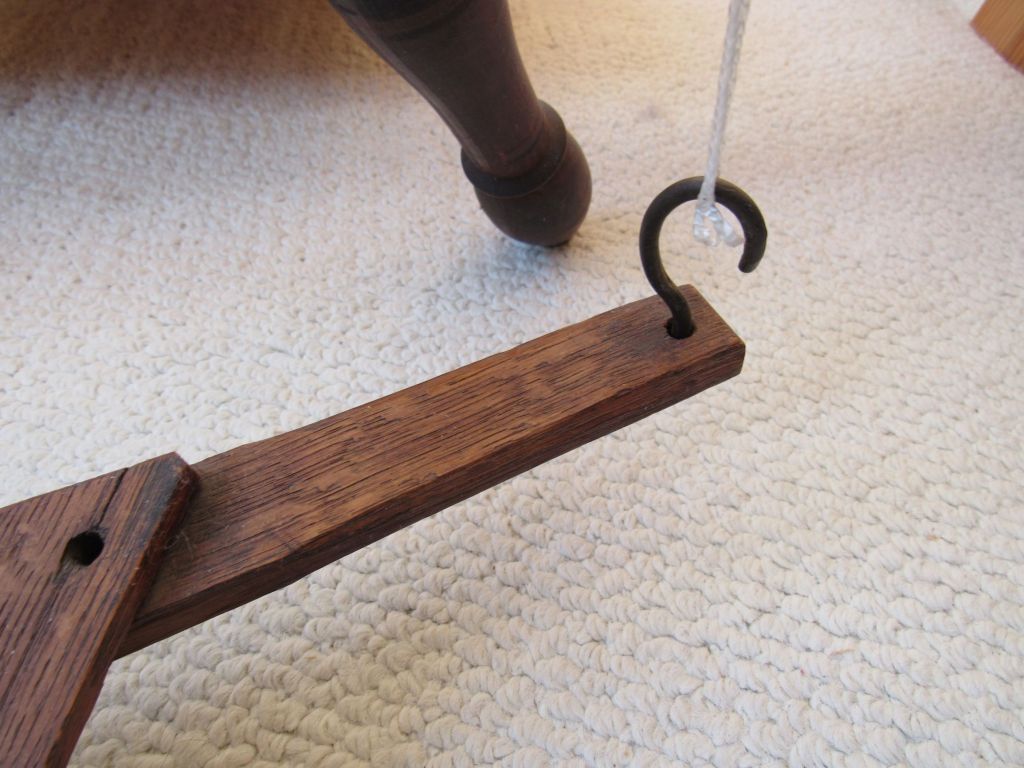
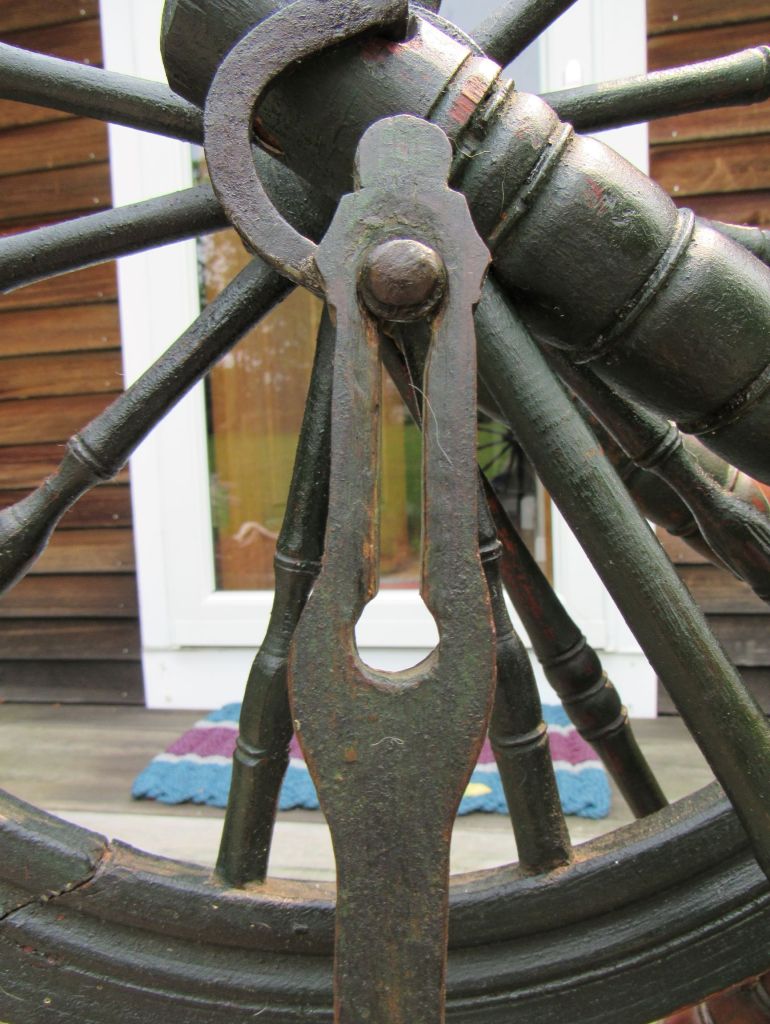
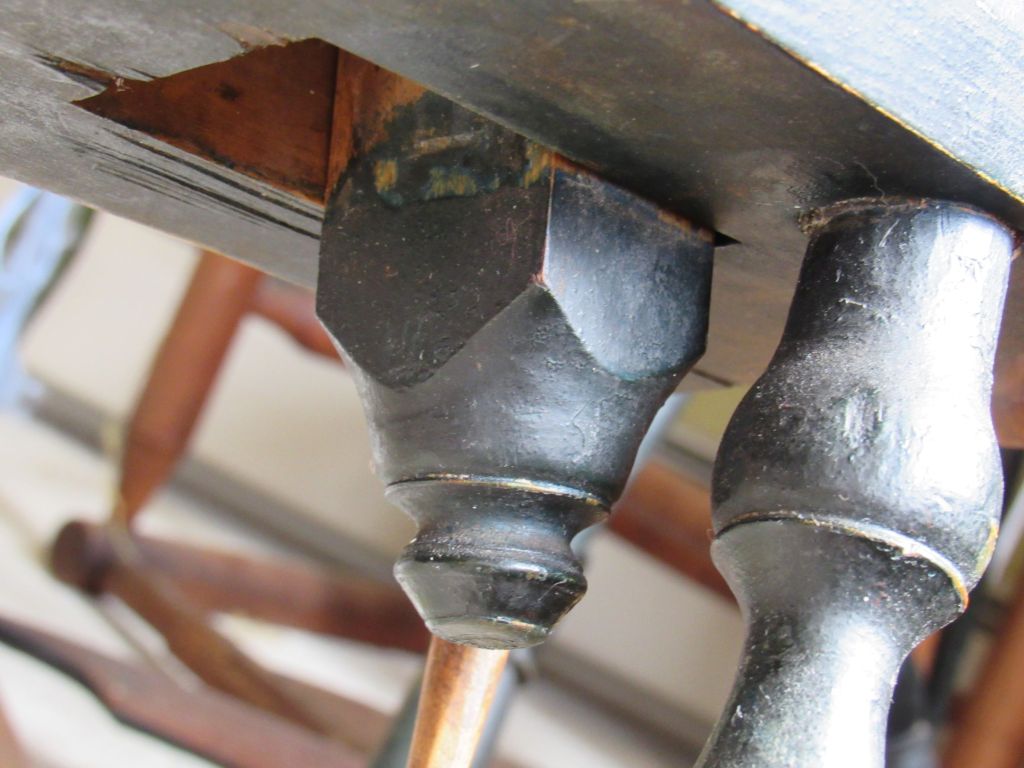
The treadle itself is an unusual exaggerated shape,
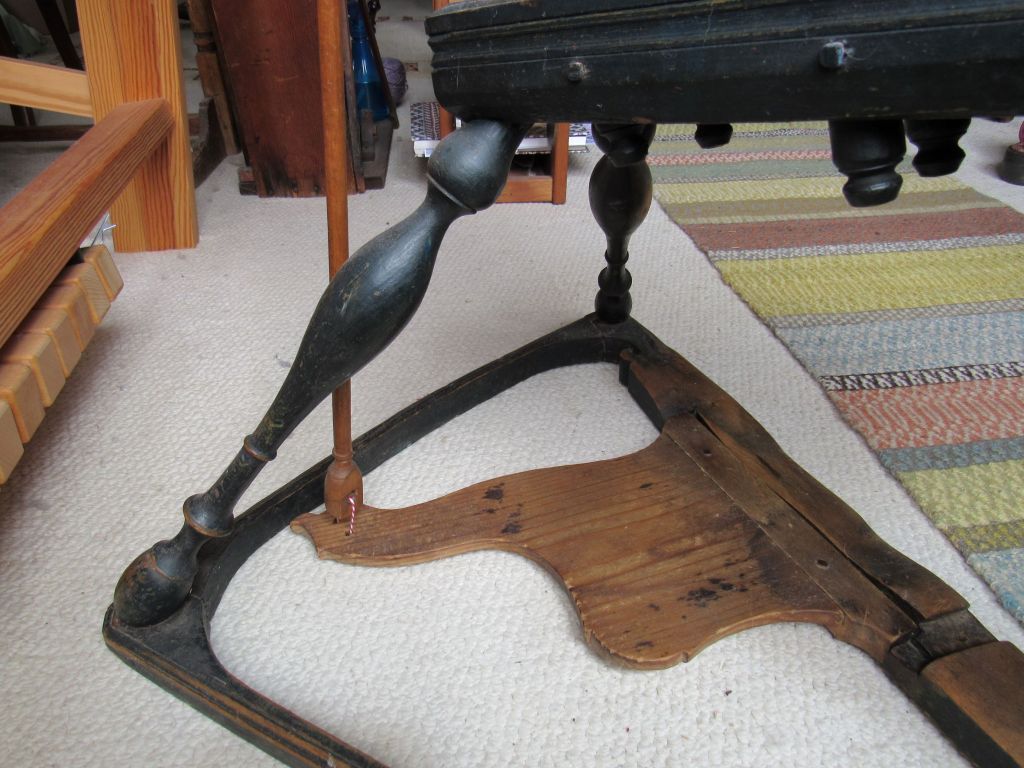
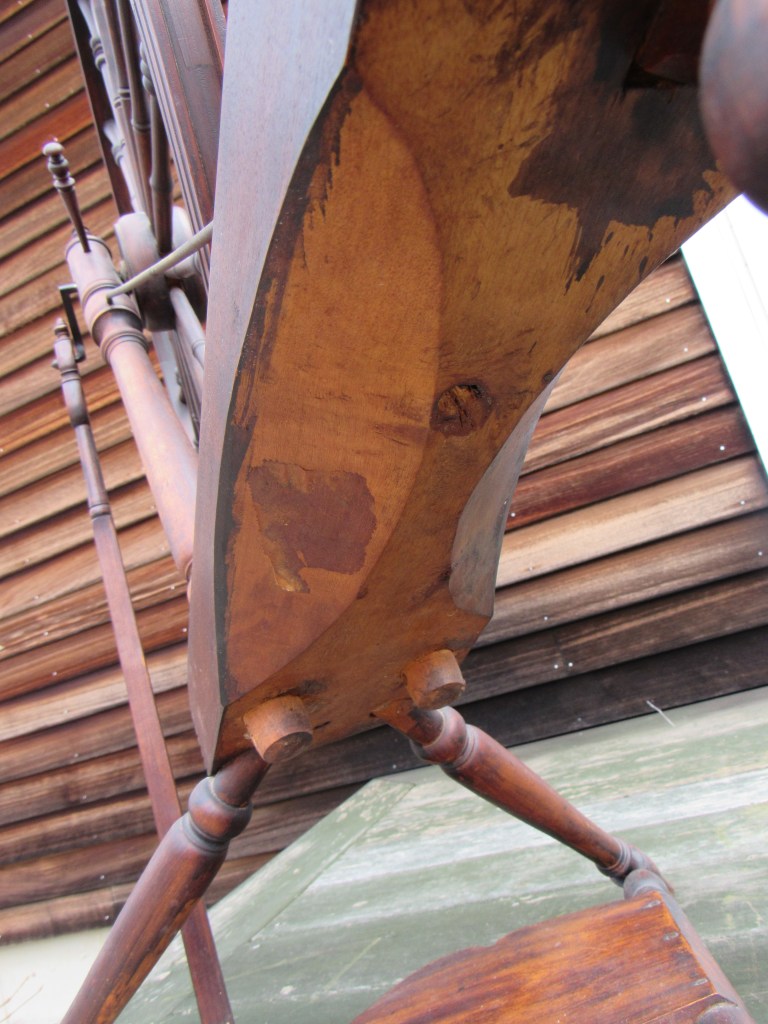
with chamfered edges underneath. 
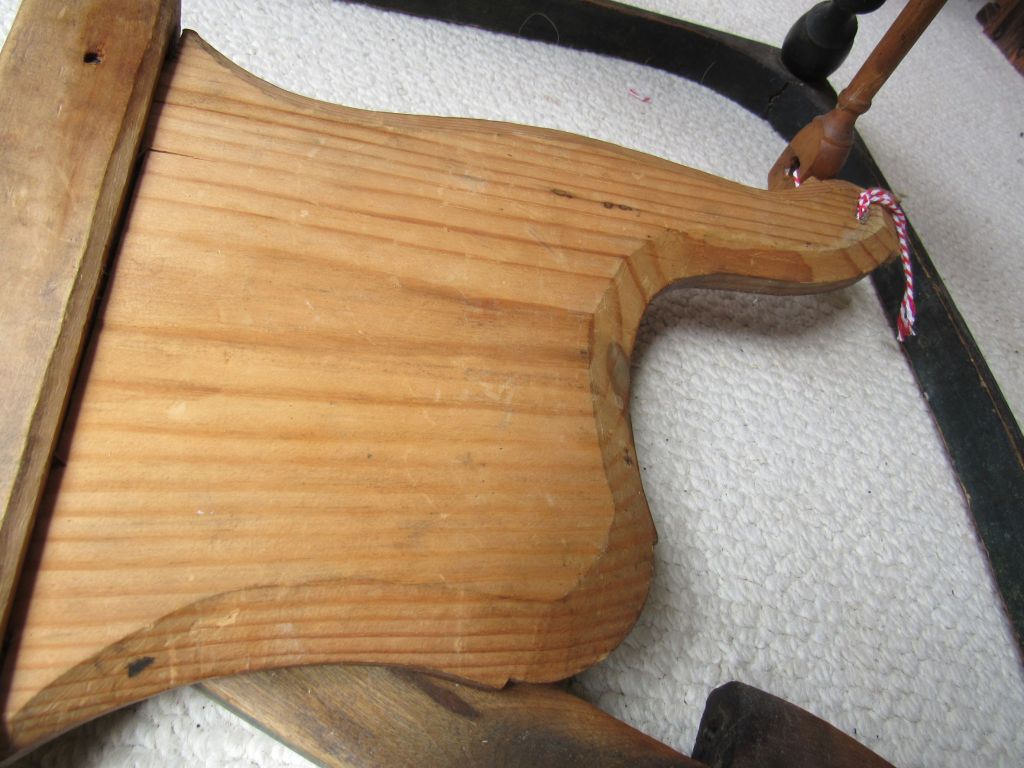
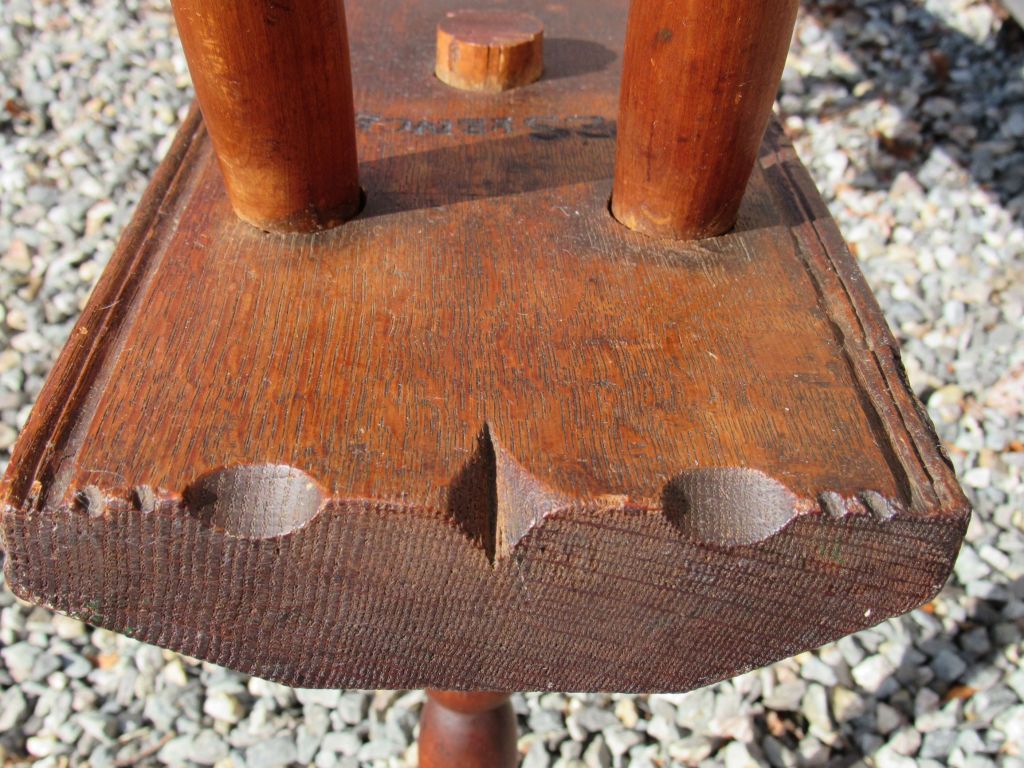
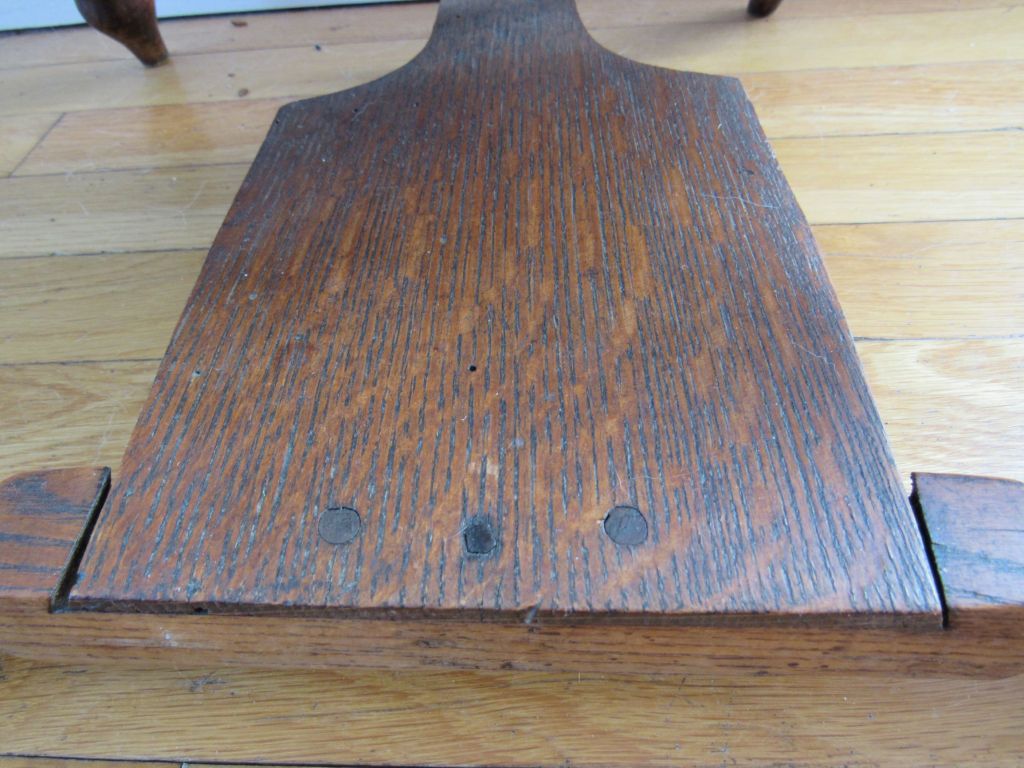
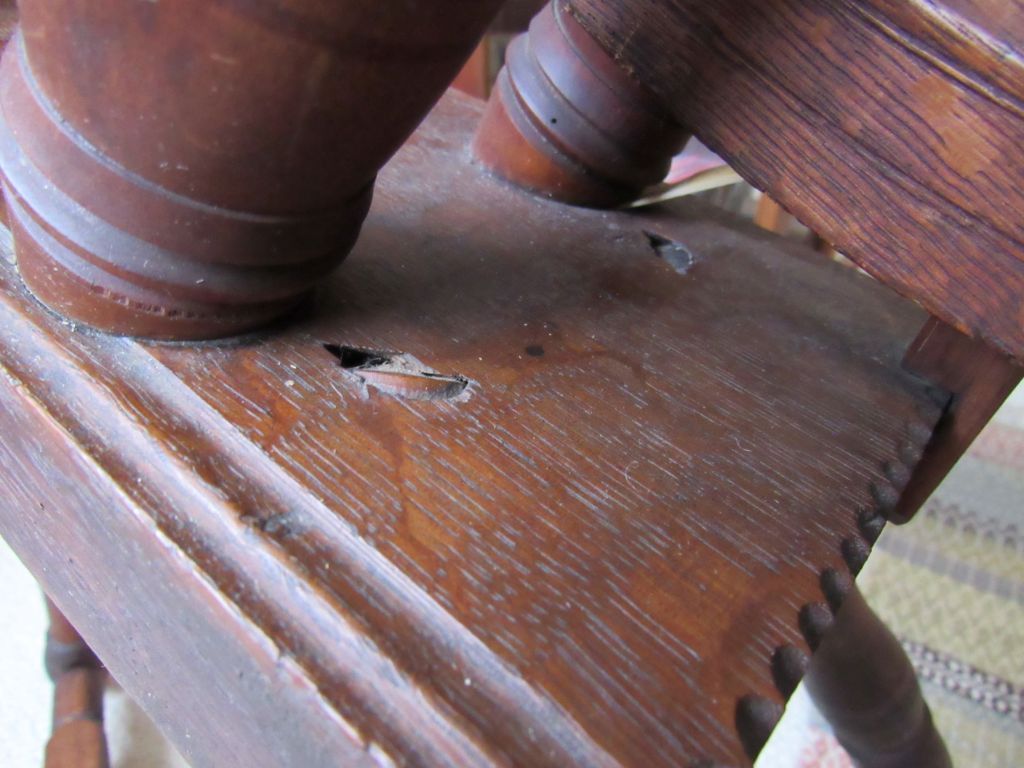
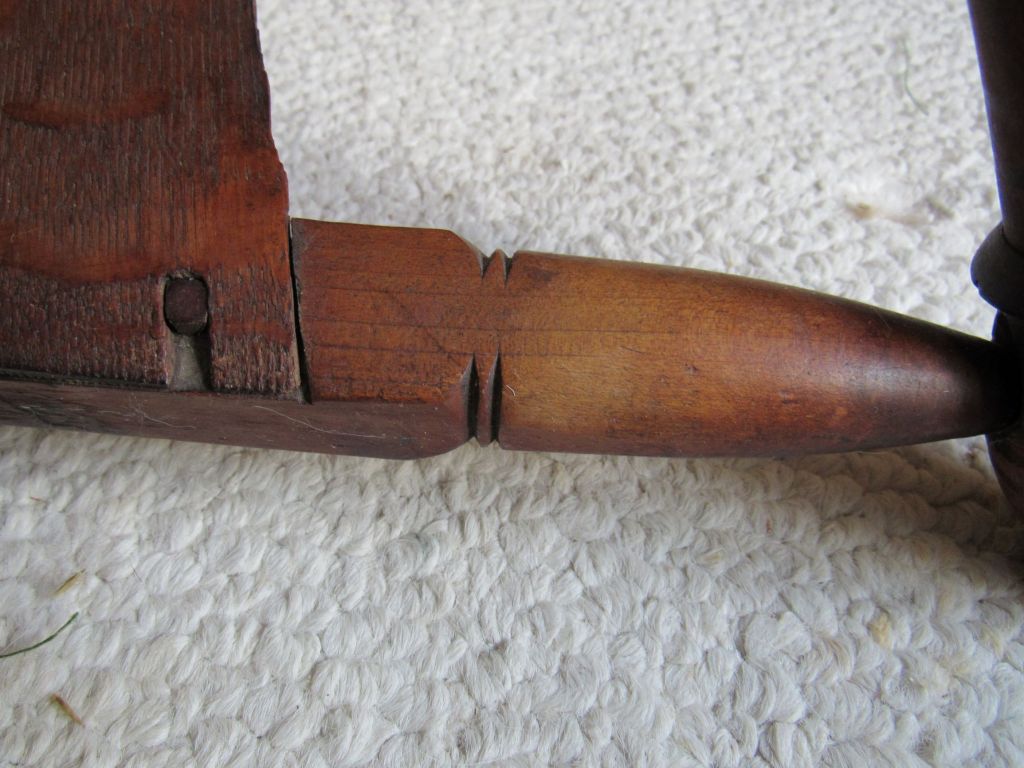
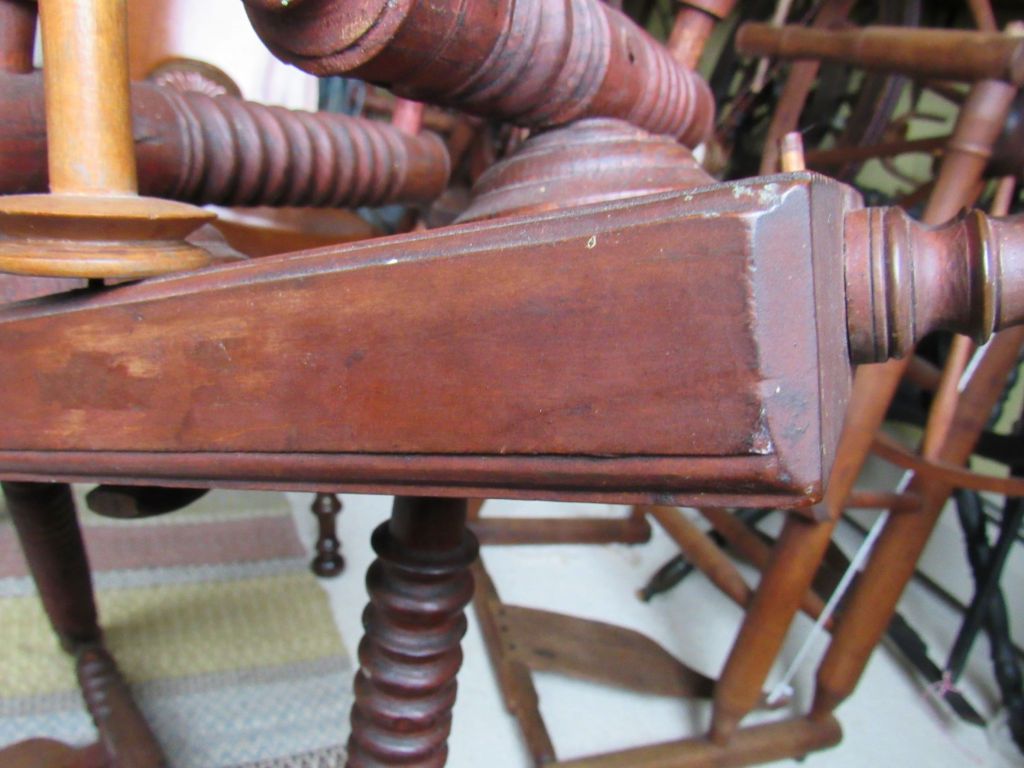
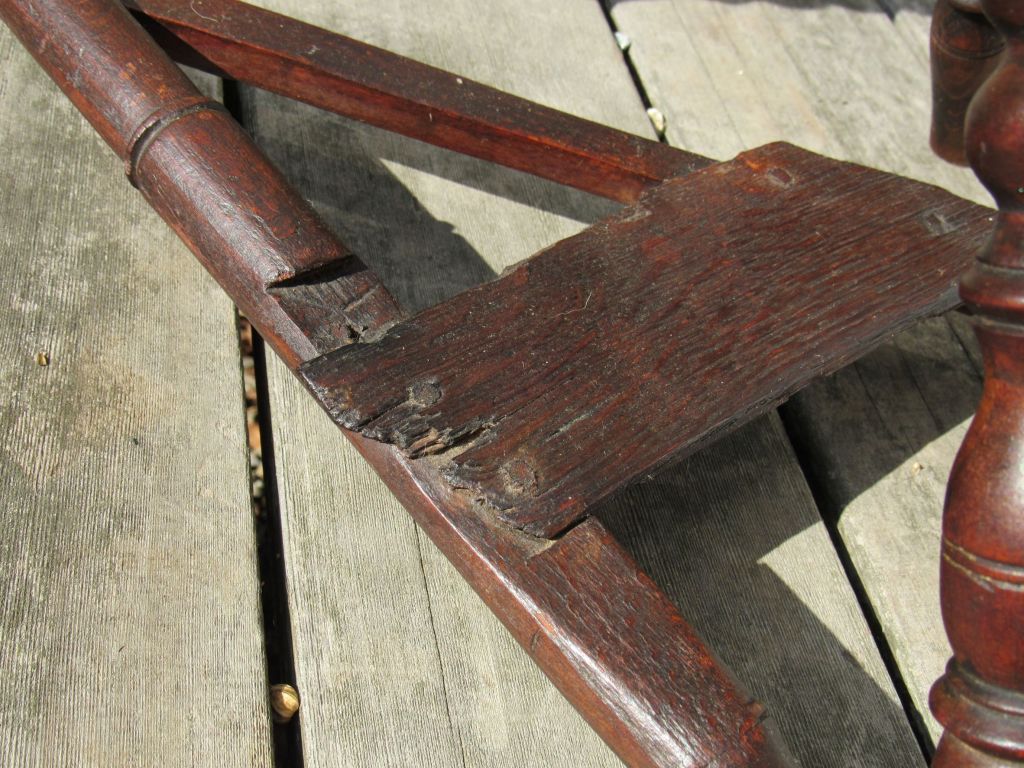
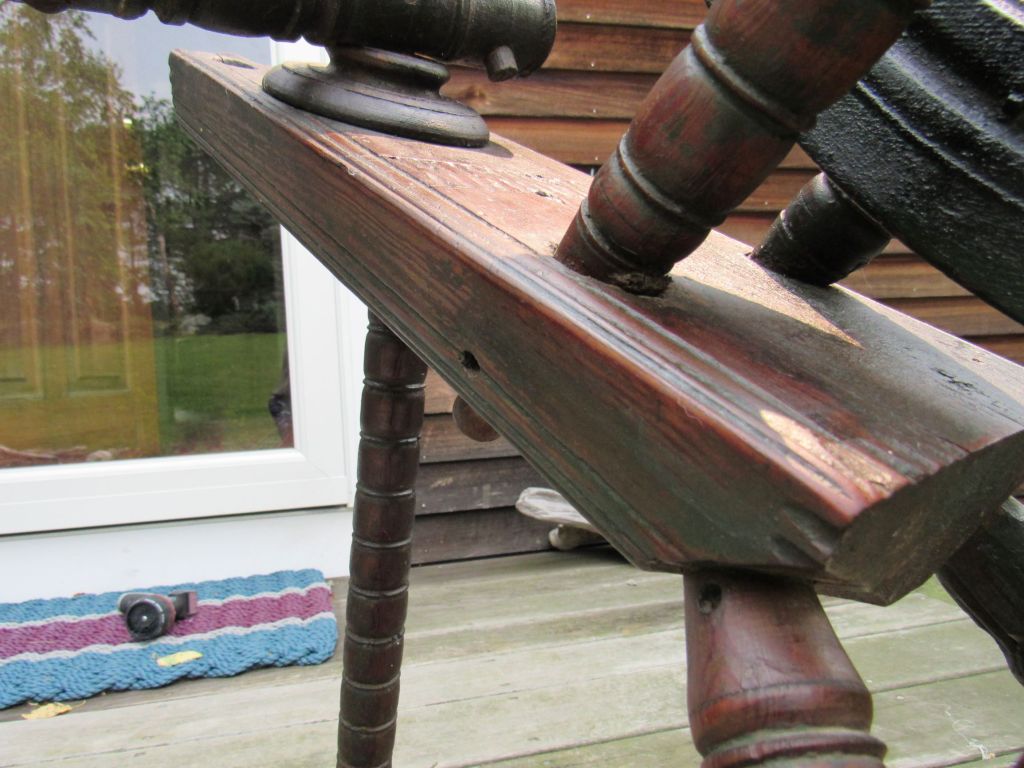
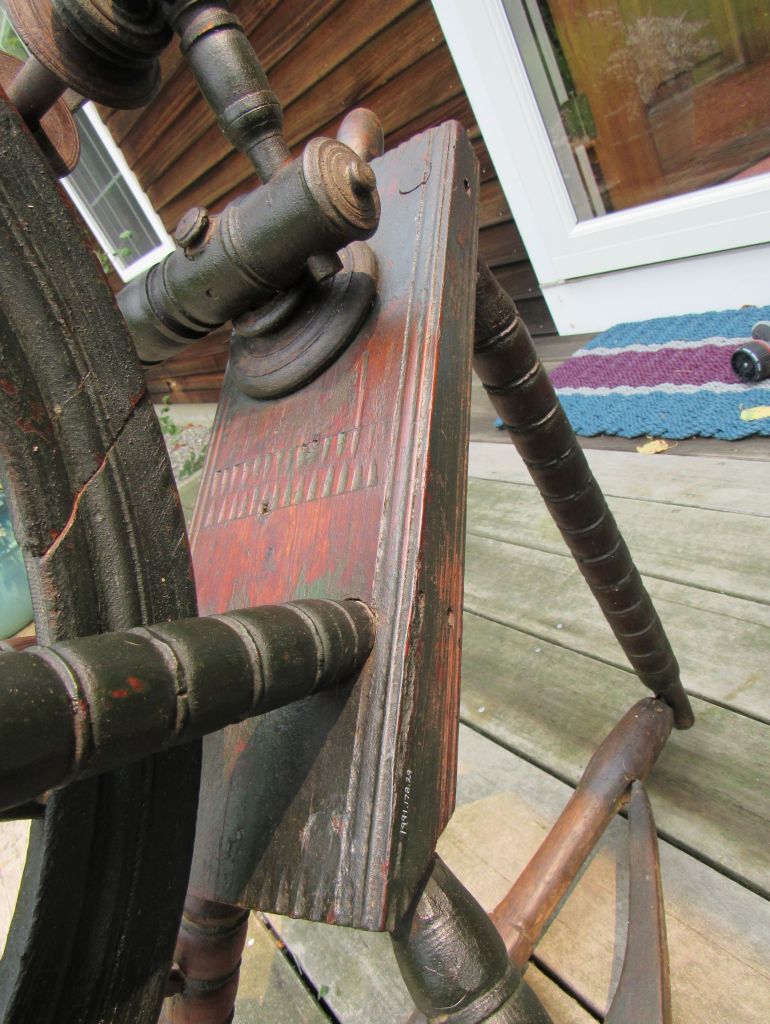
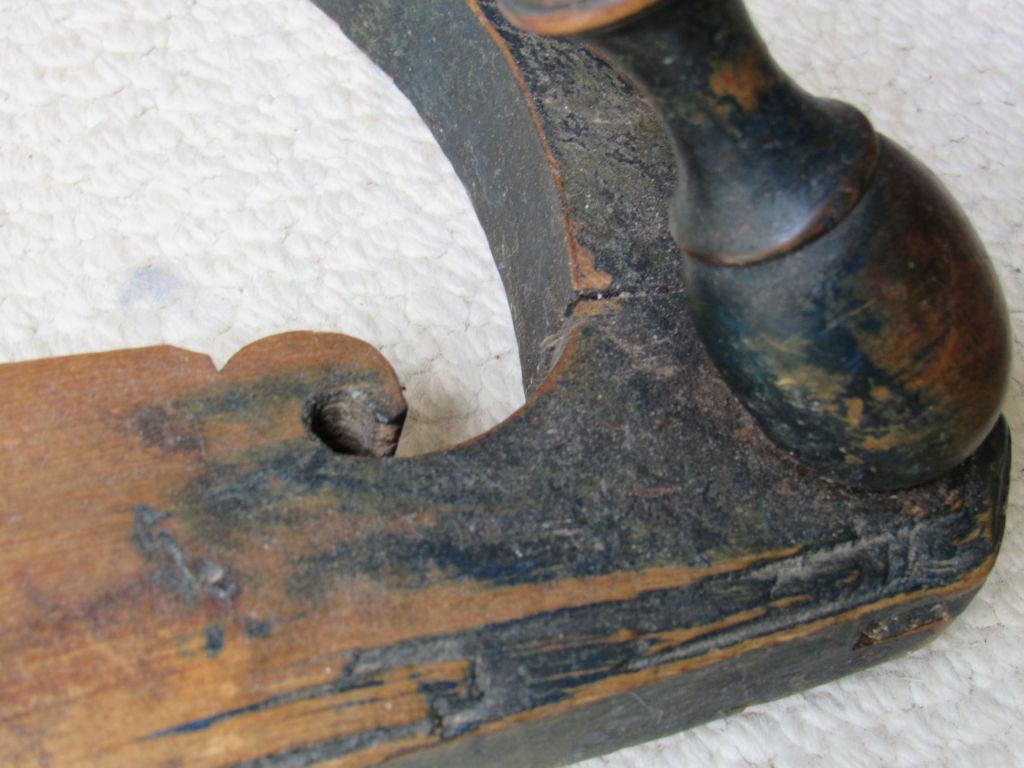
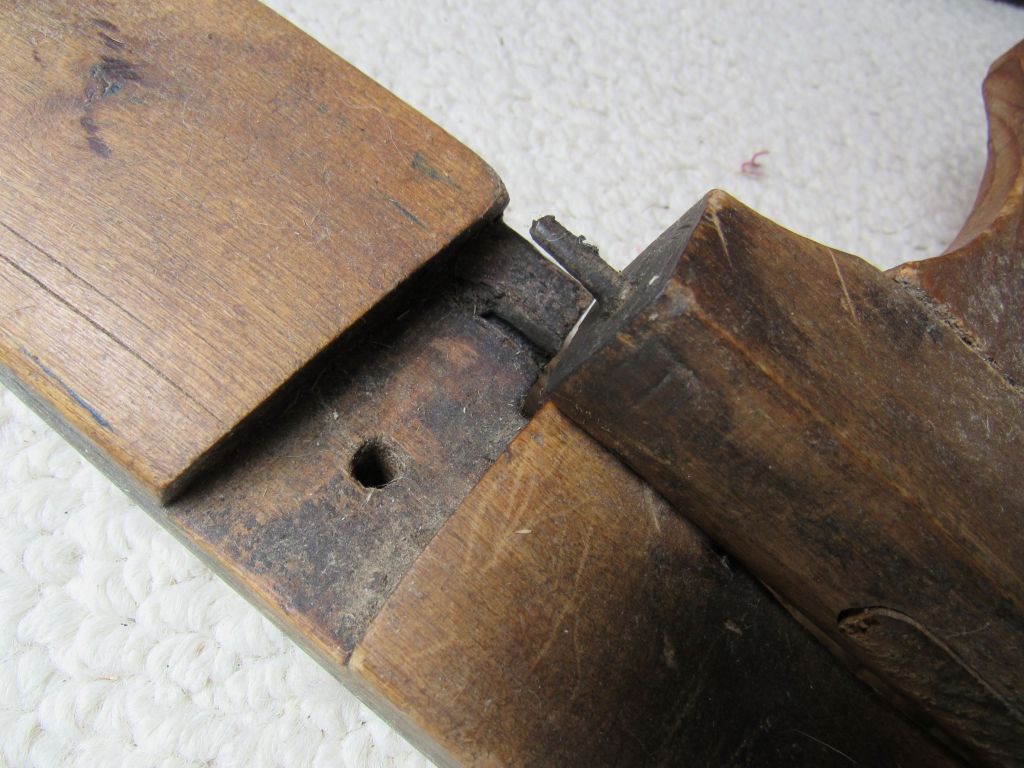
The sculptured treadle pad is set into a base with mortise and tenon joints.

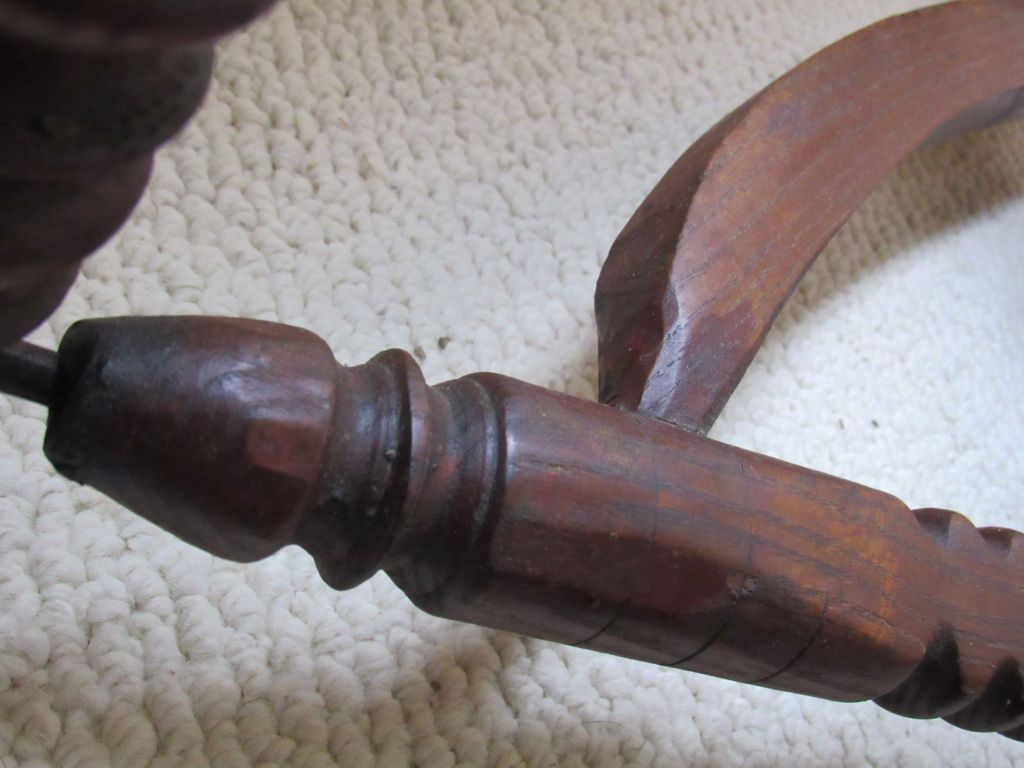
That base, which has the treadle pins, is then set into the spinner-side treadle bar, which extends between the legs.
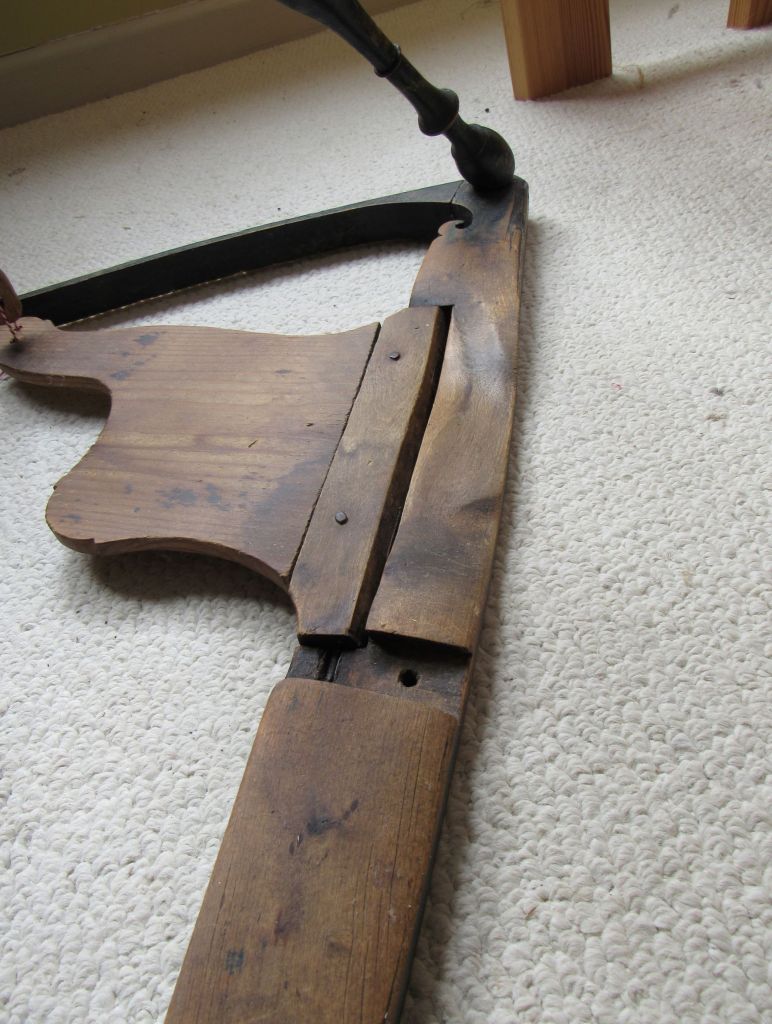
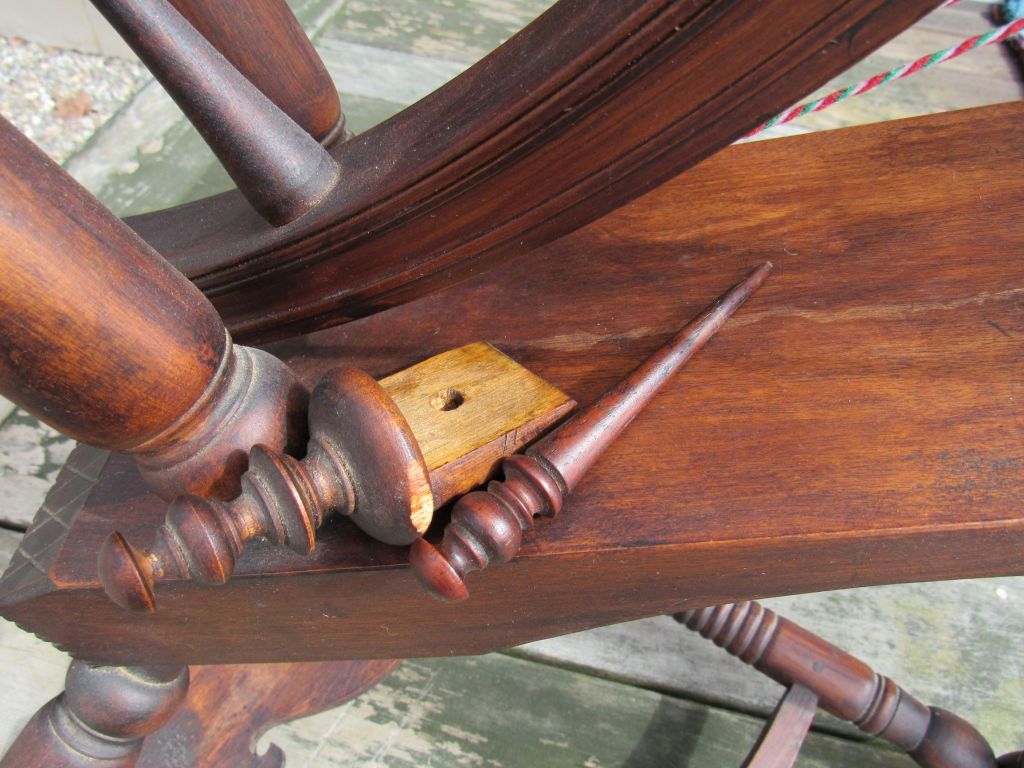
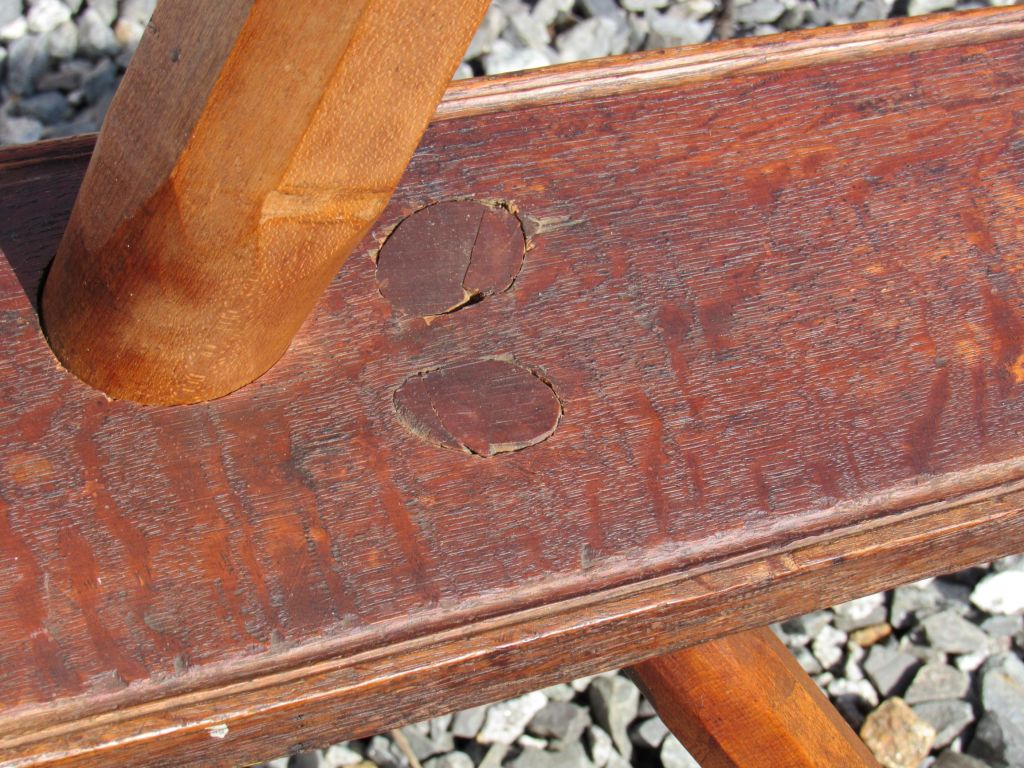
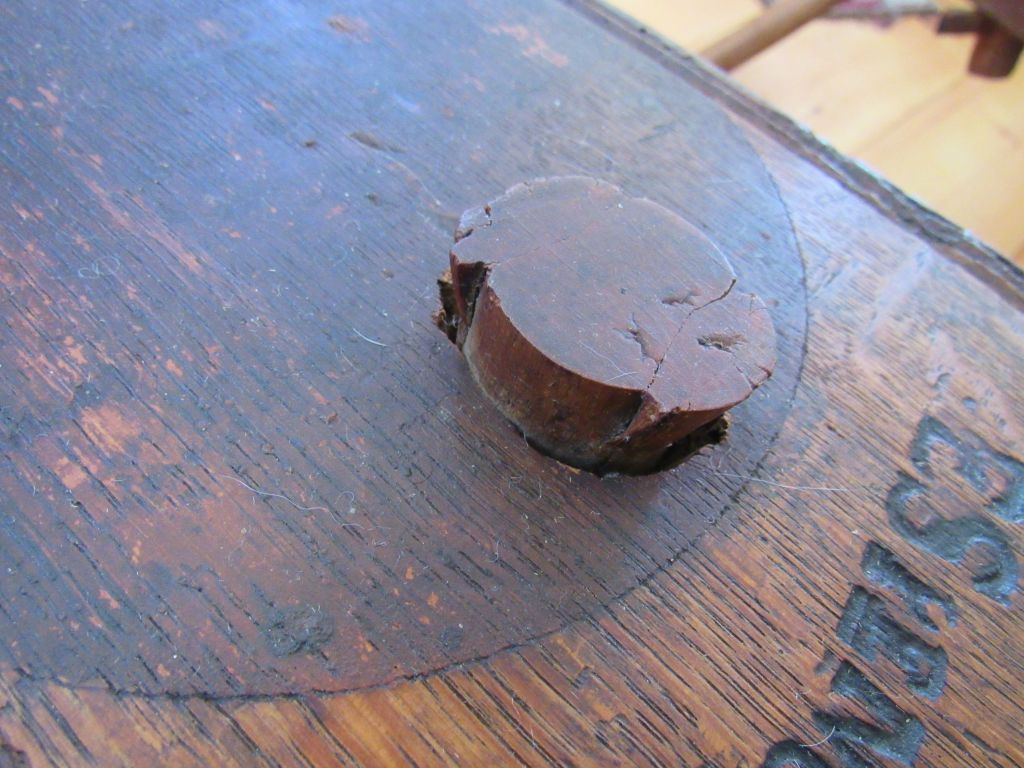
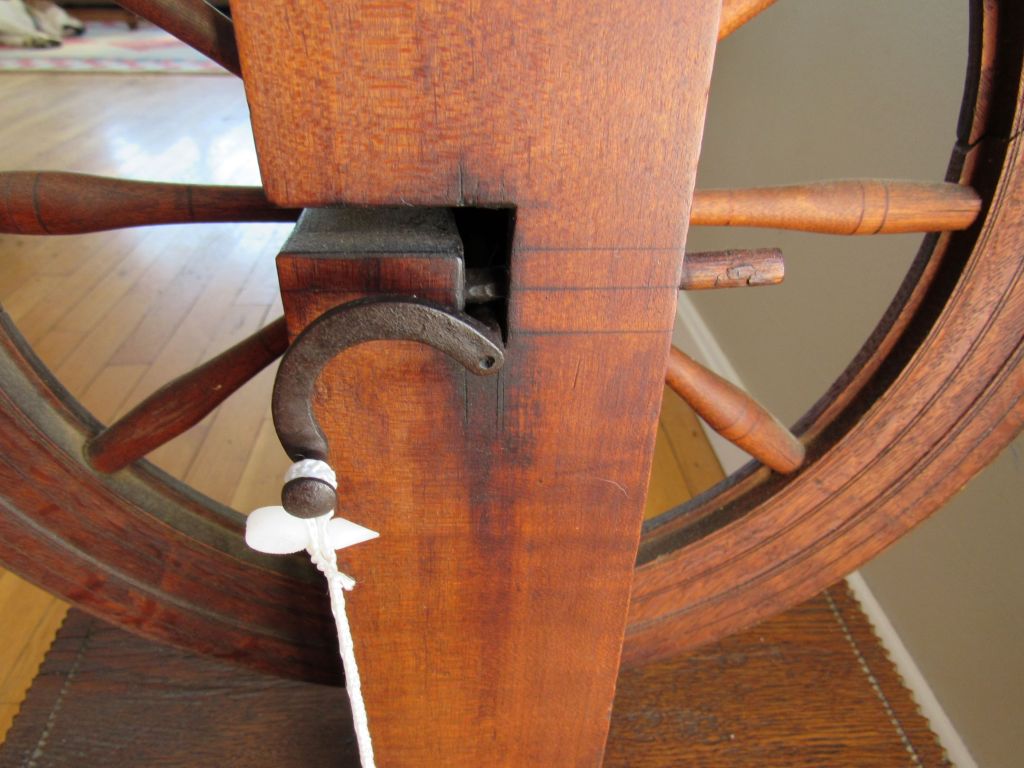
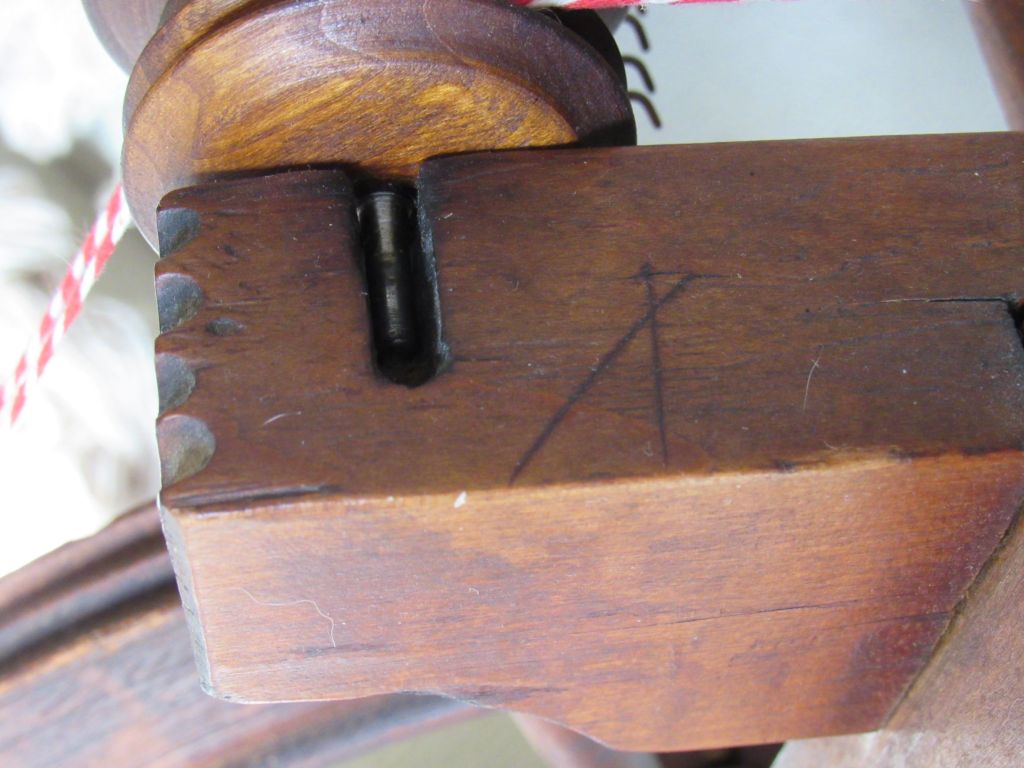
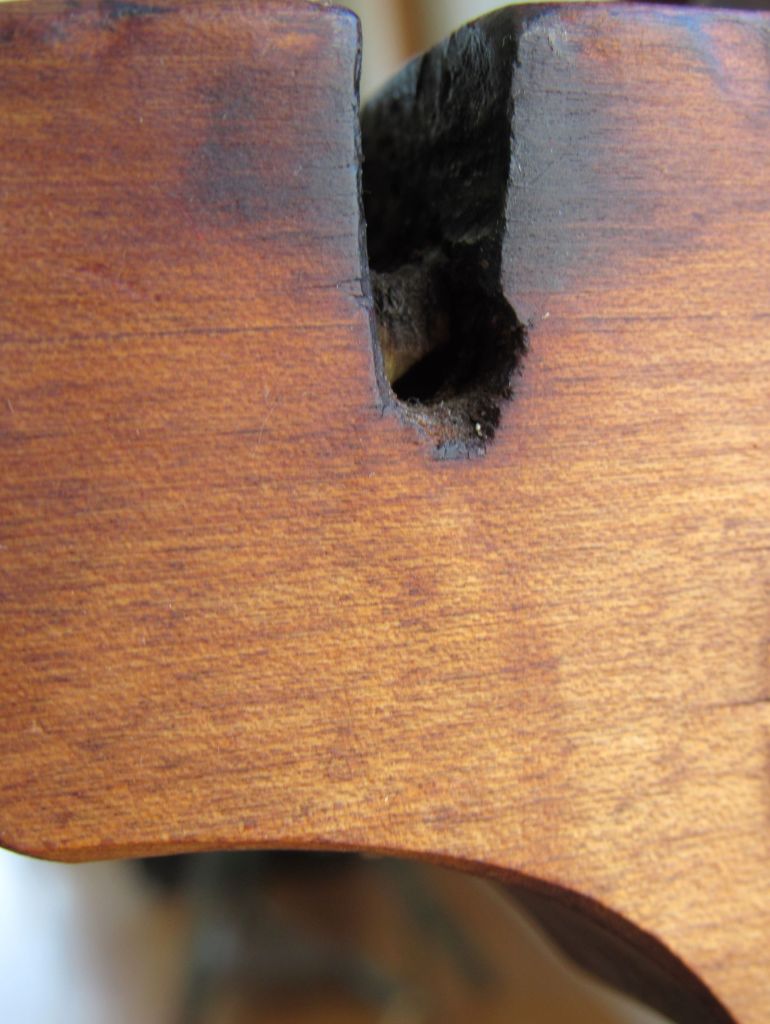
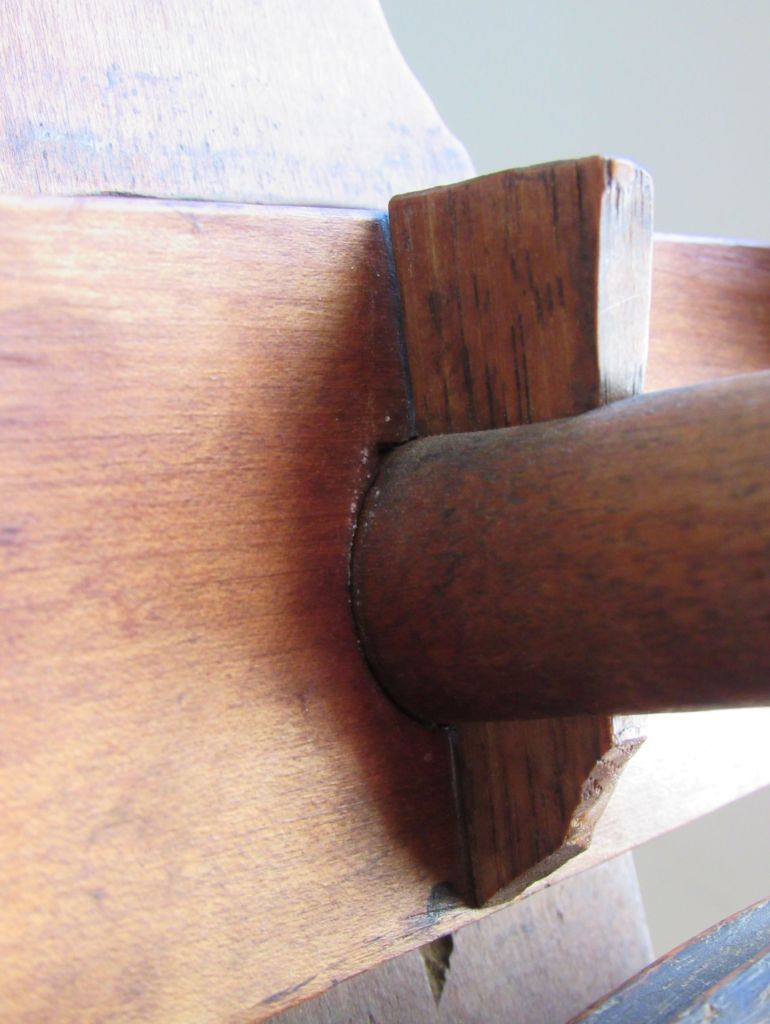
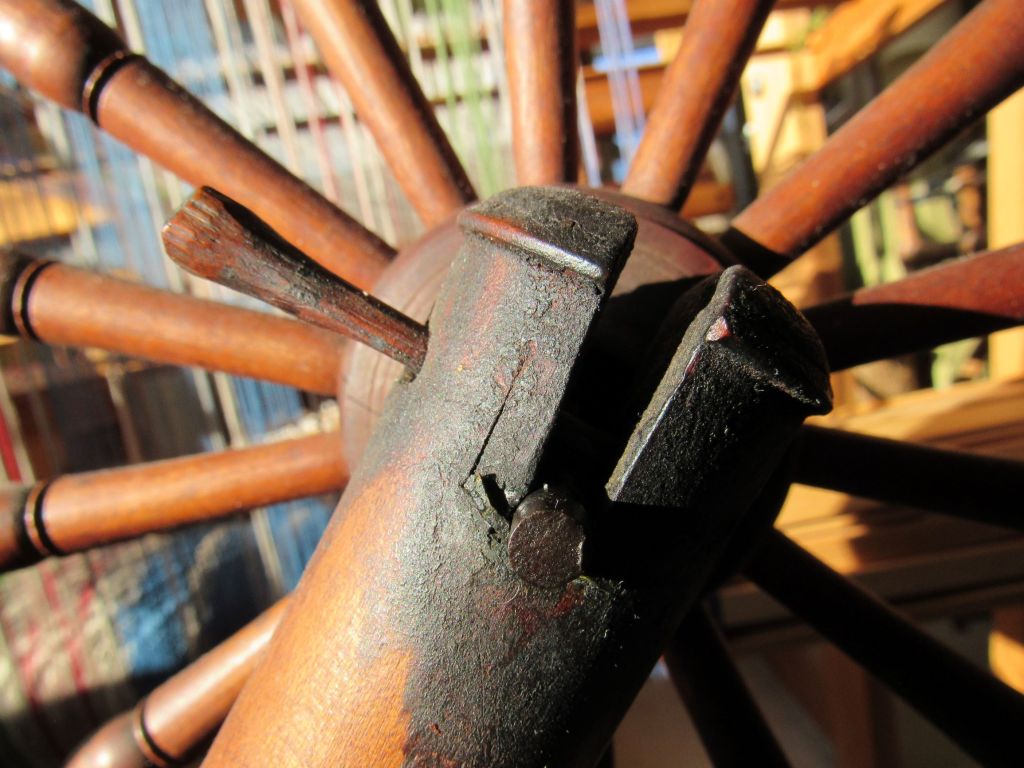
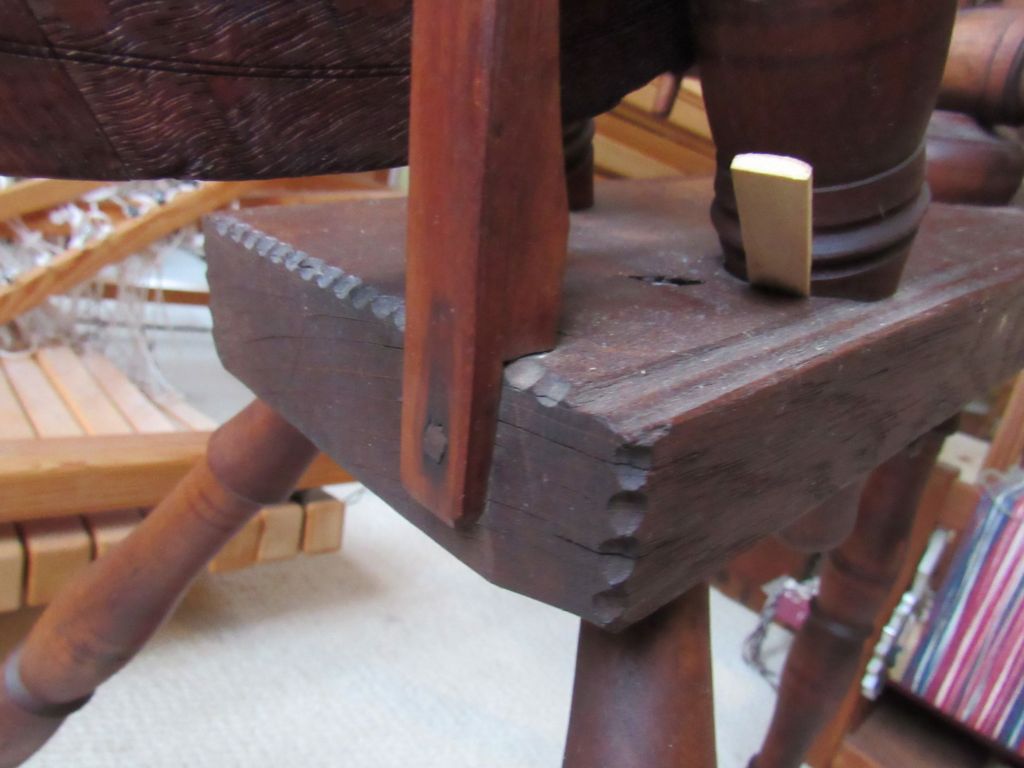
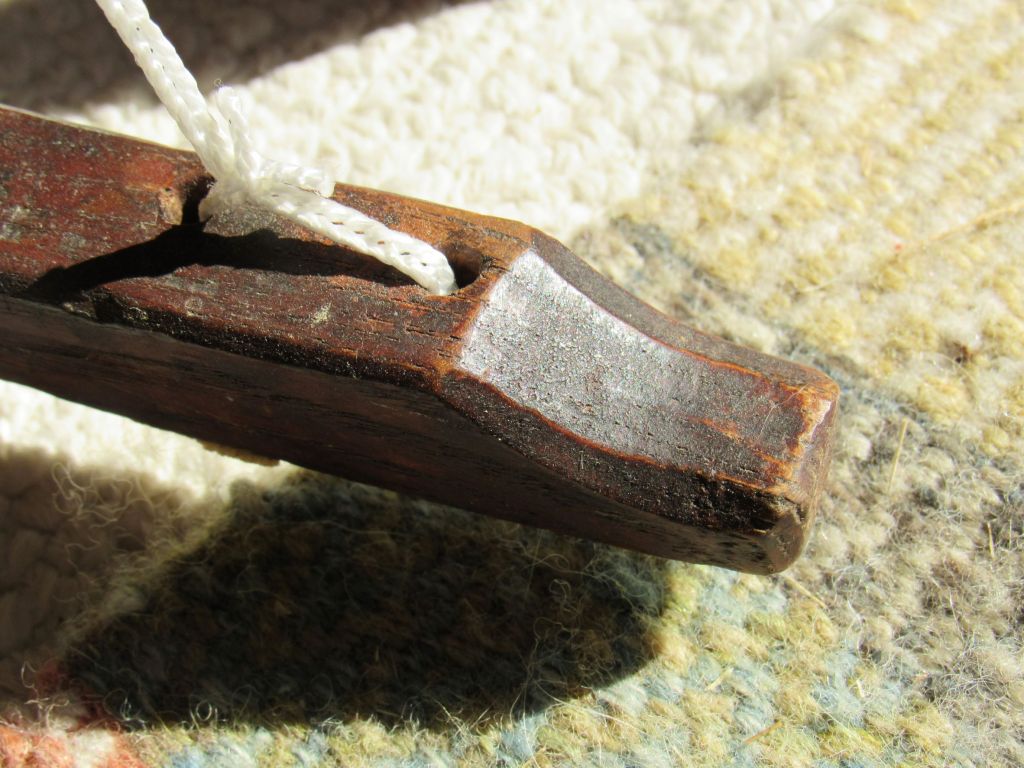
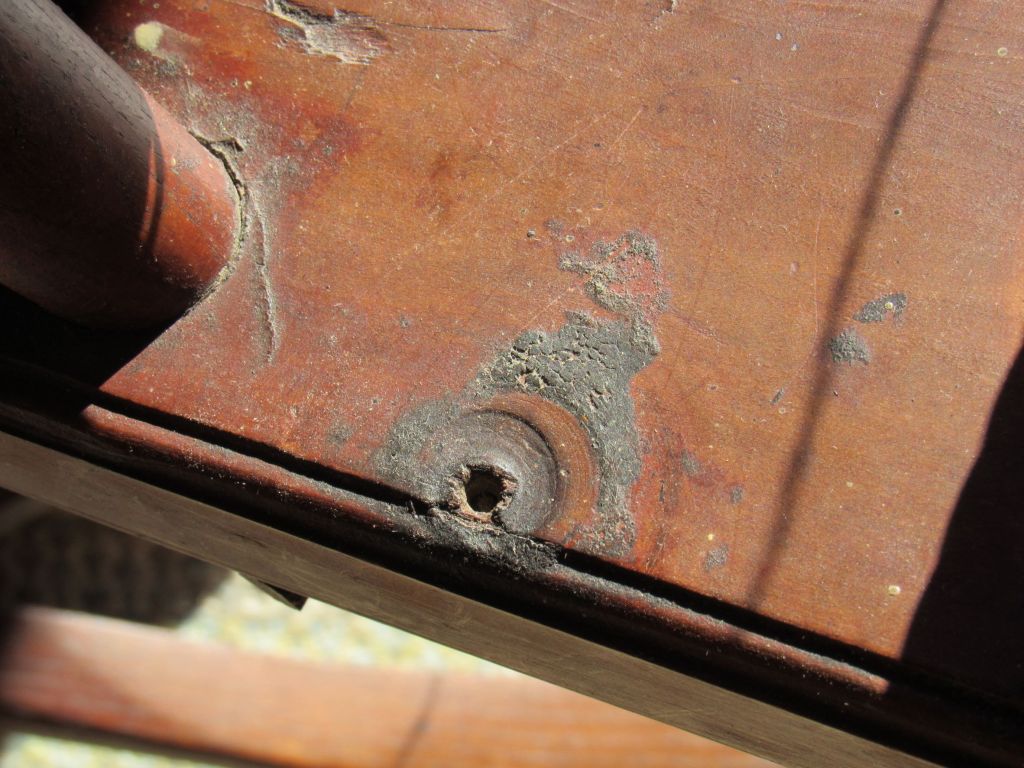
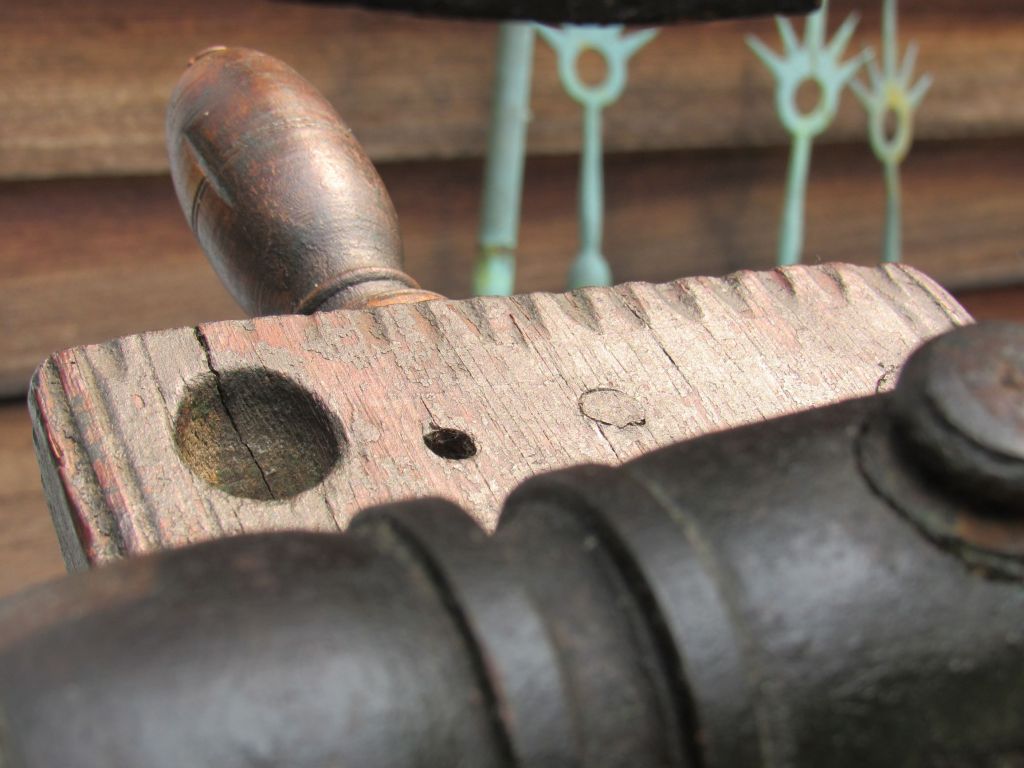
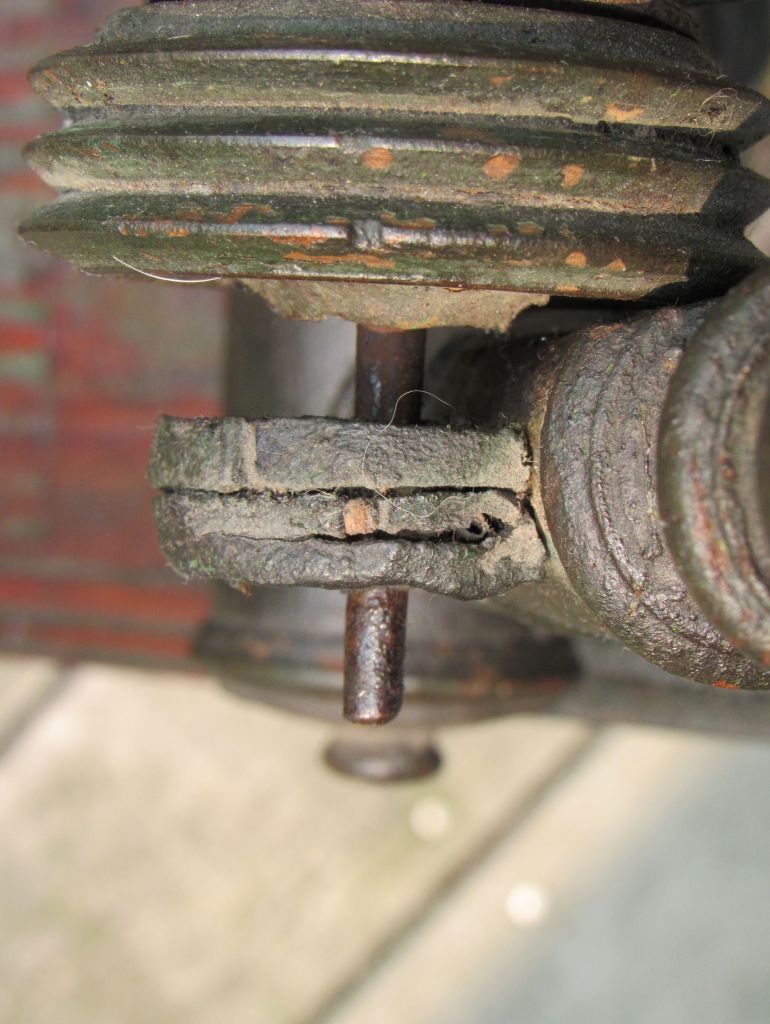
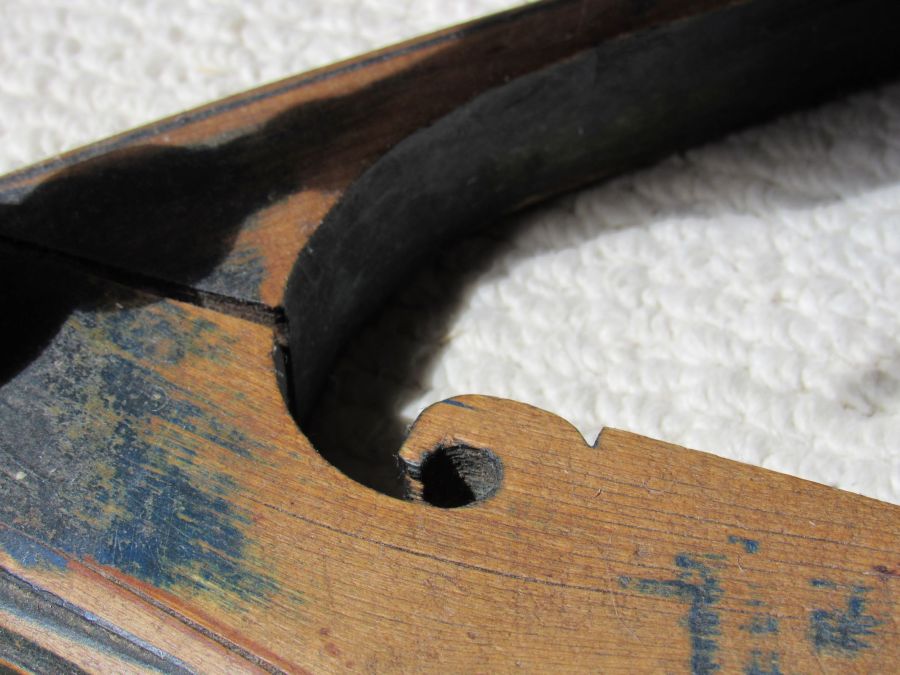
The recess for the tension-end treadle pin is supposed to have a small wooden piece and wooden pin, covering the treadle pin, which on my wheel is missing. 
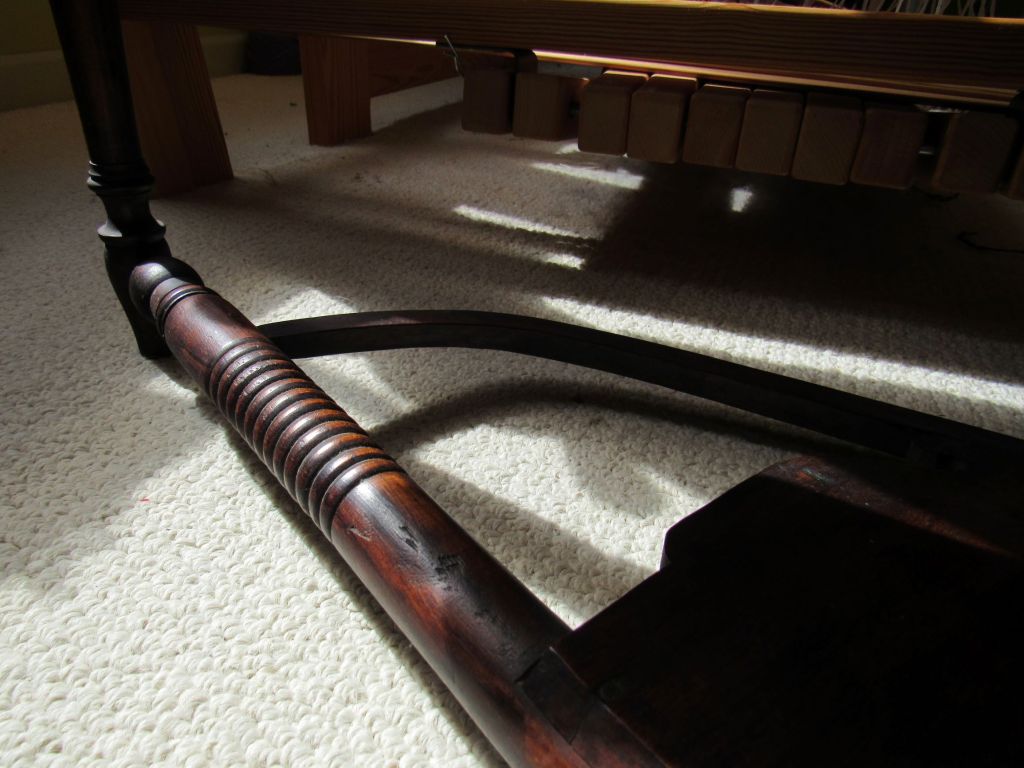
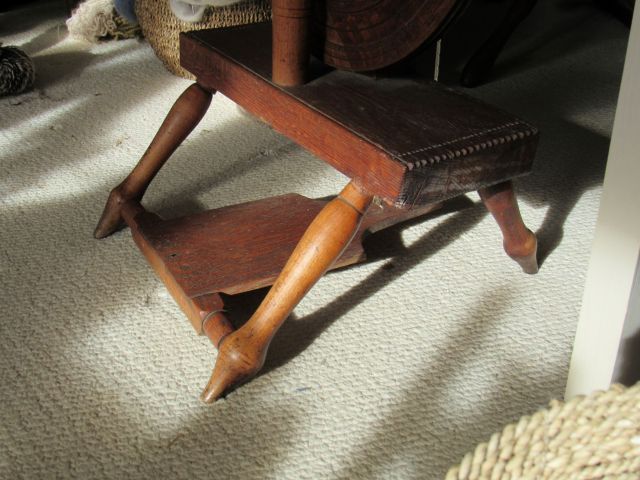
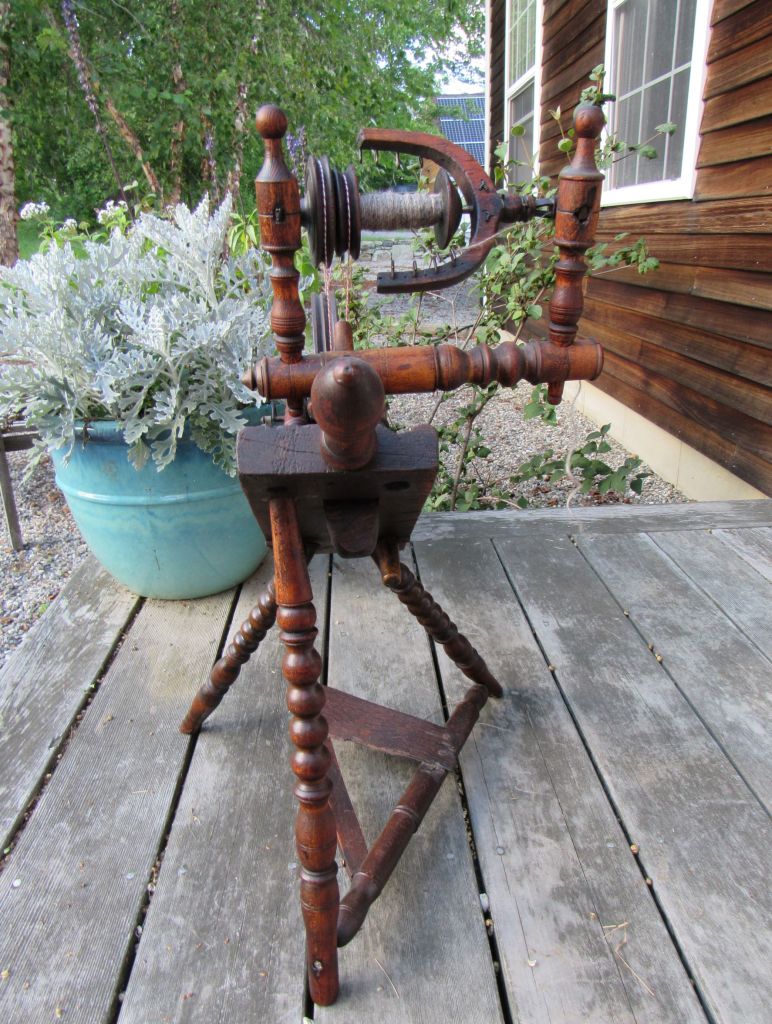
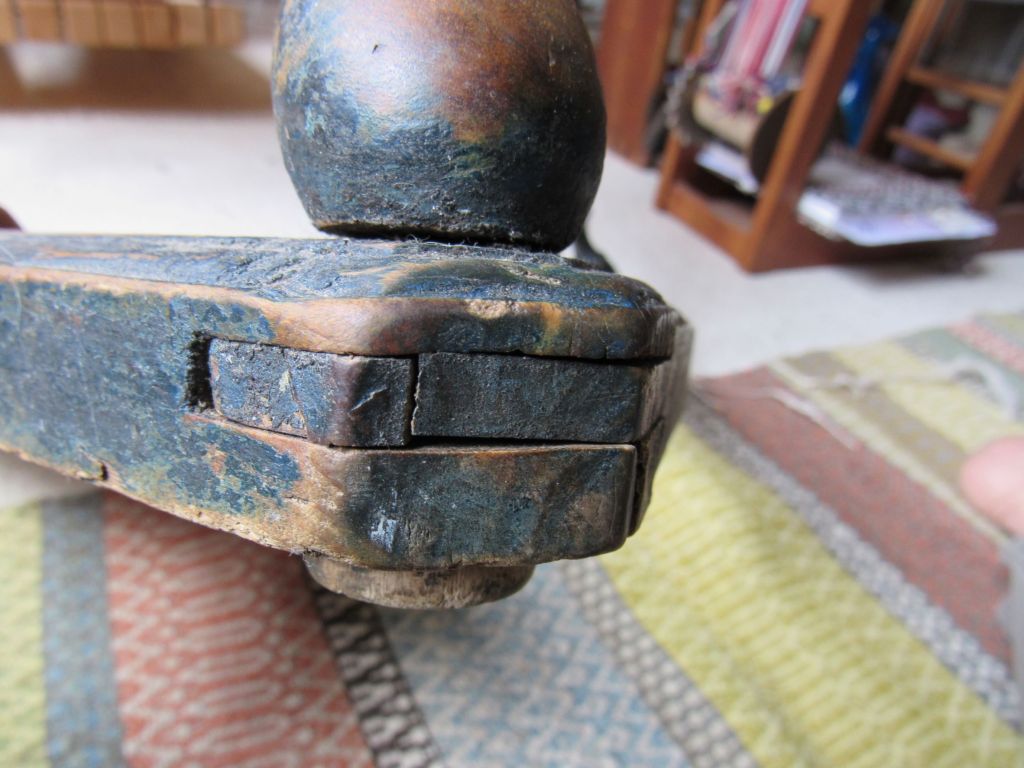
Curved bars run between all of the legs, with the feet set into the corners. 
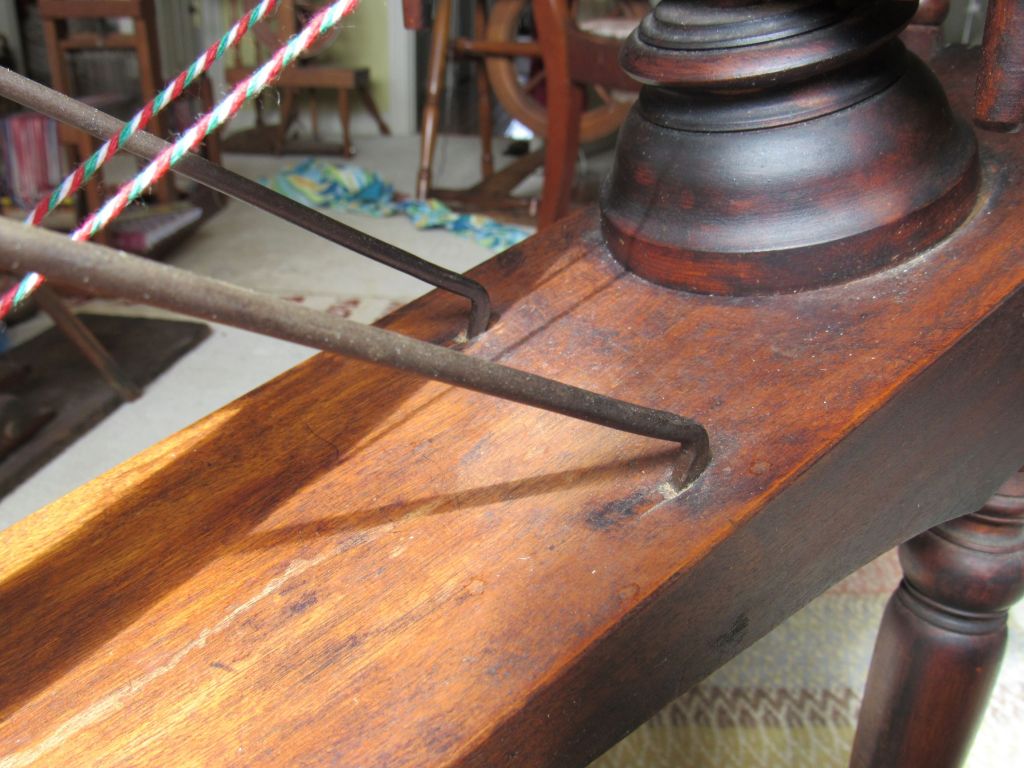
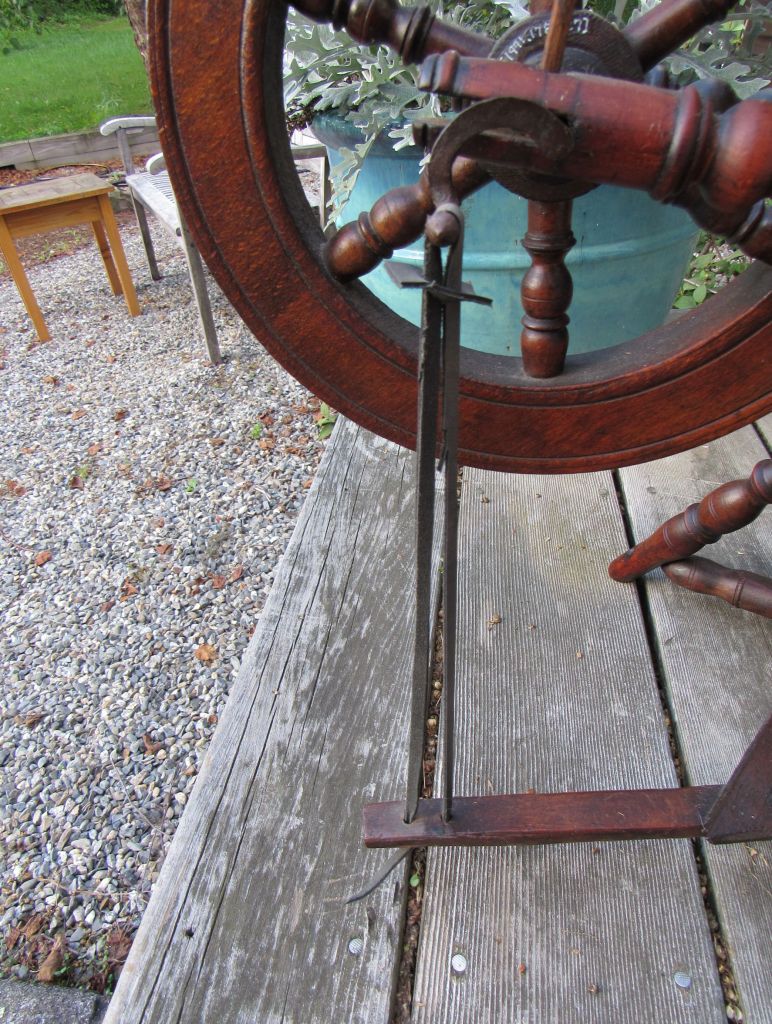
While most of the dozen or so photos I have seen of this style wheel closely resemble Tuulikki, there are some variations. The 20-spoke wheels seem to be a little larger than those with 16 spokes and have metal wires running from the table to the wheel uprights, similar to those on Impi, in the previous post. 
Most are painted, including the underside.  Some have painted dates or initials, and some are slightly more embellished.  I suspect they were all made by the same wheel maker, or perhaps a family of wheel makers, but, on the other hand, this could have been a regional style used by several wheel makers. 
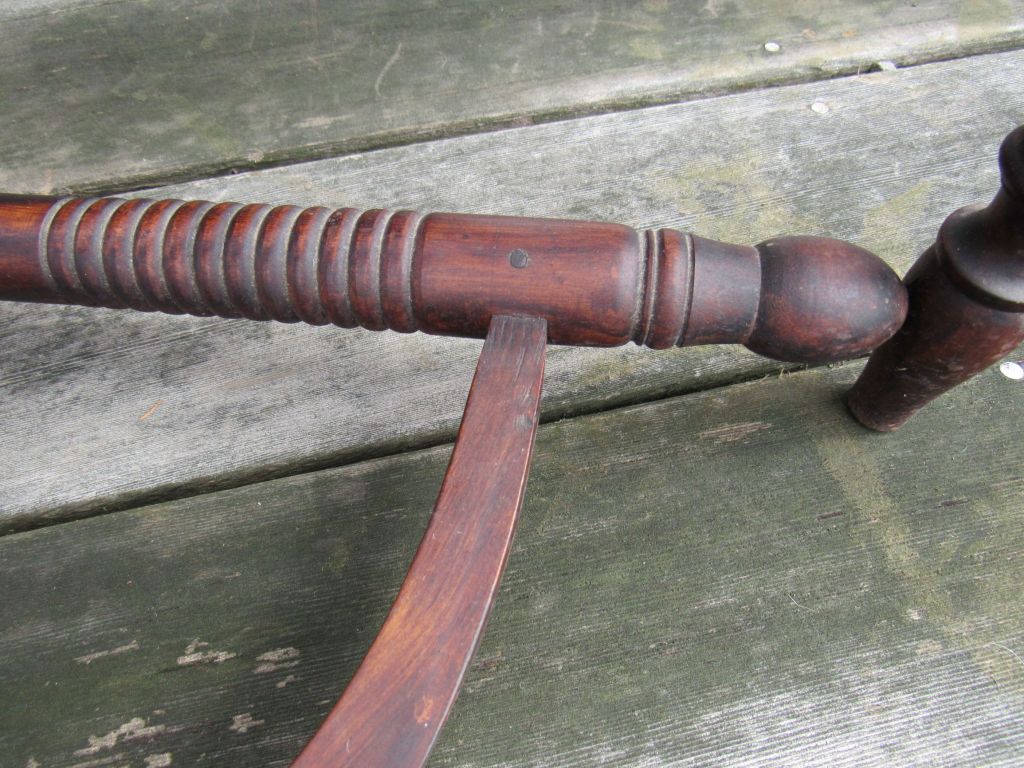
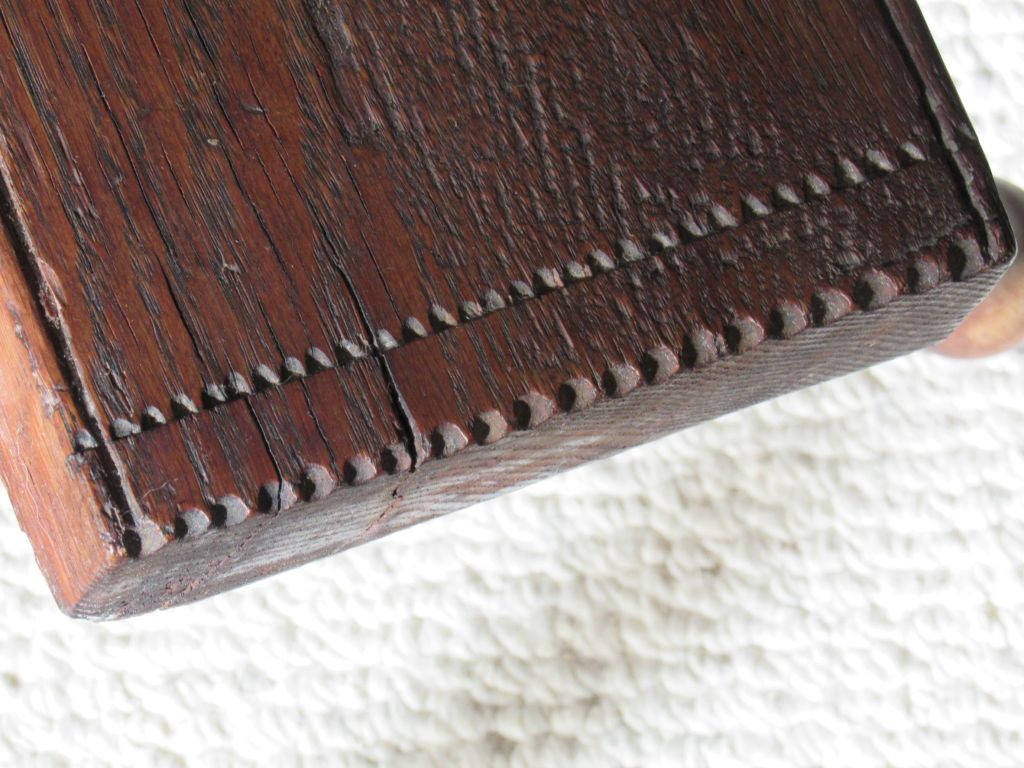
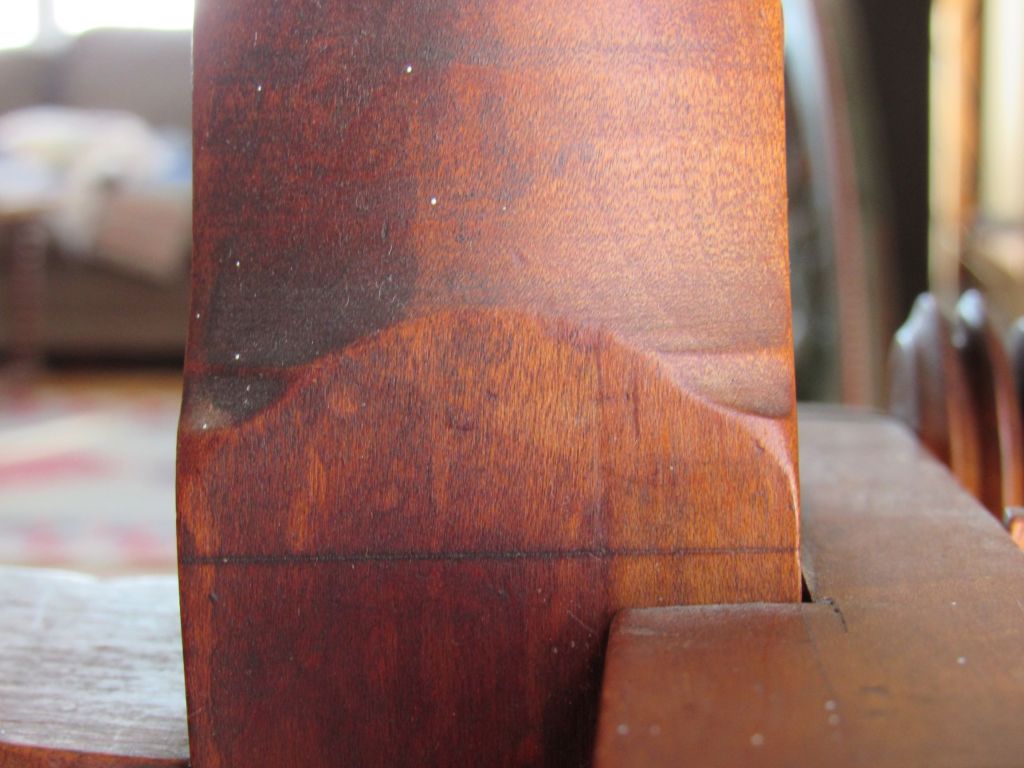
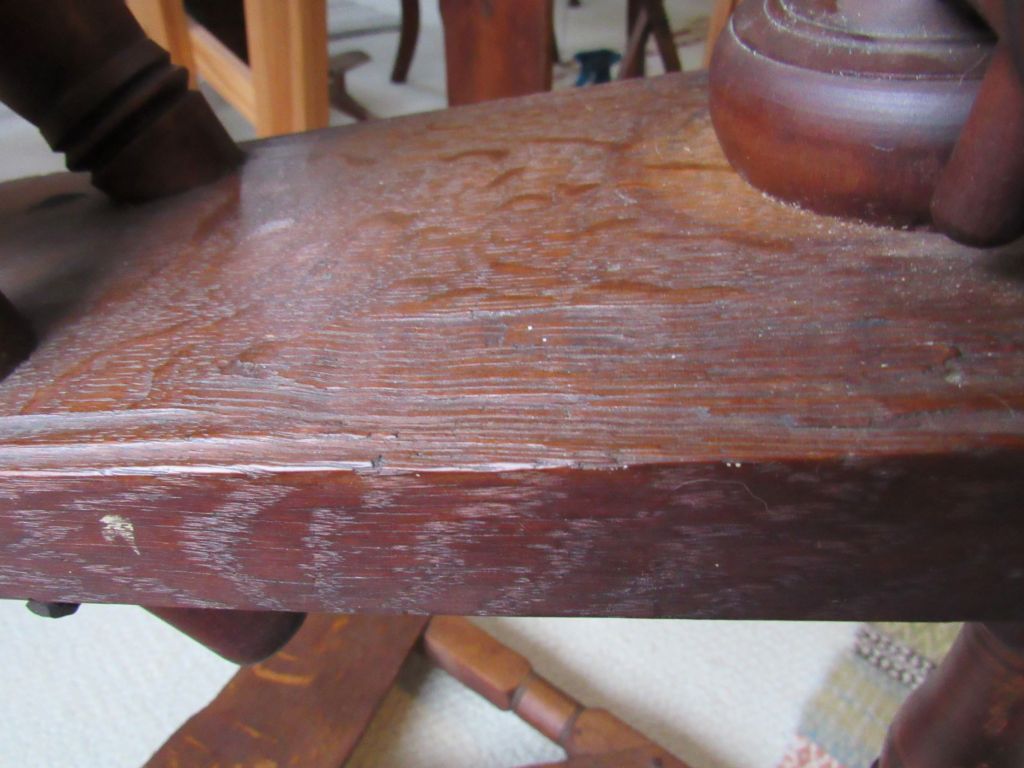
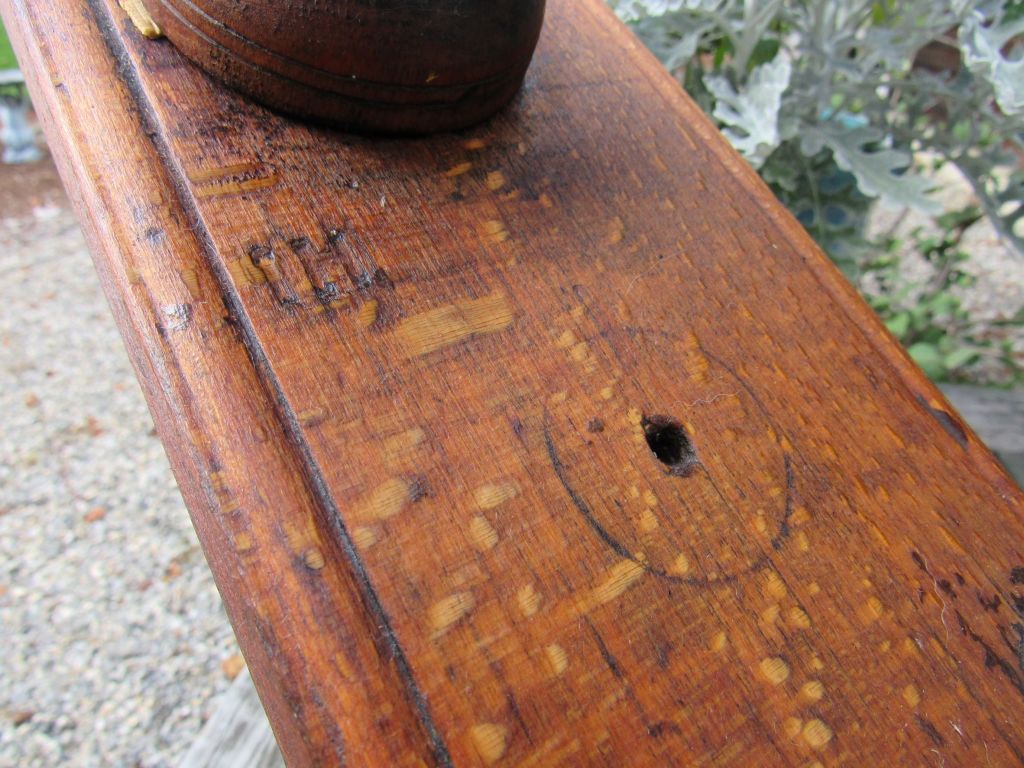
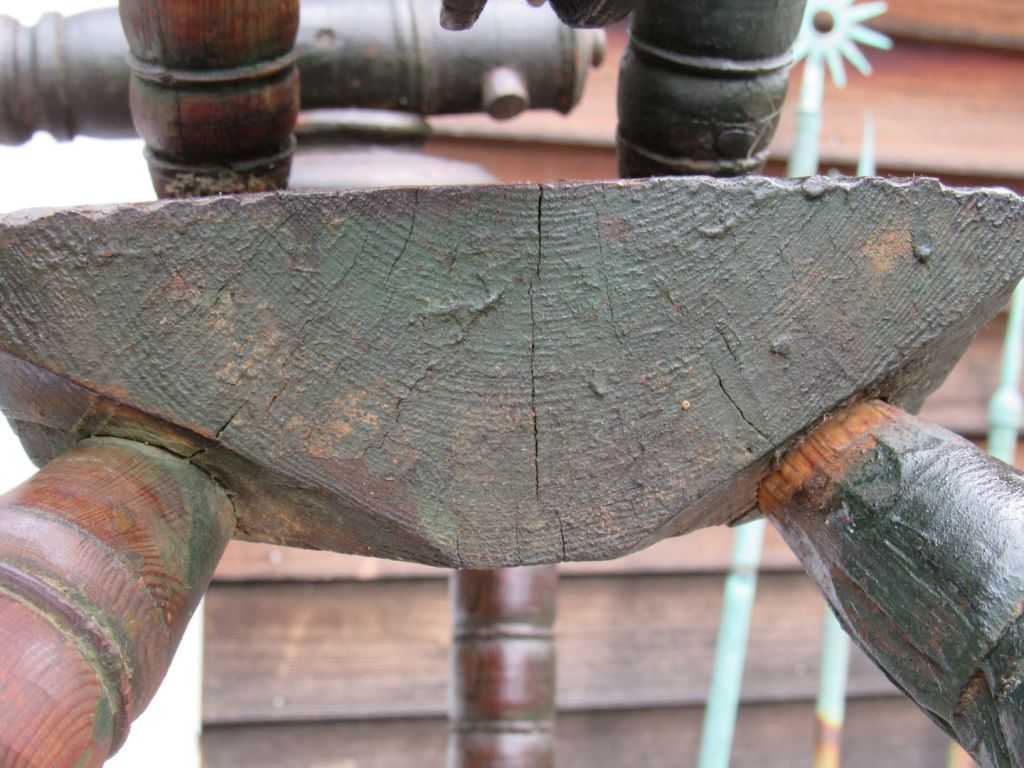
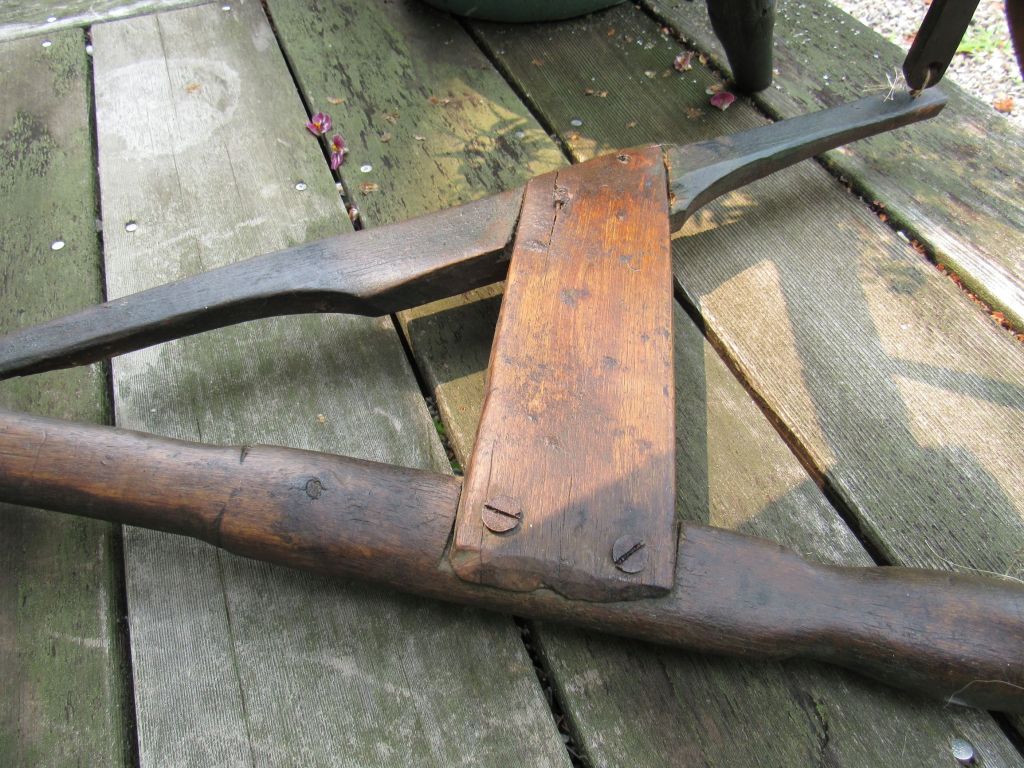
As with most wheels from the mid-1800s, Tuulikki has seen a lot of use.  The wear on the treadle is interesting.  The treadle bar is very worn down, with two concave areas (more pronounced on the right side). 
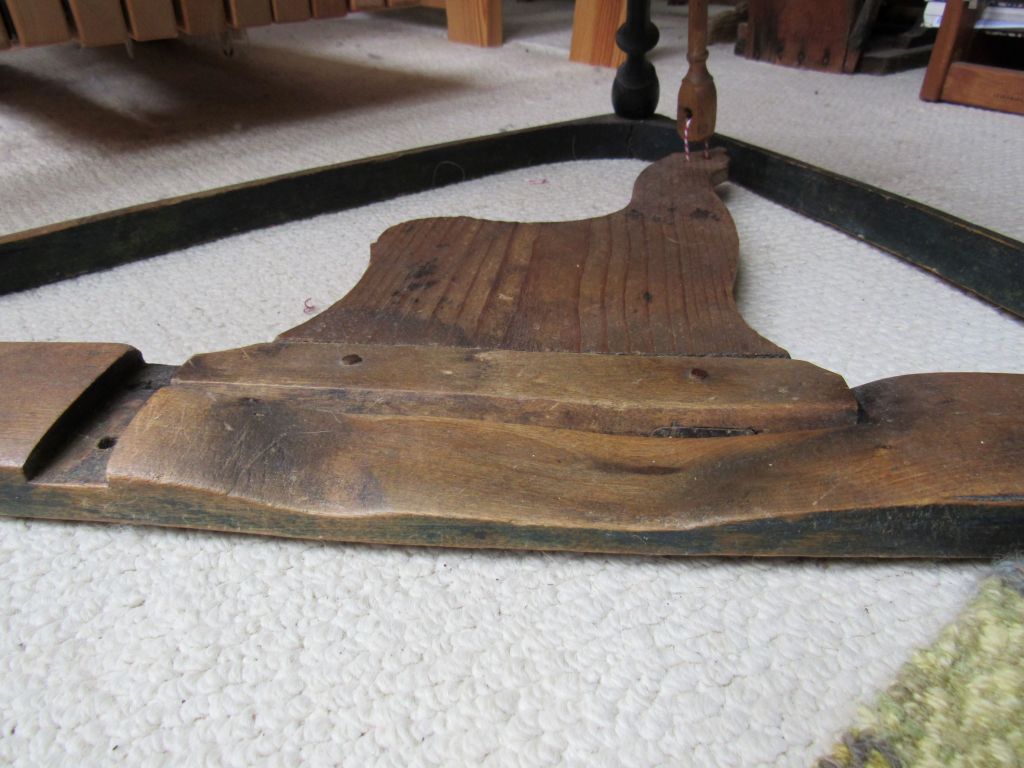
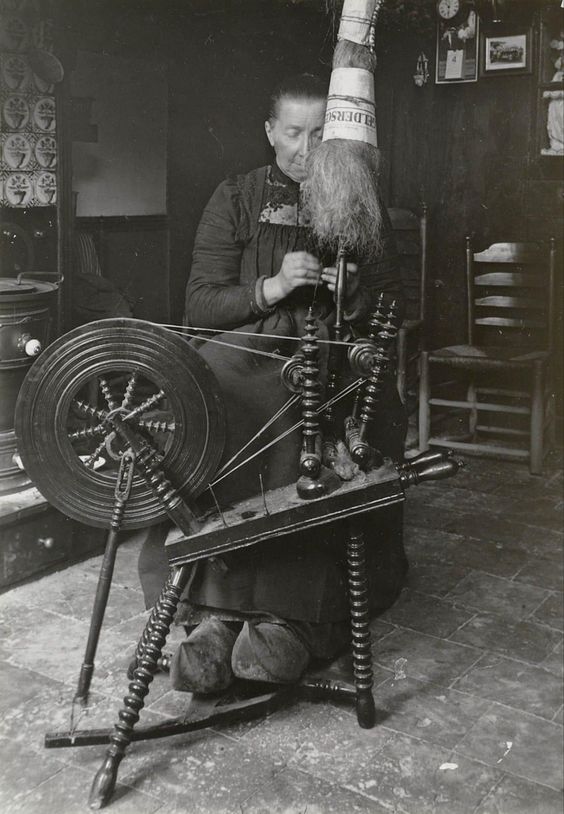
Where the treadle meets the bar, there is little wear, with wear showing again on the treadle before the swoop.  It could be that the treadle is a replacement, but I have seen other wheels with a similar wear pattern.  Interestingly, this Finnish treadle design creates a pivot of two pieces of wood that tends to pinch the foot when spinning barefoot. Which leads me to wonder if it was unusual to spin barefoot in Finland. On this wheel, the wear pattern could be explained by a spinner wearing shoes or boots with small heels neatly resting on the treadle bar, with an instep high enough to span the pinch-zone–an area with no wear–and then wear again where the ball of the foot rested on the treadle.  
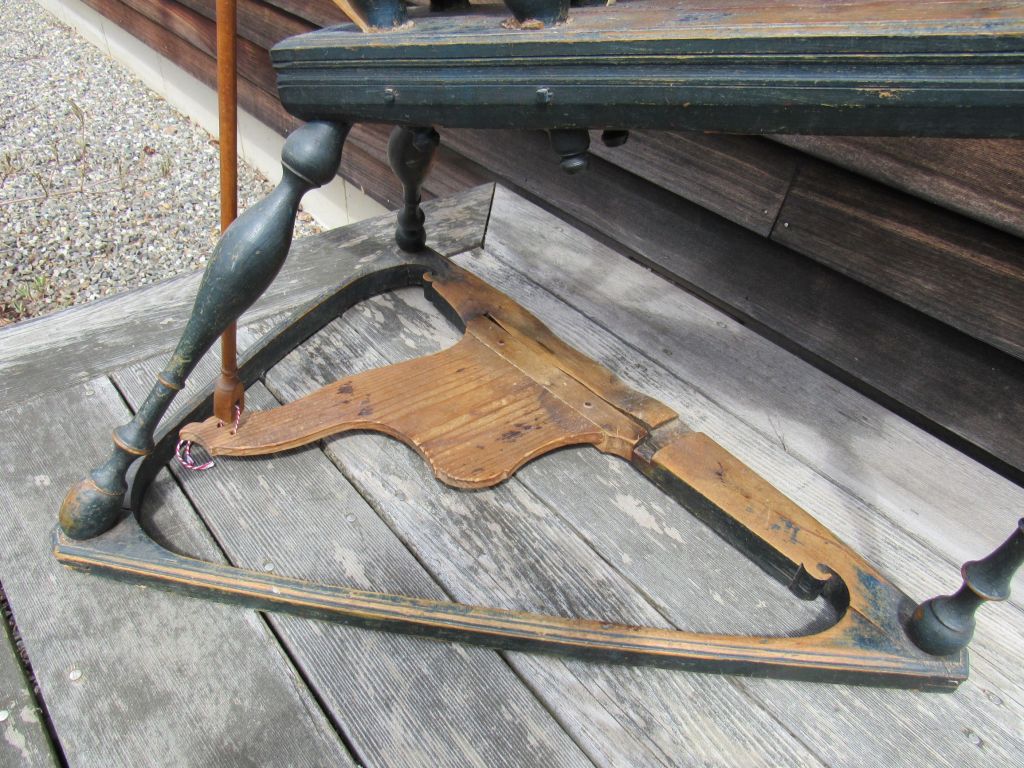
In any case, there is no question that this wheel was heavily used.  There was one large shim on an upright when I bought it. 
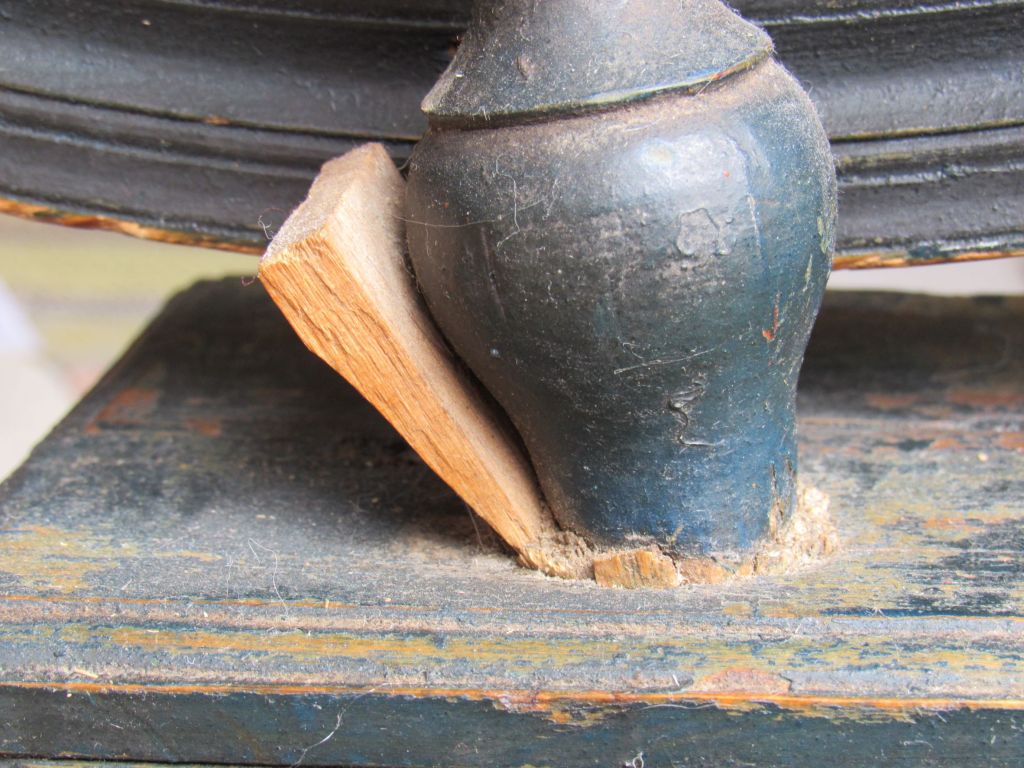
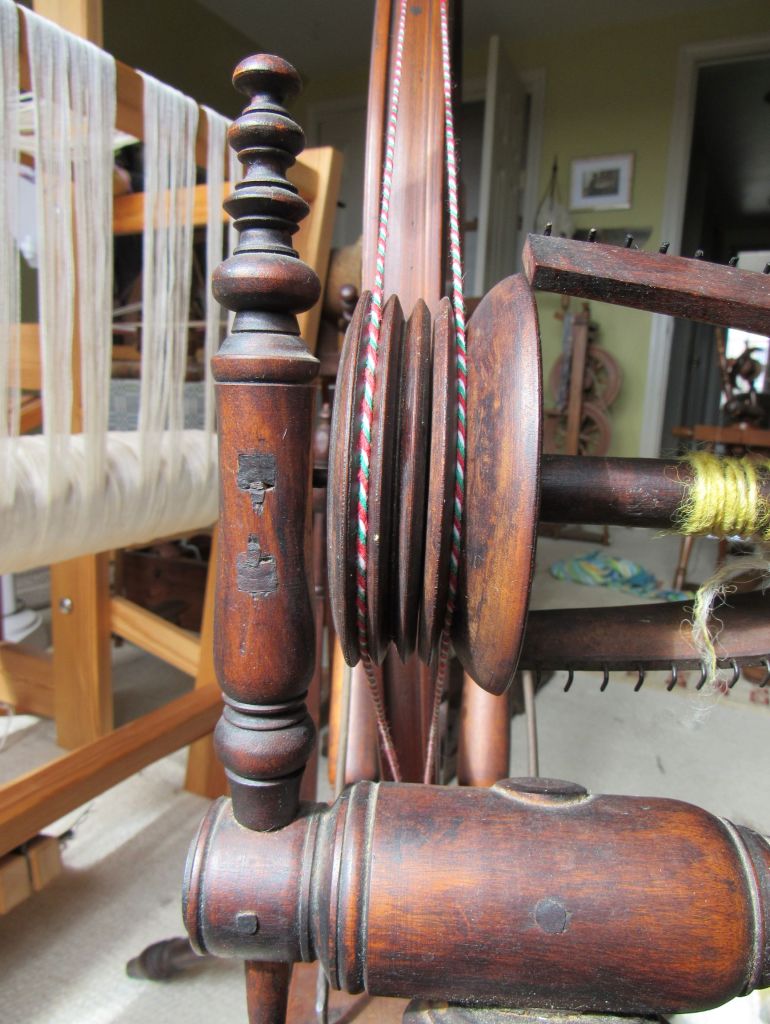
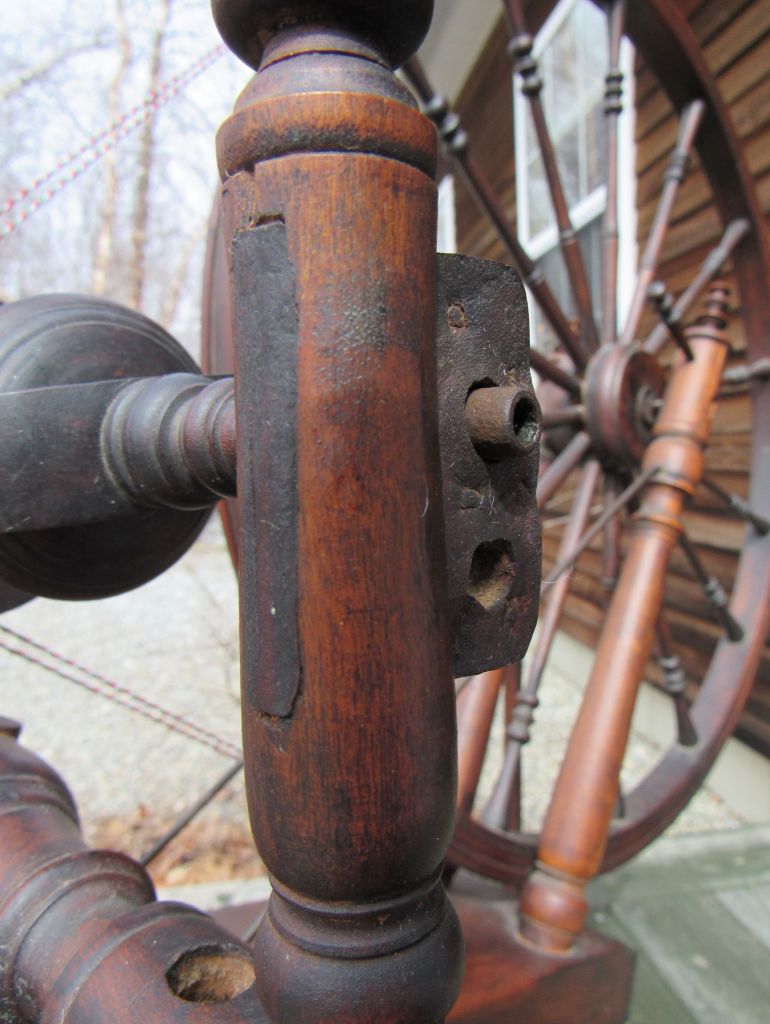
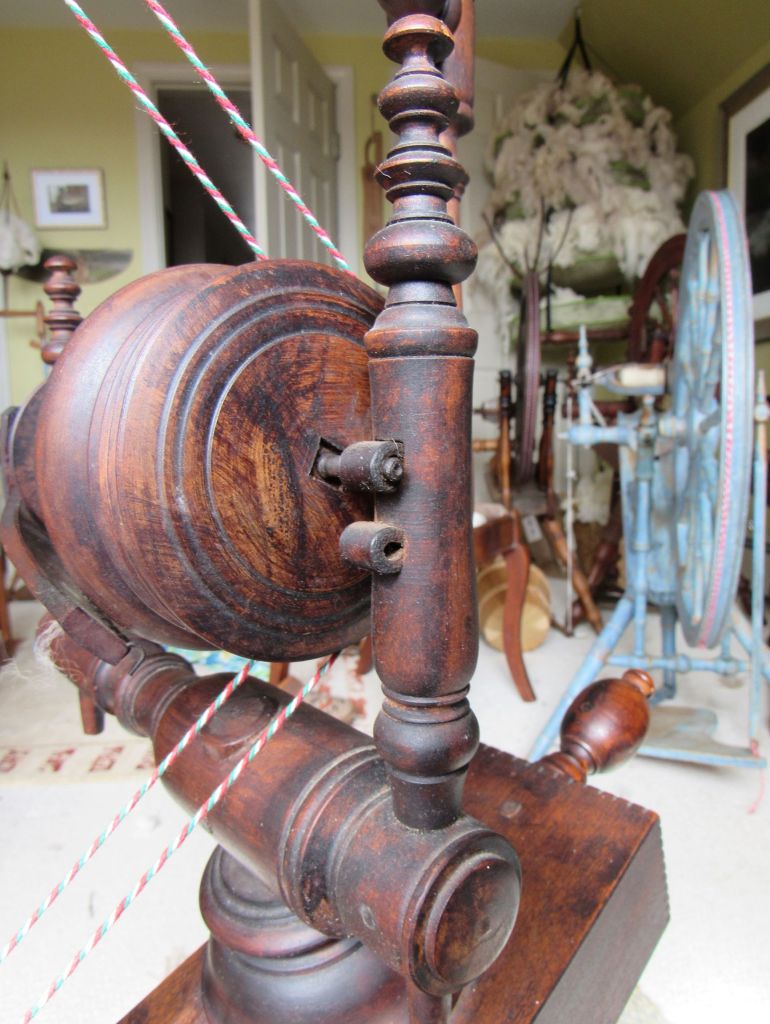
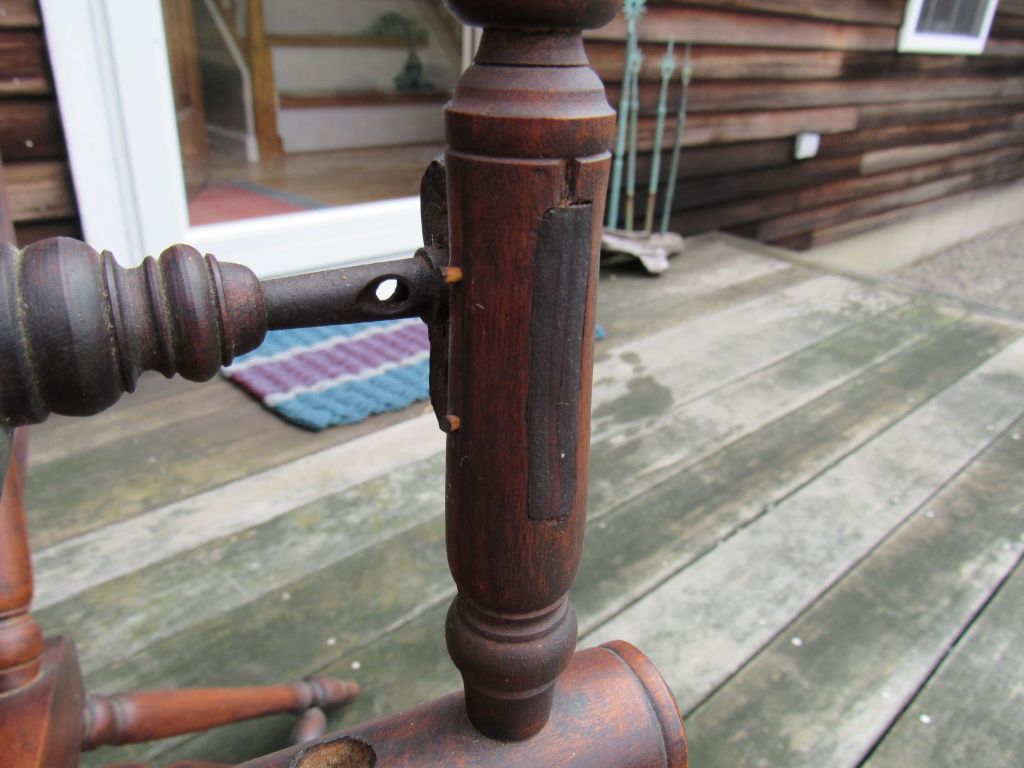
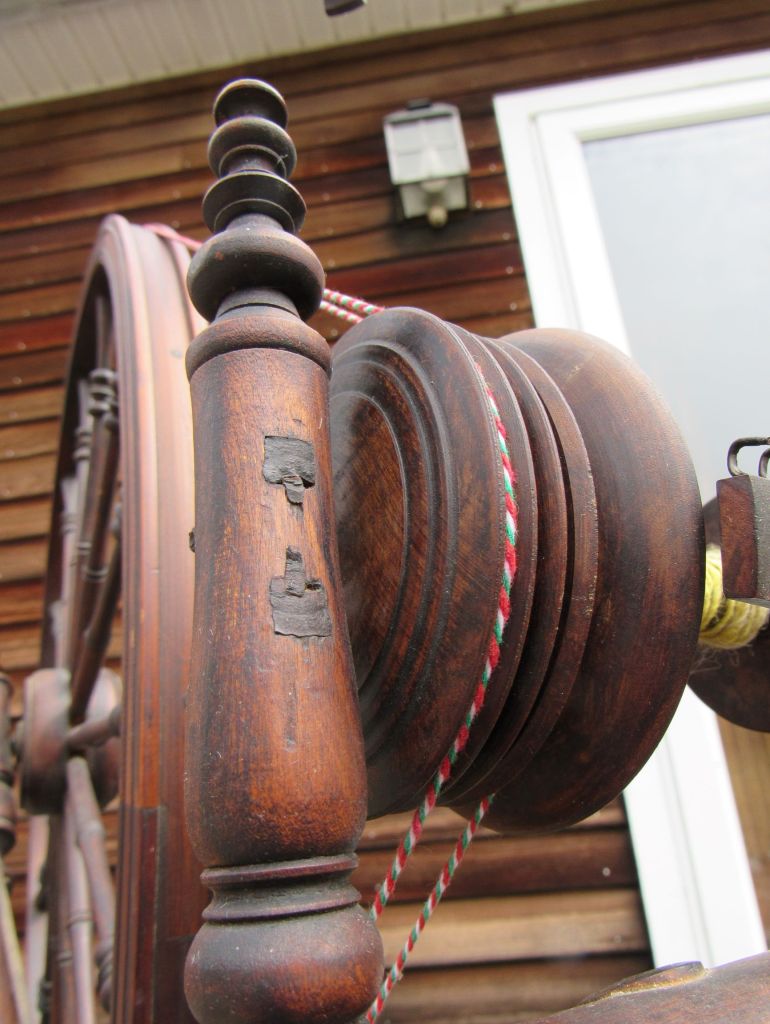
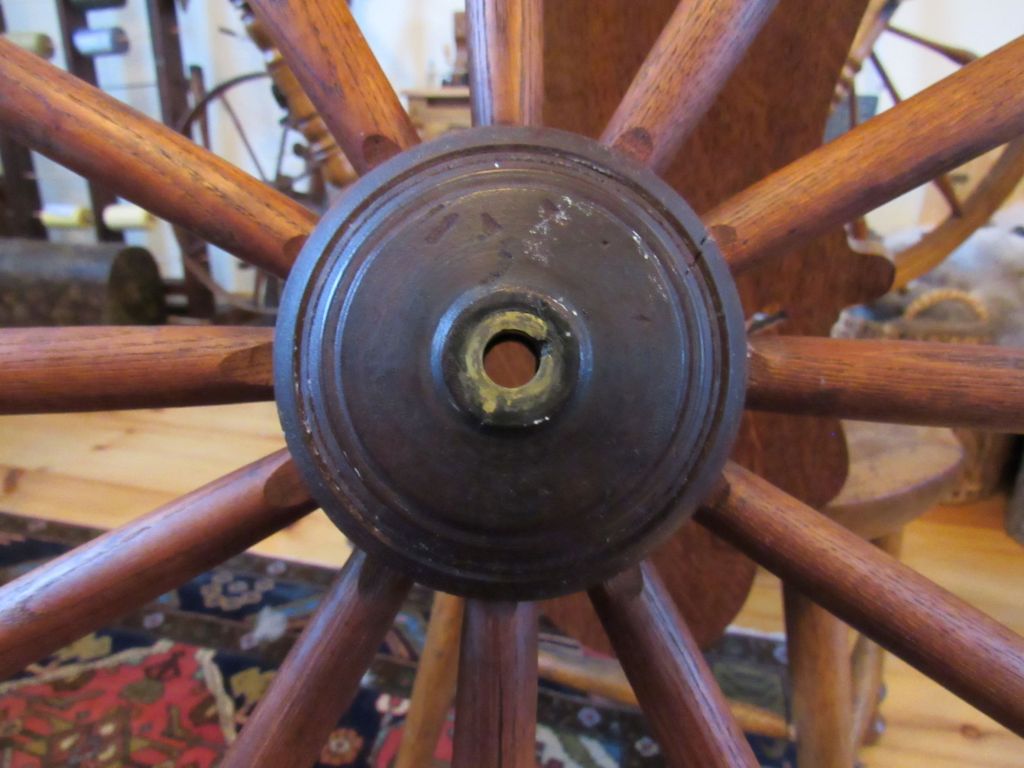
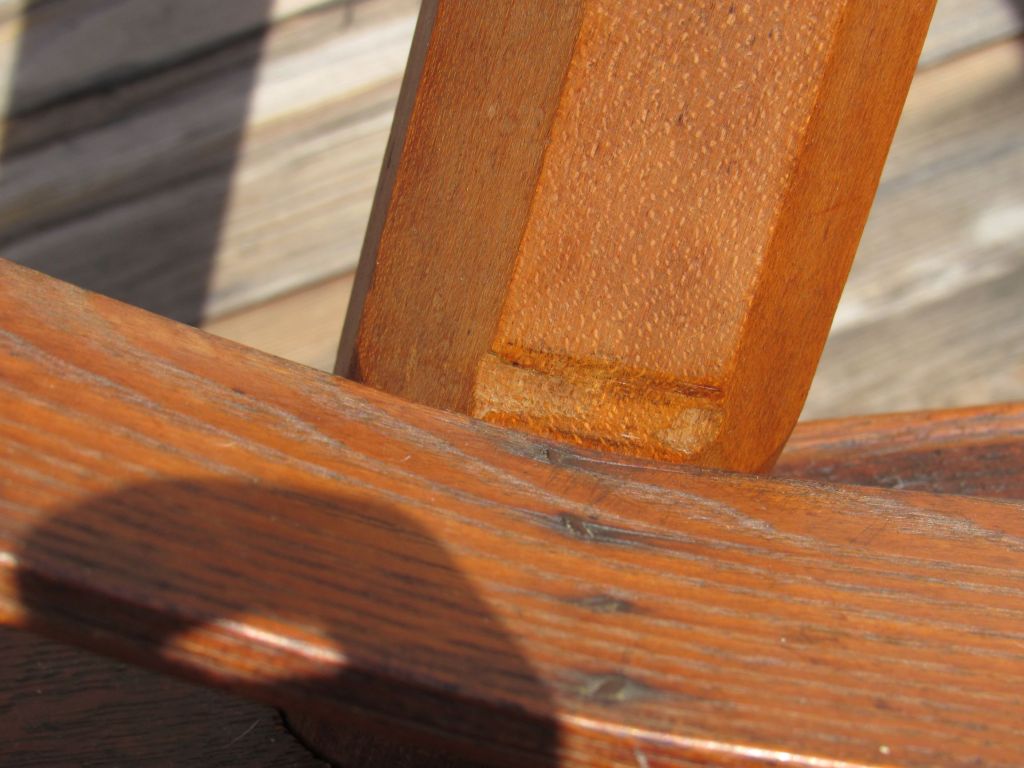
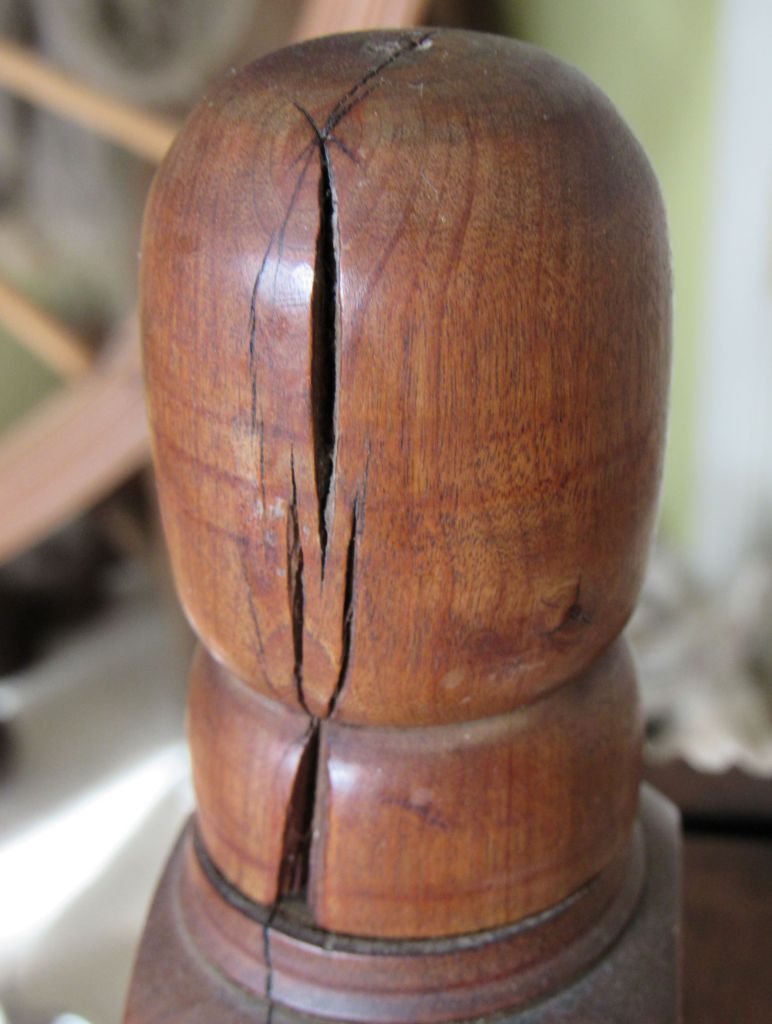
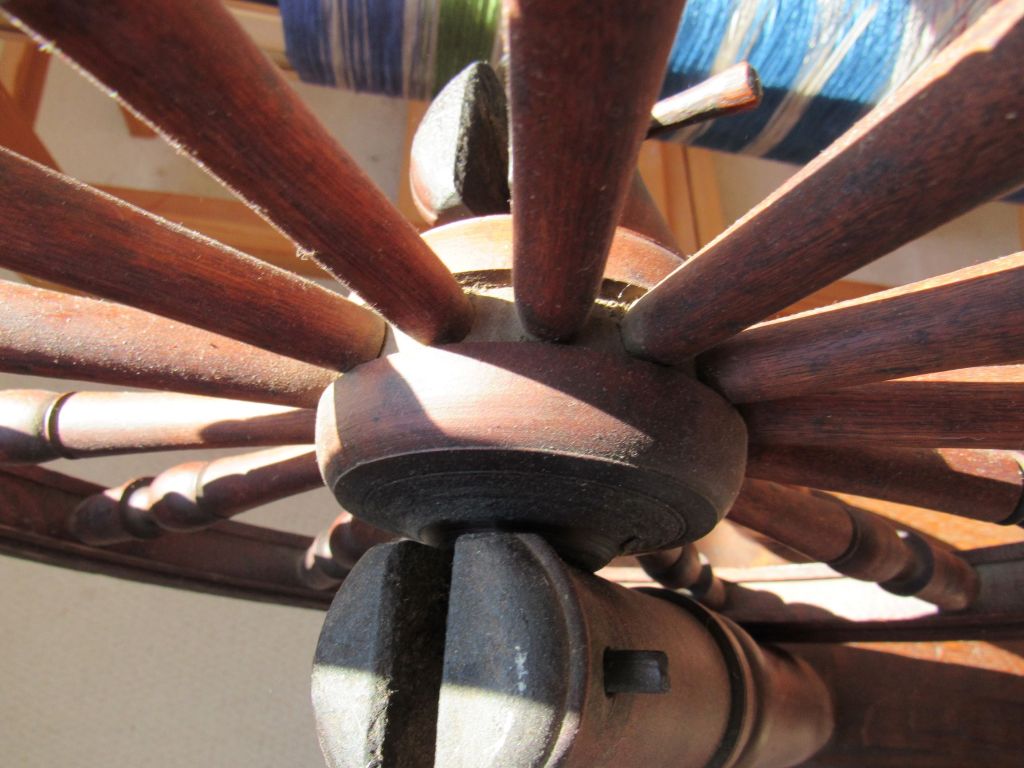
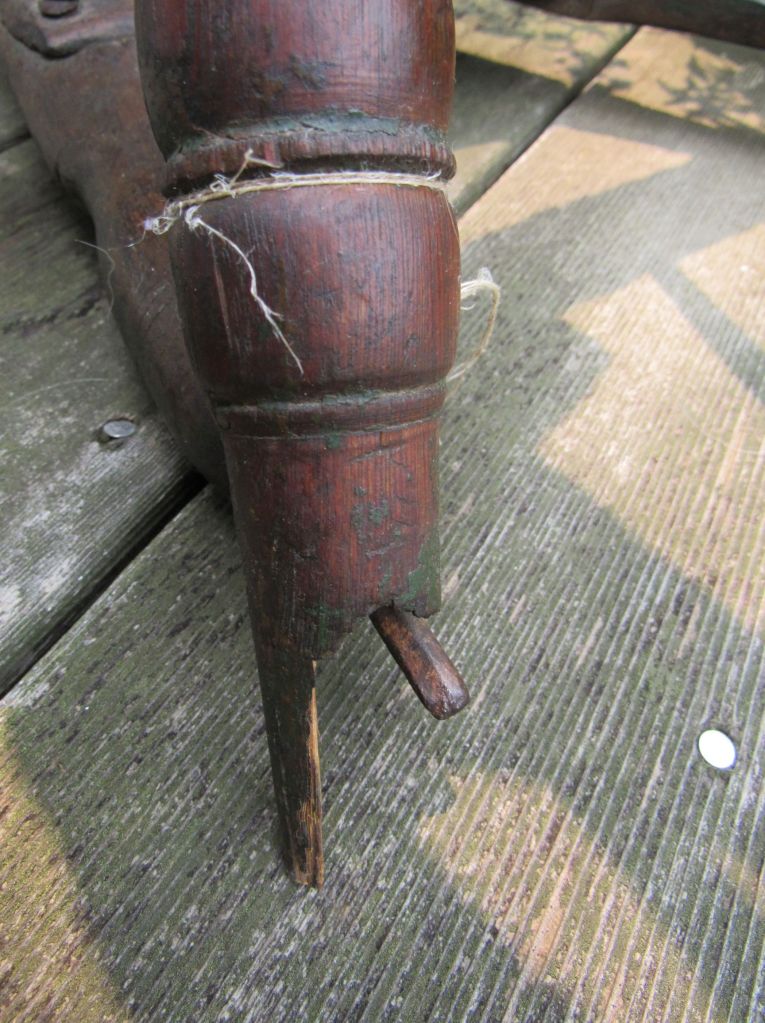
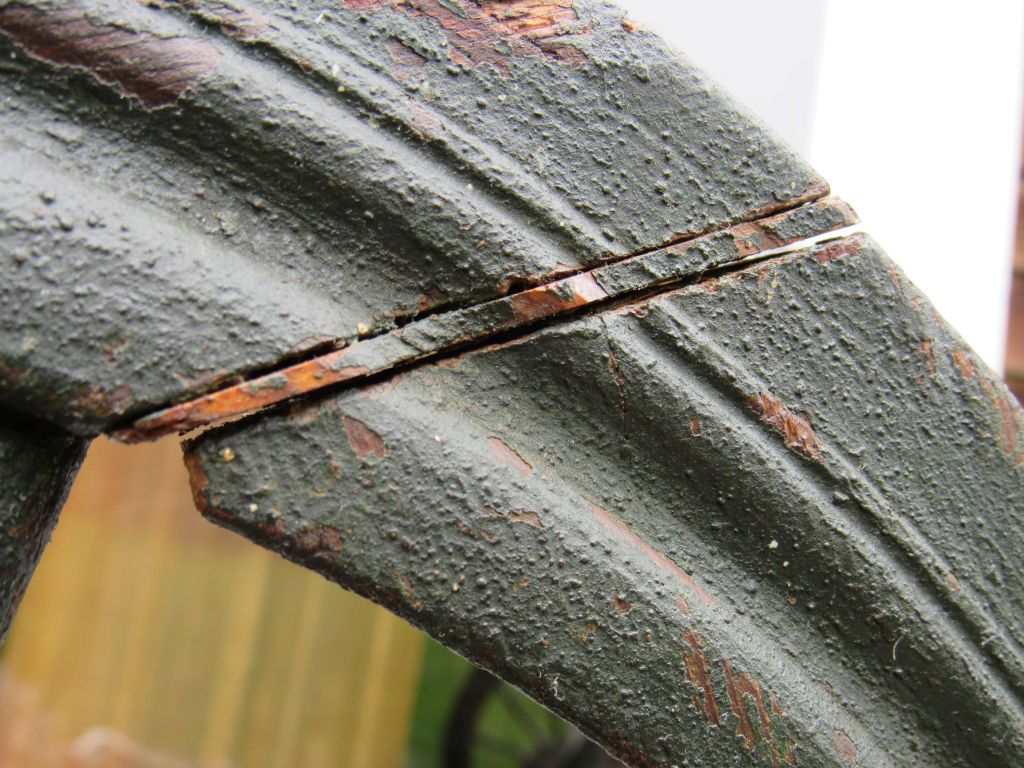
Closer inspection showed that every upright was heavily shimmed in the past–all broken off through time.
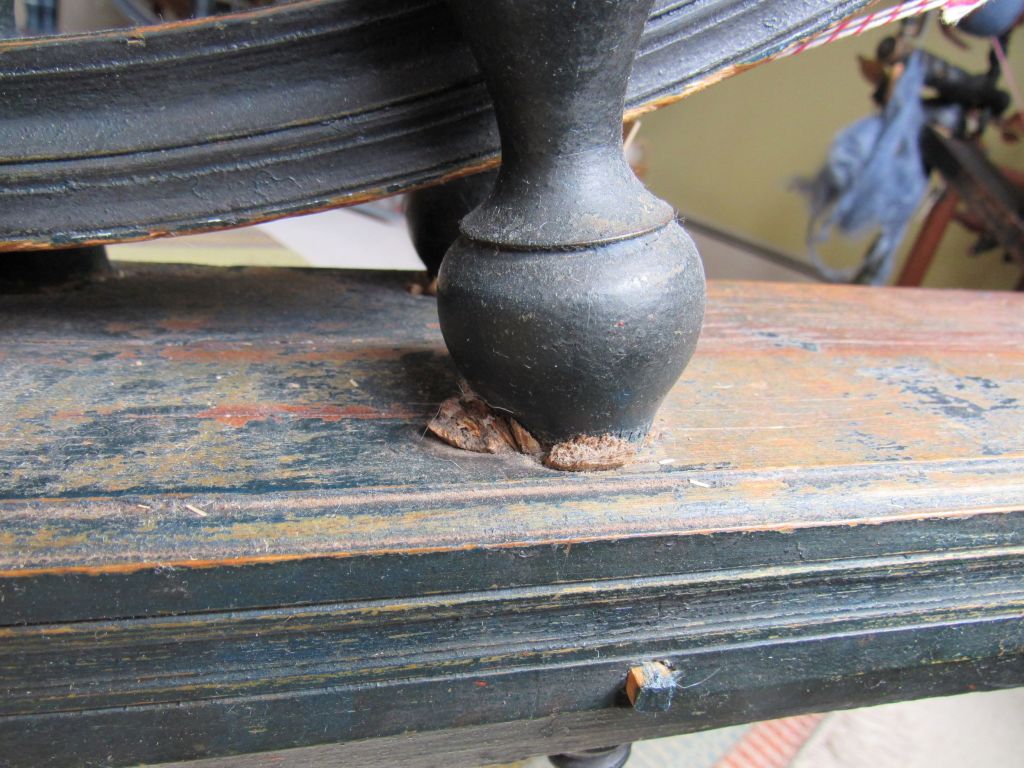
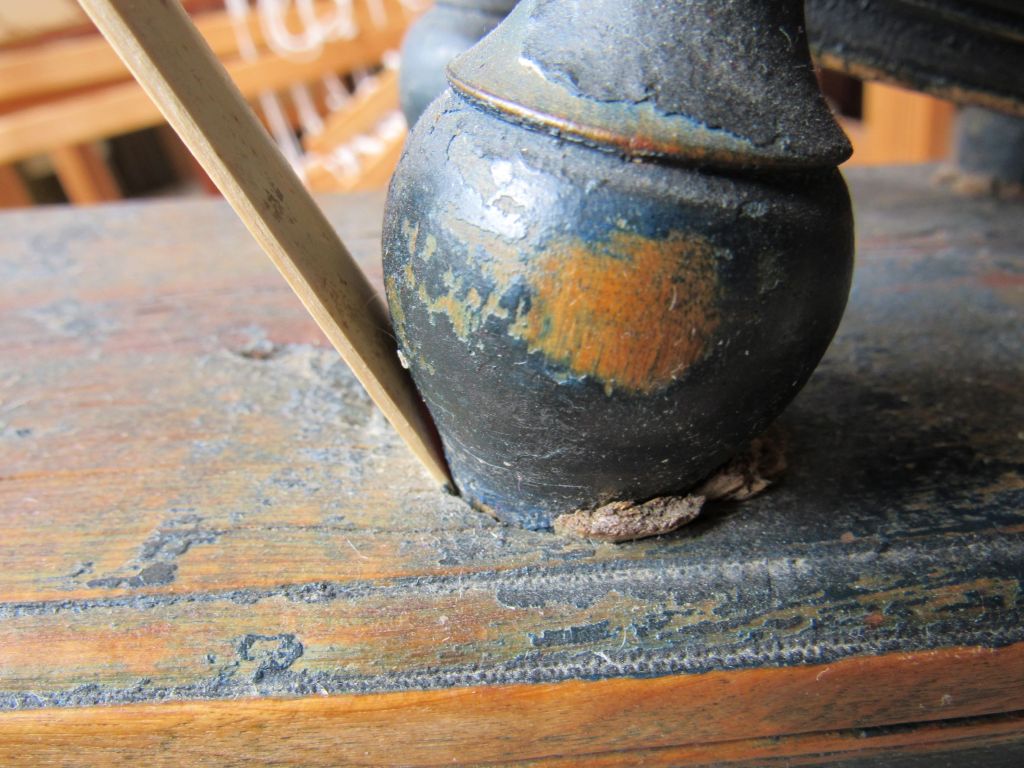
I have placed two clarinet reed shims of my own. 
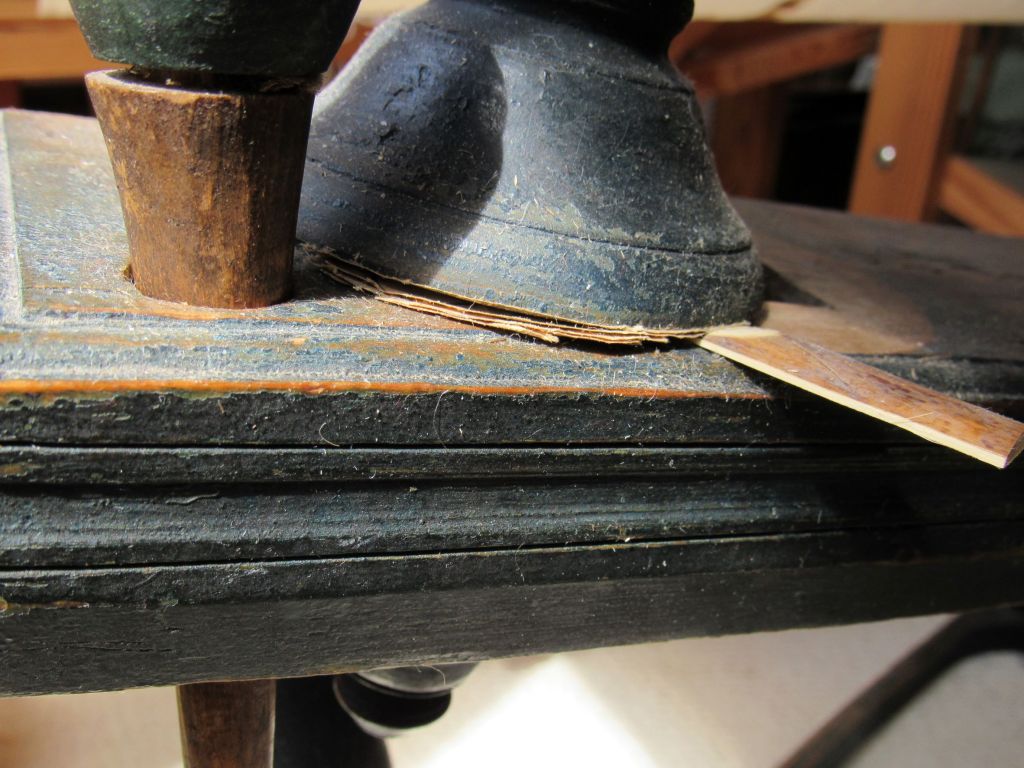
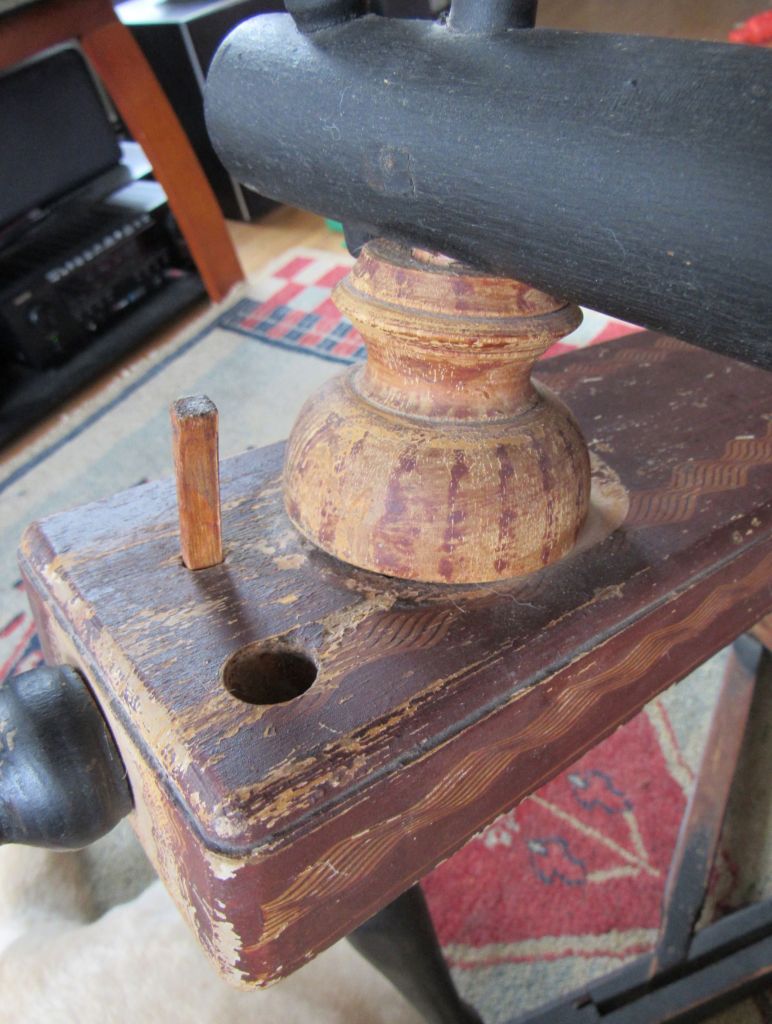
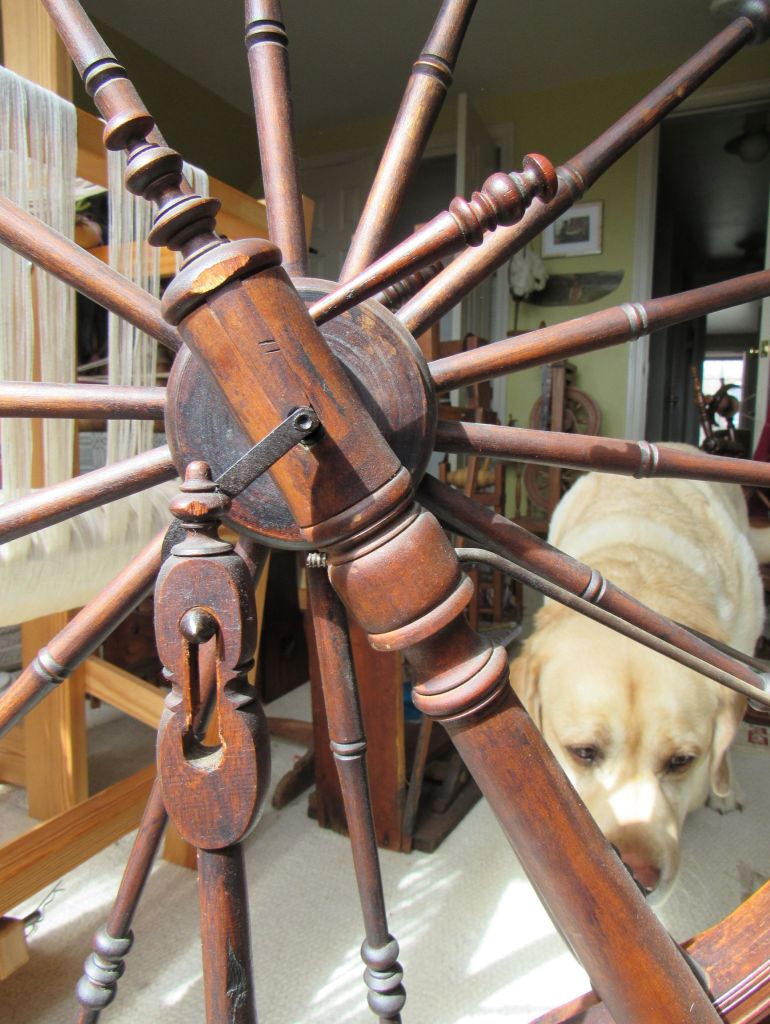
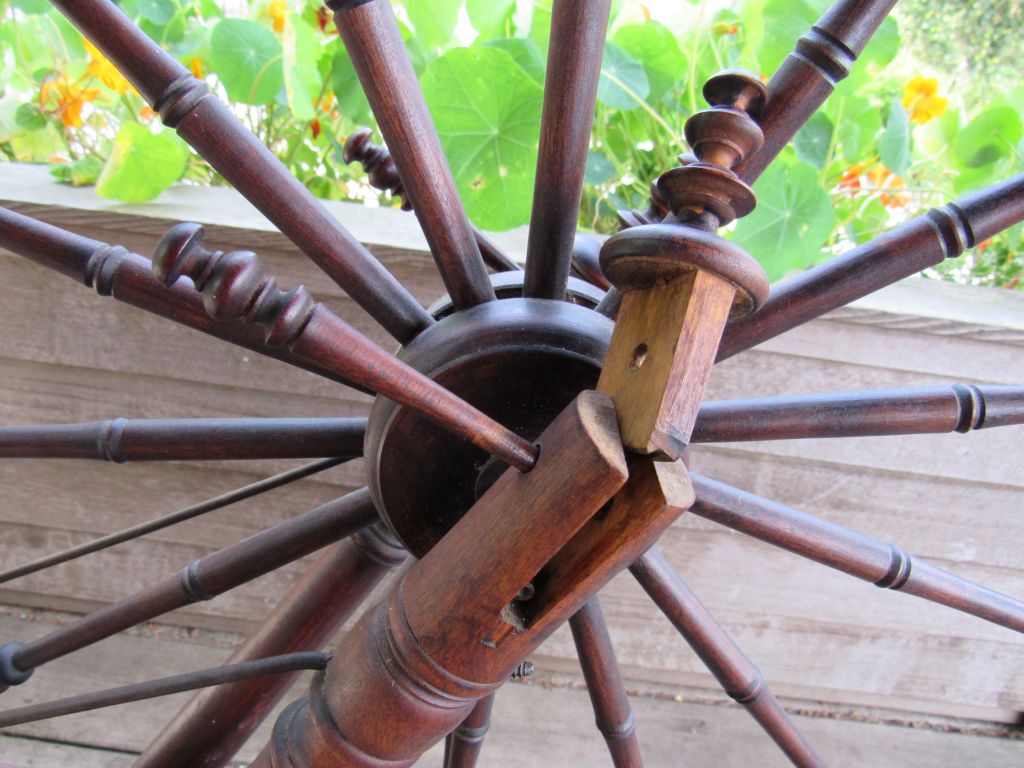
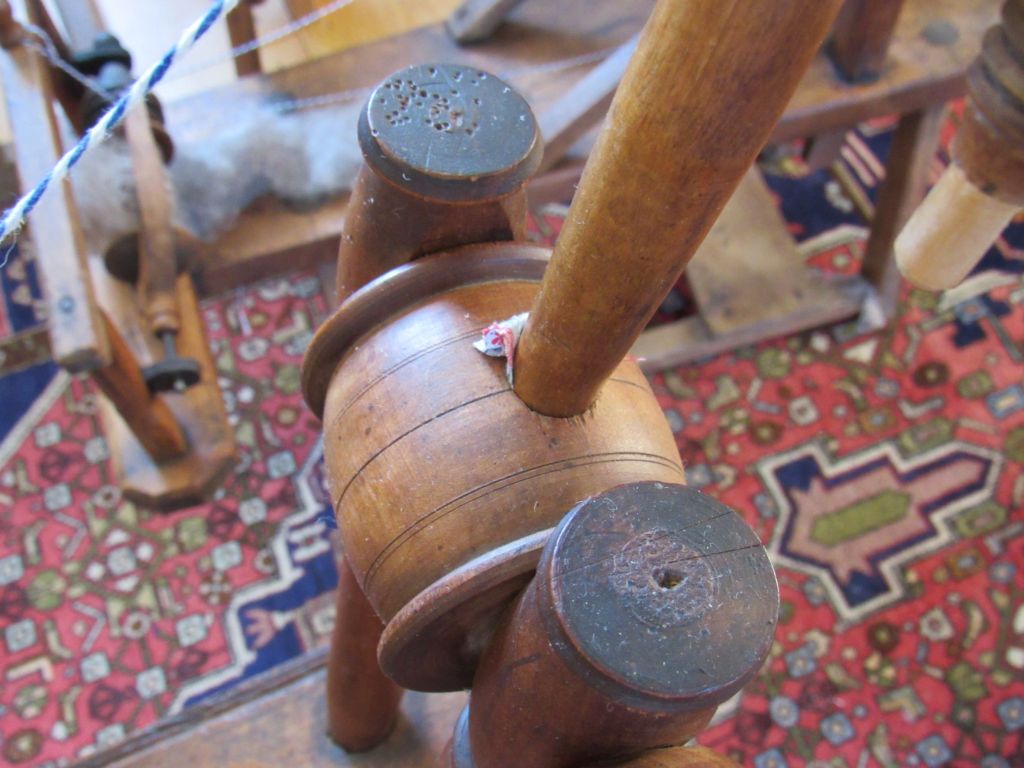
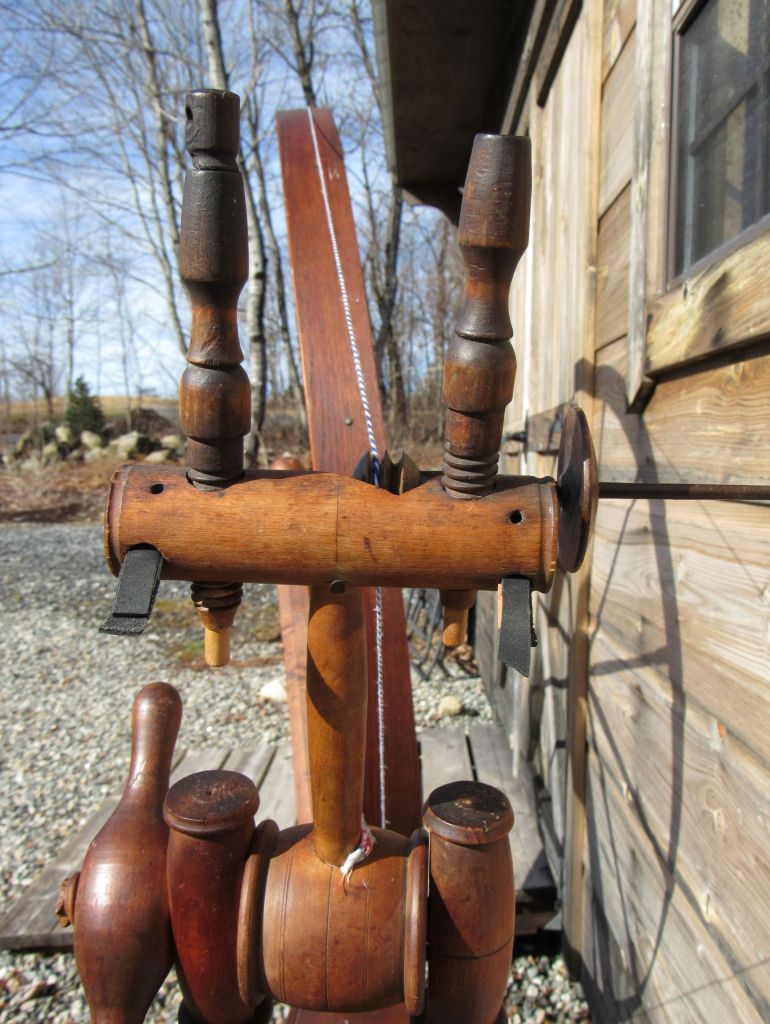
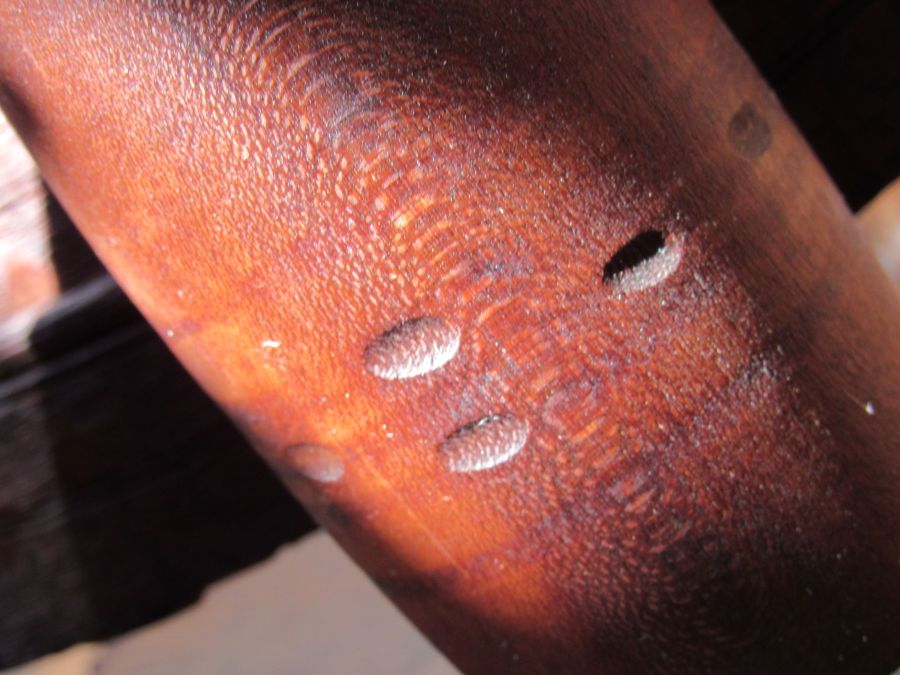
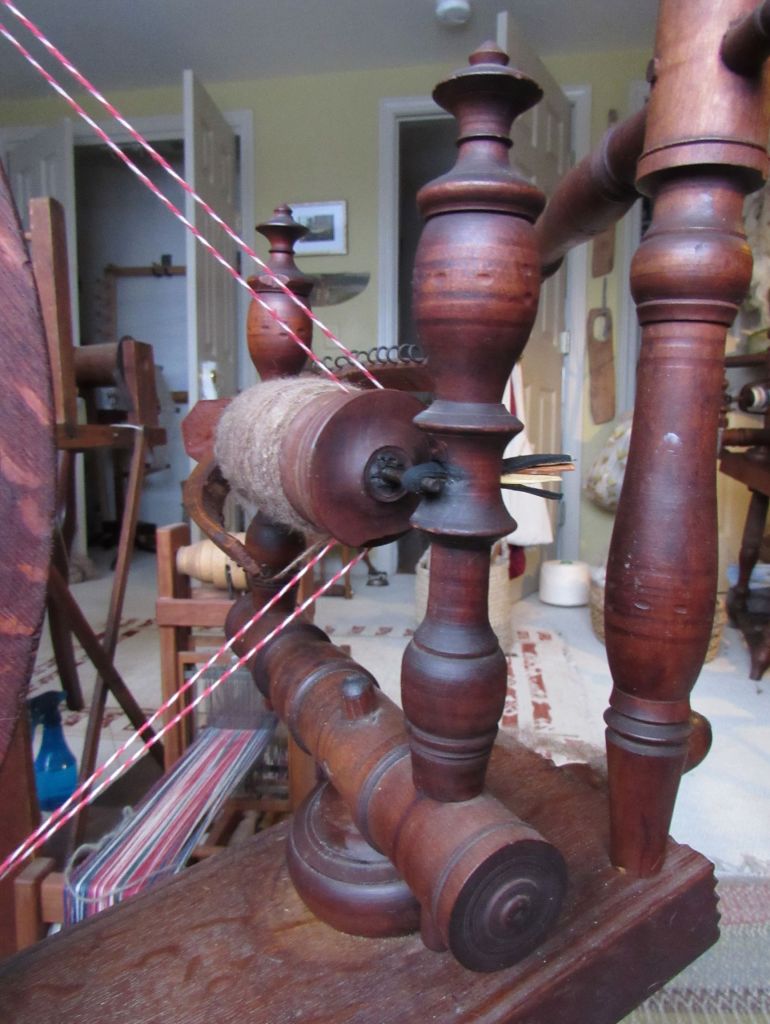
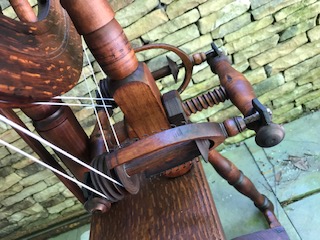
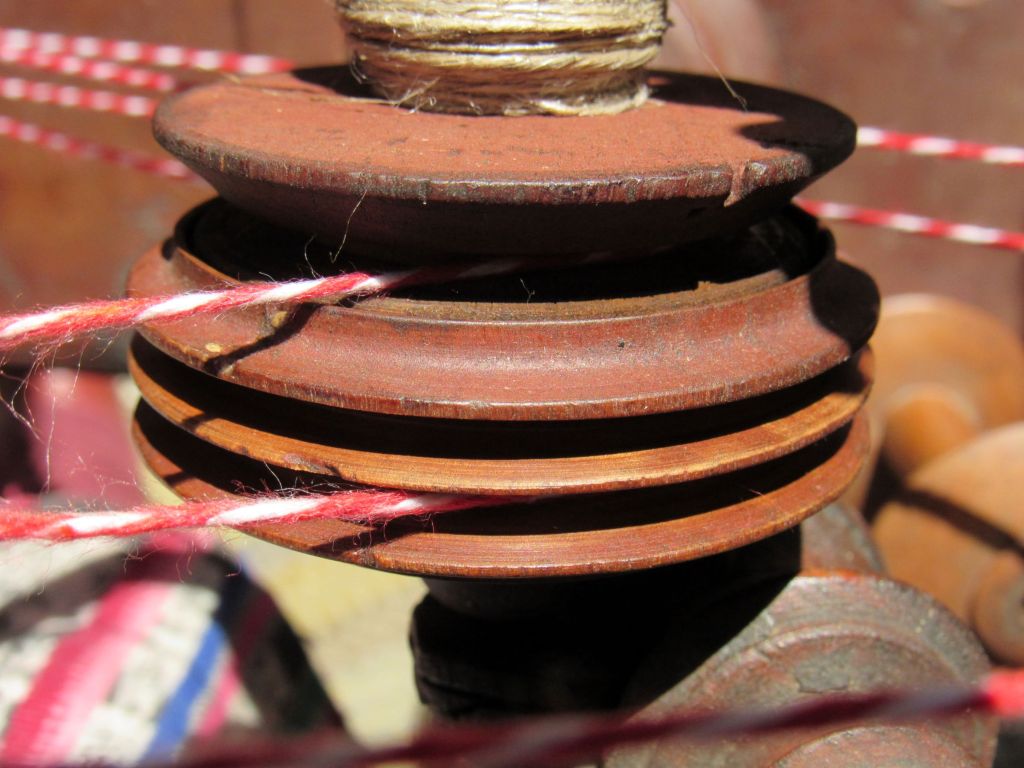
There is paper shimming under the collar and multiple pegs in the maidens,
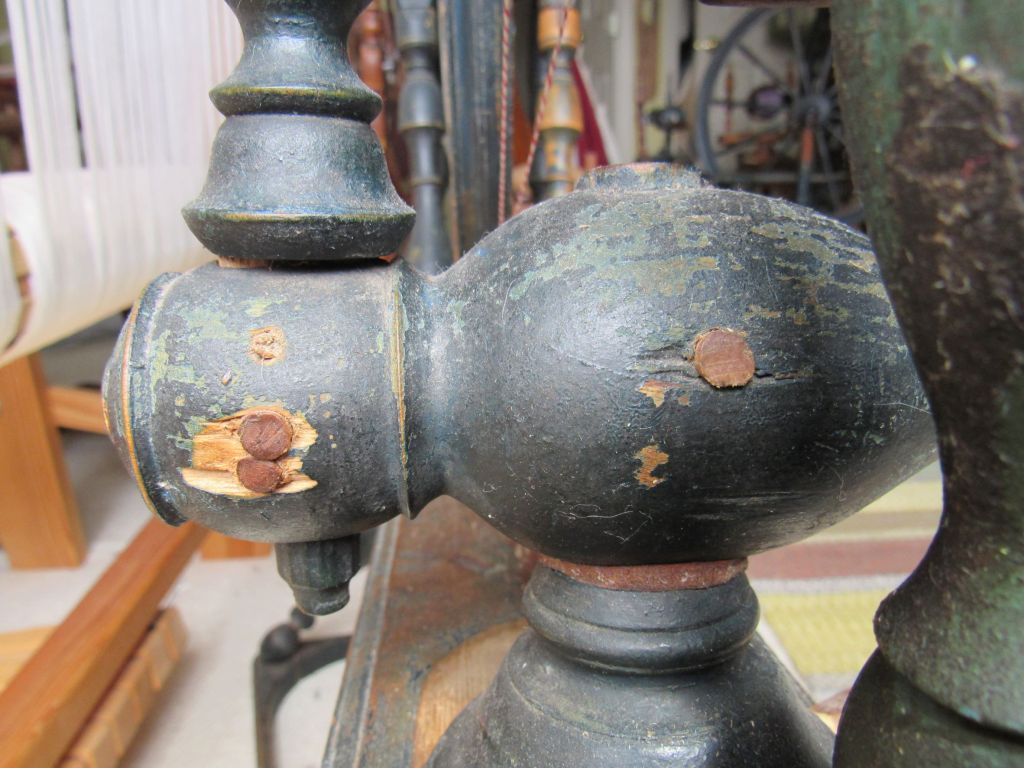
all designed to keep the wheel tight and in working order. 
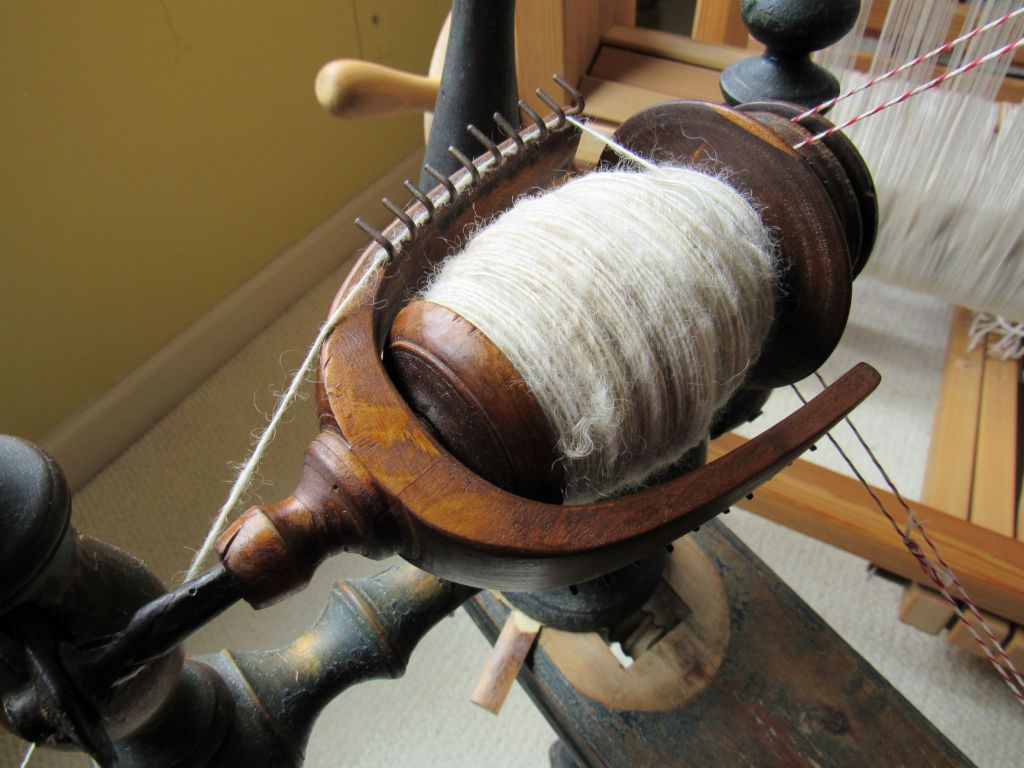
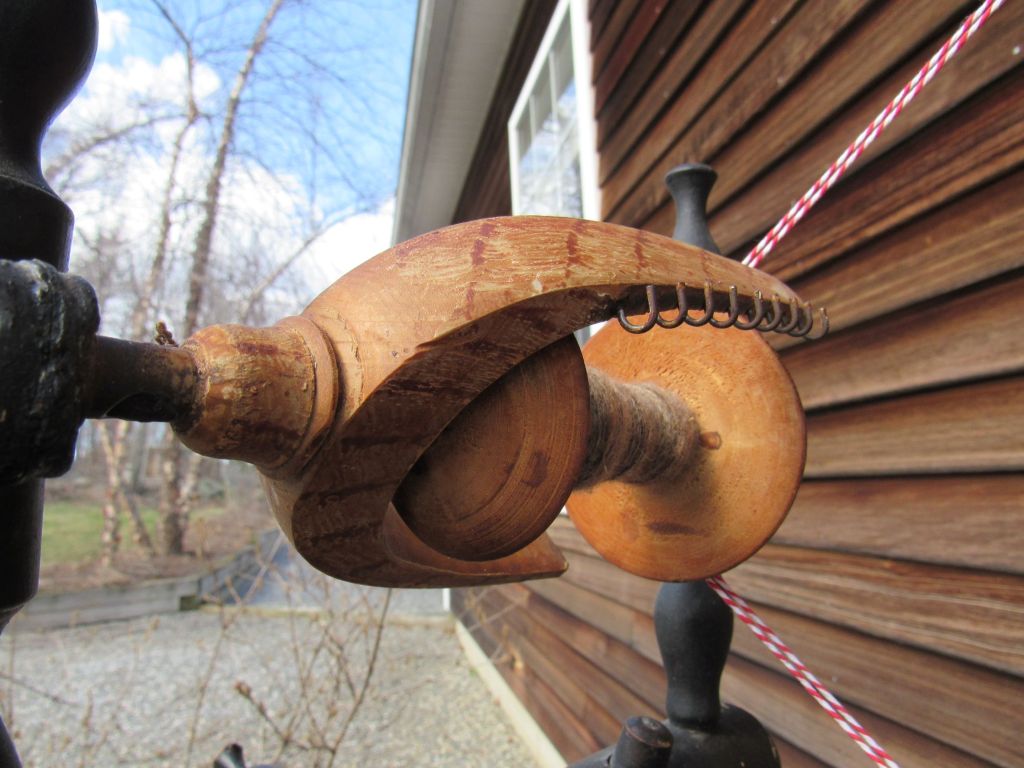
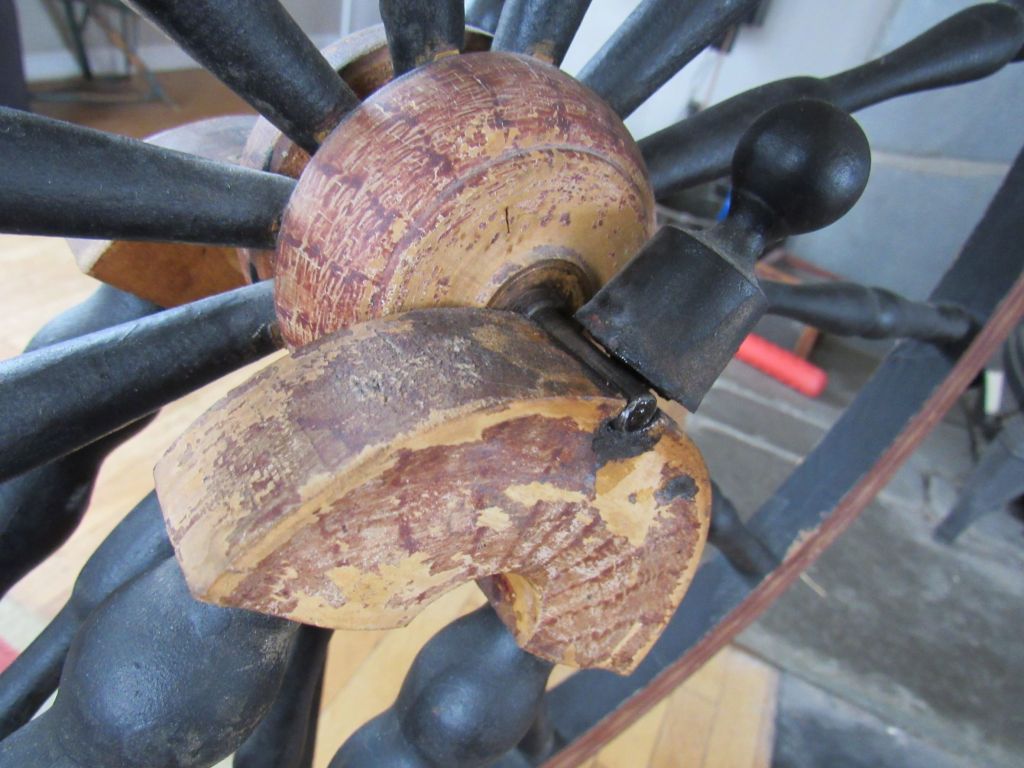
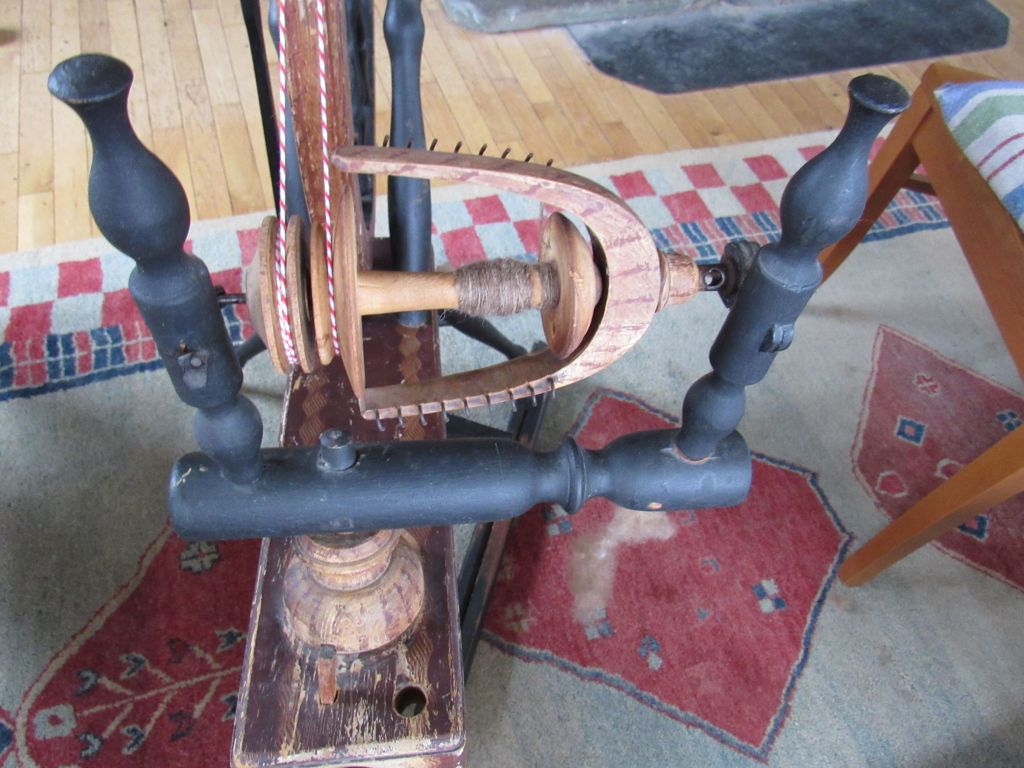
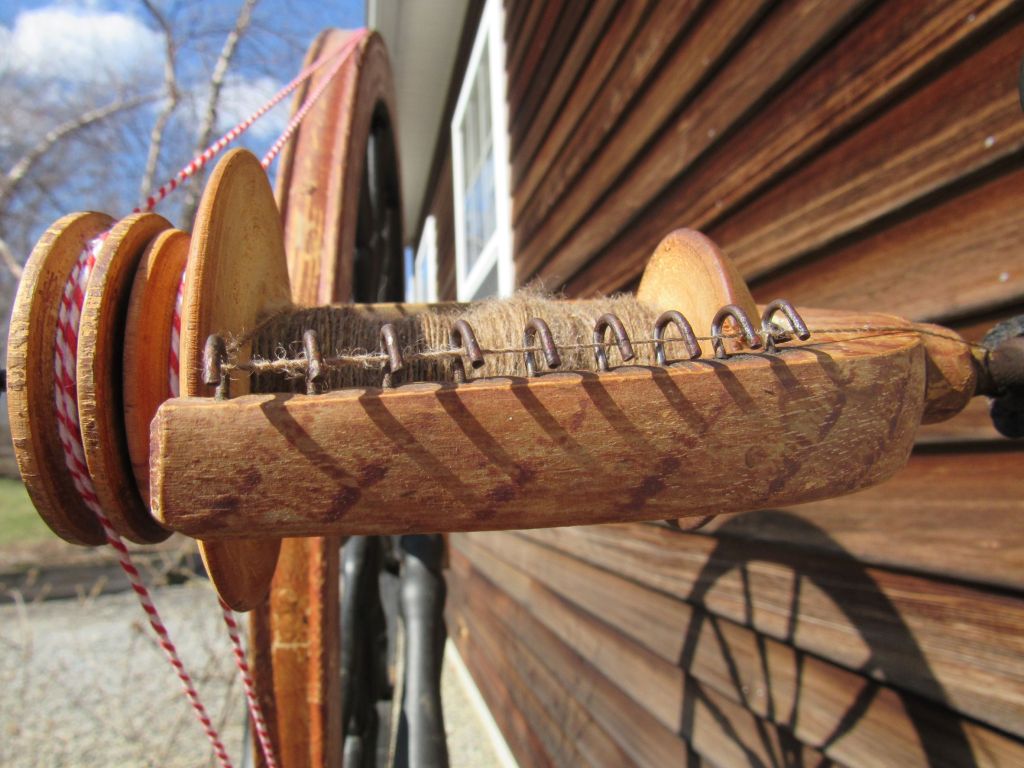
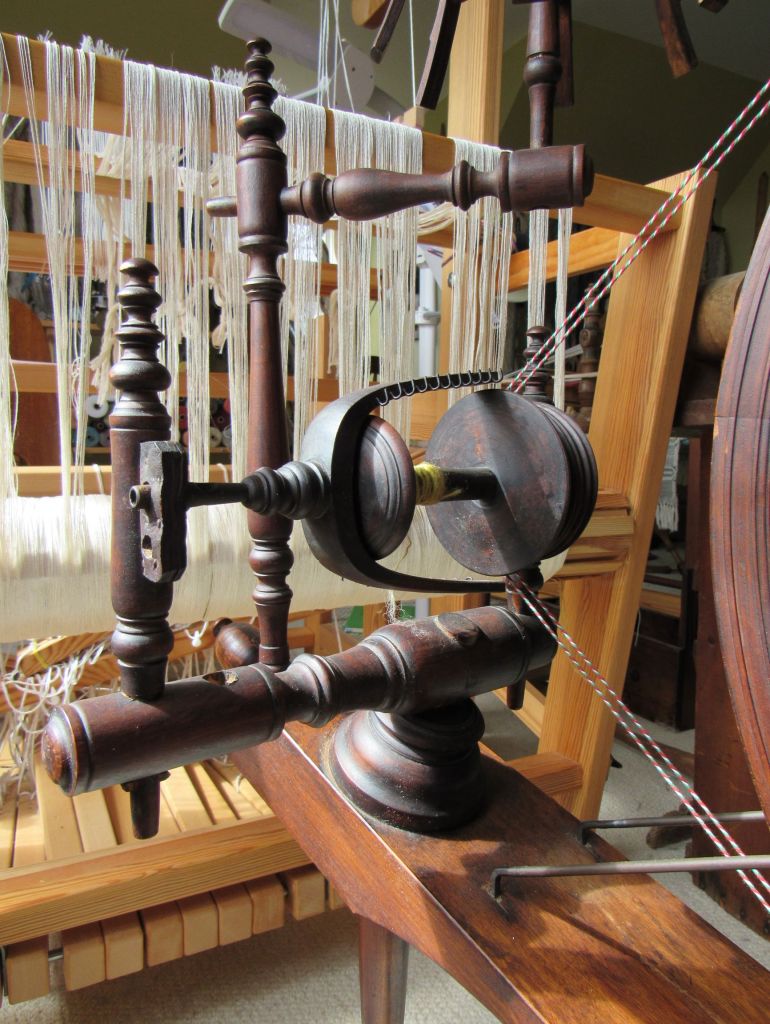
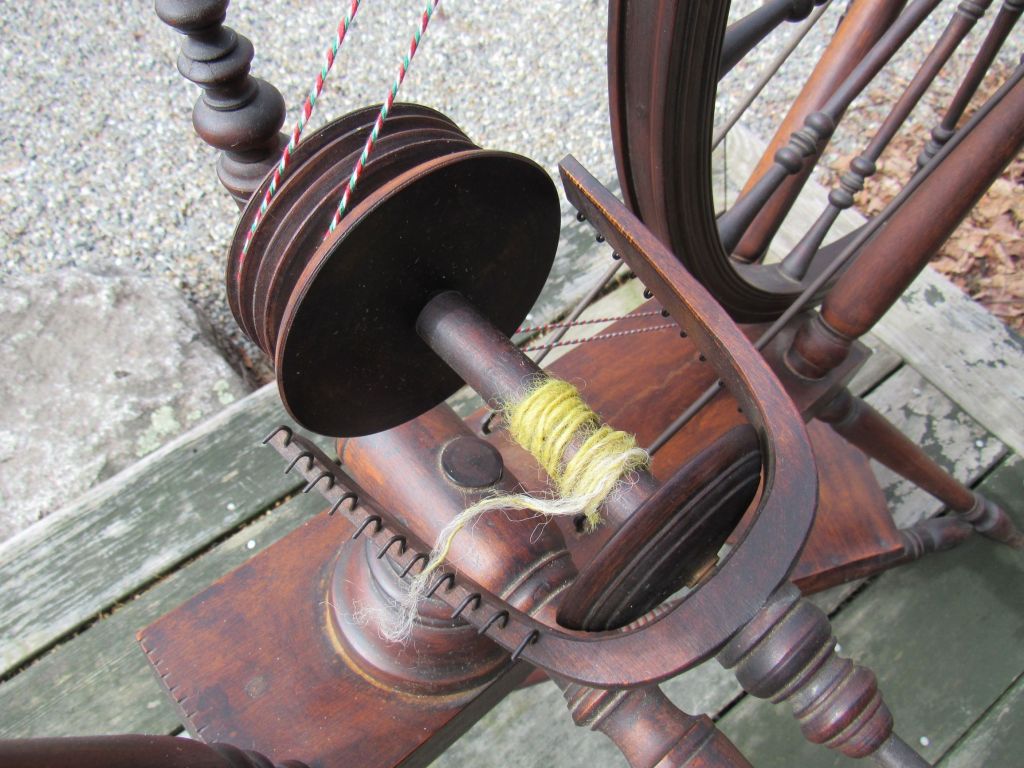
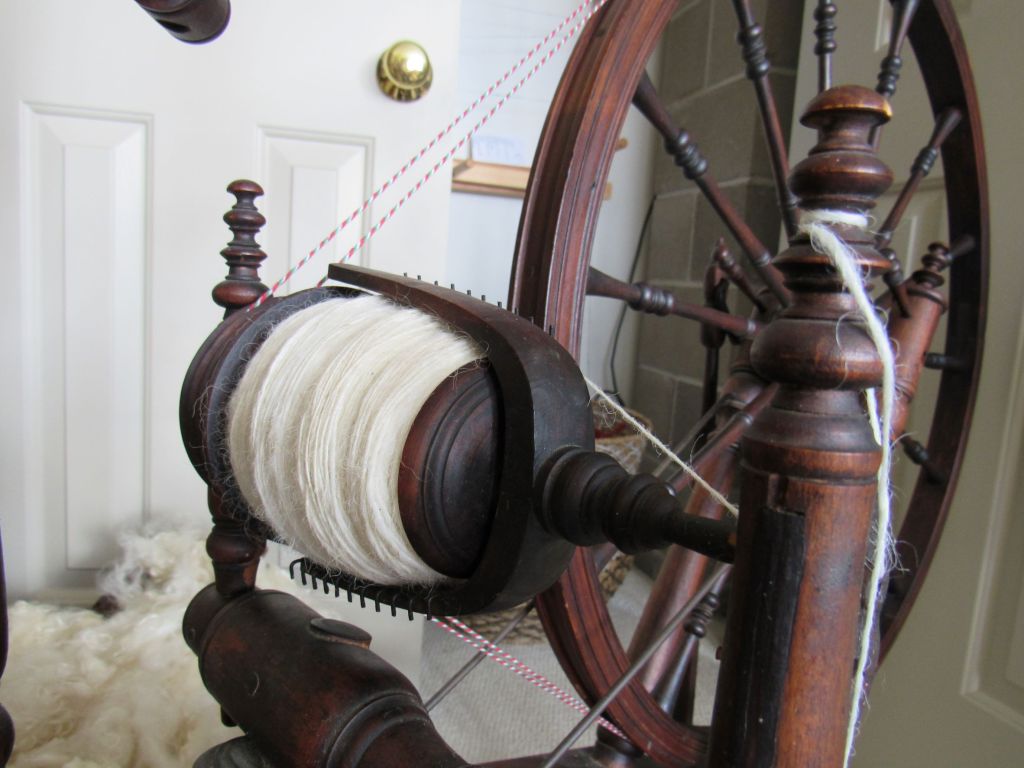
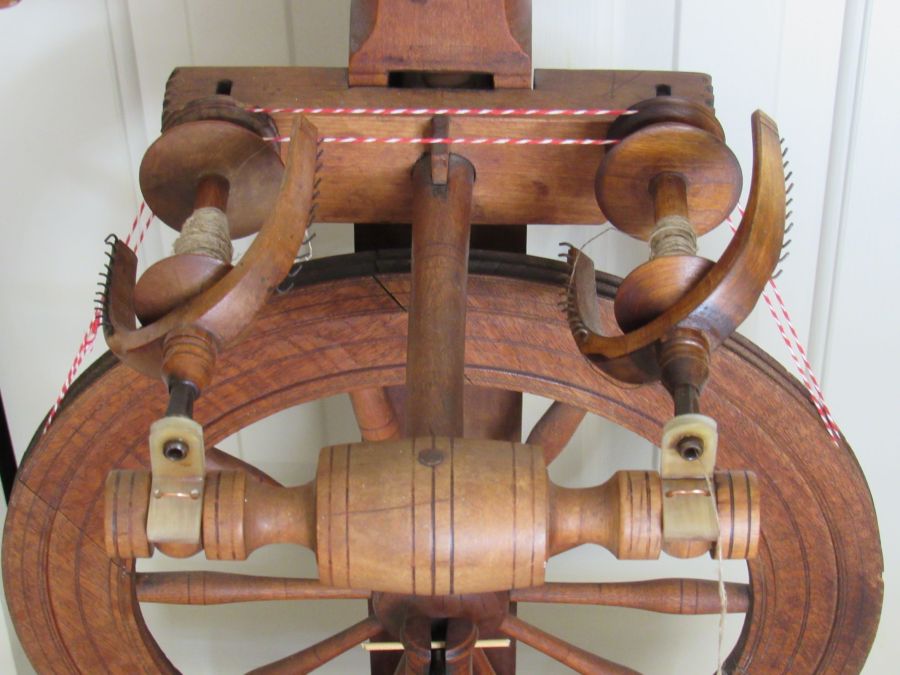
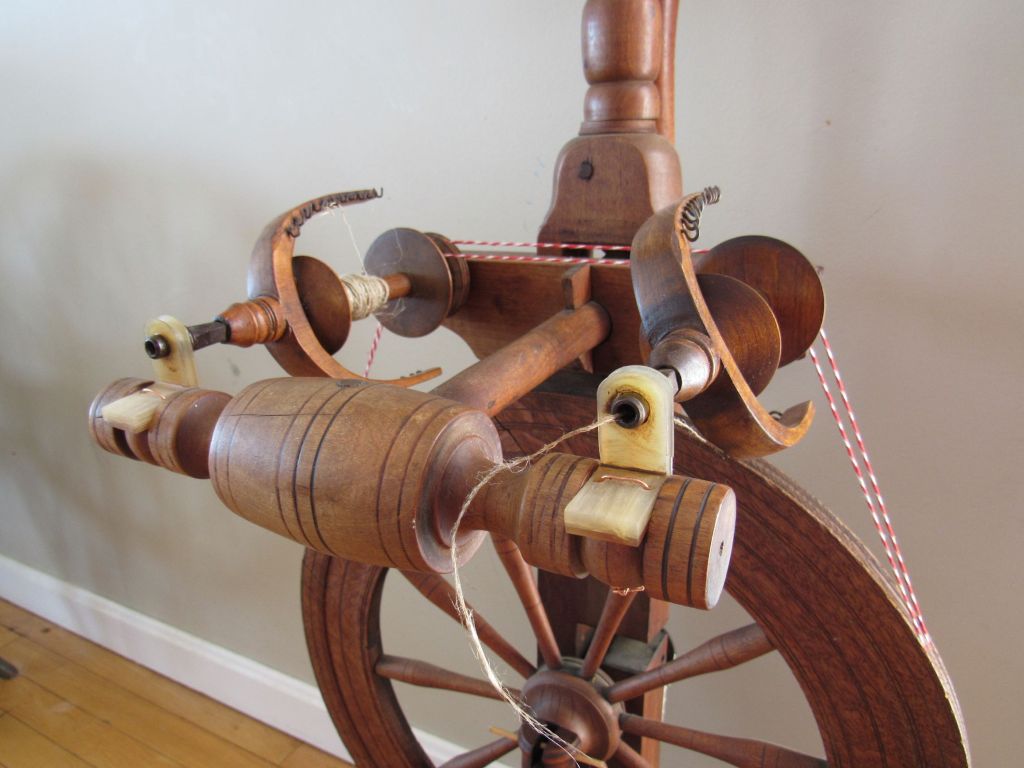
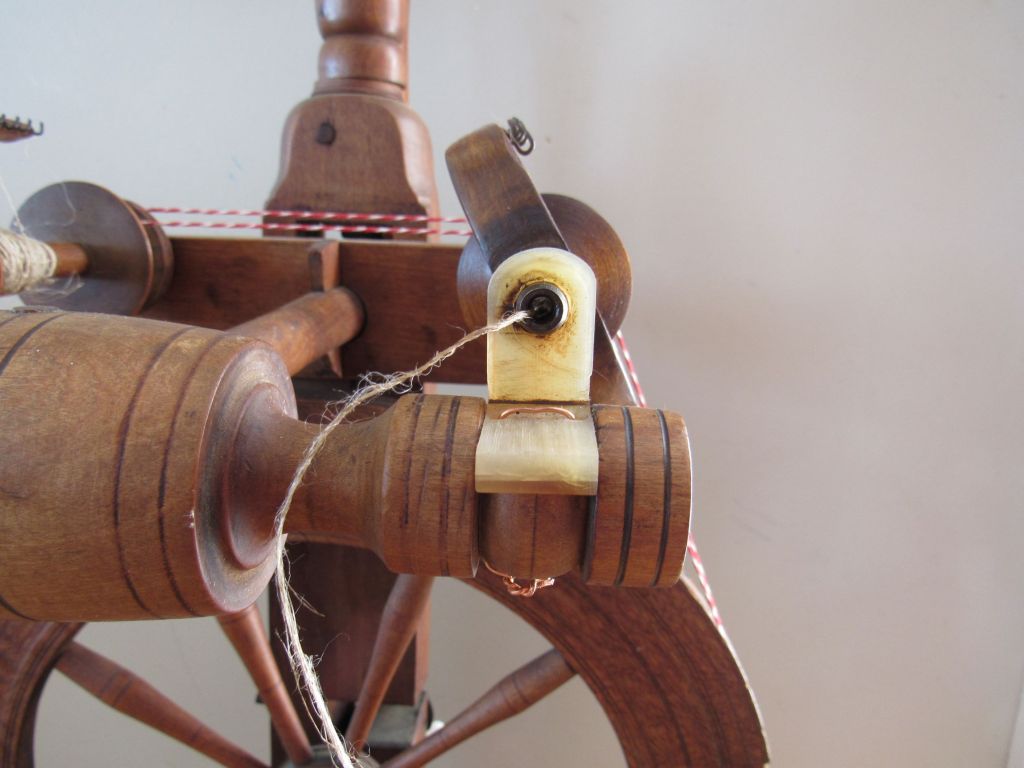
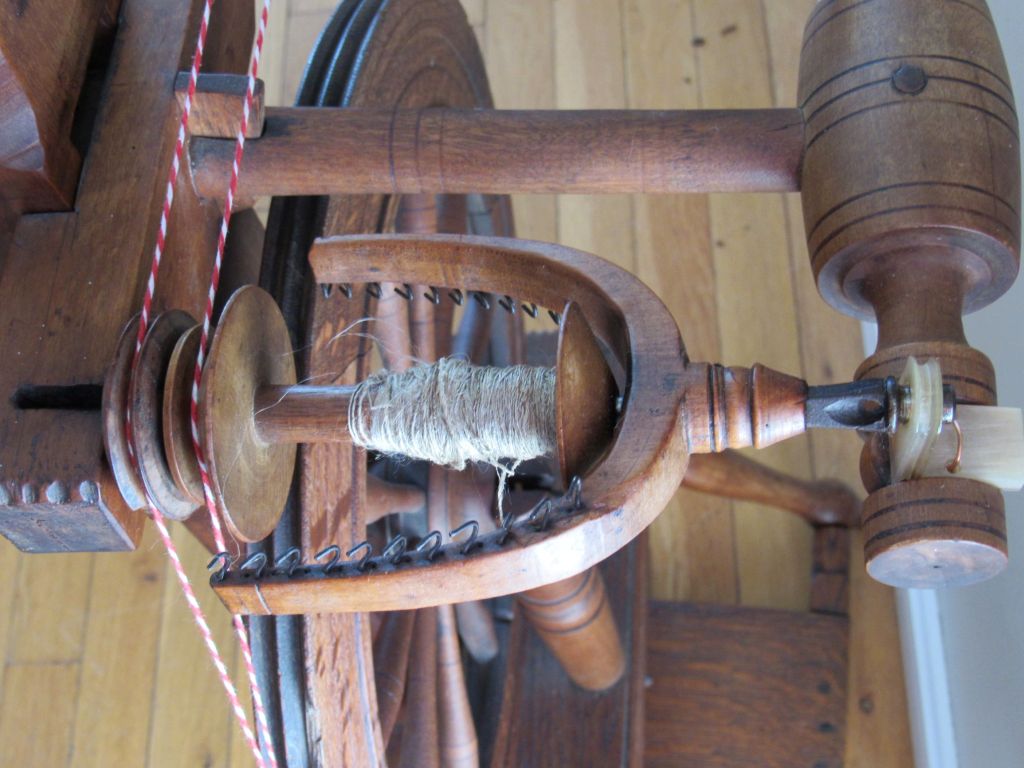
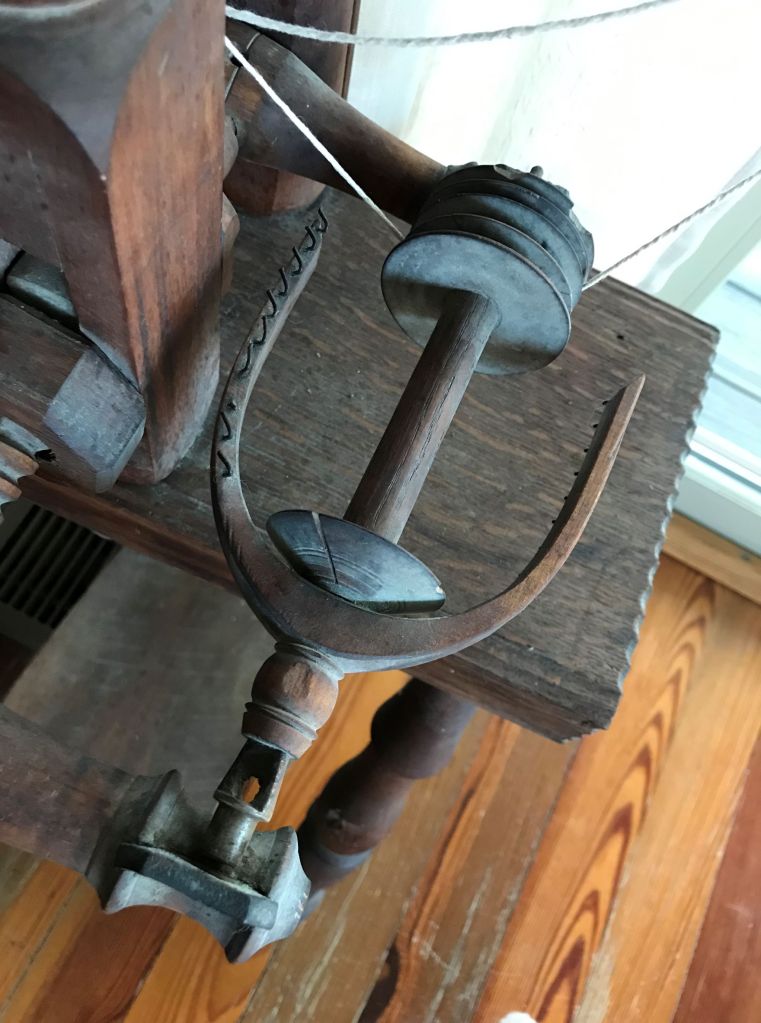
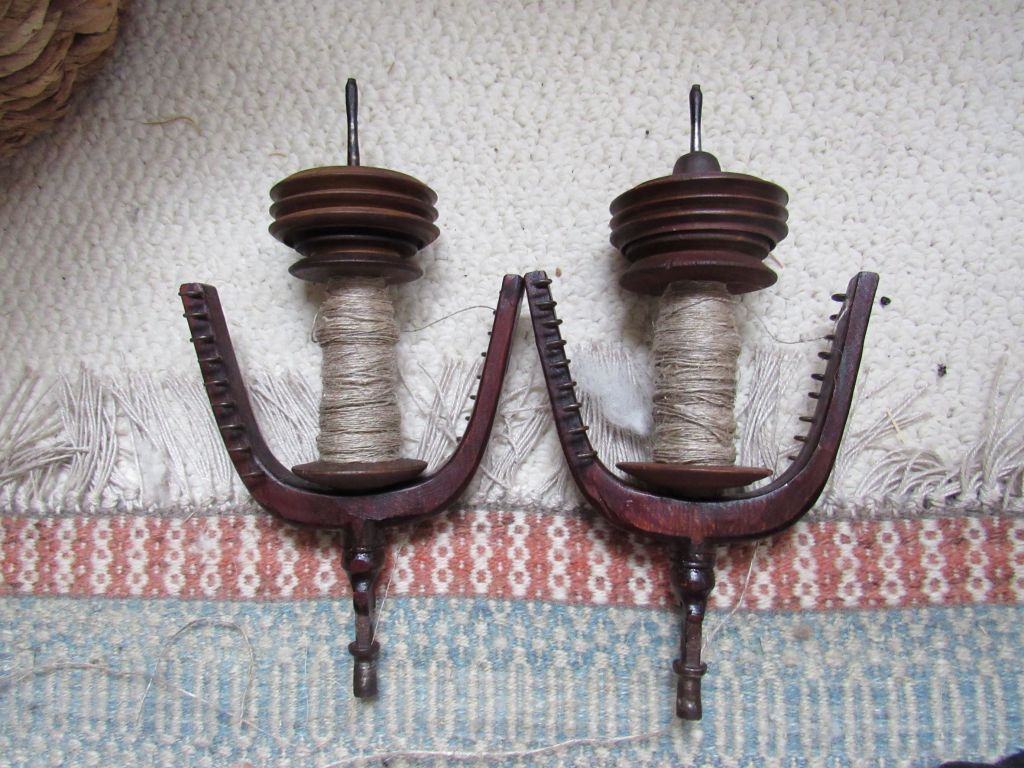
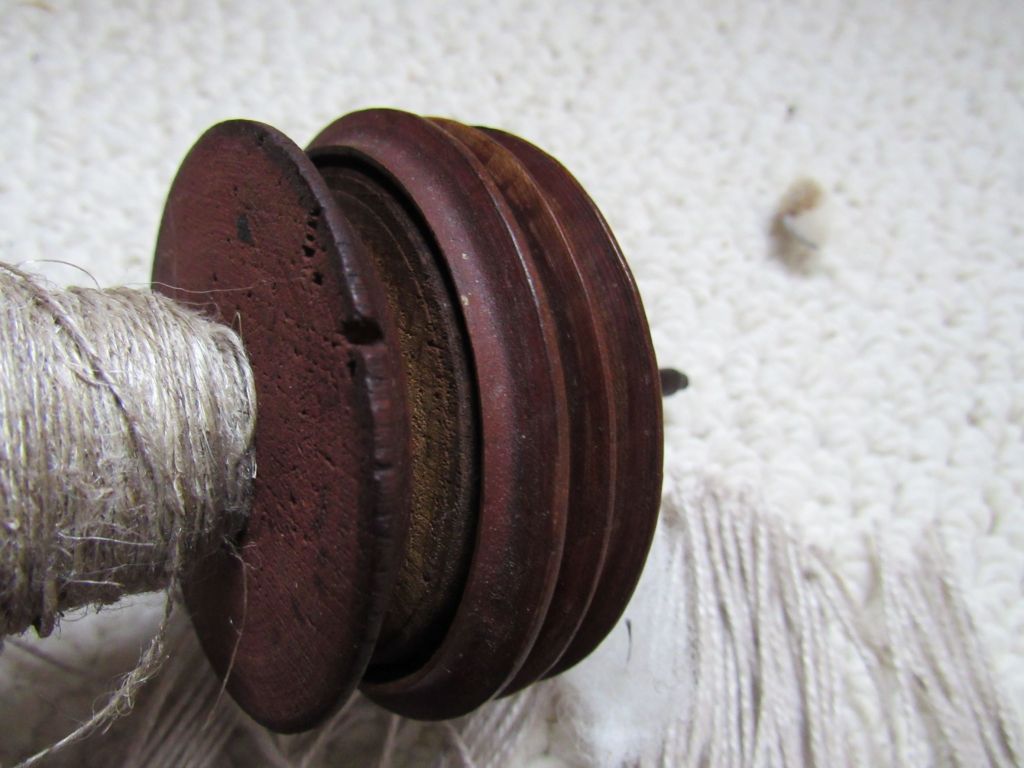
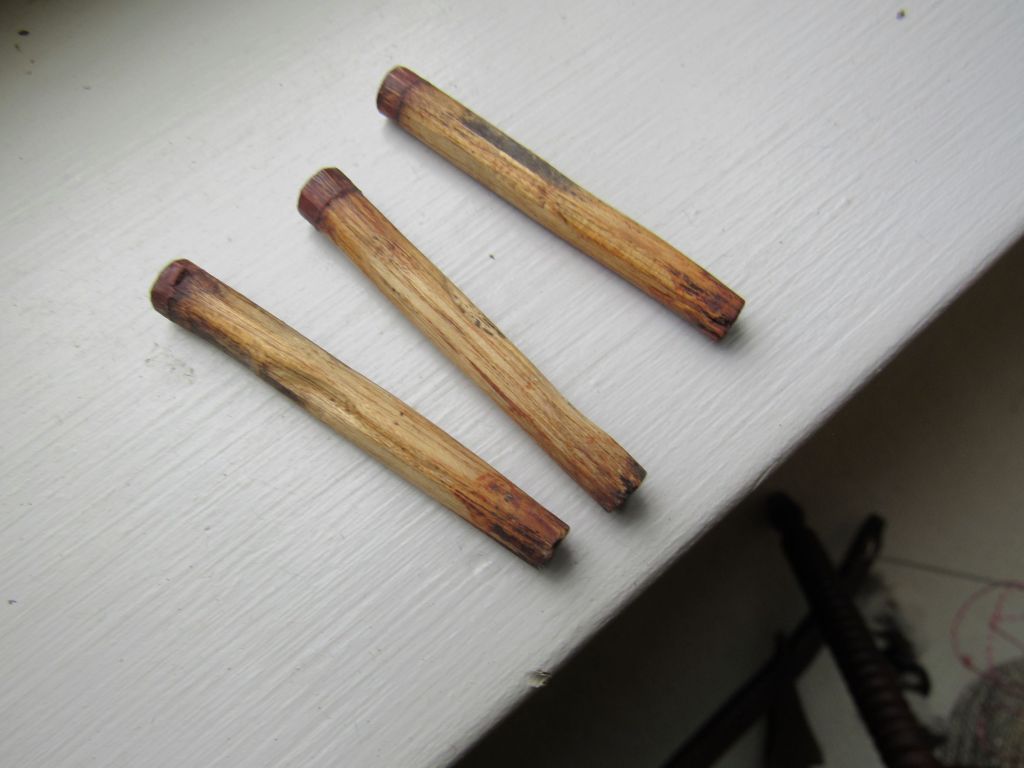
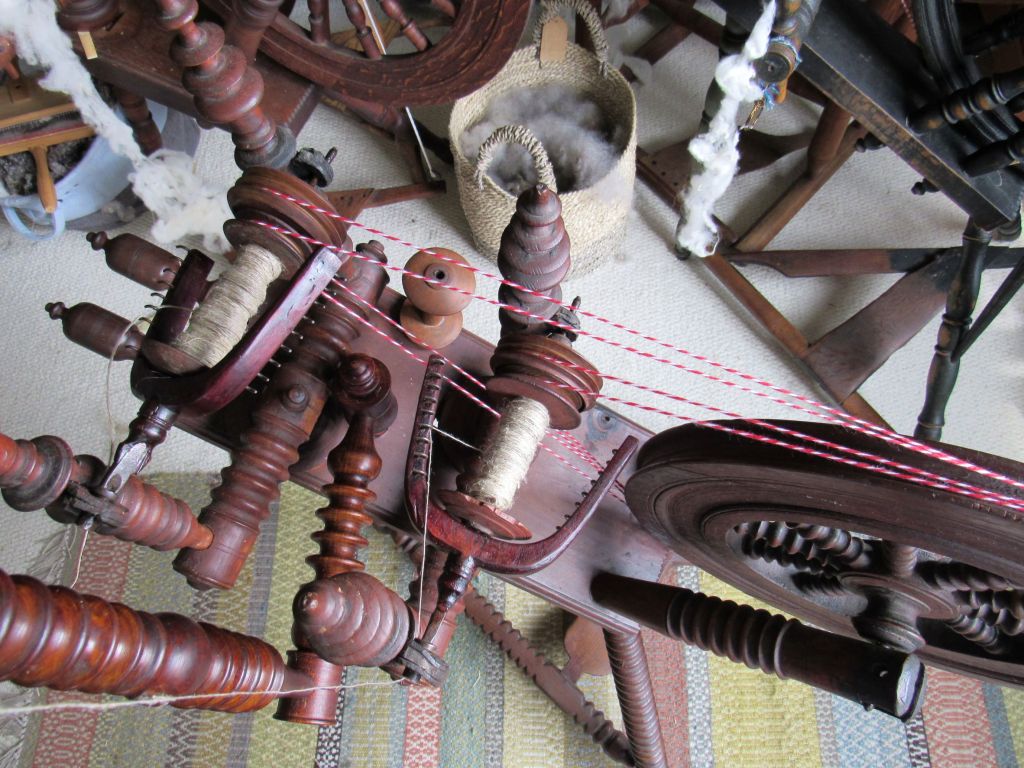
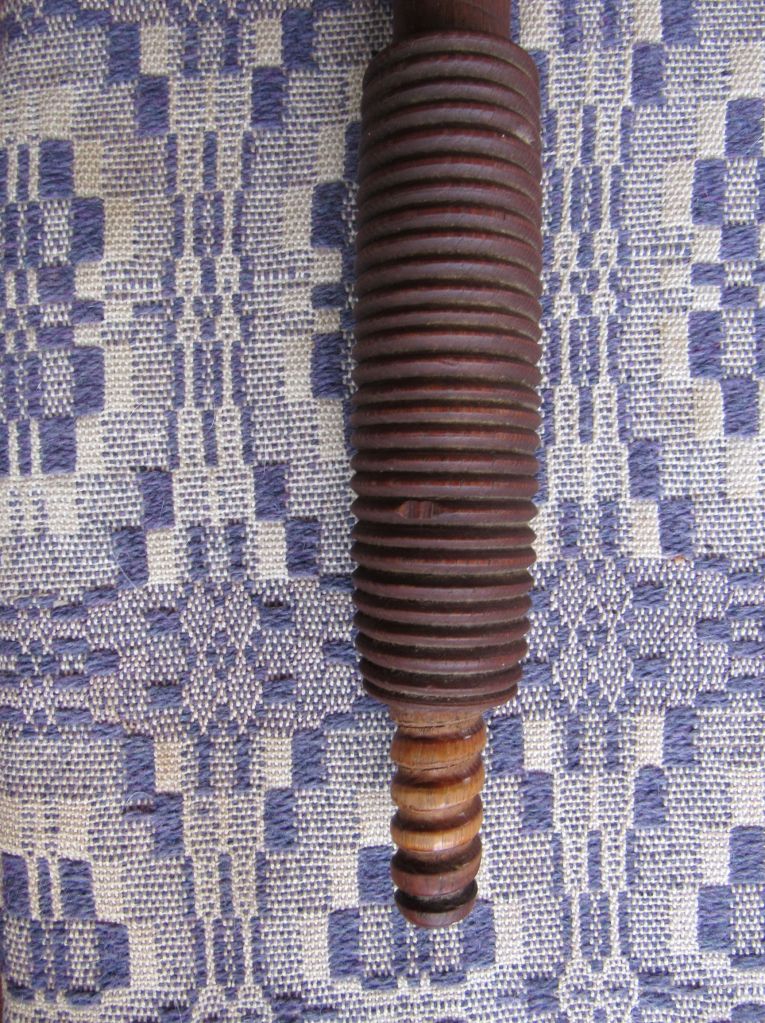
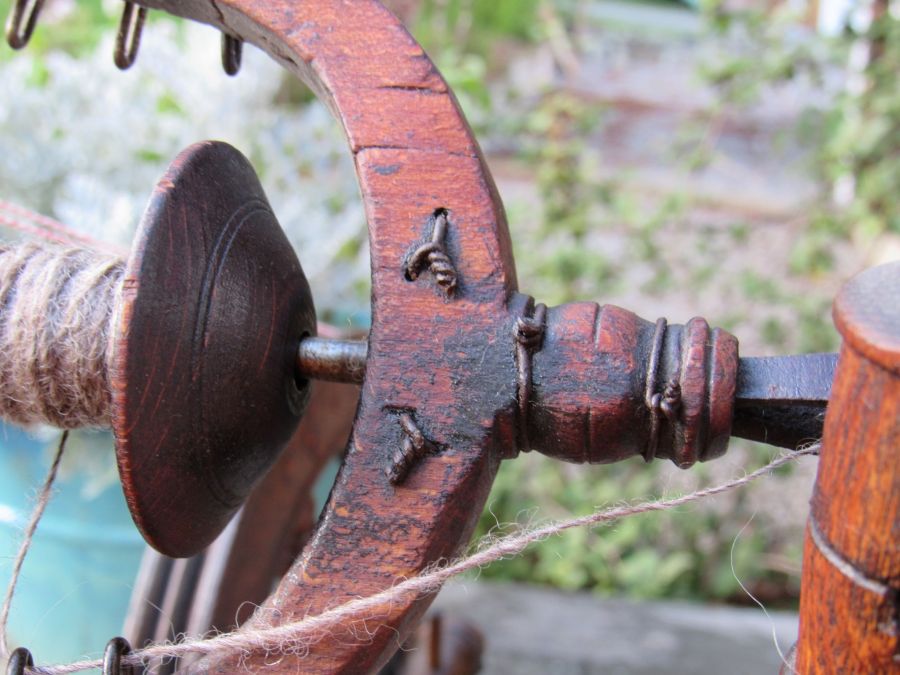
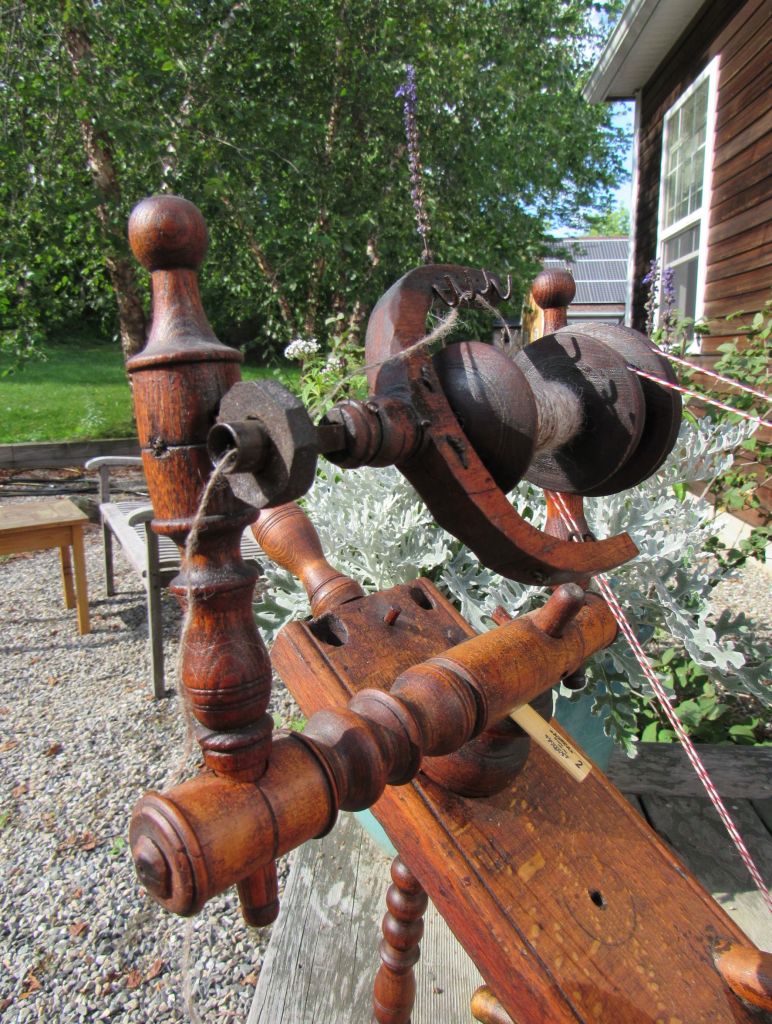
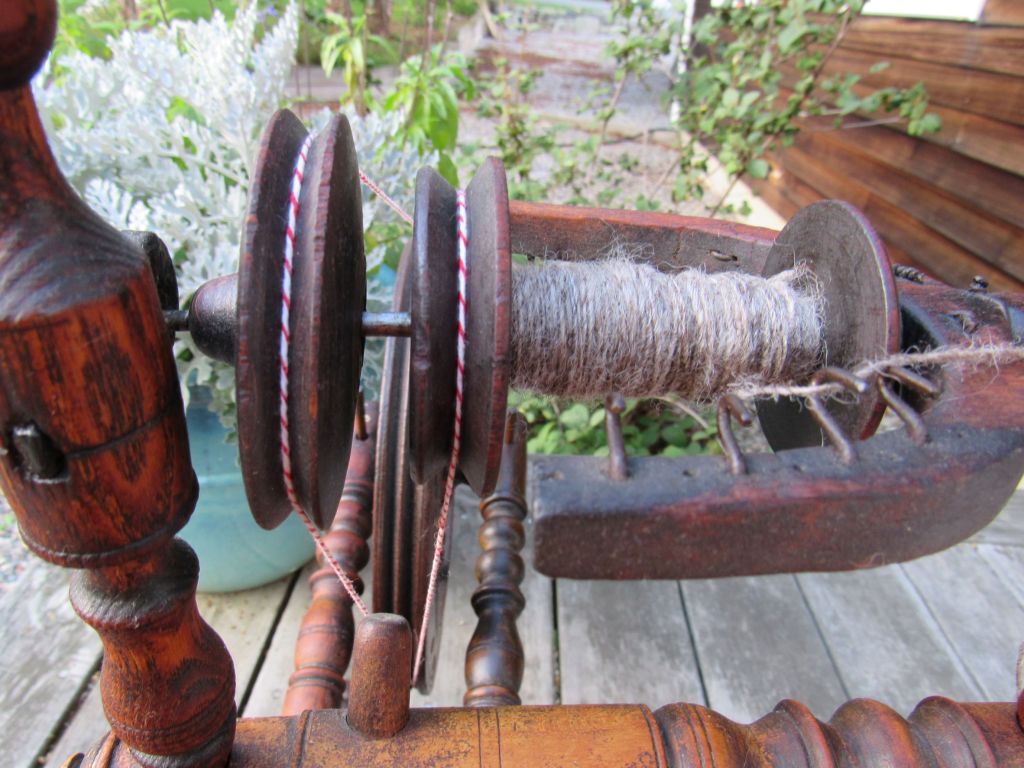
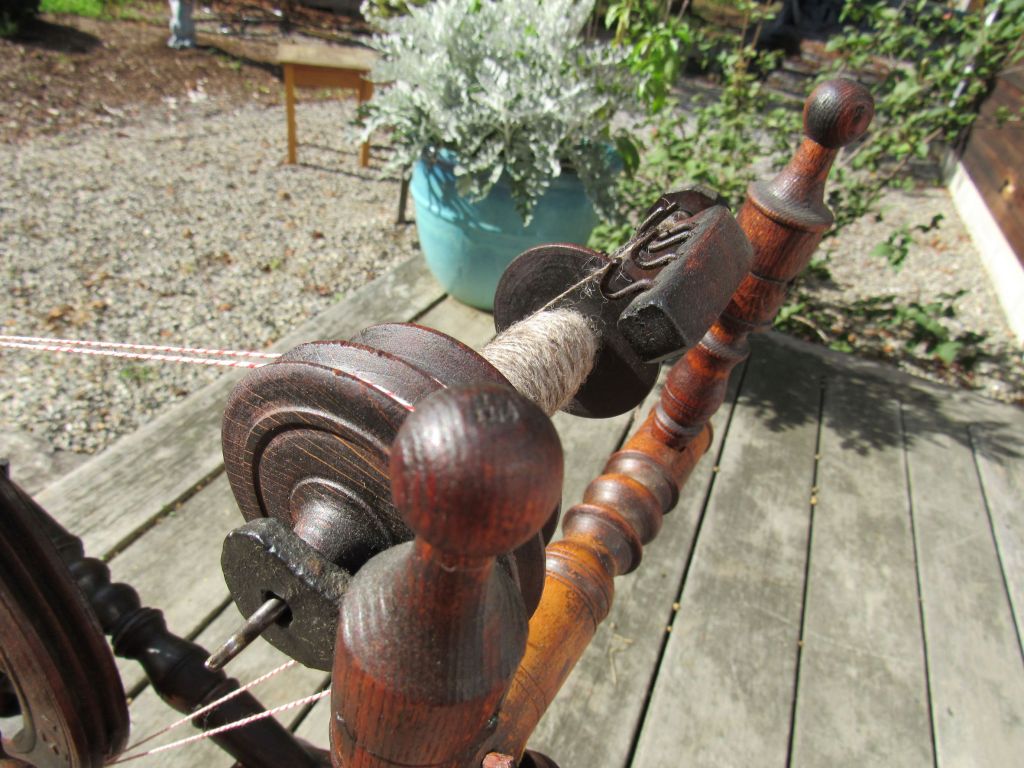
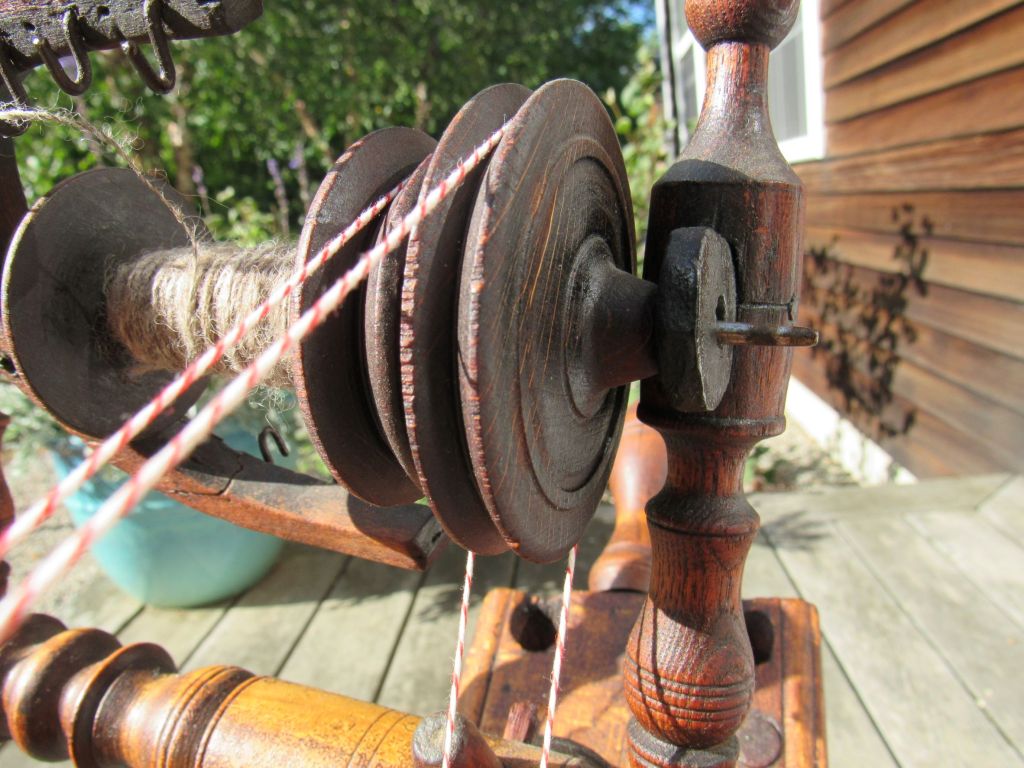
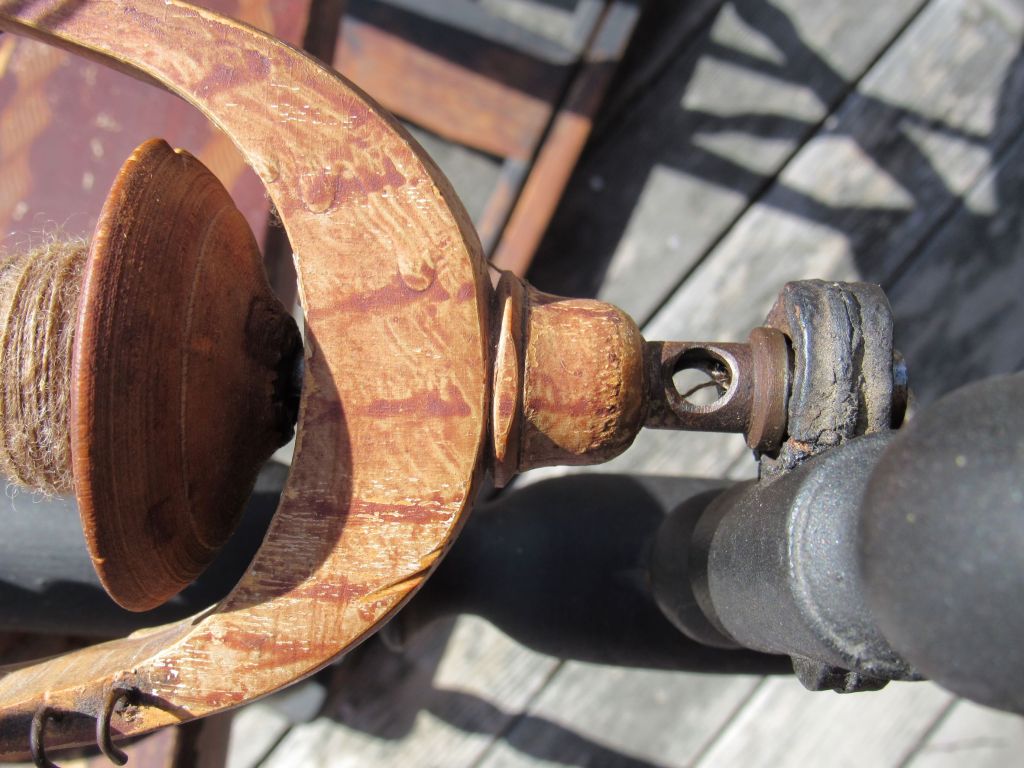
The flyer is beautiful, but was in rough shape when I got it, missing an arm and a good part of the bobbin.
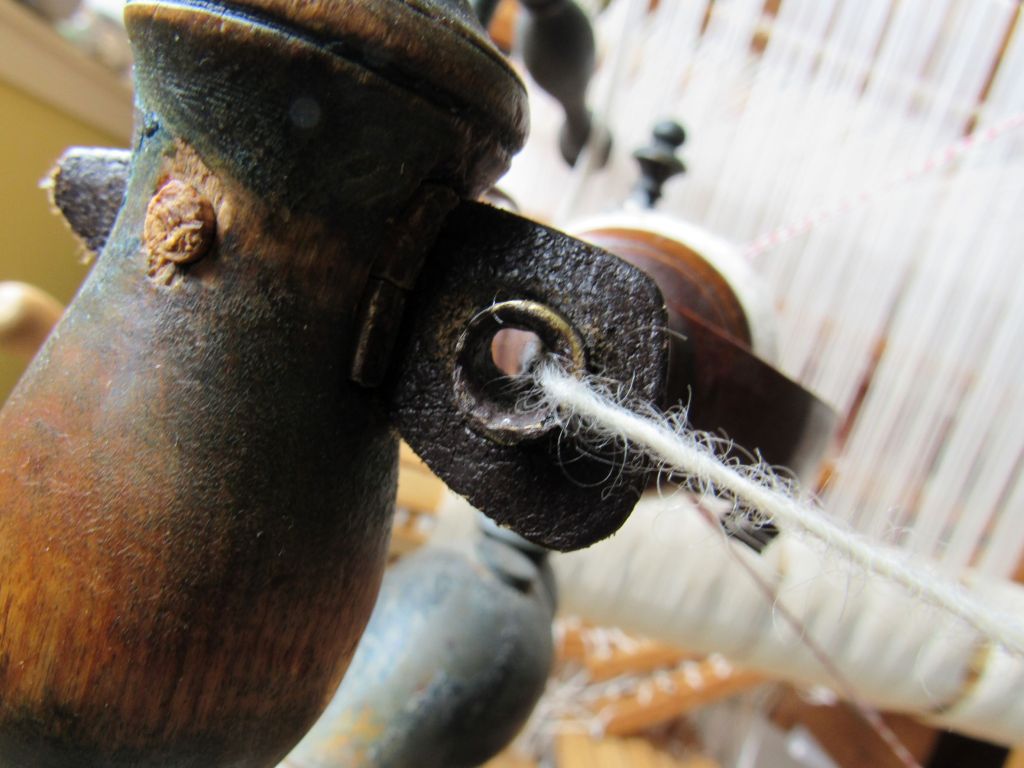
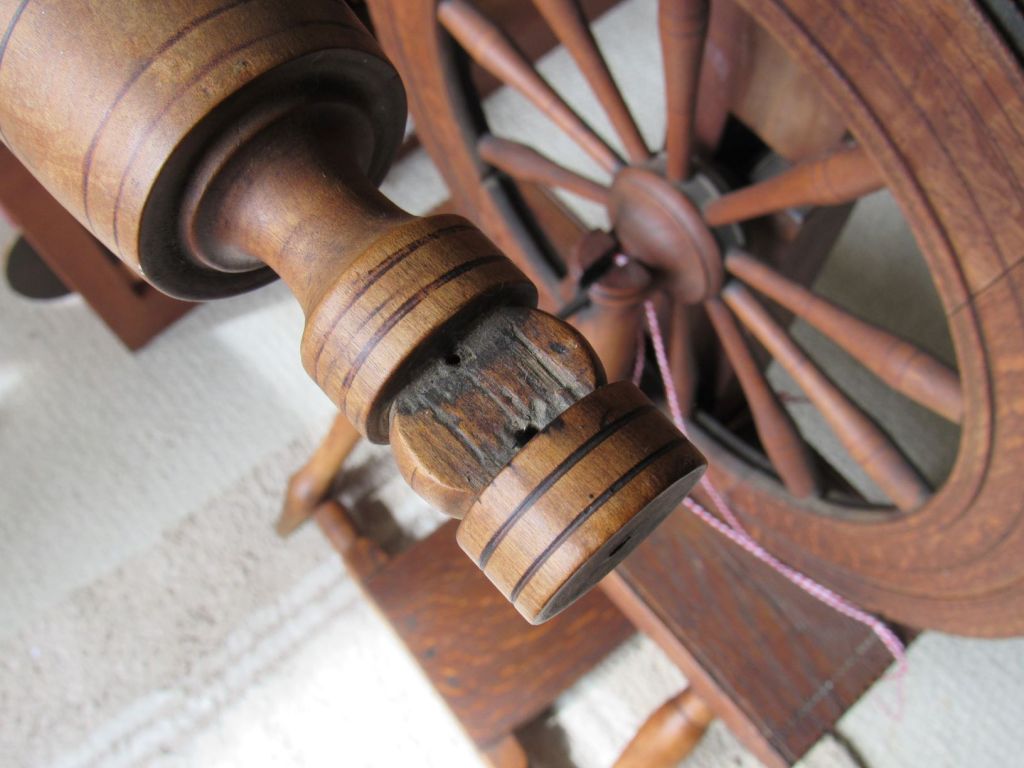
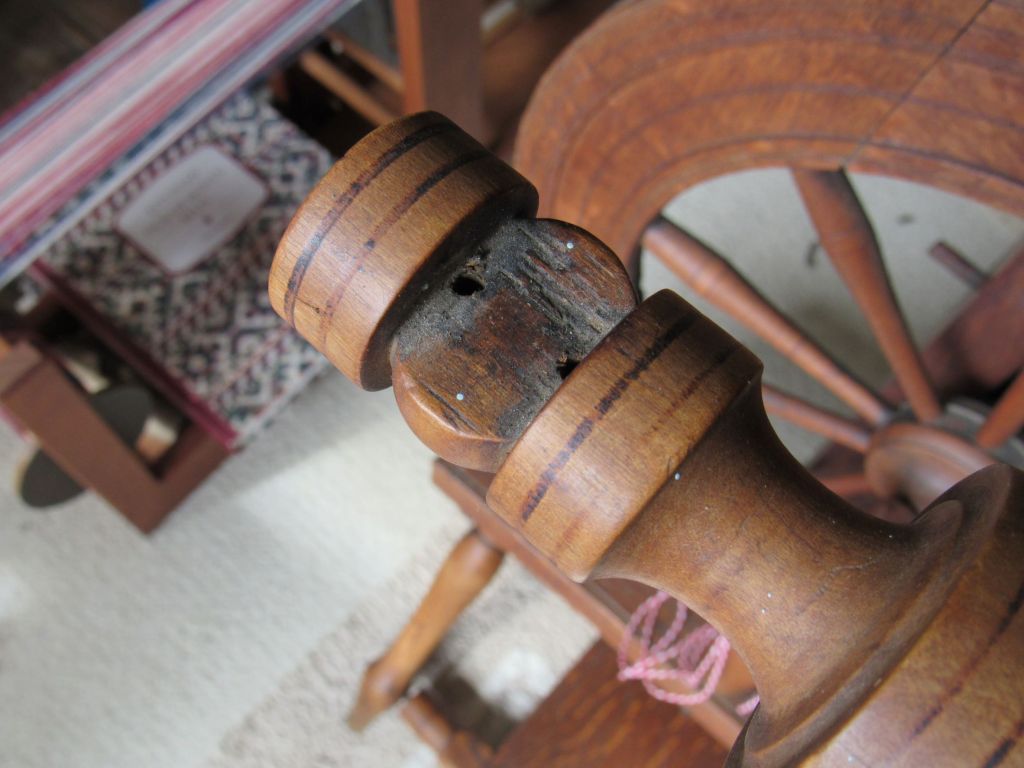
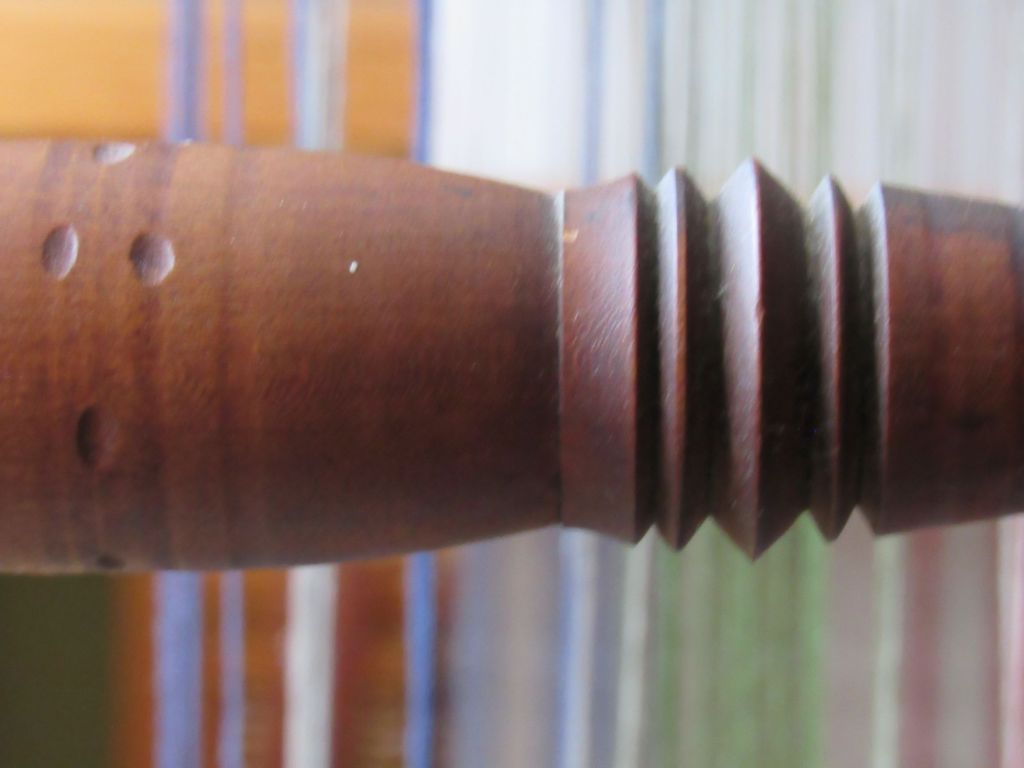
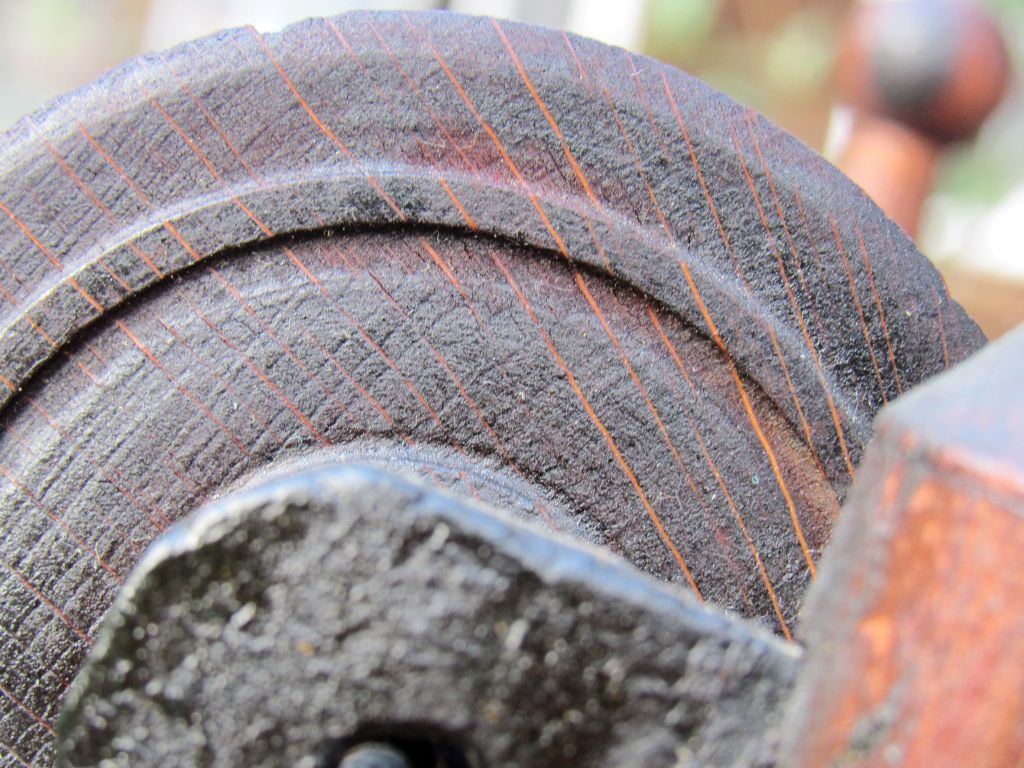
It has some fluting on the orifice and wear marks on the mandrel. After an expert repair, it is back to work.
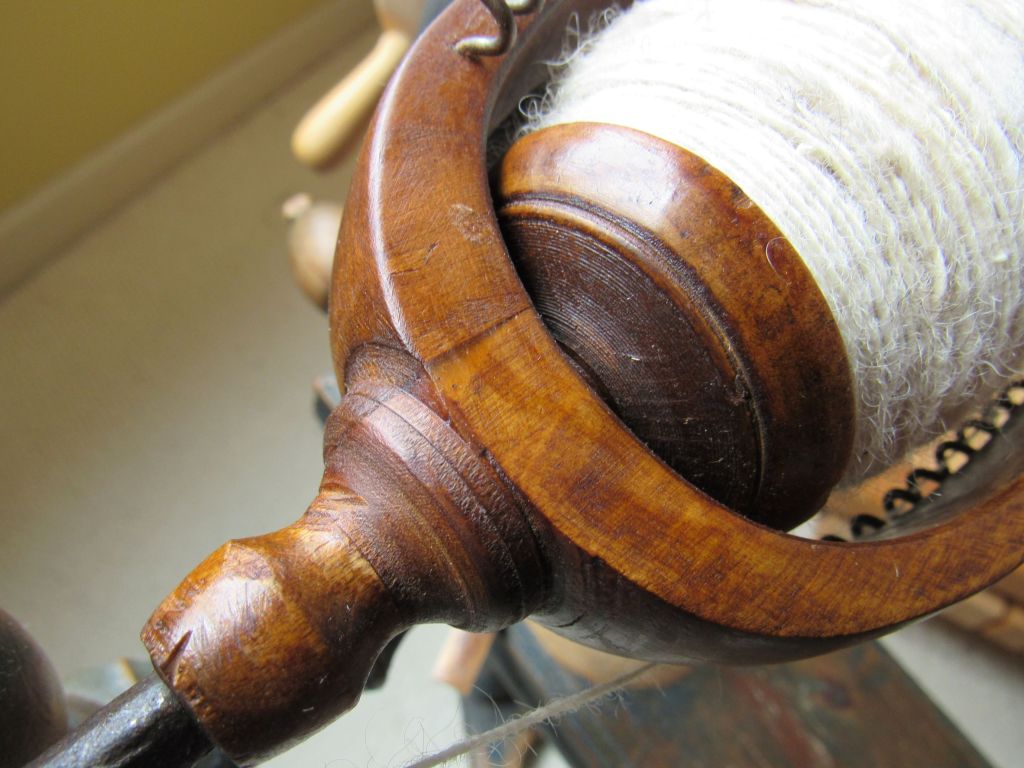
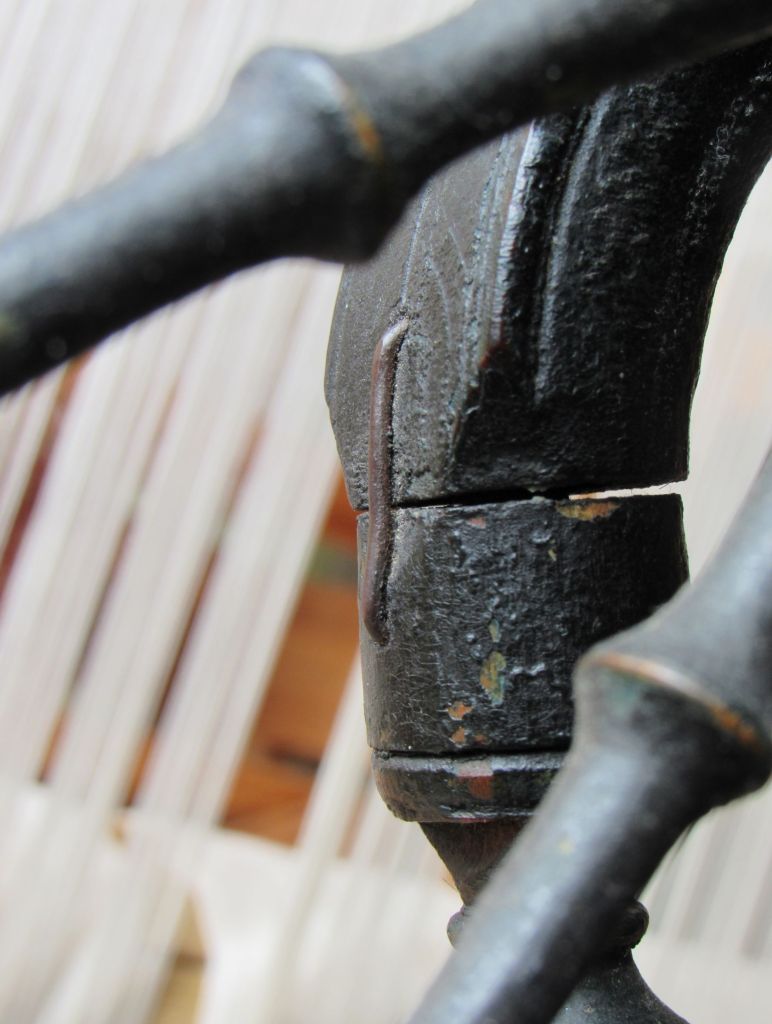
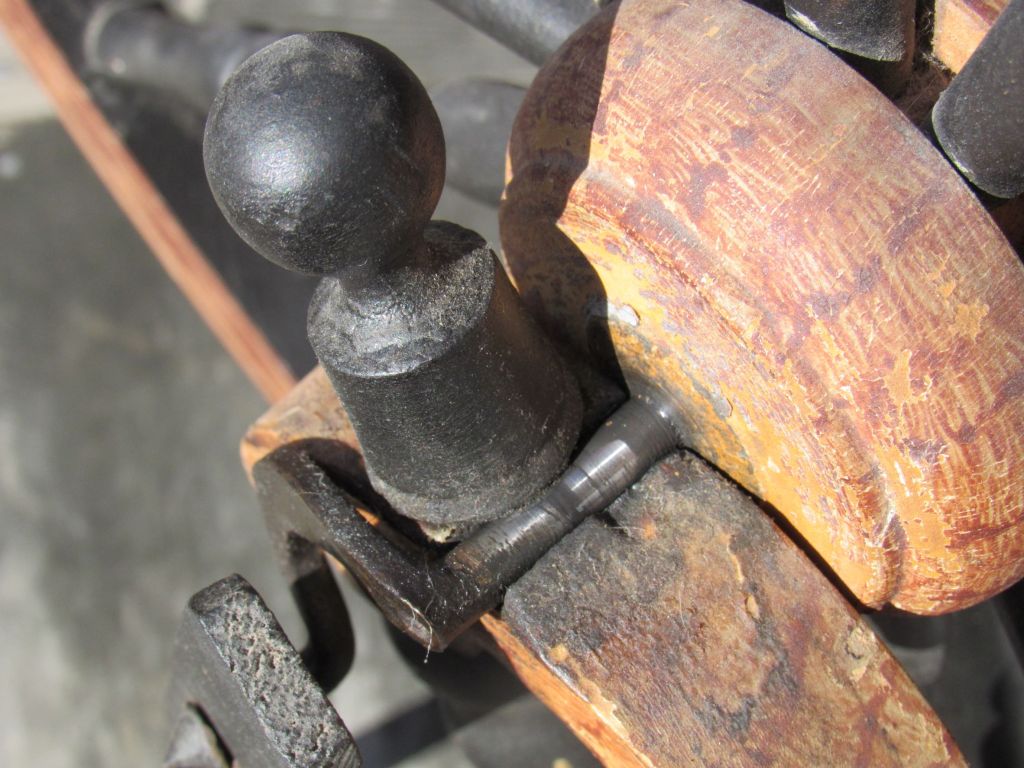
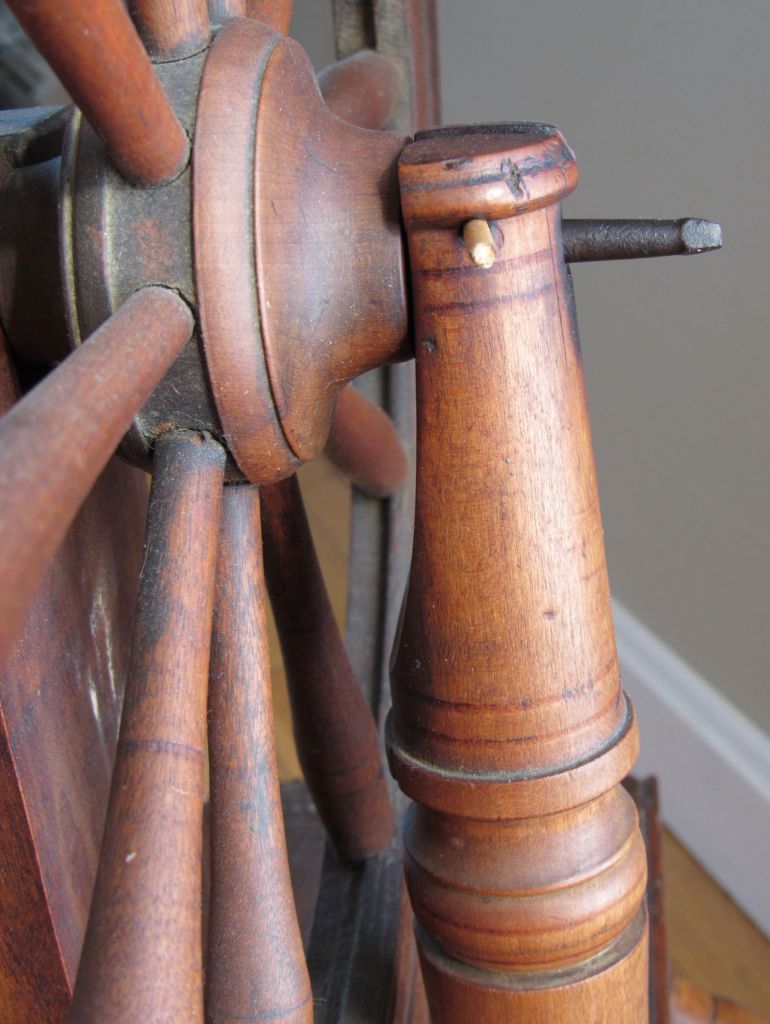
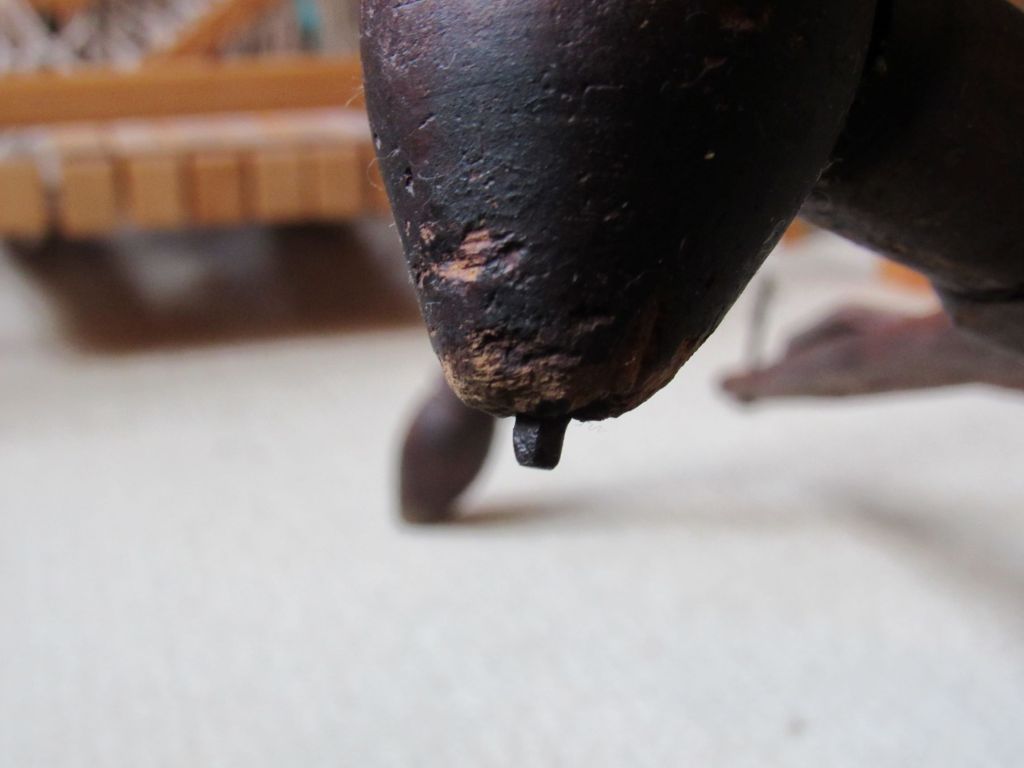
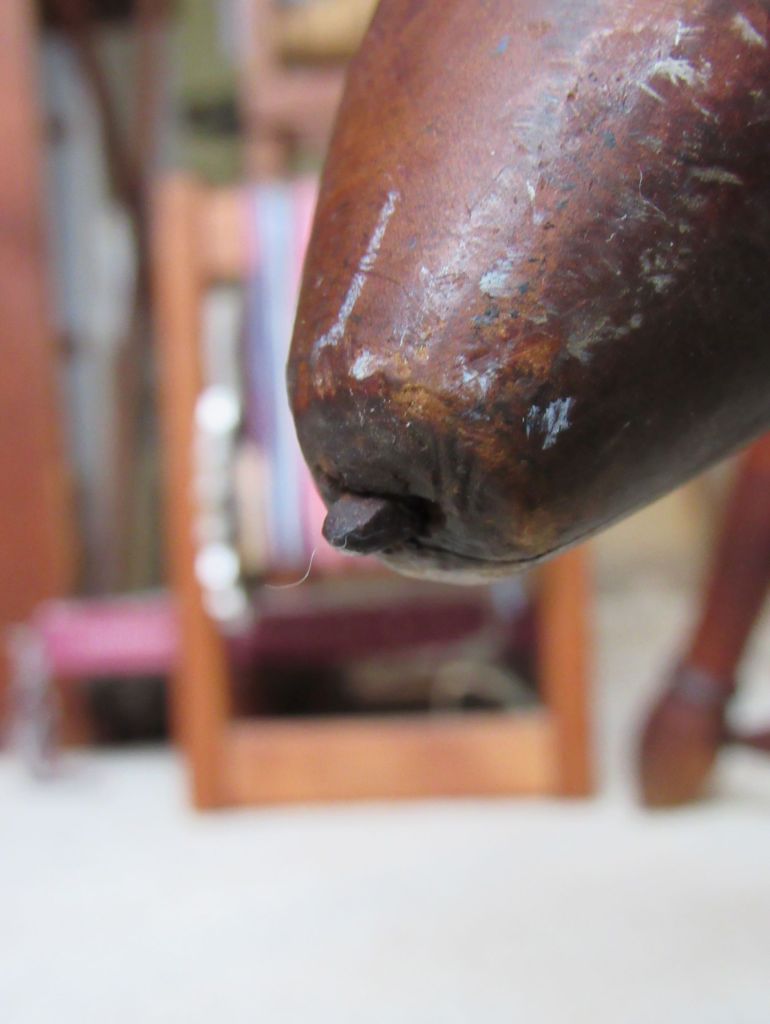
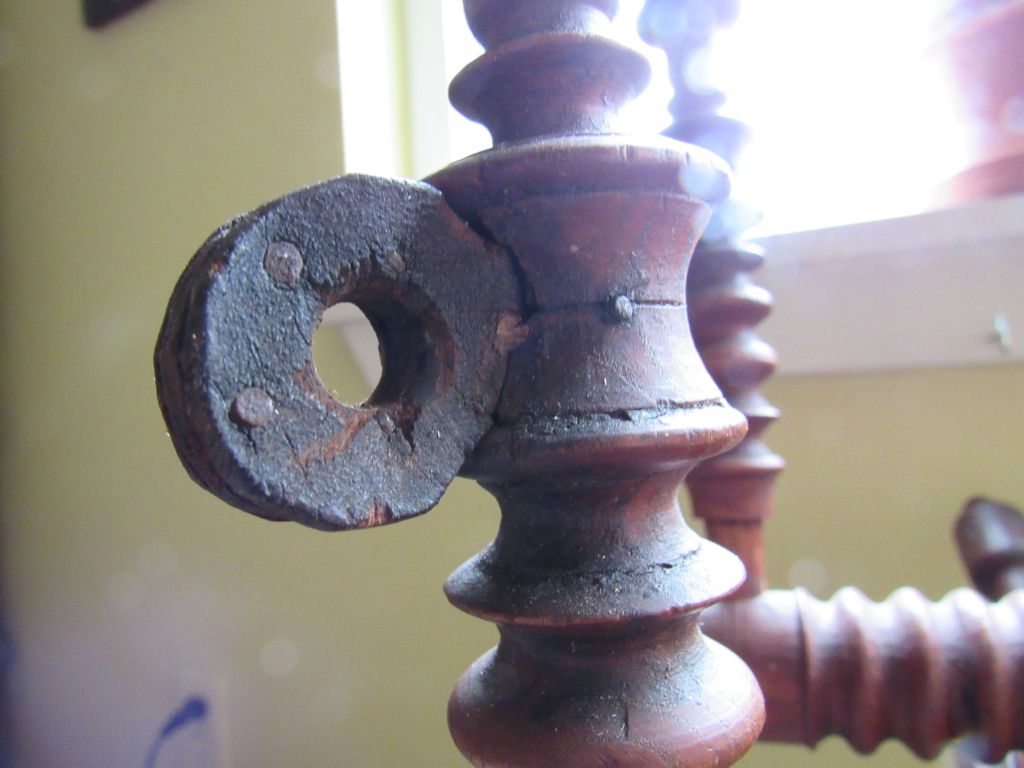
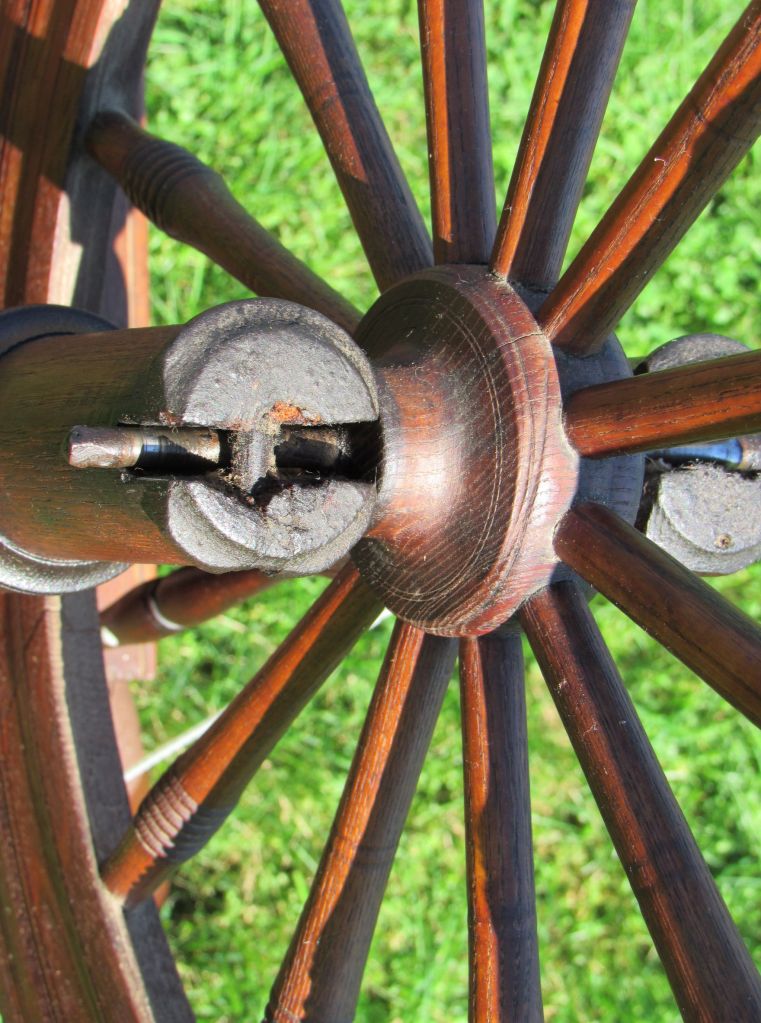
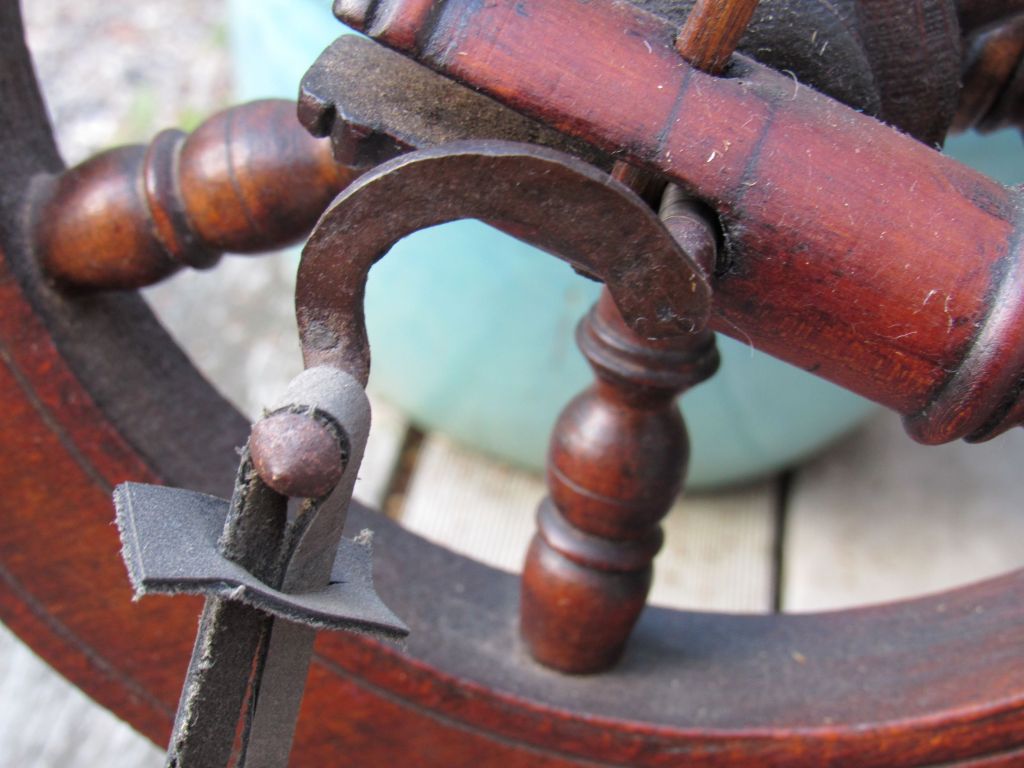
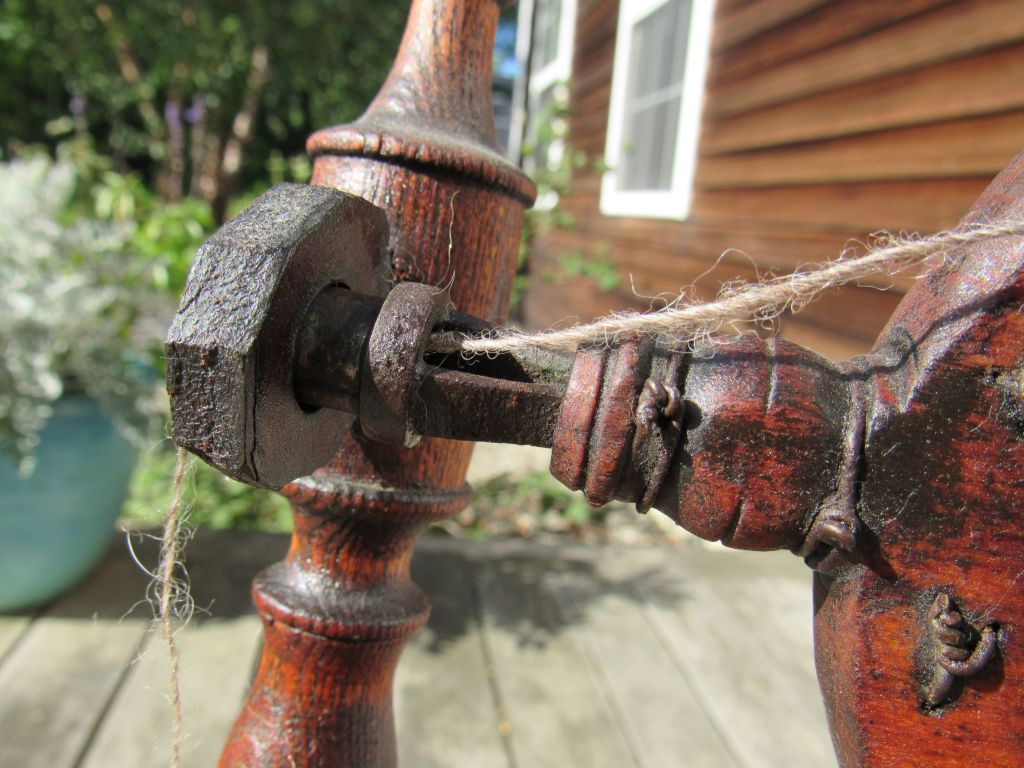
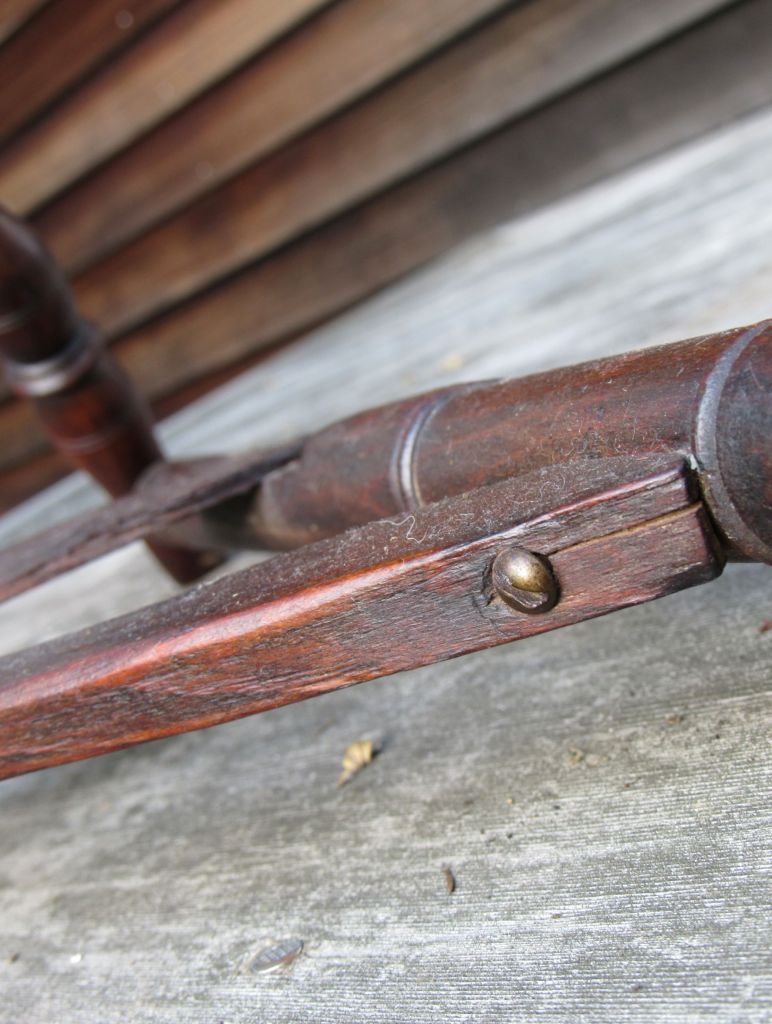
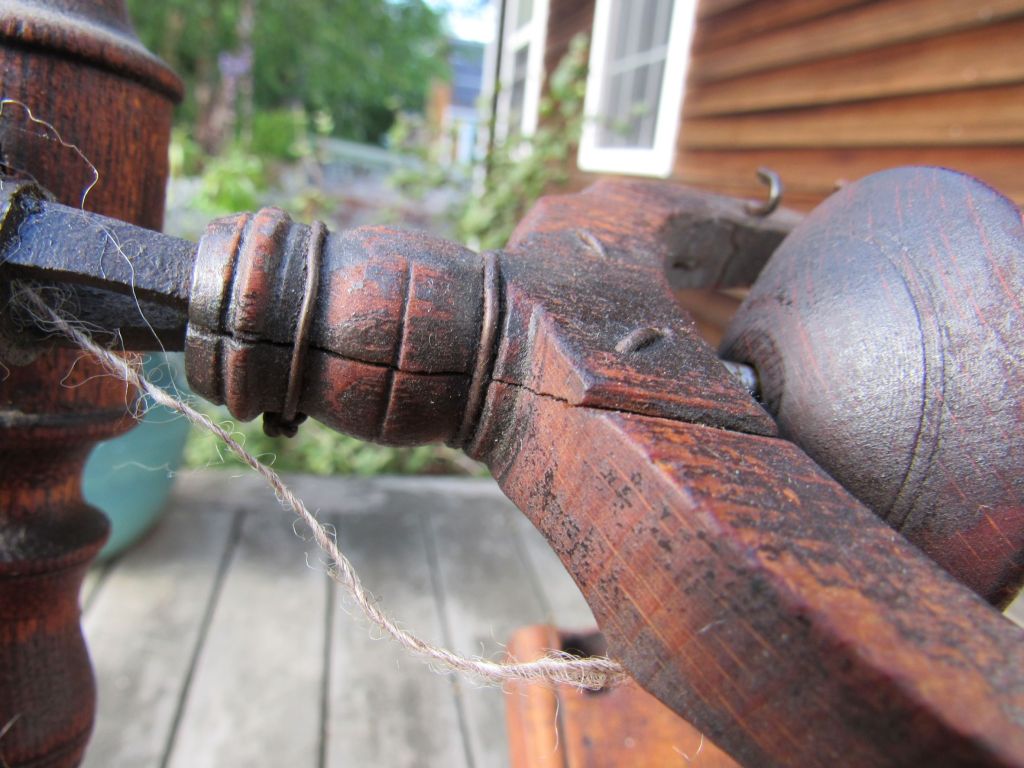
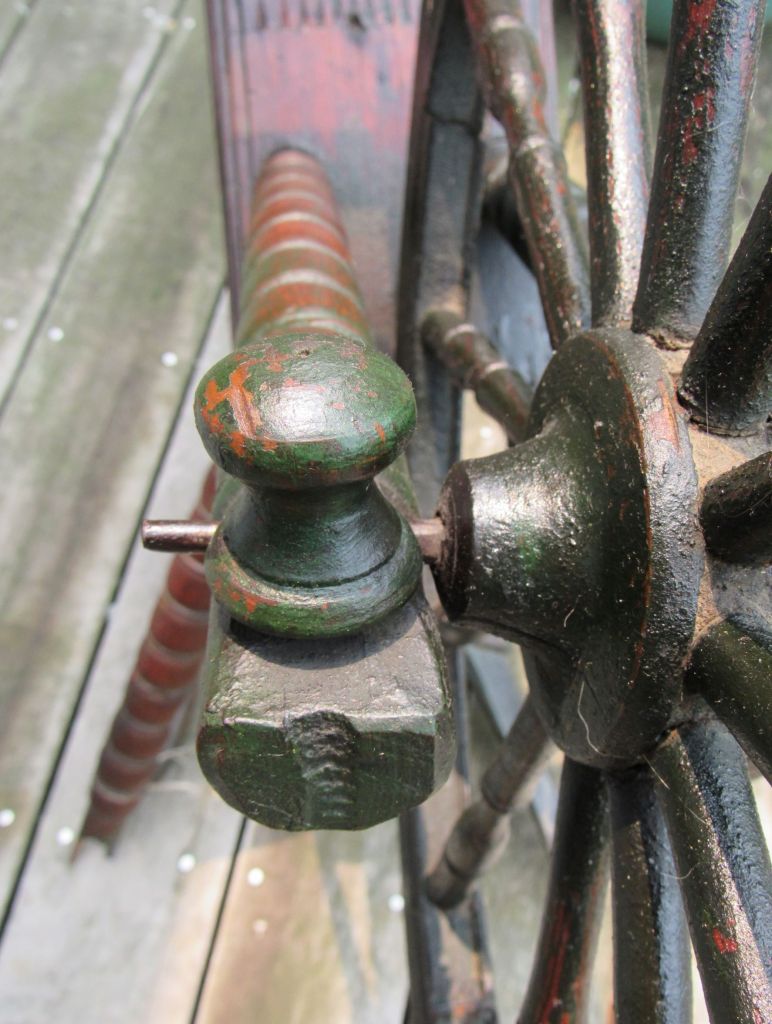
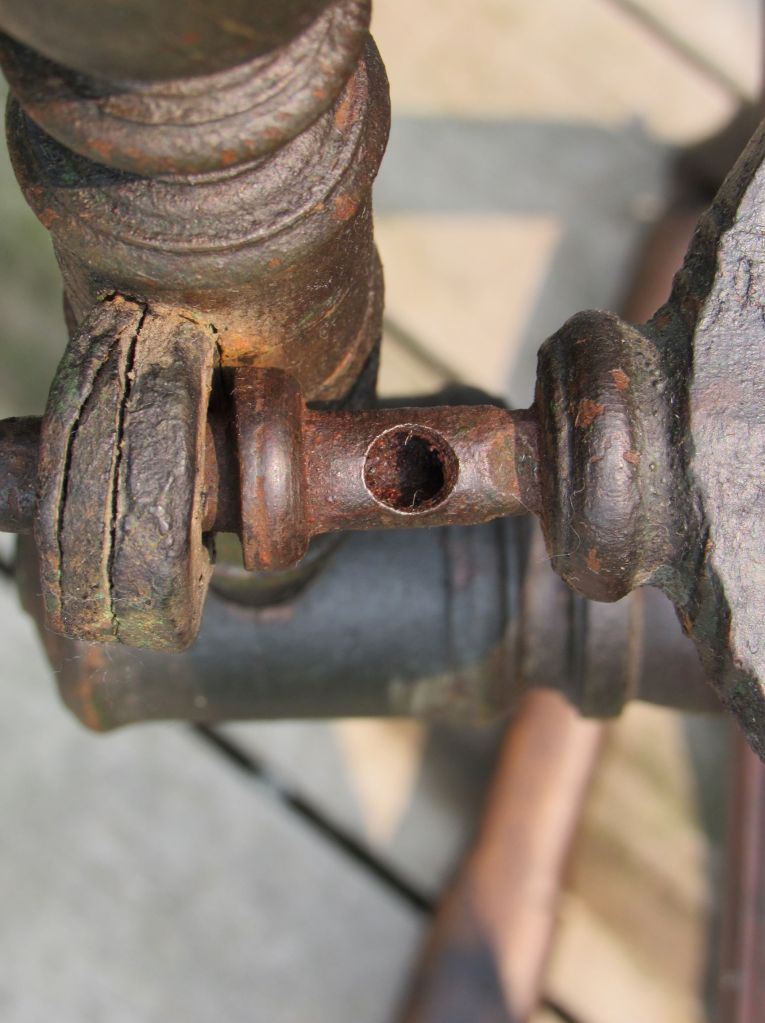
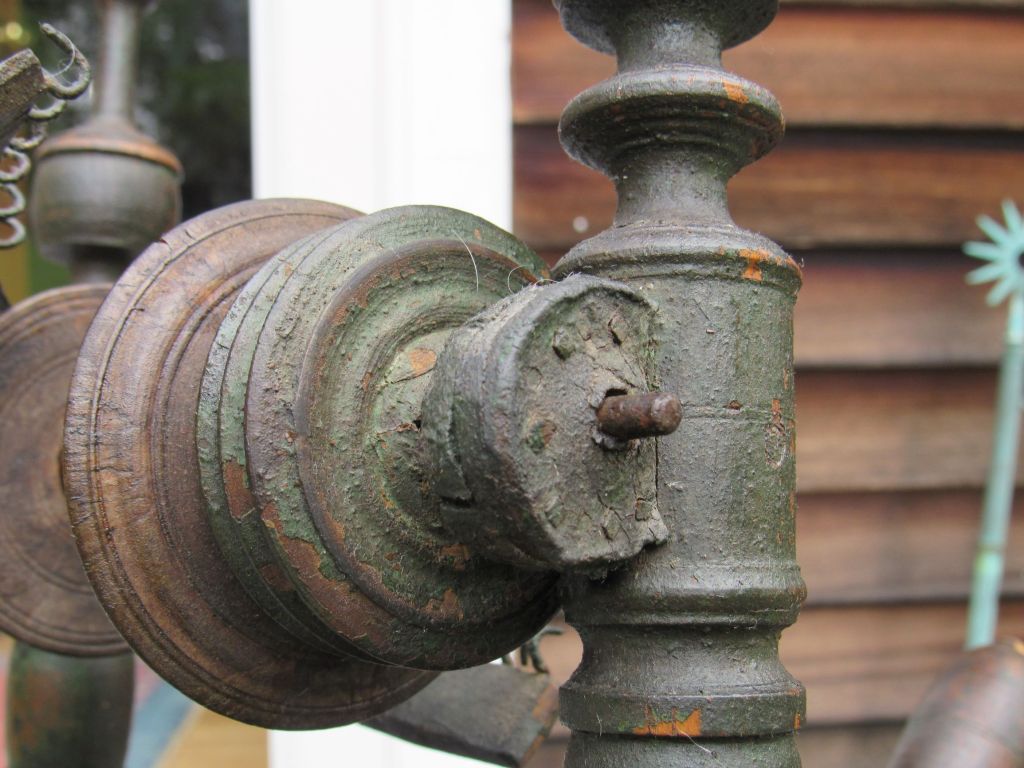
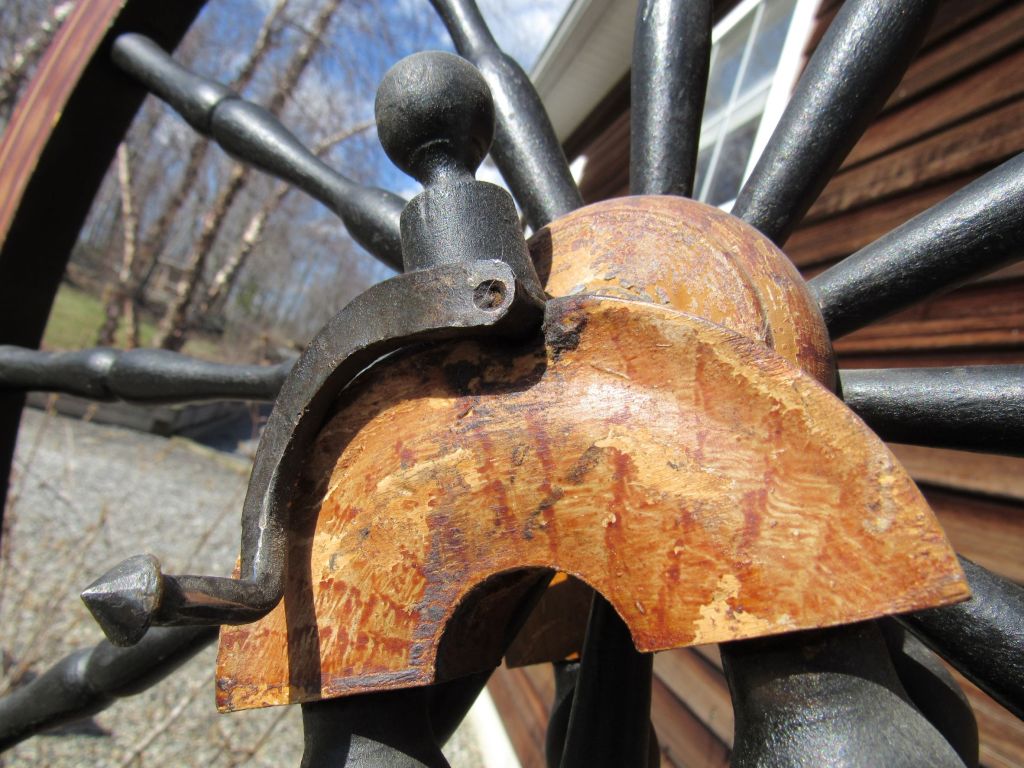
The axle bearings are thin metal, a bit crumbled,
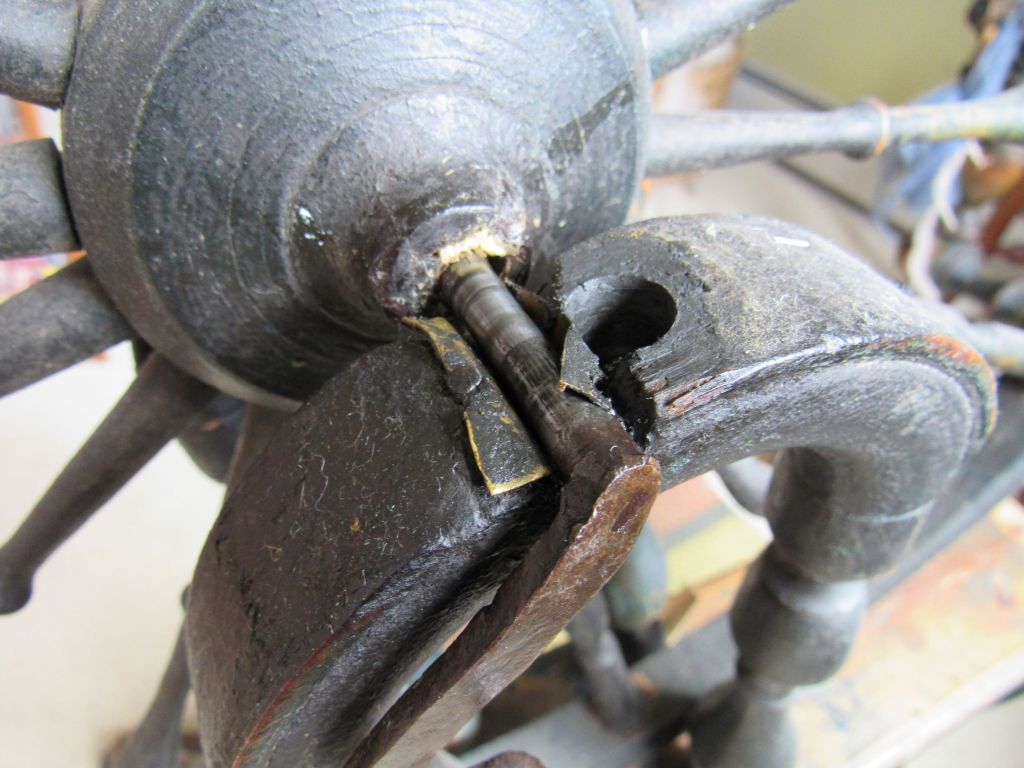
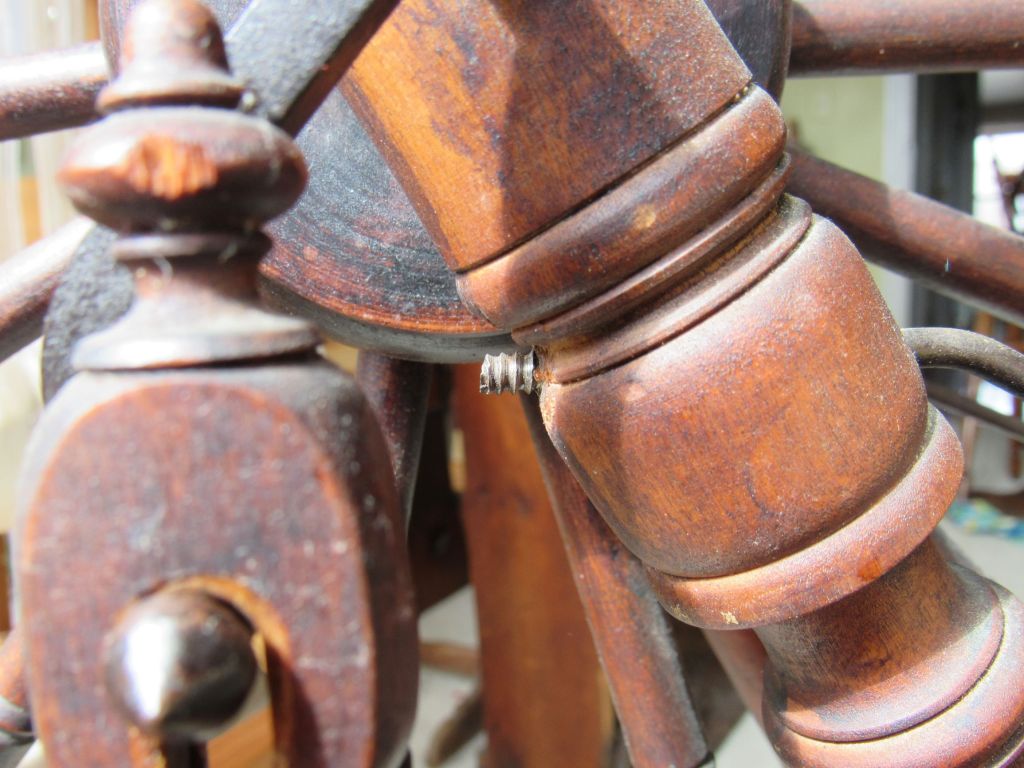
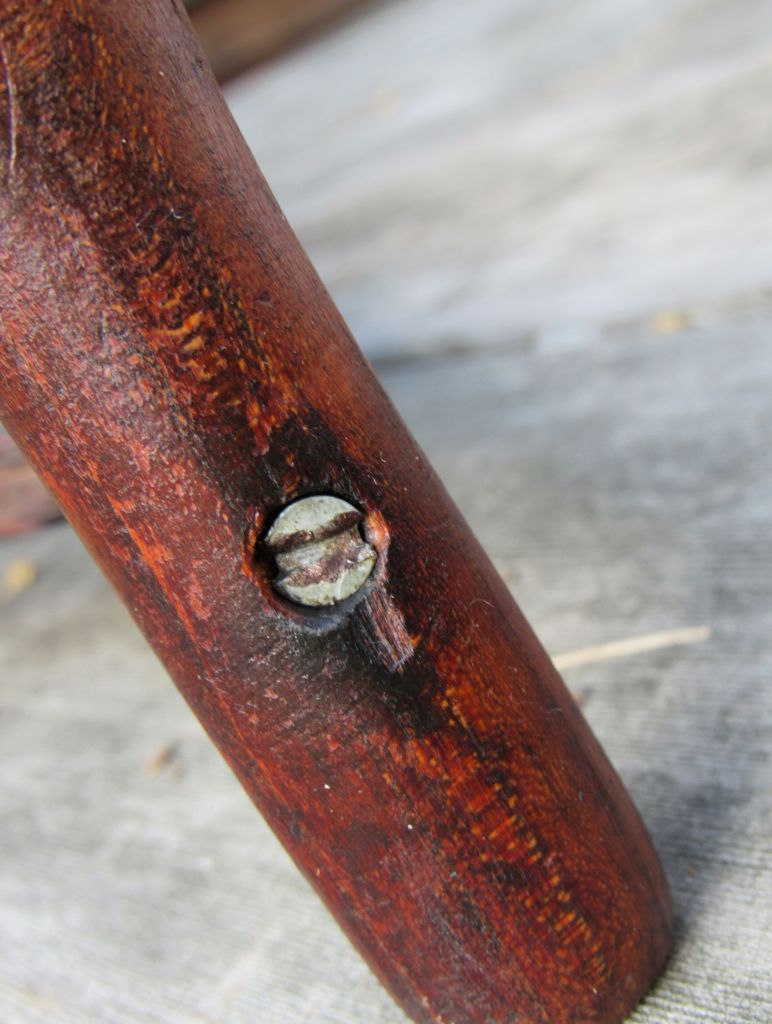
with unpainted wooden keeper screws for the axle, providing the paint/no paint contrast that I love on so many Scandinavian wheels. 
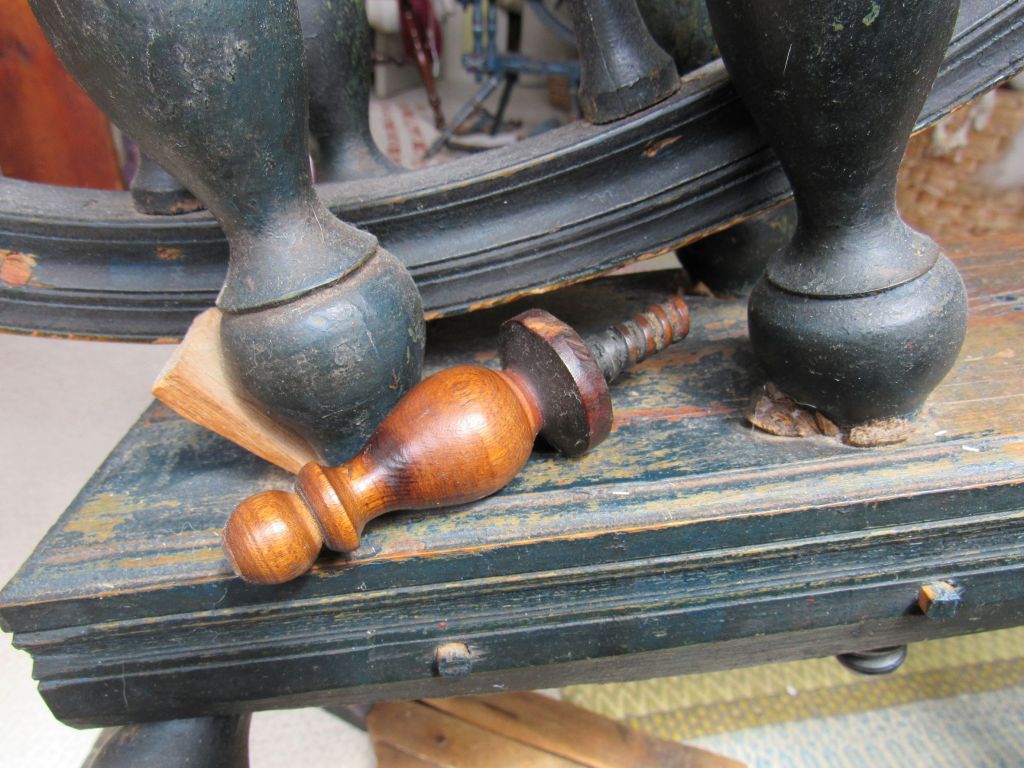
The top of the footman matches the keeper screws–a beautiful feature.  
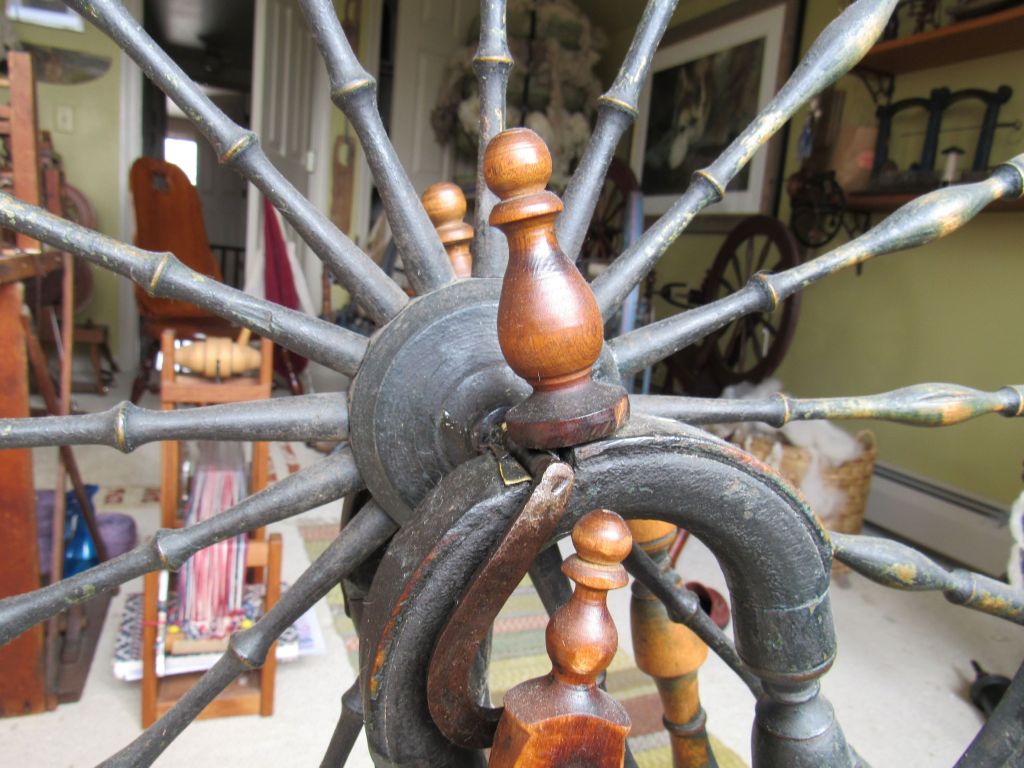
So much thought went into this wheel that I found it strange that the leg by the footman had its ample curve sheared off to make room for the footman. Again, this may be a sign that the treadle is a replacement, and slightly bigger than the original (it does look larger than the treadle on the Minneapolis wheel shown earlier). 

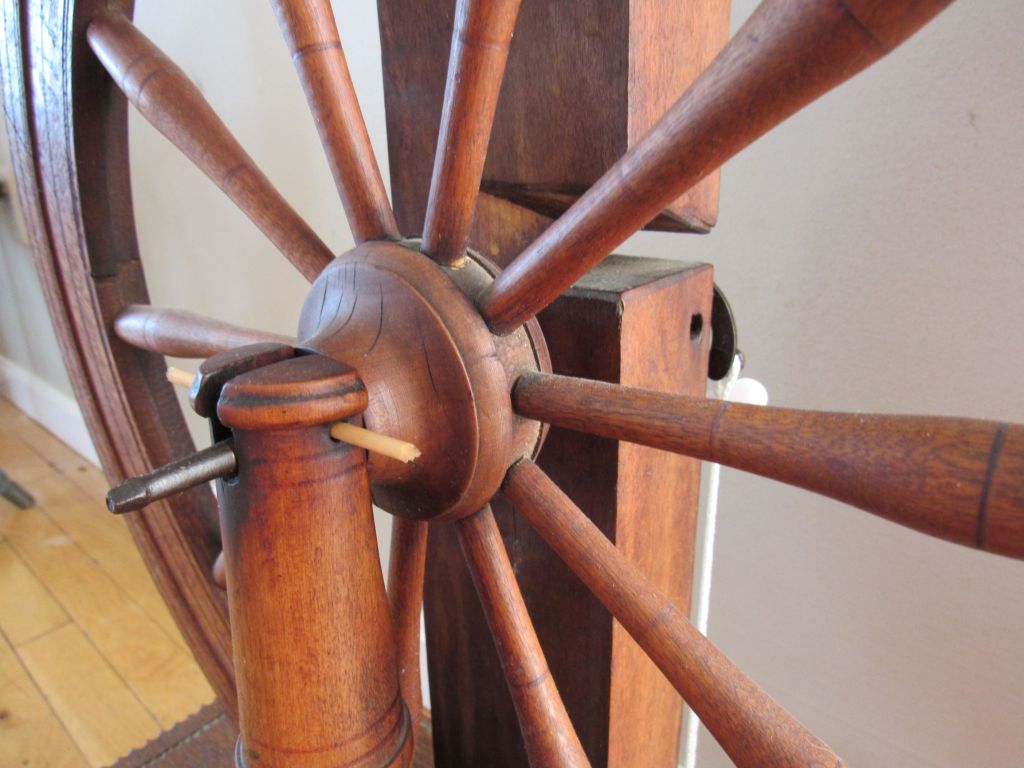
The axle was loose in the hub when I bought it, but, with expert direction, I was able to do a shim repair myself. Not something I want to mess with very often.  
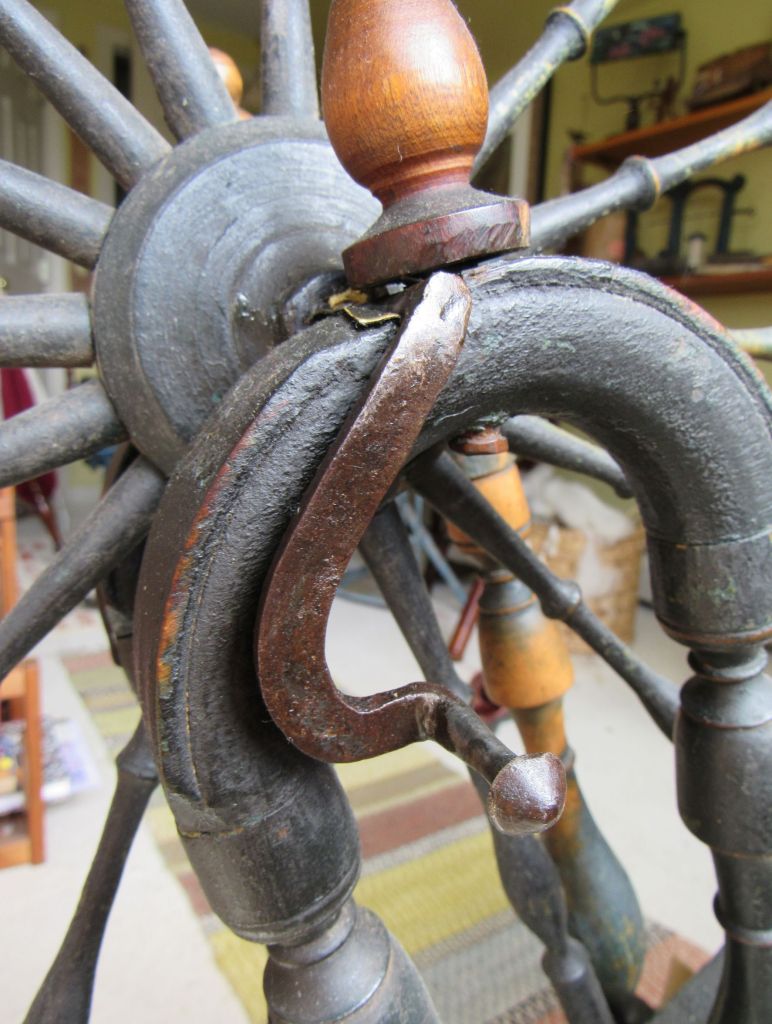
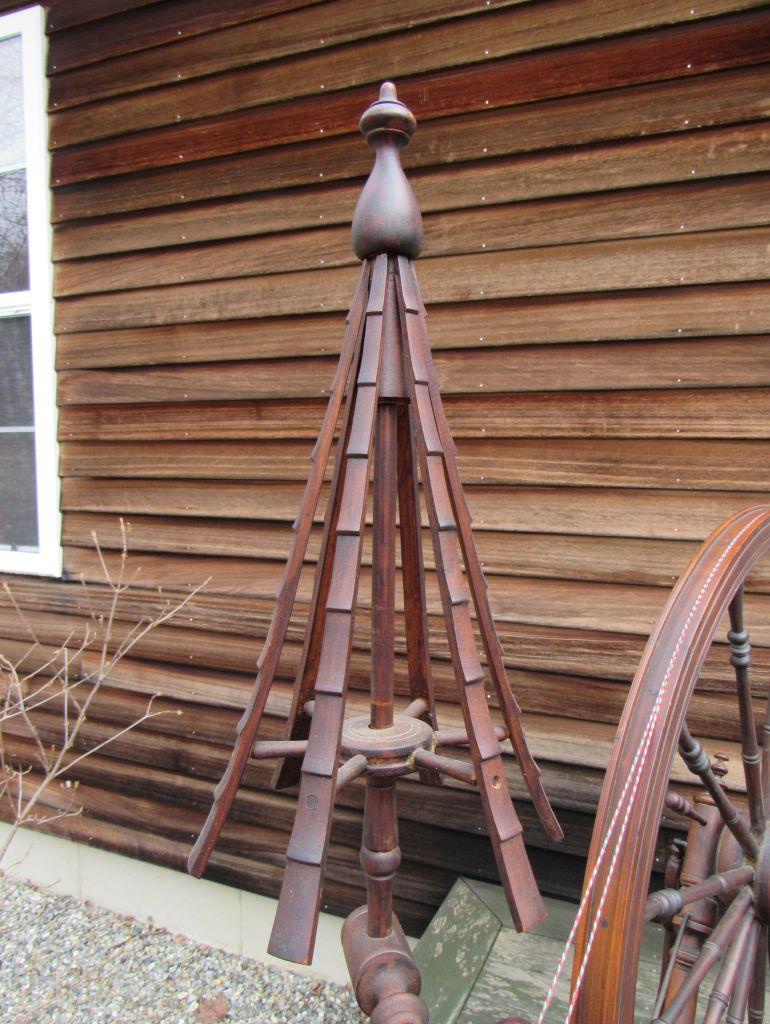
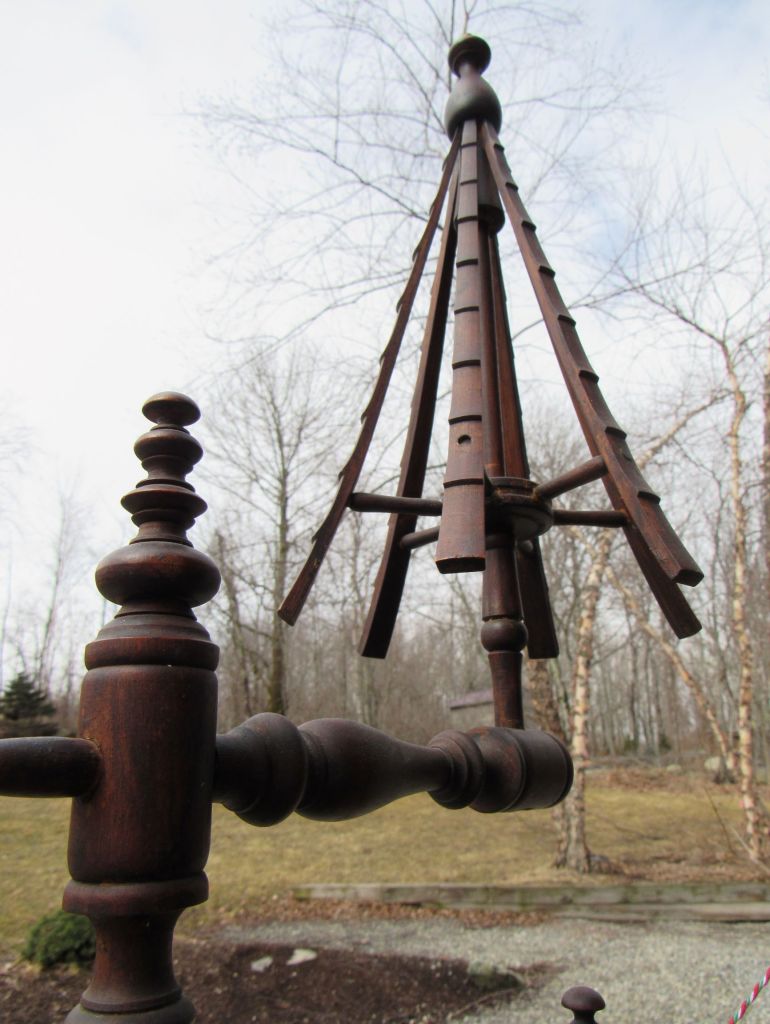
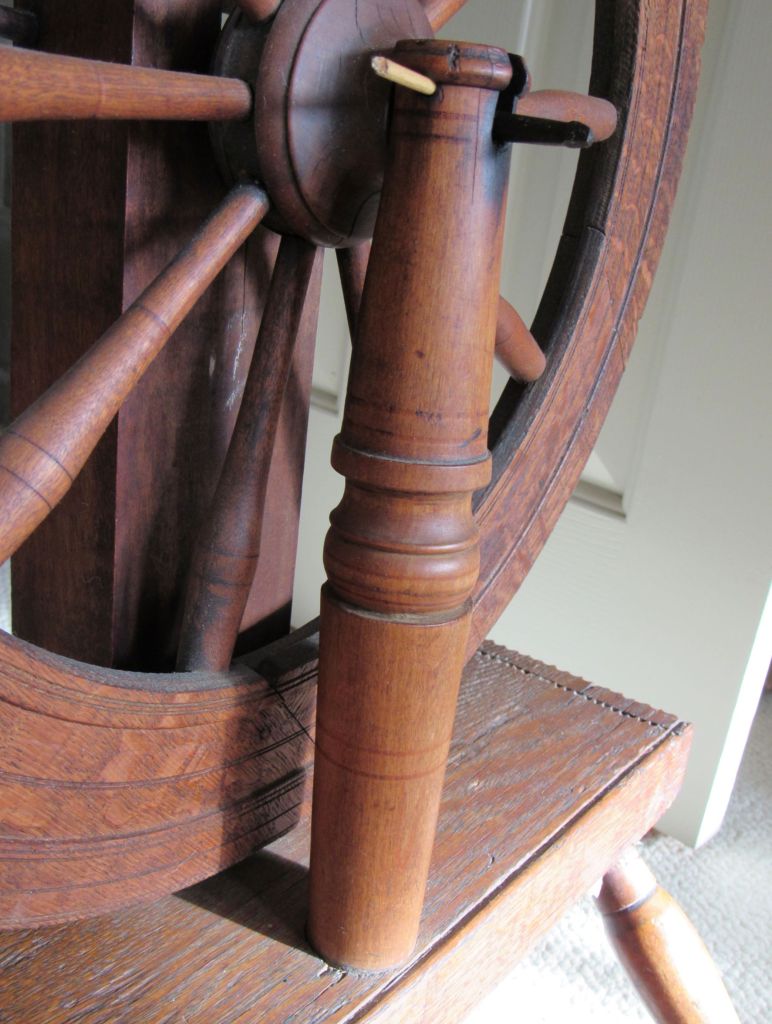
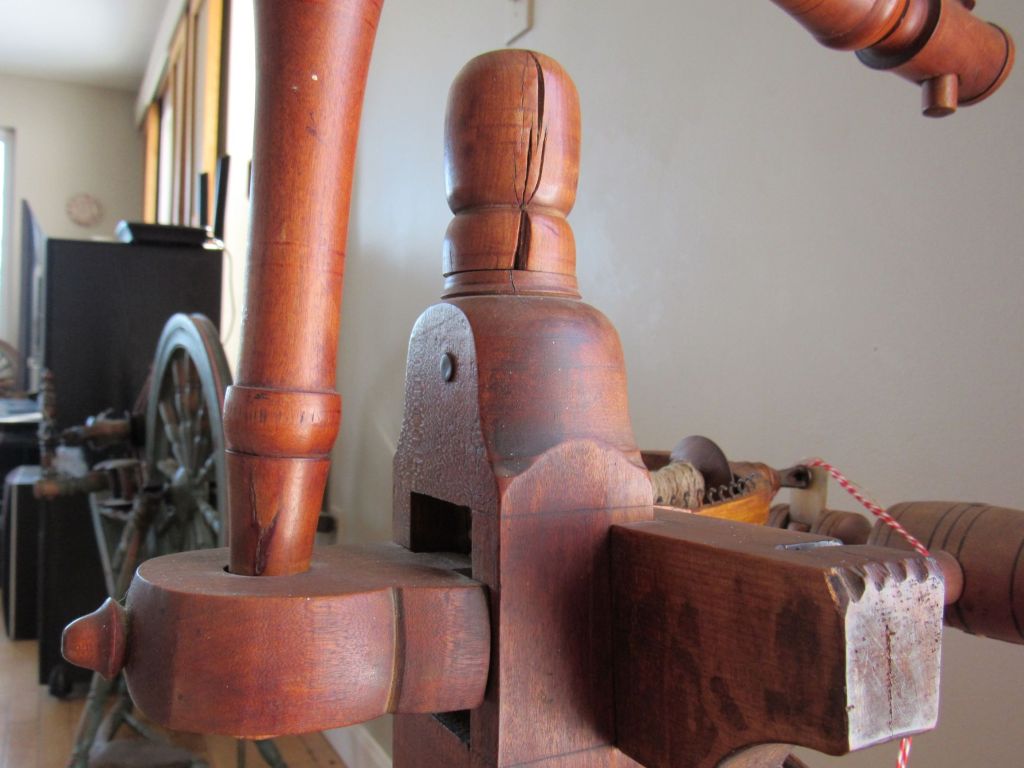
The distaff shaft extends way below with table.

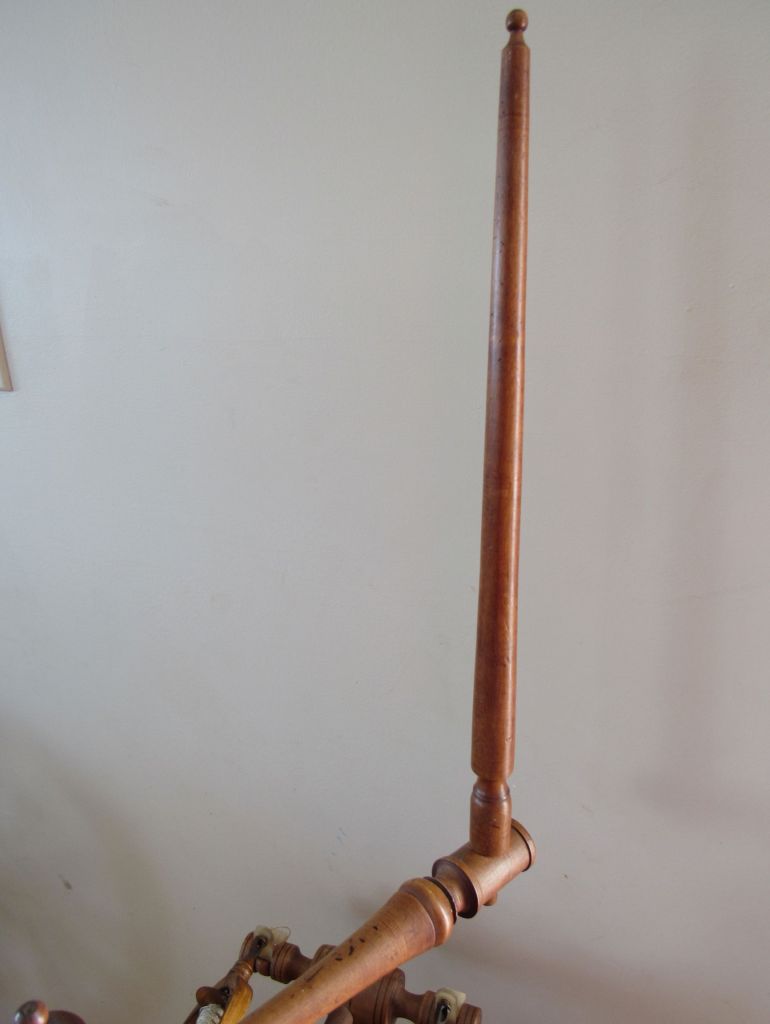
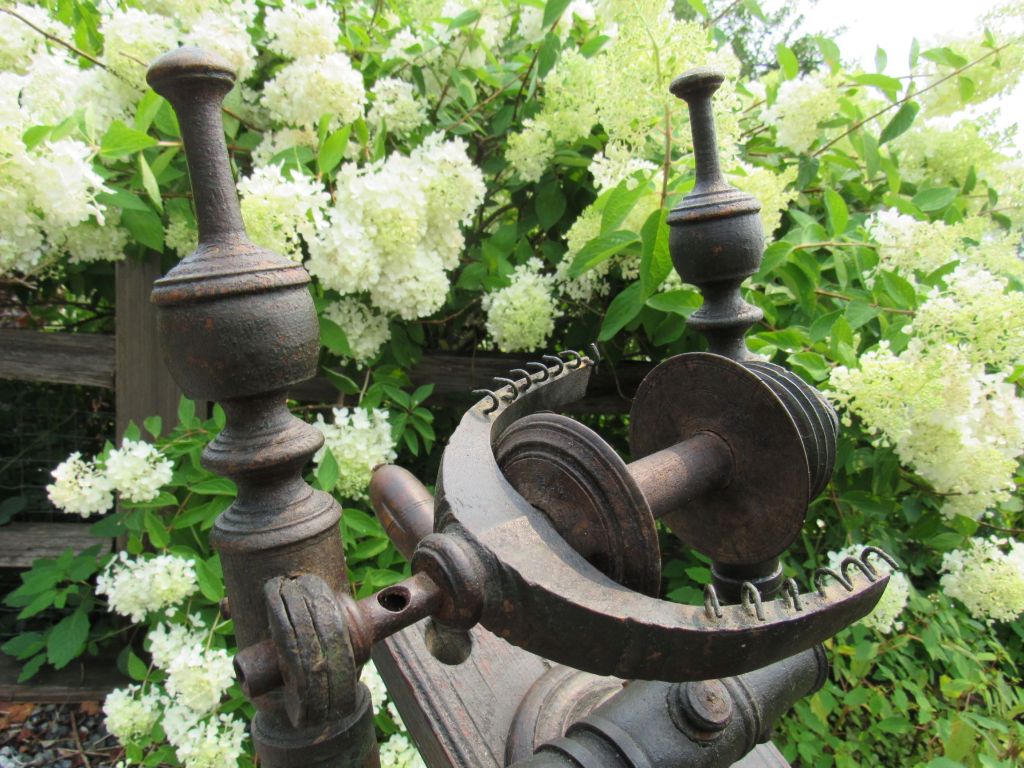
Tuulikki came without the top part of the distaff, so I bought a truncheon style one that is a good match. 

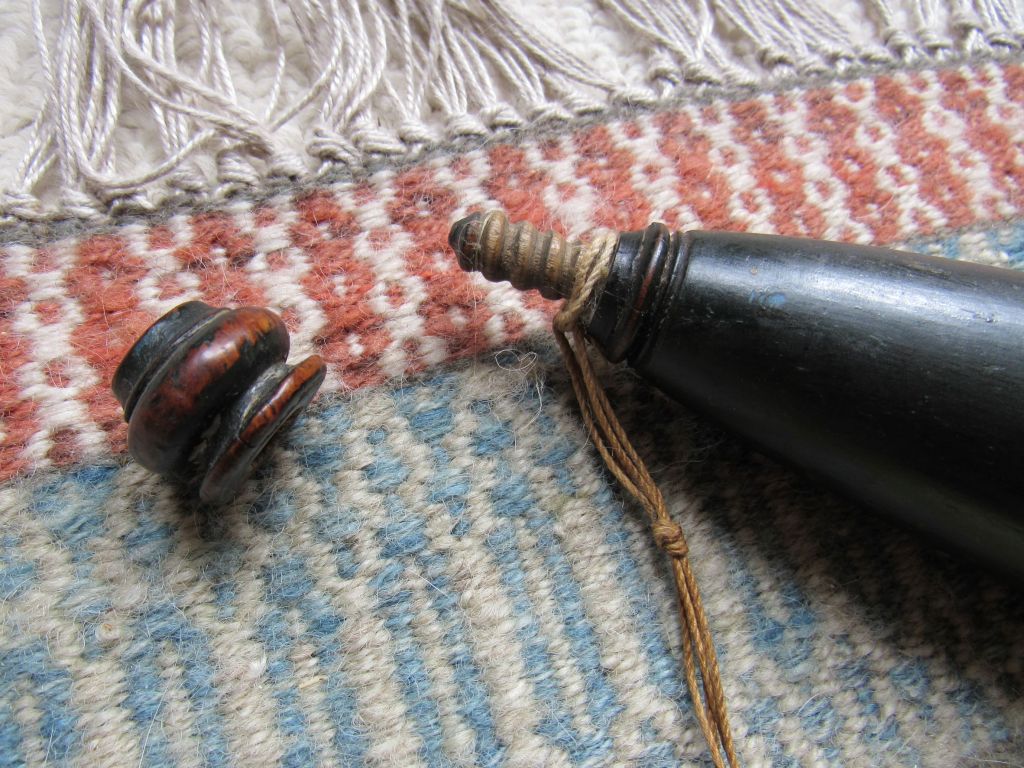
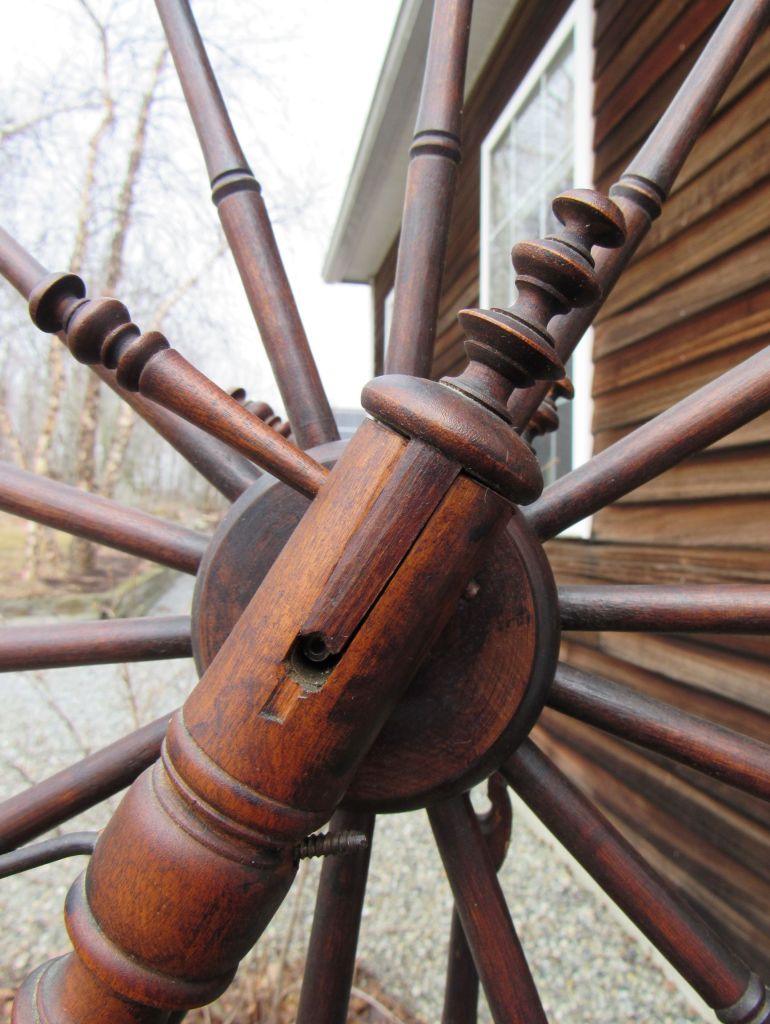
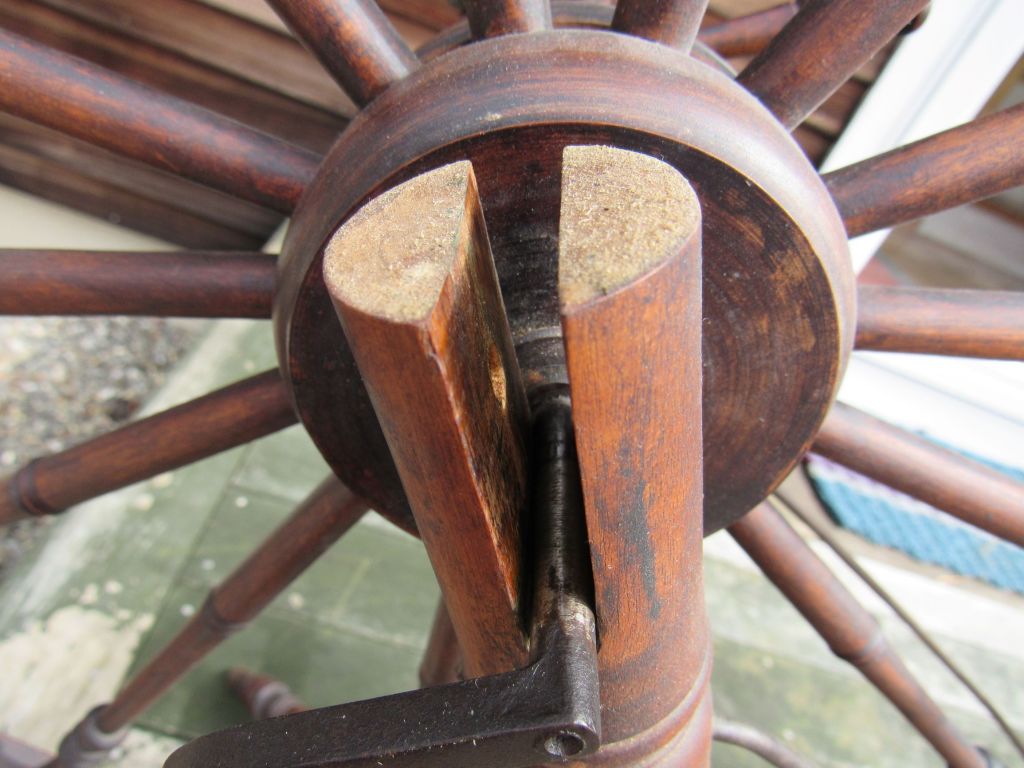
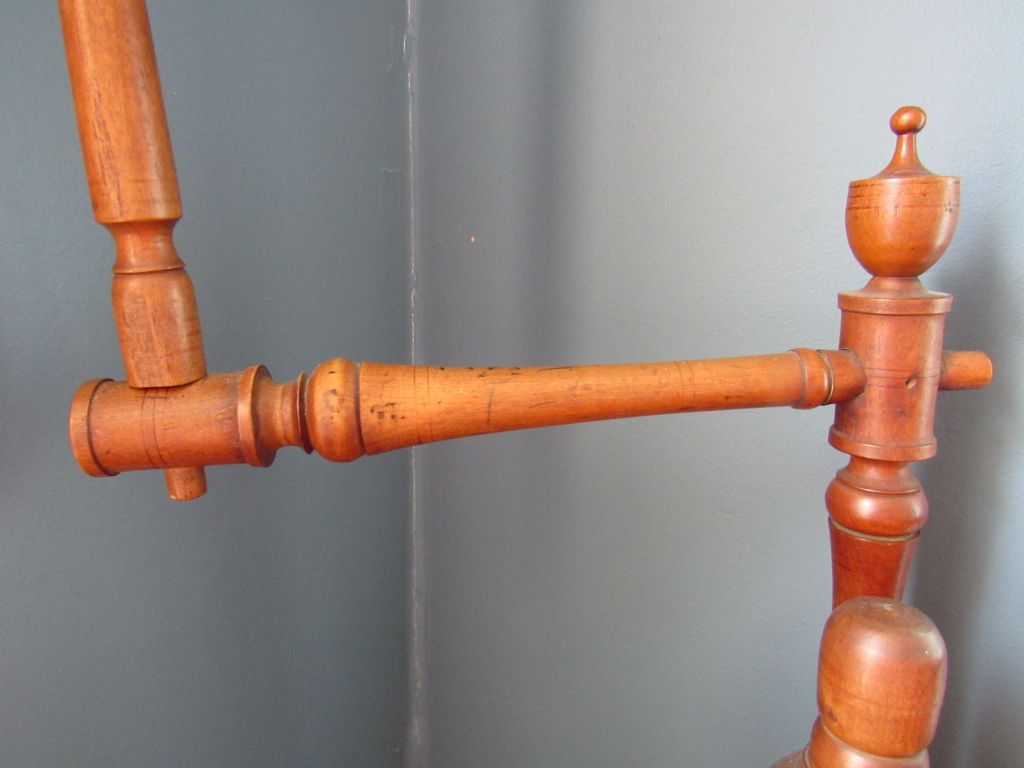
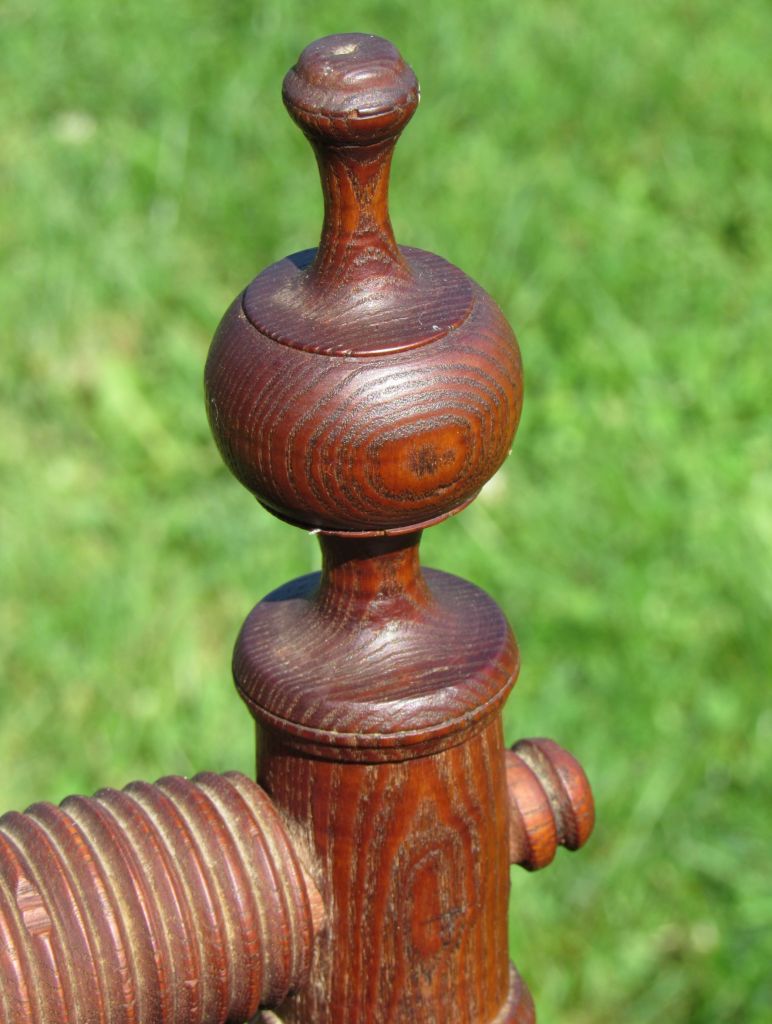
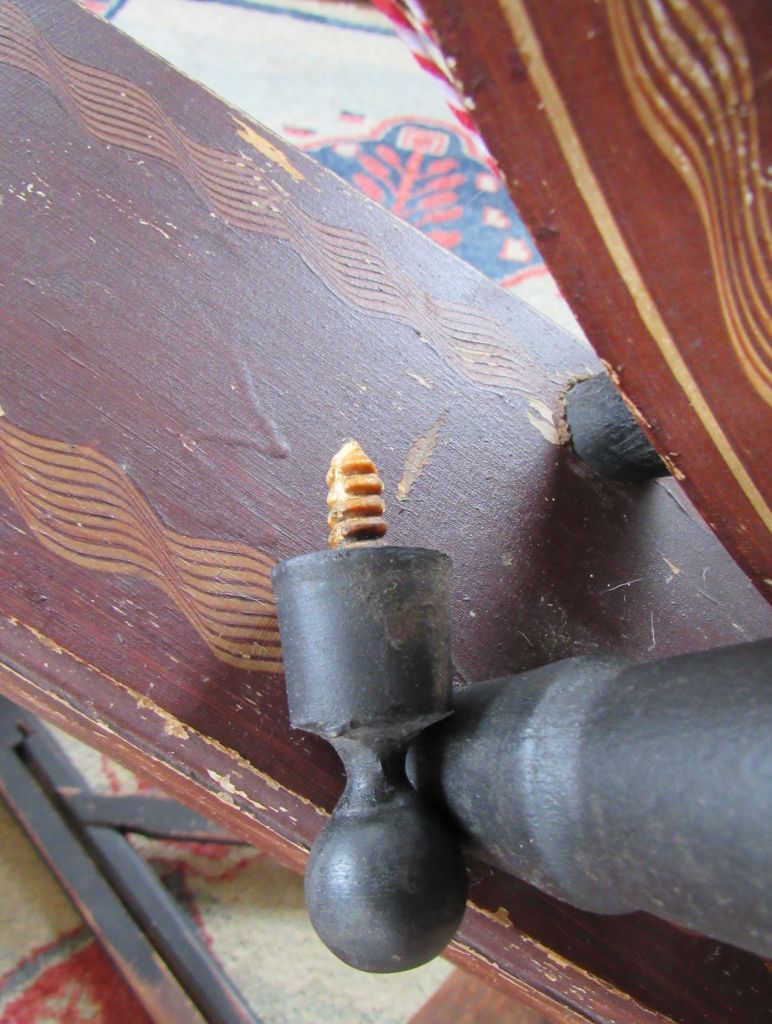
I was surprised to find that the top of the distaff unscrews
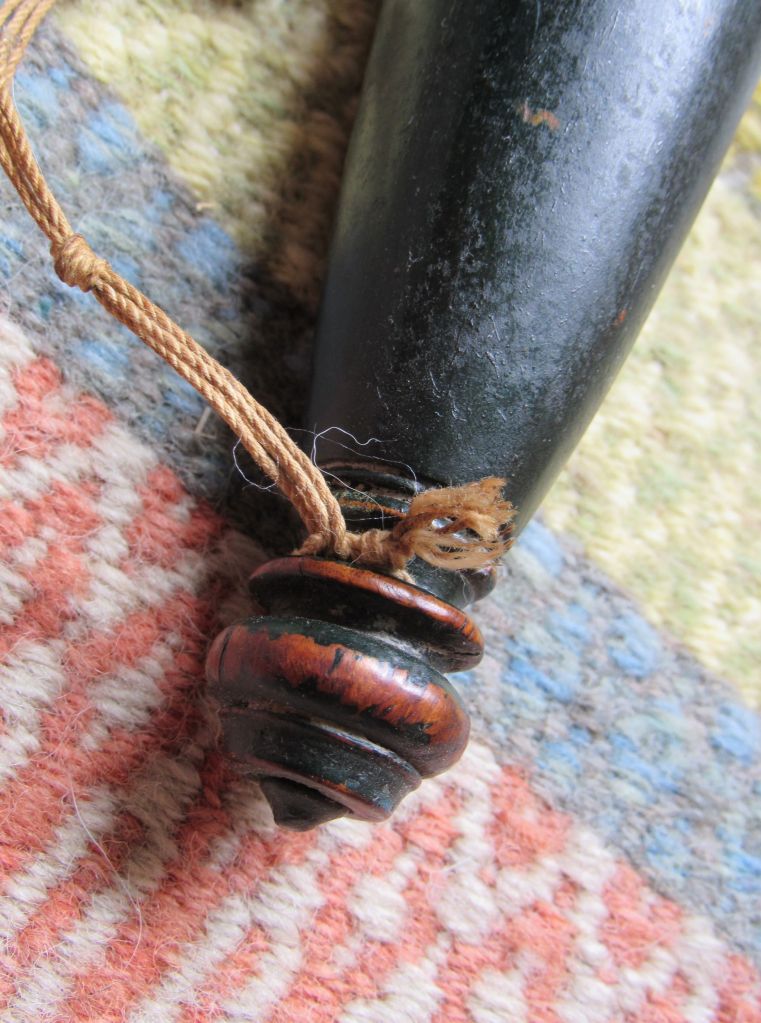
and the outer portion can be removed from the core. 
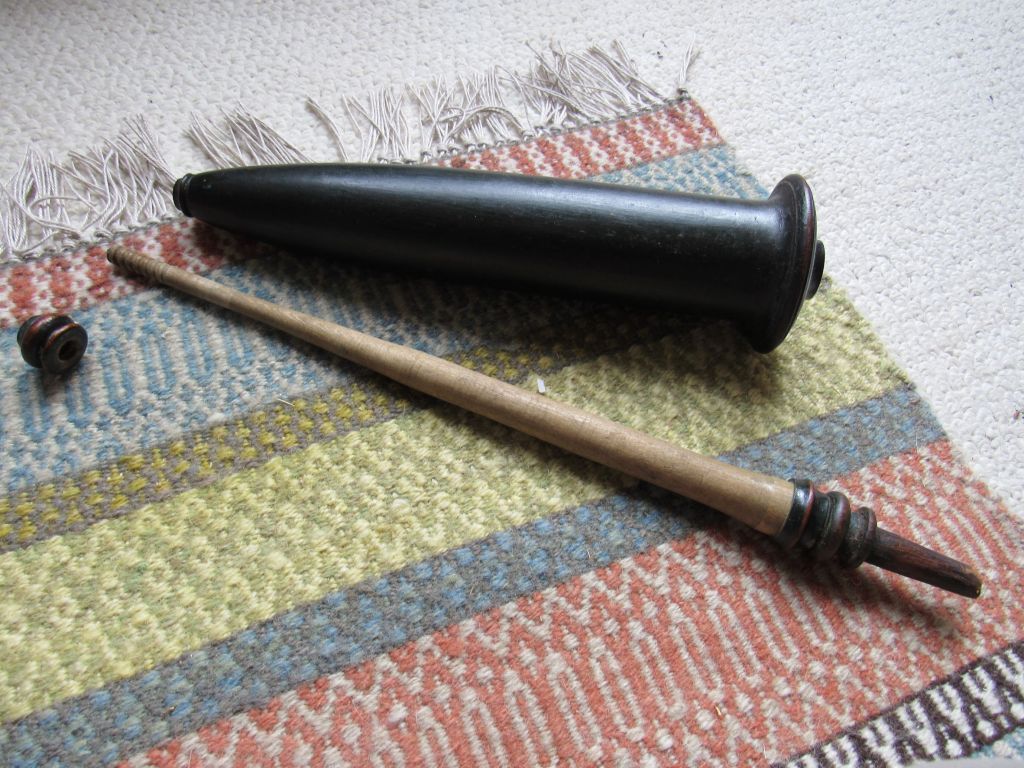
I do not know if that helps for dressing the distaff or if there is some other reason for this feature. If any one knows, please let me know.
This wheel was created with a real eye toward beauty. But she is a great spinner, too, and has been maintained, with various fixes, as a working machine. I am privileged to be part of the chain of people who have worked on and spun with this special wheel.
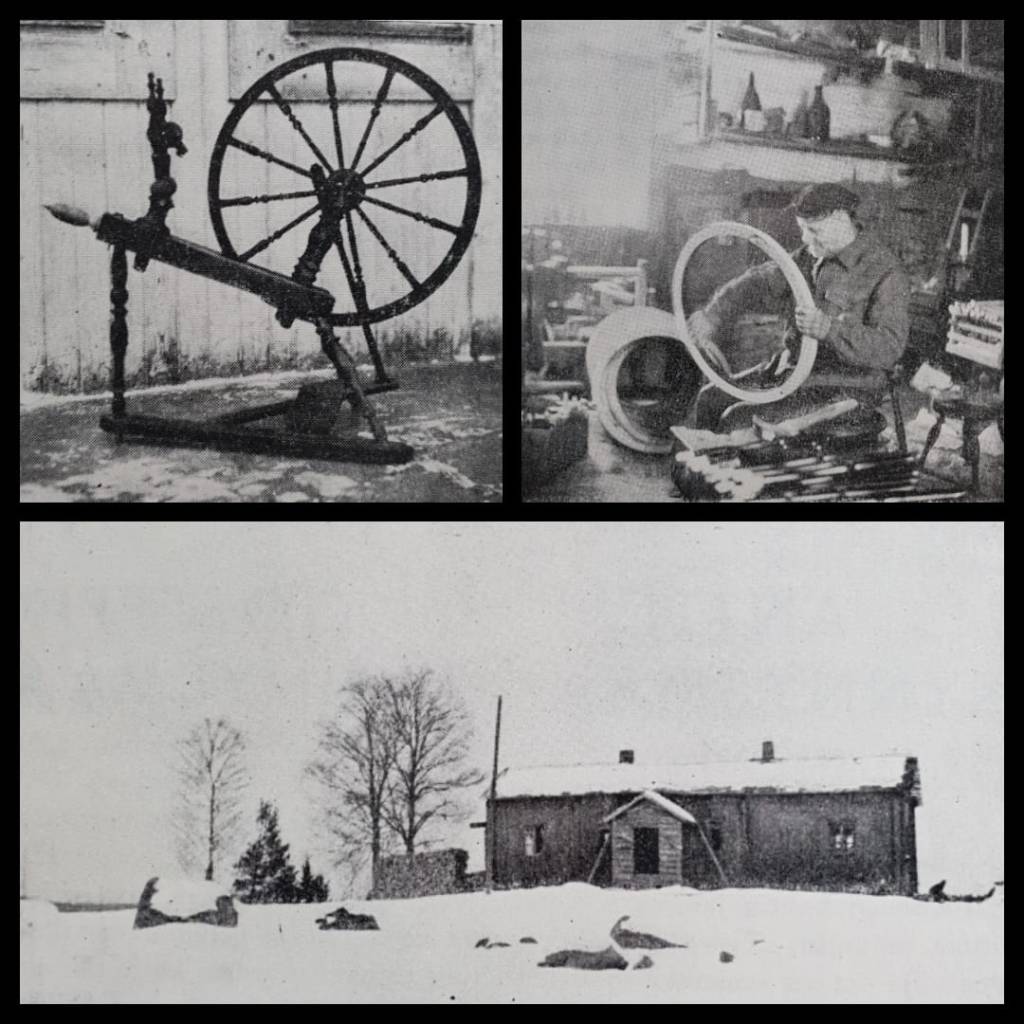
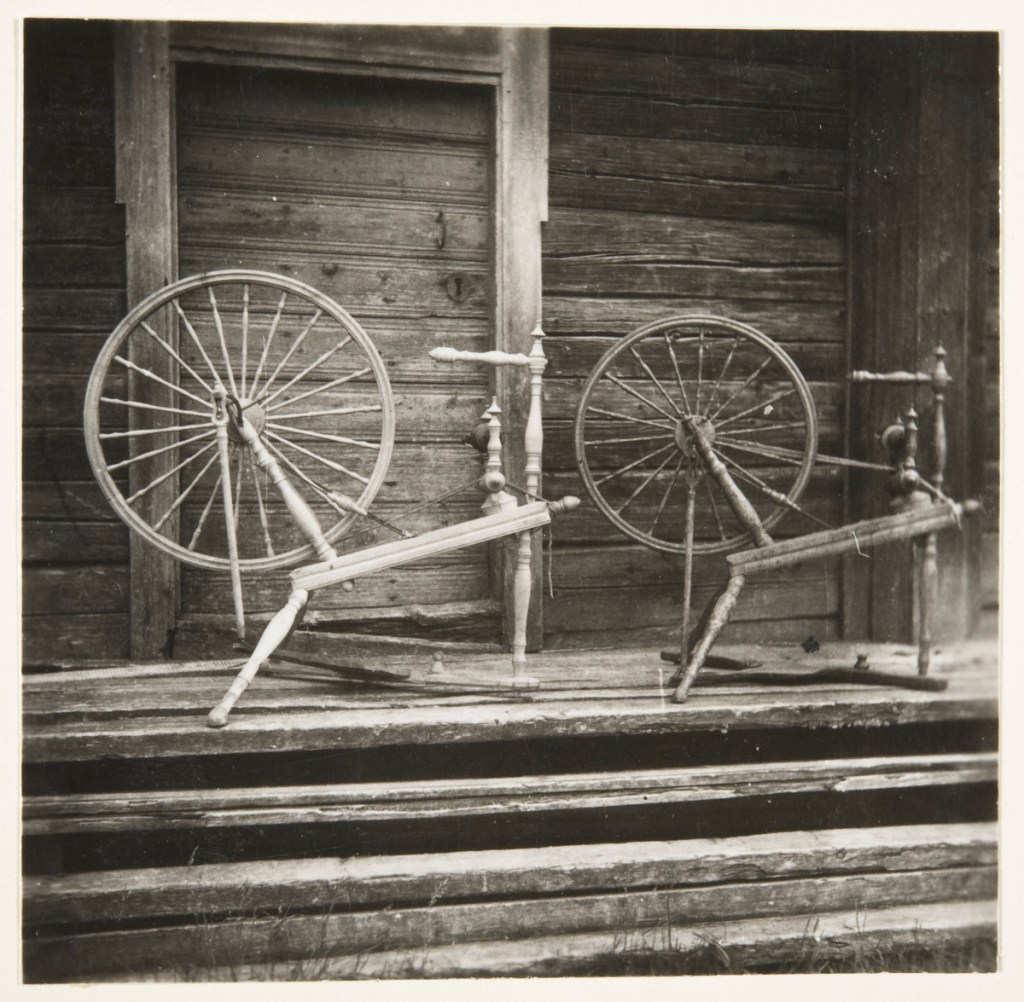
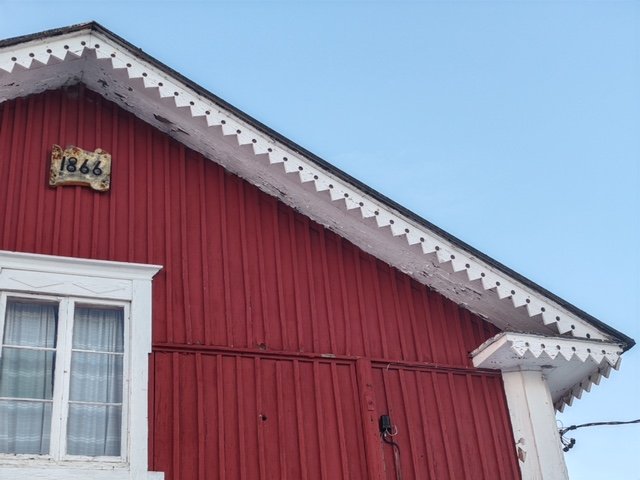
Update June 9, 2025: Thanks to folks on Ravelry, a wheelmaker in Lapua, Finland has been identified who made wheels somewhat similar to this style. Juho Pelanteri (1847-1923) was a third generation wheelmaker who made the wheels in the photo below. These wheels have some features in common with Tuulikki–many fine spokes, generous turnings, wide curvy treadles and often painted–but have different uprights, larger drive wheels, and metal struts. Pelanteri (also referred to as Johan Pelander), with his father and grandfather made about 60 wheels a year–3000 in total. museum link for photos here
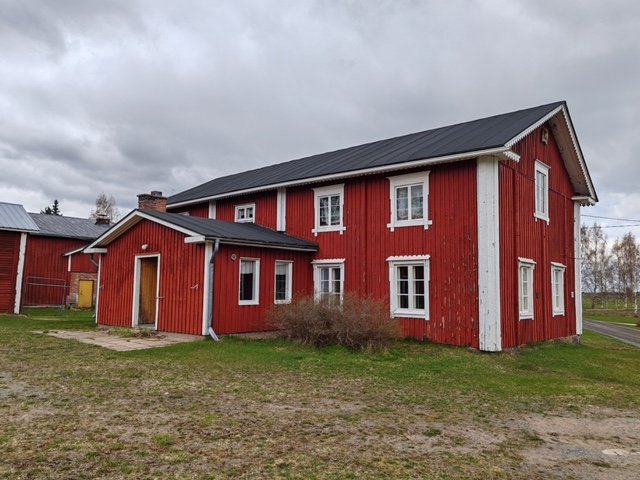
This is the Pelanteri house:
Kikkan

The most well-known and recognizable Finnish spinning wheels are the painted Kiikkalainens.  They are utterly unique to a specific place in southwestern Finland, Kiikka, located on the river Kokemäenjoki. 

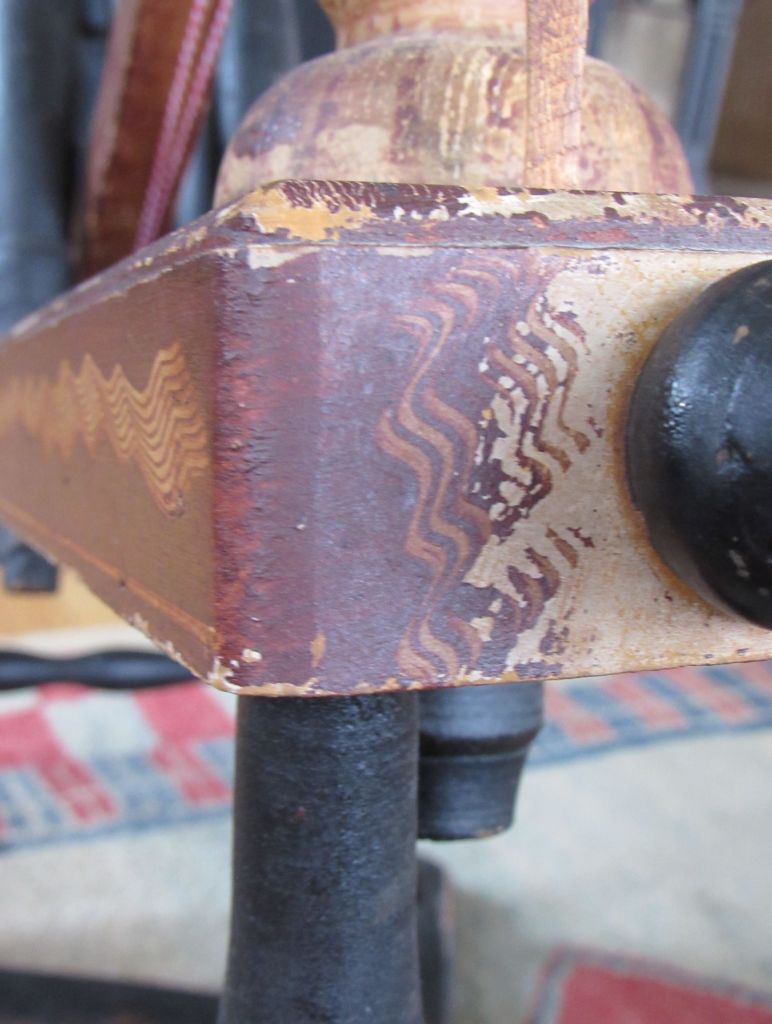
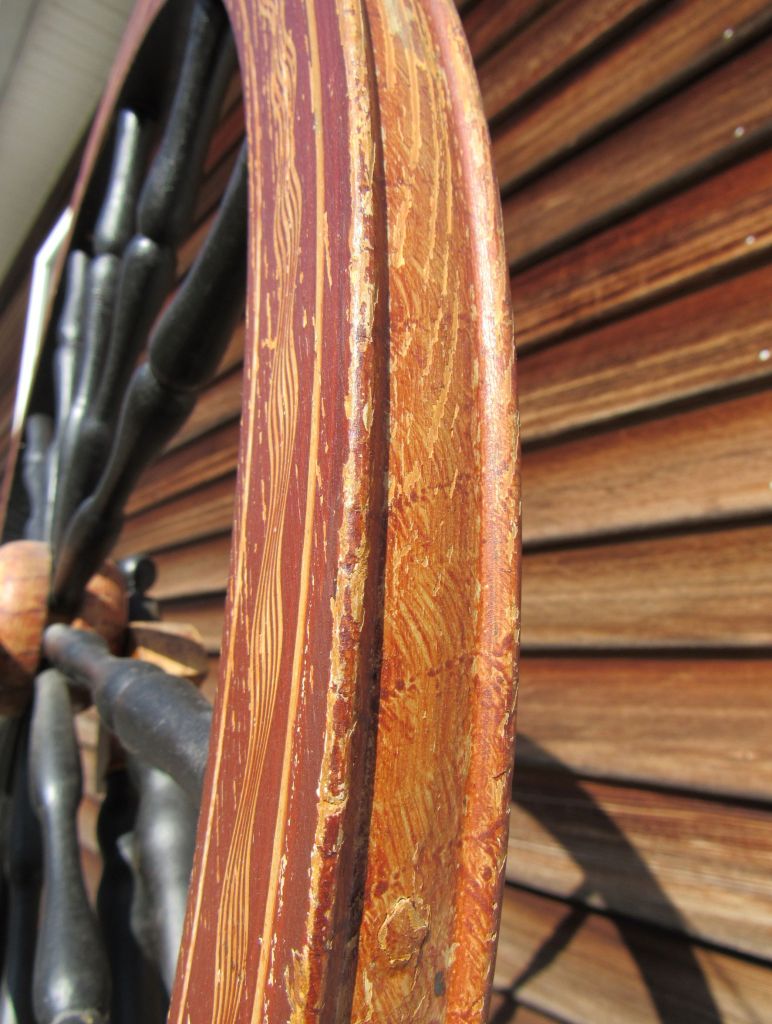
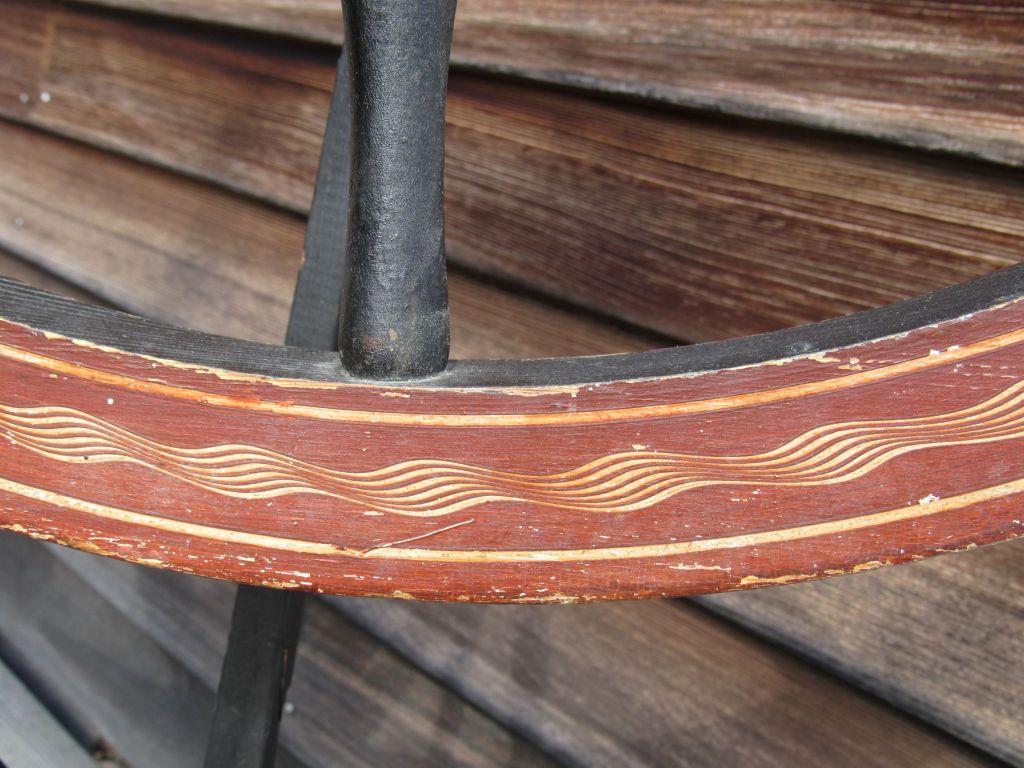
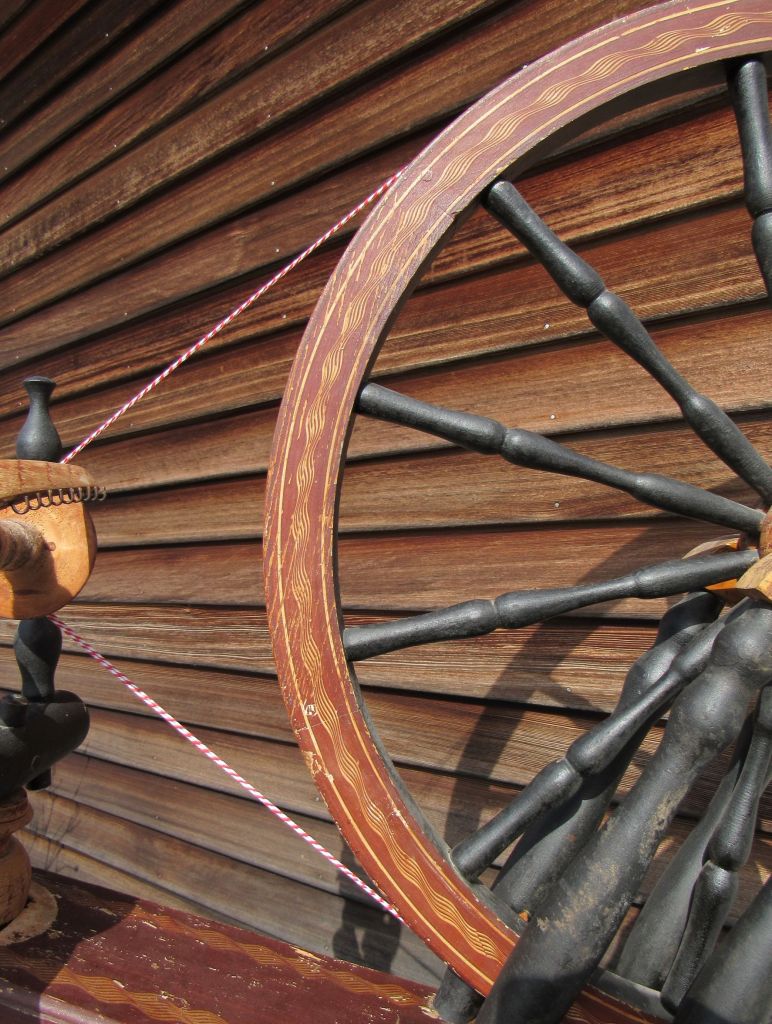
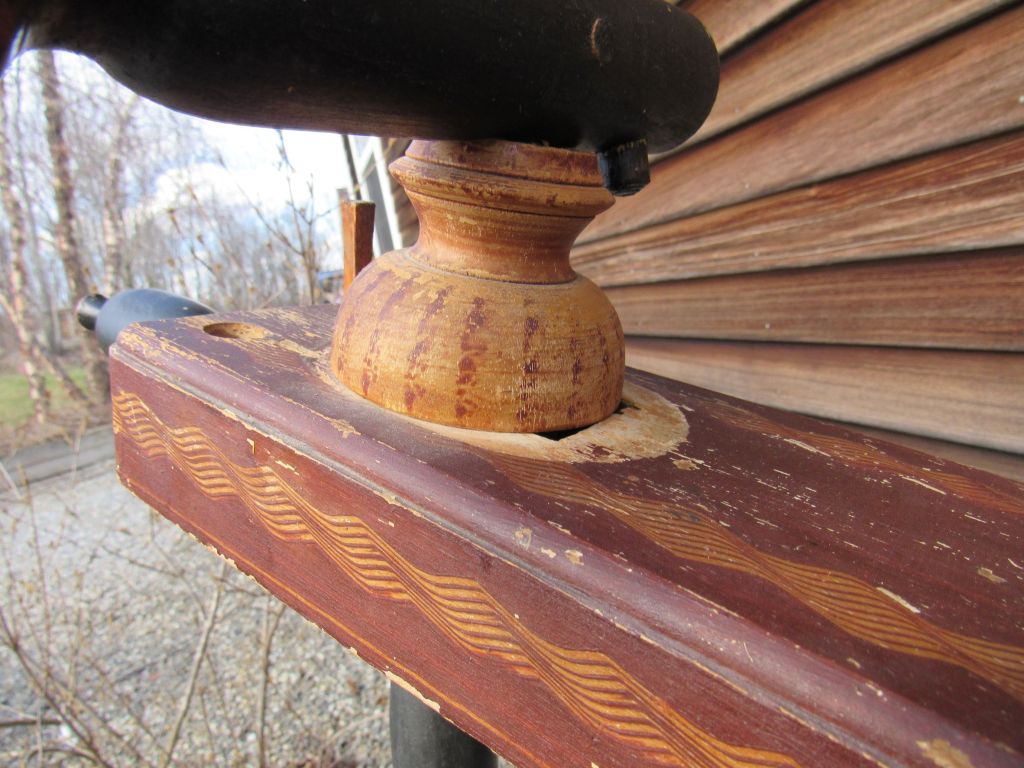
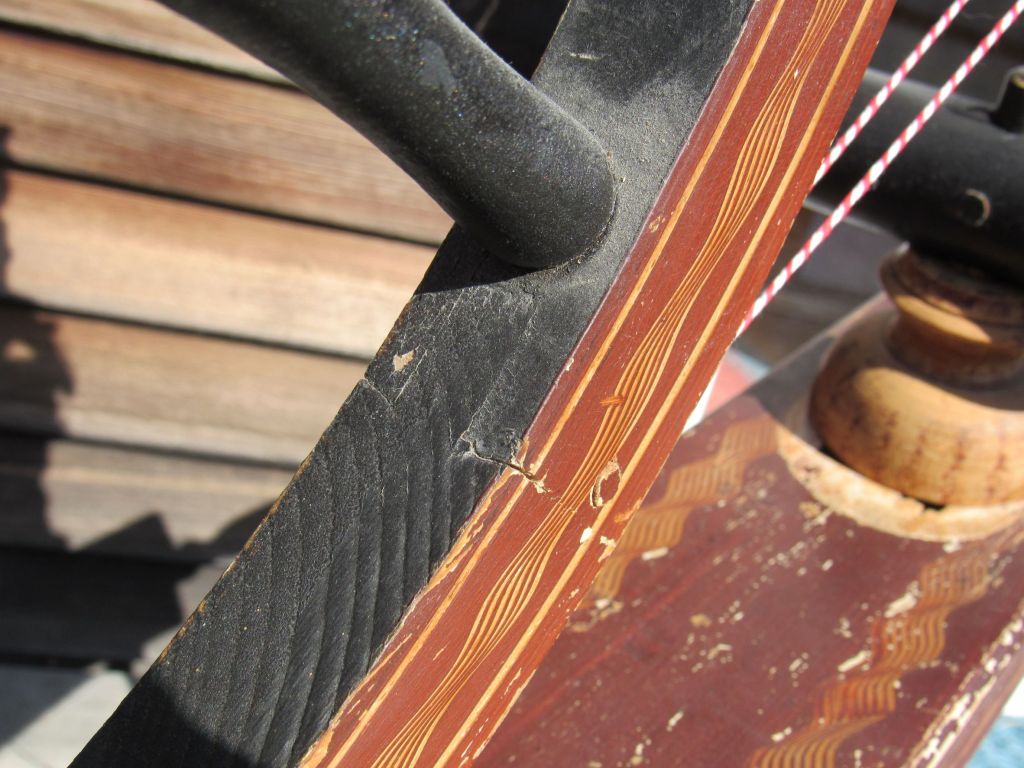
From the mid-1800s until the mid 1900s, Kiikka was famous for its spinning wheels.  Most Kiikkalainens that we recognize today are painted red and black, decorated with ribbon-candy-like undulating golden lines down the sides and top of the red table

and around the wheel rim.

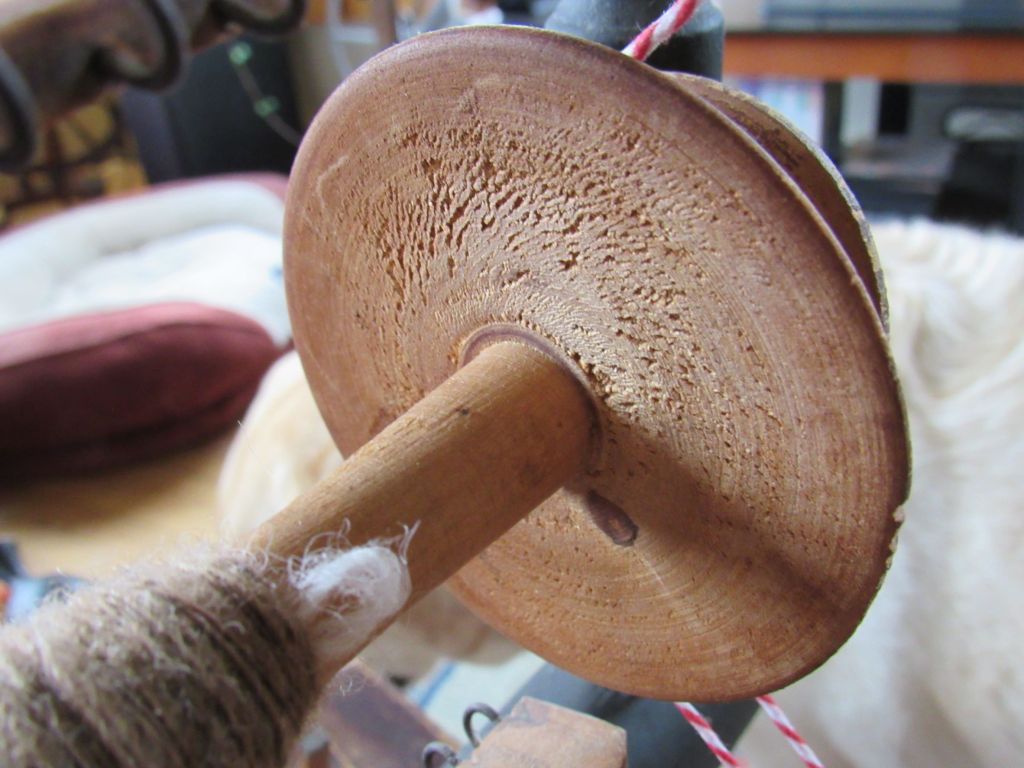
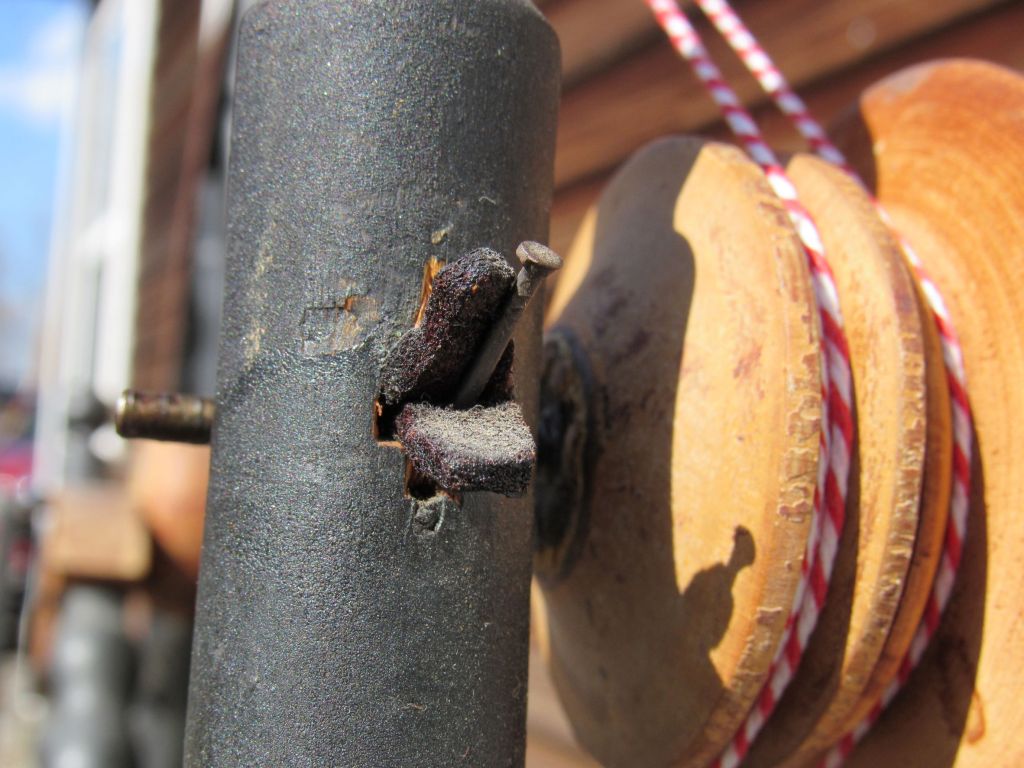
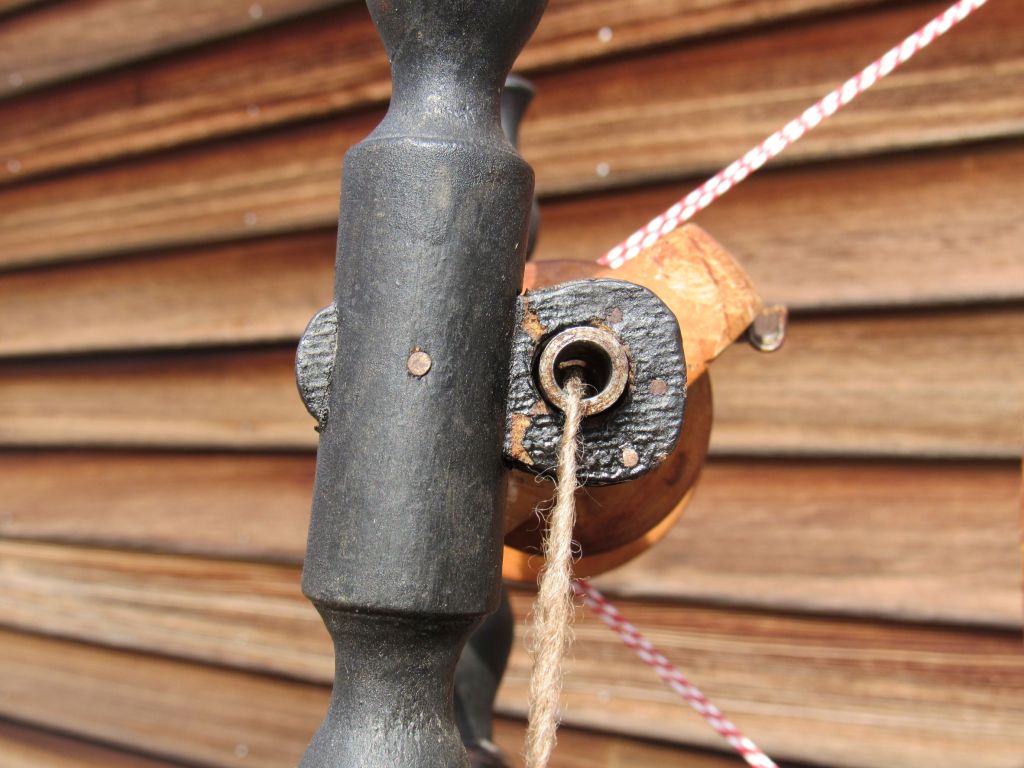
In contrast, the flyer assembly, collar, hub,

and upright arches

are painted with reddish-brown tiger-like stripes over a cream-colored background, giving a bit of a faux grain effect. 

There must be a fascinating explanation for the origin of the color and design scheme, but, with my non-existent Finnish language skills, I have not been able to discover it yet.

As I mentioned in my previous post, “Impi,” Sauli Rajala started a Facebook group dedicated to Kiikka wheels, called “Rukkitaivas, Spinning Wheel Heaven, Kiikka.”  His group has contributed enormously to our knowledge in this country of Finnish wheels. 

Because these wheels were most often marked with paper labels, most of which have fallen off or been worn away, it has been difficult to trace the makers.  The most common name found on labels seemed to be “Aaro Kaukonen,” who was making wheels well into the mid 1900s. 

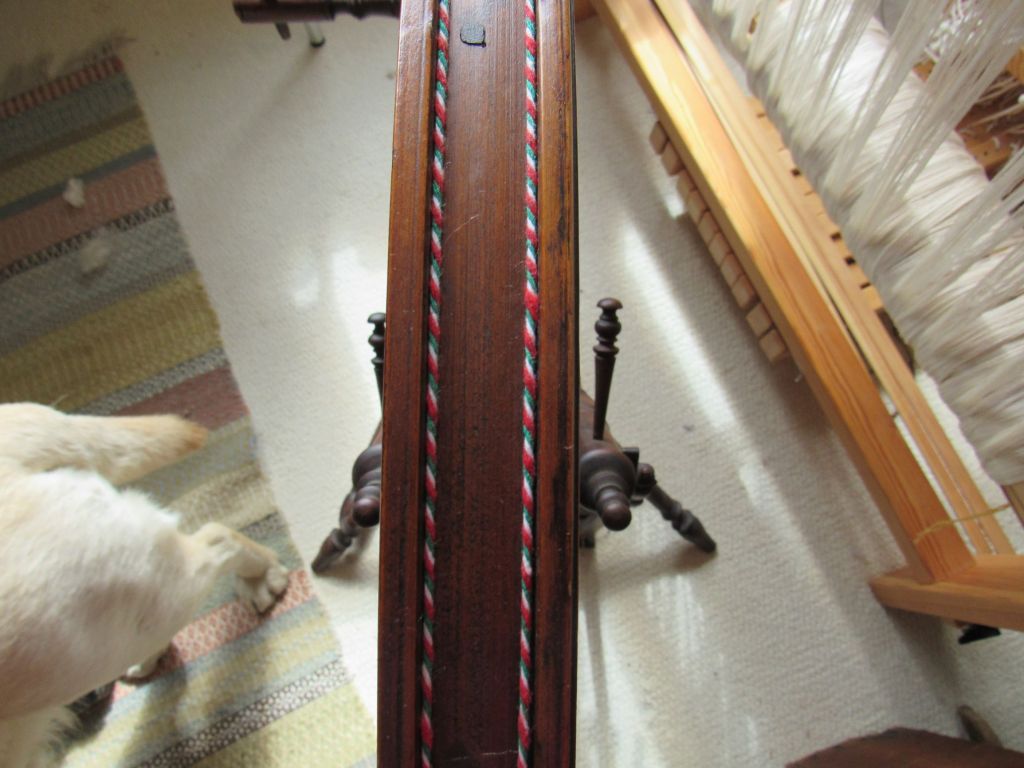
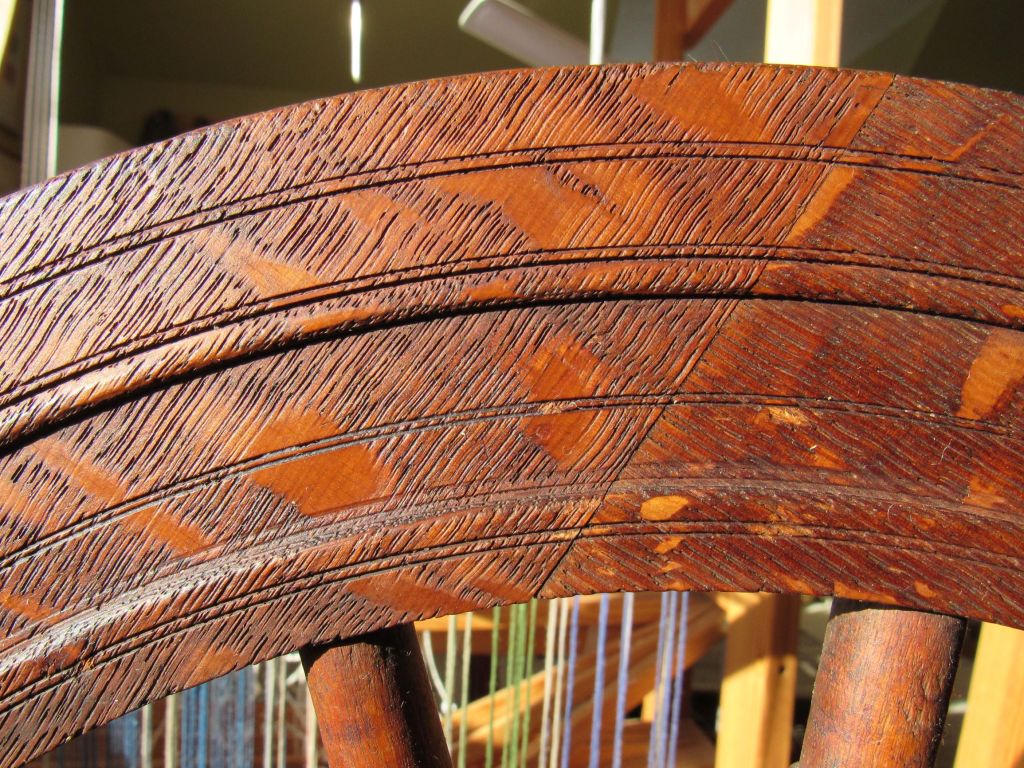
Even the wheel rim groove is feather-painted

Aaro Kaukonen’s grandson, Velli-Matti Kaukonen recently wrote a book “Kiikan Kehruurukkitehdas ja Jokisivun Saha,” about Aaro Kaukonen’s “Spinning Machine Factory.”  From two articles posted on Sauli’s site, it is my understanding that Aaro Kaukonen was taught to make wheels by his father-in-law, Kalle Ulven.  Kalle was from the most famous wheel making family in the area. 

Their wheel dynasty started with two brothers, Antti (Ant) Kynnysmaa and his brother, Joseph.  The brothers started making wheels in the 1820s and became more and more well known. 

In 1845, Antii received a certificate as a master wheelmaker and the brothers changed their last name to Ulven (also spelled Ulvein and Ullven) (this is very similar to the story of the Rantila family in the previous post, “Impi”). 

An innovator, when Joseph bought his wheels to market, he designed a trailer for travel, with a small cabin for sleeping.  At the beginning, Joseph’s wheels were unpainted, but he later painted them green (if I am understanding the translation correctly). 

I have not found any information on when the black and red version emerged, however.  Joseph died in 1882, but his sons Semmi, Kalle, and Herman continued as wheel makers. 

A wheel made by Joseph in the early 1880s (upper left), and Kalle Ulven working on wheels (upper right)

Kalle’s daughter (I believe it was this Kalle, but may have been a generation later on), Marta, married Aaro Kaukonen and, through her family’s teaching, Kaukonen became a wheelmaker.  We also see labels for Emil Ulven and Wilho Ulven (Ullven), who may have been the next generation. 

We know that Auro Kaukonen made his wheels in a small “factory” but whether he worked directly with the Ulvens, I do not know.  (Update June 2025: According to Sauli Rajala, Auro initially worked with Kalle, but then set up his own shop and opened the spinning wheel factory in 1938.) This 1939 article about the Ulvens and Kaukonen is entitled “The Only Spinning Wheel Factory in the World.”

I am slowly working my way through translating it and suspect that it has the answer to many of my questions.  If anyone reading this blog post speaks Finnish, perhaps they could help with some translation.  

While there was obviously a large output of “factory” wheels, the red and black wheels were not all the same.  There is a huge variety in construction details and paint patterns. 

Even individual wheel makers were not turning out cookie-cutter wheels. 

For example, several wheels labeled “Herman Ulven” have showed up, and each is different.  On the other hand, the flyer assemblies on the red and black Kiikkalainens seem to be quite uniform. 

Perhaps there was some uniformity in flyers so that they could be interchangeable, but individuality in design and decoration. 

My wheel has no label, so I can only guess its age.  It looks older than the shiny wheels from the mid- 1900s and has seen a lot of use, especially showing wear on the treadle. 

I bought it at an auction about an hour from my home on mid-coast Maine.  There is a good-sized Finnish population in the mid-coast, descending from immigrants who settled here from the mid-1800s through the early 1900s. 

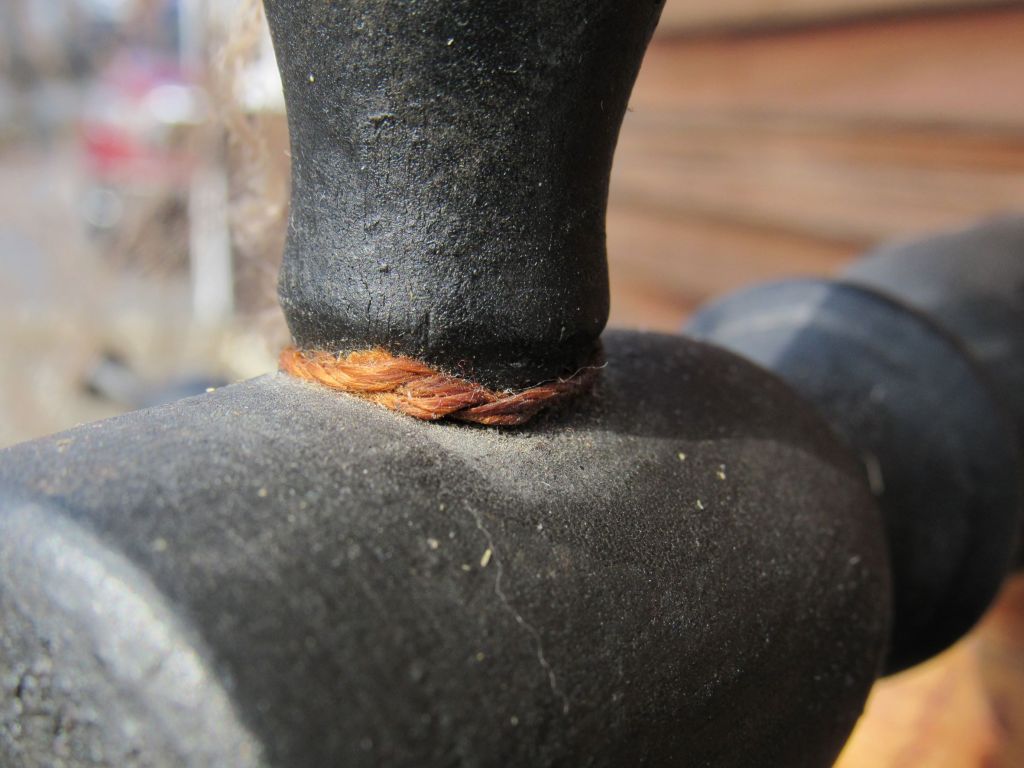
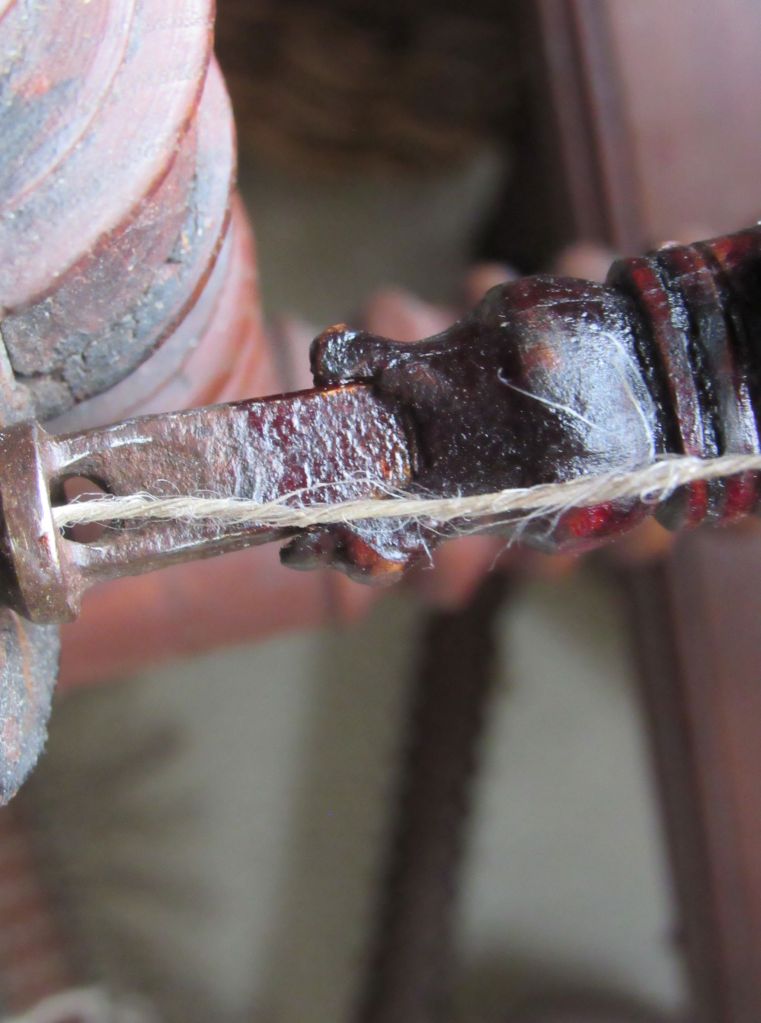
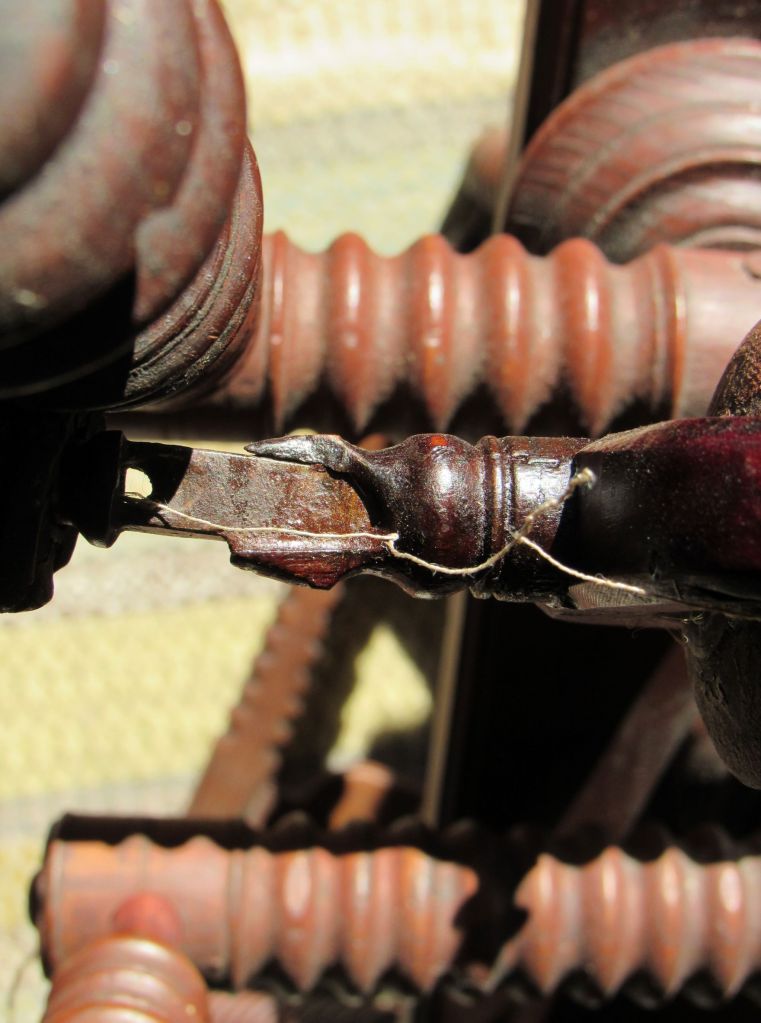
Thread, probably linen, wrapped around the maiden to tighten the joint

I like to think that my wheel was brought over by one of those immigrants in the early 1900s.  But that is only speculation.  

It is a wonderful spinner–much like the Quebec wheels made during the same time period—with a large drive wheel designed for speed and efficiency.  The drive wheel is made with six joined pieces, much like Impi’s wheel in the previous post. 

Like many Finnish wheels, the treadle pins are set into the treadle bar rather than going directly into the legs. 

And the spinner-side feet emerge below the treadle bar. 

The double uprights are topped with arches and the axle is held in place with wooden screws. 

There are a few paint drips on my wheel, but those are its only flaw. 

It is lightweight, an excellent fast spinner, and brightens every room it is in.  I have only started to learn about these wheels and will update this post as I learn more. 

The photographs and family history of the Ulvens came from this article: 23.8.1824 “KIIKASSA, KYNNYSMAAN TORPASSA ALKOI RUKKIVARVARIEN AIKAKAUSI,” by Jaana Härmä, about the history of spinning wheel making in Kiikka, which was posted in the Rukkitaivas group on Facebook.

Update June 24, 2025: Sauli Rajal offered some additional information about the wheel in this blog. According to Sauli, it was made by Eino Hossa in Keikyä, a neighboring village to Kiikka, probably in the late 1940s.

Impi

This beautiful wheel is Finnish.  In fact, even though there is no maker’s mark, I know with certainty who made it.  That is a rarity in the wheel world.  I found it for sale on Cape Cod.  Despite the fact that it had been in the seller’s home all his life, he knew nothing about its history. 

Because the wheel looked Scandinavian, I asked him about his family background.  Sure enough, they are Scandinavian, mostly Norwegian, he thought.  When I got the wheel home, I realized that it was in pristine condition—probably never used for spinning. 

In addition, it looked relatively new compared to my other wheels, most of which were made in the 1800s.  It seemed likely that the wheel was made in the 1900s, which made we wonder if it was Finnish, because Finland, like Quebec, had significant spinning wheel production in the early to mid-1900s. 

Fortunately, there is a Finnish wheel collector on Facebook, Sauli Rajala, with a page called “Rukkitaivas ‘Spinning Wheel Heaven’ Kiikka,” in which he photographs wheels that he collects in and around the Kiikka region of Finland.  As of March 2022, he has rescued more than 1600 wheels.  They are so abundant in his area, which was once a thriving center of wheel making, that they are often given away.  One day I saw a wheel on his page that looked just like mine. 

He knew the area in which he had found it, but no other details.  A few months later, another similar wheel showed up, but no one seemed to know anything definitive about where the wheels were made.  Of course, I may have missed huge chunks of information since I speak no Finnish and Facebook translations range from hilarious to vaguely obscene.  I’ve come to understand some of the wonky translations, such as “Rukki,” the Finnish word for spinning wheel, which translates as “rye” and “lantern” is the translation for flyers. 

Translated posts usually go something like these:  “The roller has to spin an obstacle with a krake and a lantern in the leather earrings,” and “the between the thighs must not be at all tight so that bike is not an obstacle.”  Translations are littered with “bitches,” “wheelbarrows,” and “the Polish side.” Let’s just say that the translation feature is usually more laugh-inducing than illuminating.  So, although I was fairly confident this wheel was Finnish, that was the extent of my knowledge. 
Until recently, when someone posted in the Rukkitaivis Facebook group a wheel similar–but slightly different–than mine, with the information that her aunt said it had come from central Finland.  I posted a photo of my wheel asking if she thought it would have come from the same region.  In response, I was amazed to hear from Marja Tolonen, who said that my wheel had been made by her grandfather, Hannes Rantila, who shipped a batch of wheels to America for sale in 1922. 

Marja’s father, Edvard, grandfather, Hannes, and great-grandfather, Sakari Rantila, all made spinning wheels in Manniskylä, Keuruu.  Sakari started making wheels in 1845.  He could read and write and kept a record of all the wheels and other turnings he sold. 

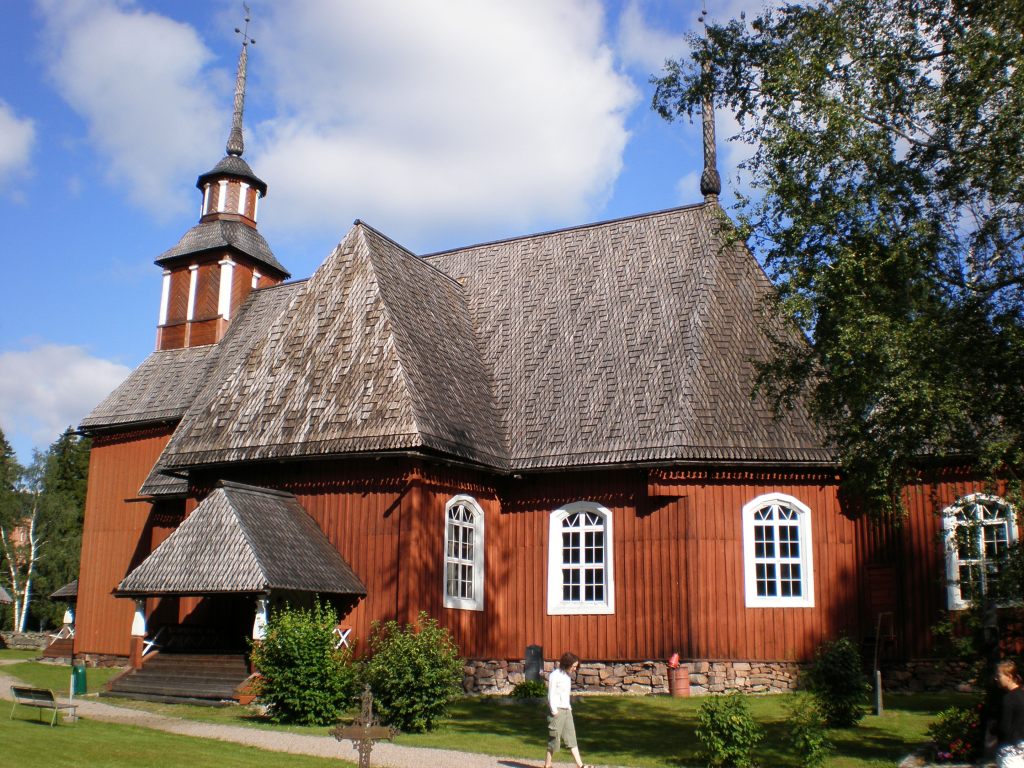
Sakari’s son, who was Marja’s grandfather, Hannes, continued Sakari’s work.  Hannes had five sons, all of whom made wheels.  Two of them, Nikolai and Gideon, stayed home and worked as carpenters through their lives, including working on renovations of the old church in Keuruu.  I assume it is this church, famous in the area, originally built in the 1750s.

This link has photographs of the incredible painted woodwork inside: Travels in Finland and abroad. Nikolai lived to age 94 and continued in his old age to make small wooden objects.  Marja shared this article with the Rukkitaivas group, from a 1958 Pellervo magazine in Finland. 
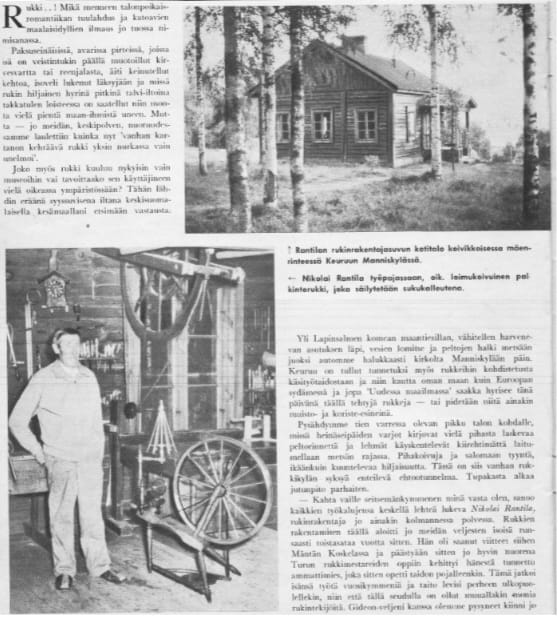
The picture in the article shows the Rantilas’ house, where her father was born and the wheels were made.  The man showing the wheel was Nikolai. 

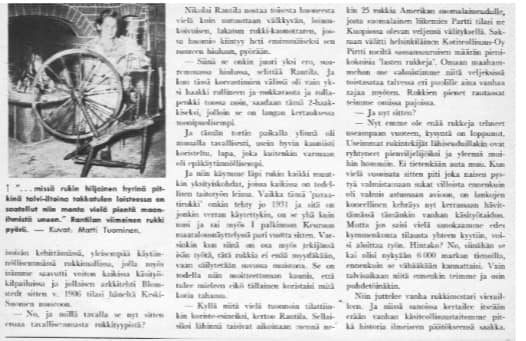
The woman spinning was Gideon’s wife, Auna. Unfortunately, the text is blurry, but Sauli and Marta provided the key information from it. This is a wheel made by Hannes in 1931, which appears to be identical to mine, except for the stain color.

The Rantilas were not the only wheel makers in Keuruu.  Another branch of the family also made wheels.  Nikolai’s grandfather, whom I believe was named Adam (Aatami), had a brother, Samuel Kingelin, who along with his son, Samuel Saukkomäki, also made wheels. The wheels were quite similar, with just slight differences in their decoration.

With all of the hours I spend researching spinning wheels, following fruitless leads and hitting dead ends, it felt slightly surreal to have this rich trove of wheel history fall into my lap as the result of a single facebook query.  And it adds a whole layer of richness to spinning on wheel when you know something of its maker and history.    

While I cannot be absolutely certain that my wheel was part of the 1922 batch that Hannes sent to America, chances are good that it was.  My wheel looks as if it was never touched for spinning, but always used as decoration.  That makes sense, since hardly anyone still spun on wheels in the early 1900s in this country.  It seems more likely that someone would have bought one of Hannes’ shipped wheels once it was here, rather than taking the effort and expense to personally ship the wheel over from Finland.  But, however it arrived, it has been lovingly taken care of since then. 

I would love to know the reason Hannes Rantila marketed these wheels in America in 1922.   Were they a decorative Scandinavian touch for homes at the end of the Arts and Crafts movement?   A taste of a Carl Larsson interior, perhaps?  Because, if ever a wheel elevates traditional craftsmanship to art, this one does. 

It has a graceful, low-to-the-ground stance, with scooped cutouts under both sides of the table.

The far side cutout has the remains of what looks like a paper label.  The stain finish is uneven, so I wonder if the wheels were shipped here unfinished, to be stained or painted as the customer desired.  Turnings, angles, and curves are juxtaposed into a happy web of parts. 

The large treadle has curves and swirls cut into the edges

and is attached with a swooping bar,

both features found in earlier Finnish wheels. 

The turnings on the maidens and spokes are harmonious and eye-catching. 

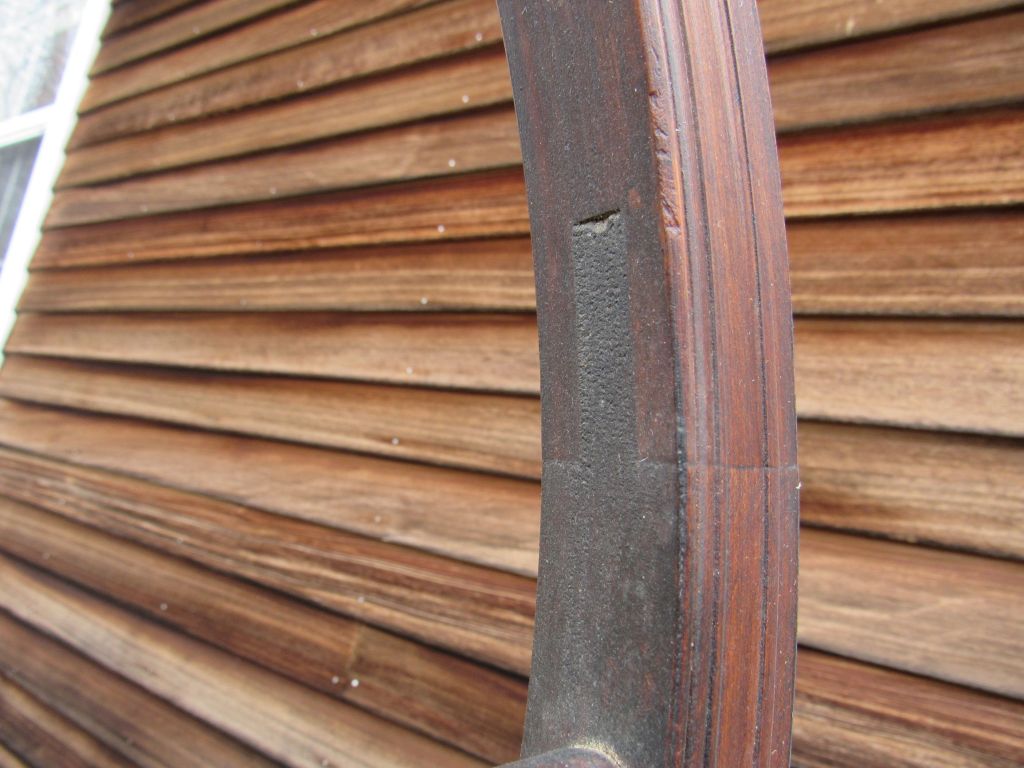
The spokes are pegged through the drive wheel rim, which has a wide single groove for the drive band. 

The drive wheel is constructed of six joined pieces with radial edges. 

The uprights have deep cuts for the axle,

capped with decorative pegged inserts on both sides. 

Thick guy wires run from table to uprights—again a characteristic of some older Finnish wheels. 

The upright ends are threaded.

One of the most interesting features of this spinning wheel is that it is designed to accommodate two different sized flyer assemblies.  

Some Scandinavian wheels accomplish this by having two-sided leather bearings, which can hold different sized flyers on either side of the maidens.  Others have a spinner-side maiden that slides back and forth on the mother-of-all, so that shorter and longer flyer assemblies can be switched out.  This design is a little different. 

There are two holes on top of each other in the spinner-side leather bearing and two looped bearings on the far side. 

The leathers are sheared flush with the maidens in the back and the double-holed one has two small wooden pegs securing it through the side of the maiden.  

There is an extra hole in the mother-of-all so that the spinner-side maiden can be moved closer to the other maiden. 

That maiden has a small, easily removable peg in the bottom. 

This design allows the spinner to readily change from a large bobbin and flyer assembly to a smaller one.  My wheel came with only one flyer.  It is humongous. 

I cannot imagine spinning flax on it, so I am assuming that the large flyer was intended for wool spinning and a smaller one for flax spinning.  It is also possible that the larger flyer assembly was used for plying.  Whatever the intent, it is a nice, ingenious set-up. 

The crowning touch, of course, is the distaff.  It tops the wheel like a perfect Christmas tree. 

The wheel is just so over-the-top pretty, when I brought it home I was little apprehensive about how it would spin.  I knew nothing about the maker then, so feared it might have been made more for decoration than for spinning.  It only took a few treadles, however, to realize that this wheel was a true Finnish production wheel, designed to spin with ease and speed. 

It is pure pleasure to look at and to use.  Thank you Hannes. 

And great thanks–kiitos–to Marja and Sauli.  I apologize if I muddled any of the details in translation. 

Update, March 23, 2022:
I learned a little more from Marja about the Rantilas.  She told me that Hannes Rantila won a First Prize for his wheels at the 1922 Exhibition in Tampere, Finland.  I found a piece describing the Tampere Exhibition: “Plans had also been made to organise the 12th general agricultural fair in Tampere in 1922. Eventually that fair merged with the third national fair, albeit in a truncated form. The architectural design for the fair was commissioned from architect Alvar Aalto. The fair exhibited mainly products from the wood industry and the home industry as well as the machining industry. The audience could also see competitions related to craftsmanship and exhibitions ranging from carving a shaft of an axe to patching a pair of mittens. The stands of Tampere businesses received much attention.”  (for citation, see below).  After Hannes’ win at Tampere, he received an order from a businessman (arranged through a brother in Kuopio) for 10 spinning wheels to be sent to America.  After sending the first shipment, more were ordered and Hannes eventually sent a total of 25 wheels.  I believe Hannes also sent some wheels to Germany.

Also interesting is the family name.  From what I understand, in the early- and mid-19th century, surnames were fluid, even for an individual, and Finnish families did not have fixed family surnames.  So, each individual in a family might have a different surname—some patronymic, some based on a trade, or place.  When Sakari, Marja’s great-grandfather, started making wheels in 1845, believing a craftsman should have a fixed surname, he chose “Rantila” based on a shortened version of the name of the beach estate where he lived.  It is an unusual surname and his wheel-making son and grandsons all kept it. As a result, these wheels can accurately be referred to as Rantila wheels.

The quote above is from: Hietala, Marjatta; Kaarninen, Mervi, “The foundation of an information city : education and culture in the development of Tampere,” (Tampere University Press, 2005).

Theodosia Bunce (Dosia)

This wheel invites questions.  I would love to be able to sit down with its maker and ask why he constructed it the way he did.  Why this way, why that–what are the reasons behind his design?  Fortunately, in this case, we know something about the maker. 

He appears to have been thoughtful and innovative–a build-a-better-mousetrap kind of man.  So, his wheels perhaps can tell us something about 19th century ergonomics in designing great wheels for greater ease and efficiency in spinning.    

The most striking feature, at first glance, is not the wheel design, but the dark red paint on the table.  It does not run the whole length, but ends in a graceful curve near the spindle end, topped by and highlighting the maker’s name,“E. Spencer.” 

It is a nice touch by this intriguing man.  On some of Spencer’s wheels, his name in the stamp runs straight across. On others, such as this one, the name roughly follows the curve of the paint. Elizur Spencer was born in 1779 in New Hartford, Connecticut.  Around 1803-04, he moved to Sandisfield, a western Massachusetts town on the Connecticut border, with his wife Mary (called Polly).  According to this wonderful article by a local Sandisfield historian: Elizur Spencer of Sandisfield., Mass., and His Remarkable Apple Parer, Spencer was: “the most skilled artisan-woodworker who ever lived in Sandisfield and probably for many miles around.”  (p. 2). 

The article goes on to say: “By all accounts Elizur, a humble man and a helpful and generous neighbor, was a wonder. Town historian George Shepard in 1885 remembered him as a prolific, first-rate craftsman who made important things to improve everyday life. Shepard wrote that Spencer made ‘spinning wheels, quill wheels, reels, swifts and paring machines.’  He added that Spencer ‘used a small stream to the south to power his turning shop.’” (p. 3) 

Spencer’s house, a dam and small reservoir, and remnants of his shop still stand.  After his wife’s death in 1822, in addition to his wheel and tool making, Spencer farmed and raised his three teenage daughters.  The “paring machine” referred to in the article was an apple parer, which could be used right- or left-handed, an innovation that must have been fairly unusual for his time.   

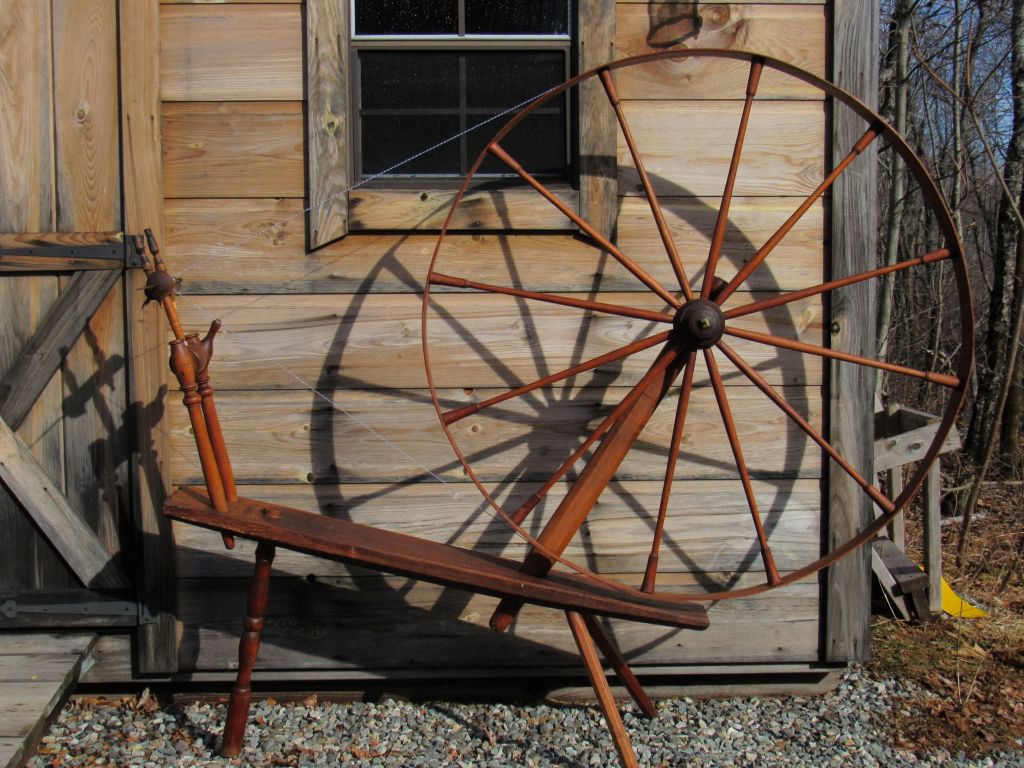
Spencer’s great wheels likewise have unusual design features.  Aside from the red paint, the thing that immediately stands out is the mismatched legs.  The spindle-end leg is beautifully turned, sleek and rounded, with a well-balanced design. 

In contrast, the wheel-end legs are chamfered, a leg style often associated with early or relatively primitive wheels because they could be made without a lathe.  

Why would Spencer chamfer the wheel-end legs rather than turn them?  Perhaps the answer lies in this photo. 

The spinner-side leg is much shorter than the back-side leg—only 16 1/2 inches compared to 19 1/2 inches—making it difficult to match turnings on those legs in a way that would look good.  It is pure speculation, but perhaps chamfering was an easier and more visually appealing way to deal with the three-inch difference in leg length.  As for why the wheel-end legs have differing lengths, it is a feature seen on some great wheels. 

It is generally assumed that the spinner side leg is shorter and tucked a bit under the table to better keep it out of the way of the spinner.  Spencer’s wheels appear to reinforce that theory because the whole wheel appears designed to allow the spinner to easily and smoothly move back and forward while spinning. The legs are set in the angled undersides of the table. 

The table narrows as it approaches the wheel end–a good feature for long skirts, giving them a little more room and less of sharp end to catch against.  Interestingly, both sides of the table narrow, but the spinner’s side narrows more. 

Did Spencer narrow the spinner’s side to accommodate the spinner and then narrow the other side—but less so—to provide a balanced look to the table?  I do not know, but am really intrigued by his decisions balancing utility and beauty. 

Another apparent spinner accommodation is Spencer’s tilted drive wheel post.  And, it is almost absurdly tilted.  Again, the theory is that a tilted post or a tilted axle moves the upper part of the drive wheel away from the spinner, giving more room for the spinner’s arm and shoulder to move with ease.  It seems as if it would cause problems with the drive band, but it works. 

Everything about this wheel seems to be spinner-conscious, designed to provide for free movement of legs and arms.  But it makes for an oddly lovely lopsidedness when viewed from the end. 

Does the long dancer-like leg on the non-spinner side provide compensation for the weight of the drive wheel tilt? 

And, what about the wheel post—chamfered along its length with a turned top?  Was that an aesthetic choice, combining the chamfering from the wheel-end legs, with the lovely turning on the leg and posts on the spindle end?  Underneath the table, the edges are beveled. 

Everywhere, even under the table, the quality of workmanship is impressive.  The wheel is, as the apple-parer article described, “exquisite.” 

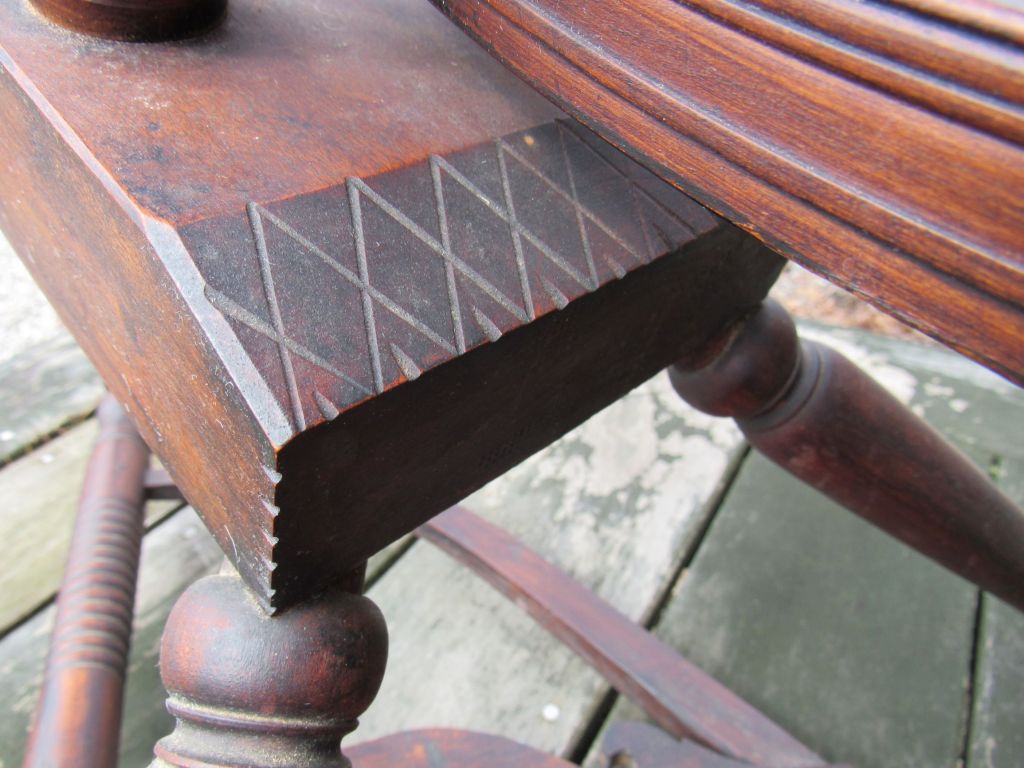
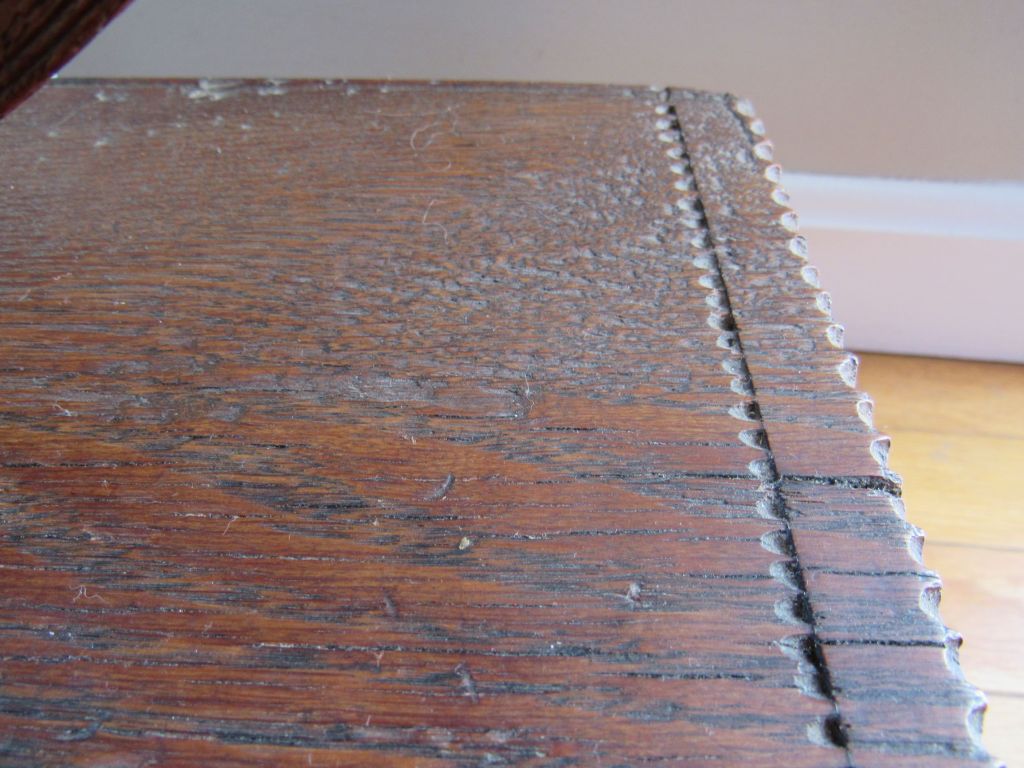
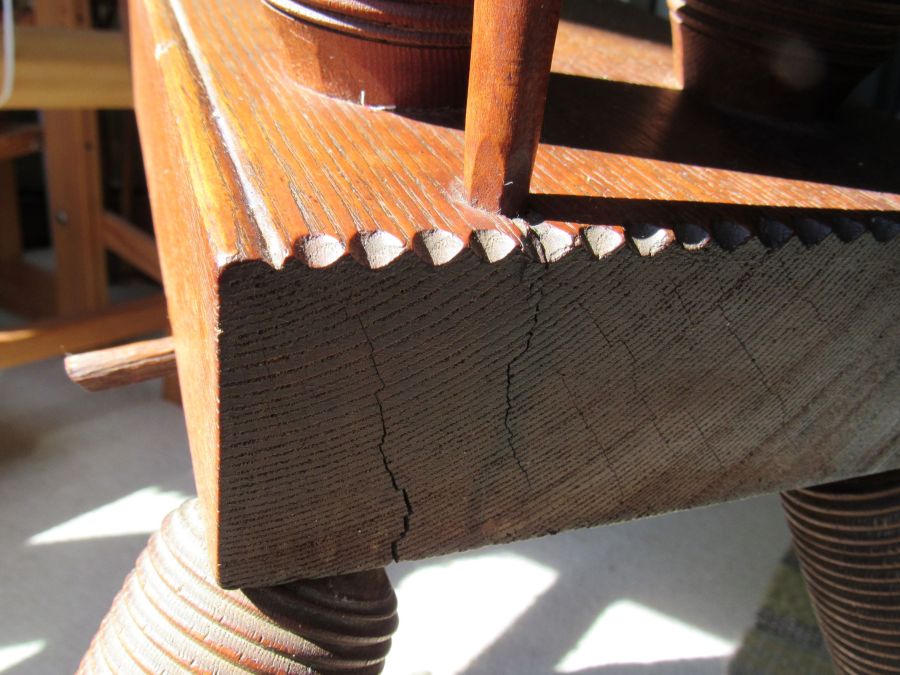
Many wheel makers put chip carving on table ends. 

But, on one end, Spencer put this personal flourish on his wheels. 

It is actually this particular detail that captured my heart.  I admire that unique touch—a signature of a little extra beauty. 

Spencer made flax wheels, too, but I have only seen photographs of one of them.   I would love to know whether his flax wheels had any innovative touches. 

He also made accelerated heads, complete with his label (he had a similar label on his apple peelers).  Mine looks as if it could be made by him, but without the label, I can’t be sure. 

It is missing the accelerator wheel and whorl, so I use it as a direct drive. 

The wheel has the double upright barrel tension that was typical for Connecticut and upstate New York great wheels. 

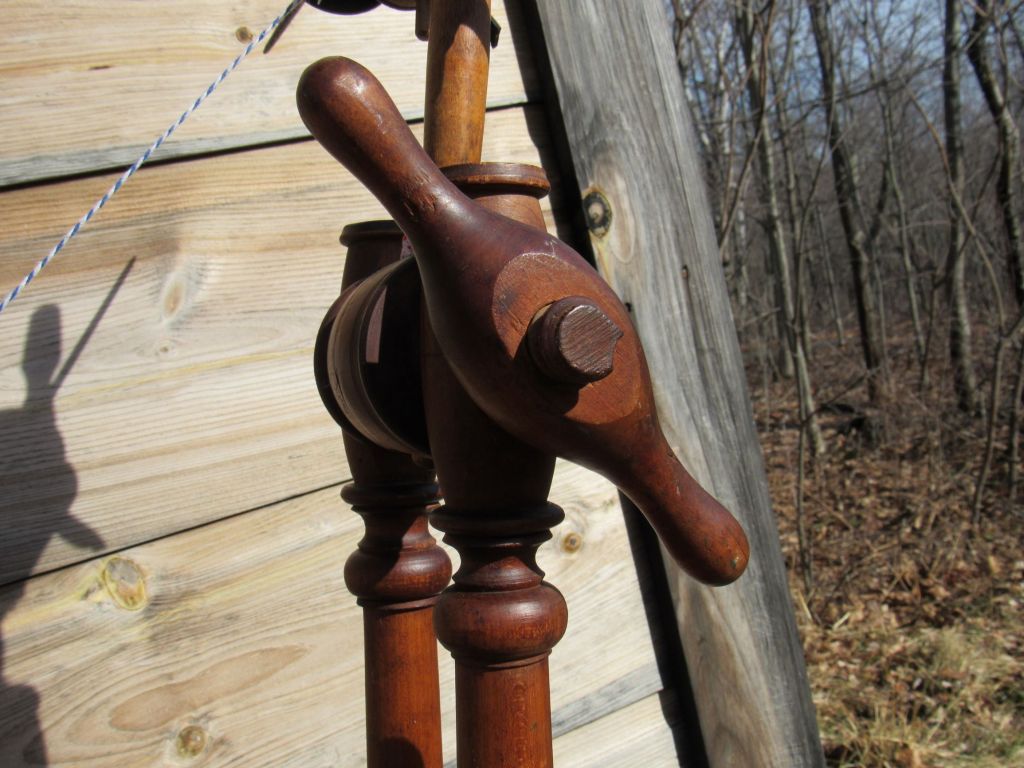
The tension tightening handle has smooth curves that feel good in the hand. 

The top of the spinner-side post has dents that look as if they may have been made by the spindle end, but I do not know the reason why the spindle would have been hit against the post–perhaps to help remove it from the bearings?

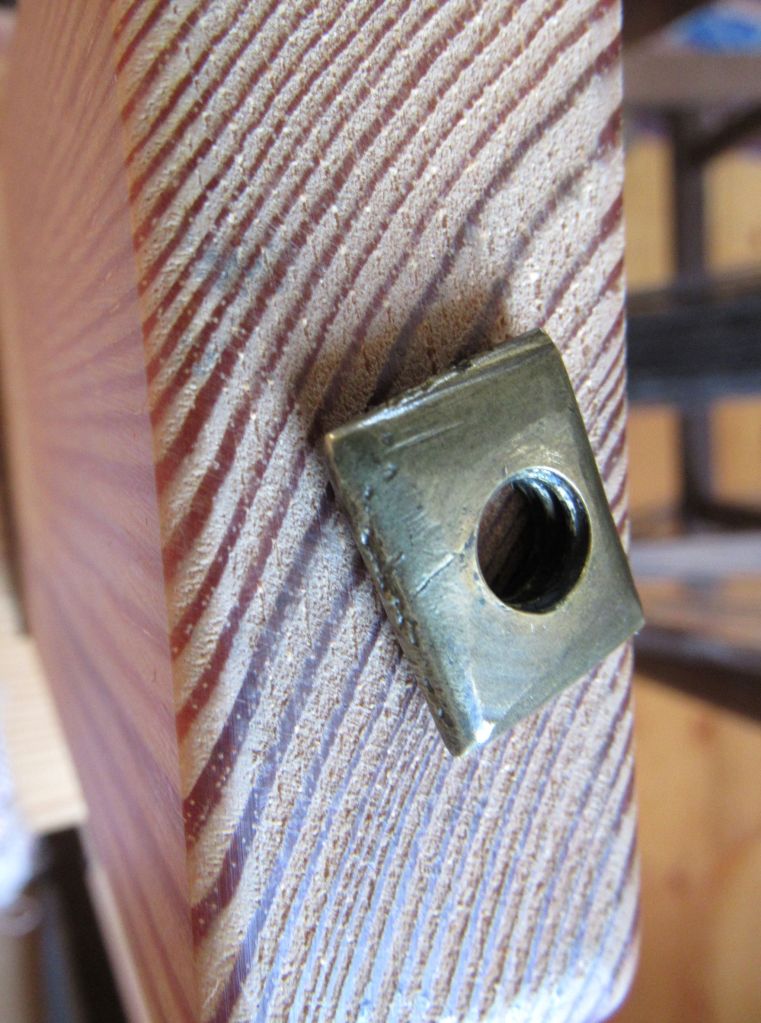
The axle is threaded on the end,

with a smooth-edged old nut that looks handmade. 

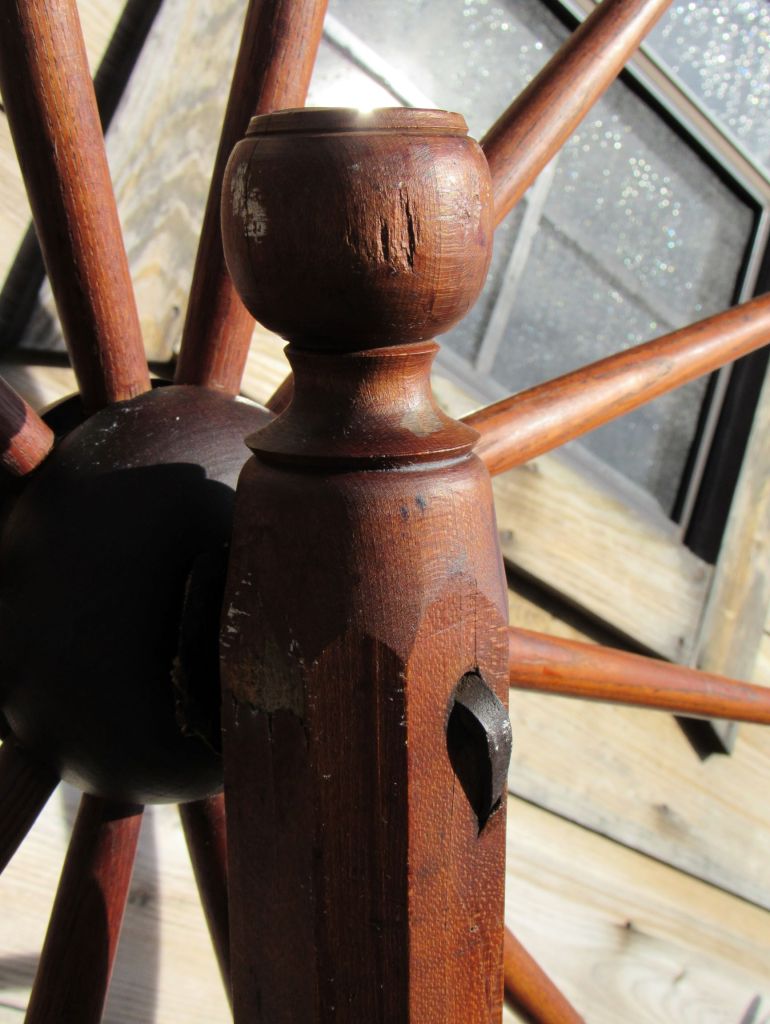
The backside of the axle is flattened and hammered into the upright post.

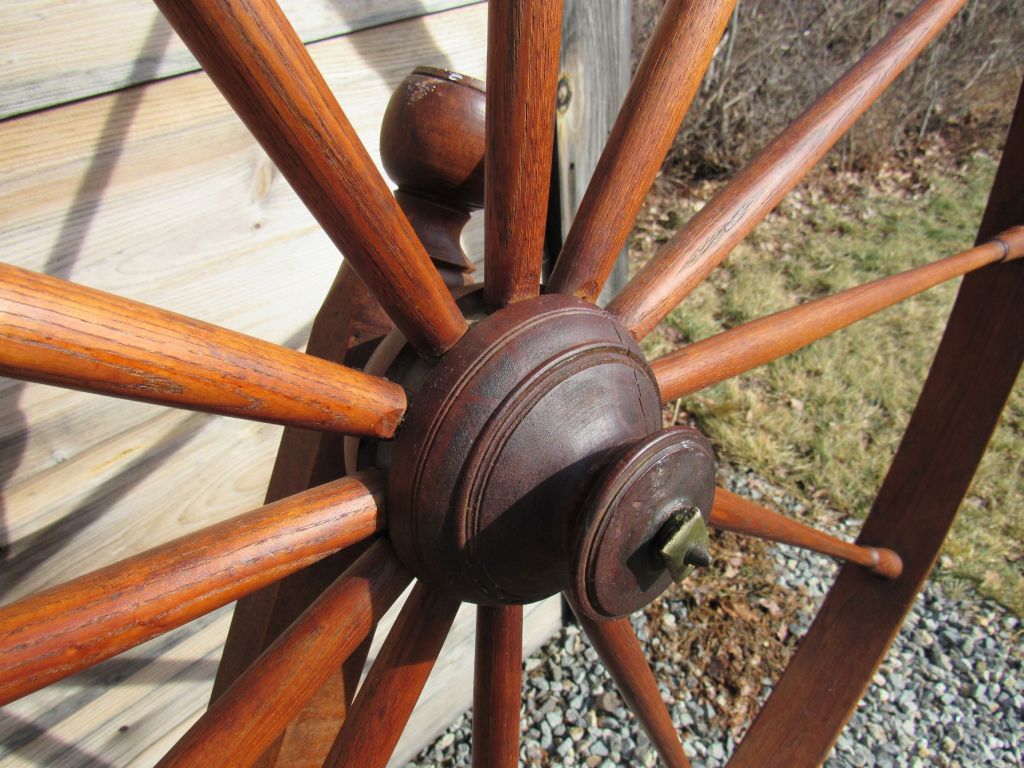
The hub is hefty, with the spokes perfectly fitted into a wide groove.

Brass bearings are fitted into both sides of the hub.

The only flaw I have seen on this wheel is that the bottom of the upright post shows where the wheel rim scraped against it.  I cannot tell if the groove is from wear or whether it may have been carved out to give the rim some extra room.

At some point, someone added a few layers of leather and canvas, apparently to hold the hub out far enough so that the wheel clears the upright. 

The drive wheel rim is tight, without loose or wobbly spokes. 

The wheel-end legs are flush with the table top

but the spindle-end leg protrudes above it.  I wondered if it had eventually worked its way upward, but it is painted on its side, indicating that it probably was that way originally. 

Some Spencer great wheels have the same protruding leg-top as mine, and others are flush.  It seems odd to have it protrude.  Could it have been intended as a rolag holder?  That is how I use it.  Because, I use this wheel a lot. 

It is an amazing wheel for spinning, elevating the spinner’s dance to something very graceful and almost effortless.   If I could meet with Spencer, after grilling him about his design choices, I would thank him for making such an exquisite machine.   

For more information on Elizur Spencer, follow the link to this article:

Bernard, Ronald, “Elizur Spencer of Sandisfield, Mass., and His Remarkable Apple Parer,” published in the Apple Parer Journal, January 8, 2017.

Thanks to Miranda for finding this article and making it available on Ravelry.

Henrietta

I know little about this wheel. A vertical double flyer wheel, stamped on two sides with a “D.S” maker’s mark, seems distinctive enough to have generated some body of research.

But this style seems to be a bit of a mystery.

The most familiar North American double flyer wheels are the two-table variety made in Connecticut in the early 19th century (see the post “Louisa Lenore”).

According to Pennington & Taylor, who refer to this lesser-known style as “t-top” double flyers, they likely were made during the the same popular surge of Connecticut double flyer wheels that produced the two-table version. (Spinning Wheels and Accessories, p. 86-87)

I do not know what evidence indicates that the t-tops were also made in Connecticut, but it would be interesting to know if they were a double-flyer variation that evolved in a different geographic area of the state or in a nearby state.

Why double-flyer wheels became so popular in Connecticut at that time is not really clear, but I find it interesting that both of the Connecticut double flyer wheels I have owned appear to have been little used.

It makes me wonder if the wheels became a “must have” item but, once acquired, spinners realized that they preferred their single flyers.

After all, while double flyer spinning increases production, it takes a skilled spinner and fine flax to produce as consistent high quality linen thread as on a single flyer wheel (see the update to “Louisa Lenore” for more information on double-flyer spinning production).

I am not aware of any evidence suggesting that these double flyer wheels were used for a specific purpose in Connecticut, such as on this Conder token from 1796 in Plymouth, England, which shows a double flyer wheel being used in “sail canvas manufactory.”

However they were used, they did come in several different styles. “T-top” is a wonderfully descriptive name, because this style wheel has a t-shaped support for the two flyers. It gives them an almost weightless, elegant look.

In contrast with the double table wheels, most of which are marked with the maker’s first initial and last name, the t-top wheels, when marked, tend to have initials only.

Examples have been found with “AT,” “TM,” “EB,” and “DS.” Why would the t-top wheel makers consistently use only initials? And who were they? Another mystery are the flyer bearings.

Apparently, they were often horn rather than leather. When I bought my wheel, both flyers were missing and there were no bearings at all. Where each bearing belonged, all that remained was a recessed flat space with two holes.

The other end of the flyer rests in a groove cut into the rear cross piece.

One side is marked with an “X,” which likely matched with a corresponding mark on one of the flyers. This is sometimes seen in double flyer wheels, although why it would matter which flyer goes on which side is not clear to me. Was each flyer slightly different for some reason?

There are small wooden pegs underneath that reach up into that groove. The peg tops are just visible at the bottom of the groove and appear to have some sort of hole or groove near the top.

The vertical tension screw has a keeper peg.

The spokes are cut to fit over a ridge in the drive wheel rim

and pegged through the outside.

The wood on the table is a little rough,

especially in comparison with the thoughtful decorative details on the rest of the wheel.

She is a very pretty wheel and, without flyers, she remained merely decorative for a year or so.

Then, one day I found a small flyer assembly that was a perfect fit. Similar to the wheel, the flyer looked barely used.

But there is an extra set of holes for the flyer hooks, which seems odd.

Why would the hooks be replaced if the flyer was little used? I decided to have another flyer made, along with some horn bearings, so that she could be spinning again.

It appeared some of the horn bearings had edges sheathed in metal, but I just attached with copper wire because it seemed to work best with the holes that were there.

And, she does spin. But, so far, I have not particularly enjoyed spinning on her. For one thing, she has a stubborn leg.

It falls out. Constantly. None of the usual fixes have worked so far. She also has a surprisingly fragile feel.

Most of my wheels obviously were designed for hard use and to stand up to wear and tear.

In contrast, this wheel feels as if she wants to fly apart.

As for the spinning, I have become spoiled by “Truus,” my Dutch double flyer wheel. Truus has a horizontal set up, with each flyer on a separate tension system. I much prefer that to these vertical wheels, which have only one tension screw for both flyers.

I have not yet been able to get Henrietta to have the same uptake rate on both bobbins, which makes for frustrating double flyer spinning.

I am hoping that with more time and attention, we will get along better. In the meantime, she’s lovely to look at.

For more information see:

Taylor, Micheal, “A ‘T-Top’ Double Flyer Wheel,” The Spinning Wheel Sleuth, Issue #64, April 2009.

Pennington, David A. and Michael B. Taylor. Spinning Wheels and Accessories. Atglen, PA: Schiffer Publishing, Ltd., 2004, pp. 86-87.   

Olive Peck

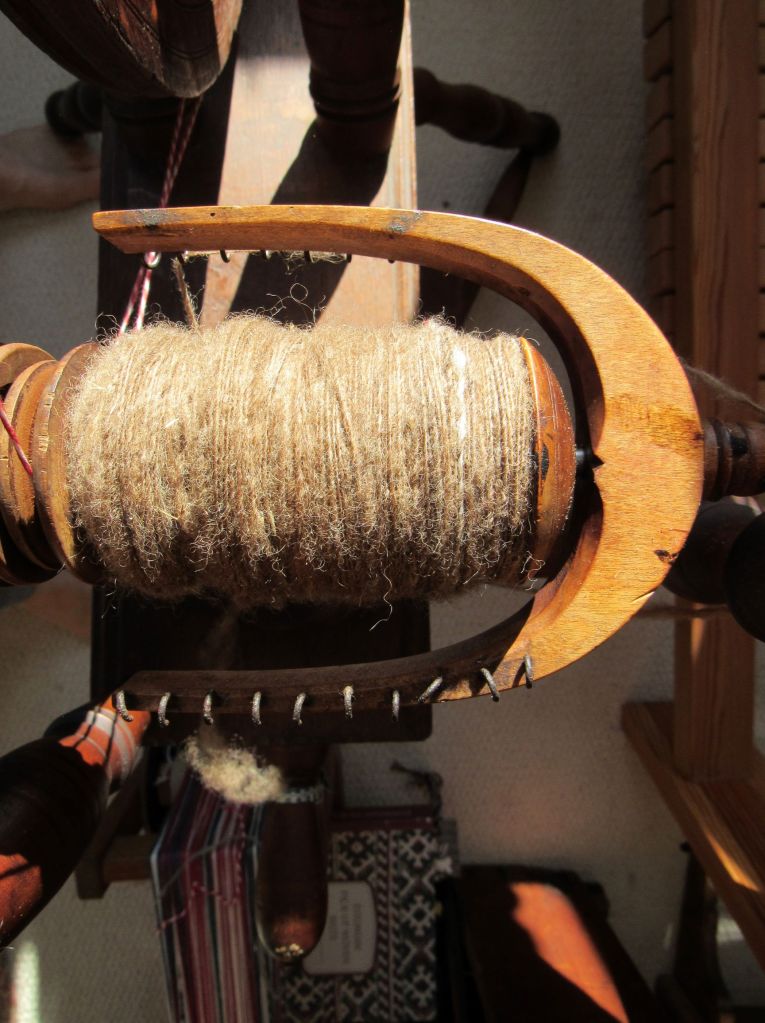
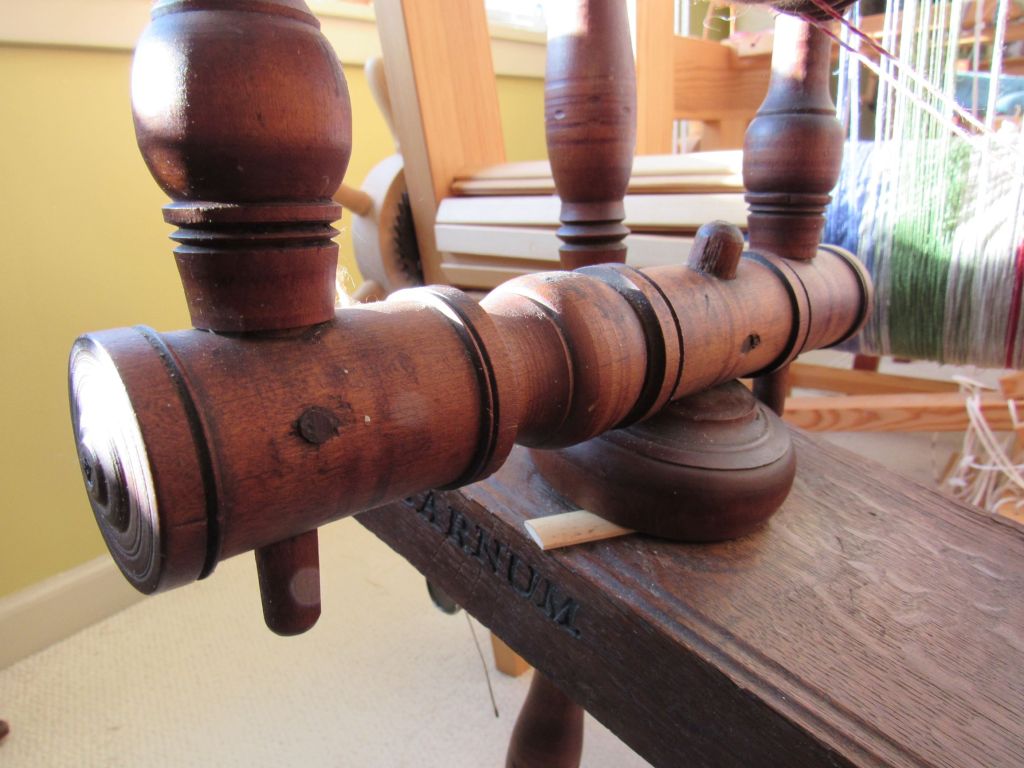
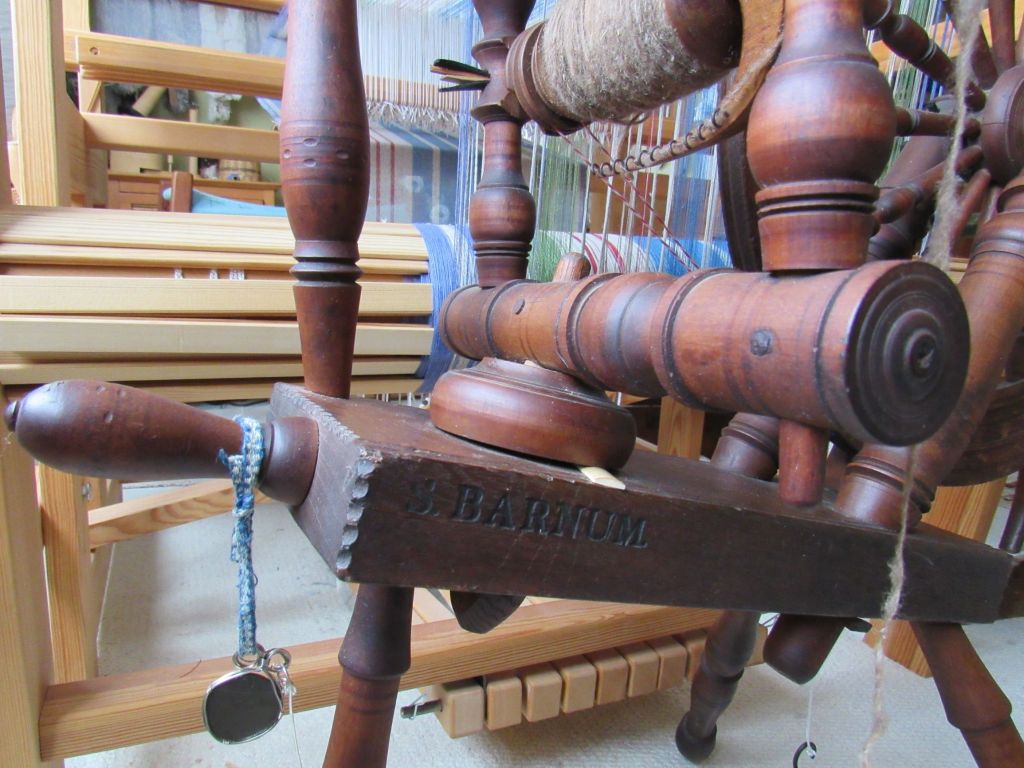
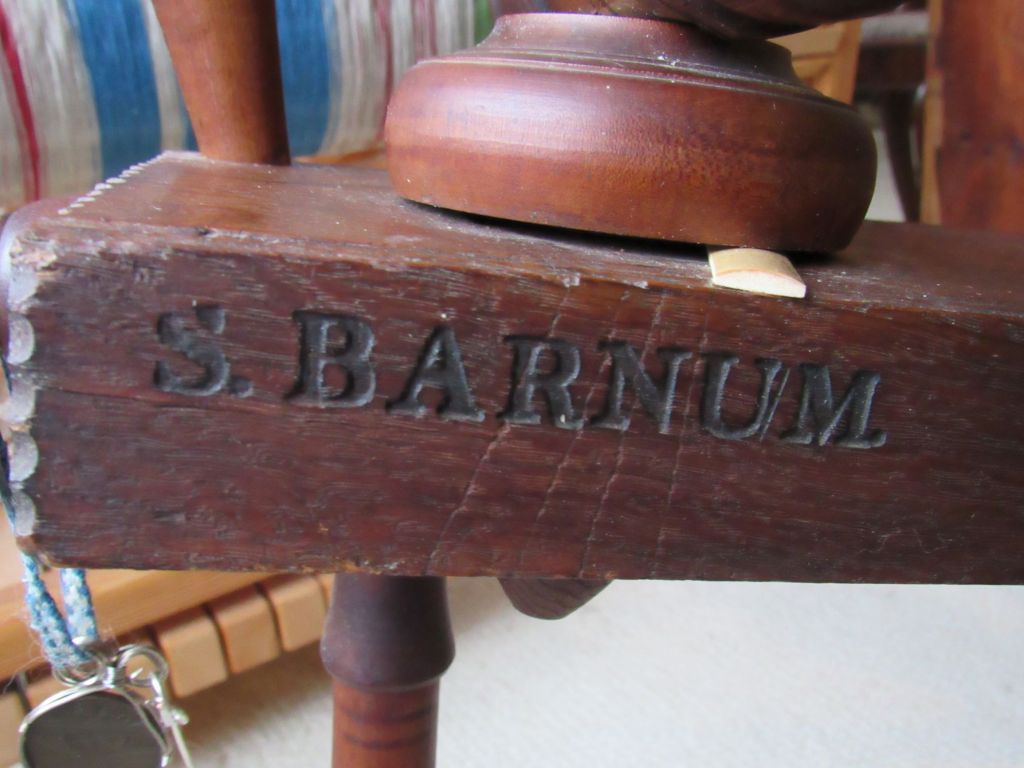
This wheel—made more than two hundred years ago—is a testament to the superb skills of Connecticut wheel makers in the late 18th and early 19th century.  It was made by Silas Barnum (1775-1828), one of a group of wheel makers from southwest Connecticut, who are most well-known today for their double flyer wheels. 

From this group, the most well-known are Solomon Plant, the Sanfords, the Sturdevants, and Silas Barnum.  The earliest, born in the 1740s, included Solomon Plant and Samuel Sanford, two men who likely were making wheels before the Revolution.  A second generation, born in the 1760s and 70s, arose with John Sturdevant, Jr., Isaac Sanford (Samuel’s son), and Silas Barnum, who, in turn, were followed by another generation, born in the 1790’s, including Beardsley Sanford (Samuel’s great-nephew), Elias Bristol Sanford (Isaac’s son), Josiah Sanford (Samuel’s son by his second wife), and John Sanford Sturdevant (John Sturdevant Jr.’s son). 

J. Platt appears to have been part of this group, too, but, as far as I know, no one has determined just who he was.  These men, and a few others, made wheels of a distinctive style, recognizable immediately as having come from a particular time and place in our history.   

For more on these wheel makers, see the previous posts: “Mindful Pond” (Solomon Plant); “Louisa Lenore” (Sanfords); and “Katherine the Witch,” “Mercy,” and “Judith and Prudence” (J. Platt). 

To help keep these wheel makers sorted out, in a previous post about Silas Barnum, “Big Bear,” I included a timeline, map, and family history that helps to understand how these particular wheel makers were connected.  All of them were from families that settled on the Connecticut shore in the 17th century and gradually migrated inland. 

Their family names are found repeatedly, along with Platts, Pecks, Smiths, Beardsleys, and others, in the history of this area.  Silas’s mother was a Sturdevant, his older sister, Sarah, married wheel maker, John Sturdevant, Jr.  Their son (Silas’s nephew), John Sanford Sturdevant (likely named after his Sanford grandmother) was also a wheel maker.  Silas married Martha Platt, although whether she was related to wheelmaker J. Platt remains a mystery. 

While there is ample evidence of family relationships between Barnum and other Connecticut wheel makers, we know little about their working relationships.  Did Barnum work with his brother-in-law, Sturdevant, Platt, or any others?  How well did these men know each other?  Was their wheel making competitive or cooperative, or a likely mix of the two?  We just do not know. 

We know that Barnum, the Sanfords, the Sturdevants, and likely Platt, worked in neighboring towns and their wheels share some remarkable similarities, so there was cross-pollination, but it would be fascinating to know more about the interplay of design influences, creativity, innovation, and marketing. 

Platt in the front (with new treadle), Barnum in the back

For example, in trying to determine how J. Platt fit into this group, I was struck by the remarkable similarities between Platt and Barnum’s great wheels (see “Big Bear”), which seemed to indicate some relationship between the two men.  But, when I found Barnum’s flax wheel, I was surprised by how different it was to Platt’s in the details.  

Was the difference one reflecting the time they were made or just the personal style of the makers? 

Barnum’s wheel is more finely and elaborately turned and has the small chip carvings dotted on decorative black bands so typical of these Connecticut wheels (but missing from Platt’s).

The spokes, also, are different.

Barnum’s spokes are more elaborate. He used the wonderfully-named “shotgun shell and olive” style, often found on Connecticut and Pennsylvania wheels of this era. 

Despite these differences, though, both wheels share the same overall look and excellent craftsmanship typical of this group of wheel makers.

Barnum’s fine work on this wheel is illustrated by the spokes. 

They rest up against the rim lip, with pegs cut perfectly flush with the drive rim. 

Who knew a spoke peg could be a thing of beauty?

Despite the wheel’s impressive age, not a spoke has a wiggle or gap, and the drive wheel is perfectly solid, straight and aligned.  The drive rim’s four parts have different patterns of shining ray flecks that glow in the sun. 

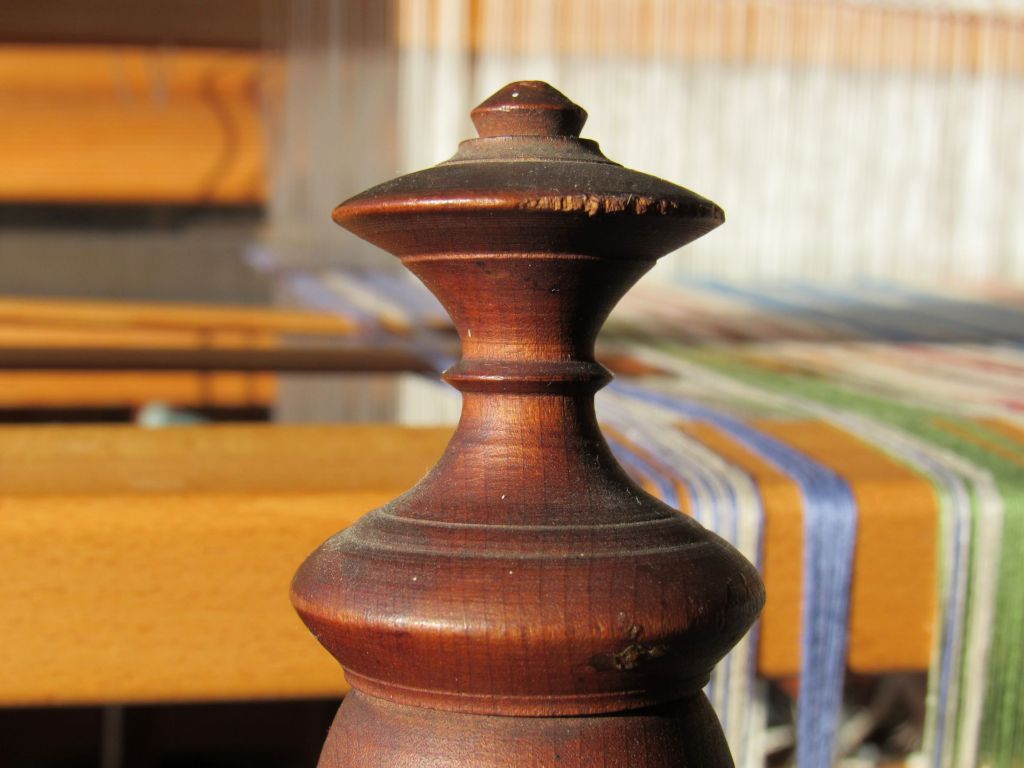
There are fine turnings on the maidens and distaff (the top part is missing). 

In contrast, the table is a bit more crude,

appearing to have been cut from an imperfect chunk of lumber, with one bottom edge at an angle and a concave area on the top.  

Perhaps Barnum chose it for the grain, which, as with the drive rim, has highly contrasting fleck.   

The table underside is smooth, without scribe marks. 

The wheel end legs stick up through the table. 

Each leg as a nail in the bottom, which is fairly unusual, in my experience. 

I often find one in the far-side leg, but seldom in all legs. 

The wheel shows considerable use,

but is in excellent working condition.

The treadle is almost worn through at the front

and right side edge and bar. 

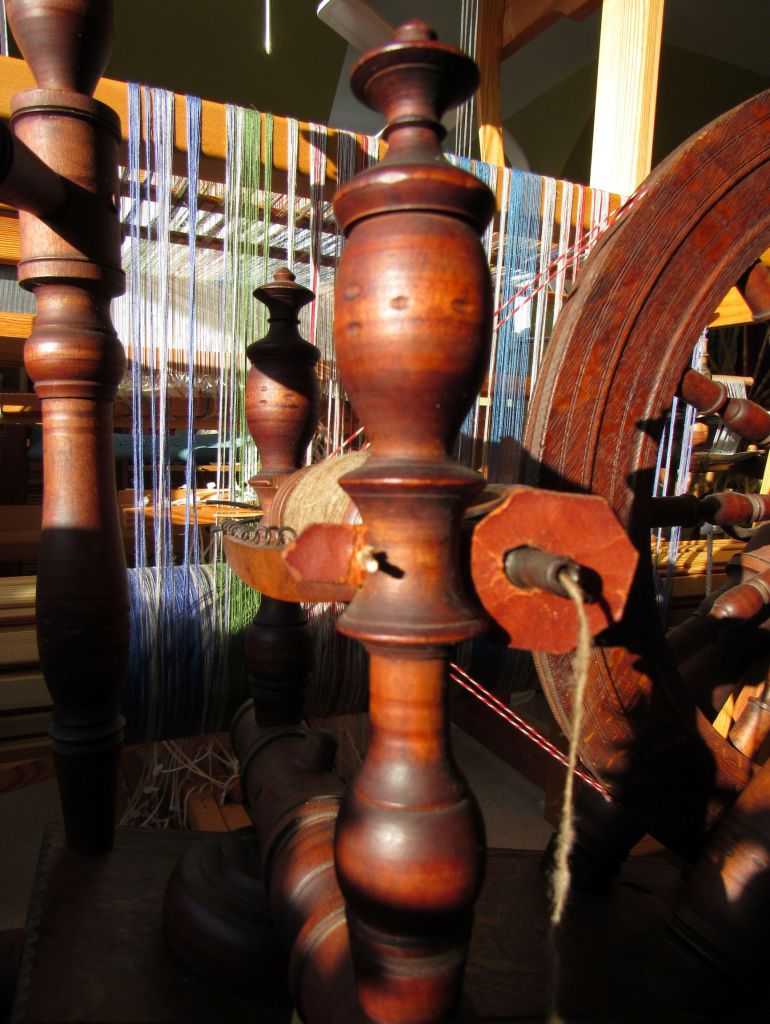
The original flyer assembly is missing.  It came with a funky one that likely was made in the 1970s or so.  I replaced it with one that fits perfectly and has its own elegant style, well-suited to the wheel. 

The spinner-side maiden is pegged into the mother-of-all

but the far-side one only has small peg underneath,

which keeps it in the mother-of-all but allows it to turn for easy flyer removal of the flyer. 

The tension knob shows no signs of wear from being used for winding off. 

There is one unturned secondary upright support that runs to the table. 

This is a common feature seen on these Connecticut wheels.  There are chip carvings on both ends of the table

and deep double grooves down each side. 

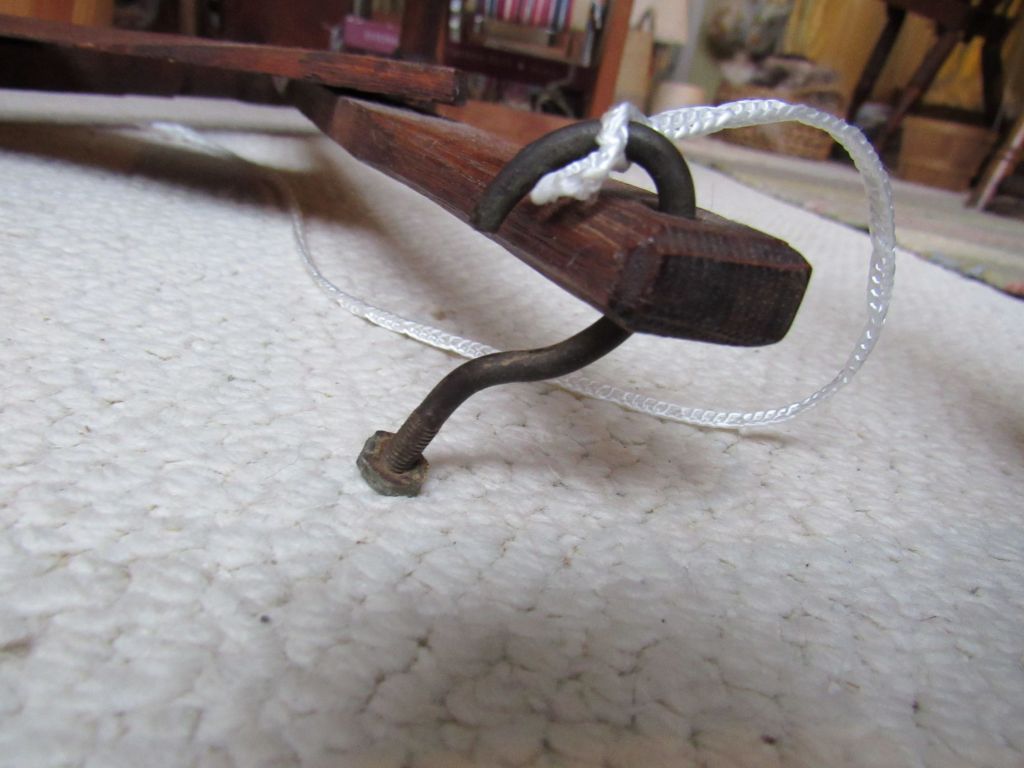
It came with a rawhide footman attached to the treadle bar with a metal hook with a nut underneath. 

As I mentioned earlier, Barnum’s life spanned the period at the end of the first generation and beginning of the next generation of these Connecticut wheel makers. 

To some extent, this must have been a transition period.  His spokes and turnings are similar to Solomon Plant’s, but a little more refined. 

The olive and shotgun shell spoke was found on the early Sanford wheels and those of John Sturdevant Jr. and Solomon Plant.  But, the later Sanford wheels evolved to have simpler spokes and finials, which according to Pennington & Taylor’s book “Spinning Wheels and Accessories,” this evolution reflected the change in style to plainer turnings for furniture in the 1810s to 1830s (p. 81). 

 Barnum did, interestingly, venture into a style of double flyer wheel that the later generation of Sanfords embraced, with the wheel above the flyers rather than below.

Kelley’s wheel

In discussing this style wheel, Pennington & Taylor highlight one made by Elias Bristol (E.B.) Sanford, who was born 16 years after Barnum (p. 82-83).  E. B. Sanford apparently patented the wheel in 1816.  It had unusual metal flyers, but the tension system looks very similar to a wheel signed by Barnum, which was discovered languishing in a North Carolina junk shop by Kelley Dew a few years ago. 

Kelley generously shared photos of her wheel,

showing similarities to E.B. Sanford’s, even down to the unusual decorative black marks on the wheel post. 

There are differences in the wheels,

but enough similarities to indicate that one maker influenced the other. 

Elias Bristol would have been about twenty-five years old when his patent was granted, while Barnum would have been forty-one. 

Did the older Barnum first make his wheel and then Elias Bristol improved and patented it? 

Or did Barnum take from Elias Bristol’s design, possibly without the patented parts?  Who knows? 

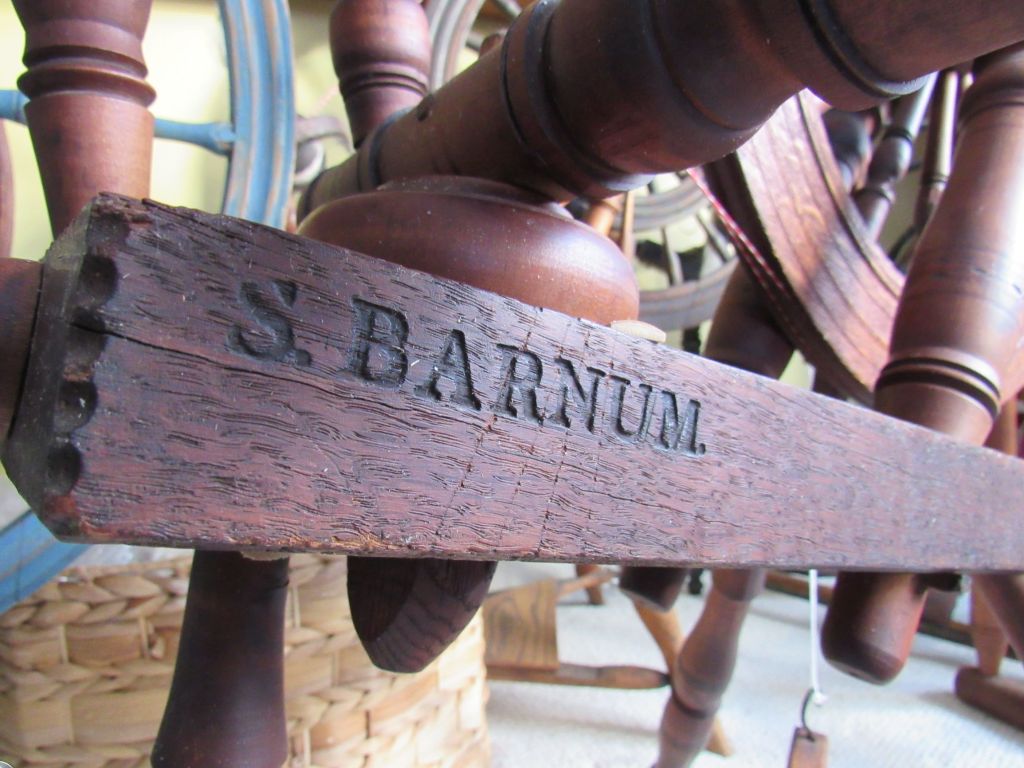
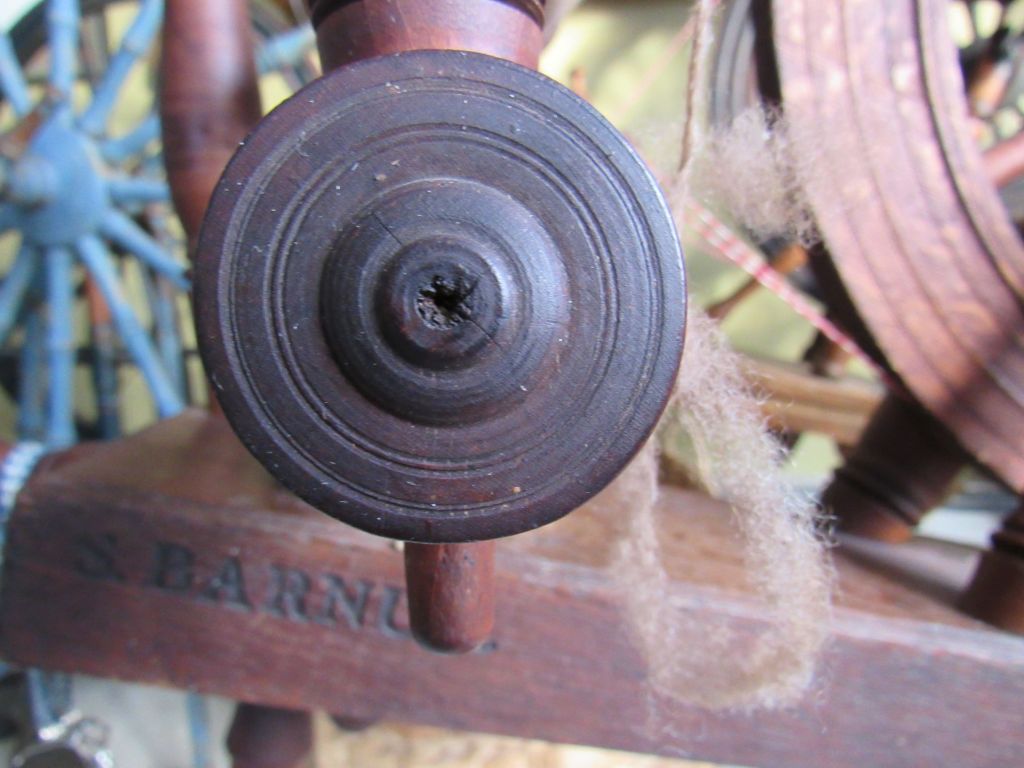
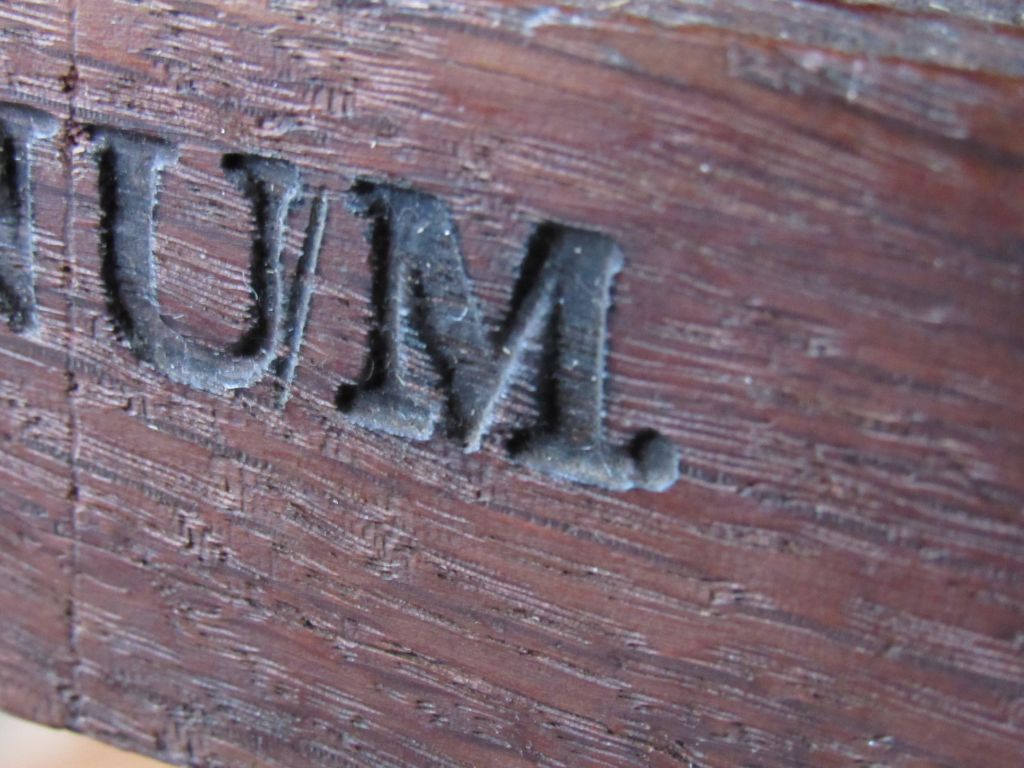
The “N” on the stamp is worn down, possibly indicating this was a late wheel of Barnum’s

Fascinating to think about, though.    

The letters are crisp on Olive Peck’s Barnum stamp

I am still hoping to learn more about Silas Barnum. 

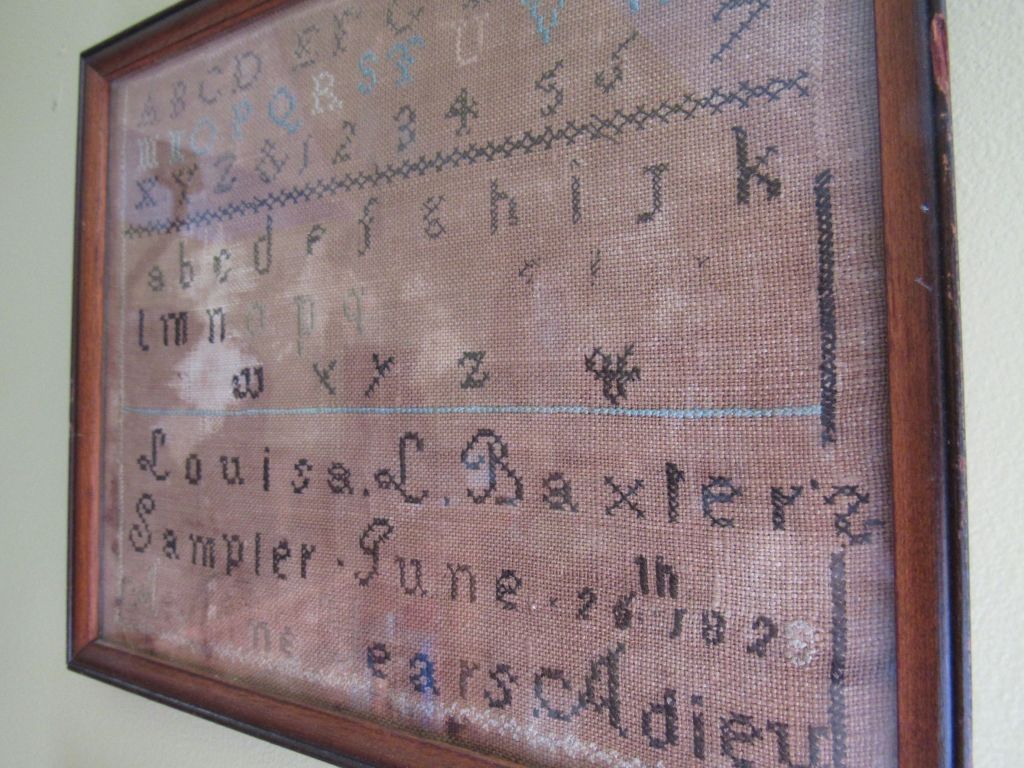
I knew that I had Barnums in my Connecticut family background and recently learned that my great, great, great, great grandmother, Hannah Barnum Baxter, was Silas Barnum’s older cousin. 

She married and moved to upstate New York before Silas was born, so likely never knew him.  But spinning on a wheel made by someone sharing a small part of my ancestry gives me a special thrill of connection.  

My great, great grandmother’s sampler. Silas Barnum was cousin to her grandmother, Hannah Barnum Baxter.

Thank you to Kelley Dew for allowing me to share her photographs of her stunning Barnum double flyer wheel.

For more information

Bacheller, Sue and Feldman-Wood, Florence, “S. Barnum and J. Sturdevant Double Flyer Wheels,” The Spinning Wheel Sleuth, Issue #31, January 2001 (and “Update” Issue #32, April 2001).

Pennington, David A. and Michael B. Taylor. Spinning Wheels and Accessories. Atglen, PA: Schiffer Publishing, Ltd., 2004, pp. 81-83.   

Truus

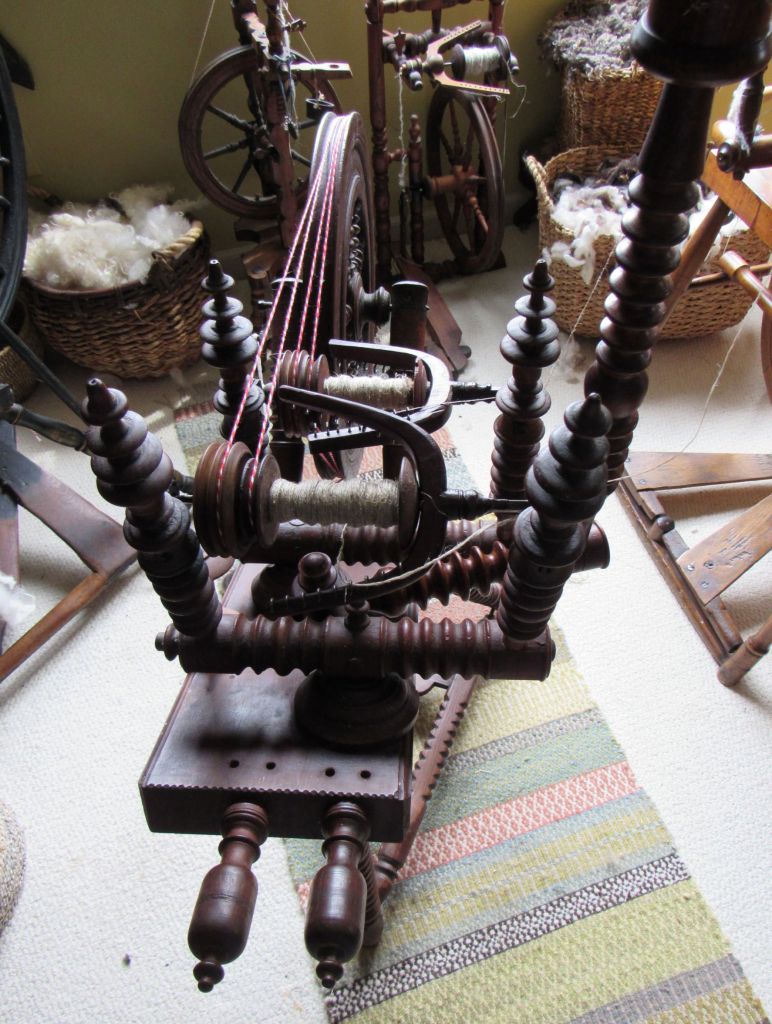
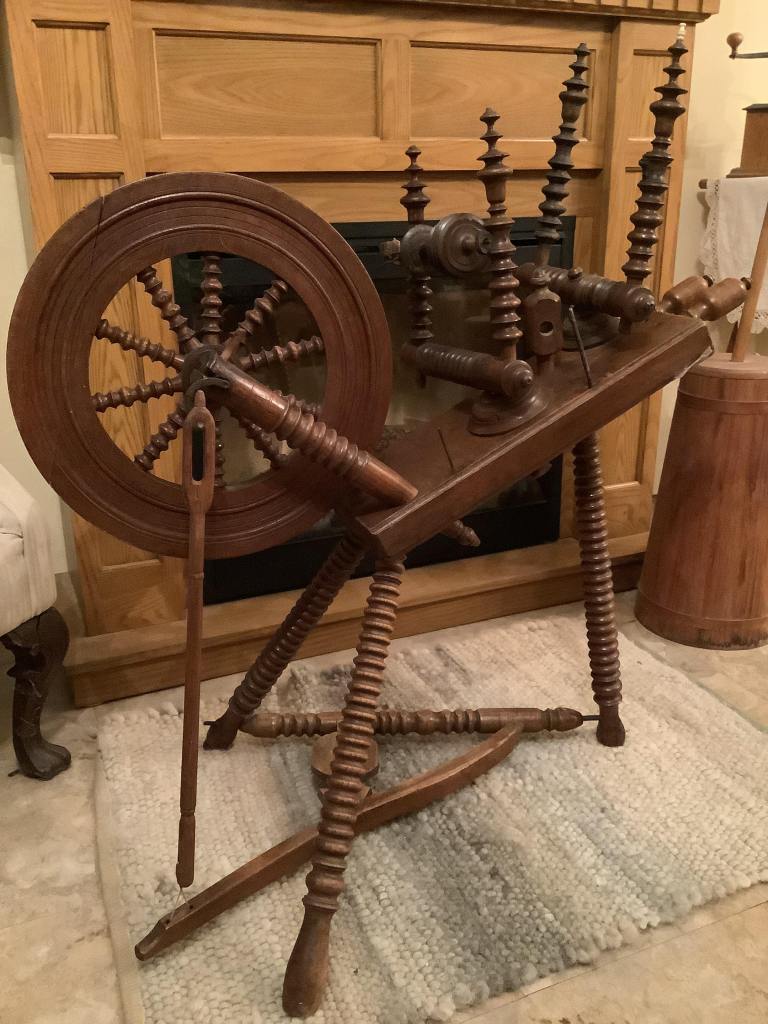
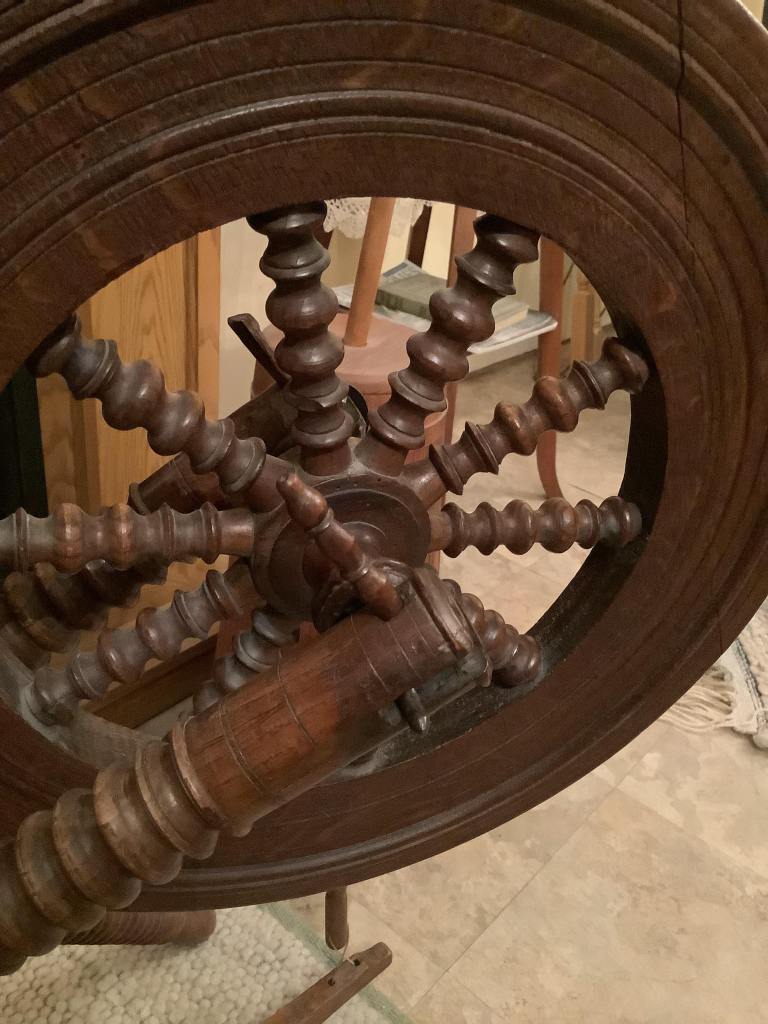
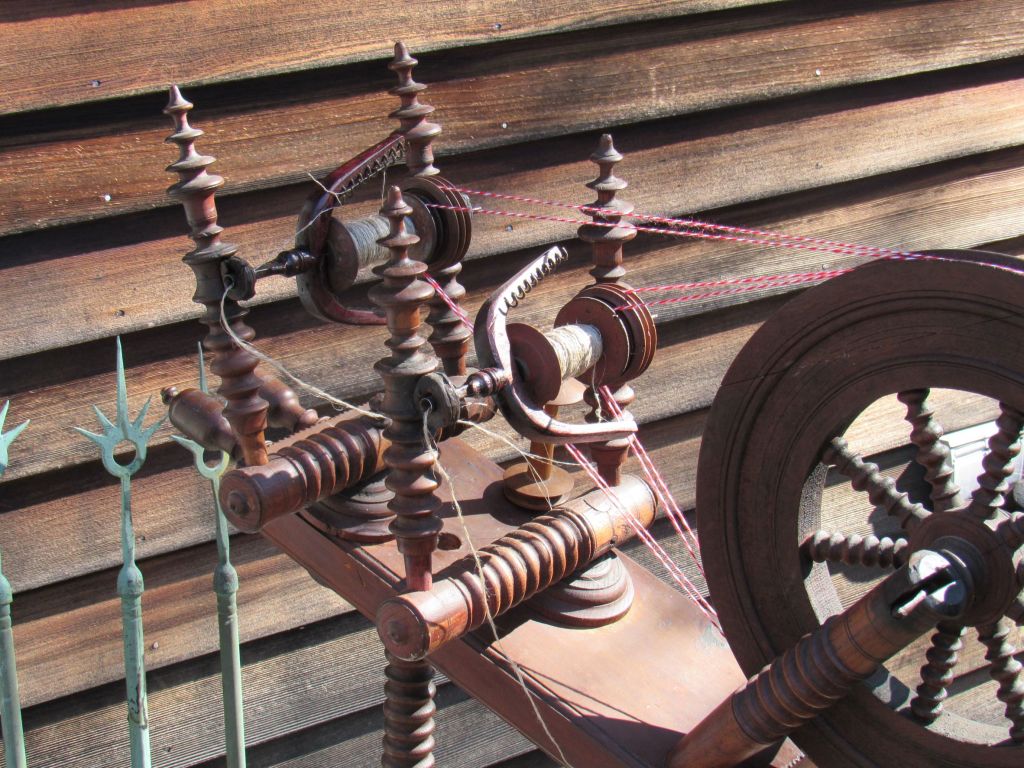
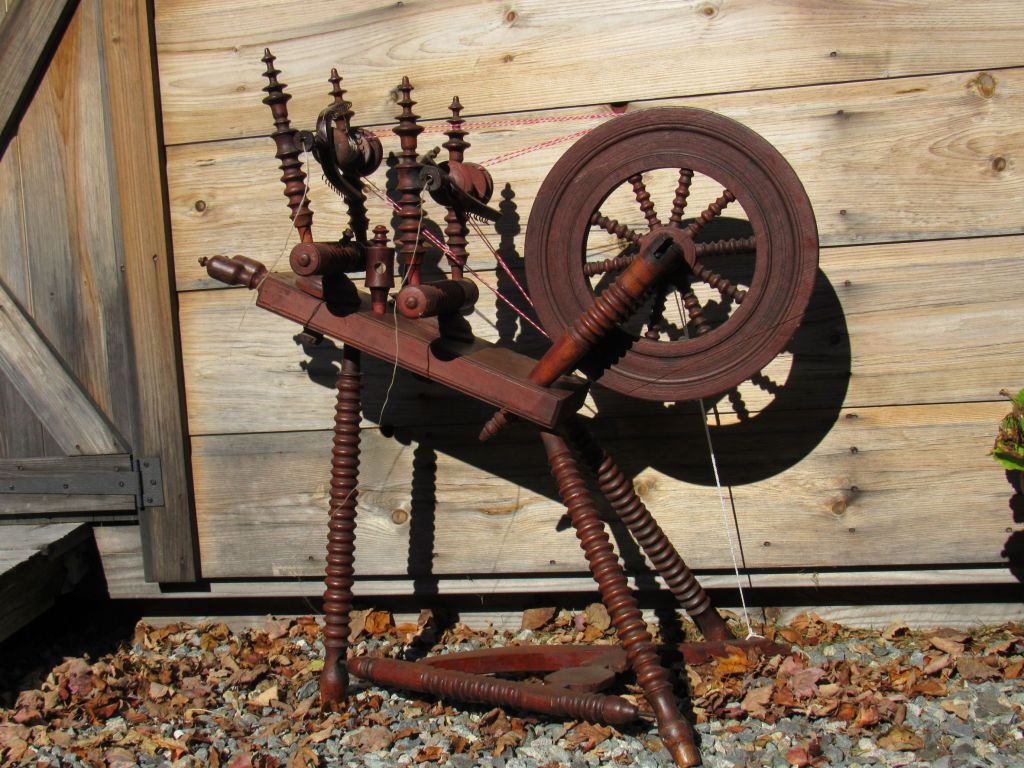
Truus is a striking combination of form and function. 

The turnings on this Dutch wheel are almost mesmerizing, especially when light strikes them through a window.  Long and short rows of ridges at various angles, topped by four maiden spires—wheel sculpture. 

In a dim interior before electric lights, candle and fire light would have highlighted and accentuated the ridges, creating an intricate interplay of light, dark, and shadow.  Today, even in a room full of beautiful wheels, this one captures the light, becoming the center of attention. 

Not only a treat for the eyes, it is a little workhorse.  With two flyers, side by side, a spinner can spin flax at a much greater rate than with a single flyer (for more information on a double flyer wheel’s increased production, see the end of the earlier post “Louisa Lenore”). 

This wheel’s design is especially nice for two handed spinning because each flyer has a separate tension system, which allows the spinner to fine tune the tension of each flyer to closely synchronize their uptake rates. 

In comparison, the tensioning on Connecticut double flyer wheels seems crude, because each tension adjustment has some effect on both flyers, making it more difficult to find that sweet uptake spot, especially if one of the flyers is a replacement.  I have spun on several different styles of double flyer wheels and, to me, this one is by far the easiest to achieve consistent two-handed spinning.  It is a very sweet flax spinner.

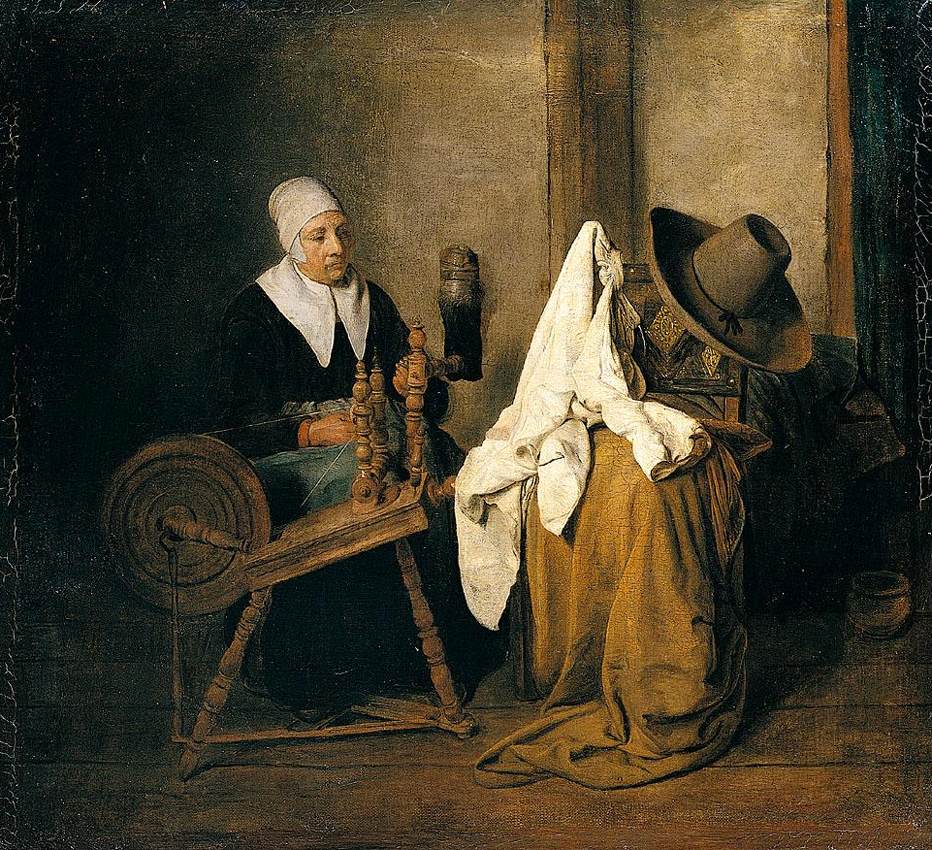
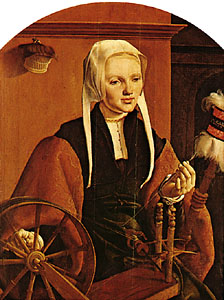
Historically, Dutch wheels were made in a variety of styles, reflected in a richness of paintings.

Esaias Boursse–Interior With an Old Woman at Spinning Wheel
Maerten van Heemskerck–Portrait of a Woman at the Spinning Wheel

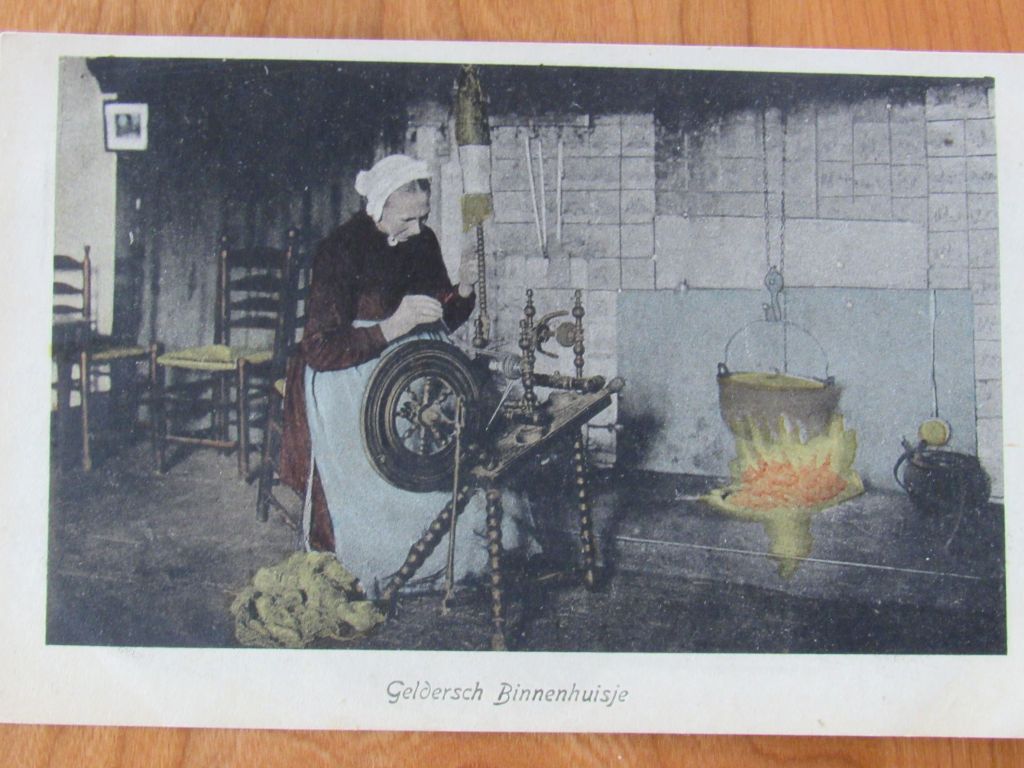
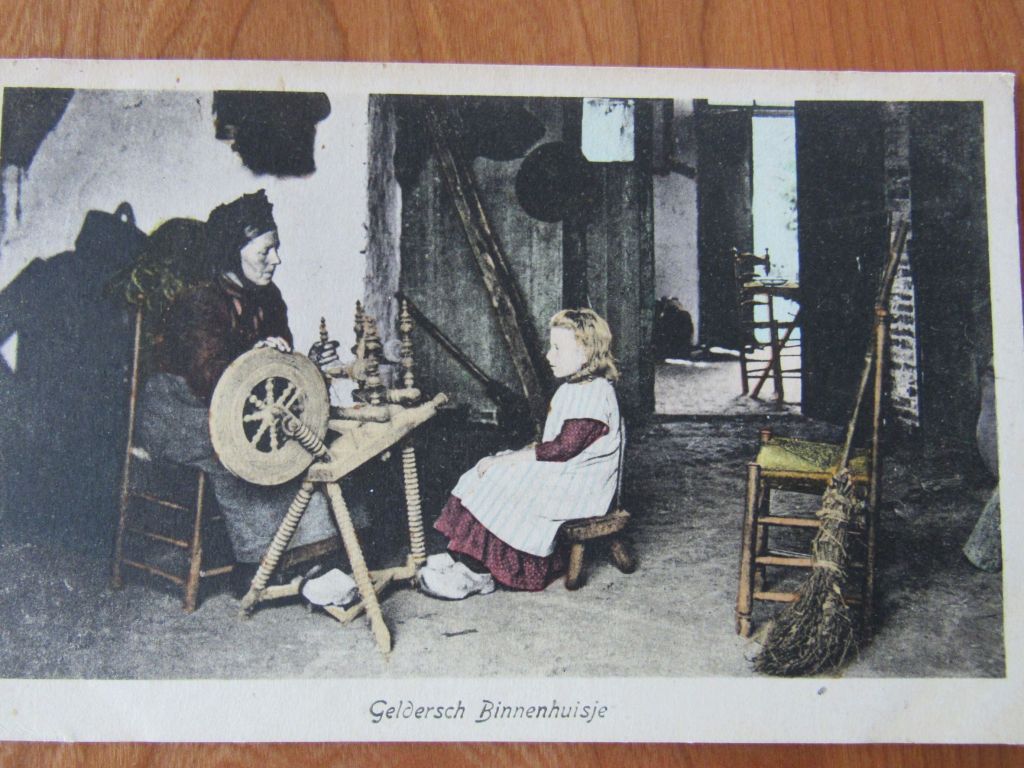
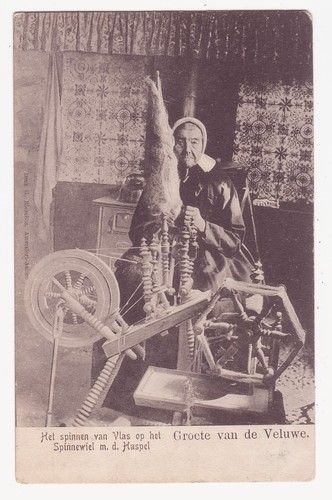
Most of the Dutch double-flyers, however, seem to look much like Truus, with small variations.  These postcards of double flyers are entitled “Geldersch Binnenhuisje.” 

Binnenhuisje is a home’s interior and, I believe, Geldersch refers to the province of Gelderland, in the east central area of the Netherlands. 

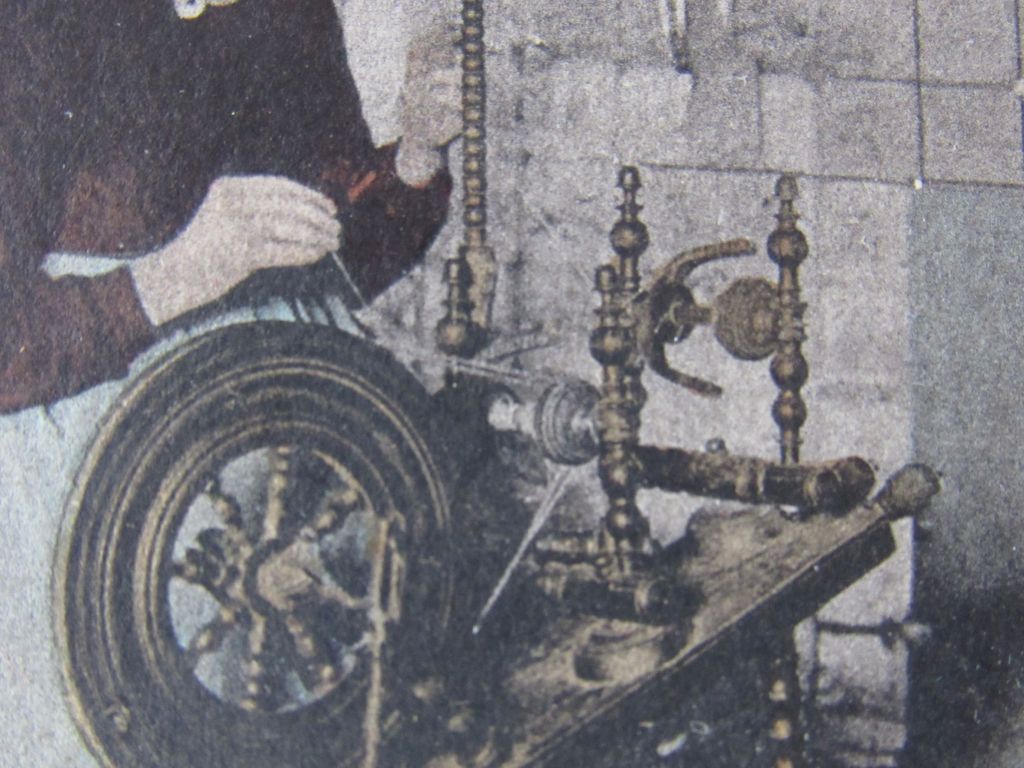
This woman appears to have threads going to both flyers but only one flyer seems to have a drive band or any accumulation of thread. 

The wheel in the above postcard does not even have a footman, but it is a lovely and instructive prop. My favorite card, identifying a woman spinning flax on a wheel with a reel, is intriguing because the wheel appears to be almost identical to Truus, right down to the bobbin holders. 

The card reads, “Groete van de Veluwe,” meaning “Greetings from Veluwe”–a region in the Gelderland.  Perhaps these wheels were a Gelderland style.  And, possibly, many were made by the same maker.  Several identical, or nearly so, wheels have turned up in widely different locations around the world.   One wheel, featured in Issue #65 of the Spinning Wheel Sleuth, and looking just like Truus, was found in Australia.  According to the article, that wheel had “W&H” or “M&H” handwritten on the base of the upright forks.  (SWS #65, pp.9-10).  Interestingly, another sister wheel, bought in Gelderland, was posted on Ravelry about seven years ago, with an “HW” stamped on the end of the table. As far as I know, no one has identified “HW” or determined if he may have been a primary maker of these wheels.

Ginnie’s wheel

Several similar wheels have been found around the United States, but, as far as I know, no others have maker’s marks. 

Ginnie’s wheel

A few have some ornamentation, perhaps ceramic or porcelain, including the wheel above owned by Ginnie Schirmer in Kansas. Aside from the bits of ornament, her wheel looks just like Truus, although it has an axle pin, perhaps original.

Ginnie’s wheel

Truus’ axles came pinless.

True to her Dutch roots, Truus turned up for sale in Michigan, in an area heavy with Dutch immigrants.  A wonderful woman in Michigan (now a friend) kindly picked her up, fostered, and eventually railroaded her east. The wheel was in pretty good shape but had no distaff parts and both flyers were split down the middle at the orifice end.

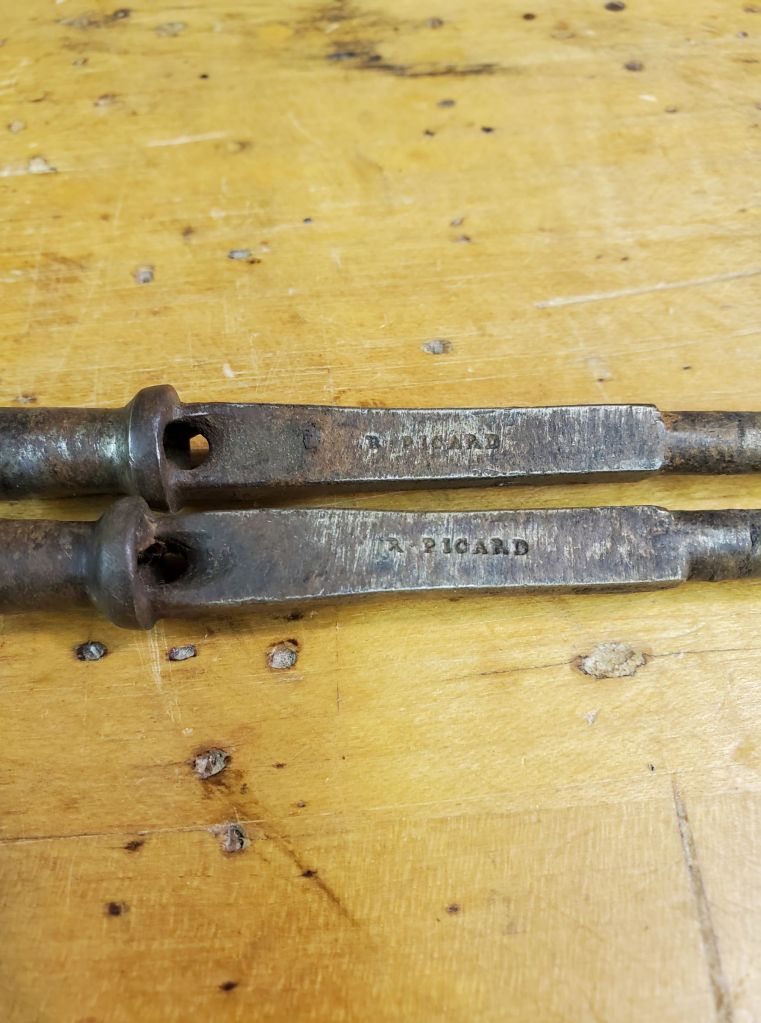
I was thrilled, though, to have both flyers, damaged or not.  I sent her off to John Sturdevant at SpiritWood for repair and to have a distaff made.  When John started the flyer repair, he was surprised to discover, in a mandrel section that had been covered by the wooden flyer, the name “R. Picard” engraved the metal on both flyers. 

Try as I might, the only R. Picard I have been able to find is a Raphael Picard, who founded a watchmaking company in 1837 in La Chaux-de-Fonds, Switzerland.  It seems unlikely that he would have made spinning wheel mandrels for Dutch wheels.  But perhaps there is some family connection.   

While Picard’s engraving shows that both flyers likely are original, they are not identical.  One is slightly longer and has a nipple end on its whorl. 

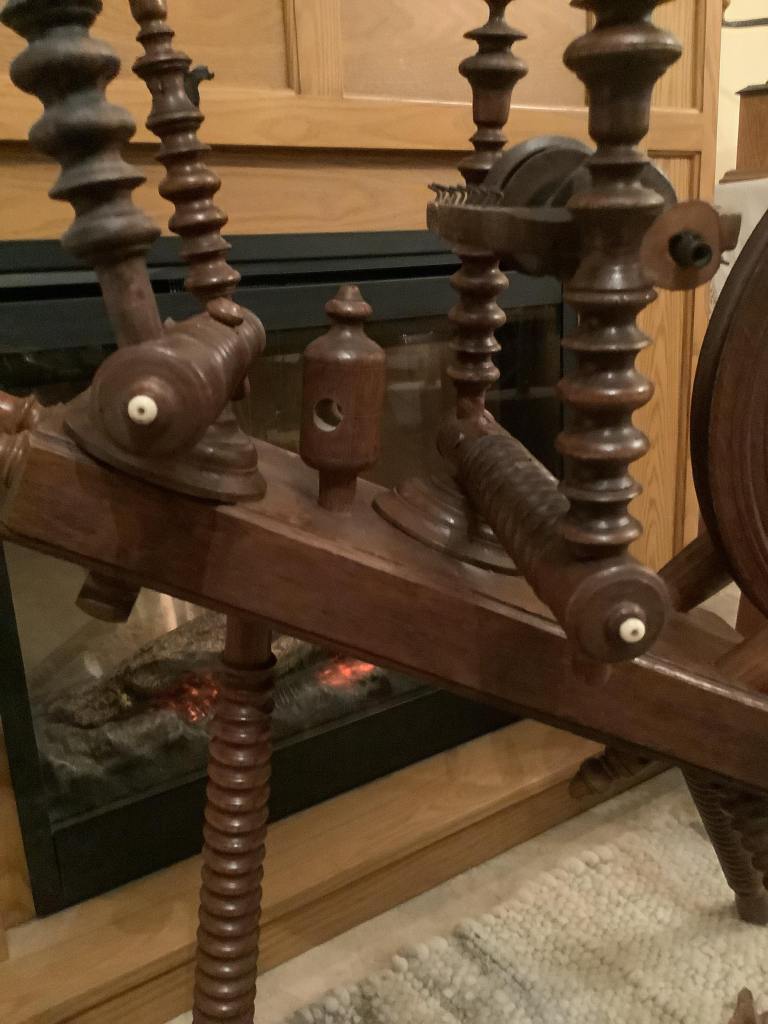
Both whorls have a feature sometimes seen on Scandinavian wheels—a lipped recess on the flyer whorl in which the bobbin neatly nests. 

Ginnie’s wheel has the same nested bobbin

On both flyers, the wood is cut back from the mandrel on both sides near the orifice.

Another distinctive feature of these sister wheels is a curved treadle bar

and arrow-ended treadle. 

My wheel has wear showing that it was treadled with both feet, perhaps with wooden klompen as in this postcard. 

The ends of the treadle bars look handcarved,

as are the tension knob pegs,

which fit so perfectly in the holes that I’m still working on matching the pegs back to the correct holes. If they are lined up just right, they do not need to be hammered in.

Decorative touches are everywhere,

except for the drive wheel rim,

which has simple four-part construction.  

Ginnie’s wheel showing the collar extending past the table

The mother-of-all collar on the uphill side extends past the table

Truus’ collar overhang

and has a strong grain. 

Several areas have traces of red paint

and others are grease-encrusted. 

There were two metal upright rods for storing bobbins along the non-spinner side,

but one has broken off. 

Each flyer has its own drive band

and they seem to happily accommodate each other on the drive wheel without any fiddling on my part. 

The leather flyer bearings are three layers held together with metal rivets.

The distaff hole is between the two flyers. 

There is not much room for the lowest distaff piece.


In deciding on the distaff design, I worked with John.

I examined wheel photos and a friend kindly sent me photos and measurements from a wheel in Canada.  I am delighted with how it turned out. 

I understand why these wheels have ended up so far from where they were made.  They were a perfect combination of desirable features–lightweight, portable, and beautiful in form, while performing their function brilliantly as efficient and pleasurable spinners.  

Thank you to John, Rita, and Gordon for helping me to bring this wheel back to life and to Ginnie for sharing photos of her wheel.

For more information see:

Feldman-Wood, Florence, Two Double-Flyer Dutch Spinning Wheels, The Spinning Wheel Sleuth, Issue #65, July 2009.

SpiritWood’s link: https://www.spinningwheelrepairs.com/

Handsome Molly

I know little about the history of this stately wheel. A woman in southern Maine kindly gave it to me. She had bought it from a woman–not a spinner–who decided to sell it because it was taking up space on her porch. How and when this wheel made its way to New England likely will remain a mystery.

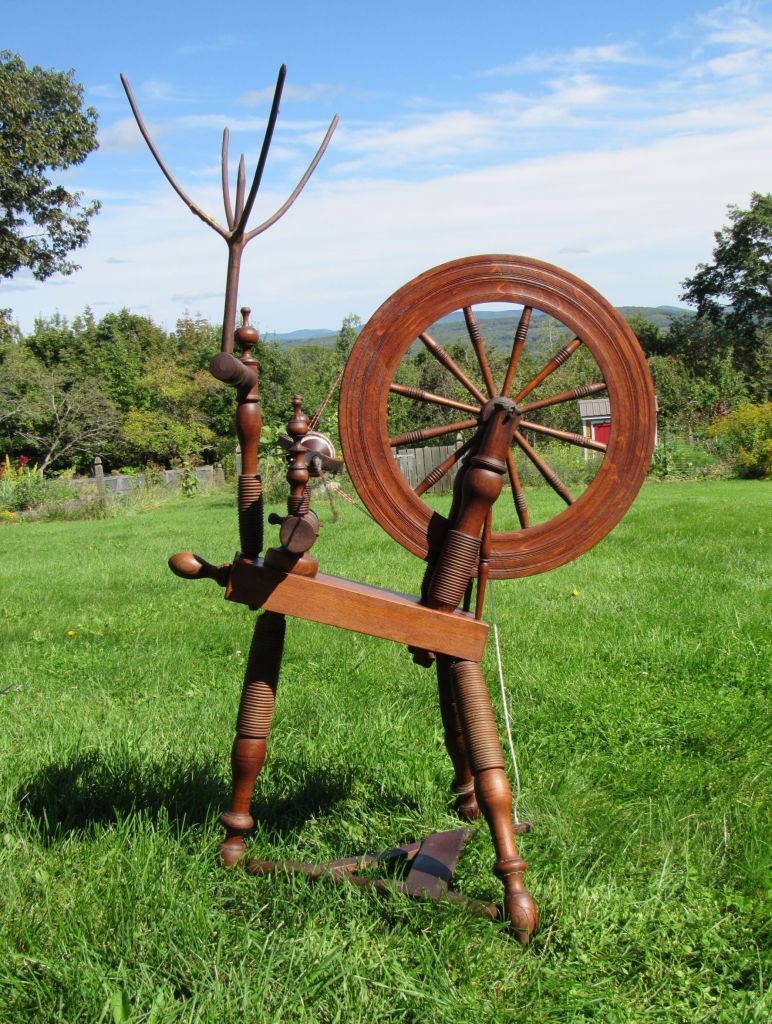
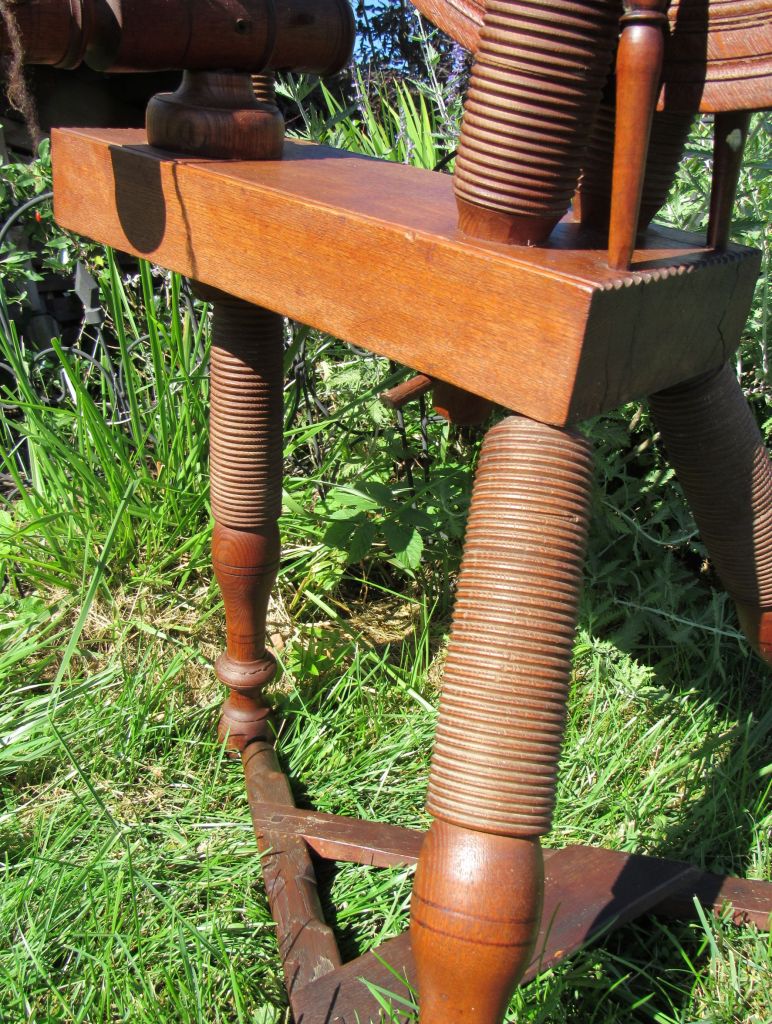
It almost certainly came from Ireland originally. It has the distinctive characteristics of an Irish wheel of this style–upright stance,

a drive wheel that sits close to the flyer but high off the table,

thick, solid legs,

and amazing reed turnings, row upon row of tiny ridges that look like perfect smocking.

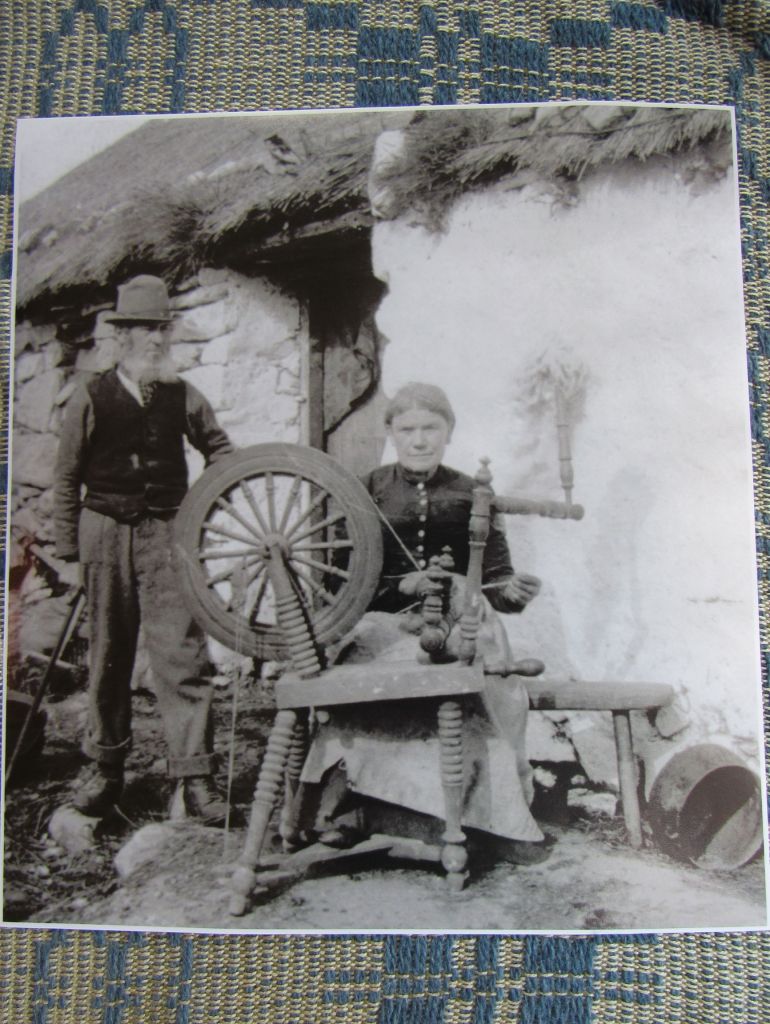
Old postcards and photographs show a variety of similar wheels being used in Ireland.

Interestingly, in these photographs, most of the footmen are string or cord (usually with a leather piece attaching to the axle) rather than wood, a contrast with North American wheels.

When starting to research this wheel, I posted a photograph on Instagram. Fortunately, Johnny Shiels, a third-generation wheel maker in Donegal, saw the photo and thoughtfully reached out. He sent me a photo of a very similar antique wheel from Donegal. And, his IG account spinningwheels.ie revealed photos of other lovely old Donegal wheels that he has restored.

This style wheel, which we usually refer to as a “Saxony” in North America, is known in Ireland as a “Low Irish” or “Dutch wheel.” Actually, early Connecticut probate records from the 18th and early 19th century often referred to them as Dutch wheels, too. These wheels were introduced to Ireland from Holland by Thomas Wentworth, later the Earl of Stafford, in the 17th century to encourage linen production.

While originally intended for flax spinning, they later also would be used for spinning wool.

Ireland also had spindle-style great wheels, often called “long wheels” for wool spinning. The wheel style that we, in this country, most often associate with Irish flax spinning, however, is the upright “castle” wheel. I have been curious as to whether the different styles were regional.

Were castle wheels and Dutch wheels both used throughout Ireland, or were they exclusive to different areas? And, were the turnings on the Dutch wheels specific to certain towns or counties?

The only information I have found so far is in the booklet from the Ulster Museum, which indicates that castle wheels were principally found in Ulster, explaining that they were “confined in distribution to the northern counties. The design provides good rigidity which is essential to efficient spinning.” Id.

The same stability applies to Handsome Molly, but derives from sheer size and weight. It is a remarkably large wheel, with long legs of substantial girth, and a wide heavy table.

It measures 43 1/2 inches tall, with an orifice height of 29 1/2 inches. The table is an ample 7 1/4 inches wide and upright circumference is 8 1/4 inches.

For comparison, it is almost a full foot taller than a typical Connecticut flax wheel made by Silas Barnum.

The legs on the Barnum wheel look puny compared to Molly’s generous proportions.

There is something about the sheer mass of this wheel that does affect spinning–giving a certain lightness and ease. Pure pleasure. There are signs of use on the wheel, but it is difficult to tell how much.

There are grease marks around the axles and some signs of treadle wear.

There appear to be some wear marks, from winding off perhaps, on the tension knob. The groove over the fat part of the knob looks just like the puzzling groove on the wheel Adelaide’s knob in a previous post.

Both maidens are pegged through the mother-of-all and do not turn.

They are in good condition and look much like the maidens on Green Linnet, in a previous post.

The distaff is made from a tree branch, typically used for spinning tow.

The distaff cross-support threads into the upright.

That is a feature I have never seen before, but brilliant to keep the distaff full of flax from tipping over while spinning (which it can do–I speak from experience).

The cross support also has what appear to be wear marks from thread or yarn, again, perhaps from winding off.

There are secondary upright supports on both sides, extending to the table.

Decorative marks ring the uprights and legs, both burned and incised.

The wood grain is interesting, somewhat wide and coarse

–perhaps oak, ash or a mix?

I do not have the original flyer yet. It still exists, but has been stored away and the hunt is on to find it. I am hoping that it will give more clues as to whether this wheel was brought to this country for use or for decoration. It cannot have been easy or cheap to transport across the Atlantic. But, I totally understand why someone would go to the trouble, because it is a magnificent piece of machinery.

I am extremely grateful that this wheel is now taking up space in my home. And, it is not relegated to the porch, but in a place of honor, creating beautiful yarn.

October 2021 update: Joan Cummer had a somewhat similar wheel in her collection, Wheel No. 30. In describing the wheel, she notes: “This wheel was made in the late eighteenth or early nineteenth century in Ireland. The turnings are Sheraton period with extremely fine reed turnings on the distaff … This has been a well made and very heavy wheel.” Cummer, Joan Whittaker, A Book of Spinning Wheels, Peter E. Randall, Portsmouth, NH, 1994 (pp. 72-73).

For more information see:

Johnny Shiels Inishowen Spinning Wheels, website here.

Evans, Nancy Goyne, American Windsor Furniture, Hudson Hills Press, New York, NY, 1997 (p. 214).

Ulster Museum, Spinning Wheels (The John Horner Collection); Ulster Museum, Belfast, Ireland 1976.

Hermione

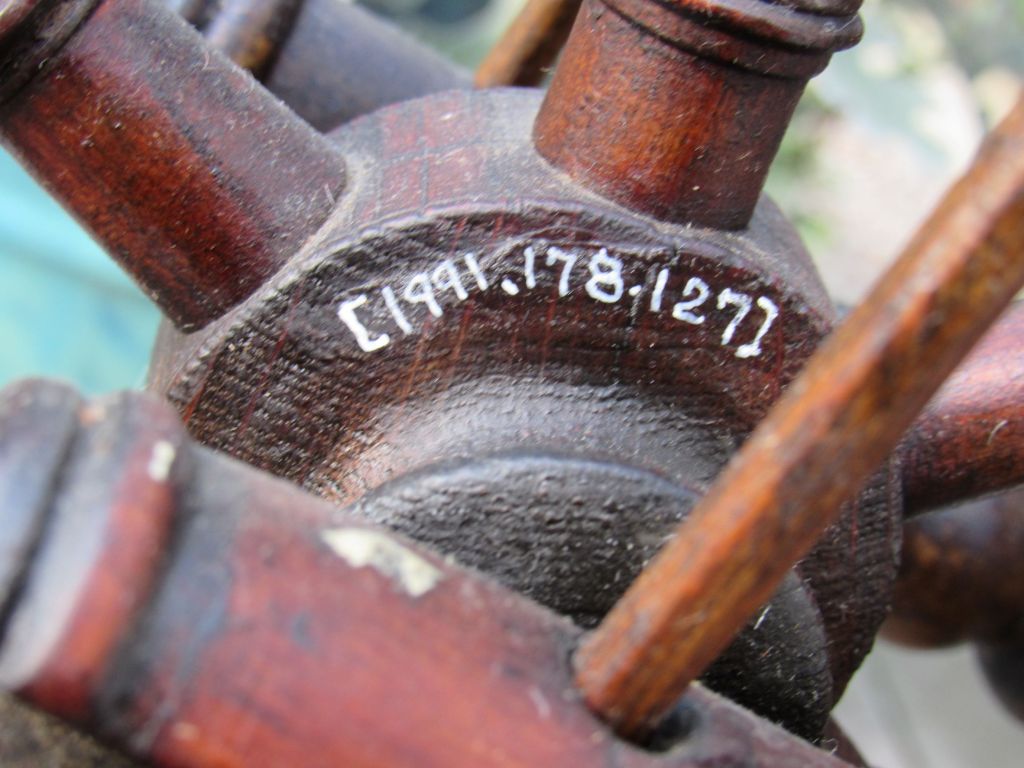
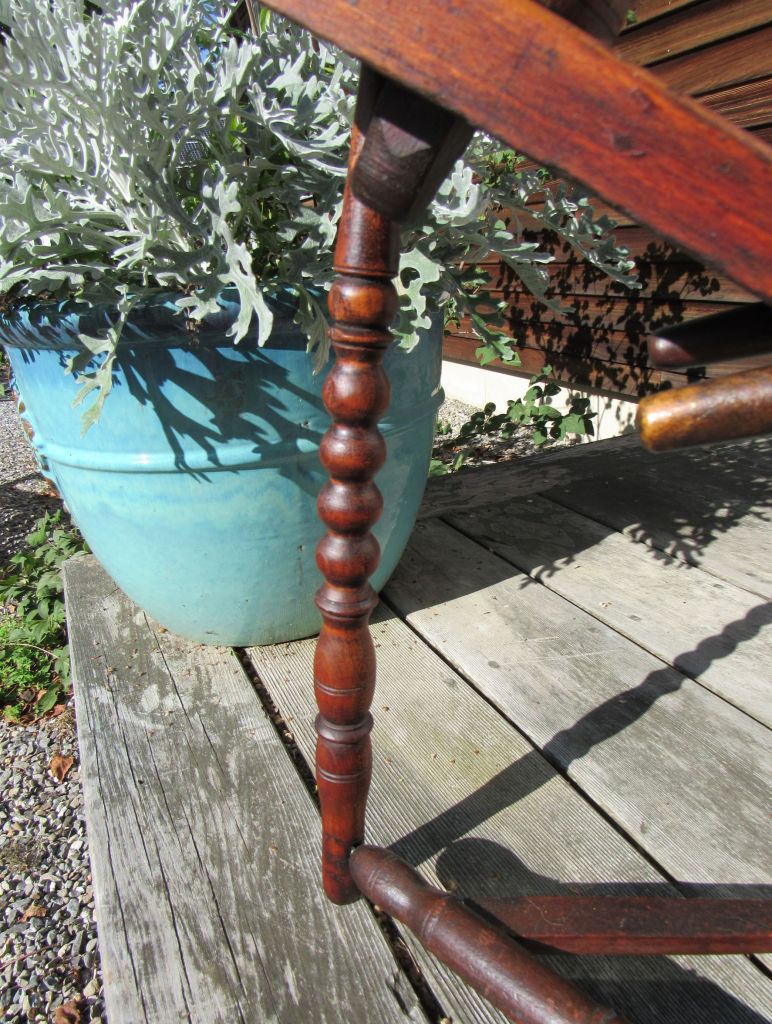
If the wheel in the previous post, Green Linnet, is the oldest I have owned, this wheel, Hermione, is the smallest. 

It is hard to convey just how tiny this wheel is and photos cannot capture how little it weighs. 

Such small wheels are often advertised these days as children’s wheels, which generally is considered an inaccurate description, since apparently children rarely got wheels of their own but learned to spin on full-sized wheels. 

Nevertheless, we do know that there were great wheels scaled down in size for children, so it is entirely possible that some small flax wheels were made for children, also.   

I do not dispute that children’s wheels were a rarity. This wheel probably was intended for and used by adults. But, I like to think that it may have been used, at least at some point in its history, by a child.  Because, if ever a wheel would appeal to a child, this is it.   At less than 24 inches tall, under 5 pounds, and beautifully turned, it would have been a powerful lure for a child to learn to spin. 

And what a good teacher it would have been. The wheel is an excellent, responsive spinner.  Despite its almost toy-like quality, it has a full-sized flyer assembly and spins like a much larger wheel.

Even though the drive wheel is petite, it does not require frantic treadling for a smooth, even uptake, but has a nice, easy rhythm.  The orifice height is 21 ½ inches, only two inches lower than some of my other small flax wheels. 

Its main advantage for an adult user would have been portability and ease of storage.  Its slanted stance gives it a tiny footprint.  Combine that with its feather weight and it can easily travel anywhere and be tucked in a corner or lifted to the top of a wardrobe when not in use.

As with several of my wheels, this one was part of Joan Cummer’s collection, auctioned off after the American Textile History Museum closed.  It is Wheel #127 in Cummer’s “A Book of Spinning Wheels,” on pages 274-75

It is hard to pin down the origins of this wheel–in time or place.  According to Cummer, the wheel was thought to have originated in England or northern Europe in the late eighteenth or early nineteenth century.

I would love to know how Cummer came to her conclusions. Tiny Saxony-style wheels are most often associated with Germany and eastern Europe and usually are not thought to be as old the eighteenth century. But this wheel does have a bit of a unique style. Based on the series of ball or bead turnings on the legs, Cummer may have compared this wheel to an English wheel made by Richard Arkwright, probably in the middle of the 18th century (for a photo of Arkwright’s wheel see Baines, Spinning Wheels, Spinners & Spinning, p. 124) to conclude that it could be an early English wheel. 

Nevertheless, the turnings are not really much help in accurate dating. Patricia Baines calls such turnings “knob turnery” and notes that it “could suggest the Cromwell period, nearly 100 years before” the estimated date of Arkwright’s wheel, while also noting that it is found on spinning wheels known to have been made in the nineteenth century. (Spinning Wheels, Spinners and Spinning, p. 123).

Nor do the turnings help much in determining place of origin. The legs’ series of knobs, balls, or beads (also referred to as “bubble” turnings by some) resemble those found on many Dutch and some German and Scandinavian wheels. Moreover, the drive wheel is scattered with decorations of a type found most commonly on small German and eastern European wheels. 

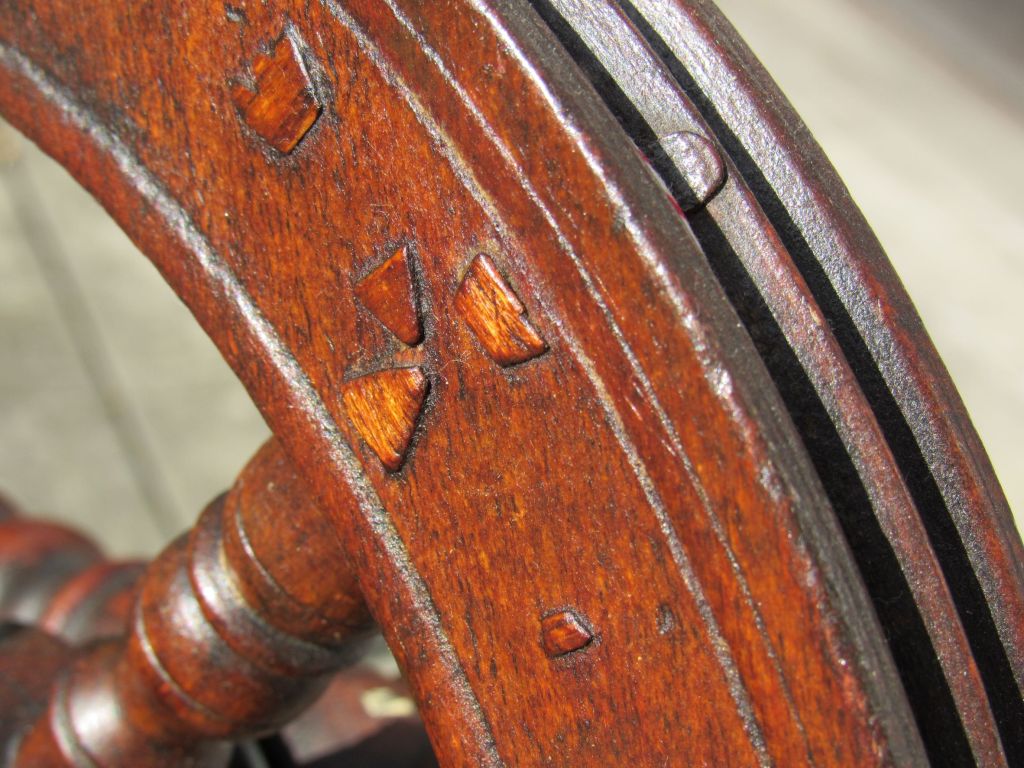
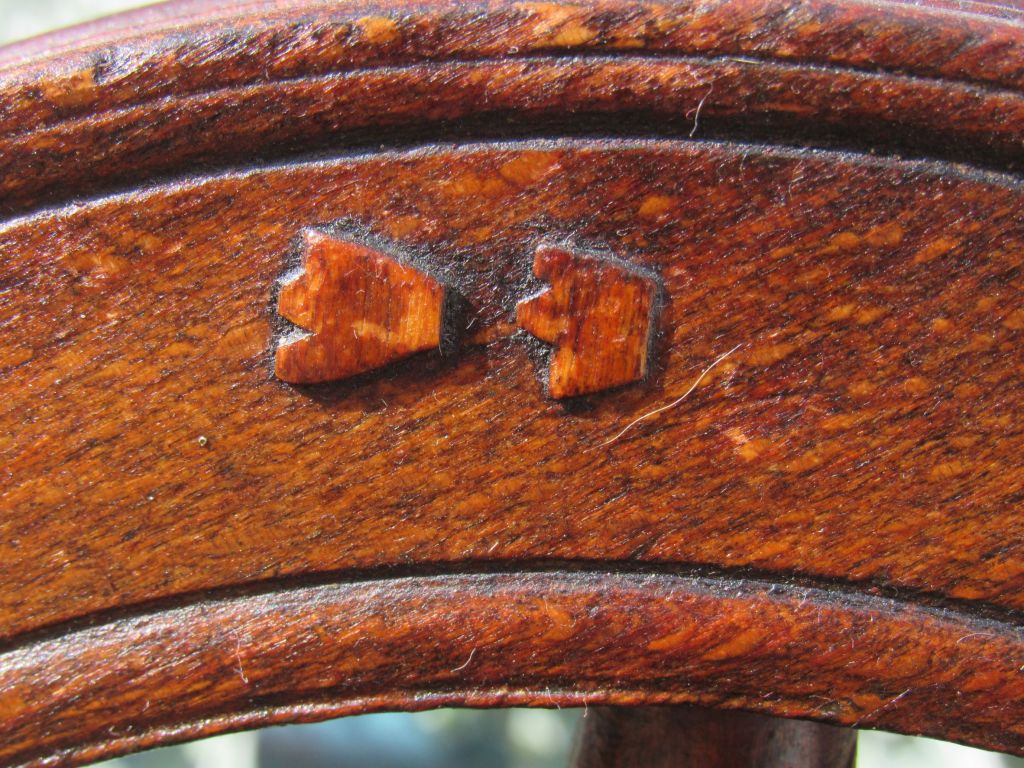
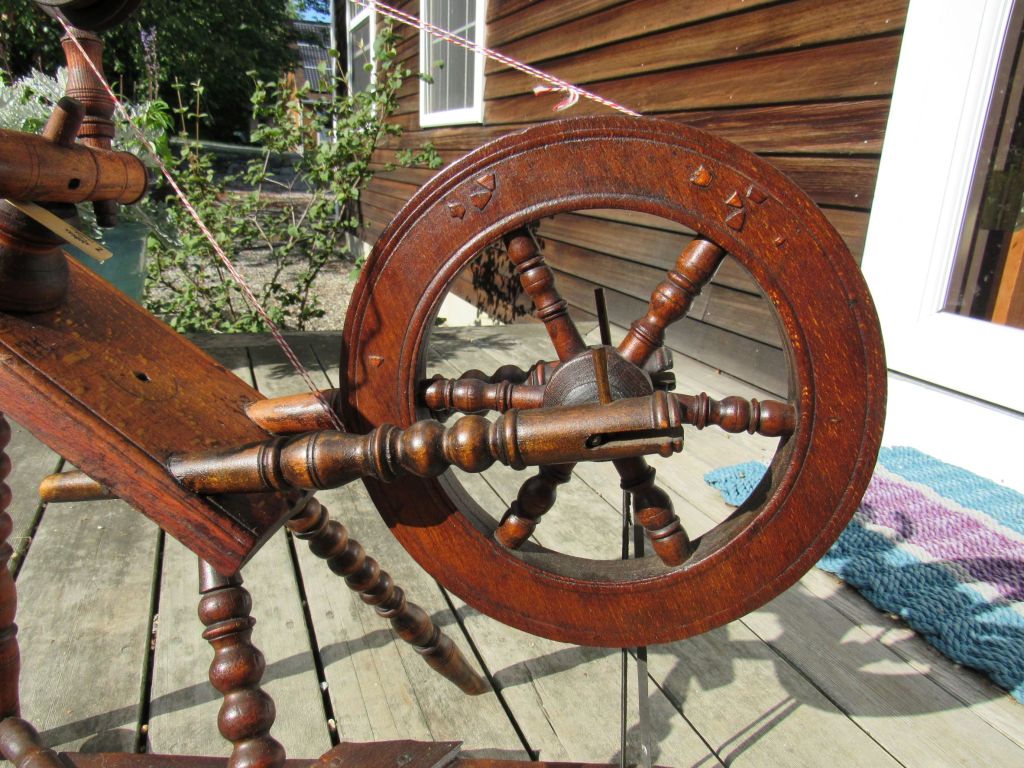
They are raised and appear to have been glued on, many resembling small tulips or crowns. 

Another interesting feature is the drive wheel construction. 

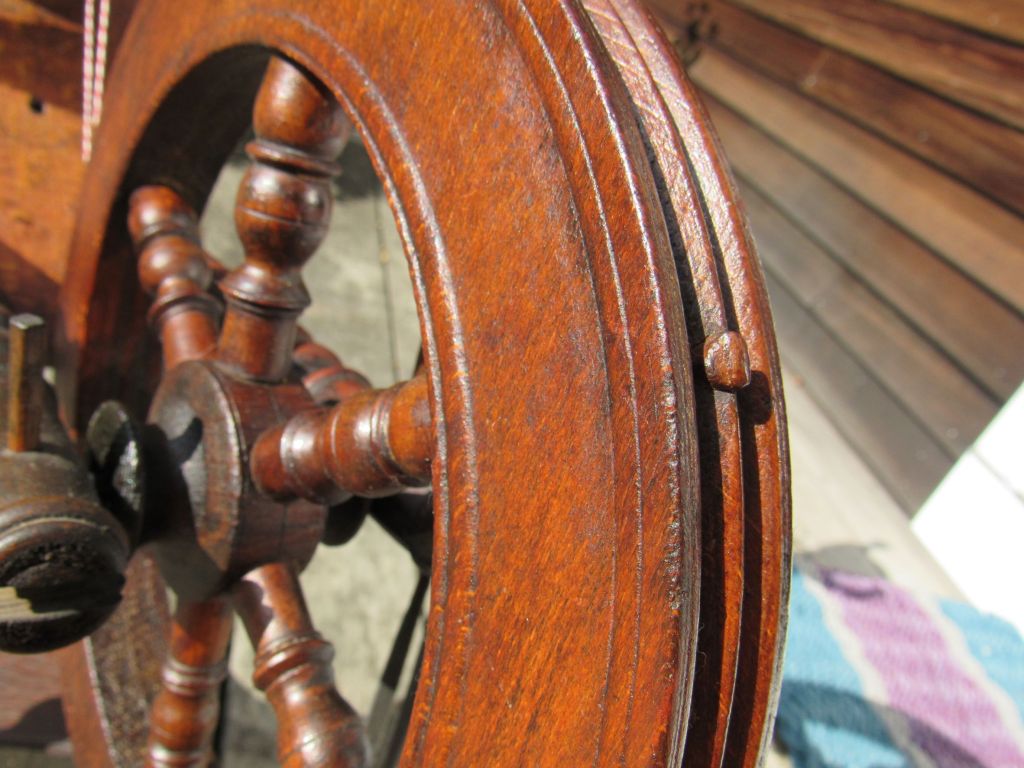
It is made from one piece of wood, with no joins, and the pegs for the spokes are driven directly, straight down, through the middle of the rim.  I don’t know whether this construction is indicative of a certain region.

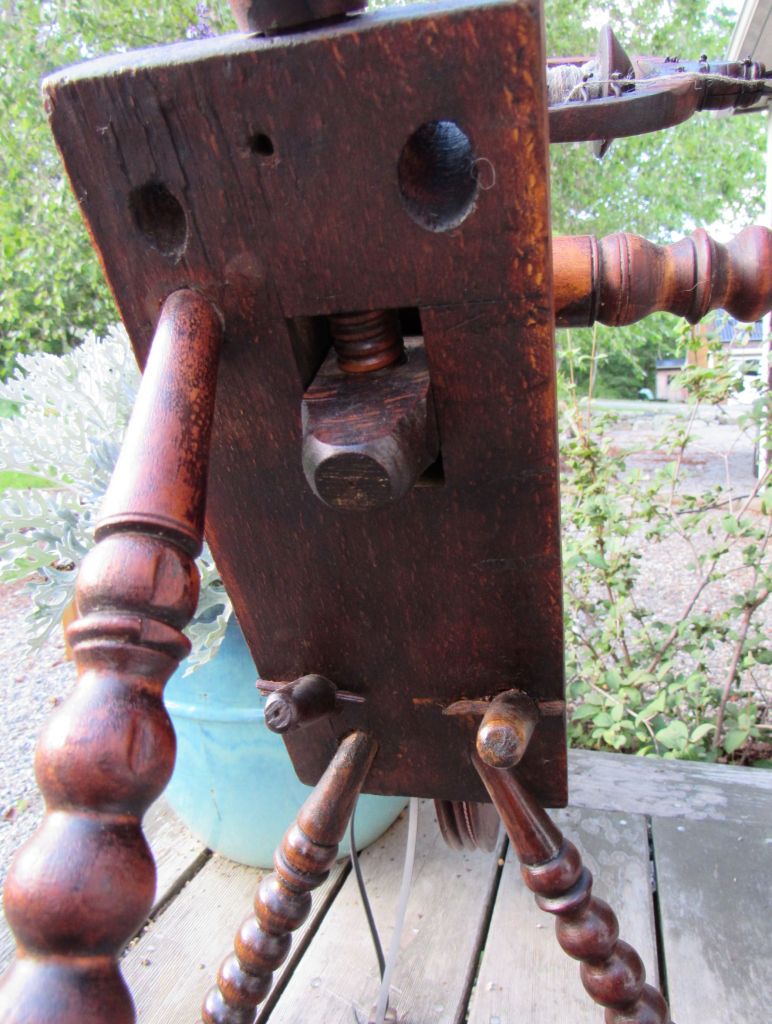
But, we can tell that the wheel likely came from a flax-spinning region. As Cummer notes, there are two holes in the table–one for a distaff and the other for a water vessel for flax spinning.  

The wheel is versatile, however, with an orifice and bobbin large enough for spinning wool as well as flax. 

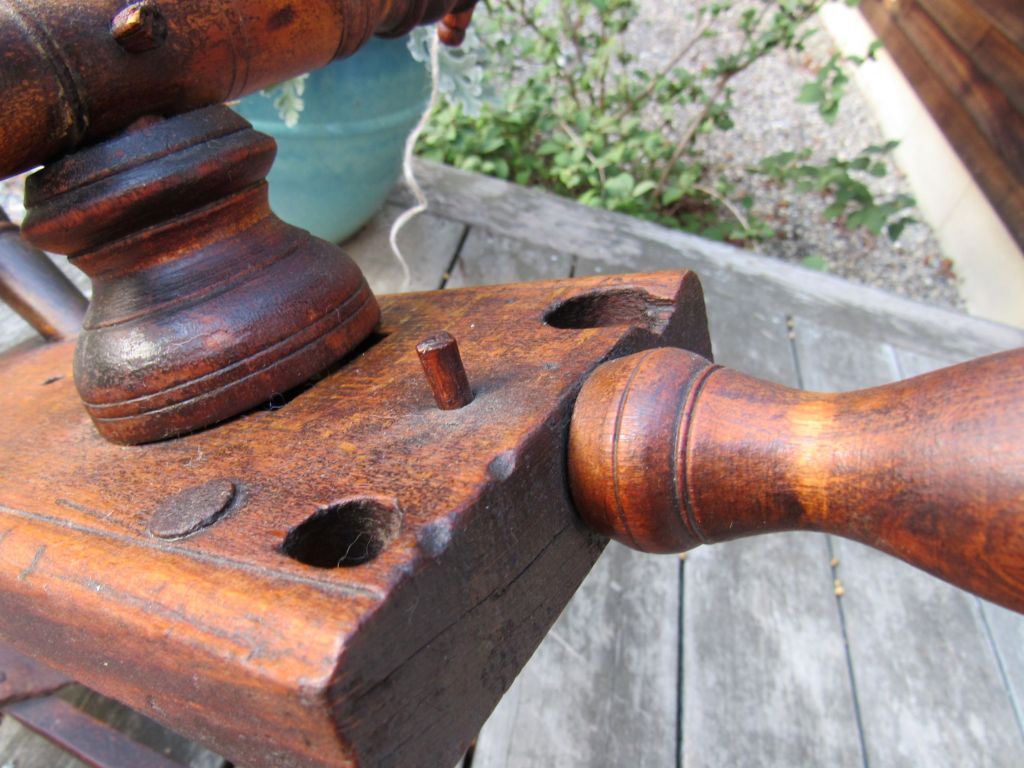
The table also has a small hole with a circular mark that likely had a decorative medallion at some point, another feature sometimes found on German wheels and other European wheels. 

Although its origins likely will never be pinned down, it is a delightful wheel and was easy to bring back to life. When I bought it, the footman was a broken thin leather strap that had been doubled up.  It was stiff, severely cracked with age, and falling apart, so I replaced it with new leather in the same design.  

The treadle has seen a lot of wear and one edge is partly broken off.  

I originally thought that the bobbin was a replacement because it comes well short of taking up its allotted space on the mandrel. 

But its wood appears to match that of the spindle whorl and the hub, all of which have eye-catching reddish grain rings.    

It is apparent that the wheel was well-used and valued for its sweet spinning because of the careful repairs. Screws have been added in strategic places

But the most interesting repairs are to the flyer assembly. 

The flyer hooks apparently are replacements, set into holes adjacent to the originals. 

And, at some point, the flyer was pretty well shattered,

with a break down the center and a broken arm. 

The breaks are neatly repaired with wire,

doubled through and tightly wrapped. 

The arm break also appears to have a small nail as back up. 

Years of usage grime have settled in around the wires, indicating the flyer repair is an old one. Such a thorough and effective repair speaks eloquently for someone’s desire to keep this wheel spinning. 

I hope that whoever it was would be satisfied and content to know that it is spinning still. 

February 2022 update: I just read “Silas Marner, The Weaver of Raveloe,” written by George Eliot (Mary Anne Evans) in 1860 about a linen weaver working in England at the end of the 18th and early 19th century. The first line of the book starts with: “In the days when the spinning-wheels hummed busily in the farmhouses–and even great ladies, clothed in silk and threadlace, had their toy spinning-wheels of polished oak …” Perhaps wheels such as Hermione were such “toy” wheels, ornamenting the houses of those who really did not need to use them except for casual spinning.

For further reference see:

Baines, Patricia, Spinning Wheels, Spinners & Spinning, Anchor Press Ltd, London, 1977, pp. 123-25.

Cummer, Joan, A Book of Spinning Wheels, Peter E. Randall, Portsmouth, N.H. 1984, pp. 274-75.

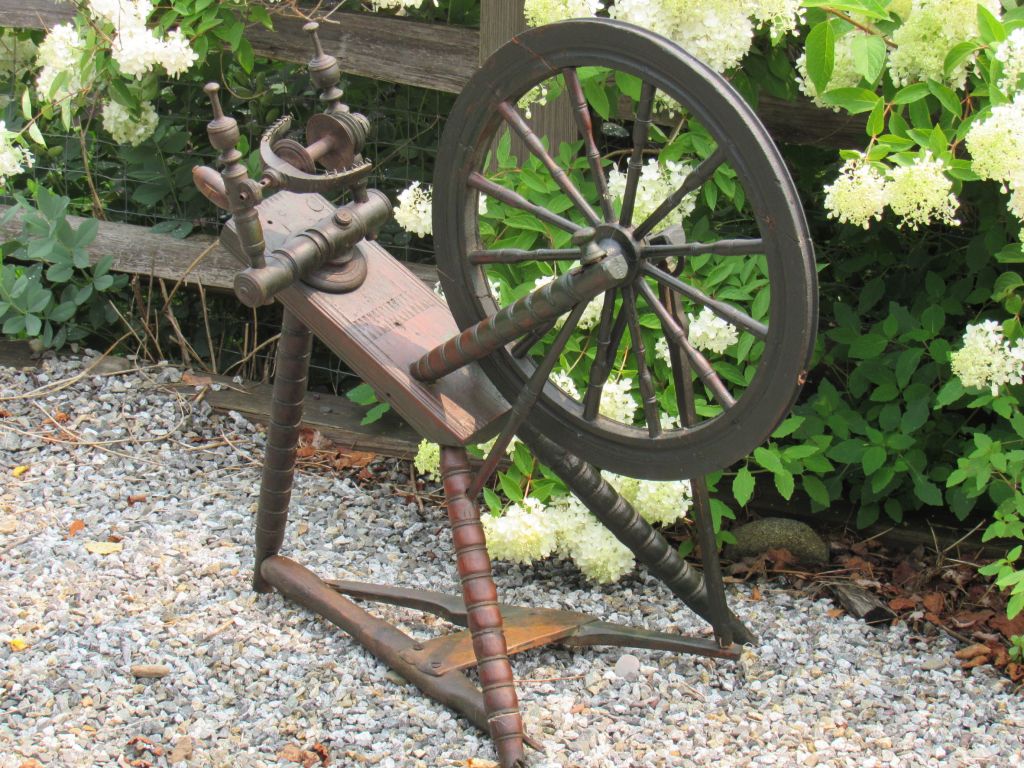
Green Linnet

This is an old wheel.  It was part of Joan Cummer’s collection, auctioned off when Lowell’s American Textile History Museum closed.  I was the only person to bid on this wheel at the auction and bought it because Cummer believed it to be the oldest wheel in her collection. 

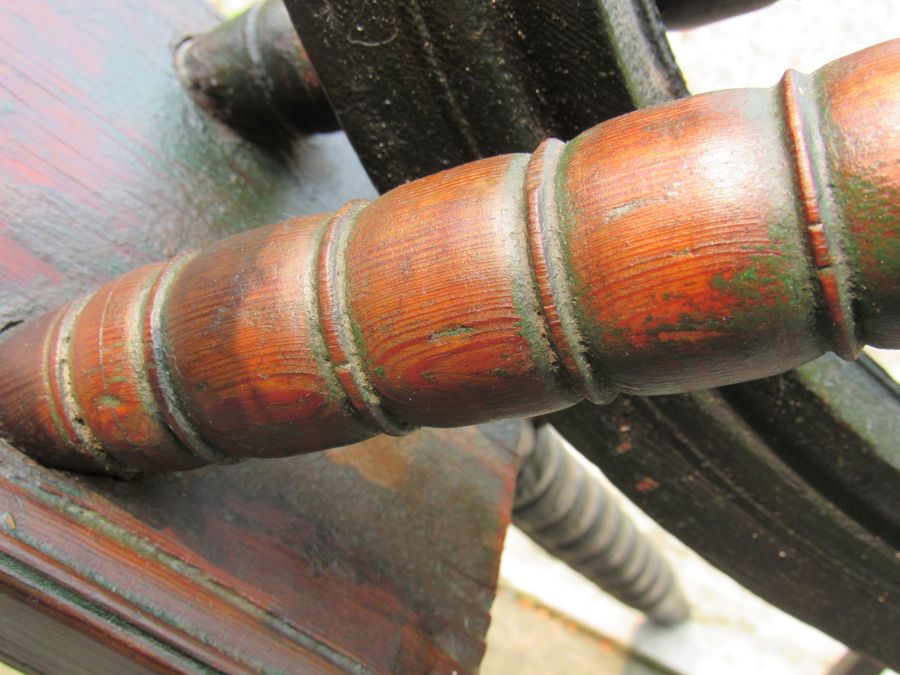
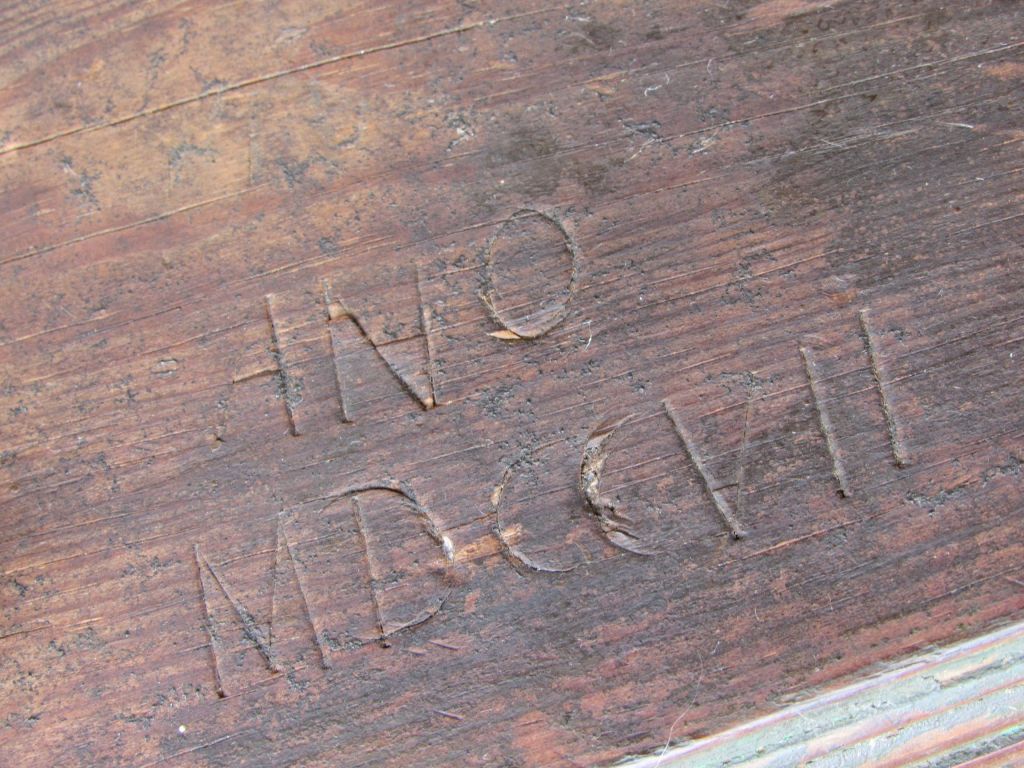
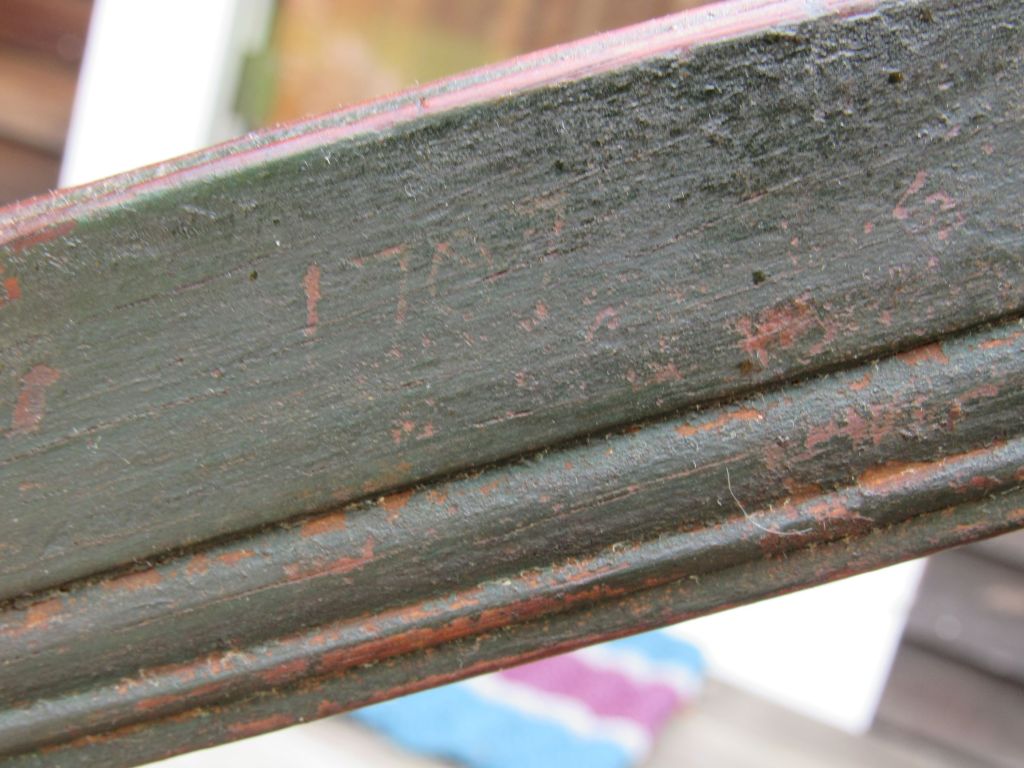
The underside of the table has a carved date in Roman Numerals of 1707, and the same date is faintly inscribed on the table’s side. 

The wheel is No. 29 in Cummer’s collection and, in her description, she did not question the date, noting that it was compatible with the wheel’s William and Mary turnings. 

According to Cummer, the wheel was believed to have been brought to New England from England. 

I do not know if the wheel is really that old or if it was from England—it has some Scandinavian-style features.

Unfortunately, we do not have many surviving wheels from the early 18th century for comparison and I have not been able to find any similar wheels in paintings. 

I like to think it is over three hundred years old. 

Knotted wood on the inside of one leg

But, even if not quite that old, it has been through a lot. 

As Cummer commented, there seems to be at least one layer of green paint that, while old, is not original. 

The wood that shines through is a beautifully grained reddish color. 

The two secondary upright supports rise from the legs and fall out at the slightest jiggle. One foot is completely broken out where the treadle bar rod was inserted. 

In the leg at the other end, the bar is supported by a metal tube inserted through the wood.

The wheel’s slanty stance is a result of the legs being inserted into angular cuts on the table’s downhill side. 

The circular tree rings are visible on the end of the table. 

The axle is held in place with a large screwed wooden pin,

although the back one is missing.  There are carvings on the table

and at both ends,

a distaff hole,

and multiple grooves down the sides. 

The treadle bars are thick and give plenty of support for two footed treadling. Yet, they are graceful, too. The treadle is now attached with large screws.

 The wheel rim is four parts with a thin shim piece in one join.

The elongated tops of the maidens are particularly lovely. 

The flyer assembly is in good shape

with three-layered leather flyer bearings held together with rivets. 

It appears that the green paint was slathered over everything at some point, including the flyer hooks and leather bearings.

It is an unusual, intriguing wheel and I am always on the lookout for others like it so that we might be able to better establish its age and origin. 

For further reference see:

Cummer, Joan, A Book of Spinning Wheels, Peter E. Randall, Portsmouth, N.H. 1984, pp. 70-71.