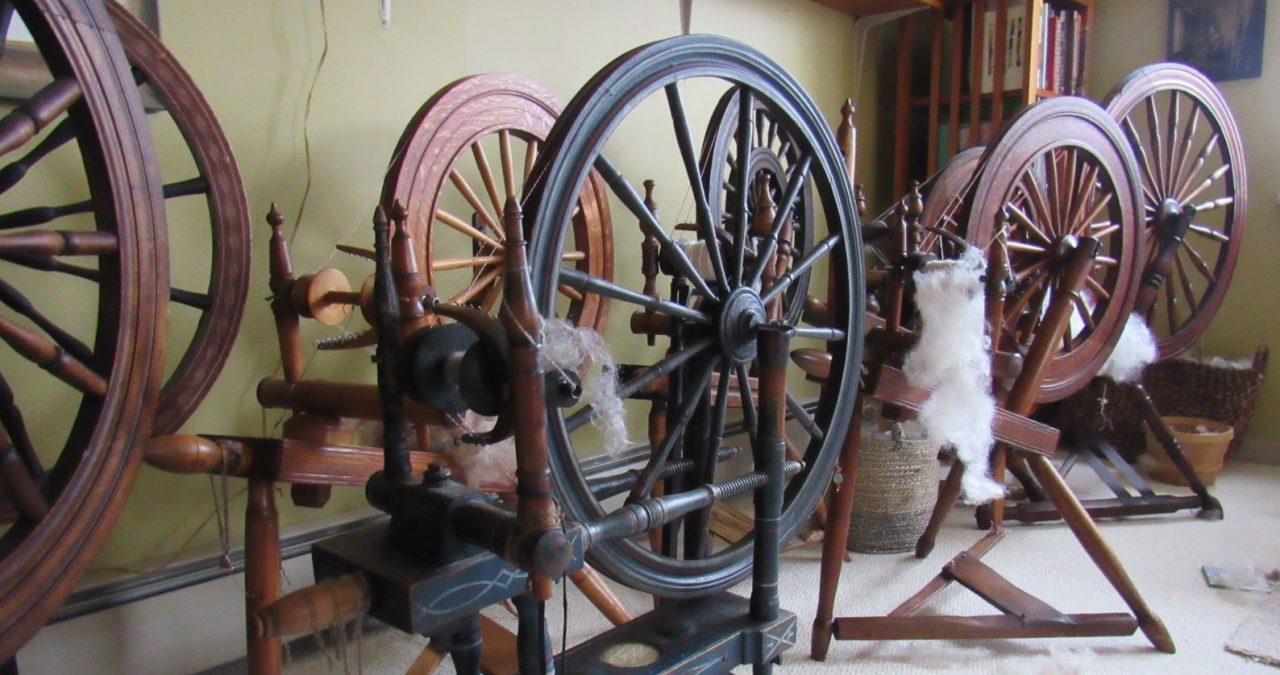
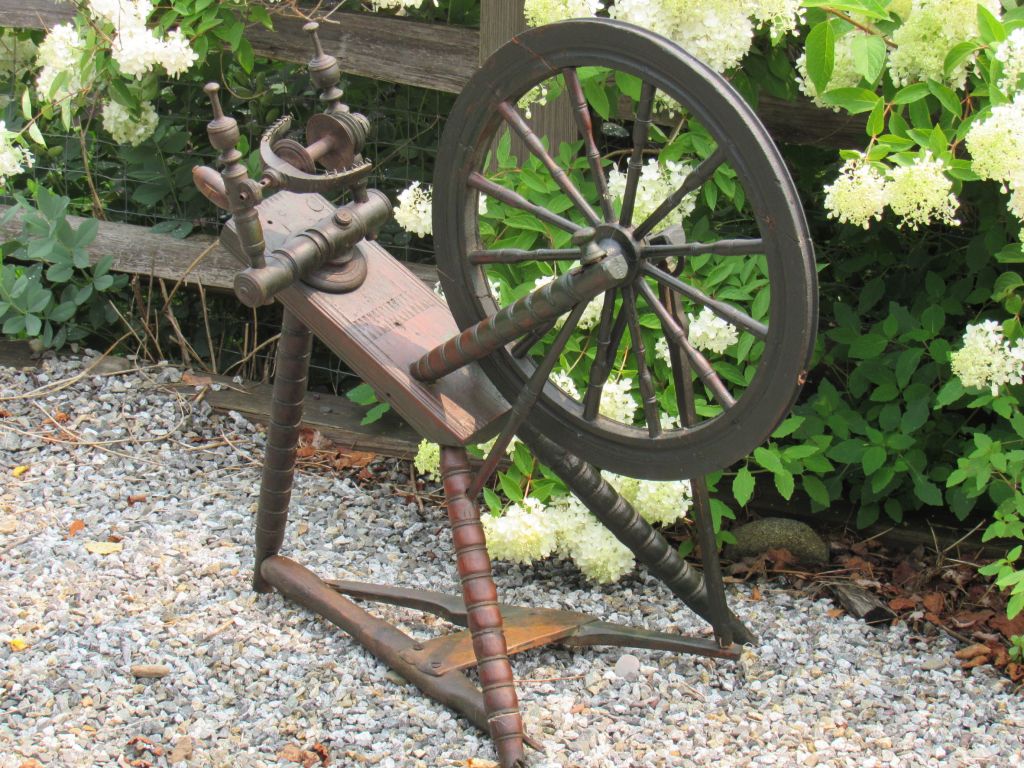
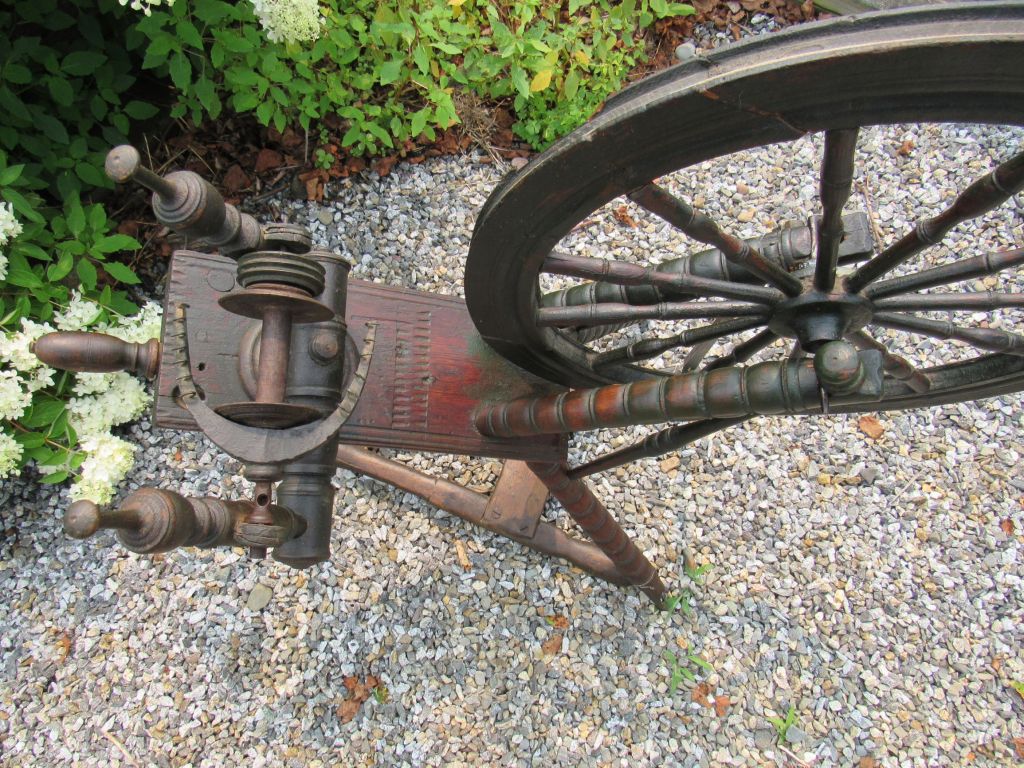
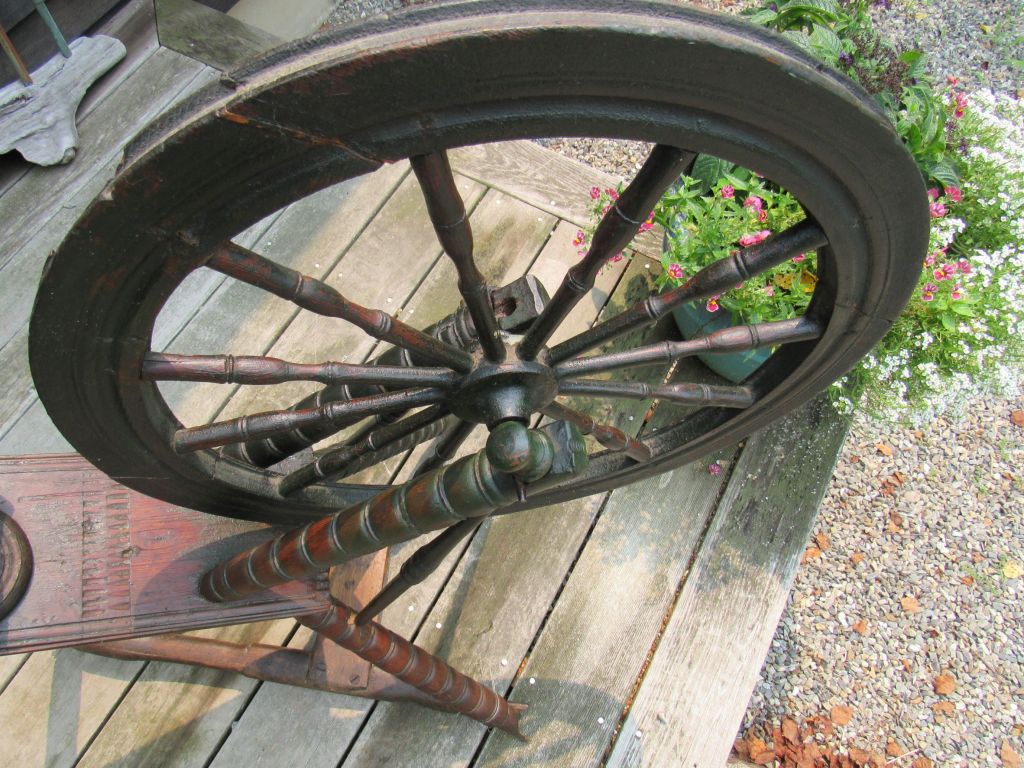
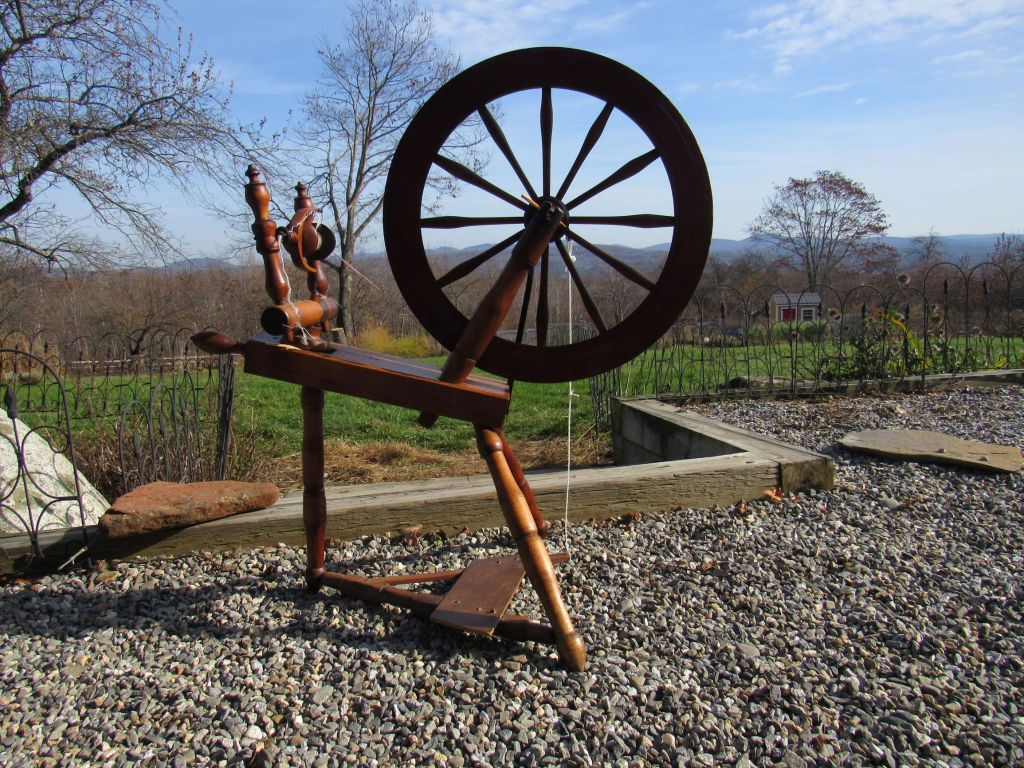
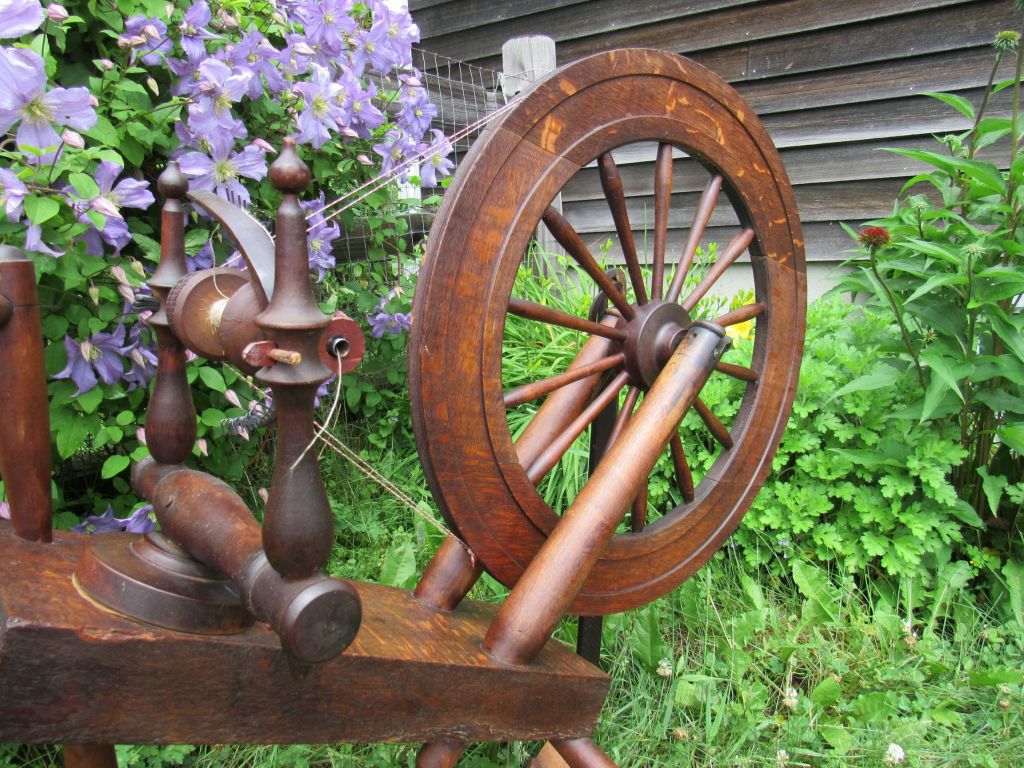
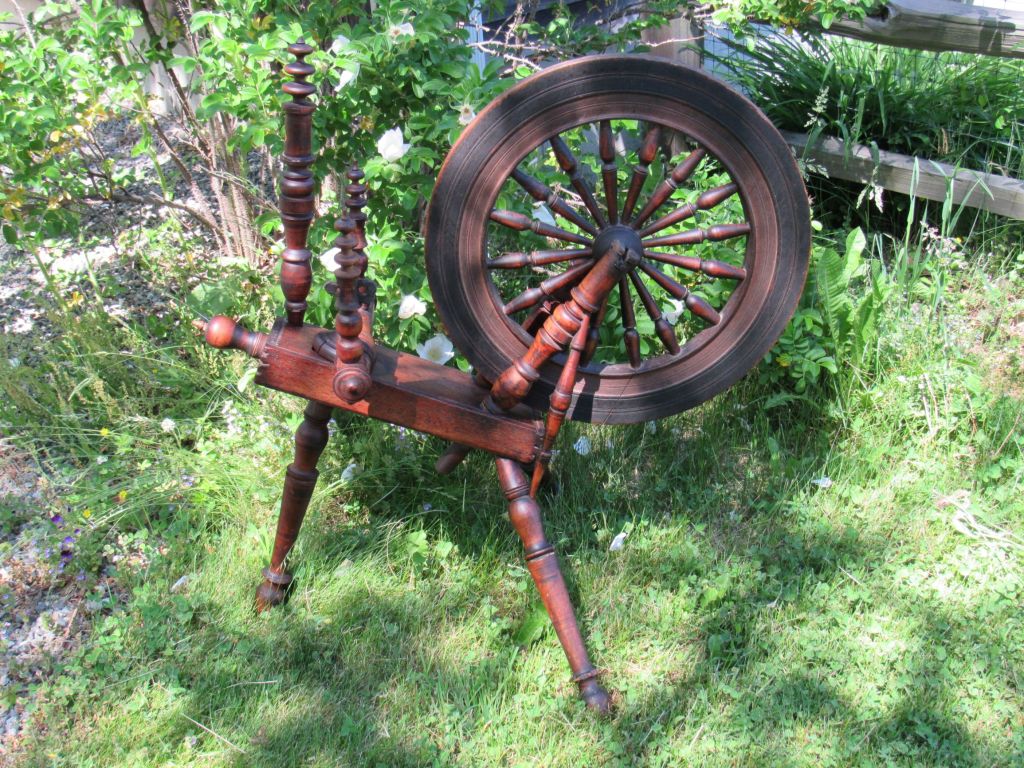
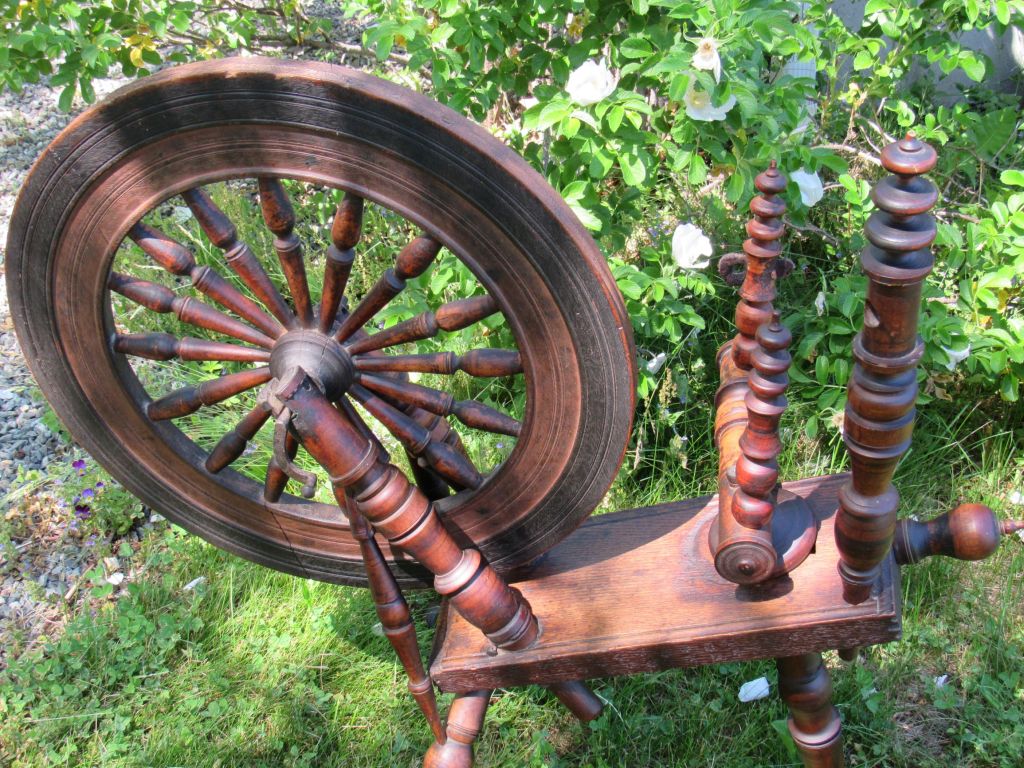
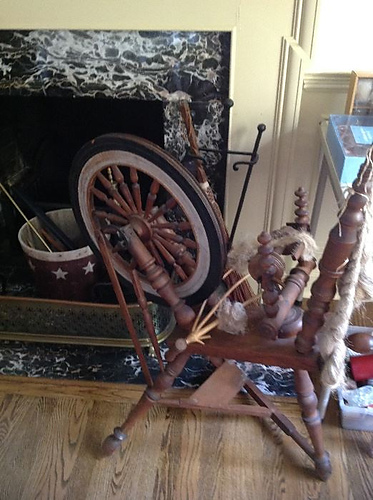
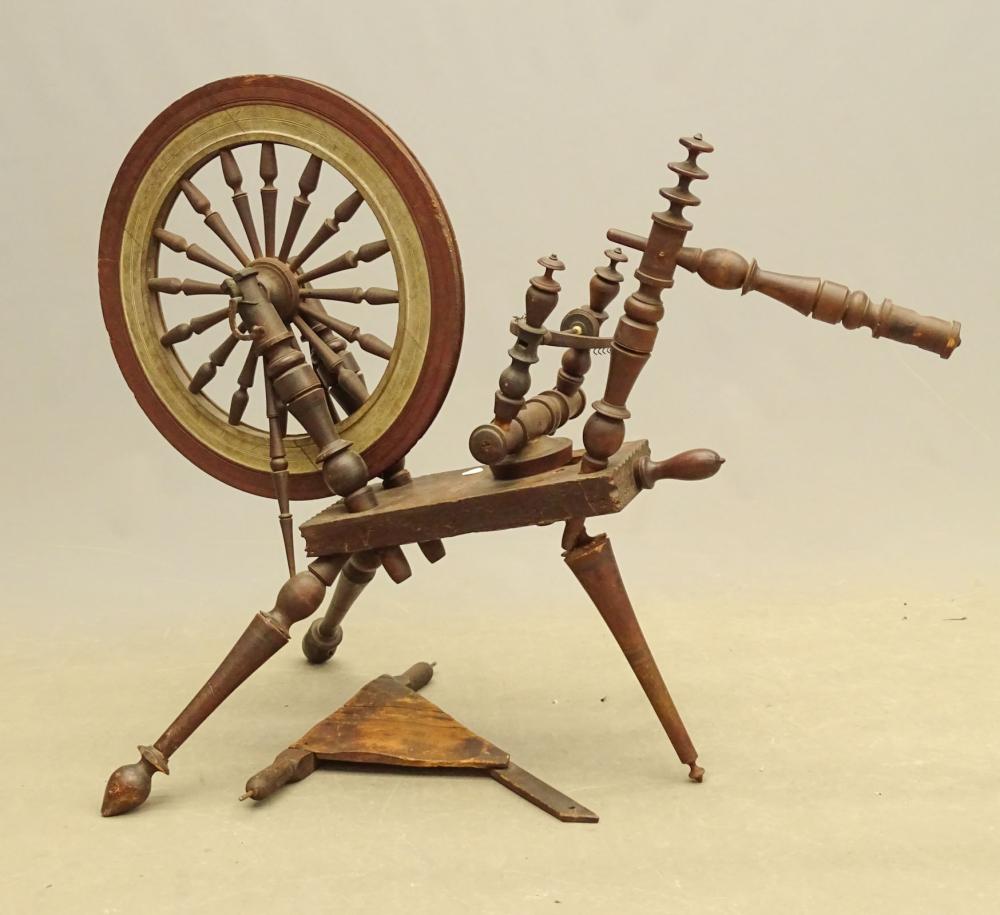
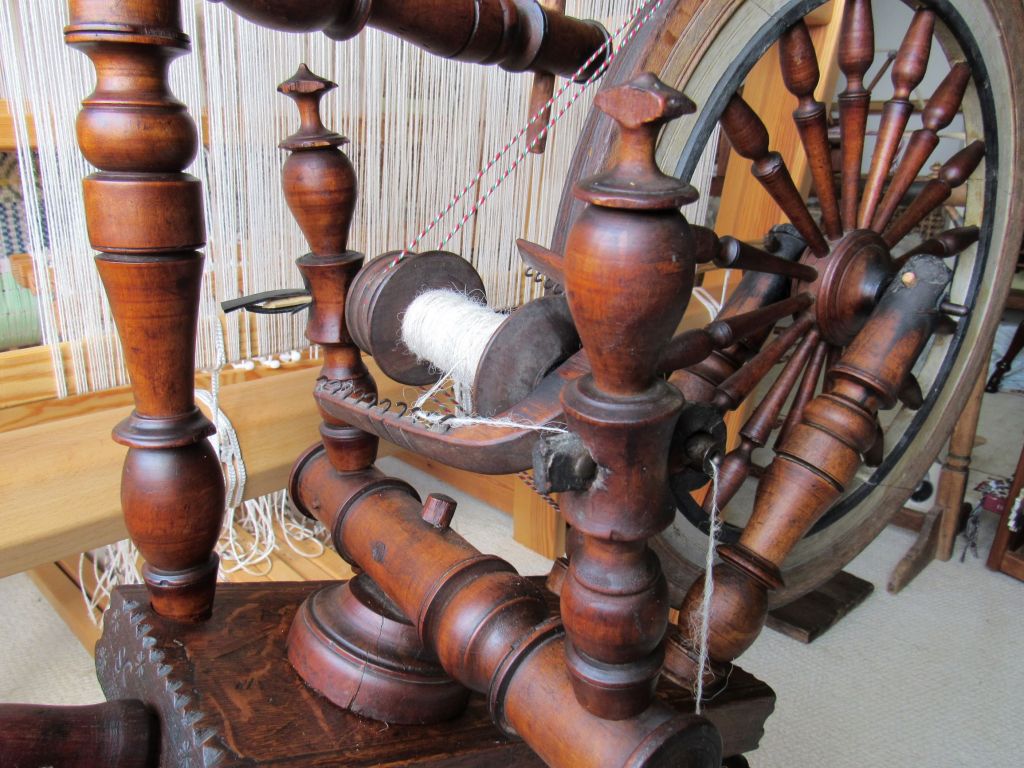
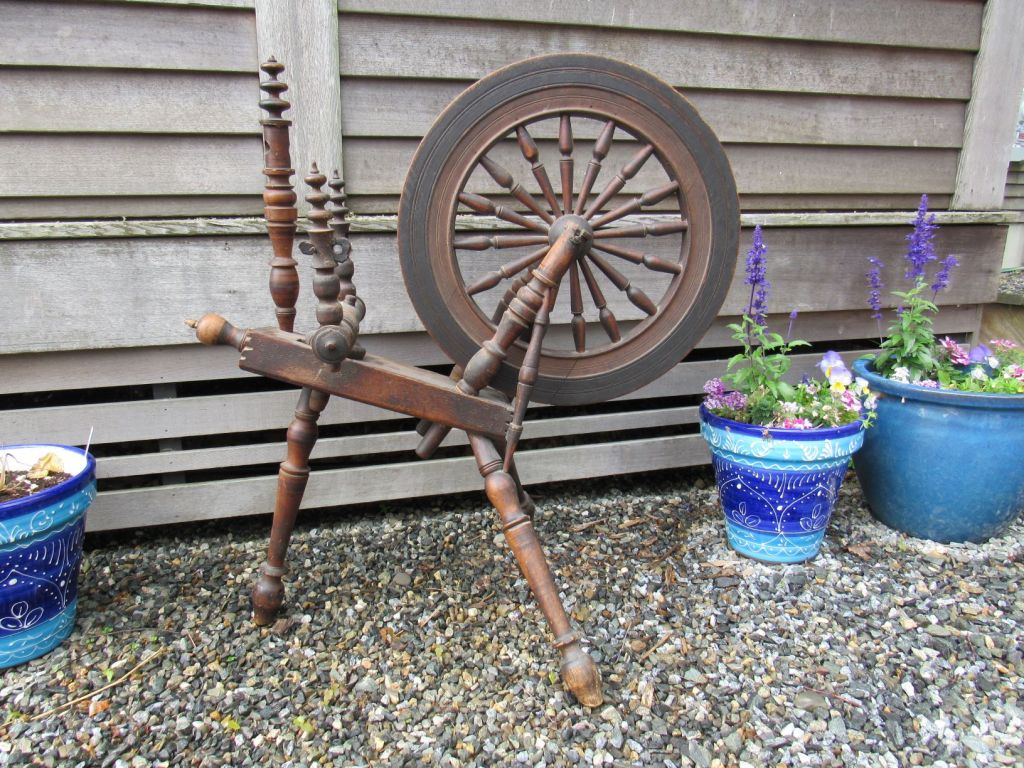
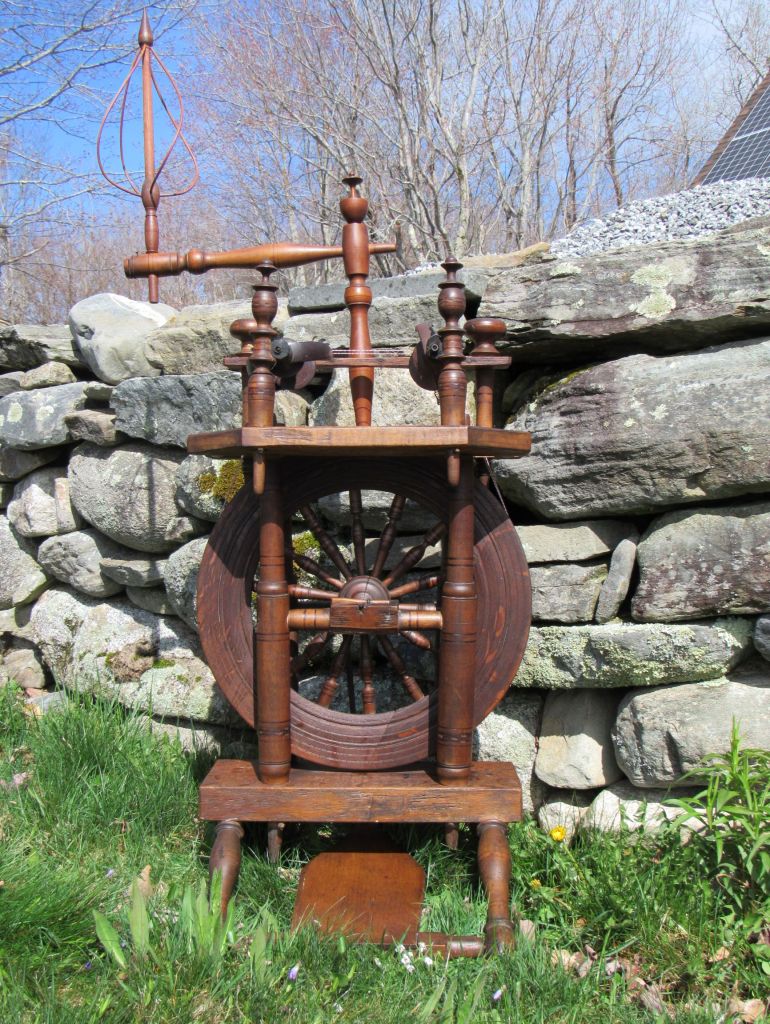
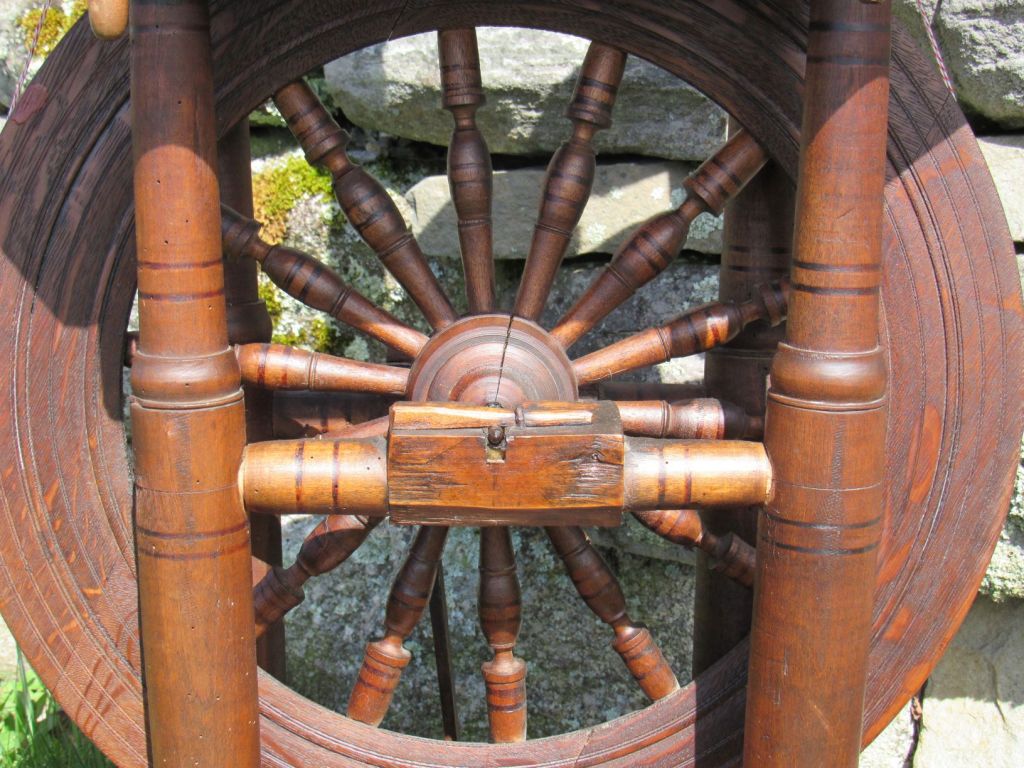
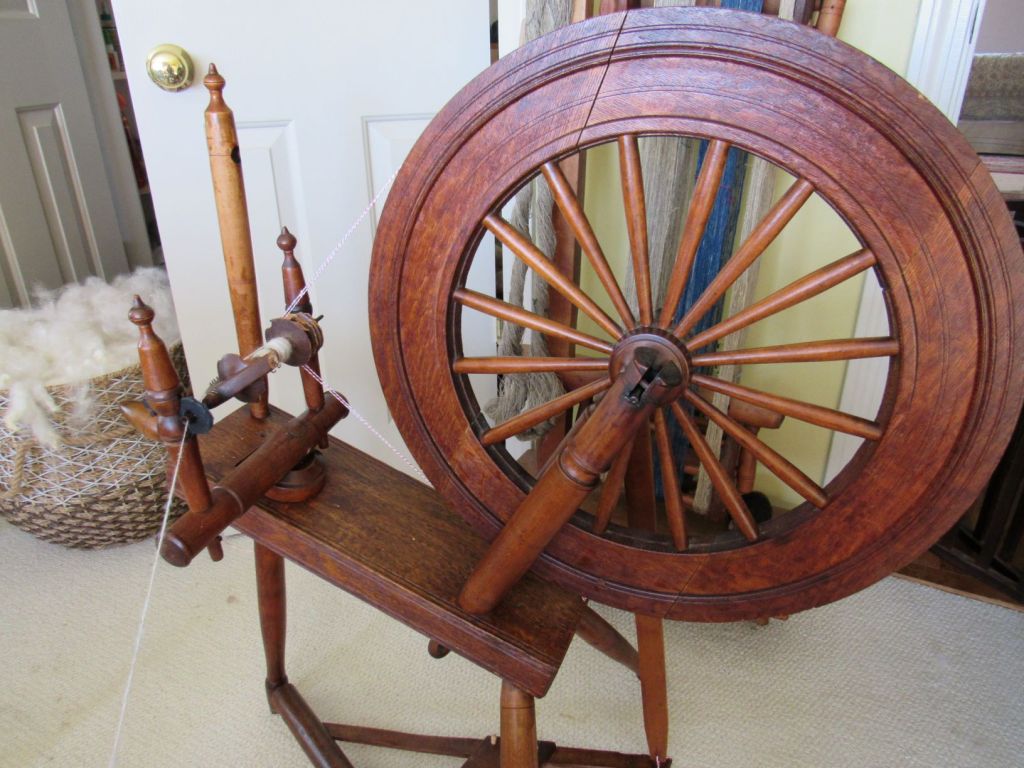
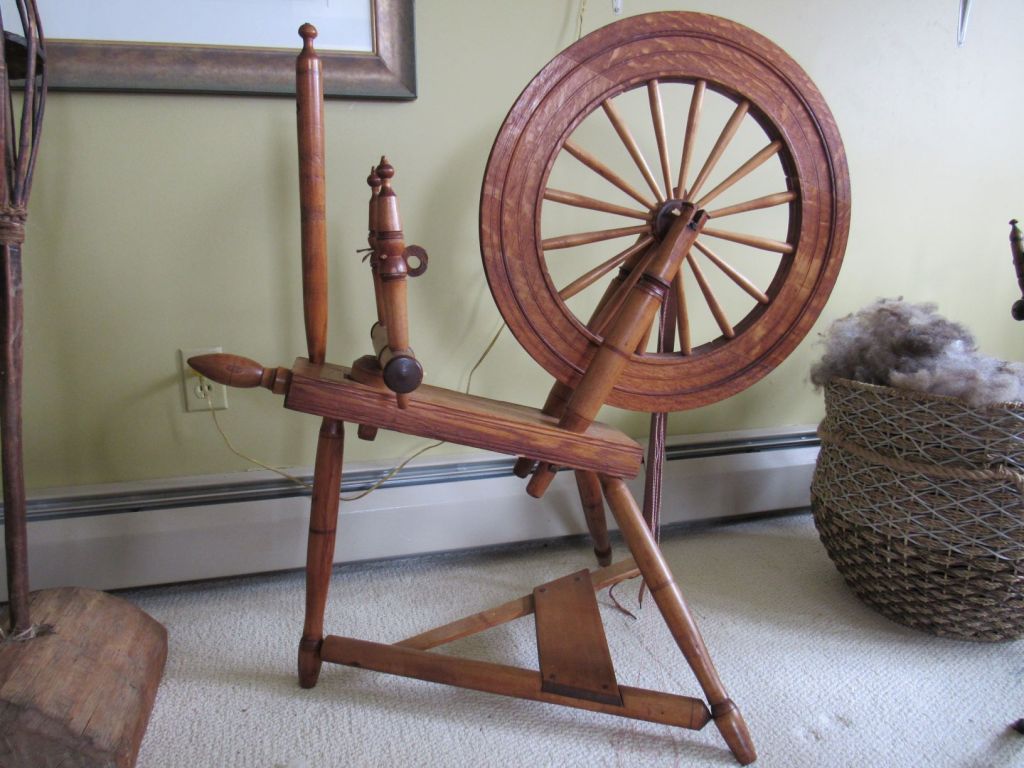
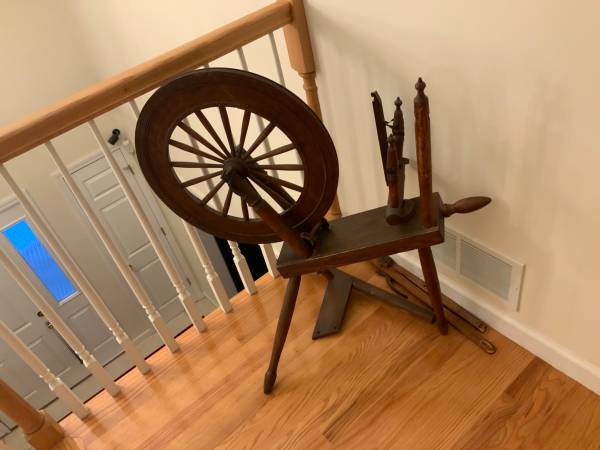
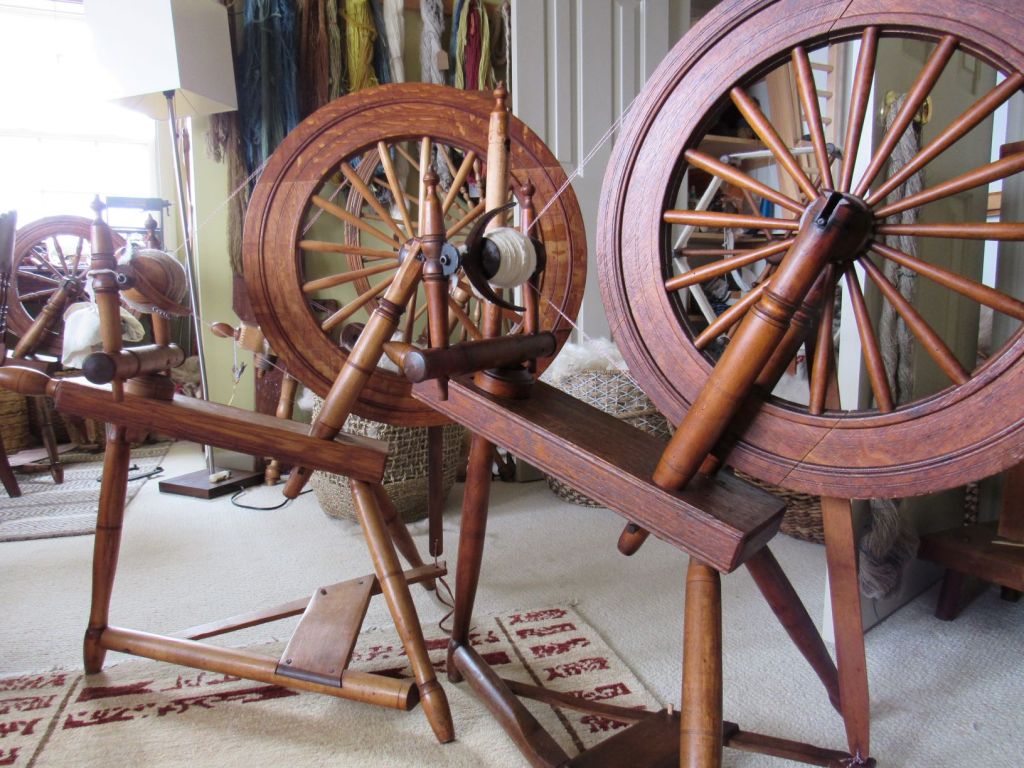
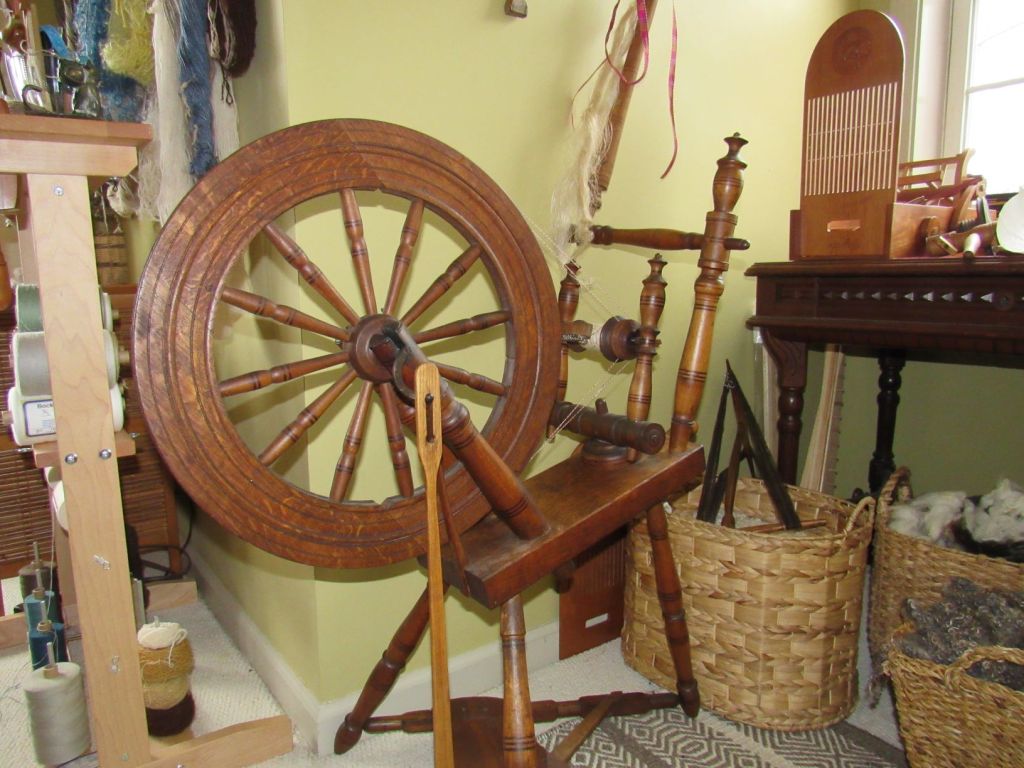
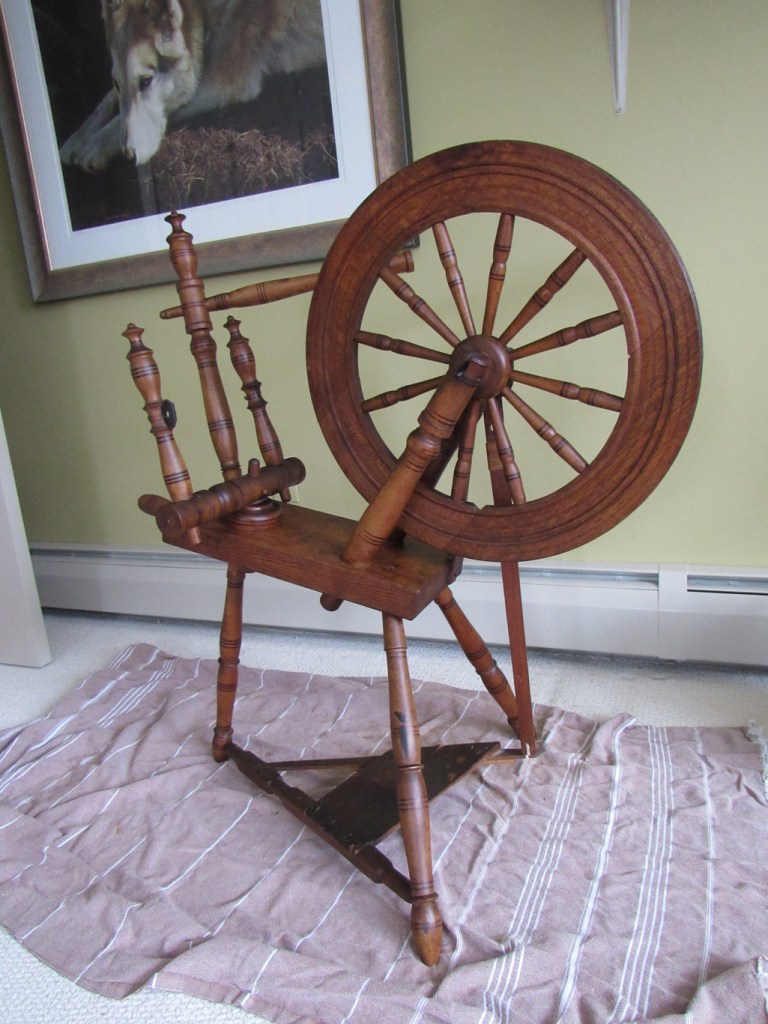
This is an old wheel. It was part of Joan Cummer’s collection, auctioned off when Lowell’s American Textile History Museum closed. I was the only person to bid on this wheel at the auction and bought it because Cummer believed it to be the oldest wheel in her collection.
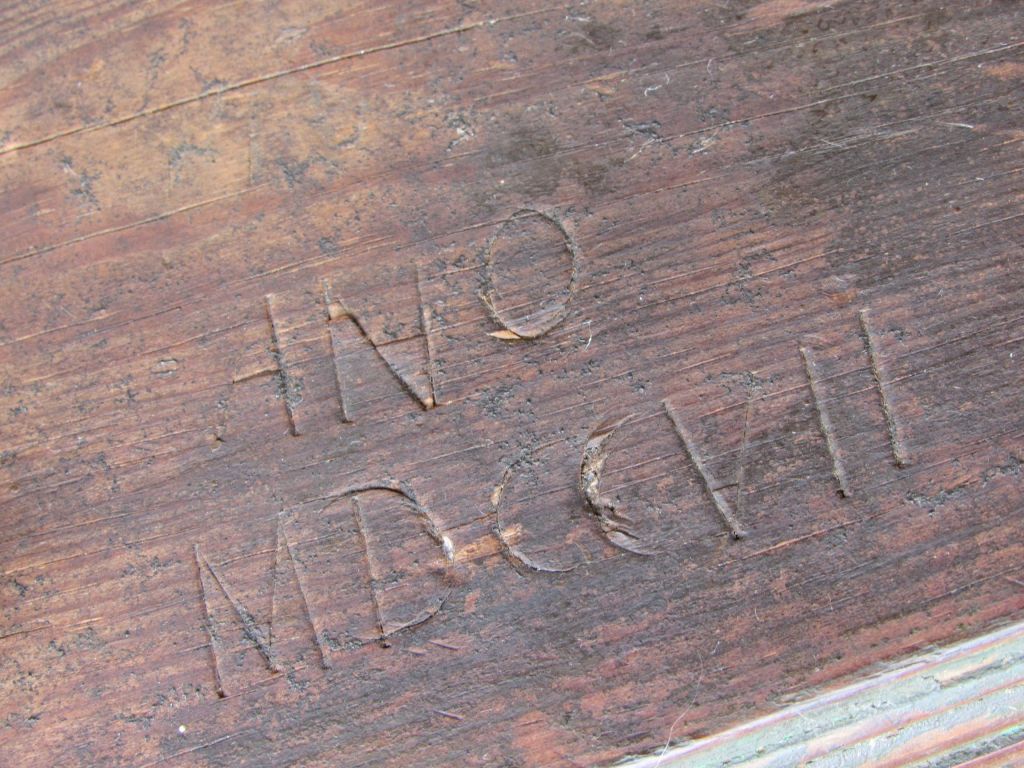
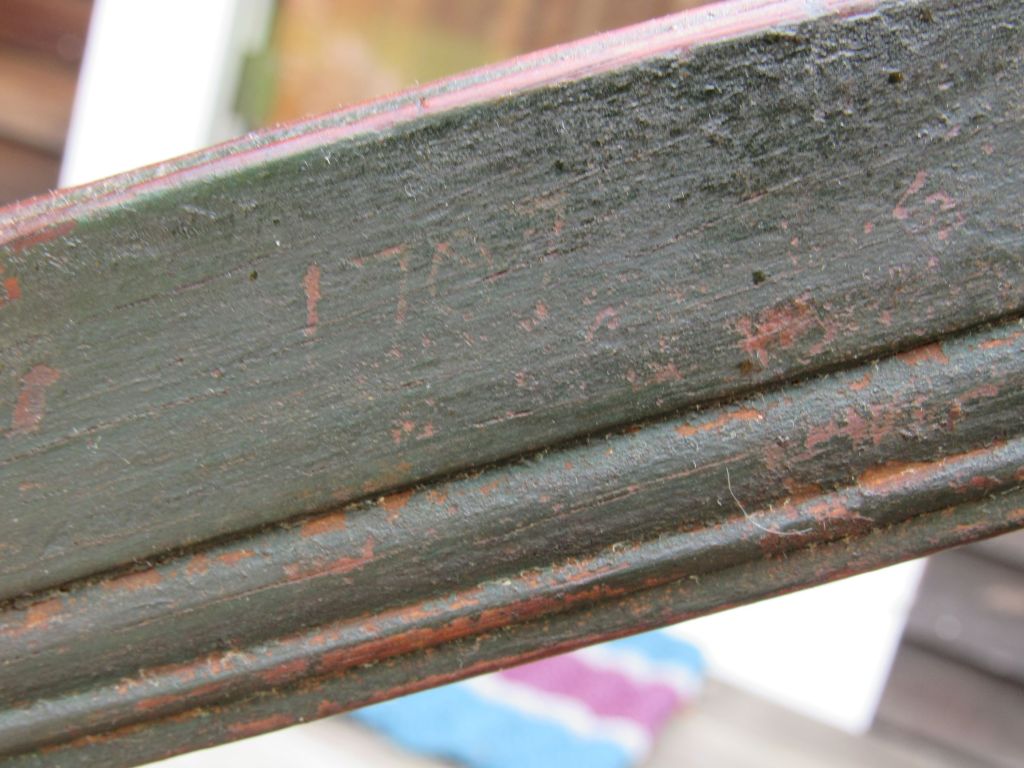
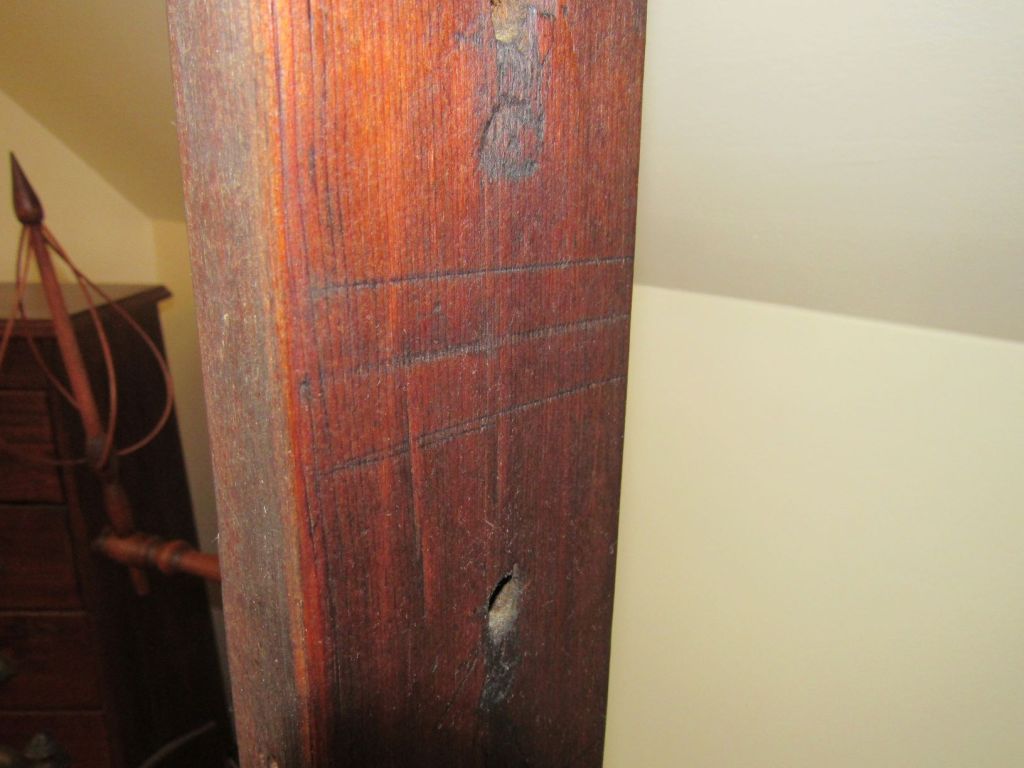
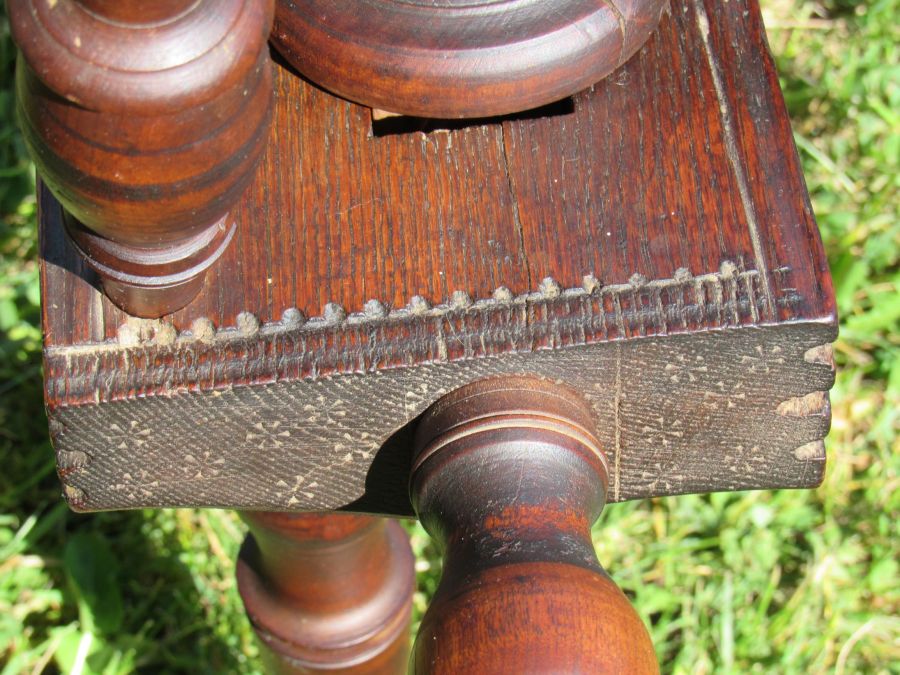
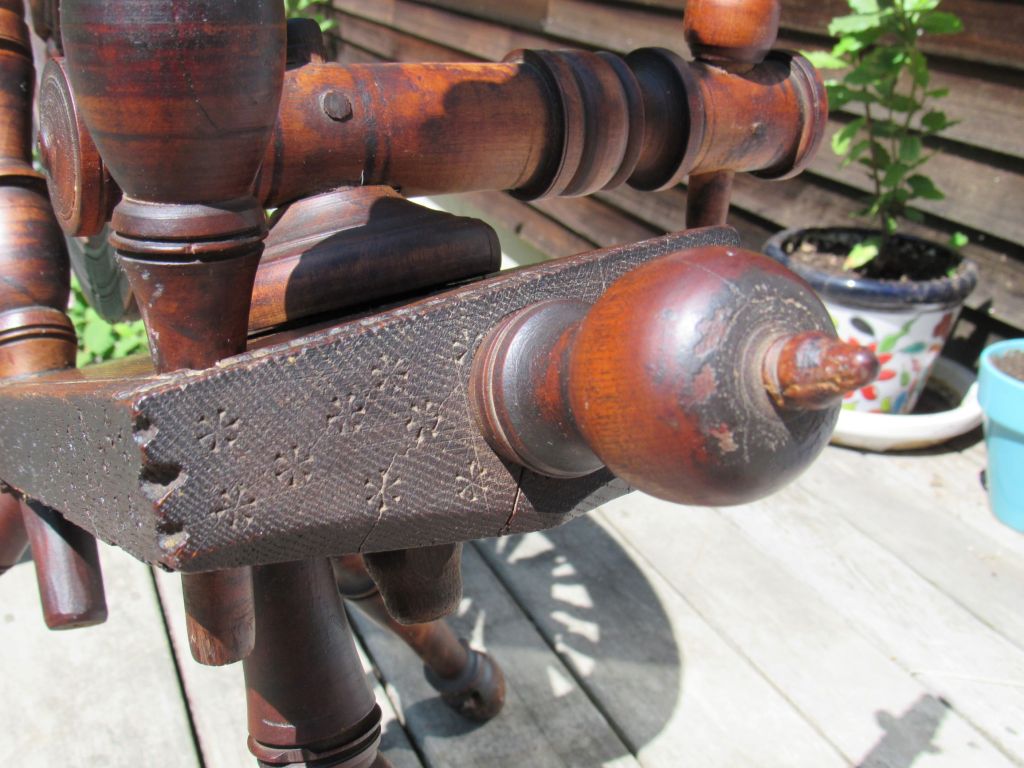
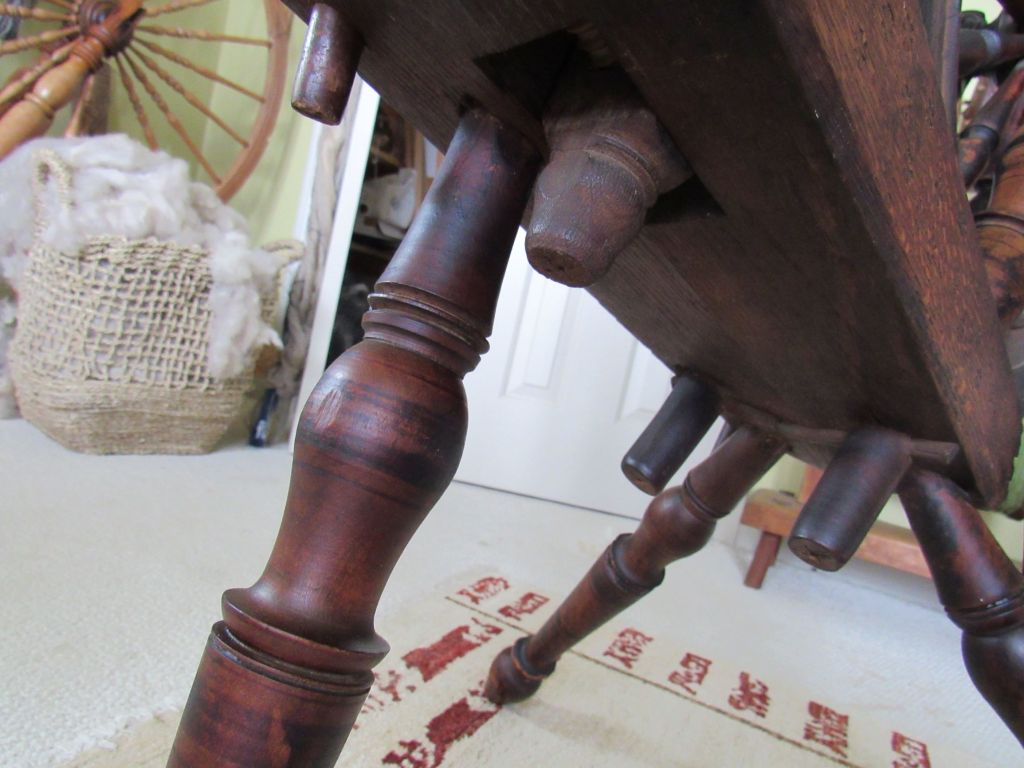
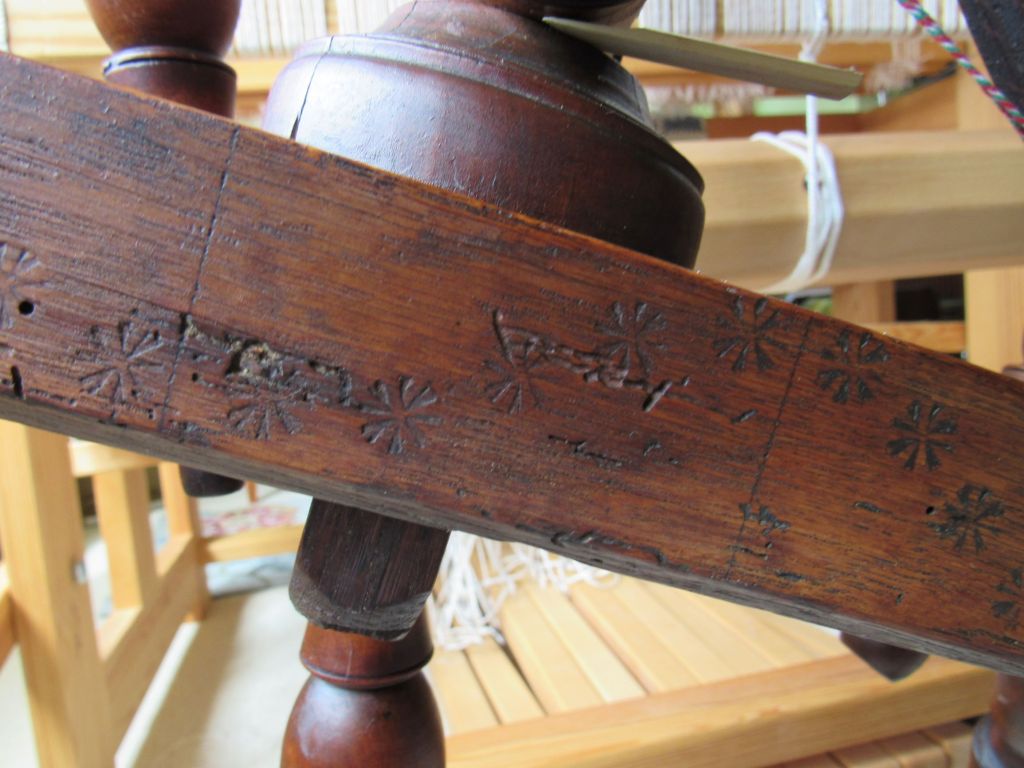
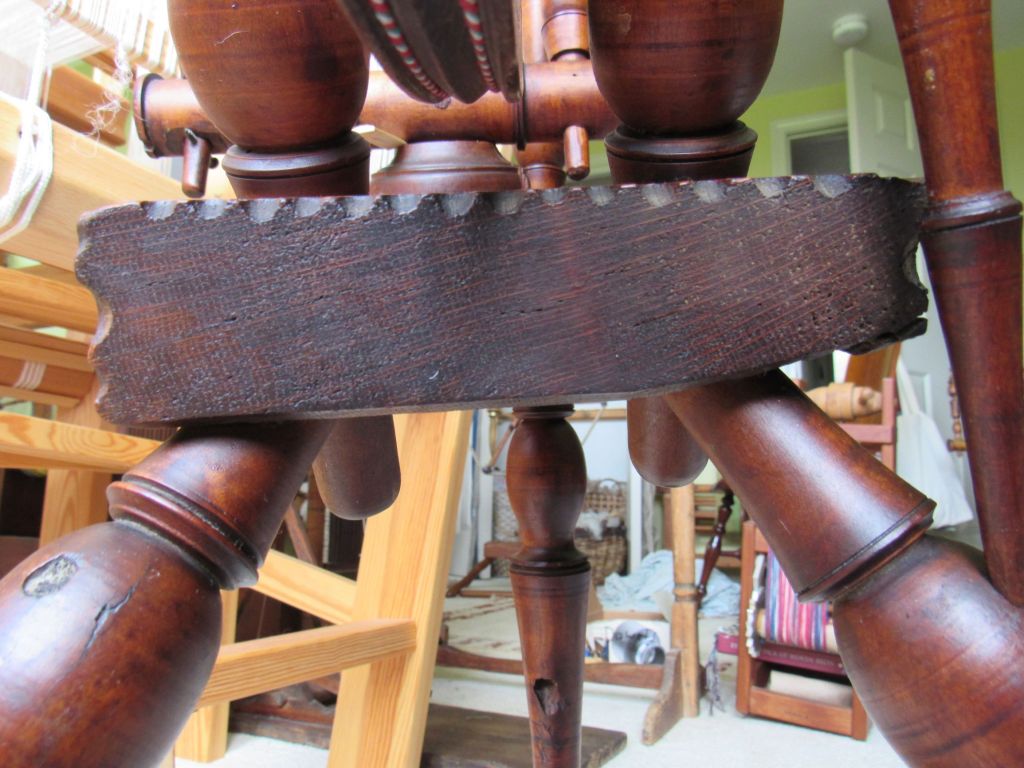
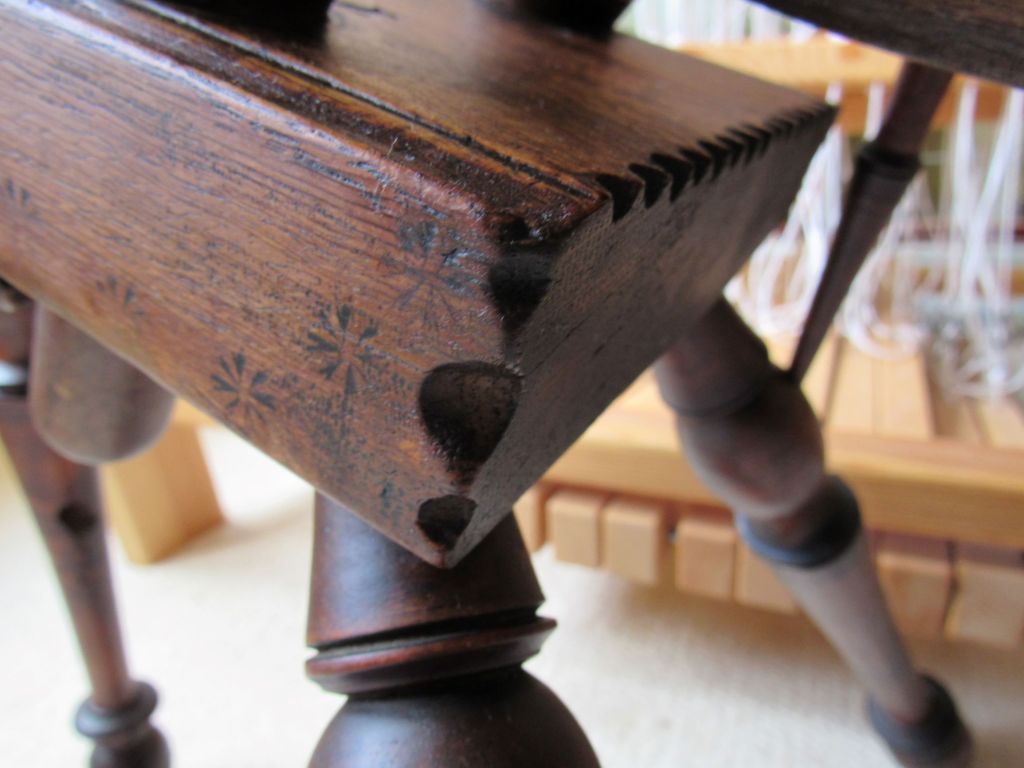
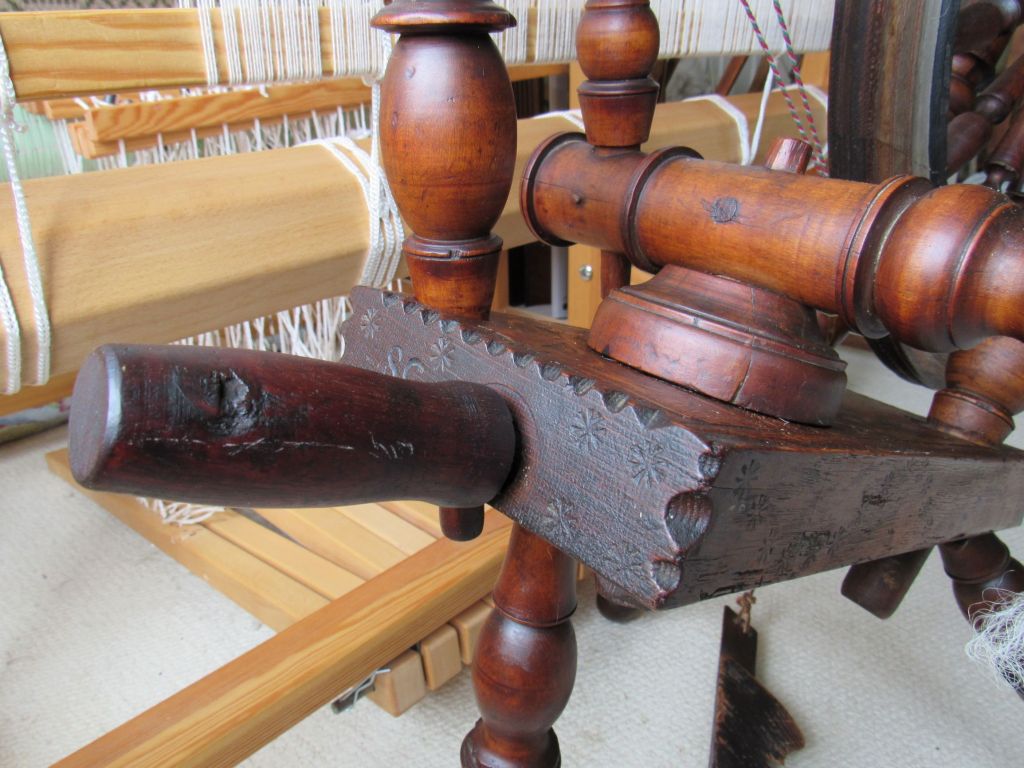
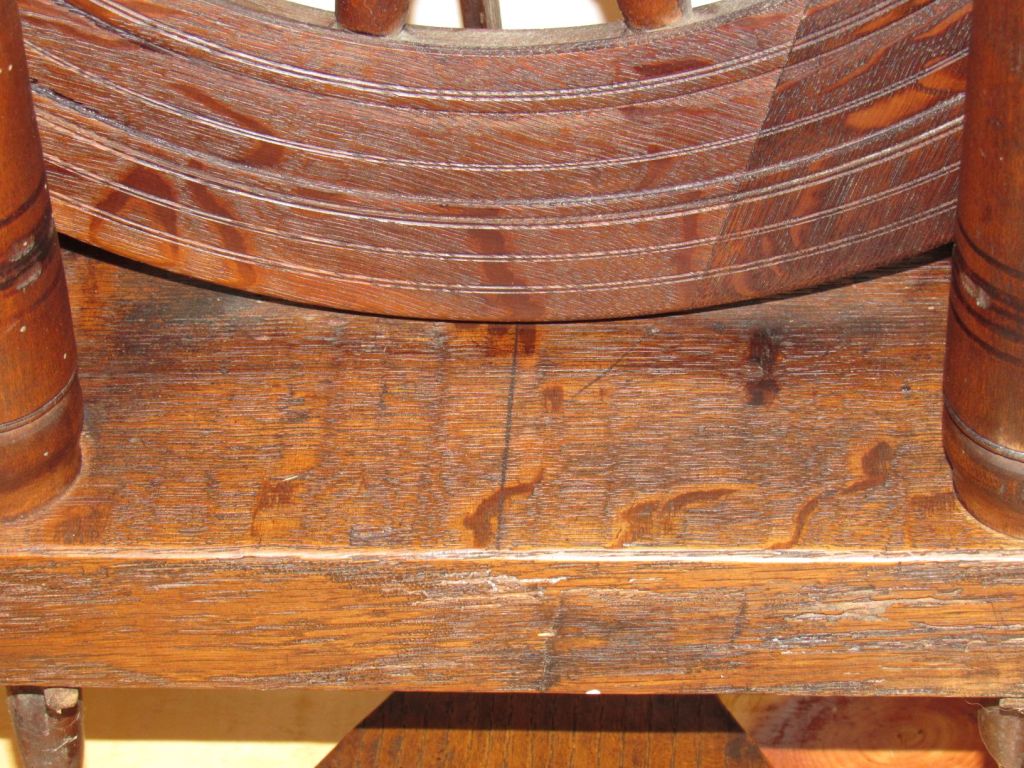
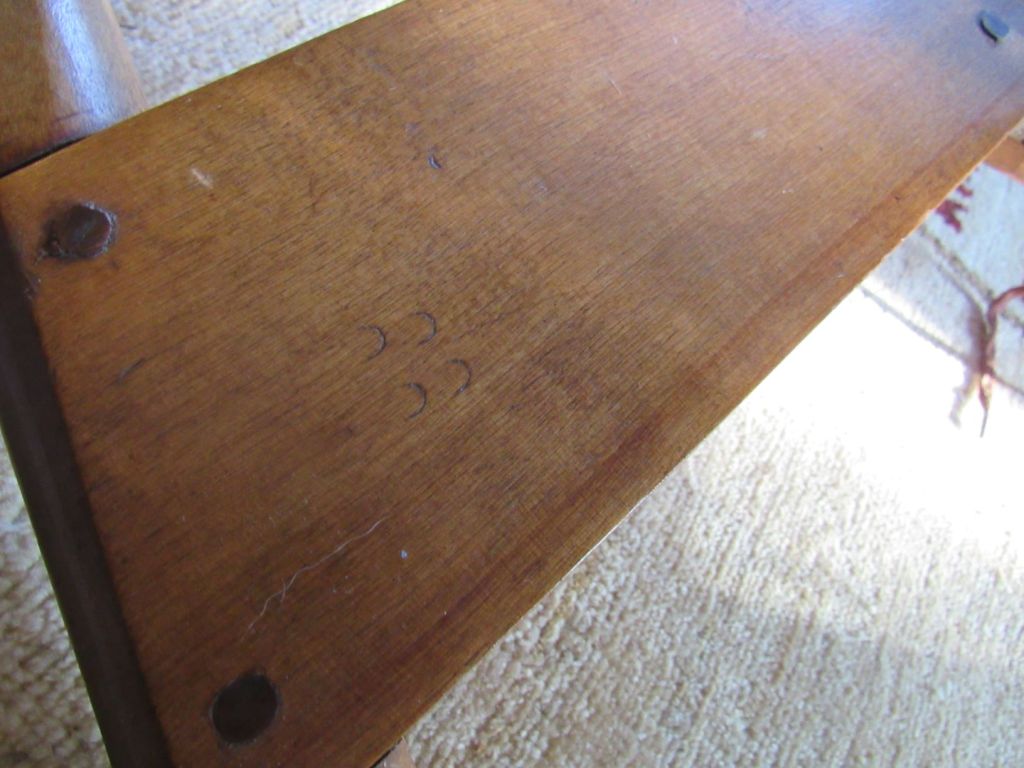
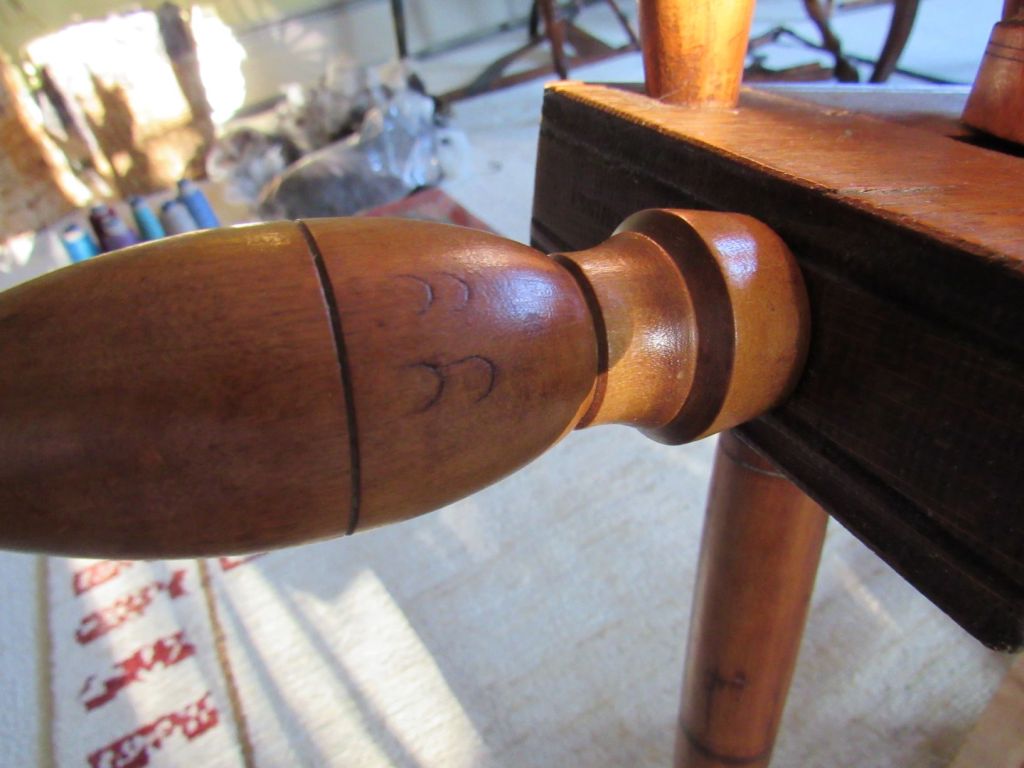
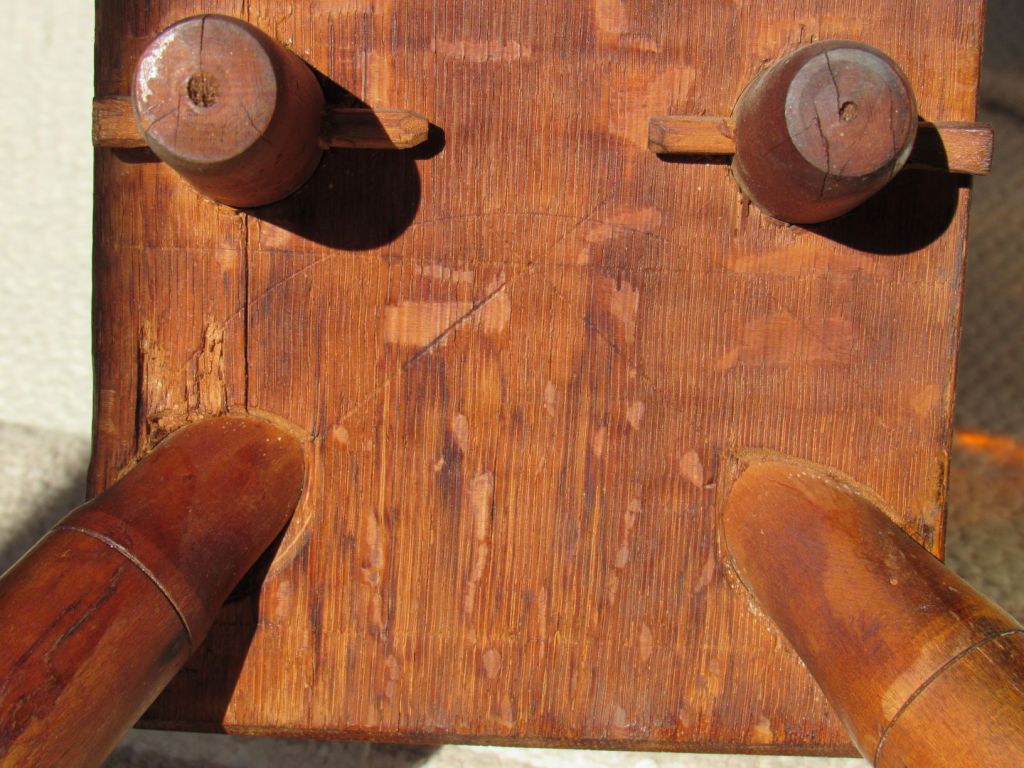
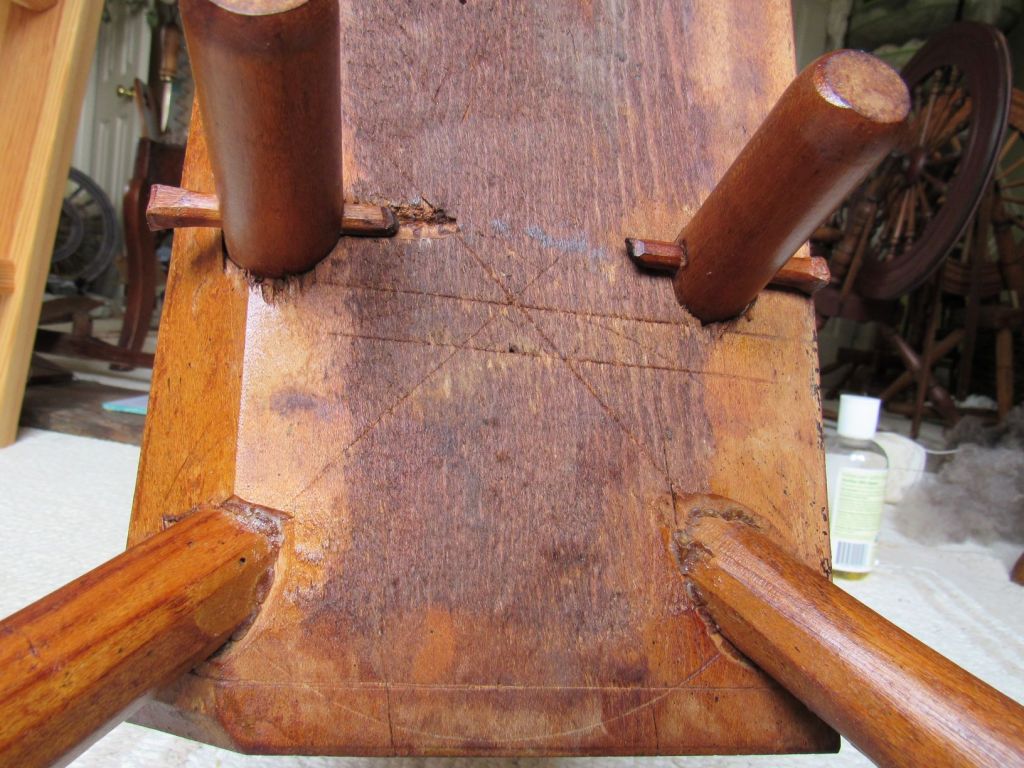
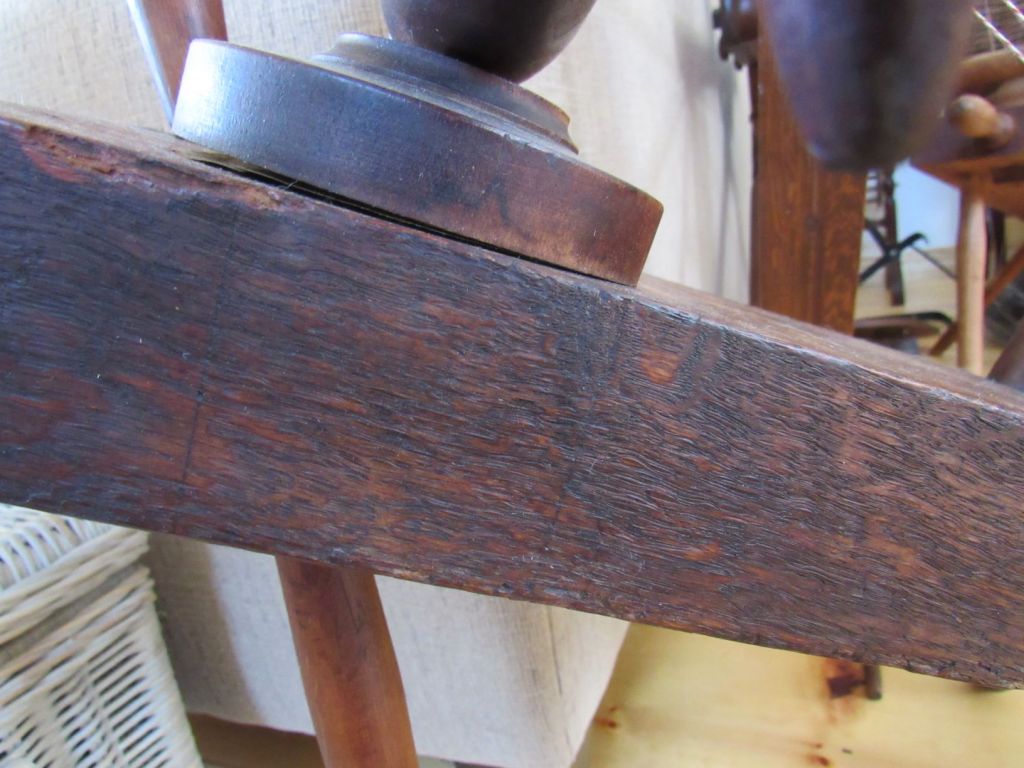
The underside of the table has a carved date in Roman Numerals of 1707, and the same date is faintly inscribed on the table’s side.
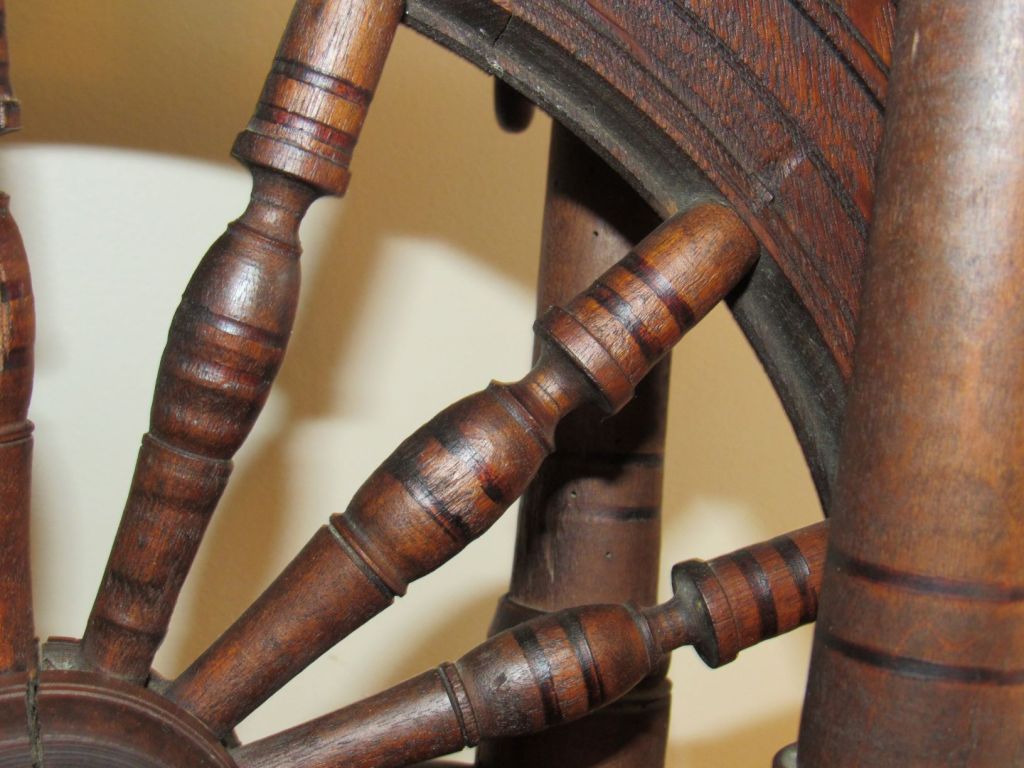
The wheel is No. 29 in Cummer’s collection and, in her description, she did not question the date, noting that it was compatible with the wheel’s William and Mary turnings.
According to Cummer, the wheel was believed to have been brought to New England from England.
I do not know if the wheel is really that old or if it was from England—it has some Scandinavian-style features.
Unfortunately, we do not have many surviving wheels from the early 18th century for comparison and I have not been able to find any similar wheels in paintings.
I like to think it is over three hundred years old.
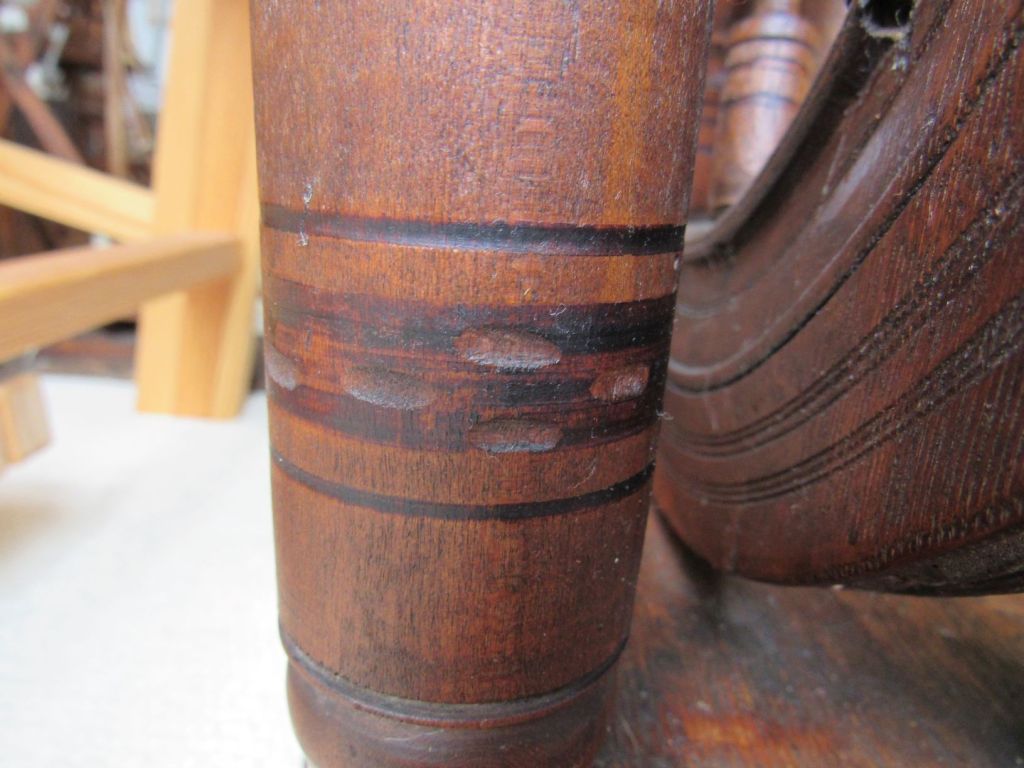
Knotted wood on the inside of one leg
But, even if not quite that old, it has been through a lot.
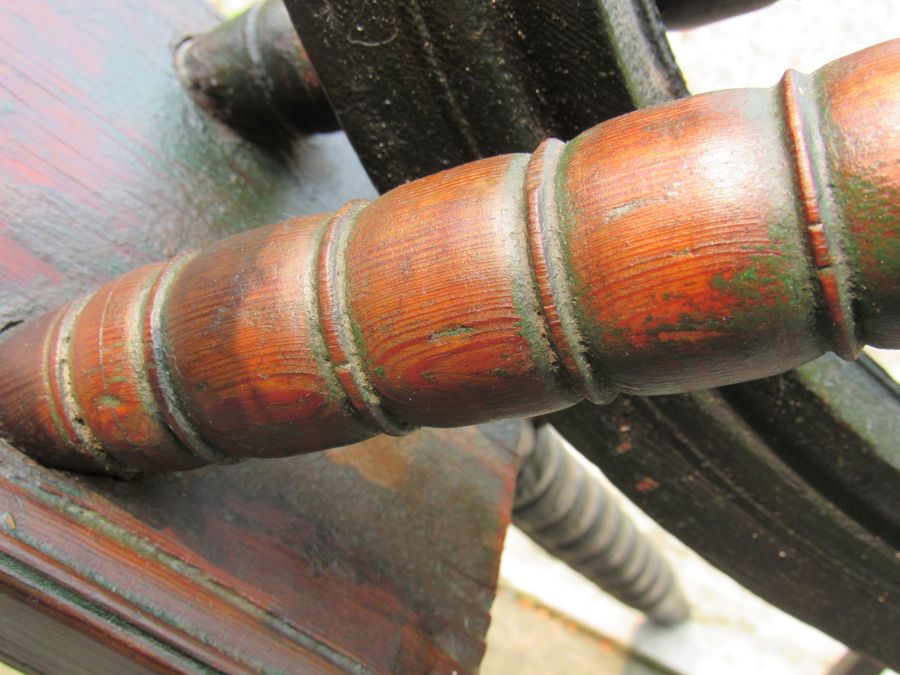
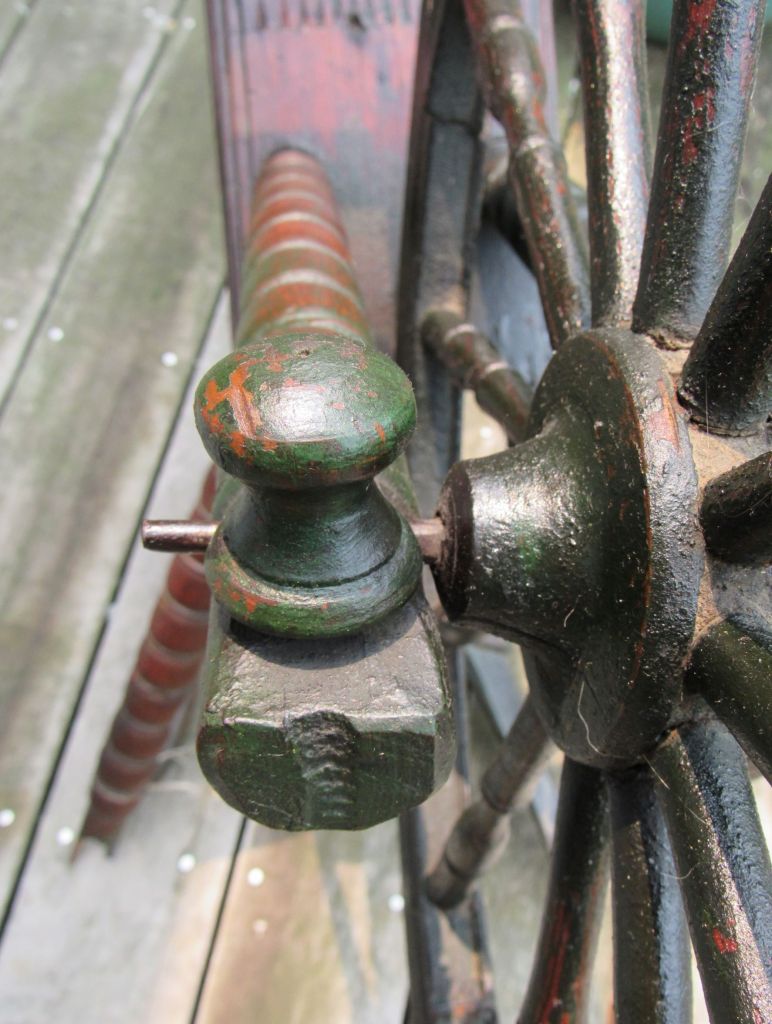
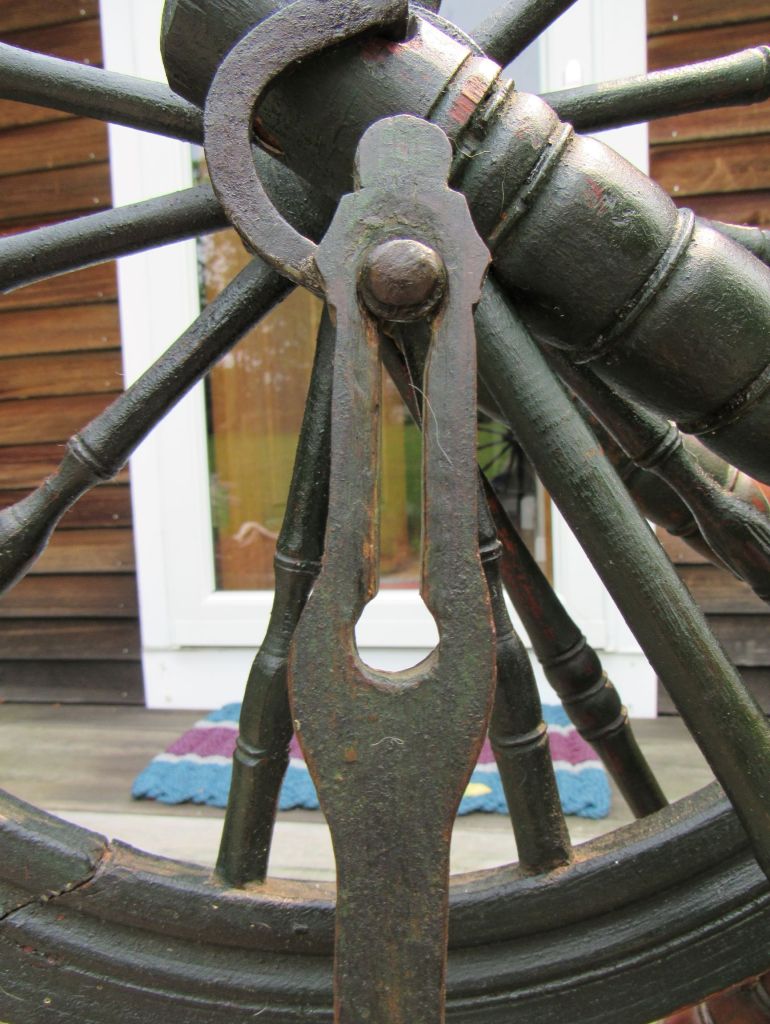
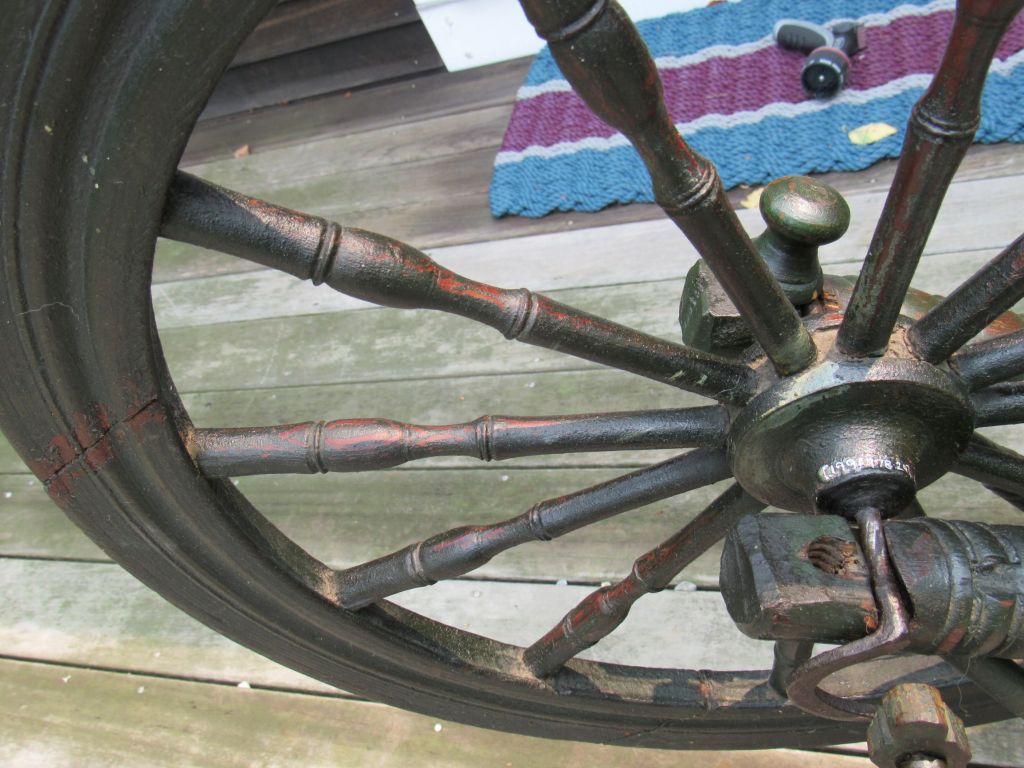
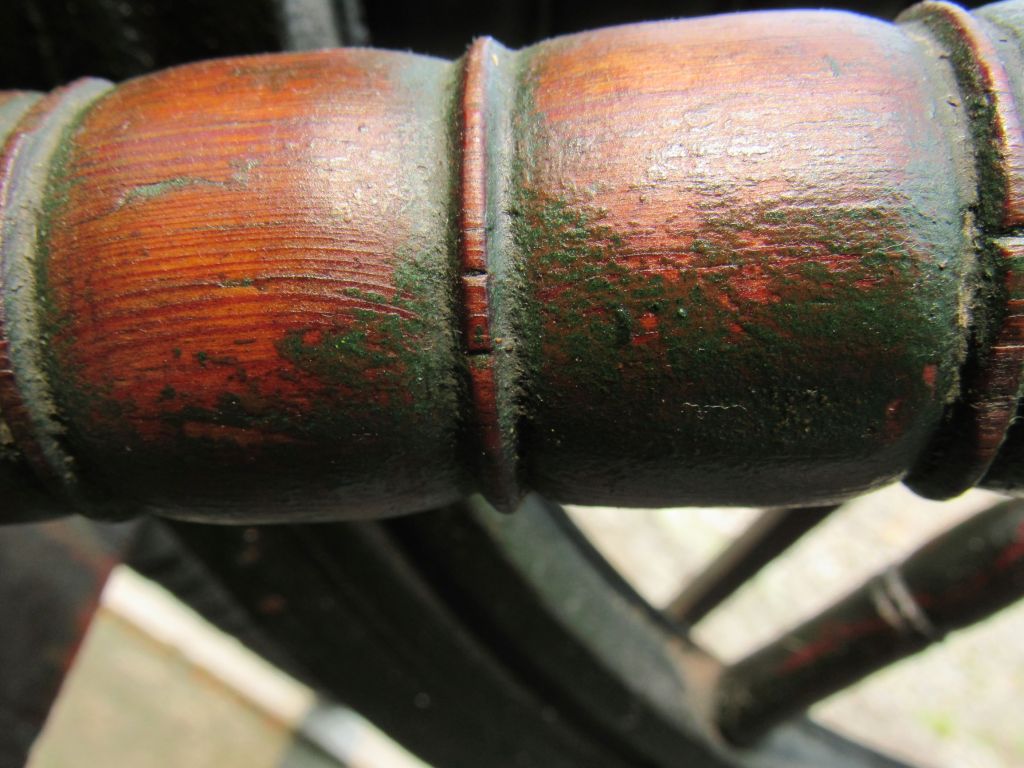
As Cummer commented, there seems to be at least one layer of green paint that, while old, is not original.
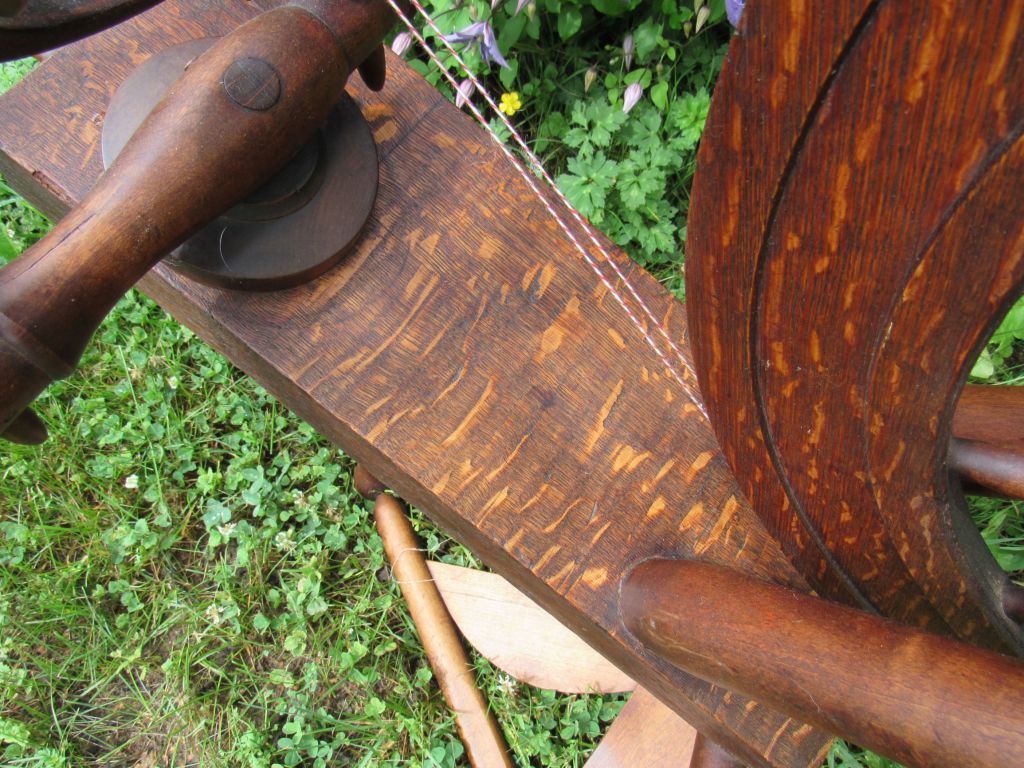
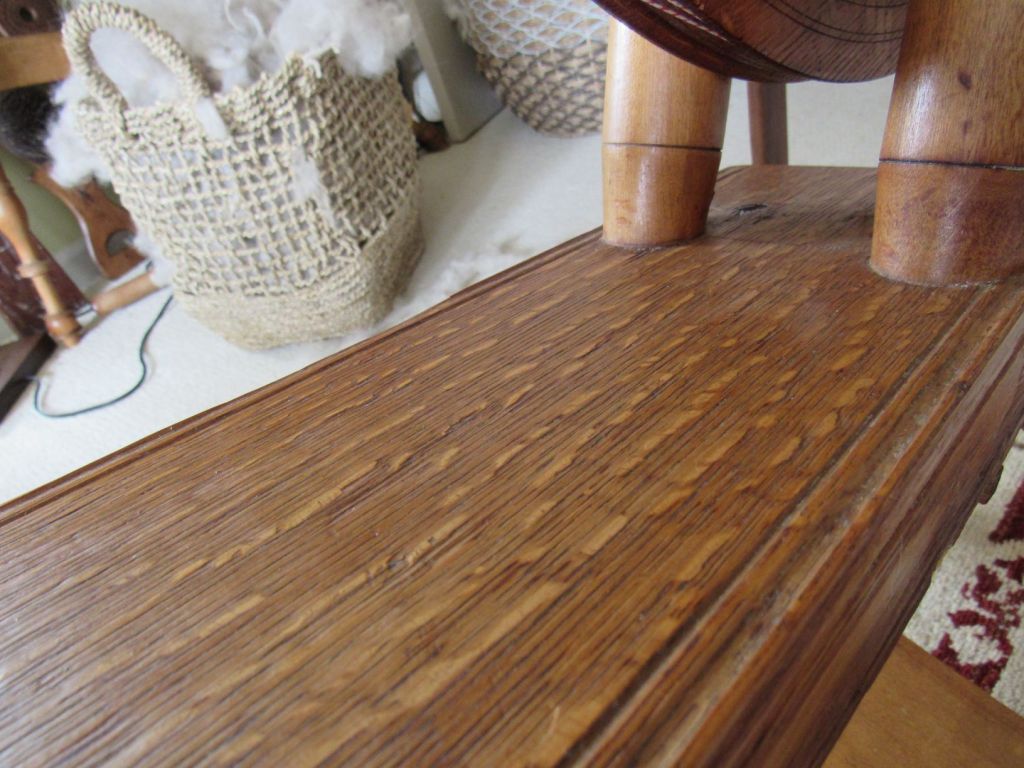
The wood that shines through is a beautifully grained reddish color.
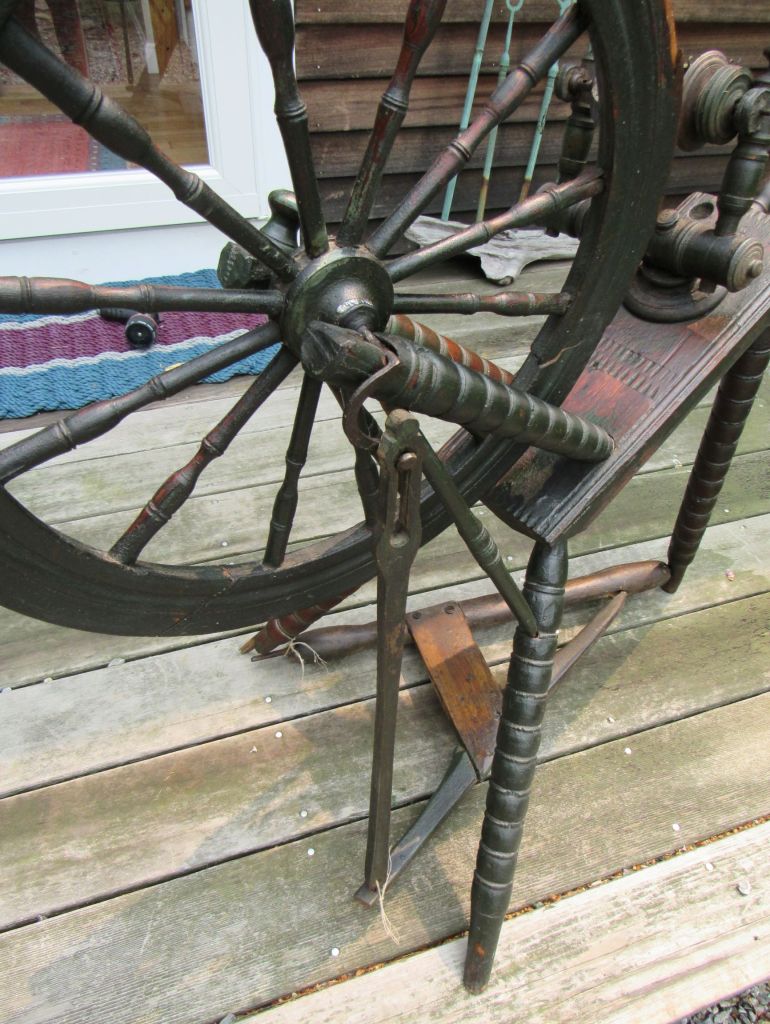
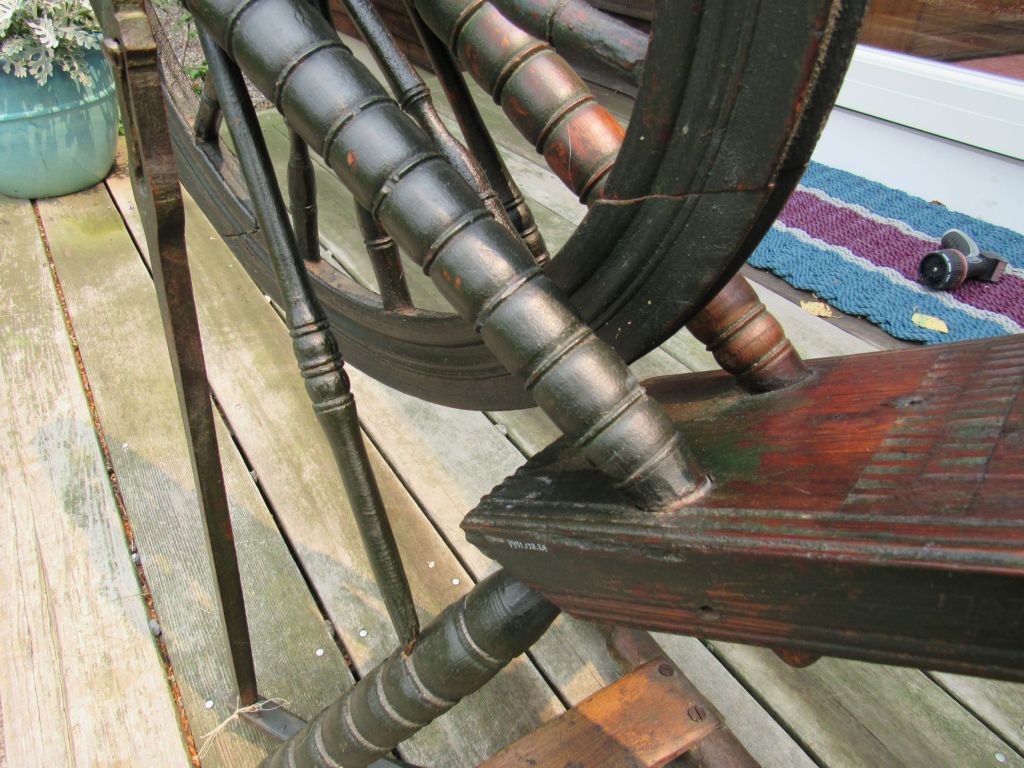
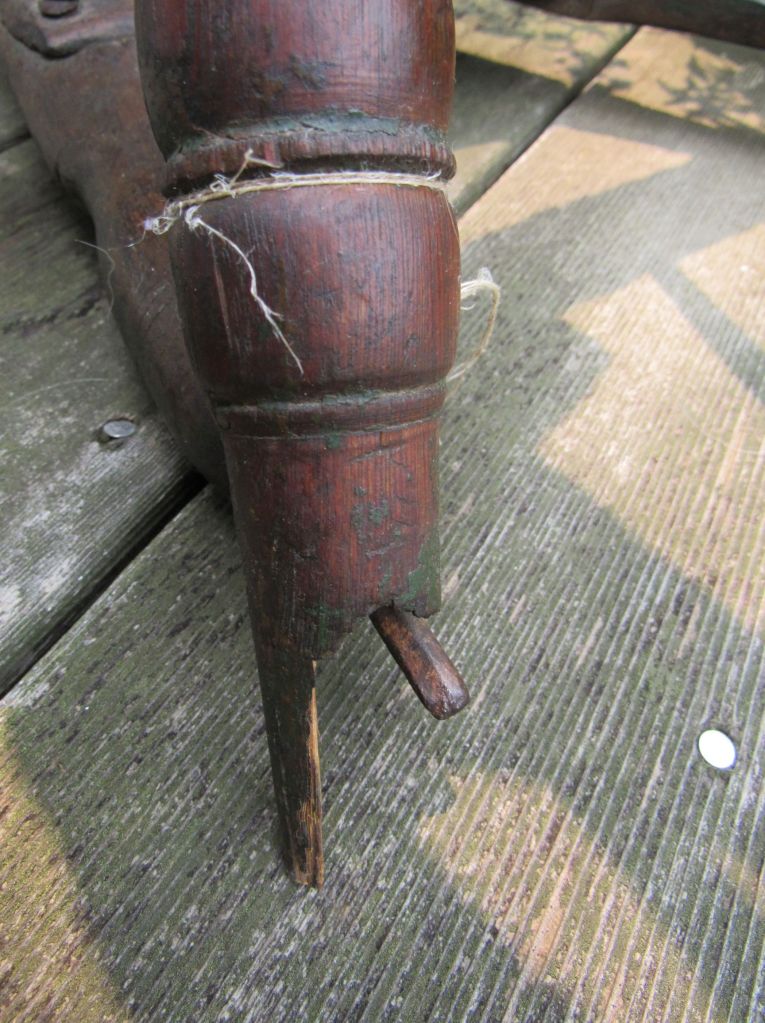
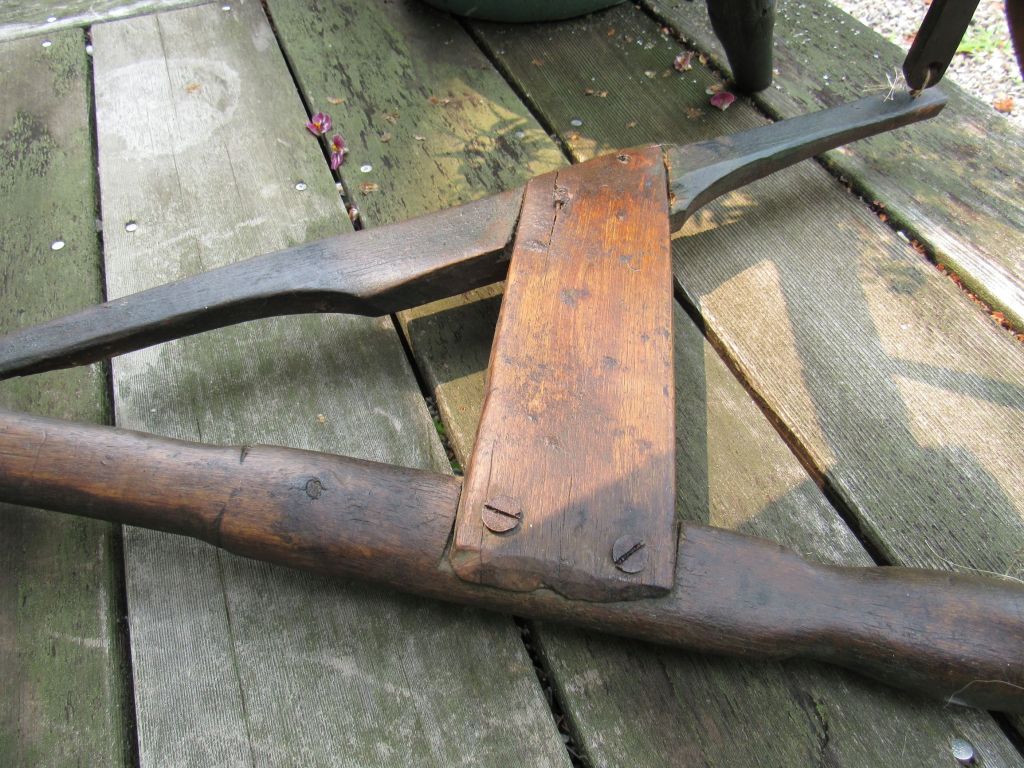
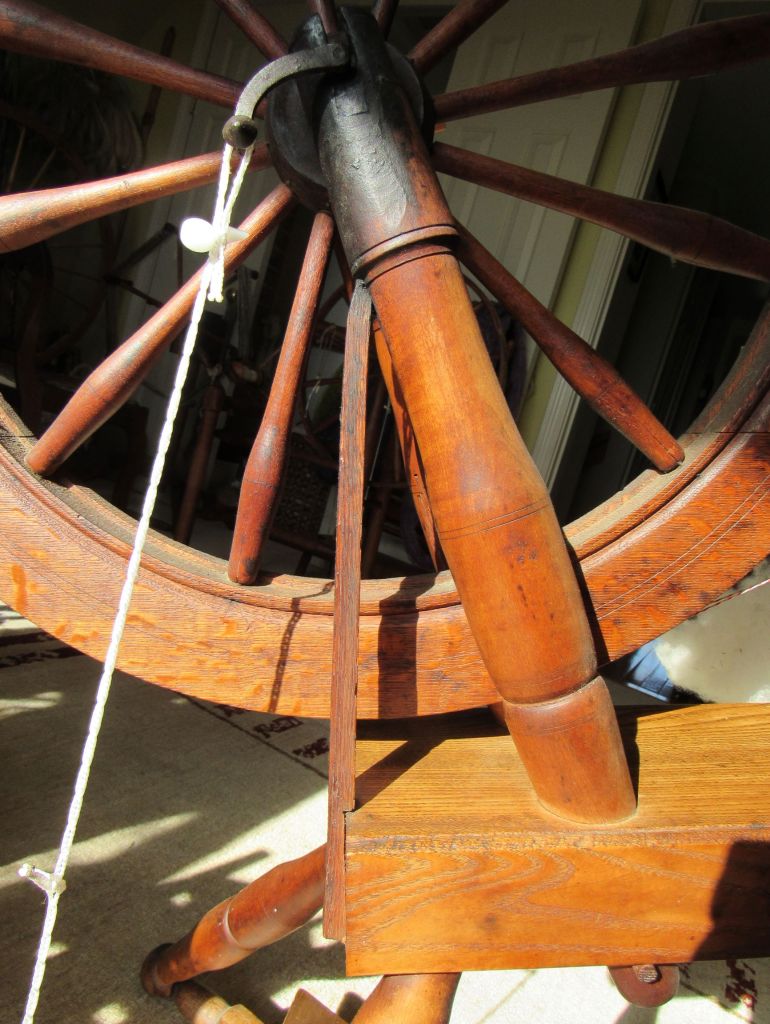
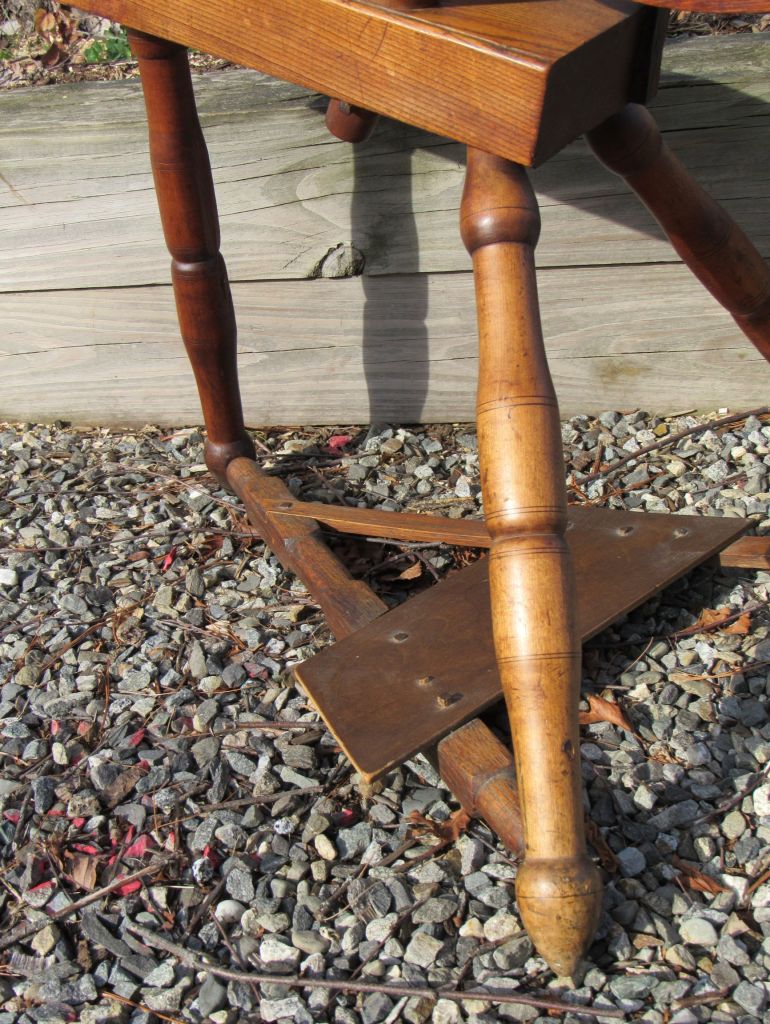
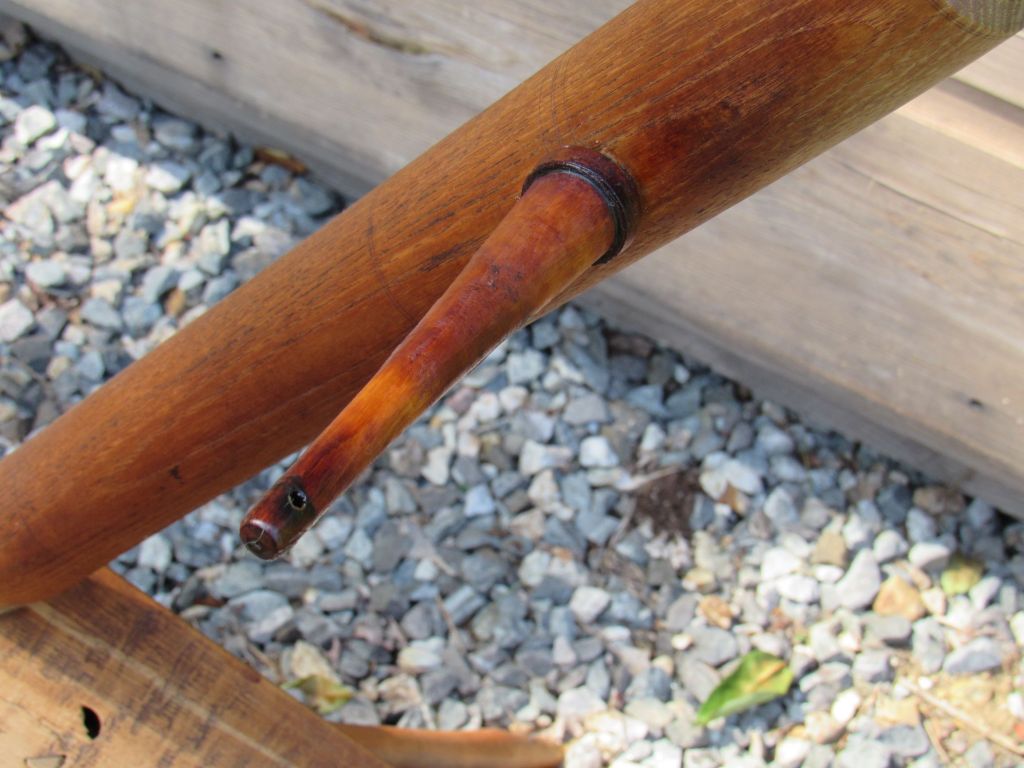
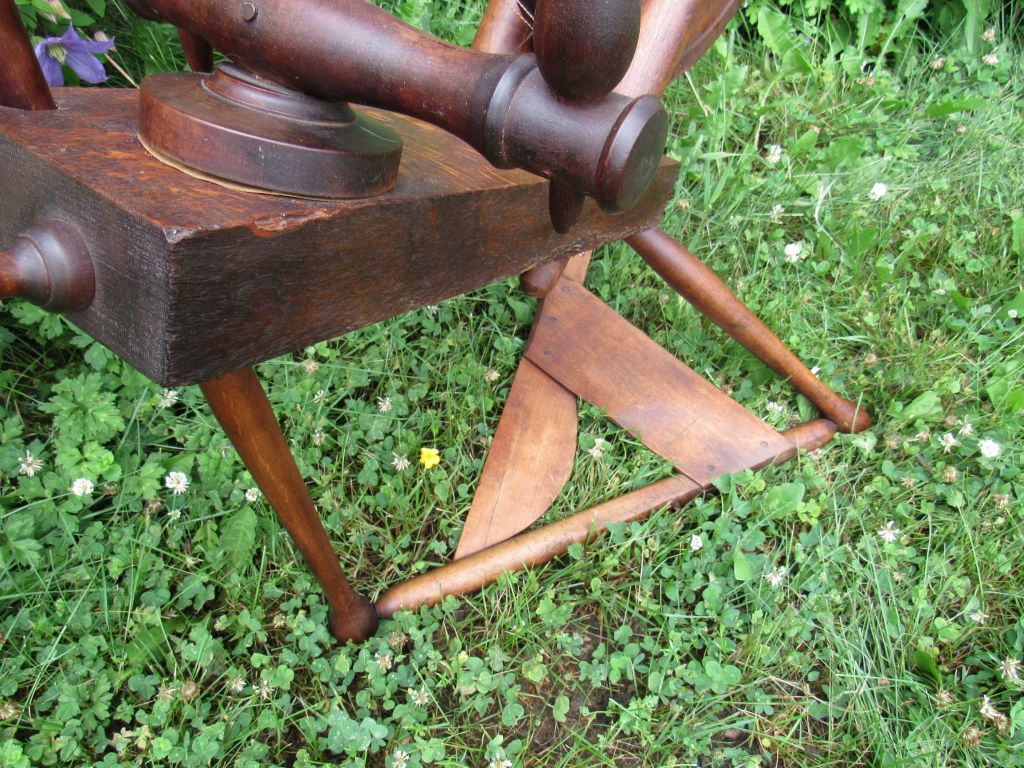
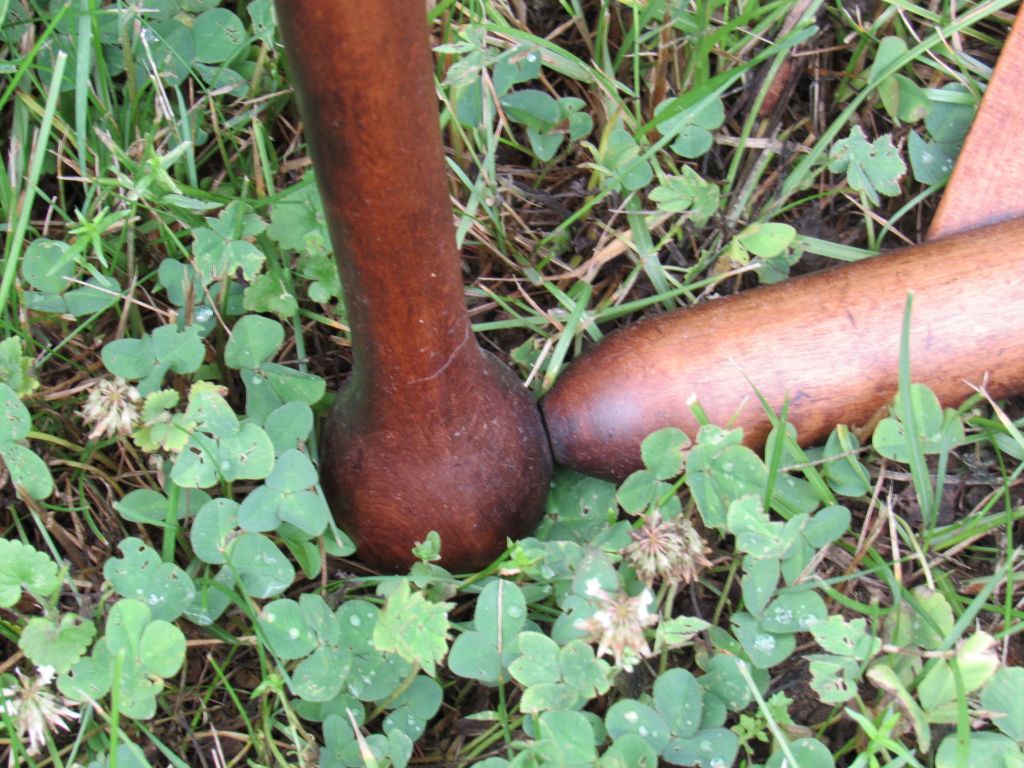
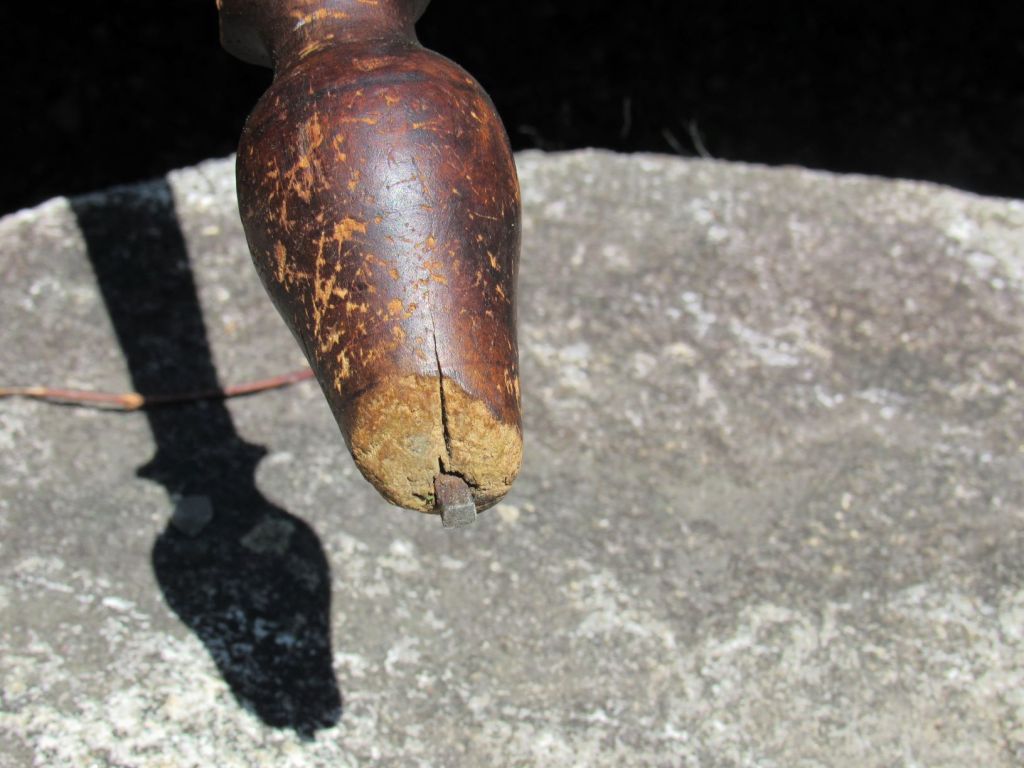
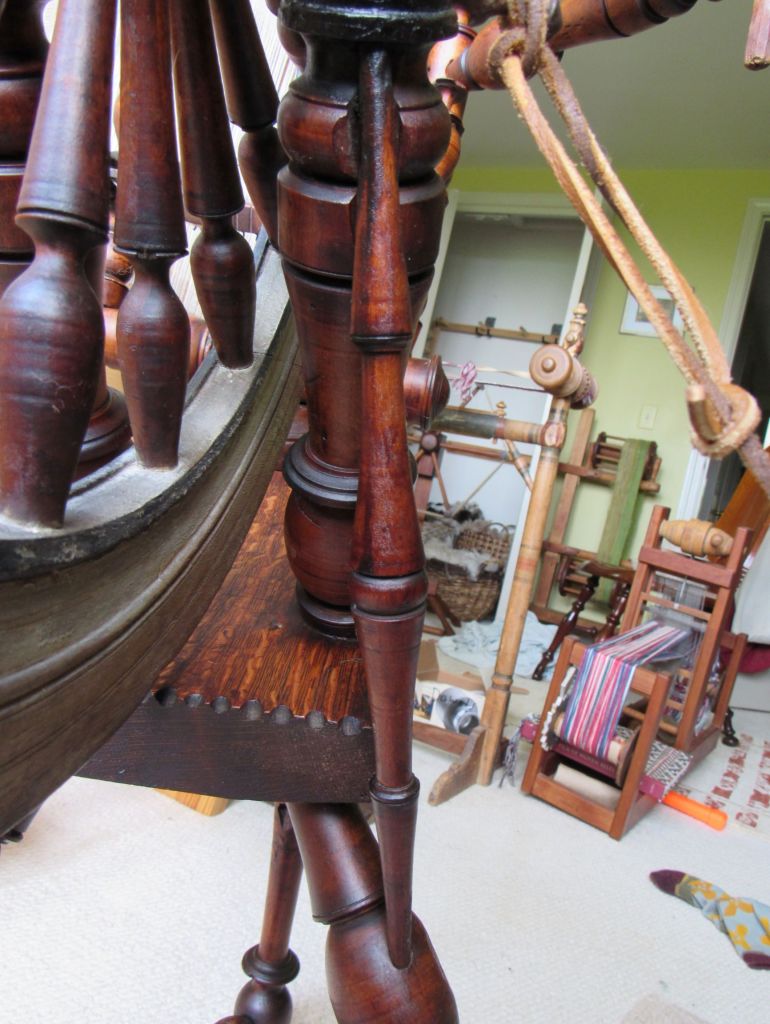
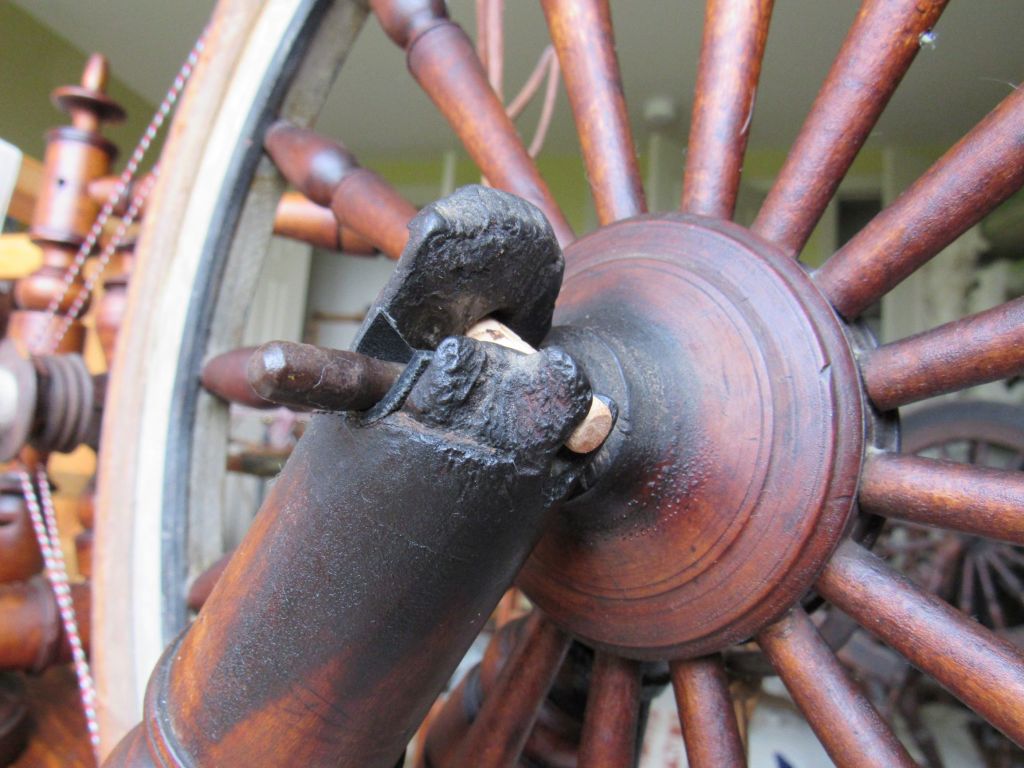
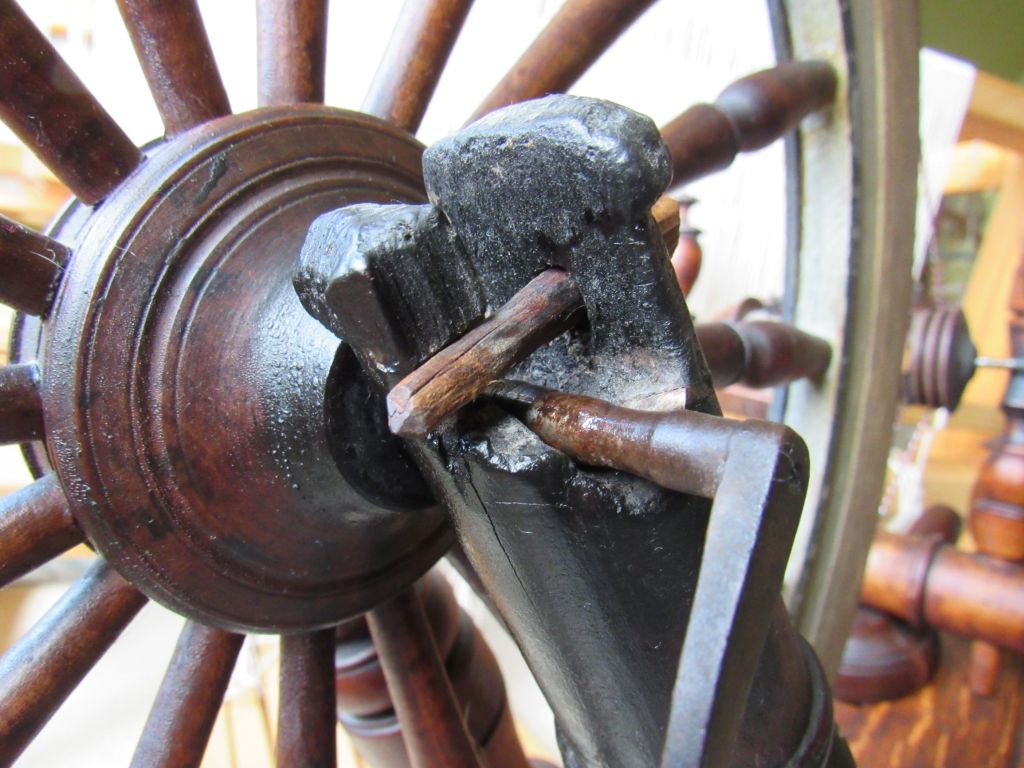
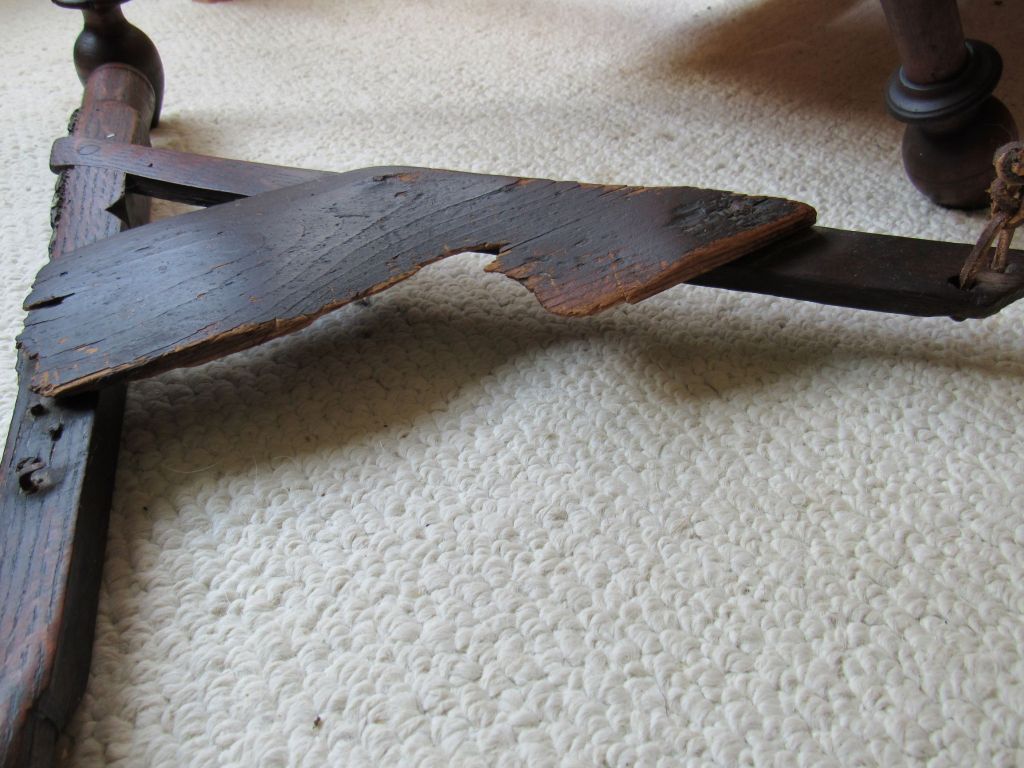
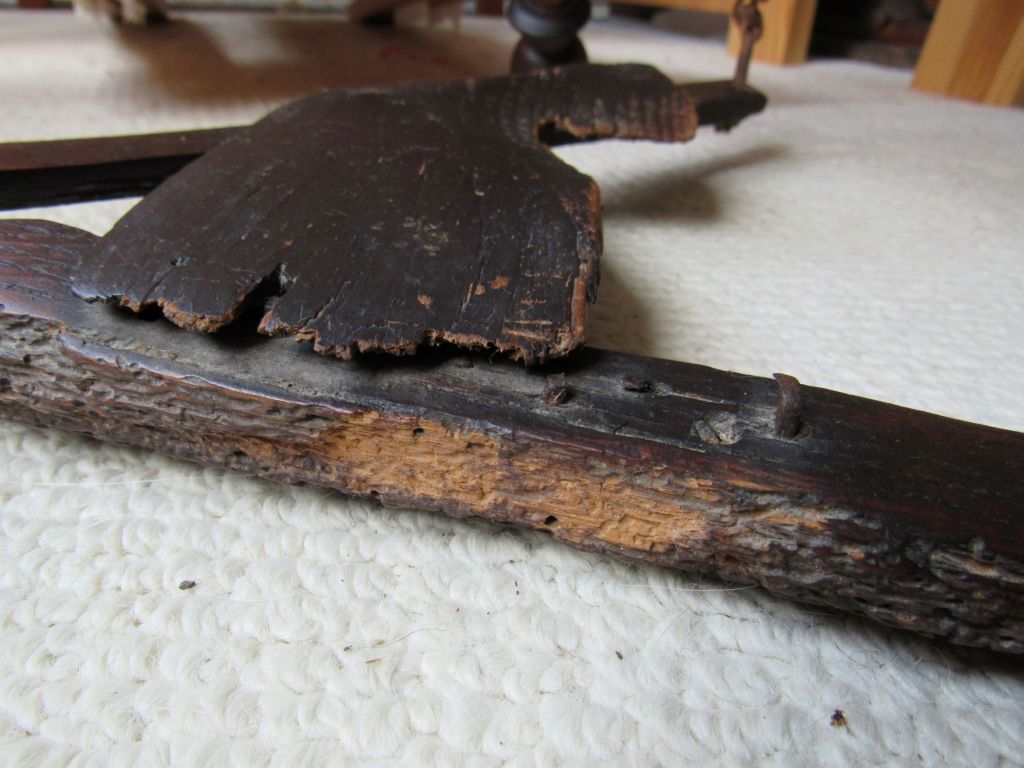
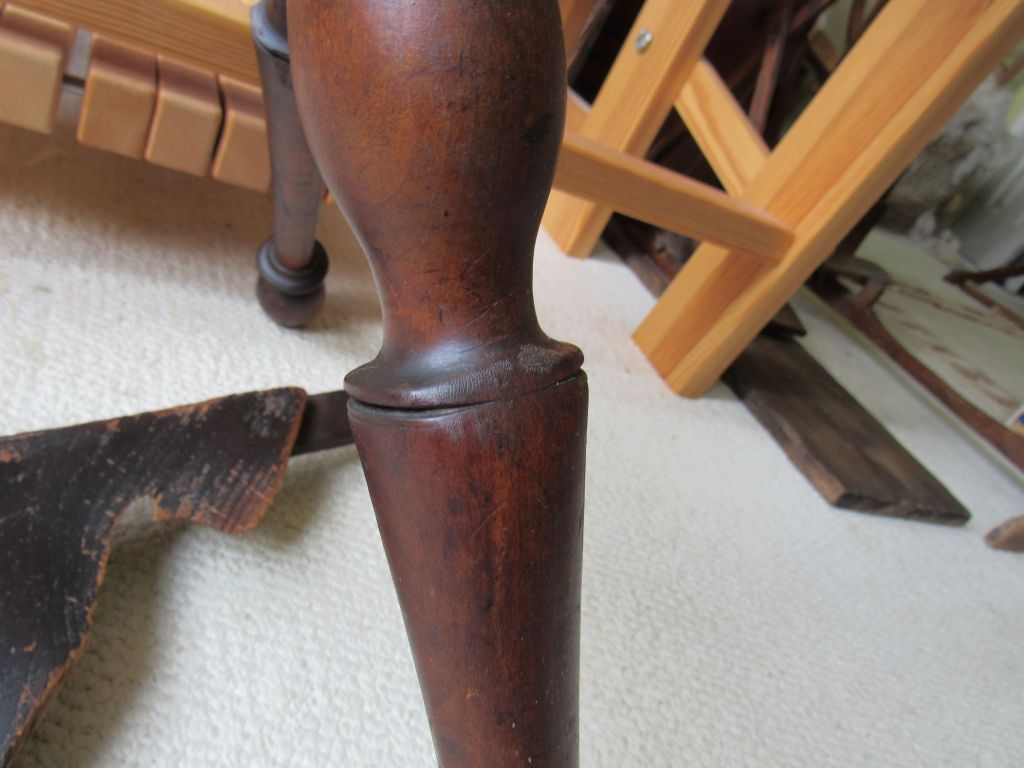
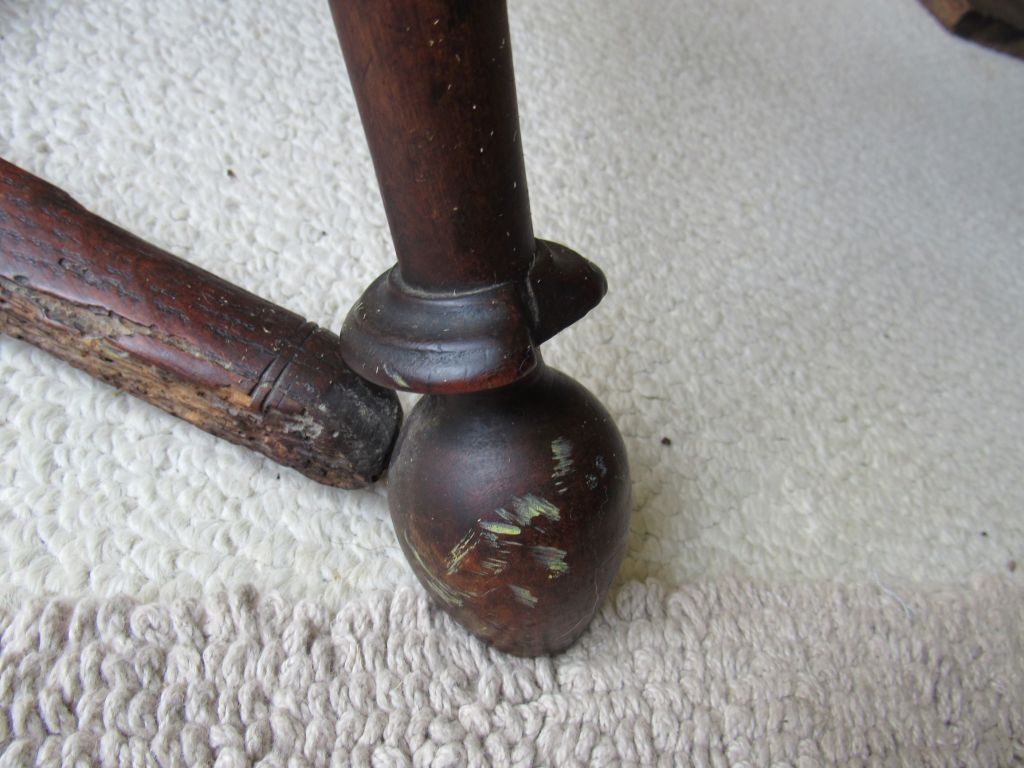
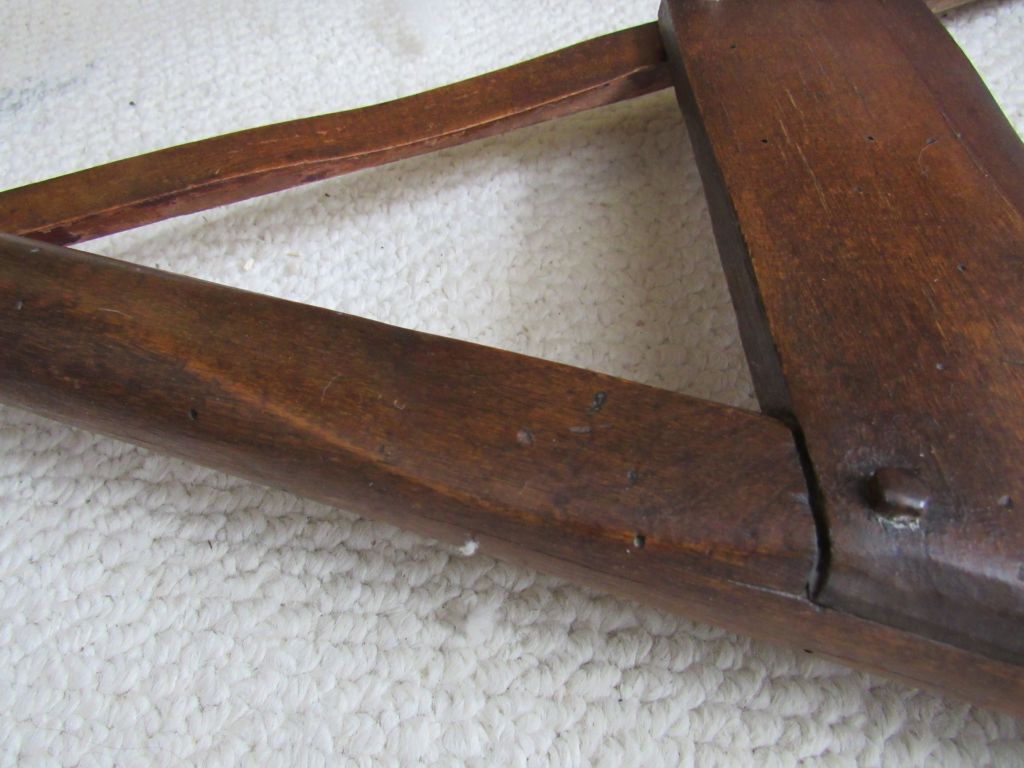
The two secondary upright supports rise from the legs and fall out at the slightest jiggle. One foot is completely broken out where the treadle bar rod was inserted.
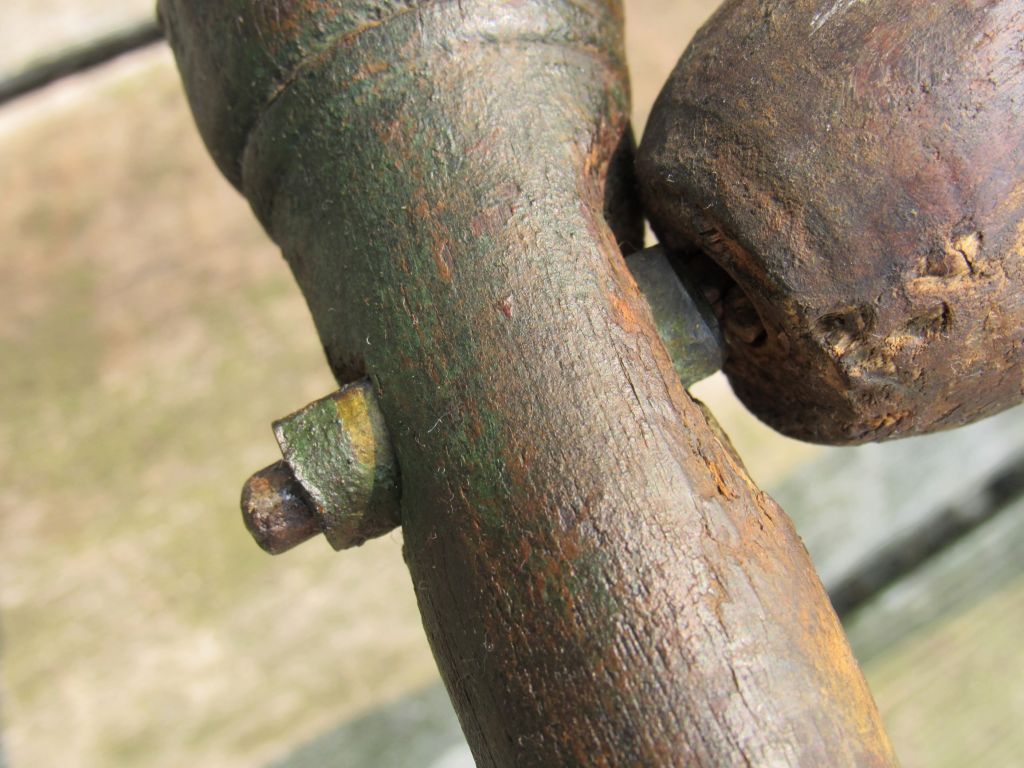
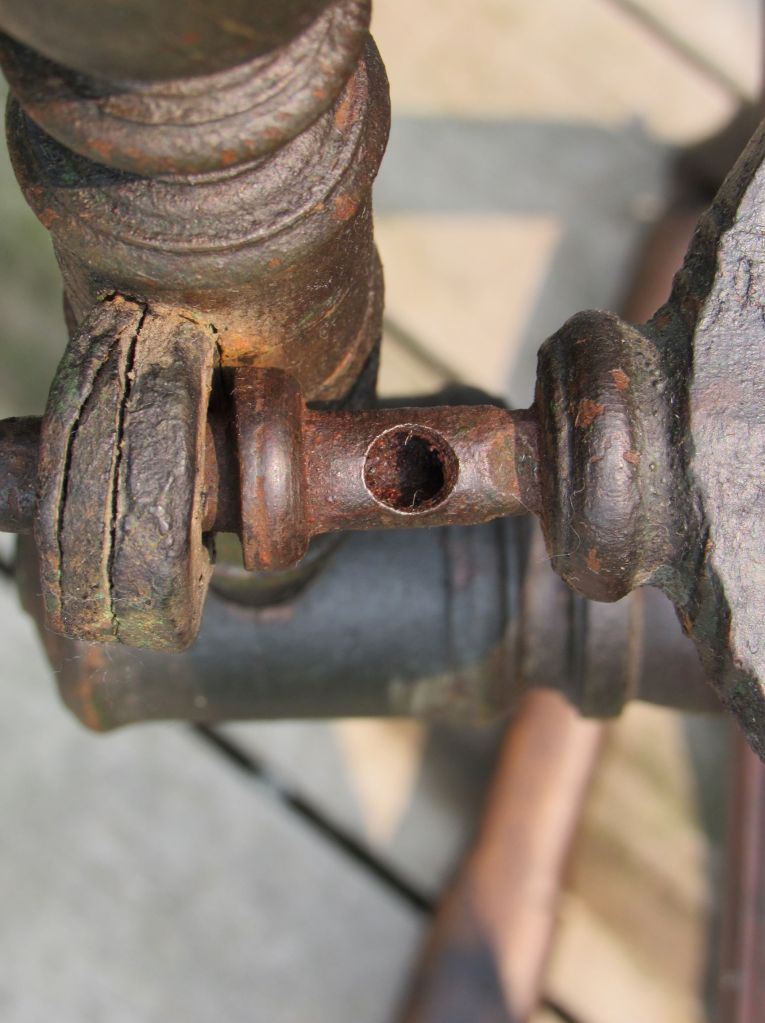
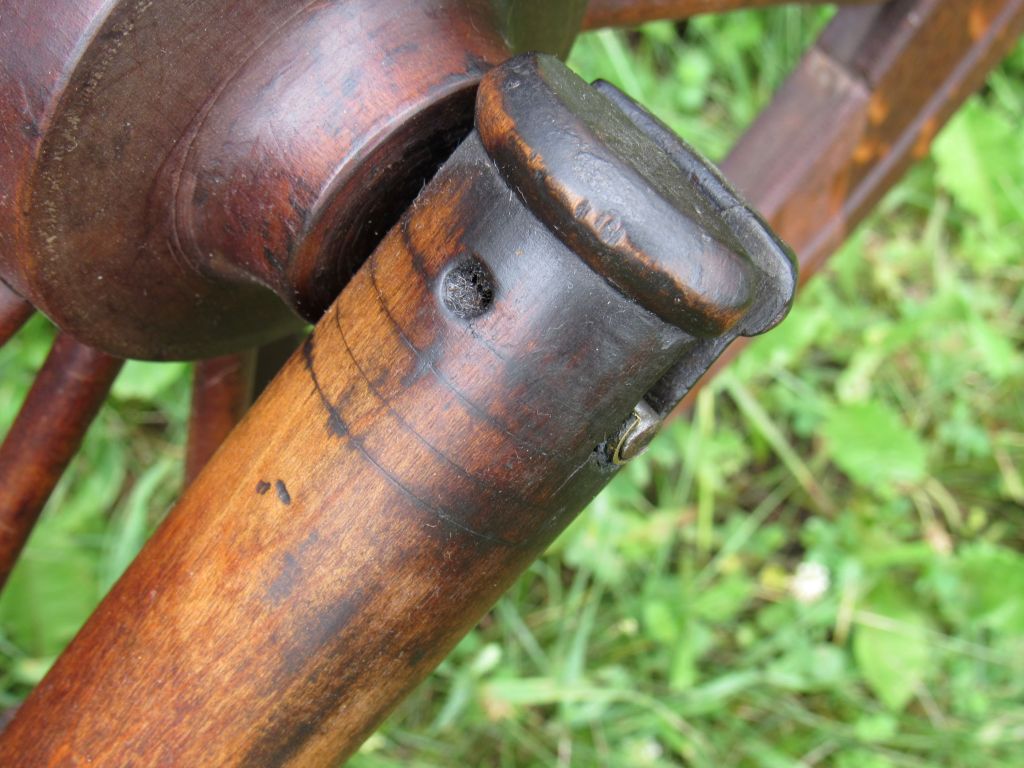
In the leg at the other end, the bar is supported by a metal tube inserted through the wood.
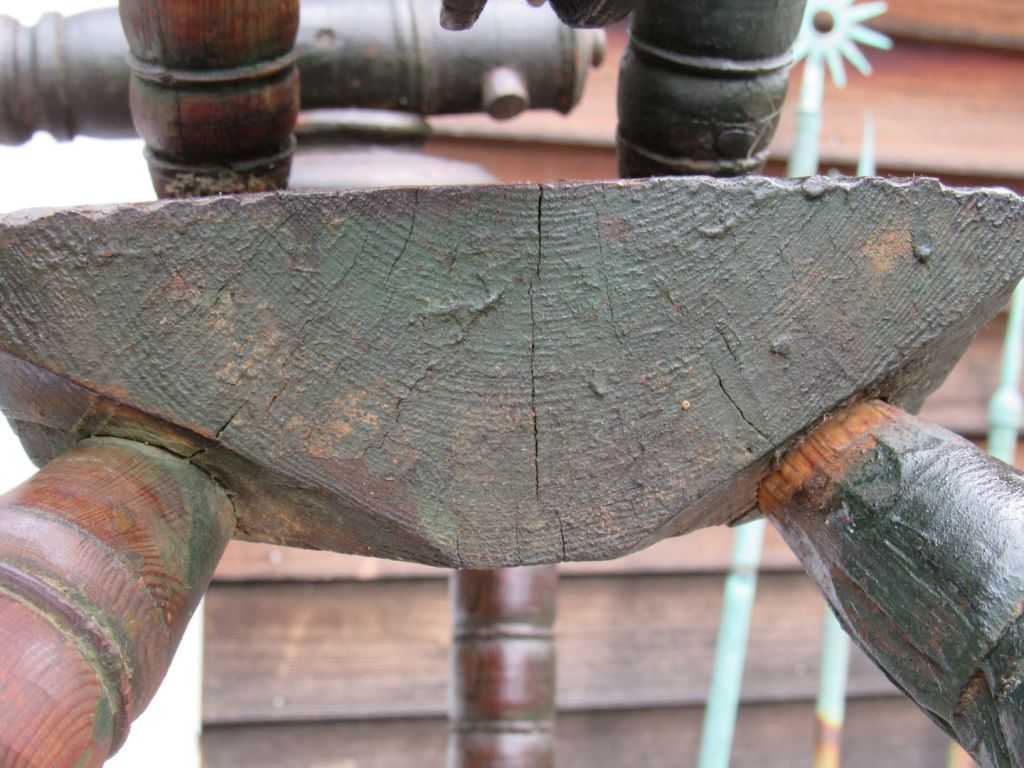
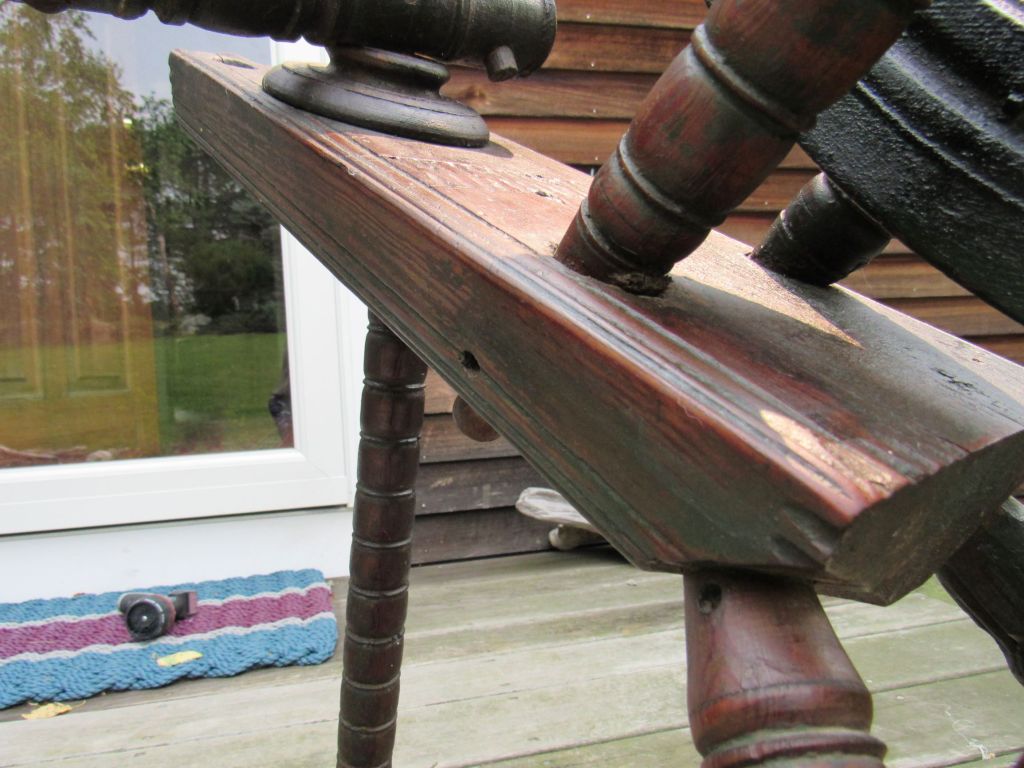
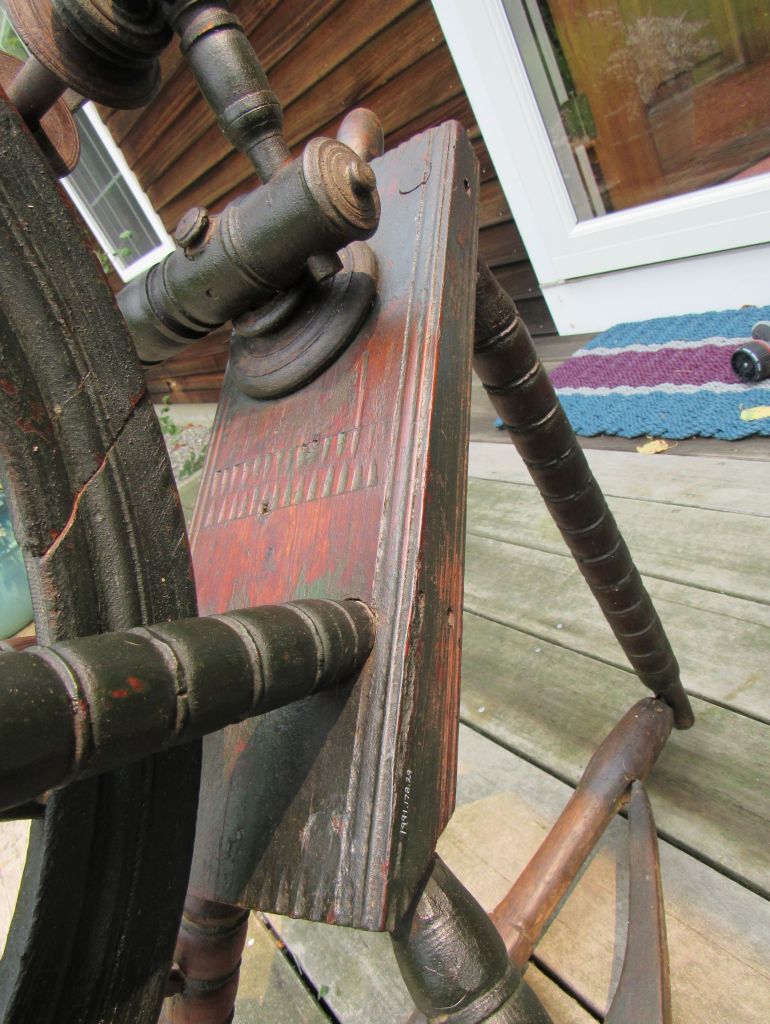
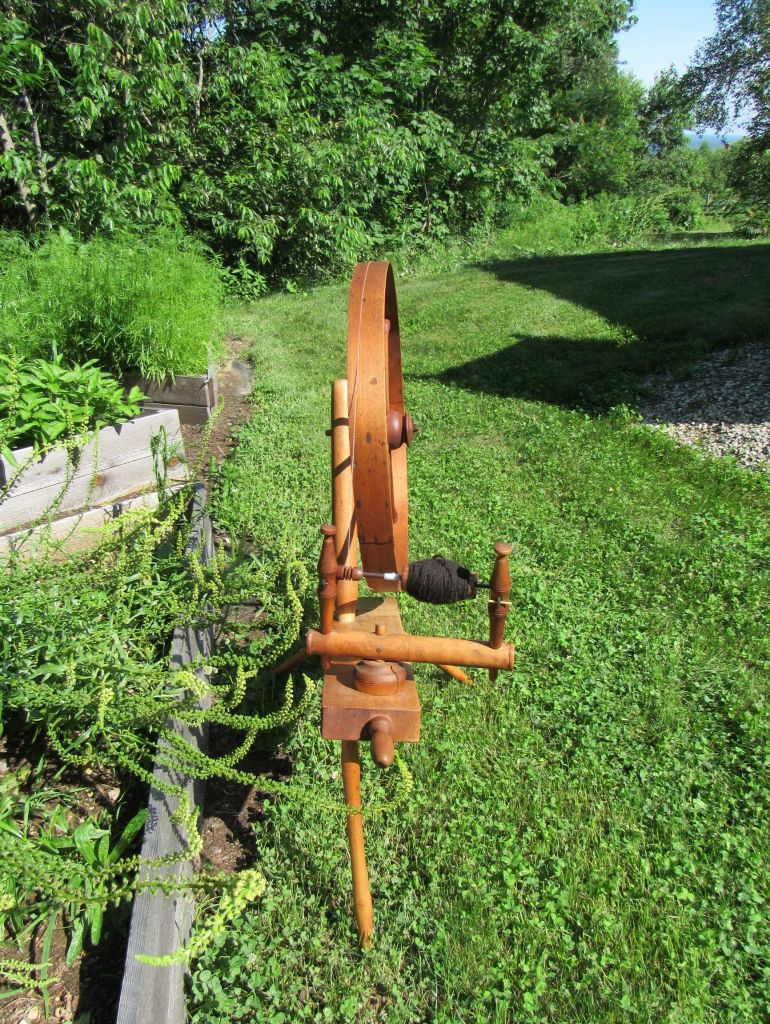
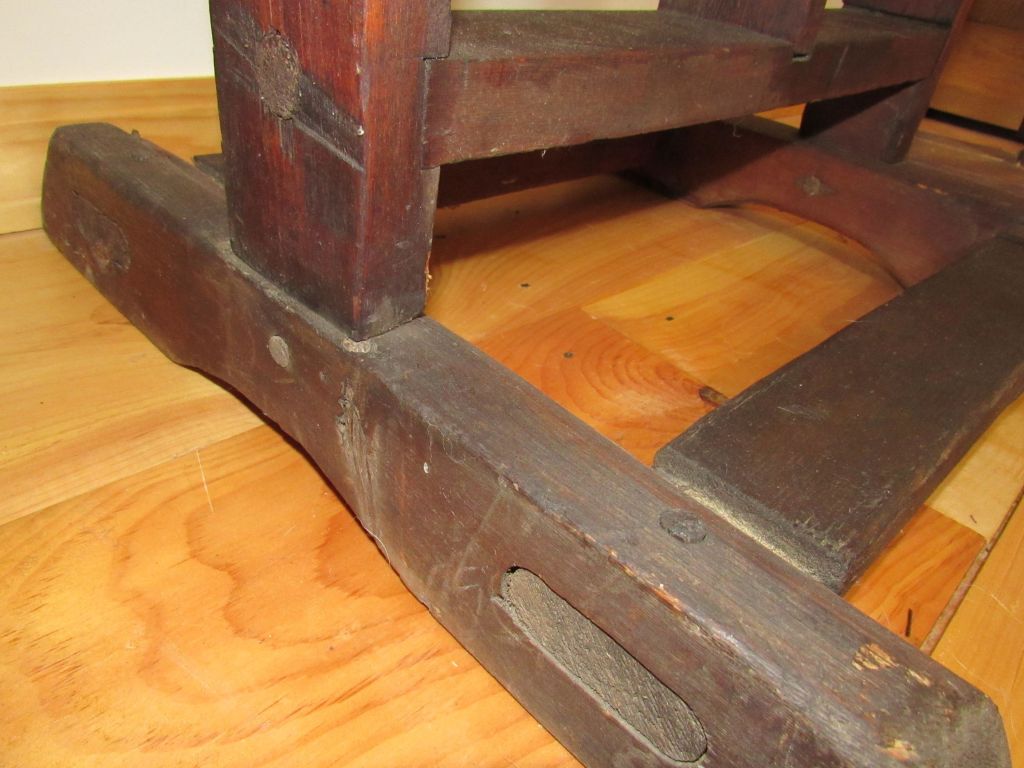
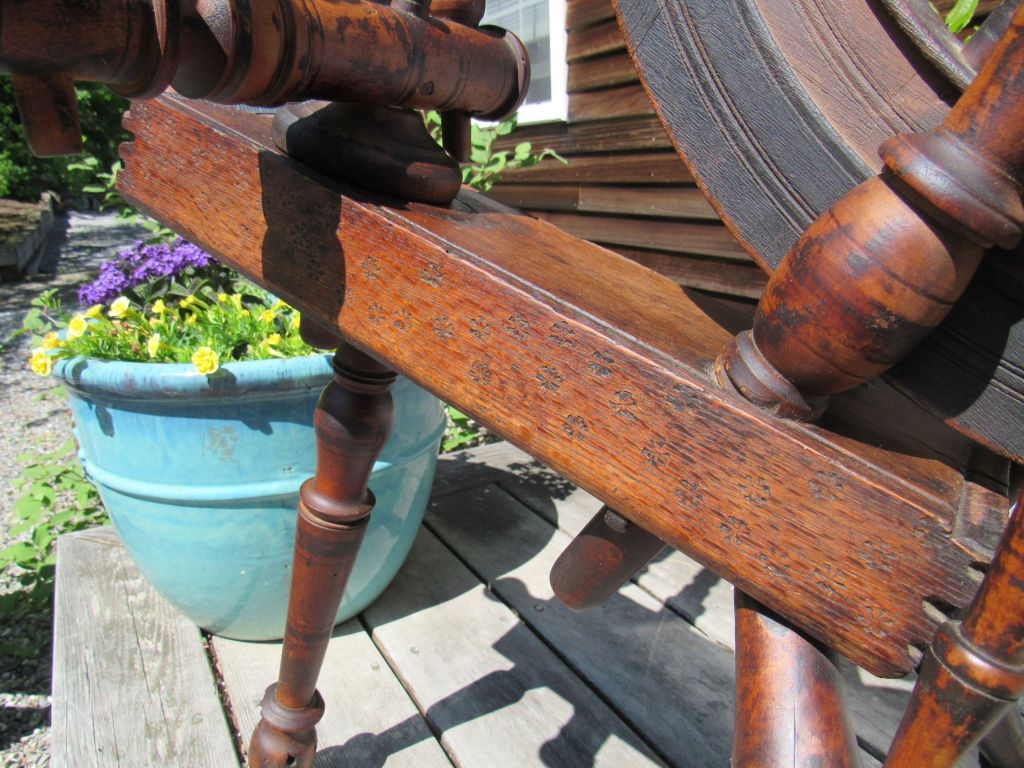
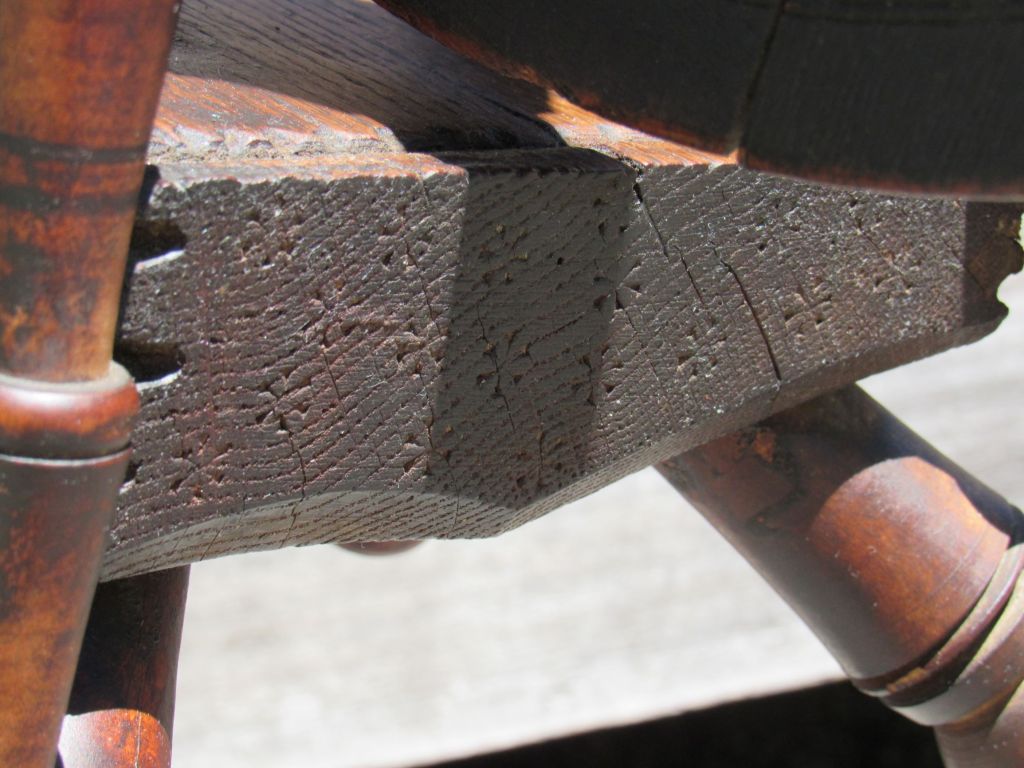
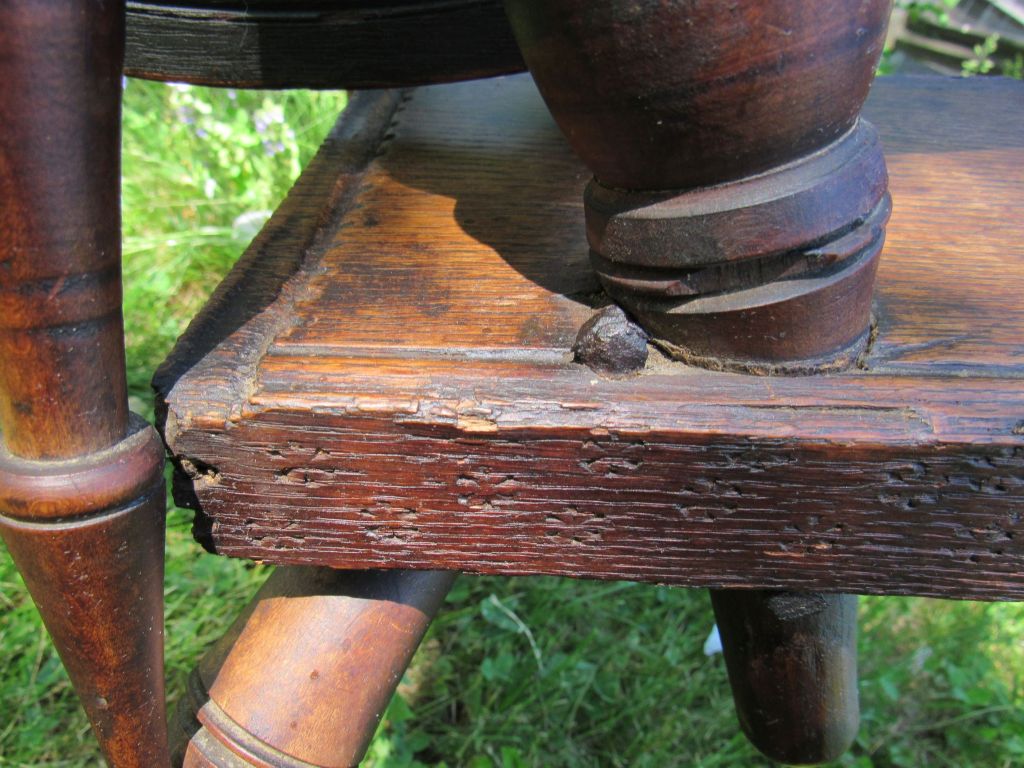
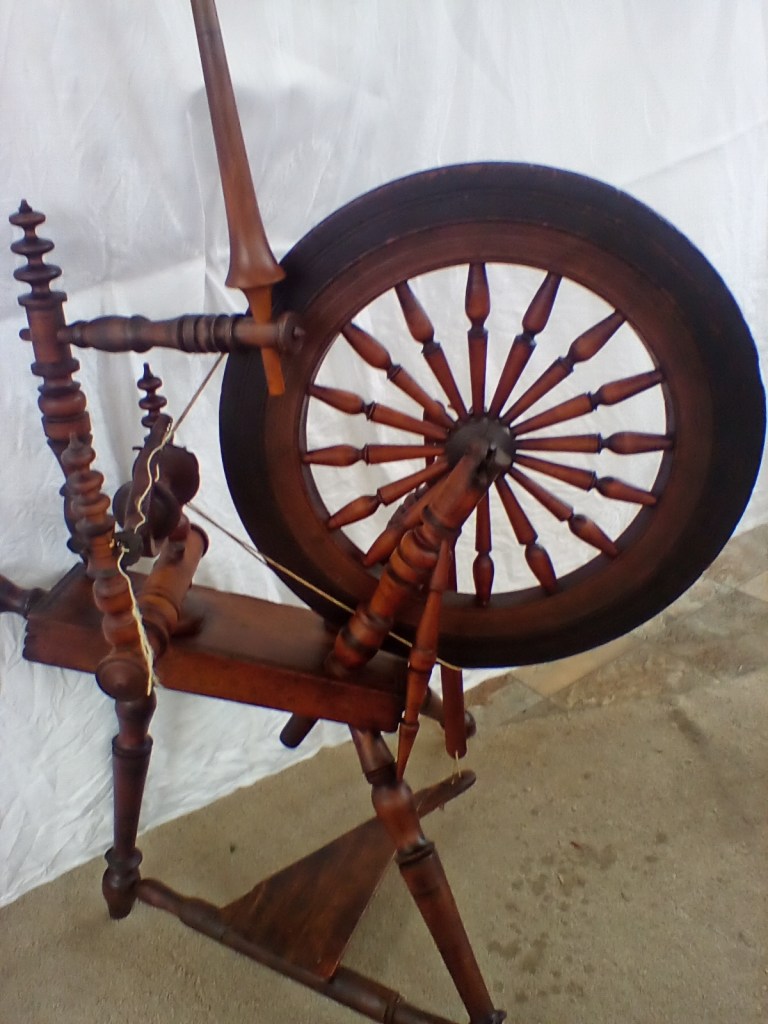
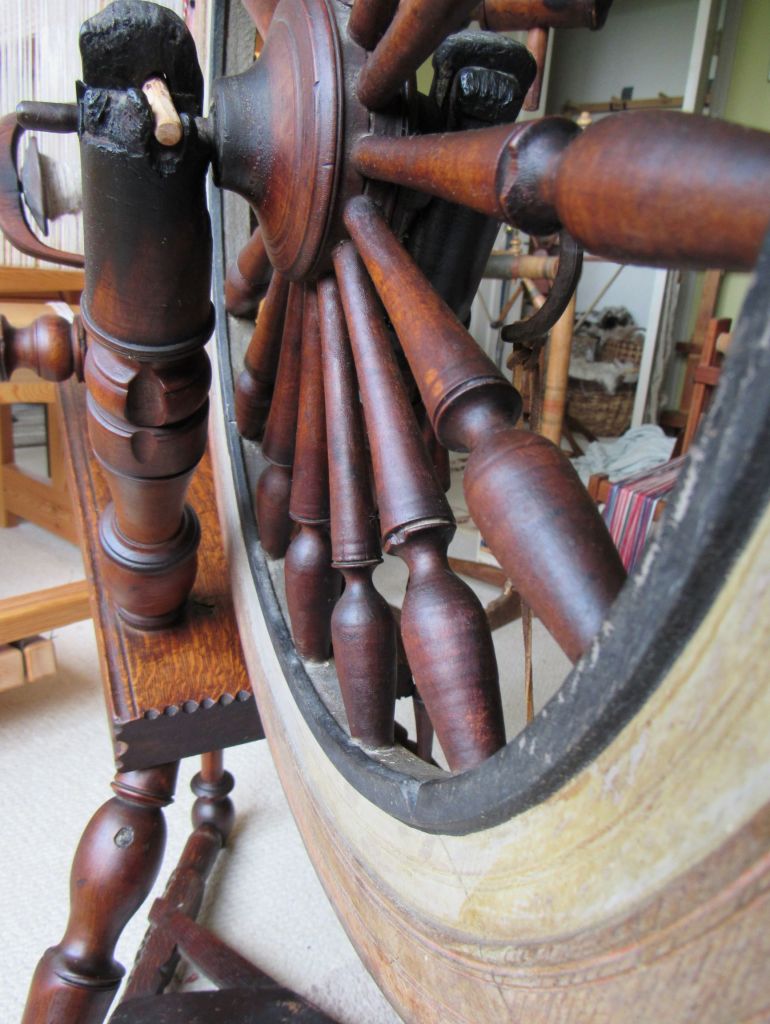
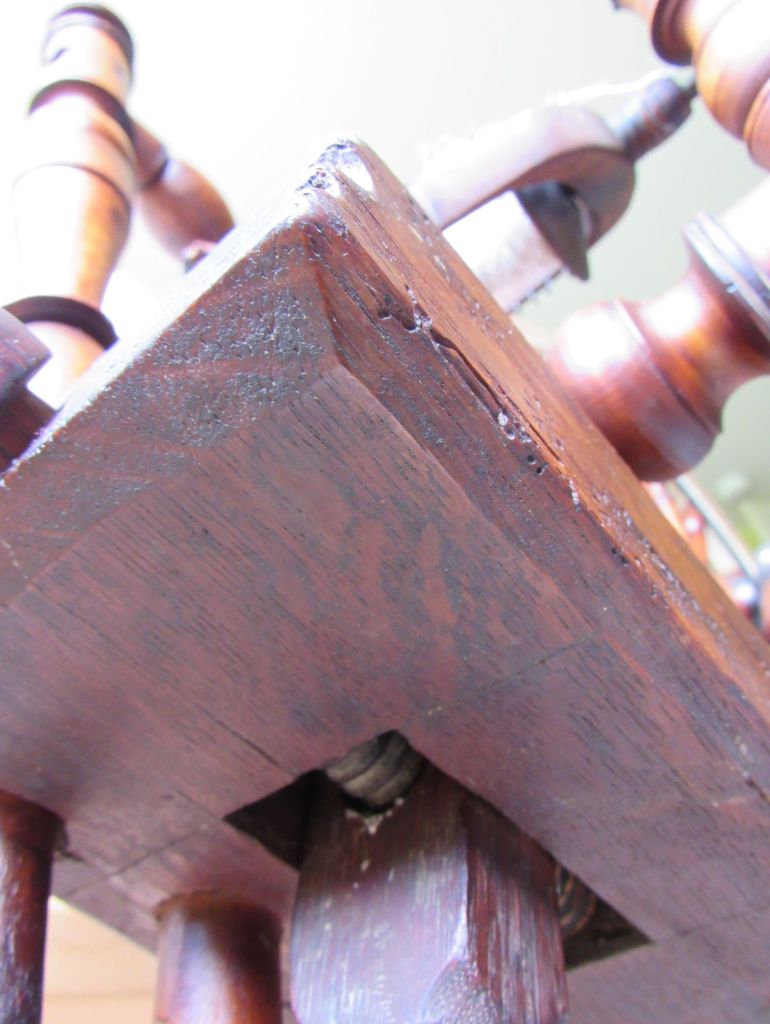
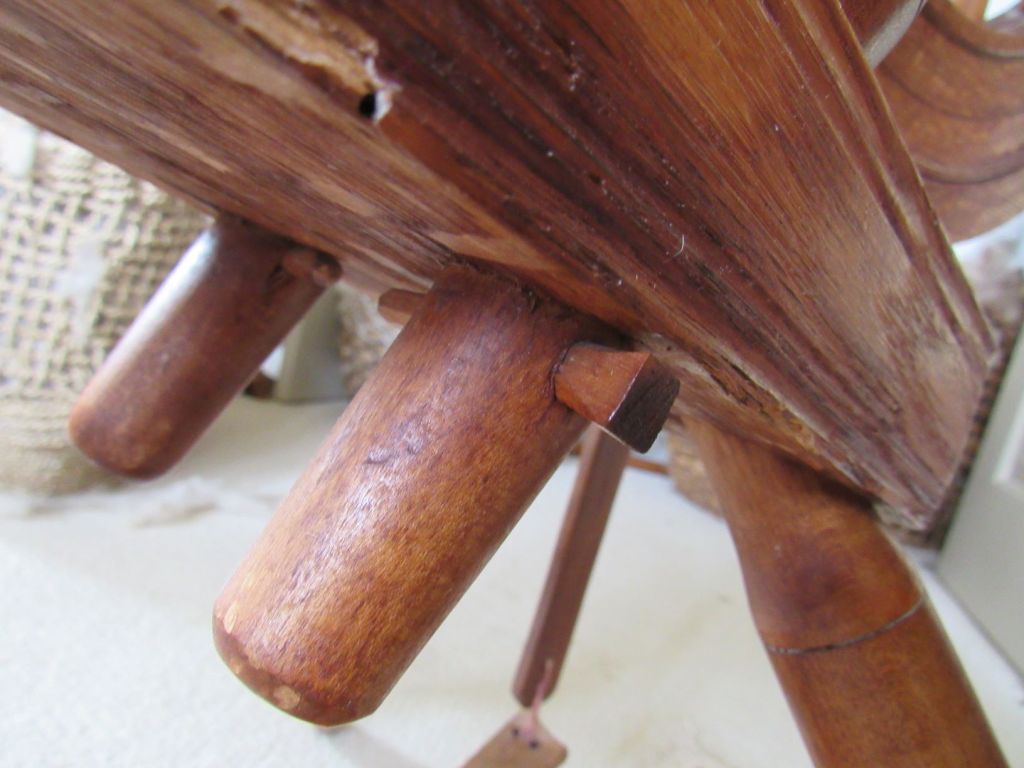
The wheel’s slanty stance is a result of the legs being inserted into angular cuts on the table’s downhill side.
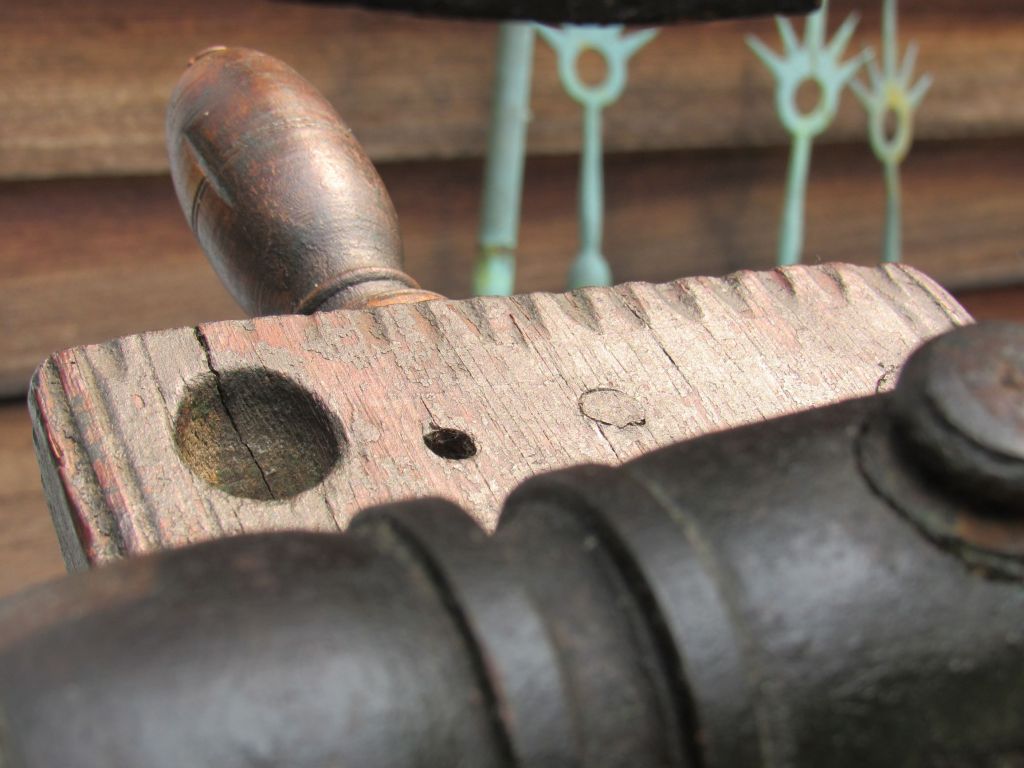
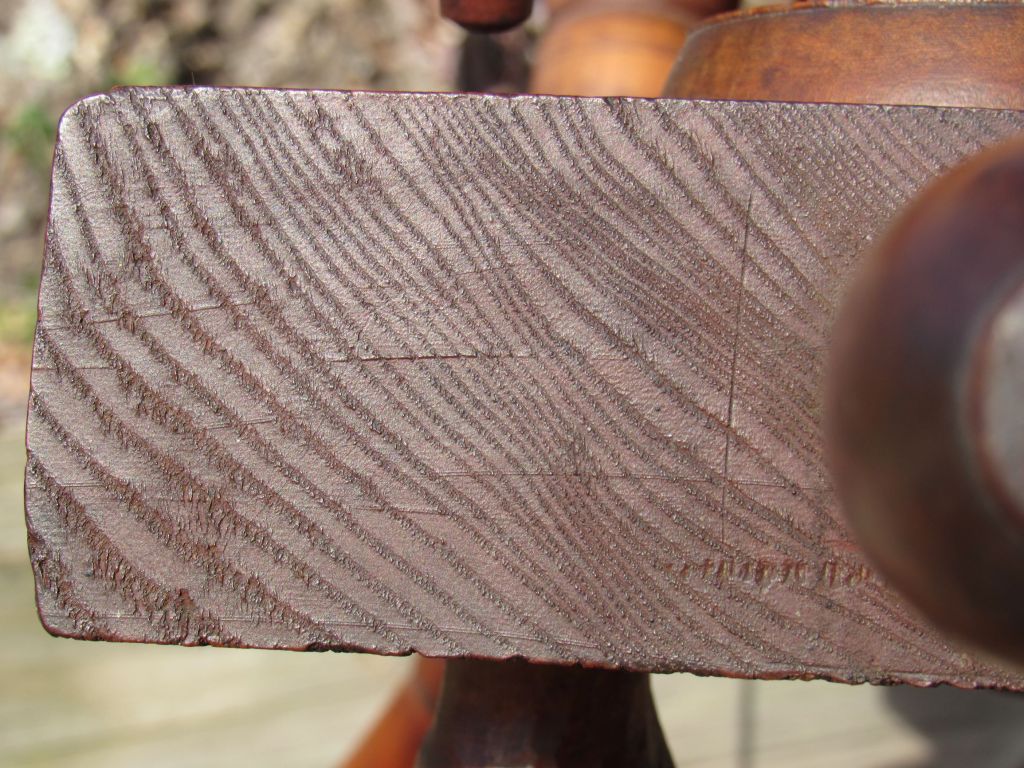
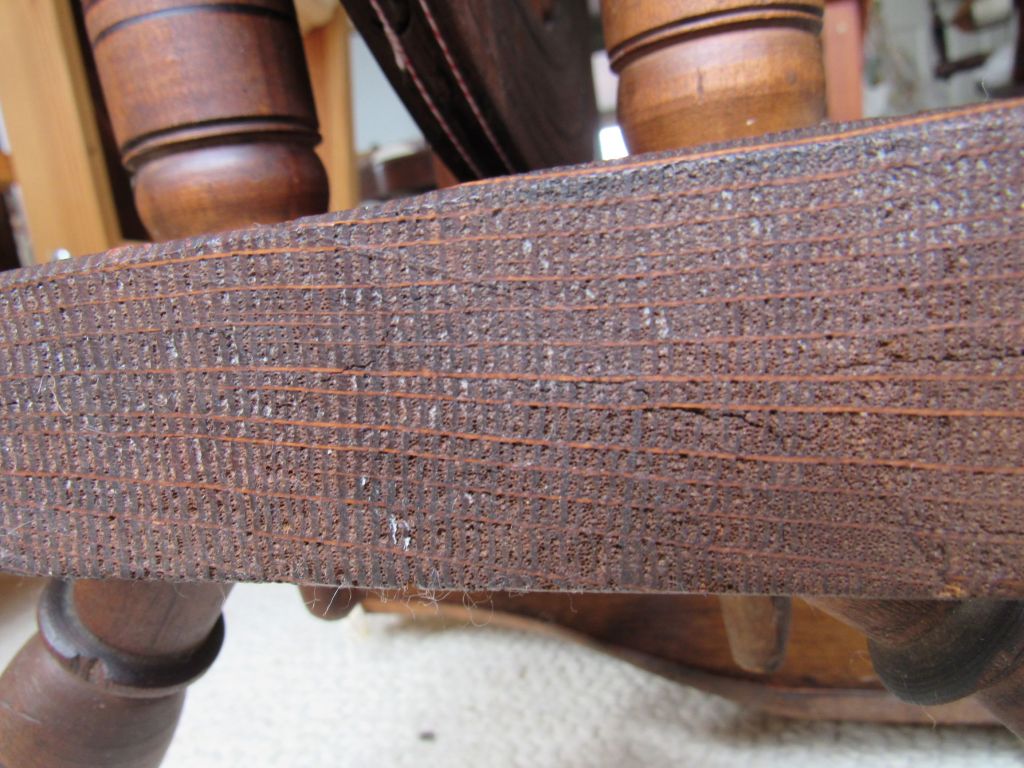
The circular tree rings are visible on the end of the table.
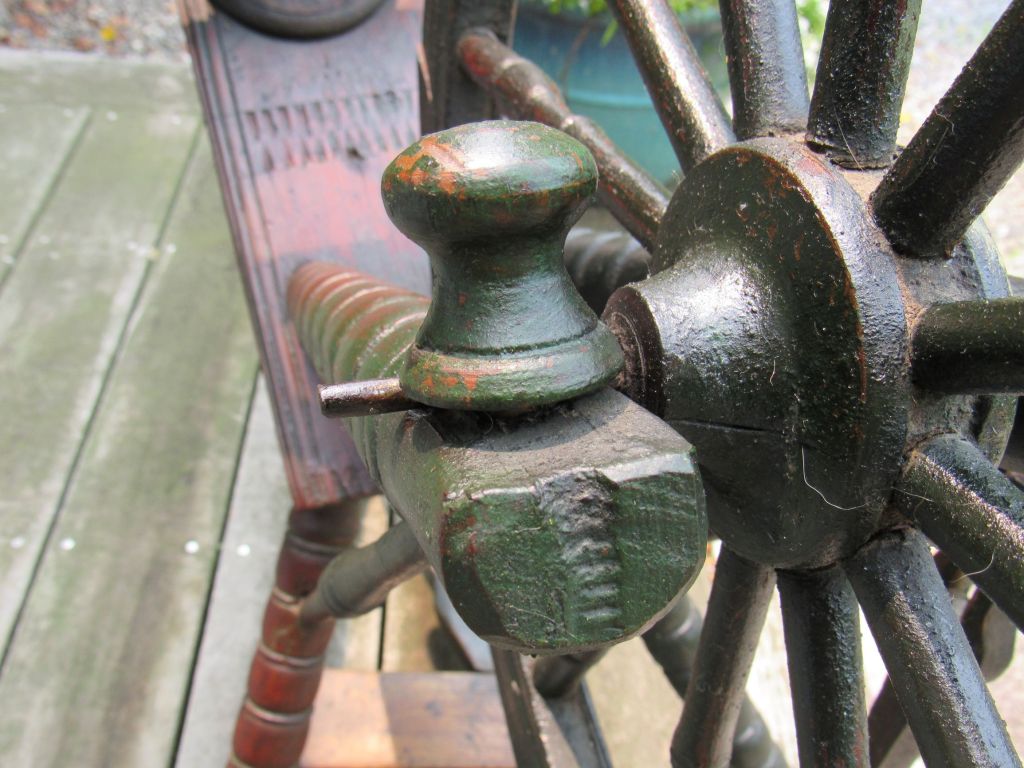
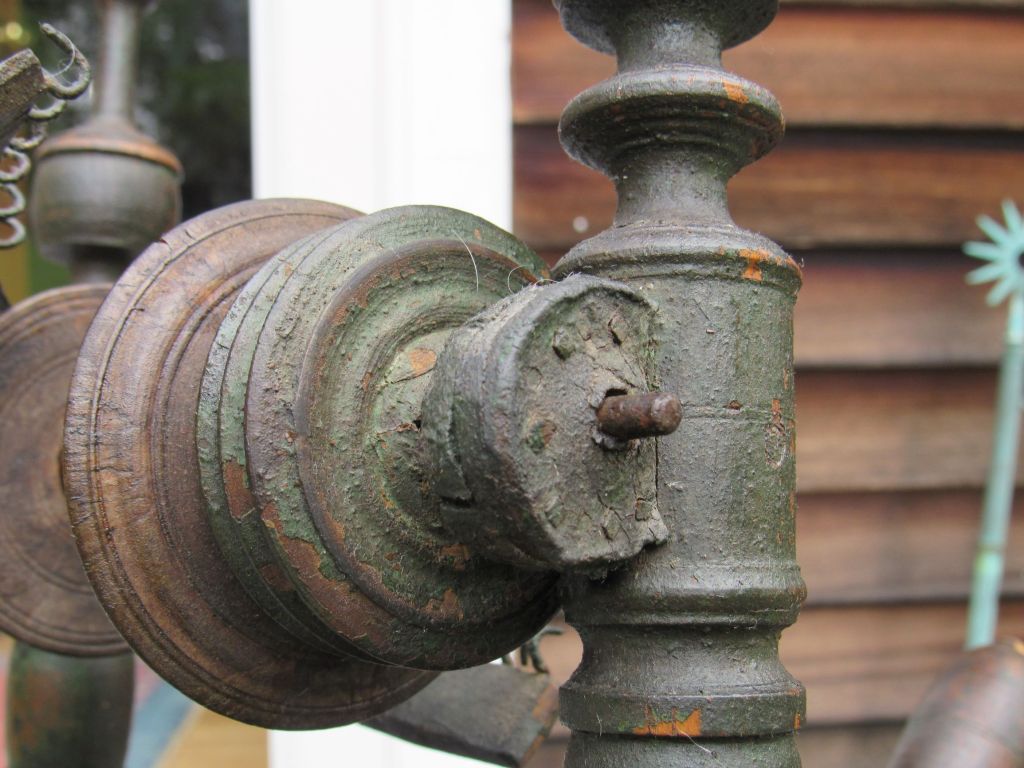
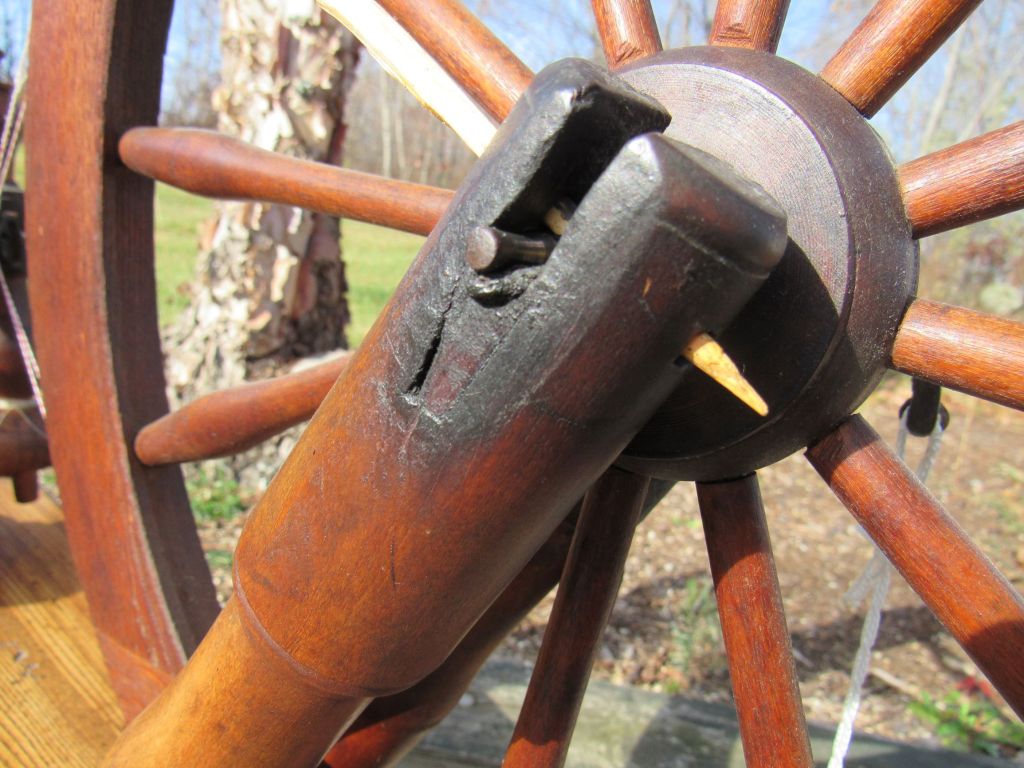
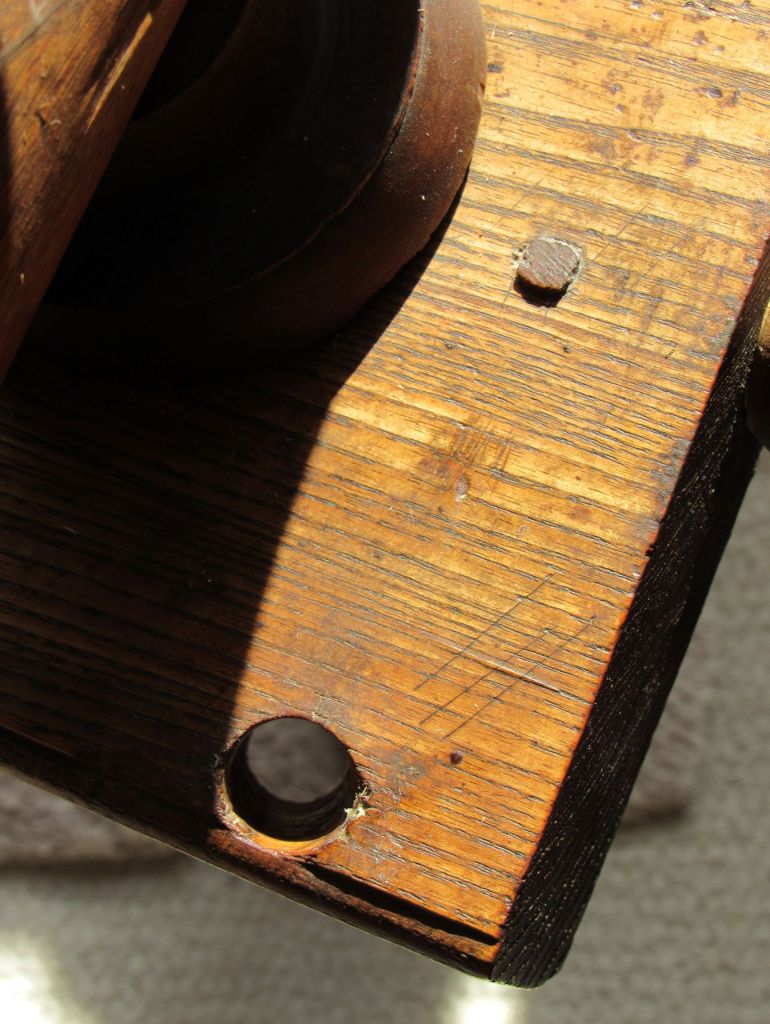
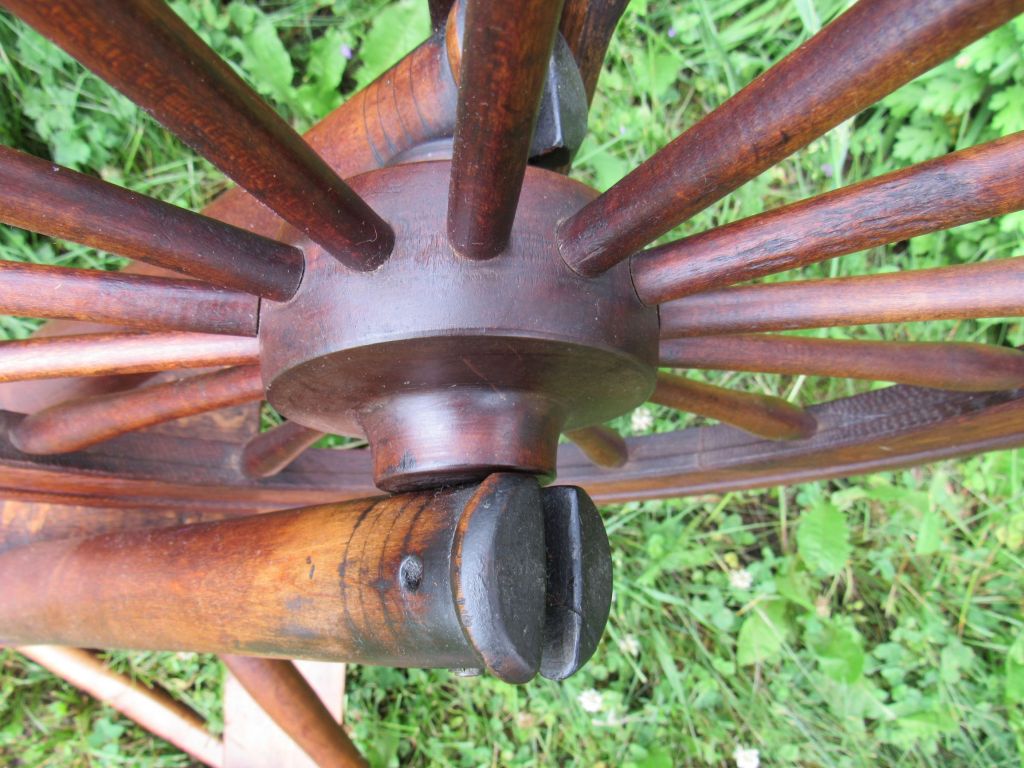
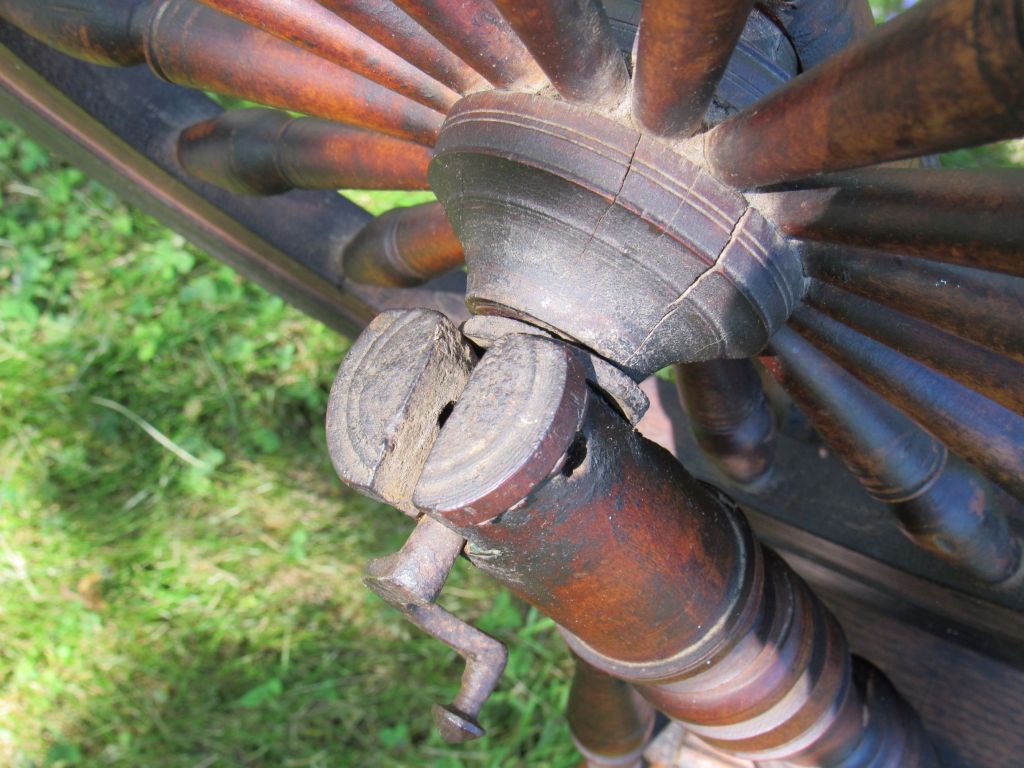
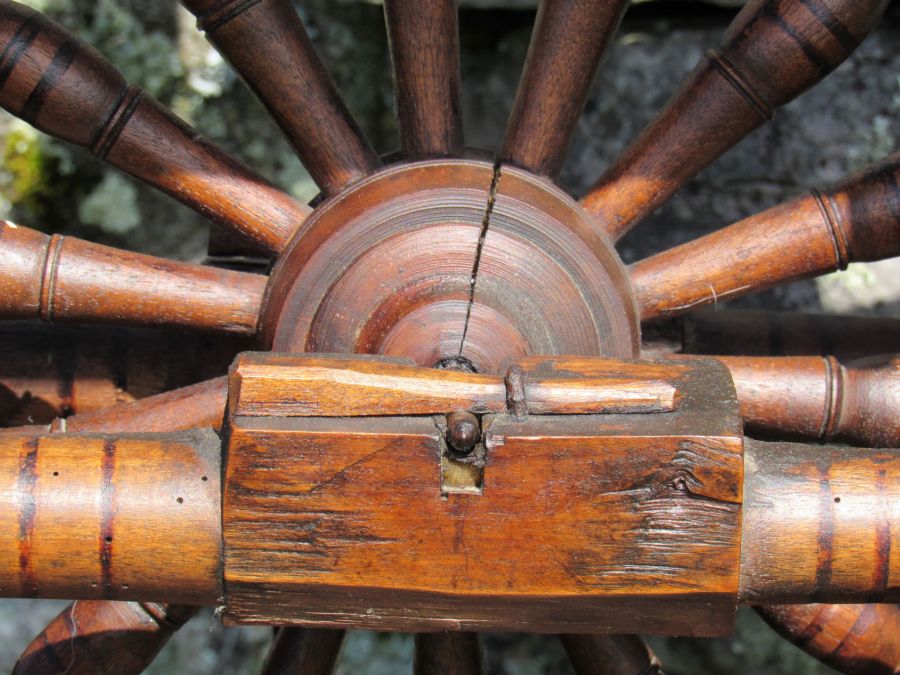
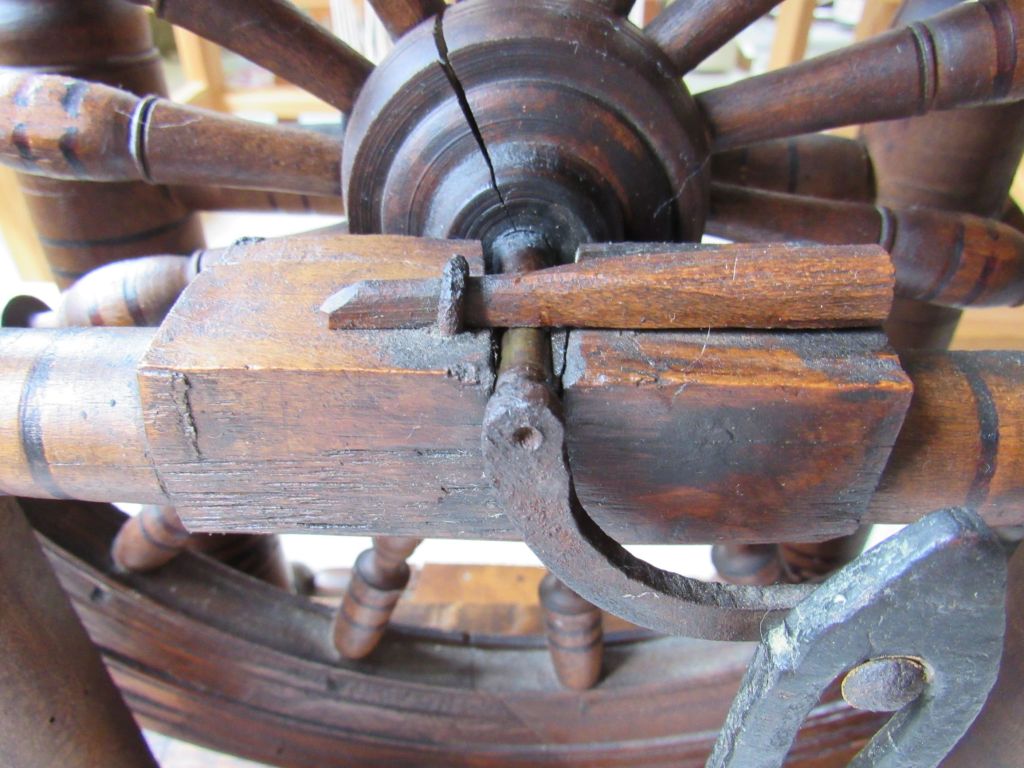
The axle is held in place with a large screwed wooden pin,
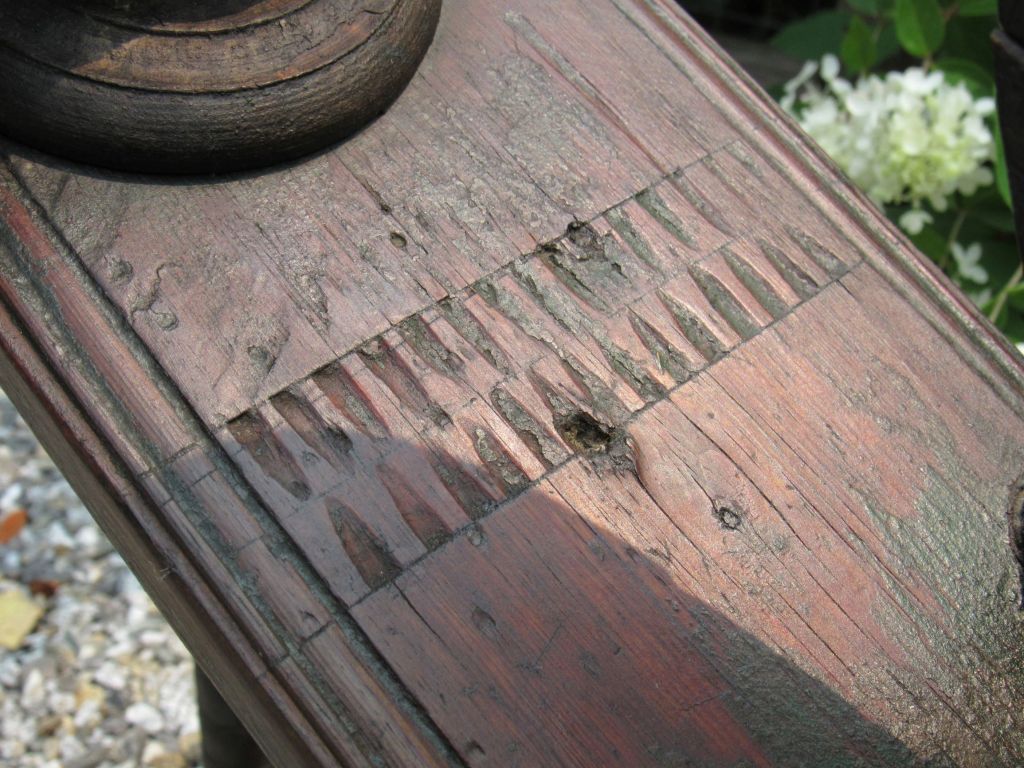
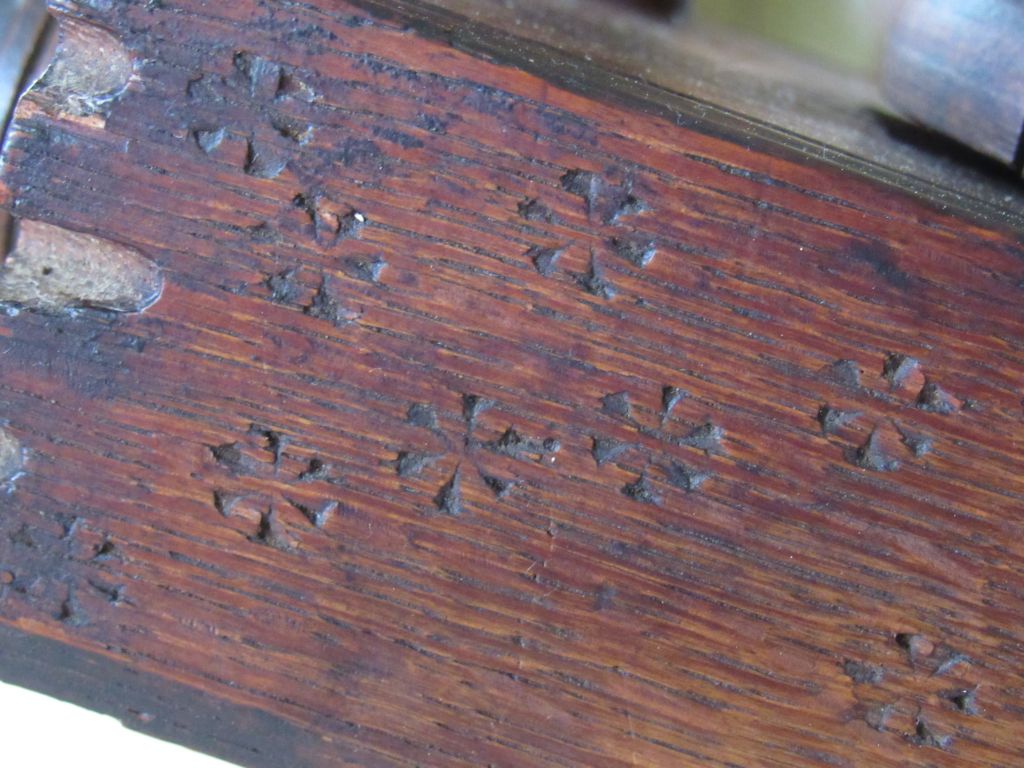
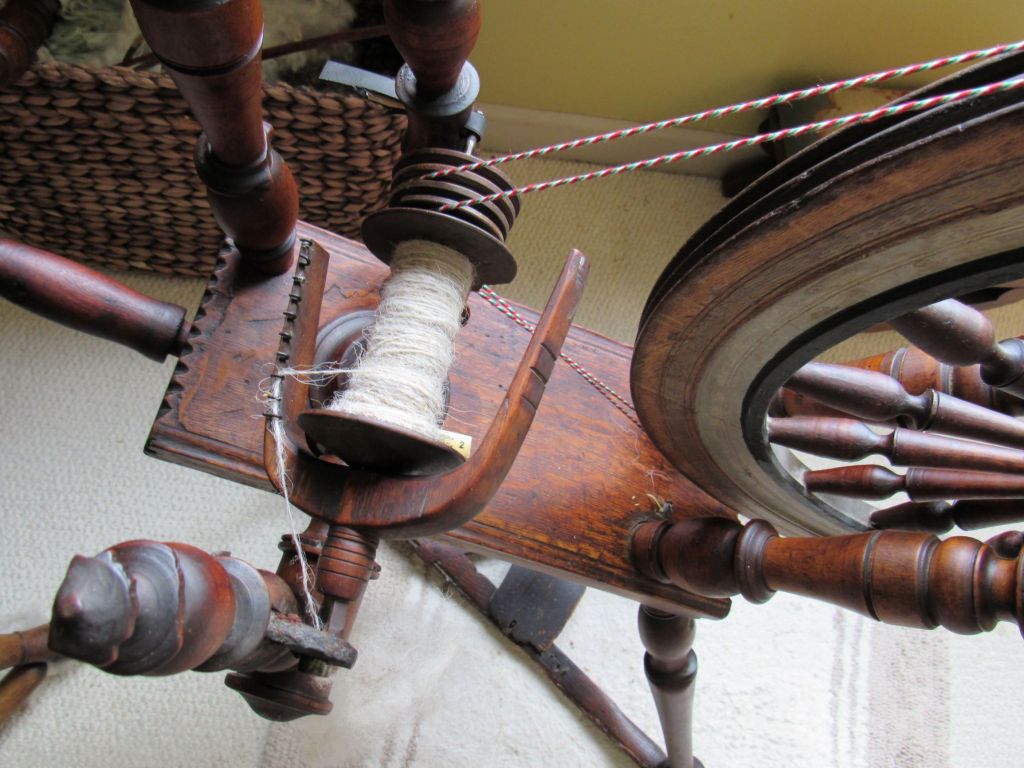
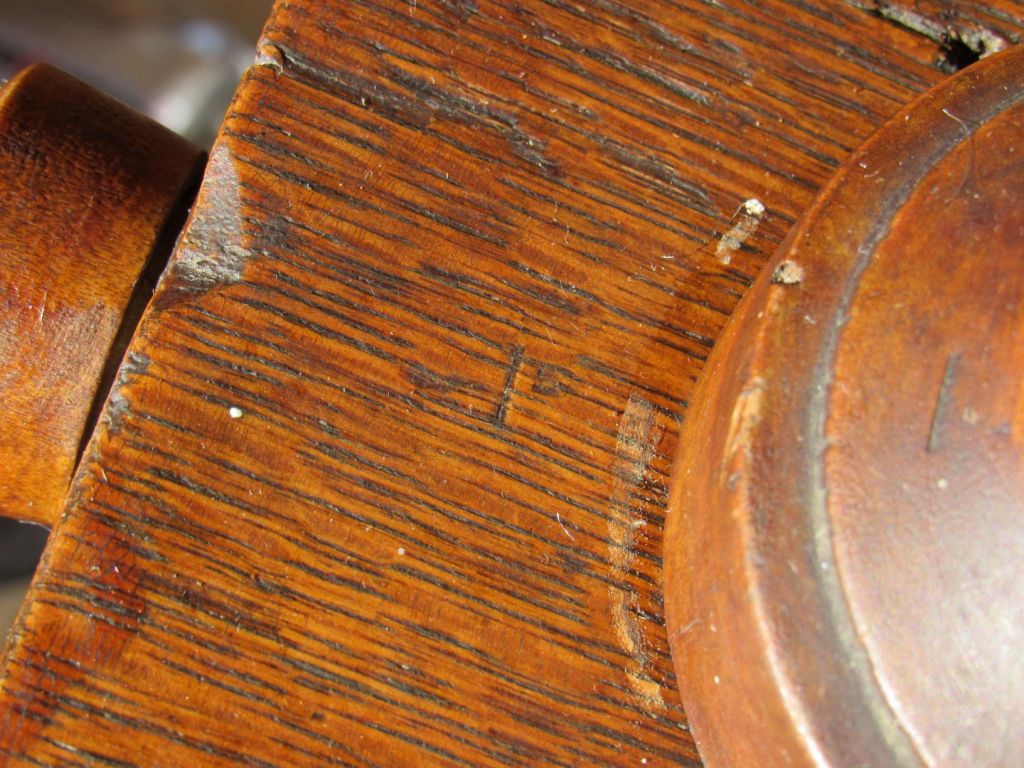
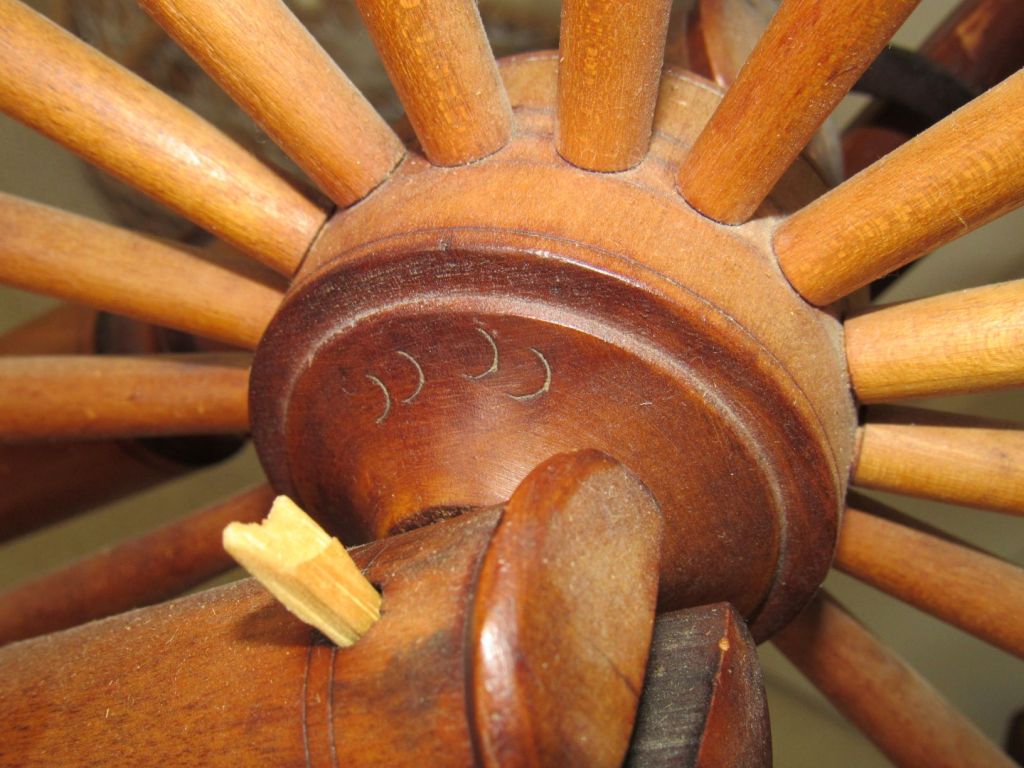
although the back one is missing. There are carvings on the table
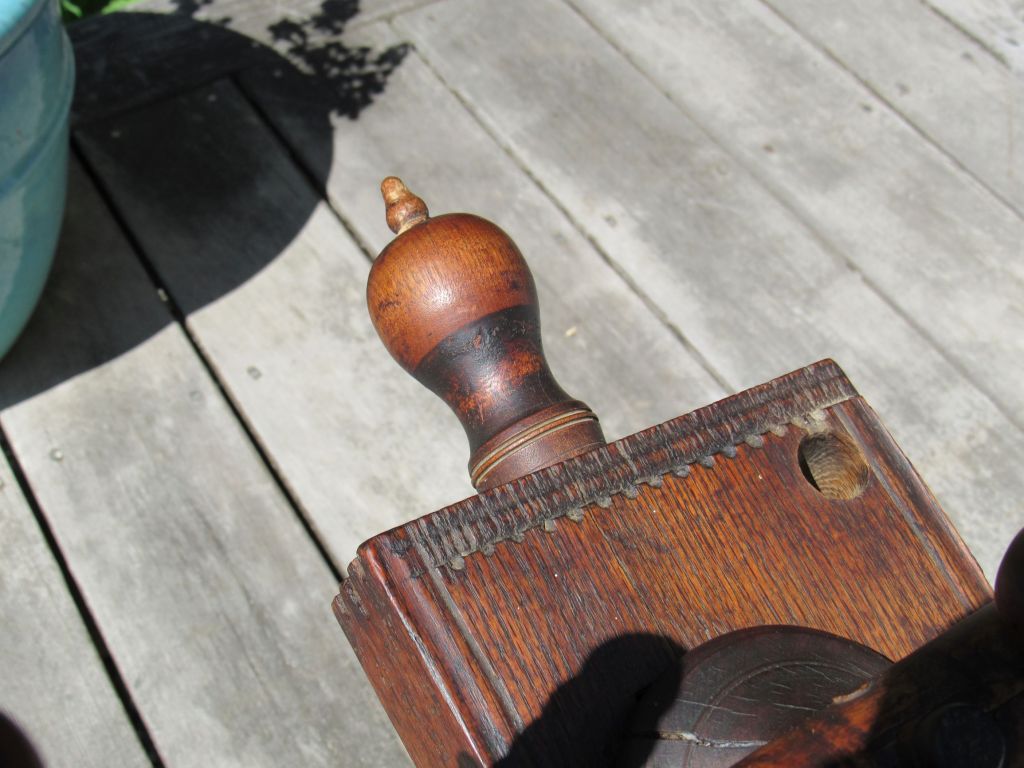
and at both ends,
a distaff hole,
and multiple grooves down the sides.
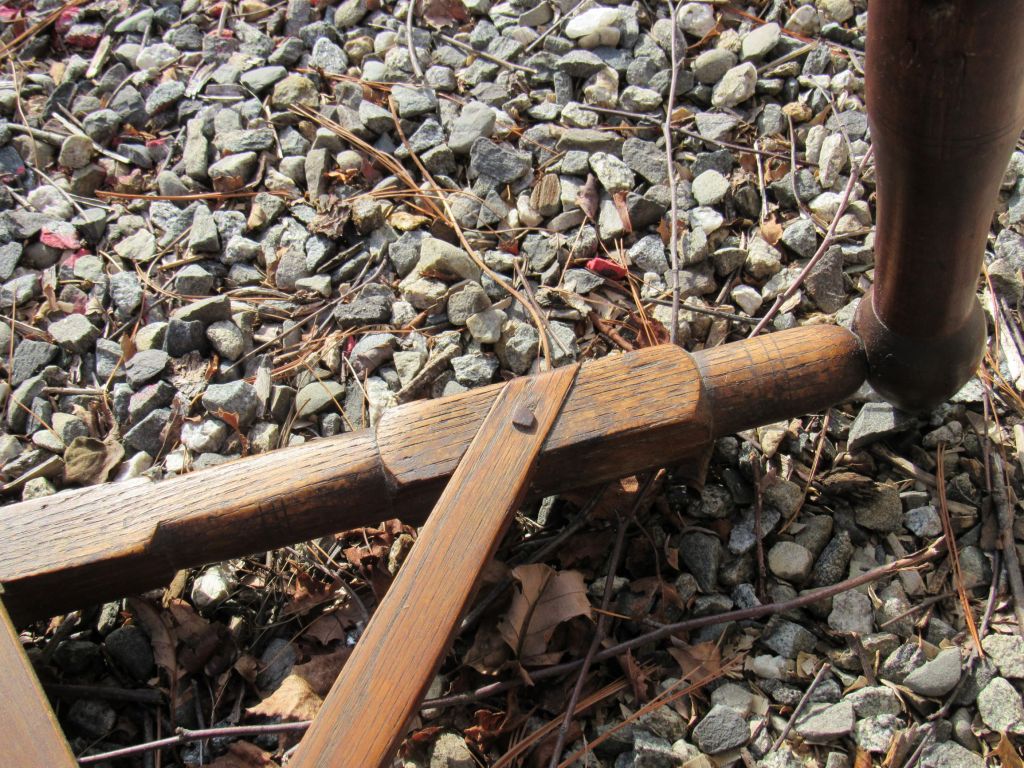
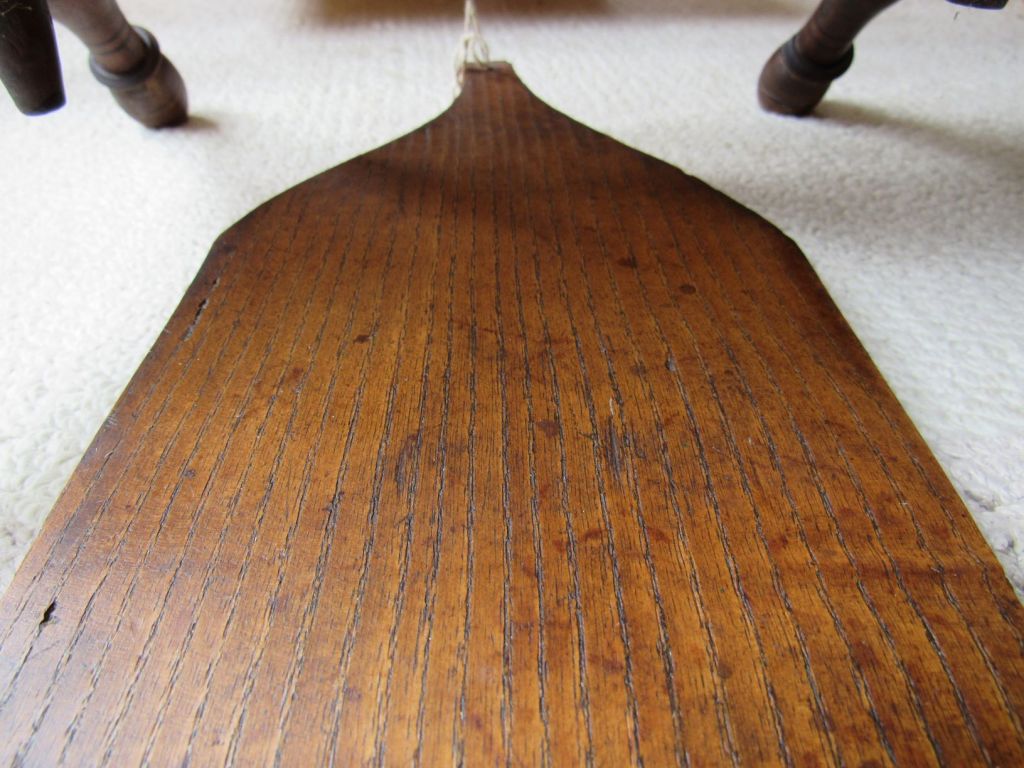
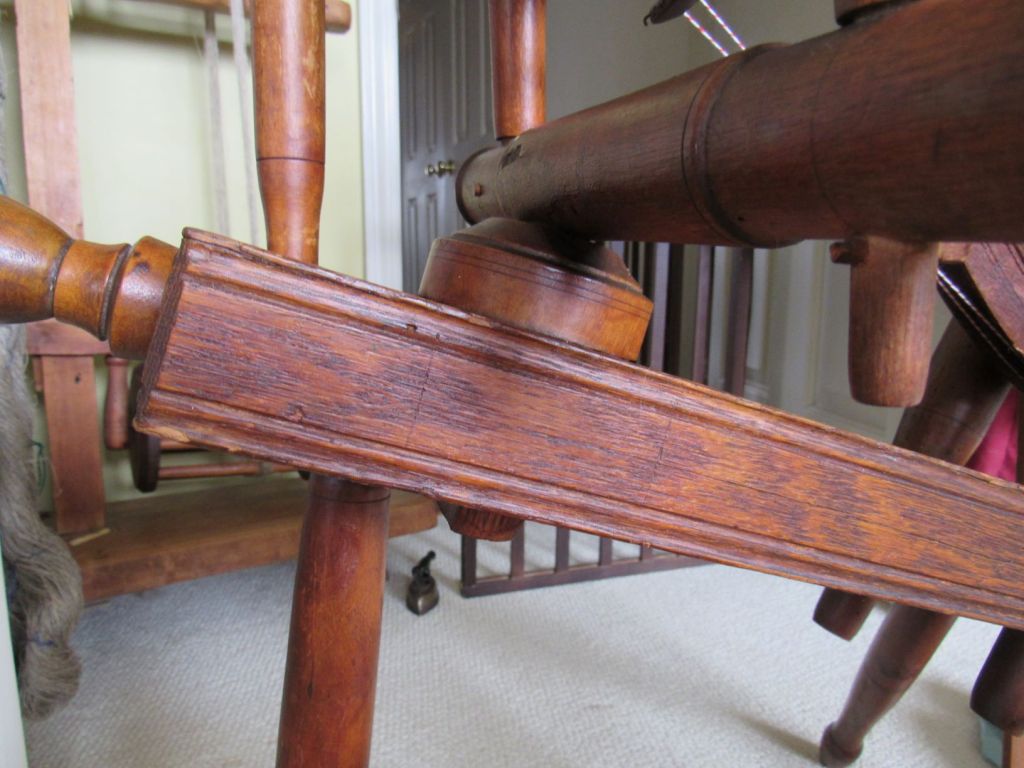
The treadle bars are thick and give plenty of support for two footed treadling. Yet, they are graceful, too. The treadle is now attached with large screws.
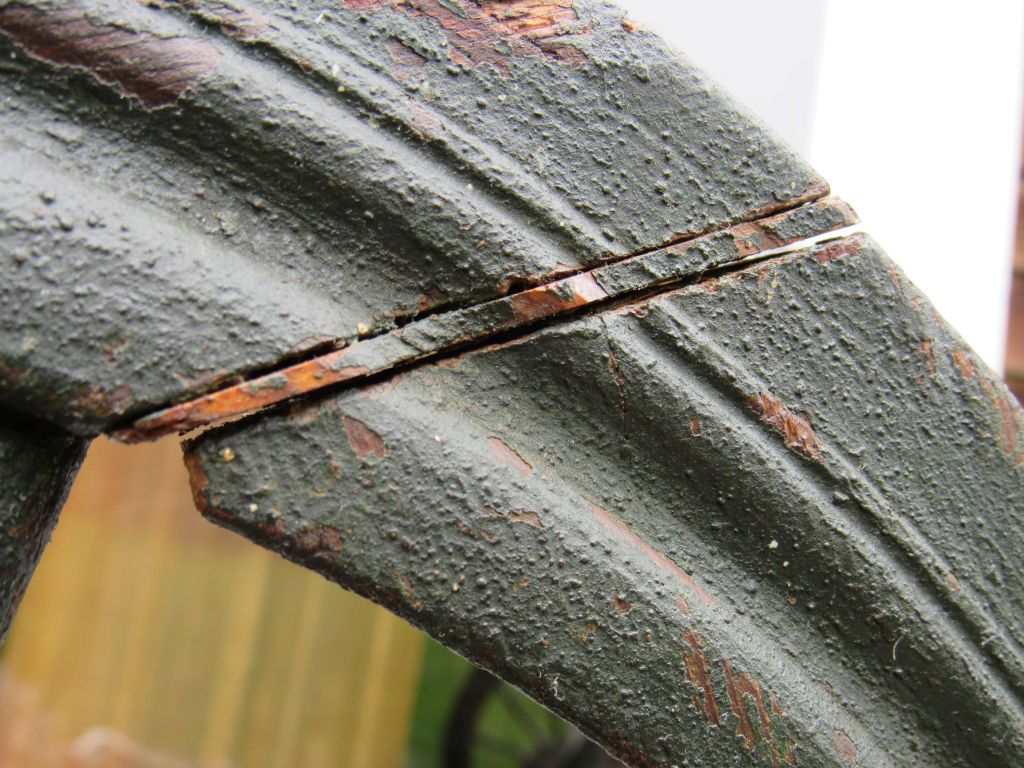
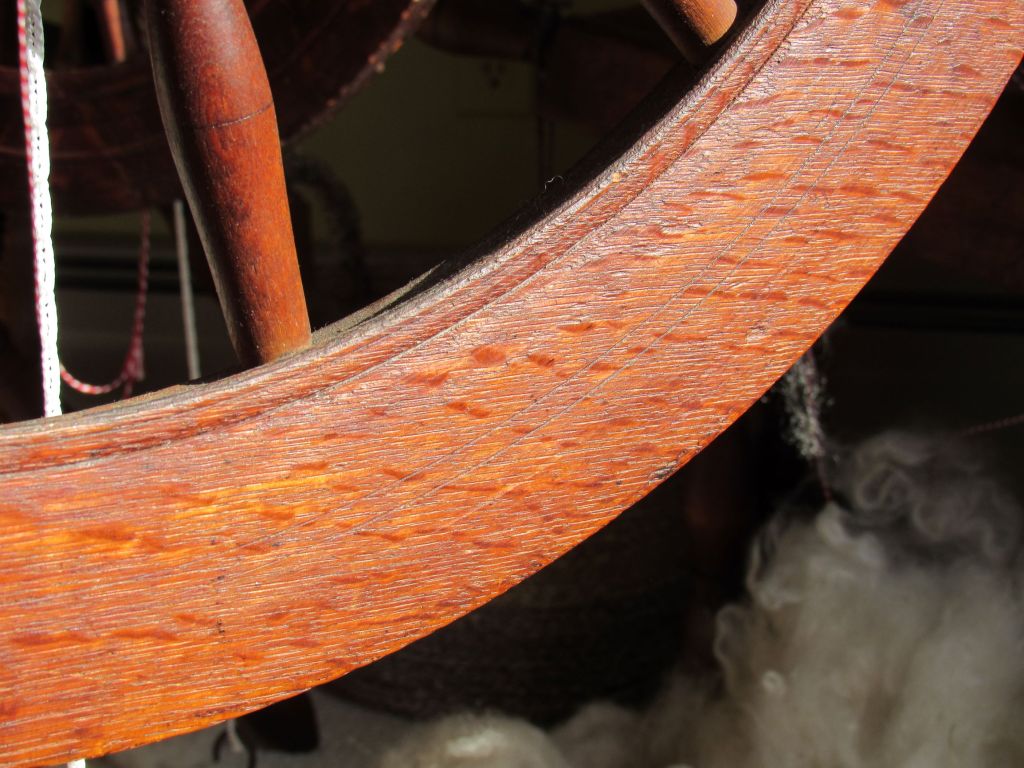
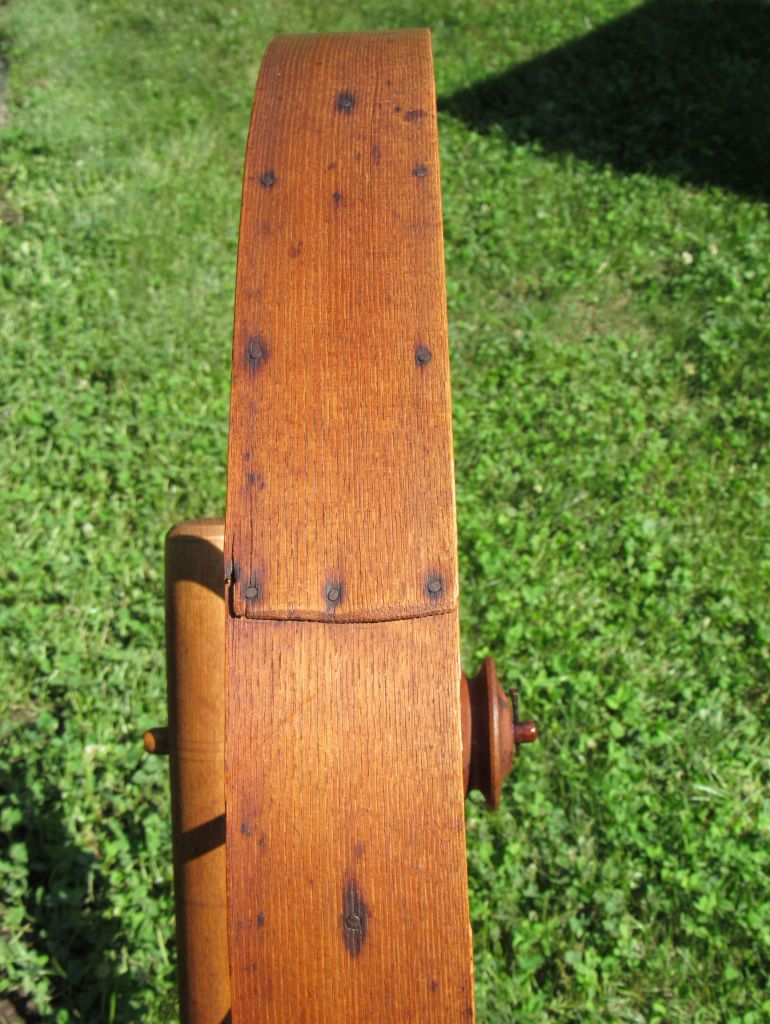
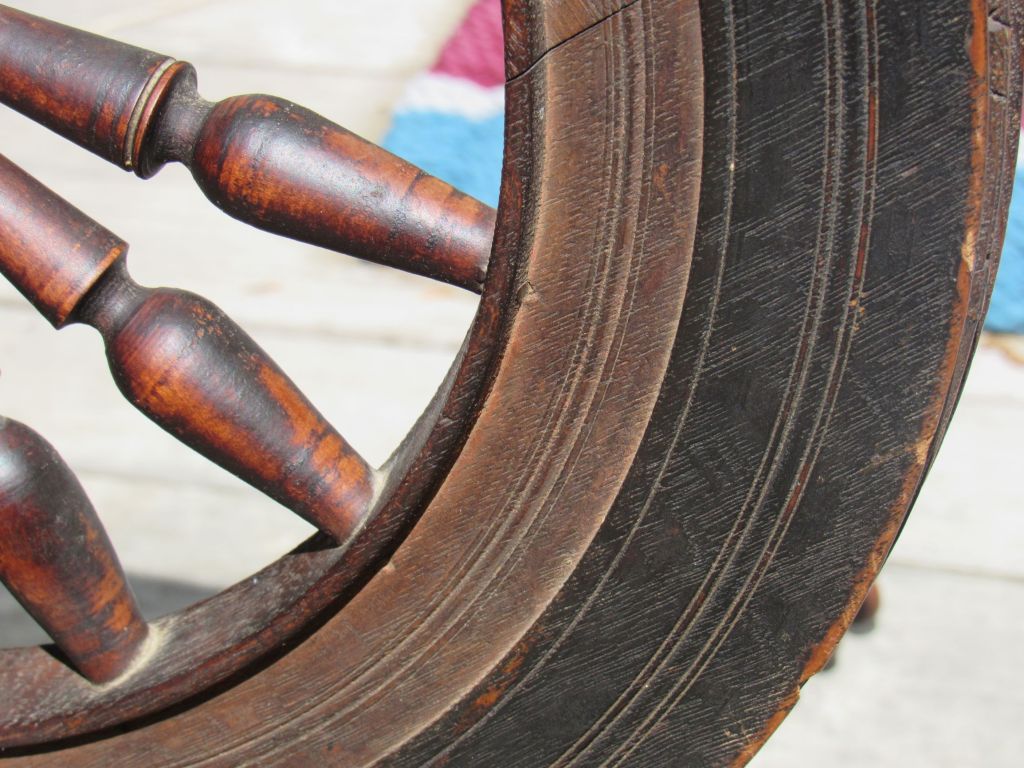
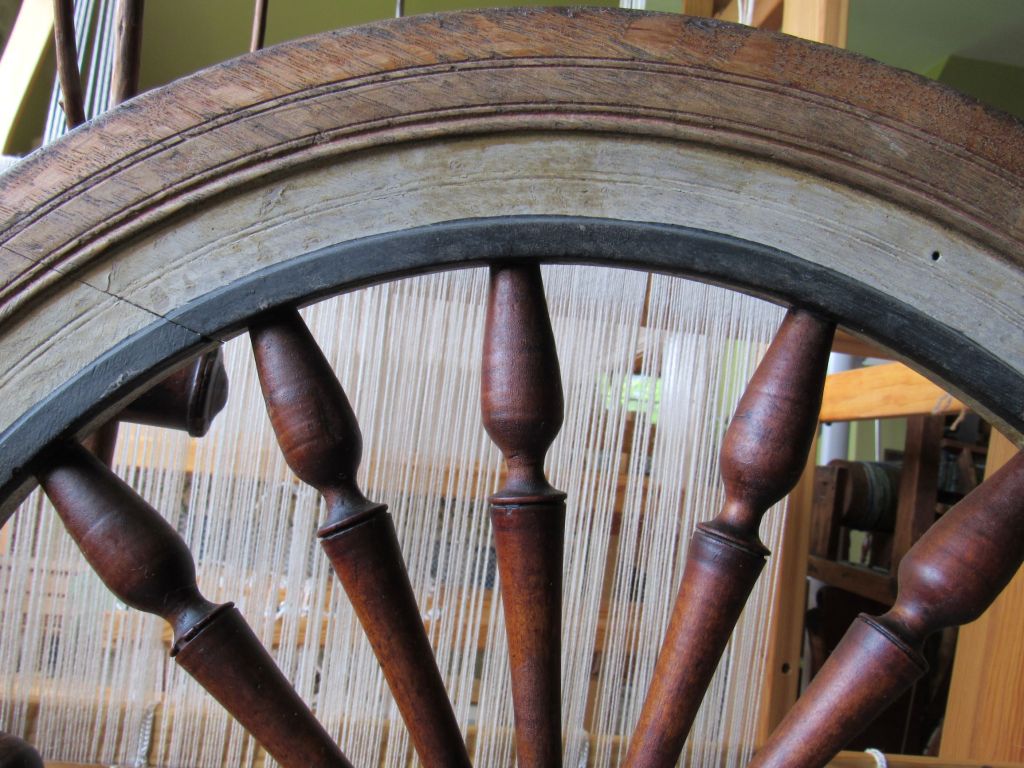
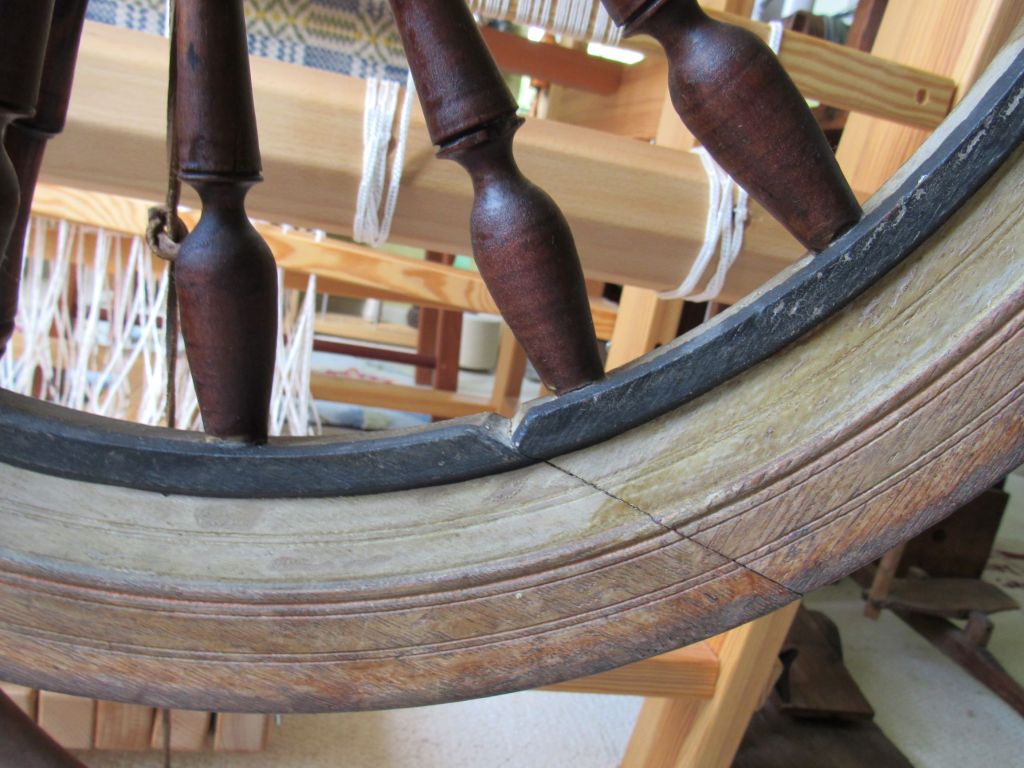
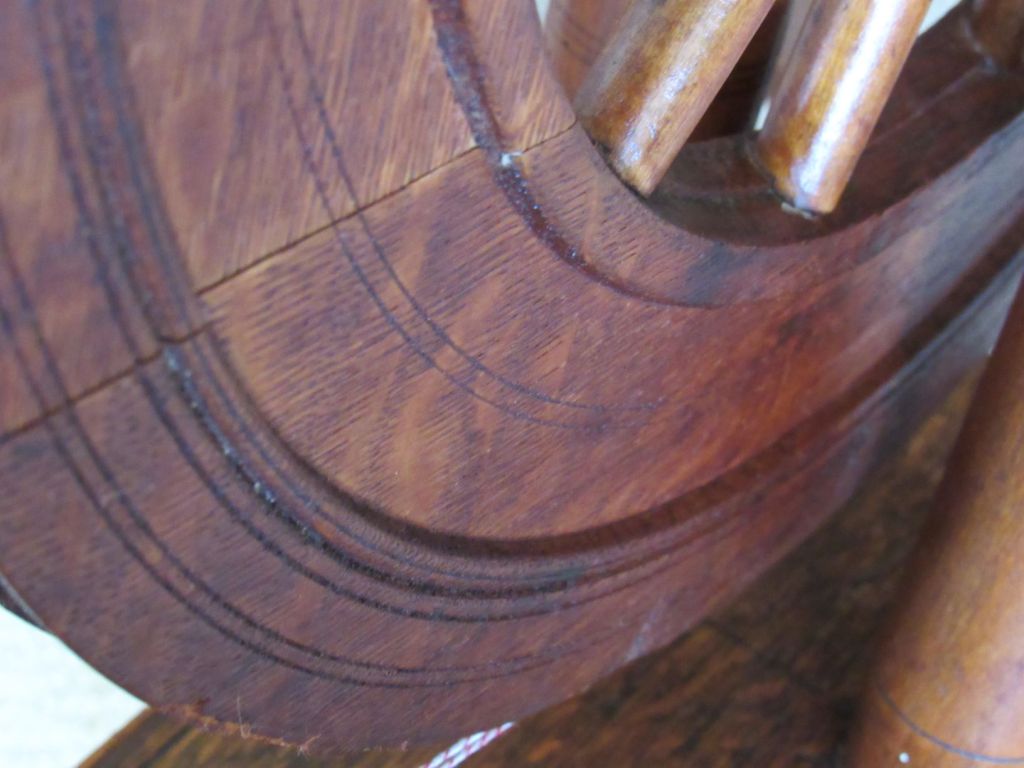
The wheel rim is four parts with a thin shim piece in one join.
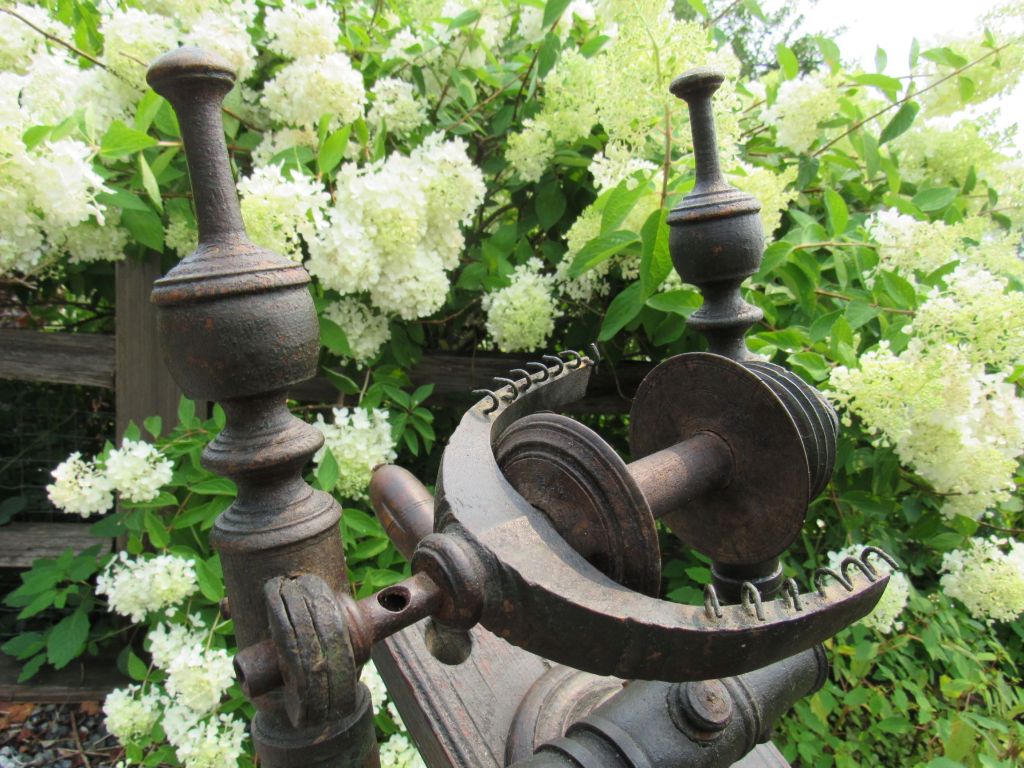
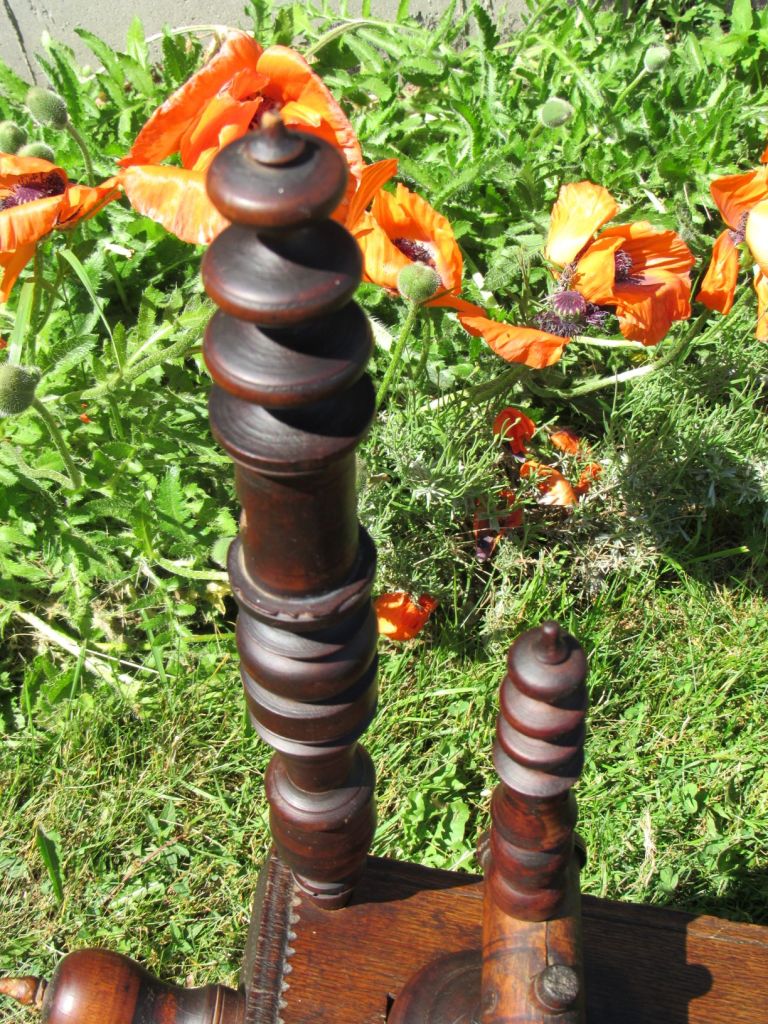
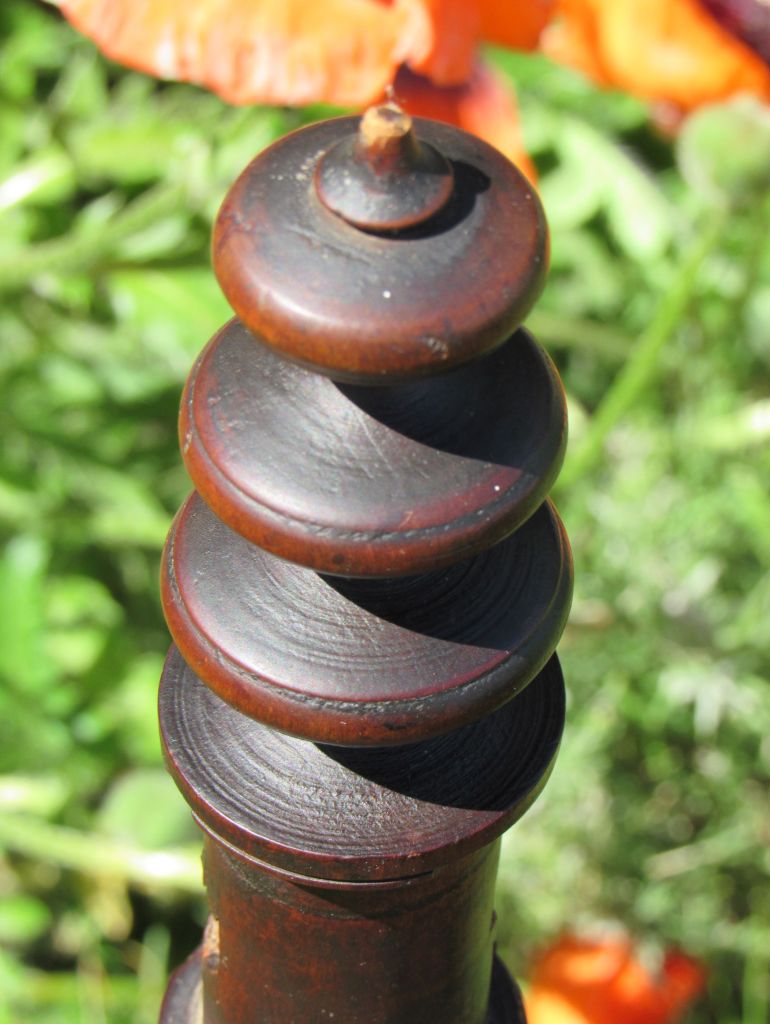
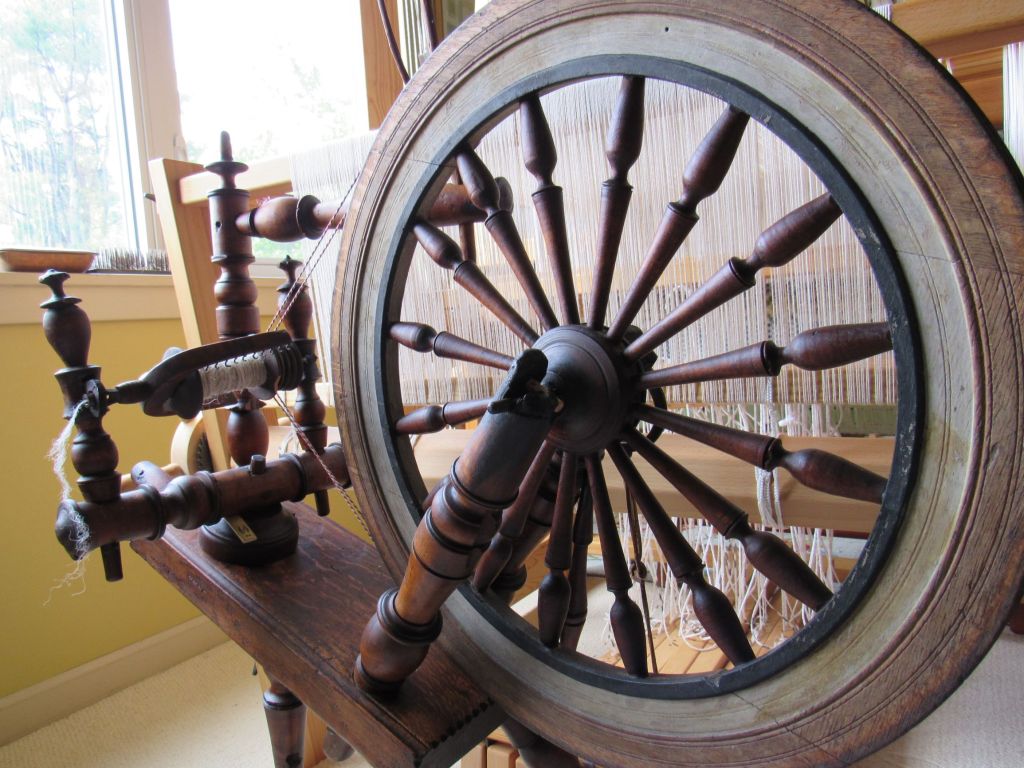
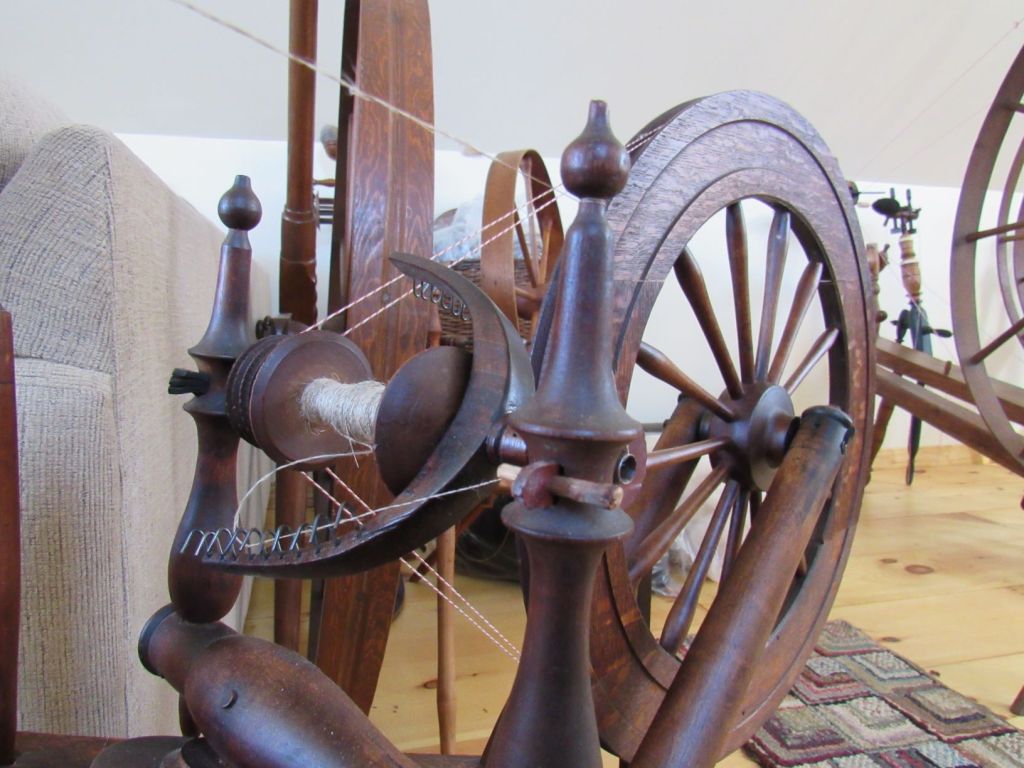
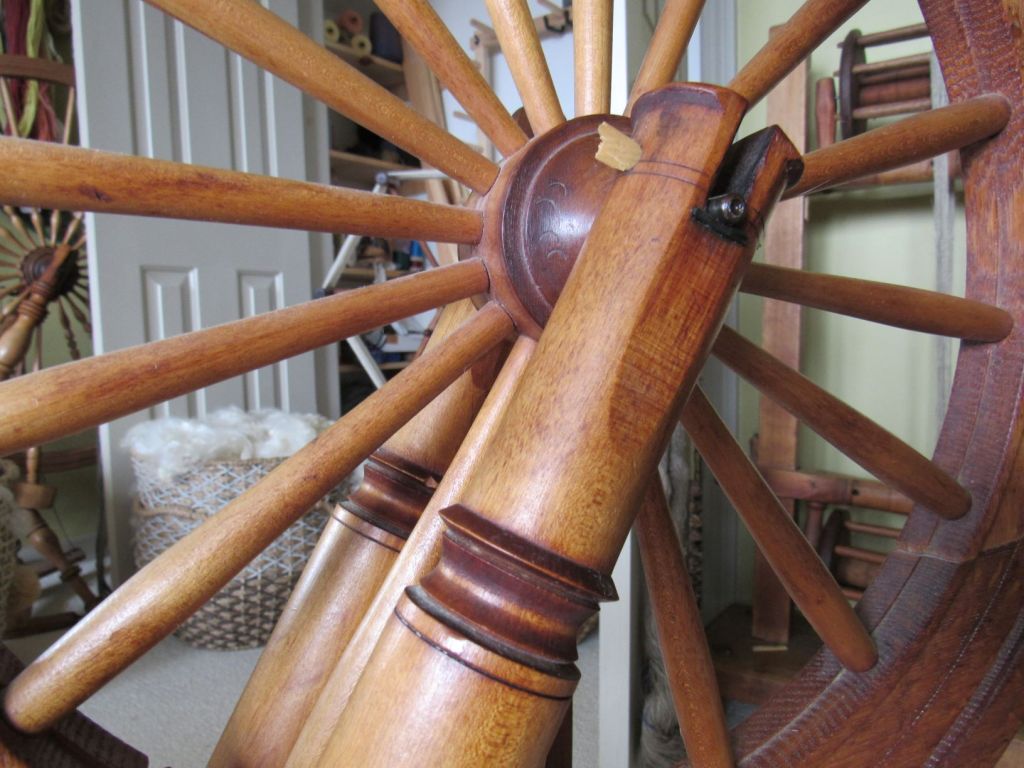
The elongated tops of the maidens are particularly lovely.
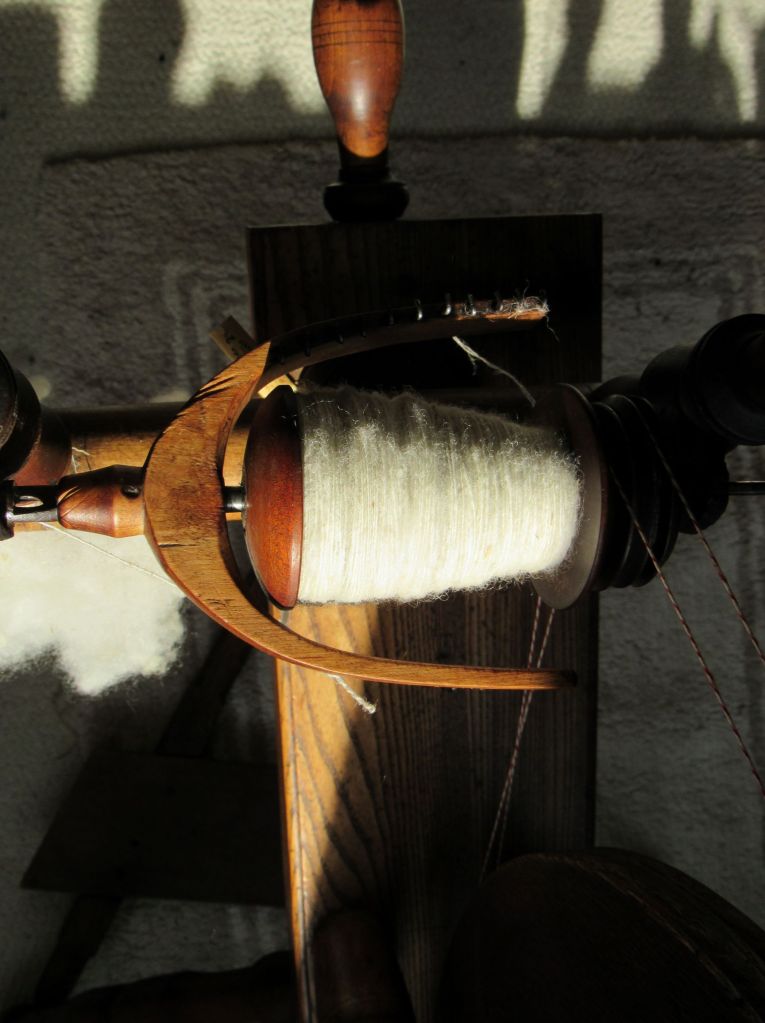
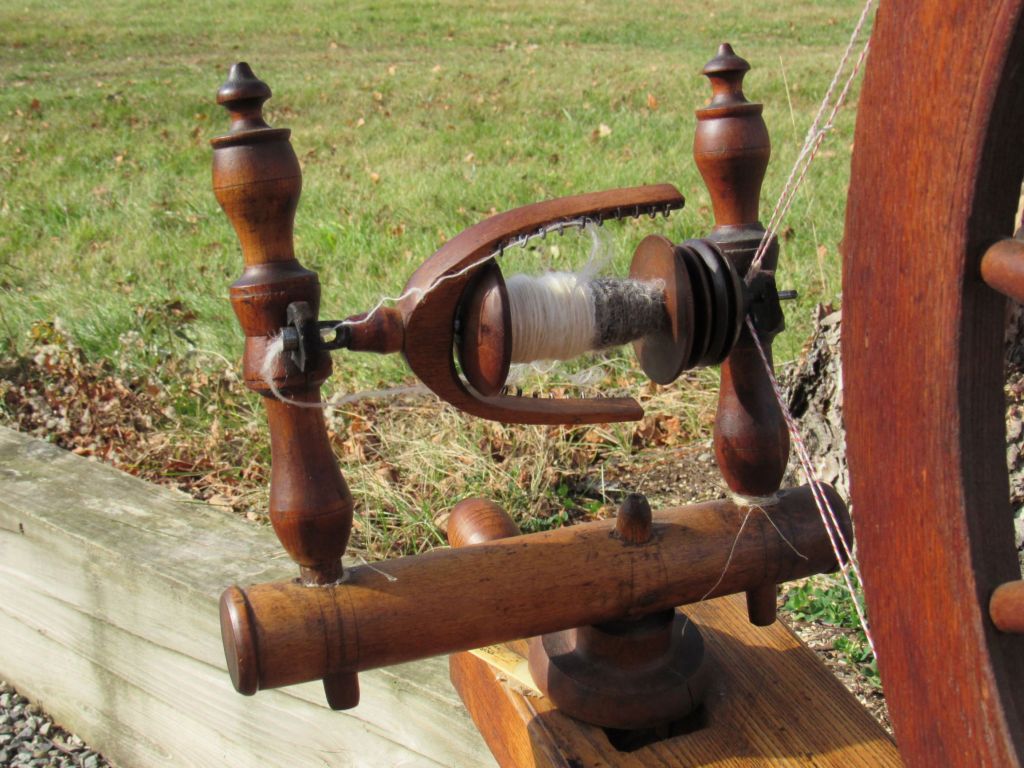
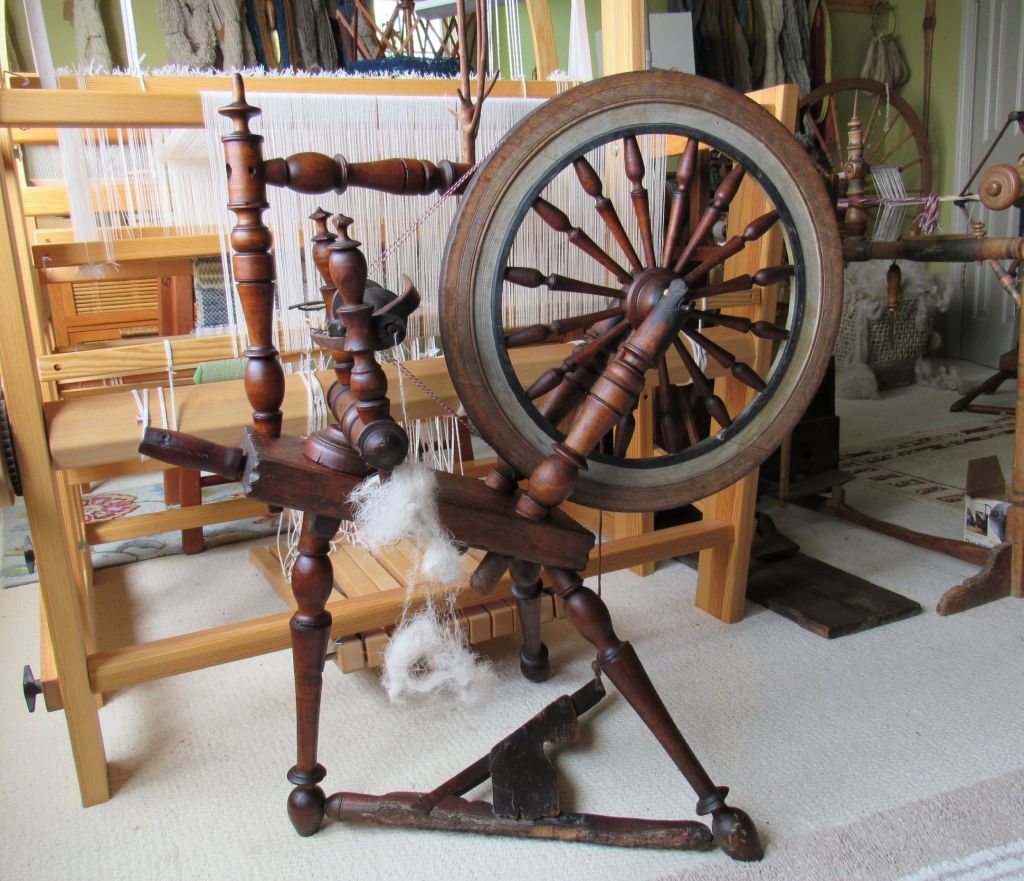
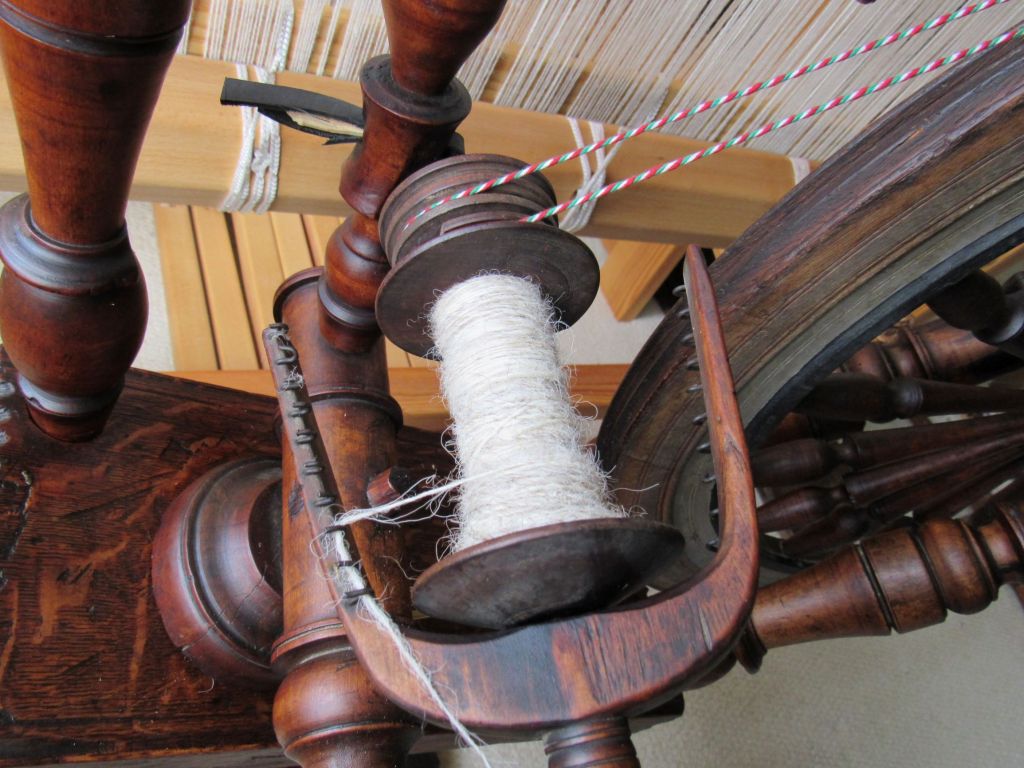
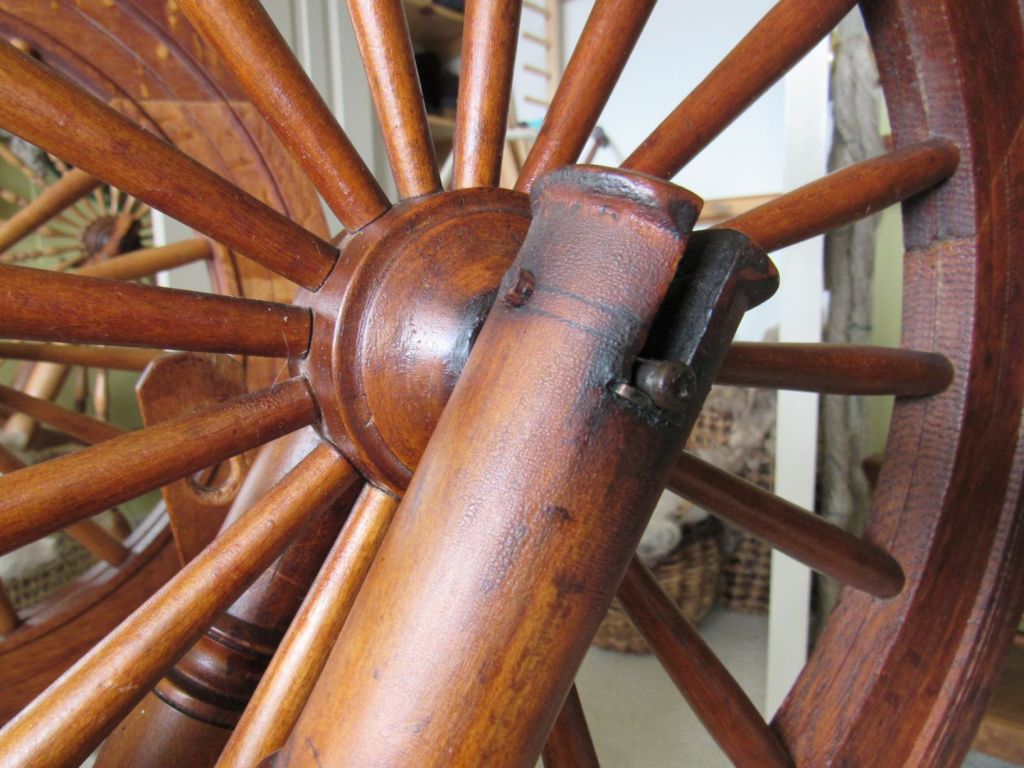
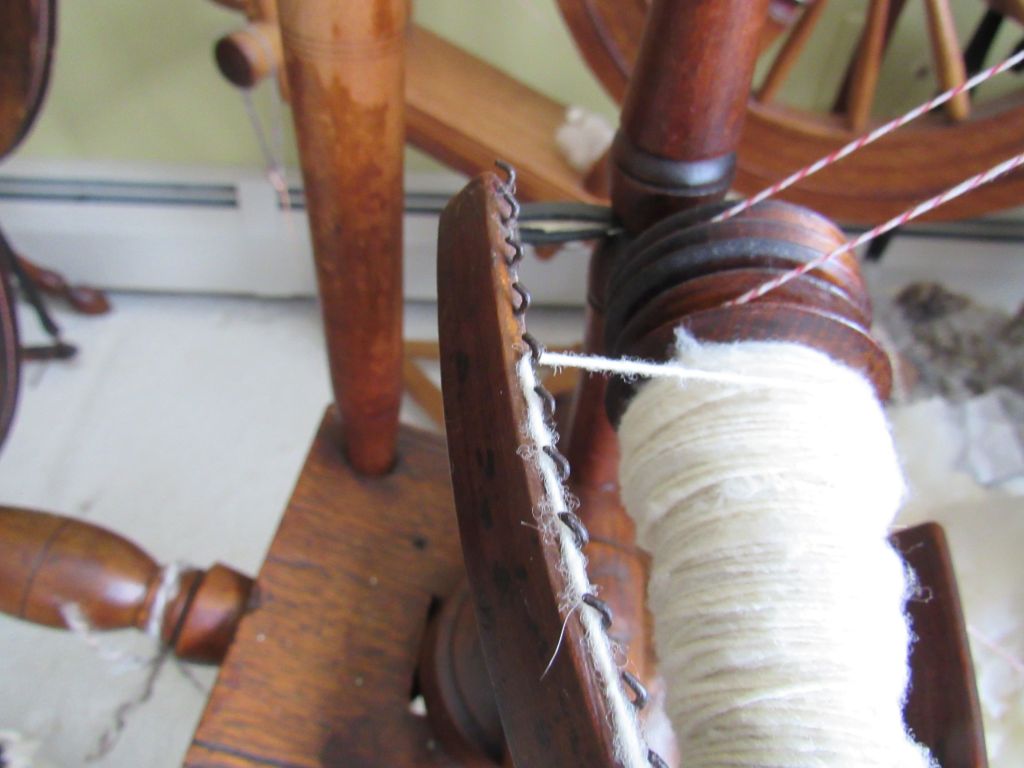
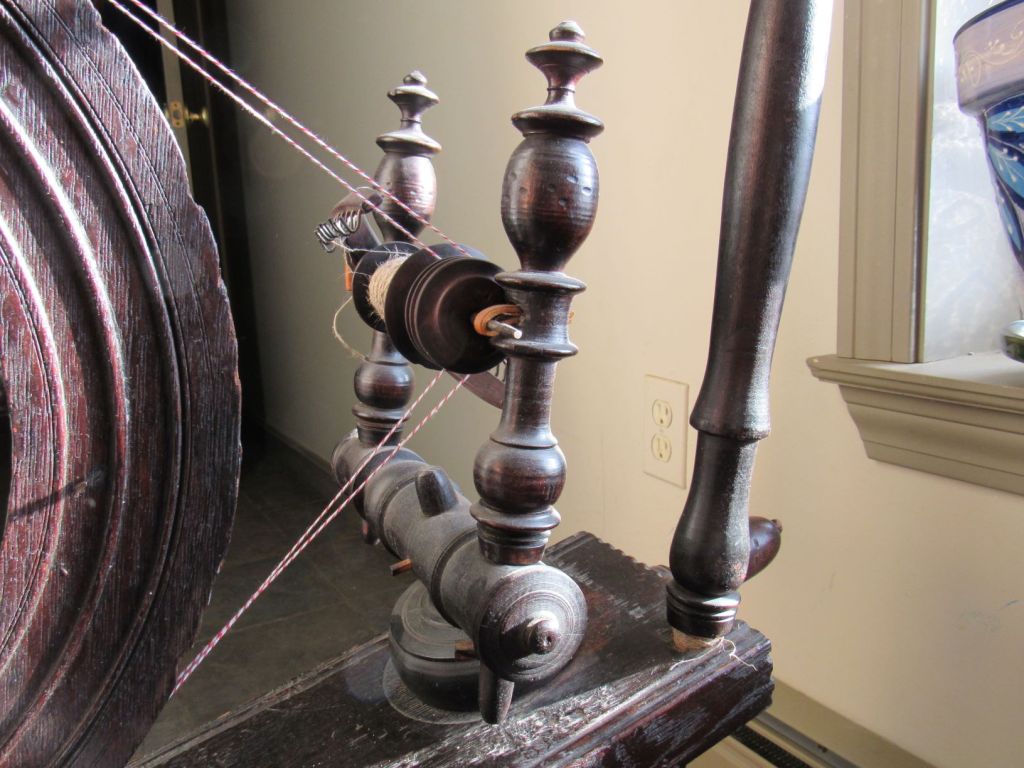
The flyer assembly is in good shape
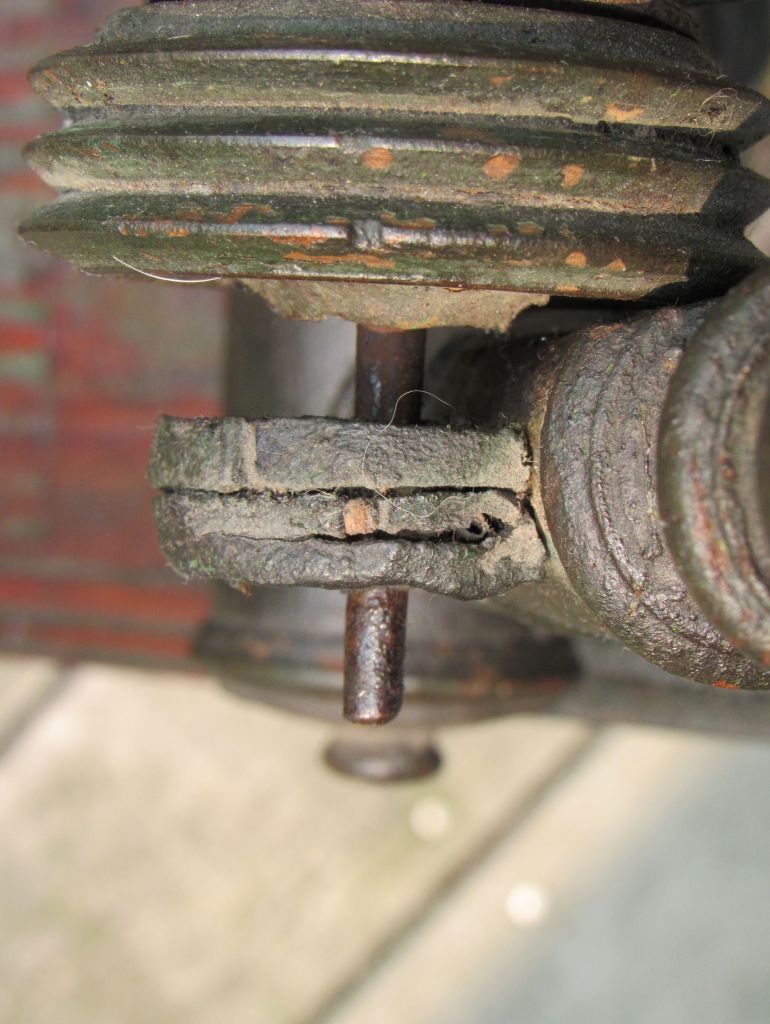
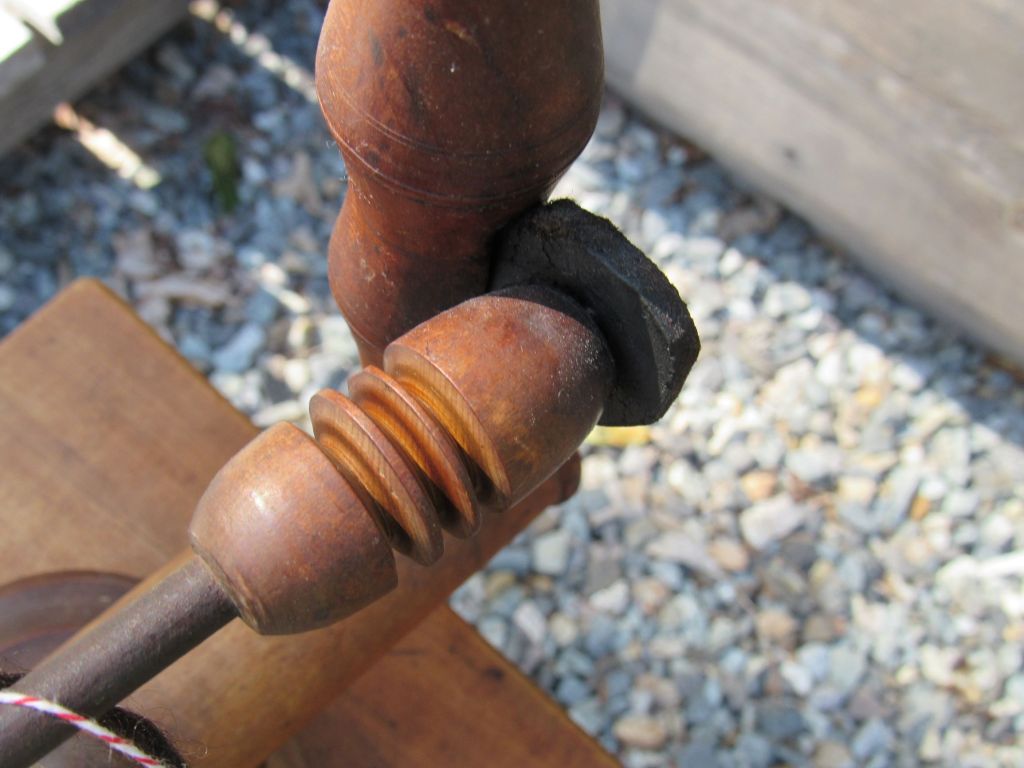
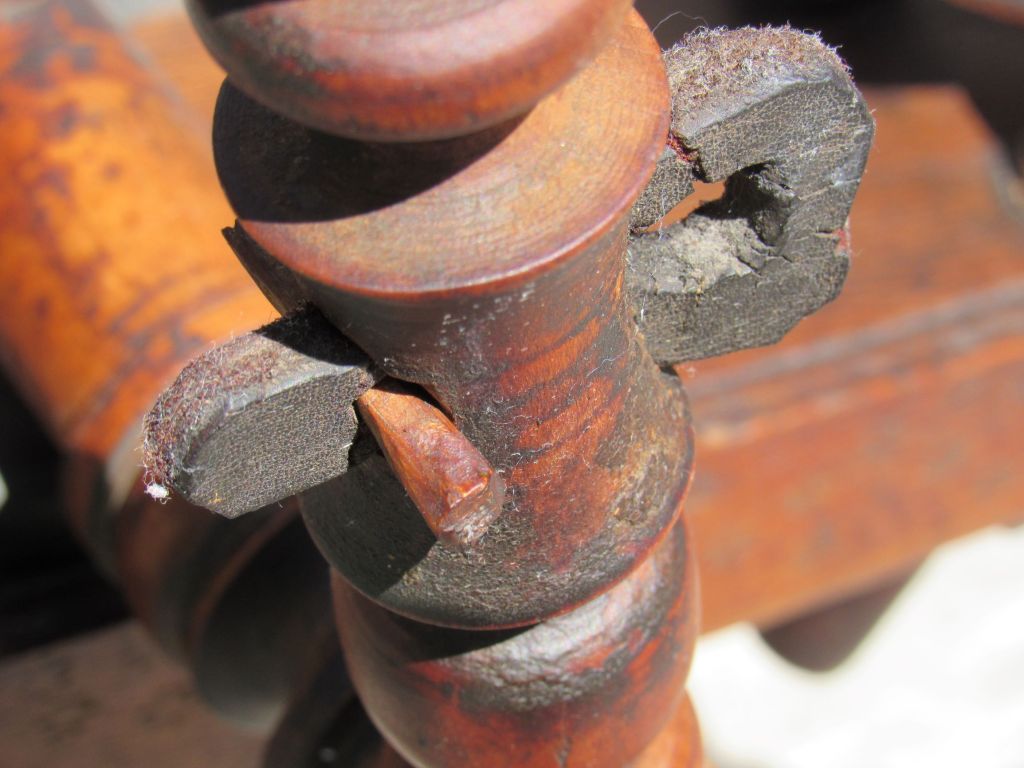
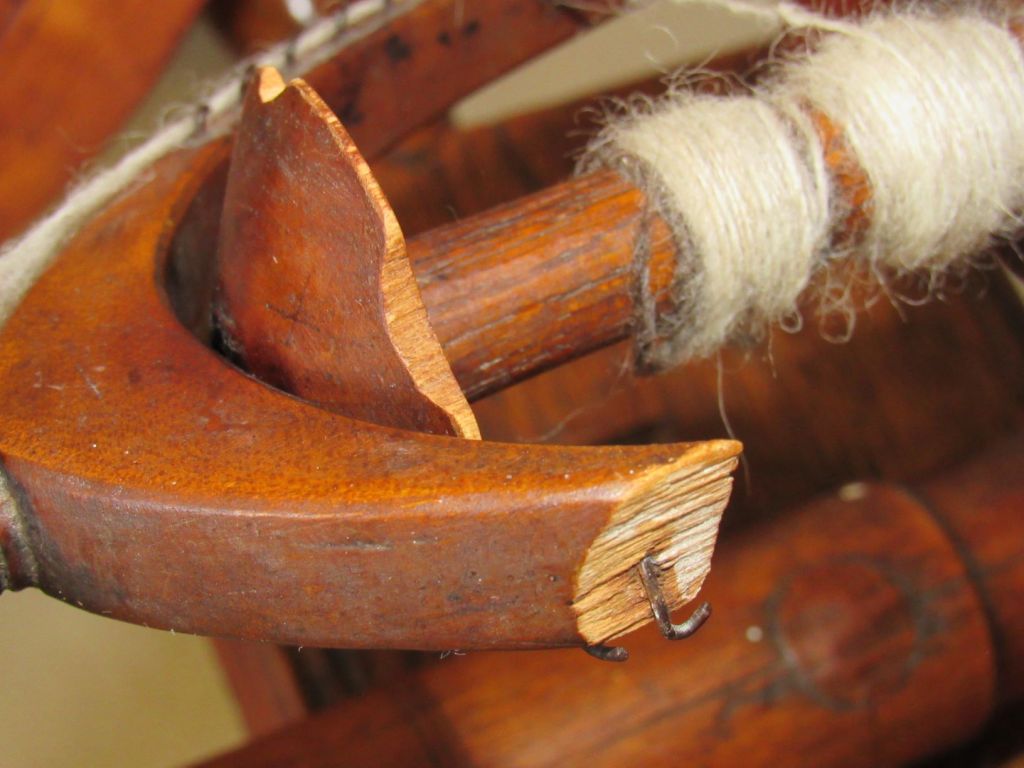
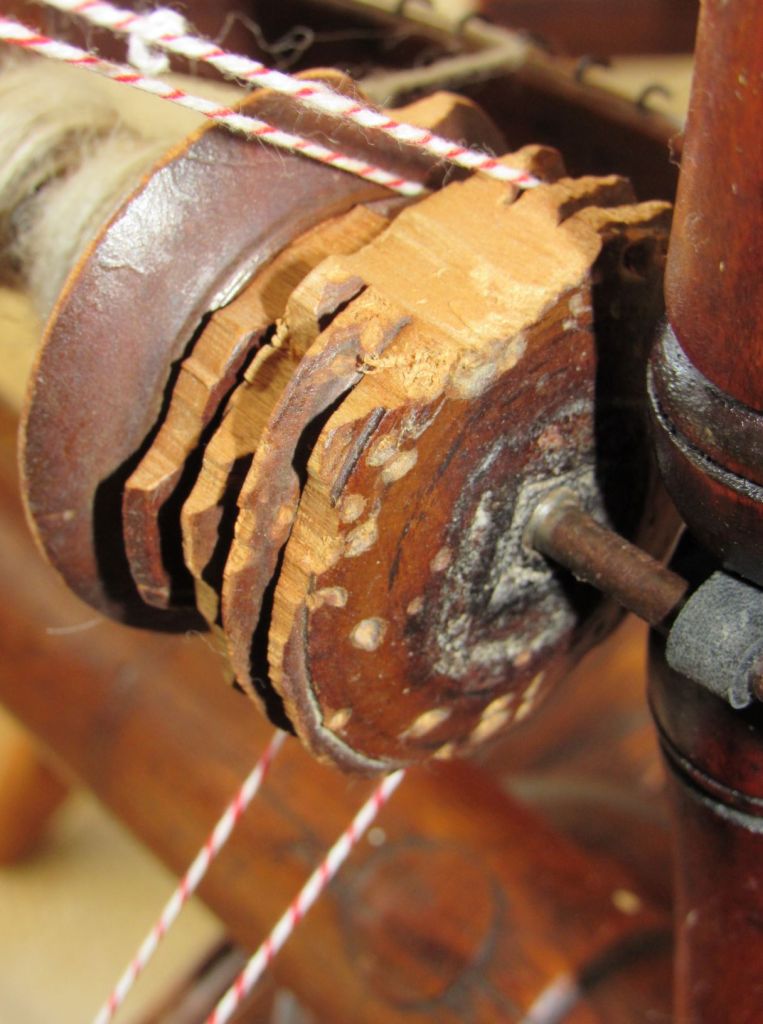
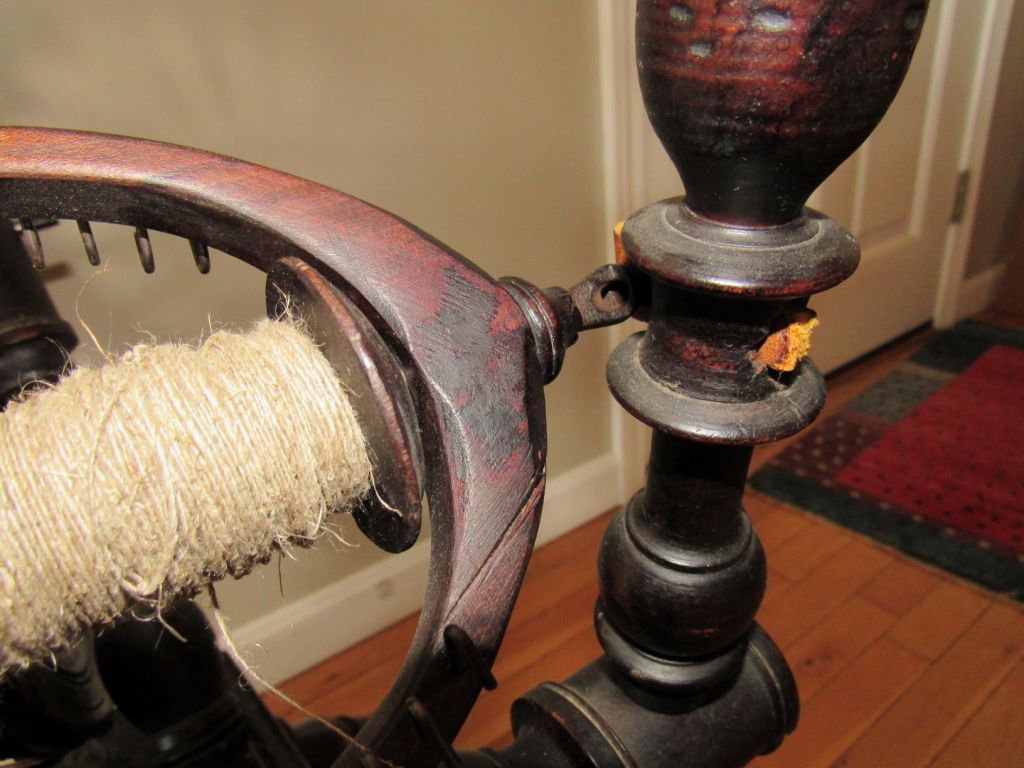
with three-layered leather flyer bearings held together with rivets.
It appears that the green paint was slathered over everything at some point, including the flyer hooks and leather bearings.
It is an unusual, intriguing wheel and I am always on the lookout for others like it so that we might be able to better establish its age and origin.
For further reference see:
Cummer, Joan, A Book of Spinning Wheels, Peter E. Randall, Portsmouth, N.H. 1984, pp. 70-71.
Phoebe is my gateway wheel. She is not the first wheel I brought back to spinning life. That was Katherine the Witch, the family antique that I somehow managed to get spinning when I was a teenager. It is Phoebe, though, that led to my retirement addiction to antique wheels. Although I prefer to think of it as a love affair.
When we retired, I had not done any spinning in decades and had no intention of taking it up again. Until, one afternoon, I spotted Phoebe in an antique store in Union, Maine. According to the store owner, she had belonged to an elderly woman in the neighboring town of Appleton. The wheel had all her necessary working parts but had obviously been stored in a barn or attic for many years.
This is after clean-up.
She was grime-black and bespeckled with bird or bat poop. I did not buy her, or even seriously consider buying her. We were house hunting–nearing the end of our year of travel–and had no place to put her. Over the next weeks, though, I could not get her off my mind. The poor filthy thing was crying out for a rescue.
So, I returned to the store and the owner agreed to store her for me until we had a house. Little did I know that she would open an entirely new world to me—a happy obsession progressing from flax wheels and tools to great wheels and tape looms, bringing an added advantage of wonderful friendships with like-minded antique wheel addicts.
As soon as we settled into our house, I brought Phoebe home and cleaned her up. No easy task. But, under all the crap, she was a beautiful little thing.
She does not have a maker’s mark but appears to be typically New England. Her maidens and the upright support suggest a Connecticut influence, while the simple spokes have a Maine Shaker look to them.
She is made with a variety of woods.
Some parts appear to be cherry, with a red glow, while the table and treadle support are a coarser grained oak or chestnut, perhaps.
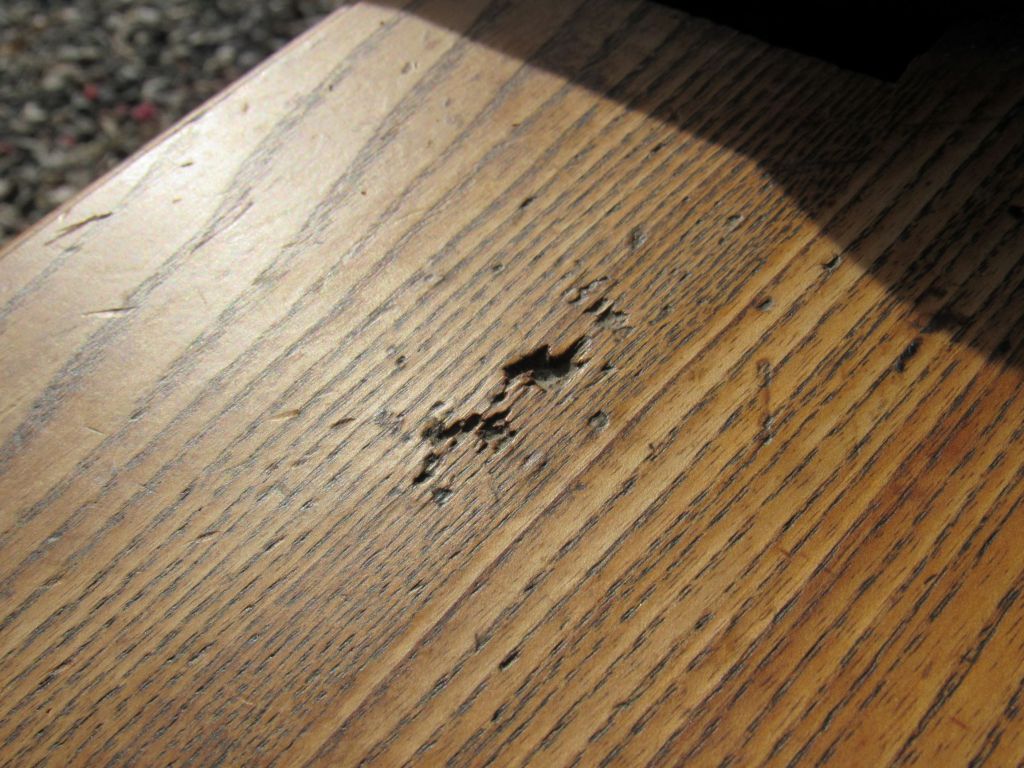
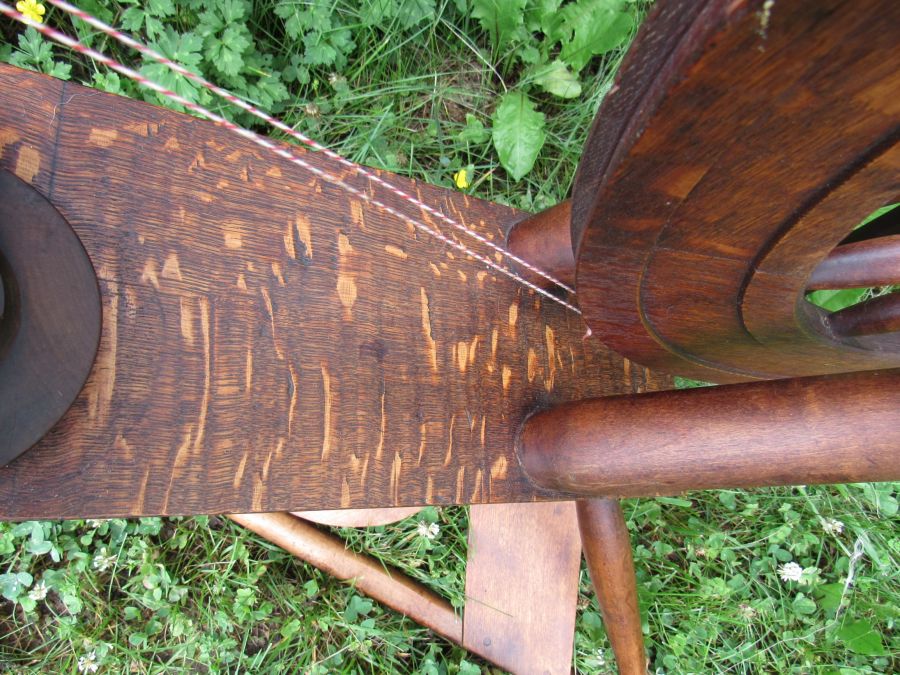
The table has gouges in the middle, which, as mentioned in an earlier post, are speculated to be from a knife (or fork) used to guide or separate the drive band at the cross, perhaps for plying.
There are scratch marks at various places.
It is hard to tell whether they were deliberate or not.
Two legs are quite red and appear to be made of cherry, while this one is light, perhaps maple or apple wood.
The treadle appears to be a replacement and the distaff supports are missing, although a partial bird-cage distaff was propped in the support hole.
There are crossed scribe marks under the table for positioning the legs,
similar to those on other northern New England wheels, and an interesting three-dash chuck mark.
Phoebe provided a good education in getting a wheel up and running again.
Many of her joints were very loosey-goosey, so I learned to shim the mother-of-all (clarinet reeds make great shims) and wrap joints with linen yarn.
Her whorl was stuck and the flyer hooks—those that were not missing—were severely rusted. At that time, I used WD-40 to loosen the whorl and fine sandpaper on the hooks. I now use a rubber strap wrench for stuck whorls and abrasive cord for rusty hooks.
What an amazing feeling it was to get her spinning again. I was hooked.
Her bobbin is a little short, giving her a low chatter, unless I wrap a little wool around the mandrel. And, interestingly, the wear marks on her orifice and flyer arms indicate that the spinner brought the thread around from the underside of the orifice hole. It still amazes me to see wear marks from thread–likely linen–on metal parts.
I always like to follow the thread marks on a flyer, to try to interpret how previous spinners worked with the wheel. Was the orifice threaded this way to slow down the uptake, to change the amount of twist, or to accommodate flax vs. wool? Even though it is not that long ago, we are ridiculously ignorant about spinning methods in the 18th and 19th centuries. At least these old wheels can give us some clues, if we can understand how to read them.
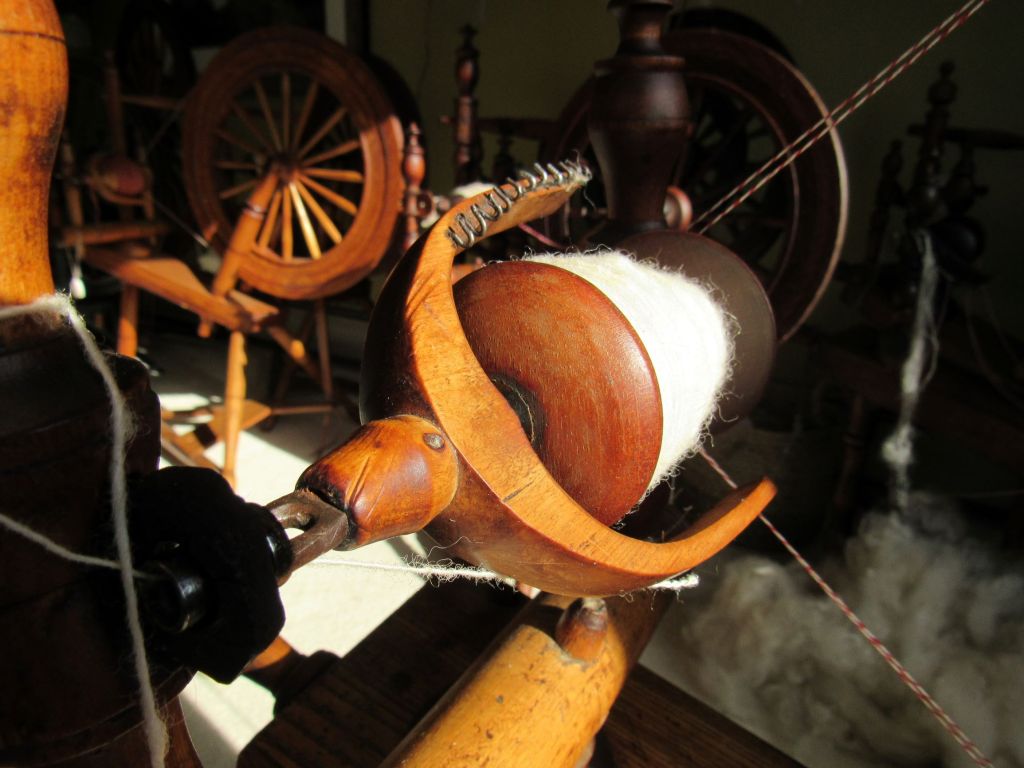
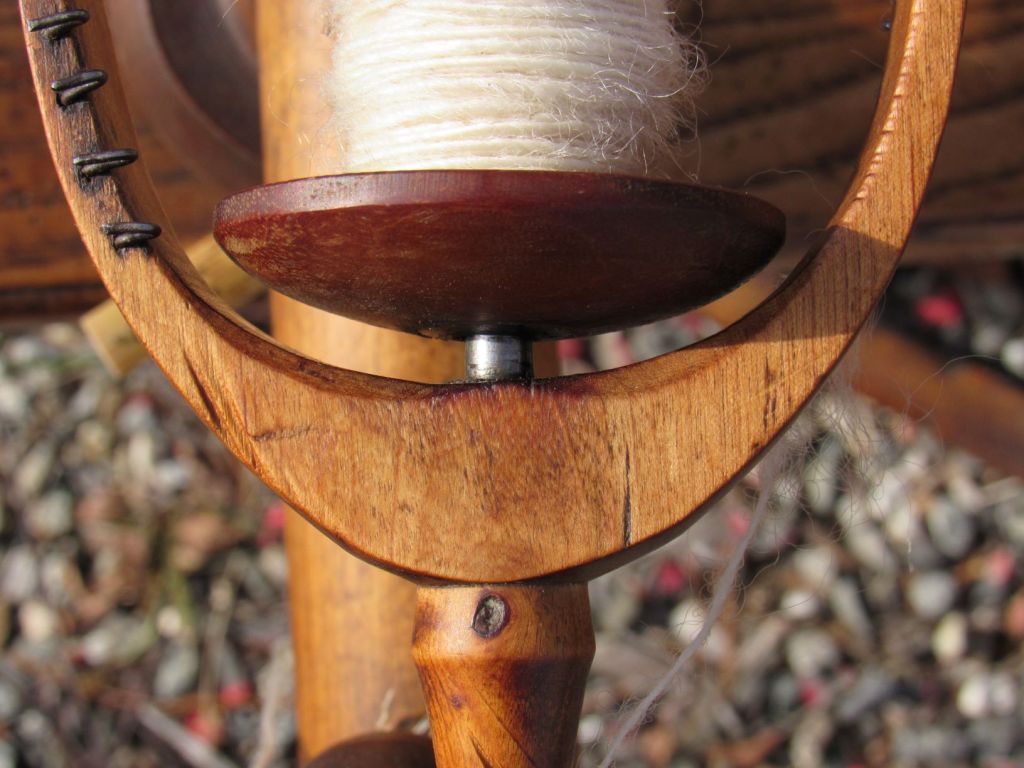
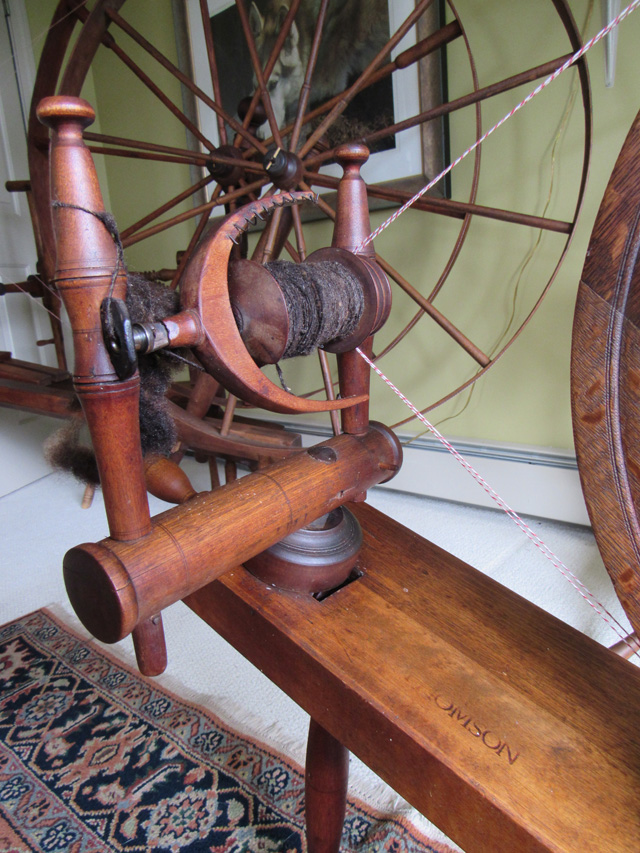
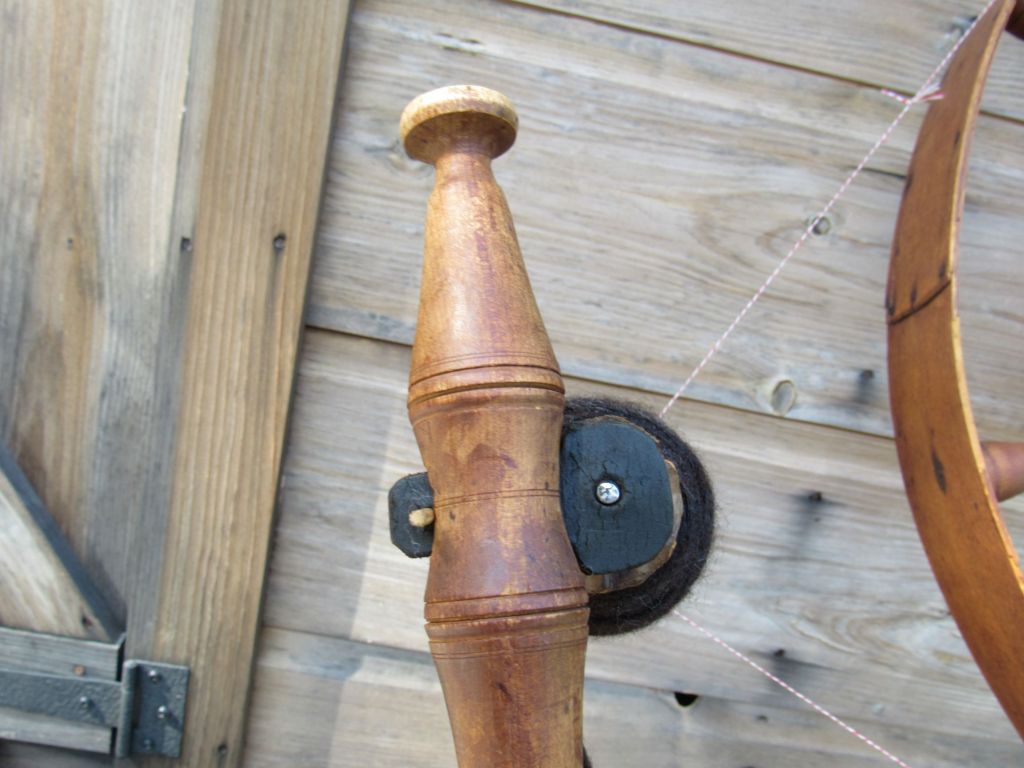
This attractive bobbin winder was made in Turner, Maine, by a man with the wonderful name of Hannibal Thomson. Unraveling the who, where, and when of Thomson’s wheels illustrates why many of us are addicted to rescuing these old wheels. There’s the thrill of the hunt—for the wheels themselves and to discover the wheel makers. And there’s the collaboration with other antique-wheel addicts, railroading wheels to new owners, sharing knowledge and research, and getting ridiculously excited about discovering a wheel’s origins.
My Thomson journey started at a Maine antique store, “Den of Antiquities,” where I spotted a Shaker-like flax wheel with an un-Shaker-like maker’s mark in large letters on the table. The mark had been worn to oblivion on one end but enough was there to make out, “Thomson.”
I knew nothing about Mr. Thomson and brought the wheel home in anticipation of a history hunt to find the maker. I found references to three Thom(p)sons in Ravelry’s Antique Spinning Wheel group, J. Thompson, T. Thompson, and H. Thomson. All the table stamps were in the same style, although the spelling varied. A wheel making family, perhaps? My wheel matched those of H. Thomson. I had found my maker.
H. Thomson flax wheel
Unfortunately, I couldn’t seem to discover exactly who he was. My on-line research found many H. Thomsons who had come to Maine from Massachusetts, but I couldn’t find any references to wheel making.
I did find, however, another H. Thomson wheel owner on Ravelry who lived not far from me in Maine. Jan had an H. Thomson bobbin winder (like the subject of this post), and flax wheel, but the drive wheel was not original.
Jan’s Thomson great wheel, and bobbin winder, reunited with my flax wheel (which I passed on to Jan)
She had been looking for an H. Thomson great wheel and when one became available at a large “wheel rescue” that I was helping with in Massachusetts, we arranged a wheel railroad.
Flax wheel
I drove a number of wheels that Jan had been fostering down to their new owners who were also at the rescue and brought back the Thomson great wheel for Jan. In the process, I got a chance to spin on the great wheel and it was love at first spindle click. As with the flax wheel, the Thomson great wheel was a beautiful spinner, well- balanced and designed for effortless spinning. I was hooked.
The maidens on the bobbin winder and flax wheel are almost identical
Some months later, a Thomson bobbin winder came up for sale in New Hampshire. It was a long drive, so I decided to combine it with it a trip to see Craig Evans, a wheel and textile collector, historian, and weaver, who lived in the same area and was selling some of his collection.
I picked up the bobbin winder and a large skarne that the seller desperately wanted to unload (“take it! take it!”) and headed to Craig’s. While admiring some of his amazing collection (and picking a few things to bring home), we talked about wheels and wheel makers, including H. Thomson. Craig recalled seeing a Thomson flax wheel in an antique store in Alfred, Maine years earlier, but didn’t know anything about Thomson himself.
About a year later, I heard from Craig that he had discovered the identity of H. Thomson. During that year, I had acquired a Thomson great wheel and passed my flax wheel on to Jan, to complete her Thomson collection. I excitedly contacted Jan with the news and she and Craig collaborated on a fascinating article, with Craig’s research and Jan’s wheels, titled “Hannibal Thomson and His ‘Widely Known and Sought For’ Spinning Wheels.” The Spinning Wheel Sleuth #107, Oct. 2020.
The title quote was from a book on the history of Turner, Maine, the town where Hannibal lived and worked in the early to mid 1800s. The description of Hannibal brings him alive: “Mr. Thompson was a good mechanic, and his spinning-wheels were widely known and sought for. He prosecuted his business for many years, and being remarkable for ready wit, his shop was an agreeable place in which to spend a leisure hour.” French, pp. 87-88.
Hannibal died at age 79 in 1861, but not before seeing his wheels become obsolete: “He lived to a good old age, but in the last years there were few calls for his work, as in the change of customs, spinning-wheels, carding machines, and fulling-mill, all went down together and became things of the past.” French, p. 88.
What would Hannibal think if he could see how we value his work today? His wheels once again are spinning, while we marvel at his skill and thoughtful design.
Hannibal’s name in his lifetime was spelled in a variety of ways, with his last name spelled both “Thomson” and “Thompson.” Craig found that Hannibal came from a family of wheel makers. His great-grandfather, Archibald Thompson, emigrated with other Scots-Irish in the 1720s from Ulster, a center of Irish linen production.
Archibald settled in North Bridgewater (now Brockton), Massachusetts, and was reputed in local histories to have made the first treadle spinning wheel in this country—or New England. Others, however, have credited the Scots-Irish who settled in Londonderry, New Hampshire in the early 1700s with that distinction.
In any case, Archibald’s descendants (called “his posterity” in one history) also made wheels. Given the similarities in the style and placement of the makers’ marks, it’s likely the wheels marked “J. Thomson” and “T. Thompson” were made by family members, although that hasn’t been established yet.
As for the winder itself, it’s a little beauty. Its overall look is similar to Shaker wheels, which isn’t surprising because Turner, Maine is not far from the Maine Shaker colonies and Hannibal’s wheels were made in the heyday of Shaker wheel production. The Shaker style influenced many local wheel makers.
These bobbin winders were used by weavers to fill bobbins, which were then placed on a skarne (or creel) (photos at the end of the post) for winding warps onto a warping board or reel, or directly onto a loom’s sectional beam.
The bobbins often were filled from skeins on swifts. But, in my case, I usually tuck the winder right next to my great wheels and unwind from the wheel spindle directly onto the bobbin.
The winder’s legs are slightly offset and the mother-of-all is angled—features that presumably make for ease of use.
There is a similar Thomson winder in Pennington & Taylor’s book, with slightly different maidens and a spindle tip, which would allow it to be used for winding quills or even spinning. P. 29, Fig 2-33. Quills were inserted into a weaver’s shuttle, which carries the weft across the warp. This one doesn’t have a spindle tip, just a long metal rod with a whorl.
The rod on my winder is pretty thick, so may have been rather large for quills. Its axle is wooden, which I keep well lubricated because I use the winder all the time. It’s a marvelous tool.
I hadn’t planned on buying a skarne when I picked up the winder, but they are very difficult to find, and the owner wanted to get rid of it.
So, home it came.
It has holes for 10 crossbars, so would hold at least 20 bobbins, more if they were smaller. Once I get additional crossbars in, I’ll put it to good use.
My resources for information on Hannibal Thomson and bobbin winders:
Cunningham, Jan and Craig Evans, “Hannibal Thomson and His ‘Widely Known and Sought For’ Spinning Wheels,” The Spinning Wheel Sleuth 107 (October 2020).
The Maine Shakers made thousands of spinning wheels and I am lucky enough to have one.
Shaker missionaries first started settling in Maine in the 1780s and by the early 1790s had established several formal communities. Two of those communities, Sabbathday Lake and Alfred, starting producing wheels soon after.
Many Shaker communities in other states also were involved in wheel production and it’s estimated that the communities combined may have produced more than 10,000 spinning wheels from the 1790s to the mid-1800s. My wheel was made in Alfred, Maine.
Maine’s Alfred community was a major wheel producer, perhaps turning out as many as 3000, the majority being wool wheels.
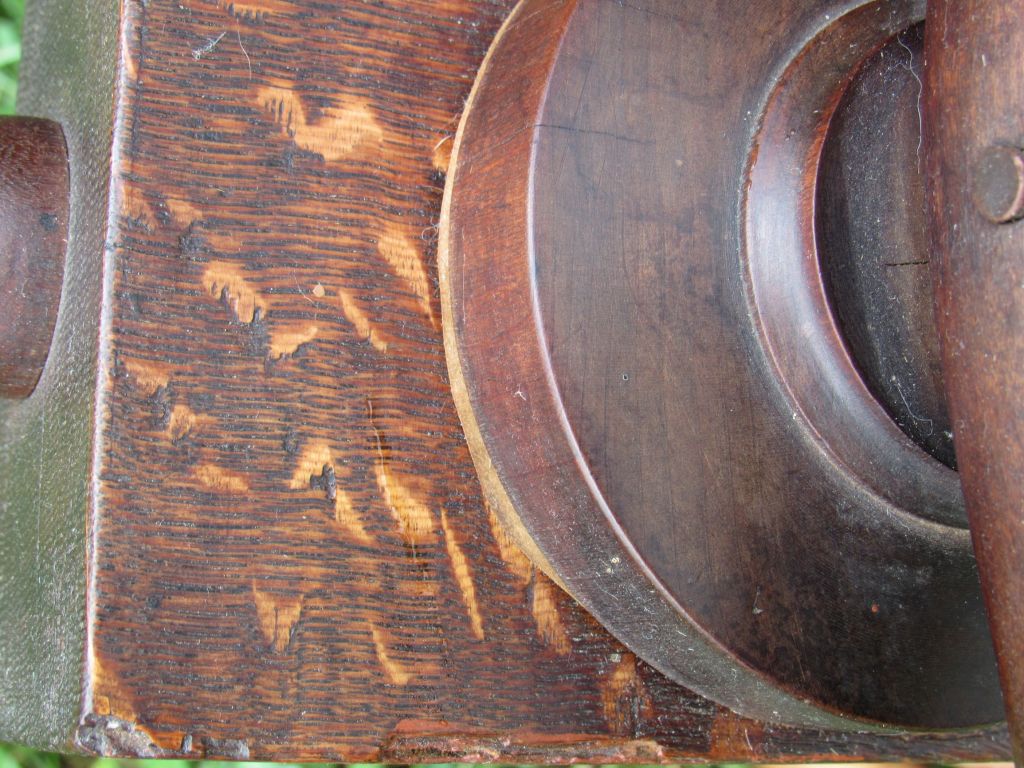
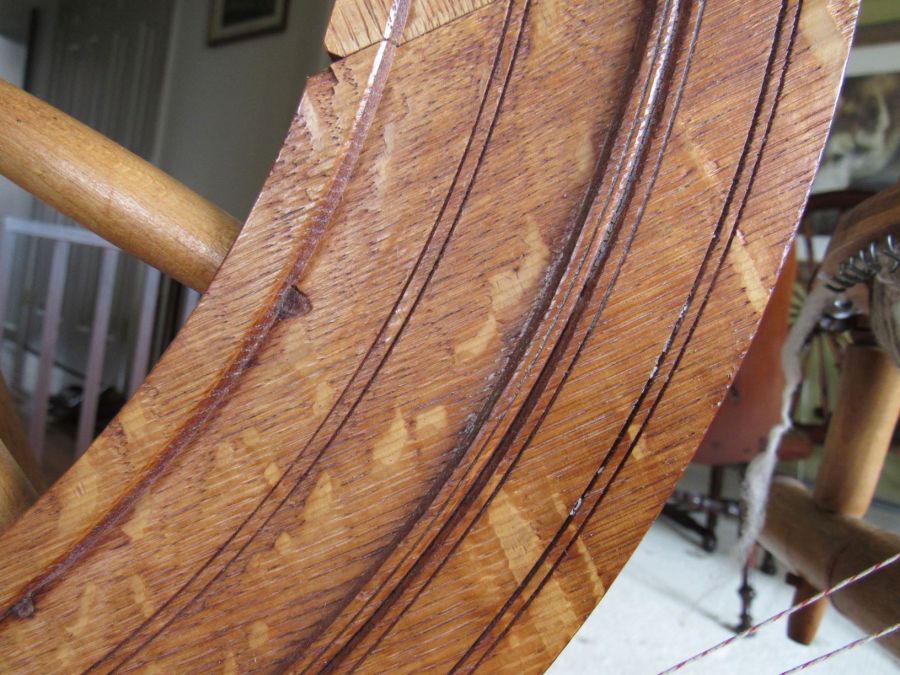
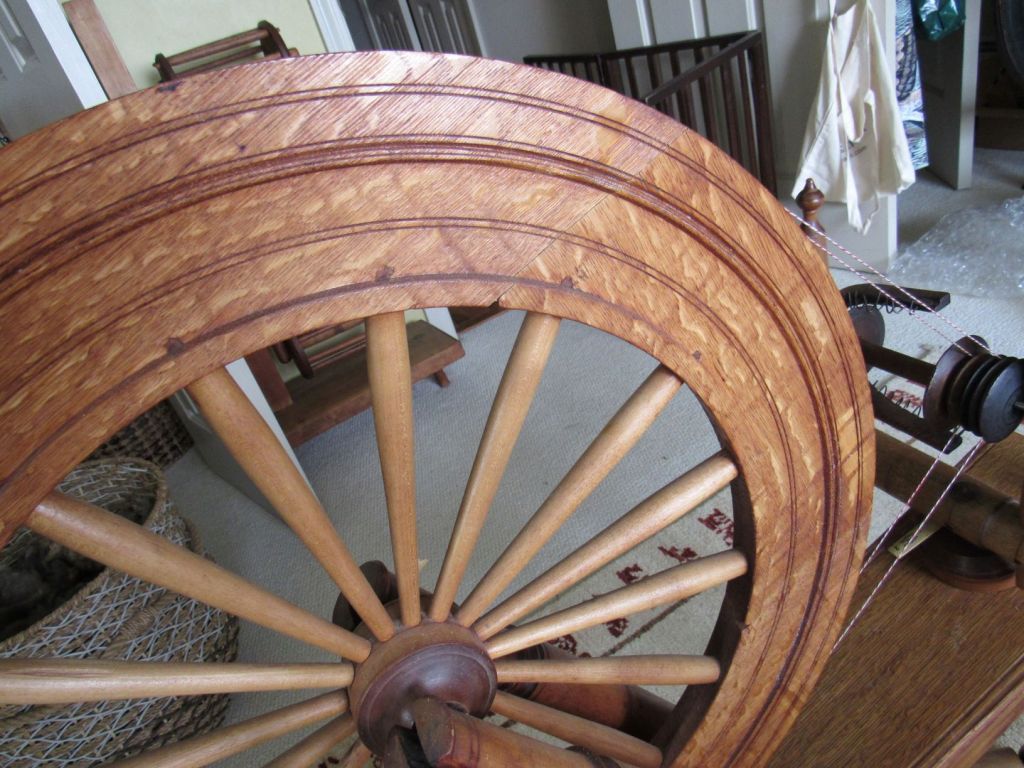
But they did produce flax wheels, too, with simple, graceful lines highlighting wood that appears to have been carefully chosen for its beautiful grain patterns and ray flecks.
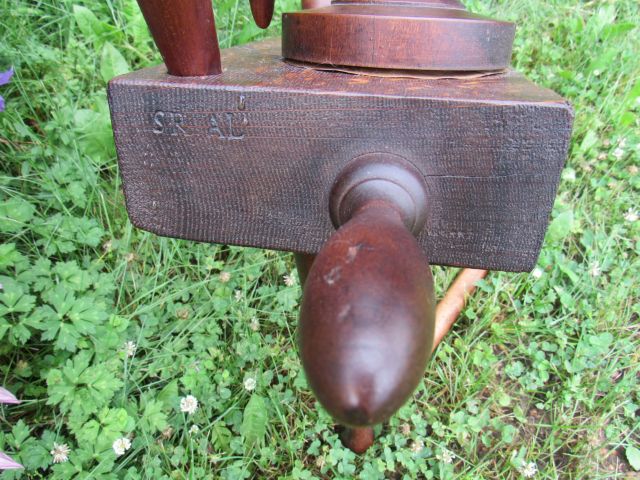
The Shakers didn’t mark all of their wheels, but many have initials stamped in the end grain of the tables. The initials were those of the community’s trustees, who may or may not also have been wheel makers. The earliest Alfred wheels were marked “TC” for trustee Thomas Cushman and, after 1809, flax wheels were marked “SR AL” for trustee Samuel Ring.
Even though Ring wasn’t a trustee for long and wasn’t a wheel maker, his name continued on the wheels after he retired in 1814. Those initials must have essentially become a brand for Alfred Lake wheels at that point.
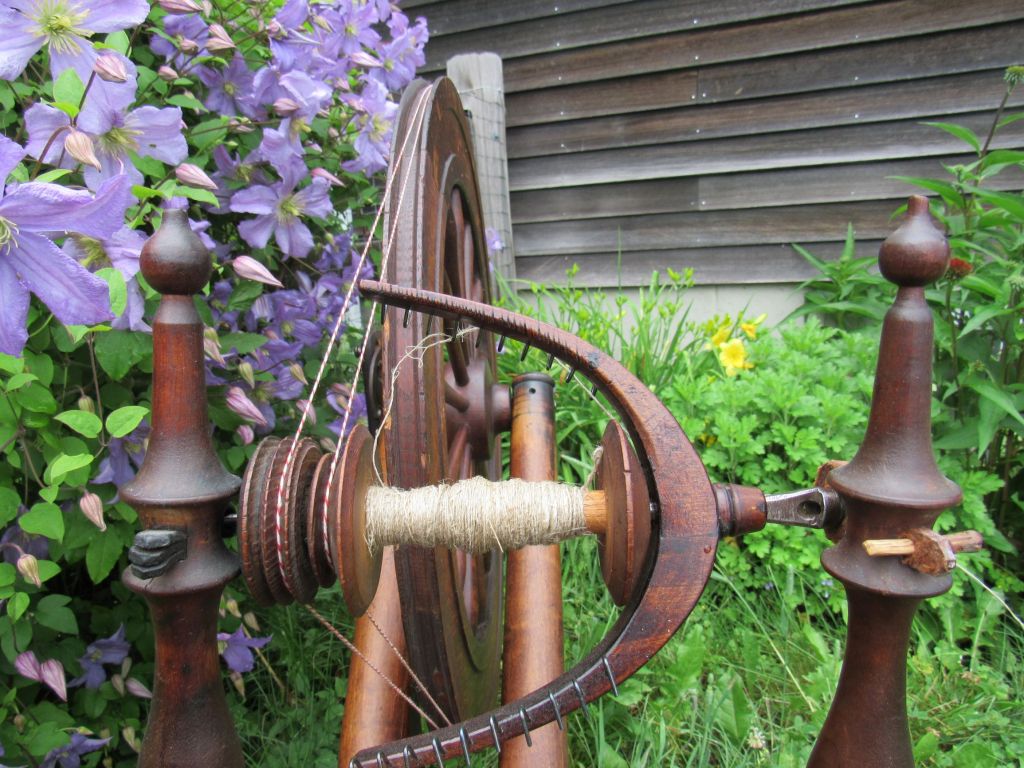
The simple design of Shaker wheels was a huge influence on other wheel makers in Maine and New Hampshire. The designs were similar between the different Shaker communities, but each community’s wheels had some distinctive features. The Alfred Lake wheels have beautifully curved maidens with small teardrops at the top.
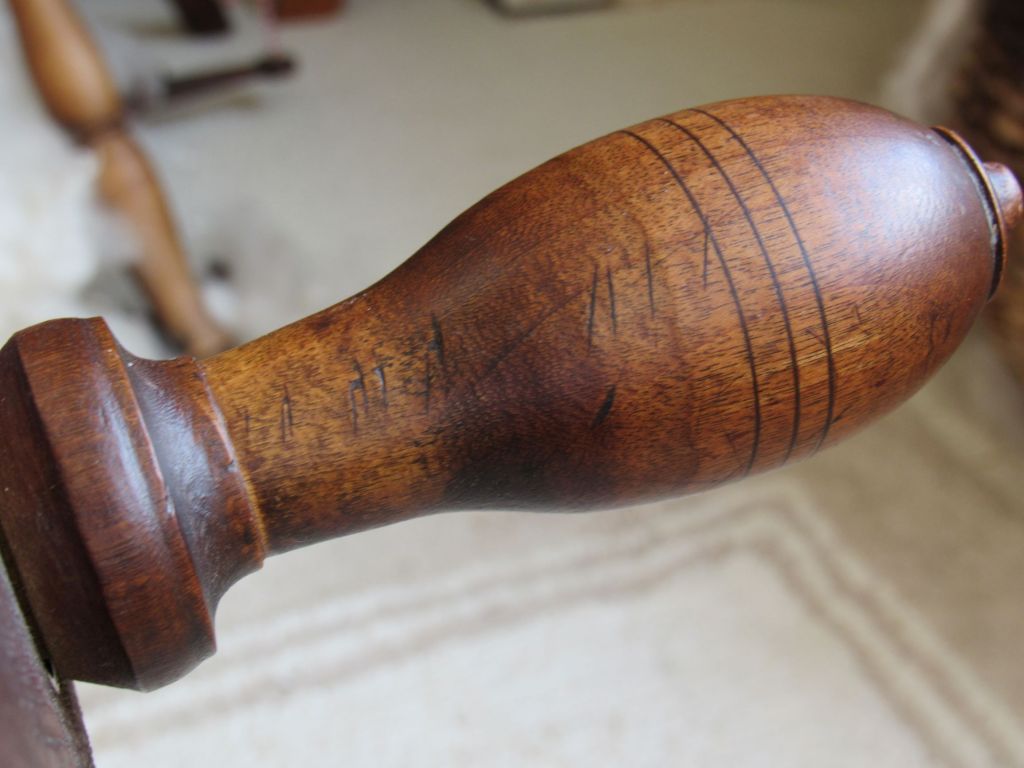
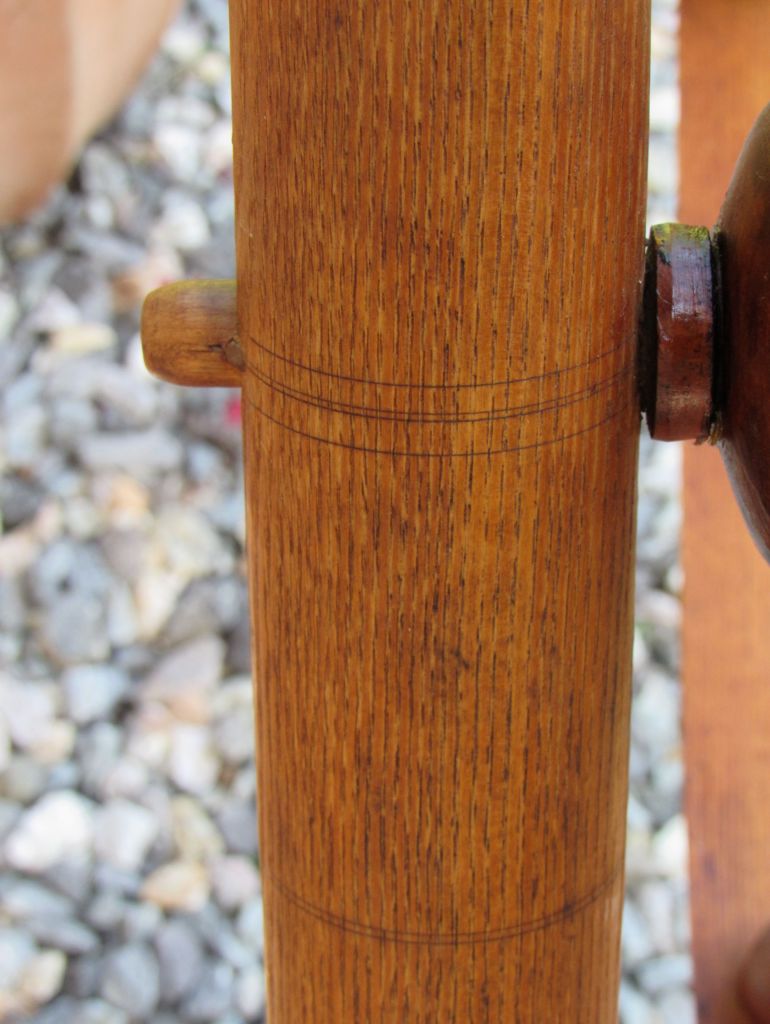
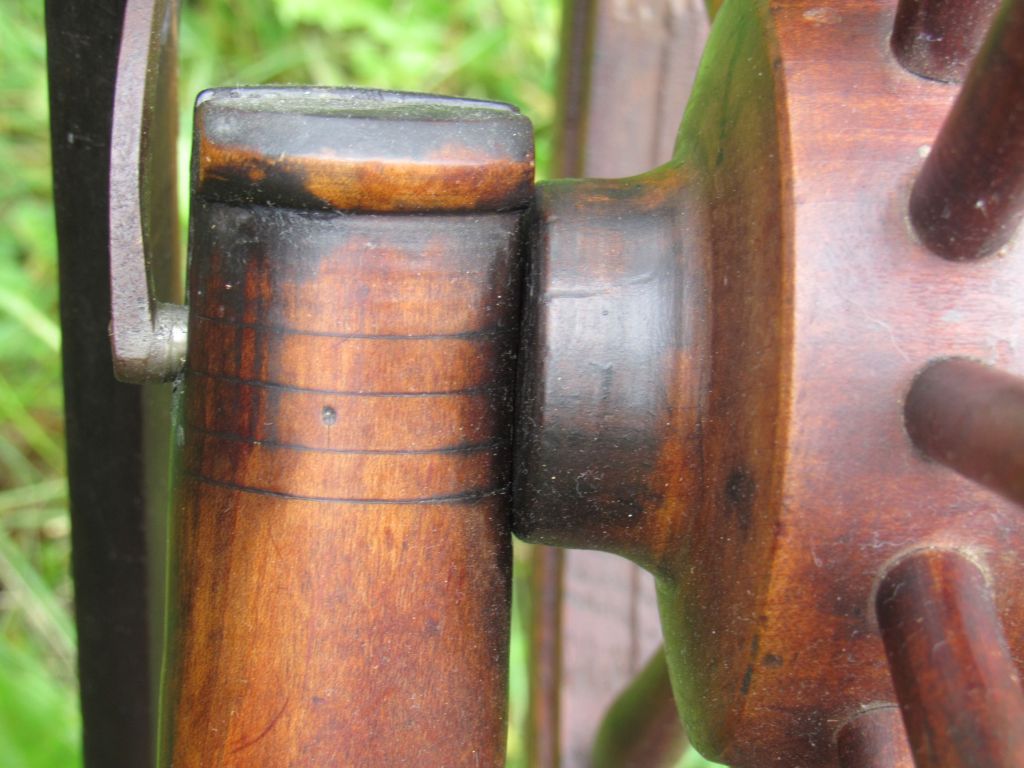
The wheel upright supports are encircled with multiple scribe marks.
Mine has four on each side.
Whether the number of marks has any significance is up for debate. There are fourteen plain spokes–with no ornamentation.
The treadle bar usually is a half-moon shape, likely designed for ease in using both feet to treadle.
The legs have a gentle curve with a rounded foot. I’m always struck by how many of the shapes on these flax wheels resemble curves in the human body–an interesting feature since the Shakers were celibate.
The flyer assembly and distaff top are not original to my wheel, although both are probably from other Shaker wheels. Mine is an absolutely wonderful spinner, especially for flax. And she’s easy on the eyes.
My resources for the information on Shaker wheels are:
Pennington, David A. and Michael B. Taylor. Spinning Wheels and Accessories. Atglen, PA: Schiffer Publishing, Ltd., 2004, pp. 131-39.
Michael Taylor, “Shaker Spinning Wheel Study Expands,” The Shaker Messenger, Vol. 8, No. 2, (spring 1986).
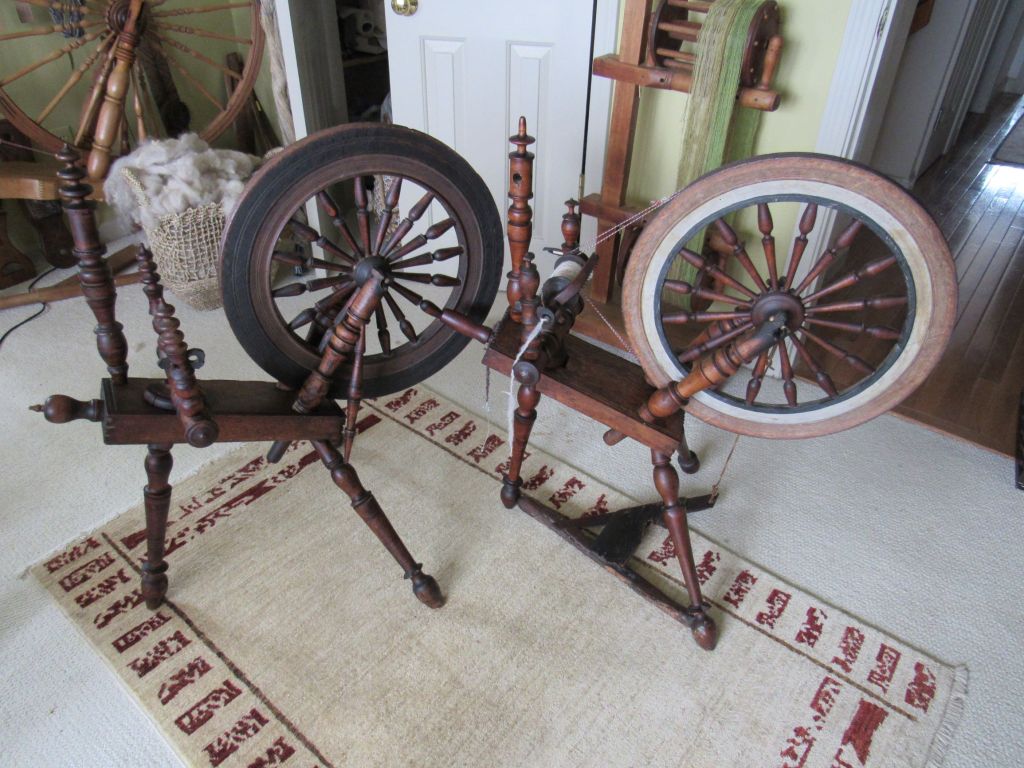
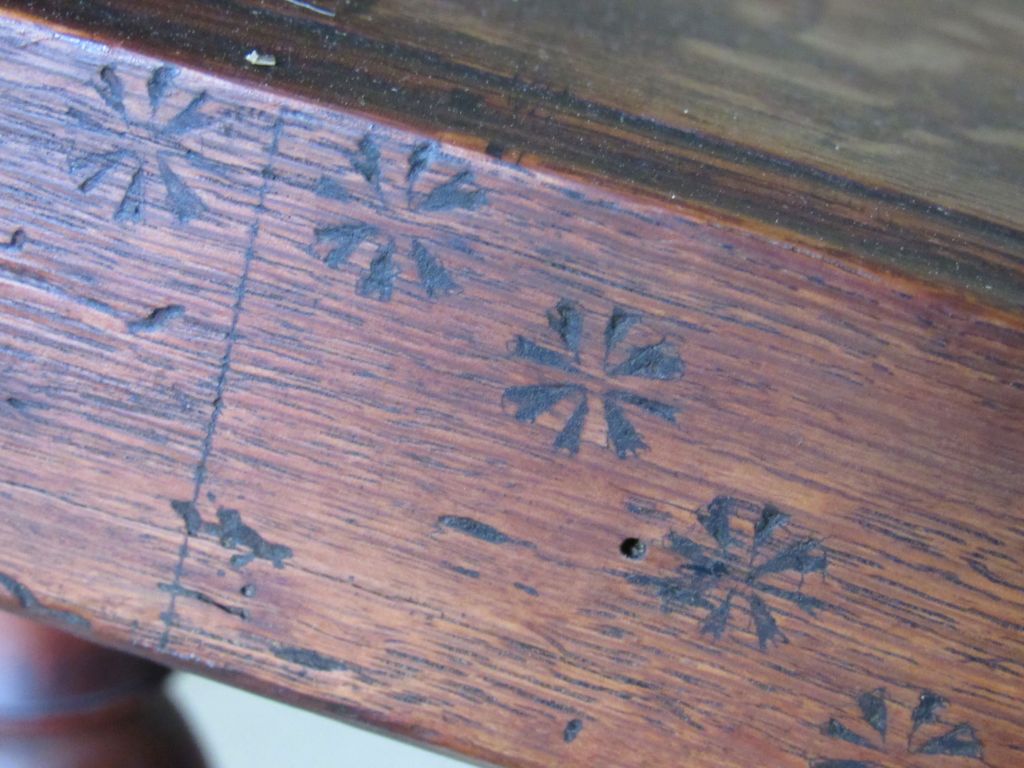
This exuberant wheel appears to be related to the family of wheels in the previous post, “Julia.” Those wheels are marked “JC,” “IC,” or “SC,” accompanied by star/flower stamps, and I expected to see one of those sets of initials on this one. But, no–nothing but star stamps–lots of them.
The basic characteristics of this wheel are the same as the others–small table, vase-turned legs, 16 tulip bud spokes, painted rim, extra upright supports, star stamps, and pagoda tops.
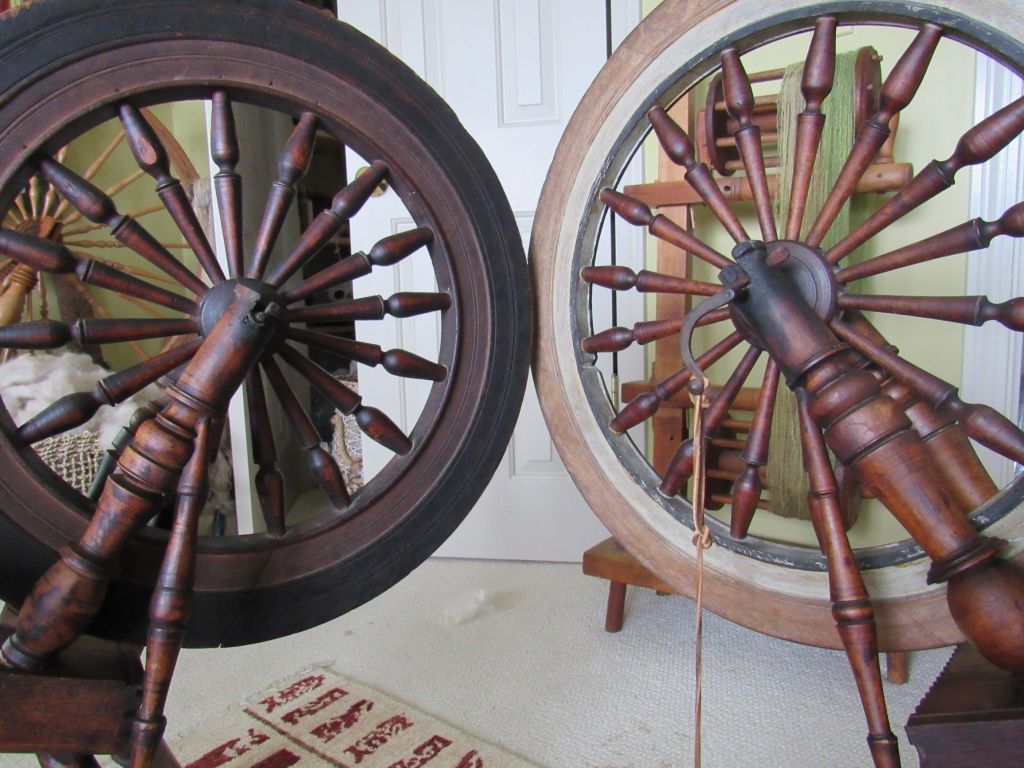
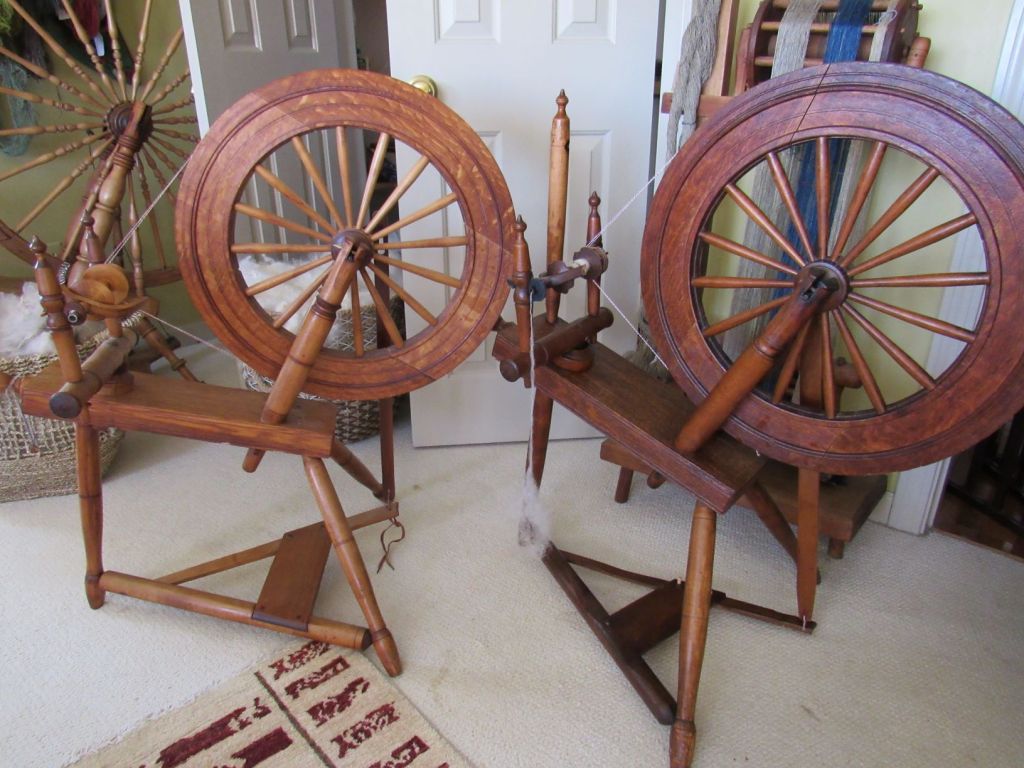
But when viewed side-by-side with Julia, everything is slightly different. This wheel’s table is slightly longer, narrower, and less tilted. The turnings–while sharing the same general contours–are different.
The spokes are shorter and stouter.
The drive wheel is about the same 20″ diameter, but looks heftier because of a broader rim. Even the star/flower stamps are different.
Julia’s stamps have 8 points, made by 4 V-shapesJerusha’s stars are six simple points
Jerusha has stars on every side of the table (Julia doesn’t have them on the wheel end), with wave patterns down both sides and additional stars in the curves.
The table is generally wedge-shaped, but has a slight peak underneath in the middle.
The table underside is smooth, with beautiful chamfered edges.
The tension knob is plump, with a painted band. That end of the table is decorated with an unusual carved pattern and all corners have the small-large-small chip carving of the other wheels in the family.
The non-spinner side leg has a nail in the bottom, presumably to keep the wheel from moving across the floor.
There also is a nail driven into the table in front of the rear drive-wheel support.
The treadle parts and flyer assembly are missing, but the wheel shows that it was well-used by the layers of encrusted grease around the axle and on the maidens.
After clean up–some of the grease remains.
The wheel is decorated with black bands, although some have worn off and others covered with years of grime.
The paint colors on the drive wheel appear to be black and perhaps red.
And the wheel’s crowning glory is the trio of triple pagodas.
I have an extra flyer assembly that looks as if it will fit this wheel and my husband will make new treadle parts this fall. Then we’ll see how she spins.
January 18, 2022 update:
In May, 2021, I took a trip to Pennsylvania to railroad antique wheels there and back, visit with other wheel lovers, and see the textile tool collections at the Landis Valley Museum, Ephrata Cloister, and Schwenkfelder museum. Thanks to friend and fellow railroader, Tina M., a highlight of the trip was a morning she and I spent with Bill Leinbach, who not only is an extraordinary weaver, but also has a remarkable collection of antique wheels. Weaving, wheels, good conversation–my idea of heaven. Since then, Bill has generously continued to share his knowledge with me and, when he asked if I would be willing to part with Jerusha, I was delighted to pass her on to him. After his meticulous clean up and new treadle and distaff parts, she has been brought back to her full glory. Thank you Bill.
Some wheels demand notice. Certain curves, angles, stances, and colors stand out in a way that catches the eye.
A family of eye-catching wheels, sharing distinctive looks and features, have come up for auction over the years in scattered locations in the northeast—New Jersey, Massachusetts, and Connecticut. They are jaunty, but elegant, with short tables, vase-turned legs, and sixteen tulip-bud spokes.
Here are two examples—the first from a New Jersey estate sale and the second from a recent auction in Copake, New York.
Notice that the Copake wheel has a distaff inserted for the rear missing leg.
Most have painted rims—a fairly unusual feature. From what I know, all are festooned with stamps resembling stars, or sunbursts, or flowers—depending on your interpretation—along the table end and sides.
Most have the initials “JC” stamped on the table end, but there are others, with similar legs, supports, and star patterns, but variations on the maidens and spokes marked “IC” and “HE.”
In January 2020, a similar wheel appeared on Facebook Marketplace in New Hampshire. It shared the same features with the JC wheels, but was marked “SC.”
I was intrigued. Was there a family of wheelmakers creating these distinctive, exuberant wheels? I wanted to buy the wheel but, unfortunately, my planned trips to pick it up were delayed by snow, rain, and the granddaddy of delays—the Covid-19 lockdown. Fortunately, the seller graciously held onto the wheel for me until I could finally pick it up on a spectacular sunny May drive through the White Mountains. It was worth the wait.
Once cleaned up, this wheel just glowed. The combination of rich wood grain on the spokes and the table contrasted with the paint colors on the rim is amazing. The rim looks as if it may have been red, white, and blue originally.
If so, the white and blue stayed strong, but the red faded into barely discernible remnants in the grooves.
The star stamps run in a sine wave pattern down both sides of the table
and adorn the tension-knob end with the “SC” stamp. The other end of the table is naked of stamps.
There are scalloped chip carvings at both table ends. And these wheels all seem to share a feature of corner chip carvings of small-large-small.
The underside of the table is planed and smooth, with a chamfered edge, and long pointed holding pegs and chuck marks on the bottom of the uprights.
The table itself is very short, only 15 inches, and the angle with the splayed legs suggests the look of a dog inviting you to play.
It’s very appealing. The drive wheel diameter is 20 inches, which with the short table, brings it quite close to the flyer assembly, similar to Pennsylvania wheels, but with a less upright stance.
Also similar to Pennsylvania wheels (and others, including Connecticut wheels) are the extra supports between the legs and the drive wheel supports.
This wheel originally had one on each side, but only the backside one remains. The other side shows the beautiful grooving and hole for the missing support.
The metal axle support, or bearing, is straight and at a severe angle to the support—almost horizontal with the ground.
The wheel has subtle ring marks on the turnings
and a simple one tiered tower on the distaff support–many of these wheels have more.
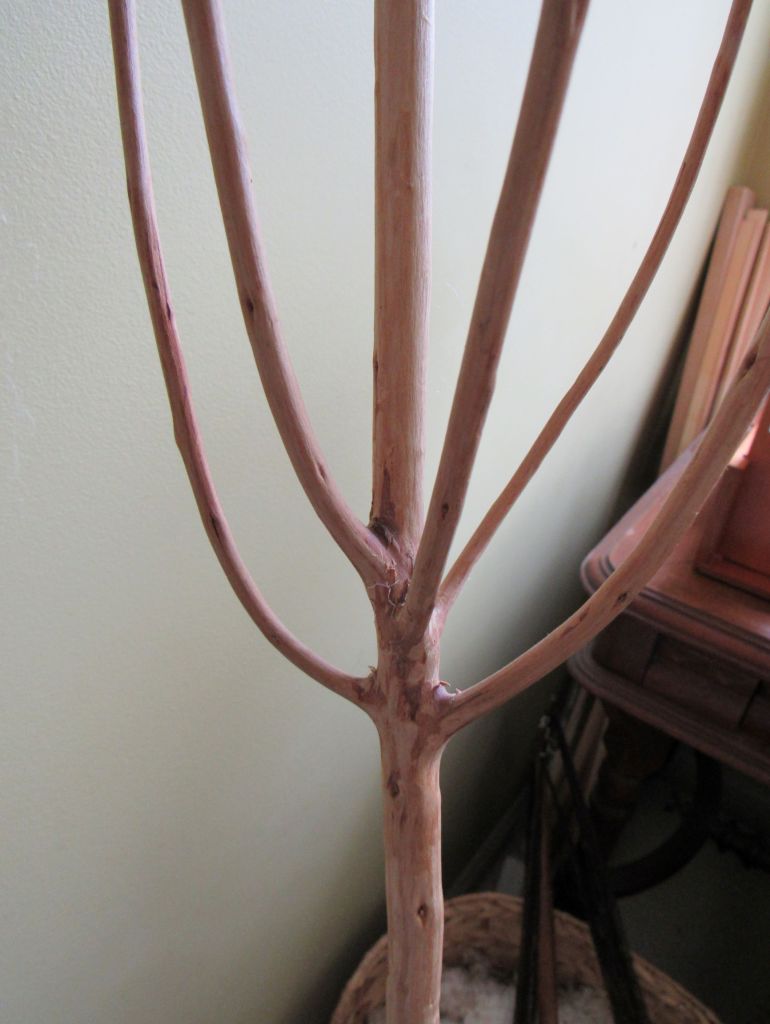
The distaff itself on this wheel is made from a sapling, often used for spinning tow.
My goal with all of my wheels is to get them spinning again. I was a concerned that this wheel had been spun to death and was too worn out to be used again. I’ve dealt with a lot of old wheels that show decades of use, but none with quite this imprint of heavy spinning. The upright supports for the drive wheel were badly eroded and blackened.
Some blackening occurs from the continual use of grease as a lubricant for the axles, but I’ve never seen uprights like this, where they are just broken down to nubs.
The treadle had been worn completely through, yet it wasn’t replaced, just used as is—a skeleton of itself, but still functional.
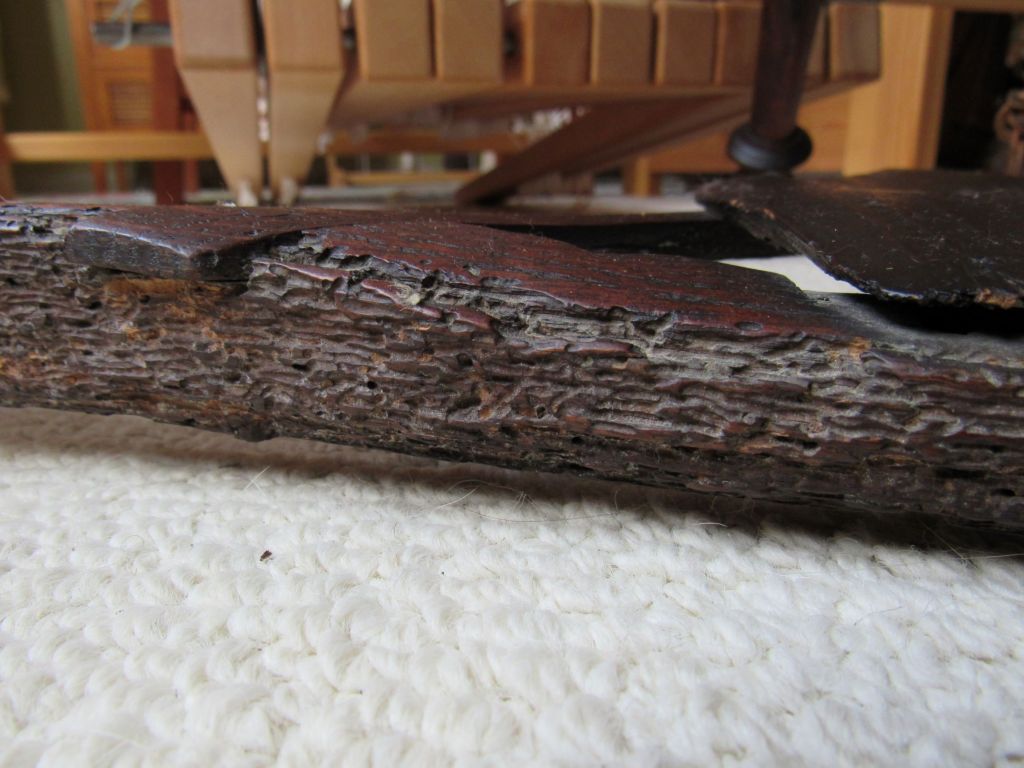
Moreover, the treadle bars had been well-tunneled by beetles, which can turn it into a crumbling wood lace—not ideal for continued use.
And, what worried me most was that the tension screw was not original.
The threads on the screw don’t match those under the mother of all. No matter. This wheel was made to spin. A few tweaks and adjustments, plenty of oil, and she was off and running.
The wheels with the most wear on them are often the best spinners. Makes sense, of course.
When cleaning the wheel, I was surprised to find that the fine-edged turnings on the right spinner side leg had been completely smoothed down.
Once I started spinning, I understood that wear. Because the table is so short on this wheel, the spinner’s treadling leg rests naturally on the wheel’s front leg. It’s a comfortable accommodation. But, imagine how much fiber was spun on this wheel and how many decades of women’s legs rested on this wheel’s leg to smooth those grooves into oblivion. It’s a rare privilege to add my leg to their imprint.
The day after I got this wheel spinning, I drove to southern Maine to pick up another wheel from the same family. She will get her own post once she’s up and running.
Given the style of these wheels and the amount of wear and damage found on many of them, they may date from the 1700s. But, really, we don’t know who made them, or when or where they were made. The research continues. In the meantime, these wheels are a brilliant reminder of how a person—or in this case, perhaps a family—can transform a utilitarian item into a work of great beauty that leaves a personal impact long after the maker is gone.
Antique wheels present so many puzzles. Connecticut double flyer wheels, for example. Why was there a sudden surge in manufacture of these wheels in the late 1700s and early 1800s? Was there a need for increased spinning production in that particular region at that time? Or did they simply become fashionable—a personal advertisement of spinning prowess?
These wheels, compact uprights with two flyers supported above the drive wheel, have been referred to as “gossip wheels,” based on a lovely, but mistaken, notion that two spinners could work side by side at one wheel, chatting as they spun. For most double flyers, however, reality was much less cozy and serene—they were a means to increase production, not socialization. One spinner, two hands, two flyers—double the product.
Or almost double—apparently a good spinner could increase her production by about fifty or seventy-five percent. I have great admiration for those spinners. It’s not easy to spin with only one hand for each flyer—especially with flax. Spinning a fine, consistent linen thread requires an even pull-down from the distaff (and very careful dressing of the distaff), a way to smooth out inevitable lumps and thicknesses, and a way to moisten the thread as it is spun.
Tough enough with two hands, let alone one. And once single-handed spinning is mastered—with right hand and left–then one must co-ordinate each hand to spin at the same time—but separately. Despite that challenge, these wheels were very popular for several decades in Connecticut.
Were all of the users competent with two flyers, I wonder? Most double flyer wheels can be used with only one flyer, so perhaps they were considered versatile—with an option of using one or both flyers. They also are compact and attractive, which may have contributed to their appeal.
In any case, my double-flyer does not appear to have seen much use, so perhaps the wheel was more aspirational than practical for her owner.
The treadle has no signs of use.
There is no maker’s mark, but the wheel bears the hallmarks of the Sanford family (see previous post “Big Bear” for more on the Sanfords).
Sanford double flyers are characterized by cross posts supporting the wheel axle rather than upright supports favored by other area wheelmakers such as Silas Barnum, Solomon Plant, John Sturdevant, Jr., and J. Platt.
The Sanford wheels also have a simple top table—with a straight angle corner cut. In contrast, most of the other wheelmakers’ top tables have curved corners and half-rounds at the base of the maidens. J. Platt’s wheels had the unusual combination of upright supports with a Sanford-like top table and L. Judson’s wheels shared the Sanford characteristics.
My wheel has spokes characteristic of the early Sanford wheels—the later ones had simpler spokes—and the typical black bands with diamond chip carvings.
Neither flyer appears to be original and the bird cage distaff looks as if it was made fairly recently. A straight, truncheon-style distaff would have been more typical for these wheels.
The distaff support assembly is absolutely beautiful and also likely not original to this wheel. The wood, finish, and rings are quite different than the wheel body and the really elegant turnings suggest that they came from a different wheel.
The wood on the wheel table is quite coarse-grained
and one of the tension knobs still has a bit of bark on it.
Although the flyers are not original, they fit and work nicely. The wheel is in remarkably good shape and a spinning beast. Now, I need to learn to keep up with her.
Update December 2020: Recently someone questioned me about the assertion that a spinner could not double production on one of these wheels. I thought it would be worthwhile to include here some sources for that contention. In her article “The Double Flyer Spinning Wheel” in Issue #6 of the Spinning Wheel Sleuth, Joan Cummer wrote: “Although sometimes used for spinning wool, the double flyer wheels were especially employed for spinning flax. A spinner could not double her single flyer production but if very competent could produce 150% to 175% of her single flyer yardage per hour.”
In Patricia Baines’ book, “Spinning Wheels, Spinners & Spinning,” (1977) she wrote that double flyer wheels were “mostly found where flax spinning was an industry, as it was thought of as a wheel essentially for helping the poor to earn more money and to speed up production although it could not actually double the output.” (p. 151). Baines cited H. E. Von Rettich’s Spinnradtypen, Vienna, 1895, for the proposition that “a spinning wheel with treadle produced 350 metres per hour and one with two flyers 498 metres per hour,” while noting that the validity of these measurements is necessarily dependent on the skill of the spinner.
And, a little book, “The Tale of the Spinning Wheel,” by Elizabeth Cynthia Barney Buel, quotes from an 1801 advertisement in a Connecticut newspaper, the Hartford Courant, by local wheel maker Joel Baldwin , saying “Two handed wheels are highly recommended to young women, as they can spin one third faster on them.” (p. 39) The book was published in 1903 and is a fascinating glimpse spinning and textile production. A free e-book version can be found here: https://www.gutenberg.org/files/58950/58950-h/58950-h.htm?fbclid=IwAR1TgJdVNGMxNgxaeHuk2MBD2Uh5wurV6D008O-FnGJcHYr6_bdxA64ZKXw.
An article in “The Journal for Weavers, Spinners, and Dyers” Winter 2020 from the UK, titled “A Window Onto the Linen Industry in Eighteenth Century Scotland,” by Hilary Miller, also discussed output from double flyer wheels in Scotland. The article notes that, according to the Old Statistical Account (OSA)–information from Scottish parishes–a spinner on a double flyer wheel could spin nearly one third more and of better quality than on a single flyer wheel, or near twice as much, but of a coarser quality. (p. 20).
November 2020 update: It is starting to look as if these wheels were not made by Silas Cheney of Litchfield, Connecticut. In researching a possible link between Cheney and the Maine Shakers, it became apparent that there is no actual evidence that Silas Cheney made spinning wheels. It is more likely that these wheels were made by a different Cheney in Maine or New Hampshire. I will write a post at a later date with the new research. In the meantime, I will leave this original post intact, with this warning that it may not be accurate.
Original post:
These two beautiful wheels were made by Silas Cheney (1776-1821) in Litchfield, Connecticut. Cheney came from a family of furniture and clock makers and, in his relatively short life, became a very successful and well-known furniture maker. By 1800, at the age of 24, he was creating high-end furniture—with stylish veneers and inlays—for affluent customers in a prosperous economy. According to the Litchfield Historical Society, which has some of Cheney’s day books, Cheney also did less glamorous, bread-and-butter work, including odd jobs, repairs, and making rake handles.
Presumably, his spinning wheels fell somewhere above rake handles but below inlaid sideboards in his work spectrum. As Cheney’s business thrived, he took on apprentices and specialists.
One apprentice, Lambert Hitchcock, supposedly influenced by clock makers and his time working for Cheney, came up with the idea of using interchangeable parts for chairs—and went on to become famous for mass production of his popular Hitchcock chairs.
CCCC marks on Cicely’s table and collar Marks on treadle–notice how there is no wear on this treadle at all
One interesting aspect of Cheney’s wheels is that parts are marked—treadle, table, tension knob, collar, hub, and flyer assembly—on my wheels with an “I” and a “CCCC.”
Whether the marks were for ease of assembly by multiple workers or some sort of mass production, who knows?
Tension knob “I” mark on ChanceyTable and collar “I”s in exactly the same places as the “CCCC” marks on Cicely
At some point, I’d love to go through Cheney’s day books in detail to see if they shed any light on his spinning wheels.
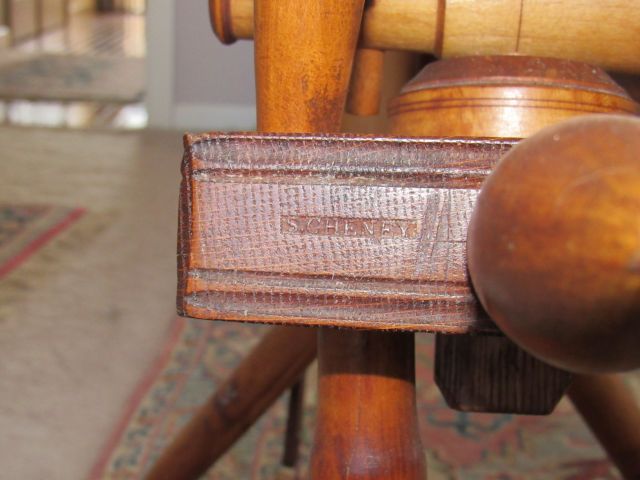
Even though Cheney did not sign his furniture, he did sign his wheels—with a tiny, hard-to-see stamp on the end of the table. Chancey’s seller said there weren’t any maker’s marks on the wheel until I asked her to go back and look again–and showed her a photo of where the mark should be.
The style of Cheney’s wheels is entirely different from other Connecticut wheelmakers of the time. For example, the wheels of Solomon Plant and J. Platt in previous posts show the typical style, with ornate turnings, black bands, and chip carvings.
Solomon Plant wheel–with 16 ornate spokes
They look fussy and overdone compared to Cheney’s wheels, which have a sleek, minimalist look, highlighting gorgeous wood and design.
Cheney’s 16 simple spokes and exquisite woodCheney treadle bar and foot
On the other hand, Cheney’s wheels have some intriguing similarities to wheelmakers farther north. The scribing under the table of Cheney’s flax wheels and the chamfering of the leg holes are fairly unusual, but very much like the Morison wheels (in Vermont and upstate New York).
Cheney under scribing for leg placement and chamfered leg openings
Morison scribes and chamfering
Even more interesting is the similarity to Maine Shaker wheels, particularly those made at Sabbathday Lake and Alfred Lake.
Cheney maiden
The maidens have the same tops, but the SRAL’s are curvier down below. The maidens on the Sabbathday Lake wheels are even closer to Cheney’s in style.
Samuel Ring Alfred Lake Shaker wheel (SRAL)
the scribe lines for the collar are the same,
Cheney scribe lines on side marking collar placementAlfred Lake scribe lines for collar
the spokes share a simple, sleek curve,
Only 14 spokes on the SRAL wheel, compared to Cheney’s 16, but the shapes are very similar
and my Alfred Lake wheel has scribe lines underneath—not the same as Cheney’s but similar.
SRAL
Most striking, though, is the wood.
The Alfred Lake and Sabbathday Lake Shaker wheels are known for gorgeous wood.
SRAL table
On my Alfred Lake wheel, the table is stunning with high contrast ray flecks. As are the Cheney tables.
Sweet Cicely’s table–just amazing wood
From newspaper advertisements, we know that Cheney was selling wheels around 1800—about the same time the Maine Shakers started producing their wheels. So, it’s hard to say whether the Shakers were influenced by Cheney or the other way around. The Litchfield Historical Society has been very helpful in answering my questions and I’m trying to determine if any early Shaker wheel makers might have apprenticed with Cheney or if there was any other connection.
Chancey–at first glance she looks like a Shaker
Cheney seemed to attract interesting connections—his daughter, Mary, while a schoolteacher in New York City, met and later married Horace Greeley, newspaper editor and politician of “Go West, young man!” fame. Mary was a suffragette, spiritualist, and likely suffered from depression. For me, learning these details about a wheel maker’s life imbues the wheel themselves with a rich, extra layer of appreciation and wonder.
Given that Cheney was a master furniture maker, I’m not surprised that the wheels are incredible spinners. The first Cheney wheel I found, Sweet Cicely, was on Craigslist in southern Maine. It had a big, clunky flyer assembly that didn’t fit or work with the wheel. The really odd thing about the wheel, though, was that it was in pristine condition and looked as if it had never been used.
When I brought Cicely home–no wear, so grease stains, she looked brand new
The wood is very blond, which is highly unusual for spinning wheels of the time. It’s just gorgeous and had clearly never seen the inside of a barn or attic, but had been lovingly cared for since the early 1800s. I’d love to know its history. Could it have been similar to the wedding wheels that we see from Europe—a status symbol wheel for a wealthy young bride who never actually had to use it?
I had a flyer assembly made and Cicely started right up. Because the new mandrel has a larger orifice than most antique wheels, this wheel is my go-to for plying. The second wheel, Chancey, I bought recently from a woman in southern New Hampshire.
Chancey’s “for sale” photo
Although one flyer arm was broken and the whorl and bobbin had been chewed by a dog, I was thrilled to see that the flyer was marked with a “I,” just like the other marked parts, so it appears to be original.
Notice there is also an “x” on the bobbin
After repairs to the flyer assembly, this wheel has become one of my top spinners—an absolute delight.
Even in this condition, she spun well.
It is darker than Cicely, has a higher, more tilted table, and lacks the flattened sides on the wheel uprights.
Cicely’s wheel supports are flattened Chancey’s are round.
The hooks on the flyer arm are tiny—smaller than any I’ve seen before—but they work beautifully.
Aside from these two wheels, I’m only aware of two other Cheney wheels that have come to light.
In contrast with Cicely, Chancey saw a lot of use
One is a great wheel in the Litchfield Historical Society’s collection and the other a flax wheel that Grace Hatton had and sold. I would love to hear of any other Cheney wheels out there.
Solomon Plant made beautiful wheels. He lived from 1741 to 1822 in Stratford, Connecticut. Florence Feldman-Wood, publisher of the Spinning Wheel Sleuth, has done extensive research on Plant, who fortunately kept good records. She wrote two fascinating articles (in SWS issues 31 and 39) about him, his wheels, and his customers.
Because I have an interest in the early Connecticut wheelmakers, I was thrilled when this wheel appeared on Craigslist in Massachusetts. It had been languishing there for some time, perhaps because both flyer arms were broken off. On a trip to see his brother, my husband arranged to pick up the wheel at the Dunkin Donuts near the Bourne bridge. So, we still refer to it as the Dunkin Donuts wheel.
The edge of the rim was badly chipped. Despite that, it held the drive band I was able to do a little spinning when I got her home–using the two hooks left on one of the flyer arm stubs. She’s fairly small and easy to lift, so once the flyer was fixed, she became my favorite for summer spinning flax outside on the porch.
The wheel has stripe and chip mark decorations on the turned pieces, with chips scalloped on the end of the table and double grooves down the sides.
Plant’s initials on the table end.
One of the most fascinating things about the wheel is that the table has a huge crater underneath, the remains of a knot.
The table is very short–only 15 3/4.” The 16 spokes and plump curves give his wheels a distinctive look.
This wheel was stained or ebonized, apparently early on, giving it a rich glow. The treadle is a replacement, and perhaps the distaff. As far as I know, there are few Solomon Plant flax wheels that have survived, so I feel extremely fortunate to have found this one.
This wheel started it all for me. When I was growing up, it decorated the corner of our Connecticut living room, with a messy, dusty hank of flax drooping from the distaff. Somehow, when I was sixteen, I got it spinning again (with wool). After I moved to Alaska when I was twenty, the wheel became decoration in my brother’s house. Through the years, a flyer arm, the footman, and the treadle broke. I brought it to Maine when I retired, had it repaired, and it has been spinning my homegrown flax ever since. It’s solid as a rock–a lovely smooth spinner–even though it likely was made in the late 1700s and saw a lot of use.
The original treadle was deeply worn.
And the distaff made from a sapling.
The table is quite short, only 16 3/4″ long, it has 12 spokes, and turnings typical for early Connecticut wheels. Every turned piece is adorned with sets of black stripes, but there are no chip carvings on the stripes, which were found on many of the early Connecticut wheels.
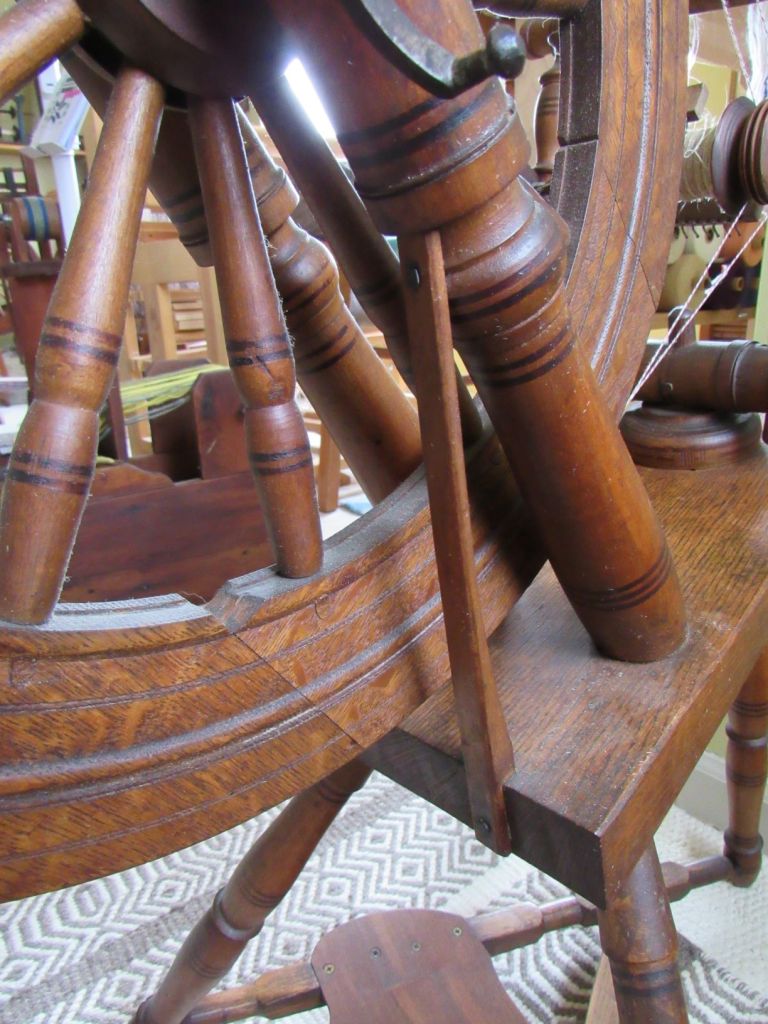
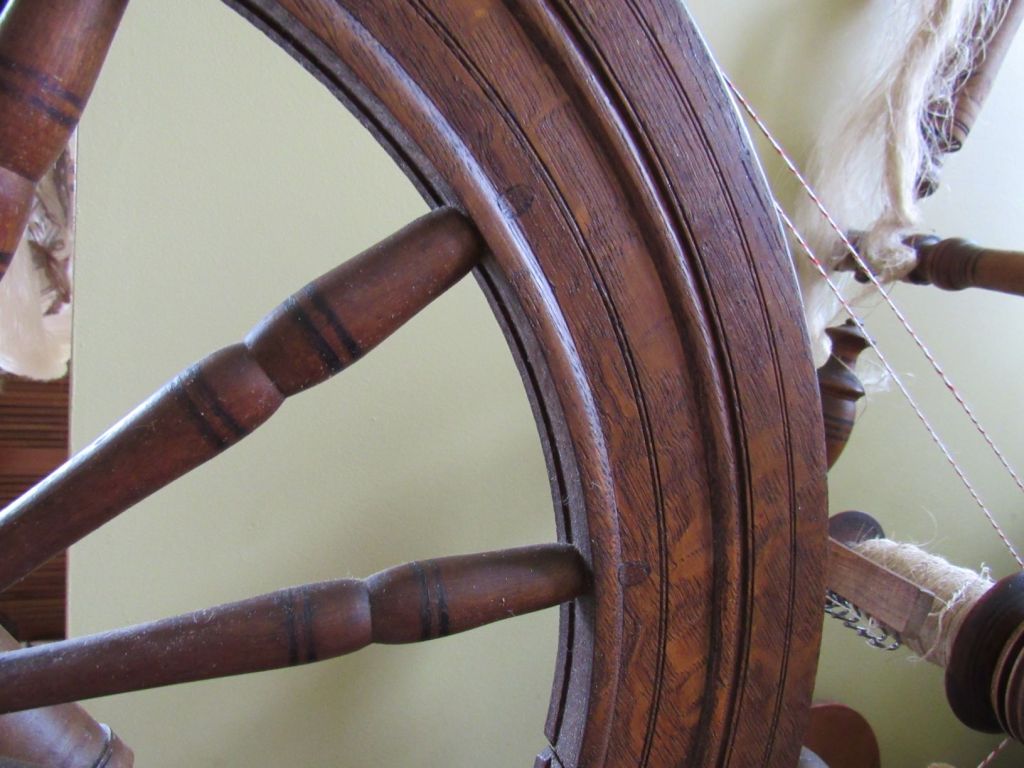
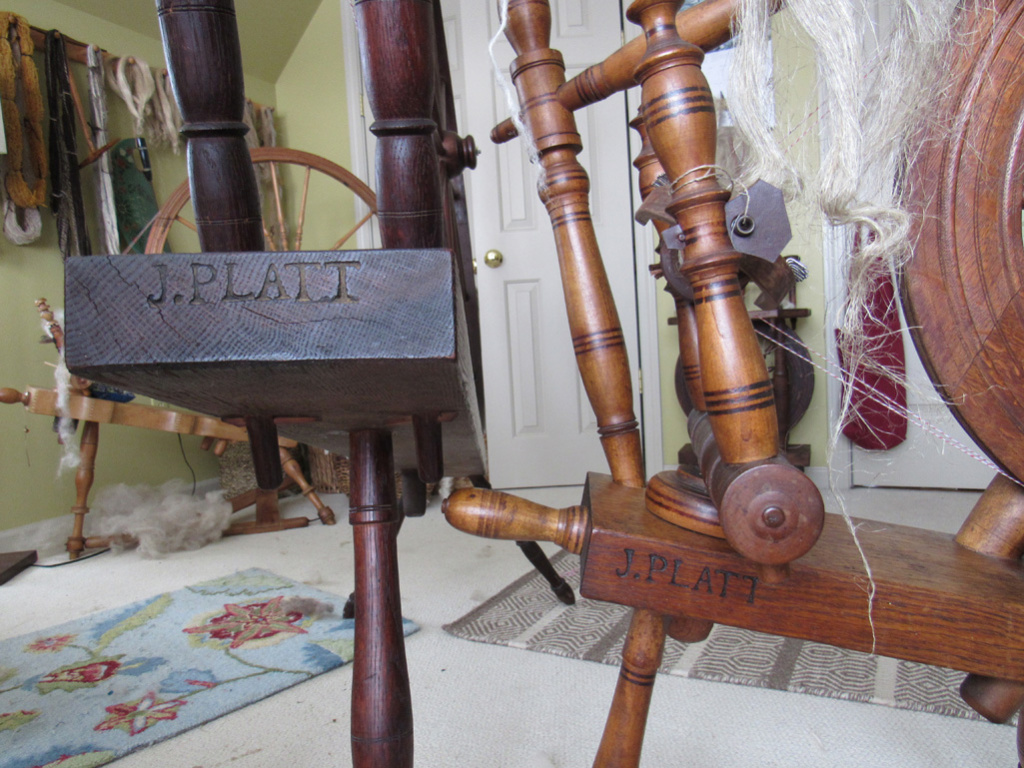
J. Platt, the wheelmaker, remains something of a mystery. Despite extensive research, I still haven’t been able to nail down who he was. His wheels share a number of features with Samuel Sanford, John Sturdevant, and Silas Barnum–wheelmakers from southwestern Connecticut in the late 18th and early 19th centuries, well-known for their double-flyer flax wheels.
My best guess for J. Platt, is Josiah Platt (1735-1804) from Newtown (married to Sary Sanford, sister to wheelmaker, Samuel Sanford), Connecticut or Joseph Platt (1741-1793) from Danbury, Connecticut but the research continues.
Side by side with a J. Platt wool wheel—the subject of the next post.




















































 Exquisite Machinery