Patience

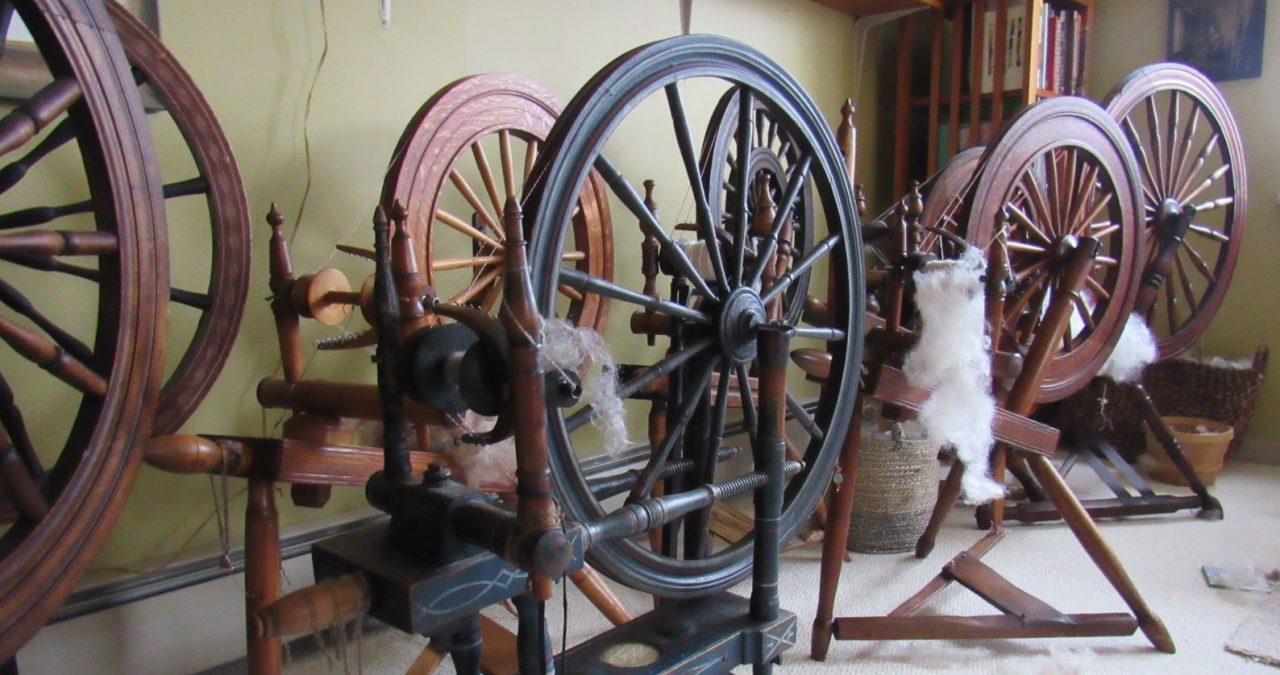
The Maine Shakers made thousands of spinning wheels and I am lucky enough to have one.
Shaker missionaries first started settling in Maine in the 1780s and by the early 1790s had established several formal communities. Two of those communities, Sabbathday Lake and Alfred, starting producing wheels soon after.
Many Shaker communities in other states also were involved in wheel production and it’s estimated that the communities combined may have produced more than 10,000 spinning wheels from the 1790s to the mid-1800s. My wheel was made in Alfred, Maine.
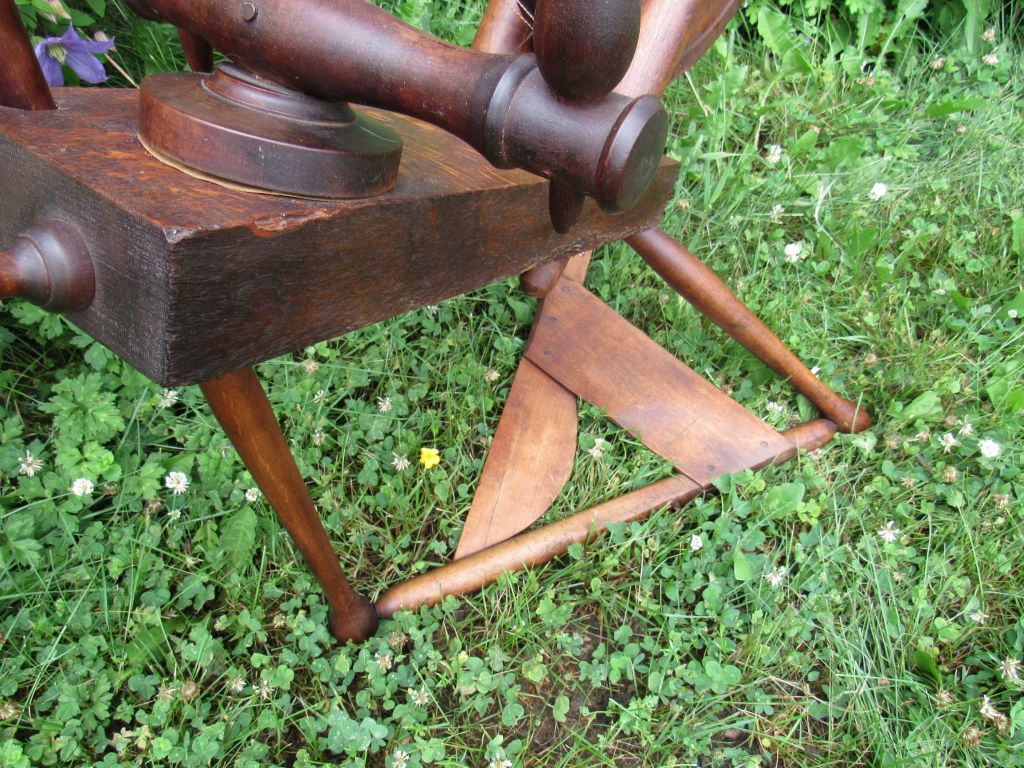
Maine’s Alfred community was a major wheel producer, perhaps turning out as many as 3000, the majority being wool wheels.
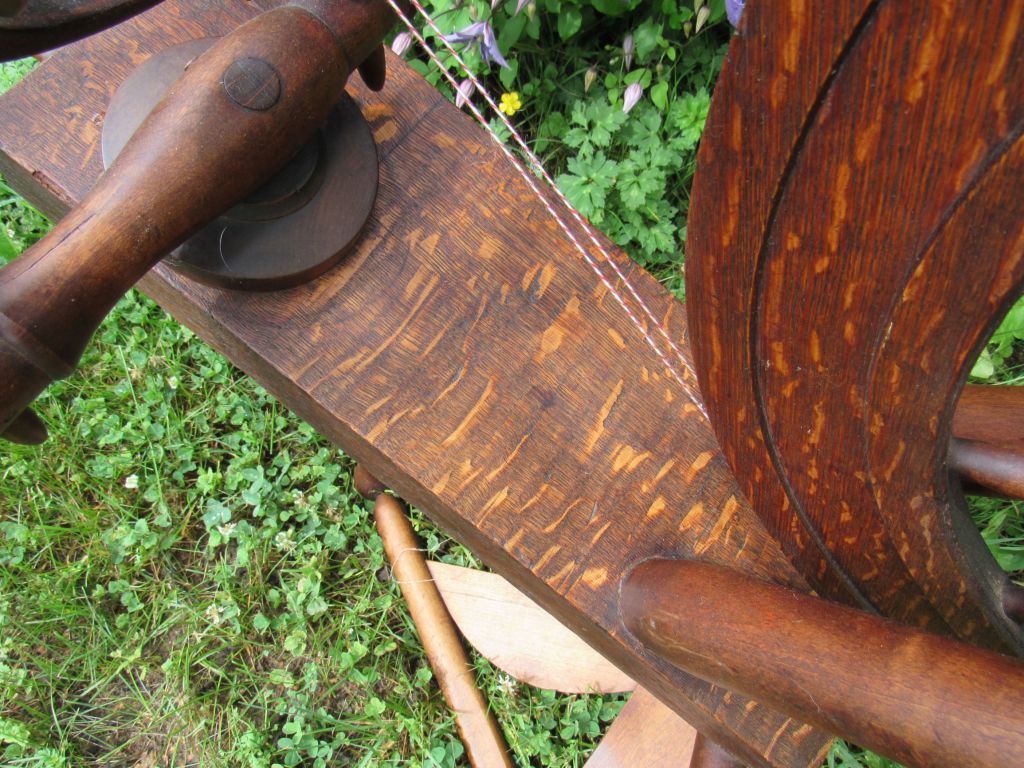
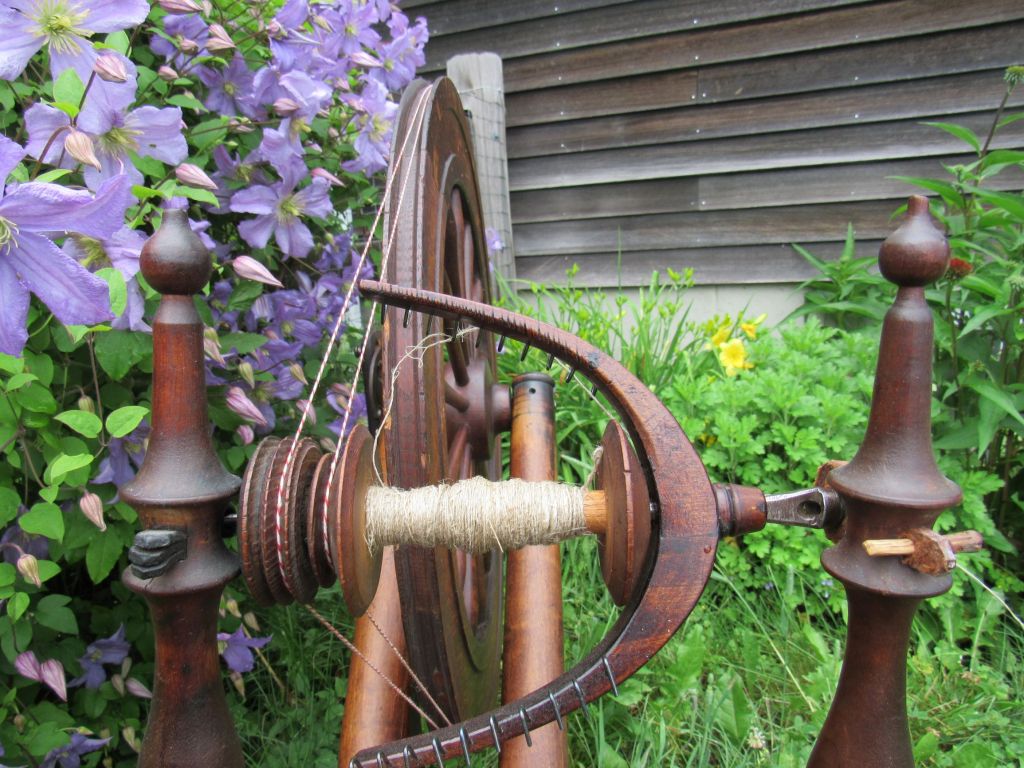
But they did produce flax wheels, too, with simple, graceful lines highlighting wood that appears to have been carefully chosen for its beautiful grain patterns and ray flecks.
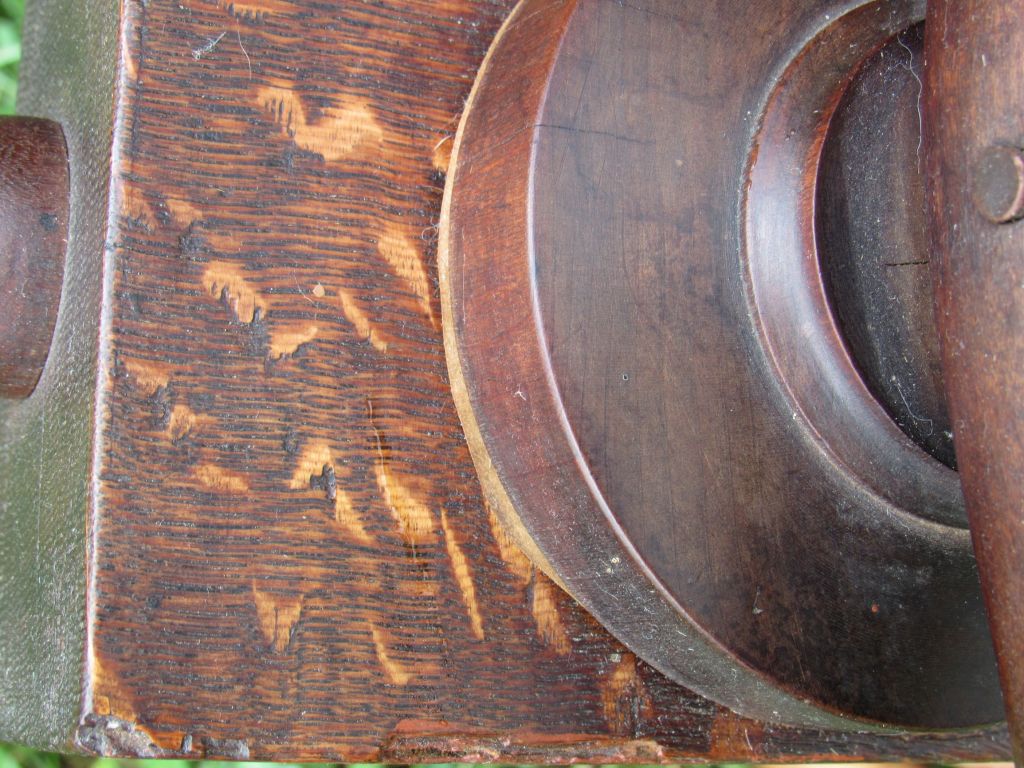
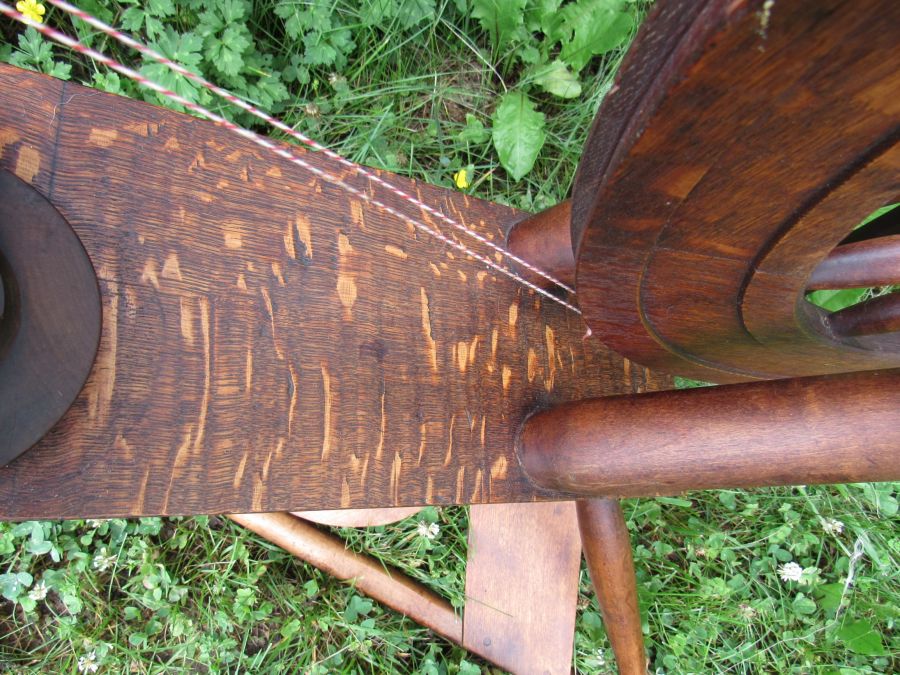
The Shakers didn’t mark all of their wheels, but many have initials stamped in the end grain of the tables. The initials were those of the community’s trustees, who may or may not also have been wheel makers. The earliest Alfred wheels were marked “TC” for trustee Thomas Cushman and, after 1809, flax wheels were marked “SR AL” for trustee Samuel Ring.
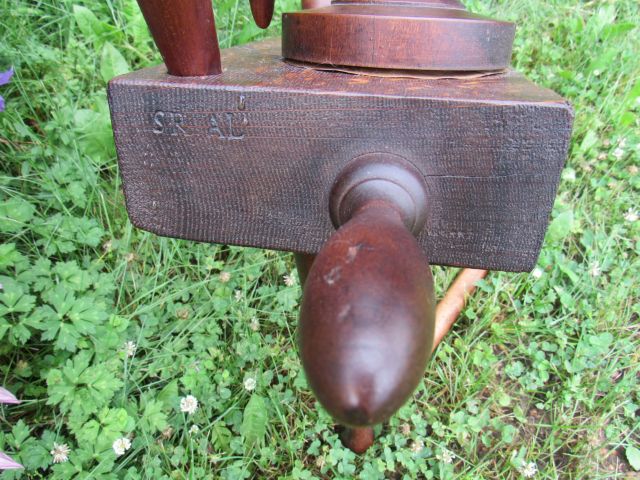
Even though Ring wasn’t a trustee for long and wasn’t a wheel maker, his name continued on the wheels after he retired in 1814. Those initials must have essentially become a brand for Alfred Lake wheels at that point.

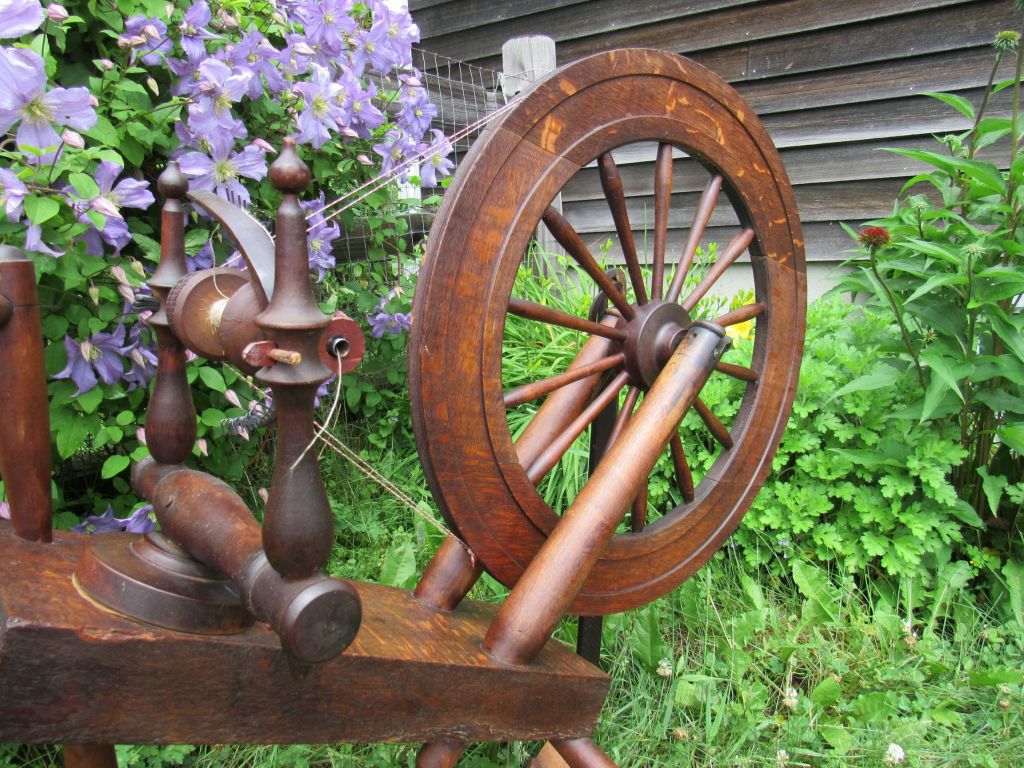
The simple design of Shaker wheels was a huge influence on other wheel makers in Maine and New Hampshire. The designs were similar between the different Shaker communities, but each community’s wheels had some distinctive features. The Alfred Lake wheels have beautifully curved maidens with small teardrops at the top.
The wheel upright supports are encircled with multiple scribe marks.
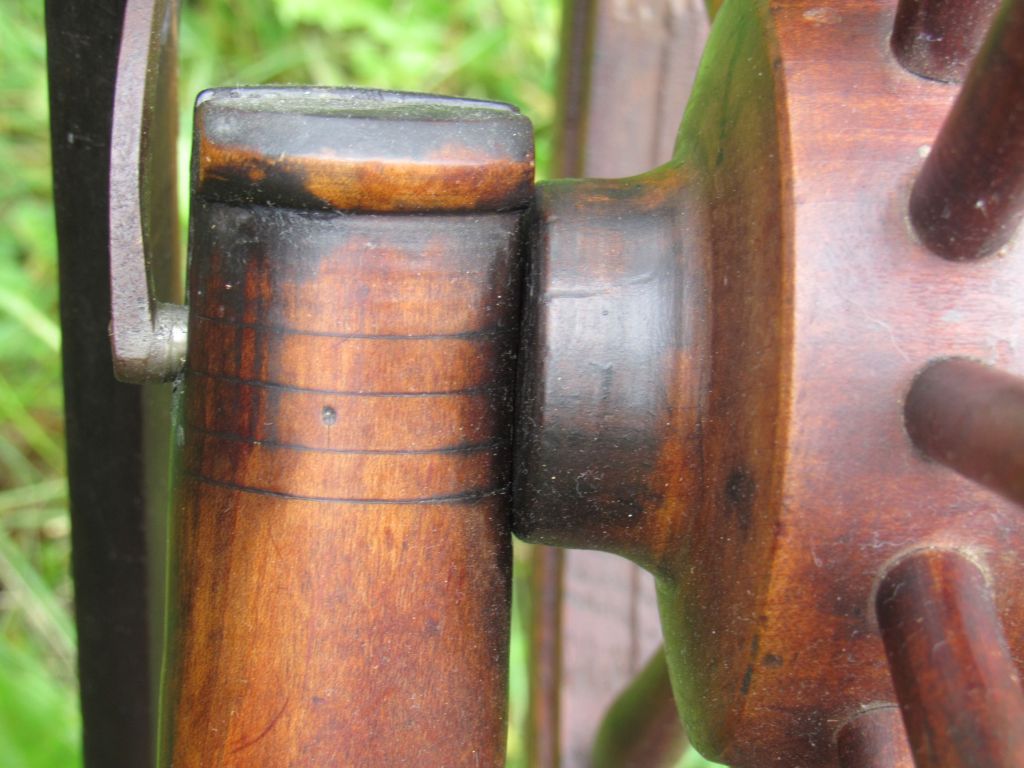
Mine has four on each side.
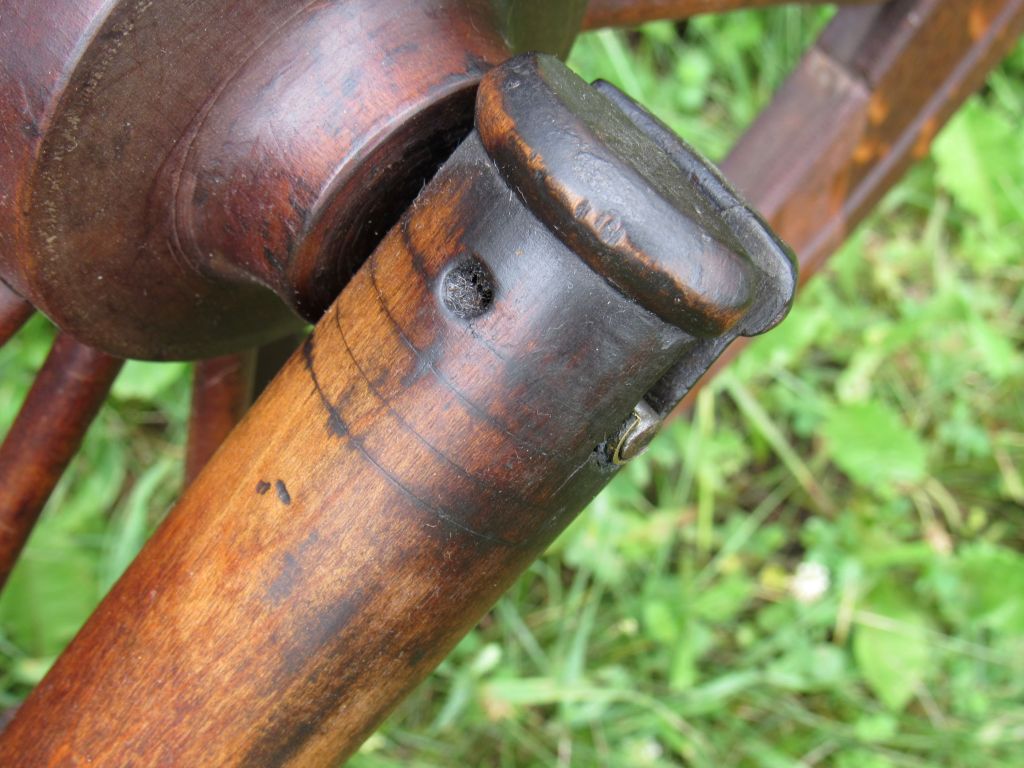
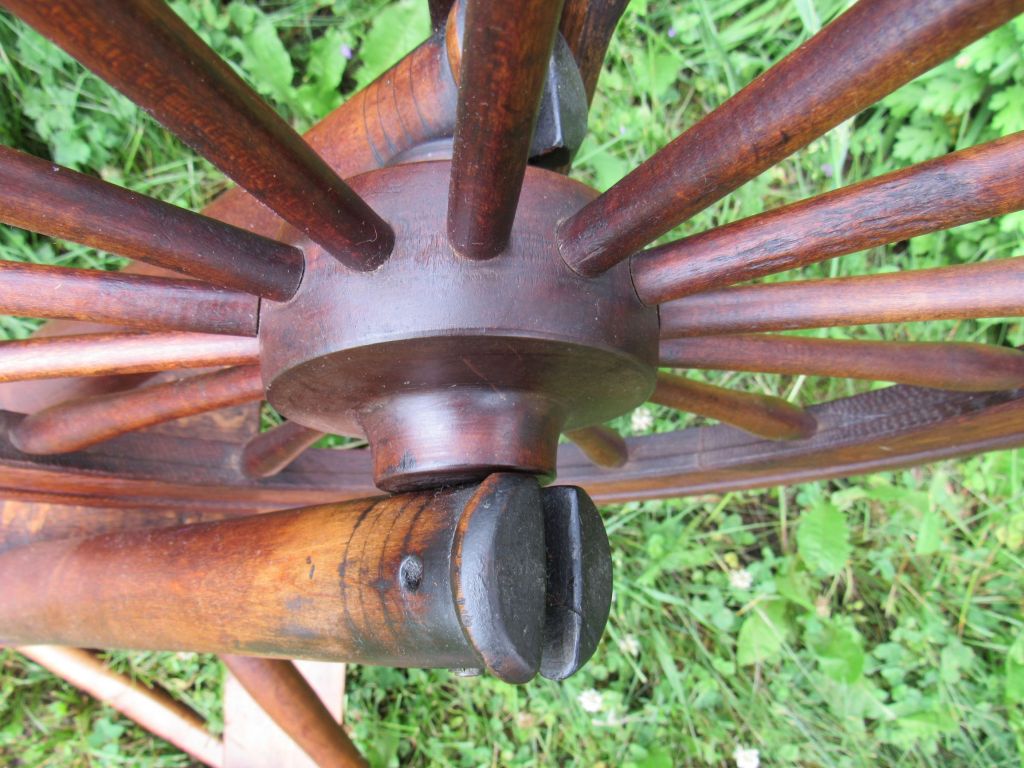
Whether the number of marks has any significance is up for debate. There are fourteen plain spokes–with no ornamentation.

The treadle bar usually is a half-moon shape, likely designed for ease in using both feet to treadle.

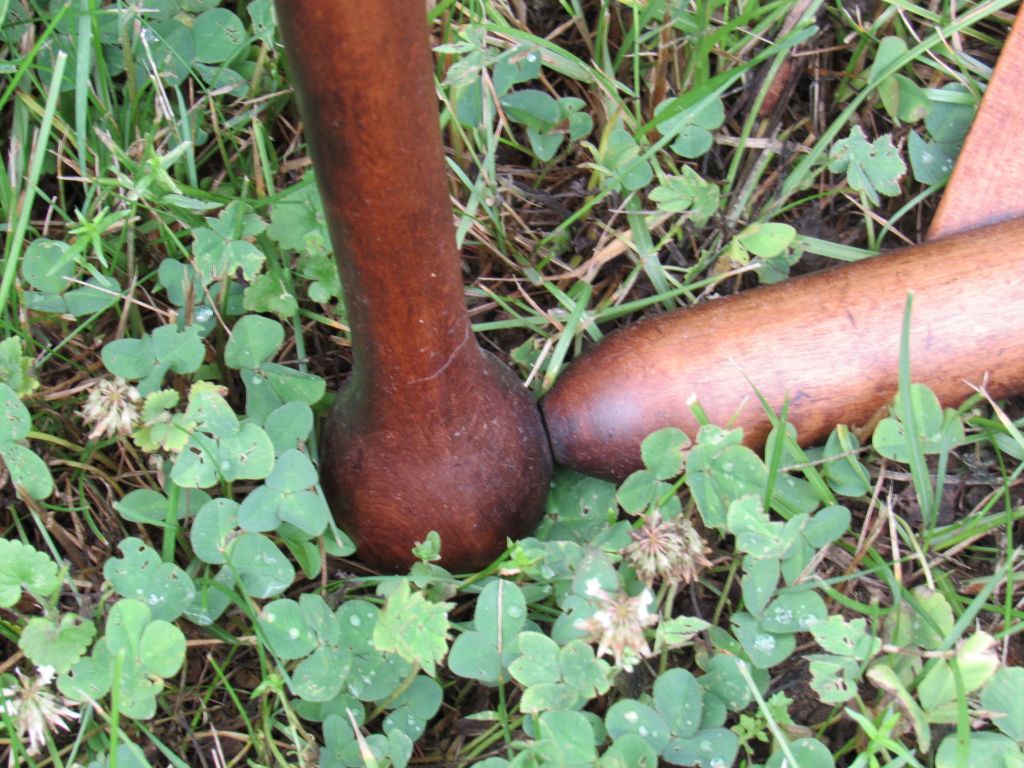
The legs have a gentle curve with a rounded foot. I’m always struck by how many of the shapes on these flax wheels resemble curves in the human body–an interesting feature since the Shakers were celibate.
The flyer assembly and distaff top are not original to my wheel, although both are probably from other Shaker wheels. Mine is an absolutely wonderful spinner, especially for flax. And she’s easy on the eyes.

My resources for the information on Shaker wheels are:

Pennington, David A. and Michael B. Taylor. Spinning Wheels and Accessories. Atglen, PA: Schiffer Publishing, Ltd., 2004, pp. 131-39.

Michael Taylor, “Shaker Spinning Wheel Study Expands,” The Shaker Messenger, Vol. 8, No. 2, (spring 1986).

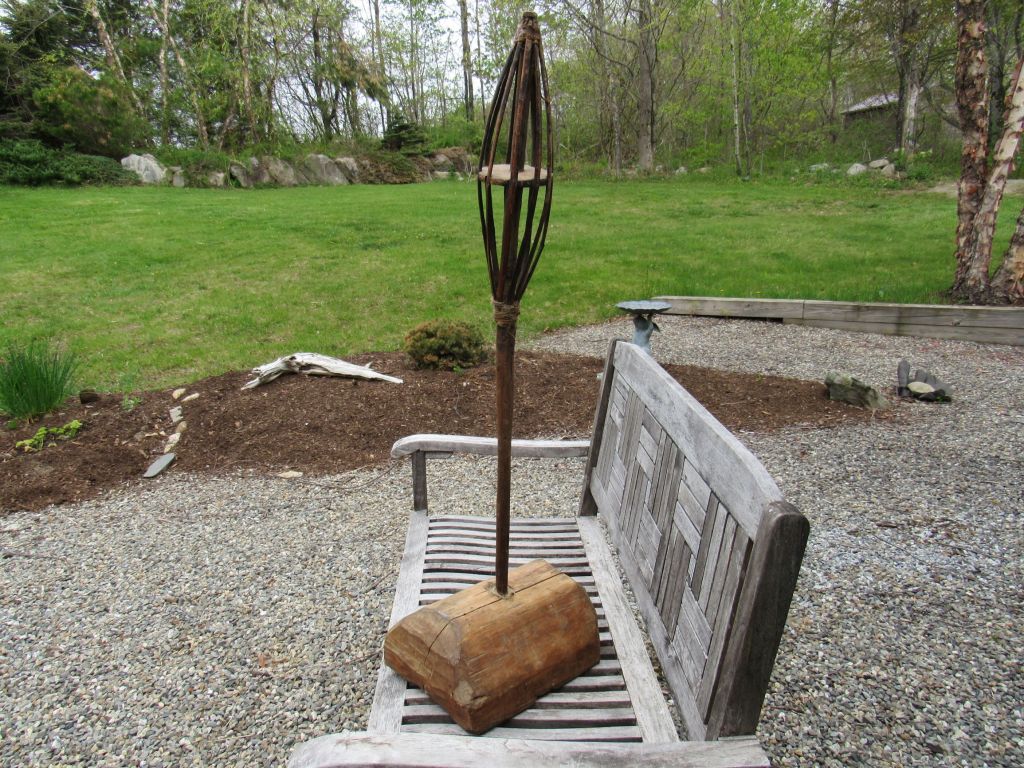
Free Standing Distaff

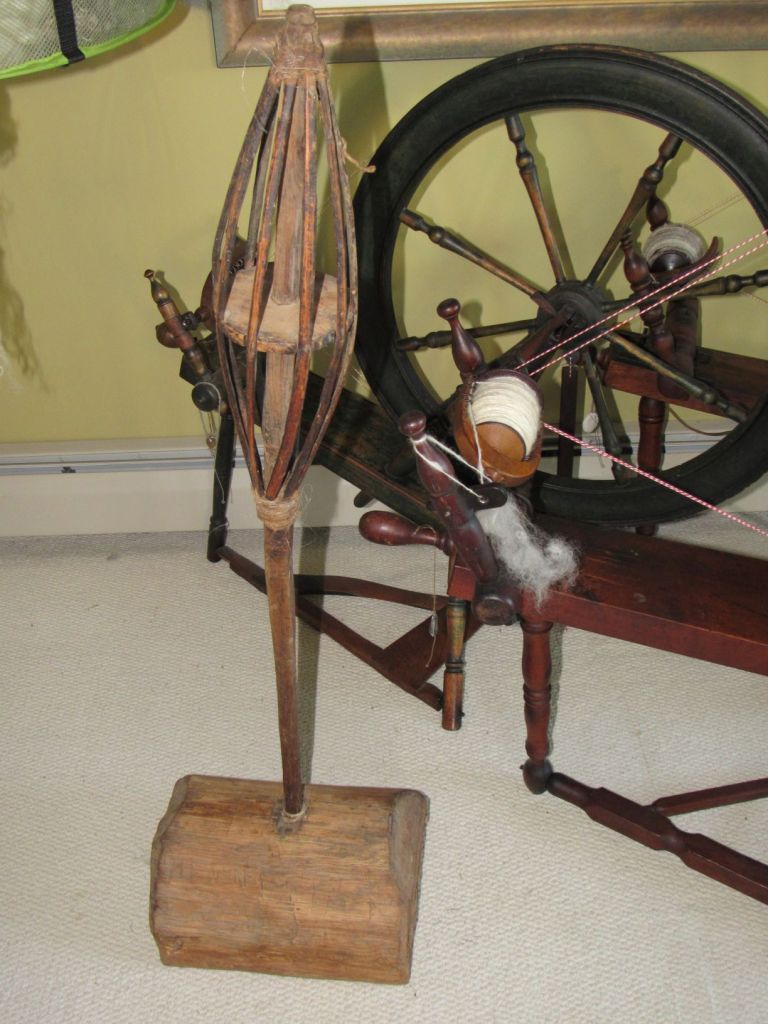
This standing distaff is a bit of mystery.  Free standing distaffs were commonly used in many regions of Europe, but North American versions don’t appear very often.  Those from Europe tend to be tall and ornate, accompanying beautifully turned wheels.  They were used for spinning long flax and sometimes hemp fibers.  Most flax wheels in North America had built-in distaffs, but there must have been spinners who preferred to use standing distaffs, so it’s surprising that we don’t see more of them.  

I bought this distaff at one of the American Textile History Museum auctions (see previous post “Jo”).  The accession number indicates that it was part of Joan Cummer’s collection.  While living in New England, Joan Whittaker Cummer collected antique wheels and textile tools for years.  In 1993, she documented her collection in A Book of Spinning Wheels, which was thoughtfully put together with beautiful photos, descriptions, and measurements.  She offered the book as “a tribute to the individuality of the men who made the wheels and the spinners who used them.”  (Cummer,  Preface, p. xiv). 

At the time the book was published, Joan had already donated her collection, in 1991, to the American Textile History Museum in Lowell, Massachusetts, noting that it was hard to see them go, “but it was a good and appropriate place for these wheels.  I look back with joy on the years I had them and hope that other people will enjoy them in the years to come.” (Cummer, p. 3). 

Sadly, when the museum closed, Joan Cummer’s collection scattered, making her book all the more valuable.   Although the collection no longer survives intact, other people continue to enjoy the wheels and tools she collected–some, like me, in a very personal and hands-on way, which would not have been possible had they remained in the museum. 

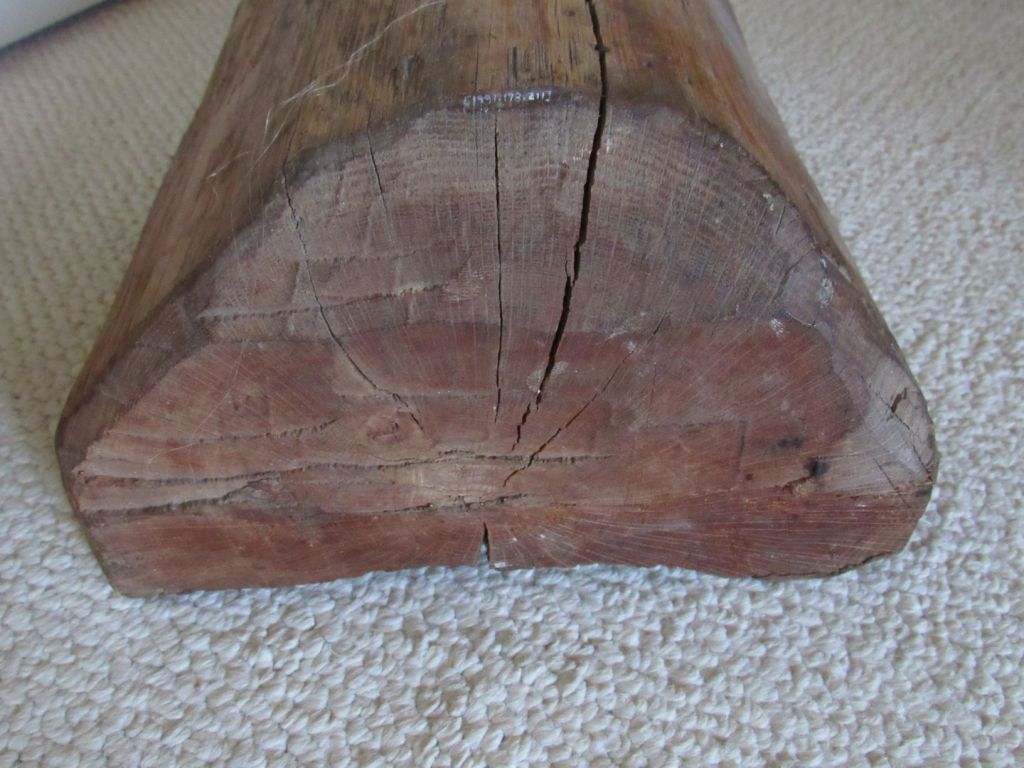
The museum’s accession numbers identify items in her collection with “1991.178.” followed by the individual item number, which, in the case of wheels, tracks the wheel number in her book.  The accession number on this distaff “1991.178.211,” appears to indicate that it was from Joan’s collection. 

But the distaff does not appear in her book.  In fact, in the book, she includes one photo of a free standing distaff (Accessory 46, p. 371), noting that: “Only one other has been seen over the years these wheels and accessories have been collected.  It was a carved and beautifully finished article.”  (Cummer, p. 370).  She clearly wasn’t referring to this distaff, which is neither carved nor beautifully finished.  So, unless I’m mistaken and this isn’t a distaff at all, it’s puzzling as to why it wasn’t mentioned in her book.  Perhaps it was a last-minute acquisition.

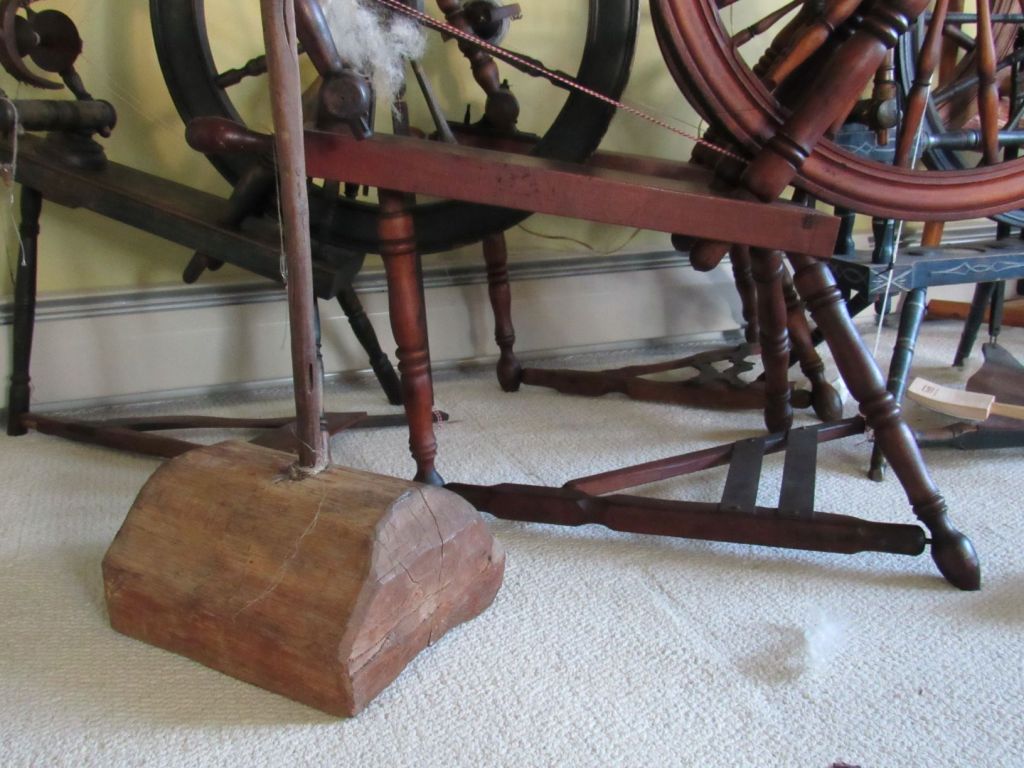
The distaff itself was made simply—a strong and useful tool—heavy enough for stability, yet light enough to easily move.  

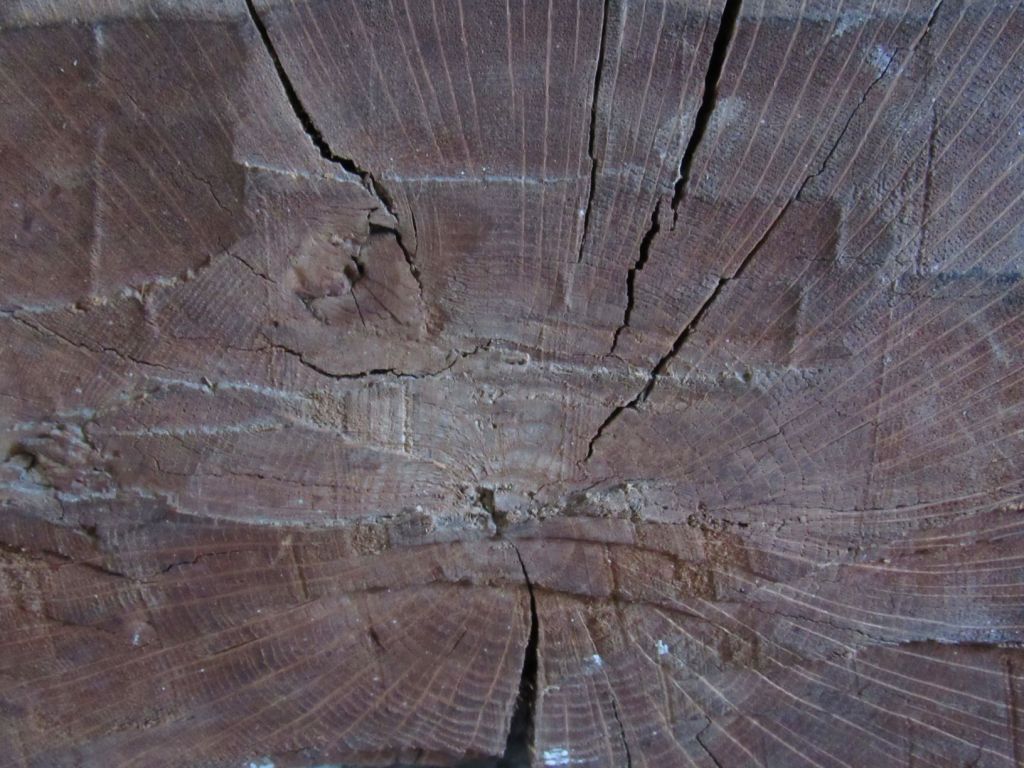
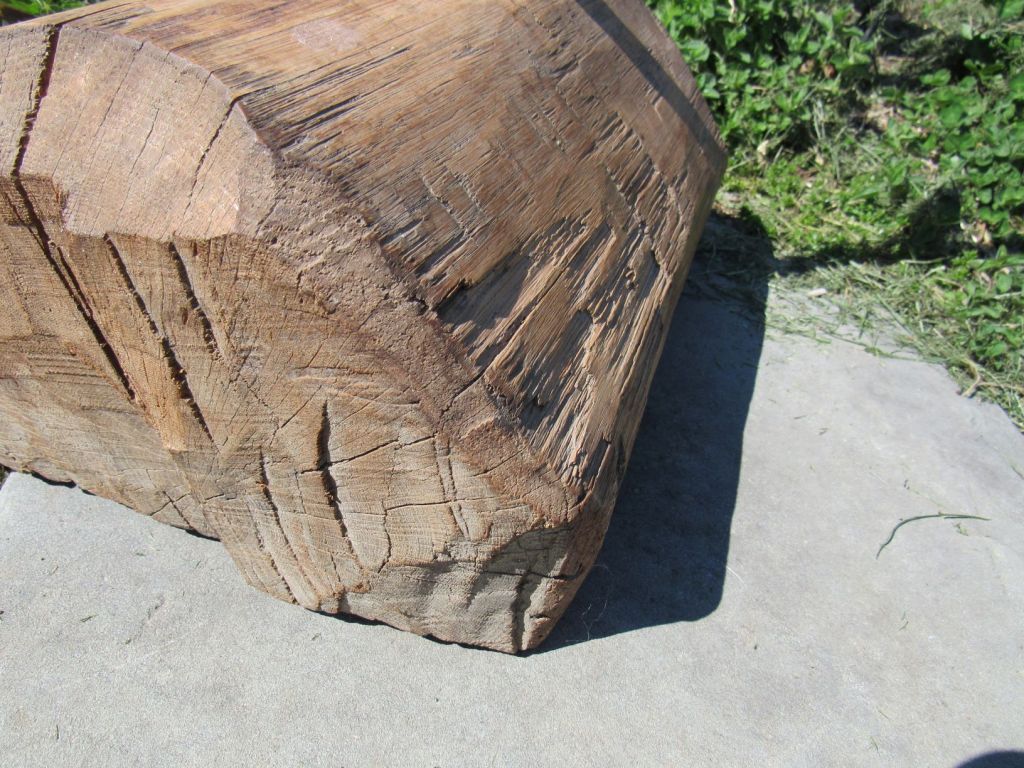
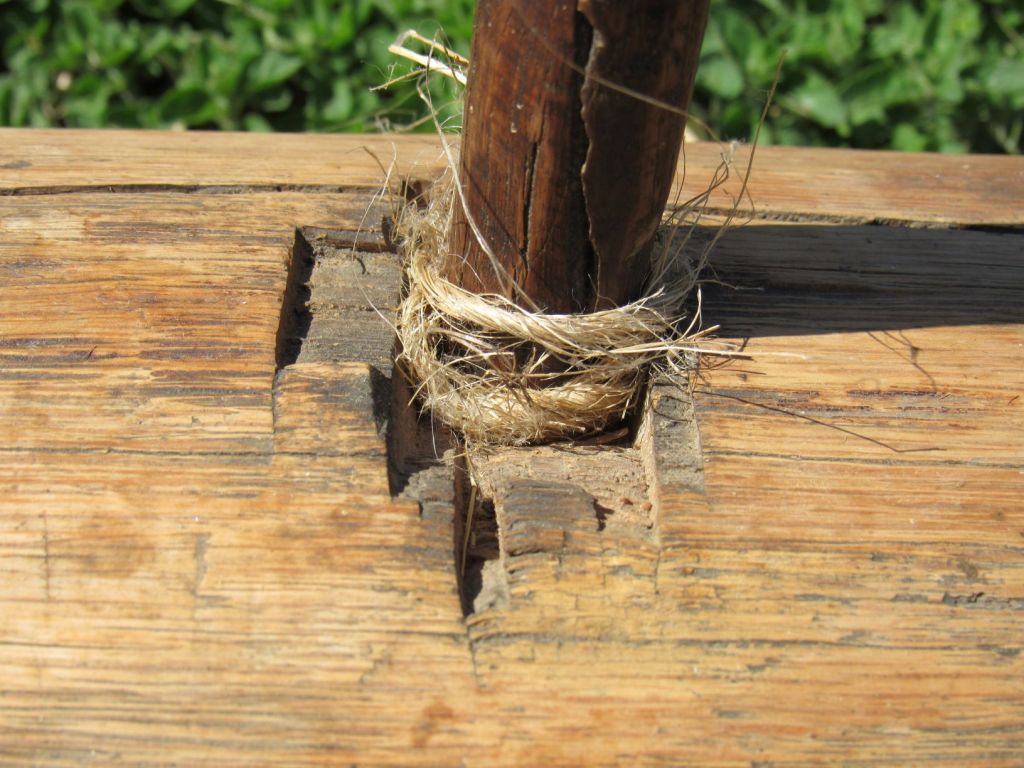
The base is a chunk of wood—it appears to have been shaped with an ax—with a hole for the distaff pole. 

The twine in this photo is mine

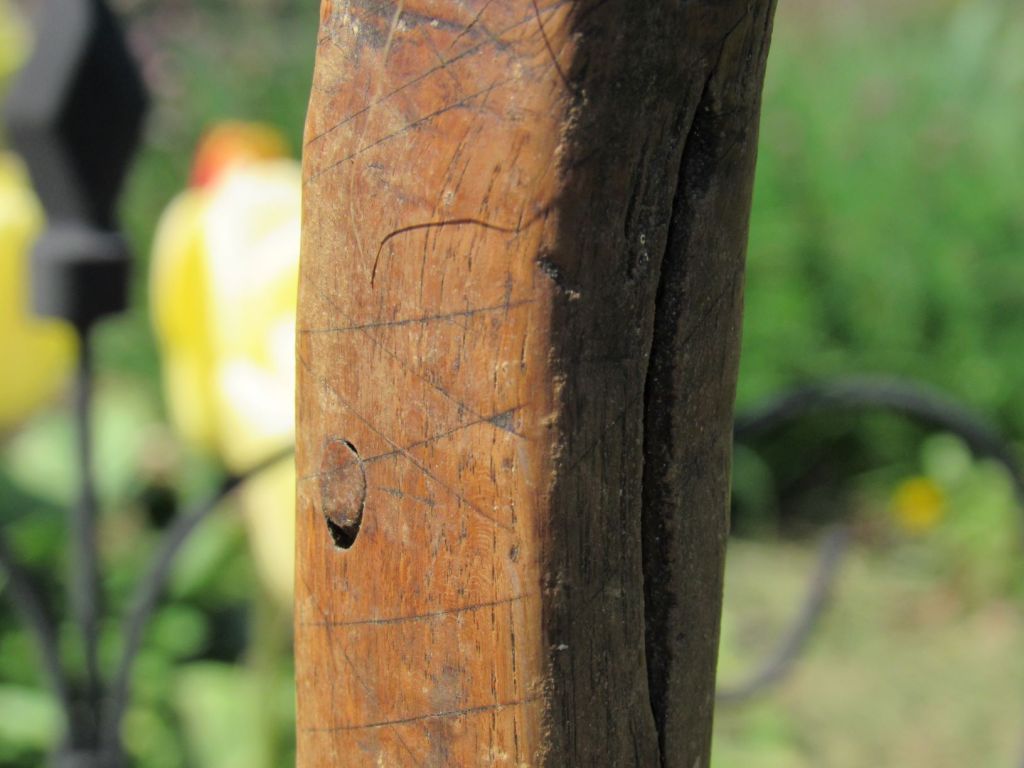
There are some cross hatched marks on the pole. 

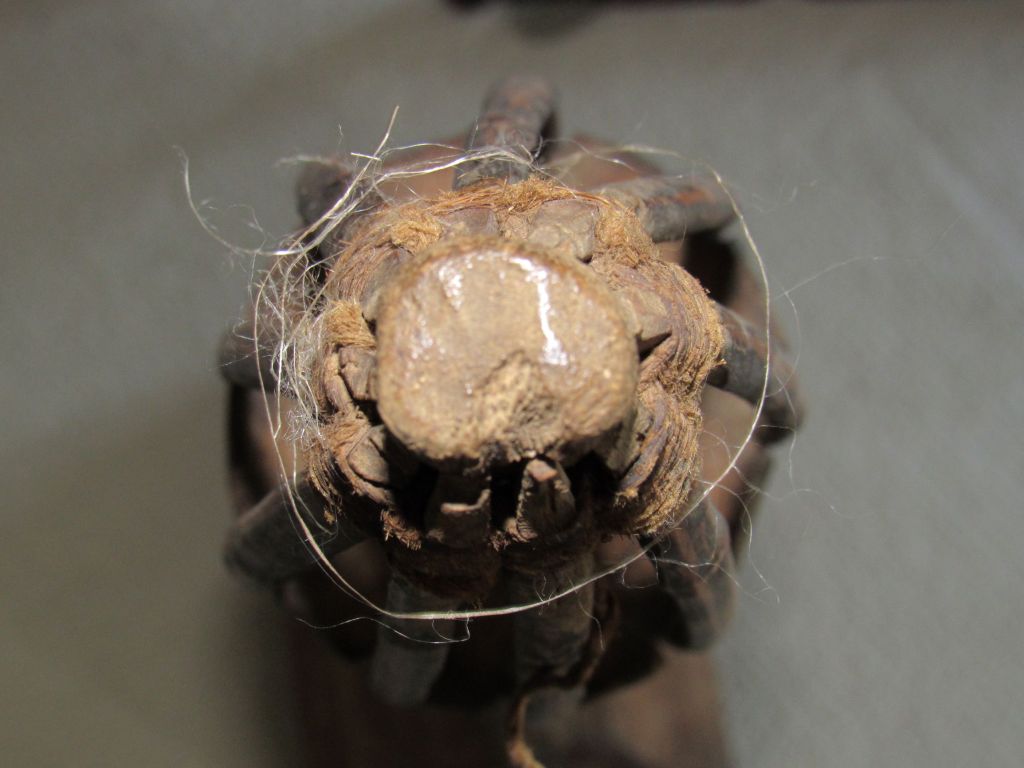
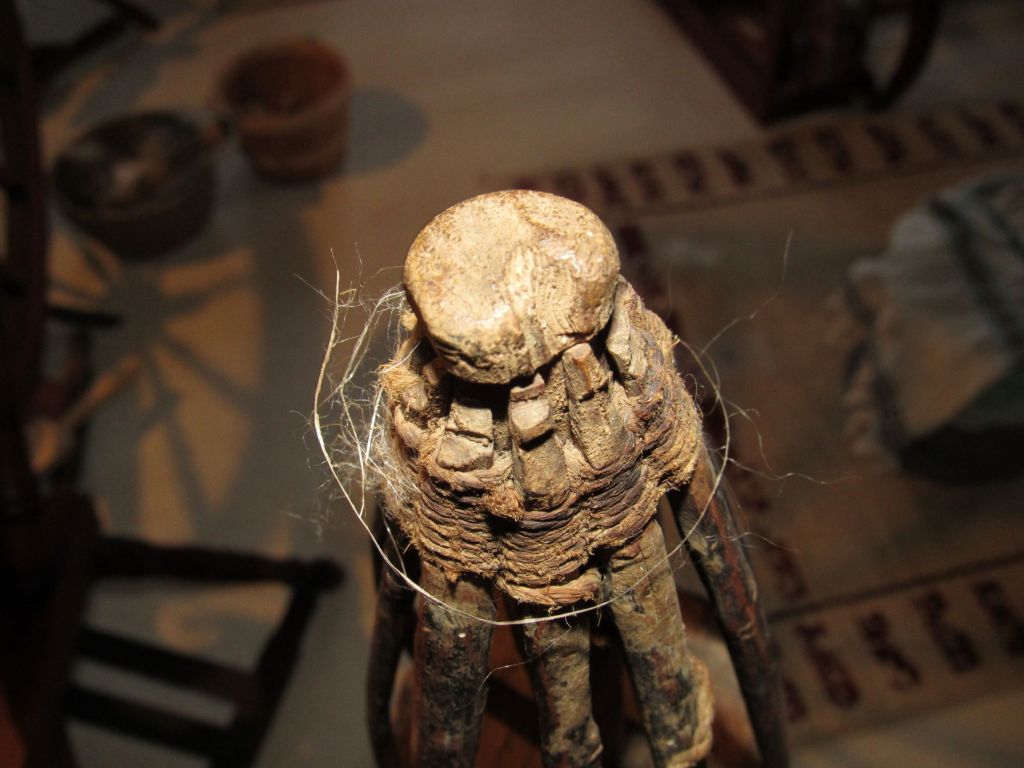
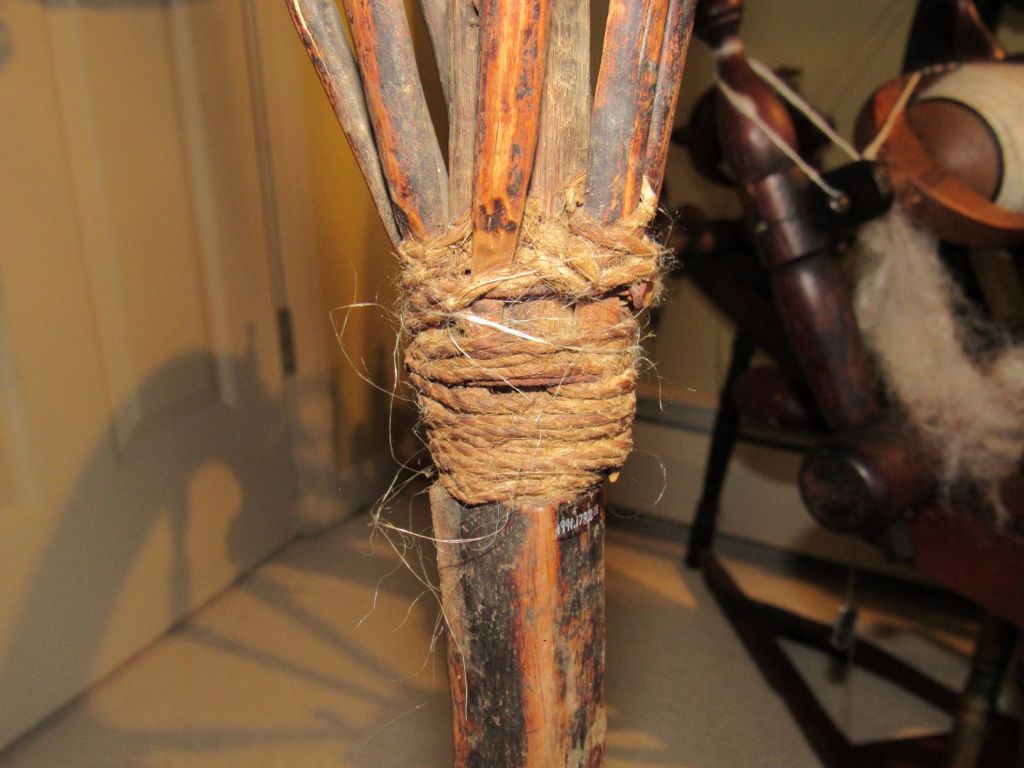
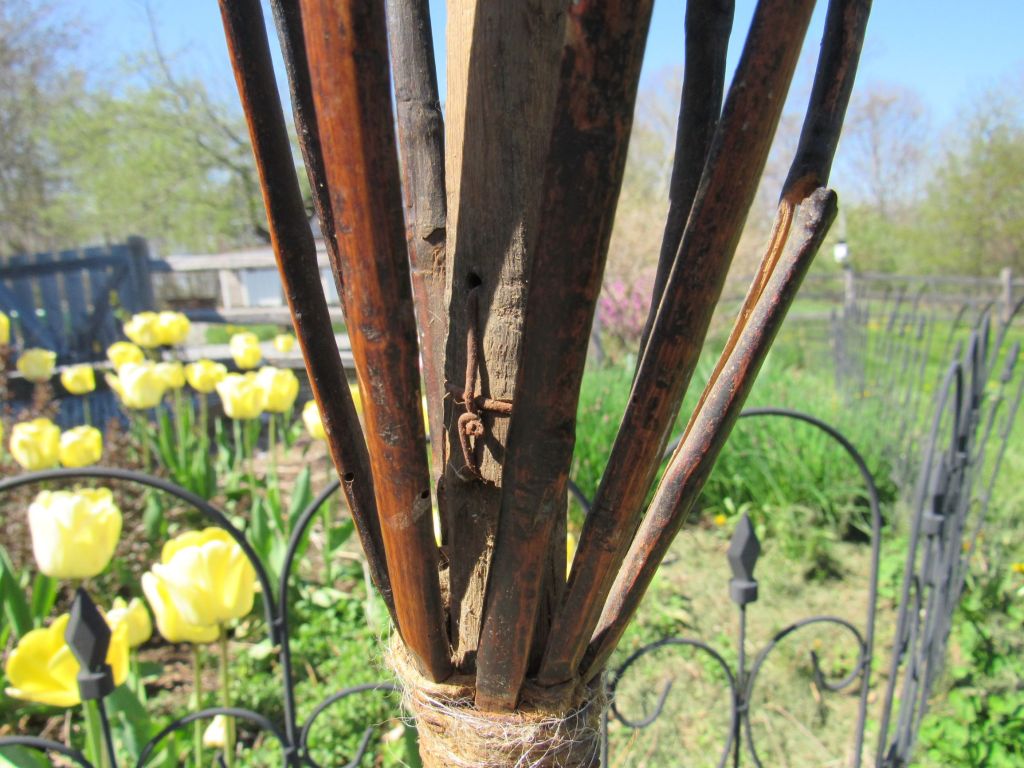
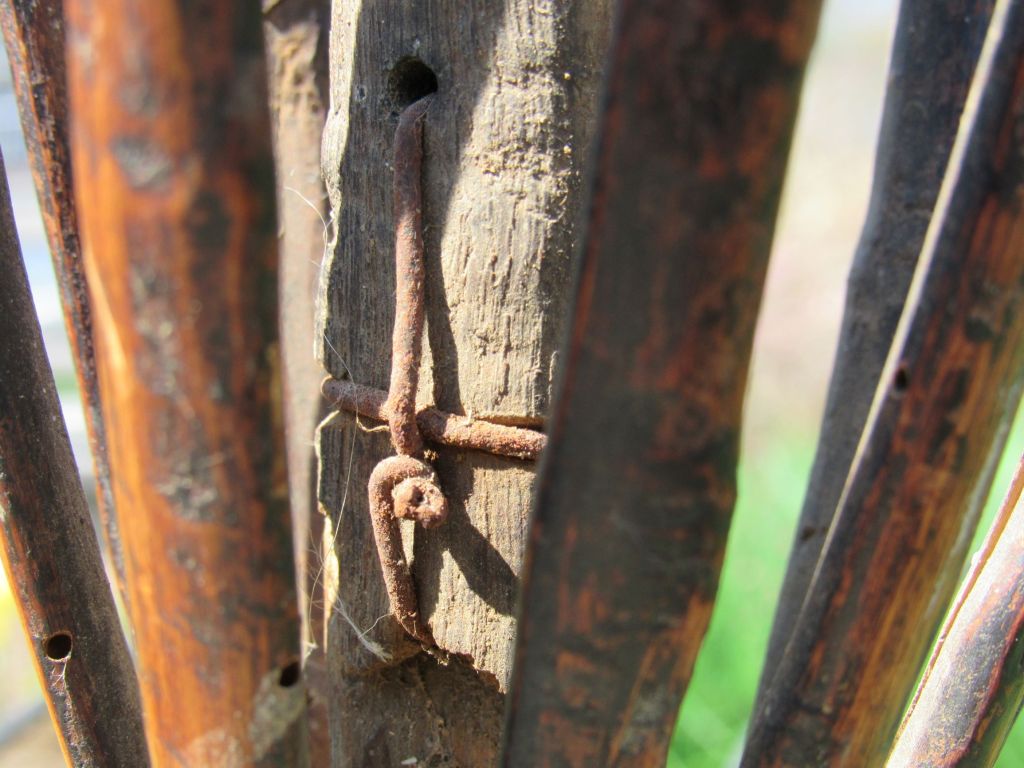
The arms of the cage at the top of the distaff are made from some light weight, pliable wood—almost like basket splints—and have small fish-hook-like prongs on the top. 

They are held in place with twine at top and bottom,

with a fitted wooden disc holding them out in the middle. 

Simple, practical, and obviously well-used,

with an old repair to the distaff pole. 


I would love to know where, when, and why this distaff was made, but for now, I am happy to use it and wonder about where it has been.

Measurements: Height—42 inches; Base—13 ¼ inches by 9 ¾ inches; Cage height, 17 ½ inches.

For more information see:           

Baines, Patricia.  Spinning Wheels, Spinners and Spinning.  New York: Charles Scribner’s Sons, 1977, pp. 94-103. 

Cummer, Joan. A Book of Spinning Wheels, Portsmouth, NH: Peter J. Randall, 1993.

Pennington, David A. and Michael B. Taylor. Spinning Wheels and Accessories. Atglen, PA: Schiffer Publishing, Ltd., 2004, pp. 142, 173.

Jo

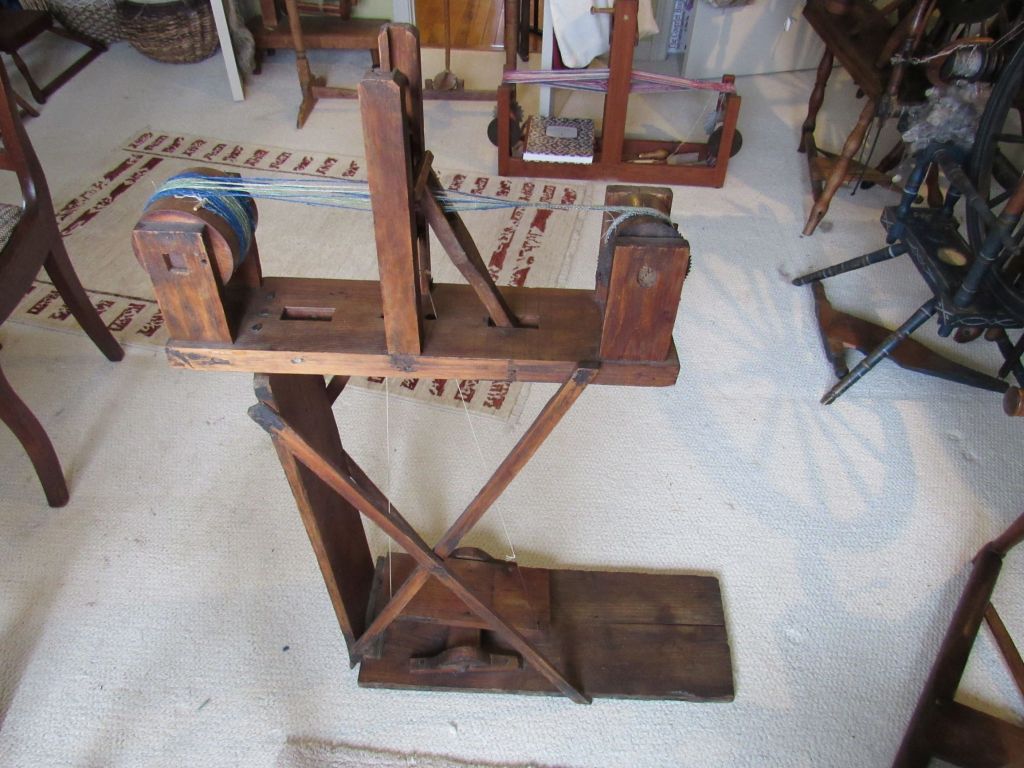
This ingenious little floor loom caught my imagination and started me down the road of tape loom weaving.  Designed for weaving tapes or bands, this style was most often found in New England—often in table top versions with hand treadles. 

This particular loom was part of the American Textile History Museum (ATHM) collection in Lowell, Massachusetts.  After the museum closed in 2016, much of its collection went to other museums and historical societies around the country.  For example, some went to Marshfield School of Weaving’s wonderful Textile Equipment Collection, cataloged here: /https://marshfieldschoolofweaving.omeka.net/ The items that didn’t find such homes, however, were sold, bit by bit, at a series of general antique auctions near Worcester, Massachusetts. 

I drove more than five hours each way to attend several of the auctions, both excited and disturbed by them.  It was a once-in-a-lifetime opportunity to see and buy an amazing variety of historic textile tools. 

At the same time, it was deeply upsetting to see some pieces—especially those donated to the museum by collector Joan Cummer—garner little interest at auction, sometimes selling for give-away prices. And all the auctioned pieces, including Cummer’s collection, are now scattered to who-knows-where, provenance and historical significance lost. 

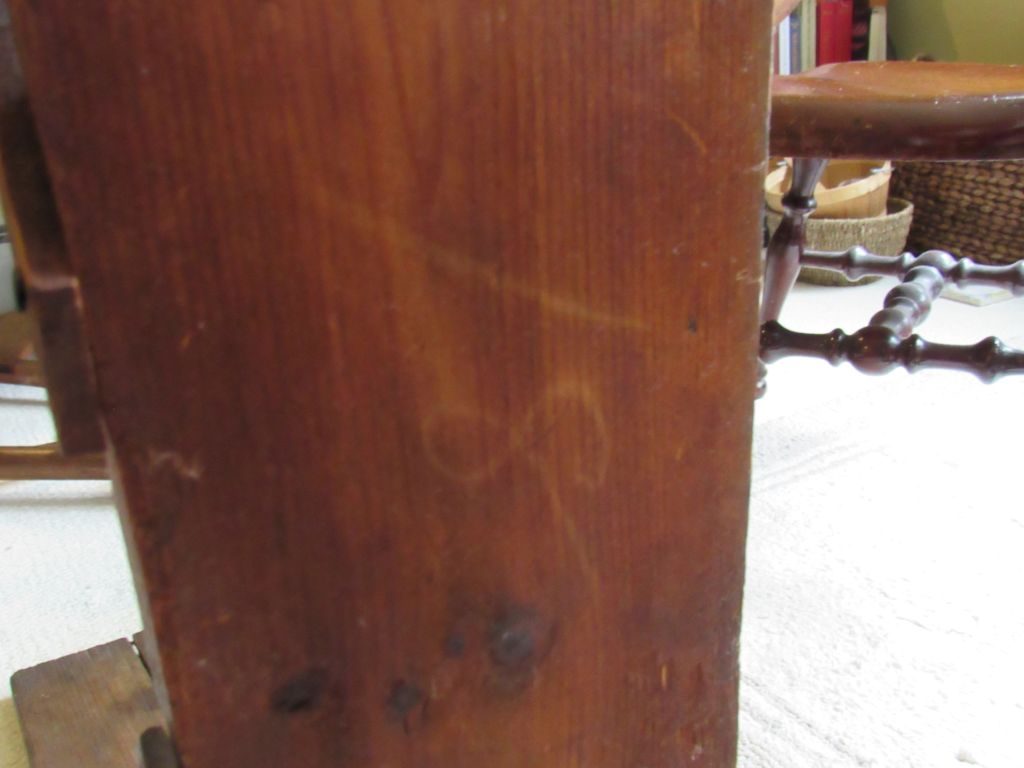
A mystery “18” appears on the end

Fortunately, all of the ATHM items are marked with a distinct set of acquisition numbers, leading with the year of acquisition, so they can be identified as once having a home there. 

Although these items will no longer be available to educate and spark interest in the public, a group of people who cherish and use antique spinning wheel and looms attended the auction—in person, and remotely—determined to rescue as many as possible.   Those items will be loved, appreciated, and, often, put back to their original use as marvelous working tools.      

My first auction acquisition was a gorgeous great wheel—in perfect condition–that I had absolutely no intention of buying.  It came up early in the auction and no one bid on it.  No one.  Silence.  I actually felt insulted for the wheel, standing there in all its glory—unwanted.  I couldn’t stand it and bid $10.  Gavel down–it was mine.

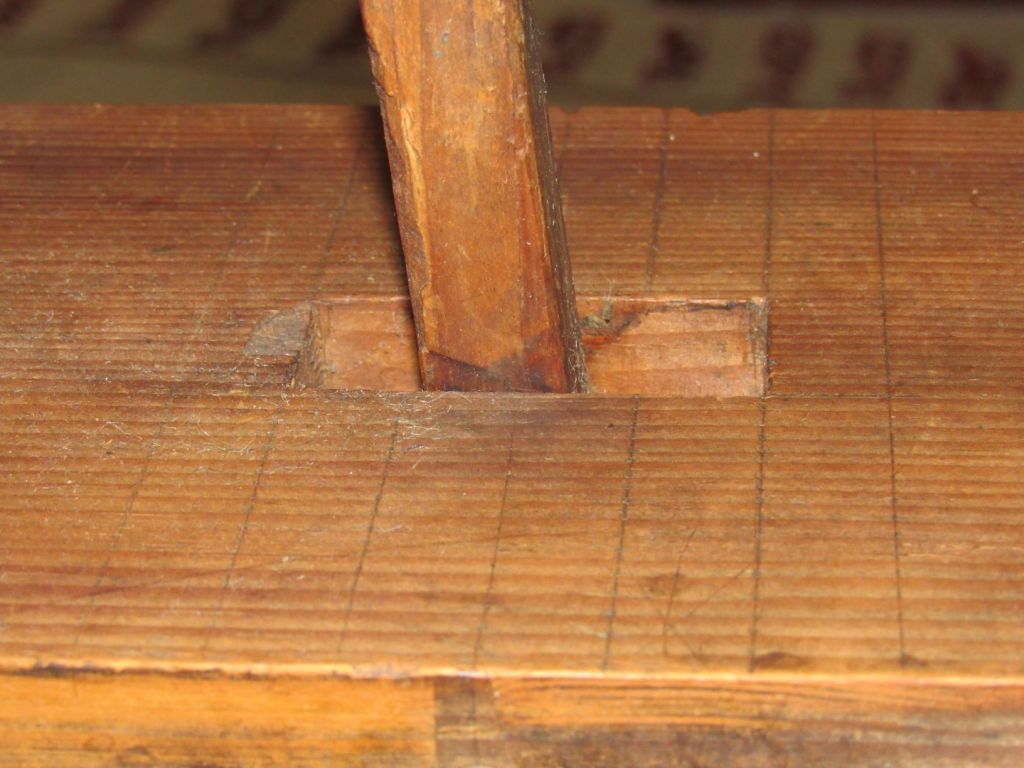
Scribe lines on the table at the beater entrance.

This loom was a different story.  I’m a weaver and small antique looms don’t come around very often.  I was very excited to find two of these floor looms up for auction one night.  The other had two foot pedals and more polished construction than this one.  But I was quickly outbid on that one and had to nervously wait until much later in the evening for this one to come up.  The late hour probably worked to my advantage and it was mine.  My first, but not last, tape loom.

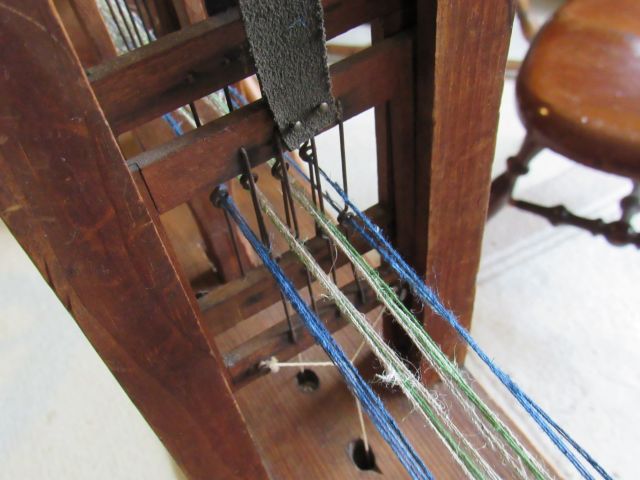
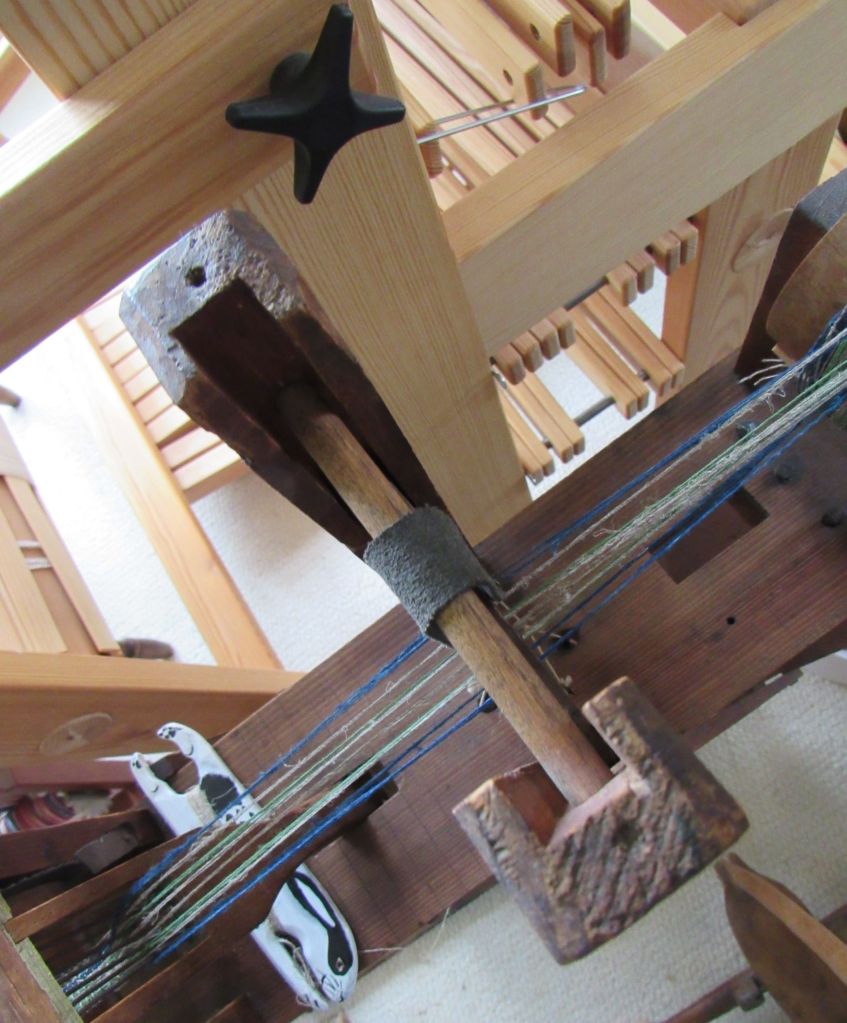
I had to replace the leather shaft holder—the original was there, but broken, and replace some washers and the wing nut on the warp beam.

It probably had a handle at the top that is now missing. 

But other than that, it was all set up and ready to go. 

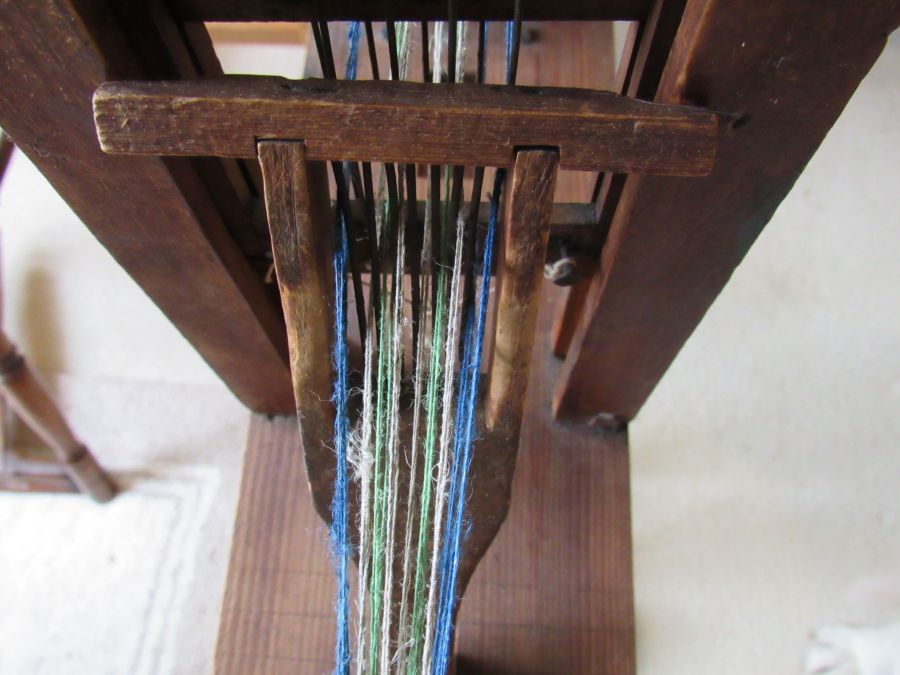
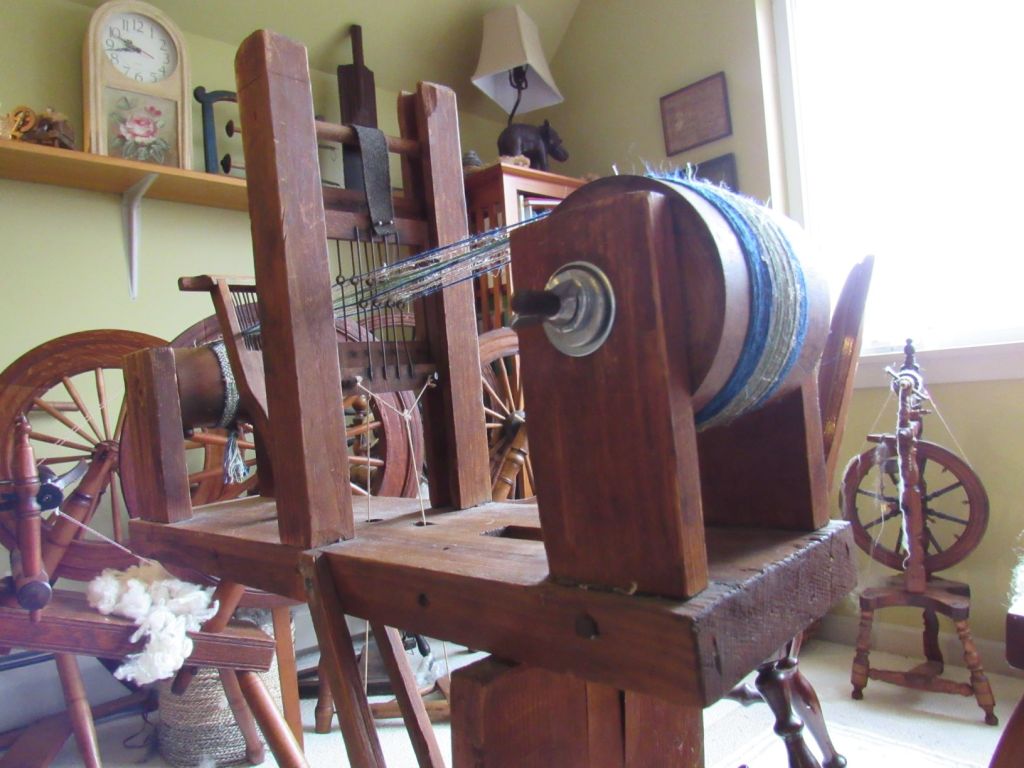
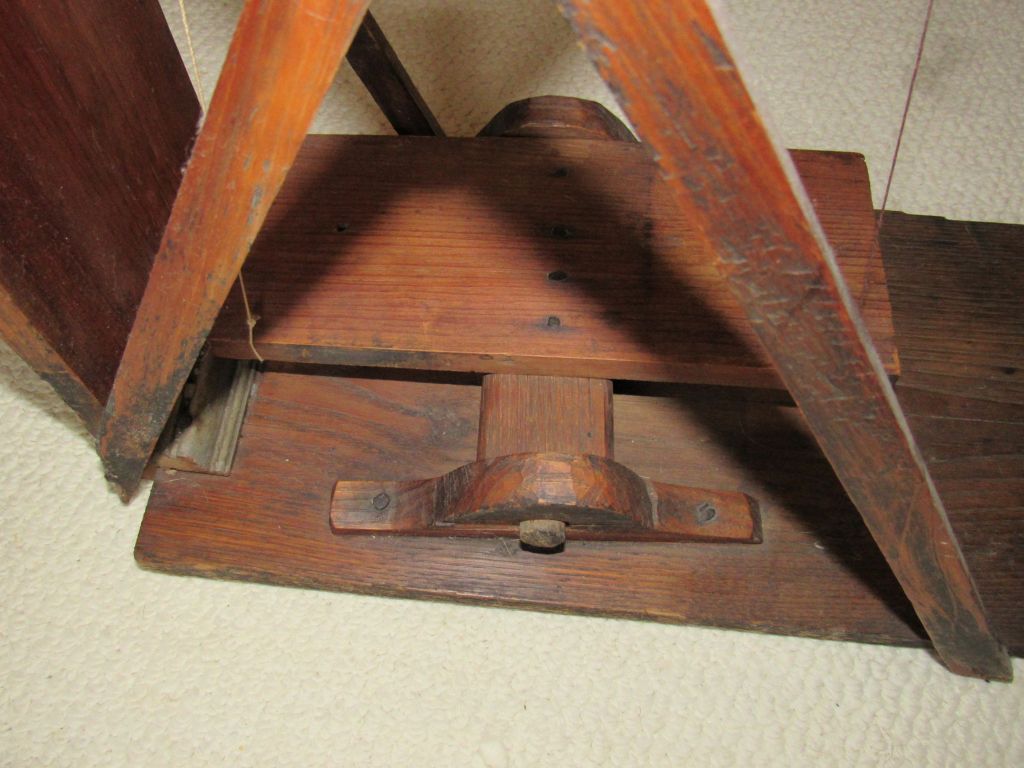
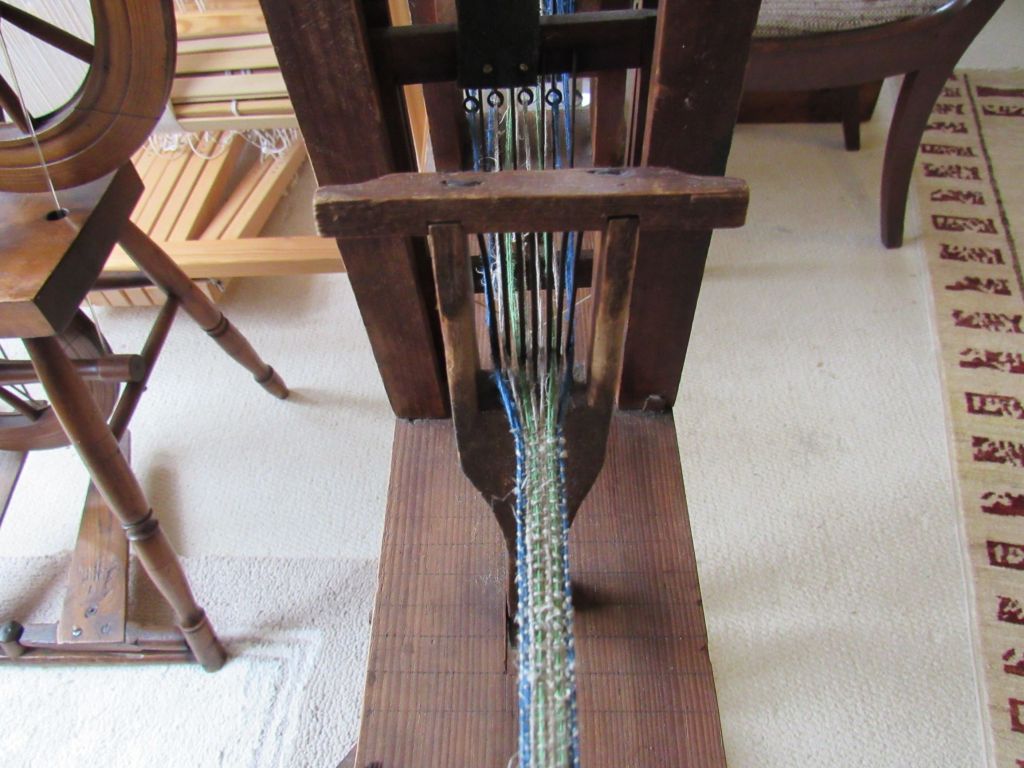
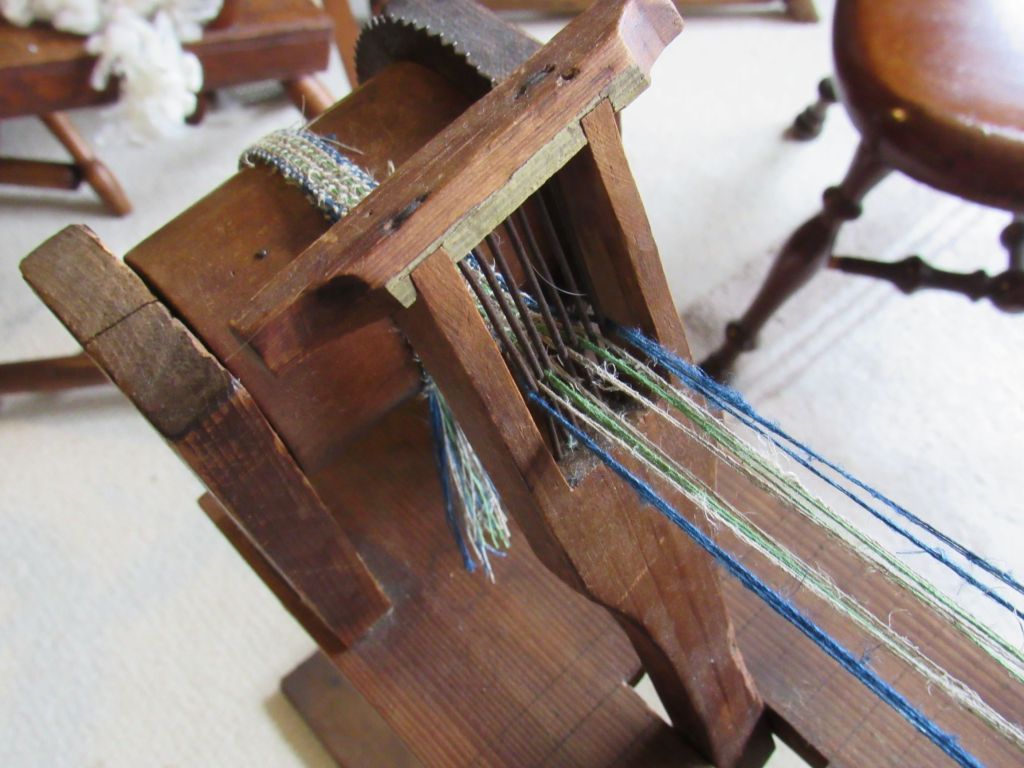
There are two shafts and eight metal heddles, with a little beater and see-saw foot treadle.   

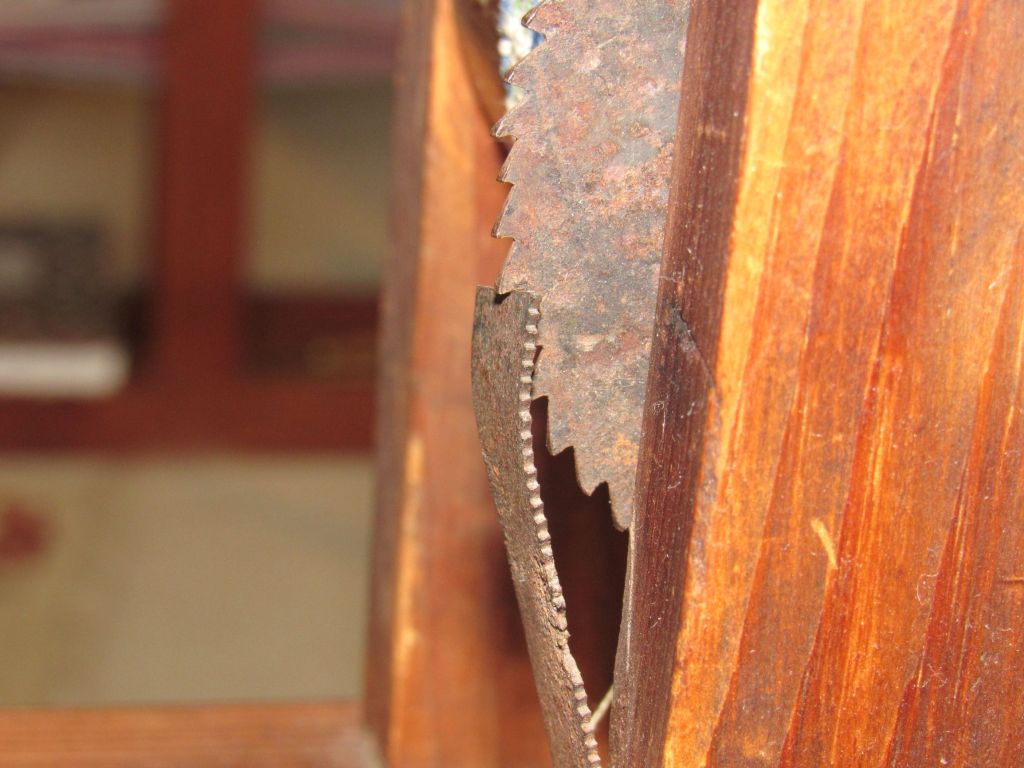
There are tiny metal teeth and metal bar holding the front beam in place

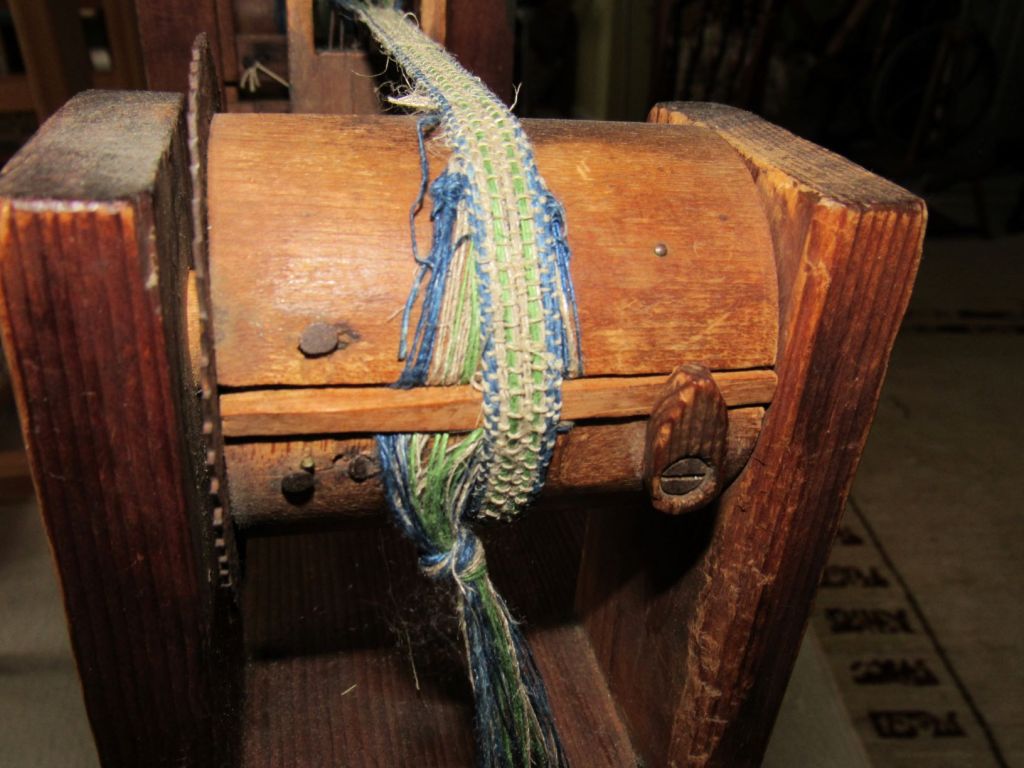
and a small wooden slat in a slot held by a rotating tab to secure the warp. 

The back beam has a leather piece nailed to the beam with a series of holes to secure the warp.  I lashed a tiny dowel onto the leather piece, which allows me to easily attach more warp threads.  

I have been using the loom mostly for weaving little tapes with odds and ends of my homespun linen from homegrown flax.  A bit hairy on the loom, but they smooth out beautifully. 

The loom naturally weaves a very weft-faced tape.  So, I put multiple threads in each heddle and usually an alternating color suspended between heddles that I can manipulate to make a colored dash in the tape.   

These looms are a bit of a mystery.  They are thought to date from the late 19th century, with some speculation that they may have been used to make oil lamp wicks.  That makes sense to me.   They are very efficient and easy to use, enabling someone to crank out wicks quite quickly.  And the loom design is perfectly suited for weaving a wick-style weft-faced band.  I love using this loom.  Although it no longer educates in a museum, I hope that by sharing it here, it may still serve to illuminate a little part of our textile history.