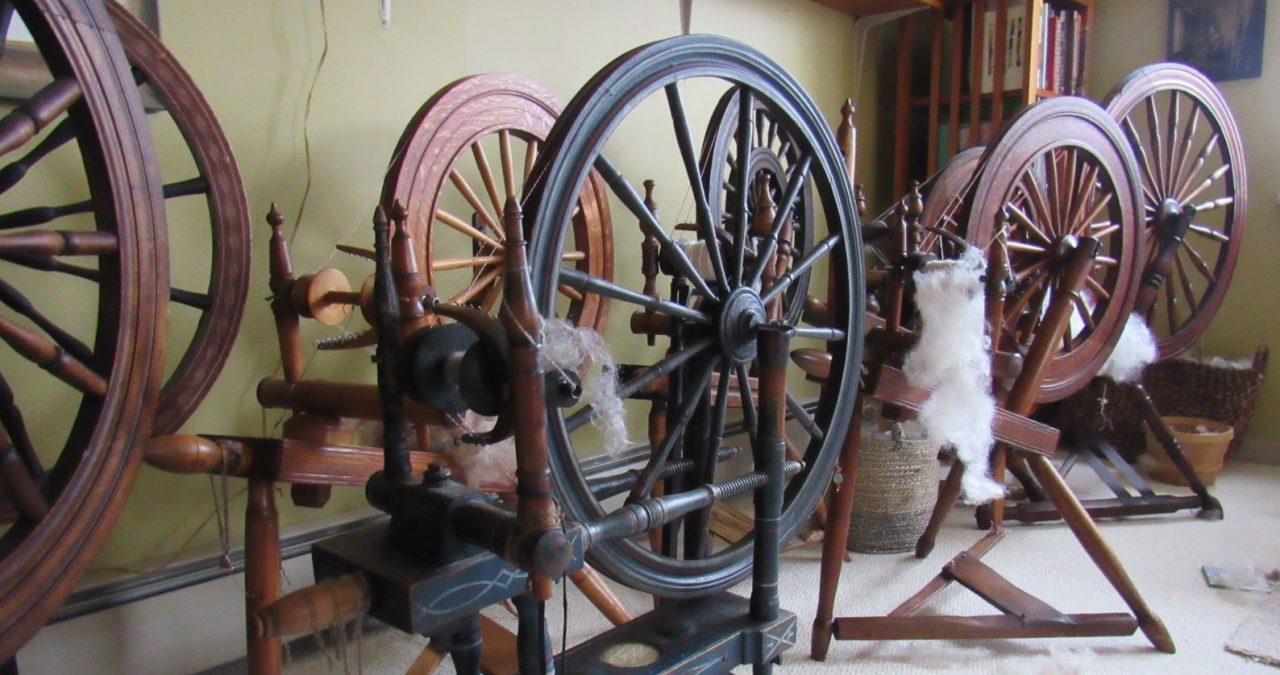
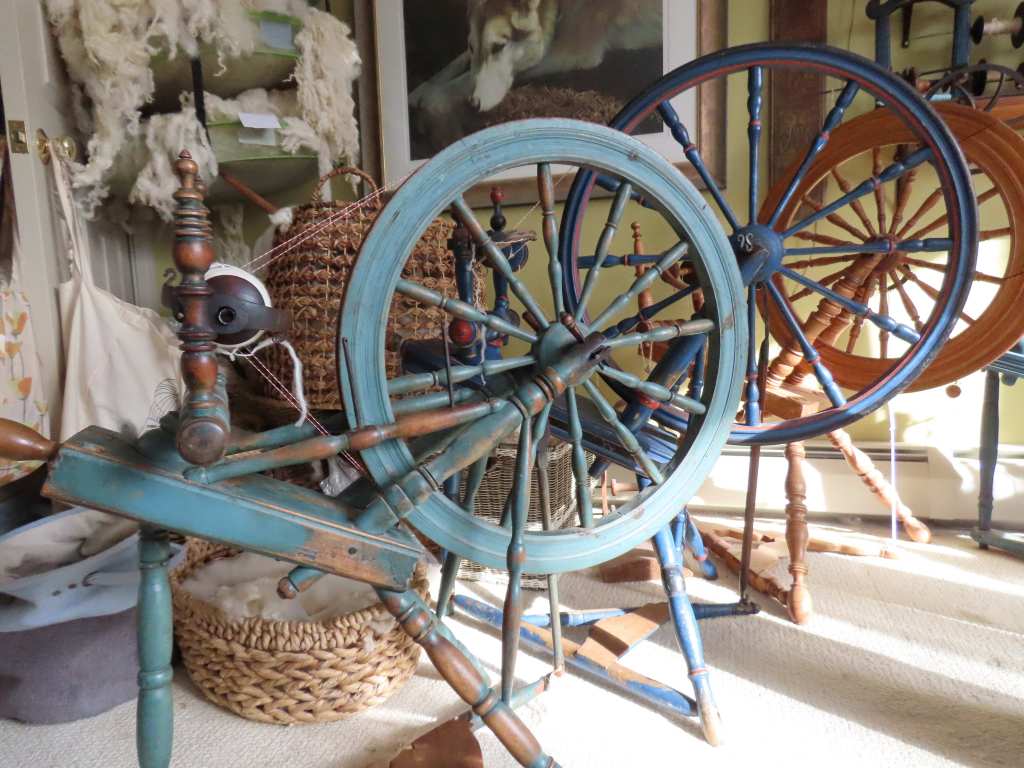
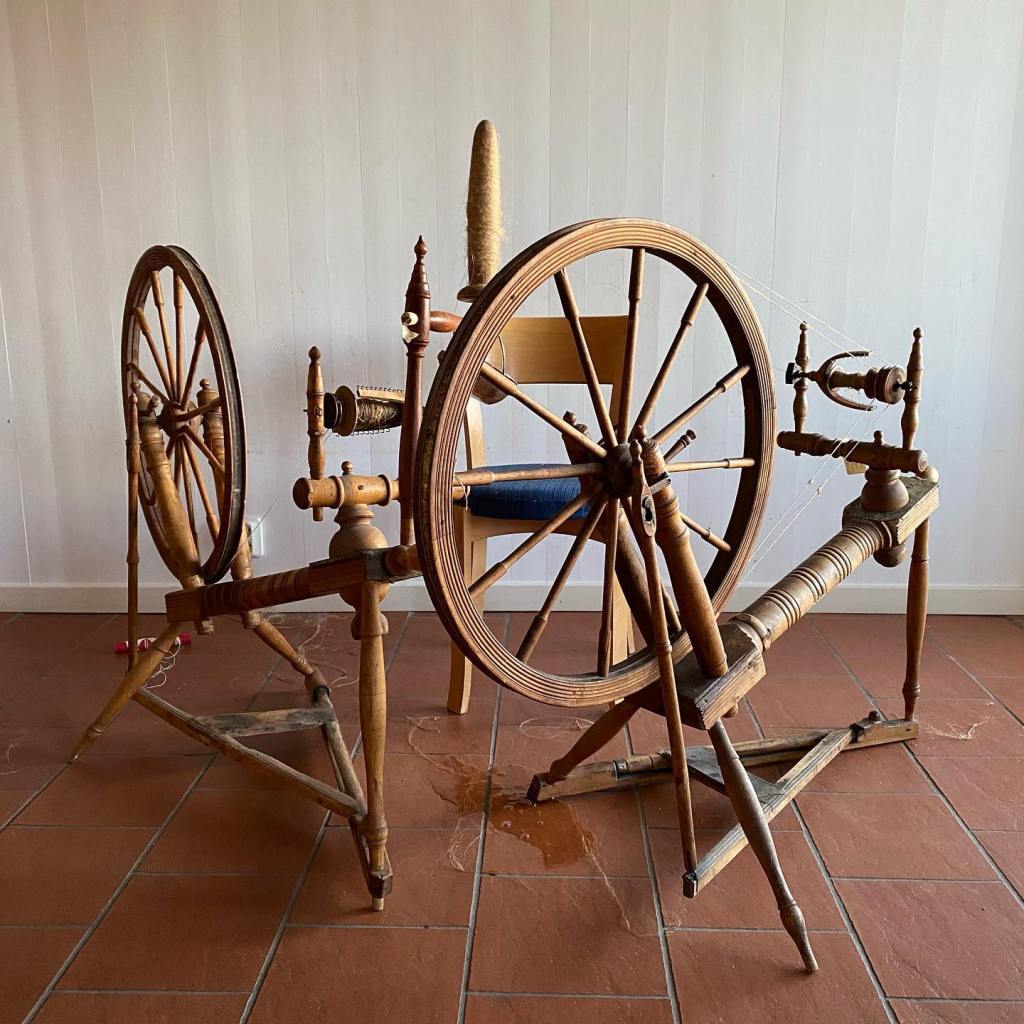
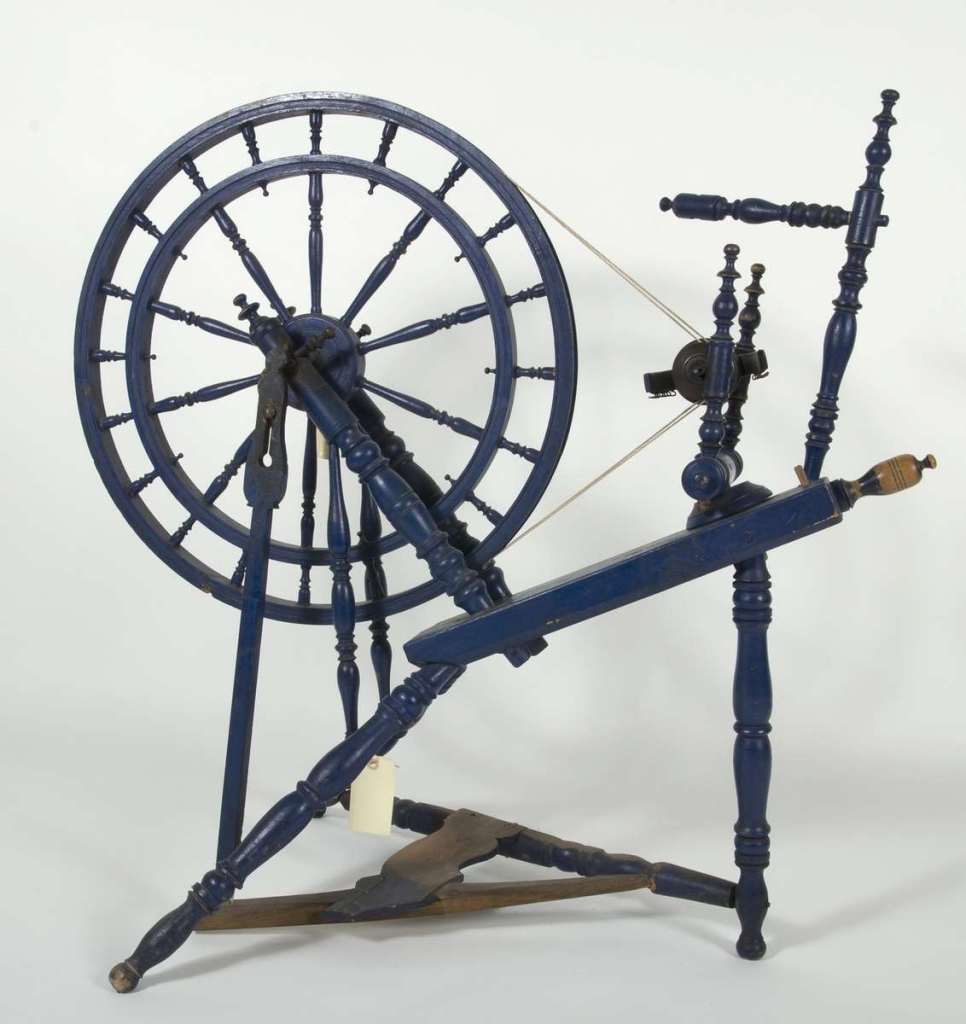
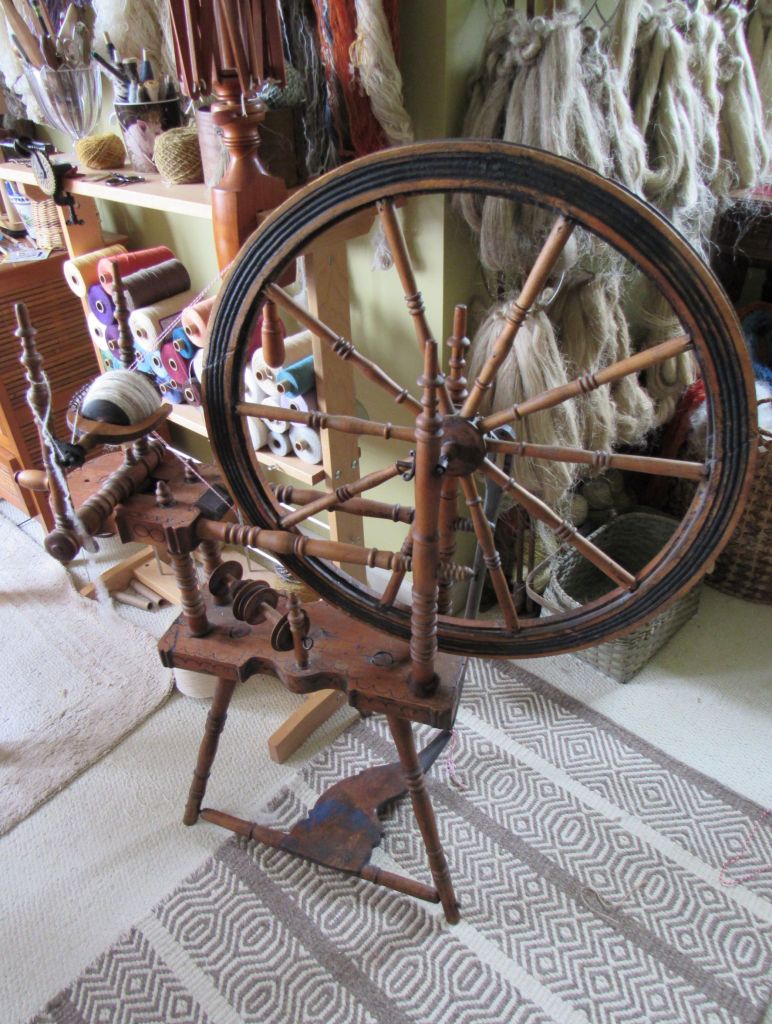
These petite Norwegian wheels turn up regularly in this country, mostly in the Midwest.
An 1851 wheel for sale in Fargo, N.D.
Because they are light and small, they must have been relatively easy to transport to this country from Norway.
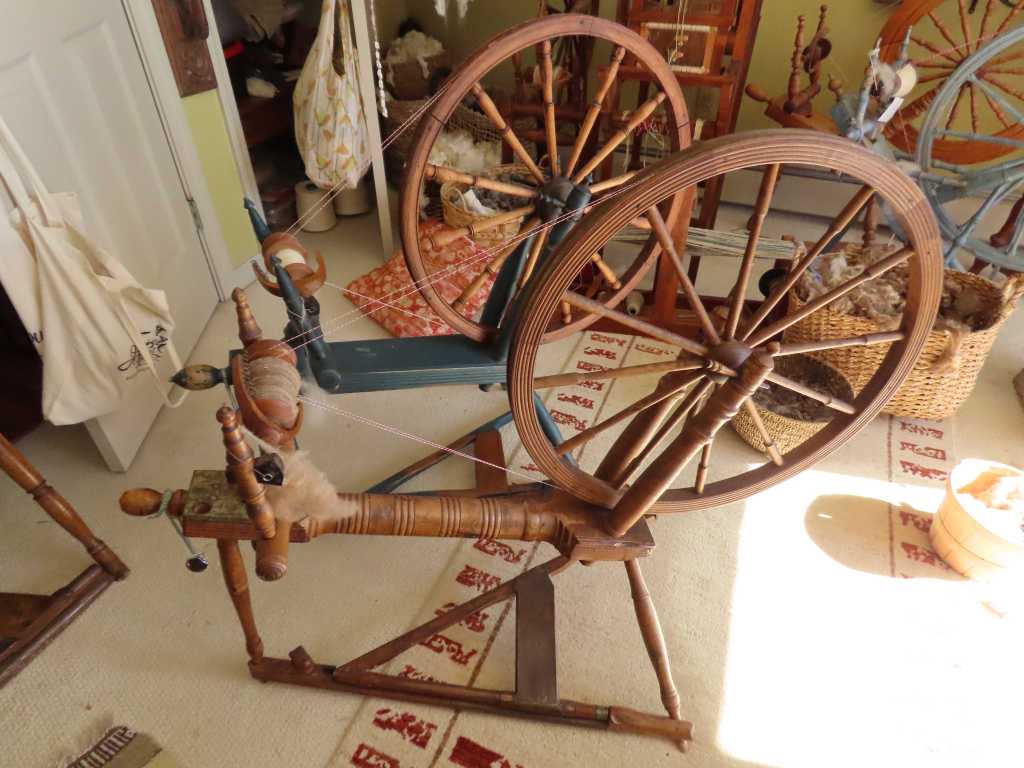
Solveig is considerably smaller than Hjordis, the Norwegian wheel from the last post
Because wheel makers often were scarce in the Midwest, “Norwegians who had emigrated earlier strongly recommended in letters to friends and family that women bring spinning wheels to America. The writers also occasionally suggested packing wool carders, looms, sheep shears and shears for cutting woven cloth.” Norwegian American Women, p. 159.
“Most sources indicate that women used the Norwegian treadle spinning wheels they brought or acquired. Kari Bunde Veblen requested a second wheel from Norway after the first one, brought by a newcomer, ‘did not prove satisfactory in that it growled slightly in running.’ ” Id at 162.
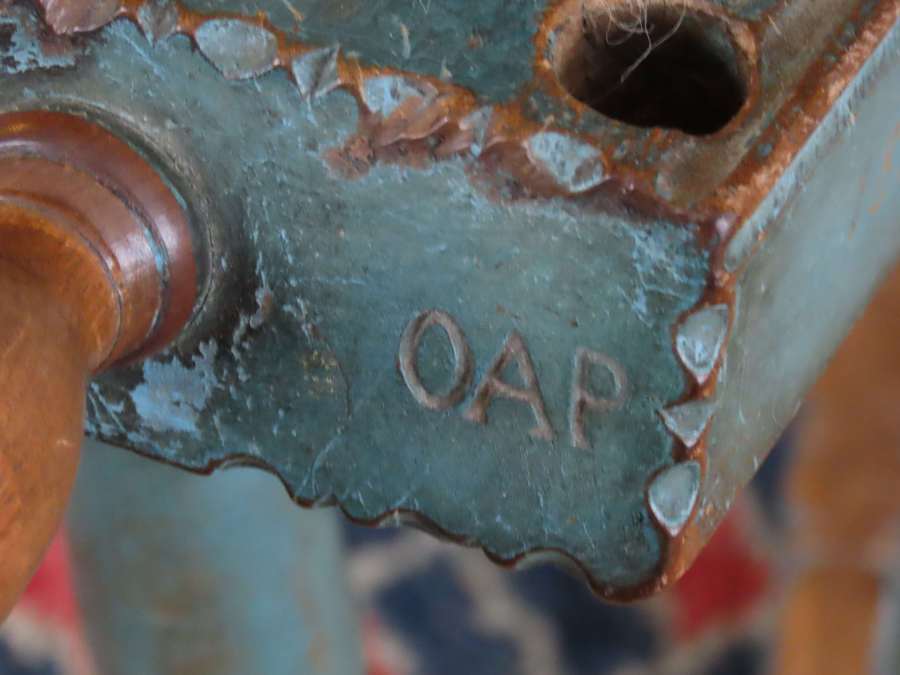
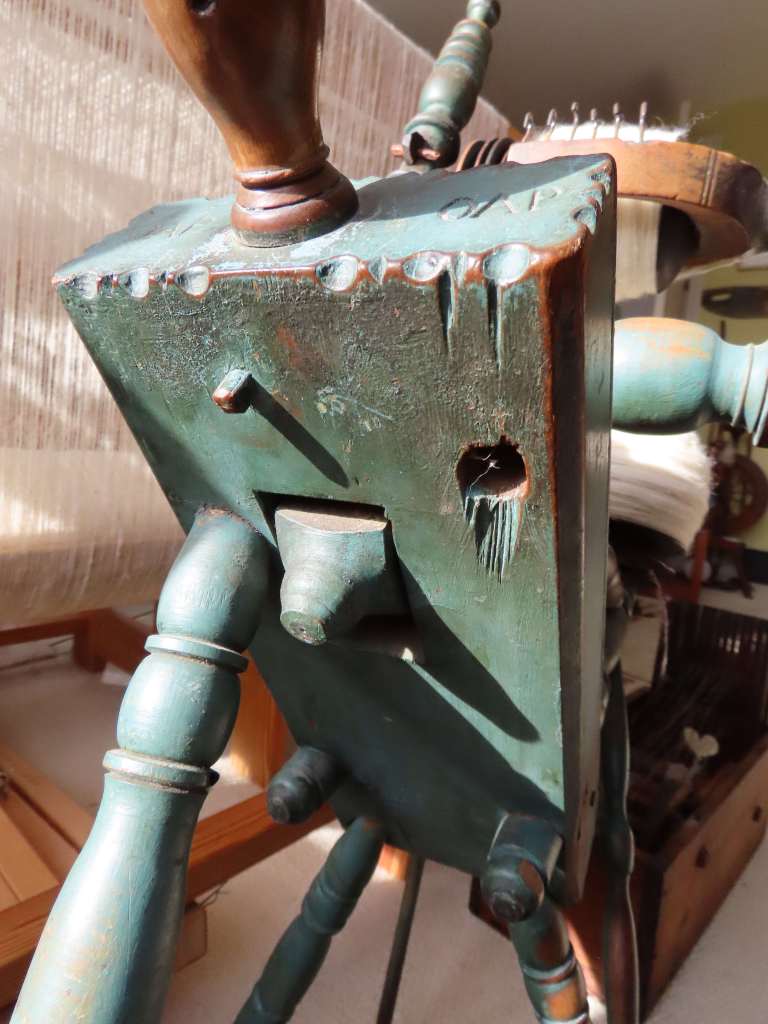
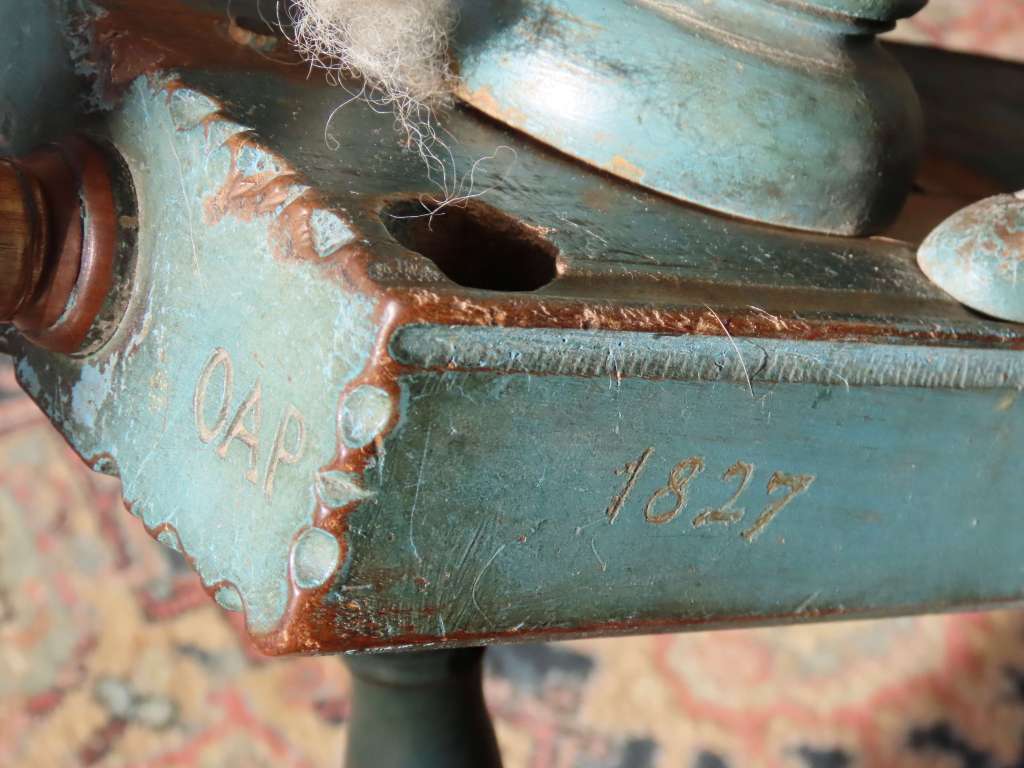
Although these wheels have a clear maker’s mark of OAP, as far as I know, his identity is a mystery.
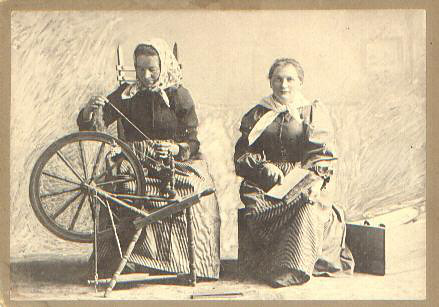
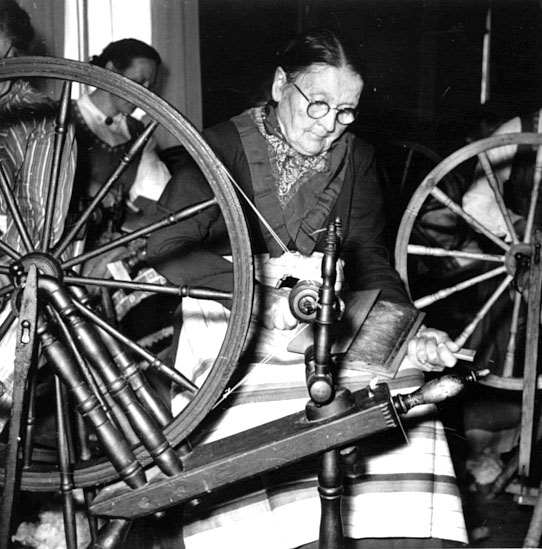
We believe the wheels may have come from the Hordaland area of Norway based on this photo found on an ancestry site, with the caption: “Lofthus, Norway – One lady spins the wool while the other combs 1888.”*
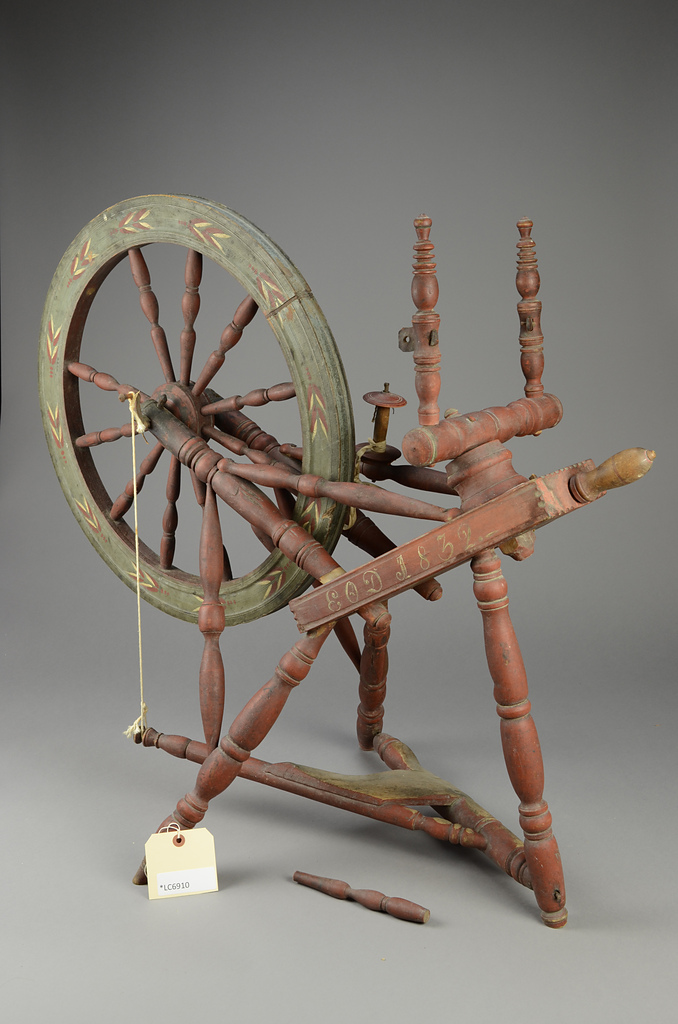
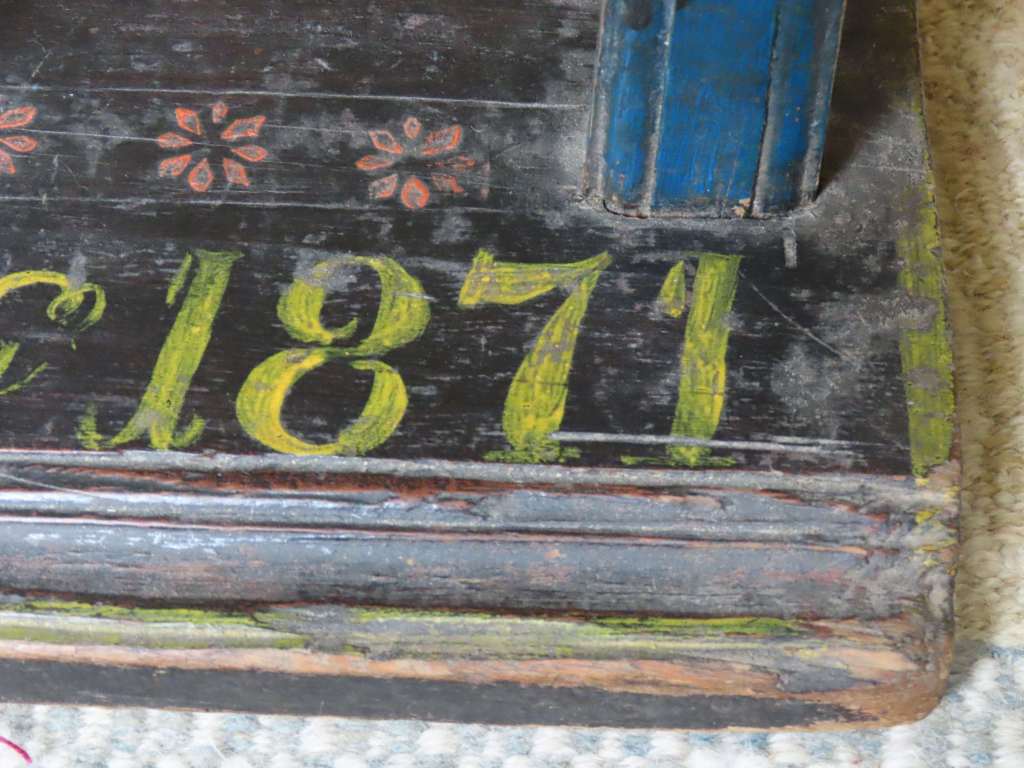
The wheels appear to have been made for decades, with painted dates ranging from the 1830s (and perhaps earlier) to the 1870s.
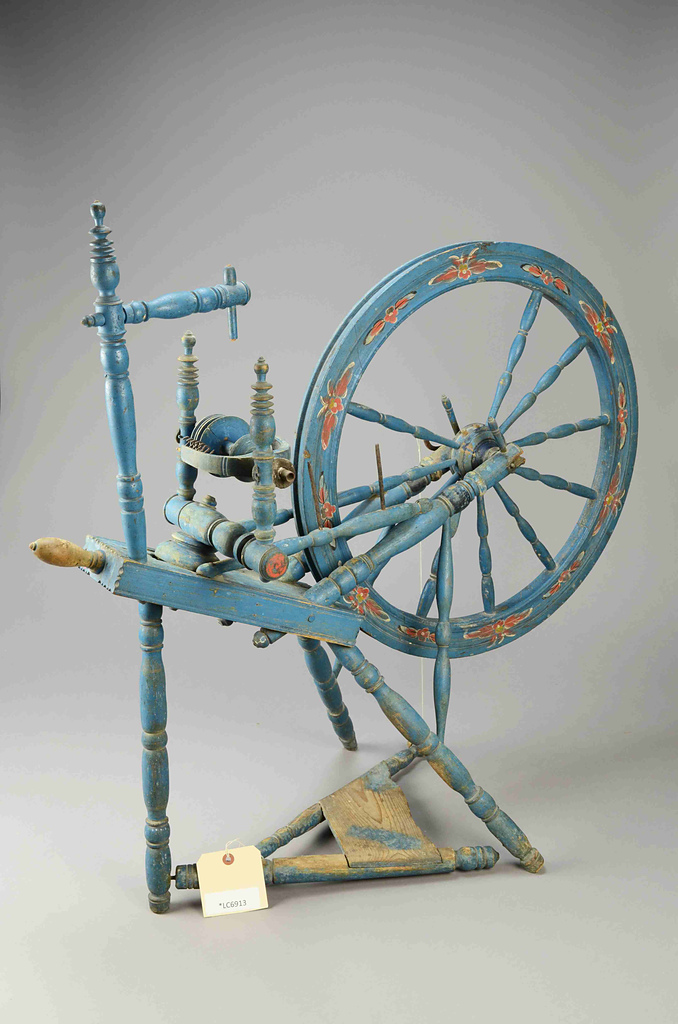
They are usually painted, sometimes with floral designs such as these wheels in the Vesterheim Museum in Decorah, Iowa.
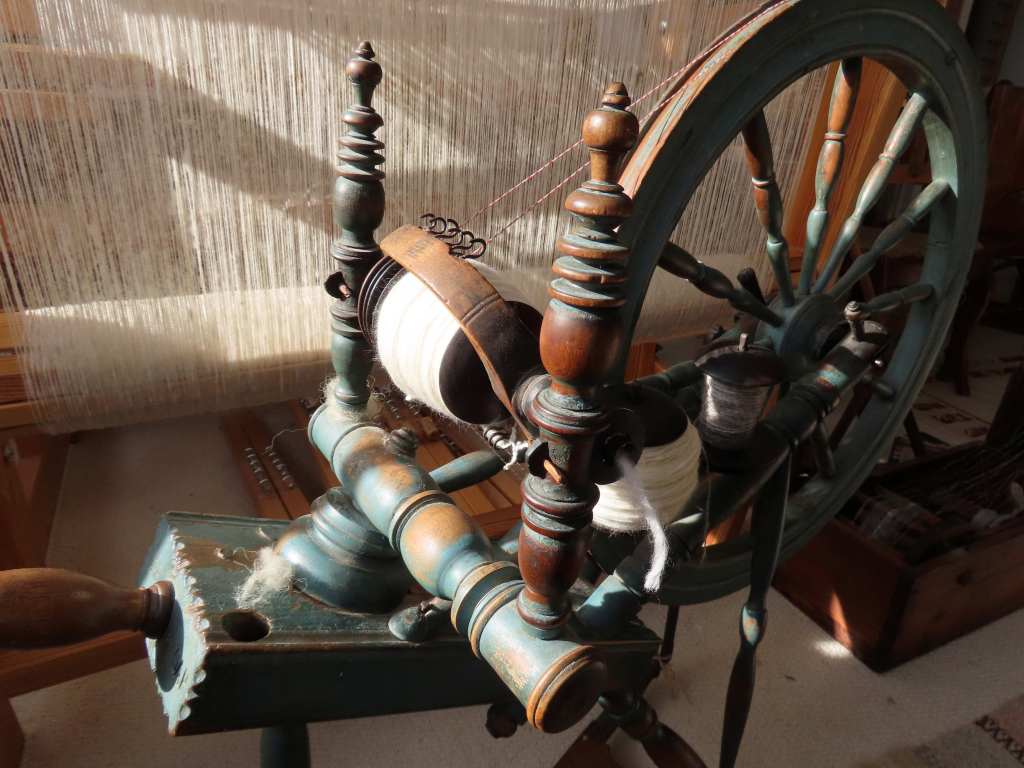
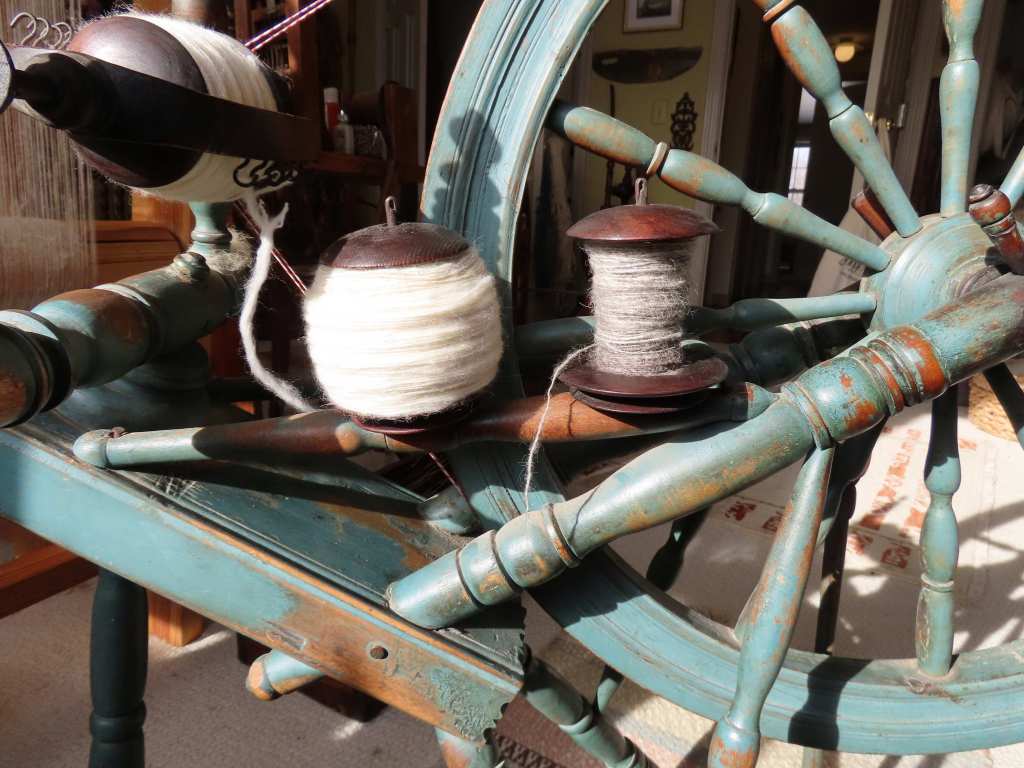
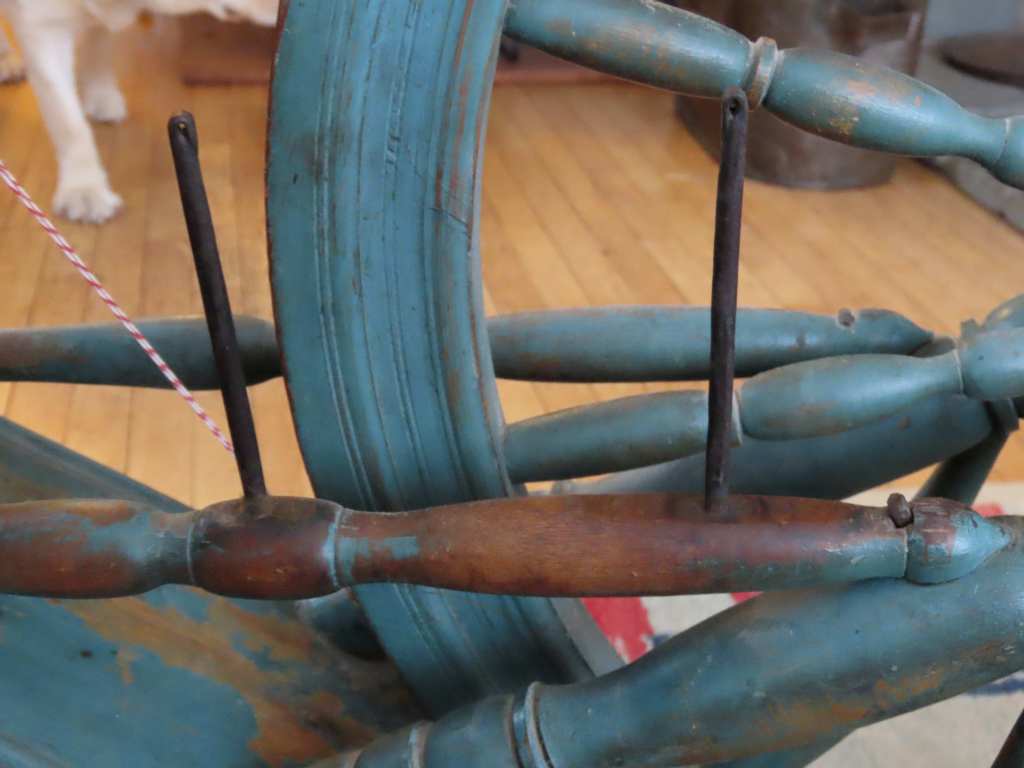
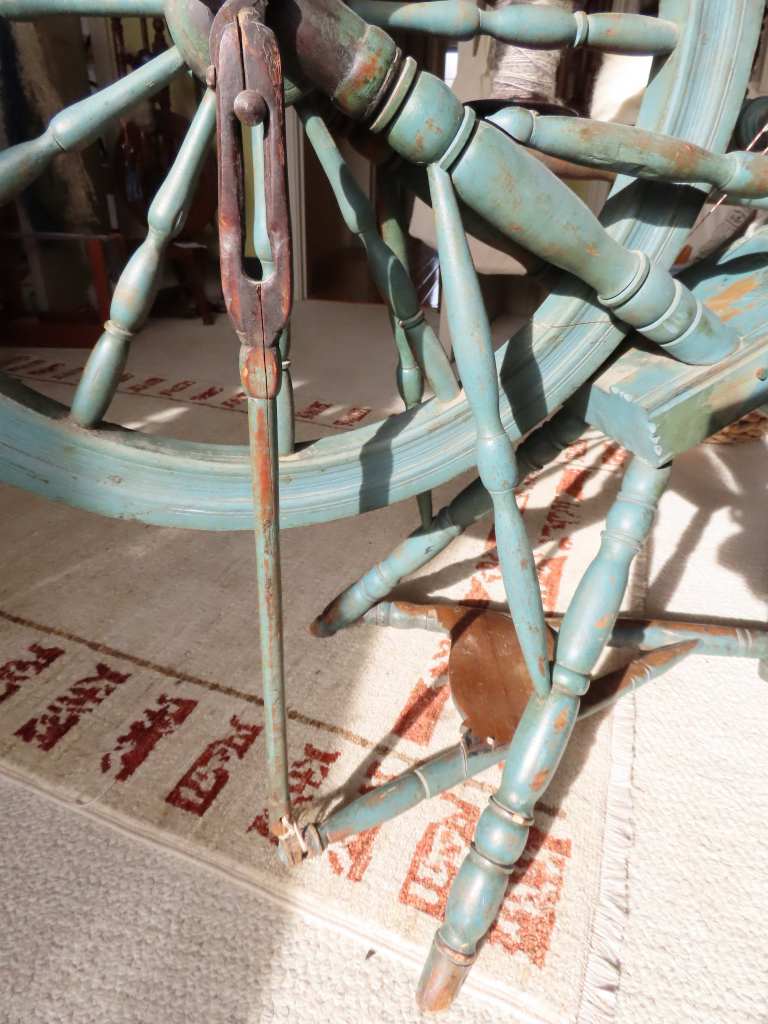
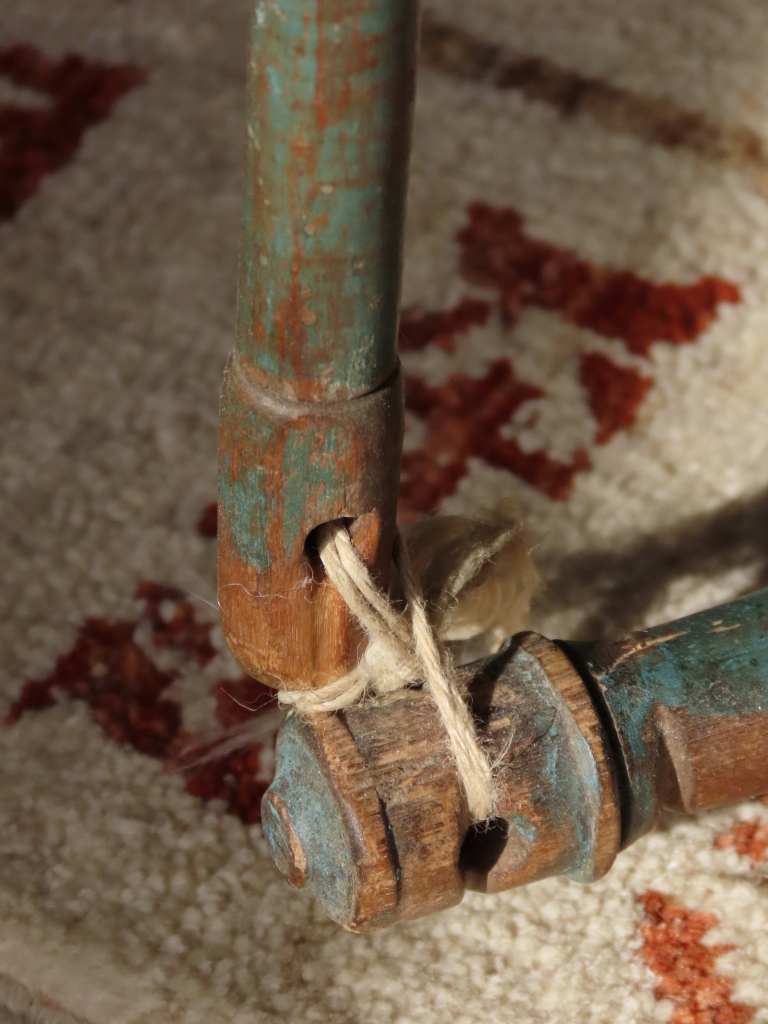
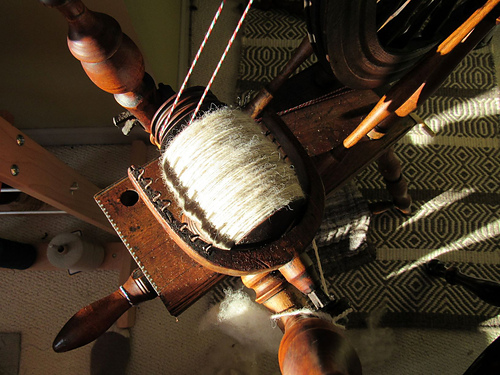
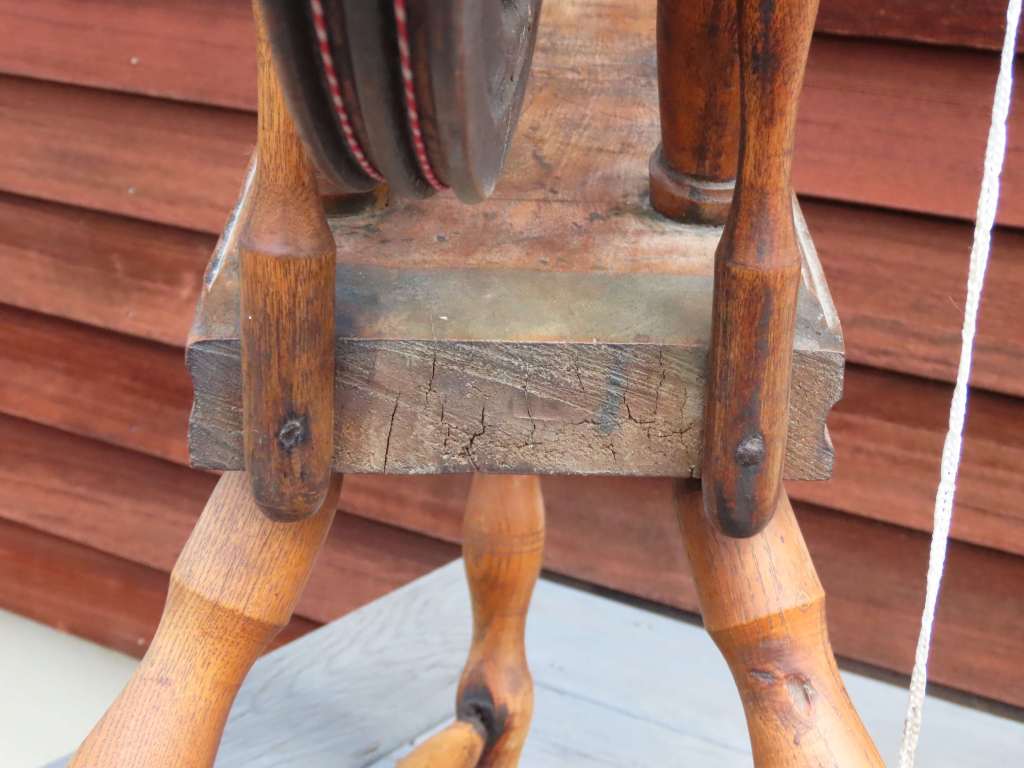
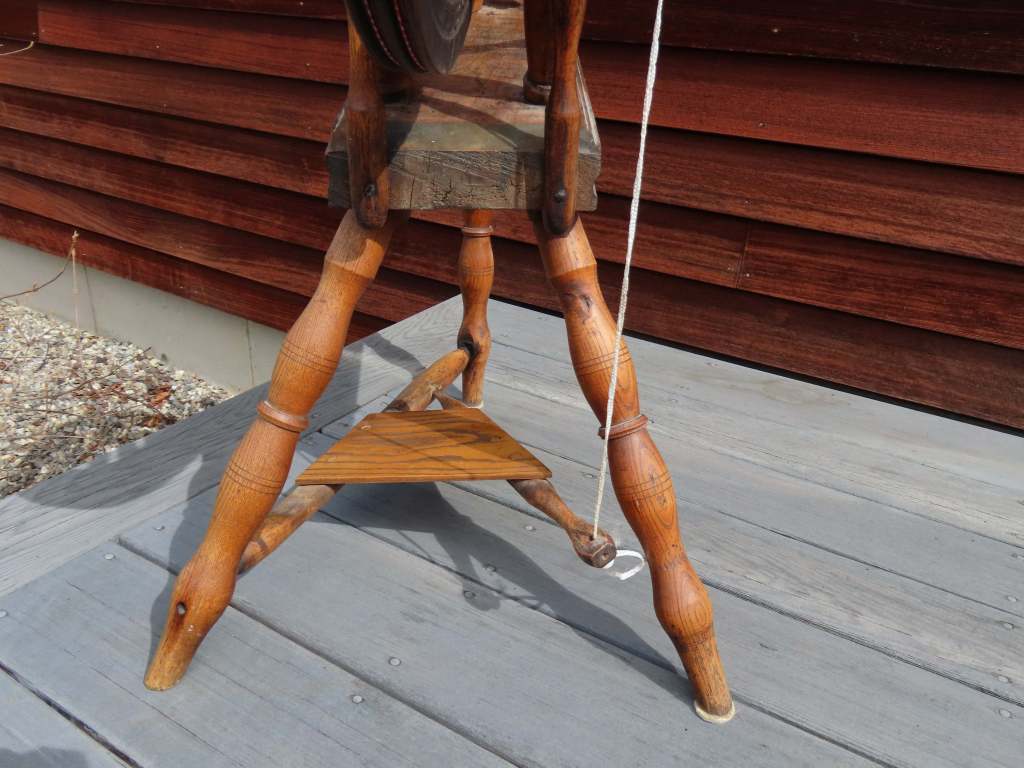
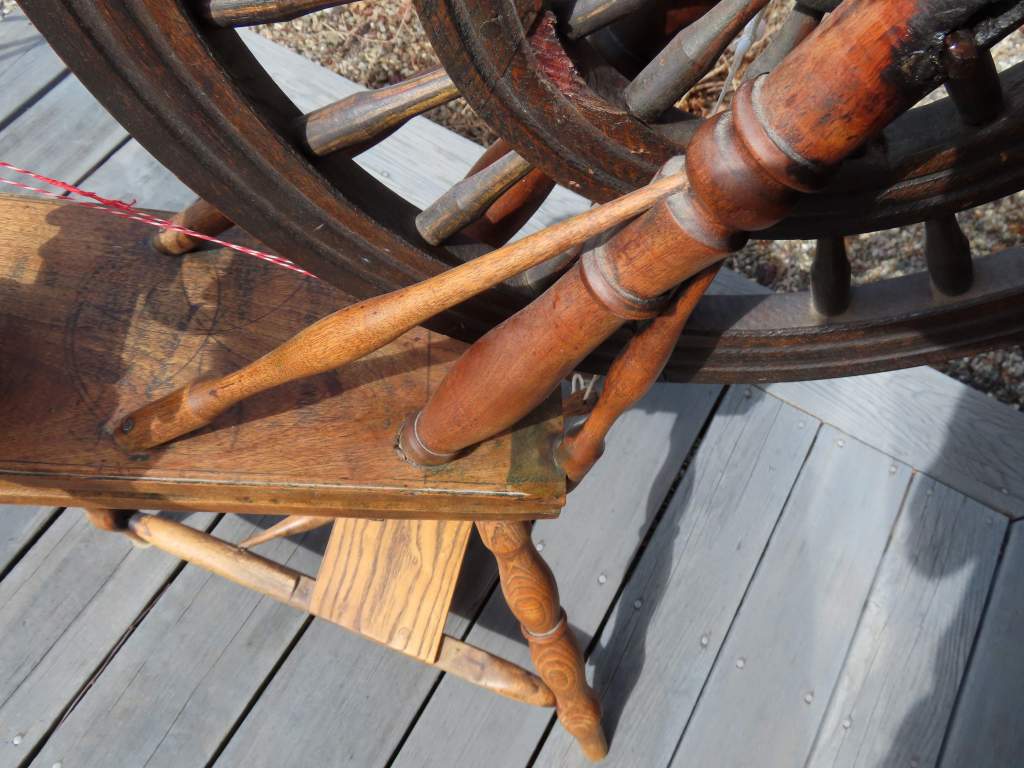
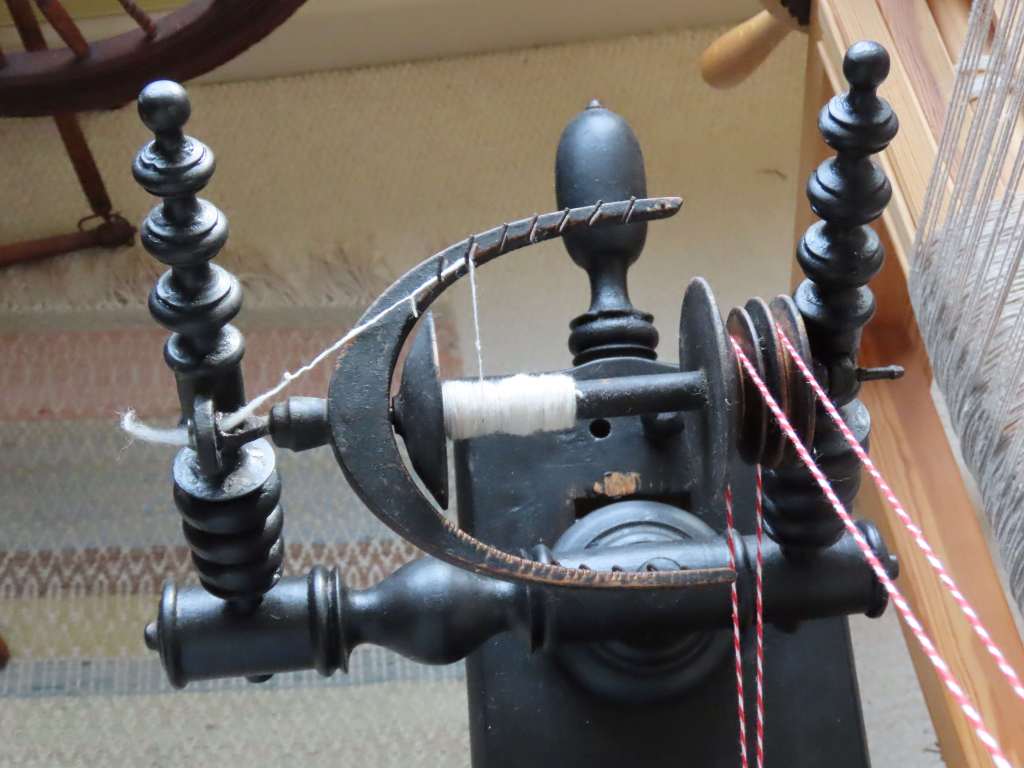
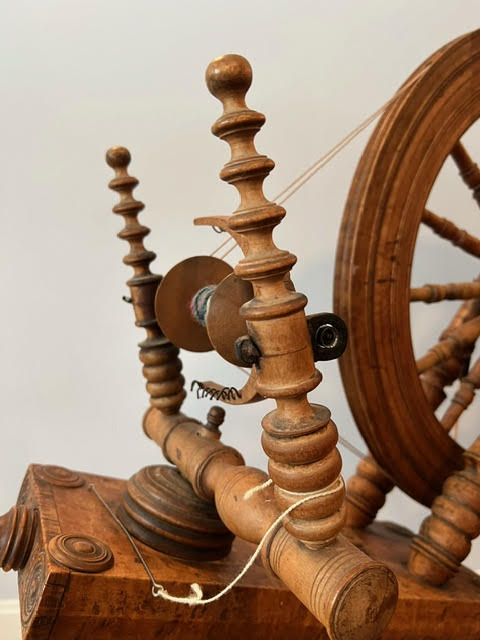
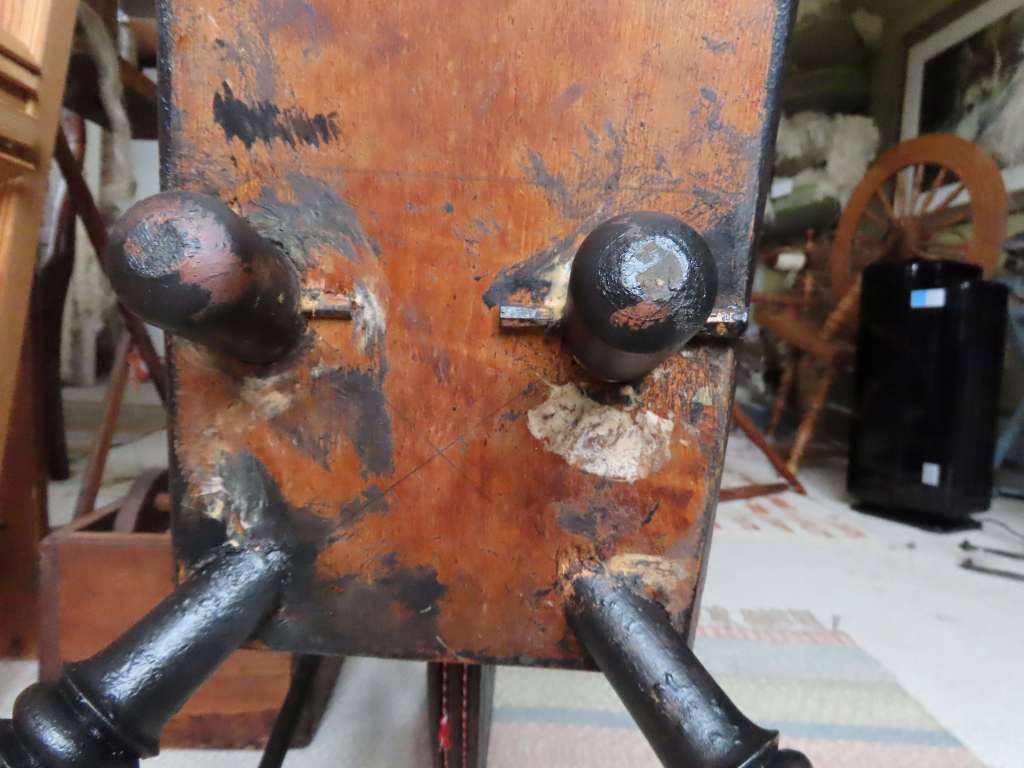
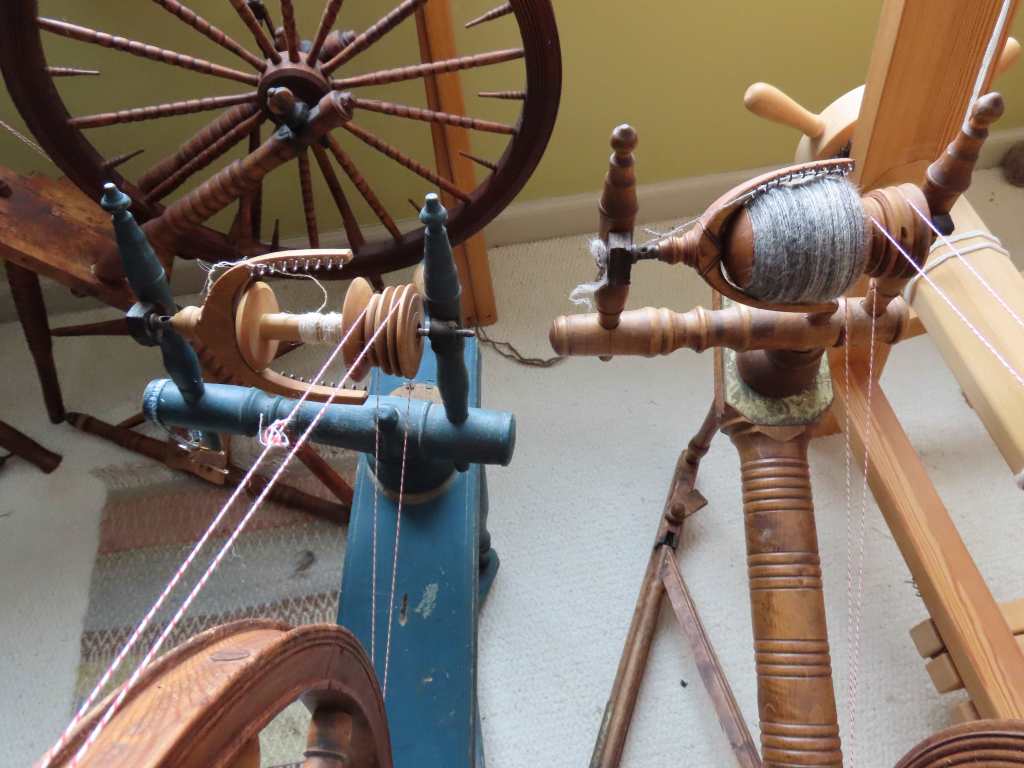
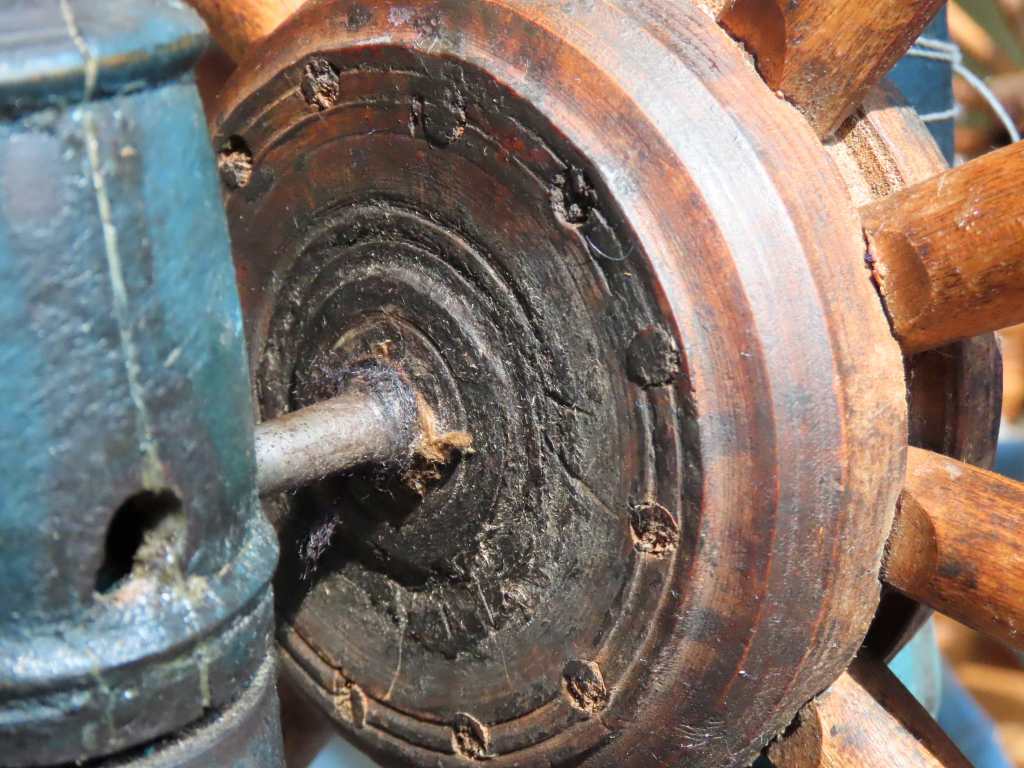
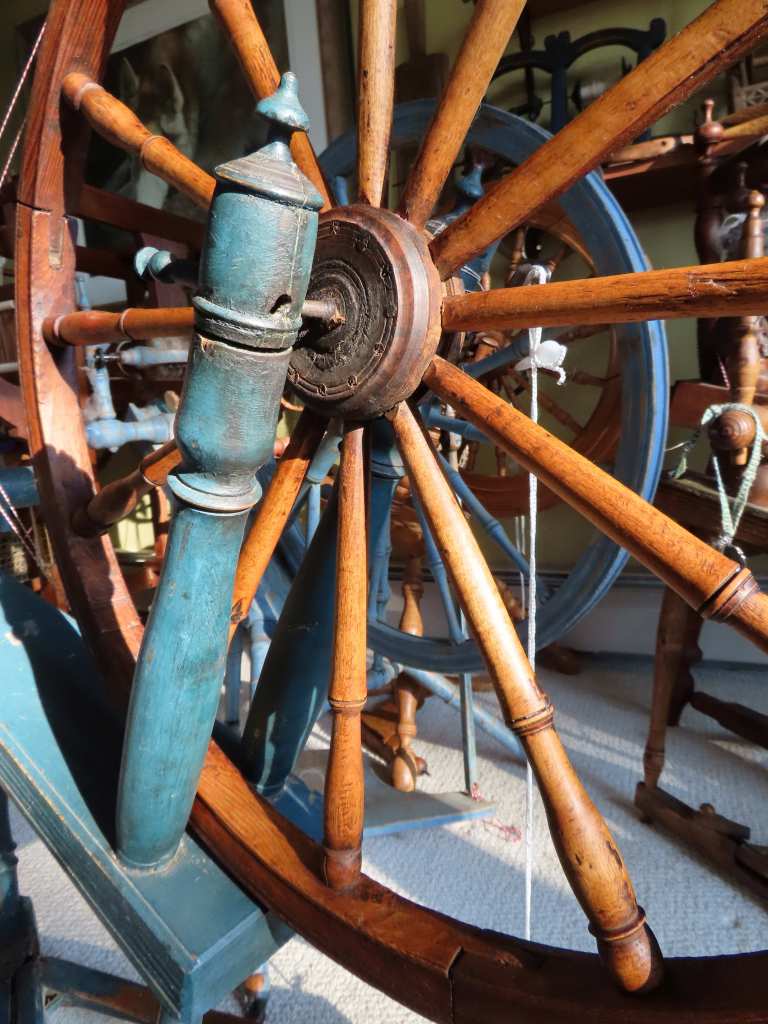
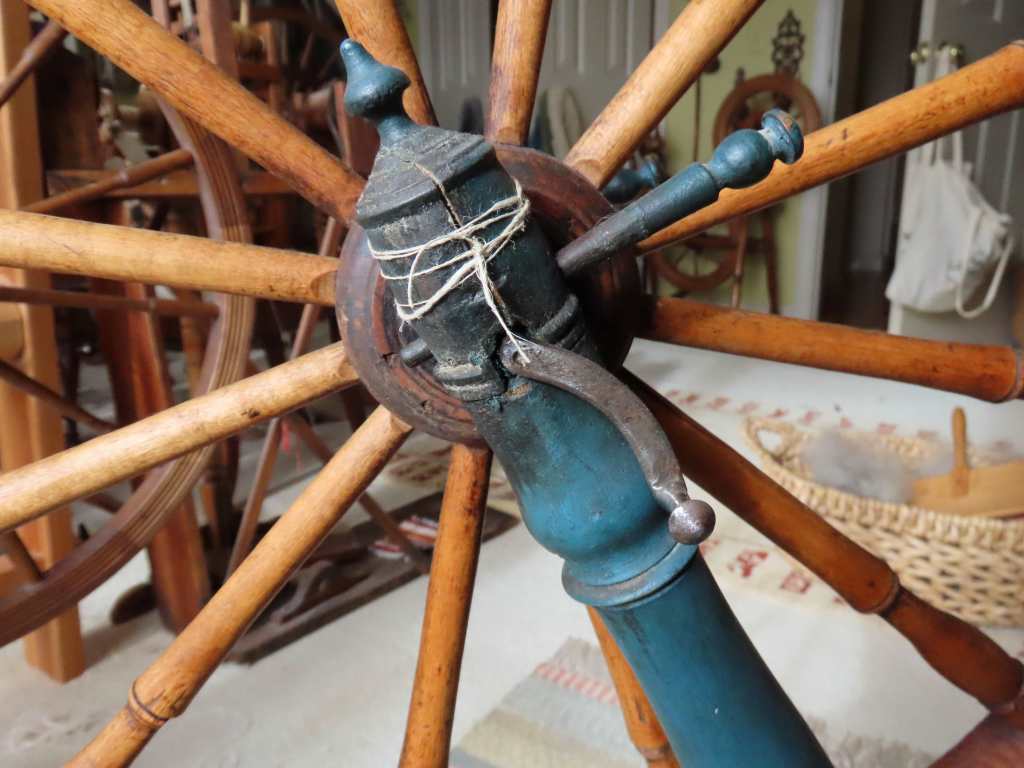
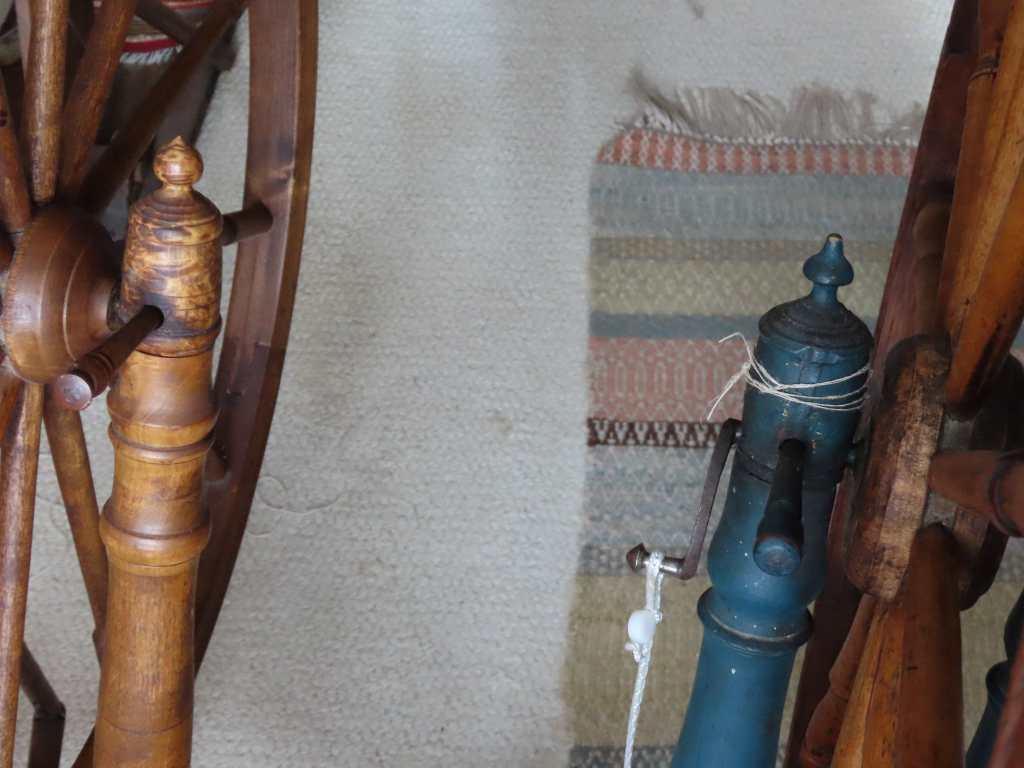
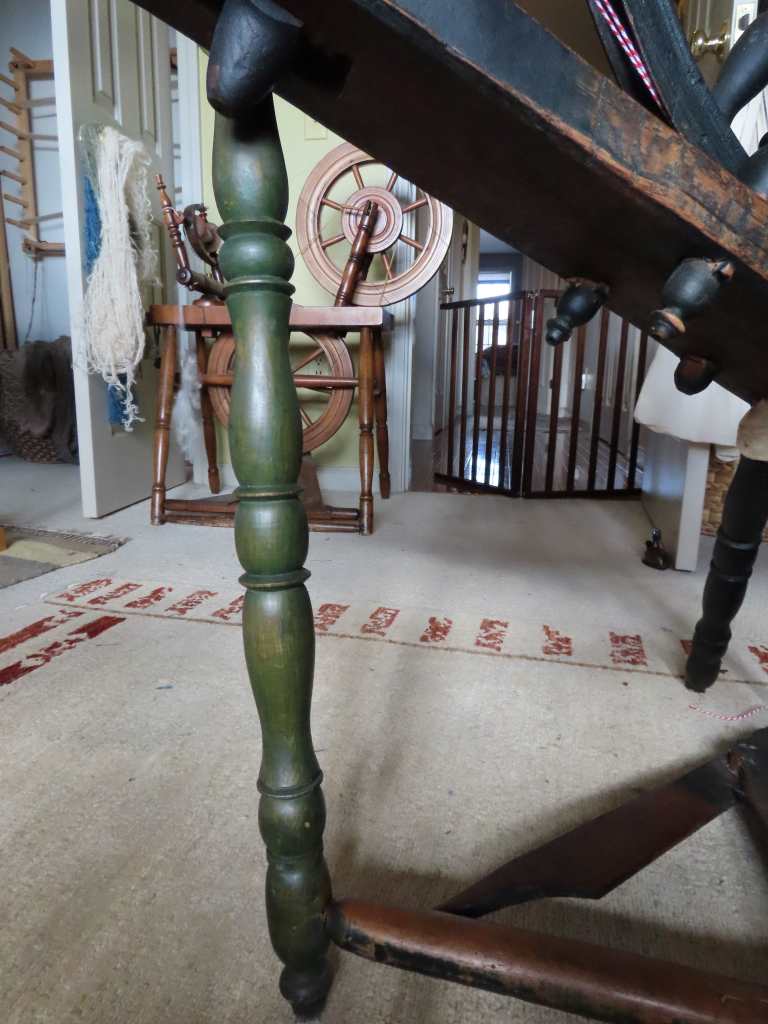
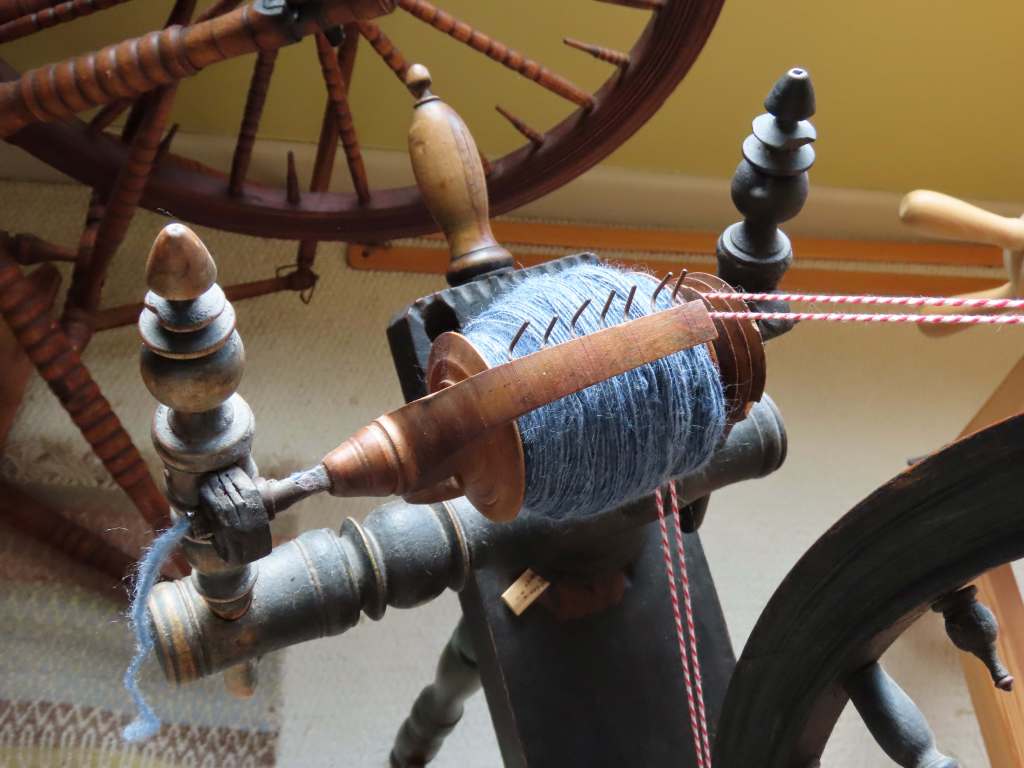
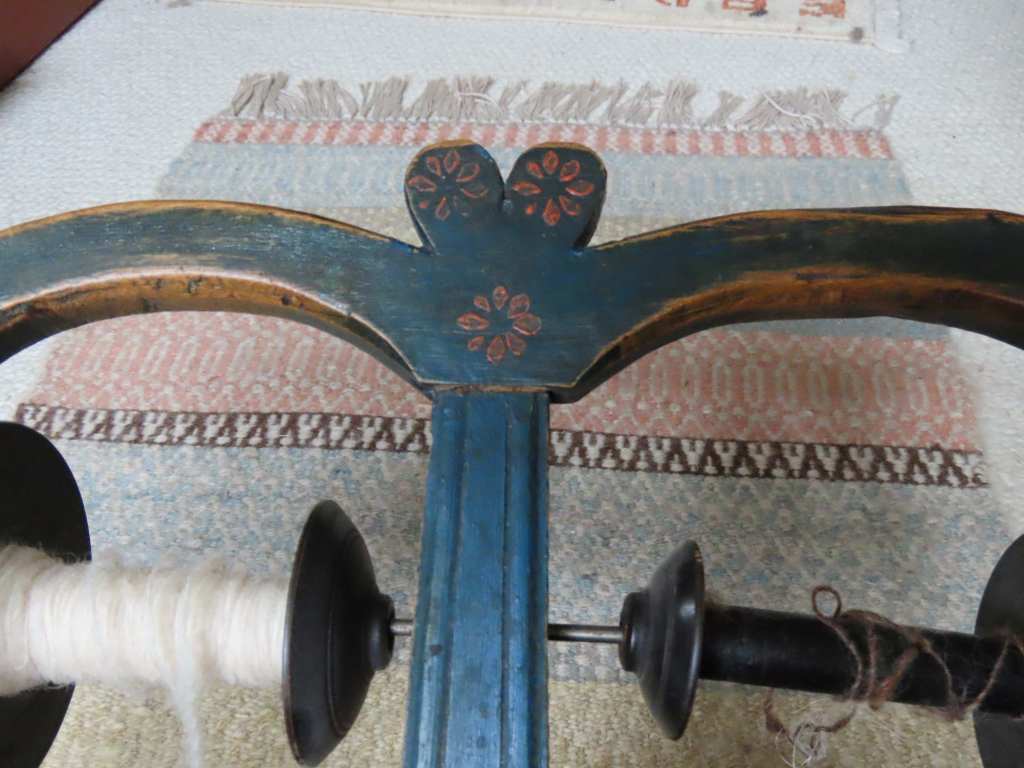
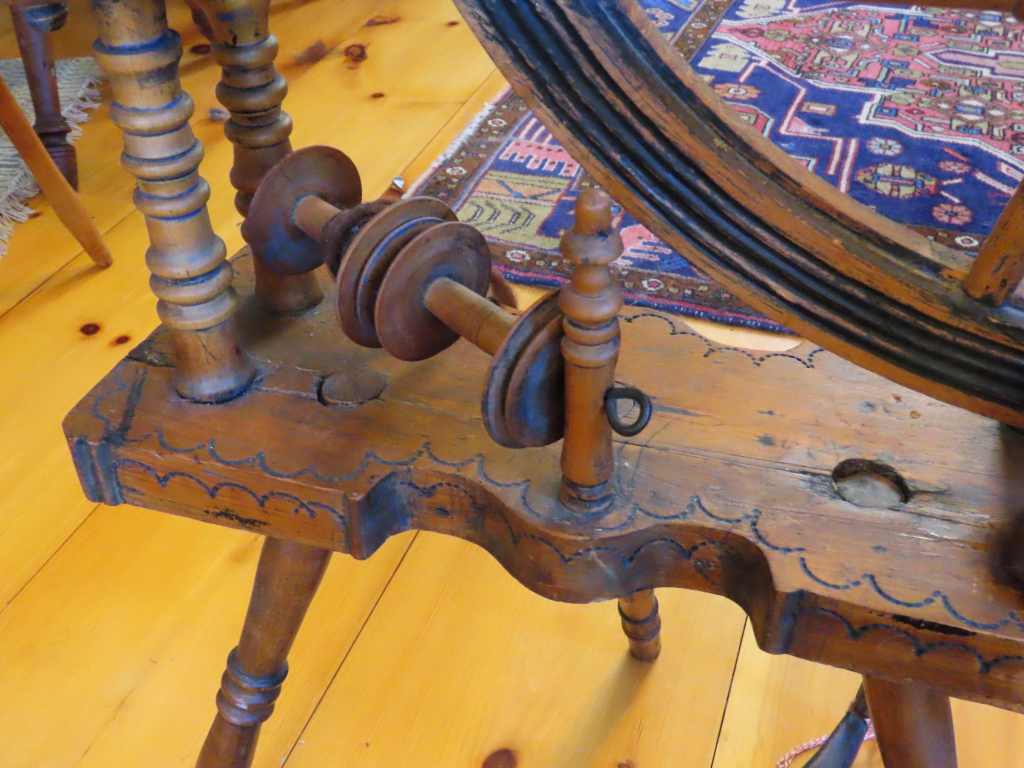
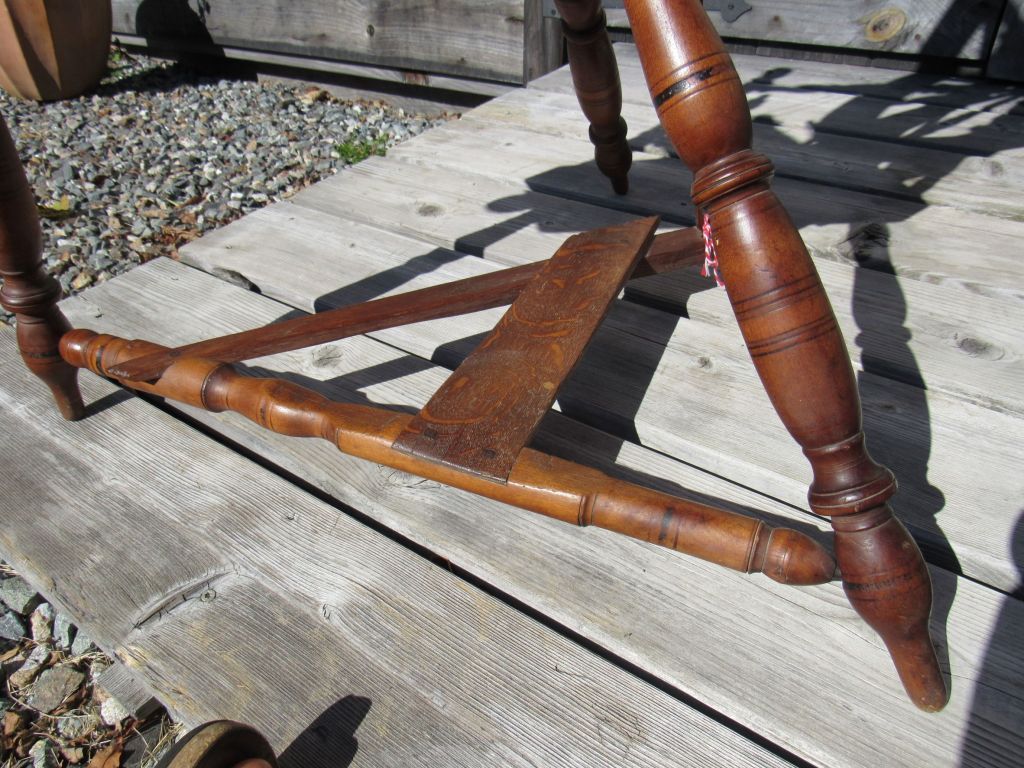
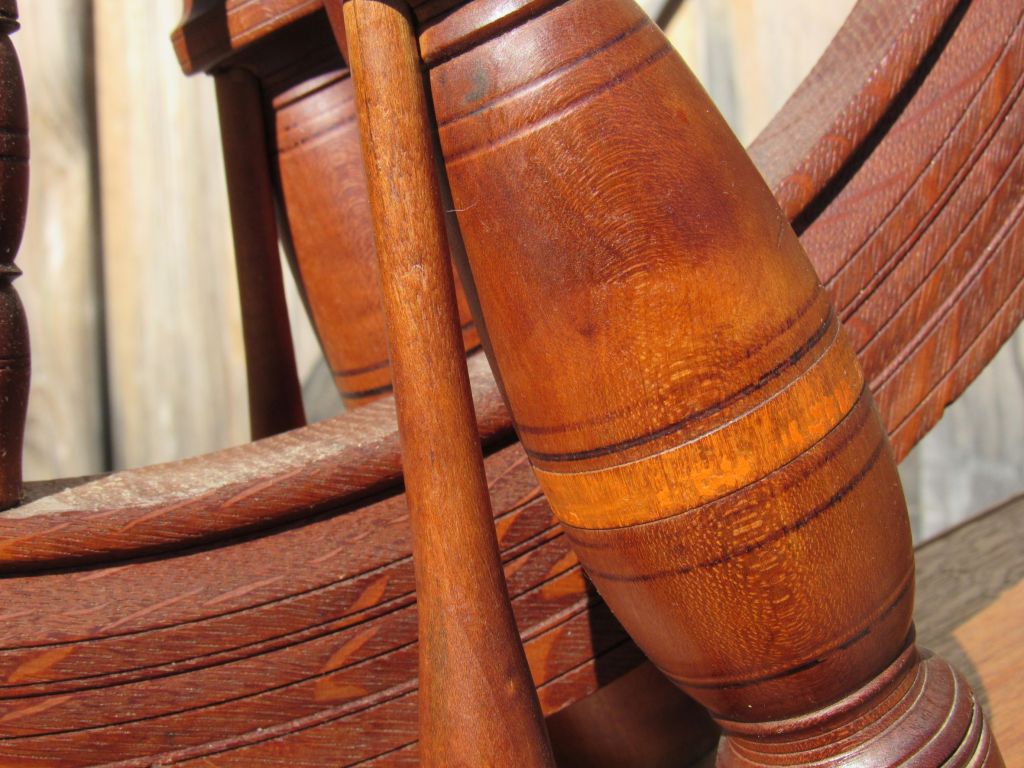
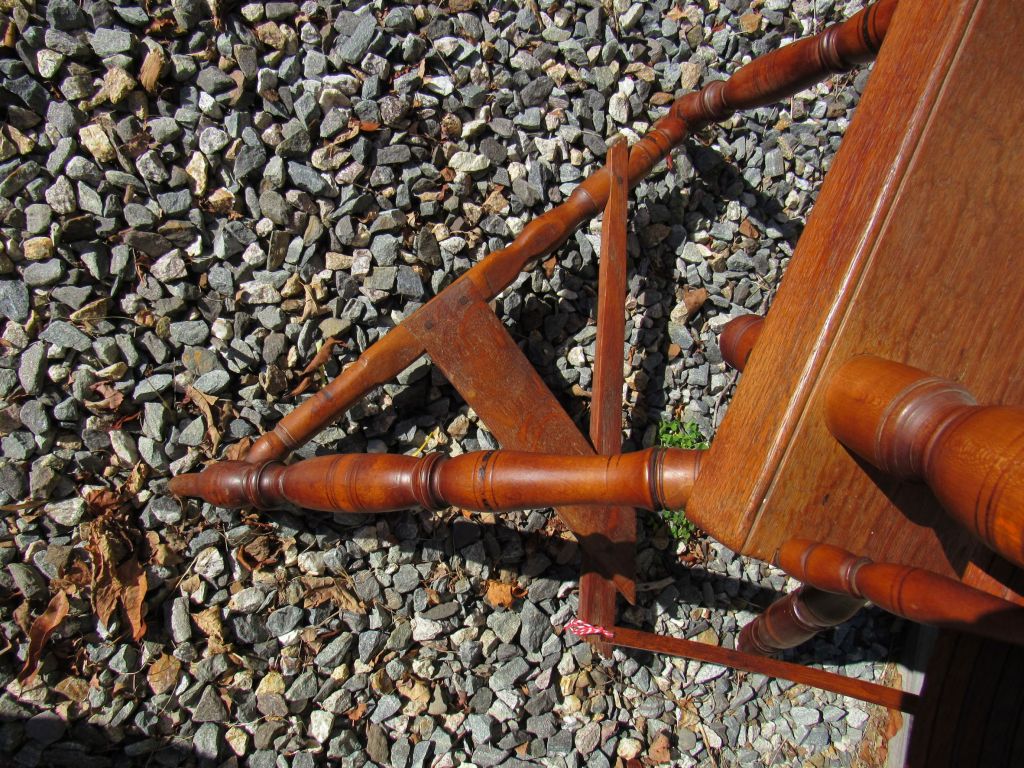
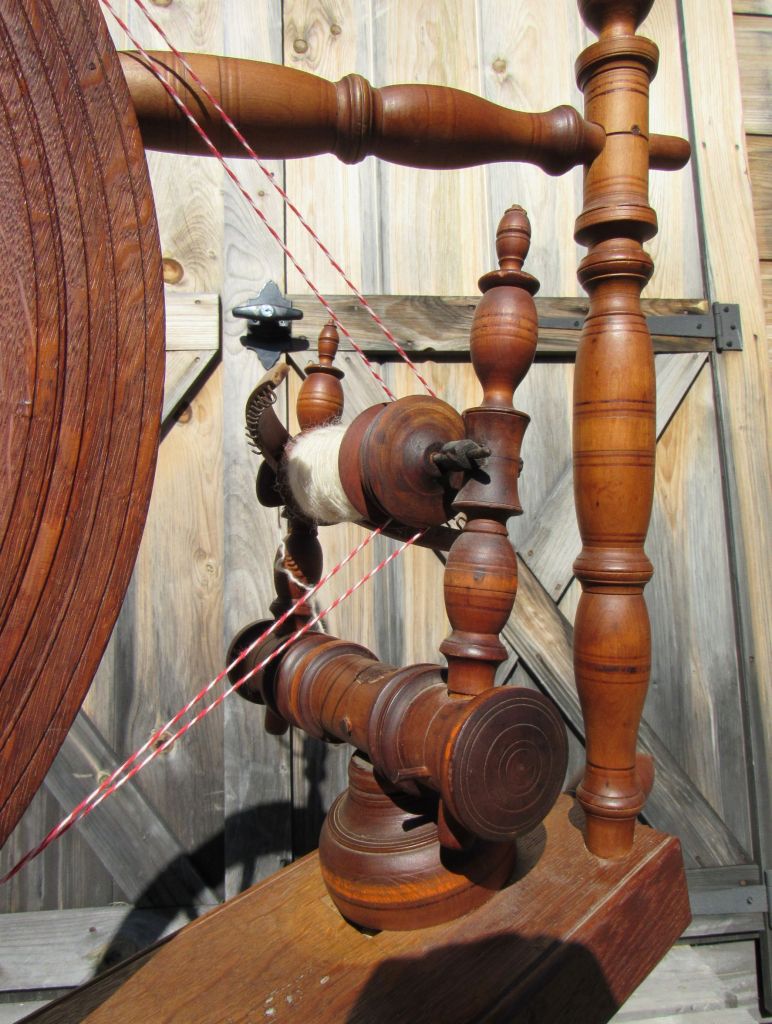
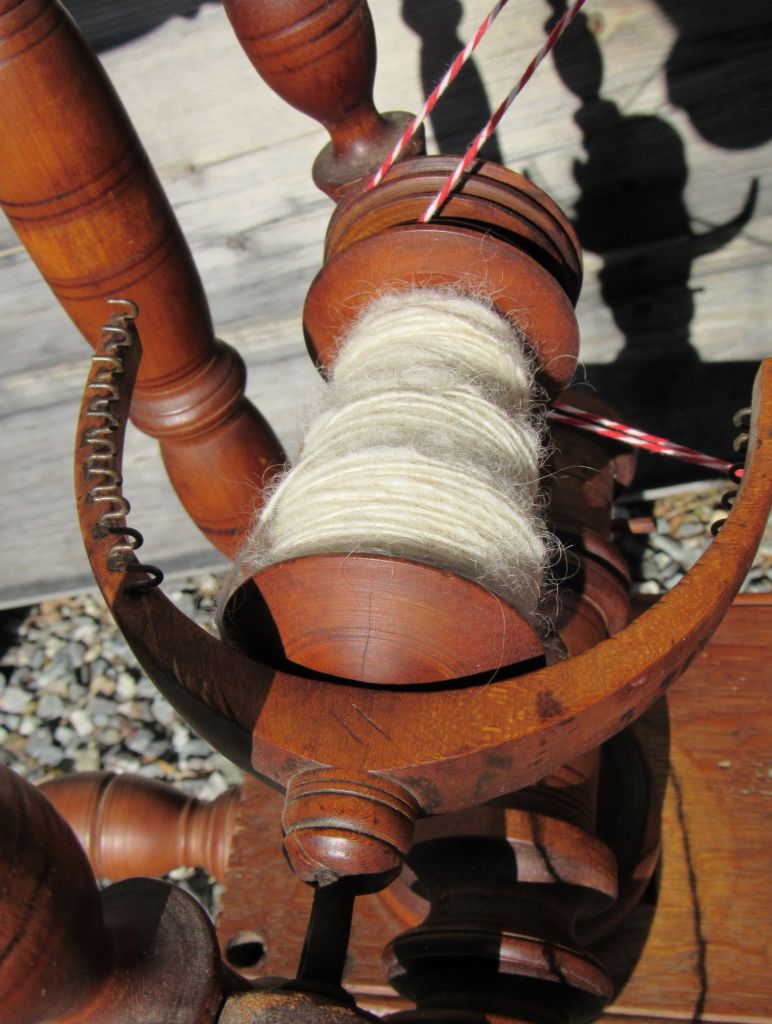
Aside from the lovely paint jobs and compact size, these wheels are immediately recognizable because of an onboard lazy kate.
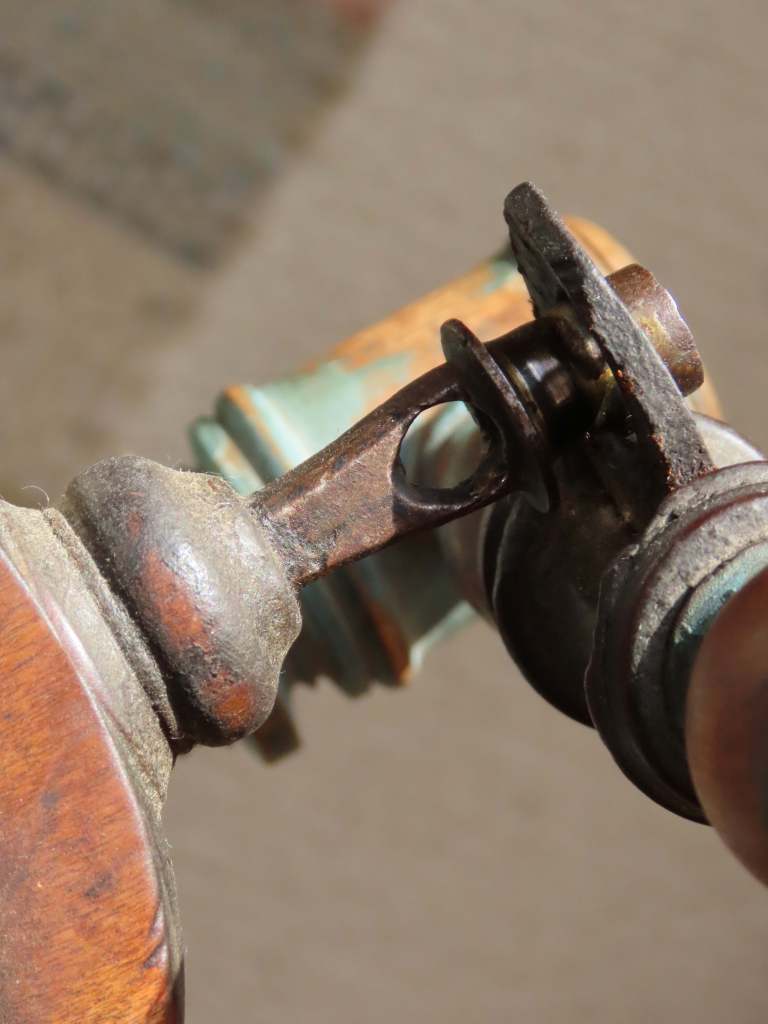
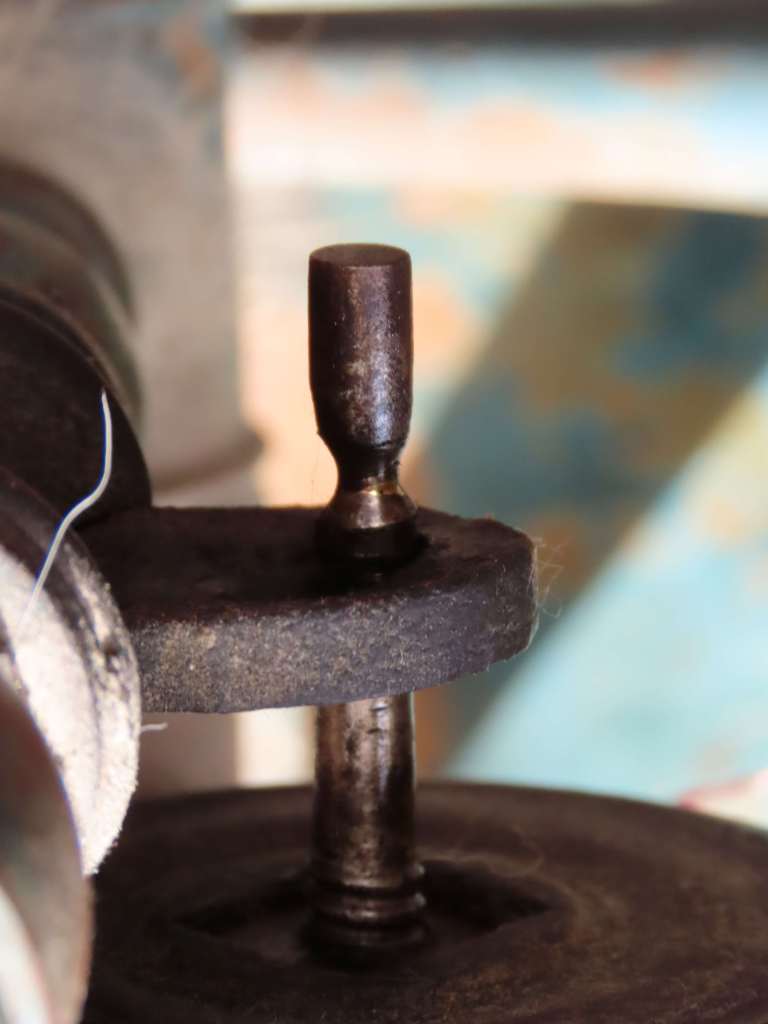
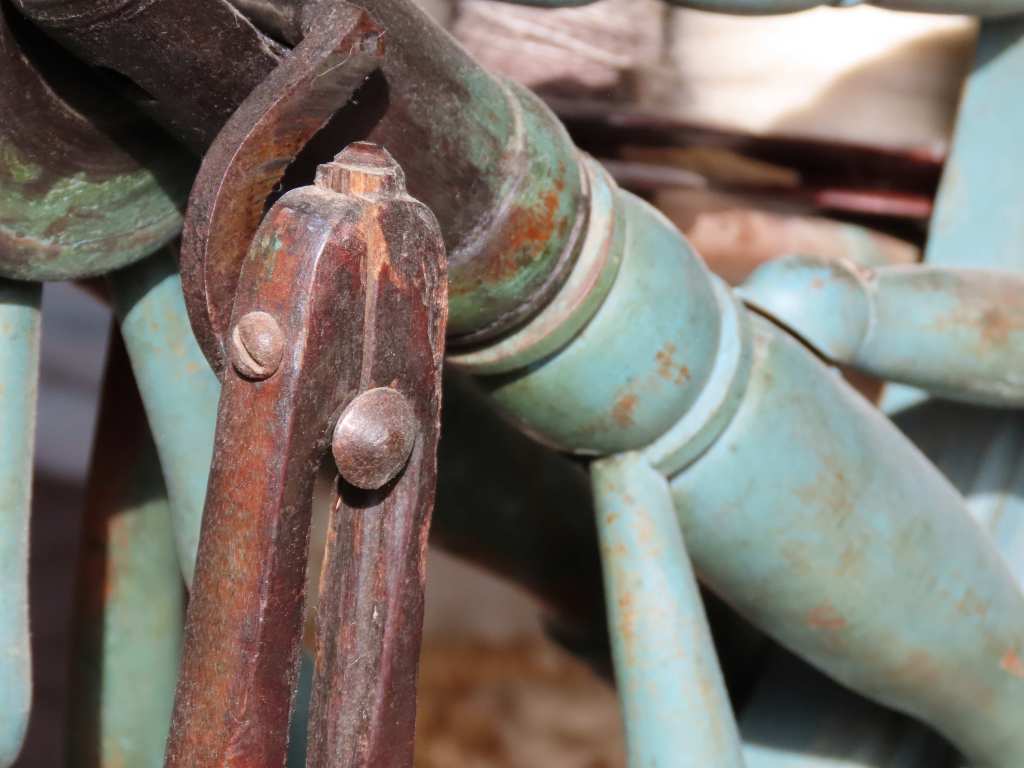
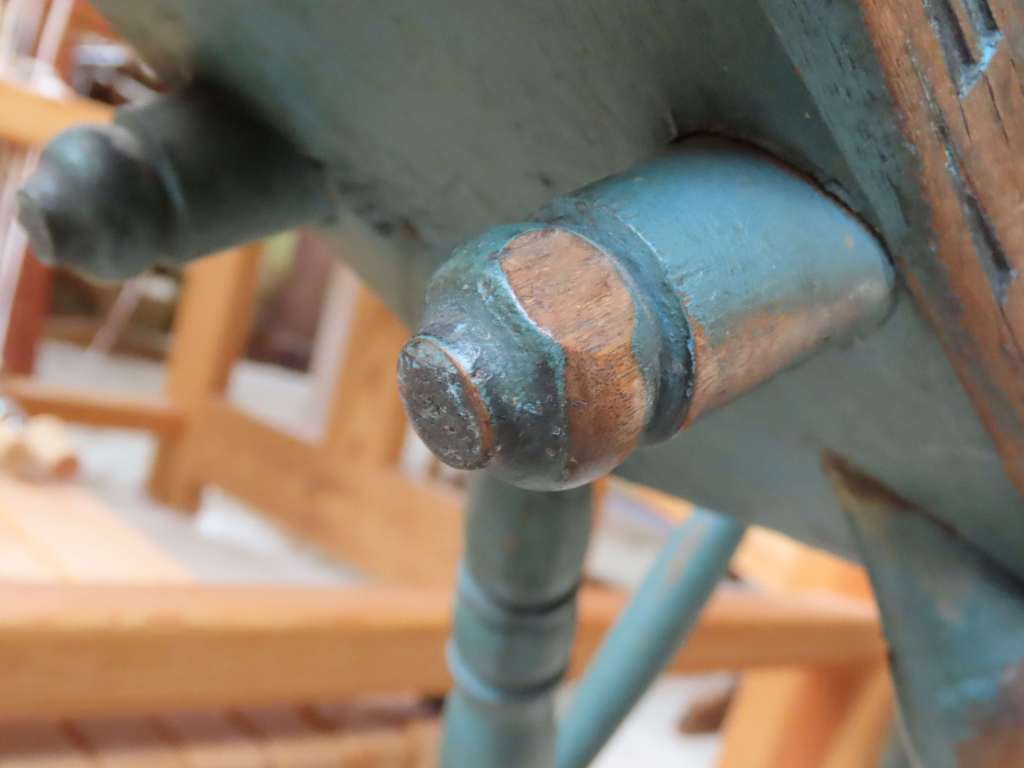
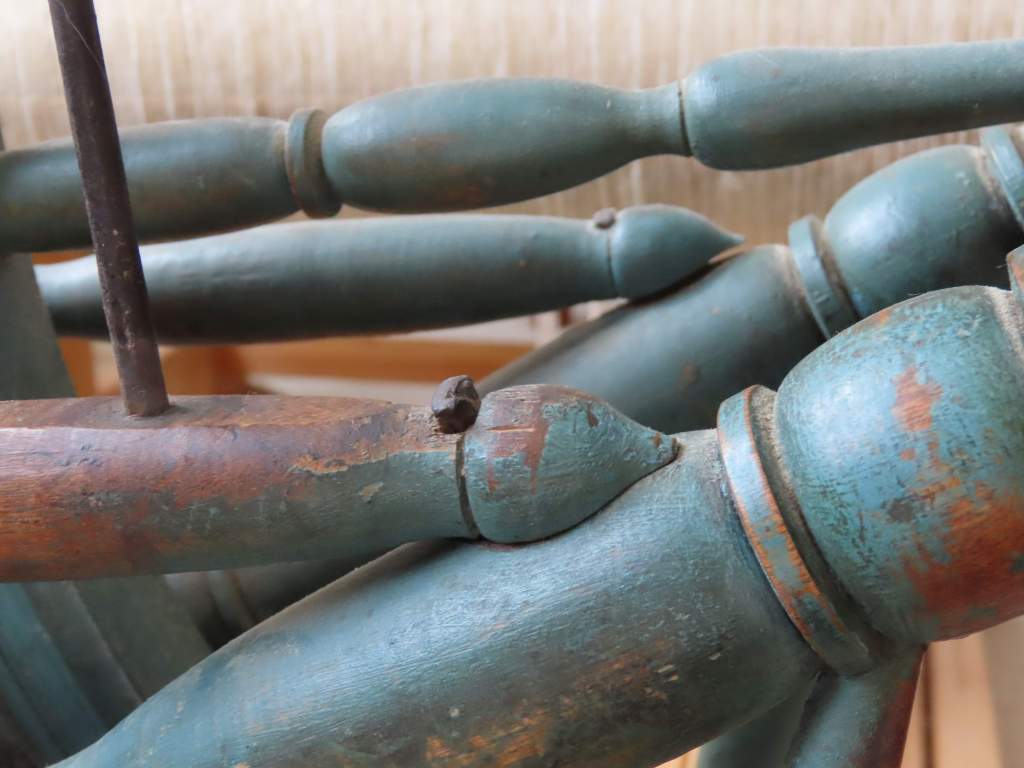
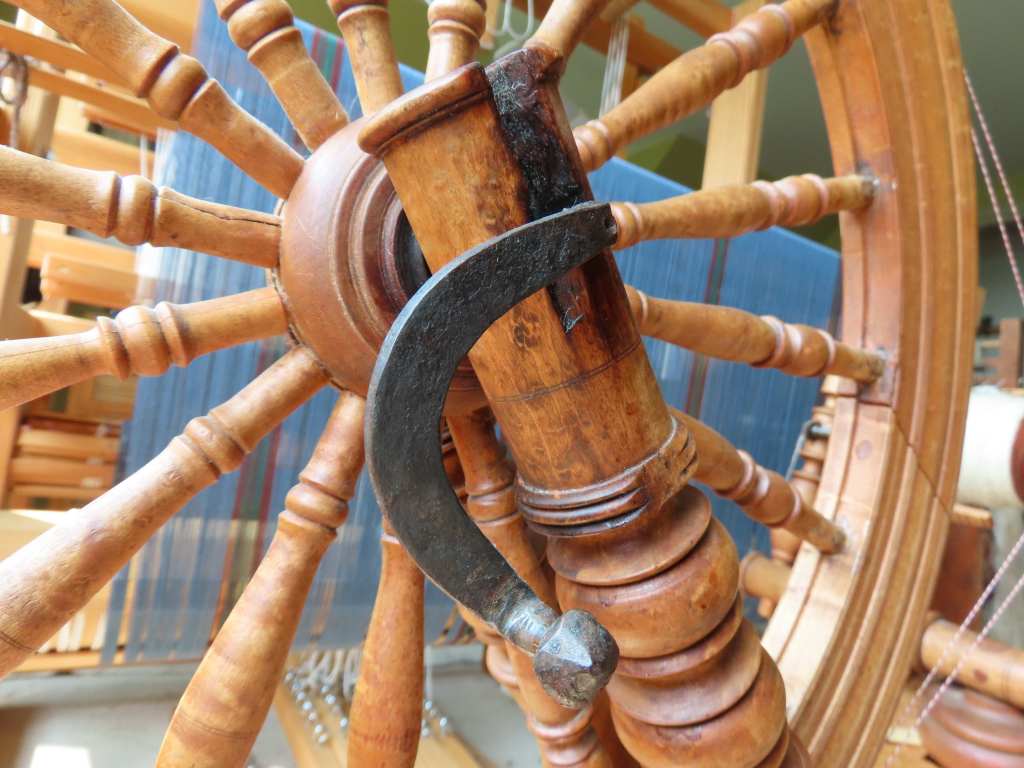
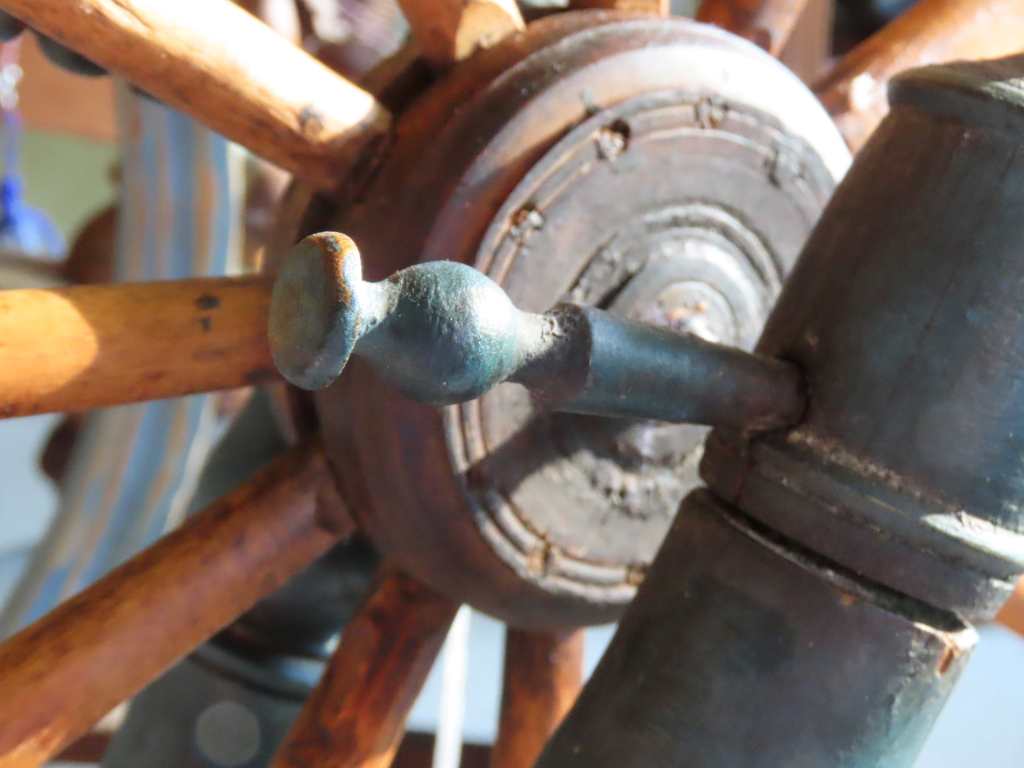
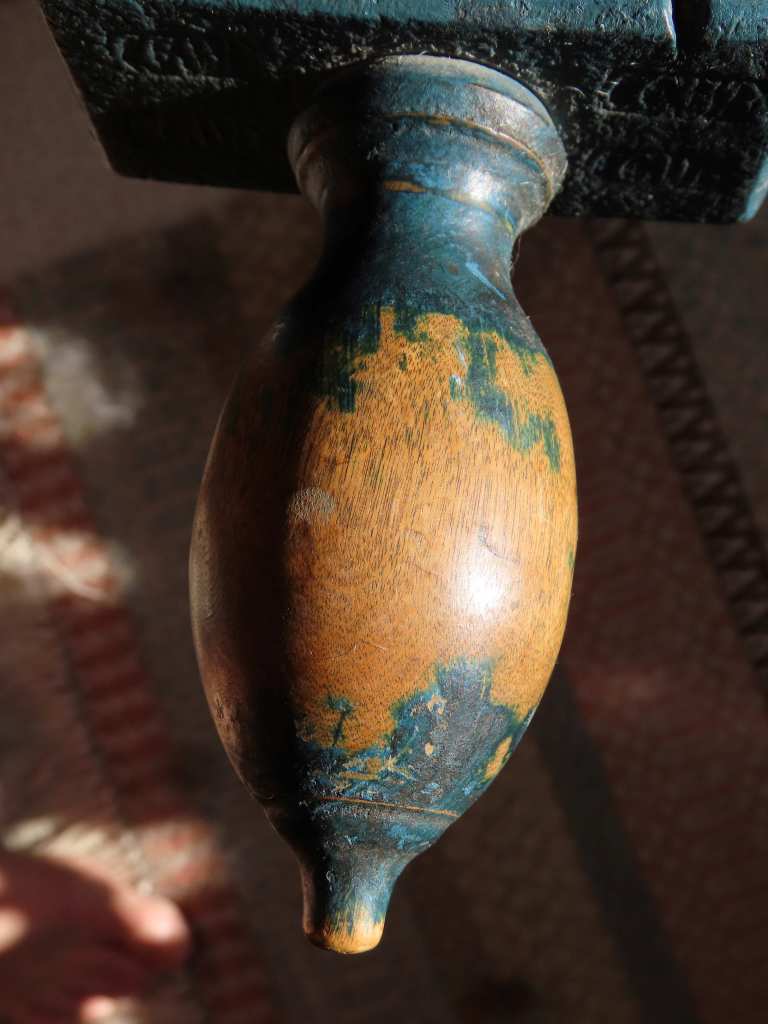
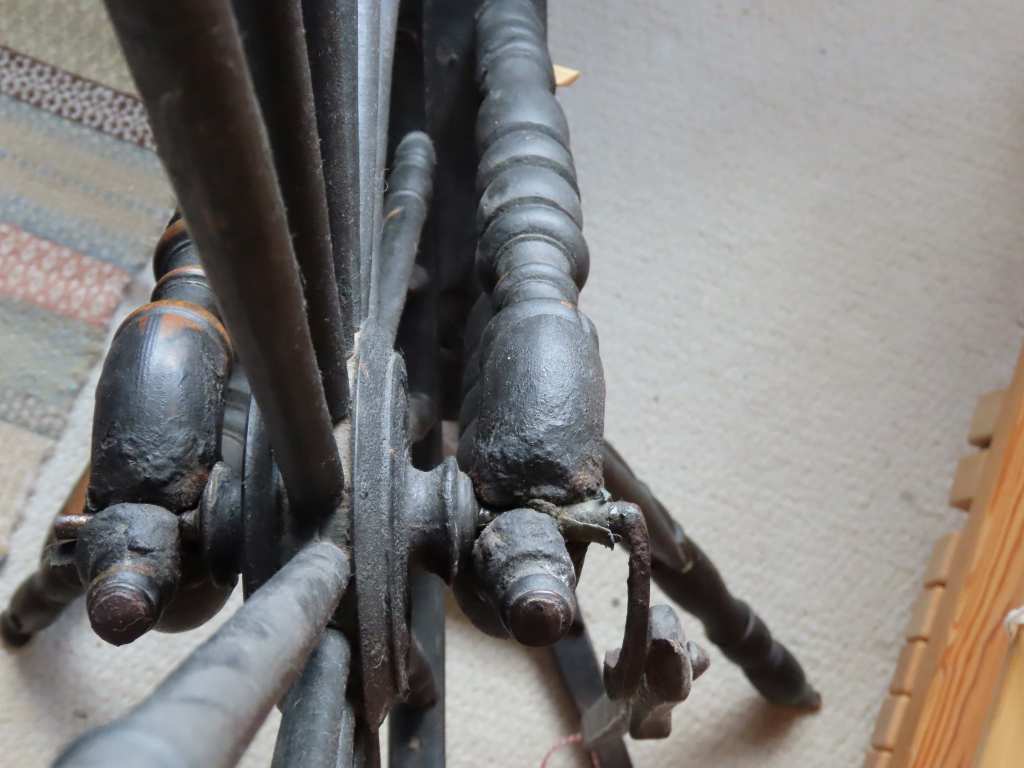
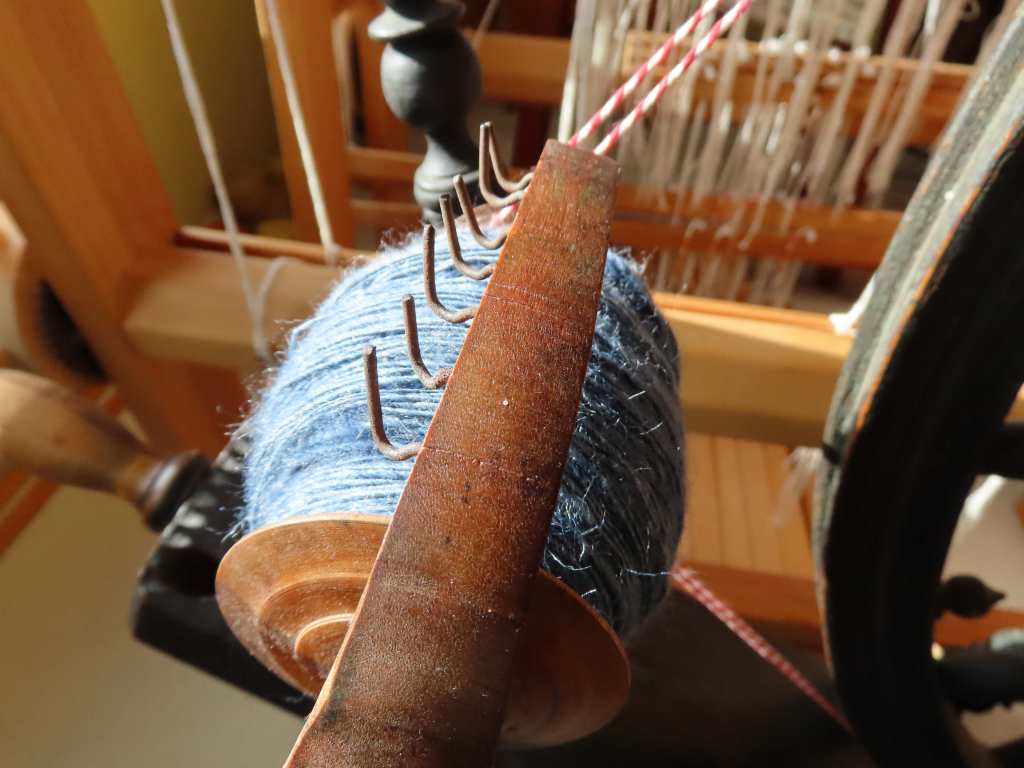
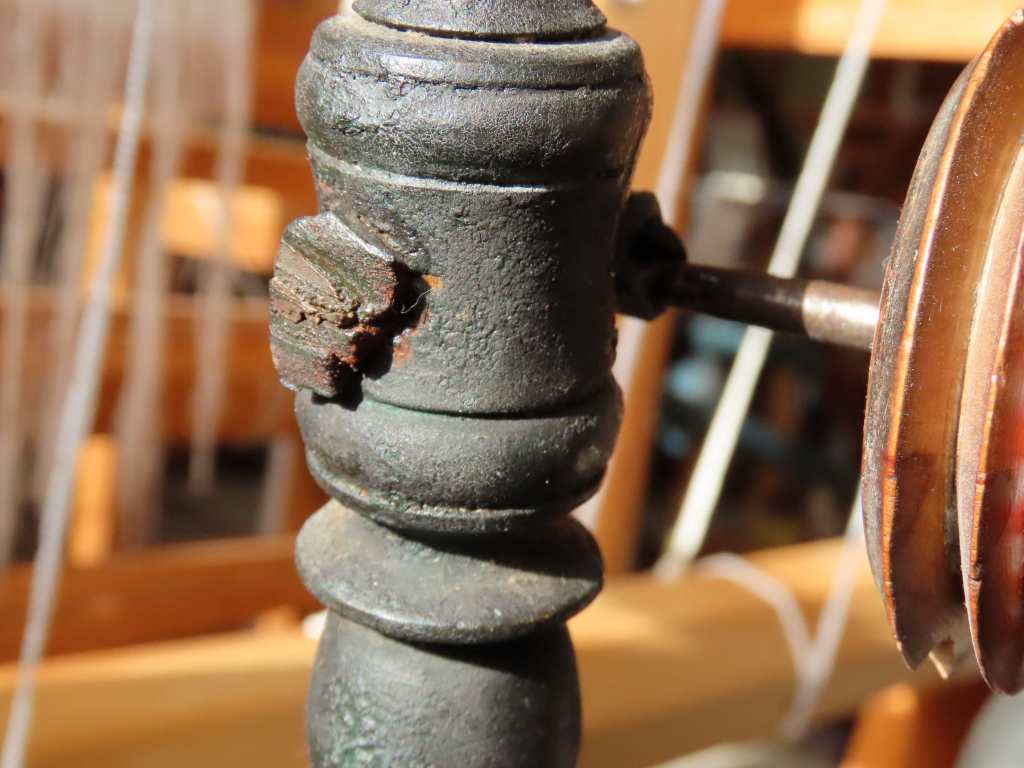
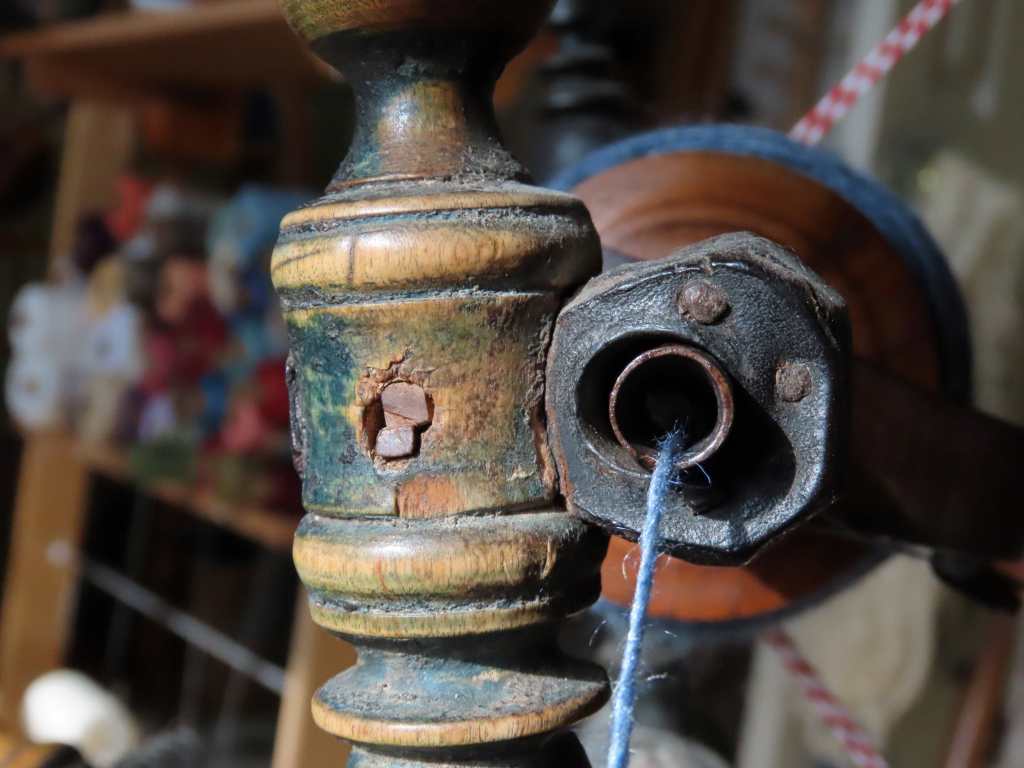
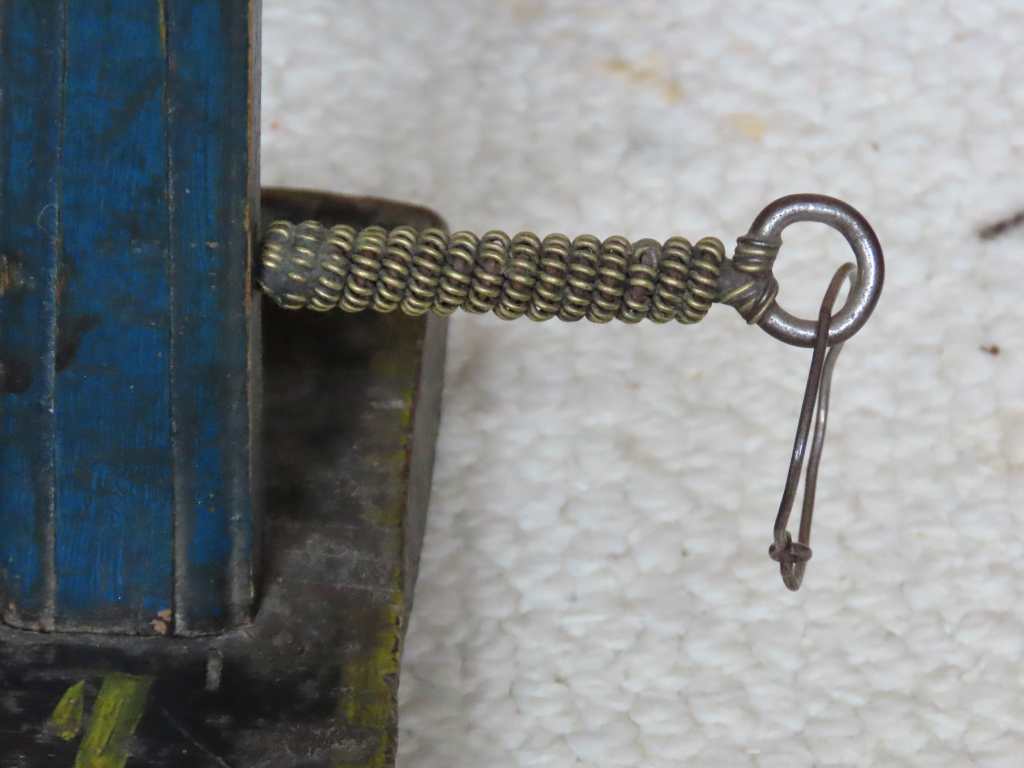
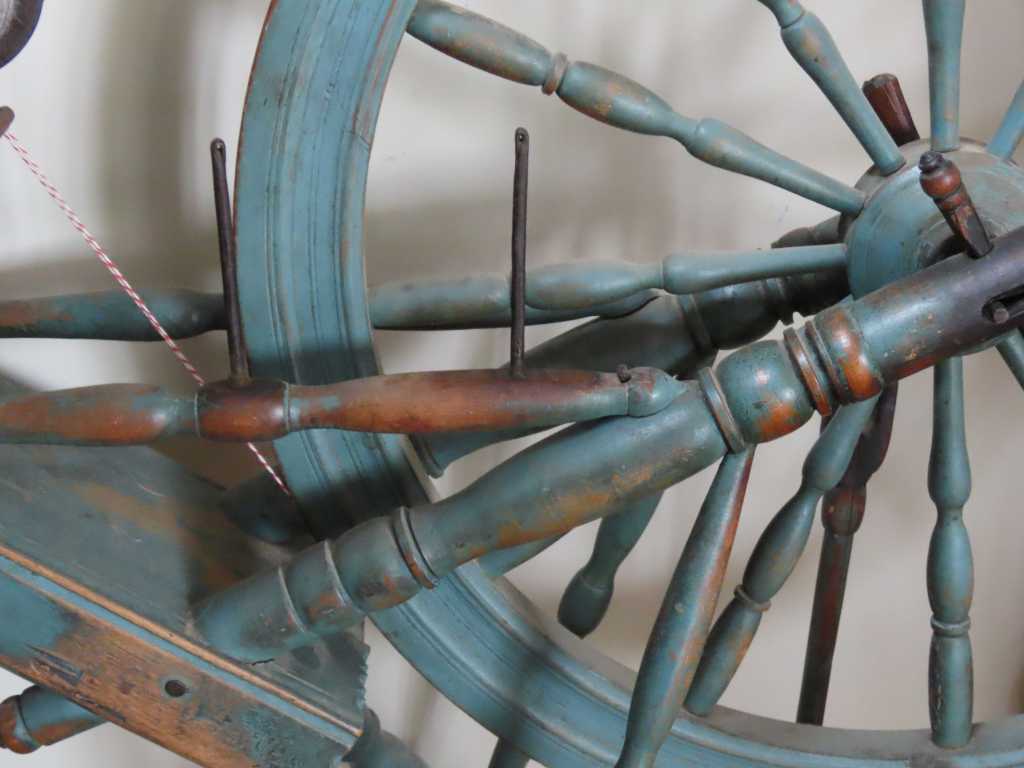
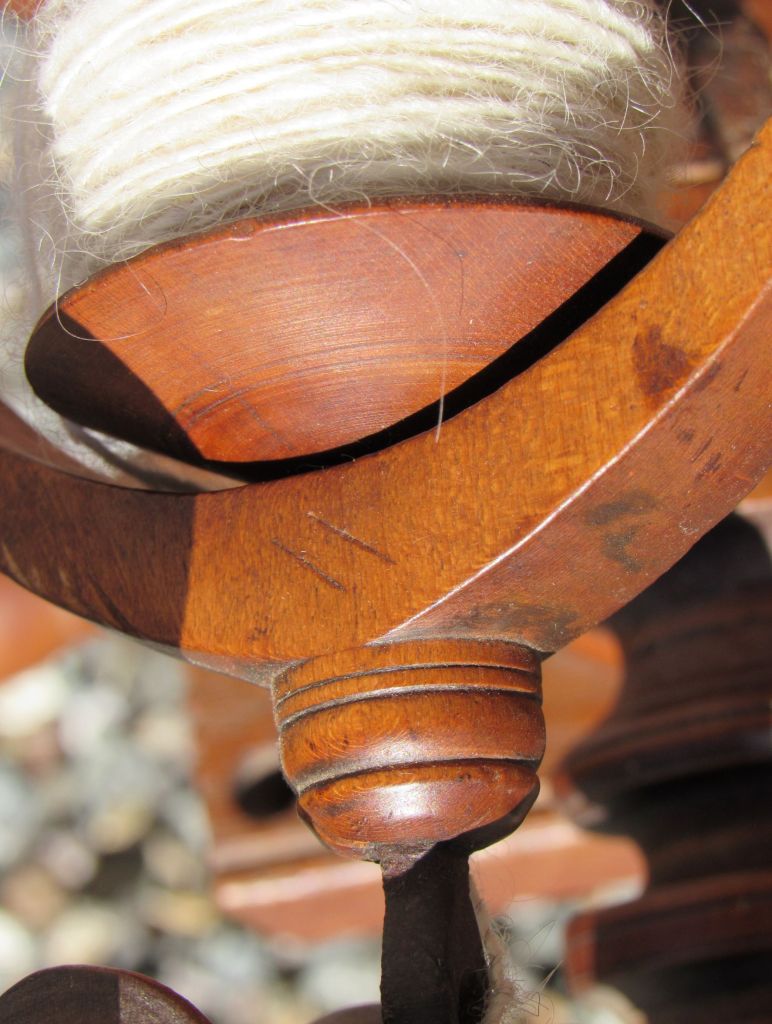
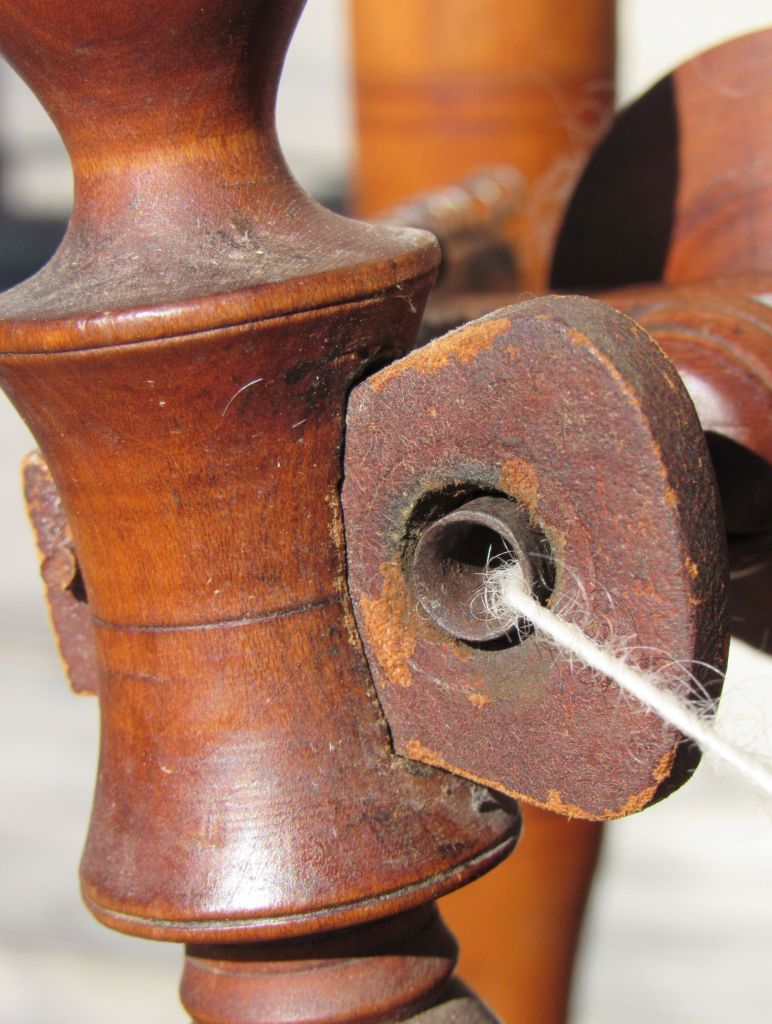
The front cross-bar support has two metal shafts, beautifully worked with folded tops.
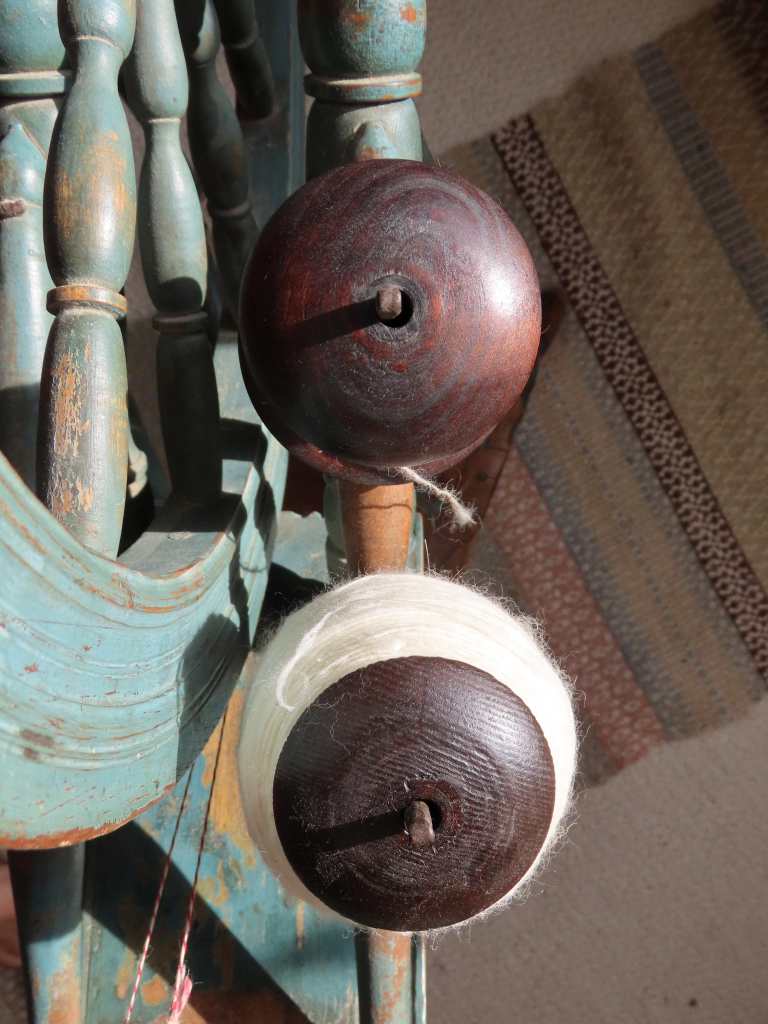
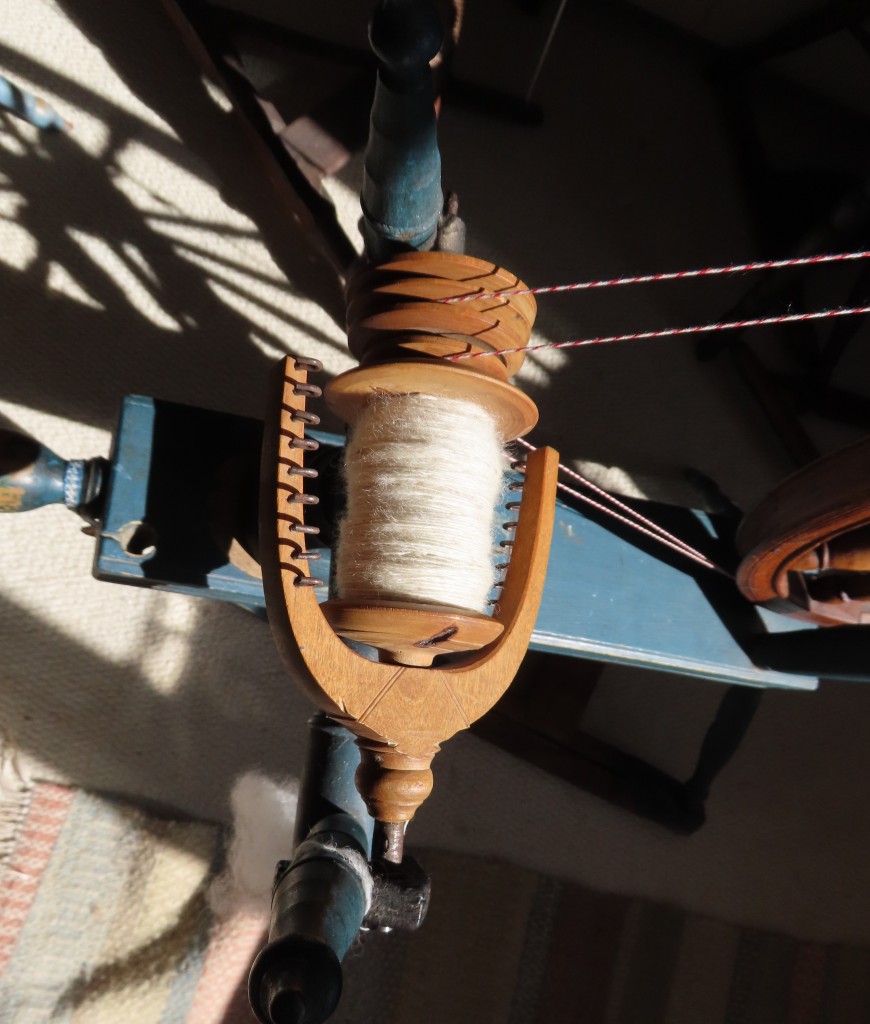
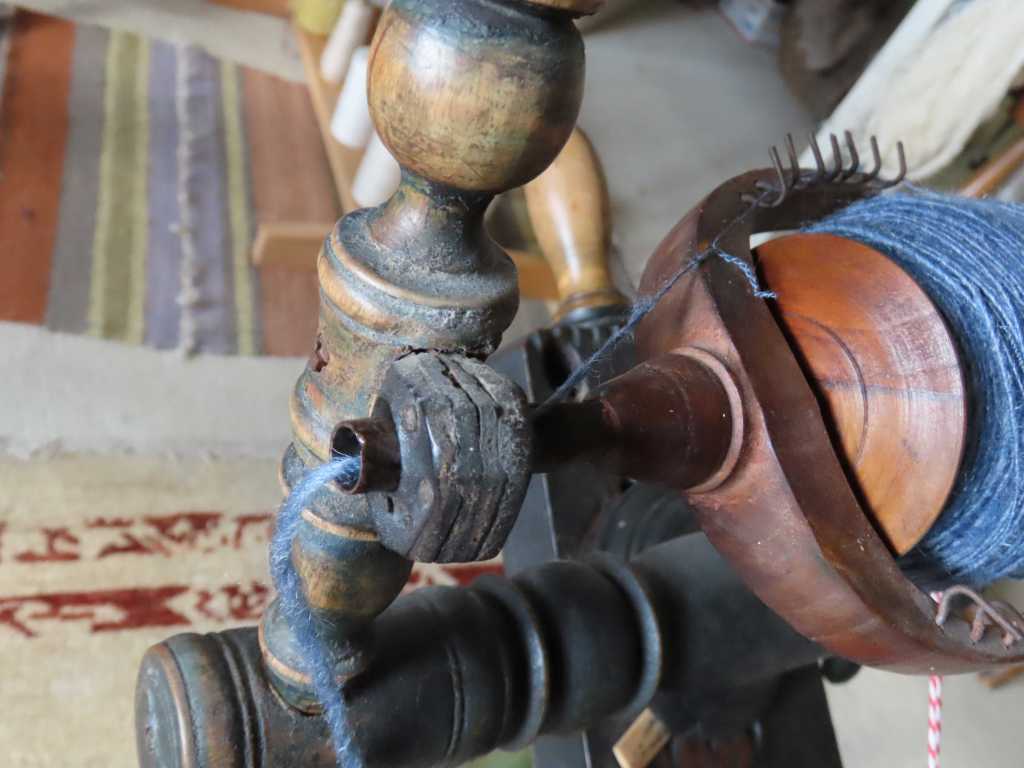
These can hold full bobbins, allowing the spinner to ply directly from the wheel.
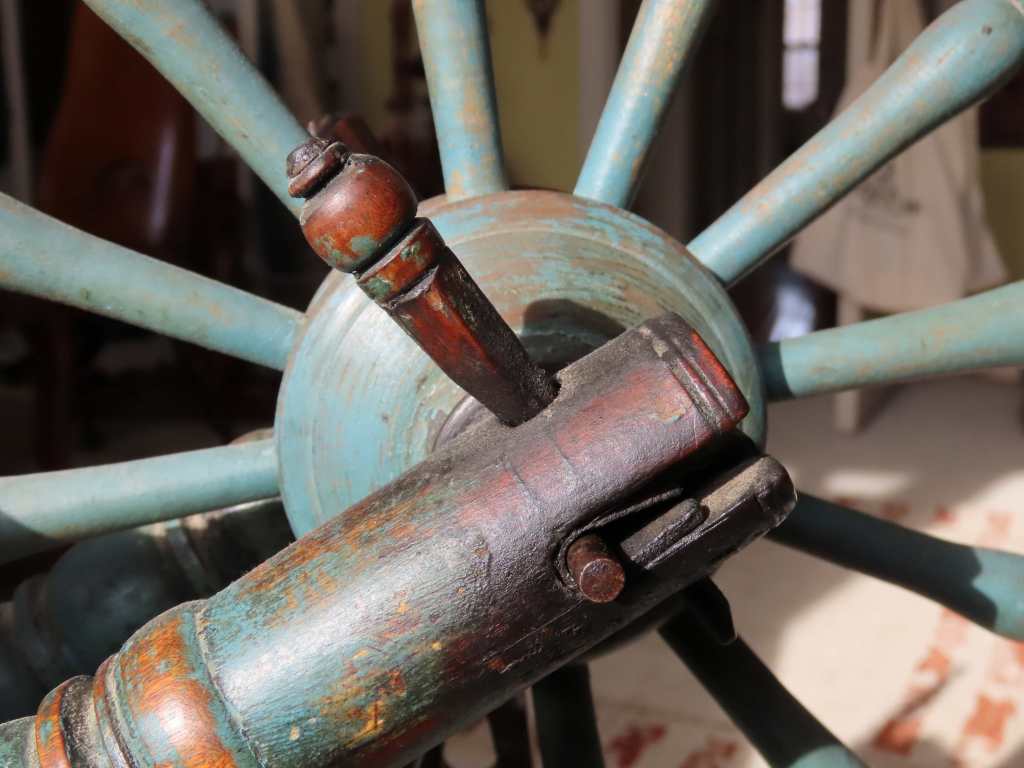
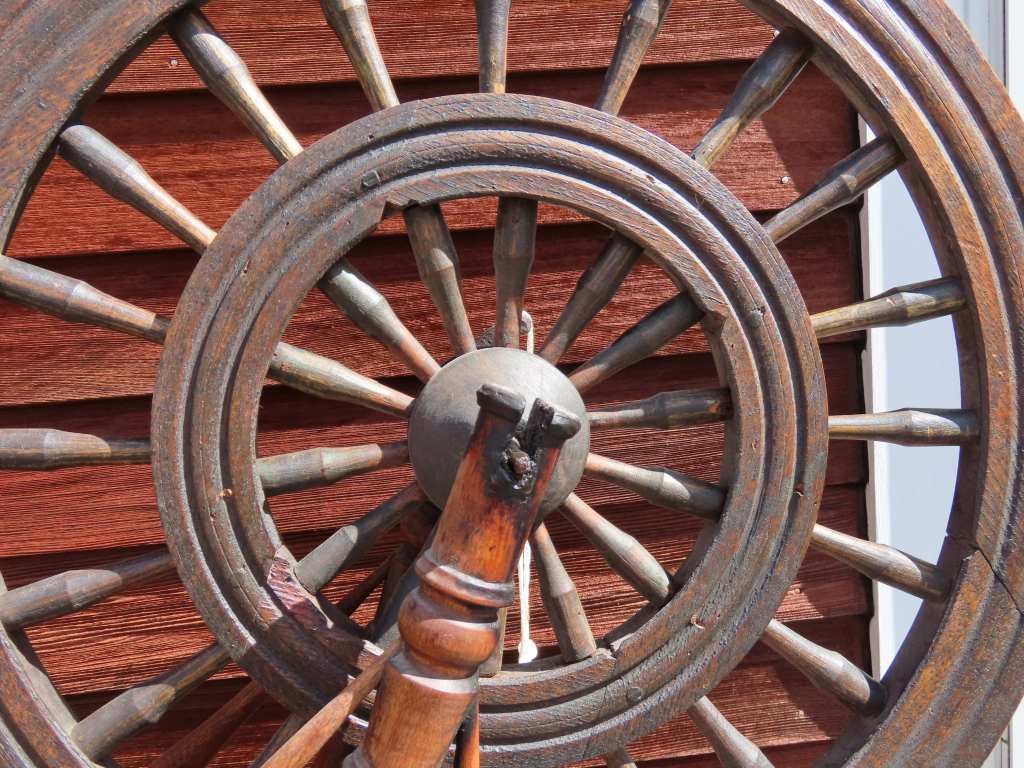
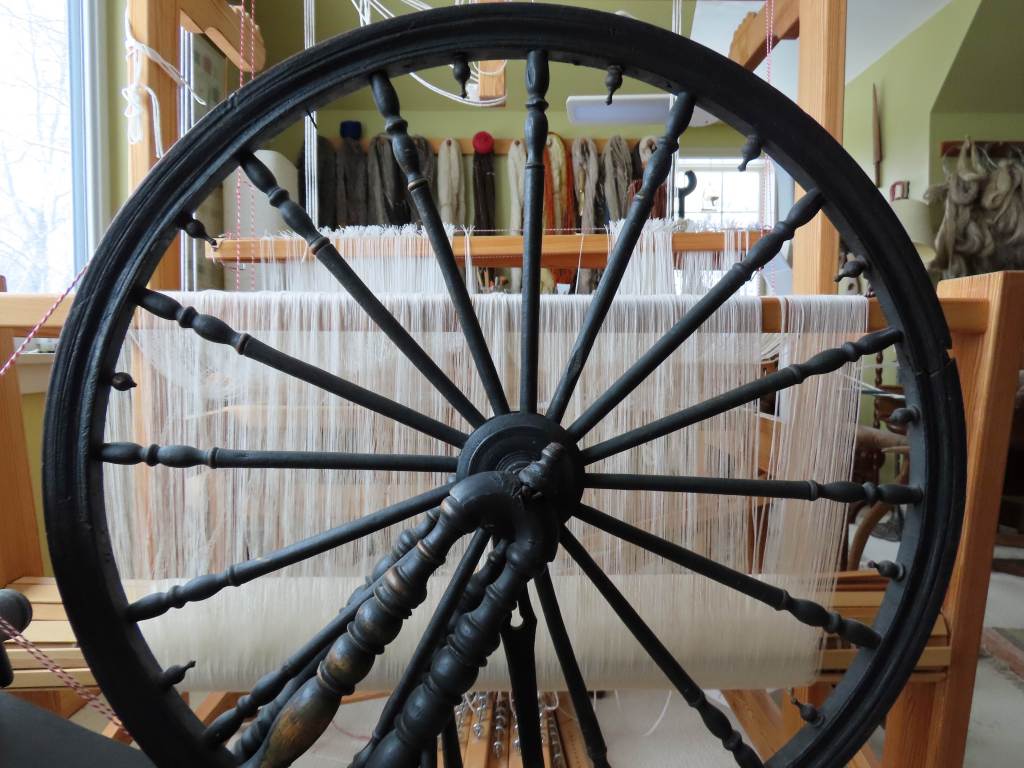
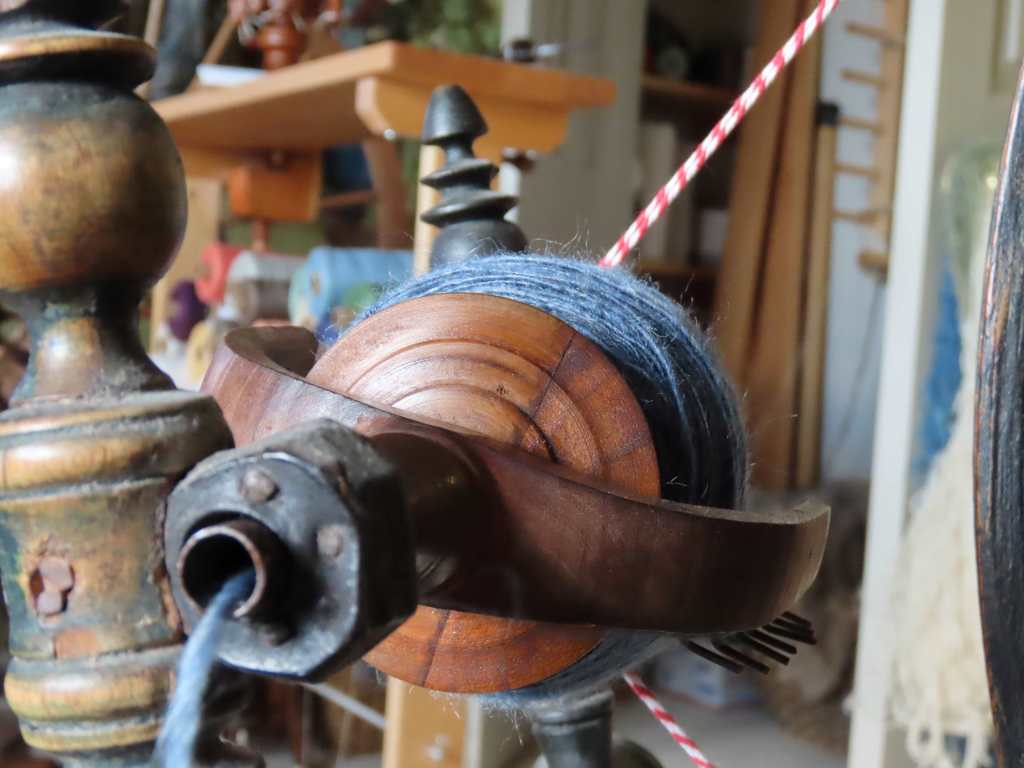
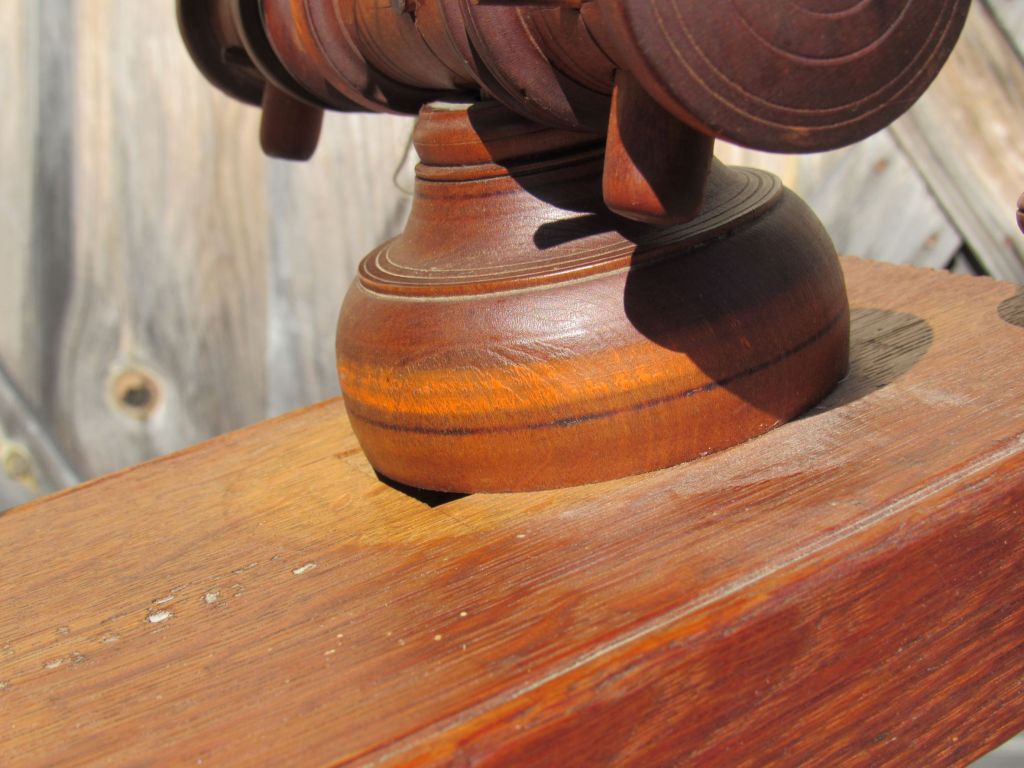
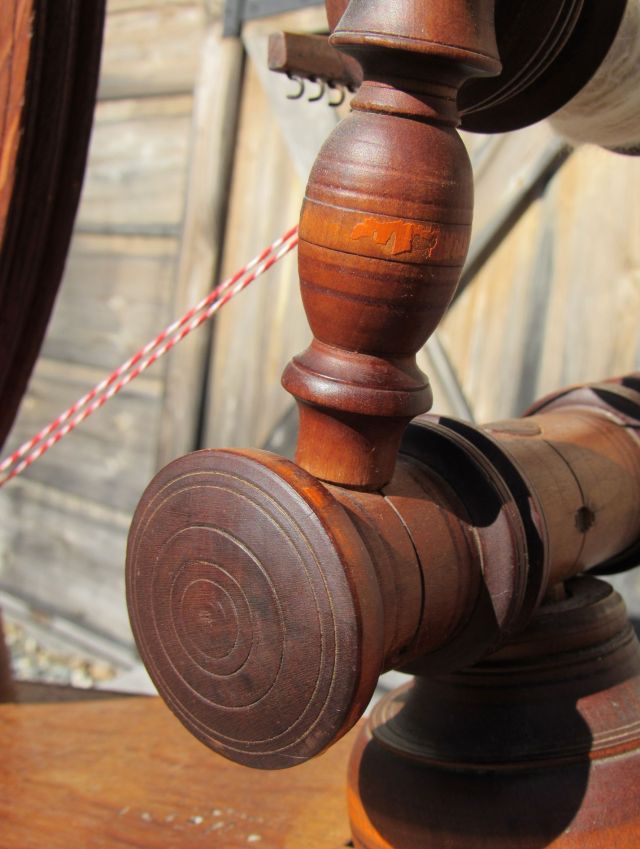
It is a handy, ingenious feature, made possible by a hub that is flat in the back, but with an extension on the spinner side to make space for the bobbins.
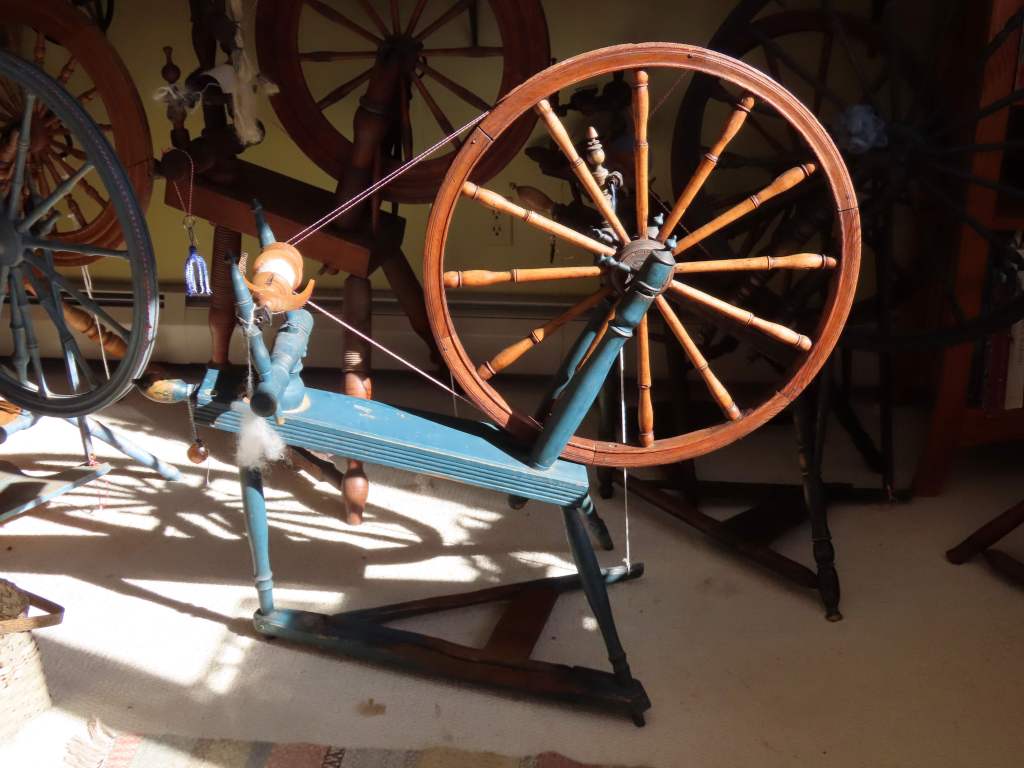
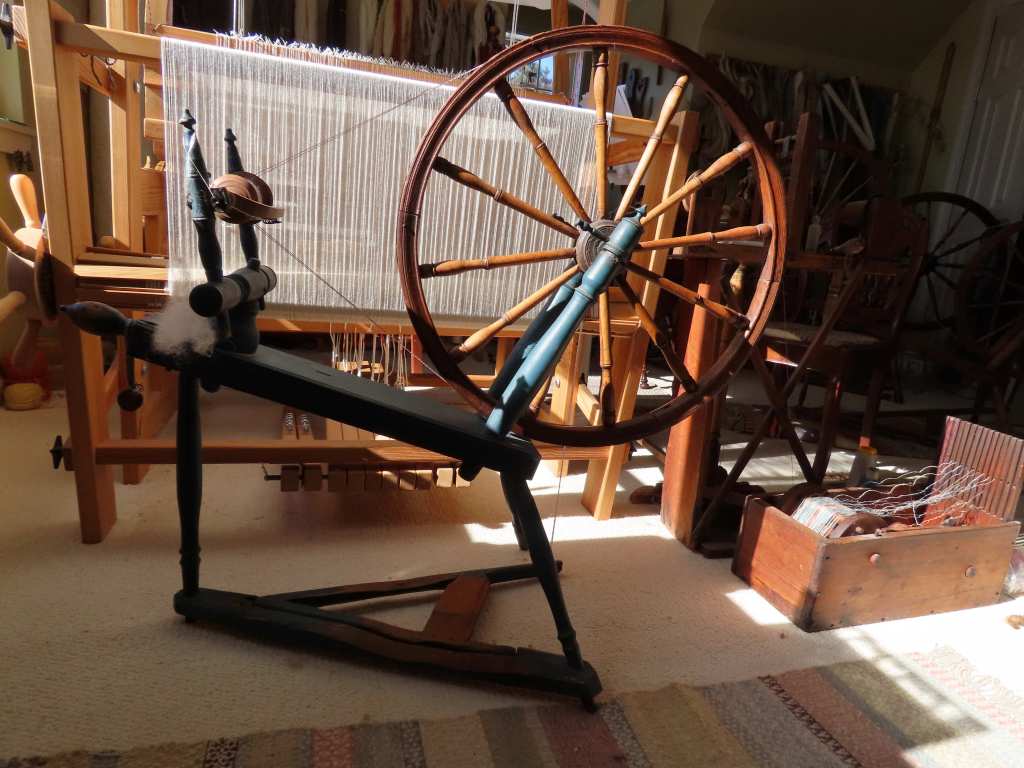
Solveig was found in northern Minnesota.
She is a workhorse, spinning and plying with ease.
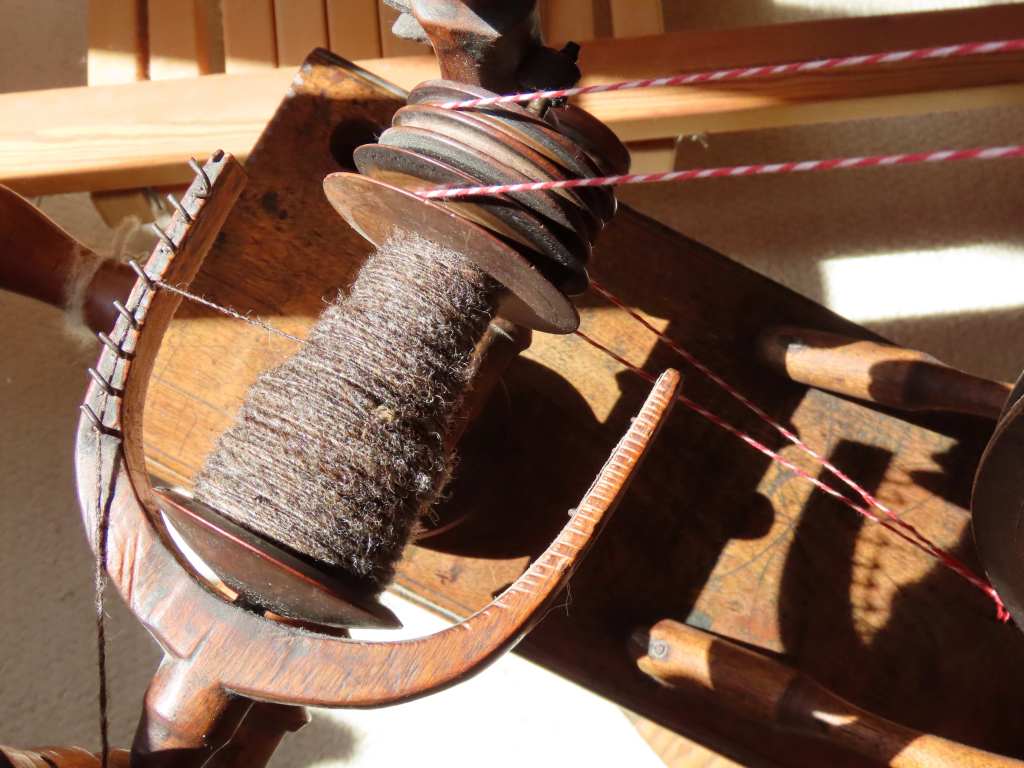
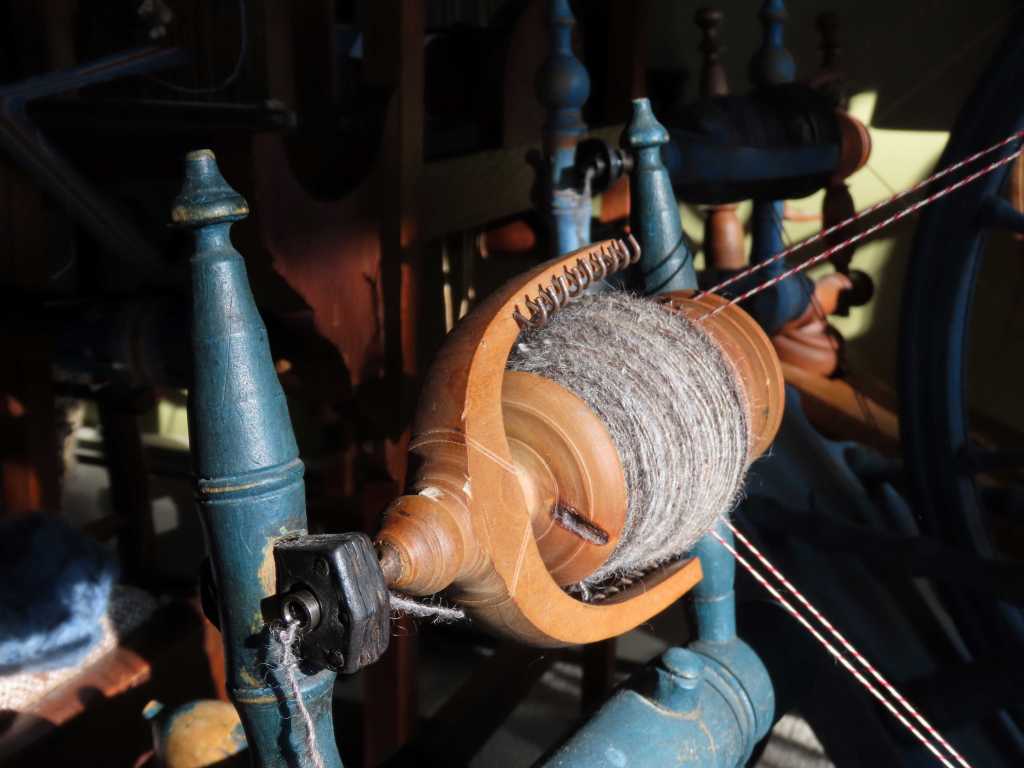
While many antique wheels have very little difference in the depth of the bobbin and whorl grooves, Solveig’s bobbin groove is much deeper than her two whorl grooves.
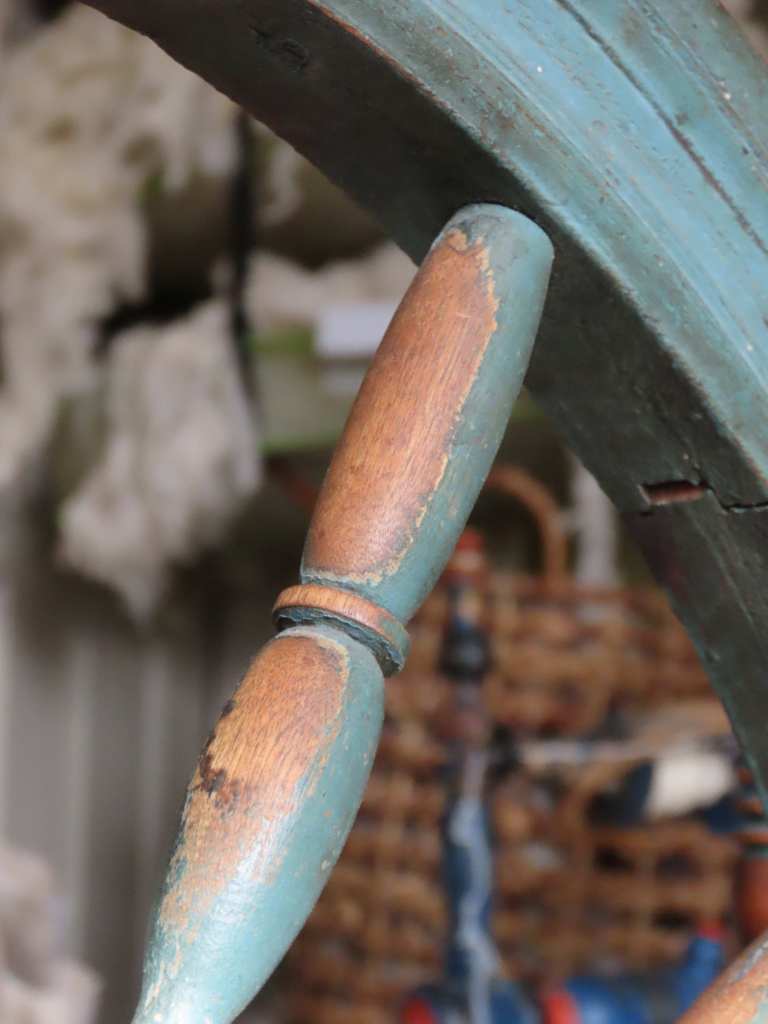
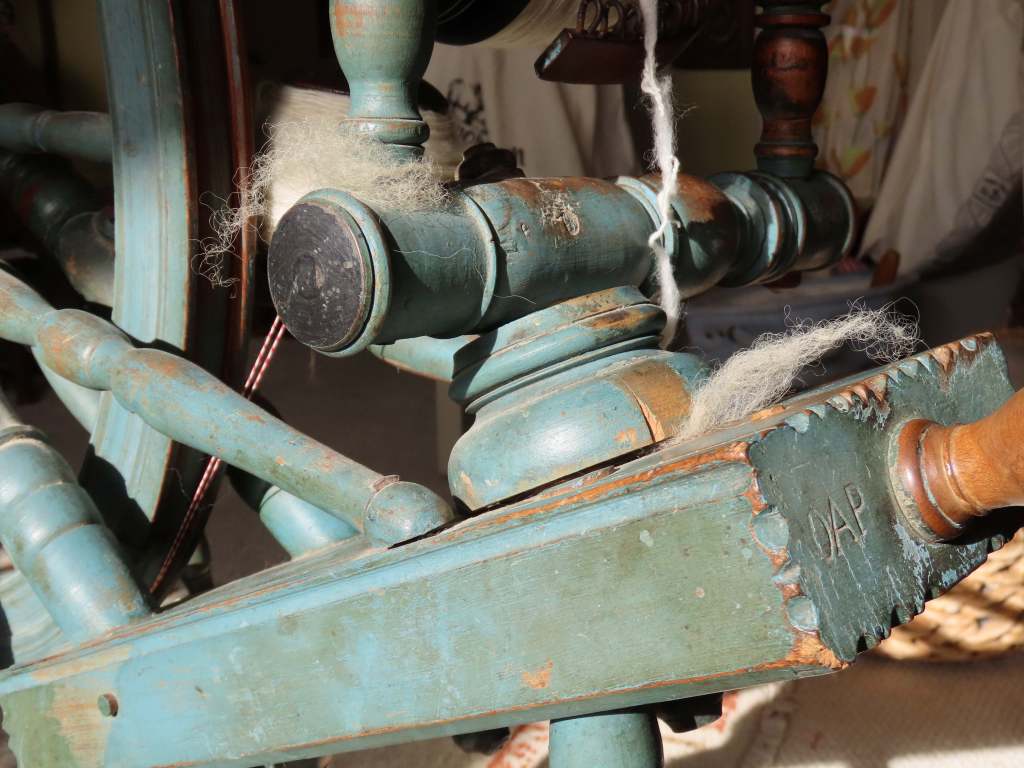
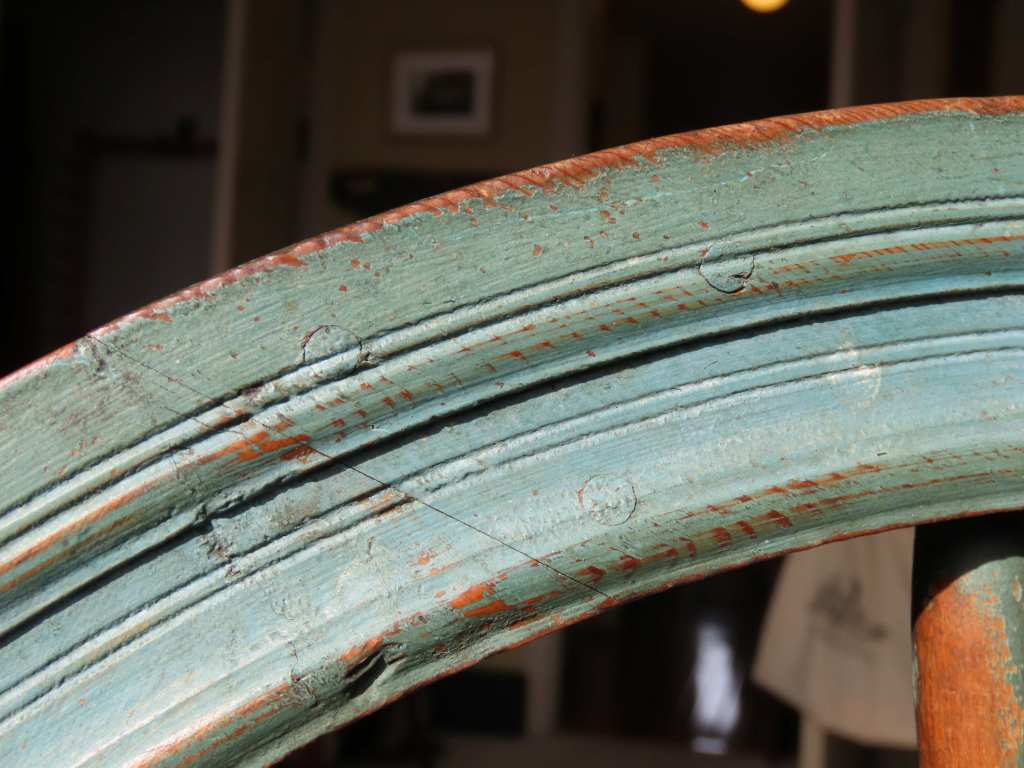
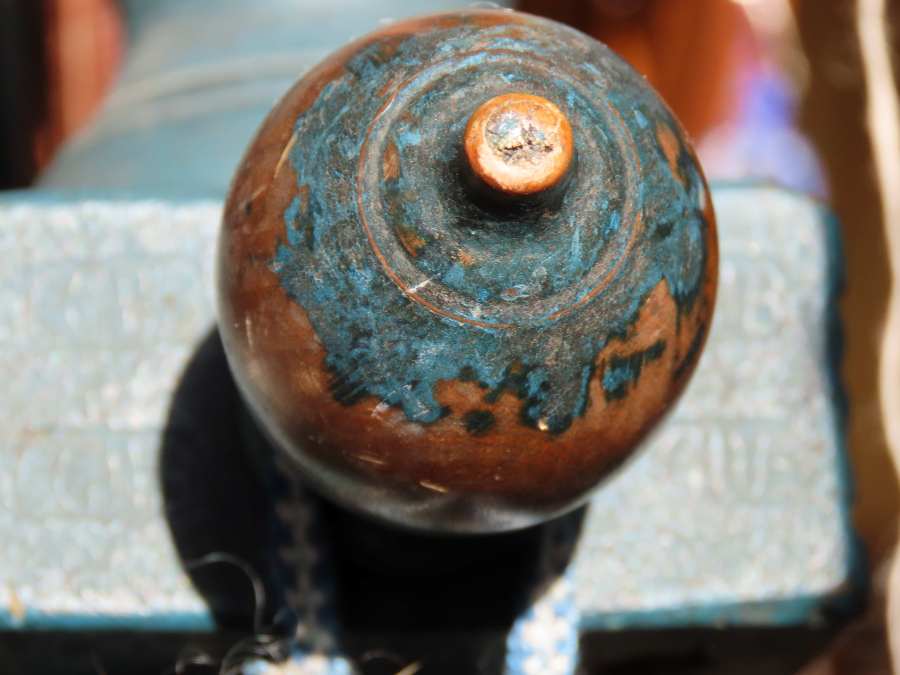
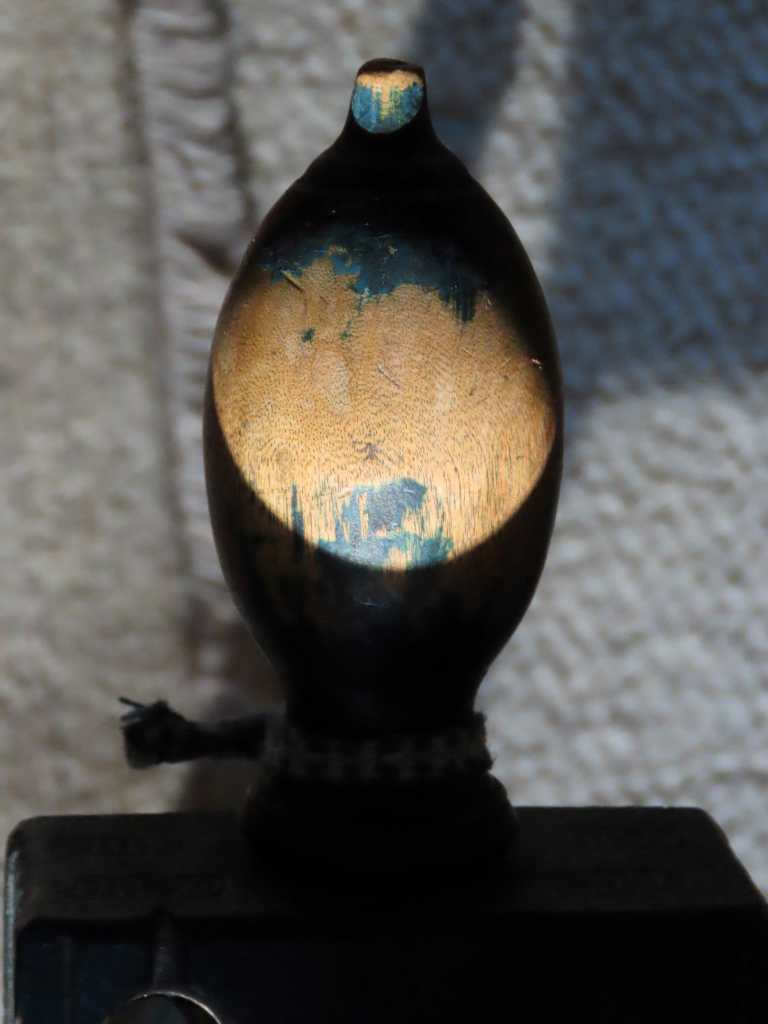
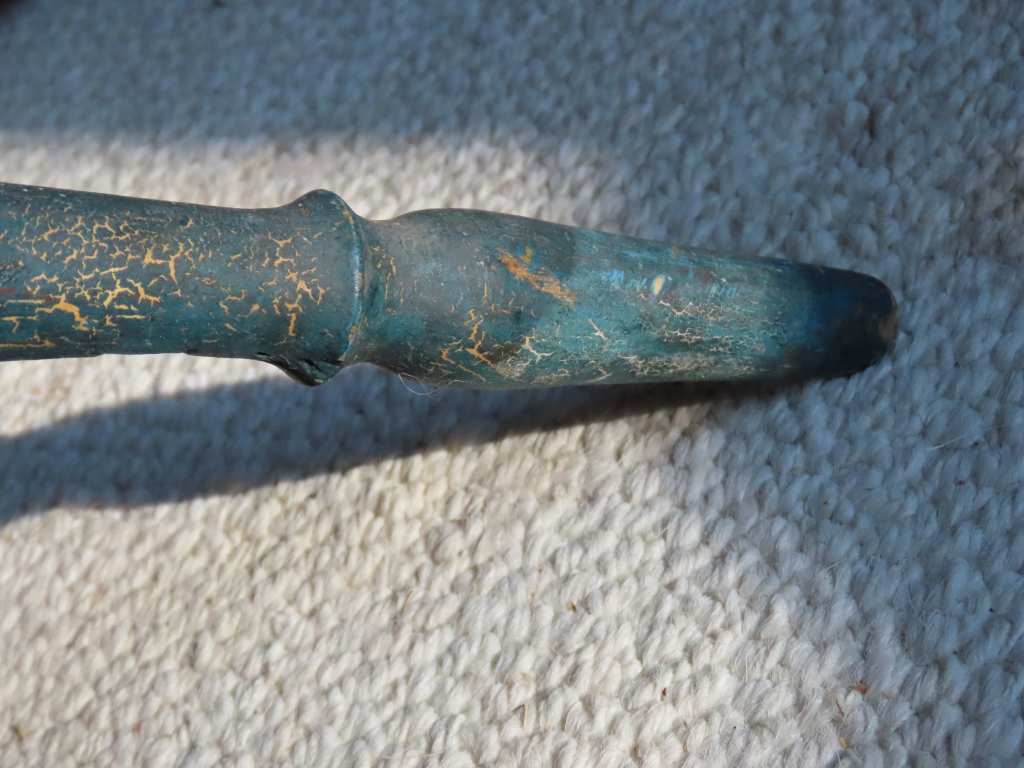
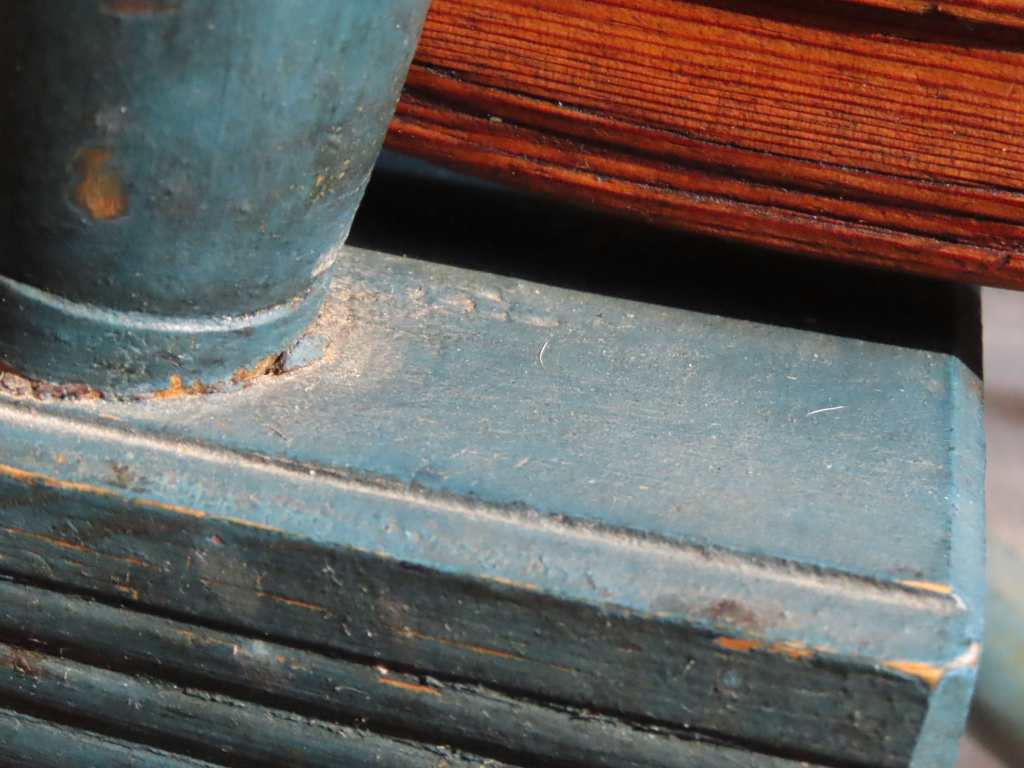
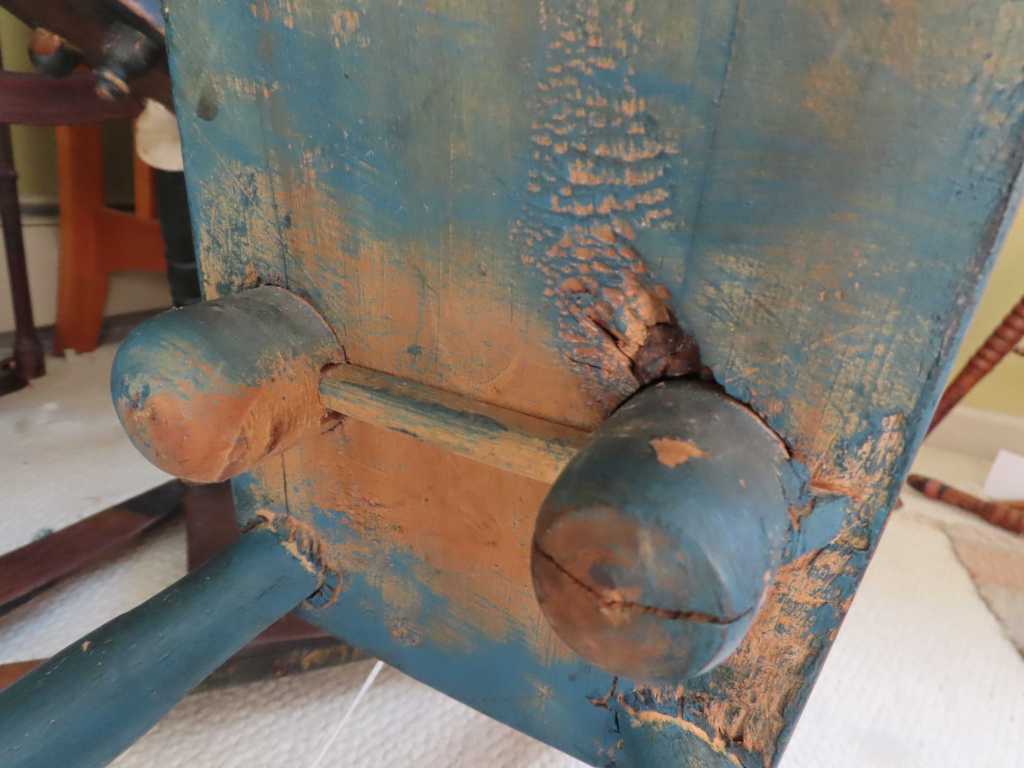
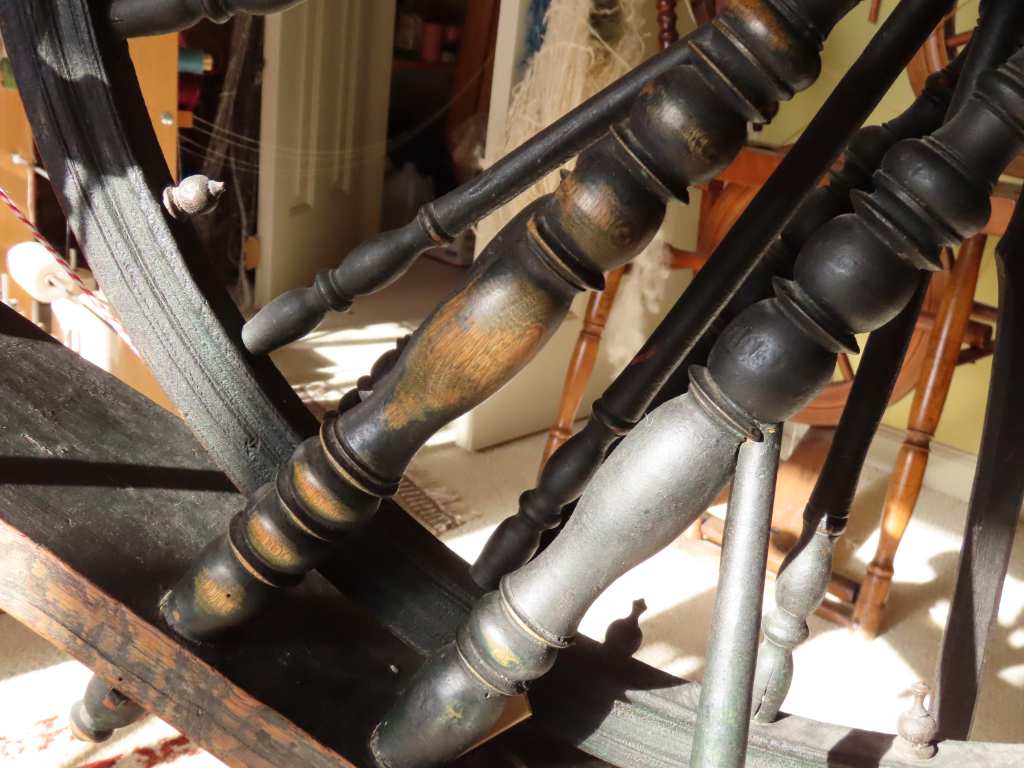
The gorgeous blue-green paint shows the typical wear made by women spinners wearing long skirts.
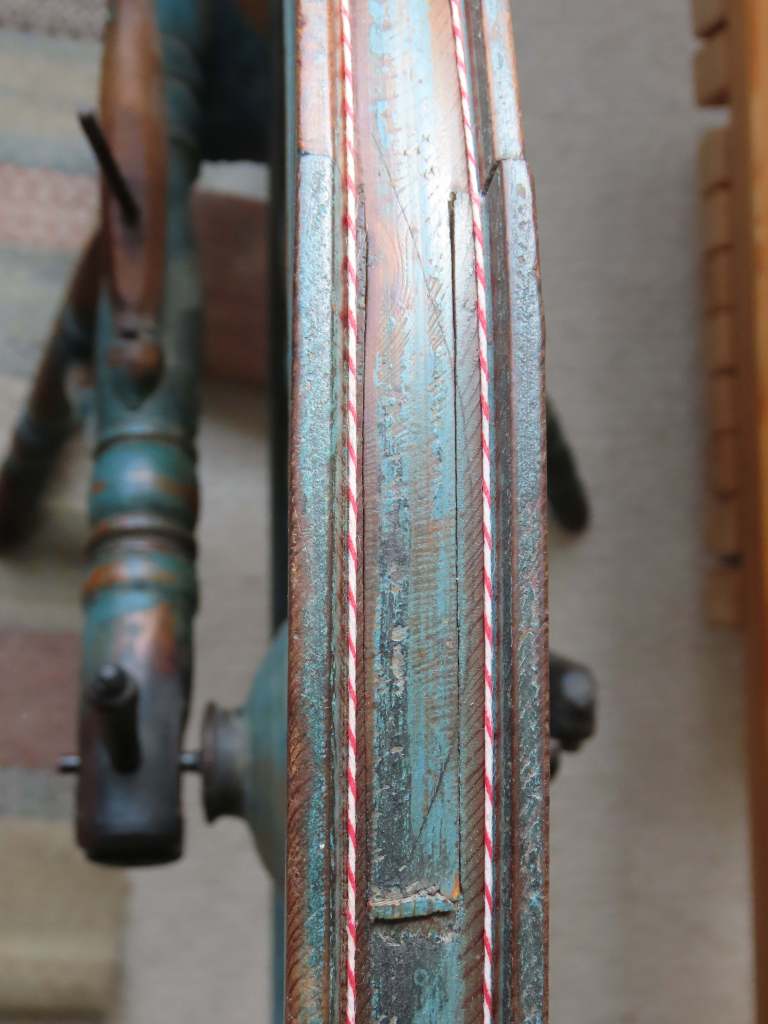
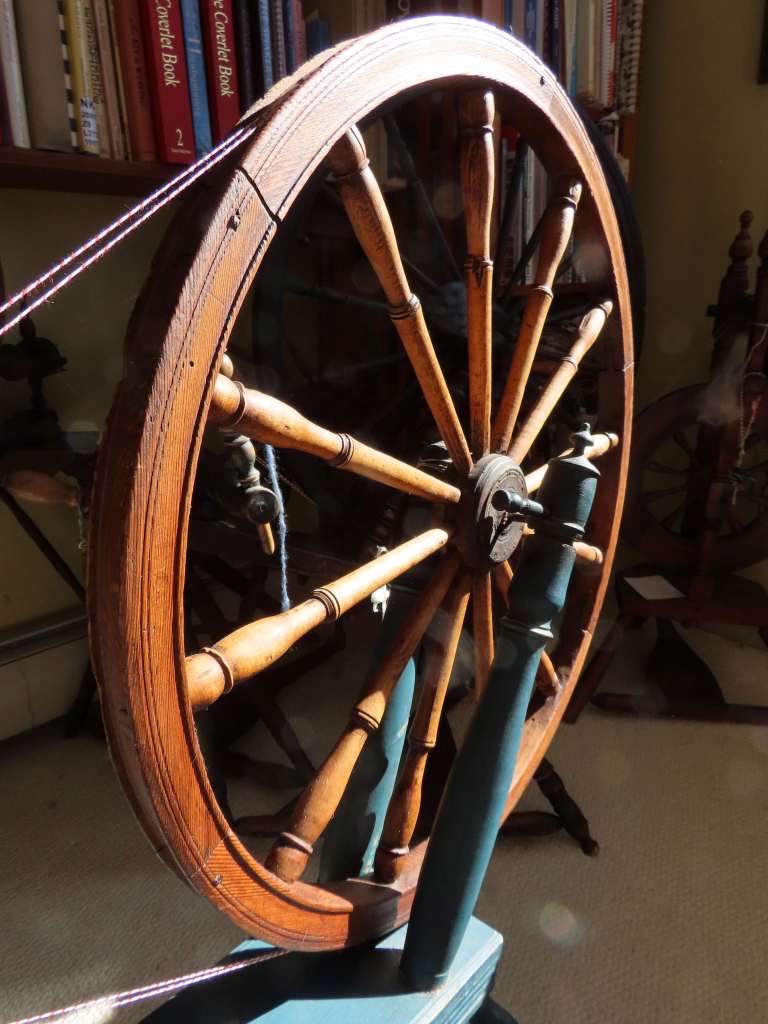
Paint wear on the spokes confirms that the drive wheel was turned in both directions, using the lazy kate for plying, although there is more wear on spokes indicating clockwise turning.
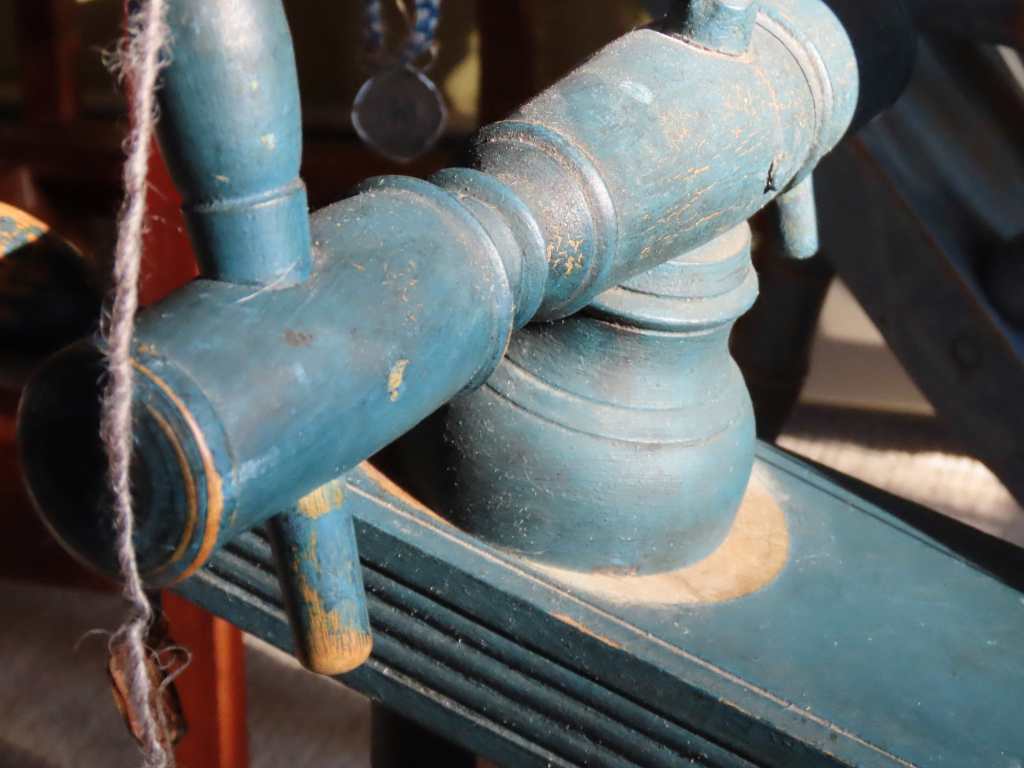
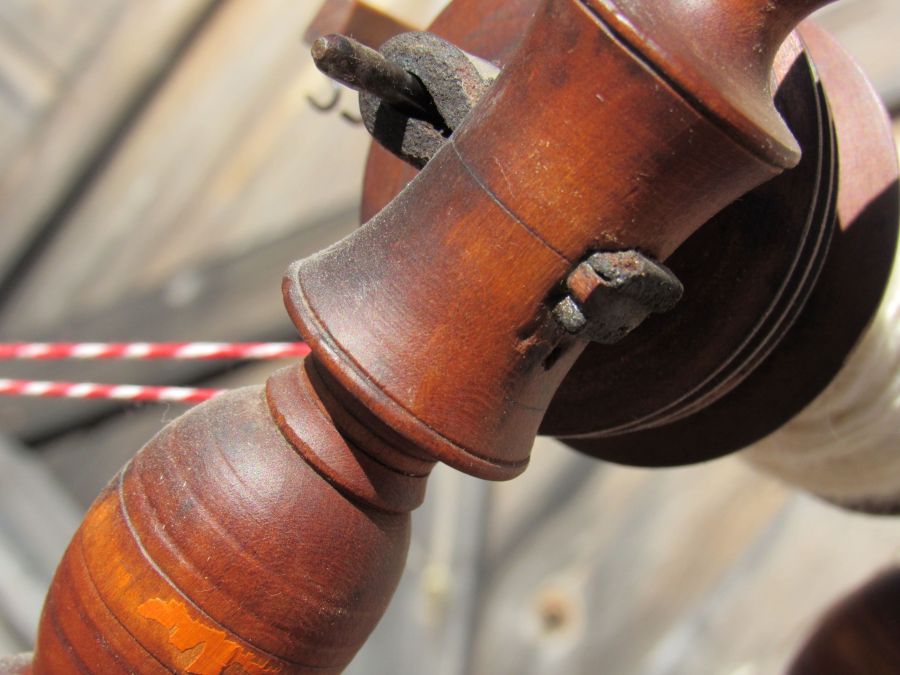
The front maiden has wear marks in a somewhat unusual place near the bottom, where spun thread was wound around it, probably when unwinding the bobbin.
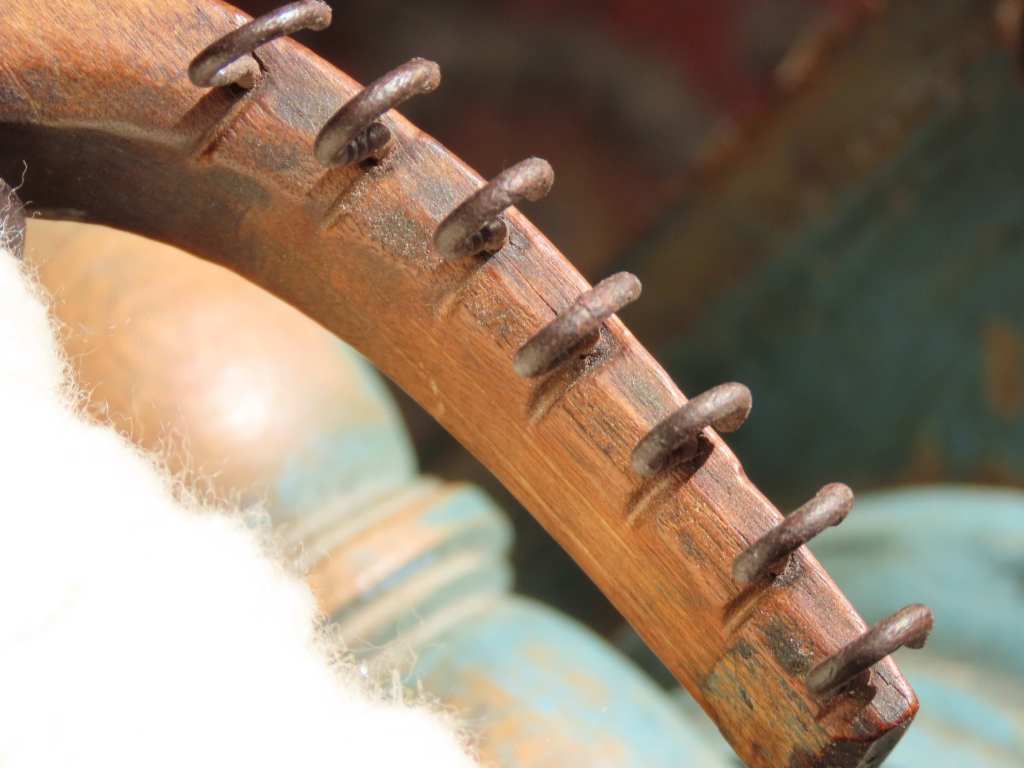
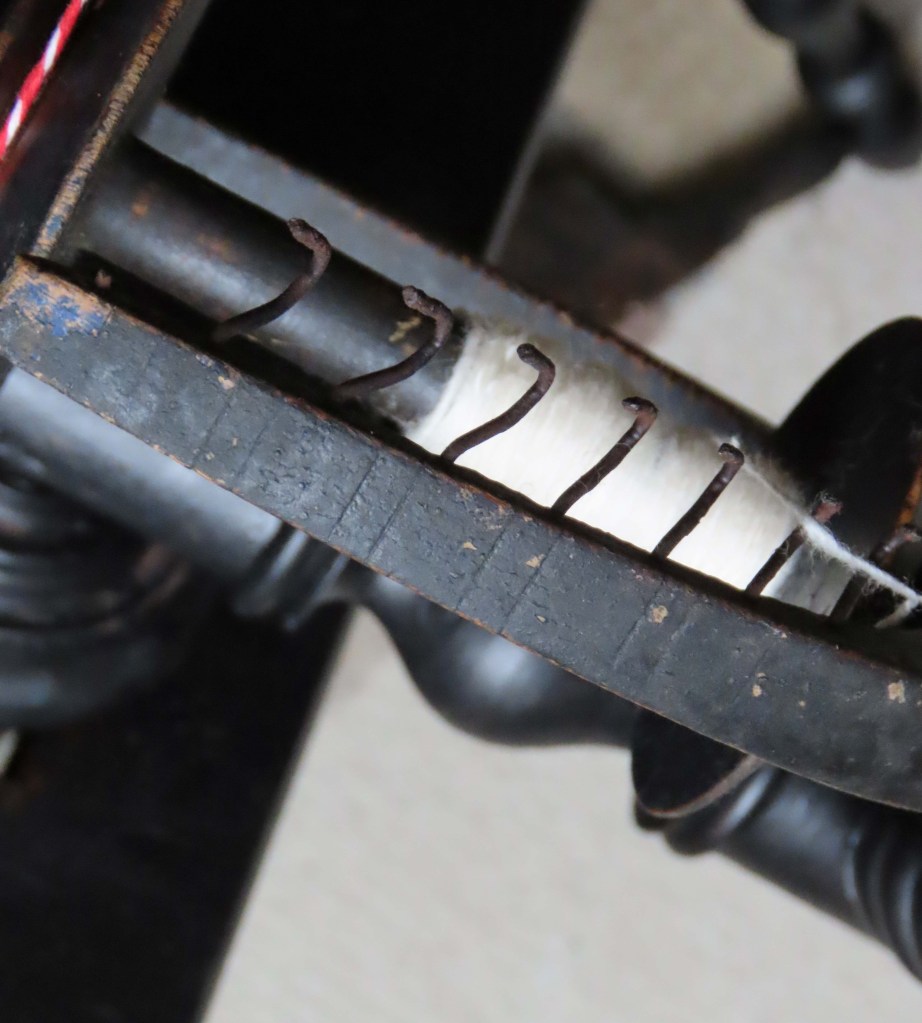
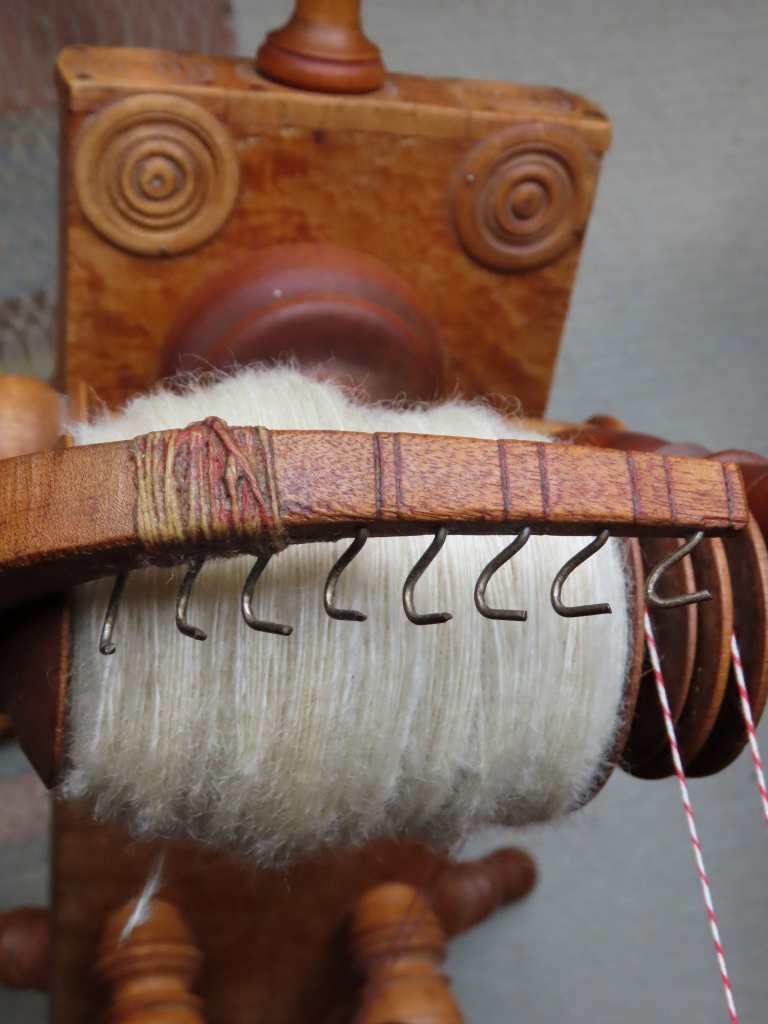
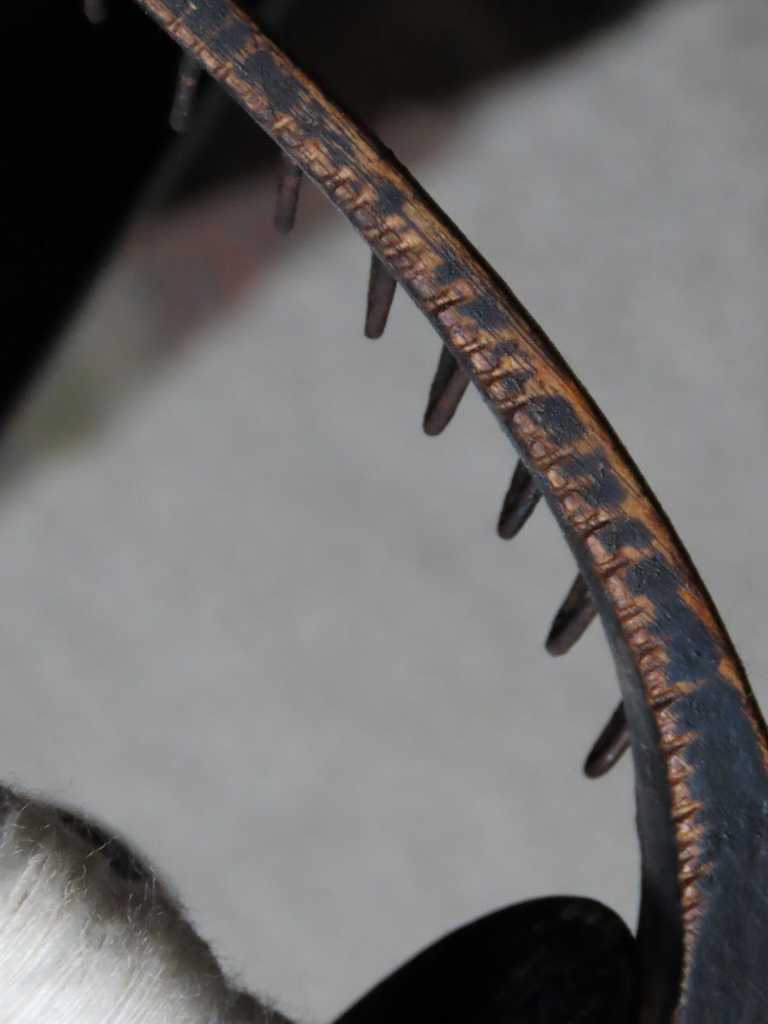
Deep grooves run alongside the flyer hooks–again a wear pattern that is out of the ordinary.
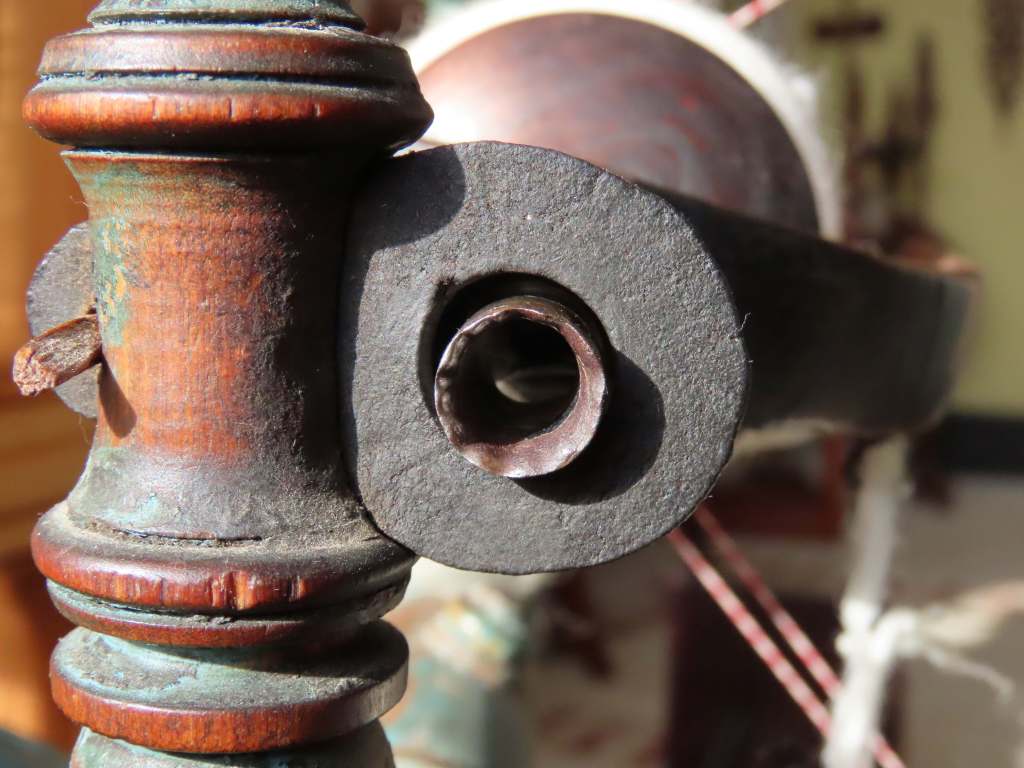
The orifice opening is slightly fluted,
with a opening big enough for easy plying.
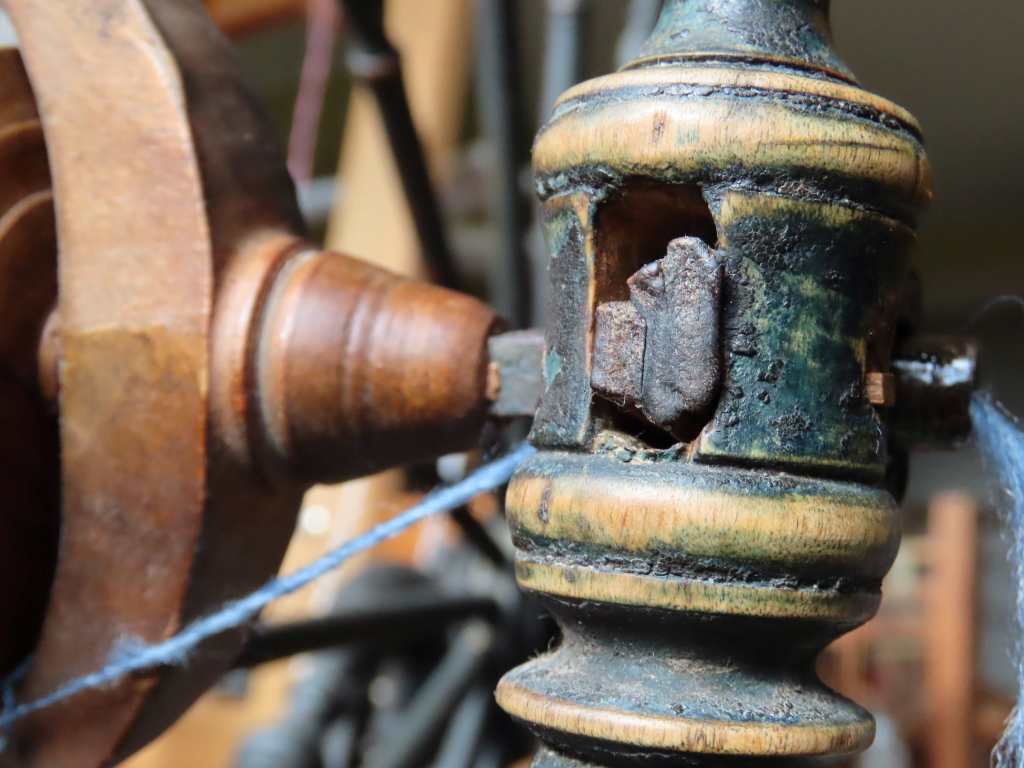
and there is wear on the far side of the mandrel where it hits the bearing.
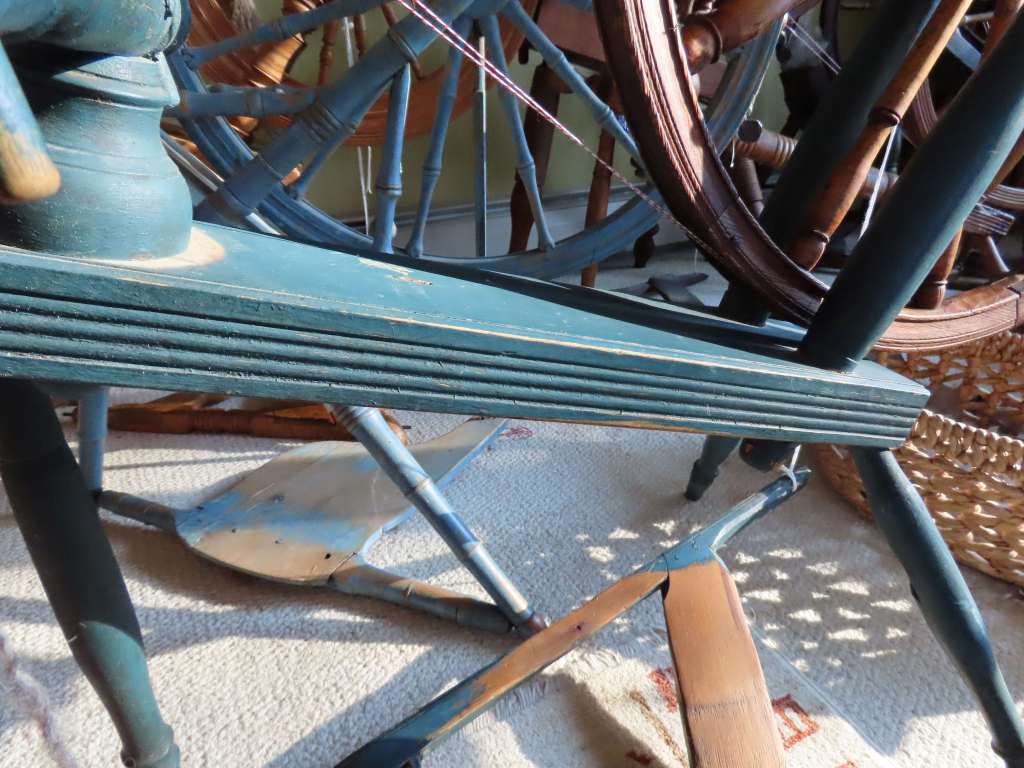
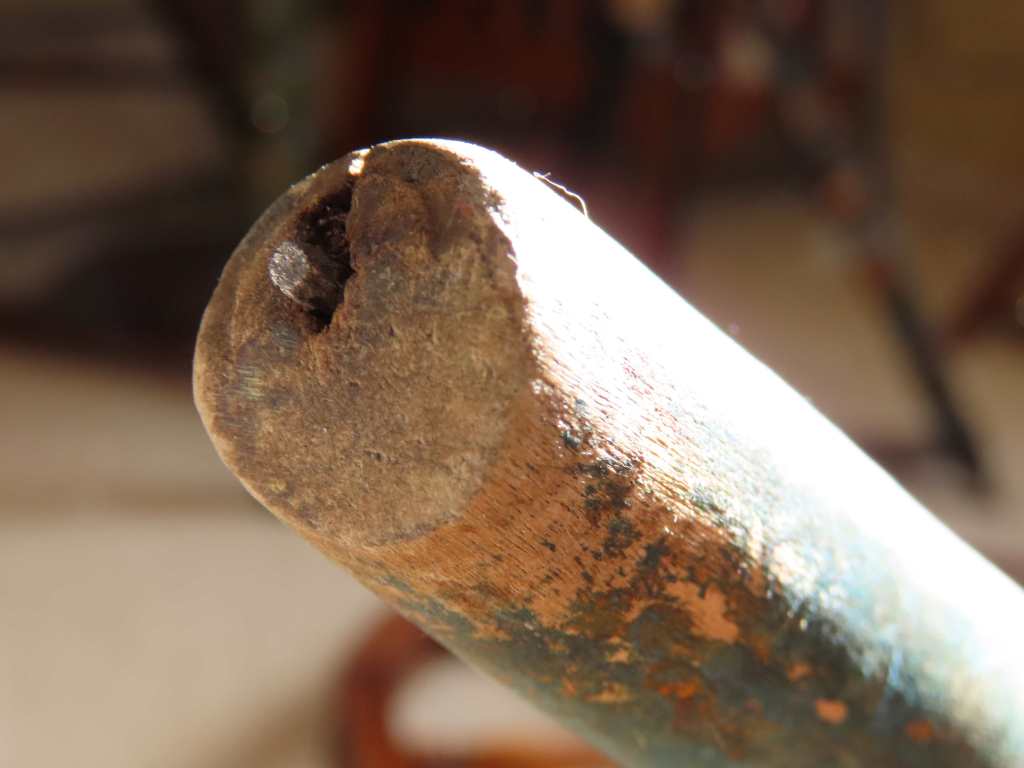
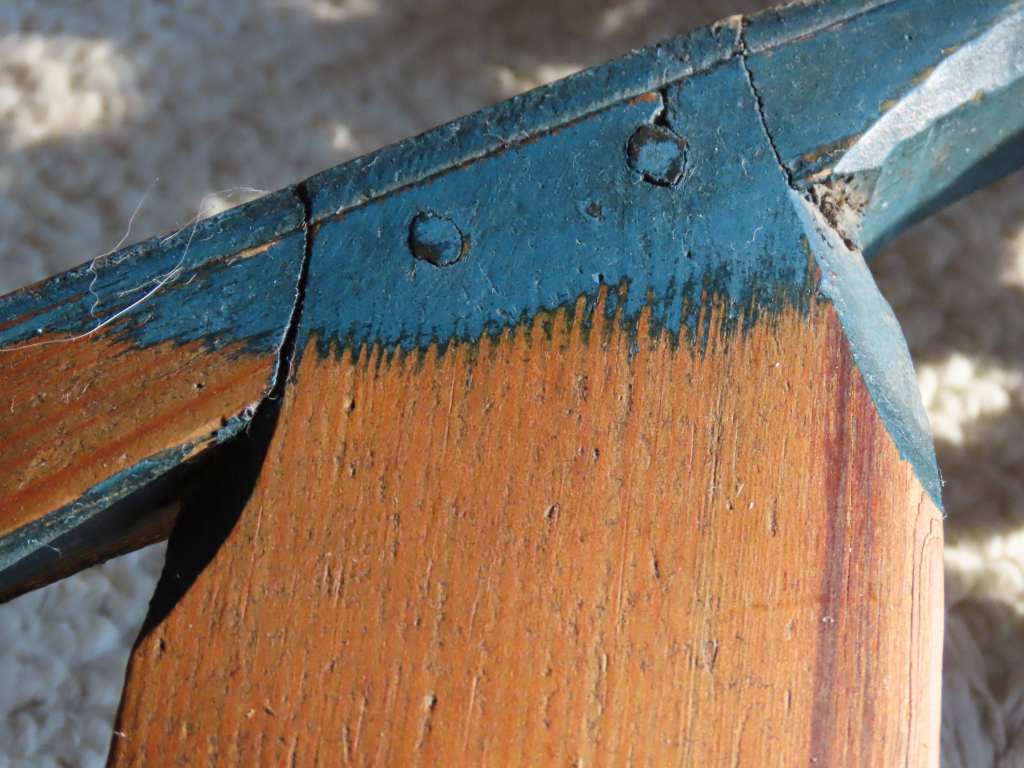
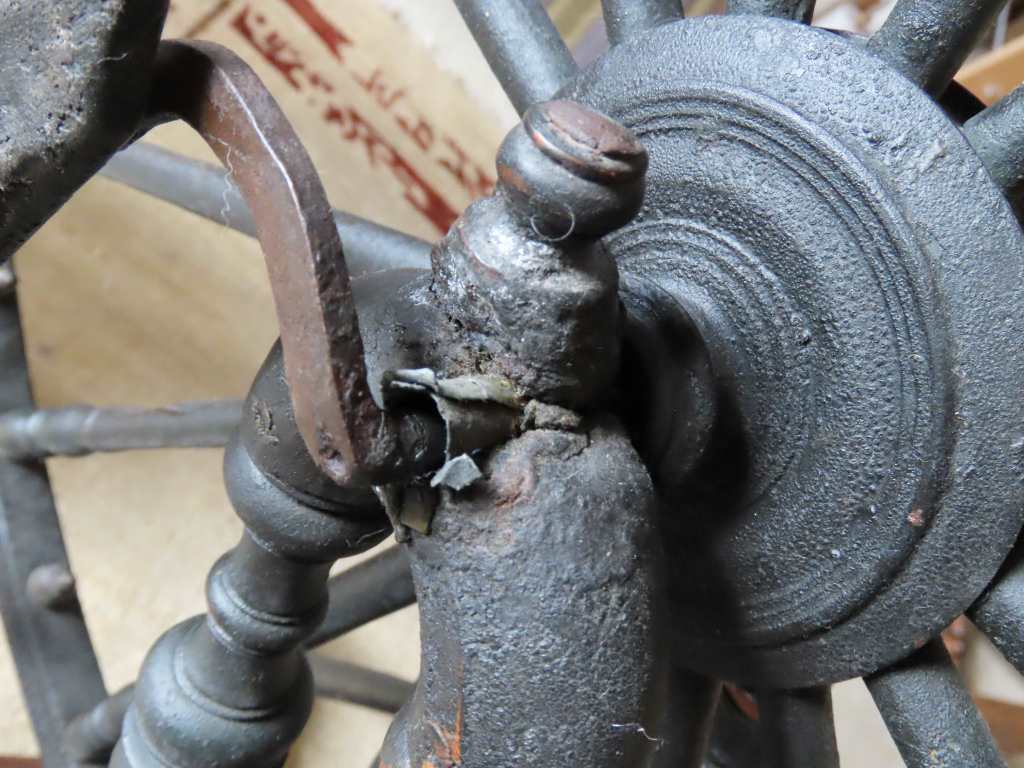
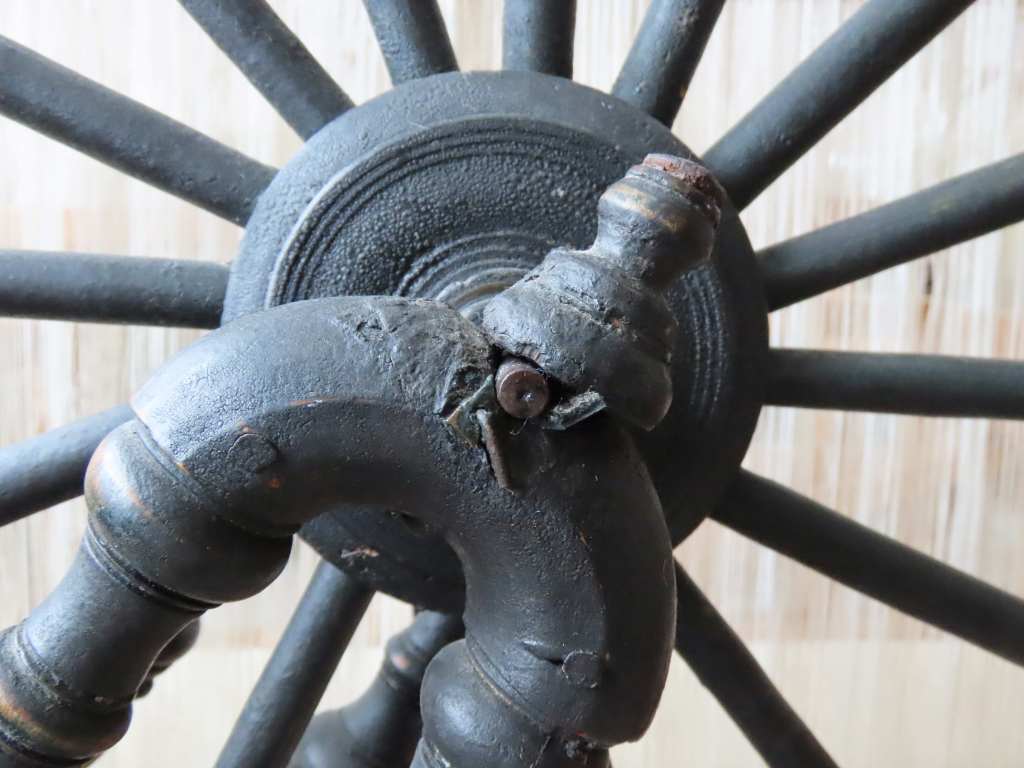
The footman has been repaired with a screw.
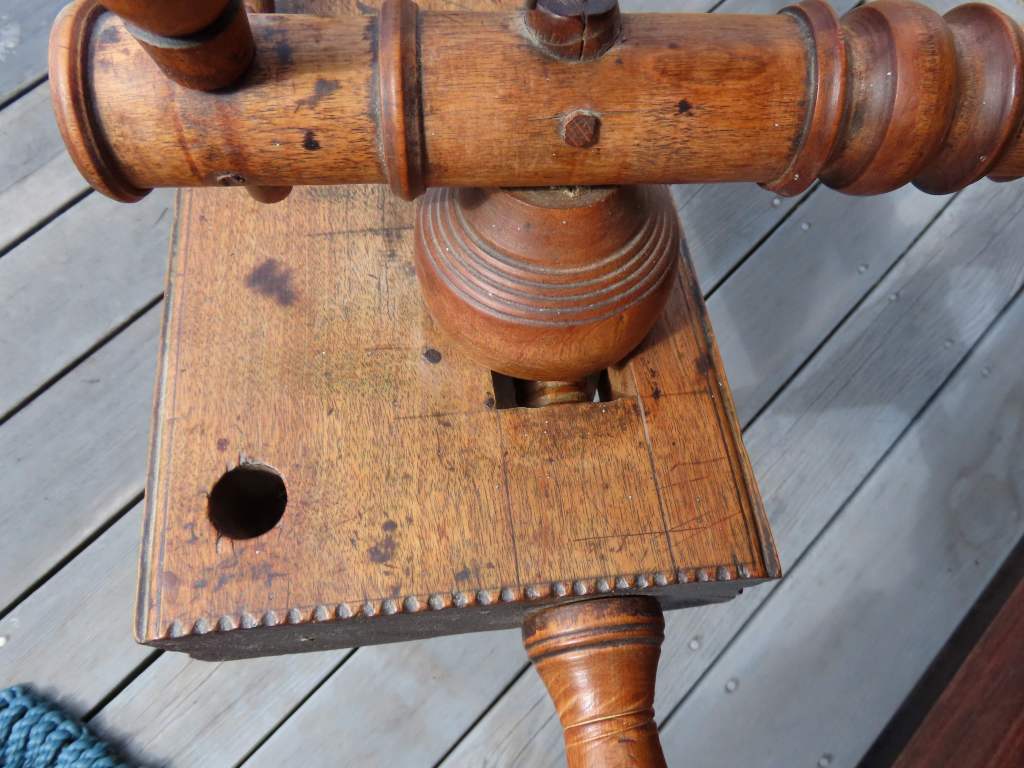
In contrast with many of these wheels, which have painted initials of the owners along with a date, Solveig has the date 1827 scratched into the side of the table.
Since OAP did not routinely apply the date in this way, it likely was added later by an owner and may not be accurate.
But there is not doubt that Solveig was used for many years.
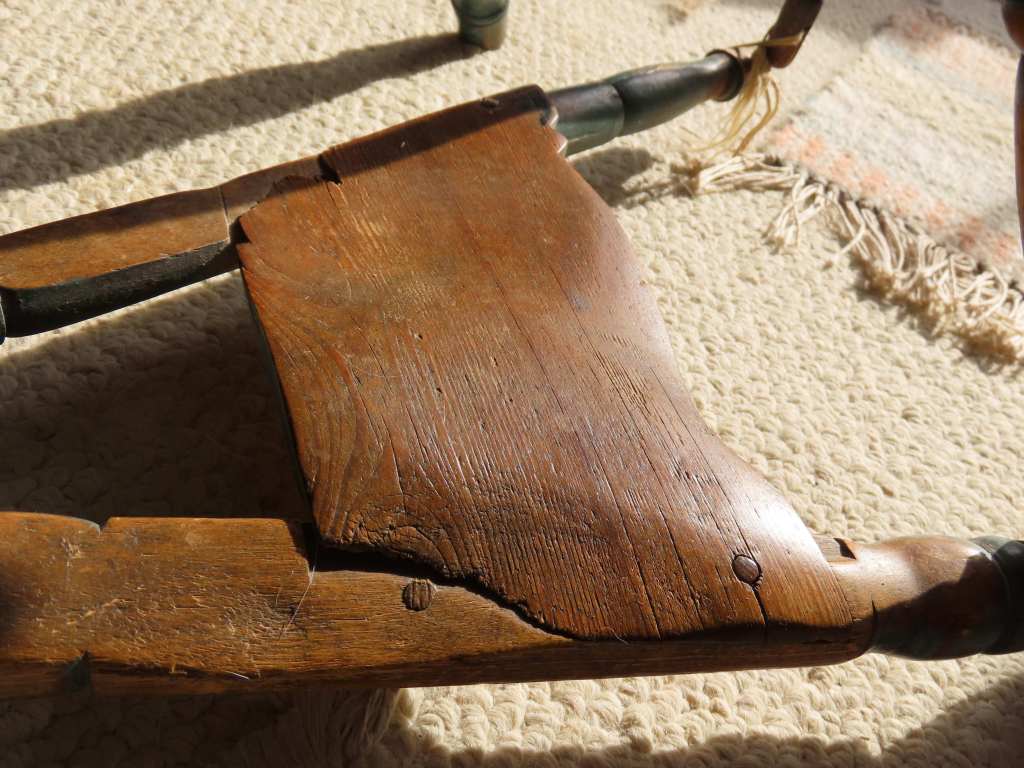
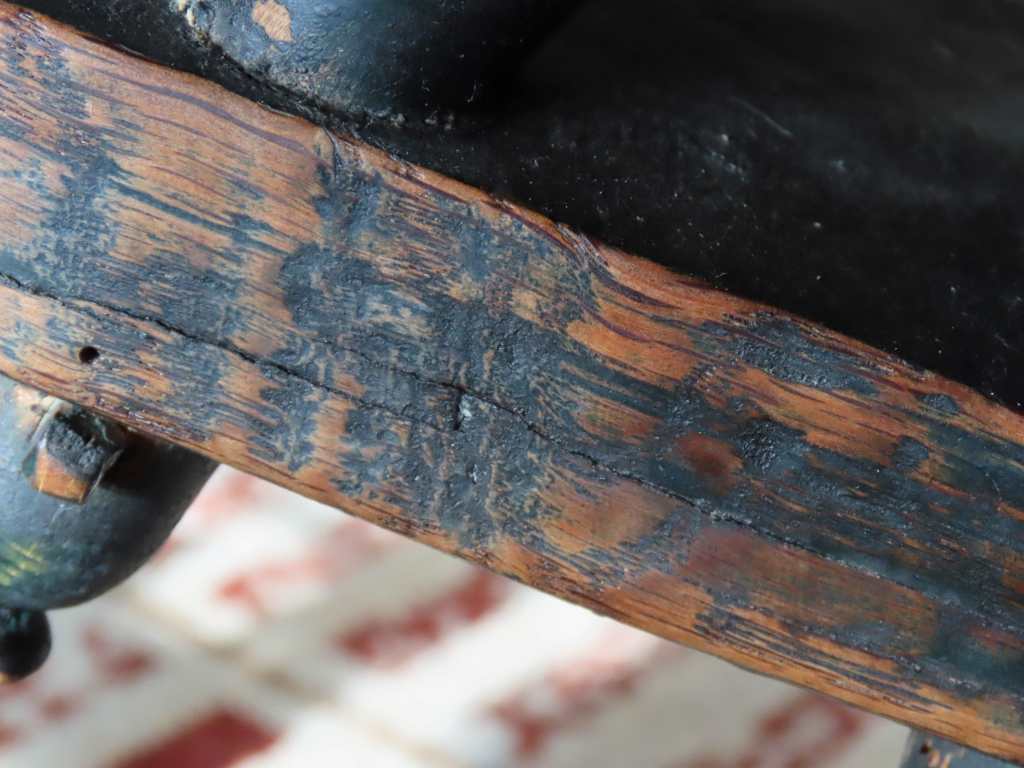
The wear on the treadle is so extreme it created a wooden wave.
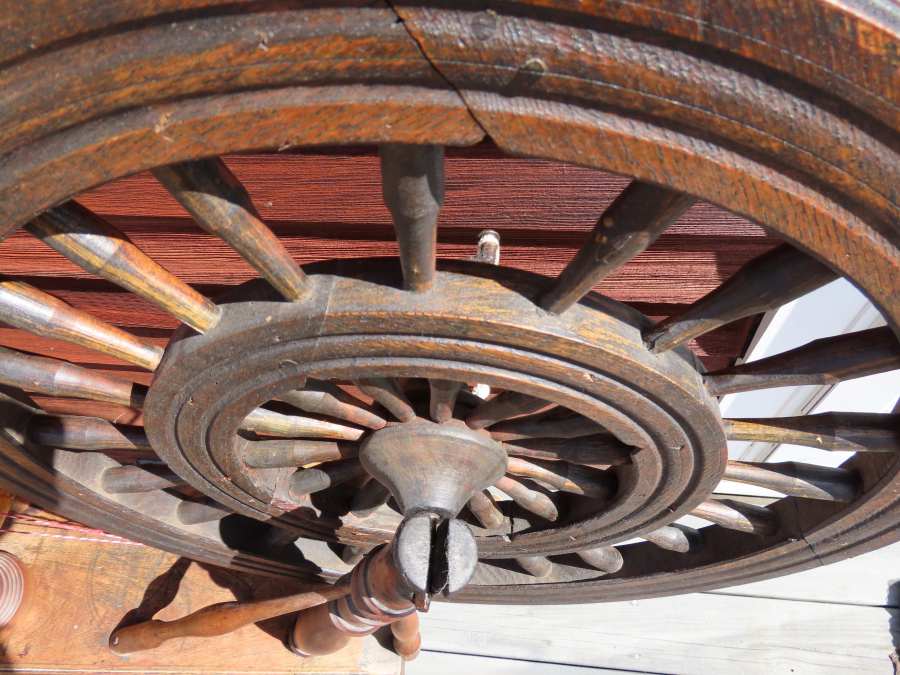
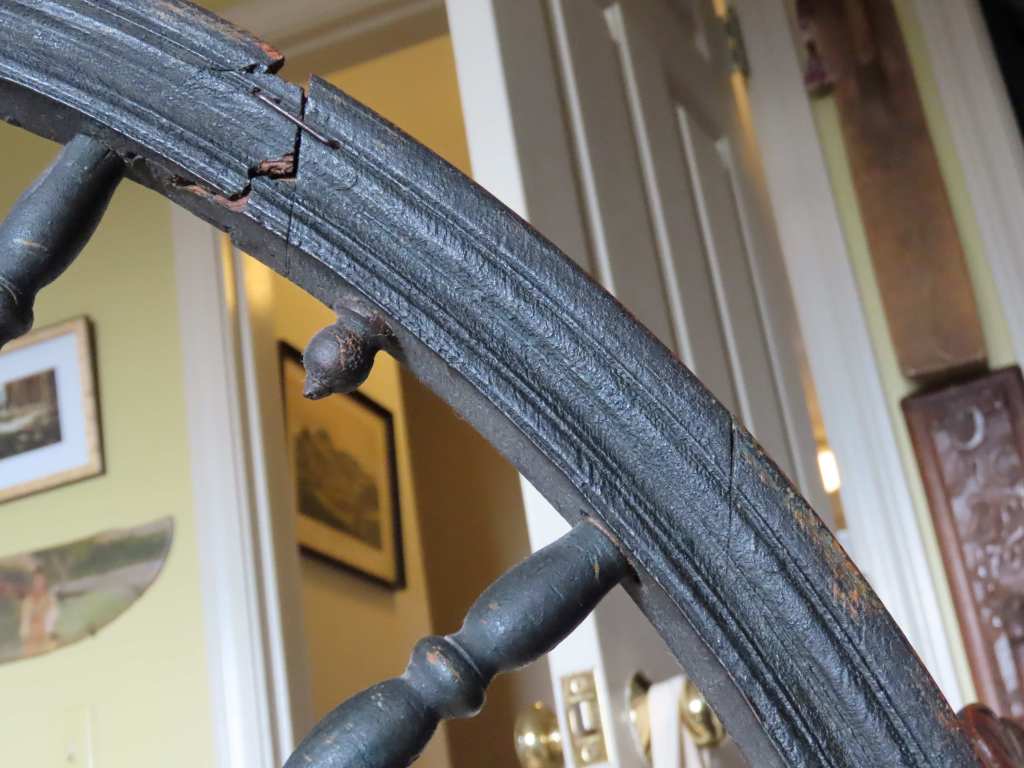
The drive wheel construction is typical of Norwegian wheels.
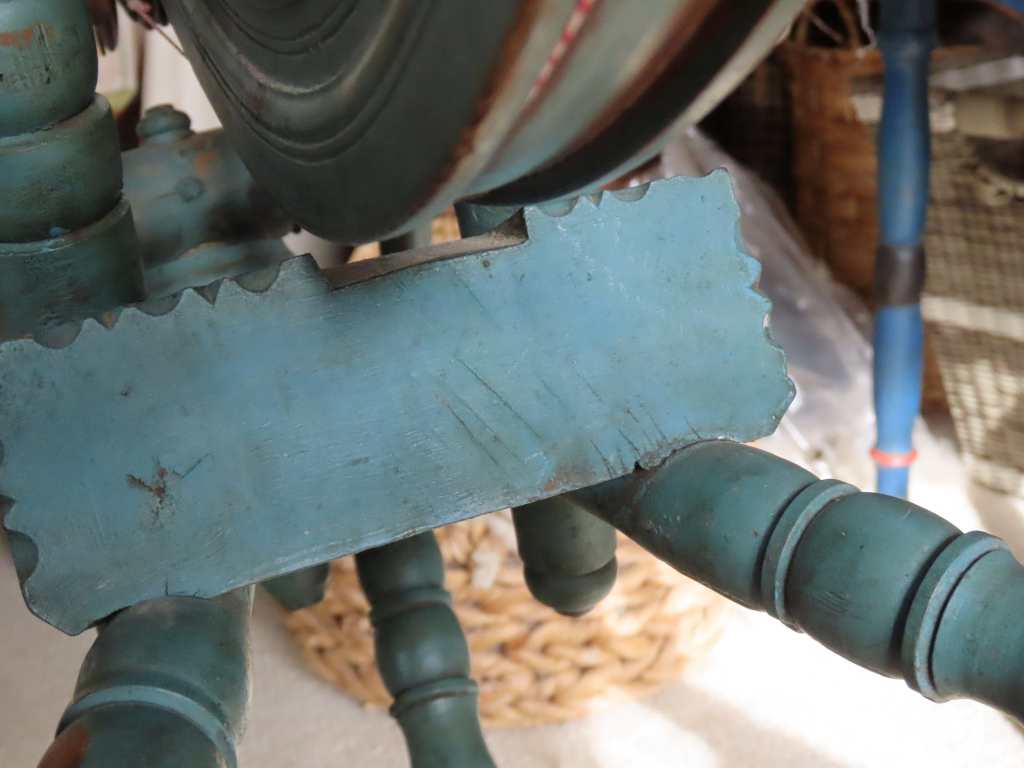
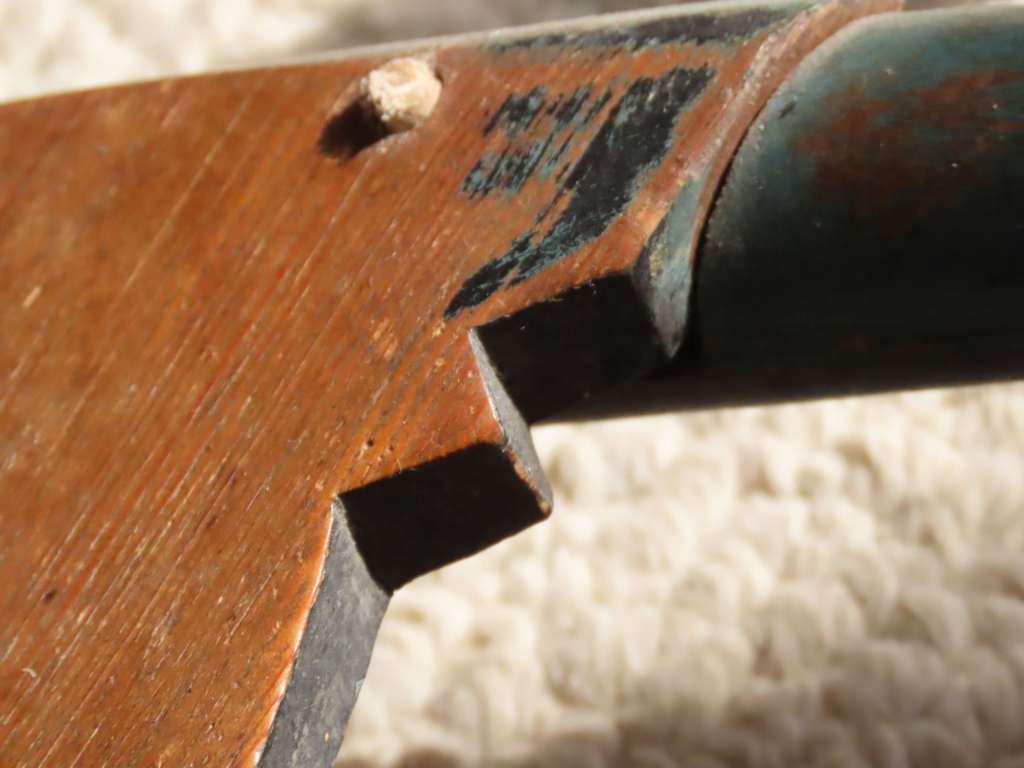
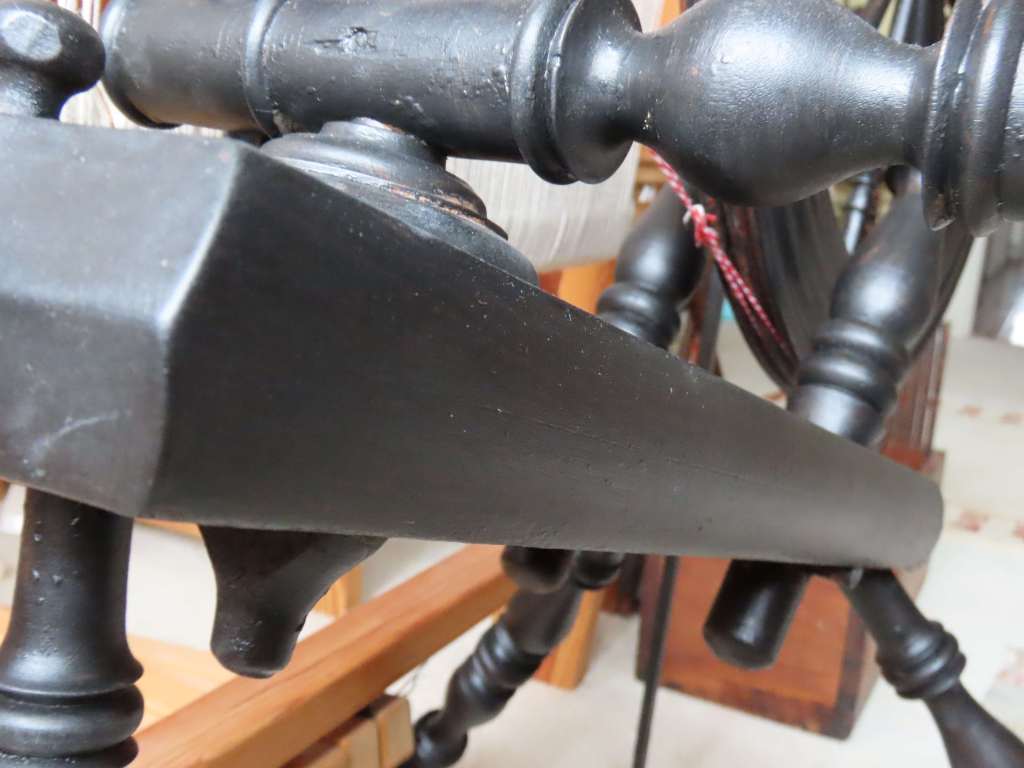
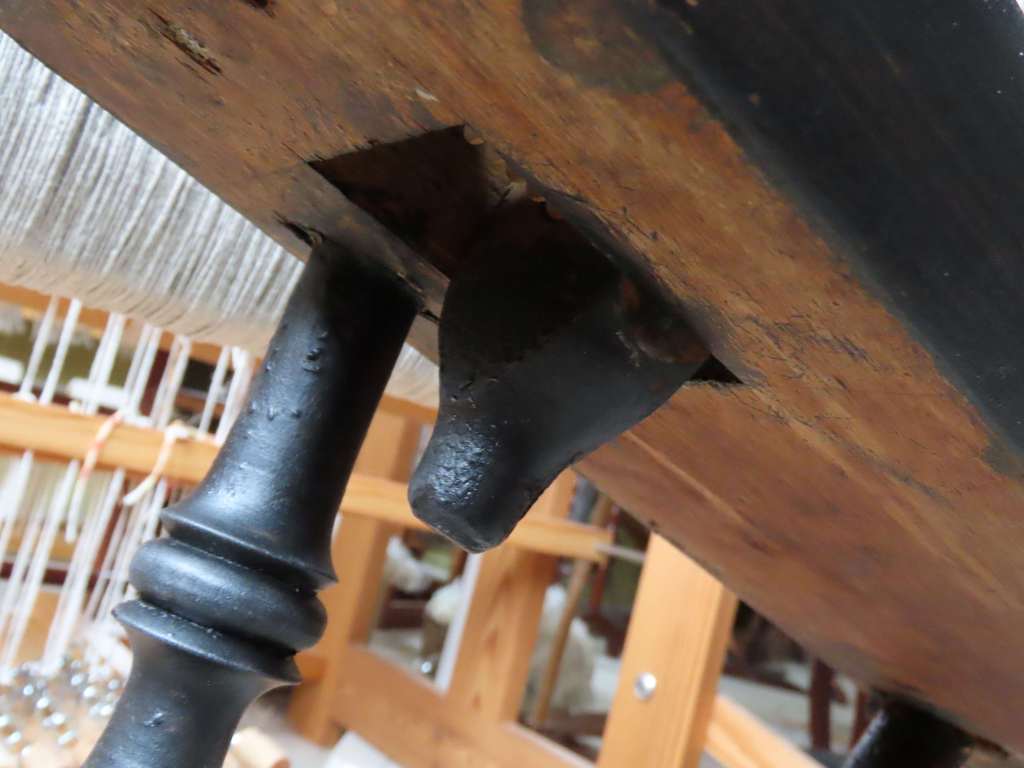
But, every part of the wheel carries special touches from OAP, whoever he was. A small cut-out under the drive wheel,
distinctive maidens,
little touches of decorative design,
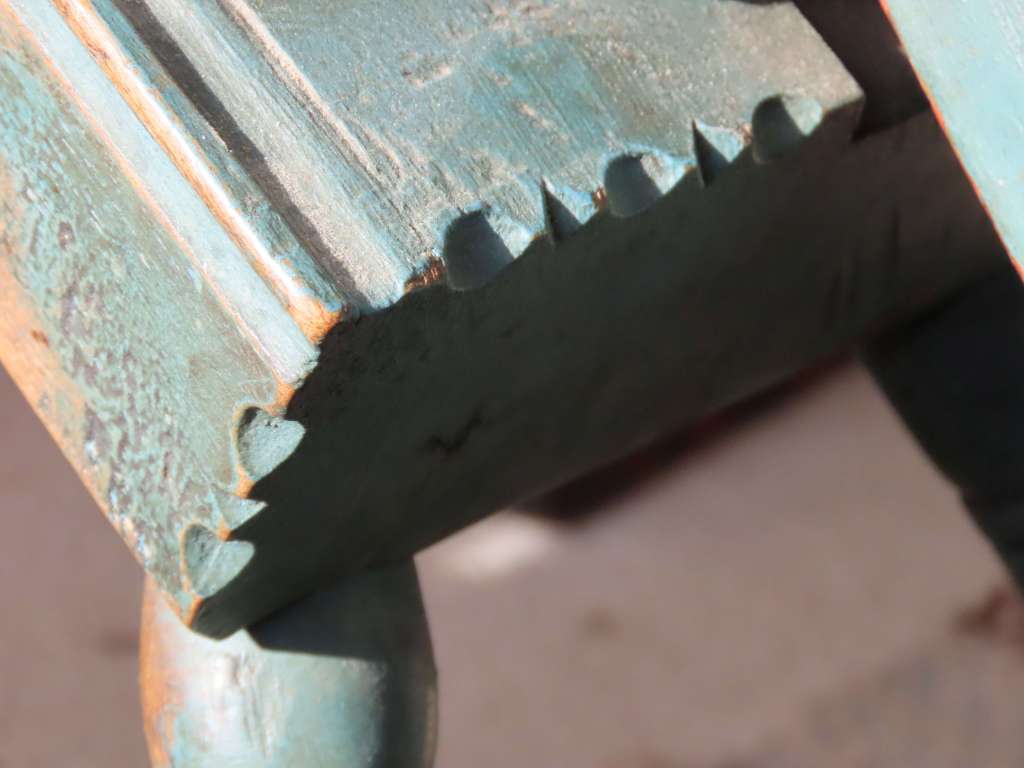
and the maker’s signature chip carving are a reminder that he valued beauty along with practicality.
It is no wonder that OAP’s wheels were so popular and remain coveted to this day.
Thank you to Andrea Myklebust for the Norway and Vesterheim photos. And, of course, for this wheel, which will soon be returned to live with Andrea again.
*The photo of the wheel in Norway was accompanied by this explanation: “This picture hangs framed over my mother’s spinning wheel along with a set of cards. Mom doesn’t know who the people in the picture are but thinks they are cousins from Lofthaug. – Wendy Turner ”
The quotations are from:
Bergland, Betty A. and Lahlum, Lori Ann, Norwegian American Women, Migration, Communities, and Identities, Minnesota Historical Society Press, St. Paul, MN 2011.
I bought this wheel and reel because they are from Prince Edward Island. Like many, PEI has a place in my heart because of L.M. Montgomery’s books. I discovered an ancient copy of “Anne of Green Gables” when I was about ten (many years before the television series) and there was no looking back. Although Montgomery’s books were not easy to find then, I ferreted out every one I could track down, eventually reading all of them.
I visited PEI when I was 14, and when Montgomery’s journals and letters were published, I devoured them, too. The magic of Montgomery’s writing, to me, is how, through her perceptive lens on the small details of speech, behavior, and customs, she brings a specific time and place to life so vividly that it feels as if I have been there. Her descriptive details also provide rare documentation of everyday practices, passed on orally, which she preserved through her writing.
A wonderful example is when Emily (of New Moon) finishes mopping the kitchen floor, she then sands it in “the beautiful and complicated ‘herring-bone pattern’ which was one of the New Moon traditions, having been invented, so it was said, by [a] great-great-grandmother … New Moon was the only place in Blair Water where the old custom of sanding the floor was kept up; other housewives had long ago begun to use ‘new-fangled’ devices and patent cleaners for making their floors white.” Emily Climbs p. 60.
So, when I bought this wheel, I tried to think of spinning wheel references in Montgomery’s books that might be a helpful starting point for research. I remembered that in “Emily of New Moon,” Aunt Laura wove and spun in the garret. “The walls were hung around with great bundles of soft fluffy rolls, all ready for spinning, and hanks of untwisted yarn. Sometimes Aunt Laura spun on the great wheel at the other end of the garret and Emily loved the whirr of it.” p. 93.
The only other reference I could think of was from “Anne of Windy Poplars,” when the local dressmaker encountered Anne walking in the old graveyard and regaled her with stories of those buried there: “My great-great-grandfather Courtaloe is buried here. He came out in 1760 and he made spinning wheels for a living. I’ve heard he made fourteen hundred in the course of his life. When he died the minister preached from the text, ‘Their works do follow them,’ and old Myrom Pringle said in that case the road to heaven behind my great-great-grandfather would be choked with spinning wheels.” p. 44.
From these tidbits, it appeared that some spinning was still going on into the early 1900s on PEI, including with great wheels (at least in homes that kept up old traditions), and that there must have been some prolific wheelmakers on the island. A promising start.
I next checked in my other books and was excited to find a reference to PEI wheels in “Keep Me Warm One Night.” “In Prince Edward Island an unidentified maker incised a number at one end of the platform,
and a date at the other. Some idea of his production may be guessed by the fact that examples numbered in the 600s have been seen.” p. 19.
I also found a reel in Joan Cummer’s book that looks just like my reel. pp. 326-27. Cummer writes: “This click reel came from Prince Edward Island, Canada. Probably made in the early nineteenth century, it had belonged to only one family where it received much use. The family, even in the first quarter of the twentieth century, spun and wove their own cloth. The reel is still in perfect working order. Each single turn takes up 79 inches, and the clicker clicks every 100 turns.” P. 326.
Cummer’s account confirms Montgomery’s portrayal of PEI spinning and weaving into the 20th century, and both support the family history that came with this wheel and reel. The people from whom I bought them kindly wrote up their history within the family.
The wheel and reel have always been together, passed down from parents to son about 1894, when the son was married on PEI.
The family lived in St. Mary’s Road, in Kings County, the easternmost part of the Island. When the family eventually migrated to Massachusetts, the wheel and reel came with them. According to the family, the wheel is made from apple wood.
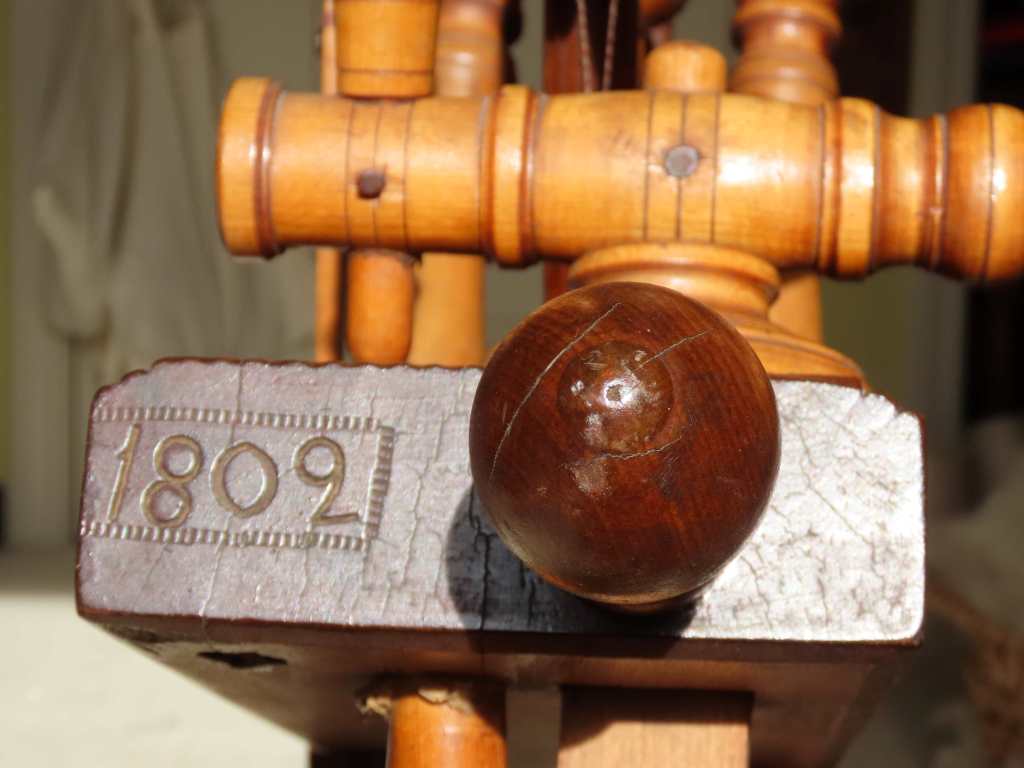
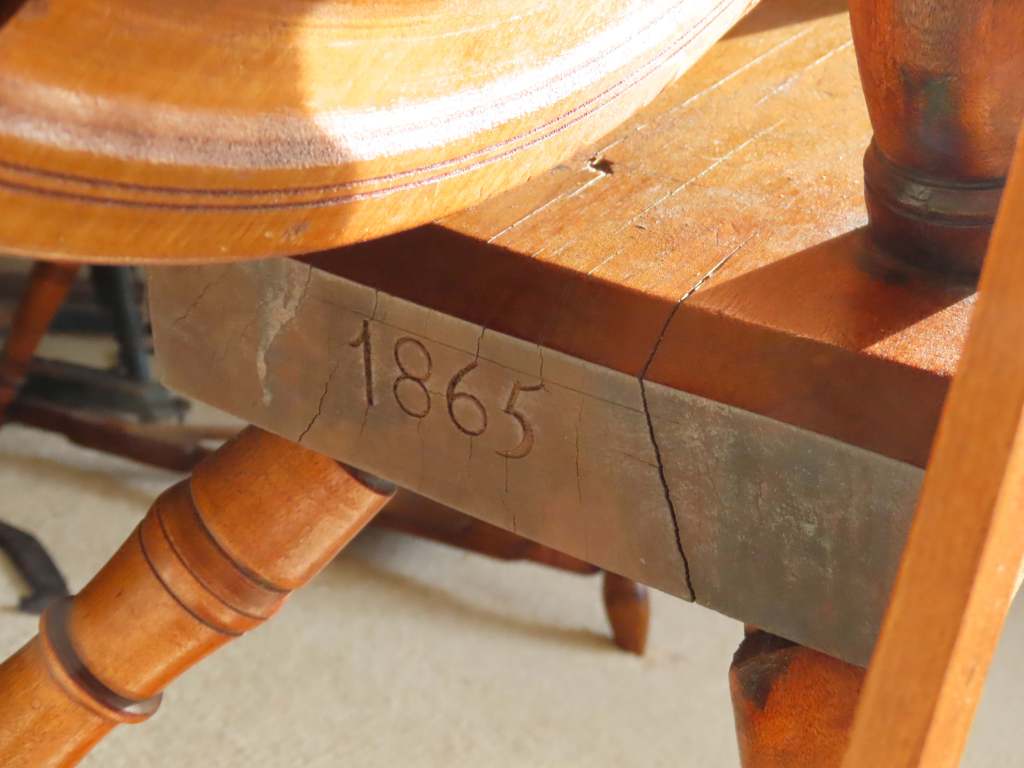
Like the wheels mentioned in “Keep Me Warm One Night” a production number of 1802 is on one end and a date, 1865, on the other.
Presuming that 1802 is a production number, it would seem that such a prolific wheel maker would be well documented. I started out my search with great optimism. But, over and over, my online searches yielded the same name-–Benjamin Chappell.
Chappel was a man of many talents. A wheel wright, machinist, and lay preacher, he came from England to PEI in 1774. He turned his hand to most anything that needed doing, including politics and spinning wheel production, and kept daybooks for many years. His daybooks are a phenomenal resource for anyone interested in spinning wheel production.
He documented the types of wood he used for wheel parts, for example: “took the Oak Rims cut them to their Length. put them over the shop they Amount to 50 wheels. They had been abroad 14 months & 20 days. Very good Oak” “black birch rim” “at more black birch whirls & c” “green beach rims … the old beach log made 20 wheels” “green white maple horses for the wheels” “Green Spokes Rounded with ye chisel was Enough for 20 Wheels” Vol. Two, pp. 11, 26, 76, 82, 98. He made the various wheel parts in batches: “last week finish’d 26 beds for drying. And Spokes 1000 of them some Maiden and Crowntrees all white Birch” “turn’d in all 7 sets of Spokes” “Tuesday Made 12 New treadels” Vol. Two, pp. 41, 90, 273.
Then he assembled and finalized the wheels in batches of three. In May 1818, he finished wheels 864, 865, and 866. Vol. Two, p. 284. I believe those are the last ones mentioned in his day books. In researching Chappell, I came across a 1930 article by PEI historian, Ada MacLeod, entitled “The Oldest Diary in Prince Edward Island.” I had a good laugh when I came across this passage:
“In his spare hours Chappell was always making spinning-wheels and so methodical was he that he numbered them, and the number entered in his book is over 600, which speaks much for the industry of the women of that time. At his funeral the text was the verse ending, ‘For their works do follow them.’ A wag remarked that if this were literally true in Chappell’s case, the road to heaven would be blocked with spinning-wheels.” p. 471. Sound familiar? L.M. Montgomery knew a good line when she saw it.
Chappell died in 1825 and clearly is not the maker of my wheel. Despite being so well-known and making so many wheels, I have not been able to find a single photograph of a Chapell wheel. In fact, I have found PEI to be a tough nut to crack when it comes to tracking down any information on wheelmakers. In addition to online research, I contacted historical societies and museums, and have had those with Island contacts make inquiries, but nothing has borne fruit. Crickets.
These wheels show up for sale with some regularity in New England, particularly in Massachusetts, where many PEI families migrated to find work. They share some similarities with the Nova Scotia wheels in the previous posts, including the spoon-like end to the treadle bar
and slope on the wheel end of the table.
The lovely generously rounded maidens make these wheels easy to spot and, of course, the numbers are distinctive.
Those on the tension end are bold and thick, surrounded by a box of punched decoration, while those on the wheel end are less robust and more refined looking, with no surrounding decoration. If the numbers indicate the year made and production number of the wheel, this maker must have been making wheels for many years, so I was extremely frustrated that I have not been able to find anyone on PEI with information.
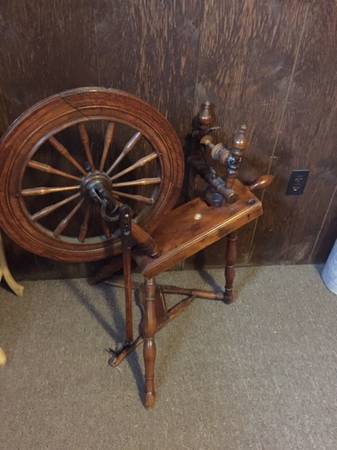
Cheryl’s wheel
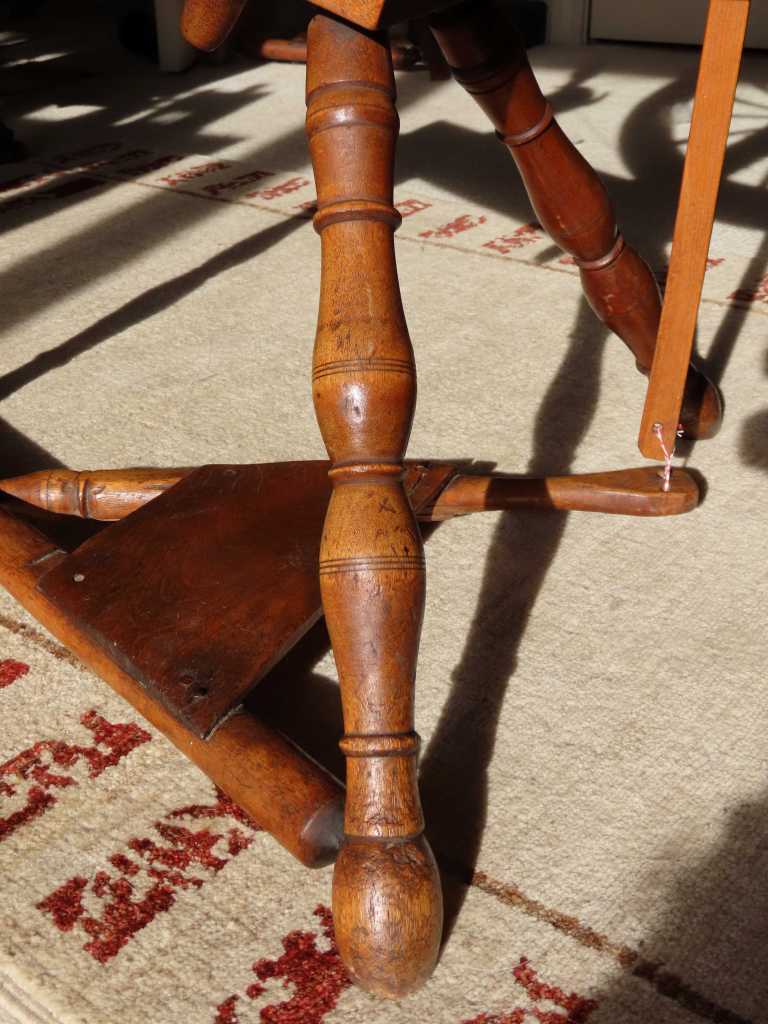
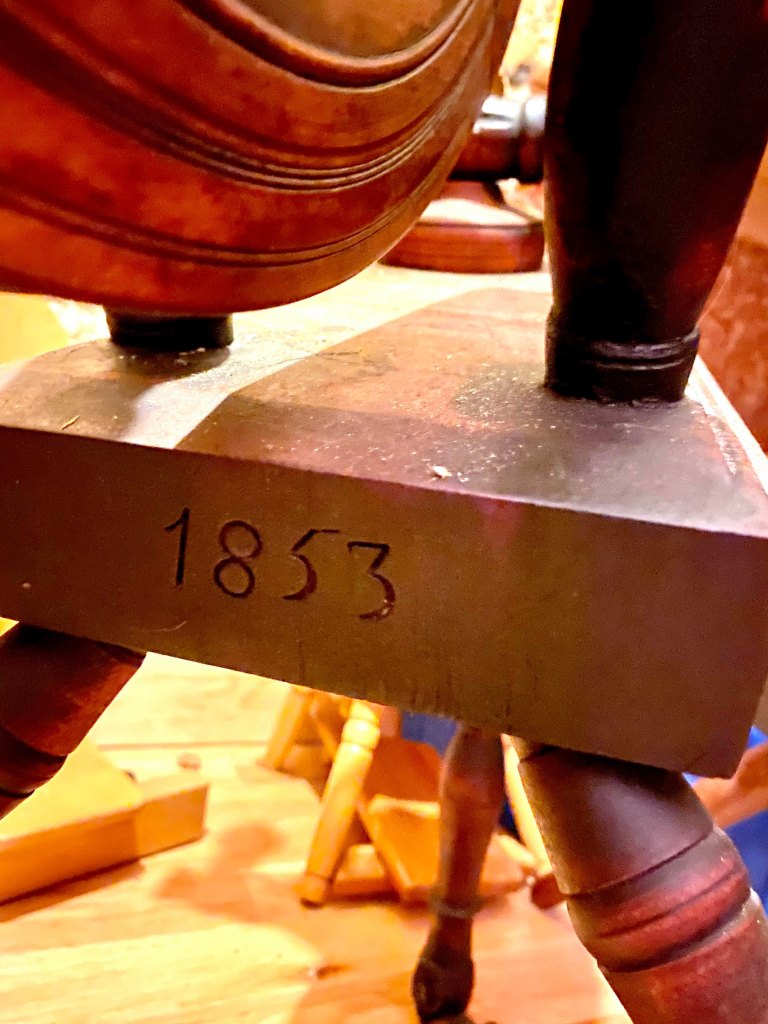
My one lucky break came from someone close to home. A few years ago, a spinner near me in Maine, Cheryl Bubar, was moving out of state and wanted to re-home some of her antique wheels. When I went over to her house, she showed me her family wheel from PEI (which she was keeping). It was a sister to mine, with the numbers 1184 on the tension end and 1853 on the other end. It turned out that Cheryl’s family also was from Kings County and were friends with the family that owned my wheel, PEI and after both families moved to Massachusetts.
Cheryl’s
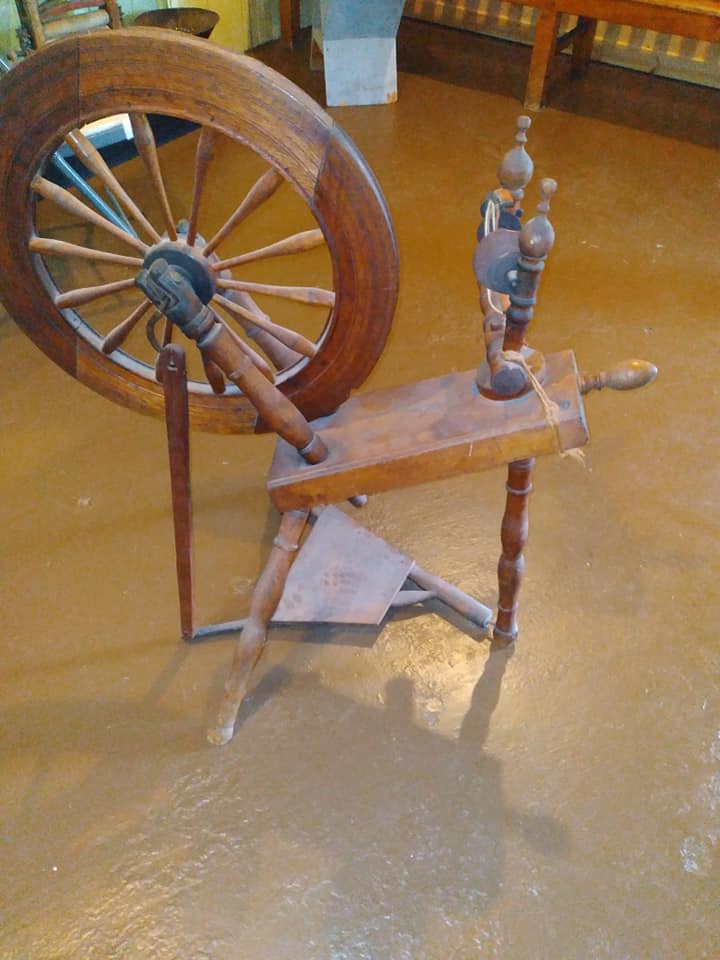
Some time later, a woman posted another of these wheels on Facebook, saying it had been donated to a museum in New Brunswick.
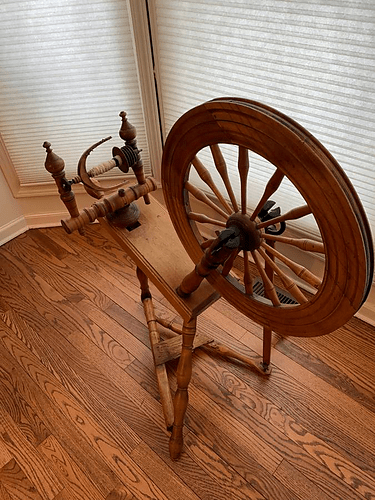
Wheel found in NB, but also from Kings County PEI
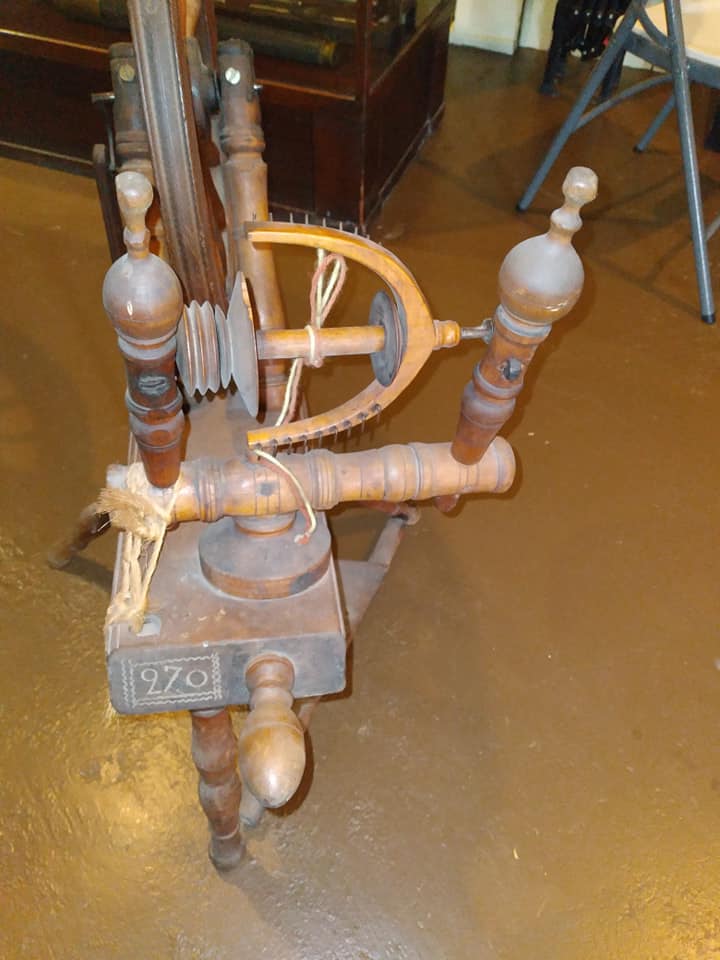
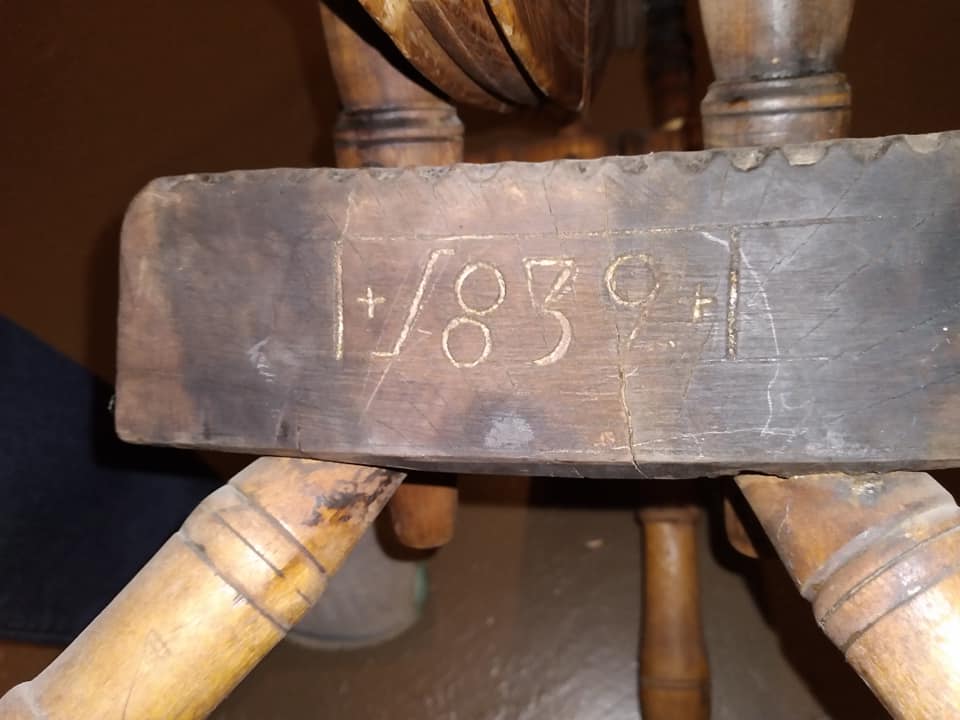
It was numbered 270 with the date 1839.
While the maidens are different on this early wheel, the first number–probably a “2” rather than a “9”–has the same unusual shape as on my wheel
She did some digging and found that the wheel had come from St. Charles, PEI—also in Kings County. While this 1839 wheel has somewhat different maidens and slightly different numbers, it seems likely that it is an early version from the same maker.
Date on the wheel found in NB
Another wheel came up for sale on Craigslist with the number 1170 and date 1853.
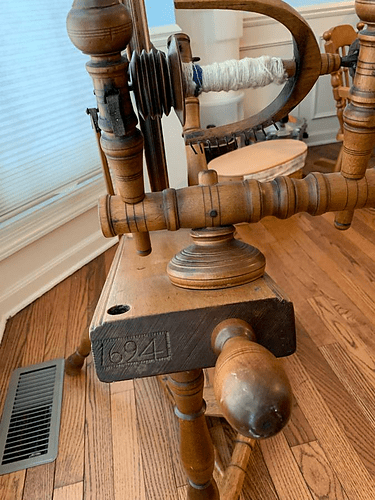
And one showed up in Michigan with the number 1694 and date 1863.
Wheel in Michigan–another beauty
So, it appears this wheel maker (or wheel making family) made over 1800 wheels from the 1830s to at least 1865.
Michigan wheel
In the twelve-year period between Cheryl’s wheel and mine, he would have made about fifty wheels a year.
1863 date on Michigan wheel
Cheryl did some digging and found in the book “Exiles & Islanders” a passage quoting from a letter written by John McNally (Nallen), a furniture maker in East Point PEI to his brother in County Mayo in 1832. McNally wrote, “if you were here you would make a fortune,” and that he was getting “five dollars for a spinning wheel and six pounds for a turned chair.” p. 116. (link to original letter here).
leg held in place with old linen cloth
I have not been able to establish how long John McNally lived, but since three of these wheels came from Kings County, where he was making wheels in 1832, he is the leading candidate for our wheel maker. Try as I might, though, I have not been able to confirm who made these wheels.
shims on far maiden
There is evidence of at least two other wheel makers on PEI at the time, John McQuarrie (or McQuarry) and George Lockerby, but both were working in Charlottetown.
My wheel is probably the heaviest saxony style that I own. Its weight and the wood grain and coloring seems to support that it (or much of it) was made of apple wood.
It has an unusual leather “bumper” on the far maiden,
I imagine to keep the whorl from bumping against it and to help with alignment.
The scribe marks underneath are unusual in that they are doubled, created a sort of plaid diamond pattern.
For the first time, when taking photographs for this post, I noticed marks on the back of the spokes similar to those on the spoke fronts of Marilla, the McIntosh wheel in a previous post.
They are much fainter and fewer on this wheel, but finding them on the back of the spokes just deepens the mystery as to how they were made.
No marks on the spoke fronts
The reel is large. Very large.
In contrast with the reel in Cummer’s book, this one makes a 90” skein and clicks at every 120 turns (giving 900 yards).
It is designed for easy carrying
and has single crossed scribe marks underneath.
Both are beautiful working tools and I would love to know who made them.
If anyone reading this has even the slightest lead that might be helpful in finding our maker, please let me know.
Although, I have not been successful in identifying the maker, or makers, it has been a fascinating journey.
Thank you to Cheryl for her research and to Cheryl, ReBecca, and Susan for use of their wheel photos.
References:
Burnham, Harold B. and Dorothy K., ‘Keep Me Warm One Night,’ Early Handweaving in eastern Canada, University of Toronto Press, Toronto and Buffalo, 1972.
Chappelle, R. LaVerne, The Daybooks of Benjamin Chappell, Volumes One and Two, The Prince Edward Island Genealogical Society Inc., Charlottetown, PEI 1998.
Cummer, Joan, A Book of Spinning Wheels, Peter E. Randall, Portsmouth, N.H. 1984. Accessory 24, pp. 326-27.
L.M. Montgomery, Anne of Windy Poplars, the front pages of my book are missing so I don’t have the edition, but the book was copyrighted in 1936.
Montgomery, L.M., Emily Climbs, Bantam Book, Harper &Row, New York, NY 1925 (Frederick A Stokes Co.), Bantam Ed. 1983.
Montgomery, L.M., Emily of New Moon, Random House Children’s Books, New York, 1923 (Frederick A Stokes Co.)
L.M. Montgomery, Anne of Windy Poplars, the front pages of my book are missing so I don’t have the edition, but the book was copyrighted in 1936.
O’Grady, Brendan, Exiles & Immigrants: The Irish Settlers in Eastern Kings County PEI, McGill Queens University Press, 2004.
Macleod, Ada, “The Oldest Diary on PEI,” The Dalhousie Review, Volume 9 Issue 4, 1930.
Several of my wheels have forged friendships. One of the earliest and best of those wheel friendships came through Granny Ross. When the wheel came up for sale in Cape Breton, Nova Scotia, a woman on Ravelry, Sherran Pak, posted the wheel’s photo, noting some similarities to the McIntosh wheels.
The seller said that the wheel was not in spinning condition and, although Sherran was initially interested in the wheel, she decided not to buy her because of the need for repairs and the difficulties in getting the wheel to her home in the Midwest.
I did not know Sherran and was uncomfortable pursuing the wheel, knowing how much she liked it. So, I contacted her and after her assurances that she was not interested and that I should go for it, I then contacted the seller.
The stars seemed to be aligned because the seller said that he would be taking a trip down to Maine in about a month and could bring the wheel with him. As it turned out, the meetup did not work out and I ended up, ultimately, finding a wonderful woman on Ravelry who, on her annual trip to Cape Breton, was willing to meet up with the seller and railroad the wheel down to me.
During the months it took to get the wheel, I got to know Sherran. Although I still have not met her in person, we have been continually in touch over the years, and she became a friend. She kept a lookout for wheels in the Midwest that might interest me and I helped her out (although to a much lesser extent) with wheels in my part of the world.
Some of my most treasured wheels came my way because of Sherran. She found them, picked them up (even waiting in line at an estate sale during covid), fostered them, arranged railroads, and sent them on their way to me. I am very much in her debt and am so glad that I have gotten to know her. And, it is all thanks to Granny Ross.
When Granny Ross finally arrived here, it was apparent why the seller said that she was not in spinning condition. The drive wheel had been seriously damaged, with a bent axle, spokes that had broken right off, with some clumsily re-glued. It looked as if someone heavy had stepped right on the drive wheel while it was on its side on the ground. I could just imagine the crunch of broken spokes.
Although I do not have photos of the drive wheel when it arrived, trust me, it was a mess. The treadle also was worn to the point of no return. The drive wheel damage was well beyond my repair capabilities, so I shipped it off to wheel-repairer extraordinaire, John Sturtevant. In the meantime, George crafted a beautiful new treadle with strong graining to match the legs.
When the drive wheel came back from John, it looked as good as new. I could not wait to try it out, interested to see how the heavy double rim would spin. I tend to like heavy drive wheels, with their sweet momentum, and Granny Ross did not disappoint. She became one of my favorite spinners.
She is a bit of a puzzle, though. Overall, she has a Scottish look.
As Sherran noted, she shares characteristics with the McIntosh wheels, including a spoon-shaped end to the treadle bar
and a slope at the drive-wheel end of the table.
And, while double rim wheels are most often found in Scandinavia, they do occasionally show up on wheels that appear to be Scottish, or made by Scottish descendants.
But the man from whom I bought the wheel said that his wife had bought it about 50 years ago in an Acadian area of Cape Breton and was told that it was Acadian.
That was intriguing to me because there seems to have been very little research done on Acadian wheels in Nova Scotia, so there is uncertainty as to what wheels were made and used by Acadians there. This photo, found in Judith Buxton-Keenlyside’s book, “Selected Canadian Spinning Wheels in Perspective” (figure 132, p. 278), is captioned “A spinning wheel maker on Ile Madam, Nova Scotia. From Edith A. Davis, “Cape Breton Island”, reprinted from the Canadian Geographical Journal 6, no. 3 (1933).”
Ile Madam is the same general area from which the seller’s wife bought Granny Ross. And, the wheel in the photo looks very similar to Granny Ross—especially the maidens,
and the legs.
To further complicate things, whoever made the wheel decorated the table with a 6-pointed rosette. While these are sometimes found on eastern European wheels, German fiber tools, and houses and barns of various cultures, I do not believe that I have ever seen one on a Scottish wheel.
Perhaps Granny Ross is a charming composite of different influences on Cape Breton—some Scots, some Acadian, a bit of German.
In any case, she is unique, with her attractive web of spokes,
strong stance,
and beautiful angled upright supports.
The shape of her legs highlights the gorgeous wood grain
and there are small lovely touches, such as the tiered MOA collar.
Much as I love this wheel—and she has been a workhorse for me—I have always felt a pang of guilt that Sherran may have deferred to me on the wheel out of her midwestern politeness.
Deep grooves on her tension knob, presumably from unwinding the bobbin
So, when I decided to sell some of my wheels, I was delighted when we were able to arrange to get Granny Ross to Sherran before Sherran moved farther west (to a place where wheels are rare). Granny Ross now resides with Sherran, where she belongs.
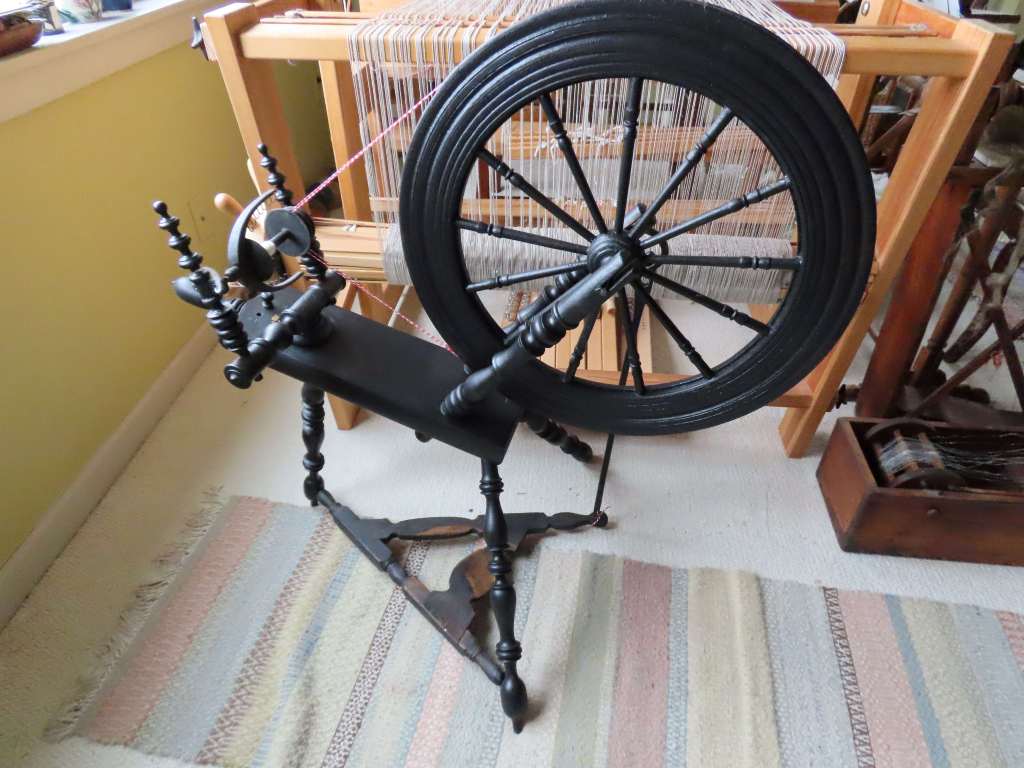
I bought Cocodris years ago from a woman in Bath, Maine. She told me that her grandfather had traded a gun for the wheel somewhere in the northern reaches of Maine.
I was attracted by the beautiful treadle curves, an oddly whimsical touch, especially for a wheel found in Maine.
The paint was a bit startling, though.
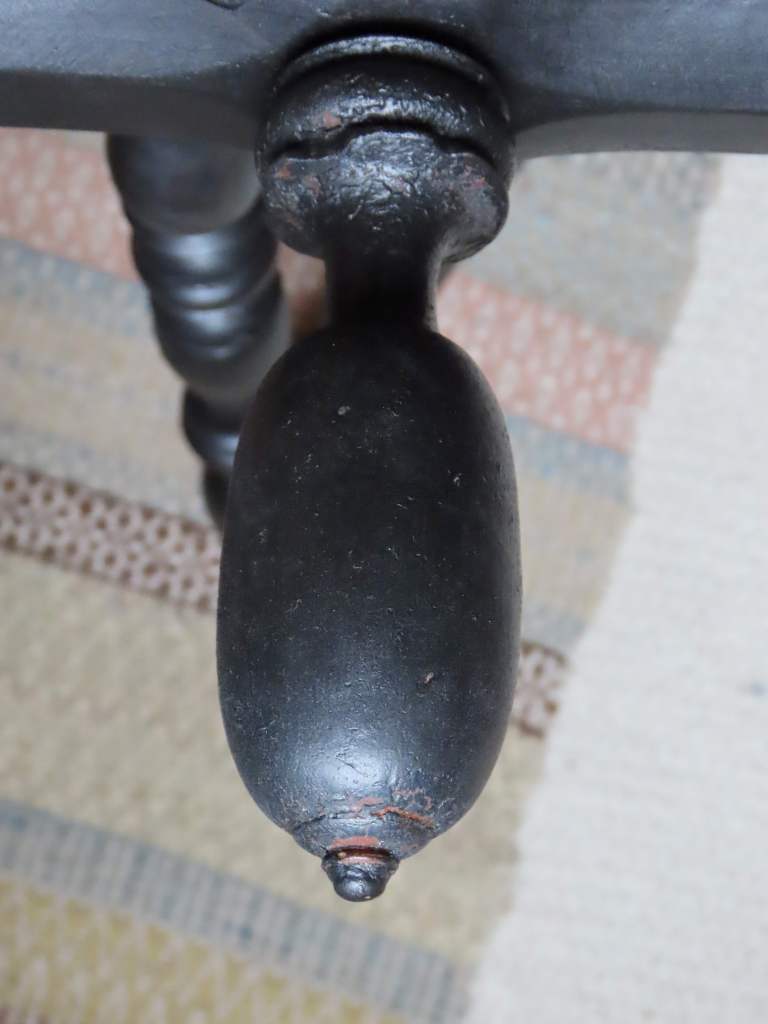
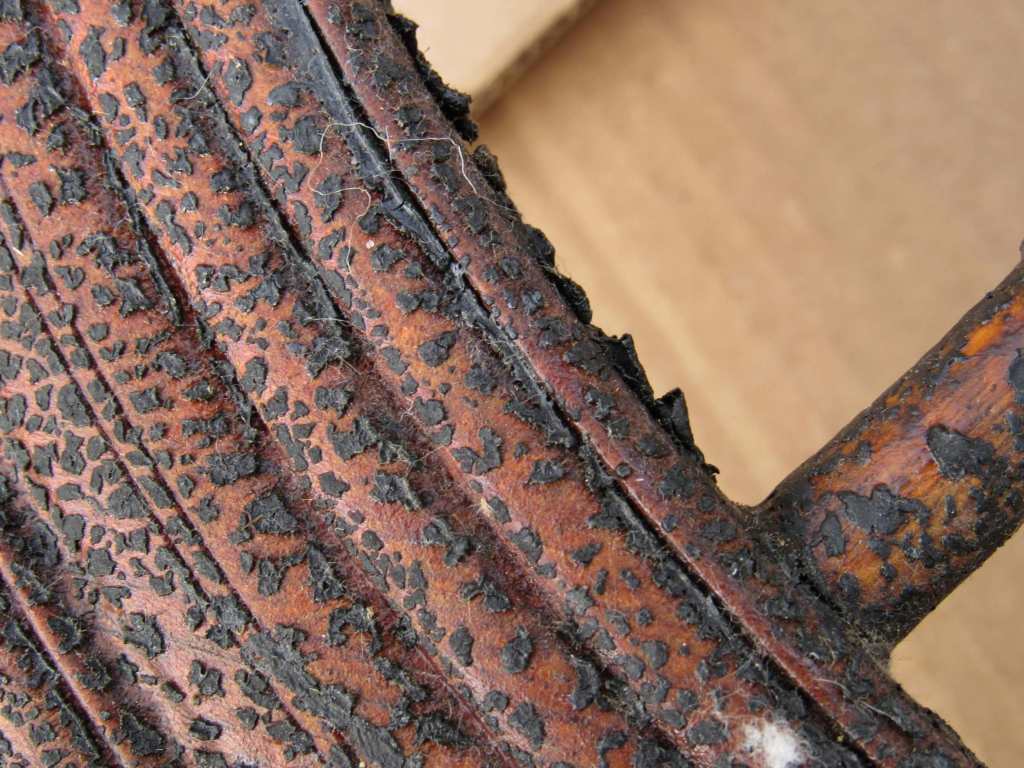
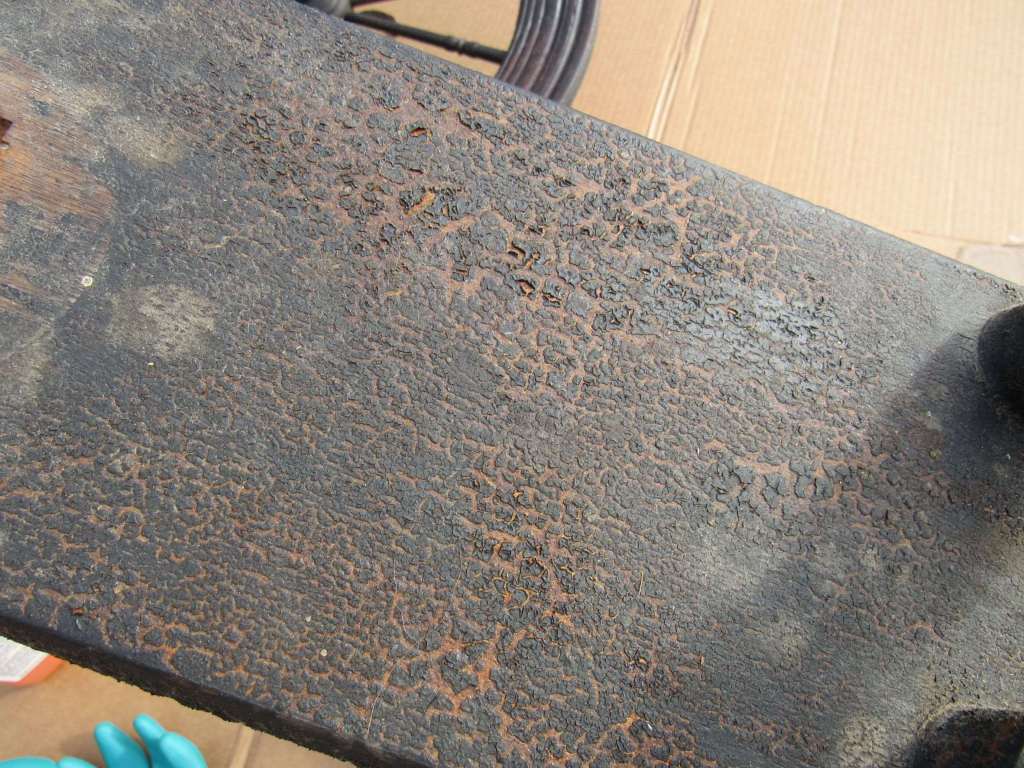
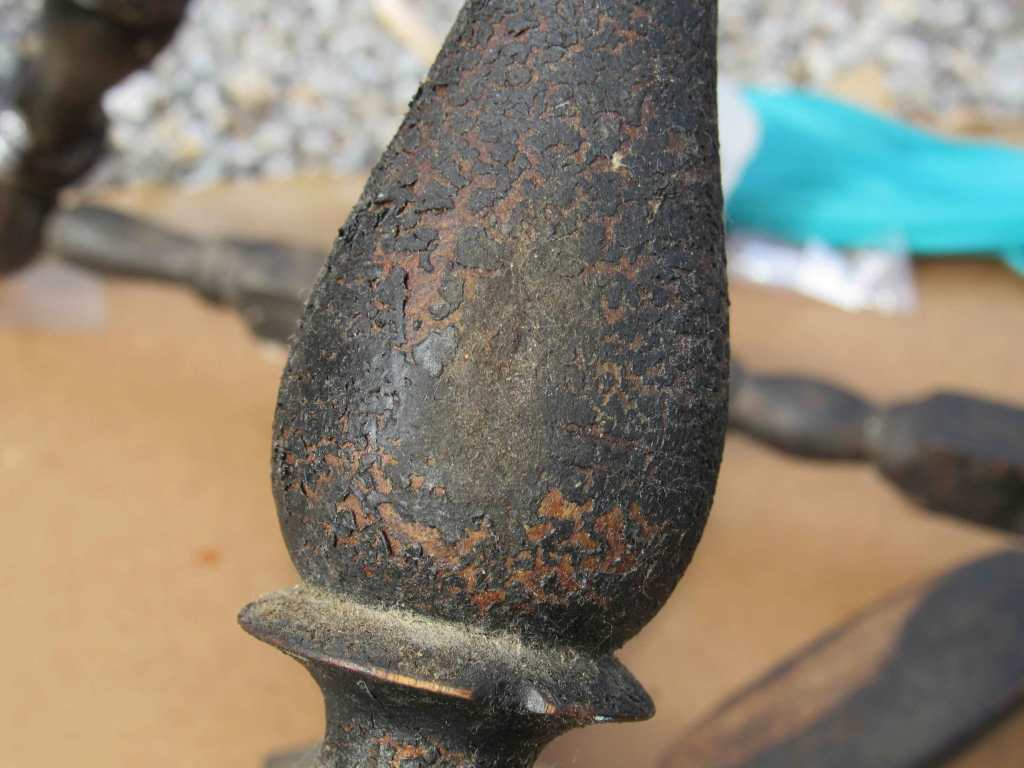
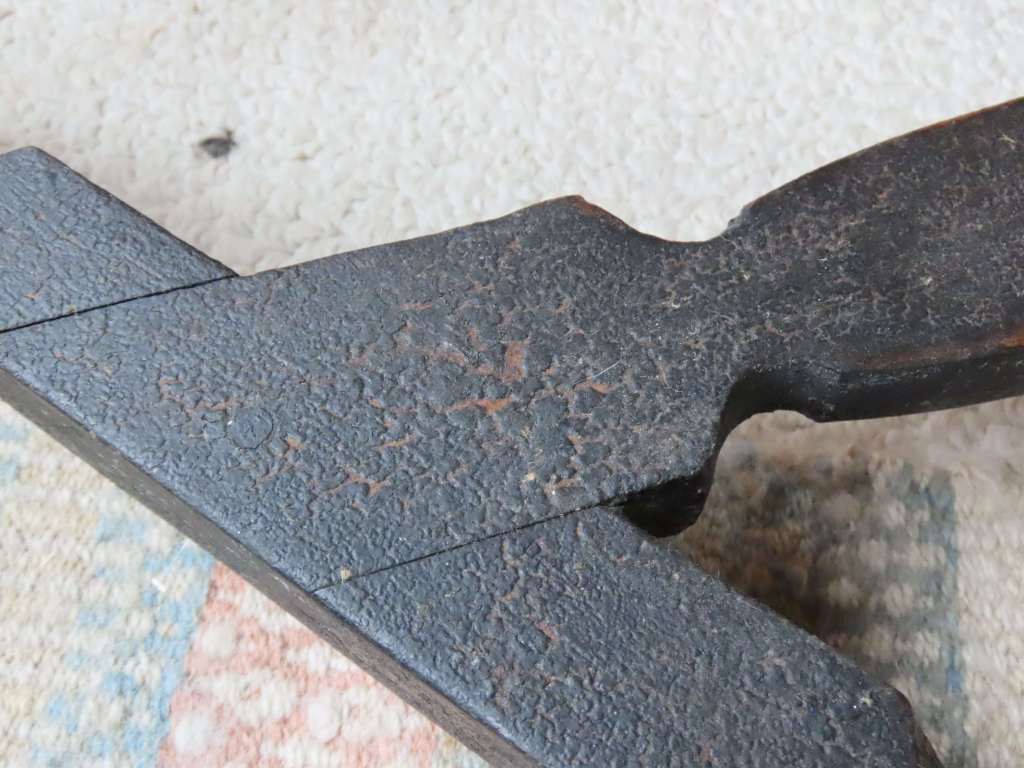
Cracked and peeling, bits almost exploded off the surface,
leaving a trail of black paint crumbs behind. While I rather liked the alligatored look, I was not enthusiastic about the paint litter so decided that I needed to address it.
I tried every suggested non-stripping tactic for alligatored finishes, but nothing worked.
I finally decided to use a citrus stripper and at least remove the worst of the flaking areas.
What a nightmare. Let’s just say that the paint won. I was trying for a mixed look—some parts painted, some showing the wood.
Instead, I ended up with a wheel that looked as if it had a terrible skin disease.
Rather than trying to strip it more, I repainted it, all except for the treadle parts and flyer, which I had not stripped.
They still have the original paint and wear.
It is a bit messy, slightly weird looking, and needs some touch up,
but the black paint highlights the wheel’s beautiful turnings.
And, as is often the case, those turnings started showing up elsewhere. I began to notice similar wheels coming up for sale. While the wheels had individual differences, most had “bowtie” spokes
and legs that resembled the Quebec Paradis wheels.
New Brunswick wheel for sale on kijiji–bowtie spokes and three-tiered maidens
The maidens generally came in two styles—three-tiered like Cocodris’ maidens, or bobble-topped like those on Philomene, the wheel in the previous post.
South Carolina wheel for sale on FB–bowtie spokes, Philomene-style maidens, paintedFor sale on FB–bowtie spokes and Philomene-style maidens
When I acquired Philomene and started researching her maker, Thomas Michaud, it became apparent that this style wheel was commonly found in the upper St. John River Valley, on the border between northern Maine and New Brunswick.
Philomene–made by Thomas Michaud, discussed in previous post
I suspect that most were made by Thomas Michaud and his wheel-making brothers, Hubade/Ubald and Francois Regis (see the previous post “Philomene”). But, since almost none are marked, we can only surmise that they are related based on similarity of features.
Cocodris’ maidens, for example, are like those on Diane Howes’ marked Thomas Michaud wheel (with a few less tiers).
Maidens on Diane’s Michaud wheel, discussed in previous post
The curved table sides,
the under-table MOA post
and scribe marks,
and the flyer scribe marks also are similar.
CocodrisPhilomene
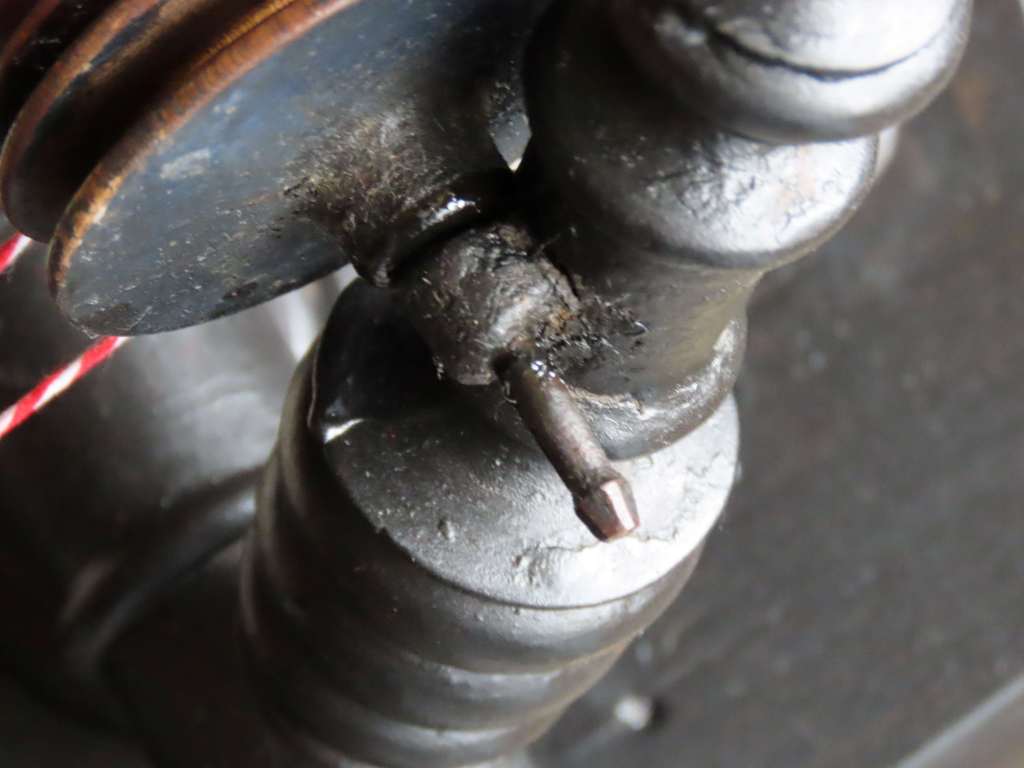
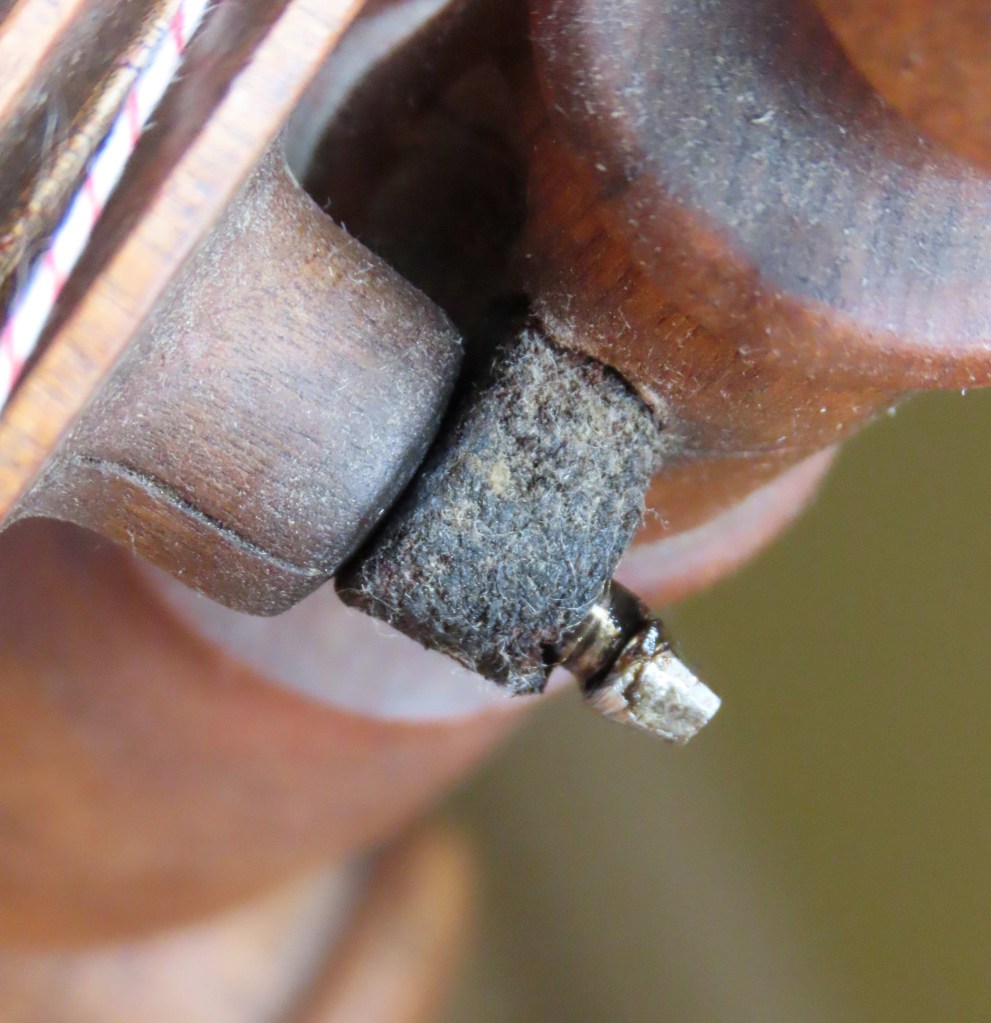
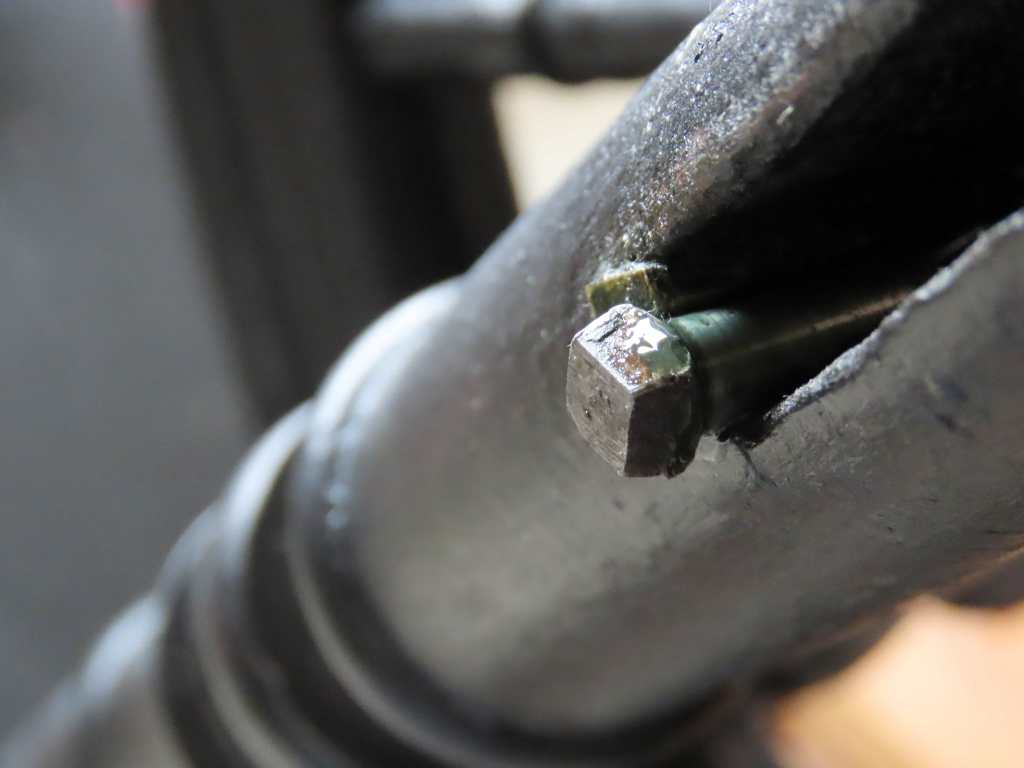
Cocodris and Philomene share somewhat unusual metal work,
CocodrisPhilomene
having distinctive angled knobs at the mandrel ends
CocodrisPhilomene
and squared axle ends.
CocodrisPhilomene
But, the most compelling similarity is the lovely treadle design.
It is so unusual and rare that it makes me think that Cocodris likely was made by Thomas Michaud. Even the wheels’ heavy treadle wear matches.
In fact, Cocodris is an even better spinner than Philomene—quiet and steady, perfect for fine singles.
Although one upright is skewed toward the spinner (it’s in tight) and the drive wheel does not directly align with the whorl, she is smooth, fast, and delightful to use.
Although these three pieces are now in new homes, I want to include them in this blog because their unusual features should be documented for future reference.
THE REEL
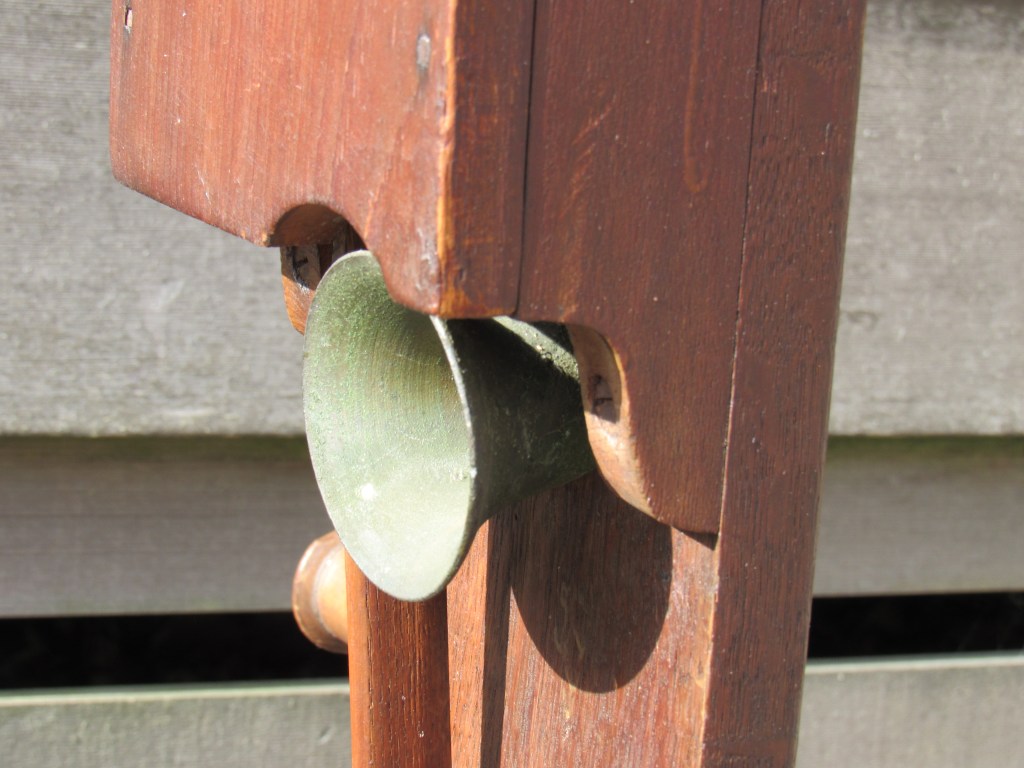
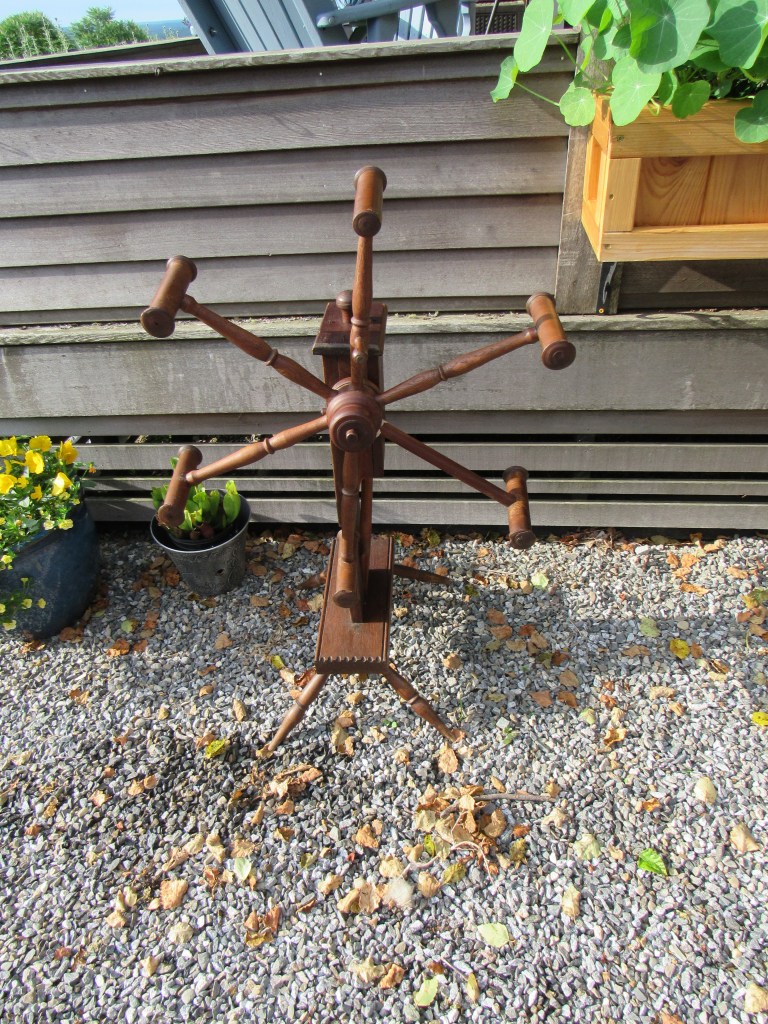
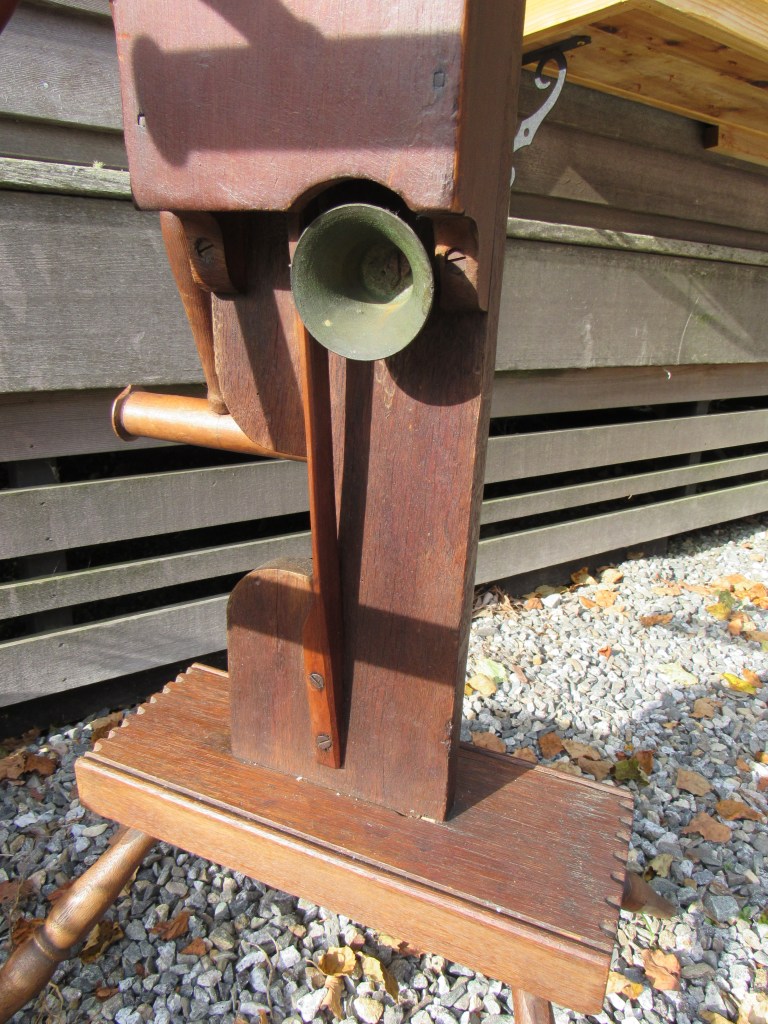
The first, a reel I named “Annabelle,” came as a package deal with two wheels from Canada. I have no idea if the reel is from Canada, too. Given that the reel’s shiny glory is a metal bell, and metal was incorporated into many Quebec wheels, it is possible.
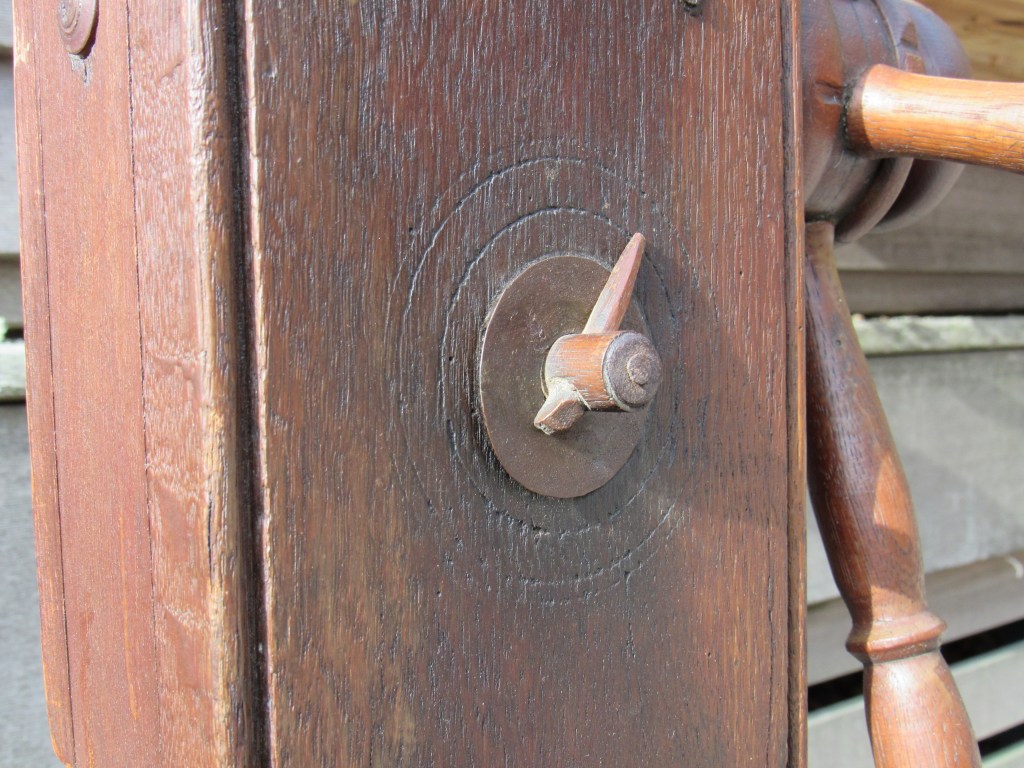
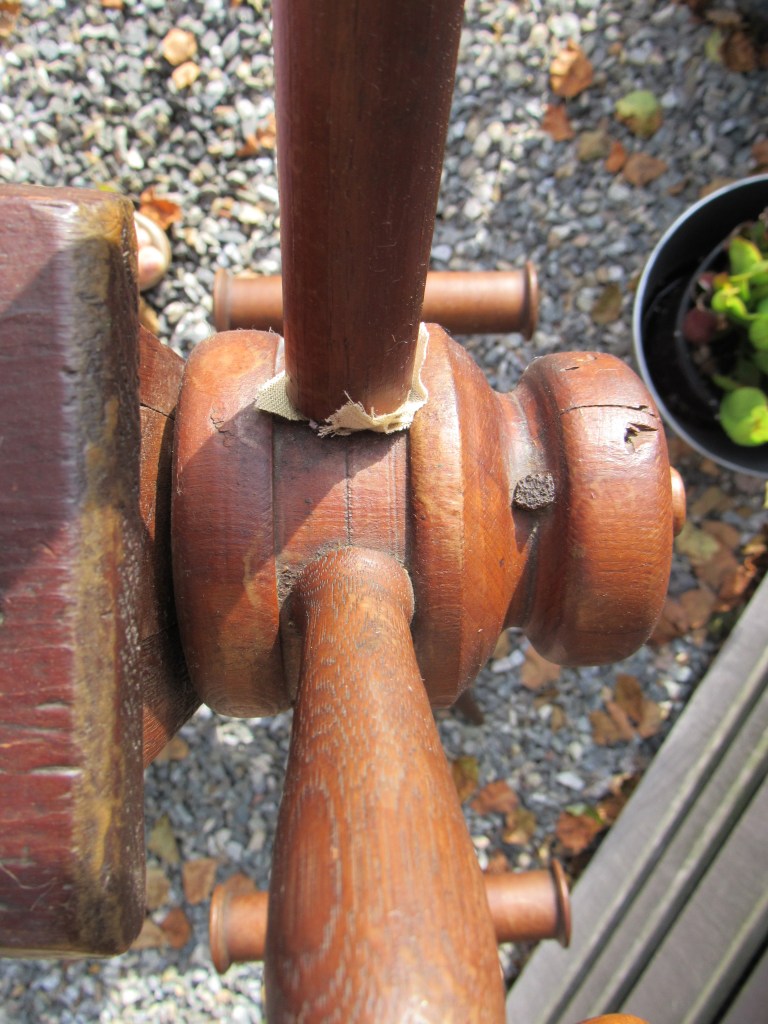
On the other hand, most (but not all) Quebec reels, called “dévidoirs,” unlike this one, are horizontal, barrel style reels, so it may not be from Quebec at all. Sadly, its origin remains a mystery. Its vertical design and counting mechanism is generally known as a clock or click reel.
Except in this case, the rotations are marked not by a click but by a ringing sound, because, upon 40 rotations, the wooden clapper hits a bell.
It is a louder and more pleasing way to count rotations, but I suspect having metal work done for a reel was not worth the extra expense for most people.
A shame, because it is lovely and practical feature. And, very rare.
THE WHEEL
The second out-of-the-ordinary piece, a great wheel I named “Felice,” was the wheel that hooked me on great wheel spinning.
I bought her in southern Maine. The seller had, in turn, bought the wheel in New Hampshire from a woman who said it was Shaker. While the beauty, simplicity, and craftsmanship would fit well with the Shaker approach to design and construction, I have not seen any evidence that Shakers make wheels with features similar to this one.
The legs are chamfered rather than turned.*
The table also has transitional, chamfered bottom edges.
The wheel post has a perfectly fitted thick horn collar, a feature found on some early Shaker wheels.
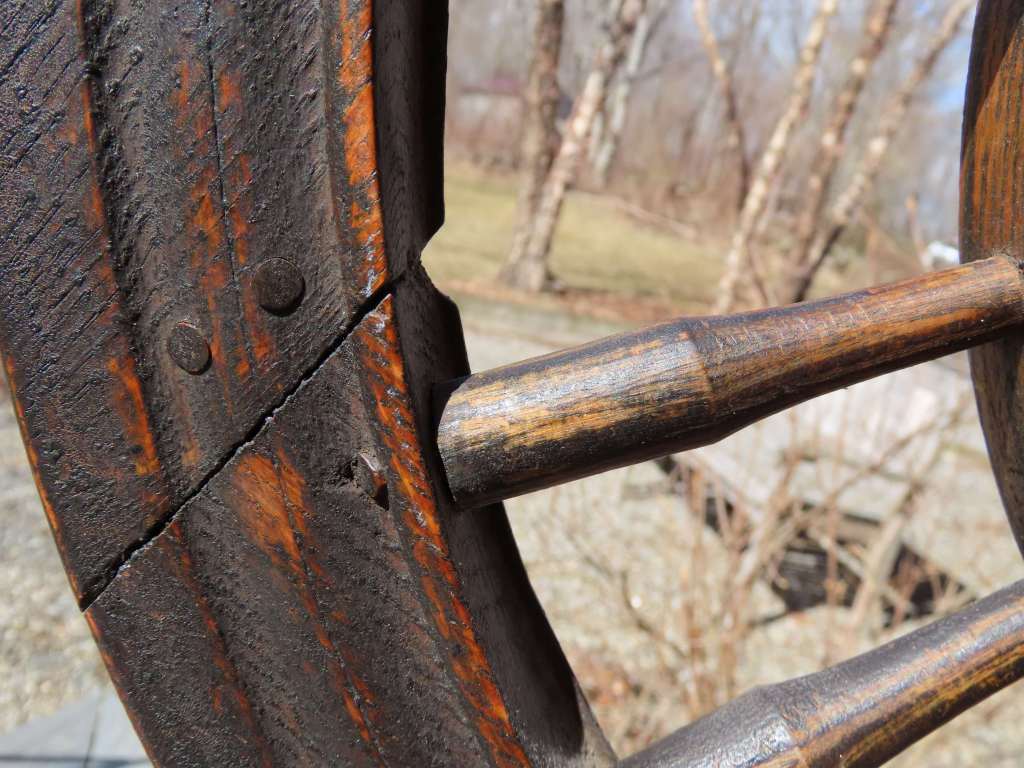
The drive wheel rim has beautifully made joins.
My favorite feature, though, is the hub, which is a perfect pear shape. I have only run across one other wheel like this one. It was found in Peachum, Vermont.
In my mind, these wheels are more beautiful than the typical Shaker great wheels. Mine also was a joy to spin on.
THE LOOM
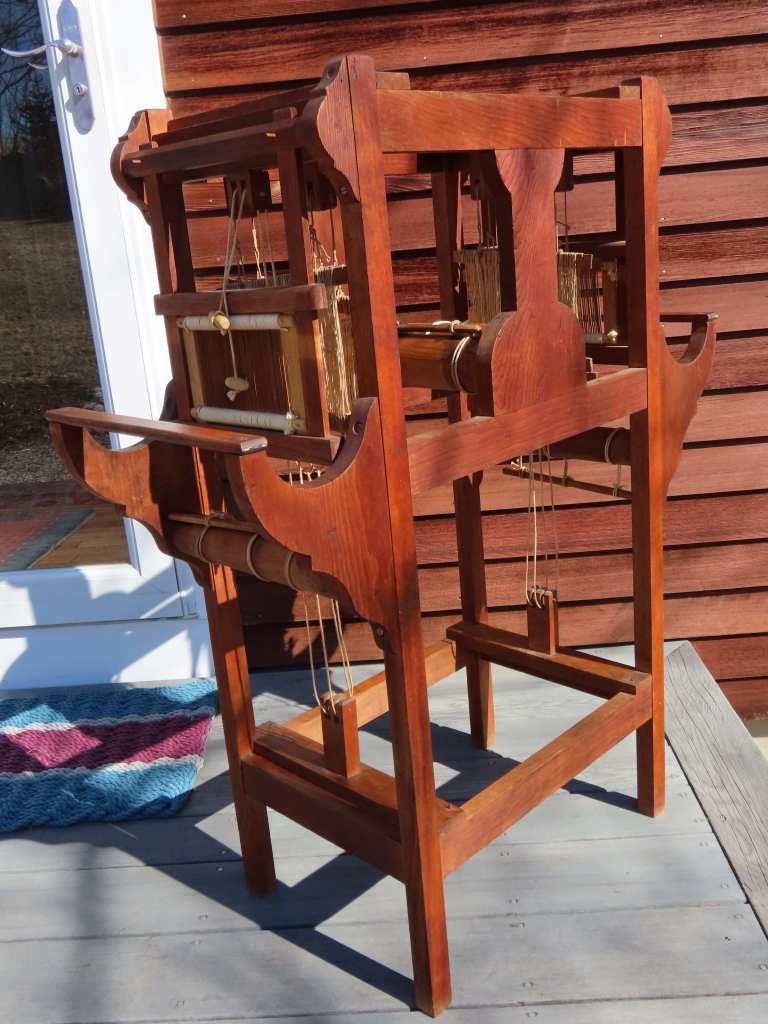
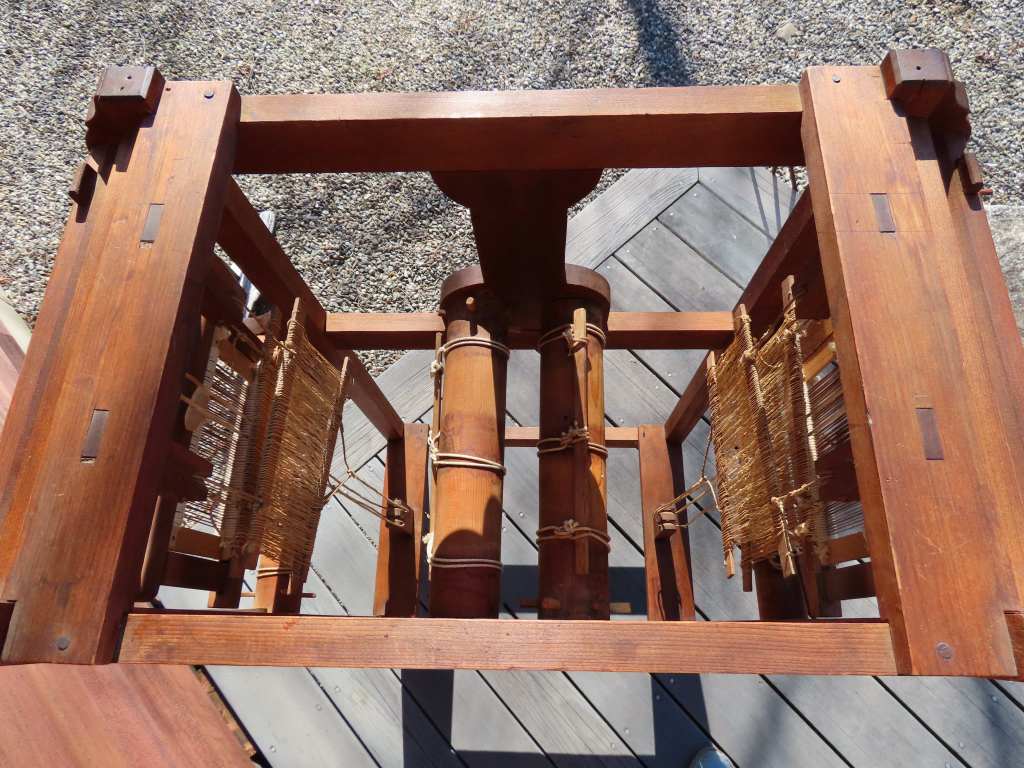
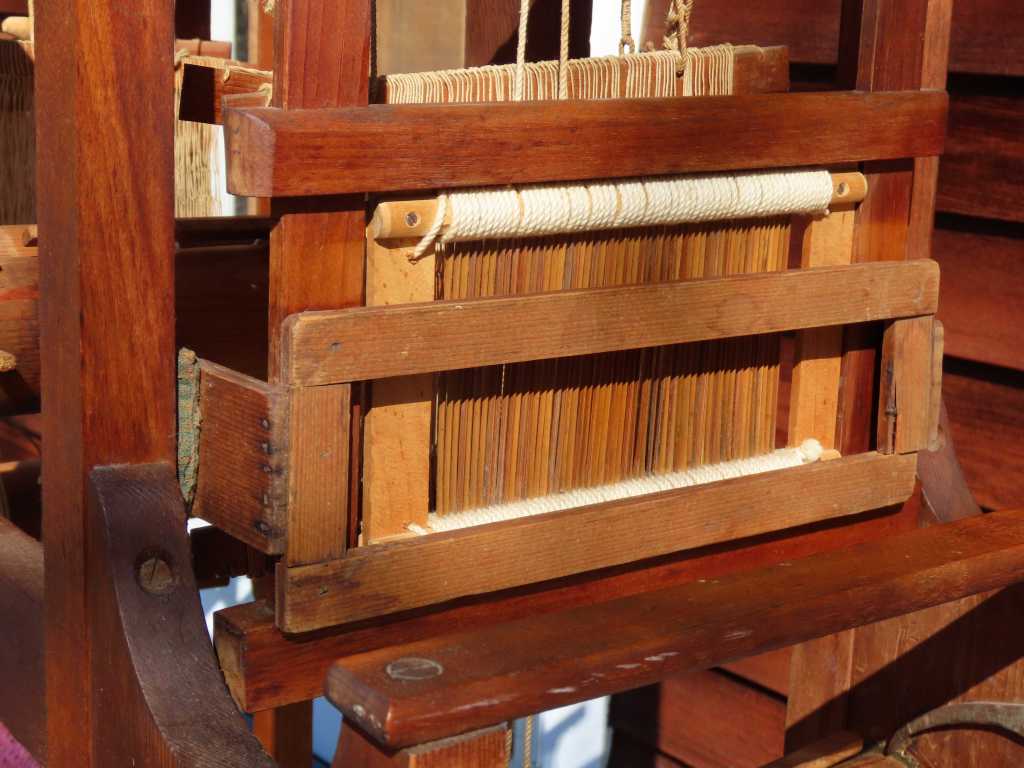
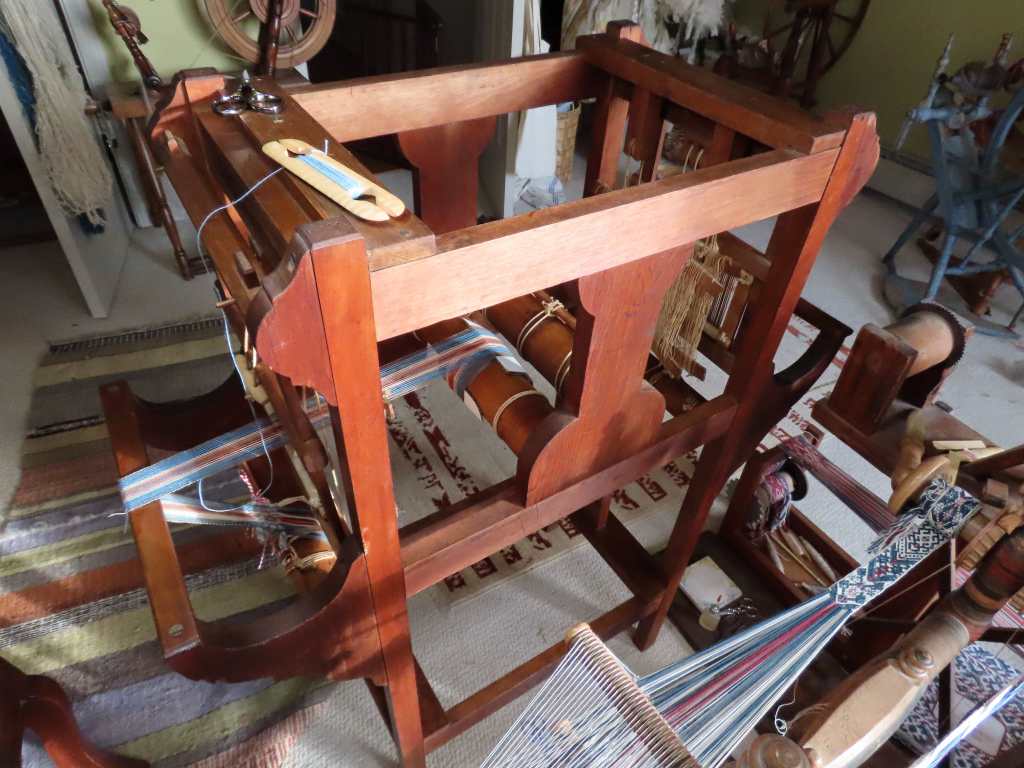
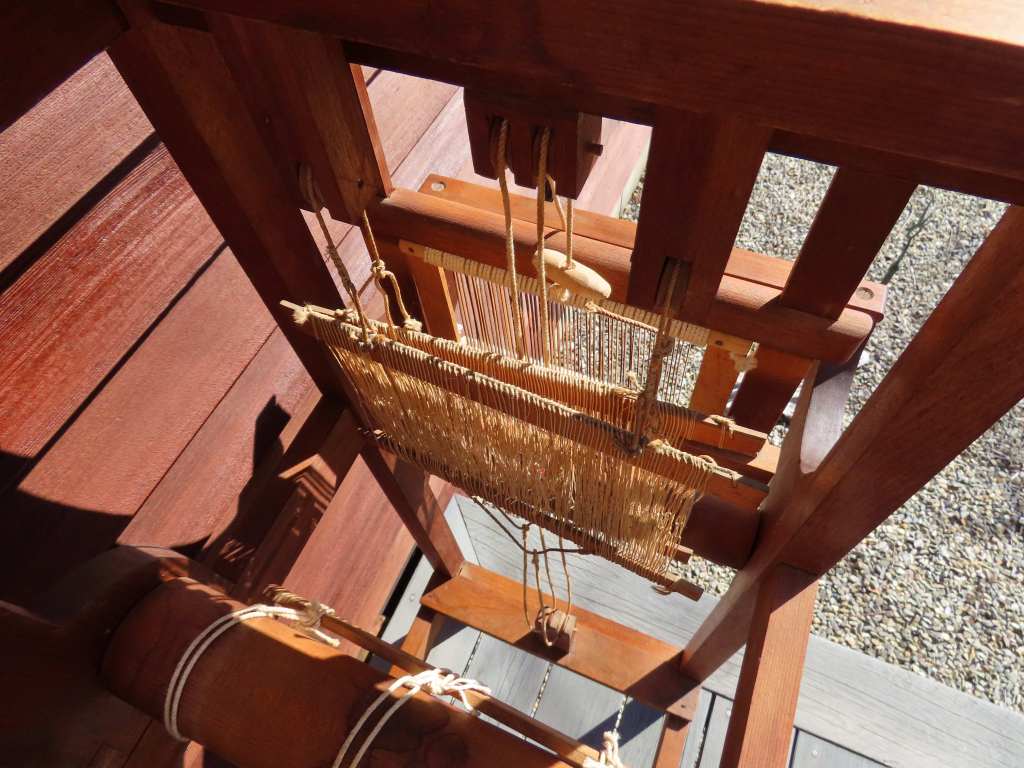
Finally, another piece that may or not be Shaker is a very unusual two-person tape loom. I wrote an article about it for the Spinning Wheel Sleuth Handloom Supplement Issue #24, but this post will supplement the article with more photographs for those curious about this wonderful little loom.
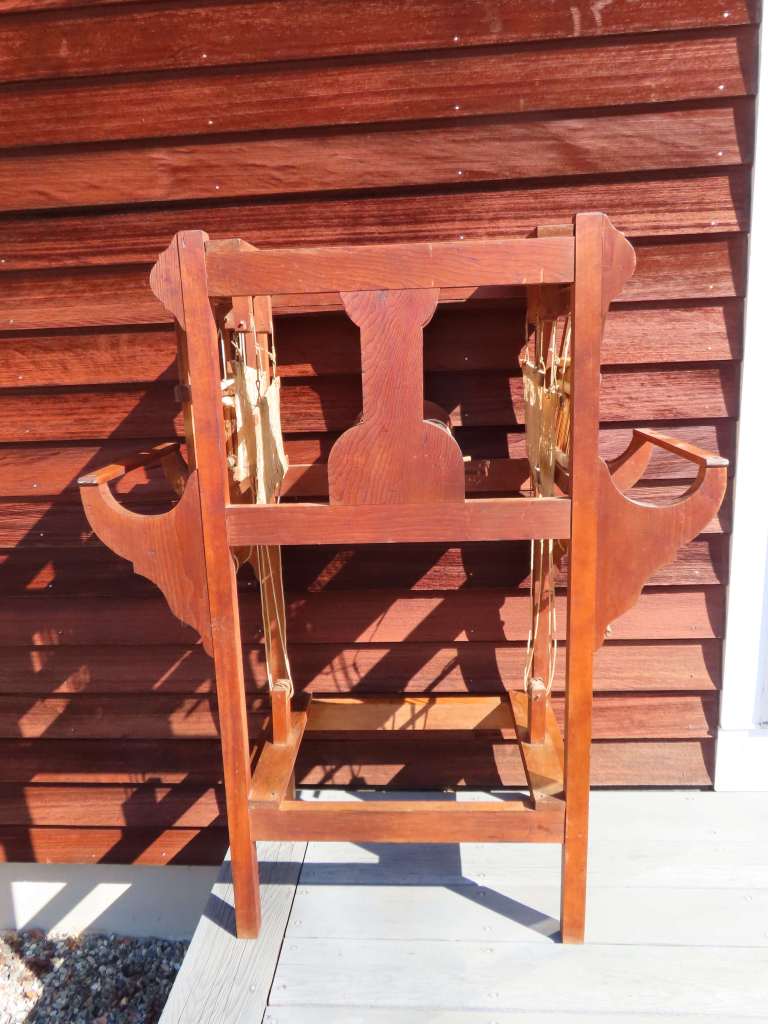
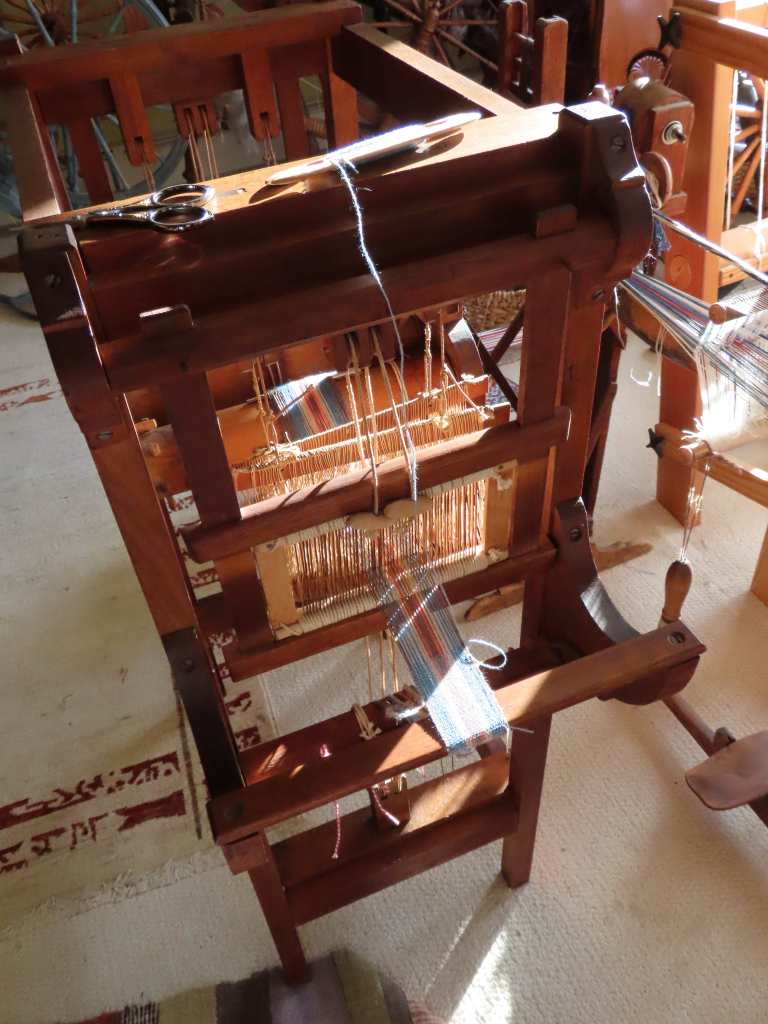
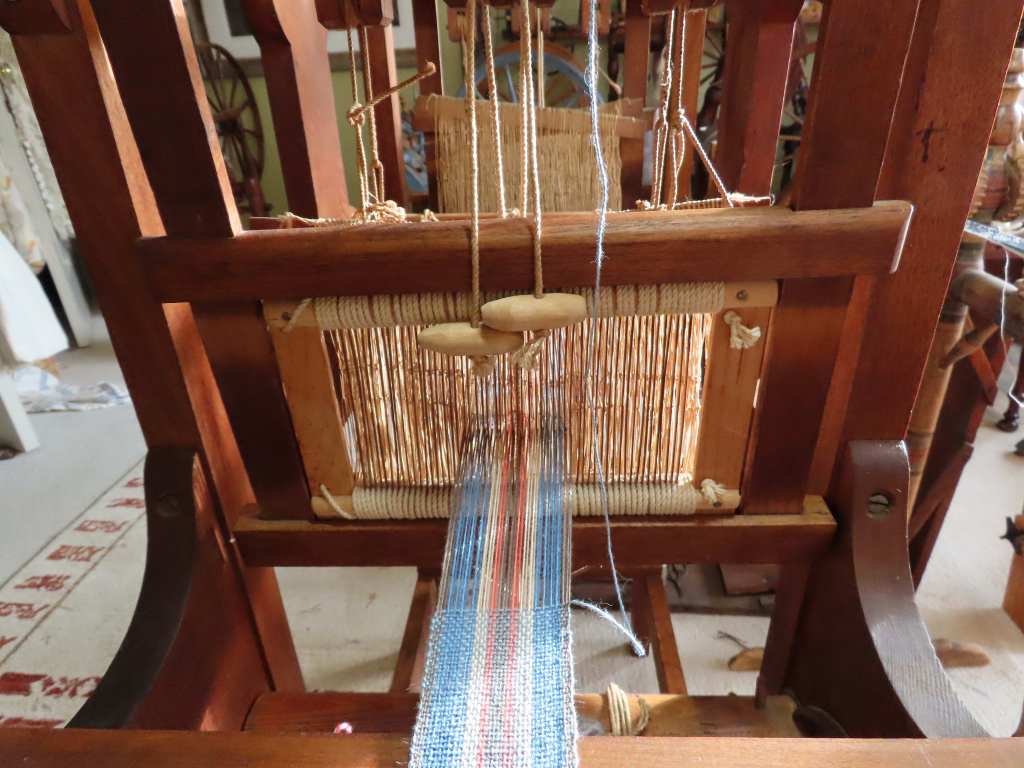
It came up for auction near me last year and I fell head over heels for it at the auction preview. Designed for two people to weave simultaneously, with a petite, pleasing design, what put it over the top was that it was in fantastic condition, with string heddles and reeds made of actual reed.
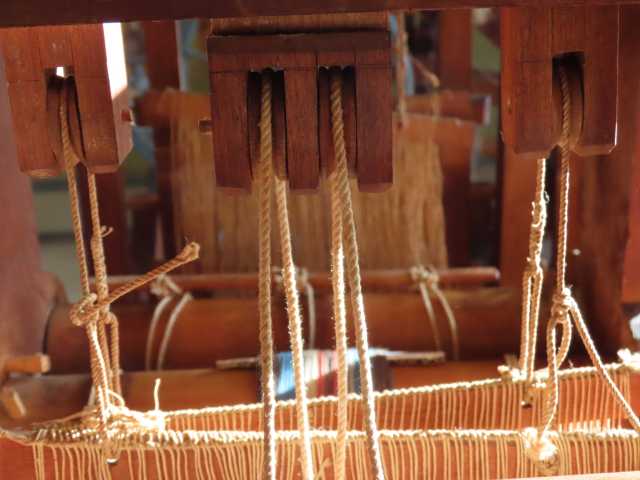
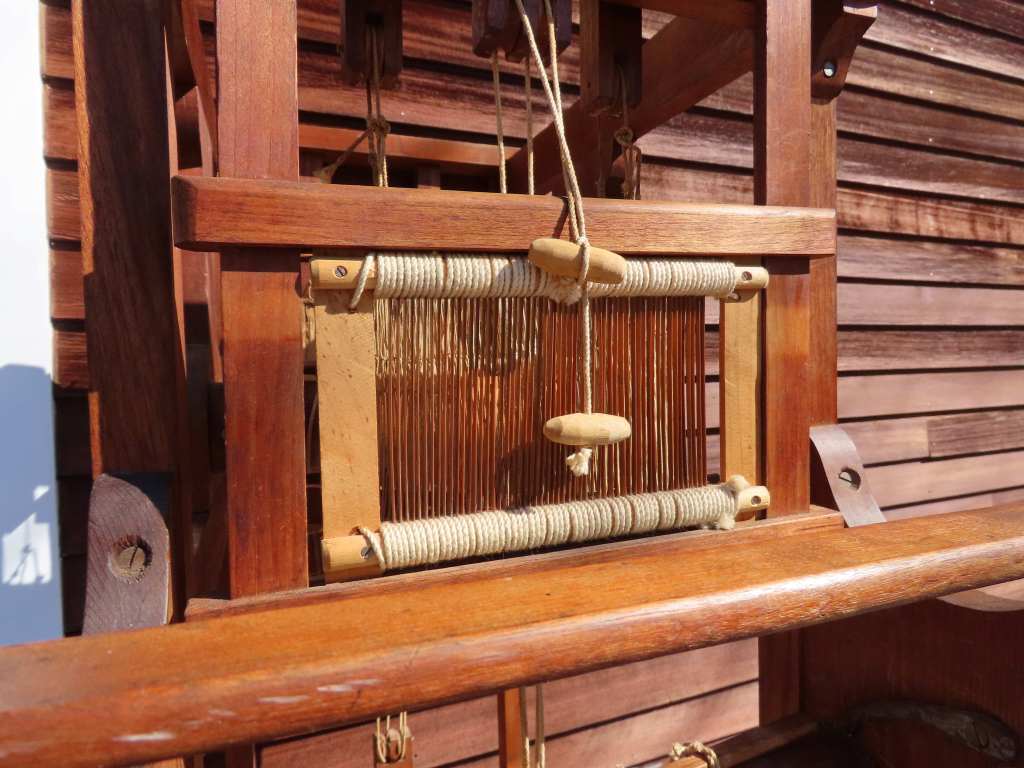
It is only 39 ½ inches tall and 13 ¾ inches wide, but big enough for two people to weave tapes at the same time. It has no space-hogging treadles, which allows for a compact footprint. Each side has two shafts, connected by an overhead pulley.
Each shaft also has a cord running down to a lower pulley and then to an upper pulley,
ending with a wooden knob which the weaver pulls to raise each shaft.
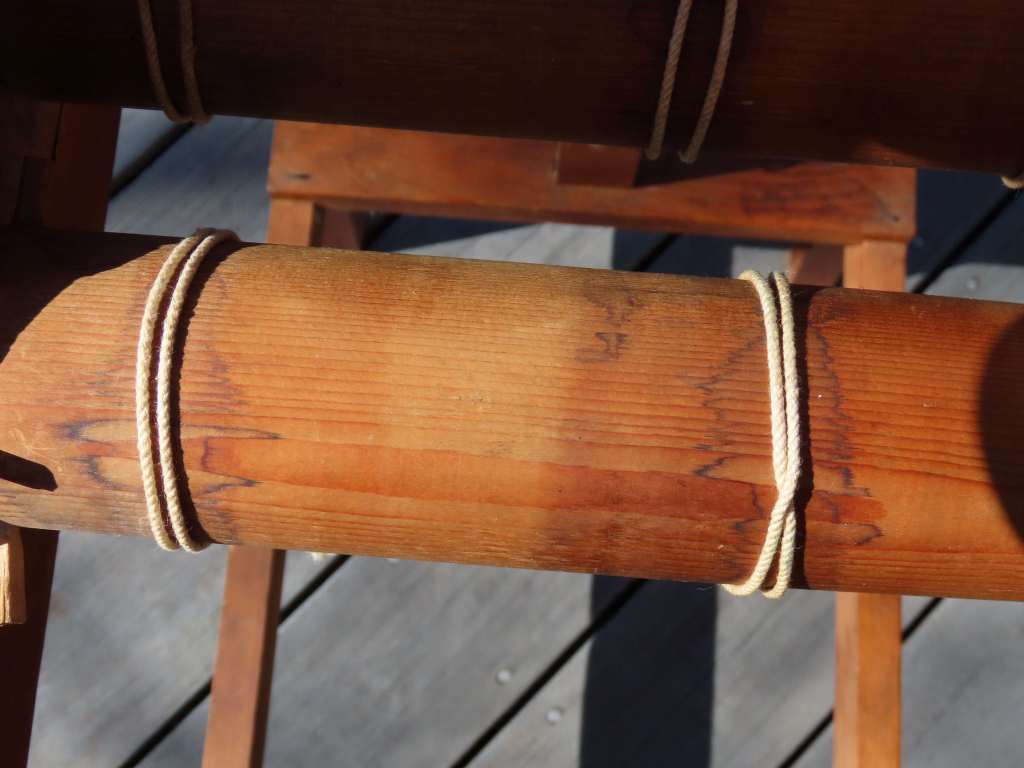
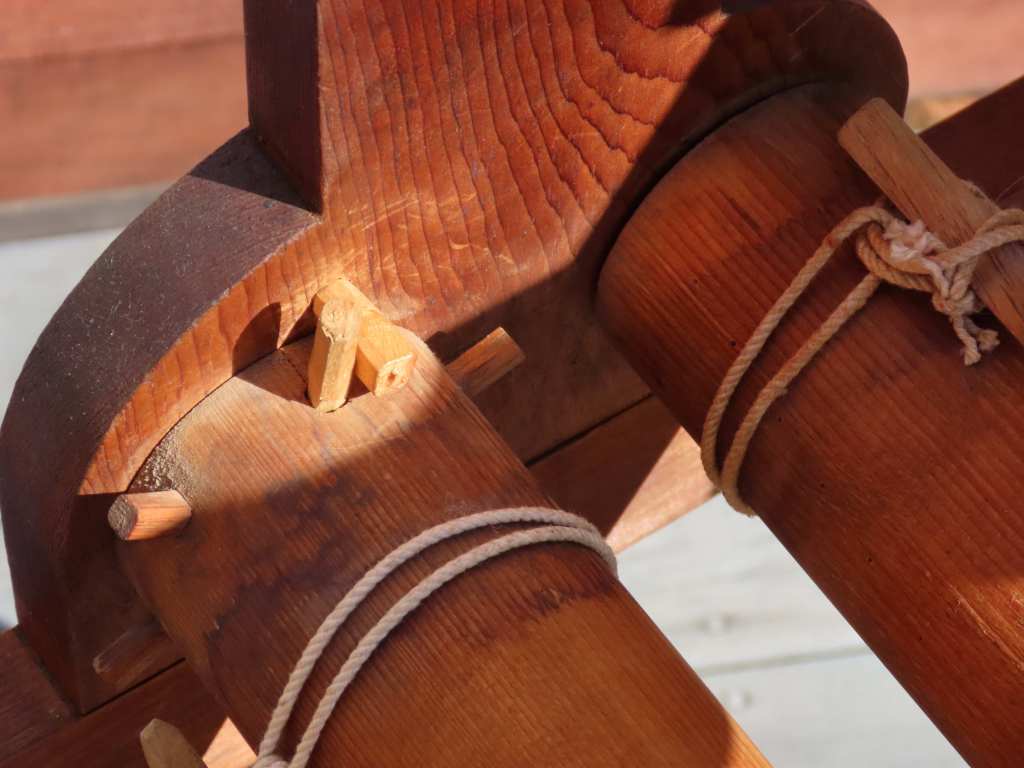
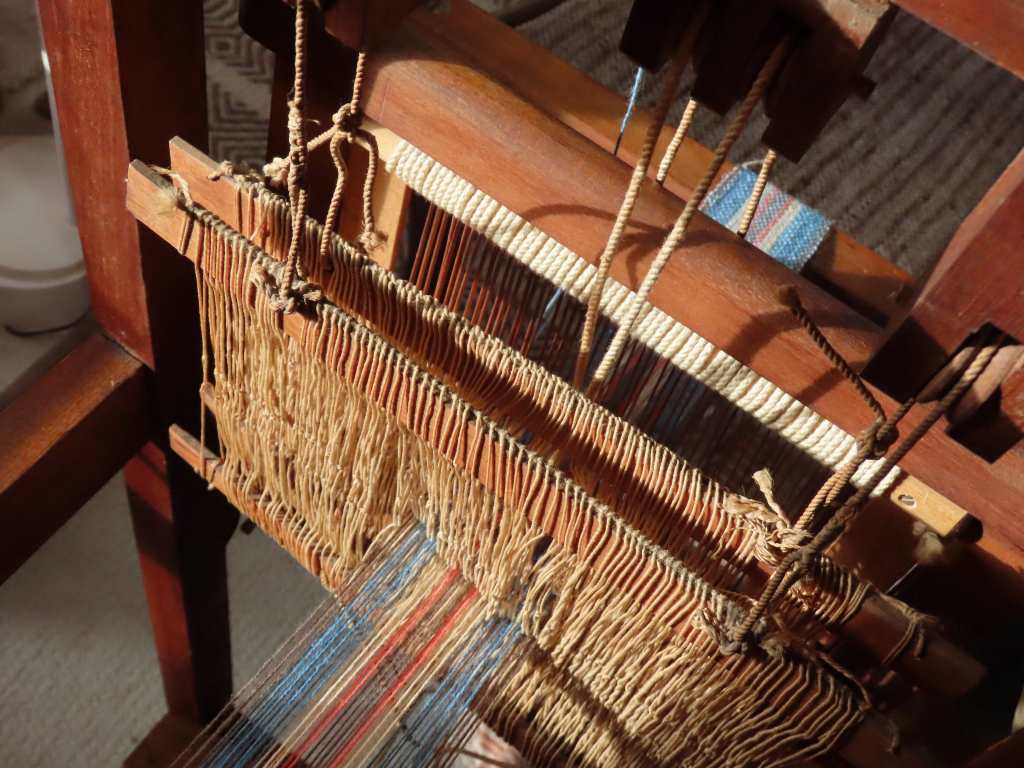
Each side has its own warp and cloth beams, with cords for attaching the warp. Interestingly, the cords have water stains around them even though the rest of the loom shows no water damage at all.
One possible explanation is that the cords were moistened to make them swell and have a tighter grip on the beam when weaving. I found that without wetting the cords or otherwise securing them, they tended to slip around the beams when under tension.
The warp beams are held in place with wooden pegs and the cloth beams have metal ratchets and pawls.
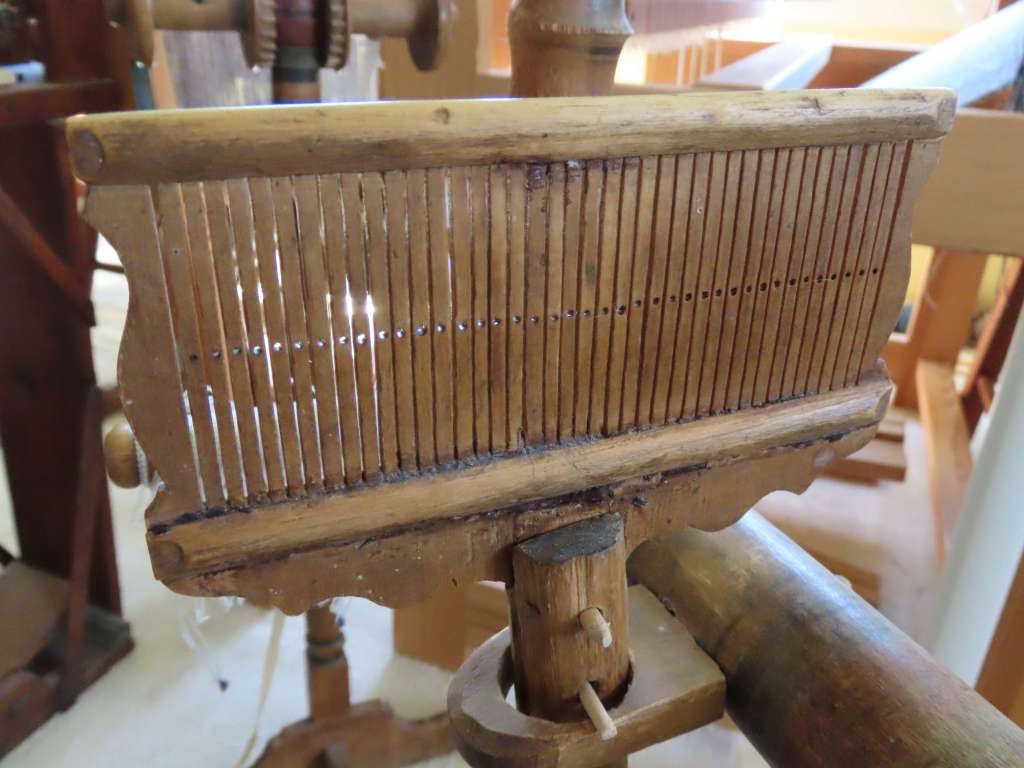
The reeds in the overhead beaters have some newer cord on them, indicating that they have been repaired or replaced.
They also appear to be taller than the original reeds, based on the darkening of the wood on the beater sides.
The sides of the beater have lighter patches where the cross bar holding the reed used to rest
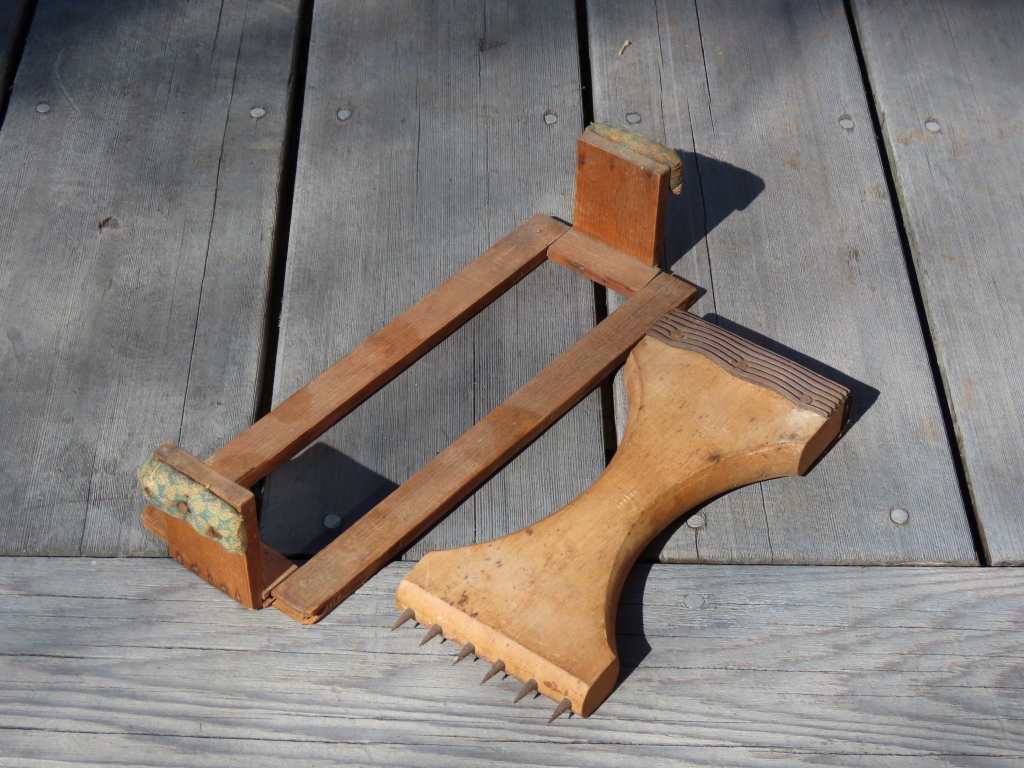
The loom came with two extra pieces that were a total mystery to me.
It turns out that the piece with the prongs is a stretcher used to tighten webbing when making chair seats. The other piece, which looks very old, is something I believe was used to hold the reed in place for sleying. But, that is just a guess.
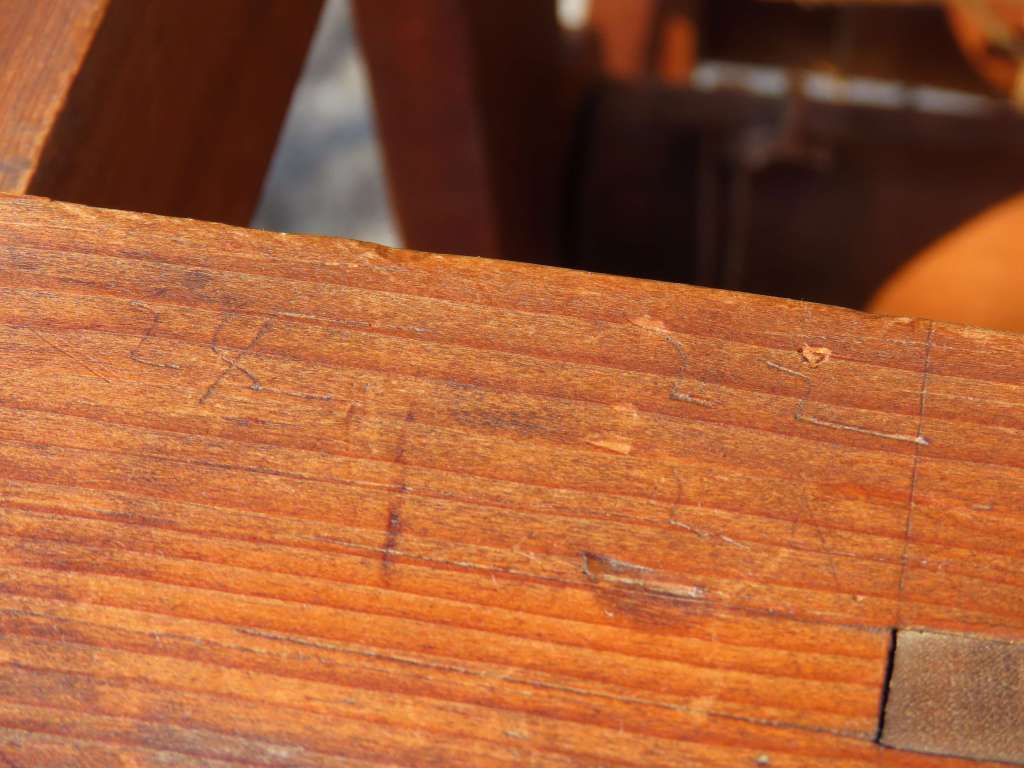
This treasure of a loom was well-cared for and apparently well-used. There are even numbers scratched on the loom top—24, 22, 24—presumably to keep track of something.
The auction house said that the loom came from the Baxter estate in Benton, Maine. Wildly curious about who would design and use a two-person tape loom, I started researching it right away and found that several have turned up. One other, just like it, but in much worse condition, was at the Fort Ticonderoga Museum and pictured in Bonnie Weidert’s book “Tape Looms Past & Present.” (photo 2-22, p. 24). A little research revealed several others—but designed for a single user—at Hancock Shaker Village Collection (1986.024.0001); Enfield Shaker Museum (2018.51); Marshfield School of Weaving Textile Equipment Collection (1959.1.12); and Jeanne Asplundh’s collection, photographed in “Spinning Wheels and Accessories” (fig. 14-67, p. 182).
Finding that two of the looms were at Shaker museums, I dove into research to see if there was an established Shaker connection (more on that in the SWS article). Ultimately, I could not find evidence to either prove or disprove that these were used by the Shakers.
The looms would be perfect for weaving the large amounts of the tape used by Shakers for chairs but the only documented Shaker chair-tape looms that I could find are a different style. If not Shaker, would they have been used in some other institutional setting such as a rehabilitation facility or a school? Having hand-operated looms would make sense for those unable to use their legs or for short-legged children.
Whatever its history, I am just thankful that it was preserved with such care so that it can be appreciated by us and future generations.
Page, Brenda, “A Two-Person Tape Loom,” The Spinning Wheel Sleuth Handloom Supplement, Issue #24, April 2024
Weidart, Bonnie R., Tape Looms Past and Present, 3rd edit., Bonnie Weidert, Henrietta, NY, 2012
Pennington, David & Taylor, Michael, Spinning Wheels and Accessories, Schiffer Publishing Ltd., Atglen, PA, 2004
*I refer to pieces with multi-angled faces as “chamfered.” While I understand that others use the term to refer to 45 degree angled edges, until I learn of a more fitting term for the multi-angled faces that we find on legs, spokes, and supports of wheels and reels, I will continue to use the term chamfered.
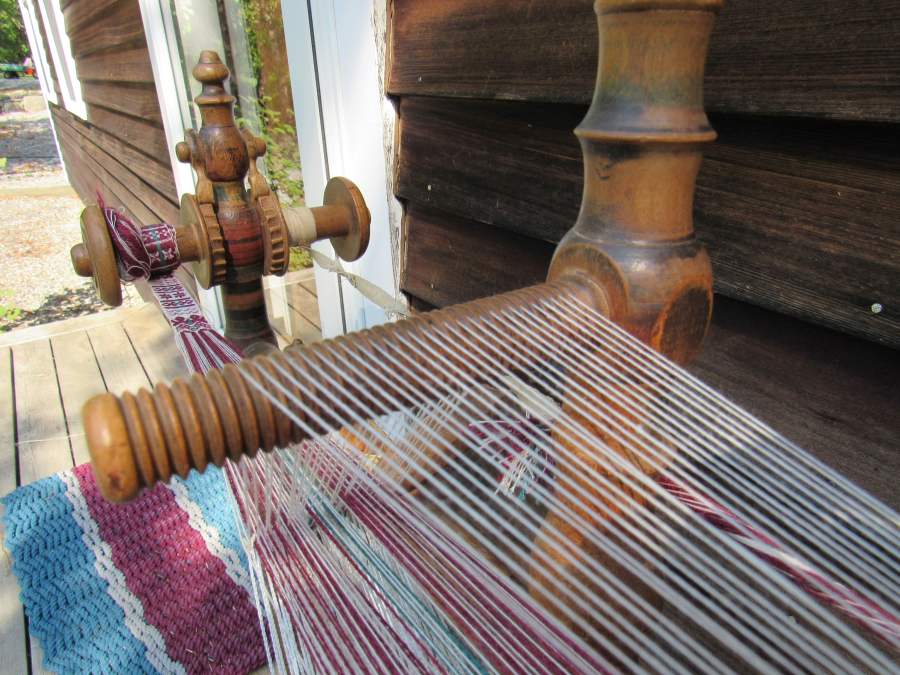
Of all the pieces in my collection, this little loom may be the one I treasure the most. In part, because it is a particularly colorful and complete example of a rare loom, but also because of the sheer pleasure of weaving on it.
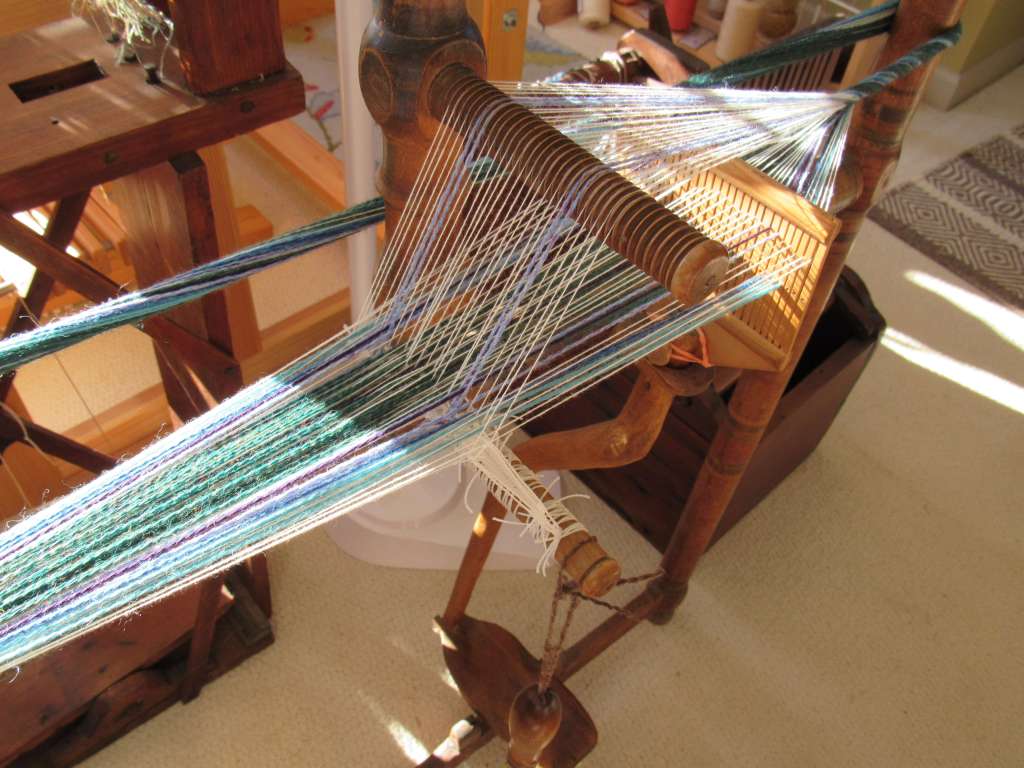
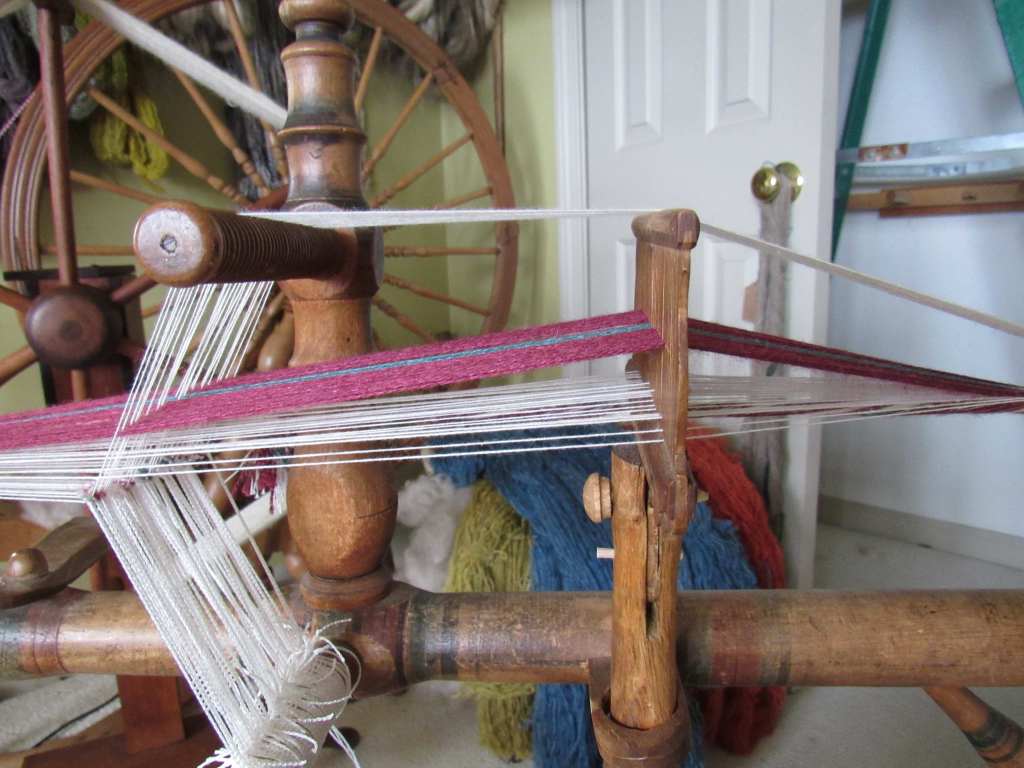
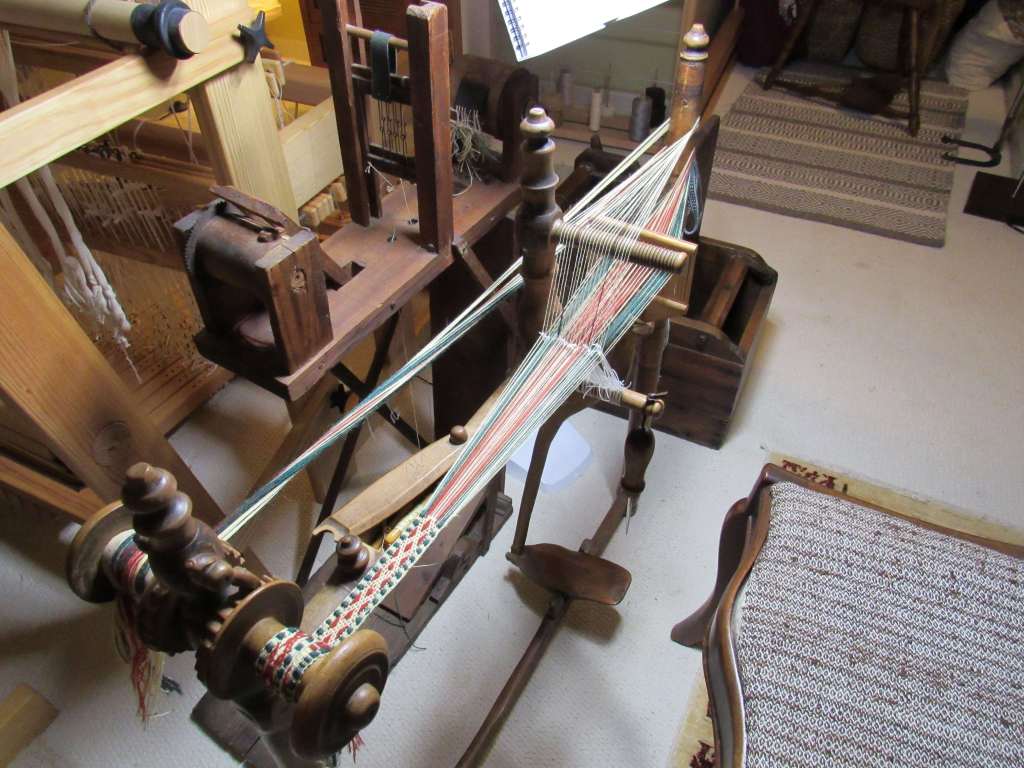
This style loom, designed for weaving bands (also called ribbons and tapes), generally is referred to as a “Leksand loom,” because it was made only in the Leksand area of Sweden. Its design is unique.
“At the Loom,” Helmer Masolle (1884-1969)
To start with, the weaver works from the side of the warp. While this horizontal style is unusual these days, it must have been quite common in the 15th century.
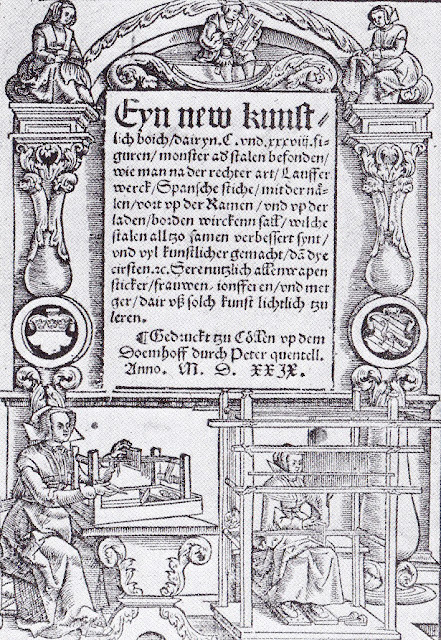
Medieval manuscripts show many varieties of sideways-style band looms,
Paris Bibl. Mazaring, Vierge tissant dans le Temple
some with tablets,
15th century France, Houghton Library, Cambridge, MA
some with floating rigid heddles,
Eny Newe Kunstlick Moetdelboech: P Quentel, Cologne, 1532, Metropolitan Museum of Art
and, at least one, with what we now call an inkle-style set up (“inkle” is believed to be a corruption of the 16th century English word “linckle,” meaning “band” or “tape”).
Le Livre de Bonnes Moeurs de Jacques Legrand, 15th century
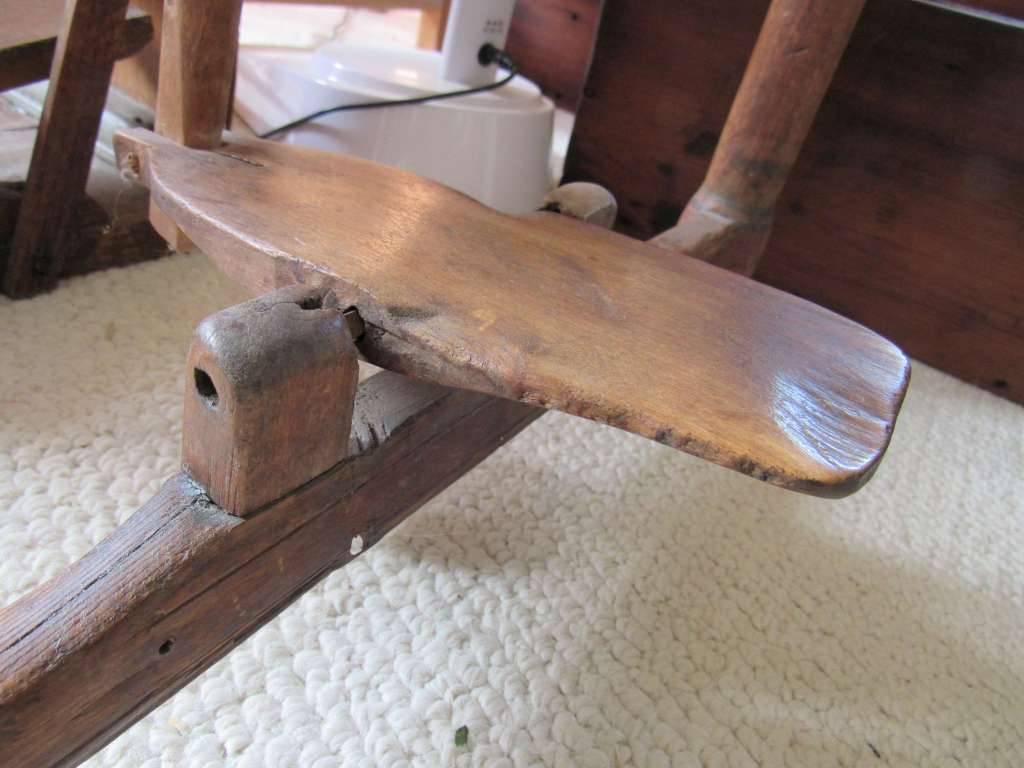
While horizontal band looms were used in several parishes in Sweden,
Carl Larsson, 1853-1919
only in Leksand did looms have the added feature of a small wooden rigid heddle attached to a foot treadle.
With this ingenious design, the pattern threads run through the holes in the rigid heddle.
One set of background threads runs through the heddle slots and the other set runs over a corrugated rod and through half-heddles.
This photo shows the new heddle that came with my loom, the rubber band kept it from tipping side-to-side
It functions similarly to a double-slotted (Sunna or pattern) heddle in backstrap weaving. Using the foot treadle, the pattern threads can be raised together, all in one plane, separate from the background threads.
With the heddle in the raised position
Elevating and isolating the pattern threads this way allows the weaver to easily pick out the band patterns with a band knife.
It is a brilliant innovation for fast, efficient weaving of complicated band patterns.
With the band knife in the right hand picking patterns and beating, the left hand is free to pass the bobbin through the sheds
And the prolific Leksand weavers took advantage of these little looms to produce stunning bands in great quantities. Most often red and white or black and white, the Leksand bands were woven with a seemingly never-ending variety of patterns, some dating back to the thirteenth century. Foulkes, p. 16. The bands were used for hats, belts, straps, ties, laces, and decorative edging.
Some typcial Leksand bands—photo by Kirsi Manni
In Sweden, Kirsi Manni is a rich source of information about Leksand looms and bands, including invaluable knowledge learned from local older weavers.
“Band Weaving in the Cowshed,” Leksand, C. Gellerstedt 1875–according to Kirsi, band-weaving in Leksand often was a social event, where young women could gather unchaperoned with their friends and young men
Kirsi kindly welcomed me to her home in Sweden last summer where she collects spinning wheels, textile tools, and these rare looms to preserve them for future generations.
Some of Kirsi’s collection–all are different and few have the original heddles
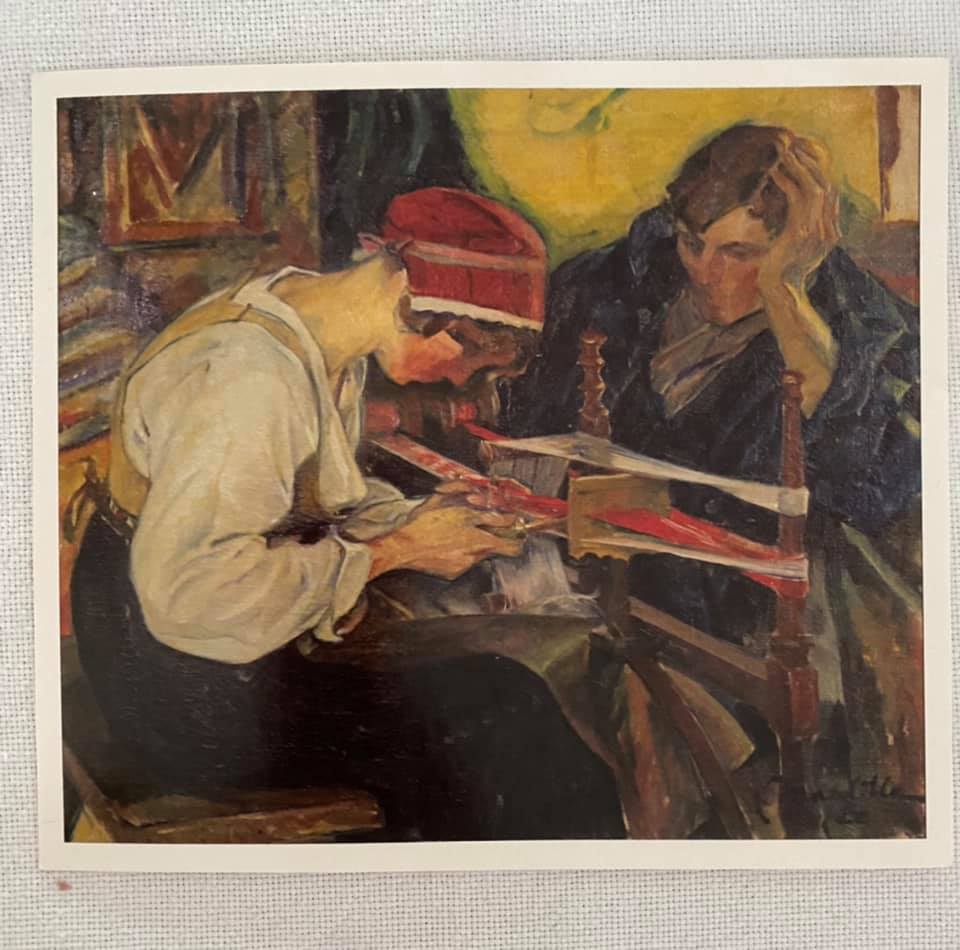
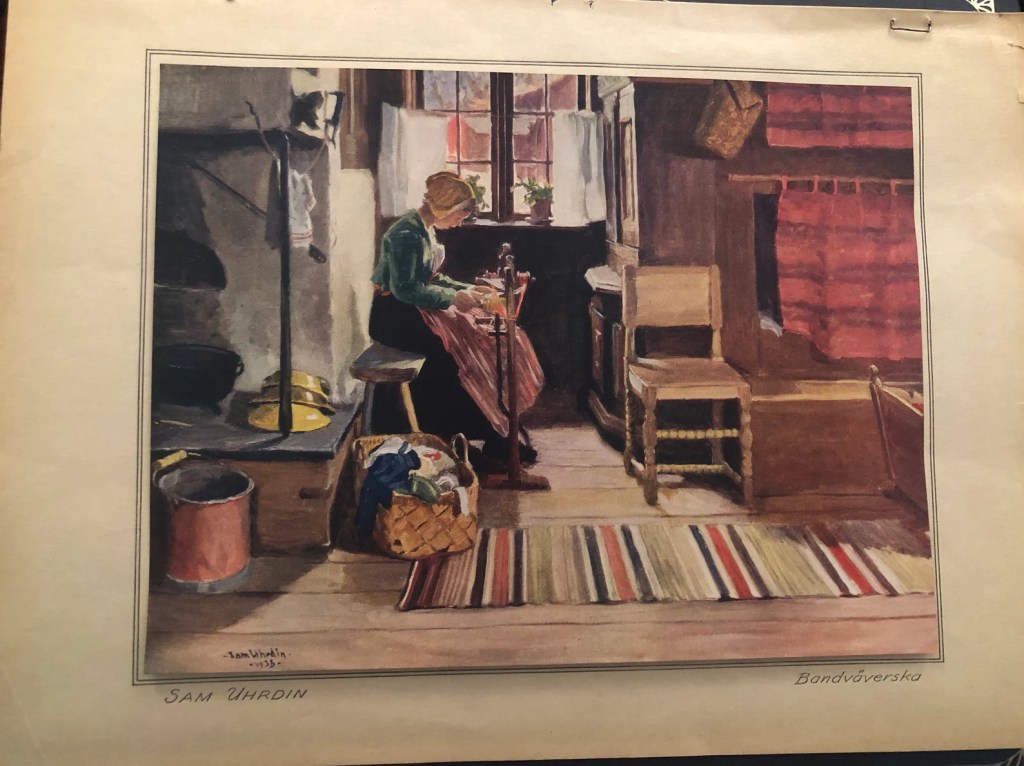
For those on Facebook, Kirsi started a “Leksand Loom” group, in which she has shared some lovely artwork, including from local painter, Sam Uhrdin (1886-1964), depicting women weaving at their band looms.
A Leksand Band Weaver, by Sam Uhrdin, 1945
Photos of Kirsi’s looms, and much more, can be found in Kirsi’s excellent article on Leksand looms in the Spinning Wheel Sleuth’s Handloom Supplement #23.
Leksand bands in Kirsi’s collection
Given that these looms were only made in Leksand, it is not surprising that they seldom turn up anywhere but Sweden. There are only a handful of which I am aware in the United States, so I am incredibly fortunate to have one (thank you Florence).
My loom was featured in The Spinning Wheel Sleuth’s Handloom Supplement #4. The article’s author, Marion Satchwell, found the loom at an antique show in Florida in the 1990s.
It came with a wee bit of black and white woven tape, which was passed on with the loom. That tape was made with what looks like fine sewing thread for the background and silk pattern threads.
Bobbins and the bit of band that came with the loom
The Leksand looms were made by local carpenters and ranged from simple to ornate. The carpenter who made mine was skilled and made the loom as lovely as it is functional.
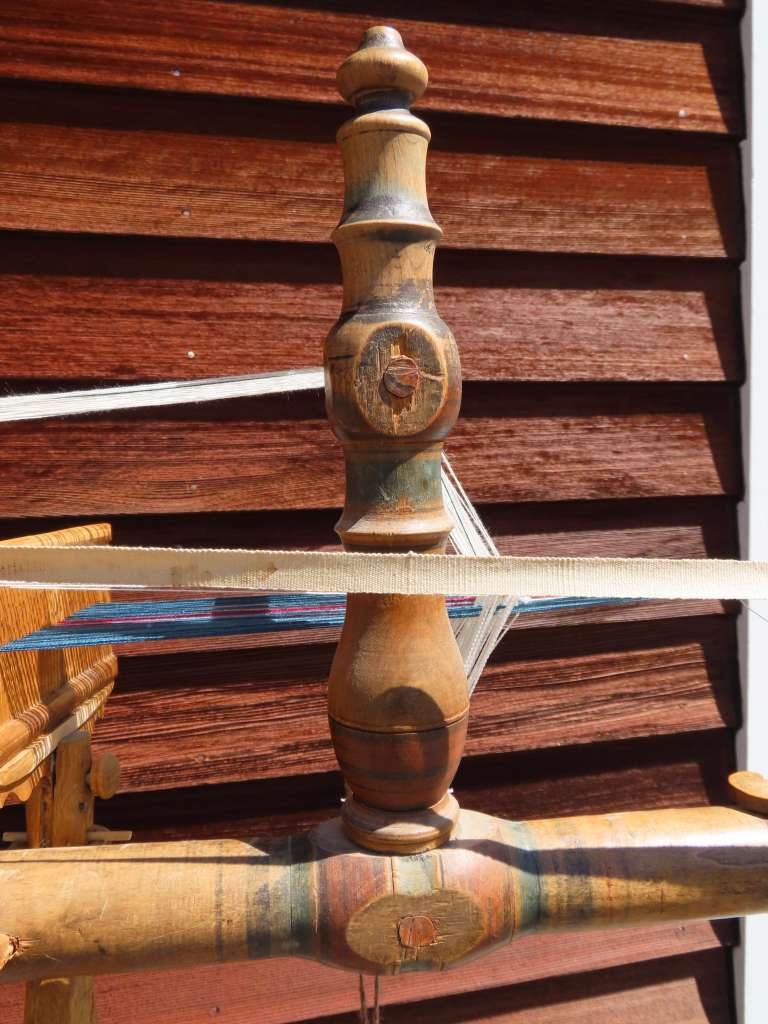
The colorful paint has faded, but continues to highlight the loom’s turnings and design.
I especially love the upright between the ratcheted spools, with reminds me of a woman with arms that lower and raise to keep the spools properly in place.
The leashes for attaching the warp ends are secured through holes in the spools.
The treadle is attached to the rigid heddle by a curved piece of wood provided by a perfectly imperfect sapling in a Swedish wood, bent by some force of nature, now living on in a Leksand loom.
It is hinged to the treadle and has a slit at the top for the rigid heddle.
A lower bar holds the half heddles and the corrugated top bar keeps the upper warp threads spread out, making for easier shed changes.
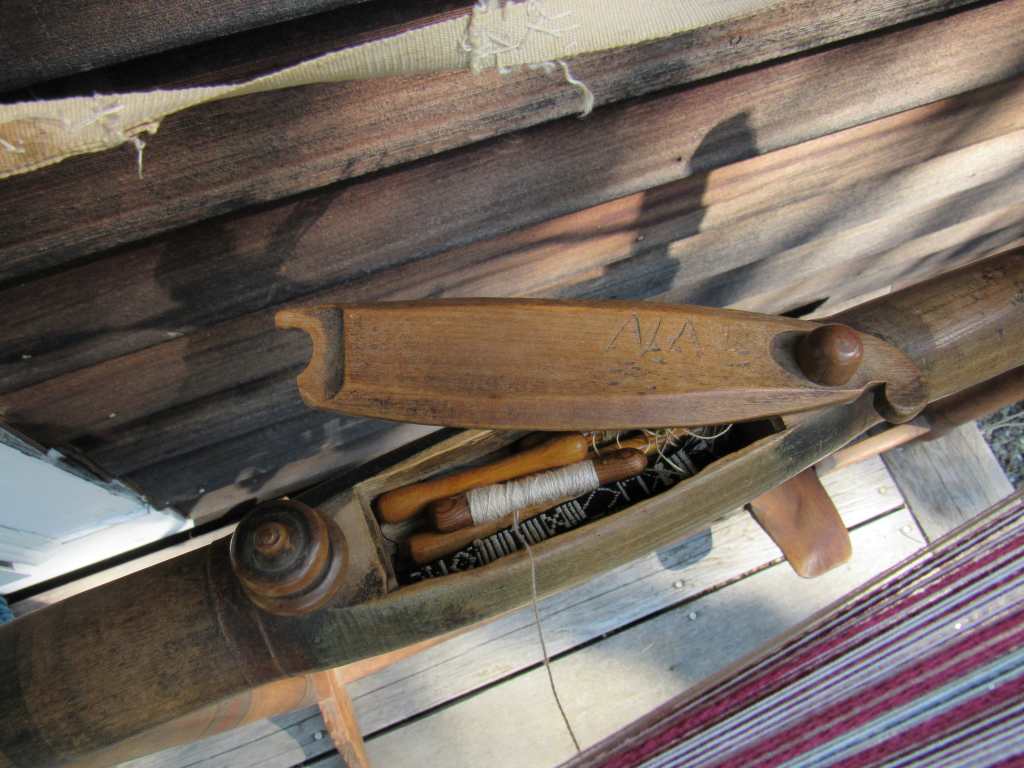
The frame has a convenient carved-out storage box, full of bobbins,
with a rotating lid with letters, probably “NA,” scratched on top.
Whoever NA was, she did a lot of weaving,
because there is heavy wear on the lower cross bar and treadle—with a deep hollow made by a smallish shoe heel on the treadle.
How I wish she could have transmitted some of her knowledge to me. Because it was a real challenge to figure out how to best set up and use this loom.
There are no manuals for weaving on Leksand looms and I did not know Kirsi then. After months of research, head scratching, messages to and from people who might be able to help, experimentation, and good dose of serendipity—I went from confused to enamored.
The first band I wove on this loom
My first stroke of luck came right after I brought the loom home when a Swedish band knife came up for sale on eBay.
About a month later, another three came up for sale together and no one bid on them (but me, eventually).
The three knives I have now–I gave one of the original four to Kirsi
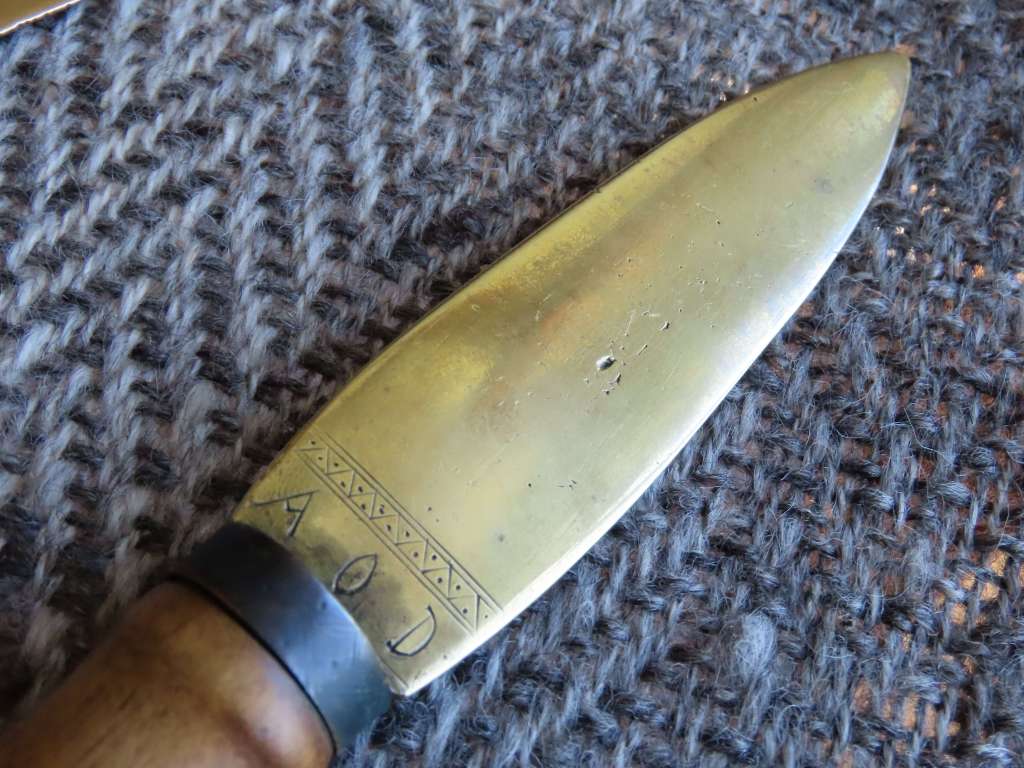
Since then, I have only run across one other for sale, so I was extremely lucky to find these right after I got the loom. Apparently, many of the knives of this style were made in Mora, Sweden, often with dates and initials inscribed on the blades. Each of mine is different, perhaps giving the weaver some choice in size and weight—a particular balance and heft.
Notice how all the tips are different
But all were designed for hours of weaving—comfortable in the hand, smooth, and nicely weighted, so that a weaver can continuously pick, slide, and whack/whack almost effortlessly. They feel amazing—the wooden handles and brass blades are incredibly smooth—I love to run my hands over them. The oldest has deep grooves in the blade from angling and lifting the shed to transfer the bobbin.
Using them gives me a feeling of intimate connection with their previous owners, knowing we have shared a common experience—the specific fit and feel of the wood in the hand, the certain way the blade tip picks up the threads, the smooth slide and angling of the shed, the force of the beat—unique to each knife.
They are marvelous tools. For more about them, Lois Swales wrote an article in the Spinning Wheel Sleuth Handloom Supplement #16. As a bonus, her article includes a photo of one of Louise’s looms, which appears to be a twin to mine–so likely by the same maker. According to Louise, that loom had been imported from Sweden by a California decorator for use as a bathroom towel rack. Such an indignity! Fortunately, it survived and is weaving again.
The heddle that came with my loom
Louise’s loom, like mine, had lost its original rigid heddle. Not surprising, because they are quite delicate and easily broken or lost—in fact, it is rare to find one with an intact heddle. My loom had a new heddle when I got it. It was nicely made, but only big enough for 29 pattern threads, and it wobbled from side to side. Since many of the traditional Leksand bands used 33 pattern threads, I wanted to find someone who could make me one close to the originals. Not an easy task. While researching possibilities, what should appear on eBay but an antique Leksand rigid heddle?
I was gobsmacked—they NEVER come up for sale. More loom serendipity. Because, when it arrived, it fit into the treadle bar slot as if made for it and the two holes in the inserted portion lined up exactly with the holes in the treadle bar.
At the time, I ignorantly did not think much of that, assuming that there must have been a certain uniformity in the rigid heddles make in Leksand. Ha. Since then, all of the Leksand rigid heddles that I have seen have been different—nothing uniform about them.
Which makes me think that I may have lucked into a rigid heddle made by the maker of my loom. How weird would that be?
A previous owner marked the center of the heddle with a small black line—I thank her for that!
I am not an experienced or particularly proficient band weaver, but with this loom and antique heddle, I can easily weave the complicated 33 pattern bands found in Leksand. I do not know if the way I weave is historically accurate, but no matter. It is fun, rhythmic, very tactile, and satisfying. This loom is a rare link to a very specific time and place that I am fortunate to be able to enjoy. Thank you to everyone in Leksand and beyond who saved these looms, especially those who had no idea what the looms were, but appreciated their unique beauty.
While in Dalarna, Sweden last summer, one particular wheel style kept appearing at various places I visited. I first noticed this style in the collection at Sätergläntan, the craft school I was attending for a daldräll weaving course. I was especially interested in the collection’s two turned-table, metal-clad wheels described in my last post, “Torvi.”
The turned-table wheels at Sätergläntan
Even as I was marveling over those wheels, however, another caught my eye. It was the maidens I noticed first—they were so much like those on the turned-table wheels.
The similar wheel in the collection
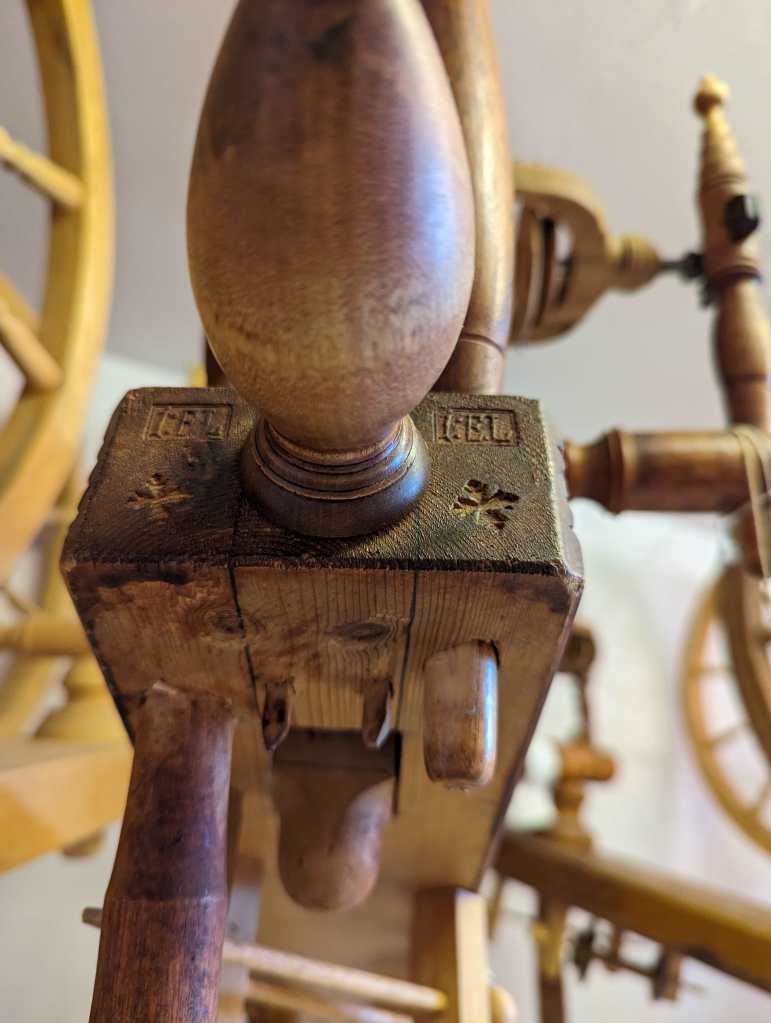
And not just the maidens–the unusual treadle set up, the legs and feet, the axle caps, the table-side grooves, and the spokes and drive wheel– all were remarkably similar to the turned-table wheels. The maker’s mark was different, though—an I (or J): E.L, with some star/sunburst stamps.
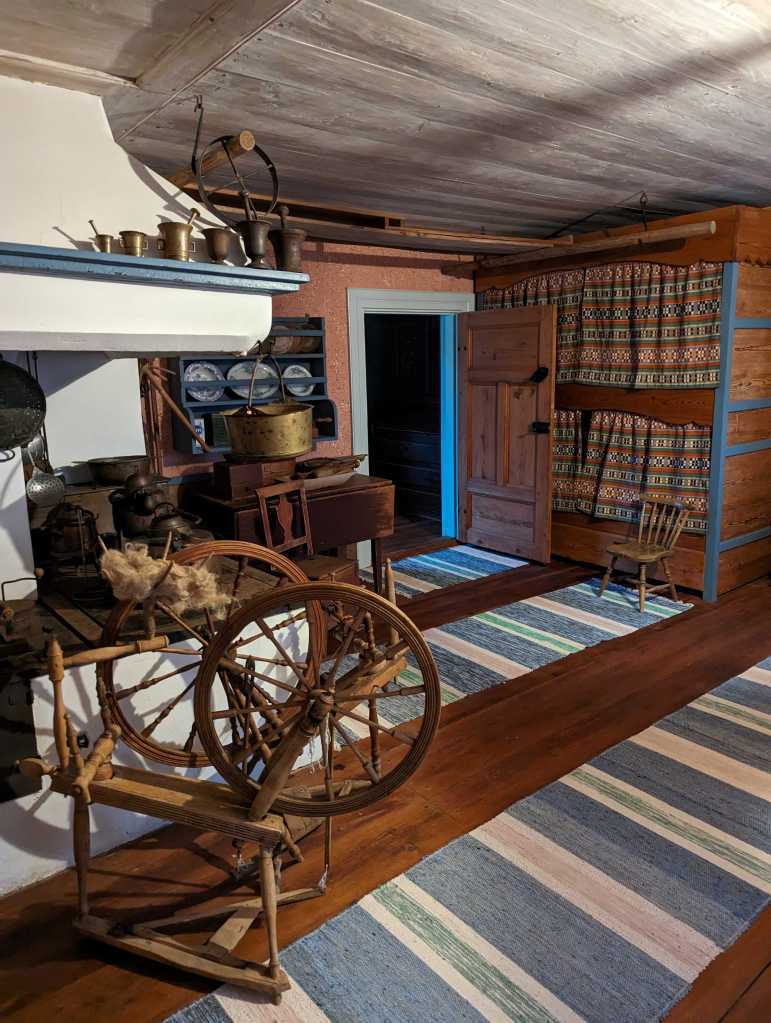
Later that week, we took a trip to the home of Anna Thomasson, a weaver who co-wrote a book on daldräll weaving. While there, we were treated to a tour of the home of the mother of Swedish poet Erik Axel Karlfeldt, which is next to Anna’s studio in southern Dalarna. As soon as we entered the house, there it was—another wheel of this style.
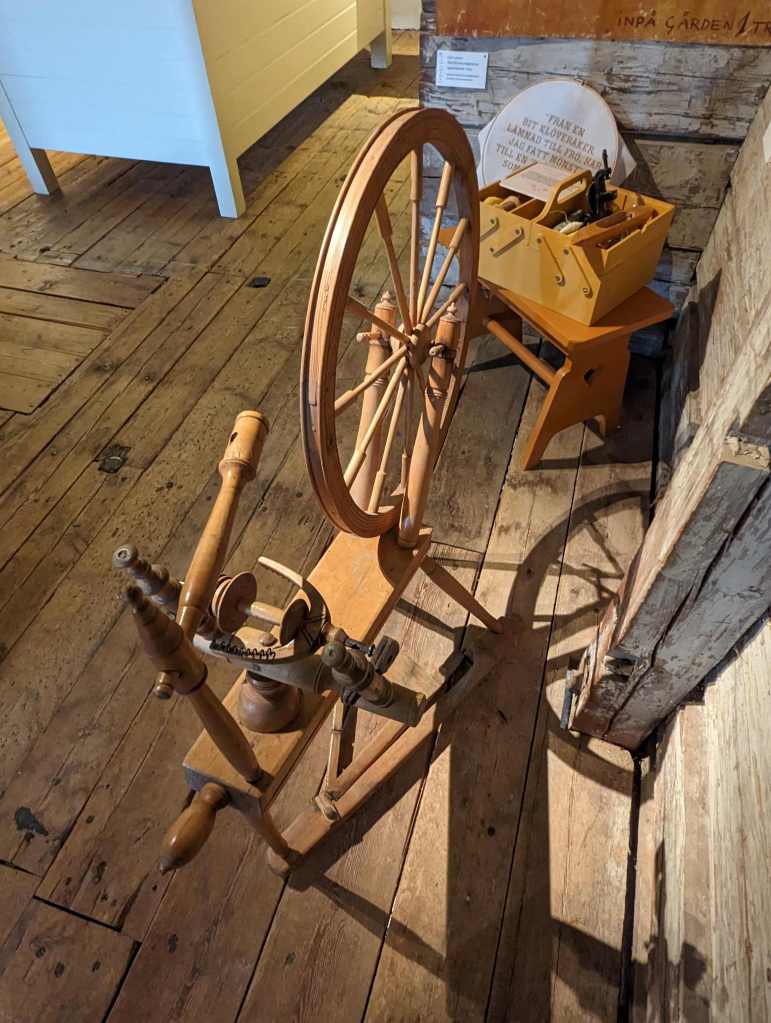
Seeing it there made me realize that I had seen others a few days earlier, when visiting the museum home of artists Carl and Karin Larsson in Sundborn, near Falun (post on this visit is here: Sweden, Part 1). While we were not allowed to take photos in the Larsson house, I was sure that one of the wheels there was this style (I have since confirmed it through photos in books). And there was a second one at the nearby exhibit on Karin Larsson and her textiles, which I was able to photograph.
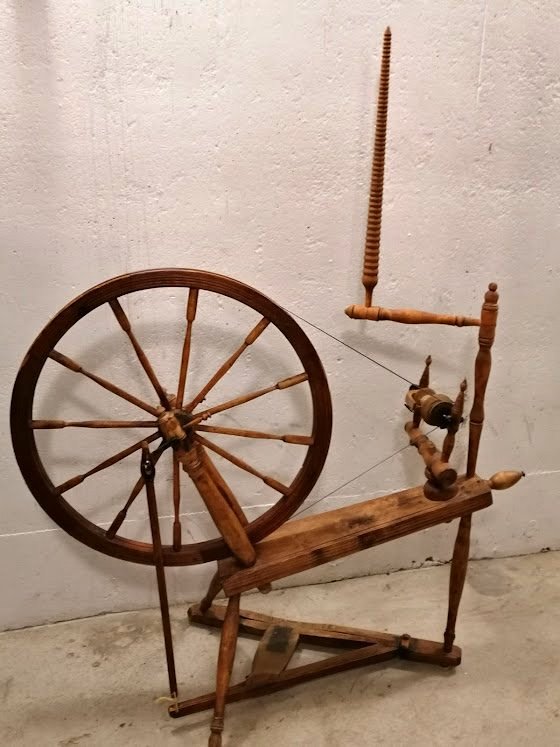
When I returned home, I found that these wheels pop up regularly on Facebook Marketplace in Dalarna. This one said that it was owned by a great-grandmother born in 1893 and from somewhere near Falun.
The Dalarna Museum in Falun also has one, recorded as being from the Husby/Hedemora area, which is in Dalarna, southeast of Falun. (Dalarna museum wheel link). Skansen, Stockholm’s wonderful open-air museum, has another, with the maker’s initials “CWB,” but no information as to where it came from. (Skansen wheel link). With so many of these wheels in the Dalarna area, I was puzzled that there did not seem to be any definitive information on where they were made.
Ulla and Torvi side-by-side–surely they are related
From the 18th to 20th centuries, Scandinavia had well-known centers of wheel-making, usually in an area with good water power, where multiple wheel-makers, sometimes as many as fifty or more (often related), produced wheels for generations. The distinctive Finnish Kiikkalainen wheels and Norwegian Gylland wheels are good examples. Sweden had several wheel-making centers, including Solberga, Hyssna, and Hjulbäck. Each area’s wheels were immediately recognizable for their particular style and features, but with small variations by the different makers.
Many of these regionally-styled wheels were marketed outside of the areas in which they were made and, perhaps for that reason, many were marked by the wheelmakers. So, while the wheel’s style and features advertised the area in which it was made, it was the initials that advertised the individual maker.
One of the maker’s marks for the turned table wheels–“AGIS” or “AGJS“
It seems likely that these Dalarna wheels were made in this same pattern, with multiple wheel-makers in an area making similar wheels. But what area? I am sure there are people Sweden who would be able to immediately identify where these were made, but I have not found them yet. Perhaps I will get lucky and one will read this post. I hope so. In the meantime, a clue has emerged. I found a wheel in same style as Ulla in an old Facebook post. It apparently has some metal on the rim, the initials “GI (or J) S,” several star/sunburst stamps and “Stigsbo” stamped on the table end. Stigsbo is a town on the eastern edge of Dalarna, close to Stjärnsund. In commenting on the wheel, Kirsi Manni, who lives in Dalarna, indicated that wheels made in Stärnsund Parish often have the star stamps on them since “stjärna” means “star” in Swedish. Could the Stigsbo wheel, with similar initials to the turned-table wheels be made by the same maker?
Another maker’s mark on a turned table wheel–probably “AGIS”
But why has only one wheel been found with a place name on it? From what I understand, Stigsbo today is tiny–were there multiple wheelmakers in the area, but spread out, perhaps in the triangle between Stigsbo, Falun, and Hedemora? My research has been hindered by my poor Swedish language skills. Nevertheless, I have not been able to find anything discussing this area as a hotbed of wheel-making. Unfortunately, I have not been able to make contact with owner of the Stigsbo wheel to get permission to post photos. But the initials bear a resemblance to the first example above.
So, the mystery lingers as to where these wheels were made. Oddly enough, while researching them, one came up for sale in Massachusetts. It is highly unusual to find any Swedish wheels for sale in New England, so I jumped on it.
Painted a greenish-blue, with an unpainted drive wheel and flyer for contrast, Ulla is a beauty and spins almost as effortlessly as her relative, Torvi.
The drive wheel was very dark with old oil and dirt, but cleaned up to reveal striking wood grain.
It does not have the simple spokes of the other wheels of this style.
And the drive wheel fits oddly between the uprights, leading me to believe it may be a replacement.
The spokes are pegged through the outside of the rim, which is probably how they are pegged on Torvi, although we cannot tell because Torvi’s rim is covered in metal.
The hub construction is quite interesting and there appears to be some hemp or other material around the axle where it goes through the hub.
It has the distinctive style of axle cap found on these wheels.
One is cracked almost through, so I temporarily wrapped it with some linen.
The table sides are grooved
and there is a gouge in the middle, which is presumed to be from a knife or other tool, used to manipulate the drive band cross, perhaps for plying (I have not yet seen a definitive explanation for why the knife was used—only speculation).
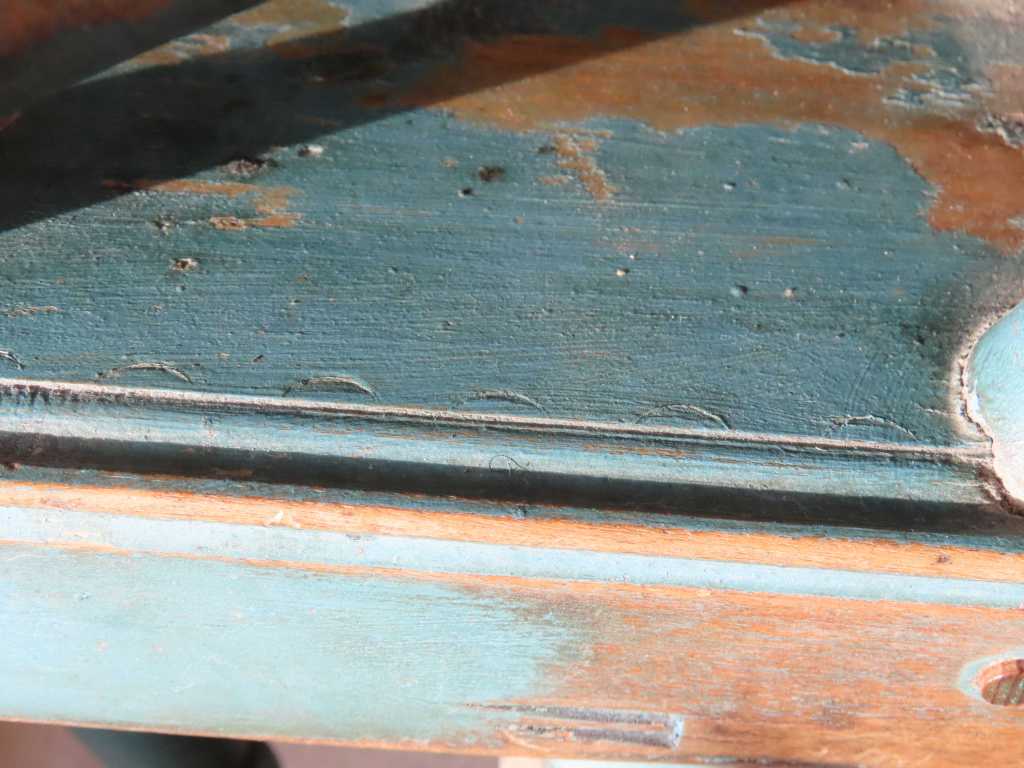
There are also fainter semi-circular marks on the table that seem to show up from time to time on wheels–a history of a spinner’s habit of tapping something, perhaps the orifice end of the flyer, on the table for some unknown purpose.
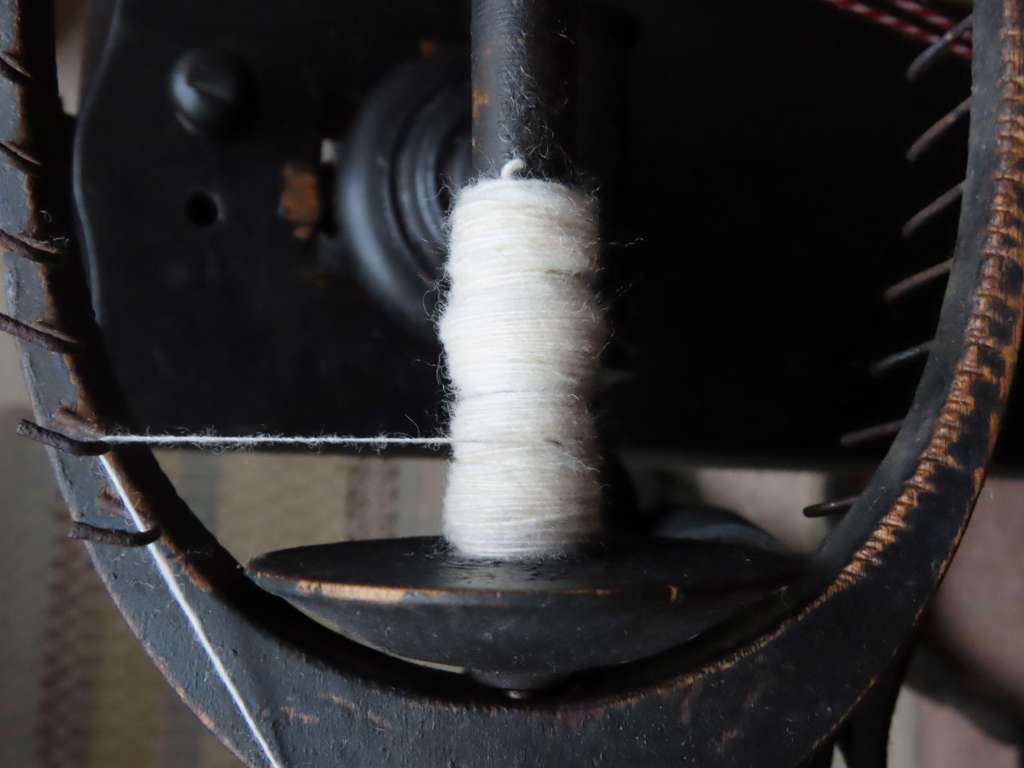
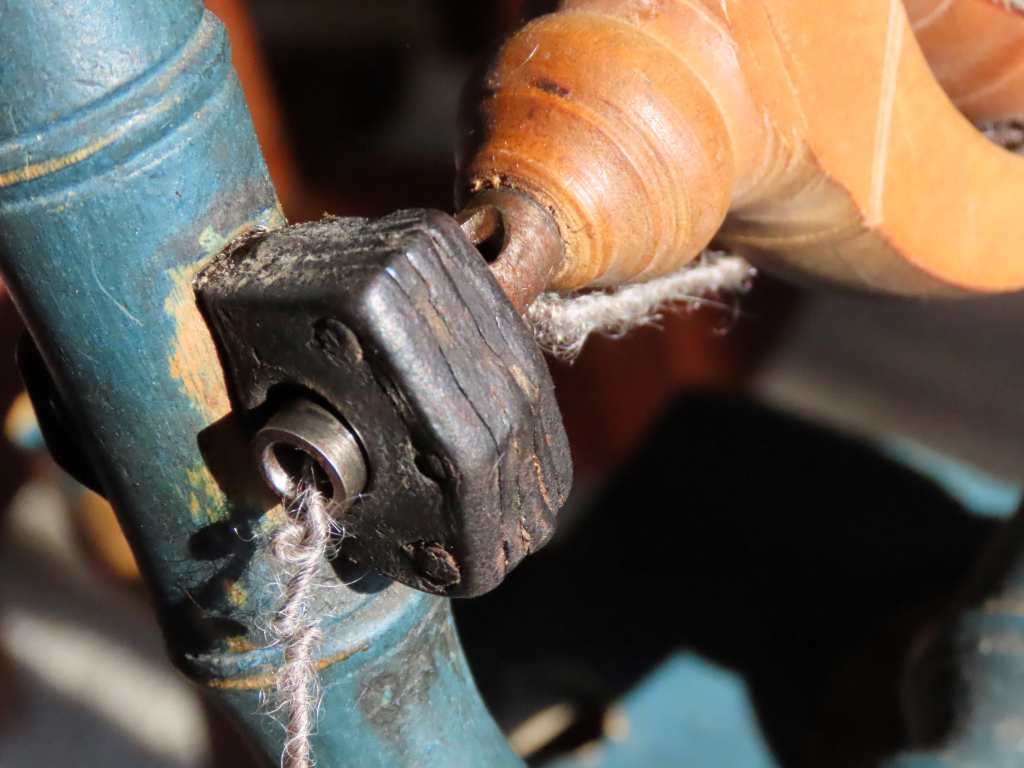
The four-layer leather flyer bearings secured with metal are typical for Swedish wheels.
The flyer is in wonderful shape
and, given the amount of wear on the treadle, might be a replacement or second or third flyer made for the wheel.
Most of the wheels I have seen of this style show extensive wear on the treadles. They must have been real work horses. Ulla’s drop-in treadle and pointy toes are characteristic of this style.
Interestingly, the non-spinner side leg has a metal spike, just like Torvi.
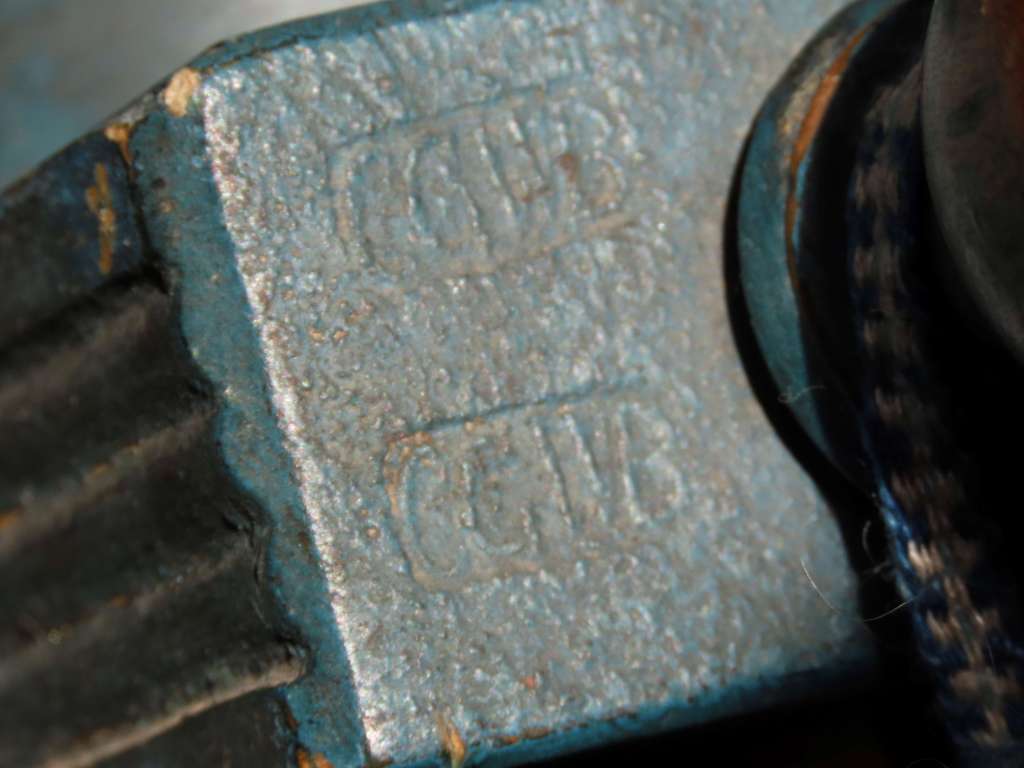
The maker’s initials are a little hard to make out, but appear to be “CGWB.”
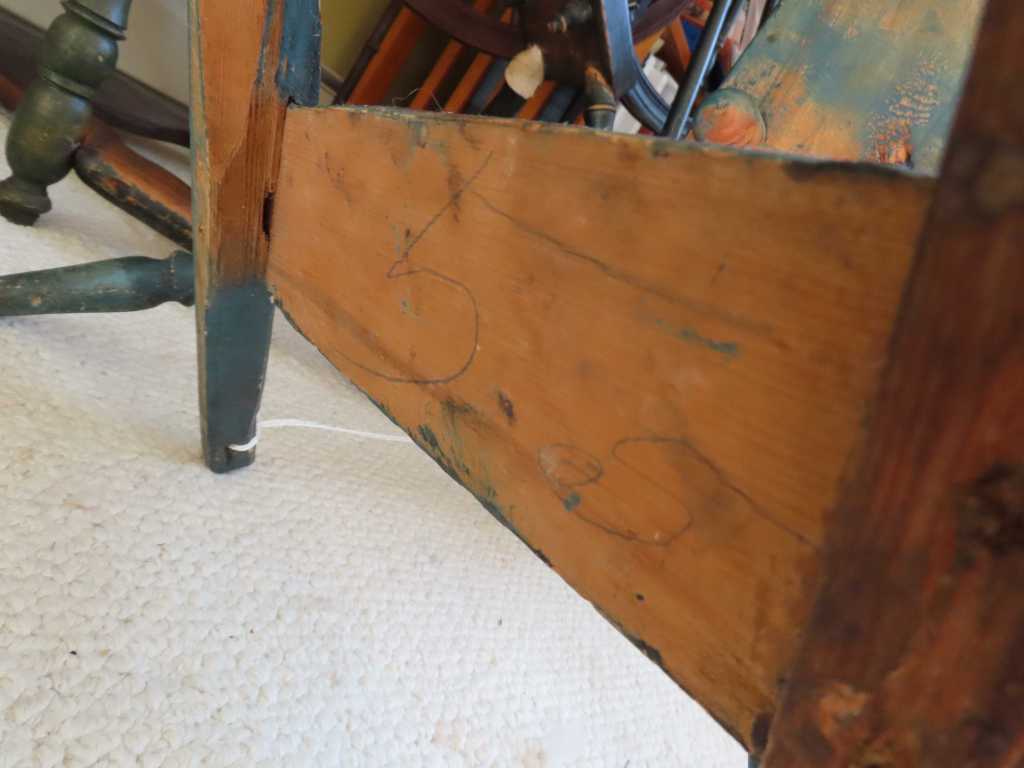
It is stamped twice on each side of the tension knob, but there are no star/sunburst stamps. The bottom of the treadle is marked in pencil “55.”
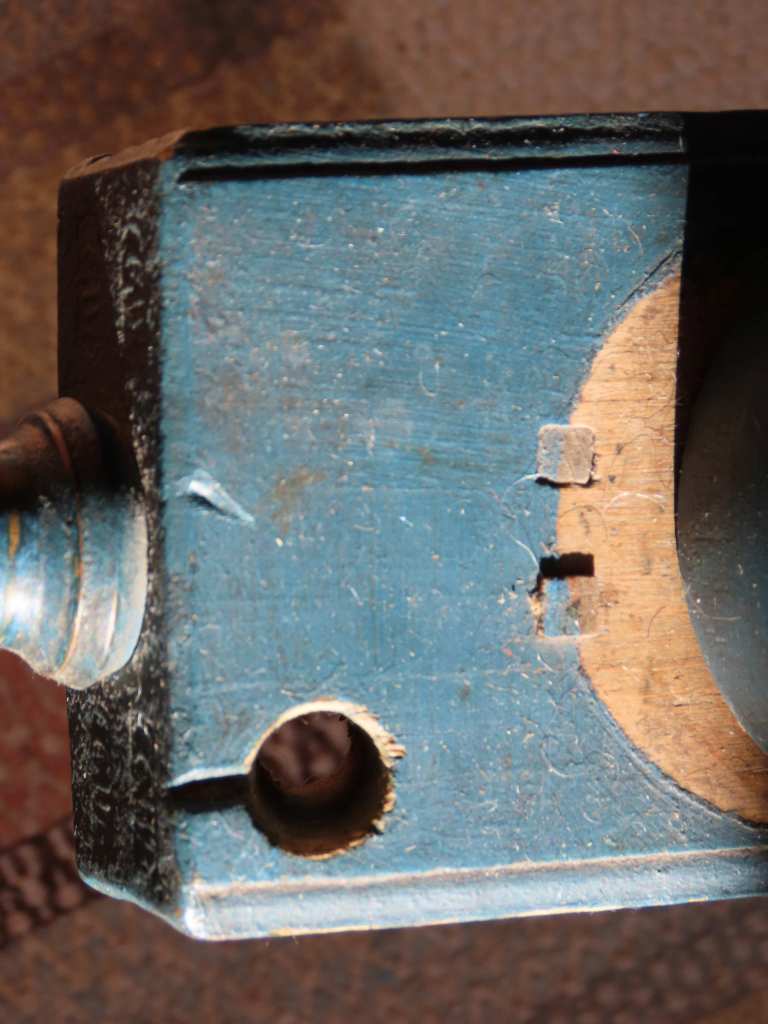
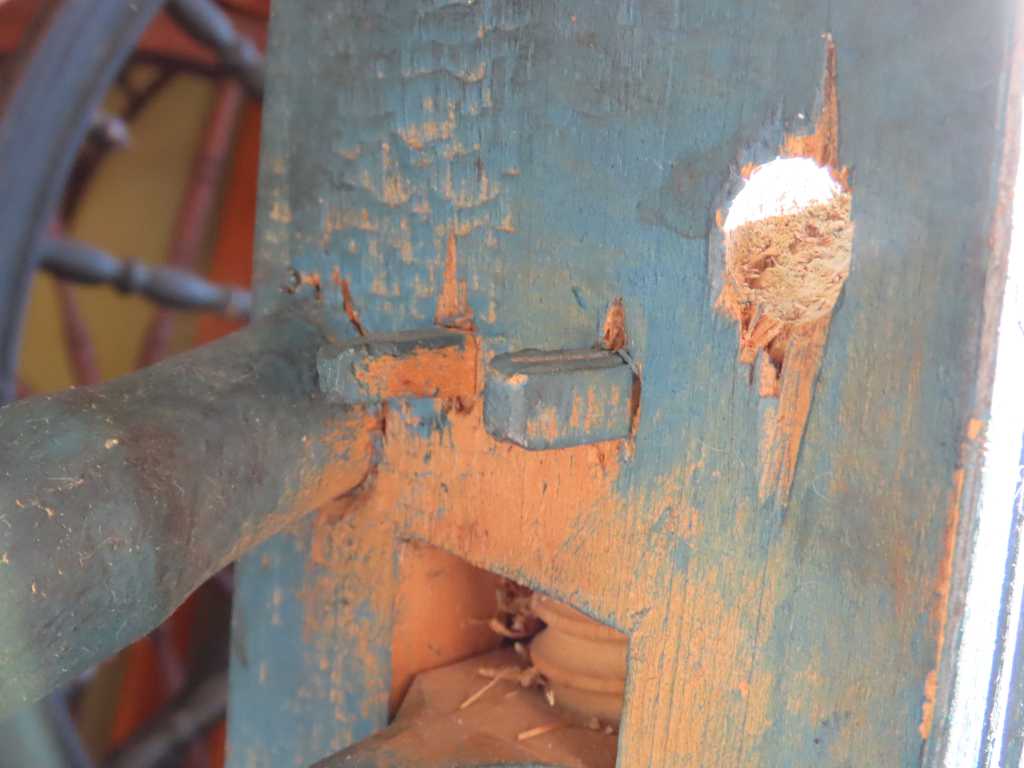
I did not remove the legs or the uprights to check for numbers (as Torvi has) because they were tightly shimmed in place before the wheel was painted.
You can see the shim for the upright, which has been painted over
As with the turned-table wheels, there are two keeper pegs for the tension screw.
But, in contrast with Torvi, there is no wooden screw and nut under the mother-of-all.
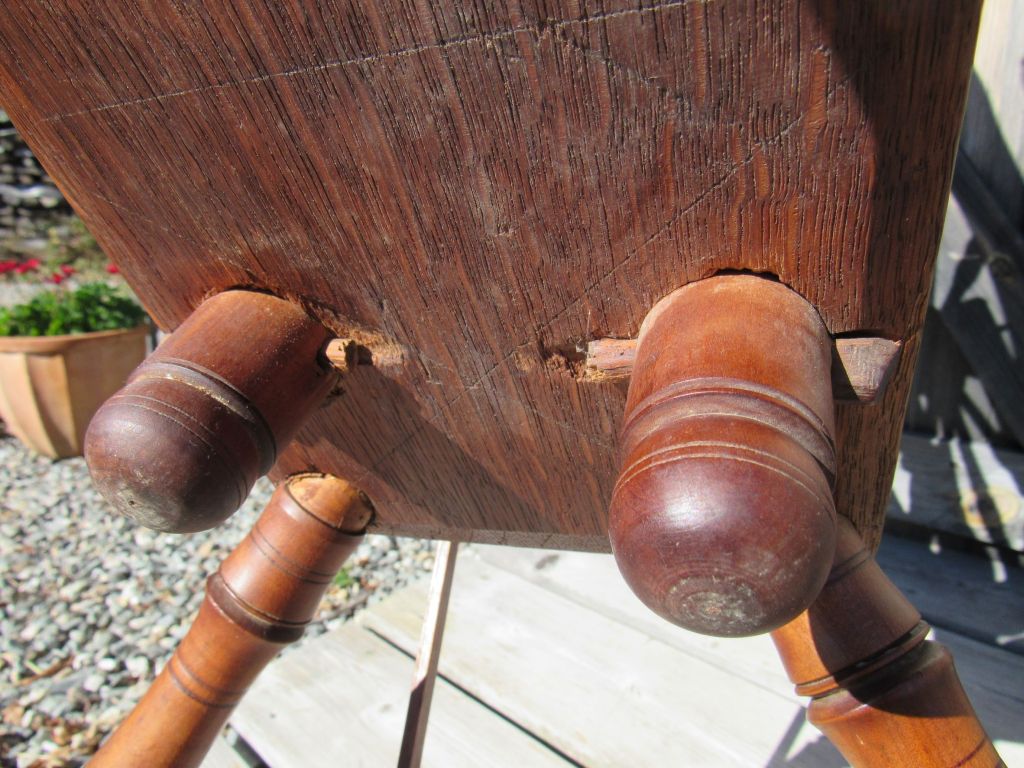
The uprights are secured under the table with one piece of wood through both.
The paint shows wear in all the expected places and enhances the interest and beauty of the wheel.
With all of the similarities between these Ulla-style wheels and the Torvi turned-table style wheels, it looks as if they all were made in the same region, but with multiple makers. If we can pinpoint with some certainty the town or towns where these wheels were made, it will make it worthwhile to research the maker’s initials to try to determine who they were. Stigsbo will be a starting place. If any one has more clues, however small, please let me know.
This wheel’s distinctive profile is immediately recognizable from across a room. Its rakish slant, impressive drive wheel, and closely set double upright supports combine for a unmistakable look. The wheel’s previous owner had brought the wheel to New Hampshire from Gothenburg, Sweden, where she had been living.
As far as she knew, the wheel had been made locally, somewhere near Gothenburg. A few sister wheels have shown up on Facebook and Ravelry, but with little information as to their origins. Recently, however, another showed up online as part of the “Lin on Me” linen exhibit at the Rydals Museum in Rydal, Sweden, east of Gothenburg. I checked with the museum and with others in Sweden knowledgeable about antique wheels and, while there seems to be agreement that the wheels are from Västra Götaland, the county (län) surrounding Gothenburg, no one seems to know the maker or town in which they were made.
No maker’s mark
They share some similarities with the beautiful Solberga wheels, but those typically are double rimmed. The photo below is a Solberga wheel, also from Västra Götaland. The photo is from the Upplandsmuseet, with more details here in Digitalt Museum: https://digitaltmuseum.se/011023874843/spinnrock
In the photo above, a woman is spinning in Bolum, also in Västra Götaland. Although the wheel is different than Amalia, it shares many features. More information on this photo is found here: https://digitaltmuseum.se/021017212168/spinning. For anyone researching Swedish wheels, I highly recommend the DigitaltMuseum: https://digitaltmuseum.se/search/?q=spinnrock&o=0&n=60 The search term “spinnrock” yields photographs from eight museums.
As with the Solberga wheels, Amalia’s most striking feature is the drive wheel.
With a 27 inch diameter, sixteen spokes, and decorative finial/half spokes, it was designed both for beauty and fast spinning. And there is no doubt this wheel was valued for its spinning, with telltale signs of heavy use. The axle area is so deeply encrusted with old grease, I hesitated to try to unscrew the axle retaining pegs. I did unscrew one, but left the other in place.
the back-side axle emerges from a sheath of thin crumpled metal.
The front had badly worn the bearing, requiring a bit of propping.
The paint wear on the spinner’s side is fascinating.
One maiden, one upright support, the table side,
and one leg have been rubbed clean of paint, revealing the smooth lustrous wood underneath.
It is interesting to speculate just how the wear occurred–perhaps a combination of hands and clothing (large skirts and sleeves, perhaps?) rubbing against the wheel for hours, days, months, and years.
Most of the treadle paint has worn off completely.
The treadle paint and wood wear show that the wheel was often treadled with two feet. The treadle bar appears to have been designed for treadling that way, with its widened sweep to easily accommodate and support the left foot.
The uphill leg was replaced and painted a lighter green.
All of the wheels of this style that I have seen were painted with a very dark green paint. In contrast, the flyer is not painted, which is not unusual on painted Scandinavian wheels.
On the other hand, it might indicate that the flyer is not original to the wheel.
Especially because it does not show as heavy use as the rest of the wheel. The flyer hooks are quite large.
The leather bearings look like they could be original.
The spinner-side flyer bearing is four-layered leather, riveted with nails.
To see how such bearings were made, here is a superb 1964 video of Swedish wheel maker, August Jonsson: Spinnrocken.
Amalia’s wheel is missing one spoke and several of the small half-spoke/finials. The wheel rim is unusually constructed with eight alternating short and long sections.
To help support the large wheel, there are long, smooth secondary uprights running down to each leg.
The drive wheel’s arched-top double upright supports are most often associated with Finnish wheels. But they are found on Swedish wheels, too. These are closer together than most, which add to this wheel’s elegant style.
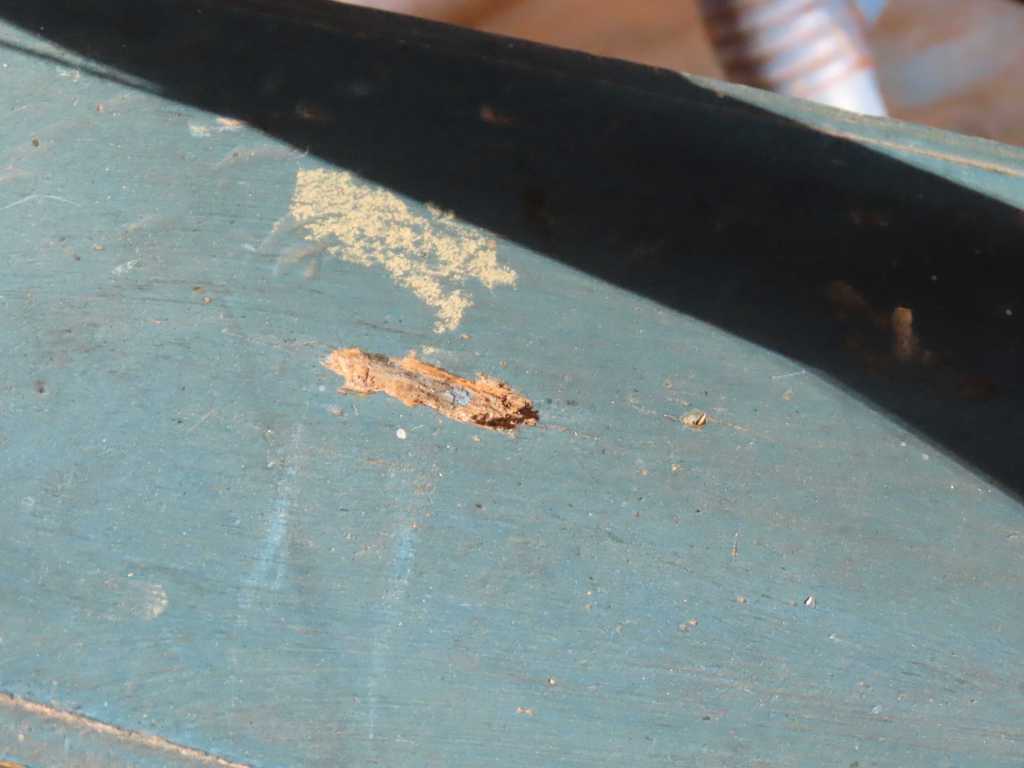
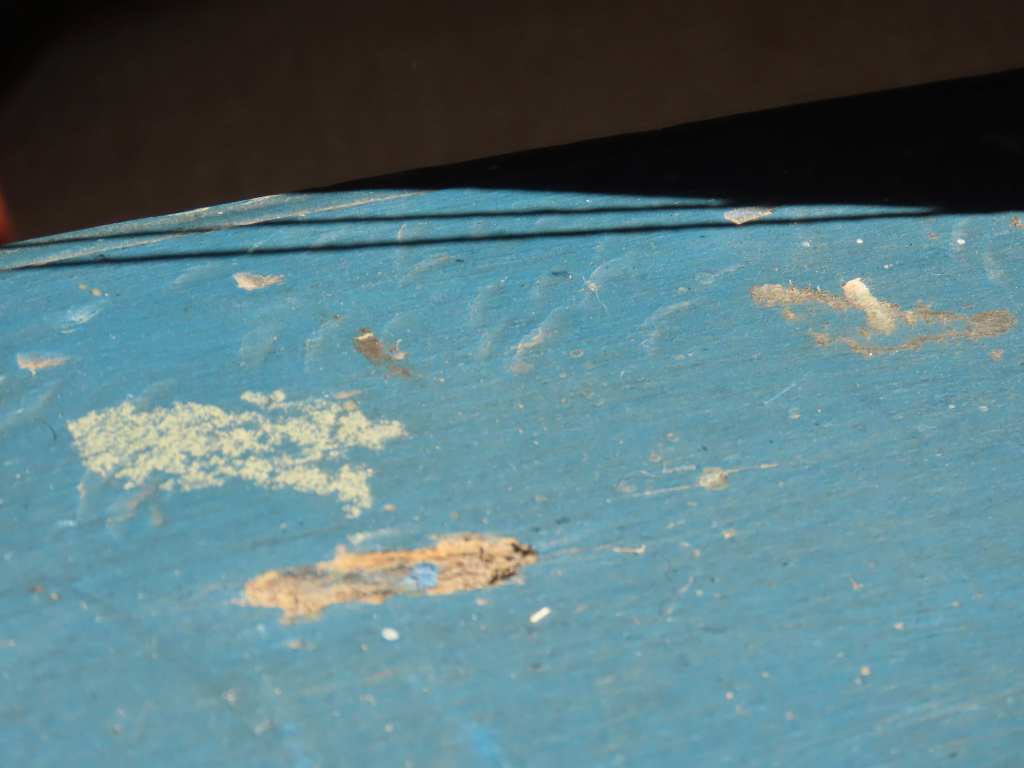
The table is made of fairly coarse grained wood, rough on the underside, but with nicely turned (and worm/beetle hole riddled) bottoms to the upright supports. Several have old shims.
There is a spinner-side distaff hole, but no distaff.
And the table end and openings are nicely chip-carved.
The distance between the flyer and the drive wheel is very short, which is somewhat unusual for Swedish wheels. It does allow for a large drive wheel to fit in a smaller footprint, although the wheel is quite tall. As for spinning, the wheel is fast, smooth, and effortless. Hats off to her maker, wherever he was.
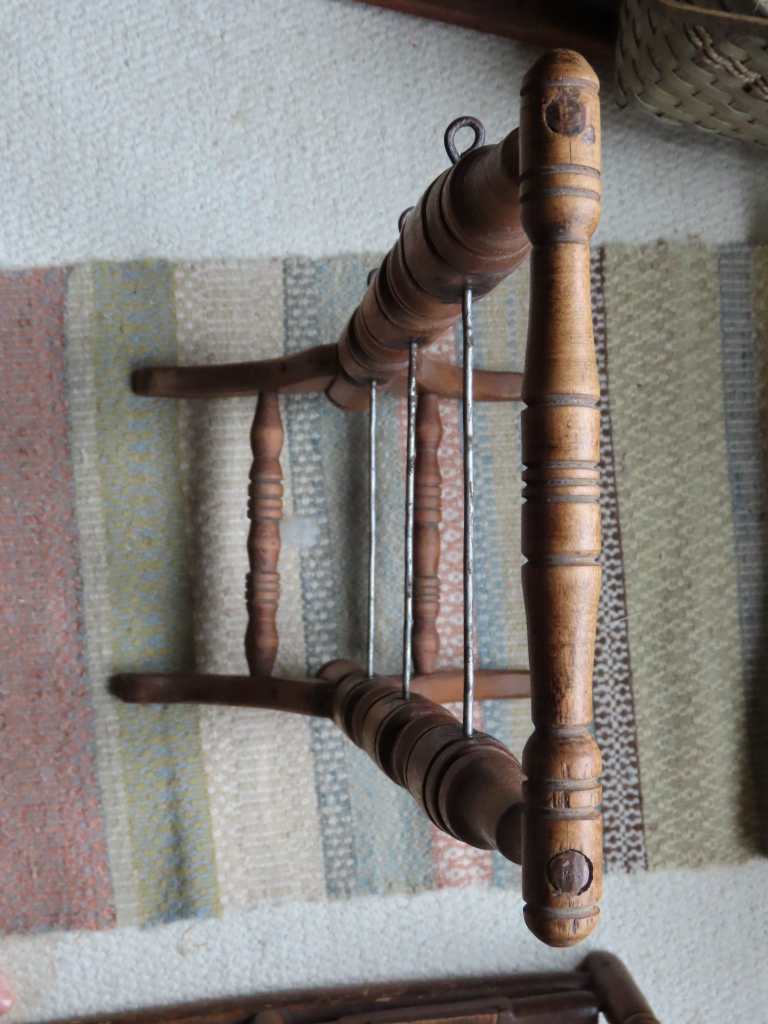
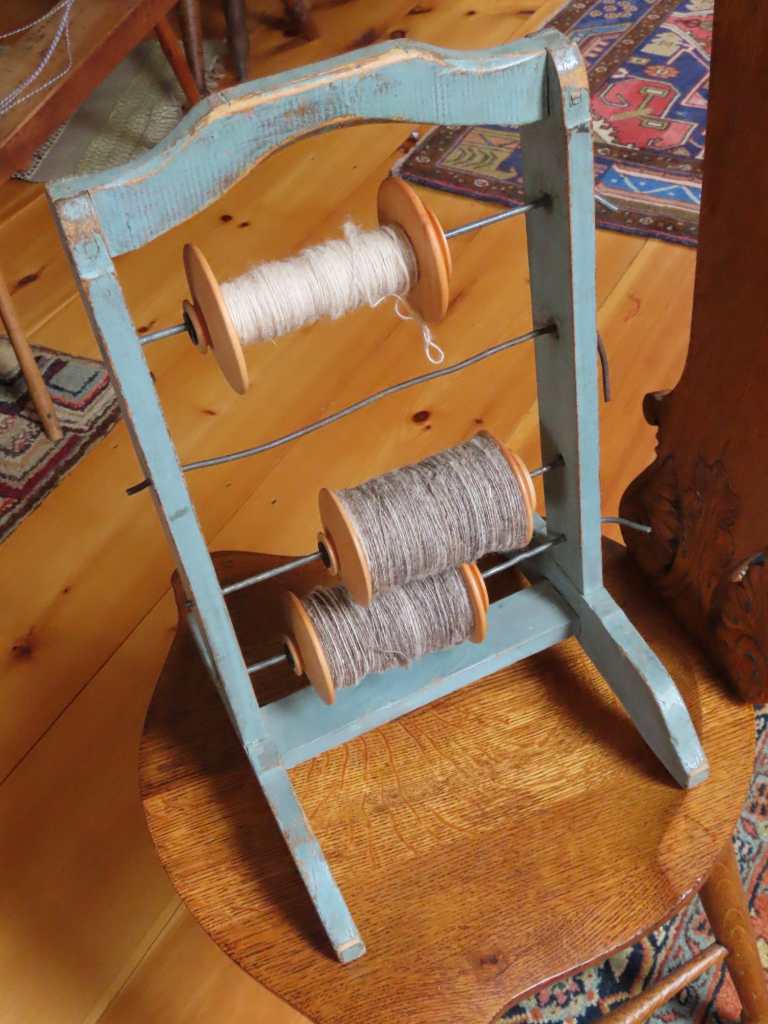
Although we are rich in antique spinning wheels in Maine, antique Lazy Kates are hard to come by. A Lazy Kate is a bobbin holder, usually for three or four bobbins. Most often used for plying, they can also serve as bobbin storage.
Perhaps they are scarce in Maine because much of the spinning done here in the 18th and 19th centuries was to produce singles linen and wool for weaving. With singles, the spun thread or yarn could simply be reeled off the wheel without removing the bobbin. Not surprisingly, we have an abundance of antique reels and bobbin/pirn winders here.
In Quebec, spinners also tended to leave bobbins on the wheel, reeling multiple bobbin-loads onto a wrap reel, called a “dévidoir.” Spinners would then simply ply directly from the dévidoir, a wonderfully efficient system that made it unnecessary to have multiple bobbins or a Lazy Kate.
Dévidoir being used for plying
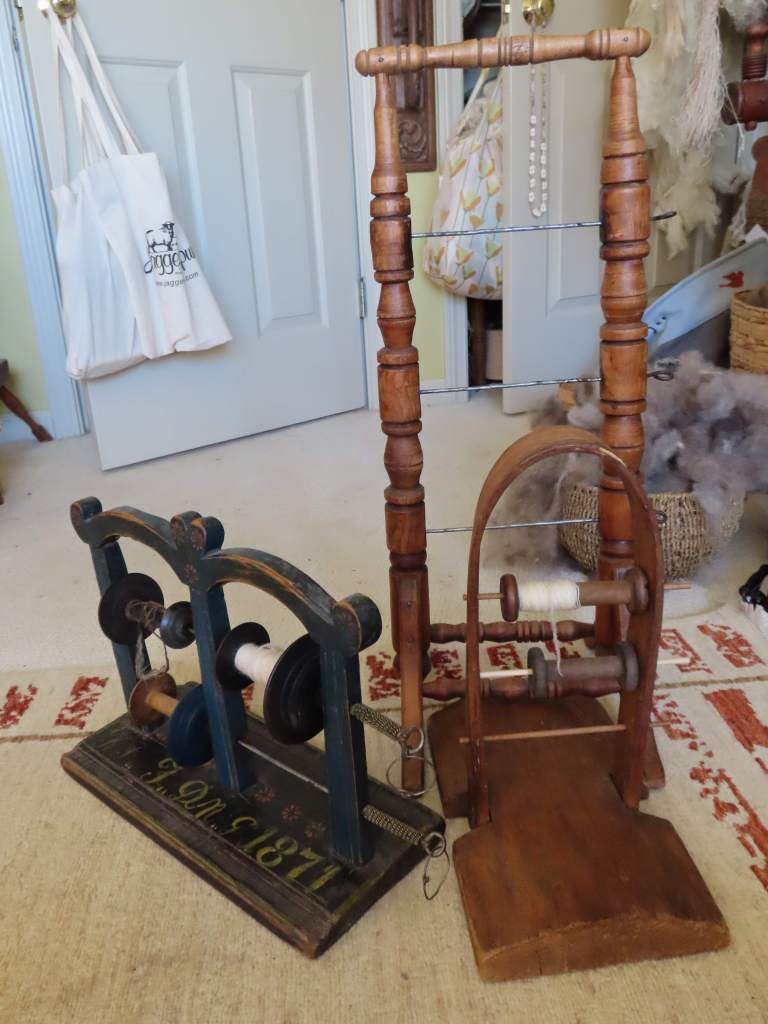
In any case, Lazy Kates seldom come up for sale in New England. And those that do seem to have no similarity of design or construction. The three I have found are wildly different from each other.
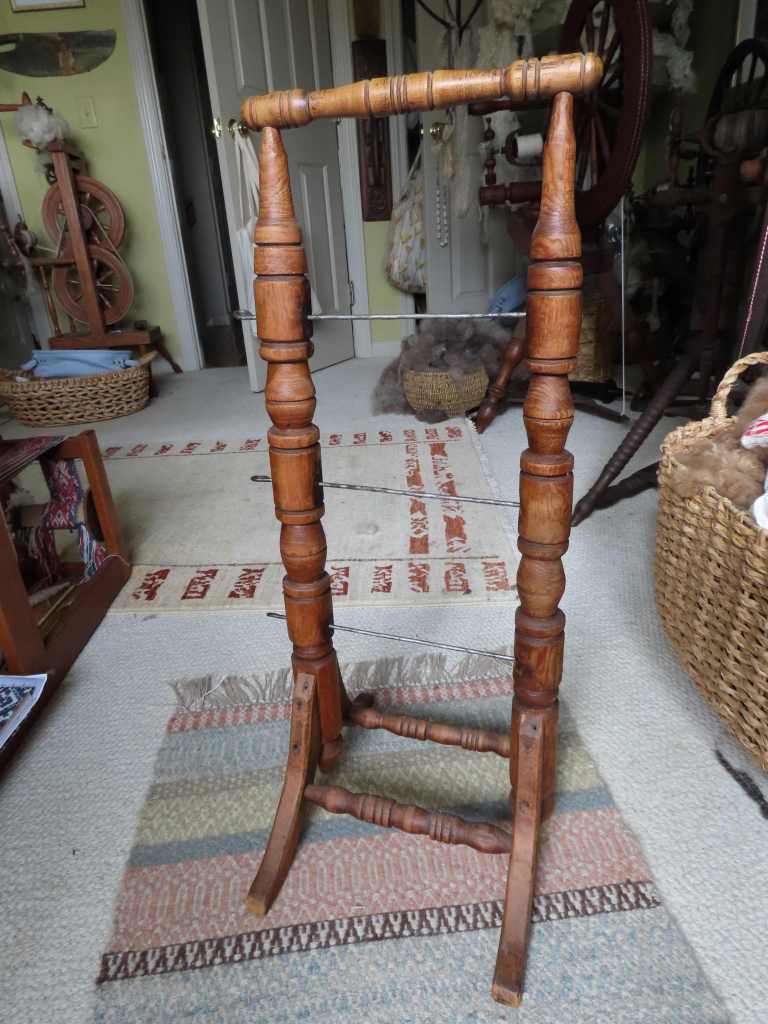
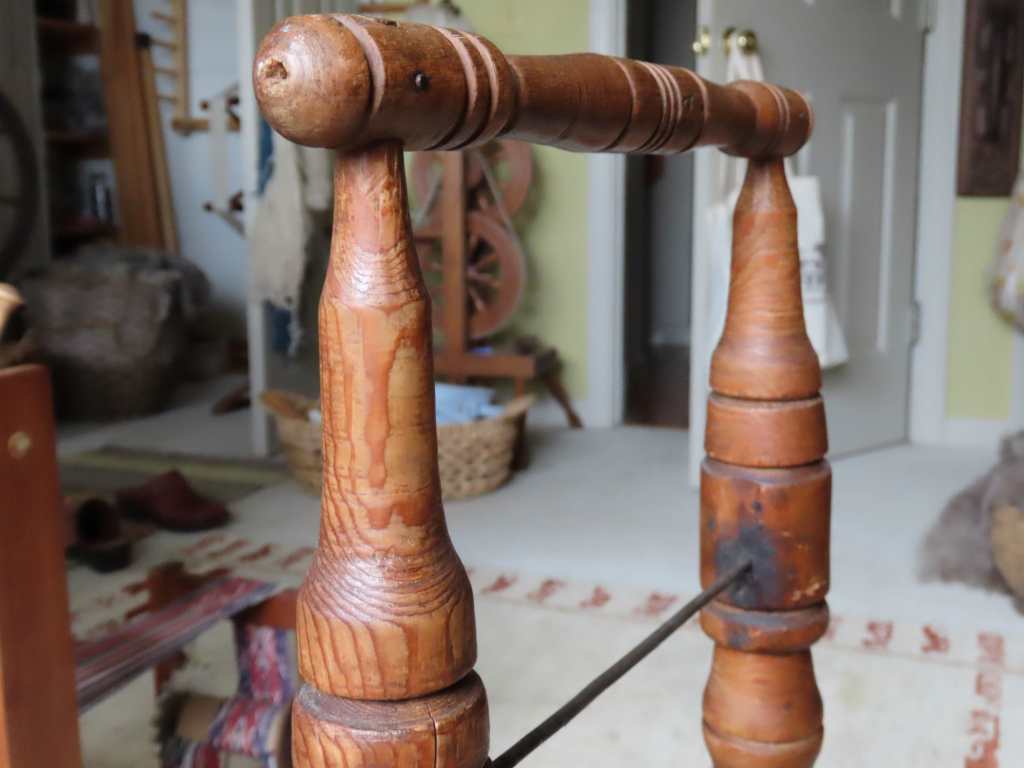
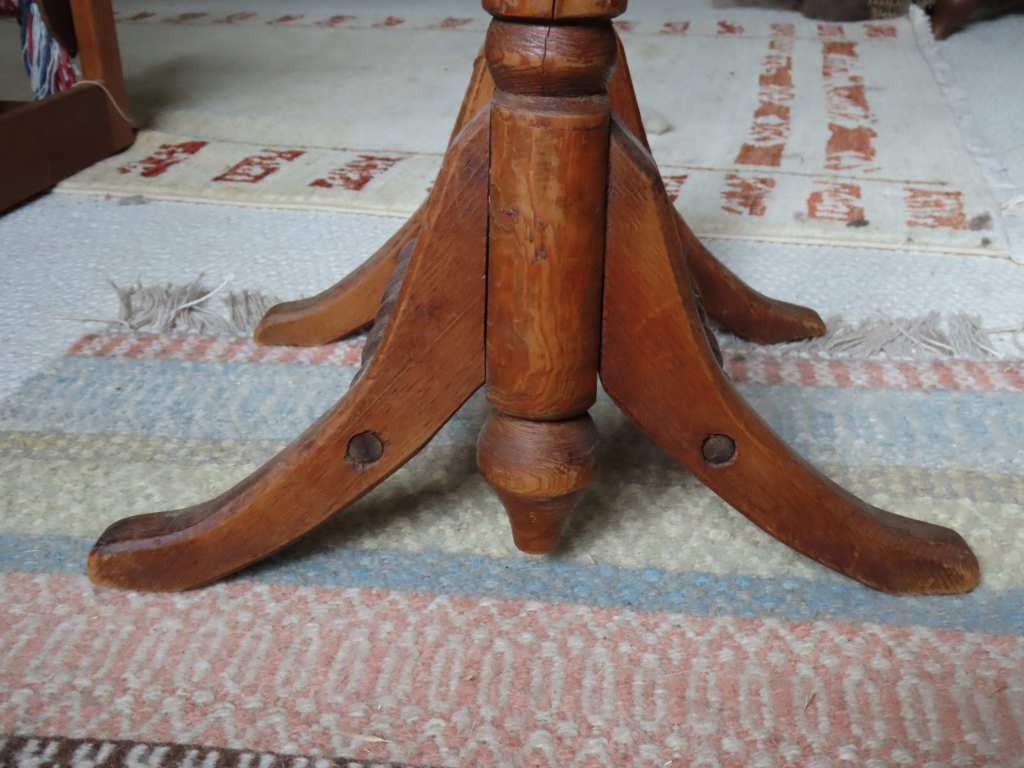
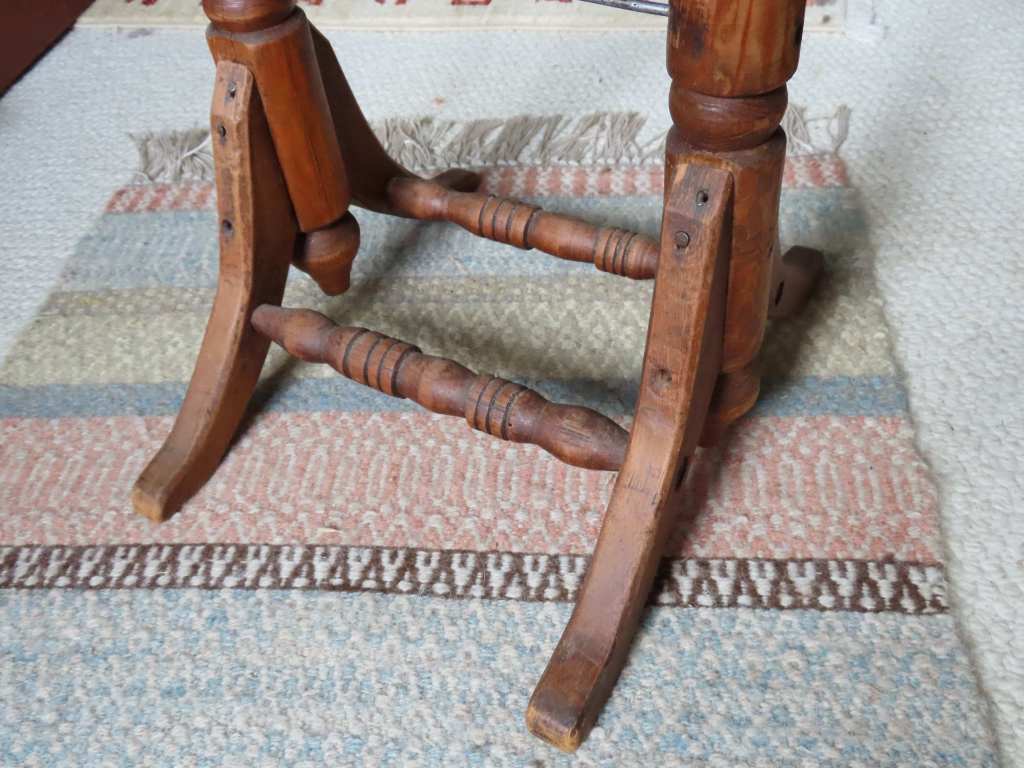
This tall Kate for three bobbins has slightly mismatched turnings.
The base manages to be both sturdy and graceful.
It looks as if it may have been made with spare pieces from furniture making.
As with spinning wheels, the makers of Lazy Kates were not content to produce objects that were just utilitarian.
Instead, they approached these simple tools with creativity and style, leaving an imprint of time, place, and their own personalities.
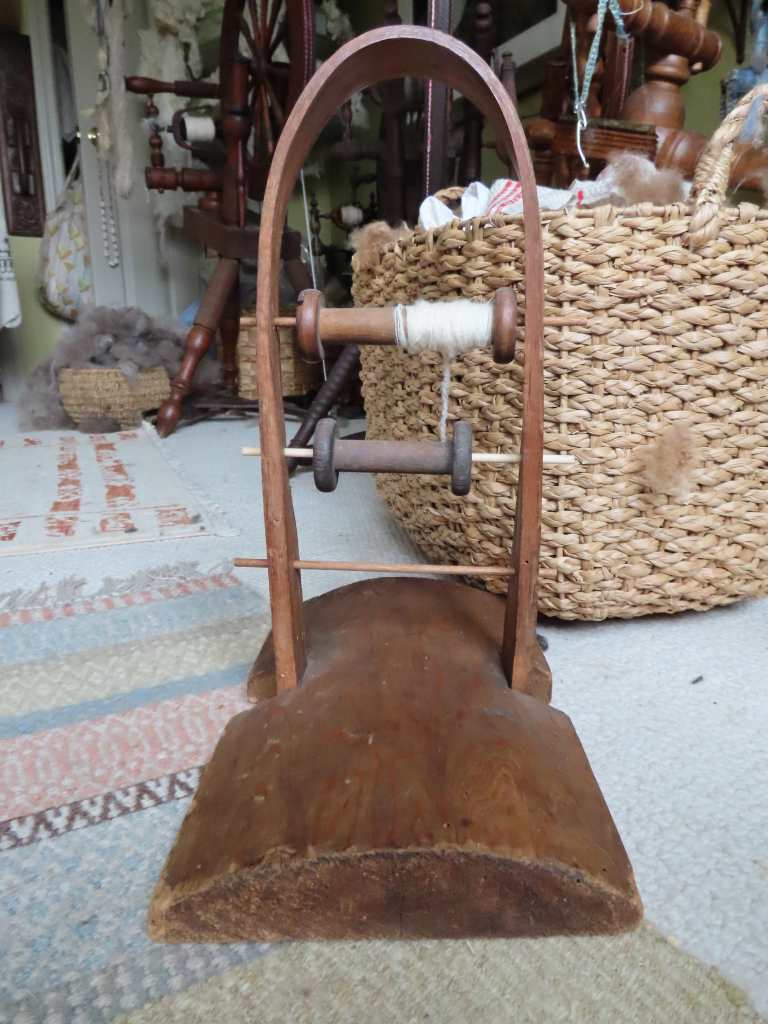
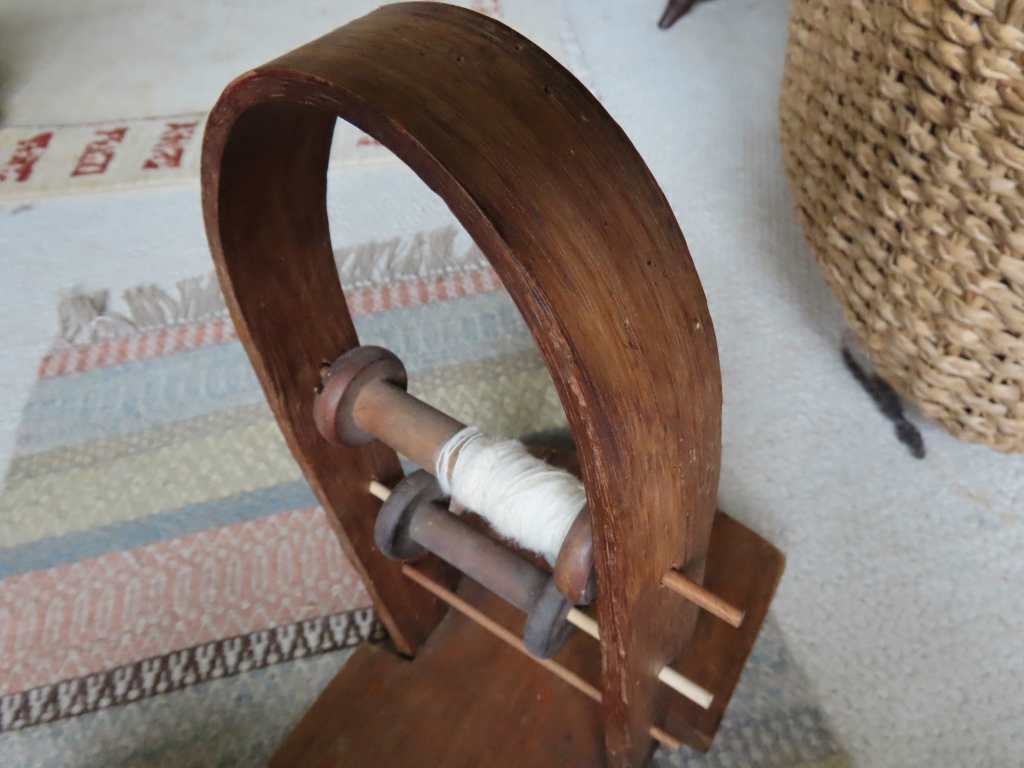
This petite three-bobbin Kate was found in a New Hampshire antique store.
It is unusual and impressive due to its extreme bentwood arch,
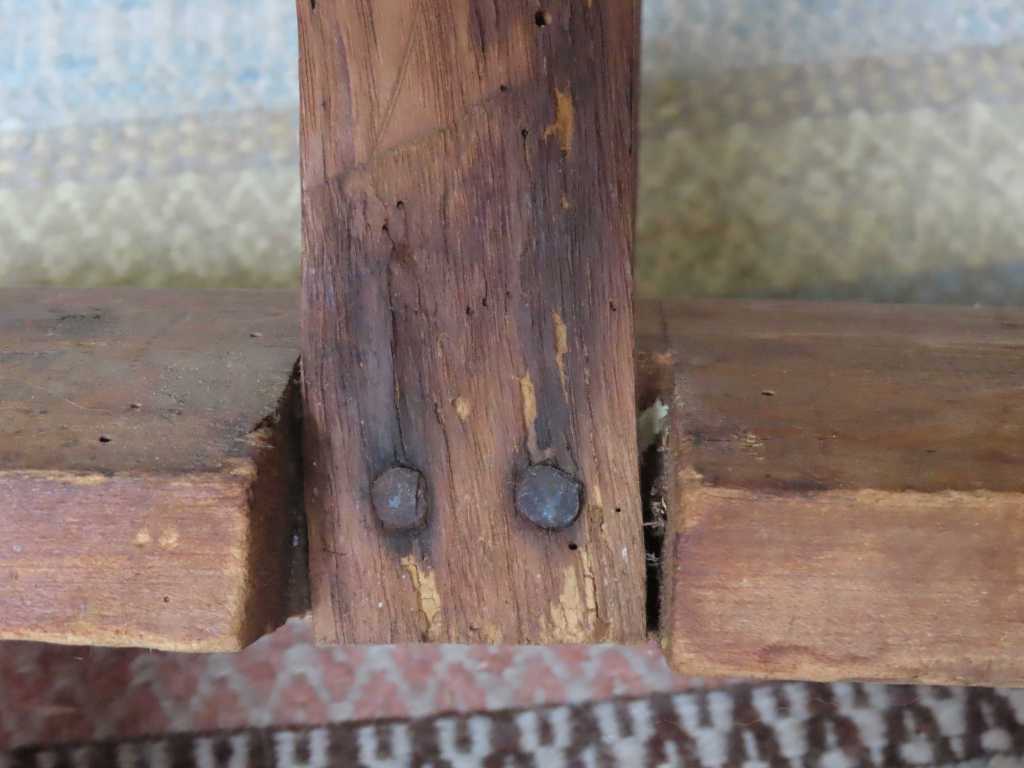
nailed into a plain unfinished base.
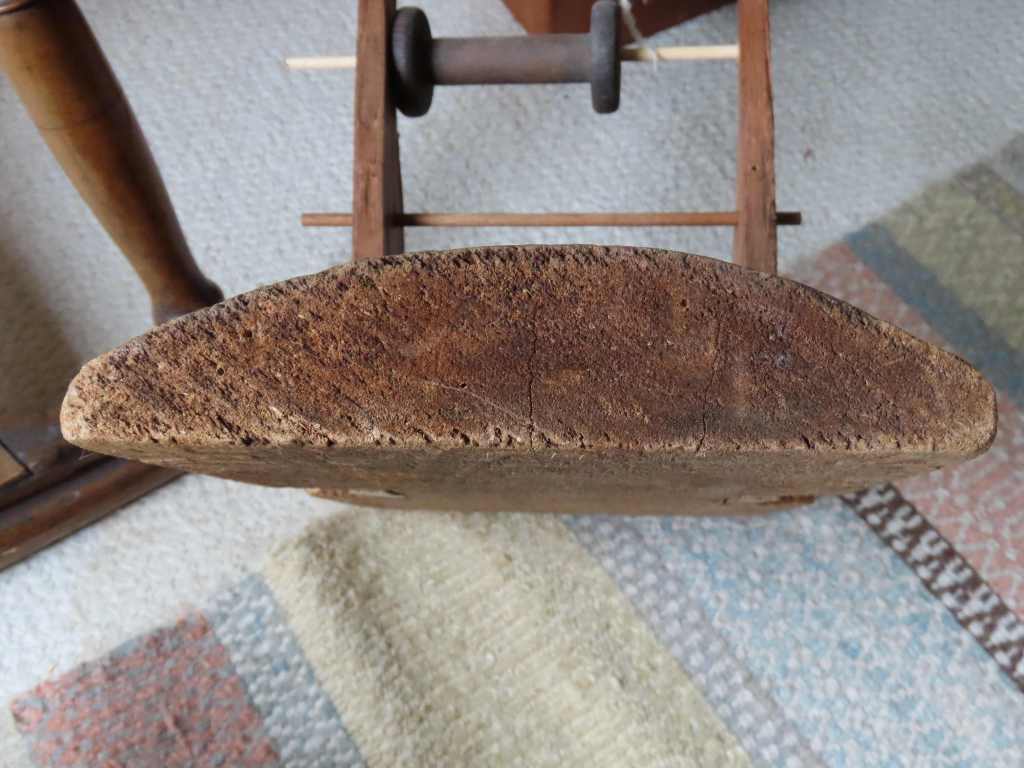
The rough bottom shows saw marks.
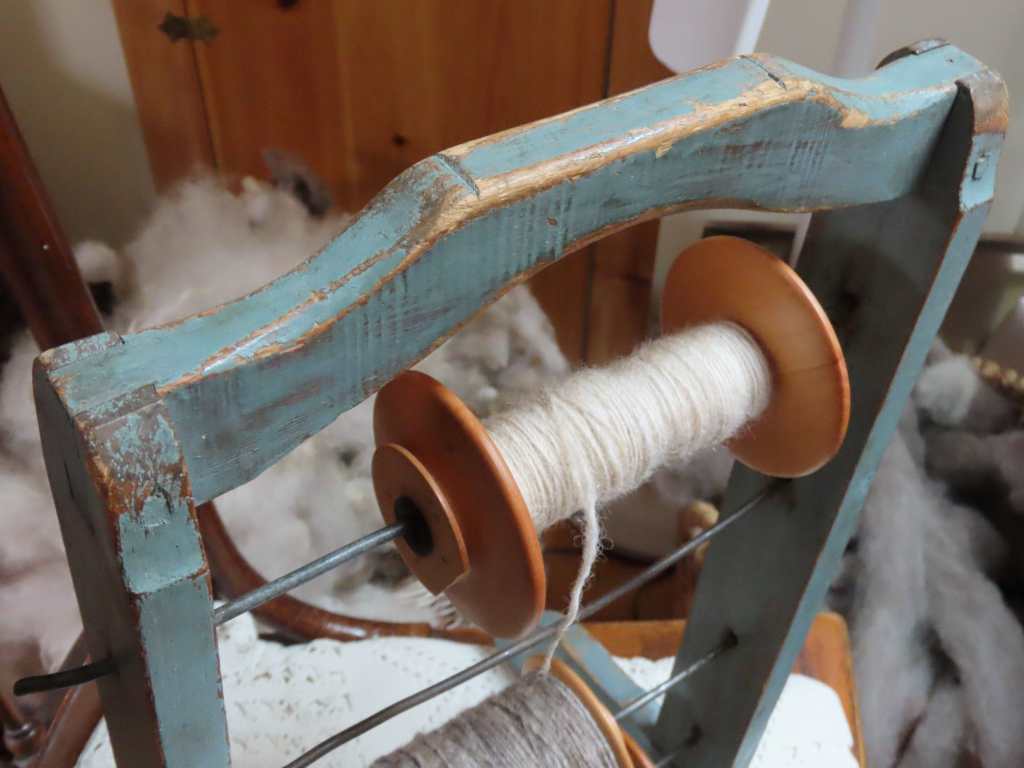
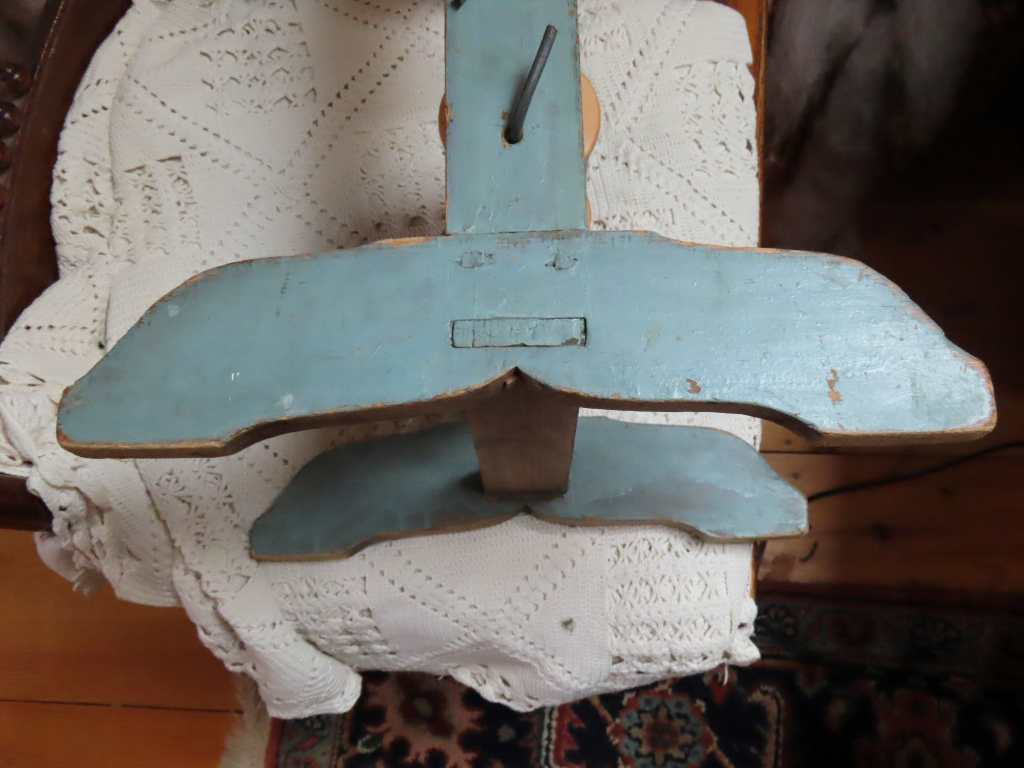
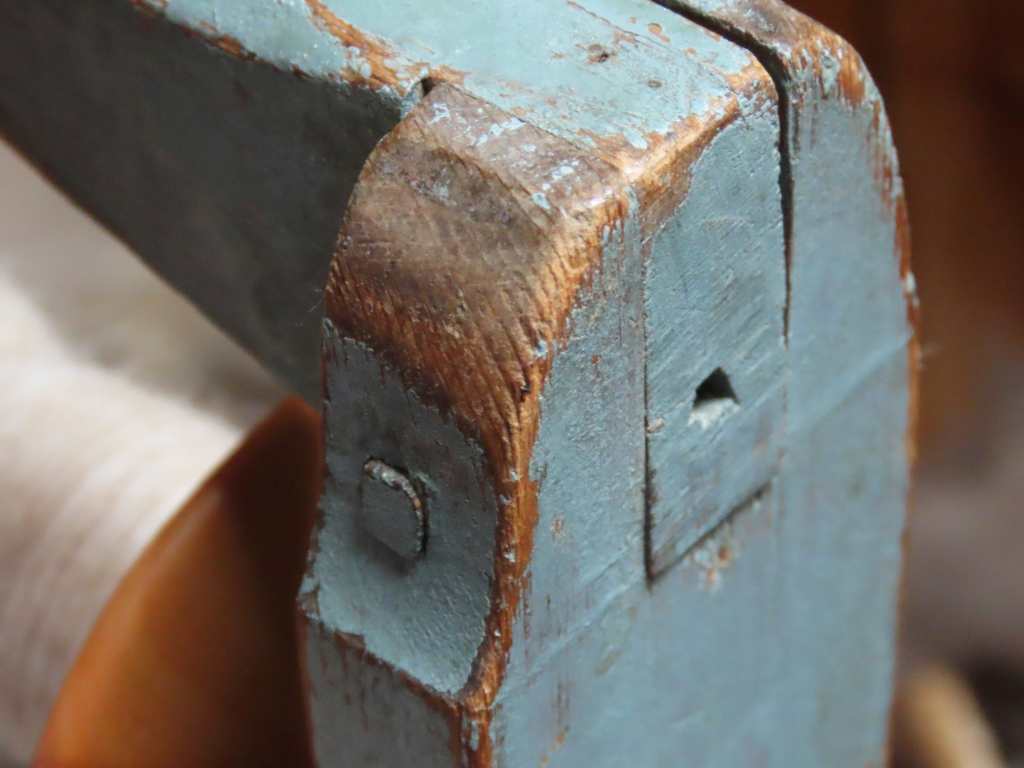
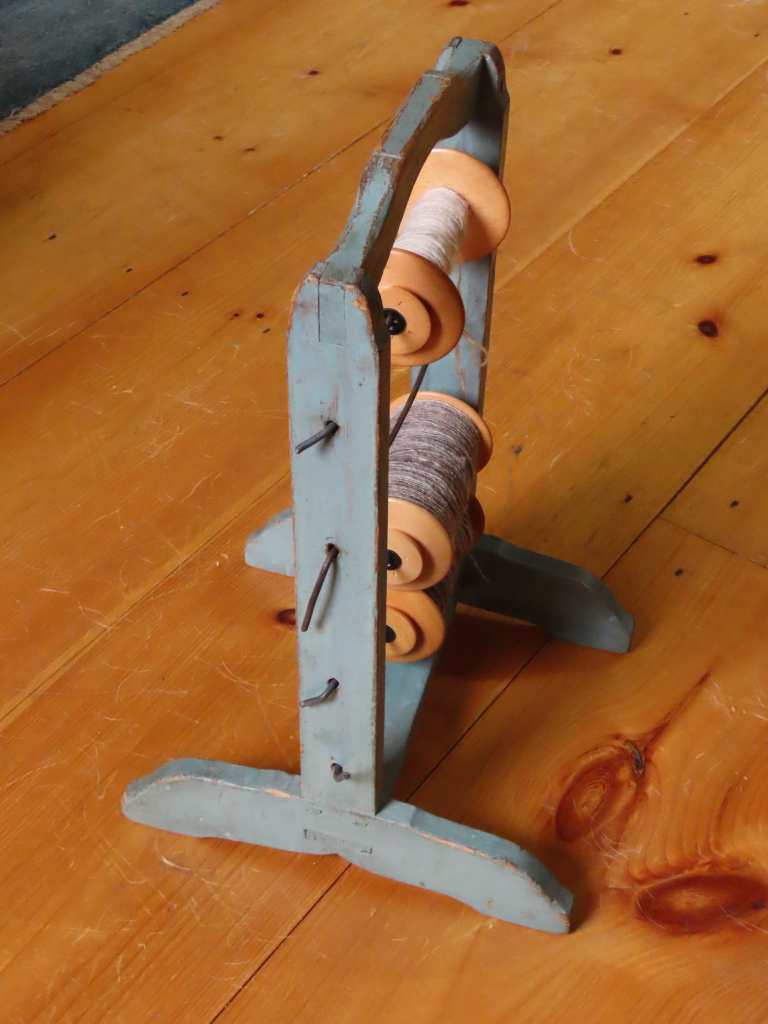
In contrast, this Kate, found at an antique show in Maine, is well-finished with paint and pegs.
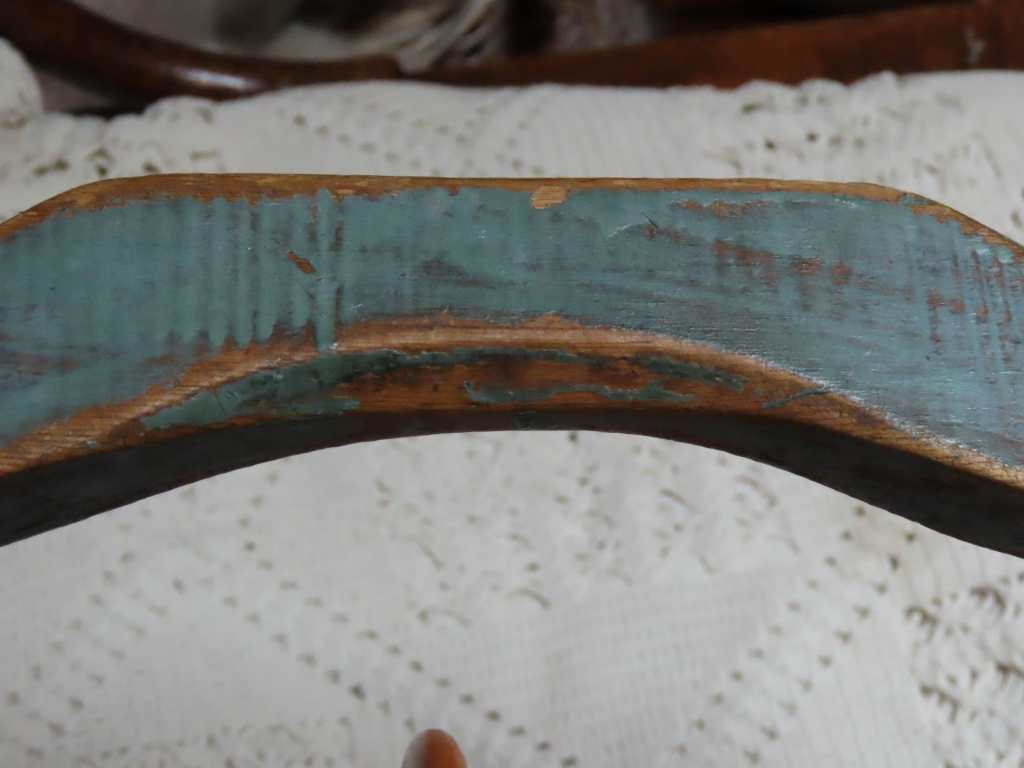
The top is designed for comfortable carrying and shows paint wear, presumably from being handled.
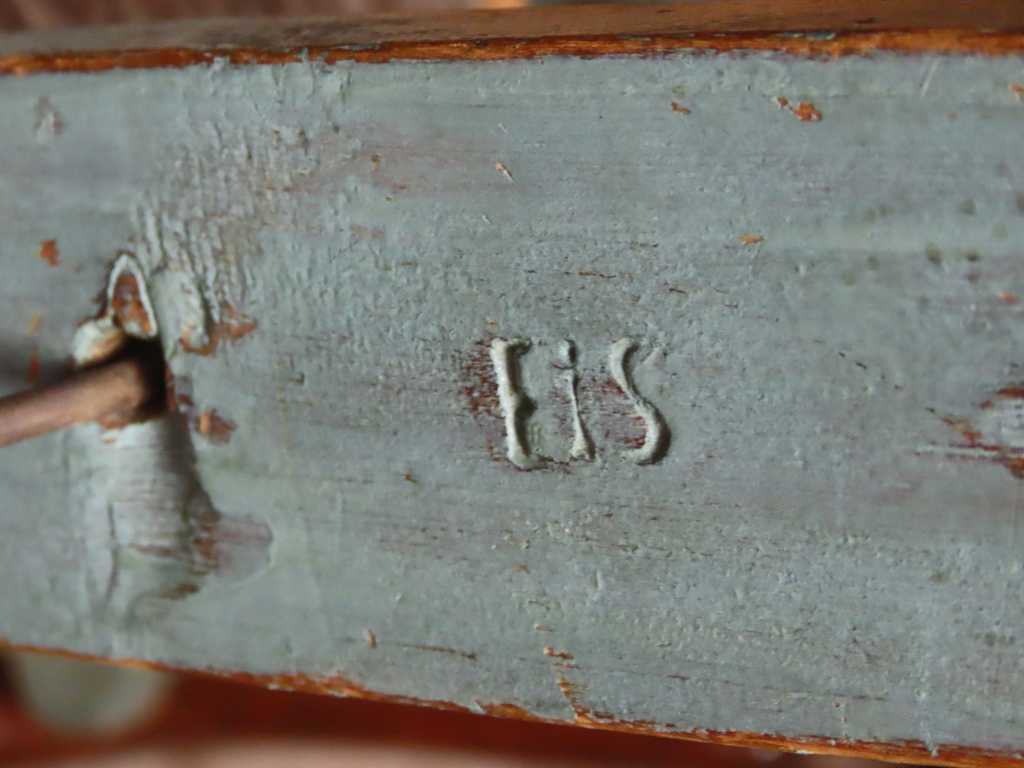
Surprising to me, it also has initials “EiS” stamped on the side.
Because the paint color and initials look much like those on Scandinavian wheels,
I wondered if this Kate may have come from there.
But, its general style does not resemble the Scandinavian Kates that I’ve seen, so its origin remains a mystery.
Aside from the Kates I found in the US, I have two Kates from Scandinavia.
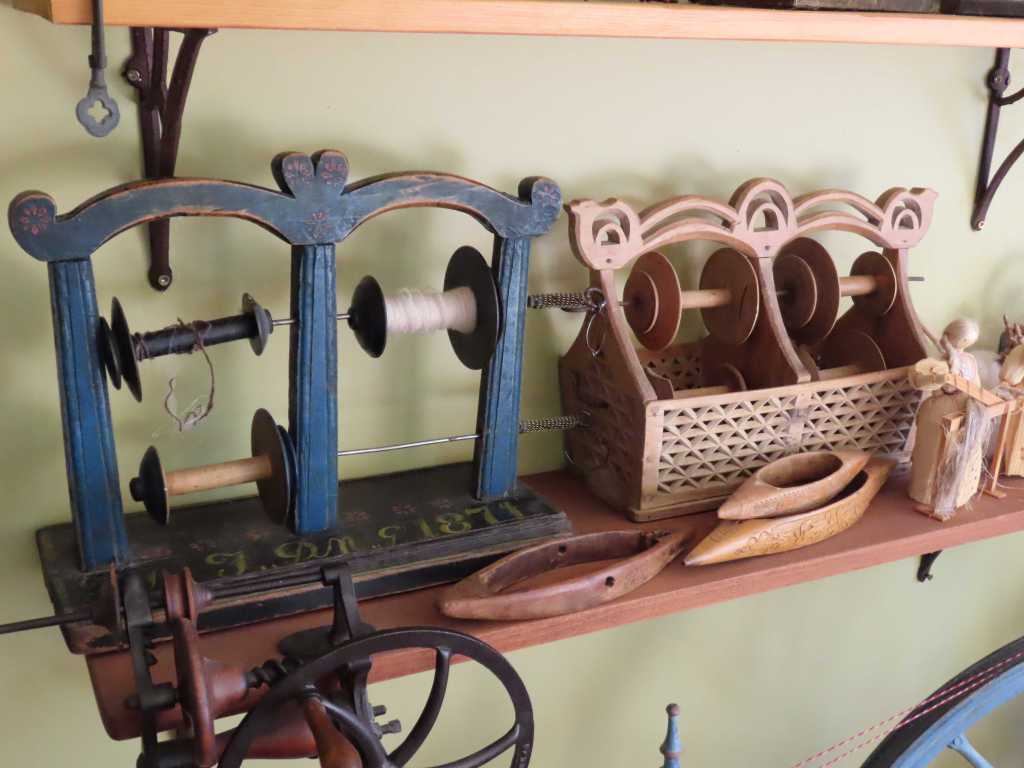
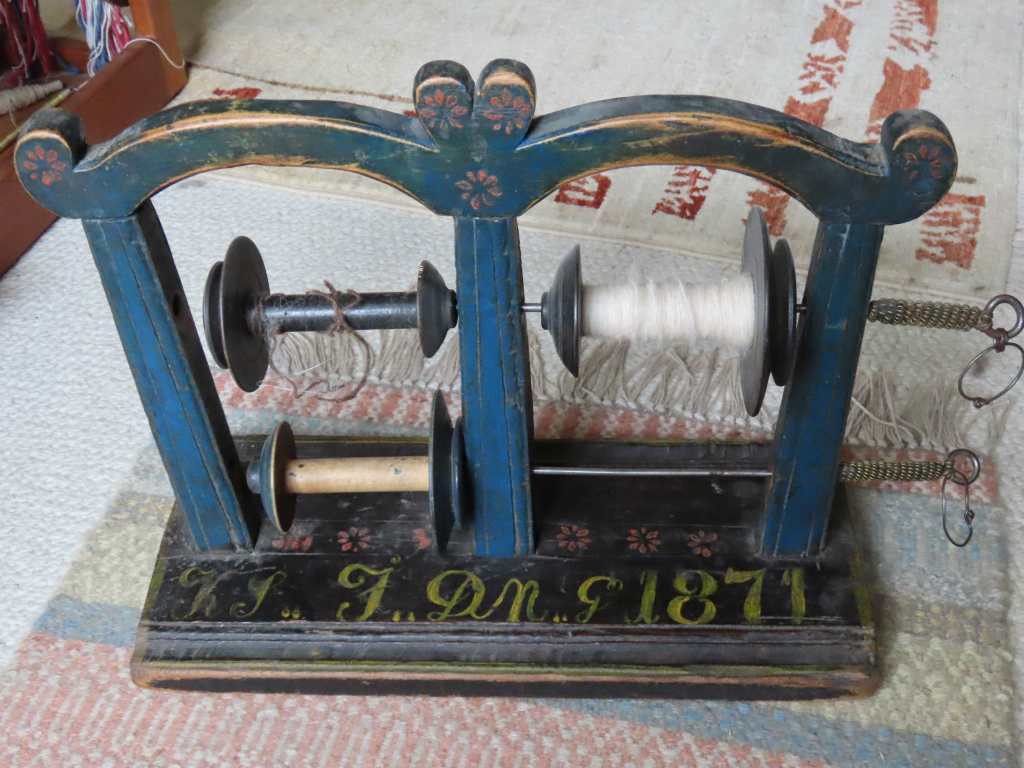
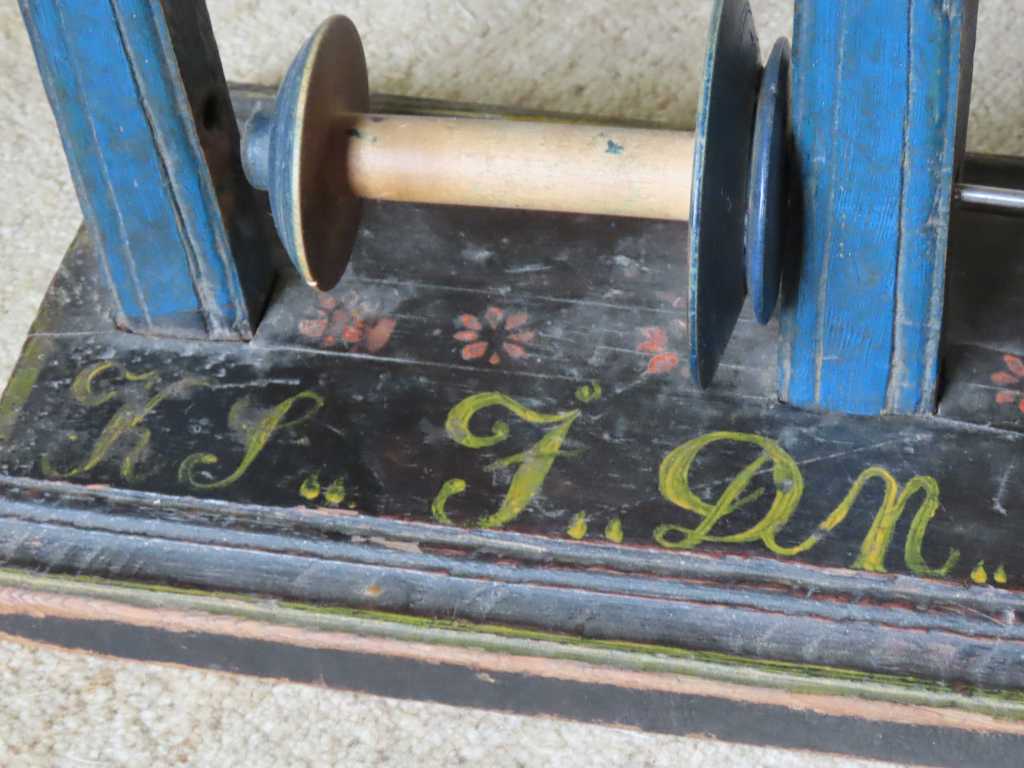
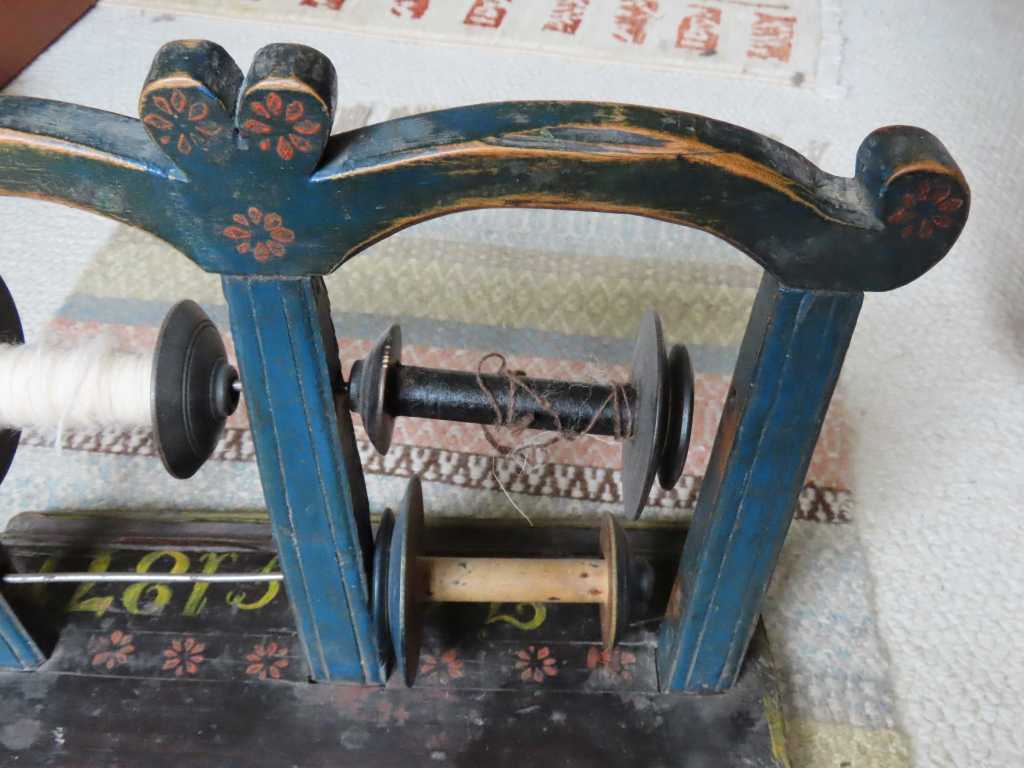
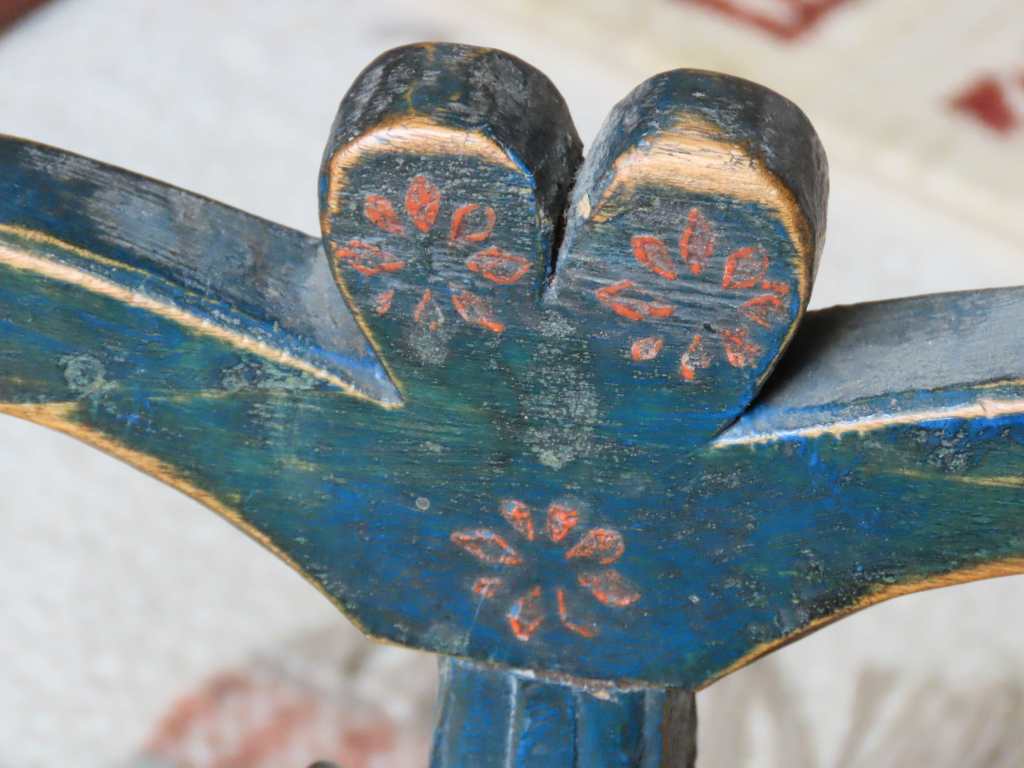
The first is one typical style found there–upright with two bobbins on each side. Painted, with an 1871 date and puzzling letters.
Is it two sets of initials, perhaps, or initials and abbreviated words?
It may have been a wedding or birthday gift.
I have seem this general design and the coiled handles on the bobbin supports on a few Kates from Finland,
so this one may be Finnish or maybe these features were common in Sweden or Norway, too. As with the other blue-painted Kate, this one shows paint wear from being carried around.
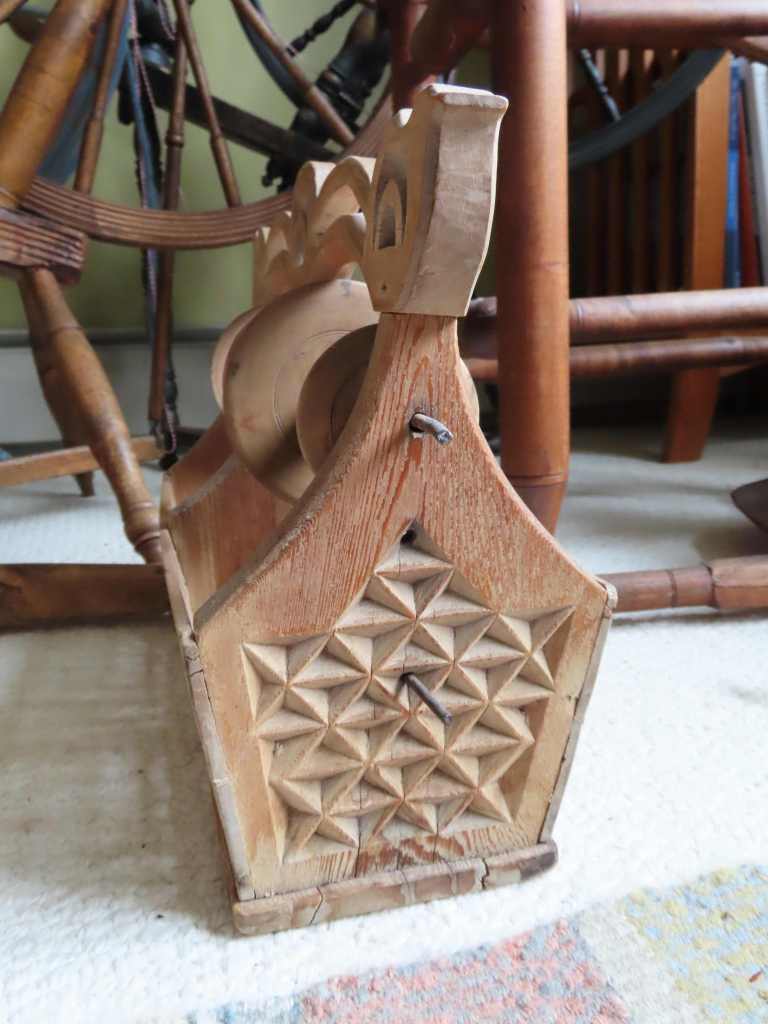
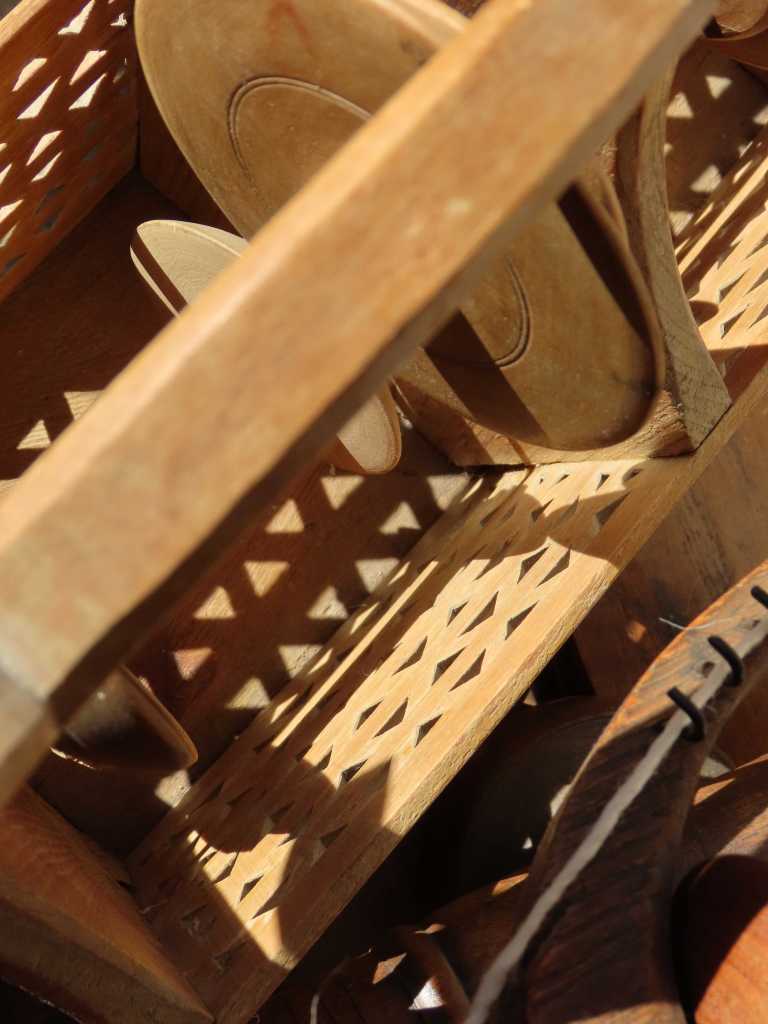
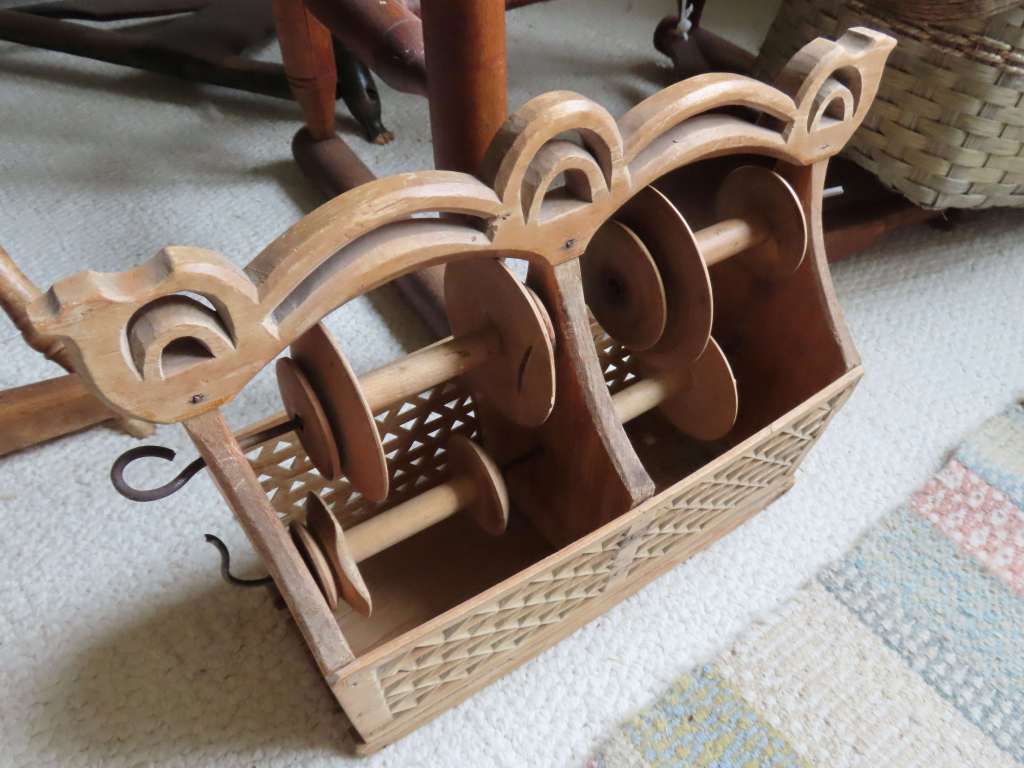
The second Scandinavian Kate illustrates another common style there.
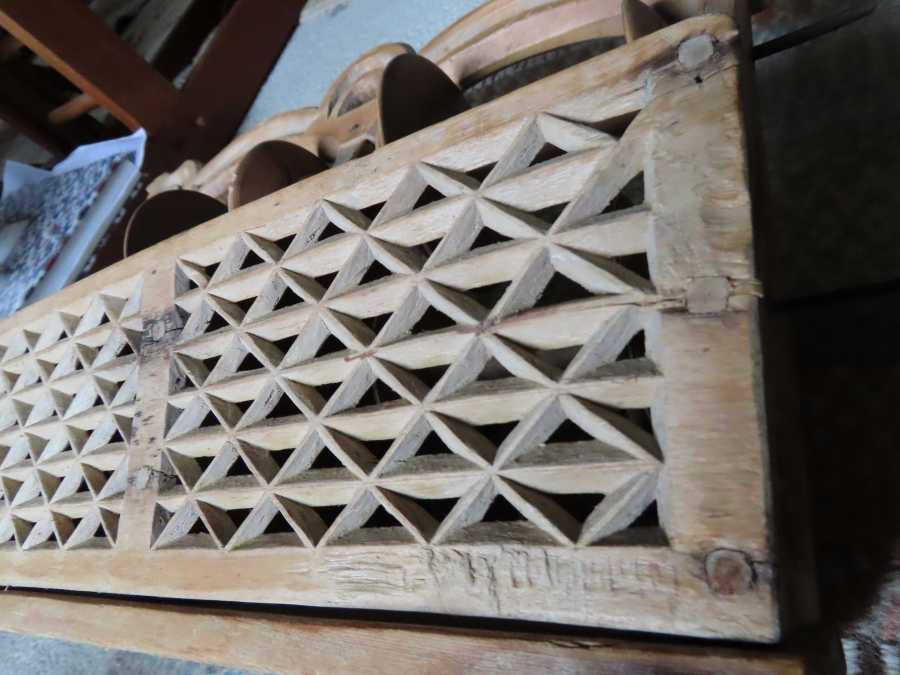
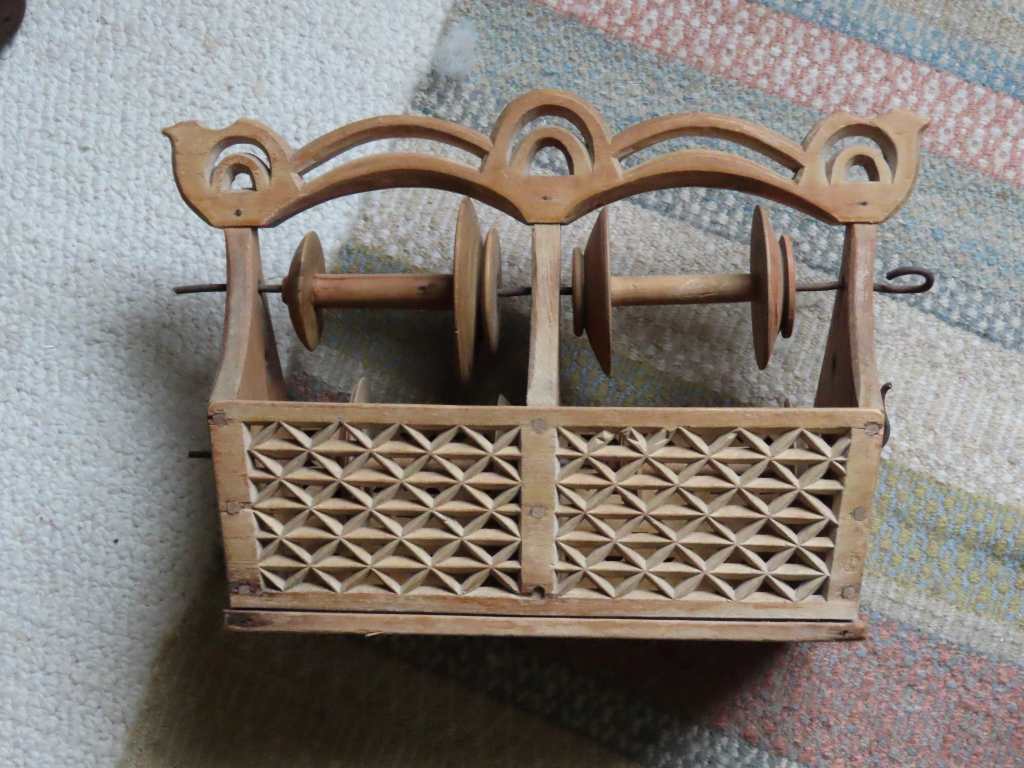
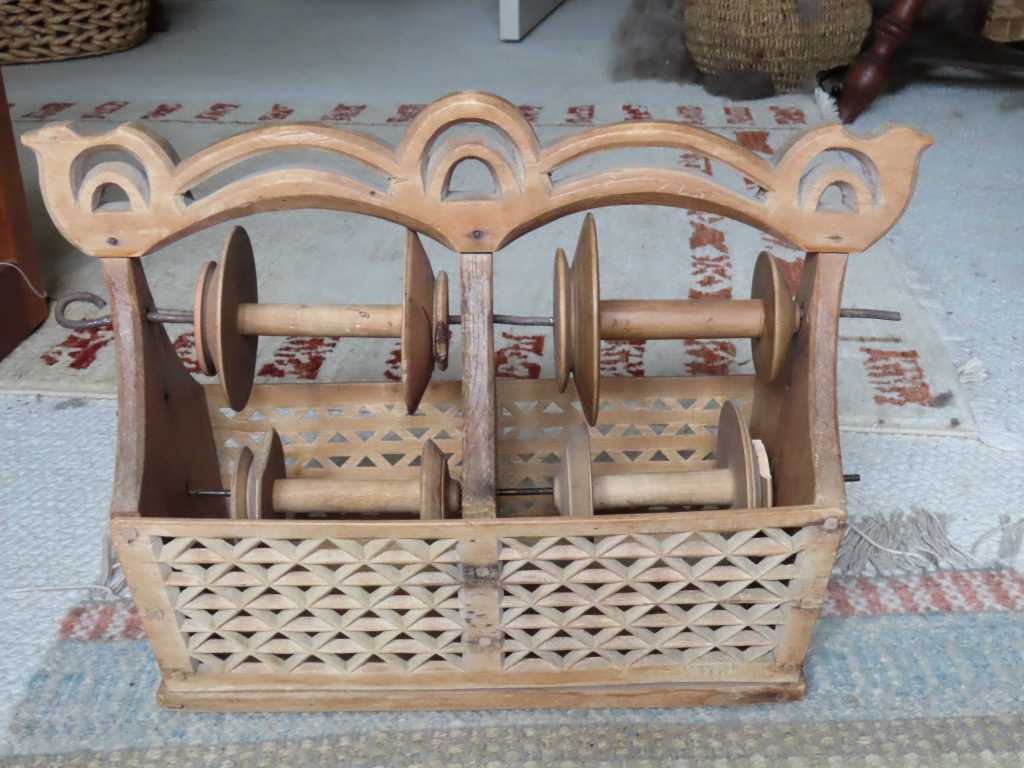
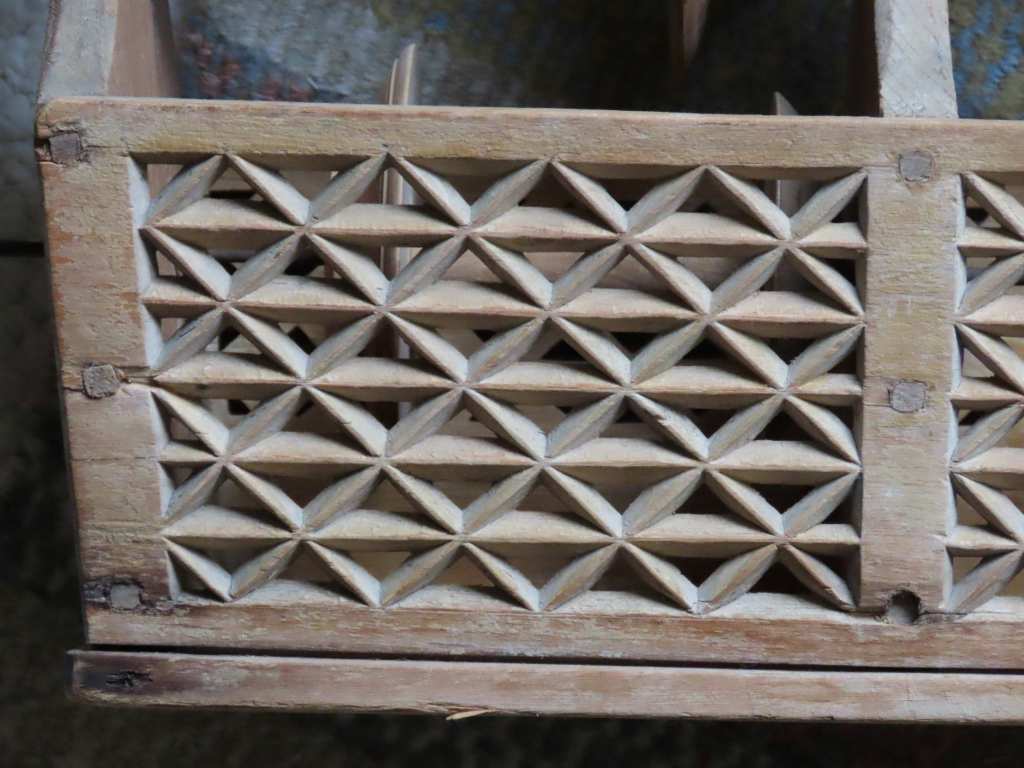
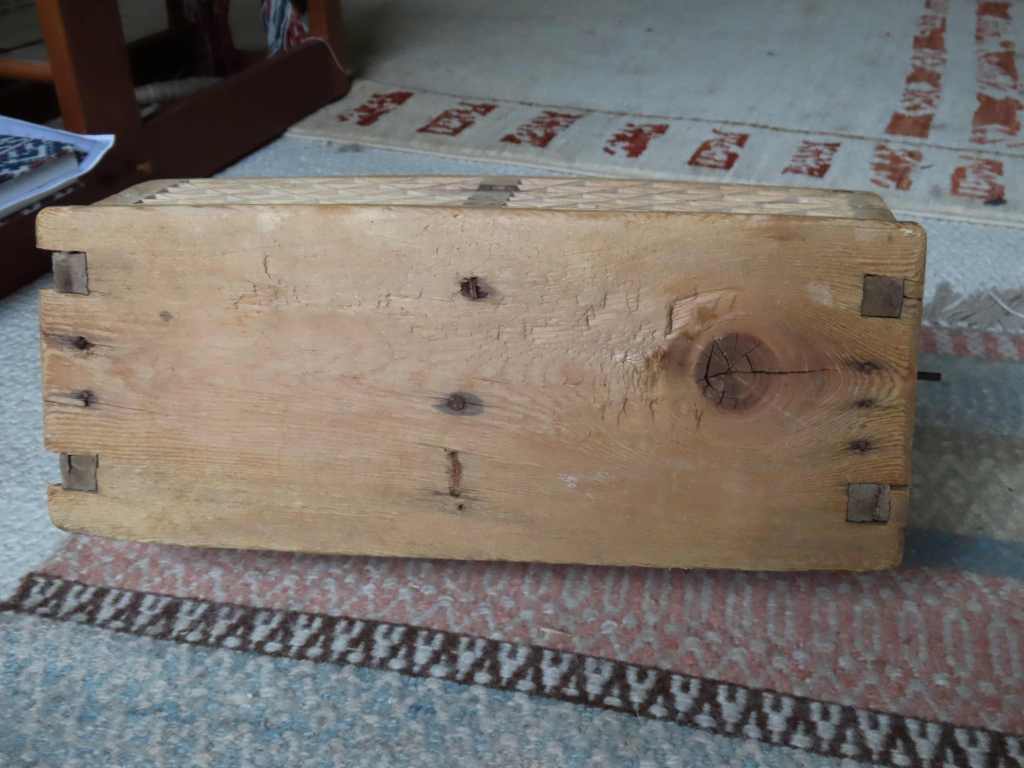
It is like a wooden basket, with four bobbins and a bottom that can provide extra storage for small items.
This one is an especially striking example,
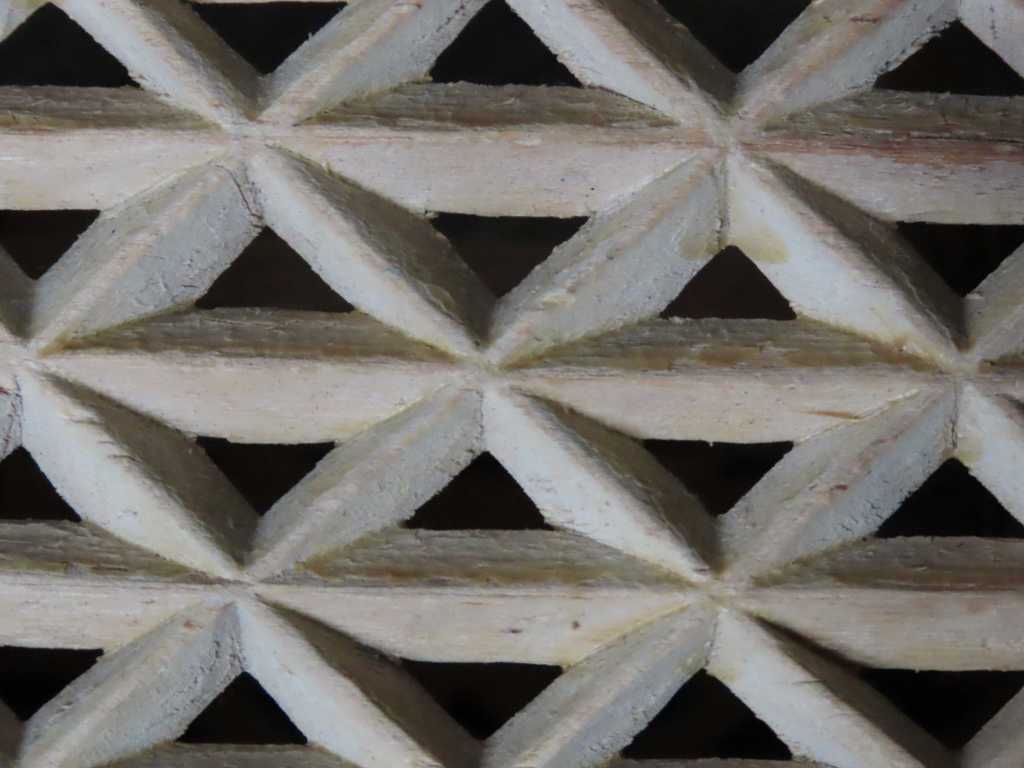
with precise, intricate carving that throws ever-changing shadow dapples.
What an investment of time and care in its creation.
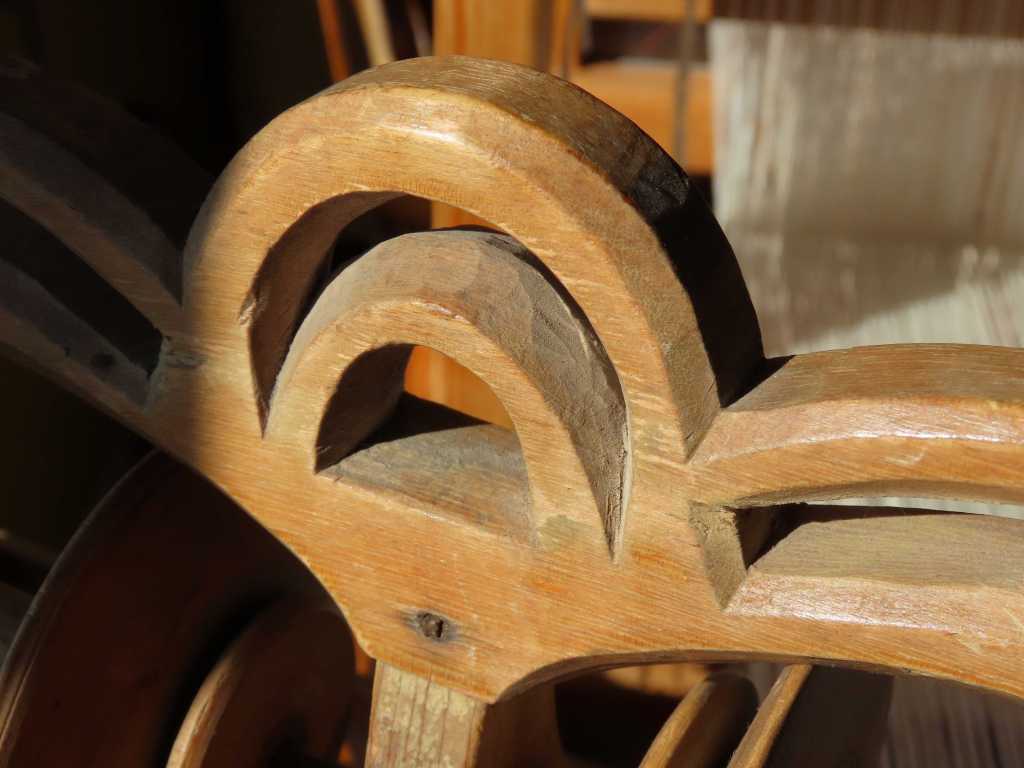
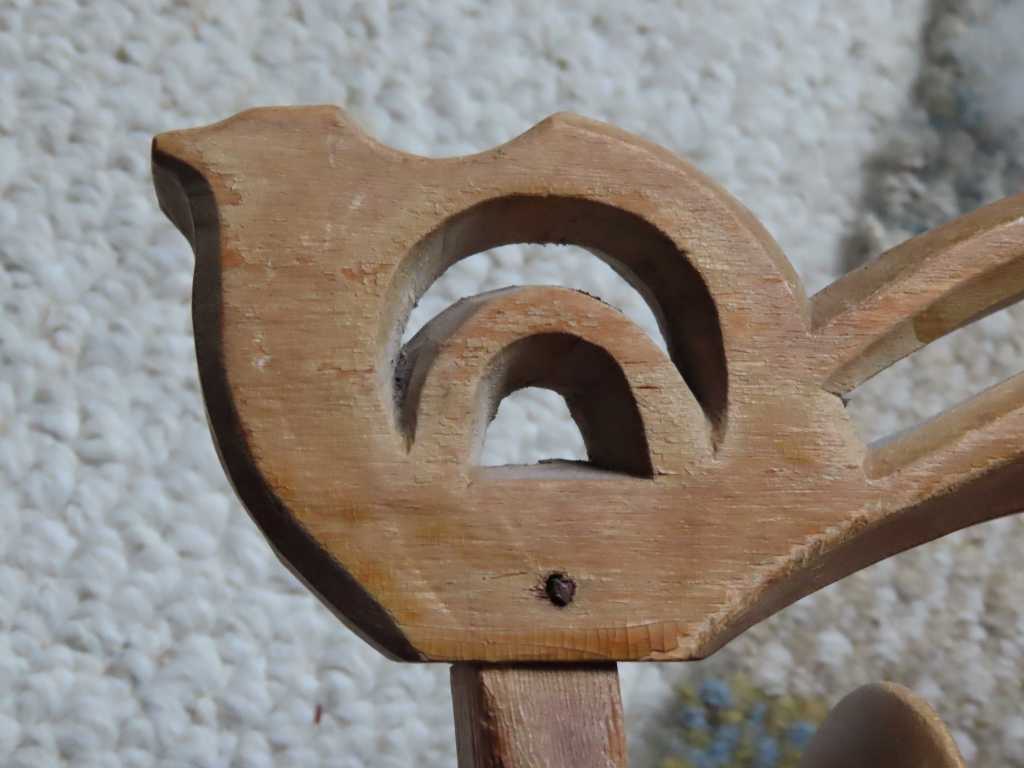
The handle ends look like plump birds
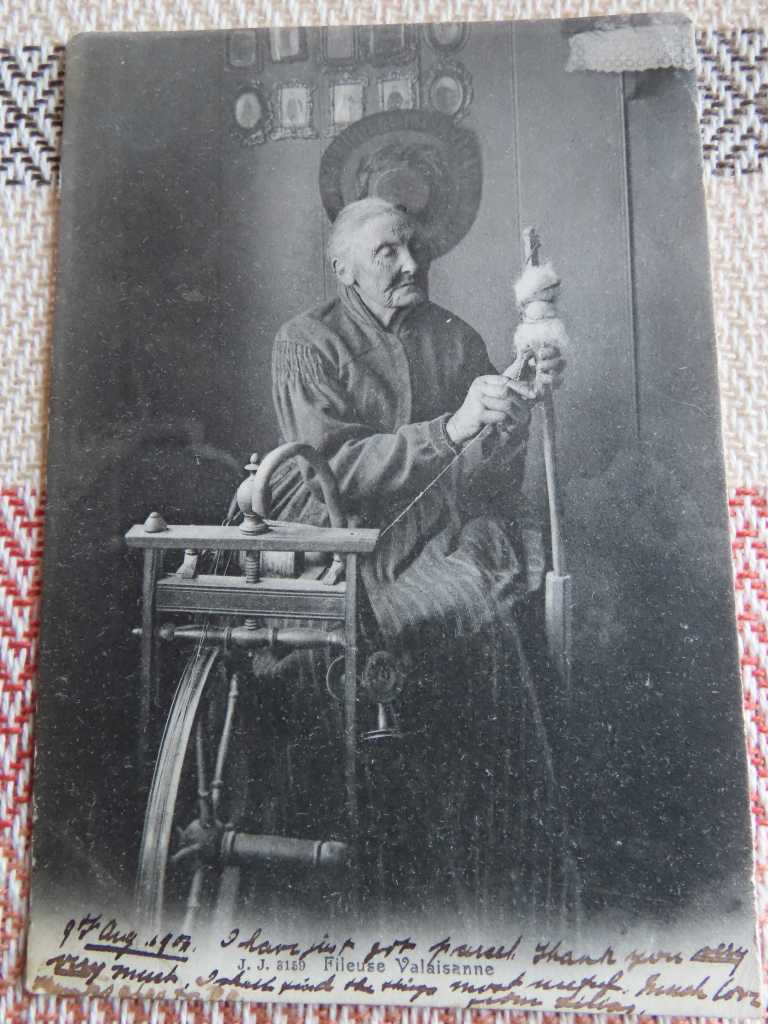
Aside from portable Lazy Kates, some wheels have “on-board” bobbin holders. A few North American makers, such as Joel Farnham and Samuel Morison made wheels with built-in bobbin holders–usually for just one bobbin. Norwegian wheels, on the other hand, often seem to have on-board Kates for two bobbins. I have not been able to determine if they were used primarily for bobbin-storage, or for plying, or both. We do see old wheels in other regions where extra bobbins were simply hung from the wheels. Some were used for spinning flax, such as the wheel in this photo from Switzerland, so the extra bobbins likely were not for plying, but simply spares.
But some Norwegian wheels have holders that would allow for plying.
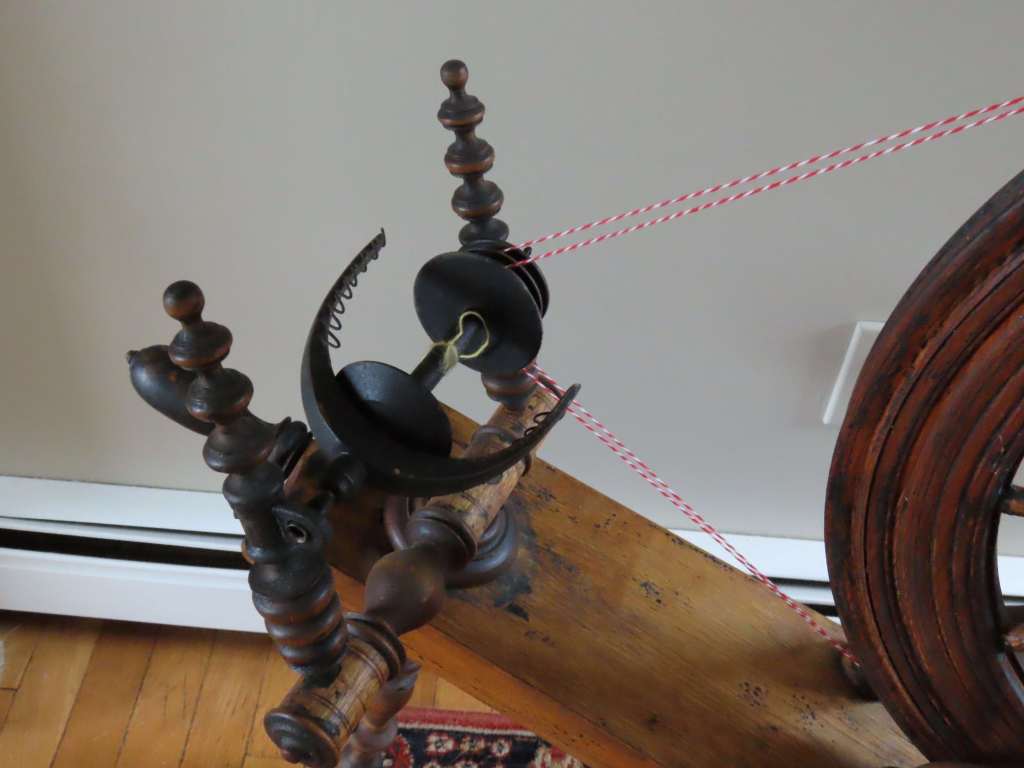
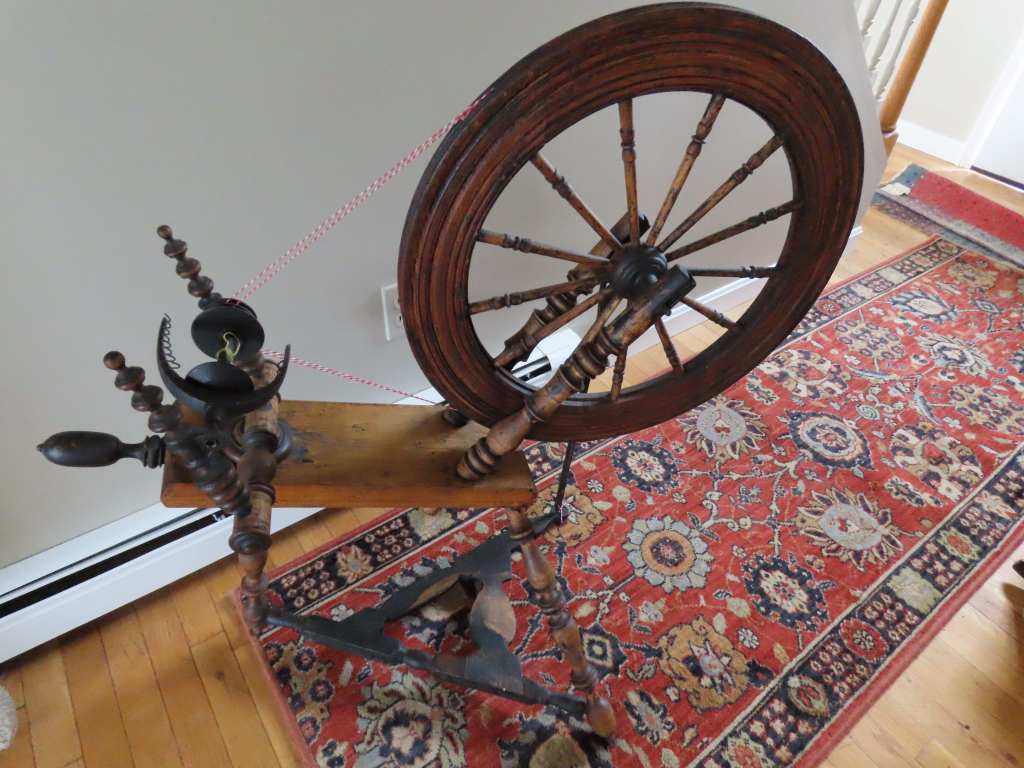
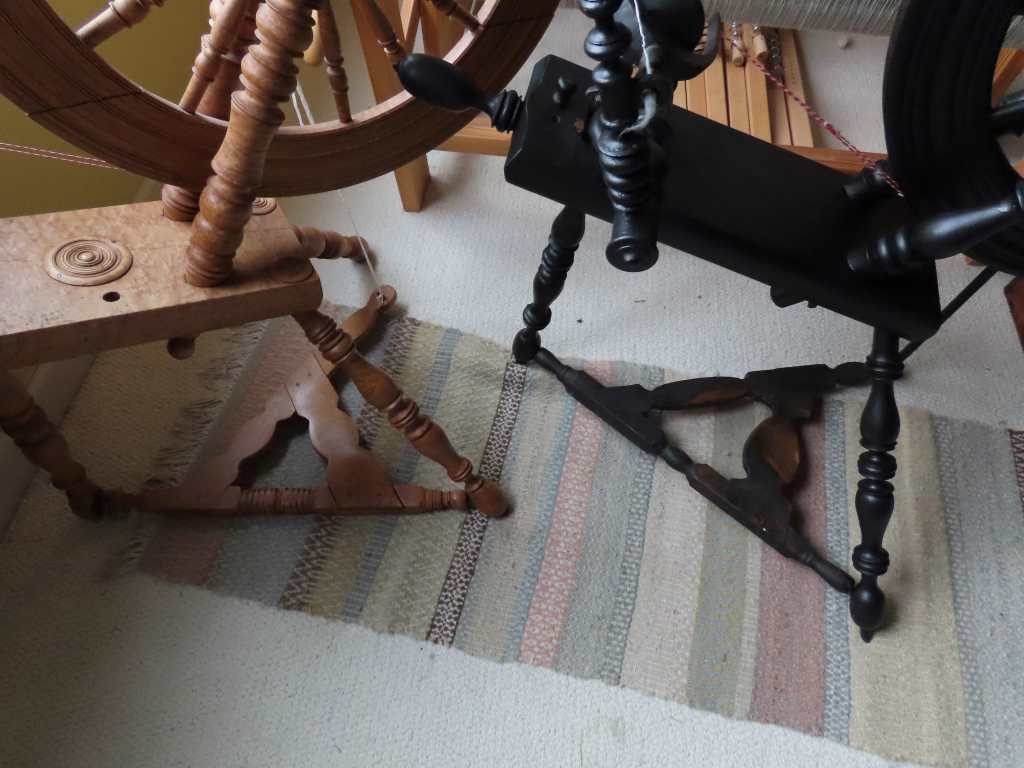
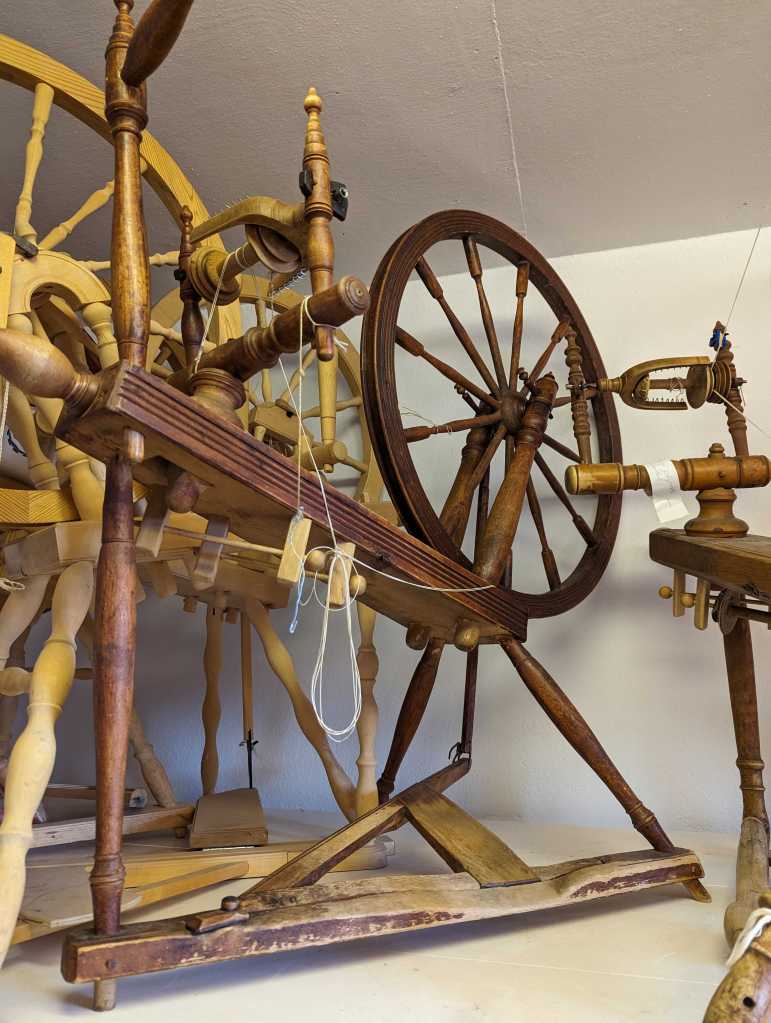
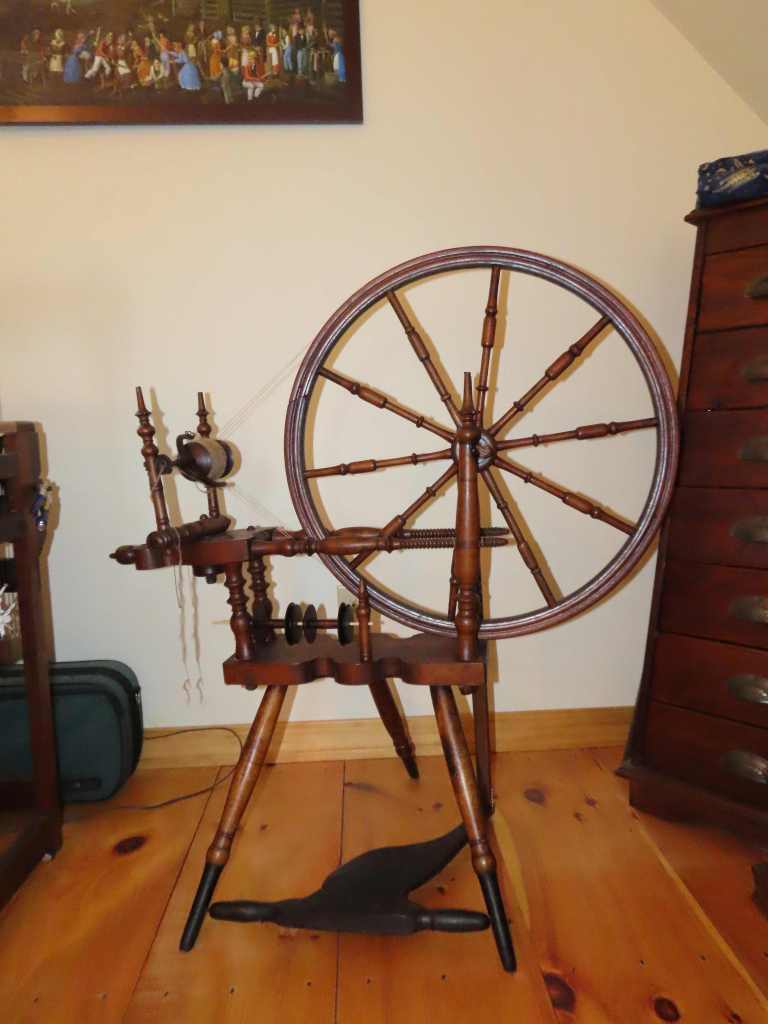
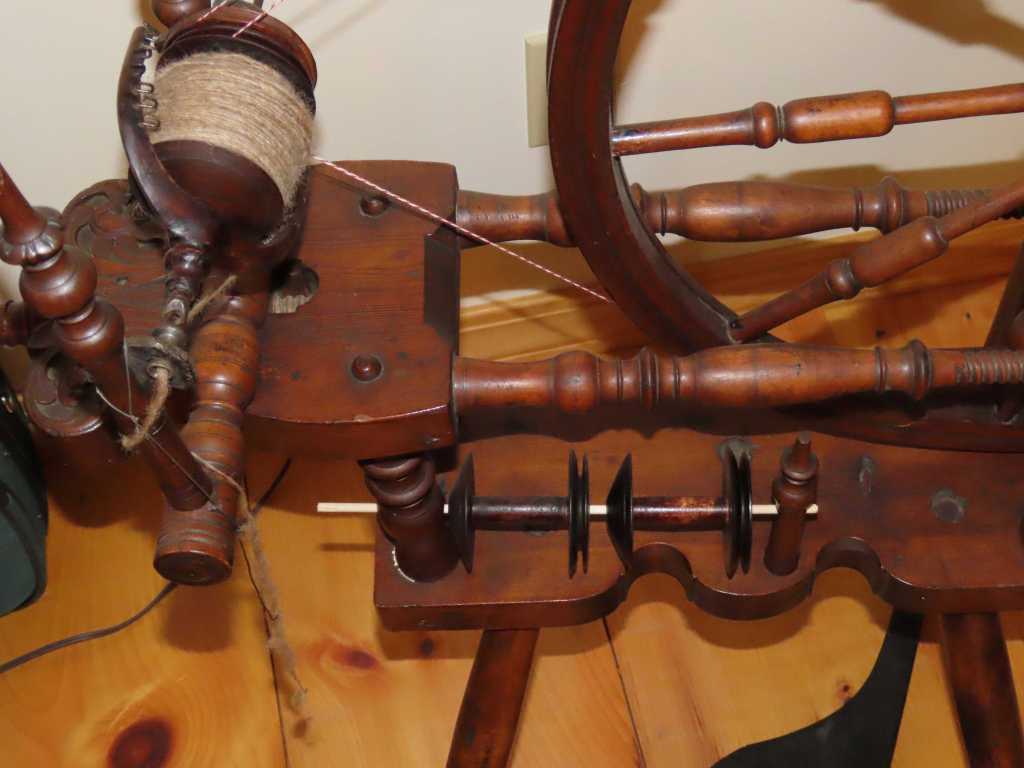
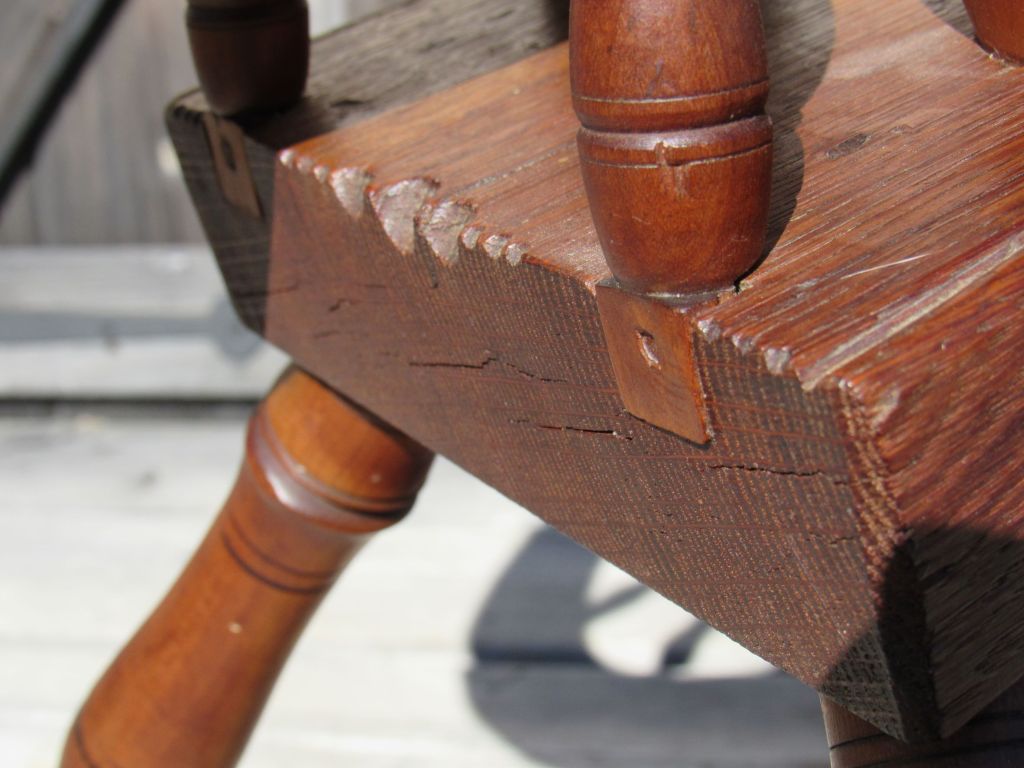
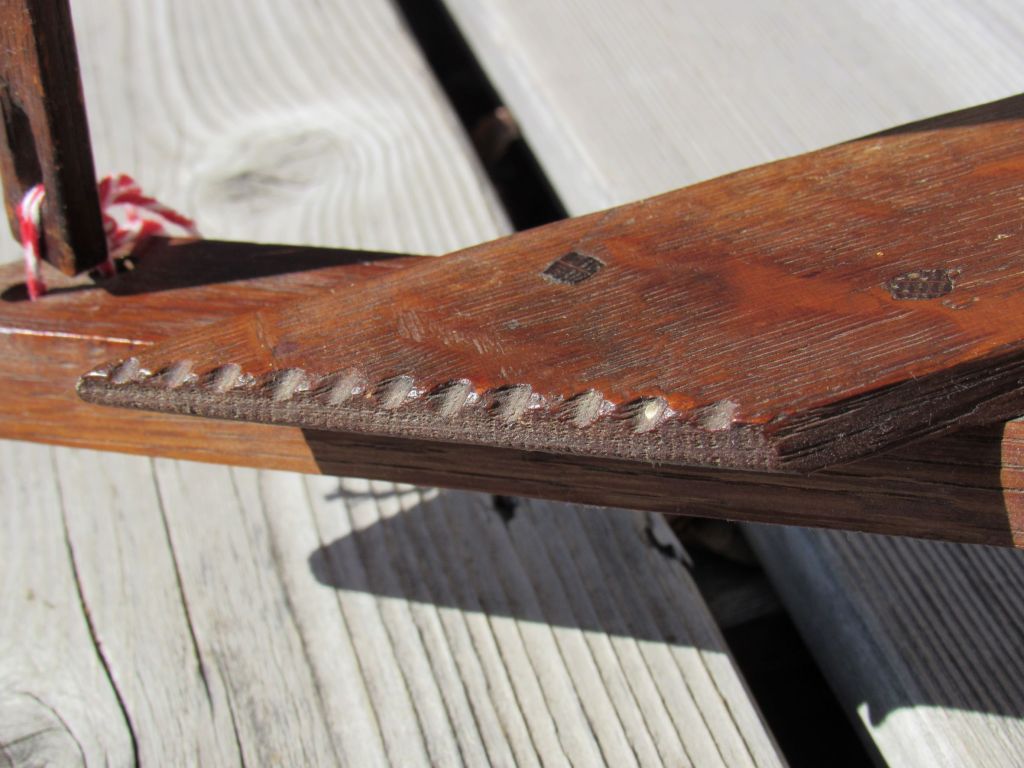
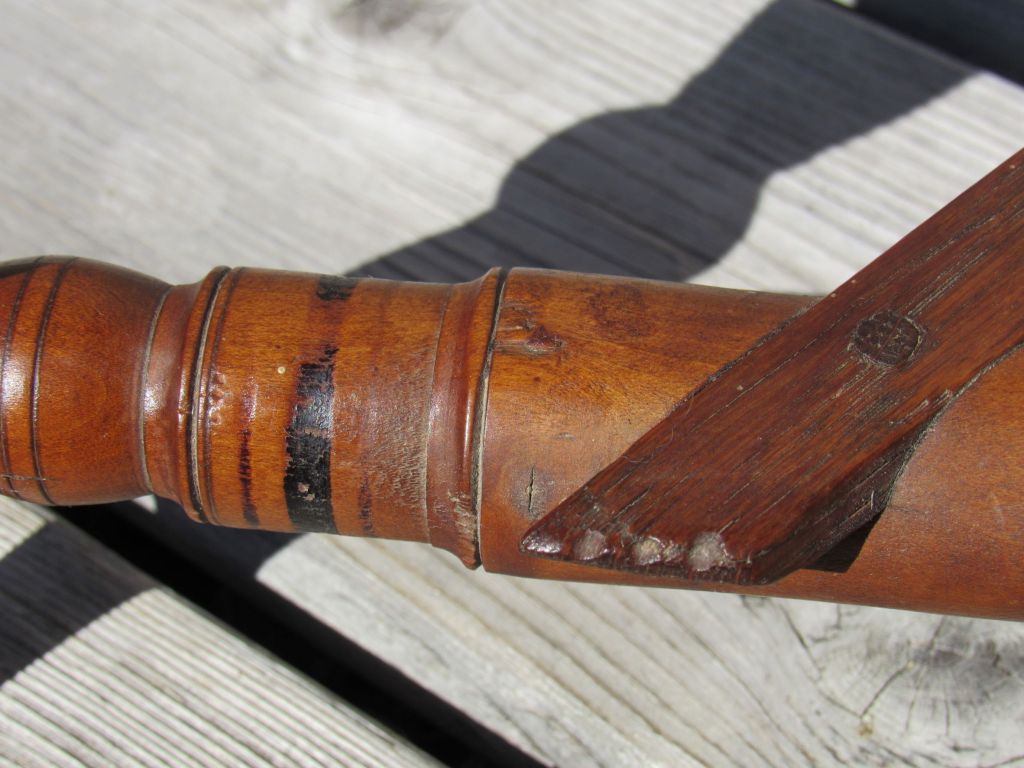
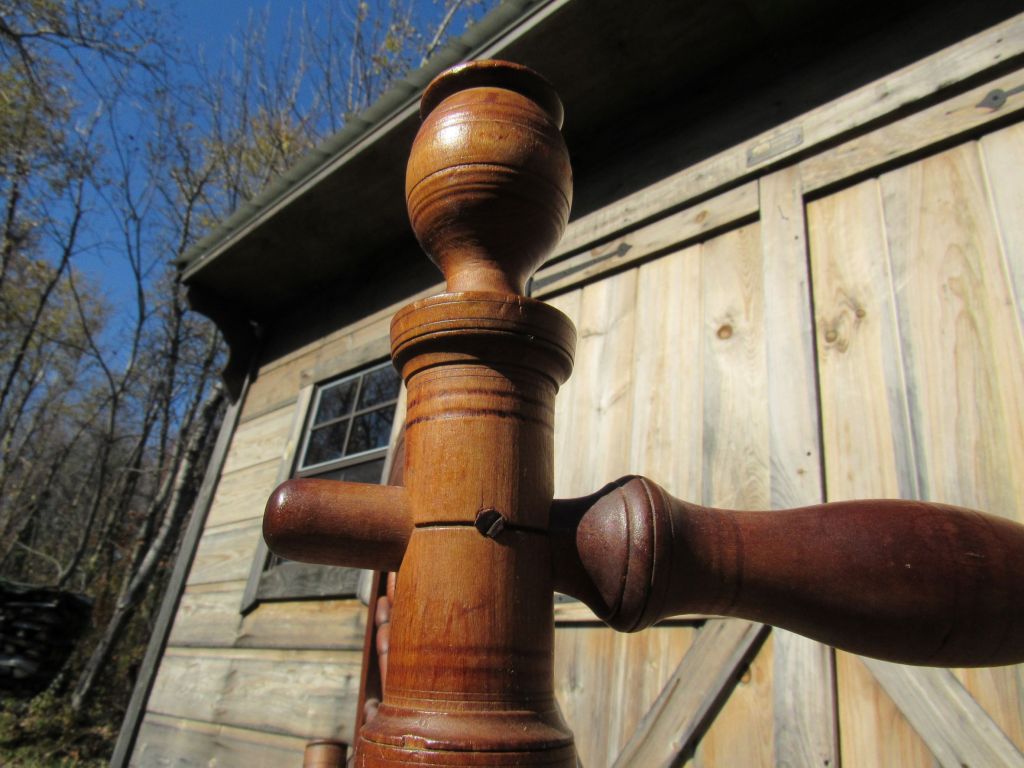
For example, the wheels marked “OAP” have two vertical holders, placed so that they could be used for plying.
(Interestingly, the paint color on this wheel appears to be just the same as the stand-along Kate with the “EiS” initials.)
Double table Norwegian wheels also often have on-board horizontal Kates. The one on this acanthus-carved wheel could be used for plying.
But, on this Norwegian wheel
the horizontal holder is angled in such a way that plying would be awkward.
For some reason, there appears to be little research on Lazy Kates. The origin of the name, for example, seems to be a total mystery. Does the “Lazy” tell us anything about how these tools were used or viewed? Information is scarce on where, when, and how they were used historically, why some regions had them on wheels, or whether the built-in Kates were used for plying. So, much is left to speculation and assumptions. Another area ripe for research …
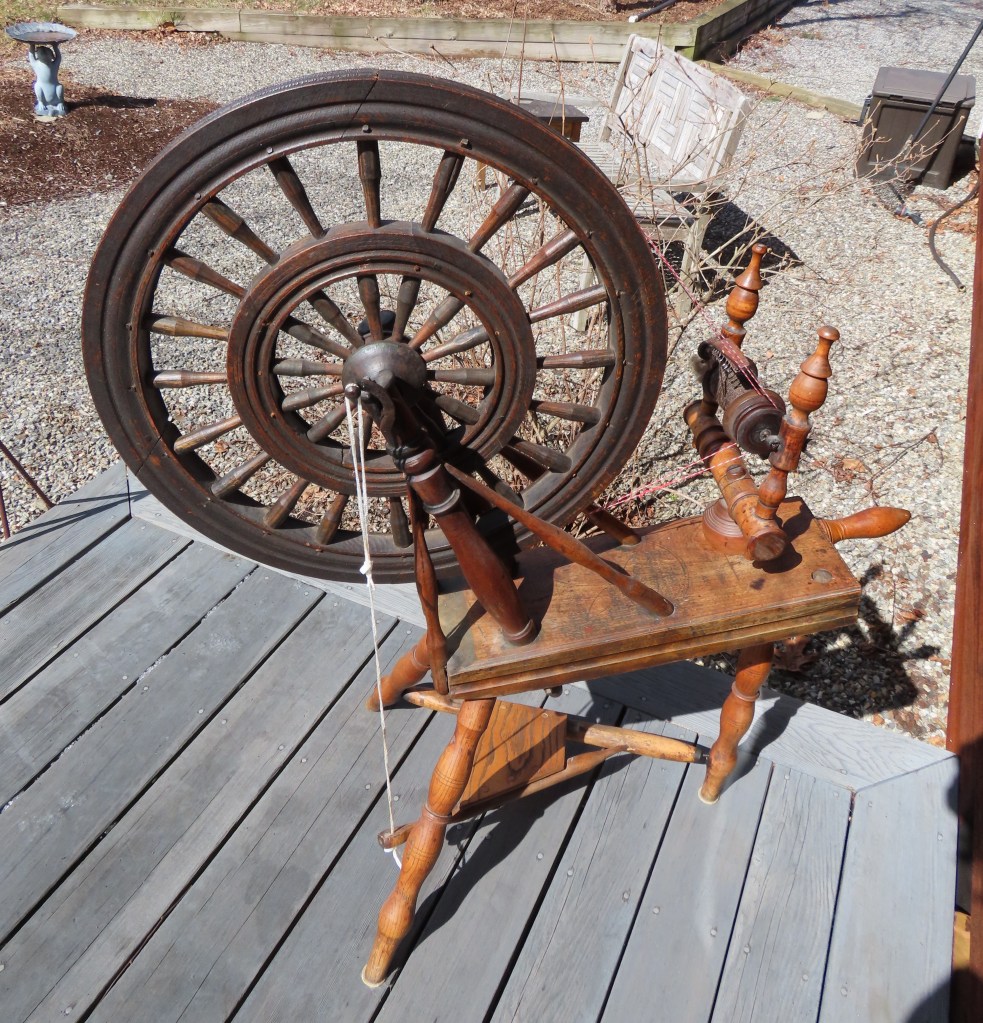
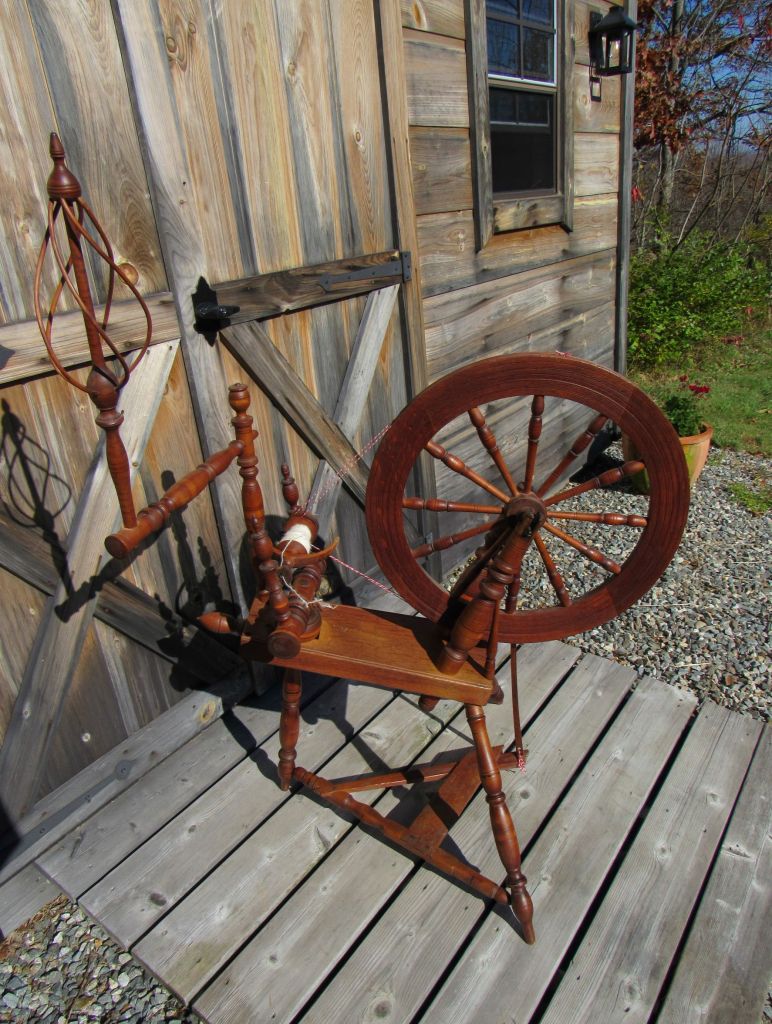
Jacob Fox made beautiful spinning wheels. Yet, despite the fact that many fine examples of his wheels survive, I have been unable to find out very much about the man himself.
He was born Jacob Fuchs in 1788, in Berks County, Pennsylvania, son of Johann Michael Fuchs and Anna Margaretha Schwartzhaupt. Jacob’s father, Johann, was born in Hesse, Germany in 1749 and arrived in Pennsylvania as a young man in 1773. Jacob’s mother, Anna Margaretha, also of German descent, was born in Berks County in 1760.
At some point Jacob Fuchs anglicized his name to “Fox.” He married Catherine Batteiger (also spelled Potteiger) in 1815. They resided in Upper Tulpehocken Township, in Berks County, where they had several daughters, and Jacob had his workshop. Jacob died in 1862, leaving a shop that still contained his woodworking tools and branding irons. (Goyne Evans, Am. Windsor Furn. p. 222, fn. 70).
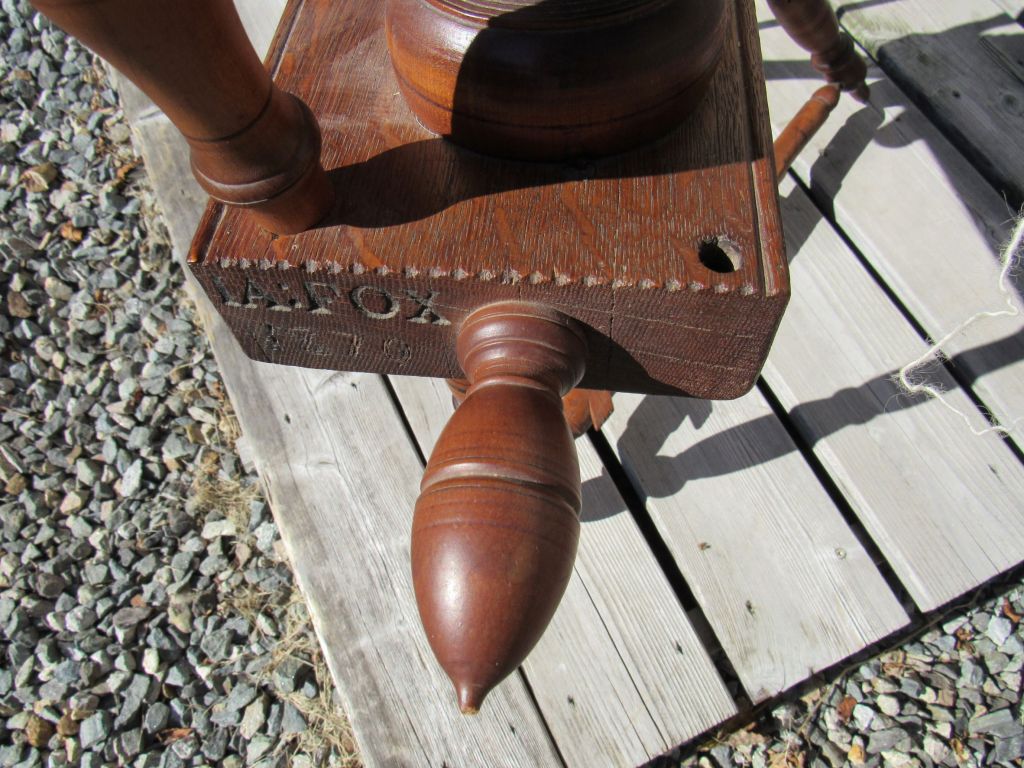
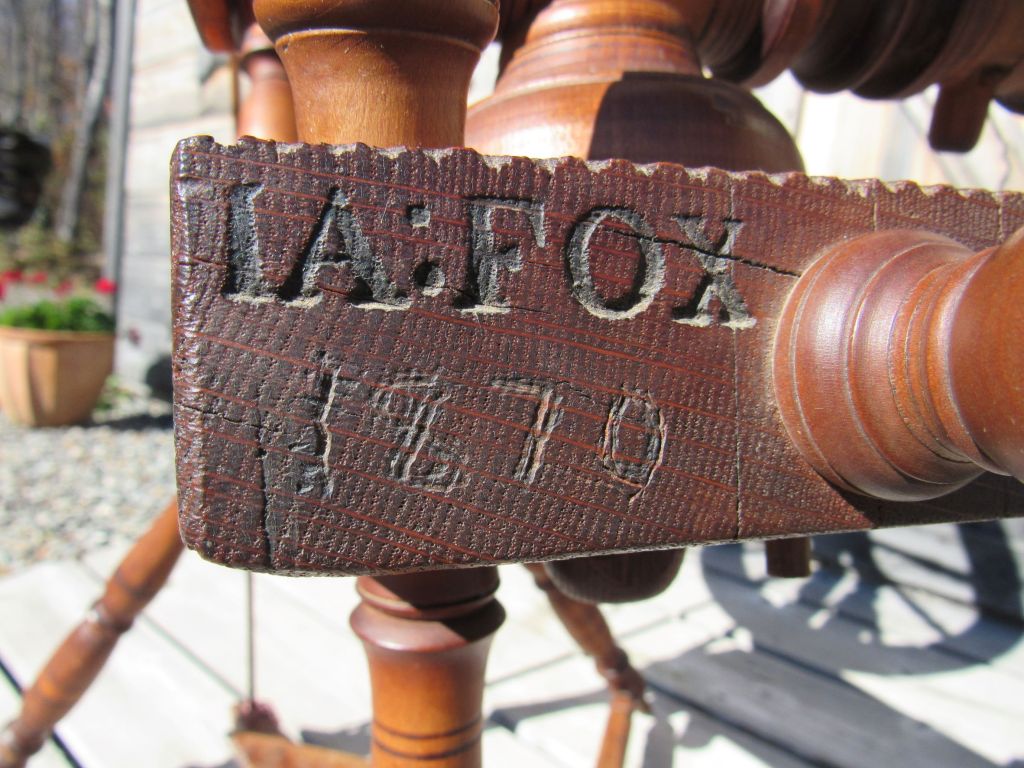
“Like many artisans of the period, Fox was both a farmer and a craftsman …” (Bartlett, pp. 28-29) He made Windsor chairs, marking them with the same brand as on my wheel, “IA: FOX.” (Goyne Evans, Am. Windsor Furn. pp. 102-03, 221).
“The work of Jacob Fox in Berks County is interesting as typical of provincial interpretations of prevailing Philadelphia style, which proved popular among his local patrons. Fox made both bow-back and square-back chairs with turned work ranging from the full baluster to full bamboo style.” (Bartlett, p. 29)
In 1839, Fox had a new branding iron made, changing his mark from “IA: FOX” to “J. FOX”. Although Fox did not date his wheels, because his branding iron has a date on its side, the changed mark serves as a demarcation for wheels made before and after 1839.
Aside from this rather bare-bones “he-was-born-he-worked-he-died” life summary, I found little information to bring Jacob Fox to life. Perhaps his wheels must speak for him. We can see from them Fox’s meticulous attention to detail and quality.
From a business perspective, he appeared to have an eye for his market. As with his chair making, Fox’s wheels were made in the style popular for his time and place. His wheels share certain distinctive features with other Berks County wheels marked “D. Kunkel,” “D.S.,” “H.S.,” and “J. Jacob.” (P&T, p. 127).
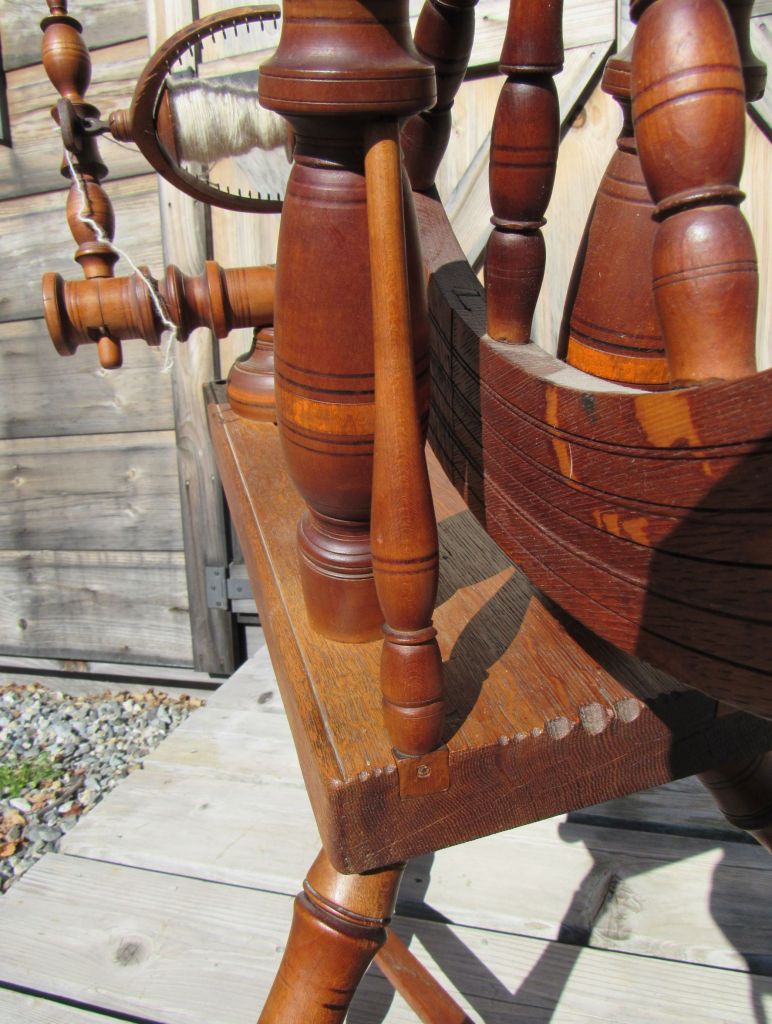
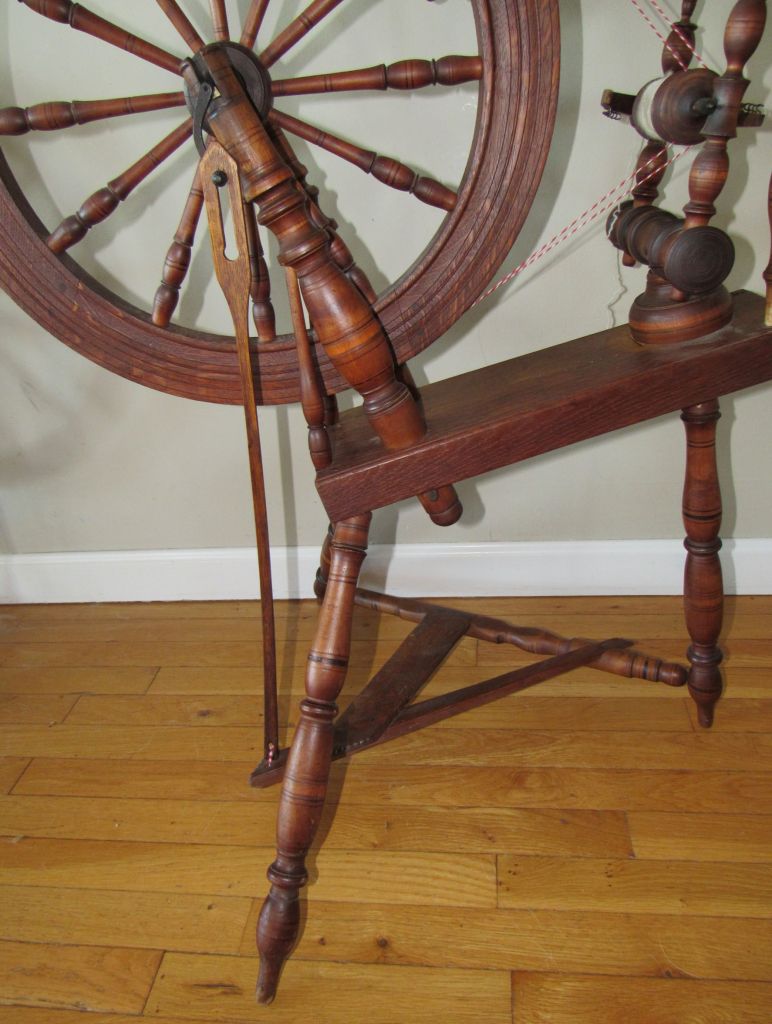
Those construction features included secondary upright supports on both sides, snugly fitted and pegged flush in the table,
and drive wheels constructed of four roughly equal sections,
each section, or felloe, tightly joined
and double pegged.
Another unusual feature, popular in eastern and central Pennsylvania, was a hole through the table’s spinner side for a reeling pin. (Taylor, SWS p.7)
Reeling pins were turned wooden pins about the size of a finger. It is believed they were used for guiding the spun thread when unwinding it from the wheel’s bobbin onto a reel. The theory is that it saved fingers from friction burn (think of rope-burn on a finer scale) and cuts made by fast-reeling flax thread. It seems like something a city women with soft hands might have used but less likely to be in high demand from farm women, whose hands likely were well-callused and work-hardened enough not to be bothered by unwinding flax.
Ester’s reeling pin is gone, but the hole is a reminder of how quickly we lose knowledge about wheel design and use at particular times and places. Why are holes for reeling pins found in only a small area of the country? Was it a tradition brought from a German region? Were reeling pins used in other parts of this country, but without storage holes? Or were they a nineteenth century local fad?
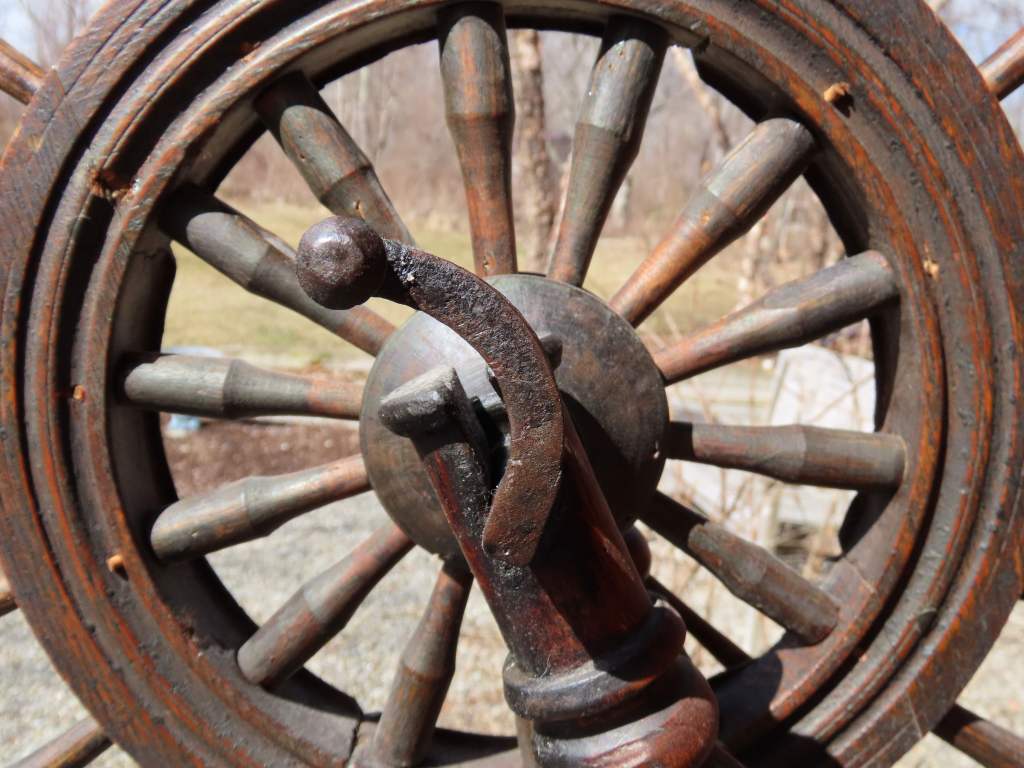
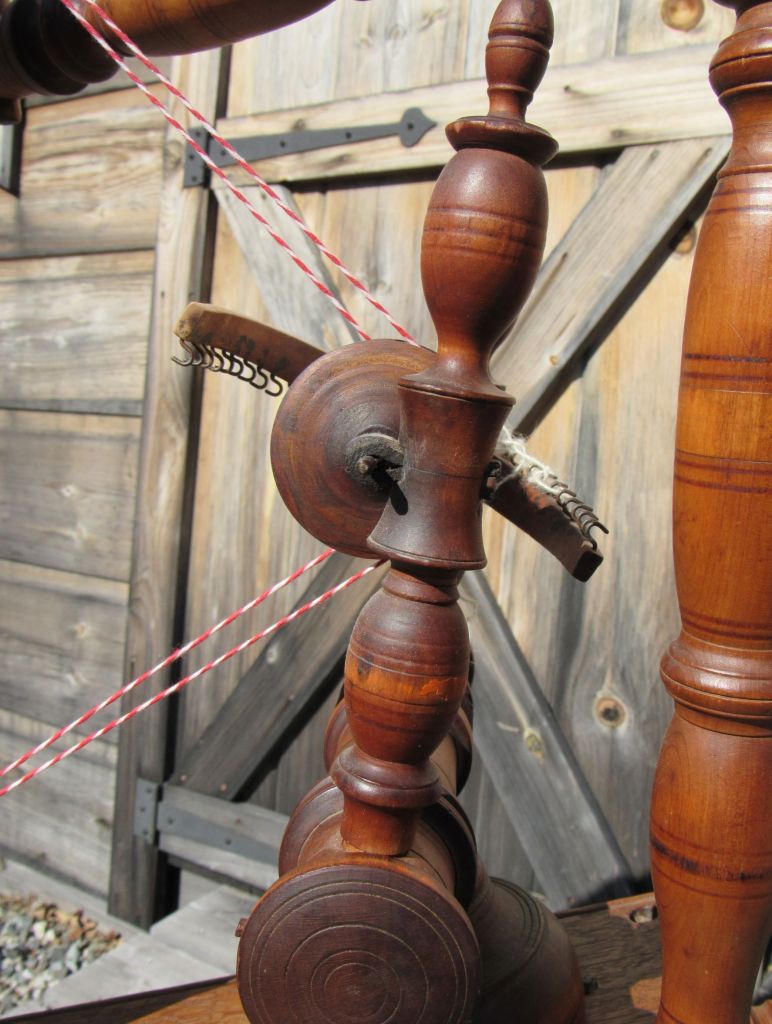
While Fox’s wheels share similarities with other area wheel makers, his wheels also have a certain flair that mark them as his creations. From hub,
to axle bearings,
to spokes
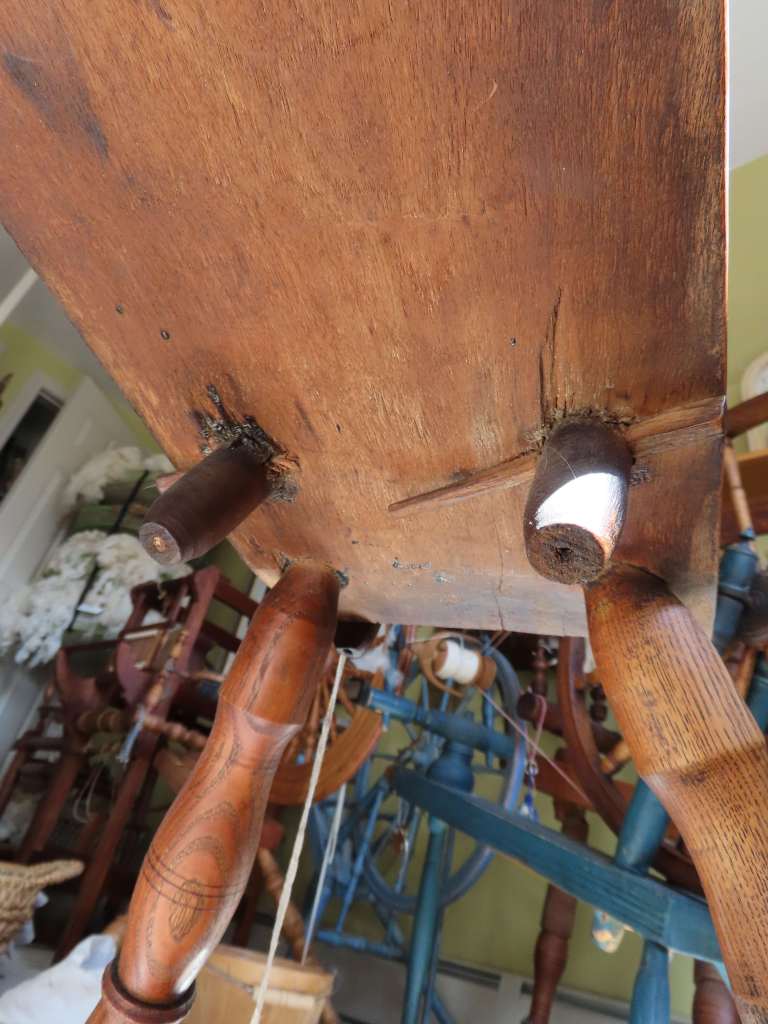
to the underside,
the materials, construction, and design are superb.
The wheels have a finely-finished quality,
exuberantly decorated with brilliant orange painted bands,
contrasted with black bands.
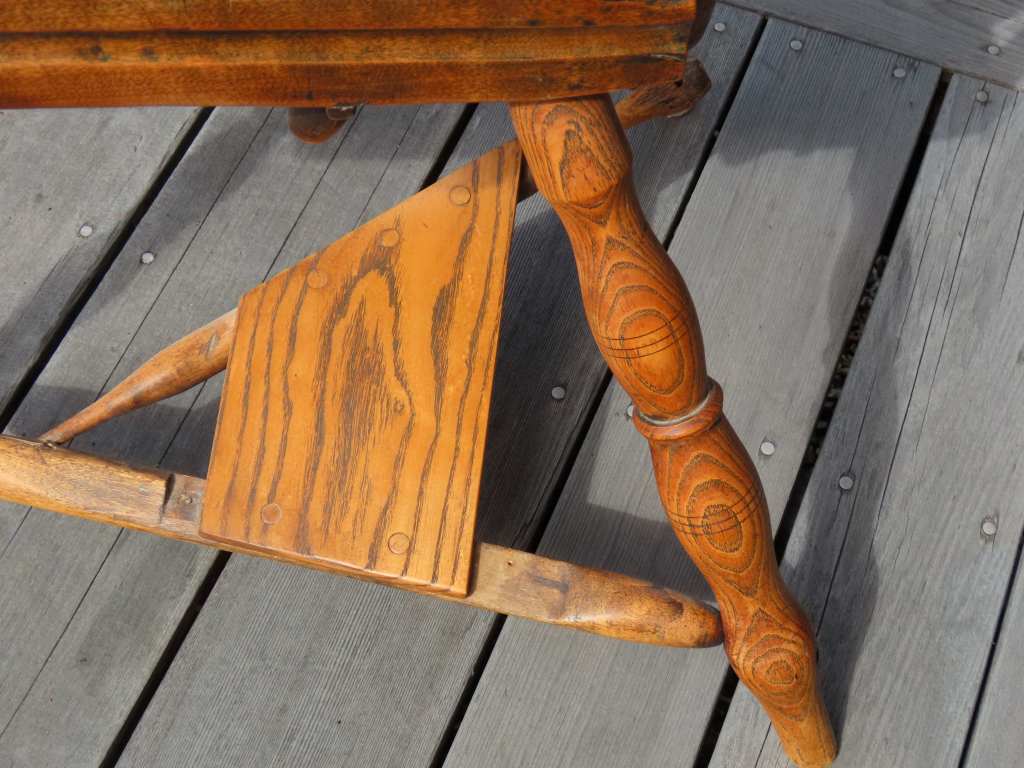
The feet are elegantly pointed
and the small-large-small chip carving on the table end gives a special touch.
His attention to the smallest details is remarkable.
Even the ends of the treadle bars have chip carvings.
The distaff arm is pegged in place to keep the distaff from flopping over when in use.
And the under-table portion of the wheel uprights are turned, beautifying a largely hidden part of the wheel–an unusual feature that makes him and his wheels stand out.
This wheel has seen some significant use,
with obvious wear on the treadle
and dent marks on the table.
Such marks have been the cause of much discussion in online antique wheel groups. They are often seen on Scandinavian wheels and the general consensus seems to be that small knives or other utensils were spiked into the table under the drive band to help guide or separate it, although often the marks do not look big enough to hold a knife upright for long.
The flyer fits well and matches the wheel. It has some wear
but is in overall good condition with a smooth orifice
and a moderate wingspan (not as wide as many Pennsylvania flyers). It could be original, or not.
The distaff appears to match the wheel, but, again, I do not know if it is original.
Since Ester has Fox’s early stamp, we know the wheel was made before 1839, and this distaff looks as if it might be newer than that.
The footman is intriguing because it is elegantly curved. But, without seeing other similar Fox footmen, I doubt if it is original.
As for the date carved crudely carved under Fox’s mark, it appears to have originally been 1770 and then changed to 1880.
Both dates are puzzling, because Fox would have been 15 in 1770 and dead in 1880. Still, it is part of the wheel’s history and mystery.
This wheel is a testament to the power of material things and the importance of preserving them. While there seem to be few written details about Jacob Fox, his branding iron and his wheels give us clues about him and his life. He lives on in them.
January 6, 2023 edited to add:
After posting this, I heard from two owners of J. Fox wheels, both of whom confirmed that Ester’s distaff is consistent with others on Fox wheels and likely original. In addition, Bill Leinbach sent this photo of Fox reeling pin (thanks Bill):
References:
Taylor, Michael, “Reeling Pins,” The Spinning Wheel Sleuth, Issue #115, January 2022, pp. 7-8
Bartlett, Louisa, Curator, A Cultural Celebration: Arts of the Berks County Pennsylvania Germans From a Private Collection, paper available online from exhibit June 12-Sept. 26, 2010, pp. 28-29.
Goyne Evans, Nancy, American Windsor Furniture, Specialized Forms, Hudson Hills Press, New York, N.Y. 1997.
Goyne Evans, Nancy, Windsor-Chair Making in America, From Craft Shop to Consumer, University Press of New England, Lebanon, N.H. 2006. Fox’s dated brand is pictured on page 80.
Pennington, David and Taylor, Michael, Spinning Wheels and Accessories, Schiffer Publishing, Atglen, PA 2004, pp. For a wonderful discussion of eastern Pennsylvania wheels see Chapter 11, pp. 123-29.

































































 Exquisite Machinery