Big Bear

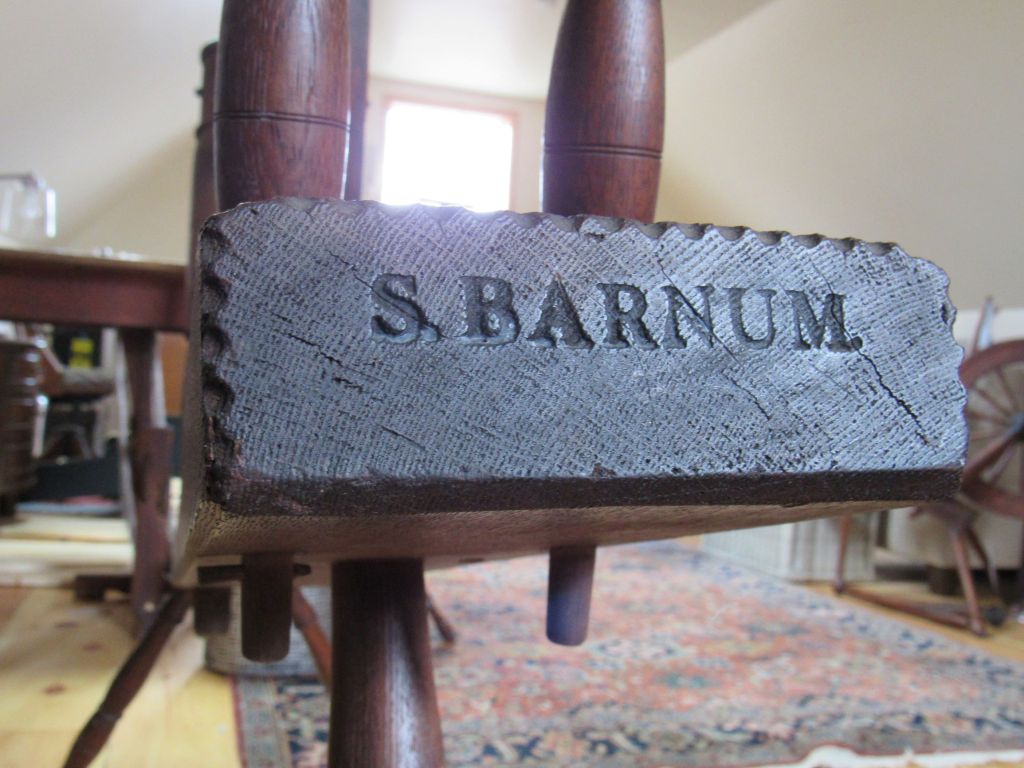
Silas Barnum (1775-1825) was part of a group of Connecticut wheel makers working in the late-1700s to mid-1800s.  They spanned generations and had numerous connections–some clear, others more elusive. I like to refer to the early generation–Barnum, Samuel Sanford, John Sturdevant, Jr., Solomon Plant, and J. Platt–as the “double flyer boys,” because they are best known today for their distinctive upright double flyer wheels. 
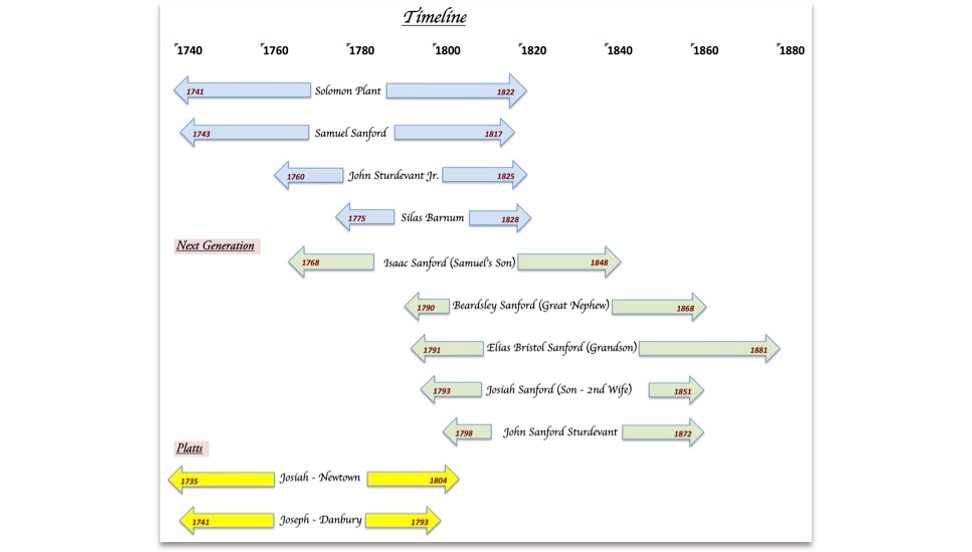
These men and their wheels share many similarities.  With the exception of Plant, who lived a few towns away on the coast, they lived in neighboring towns in southwest Connecticut. 
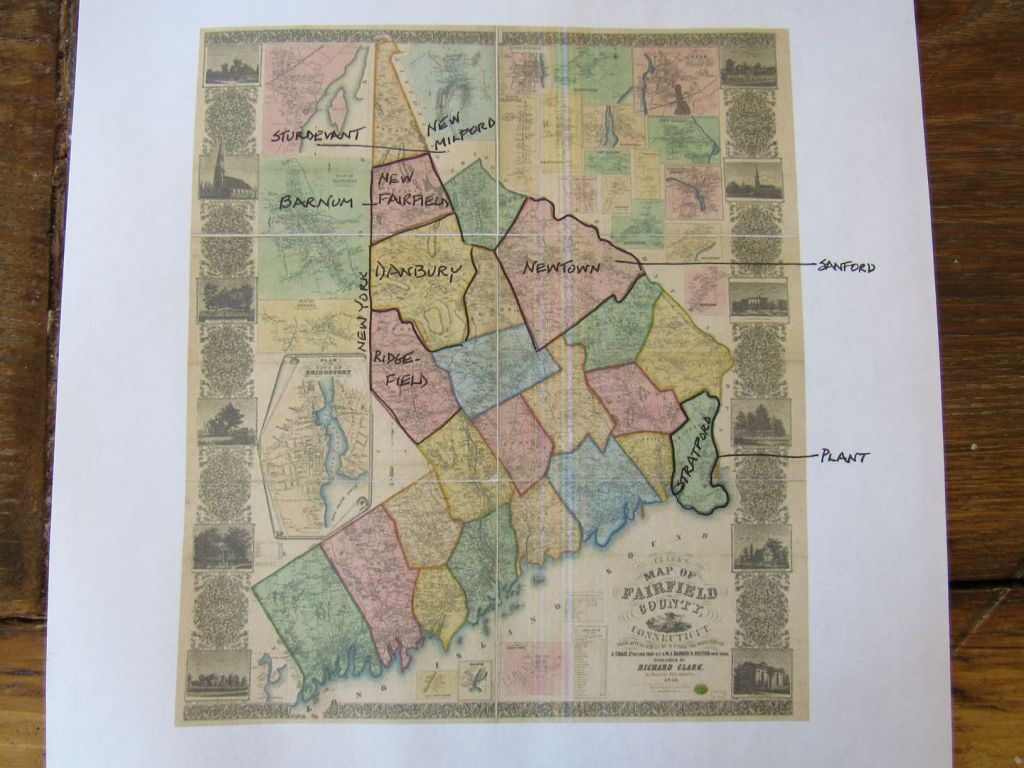
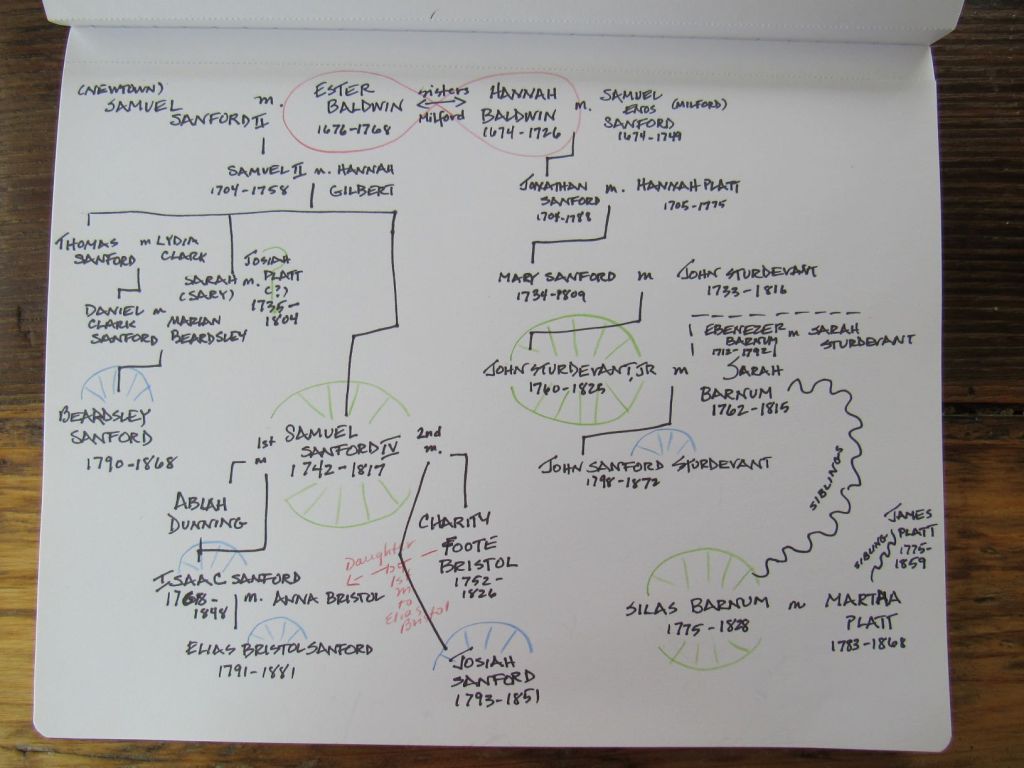
Their families were early settlers in the area, with a web of interconnected family relationships. For example, Silas Barnum’s older sister, Sarah, was married to wheel maker John Sturdevant, Jr. 
This chart is the best I’ve been able to do in tracking the family connections. 
We don’t know whether some of these men apprenticed or worked for others or if the similarity in their wheels simply reflected what was in demand at the time. 
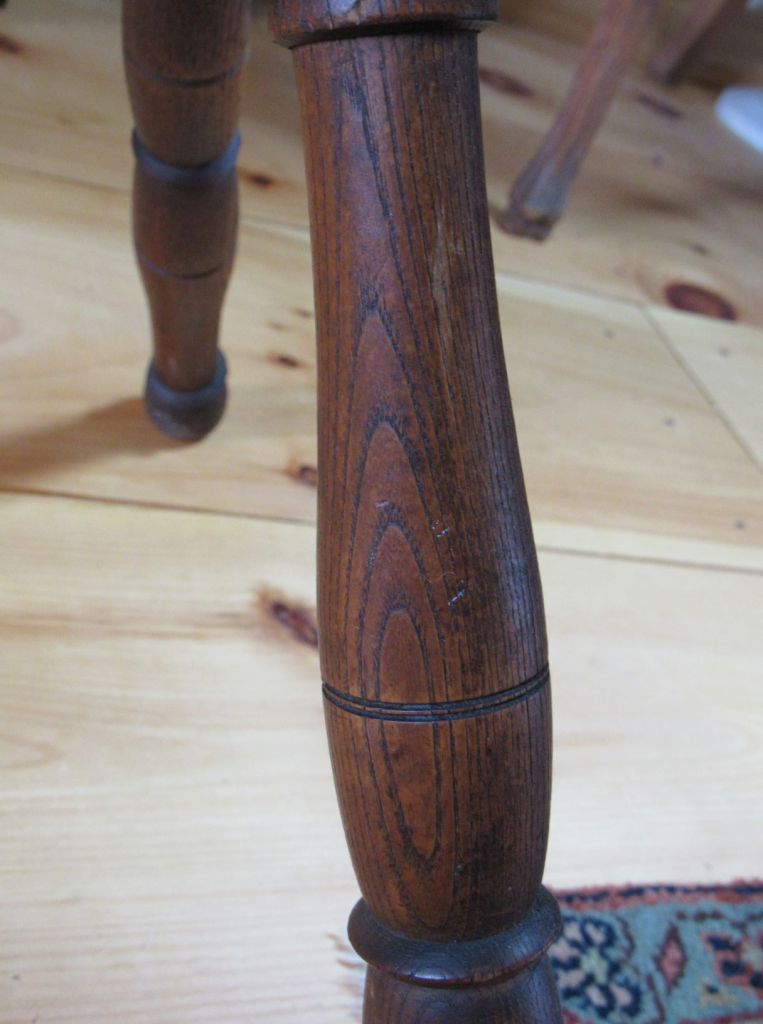
It’s doubtful that the similarities were just market driven, however, since Silas Cheney—who was working in the same time period just a couple of towns away—made wheels in an entirely different style (see previous post—”Sweet Cicely and Chancey”).  And, with all of the family ties, there must have been shared work and design tendencies to leave such a legacy of style. 
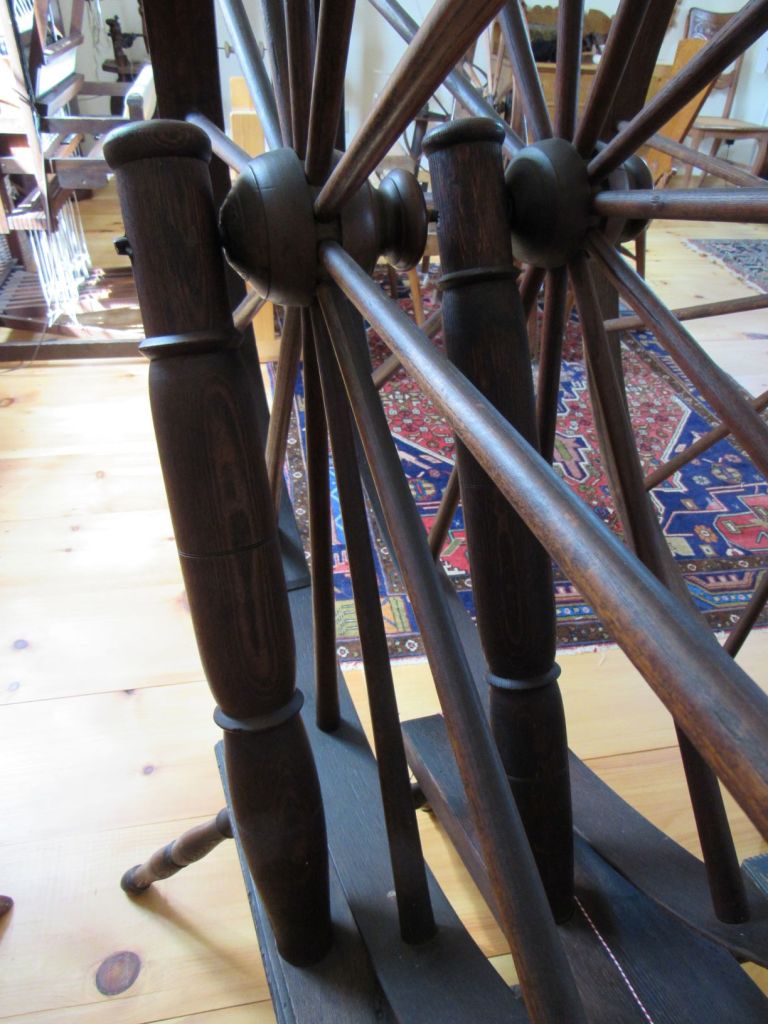
Barnum and Platt great wheels

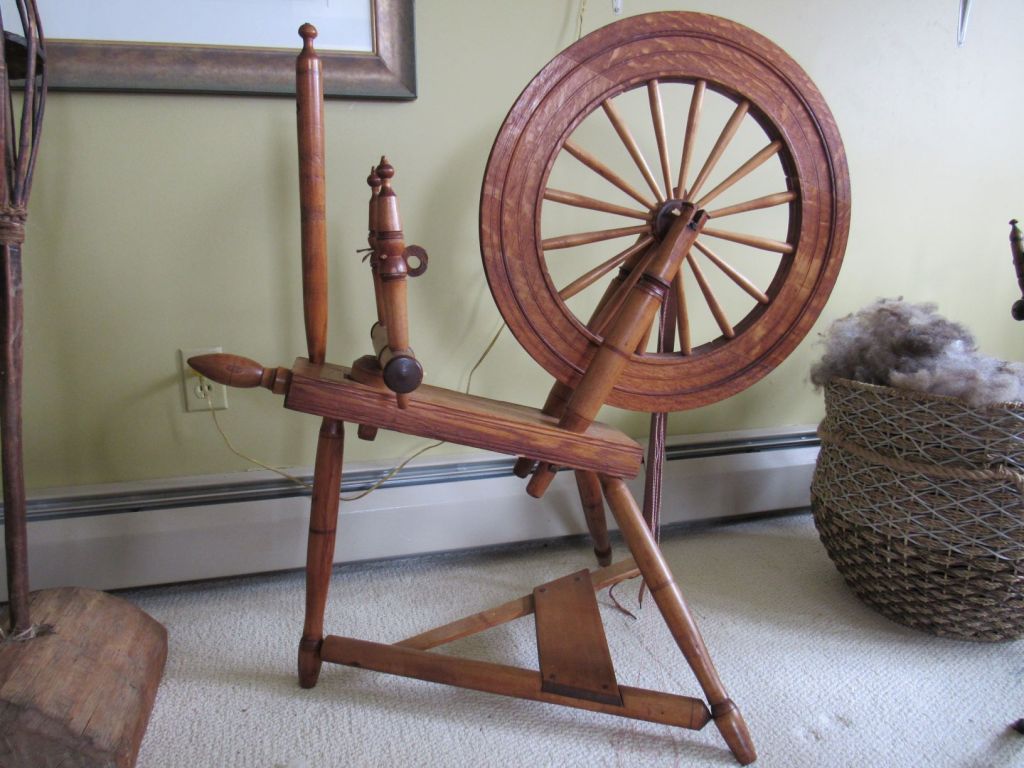
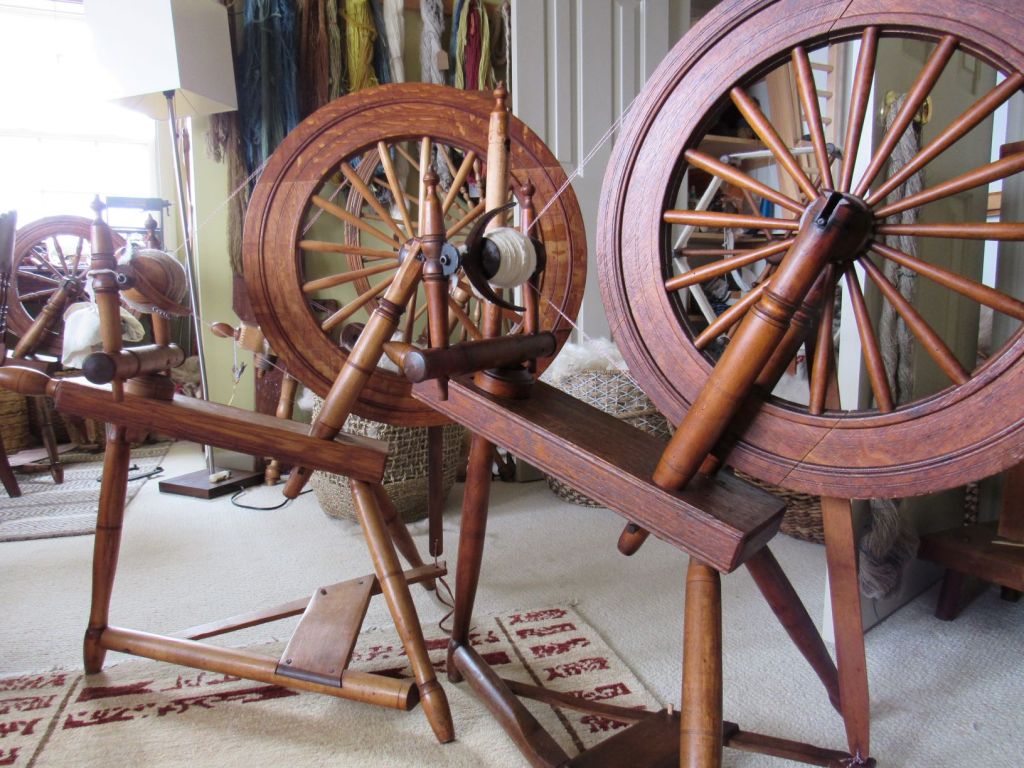
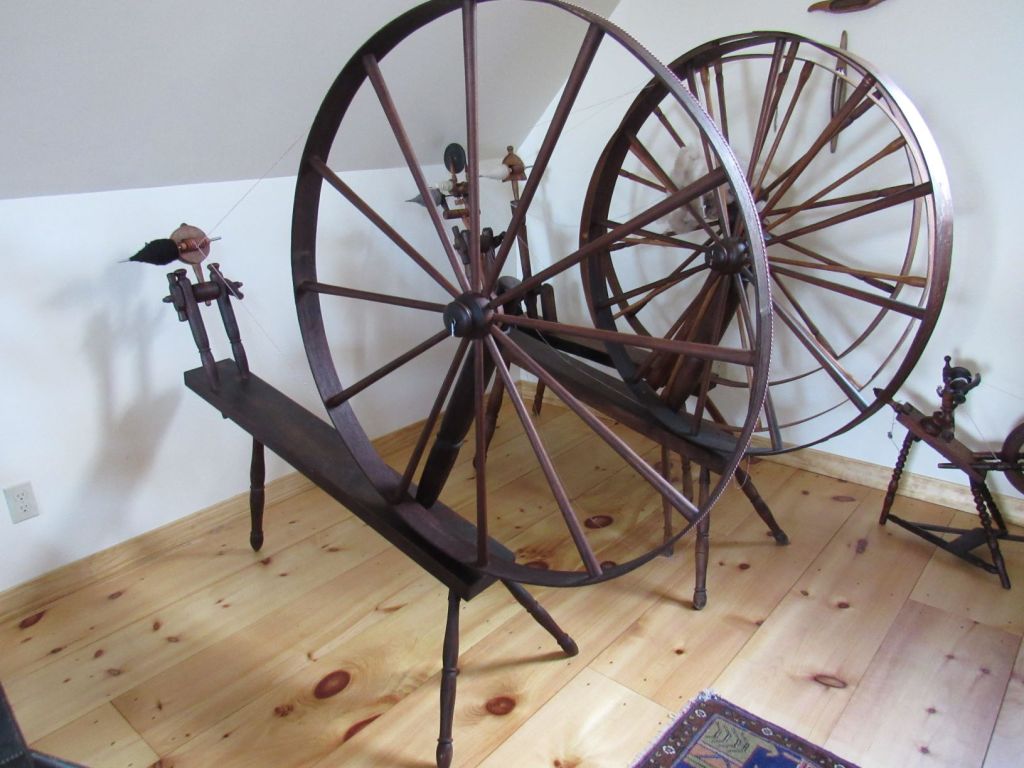
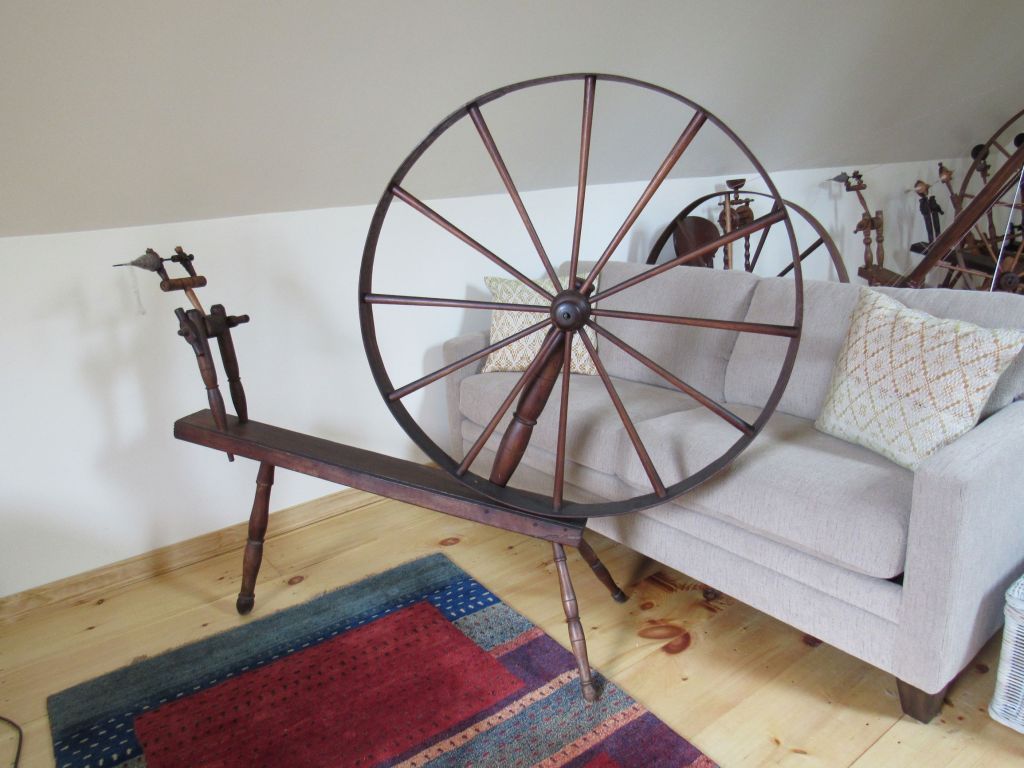
I found my Silas Barnum great wheel, “Big Bear,” on Facebook. 
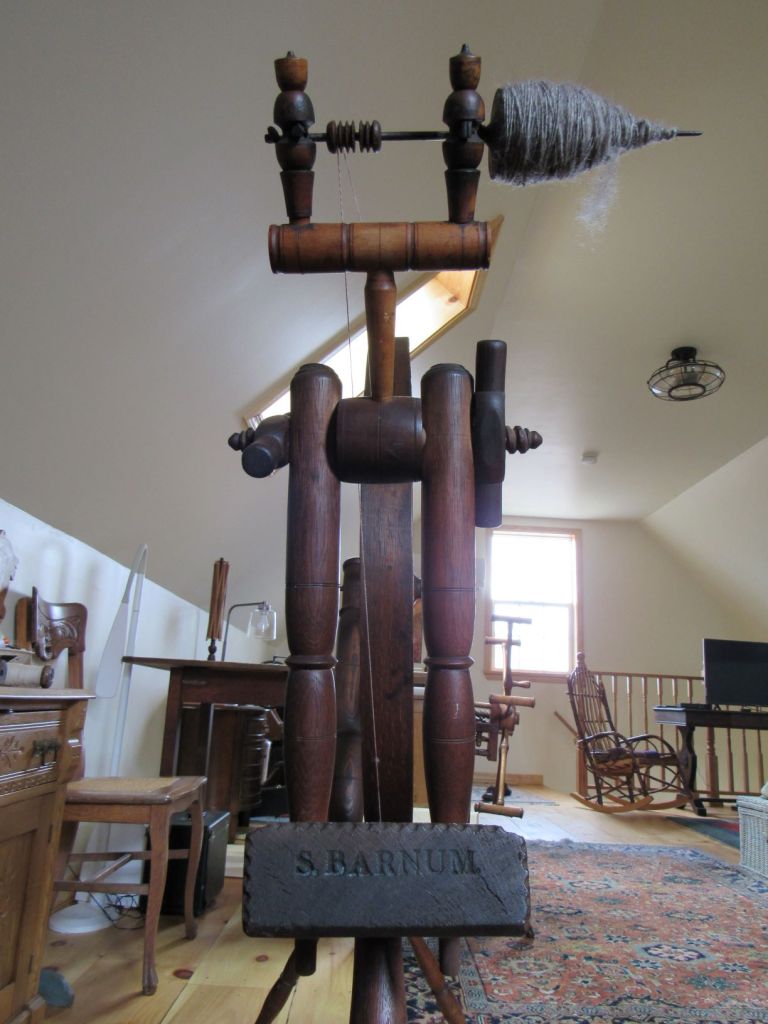
The seller, a spinner in New Haven, Connecticut, had recently bought it at an estate sale of her artist neighbor—a very old man at the time of his death. 
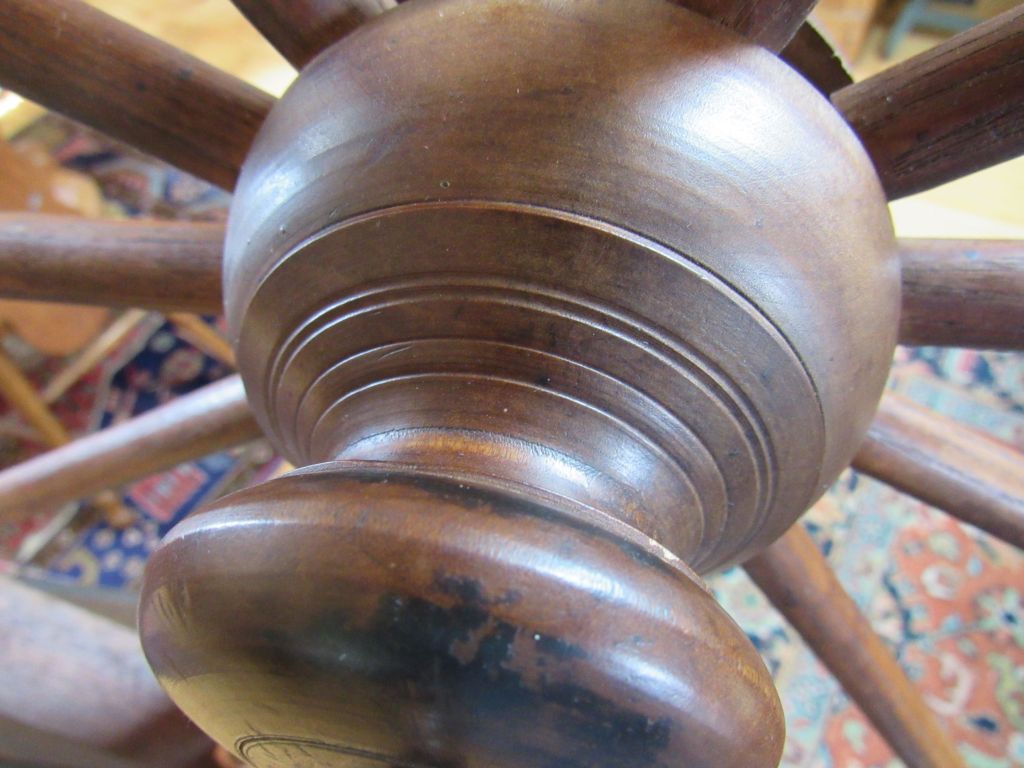
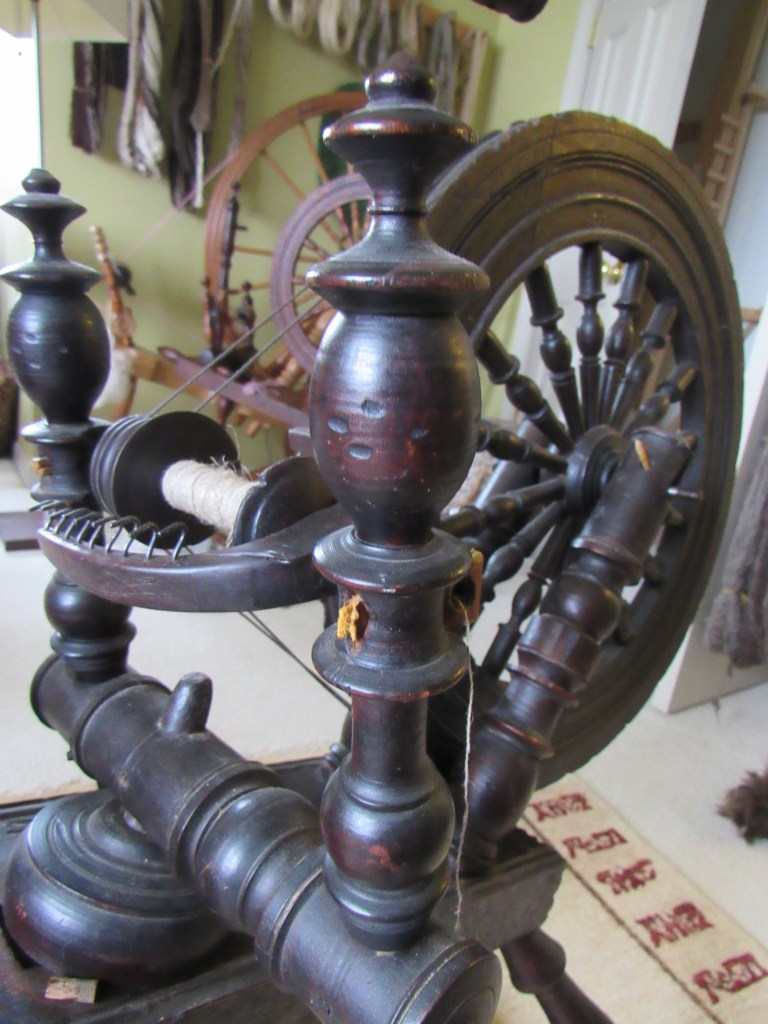
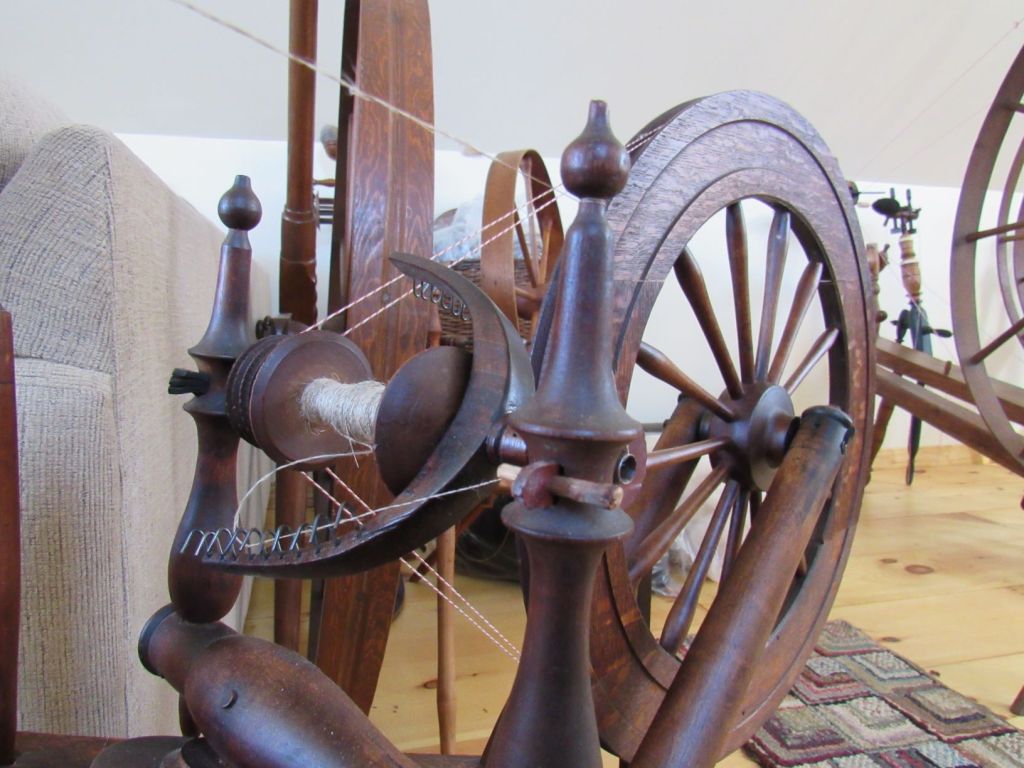
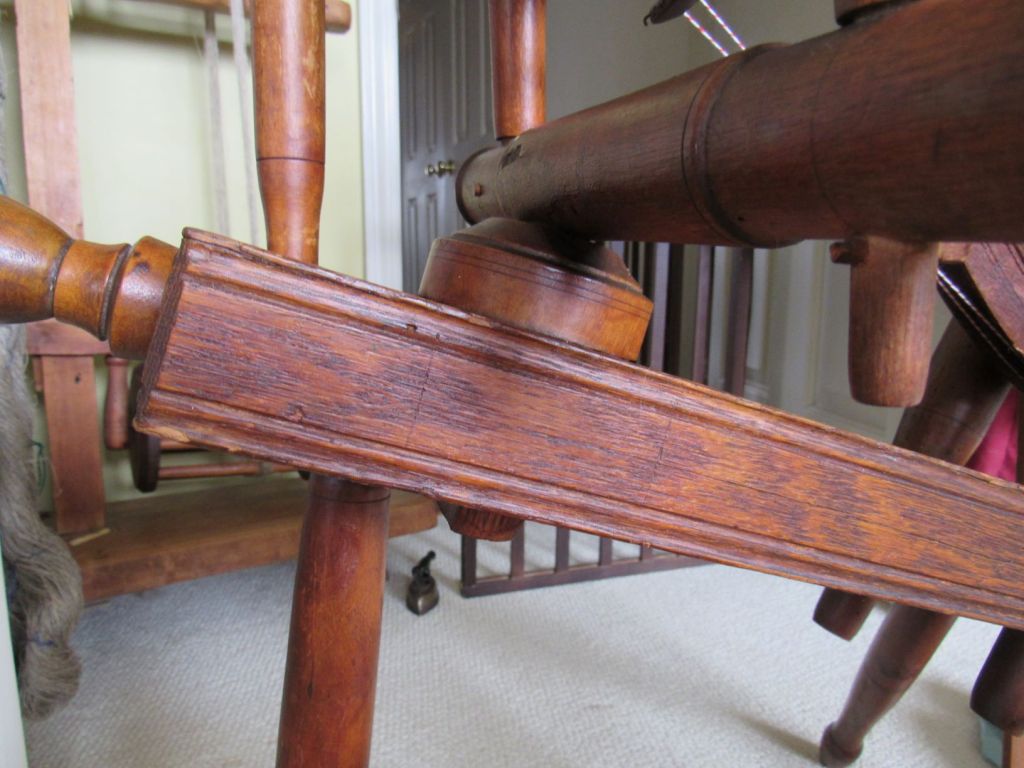
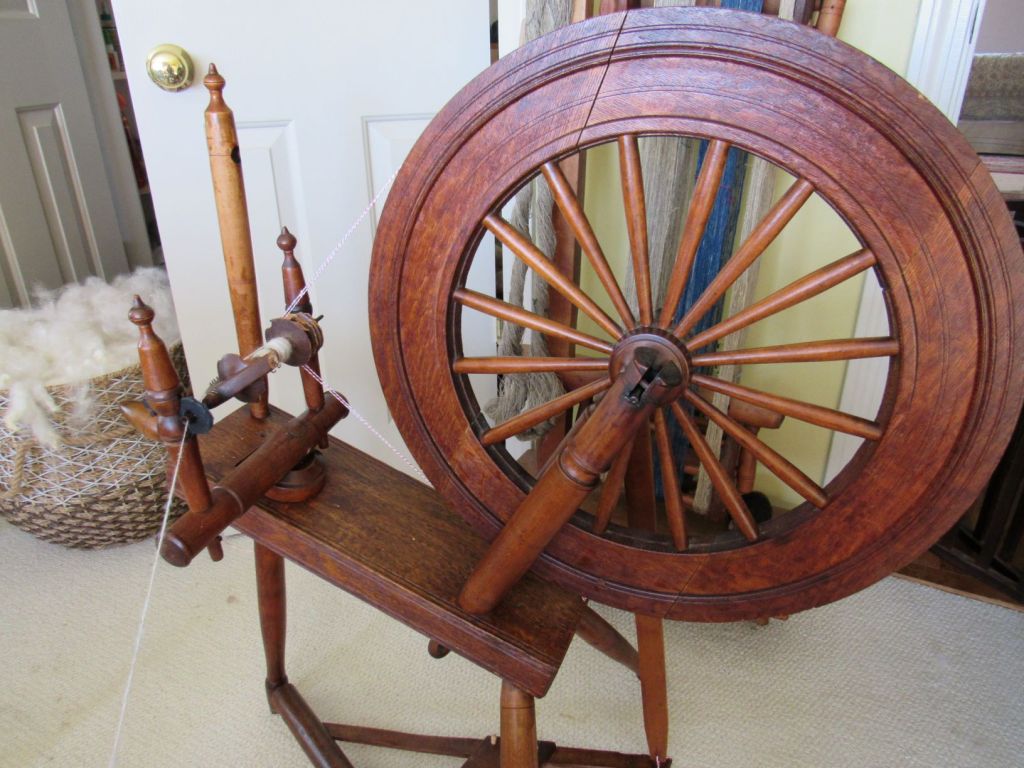
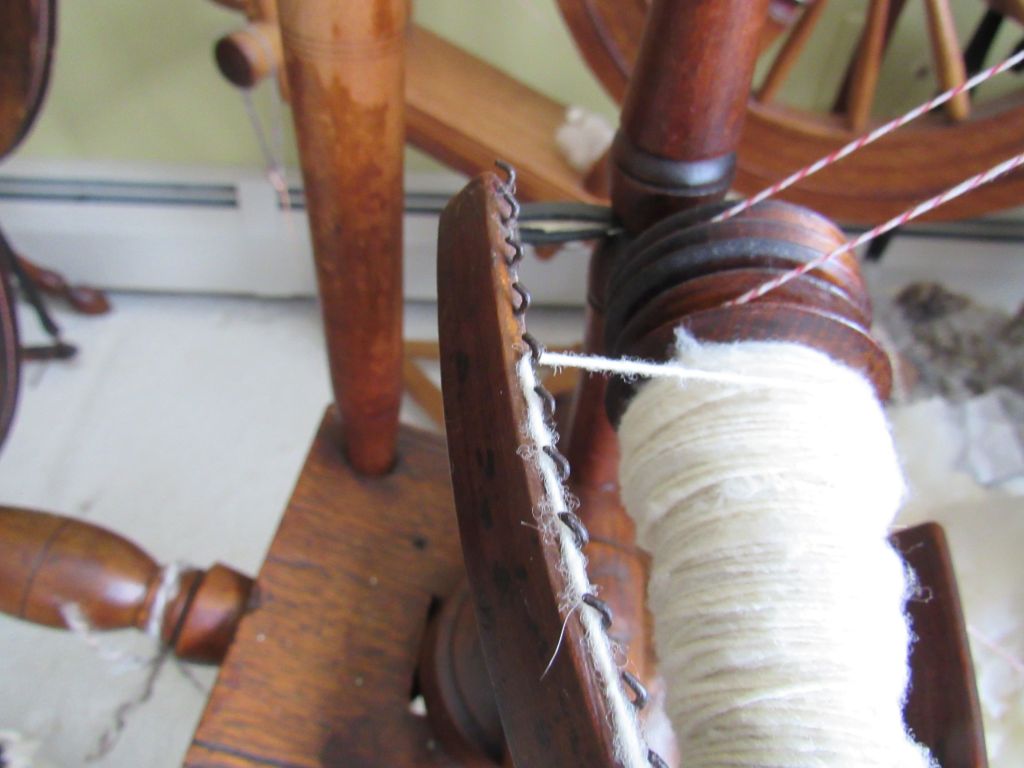
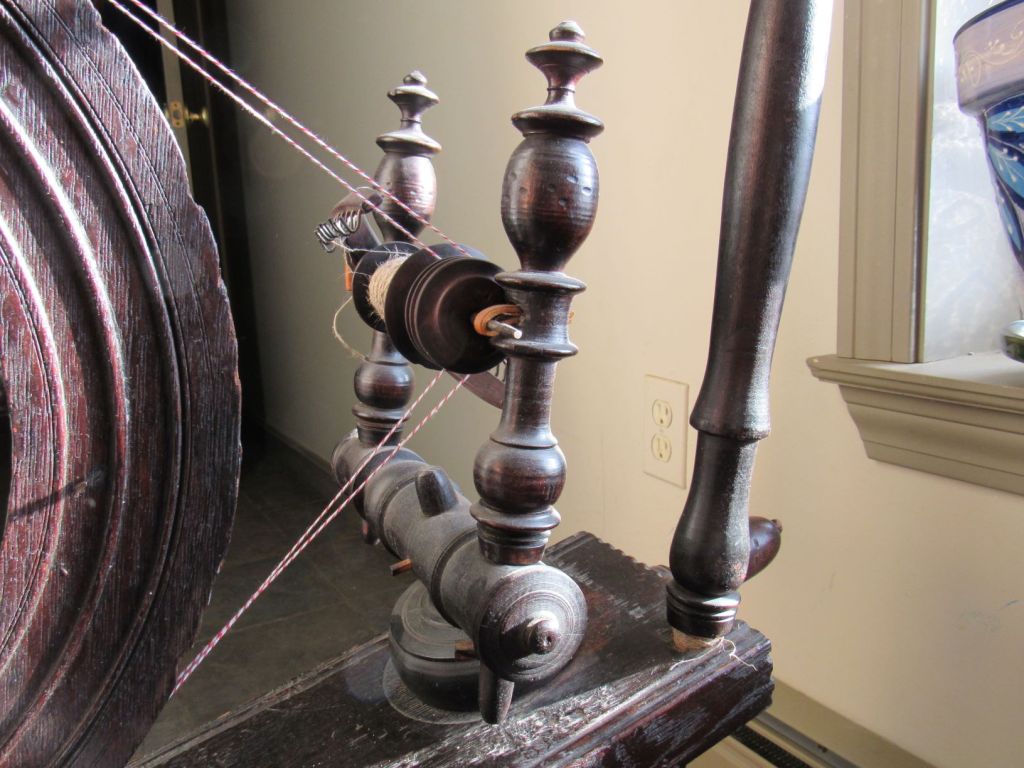
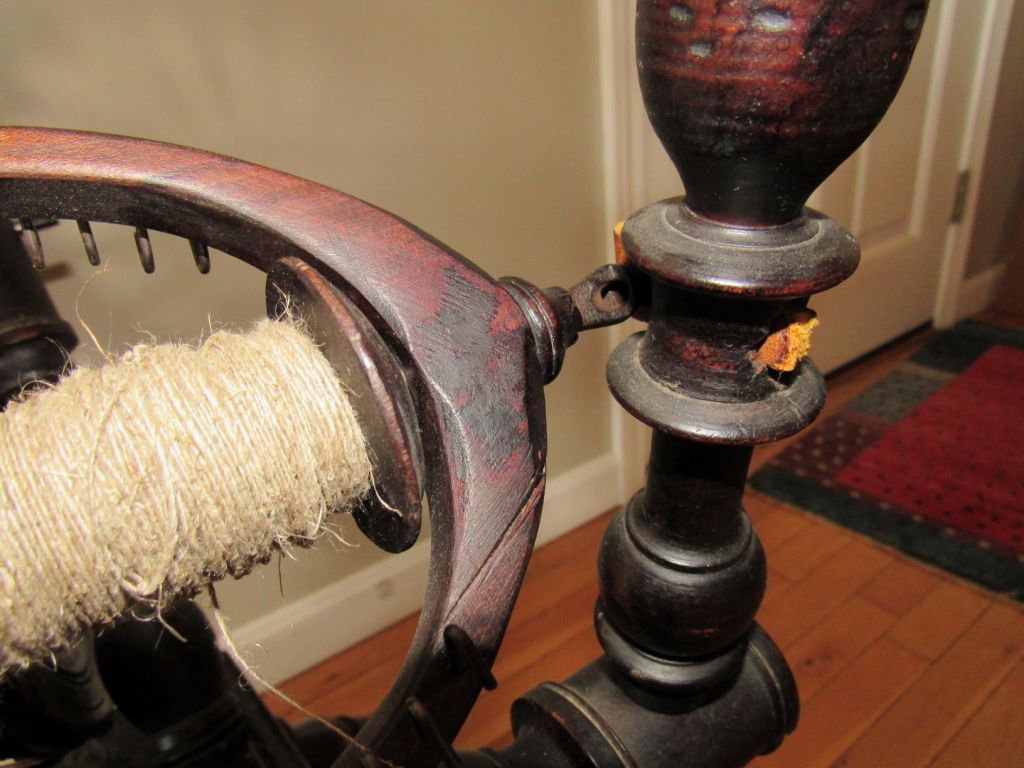
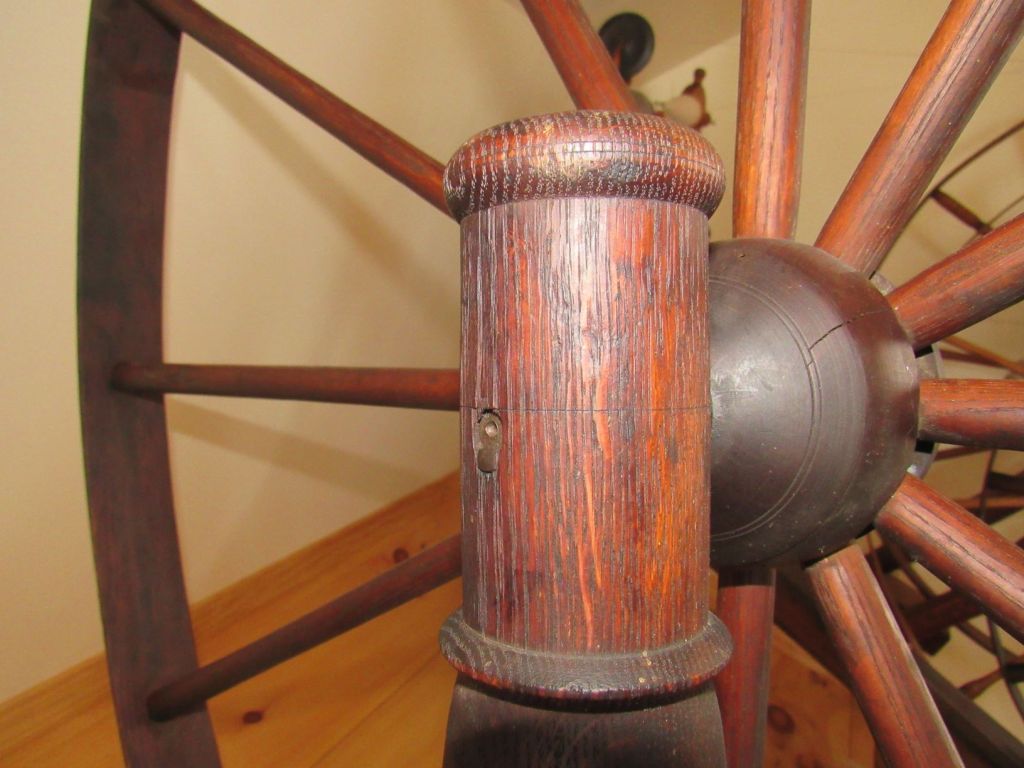
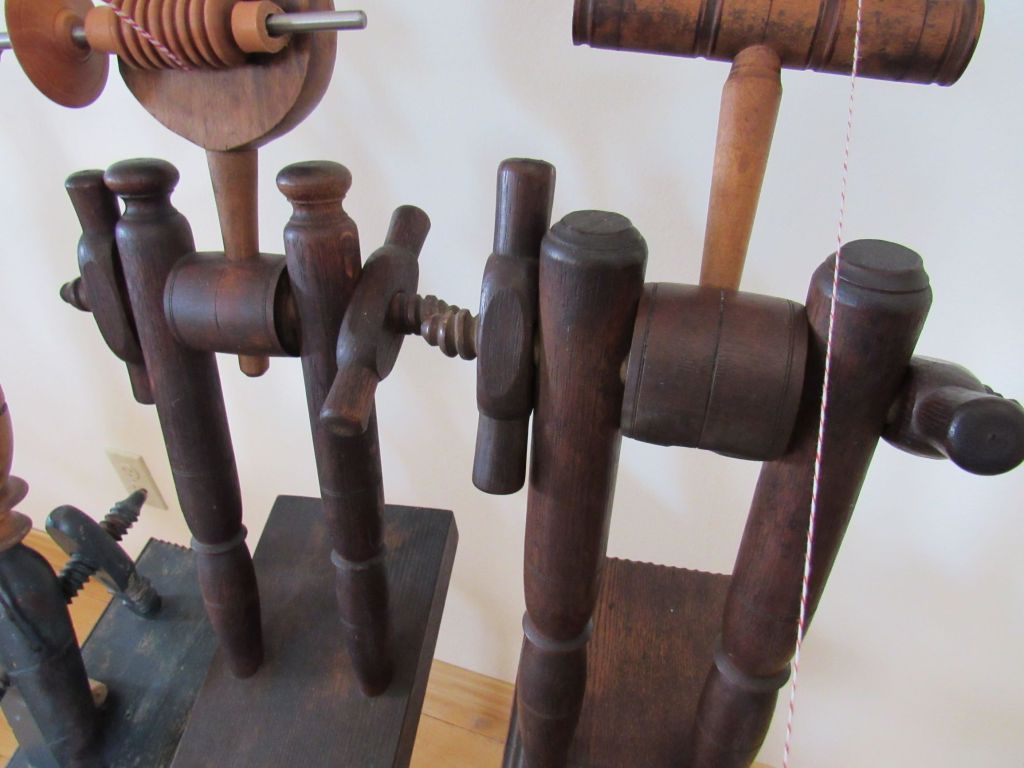
She believed that he had owned the wheel for many decades.  It’s a big, solid wheel, with a two-posted barrel tension system and lovely direct drive head.  It’s hard to tell if the head is original to the wheel, since they were so often replaced or interchanged. 
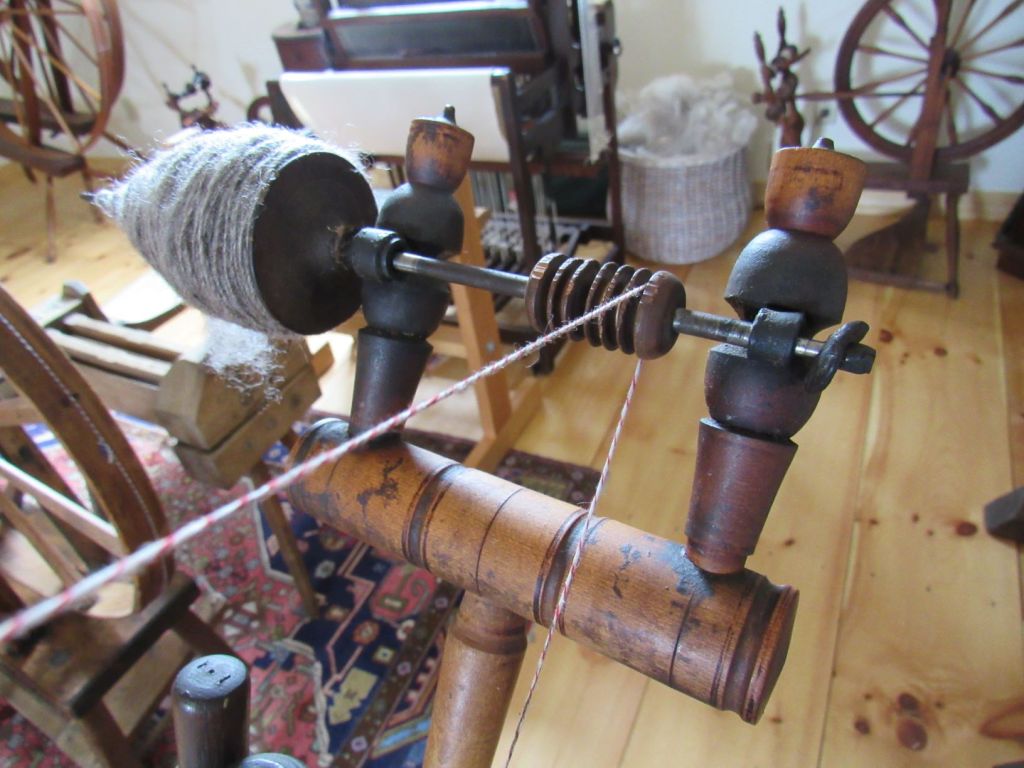
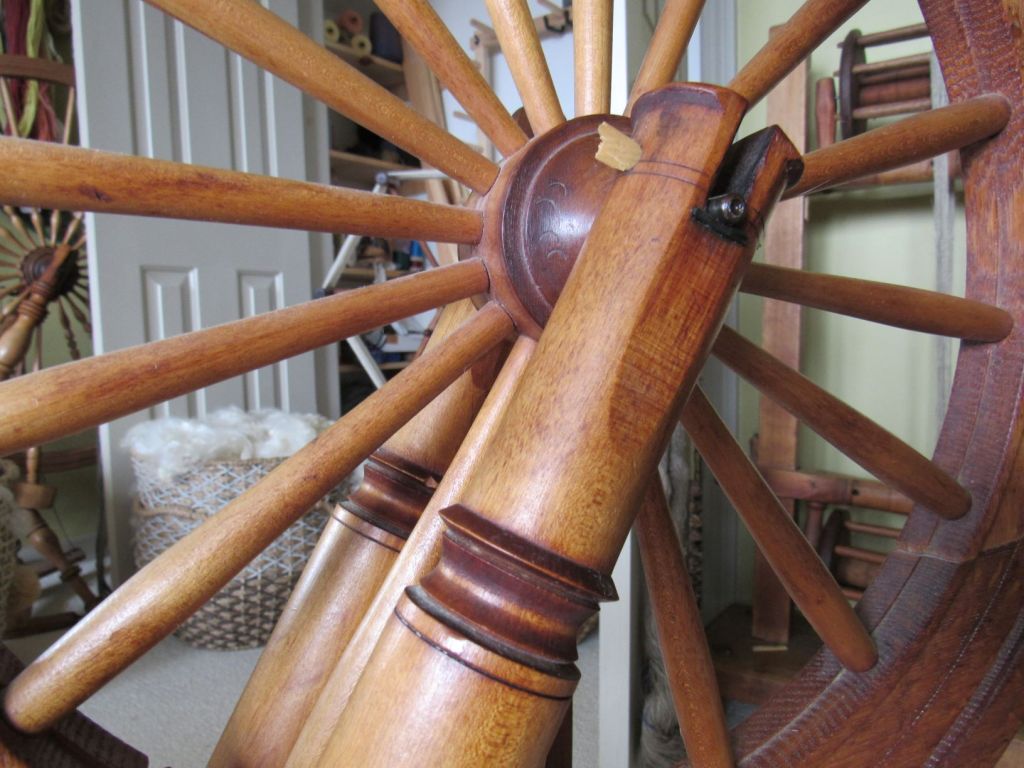
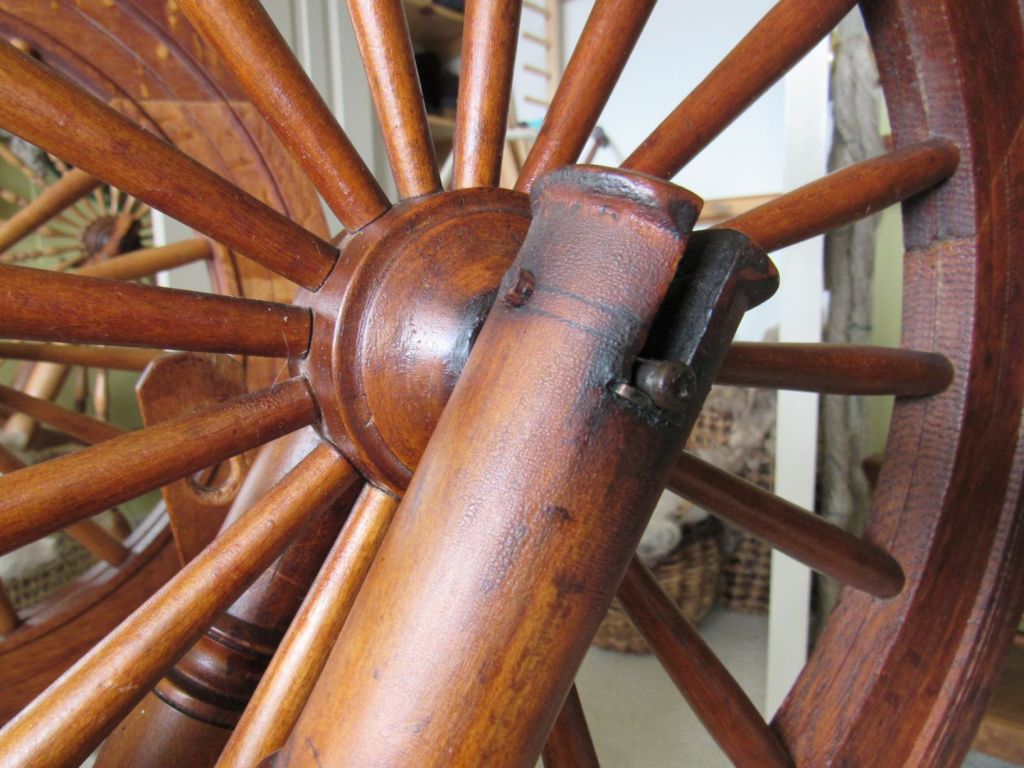
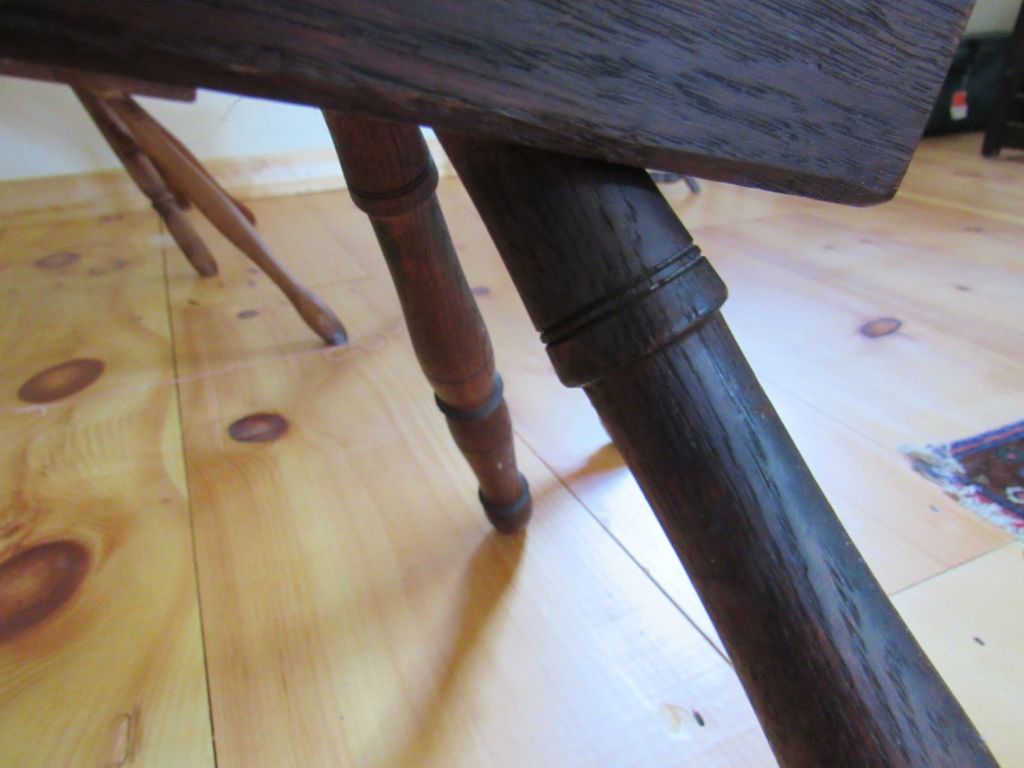
The style is right—many of Barnum’s wheel predated accelerated heads and these nicely turned spindle supports were typical of the time and region. 
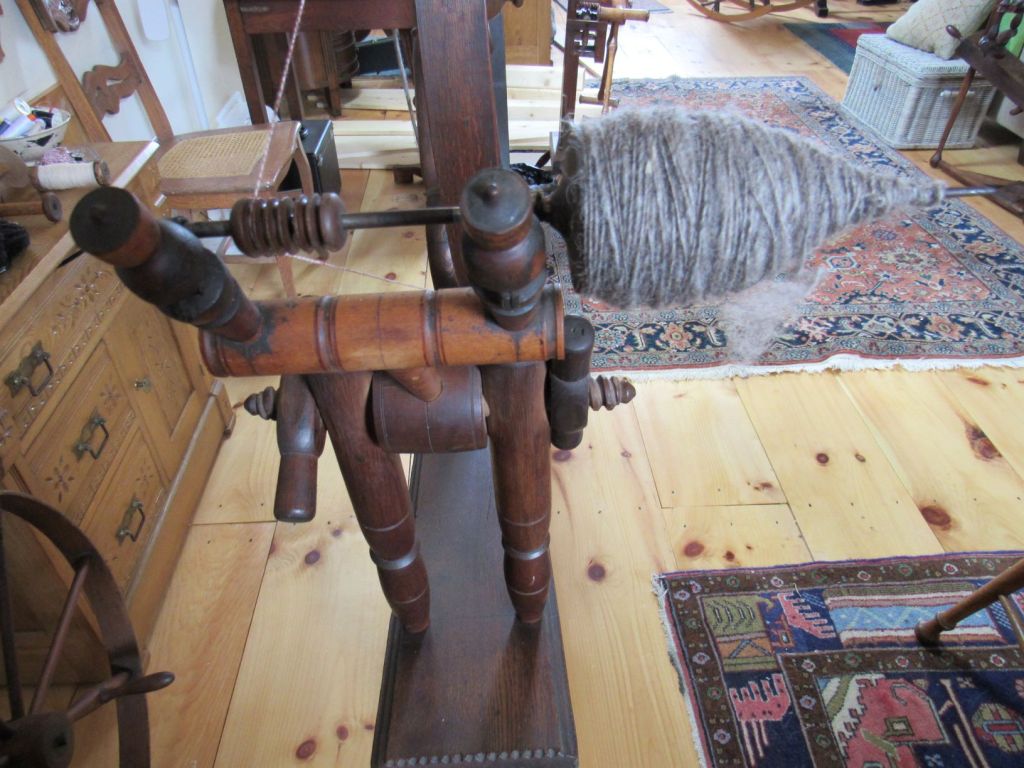
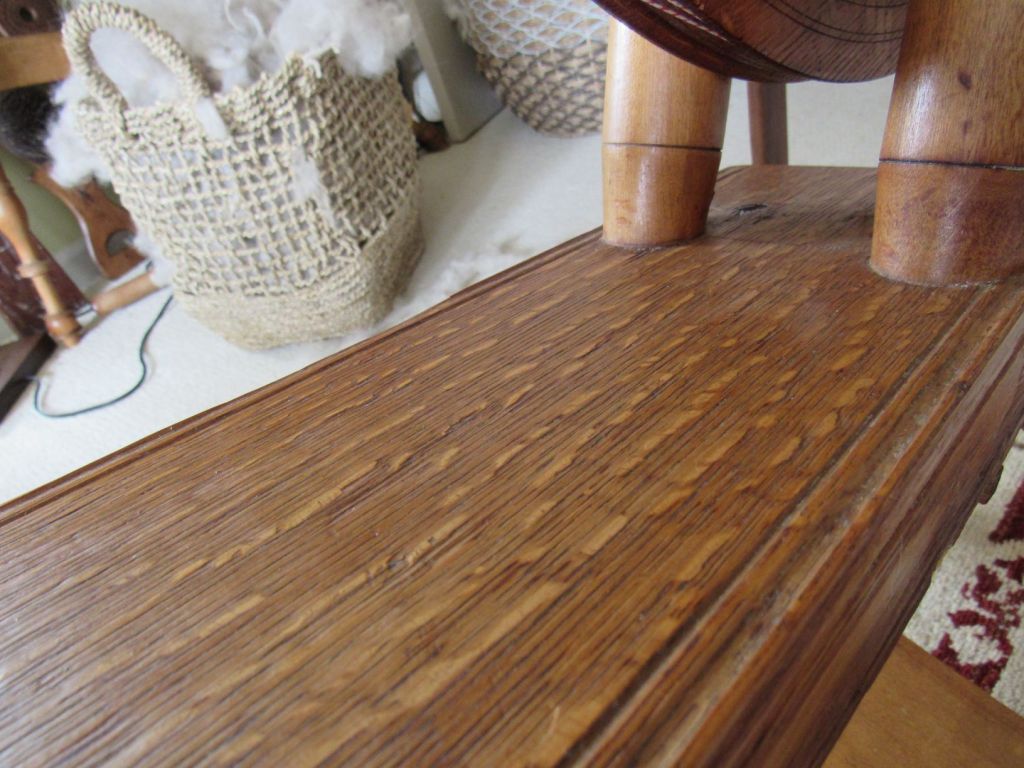
The wood is lighter than the wheel itself and, interestingly, has the dark bands so prevalent on the flax wheels of this group of wheel makers. 

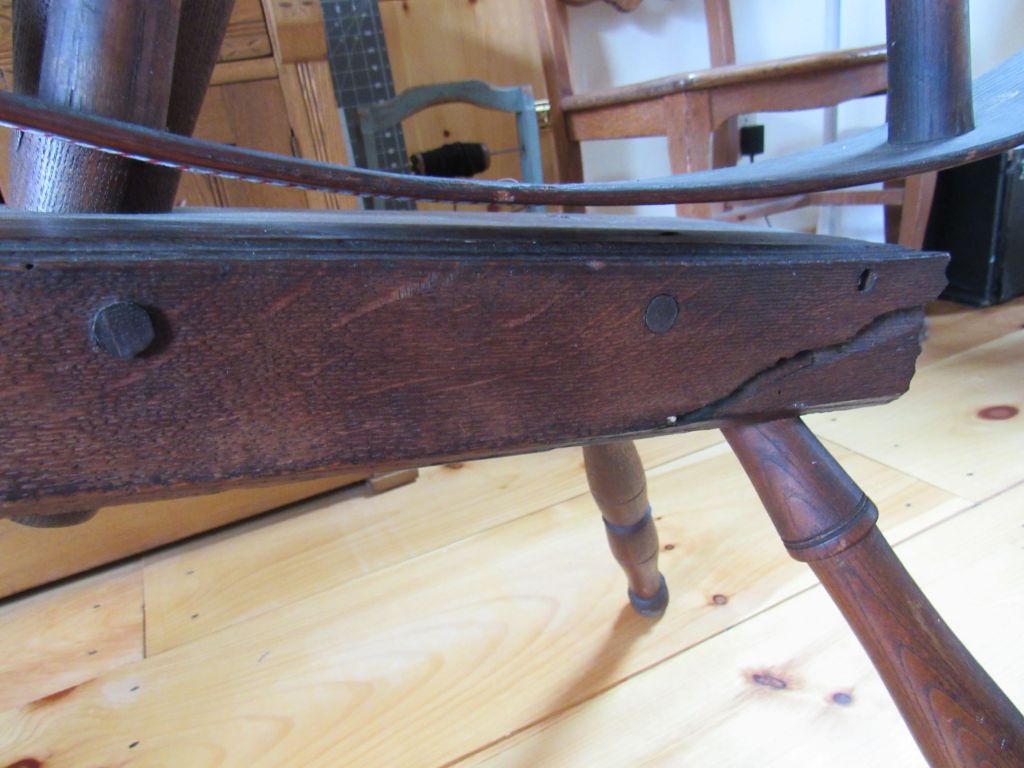
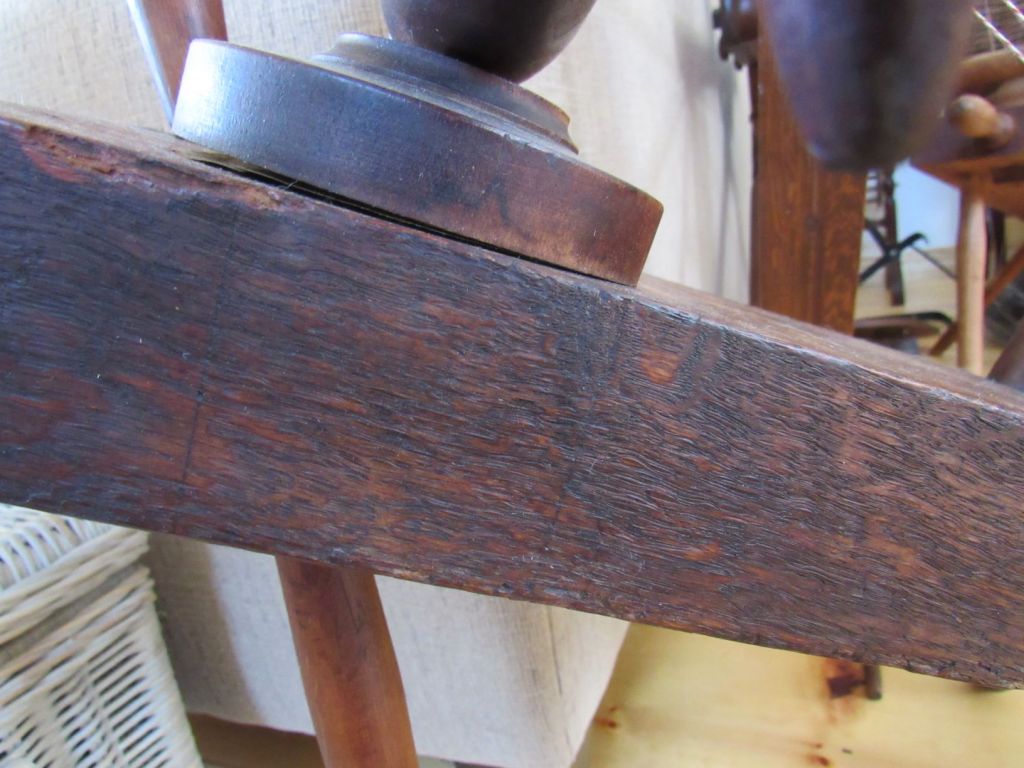
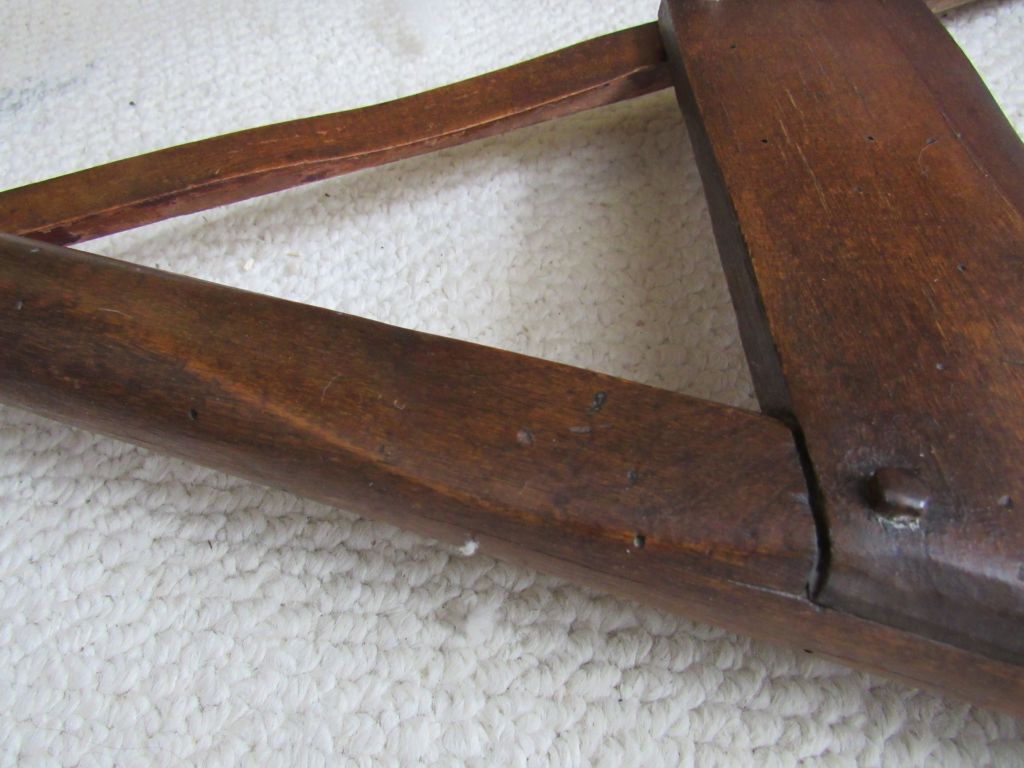
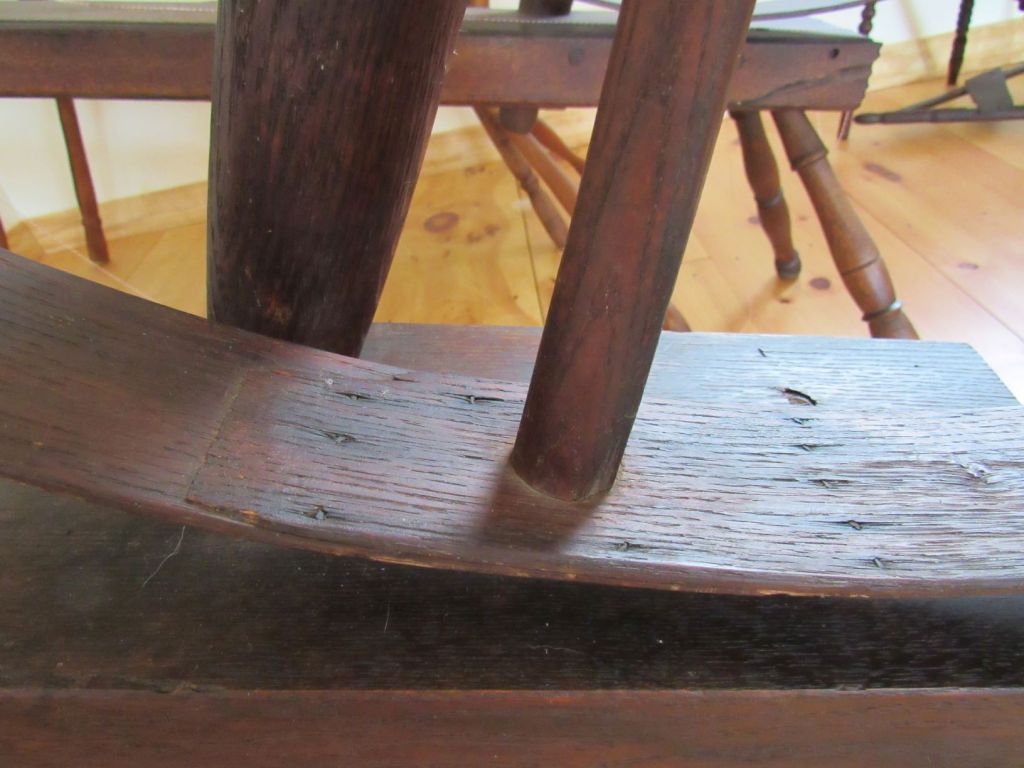
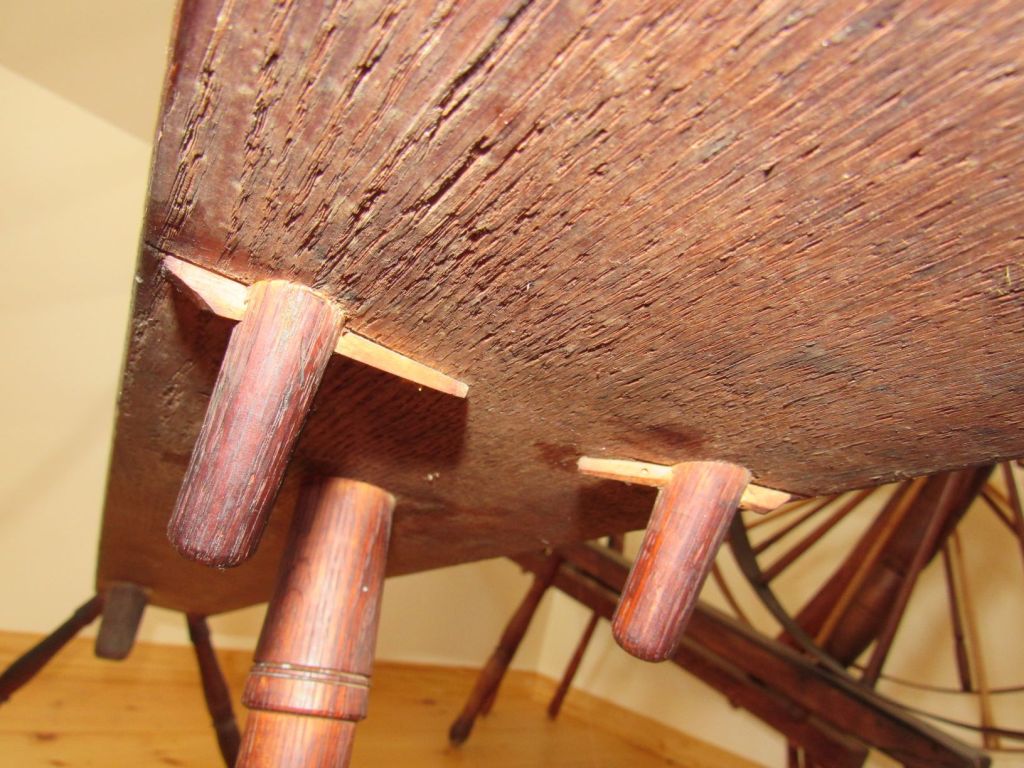
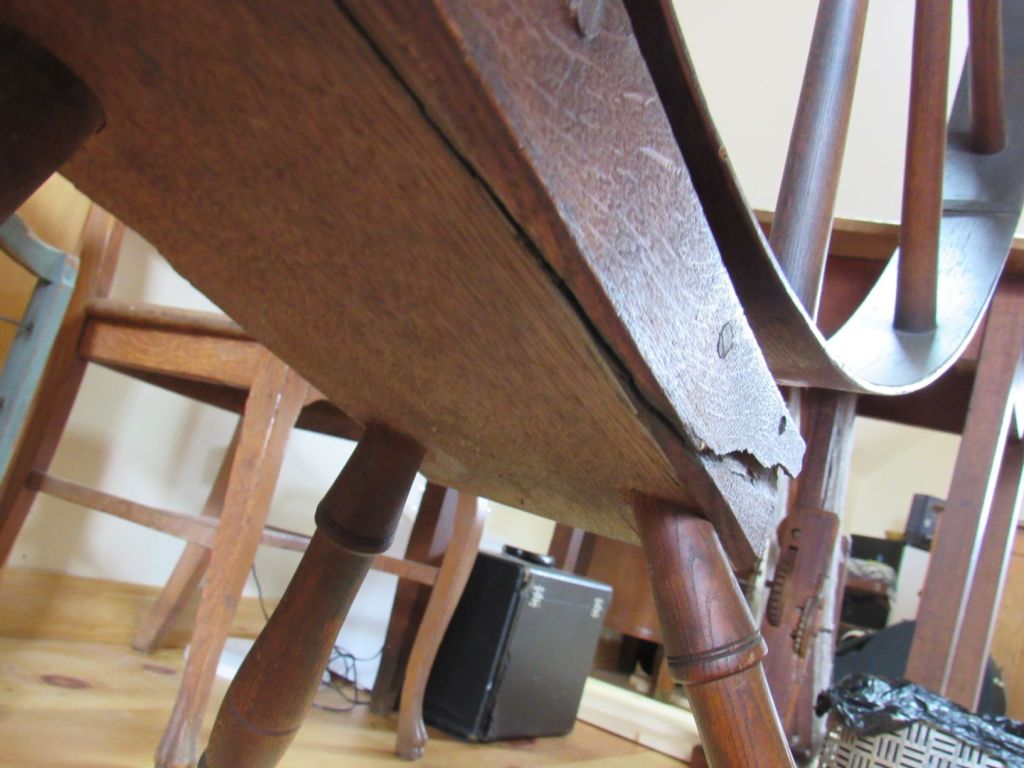
The wheel has a large crack in the table that was nicely repaired with pegs. 

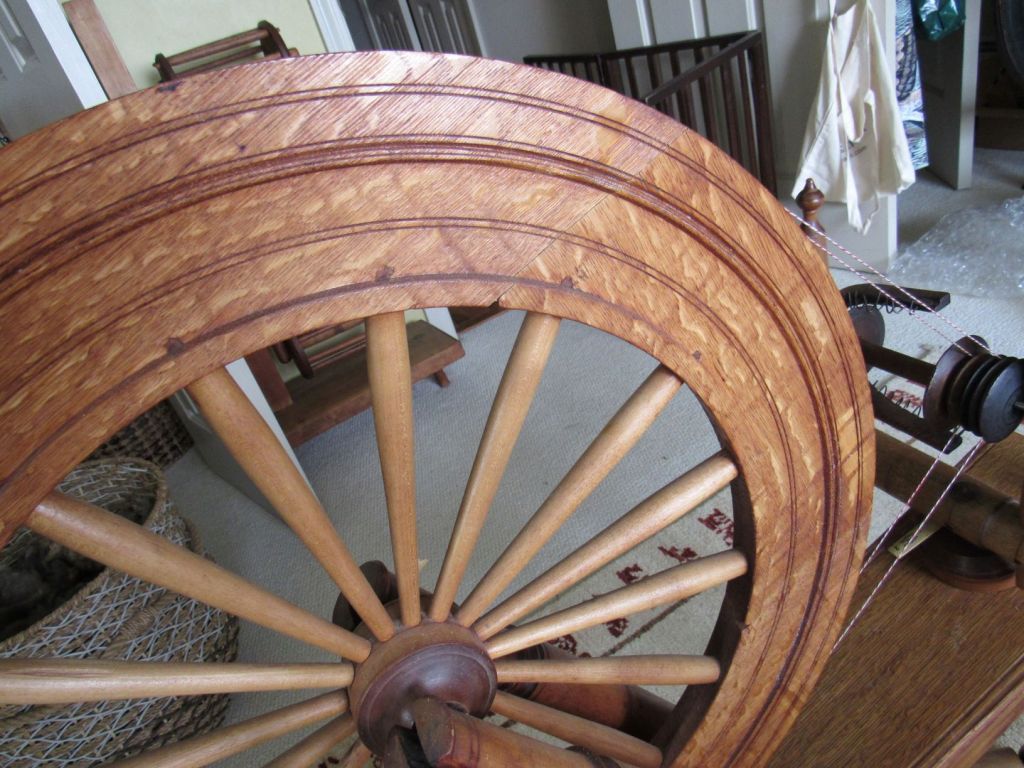
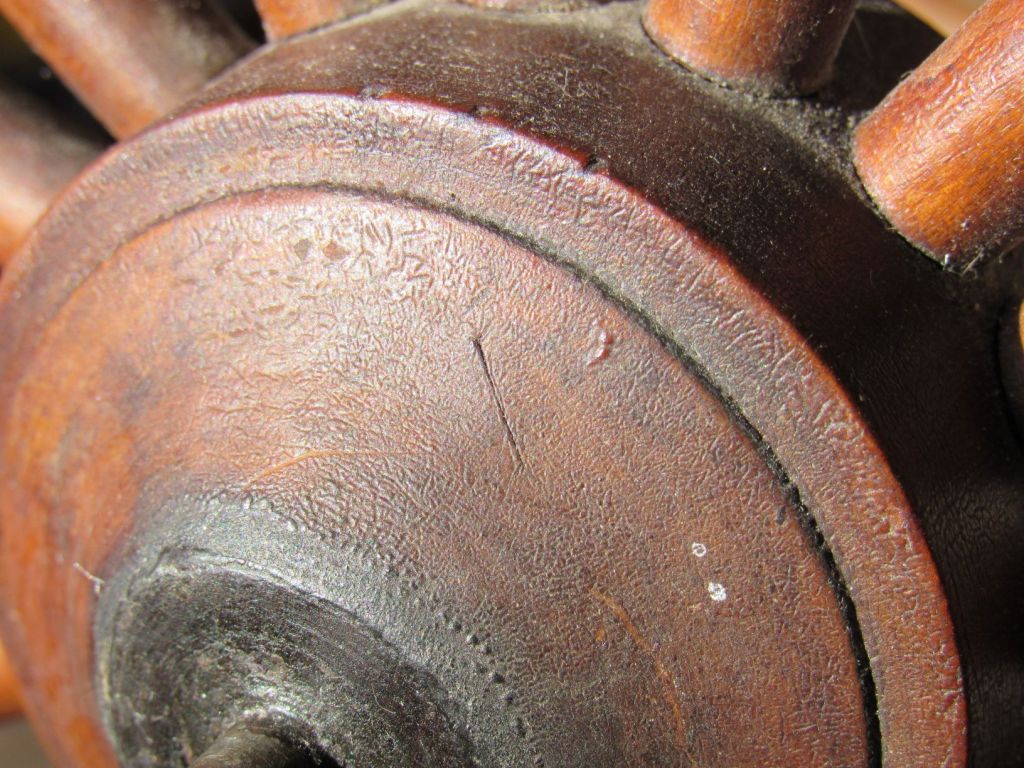
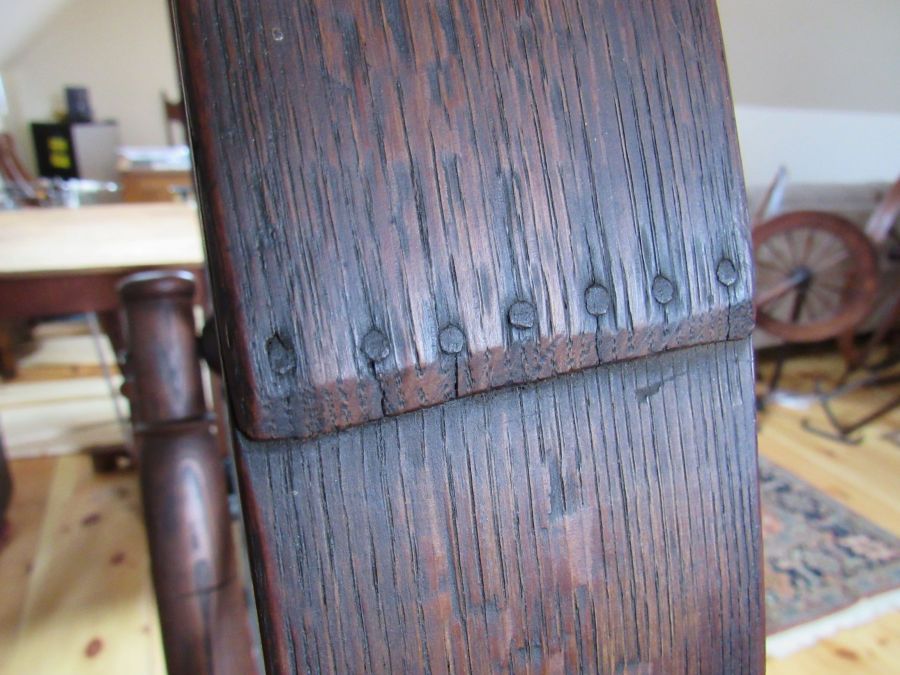
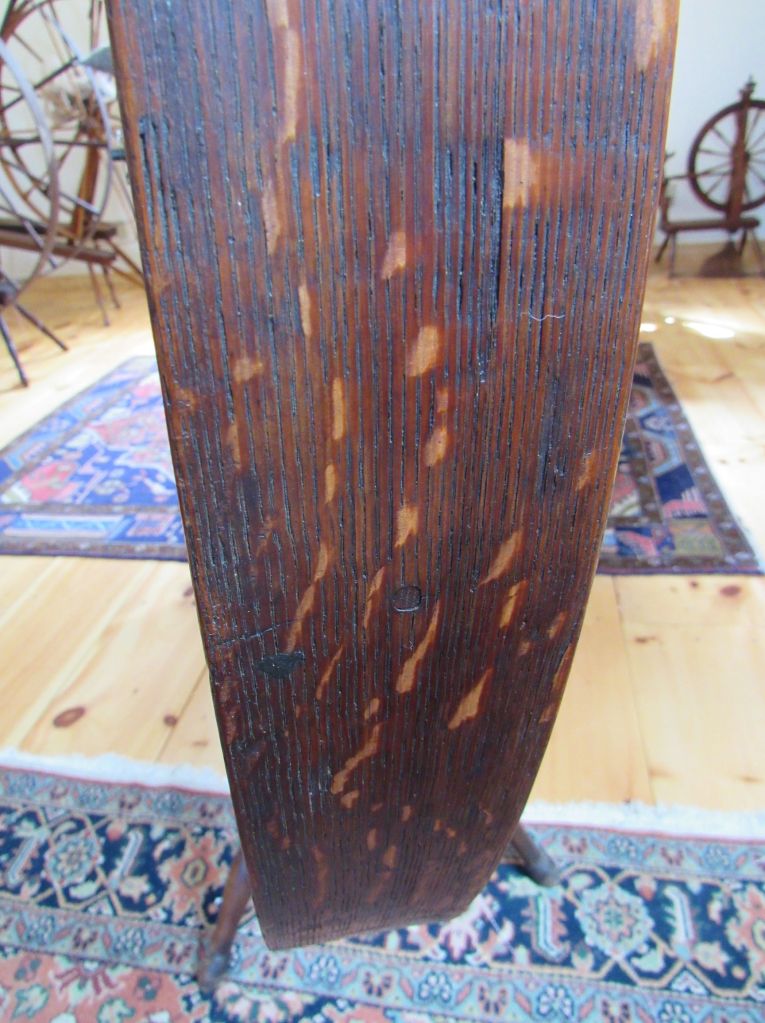
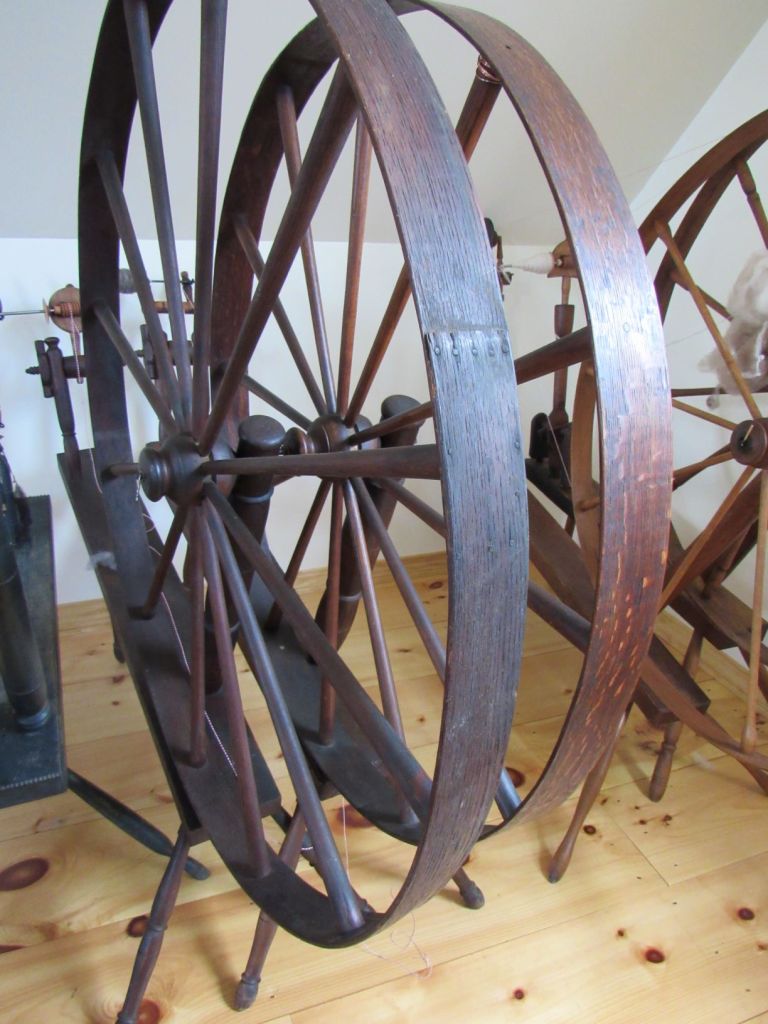
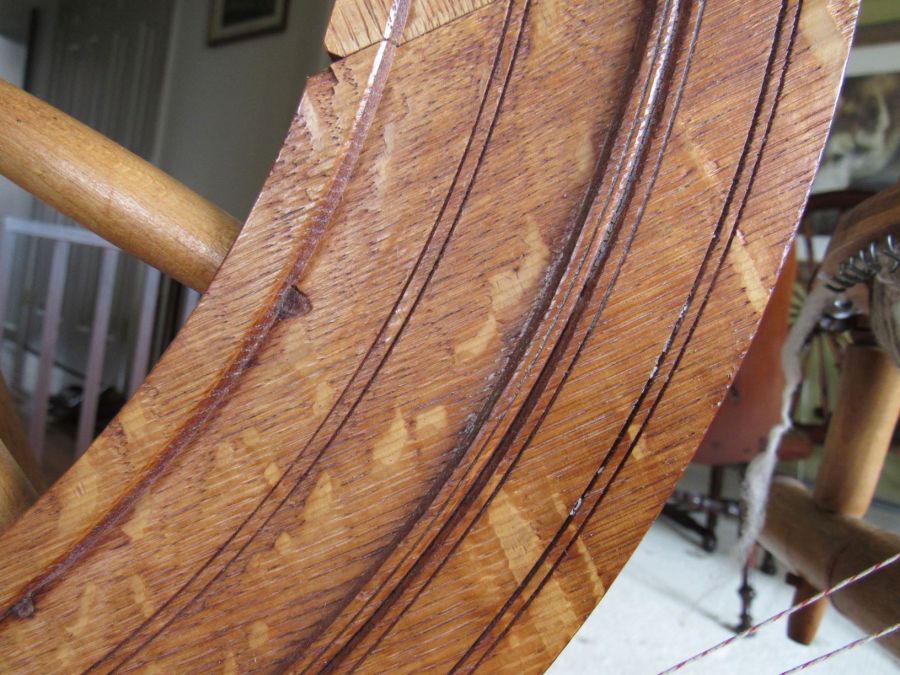
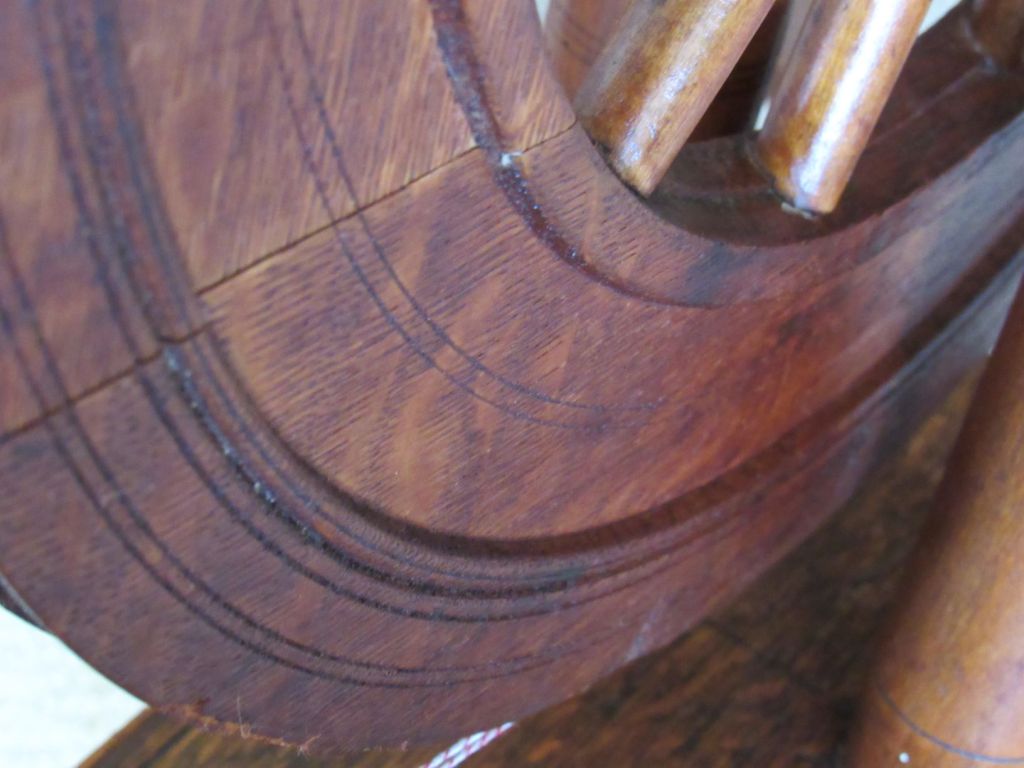
The drive wheel rim is beautiful ray-flecked oak, with a generous 3 inch width, and a 41 ½ inch diameter.  
It’s a good spinner, with a wheel that invites the body to lean in and work with its heft, weighted so that the wheel comes to rest at a certain point. 
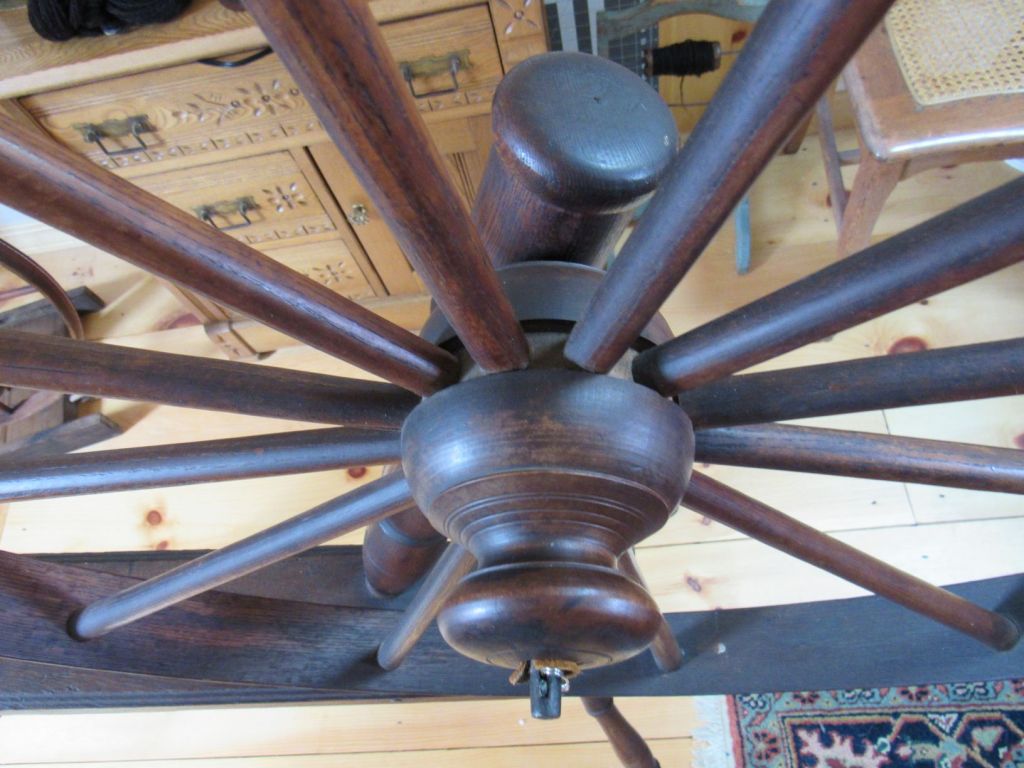
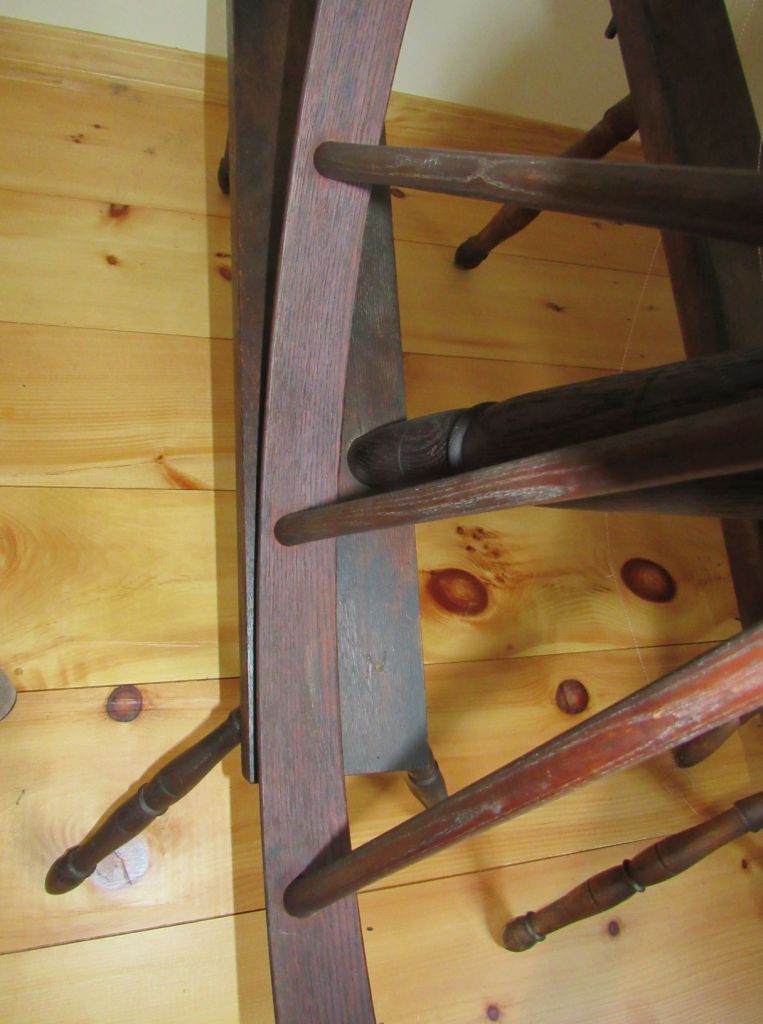
The spokes are set in a deep groove (similar to Platt’s great wheel)

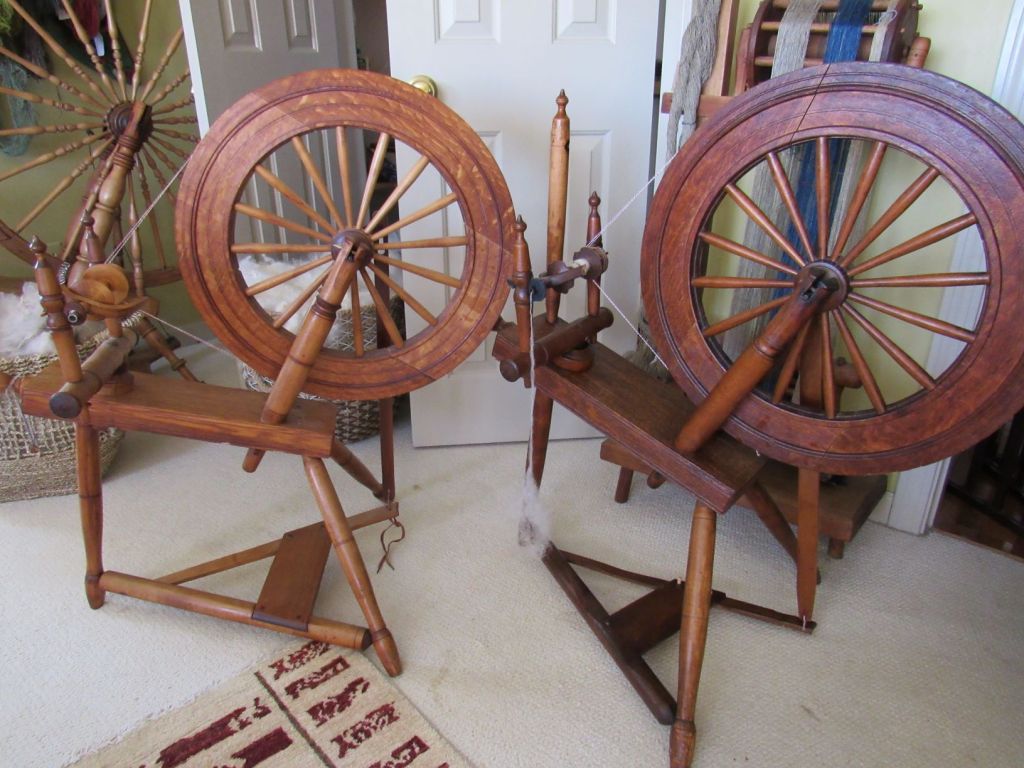
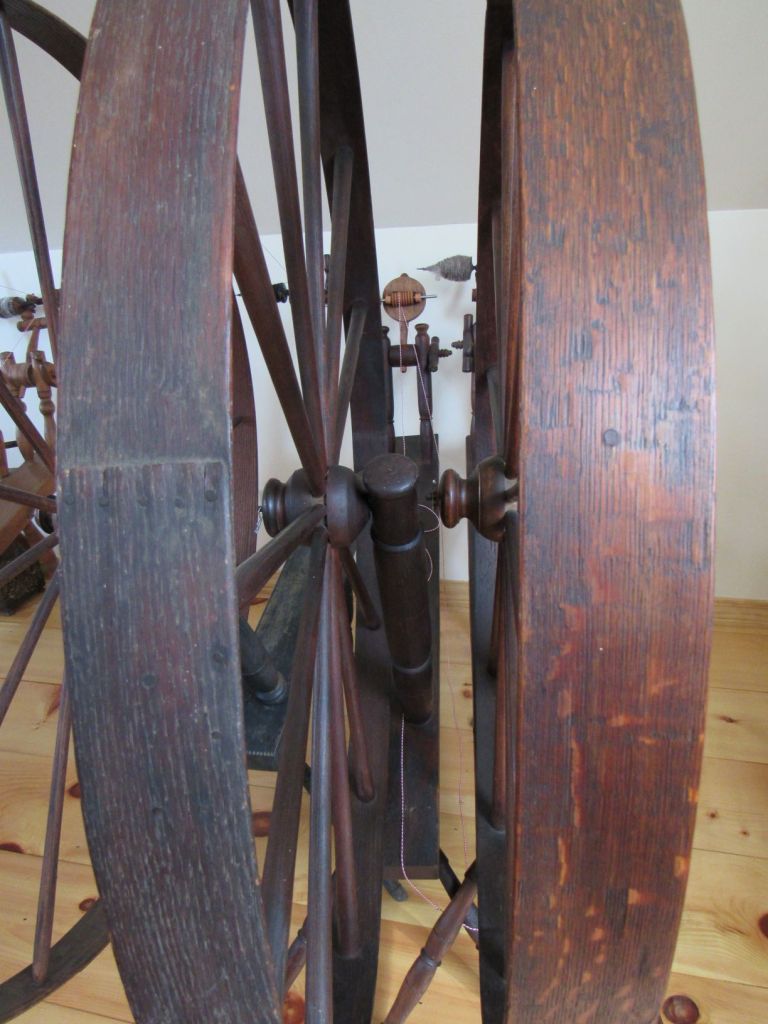
There is a remarkable similarity to J. Platt’s great wheel (“Mercy” in previous post), although the Platt drive wheel has a larger 44” diameter and the rim is a smaller 2 5/8 inch width. 
I did a lot of research into possible connections between Barnum and Platt—digging into family trees and probate records.  As with most wheel makers, probate inventories reveal a lot (and give a fascinating glimpse into 19th century life). 
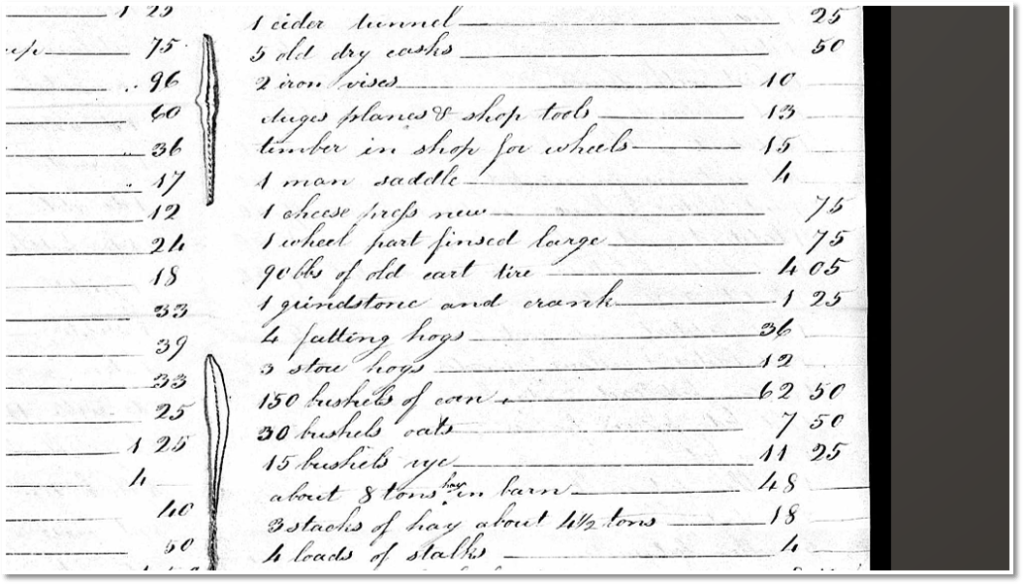
Barnum’s shows clearly that he was a wheel maker, referring to “timber in shop for wheels,” and “1 wheel part finished large.”   In my research, I found several J. Platt connections with Silas Barnum.  But none of their probate records showed a wheel maker.  The first was through Barnum’s wife, Martha Platt.  I had high hopes that her brother James might be J. Platt the wheel maker, but probate records showed that he was a city dweller and no craftsman. 
Platt and Barnum side by side

A Josiah Platt was another good possibility.  He married Sary Sanford, sister to wheel maker Samuel Sanford, but there is no evidence at all that he was a wheel maker or had anything to do with furniture making and the timing isn’t quite right.  There is a Joseph Platt that could possibly be our man—he had some connections with Barnum and appears to have done some furniture making—but the evidence is inconclusive. 
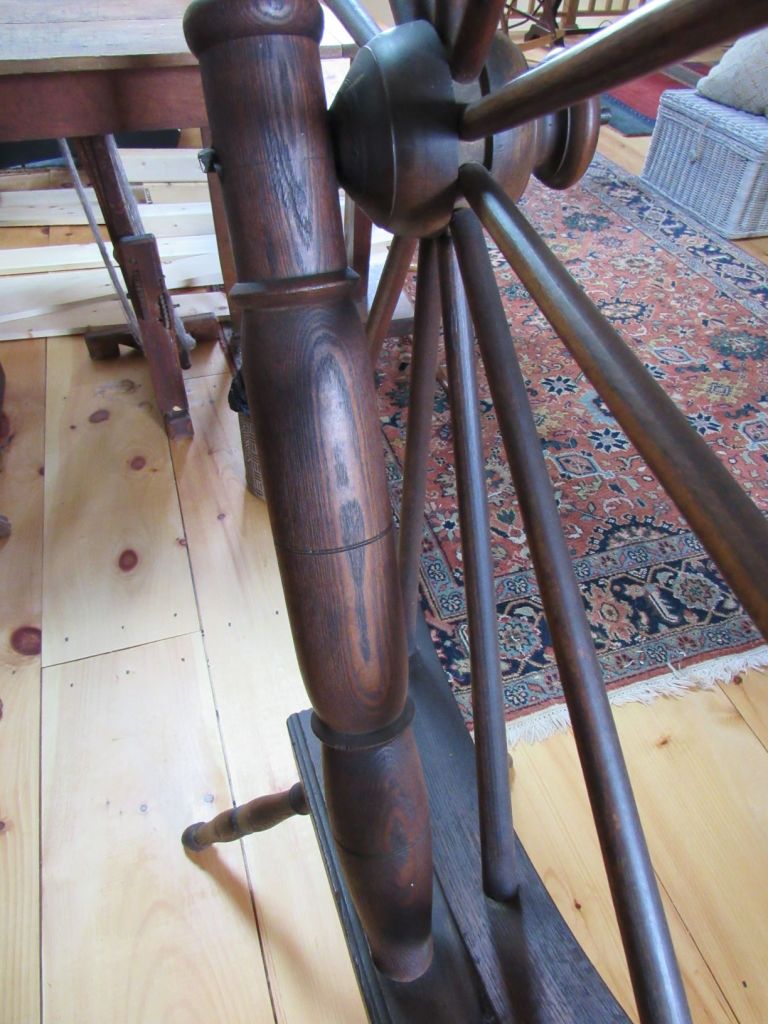
So, I’m still researching the Barnum/Platt connection.  Whatever the maker’s relationship, the wheels look like siblings—closely related, but with their own unique characteristics. More information can be found on Silas Barnum and his double flyer wheels in the Spinning Wheel Sleuth, Issues 31 and 32.
Sweet Cicely and Chancey

November 2020 update: It is starting to look as if these wheels were not made by Silas Cheney of Litchfield, Connecticut. In researching a possible link between Cheney and the Maine Shakers, it became apparent that there is no actual evidence that Silas Cheney made spinning wheels. It is more likely that these wheels were made by a different Cheney in Maine or New Hampshire. I will write a post at a later date with the new research. In the meantime, I will leave this original post intact, with this warning that it may not be accurate.
Original post:

These two beautiful wheels were made by Silas Cheney (1776-1821) in Litchfield, Connecticut.  Cheney came from a family of furniture and clock makers and, in his relatively short life, became a very successful and well-known furniture maker.  By 1800, at the age of 24, he was creating high-end furniture—with stylish veneers and inlays—for affluent customers in a prosperous economy.   According to the Litchfield Historical Society, which has some of Cheney’s day books, Cheney also did less glamorous, bread-and-butter work, including odd jobs, repairs, and making rake handles.  

Presumably, his spinning wheels fell somewhere above rake handles but below inlaid sideboards in his work spectrum.  As Cheney’s business thrived, he took on apprentices and specialists. 

One apprentice, Lambert Hitchcock, supposedly influenced by clock makers and his time working for Cheney, came up with the idea of using interchangeable parts for chairs—and went on to become famous for mass production of his popular Hitchcock chairs.  

CCCC marks on Cicely’s table and collar
Marks on treadle–notice how there is no wear on this treadle at all

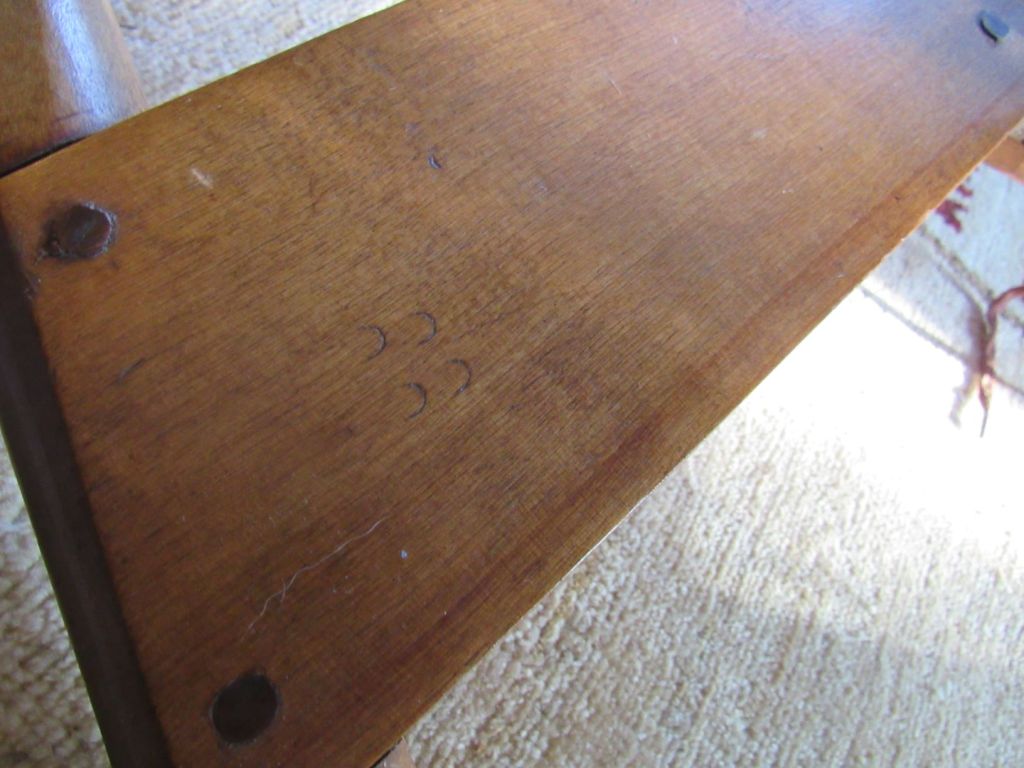
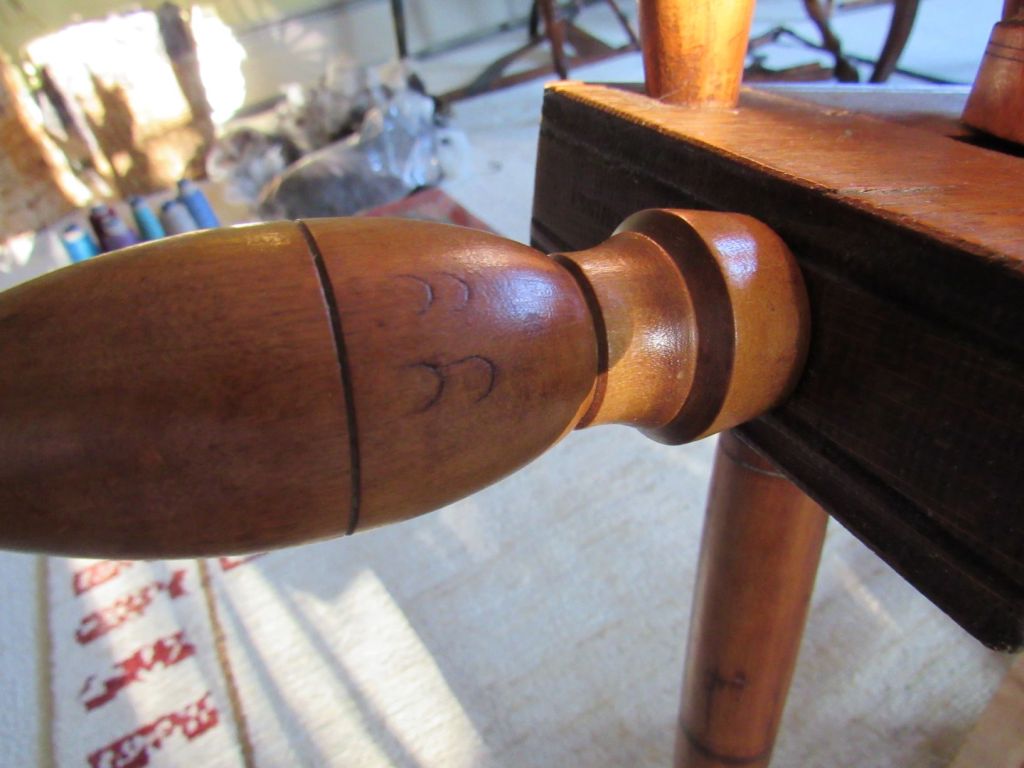
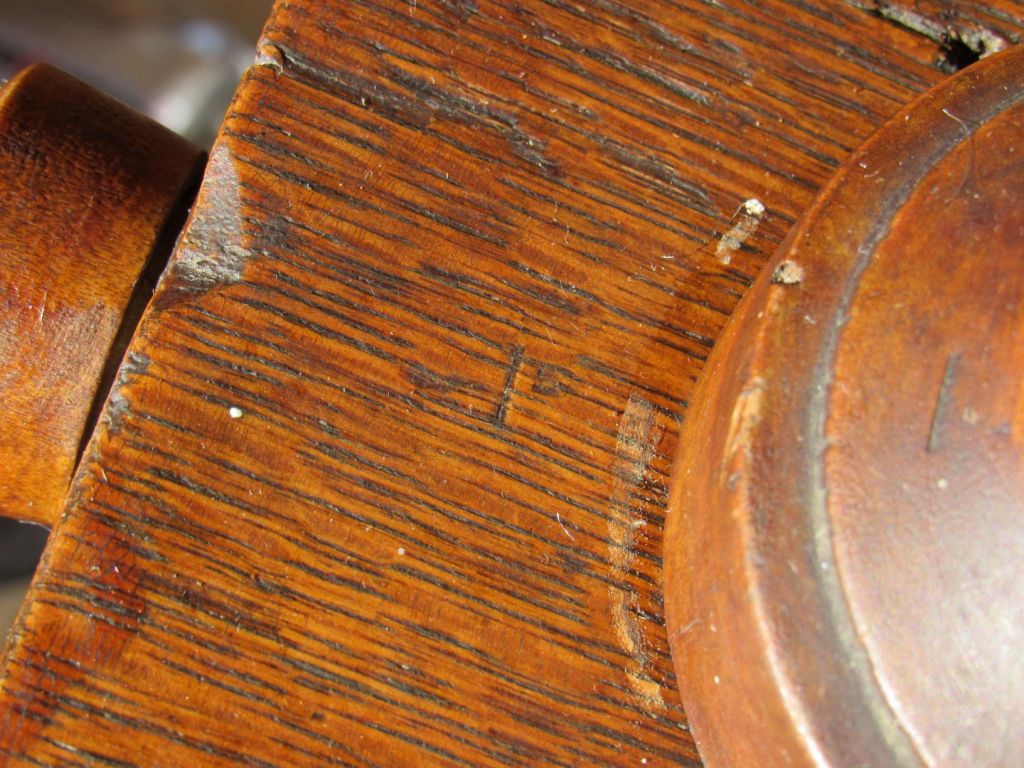
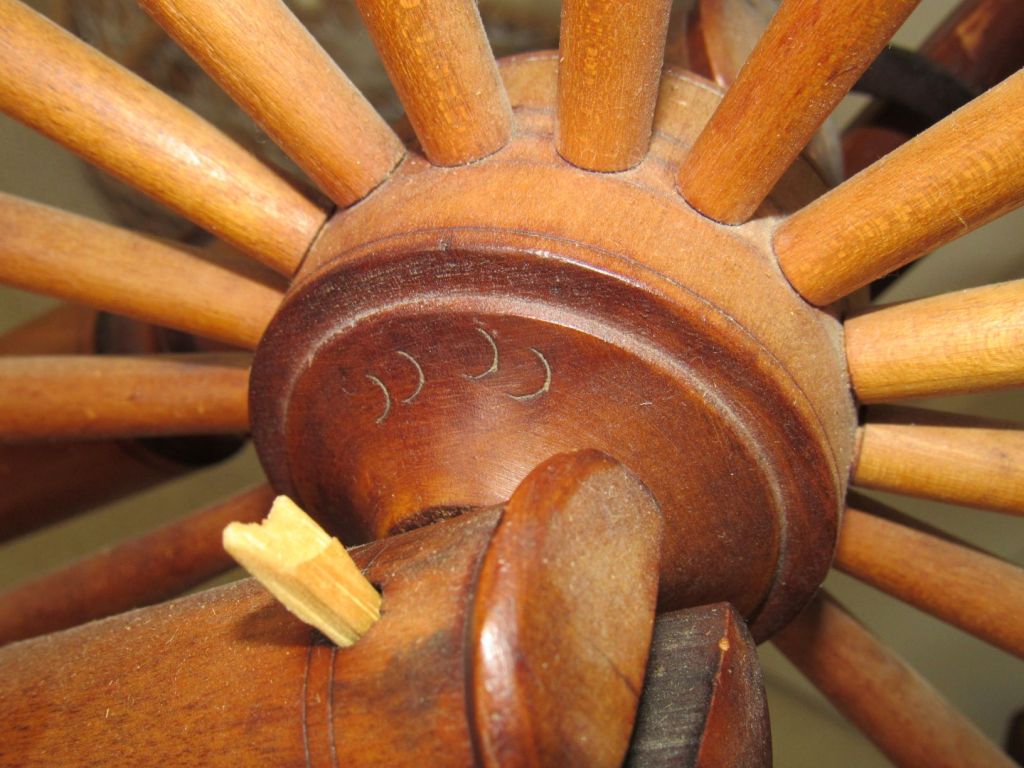
One interesting aspect of Cheney’s wheels is that parts are marked—treadle, table, tension knob, collar, hub, and flyer assembly—on my wheels with an “I” and a “CCCC.” 

Whether the marks were for ease of assembly by multiple workers or some sort of mass production, who knows?  

Tension knob “I” mark on Chancey
Table and collar “I”s in exactly the same places as the “CCCC” marks on Cicely

At some point, I’d love to go through Cheney’s day books in detail to see if they shed any light on his spinning wheels. 


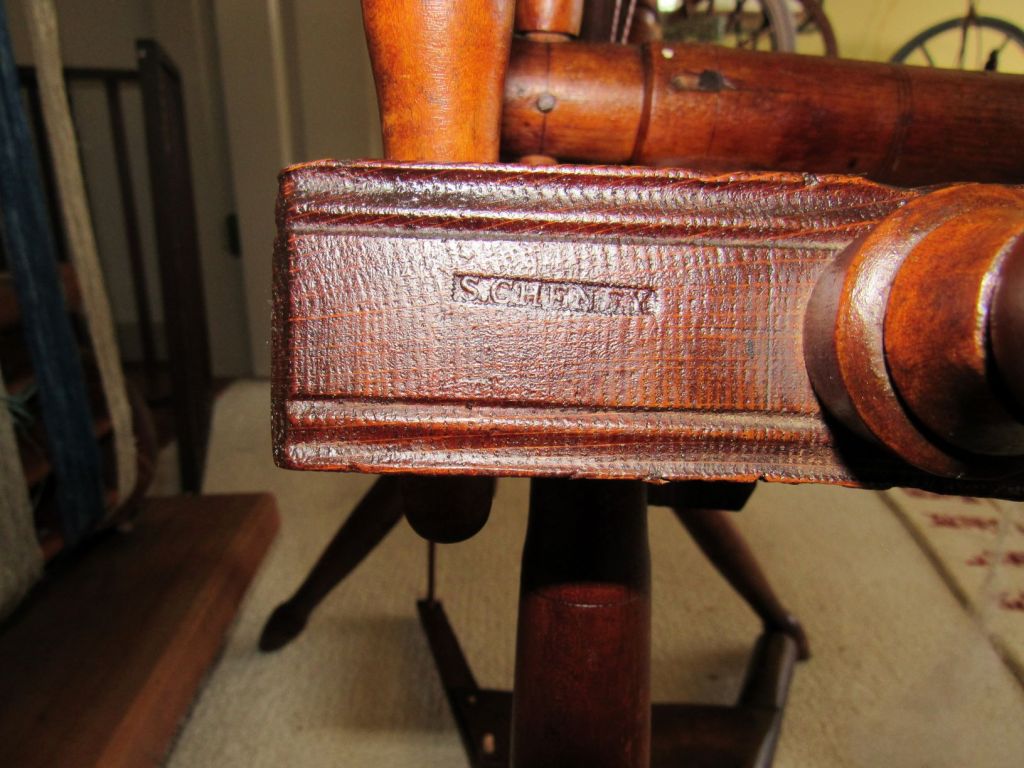
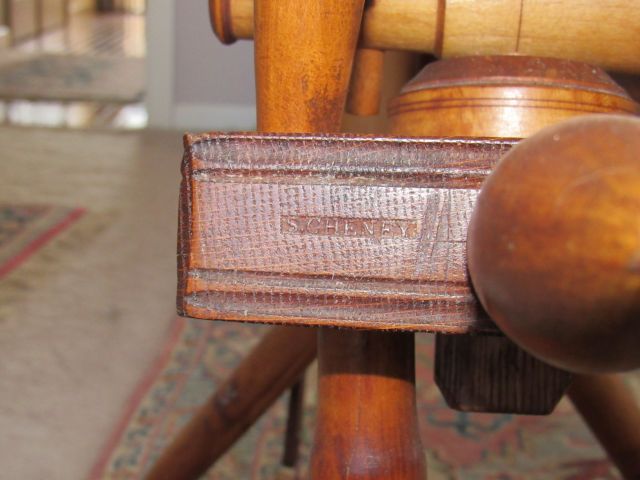
Even though Cheney did not sign his furniture, he did sign his wheels—with a tiny, hard-to-see stamp on the end of the table.   Chancey’s seller said there weren’t any maker’s marks on the wheel until I asked her to go back and look again–and showed her a photo of where the mark should be.

The style of Cheney’s wheels is entirely different from other Connecticut wheelmakers of the time.  For example, the wheels of Solomon Plant and J. Platt in previous posts show the typical style, with ornate turnings, black bands, and chip carvings. 

Solomon Plant wheel–with 16 ornate spokes

They look fussy and overdone compared to Cheney’s wheels, which have a sleek, minimalist look, highlighting gorgeous wood and design. 

Cheney’s 16 simple spokes and exquisite wood
Cheney treadle bar and foot

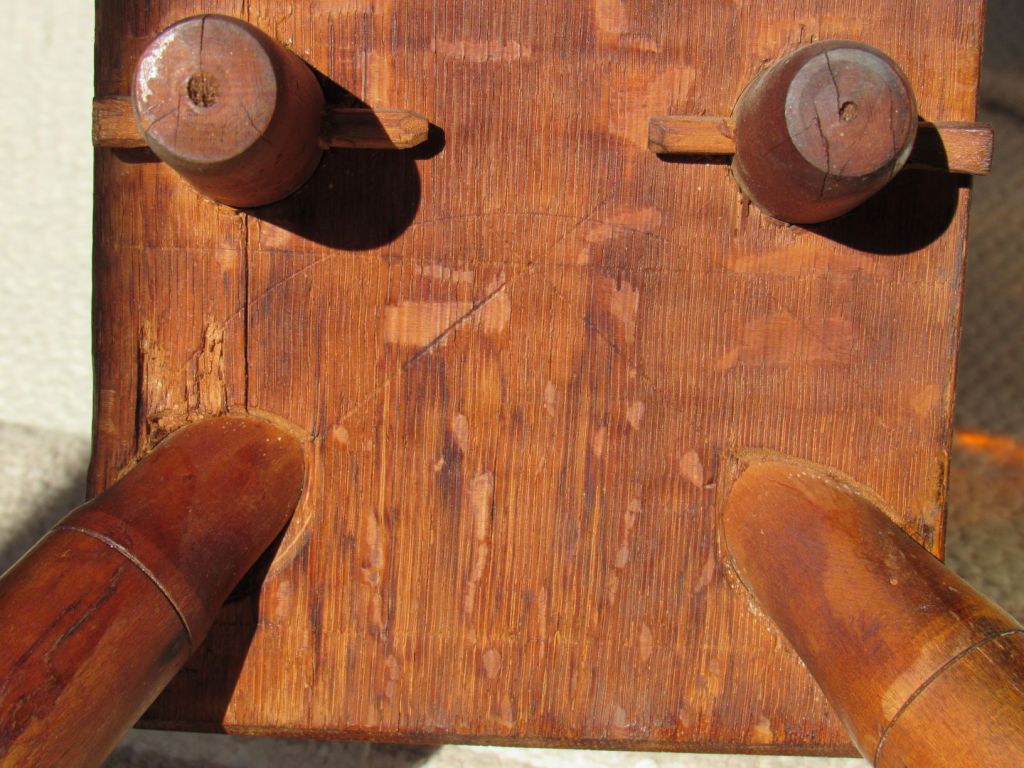
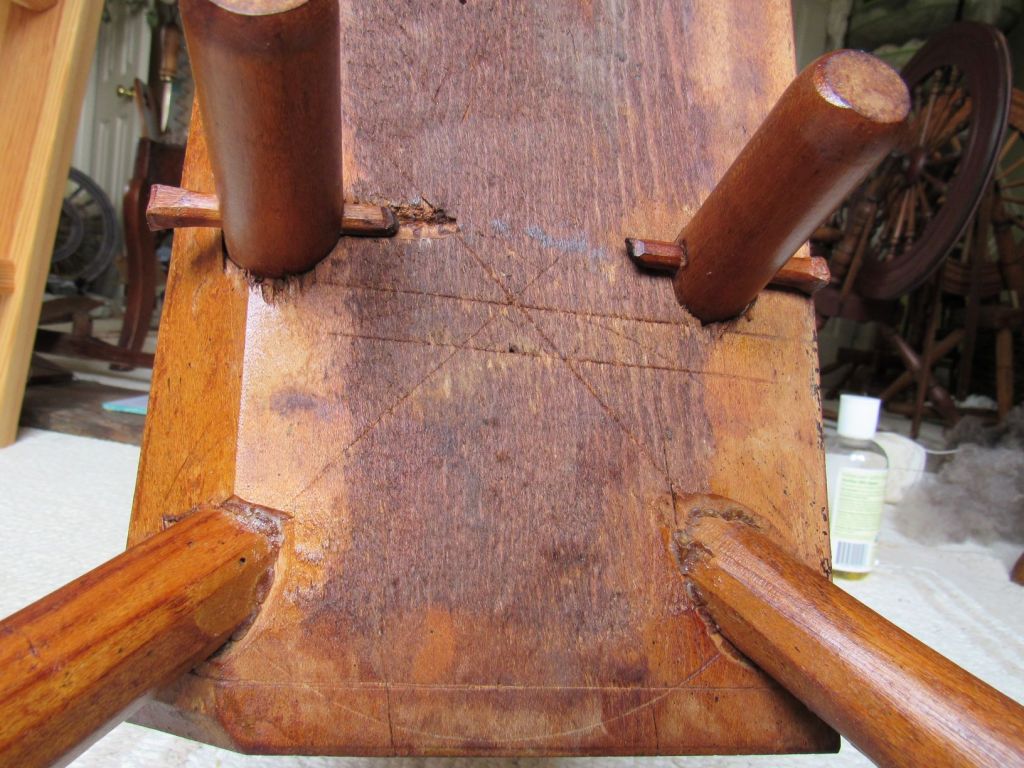
On the other hand, Cheney’s wheels have some intriguing similarities to wheelmakers farther north.  The scribing under the table of Cheney’s flax wheels and the chamfering of the leg holes are fairly unusual, but very much like the Morison wheels (in Vermont and upstate New York). 

Cheney under scribing for leg placement and chamfered leg openings
Morison scribes and chamfering

Even more interesting is the similarity to Maine Shaker wheels, particularly those made at Sabbathday Lake and Alfred Lake. 

Cheney maiden

The maidens have the same tops, but the SRAL’s are curvier down below. The maidens on the Sabbathday Lake wheels are even closer to Cheney’s in style.

Samuel Ring Alfred Lake Shaker wheel (SRAL)

the scribe lines for the collar are the same,

Cheney scribe lines on side marking collar placement
Alfred Lake scribe lines for collar

the spokes share a simple, sleek curve,

Only 14 spokes on the SRAL wheel, compared to Cheney’s 16, but the shapes are very similar

and my Alfred Lake wheel has scribe lines underneath—not the same as Cheney’s but similar. 

SRAL

Most striking, though, is the wood.

 The Alfred Lake and Sabbathday Lake Shaker wheels are known for gorgeous wood. 

SRAL table

On my Alfred Lake wheel, the table is stunning with high contrast ray flecks.  As are the Cheney tables. 

Sweet Cicely’s table–just amazing wood

From newspaper advertisements, we know that Cheney was selling wheels around 1800—about the same time the Maine Shakers started producing their wheels.  So, it’s hard to say whether the Shakers were influenced by Cheney or the other way around.  The Litchfield Historical Society has been very helpful in answering my questions and I’m trying to determine if any early Shaker wheel makers might have apprenticed with Cheney or if there was any other connection.  

Chancey–at first glance she looks like a Shaker

Cheney seemed to attract interesting connections—his daughter, Mary, while a schoolteacher in New York City, met and later married Horace Greeley, newspaper editor and politician of “Go West, young man!” fame.  Mary was a suffragette, spiritualist, and likely suffered from depression.  For me, learning these details about a wheel maker’s life imbues the wheel themselves with a rich, extra layer of appreciation and wonder.

Given that Cheney was a master furniture maker, I’m not surprised that the wheels are incredible spinners.  The first Cheney wheel I found, Sweet Cicely, was on Craigslist in southern Maine.  It had a big, clunky flyer assembly that didn’t fit or work with the wheel.  The really odd thing about the wheel, though, was that it was in pristine condition and looked as if it had never been used. 

When I brought Cicely home–no wear, so grease stains, she looked brand new

The wood is very blond, which is highly unusual for spinning wheels of the time.  It’s just gorgeous and had clearly never seen the inside of a barn or attic, but had been lovingly cared for since the early 1800s.  I’d love to know its history. Could it have been similar to the wedding wheels that we see from Europe—a status symbol wheel for a wealthy young bride who never actually had to use it? 

I had a flyer assembly made and Cicely started right up.  Because the new mandrel has a larger orifice than most antique wheels, this wheel is my go-to for plying.  The second wheel, Chancey, I bought recently from a woman in southern New Hampshire. 

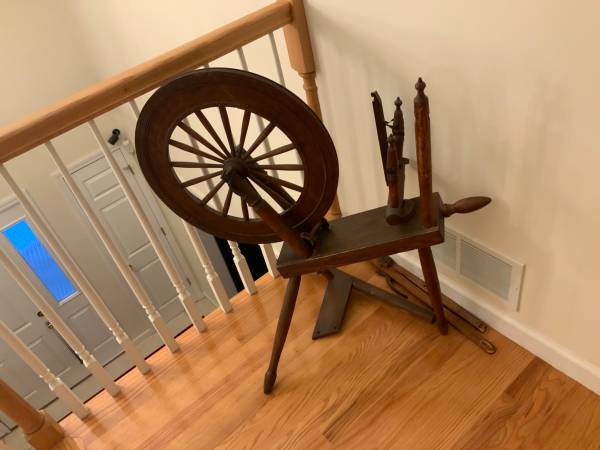
Chancey’s “for sale” photo

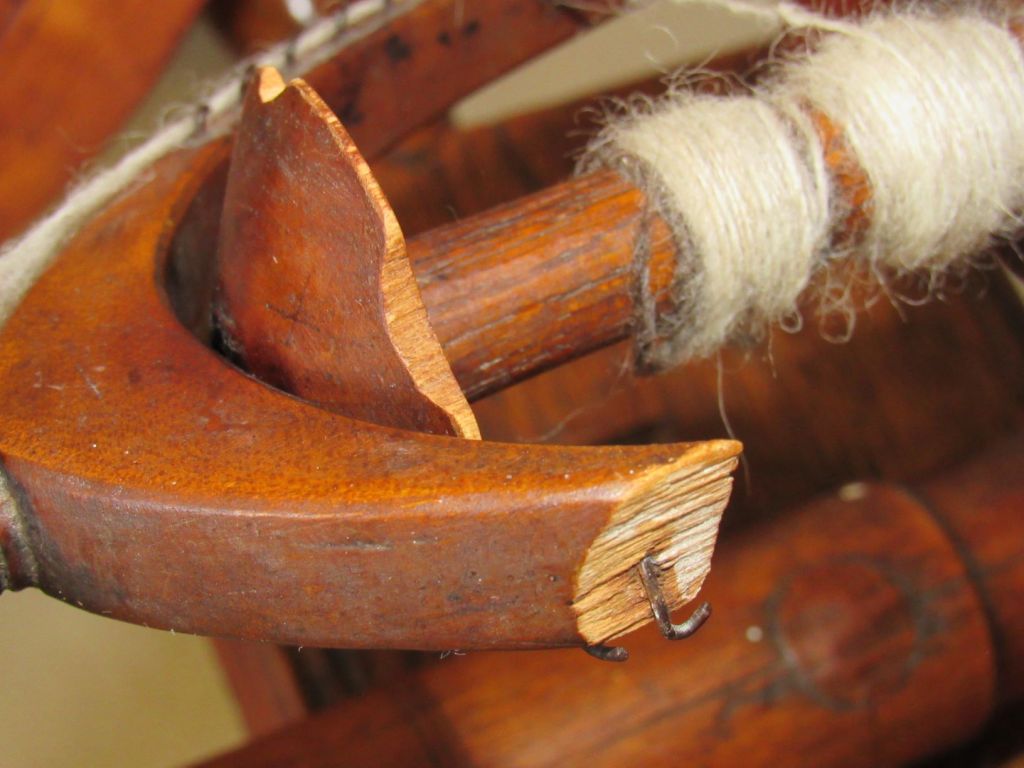
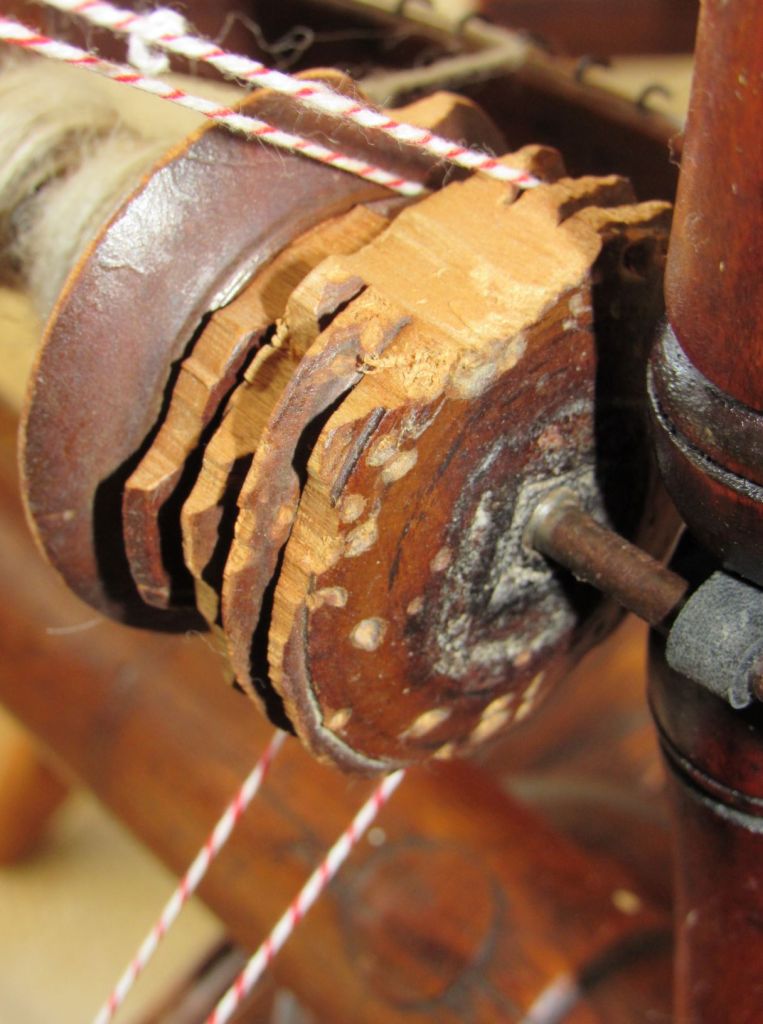
Although one flyer arm was broken and the whorl and bobbin had been chewed by a dog, I was thrilled to see that the flyer was marked with a “I,” just like the other marked parts, so it appears to be original. 

Notice there is also an “x” on the bobbin

After repairs to the flyer assembly, this wheel has become one of my top spinners—an absolute delight. 

Even in this condition, she spun well.

It is darker than Cicely, has a higher, more tilted table, and lacks the flattened sides on the wheel uprights. 

Cicely’s wheel supports are flattened
Chancey’s are round.

The hooks on the flyer arm are tiny—smaller than any I’ve seen before—but they work beautifully. 

Aside from these two wheels, I’m only aware of two other Cheney wheels that have come to light. 

In contrast with Cicely, Chancey saw a lot of use

One is a great wheel in the Litchfield Historical Society’s collection and the other a flax wheel that Grace Hatton had and sold.  I would love to hear of any other Cheney wheels out there.

Mindwell Pond

Solomon Plant made beautiful wheels. He lived from 1741 to 1822 in Stratford, Connecticut. Florence Feldman-Wood, publisher of the Spinning Wheel Sleuth, has done extensive research on Plant, who fortunately kept good records. She wrote two fascinating articles (in SWS issues 31 and 39) about him, his wheels, and his customers.

Because I have an interest in the early Connecticut wheelmakers, I was thrilled when this wheel appeared on Craigslist in Massachusetts. It had been languishing there for some time, perhaps because both flyer arms were broken off. On a trip to see his brother, my husband arranged to pick up the wheel at the Dunkin Donuts near the Bourne bridge. So, we still refer to it as the Dunkin Donuts wheel.

The edge of the rim was badly chipped. Despite that, it held the drive band I was able to do a little spinning when I got her home–using the two hooks left on one of the flyer arm stubs. She’s fairly small and easy to lift, so once the flyer was fixed, she became my favorite for summer spinning flax outside on the porch.

The wheel has stripe and chip mark decorations on the turned pieces, with chips scalloped on the end of the table and double grooves down the sides.

Plant’s initials on the table end.

One of the most fascinating things about the wheel is that the table has a huge crater underneath, the remains of a knot.

The table is very short–only 15 3/4.” The 16 spokes and plump curves give his wheels a distinctive look.

This wheel was stained or ebonized, apparently early on, giving it a rich glow. The treadle is a replacement, and perhaps the distaff. As far as I know, there are few Solomon Plant flax wheels that have survived, so I feel extremely fortunate to have found this one.

Mercy

In researching my J. Platt flax wheel (in the previous post), I combed the internet for other Platt wheels. Only a few turned up–one double-flyer wheel, one other flax wheel, a tilt-table yarn winder/reel, two great wheels, and some phantoms that were auctioned to unknown new owners.

This Platt great wheel turned up on Facebook, with an owner in New York state inquiring if anyone knew anything about the maker. I just about jumped out of my seat with excitement and another Platt owner (in Massachusetts) also joined in to share information on her wheel and winder. Some months later, the owner of this wheel decided to sell and, thanks to the kindness of three volunteers, we quickly had a wheel railroad to eastern Massachusetts, where my husband picked it up to bring to Maine.

The two-posted barrel tension is almost identical to those found on Barnum, Sturdevant, and Sanford wheels. When the previous owner bought the wheel, it had a double-post direct drive spindle set up. Unfortunately, that was lost when sent for a repair. It had been replaced with a Miner’s head, which I replaced with a bat head, since this wheel likely pre-dated accelerated heads.

The spokes do not run down the rim center, but are slightly offset, by varying distances. They have an almost imperceptible flare at the rim end. The drive wheel diameter is 44 1/2″ with simple overlap rim joins.

The table is absolutely plain–no scribe marks, no chip carving, no grooves, no curved edges–with the J. Platt mark on the end.

The wheel post is very coarse-grained, perhaps chestnut.

The legs are simple with four sets of double grooves at the wide parts of the turnings. Again, as with other features, they are similar to other Connecticut wheelmakers of the time.

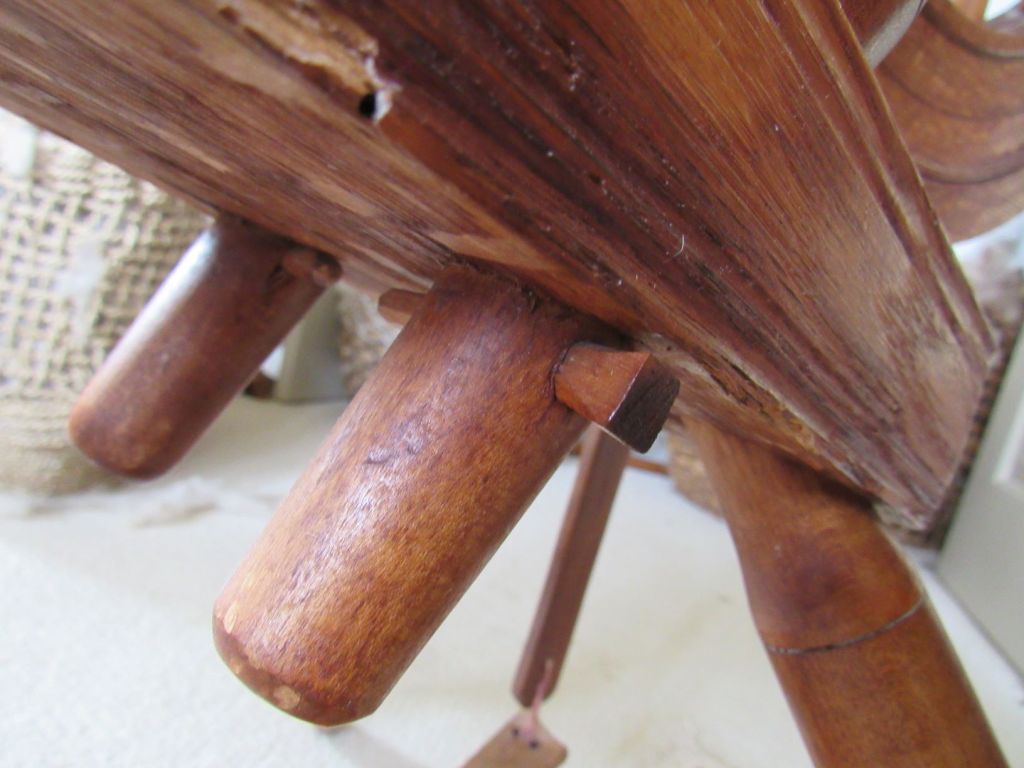
The leg tops show through the upper side of the table.

The underside of the table is smooth, without any scribe marks.

The wheel is simple, solid, and made to last. She spins beautifully and, because her replacement spindle is huge, she’s one of my go-to wheels for plying.