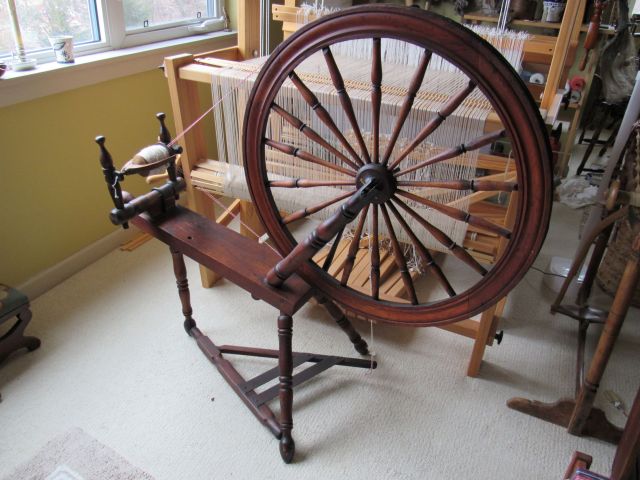
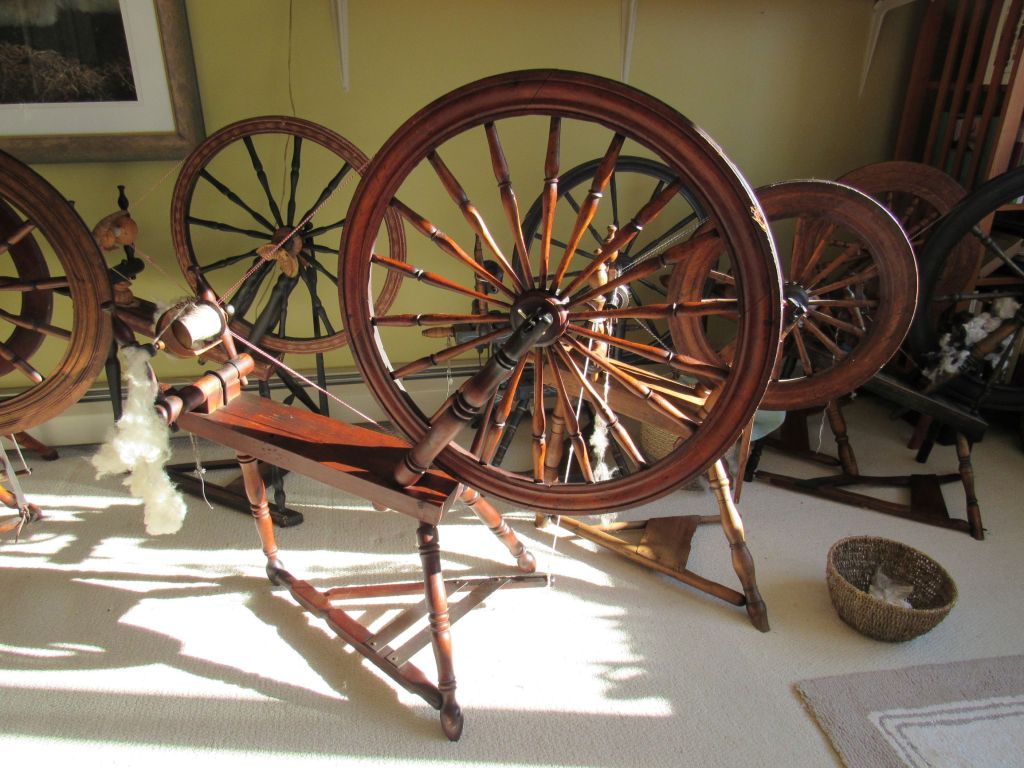
Rosanna was a bonus wheel. I did not want her. I had more than enough large Quebec wheels. I was interested, instead, in the great wheel stored alongside her in a shed. Her owners desperately wanted to clear both out–along with a clock reel–and gave me such a discounted price that ended up taking all three.
I thought I would just clean her up, get her spinning, and find her a new home. I did not expect to become attached. But she was one of those wheels that just clicked with me spinning-wise. She is a powerhouse spinner that loves a fast long draw. So, I kept her quite a bit longer than I expected, just for the great pleasure of spinning on her.
When I first brought her home, she did not look very promising. She had clearly been in the shed for a long time and was dry, spidery, and dirty. I took off the worst of the deeply encrusted grime with turpentine and linseed oil, unstuck her whorl, oiled her up, and away she went.
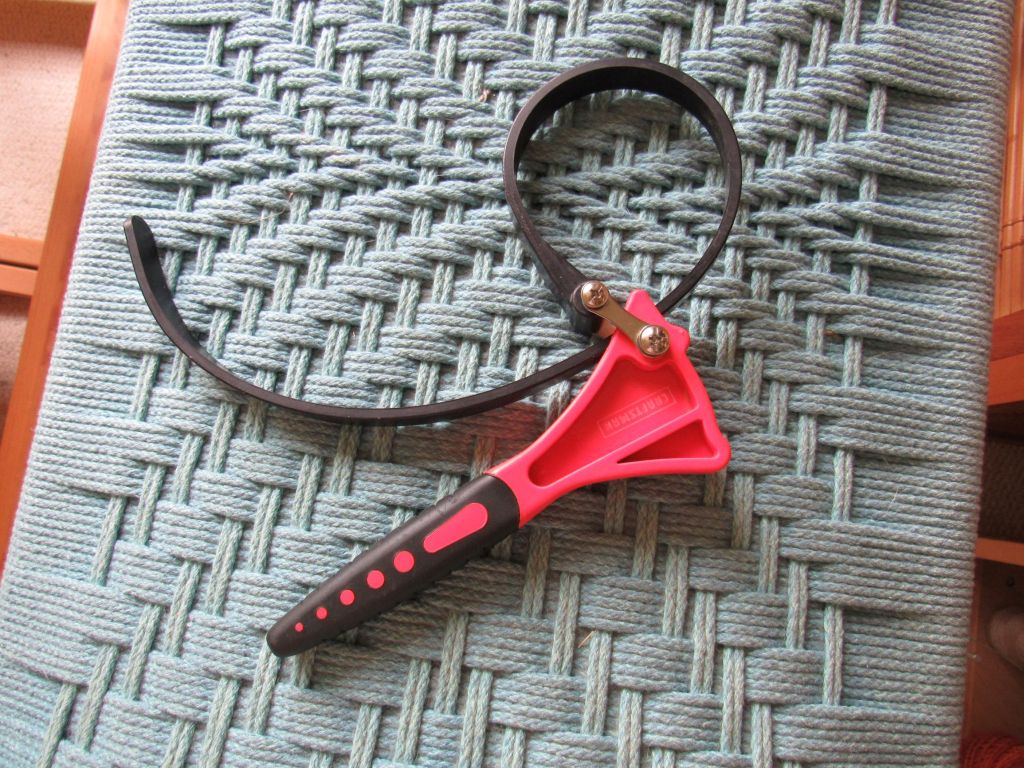
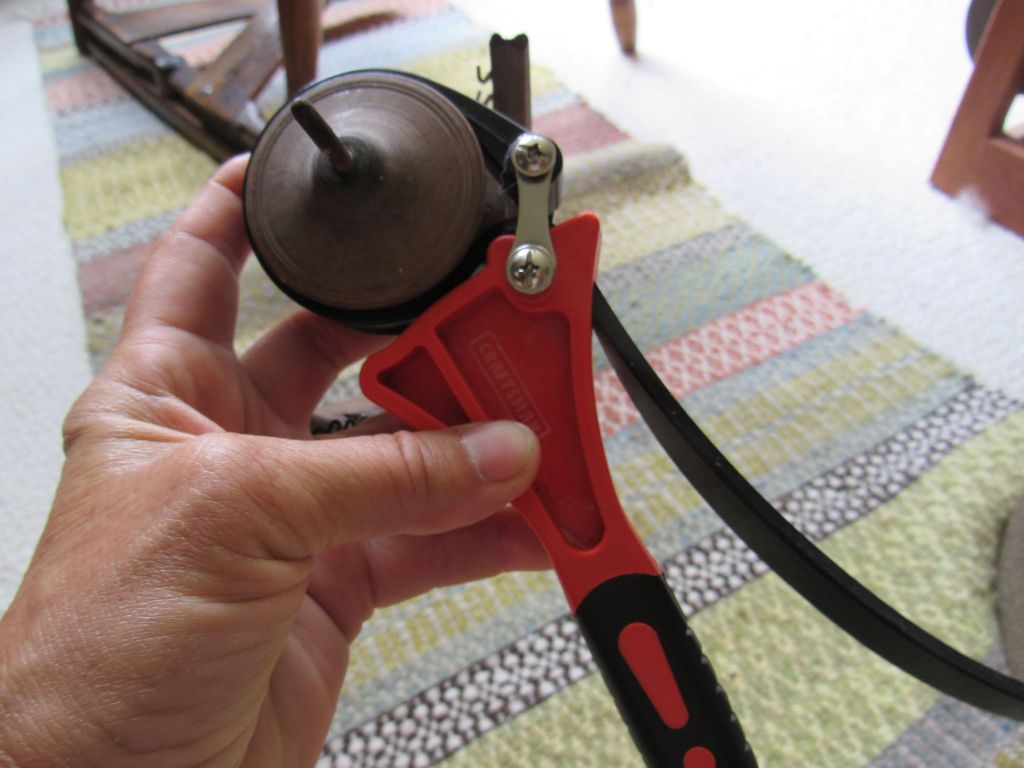
As an aside, everyone who rescues and rehabilitates old wheels should have a rubber strap wrench in their tool box.
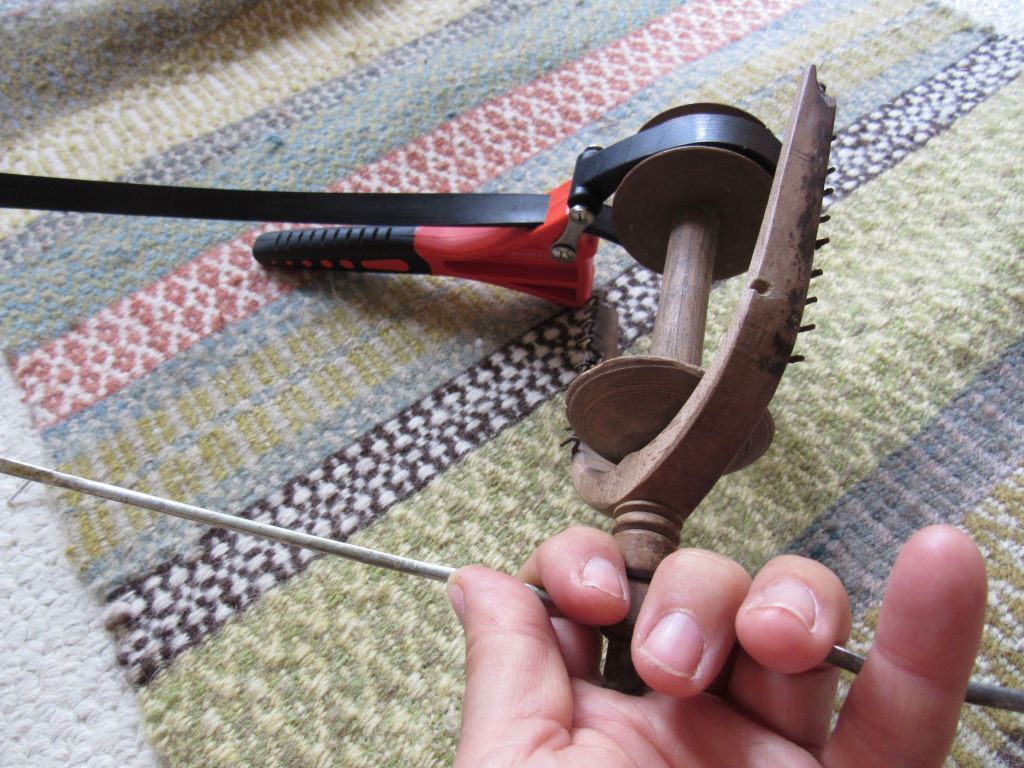
They are inexpensive and work miracles on stuck whorls. Just put a knitting needle, skewer, or something similar through the orifice holes to hold onto (rather than the too-readily-breakable flyer arms),
fit the rubber strap around the whorl, and gently twist with the wrench.
Almost all antique whorls are threaded opposite to what we are used to—so turning to the left generally tightens the whorl and turning to right loosens it. The wrench gives great leverage and the rubber strap will not mark or scratch the whorl. No muss, no fuss, no wait.
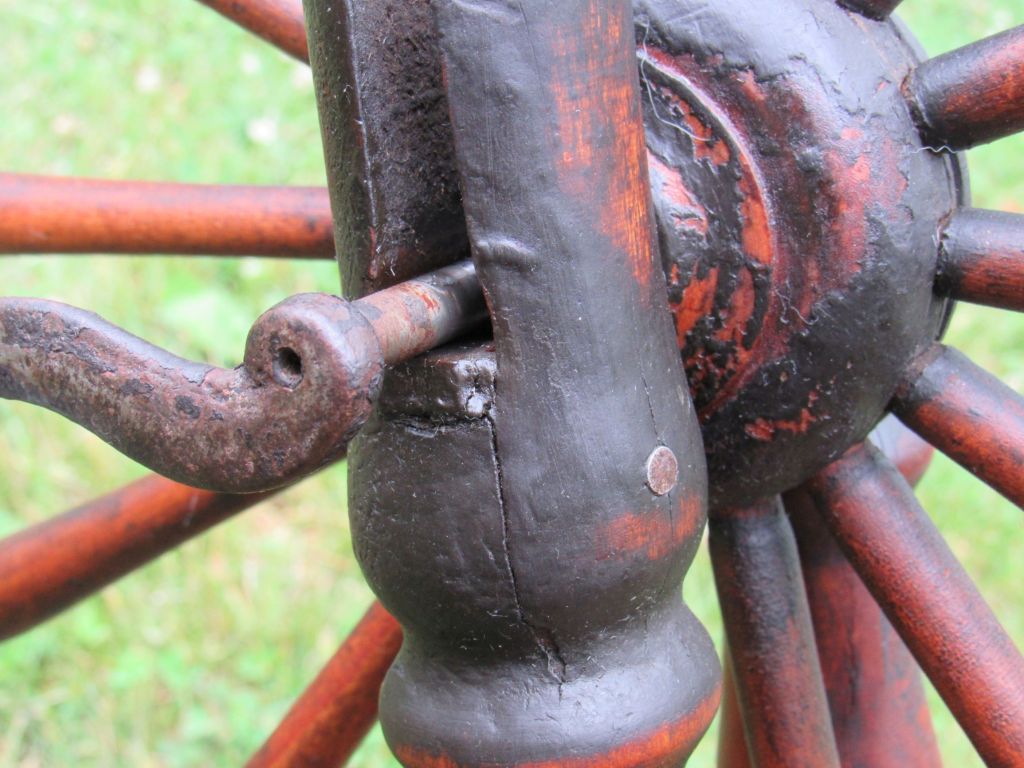
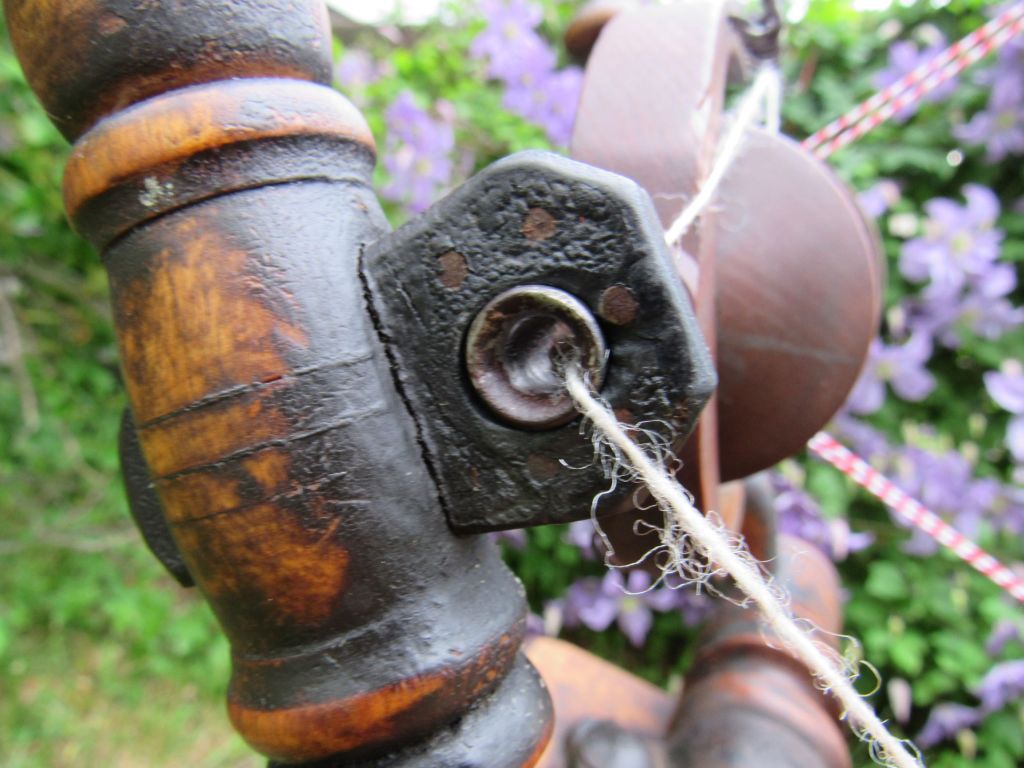
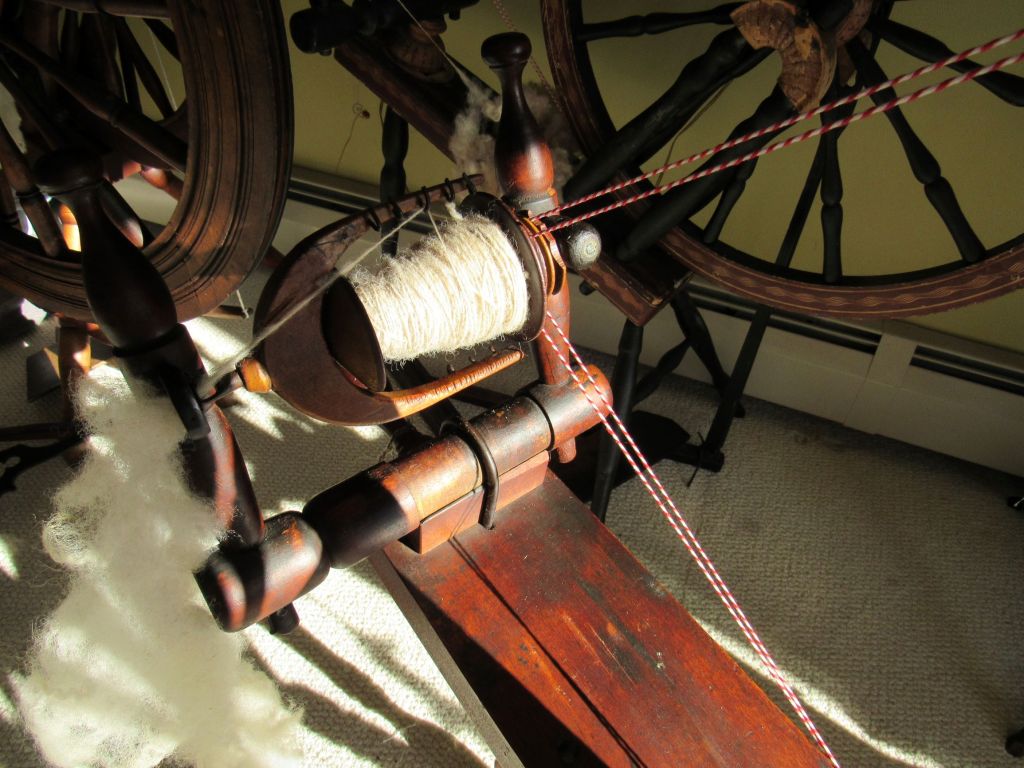
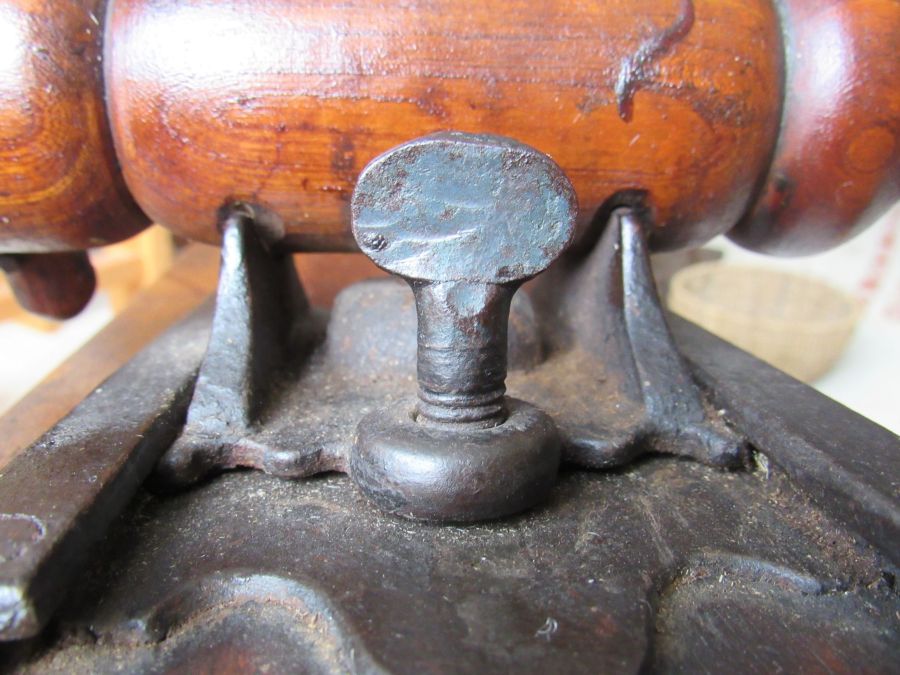
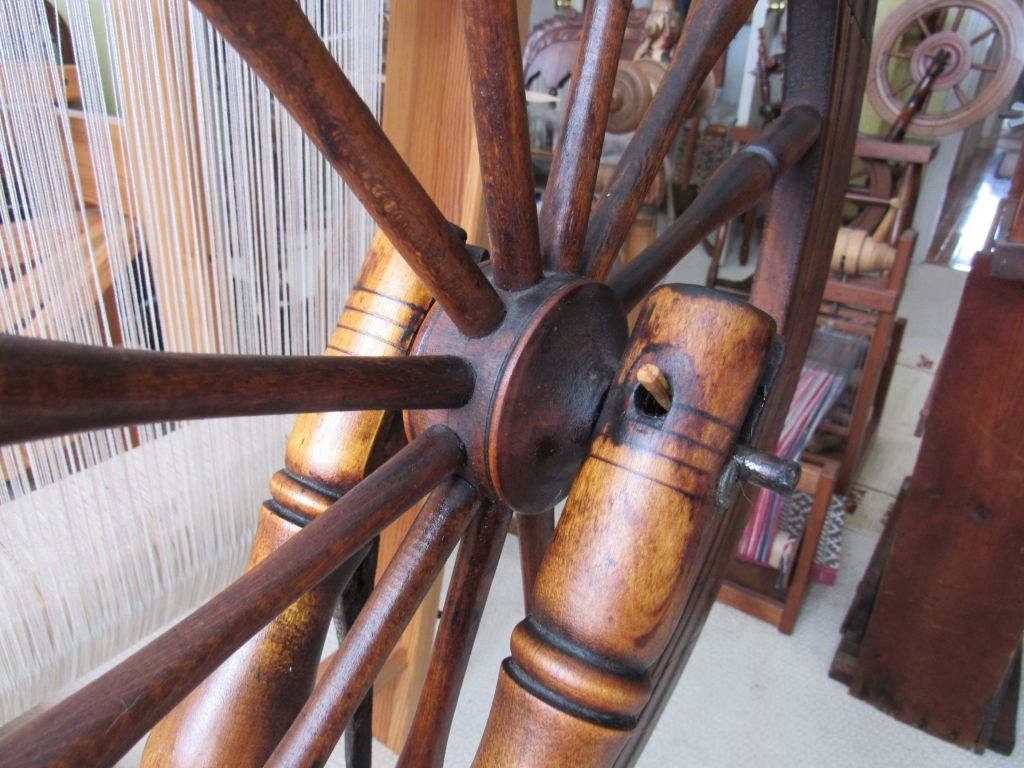
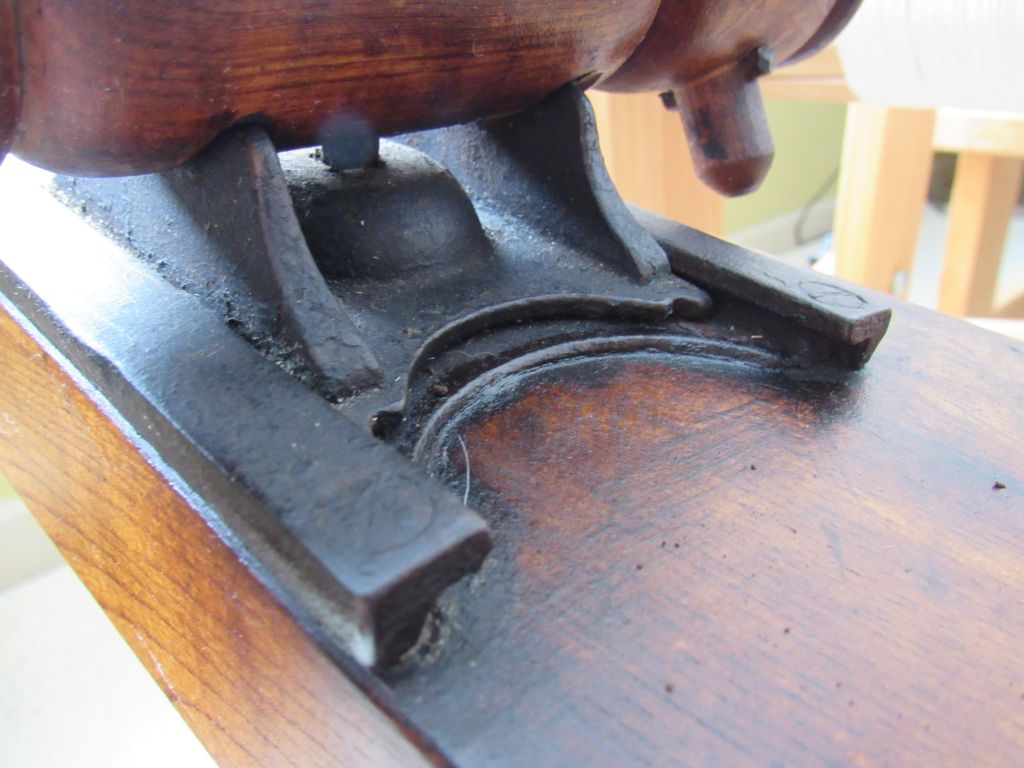
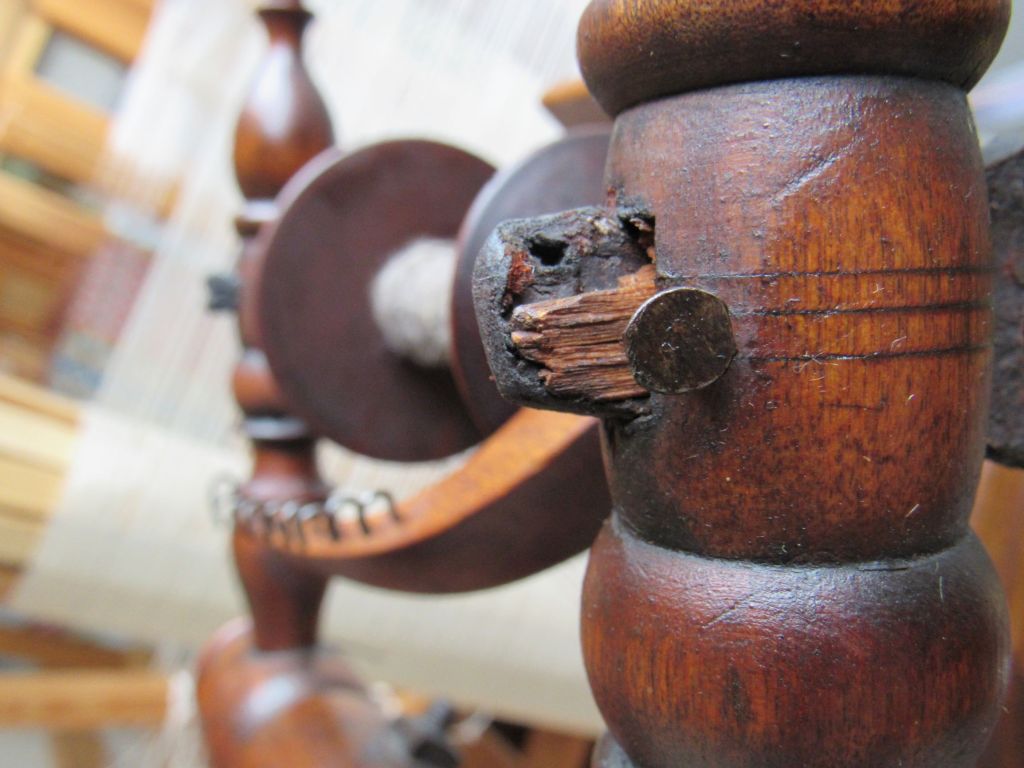
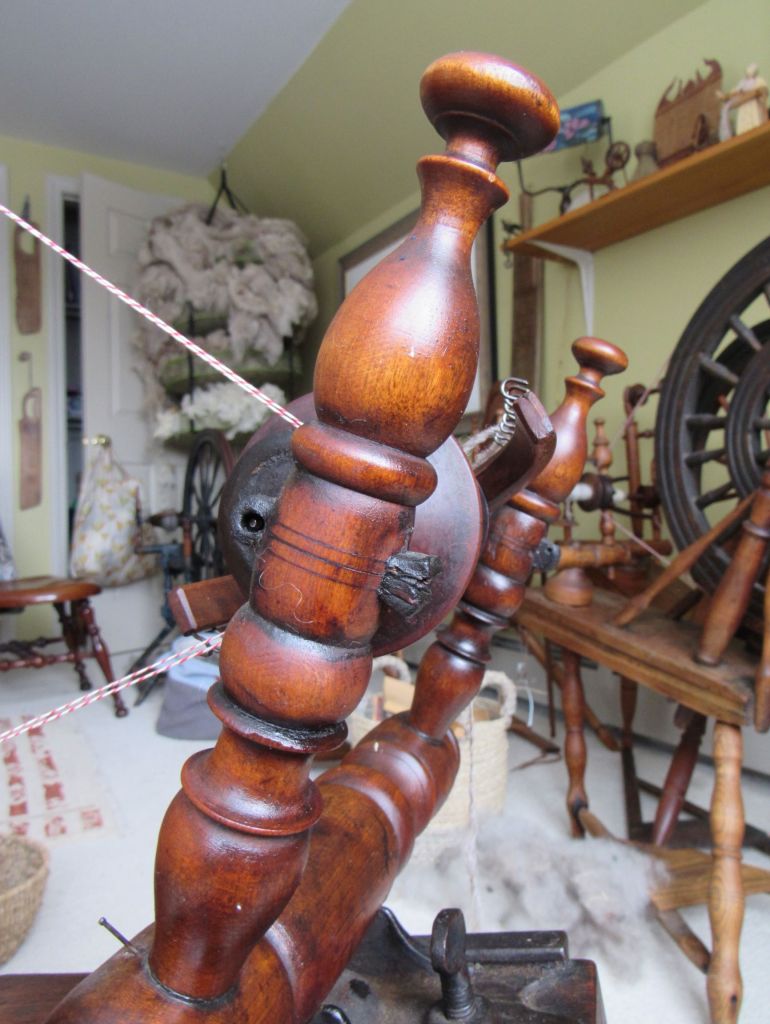
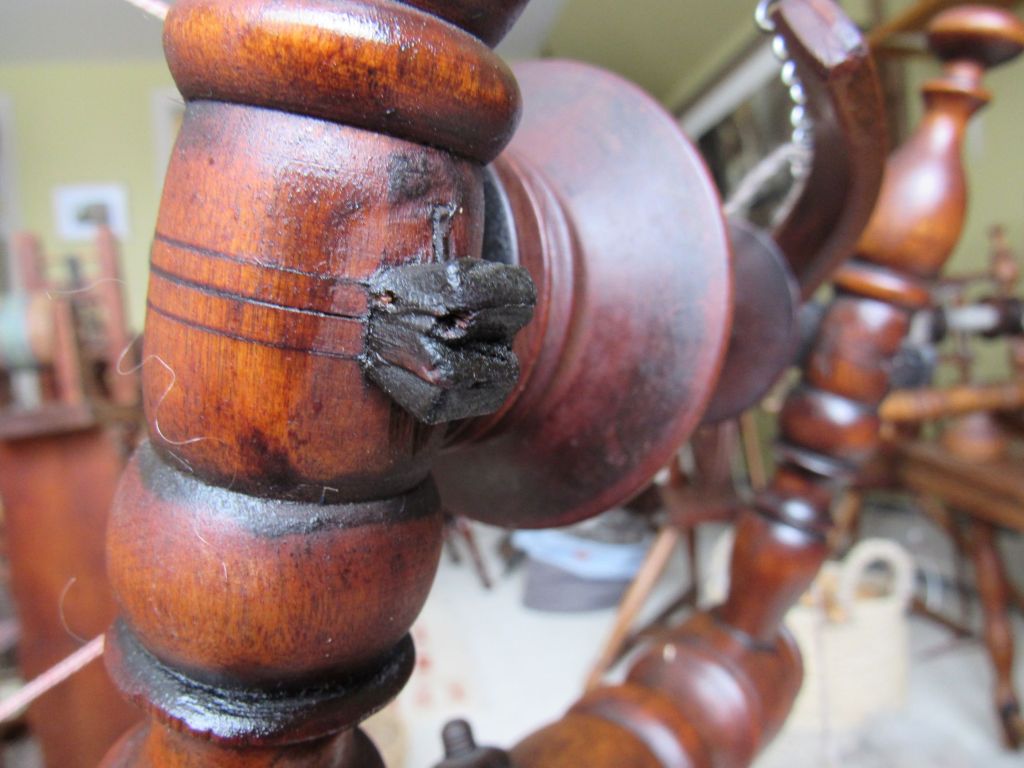
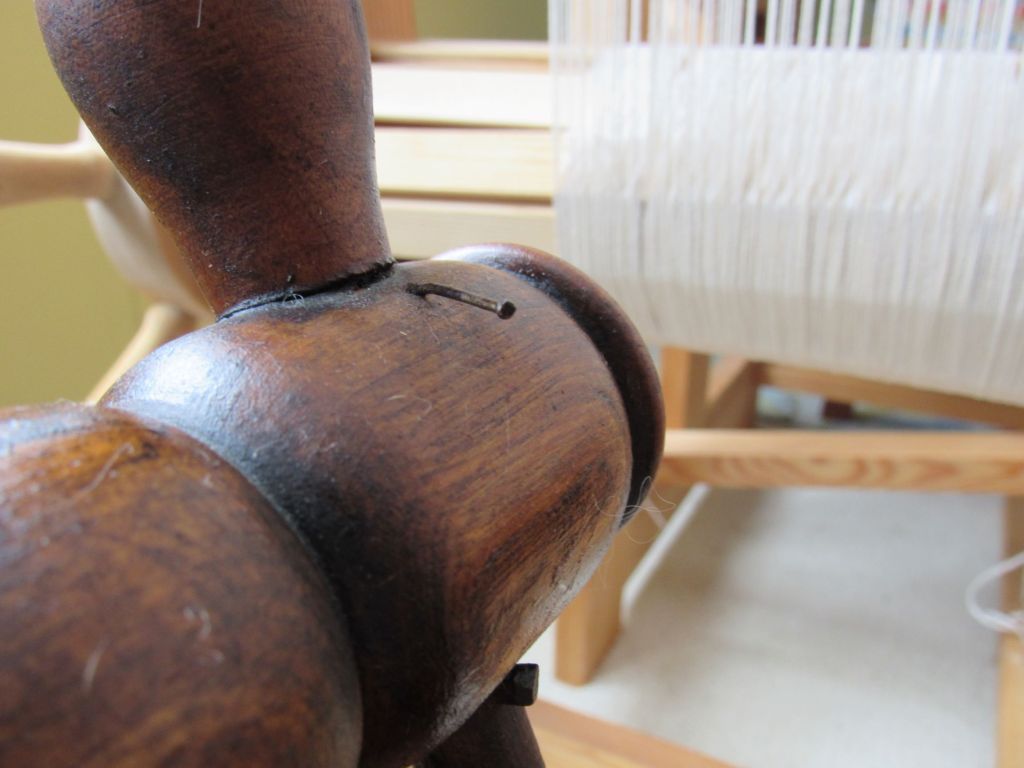
Being such a wonderful spinner—a true production wheel–it is not surprising that Rosanna shows signs of long use. She was heavily greased around all of her moving parts—now well shrouded in black residue. Her front upright was long ago shimmed with nail.
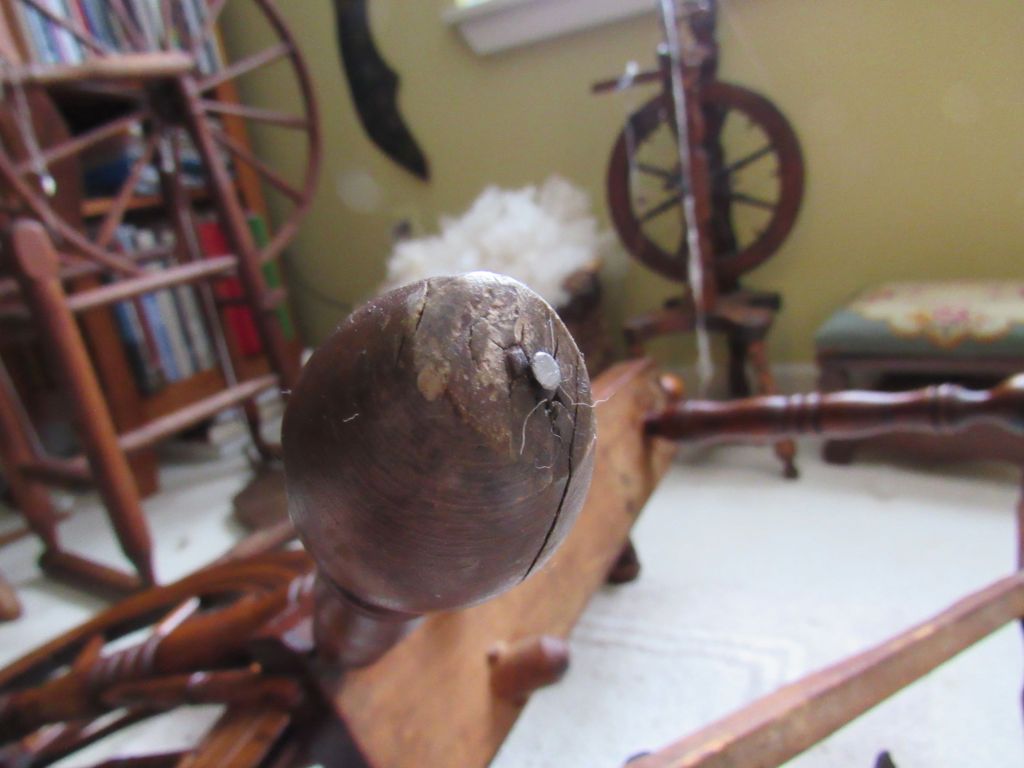
Her rear upright appears to have been nailed to secure a crack.
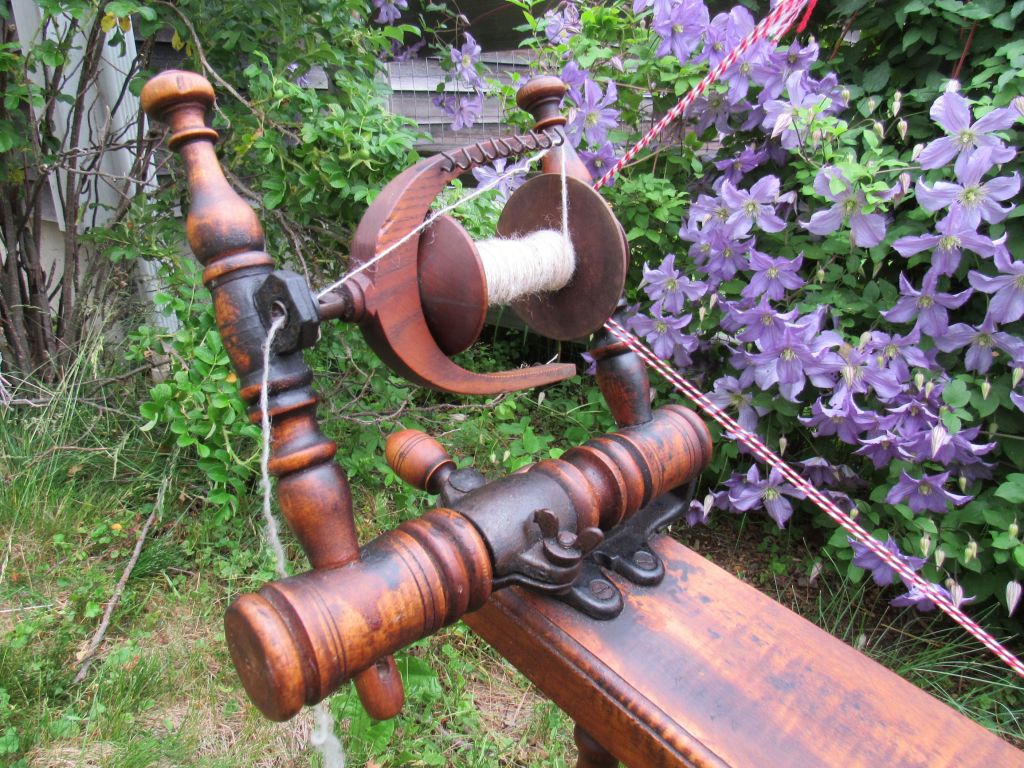
Her bobbin is slightly short, giving a bit of chatter. The flyer assembly does not look as worn as I would expect, given the rest of the wheel, so probably is a replacement.
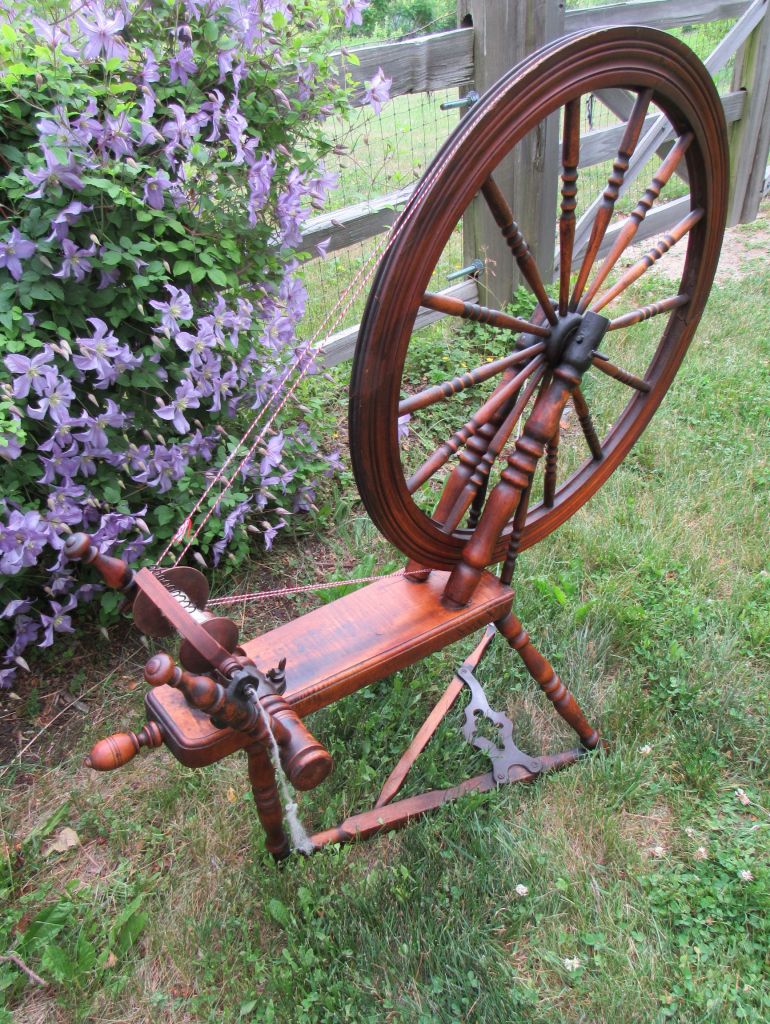
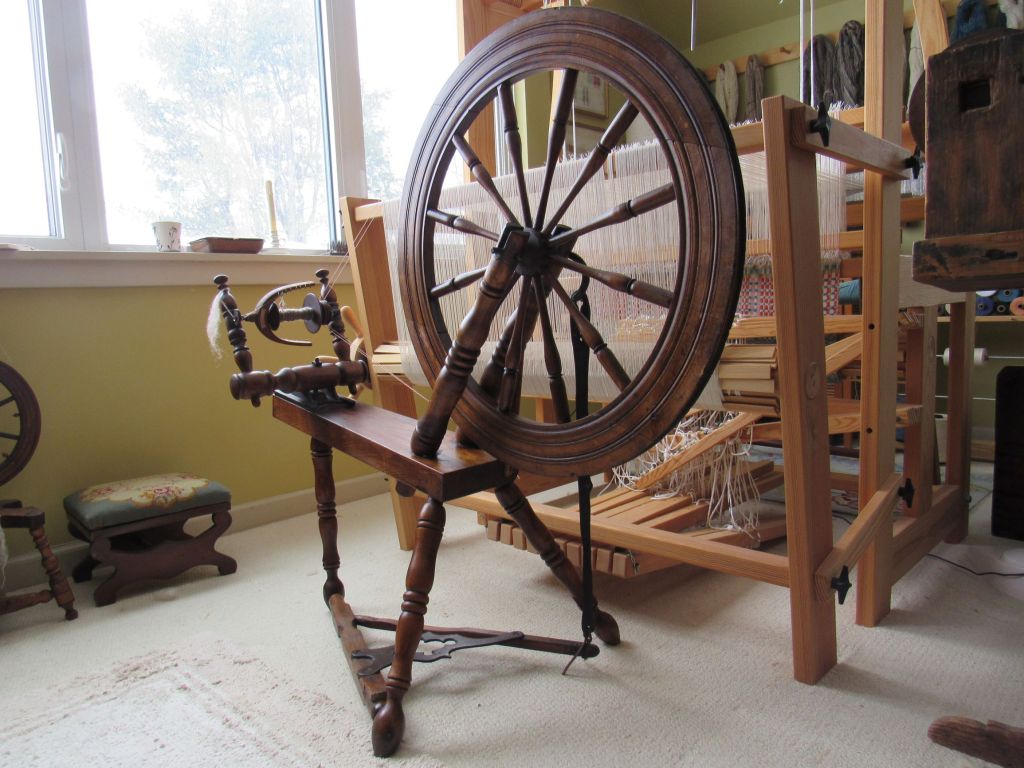
She is one of the few Quebec wheels that I own that fits in the definition of a CPW. She has tilt-tension,
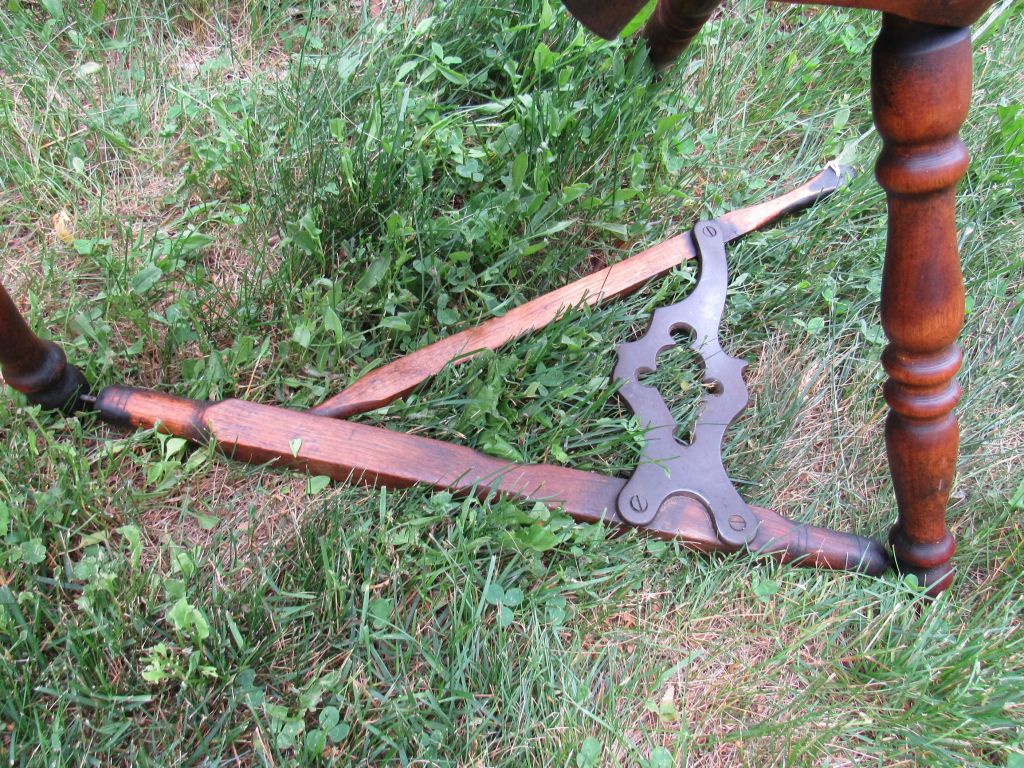
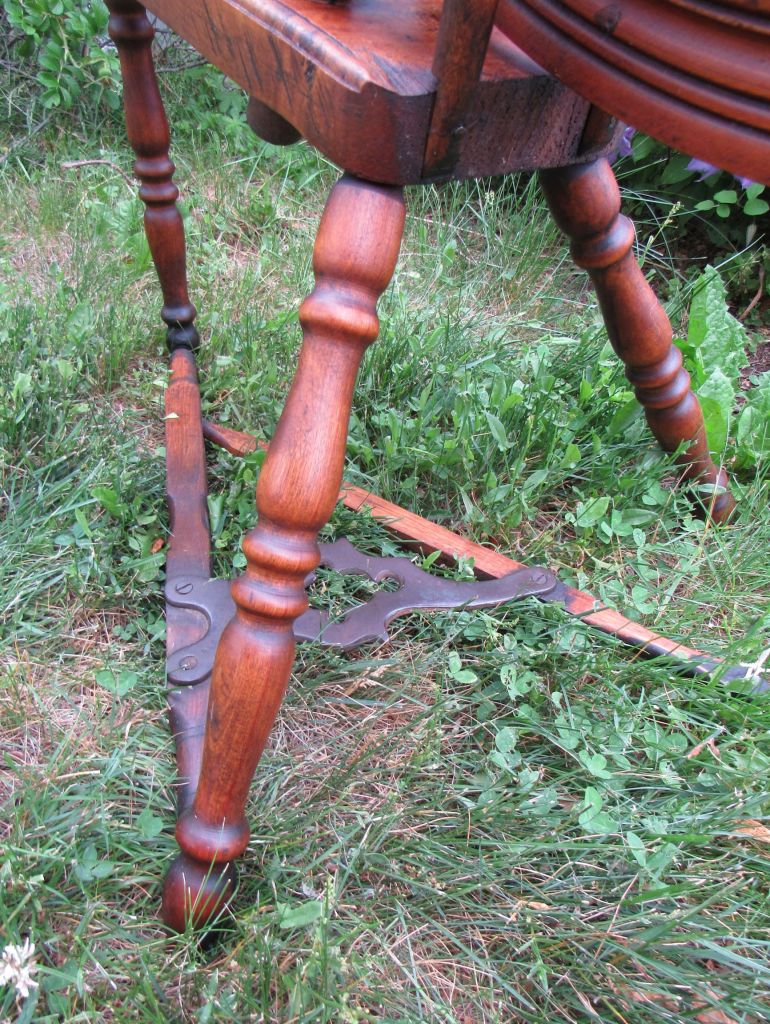
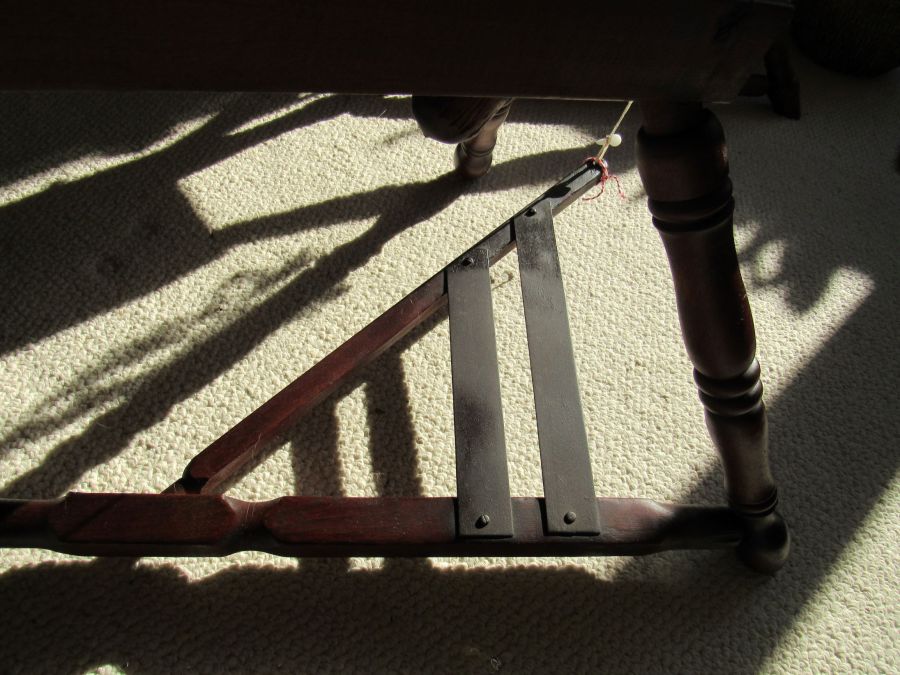
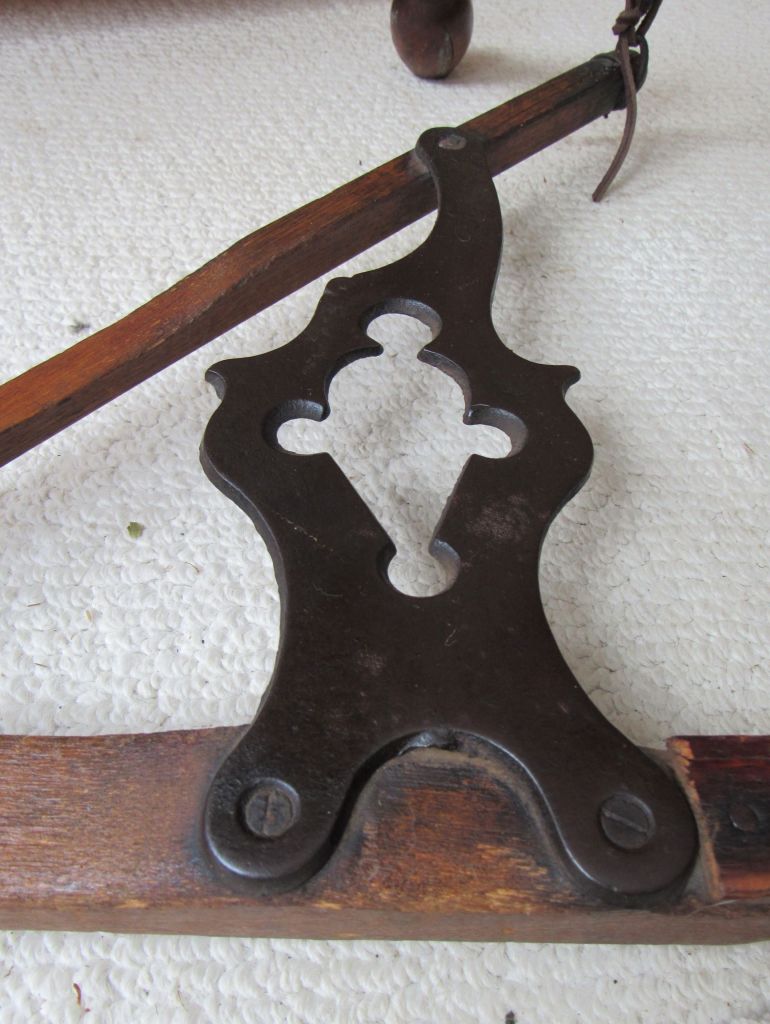
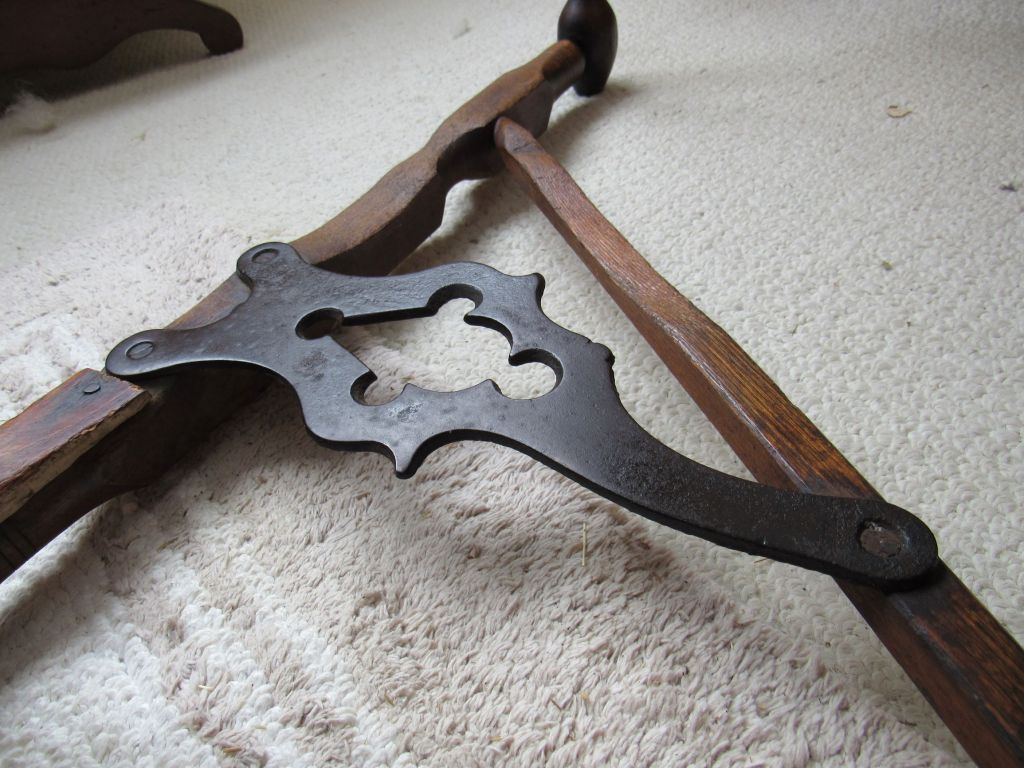
a classic fleur-de-lis metal treadle,
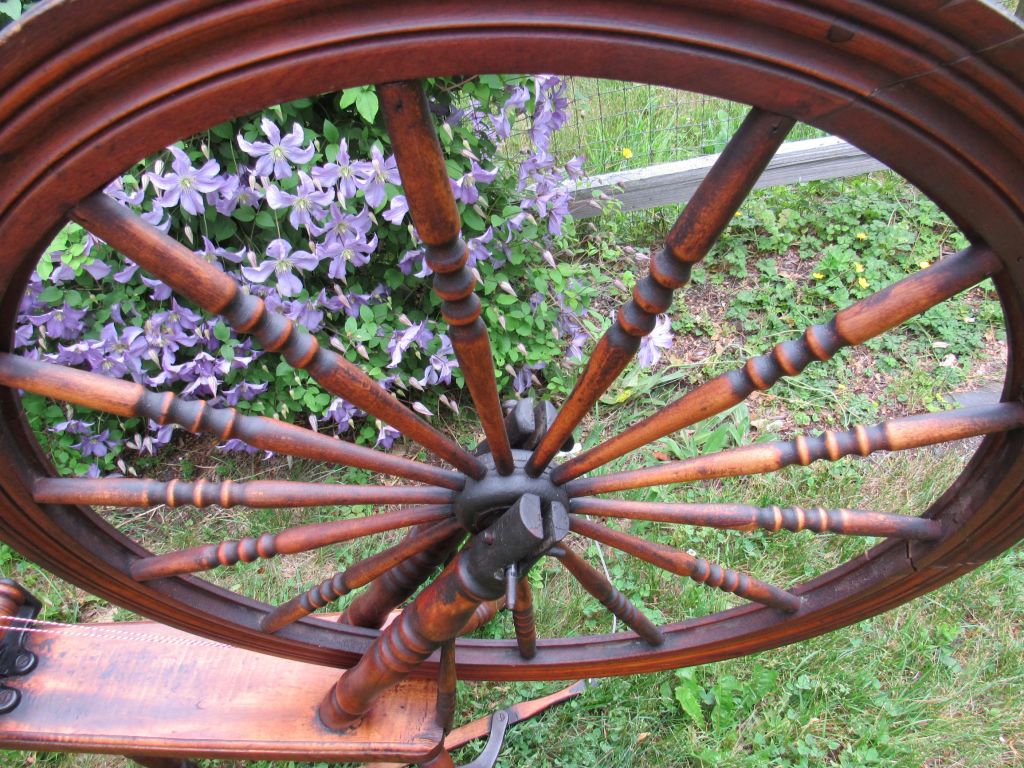
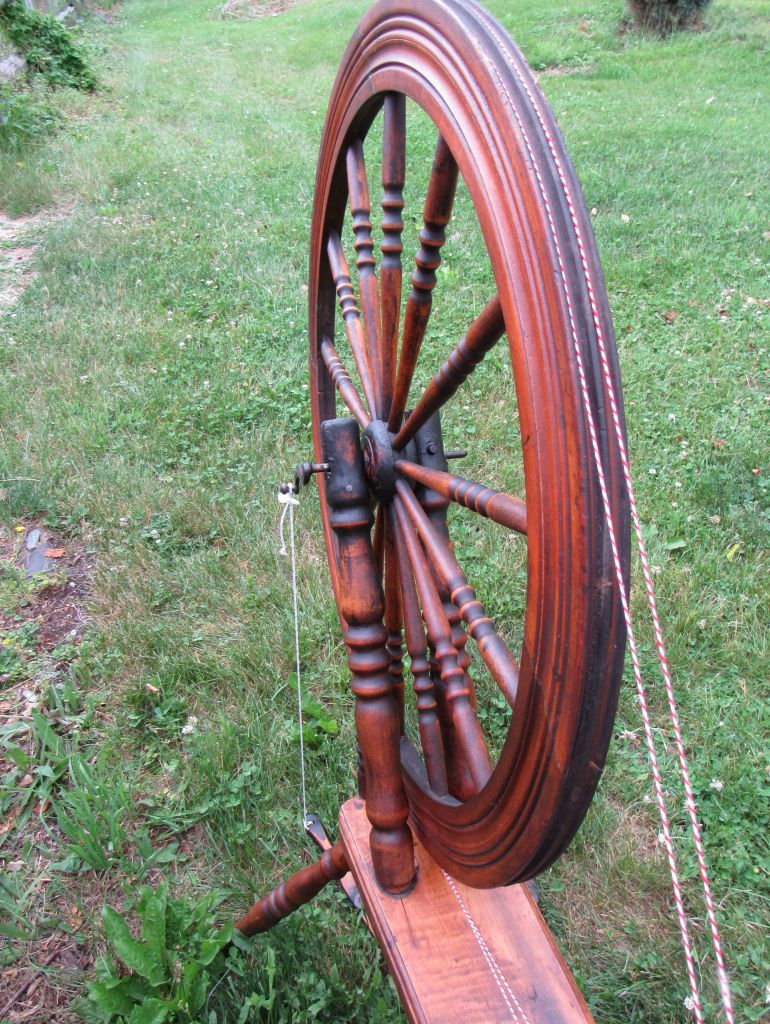
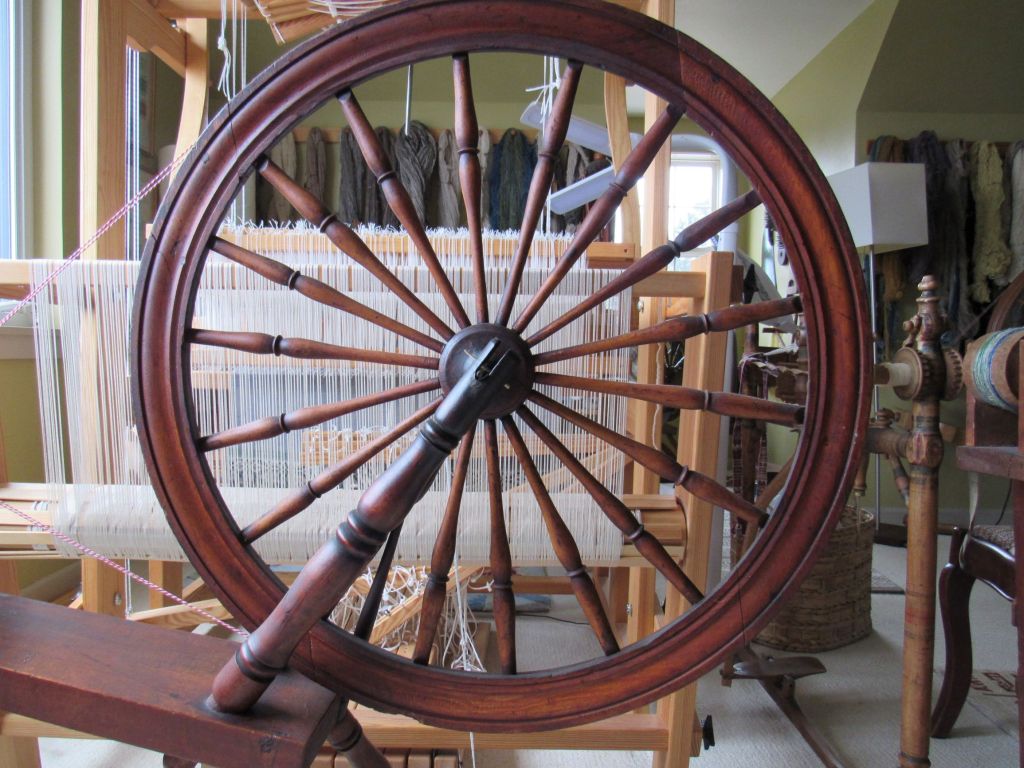
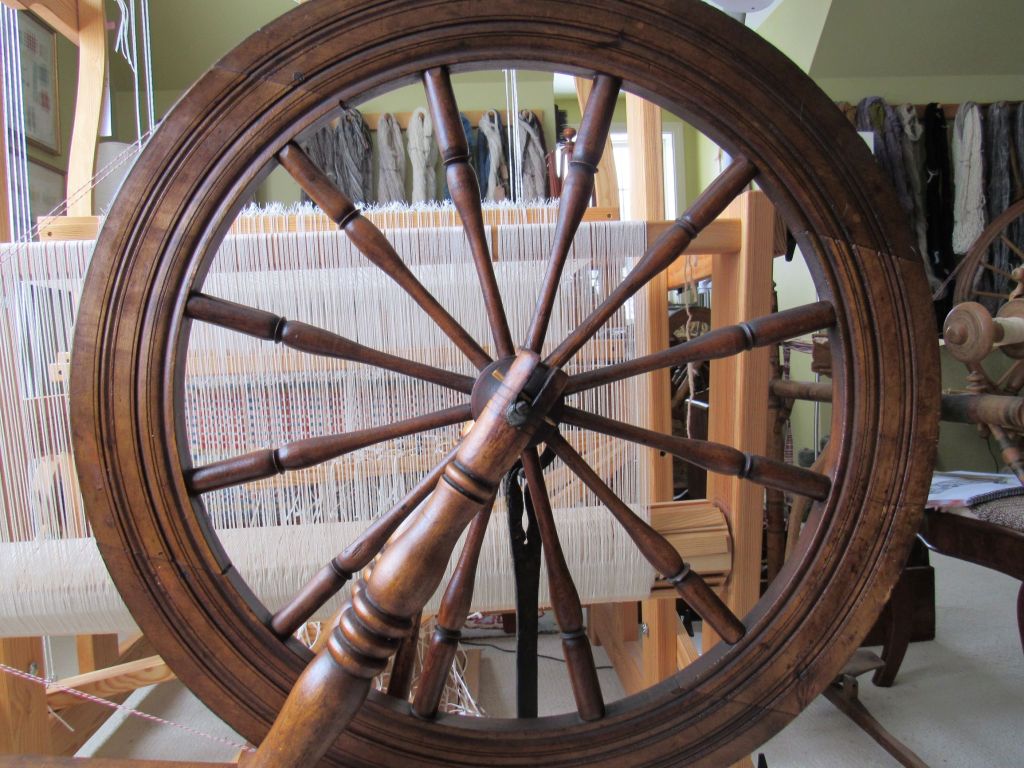
and a large 31-inch drive wheel.
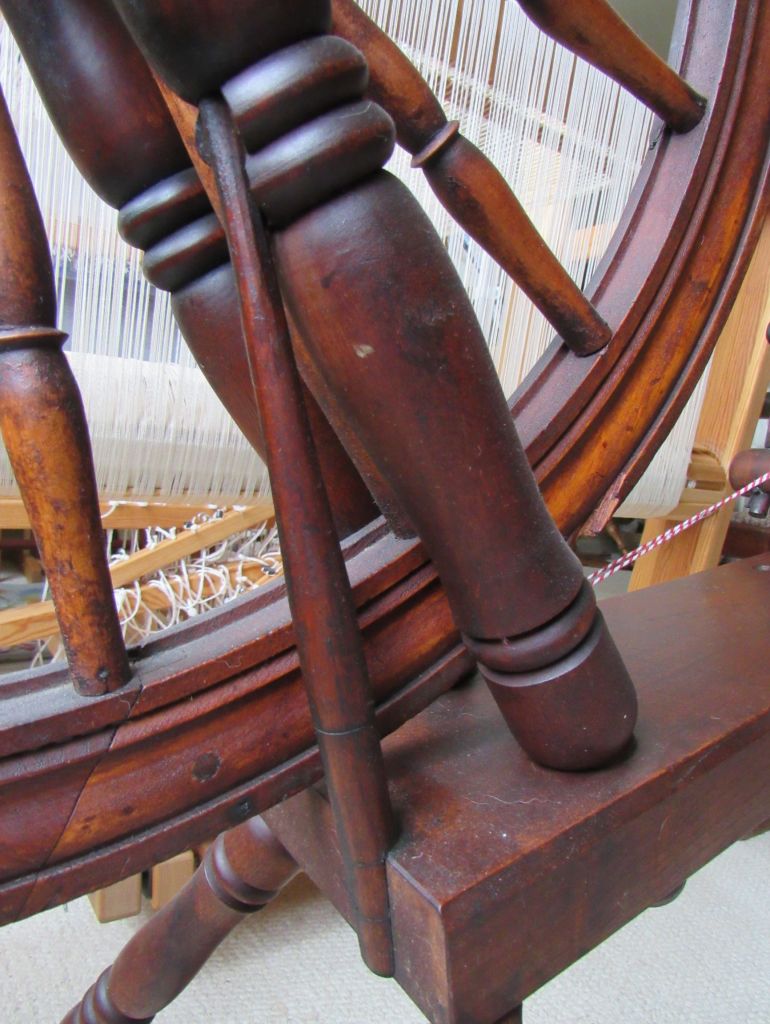
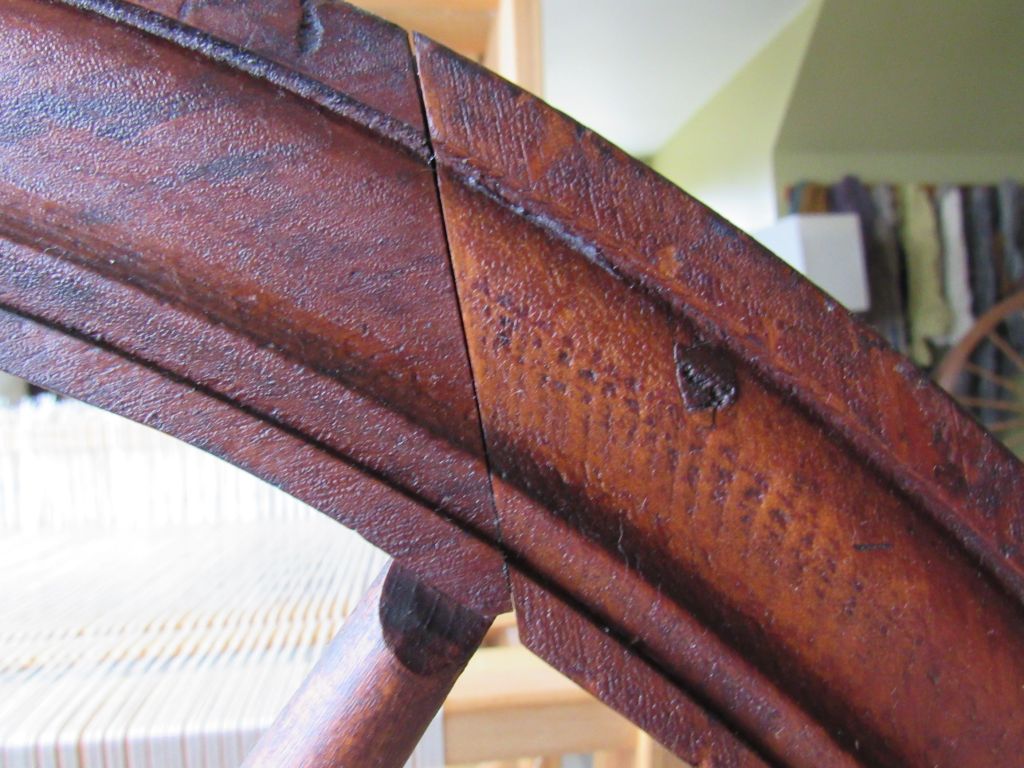
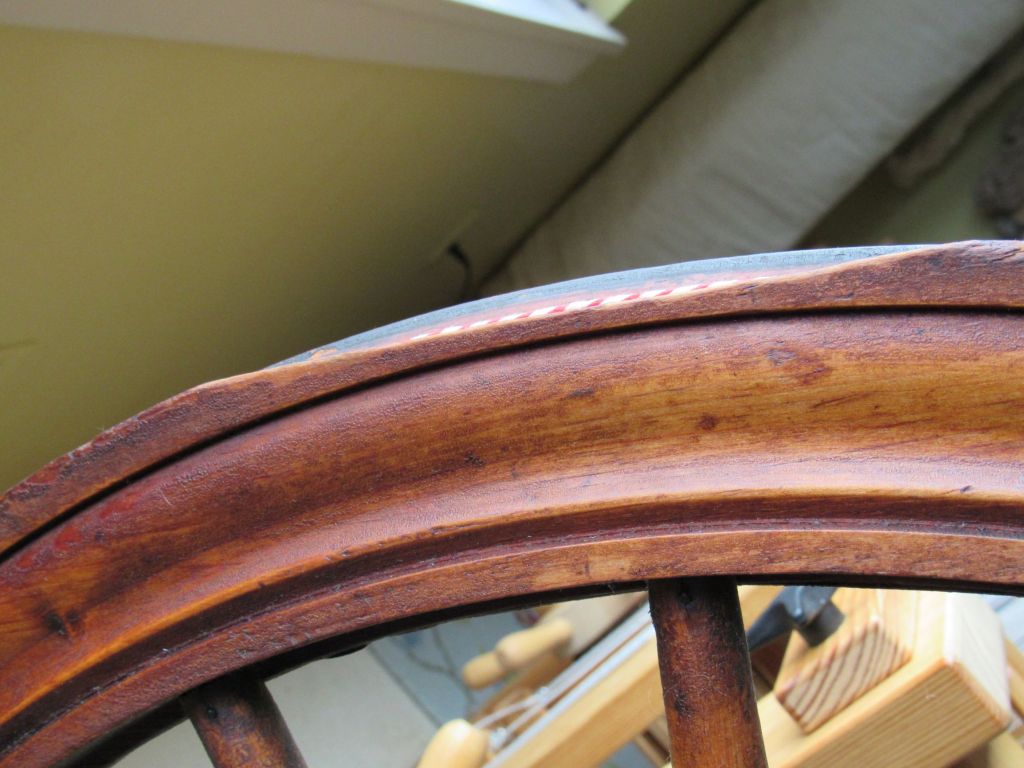
She has no discernible maker’s mark but has features of wheels made by the Laurence family (father Simeon and sons Louis and Clement) near St. Hyacinthe, Quebec. Laurence wheels are characterized by their beautiful beveled and beaded edges,
“s” curve cranks,
secondary upright supports front and back,
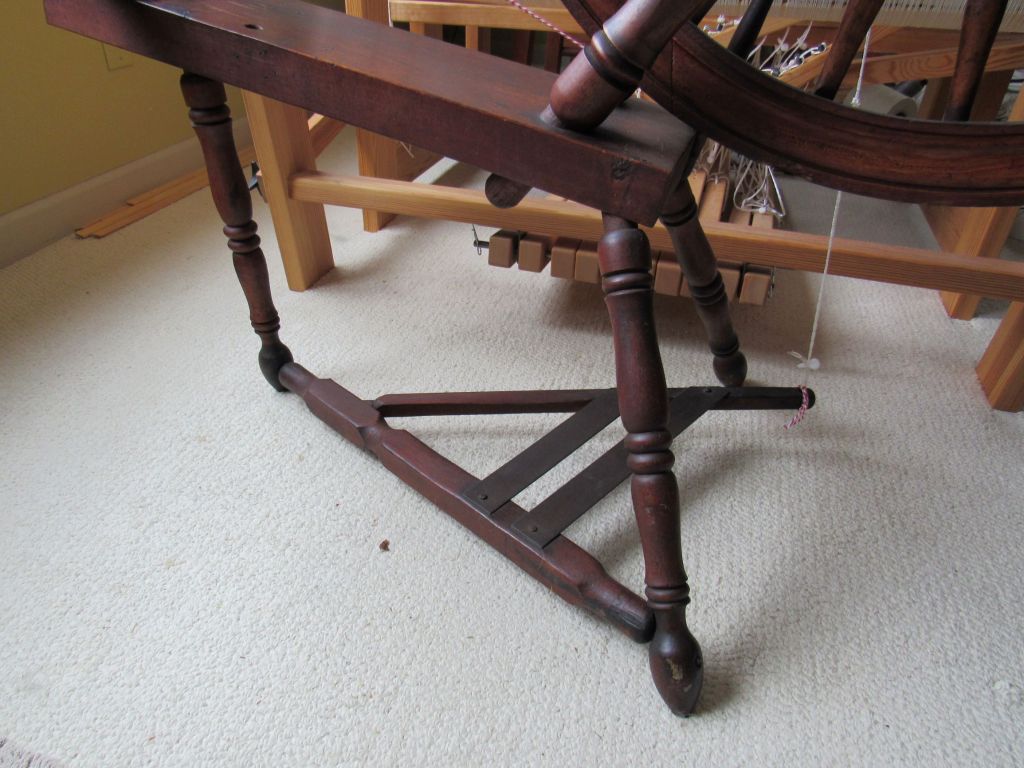
pear-shaped feet,
and “flying saucer” maidens.
Some wheels with these same features, however, have been found with a stamp by maker Michel Cadorette. The Laurence and Cadorette families were intertwined with family and wheel-making ties. So, as with so many wheels without a maker’s mark, we cannot know with certainty who made this one—likely a Laurence, but possibly Cadorette. In any case, she is quite a presence.
After spinning on her all winter, I am finally ready to move her on. She is going to a good home, where I hope she will give her new owner many more years of spinning pleasure. Much better than all those years sitting idle in a shed.
For more information on Laurence and Cadorette wheels, see:
Foty, Caroline, Fabricants de Rouets— this book and a photo supplement are available for sale as a downloadable PDF by contacting “Fiddletwist” by message on Ravelry.
This wheel is a lovely marriage (perhaps polygamous) of wheel parts—also known as a Frankenwheel. I prefer to think of it as a mélange or medley wheel, a hodgepodge of parts by different makers working together in harmony.
By the time they get to us, many Quebec wheels have replacement flyers or drive wheels. Even when parts were from different makers, there seems to be a happy interchangeability. Zotique is an interesting mix, with some unusual features. A Quebec wheel, with a drive wheel diameter of about 30 inches and a tilt tension system, it falls within the definition of a Canadian Production Wheel (CPW).
As with the wheel in the previous post, Zinnia Rue, the body of this wheel was almost certainly made by a Vezina. While Zinnia Rue likely was made by Ferdinand Vezina, this wheel appears to have been made by Ferdinand’s son, Antoine Emile, or Ferdinand’s younger half-brother, Charles.
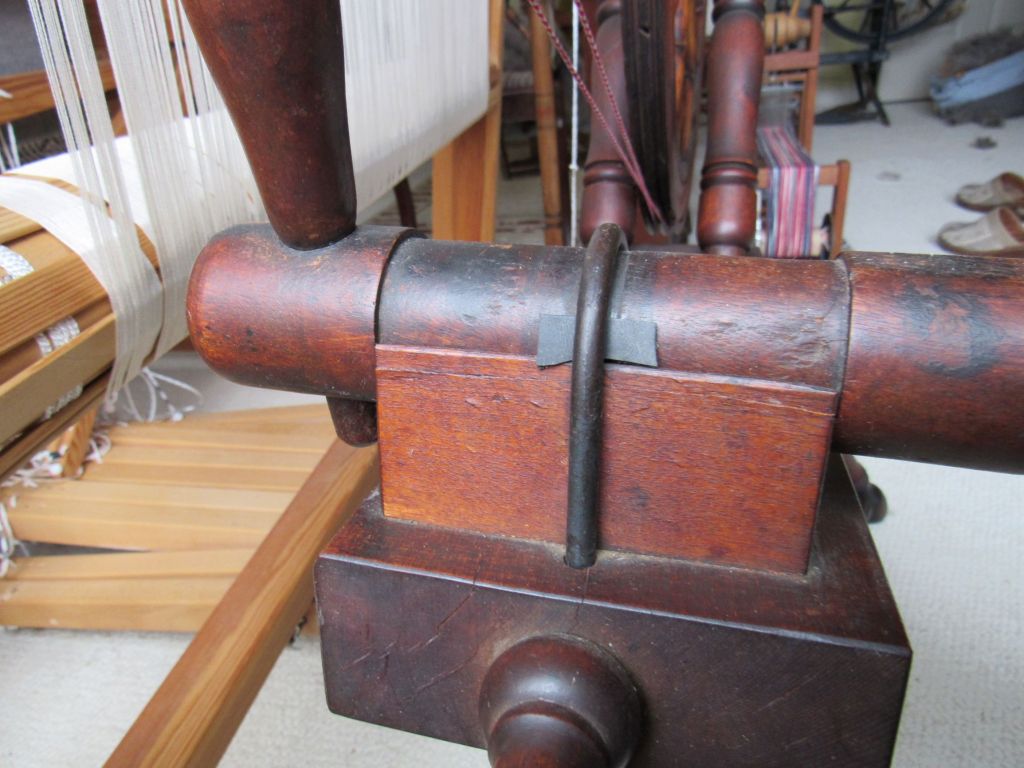
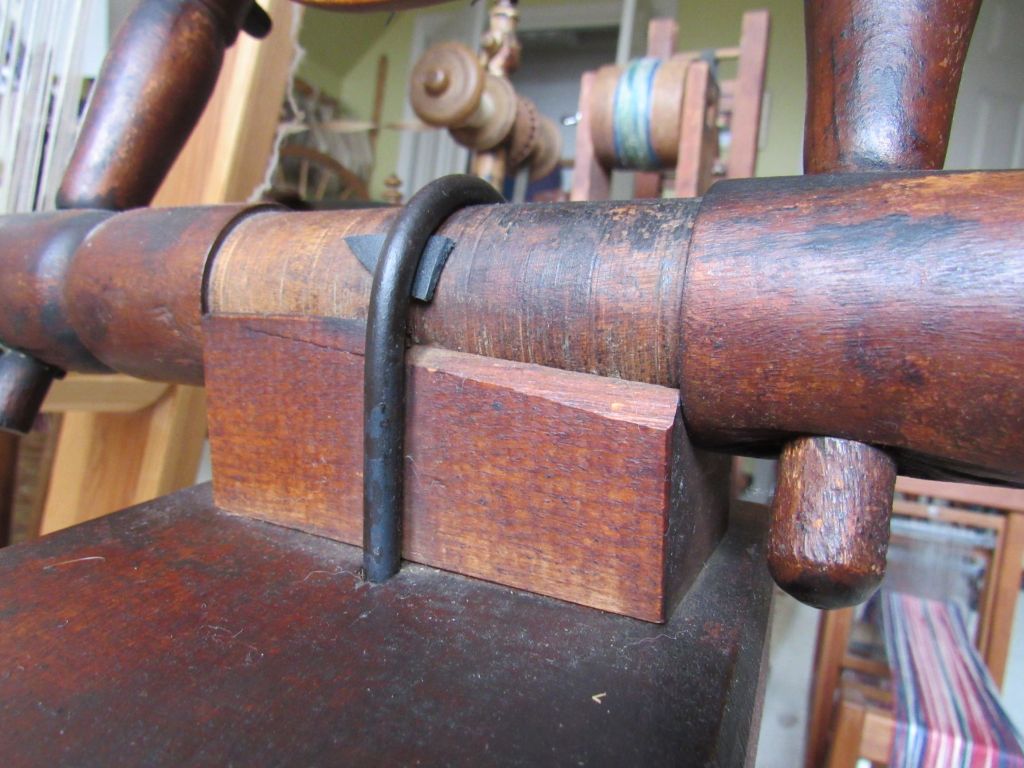
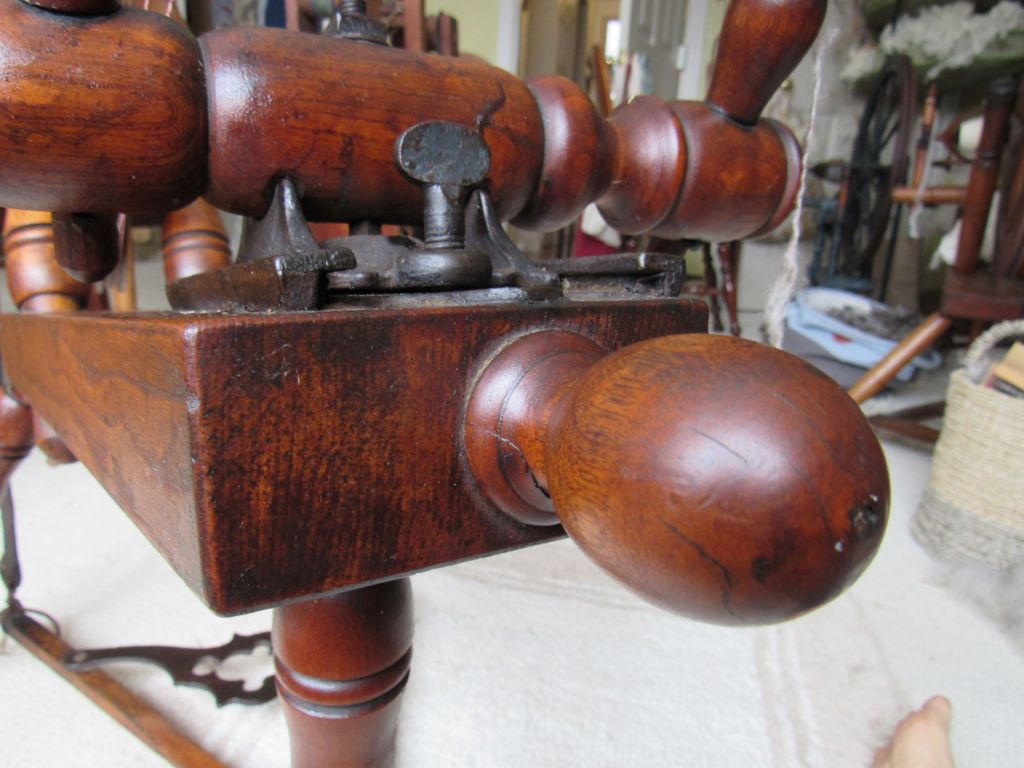
Both Antoine Emile and Charles made wheels with distinctive double metal-slat treadles and a tension system cradling the MOA in a block of wood held in place with an iron U-bolt.
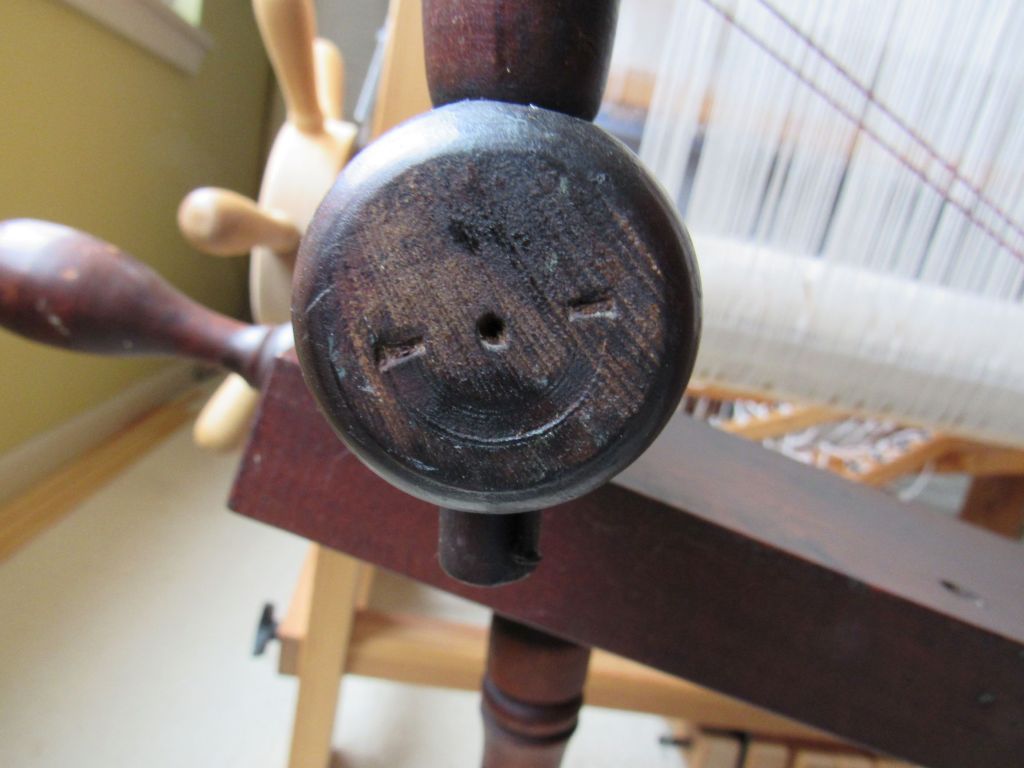
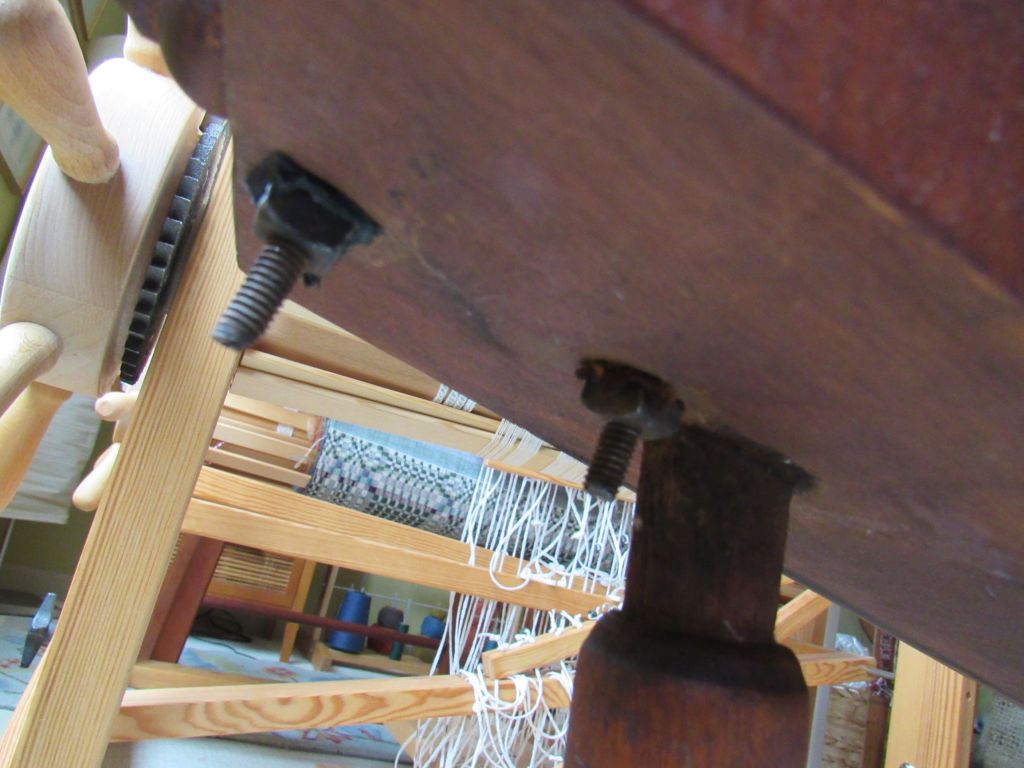
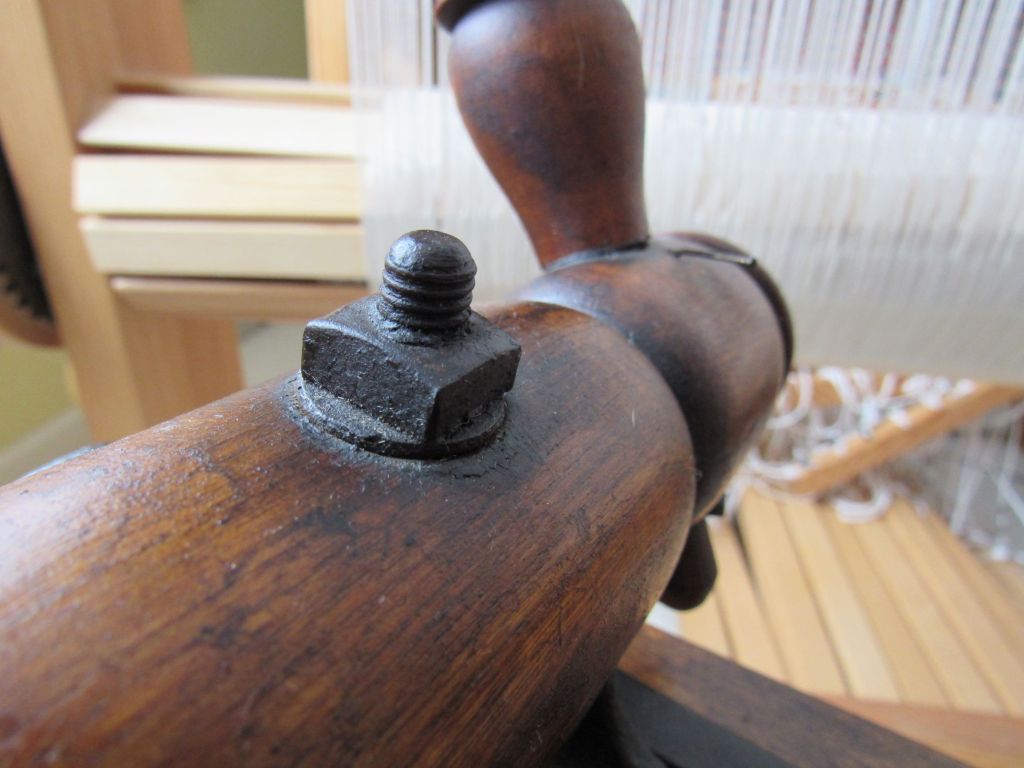
Chuck mark at one end of the MOAThe metal U holding the MOA is tightened with nuts underneath the table
While I cannot be sure which Vezina made this wheel, I am inclined to think it is Antoine Emile for two reasons. First, he apparently marked his wheels with a paper label on the table, whereas Charles marked his with a stencil. I cannot find any trace of a stenciled mark on this wheel, but there are marks on the table that look as if a paper label, or remnants of a label, were scraped off at some point.
In addition, Antoine Emile’s wheels often had metal flyer bearings—he apparently was inclined to experiment. While this wheel does not have metal flyer bearings, it has something even more unusual—wooden bearings.
I have only heard of these on a handful of wheels, so they likely were experiments.
The bearings are screwed into the maidens.
The rear bearing has a hole in the top and there has been some speculation that it may have been designed for oiling the bearing.
On this wheel, however, the hole does not go through to the opening for the flyer shaft, so, unless it is really gunked up, that theory is out the window.
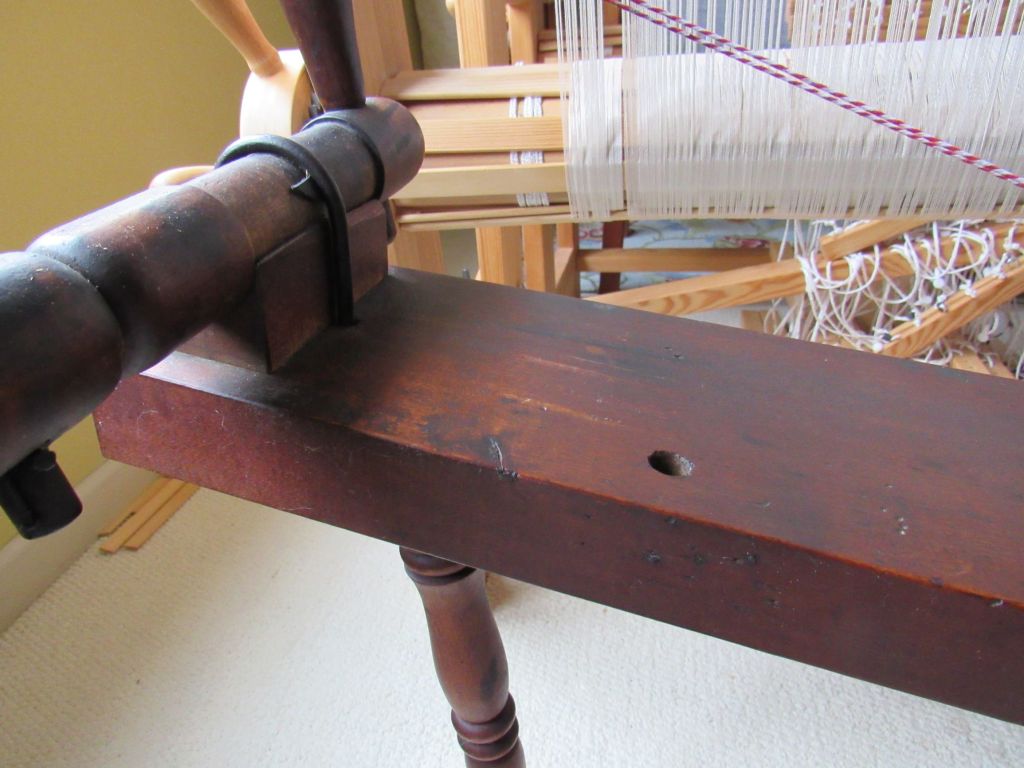
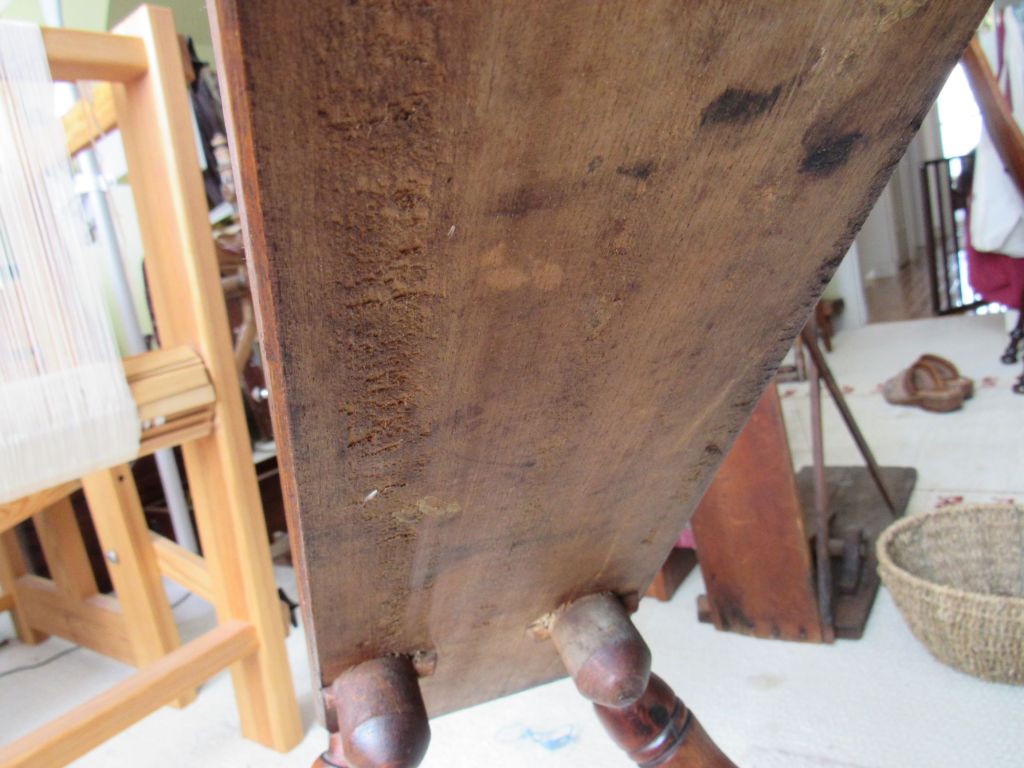
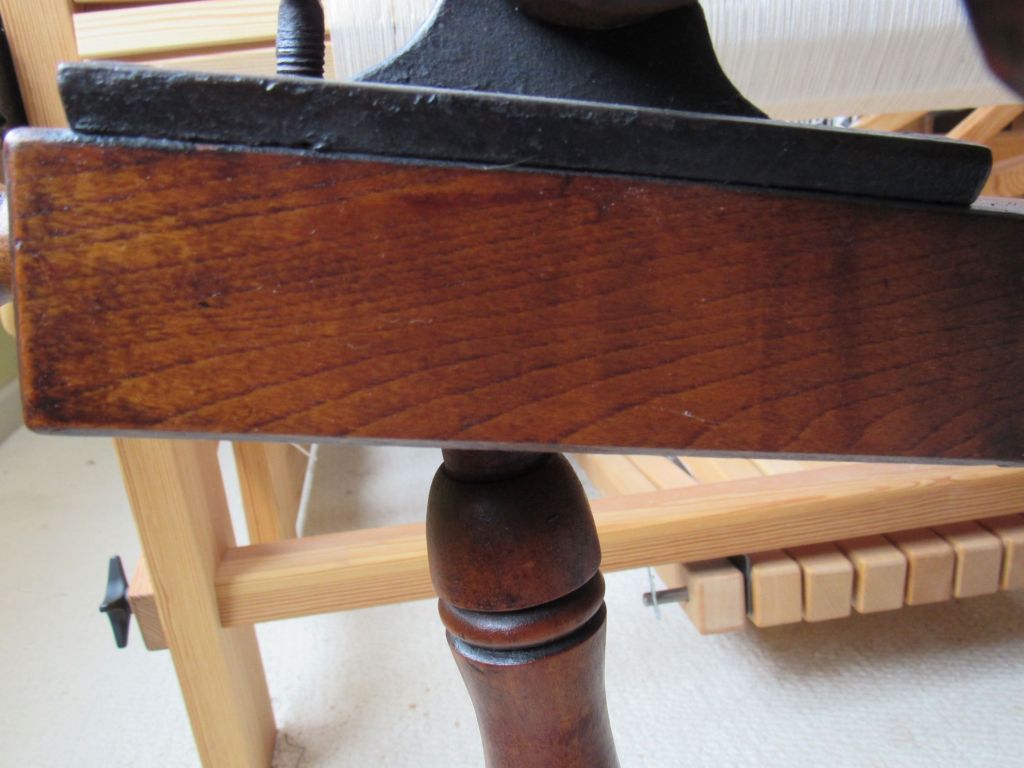
The wheel has only one secondary upright support, on the non-spinner side. The table is slightly tapered and has a hole going all the way through.
These holes are found on some Quebec wheels, but most do not have them. The obvious use for the hole would be for mounting a distaff or a water dish for spinning flax. Although flax was grown and spun in Quebec, it was not widespread, especially by the time that this wheel was manufactured in the early 1900s (Antoine Emile patented this wheel style in 1899). In fact, these wheels were designed and singularly suited for spinning wool, fine and fast–not flax. Moreover, I am not aware of any photographs showing flax spinning or distaffs on a tilt tension Quebec wheel. So, the hole remains a bit puzzling.
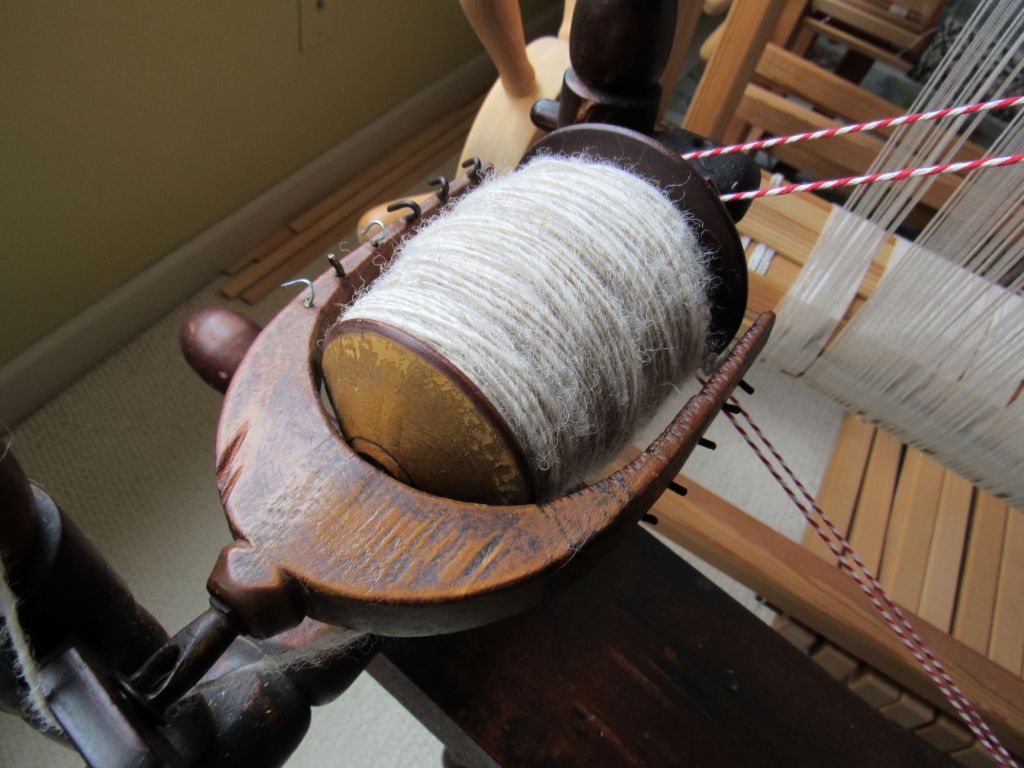
At some point, the original flyer was lost and replaced with this mustard-yellow painted flyer, which likely came from an Ouellet or Paradis wheel.
It has a smooth bell-shaped orifice and has spun many miles.
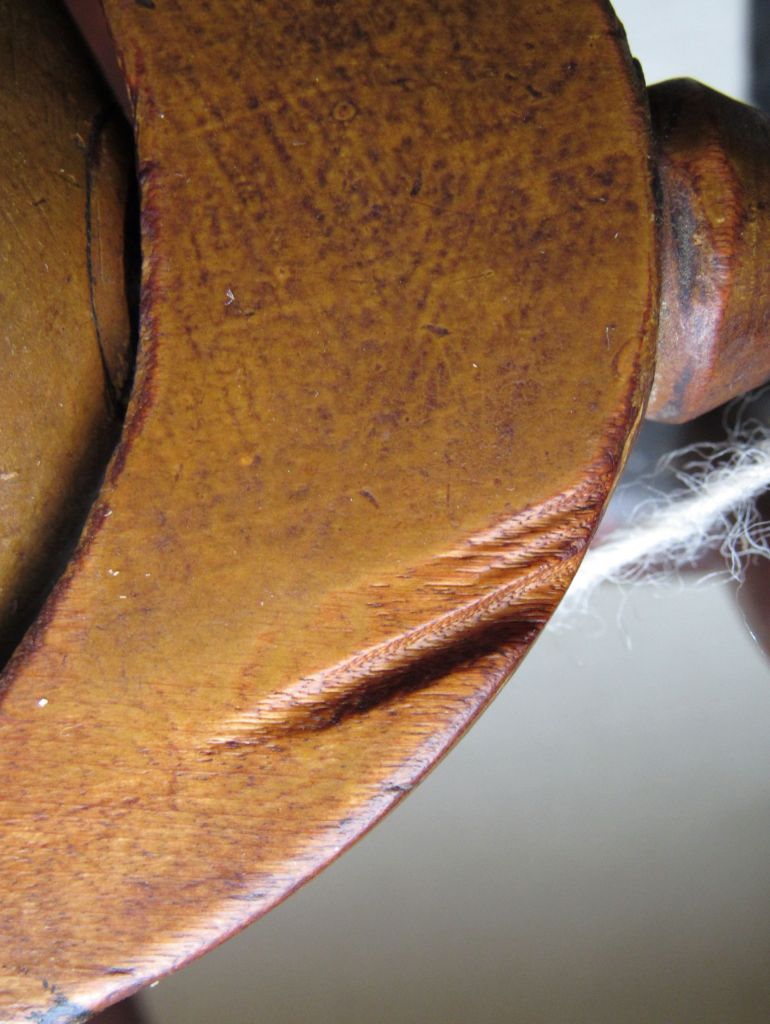
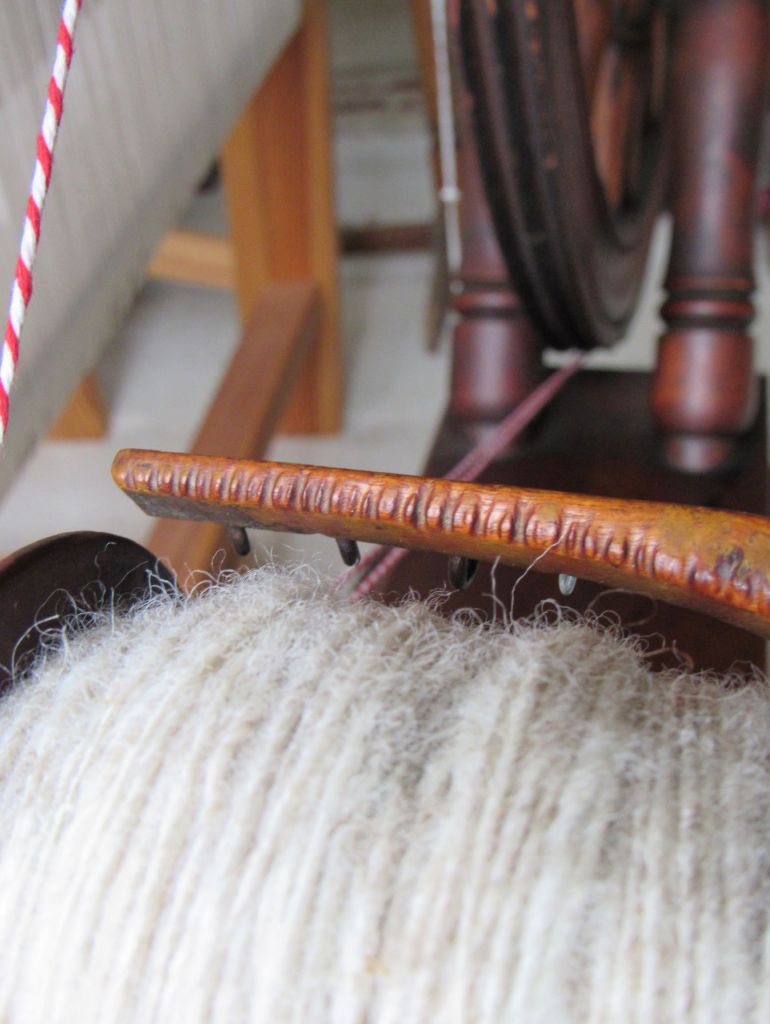
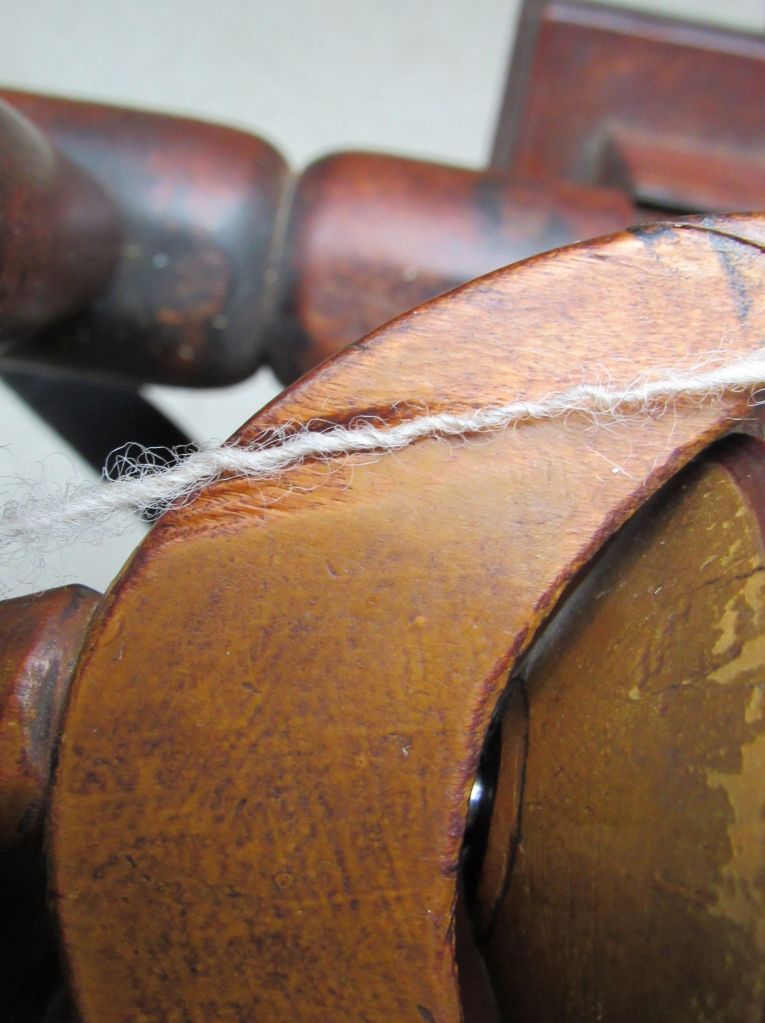
There is a deep groove where the thread ran from the orifice to the hooks and a series of grooves on the edge of the flyer arms.
While grooves running from the orifice are common and easily explained, many Quebec flyers do not have grooves on the arm.
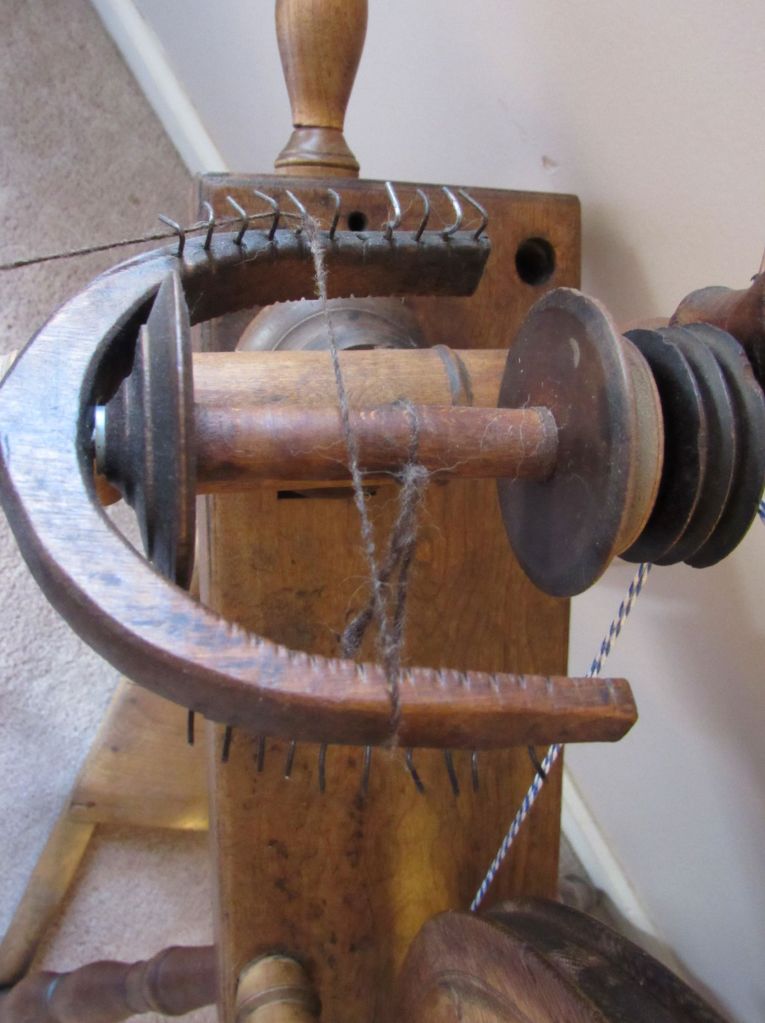
You see them a lot on New England and Nova Scotia wheels, but less often on Quebec wheels. The origin of these grooves is a source of debate. The two most prevalent theories are that they are the result of cross-lacing or winding off. In cross-lacing, yarn is passed from hooks on one side of the flyer to the other, which helps control the speed of the uptake, allows for more uniformity of finely spun yarn, and—with linen—helps to even out the ridges that are formed on the bobbin as the thread piles up at the point of each hook.
An example of cross-lacing on another wheel
I am no expert on cross-lacing—I do not use it at all. And I do not know how common it was for Quebec production spinners. But on almost all of my flyers with arm grooves, the grooves seem to be on the wrong edge to have been made by cross-lacing, as I understand it. If I have this wrong, I hope someone will correct me.
With cross-lacing, the thread makes contact with the outside edge of the arm, not the inside.
On the other hand, the grooves are on the edge that would have been impacted by winding off. Most antique wheels did not have multiple bobbins and thread was wound off onto a reel when the bobbin was full. In winding off, many spinners ran the thread around the tension screw handle on the way to the reel. With most wheels, an arm comes to rest against the thread as it heads to the tension screw.
The thread usually rubs against the inside of the flyer arm at a pretty good rate of speed, moving along the length of the bobbin as it winds off.
I suspect this is what caused the grooves, but without more evidence, it is just speculation.
In this close up, you can see the thread running through the groove.
Still, it is interesting that when Quebec wheels evolved to tilt tension, the tension knobs remained, perhaps not only as a handle for carrying, but as a tool for winding off. I have several Nova Scotia wheels where heavy flyer arm grooves are matched by heavy grooves in the tension knob. This wheel does not have grooves on the tension knob, but I would love to see if there are grooves in the tension knob on this flyer’s original wheel.
This wheel’s graceful, outsized drive wheel also is a bit of a mystery.
In general on Quebec wheels, spokes are a defining feature for different makers. But this wheel’s relatively plain spokes do not seem to be associated with any particular maker.
The edges are angled at the rim to fit against a ridge and are nailed on the other side.
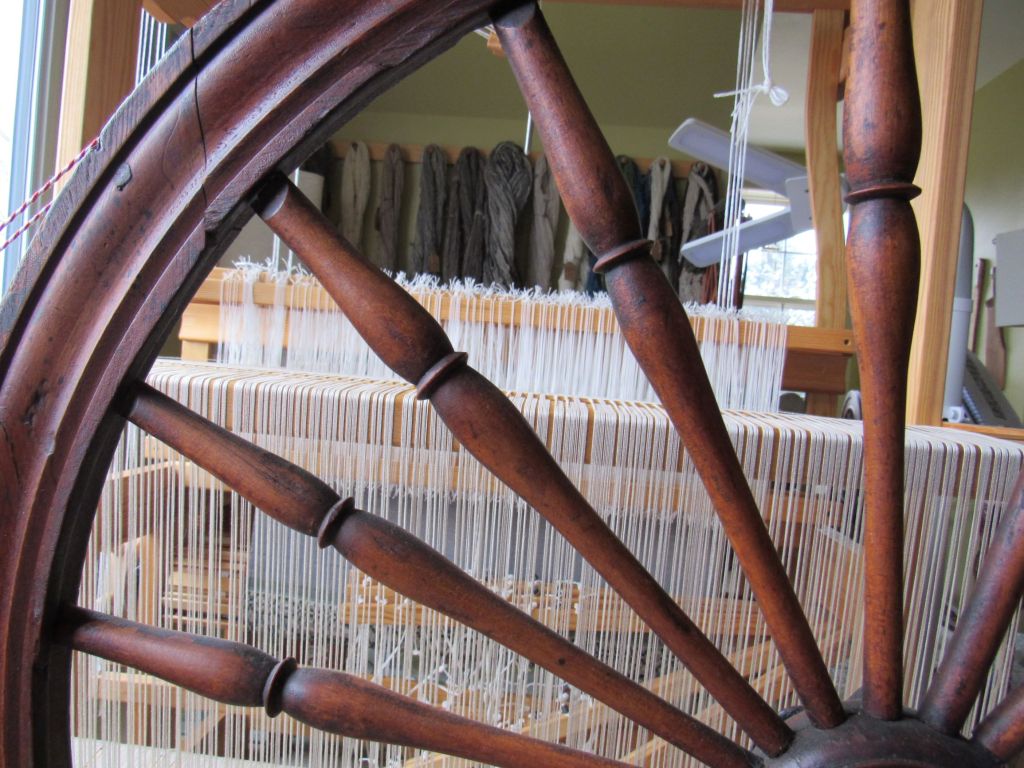
They are not very common, but turn up here and there on various makers’ wheels, sometimes with an unusually large number of spokes–16 or 18 compared with the more typical 12 or 14. This one has 18 spokes—quite beautiful and rarely seen.
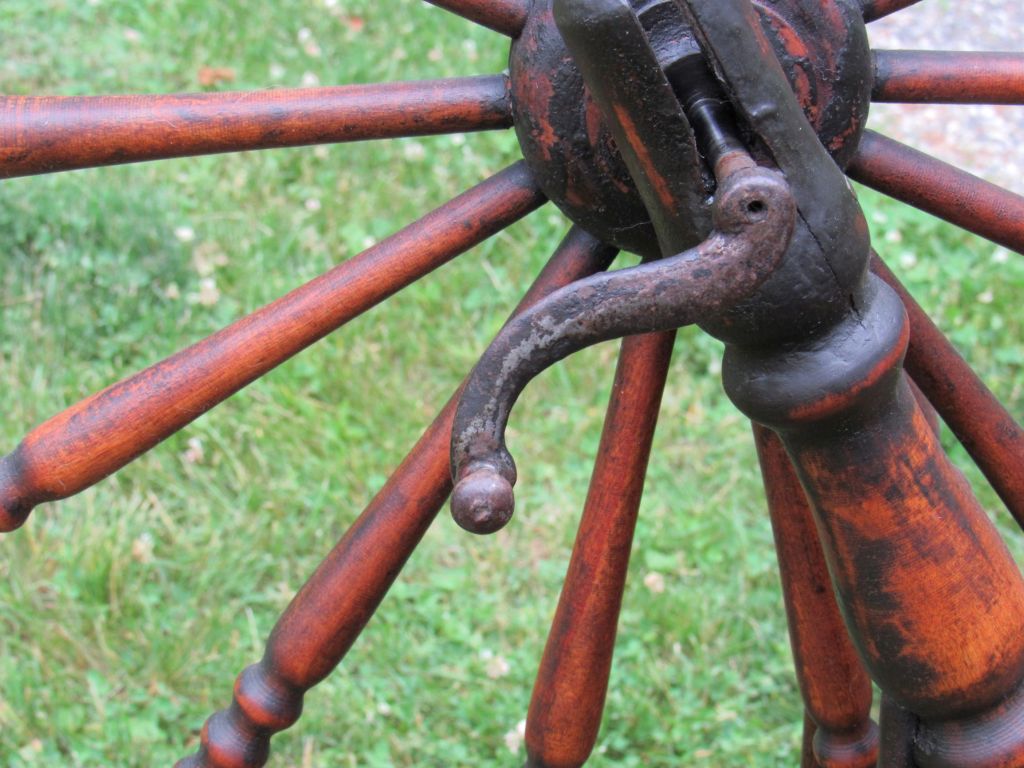
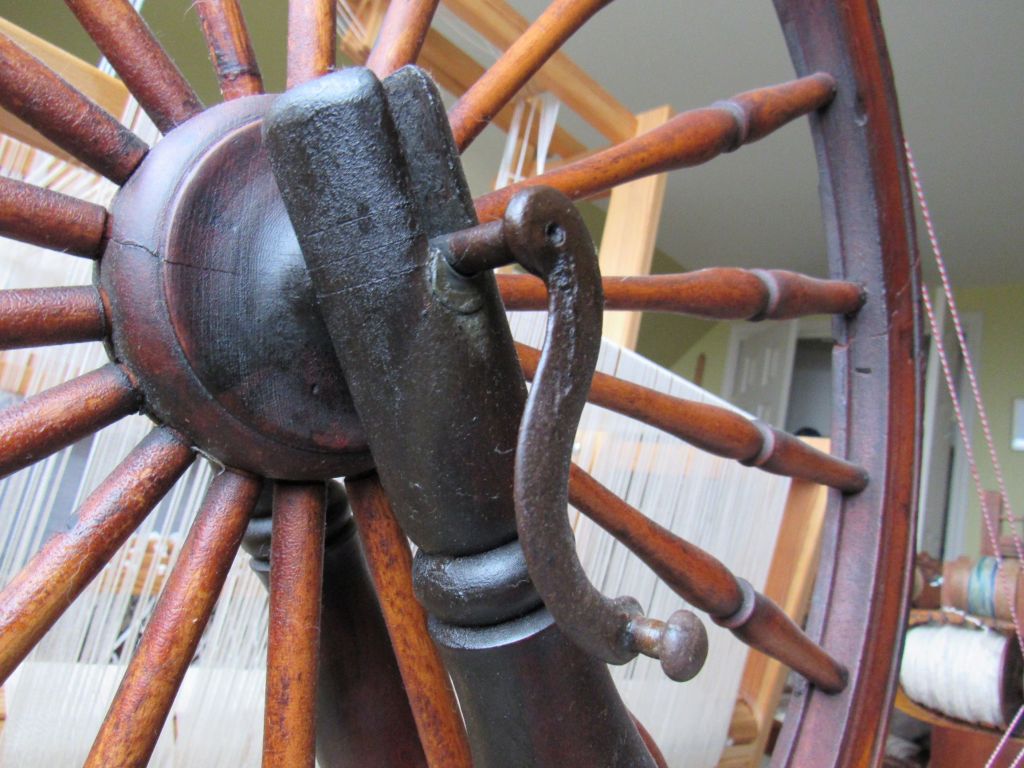
The axle crank is “S” shaped, which is less common than “C” shaped cranks, and often associated with Laurence wheels.
I have wondered if these drive wheels might have been manufactured by Laurence (or someone else) to be available as replacements. The simple spokes would not clash with different maker’s wheel styles and having 16 or 18 spokes and an S crank might have been seen as a lovely upgrade feature.
But, that is purely speculation. Oddly enough, both of my Vezina wheels have this style spoke (but with different crank styles), and the drive wheels appear to match the rest of the wheel’s wood and finish, so perhaps they were occasionally offered by the Vezinas.
As with many mélange/Franken wheels, this one is a wonderful spinner.
I enjoy this style of metal treadle—it has some give to it, making it very responsive and easy on the foot.
The wheel is beat up, with some chips,
especially along the drive wheel rim.
But, with its size, 18 spokes, wooden flyer bearings, and yellow flyer, it stands out as a unique and striking survivor.
January 25, 2021 update: In pondering whether this style drive wheel may have been sold as a replacement wheel, I found this advertisement for spinning wheels sold by Dupuis Freres, a major Montreal department store that sold wheels as late as 1948 (mostly made by Borduas). The advertisement offers drive wheels only, or “Roue seule,” so this establishes that replacement wheels were sold as separate items.
For much more information on Antoine Emile and Charles Vezina see Caroline Foty’s book and photo supplement:
Foty, Caroline, Fabricants de Rouets— this book is available for sale as a downloadable PDF by contacting “Fiddletwist” by message on Ravelry.:
All of the wheels I have documented so far have been from New England—specifically Connecticut and Maine. But many of my favorite wheels are Canadian. I have wheels from Ontario, Quebec, Nova Scotia, and Prince Edward Island. They differ hugely in style, but every single one is a splendid spinner.
Probably the most widely known Canadian wheels are from Quebec and now commonly referred to as “Canadian Production Wheels” or CPWs. Caroline Foty, in her book about these wheels, “Fabricant de Rouets,” defines them as double-drive saxony-style wheels with very large drive wheels measuring 27-30 inches in diameter, and having a tension mechanism (usually with metal components), which tilts or slides along the table rather than the more typical wooden screw tension system.
The general time of manufacture was 1875-1935, a period of innovation in wheel design in an attempt to make home spinning more productive and efficient. And CPWs were productive–wonderfully suited to spinning wool fast and fine. But the wheels that fall within the CPW definition are not the only Quebec wheels designed for fast production. Many of the wooden screw tension wheels are extremely fast spinners–some have drive wheel diameters larger than any CPWs, and others have two drive wheels for accelerated speed. So, another way to more precisely categorize Quebec wheels, is: screw-tension, tilt-tension, slide-tension, accelerated, and flat-rim (which sometimes have screw tension and sometimes scotch tension).
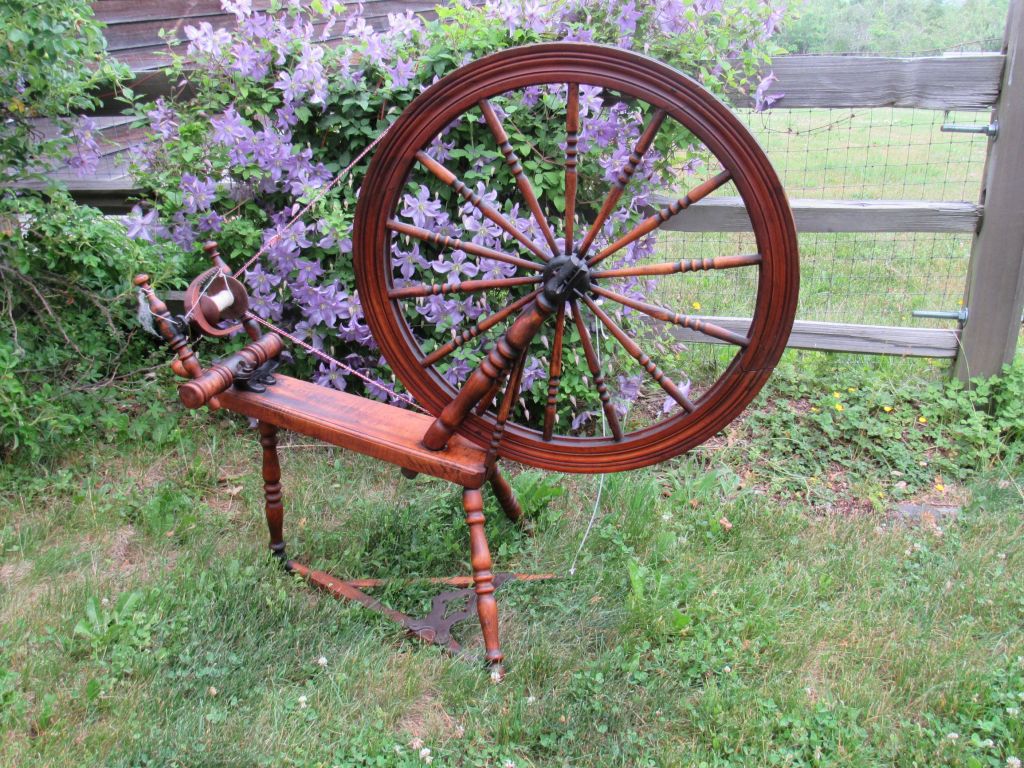
Zinnia Rue is a Quebec slide-tension wheel. Her drive wheel is smaller than most CPWs, at just 26 inches.
She appears to have been made by Ferdinand Napoleon Vezina (1841-1898) of Vercheres, Quebec, who likely developed this tension system. Faint remnants of his “F.N. Vezina Vercheres” stamp on the wheel’s table can just barely be discerned.
Trust me, you can make out bits of the mark.
Ferdinand was part of a family of wheel makers, carpenters, and inventors, including his uncle Joseph, brothers Pierre and Charles, nephew Polycarpe, and son Antoine Emile. Their last name was variously spelled Vezina, Visina, and Vesina (seeFabricants de Rouet, pp. 96-110, for extensive information on the Vezina family).
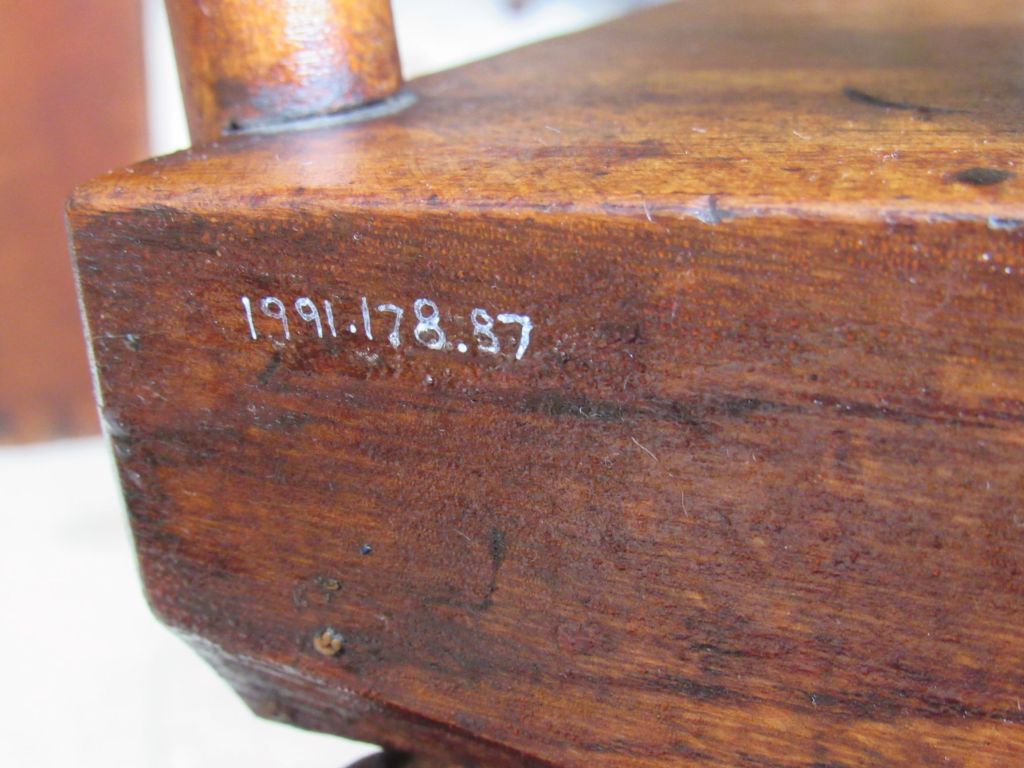
This beautiful wheel was part of Joan Cummer’s collection. It is wheel No. 87 on page 190 of her book, and in its description, she notes that it is slightly smaller than the usual “Great Canadian” wheels—her term for CPWs. Cummer purchased the wheel from an Antrim, New Hampshire antique dealer and later donated it, along with the rest of her collection to the American Textile History Museum.
It was put up for auction after the museum closed, when I purchased it and brought it home. There were two Cummer Quebec wheels up for auction that night and I was intending to bid on the other one. But when my foot met the treadle on this one, to see if the wheel turned true, I was immediately drawn to it. It is funny how some wheels don’t speak to me at all and others suck me right in. This wheel is a wonderful spinner and I am hoping to pass her on to a friend who has been looking for a CPW and will give her a good home.
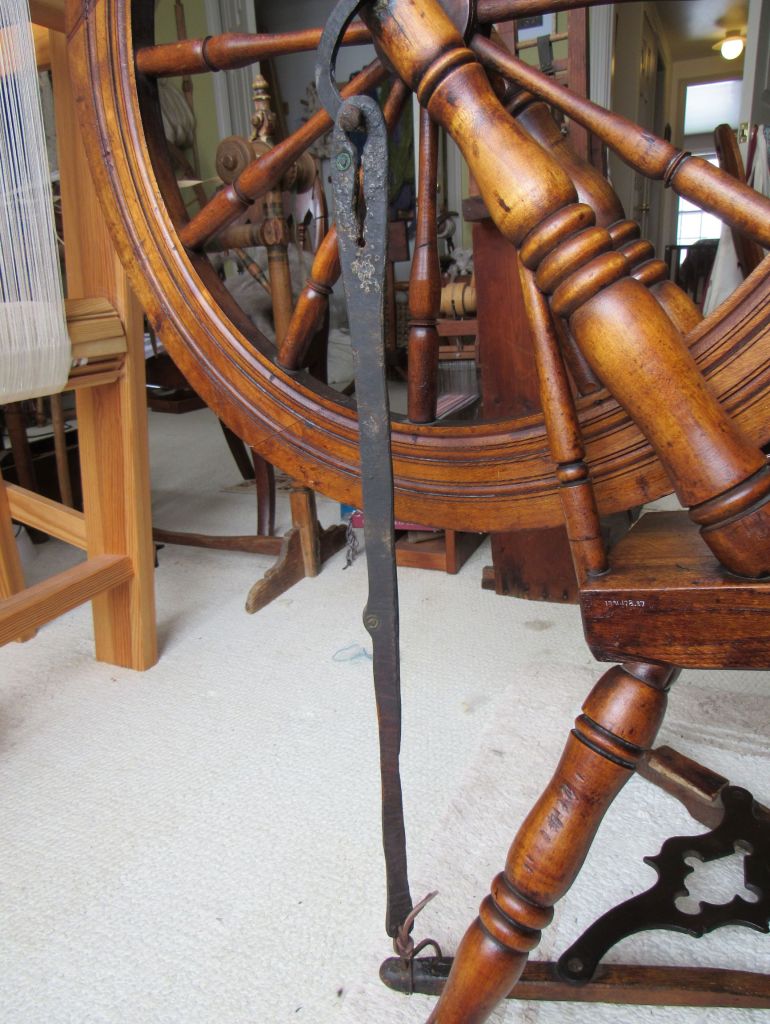
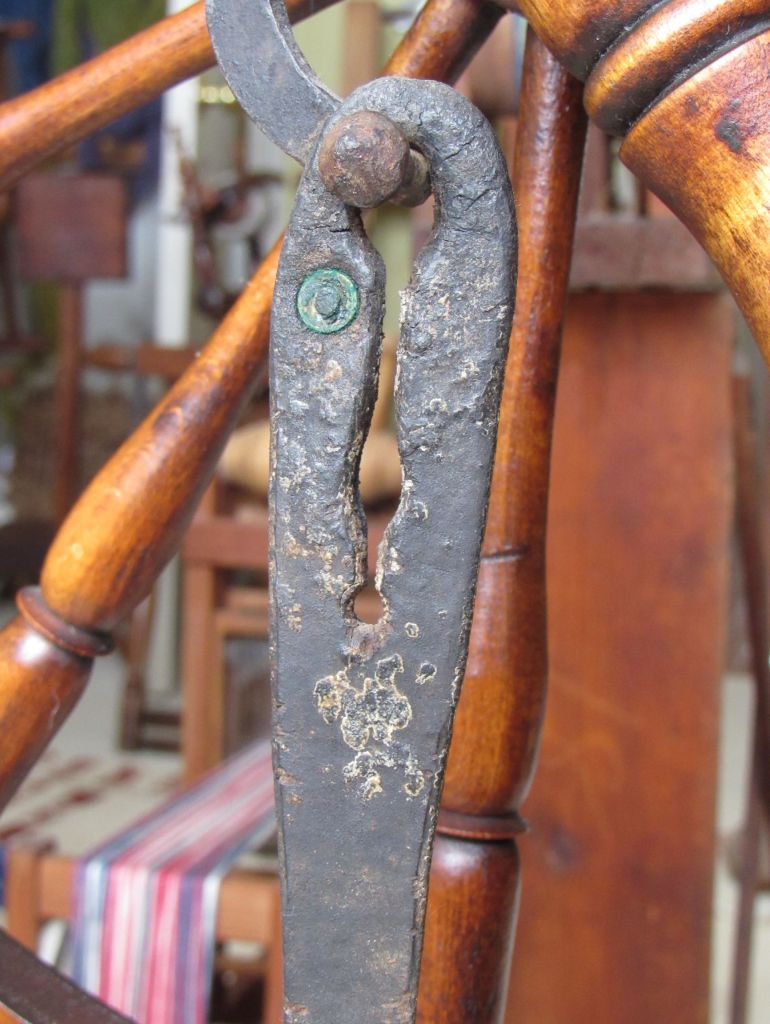
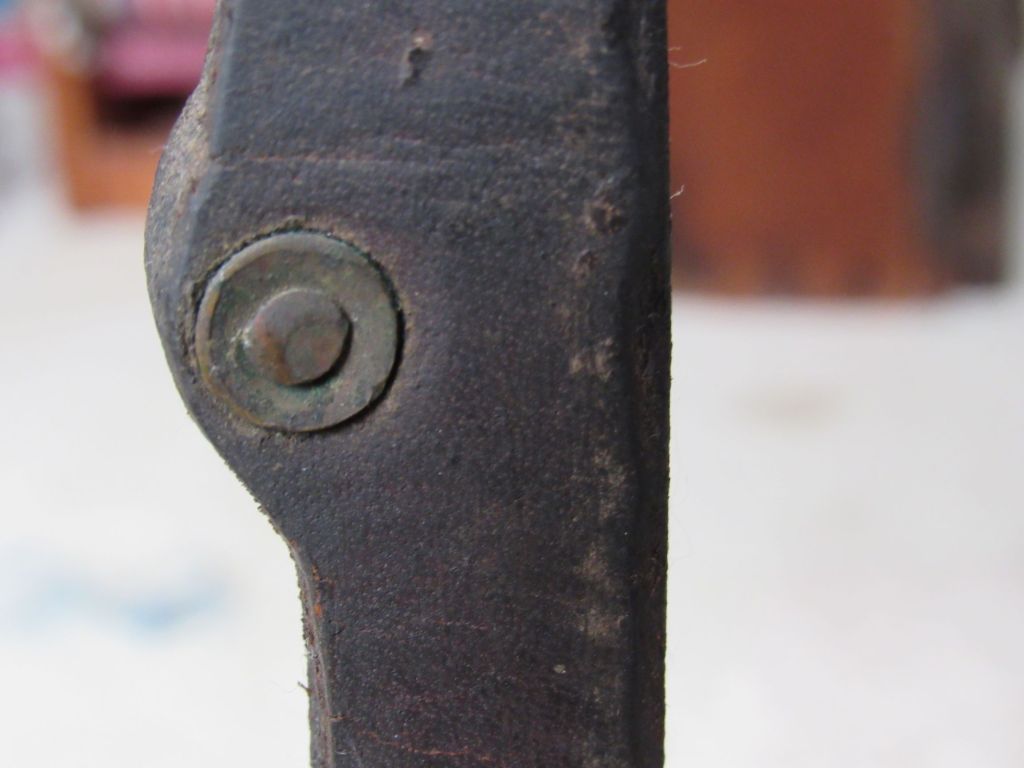
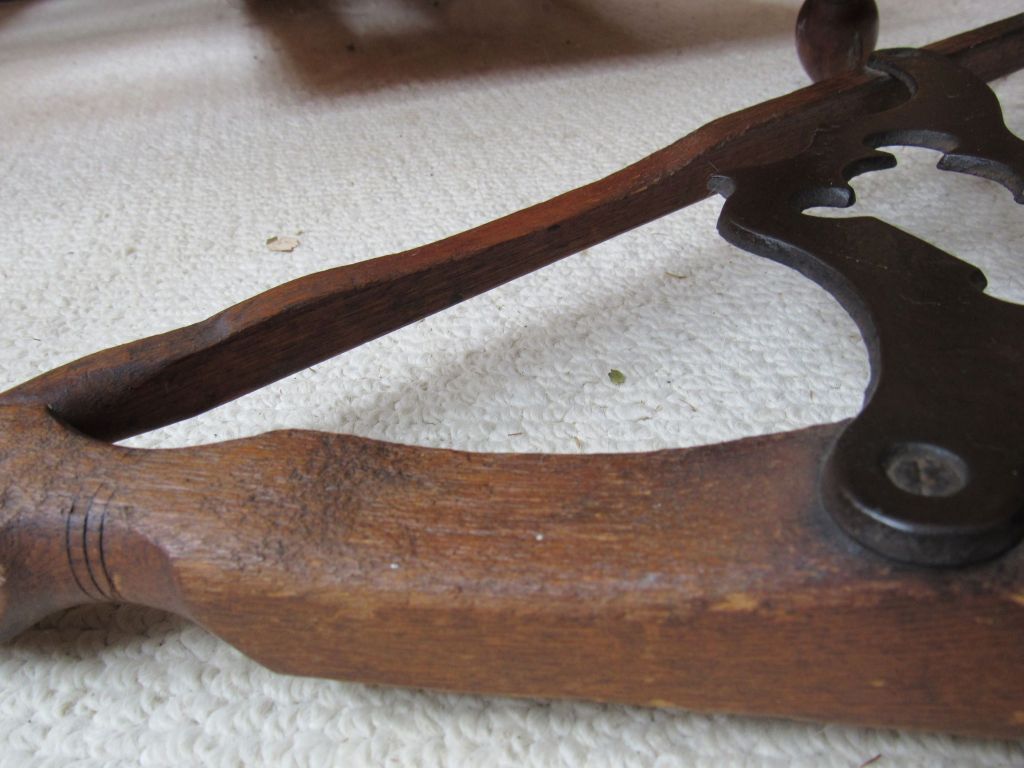
She has the common fleur-de-lis style metal treadle and a leather footman
with old greenish (copper?) rivets,
which perhaps was part of a harness originally.
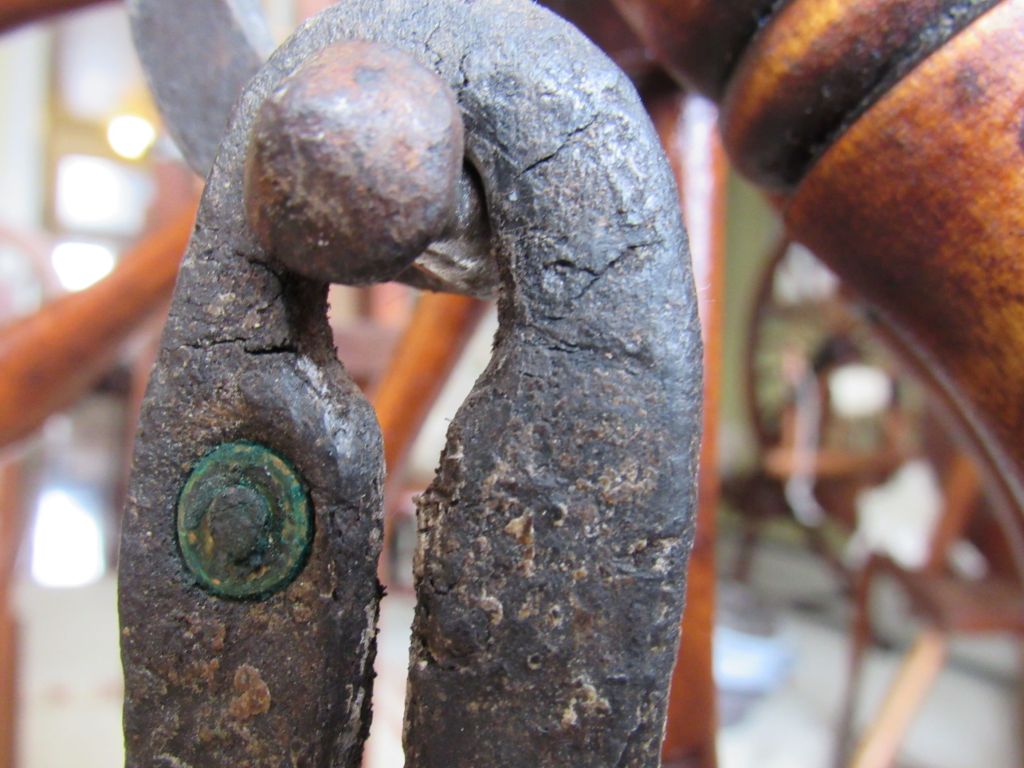
The footman is attached to a to a loop in a wire twisted around the treadle bar.
The front axle bearing has the color and texture of lead,
but the back one is more yellowish.
The flyer was broken and glued and repaired (I since added some metal plates, as back up to the glue) but the arms, interestingly, do not have any wear lines on them and the hooks are in great shape.
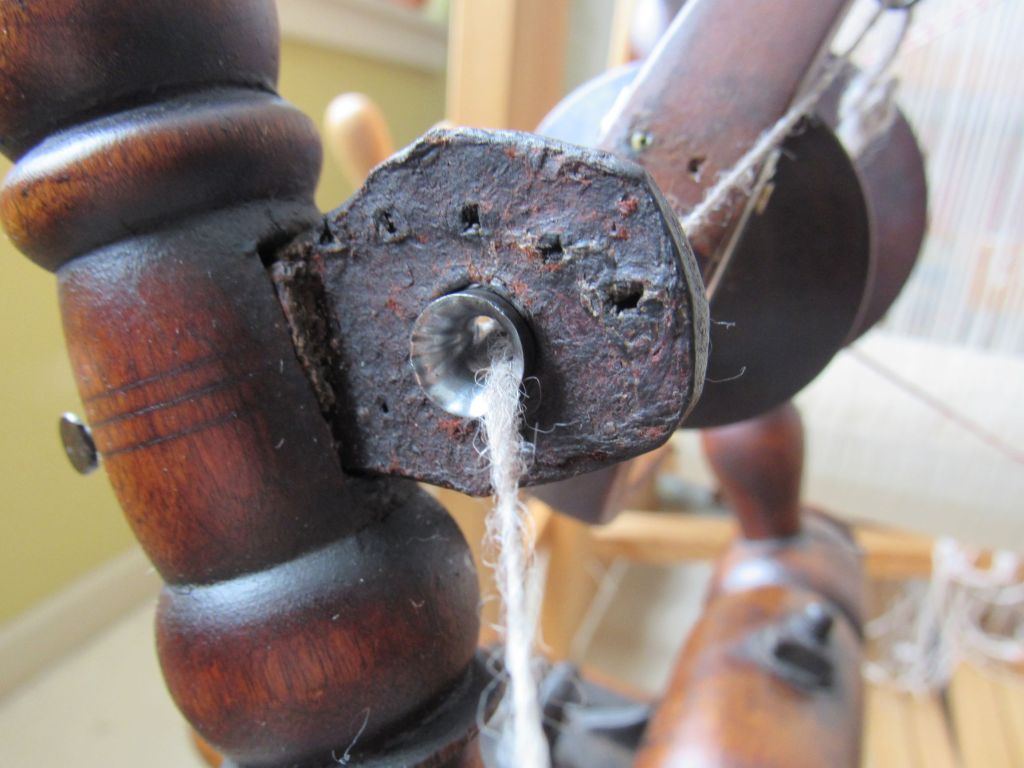
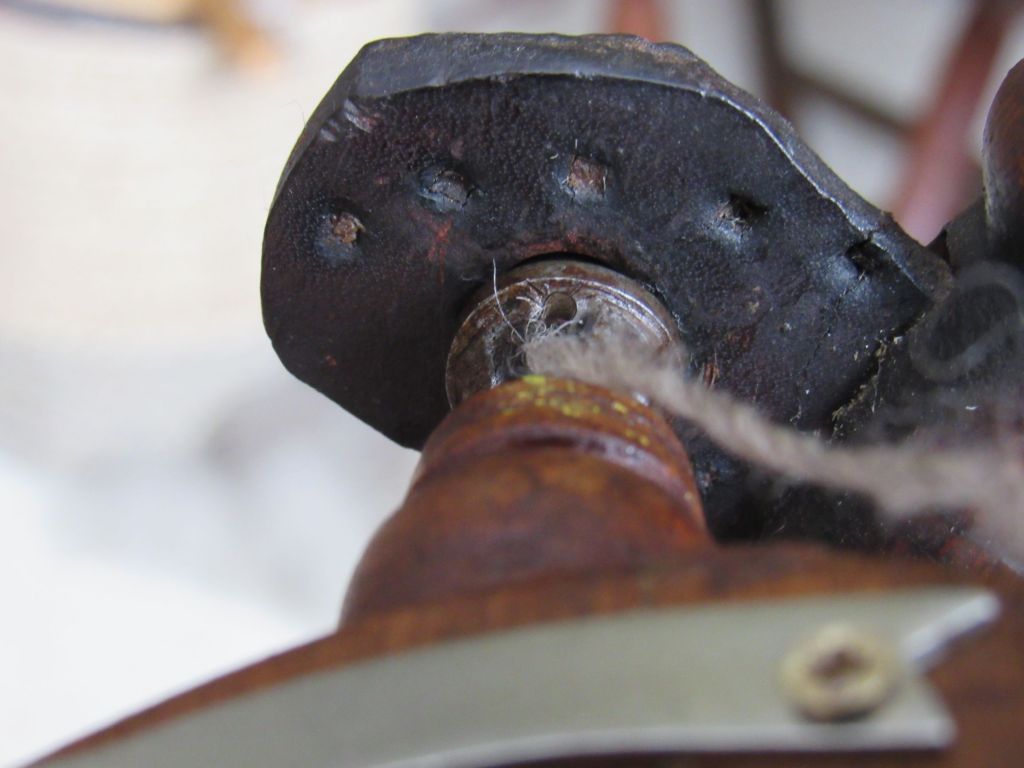
The orifice does, however, show wear with some deep grooves where the yarn emerges.
The orifice is bell-shaped and fluted, something seen on many Canadian wheels.
There has been debate about the fluting, with some people arguing that it is a result of wear. On my wheels, the bell shape and fluting go together and appear to be a deliberate manufacturing feature. Wear, as with the deep groove in this wheel’s orifice, looks different to my eyes.
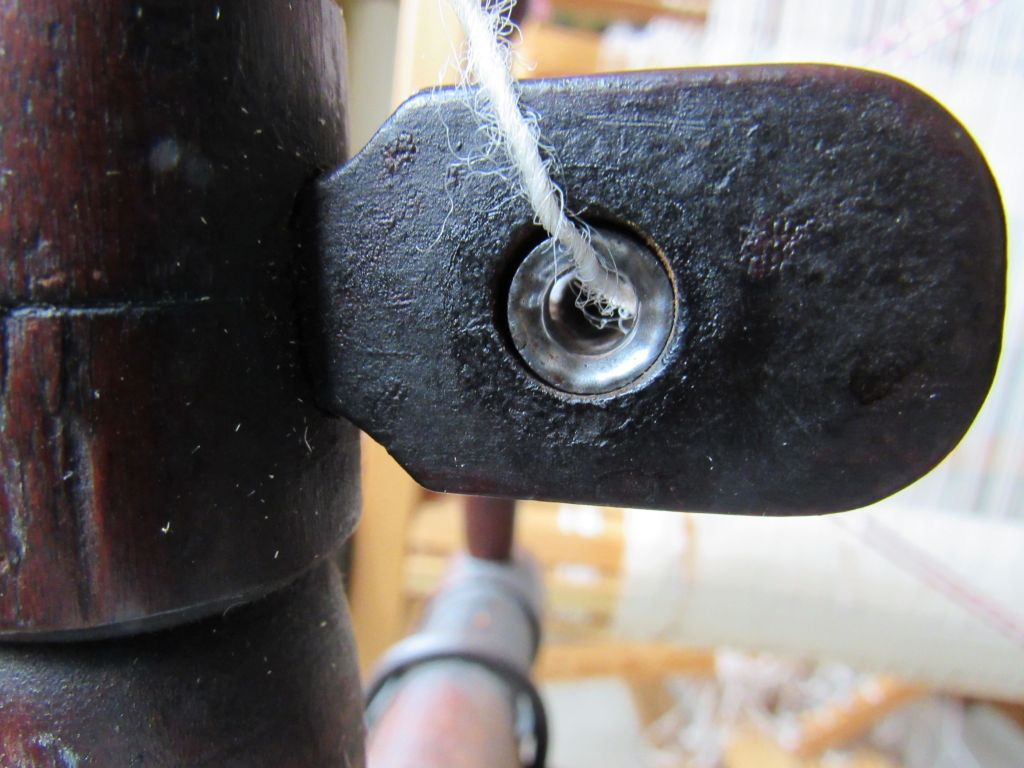
This indentation in the orifice is where the yarn runs coming out to the arms. It appears to be from constant wear.
The treadle bars also show lots of wear, indicating that the user probably used both feet to treadle.
There is an added wooden piece on the treadle bar.
I’m not sure if it was intended to elevate the foot or if it had some other purpose.
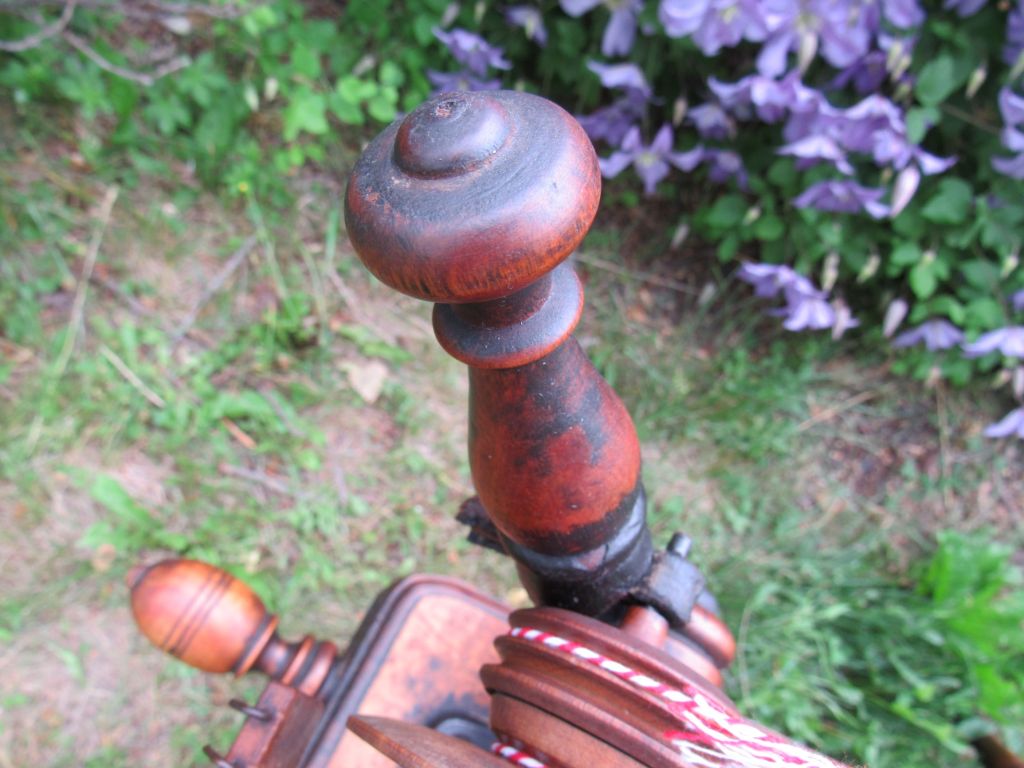
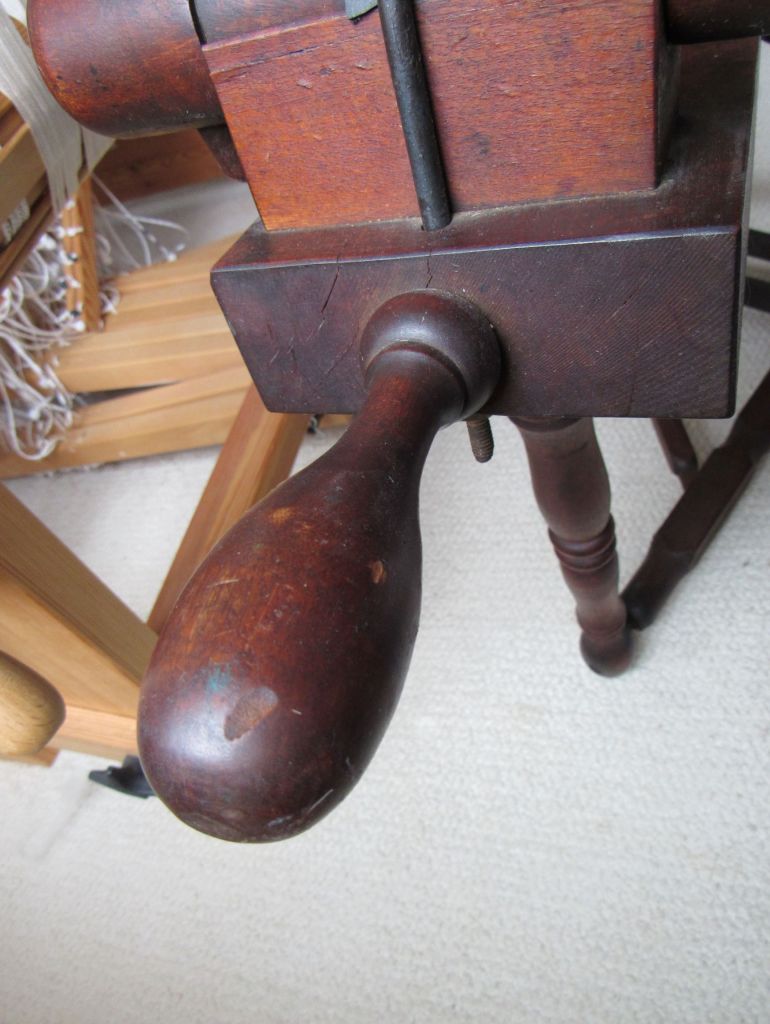
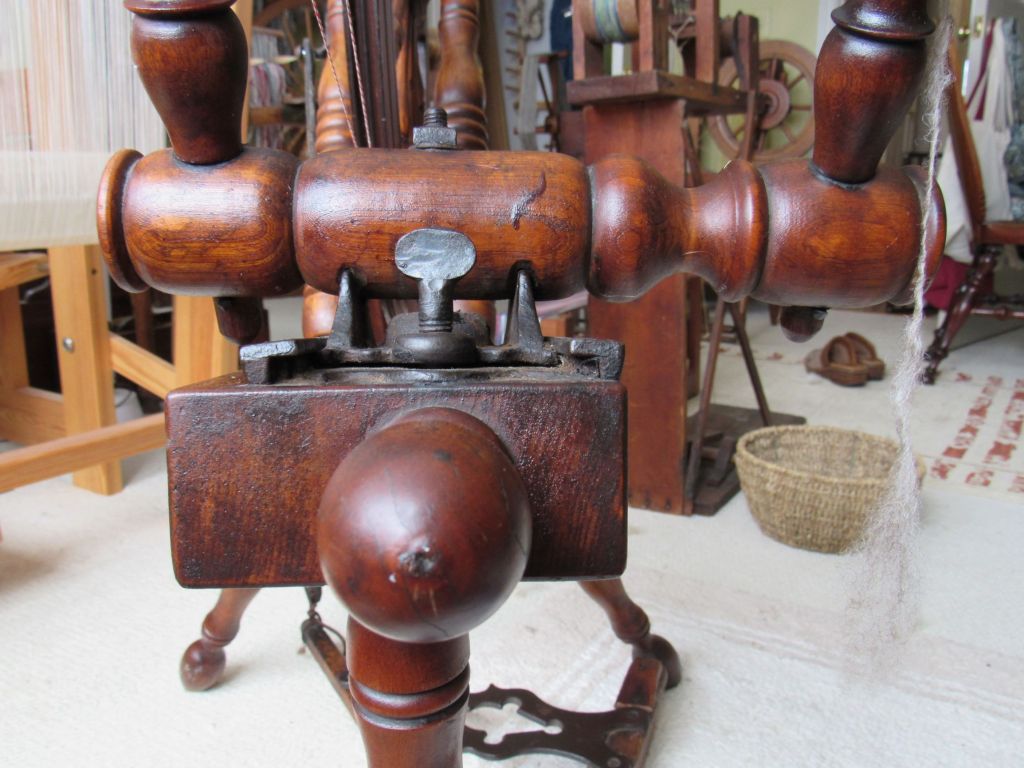
While the slider and tilt tension wheels did away with the need for wooden tension screws, they retained a sort of residual non-functioning screw that serves as a handle to pick up and carry the wheel.
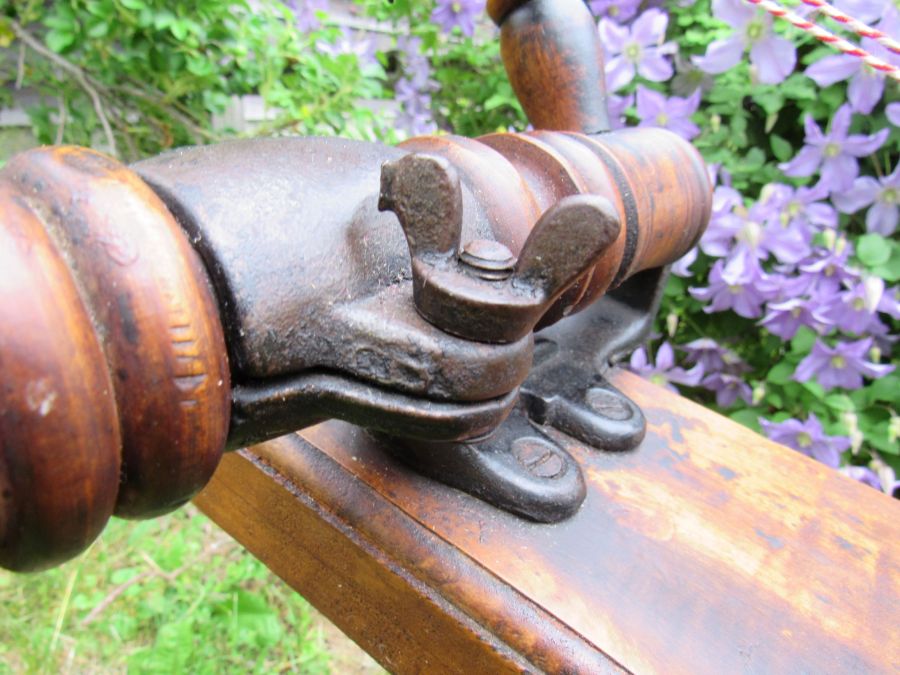
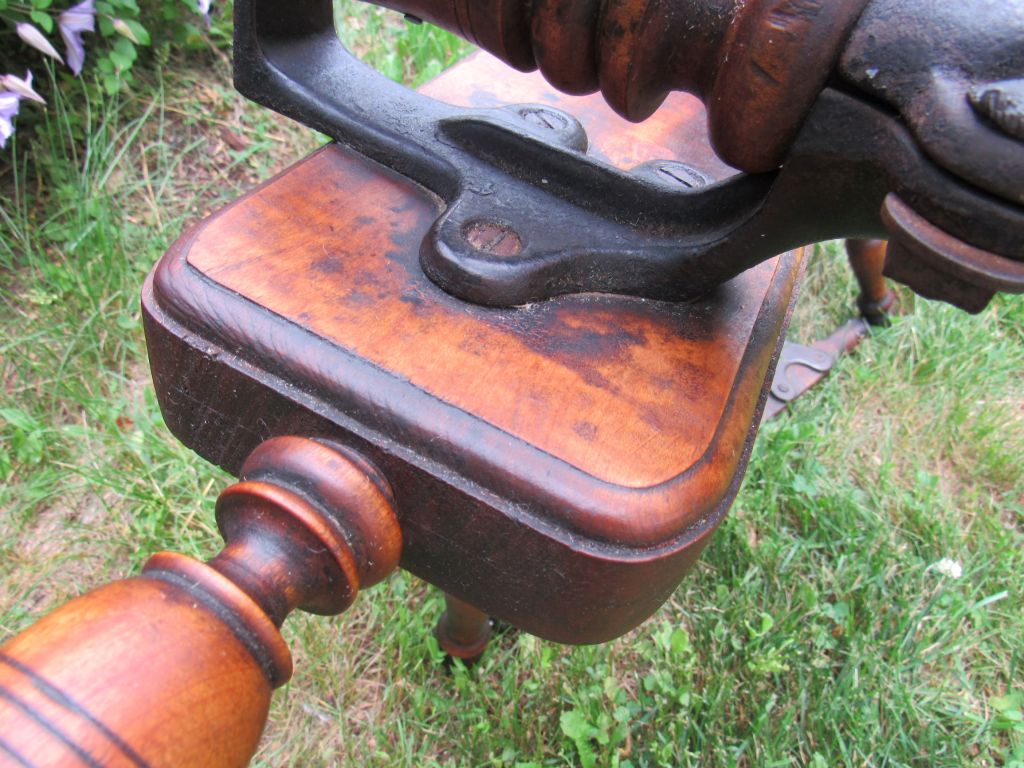
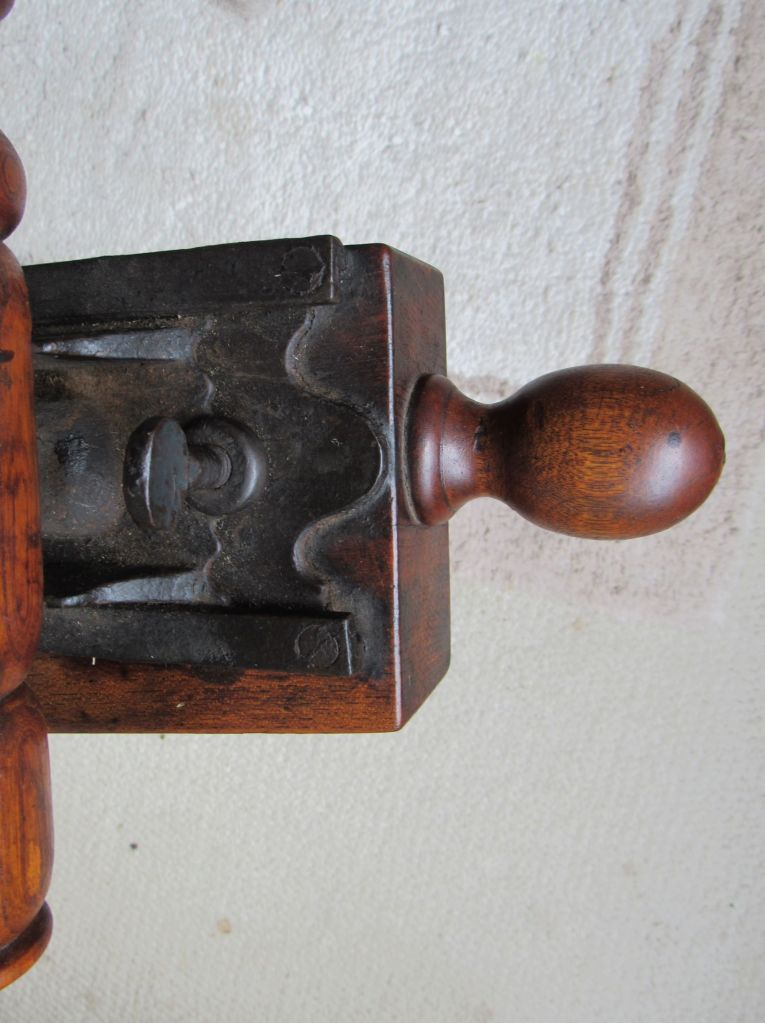
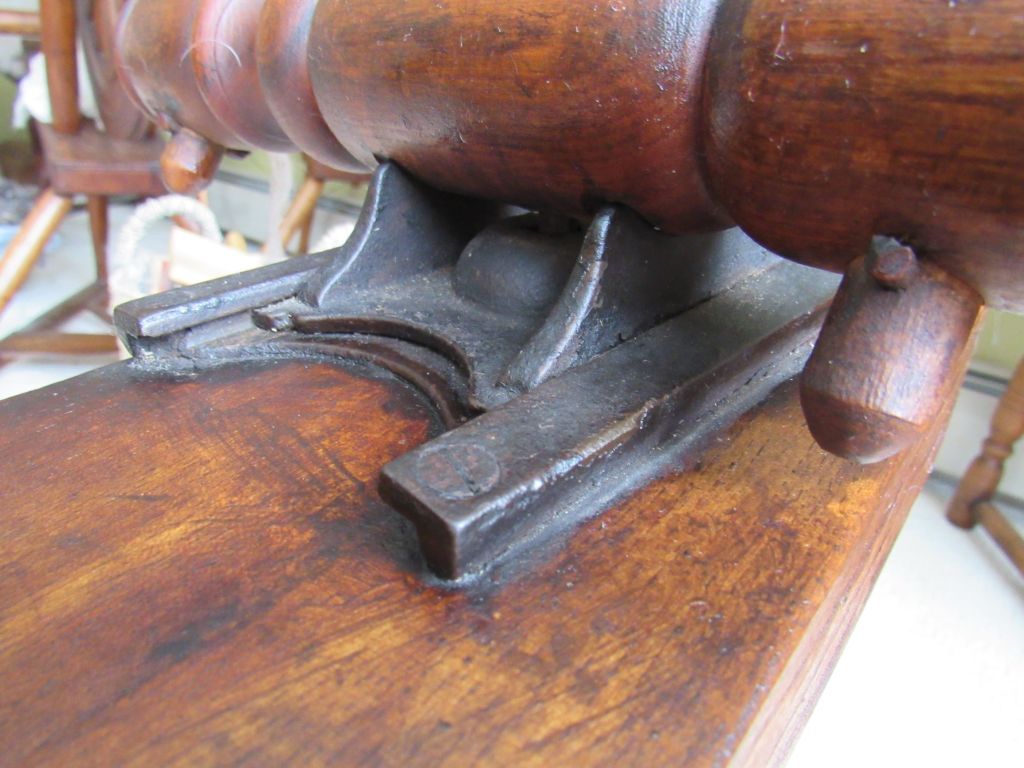
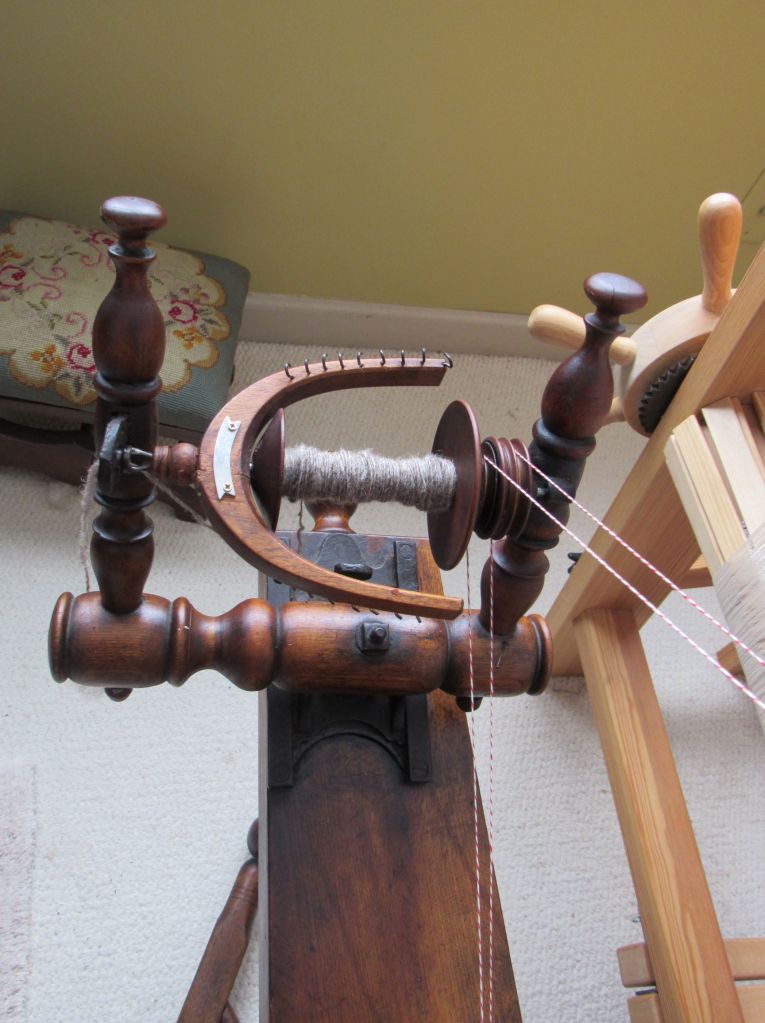
I love the slider tension on this wheel—just loosen the wing nut and the MOA can be moved in very small increments.
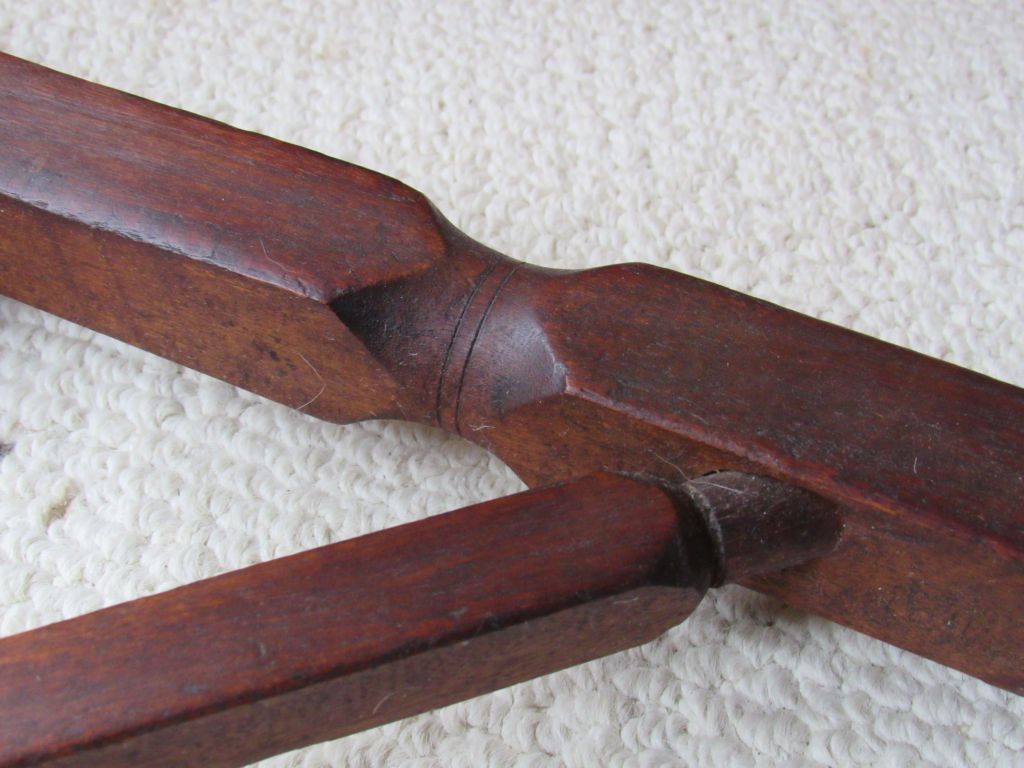
The slider has two parts—one part, bolted to the table, has runner on each end to contain the second part which is bolted to the mother-of-all.
The slider aligns with the spinner side of the wedge-shaped table.
I am a little surprised that this tension style it did not become more popular. Francois Bordua, the creative Quebec wheel maker whose wheels sometimes sported Christmas tree and eagle treadles, also used a slider tension (marked with his initials) on some of his wheels, but slider tensions do not show up very often.
The maidens have a typical Vezina look.
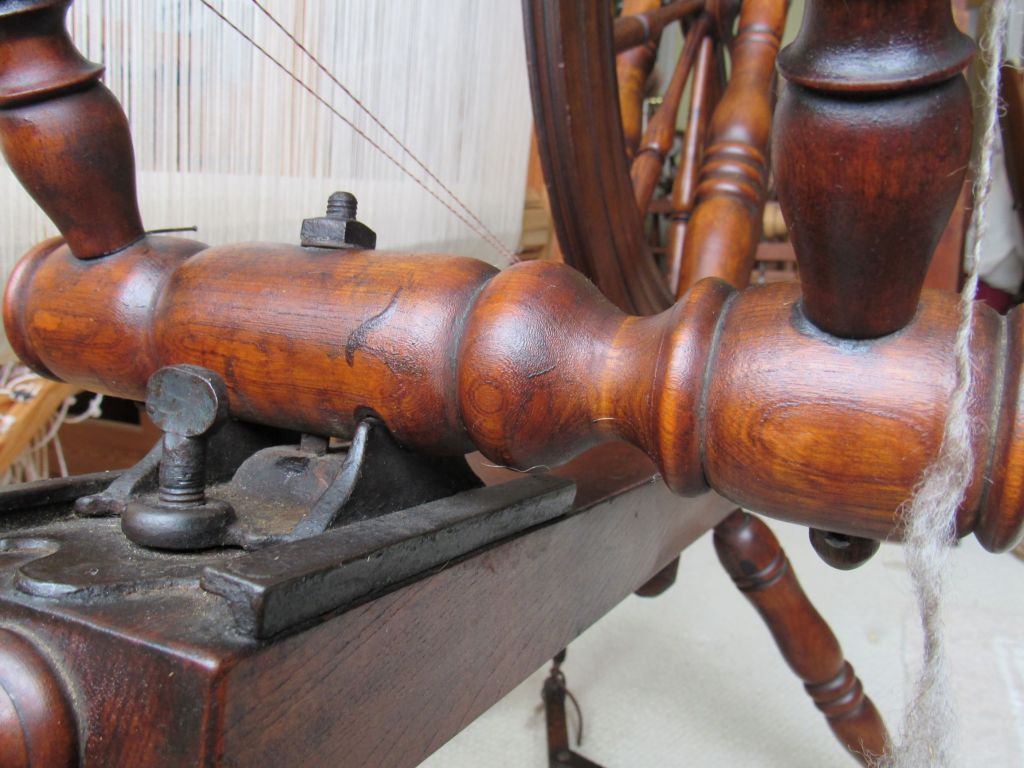
The leather flyer bearings appear to be quite old, perhaps original,
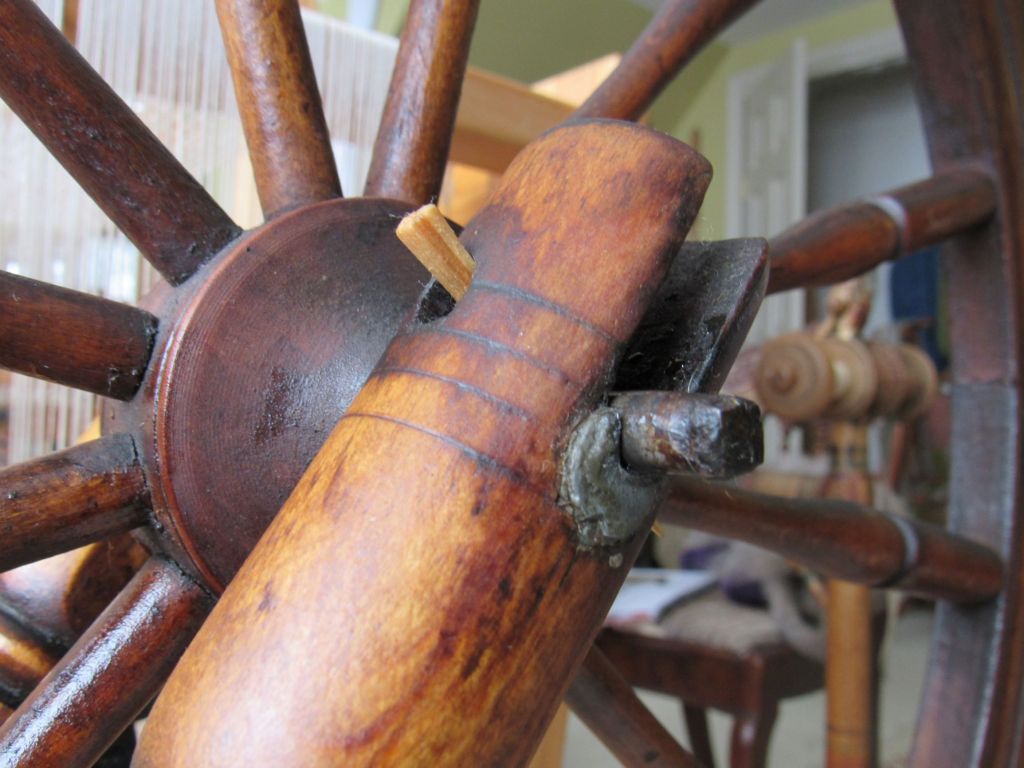
and there is an odd thin nail sticking out of the MOA.
Its purpose is a puzzlement. There also is a nail—what looks like 2 nails, actually, one quite old—in the bottom of the non-spinner side leg, presumably to keep the wheel from sliding across the floor.
The wheel underside has some rough spots.
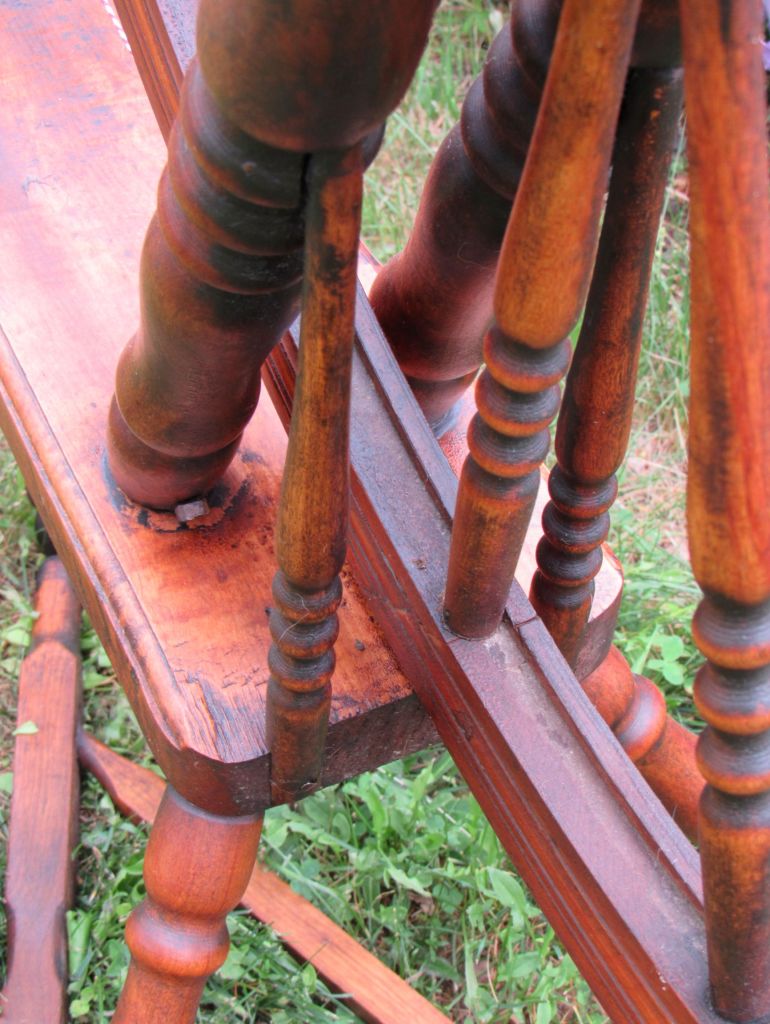
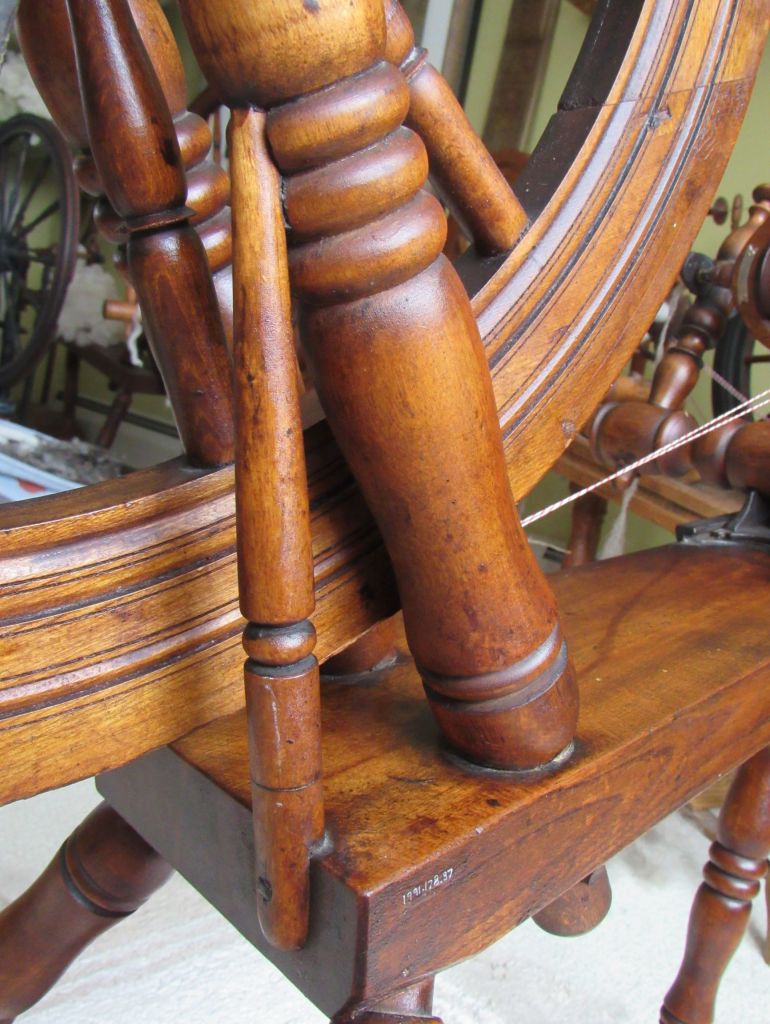
There is one upright support on the non-spinner side of the wheel.
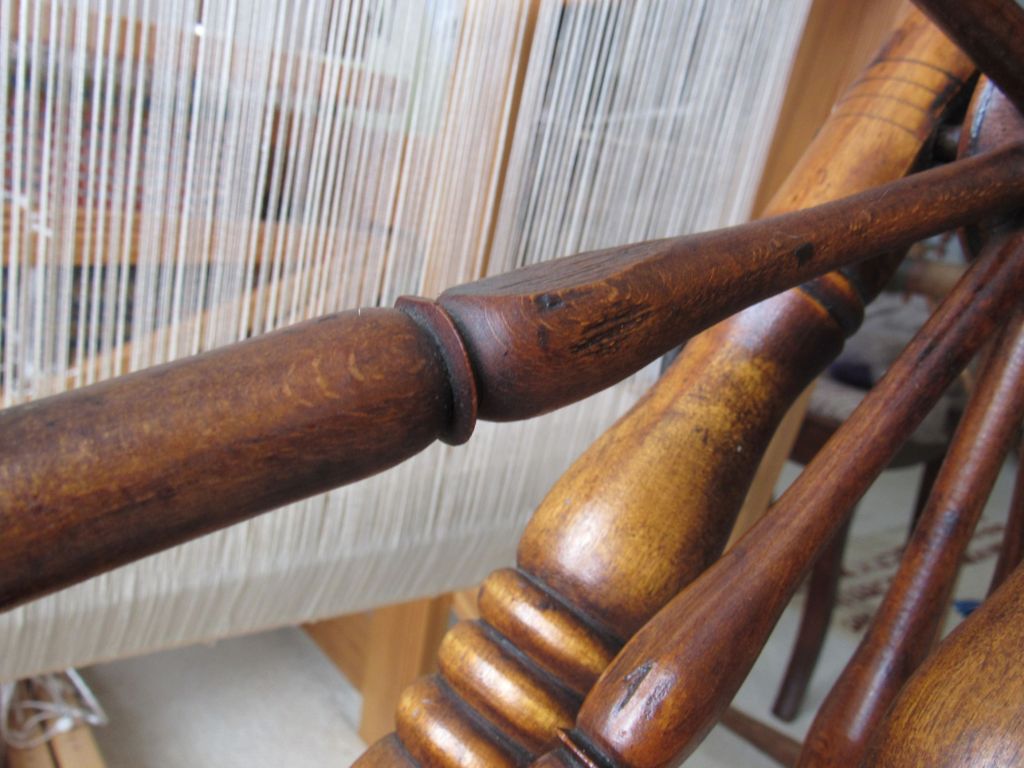
The drive wheel is a bit of a puzzle. Most Vezina wheels have spokes with two or three beads and the earlier ones are even more ornate.
These simple spokes show up occasionally on Quebec wheels of several different makers, but are fairly unusual.
Oddly, both of my Vezina wheels have this spoke style. The drive wheel rim also is not typical of Vezina wheels, which tend to have a simple three mound “quilted” rim. This one is more interesting.
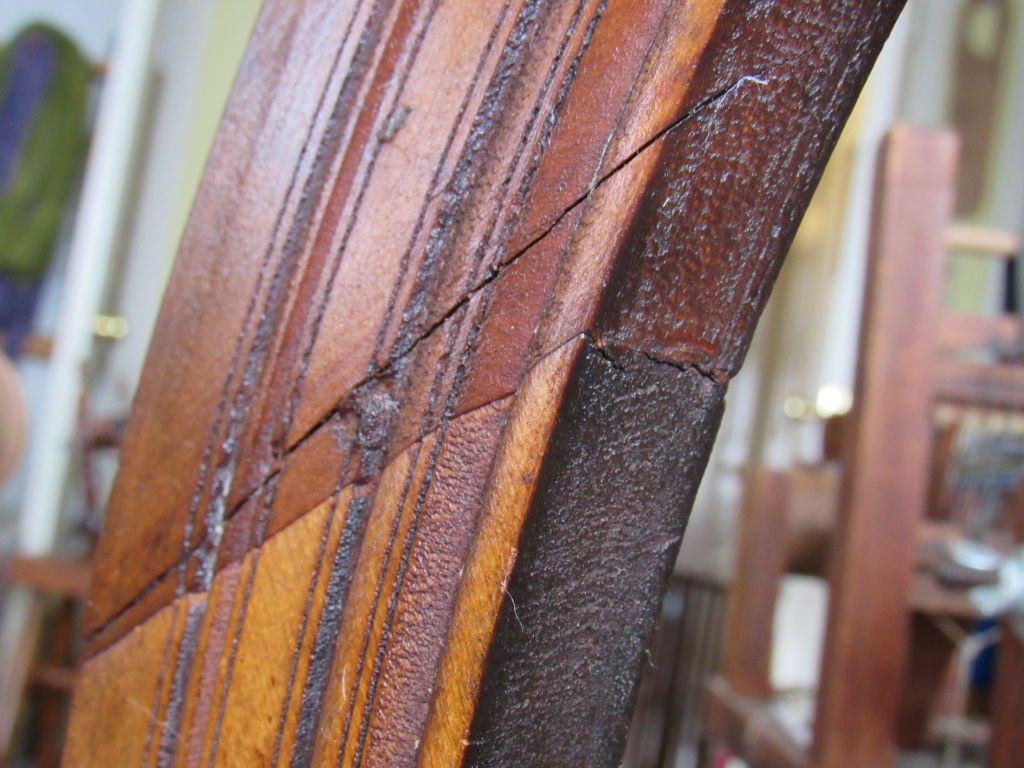
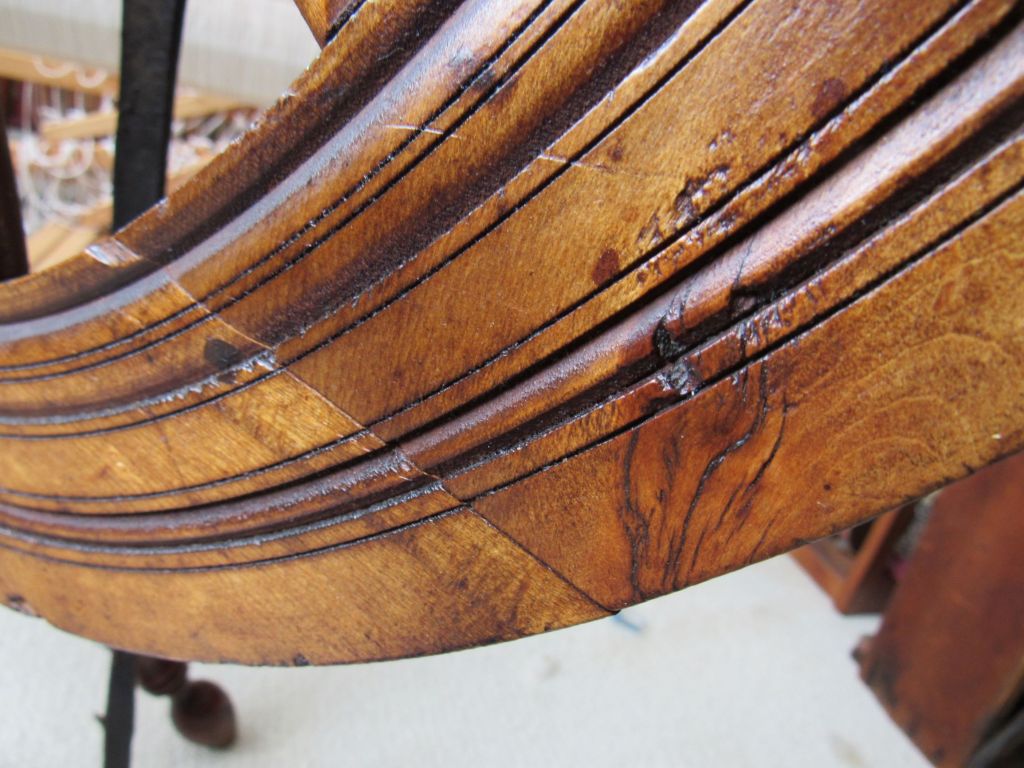
While drive wheels and other parts were often mixed and matched as needed, this particular drive wheel is not associated with any particular maker, as far as I know. The drive wheel is multi-colored, with most of the wood being dark, but some being light. The rest of the wheel also has different shades of wood. And the drive wheel look as if it belongs.
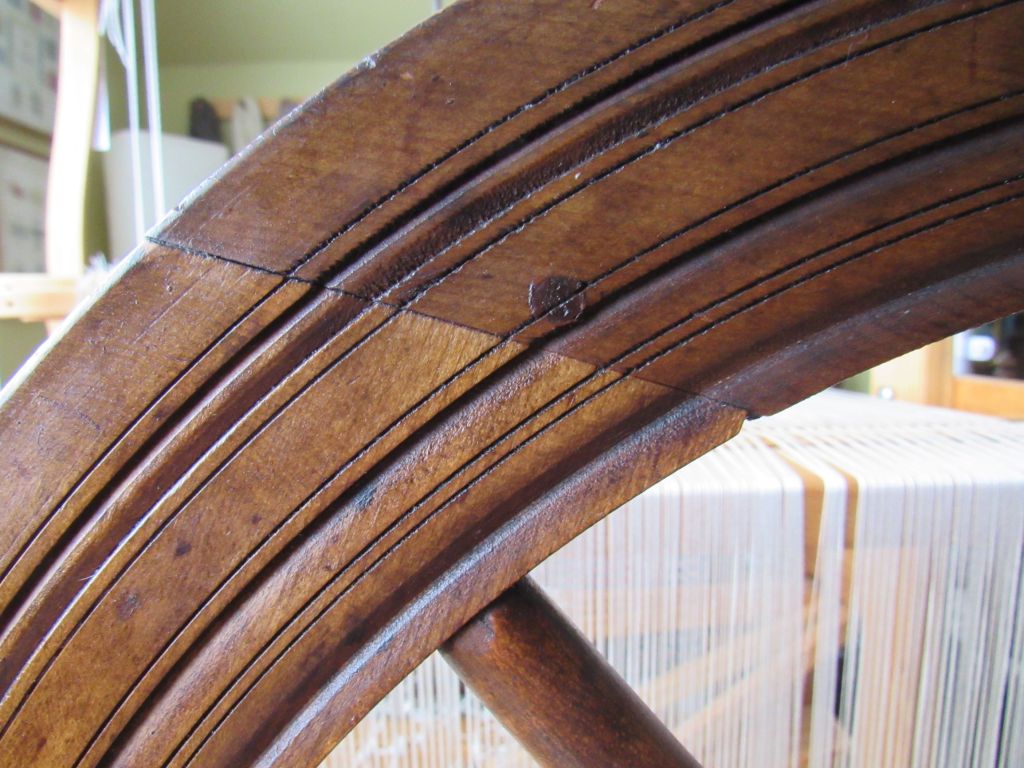
So, I am inclined to think it is original, but it is hard to say. Original or not, it carries a mark of the maker, whoever he may be. There is a saw mark on the rim where it looks as if a cut was started at the wrong angle but then used with mistake intact.
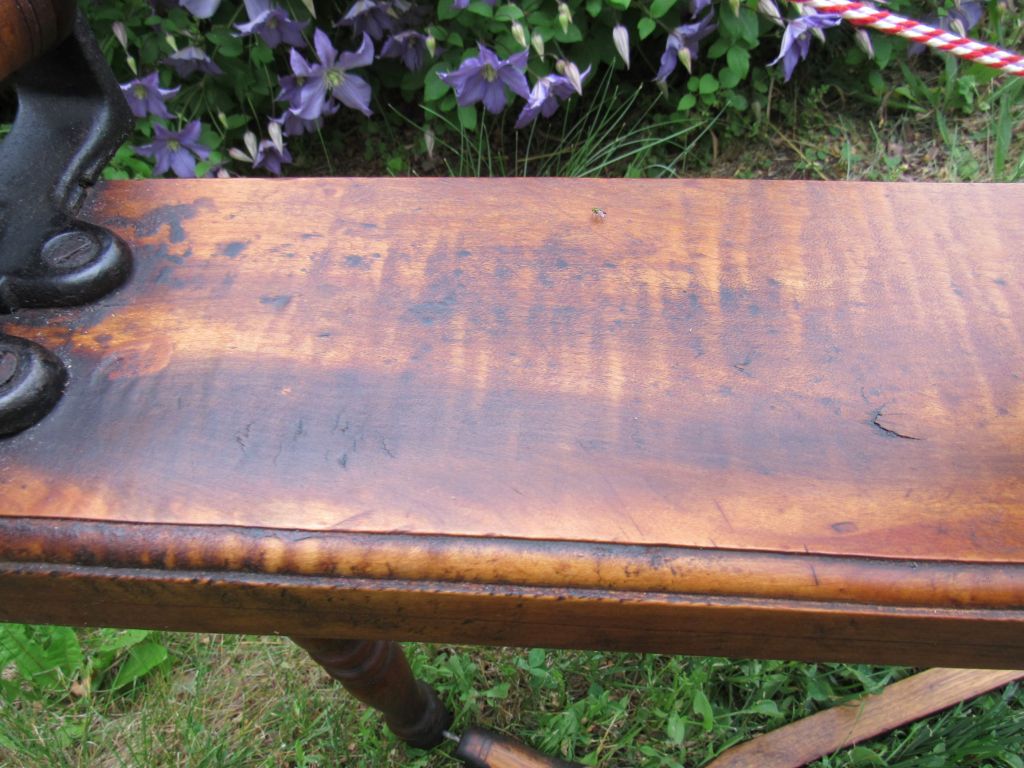
Another feature of this wheel is the wood itself.
Quebec production wheels were turned out at a great rate with a good price.
Beauty in wood was not a prime consideration. Yet, this wheel’s wood is worth a slow look and appreciation.
For more information on Canadian wheels see:
Burnham, Harold B. and Dorothy K., ‘Keep Me Warm One Night’ Early Handweaving in eastern Canada, Univ. of Toronto Press, Toronto and Buffalo, 1972.
Buxton-Keenlyside, Judith, Selected Canadian Spinning Wheels in Perspective: An Analytical Approach, National Museum of Canada, Ottawa, 1990
Cummer, Joan, A Book of Spinning Wheels, Peter E. Randall, Portsmouth, N.H. 1984
Foty, Caroline, Fabricants de Rouets— this book is available for sale as a downloadable PDF by contacting “Fiddletwist” by message on Ravelry.














 Exquisite Machinery