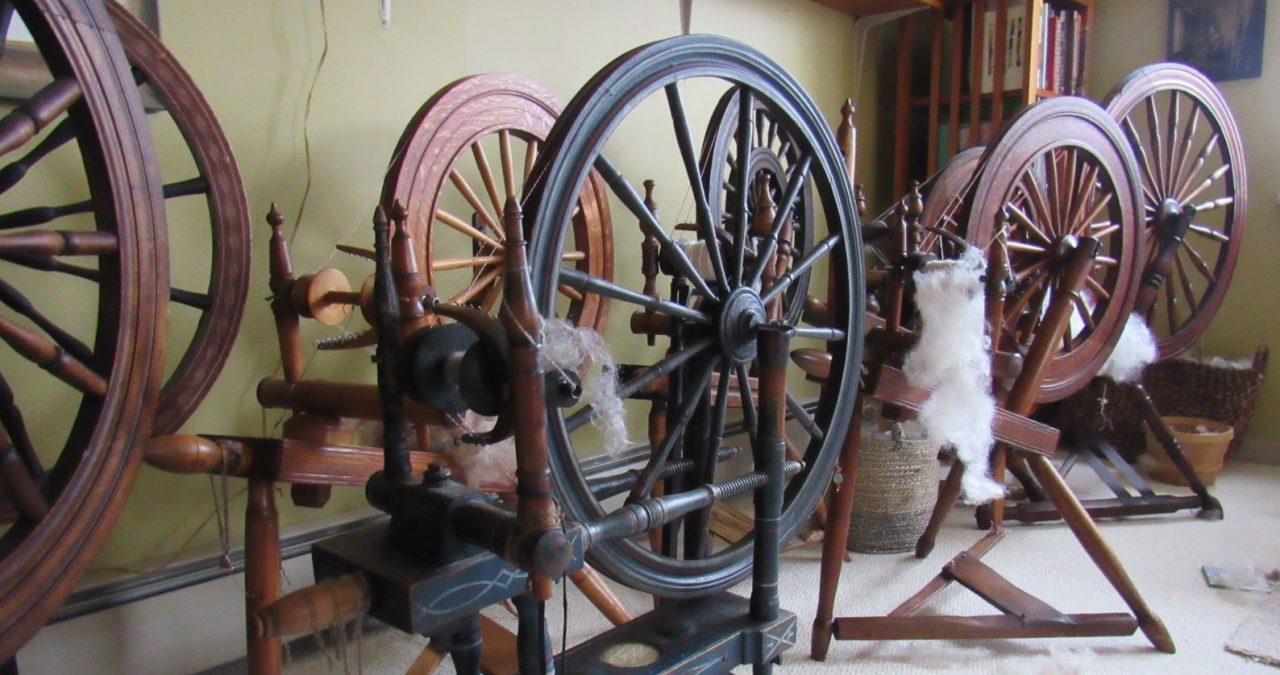
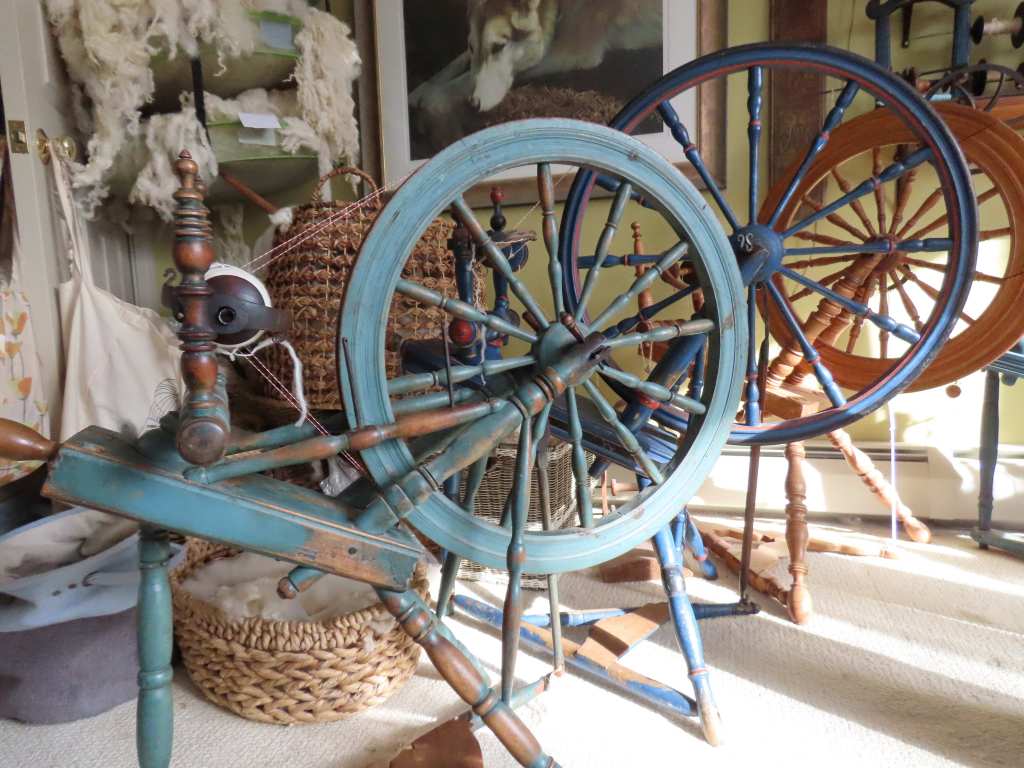
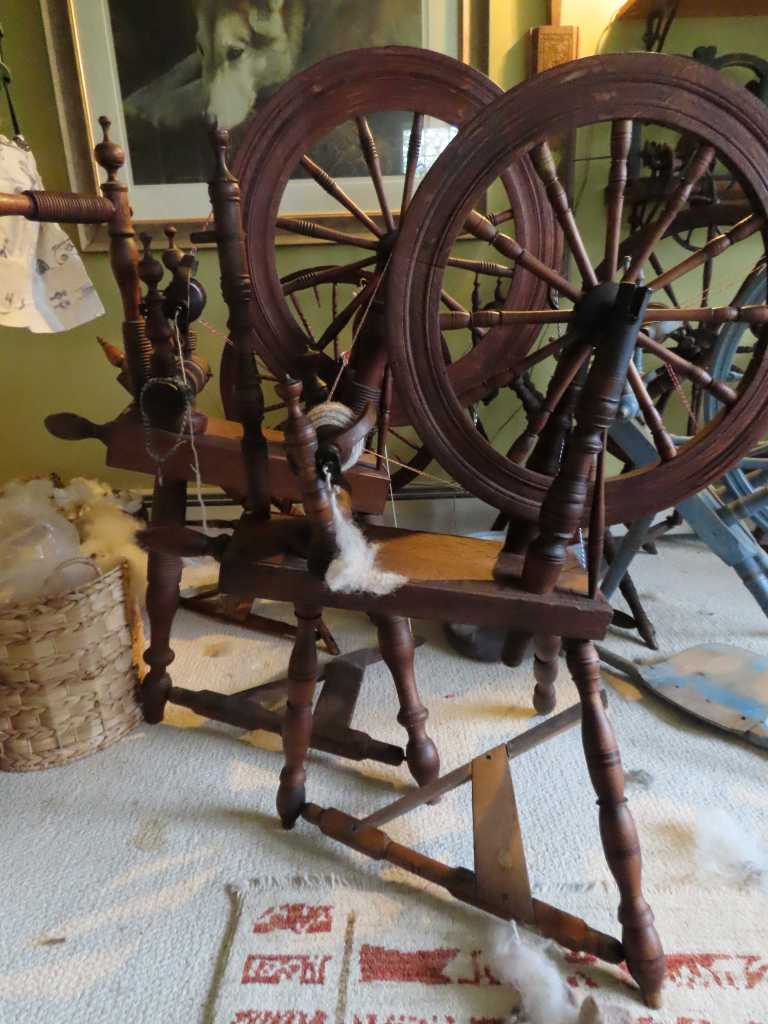
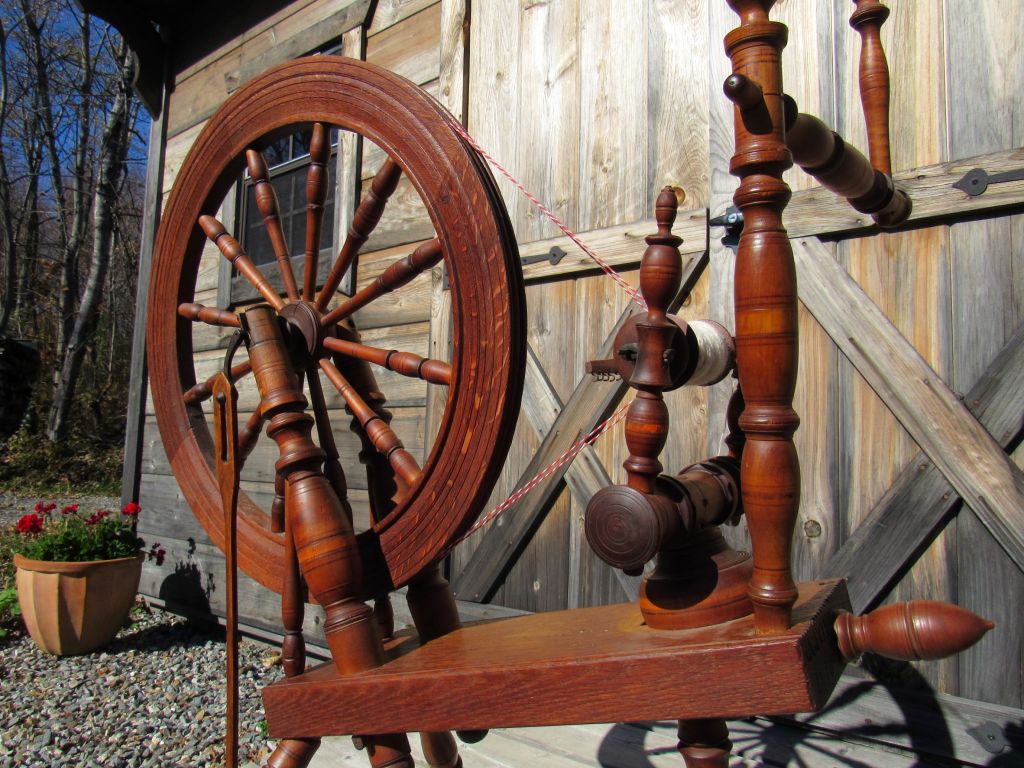
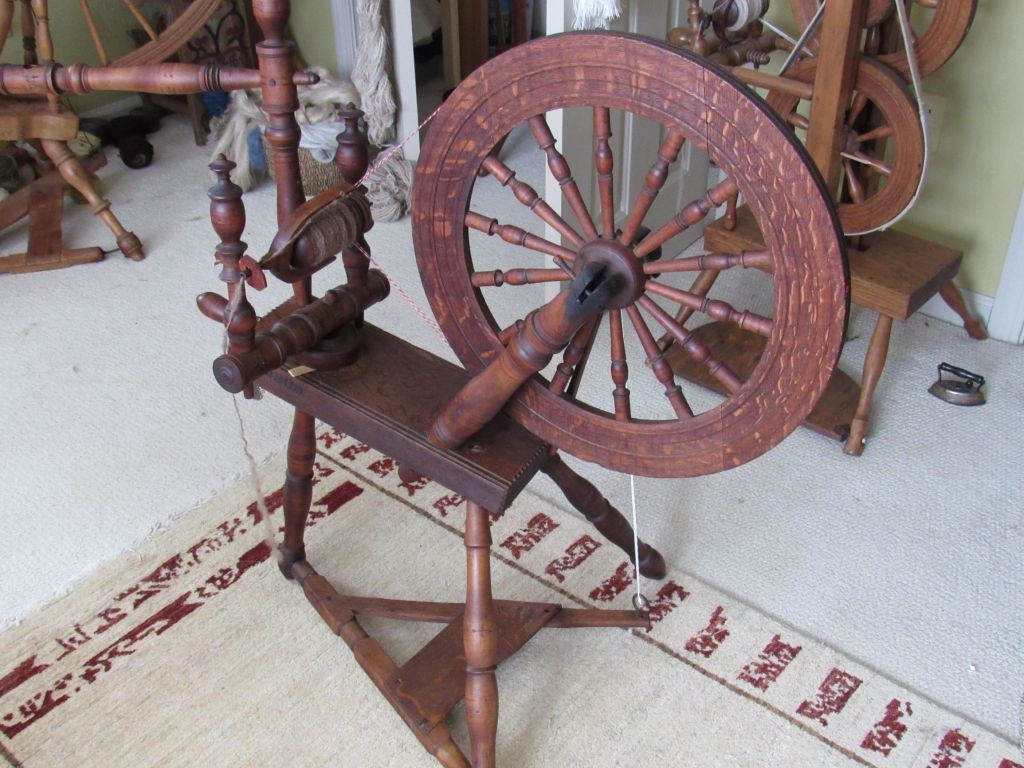
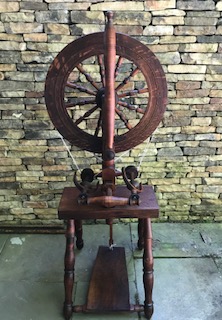
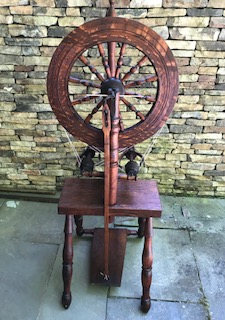
These petite Norwegian wheels turn up regularly in this country, mostly in the Midwest.
An 1851 wheel for sale in Fargo, N.D.
Because they are light and small, they must have been relatively easy to transport to this country from Norway.
Solveig is considerably smaller than Hjordis, the Norwegian wheel from the last post
Because wheel makers often were scarce in the Midwest, “Norwegians who had emigrated earlier strongly recommended in letters to friends and family that women bring spinning wheels to America. The writers also occasionally suggested packing wool carders, looms, sheep shears and shears for cutting woven cloth.” Norwegian American Women, p. 159.
“Most sources indicate that women used the Norwegian treadle spinning wheels they brought or acquired. Kari Bunde Veblen requested a second wheel from Norway after the first one, brought by a newcomer, ‘did not prove satisfactory in that it growled slightly in running.’ ” Id at 162.
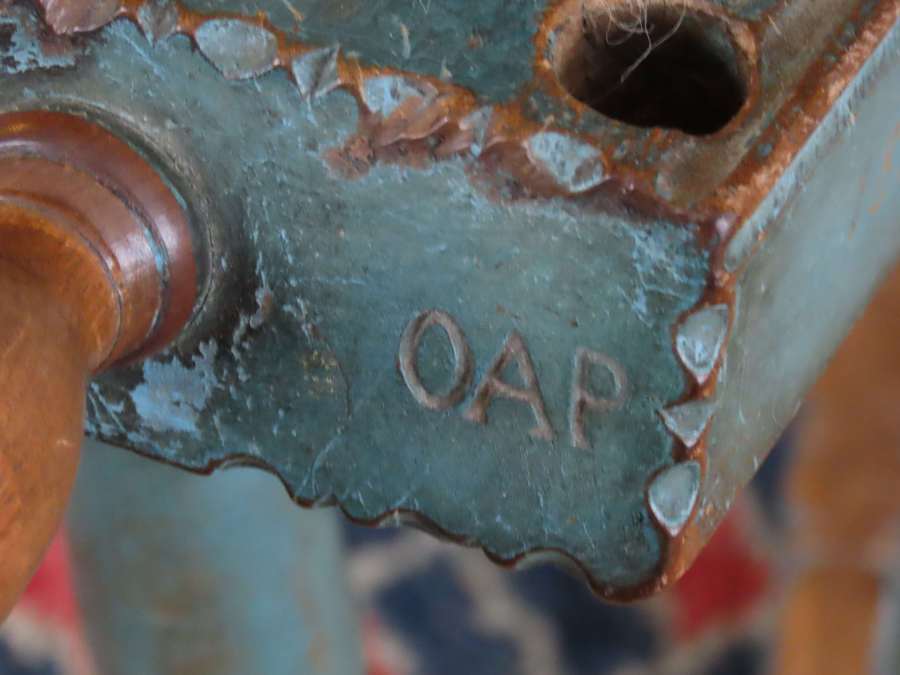
Although these wheels have a clear maker’s mark of OAP, as far as I know, his identity is a mystery.
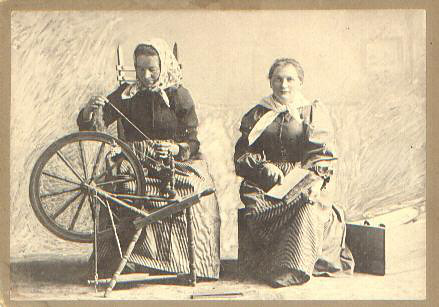
We believe the wheels may have come from the Hordaland area of Norway based on this photo found on an ancestry site, with the caption: “Lofthus, Norway – One lady spins the wool while the other combs 1888.”*
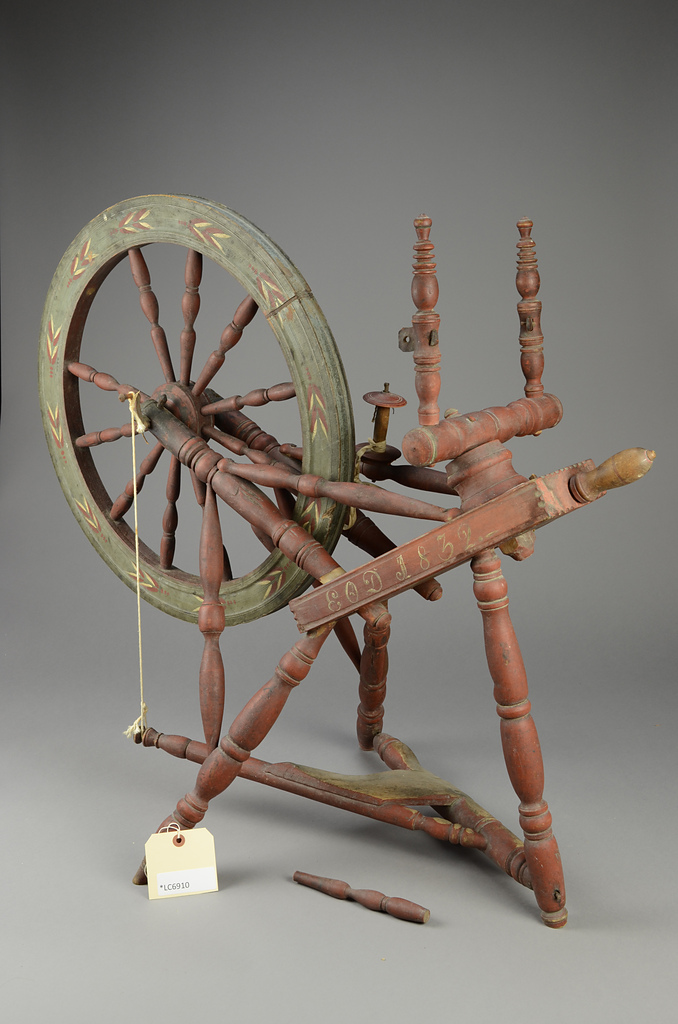
The wheels appear to have been made for decades, with painted dates ranging from the 1830s (and perhaps earlier) to the 1870s.
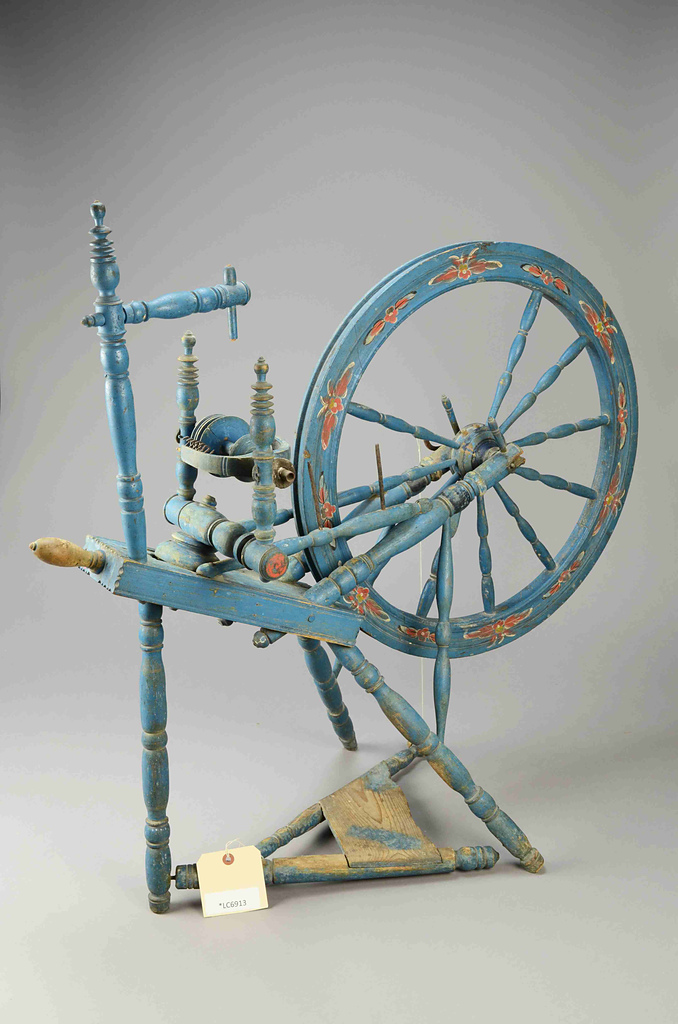
They are usually painted, sometimes with floral designs such as these wheels in the Vesterheim Museum in Decorah, Iowa.
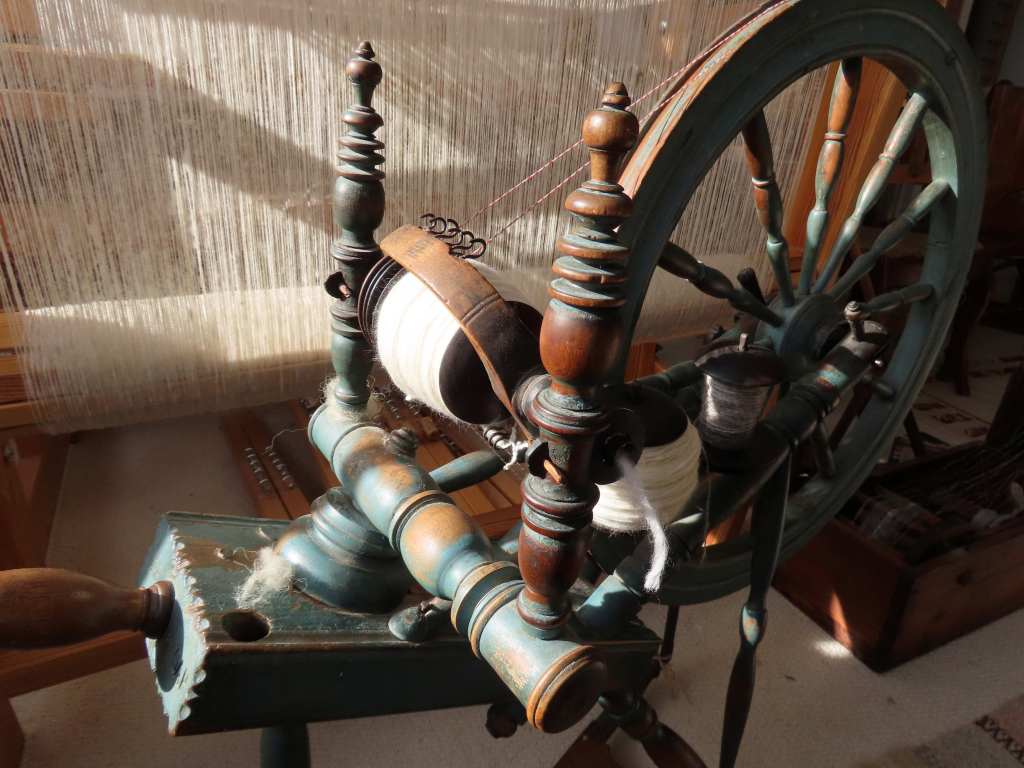
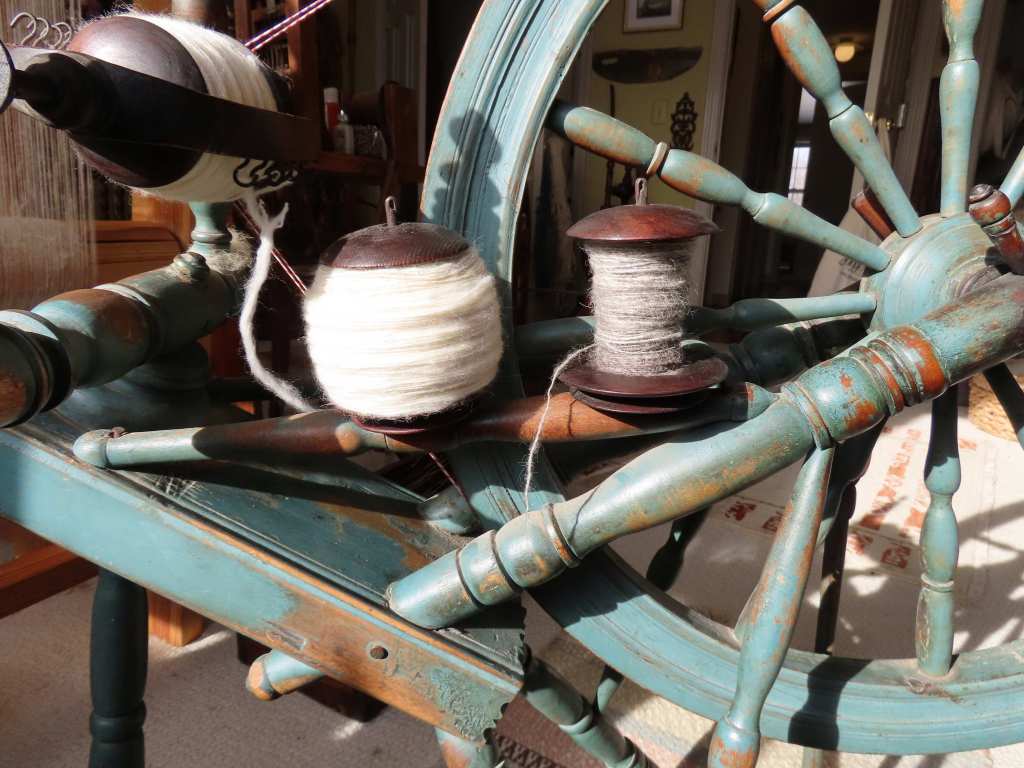
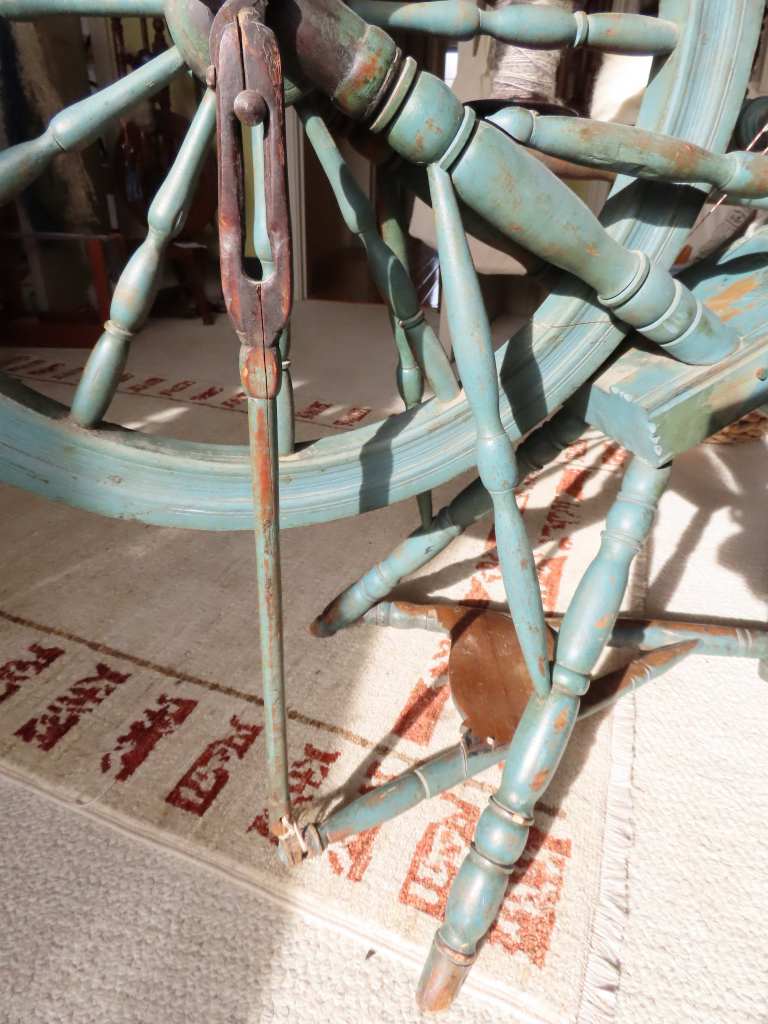
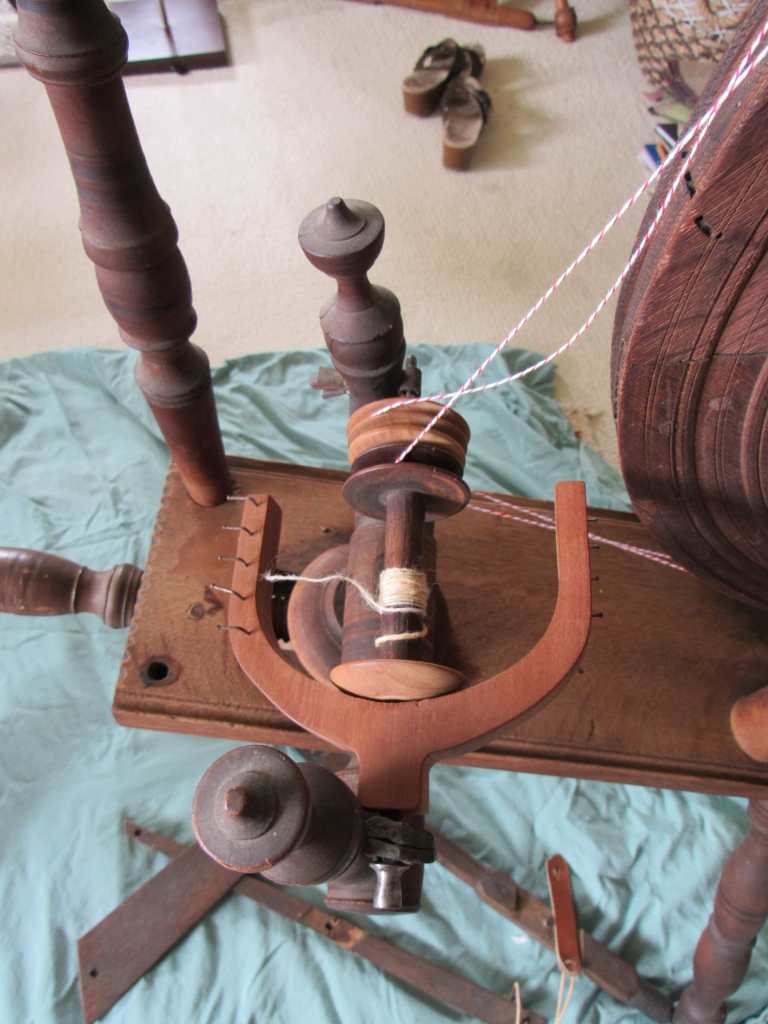
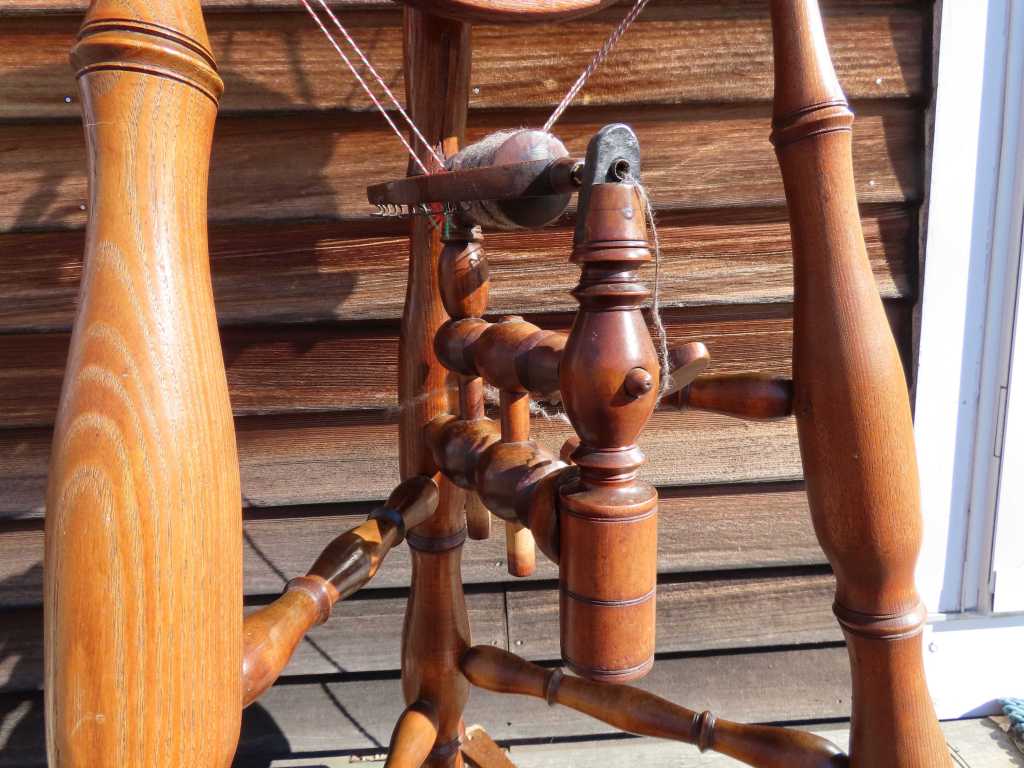
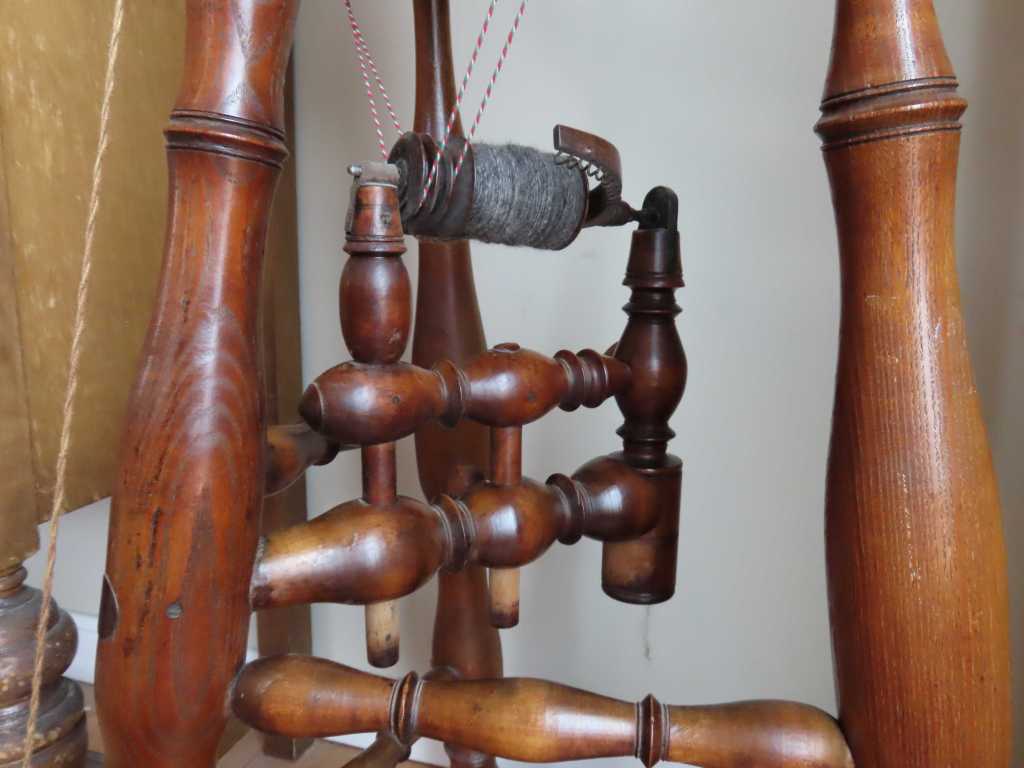
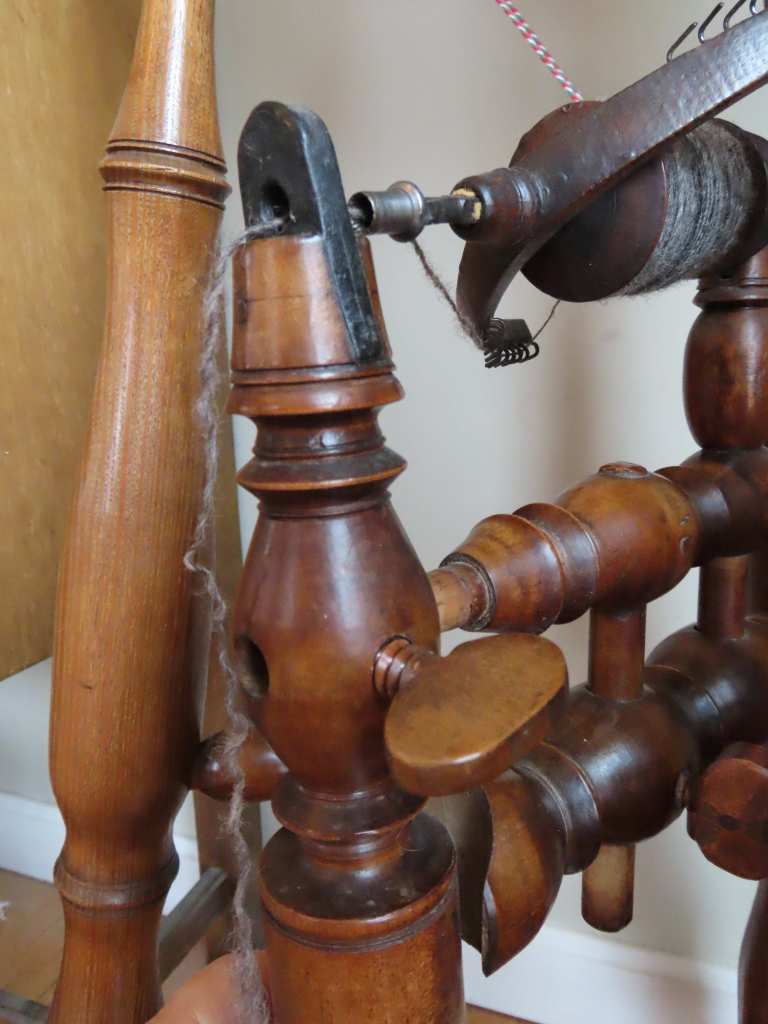
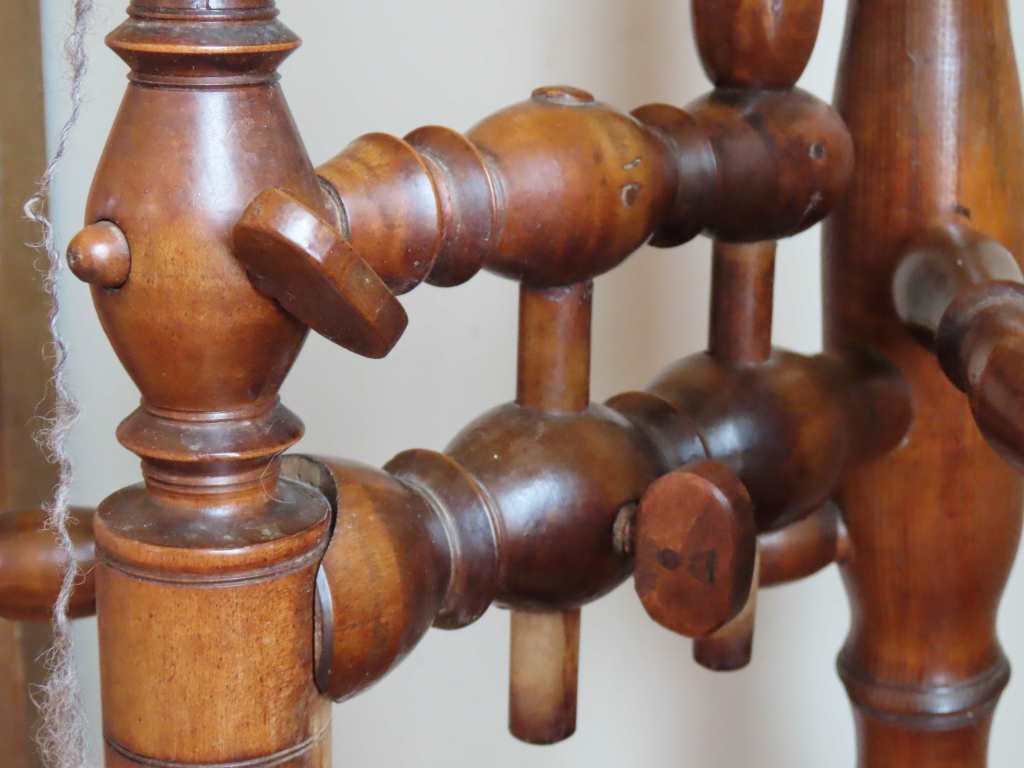
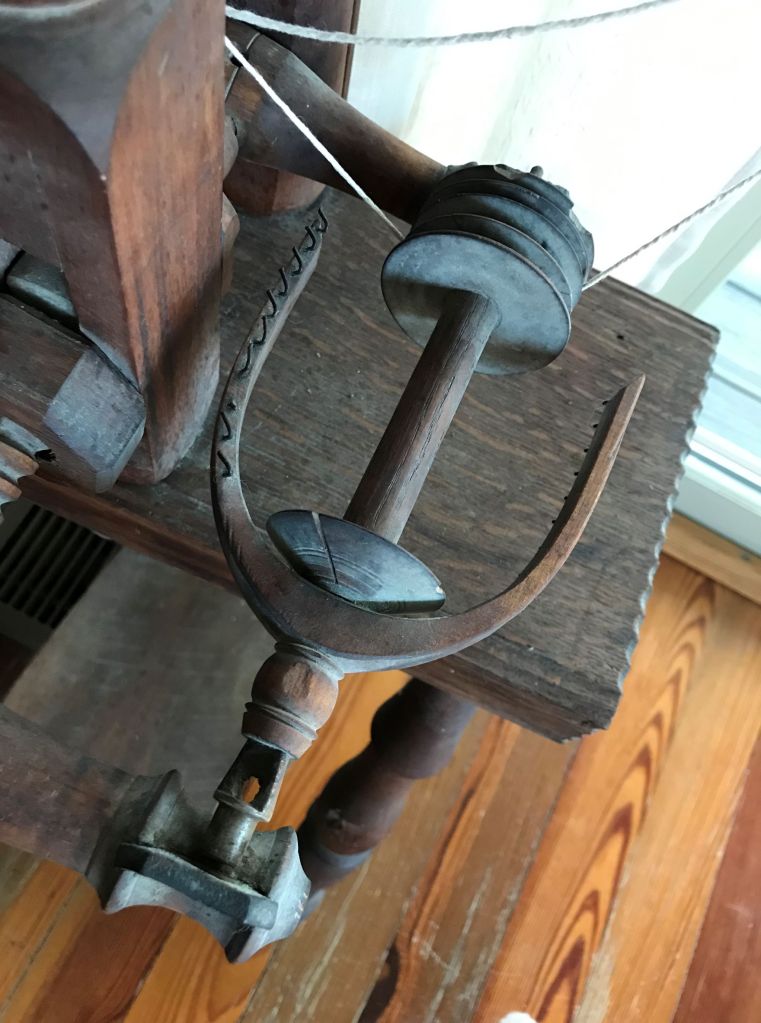
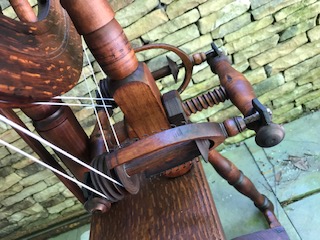
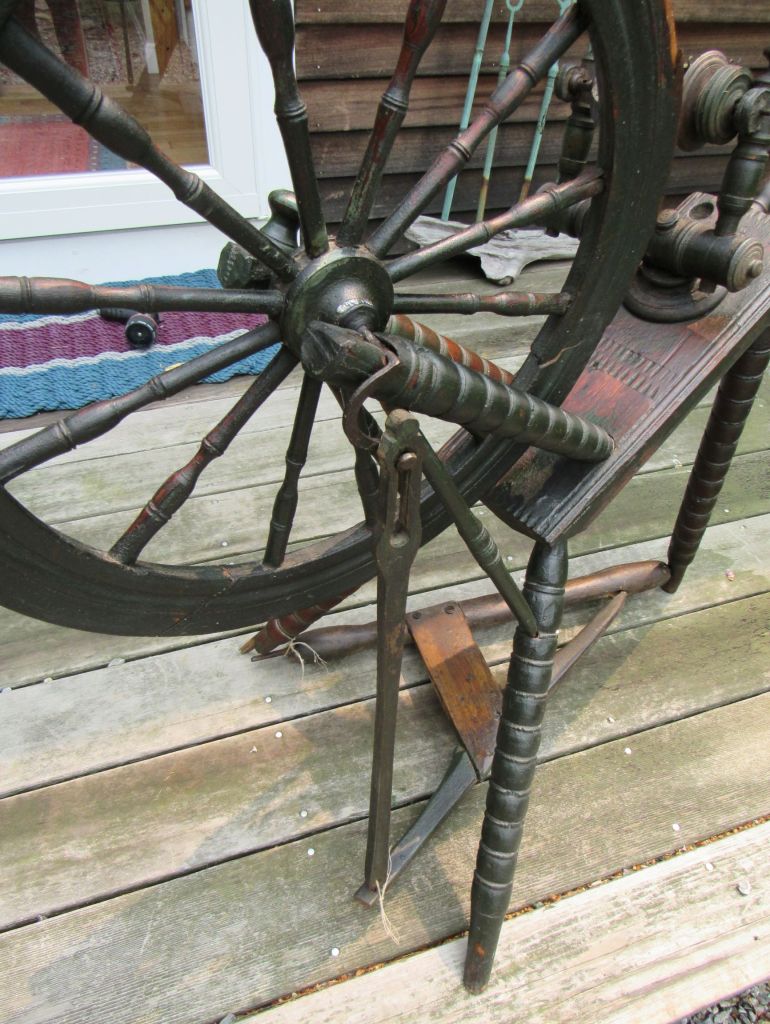
Aside from the lovely paint jobs and compact size, these wheels are immediately recognizable because of an onboard lazy kate.
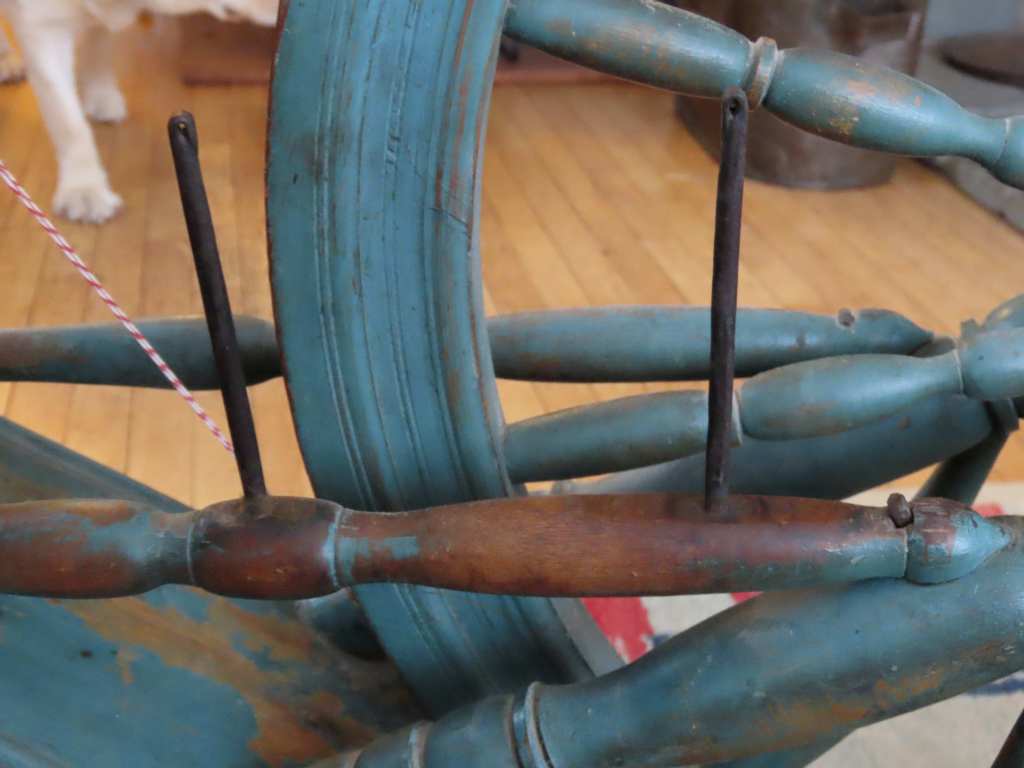
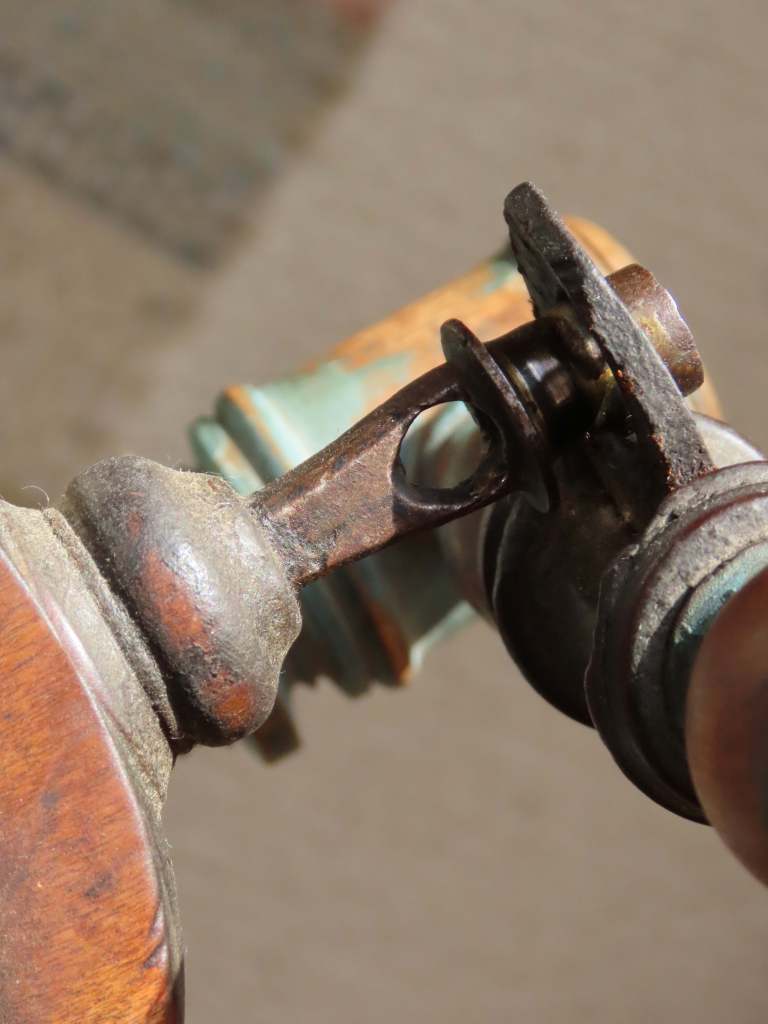
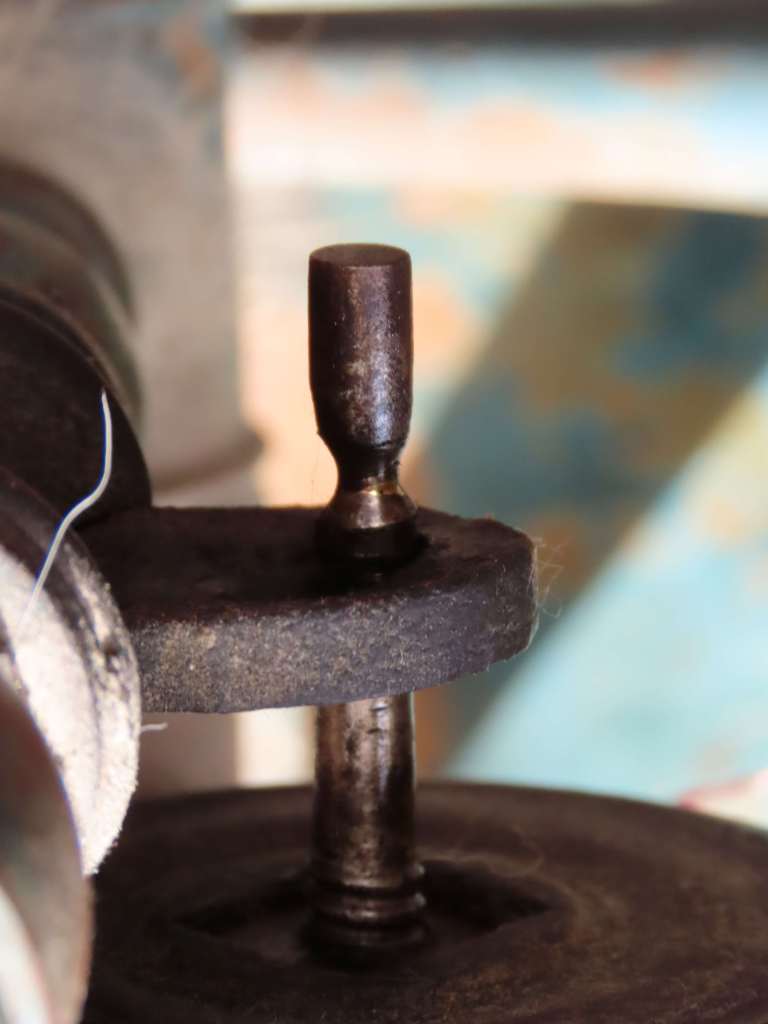
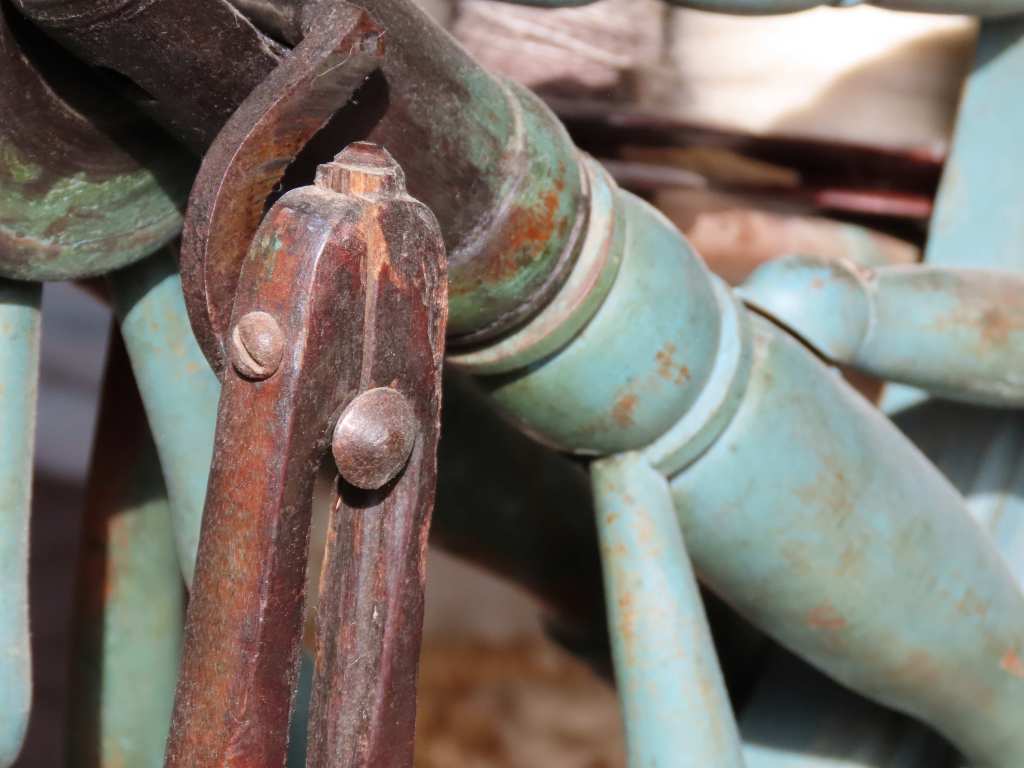
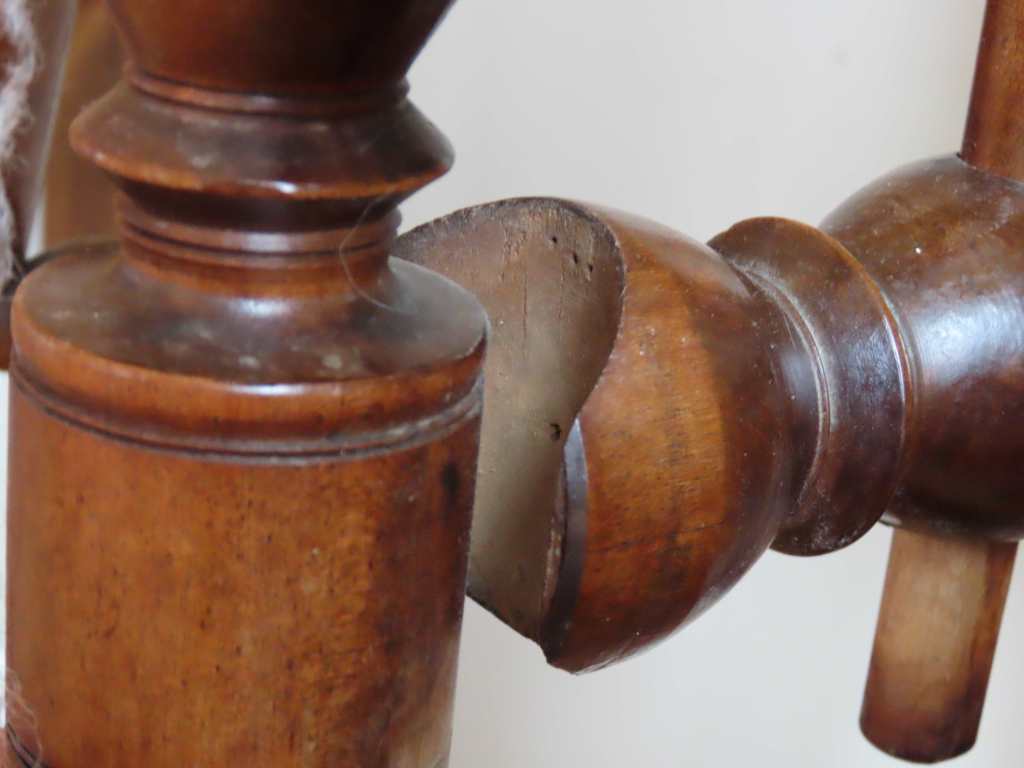
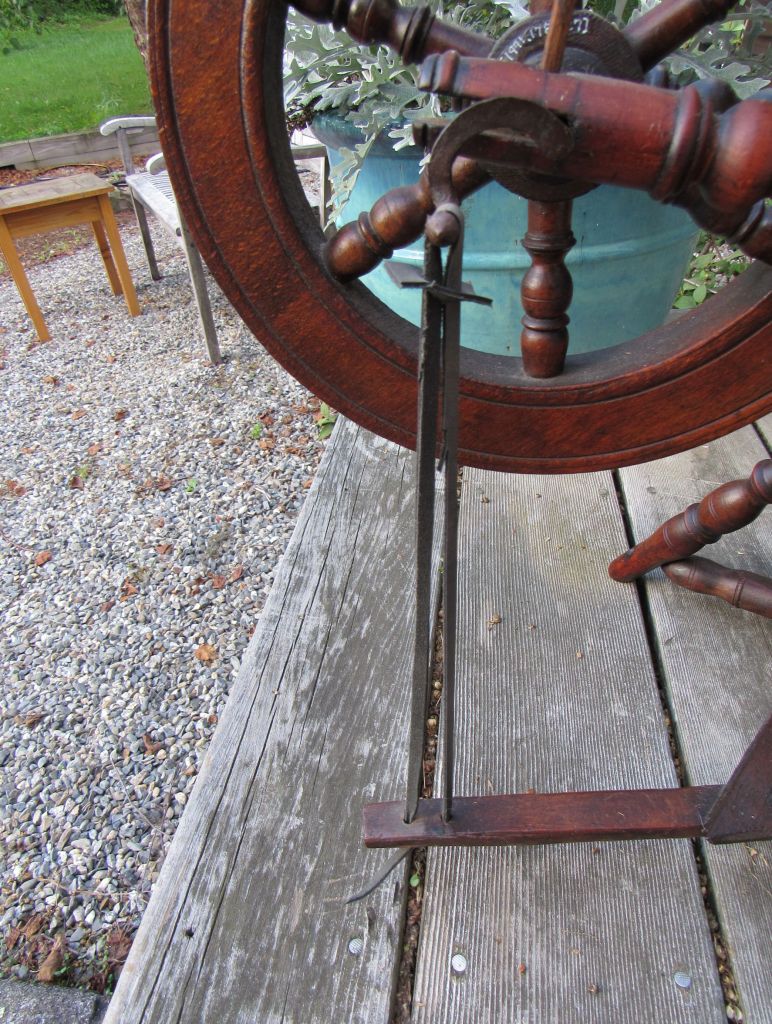
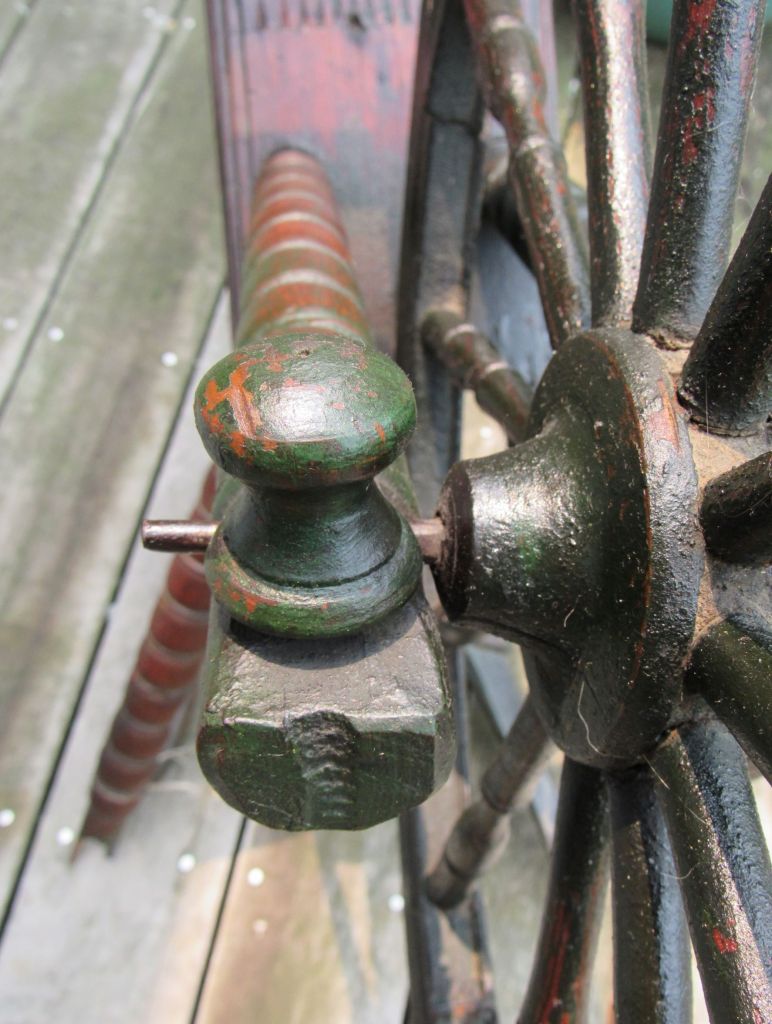
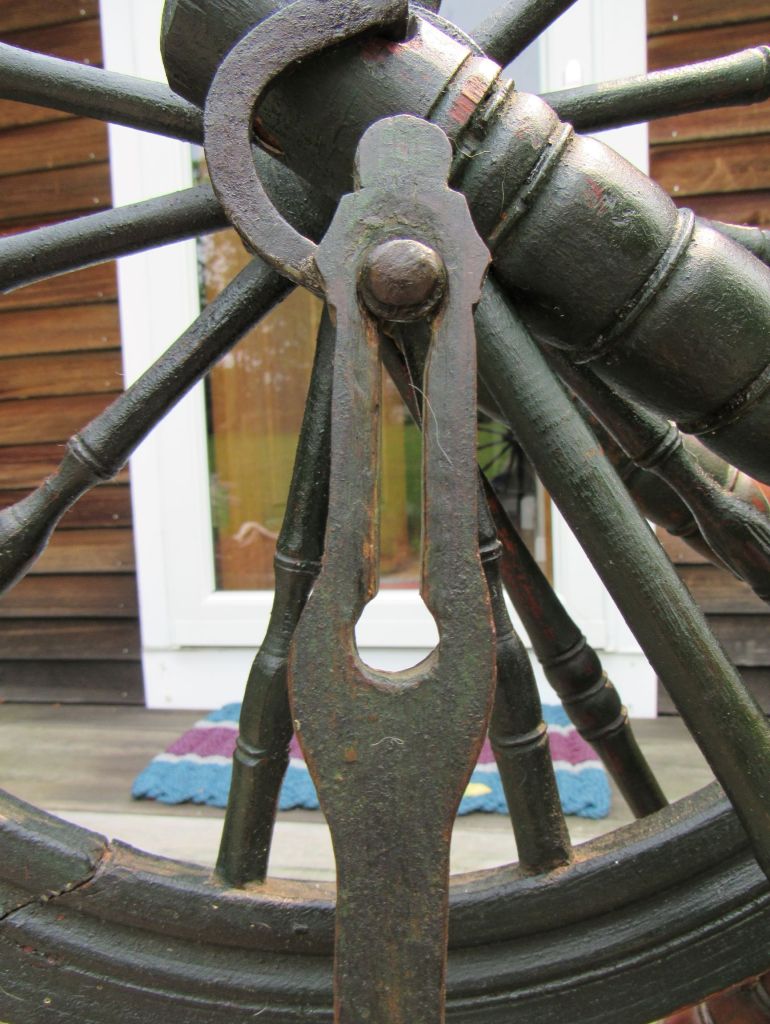
The front cross-bar support has two metal shafts, beautifully worked with folded tops.
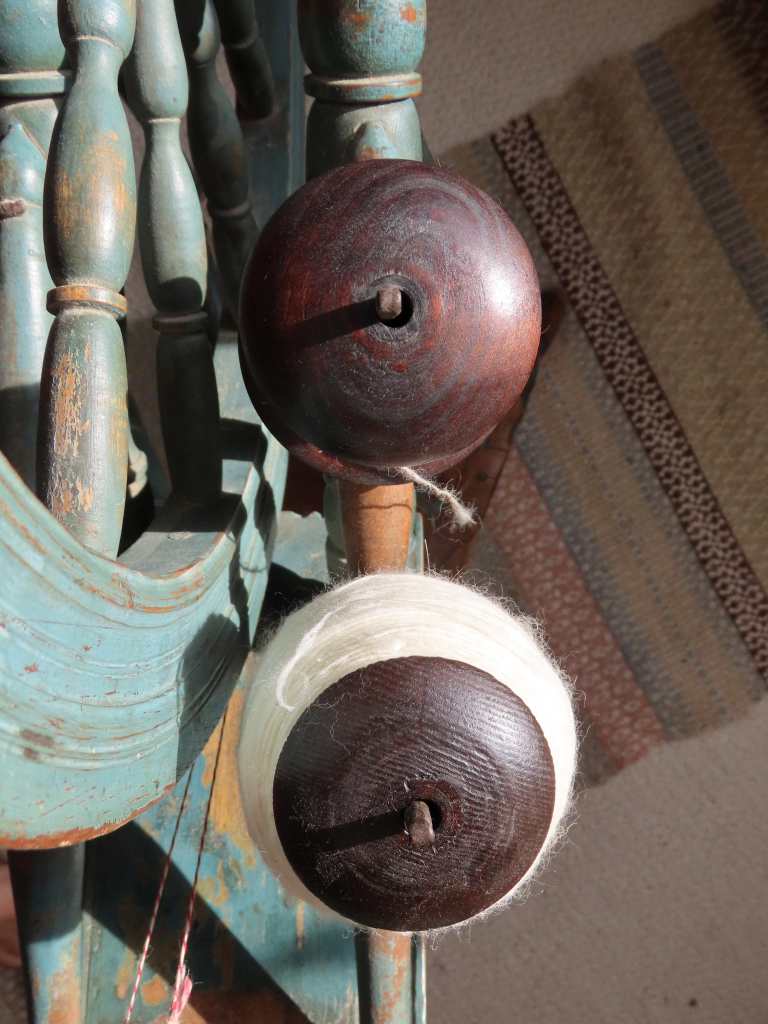
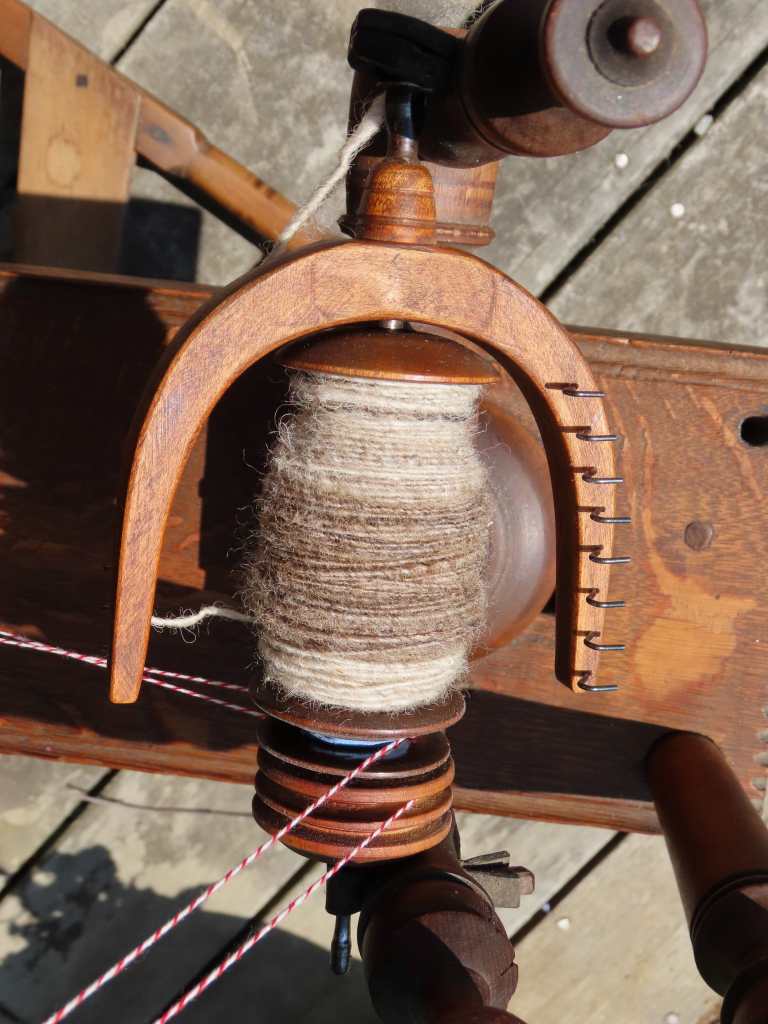
These can hold full bobbins, allowing the spinner to ply directly from the wheel.
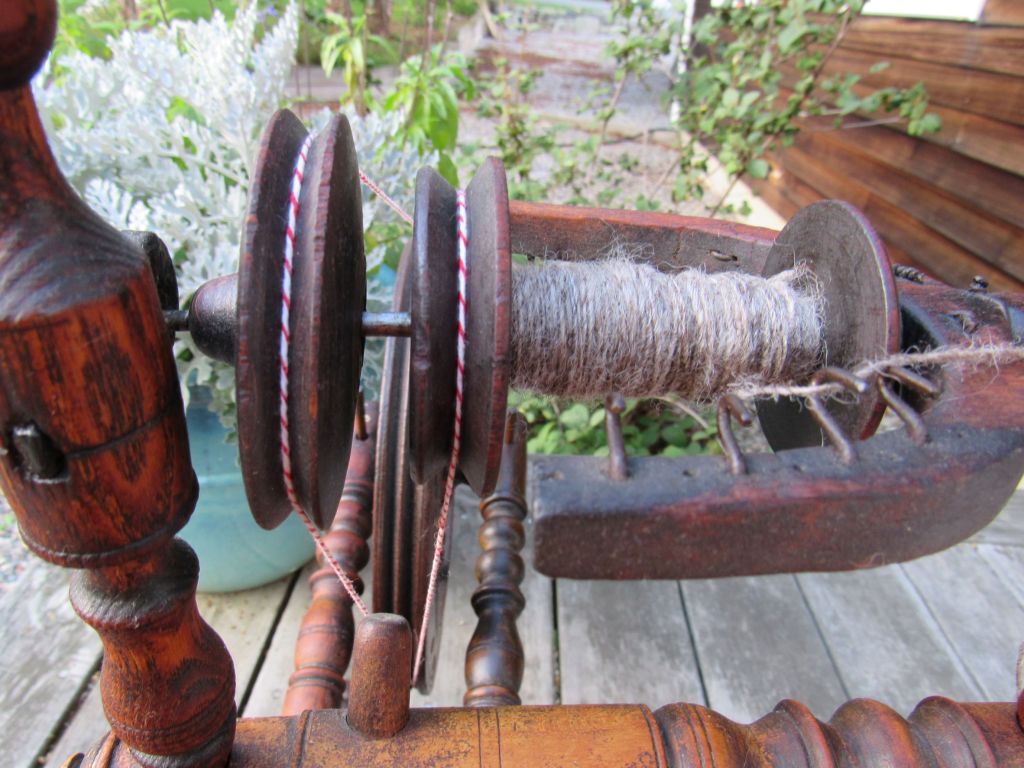
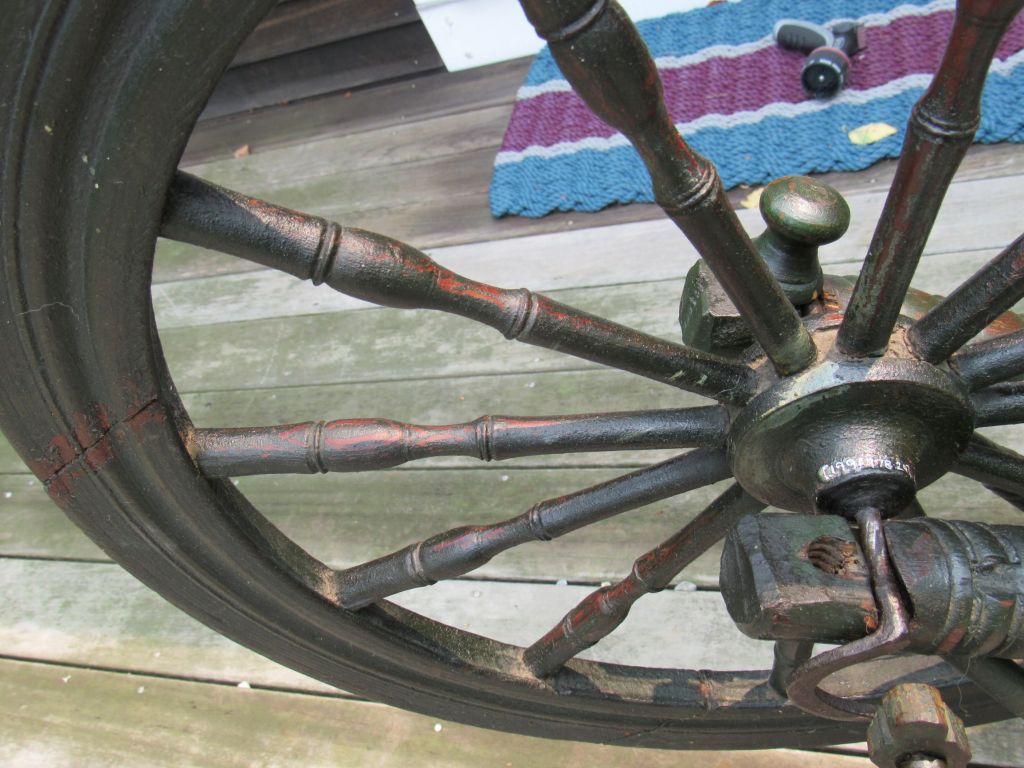
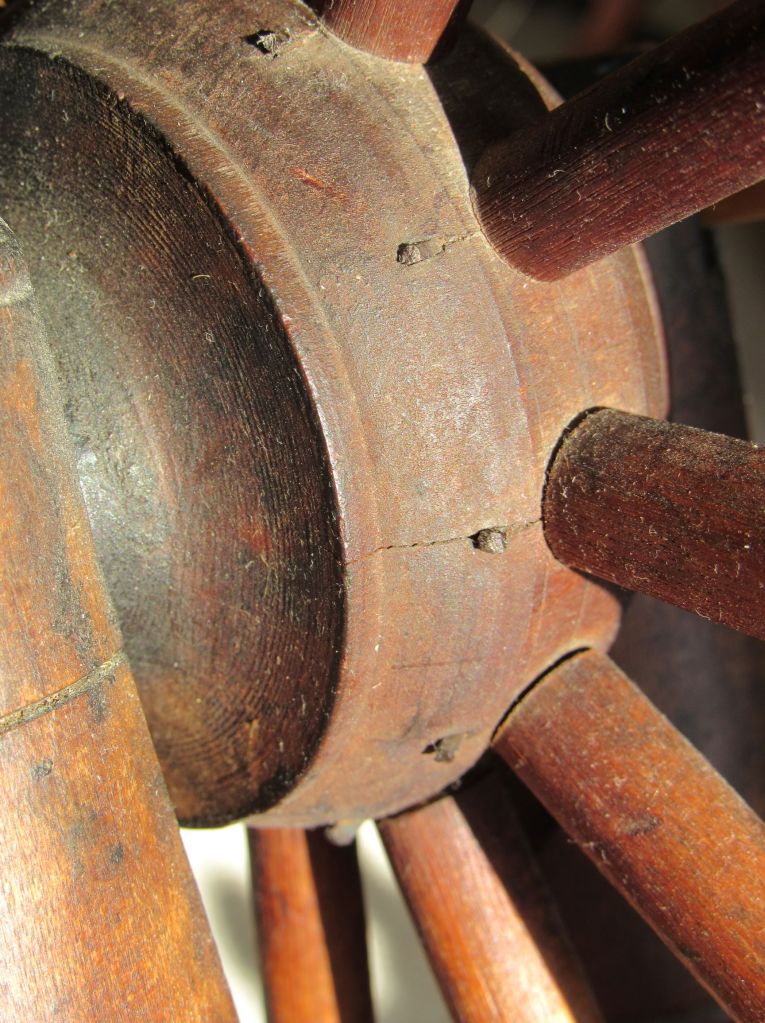
It is a handy, ingenious feature, made possible by a hub that is flat in the back, but with an extension on the spinner side to make space for the bobbins.
Solveig was found in northern Minnesota.
She is a workhorse, spinning and plying with ease.
While many antique wheels have very little difference in the depth of the bobbin and whorl grooves, Solveig’s bobbin groove is much deeper than her two whorl grooves.
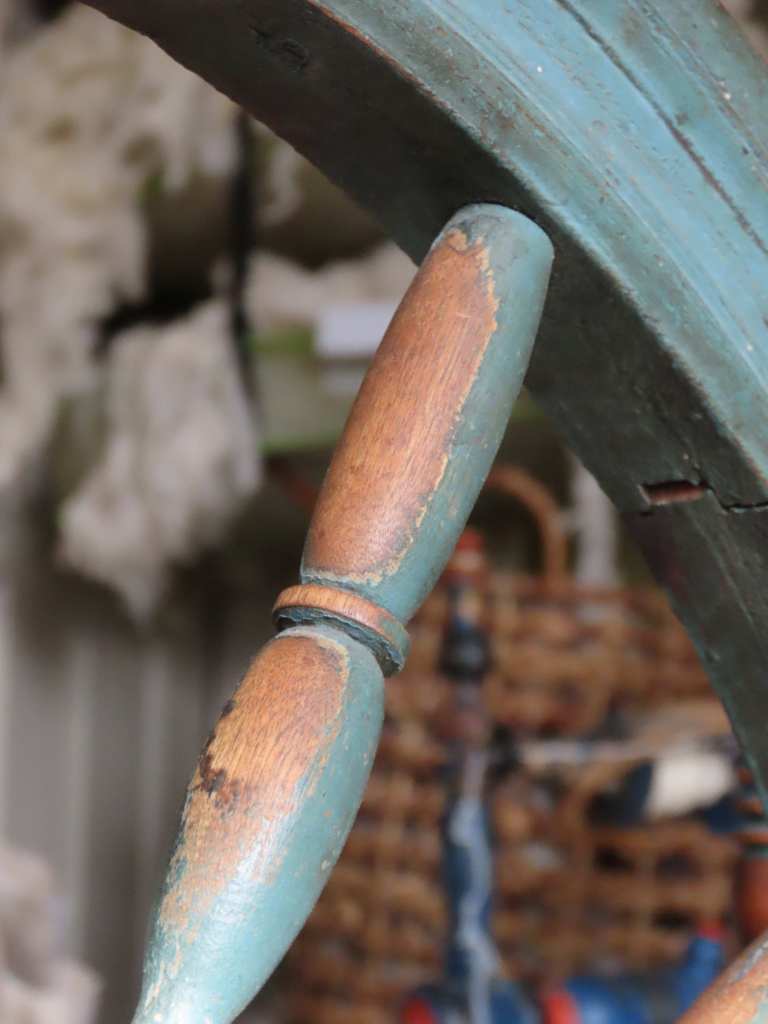
The gorgeous blue-green paint shows the typical wear made by women spinners wearing long skirts.
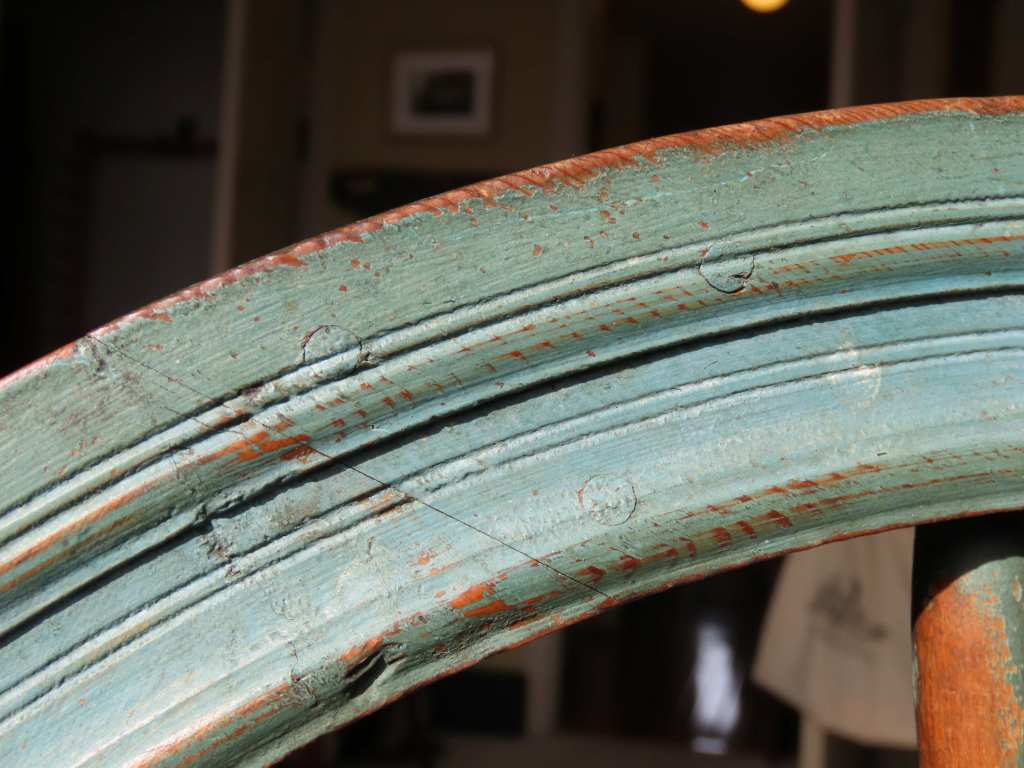
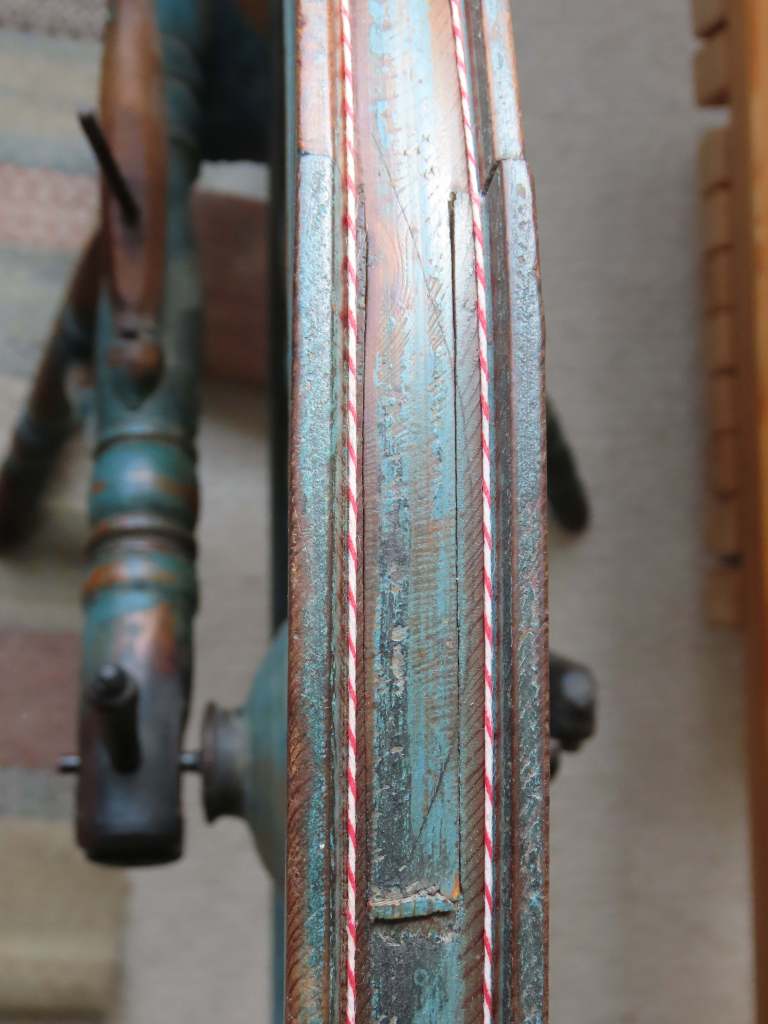
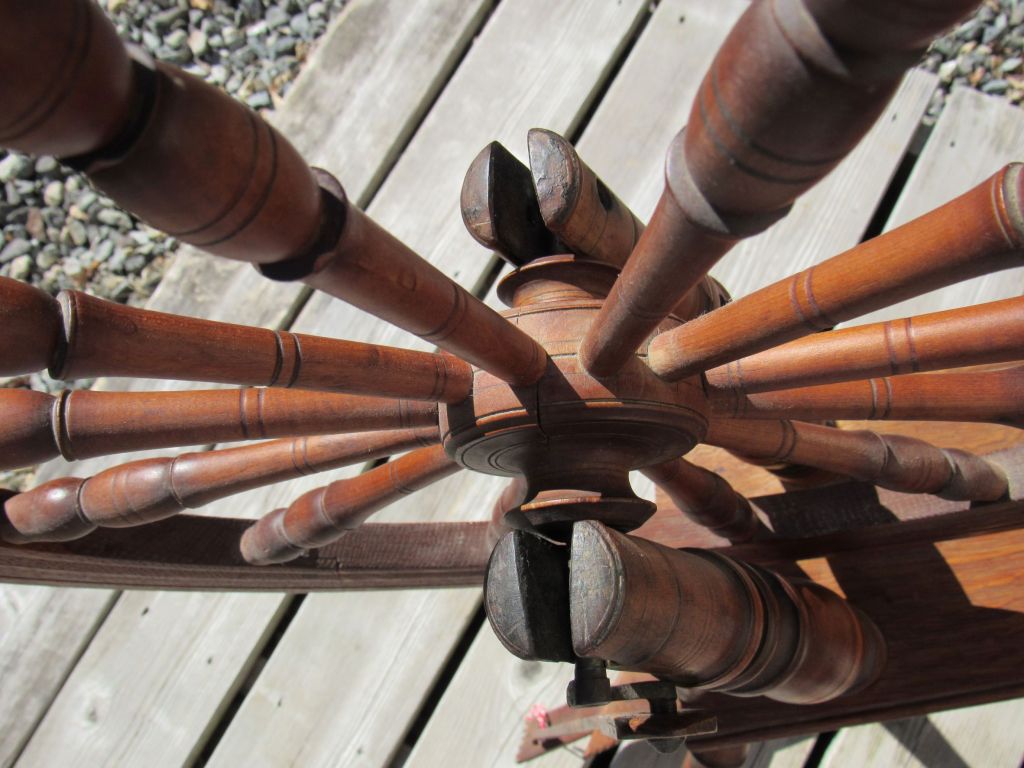
Paint wear on the spokes confirms that the drive wheel was turned in both directions, using the lazy kate for plying, although there is more wear on spokes indicating clockwise turning.
The front maiden has wear marks in a somewhat unusual place near the bottom, where spun thread was wound around it, probably when unwinding the bobbin.
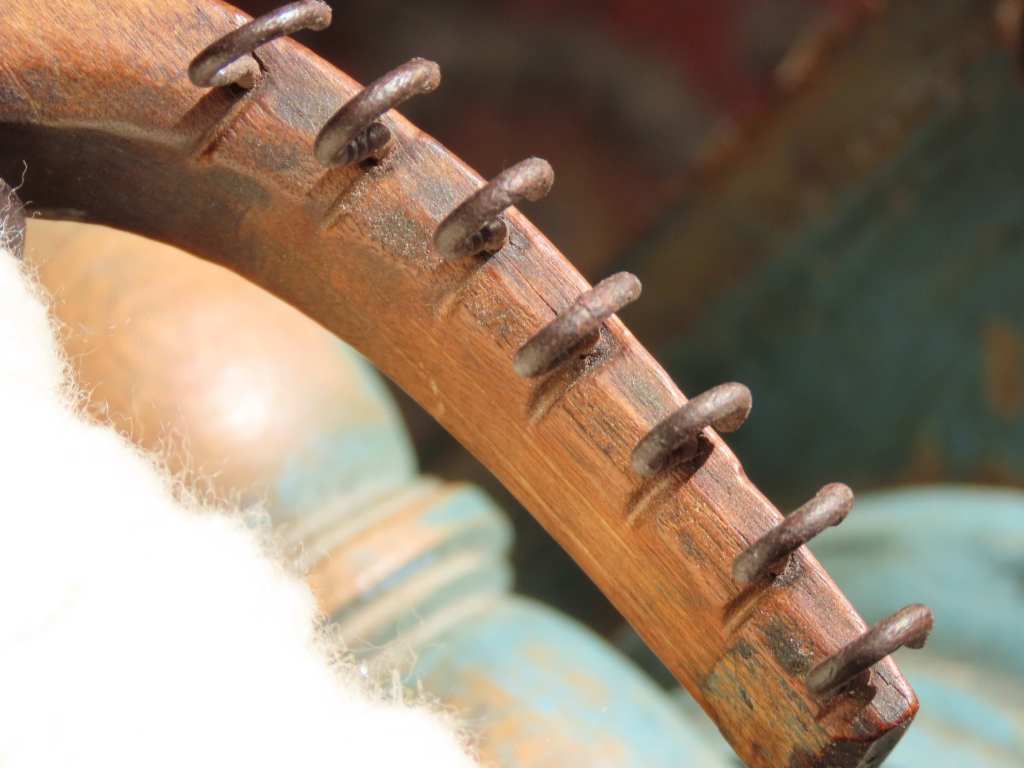
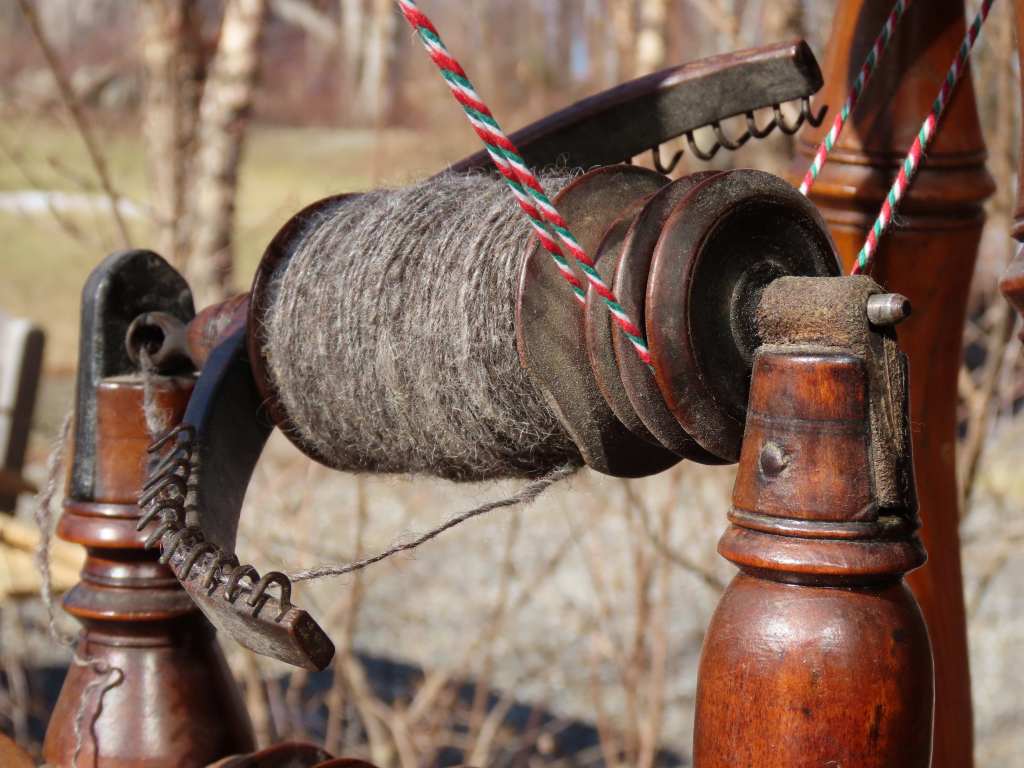
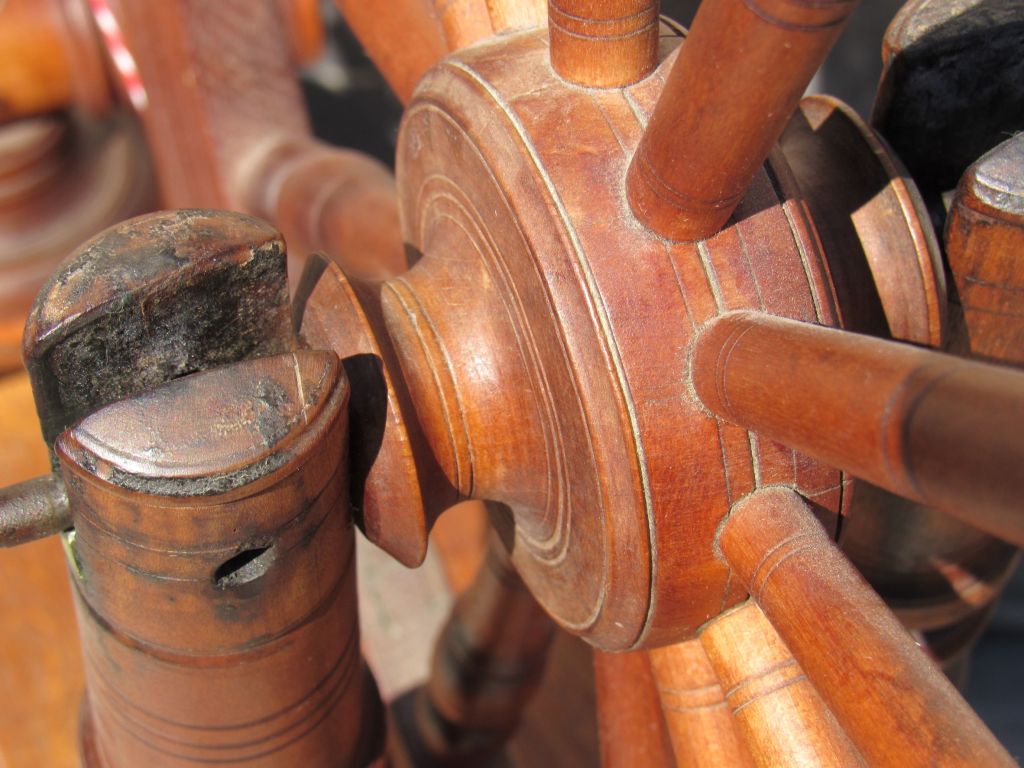
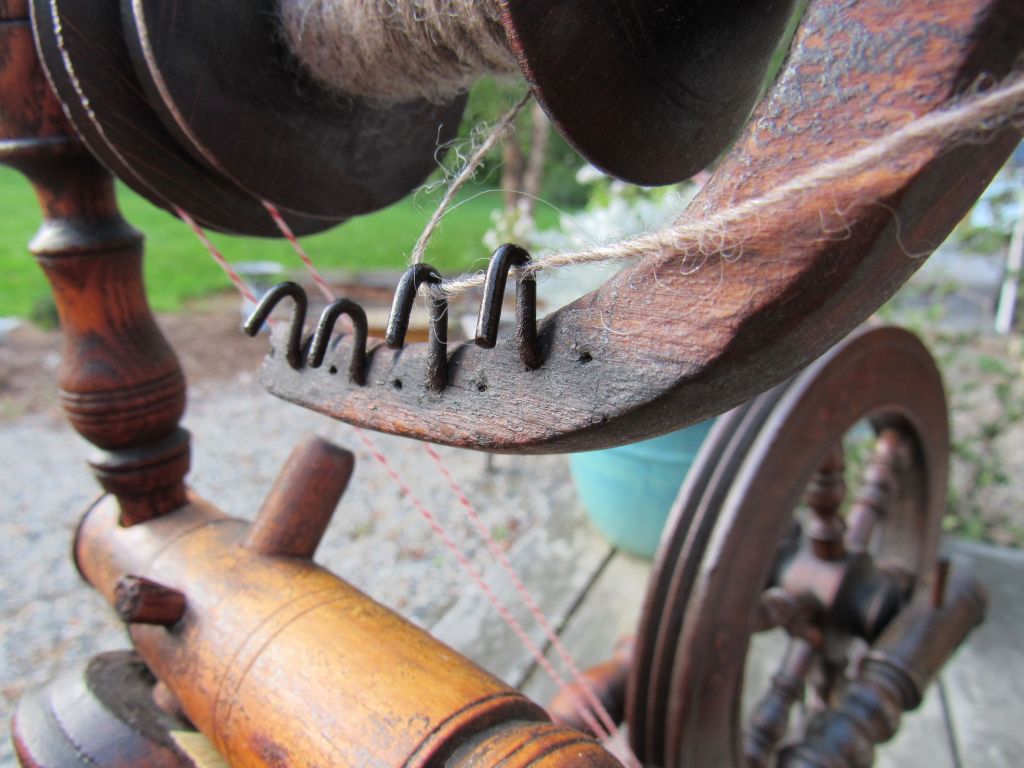
Deep grooves run alongside the flyer hooks–again a wear pattern that is out of the ordinary.
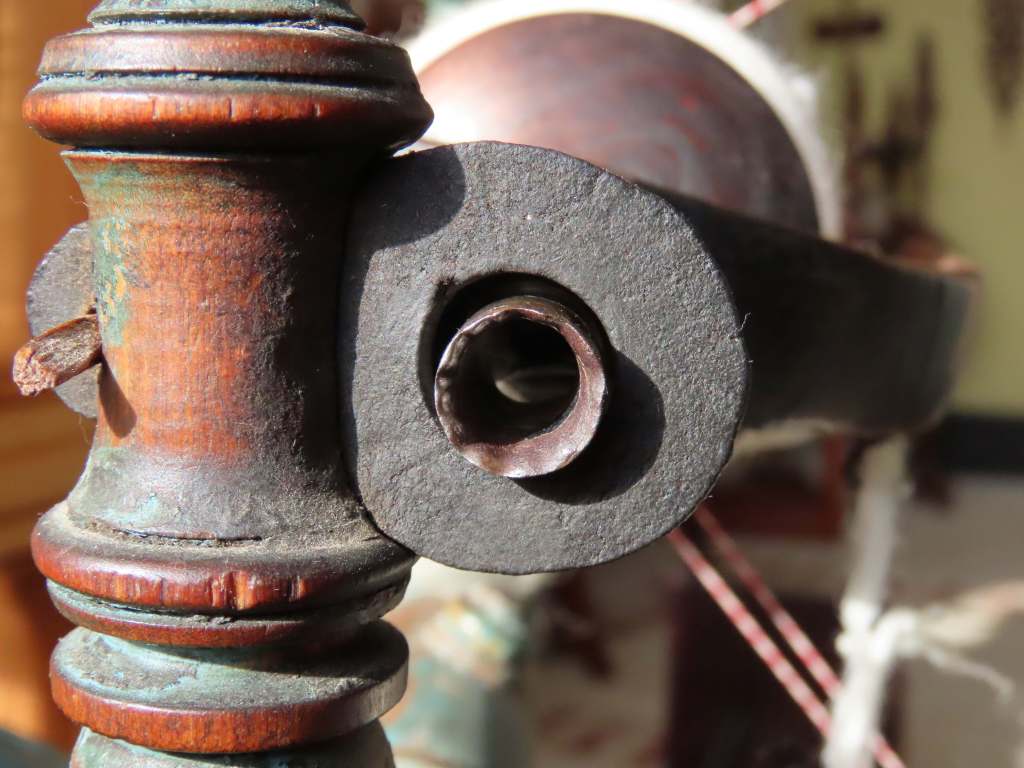
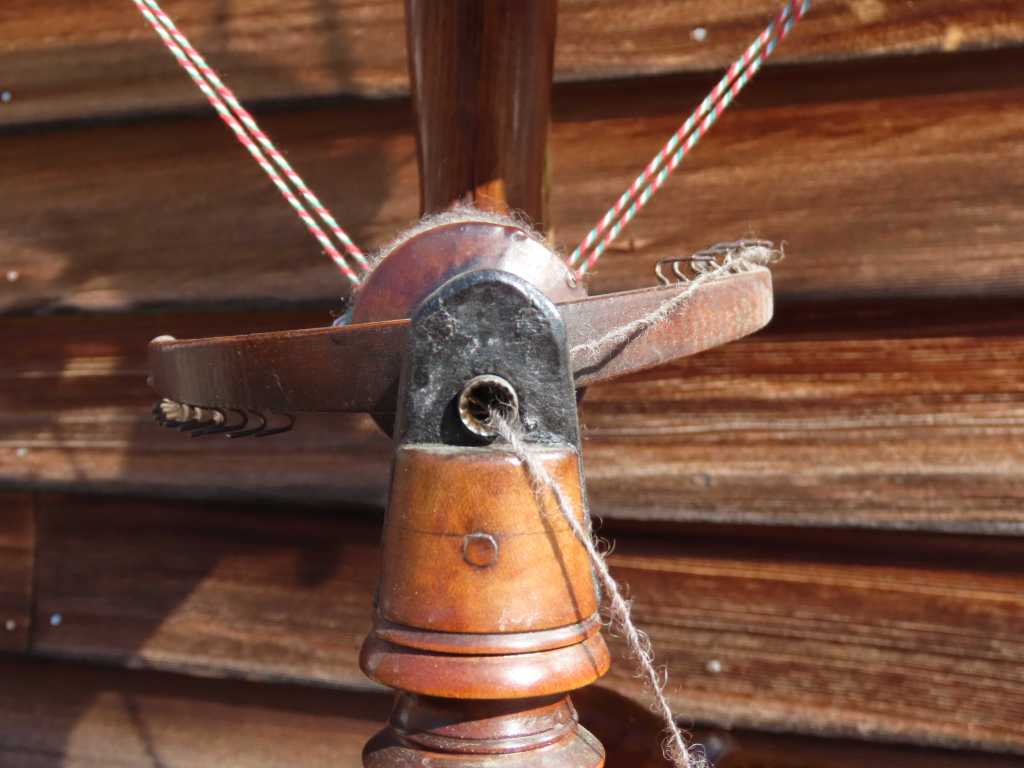
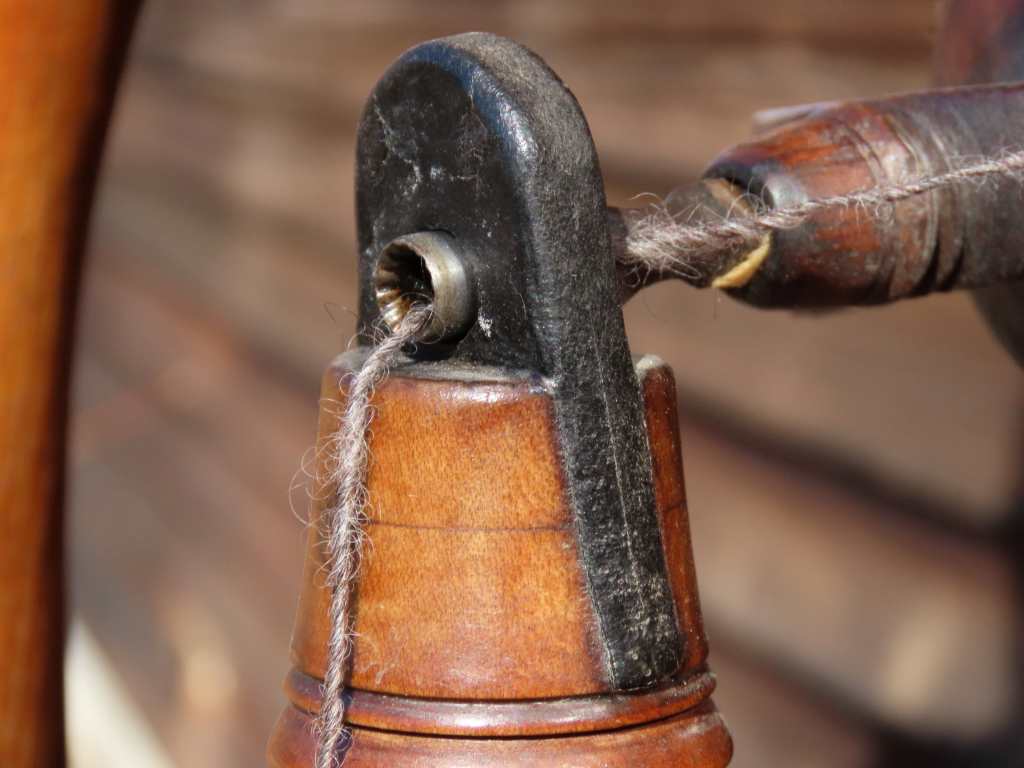
The orifice opening is slightly fluted,
with a opening big enough for easy plying.
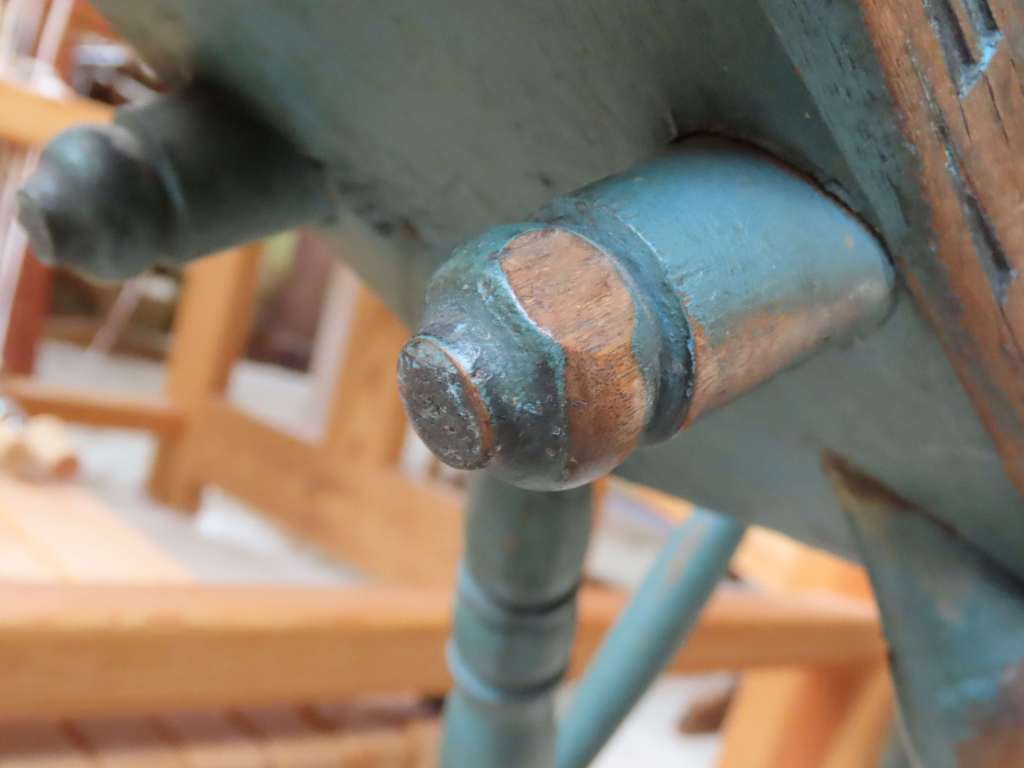
and there is wear on the far side of the mandrel where it hits the bearing.
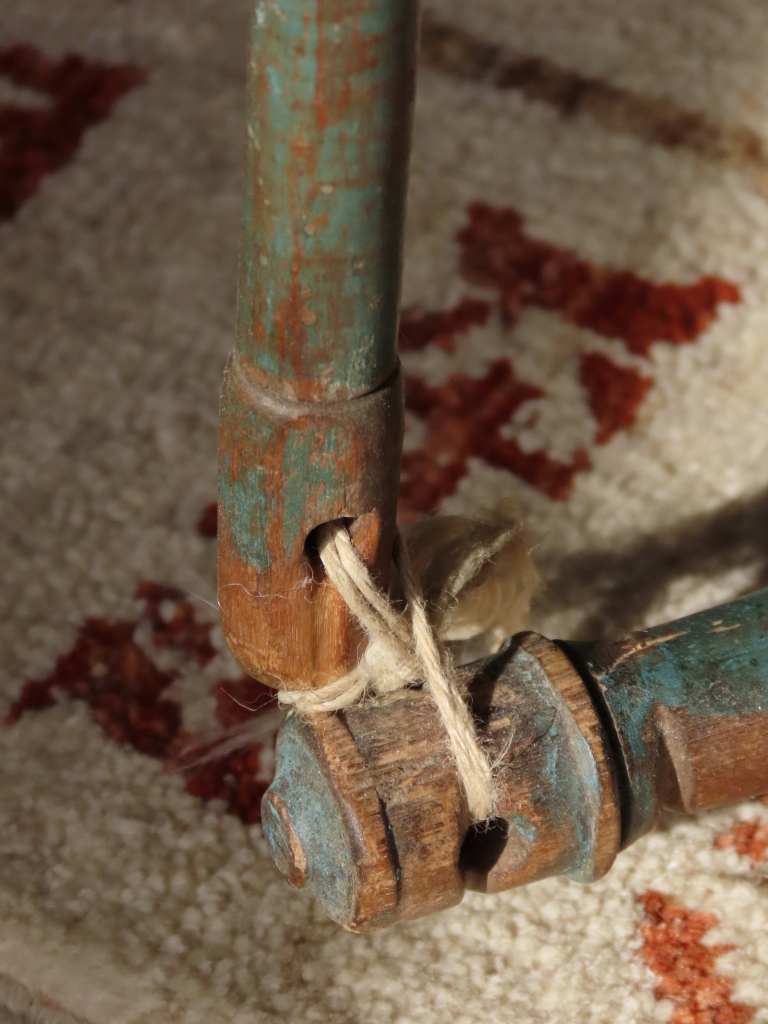
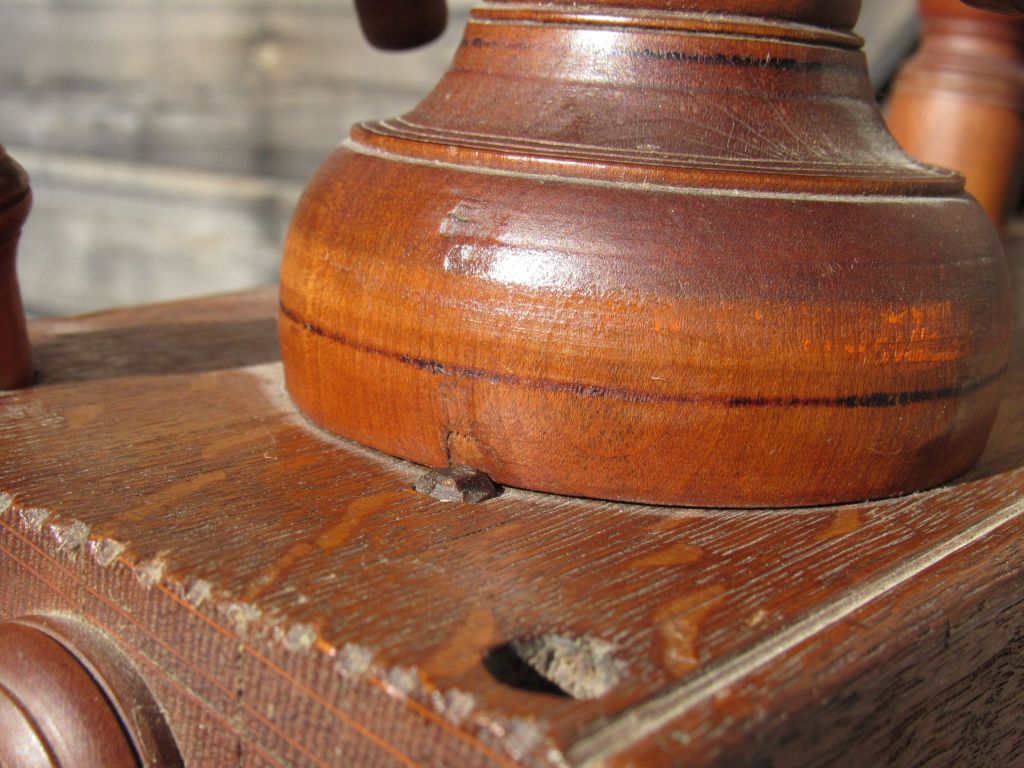
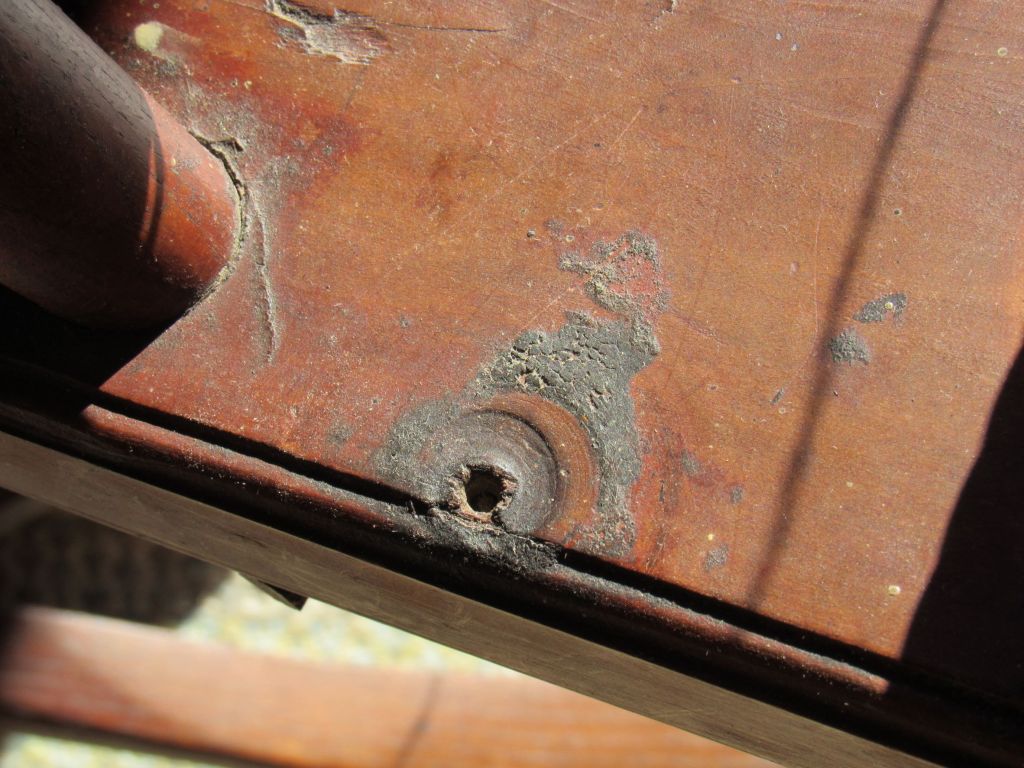
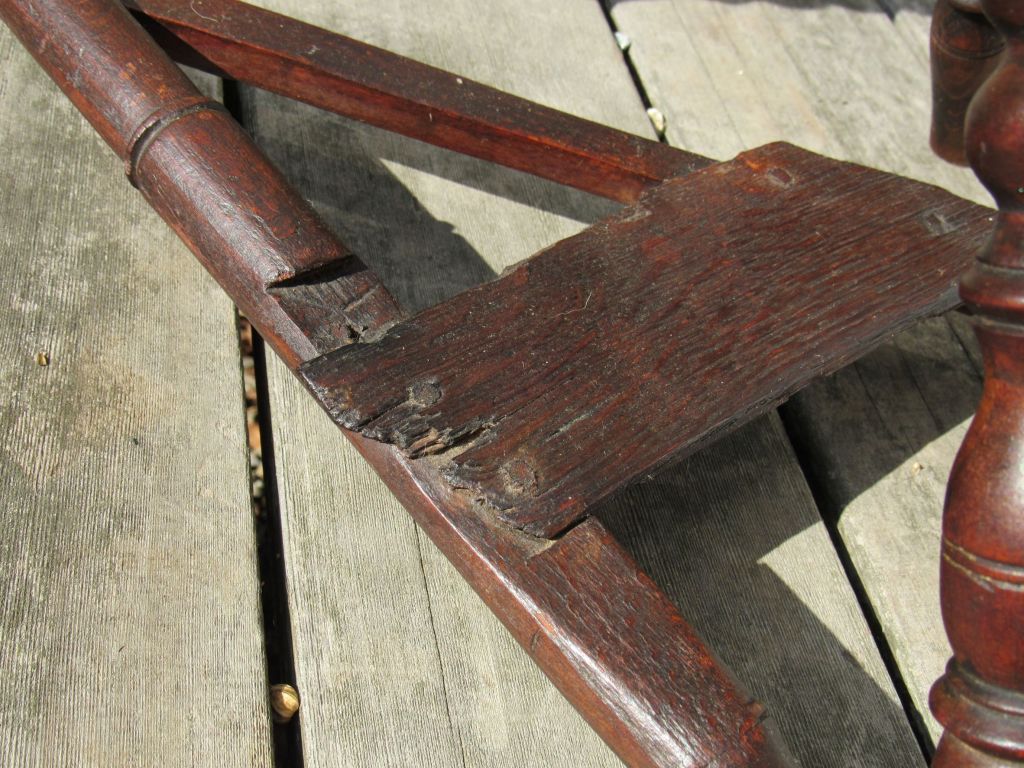
The footman has been repaired with a screw.
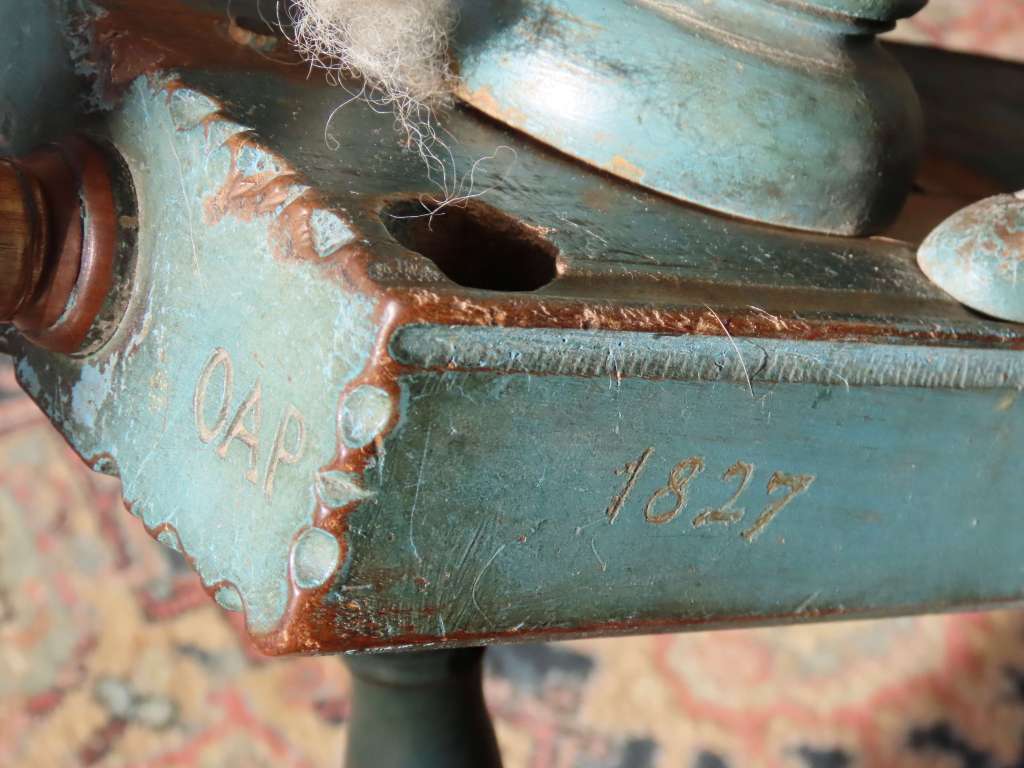
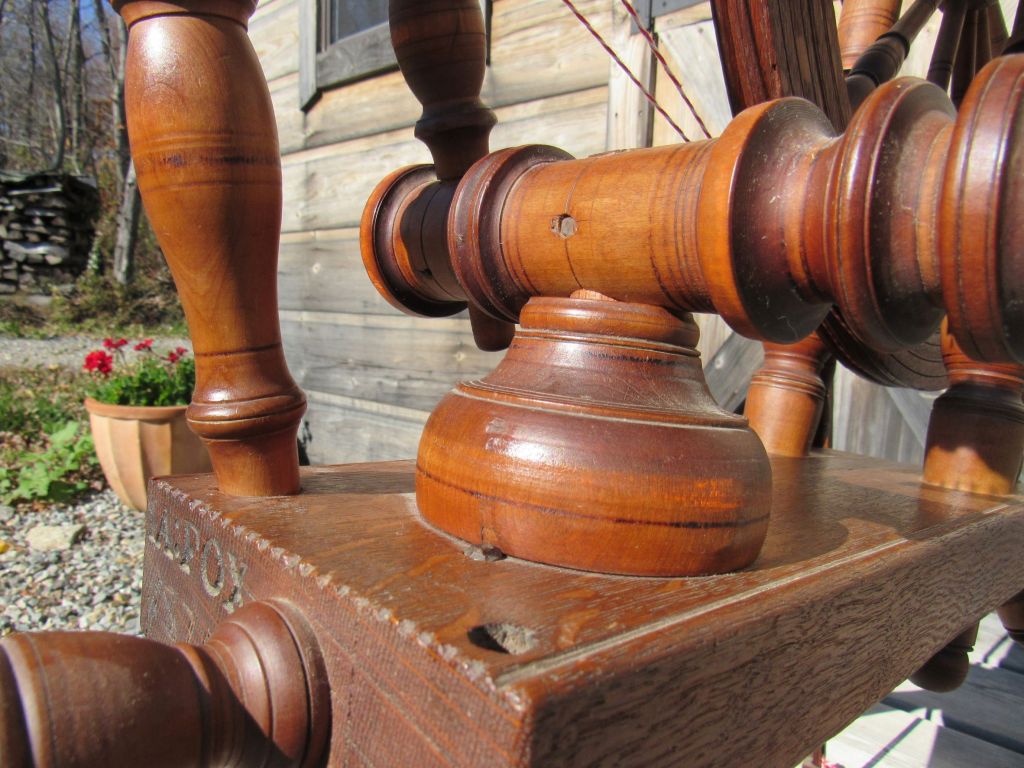
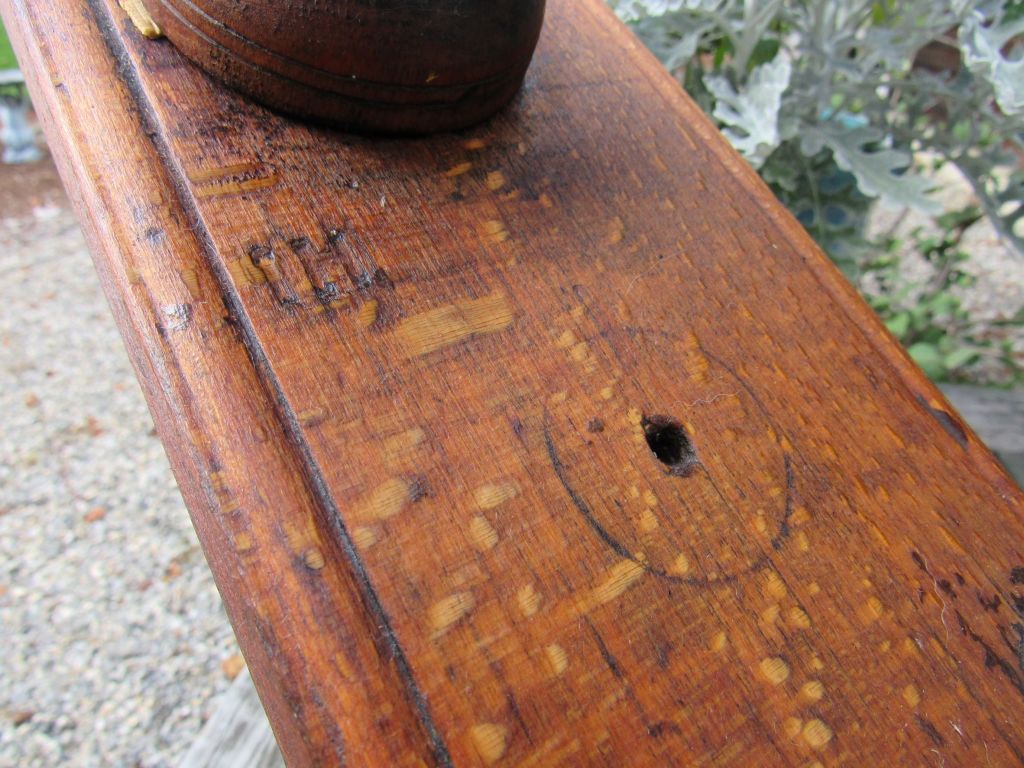
In contrast with many of these wheels, which have painted initials of the owners along with a date, Solveig has the date 1827 scratched into the side of the table.
Since OAP did not routinely apply the date in this way, it likely was added later by an owner and may not be accurate.
But there is not doubt that Solveig was used for many years.
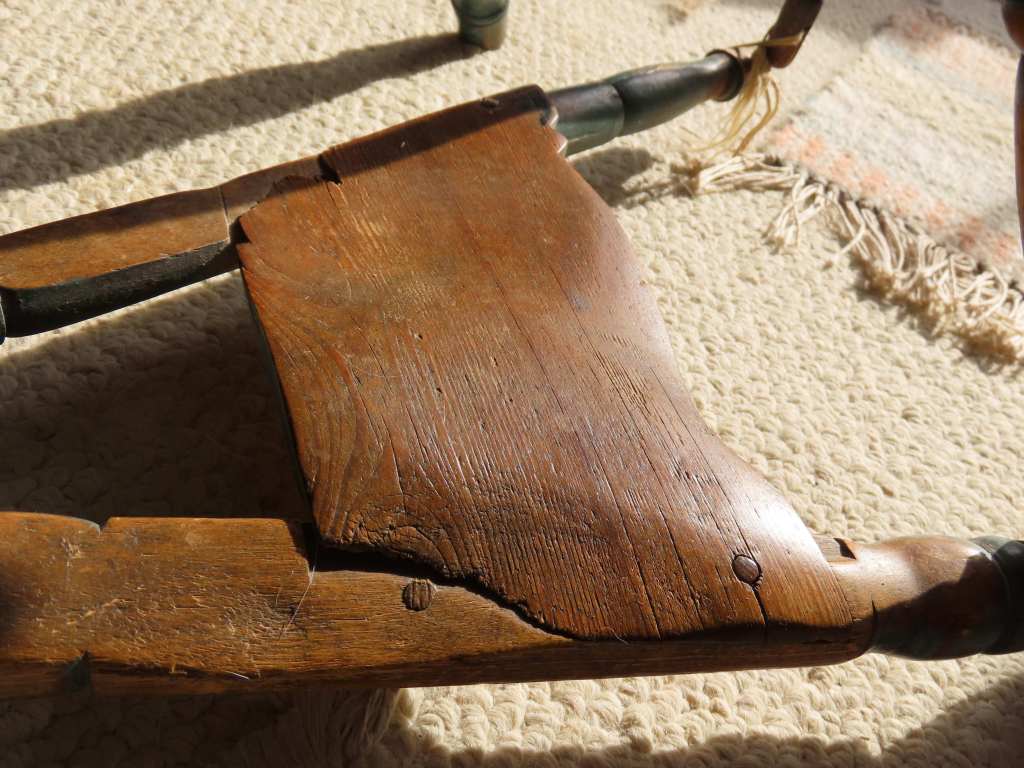
The wear on the treadle is so extreme it created a wooden wave.
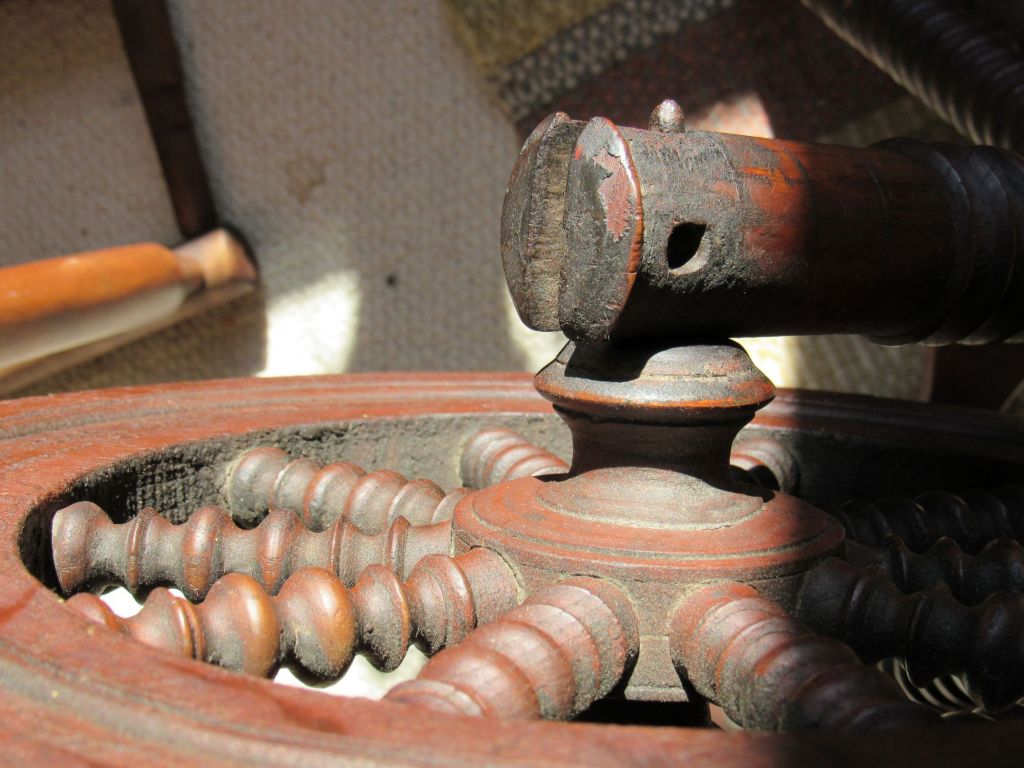
The drive wheel construction is typical of Norwegian wheels.
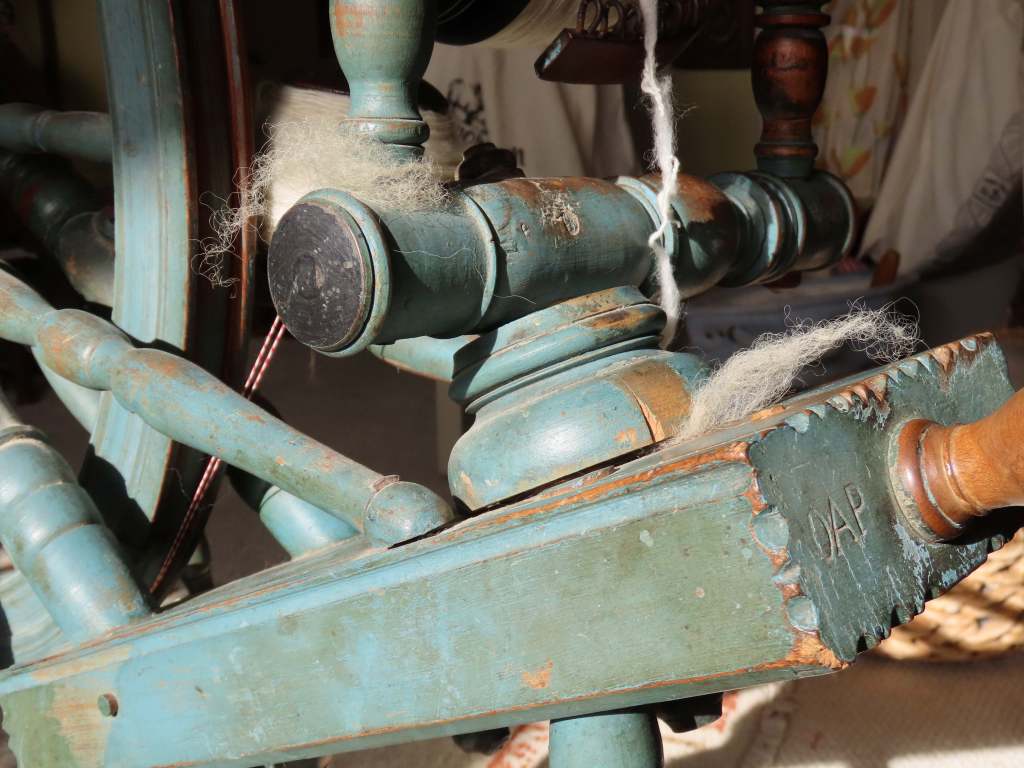
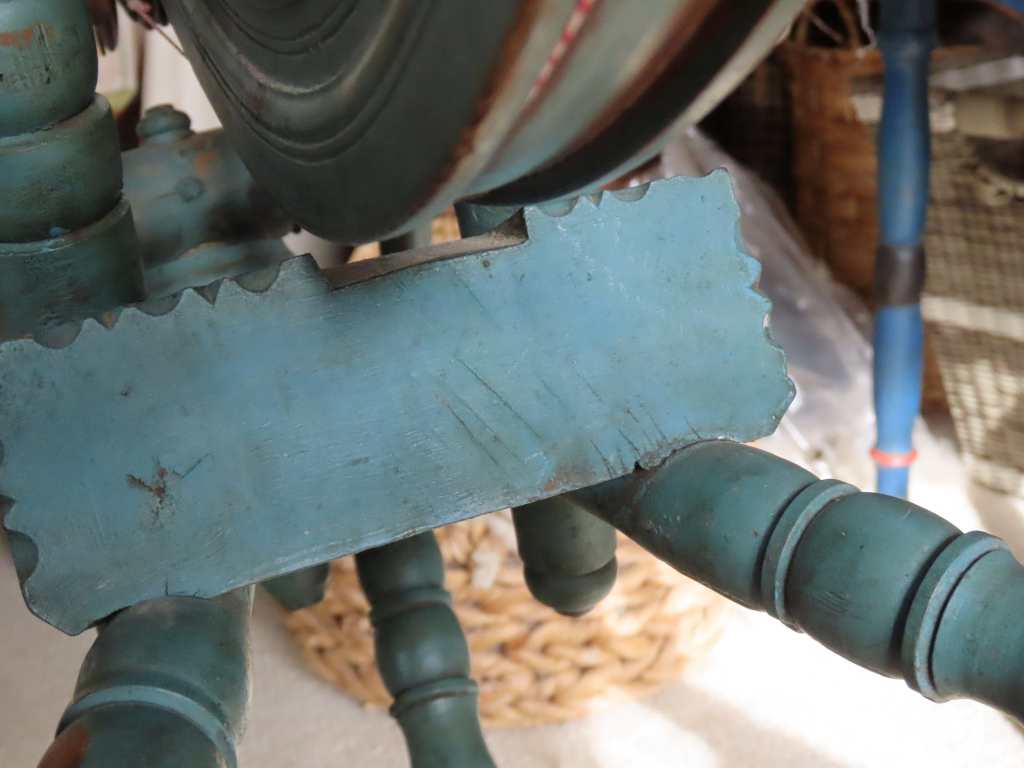
But, every part of the wheel carries special touches from OAP, whoever he was. A small cut-out under the drive wheel,
distinctive maidens,
little touches of decorative design,
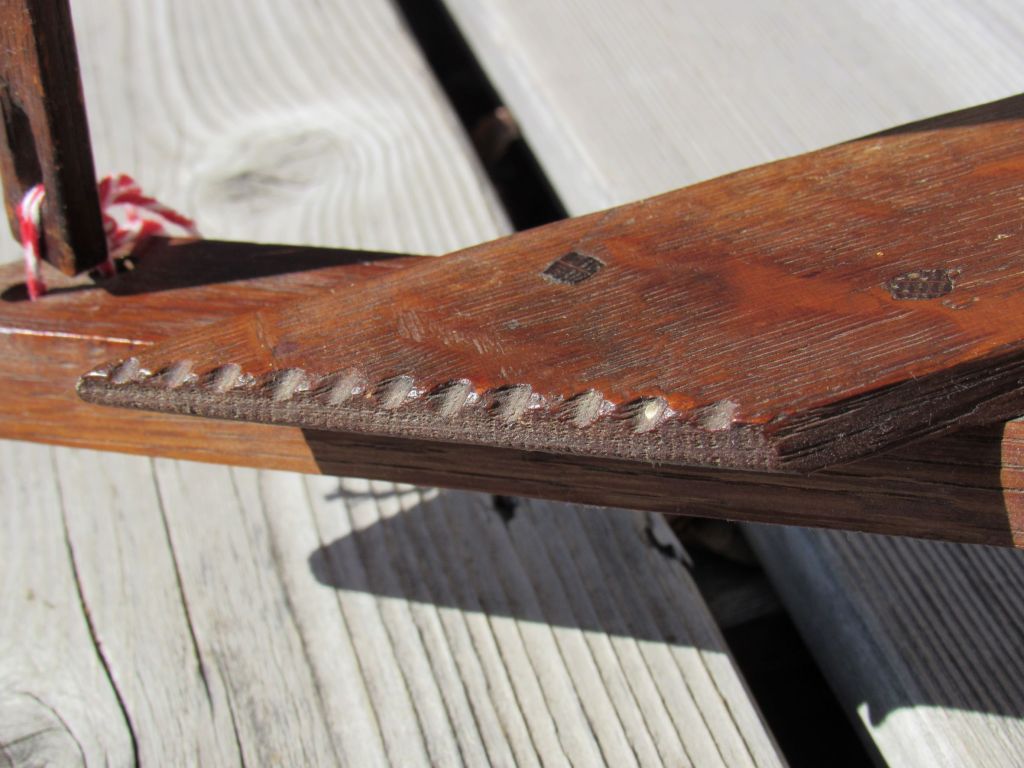
and the maker’s signature chip carving are a reminder that he valued beauty along with practicality.
It is no wonder that OAP’s wheels were so popular and remain coveted to this day.
Thank you to Andrea Myklebust for the Norway and Vesterheim photos. And, of course, for this wheel, which will soon be returned to live with Andrea again.
*The photo of the wheel in Norway was accompanied by this explanation: “This picture hangs framed over my mother’s spinning wheel along with a set of cards. Mom doesn’t know who the people in the picture are but thinks they are cousins from Lofthaug. – Wendy Turner ”
The quotations are from:
Bergland, Betty A. and Lahlum, Lori Ann, Norwegian American Women, Migration, Communities, and Identities, Minnesota Historical Society Press, St. Paul, MN 2011.
I bought this wheel and reel because they are from Prince Edward Island. Like many, PEI has a place in my heart because of L.M. Montgomery’s books. I discovered an ancient copy of “Anne of Green Gables” when I was about ten (many years before the television series) and there was no looking back. Although Montgomery’s books were not easy to find then, I ferreted out every one I could track down, eventually reading all of them.
I visited PEI when I was 14, and when Montgomery’s journals and letters were published, I devoured them, too. The magic of Montgomery’s writing, to me, is how, through her perceptive lens on the small details of speech, behavior, and customs, she brings a specific time and place to life so vividly that it feels as if I have been there. Her descriptive details also provide rare documentation of everyday practices, passed on orally, which she preserved through her writing.
A wonderful example is when Emily (of New Moon) finishes mopping the kitchen floor, she then sands it in “the beautiful and complicated ‘herring-bone pattern’ which was one of the New Moon traditions, having been invented, so it was said, by [a] great-great-grandmother … New Moon was the only place in Blair Water where the old custom of sanding the floor was kept up; other housewives had long ago begun to use ‘new-fangled’ devices and patent cleaners for making their floors white.” Emily Climbs p. 60.
So, when I bought this wheel, I tried to think of spinning wheel references in Montgomery’s books that might be a helpful starting point for research. I remembered that in “Emily of New Moon,” Aunt Laura wove and spun in the garret. “The walls were hung around with great bundles of soft fluffy rolls, all ready for spinning, and hanks of untwisted yarn. Sometimes Aunt Laura spun on the great wheel at the other end of the garret and Emily loved the whirr of it.” p. 93.
The only other reference I could think of was from “Anne of Windy Poplars,” when the local dressmaker encountered Anne walking in the old graveyard and regaled her with stories of those buried there: “My great-great-grandfather Courtaloe is buried here. He came out in 1760 and he made spinning wheels for a living. I’ve heard he made fourteen hundred in the course of his life. When he died the minister preached from the text, ‘Their works do follow them,’ and old Myrom Pringle said in that case the road to heaven behind my great-great-grandfather would be choked with spinning wheels.” p. 44.
From these tidbits, it appeared that some spinning was still going on into the early 1900s on PEI, including with great wheels (at least in homes that kept up old traditions), and that there must have been some prolific wheelmakers on the island. A promising start.
I next checked in my other books and was excited to find a reference to PEI wheels in “Keep Me Warm One Night.” “In Prince Edward Island an unidentified maker incised a number at one end of the platform,
and a date at the other. Some idea of his production may be guessed by the fact that examples numbered in the 600s have been seen.” p. 19.
I also found a reel in Joan Cummer’s book that looks just like my reel. pp. 326-27. Cummer writes: “This click reel came from Prince Edward Island, Canada. Probably made in the early nineteenth century, it had belonged to only one family where it received much use. The family, even in the first quarter of the twentieth century, spun and wove their own cloth. The reel is still in perfect working order. Each single turn takes up 79 inches, and the clicker clicks every 100 turns.” P. 326.
Cummer’s account confirms Montgomery’s portrayal of PEI spinning and weaving into the 20th century, and both support the family history that came with this wheel and reel. The people from whom I bought them kindly wrote up their history within the family.
The wheel and reel have always been together, passed down from parents to son about 1894, when the son was married on PEI.
The family lived in St. Mary’s Road, in Kings County, the easternmost part of the Island. When the family eventually migrated to Massachusetts, the wheel and reel came with them. According to the family, the wheel is made from apple wood.
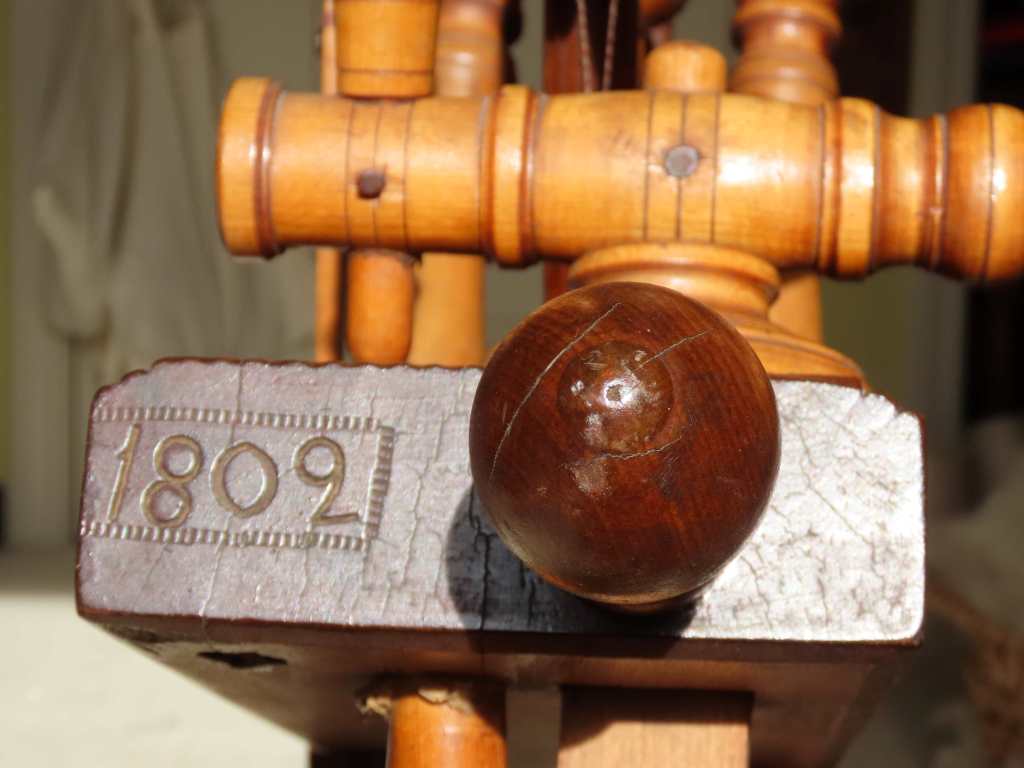
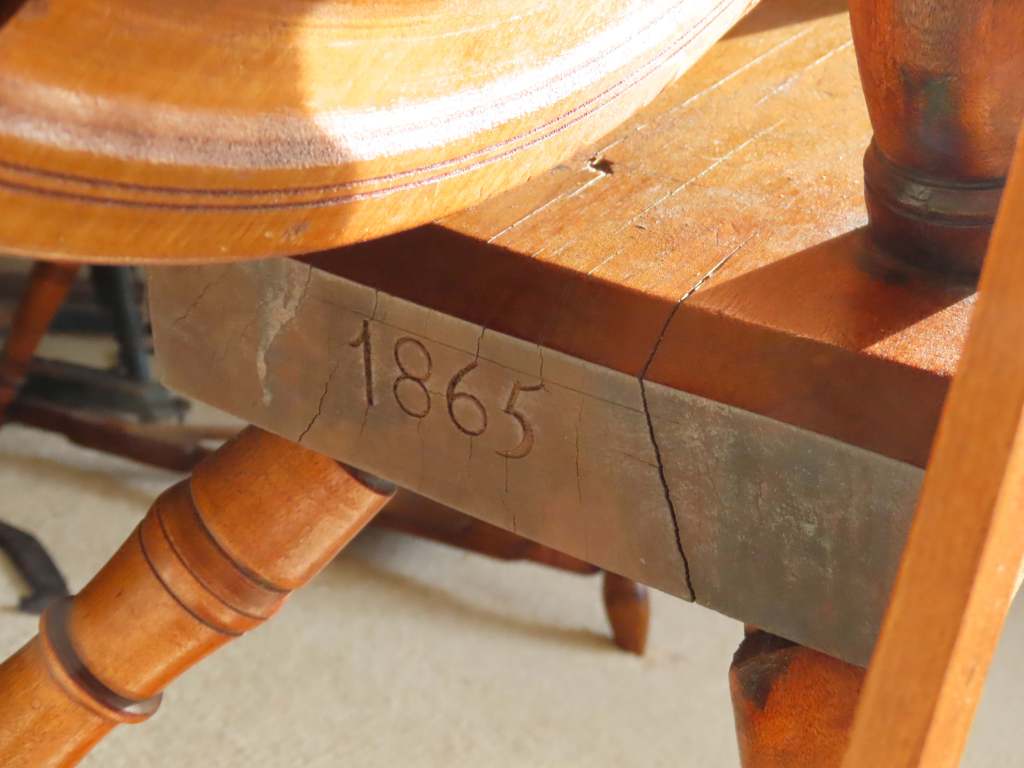
Like the wheels mentioned in “Keep Me Warm One Night” a production number of 1802 is on one end and a date, 1865, on the other.
Presuming that 1802 is a production number, it would seem that such a prolific wheel maker would be well documented. I started out my search with great optimism. But, over and over, my online searches yielded the same name-–Benjamin Chappell.
Chappel was a man of many talents. A wheel wright, machinist, and lay preacher, he came from England to PEI in 1774. He turned his hand to most anything that needed doing, including politics and spinning wheel production, and kept daybooks for many years. His daybooks are a phenomenal resource for anyone interested in spinning wheel production.
He documented the types of wood he used for wheel parts, for example: “took the Oak Rims cut them to their Length. put them over the shop they Amount to 50 wheels. They had been abroad 14 months & 20 days. Very good Oak” “black birch rim” “at more black birch whirls & c” “green beach rims … the old beach log made 20 wheels” “green white maple horses for the wheels” “Green Spokes Rounded with ye chisel was Enough for 20 Wheels” Vol. Two, pp. 11, 26, 76, 82, 98. He made the various wheel parts in batches: “last week finish’d 26 beds for drying. And Spokes 1000 of them some Maiden and Crowntrees all white Birch” “turn’d in all 7 sets of Spokes” “Tuesday Made 12 New treadels” Vol. Two, pp. 41, 90, 273.
Then he assembled and finalized the wheels in batches of three. In May 1818, he finished wheels 864, 865, and 866. Vol. Two, p. 284. I believe those are the last ones mentioned in his day books. In researching Chappell, I came across a 1930 article by PEI historian, Ada MacLeod, entitled “The Oldest Diary in Prince Edward Island.” I had a good laugh when I came across this passage:
“In his spare hours Chappell was always making spinning-wheels and so methodical was he that he numbered them, and the number entered in his book is over 600, which speaks much for the industry of the women of that time. At his funeral the text was the verse ending, ‘For their works do follow them.’ A wag remarked that if this were literally true in Chappell’s case, the road to heaven would be blocked with spinning-wheels.” p. 471. Sound familiar? L.M. Montgomery knew a good line when she saw it.
Chappell died in 1825 and clearly is not the maker of my wheel. Despite being so well-known and making so many wheels, I have not been able to find a single photograph of a Chapell wheel. In fact, I have found PEI to be a tough nut to crack when it comes to tracking down any information on wheelmakers. In addition to online research, I contacted historical societies and museums, and have had those with Island contacts make inquiries, but nothing has borne fruit. Crickets.
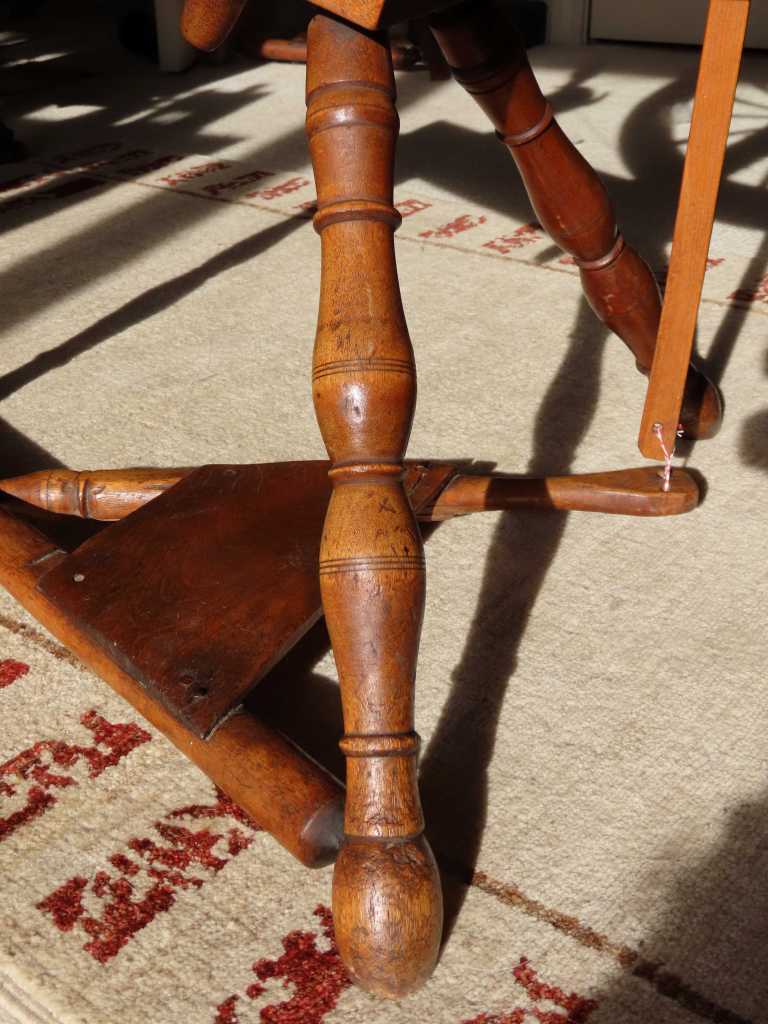
These wheels show up for sale with some regularity in New England, particularly in Massachusetts, where many PEI families migrated to find work. They share some similarities with the Nova Scotia wheels in the previous posts, including the spoon-like end to the treadle bar
and slope on the wheel end of the table.
The lovely generously rounded maidens make these wheels easy to spot and, of course, the numbers are distinctive.
Those on the tension end are bold and thick, surrounded by a box of punched decoration, while those on the wheel end are less robust and more refined looking, with no surrounding decoration. If the numbers indicate the year made and production number of the wheel, this maker must have been making wheels for many years, so I was extremely frustrated that I have not been able to find anyone on PEI with information.
Cheryl’s wheel
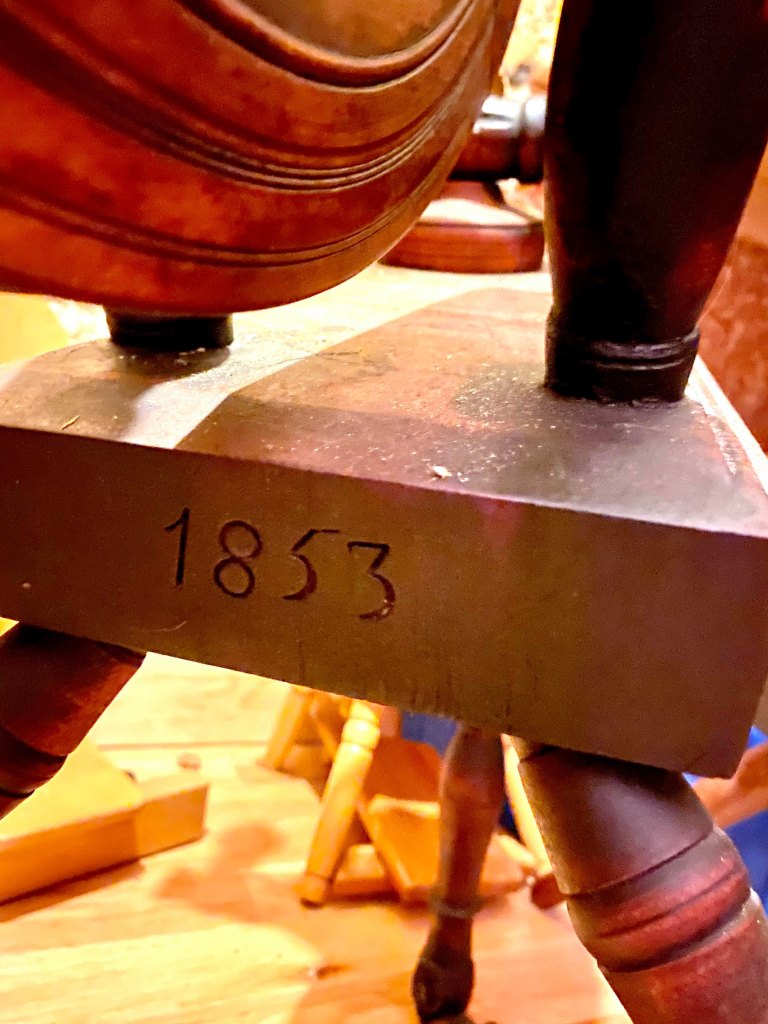
My one lucky break came from someone close to home. A few years ago, a spinner near me in Maine, Cheryl Bubar, was moving out of state and wanted to re-home some of her antique wheels. When I went over to her house, she showed me her family wheel from PEI (which she was keeping). It was a sister to mine, with the numbers 1184 on the tension end and 1853 on the other end. It turned out that Cheryl’s family also was from Kings County and were friends with the family that owned my wheel, PEI and after both families moved to Massachusetts.
Cheryl’s
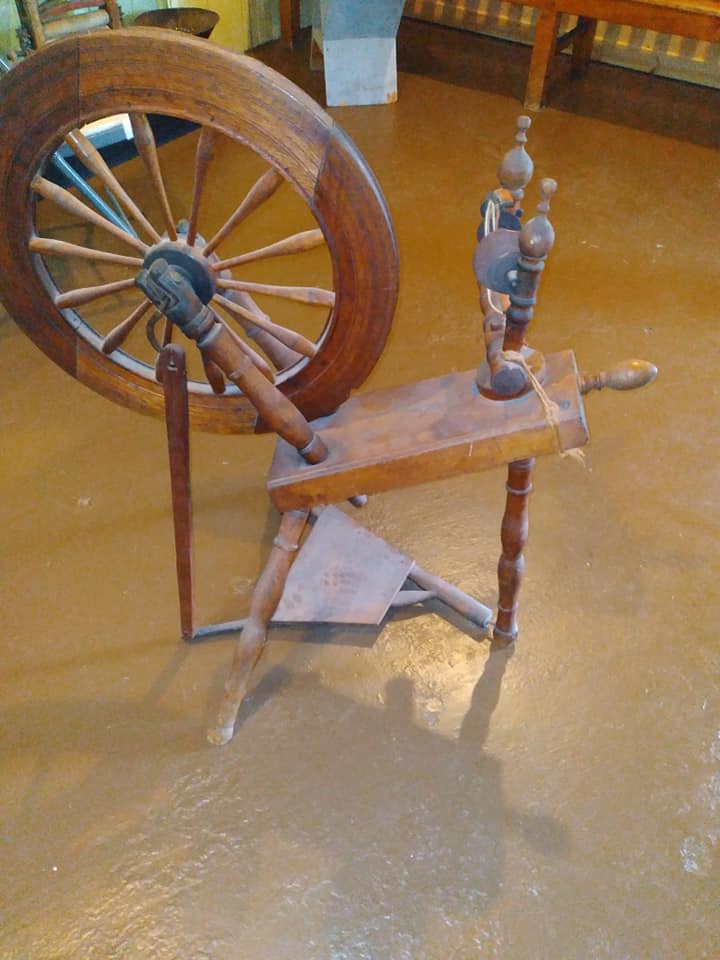
Some time later, a woman posted another of these wheels on Facebook, saying it had been donated to a museum in New Brunswick.
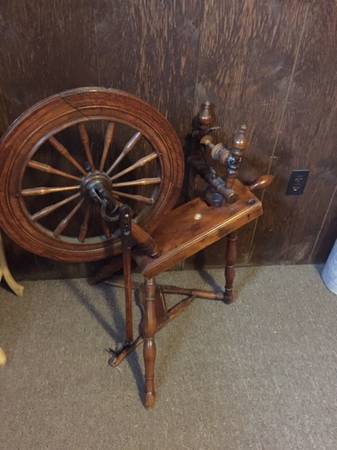
Wheel found in NB, but also from Kings County PEI
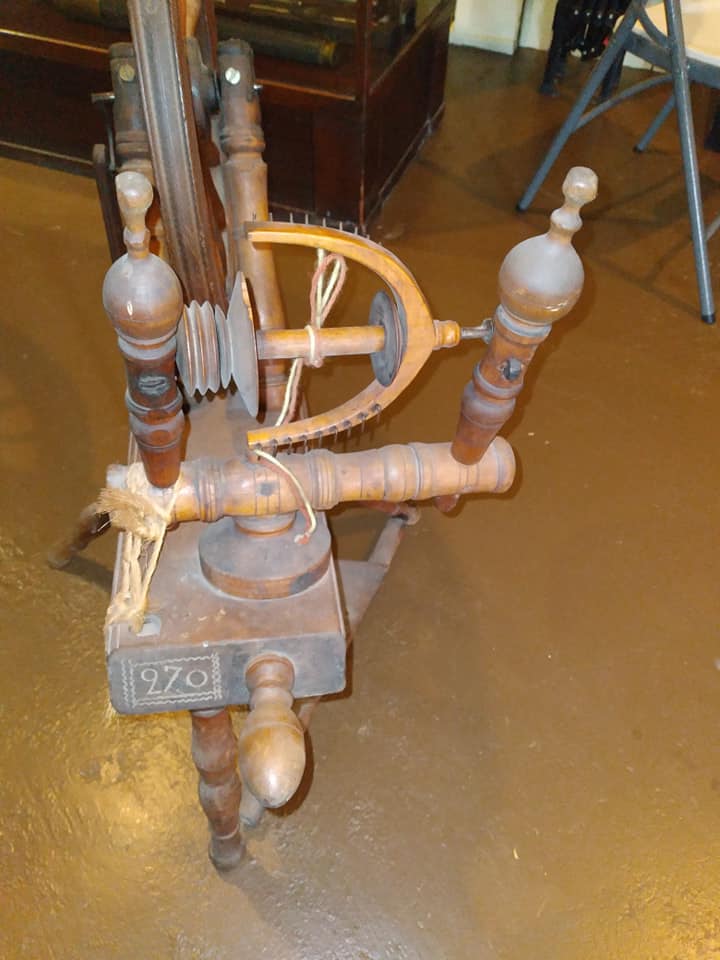
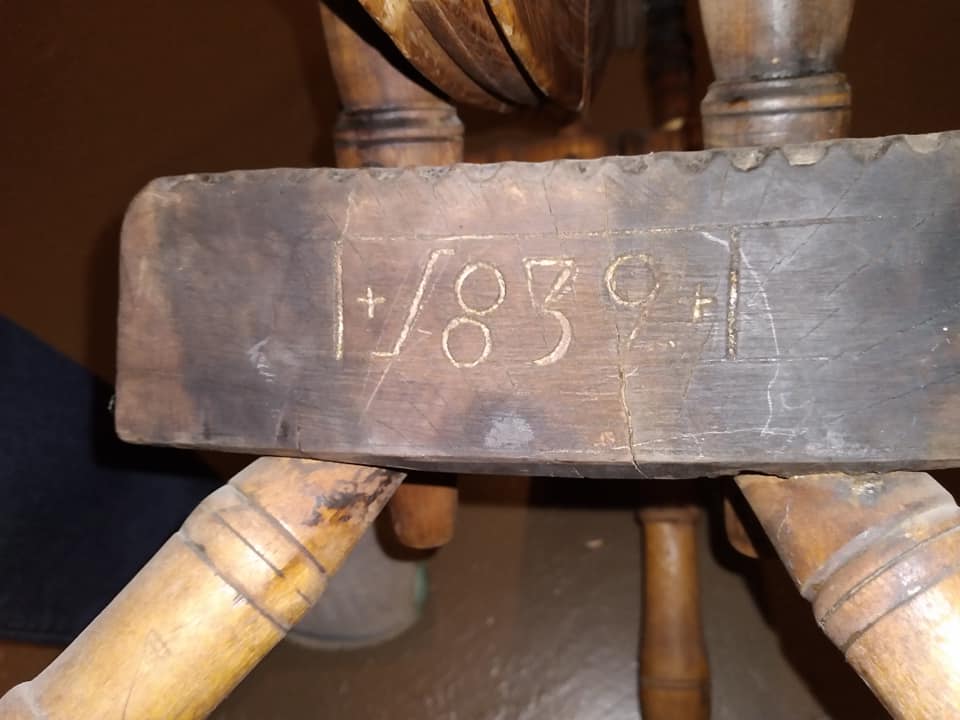
It was numbered 270 with the date 1839.
While the maidens are different on this early wheel, the first number–probably a “2” rather than a “9”–has the same unusual shape as on my wheel
She did some digging and found that the wheel had come from St. Charles, PEI—also in Kings County. While this 1839 wheel has somewhat different maidens and slightly different numbers, it seems likely that it is an early version from the same maker.
Date on the wheel found in NB
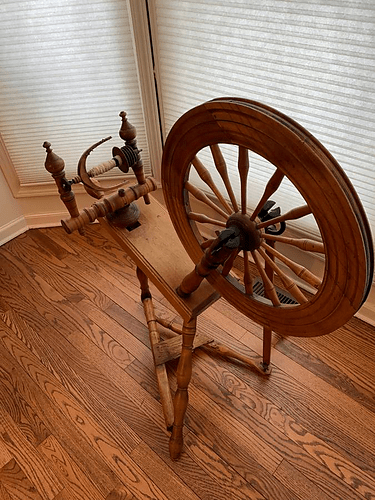
Another wheel came up for sale on Craigslist with the number 1170 and date 1853.
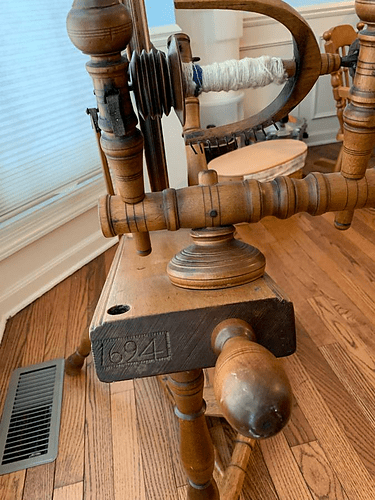
And one showed up in Michigan with the number 1694 and date 1863.
Wheel in Michigan–another beauty
So, it appears this wheel maker (or wheel making family) made over 1800 wheels from the 1830s to at least 1865.
Michigan wheel
In the twelve-year period between Cheryl’s wheel and mine, he would have made about fifty wheels a year.
1863 date on Michigan wheel
Cheryl did some digging and found in the book “Exiles & Islanders” a passage quoting from a letter written by John McNally (Nallen), a furniture maker in East Point PEI to his brother in County Mayo in 1832. McNally wrote, “if you were here you would make a fortune,” and that he was getting “five dollars for a spinning wheel and six pounds for a turned chair.” p. 116. (link to original letter here).
leg held in place with old linen cloth
I have not been able to establish how long John McNally lived, but since three of these wheels came from Kings County, where he was making wheels in 1832, he is the leading candidate for our wheel maker. Try as I might, though, I have not been able to confirm who made these wheels.
shims on far maiden
There is evidence of at least two other wheel makers on PEI at the time, John McQuarrie (or McQuarry) and George Lockerby, but both were working in Charlottetown.
My wheel is probably the heaviest saxony style that I own. Its weight and the wood grain and coloring seems to support that it (or much of it) was made of apple wood.
It has an unusual leather “bumper” on the far maiden,
I imagine to keep the whorl from bumping against it and to help with alignment.
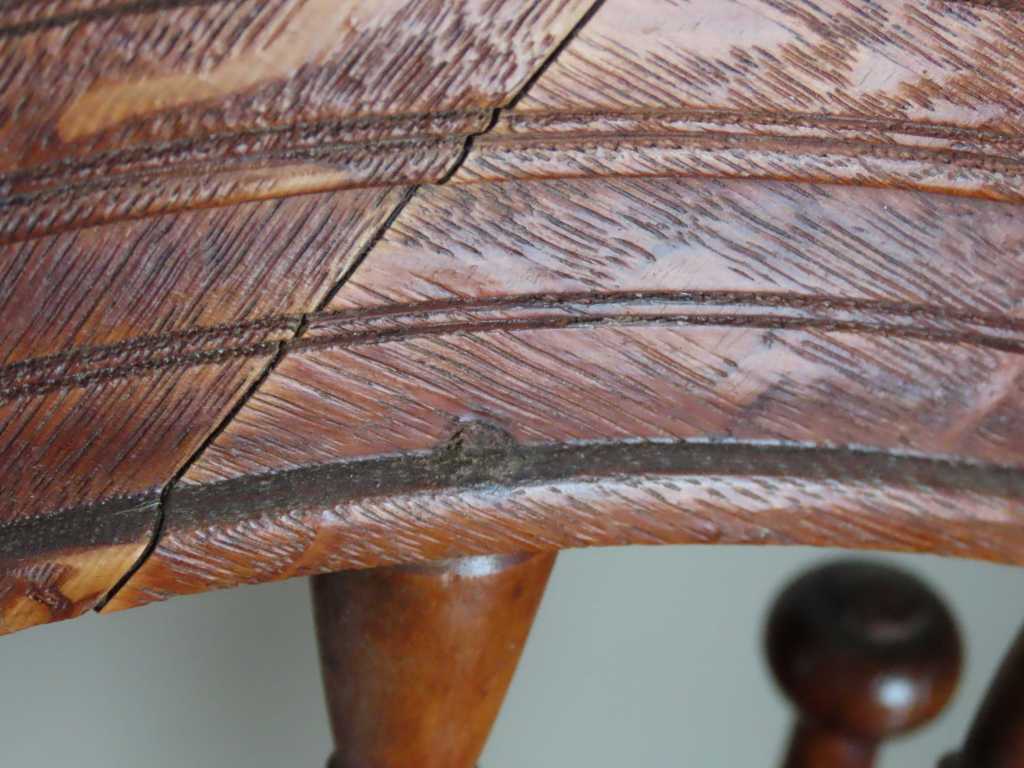
The scribe marks underneath are unusual in that they are doubled, created a sort of plaid diamond pattern.
For the first time, when taking photographs for this post, I noticed marks on the back of the spokes similar to those on the spoke fronts of Marilla, the McIntosh wheel in a previous post.
They are much fainter and fewer on this wheel, but finding them on the back of the spokes just deepens the mystery as to how they were made.
No marks on the spoke fronts
The reel is large. Very large.
In contrast with the reel in Cummer’s book, this one makes a 90” skein and clicks at every 120 turns (giving 900 yards).
It is designed for easy carrying
and has single crossed scribe marks underneath.
Both are beautiful working tools and I would love to know who made them.
If anyone reading this has even the slightest lead that might be helpful in finding our maker, please let me know.
Although, I have not been successful in identifying the maker, or makers, it has been a fascinating journey.
Thank you to Cheryl for her research and to Cheryl, ReBecca, and Susan for use of their wheel photos.
References:
Burnham, Harold B. and Dorothy K., ‘Keep Me Warm One Night,’ Early Handweaving in eastern Canada, University of Toronto Press, Toronto and Buffalo, 1972.
Chappelle, R. LaVerne, The Daybooks of Benjamin Chappell, Volumes One and Two, The Prince Edward Island Genealogical Society Inc., Charlottetown, PEI 1998.
Cummer, Joan, A Book of Spinning Wheels, Peter E. Randall, Portsmouth, N.H. 1984. Accessory 24, pp. 326-27.
L.M. Montgomery, Anne of Windy Poplars, the front pages of my book are missing so I don’t have the edition, but the book was copyrighted in 1936.
Montgomery, L.M., Emily Climbs, Bantam Book, Harper &Row, New York, NY 1925 (Frederick A Stokes Co.), Bantam Ed. 1983.
Montgomery, L.M., Emily of New Moon, Random House Children’s Books, New York, 1923 (Frederick A Stokes Co.)
L.M. Montgomery, Anne of Windy Poplars, the front pages of my book are missing so I don’t have the edition, but the book was copyrighted in 1936.
O’Grady, Brendan, Exiles & Immigrants: The Irish Settlers in Eastern Kings County PEI, McGill Queens University Press, 2004.
Macleod, Ada, “The Oldest Diary on PEI,” The Dalhousie Review, Volume 9 Issue 4, 1930.
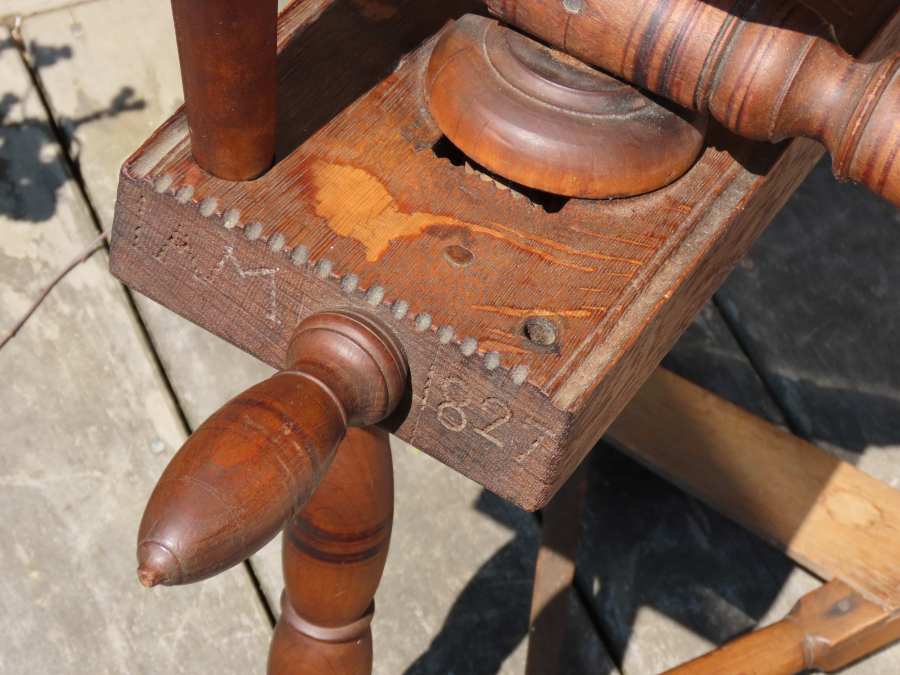
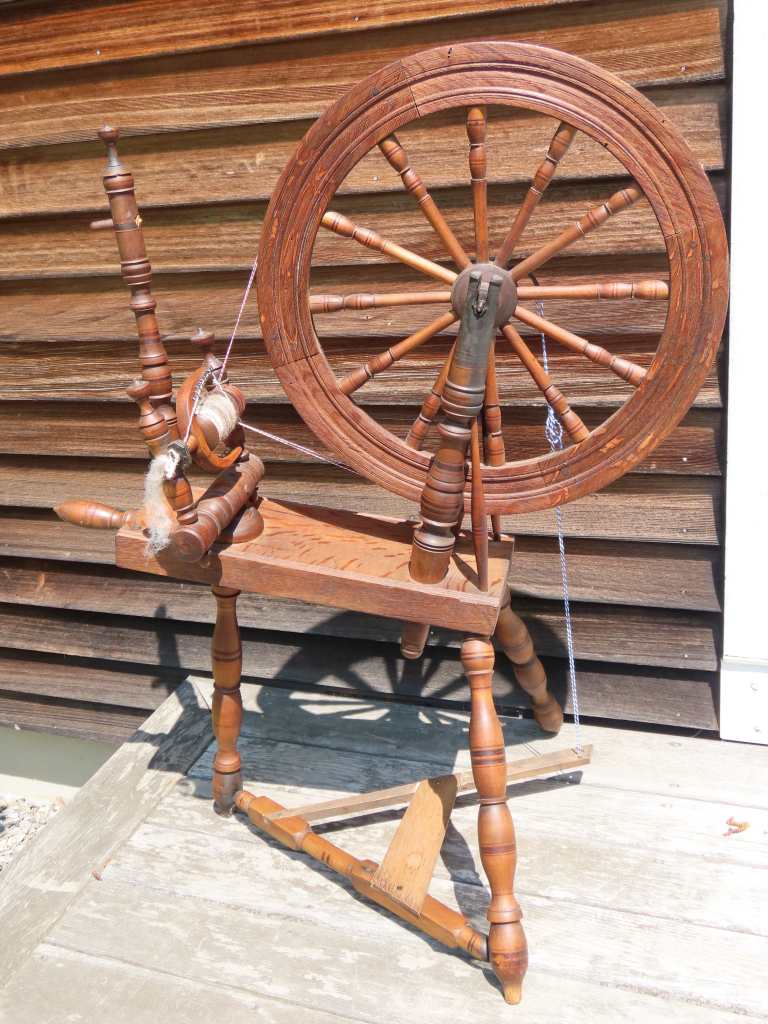
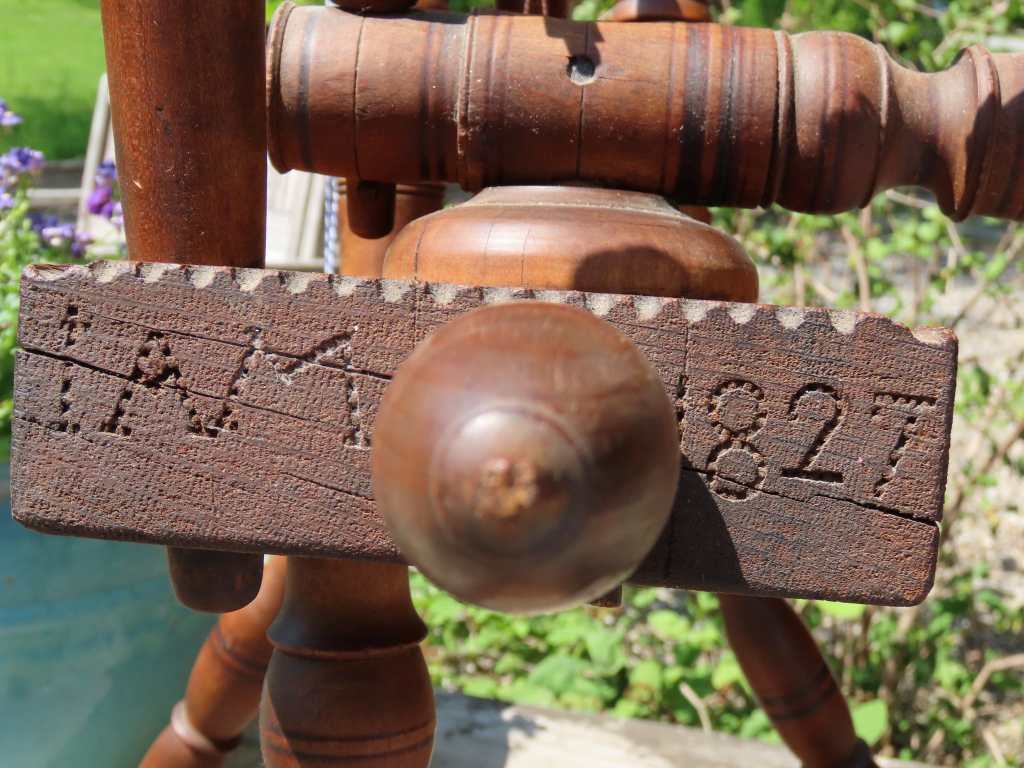
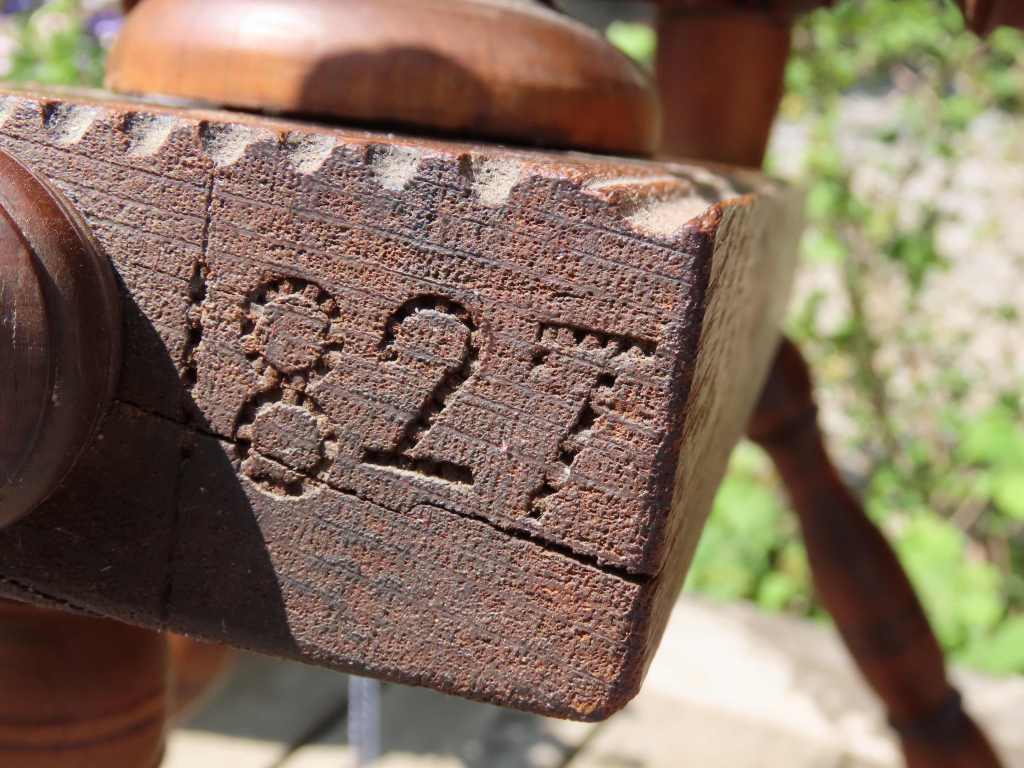
This wheel is intriguing. It is marked with the initials “IAM” and the date “1827.”
Yet, as far as I know, the maker has not been identified. According to the list of spinning wheel makers in Pennington and Taylor’s book, several flax wheels with the “IAM” mark have been found in Pennsylvania and Ohio, with dates of 1825, 1834, and 1843.
To complicate matters, a friend has a wheel with a very similar “IAM” mark and a date of 1833, but the wheel itself bears little resemblance to this one. That wheel turned up in Virginia. This one belonged to New Hampshire collector, Sue Burns, but I have no idea where she found it originally.
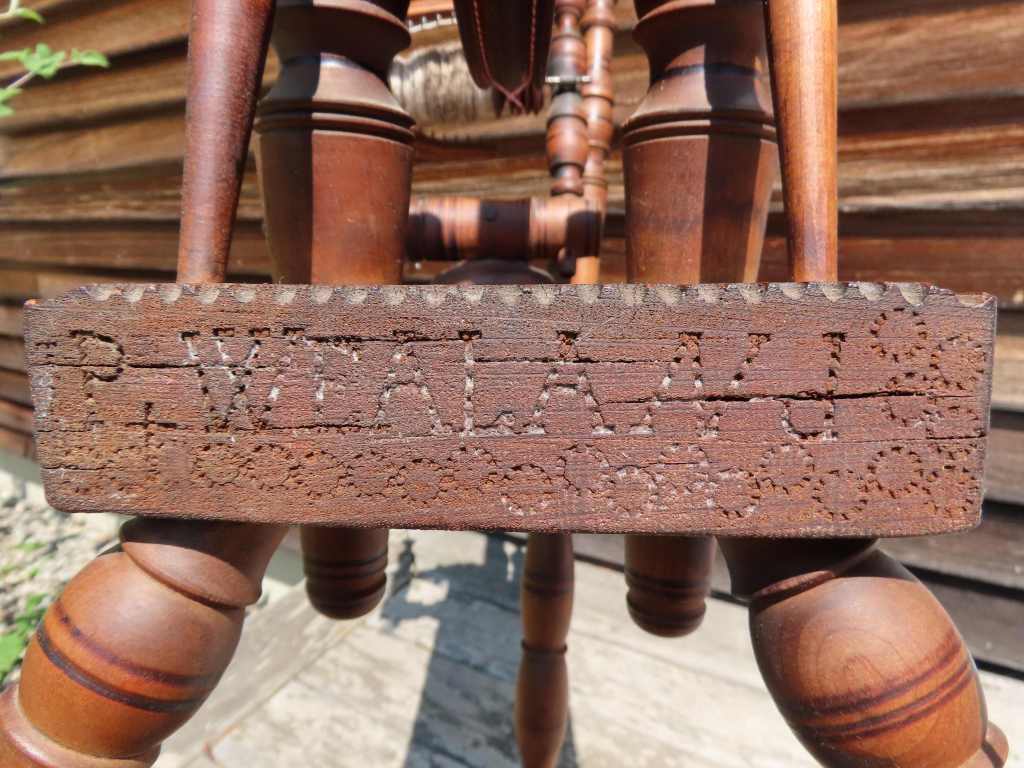
When I started researching, I hoped the mark at the other end of the table, “P. Wealand”–most likely the wheel’s owner–might provide a clue.
I found numerous Wealand families in Pennsylvania and Ohio in 1827, but not many first names beginning with “P.” Probably the strongest candidate was a Polly Wealand born in 1810 in Lancaster, Pennsylvania. She would have been 17 when this wheel was made, so the timeline fits nicely for the wheel to be made as a present to her, possibly for an engagement or wedding.
But I could not find any evidence of a Lancaster wheel maker in 1827 with the initials IAM or JAM. I found a John McSorley, listed as a spinning wheel maker in East Lampeter, Lancaster, PA in the 1850 census, but his age was only 36—too young to have been making wheels in 1827. I could not track down his family to see if he had a wheel-making brother or father. James Murry was another possibility. He was listed as a wheel wright in Stroudsburg, PA in the 1860 census, but he was not that close to Lancaster and there was no concrete evidence that he made spinning wheels.
I focused my research mostly on Pennsylvania, rather than Ohio, because so many of the wheel’s features are found in other Pennsylvania wheels. What is interesting, though, is that it resembles wheels in several different eastern Pennsylvania counties.
For example, it has a few notable similarities with the wheels made by J. Fox (Jacob Fuchs) (see previous post “Ester”) in Berks County. The way the the uprights below the table are turned and striped is much like the Fox wheels.
And, as with the Fox wheels, this wheel has a hole for a reeling pin, which suggests either Berks or a nearby county, where this somewhat unusual feature was most often found.
The drive wheel is so similar to Fox’s that, at first, I thought it might be a replacement off of a Fox wheel.
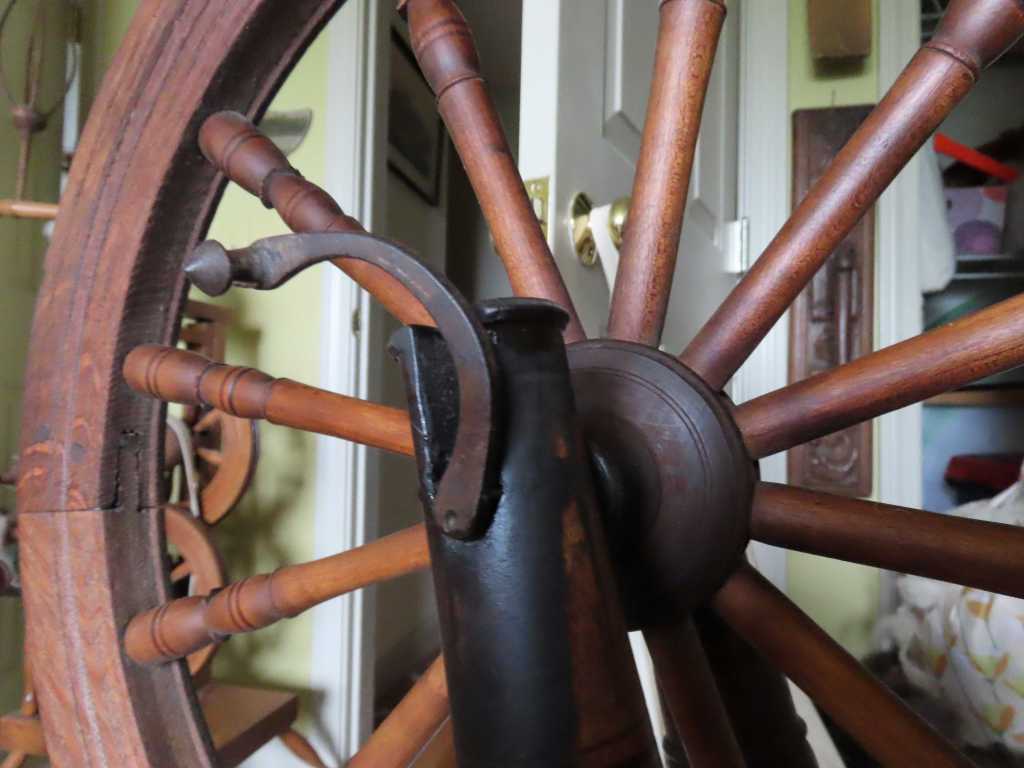
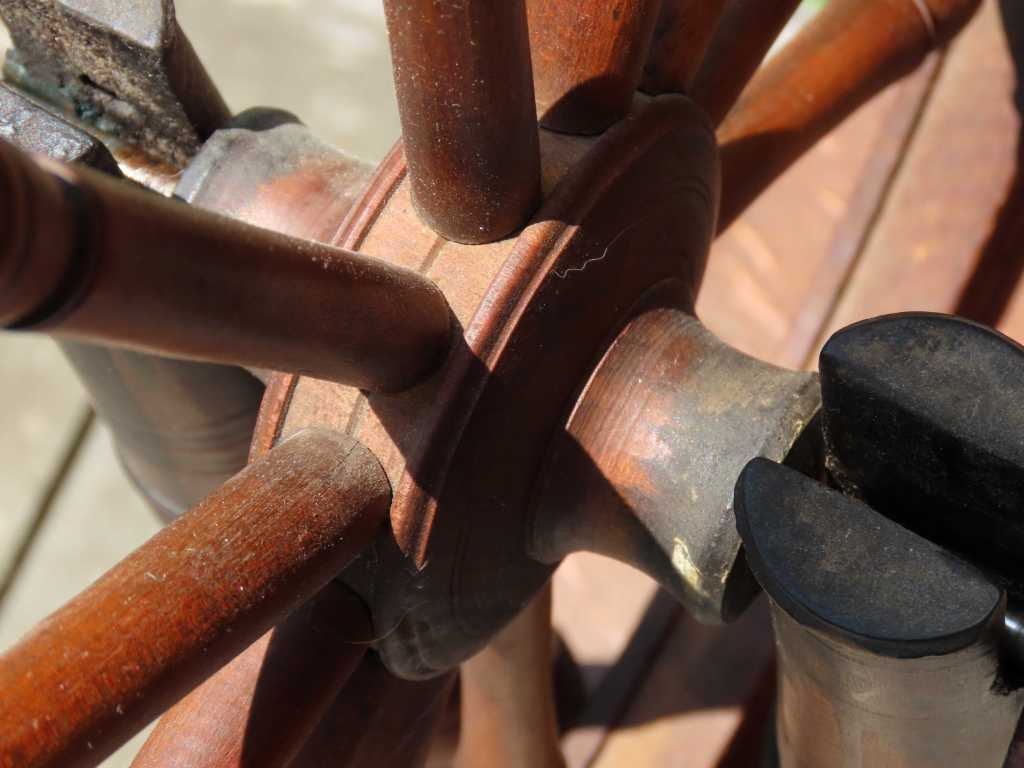
The unusual hub design, with snouts on both sides, is very similar
and, like Fox wheels, the rim is built radially in four equal parts and double pegged at the joints.
The spokes are much the same.
But there are differences in construction,
turnings, decoration,
and the axle is more curved than the axle on my Fox wheel.
Also, the wood, aging, fit, grease stains, and overall look just seem to indicate that it is original to this wheel. Nevertheless, that there is some Fox influence seems pretty apparent.
On the other hand, the style of maker’s mark differs from Fox. Here, the initials and a date were picked with a sharp tool, likely an awl, into the table’s end grain rather than stamped. This style mark is similar to Abraham Overholt’s (from Bucks County) and William Major’s (from Chester County). (P & T at 124-25)
Also similar to Overholt and Major, this wheel has decorative stamping along with the P. Wealand name. (I did research to see whether Major had a wheel making brother with an “I” or “J” first name, but came up empty-handed.)
The turnings on the spokes and the flat-topped finials on the maidens and distaff
are also similar to Overholt’s wheels and to a group of other Bucks County makers, including D. Reiner, S. Reiner, I. Sellers, and I. Homsher. (P&T at 124-25).
Those wheel makers, however, constructed the secondary upright supports to extend down to the legs, which is different than this wheel, where they only go to the table.
In fact, although this wheel is much smaller, the profile looks very much like my Irish wheel (see previous post “Handsome Molly”), with the double secondary supports holding the drive wheel in a very upright position quite close to the flyer assembly.
Although I searched in Berks, Bucks, Chester, Montgomery, and Lancaster counties, I could not come up with evidence of an IAM wheel maker in 1827. I hope there are enough clues to eventually lead us to this wheel’s maker. If so, it may give us a better understanding of the relationships between wheel makers in the area and how IAM and P. Wealand fit into their particular time and place.
Whoever IAM was, he made a lovely wheel, highlighting the ray flecks in the table’s wood so that over two hundred years later, I appreciate the way they pop in the light every time I spin.
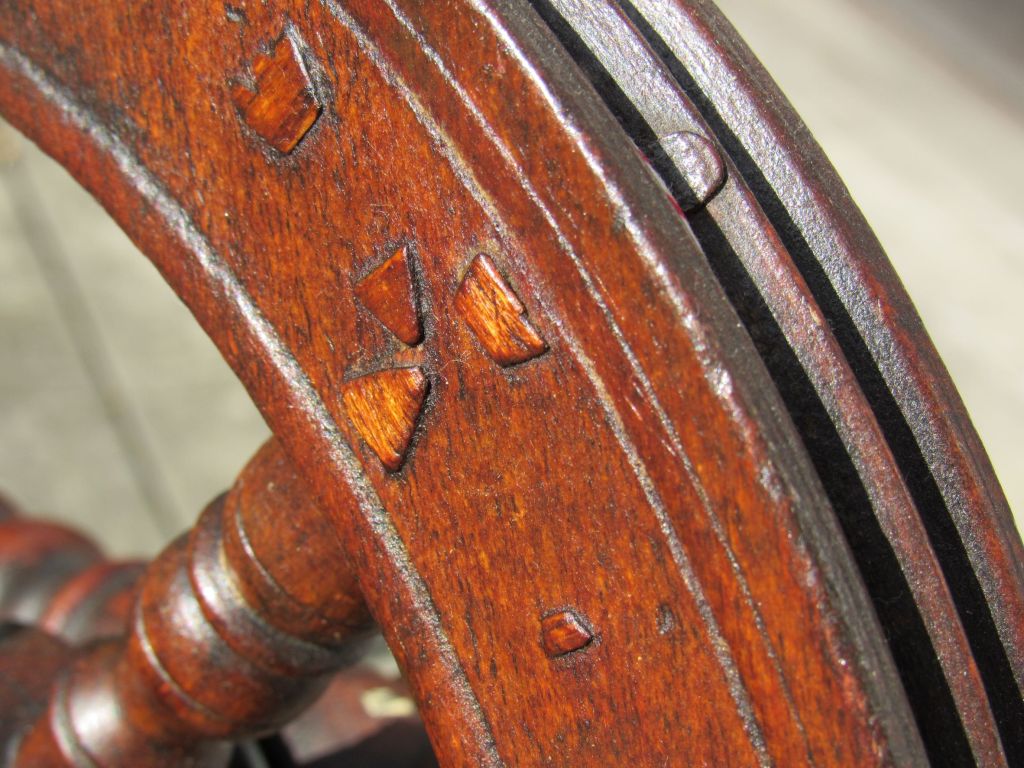
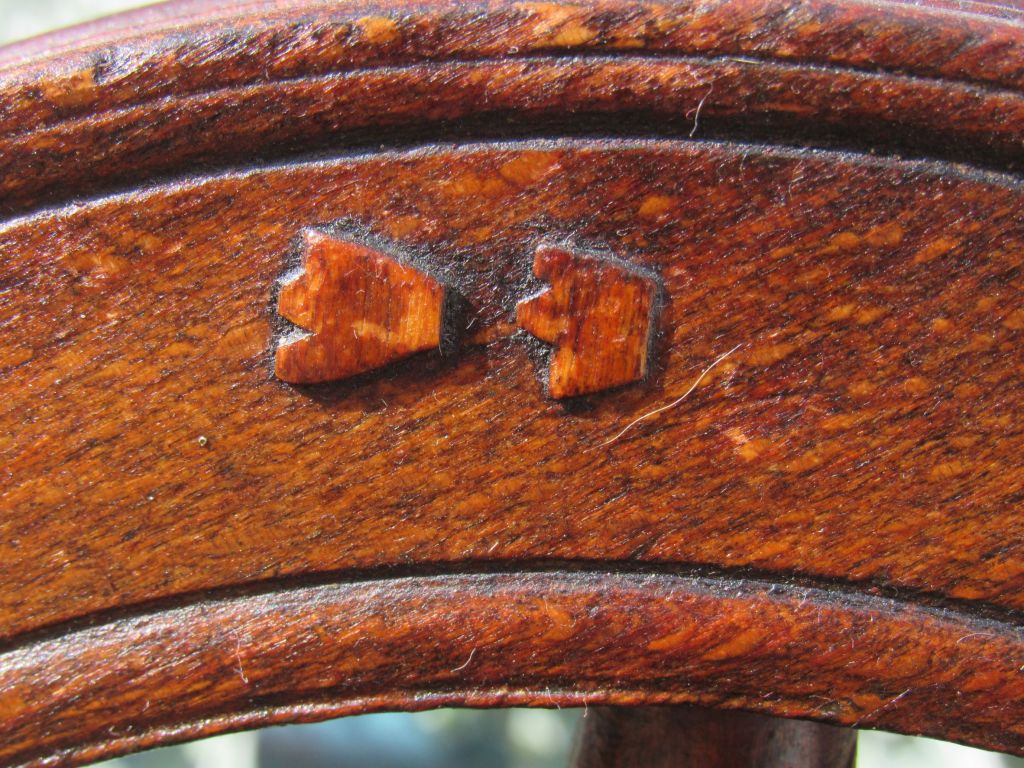
The wheel is beautifully constructed, with thoughtful decorative touches such as the chip carving,
punched designs, burned ring marks,
and pleasing turnings.
The grease stains show that the wheel was well used.
While the upper two parts of the distaff are gone, I am delighted that this part survived.
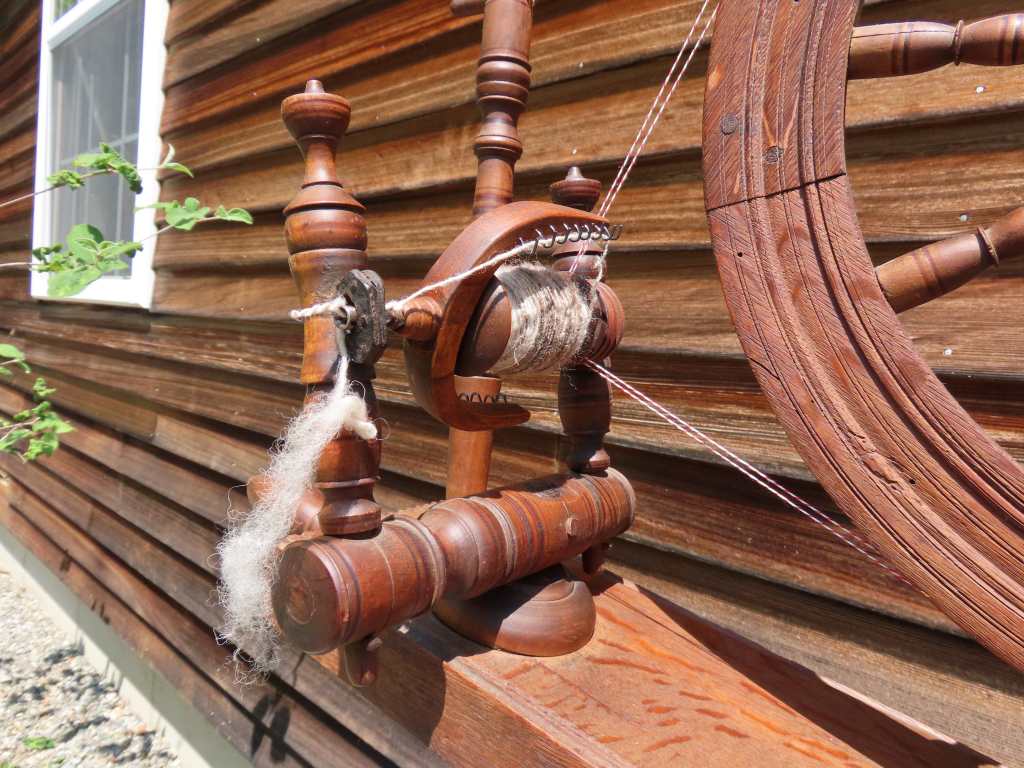
Sadly, the original flyer arms must have broken at some point. The mandrel appears to be original and perhaps the bobbin, but the clunky flyer arms seemed to be a fairly recent replacement,
so I had new ones made.
The treadle bars had some damage too (I actually broke one when I first spun on the wheel).
I repaired the treadle and with her new flyer arms, it is pure pleasure to spin on this wheel.
References:
Pennington, David and Taylor, Michael, Spinning Wheels and Accessories, Schiffer Publishing, Atglen, PA 2004, pp. 123-29.
ancestry.com for genealogical research and census records
Perhaps the most readily identifiable Pennsylvania wheel is the “Irish castle” wheel. Its distinctive style is best described by collector, Bill Leinbach: “The vertical lines, the splay of the long legs, the relationship between the drive wheel and the flyer bobbin assembly, all contribute to the magnificent display of this tripod temptress.” (Leinbach, SWS p. 6)
Aside from its harmonious lines, its height is impressive and its design practical, with long hefty legs providing a solid base with a small footprint. The solidity and stability allows for steady, even spinning, while the small footprint is welcome in tight living quarters.
While this wheel style has been found occasionally in other parts of this country, it flourished in Pennsylvania. Why and how this Irish wheel design was adopted by Pennsylvania German wheel makers remains something of a puzzle. Some have speculated that this style may have originated in Germany and migrated to Ireland, with the “castle” name having derived from the German town “Kassel.” (P&T, p. 56) On the other hand, wheel collector John Horner suggested that these wheels are named “castle” because of their shape and are “peculiar” to Ireland. (Ulster Museum, P. 21)
Patricia Baines notes that in Britain castle wheels refer to vertical wheels in which the drive wheel is above the flyer mechanism, with Scotland having its own castle wheel, different than the Irish. (Baines, p. 45). Whether born in Ireland or not, the sturdy three-legged Irish castle wheel was an integral part of 19th century life in northern Ireland, especially in Donegal and Antrim counties, used early on for flax and later for wool spinning into the 20th century. (Baines, p 144-46, P & T, p. 53)
Spinning linen in northern Ireland—notice the spokes
While some castle wheels were brought over from Ireland to Pennsylvania and other states, the majority that we find in this country appear to have been made here, primarily by Pennsylvania wheel makers of German descent.
Danner wheel for sale a few years ago
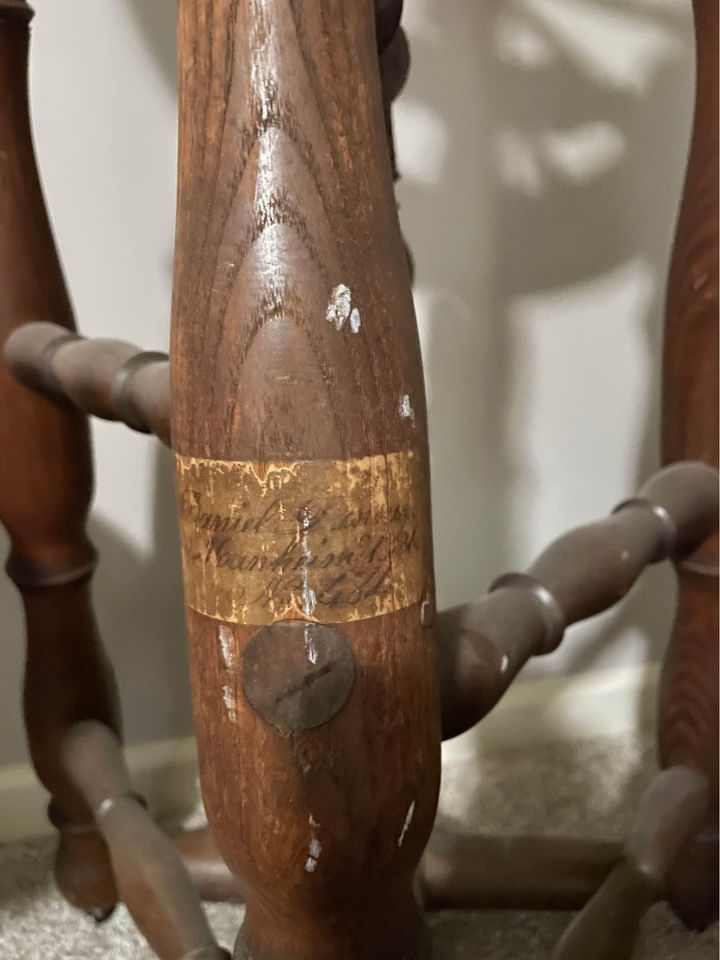
Probably the most well-known is Daniel Danner, who signed and dated many of his wheels with a paper label pasted onto the back leg. Of course, most of those labels have not survived, but his wheels have distinctive qualities that identify them as Danner wheels.
Paper label on Danner sale wheel
Danner was born in Manheim in Lancaster County, Pennsylvania in 1803. His father, Adam, was a weaver. Daniel married Elizabeth Hartman in 1833 and they had five children, only two of whom survived to be adults. (Leinbach, SWS, p. 6)
Danner’s wife Elizabeth spinning flax on one of his wheels. Notice the label on the back leg.
Fortunately, Danner kept daybooks, which show that he made wheels for over 40 years, from 1821 until at least the early 1860s. He made great wheels, saxony-style wheels, and what he called “cassel” wheels. Perhaps this was a phonetic spelling of “castle” (his daybooks were written in English, not German), or it could be an indication that these wheels did have a German origin. As with so many spinning wheel makers, Danner was not limited to wheel making, but made and repaired all types of household and farm items, including reels and swifts. About forty percent of his wheels were castle wheels, which he priced at $4.00, fifty cents more than his regular flax wheels.
There is no definitive answer as to why Danner and other Pennsylvania Germans were making Irish Castle style wheels. Perhaps there were similar wheels remembered from Germany—although I am not aware of anyone actually identifying a German wheel of this style. Perhaps he was influenced by an Irish wheelmaker, such as Samuel Humes. Humes, born in 1753—considerably older than Danner–came to Lancaster County from Antrim, Ireland. Danner’s saxony-style flax wheels were very similar to Humes’ wheels, almost copies.
Whether he did this with Humes’ permission or not remains a question. I am not aware of evidence that Humes made Irish castle wheels, but it is certainly a possibility and other wheel makers in the area, including Danner, may have copied the style from him. It is also possible that Irish Castle wheels were simply a response to market demand.
When I started digging into genealogy research on Danner, I found several family trees on ancestry.com that had Danner’s father, Adam, as born and living part of his life in Shelby, North Carolina. Because that is a region with many Scots-Irish immigrants, I was excited to think that might offer some explanation for Danner’s adoption of this style.
As it turns out, I believe that is a different Adam Danner and Daniel’s family likely did not venture outside of Pennsylvania. But it got me looking into Scots-Irish settlement in Pennsylvania and I found Scots-Irish immigrants from Antrim and nearby counties settled in many of the same areas in Pennsylvania as the Germans.
Perhaps they sought this style wheel from the local German wheel makers. While I have only seen a few pages of Danner’s day book, in those, it appears that the surnames of most of his customers were of German origin, but with a smattering of English and Irish names, including “a new flyre” for Barb Donoven. (McMahon, p. 16). So, it is possible that, at least initially, these wheels may have been made for Irish customers seeking this wheel style. We just do not know.
While probably the most well-known, Danner was not the only one making this style wheel in Pennsylvania. Some did not sign their wheels and will remain a mystery. Samuel Henry, however, another maker of German descent, did stamp his name on at least some of his unique and elaborate castle style wheels—quite different from Danner’s.
Although unmarked, this appears to be a Henry wheel that came up for sale last year
Another intriguing maker is usually referred to as the “Landisville” maker because several of his wheels showed up in that area of Pennsylvania.
According to Bill Leinbach, Clarke Hess, a well-known Pennsylvania historian and collector, believed that perhaps the Landisville wheels can be attributed to Johannes Berg or his son Jacob Berg, based at least in part on probate inventory records. Hess died several years ago and his extensive collection was auctioned off. In Lot 5525 of Clarke’s on-line auction collection, a sampler was identified as made by Maria Berg, daughter of “Turner” Jacob Berg of West Donegal Township, son of immigrant Andreas Berg. I do not know if this is the same Jacob Berg that Clarke had been researching—there are multiple Jacob Bergs in Lancaster County–but it is a clue worth pursuing.
Donegal Township had a large number of Irish settlers, so might have been fertile ground for these wheels and is not far from where Danner was making his wheels in Manheim, Pennsylvania. That may be important because, apparently, multiple wheels have been found with bodies made by Danner and drive wheels made by the “Landisville” maker. Bill Leinbach suggests that may indicate that they knew each other or even worked together at some point. This is an area ripe for more research.
My wheel, Elizabeth, which came from Bill Leinbach, is one of those combination wheels. The body has classic Danner features, but the drive wheel appears to have been made by the Landisville maker. Danner’s drive wheels were made of four equal pieces and had “shotgun shell and olive” spokes—a perfect descriptive term because that is just what they look like.
Danner drive wheel
The Landisville/perhaps Berg maker constructed his drive wheels with two long and two short sections (felloes) and spokes closely resembling those on wheels from Ireland—they look like wine goblets to me.
The drive wheel on my wheel–notice how similar the spokes are to the earlier photograph of the Irish wheel
For an excellent visual comparison and description of wheels made by Danner, the Landisville maker, and Samuel Henry, I recommend Michael Taylor’s article “Castle Wheels in Lancaster County, PA.” listed below.
While there is no label on my wheel, the body appears to be a beautiful example of Danner’s work. The long flat treadle fits around the back leg,
and is attached to the axle with a long cord and leather top—typical of Irish wheels.
While the legs are heavy, they are gracefully curved and highlight the wood grain.
The top cross bar has two holes. Danner traditionally used one for the distaff and the other for a reeling pin. Having two holes allows the spinner to place the distaff on either side and also provided a place to mount a water dish for flax spinning. I am fortunate to have two distaff supports, one on each side.
Danner had some variations in the turnings for the distaff supports. I believe the left hand one is typical of Danner’s wheels,
but am not sure if the other one is also made by him or some other maker.
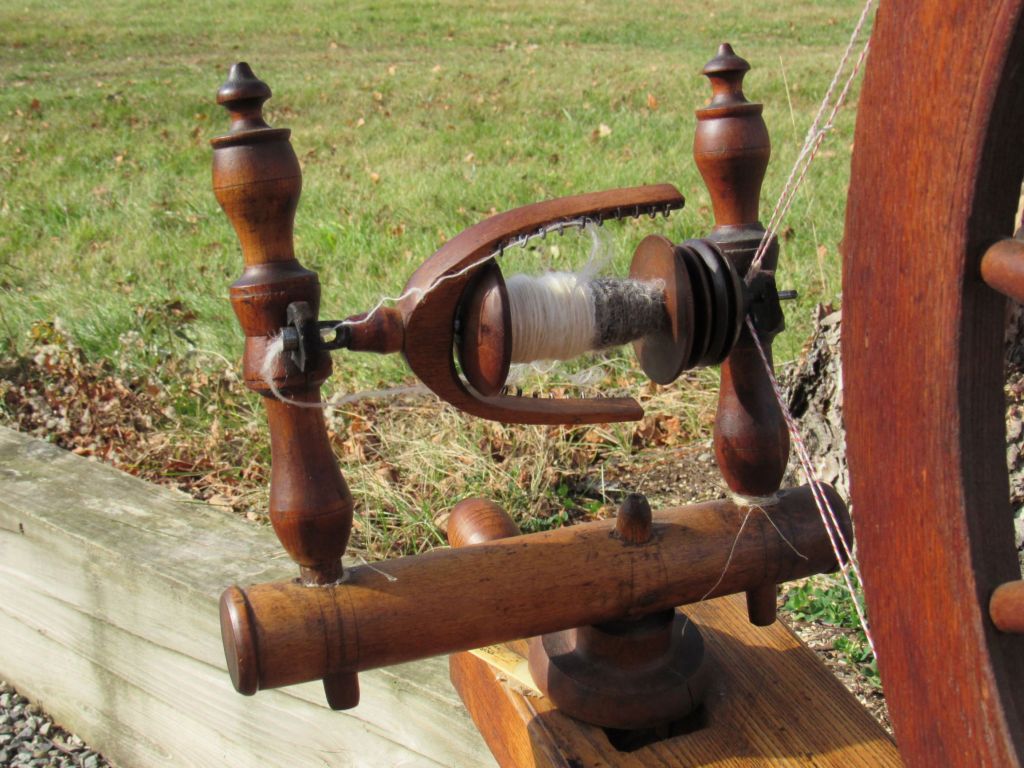
The flyer set up is ingenious.
One wooden key releases the end flyer bearing so that the flyer can be removed.
The other raises a central bar to control tension.
The flyer hooks are seated opposite to most flyers, in other words, the hooks are on the top right side and lower left side of the flyer when looking down the arm, in contrast to the usual configuration of right on top of the left arm and below the right.
According to Patricia Baines, this was the way the flyers were usually made on castle wheels in Ireland. She suggests that this may have originally been to facilitate spinning flax in the “S” direction. (Baines, p. 146) It is interesting to see how that unusual feature seems to have been carried over from Ireland to many of the castle wheels made in Pennsylvania.
While most makers of these wheels were in Pennsylvania, a few wheels have appeared in New England, too, including one signed “M. Wood.” That name is intriguing because we know of two New England wheel-making brothers, Phineas and Obadiah Wood (see previous post “Scarlet”). Could M. Wood be related?
There is still so much research to be done on American castle wheels—to pin down who made them and why. But there is already a tremendous amount of research that has been done. I only skimmed the surface here. The articles and books listed below were my references and contain much more in-depth and complete background and analysis. I highly recommend them.
Descriptions and photographs do not do justice to the beauty and fine craftsmanship of this wheel. A heartfelt thank-you to Bill Leinbach for entrusting me with this amazing wheel, for his generosity in sharing time and knowledge, and for the photograph of Elizabeth Danner.
References:
Leinbach, William A., “Daniel Danner: The Man Behind the Wheel,” The Spinning Wheel Sleuth, Issue 4, January 1994, pp. 6-8.
McMahon, James D., “Daniel Danner Woodturner: An Early 19th Century Rural Craftsman in Central Pennsylvania,” Pennsylvania Folklife; Vol. 43, No. 1, Fall 1993., pp. 8-19.
Taylor, Michael, “Humes, Danner, and Killian Flax Wheels,” The Spinning Wheel Sleuth, Issue 35, January 2007, pp. 2-4.
Taylor, Michael, “Castle Wheels in Lancaster County, PA,” The Spinning Wheel Sleuth, Issue 93, July 2016, pp. 2-4.
Baines, Patricia, Spinning Wheels, Spinners & Spinning, B. T Batsford, Ltd, London, 1977, pp. 144-46.
Pennington, David and Taylor, Michael, Spinning Wheels and Accessories, Schiffer Publishing Ltd., Atglen, PA 2004, pp. 53-59.
Thompson, G.B., Spinning Wheels (The John Horner Collection), Ulster Museum, Belfast 1976.
Ancestry.com for genealogies of the Danner and Berg families in Pennsylvania.
Jacob Fox made beautiful spinning wheels. Yet, despite the fact that many fine examples of his wheels survive, I have been unable to find out very much about the man himself.
He was born Jacob Fuchs in 1788, in Berks County, Pennsylvania, son of Johann Michael Fuchs and Anna Margaretha Schwartzhaupt. Jacob’s father, Johann, was born in Hesse, Germany in 1749 and arrived in Pennsylvania as a young man in 1773. Jacob’s mother, Anna Margaretha, also of German descent, was born in Berks County in 1760.
At some point Jacob Fuchs anglicized his name to “Fox.” He married Catherine Batteiger (also spelled Potteiger) in 1815. They resided in Upper Tulpehocken Township, in Berks County, where they had several daughters, and Jacob had his workshop. Jacob died in 1862, leaving a shop that still contained his woodworking tools and branding irons. (Goyne Evans, Am. Windsor Furn. p. 222, fn. 70).
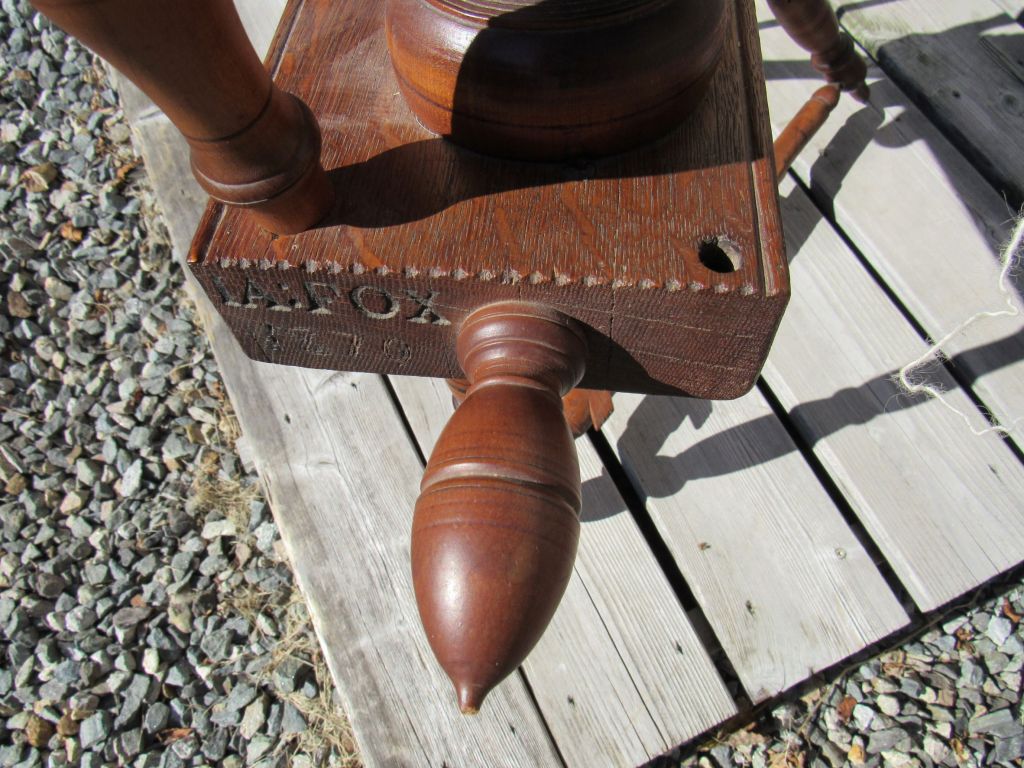
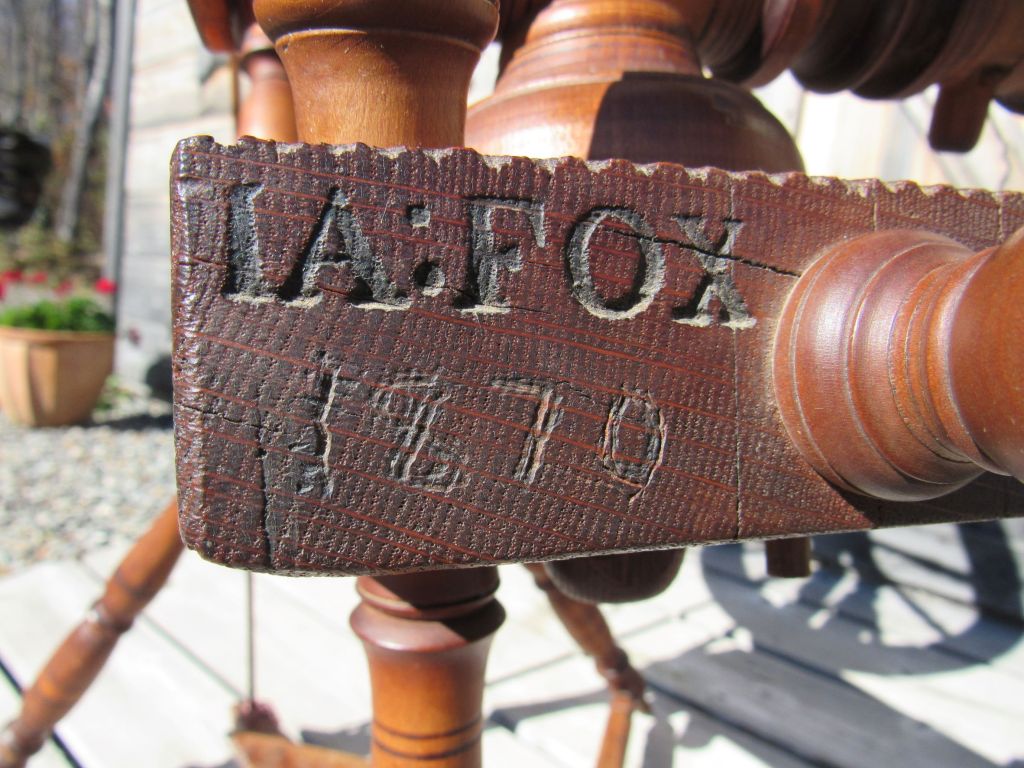
“Like many artisans of the period, Fox was both a farmer and a craftsman …” (Bartlett, pp. 28-29) He made Windsor chairs, marking them with the same brand as on my wheel, “IA: FOX.” (Goyne Evans, Am. Windsor Furn. pp. 102-03, 221).
“The work of Jacob Fox in Berks County is interesting as typical of provincial interpretations of prevailing Philadelphia style, which proved popular among his local patrons. Fox made both bow-back and square-back chairs with turned work ranging from the full baluster to full bamboo style.” (Bartlett, p. 29)
In 1839, Fox had a new branding iron made, changing his mark from “IA: FOX” to “J. FOX”. Although Fox did not date his wheels, because his branding iron has a date on its side, the changed mark serves as a demarcation for wheels made before and after 1839.
Aside from this rather bare-bones “he-was-born-he-worked-he-died” life summary, I found little information to bring Jacob Fox to life. Perhaps his wheels must speak for him. We can see from them Fox’s meticulous attention to detail and quality.
From a business perspective, he appeared to have an eye for his market. As with his chair making, Fox’s wheels were made in the style popular for his time and place. His wheels share certain distinctive features with other Berks County wheels marked “D. Kunkel,” “D.S.,” “H.S.,” and “J. Jacob.” (P&T, p. 127).
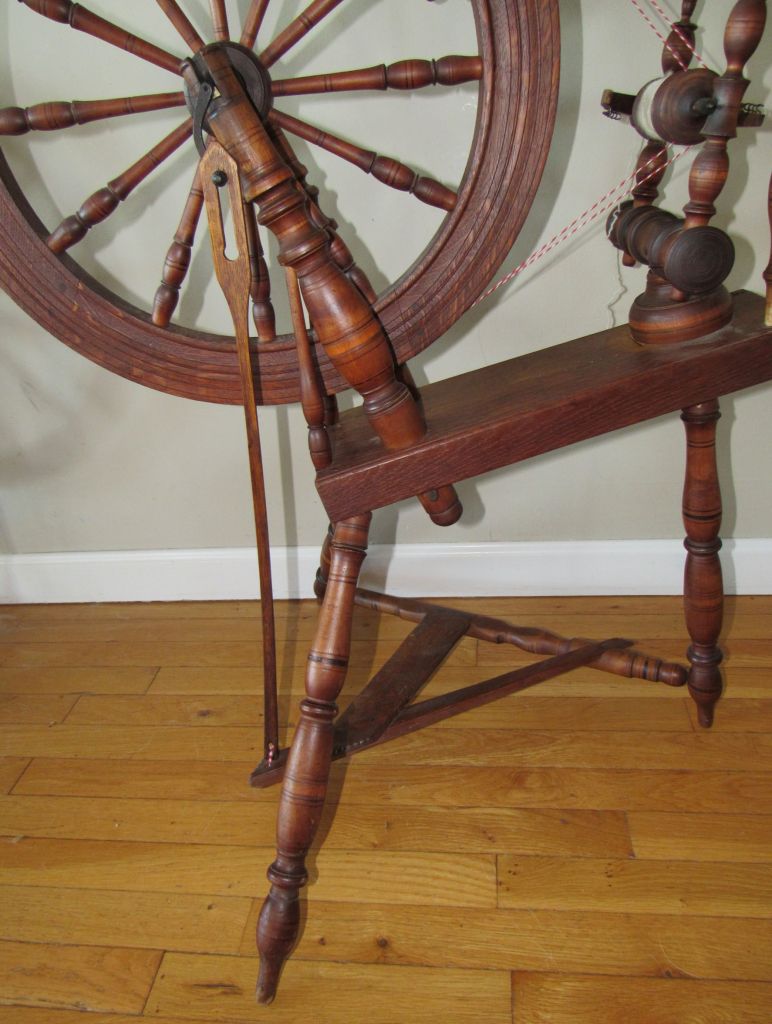
Those construction features included secondary upright supports on both sides, snugly fitted and pegged flush in the table,
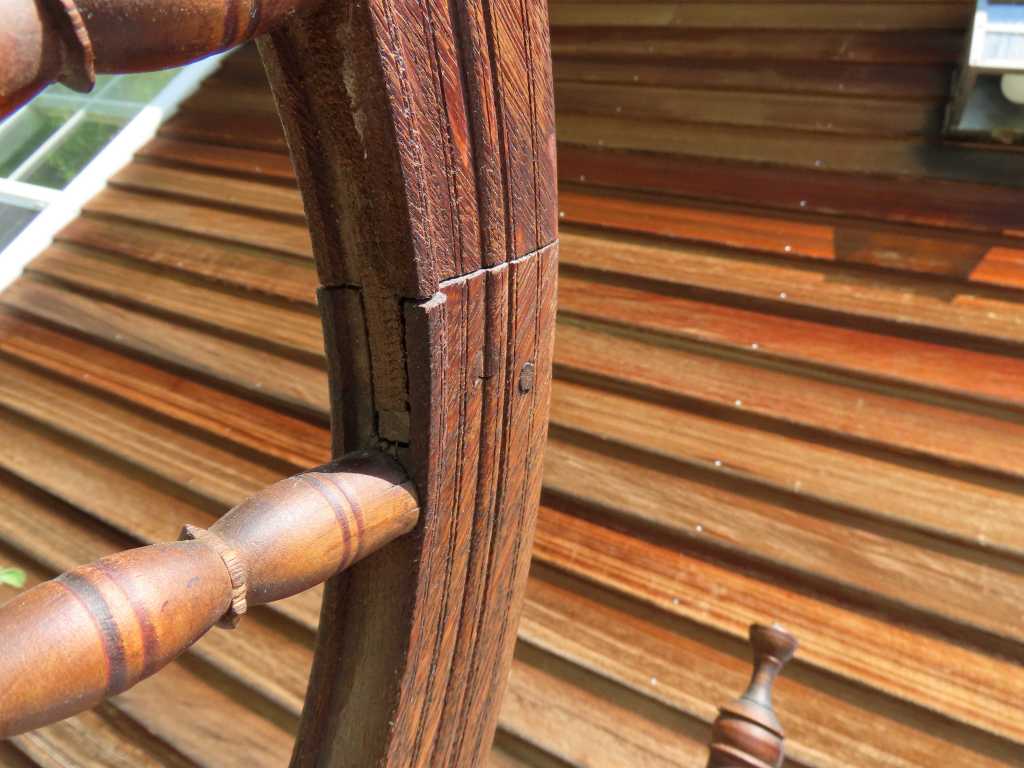
and drive wheels constructed of four roughly equal sections,
each section, or felloe, tightly joined
and double pegged.
Another unusual feature, popular in eastern and central Pennsylvania, was a hole through the table’s spinner side for a reeling pin. (Taylor, SWS p.7)
Reeling pins were turned wooden pins about the size of a finger. It is believed they were used for guiding the spun thread when unwinding it from the wheel’s bobbin onto a reel. The theory is that it saved fingers from friction burn (think of rope-burn on a finer scale) and cuts made by fast-reeling flax thread. It seems like something a city women with soft hands might have used but less likely to be in high demand from farm women, whose hands likely were well-callused and work-hardened enough not to be bothered by unwinding flax.
Ester’s reeling pin is gone, but the hole is a reminder of how quickly we lose knowledge about wheel design and use at particular times and places. Why are holes for reeling pins found in only a small area of the country? Was it a tradition brought from a German region? Were reeling pins used in other parts of this country, but without storage holes? Or were they a nineteenth century local fad?
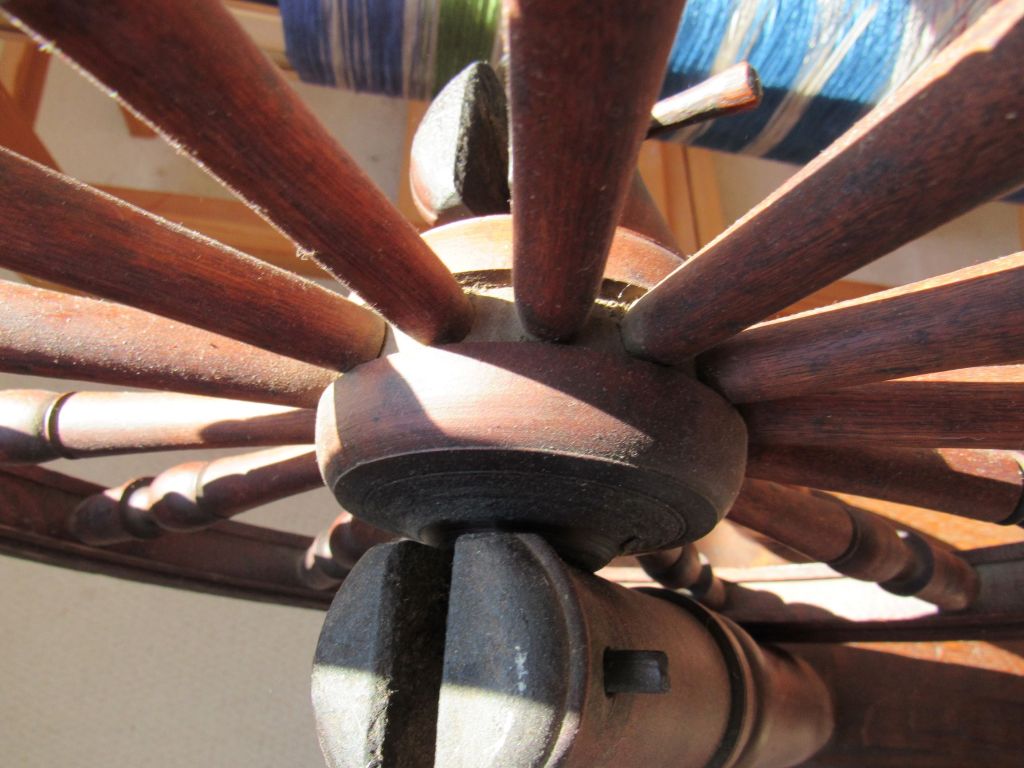
While Fox’s wheels share similarities with other area wheel makers, his wheels also have a certain flair that mark them as his creations. From hub,
to axle bearings,
to spokes
to the underside,
the materials, construction, and design are superb.
The wheels have a finely-finished quality,
exuberantly decorated with brilliant orange painted bands,
contrasted with black bands.
The feet are elegantly pointed
and the small-large-small chip carving on the table end gives a special touch.
His attention to the smallest details is remarkable.
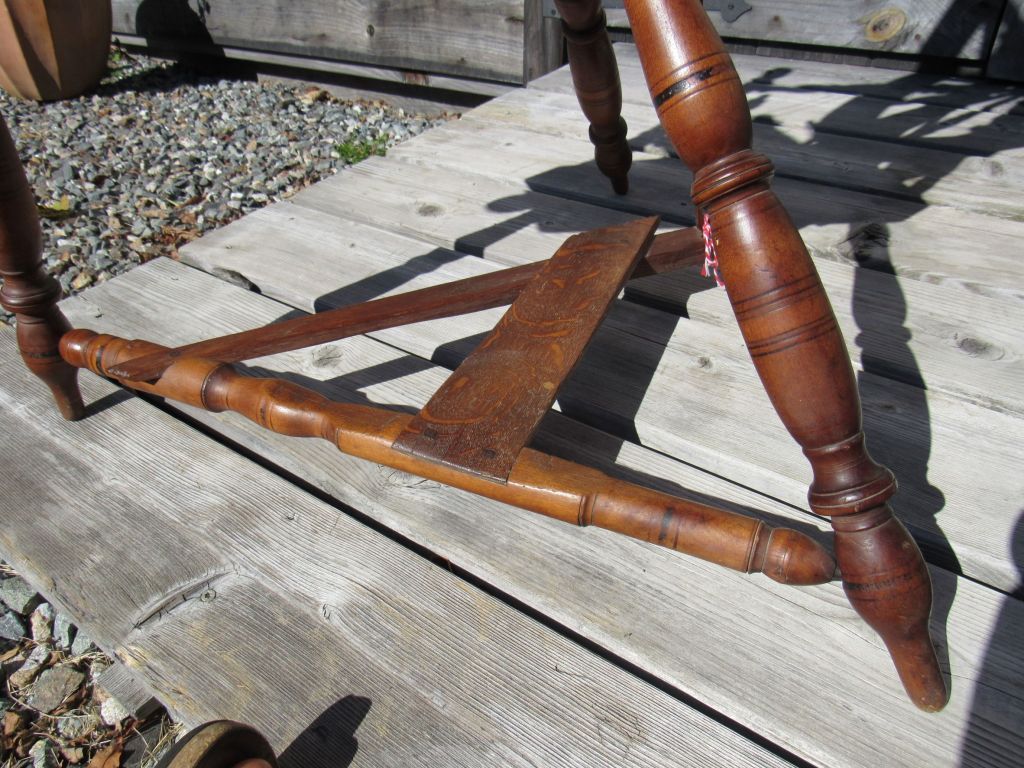
Even the ends of the treadle bars have chip carvings.
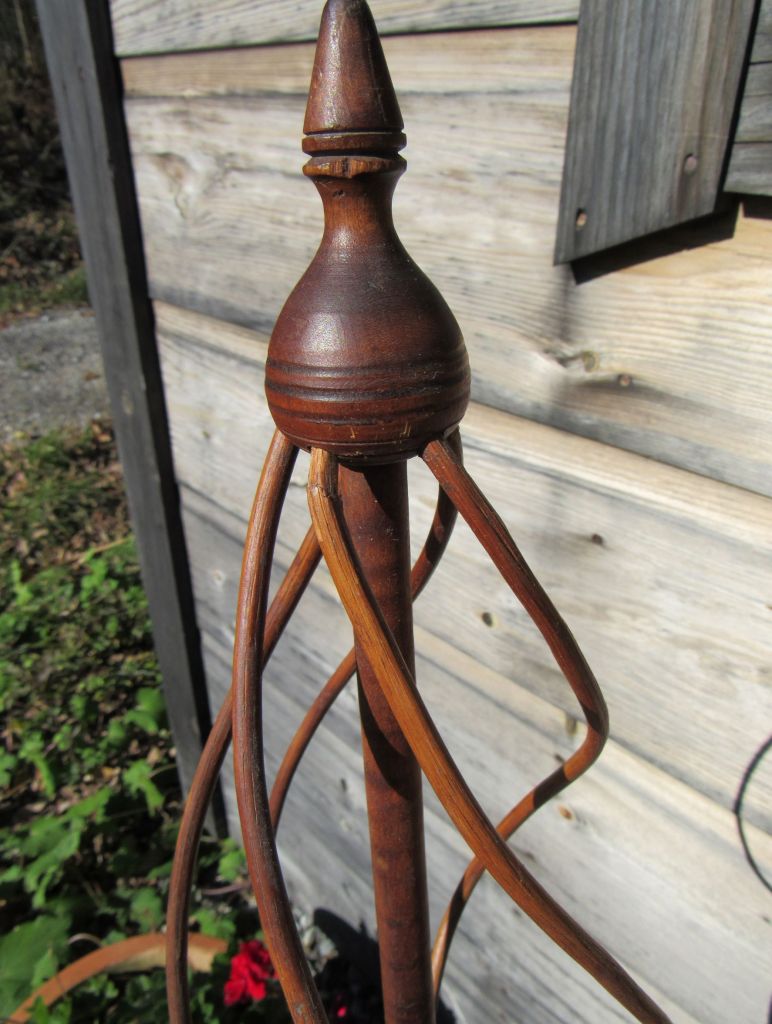
The distaff arm is pegged in place to keep the distaff from flopping over when in use.
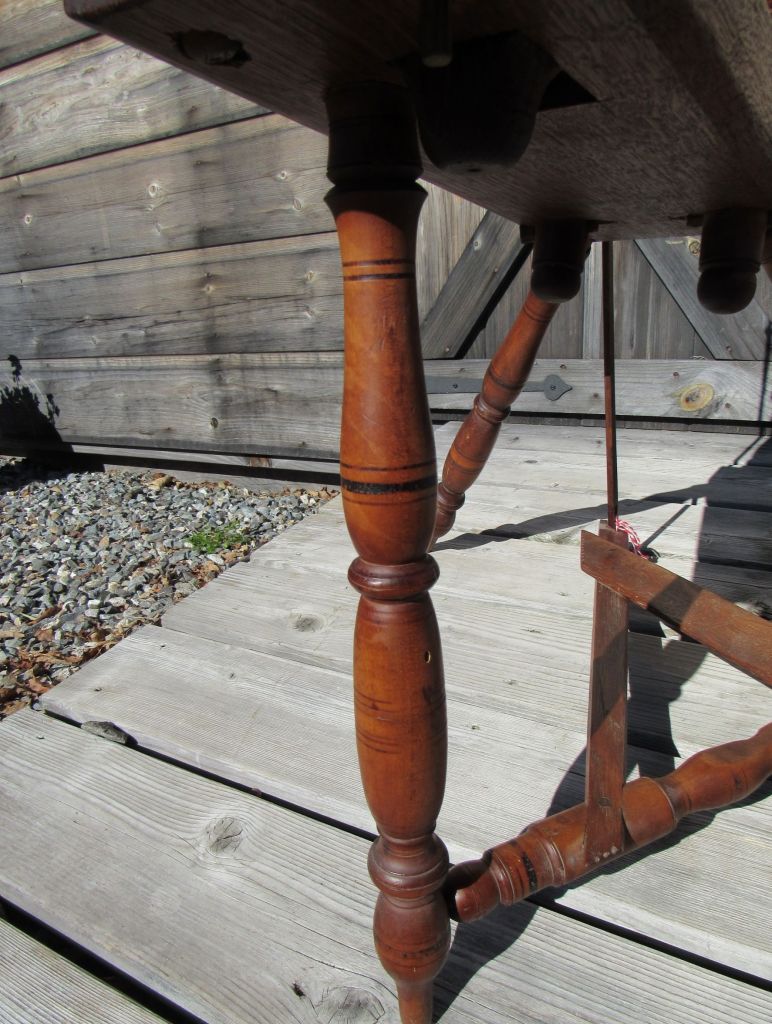
And the under-table portion of the wheel uprights are turned, beautifying a largely hidden part of the wheel–an unusual feature that makes him and his wheels stand out.
This wheel has seen some significant use,
with obvious wear on the treadle
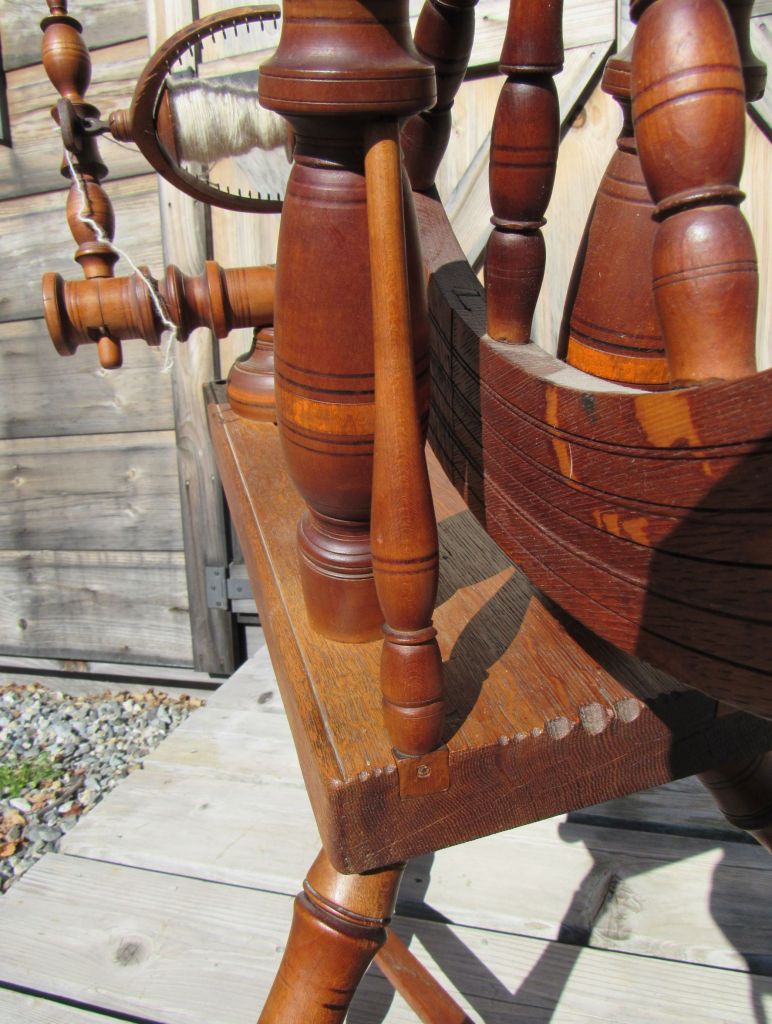
and dent marks on the table.
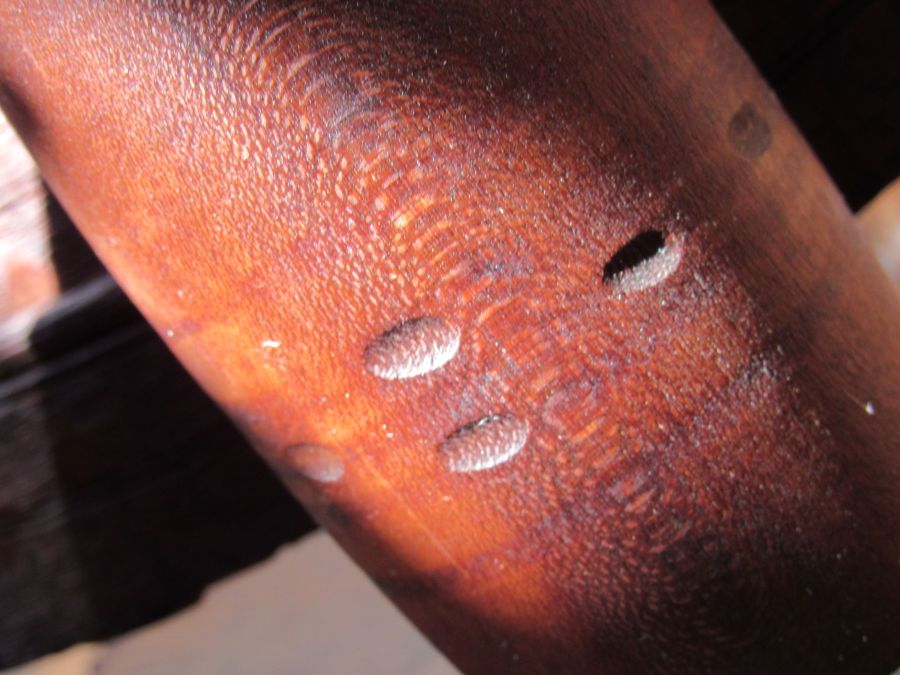
Such marks have been the cause of much discussion in online antique wheel groups. They are often seen on Scandinavian wheels and the general consensus seems to be that small knives or other utensils were spiked into the table under the drive band to help guide or separate it, although often the marks do not look big enough to hold a knife upright for long.
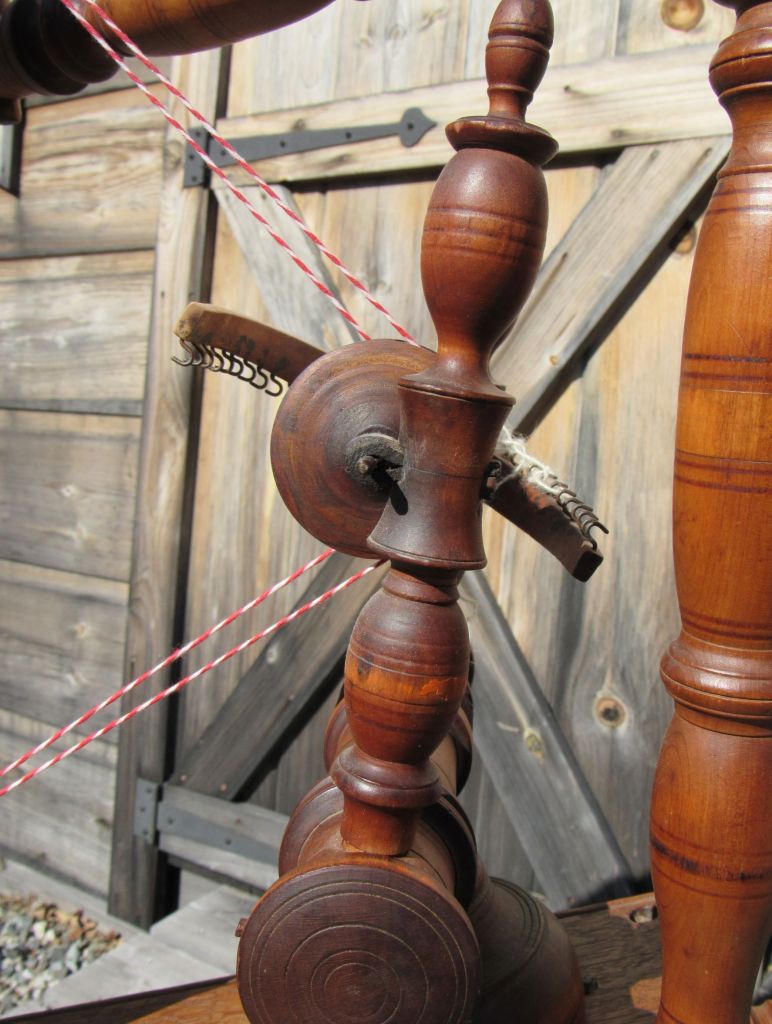
The flyer fits well and matches the wheel. It has some wear
but is in overall good condition with a smooth orifice
and a moderate wingspan (not as wide as many Pennsylvania flyers). It could be original, or not.
The distaff appears to match the wheel, but, again, I do not know if it is original.
Since Ester has Fox’s early stamp, we know the wheel was made before 1839, and this distaff looks as if it might be newer than that.
The footman is intriguing because it is elegantly curved. But, without seeing other similar Fox footmen, I doubt if it is original.
As for the date carved crudely carved under Fox’s mark, it appears to have originally been 1770 and then changed to 1880.
Both dates are puzzling, because Fox would have been 15 in 1770 and dead in 1880. Still, it is part of the wheel’s history and mystery.
This wheel is a testament to the power of material things and the importance of preserving them. While there seem to be few written details about Jacob Fox, his branding iron and his wheels give us clues about him and his life. He lives on in them.
January 6, 2023 edited to add:
After posting this, I heard from two owners of J. Fox wheels, both of whom confirmed that Ester’s distaff is consistent with others on Fox wheels and likely original. In addition, Bill Leinbach sent this photo of Fox reeling pin (thanks Bill):
References:
Taylor, Michael, “Reeling Pins,” The Spinning Wheel Sleuth, Issue #115, January 2022, pp. 7-8
Bartlett, Louisa, Curator, A Cultural Celebration: Arts of the Berks County Pennsylvania Germans From a Private Collection, paper available online from exhibit June 12-Sept. 26, 2010, pp. 28-29.
Goyne Evans, Nancy, American Windsor Furniture, Specialized Forms, Hudson Hills Press, New York, N.Y. 1997.
Goyne Evans, Nancy, Windsor-Chair Making in America, From Craft Shop to Consumer, University Press of New England, Lebanon, N.H. 2006. Fox’s dated brand is pictured on page 80.
Pennington, David and Taylor, Michael, Spinning Wheels and Accessories, Schiffer Publishing, Atglen, PA 2004, pp. For a wonderful discussion of eastern Pennsylvania wheels see Chapter 11, pp. 123-29.
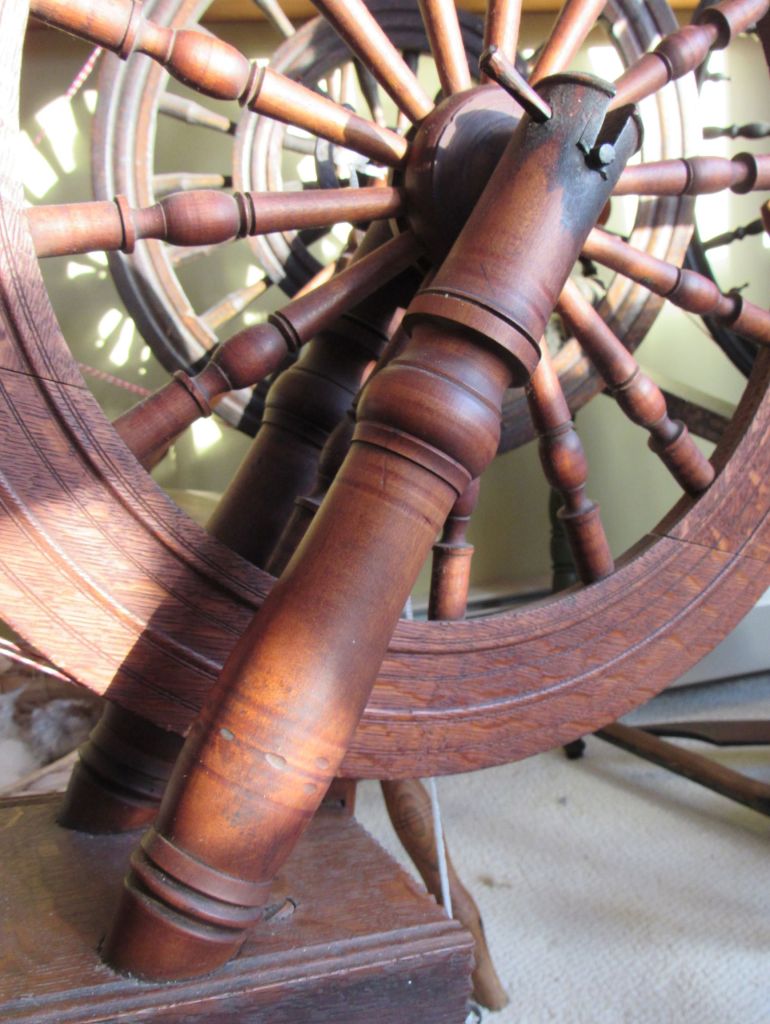
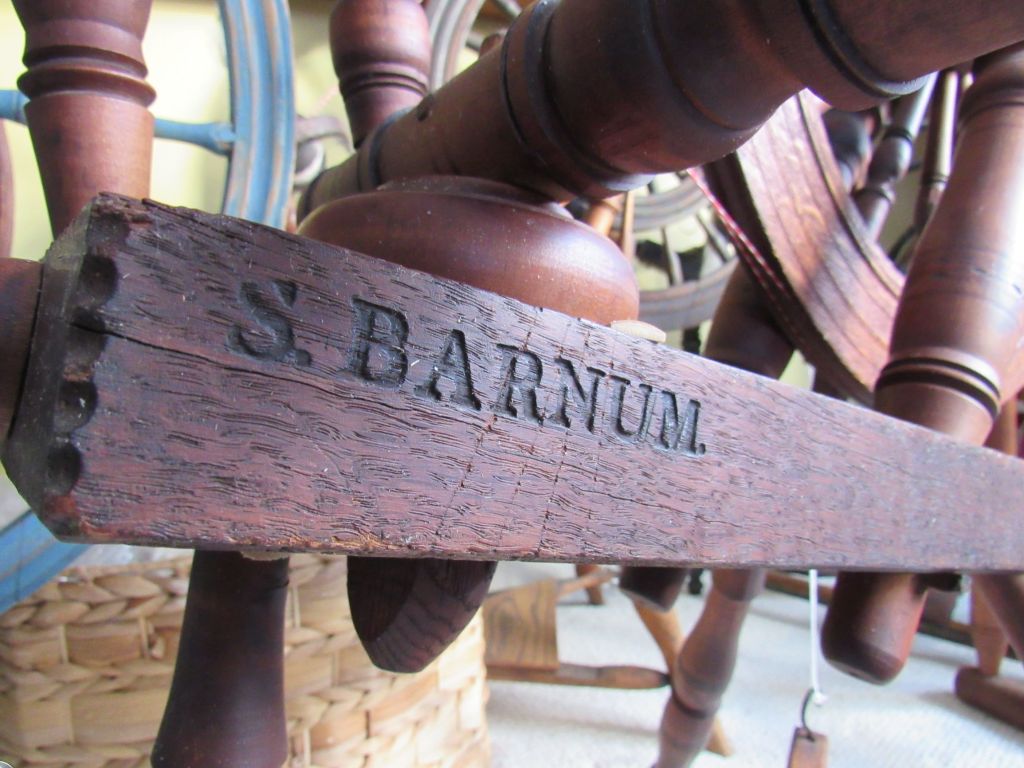
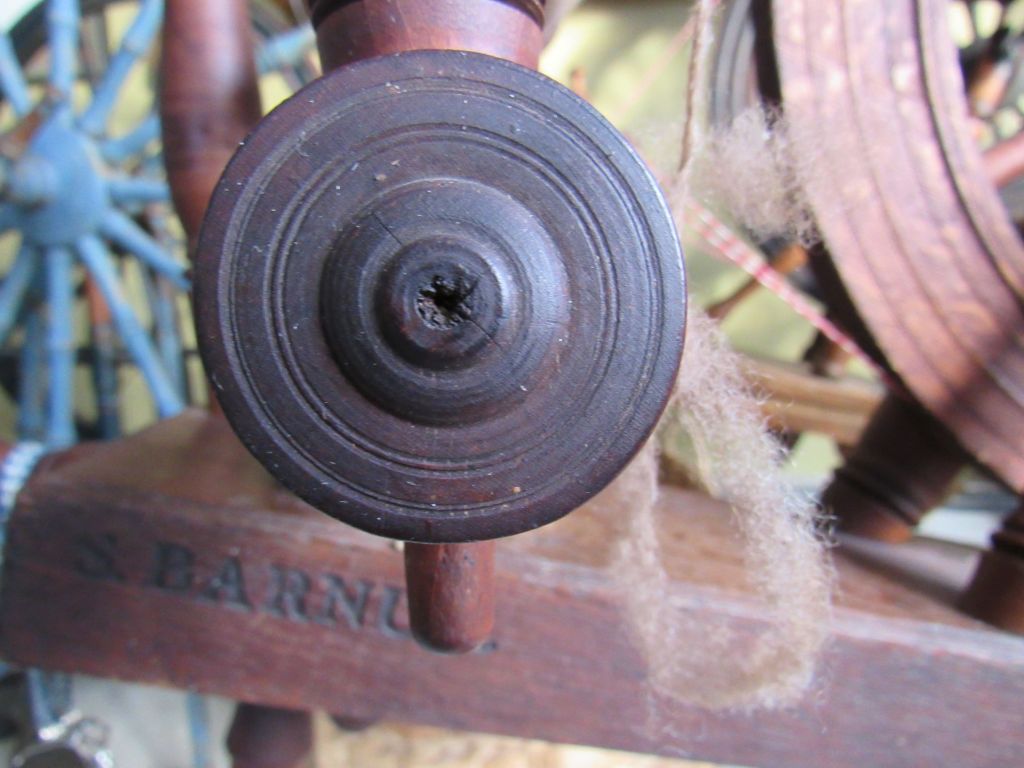
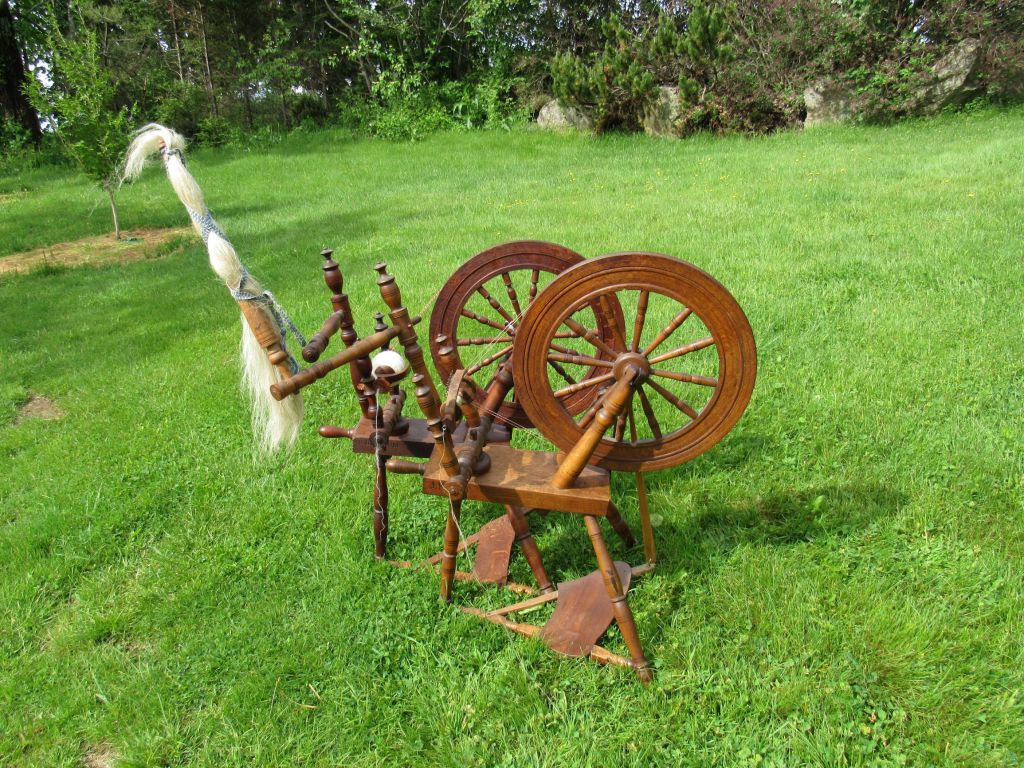
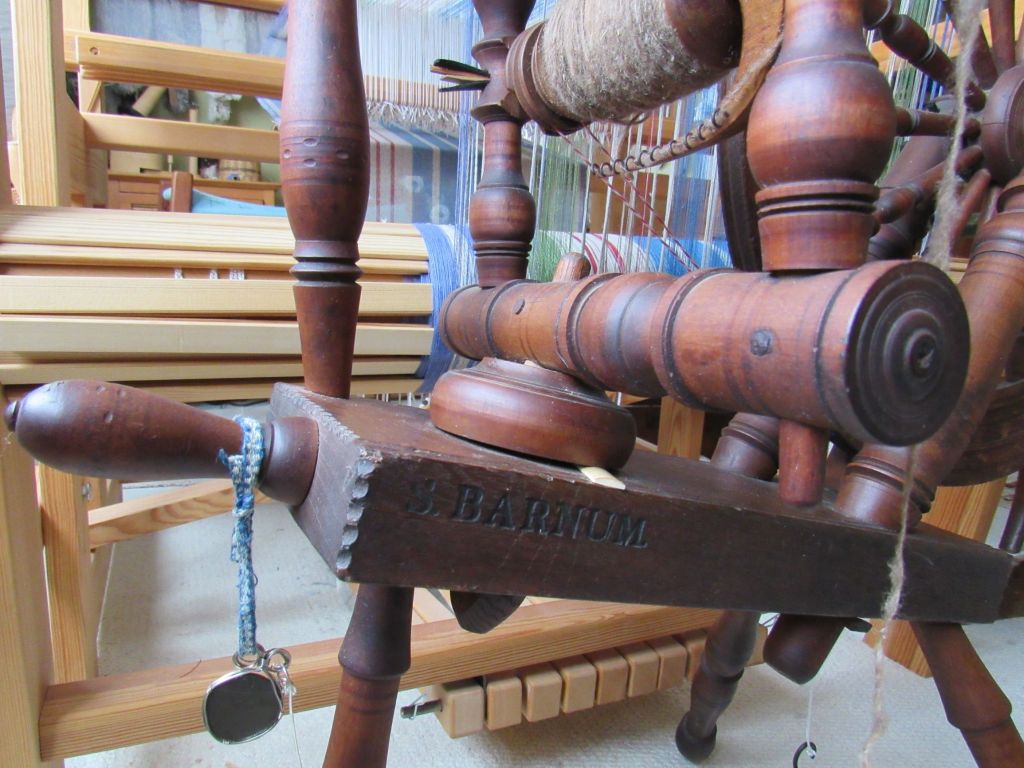
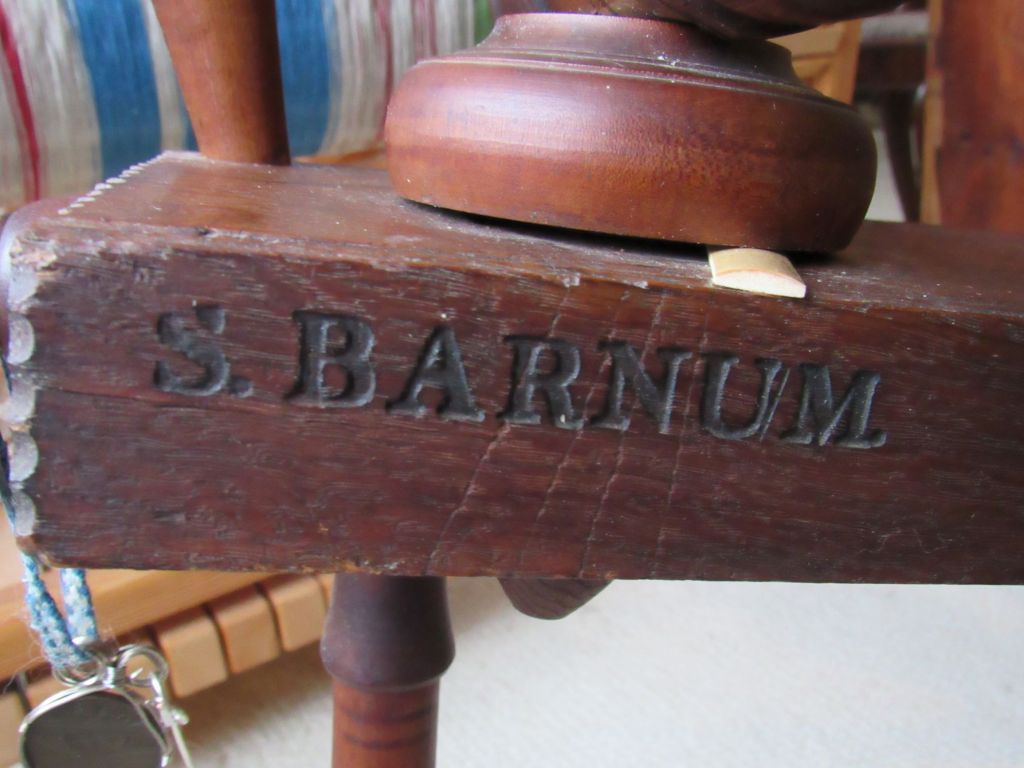
This wheel—made more than two hundred years ago—is a testament to the superb skills of Connecticut wheel makers in the late 18th and early 19th century. It was made by Silas Barnum (1775-1828), one of a group of wheel makers from southwest Connecticut, who are most well-known today for their double flyer wheels.
From this group, the most well-known are Solomon Plant, the Sanfords, the Sturdevants, and Silas Barnum. The earliest, born in the 1740s, included Solomon Plant and Samuel Sanford, two men who likely were making wheels before the Revolution. A second generation, born in the 1760s and 70s, arose with John Sturdevant, Jr., Isaac Sanford (Samuel’s son), and Silas Barnum, who, in turn, were followed by another generation, born in the 1790’s, including Beardsley Sanford (Samuel’s great-nephew), Elias Bristol Sanford (Isaac’s son), Josiah Sanford (Samuel’s son by his second wife), and John Sanford Sturdevant (John Sturdevant Jr.’s son).
J. Platt appears to have been part of this group, too, but, as far as I know, no one has determined just who he was. These men, and a few others, made wheels of a distinctive style, recognizable immediately as having come from a particular time and place in our history.
For more on these wheel makers, see the previous posts: “Mindful Pond” (Solomon Plant); “Louisa Lenore” (Sanfords); and “Katherine the Witch,” “Mercy,” and “Judith and Prudence” (J. Platt).
To help keep these wheel makers sorted out, in a previous post about Silas Barnum, “Big Bear,” I included a timeline, map, and family history that helps to understand how these particular wheel makers were connected. All of them were from families that settled on the Connecticut shore in the 17th century and gradually migrated inland.
Their family names are found repeatedly, along with Platts, Pecks, Smiths, Beardsleys, and others, in the history of this area. Silas’s mother was a Sturdevant, his older sister, Sarah, married wheel maker, John Sturdevant, Jr. Their son (Silas’s nephew), John Sanford Sturdevant (likely named after his Sanford grandmother) was also a wheel maker. Silas married Martha Platt, although whether she was related to wheelmaker J. Platt remains a mystery.
While there is ample evidence of family relationships between Barnum and other Connecticut wheel makers, we know little about their working relationships. Did Barnum work with his brother-in-law, Sturdevant, Platt, or any others? How well did these men know each other? Was their wheel making competitive or cooperative, or a likely mix of the two? We just do not know.
We know that Barnum, the Sanfords, the Sturdevants, and likely Platt, worked in neighboring towns and their wheels share some remarkable similarities, so there was cross-pollination, but it would be fascinating to know more about the interplay of design influences, creativity, innovation, and marketing.
Platt in the front (with new treadle), Barnum in the back
For example, in trying to determine how J. Platt fit into this group, I was struck by the remarkable similarities between Platt and Barnum’s great wheels (see “Big Bear”), which seemed to indicate some relationship between the two men. But, when I found Barnum’s flax wheel, I was surprised by how different it was to Platt’s in the details.
Was the difference one reflecting the time they were made or just the personal style of the makers?
Barnum’s wheel is more finely and elaborately turned and has the small chip carvings dotted on decorative black bands so typical of these Connecticut wheels (but missing from Platt’s).
The spokes, also, are different.
Barnum’s spokes are more elaborate. He used the wonderfully-named “shotgun shell and olive” style, often found on Connecticut and Pennsylvania wheels of this era.
Despite these differences, though, both wheels share the same overall look and excellent craftsmanship typical of this group of wheel makers.
Barnum’s fine work on this wheel is illustrated by the spokes.
They rest up against the rim lip, with pegs cut perfectly flush with the drive rim.
Who knew a spoke peg could be a thing of beauty?
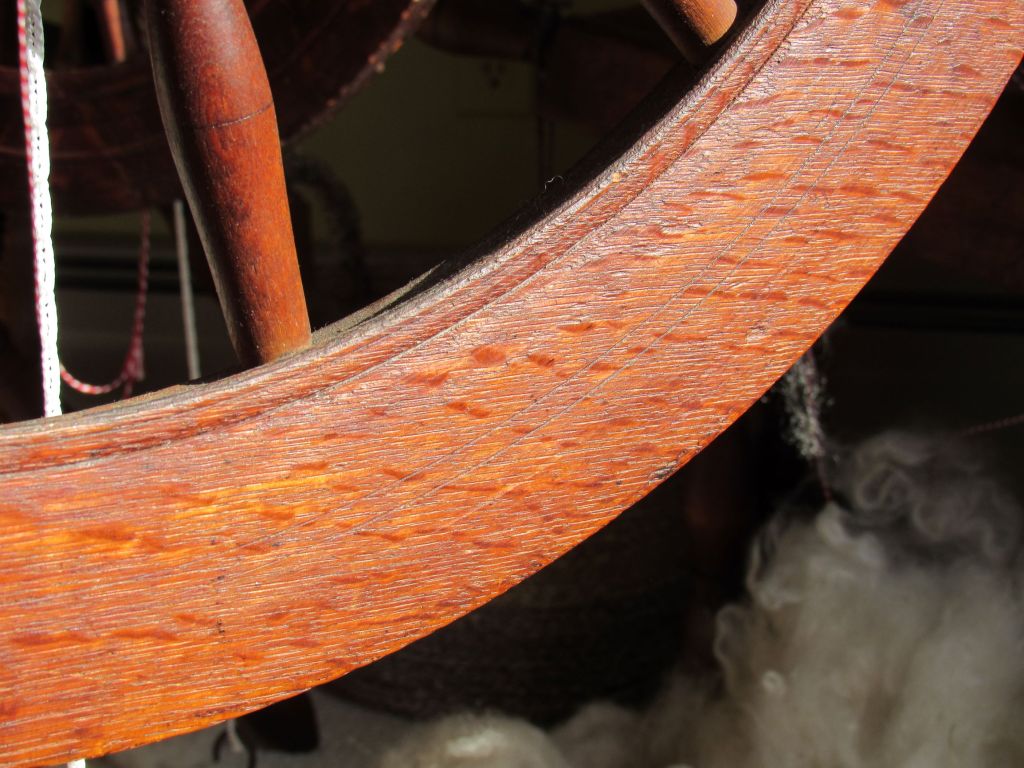
Despite the wheel’s impressive age, not a spoke has a wiggle or gap, and the drive wheel is perfectly solid, straight and aligned. The drive rim’s four parts have different patterns of shining ray flecks that glow in the sun.
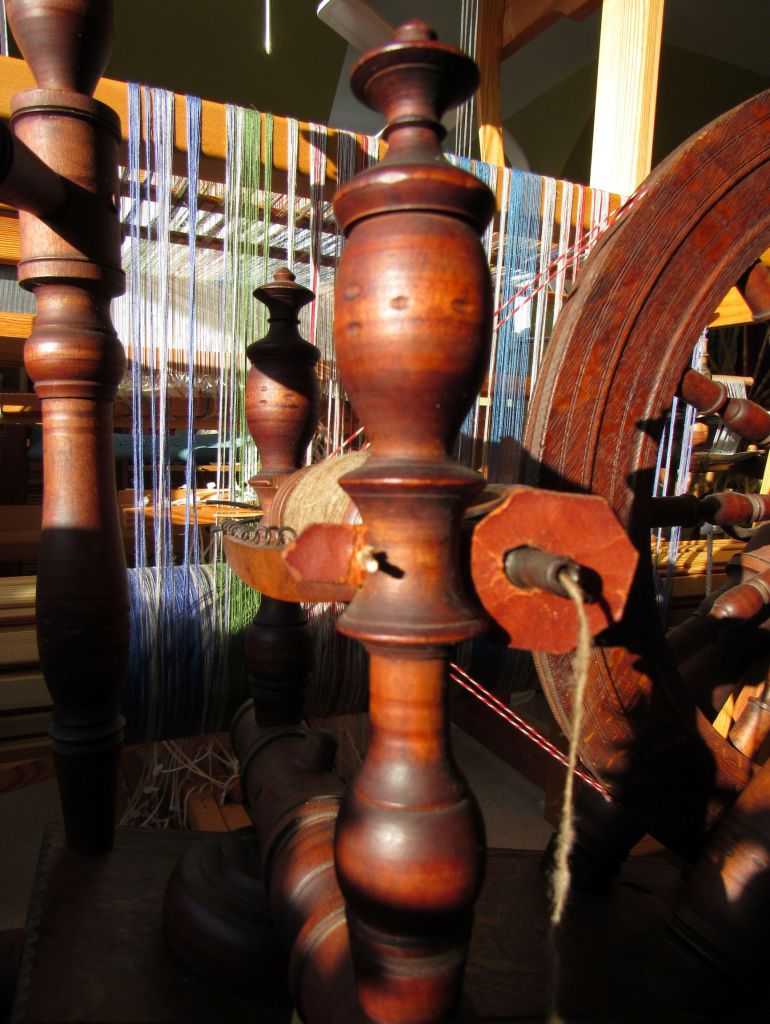
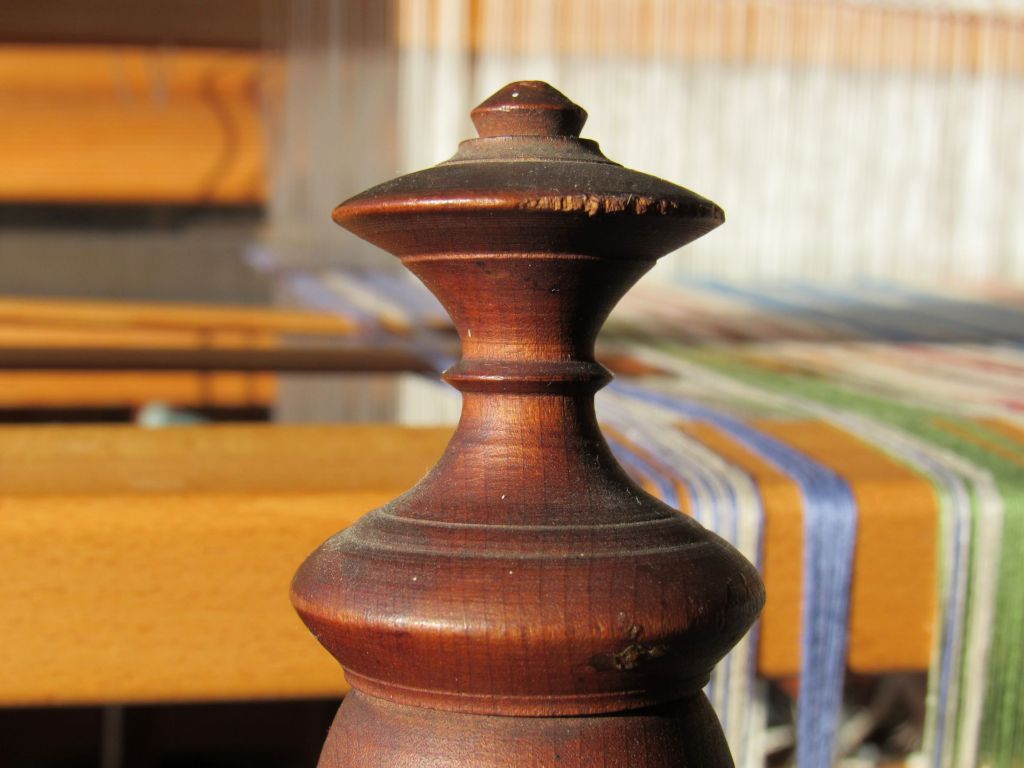
There are fine turnings on the maidens and distaff (the top part is missing).
In contrast, the table is a bit more crude,
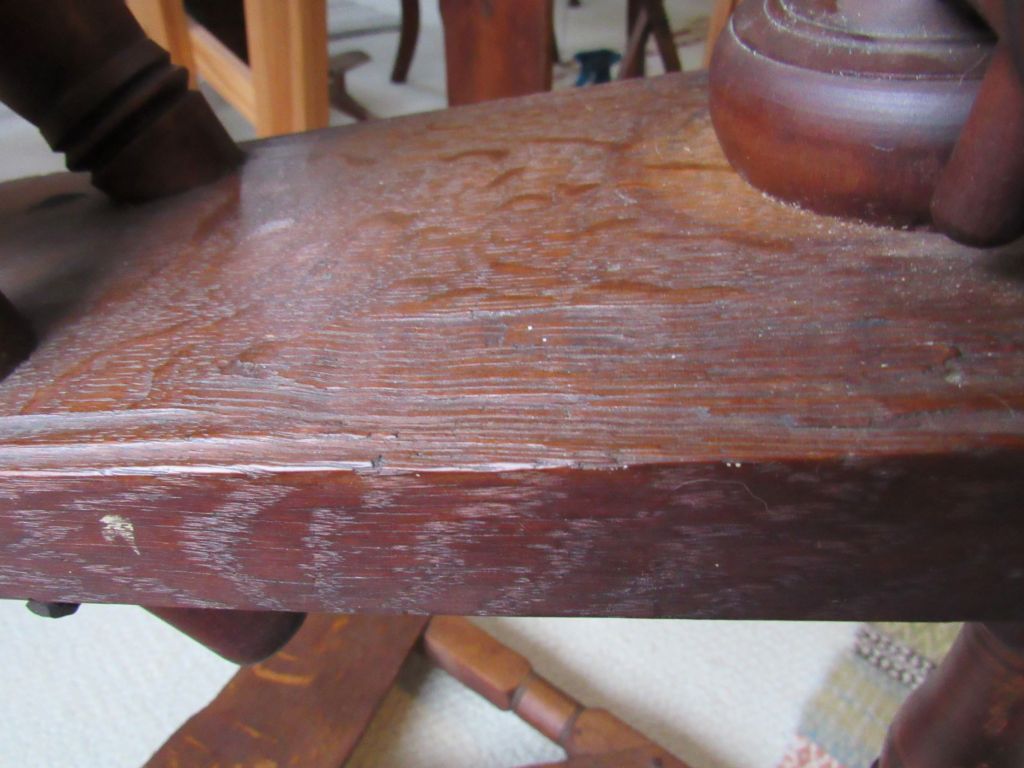
appearing to have been cut from an imperfect chunk of lumber, with one bottom edge at an angle and a concave area on the top.
Perhaps Barnum chose it for the grain, which, as with the drive rim, has highly contrasting fleck.
The table underside is smooth, without scribe marks.
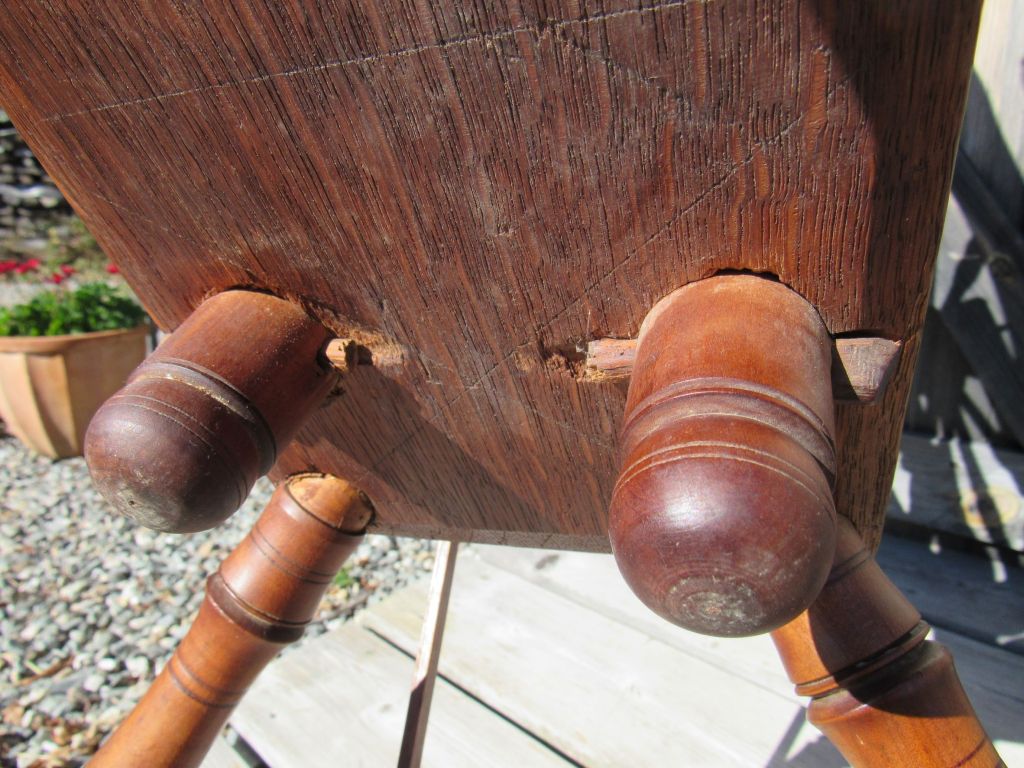
The wheel end legs stick up through the table.
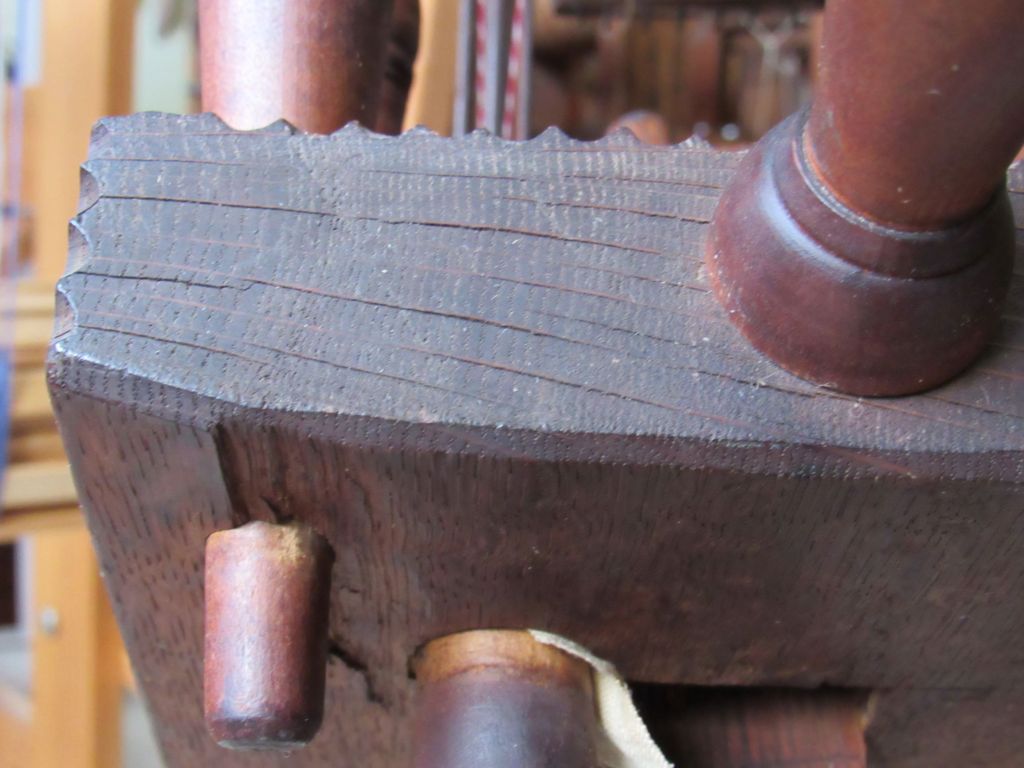
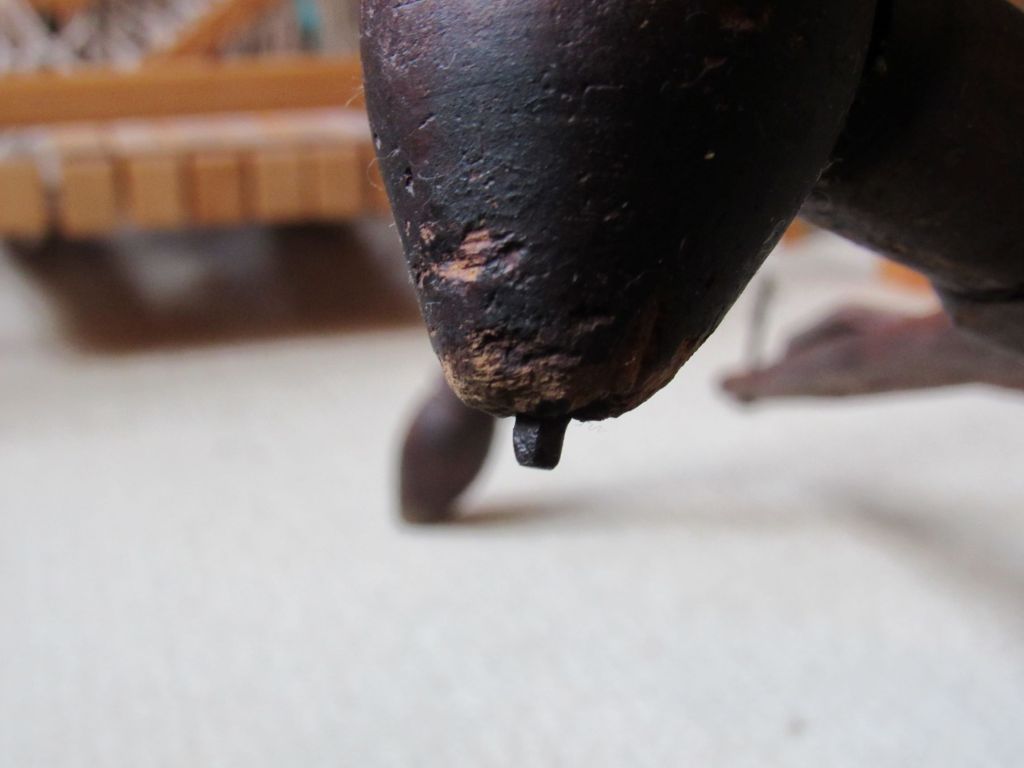
Each leg as a nail in the bottom, which is fairly unusual, in my experience.
I often find one in the far-side leg, but seldom in all legs.
The wheel shows considerable use,
but is in excellent working condition.
The treadle is almost worn through at the front
and right side edge and bar.
The original flyer assembly is missing. It came with a funky one that likely was made in the 1970s or so. I replaced it with one that fits perfectly and has its own elegant style, well-suited to the wheel.
The spinner-side maiden is pegged into the mother-of-all
but the far-side one only has small peg underneath,
which keeps it in the mother-of-all but allows it to turn for easy flyer removal of the flyer.
The tension knob shows no signs of wear from being used for winding off.
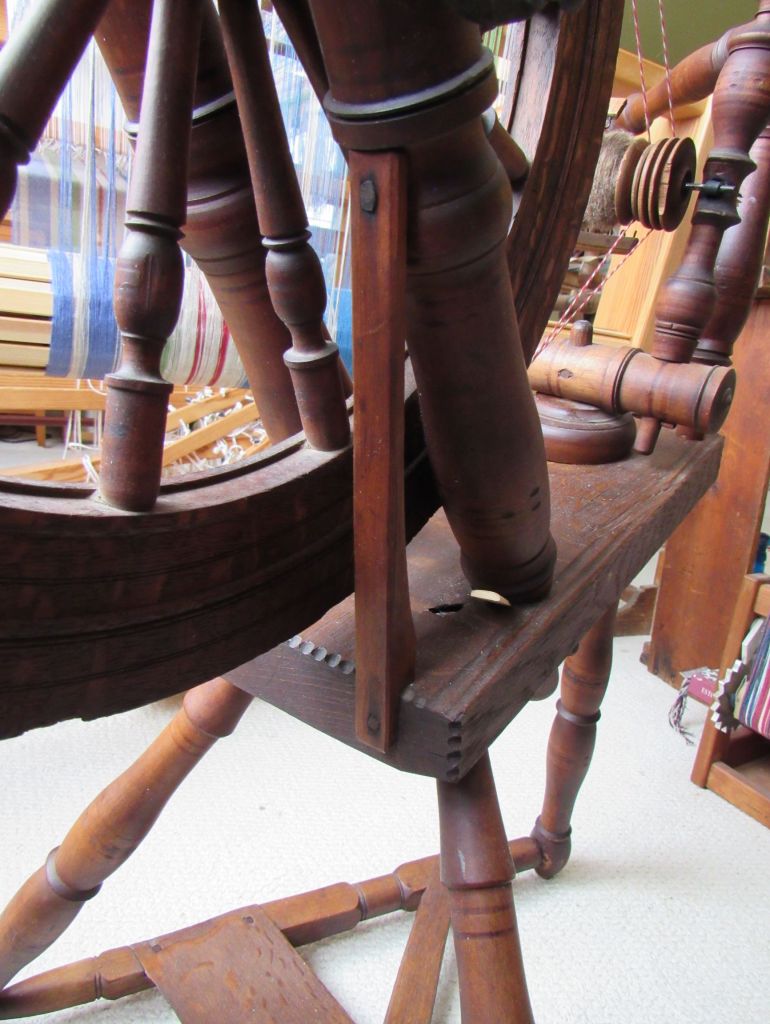
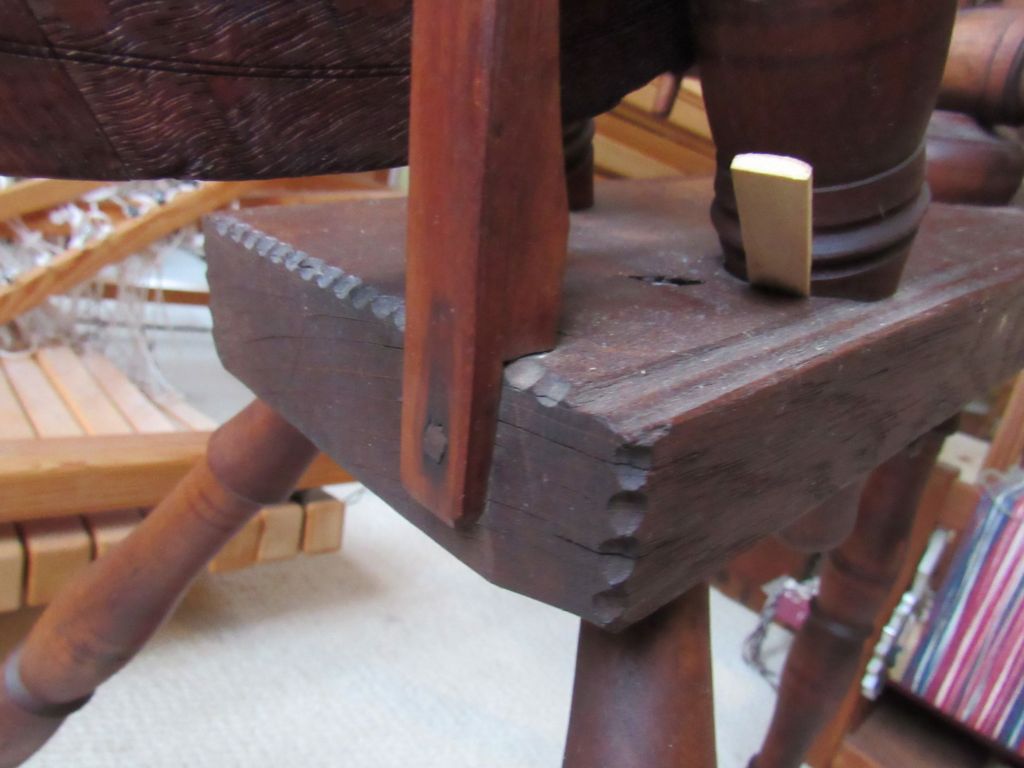
There is one unturned secondary upright support that runs to the table.
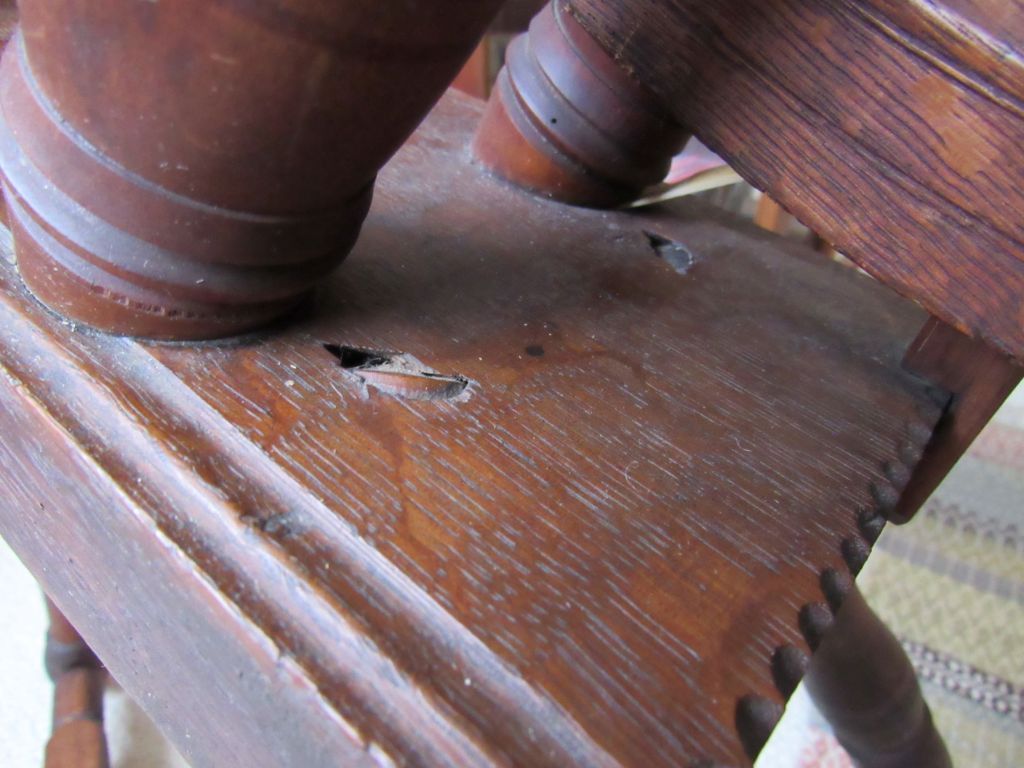
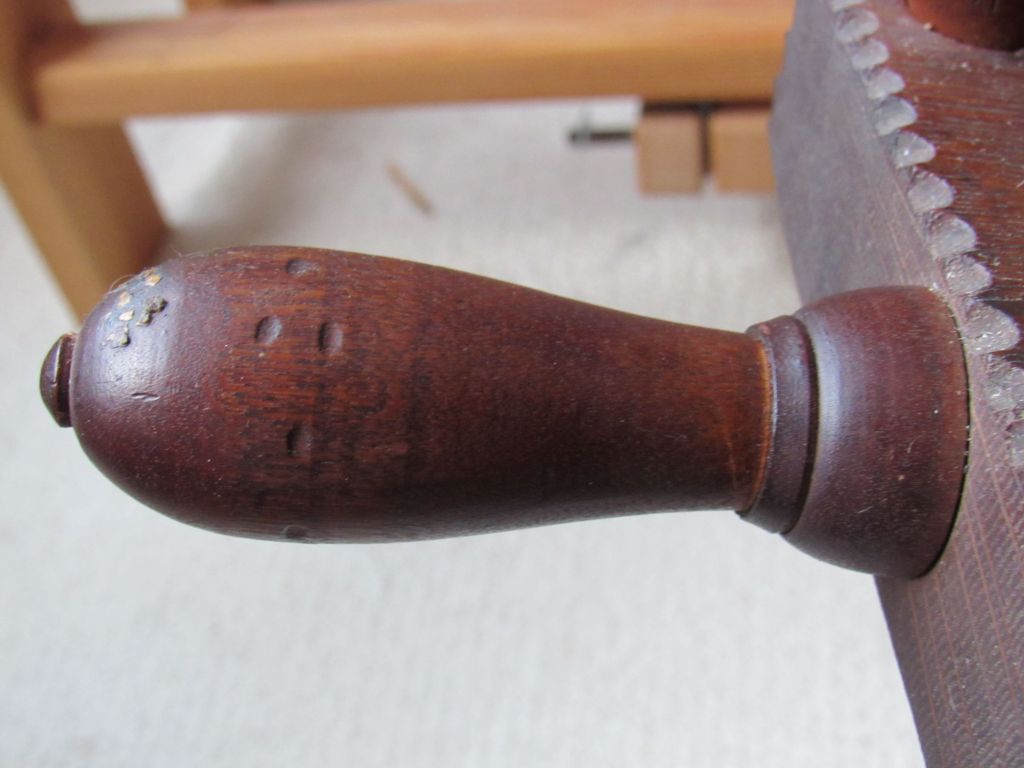
This is a common feature seen on these Connecticut wheels. There are chip carvings on both ends of the table
and deep double grooves down each side.
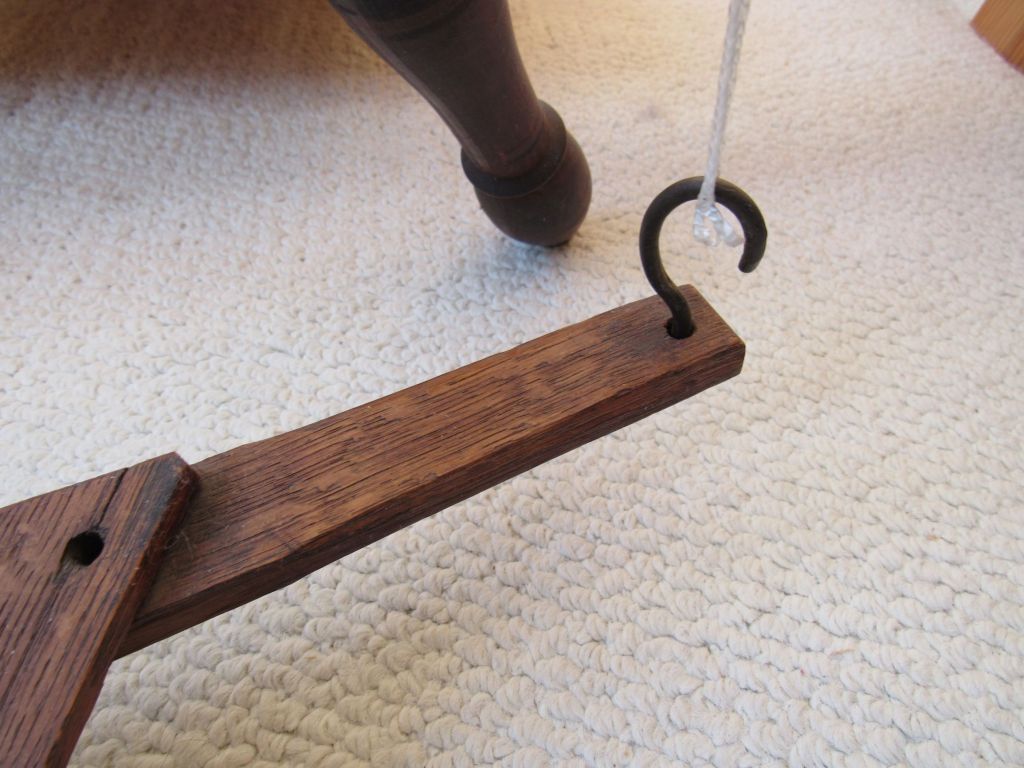
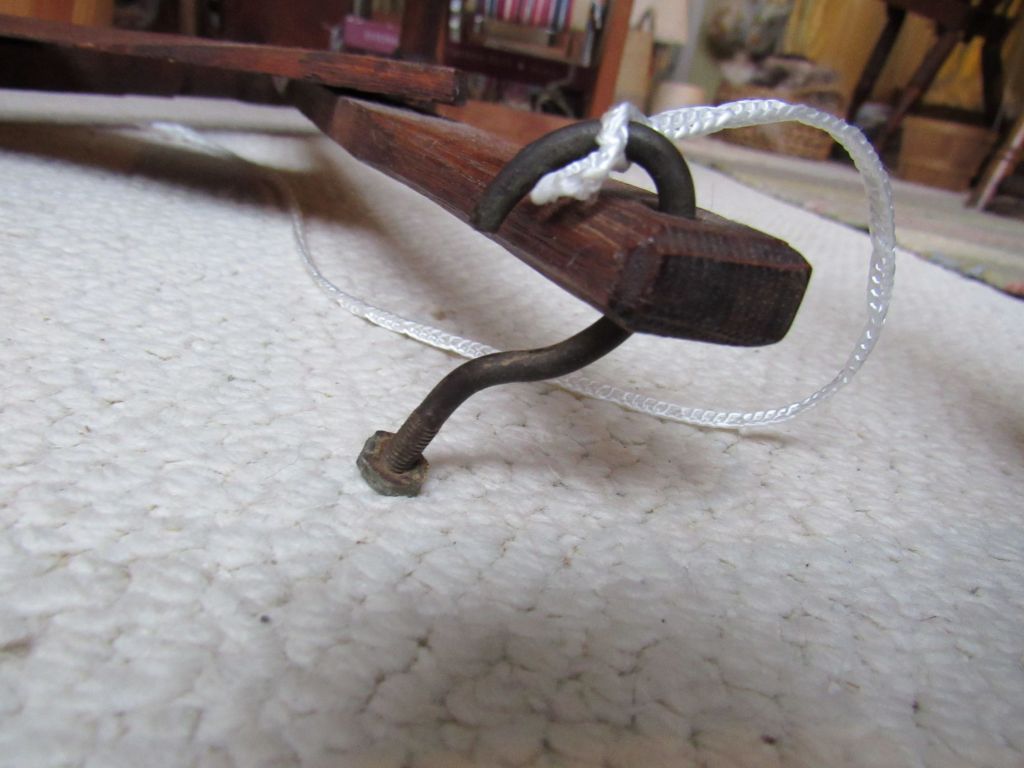
It came with a rawhide footman attached to the treadle bar with a metal hook with a nut underneath.
As I mentioned earlier, Barnum’s life spanned the period at the end of the first generation and beginning of the next generation of these Connecticut wheel makers.
To some extent, this must have been a transition period. His spokes and turnings are similar to Solomon Plant’s, but a little more refined.
The olive and shotgun shell spoke was found on the early Sanford wheels and those of John Sturdevant Jr. and Solomon Plant. But, the later Sanford wheels evolved to have simpler spokes and finials, which according to Pennington & Taylor’s book “Spinning Wheels and Accessories,” this evolution reflected the change in style to plainer turnings for furniture in the 1810s to 1830s (p. 81).
Barnum did, interestingly, venture into a style of double flyer wheel that the later generation of Sanfords embraced, with the wheel above the flyers rather than below.
Kelley’s wheel
In discussing this style wheel, Pennington & Taylor highlight one made by Elias Bristol (E.B.) Sanford, who was born 16 years after Barnum (p. 82-83). E. B. Sanford apparently patented the wheel in 1816. It had unusual metal flyers, but the tension system looks very similar to a wheel signed by Barnum, which was discovered languishing in a North Carolina junk shop by Kelley Dew a few years ago.
Kelley generously shared photos of her wheel,
showing similarities to E.B. Sanford’s, even down to the unusual decorative black marks on the wheel post.
There are differences in the wheels,
but enough similarities to indicate that one maker influenced the other.
Elias Bristol would have been about twenty-five years old when his patent was granted, while Barnum would have been forty-one.
Did the older Barnum first make his wheel and then Elias Bristol improved and patented it?
Or did Barnum take from Elias Bristol’s design, possibly without the patented parts? Who knows?
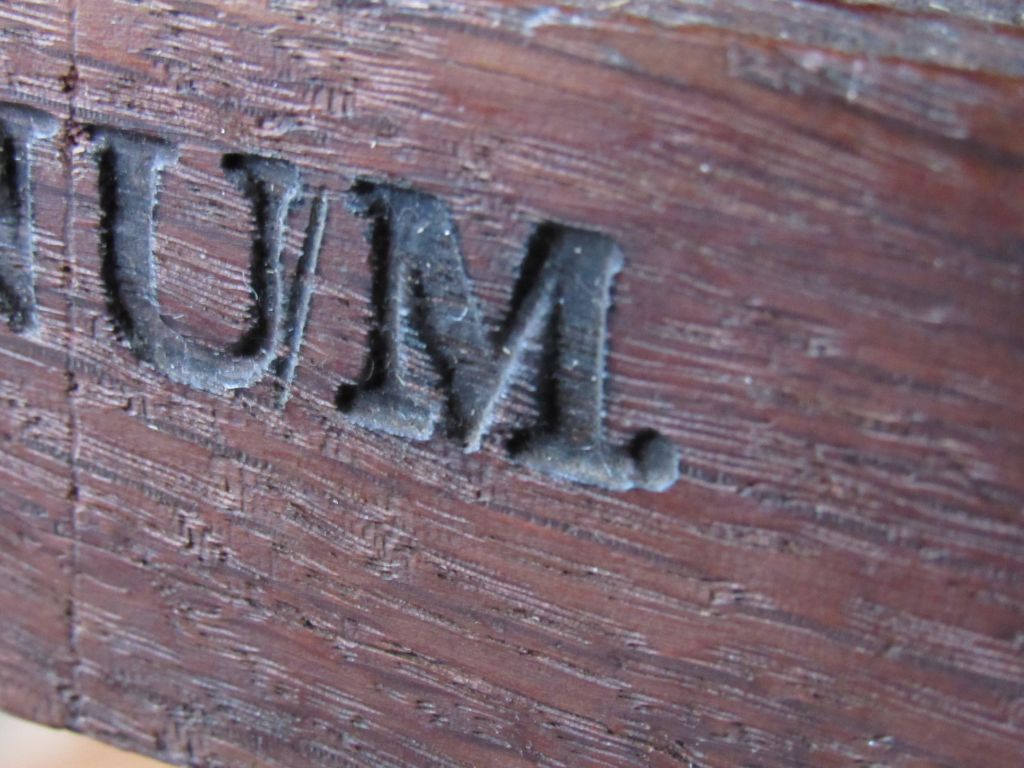
The “N” on the stamp is worn down, possibly indicating this was a late wheel of Barnum’s
Fascinating to think about, though.
The letters are crisp on Olive Peck’s Barnum stamp
I am still hoping to learn more about Silas Barnum.
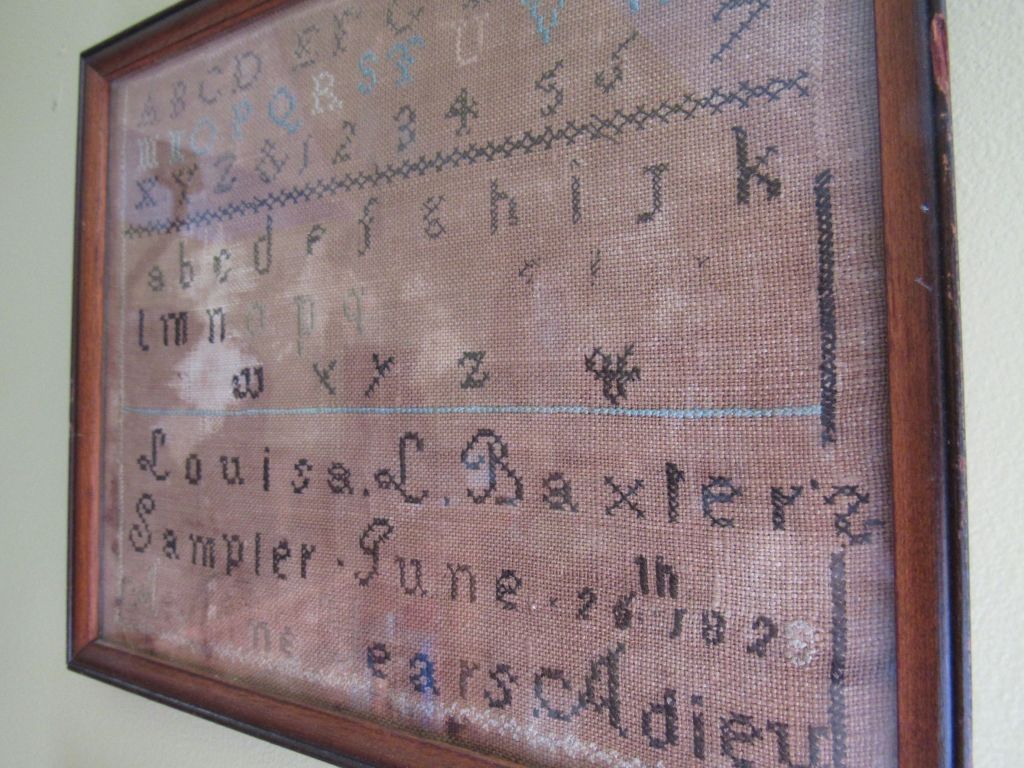
I knew that I had Barnums in my Connecticut family background and recently learned that my great, great, great, great grandmother, Hannah Barnum Baxter, was Silas Barnum’s older cousin.
She married and moved to upstate New York before Silas was born, so likely never knew him. But spinning on a wheel made by someone sharing a small part of my ancestry gives me a special thrill of connection.
My great, great grandmother’s sampler. Silas Barnum was cousin to her grandmother, Hannah Barnum Baxter.
Thank you to Kelley Dew for allowing me to share her photographs of her stunning Barnum double flyer wheel.
For more information
Bacheller, Sue and Feldman-Wood, Florence, “S. Barnum and J. Sturdevant Double Flyer Wheels,” The Spinning Wheel Sleuth, Issue #31, January 2001 (and “Update” Issue #32, April 2001).
Pennington, David A. and Michael B. Taylor. Spinning Wheels and Accessories. Atglen, PA: Schiffer Publishing, Ltd., 2004, pp. 81-83.
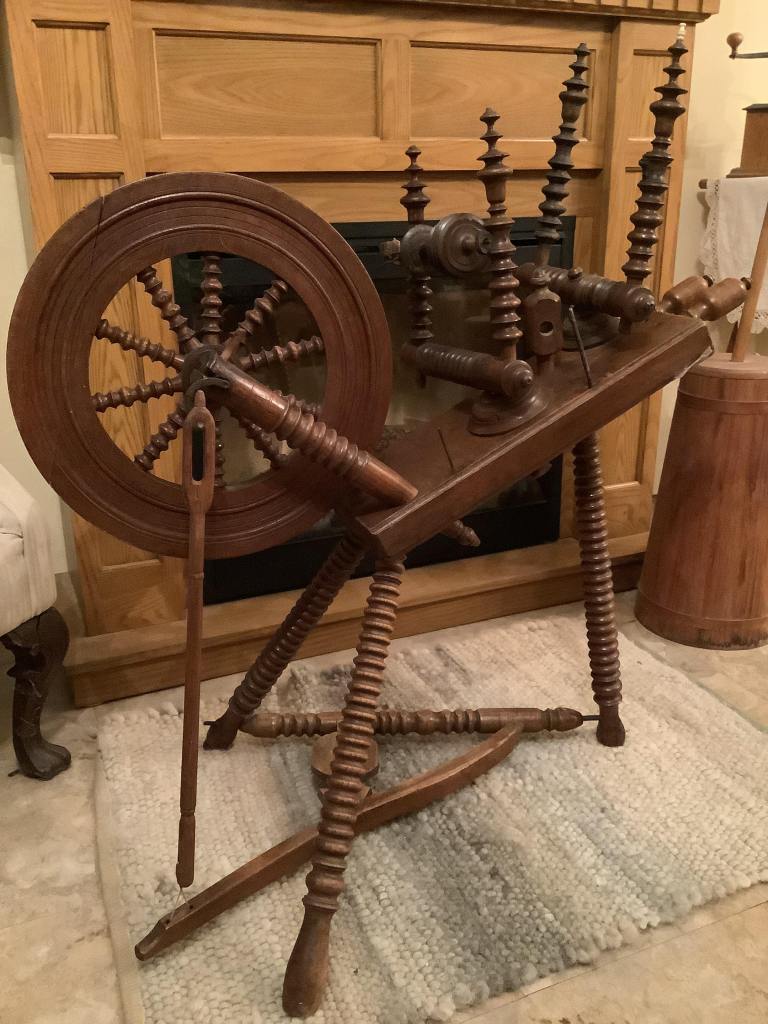
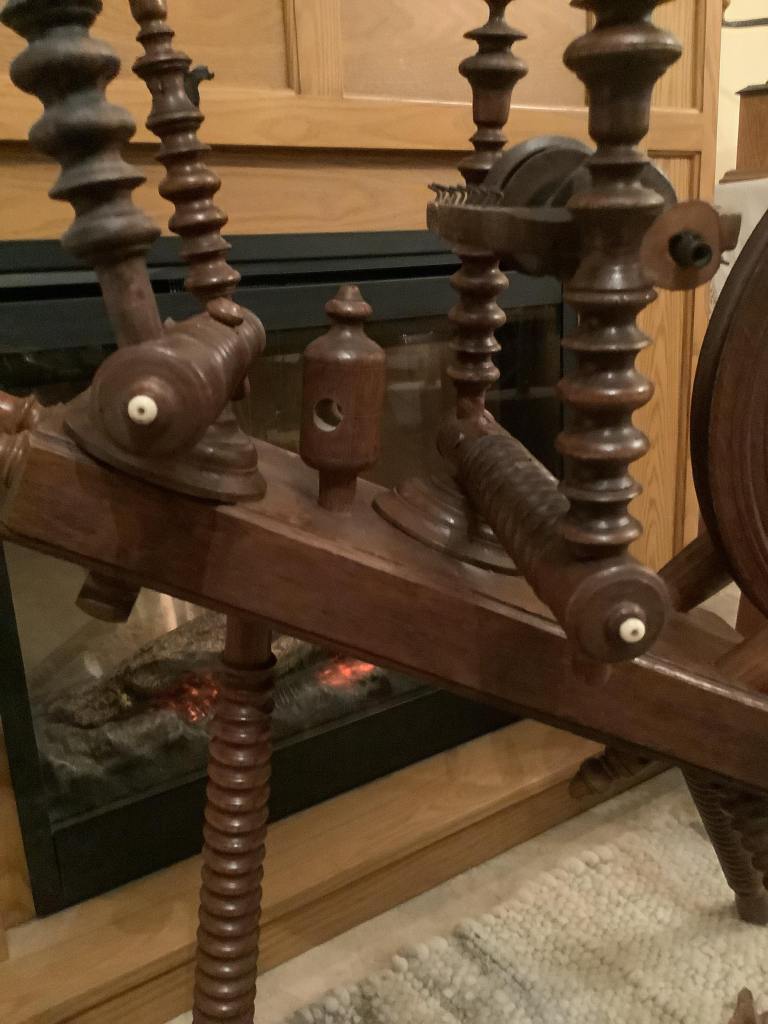
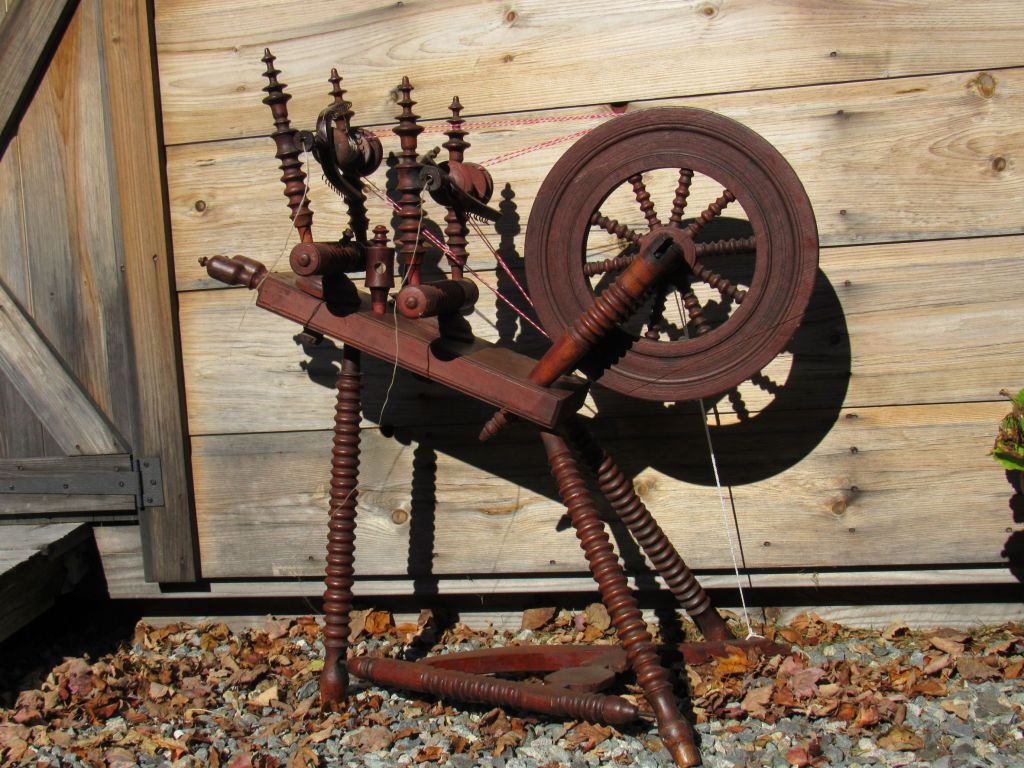
Truus is a striking combination of form and function.
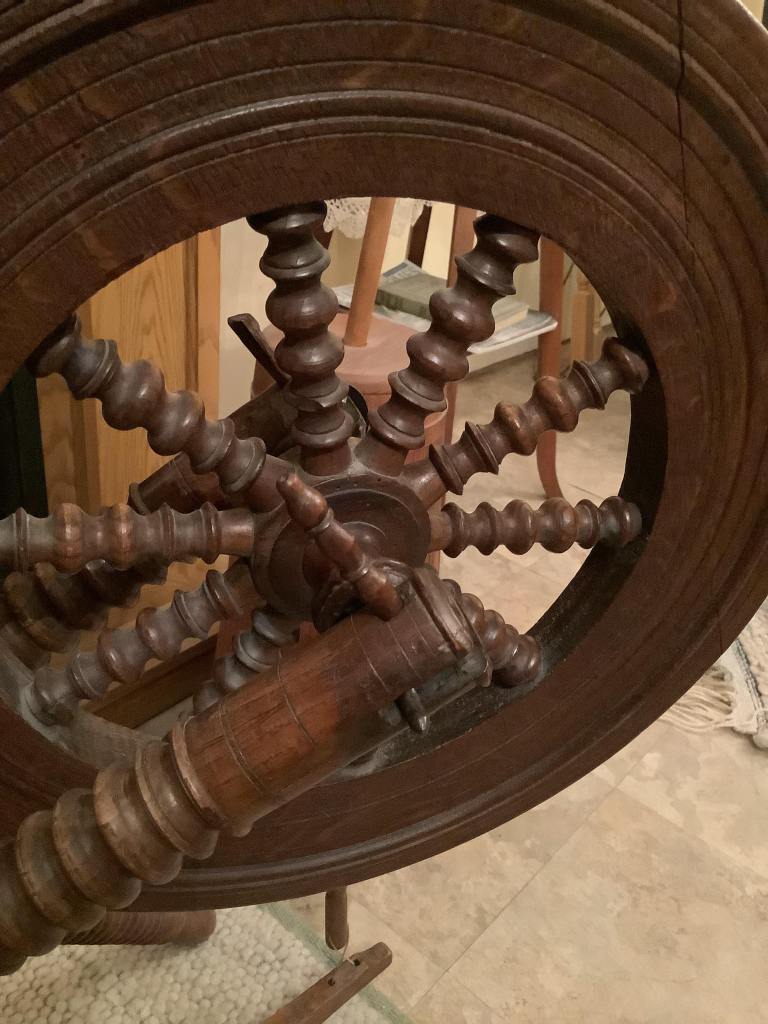
The turnings on this Dutch wheel are almost mesmerizing, especially when light strikes them through a window. Long and short rows of ridges at various angles, topped by four maiden spires—wheel sculpture.
In a dim interior before electric lights, candle and fire light would have highlighted and accentuated the ridges, creating an intricate interplay of light, dark, and shadow. Today, even in a room full of beautiful wheels, this one captures the light, becoming the center of attention.
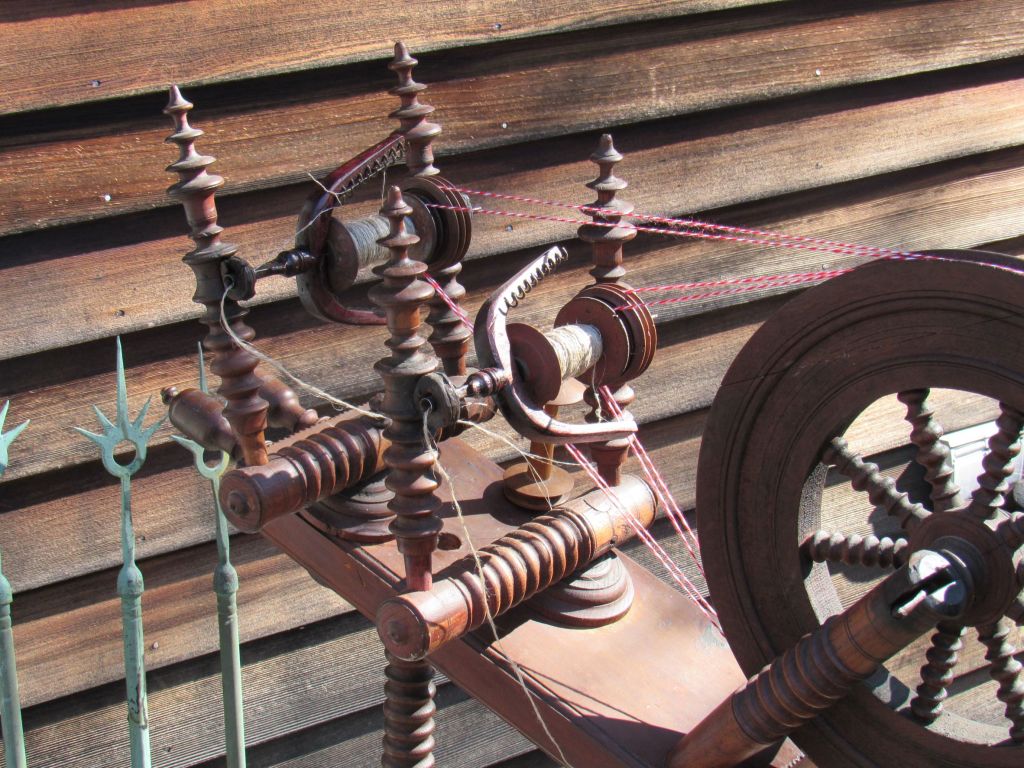
Not only a treat for the eyes, it is a little workhorse. With two flyers, side by side, a spinner can spin flax at a much greater rate than with a single flyer (for more information on a double flyer wheel’s increased production, see the end of the earlier post “Louisa Lenore”).
This wheel’s design is especially nice for two handed spinning because each flyer has a separate tension system, which allows the spinner to fine tune the tension of each flyer to closely synchronize their uptake rates.
In comparison, the tensioning on Connecticut double flyer wheels seems crude, because each tension adjustment has some effect on both flyers, making it more difficult to find that sweet uptake spot, especially if one of the flyers is a replacement. I have spun on several different styles of double flyer wheels and, to me, this one is by far the easiest to achieve consistent two-handed spinning. It is a very sweet flax spinner.
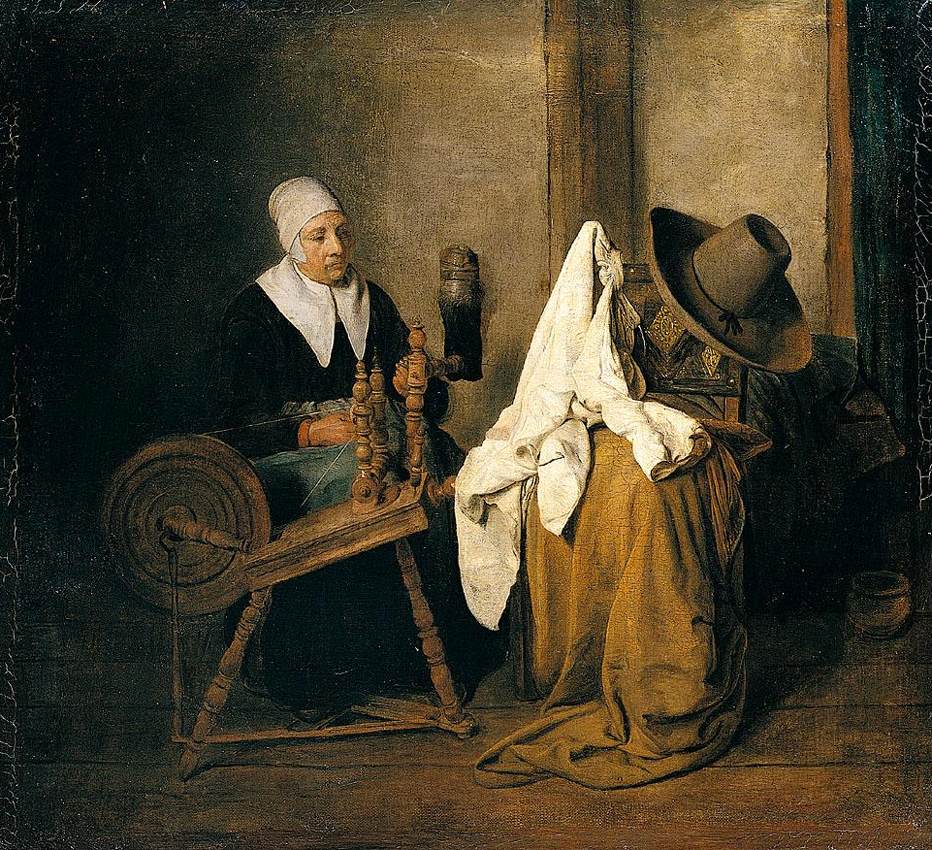
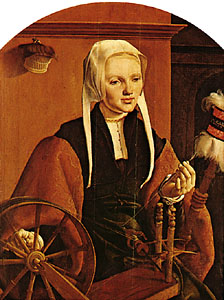
Historically, Dutch wheels were made in a variety of styles, reflected in a richness of paintings.
Esaias Boursse–Interior With an Old Woman at Spinning WheelMaerten van Heemskerck–Portrait of a Woman at the Spinning Wheel
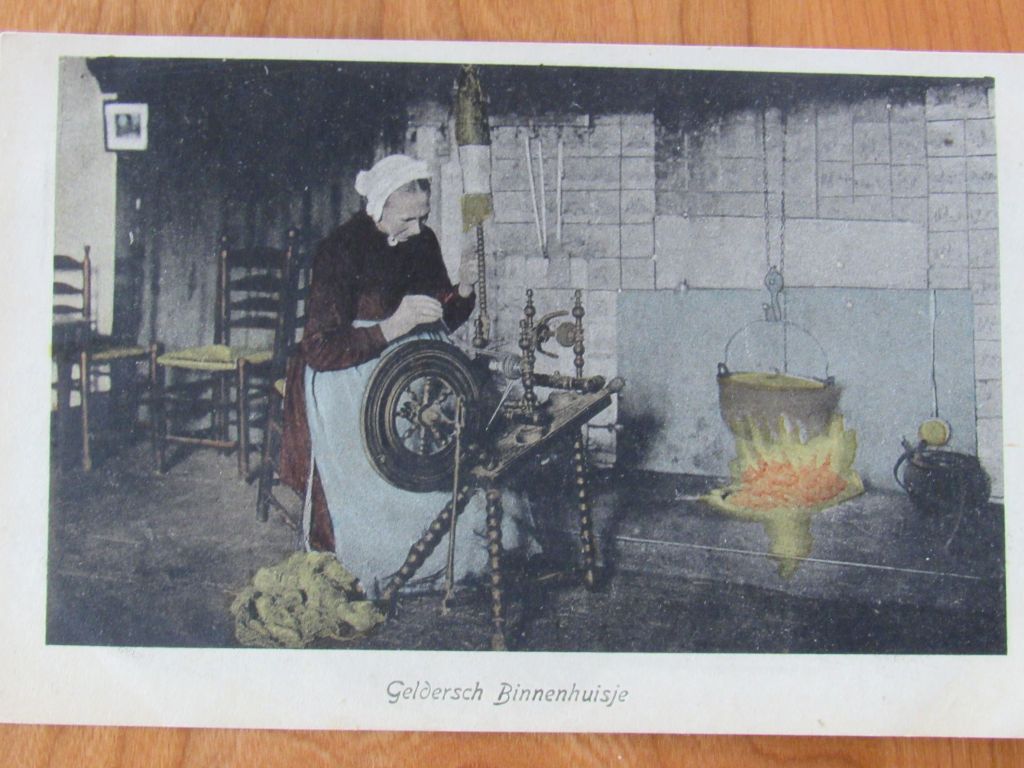
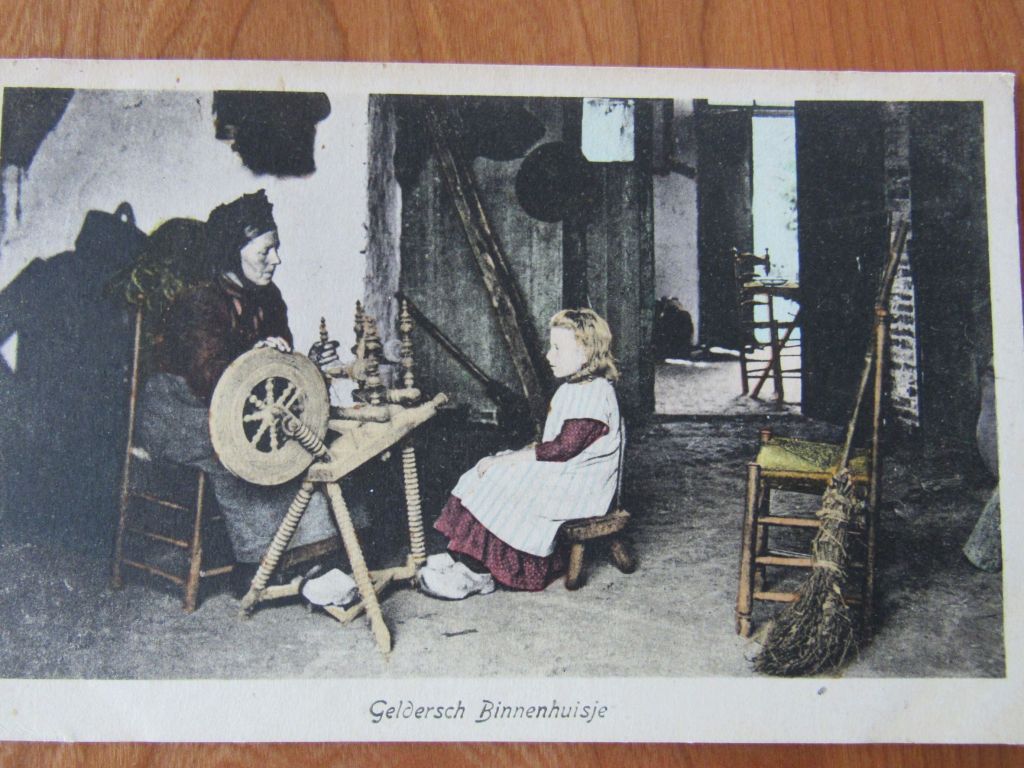
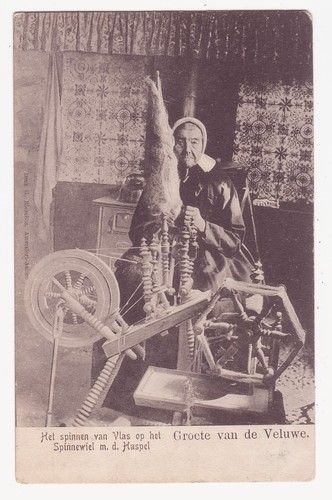
Most of the Dutch double-flyers, however, seem to look much like Truus, with small variations. These postcards of double flyers are entitled “Geldersch Binnenhuisje.”
Binnenhuisje is a home’s interior and, I believe, Geldersch refers to the province of Gelderland, in the east central area of the Netherlands.
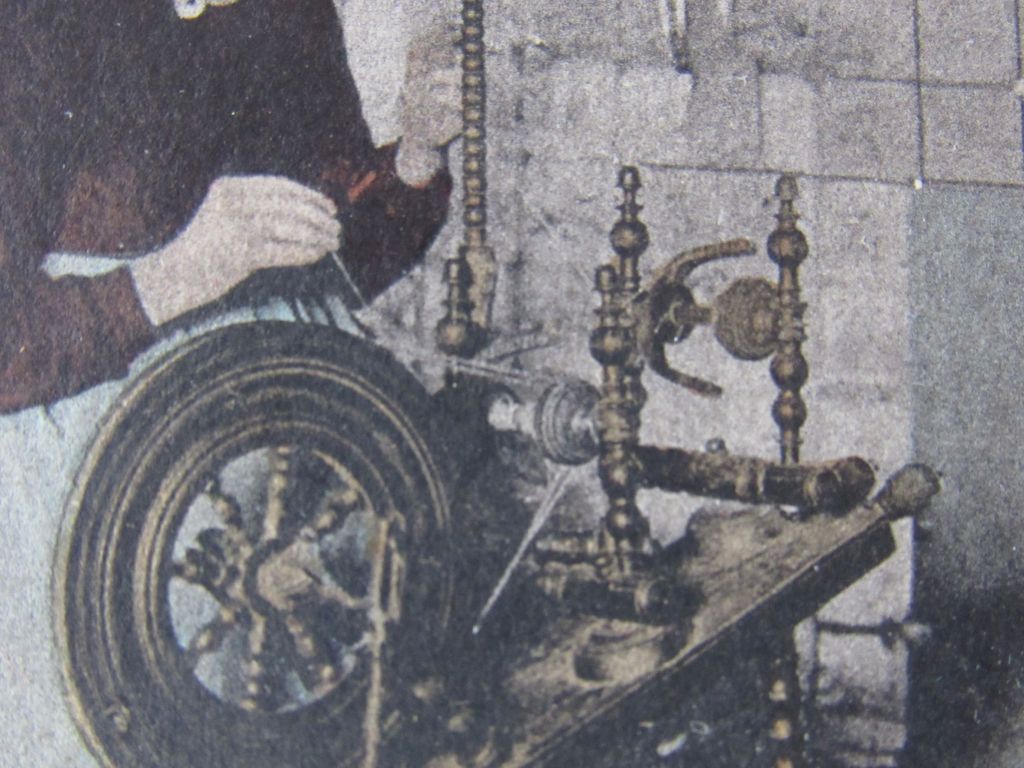
This woman appears to have threads going to both flyers but only one flyer seems to have a drive band or any accumulation of thread.
The wheel in the above postcard does not even have a footman, but it is a lovely and instructive prop. My favorite card, identifying a woman spinning flax on a wheel with a reel, is intriguing because the wheel appears to be almost identical to Truus, right down to the bobbin holders.
The card reads, “Groete van de Veluwe,” meaning “Greetings from Veluwe”–a region in the Gelderland. Perhaps these wheels were a Gelderland style. And, possibly, many were made by the same maker. Several identical, or nearly so, wheels have turned up in widely different locations around the world. One wheel, featured in Issue #65 of the Spinning Wheel Sleuth, and looking just like Truus, was found in Australia. According to the article, that wheel had “W&H” or “M&H” handwritten on the base of the upright forks. (SWS #65, pp.9-10). Interestingly, another sister wheel, bought in Gelderland, was posted on Ravelry about seven years ago, with an “HW” stamped on the end of the table. As far as I know, no one has identified “HW” or determined if he may have been a primary maker of these wheels.
Ginnie’s wheel
Several similar wheels have been found around the United States, but, as far as I know, no others have maker’s marks.
Ginnie’s wheel
A few have some ornamentation, perhaps ceramic or porcelain, including the wheel above owned by Ginnie Schirmer in Kansas. Aside from the bits of ornament, her wheel looks just like Truus, although it has an axle pin, perhaps original.
Ginnie’s wheel
Truus’ axles came pinless.
True to her Dutch roots, Truus turned up for sale in Michigan, in an area heavy with Dutch immigrants. A wonderful woman in Michigan (now a friend) kindly picked her up, fostered, and eventually railroaded her east. The wheel was in pretty good shape but had no distaff parts and both flyers were split down the middle at the orifice end.
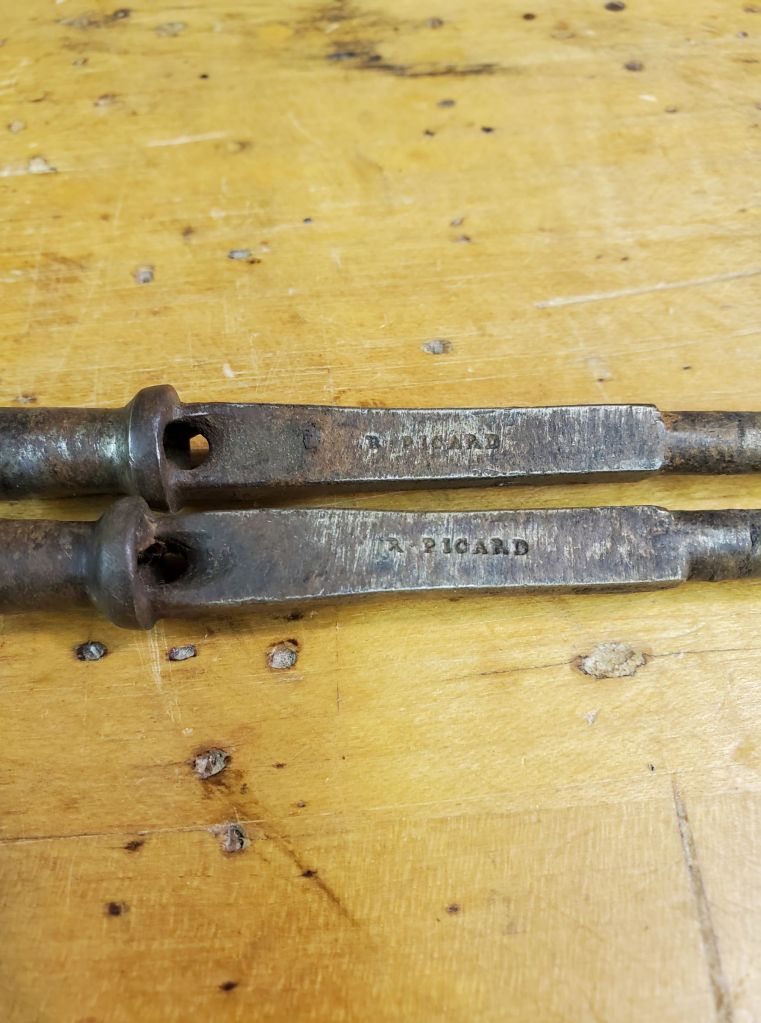
I was thrilled, though, to have both flyers, damaged or not. I sent her off to John Sturdevant at SpiritWood for repair and to have a distaff made. When John started the flyer repair, he was surprised to discover, in a mandrel section that had been covered by the wooden flyer, the name “R. Picard” engraved the metal on both flyers.
Try as I might, the only R. Picard I have been able to find is a Raphael Picard, who founded a watchmaking company in 1837 in La Chaux-de-Fonds, Switzerland. It seems unlikely that he would have made spinning wheel mandrels for Dutch wheels. But perhaps there is some family connection.
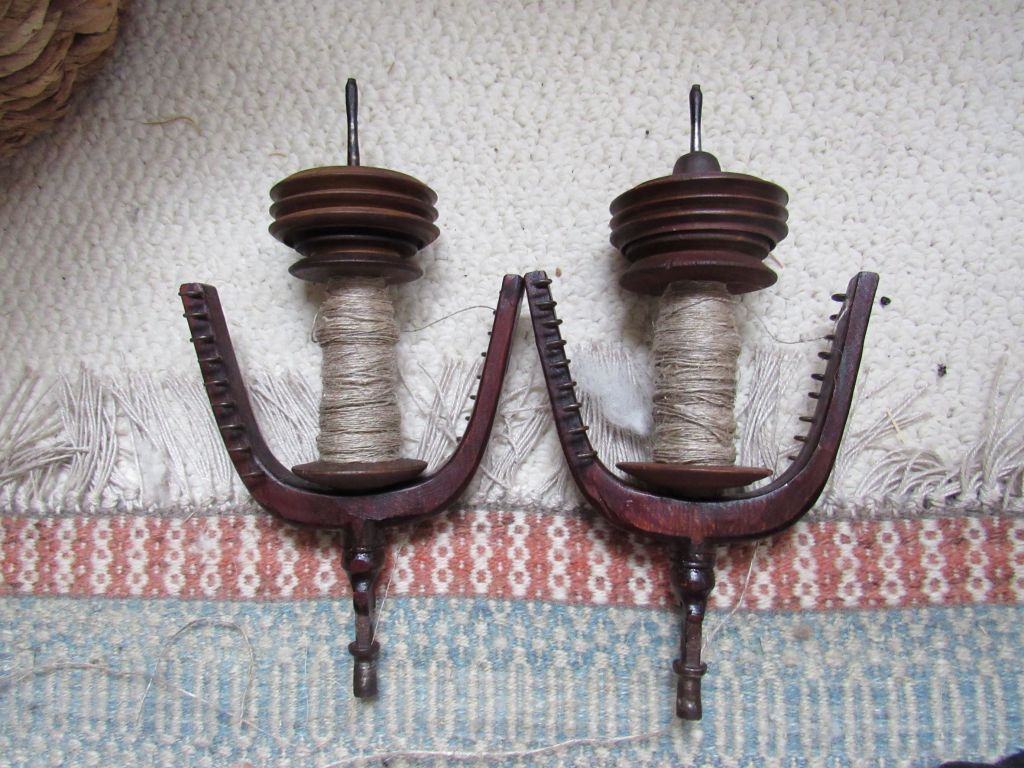
While Picard’s engraving shows that both flyers likely are original, they are not identical. One is slightly longer and has a nipple end on its whorl.
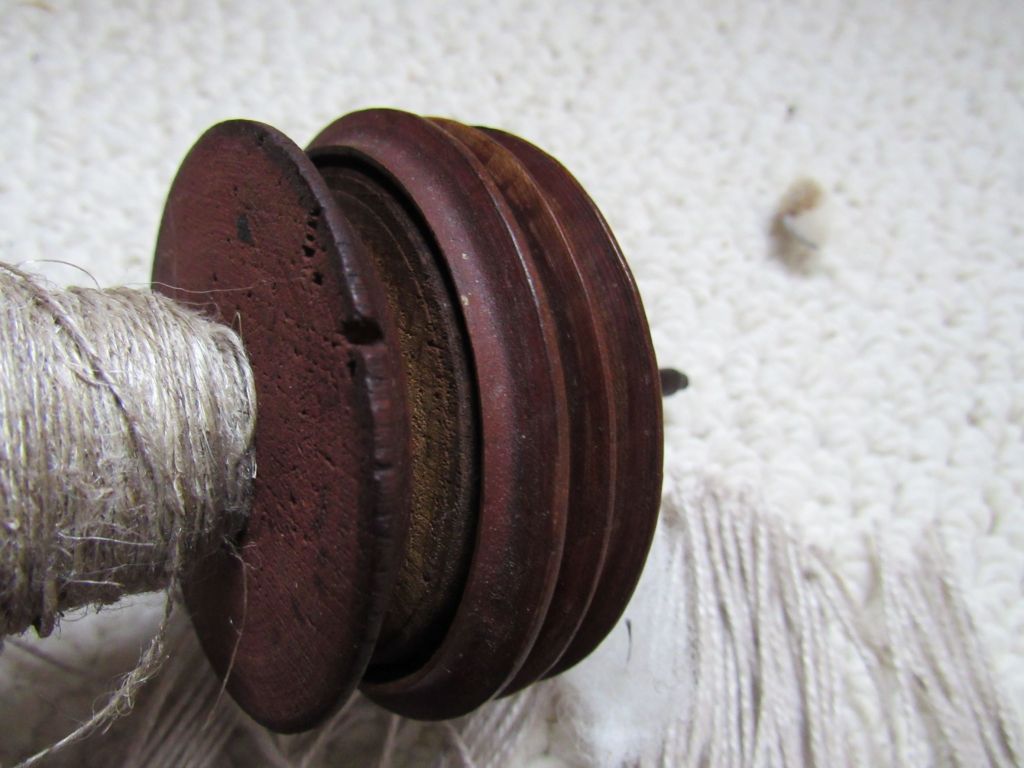
Both whorls have a feature sometimes seen on Scandinavian wheels—a lipped recess on the flyer whorl in which the bobbin neatly nests.
Ginnie’s wheel has the same nested bobbin
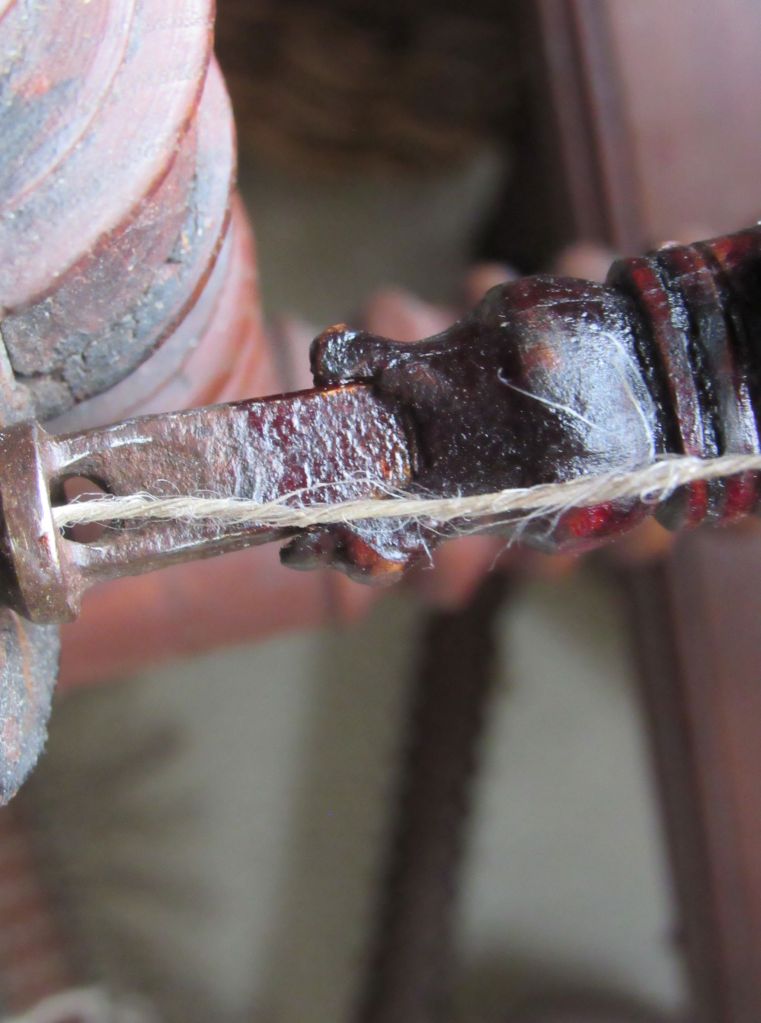
On both flyers, the wood is cut back from the mandrel on both sides near the orifice.
Another distinctive feature of these sister wheels is a curved treadle bar
and arrow-ended treadle.
My wheel has wear showing that it was treadled with both feet, perhaps with wooden klompen as in this postcard.
The ends of the treadle bars look handcarved,
as are the tension knob pegs,
which fit so perfectly in the holes that I’m still working on matching the pegs back to the correct holes. If they are lined up just right, they do not need to be hammered in.
Decorative touches are everywhere,
except for the drive wheel rim,
which has simple four-part construction.
Ginnie’s wheel showing the collar extending past the table
The mother-of-all collar on the uphill side extends past the table
Truus’ collaroverhang
and has a strong grain.
Several areas have traces of red paint
and others are grease-encrusted.
There were two metal upright rods for storing bobbins along the non-spinner side,
but one has broken off.
Each flyer has its own drive band
and they seem to happily accommodate each other on the drive wheel without any fiddling on my part.
The leather flyer bearings are three layers held together with metal rivets.
The distaff hole is between the two flyers.
There is not much room for the lowest distaff piece.
In deciding on the distaff design, I worked with John.
I examined wheel photos and a friend kindly sent me photos and measurements from a wheel in Canada. I am delighted with how it turned out.
I understand why these wheels have ended up so far from where they were made. They were a perfect combination of desirable features–lightweight, portable, and beautiful in form, while performing their function brilliantly as efficient and pleasurable spinners.
Thank you to John, Rita, and Gordon for helping me to bring this wheel back to life and to Ginnie for sharing photos of her wheel.
For more information see:
Feldman-Wood, Florence, Two Double-Flyer Dutch Spinning Wheels, The Spinning Wheel Sleuth, Issue #65, July 2009.
If the wheel in the previous post, Green Linnet, is the oldest I have owned, this wheel, Hermione, is the smallest.
It is hard to convey just how tiny this wheel is and photos cannot capture how little it weighs.
Such small wheels are often advertised these days as children’s wheels, which generally is considered an inaccurate description, since apparently children rarely got wheels of their own but learned to spin on full-sized wheels.
Nevertheless, we do know that there were great wheels scaled down in size for children, so it is entirely possible that some small flax wheels were made for children, also.
I do not dispute that children’s wheels were a rarity. This wheel probably was intended for and used by adults. But, I like to think that it may have been used, at least at some point in its history, by a child. Because, if ever a wheel would appeal to a child, this is it. At less than 24 inches tall, under 5 pounds, and beautifully turned, it would have been a powerful lure for a child to learn to spin.
And what a good teacher it would have been. The wheel is an excellent, responsive spinner. Despite its almost toy-like quality, it has a full-sized flyer assembly and spins like a much larger wheel.
Even though the drive wheel is petite, it does not require frantic treadling for a smooth, even uptake, but has a nice, easy rhythm. The orifice height is 21 ½ inches, only two inches lower than some of my other small flax wheels.
Its main advantage for an adult user would have been portability and ease of storage. Its slanted stance gives it a tiny footprint. Combine that with its feather weight and it can easily travel anywhere and be tucked in a corner or lifted to the top of a wardrobe when not in use.
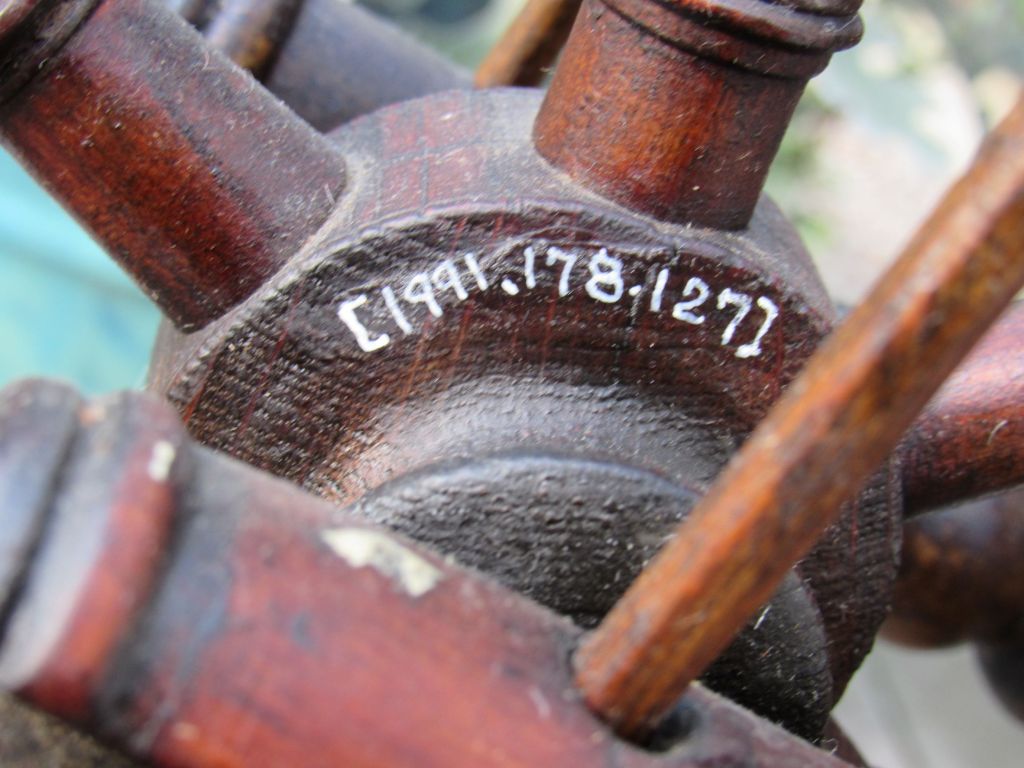
As with several of my wheels, this one was part of Joan Cummer’s collection, auctioned off after the American Textile History Museum closed. It is Wheel #127 in Cummer’s “A Book of Spinning Wheels,” on pages 274-75
It is hard to pin down the origins of this wheel–in time or place. According to Cummer, the wheel was thought to have originated in England or northern Europe in the late eighteenth or early nineteenth century.
I would love to know how Cummer came to her conclusions. Tiny Saxony-style wheels are most often associated with Germany and eastern Europe and usually are not thought to be as old the eighteenth century. But this wheel does have a bit of a unique style. Based on the series of ball or bead turnings on the legs, Cummer may have compared this wheel to an English wheel made by Richard Arkwright, probably in the middle of the 18th century (for a photo of Arkwright’s wheel see Baines, Spinning Wheels, Spinners & Spinning, p. 124) to conclude that it could be an early English wheel.
Nevertheless, the turnings are not really much help in accurate dating. Patricia Baines calls such turnings “knob turnery” and notes that it “could suggest the Cromwell period, nearly 100 years before” the estimated date of Arkwright’s wheel, while also noting that it is found on spinning wheels known to have been made in the nineteenth century. (Spinning Wheels, Spinners and Spinning, p. 123).
Nor do the turnings help much in determining place of origin. The legs’ series of knobs, balls, or beads (also referred to as “bubble” turnings by some) resemble those found on many Dutch and some German and Scandinavian wheels. Moreover, the drive wheel is scattered with decorations of a type found most commonly on small German and eastern European wheels.
They are raised and appear to have been glued on, many resembling small tulips or crowns.
Another interesting feature is the drive wheel construction.
It is made from one piece of wood, with no joins, and the pegs for the spokes are driven directly, straight down, through the middle of the rim. I don’t know whether this construction is indicative of a certain region.
But, we can tell that the wheel likely came from a flax-spinning region. As Cummer notes, there are two holes in the table–one for a distaff and the other for a water vessel for flax spinning.
The wheel is versatile, however, with an orifice and bobbin large enough for spinning wool as well as flax.
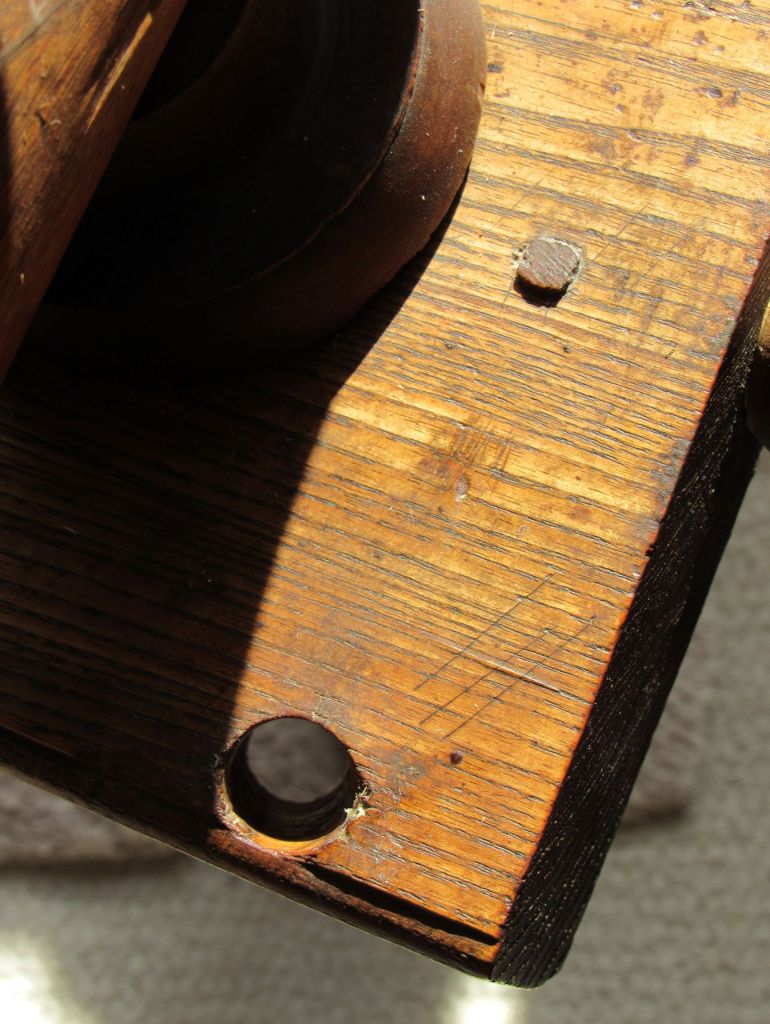
The table also has a small hole with a circular mark that likely had a decorative medallion at some point, another feature sometimes found on German wheels and other European wheels.
Although its origins likely will never be pinned down, it is a delightful wheel and was easy to bring back to life. When I bought it, the footman was a broken thin leather strap that had been doubled up. It was stiff, severely cracked with age, and falling apart, so I replaced it with new leather in the same design.
The treadle has seen a lot of wear and one edge is partly broken off.
I originally thought that the bobbin was a replacement because it comes well short of taking up its allotted space on the mandrel.
But its wood appears to match that of the spindle whorl and the hub, all of which have eye-catching reddish grain rings.
It is apparent that the wheel was well-used and valued for its sweet spinning because of the careful repairs. Screws have been added in strategic places
But the most interesting repairs are to the flyer assembly.
The flyer hooks apparently are replacements, set into holes adjacent to the originals.
And, at some point, the flyer was pretty well shattered,
with a break down the center and a broken arm.
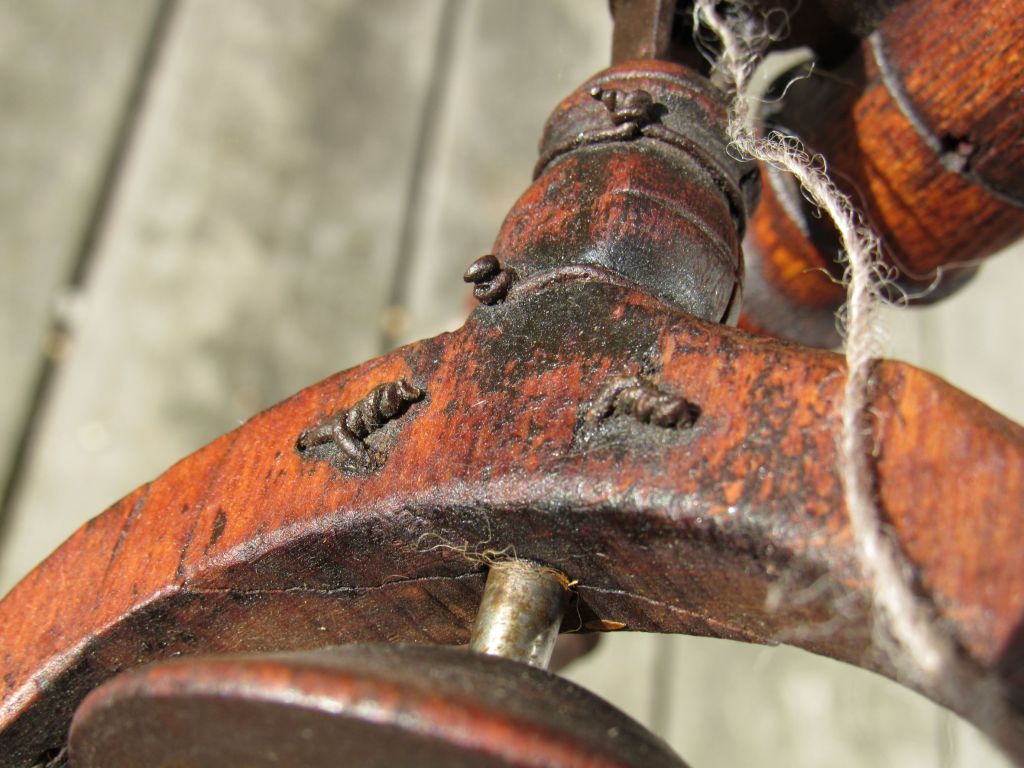
The breaks are neatly repaired with wire,
doubled through and tightly wrapped.
The arm break also appears to have a small nail as back up.
Years of usage grime have settled in around the wires, indicating the flyer repair is an old one. Such a thorough and effective repair speaks eloquently for someone’s desire to keep this wheel spinning.
I hope that whoever it was would be satisfied and content to know that it is spinning still.
February 2022 update: I just read “Silas Marner, The Weaver of Raveloe,” written by George Eliot (Mary Anne Evans) in 1860 about a linen weaver working in England at the end of the 18th and early 19th century. The first line of the book starts with: “In the days when the spinning-wheels hummed busily in the farmhouses–and even great ladies, clothed in silk and threadlace, had their toy spinning-wheels of polished oak …” Perhaps wheels such as Hermione were such “toy” wheels, ornamenting the houses of those who really did not need to use them except for casual spinning.
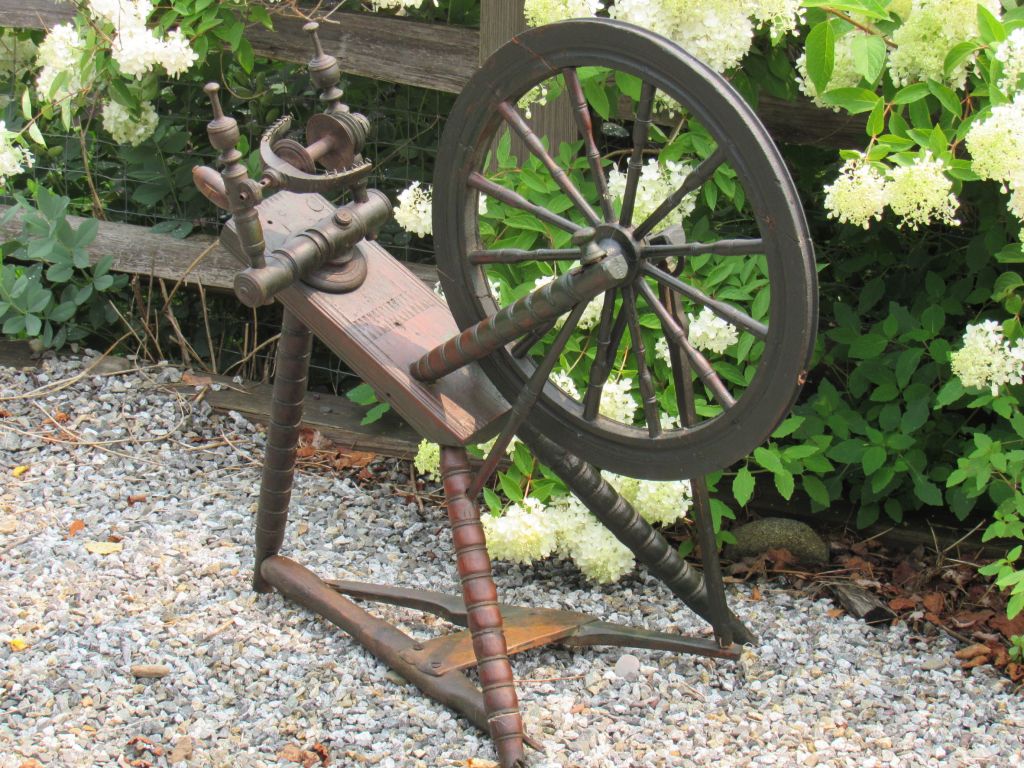
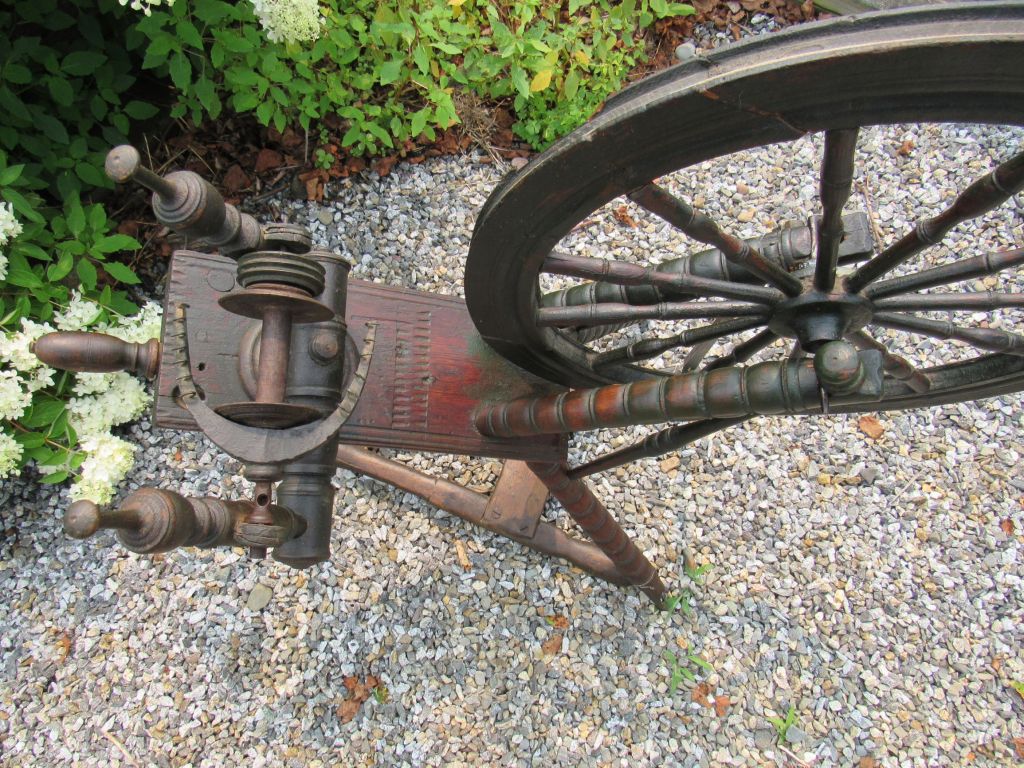
This is an old wheel. It was part of Joan Cummer’s collection, auctioned off when Lowell’s American Textile History Museum closed. I was the only person to bid on this wheel at the auction and bought it because Cummer believed it to be the oldest wheel in her collection.
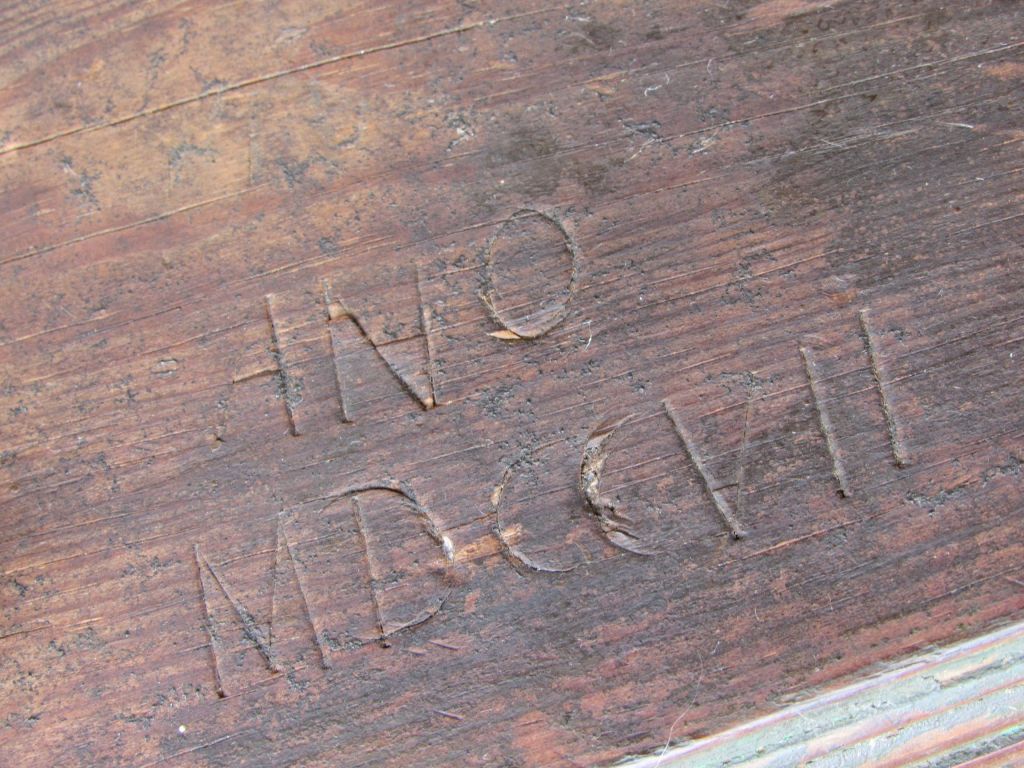
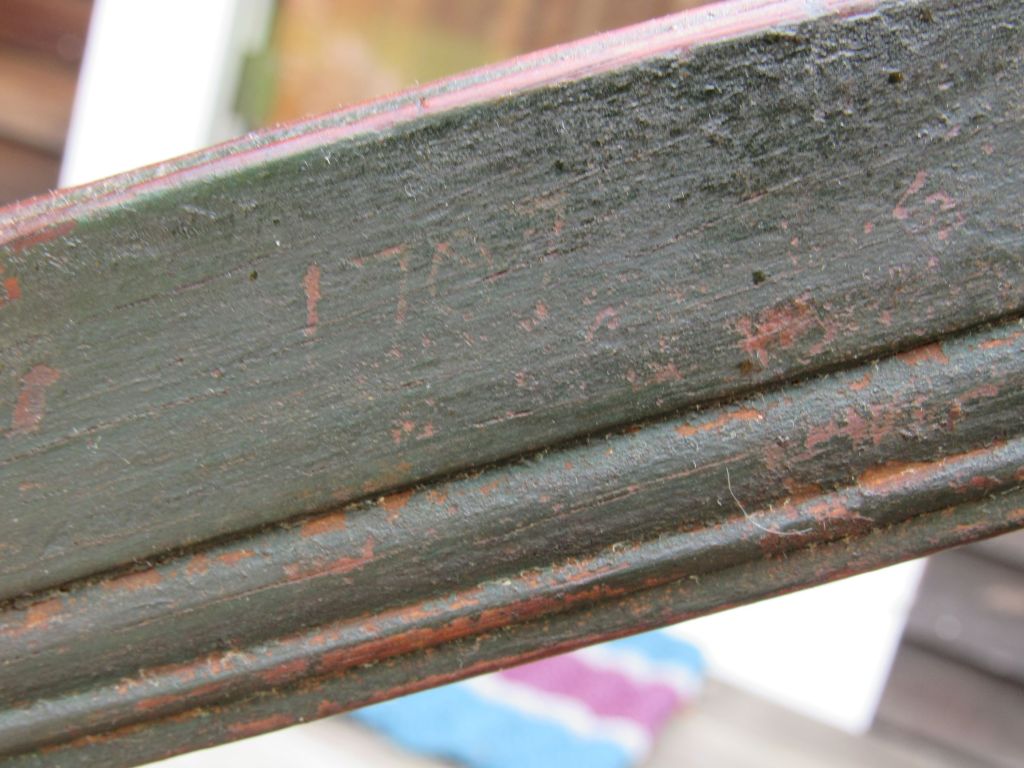
The underside of the table has a carved date in Roman Numerals of 1707, and the same date is faintly inscribed on the table’s side.
The wheel is No. 29 in Cummer’s collection and, in her description, she did not question the date, noting that it was compatible with the wheel’s William and Mary turnings.
According to Cummer, the wheel was believed to have been brought to New England from England.
I do not know if the wheel is really that old or if it was from England—it has some Scandinavian-style features.
Unfortunately, we do not have many surviving wheels from the early 18th century for comparison and I have not been able to find any similar wheels in paintings.
I like to think it is over three hundred years old.
Knotted wood on the inside of one leg
But, even if not quite that old, it has been through a lot.
As Cummer commented, there seems to be at least one layer of green paint that, while old, is not original.
The wood that shines through is a beautifully grained reddish color.
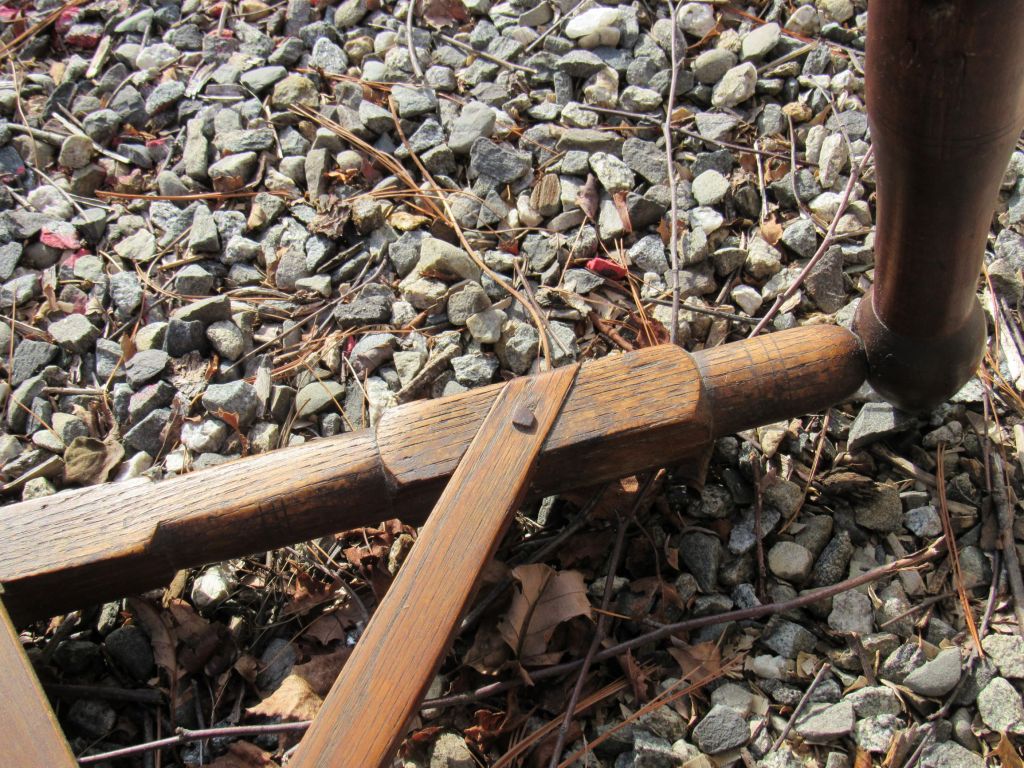
The two secondary upright supports rise from the legs and fall out at the slightest jiggle. One foot is completely broken out where the treadle bar rod was inserted.
In the leg at the other end, the bar is supported by a metal tube inserted through the wood.
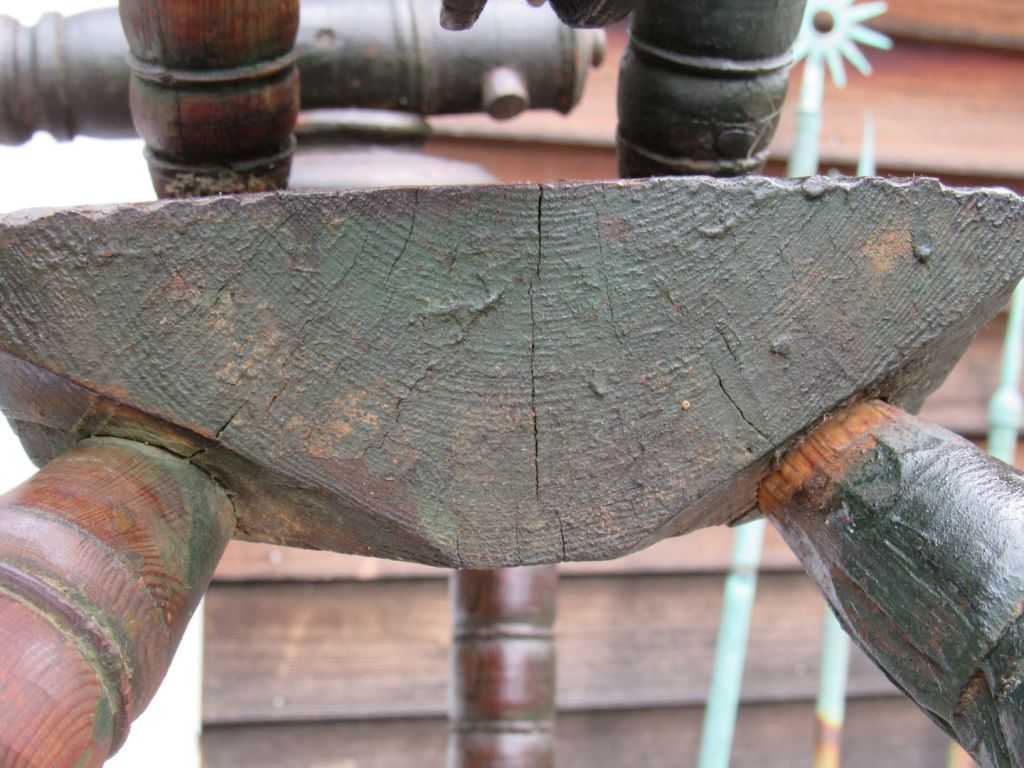
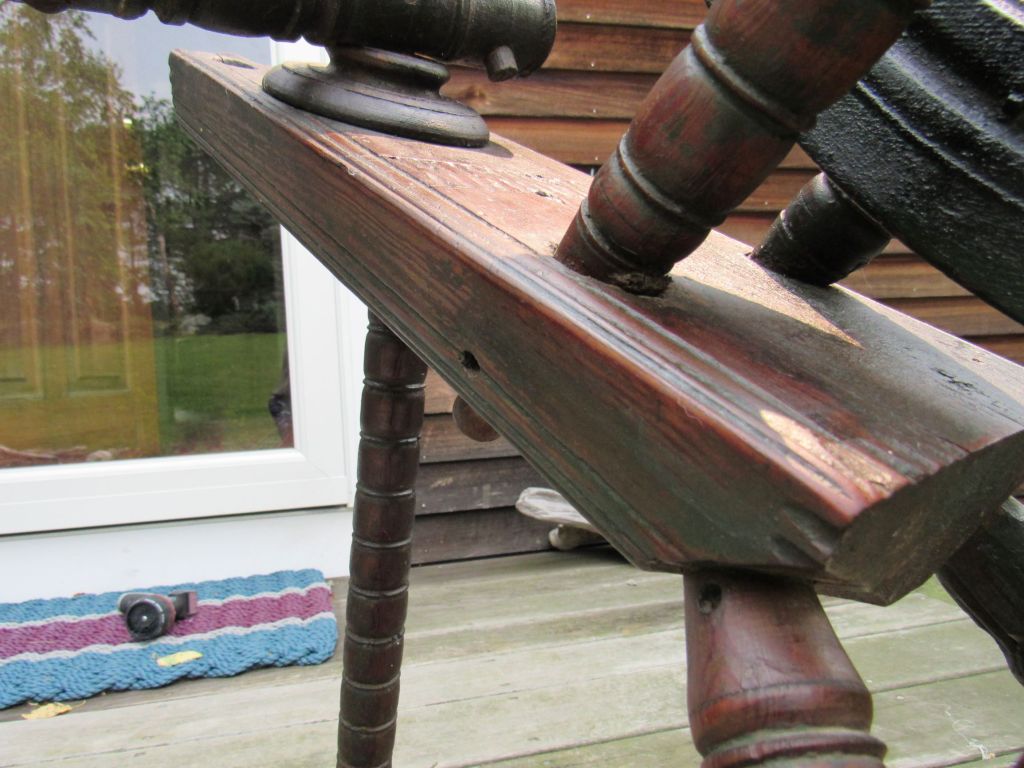
The wheel’s slanty stance is a result of the legs being inserted into angular cuts on the table’s downhill side.
The circular tree rings are visible on the end of the table.
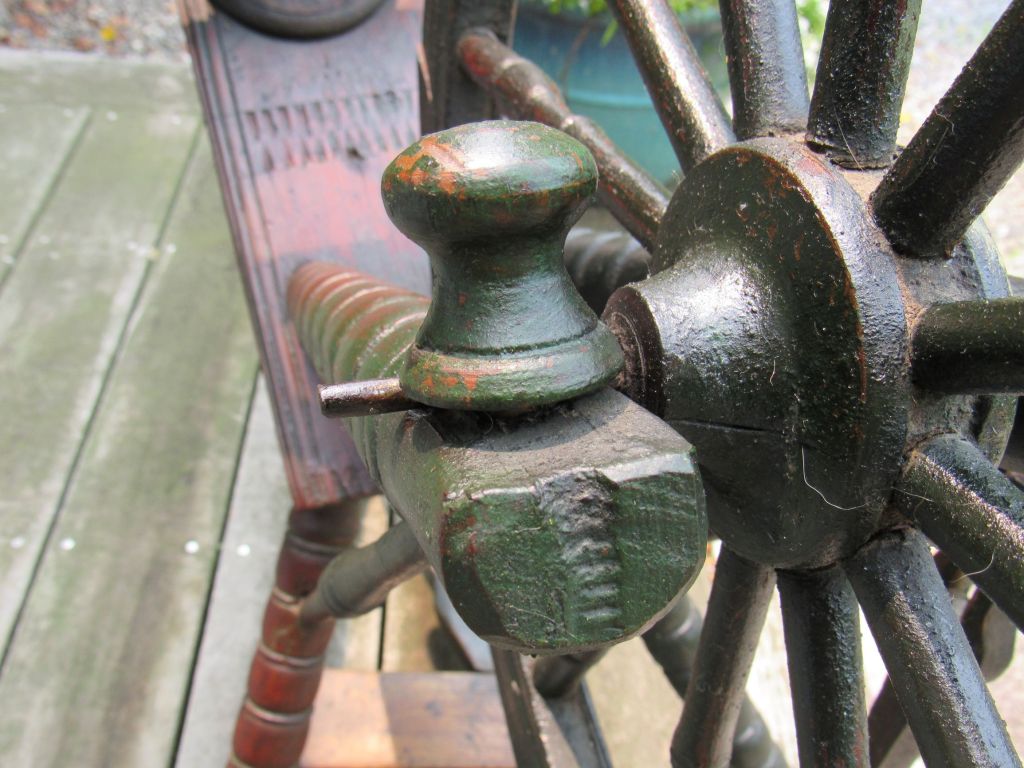
The axle is held in place with a large screwed wooden pin,
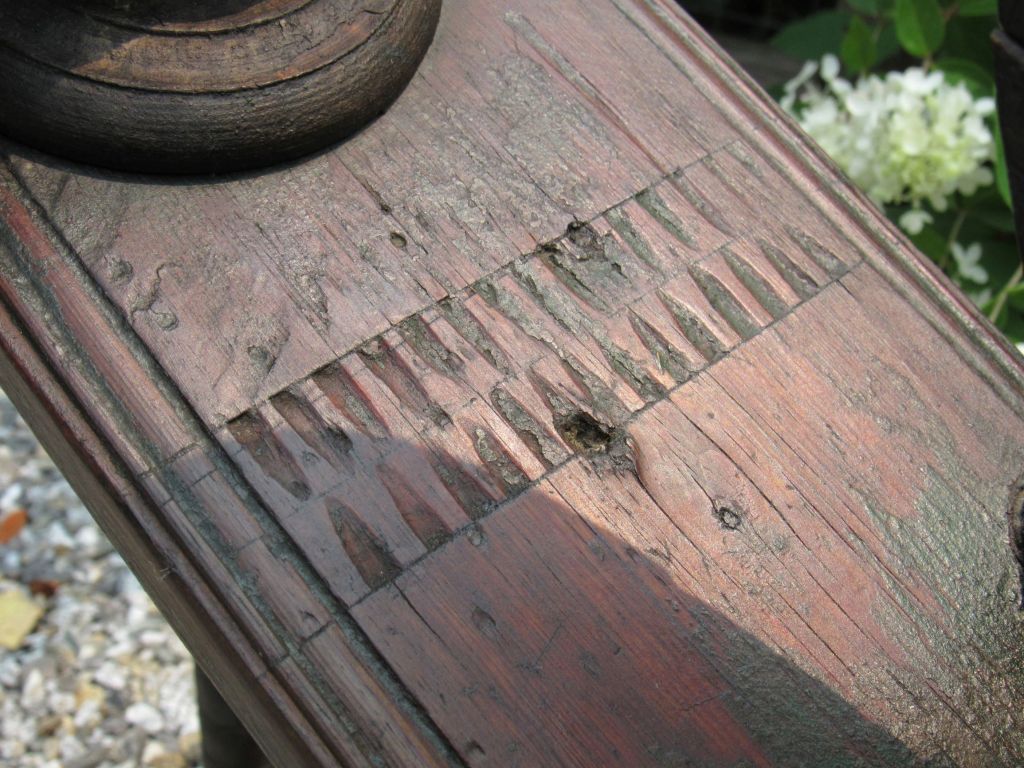
although the back one is missing. There are carvings on the table
and at both ends,
a distaff hole,
and multiple grooves down the sides.
The treadle bars are thick and give plenty of support for two footed treadling. Yet, they are graceful, too. The treadle is now attached with large screws.
The wheel rim is four parts with a thin shim piece in one join.
The elongated tops of the maidens are particularly lovely.
The flyer assembly is in good shape
with three-layered leather flyer bearings held together with rivets.
It appears that the green paint was slathered over everything at some point, including the flyer hooks and leather bearings.
It is an unusual, intriguing wheel and I am always on the lookout for others like it so that we might be able to better establish its age and origin.
For further reference see:
Cummer, Joan, A Book of Spinning Wheels, Peter E. Randall, Portsmouth, N.H. 1984, pp. 70-71.
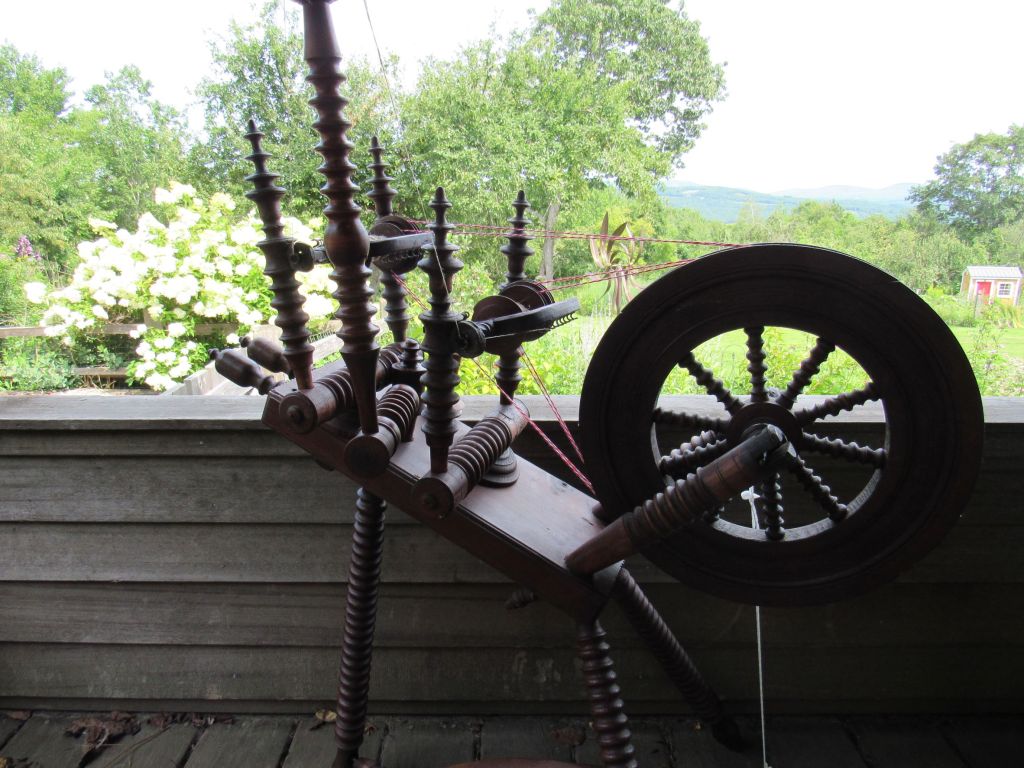
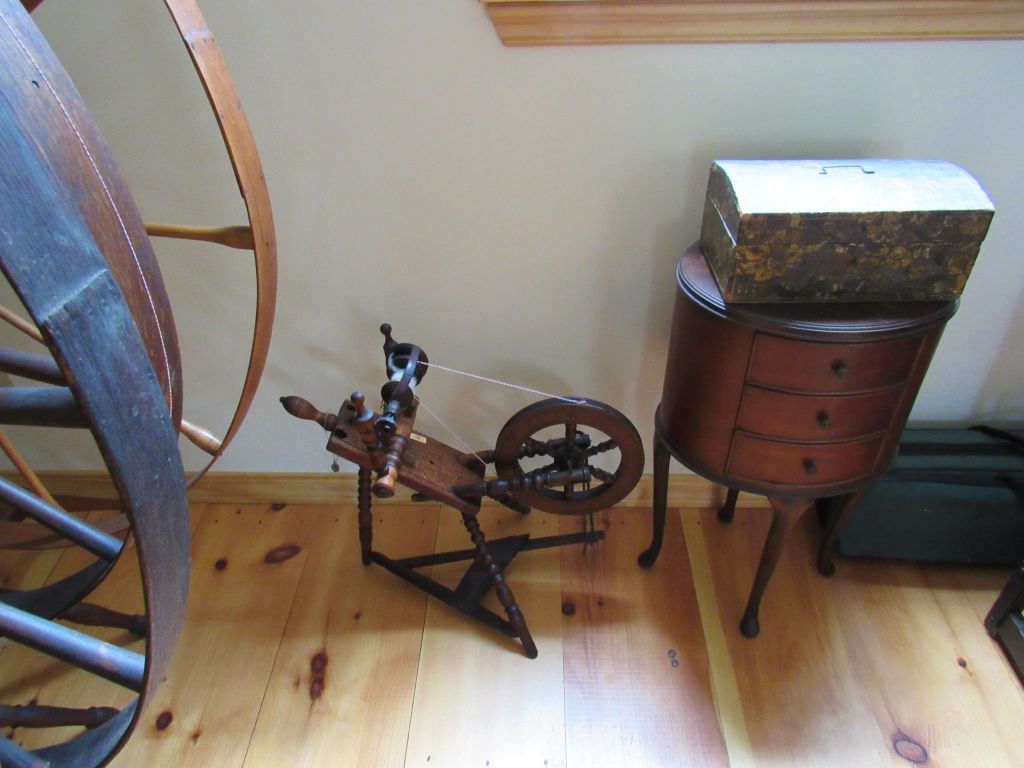
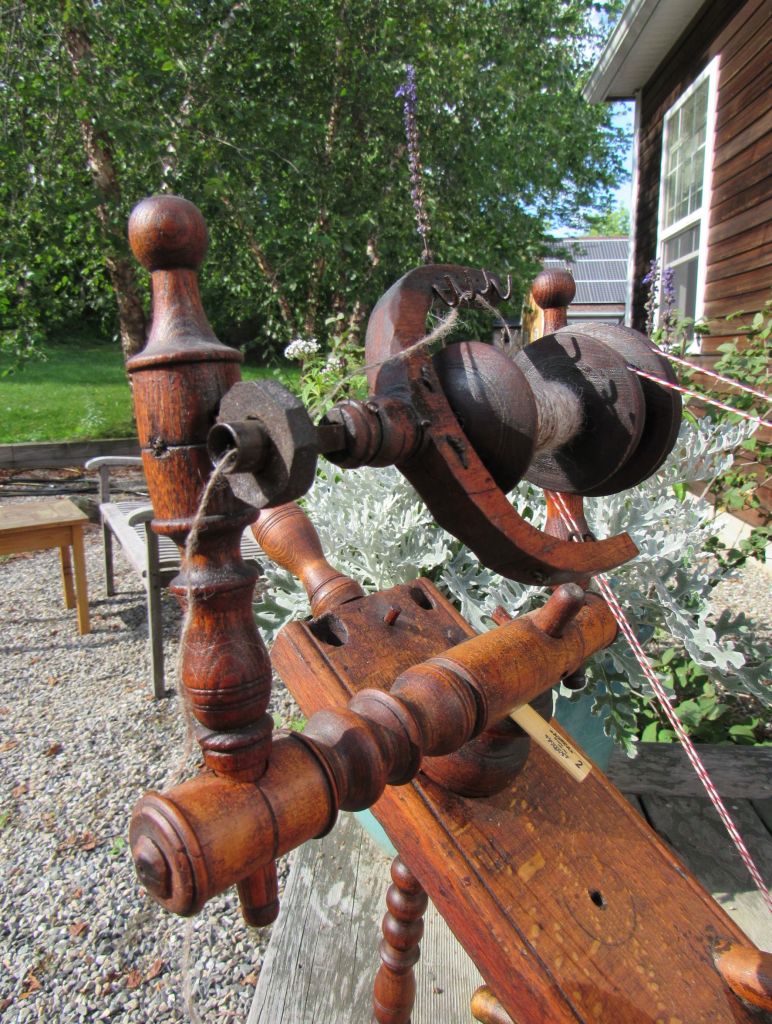
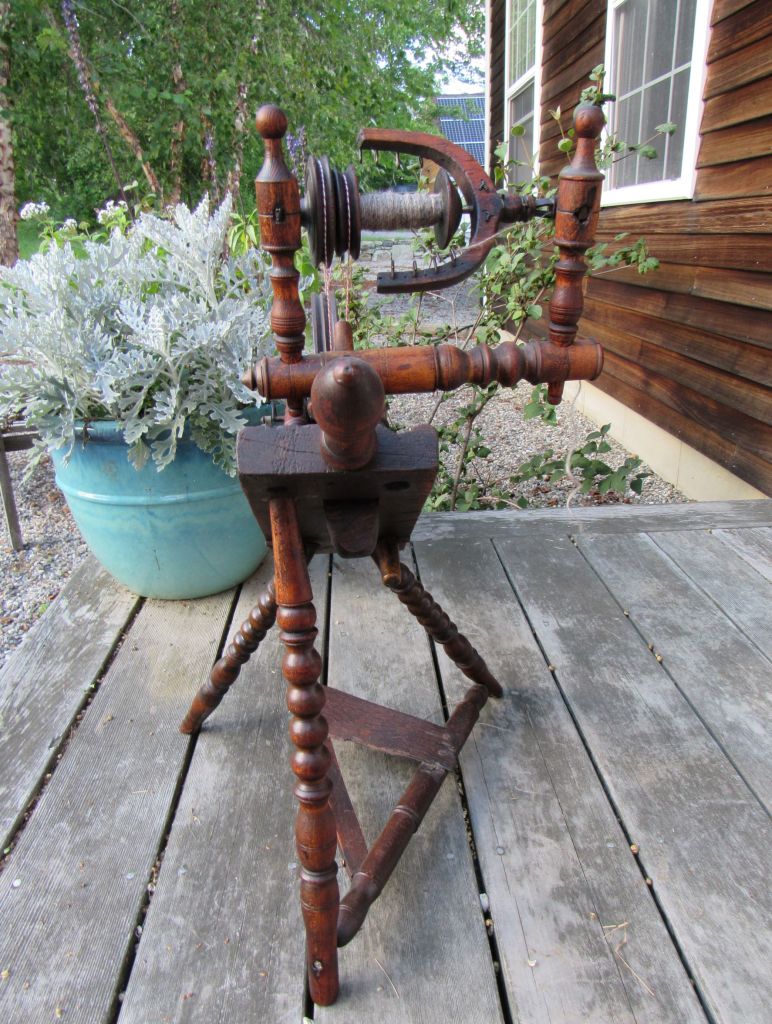
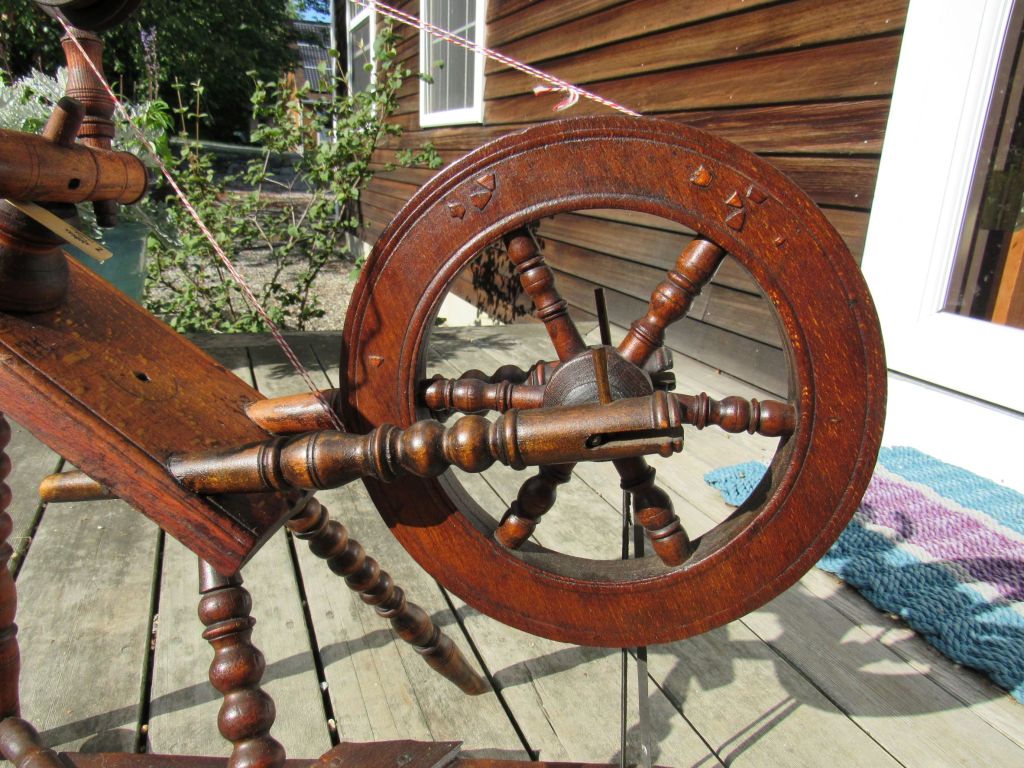
Phoebe is my gateway wheel. She is not the first wheel I brought back to spinning life. That was Katherine the Witch, the family antique that I somehow managed to get spinning when I was a teenager. It is Phoebe, though, that led to my retirement addiction to antique wheels. Although I prefer to think of it as a love affair.
When we retired, I had not done any spinning in decades and had no intention of taking it up again. Until, one afternoon, I spotted Phoebe in an antique store in Union, Maine. According to the store owner, she had belonged to an elderly woman in the neighboring town of Appleton. The wheel had all her necessary working parts but had obviously been stored in a barn or attic for many years.
This is after clean-up.
She was grime-black and bespeckled with bird or bat poop. I did not buy her, or even seriously consider buying her. We were house hunting–nearing the end of our year of travel–and had no place to put her. Over the next weeks, though, I could not get her off my mind. The poor filthy thing was crying out for a rescue.
So, I returned to the store and the owner agreed to store her for me until we had a house. Little did I know that she would open an entirely new world to me—a happy obsession progressing from flax wheels and tools to great wheels and tape looms, bringing an added advantage of wonderful friendships with like-minded antique wheel addicts.
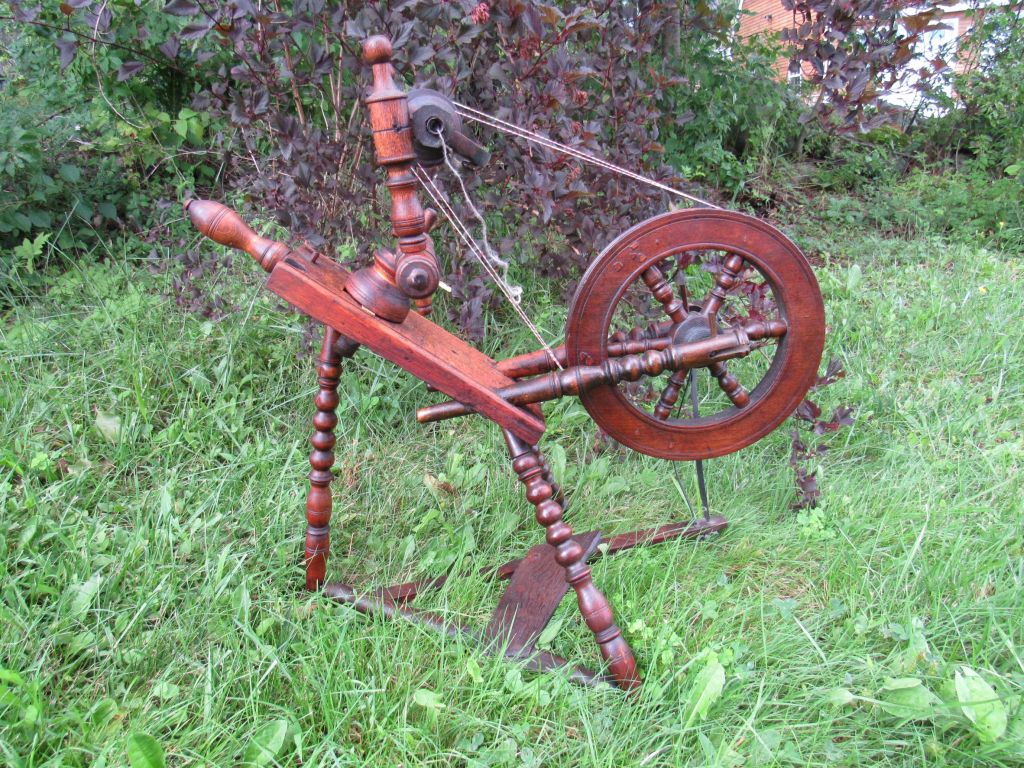
As soon as we settled into our house, I brought Phoebe home and cleaned her up. No easy task. But, under all the crap, she was a beautiful little thing.
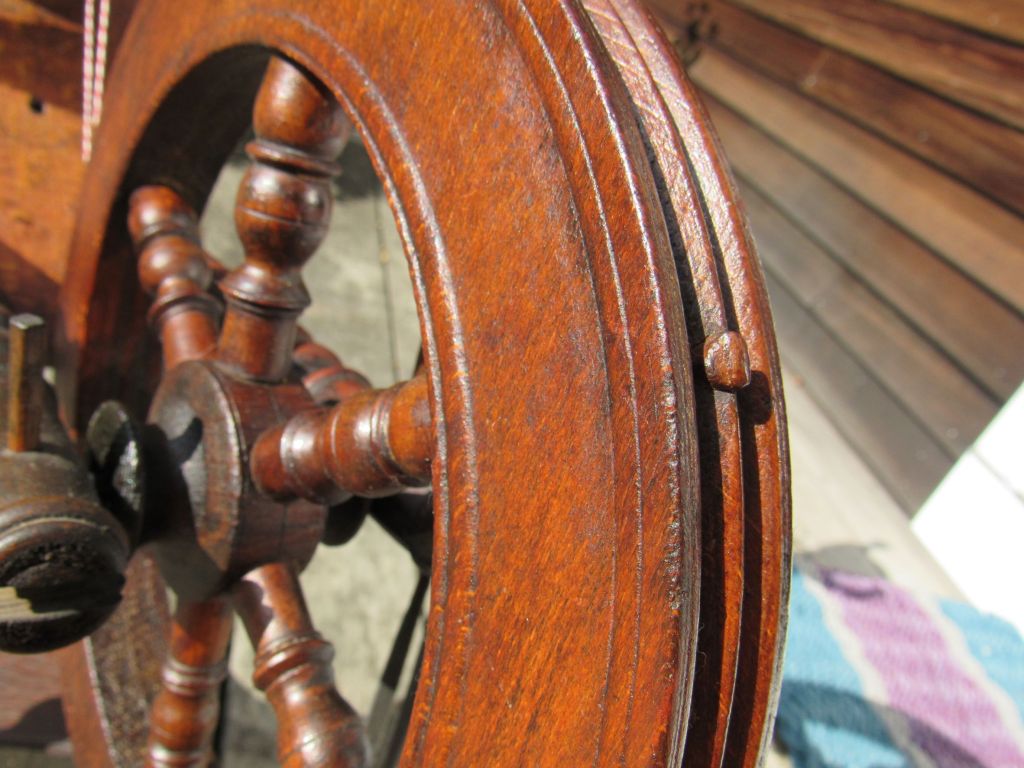
She does not have a maker’s mark but appears to be typically New England. Her maidens and the upright support suggest a Connecticut influence, while the simple spokes have a Maine Shaker look to them.
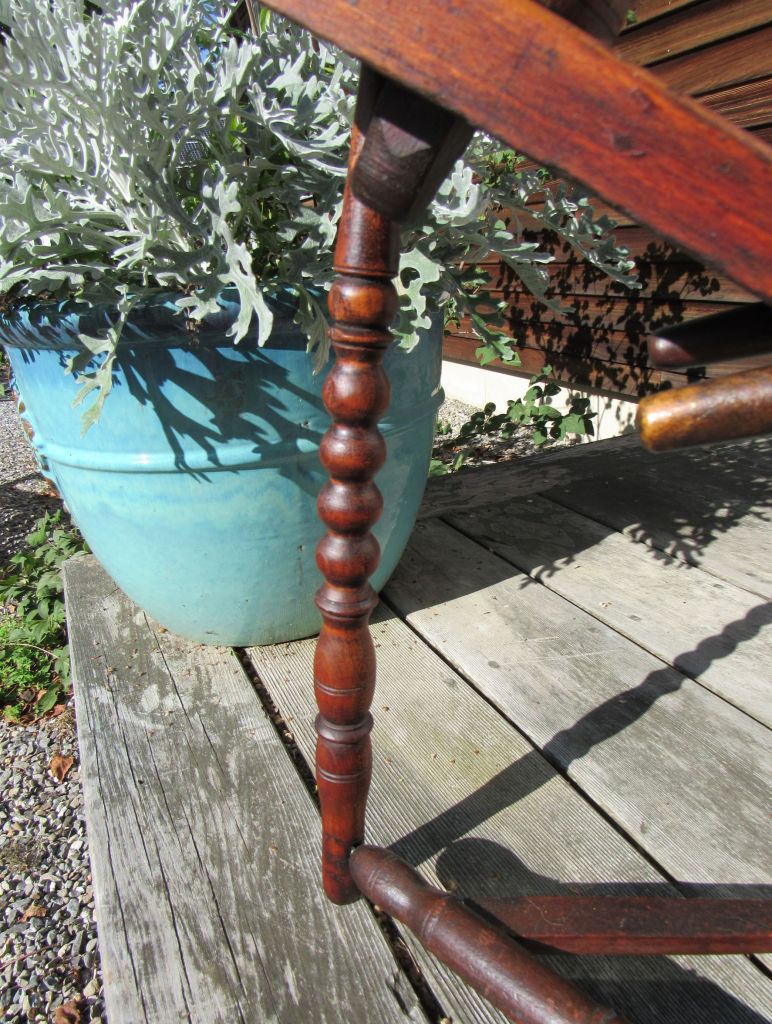
She is made with a variety of woods.
Some parts appear to be cherry, with a red glow, while the table and treadle support are a coarser grained oak or chestnut, perhaps.
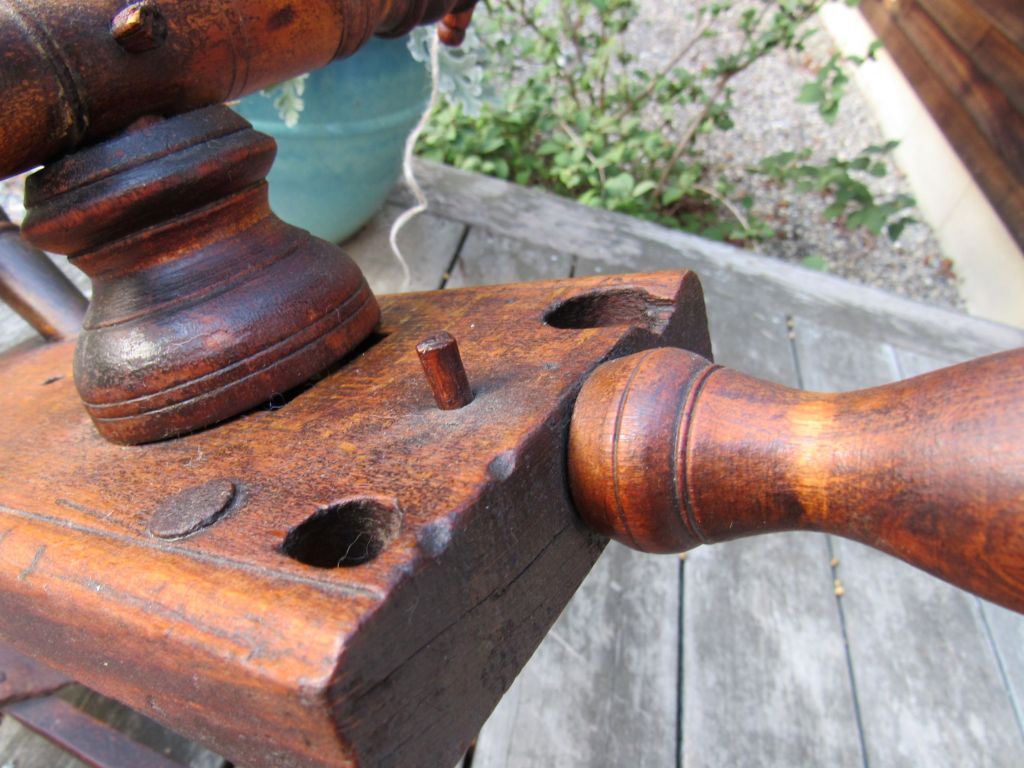
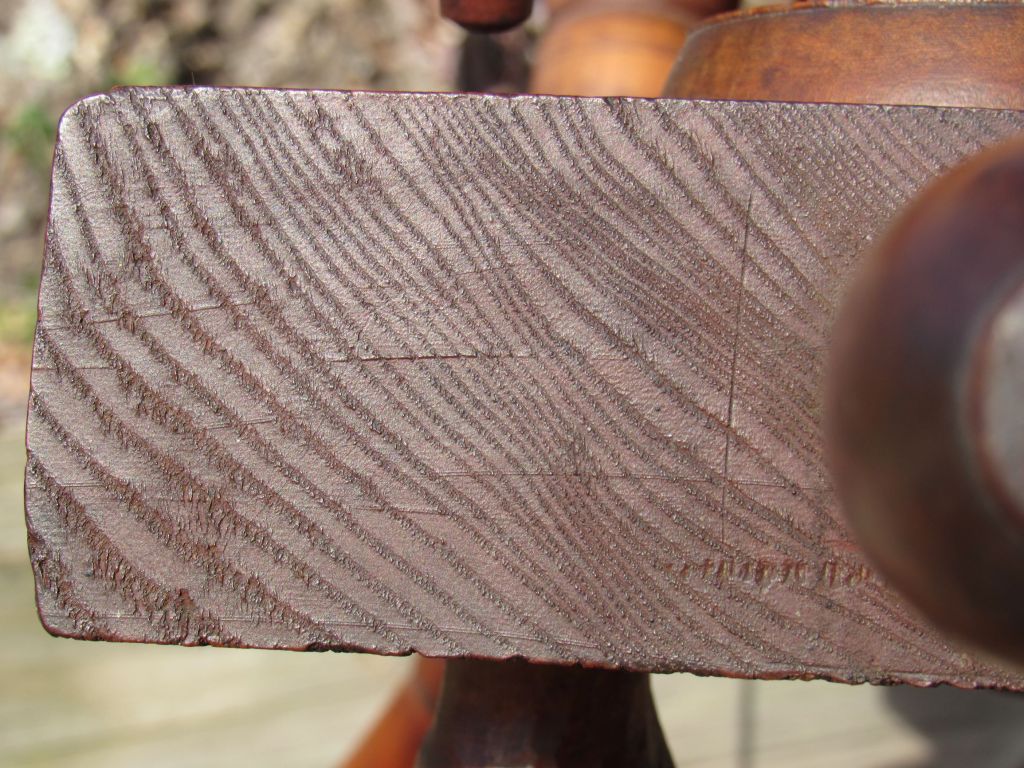
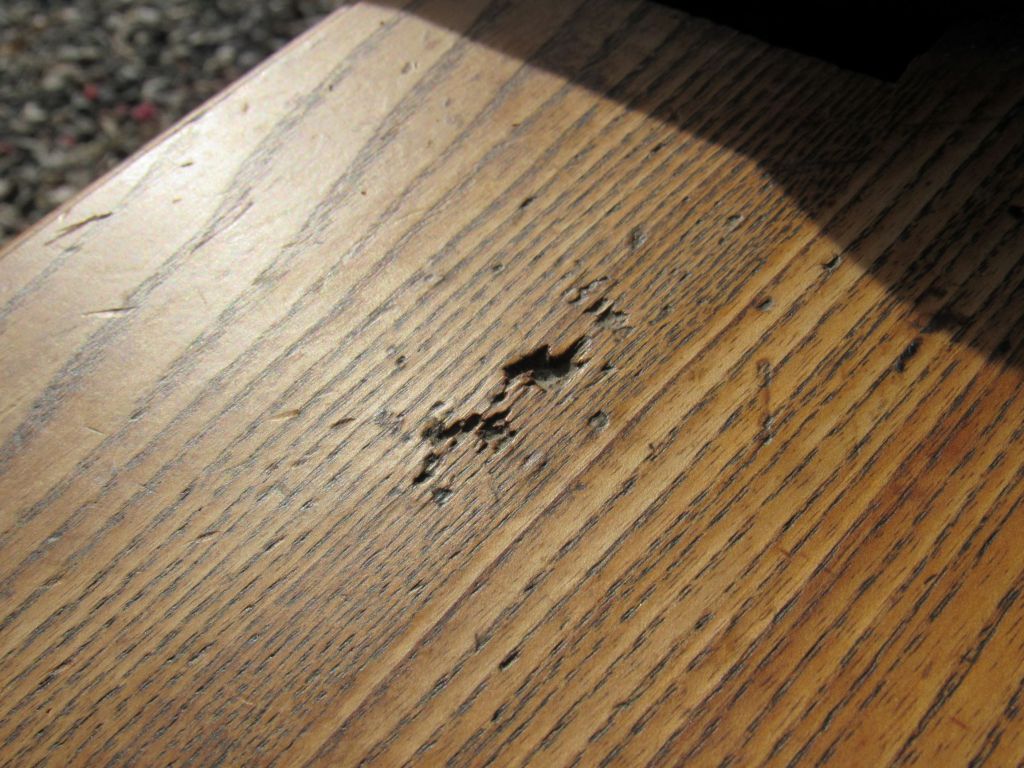
The table has gouges in the middle, which, as mentioned in an earlier post, are speculated to be from a knife (or fork) used to guide or separate the drive band at the cross, perhaps for plying.
There are scratch marks at various places.
It is hard to tell whether they were deliberate or not.
Two legs are quite red and appear to be made of cherry, while this one is light, perhaps maple or apple wood.
The treadle appears to be a replacement and the distaff supports are missing, although a partial bird-cage distaff was propped in the support hole.
There are crossed scribe marks under the table for positioning the legs,
similar to those on other northern New England wheels, and an interesting three-dash chuck mark.
Phoebe provided a good education in getting a wheel up and running again.
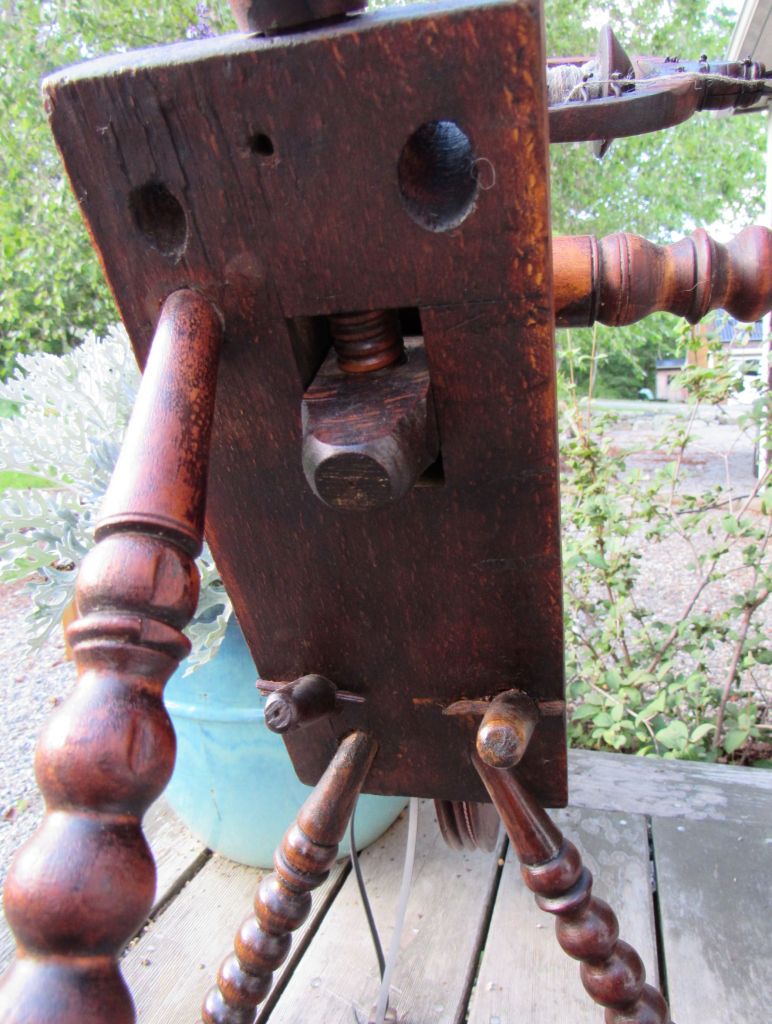
Many of her joints were very loosey-goosey, so I learned to shim the mother-of-all (clarinet reeds make great shims) and wrap joints with linen yarn.
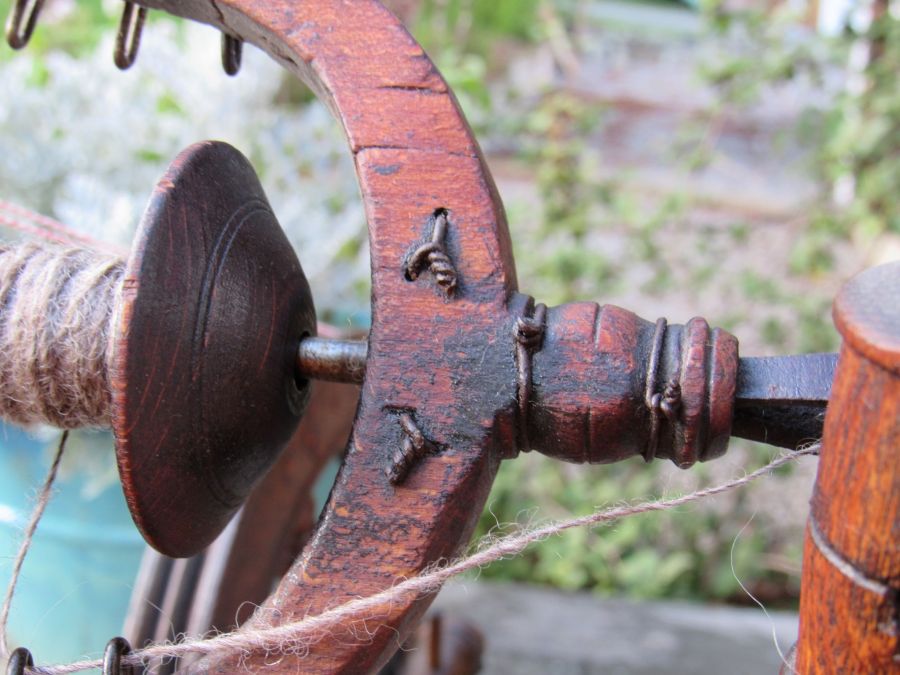
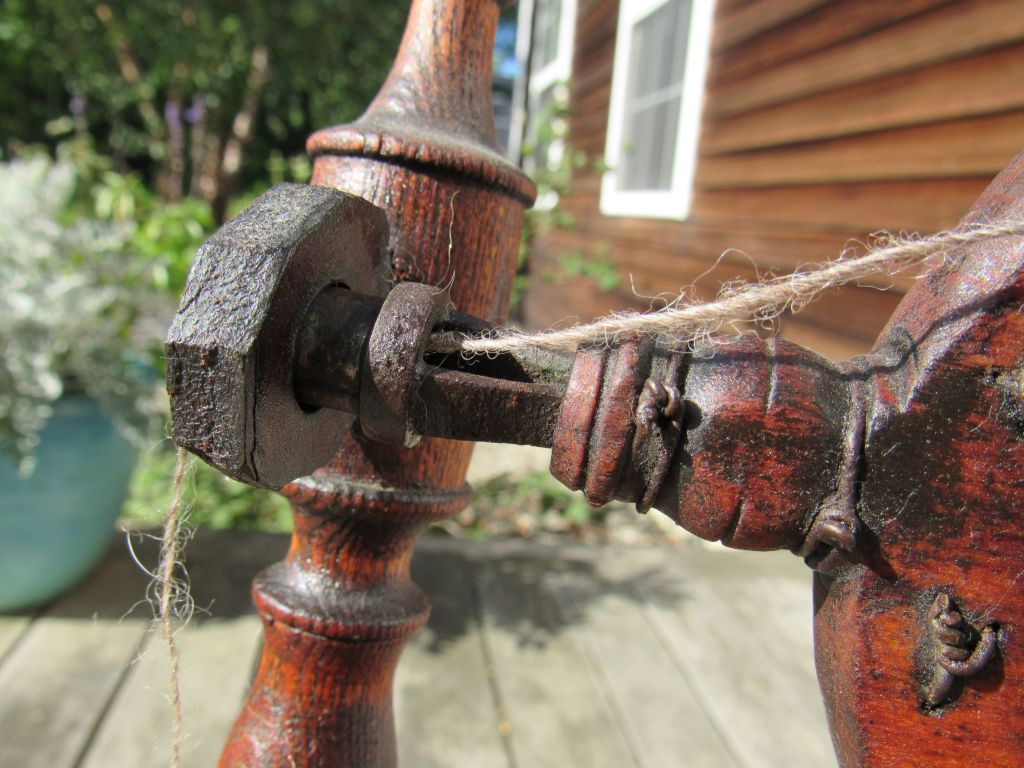
Her whorl was stuck and the flyer hooks—those that were not missing—were severely rusted. At that time, I used WD-40 to loosen the whorl and fine sandpaper on the hooks. I now use a rubber strap wrench for stuck whorls and abrasive cord for rusty hooks.
What an amazing feeling it was to get her spinning again. I was hooked.
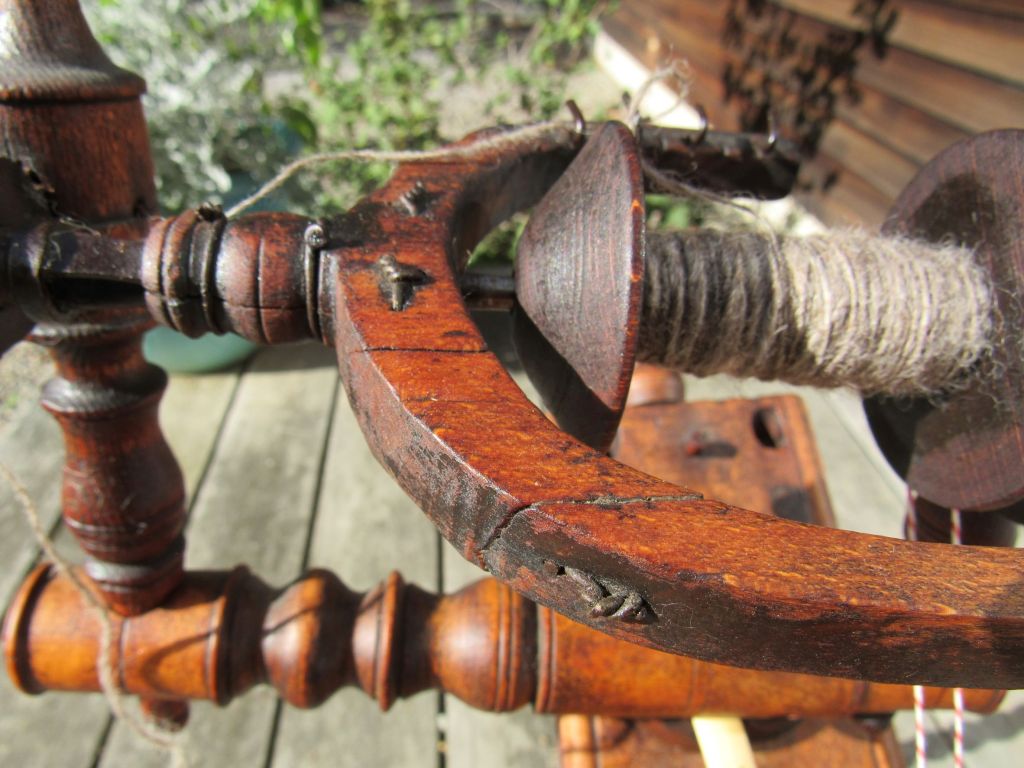
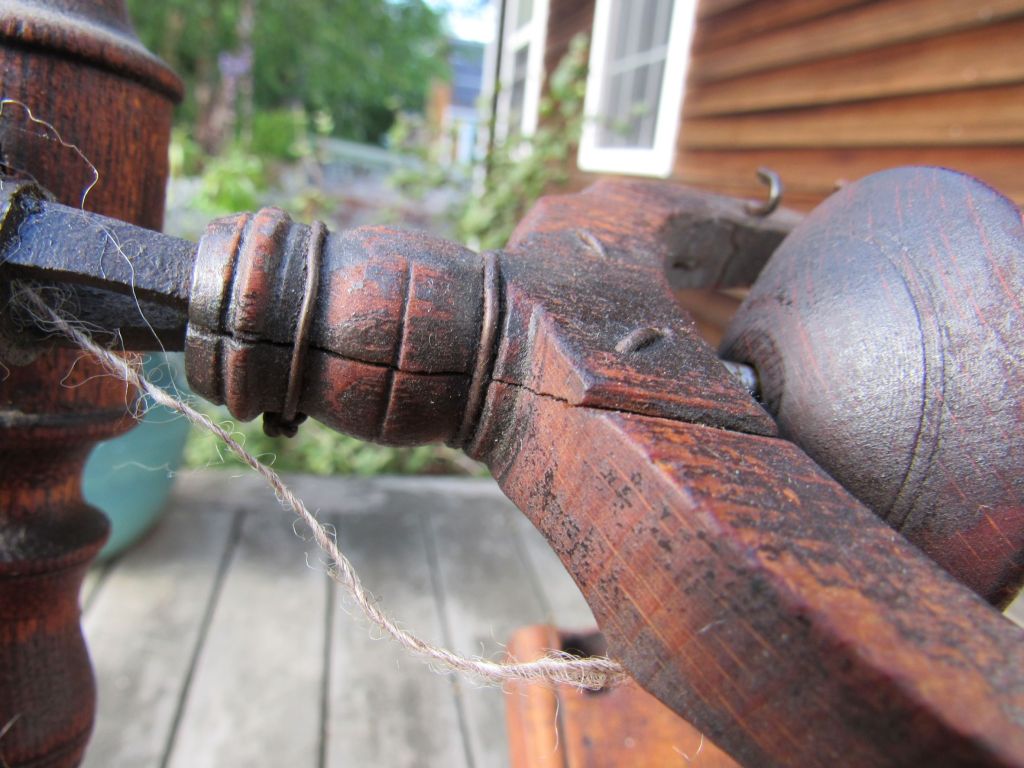
Her bobbin is a little short, giving her a low chatter, unless I wrap a little wool around the mandrel. And, interestingly, the wear marks on her orifice and flyer arms indicate that the spinner brought the thread around from the underside of the orifice hole. It still amazes me to see wear marks from thread–likely linen–on metal parts.
I always like to follow the thread marks on a flyer, to try to interpret how previous spinners worked with the wheel. Was the orifice threaded this way to slow down the uptake, to change the amount of twist, or to accommodate flax vs. wool? Even though it is not that long ago, we are ridiculously ignorant about spinning methods in the 18th and 19th centuries. At least these old wheels can give us some clues, if we can understand how to read them.









































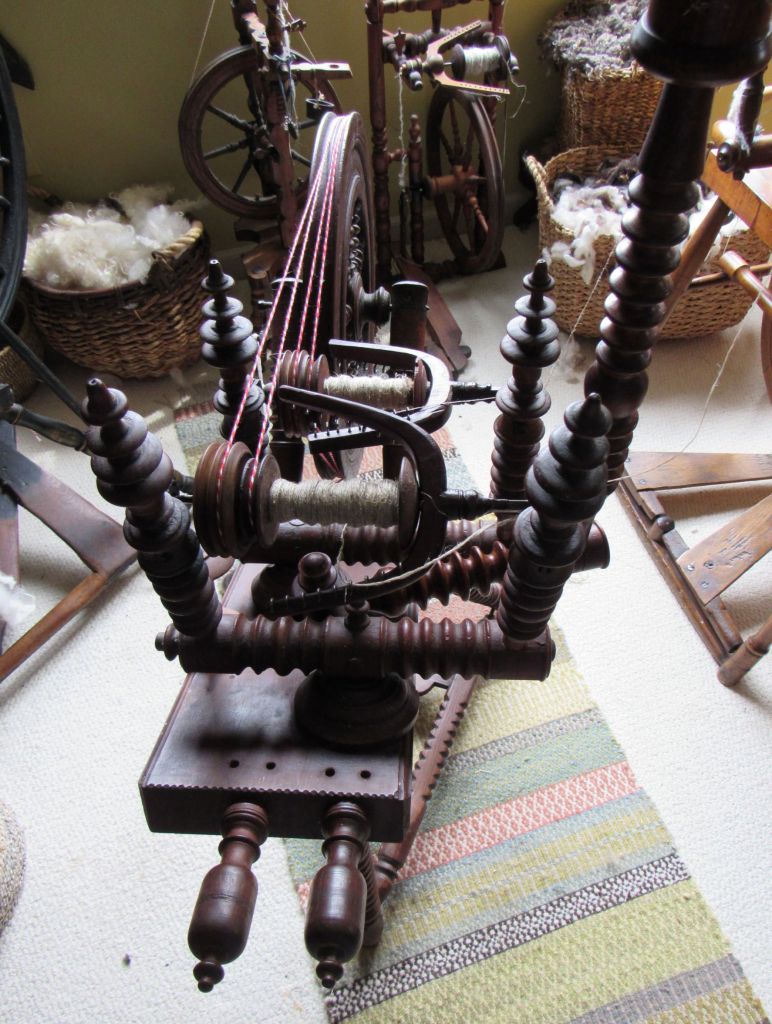
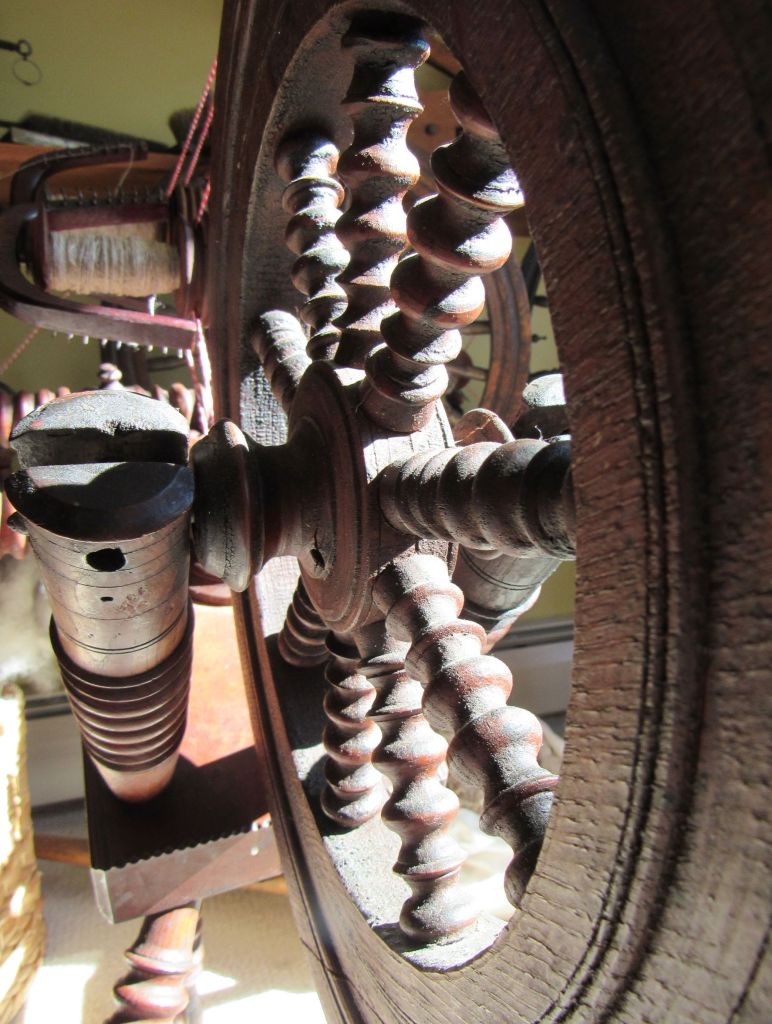
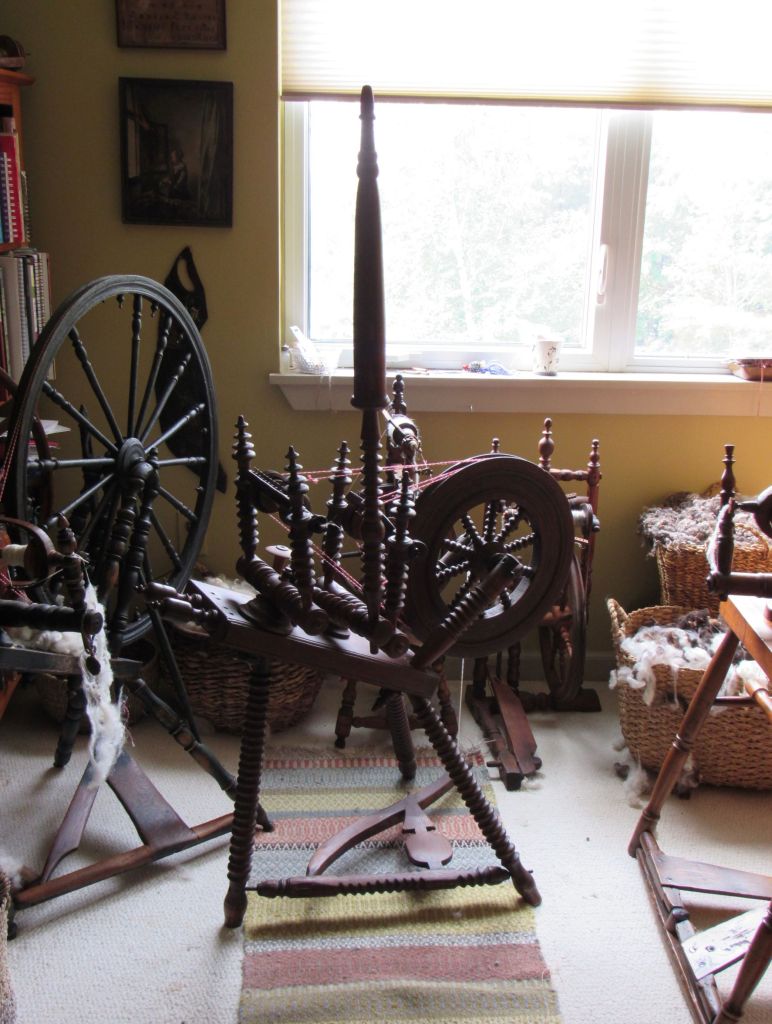
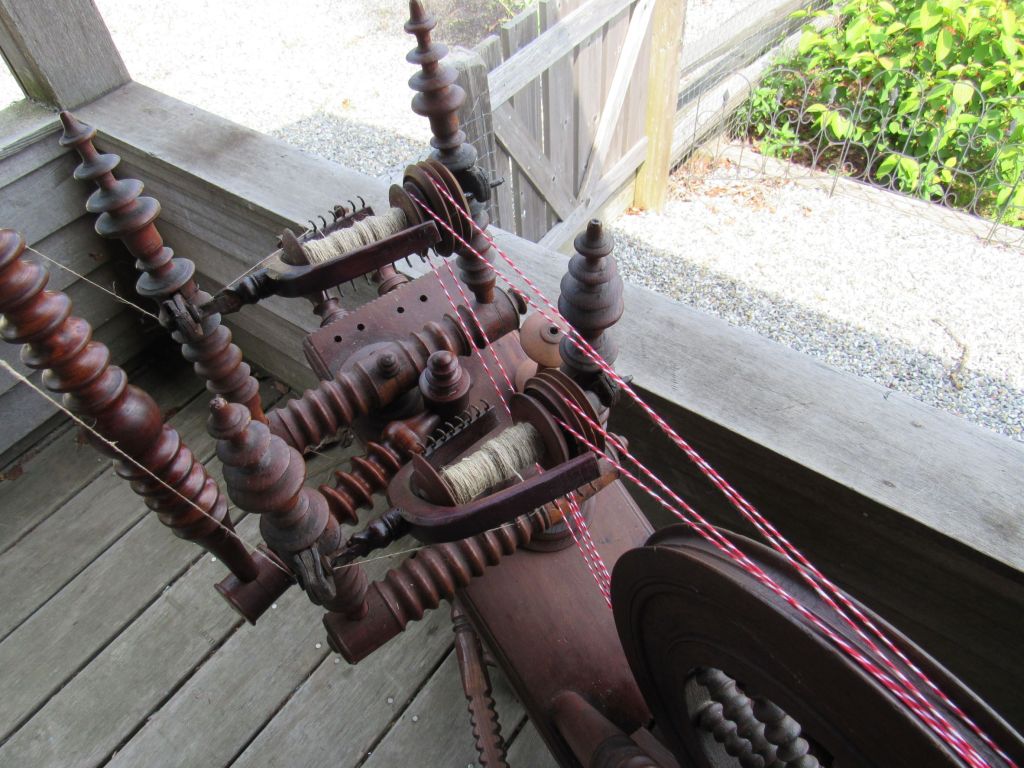







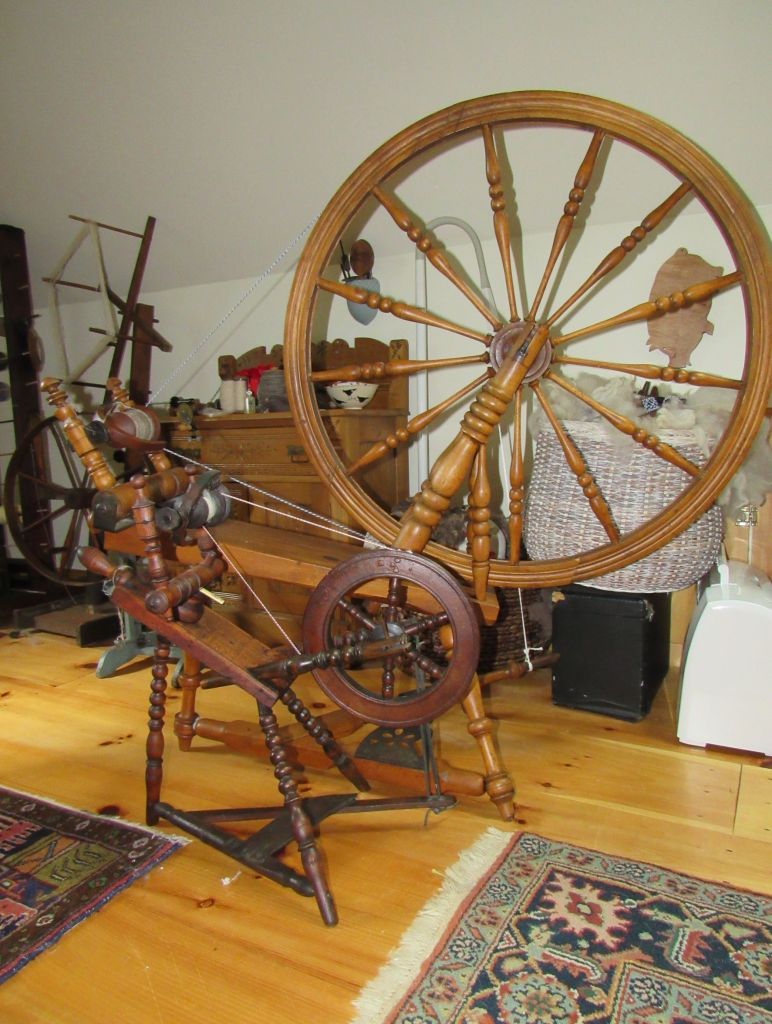
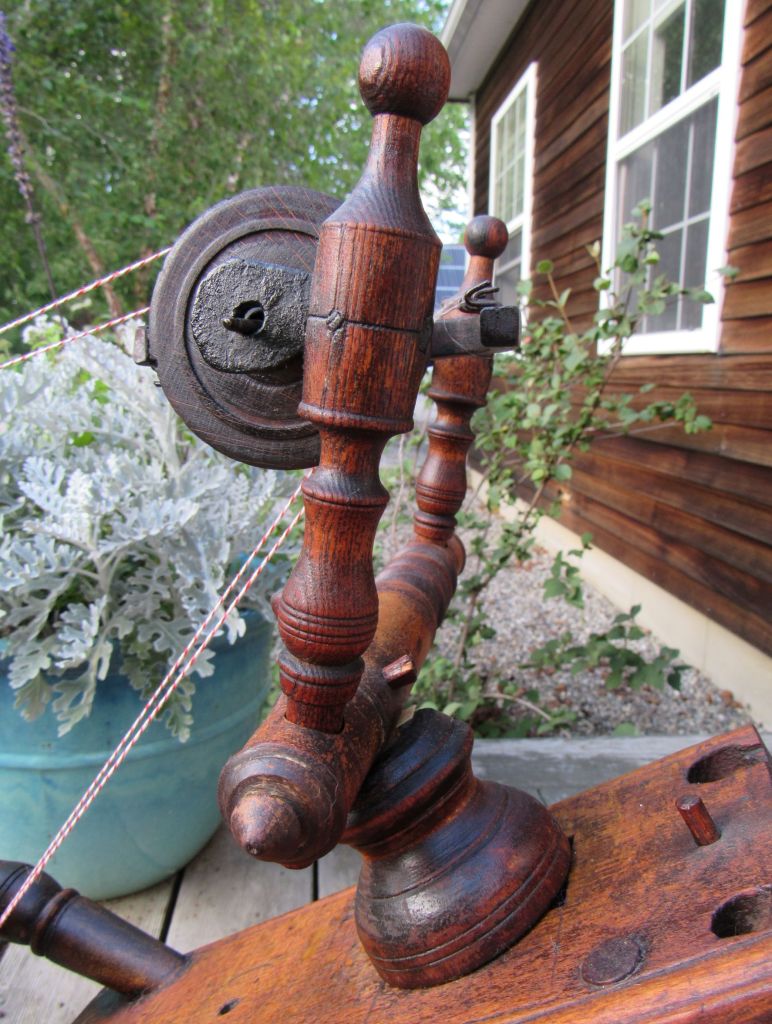
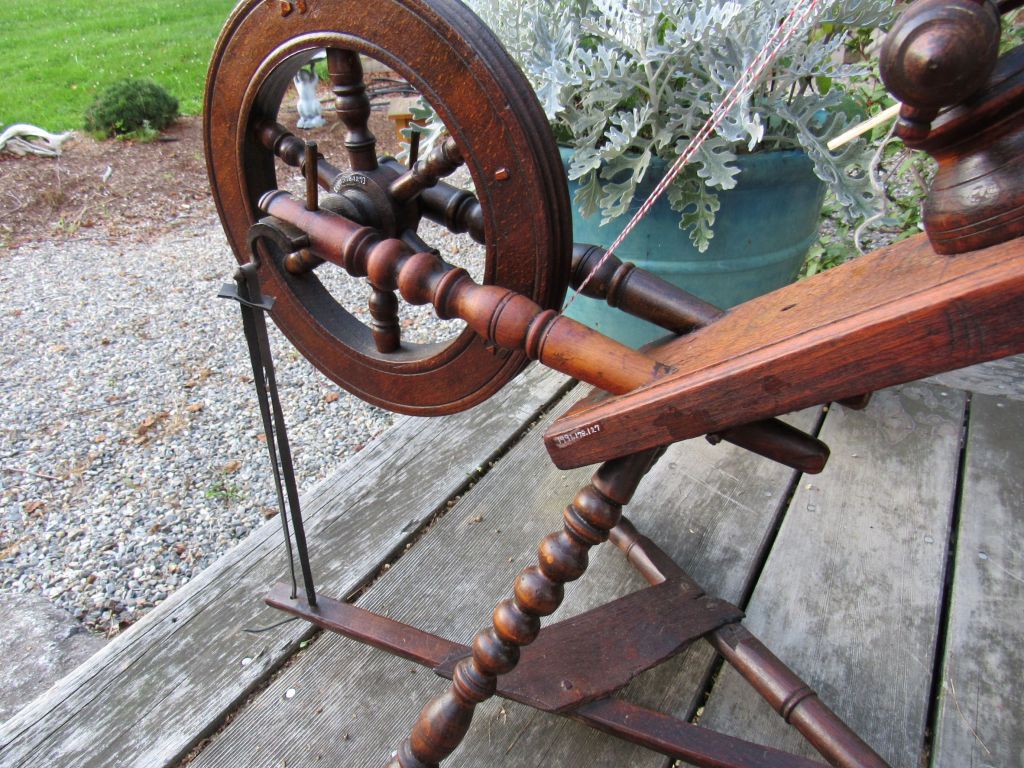
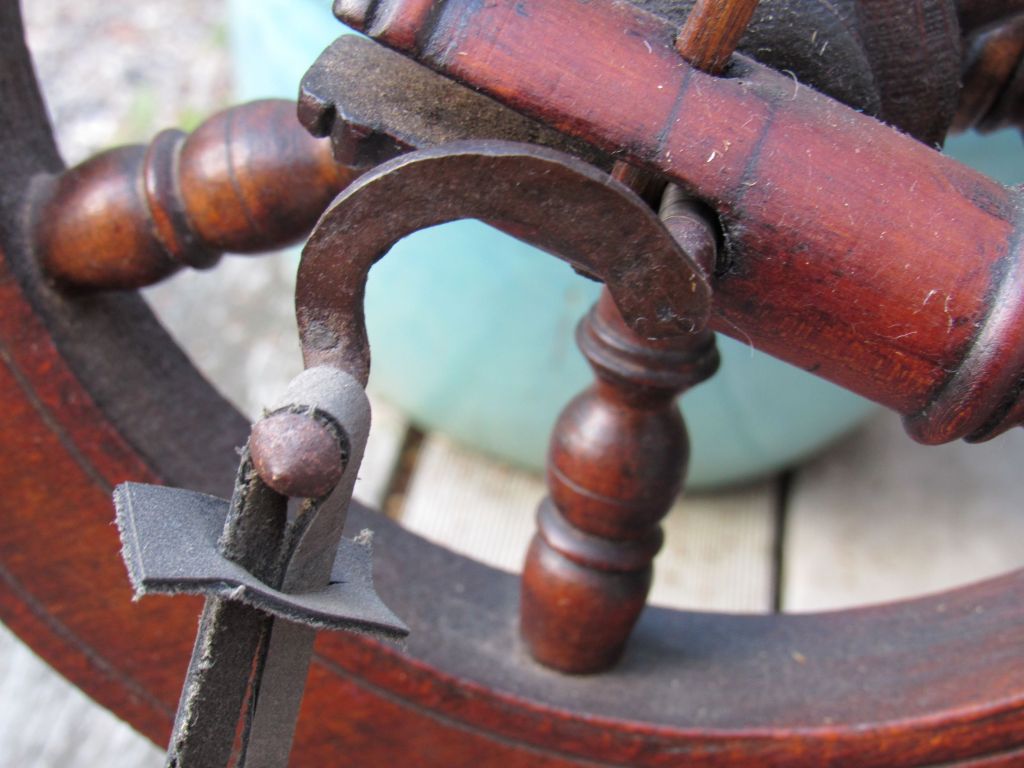











 Exquisite Machinery