Clarry

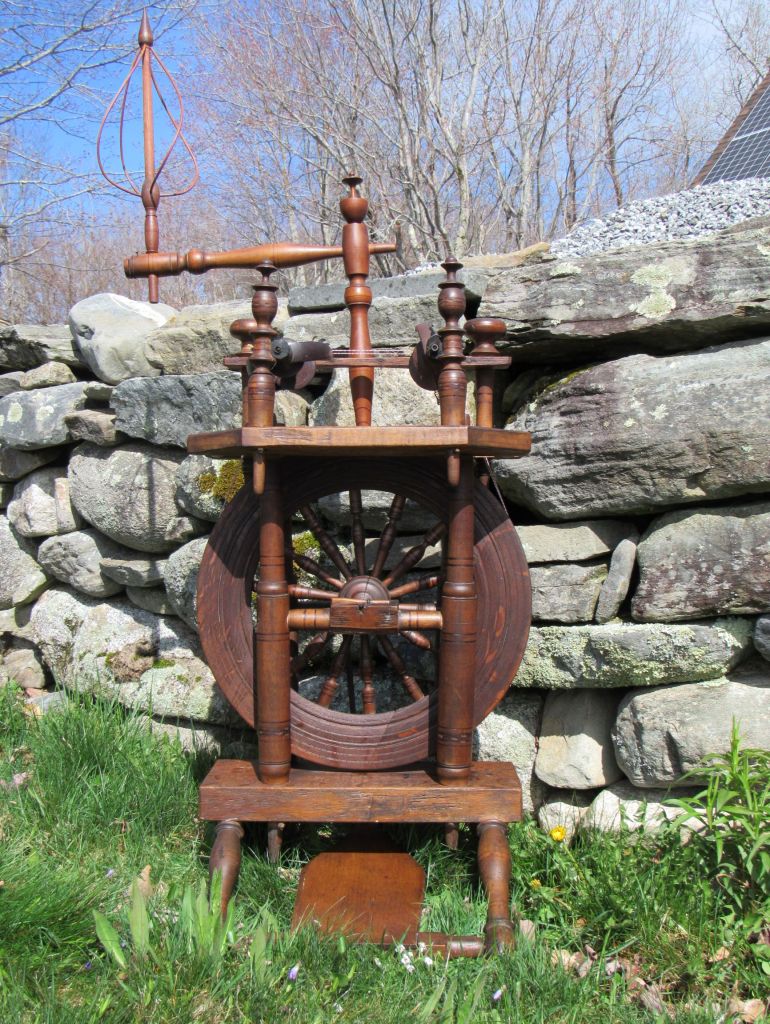
Marlboro Packard, born in Massachusetts in 1763 into a family of carpenters, moved north to Union, Maine where he produced attractive, well-engineered spinning wheels, found throughout the midcoast to this day. 

Marlboro, also spelled “Marlborough,” was “a natural mathematician. He excelled in the solution of mathematical problems and in the use of mechanical tools. He could make anything from a boot-jack to a wagon wheel, from a window to a spinning wheel and in construction of the latter, he was a past master. All spinning wheels in the locality having the letters ‘MP’ carved on the end of the body are the work of Mr. Packard.” Soldiers and Sailors of Lower St. Georges Maine, p. 51. 

Marlboro was born in Bridgewater, Massachusetts, in the same part of town (now Brockton) as the wheel-making Thompson family (see previous posts “Polly and a Skarne” and “Mag Reiver and a Finger”). 
Multiple generations of Thompsons (also spelled “Thomson”) were well-known wheel-makers in Bridgewater. 

While the Packards were carpenters, I couldn’t find evidence that they made wheels while in Bridgewater or that they worked with the Thompsons. 

But it does appear that the two families were related.  Marlboro’s aunt, Joanna Packard (his father Nathan’s sister), had a daughter, Jennett Allen, who married wheel-maker John Thompson.  John and Jennett were wheel-maker Hannibal Thomson’s parents. 
That makes Marlboro and Hannibal first cousins once-removed. 

Both Marlboro and Hannibal ended up in Maine making spinning wheels, but they are a generation apart and their wheels reflect that. 

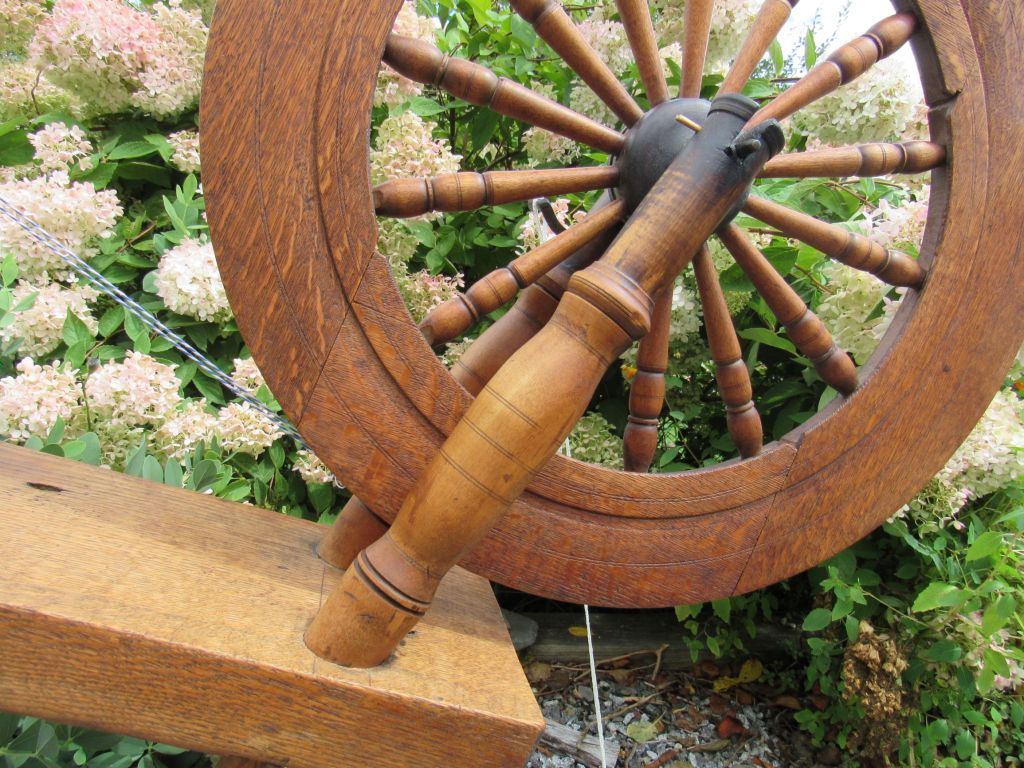
Marlboro’s wheels were similar to those made by the earlier Thomson generations, based on a traditional Scottish-style wheel, while Hannibal’s wheels show the strong influence of the Maine Shakers on wheel styles in the early and mid 1800s. 
Marlboro’s father, Nathan, died in 1772, when Marlboro was only nine years old.  It’s unclear when Marlboro came to Maine, but his uncles Micah and Benjamin apparently moved to Cushing on the midcoast in the 1760s. 
They worked as carpenters and appear to have done well.  I couldn’t determine how long Marlboro stayed on in Bridgewater or whether he learned wheel-making skills there before coming to Maine. 
But eventually, Marlboro joined his uncles and by 1795 must have been well established in his trade, because the Maine Historical Society has copies of payment invoices to Marlboro for turning work, including banisters, for Montpelier, the mansion being built in Cushing by Henry Knox, George Washington’s former Secretary of War.  
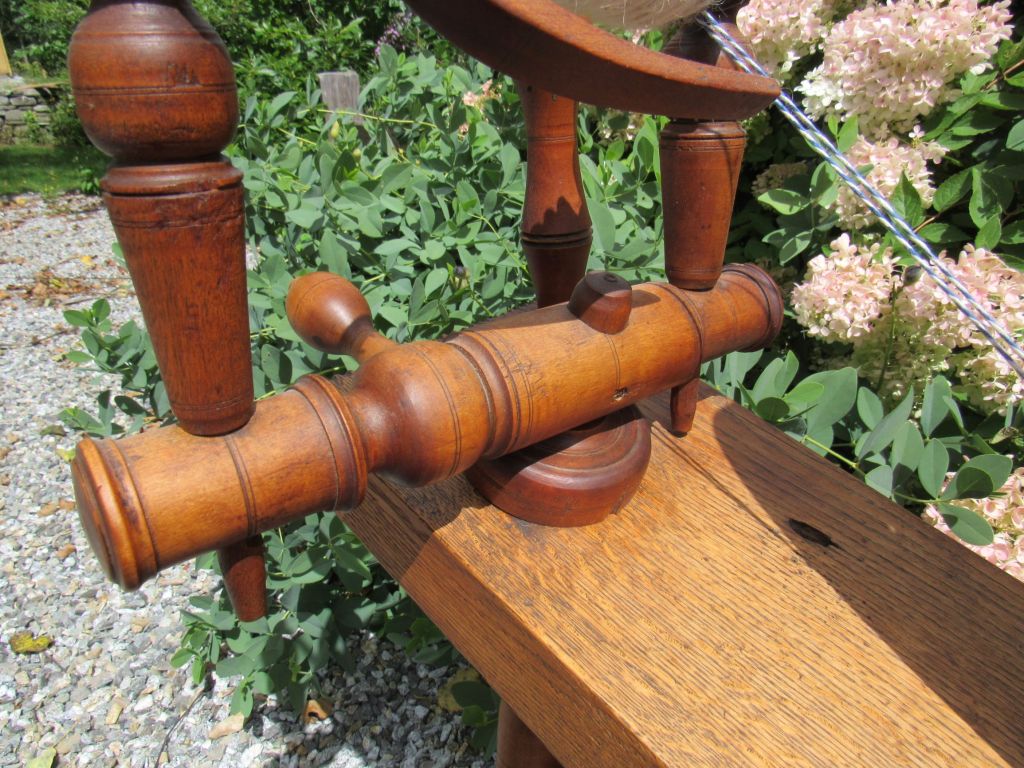
In the 1790s or early 1800s Marlboro moved to Union, about 15 miles inland up the St. George River from the coast, and settled on Clarry Hill, the top of which is now blueberry barrens with a magnificent view. 

The Packard farmhouse still stands and Marlboro’s wheels appear with regularity in antique stores and barn sales throughout the area. 
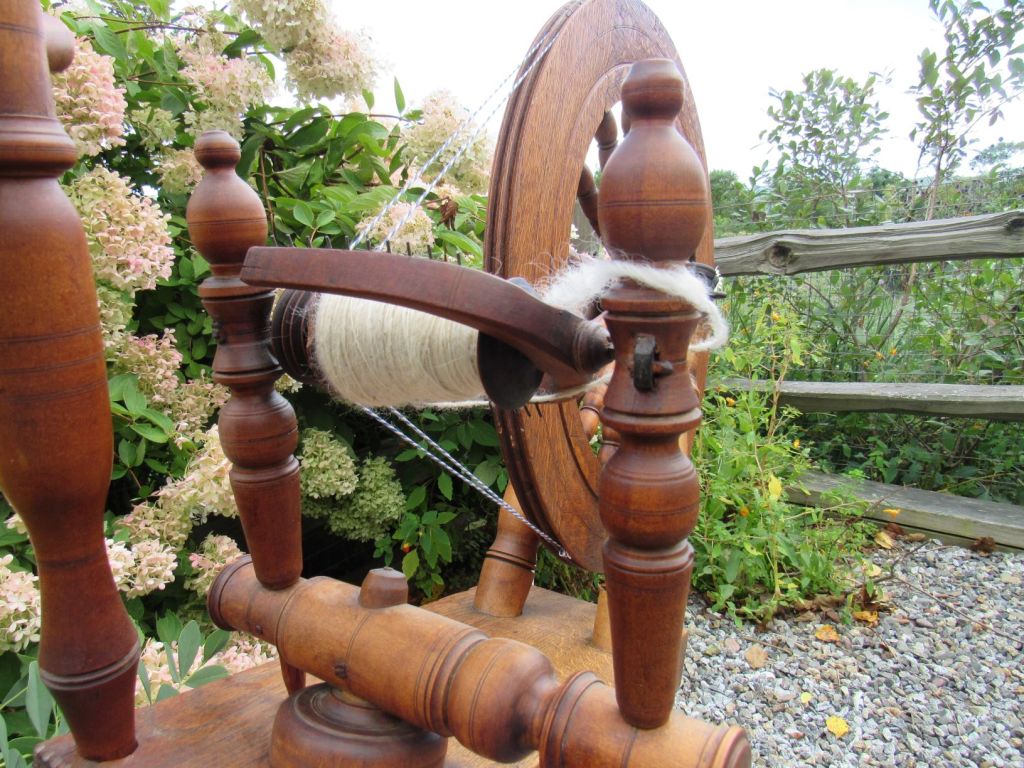
In the Maine State Museum, one of Marlboro’s wheels serves as the example of a typical Maine flax wheel. 

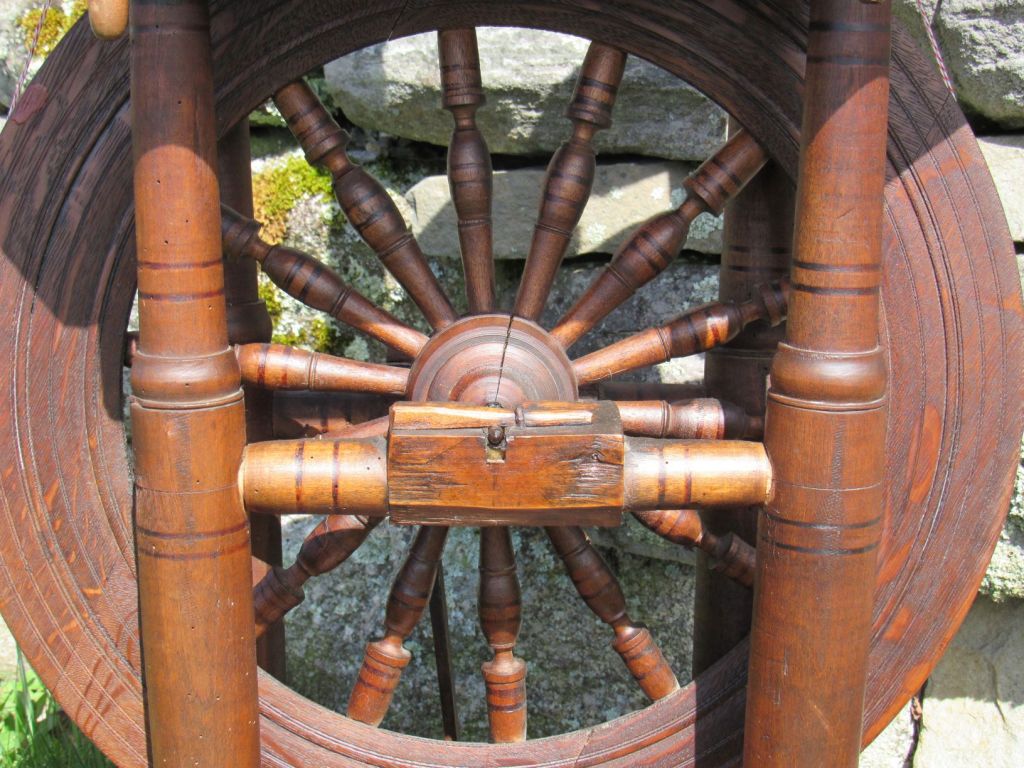
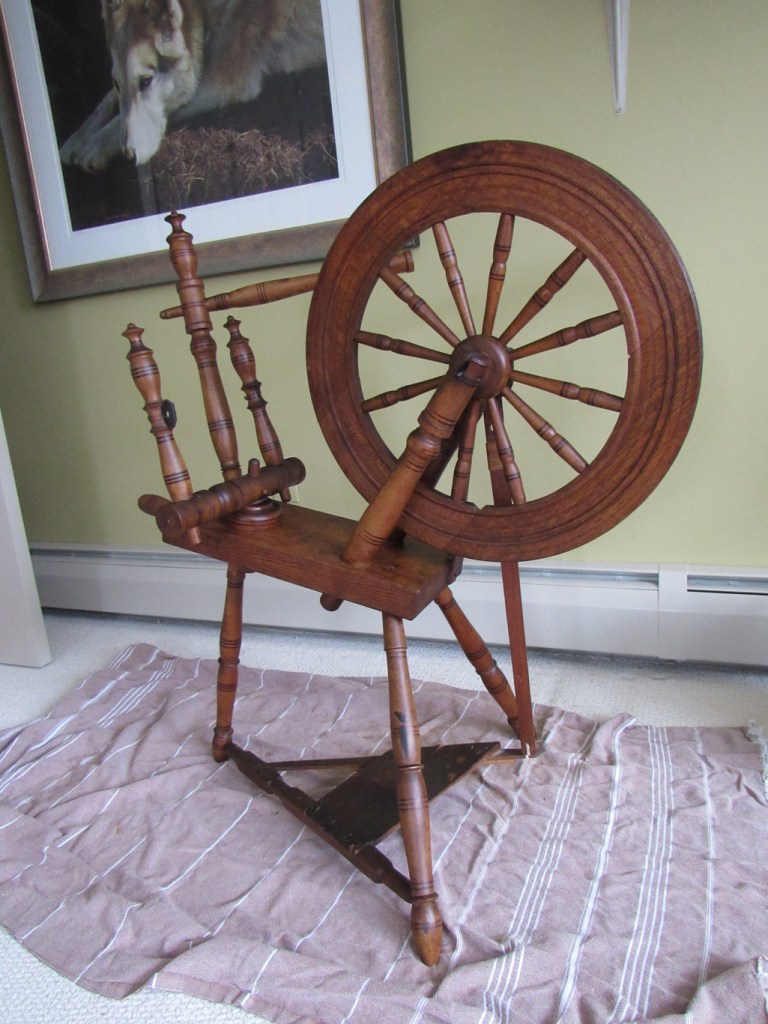
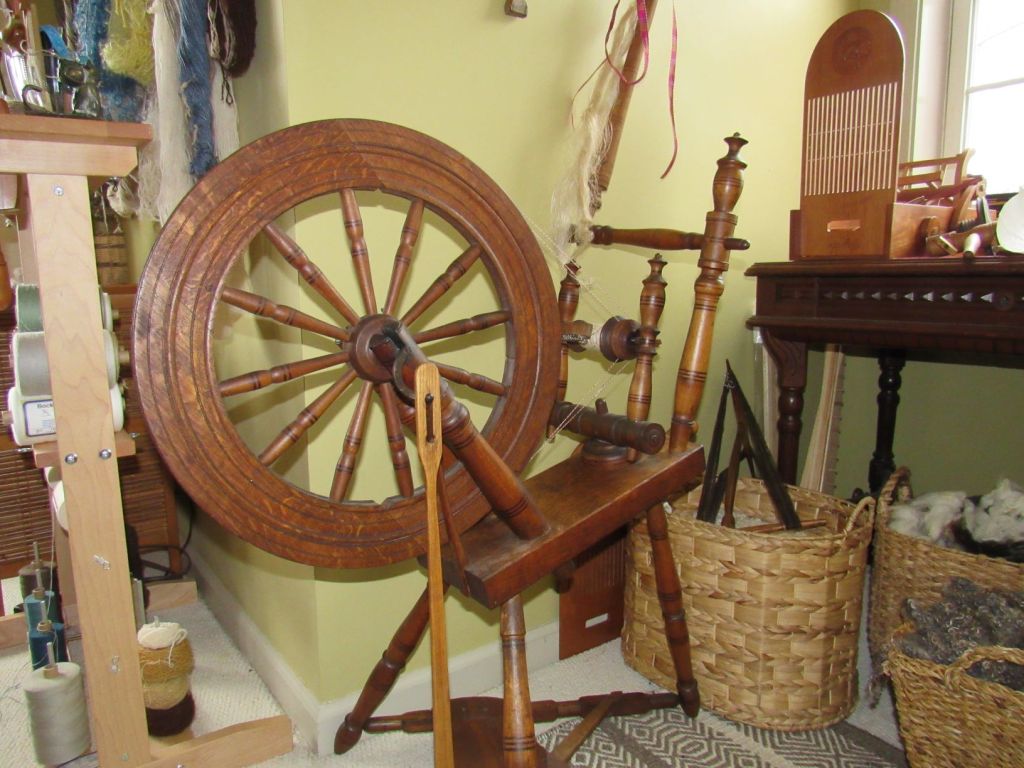
Marlboro’s flax wheels are easily recognizable. 
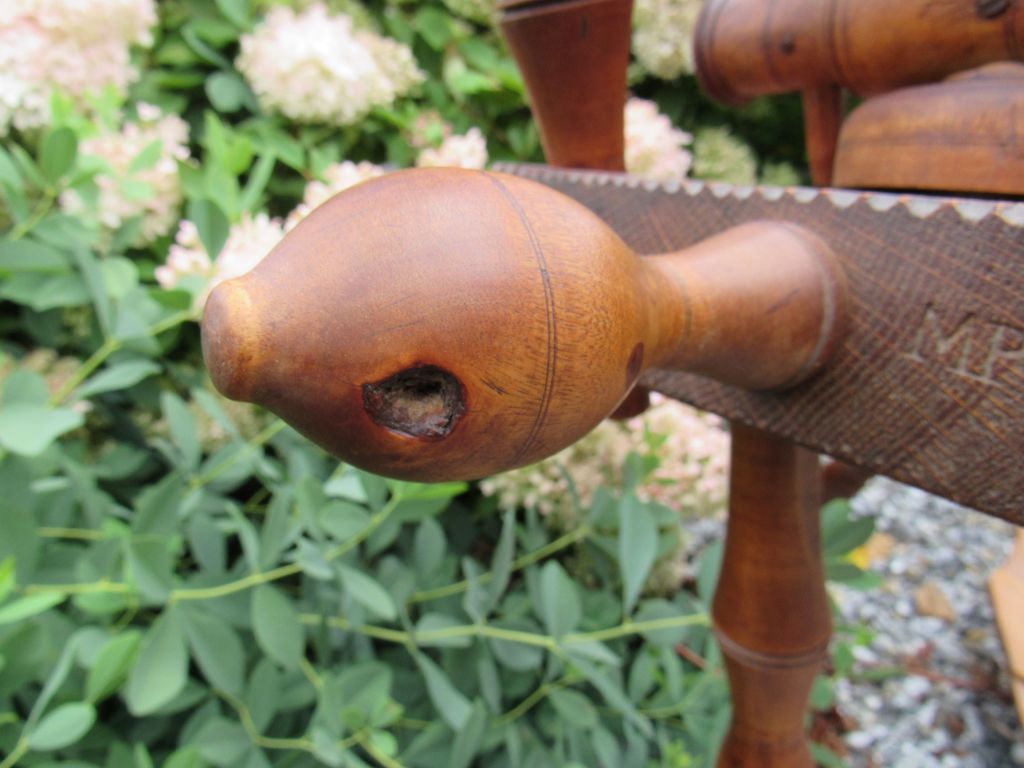
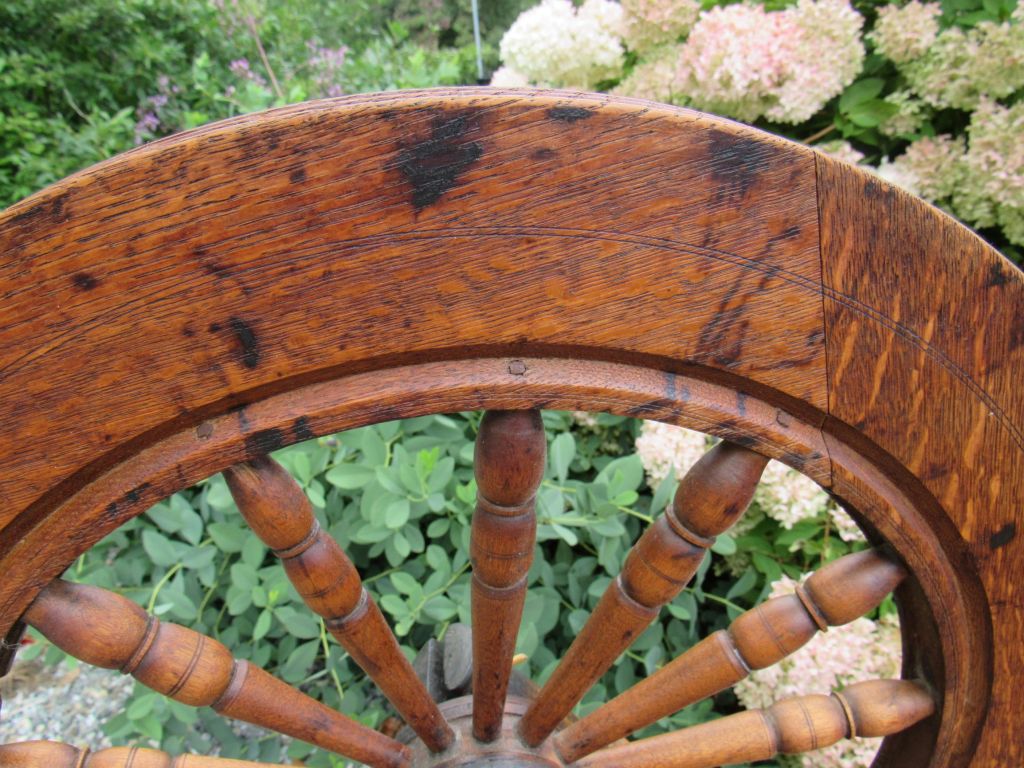
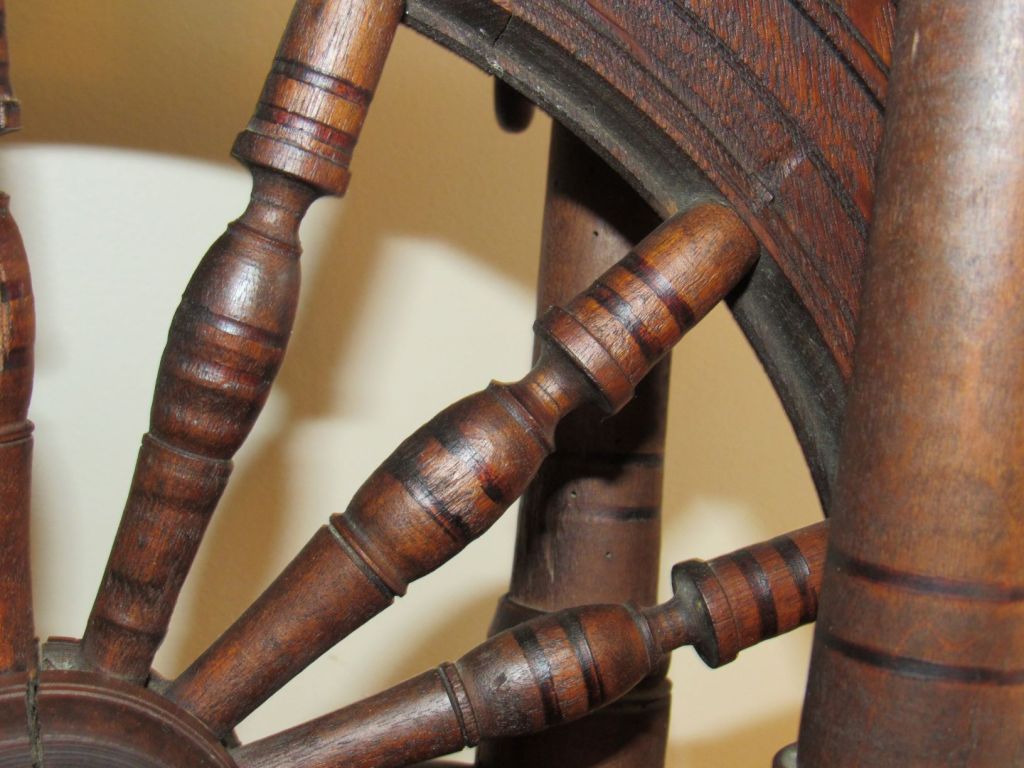
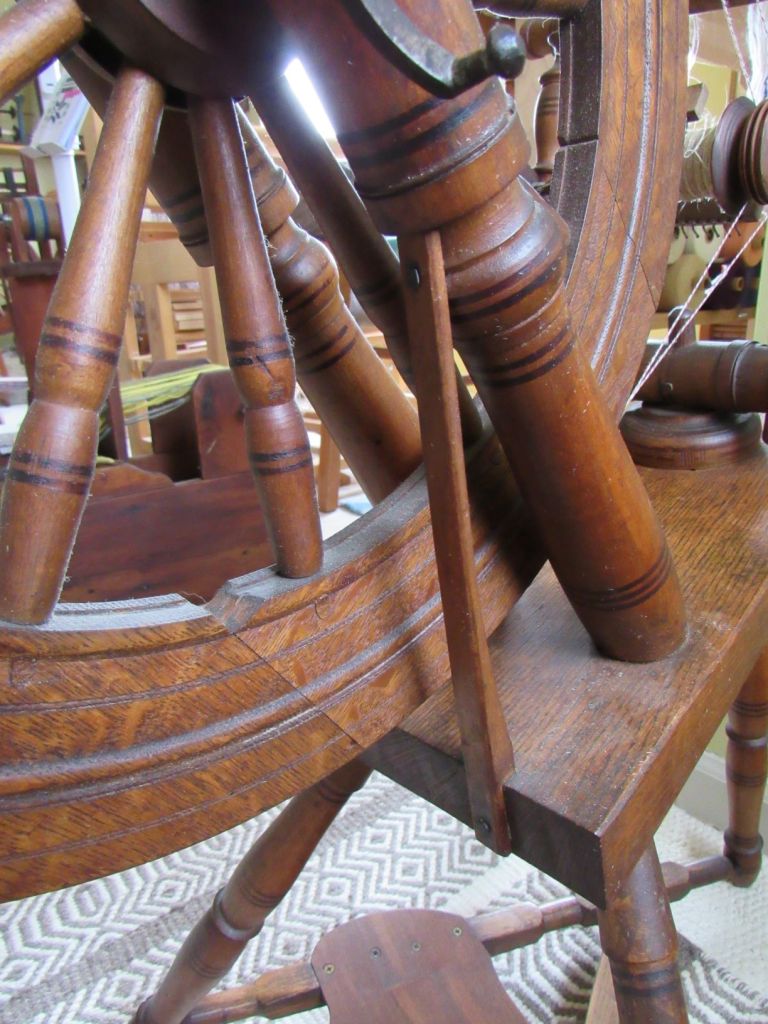
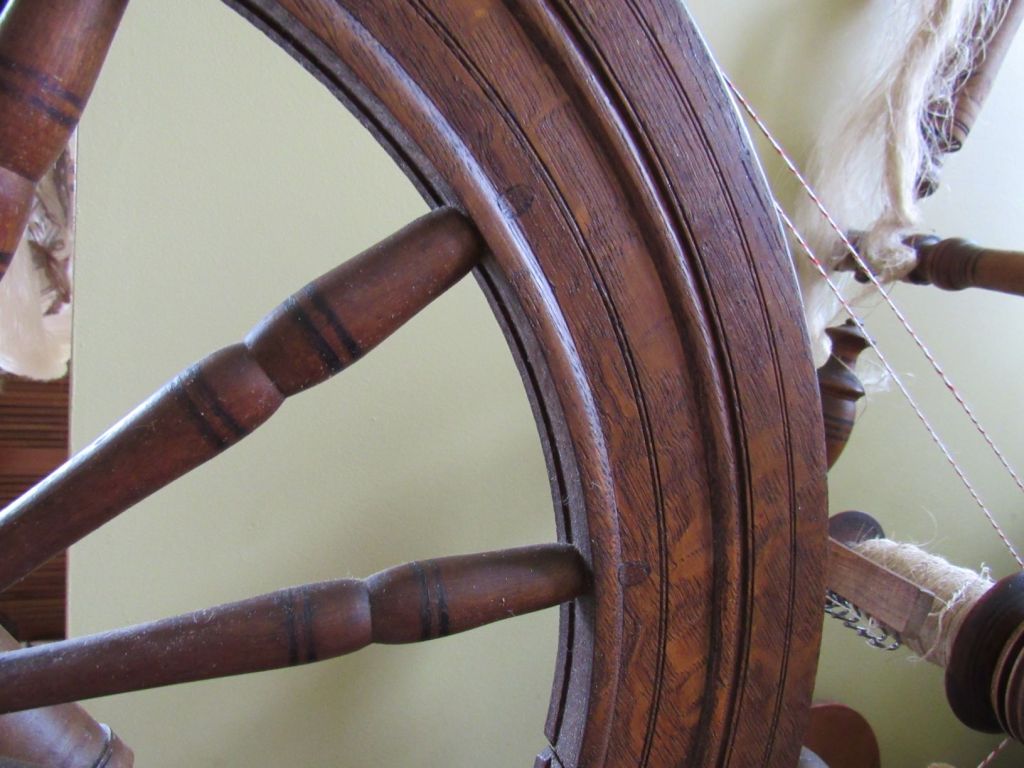
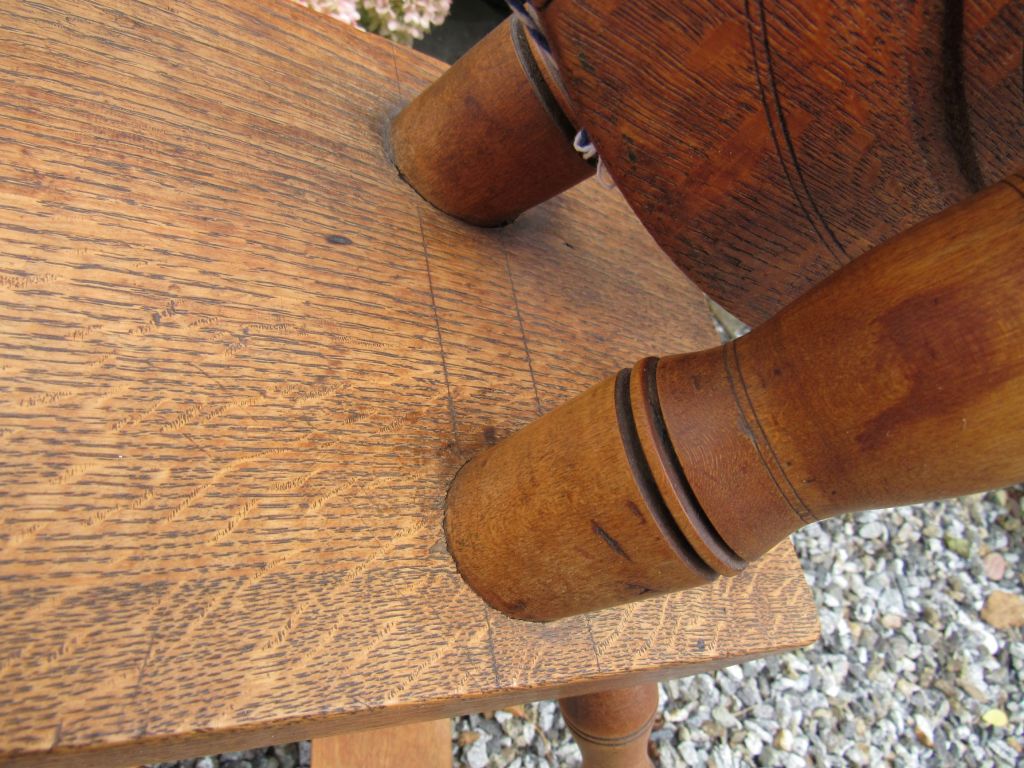
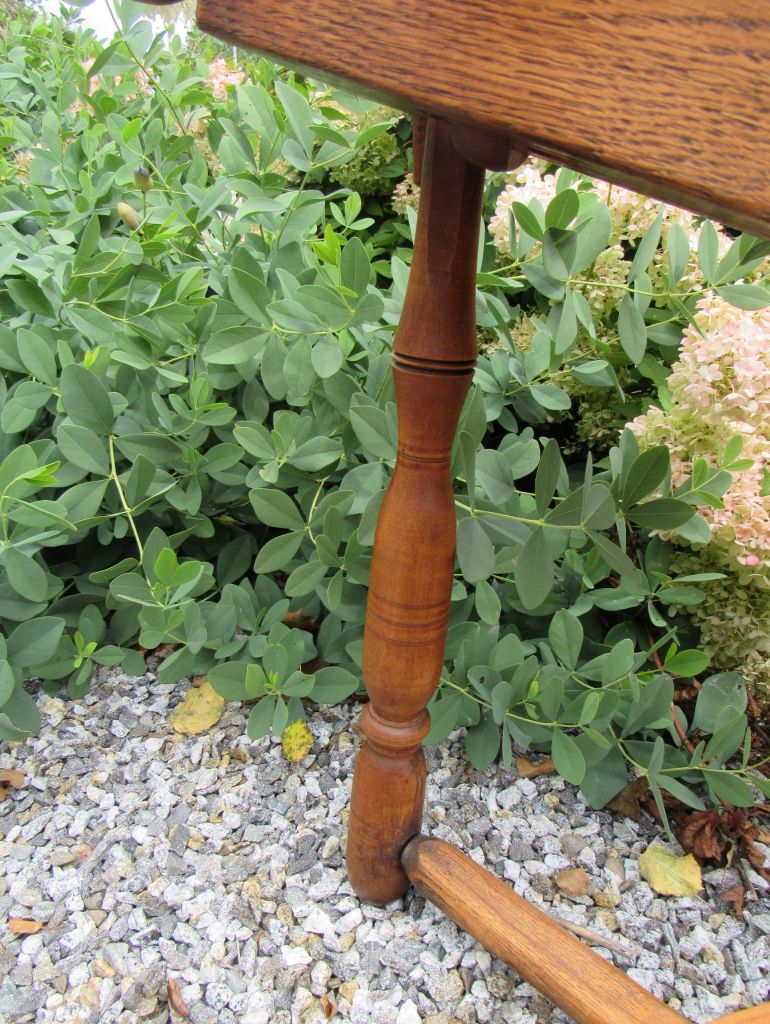
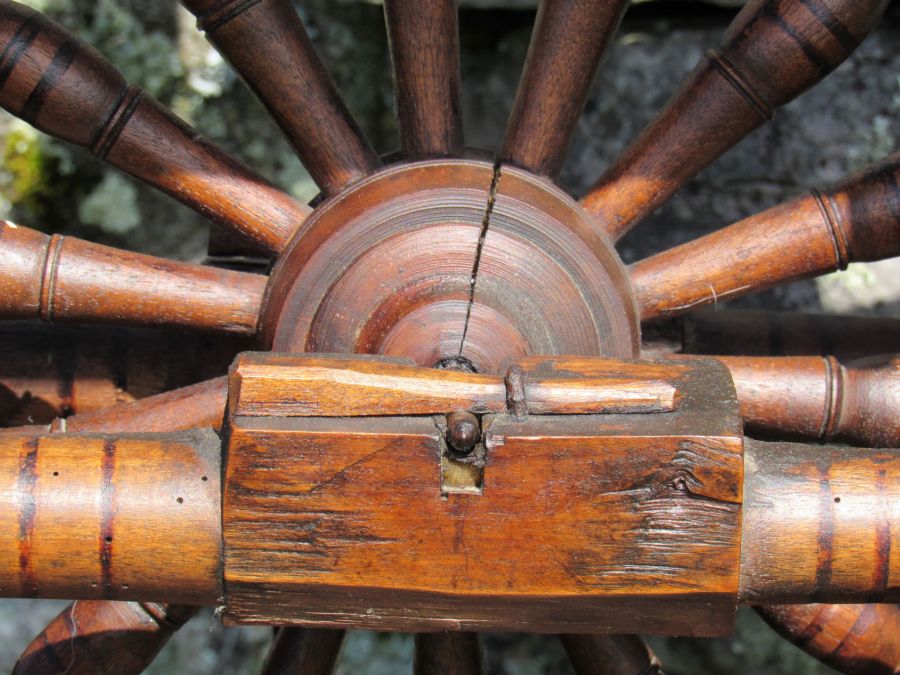
Aside from his doubled initial stamps on the table end, the turnings are somewhat unusual in their generous proportions.  There is nothing skinny or delicate about these wheels, they are plump and ripe-looking. 

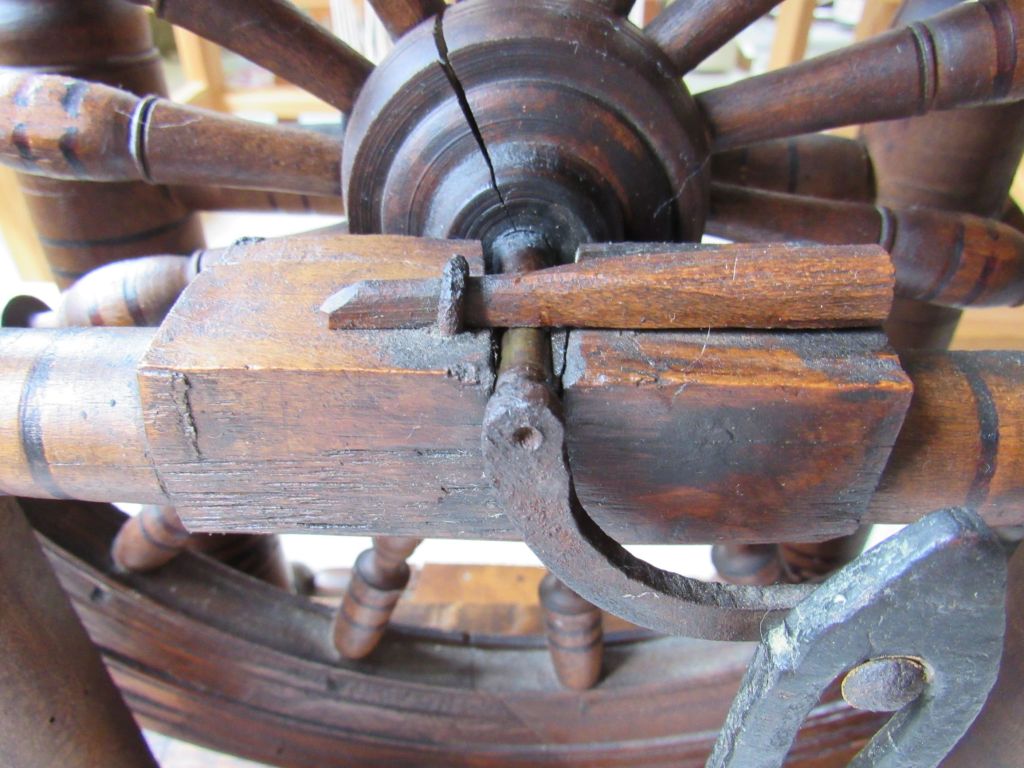
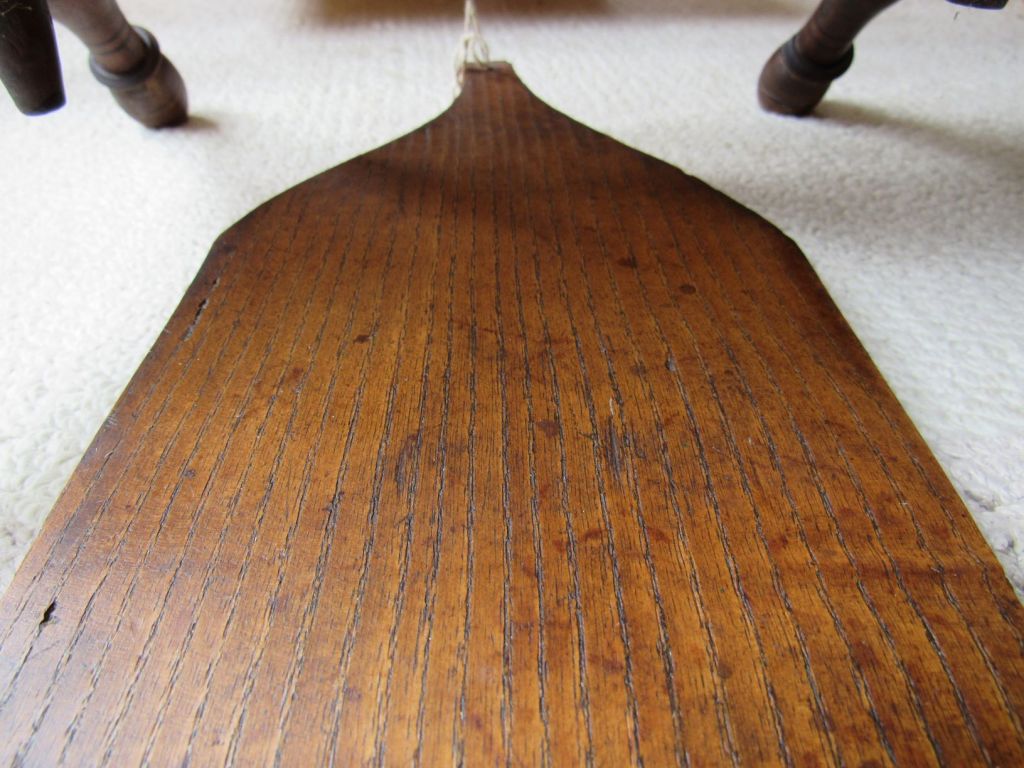
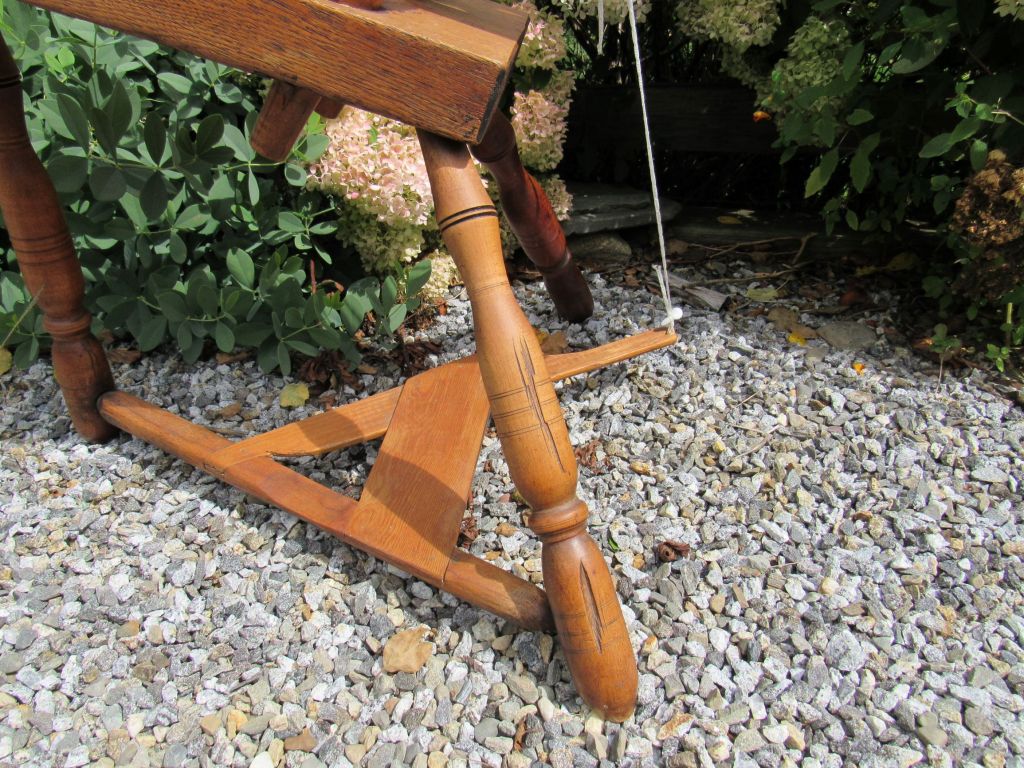
My wheel has a replacement treadle. 
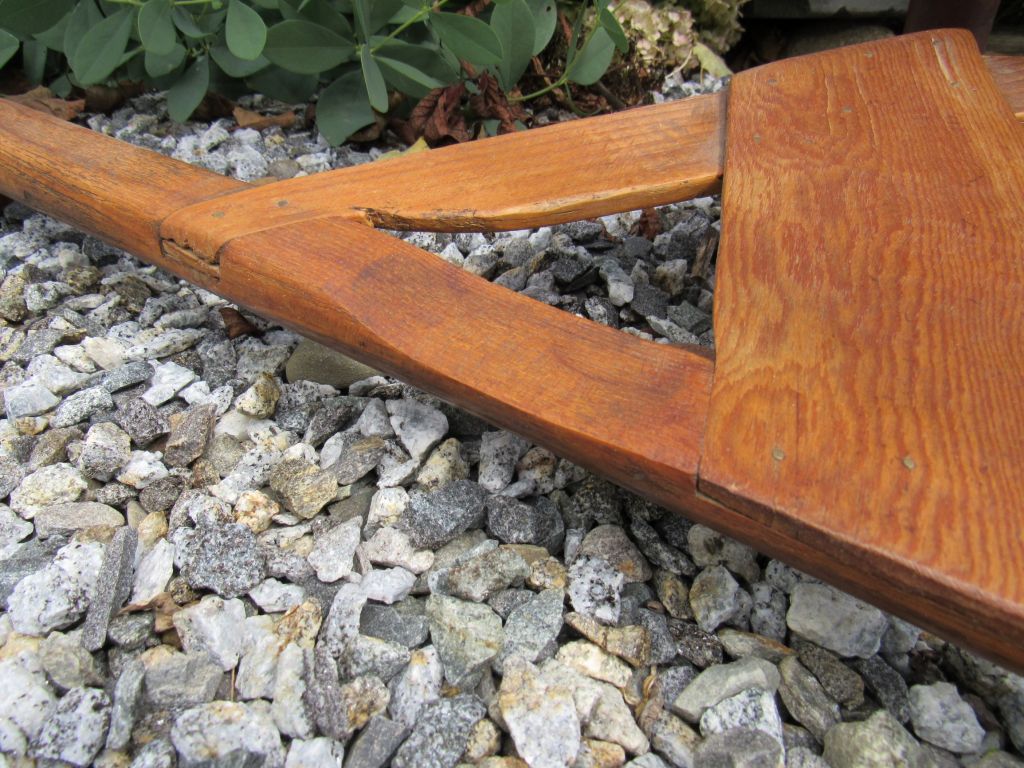
Marlboro’s treadles have a distinct notch such as this one found by a friend in Searsport.  Here is her wheel and the treadle.

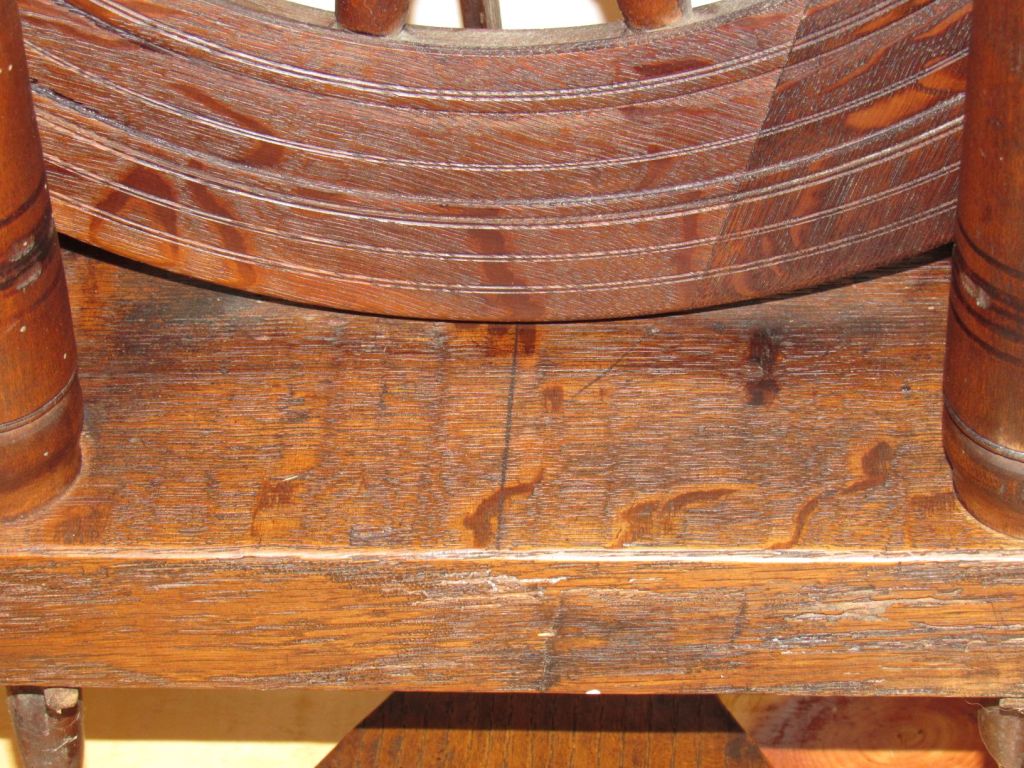
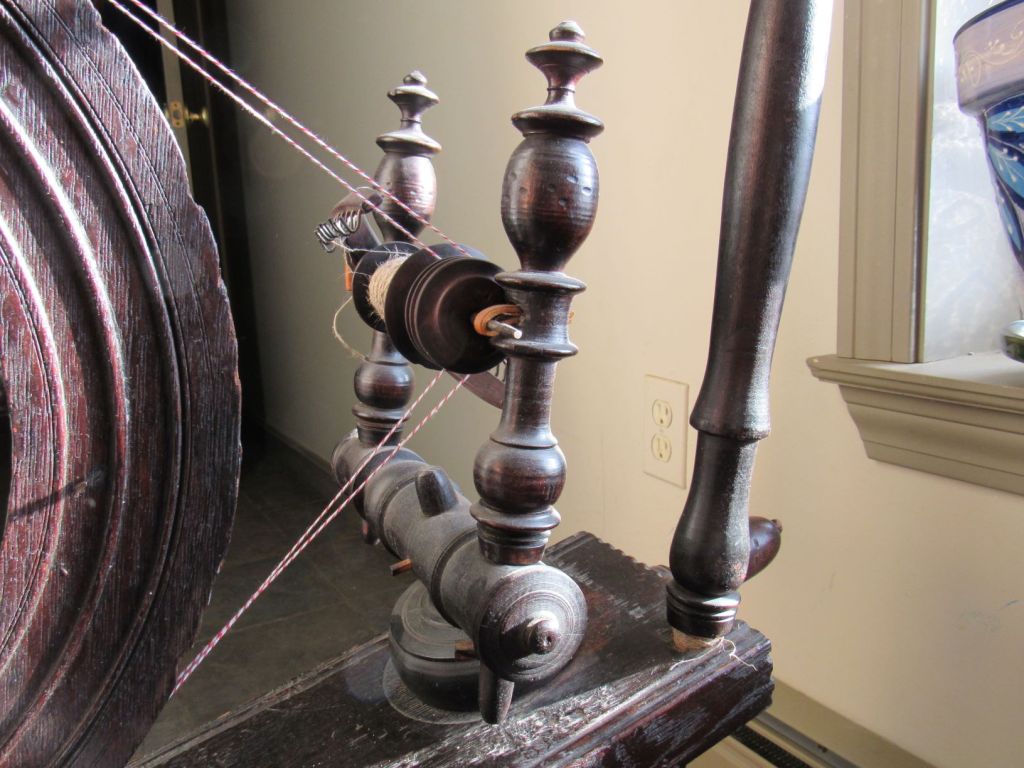
On my Packard wheel, the back side of the drive wheel has black marks, which look somewhat like burn marks, but in odd patterns.   
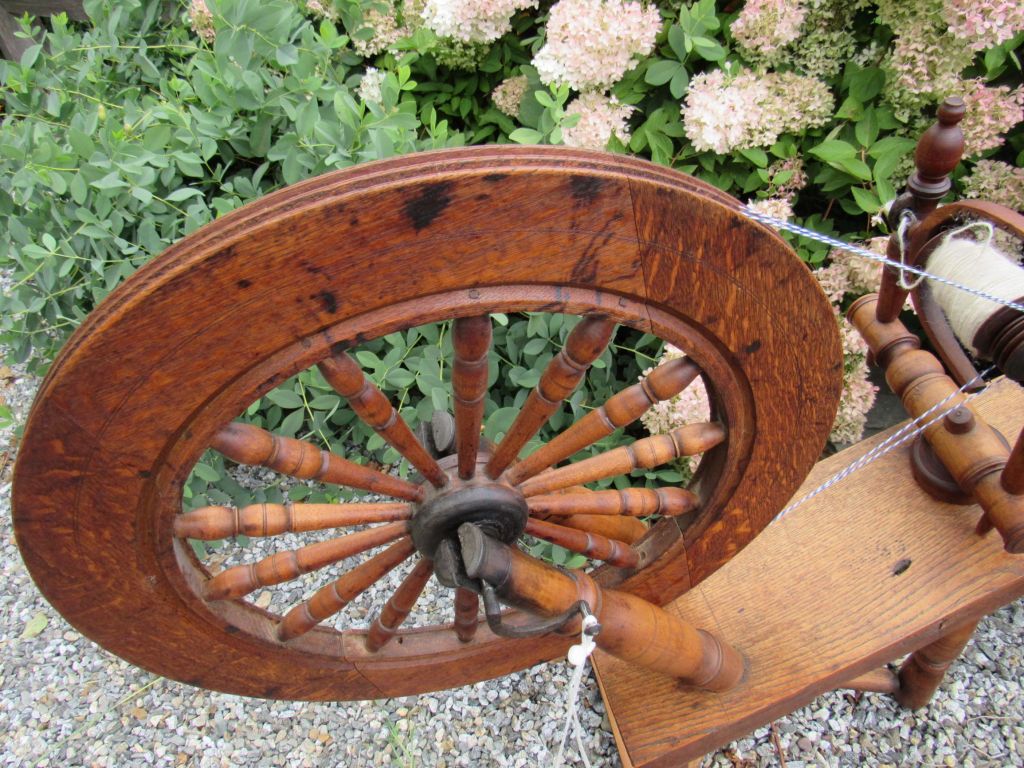
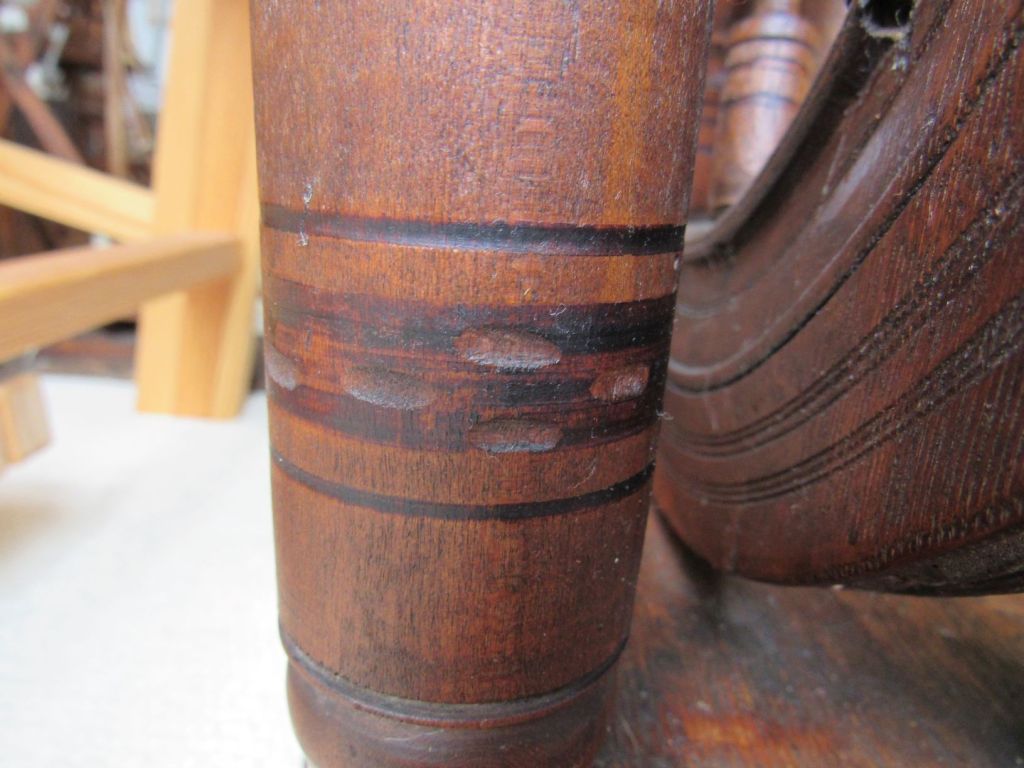
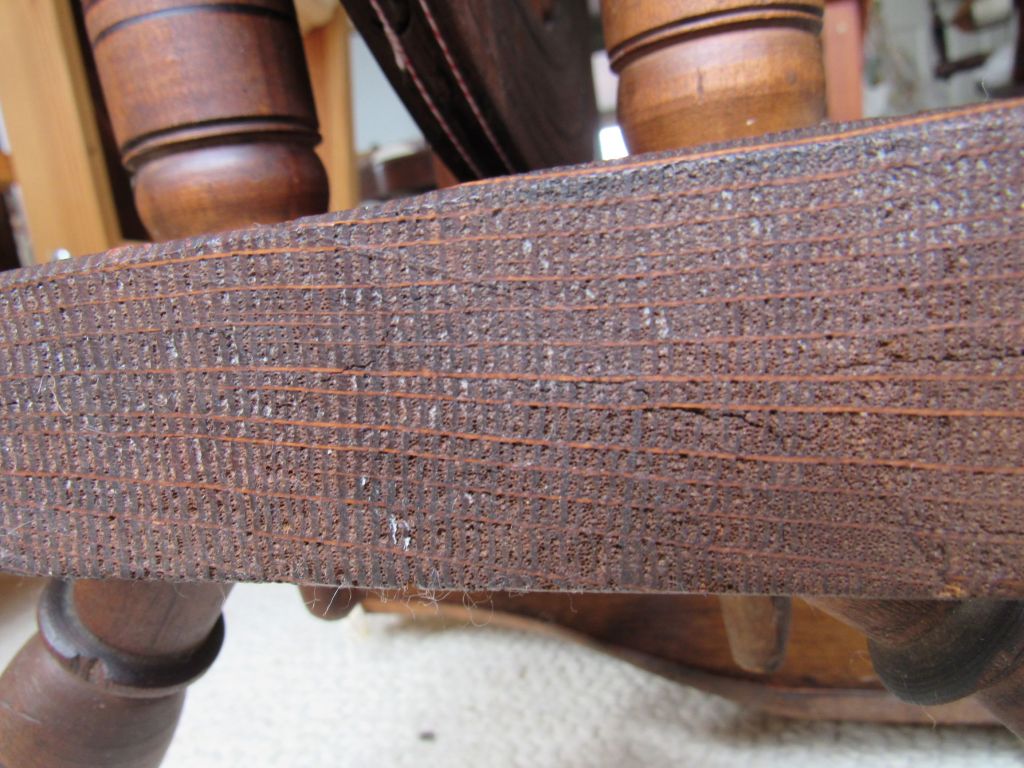
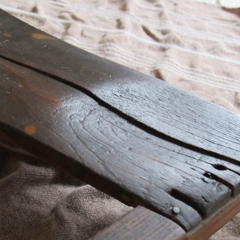
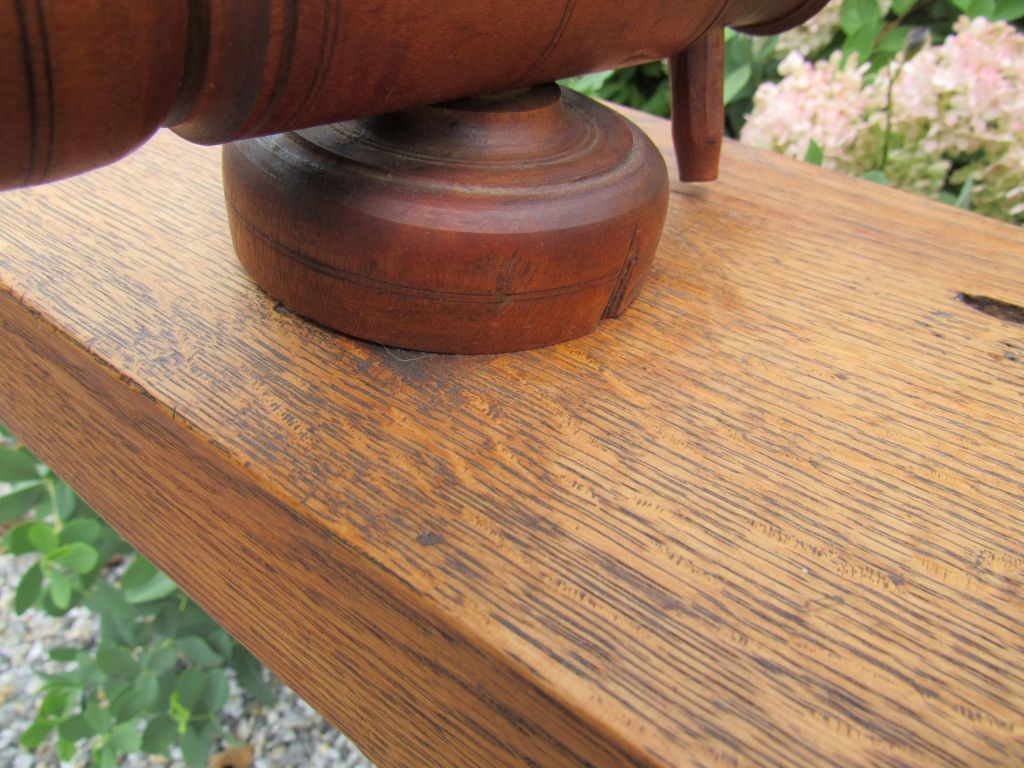
It also has gouge marks on the table, which remain something of a mystery.
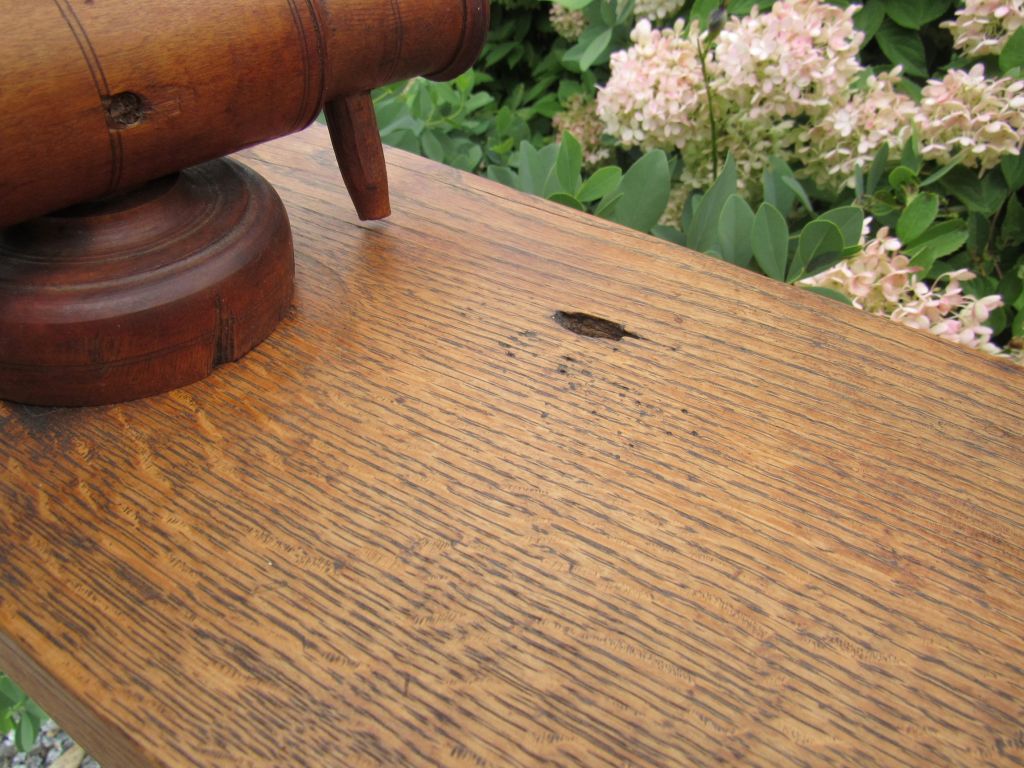
They are usually attributed to the practice of sticking knives (or forks) in the table to separate or guide the double drive band, perhaps when plying.

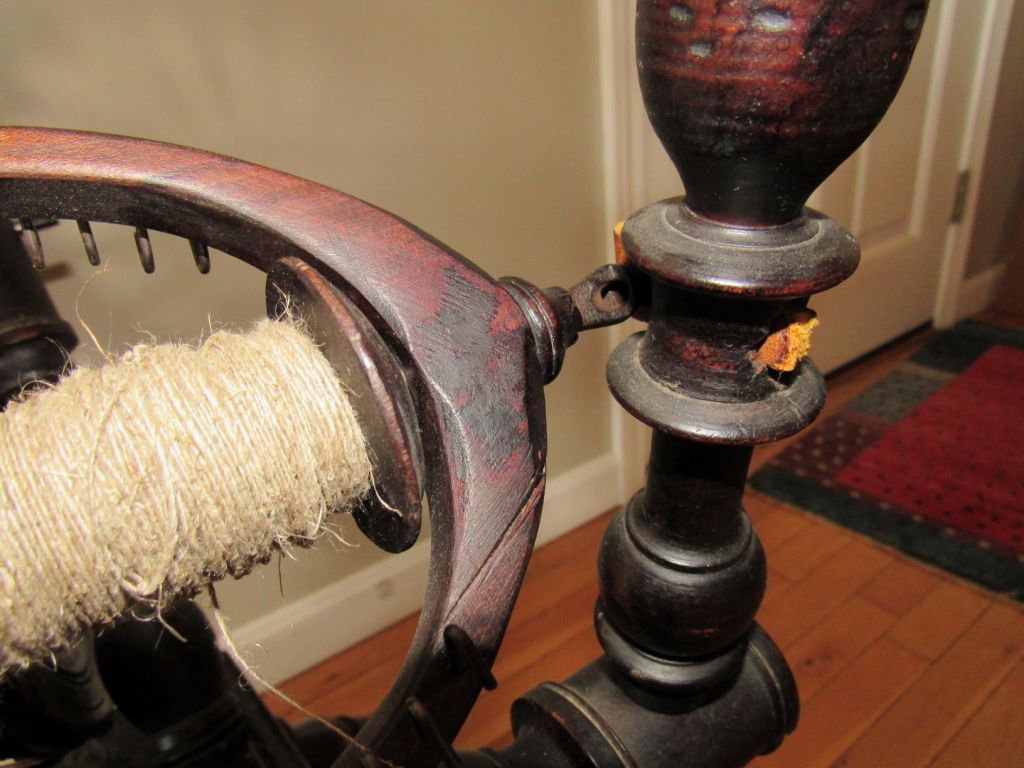
My wheel has a quirk shared with another of my Maine wheels, in that if the whorl is tightened fully, it tends to pinch the bobbin so that it doesn’t turn freely, so I need to back it off slightly.  Once that is done, she spins fast and sweet. 
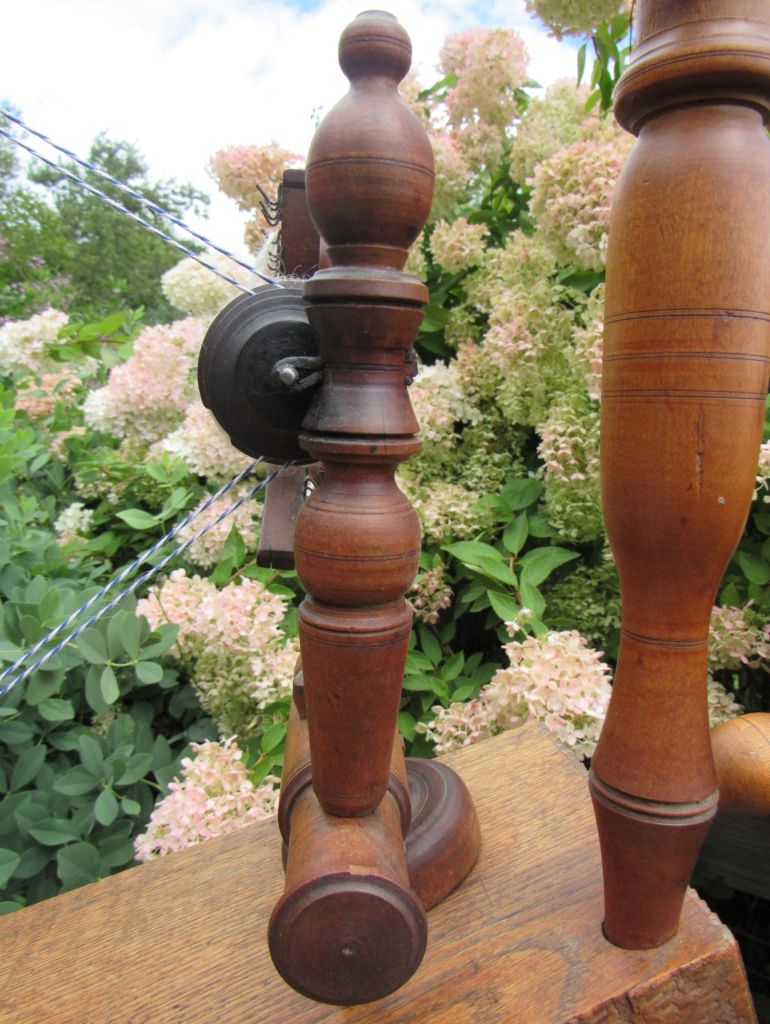
I was delighted to be contacted this week by a woman seeking information about her beautiful Packard wheel bought in New York state. It is complete with a full distaff and in amazing condition. It is satisfying to see that Marlboro’s wheels have been cherished and maintained so that they can continue to spin for us two hundred years later.

The wonderful quote on Marlboro is from:

Miller, Frank Burton, Soldiers & Sailors of the Plantation of Lower St. Georges Maine, Who Served in the War for American Independence, Genealogical Publishing Co., 1999.

Update December 2020:

I recently ran across this old photograph for sale in eBay. According to the seller, it was taken in 1914 and is from a photo album belonging to the Fountain and Sproul family from Round Pond and Sproul Hill in Bristol, Maine. The back of the photo identifies the woman knitting as Margy Johnson. What caught my eye was the swift behind Margy Johnson and, of course, the spinning wheel, which is a Marlboro Packard wheel. Bristol is about thirty miles from Union, where the wheel was made. It is hard to tell from the photo whether the wheel was still in use. The treadle appears quite worn, the footman is attached and there appears to be a drive band. It felt like I met an old friend when I recognized this wheel.

Louisa Lenore

Antique wheels present so many puzzles.  Connecticut double flyer wheels, for example.  Why was there a sudden surge in manufacture of these wheels in the late 1700s and early 1800s?  Was there a need for increased spinning production in that particular region at that time?  Or did they simply become fashionable—a personal advertisement of spinning prowess? 

These wheels, compact uprights with two flyers supported above the drive wheel, have been referred to as “gossip wheels,” based on a lovely, but mistaken, notion that two spinners could work side by side at one wheel, chatting as they spun.  For most double flyers, however, reality was much less cozy and serene—they were a means to increase production, not socialization.  One spinner, two hands, two flyers—double the product. 

Or almost double—apparently a good spinner could increase her production by about fifty or seventy-five percent.  I have great admiration for those spinners.  It’s not easy to spin with only one hand for each flyer—especially with flax.  Spinning a fine, consistent linen thread requires an even pull-down from the distaff (and very careful dressing of the distaff), a way to smooth out inevitable lumps and thicknesses, and a way to moisten the thread as it is spun. 

Tough enough with two hands, let alone one.  And once single-handed spinning is mastered—with right hand and left–then one must co-ordinate each hand to spin at the same time—but separately.  Despite that challenge, these wheels were very popular for several decades in Connecticut. 

Were all of the users competent with two flyers, I wonder?  Most double flyer wheels can be used with only one flyer, so perhaps they were considered versatile—with an option of using one or both flyers.  They also are compact and attractive, which may have contributed to their appeal. 

In any case, my double-flyer does not appear to have seen much use, so perhaps the wheel was more aspirational than practical for her owner. 

The treadle has no signs of use.

There is no maker’s mark, but the wheel bears the hallmarks of the Sanford family (see previous post “Big Bear” for more on the Sanfords). 

Sanford double flyers are characterized by cross posts supporting the wheel axle rather than upright supports favored by other area wheelmakers such as Silas Barnum, Solomon Plant, John Sturdevant, Jr., and J. Platt. 

The Sanford wheels also have a simple top table—with a straight angle corner cut.  In contrast, most of the other wheelmakers’ top tables have curved corners and half-rounds at the base of the maidens.  J. Platt’s wheels had the unusual combination of upright supports with a Sanford-like top table and L. Judson’s wheels shared the Sanford characteristics. 

My wheel has spokes characteristic of the early Sanford wheels—the later ones had simpler spokes—and the typical black bands with diamond chip carvings. 

Neither flyer appears to be original and the bird cage distaff looks as if it was made fairly recently.  A straight, truncheon-style distaff would have been more typical for these wheels. 

The distaff support assembly is absolutely beautiful and also likely not original to this wheel. The wood, finish, and rings are quite different than the wheel body and the really elegant turnings suggest that they came from a different wheel.
The wood on the wheel table is quite coarse-grained

and one of the tension knobs still has a bit of bark on it.

Although the flyers are not original, they fit and work nicely. The wheel is in remarkably good shape and a spinning beast. Now, I need to learn to keep up with her.

Update December 2020: Recently someone questioned me about the assertion that a spinner could not double production on one of these wheels. I thought it would be worthwhile to include here some sources for that contention. In her article “The Double Flyer Spinning Wheel” in Issue #6 of the Spinning Wheel Sleuth, Joan Cummer wrote: “Although sometimes used for spinning wool, the double flyer wheels were especially employed for spinning flax. A spinner could not double her single flyer production but if very competent could produce 150% to 175% of her single flyer yardage per hour.”

In Patricia Baines’ book, “Spinning Wheels, Spinners & Spinning,” (1977) she wrote that double flyer wheels were “mostly found where flax spinning was an industry, as it was thought of as a wheel essentially for helping the poor to earn more money and to speed up production although it could not actually double the output.” (p. 151). Baines cited H. E. Von Rettich’s Spinnradtypen, Vienna, 1895, for the proposition that “a spinning wheel with treadle produced 350 metres per hour and one with two flyers 498 metres per hour,” while noting that the validity of these measurements is necessarily dependent on the skill of the spinner.

And, a little book, “The Tale of the Spinning Wheel,” by Elizabeth Cynthia Barney Buel, quotes from an 1801 advertisement in a Connecticut newspaper, the Hartford Courant, by local wheel maker Joel Baldwin , saying “Two handed wheels are highly recommended to young women, as they can spin one third faster on them.” (p. 39) The book was published in 1903 and is a fascinating glimpse spinning and textile production. A free e-book version can be found here: https://www.gutenberg.org/files/58950/58950-h/58950-h.htm?fbclid=IwAR1TgJdVNGMxNgxaeHuk2MBD2Uh5wurV6D008O-FnGJcHYr6_bdxA64ZKXw.

An article in “The Journal for Weavers, Spinners, and Dyers” Winter 2020 from the UK, titled “A Window Onto the Linen Industry in Eighteenth Century Scotland,” by Hilary Miller, also discussed output from double flyer wheels in Scotland. The article notes that, according to the Old Statistical Account (OSA)–information from Scottish parishes–a spinner on a double flyer wheel could spin nearly one third more and of better quality than on a single flyer wheel, or near twice as much, but of a coarser quality. (p. 20).

Mindwell Pond

Solomon Plant made beautiful wheels. He lived from 1741 to 1822 in Stratford, Connecticut. Florence Feldman-Wood, publisher of the Spinning Wheel Sleuth, has done extensive research on Plant, who fortunately kept good records. She wrote two fascinating articles (in SWS issues 31 and 39) about him, his wheels, and his customers.

Because I have an interest in the early Connecticut wheelmakers, I was thrilled when this wheel appeared on Craigslist in Massachusetts. It had been languishing there for some time, perhaps because both flyer arms were broken off. On a trip to see his brother, my husband arranged to pick up the wheel at the Dunkin Donuts near the Bourne bridge. So, we still refer to it as the Dunkin Donuts wheel.
The edge of the rim was badly chipped. Despite that, it held the drive band I was able to do a little spinning when I got her home–using the two hooks left on one of the flyer arm stubs. She’s fairly small and easy to lift, so once the flyer was fixed, she became my favorite for summer spinning flax outside on the porch.

The wheel has stripe and chip mark decorations on the turned pieces, with chips scalloped on the end of the table and double grooves down the sides.

Plant’s initials on the table end.

One of the most fascinating things about the wheel is that the table has a huge crater underneath, the remains of a knot.

The table is very short–only 15 3/4.” The 16 spokes and plump curves give his wheels a distinctive look.

This wheel was stained or ebonized, apparently early on, giving it a rich glow. The treadle is a replacement, and perhaps the distaff. As far as I know, there are few Solomon Plant flax wheels that have survived, so I feel extremely fortunate to have found this one.

Katherine the Witch

This wheel started it all for me. When I was growing up, it decorated the corner of our Connecticut living room, with a messy, dusty hank of flax drooping from the distaff. Somehow, when I was sixteen, I got it spinning again (with wool). After I moved to Alaska when I was twenty, the wheel became decoration in my brother’s house. Through the years, a flyer arm, the footman, and the treadle broke. I brought it to Maine when I retired, had it repaired, and it has been spinning my homegrown flax ever since. It’s solid as a rock–a lovely smooth spinner–even though it likely was made in the late 1700s and saw a lot of use.

The original treadle was deeply worn.

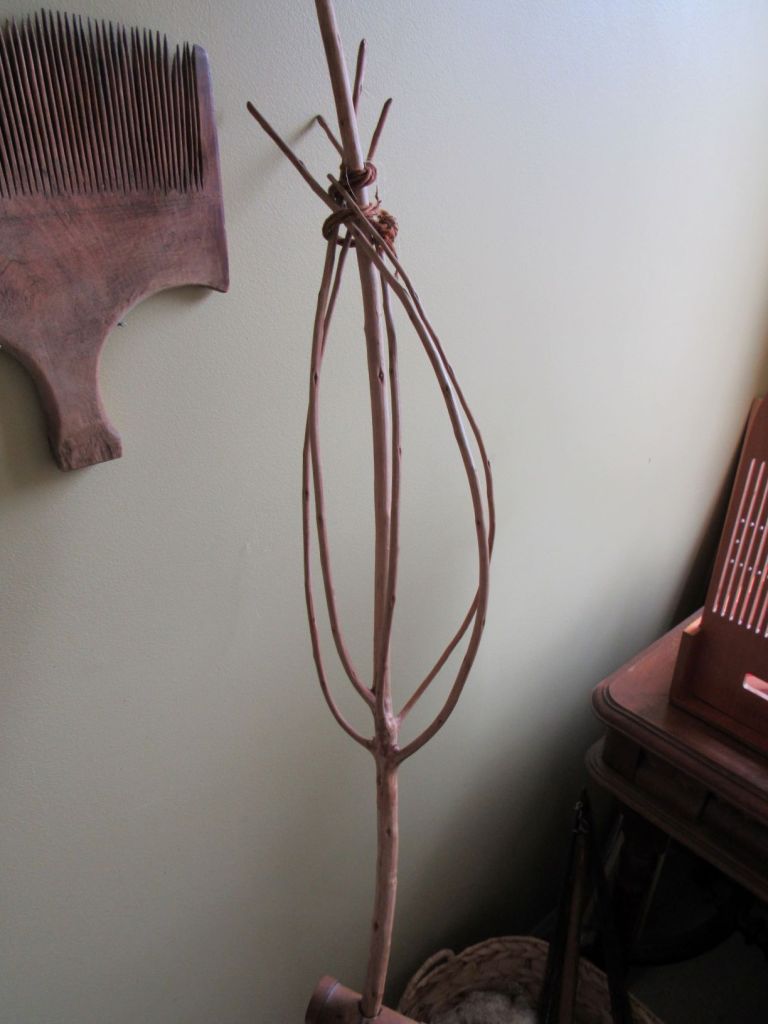
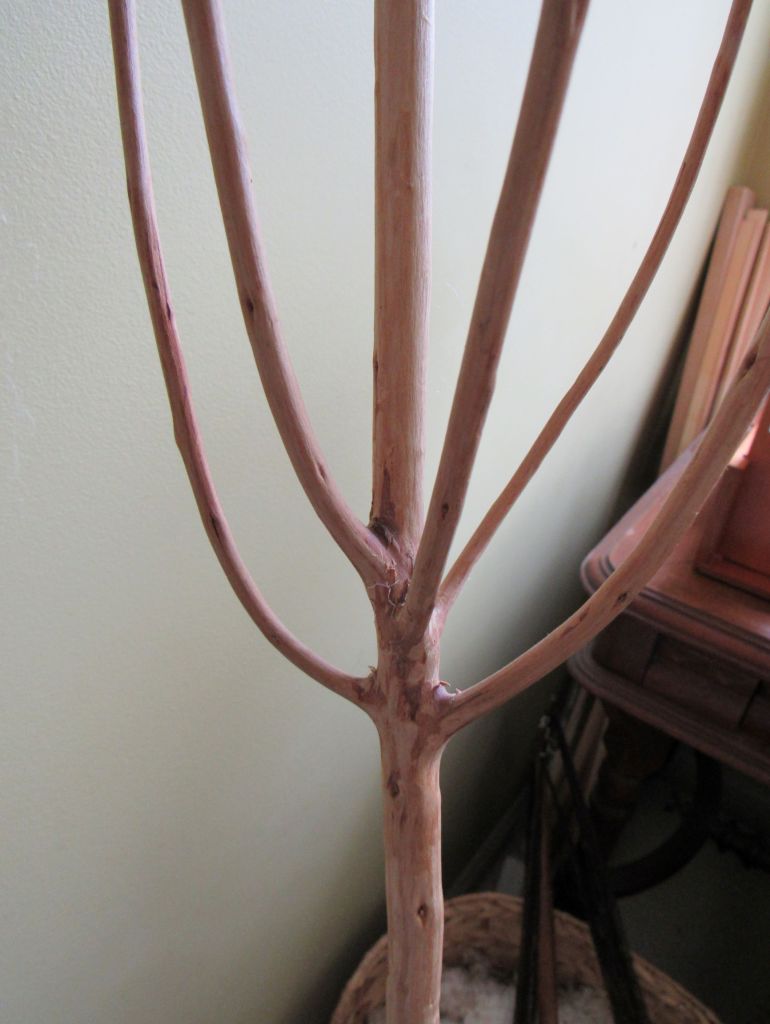
And the distaff made from a sapling.

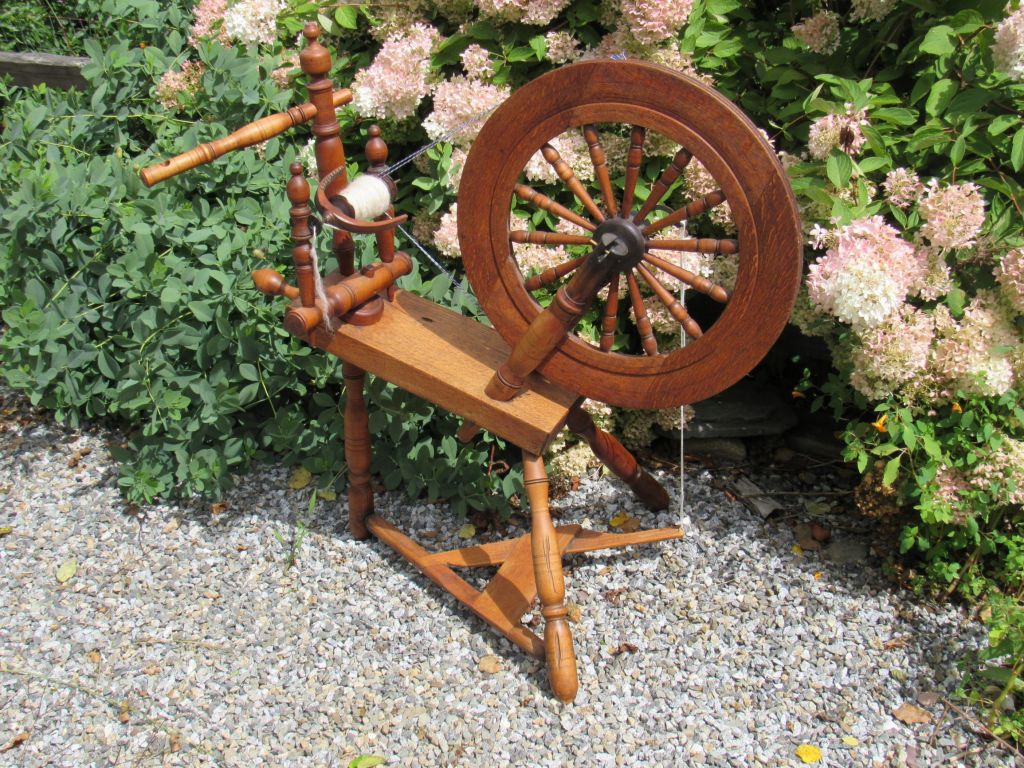
The table is quite short, only 16 3/4″ long, it has 12 spokes, and turnings typical for early Connecticut wheels. Every turned piece is adorned with sets of black stripes, but there are no chip carvings on the stripes, which were found on many of the early Connecticut wheels.

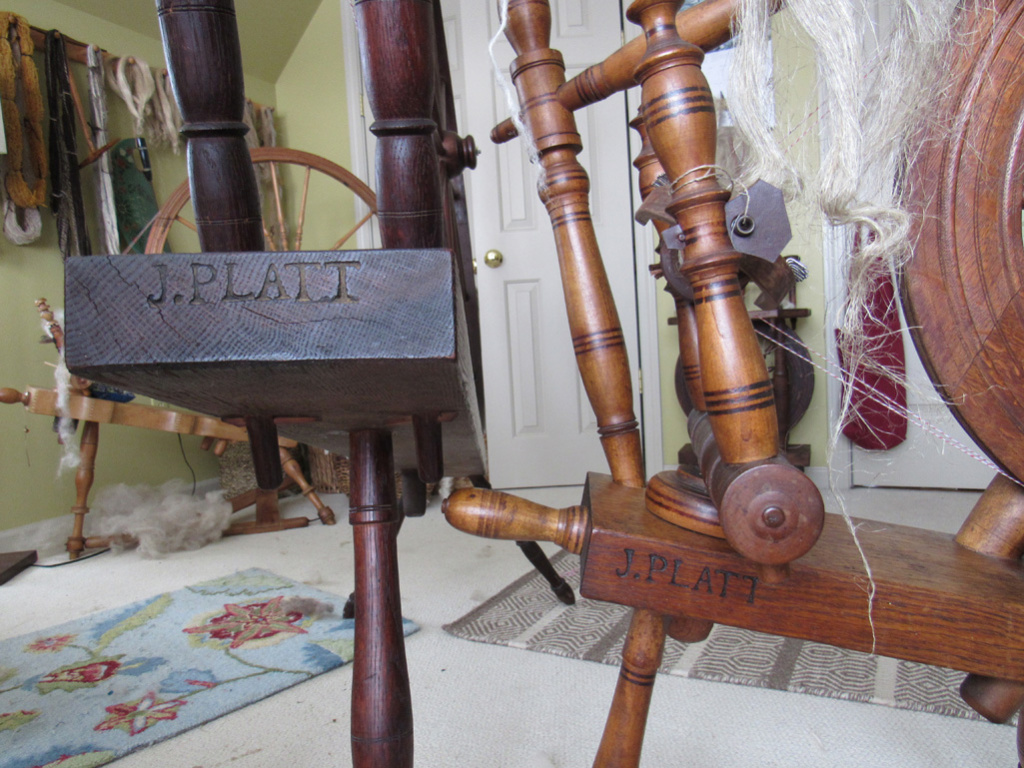
J. Platt, the wheelmaker, remains something of a mystery. Despite extensive research, I still haven’t been able to nail down who he was. His wheels share a number of features with Samuel Sanford, John Sturdevant, and Silas Barnum–wheelmakers from southwestern Connecticut in the late 18th and early 19th centuries, well-known for their double-flyer flax wheels.

My best guess for J. Platt, is Josiah Platt (1735-1804) from Newtown (married to Sary Sanford, sister to wheelmaker, Samuel Sanford), Connecticut or Joseph Platt (1741-1793) from Danbury, Connecticut but the research continues.

Side by side with a J. Platt wool wheel—the subject of the next post.