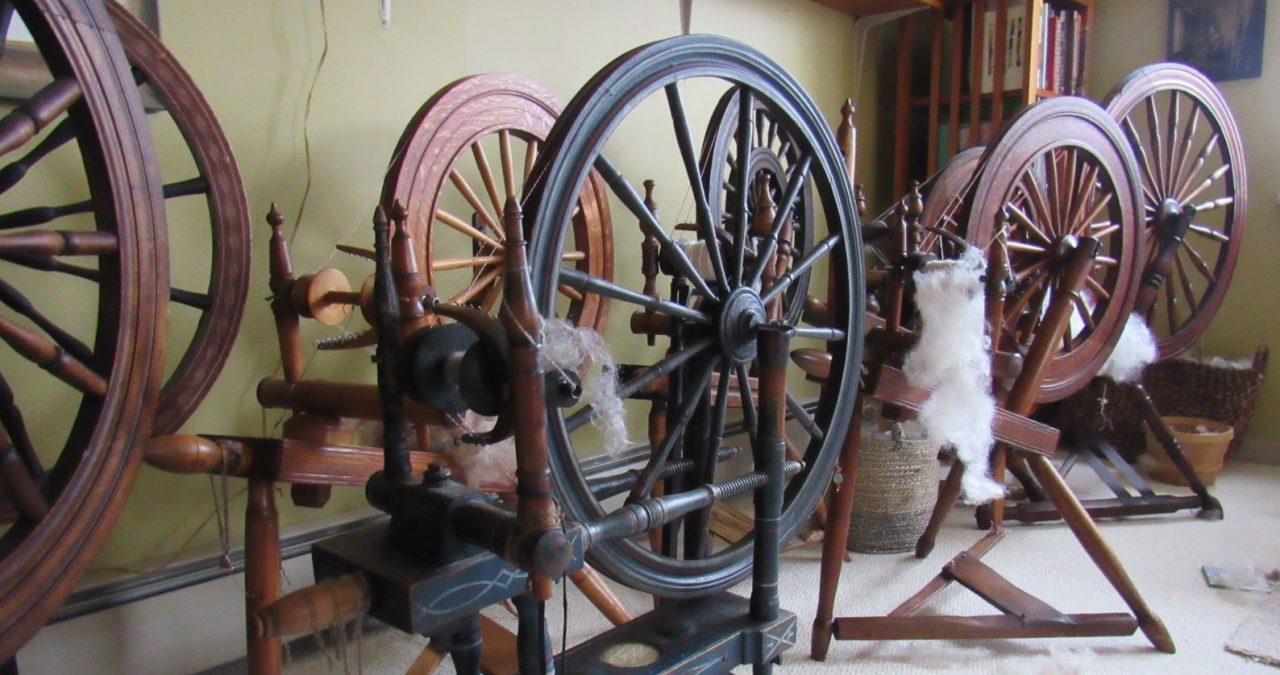
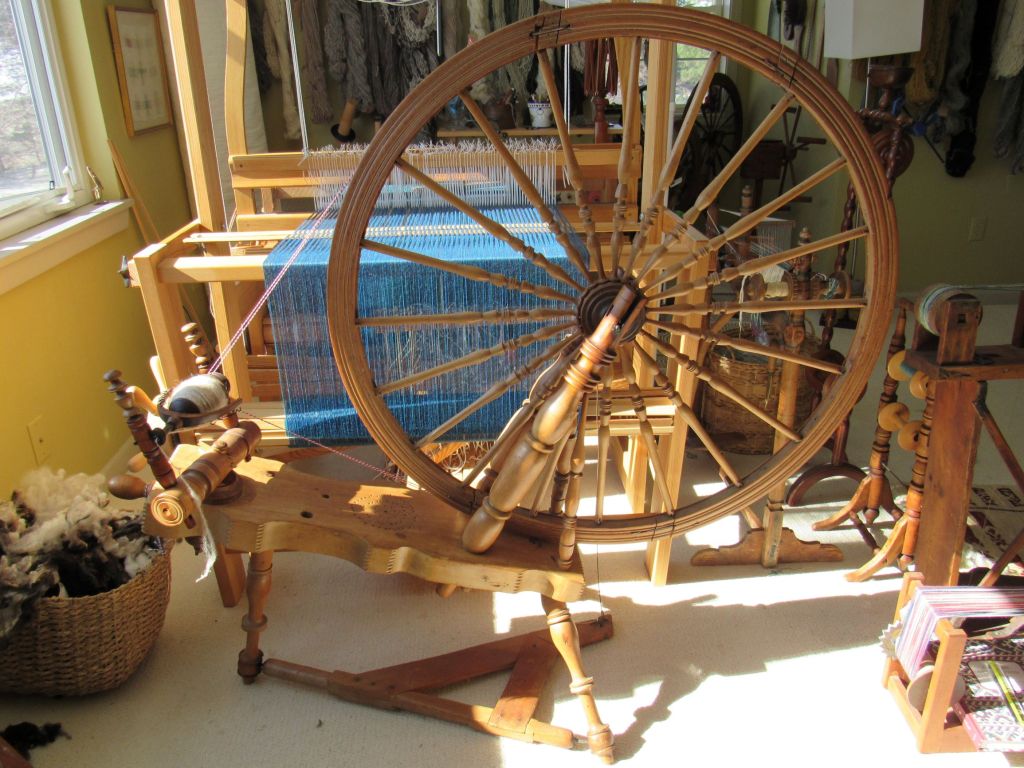
Olympe is a magnificent giantess of a wheel. She is from Quebec, but her maker remains a mystery. There are several similar wheels likely made by the same maker, although no two are quite alike. Caroline Foty wrote an article about them in The Spinning Wheel Sleuth, fittingly entitled “A Family of Wheels of Unknown Origin.” In it, she documents her wheel, No. 94 from Joan Cummer’s collection, and seven other wheels of varying sizes and configurations that share the characteristics of this wheel family–a low-slung profile, short legs, and fine, sharp distinctive turnings on the maidens, legs, and spokes—all features very different from other Quebec wheels.

Several of the wheels are huge and adorned with whimsical carved flowers and sunbursts. The enormous ones have been affectionately referred to as Big Bertha or Madame Maxime wheels.
For some reason, these wheels seem to appear in my life. I encountered the first one at an auction selling items from the American Textile History Museum (ATHM). It was Cummer’s wheel No. 94, soon to be Foty’s. A sister wheel, not quite so large, No. 95 in Cummer’s collection, had been donated by the ATHM to the Marshfield School of Weaving for their Textile Collection (photos can be found here: https://marshfieldschoolofweaving.omeka.net/items/show/121). But perhaps because No. 94 had a broken flyer, it went to auction.
I was interested in other wheels that night and was done bidding fairly early. But I was staying overnight and was trying to track the ATHM items to see where they went and for how much, so hung in to the bitter end. Cummer’s wheel was one of the very last items up for bid, after almost everyone had left or was packing up, and I was relieved when Foty’s remote bid was the winner, knowing it would have the best of homes.
By then I felt almost motherly toward the wheel and, because of her large size, made sure she was stowed safely out of harm’s way for pick up later that week. It had been a fun evening admiring the giantess, but I did not expect to see another in my lifetime.
Less than six months after the auction, I was picking up a loom in central Maine for a friend and stopped by an antique store. I was astonished to see in the front window another one of the giantess wheels.
It was decorated with trefoils and sunbursts and its original screw tension had been replaced by what looked like a tilt-tension from a Vezina wheel. It appeared to have 21 spokes and, of course, I was besotted. What followed was an extremely unpleasant series of exchanges with the antique dealer. He had the wheel marked for sale at a very high price and when I offered him something lower (but still high), he basically refused to sell it to me at any price. When my husband stopped by the shop some months later, the wheel was gone from the window and the owner said that it had sold. I wish I knew where it was.
I still had that wheel on my mind when my daughter and grandchildren came for a visit in December that year. They wanted to see Quebec City and before the trip I, of course, took a look at Kijiji, Canada’s version of Craigslist, to see if there were any interesting wheels for sale. I was gobsmacked to find, way at the end with the oldest listings, another giantess wheel, that had been languishing for months unsold. What are the odds for that?
On the second day of our Quebec visit, a granddaughter and I drove over the bridge to Ile d’Orleans and had a wonderful visit with the wheel’s owner, a Francophone woman with an artist husband. She collected antiques and had owned the wheel for decades, but knew nothing of its earlier history.
She had another beautiful wheel for sale, but it was all I could do to fit the giantess in the car along with my daughter and three grandchildren.
After a lot of luggage rearranging, we managed to get it in the car and home it came. The drive wheel was bizarrely cobbled together and canted crazily in different directions, making me a little dubious that it would hold up to spinning.
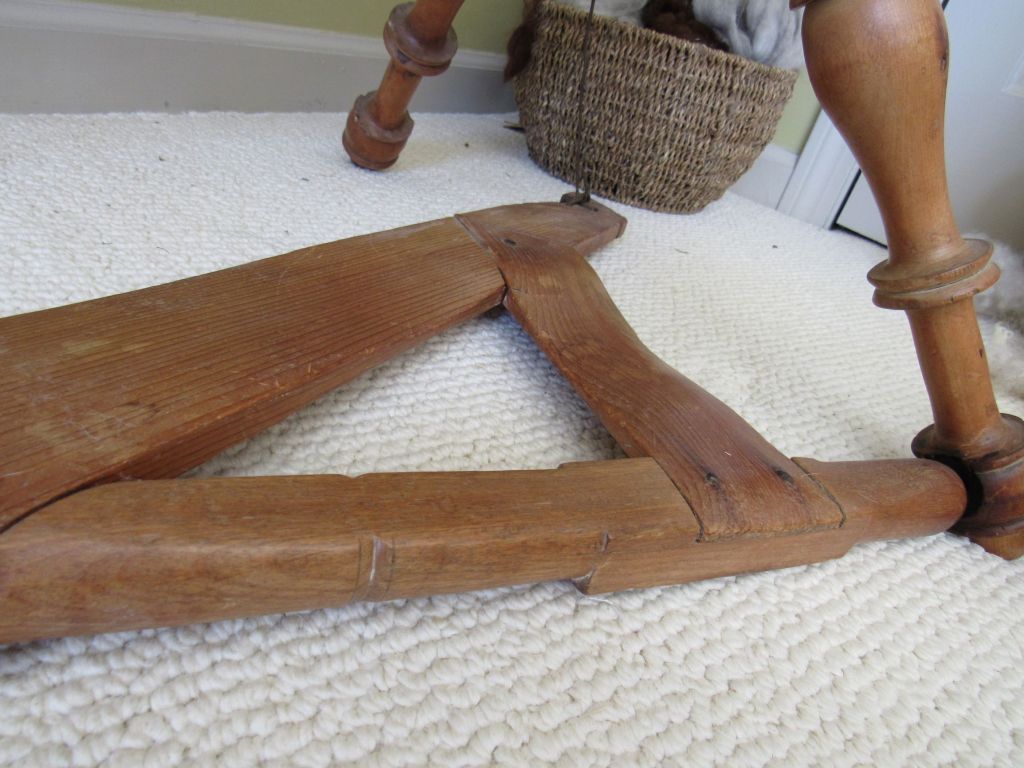
But the treadle and supporting bar were very worn, so clearly had been heavily used in the past.
And, sure enough, despite the wonky drive wheel, it spins beautifully and has an added almost fairy-tale quality of making me feel like I have shrunk to child-sized dimensions when I sit down to spin.
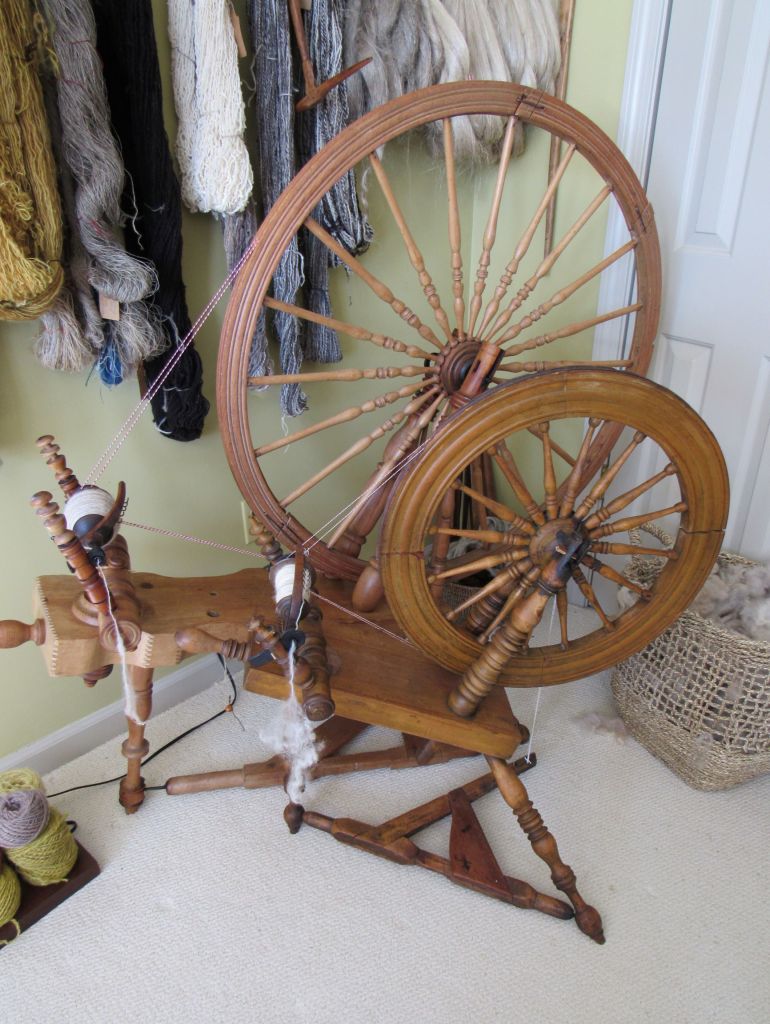
The wheel is huge.
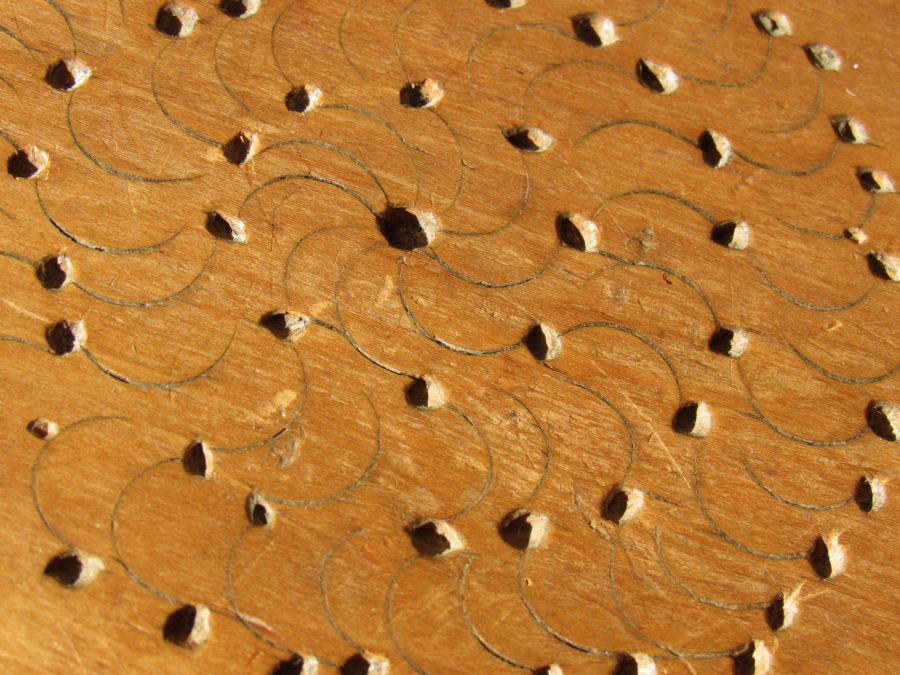
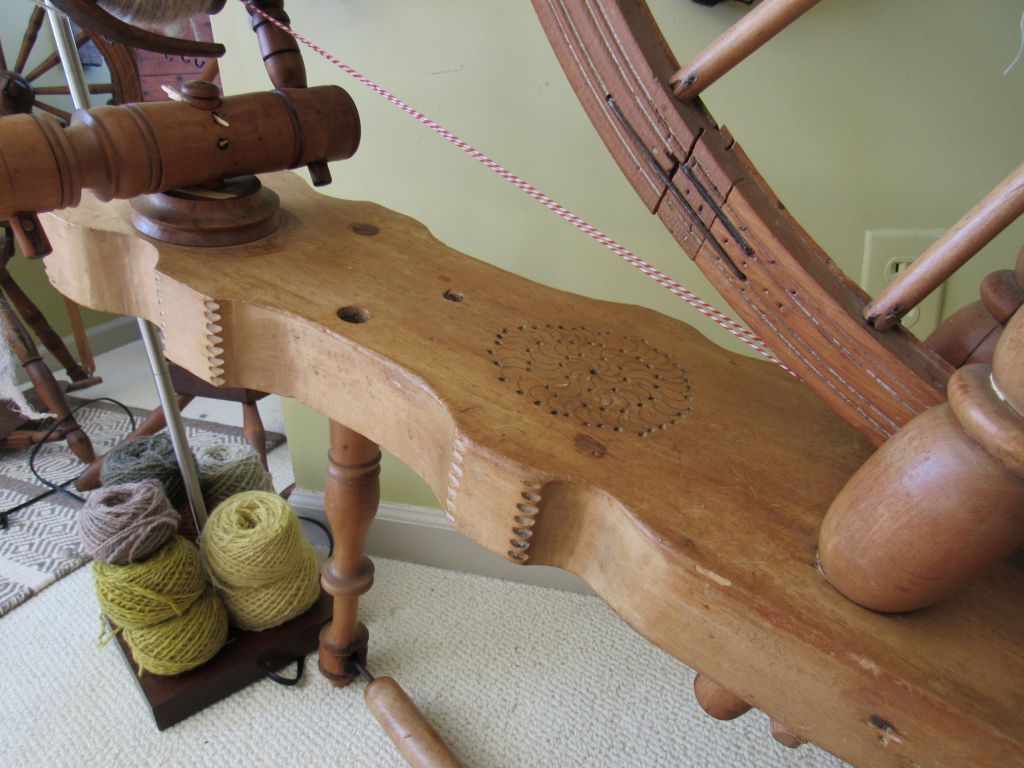
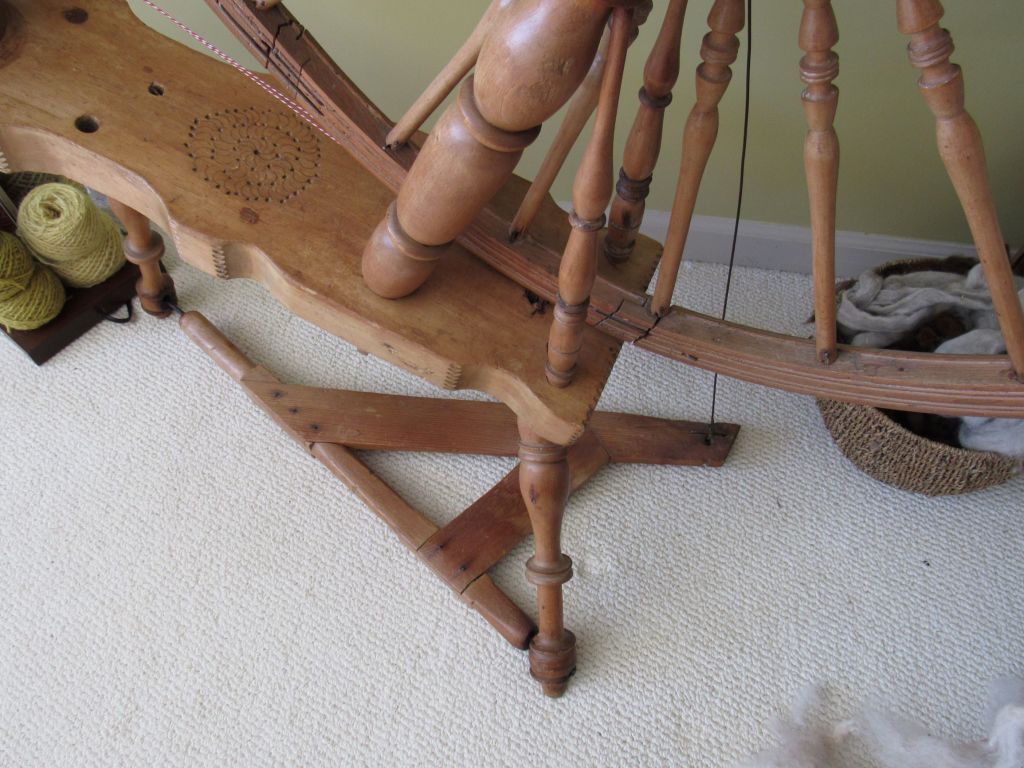
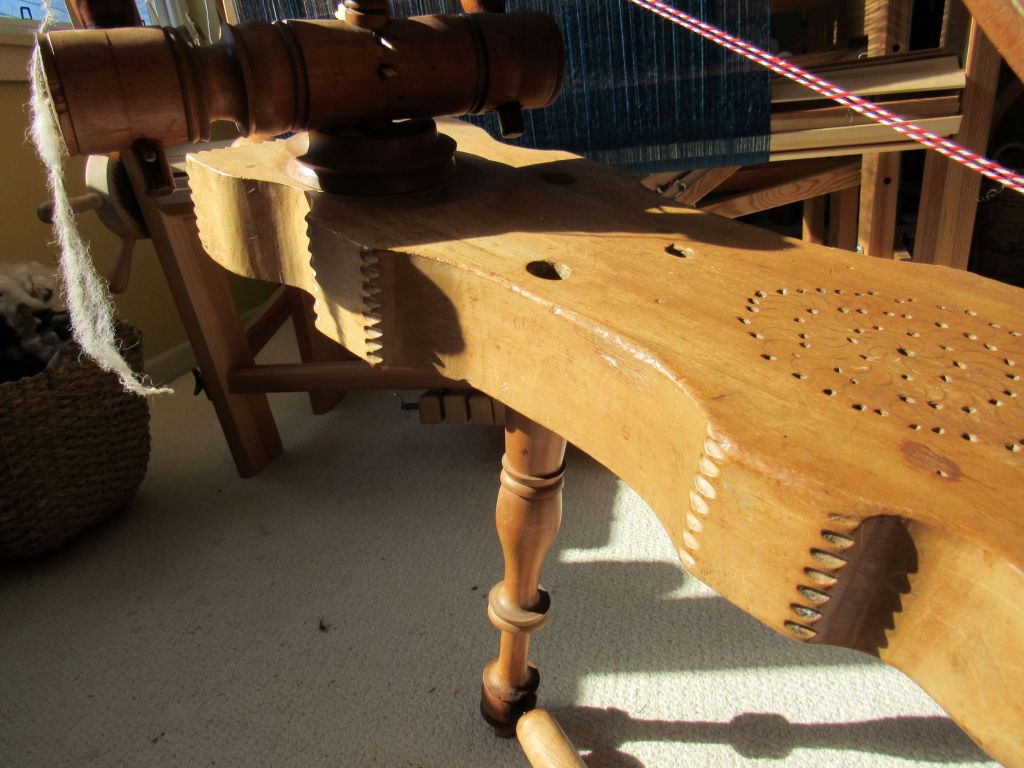
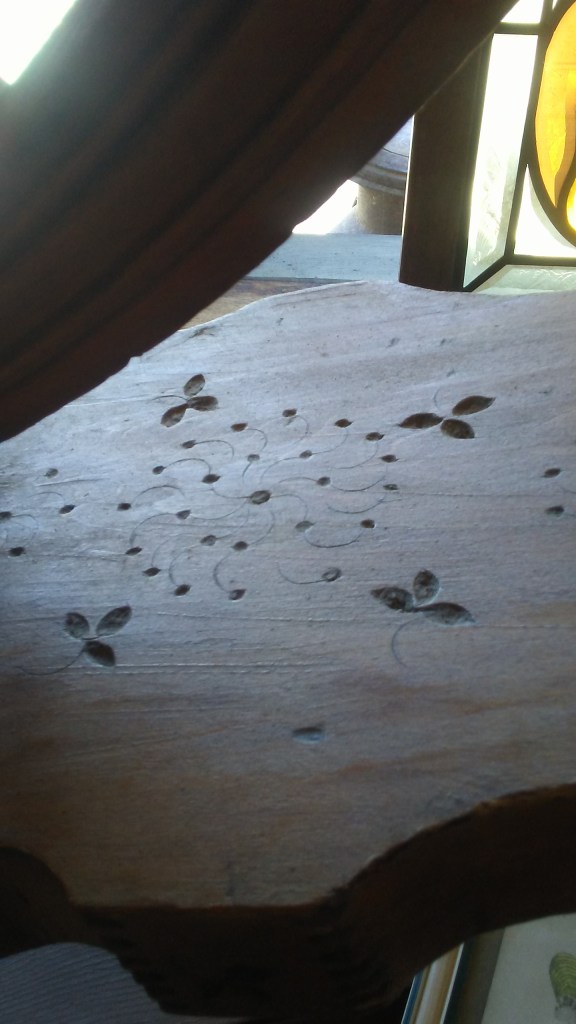
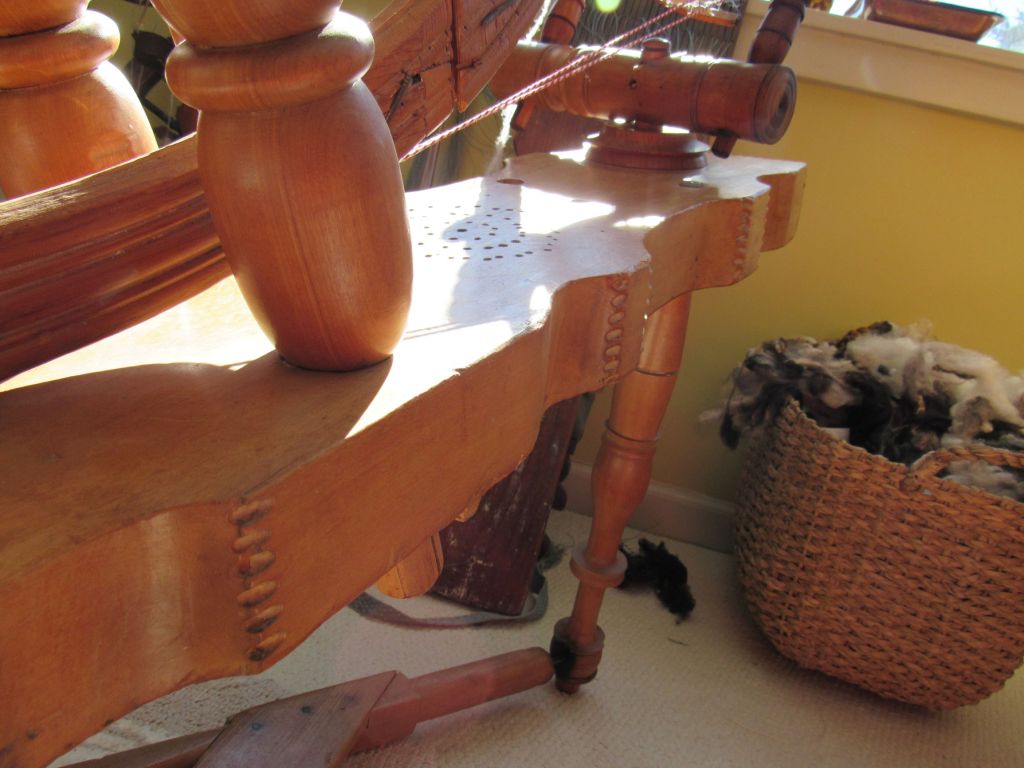
The table is 31” long, with a squiggly, dotted sunburst in the middle
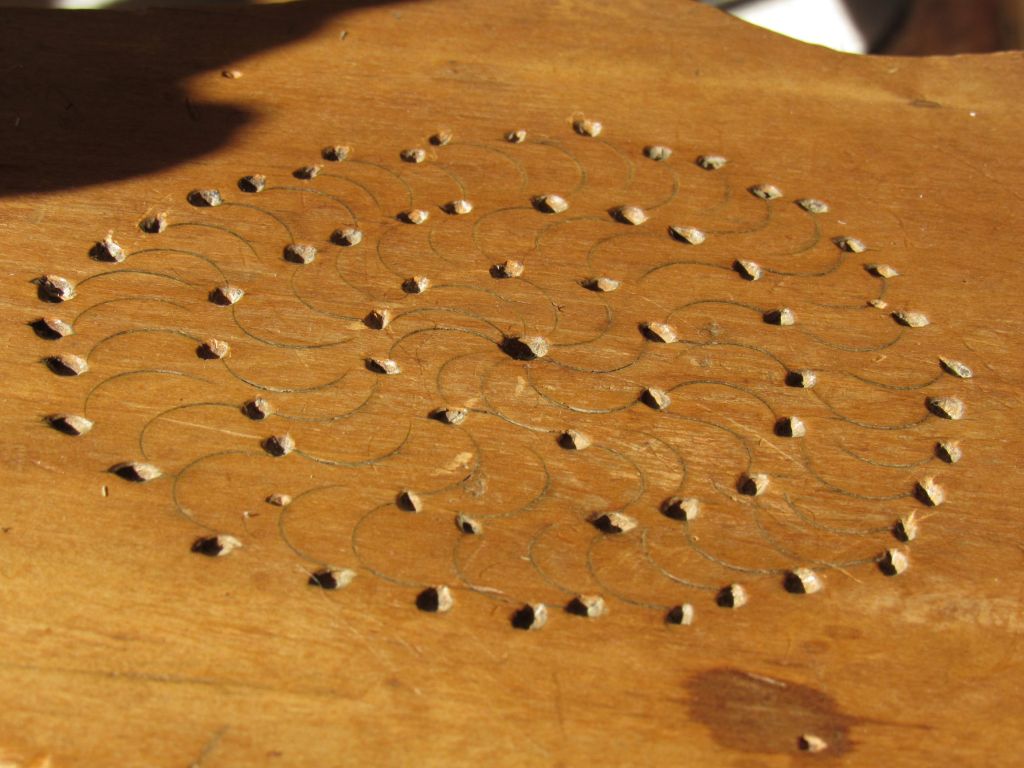
and two holes—possibly for a distaff and water dish for spinning flax. No ordinary production wheel.
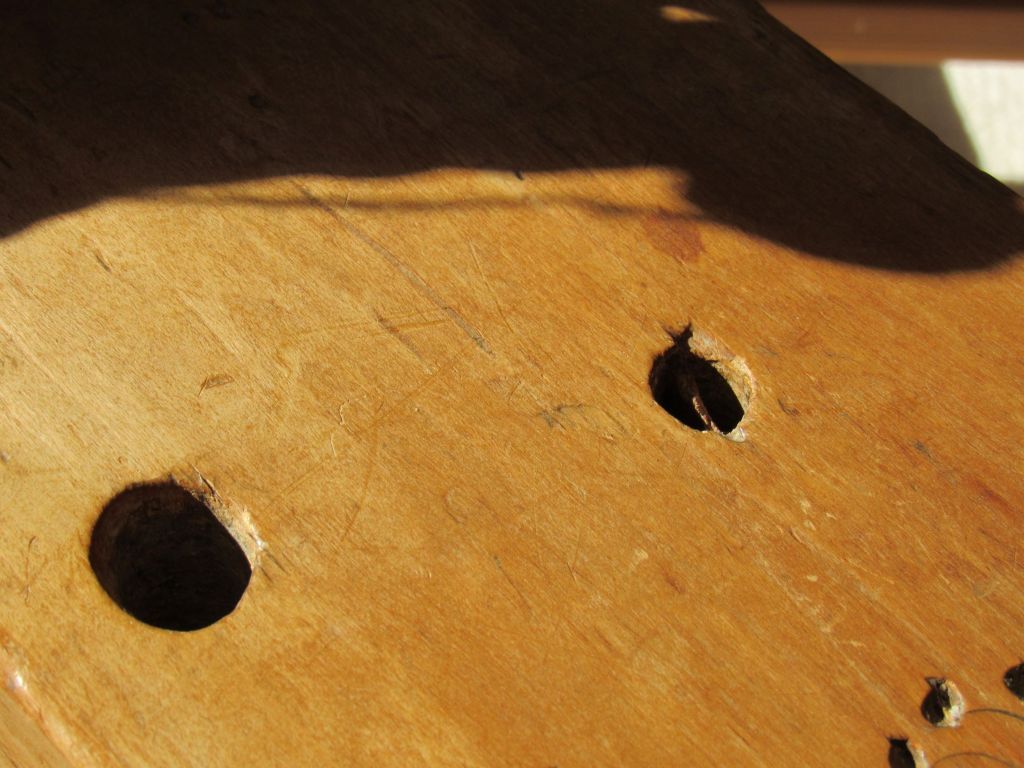
The sides curve in and out, with barely-visible chisel marks on the curved portions
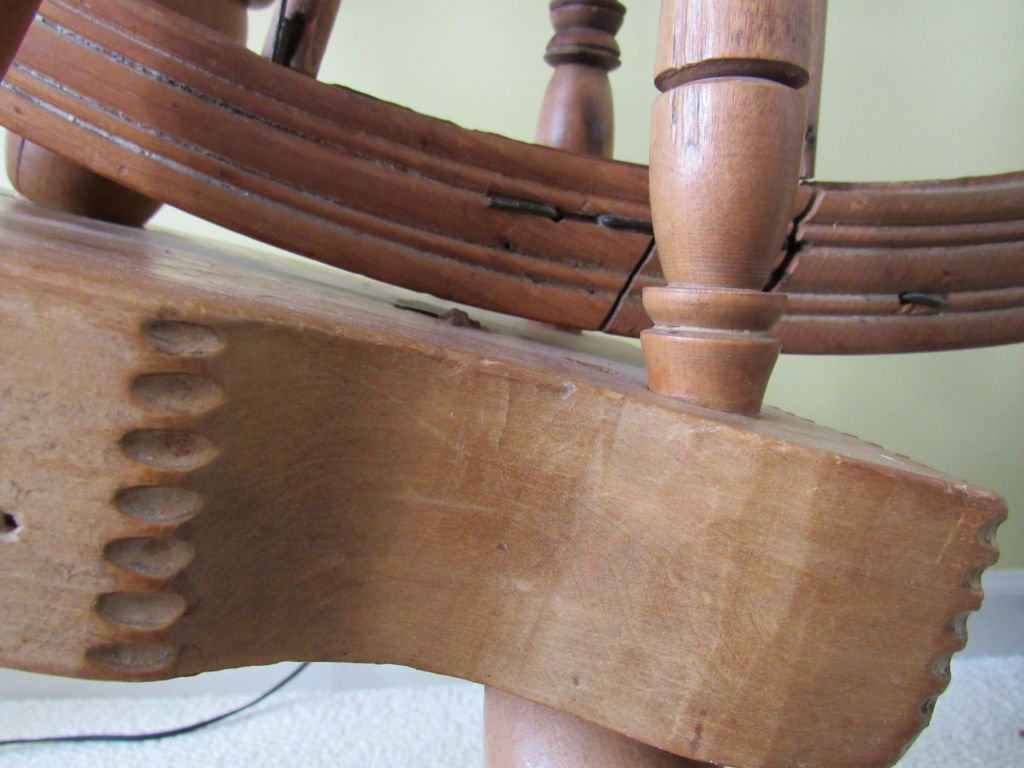
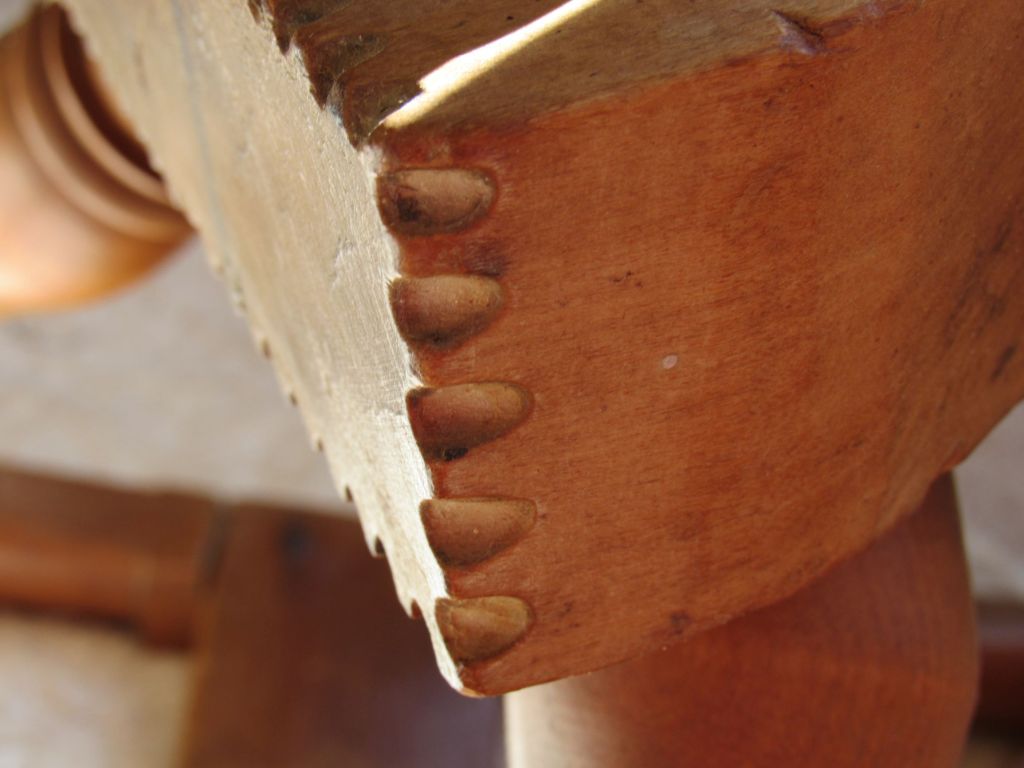
and chip carvings along the flat edges and ends.
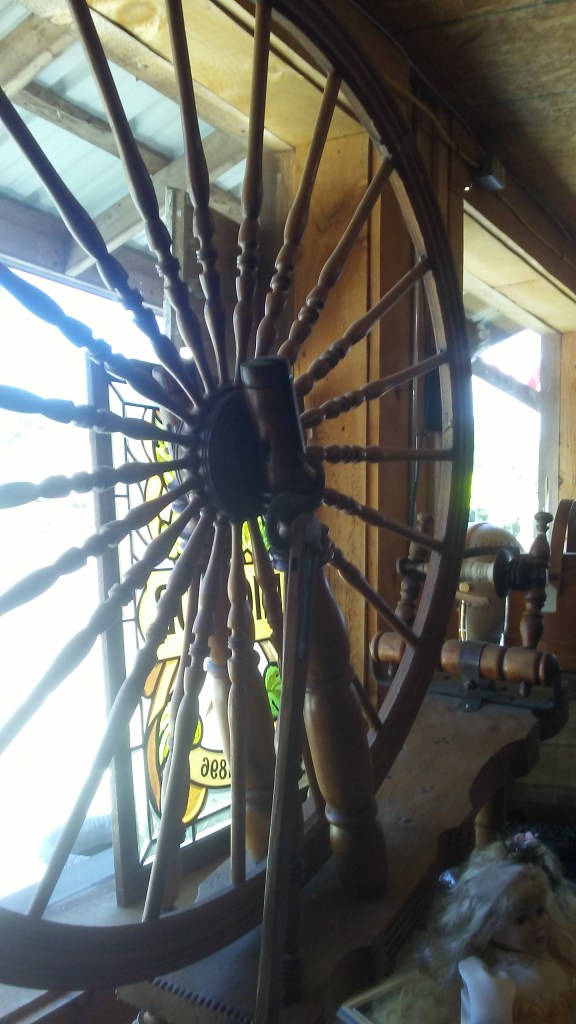
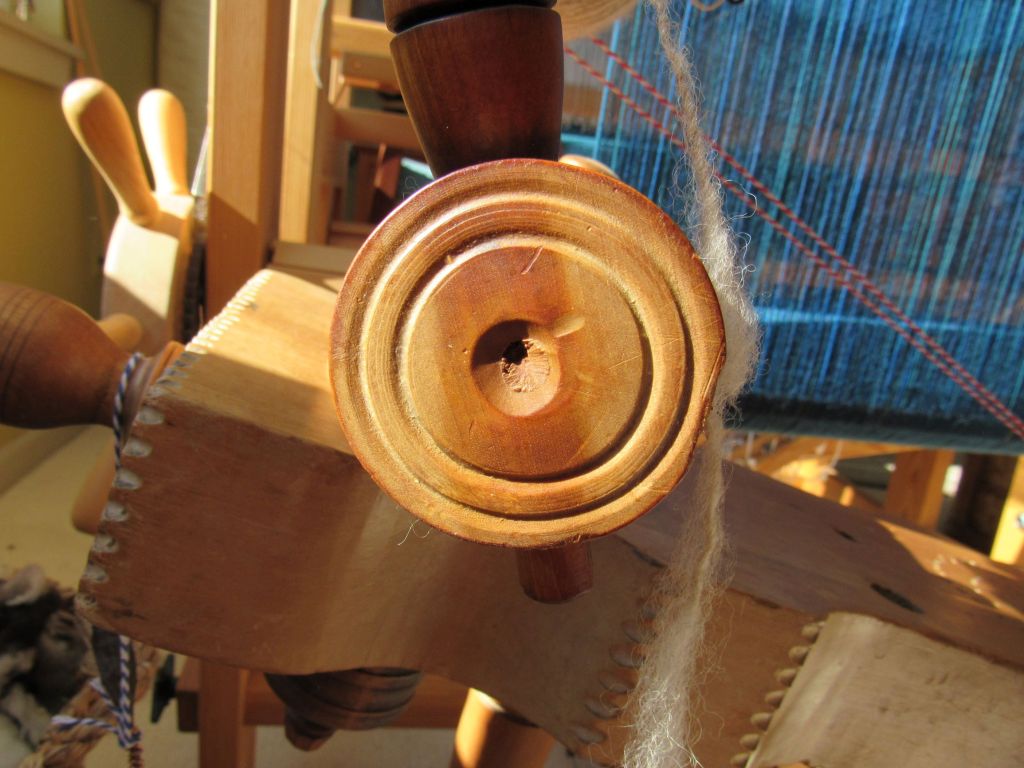
The 38” drive wheel has twenty exquisite spokes
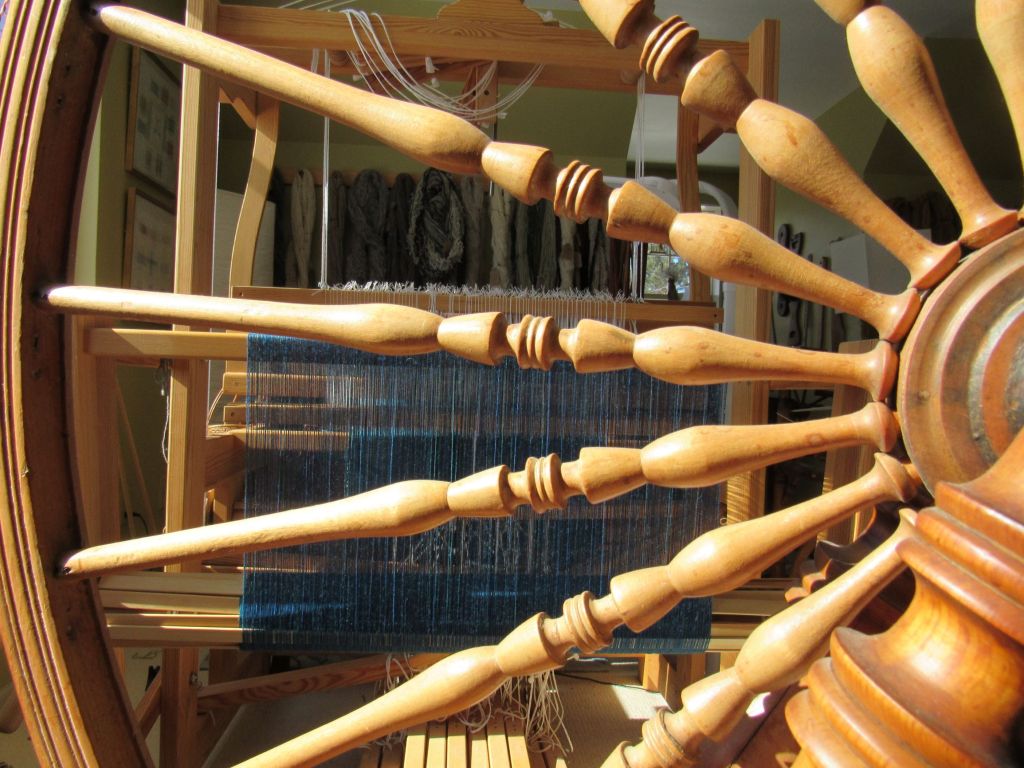
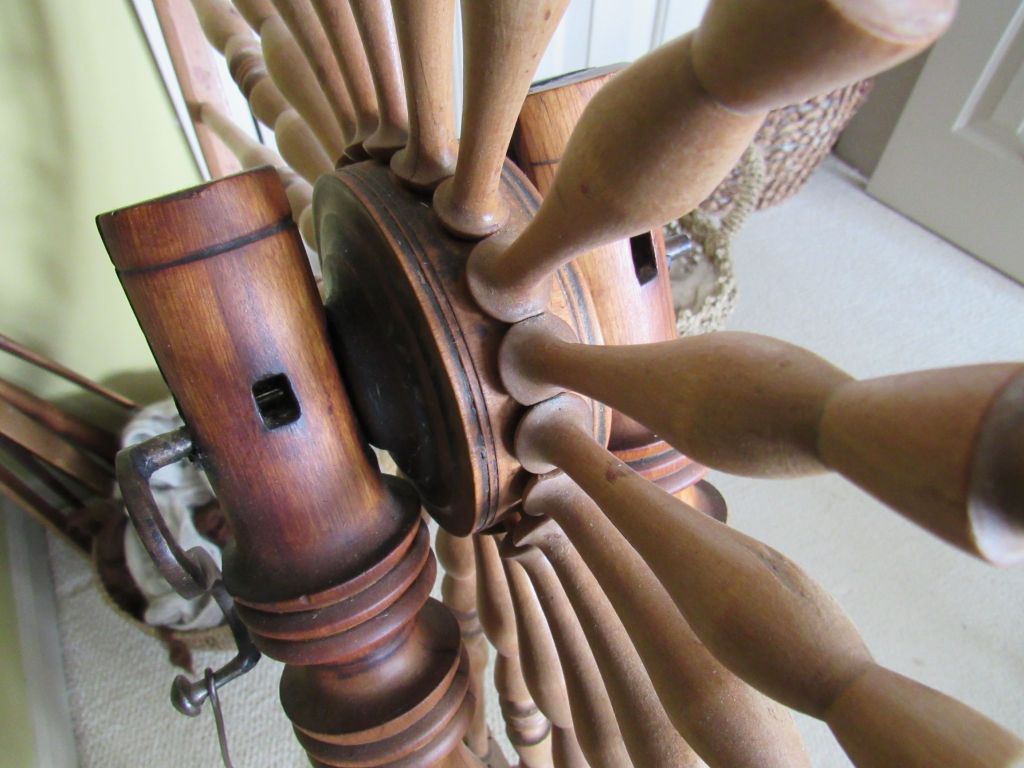
—so many that there is barely room for them in the hub, especially with their upside-down blossom shape.

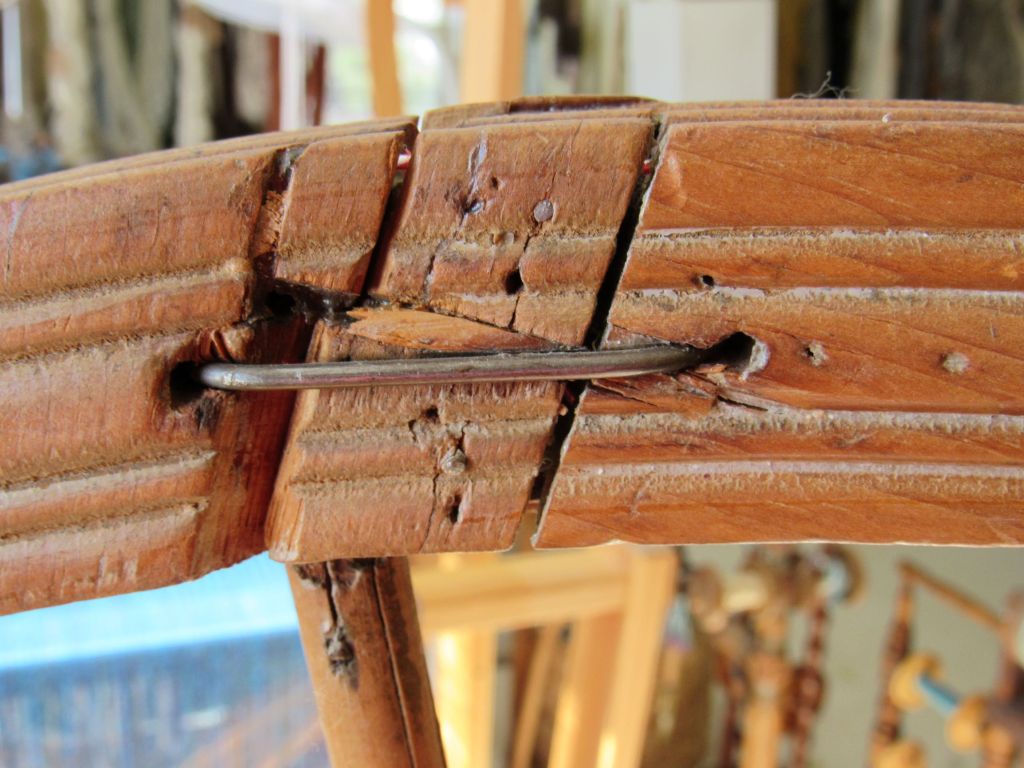
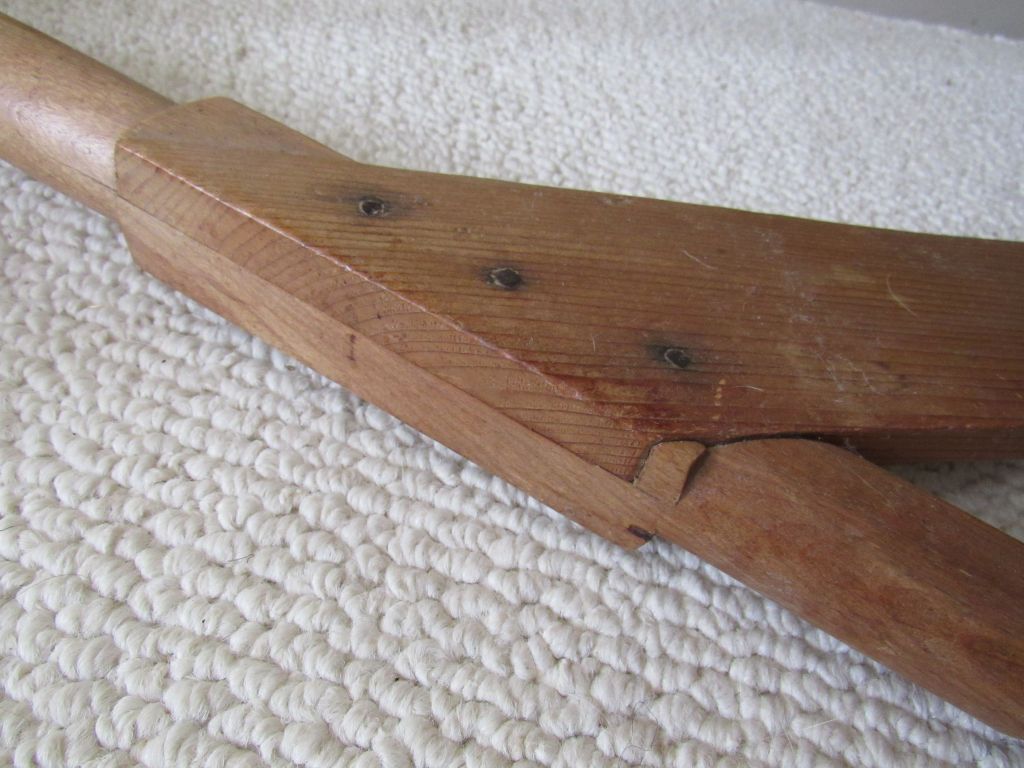
The drive wheel rim is relatively narrow, made of two long and two short pieces.
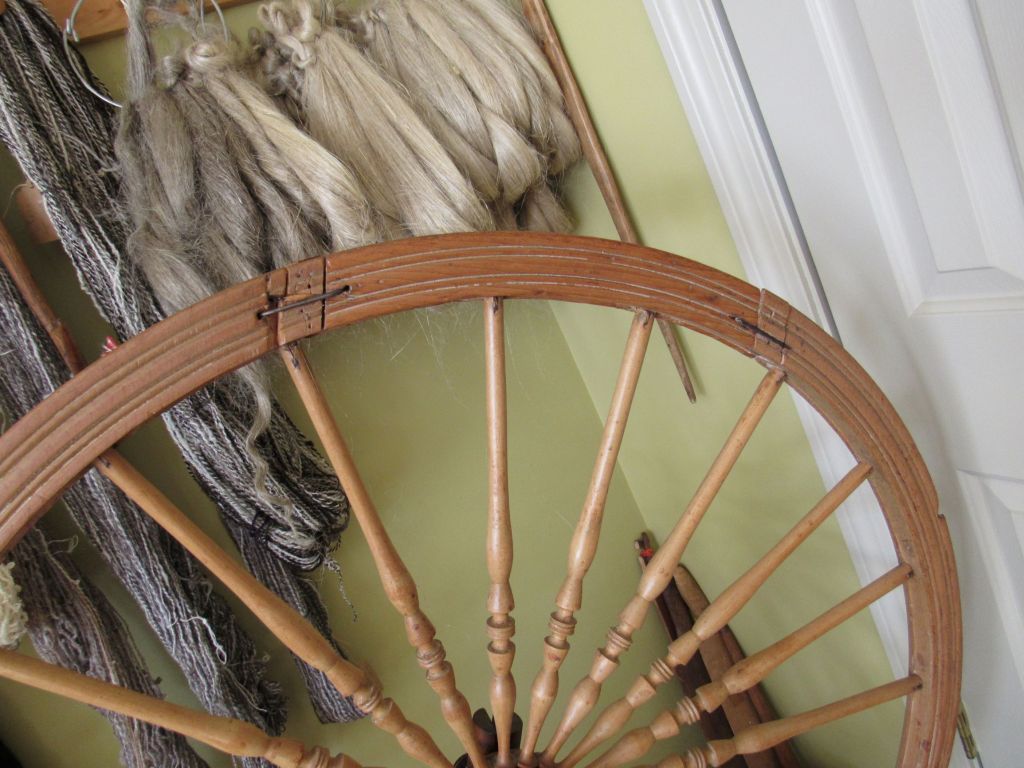
The joins are unusual and include a smaller piece of wood between the main pieces
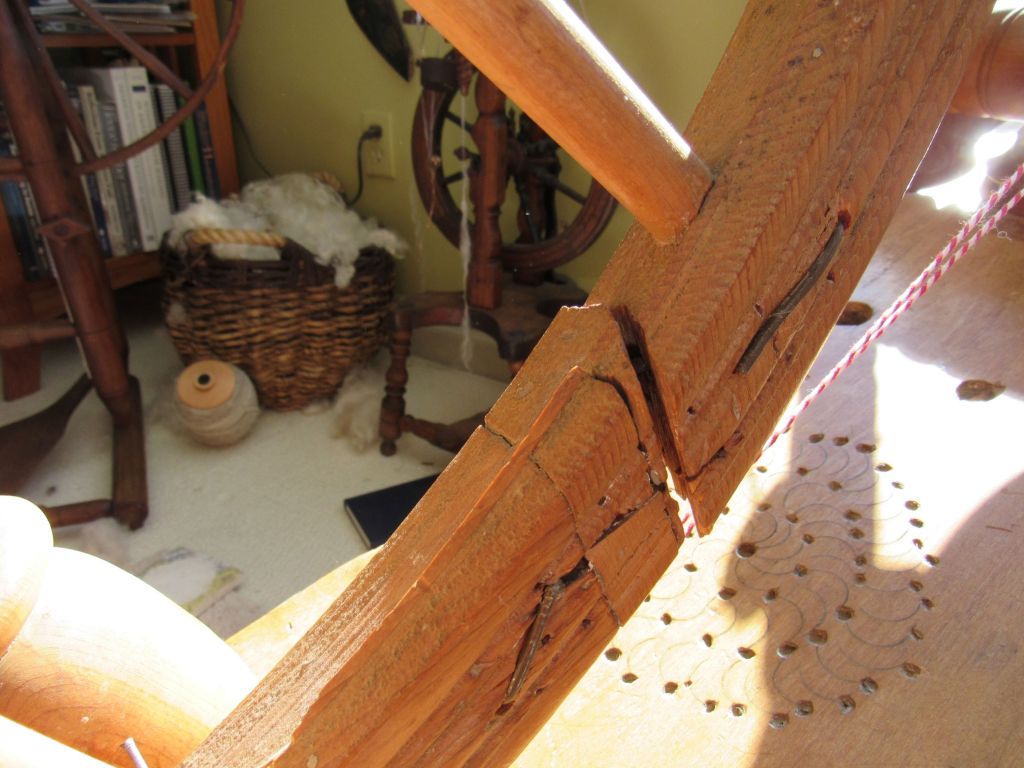
with thick metal wire reinforcements that likely were added well after the wheel was made.

The wheel itself barely clears the table.

One spoke was broken, but repairable, and others were loose, many with nails protruding–some barely hanging on.
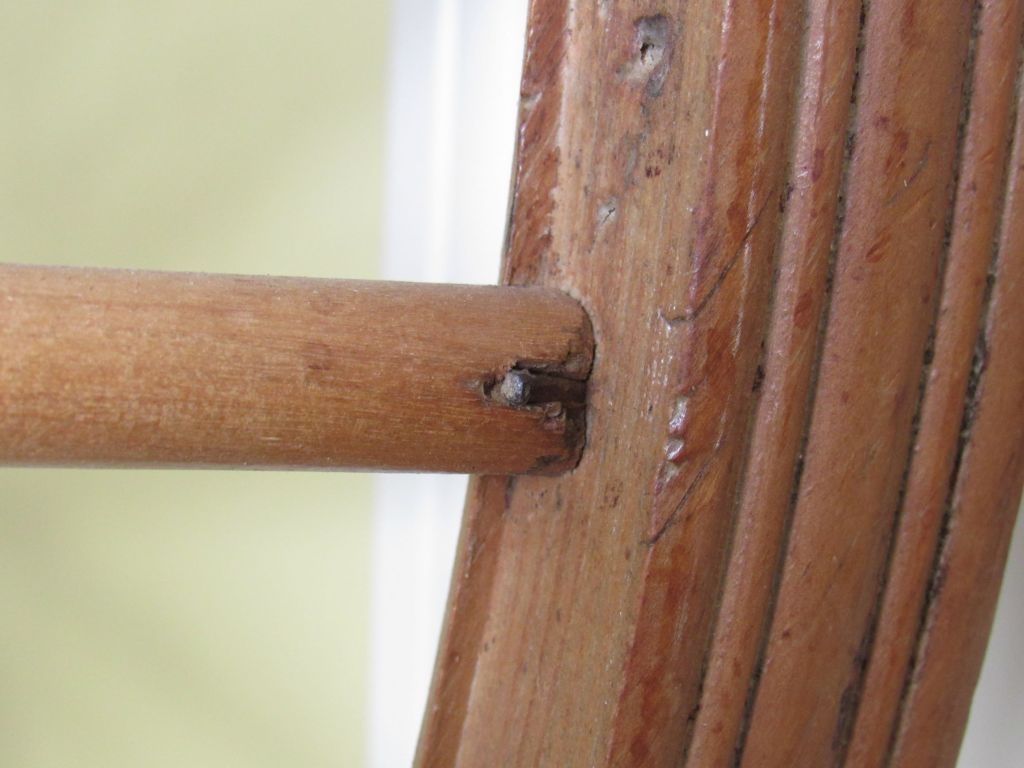
It looks as if the spokes were re-positioned on the rim at some point.
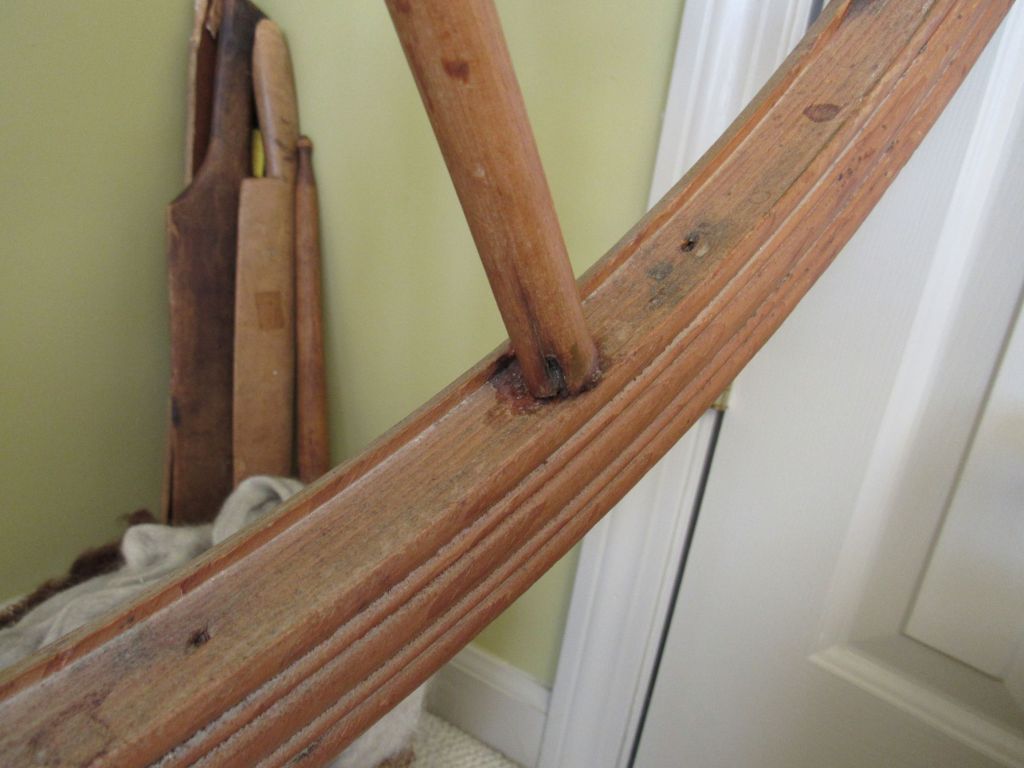
They are cut at angle where they butt up against a narrow lip.

The wheel uprights measure an impressive 7 ½” circumference.

They are held in place under the table with large pegs.

There are secondary upright supports on both sides.
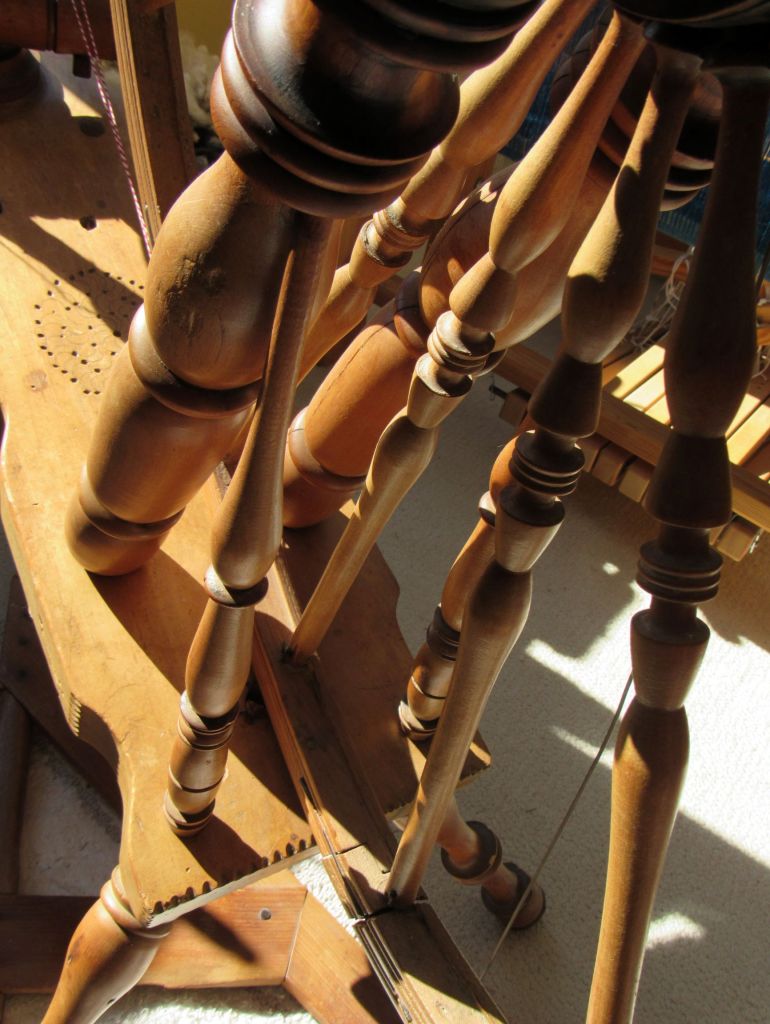
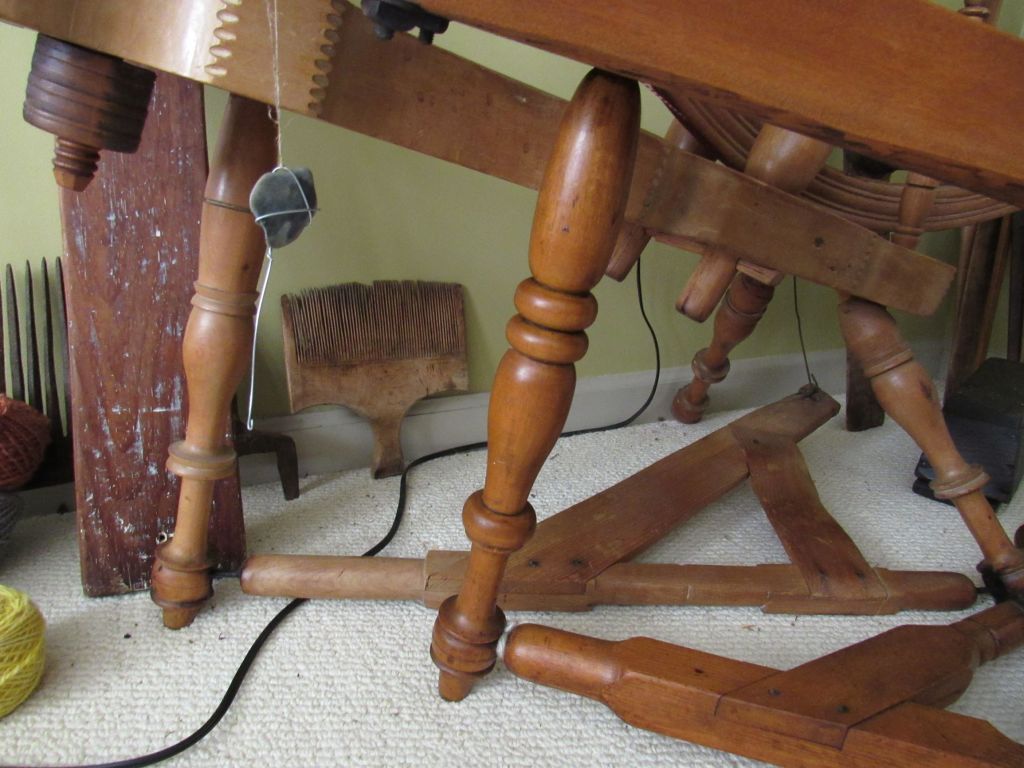
The wheel has relatively short legs—only 13” at the downhill end—with chubby feet.
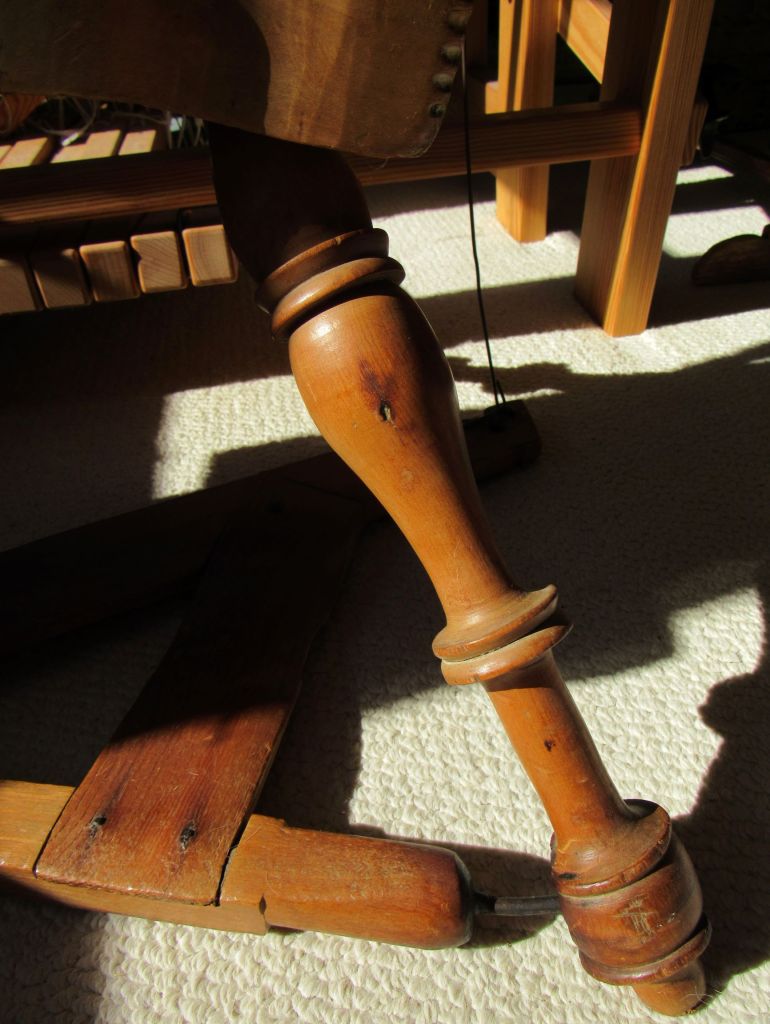
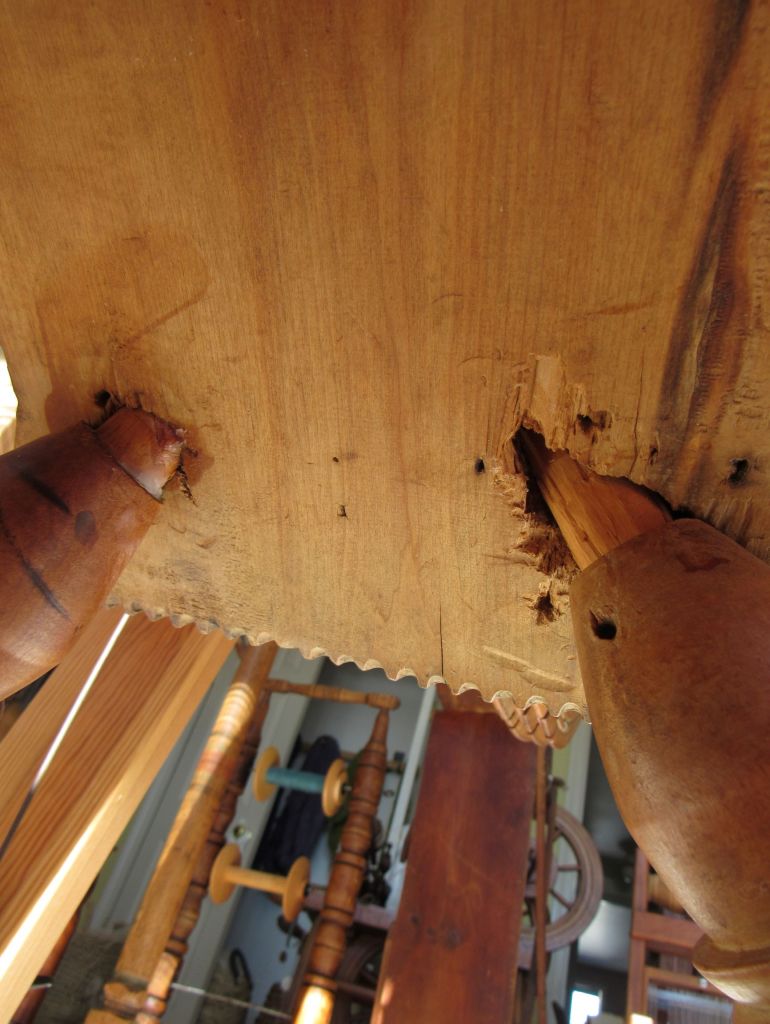
In contrast with the fine work on the rest of the wheel, the hole for one of the legs is rather crudely dug out.
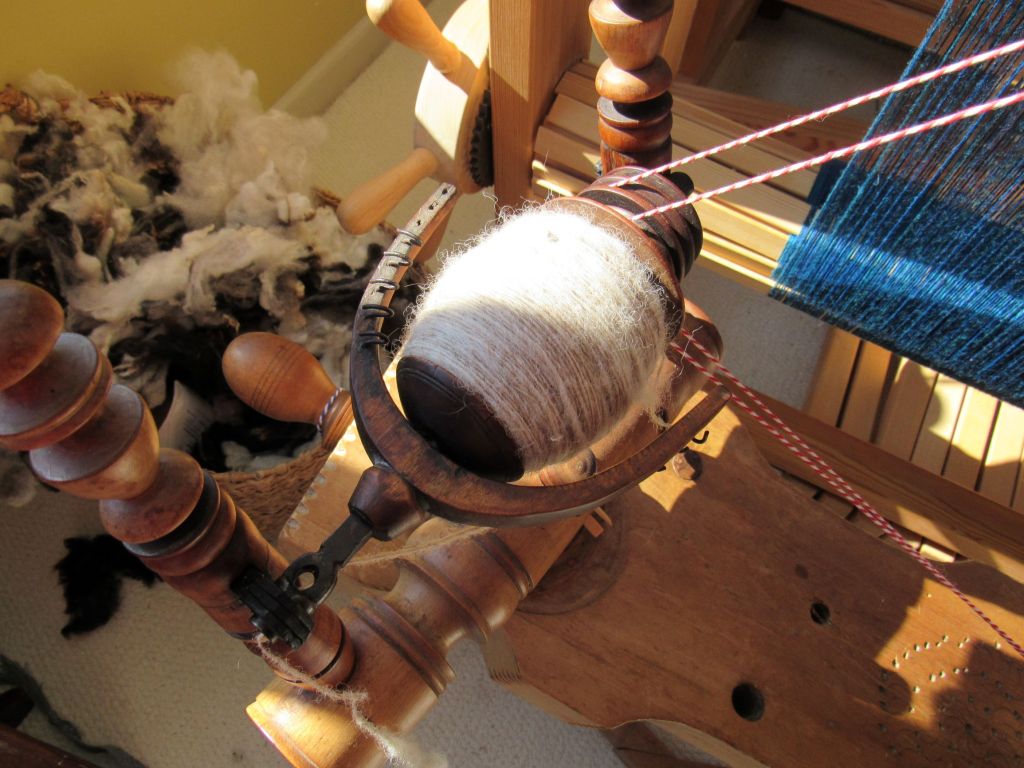
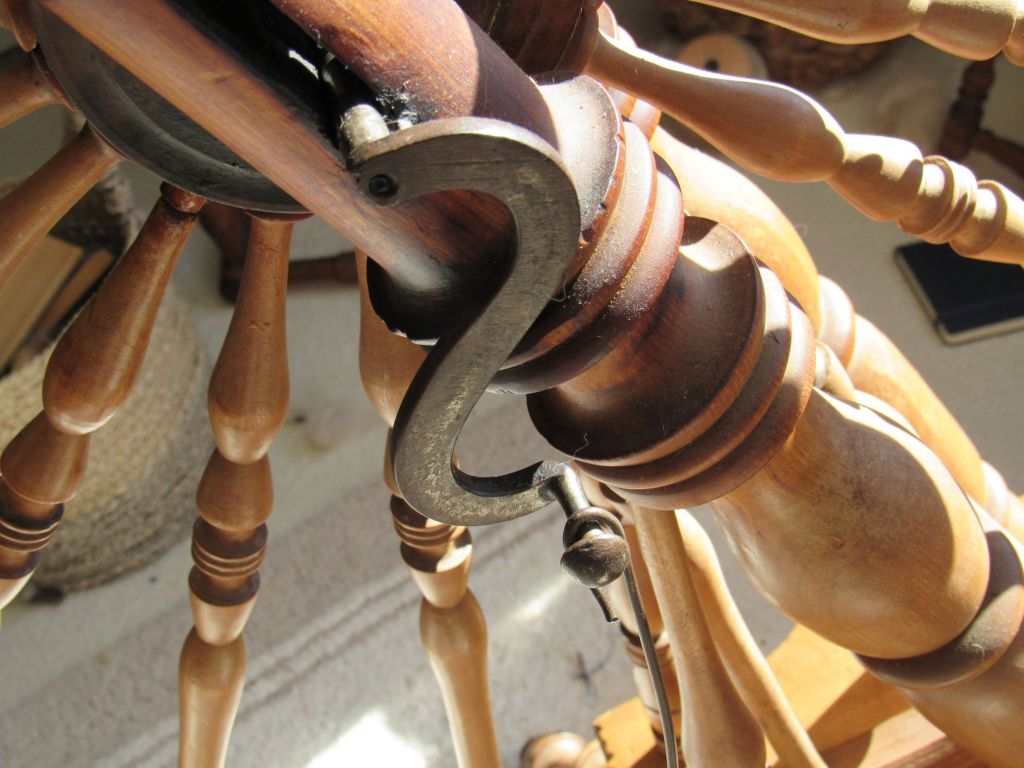
There is a graceful S-shaped crank
and metal footman
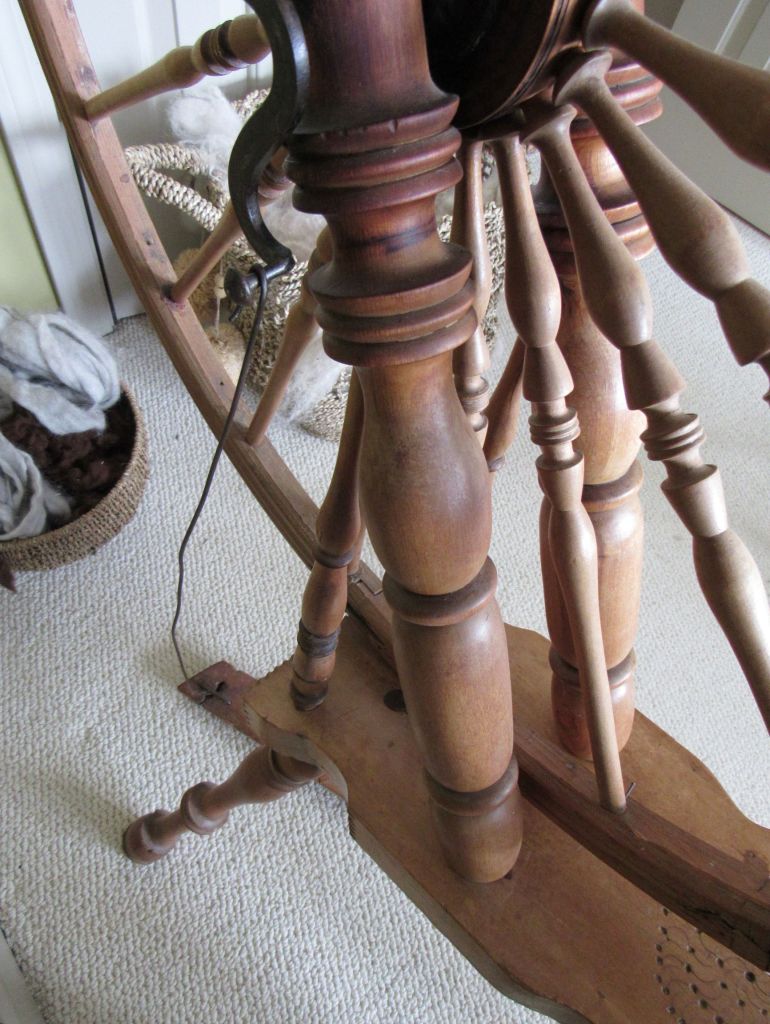
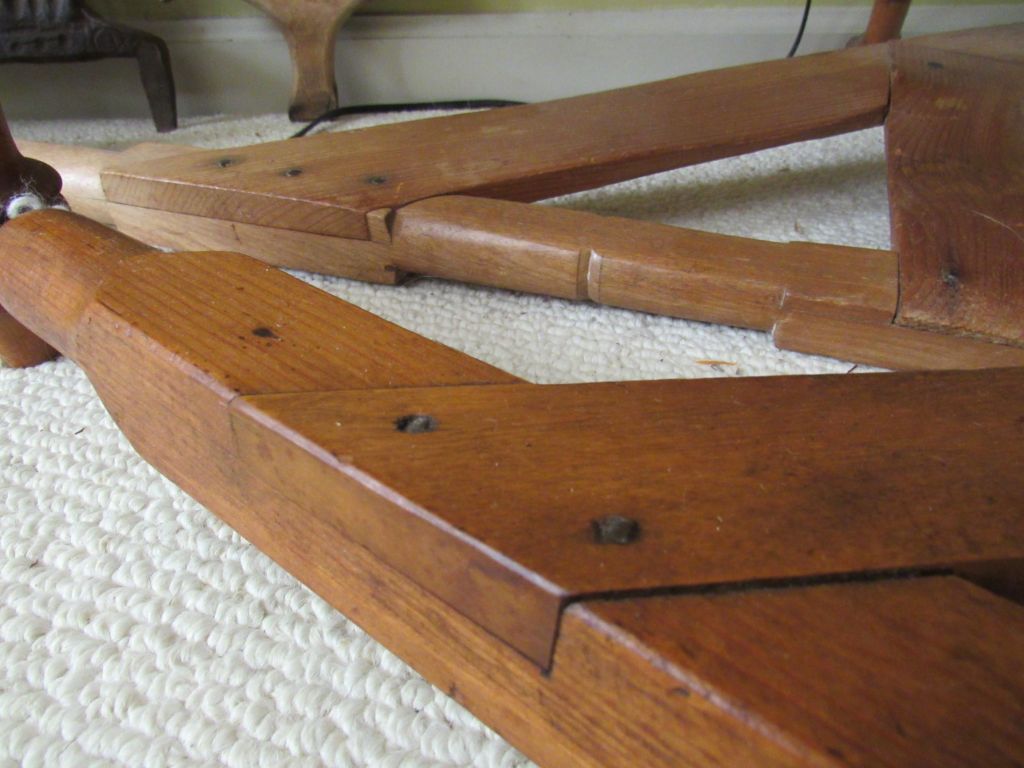
and a beautifully made treadle and treadle bar, wide enough for the two-footed treadling that keeps the momentum smooth and easy for such a big wheel.
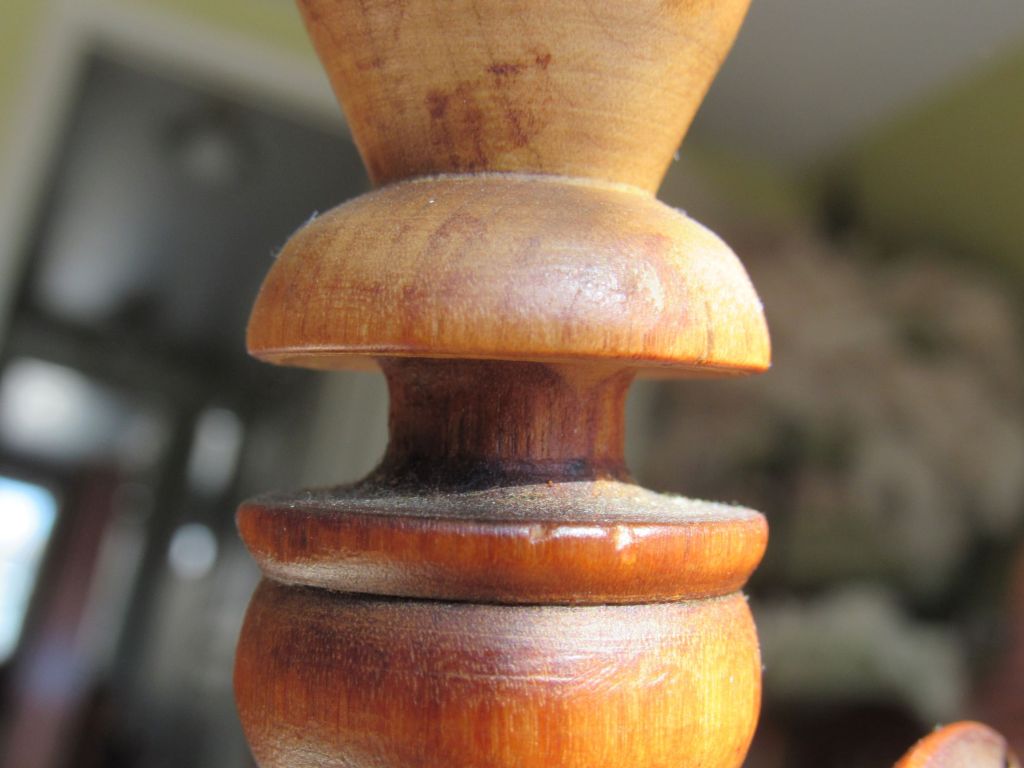
The maidens are unusually lovely and a hallmark of this wheel family.
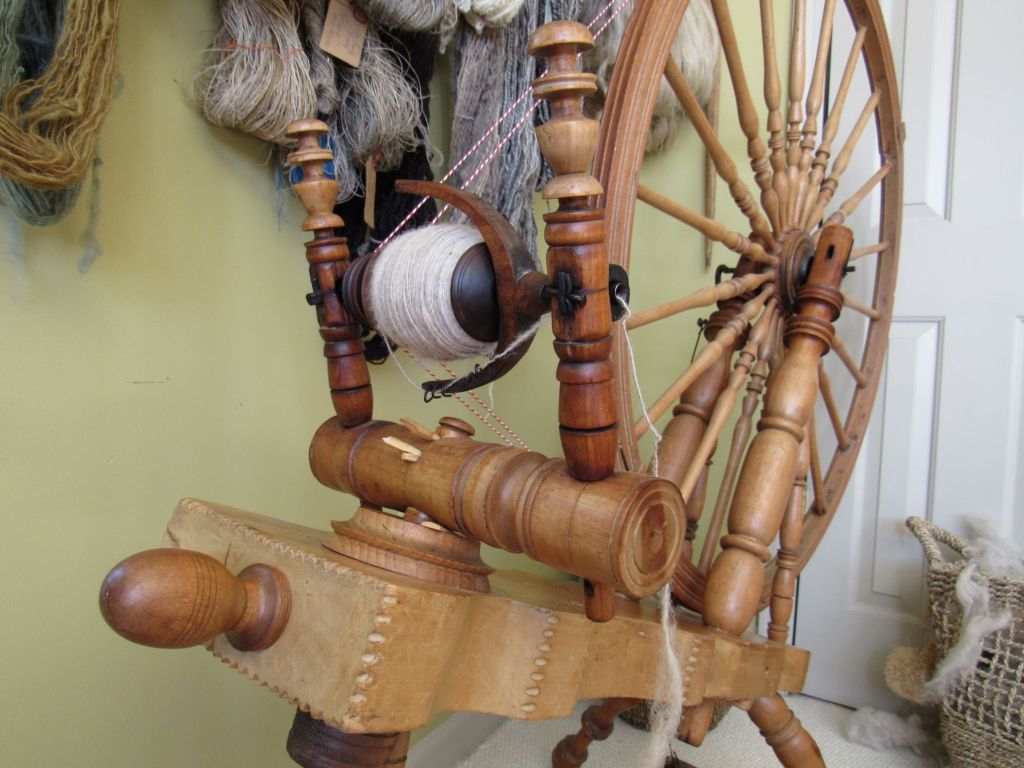
Interestingly, the top parts of the maidens are very light and the lower parts much darker.
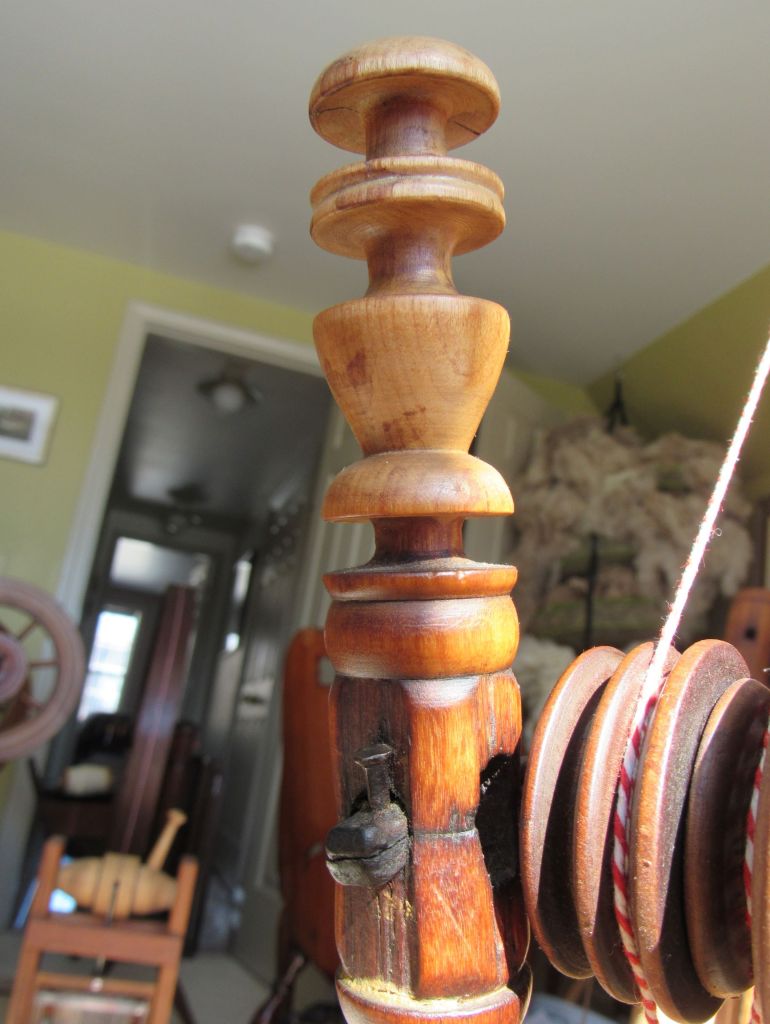
At first, I thought that the tops were a different wood type attached to a darker wood below. But there is no join, so perhaps they were stained differently for decorative effect.
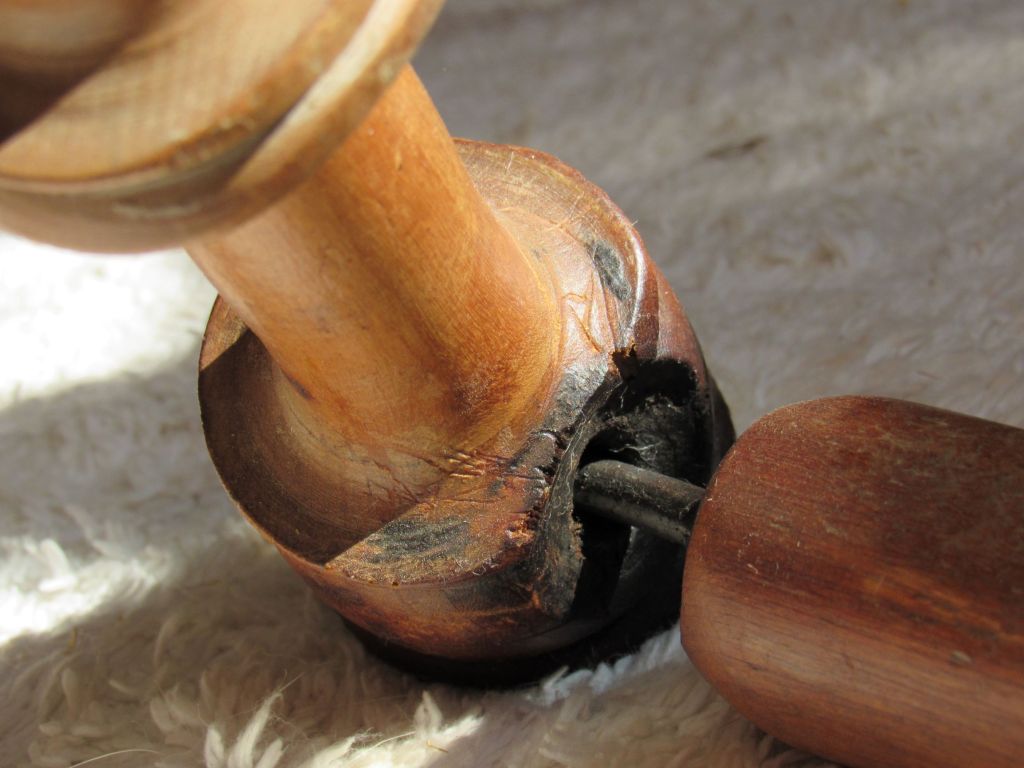
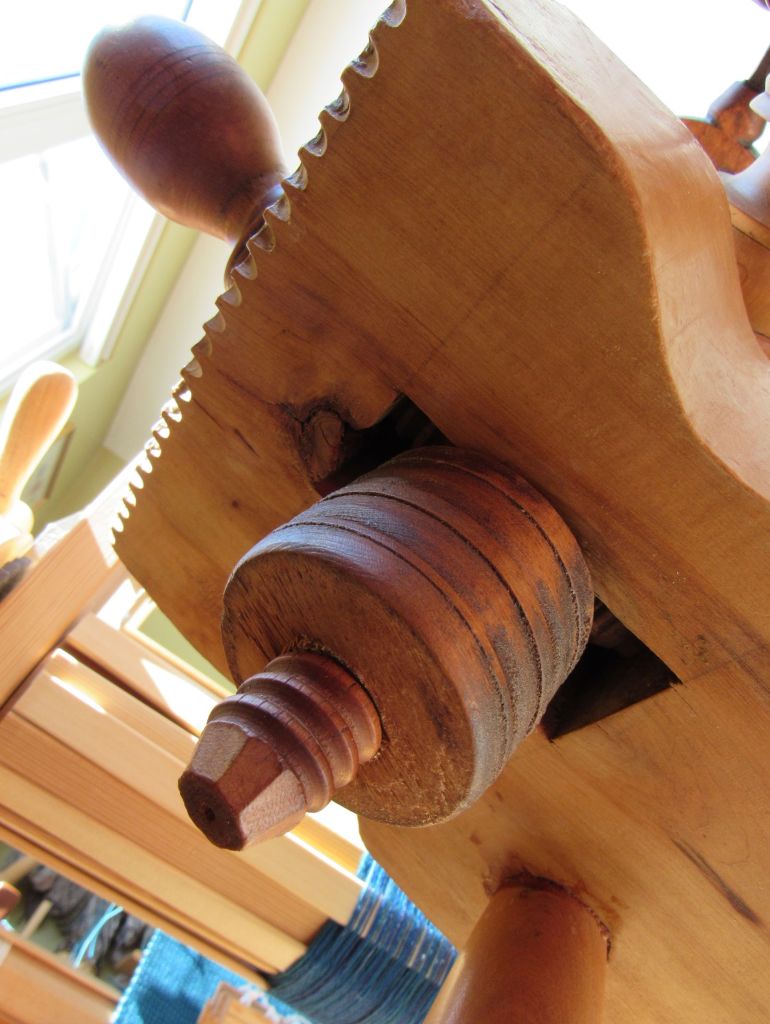
The mother-of-all is secured by a large nut underneath the table—something more often seen in Scandinavian wheels than Quebec wheels.
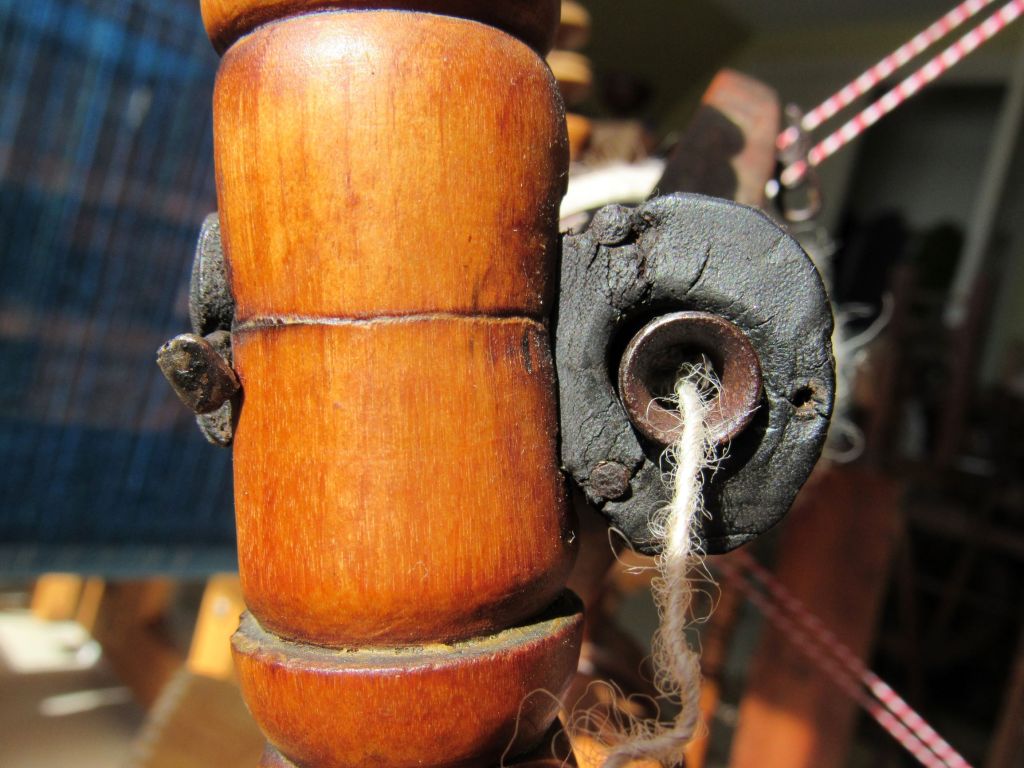
The orifice is smooth–not fluted.
Because the wheel has a screw tension, and very large drive-wheel, under the current definition, it is not considered to be a Canadian Production Wheel (CPW) even though it spins very fast and fine.
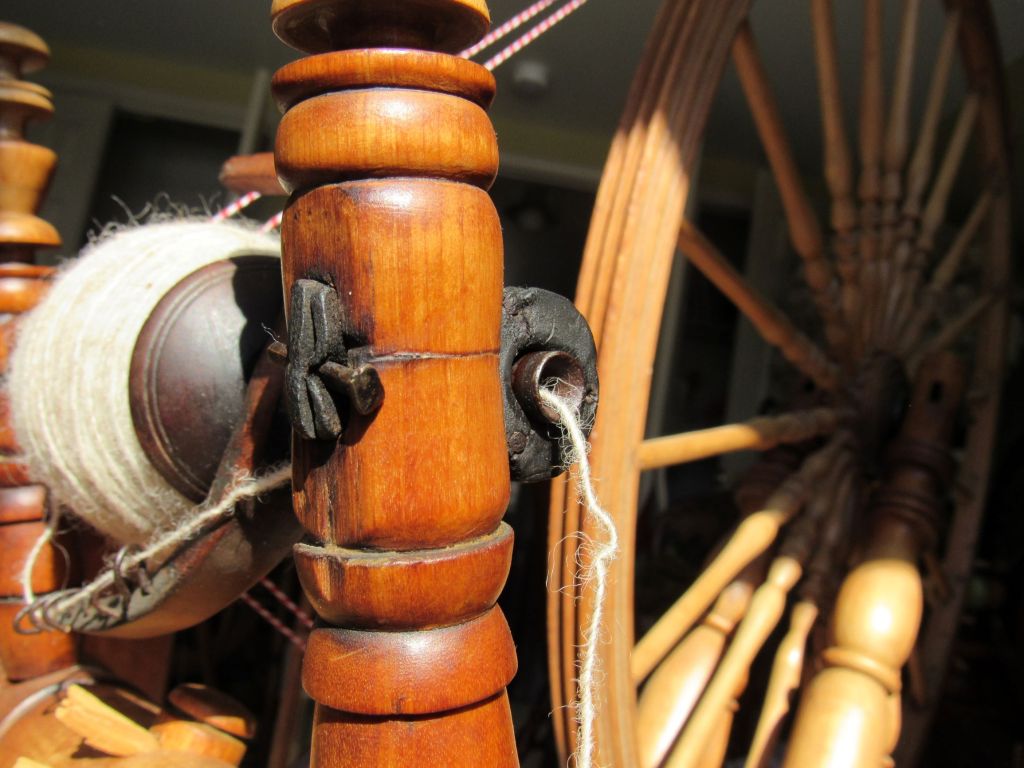
It is a wheel of flair, elegance, and whimsy, designed to be noticed.
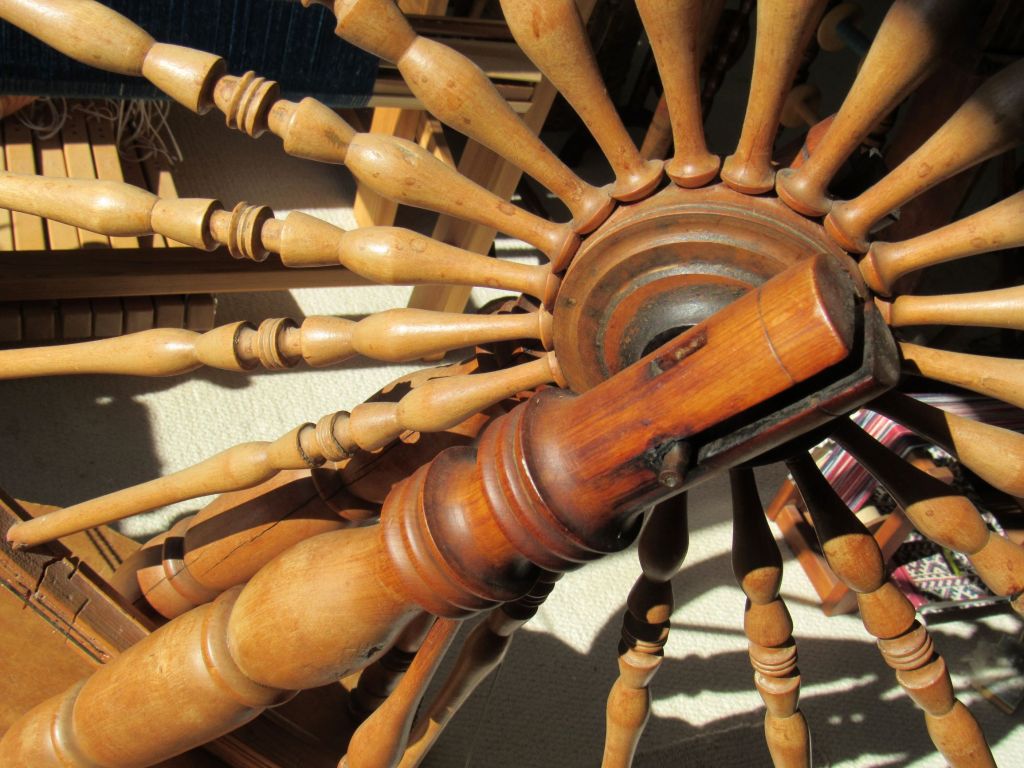
One reason this family of wheels is fascinating is because they are so different from other Quebec wheels. In her book, Cummer suggested that they may have been made in the Eastern Townships of Quebec, which had a heavier English influence than other areas of Quebec.

But the wheels have no maker’s mark and there does not appear to be any evidence, other than speculation, that they are from the Eastern Townships. What interests me, however, is the similarity of these wheels to others that do have maker’s marks—most specifically to those made by Elie Laporte (featured in the last post “Fleur”). It was the spokes that first caught my attention—the upside-down blossom shape where they meet the hub.
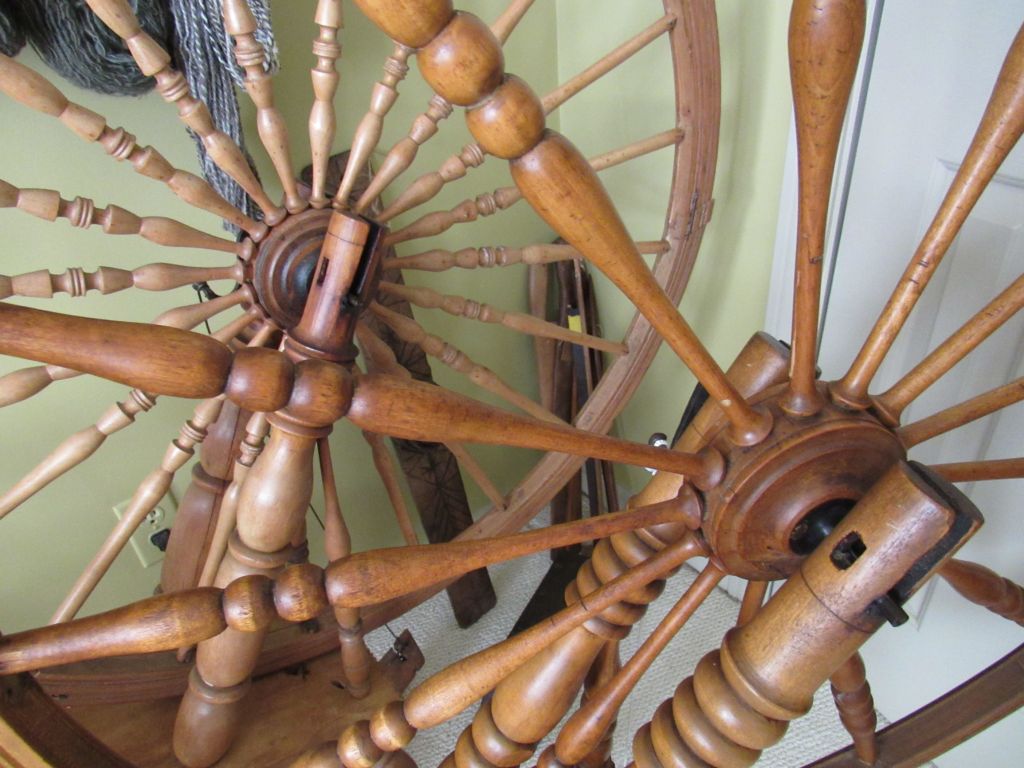
The only time I have ever seen such spokes is on the mystery wheels and Laporte wheels. Looking at the wheels side by side, so many other similarities are striking—the low profile, the large size,
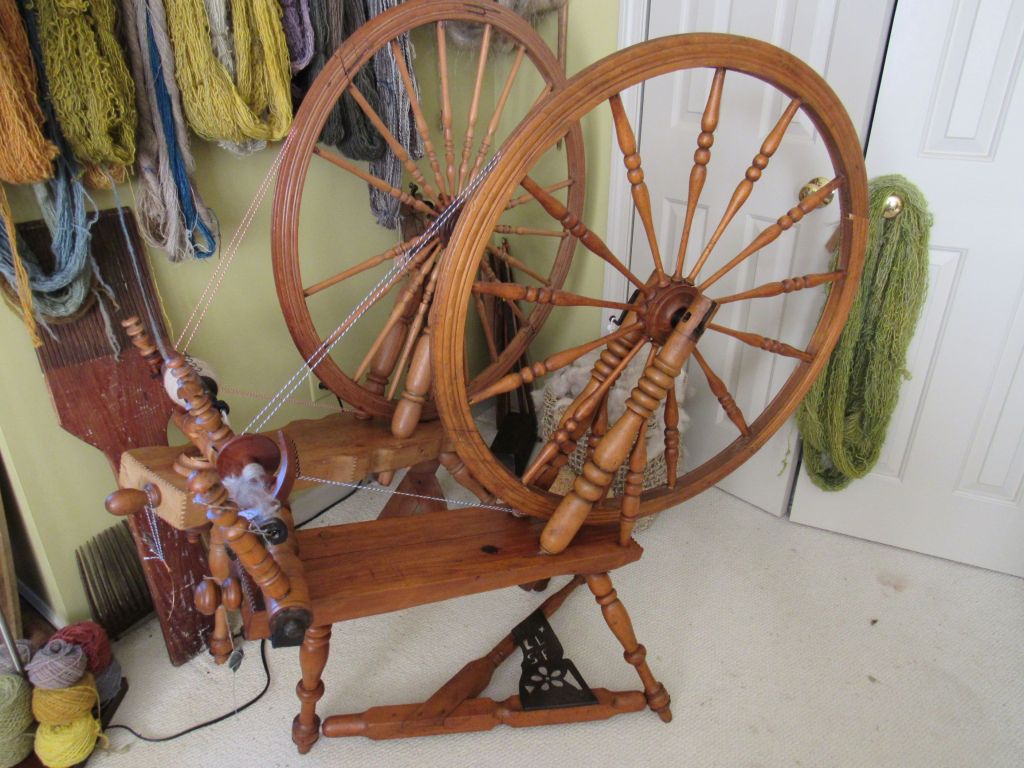
the distinctive maidens,

the legs, the treadle joins,
the rims,
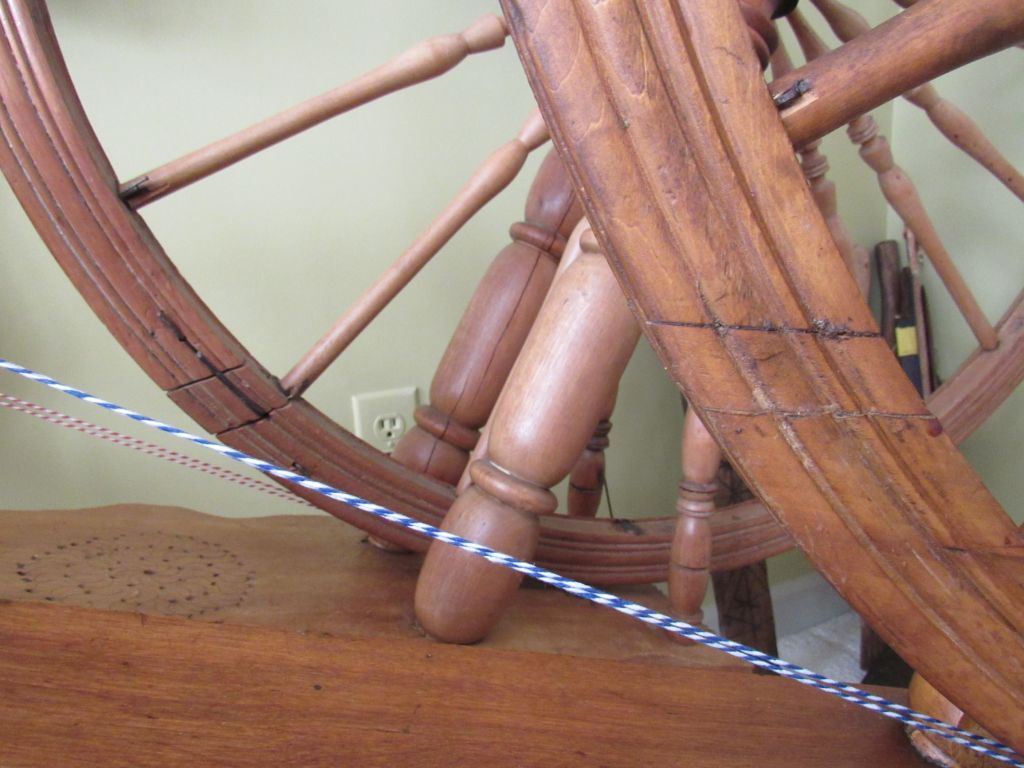
the deep cuts for the axles, the secondary upright supports.

Could Laporte have made all of these wheels?

Or could his father, who was also a wheel maker, have made the earlier screw tension wheels, while Elie carried on with tilt-tensions? Or was this a wheel style from the Yamaska area, where Laporte made his wheels?
We know of another similarly-styled wheel made by Jean Baptiste Houle (marked “JBH”), who also lived in Yamaska, in a town near Laporte’s. It is a screw tension with the wooden nut underneath, short legs, similar (but slightly different) maidens, chip carved ends, and a heavy long table with an odd rectangular hole cut in it. Houle (1818-1884) was a generation earlier than Laporte (1845-1919). Could there be some connection?
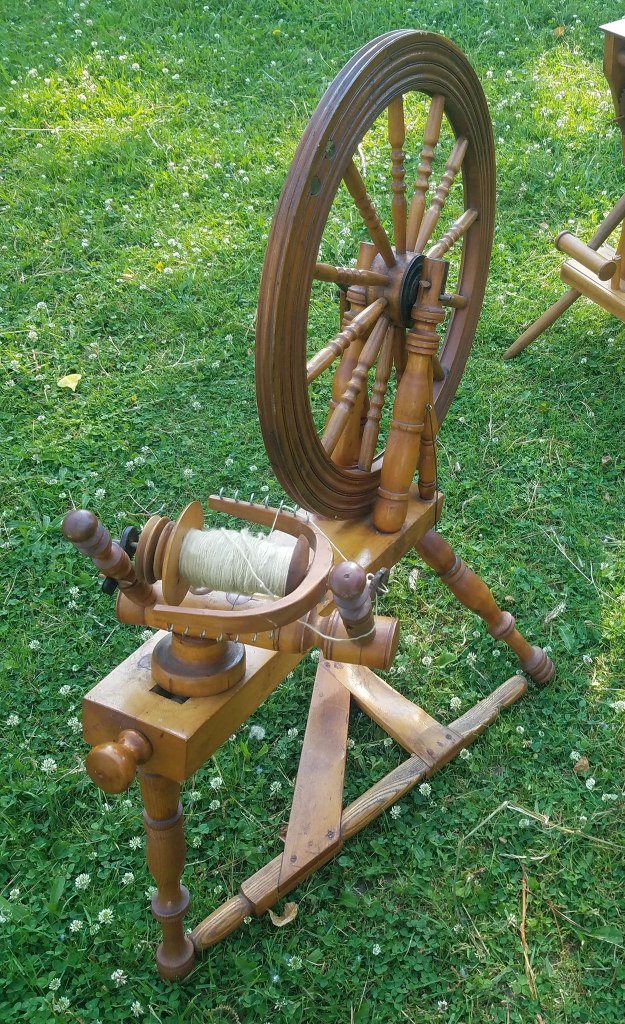
Another intriguing wheel surfaced on Facebook several months ago and shares some similarities with these wheels. It is a screw tension with the unusual wooden nut under the table and has similar maidens, legs, and treadle construction.
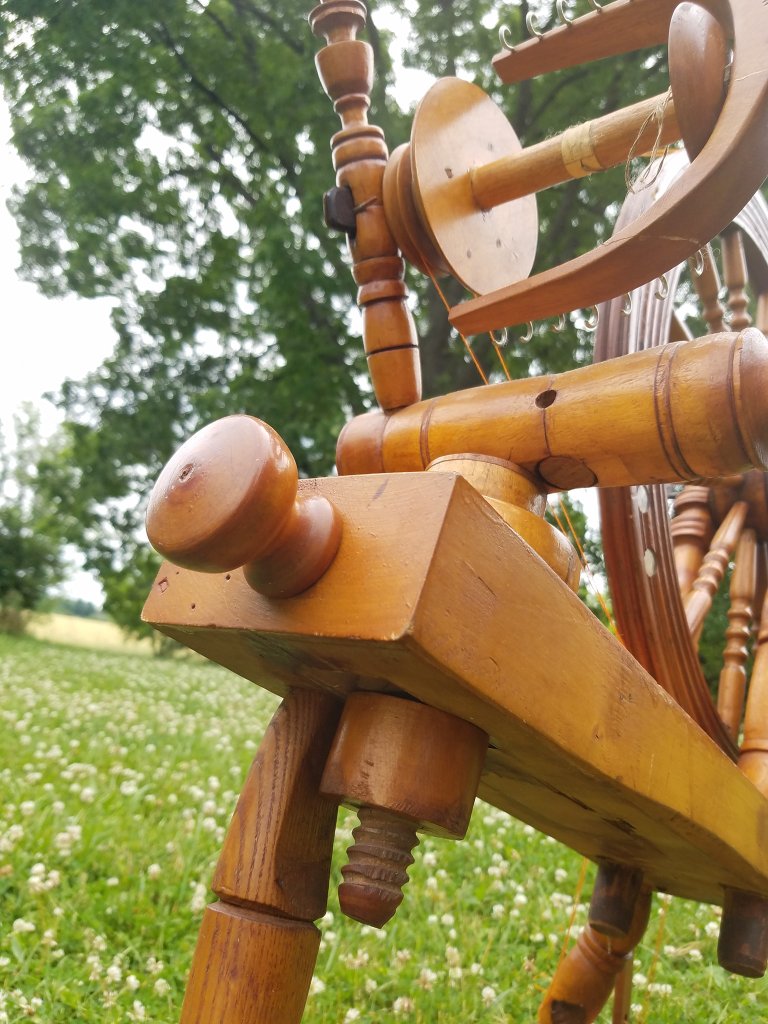
The table has a cut out box in it, with a cover stamped with the name “D. Stewart” and an embedded 1857 coin marked with “Bank of Upper Canada.”
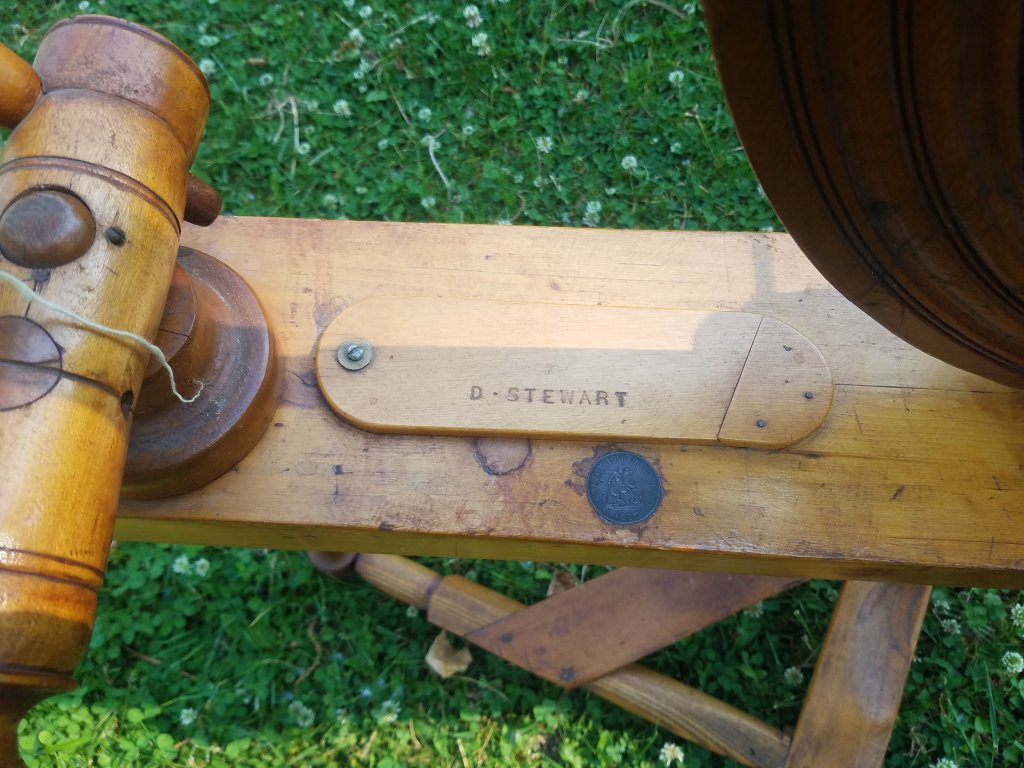
The end of the wheel also had the name stamp and an accompanying reel had another embedded coin. From the style of the stamp, which is different than most maker’s marks, it seems likely that it is the name of the wheel owner rather than maker. But, who knows? This wheel looks newer than the others and remains a mystery. But its similarities to the others suggest there may be some connection.
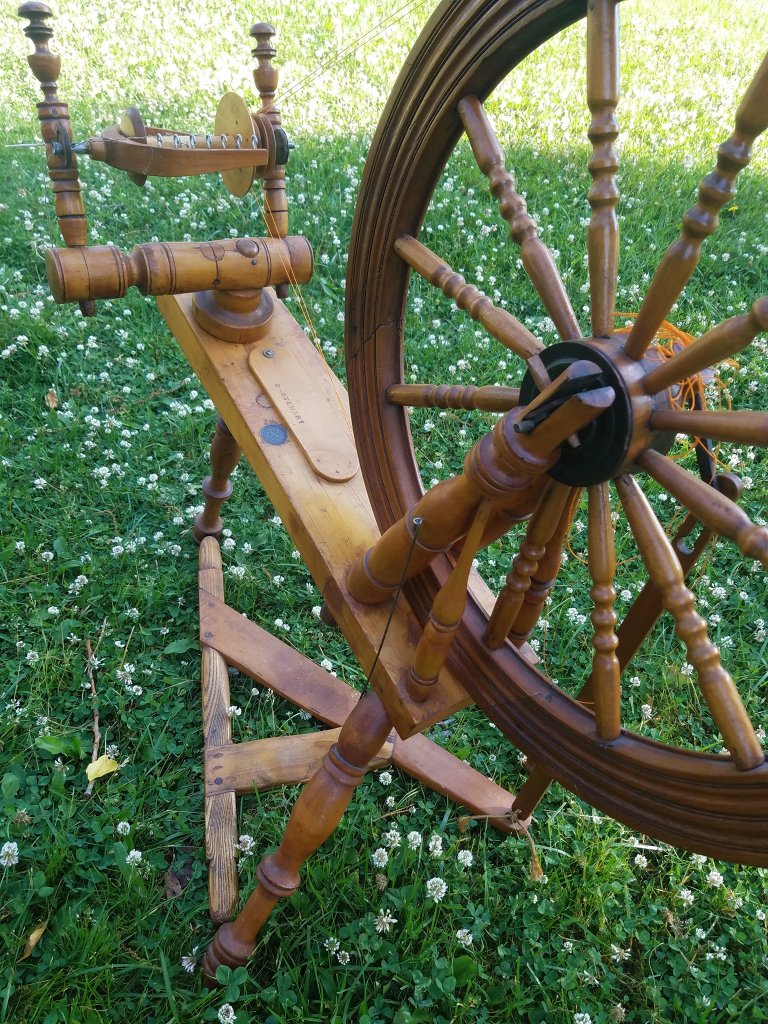
For now, Olympe and her family wheels remain a mystery, but it feels as if we are getting closer to solving it.

Thank you to Lisa Pohl Davis for allowing me to use the photos of her D. Stewart wheel.
For more information on this family of wheels:
Cummer, Joan, A Book of Spinning Wheels, Peter E. Randall, Portsmouth, N.H. 1984. Wheels 94 and 95 are on pages 204-207.
Foty, Caroline, “A Family of Wheels of Unknown Origin,” The Spinning Wheel Sleuth, #100 (April 2018).
 Exquisite Machinery