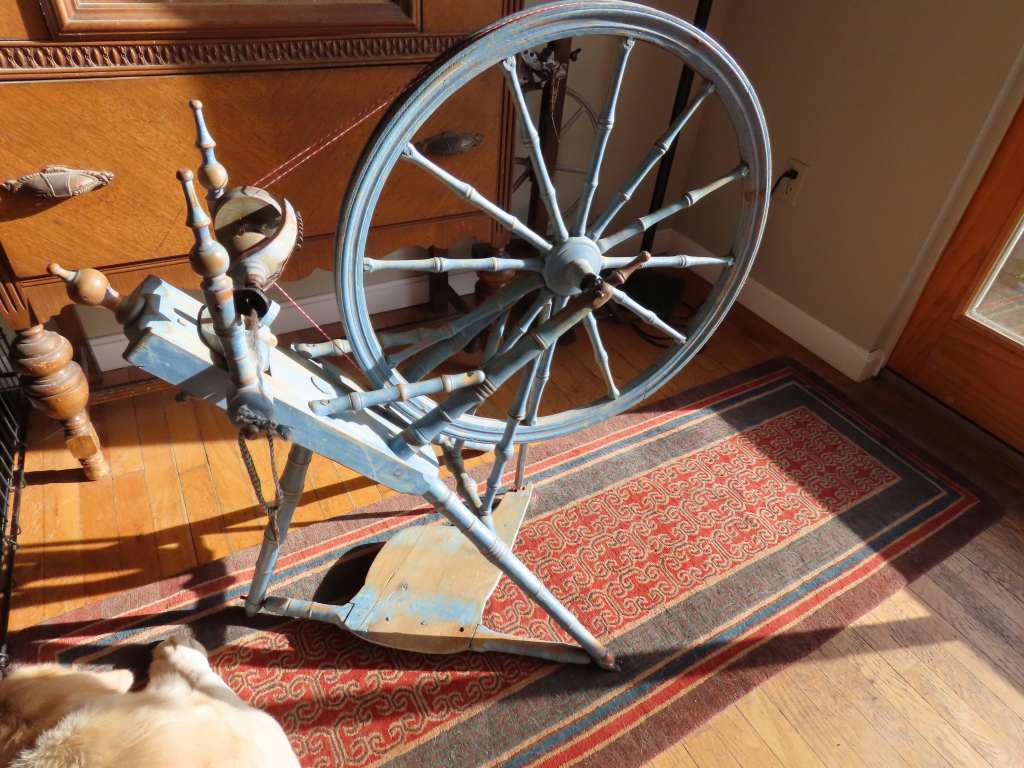
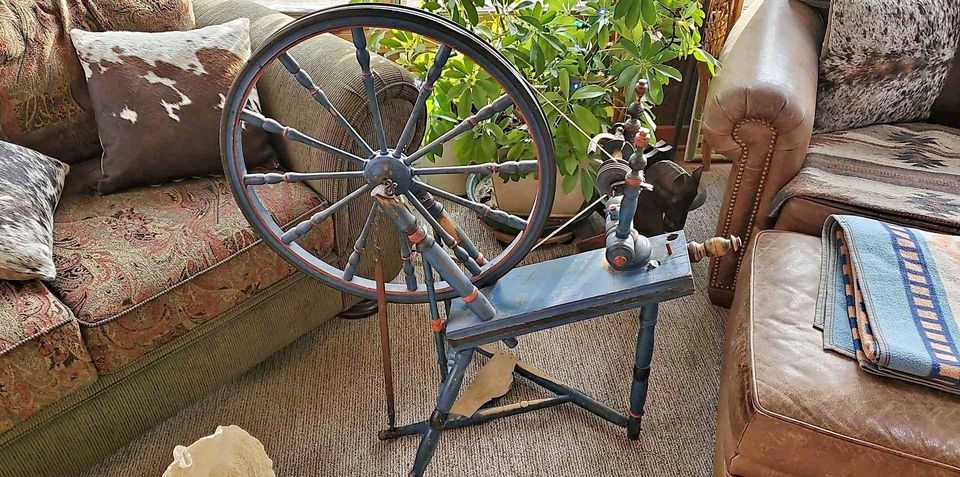
It looks like a combination of two Norwegian styles, with the small table from a double-table style
grafted on to a slanty with decorative bits in between.
It is brilliant, actually, giving the stability of a flat table and a small footprint.
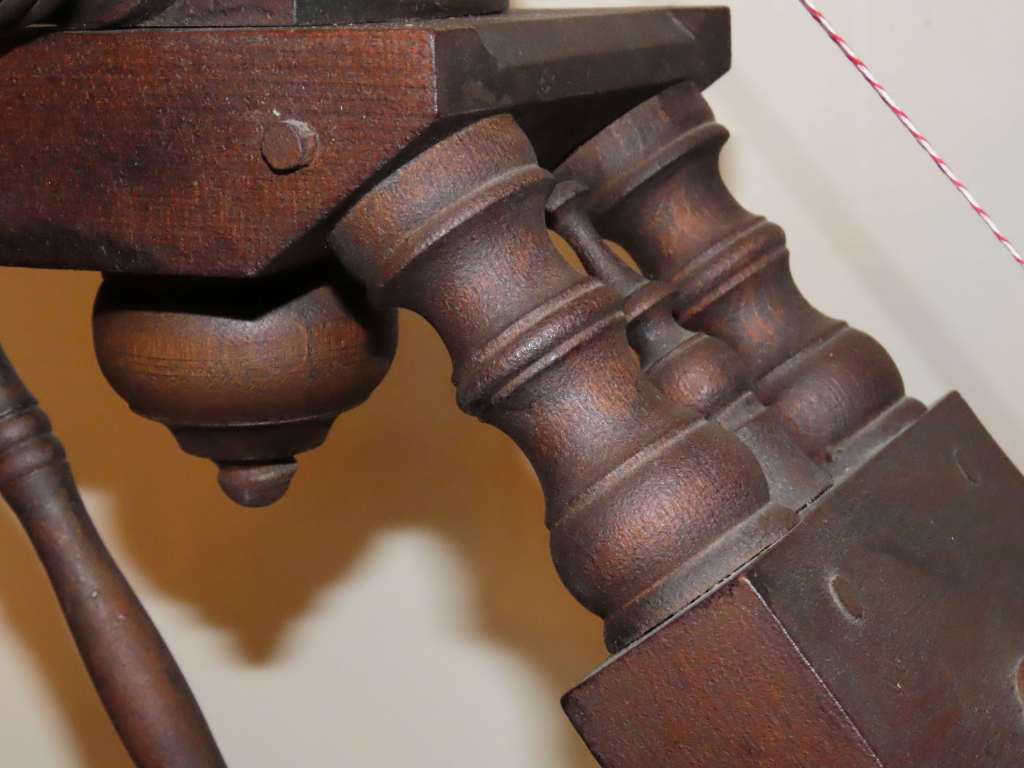
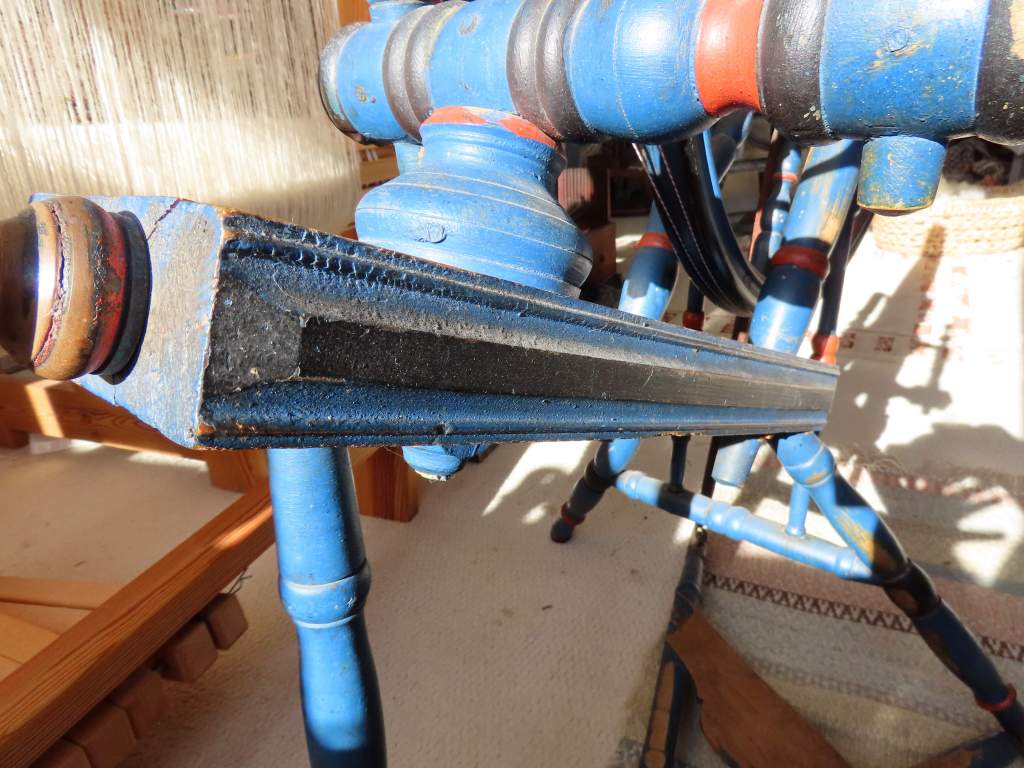
The design requires struts, which makes for a lovely profile.
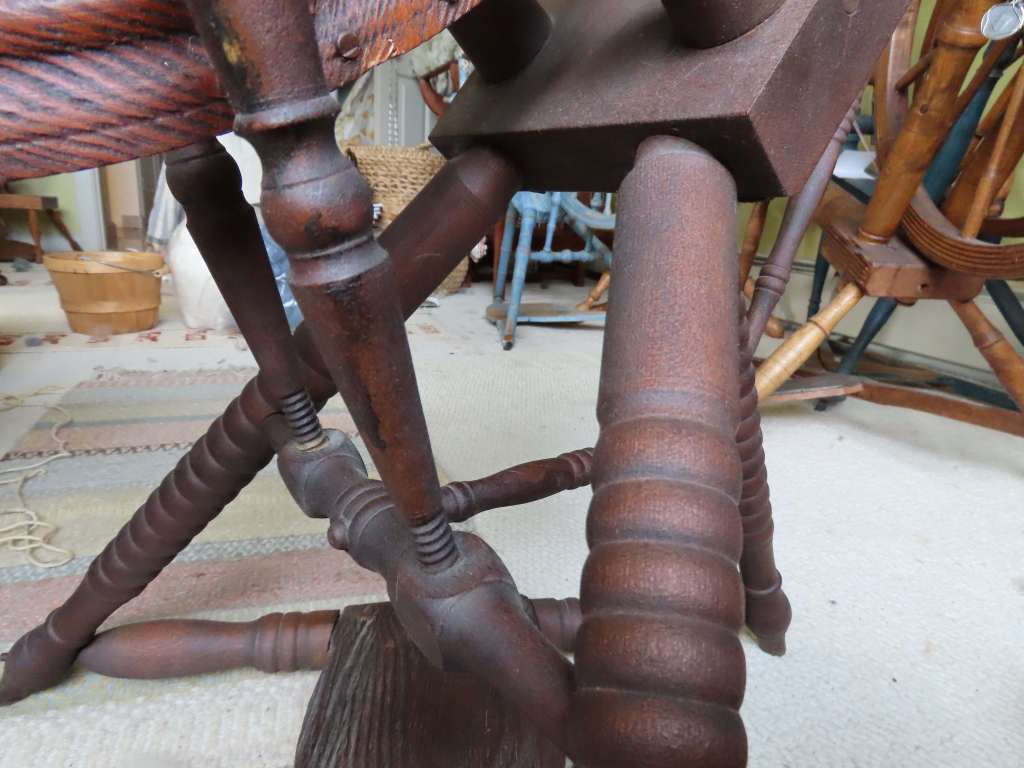
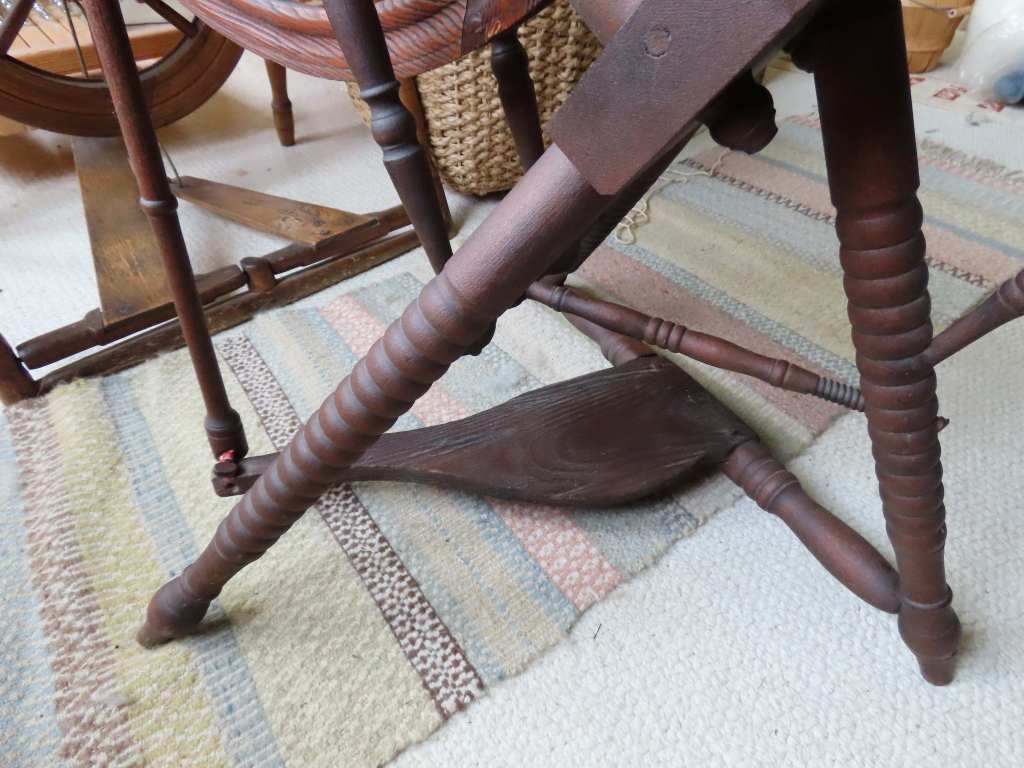
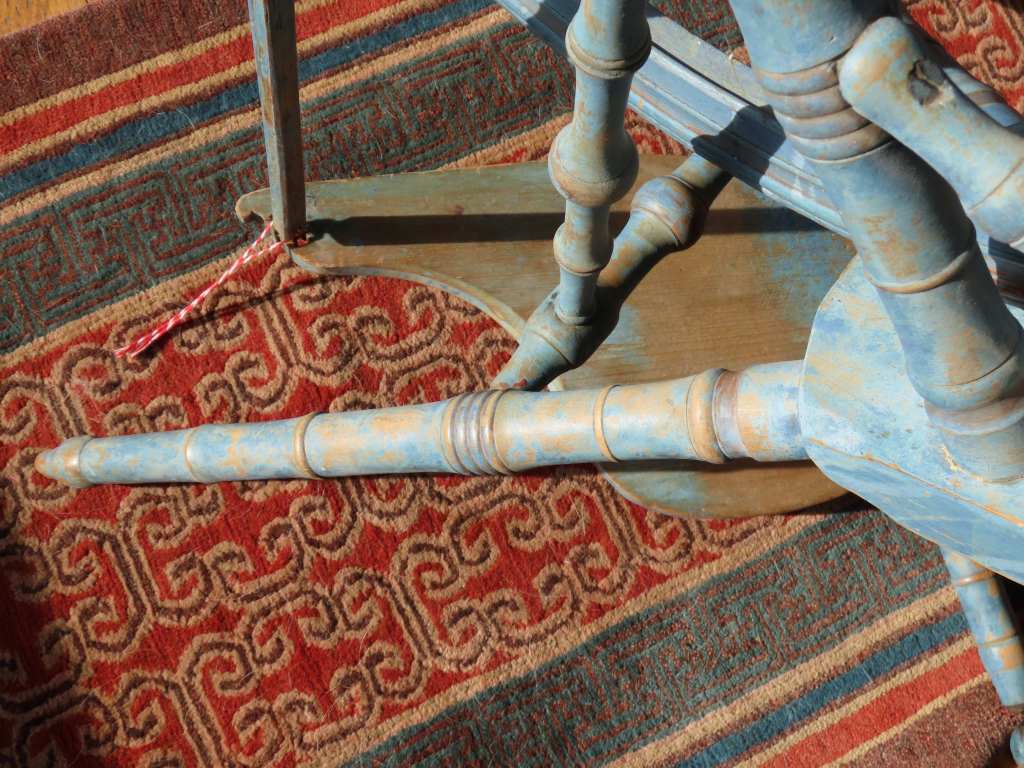
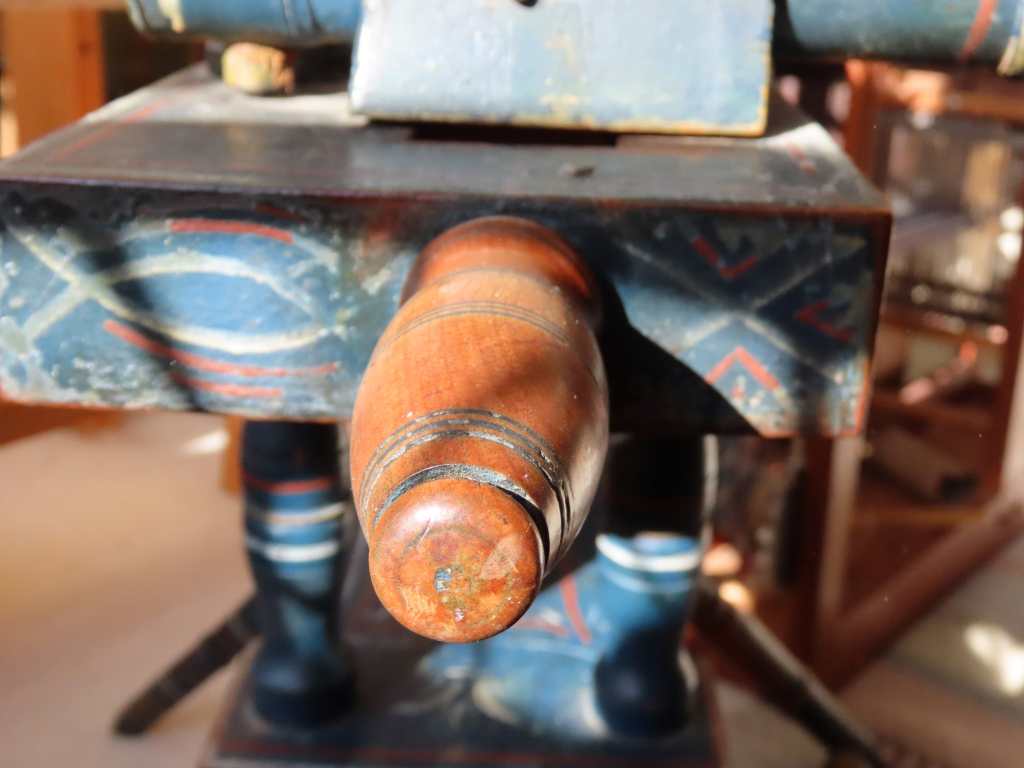
The legs emerge from the end of the table
often with bubble-type turnings.
Unfortunately, as far as I can tell, little is known about these wheels.
They are assumed to be Norwegian, but I do not think any particular region of origin has been identified.
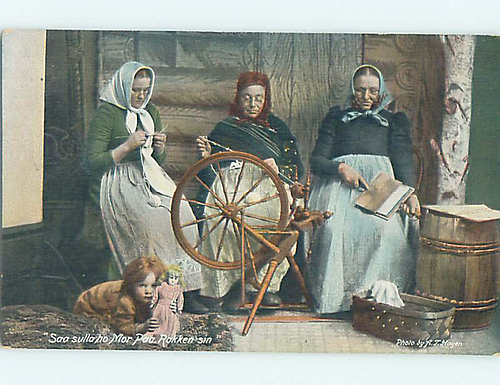
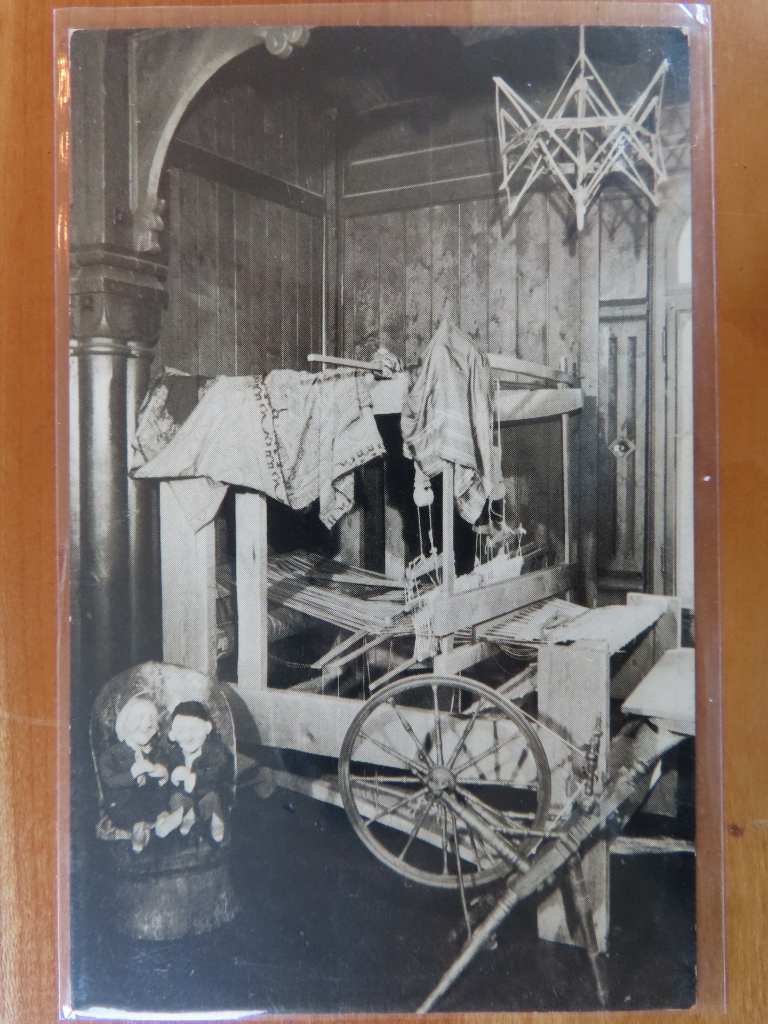
Not sure what the text says on this postcard, except for the words “mother” and “spinning wheel”
Some have maker’s marks, many do not. In the U.S., they are most often referred to as “broken-table” slanties (or super slanties).
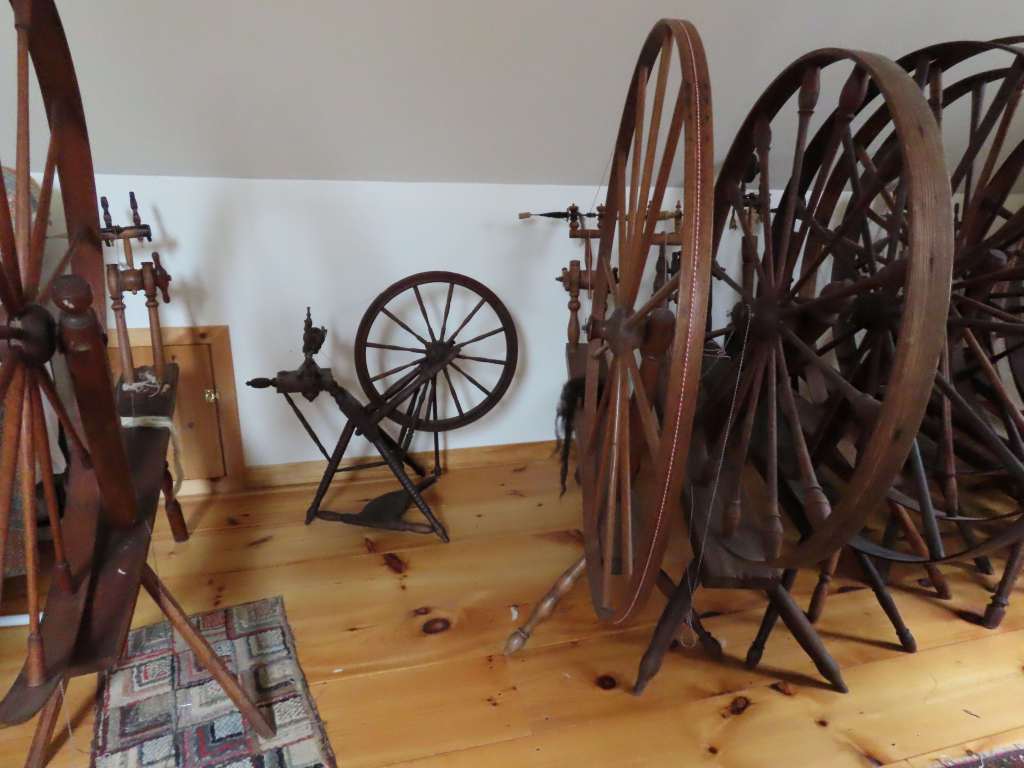
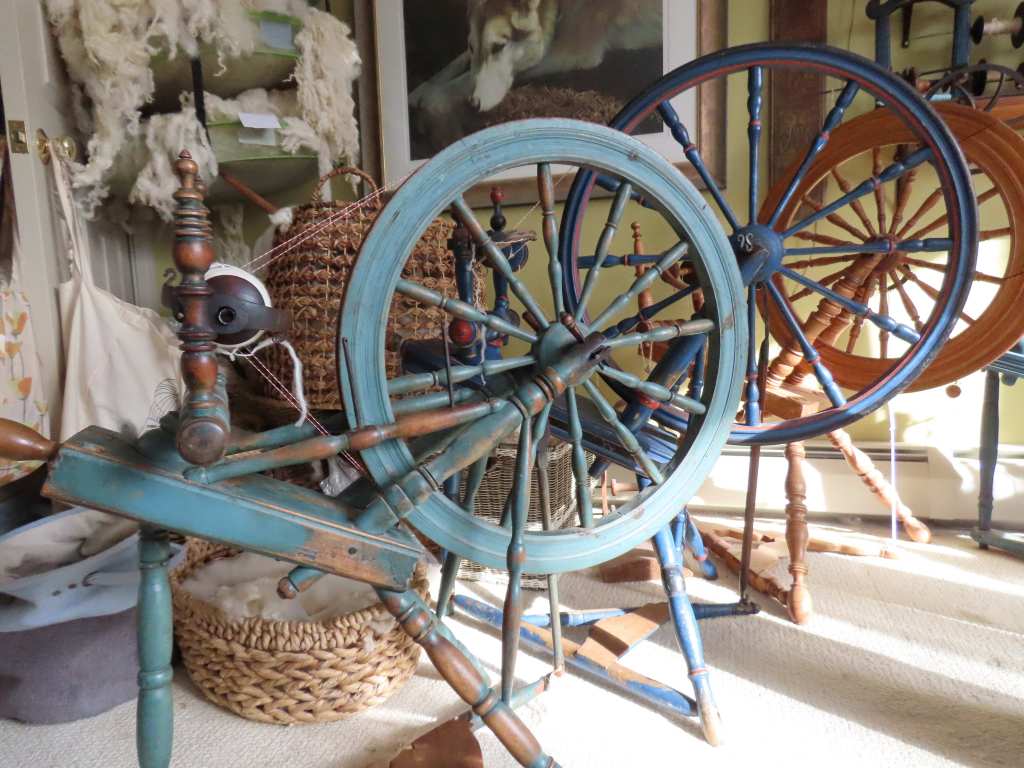
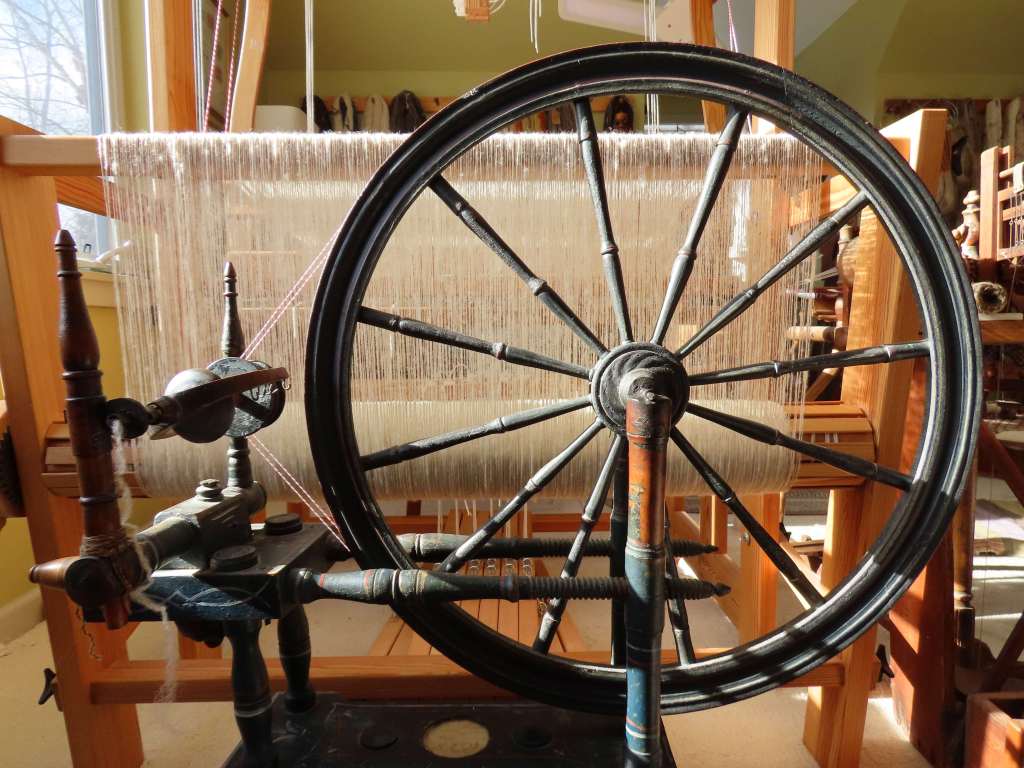
Norwegian broken-table slanty in front, with regular slanty by window
They come in all different styles, many with elaborate turnings.
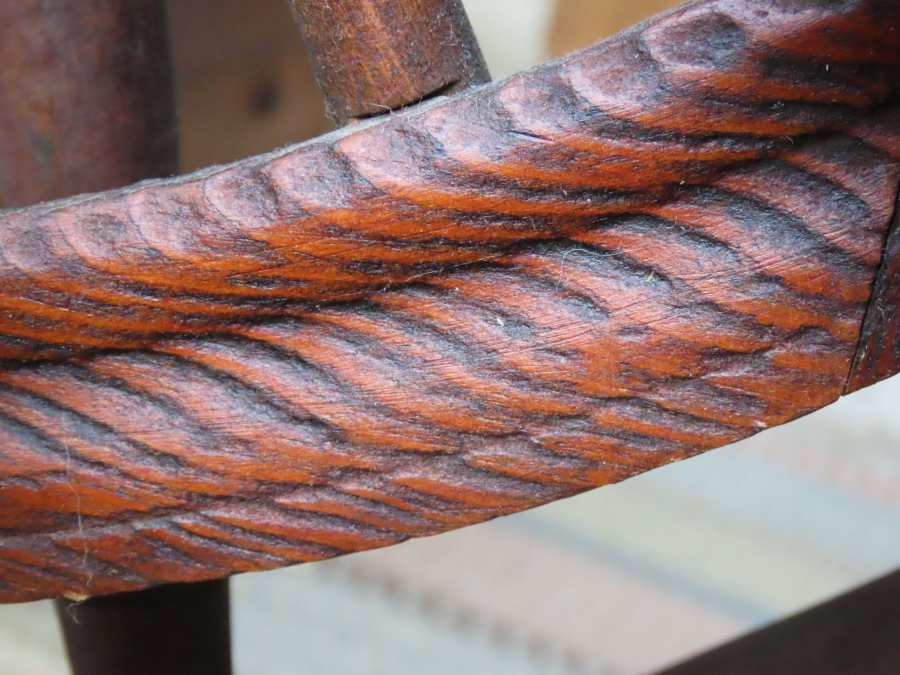
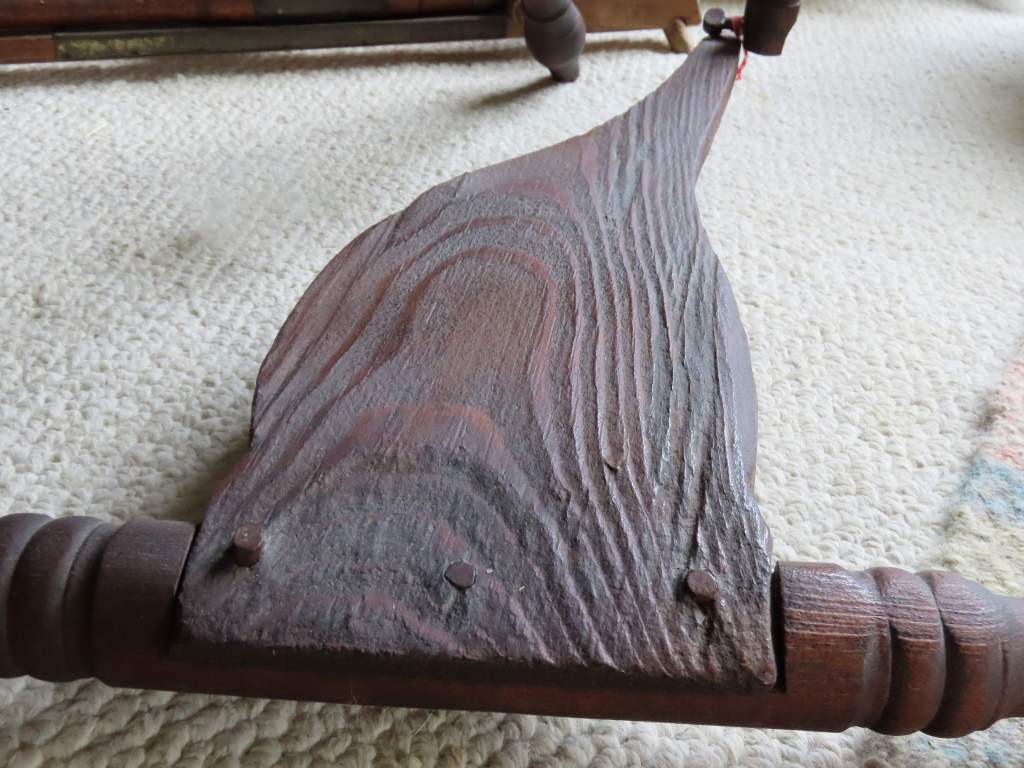
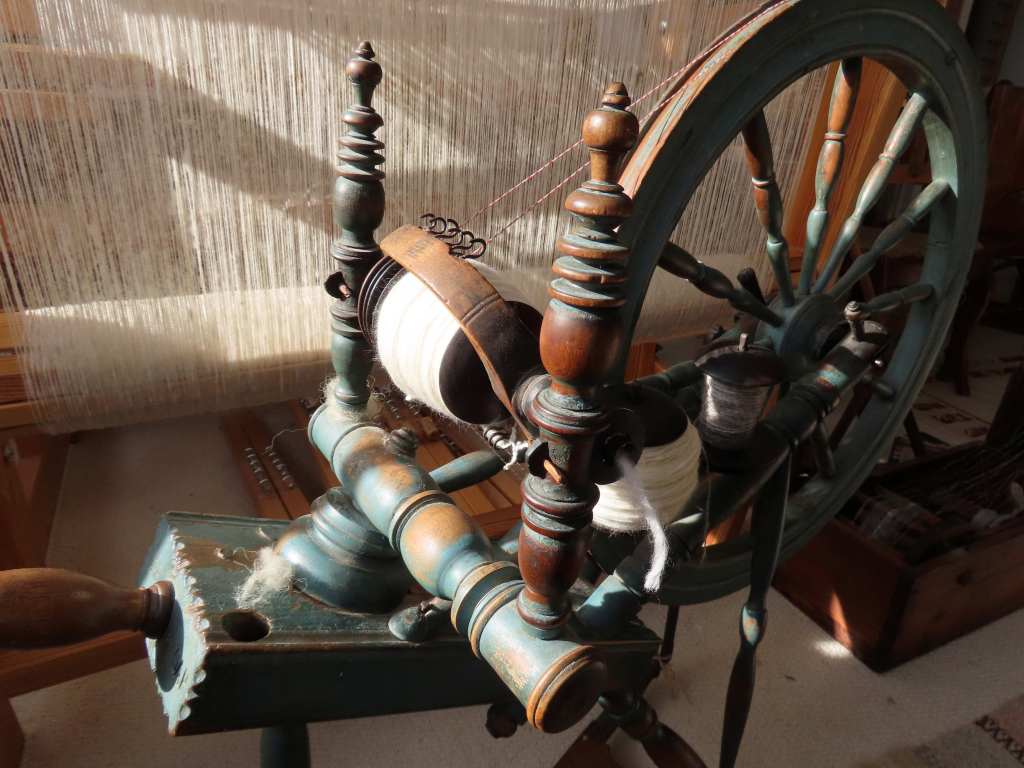
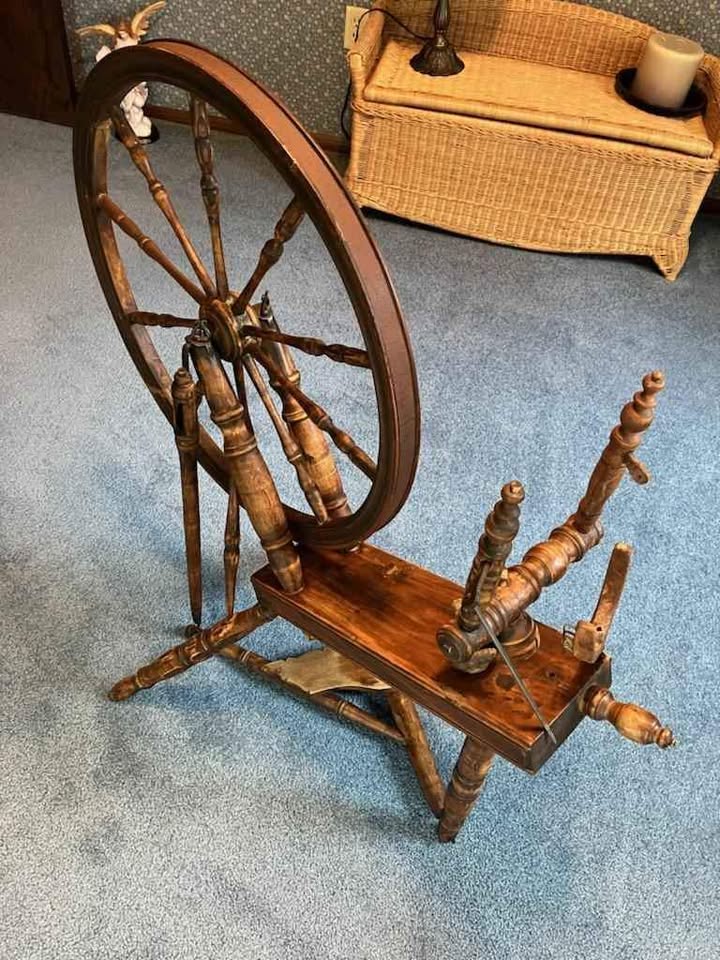
Sif is unlike any other I have seen because of her wood.
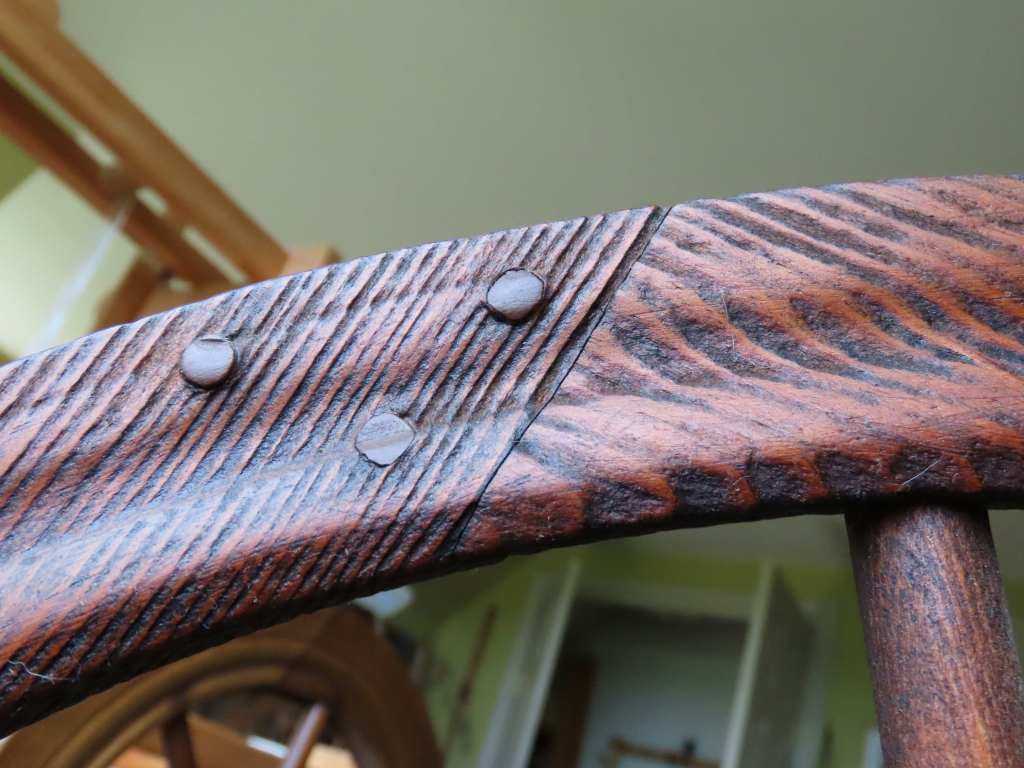
It is lightweight but has a very wide, strong grain.
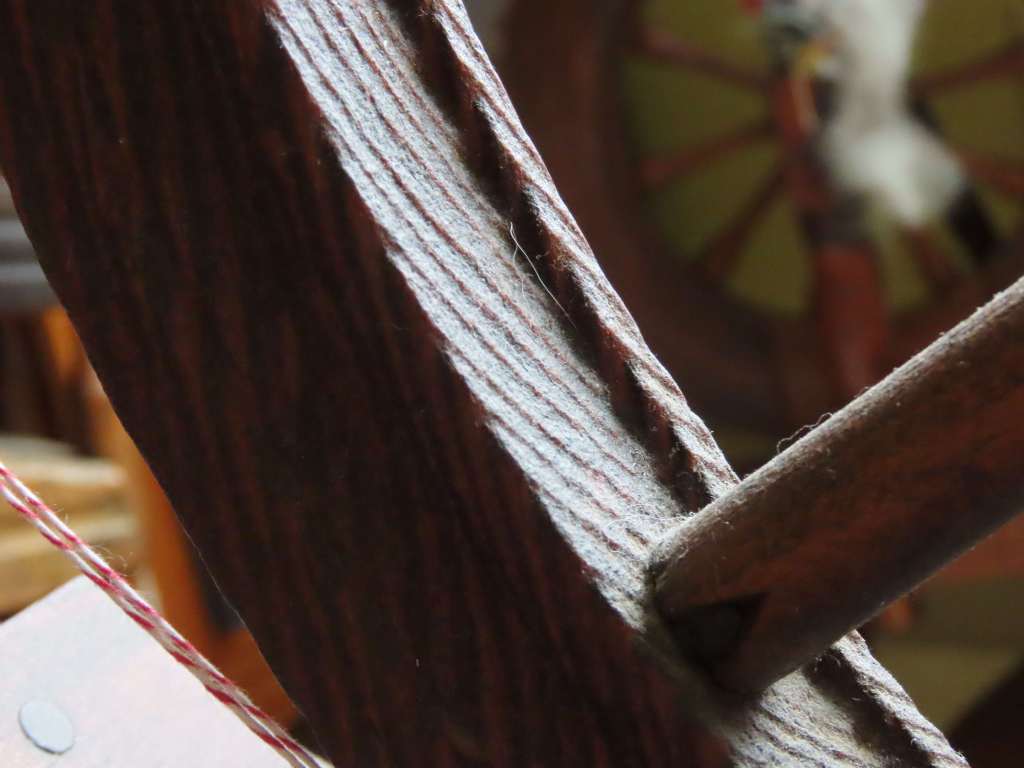
Her surfaces were not varnished or smoothed and the grain is somewhat raised.
It gives her a fantastic texture not found in many wheels.
She is an excellent spinner and her light weight makes her easy to transport.
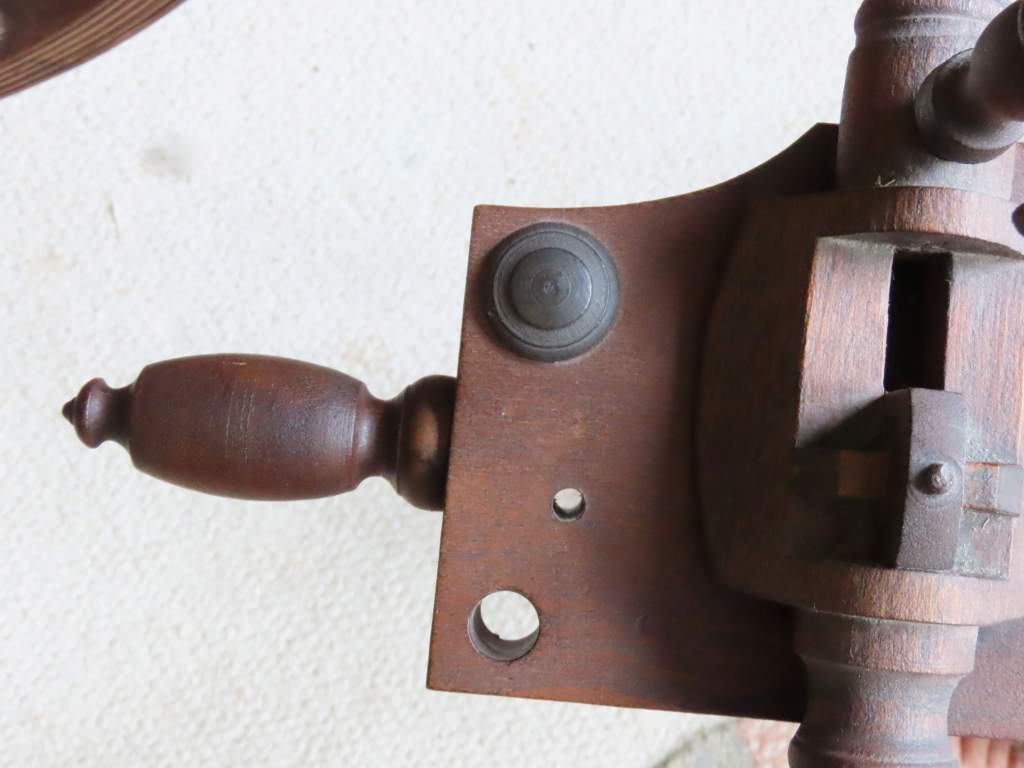
While she did not come with a distaff, there are two distaff holes, one with a cap.
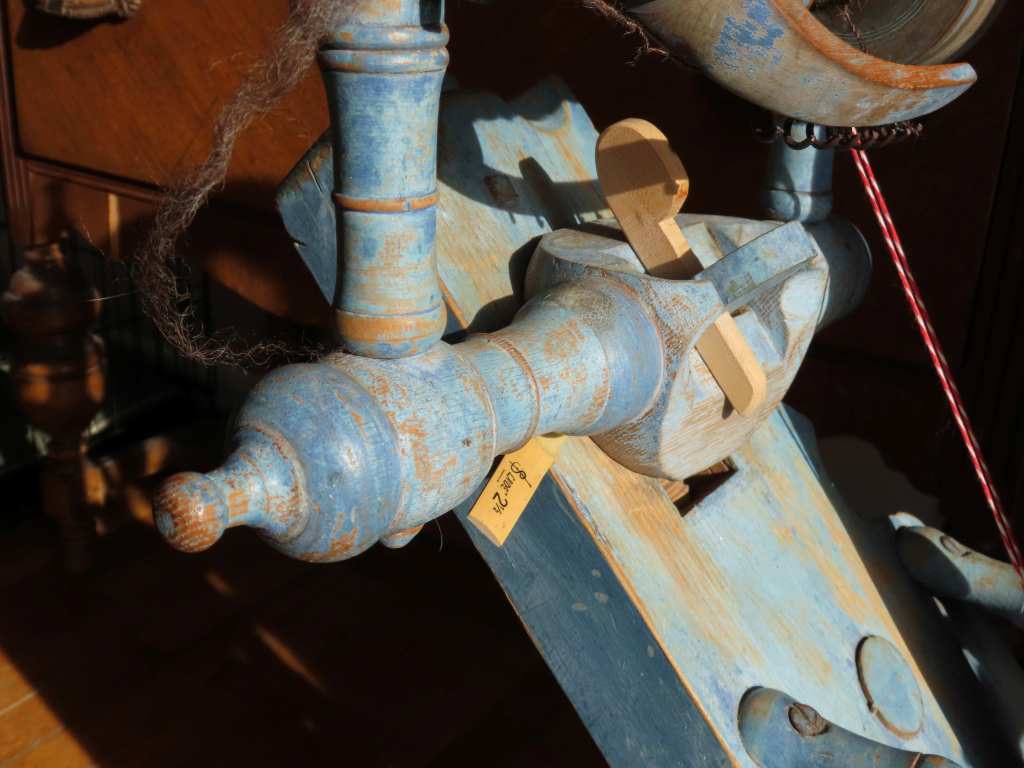
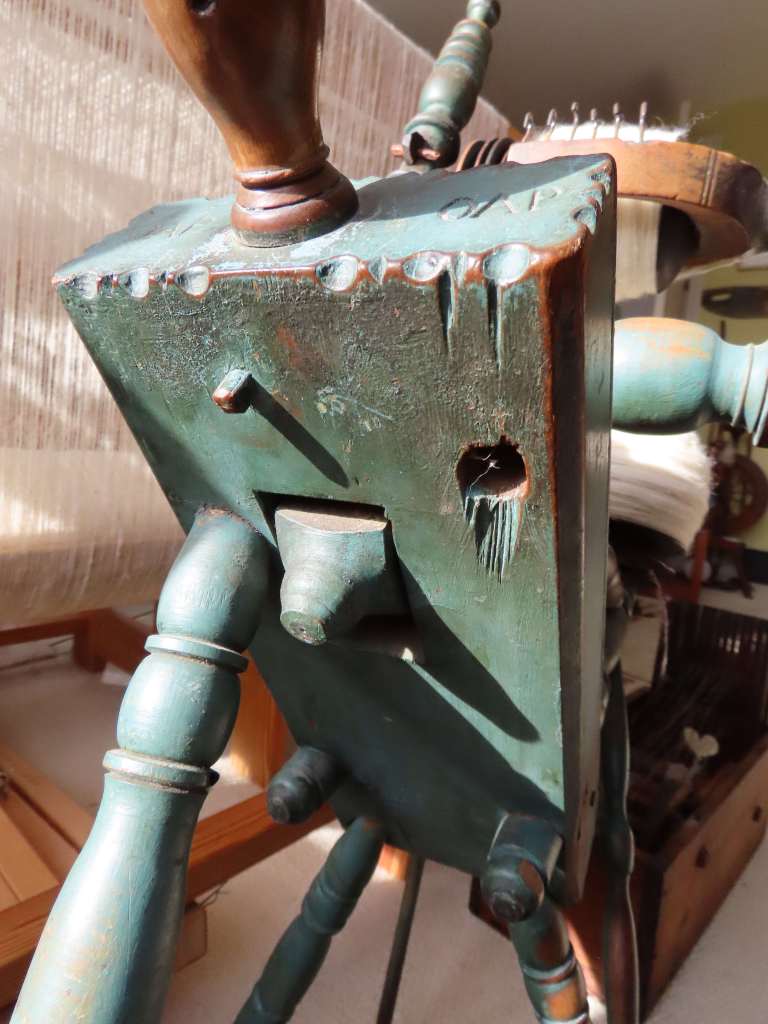
The mother-of-all has a slider for positioning the flyer, similar to the BESS wheels in the previous post. A wooden screw under the table tightens the MOA in place.
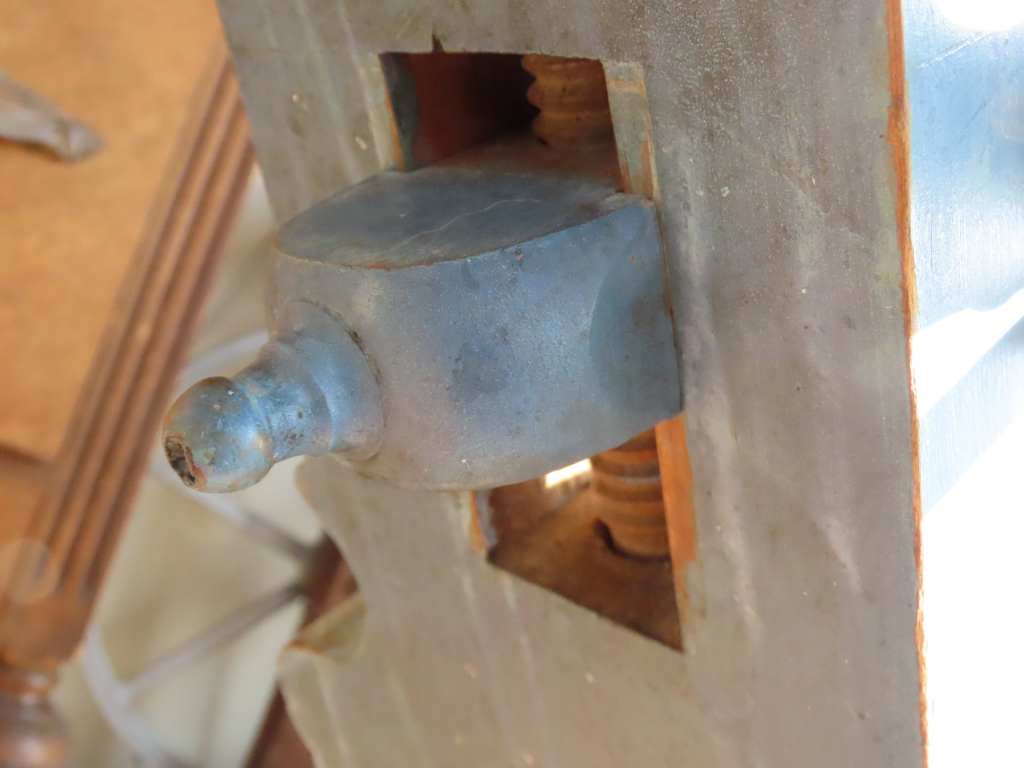
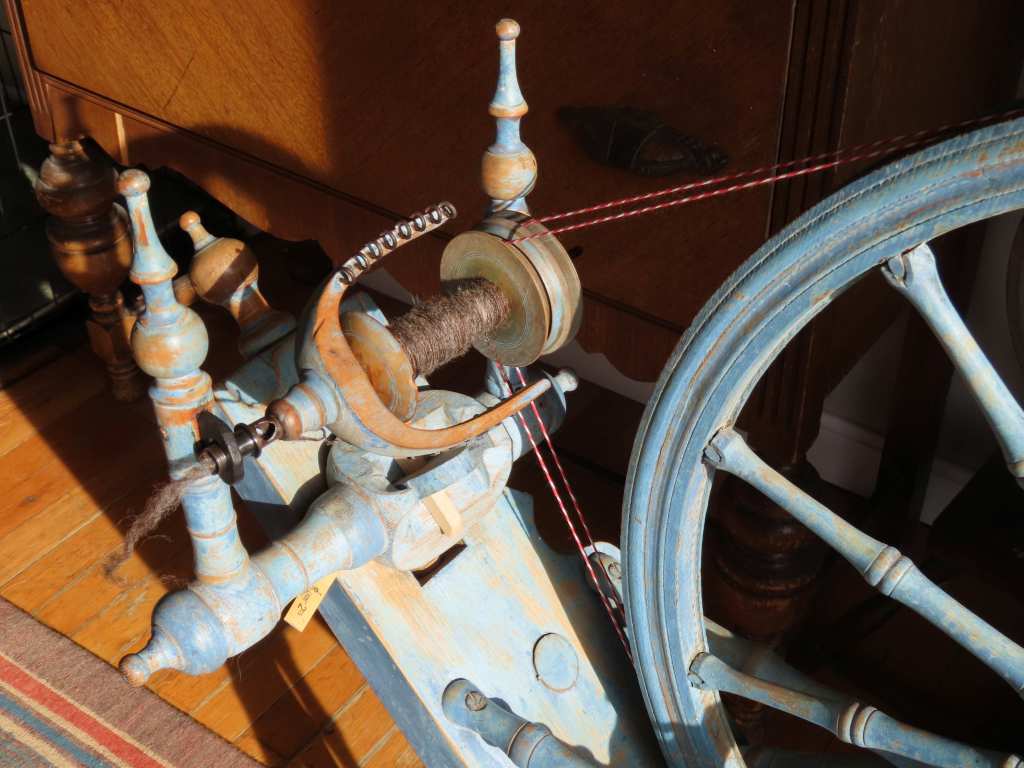
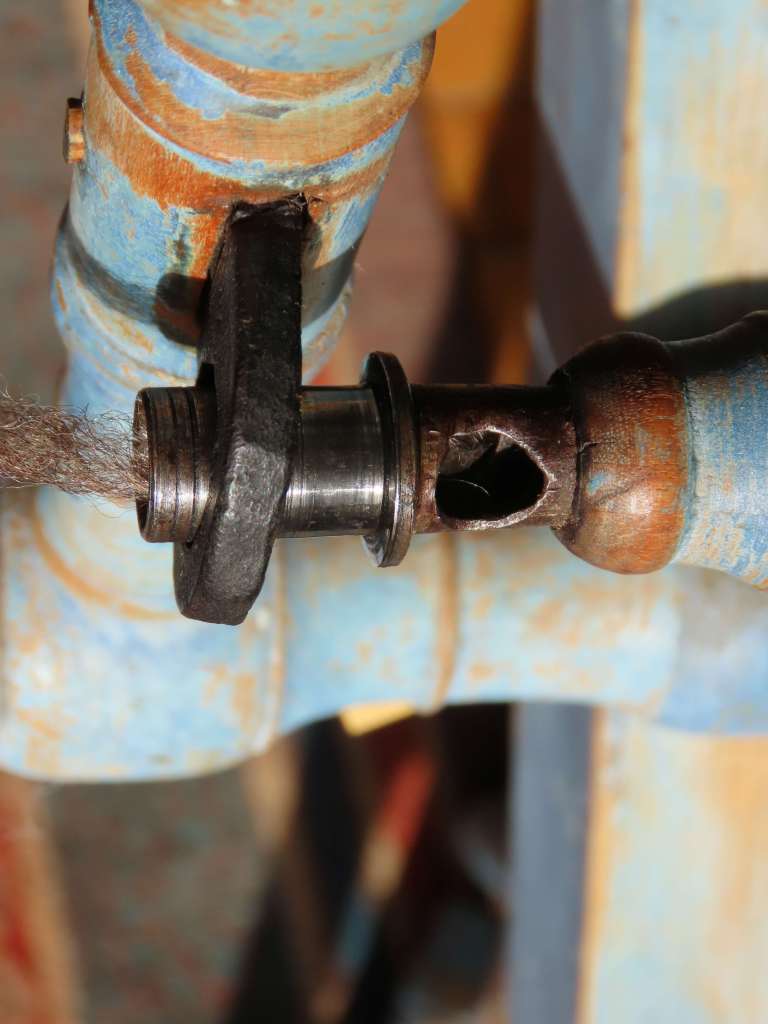
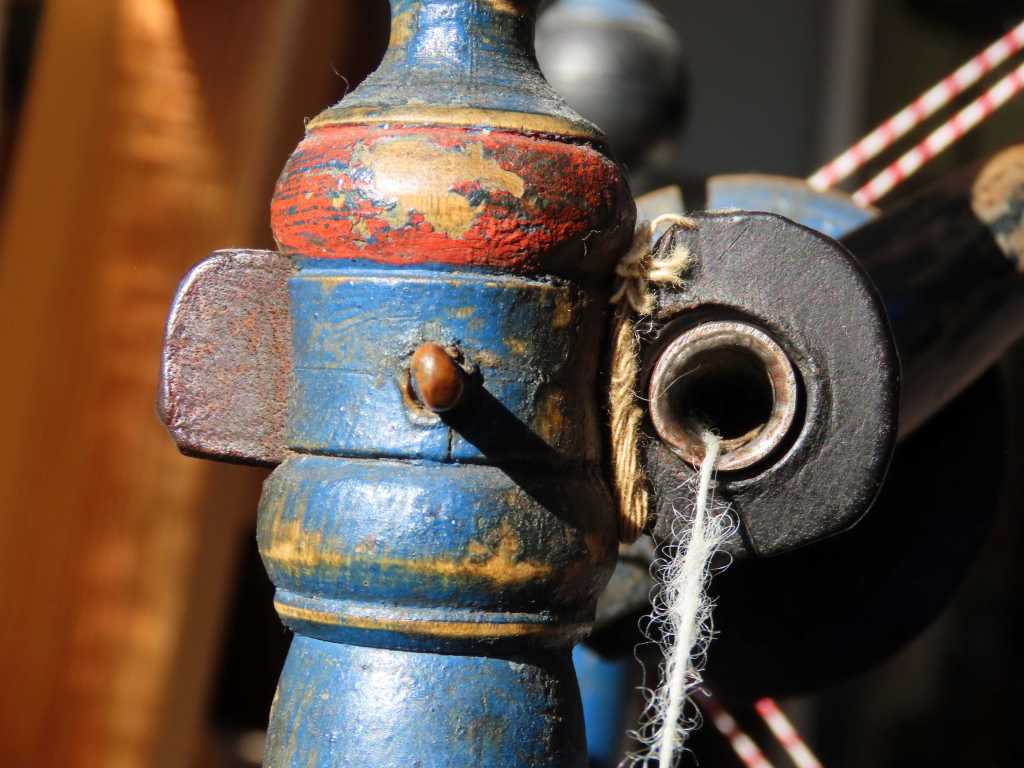
The axle rests in a metal-clad depression in the angled upright supports,
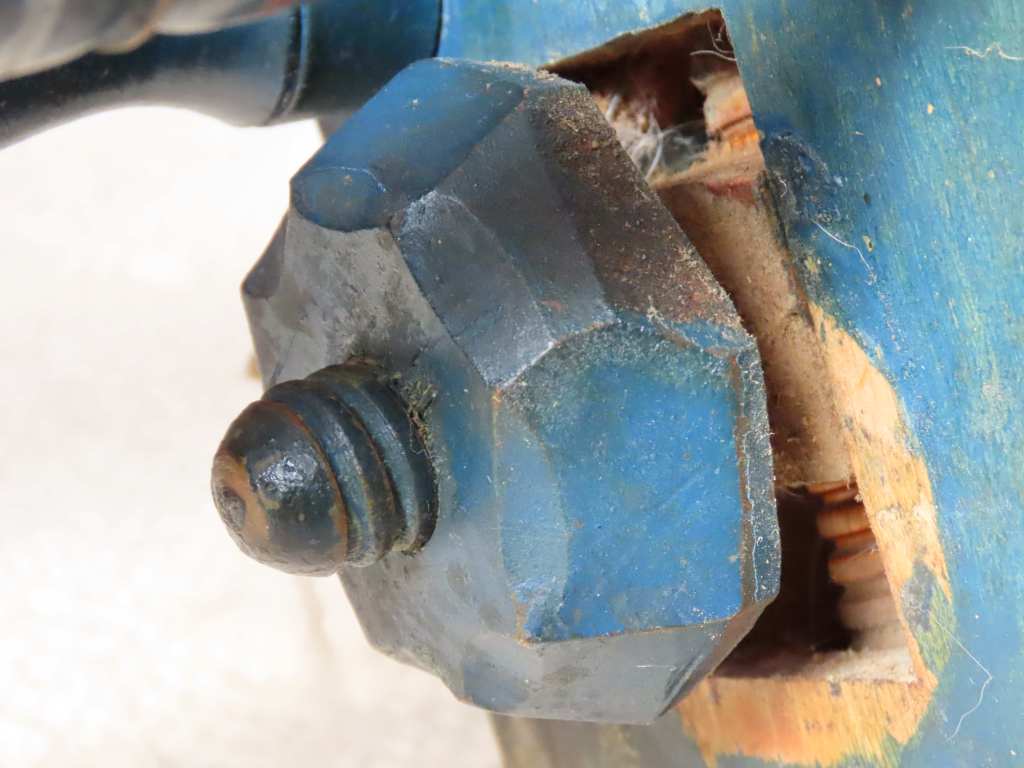
held in place with a wooden screw.
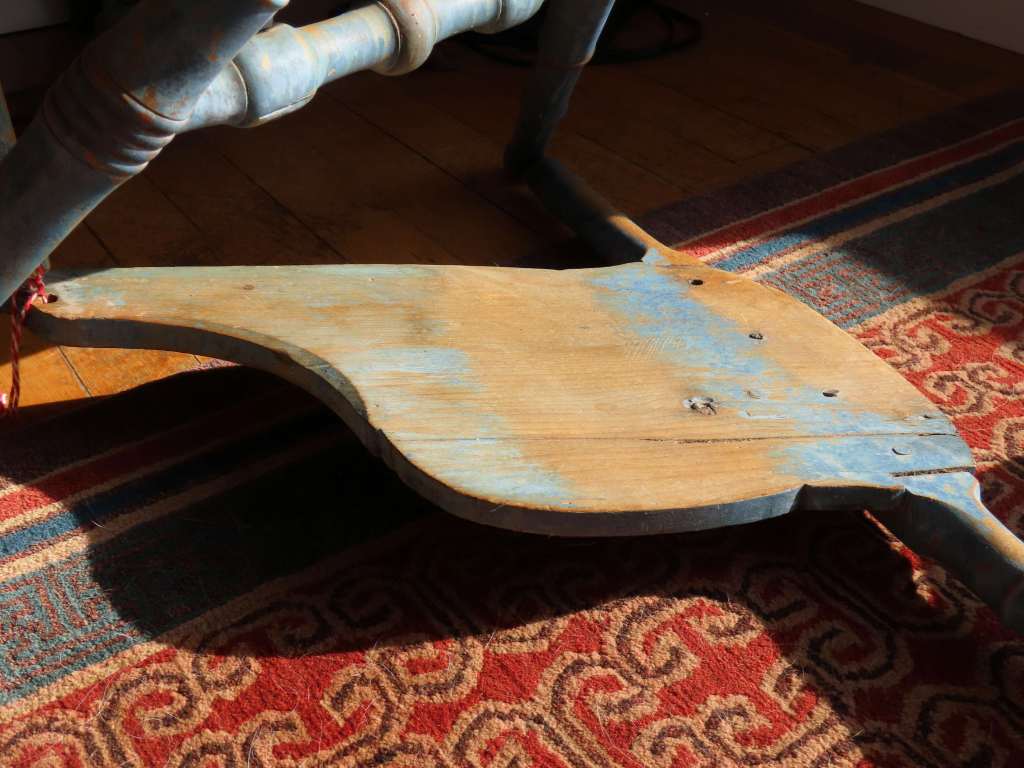
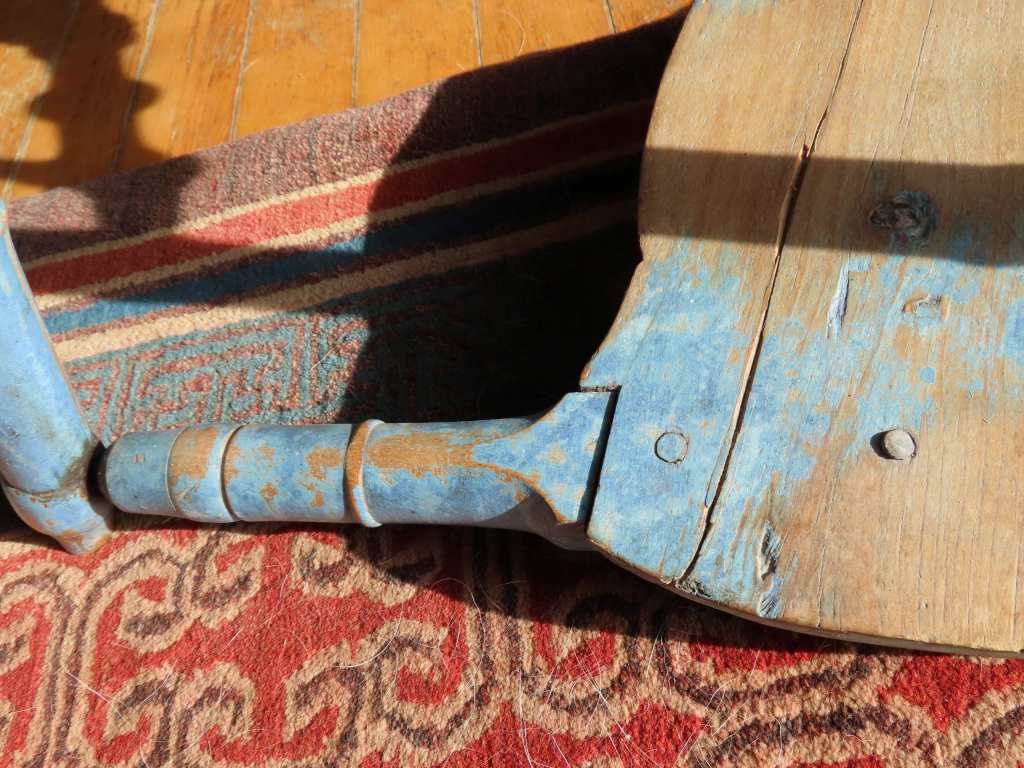
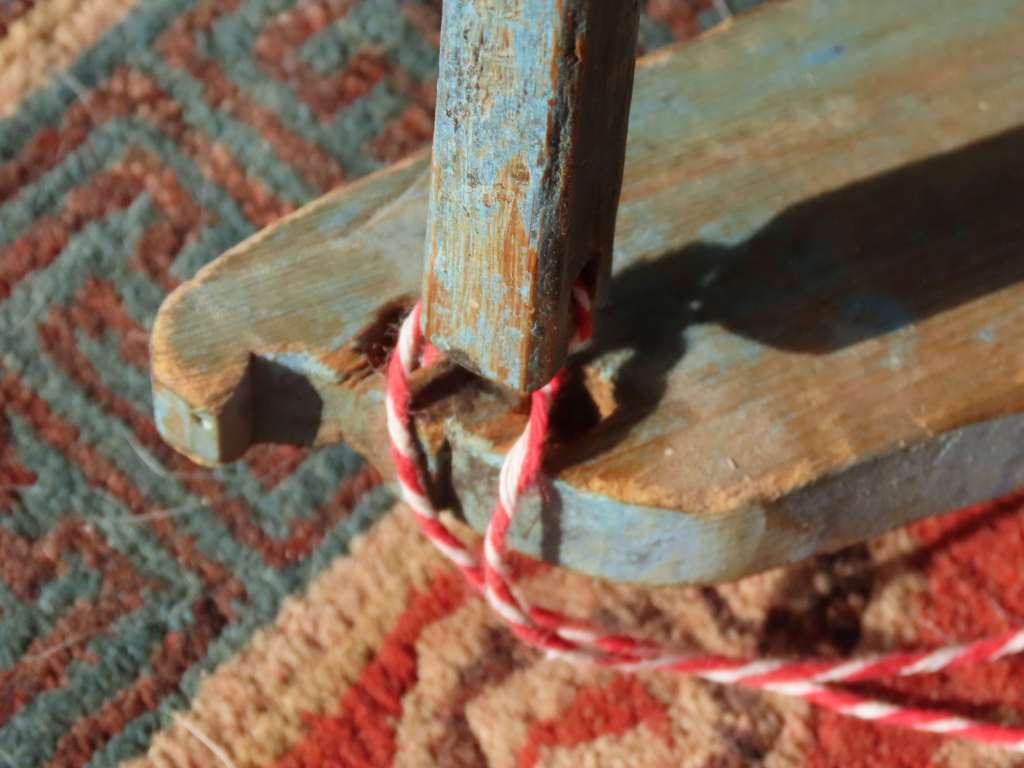
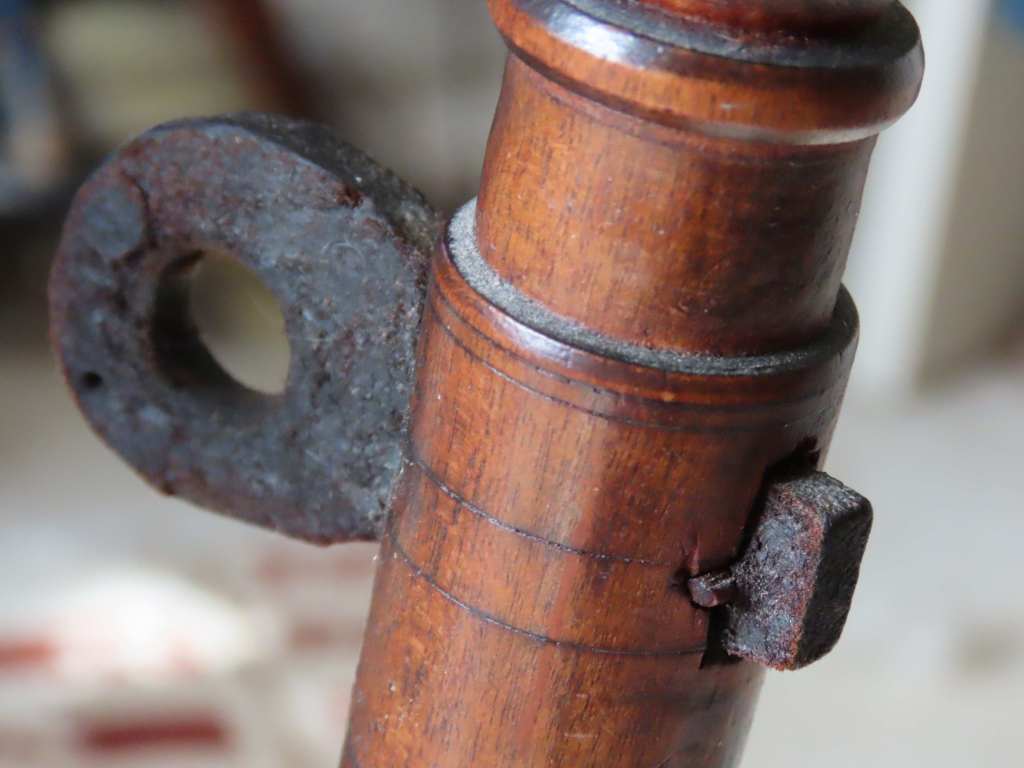
A unique feature to Sif is a little wooden pin for securing the footman to the treadle.
The footman appears to be original.
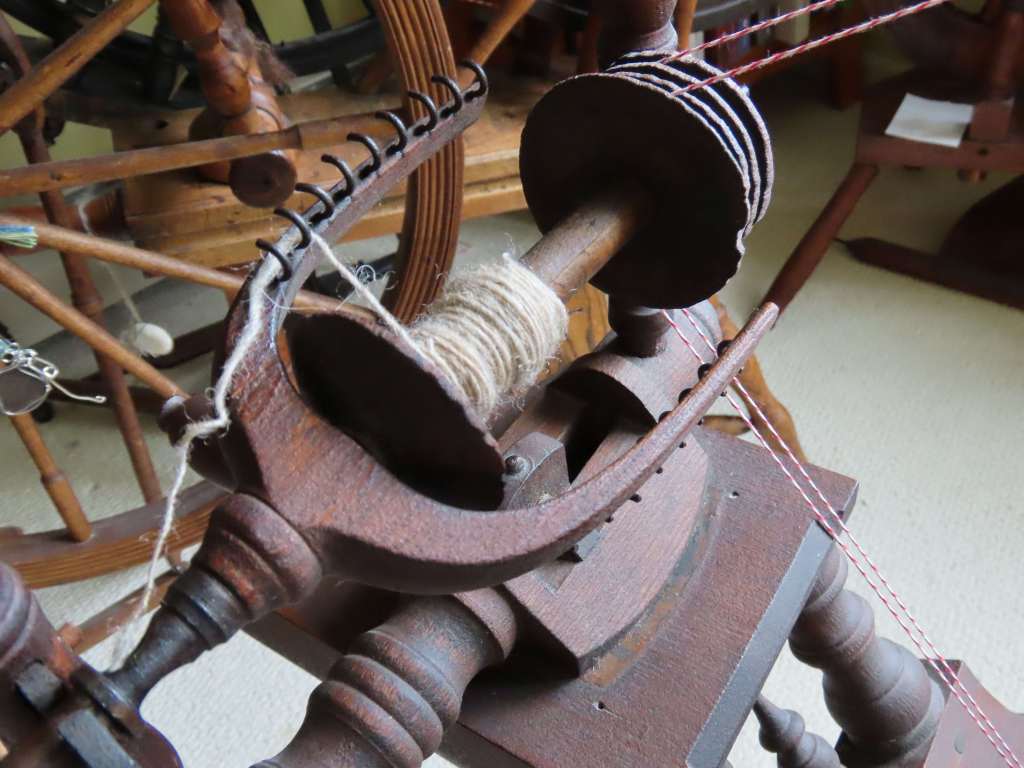
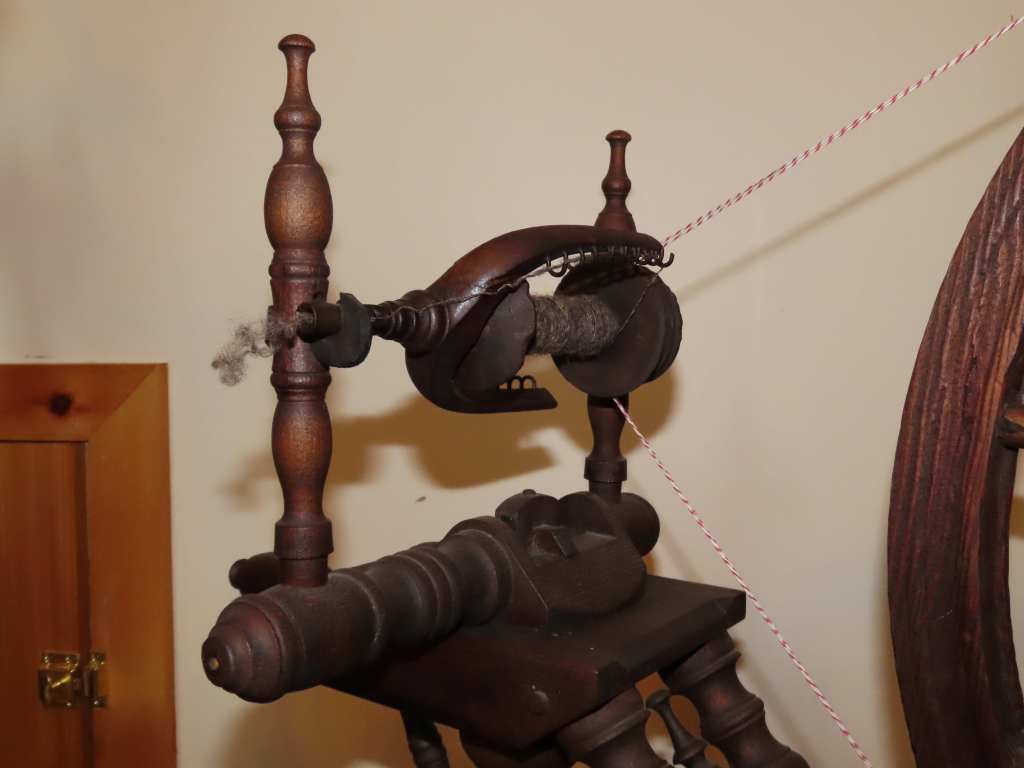
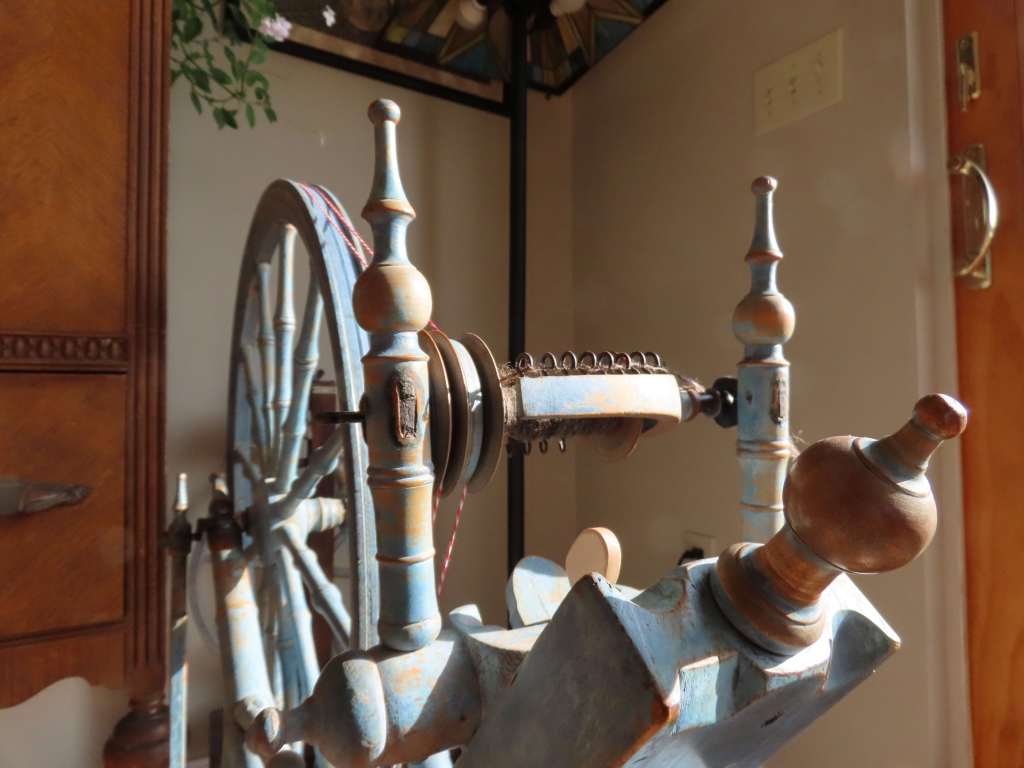
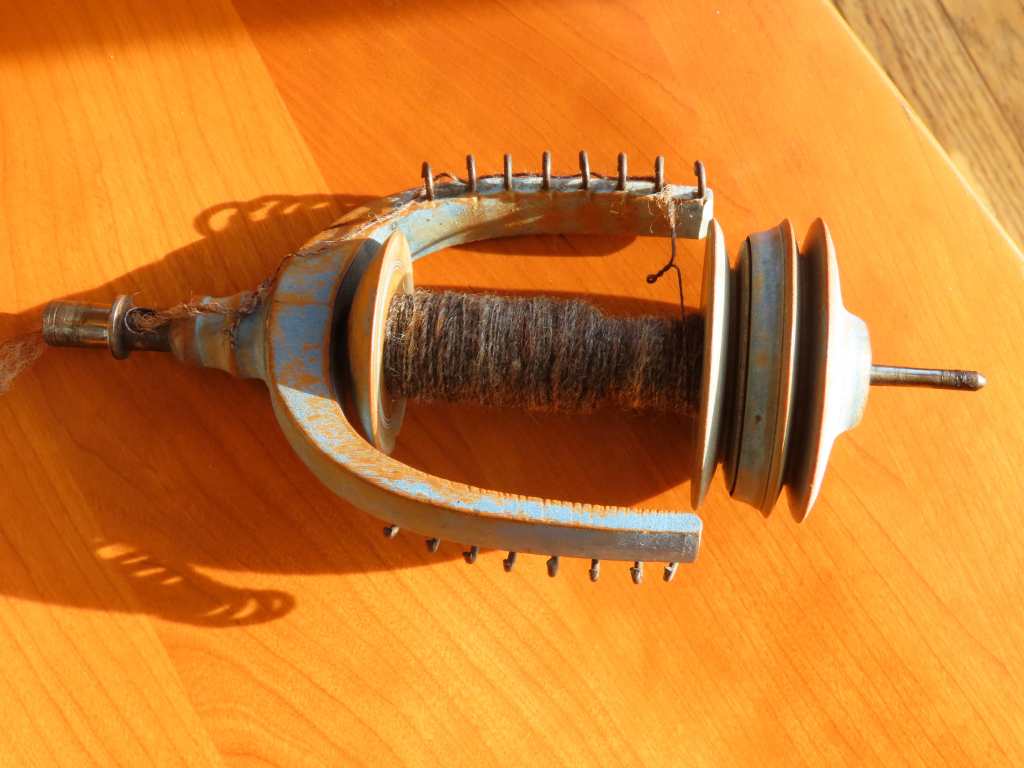
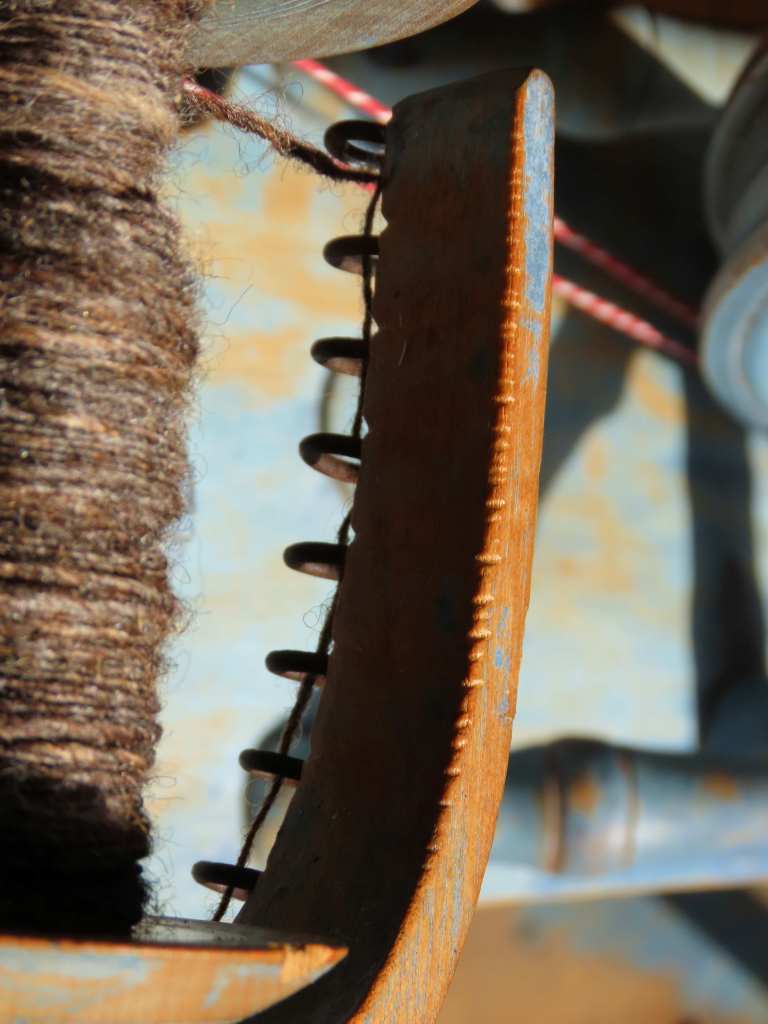
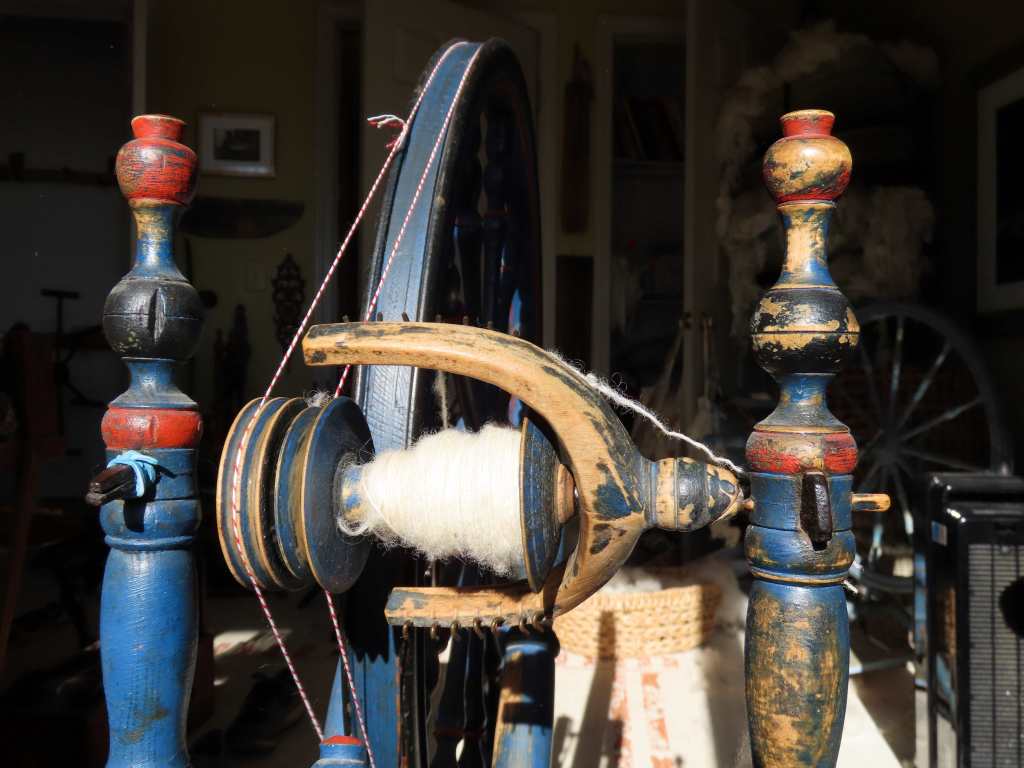
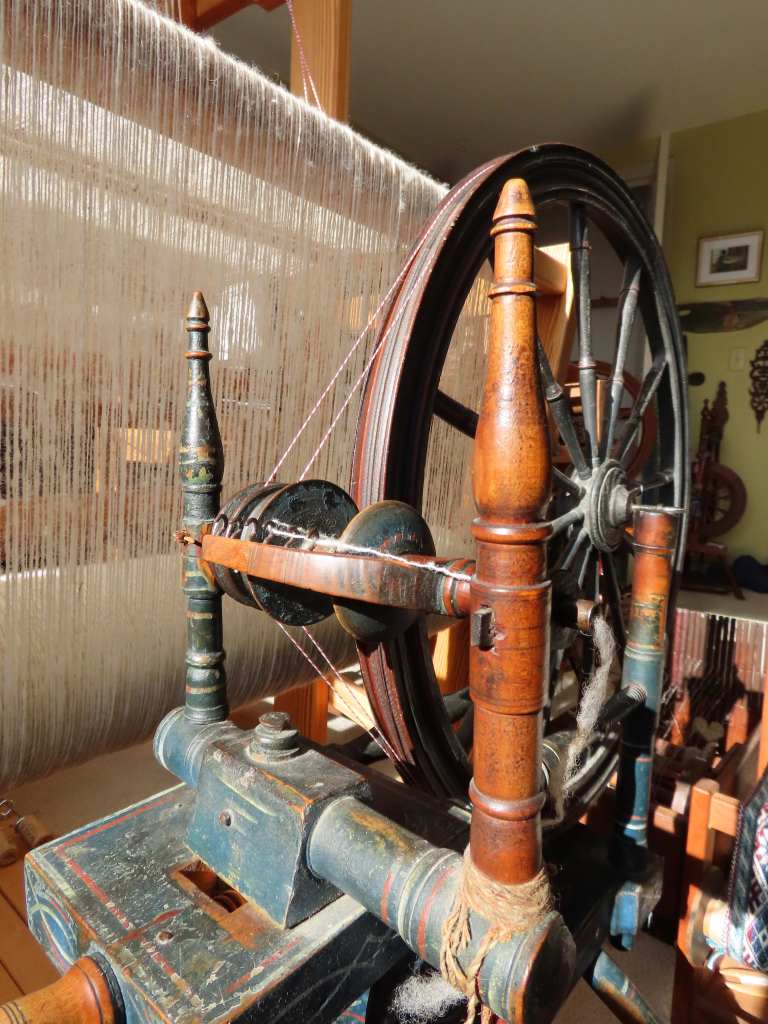
The mid-sized flyer
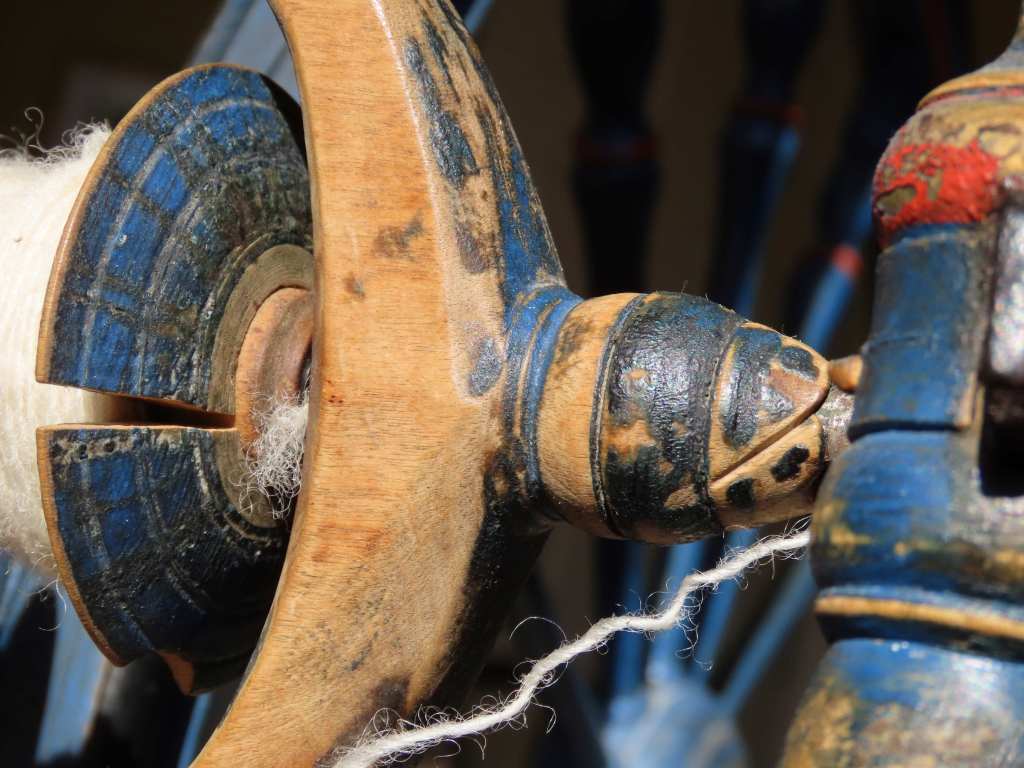
rests in an open-topped leather bearing on the orifice end.
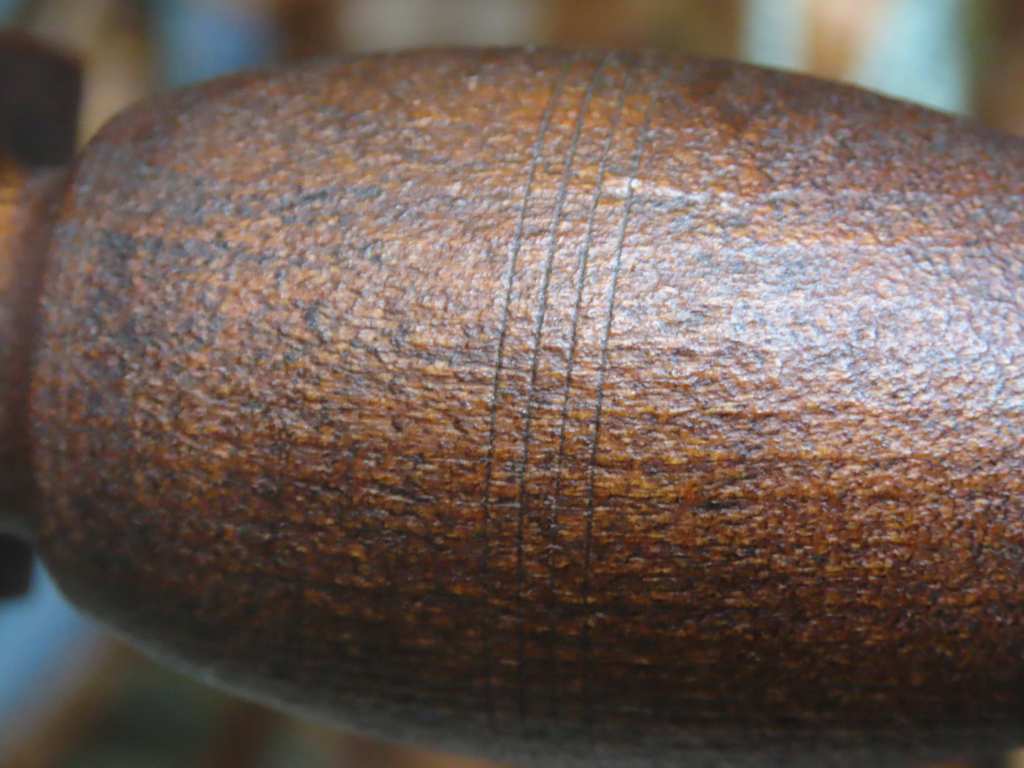
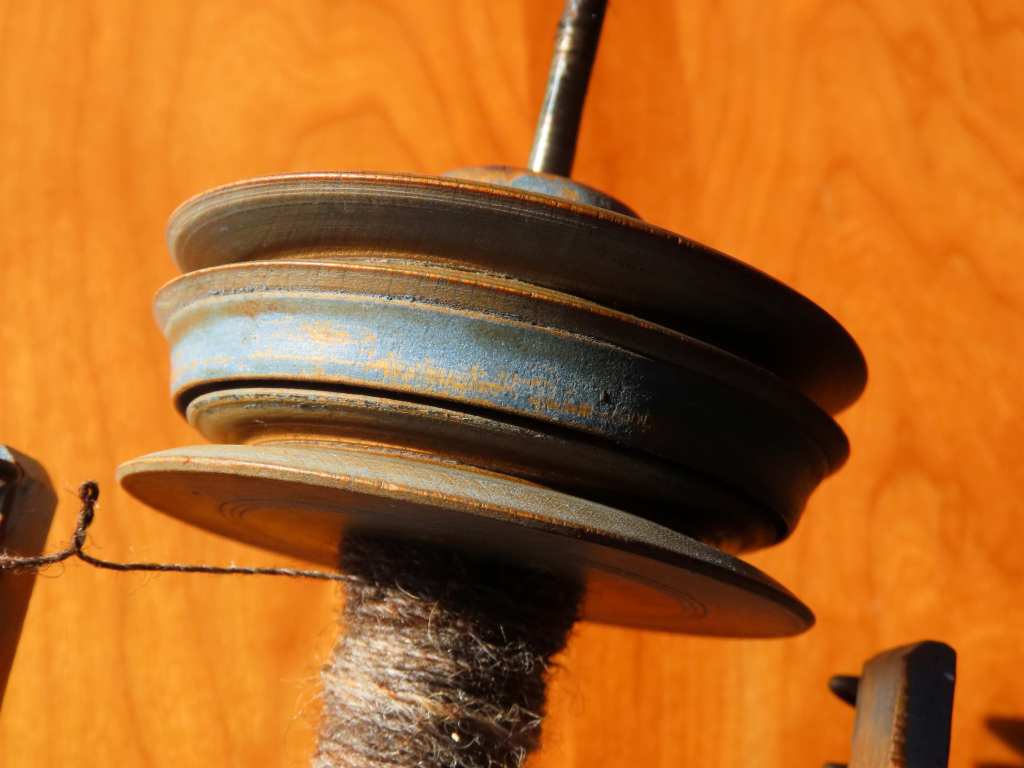
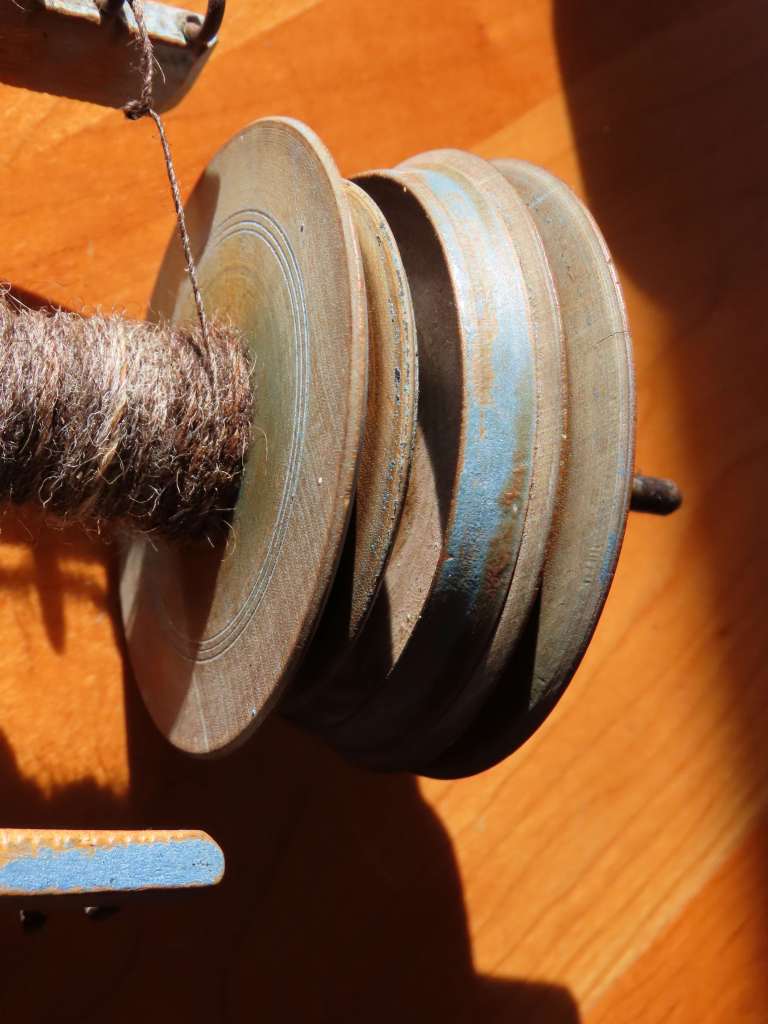
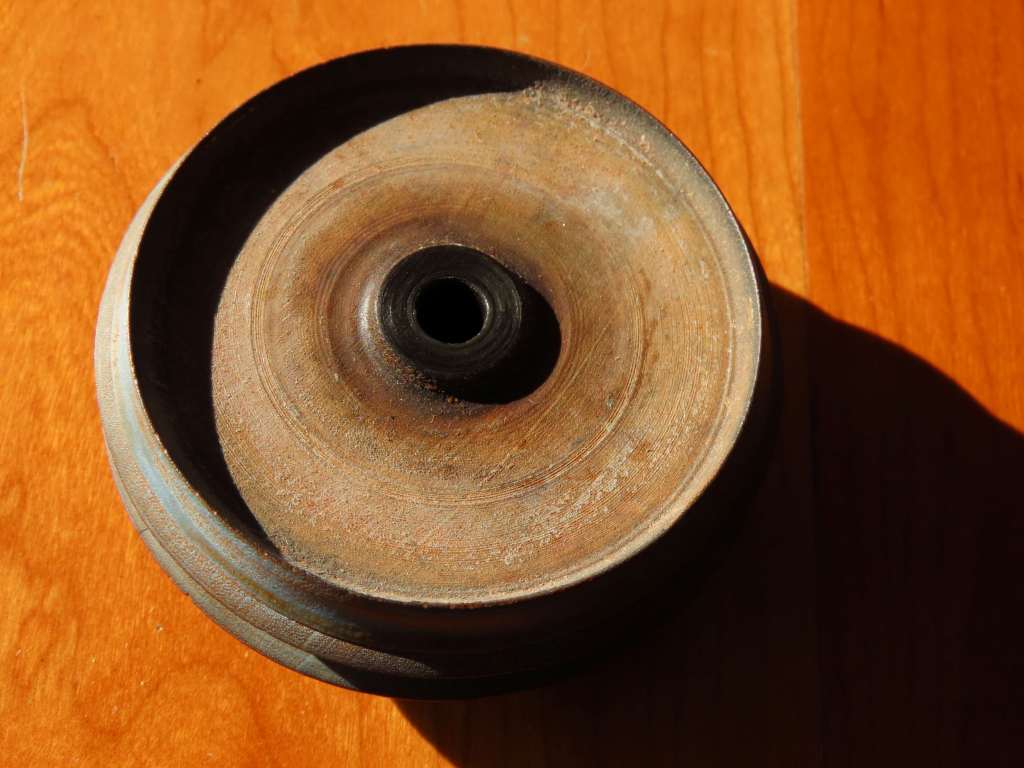
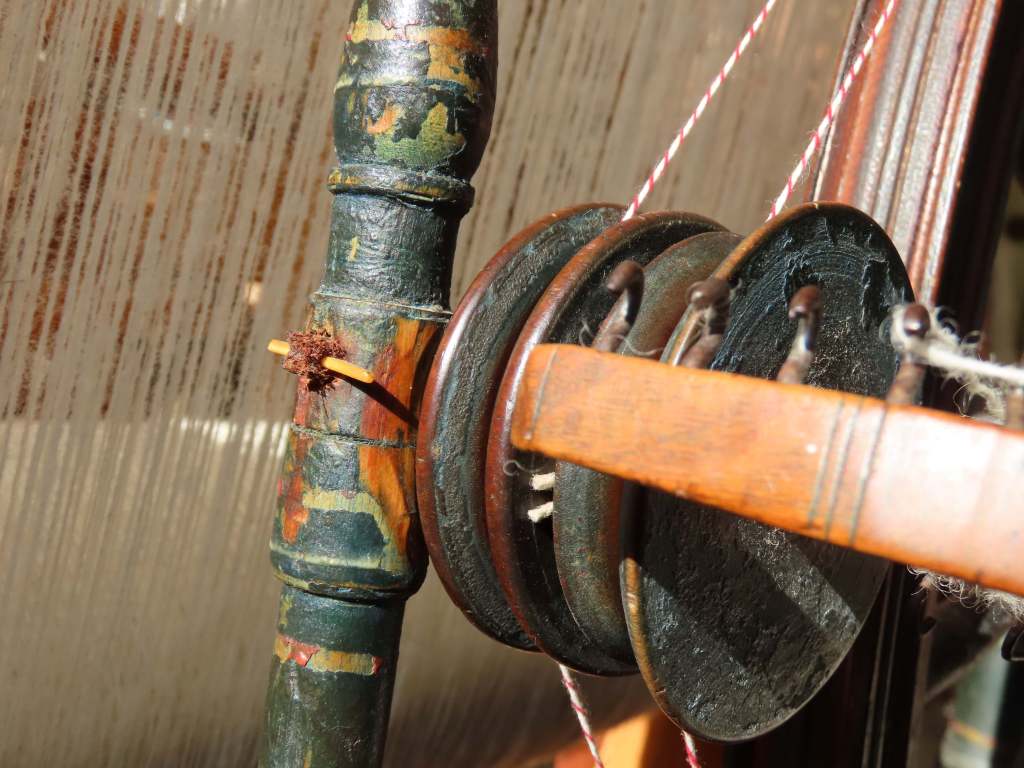
There is some roughness in the bobbin and whorl edges, due to how the coarse-grained wood has worn.
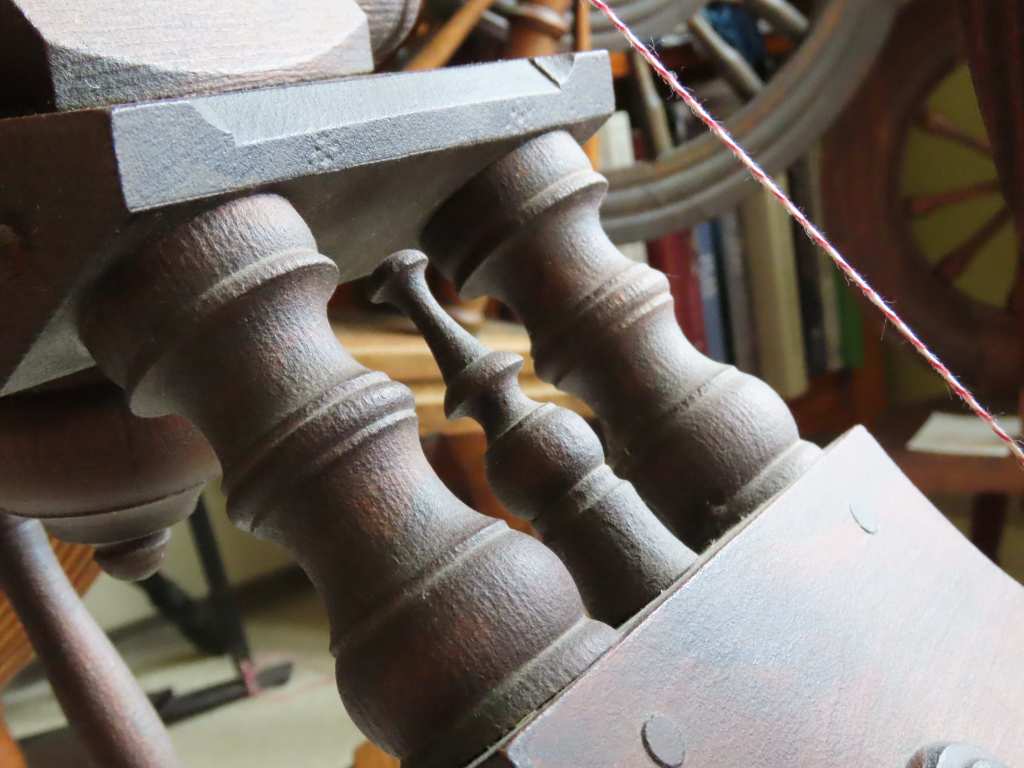
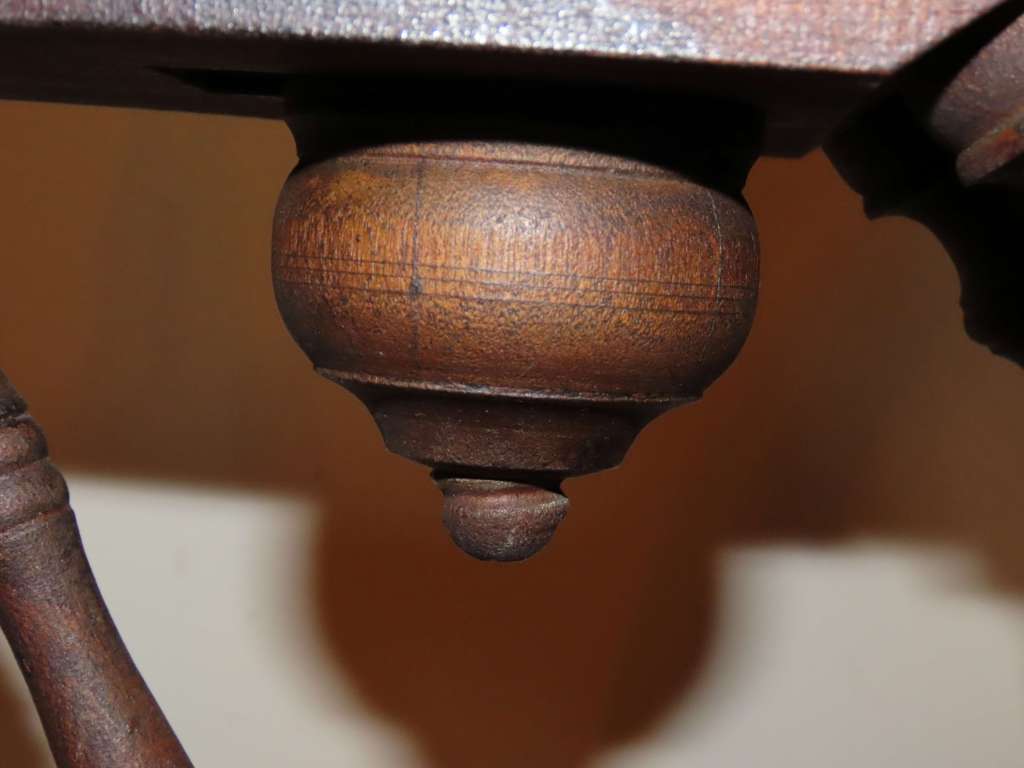
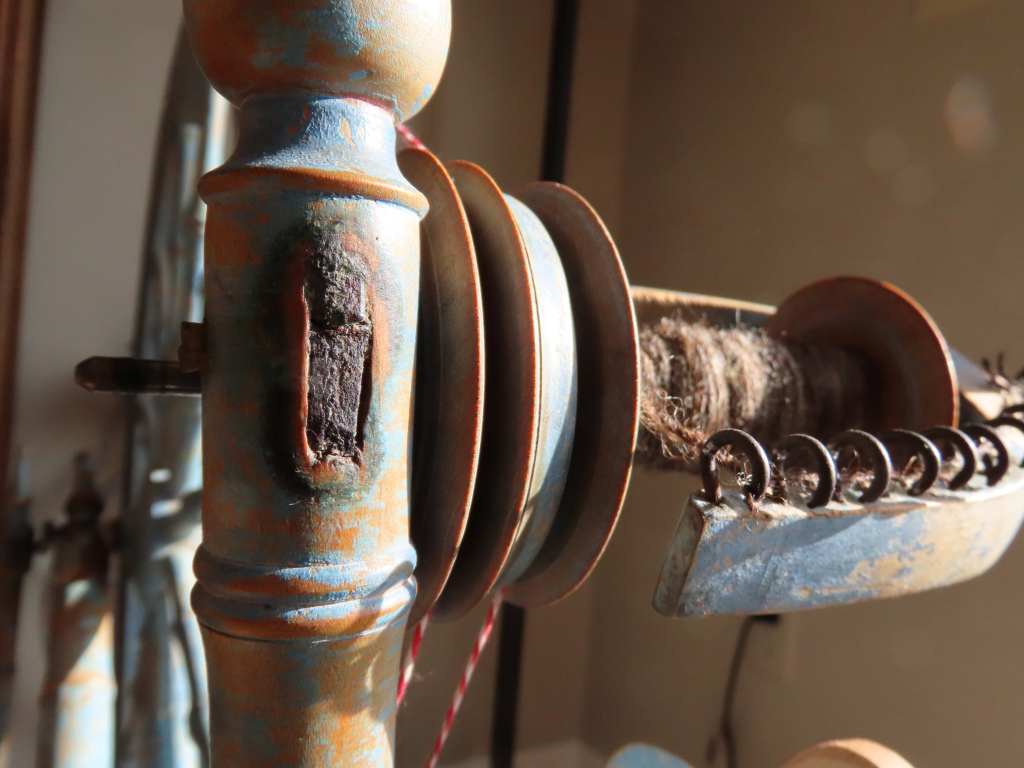
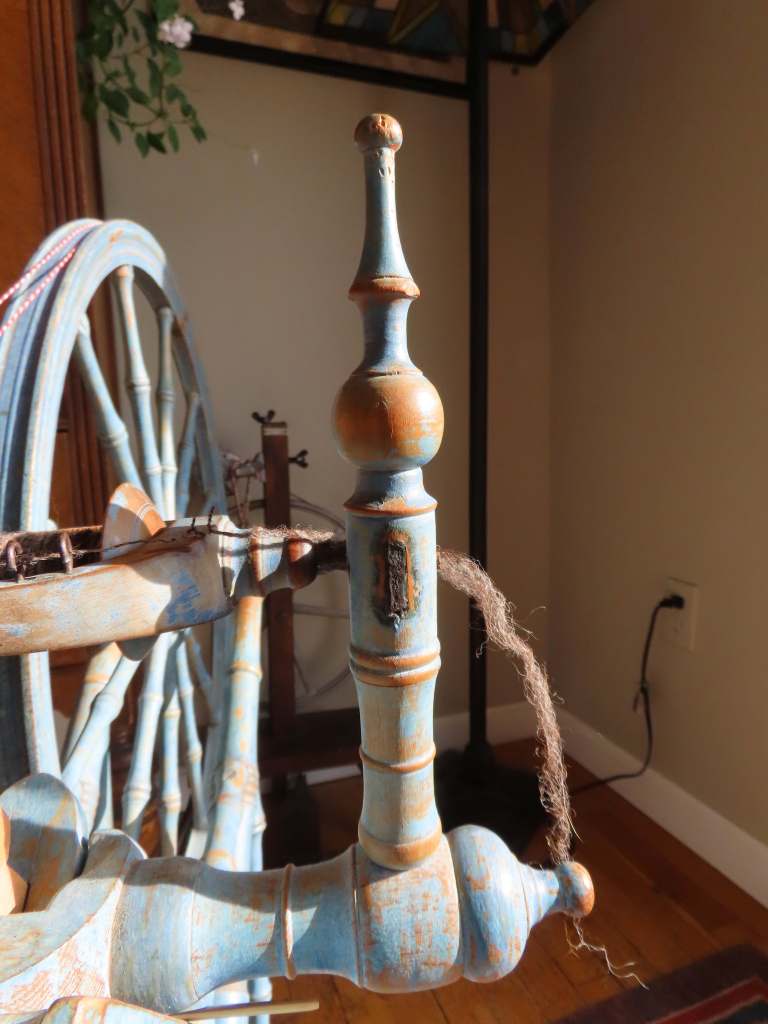
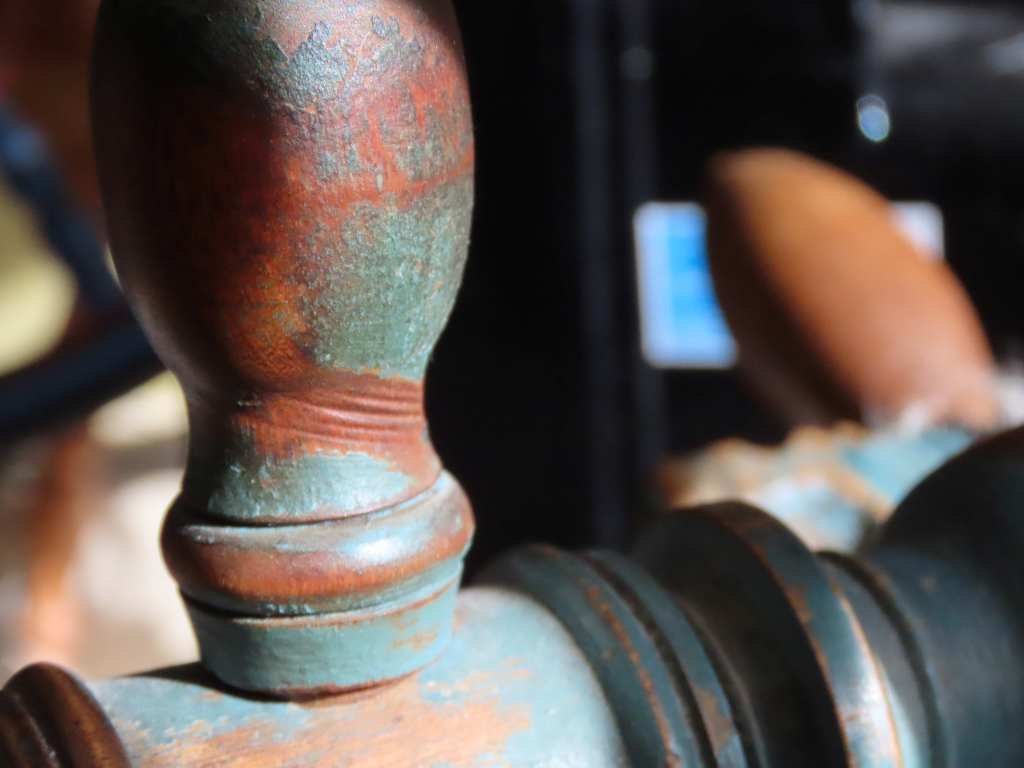
The maidens are simply turned.
Sif was for sale in northern Wisconsin by the manager of a retirement home. He was selling it for one of the residents who needed to downsize her belongings. Sadly, none of her children wanted the wheel. It always feels tremendously satisfying to rescue an unwanted wheel, bring it back to spinning life, and, ultimately, pass it on to another caretaker who will use it and cherish its unique qualities.
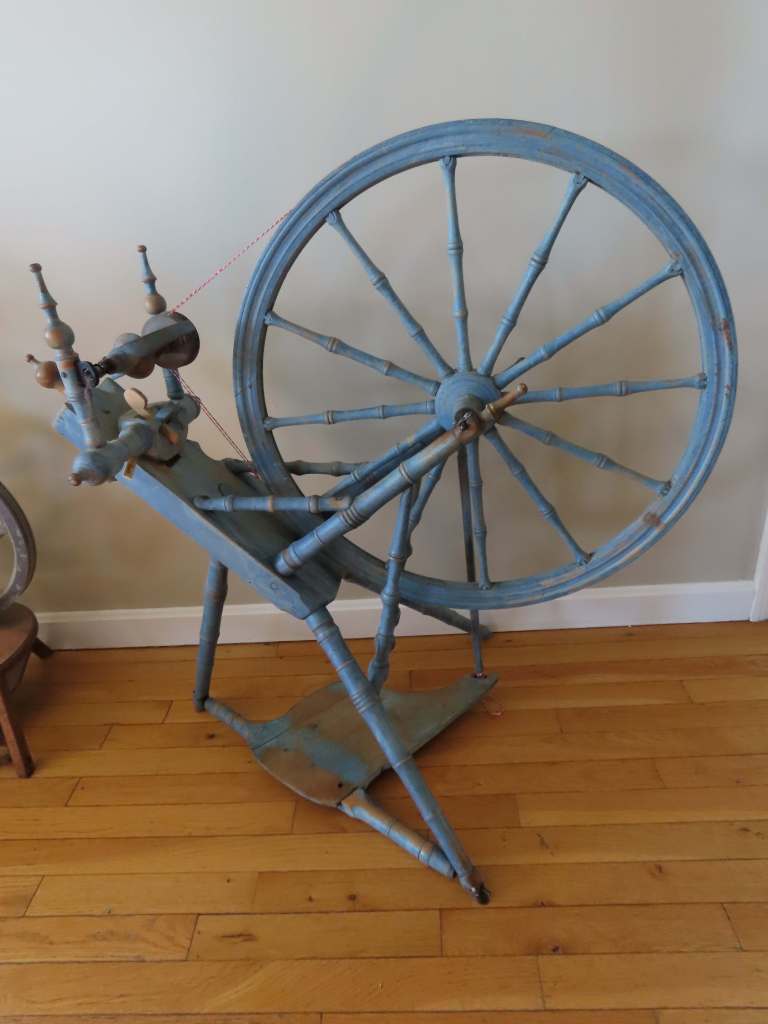
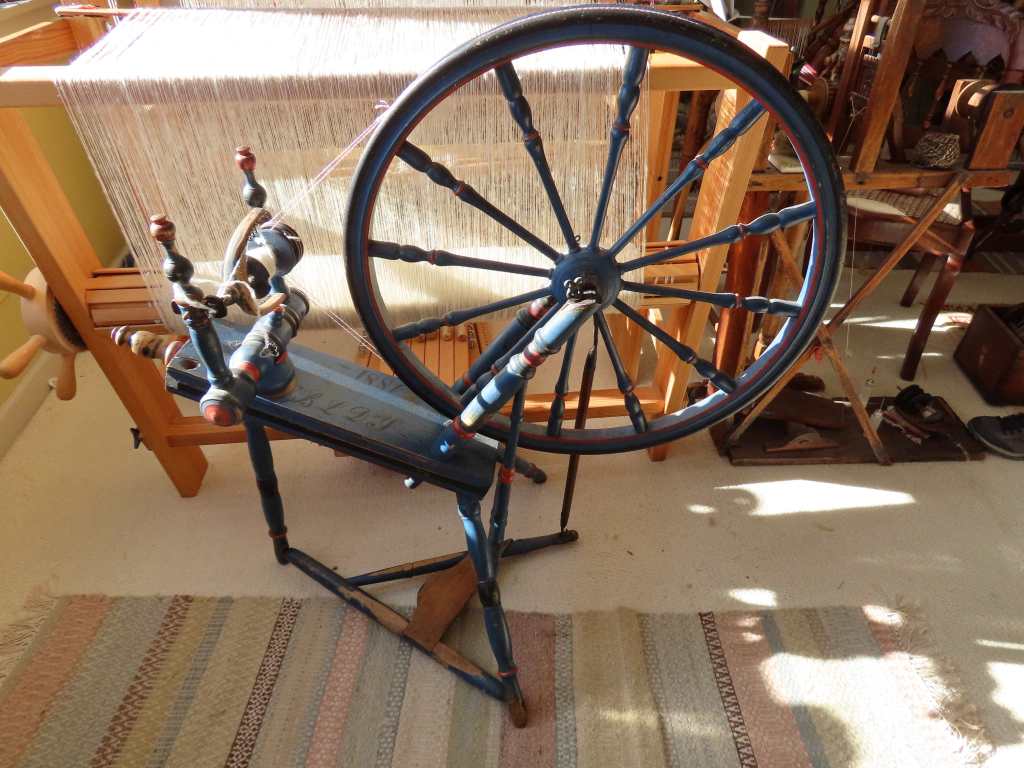
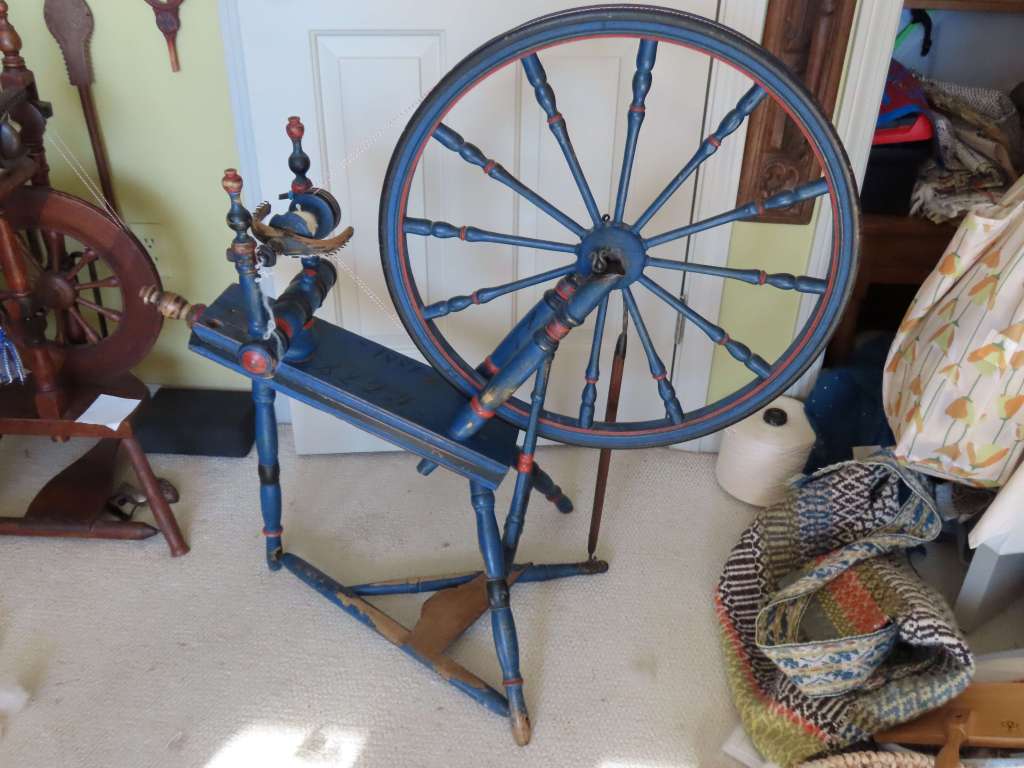
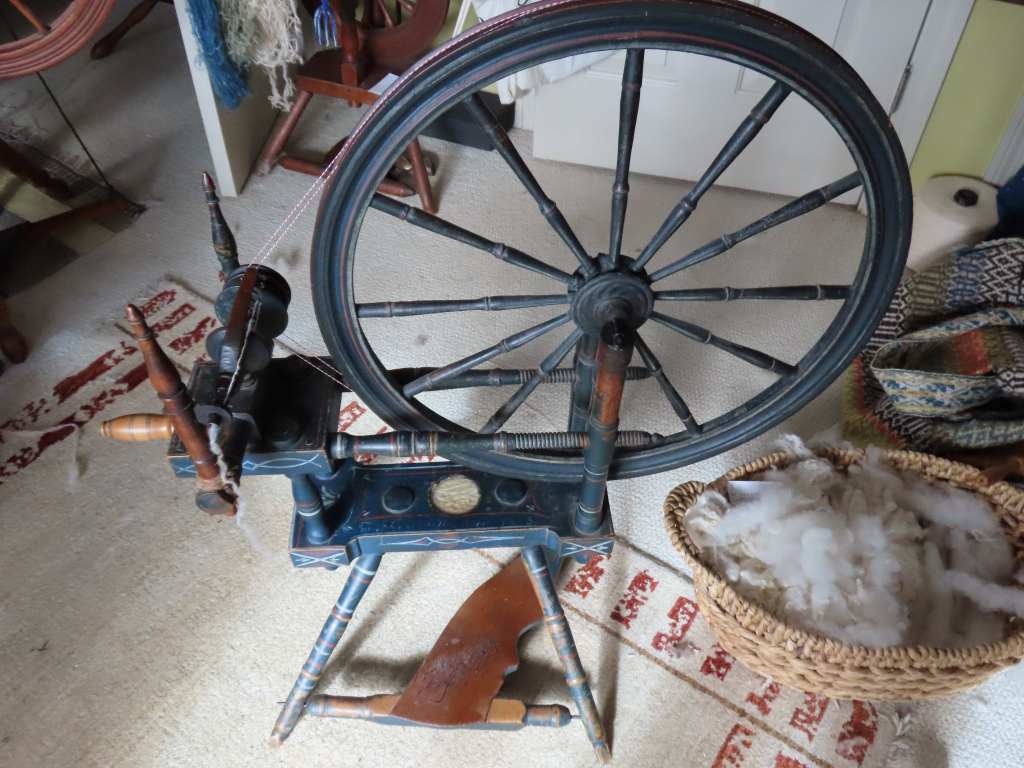
This robin-egg-blue Norwegian wheel is (to borrow from Max Verstappen) simply lovely. As with the OAP wheels in the previous post, this style comes up for sale with some regularity in the US midwest and even Canada.
In fact, the man I bought this wheel from had found it in Ontario, where he said they called them “crowder” wheels. I have not heard that name before, but wonder if it refers to the compact footprint designed to fit in crowded spaces. Just speculation …
The nickname I am familiar with is “BESS,” from the antique spinning wheel folks at Ravelry. “BESS” is an acronym for “Black Earth Super Slanty.” The “Super Slanty” describes the shape–an extremely slanted table with legs protruding from the table end (not bottom) following the same angle as the table. “Black Earth” refers to a photo taken in Black Earth Wisconsin around 1873 of five women in the Rustebakke family. The matriarch, Siri, sits in the middle with hand carders in her lap. Four younger women surround her (likely three daughters and a daughter-in-law), all posed with spinning wheels in front of them. The spinning wheels, each meticulously angled in a way that highlights their elegant style, are what make the photograph so captivating. I wanted to include the photograph in this post, but the Wisconsin Historical Society, which owns rights to the photo, charges too much for me to reproduce it here. ***For my rant about these charges, see below*** Although I cannot post it here, the photo (and a second one that include’s Siri’s husband and a dog) is easily found by doing a search for “Siri Rustebakke.”
What is significant about the Black Earth photo is that all the Rustebakke women are using the same style wheel. Were they all brought from Norway, were they built in the US based on a Norwegian style, or both? The answer remains unclear. The Rustebakke family came from the Valdres area of Norway and evidence shows this style wheel in that area. The Valdres Folkemuseum has several of them in its collection.
The Vesterheim Norwegian American Museum in Iowa also has examples in its collection with “Valdres” frequently appearing in the wheel description (thank you A. Myklebust for this information). Many families from Valdres also settled in Blue Mounds, Wisconsin, about 12 miles from Black Earth, and one of these wheels shows up in this postcard from “Little Norway,” a living museum, there.
Postcard from “Little Norway”
Patricia and Victor Hilts, in their article about Wisconsin spinning wheels suggest that the wheel at Little Norway may actually have been one of the Rustebakke family wheels. Hilts, p. 19, fn. 86. The Hilts also speculate that these wheels may have been made in Wisconsin rather than Norway. Hilts, pp. 18-19.
The flat area on the lower left is where the maker’s initials are usually found. Mine has none.
They note that some wheels have maker’s initials of “JS” and that there was a furniture maker named Jacob Schanel advertising in the area. An absolutely fascinating piece in the book “Creators, Collectors, Communities,” discusses Aslak Olsen Lie, a furniture maker from Valdres, who immigrated to Blue Mounds and continued to make furniture in a meld of traditional Norwegian and American popular style. link here (I could not help but notice the robins-egg-blue paint on the back of Lie’s cupboard).
While these furniture makers could also have been making wheels, there is no evidence showing that they did, as far as I know.
We do know, however, that spinning wheels were made in Valdres. A Wisconsin settler, A. O. Eidsmoe, wrote: “I was born in Southern Aurdal in Valders, Norway, the 13th of February, 1814. My first or earlier childhood years passed without anything of importance.
Our parents were poor and with six children (three boys and three girls) were able to make both ends meet, nothing more. As soon as we were old enough, we had to go to work. We boys learned to run a turning lathe and made tynneturer, lobbismarer, peppergrinders, rolling pins, distaffs, and as we learned the trade, we commenced to make spinning wheels.” The Norwegian Settler’s Story.
Perhaps the best evidence that these wheels were made in Norway is that they turn up for sale there. I was delighted to see this recent beauty on Facebook Marketplace for sale in, not surprisingly, Aurdal, Valdres.
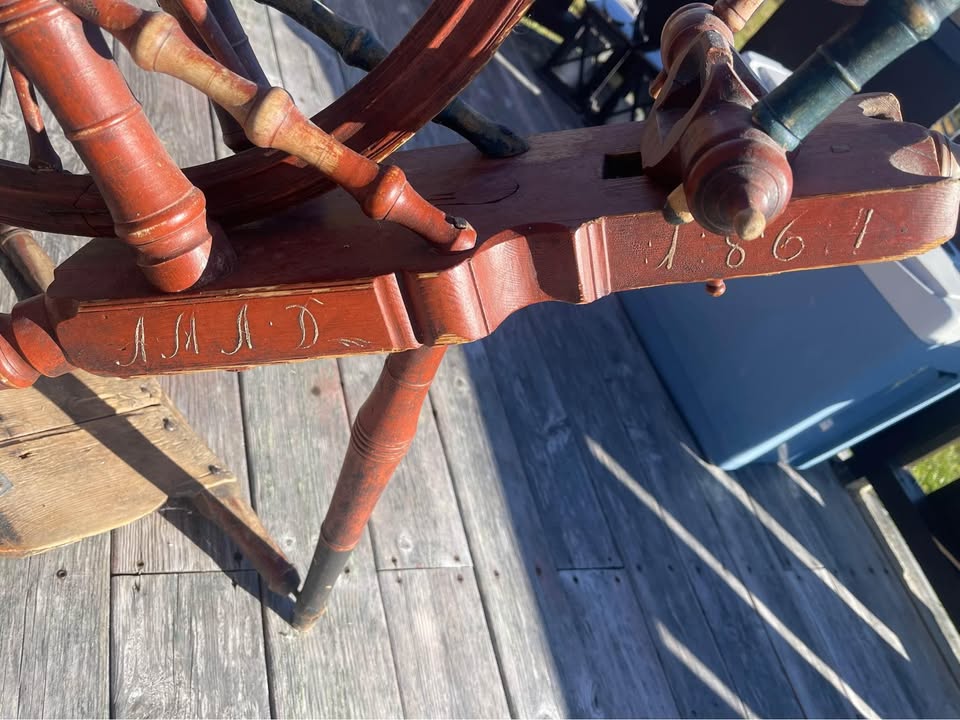
Wheel for sale in Aurdal, NorwayThere’s a maker’s mark but I cannot make it out1861 date, note how similar this wheel is to Sissel
While some have makers’ initials, most seem to be unmarked. It seems likely that, in a pattern typical for many regions of Norway, Finland, and Sweden, Valdres used its abundant water power for furniture and spinning wheel production and there were multiple makers in the area, all producing the same regional style wheel. If that was the case (and it’s purely speculation at this point) it is very possible that one or more of these makers continued to make this style wheel after immigrating to the midwest.
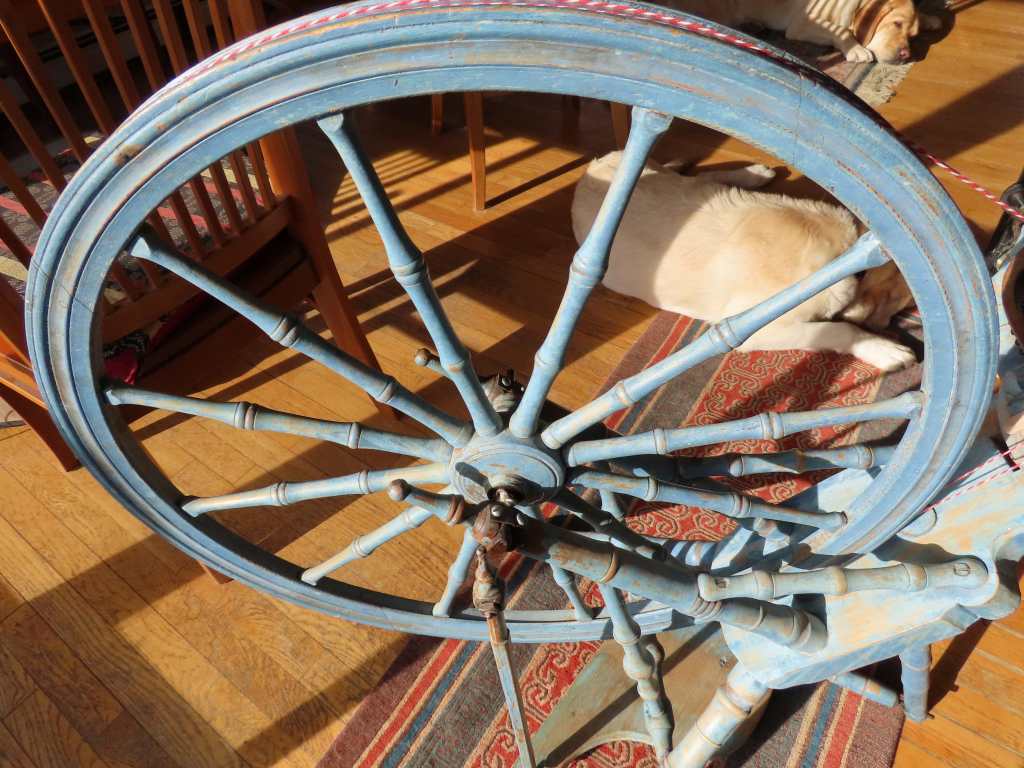
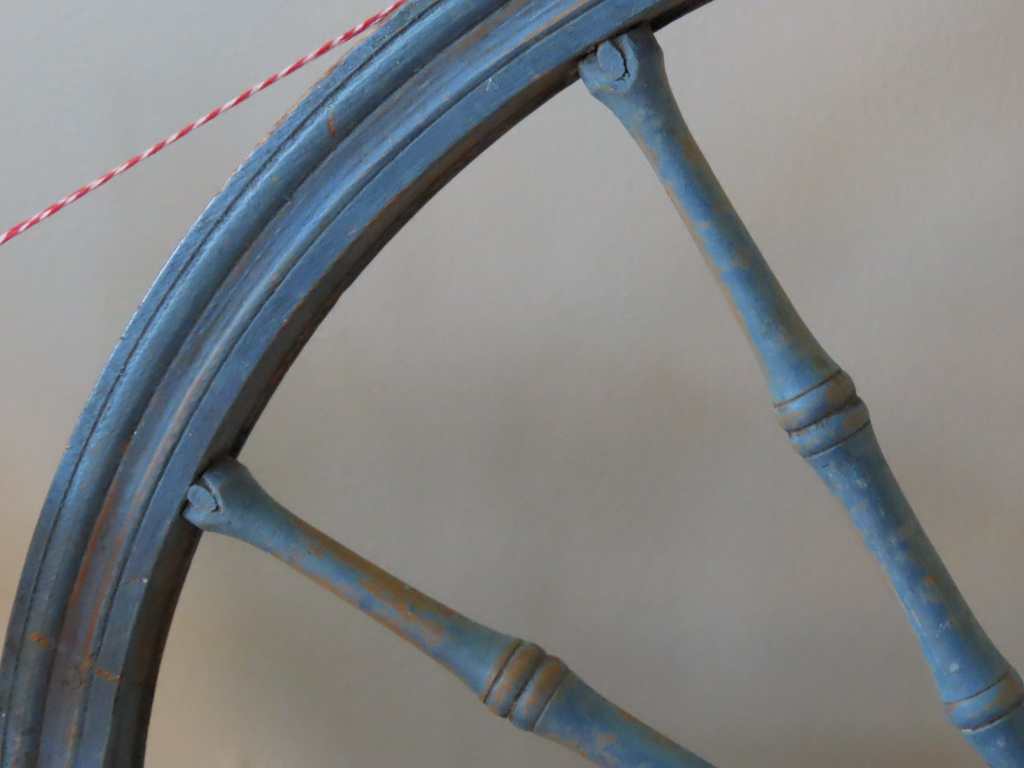
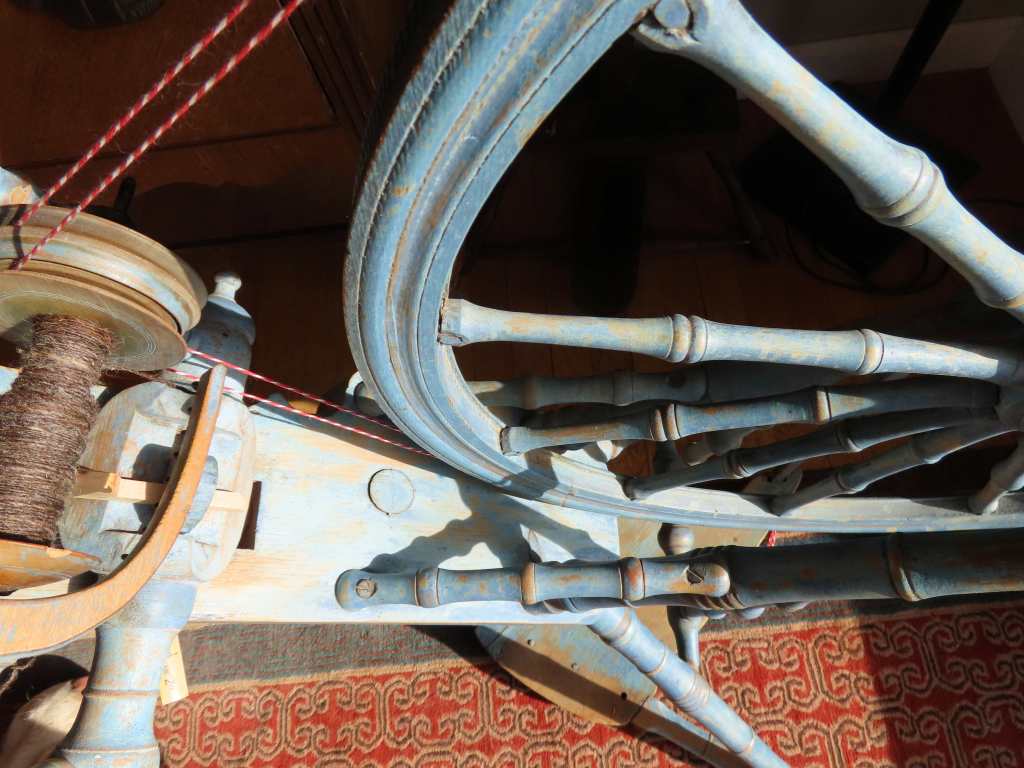
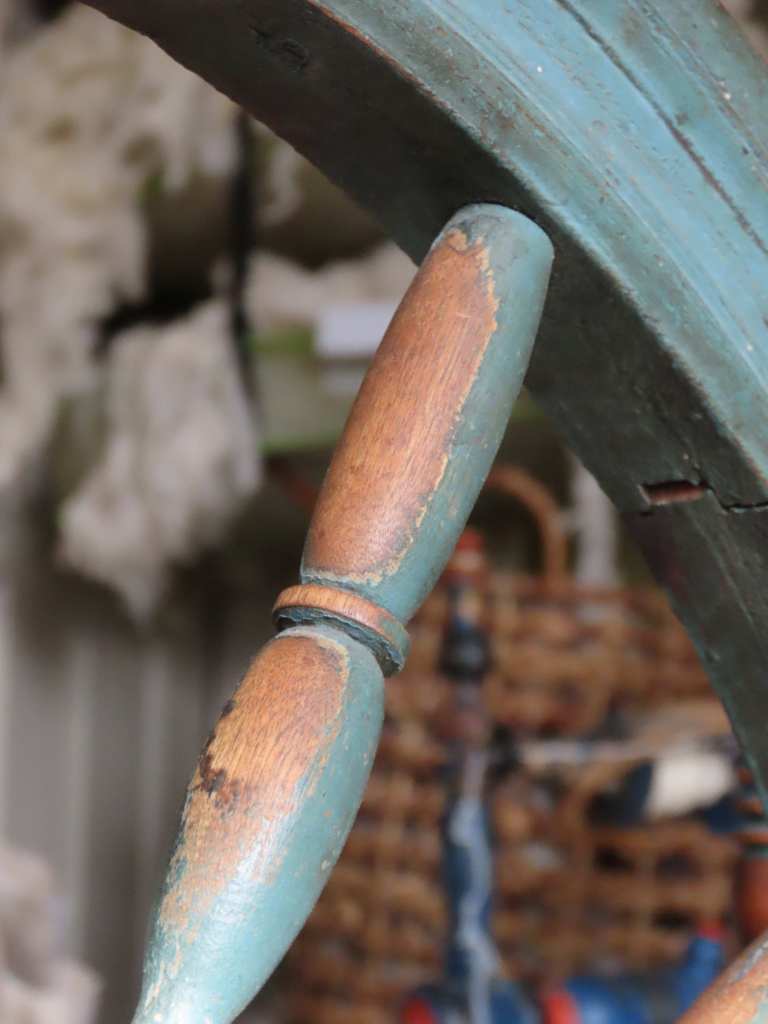
Whether all were made in Norway, or some made here, there do seem be be multiple makers and individual differences between the wheels. Some have fancier turnings and some have internal cranks, for example. But all share certain characteristics. The spokes and legs are turned to resemble bamboo–a style found in late 18th and 19th century furniture, but uncommon in spinning wheels.
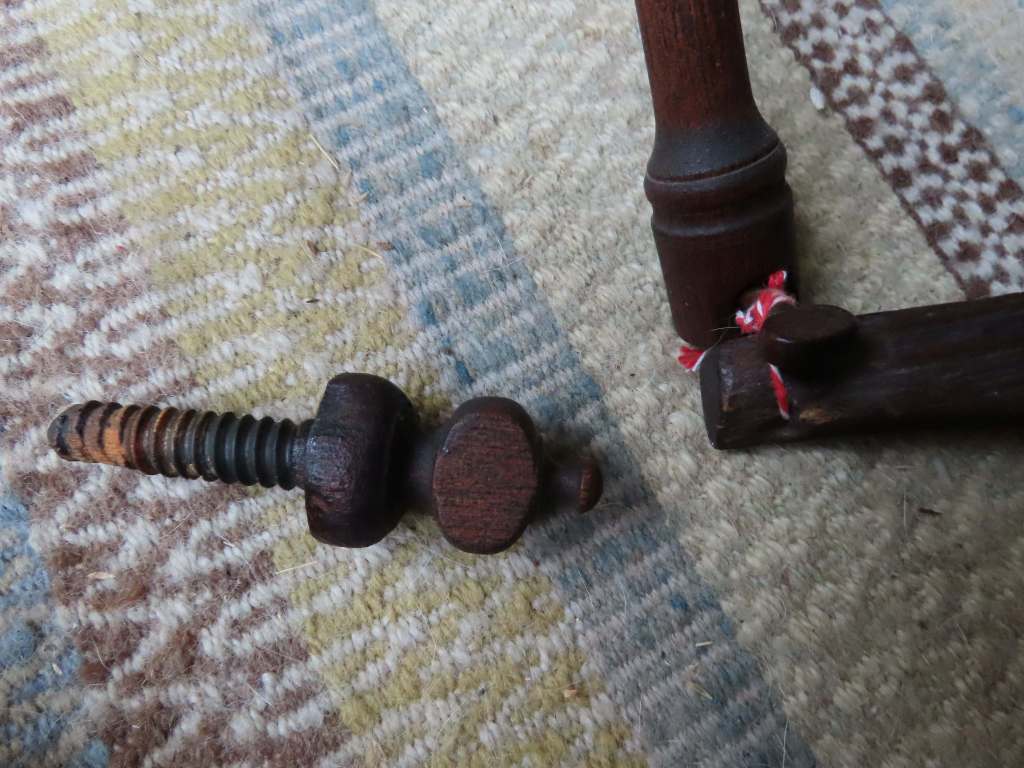
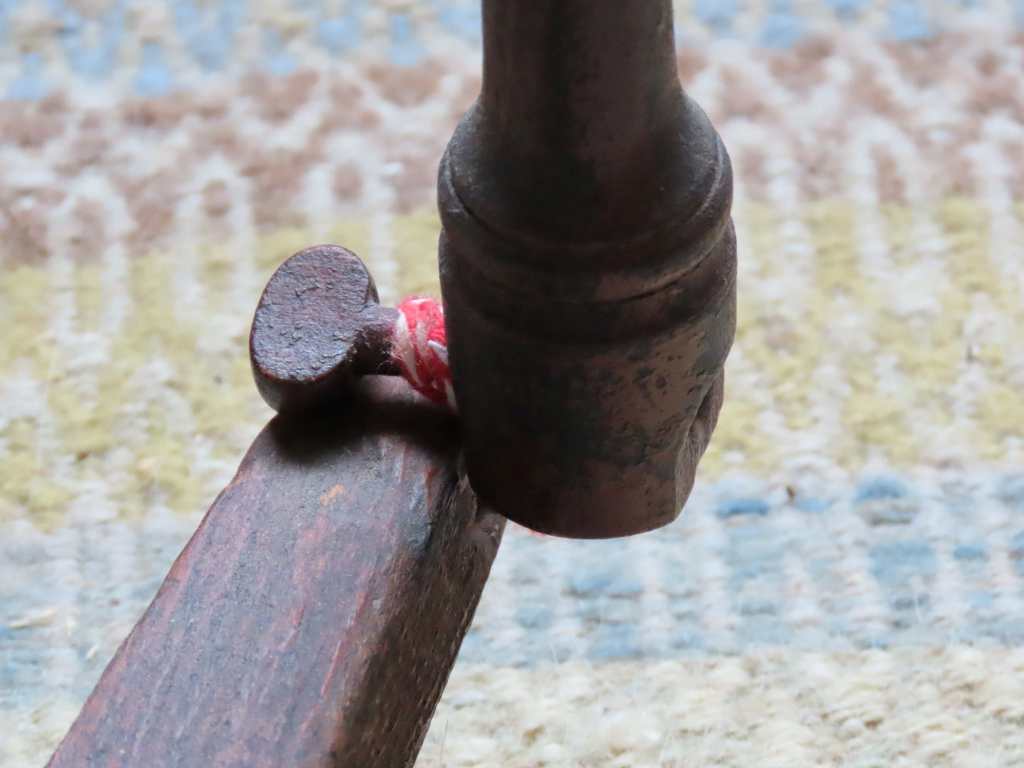
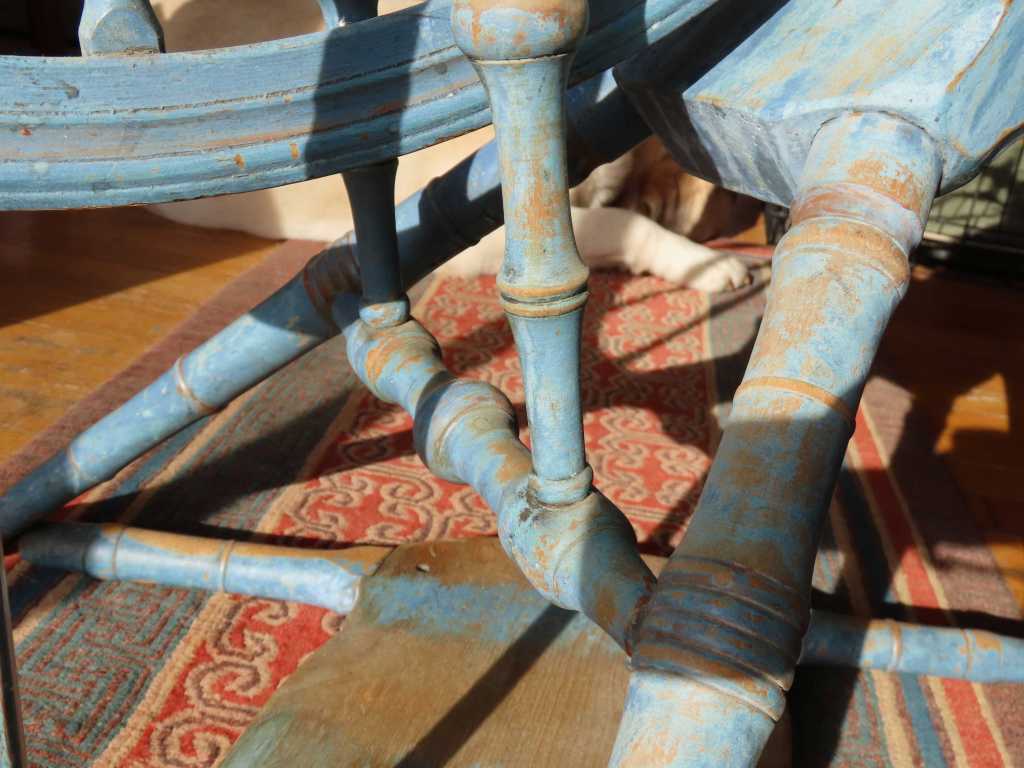
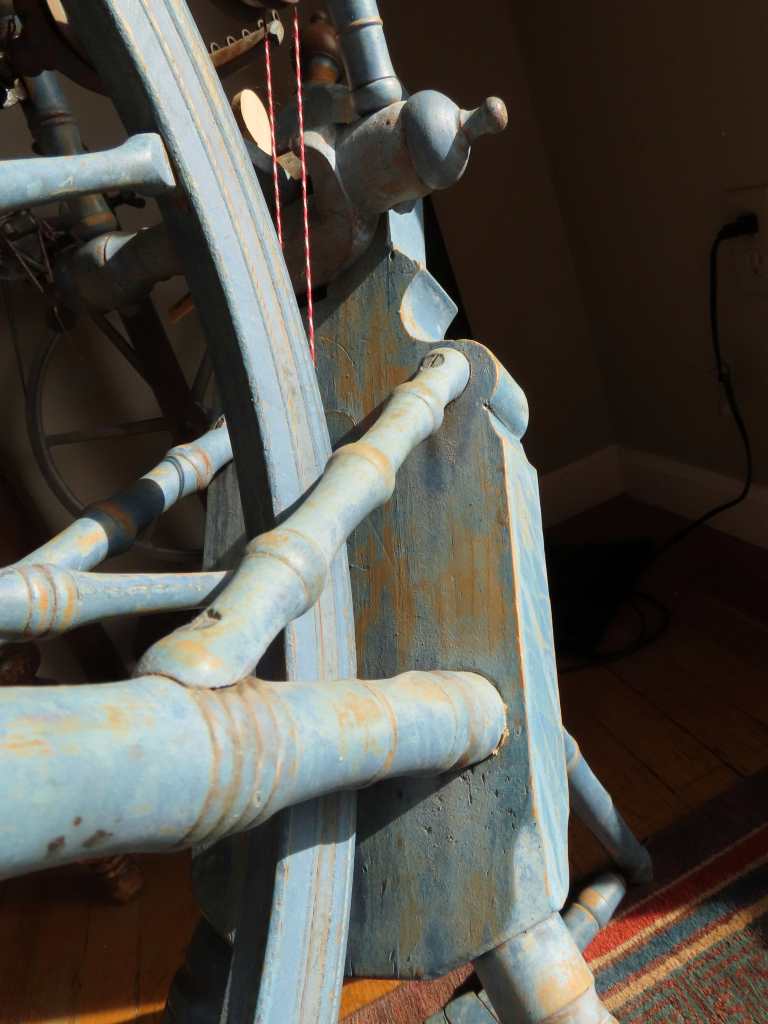
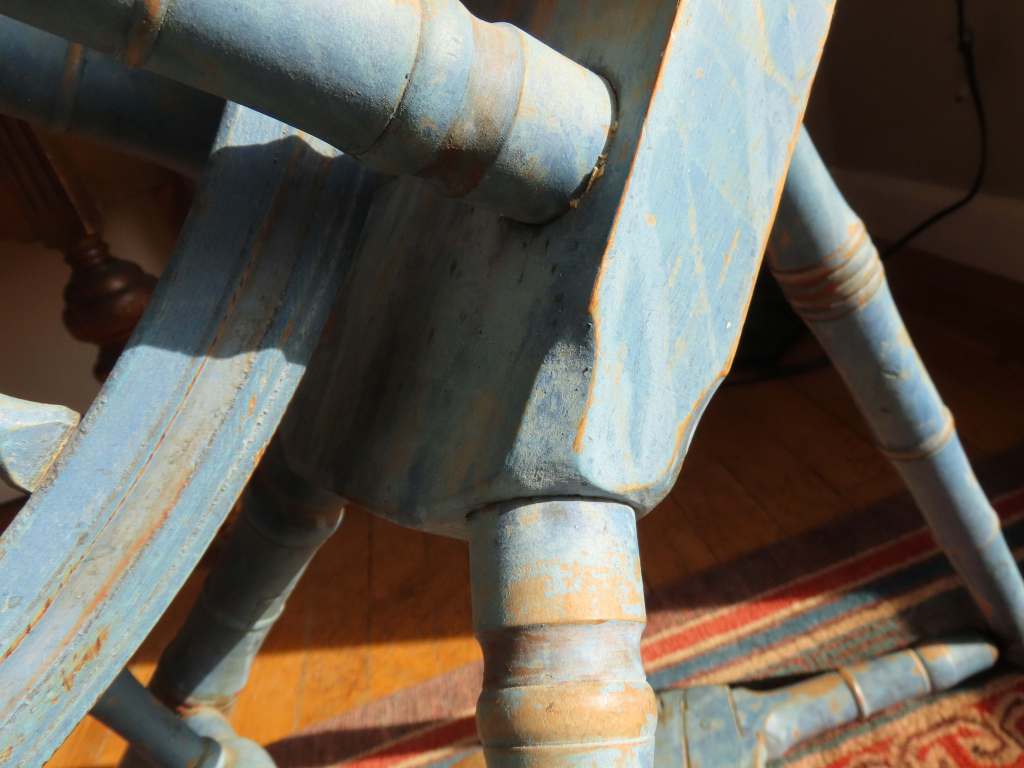
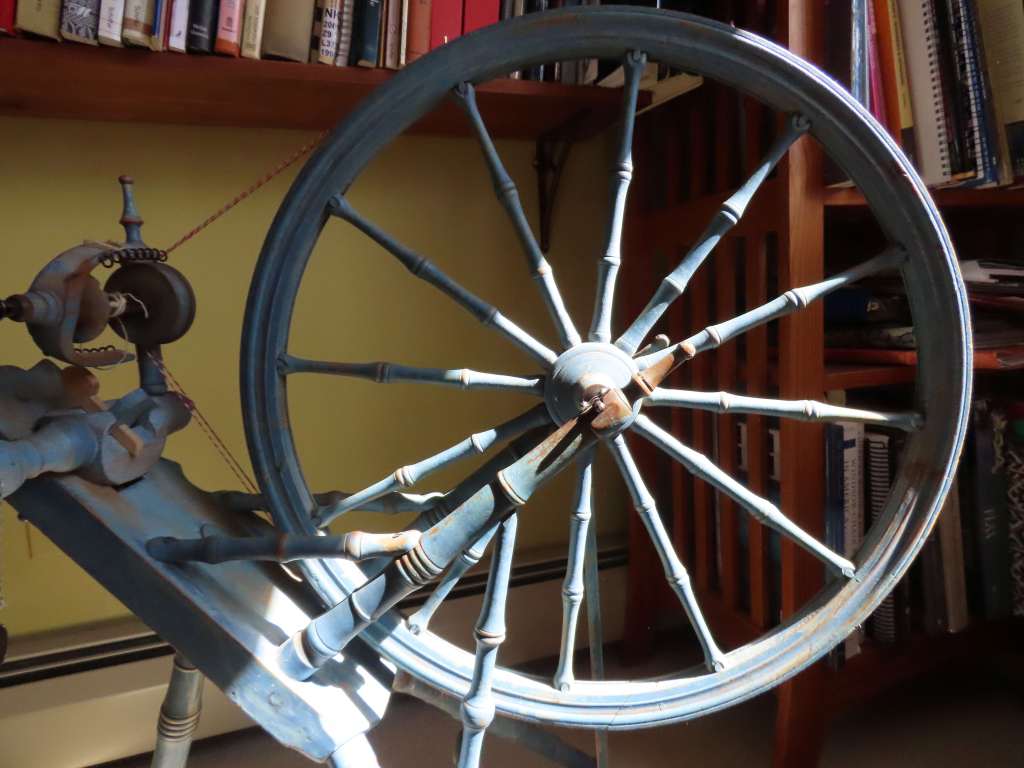
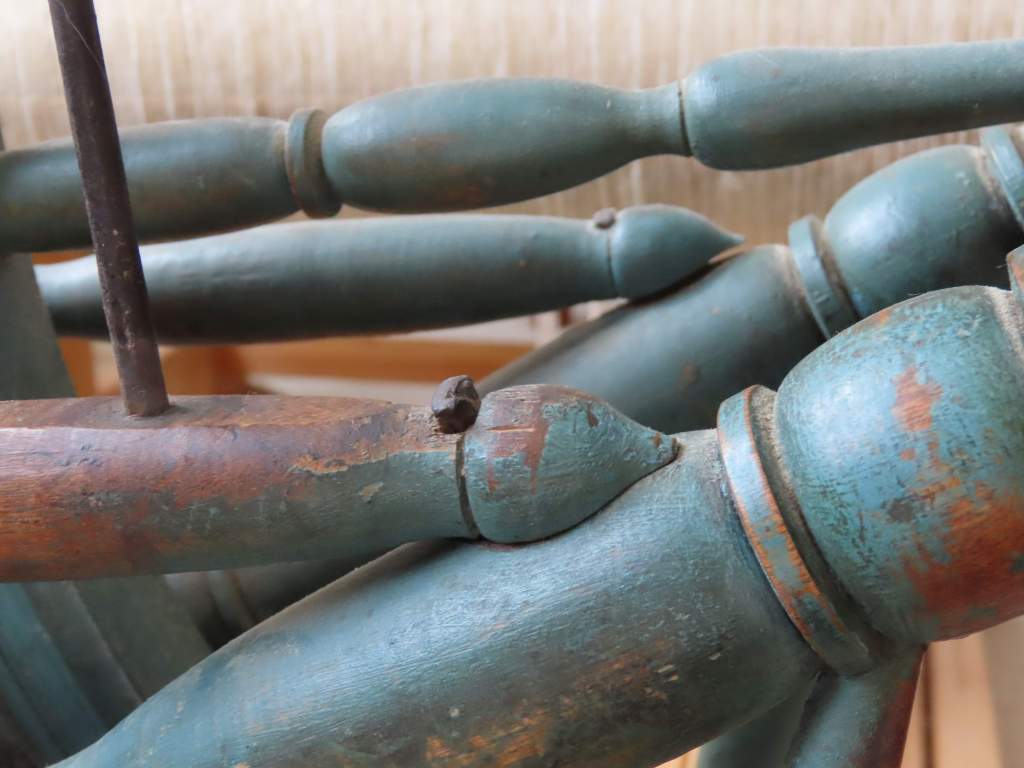
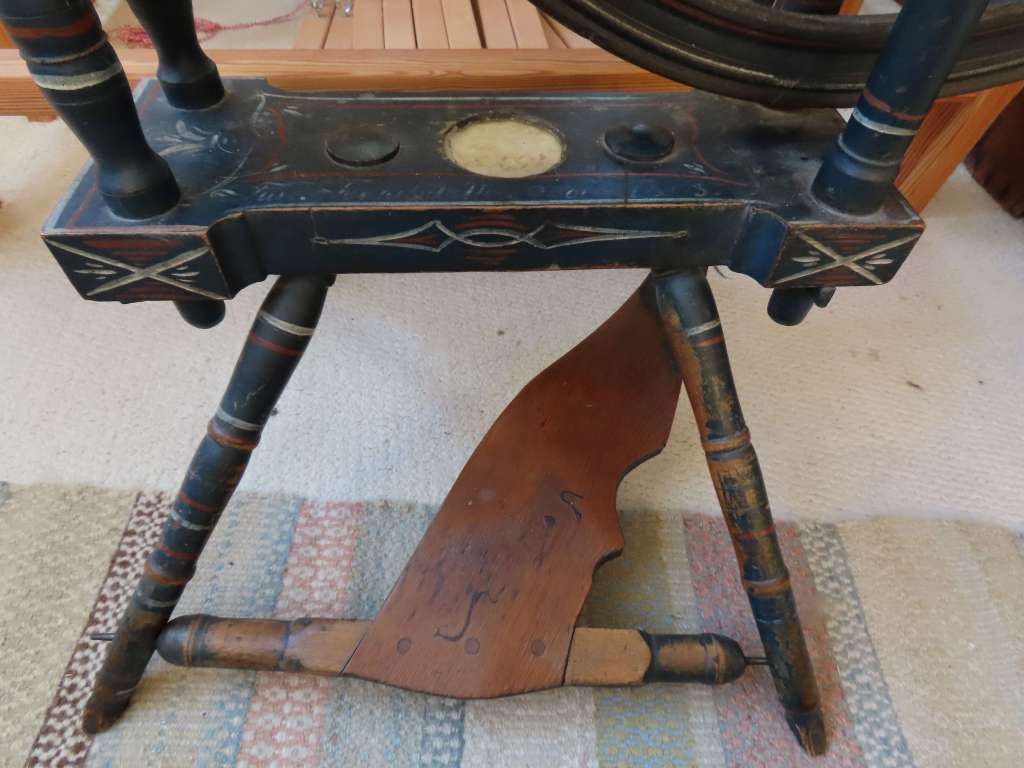
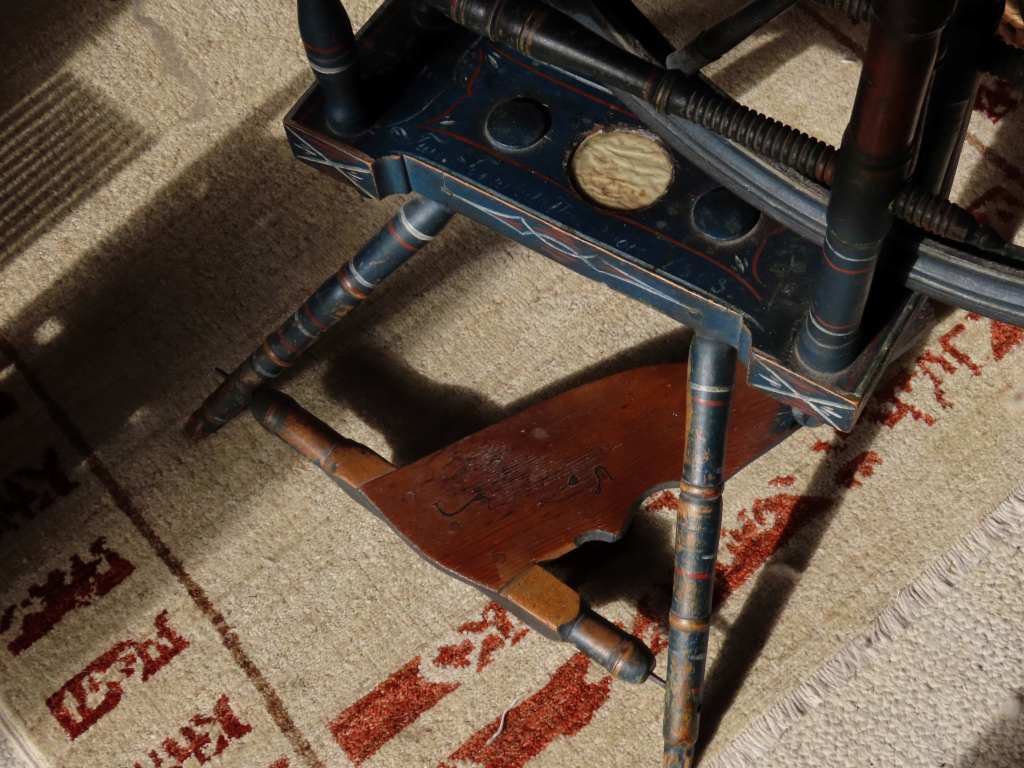
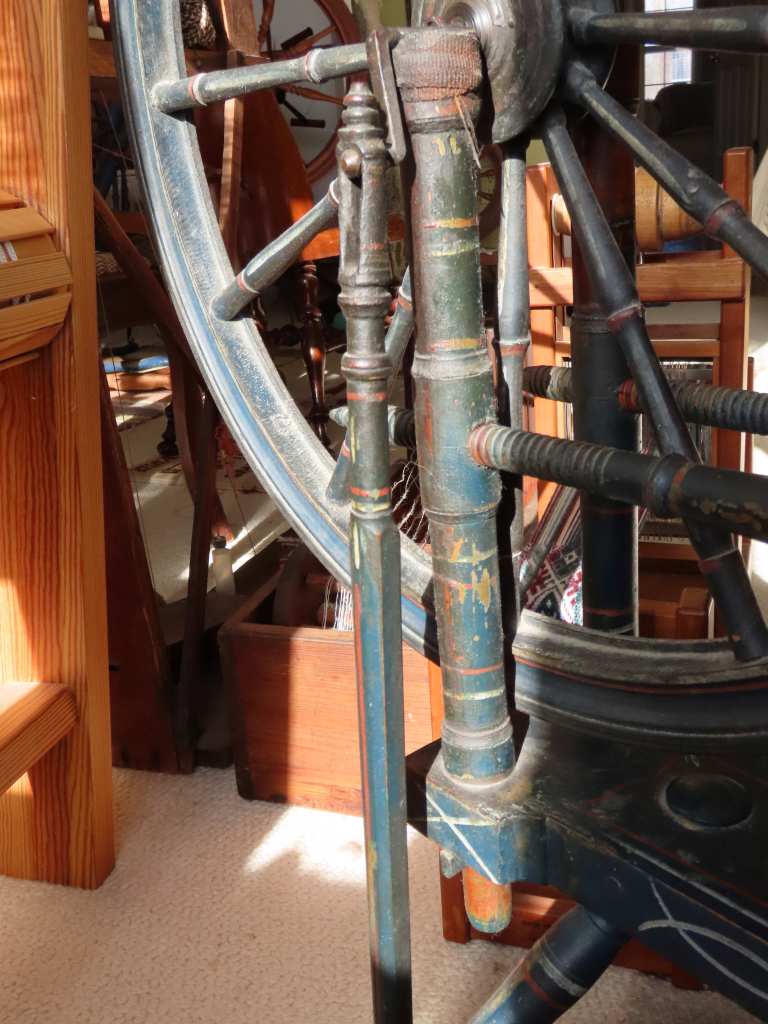
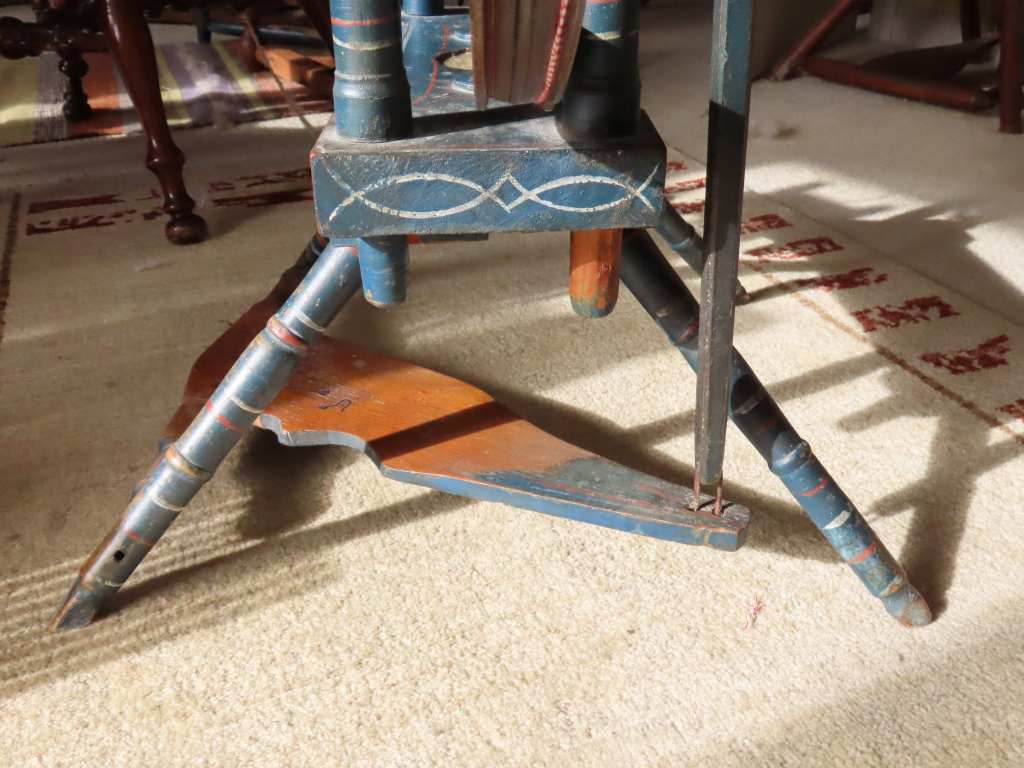
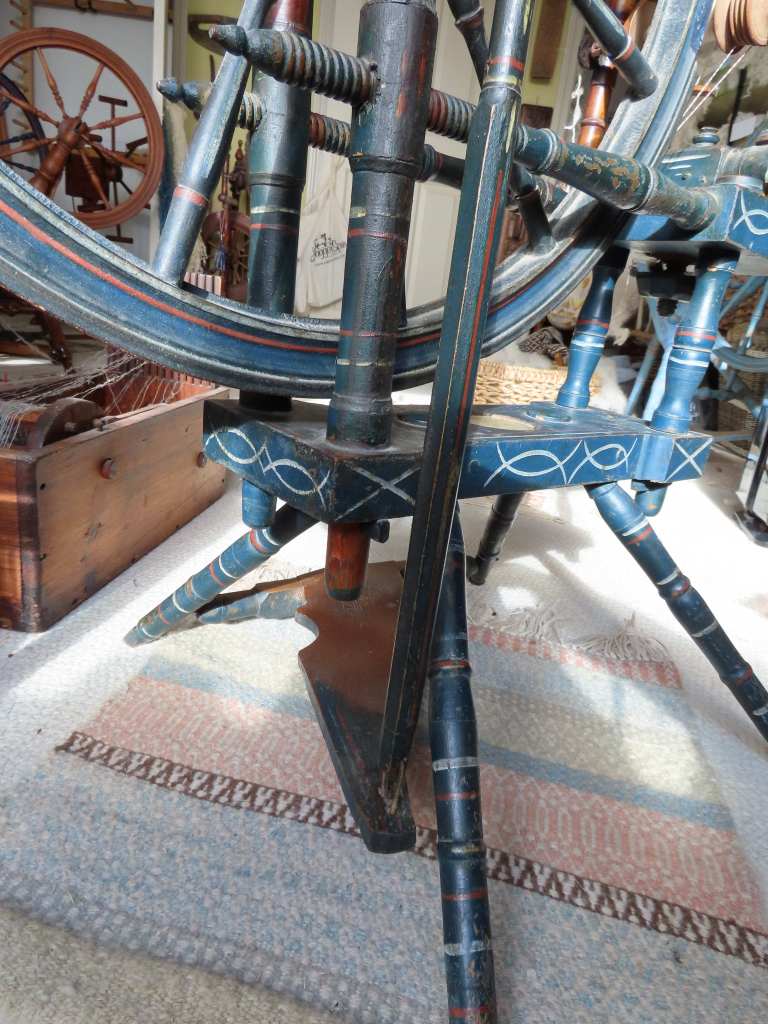
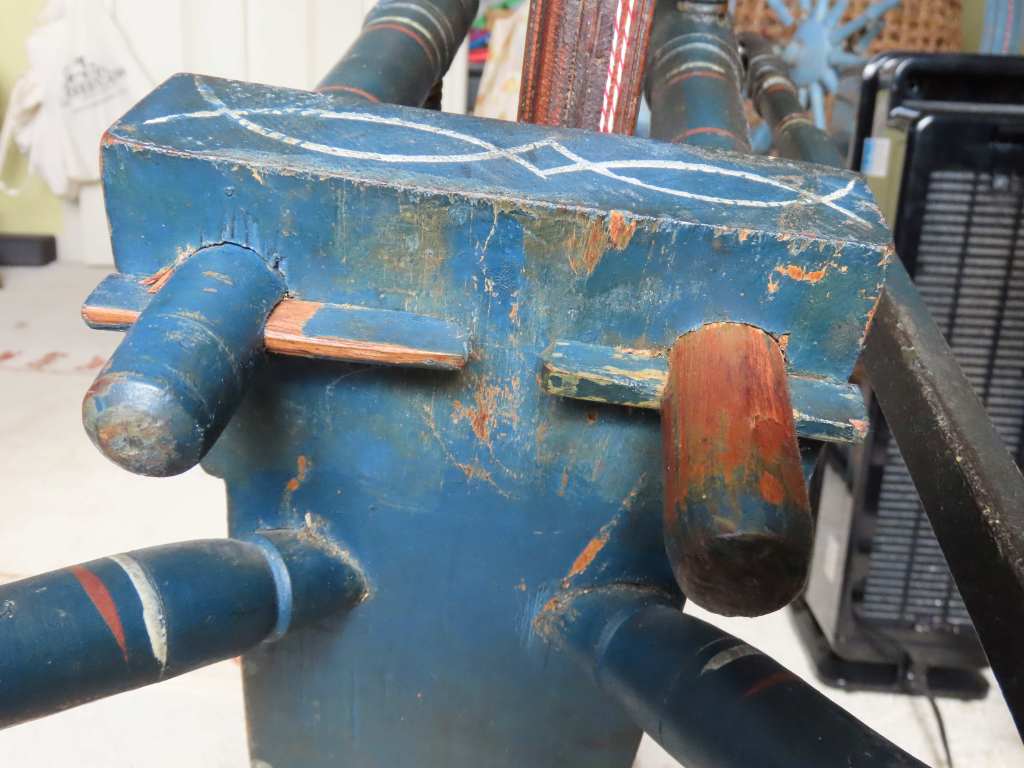
A cross brace between the two downhill legs gives stability to the highly slanted table,
as do the screwed-in struts.
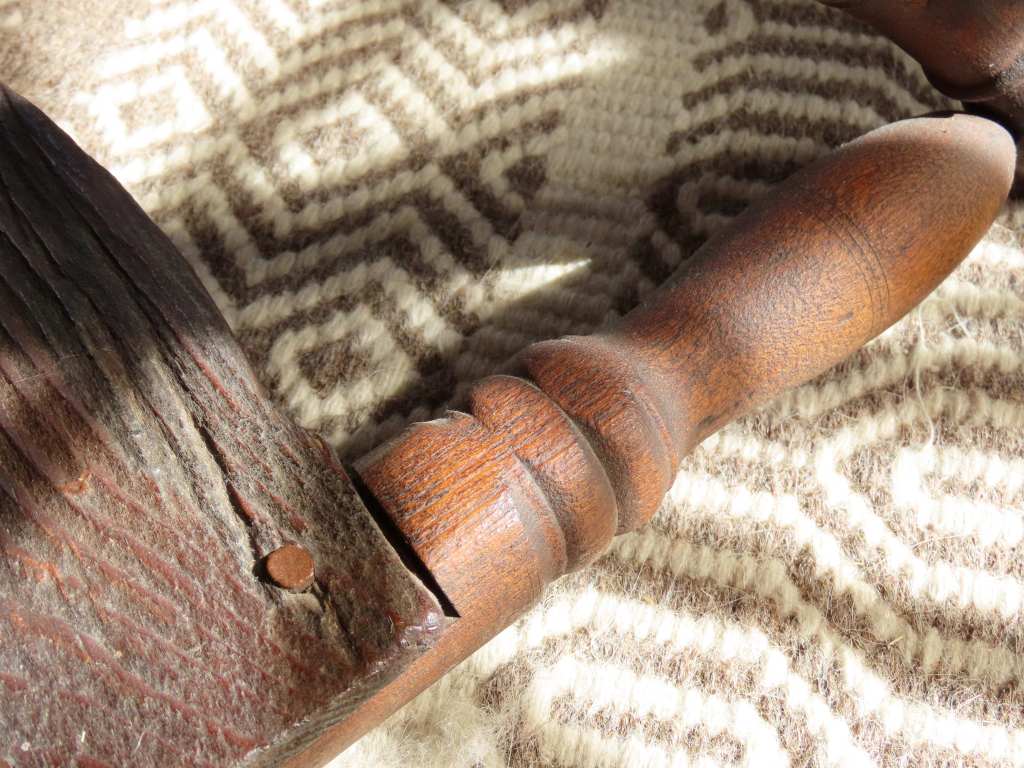
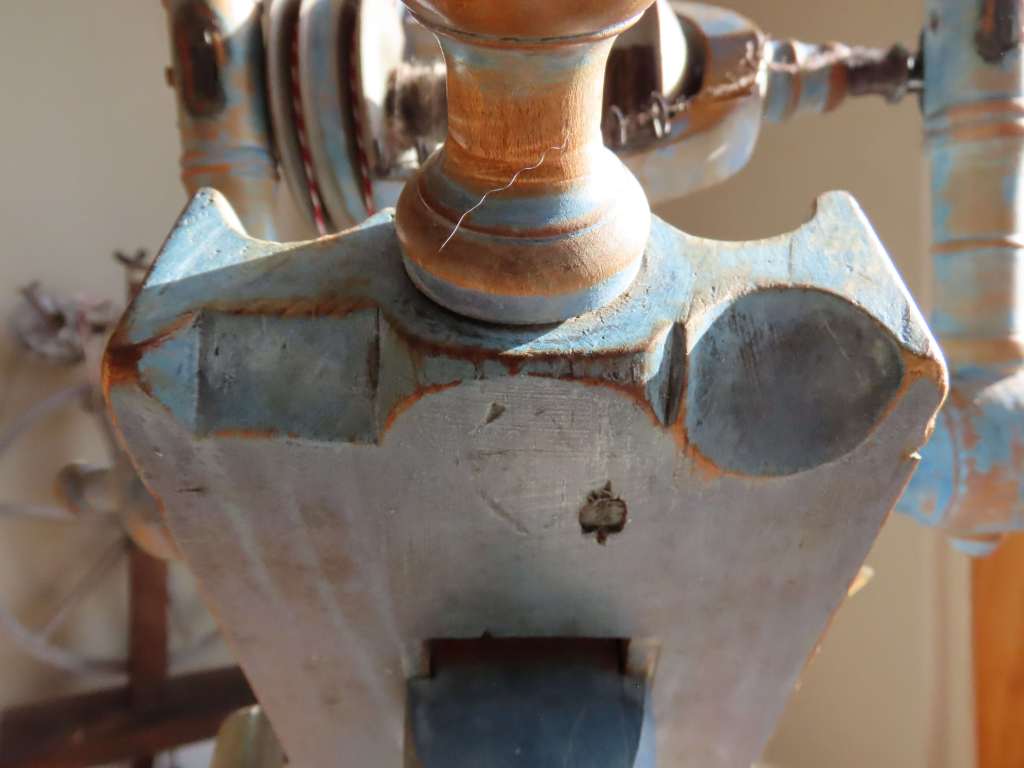
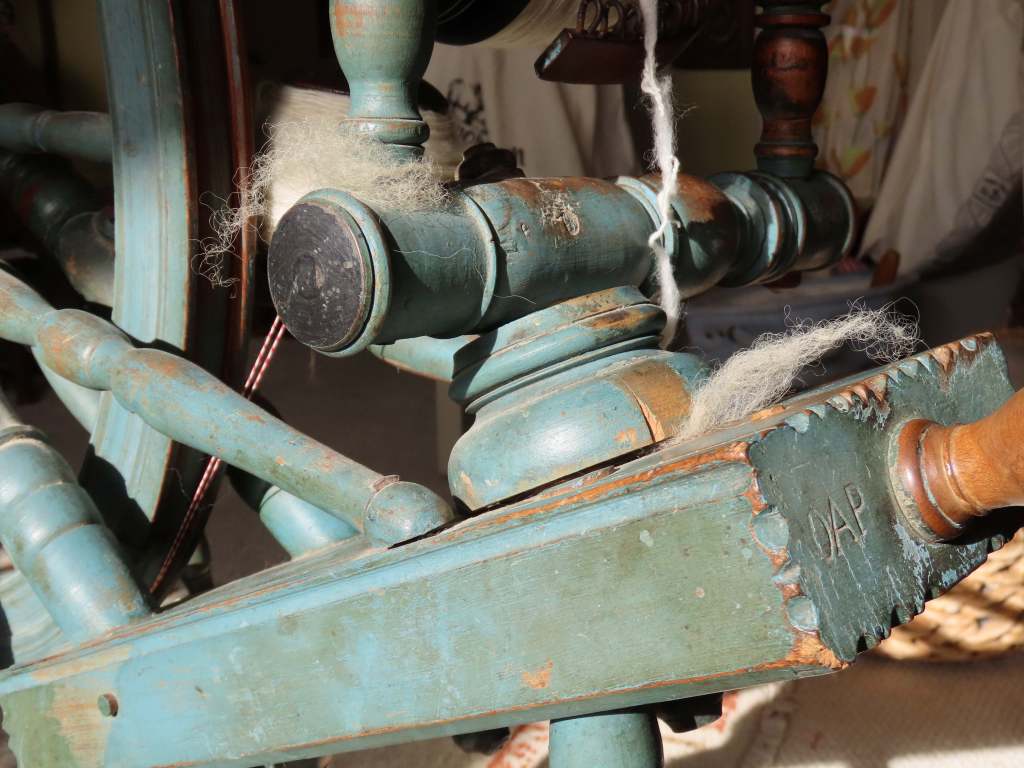
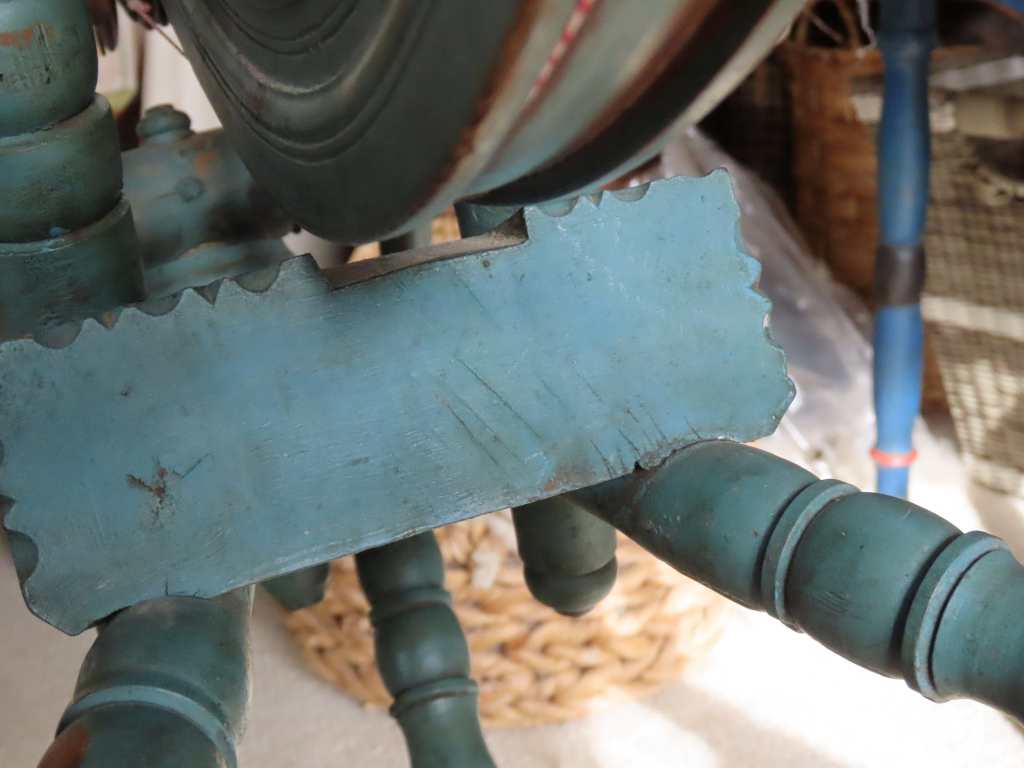
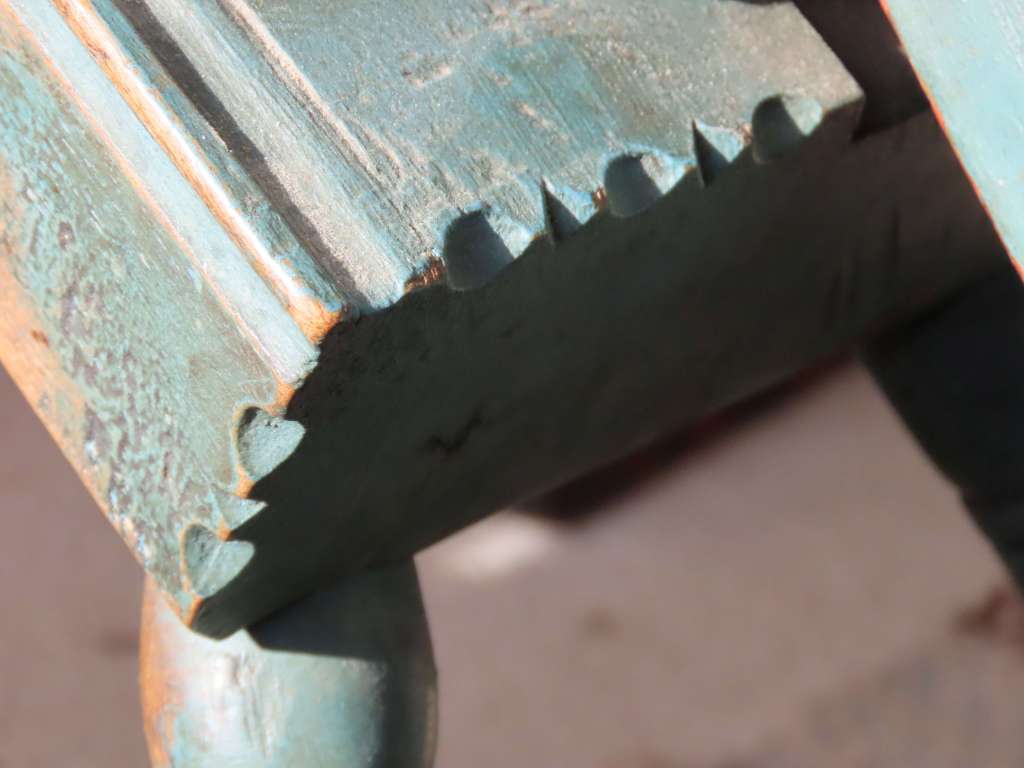
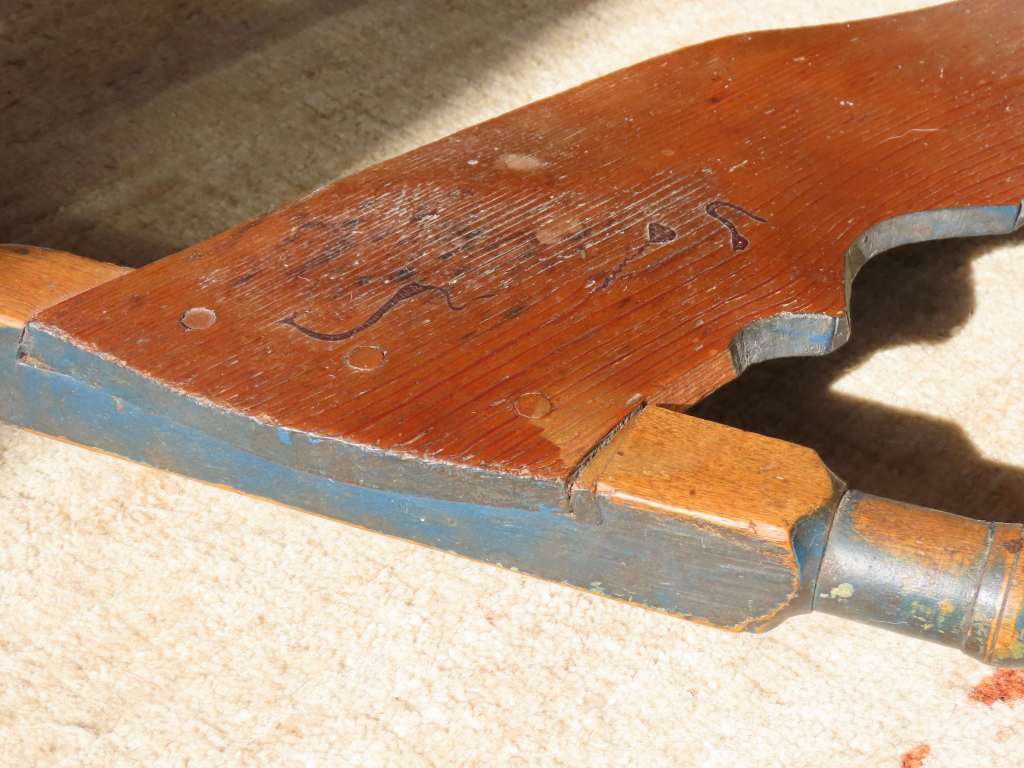
The table itself is adorned with a decorative swirled edge on the non-spinner tension end
and subtle shaping on the other end.
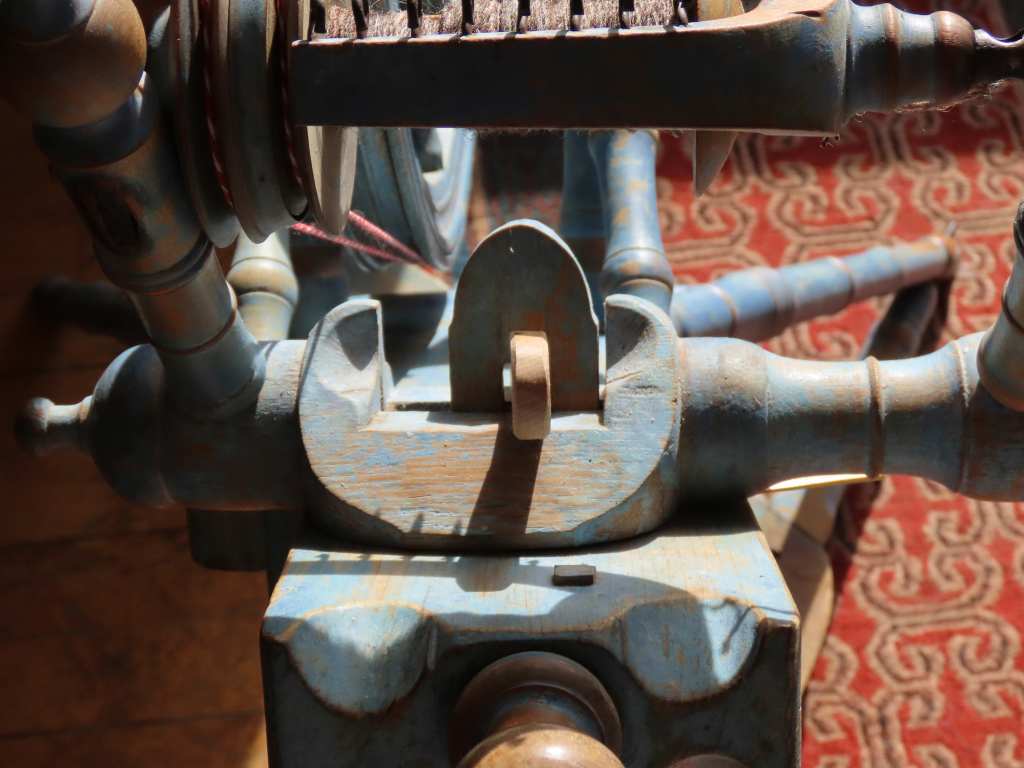
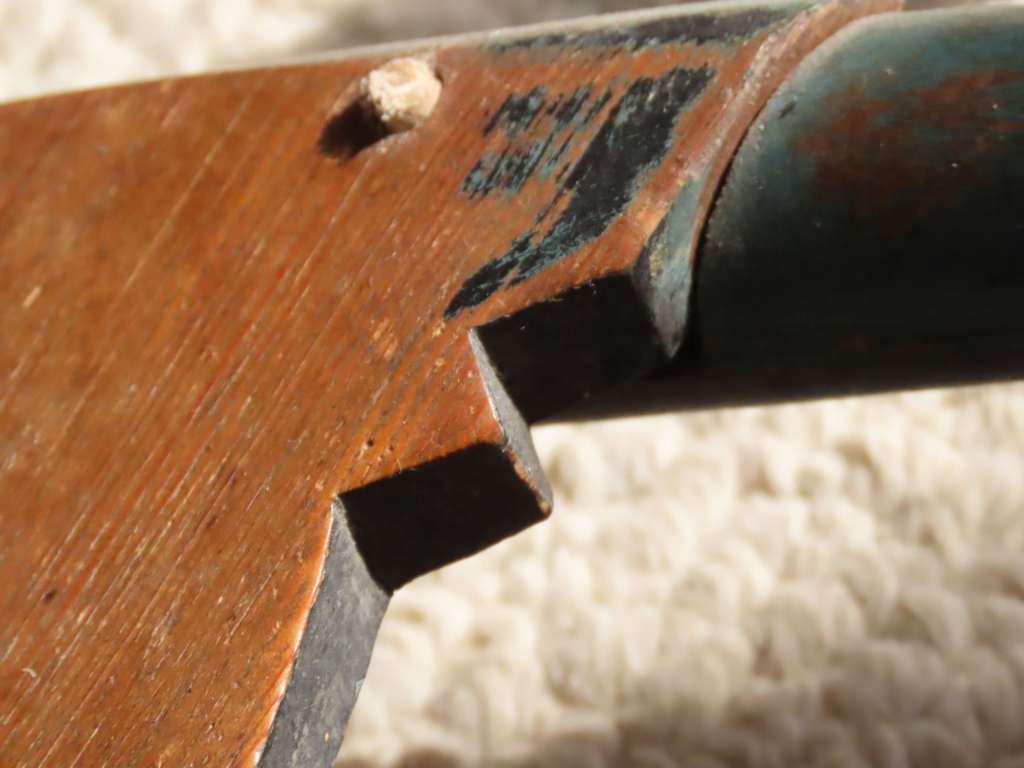
The MOA has a nifty sliding mechanism,
with nicely scooped edges,
for precise adjustment of the drive band angle. It also allows the spinner to easily use different-sized flyers for wool and flax.
The treadle is very wide,
working equally well for one- or two-footed treadling.
The flyer on mine is a generous size,
with a relatively large orifice.
The leather flyer bearings are cut flush with the maidens on the backside.
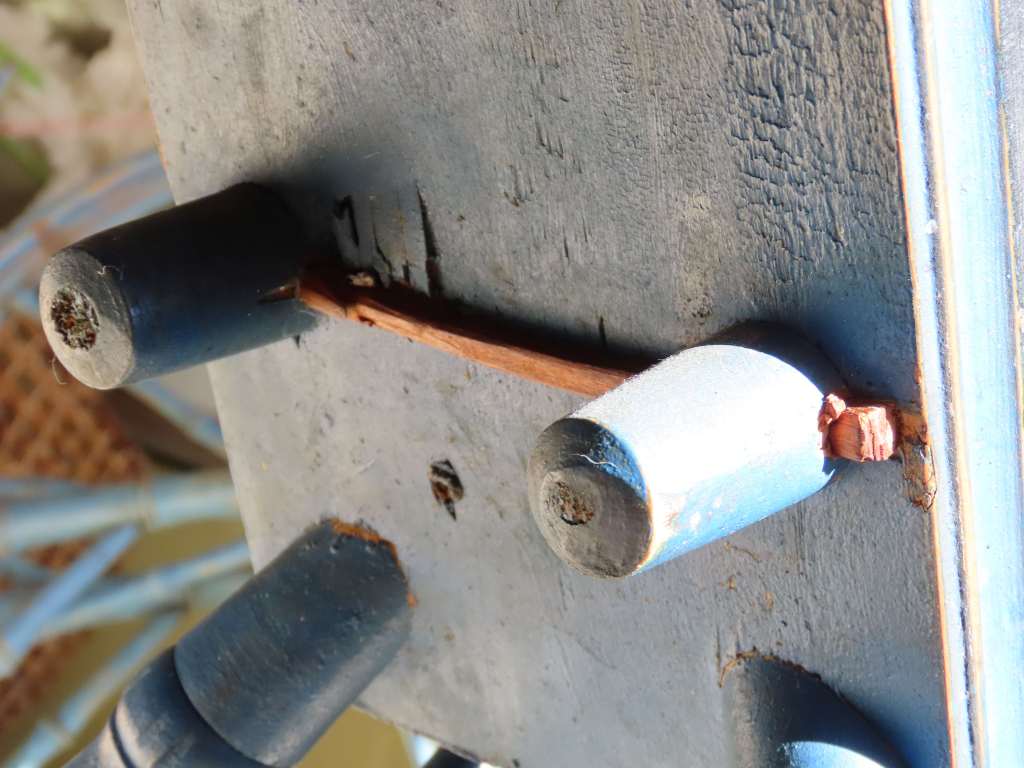
No, the dog chewing marks at various places on this wheel are not from my dogs!
Unlike many Norwegian wheels, the whorl turns righty-loosey.
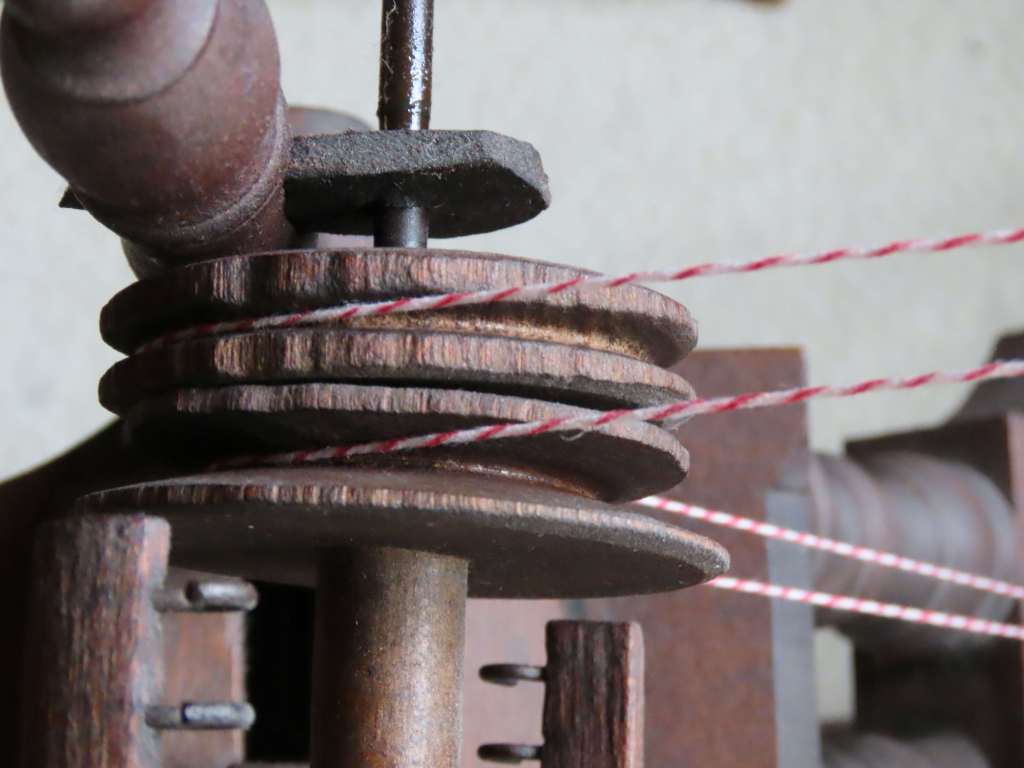
The the bobbin whorl
neatly nests into the flyer whorl, a feature found on other styles of Norwegian wheels.
Mine is a good spinner, although it required quite a bit of initial adjustment to properly align the whorl.
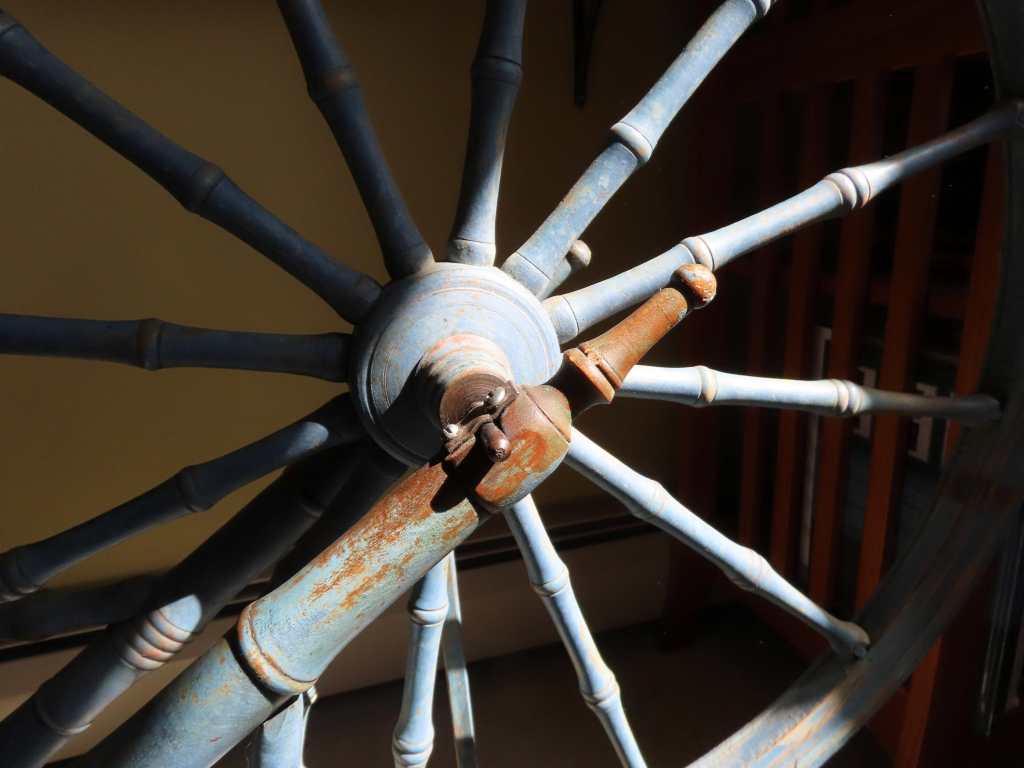
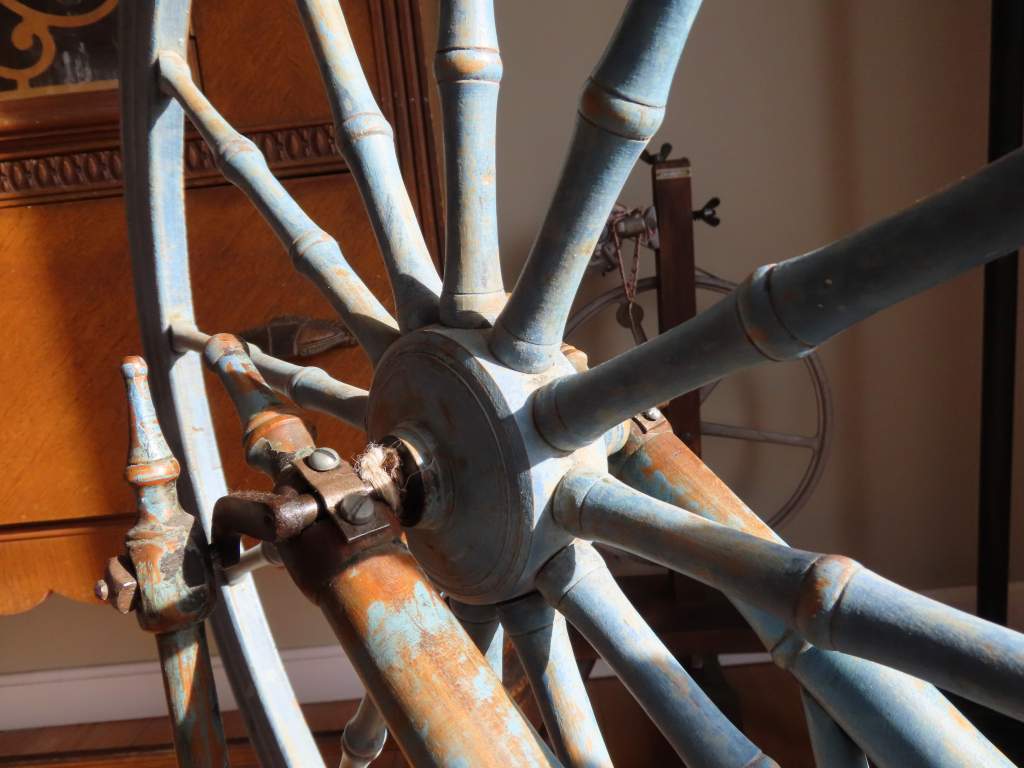
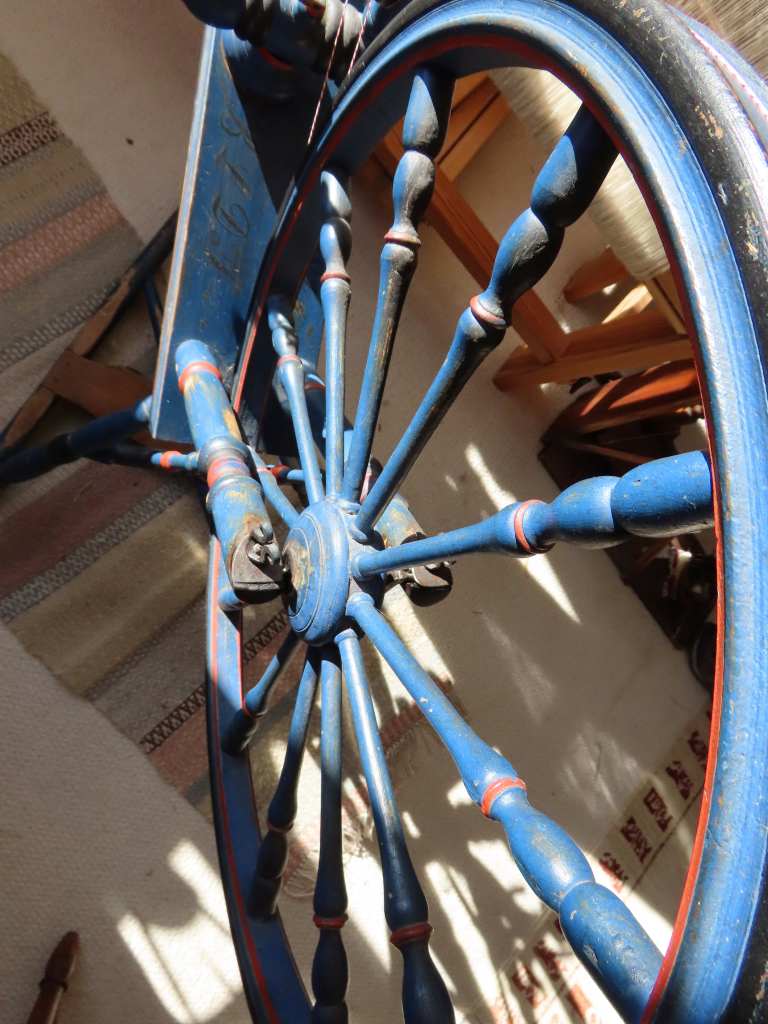
The spokes, which have fat pegs holding them to the rim, are loosey-goosey along the hub, with lots of play.
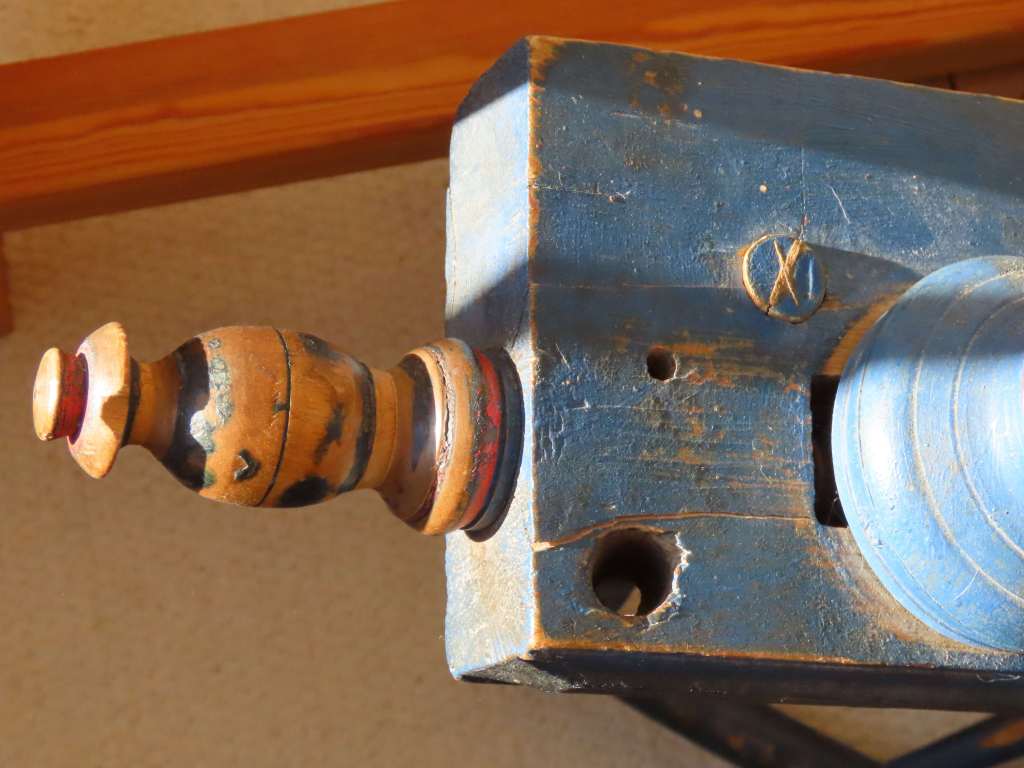
The original hardware keeping the axle ends in place was replaced with clunkier modern hardware, which, while not particularly attractive, works well.
With a little shimming of the rear axle, some leather washers, and a clarinet reed under the MOA,
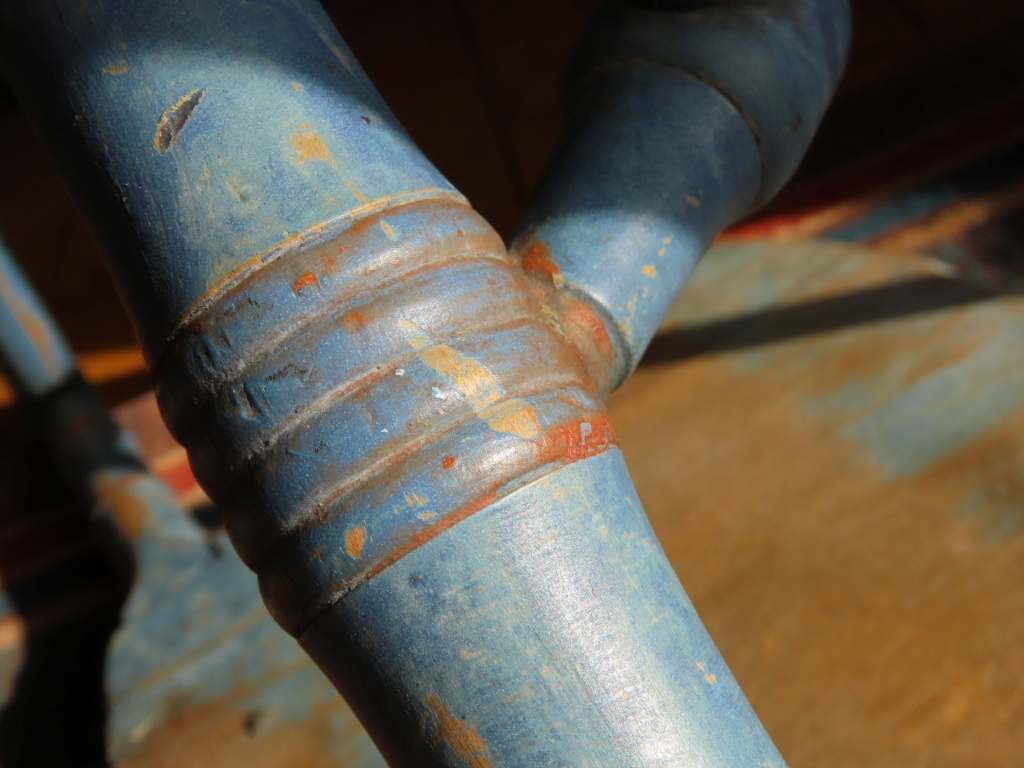
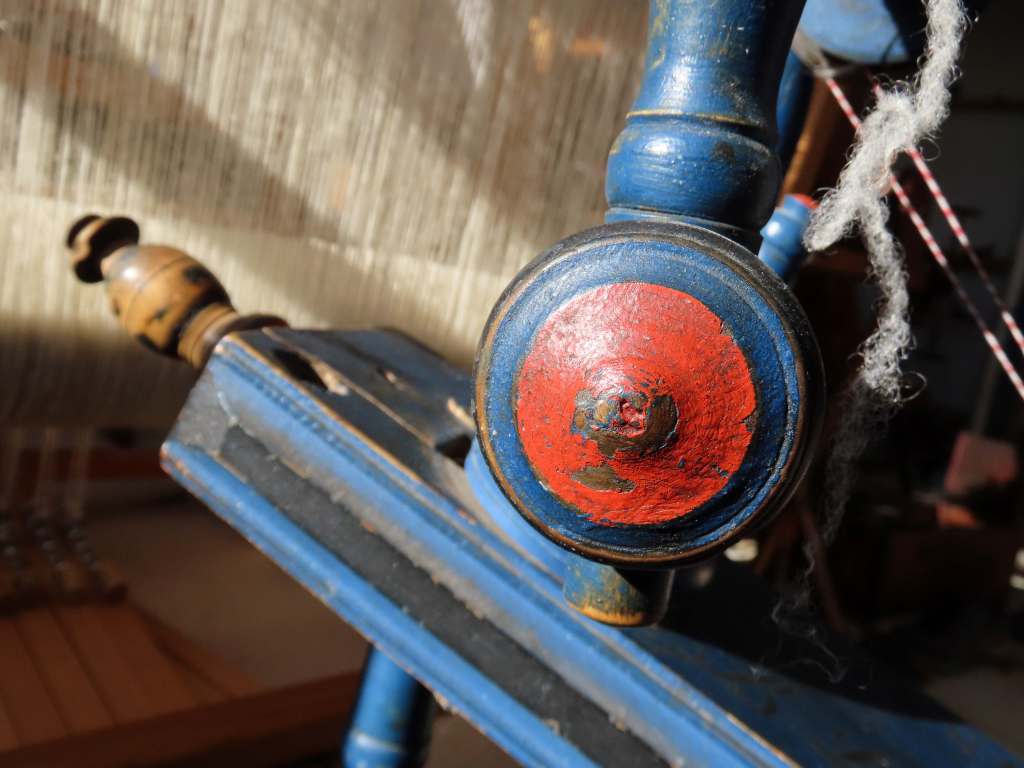
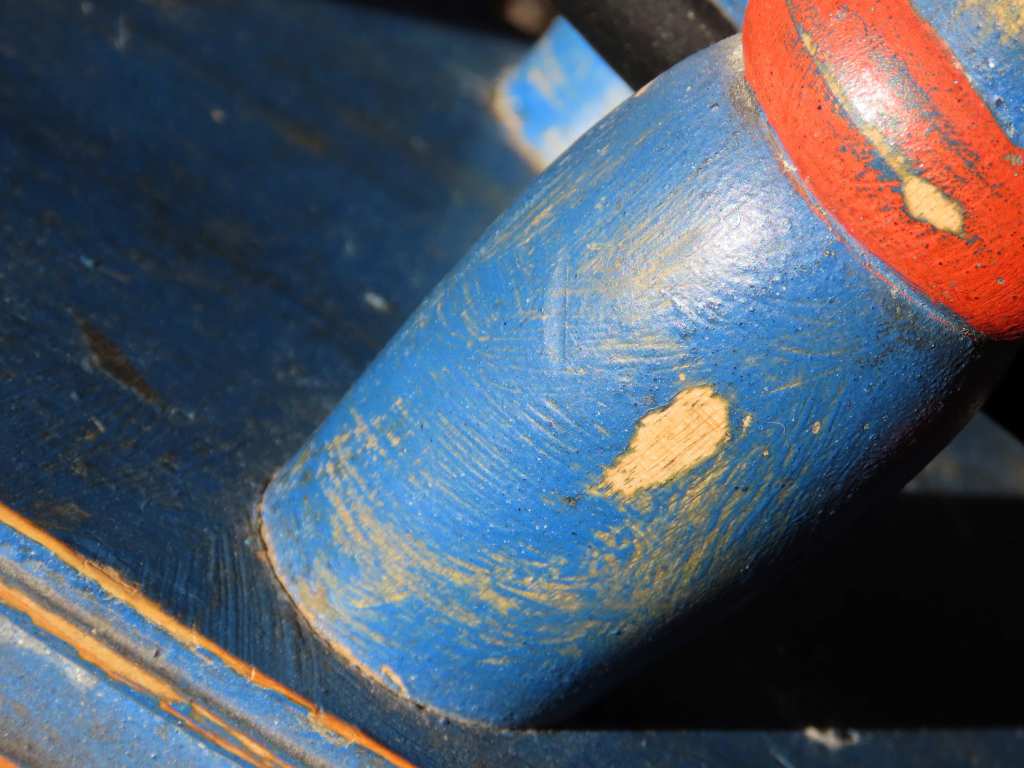
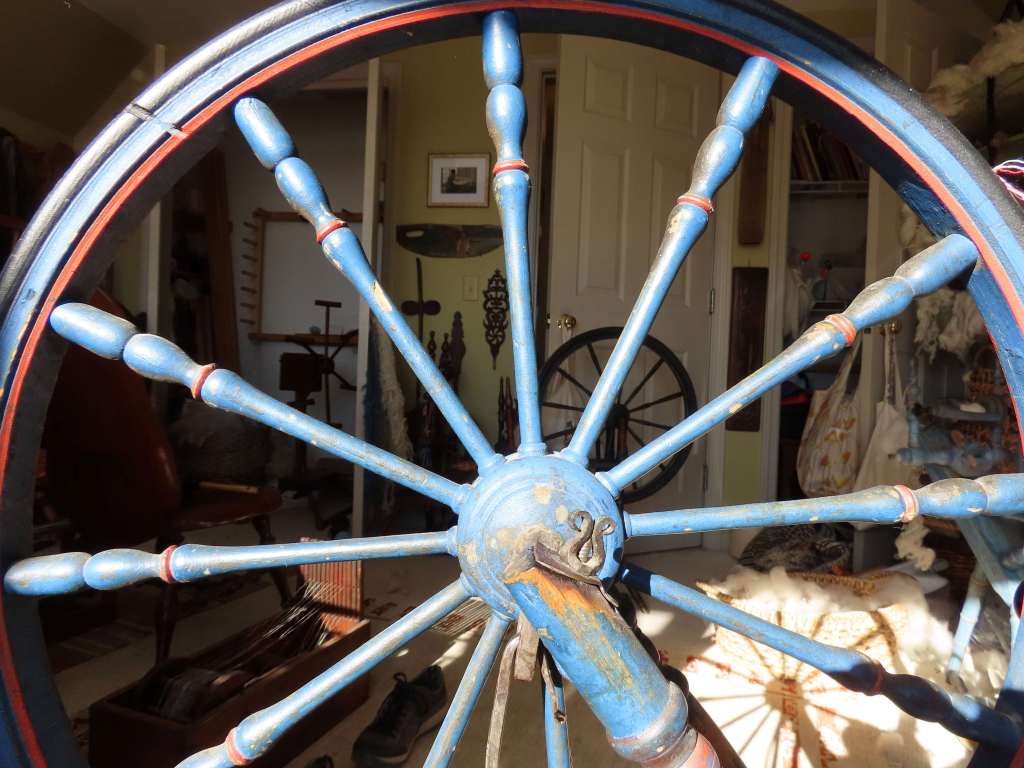
everything aligned eventually and she became a pleasure to spin. And, I have to say, I enjoy just looking at her–such a sublime color. These wheels were often painted, sometimes in multiple colors. I believe that the blue paint on my wheel is original, but there are traces of red highlights, too, which have worn off.
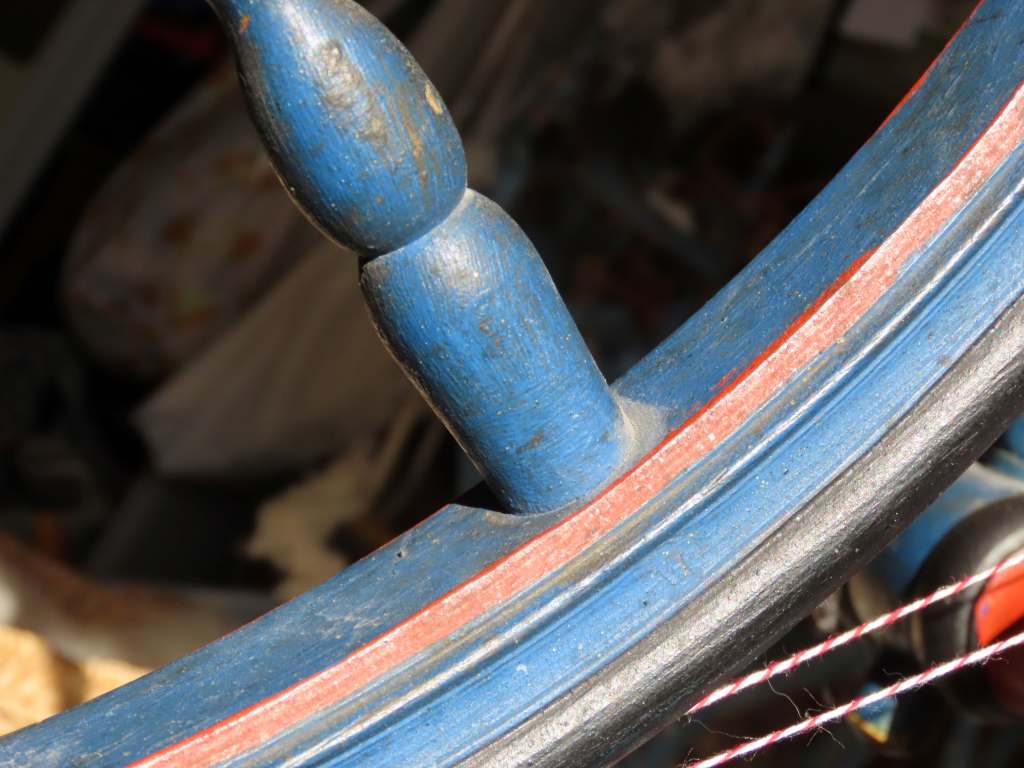
Traces of red paint
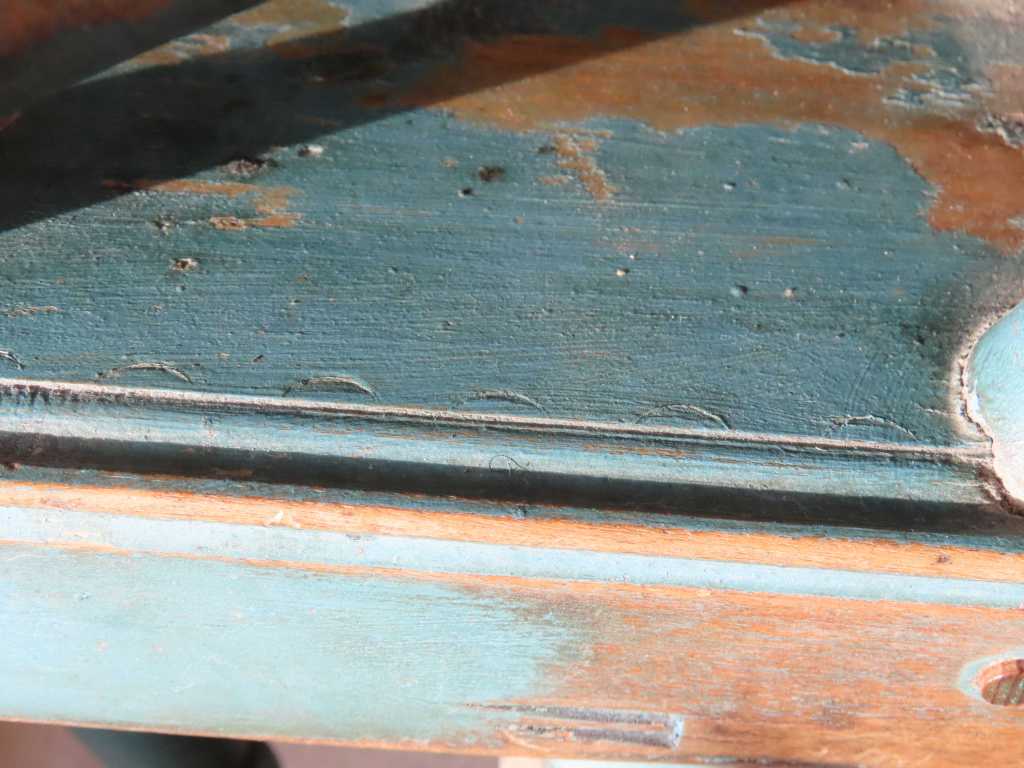
Interestingly, as with some of my other Norwegian wheels, the paint strokes are visible in some areas–it looks like a fast and not-very-meticulous paint job.
But it has lasted for well over a hundred years and makes this wheel especially visually satisfying to me. Combine it with the design features–not too cluttered, clean lines, elegant stance, rounded yet restrained turnings–it is like a sculpture in motion.
References:
Amund O. Eisdmoe’s “Story of His Own Life” is found in “The Norwegian Settlers Story” in the online Norway Heritage–Hands Across the Sea, link here
Hilts, Patricia and Victor, “Not For Pioneers Only: The Story of Wisconsin’s Spinning Wheels,” Wisconsin Magazine of History, Volume 66, #1, Autumn 1982.
Thorlow, Peter, “Aslak Lie Cupboard,” Creators, Creators, Collectors, edited by Ann Smart Martin, Mount Horeb Area Historical Society and UW Madison, 2017. Available online through Creative Commons.
*** I been writing these blog posts for years now and, in doing my research, have been fortunate to deal with a wide variety of generous people and institutions. Most are curious and enthusiastic people who share my love of trying to unravel the history of objects and pass it on to others. In writing posts, I do my best to abide by copyrights, to ask permission to use material, and to properly attribute photographs, research, and quotations. When I contacted the Wisconsin Historical Society for permission to include the two Rustebakke family photographs in this post, I found the fee to post each photograph (special non-profit rate!) was $20, for a total of $40. This is the first time I have ever been asked to pay a fee to use a photograph–other places have simply requested attribution. I fully understand that it costs money to collect, maintain, and digitize a collection and would have no objection to paying a small fee. But $40? I could rescue a wheel for that.
I gladly contribute to small historical societies manned by volunteers and struggling to keep their doors open. But, this historical society (according to its website) has an annual budget of over $35 million dollars, well over 100 paid employees, and is building a $160 million dollar history center. It does not need to charge such high fees for use of its photographs, especially when the user, like me, is unpaid, and making no profit whatsoever from use of the photographs. Such a charge seems outdated in the internet age and a frustrating impediment to further sharing the story of the Rustebakkes and their spinning wheels. Making history accessible to all and connecting people to the past through collecting, preserving, and sharing stories is part of the Society’s mission and vision. They missed an opportunity to do that here.***
These petite Norwegian wheels turn up regularly in this country, mostly in the Midwest.
An 1851 wheel for sale in Fargo, N.D.
Because they are light and small, they must have been relatively easy to transport to this country from Norway.
Solveig is considerably smaller than Hjordis, the Norwegian wheel from the last post
Because wheel makers often were scarce in the Midwest, “Norwegians who had emigrated earlier strongly recommended in letters to friends and family that women bring spinning wheels to America. The writers also occasionally suggested packing wool carders, looms, sheep shears and shears for cutting woven cloth.” Norwegian American Women, p. 159.
“Most sources indicate that women used the Norwegian treadle spinning wheels they brought or acquired. Kari Bunde Veblen requested a second wheel from Norway after the first one, brought by a newcomer, ‘did not prove satisfactory in that it growled slightly in running.’ ” Id at 162.
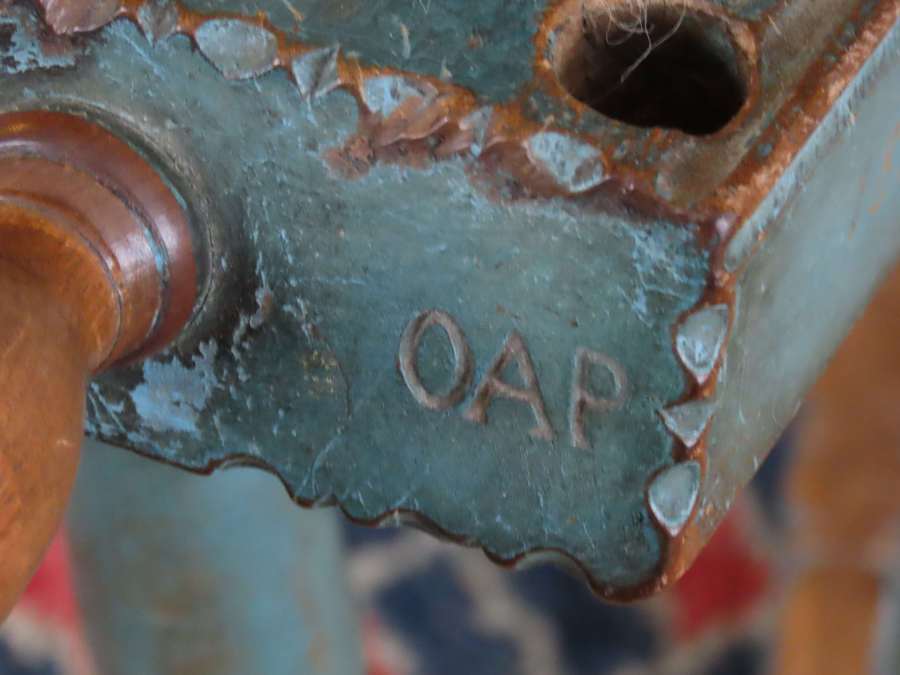
Although these wheels have a clear maker’s mark of OAP, as far as I know, his identity is a mystery.
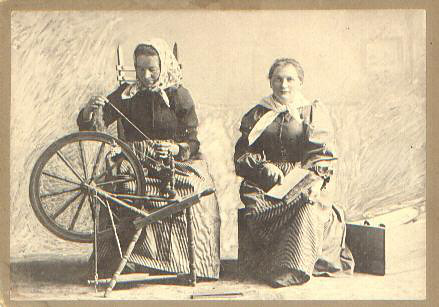
We believe the wheels may have come from the Hordaland area of Norway based on this photo found on an ancestry site, with the caption: “Lofthus, Norway – One lady spins the wool while the other combs 1888.”*
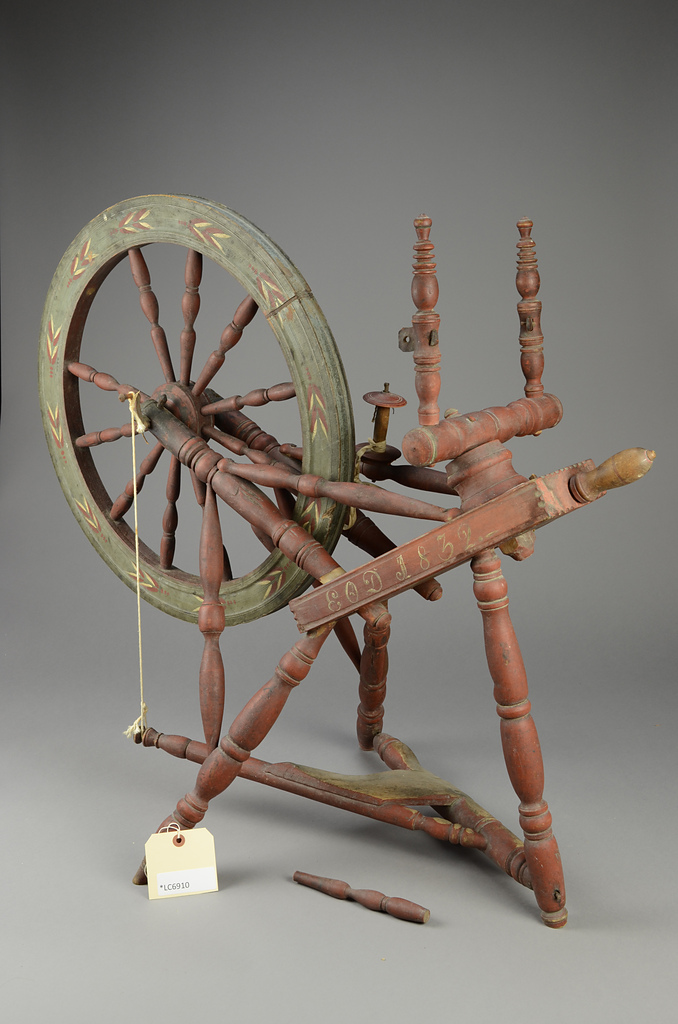
The wheels appear to have been made for decades, with painted dates ranging from the 1830s (and perhaps earlier) to the 1870s.
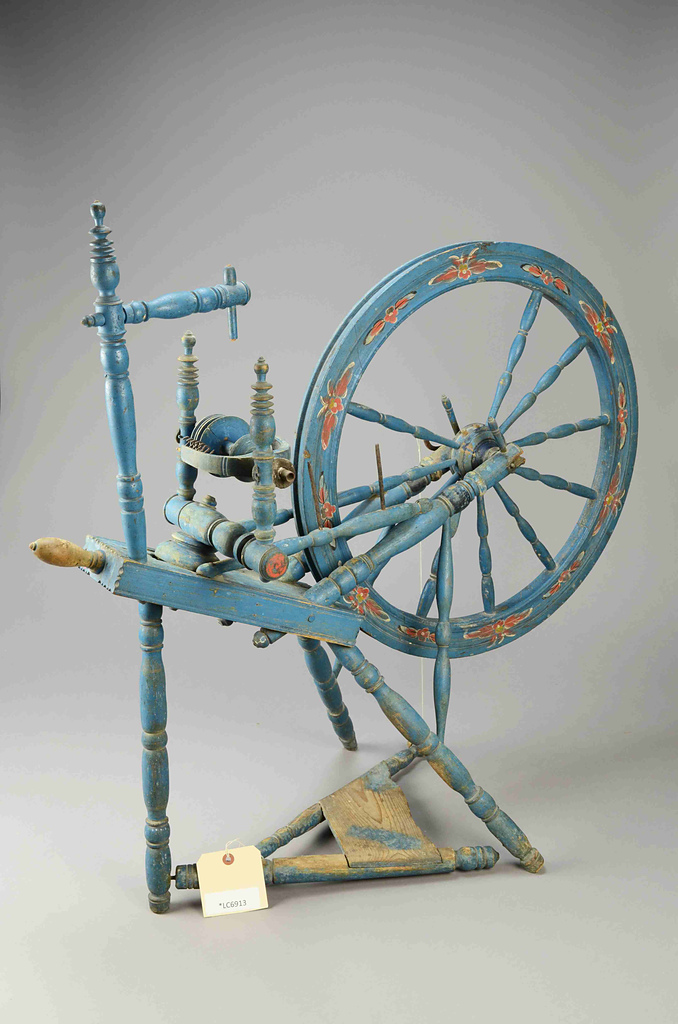
They are usually painted, sometimes with floral designs such as these wheels in the Vesterheim Museum in Decorah, Iowa.
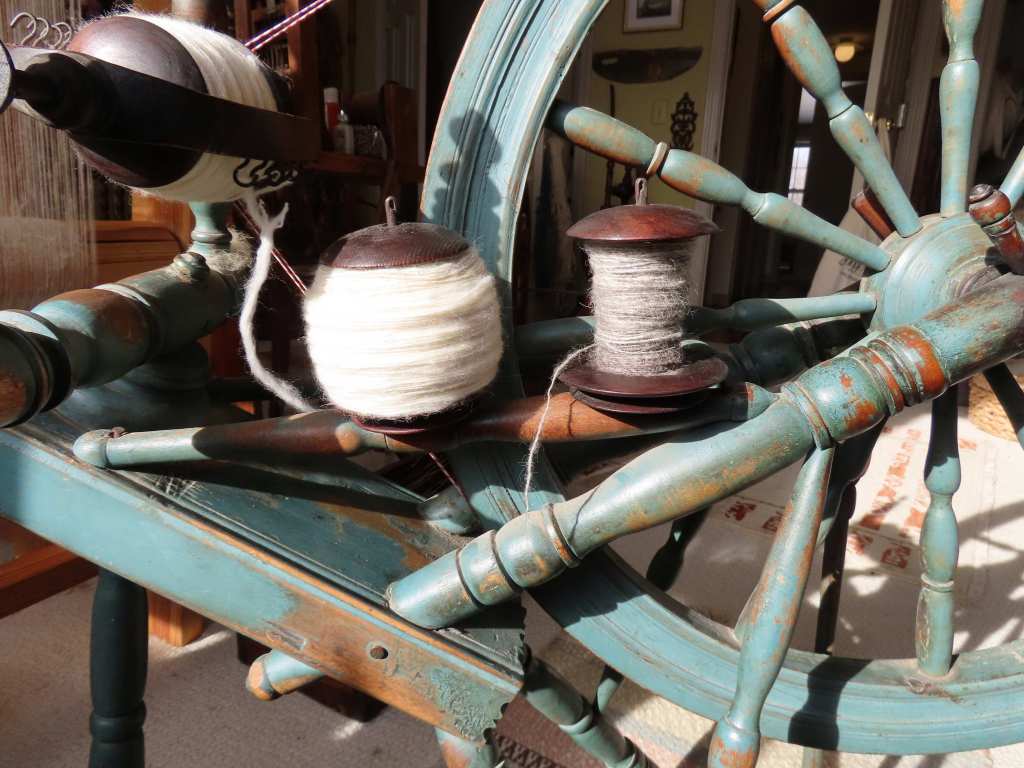
Aside from the lovely paint jobs and compact size, these wheels are immediately recognizable because of an onboard lazy kate.
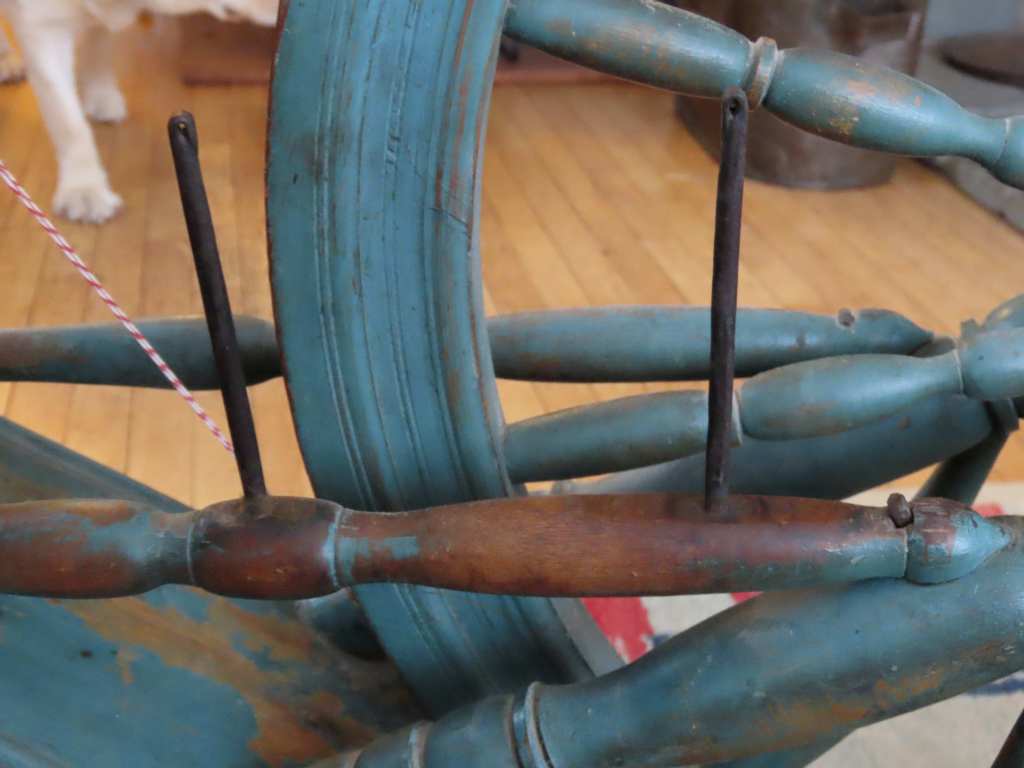
The front cross-bar support has two metal shafts, beautifully worked with folded tops.
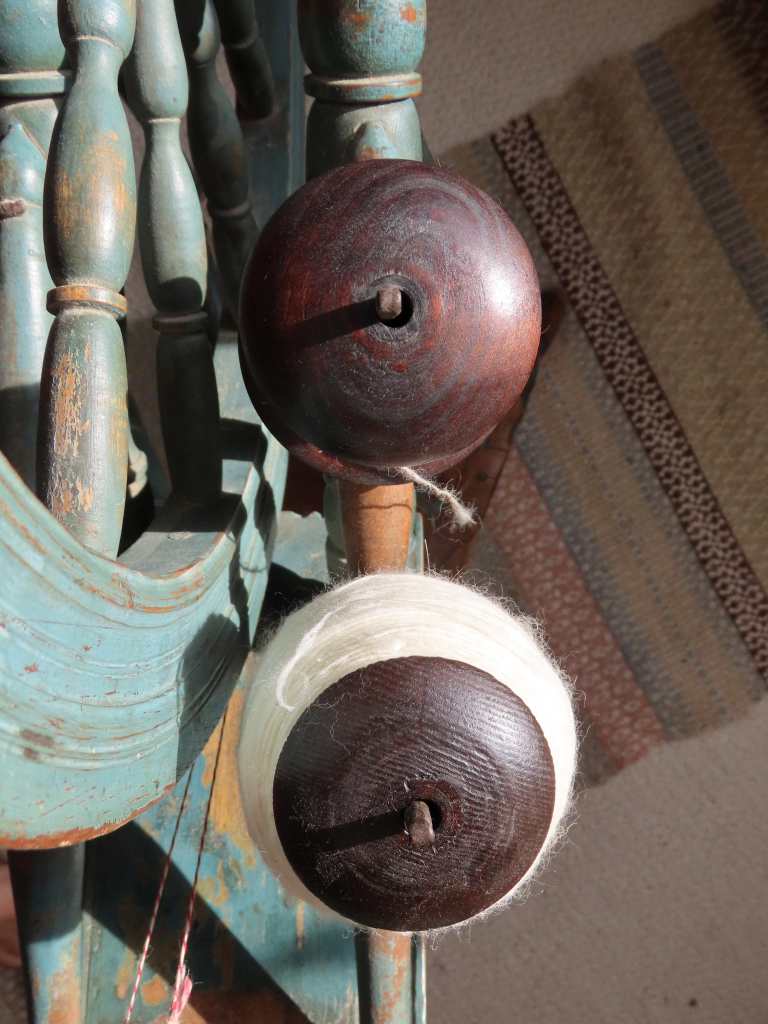
These can hold full bobbins, allowing the spinner to ply directly from the wheel.
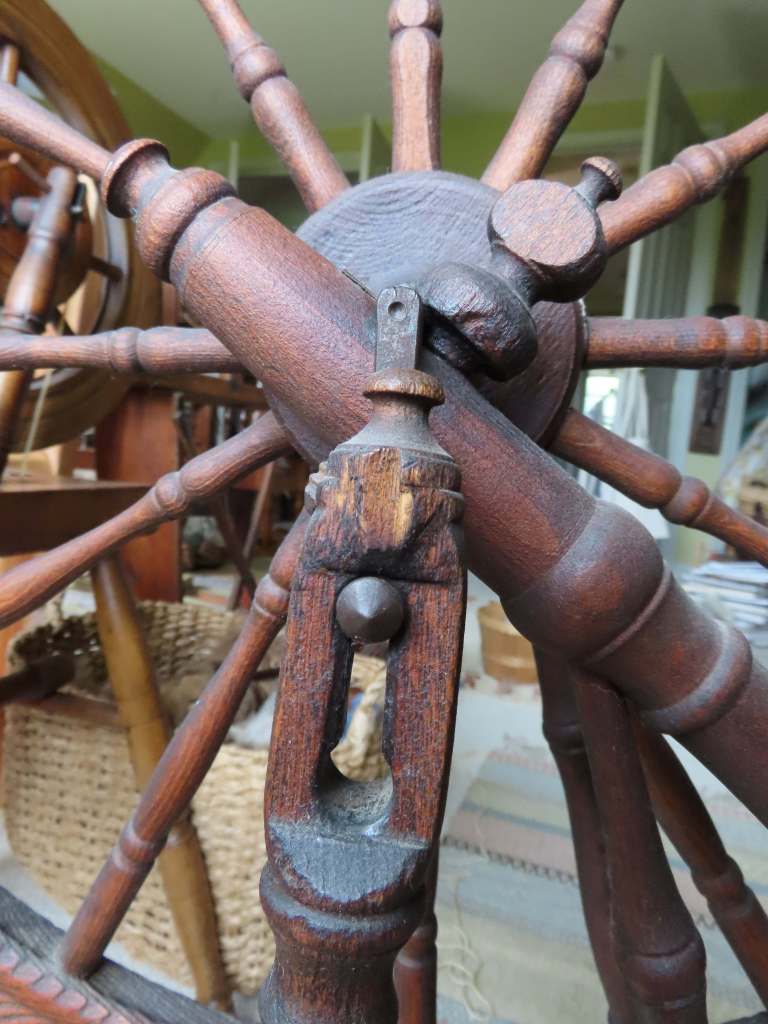
It is a handy, ingenious feature, made possible by a hub that is flat in the back, but with an extension on the spinner side to make space for the bobbins.
Solveig was found in northern Minnesota.
She is a workhorse, spinning and plying with ease.
While many antique wheels have very little difference in the depth of the bobbin and whorl grooves, Solveig’s bobbin groove is much deeper than her two whorl grooves.
The gorgeous blue-green paint shows the typical wear made by women spinners wearing long skirts.
Paint wear on the spokes confirms that the drive wheel was turned in both directions, using the lazy kate for plying, although there is more wear on spokes indicating clockwise turning.
The front maiden has wear marks in a somewhat unusual place near the bottom, where spun thread was wound around it, probably when unwinding the bobbin.
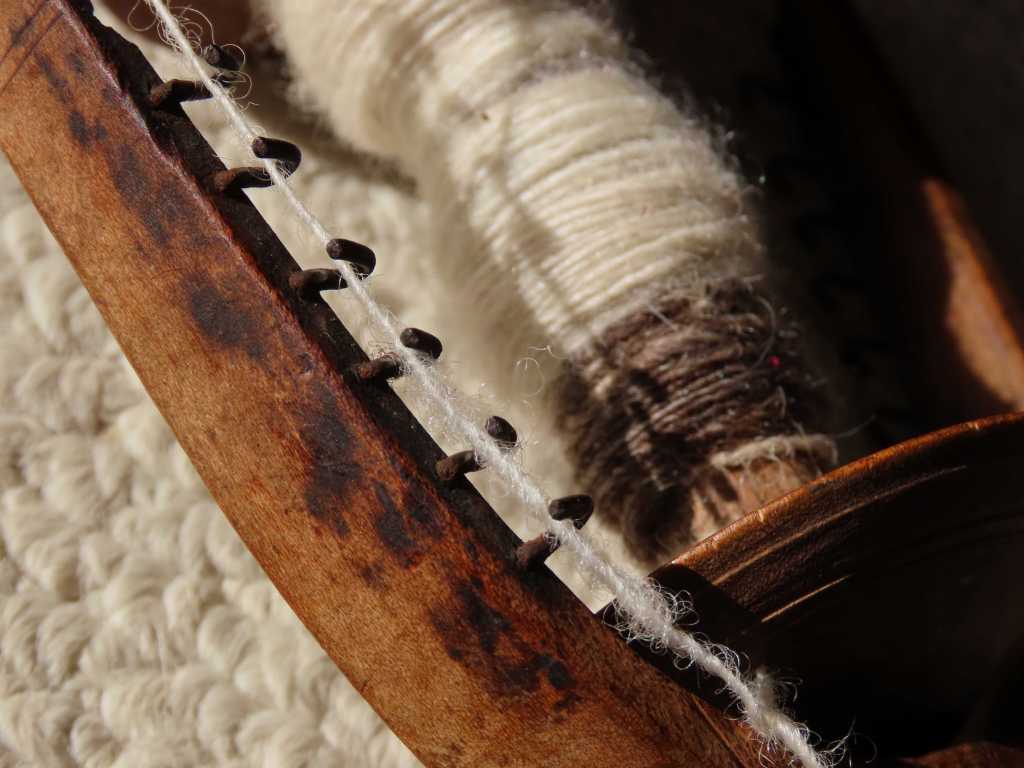
Deep grooves run alongside the flyer hooks–again a wear pattern that is out of the ordinary.
The orifice opening is slightly fluted,
with a opening big enough for easy plying.
and there is wear on the far side of the mandrel where it hits the bearing.
The footman has been repaired with a screw.
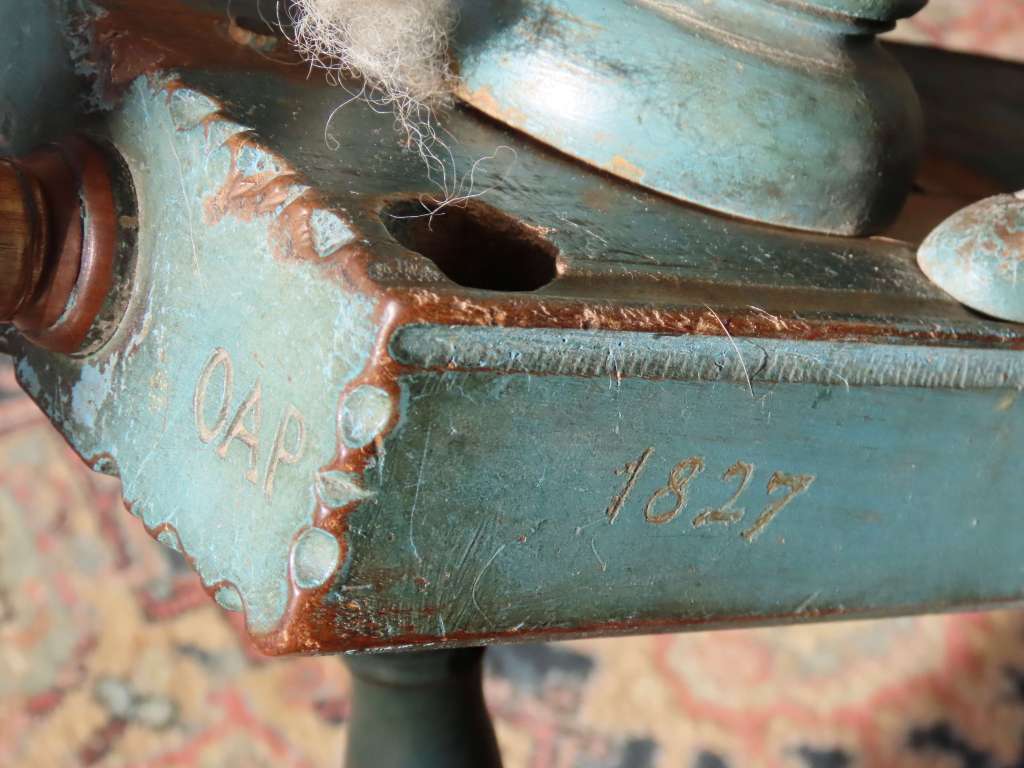
In contrast with many of these wheels, which have painted initials of the owners along with a date, Solveig has the date 1827 scratched into the side of the table.
Since OAP did not routinely apply the date in this way, it likely was added later by an owner and may not be accurate.
But there is not doubt that Solveig was used for many years.
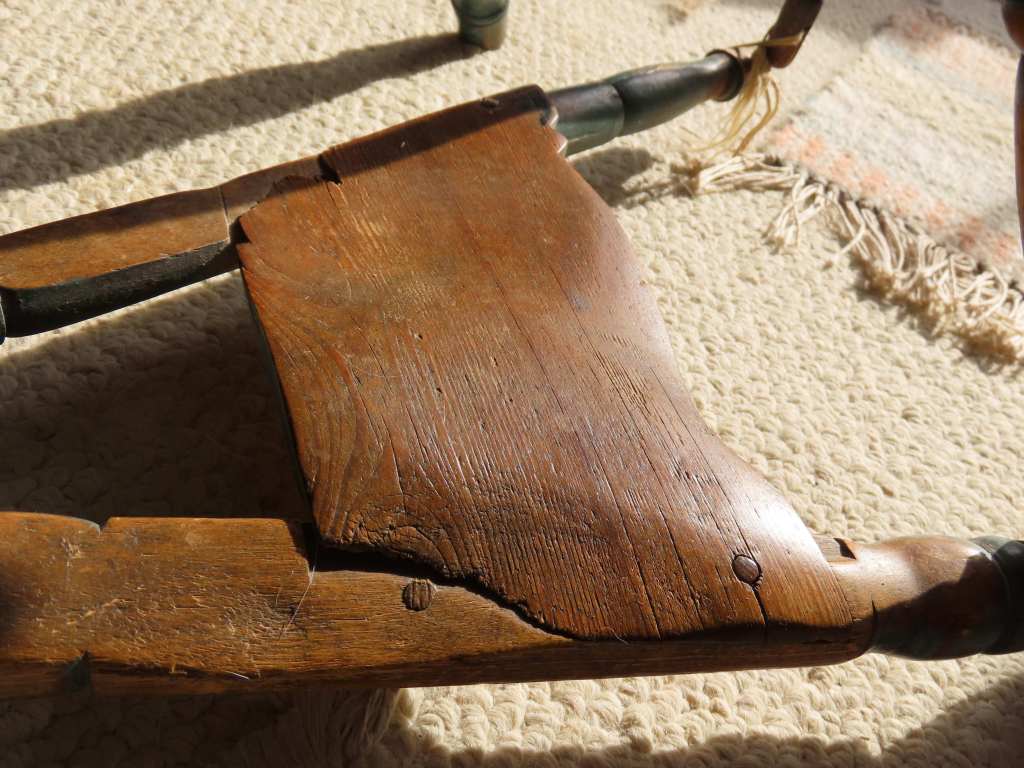
The wear on the treadle is so extreme it created a wooden wave.
The drive wheel construction is typical of Norwegian wheels.
But, every part of the wheel carries special touches from OAP, whoever he was. A small cut-out under the drive wheel,
distinctive maidens,
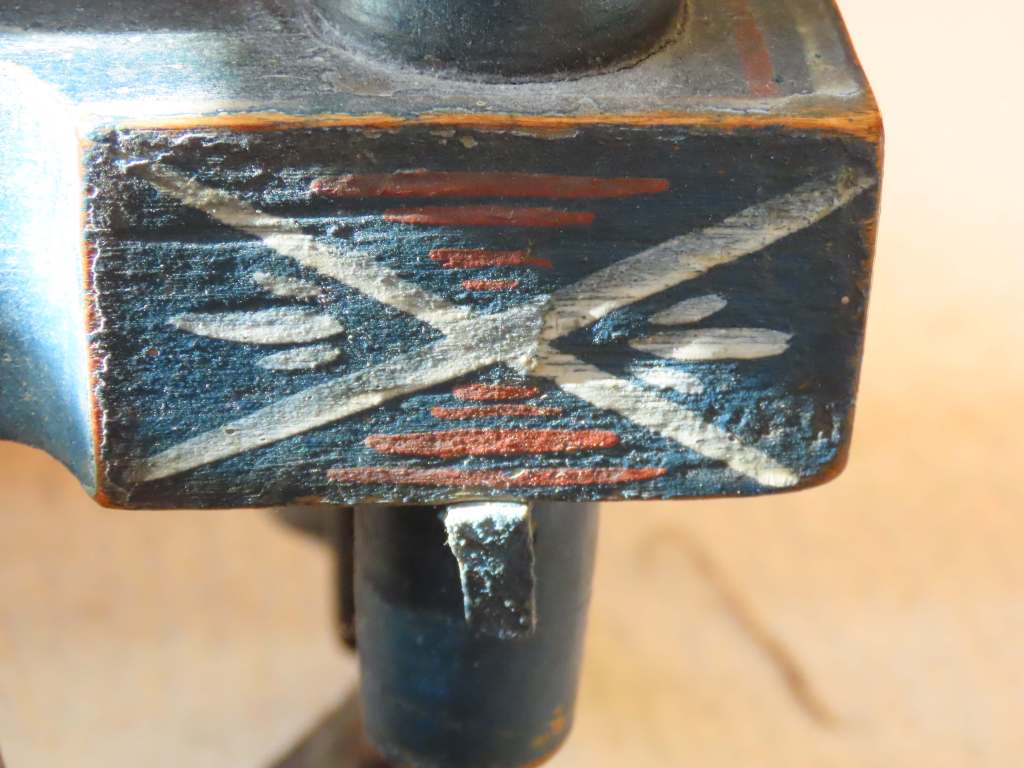
little touches of decorative design,
and the maker’s signature chip carving are a reminder that he valued beauty along with practicality.
It is no wonder that OAP’s wheels were so popular and remain coveted to this day.
Thank you to Andrea Myklebust for the Norway and Vesterheim photos. And, of course, for this wheel, which will soon be returned to live with Andrea again.
*The photo of the wheel in Norway was accompanied by this explanation: “This picture hangs framed over my mother’s spinning wheel along with a set of cards. Mom doesn’t know who the people in the picture are but thinks they are cousins from Lofthaug. – Wendy Turner ”
The quotations are from:
Bergland, Betty A. and Lahlum, Lori Ann, Norwegian American Women, Migration, Communities, and Identities, Minnesota Historical Society Press, St. Paul, MN 2011.
Collecting and rescuing antique wheels is like hunting or foraging. The hunt starts with scanning a parade of sale and auction photographs in hopes of finding unique and interesting wheel quarry. Because sale photos are often dark, blurry, and taken from a distance, details of construction and decoration can be obscured. It is easy to take a quick look, pass by, and miss out on a treasure.
Hjordis sale photo
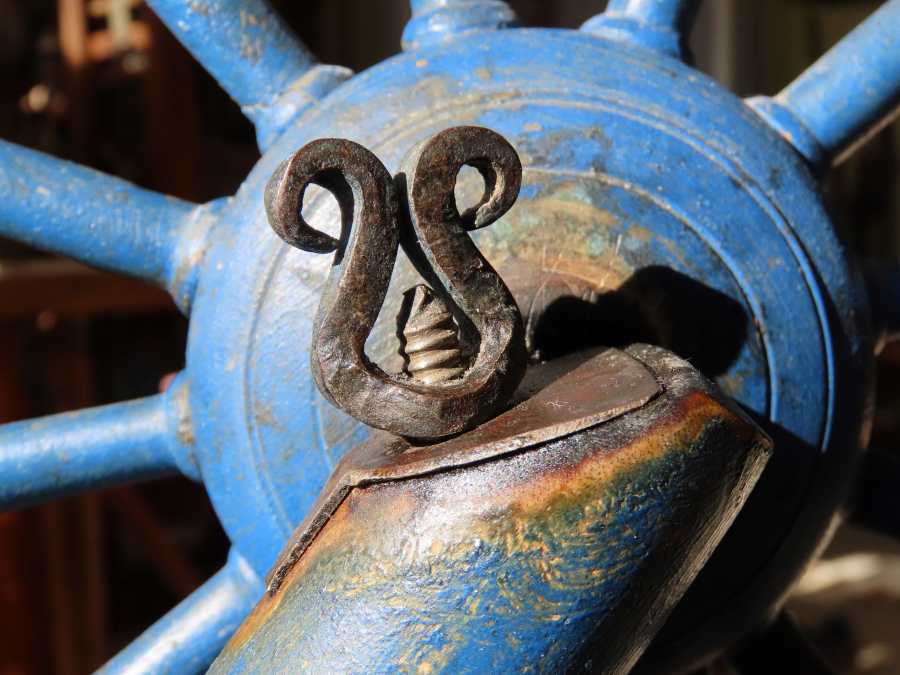
Hjordis is a treasure that could easily have been overlooked. The sale photo showed a pretty painted wheel, likely Scandinavian. At first glance, it was hard to make out the gorgeous lyre-shaped nut on top of the upright–an indication that this wheel is something special.
The axle and footman seemed oddly out of whack in the photo, but it was hard to make out why. Fortunately, my friend, Sherran Pak, had spotted this wheel online. The sale price was ridiculously high, but since it was close to where she lived, and our curiosity was high, she went to have a look at it. Curiosity satisfied and interest piqued even more, we waited until the price eventually came down and, with Sherran’s help, I was able to rescue Hjordis.
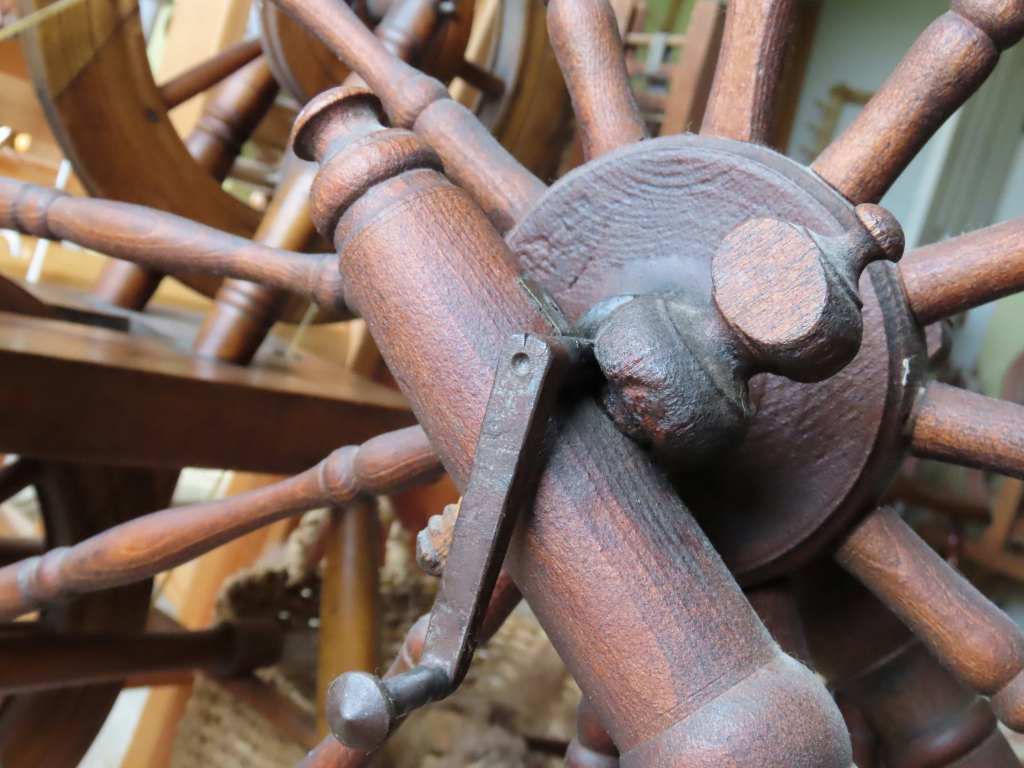
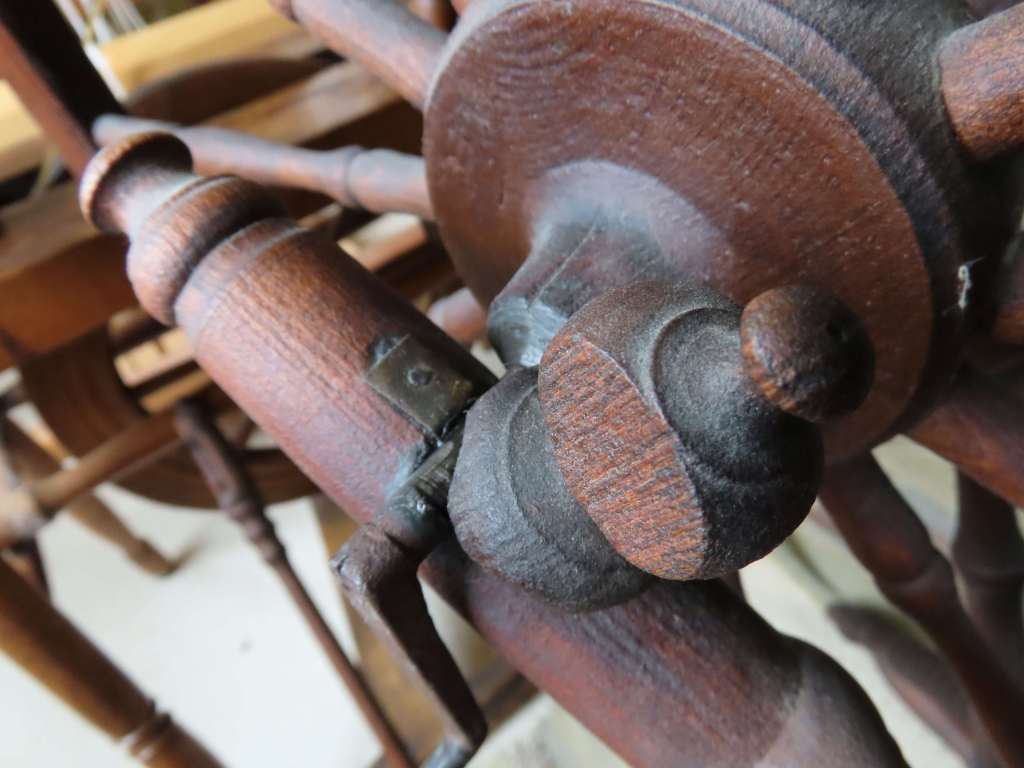
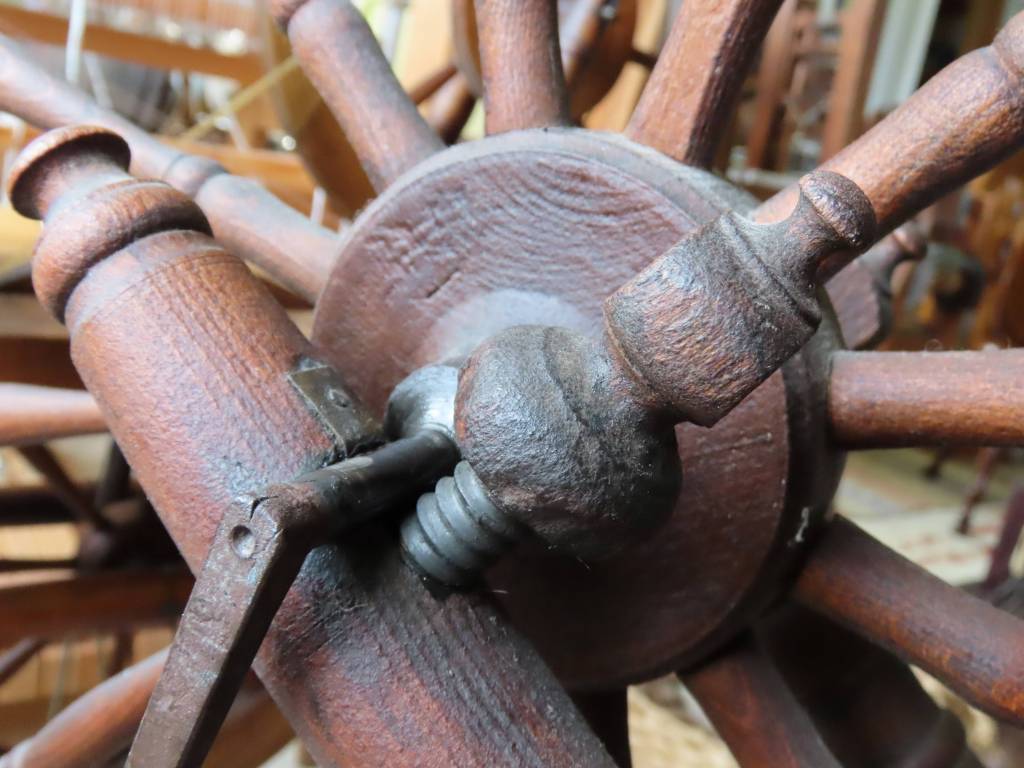
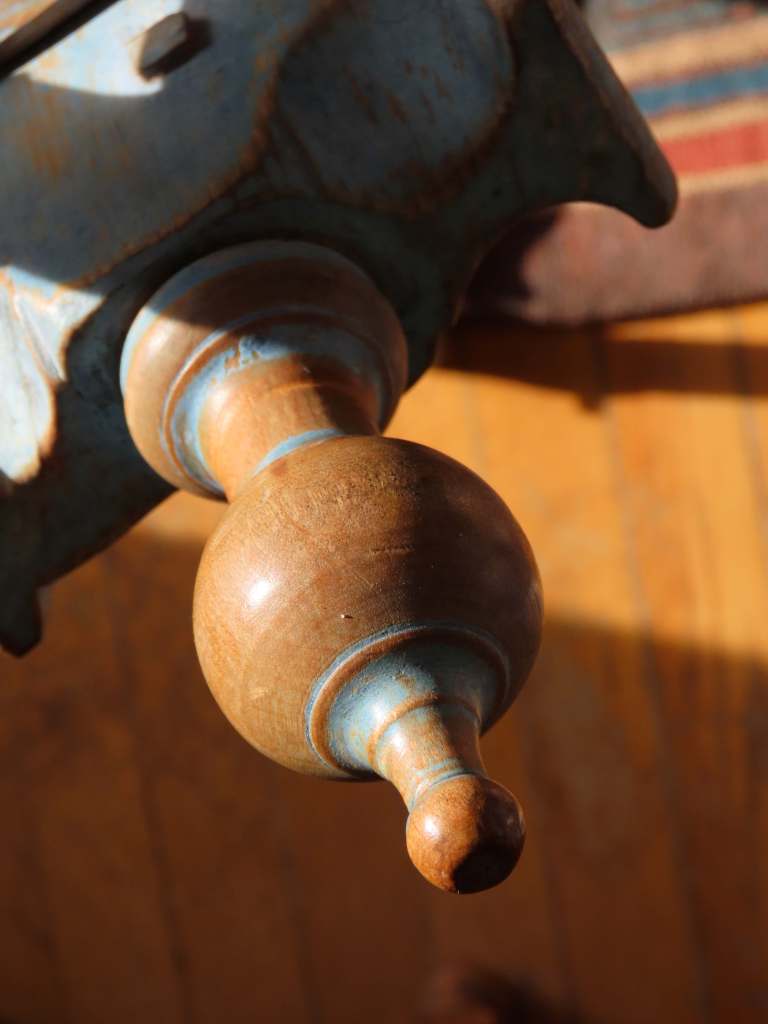
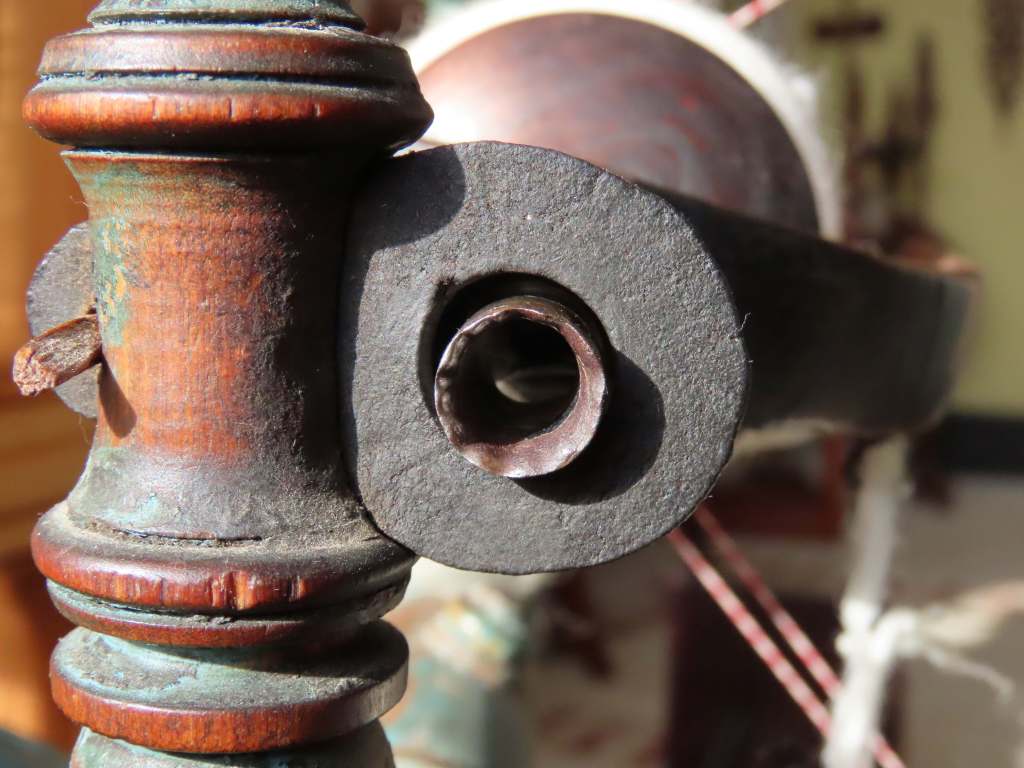
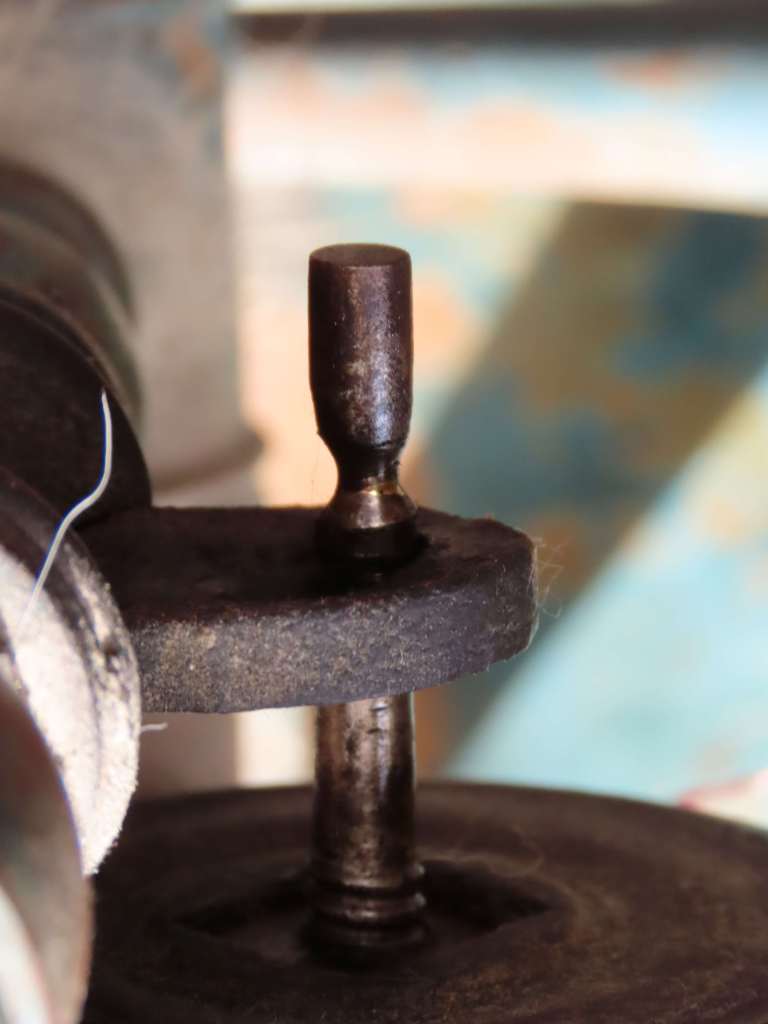
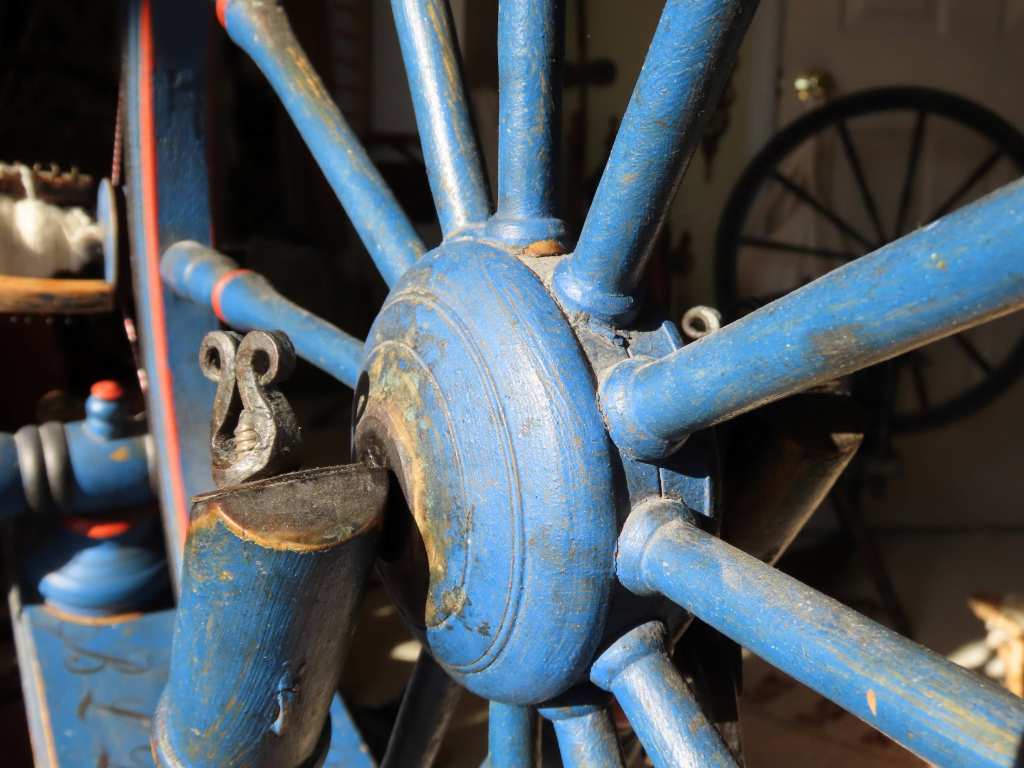
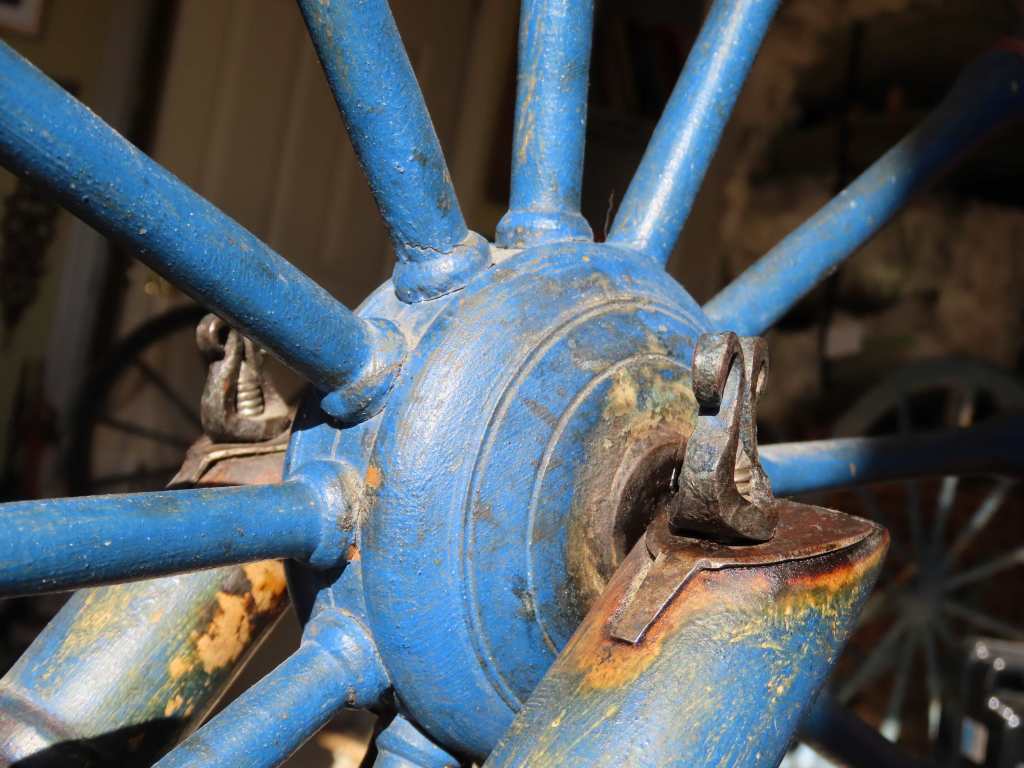
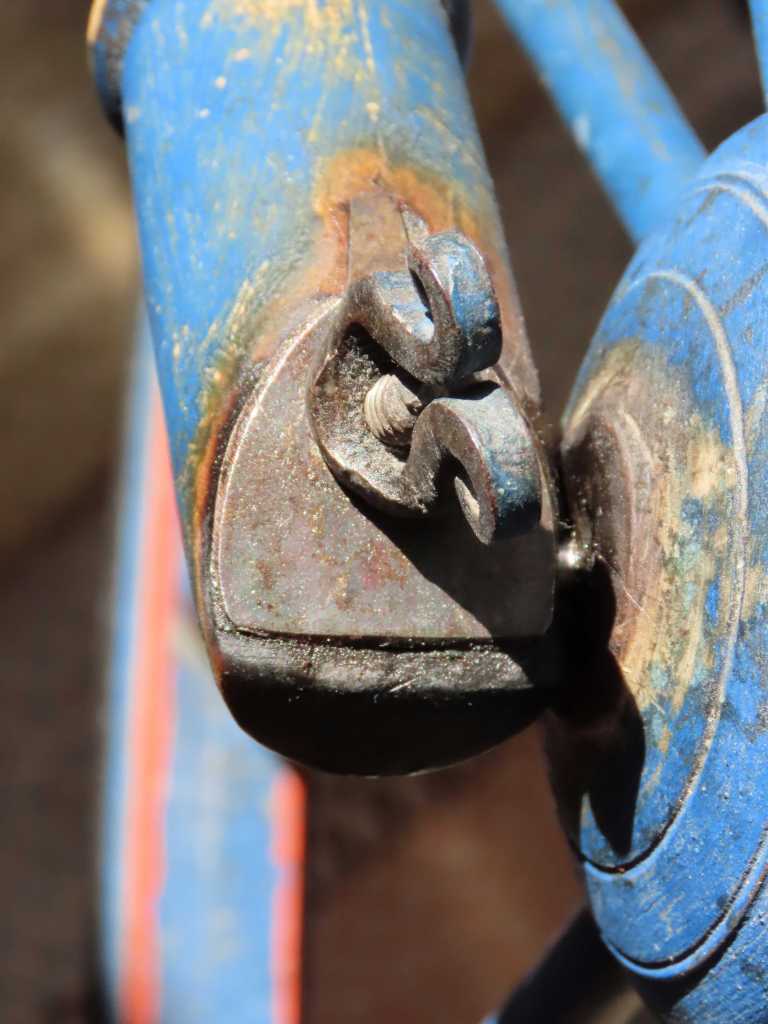
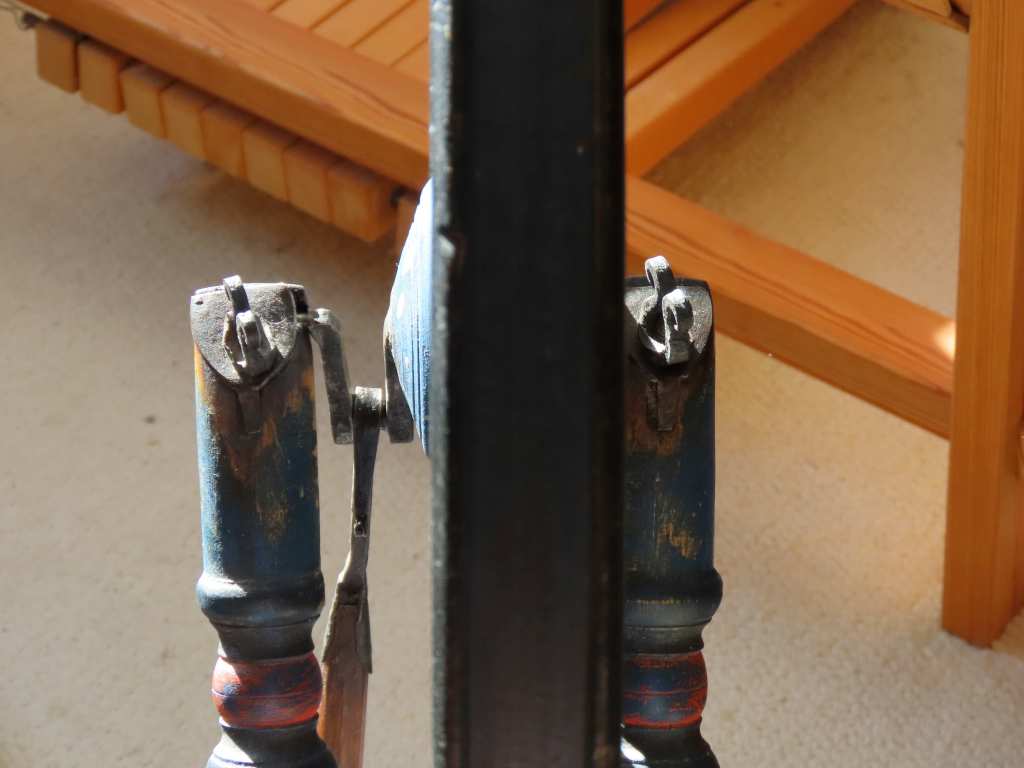
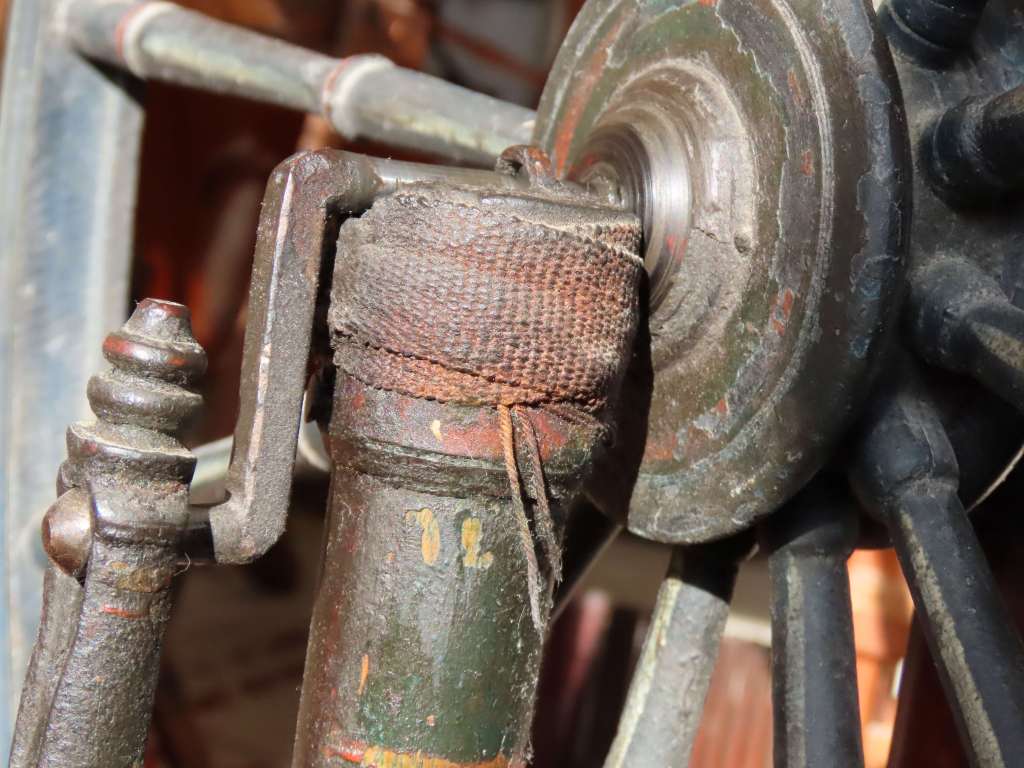
The lyre-shaped nuts were even more stunning in person than I expected. They sit like twin guardians on top of the metal plates securing the axle ends.
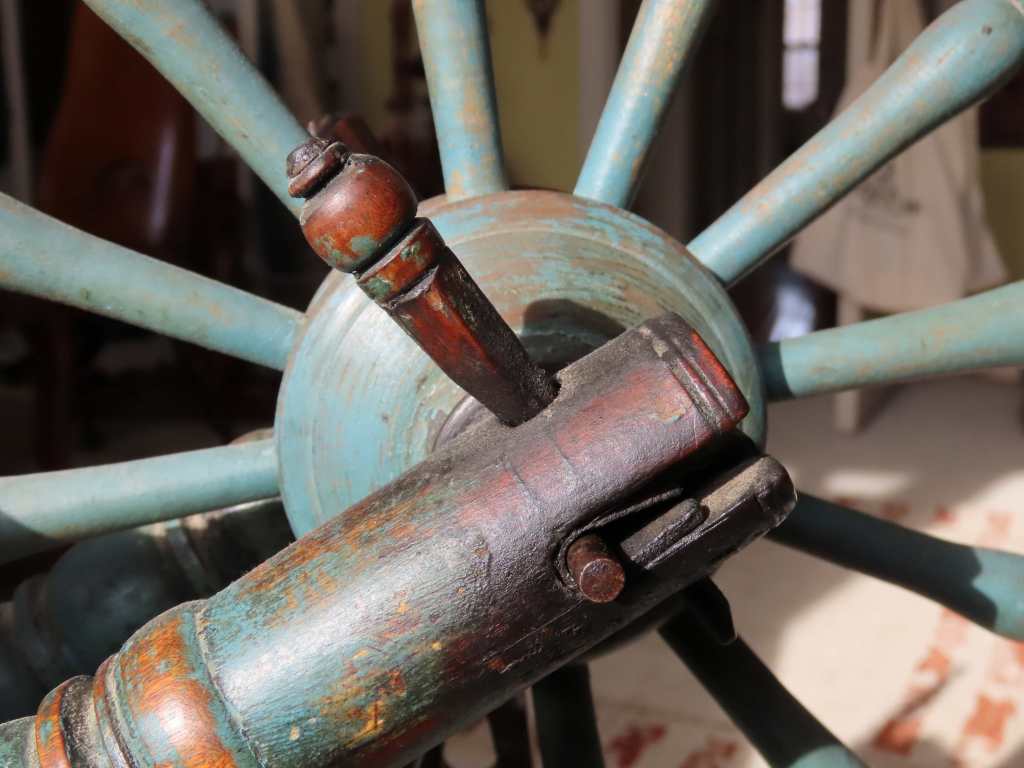
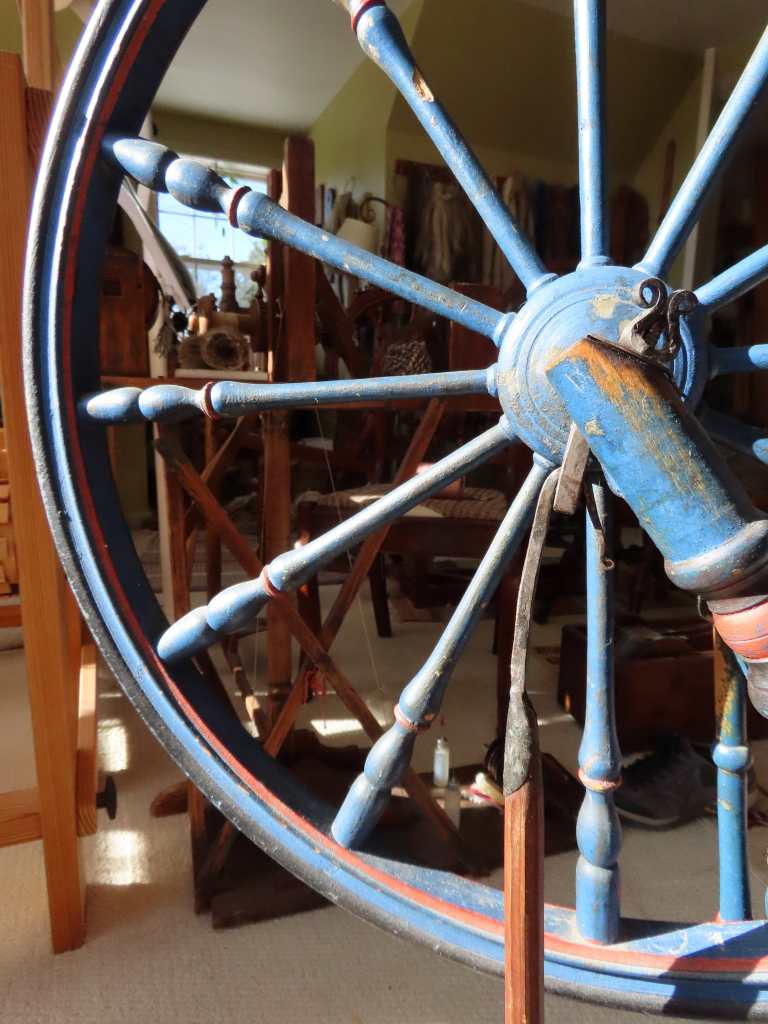
But, an even more unusual feature was the wheel’s internal crank.
It was what confused us in looking at the sale photos. While internal cranks are found on many double-table Norwegian wheels, they are very rare on saxony-style wheels. Samuel Morison, in Vermont, used them on some of his saxony-style wheels, but aside from his wheels, they are scarce. So I was thrilled to find this beautiful example.
The inside part of the crank is actually embedded into the wheel hub. I would love to know why some wheel makers experimented with internal cranks. Is there any advantage to them? One disadvantage is that a traditional style footman is not ideal because it cannot easily be popped on and off the axle.
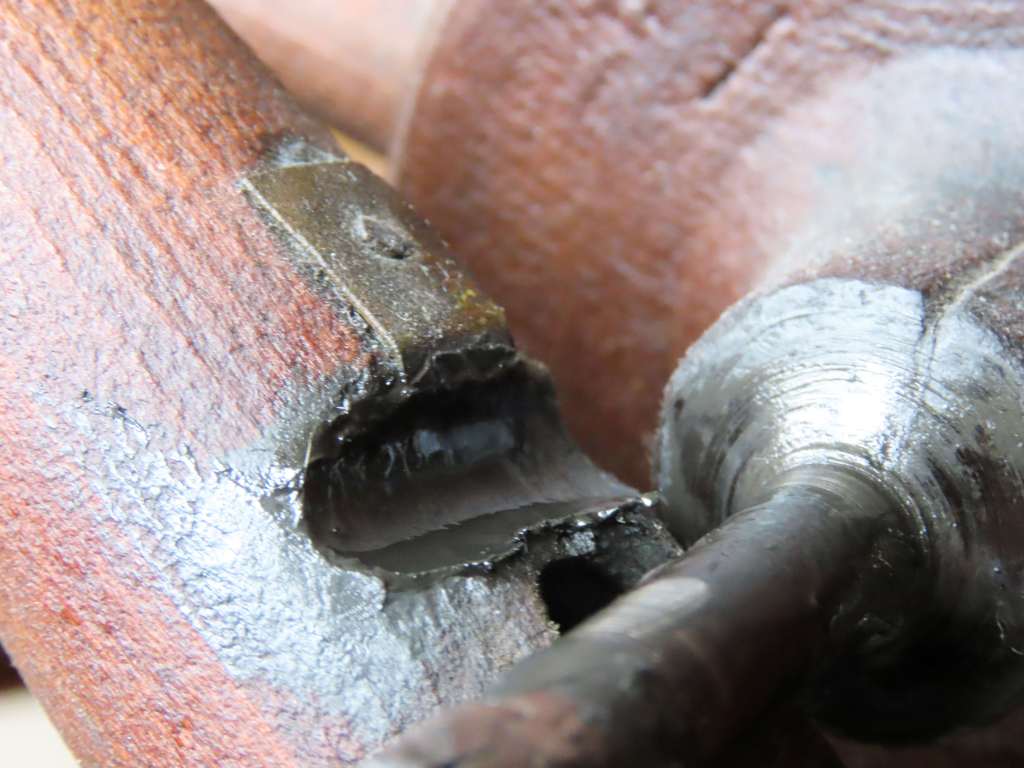
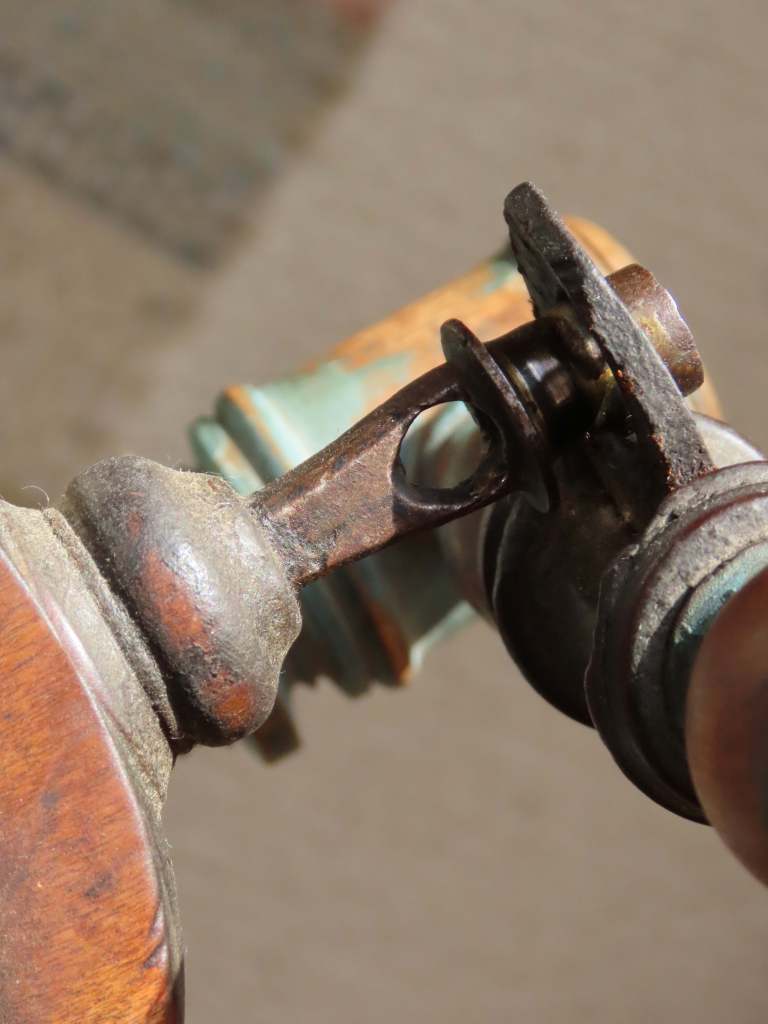
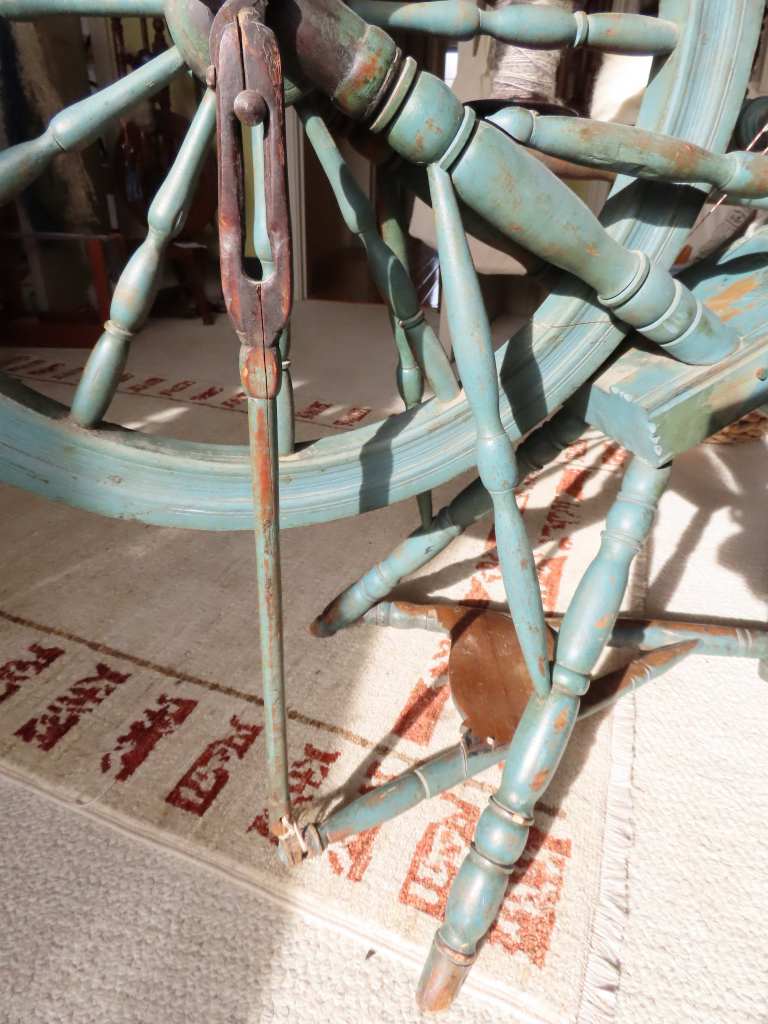
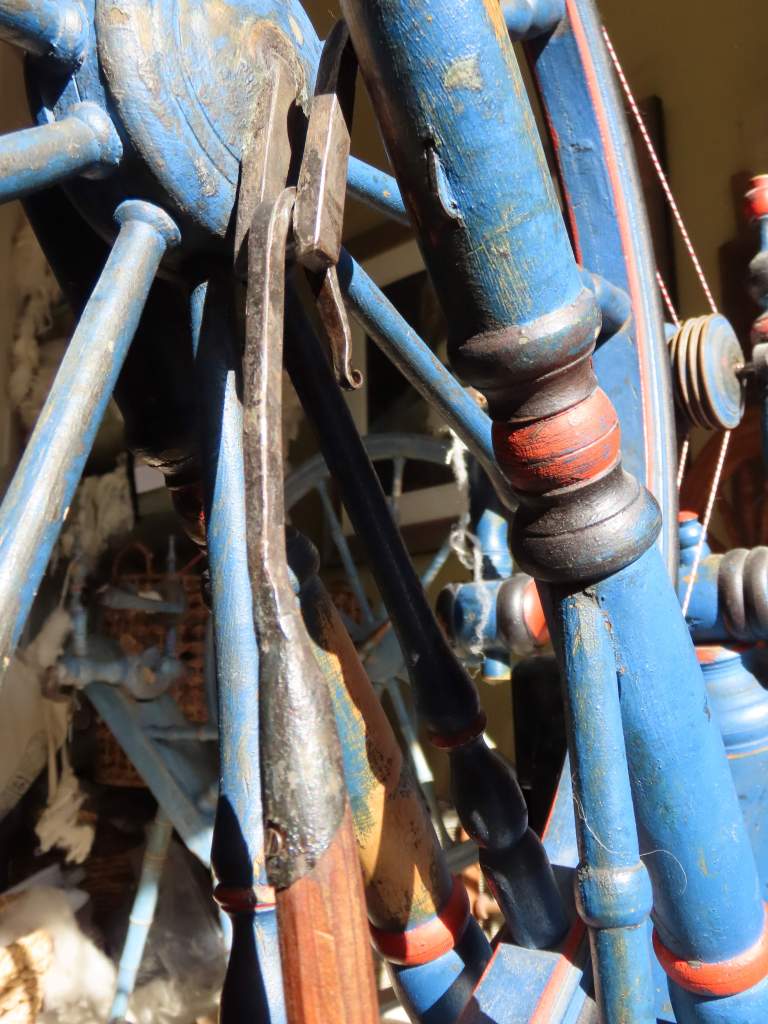
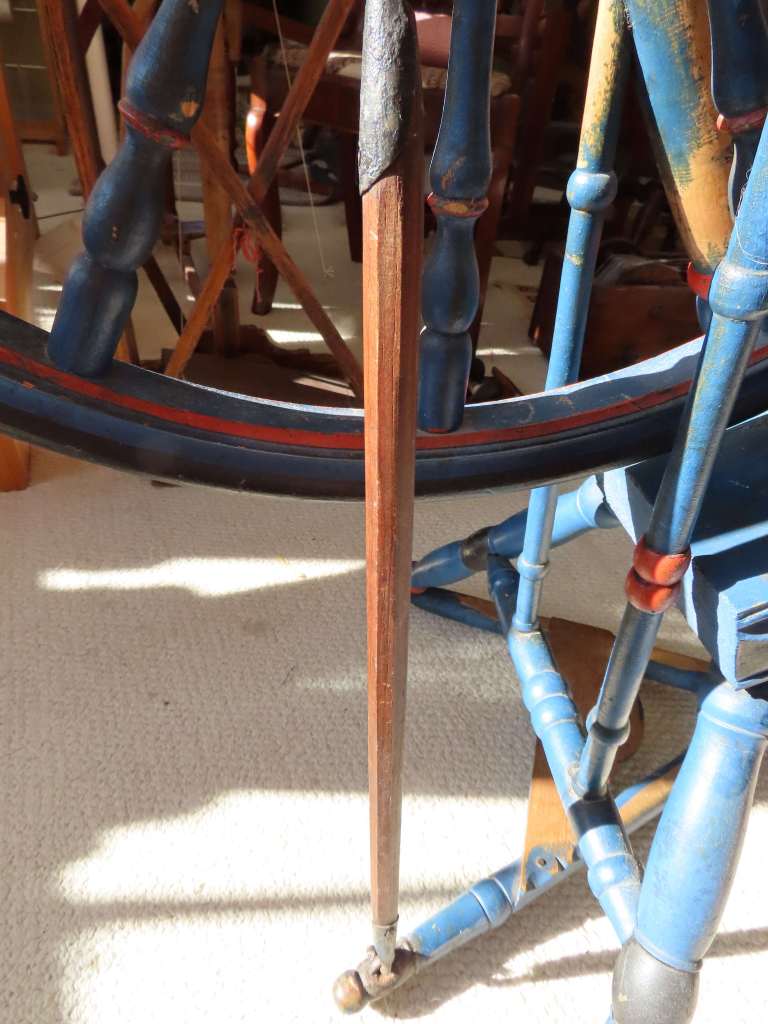
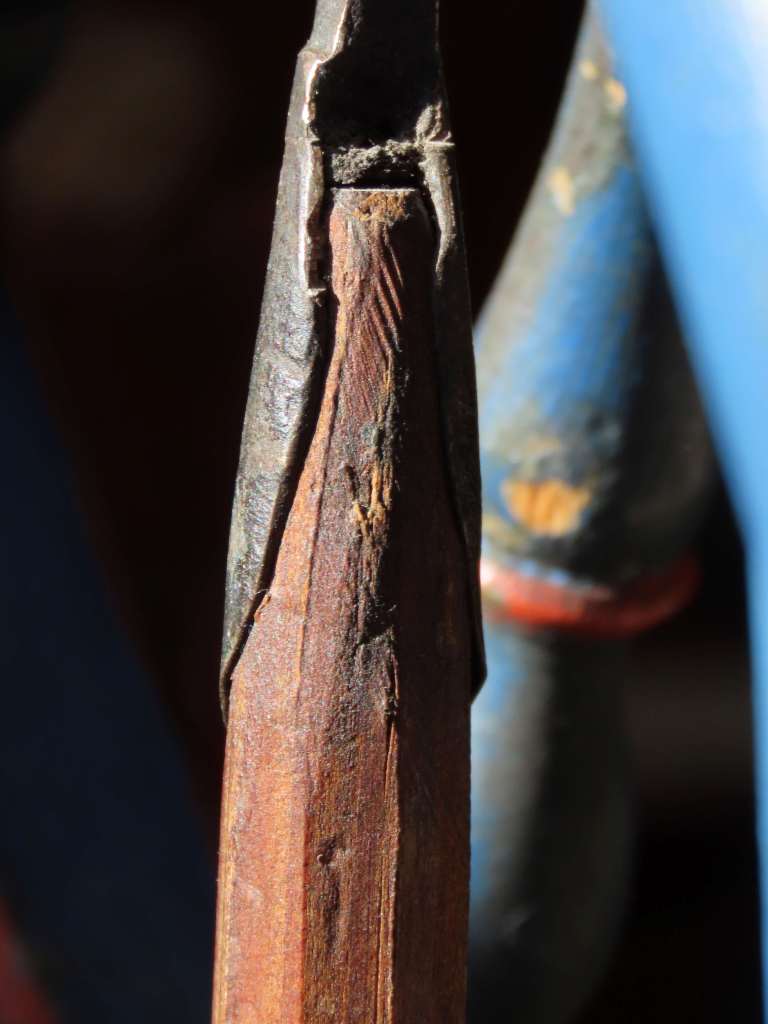
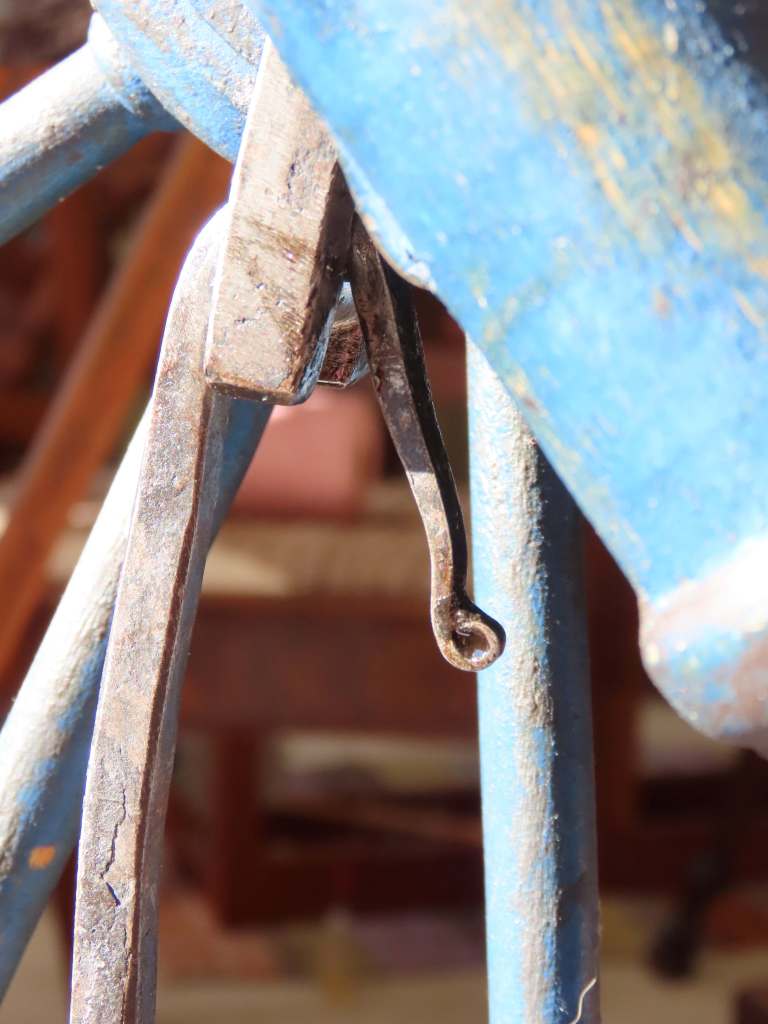
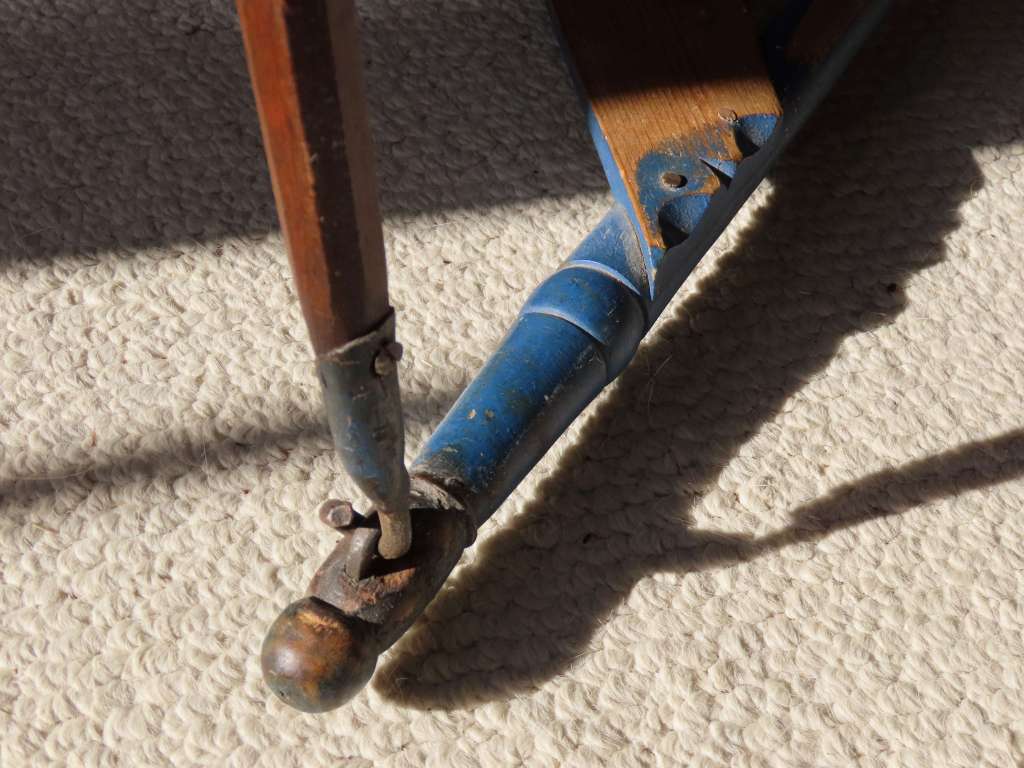
Hjordis’s maker solved that problem by crafting a special footman. A multi-sided wooden shaft is topped with what looks like a metal hood, partially surrounding the wood.
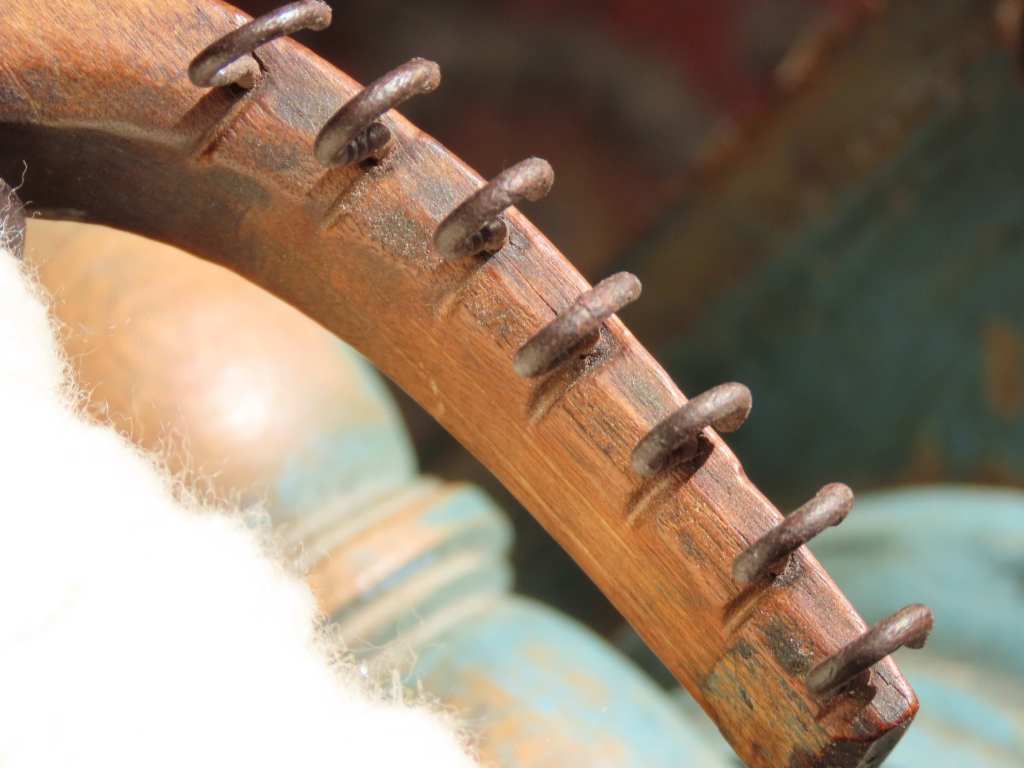
The hood is topped by a long metal piece that hooks over the internal crank and ends in a lovely curl.
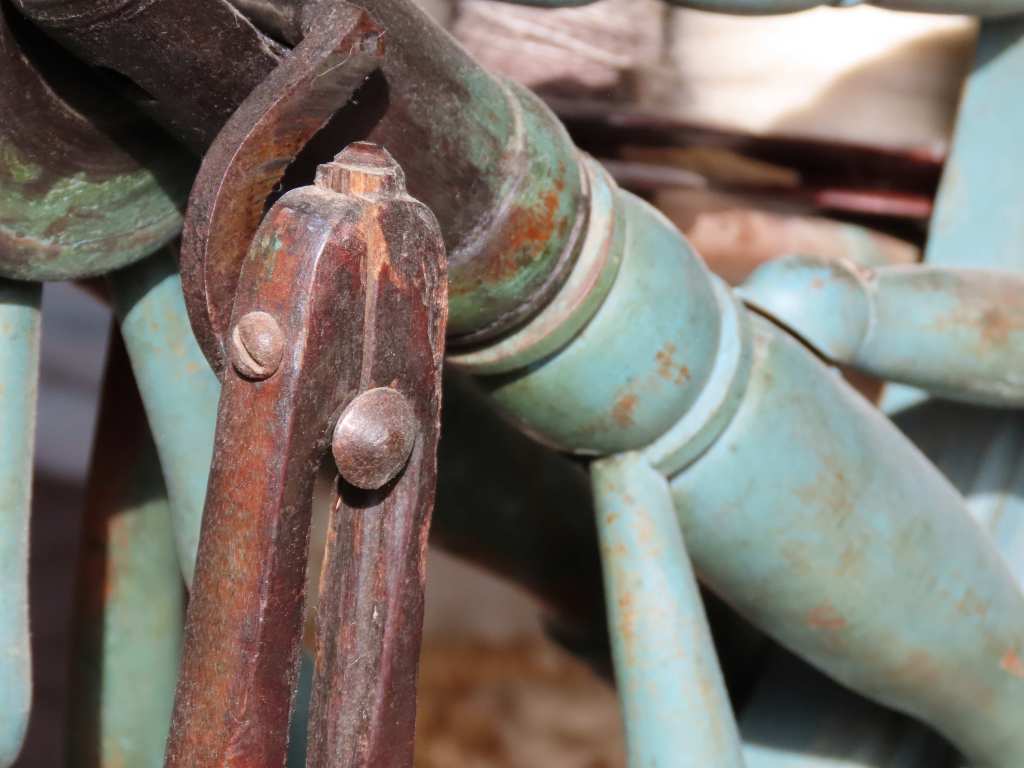
The bottom end of the footman also is encased in metal with a small metal hook attaching it to a metal piece on the treadle bar.
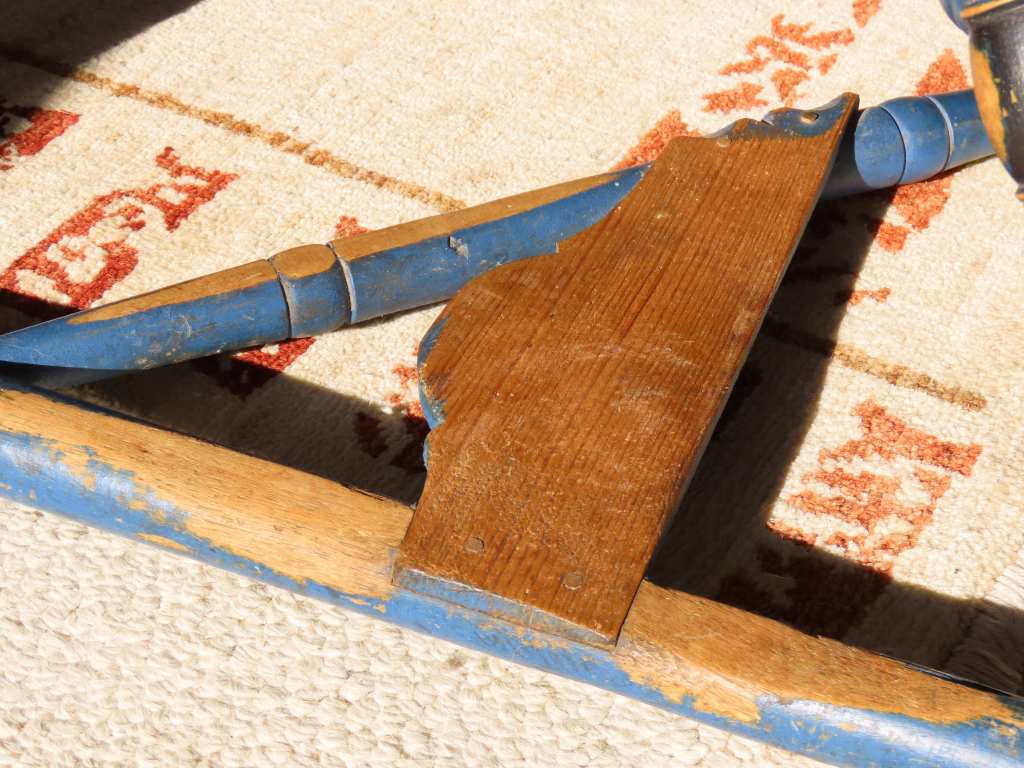
So much beautiful work went into this footman. Likewise, the treadle is no plain wood piece, but shaped with a decorative flourish at the end.
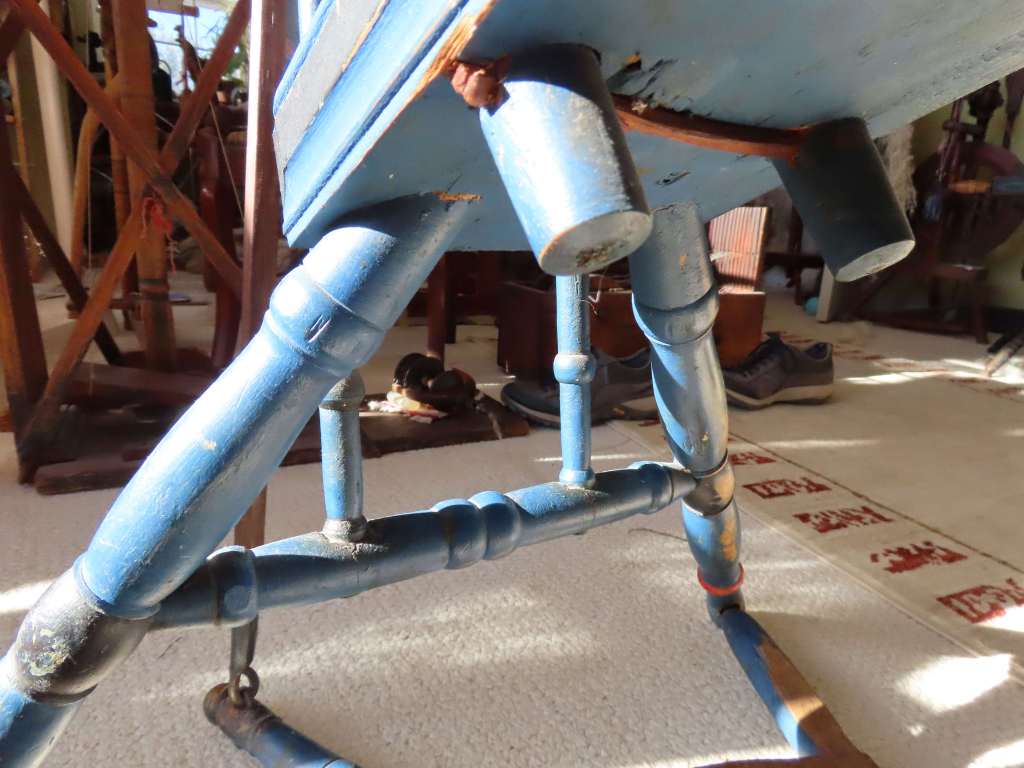
The wheel end has a cross-bar between the wheel-end legs with supports extending to the wheel uprights.
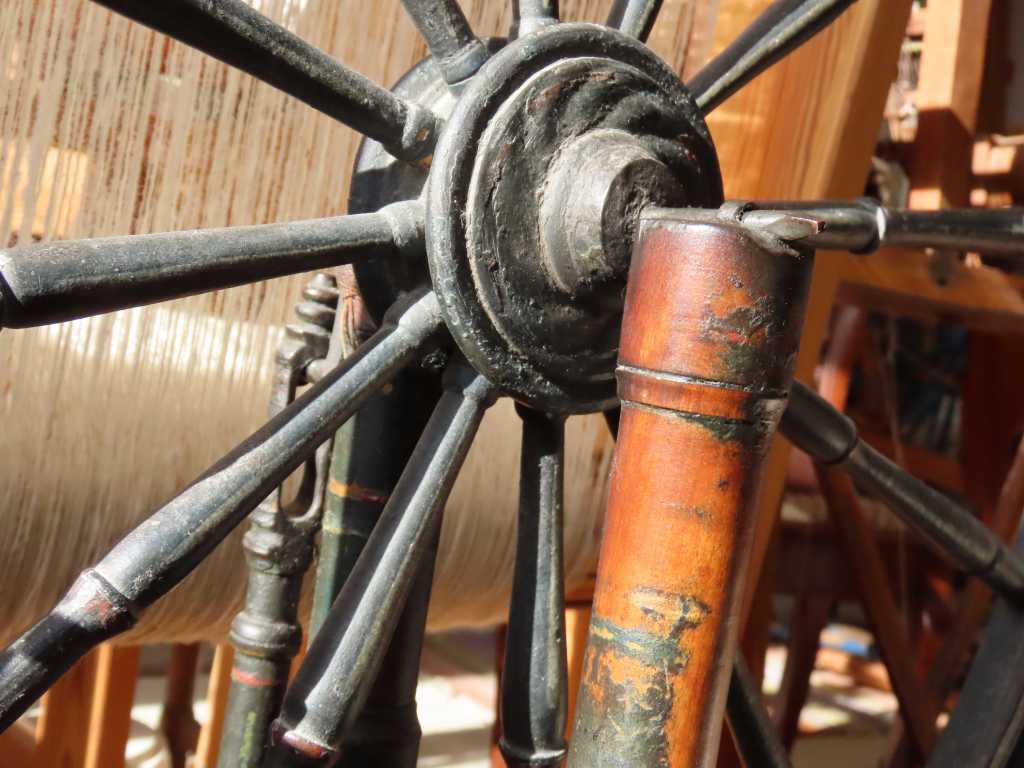
The drive wheel has 12 spokes,
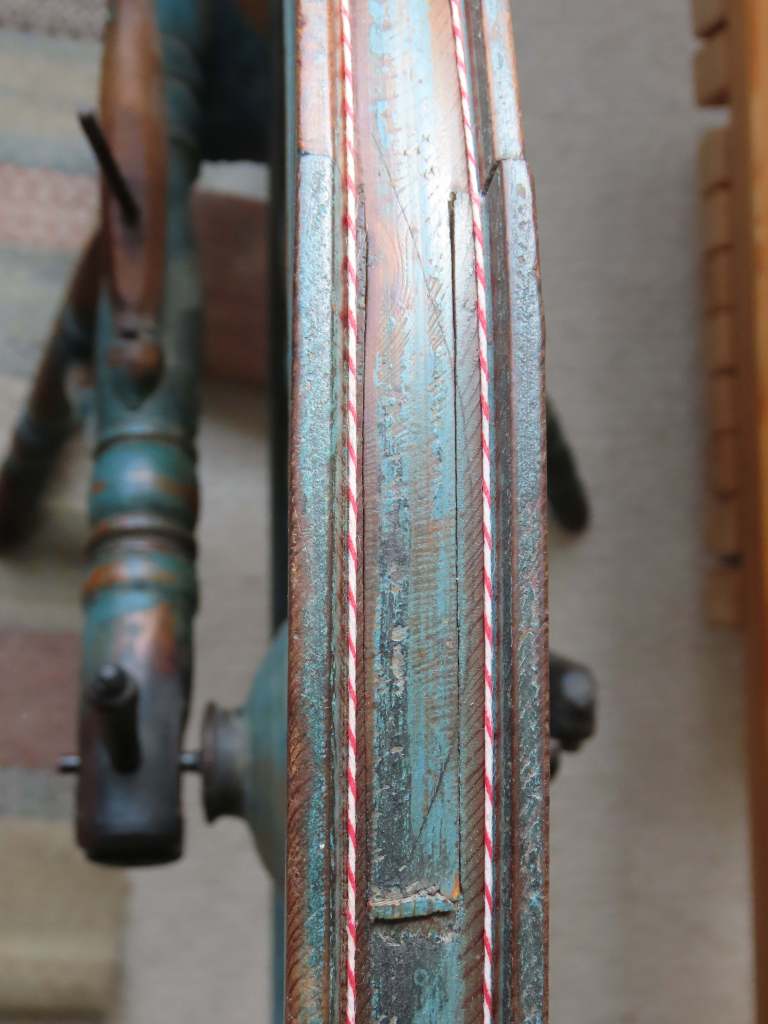
set on the flat inner rim
with a nail or peg securing them at an angle through the side of the rim.
The rim itself is four sections. The sections are fitted together with tongues (long on the top, shorter inside) going in opposite directions on two sections, fitting into grooves on the other two sections.
Hjordis has seen a lot of use but her flyer assembly is still going strong.
Her bobbin is cracked and there is a deep groove in the flyer front near the orifice.
Her whorl screws on righty-tighty, lefty-loosey, the opposite of most North American wheels, but found on many Norwegian wheels.
Her back leather bearing is a little droopy, but works well. The previous owner put an elastic band on it.
The orifice is quite smooth and the front bearing secured with some old yarn or twine.
Her paint colors are vivid,
but, in some areas, applied a little sloppily,
which is interesting, since the underside of the table is painted, something many makers do not bother with.
There is a crack in the table that I need to repair and a distaff hole on the spinner side.
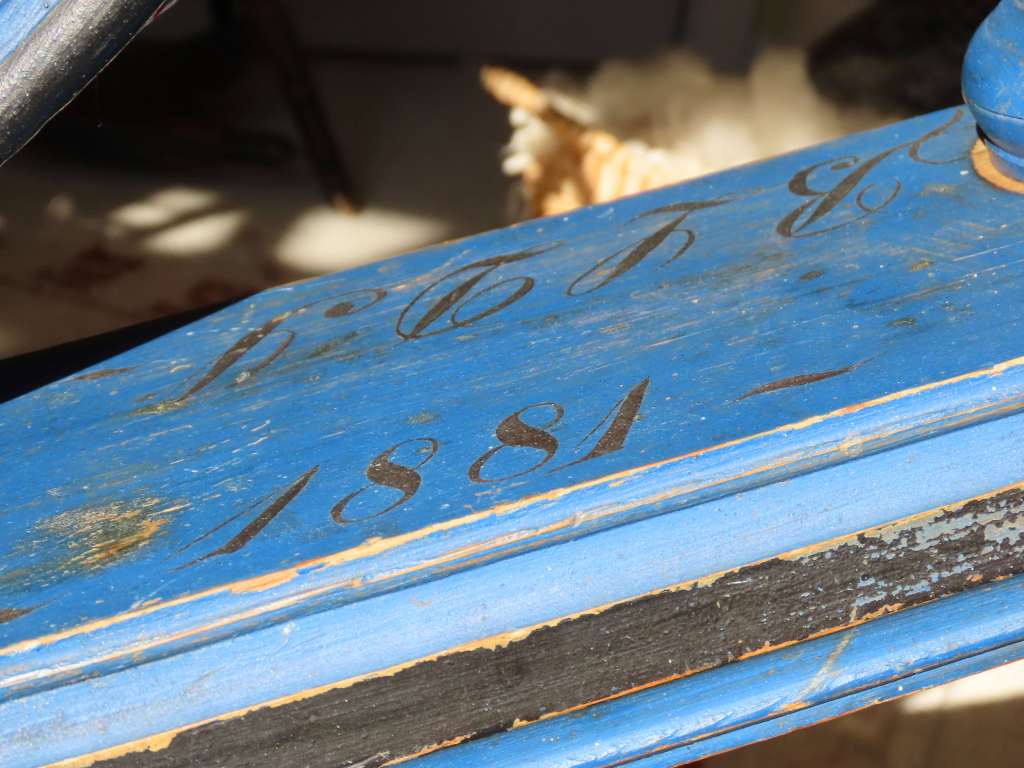
The table bears a date and initials in elegant script.
Aside from the date, I have not been able to find out much about the wheel’s origins. I believe that she is Norwegian for a few reasons. The internal crank and righty-tighty whorl point in that direction and there have been a few other wheels that have come up for sale with sellers indicating they are Norwegian. These wheels do not have an internal crank, but do have the unusual lyre-shaped nuts and metal upright-tops.
For sale in IowaFor sale in Minnesota, no internal crank but the treadle is very similar to Hjordis’s
Although these wheels likely were made by the same maker, only Hjordis has the internal crank and creative footman, which kicks her up a notch. I am very grateful that she was not passed by in the hunt.
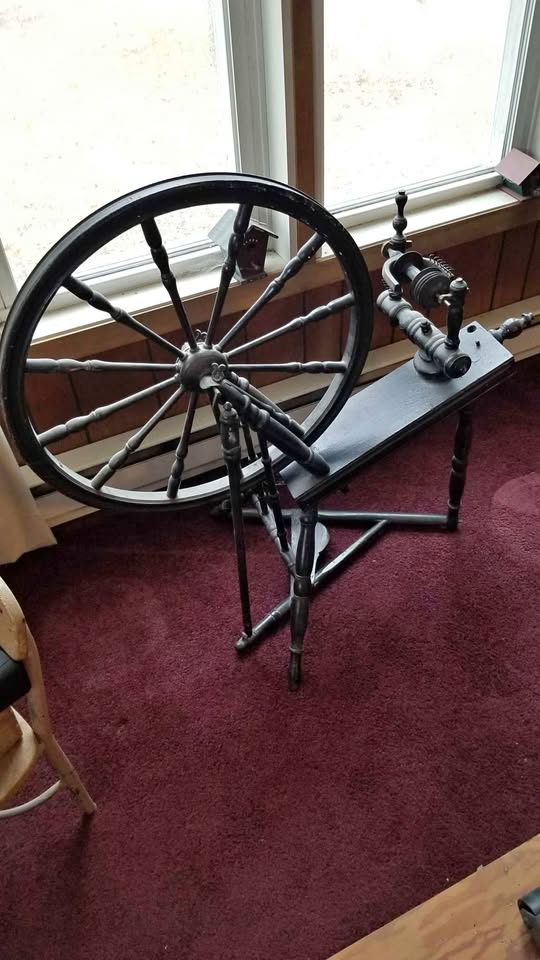
Norwegian wheels come in all shapes, sizes, and colors. This one is a “double-table” wheel, a style commonly found in Norway.
But it has several interesting features that make it stand out–its size, festive paint, handwritten note, and fixes.
Size-wise, it is petite compared to most double table wheels. It is more compact and lightweight, making it relatively easy to store and portable, attributes apparently prized in Norway, given the many different styles of slanty wheels made there.
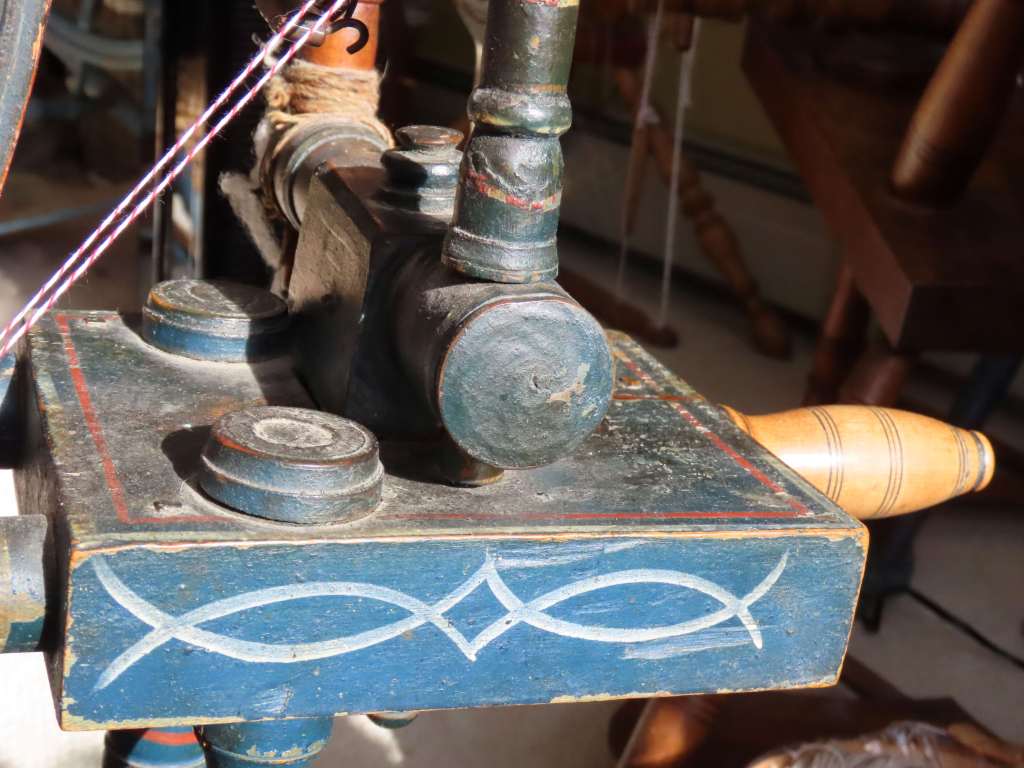
Painted a dark greenish-blue, almost every surface is decorated with red and white designs, which really pop in contrast with the deep background color.
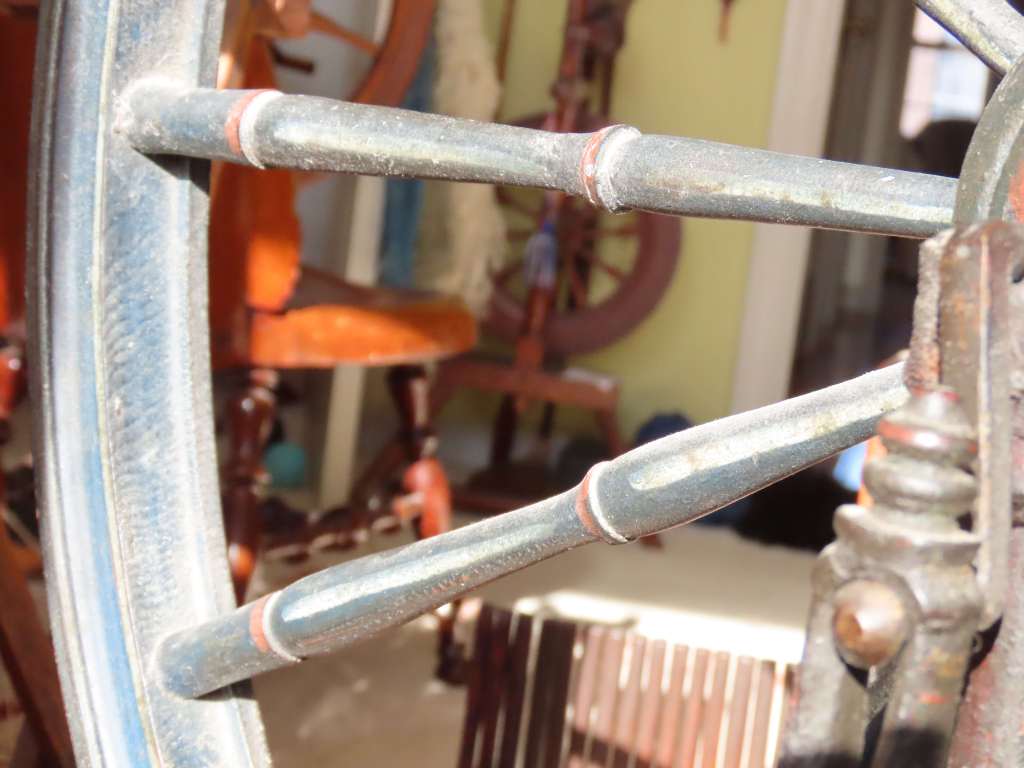
Even the spokes have white stripes running their length–many hard to see through fading.
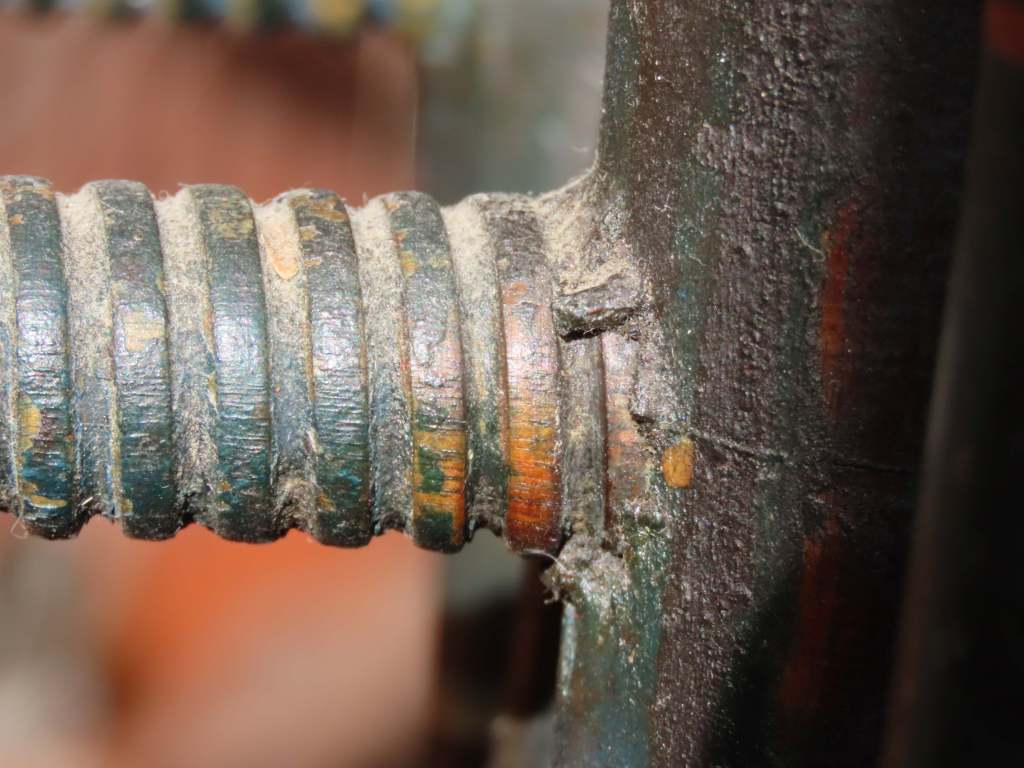
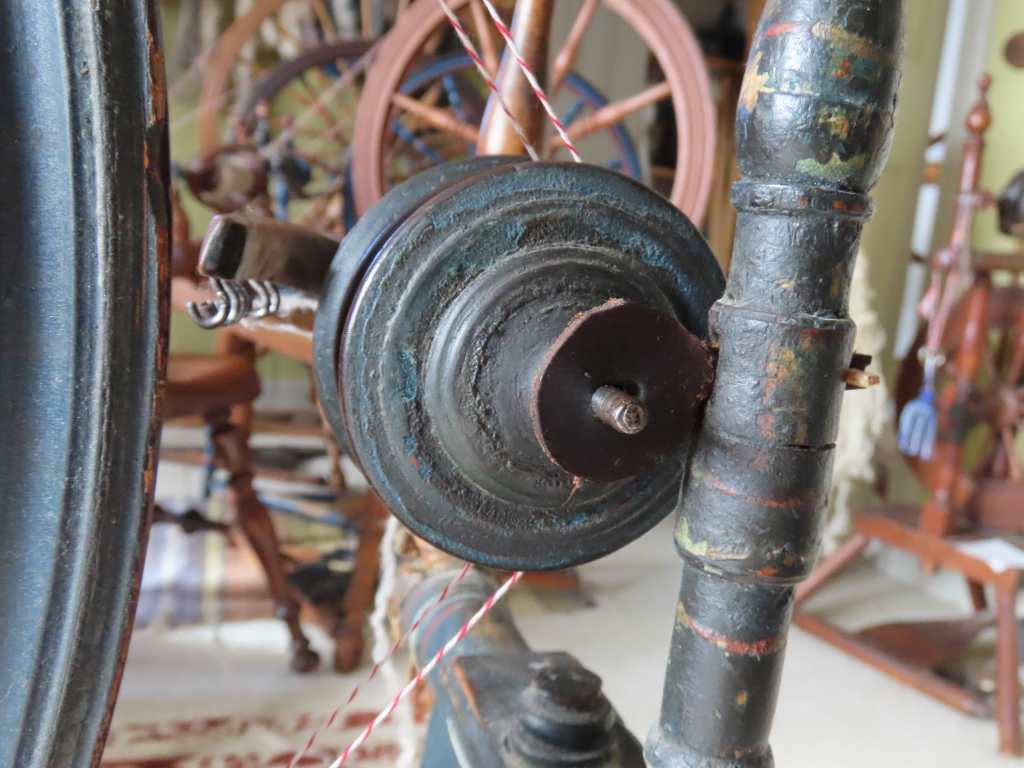
The hub has an odd wave–like surface.
The footman is ornate
and the treadle is nicely contoured to fit exactly next to the leg.
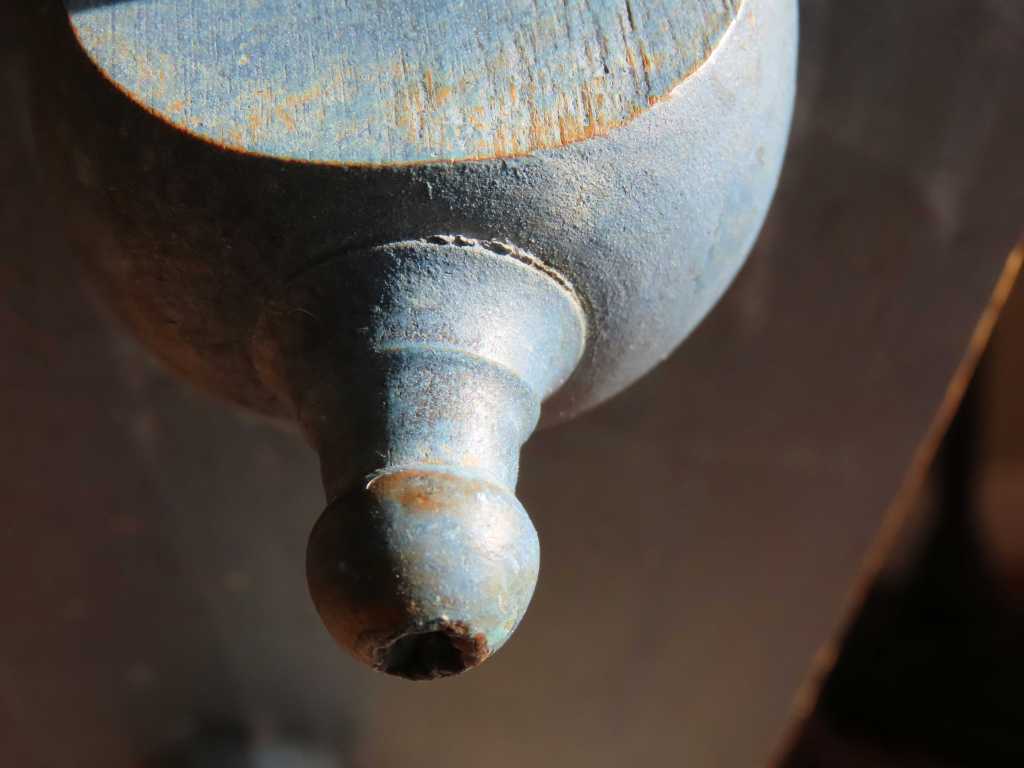
The tension knob was either unpainted or the paint has worn off.
Maybe a touch of old paint left on the end
The treadle is worn
and the paint is mostly worn of of the front maiden.
The back maiden has a recess for the whorl, either through wear or made intentionally.
The underside of the table is painted.
As is the under-table nut tightening the MOA.
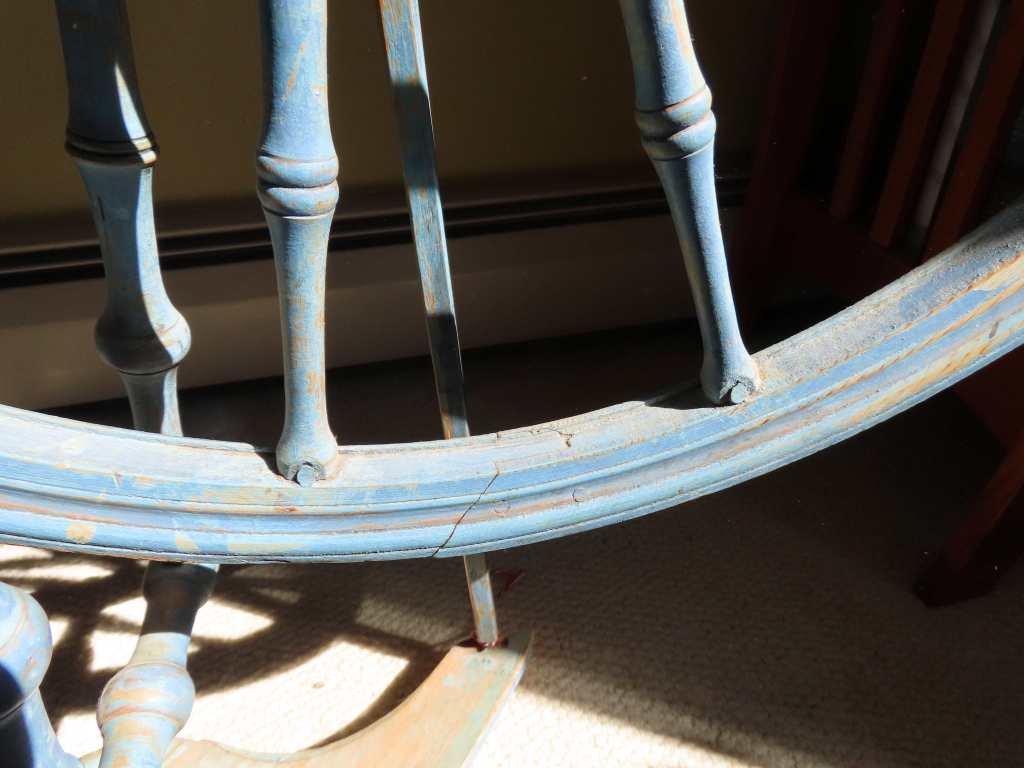
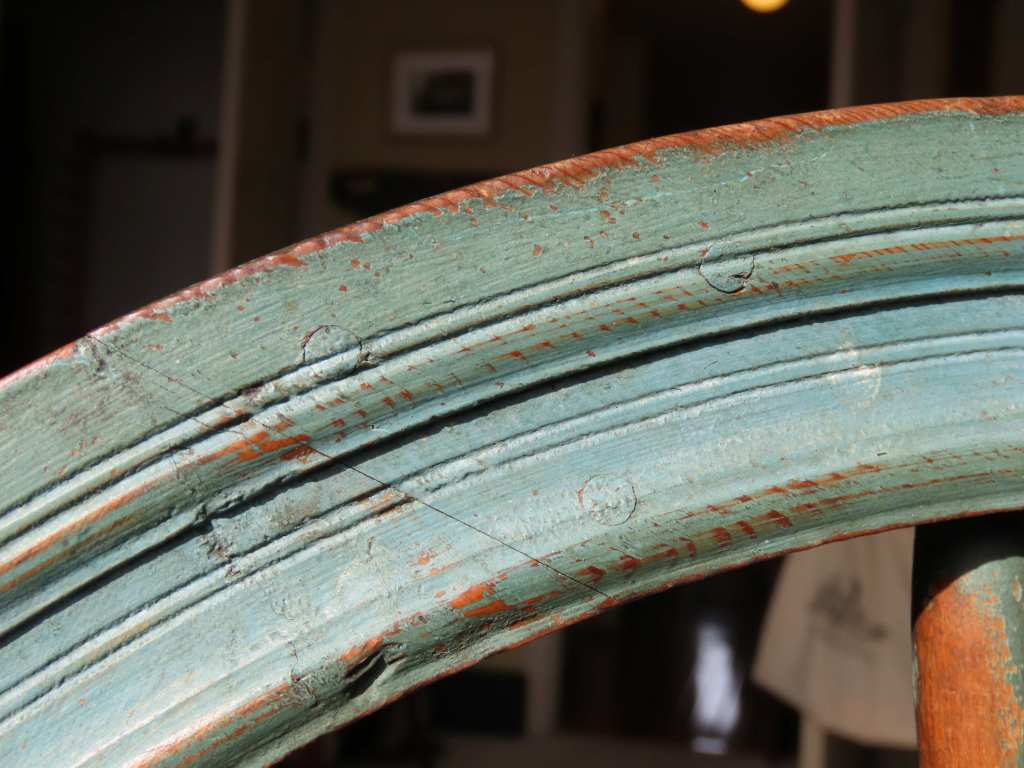
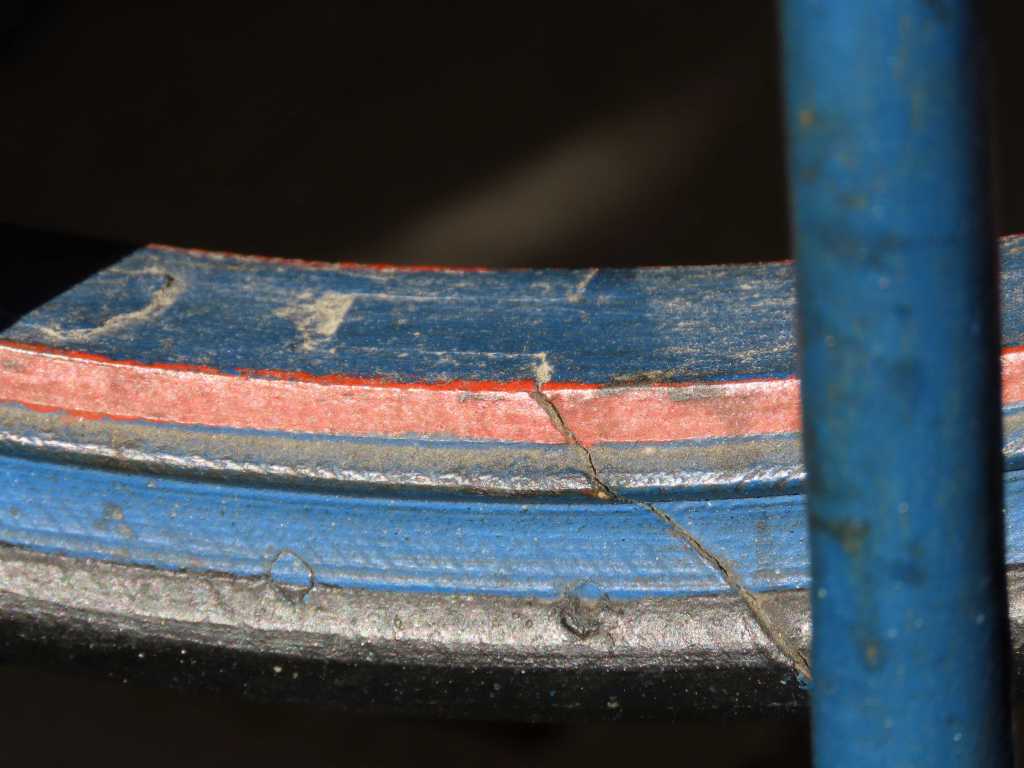
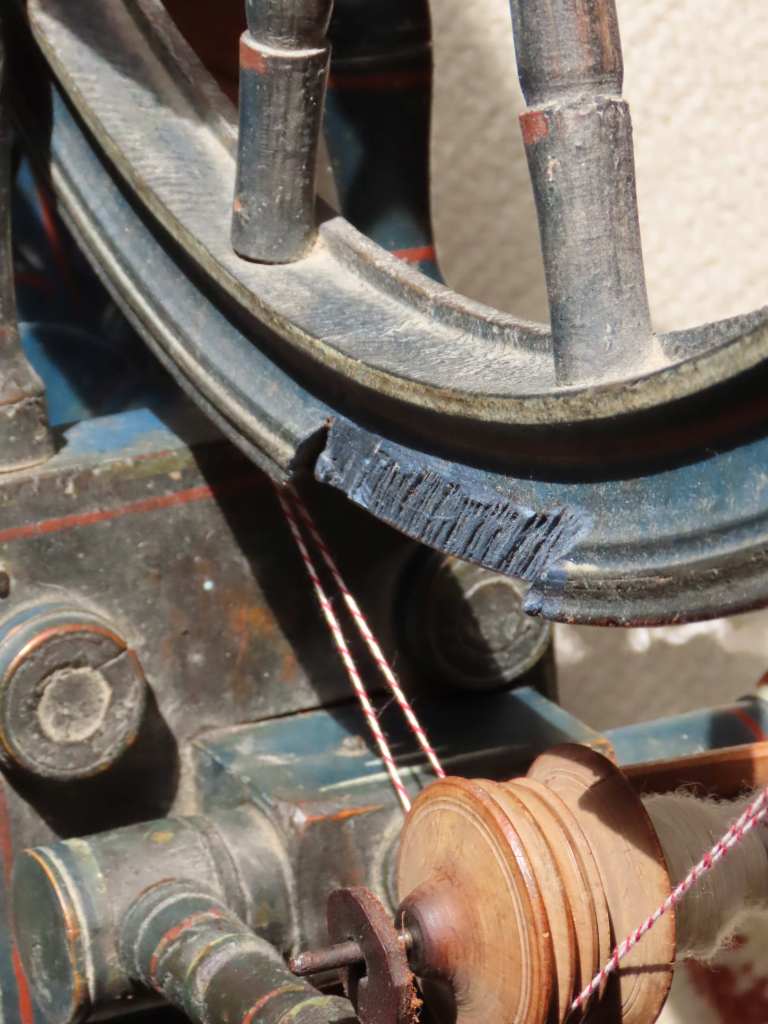
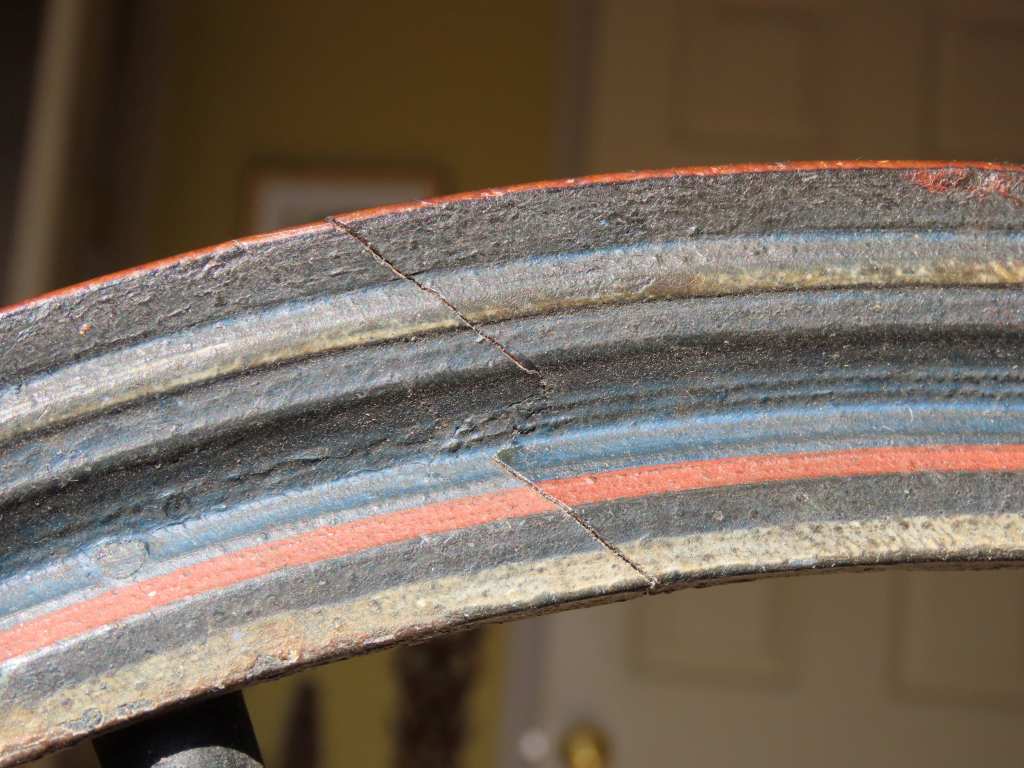
The rim of the drive wheel looks like beautiful snakeskin.
A piece had been broken off the rim and repainted with a blue paint that does not match the original.
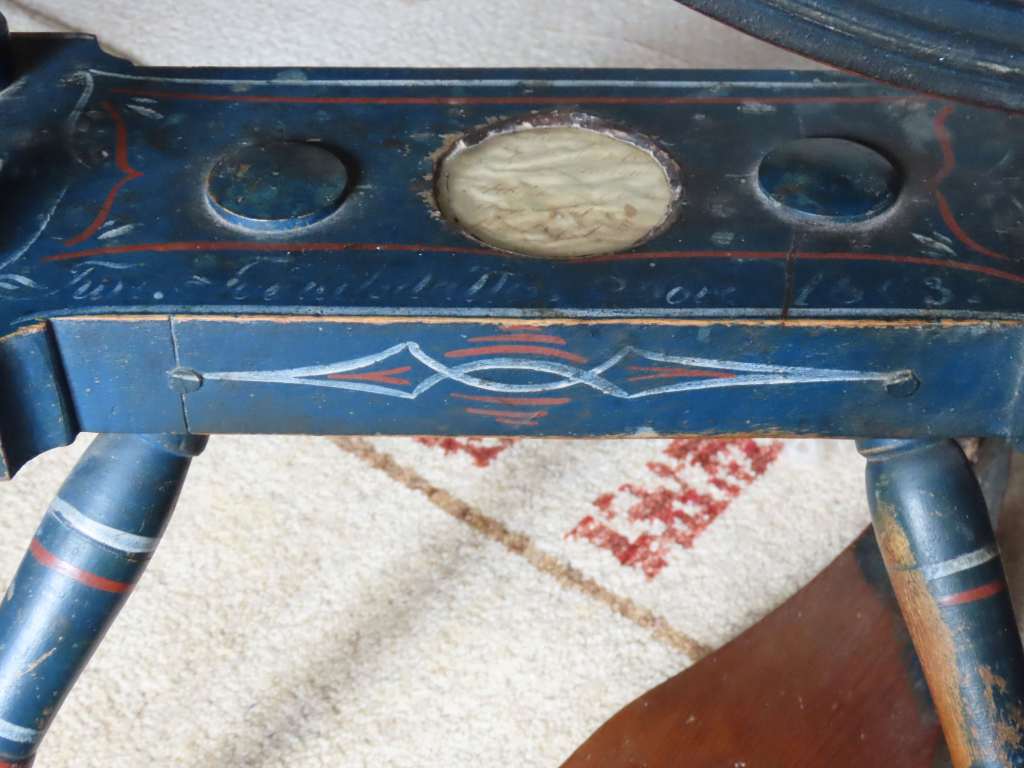
The name of the owner is painted on the top, “Turi Torkelsdatter,”
along with a place name, “Nore,” and date “1863.”
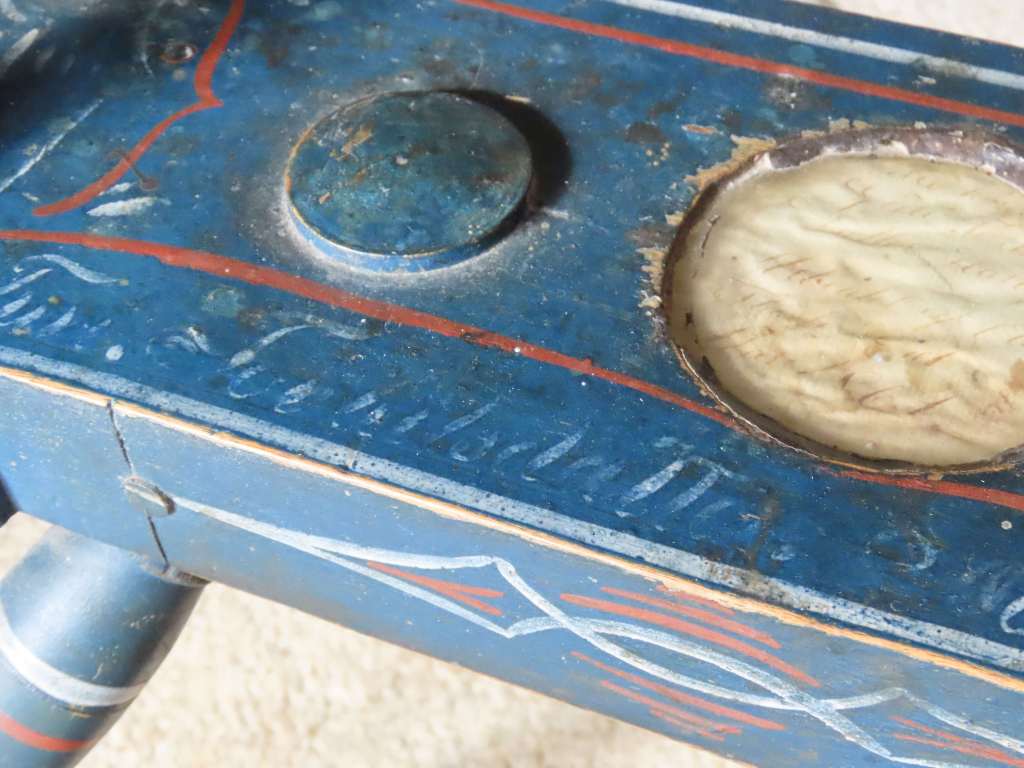
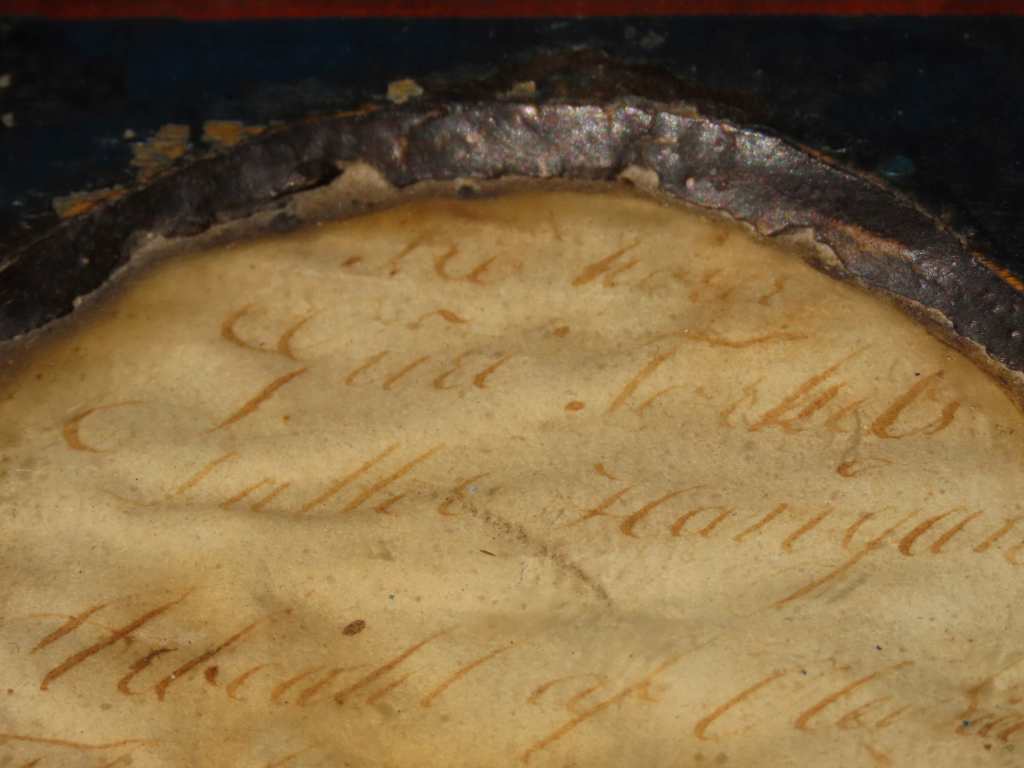
But what sets the wheel apart is a small piece of paper covered with glass sitting in the middle of the table.
The paper is wrinkled now and the handwriting faded.
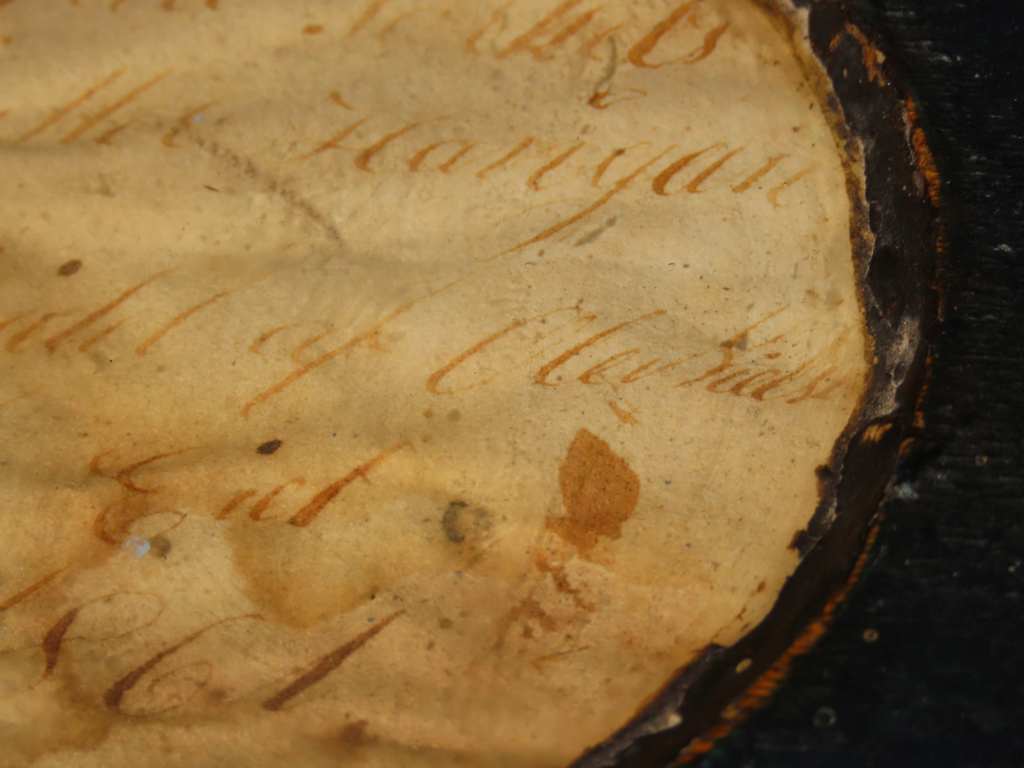
But what a treasure. A note came with the wheel from a previous owner saying that the rough translation of the script is: “For: Turi Torkelsdatter Year: 1863 Place: Nore Valley Norway Made by: Olev Seilsen in 1861.” I cannot read Norwegian and much of the writing is hard to make out. It is pretty easy to make out the “Turi Torkelsdatter,” although there is a word after it that looks like it could be “Harigan” or “Haugan.”
Also, the name of the maker is here. I believe that the name is actually “Ole Neilsen,” because what looks like it could be a “v” at the end on “Ole” is really just a swirl on a capital “N.”
The maker’s name is in the center right
In researching online, I did find several Ole Neilsens who lived in the Nore Valley through the years, although nothing indicating that any of them might have made wheels.
I also found several Turi Torkelsdatters in genealogy sites, but I do not have access to international searches so was not able to pin down this particular Turi.
Nevertheless, what a valuable piece of paper–I am grateful to Ole Neilsen for taking the time to document this wheel. Did he do so out of pride in his beautiful creation, to celebrate Turi, or both? Perhaps someone with the resources could track down more about Ole and Turi.
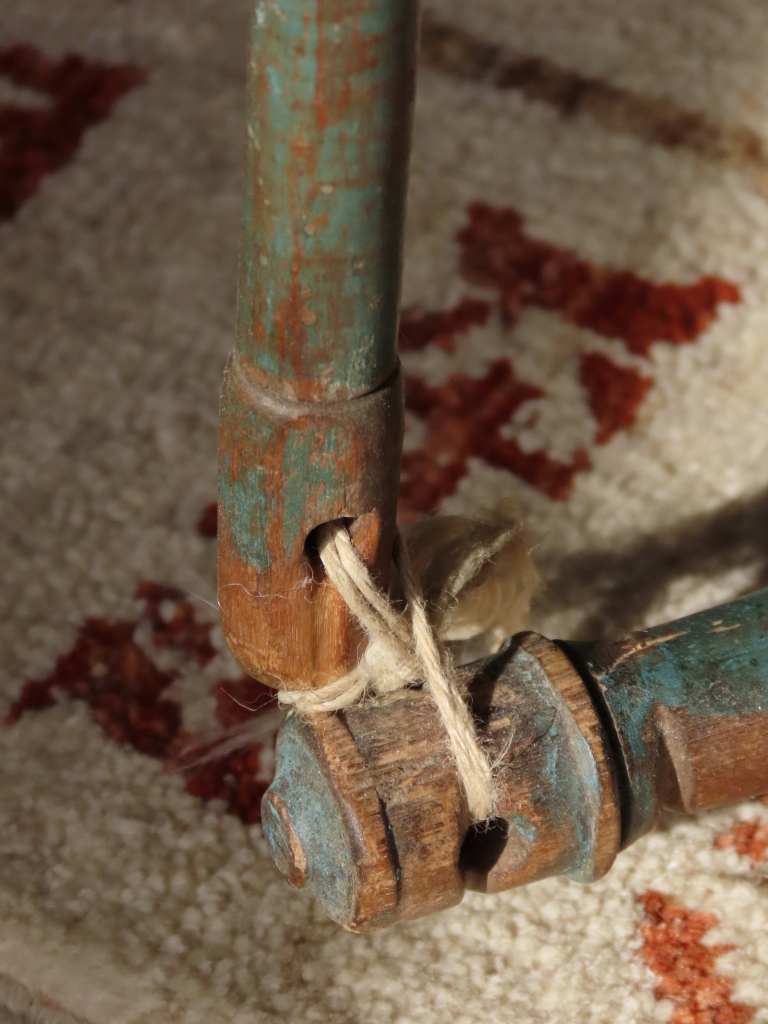
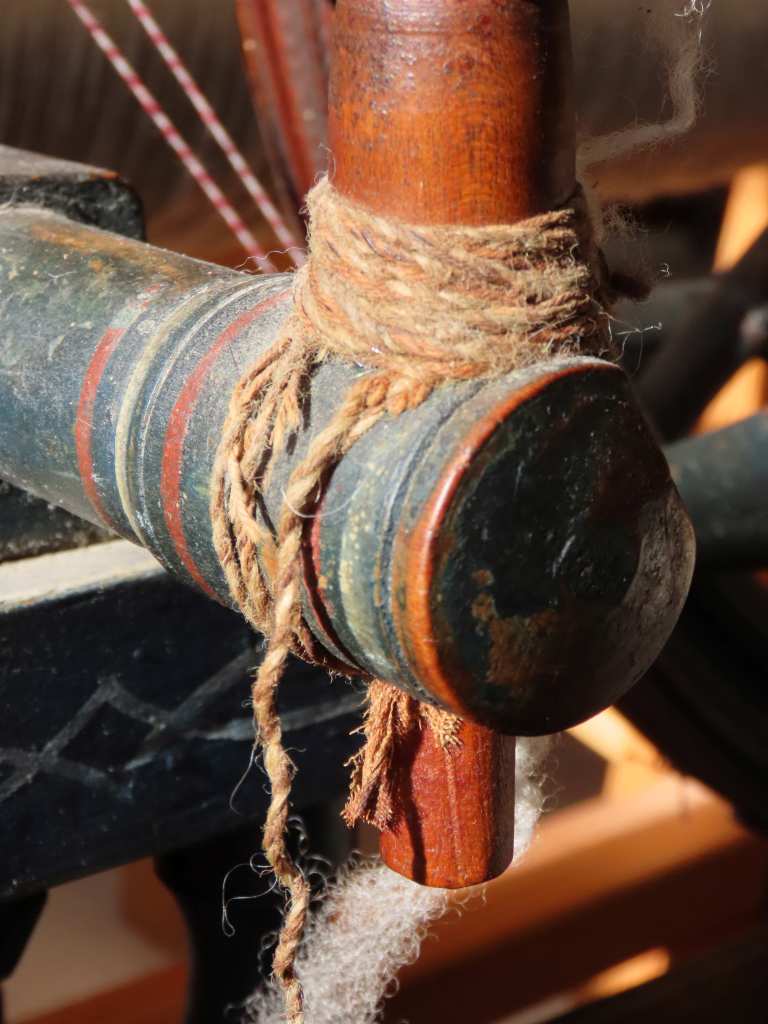
Whoever Turi was, she, and the women who inherited this wheel, used it well and took great pains to keep it spinning. It is a fantastic example of make-do fixes. The front maiden is bound at the bottom with a thick string.
The back axle is bound with what looks like linen tape and secured with nails.
In fact, nails abound.
They are found here in one of the secondary tension screws.
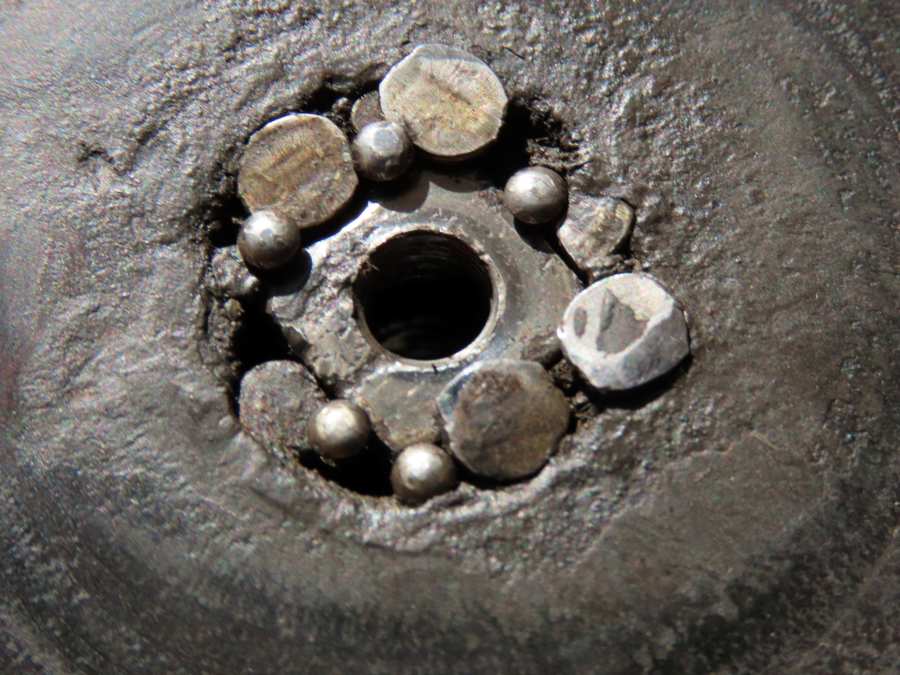
But the biggest nest of nails was hidden. When I got the wheel, it spun okay, but the flyer was a bit funky, turning with a wobbly, thump-ity feel to to it. The whorl looked as if it was a bit askew. I carefully unscrewed it (as an aside, as with many Norwegian wheels, it screws righty-tighty, lefty-loosey, in contrast to most North American wheels) and found this.
I imagine they were to keep the whorl nut in place, but sadly, it is loose again and the nails seem to give an odd unbalanced weight to the whorl. Interestingly, the whorl end of the mandrel shows uneven wear, with one side grooved more deeply than the other.
So, perhaps this unbalanced whorl was used for a while. The flyer arms show grooves on both edges, with interesting deeper grooves right next to the hooks.
Because this flyer is such a marvelous piece of the wheel’s history, I wanted to keep it as is and not have it repaired.
But it spins a bit awkwardly and there is some slippage of the mandrel. I did not want things to get worse, so I found an extra flyer in my collection to replace the original for everyday spinning.
Although it is a very different design than the original, it works beautifully on this wheel, belying the oft-repeated mantra that you cannot substitute flyers on antique wheels.
I do it all the time with great success. On this wheel it was especially satisfying to find a good substitute since the clearance between the flyer arms and drive wheel is very narrow.
The actual clearance is even closer than it looks in these photos
Happily, the substitute flyer looks nice and at home on the wheel.
And, as with all the previous fixes, it will allow this wheel to spin on, without erasing any of its history.





































 Exquisite Machinery