Granny Ross

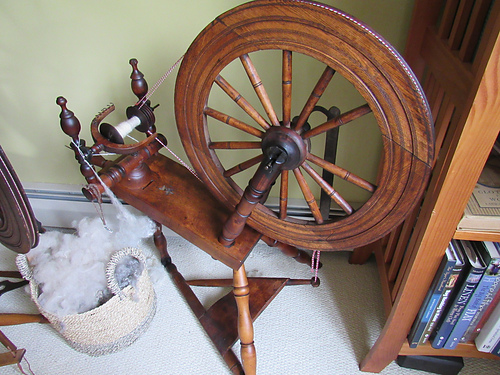
Several of my wheels have forged friendships.  One of the earliest and best of those wheel friendships came through Granny Ross.  When the wheel came up for sale in Cape Breton, Nova Scotia, a woman on Ravelry, Sherran Pak, posted the wheel’s photo, noting some similarities to the McIntosh wheels. 
The seller said that the wheel was not in spinning condition and, although Sherran was initially interested in the wheel, she decided not to buy her because of the need for repairs and the difficulties in getting the wheel to her home in the Midwest. 
I did not know Sherran and was uncomfortable pursuing the wheel, knowing how much she liked it.  So, I contacted her and after her assurances that she was not interested and that I should go for it, I then contacted the seller. 
The stars seemed to be aligned because the seller said that he would be taking a trip down to Maine in about a month and could bring the wheel with him.  As it turned out, the meetup did not work out and I ended up, ultimately, finding a wonderful woman on Ravelry who, on her annual trip to Cape Breton, was willing to meet up with the seller and railroad the wheel down to me. 
During the months it took to get the wheel, I got to know Sherran.  Although I still have not met her in person, we have been continually in touch over the years, and she became a friend.  She kept a lookout for wheels in the Midwest that might interest me and I helped her out (although to a much lesser extent) with wheels in my part of the world. 
Some of my most treasured wheels came my way because of Sherran.  She found them, picked them up (even waiting in line at an estate sale during covid), fostered them, arranged railroads, and sent them on their way to me.  I am very much in her debt and am so glad that I have gotten to know her.  And, it is all thanks to Granny Ross.
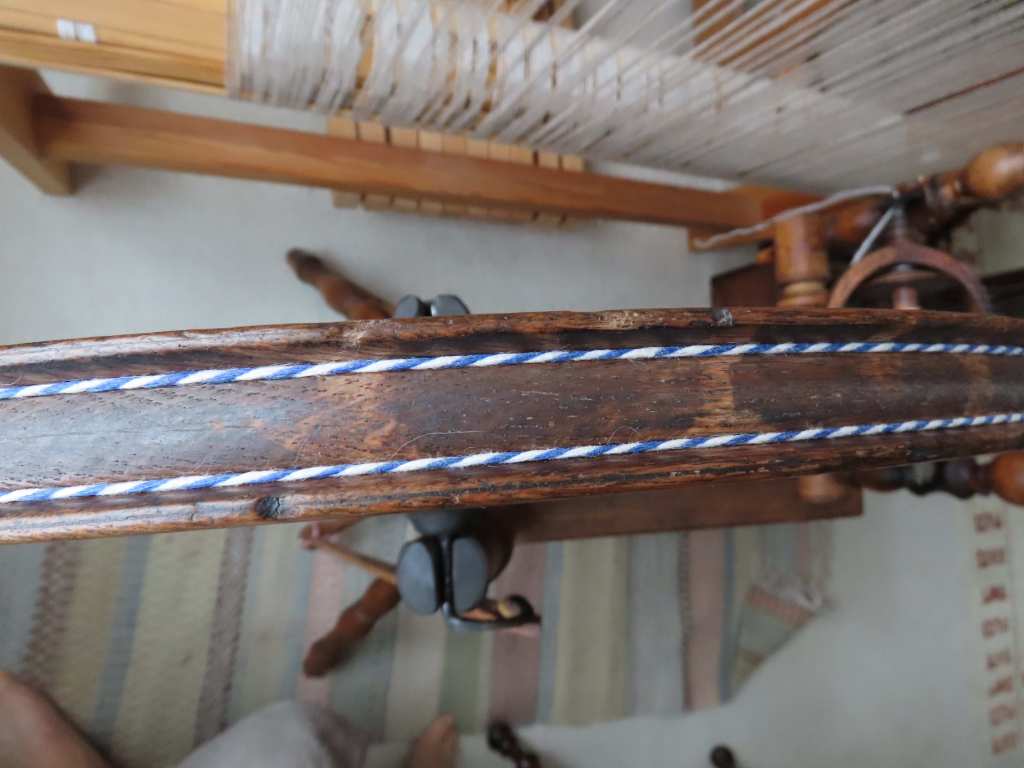
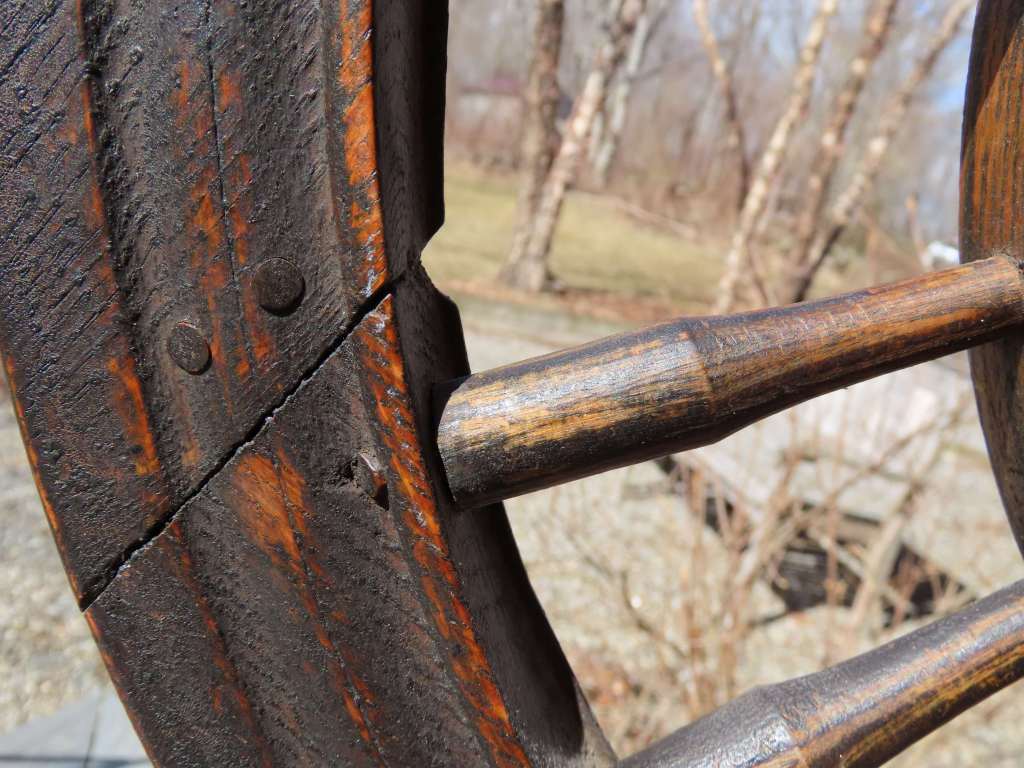
When Granny Ross finally arrived here, it was apparent why the seller said that she was not in spinning condition.  The drive wheel had been seriously damaged, with a bent axle, spokes that had broken right off, with some clumsily re-glued.  It looked as if someone heavy had stepped right on the drive wheel while it was on its side on the ground.  I could just imagine the crunch of broken spokes. 

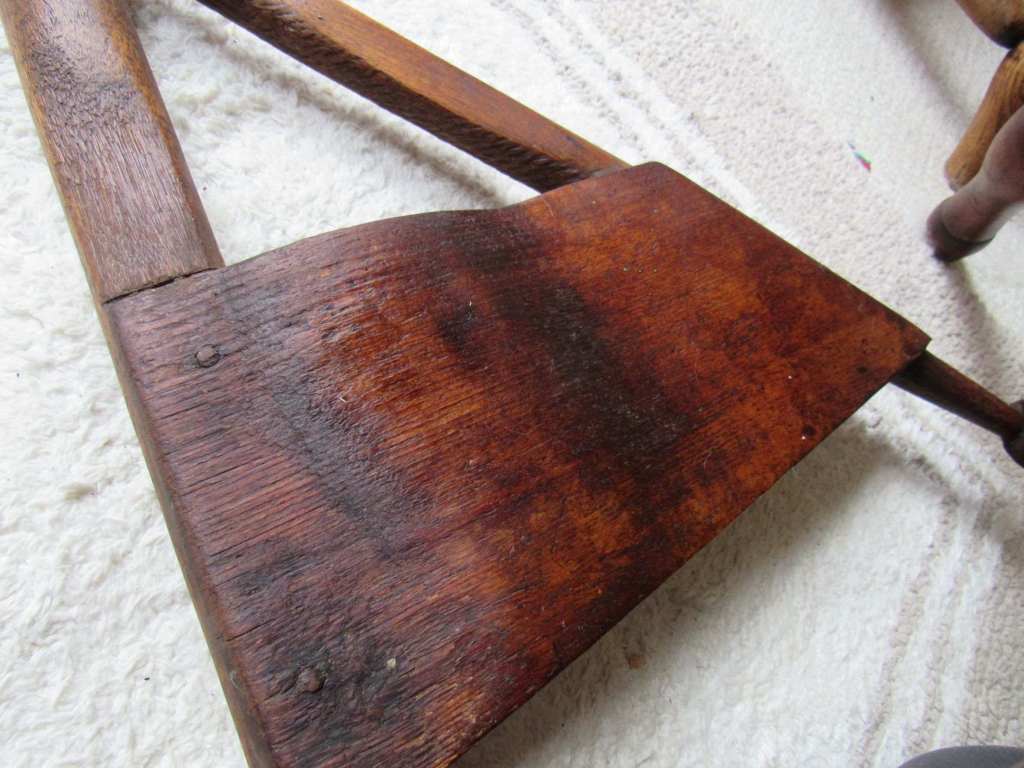
Although I do not have photos of the drive wheel when it arrived, trust me, it was a mess.  The treadle also was worn to the point of no return.  The drive wheel damage was well beyond my repair capabilities, so I shipped it off to wheel-repairer extraordinaire, John Sturtevant.  In the meantime, George crafted a beautiful new treadle with strong graining to match the legs. 
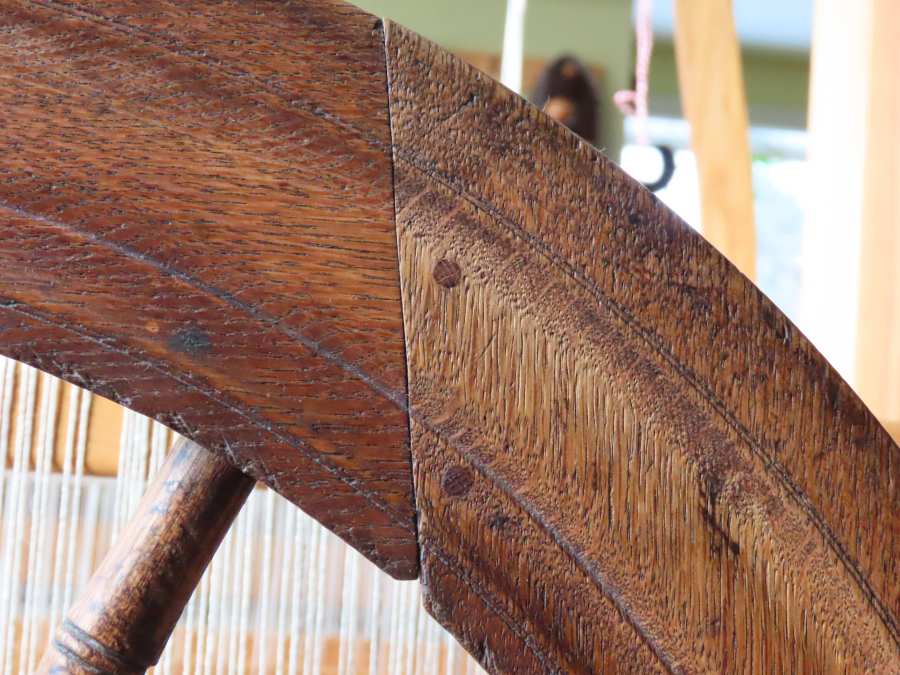
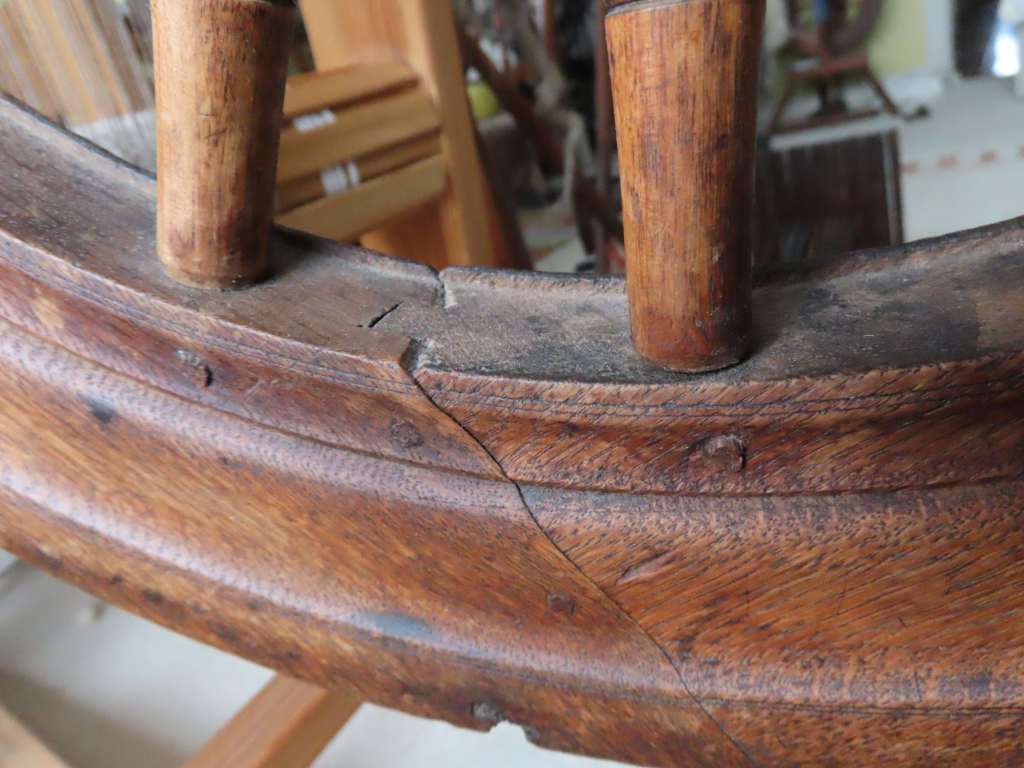
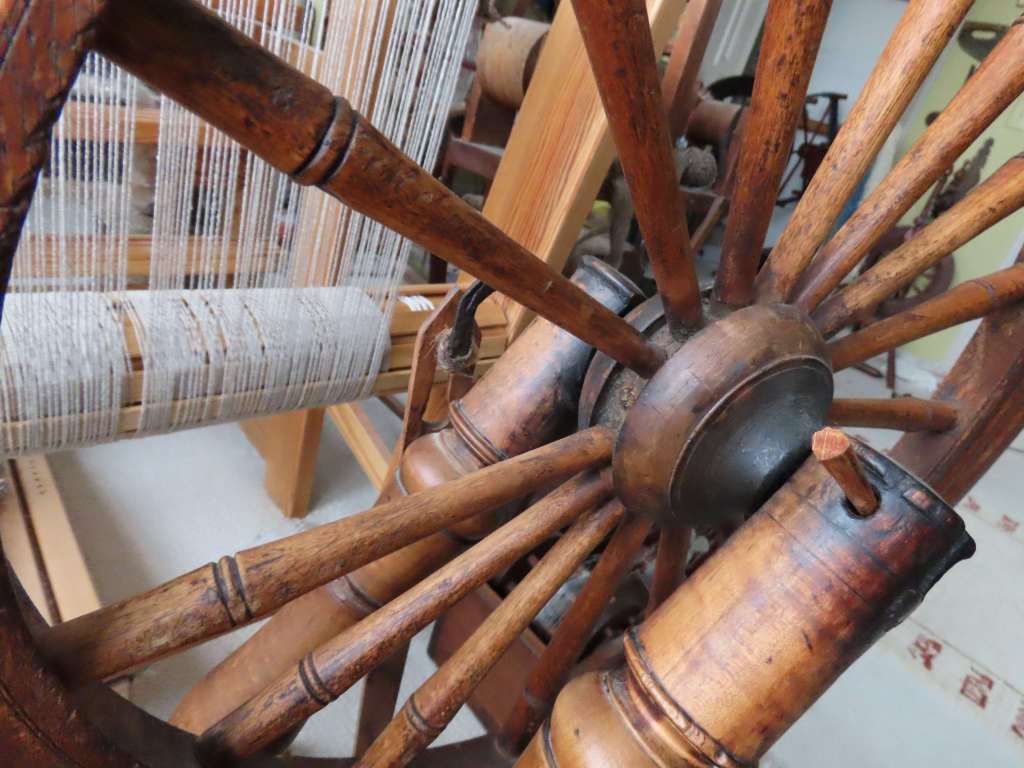
When the drive wheel came back from John, it looked as good as new.  I could not wait to try it out, interested to see how the heavy double rim would spin.  I tend to like heavy drive wheels, with their sweet momentum, and Granny Ross did not disappoint.  She became one of my favorite spinners. 
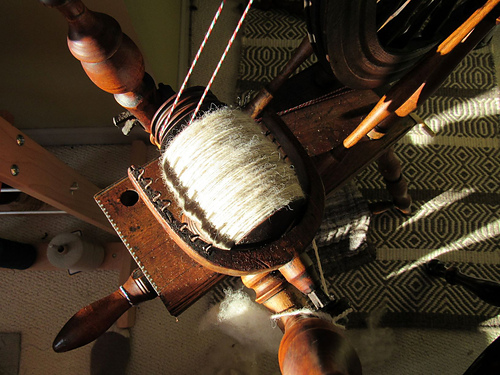
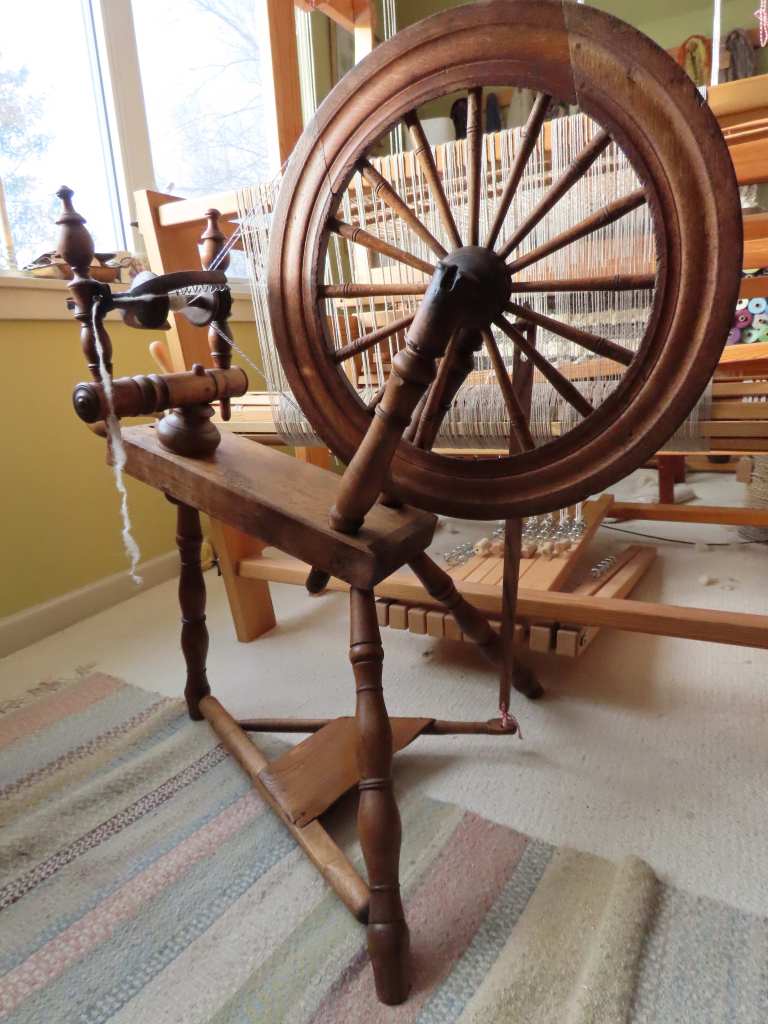
She is a bit of a puzzle, though.  Overall, she has a Scottish look. 

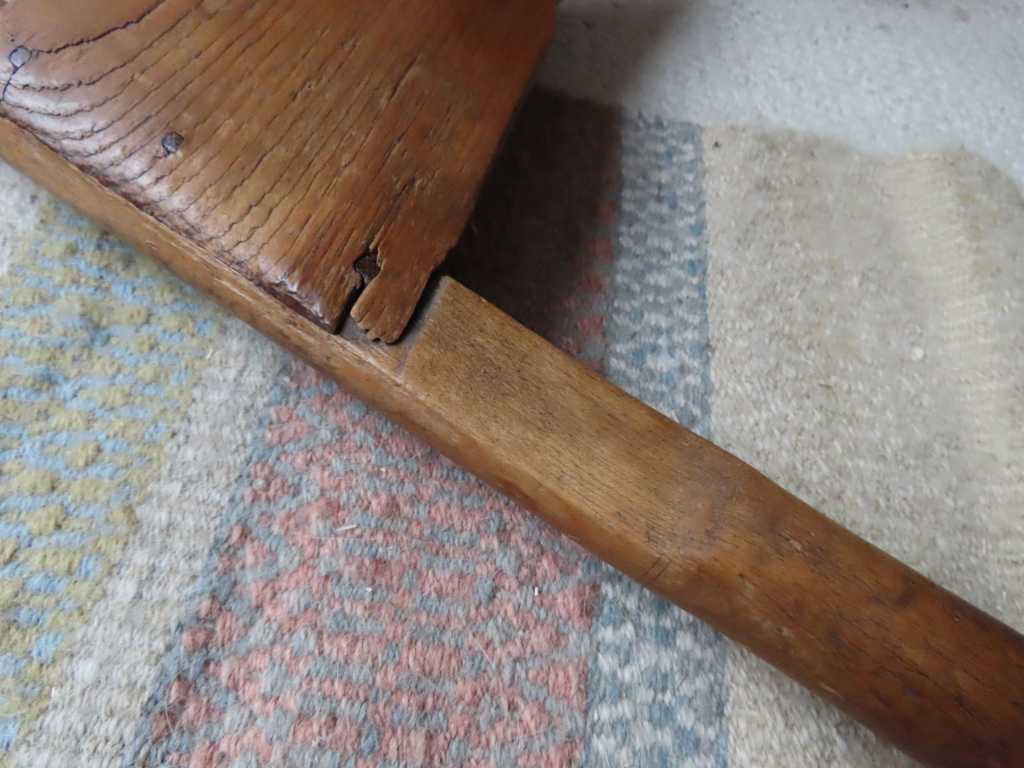
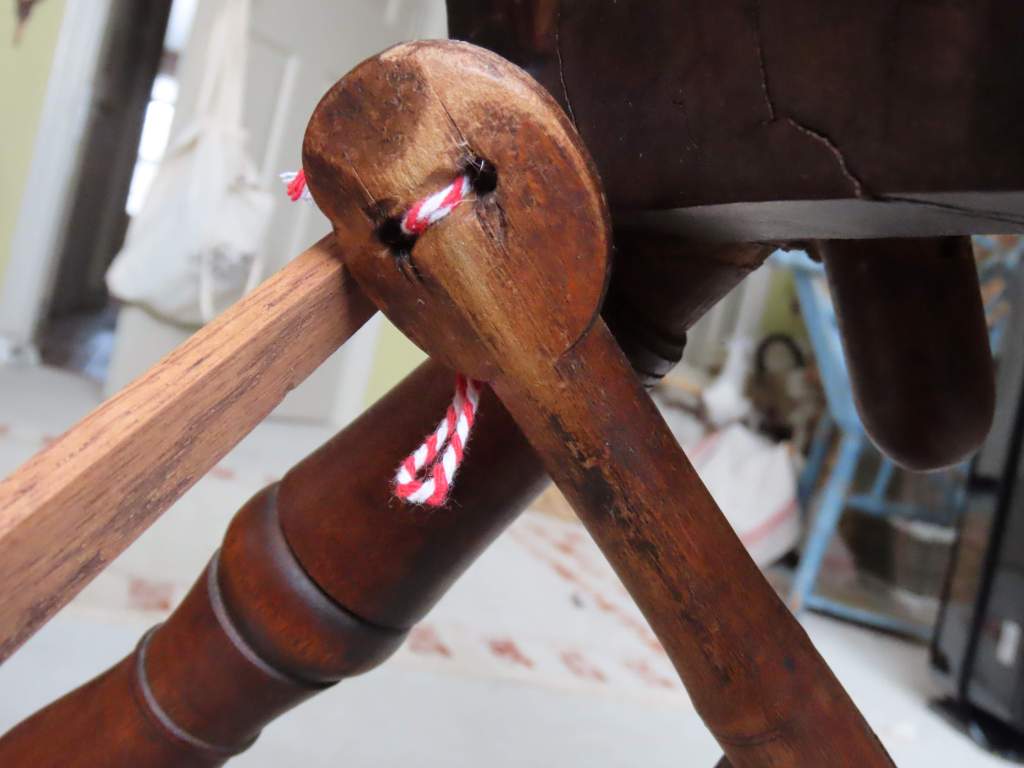
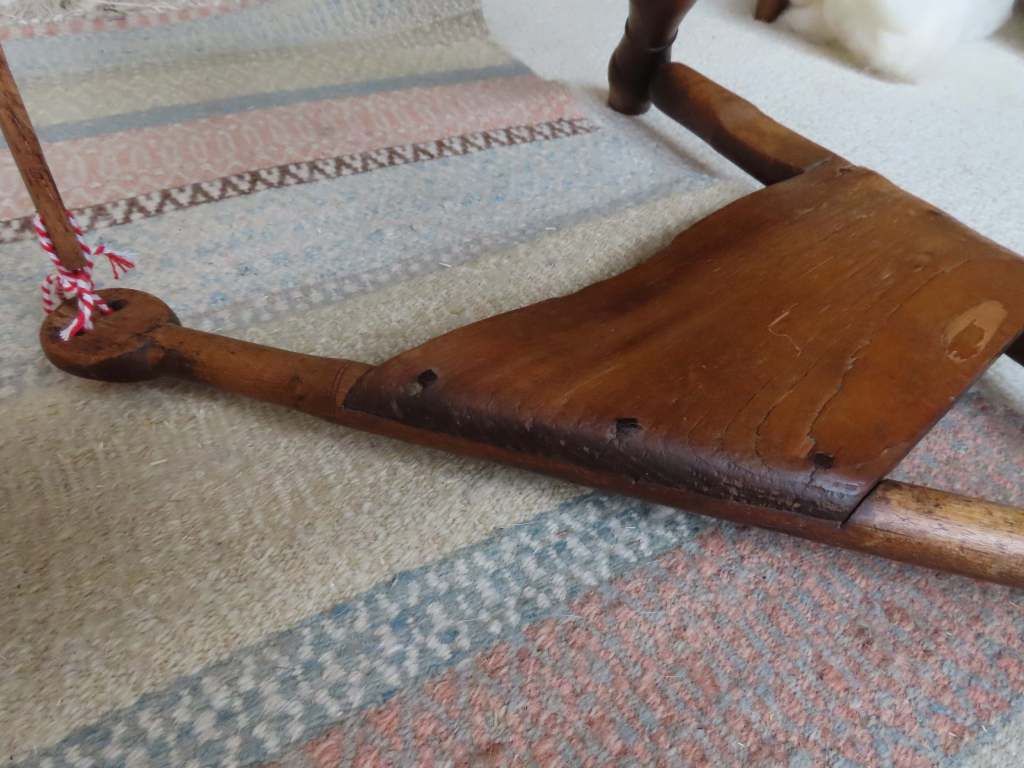
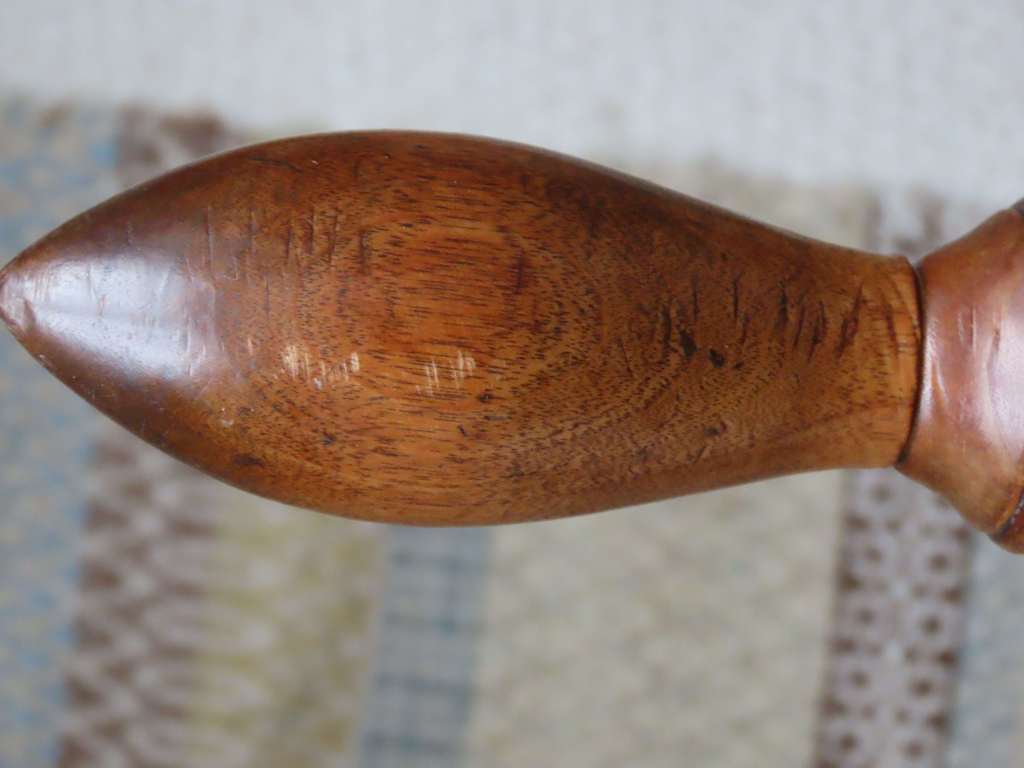
As Sherran noted, she shares characteristics with the McIntosh wheels, including a spoon-shaped end to the treadle bar
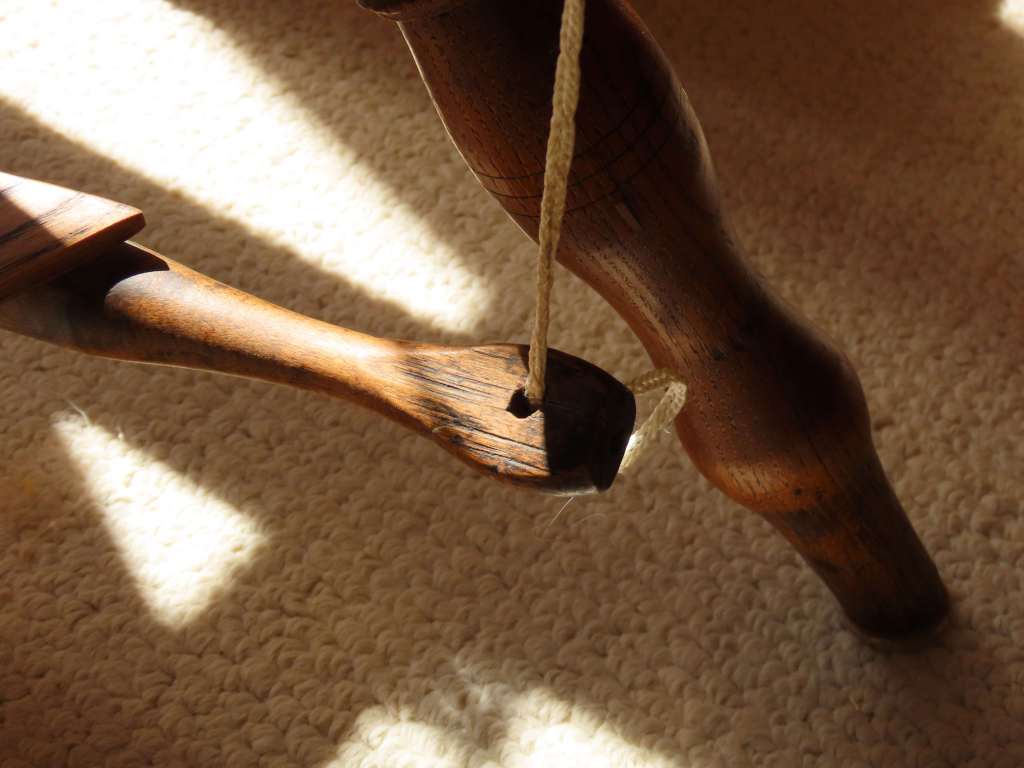
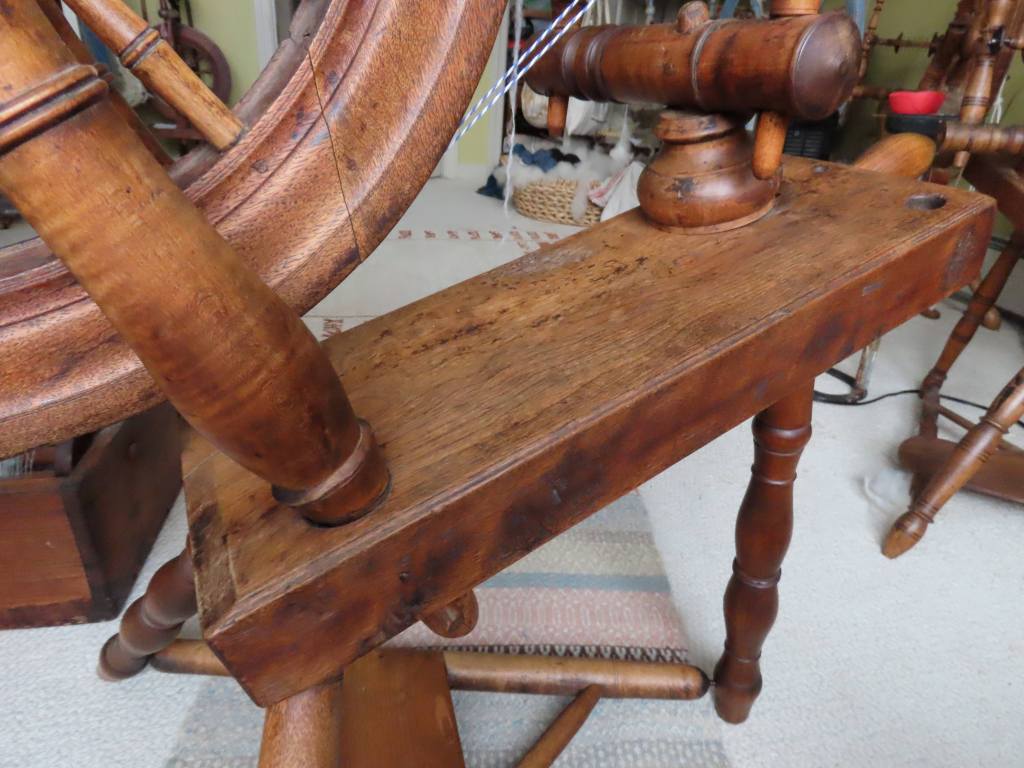
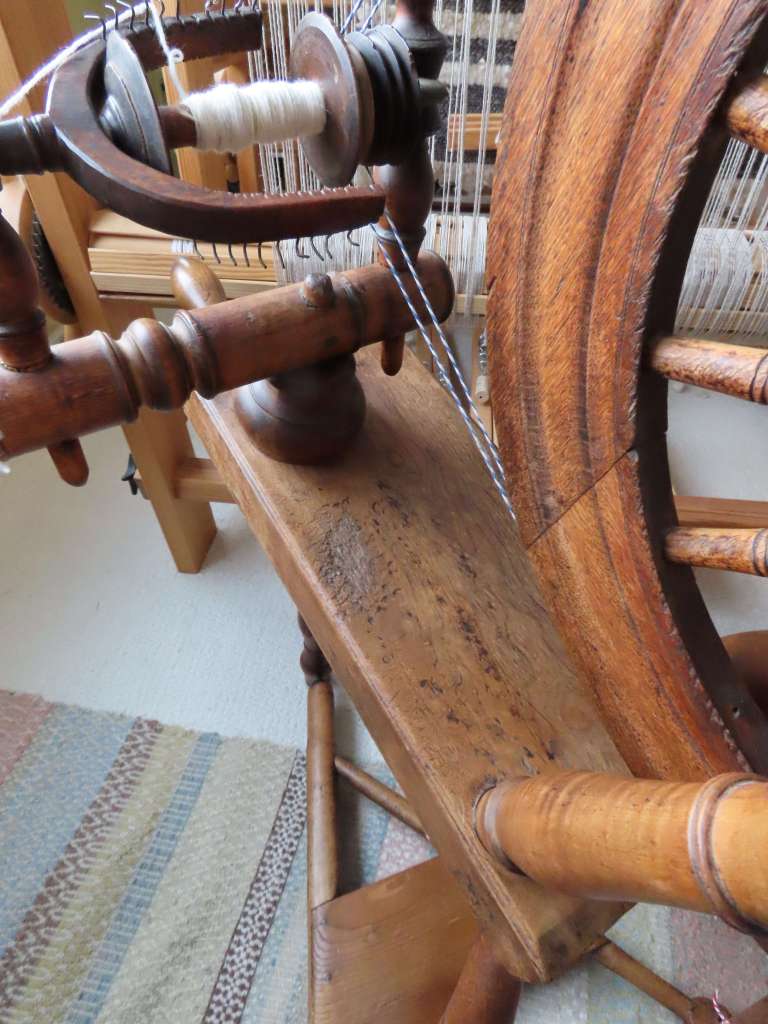
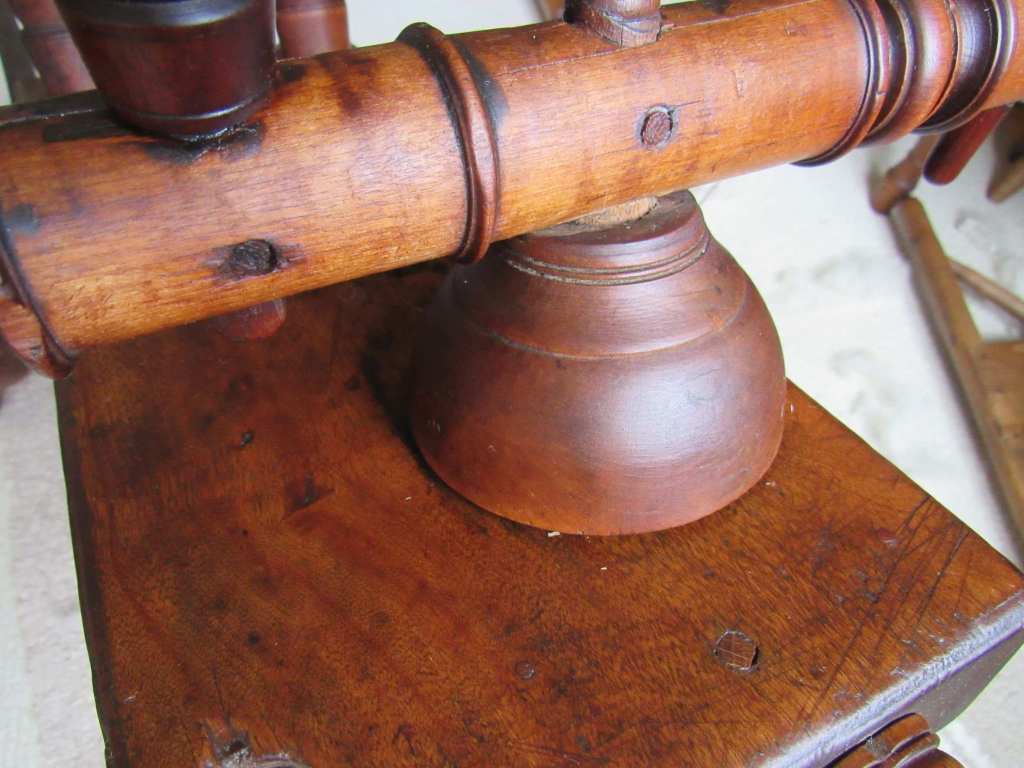
and a slope at the drive-wheel end of the table. 

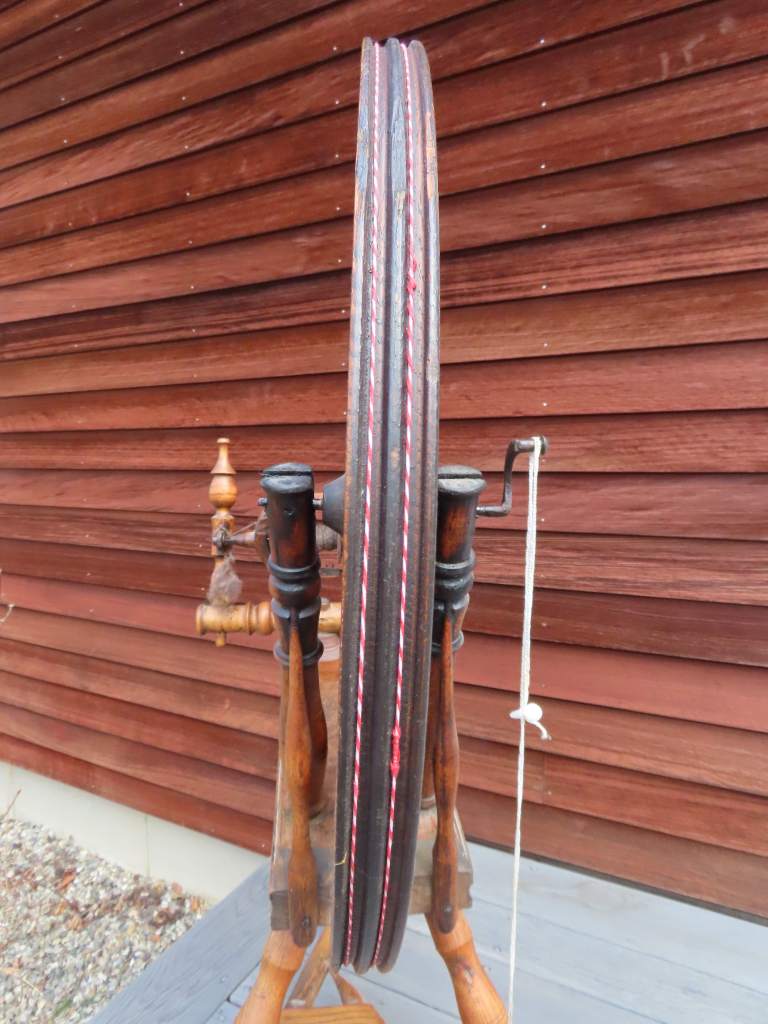
And, while double rim wheels are most often found in Scandinavia, they do occasionally show up on wheels that appear to be Scottish, or made by Scottish descendants.  
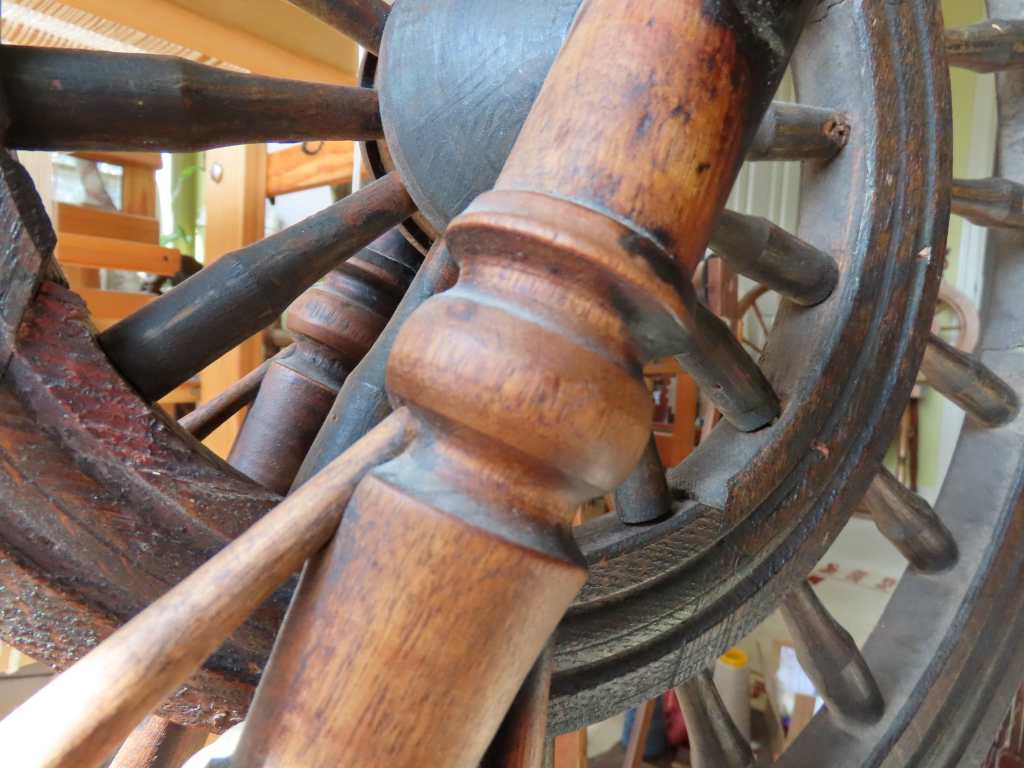
But the man from whom I bought the wheel said that his wife had bought it about 50 years ago in an Acadian area of Cape Breton and was told that it was Acadian. 
That was intriguing to me because there seems to have been very little research done on Acadian wheels in Nova Scotia, so there is uncertainty as to what wheels were made and used by Acadians there.  This photo, found in Judith Buxton-Keenlyside’s book, “Selected Canadian Spinning Wheels in Perspective” (figure 132, p. 278), is captioned “A spinning wheel maker on Ile Madam, Nova Scotia. From
Edith A. Davis, “Cape Breton Island”, reprinted from the Canadian
Geographical Journal 6, no. 3 (1933).” 
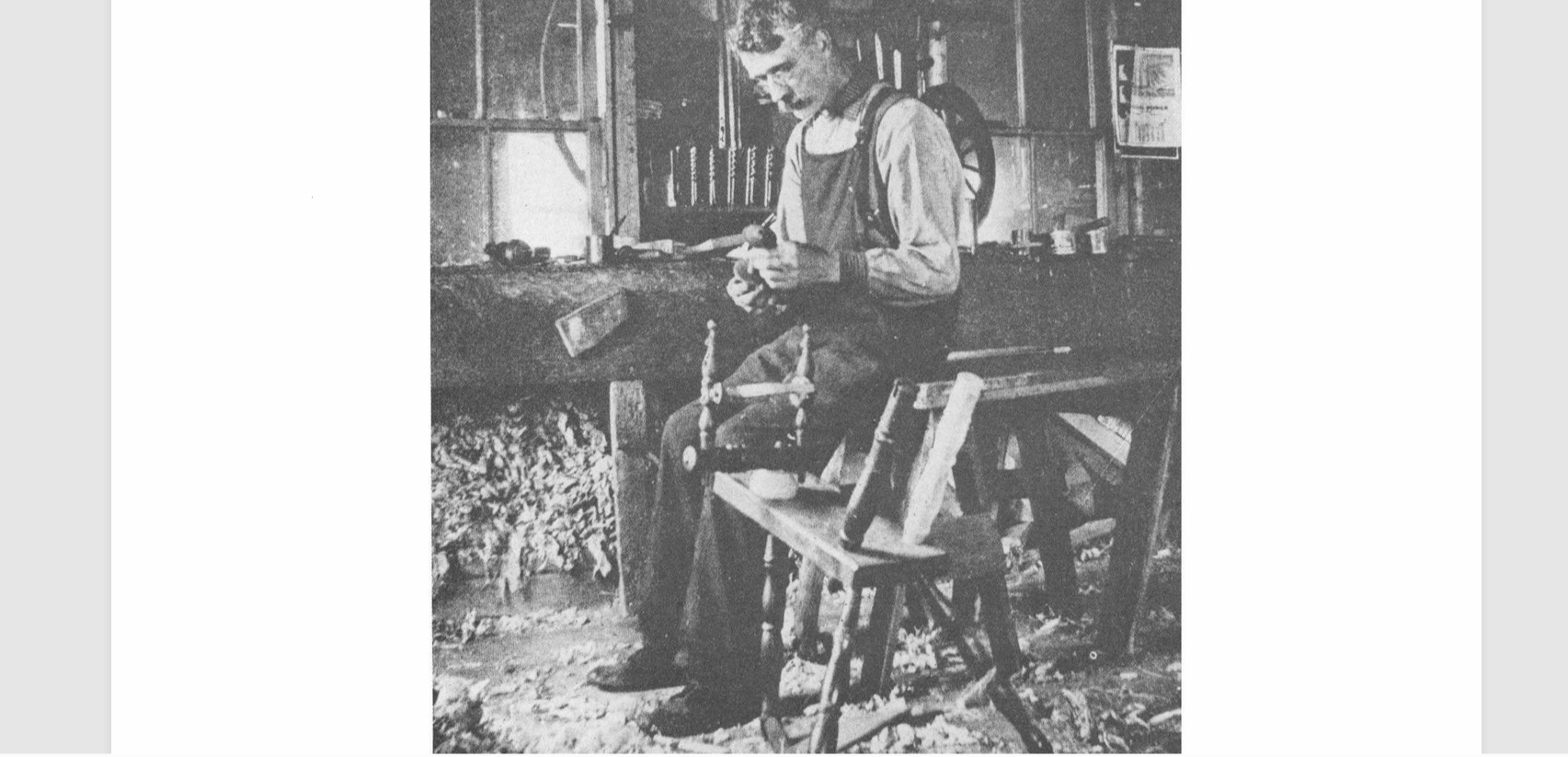
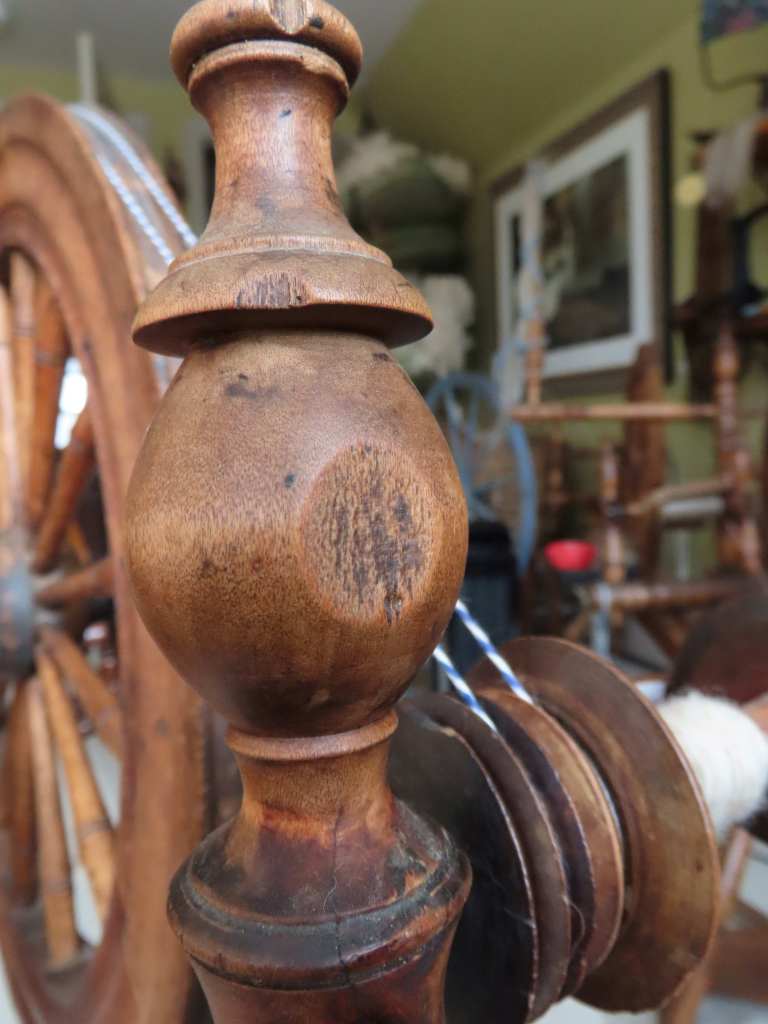
Ile Madam is the same general area from which the seller’s wife bought Granny Ross. And, the wheel in the photo looks very similar to Granny Ross—especially the maidens,
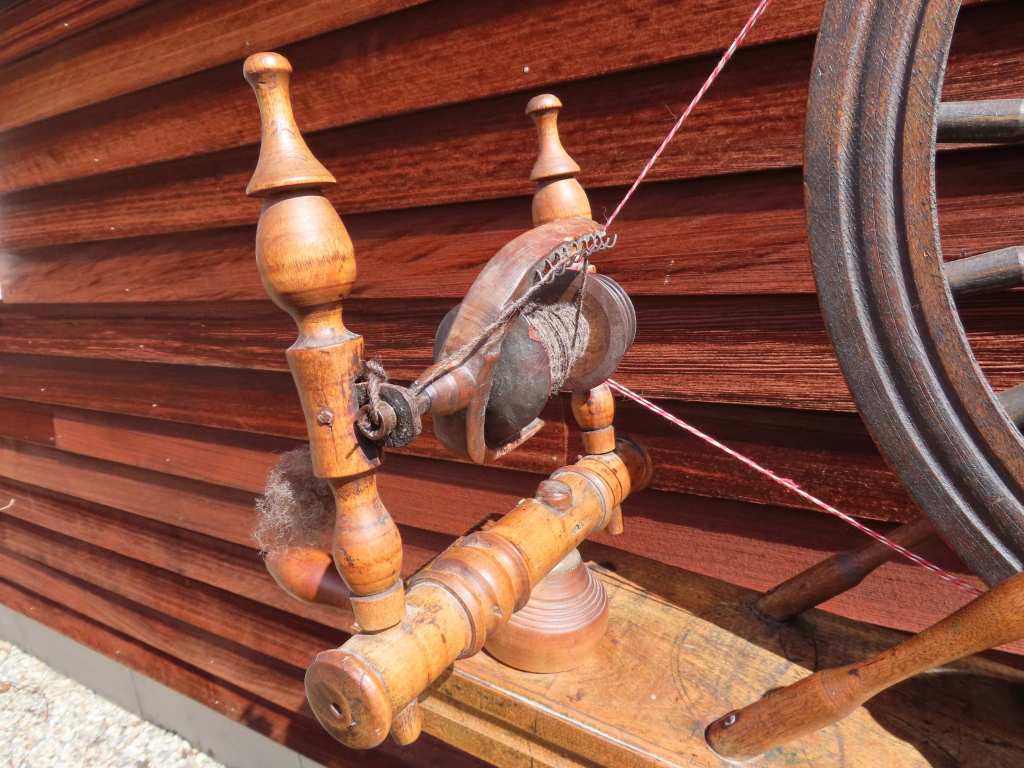
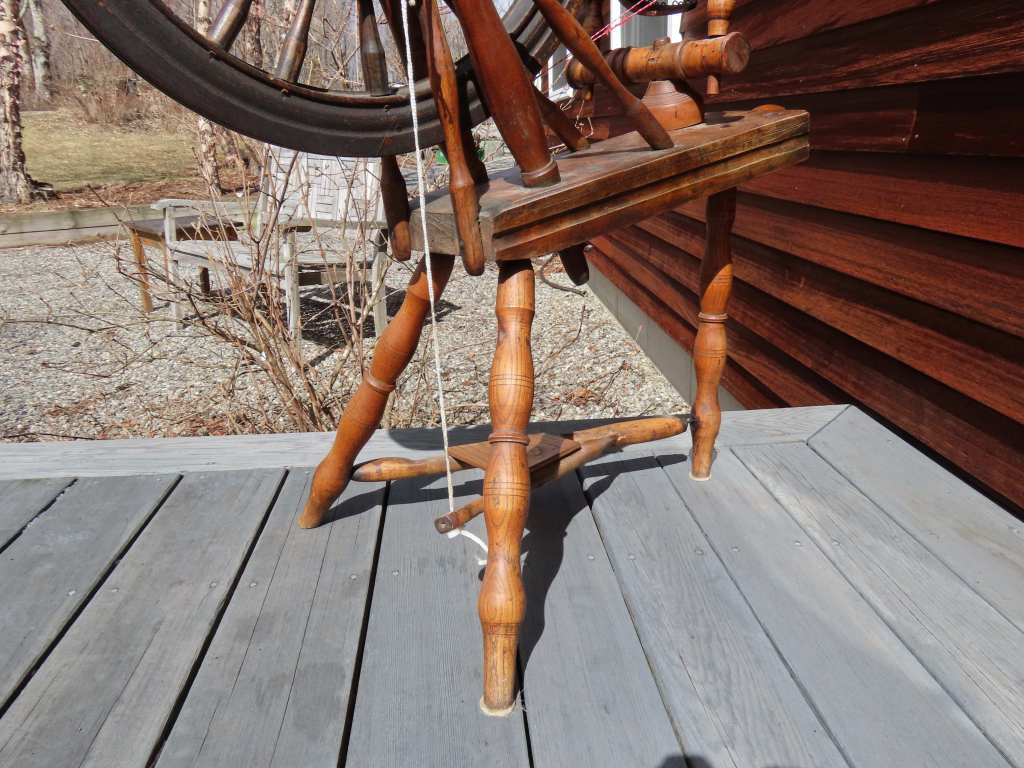
and the legs. 
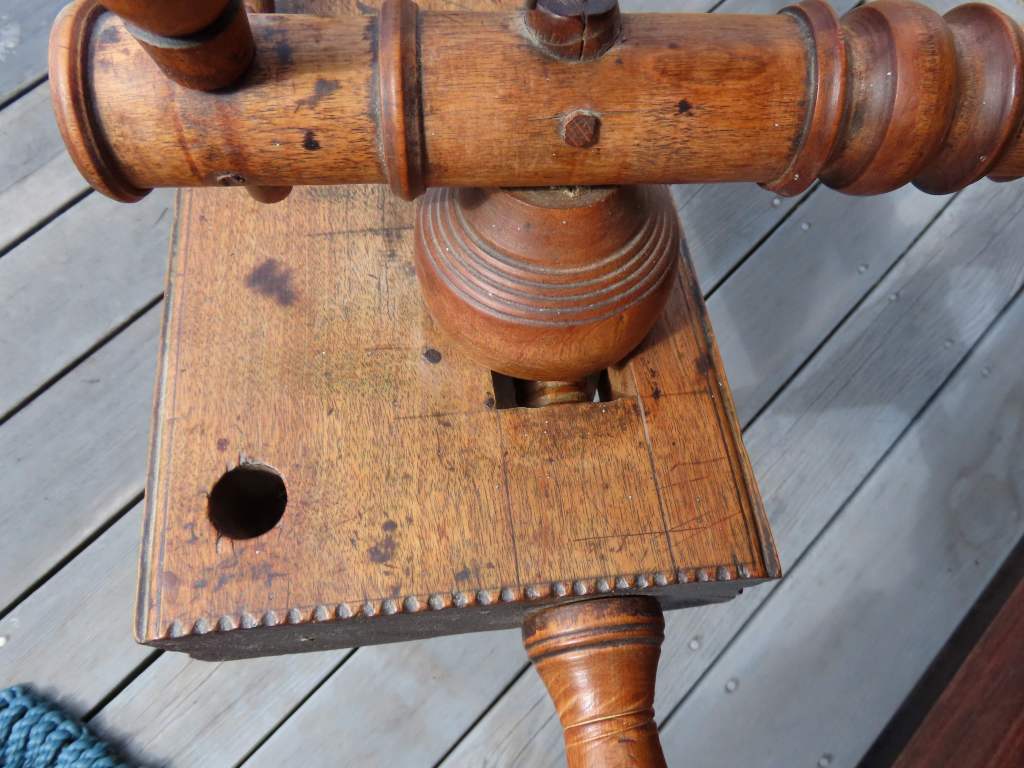
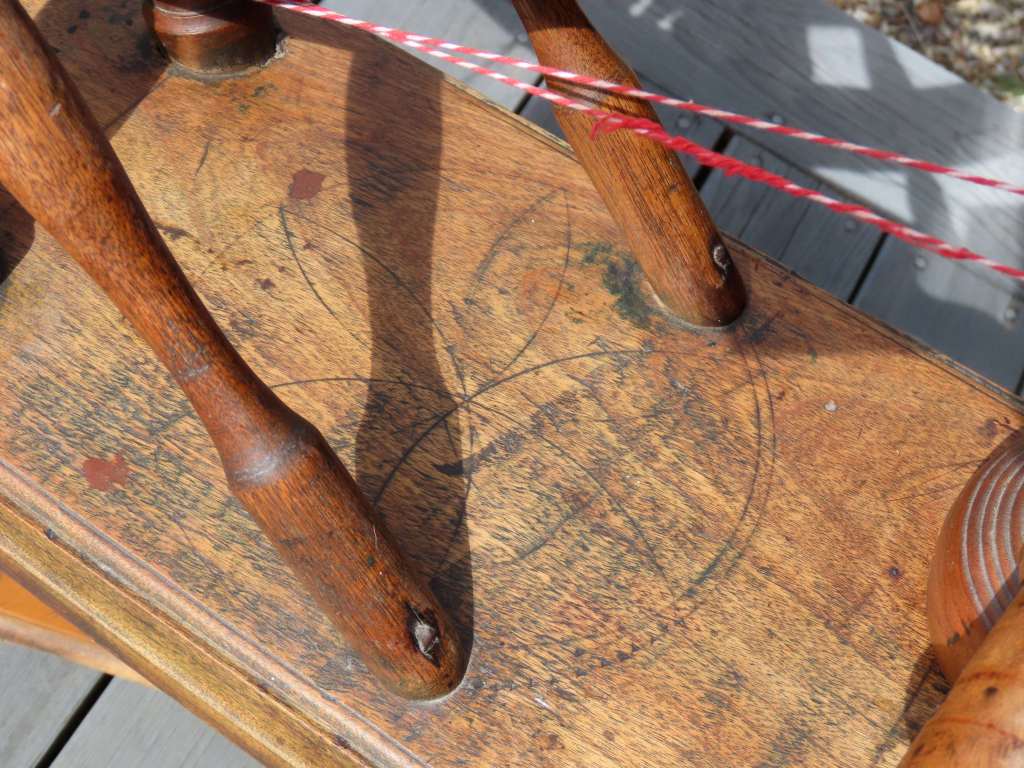
To further complicate things, whoever made the wheel decorated the table with a 6-pointed rosette.  While these are sometimes found on eastern European wheels, German fiber tools, and houses and barns of various cultures, I do not believe that I have ever seen one on a Scottish wheel. 
Perhaps Granny Ross is a charming composite of different influences on Cape Breton—some Scots, some Acadian, a bit of German. 
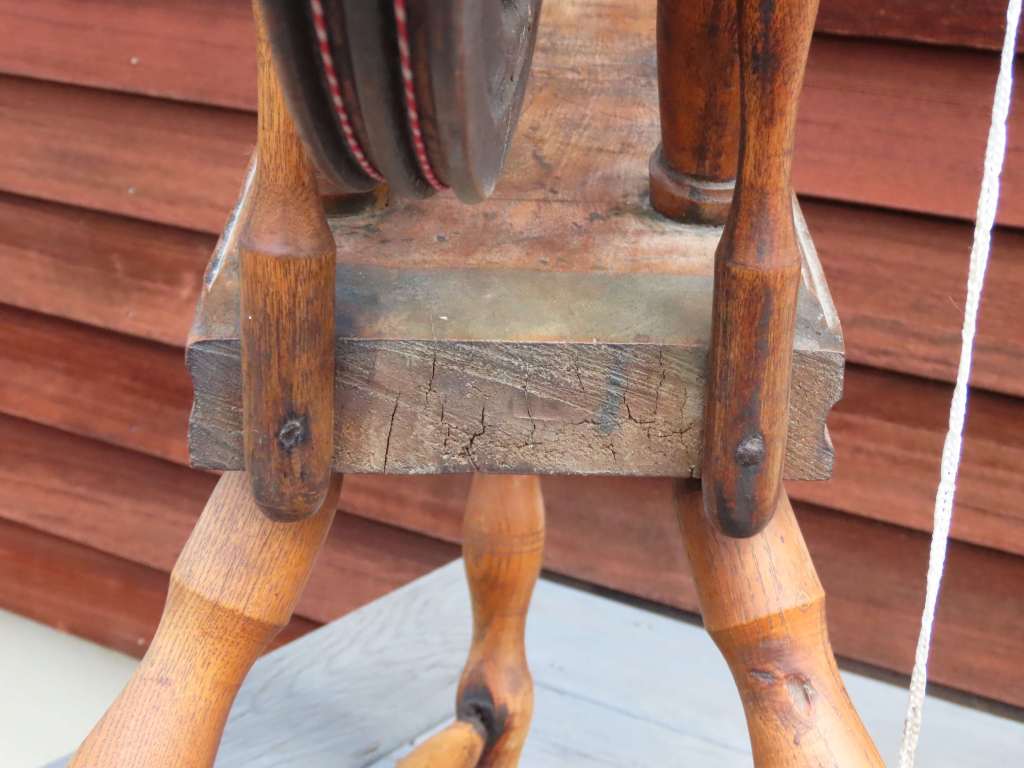
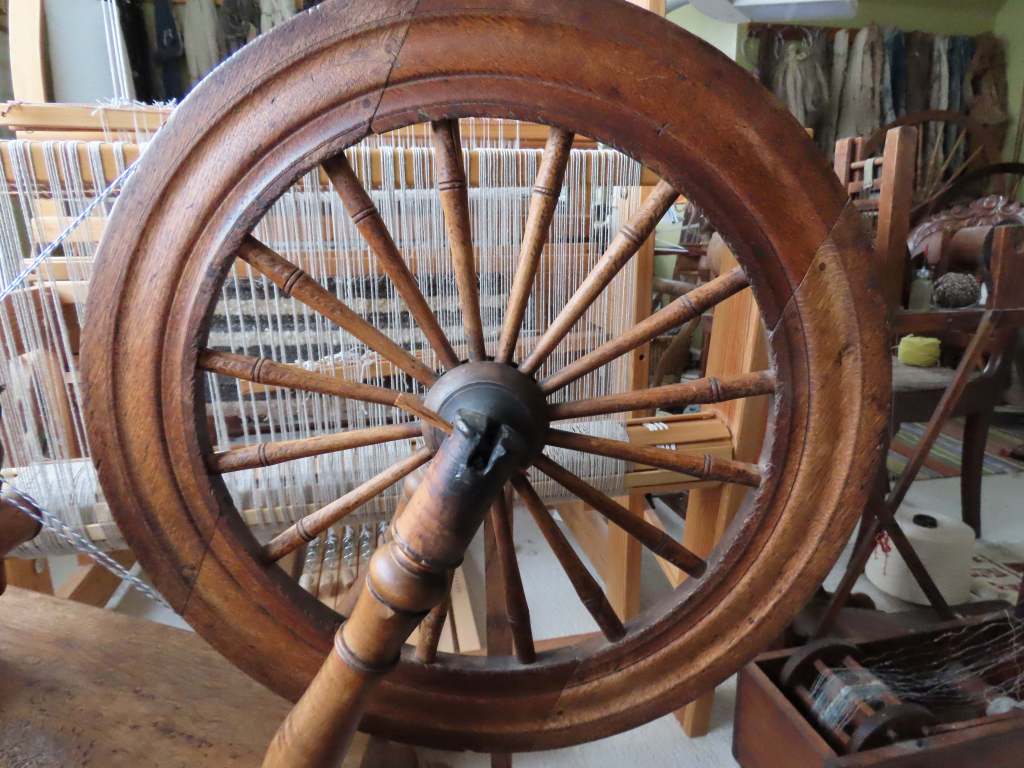
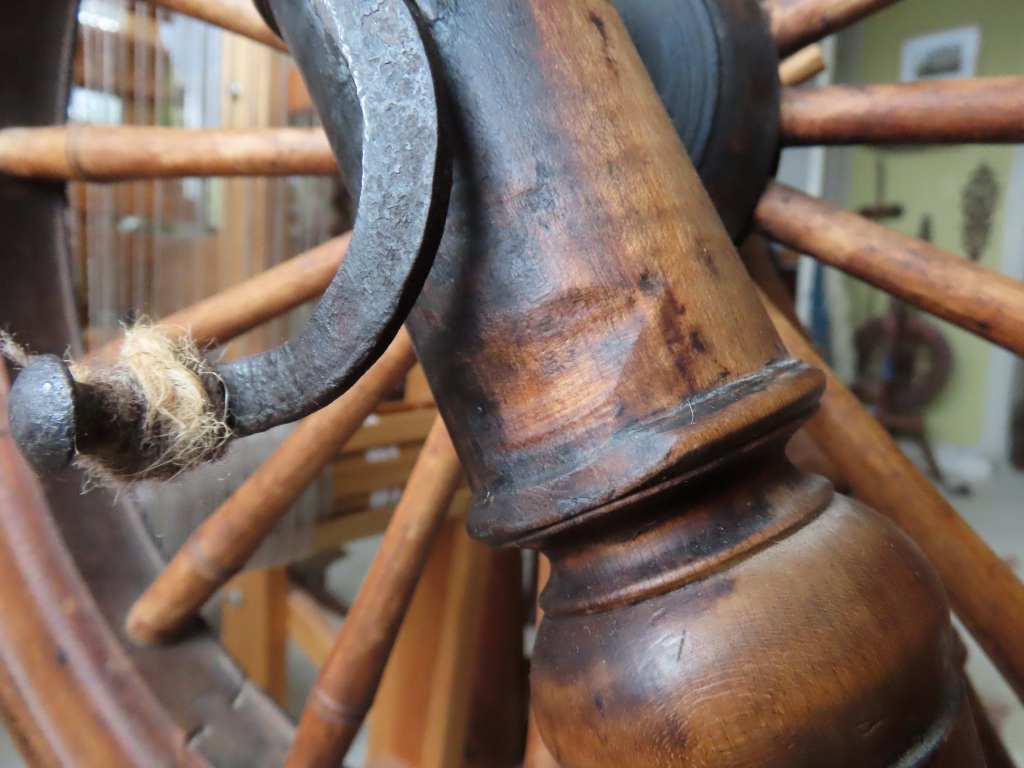
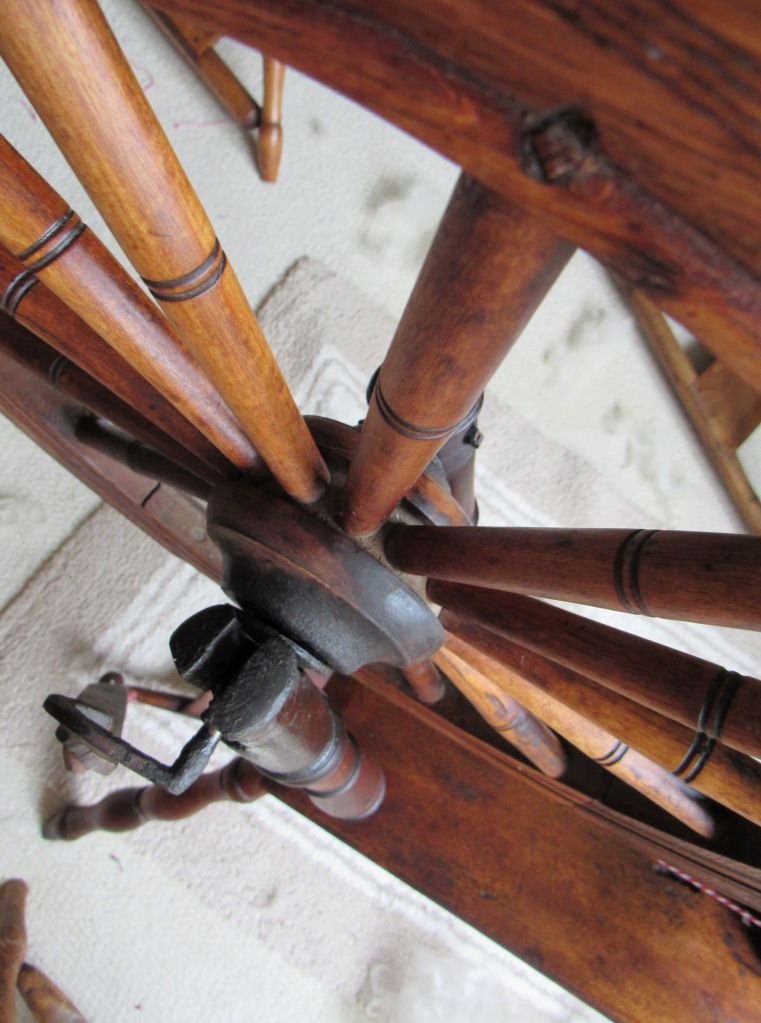
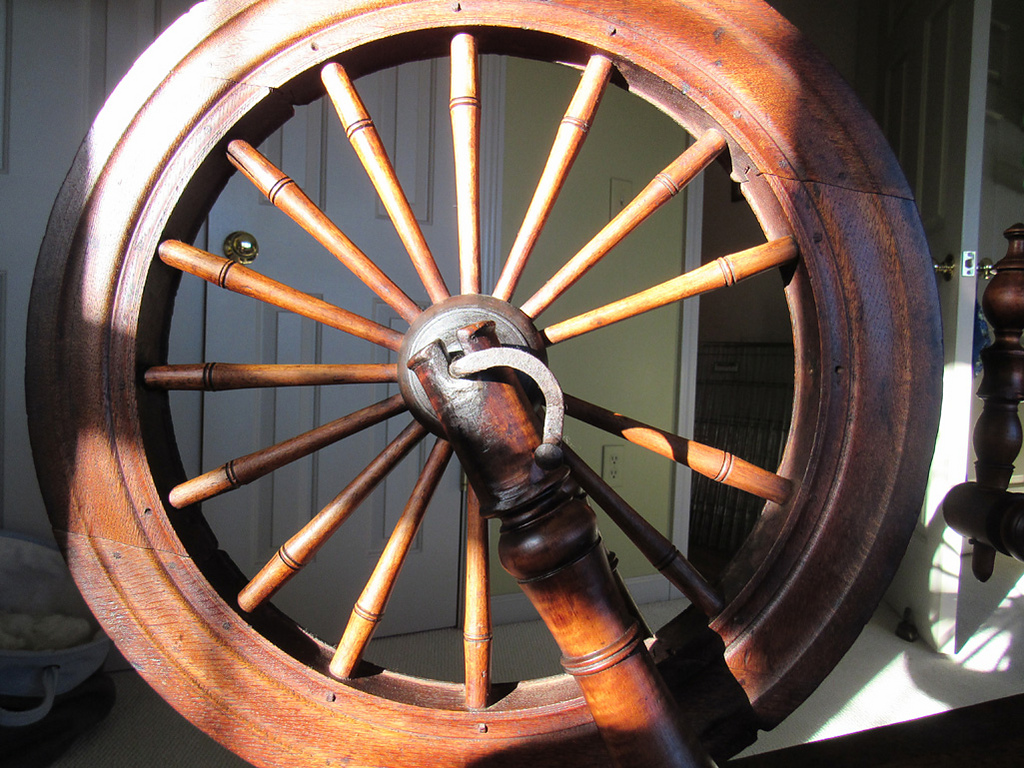
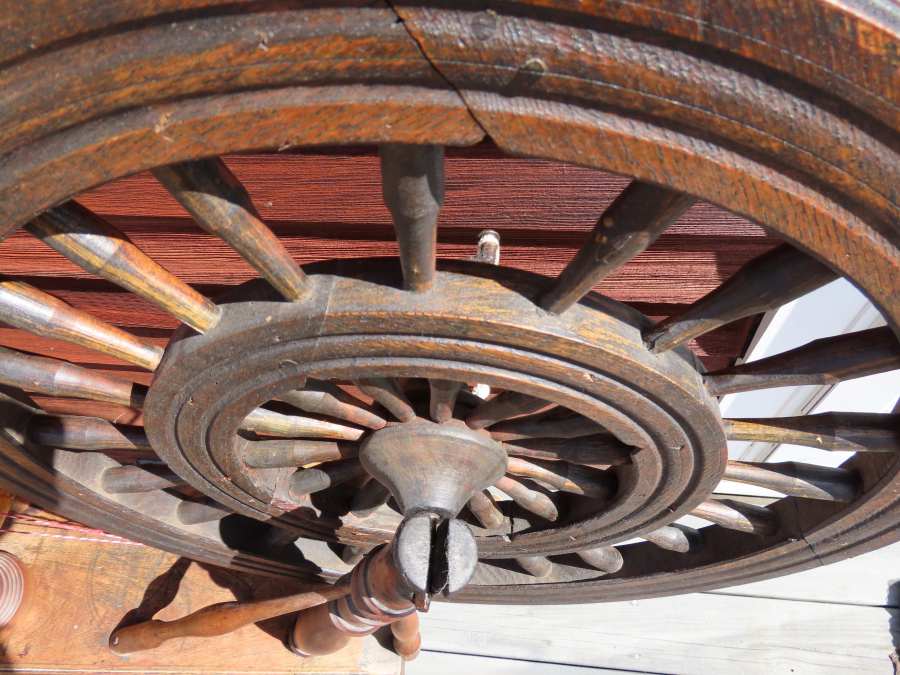
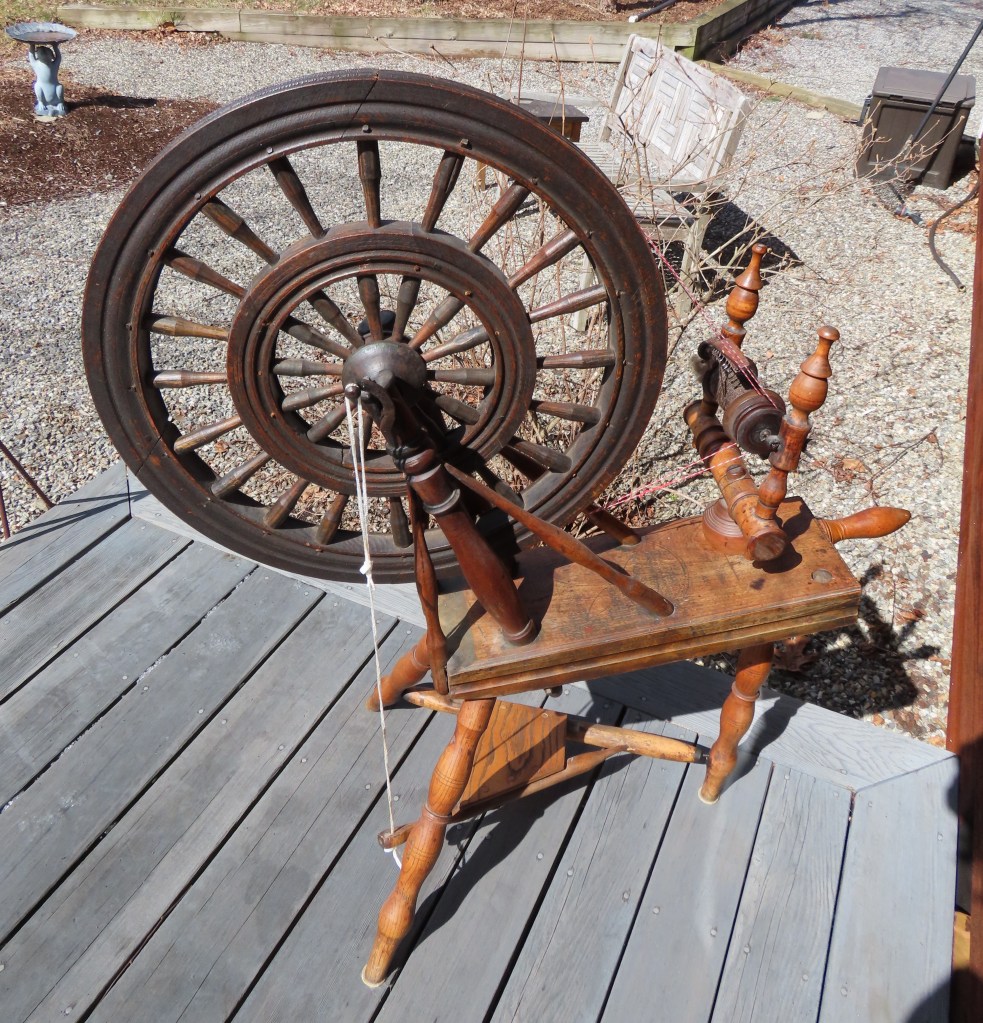
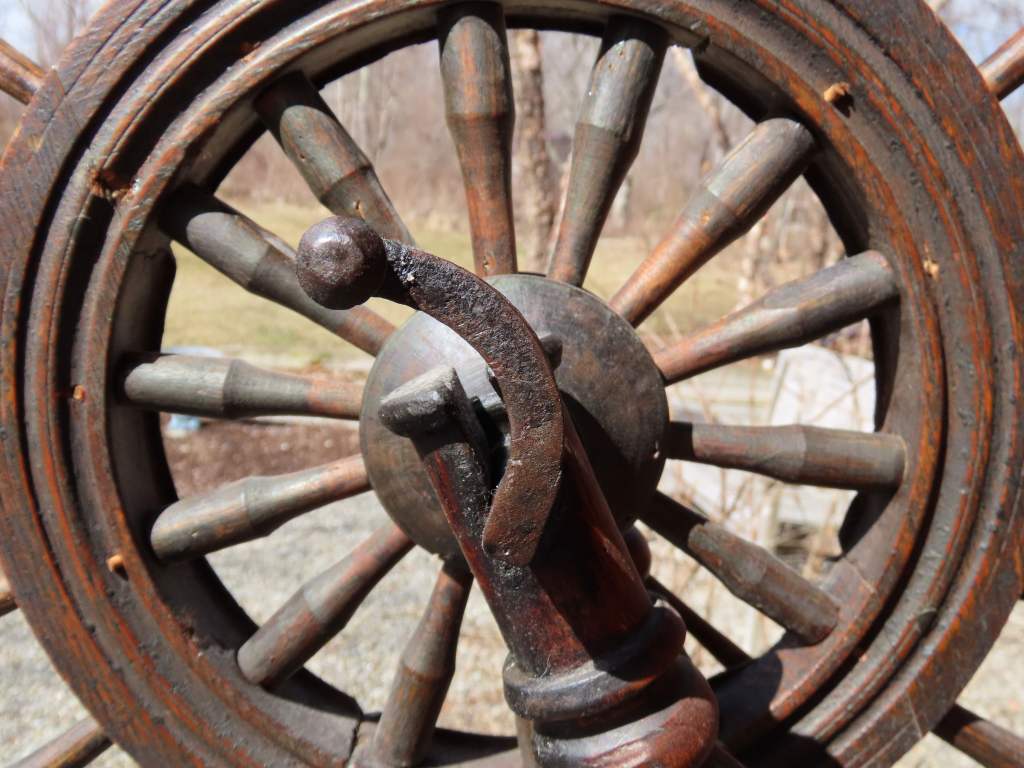
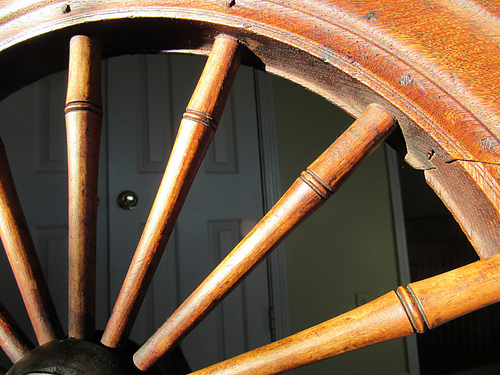
In any case, she is unique, with her attractive web of spokes,
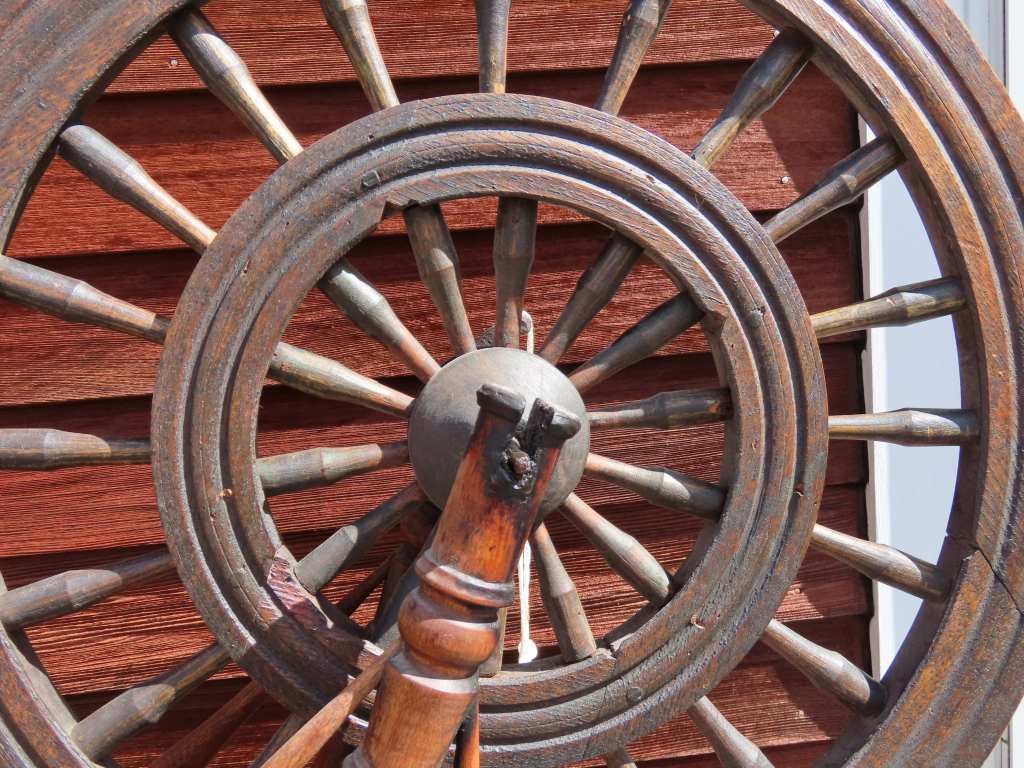
strong stance,
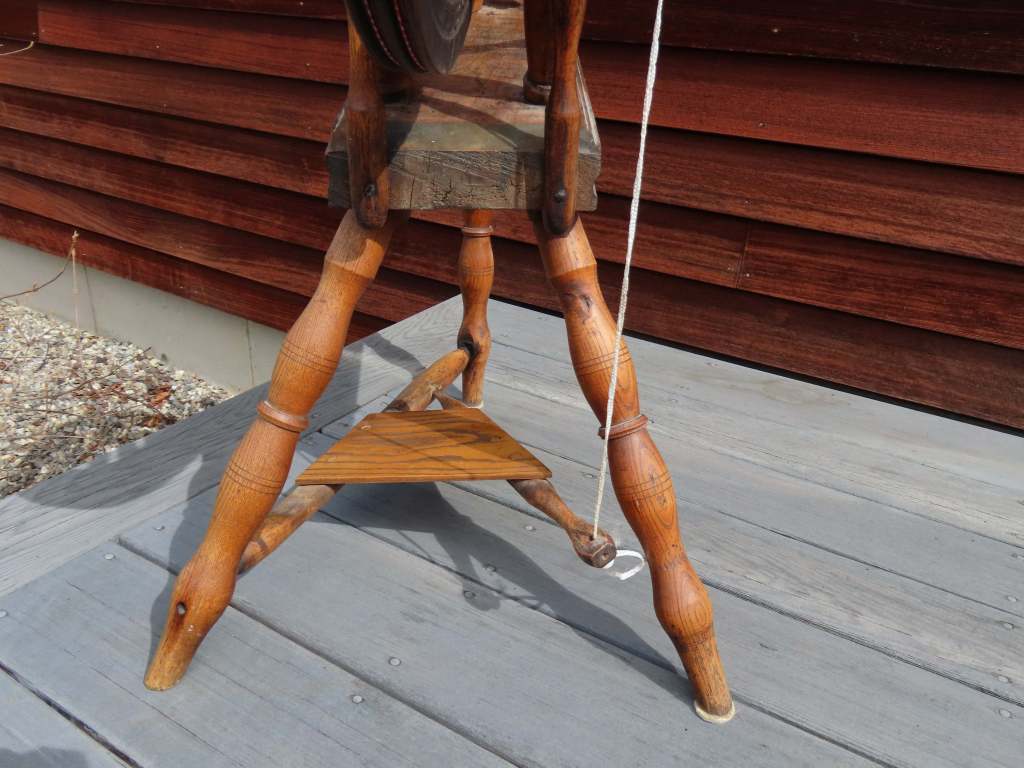
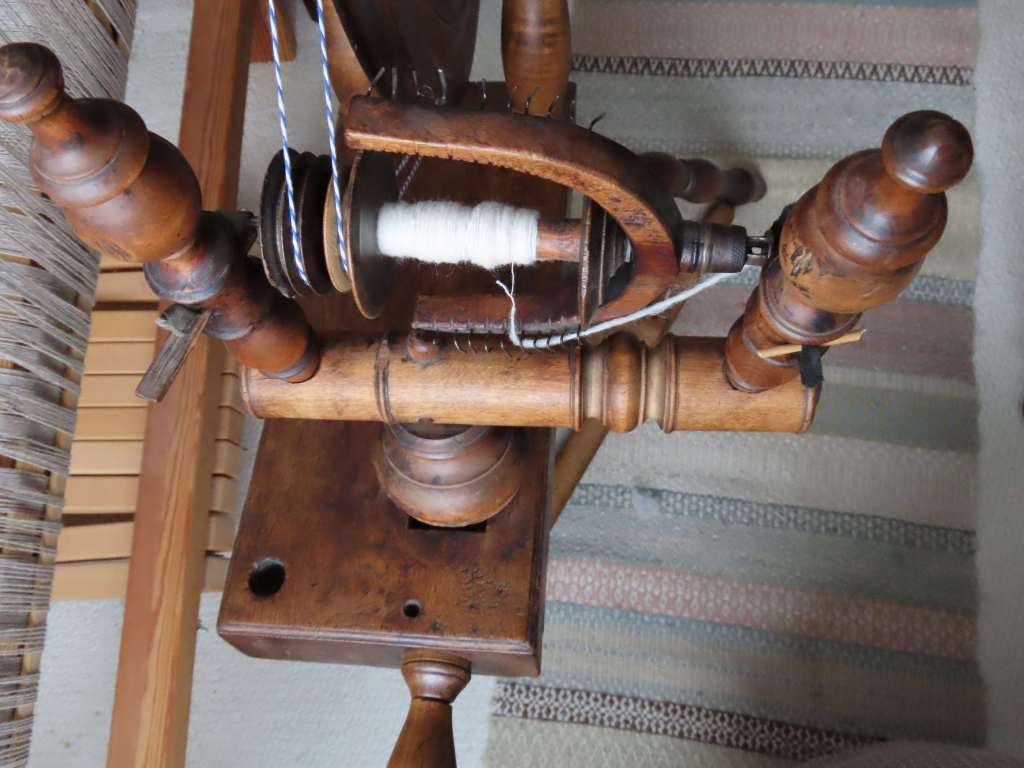
and beautiful angled upright supports. 
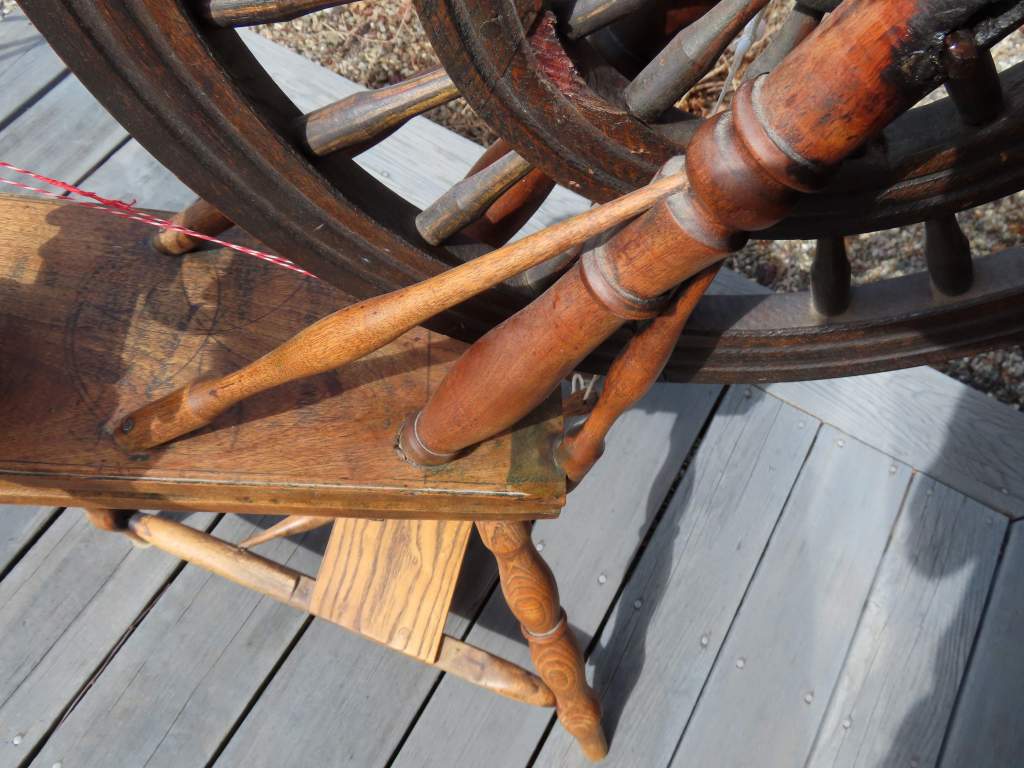
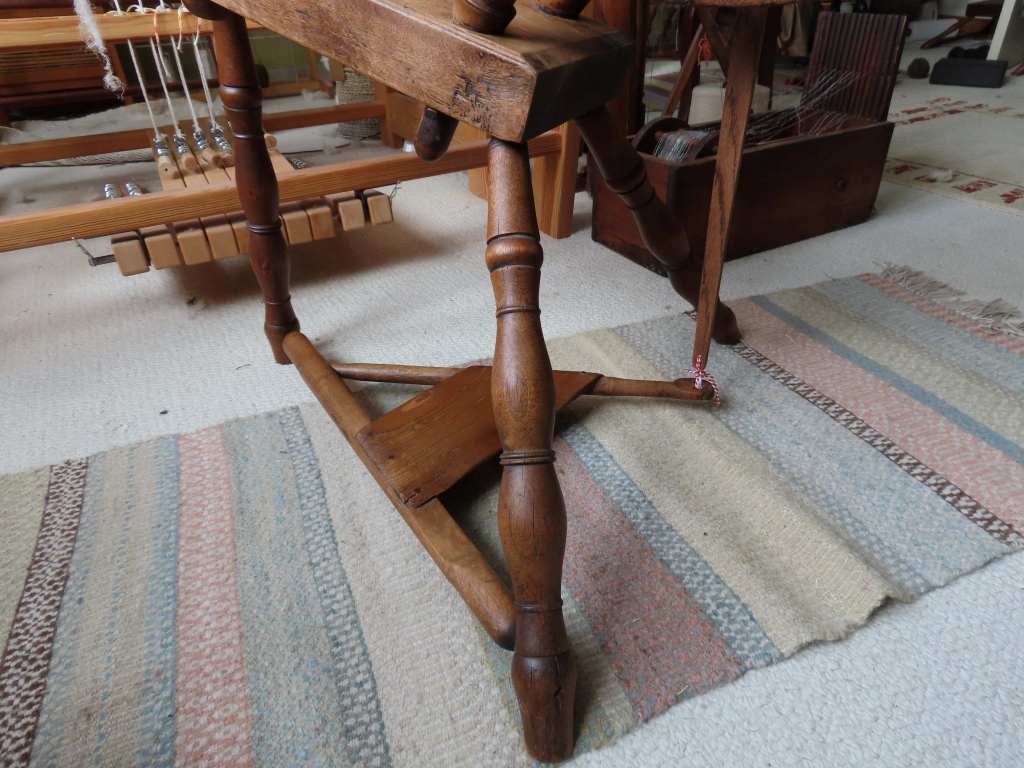
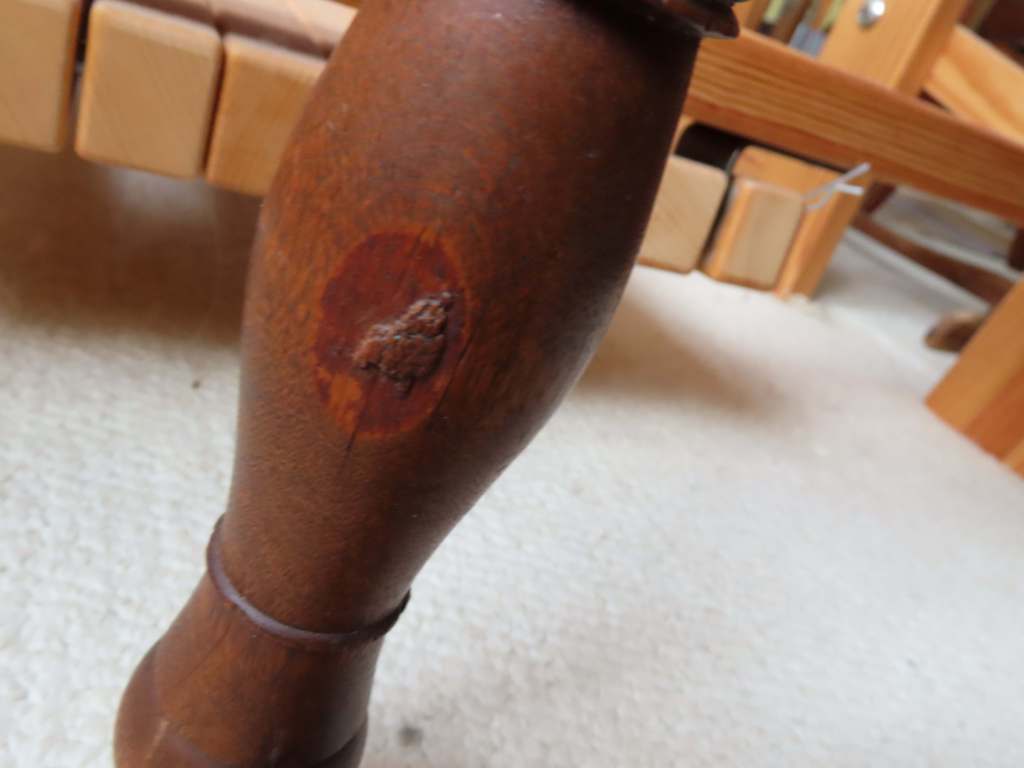
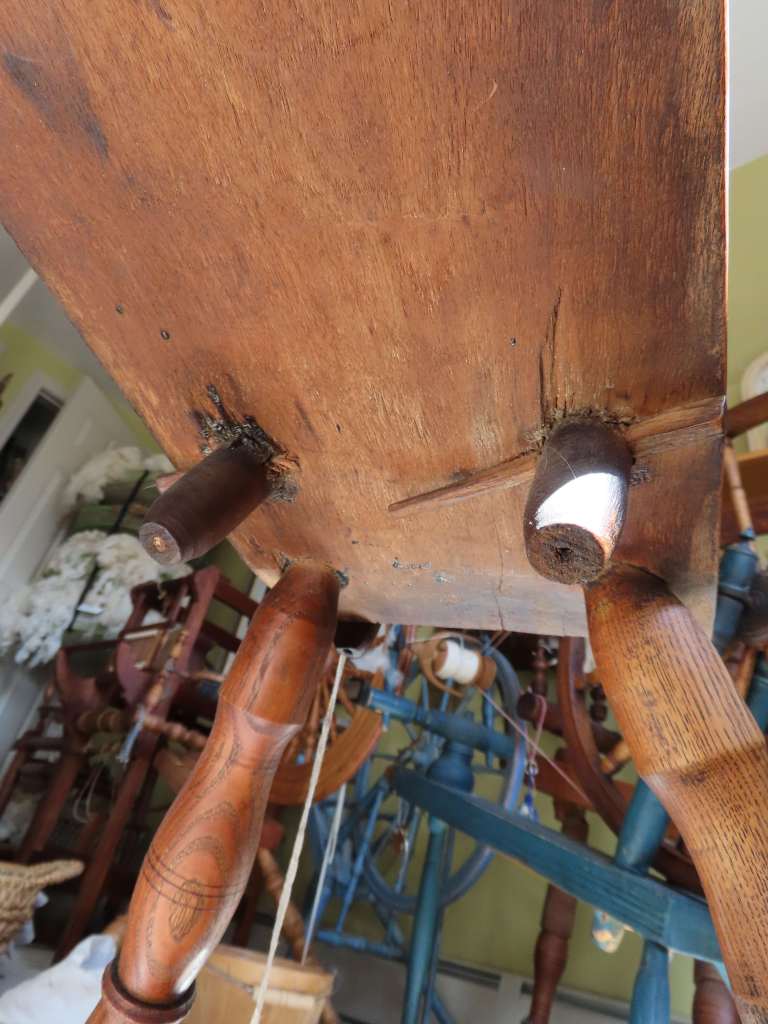
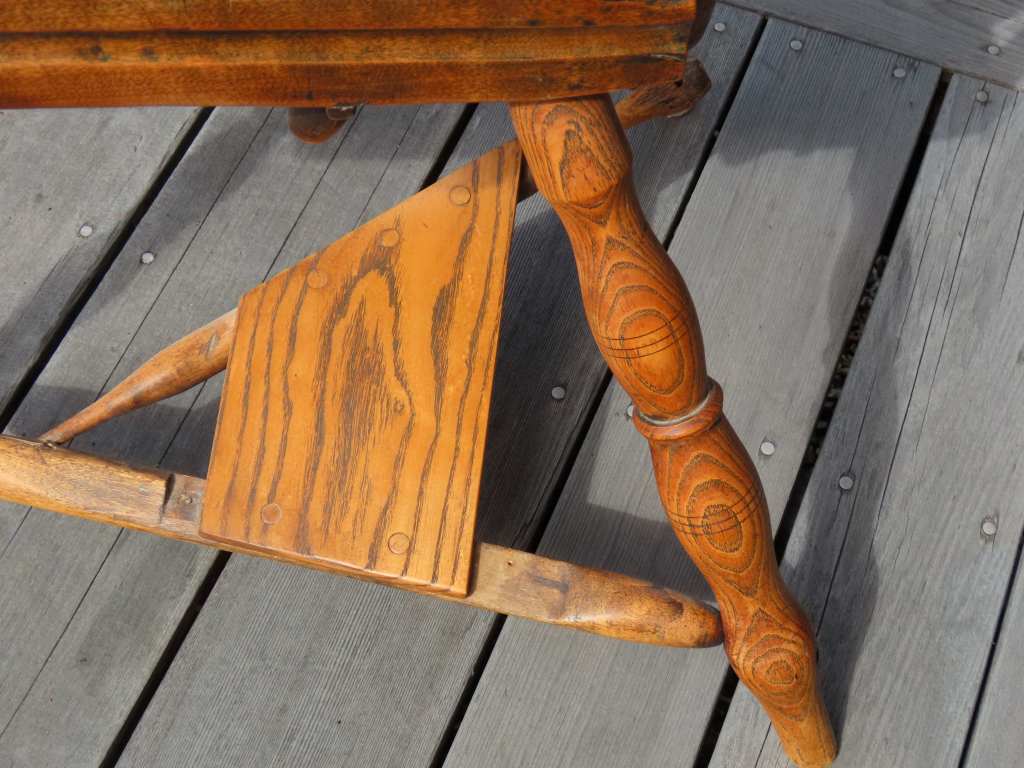
The shape of her legs highlights the gorgeous wood grain
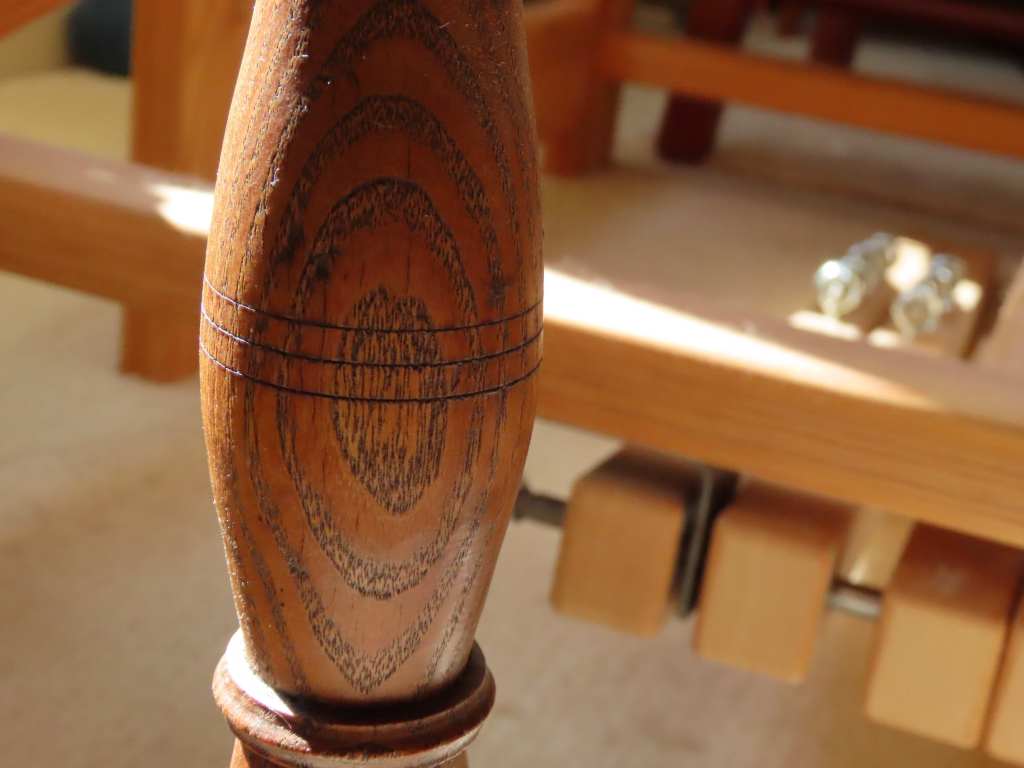
and there are small lovely touches, such as the tiered MOA collar. 
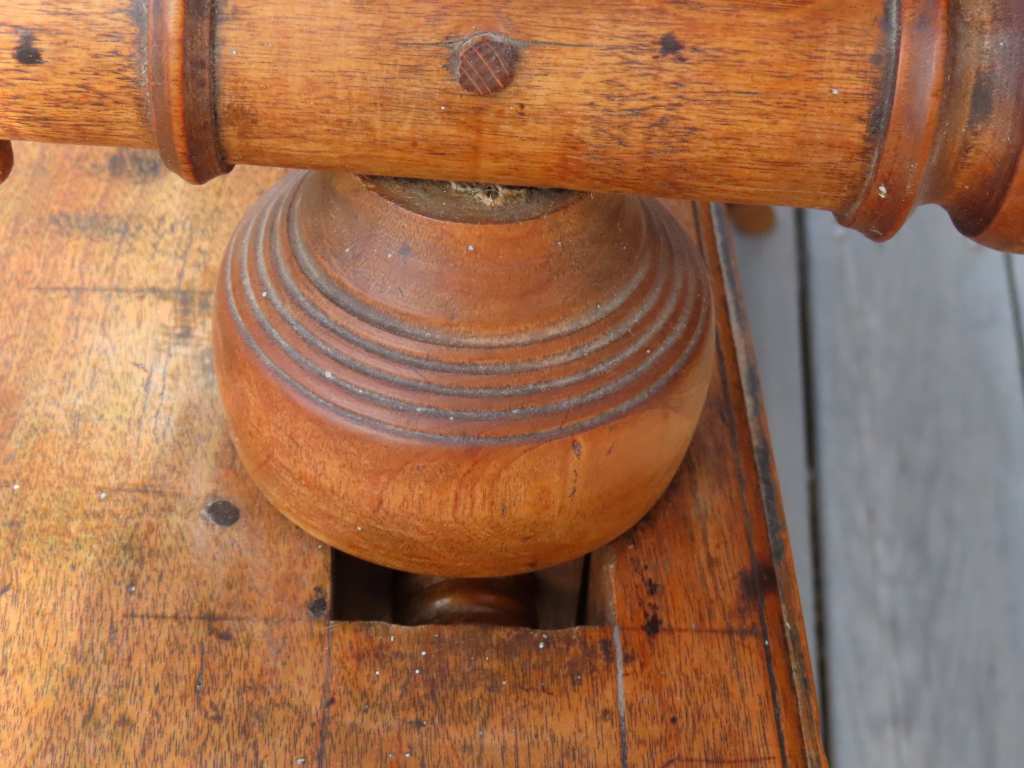
Much as I love this wheel—and she has been a workhorse for me—I have always felt a pang of guilt that Sherran may have deferred to me on the wheel out of her midwestern politeness. 
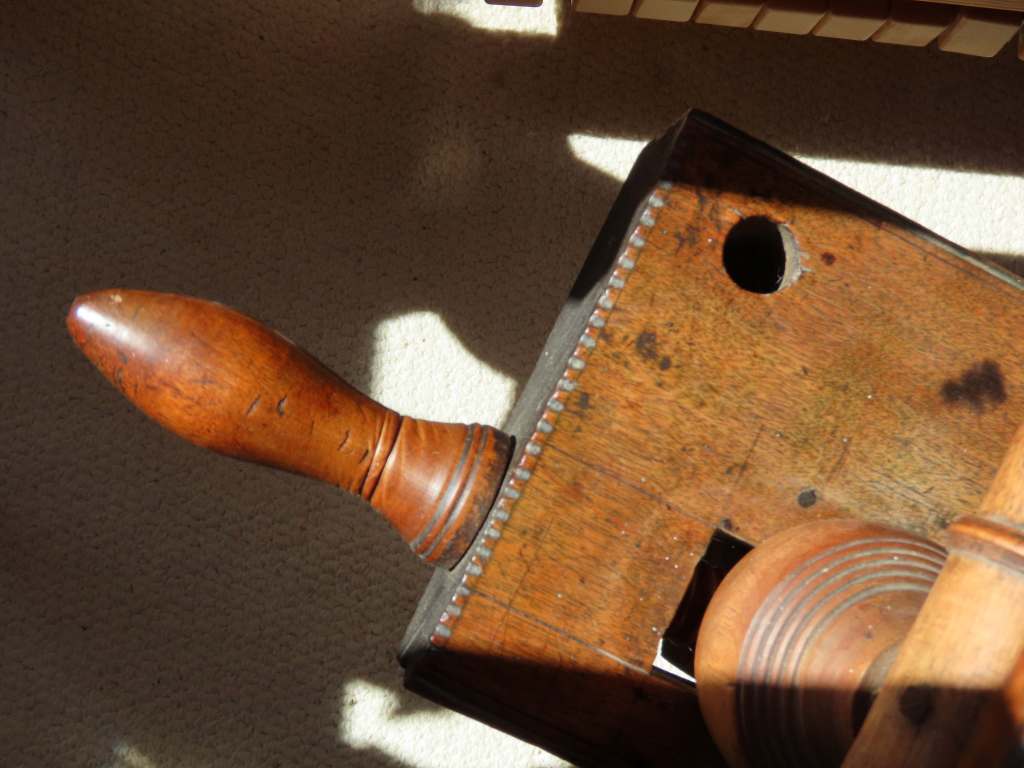
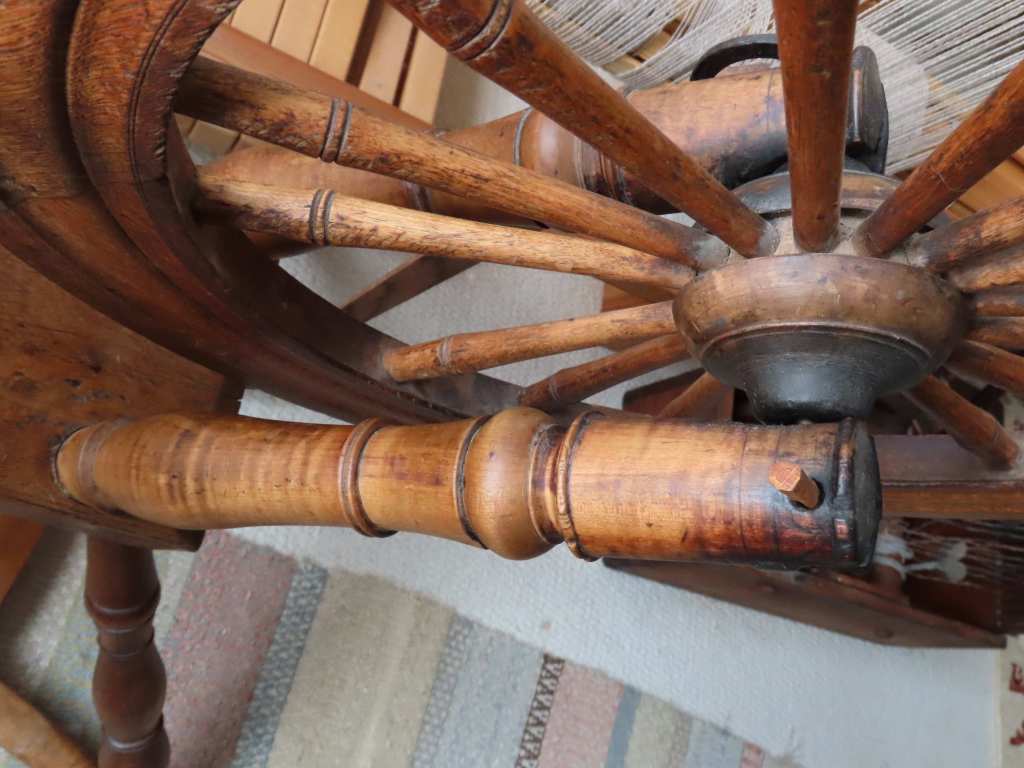
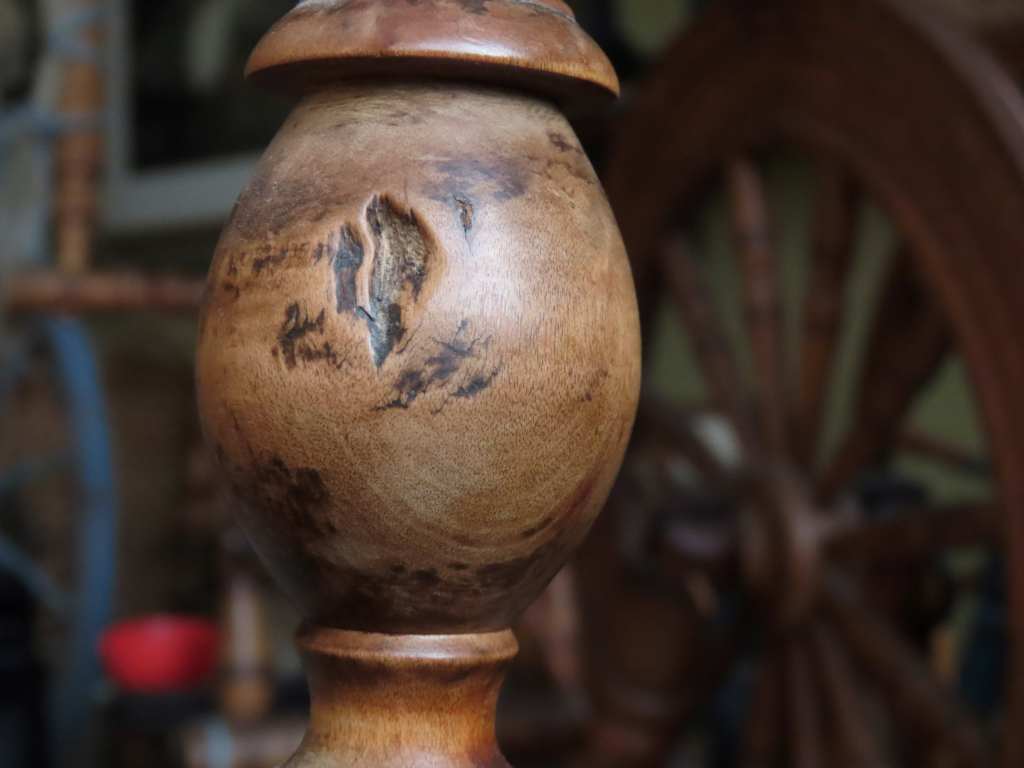
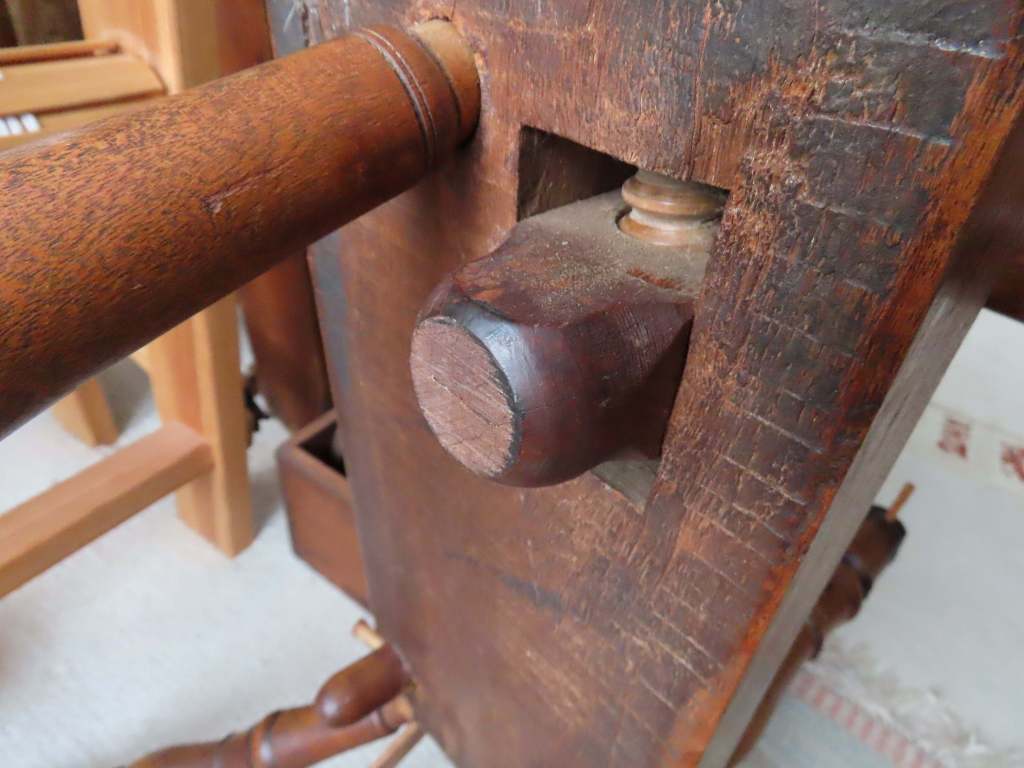
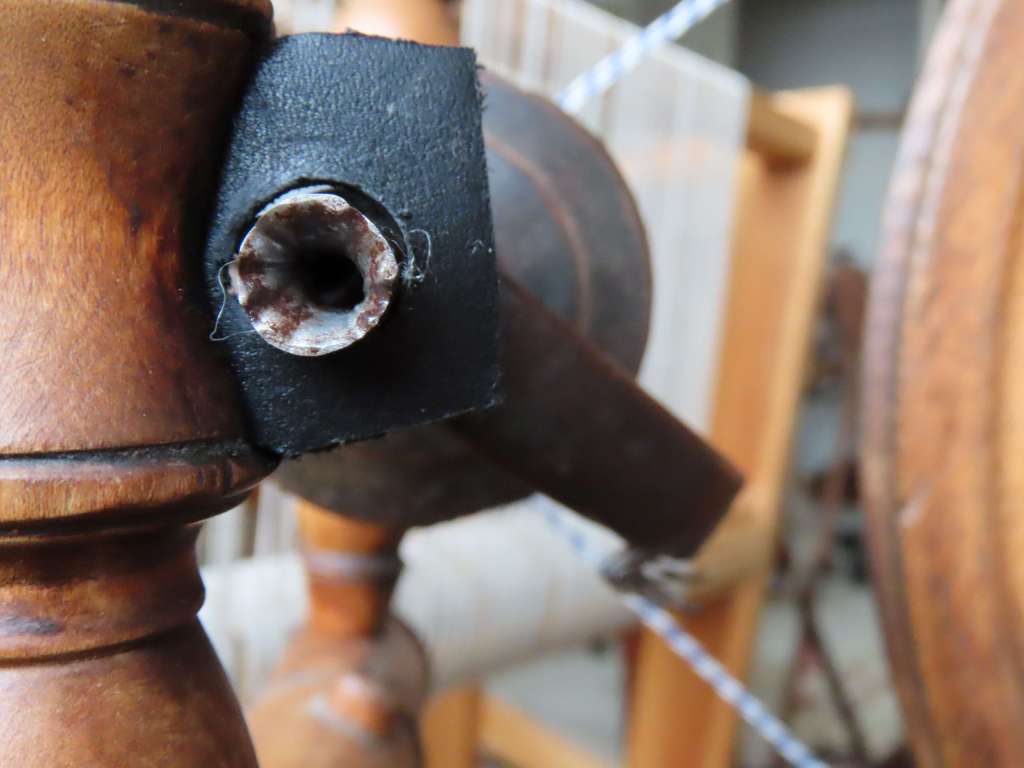
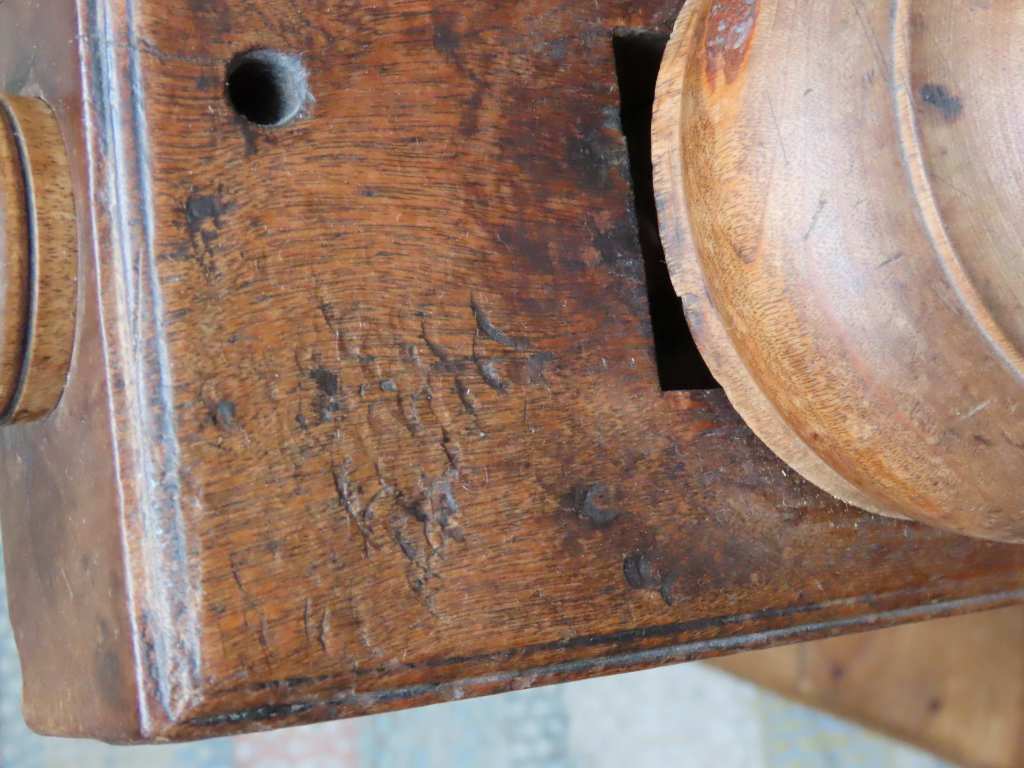
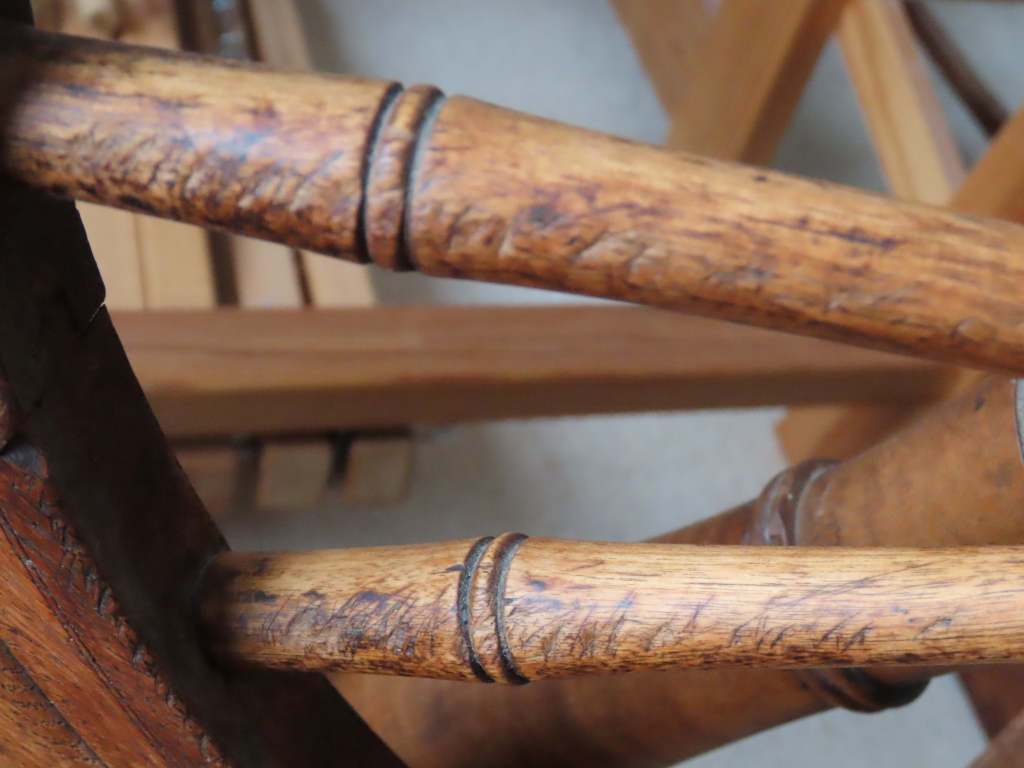
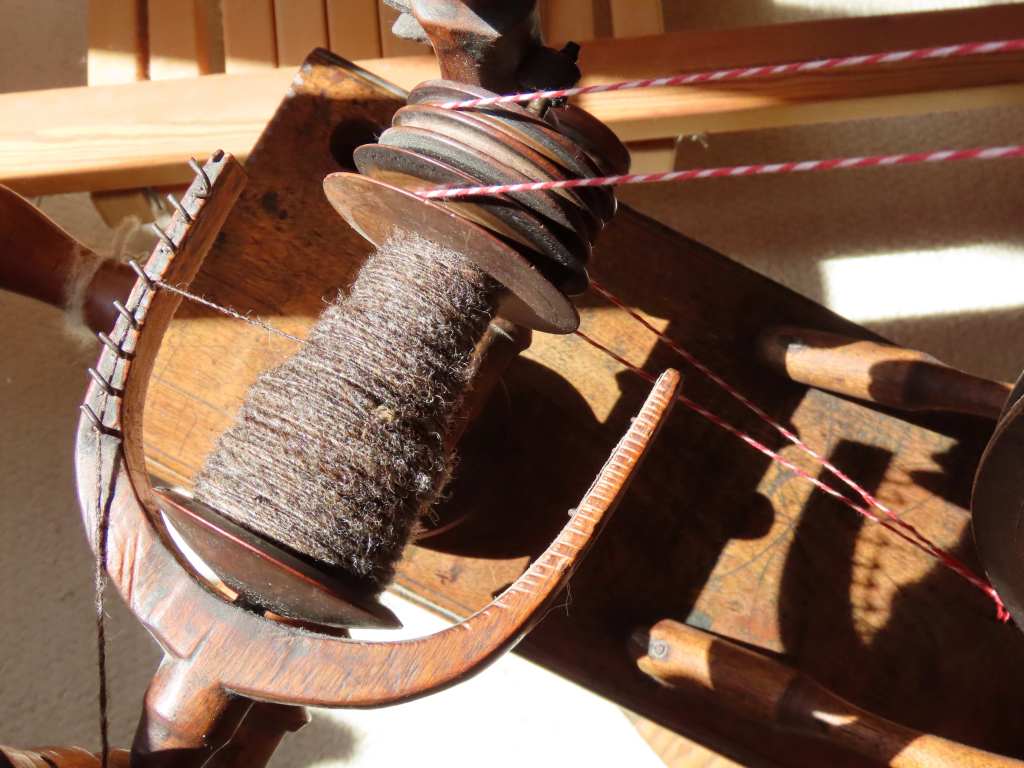
Deep grooves on her tension knob, presumably from unwinding the bobbin

So, when I decided to sell some of my wheels, I was delighted when we were able to arrange to get Granny Ross to Sherran before Sherran moved farther west (to a place where wheels are rare).  Granny Ross now resides with Sherran, where she belongs. 

Marilla and Margaret

Most antique wheels are a puzzle—wood and metal conundrums.  Who made them?  Where, when, and how were they made?  Who used them?  For what and how were they used?  Because so little of this information was written down, most often we rely on clues from the wheels themselves to try to answer these questions.

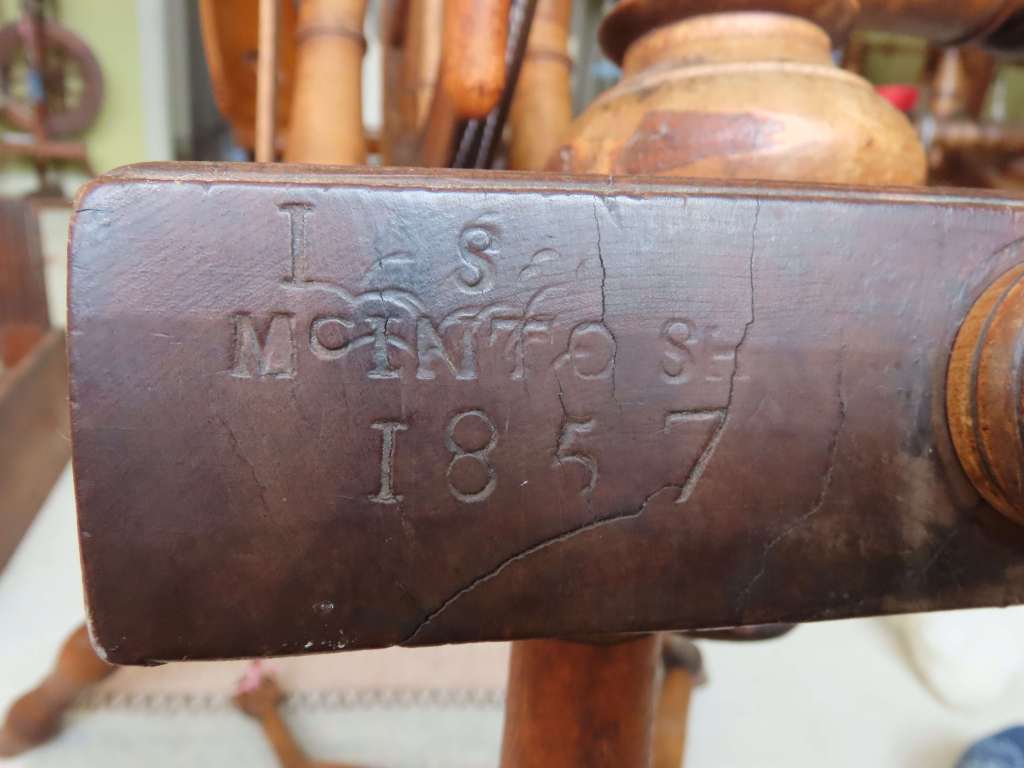
But some clues are confusing.  In contrast to most wheels, this one advertises her maker and time—IS McIntosh, 1857. 

How exactly she was used, however, is a mystery.  There is no doubt that she was heavily used.  But, in addition to expected wear, she has unusual scars that are somewhat bewildering.  It feels as if she is trying to tell us something, but we lack the ability to translate it. 

She is the second wheel that I ever bought and I almost passed her by.  I found her deep in a crowded, dark antique store barn one town away.  Brand new to antique wheels, I obediently followed the oft-heard instruction to check the drive wheel for wobble, which supposedly indicated a warped wheel.  This wheel had an extreme wobble, veering one way and then the other. 

So, even though I could see a name and date, I gave the wheel a pass, thinking it would be unusable.  In the months that followed, though, I could not get her out of my mind.  I decided to check her out more closely and found that whatever the reason for the wobble, it was not due to warping.  So, when the owner offered her for a song, I brought her home, determined to get her spinning again.    

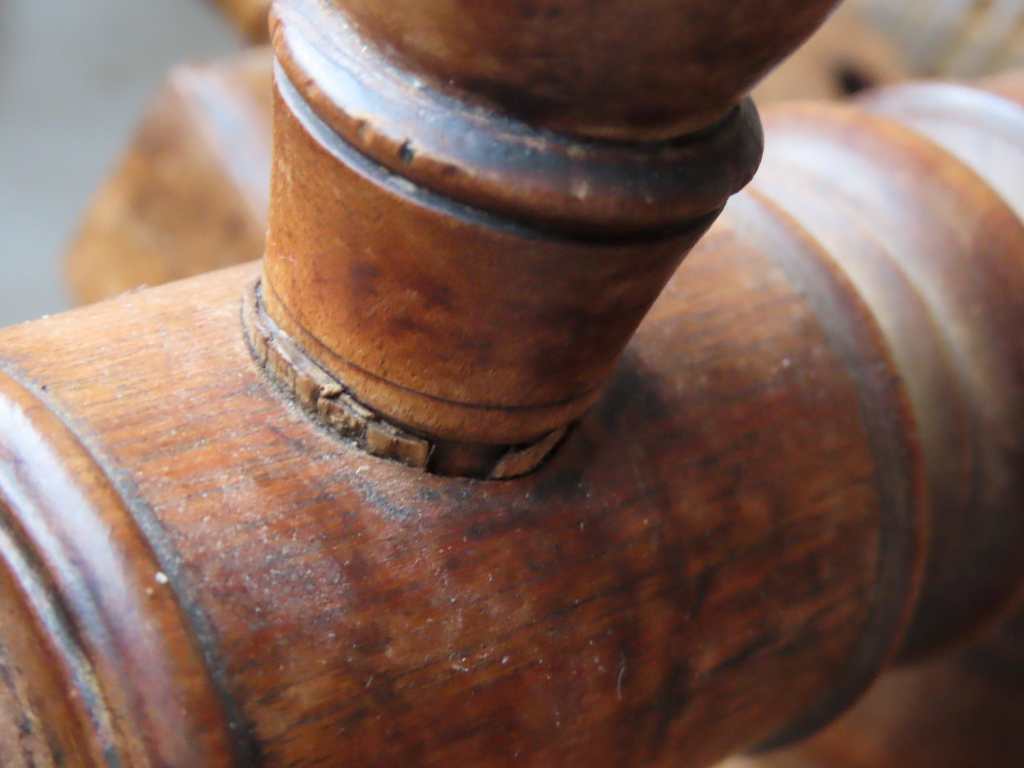
Old shims on the maiden

She was filthy—absolutely encrusted in black grime.  And, it turned out that the wobble was caused by a bend in the straight end of the axle.  Thanks to advice from David Maxwell (aka TheSpinDoctor) on Ravelry, after securing the drive wheel in a flat position, I used a pipe for leverage to straighten the axle end.  It worked beautifully. 

Cleaned up, axle straightened, oiled, with a new footman made by my husband—she was ready to try.  And, as those of you who rescue wheels know, that first spin after bringing a neglected wheel back to life is hard to describe without sounding overly romantic and ascribing human-like qualities to the wheel (it feels like she’s thanking me!). 

But with your feet and hands feeling the imprint of past users, it is almost intoxicating when the wheel settles into its old work rhythm. 

Not only is it satisfying, but there is an undeniable feeling that bringing such a marvelous little machine back to its purpose connects you with all the women who used the wheel in the past.  It is a good feeling and an addictive one.  This filthy, wobbly wheel set the hook, making me a sucker for wheels that cry out to be rescued. 

Mark where the axle had been scraping the upright

Once I had her spinning, I set out to find out more about her maker, IS McIntosh.  Coincidentally, the same person who had given advice on the bent axle, David Maxwell, also is the McIntosh wheel specialist. His research is set out in an article in The Spinning Wheel Sleuth, cited below.  As David explains, there are three versions of McIntosh marks—”Alexr McIntosh,” “McIntosh,” and “IS McIntosh.” 

He has documented marks from 1798 to 1892–almost one hundred years.  From genealogical research, David surmises that the “Alexr” marked wheels were made by Alexander McIntosh, born in Scotland, and emigrating to Canada in 1803.  The earliest marked “Alexr” wheel, a double flyer, likely was made in Scotland.  Alexander eventually settled in Pictou County, Nova Scotia and his known marked Nova Scotia wheels span the years from 1811-1824. 

The axle bearing looks like it might be horn

From the wheels David has been documenting, from 1829 until 1886 wheels appeared marked simply with “McIntosh.”  From 1852 to 1892, the “IS McIntosh” wheels were being produced.  And, starting in 1863 until 1879, the Alexr stamp again was used. 

David Maxwell’s research found that Alexander’s son John apparently joined him as a wheel maker, which likely resulted in the mark’s change to simply “McIntosh.”  But both Alexander and son John died in 1846.  At some point, before or after 1846, Alexander’s grandsons (John’s nephews), named Alexander and James, also became wheel makers. 

David’s theory is that Alexander Jr. carried on making wheels under the “McIntosh” stamp after his grandfather and uncle died, joined by his younger brother, James.  In 1857, it’s probable that James started marking his wheels with the “IS McIntosh” stamp (the letter “I” often used for the letter “J” in maker’s marks) and then brother Alexander starting using the “Alexr McIntosh” stamp again.  For much more detail on this, please refer to David’s article. 

No matter which McIntosh was making the wheels, they all share similar features.  The treadle bar has a spoon-shaped end, with a ridge underneath. 

The drive wheels have 14 or 16 spokes—mostly 14 on the earlier wheels and 16 on the later ones, with some exceptions. 

Marilla is missing one of her 16 spokes

The tables have a hole for the distaff, an angled end under the drive wheel, and understated, tasteful turnings. 
The wheels were popular and well-made, apparently spawning imitators.  Unmarked wheels often turn up that look very similar to McIntosh wheels, but with some slight deviation. 
My wheel, Marilla, while a typical McIntosh, has her own unique features.  Her maker, IS (likely James) was economical with wood and his time. 

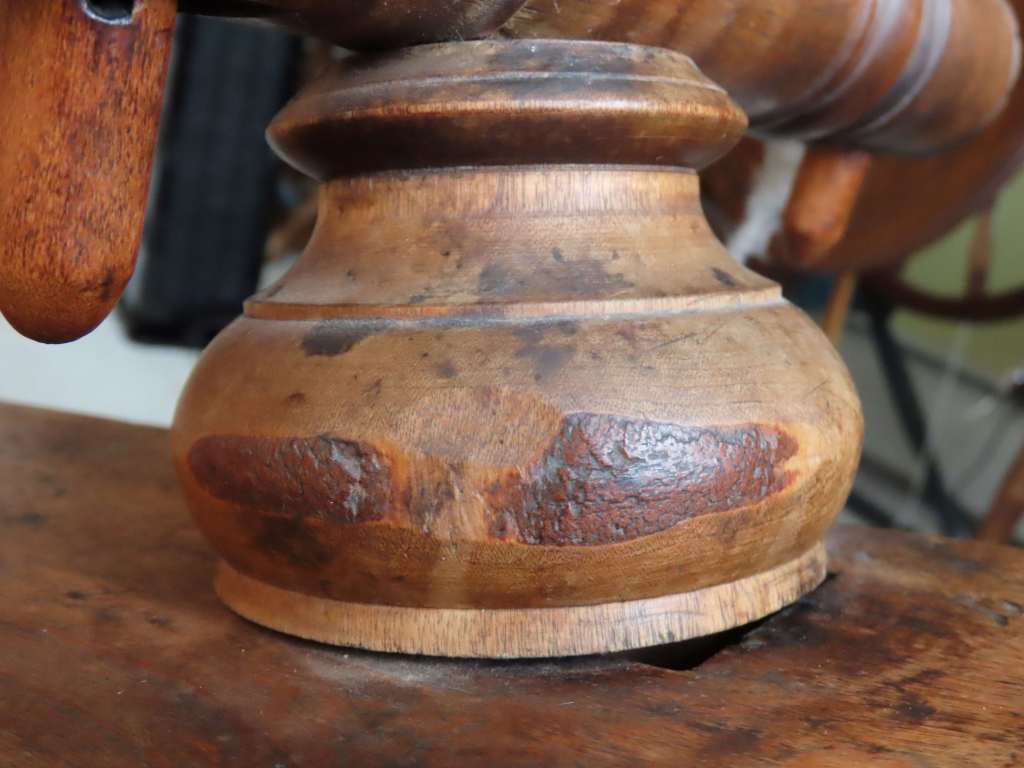
The wood on one leg and the MOA collar still retain some bark. 

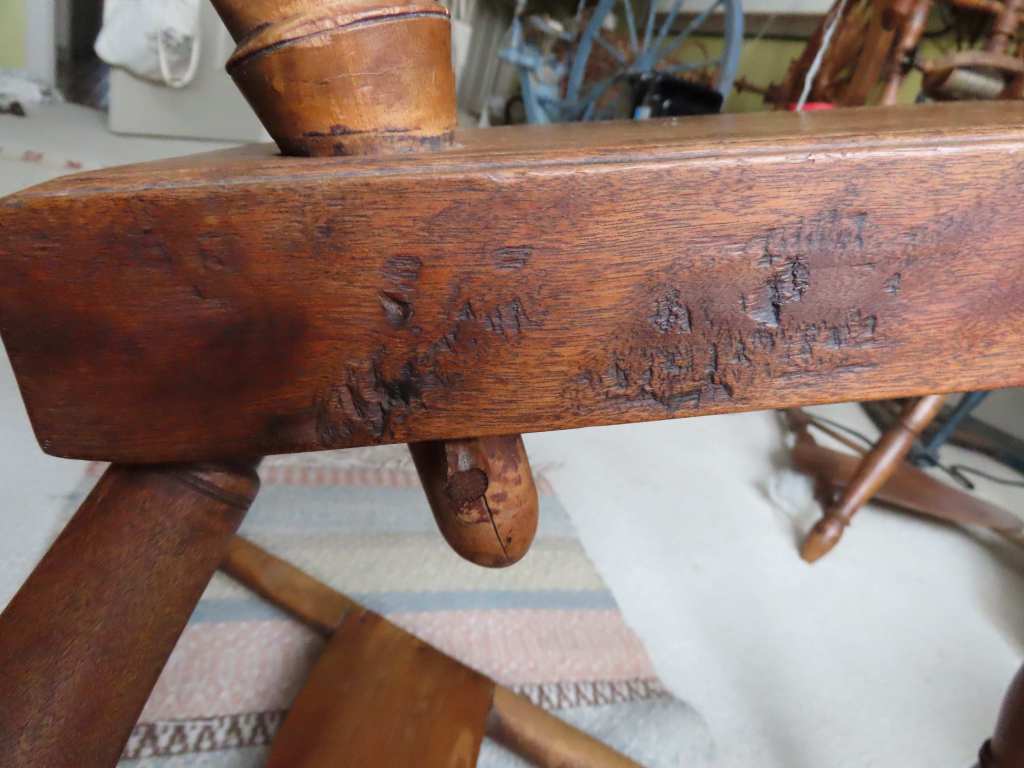
The sides of the table are quite rough

and the underside has a series of indented lines, whether from a saw, a plane, or something else, I do not know. 

The wheel is made from heavy wood and the drive rim is quite wide.   

There is a nail in the non-spinner side leg, with no apparent purpose (it is not on the bottom to keep the wheel from sliding). 

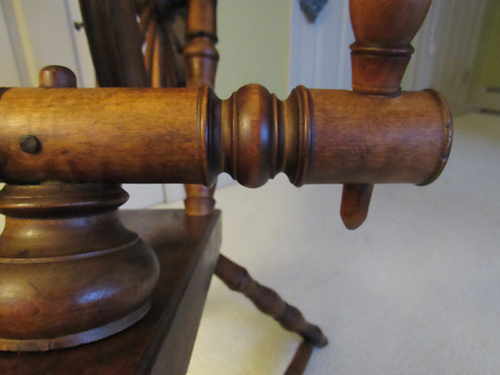
The orifice is fluted, something found on other McIntosh wheels, but not all. 

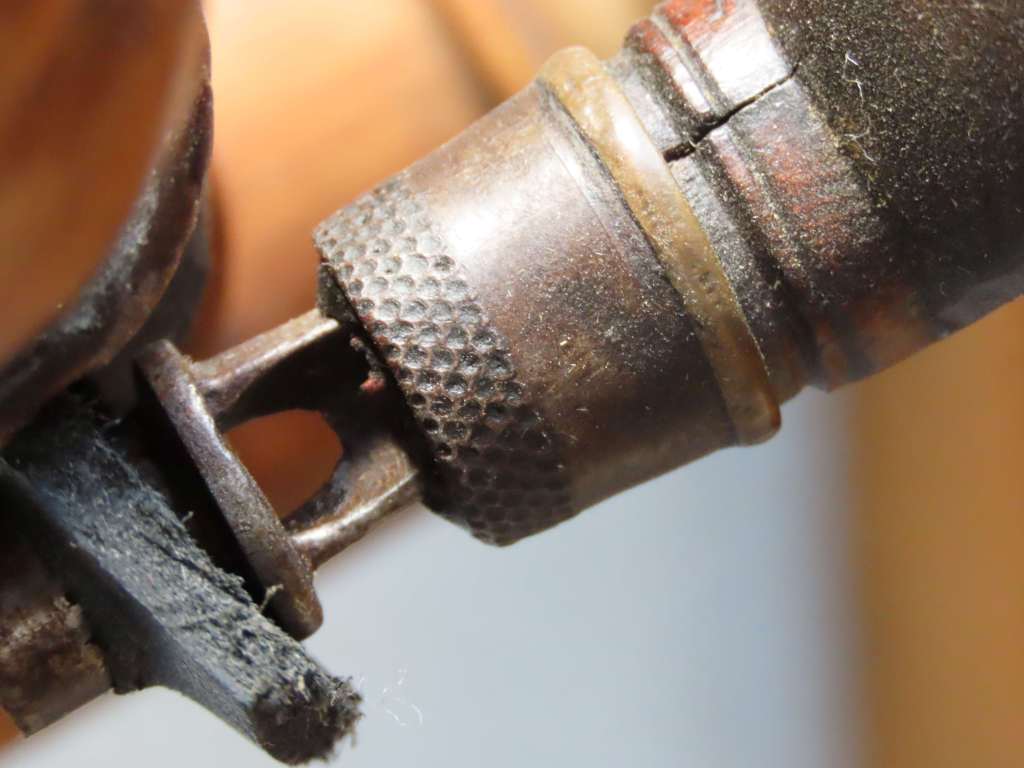
And, probably to “repair” a crack where the mandrel runs into the flyer, a thimble (with the bottom cut out) provides an ingenious and long-lasting binding. 

It is such a personal touch, this thimble fix is one of my favorite things I have ever found on an antique wheel.  

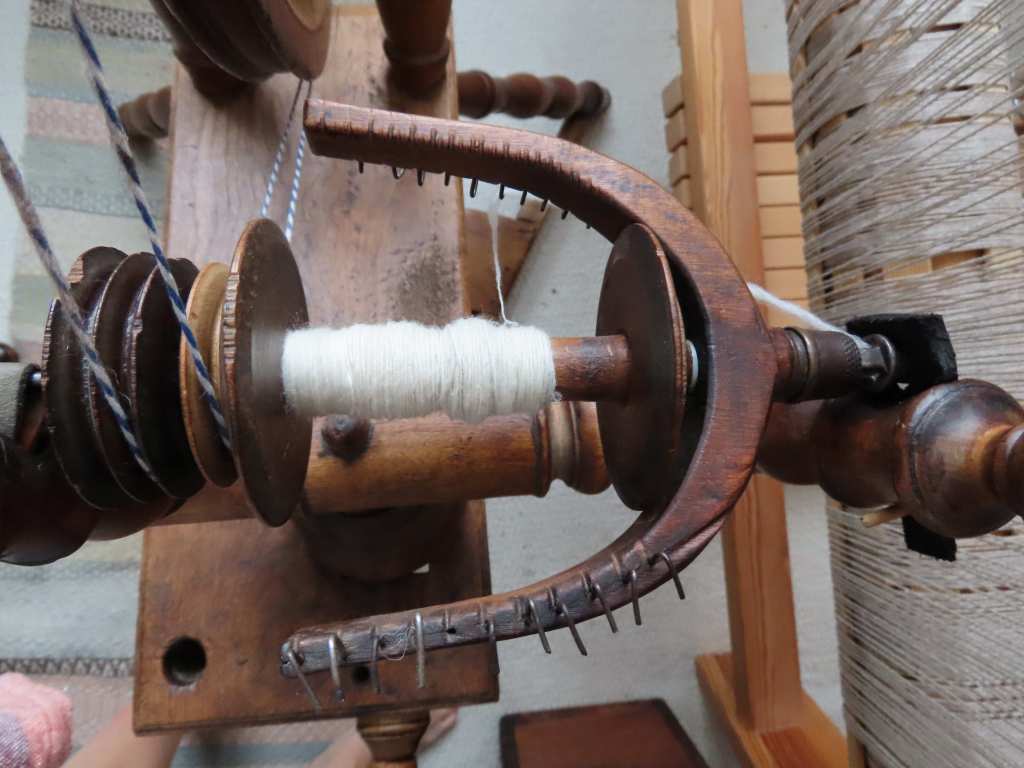
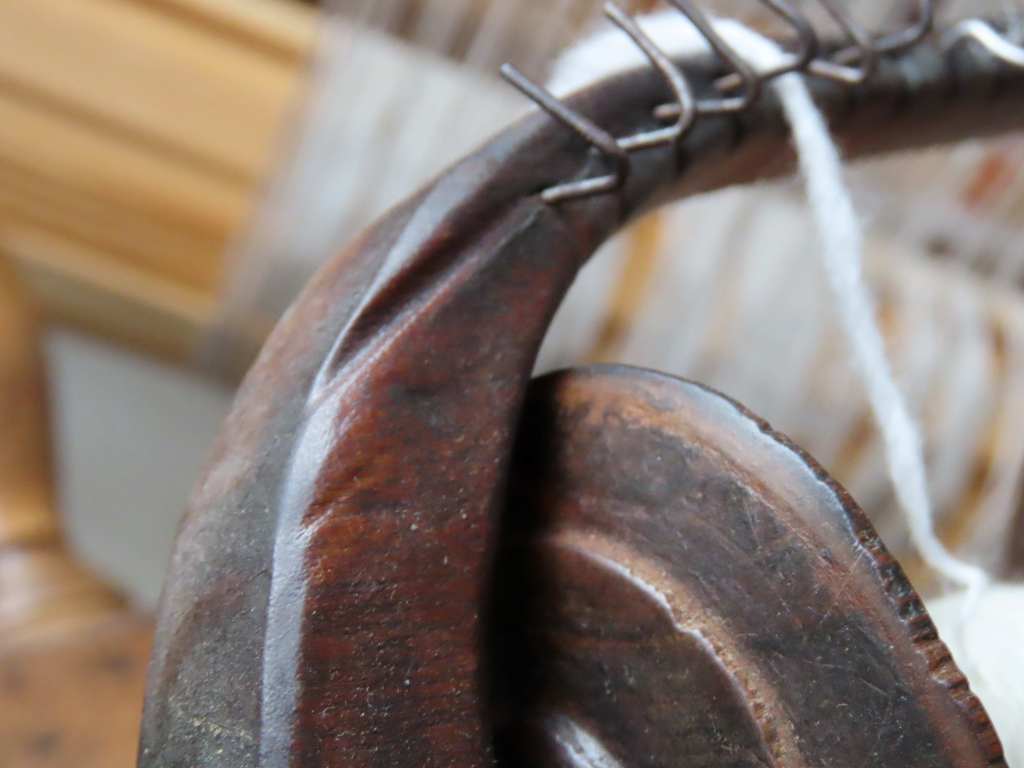
When I brought the wheel home, the bobbin had some very old, beautifully spun wool on the bobbin—a seriously good spinner last used this wheel.  The flyer has typical wear marks

and the treadle a lovely smooth worn curve from years of treadling. 

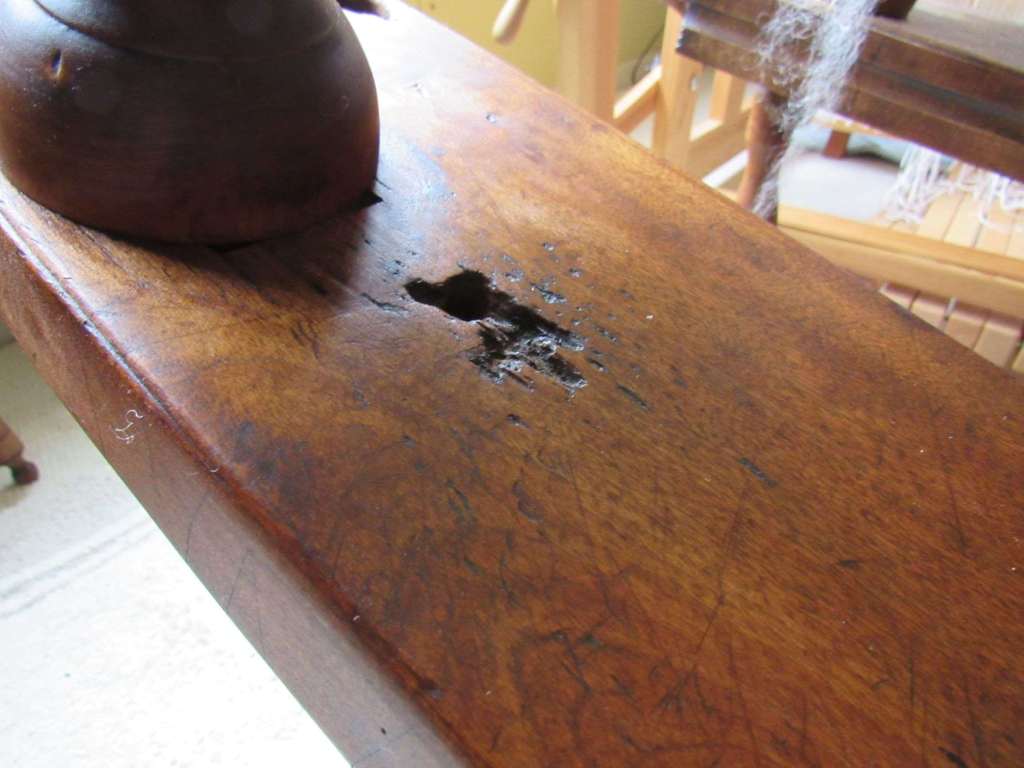
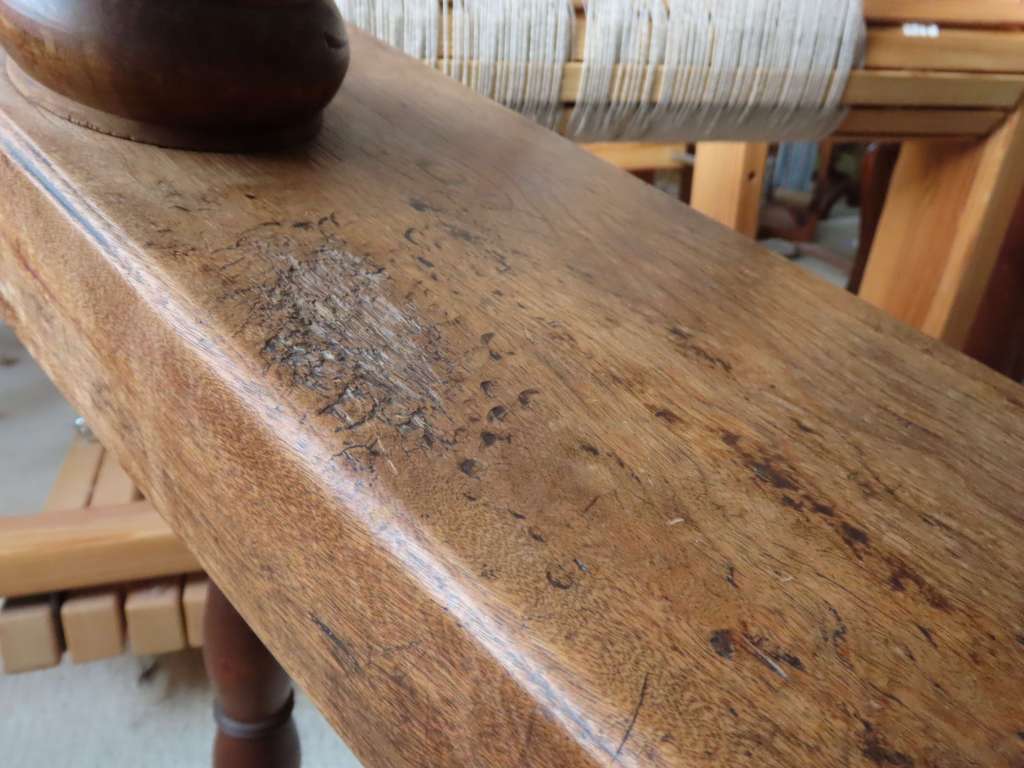
But other wear marks have me flummoxed.  On the end of the table around the maker’s mark and on areas of the table, there are crescent moon-shaped gouges. 

Occasionally, similar marks are found on other wheels.  While no one seems to know with certainty what they are, speculation is that they might be from the spinner tapping the orifice end of the flyer, perhaps to loosen the bobbin for removal. 

But, in this case, there is a whole valley gouged out of the table, where apparently something struck the surface repeatedly for a long time.  

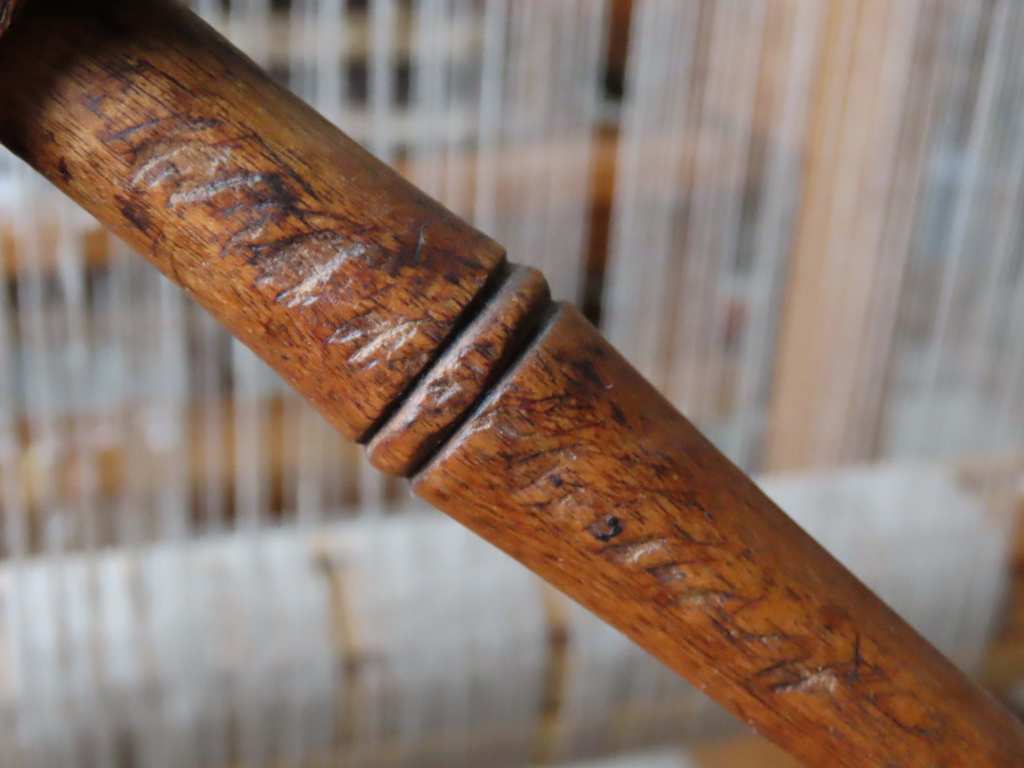
Even more perplexing are the marks on the spokes. 

They are only on the spinner side

no marks on non-spinner side

and are angled, short lines–some straight, some slightly curved–on the outer 2/3 of each spoke. 

I have seen two other wheels on Ravelry with somewhat similar marks, one a Norwegian-style wheel found in Saskatchewan and the other a Finnish-style wheel found in Leningrad.  There is a thread named “Mystery Scratches” in the Antique Wheel group on Ravelry discussing the marks on these three wheels, with a variety of guesses as to their origins. 

While many of the guesses were that they are damage unrelated to spinning (child hitting with a stick, dog chewing, odd storage), I believe they are wear marks from some type of long term use either in spinning, winding off, or warping, but try as I might, I cannot figure out how they came to be.  If anyone has suggestions, please let me know.  I would love to solve the mystery.

Marilla

Finally, in addition to Marilla, I was fortunate to find another McIntosh wheel several years later, this time an early 1815 Alexander. 

Margaret–14 spokes, but like Marilla, she is missing one

I named that wheel Margaret and she has since moved on to another, very good home. 

I only took a few photos of her, but it is interesting to compare her to the later IS wheel.   

She is a beauty

but has her own table gouge, this time the typical one found under the drive band. 

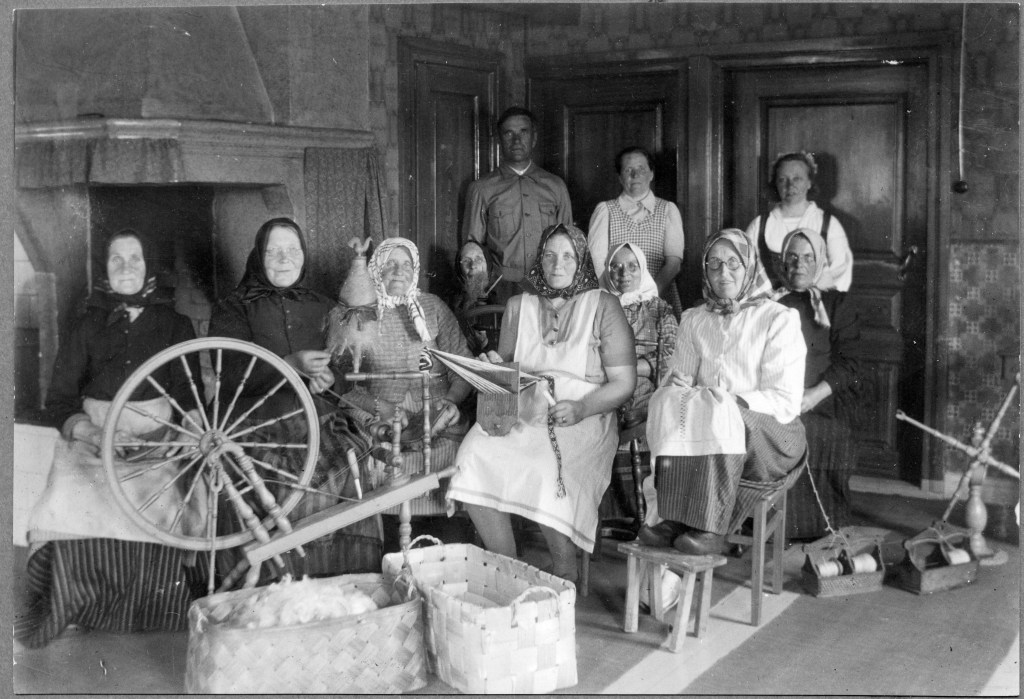
Here is a photo taken in Vörå, Österbotten, Finland  sometime between 1920 and 1960 (link here) of a knife used in this way. 

There is speculation that the knife kept the drive band cross from migrating to the top when spinning counterclockwise, so that the band would be less likely to grab flax from the distaff.  But, at this point, that remains speculation.  As this wheel shows, these knife marks are not just found on Scandinavian wheels, as many think, but on wheels from a variety of places and cultures.  Whatever the purpose of the knife, it was important enough that spinners did not mind creating a big gouge mark in their wheels.  As more and more photographs become available online, I hope that we will discover more about what the marks mean and how these wheels were traditionally used.

Thank you to David Maxwell and his sources for all of the research he has provided on McIntosh wheels. 

You can find much more information in the Antique Spinning Wheels group on Ravelry, including a list of all the wheels David has been able to document. 

Here is David’s article, with a wealth of information that I did not include here:

Maxwell, David, “The McIntosh Family of Spinning-Wheel Makers,” The Spinning Wheel Sleuth, Issue 108, April 2020, pp. 2-5.

Also thank you to AlltFlyer on Ravelry for the photograph of the knife in the table.