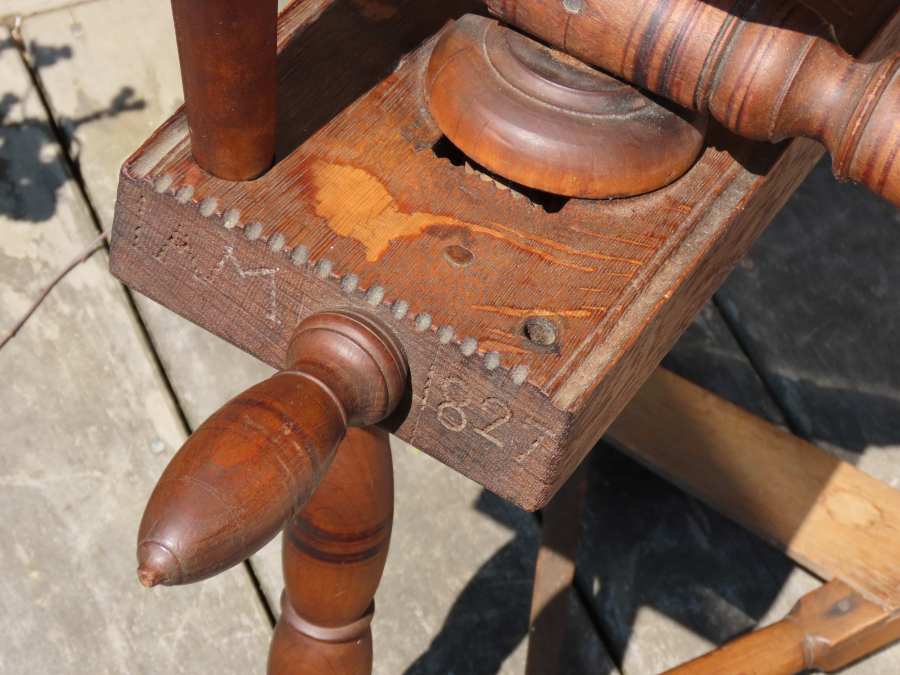
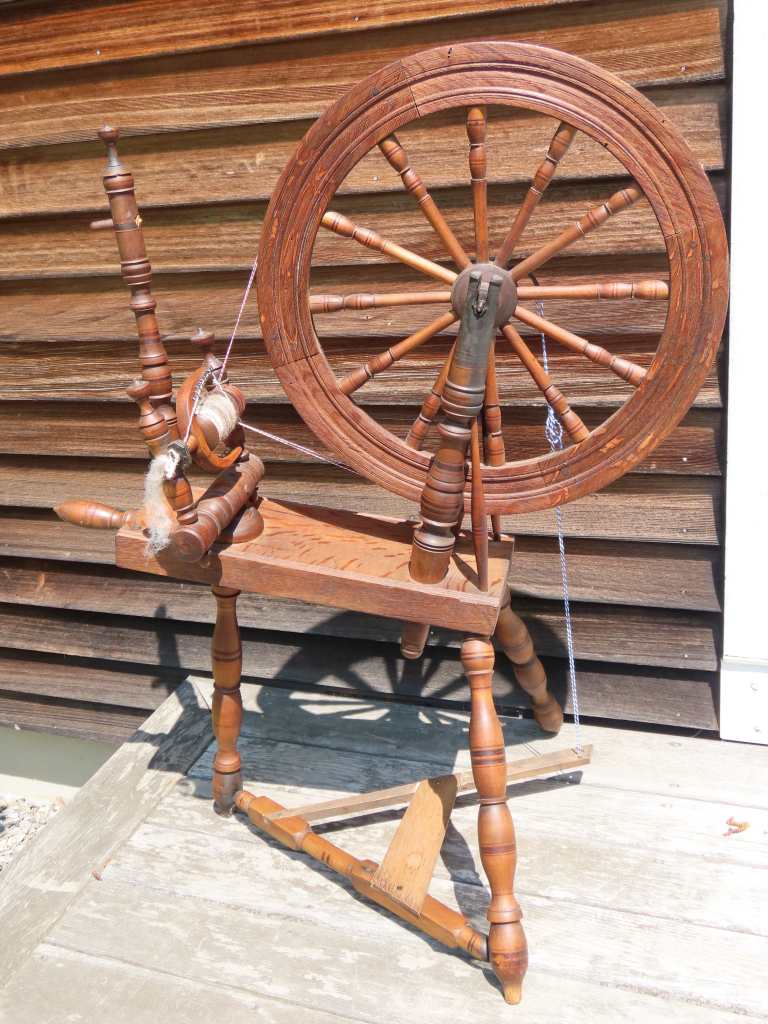
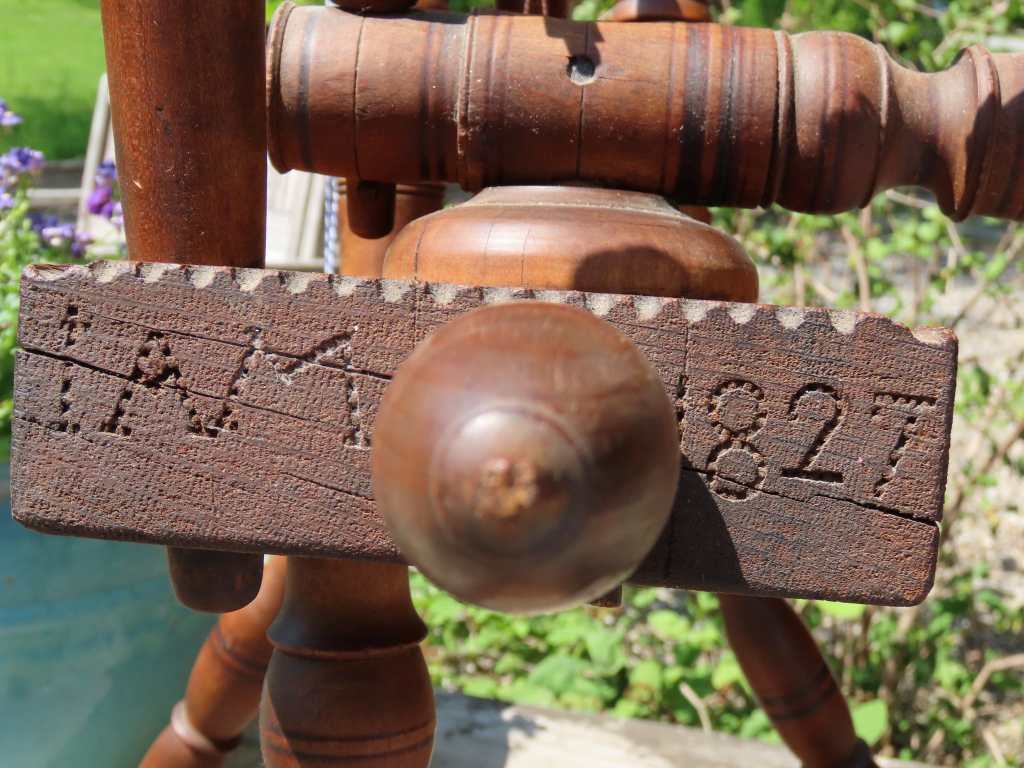
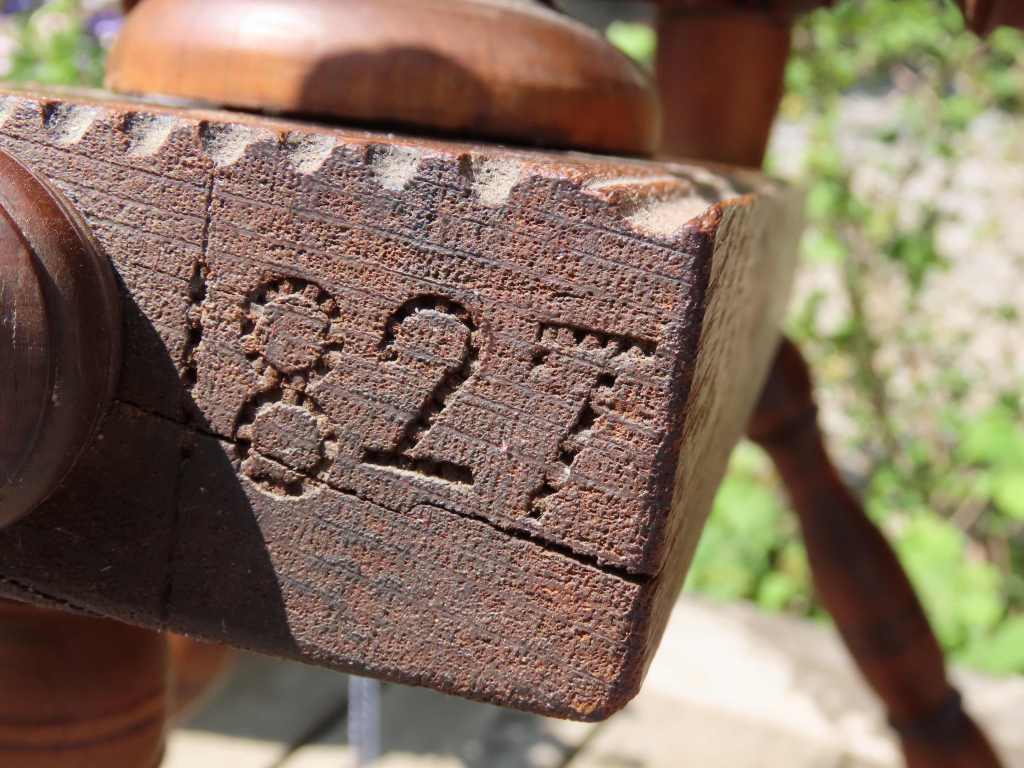
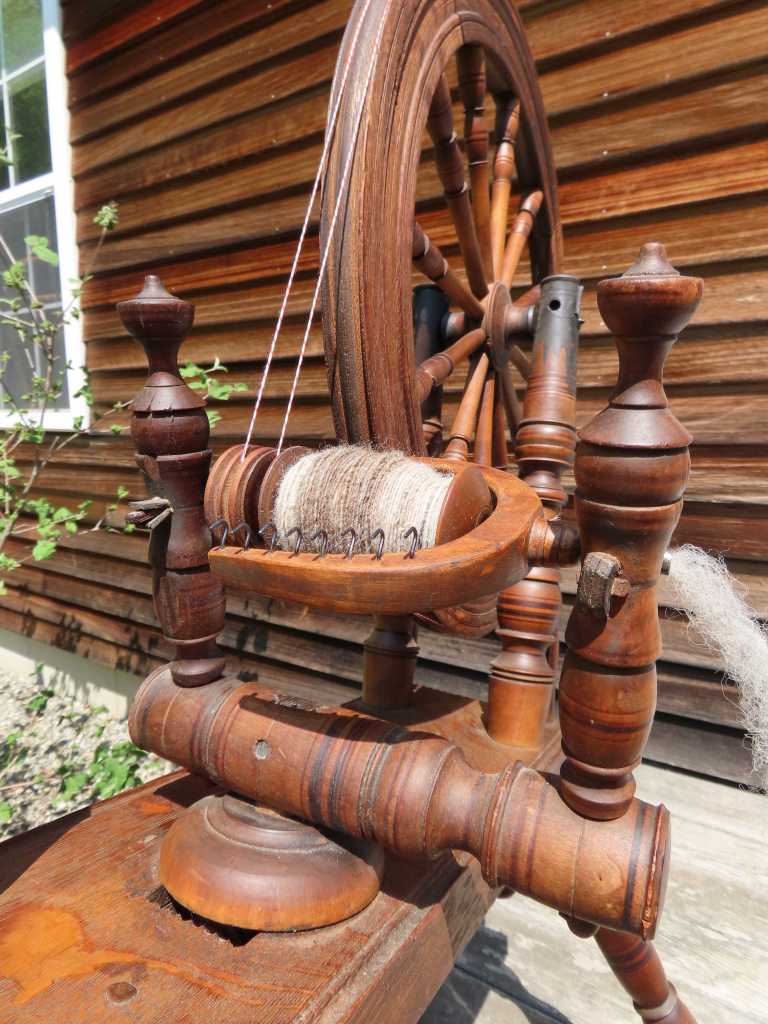
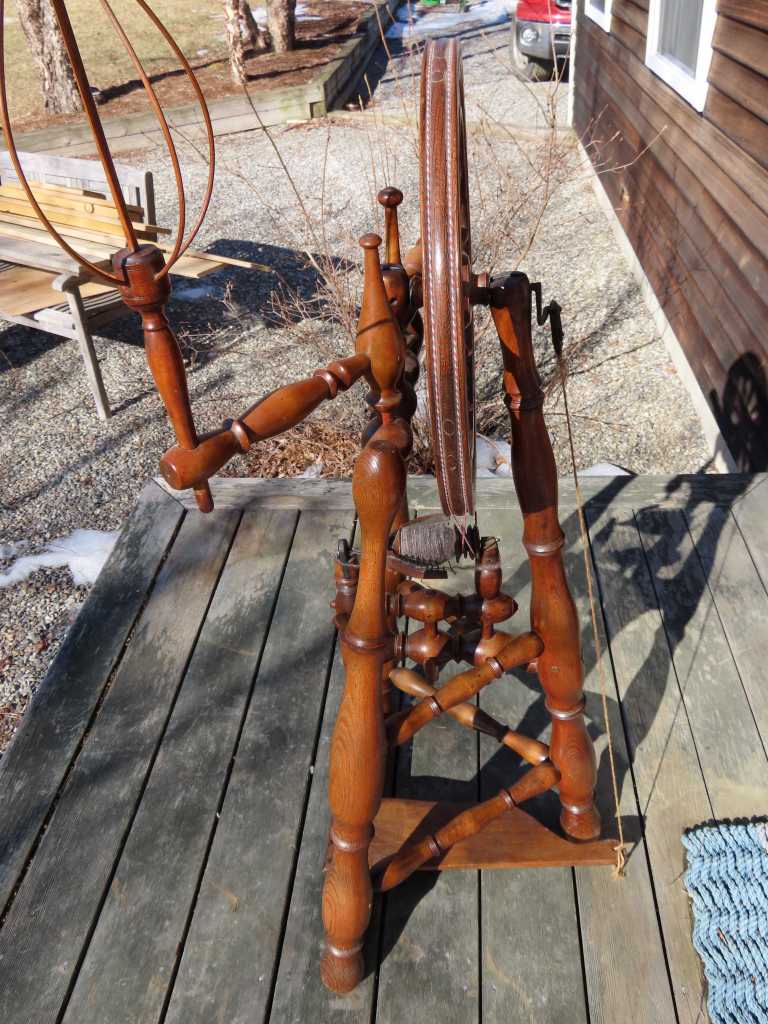
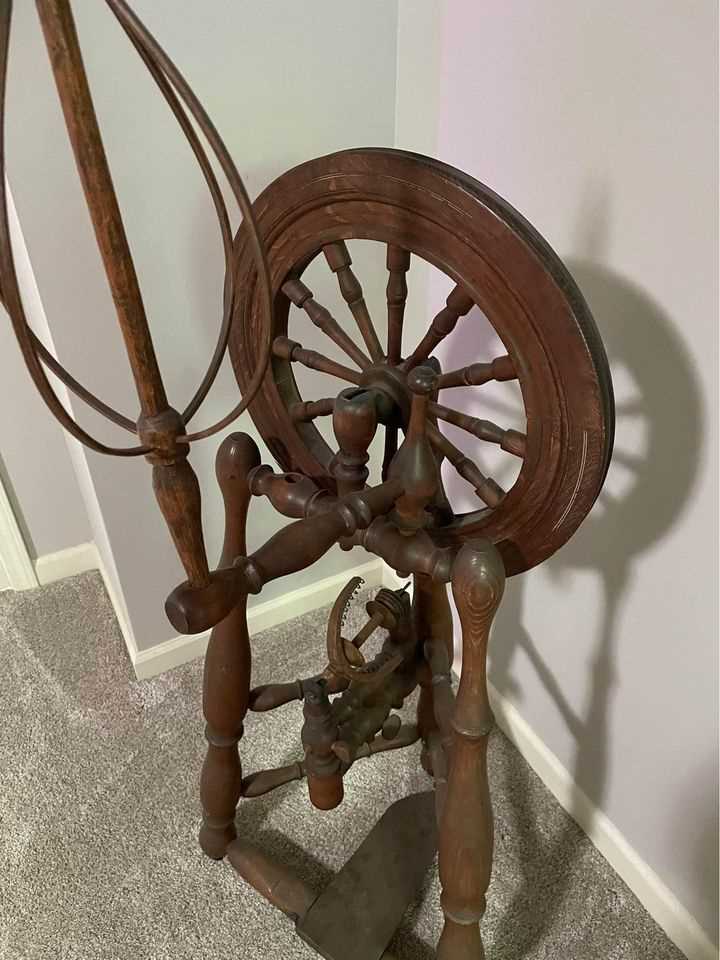
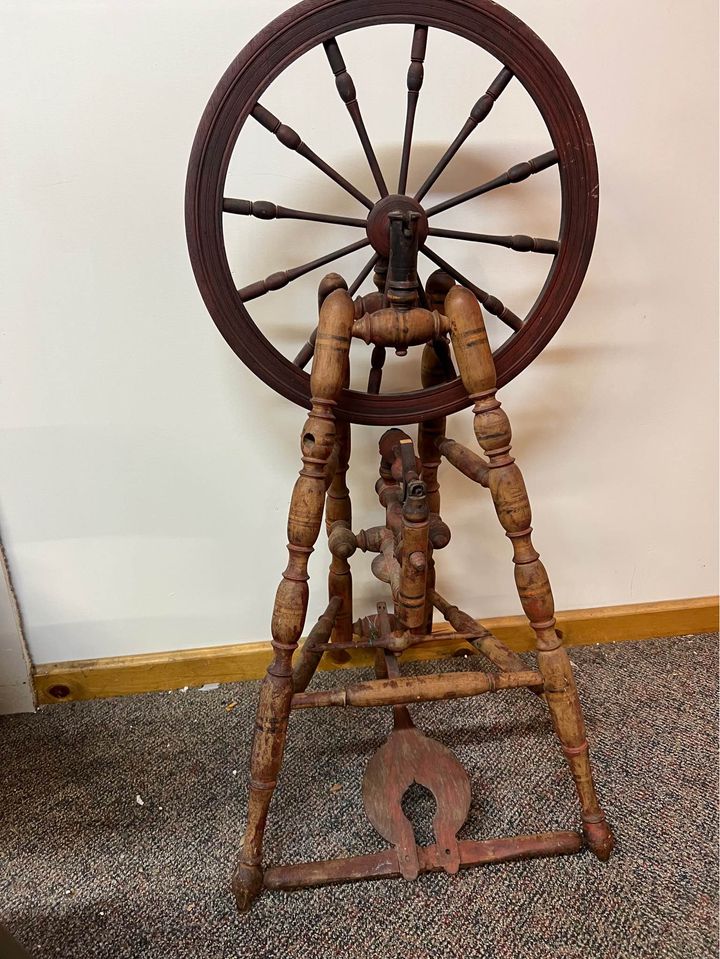
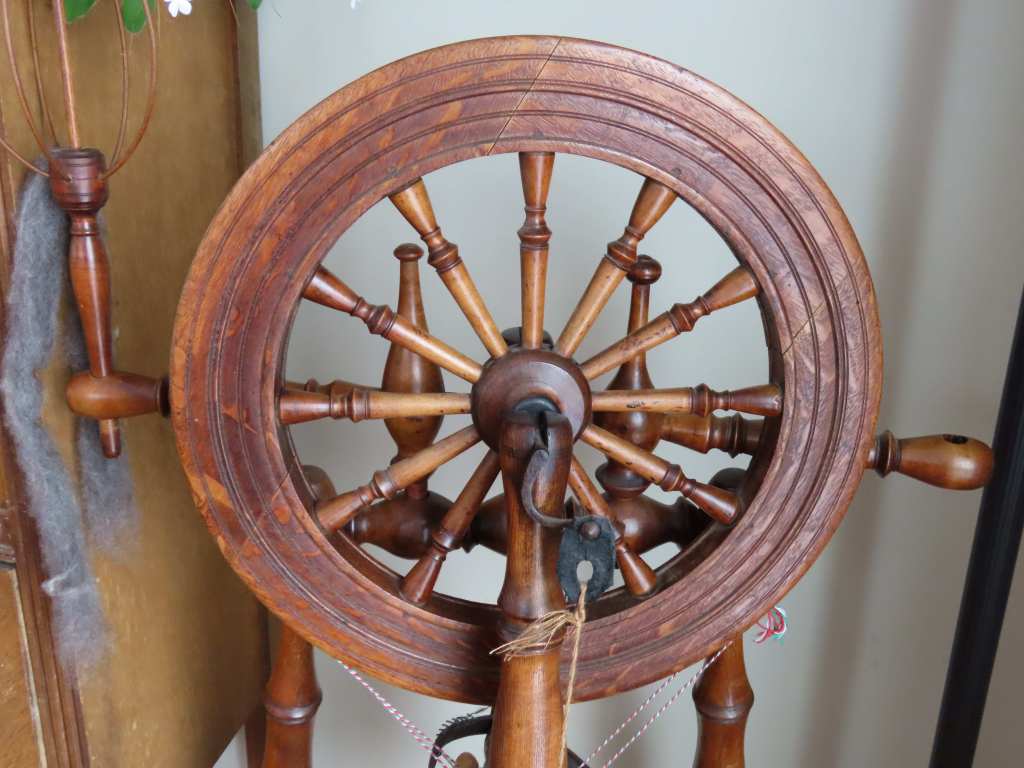
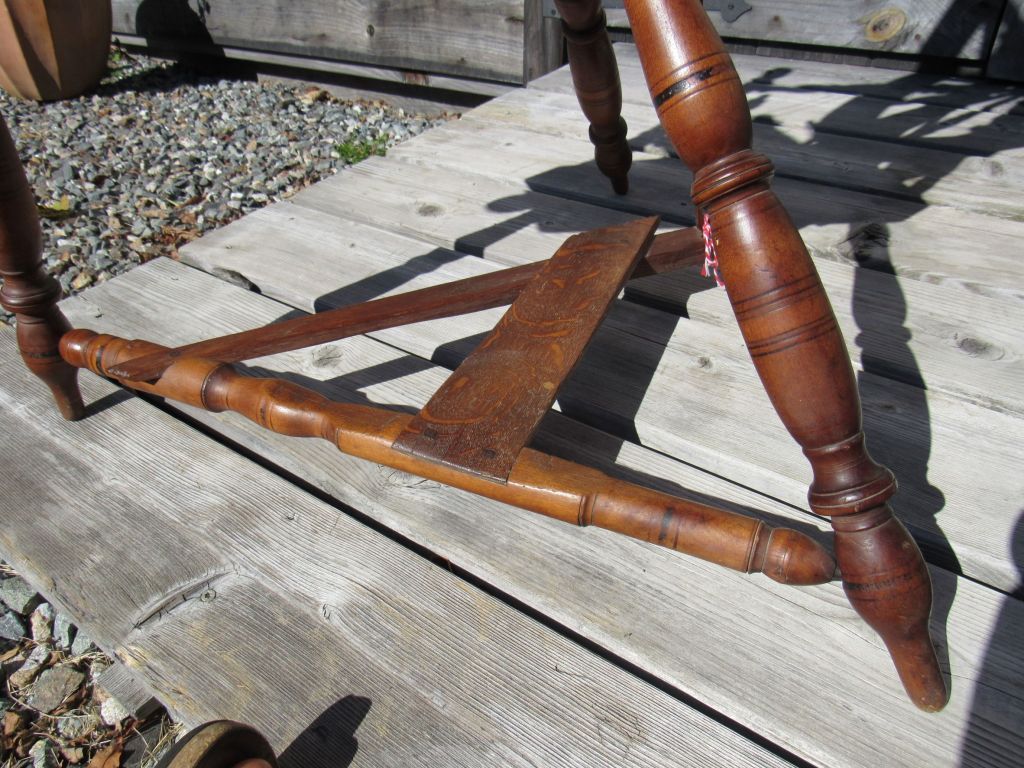
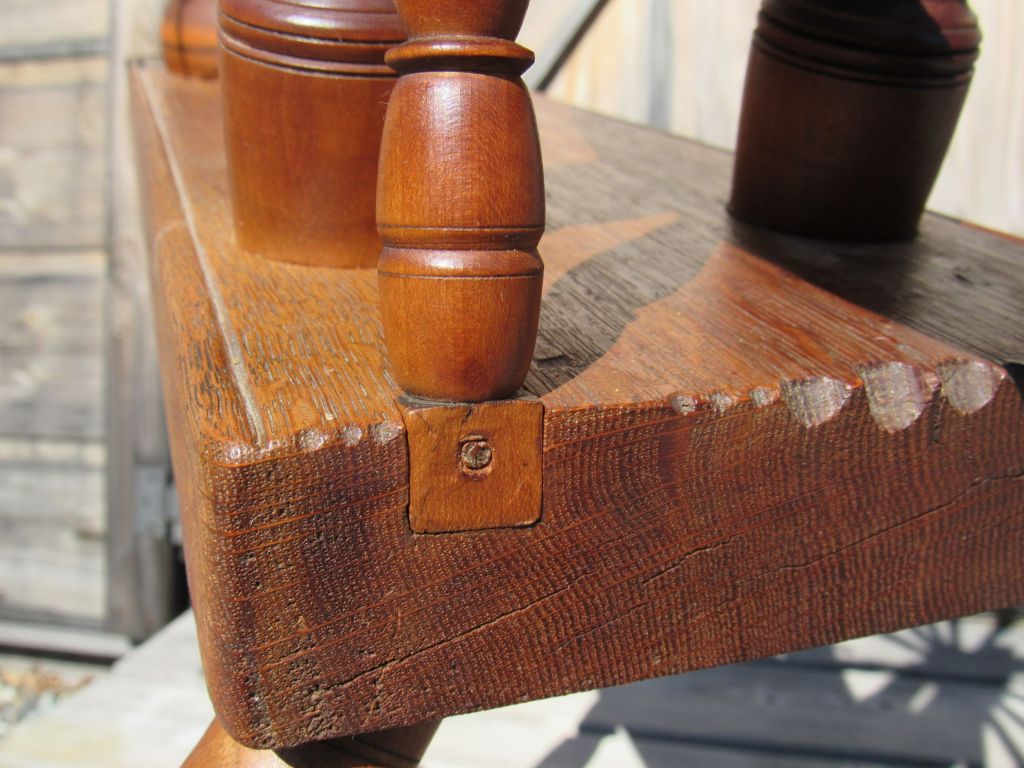
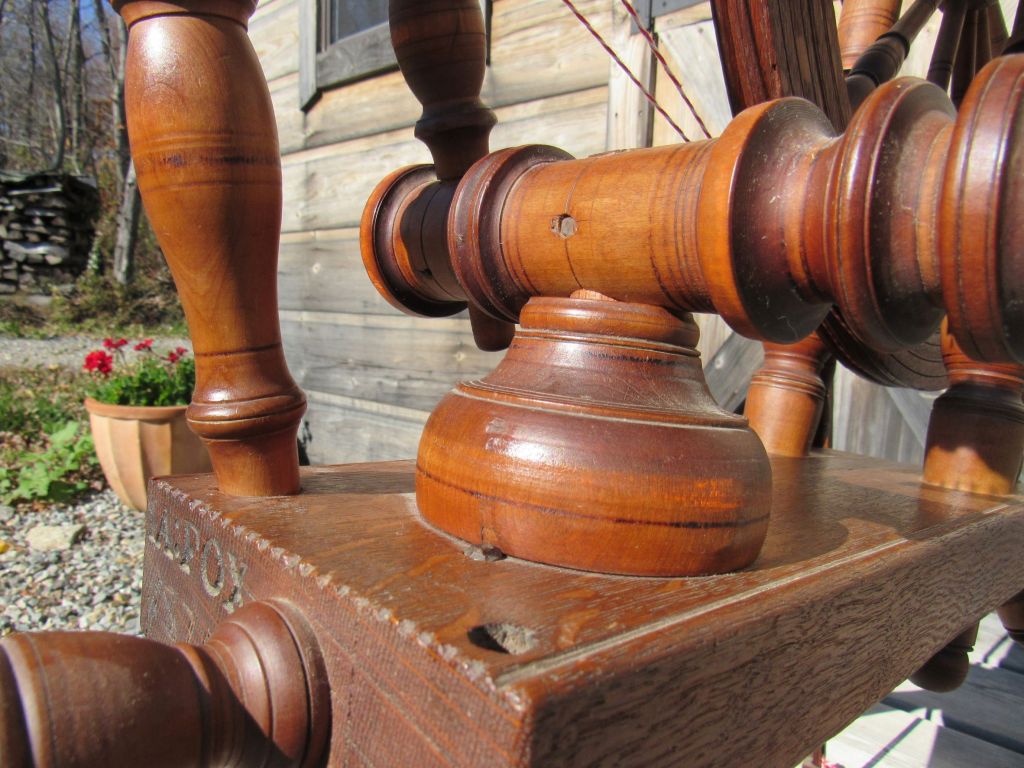
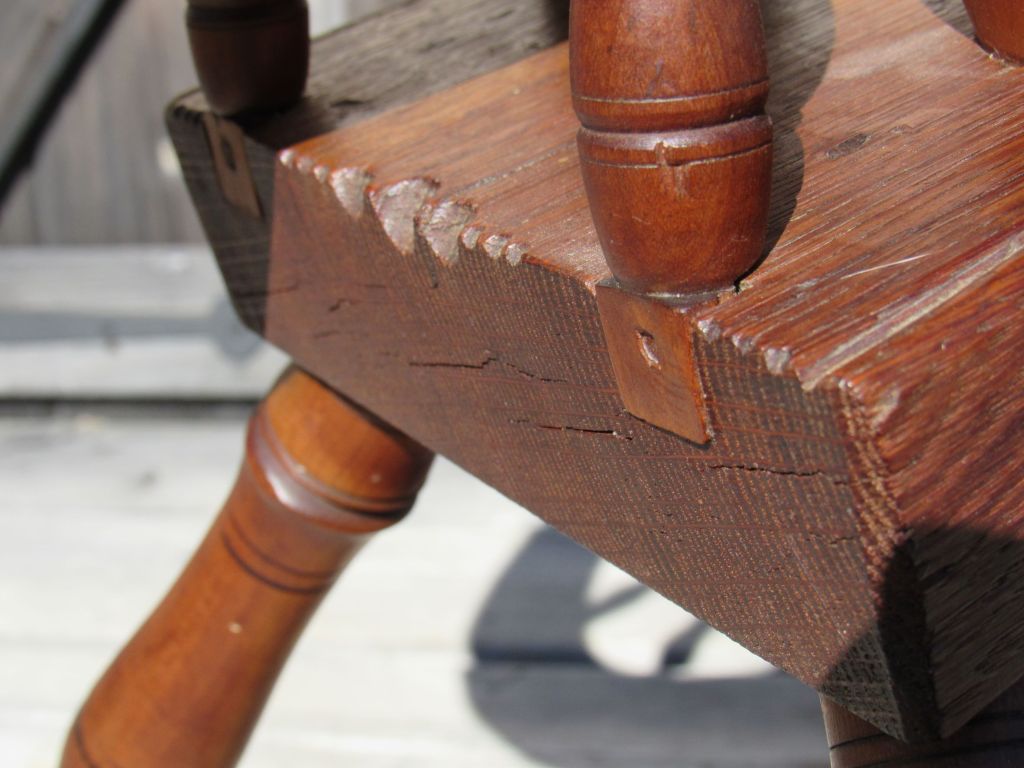
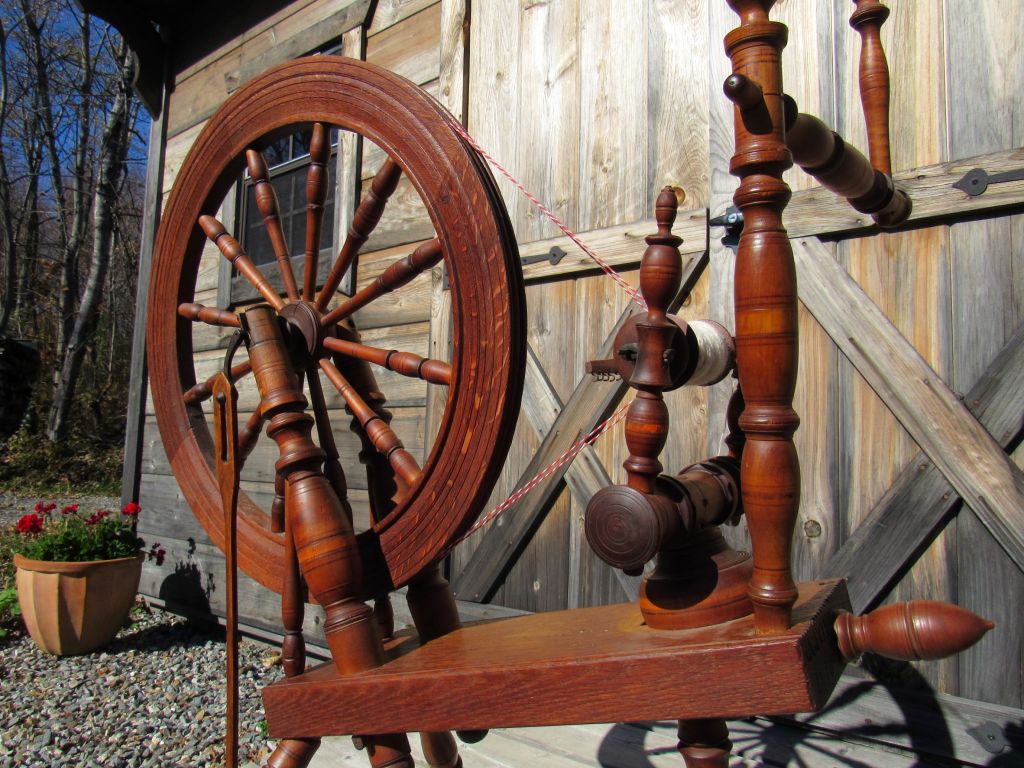
This wheel is intriguing. It is marked with the initials “IAM” and the date “1827.”
Yet, as far as I know, the maker has not been identified. According to the list of spinning wheel makers in Pennington and Taylor’s book, several flax wheels with the “IAM” mark have been found in Pennsylvania and Ohio, with dates of 1825, 1834, and 1843.
To complicate matters, a friend has a wheel with a very similar “IAM” mark and a date of 1833, but the wheel itself bears little resemblance to this one. That wheel turned up in Virginia. This one belonged to New Hampshire collector, Sue Burns, but I have no idea where she found it originally.
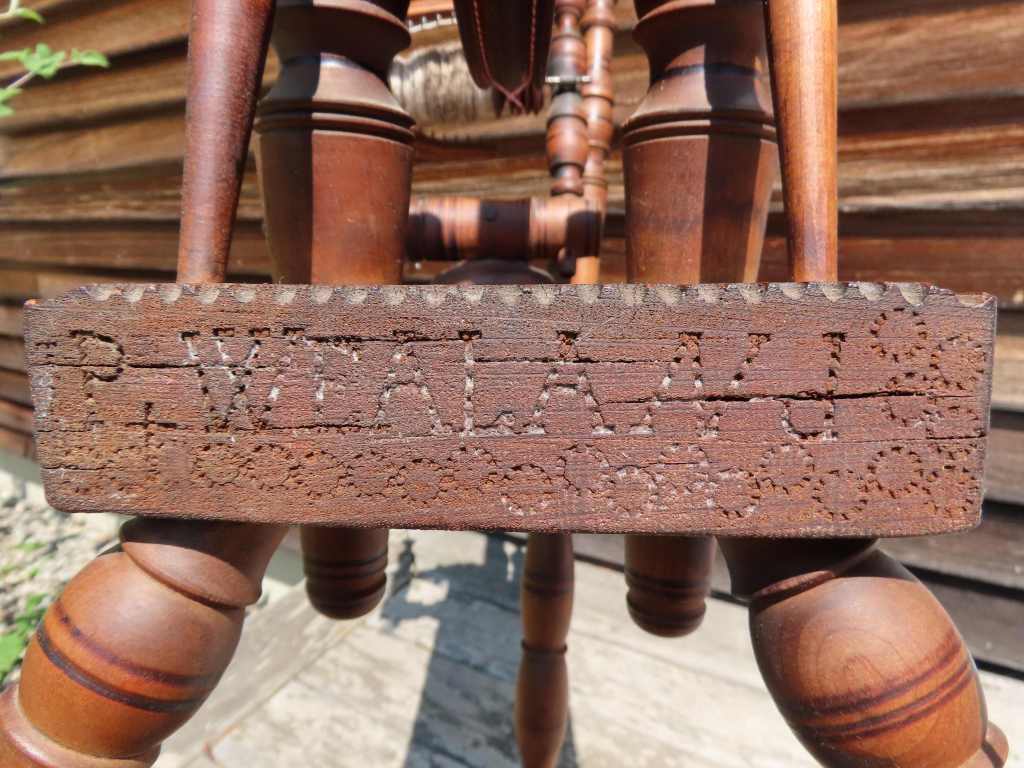
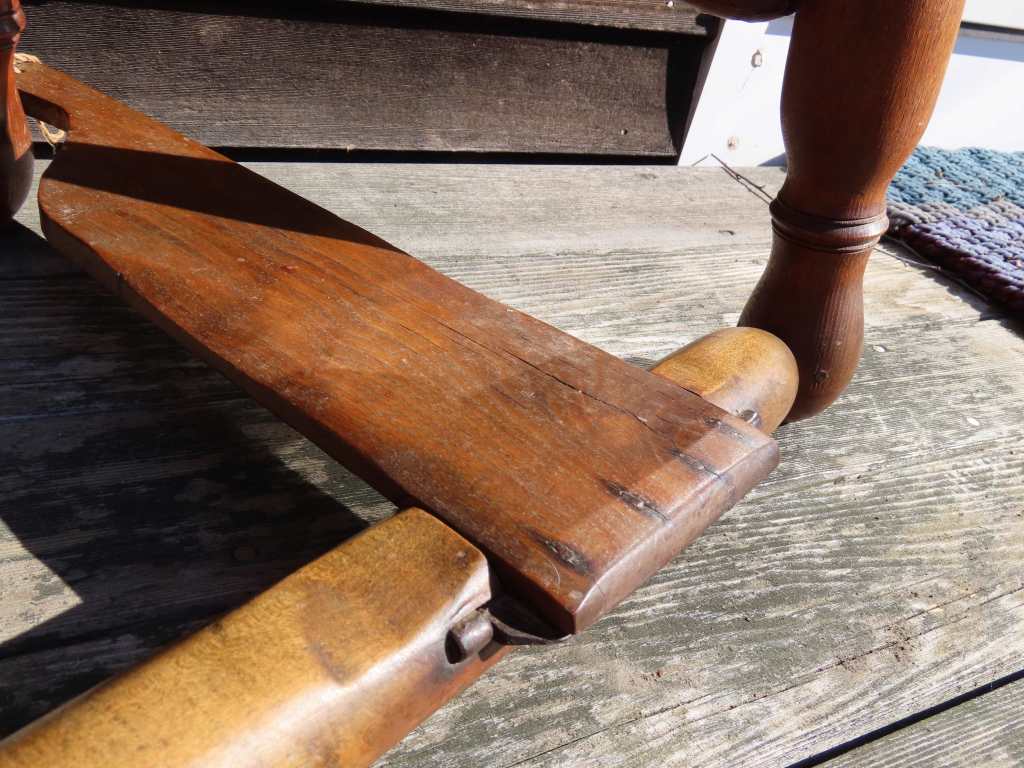
When I started researching, I hoped the mark at the other end of the table, “P. Wealand”–most likely the wheel’s owner–might provide a clue.
I found numerous Wealand families in Pennsylvania and Ohio in 1827, but not many first names beginning with “P.” Probably the strongest candidate was a Polly Wealand born in 1810 in Lancaster, Pennsylvania. She would have been 17 when this wheel was made, so the timeline fits nicely for the wheel to be made as a present to her, possibly for an engagement or wedding.
But I could not find any evidence of a Lancaster wheel maker in 1827 with the initials IAM or JAM. I found a John McSorley, listed as a spinning wheel maker in East Lampeter, Lancaster, PA in the 1850 census, but his age was only 36—too young to have been making wheels in 1827. I could not track down his family to see if he had a wheel-making brother or father. James Murry was another possibility. He was listed as a wheel wright in Stroudsburg, PA in the 1860 census, but he was not that close to Lancaster and there was no concrete evidence that he made spinning wheels.
I focused my research mostly on Pennsylvania, rather than Ohio, because so many of the wheel’s features are found in other Pennsylvania wheels. What is interesting, though, is that it resembles wheels in several different eastern Pennsylvania counties.
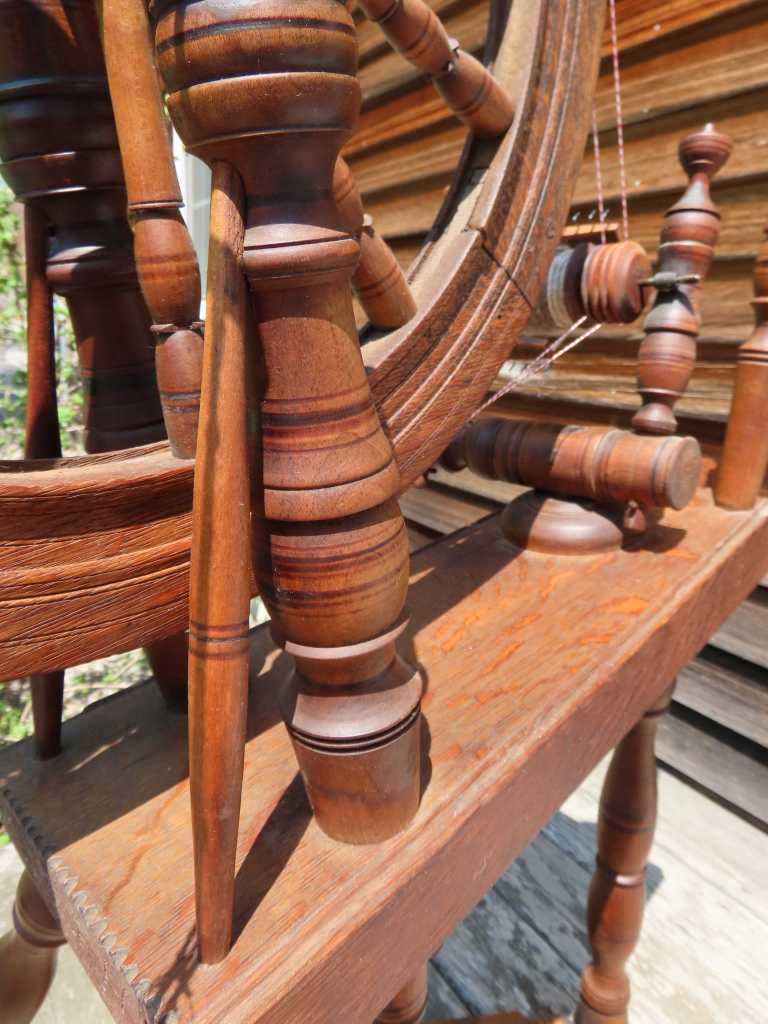
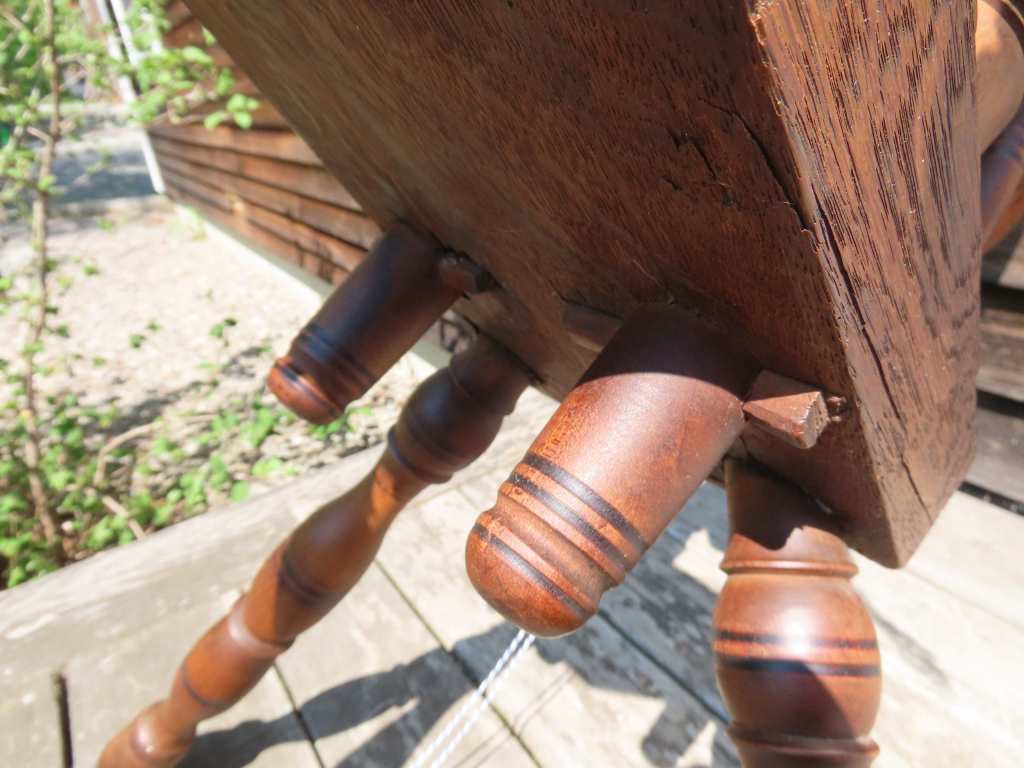
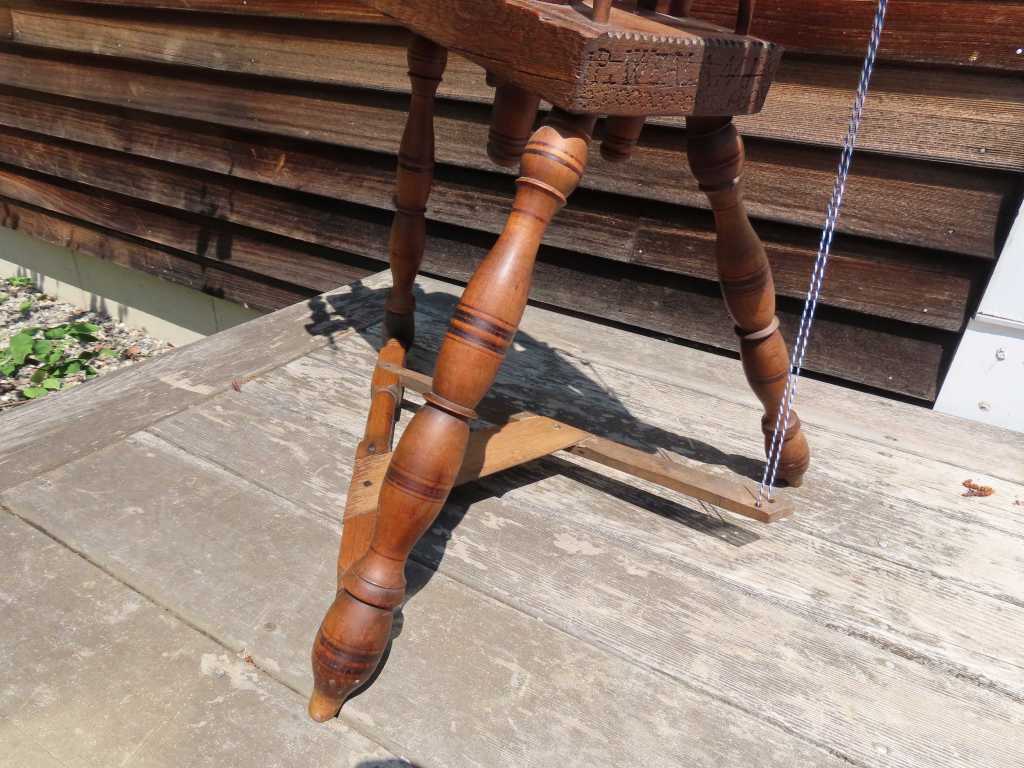
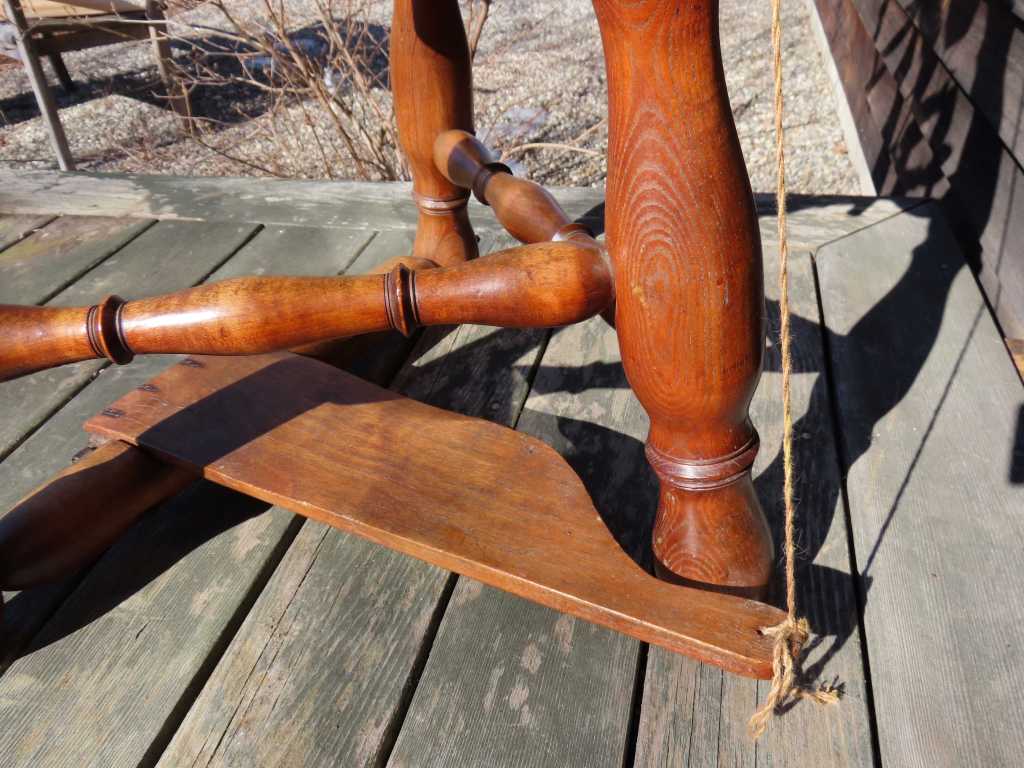
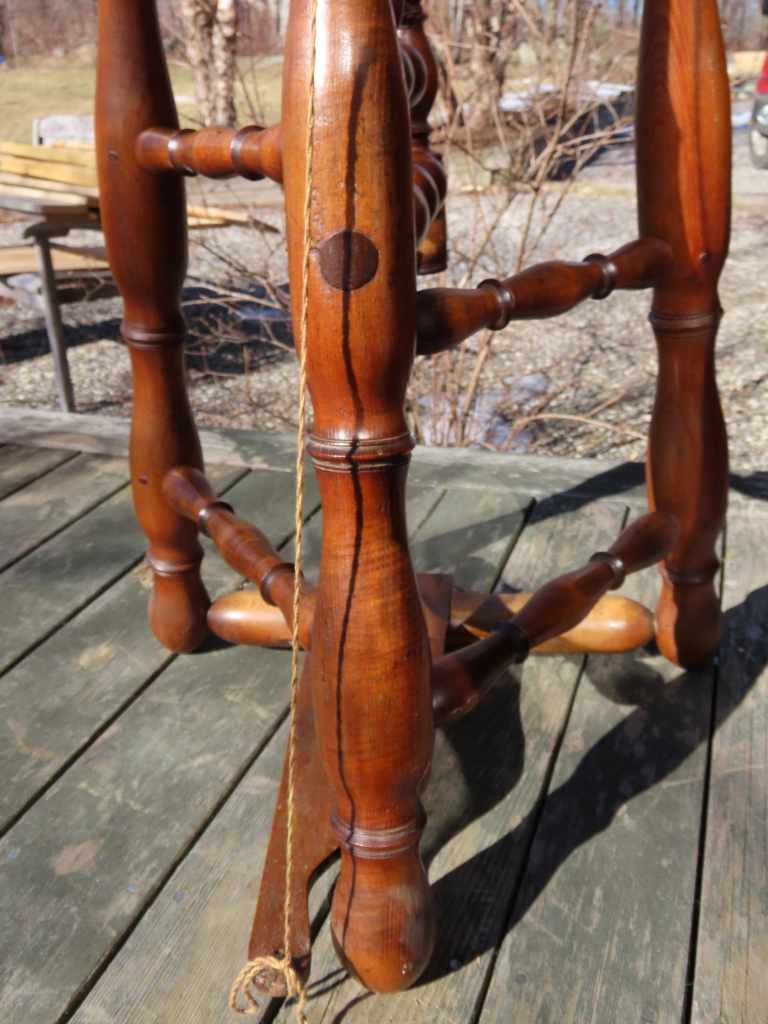
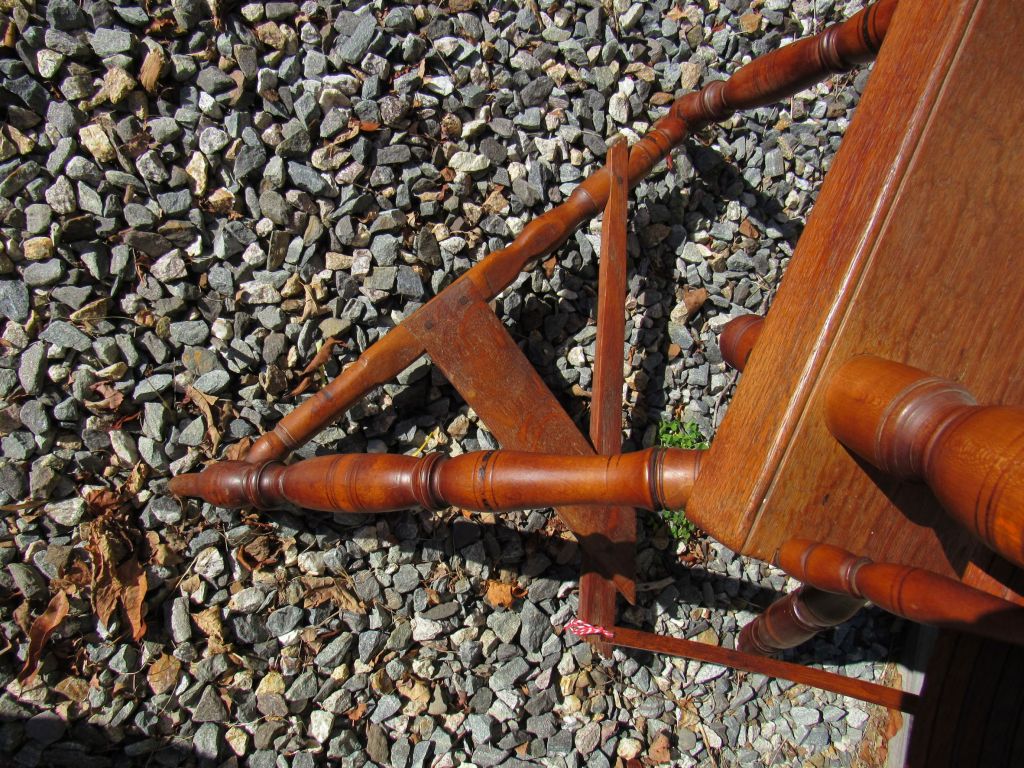
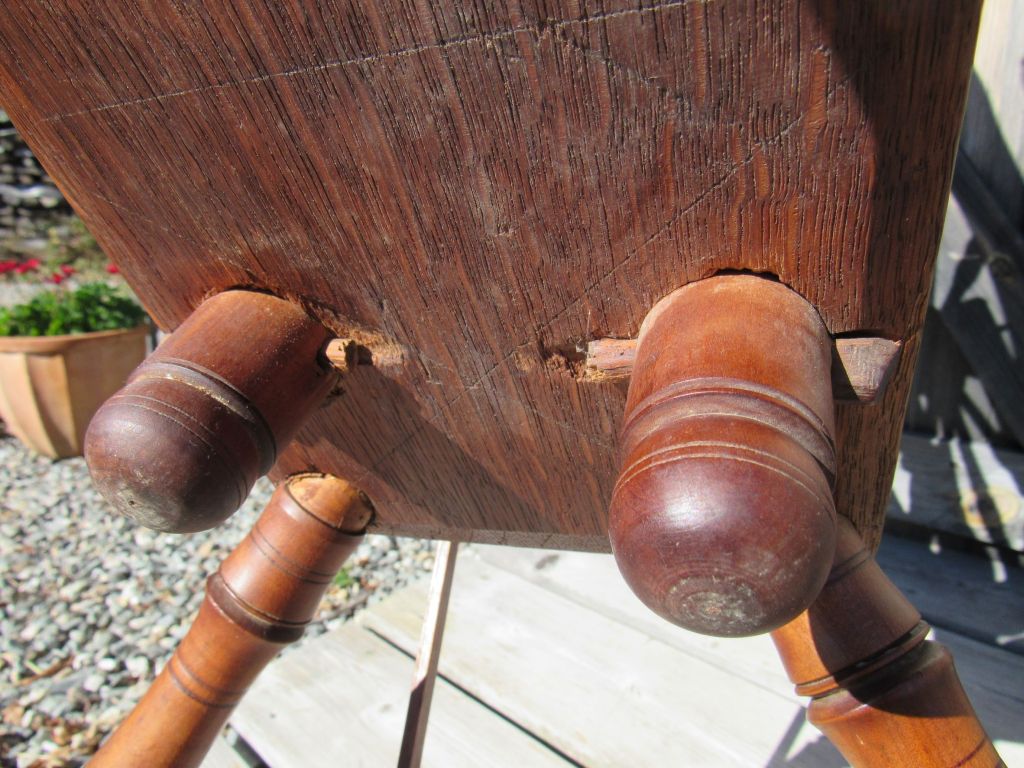
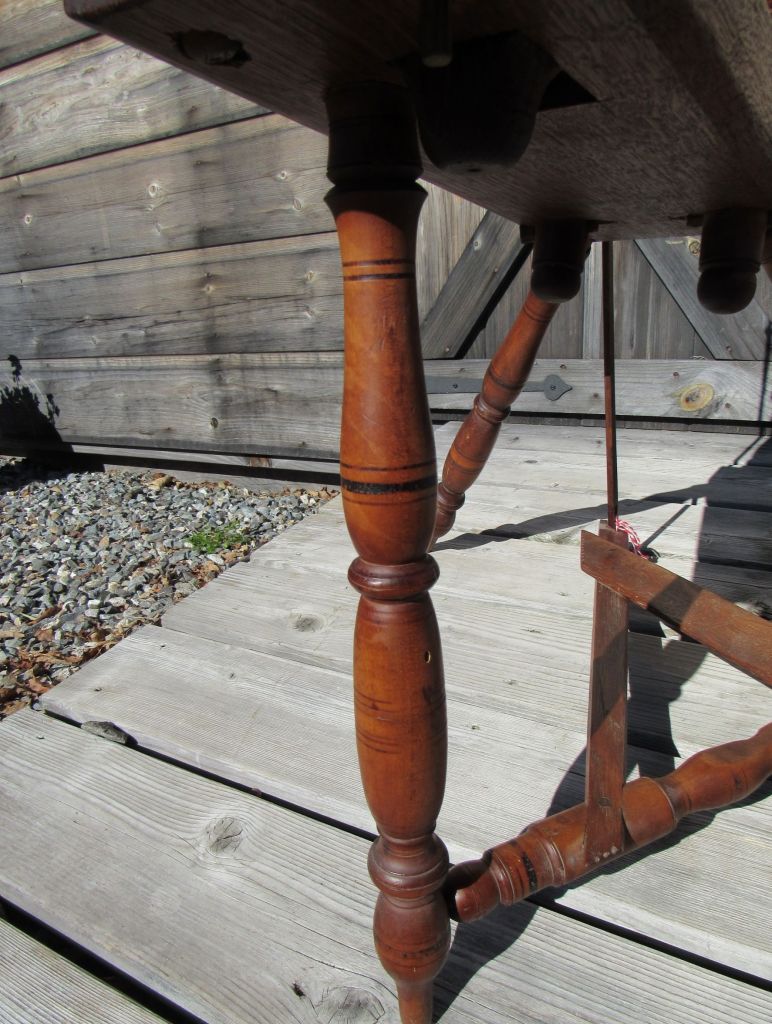
For example, it has a few notable similarities with the wheels made by J. Fox (Jacob Fuchs) (see previous post “Ester”) in Berks County. The way the the uprights below the table are turned and striped is much like the Fox wheels.
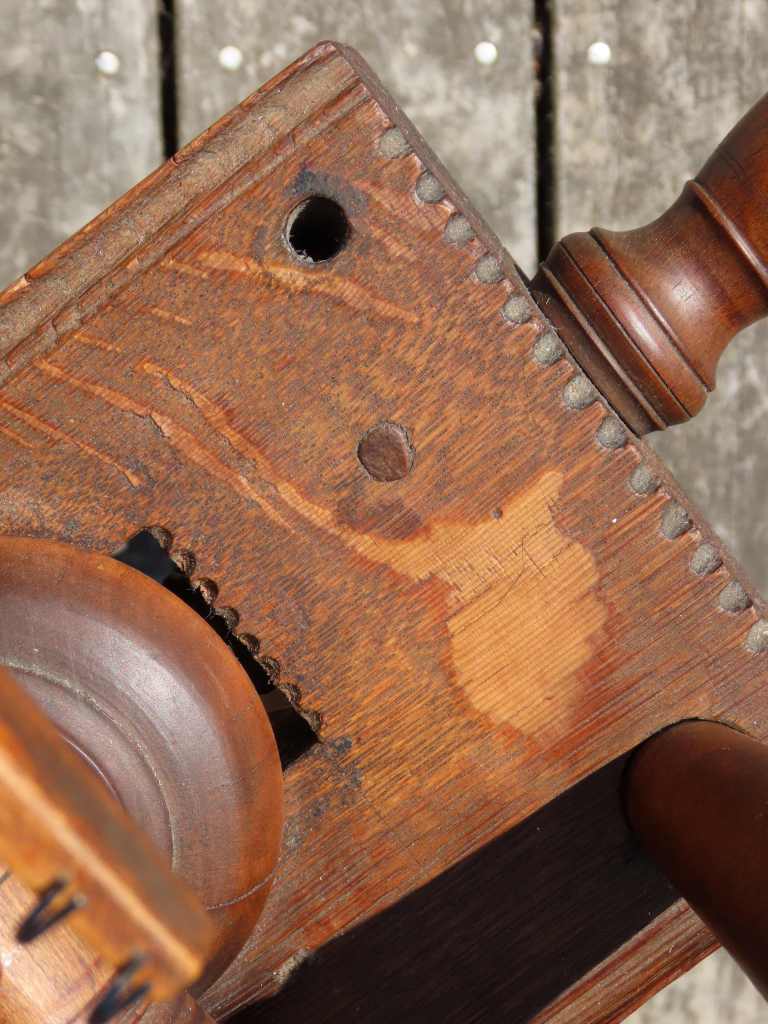
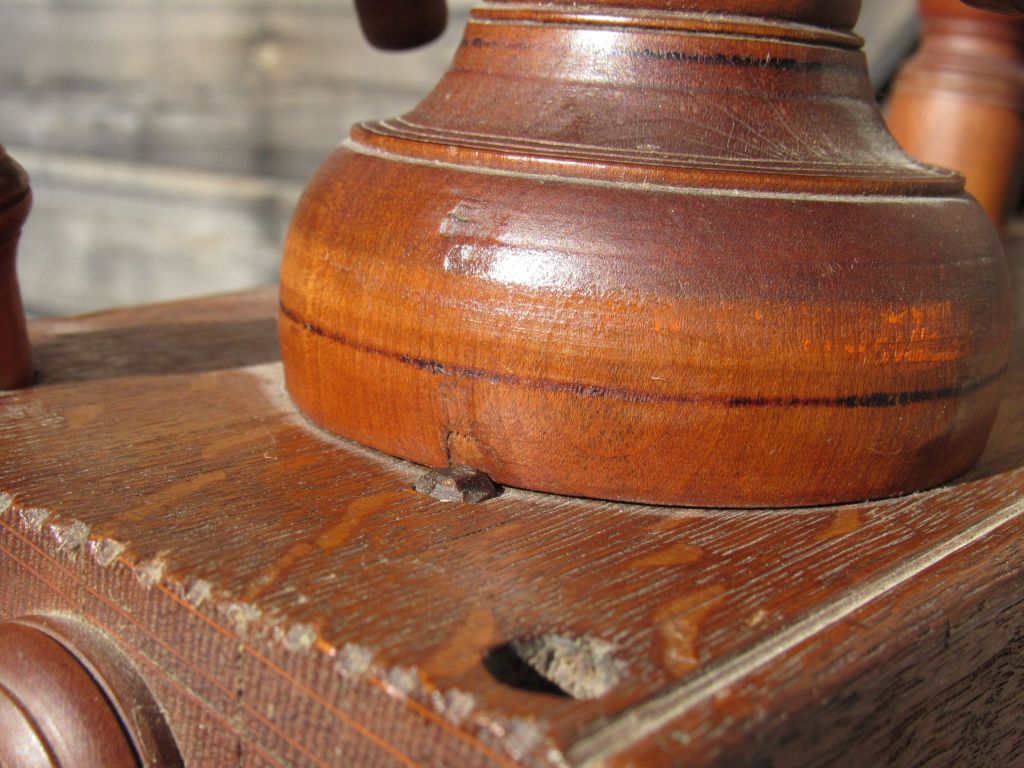
And, as with the Fox wheels, this wheel has a hole for a reeling pin, which suggests either Berks or a nearby county, where this somewhat unusual feature was most often found.
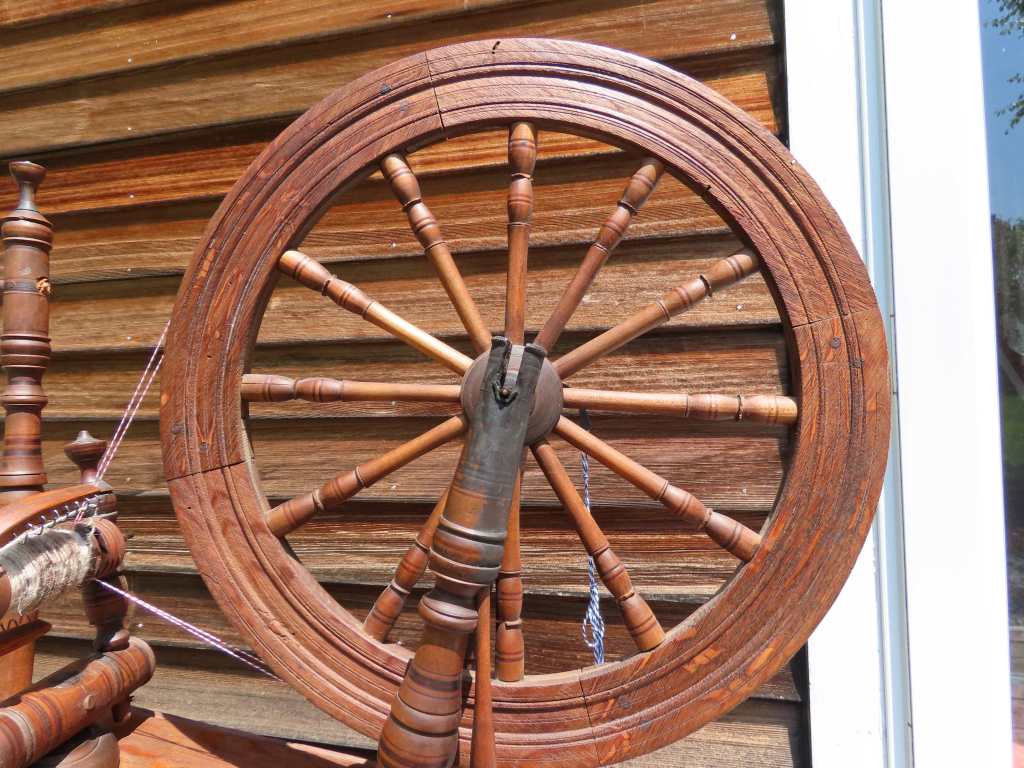
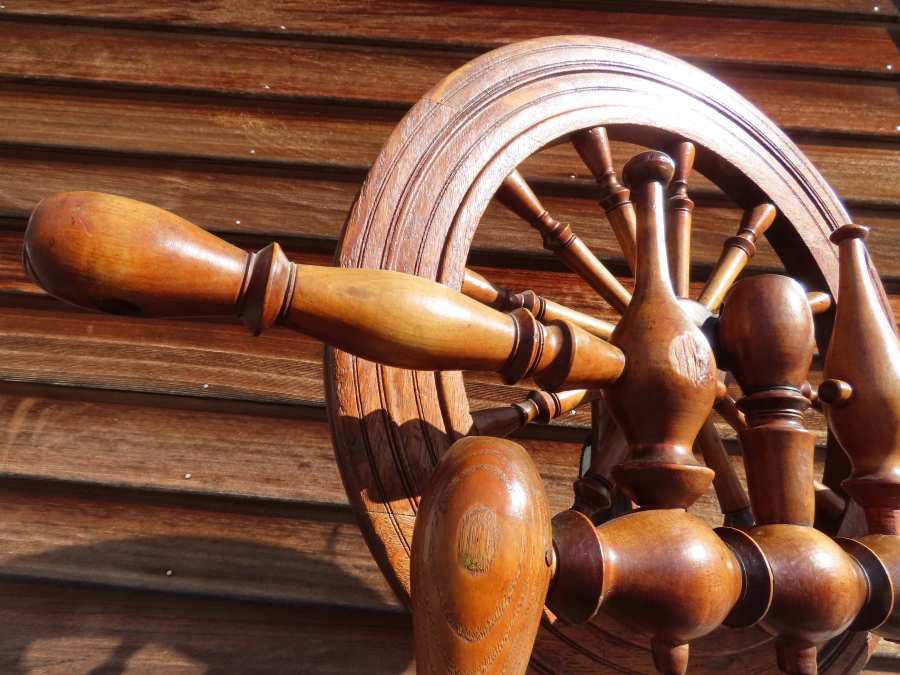
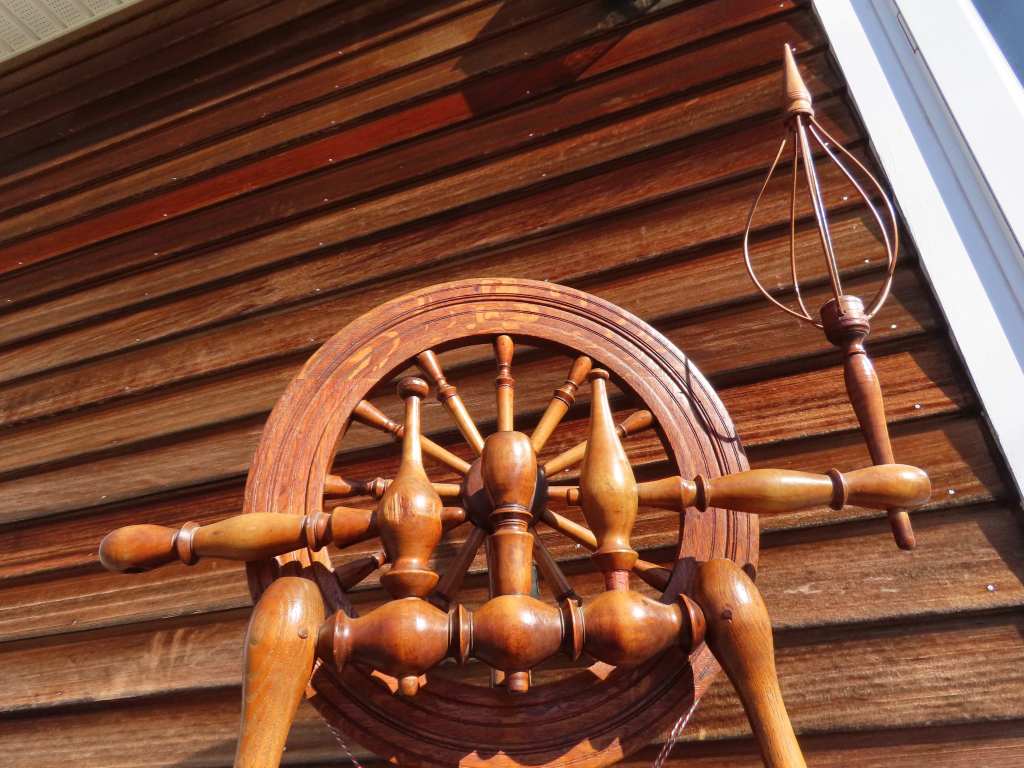
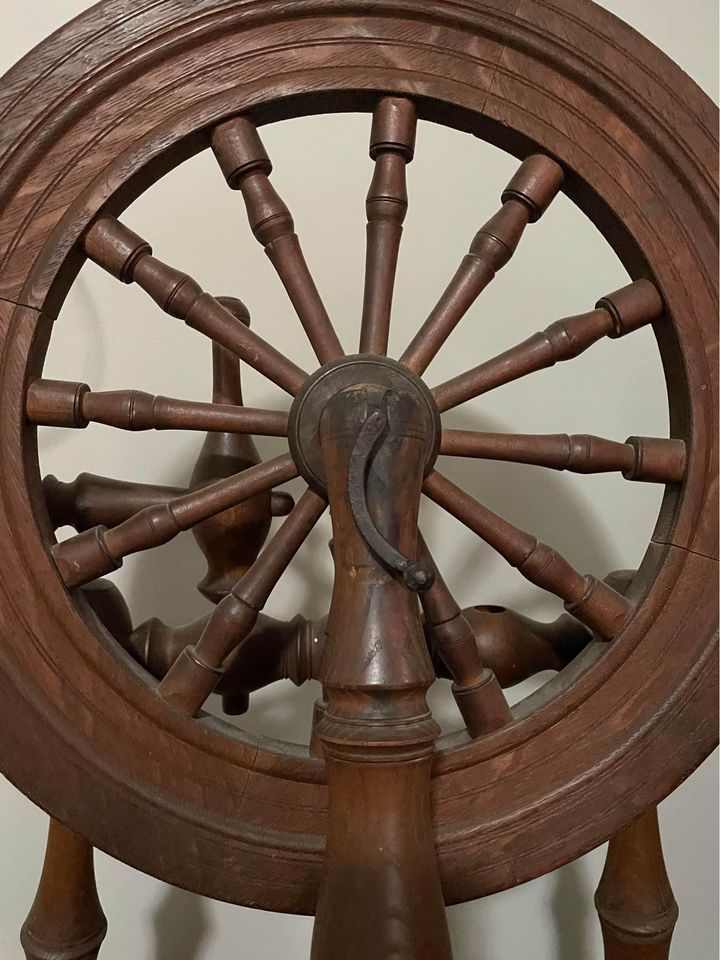
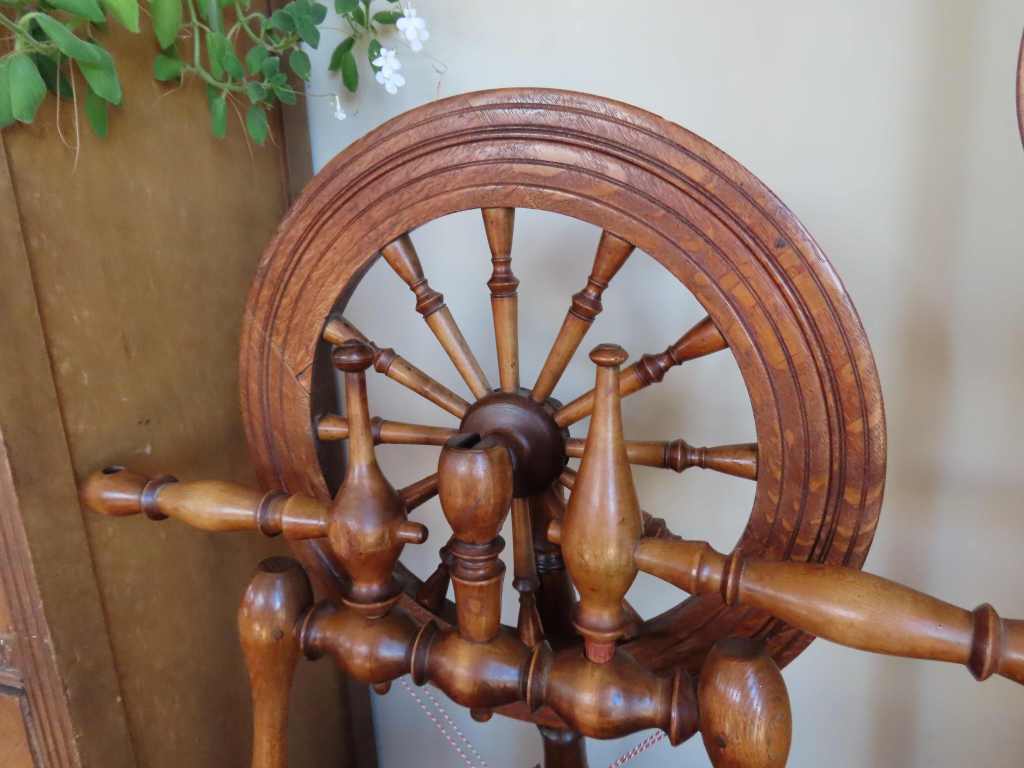
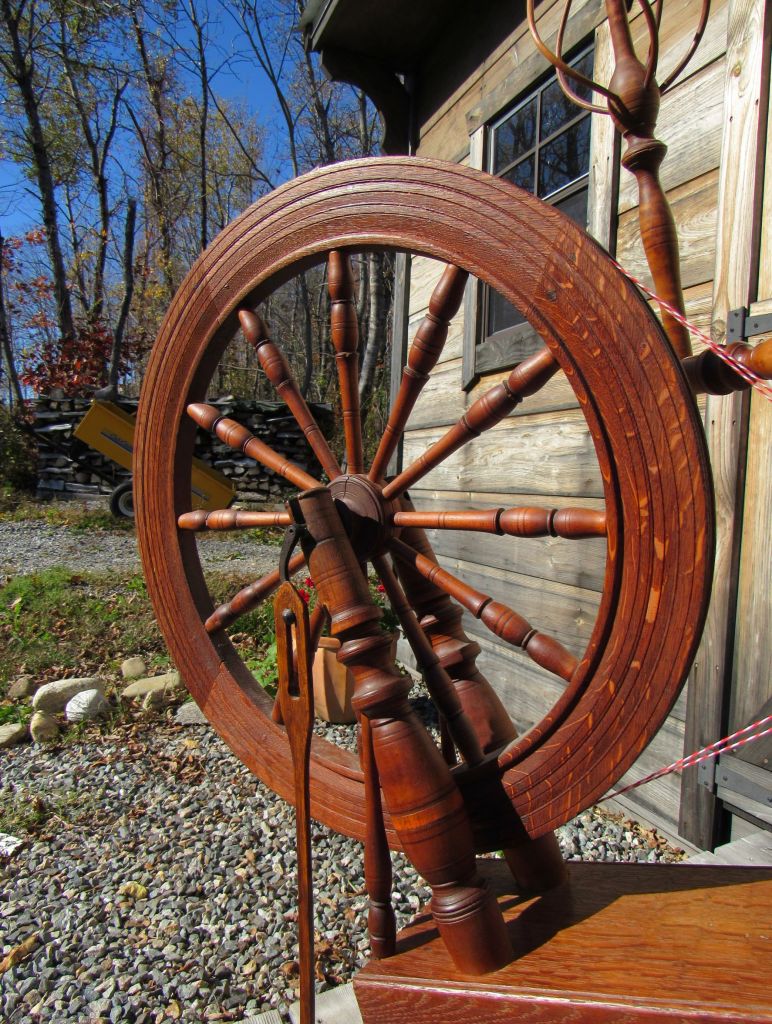
The drive wheel is so similar to Fox’s that, at first, I thought it might be a replacement off of a Fox wheel.
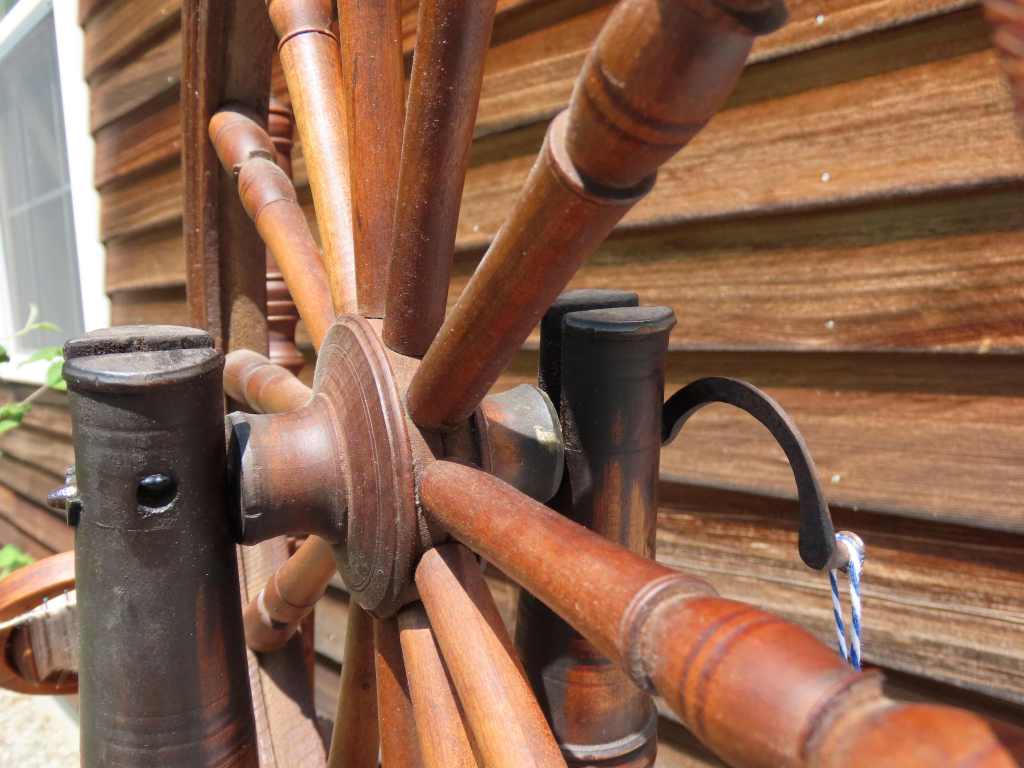
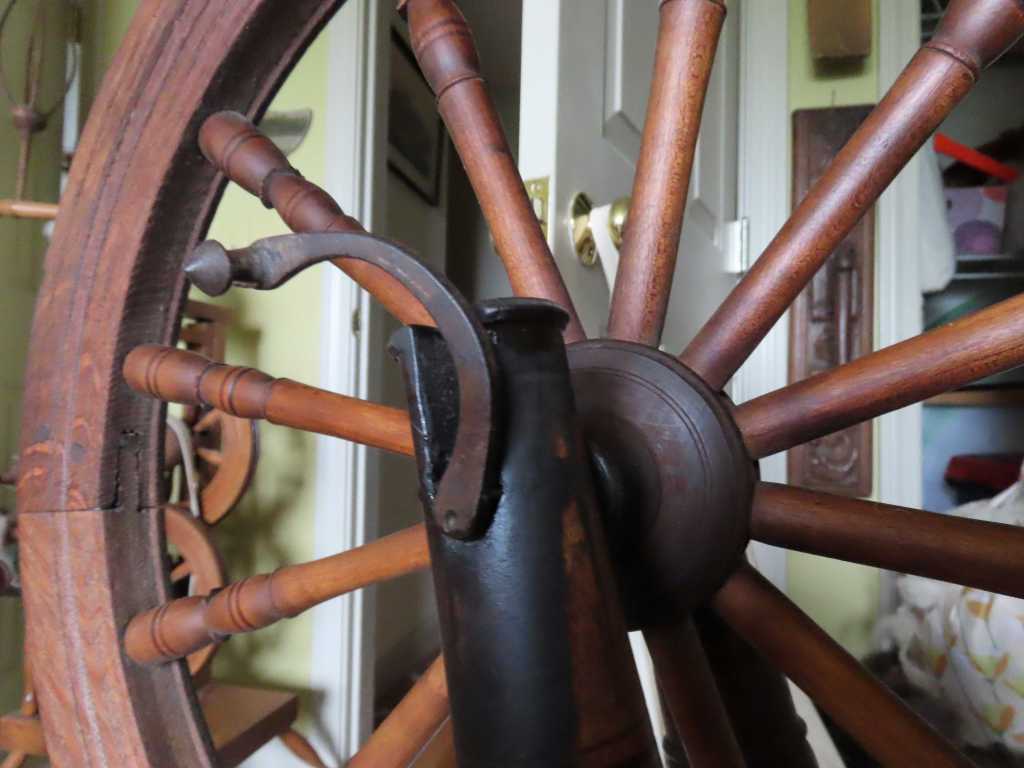
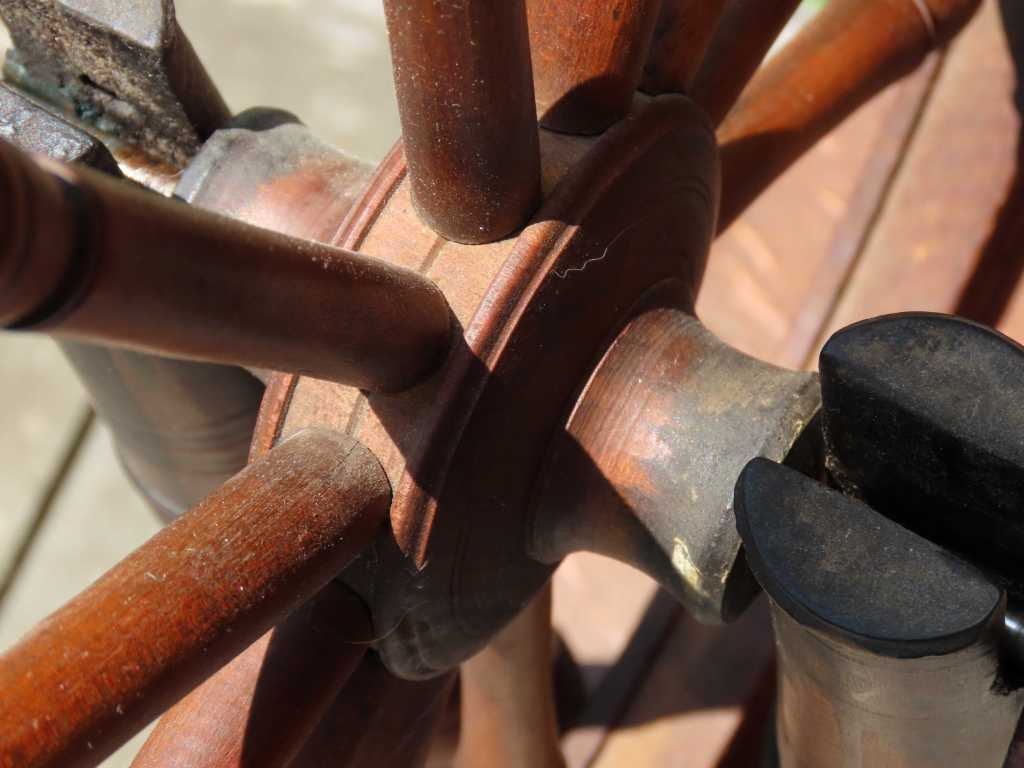
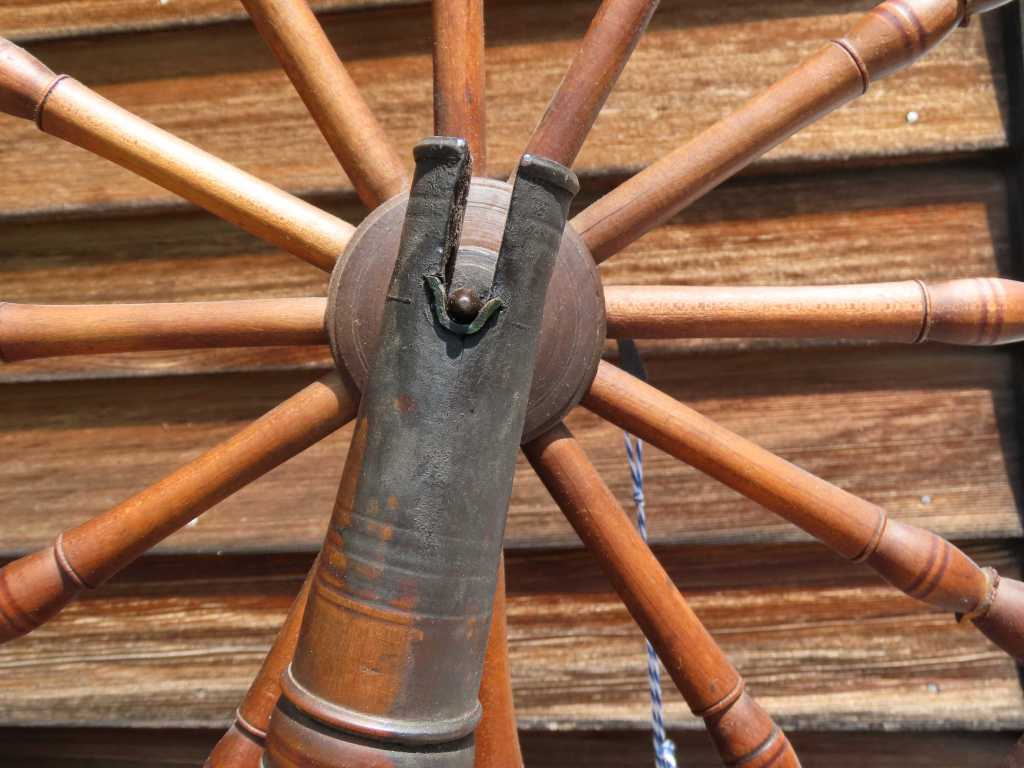
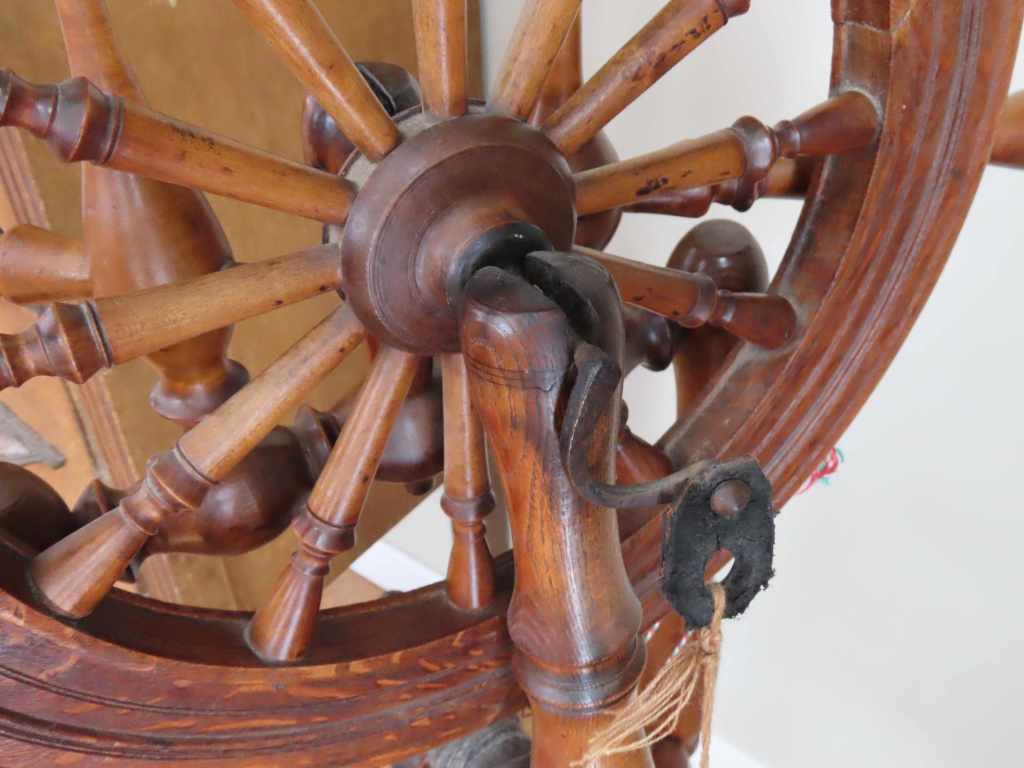
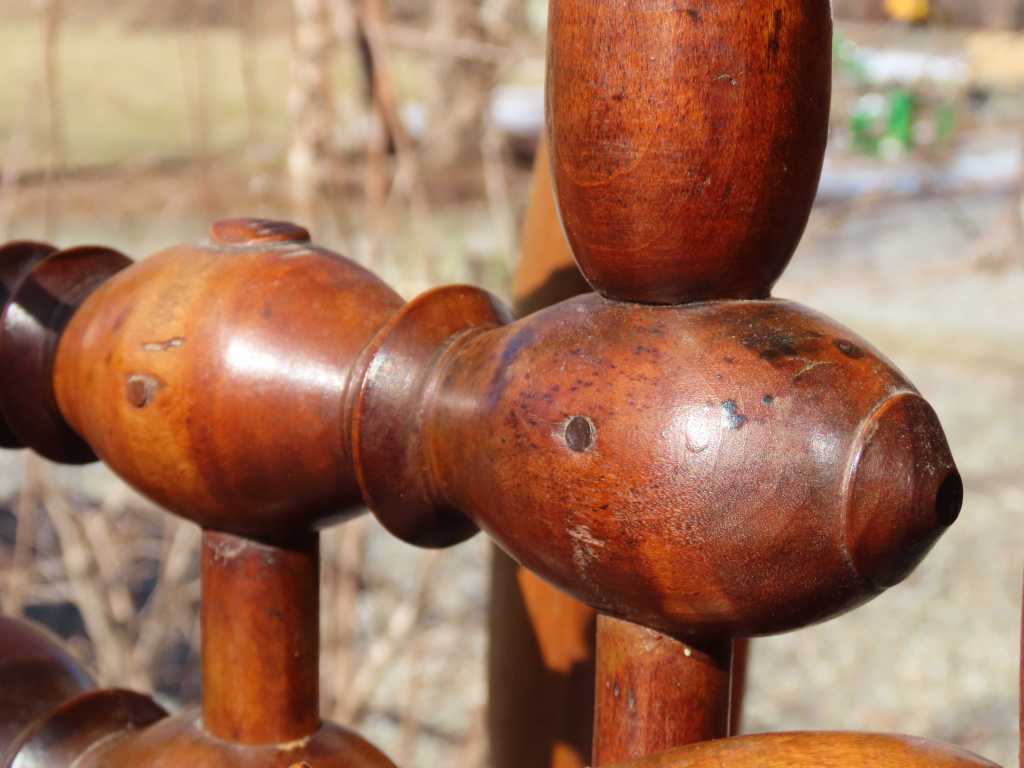
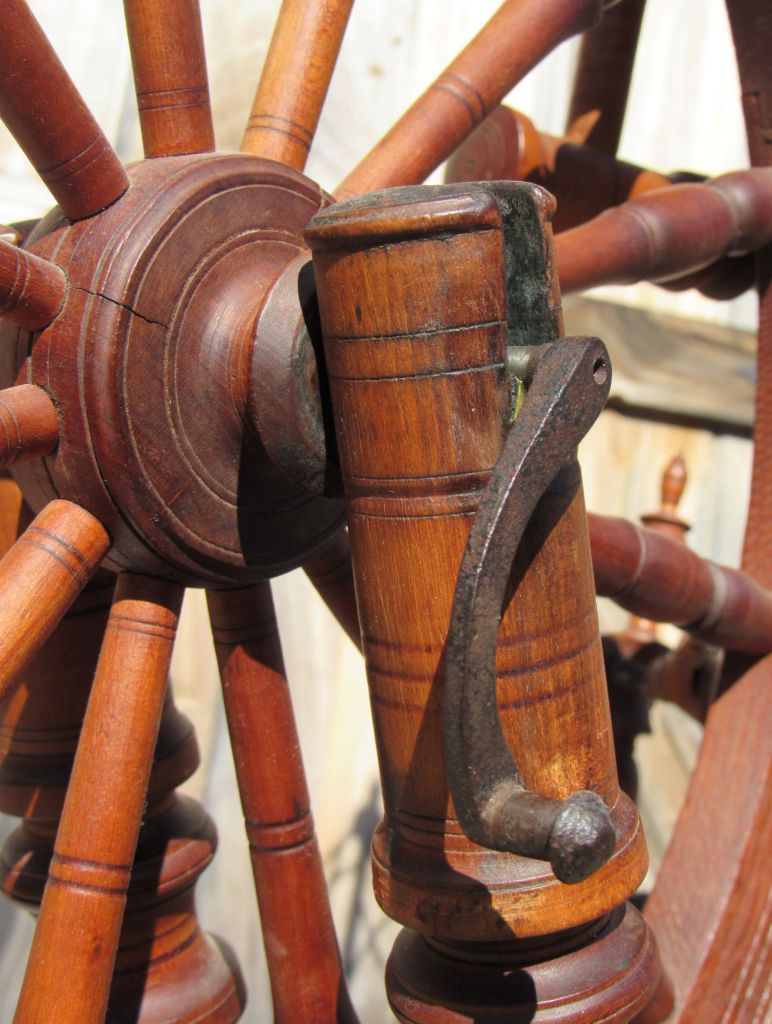
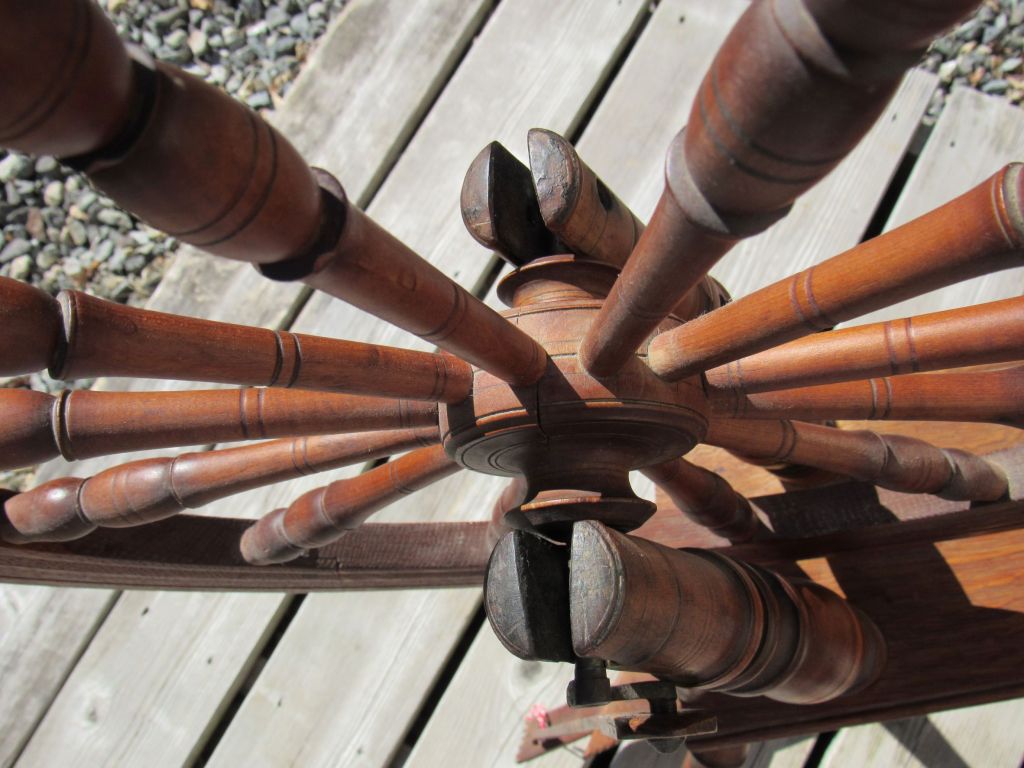
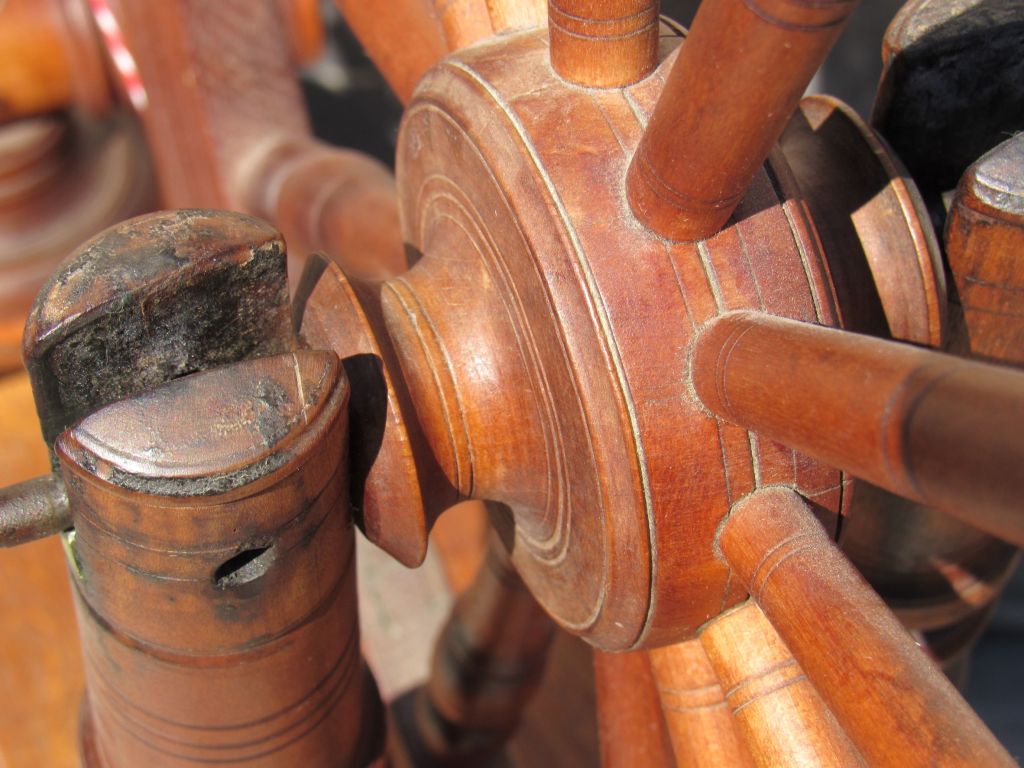
The unusual hub design, with snouts on both sides, is very similar
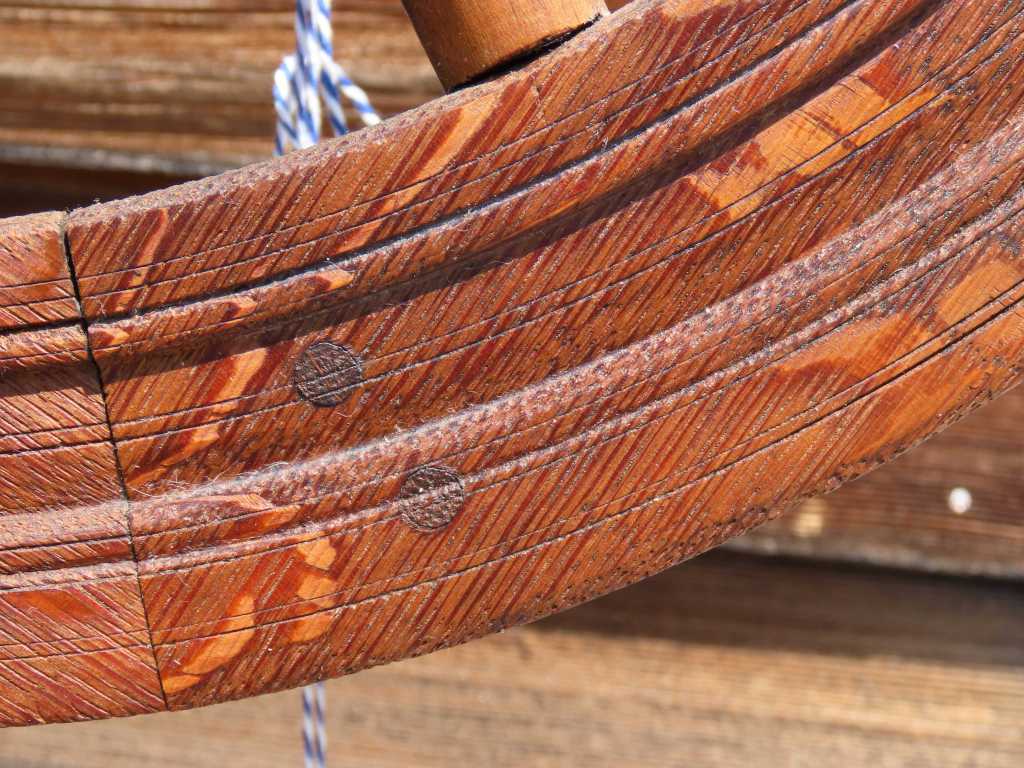
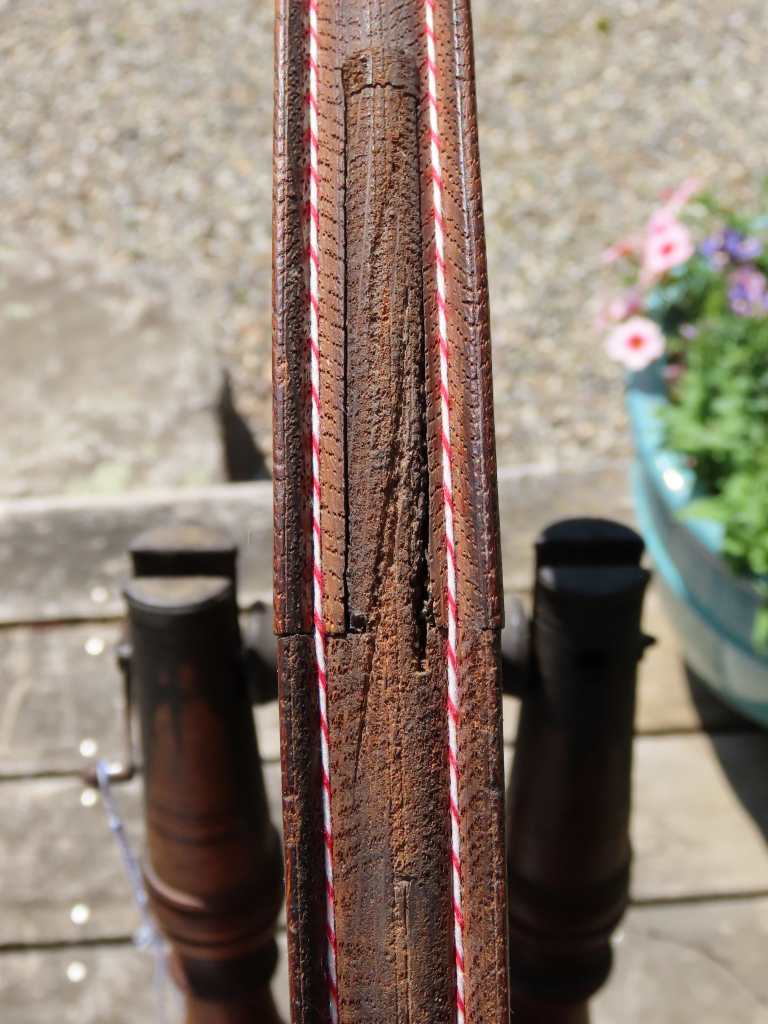
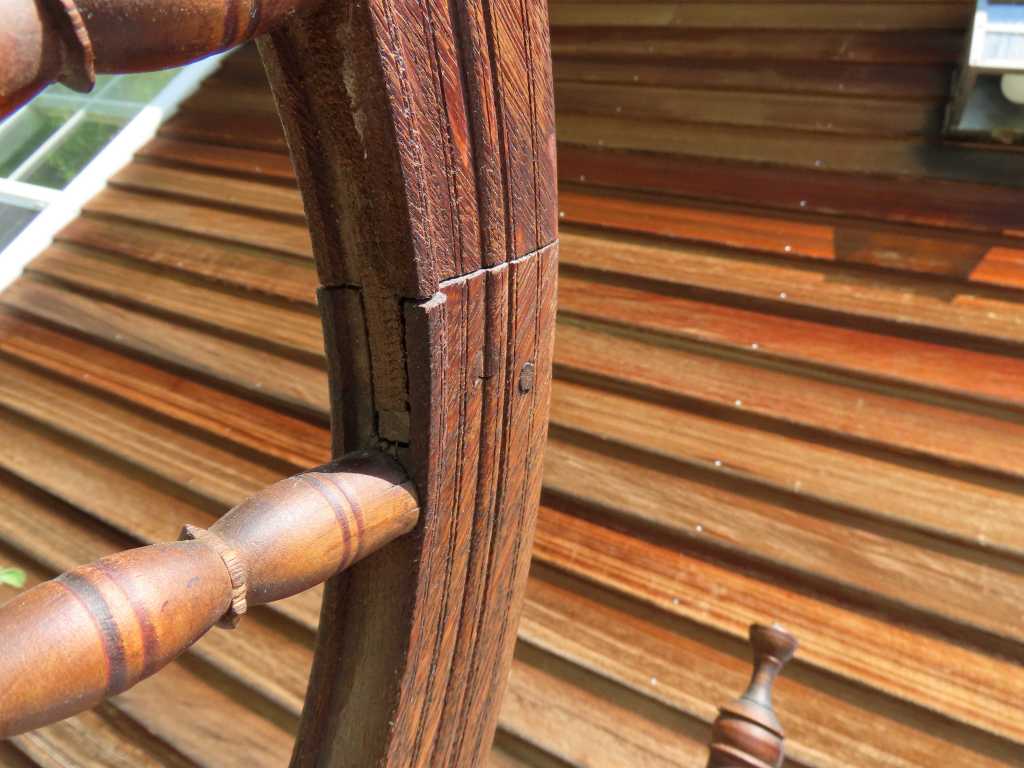
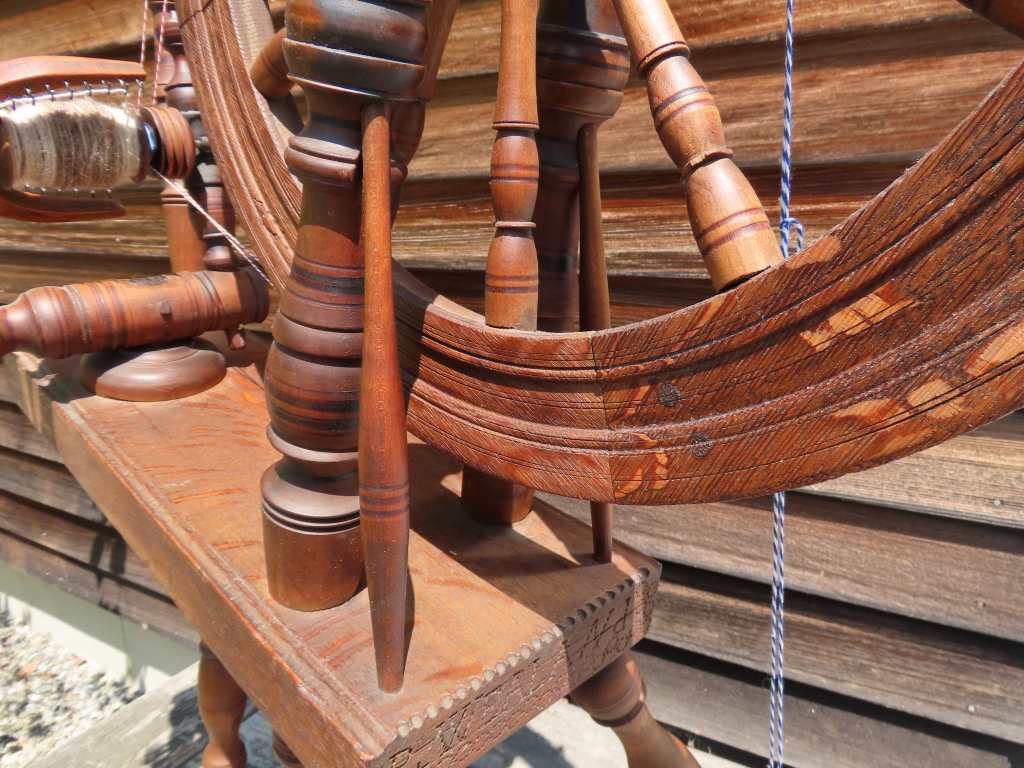
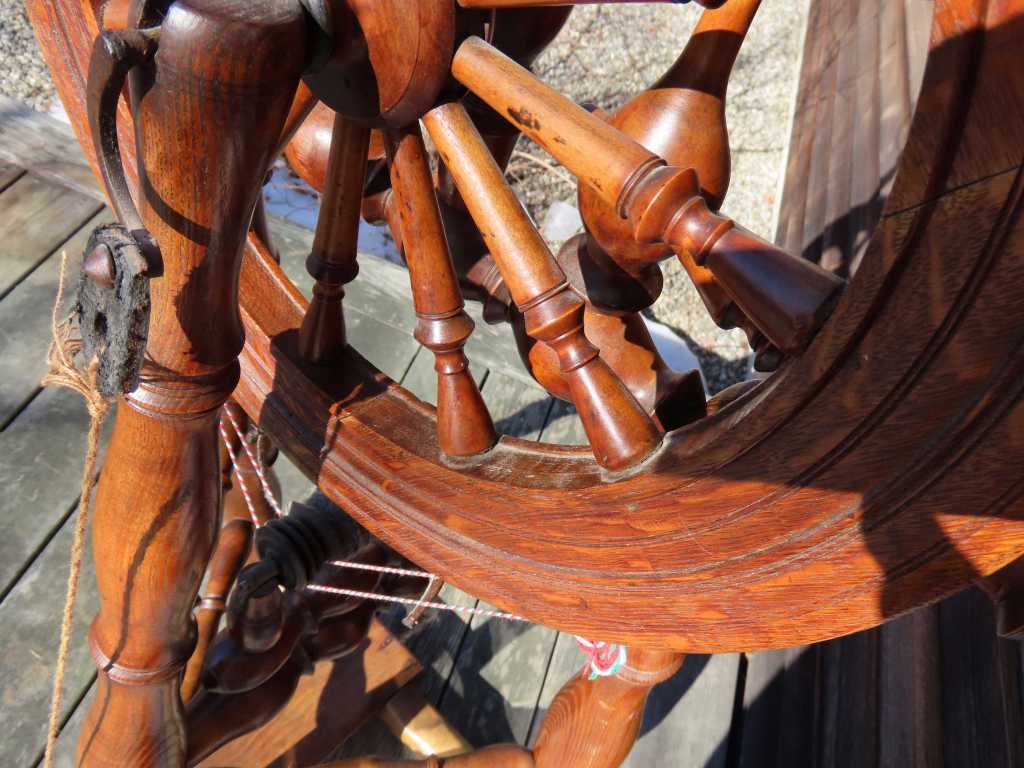
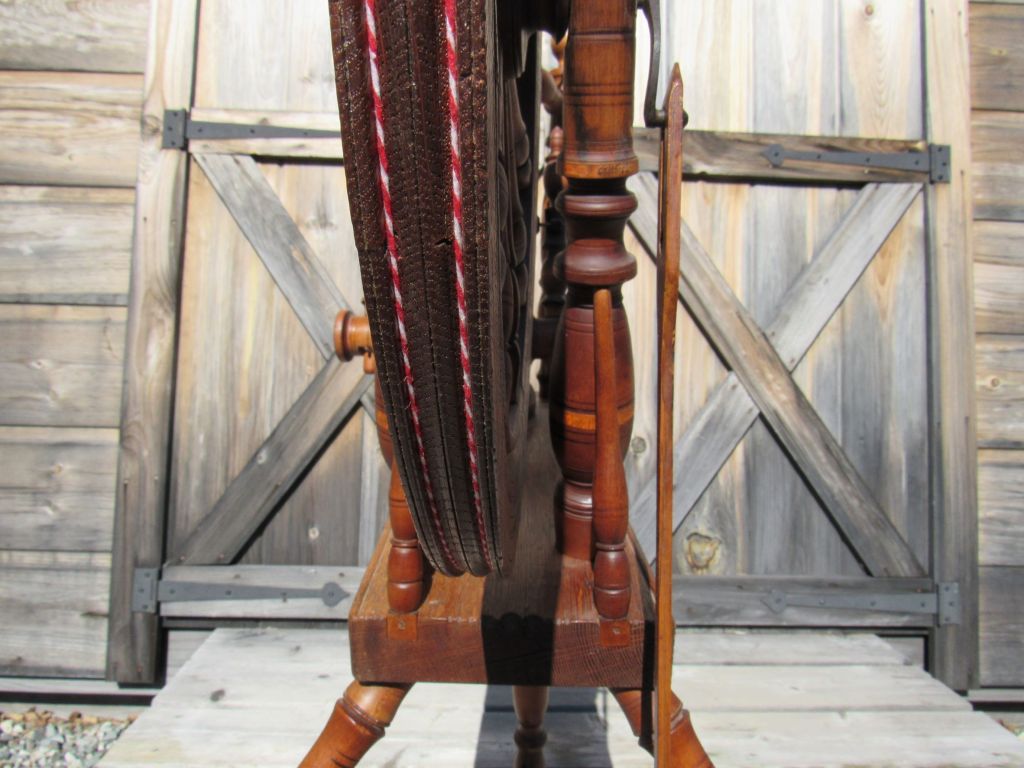
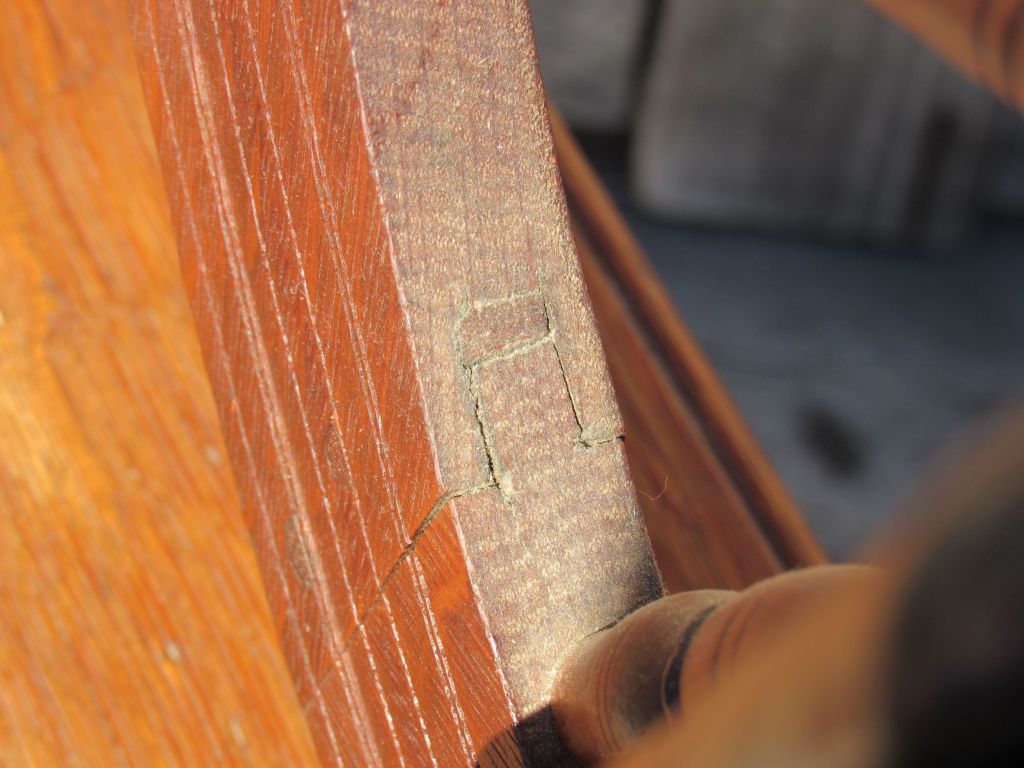
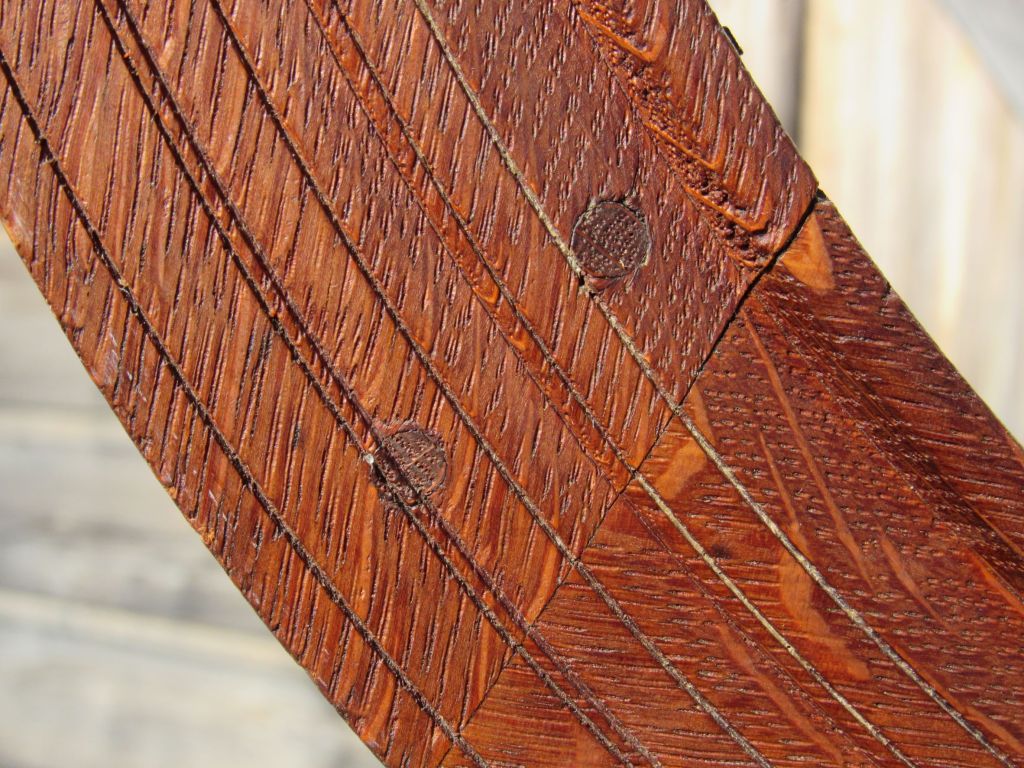
and, like Fox wheels, the rim is built radially in four equal parts and double pegged at the joints.
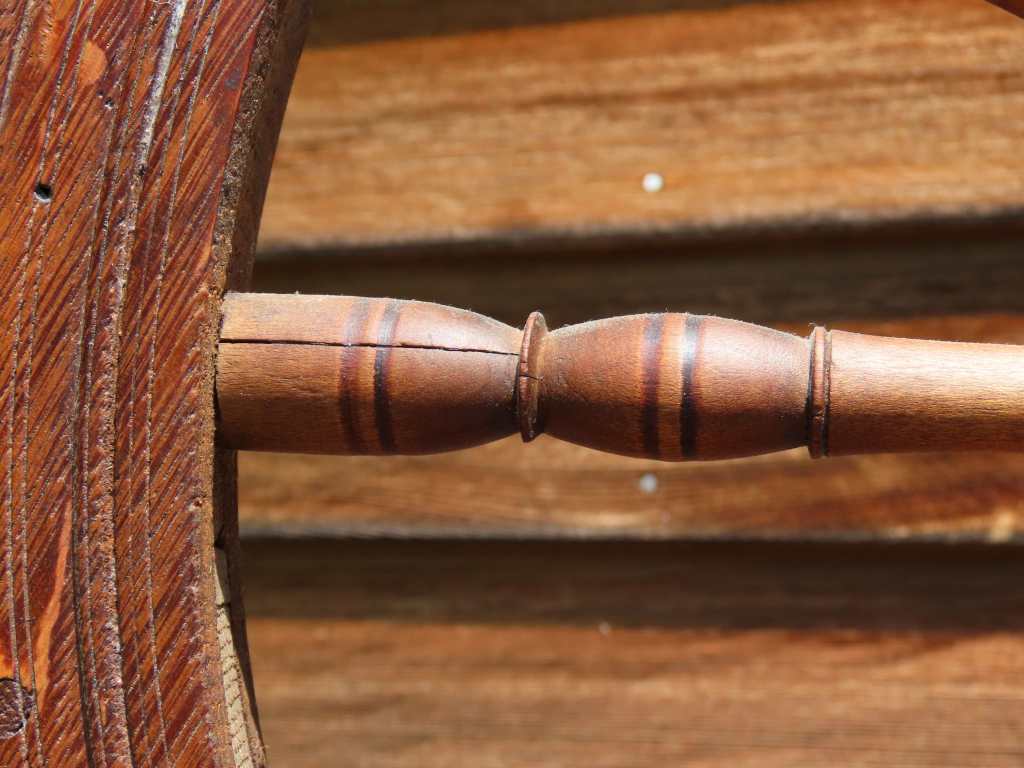
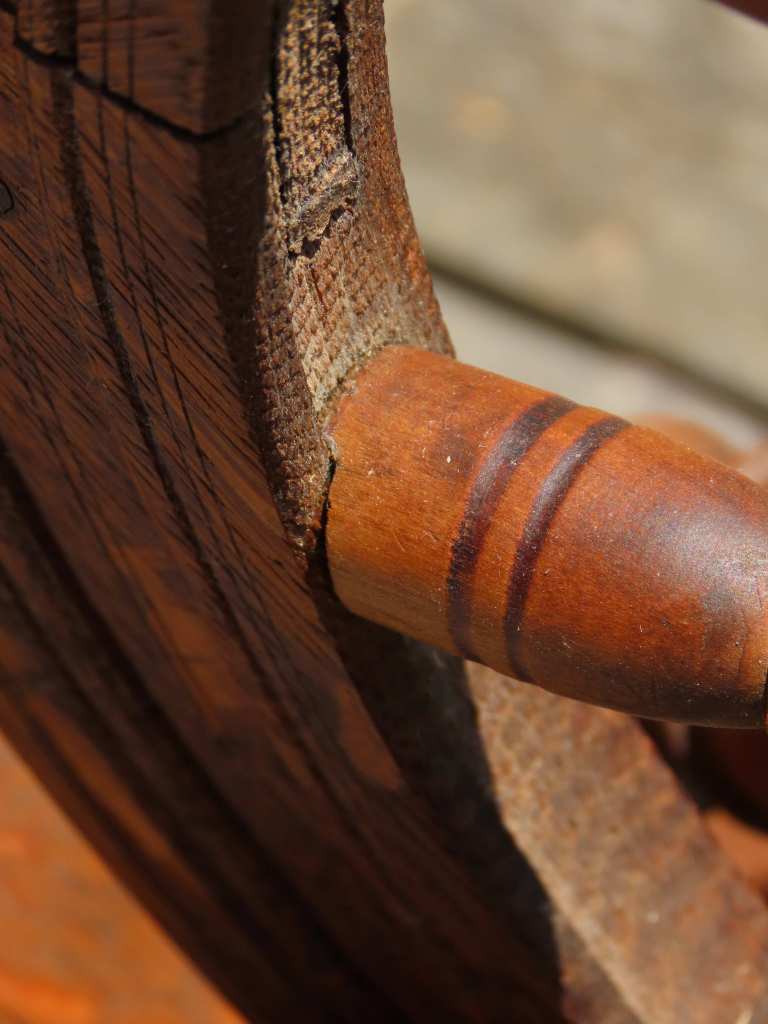
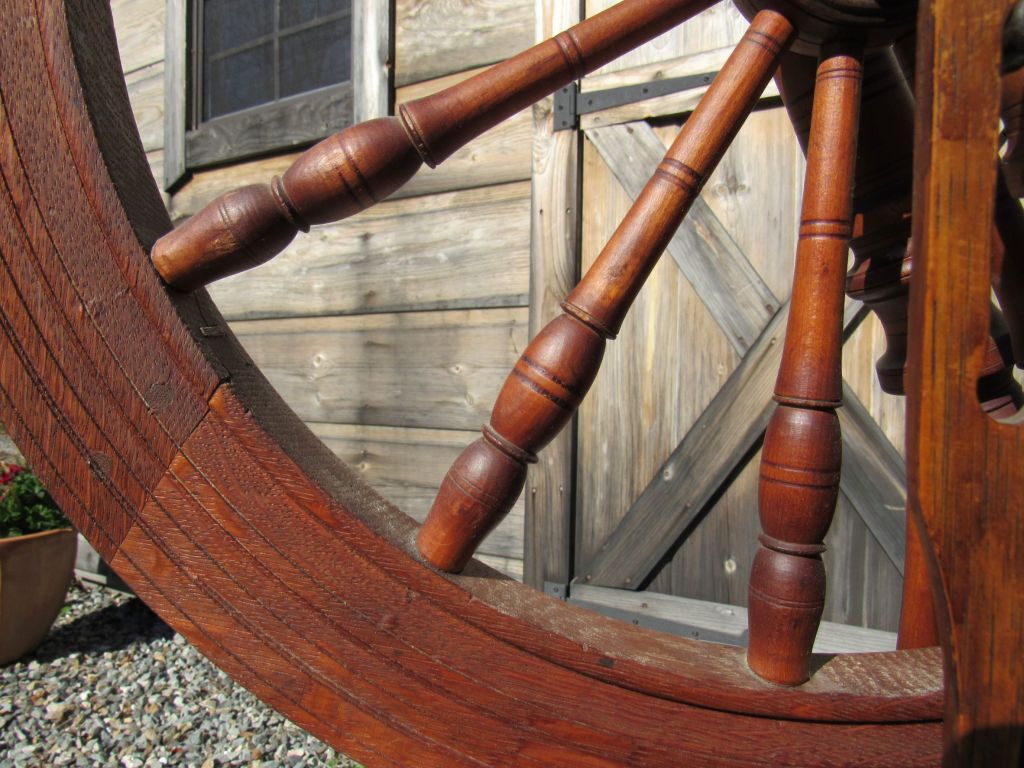
The spokes are much the same.
But there are differences in construction,
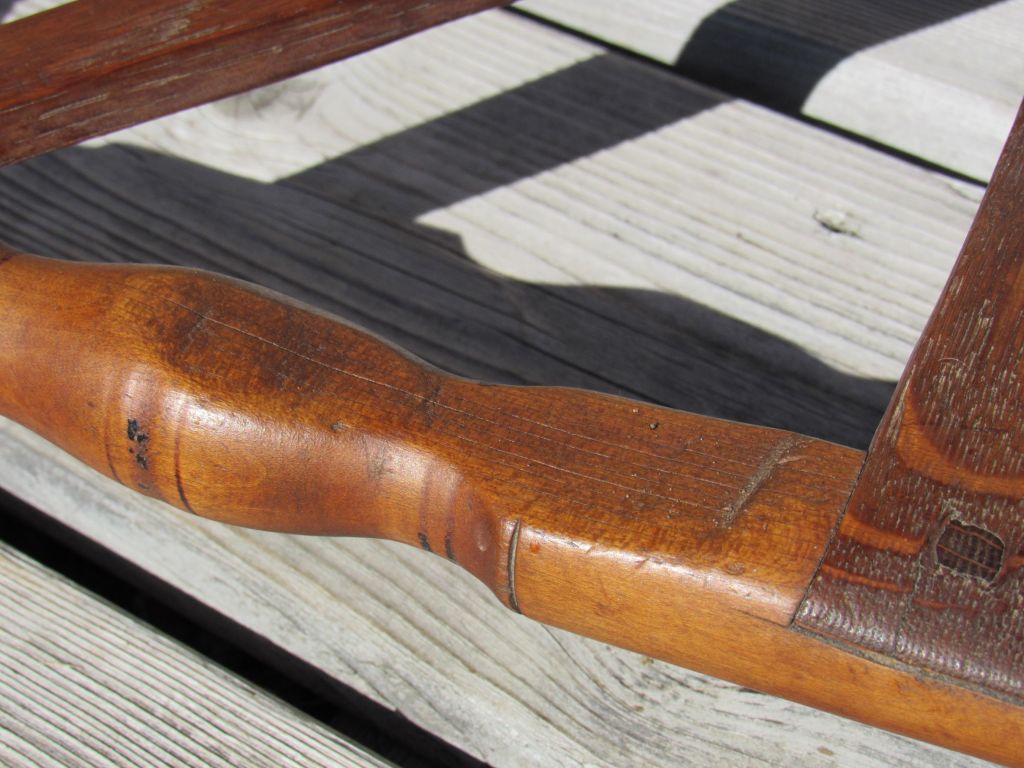
turnings, decoration,
and the axle is more curved than the axle on my Fox wheel.
Also, the wood, aging, fit, grease stains, and overall look just seem to indicate that it is original to this wheel. Nevertheless, that there is some Fox influence seems pretty apparent.
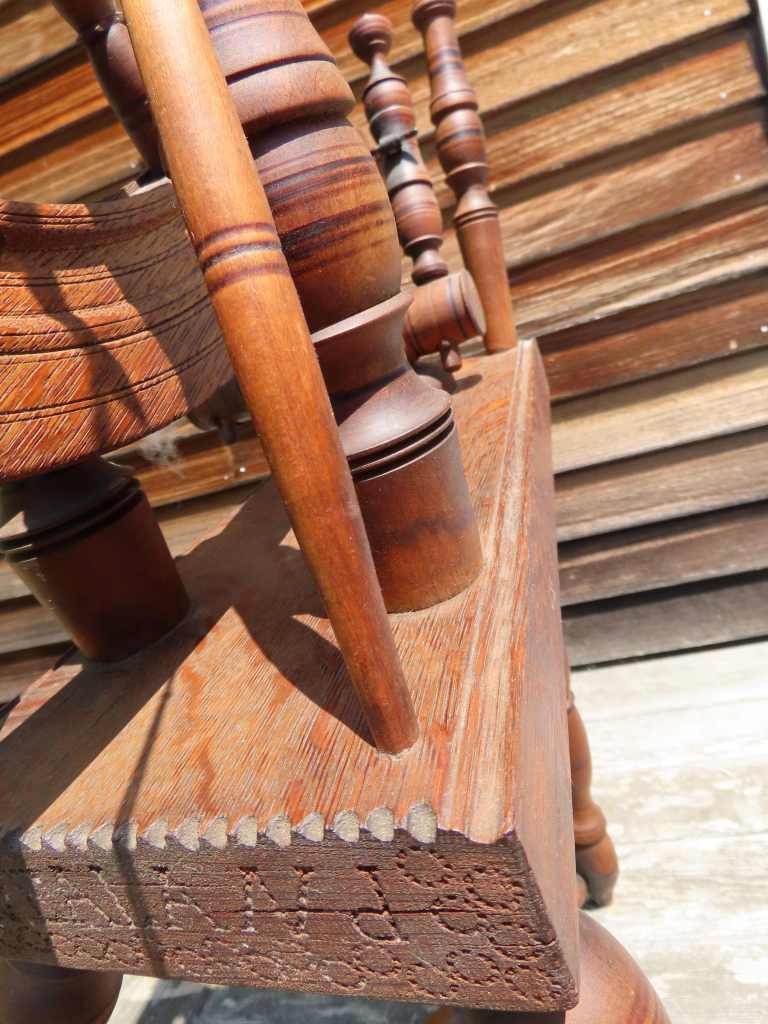
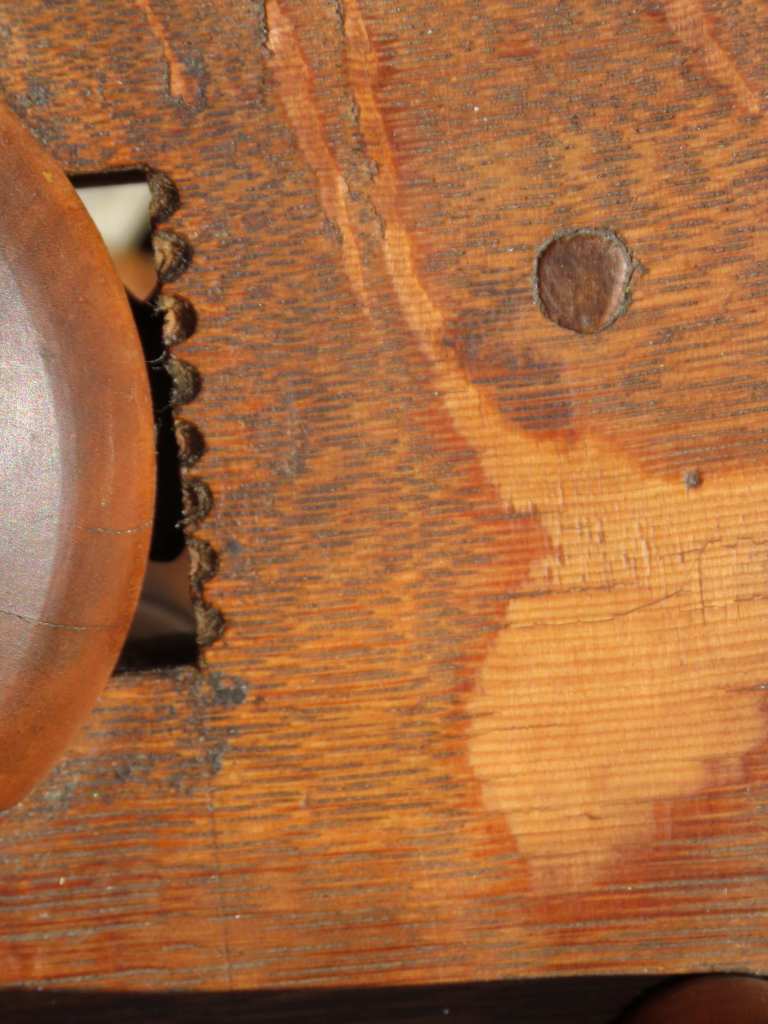
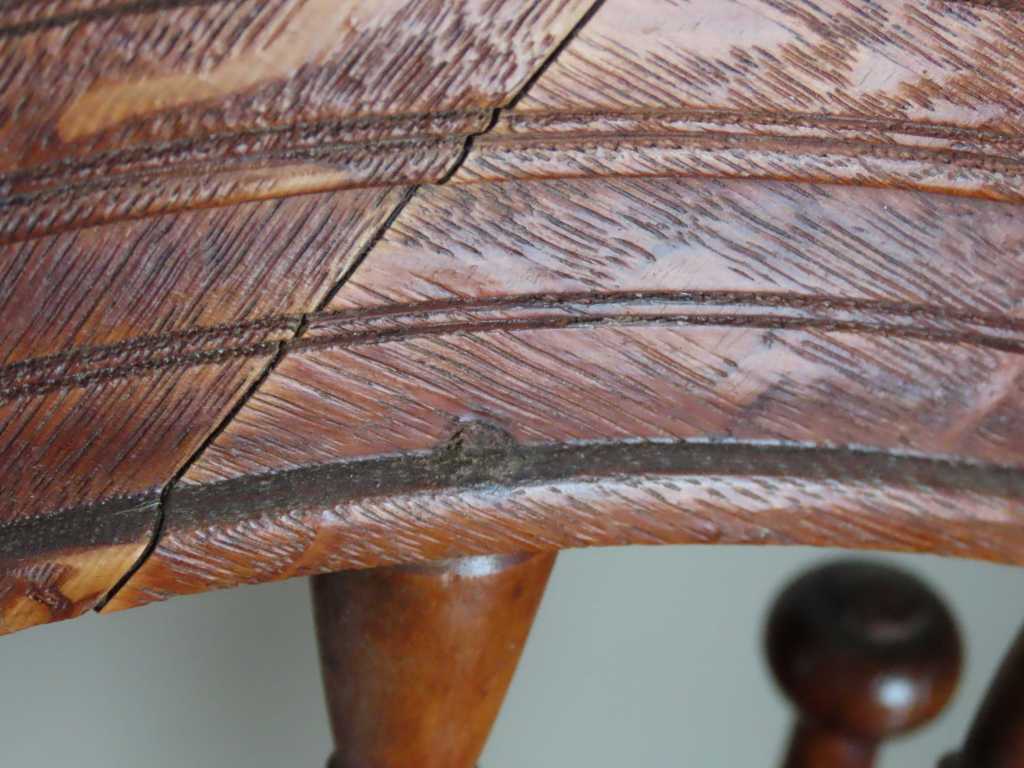
On the other hand, the style of maker’s mark differs from Fox. Here, the initials and a date were picked with a sharp tool, likely an awl, into the table’s end grain rather than stamped. This style mark is similar to Abraham Overholt’s (from Bucks County) and William Major’s (from Chester County). (P & T at 124-25)
Also similar to Overholt and Major, this wheel has decorative stamping along with the P. Wealand name. (I did research to see whether Major had a wheel making brother with an “I” or “J” first name, but came up empty-handed.)
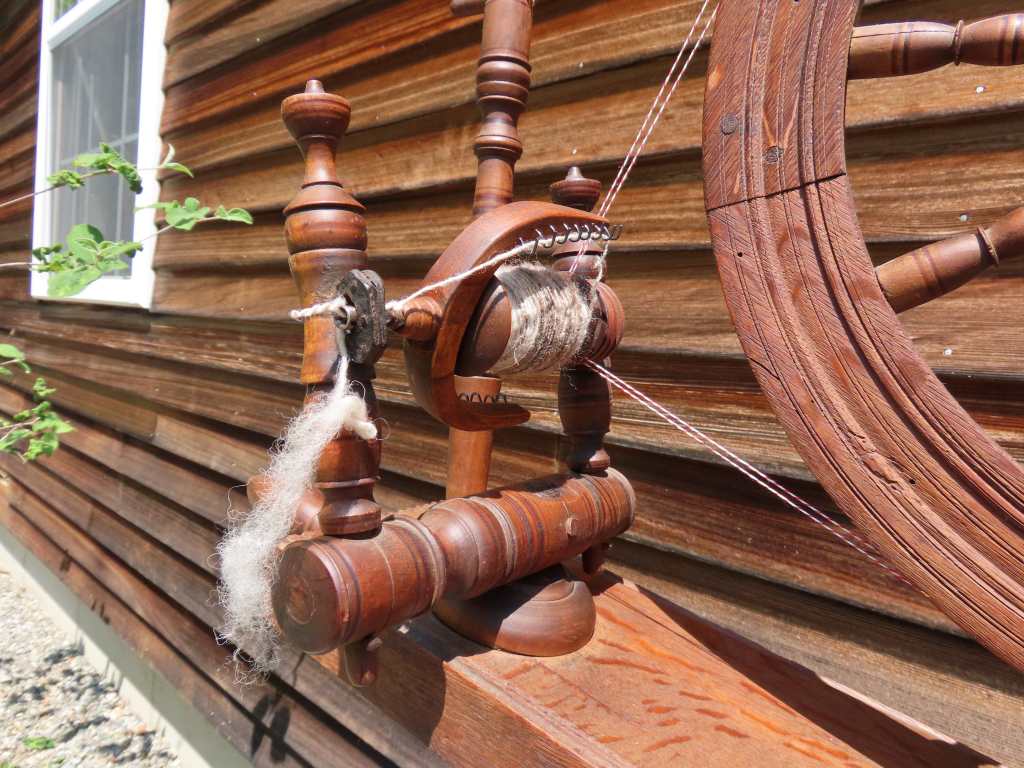
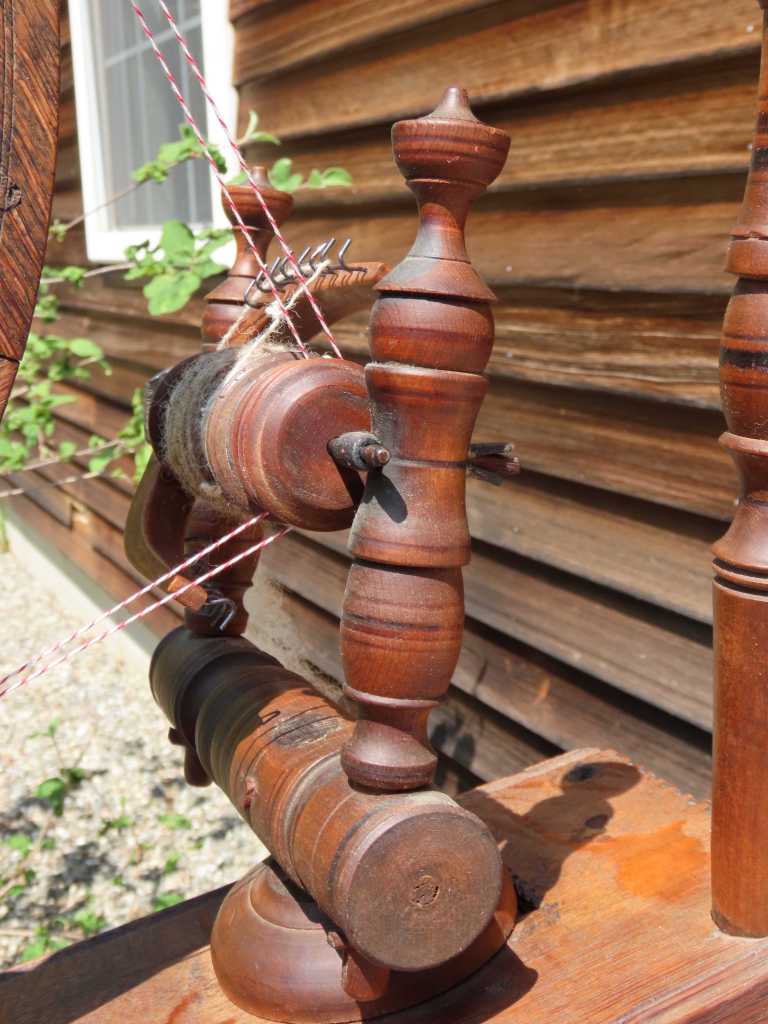
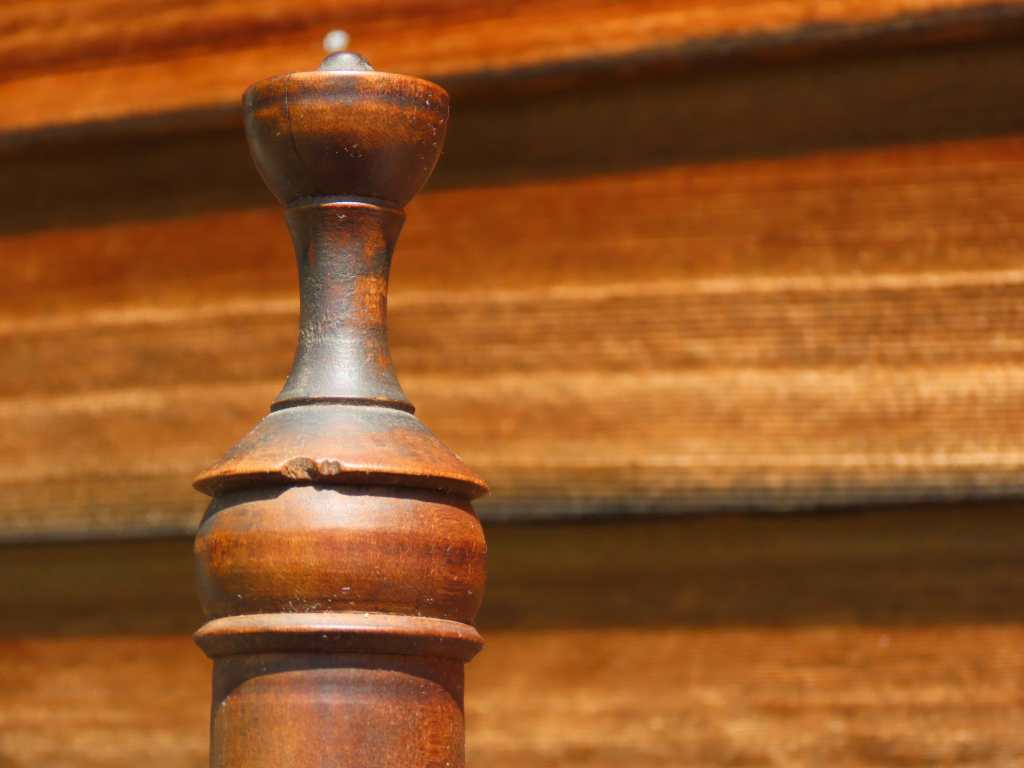
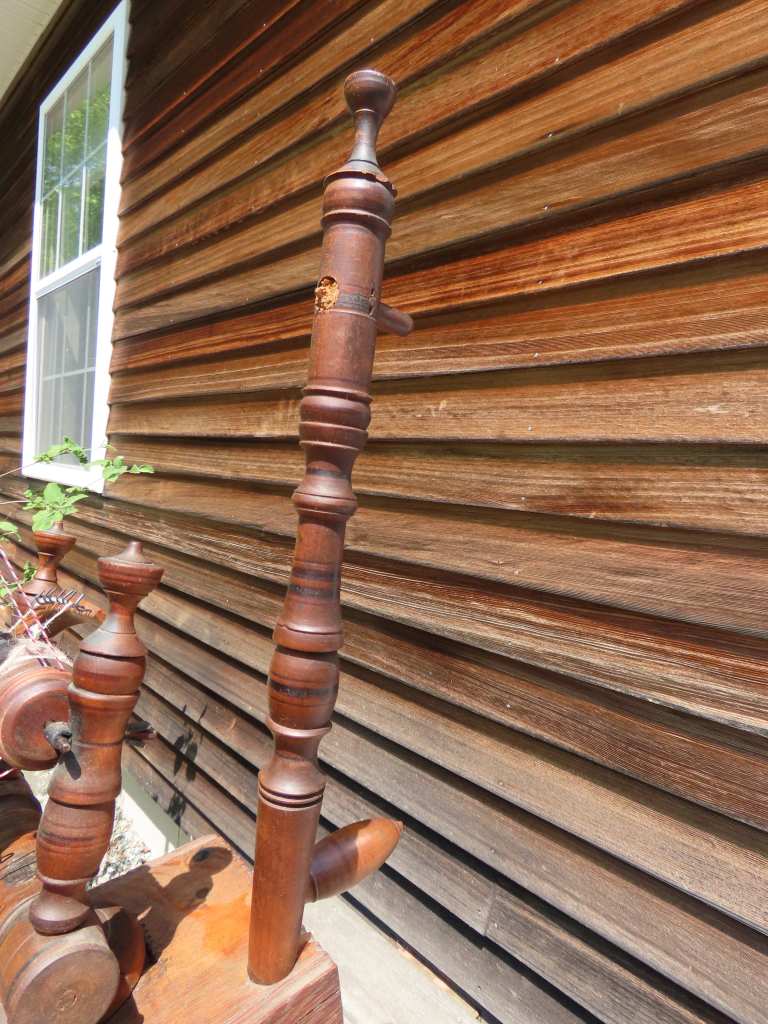
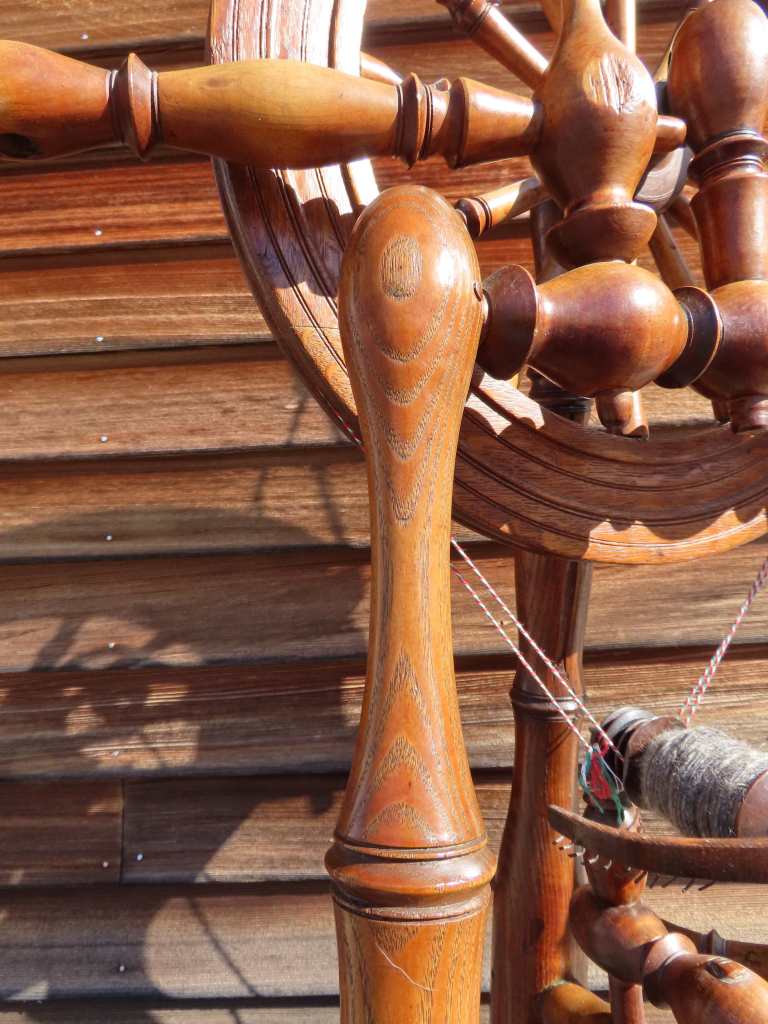
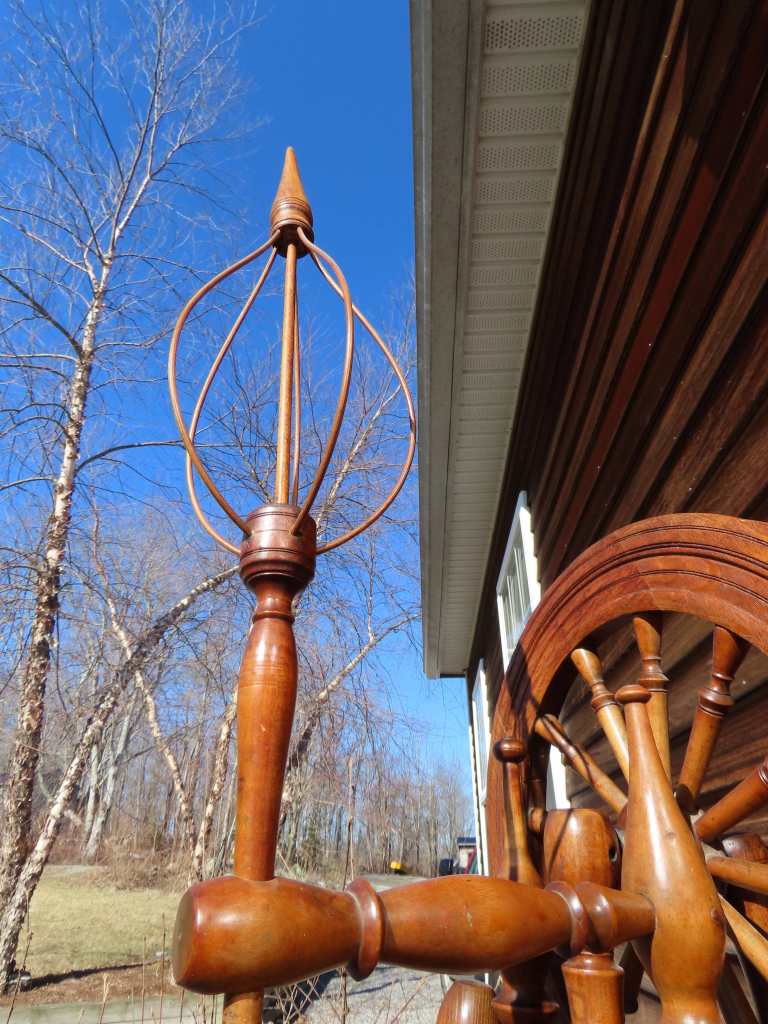
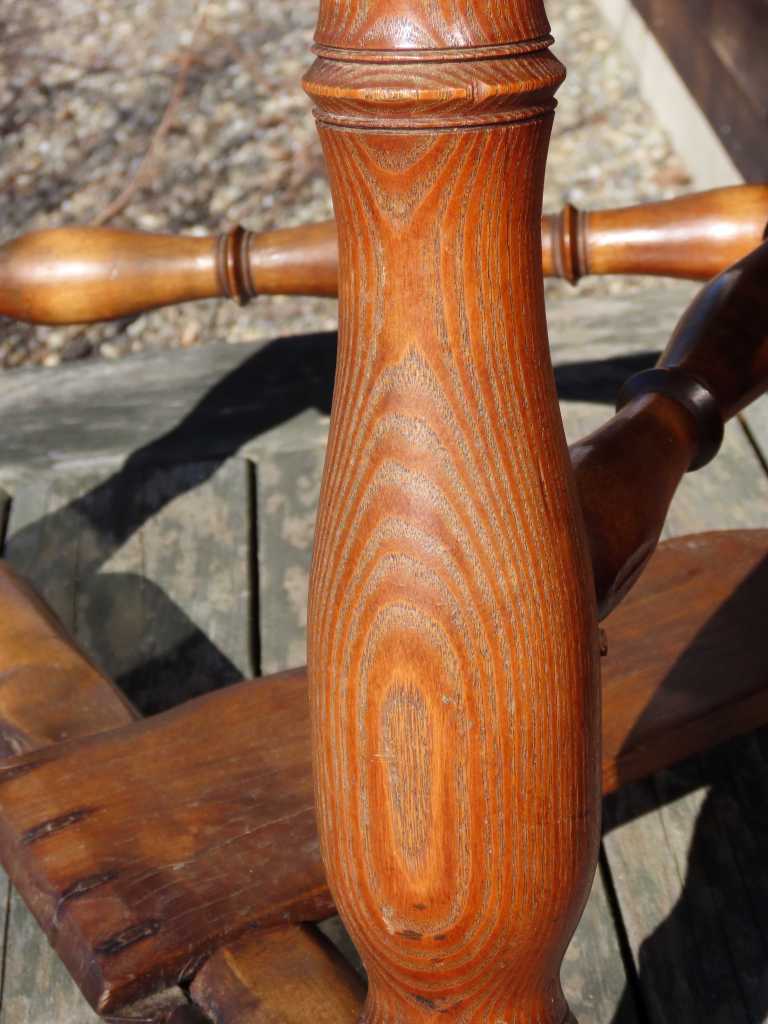
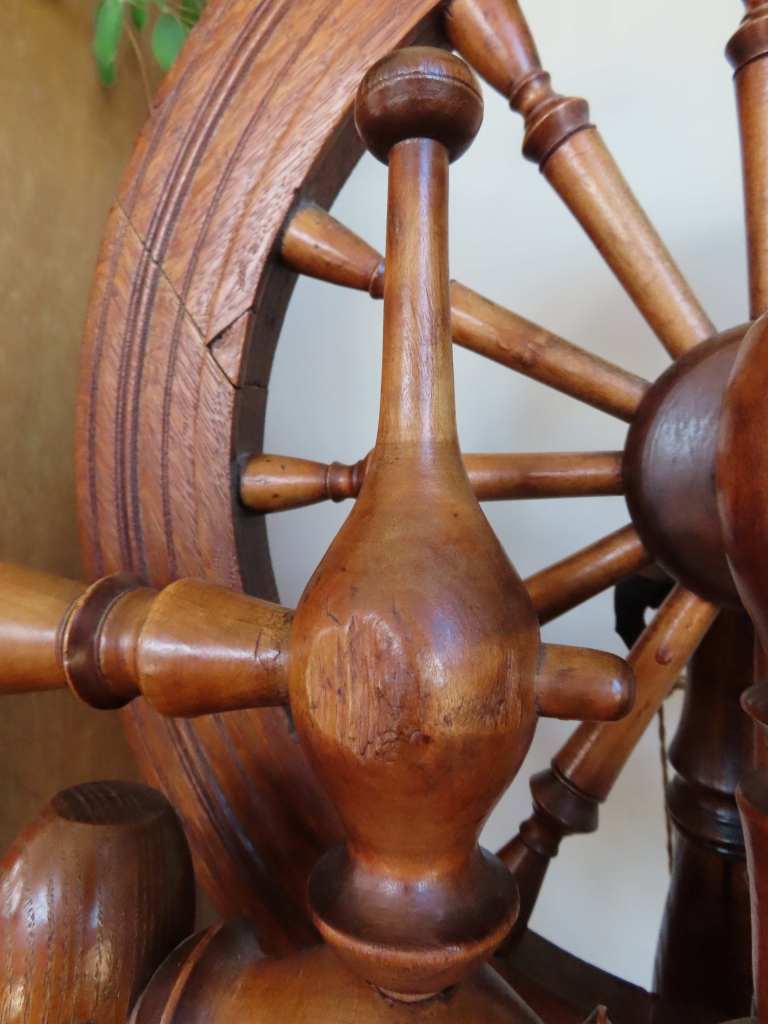
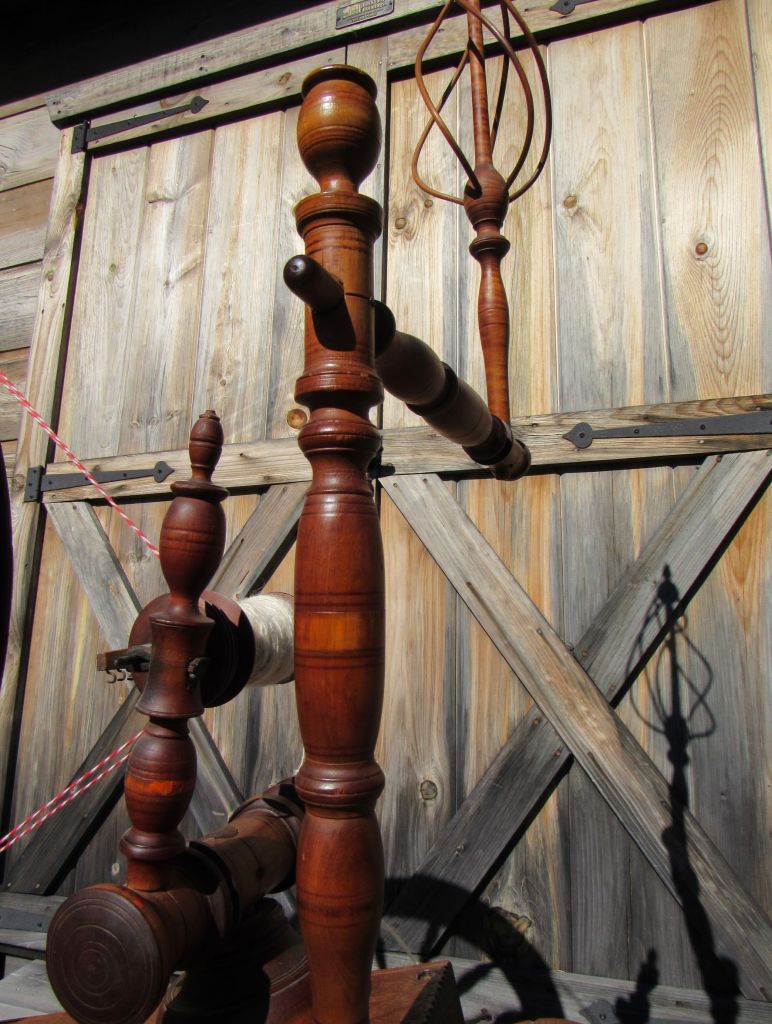
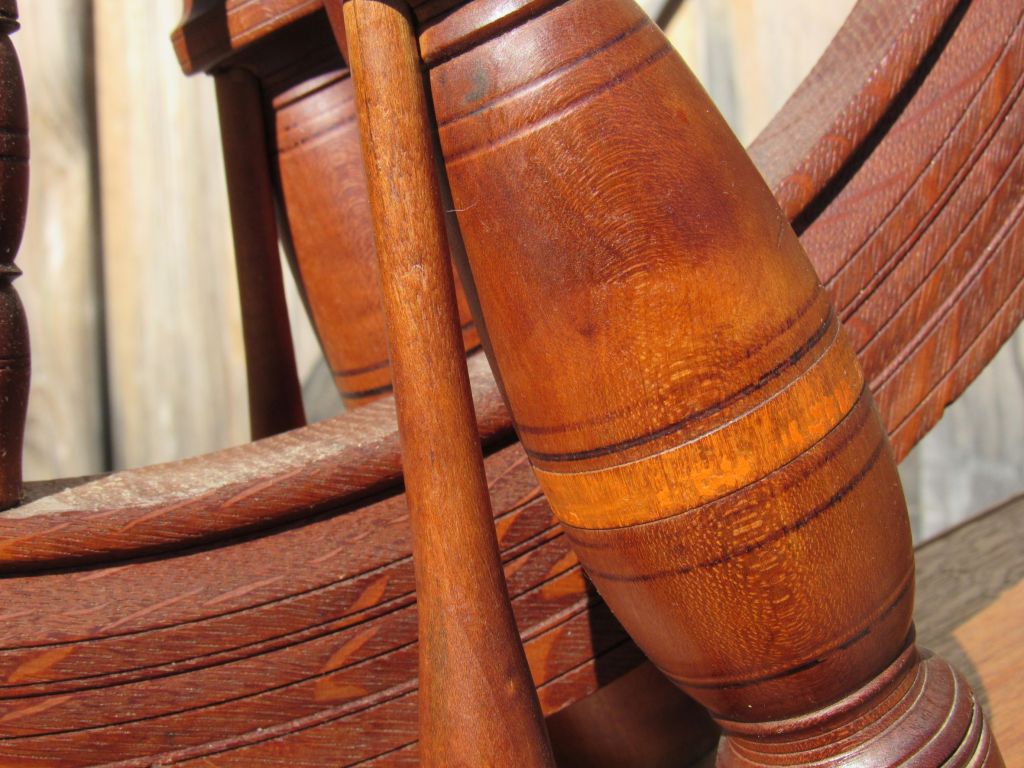
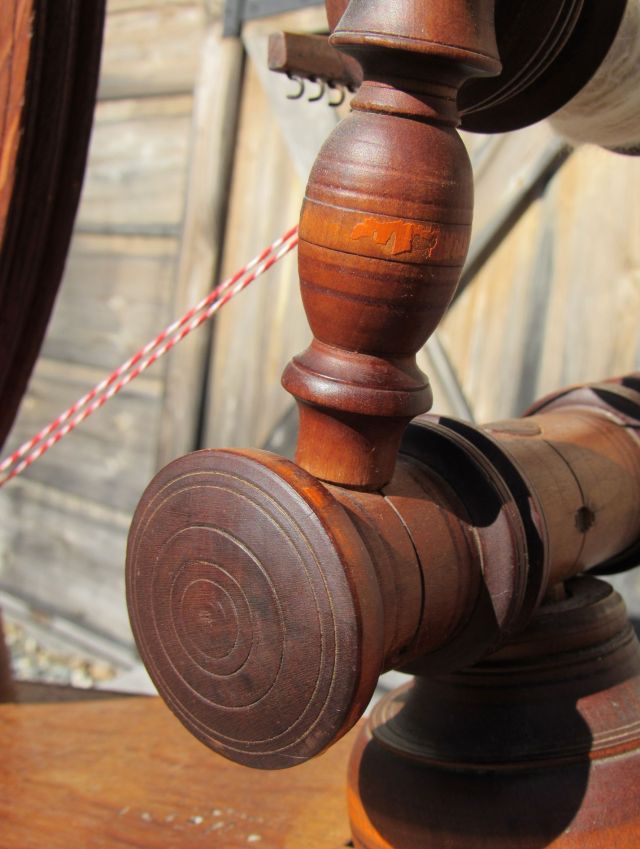
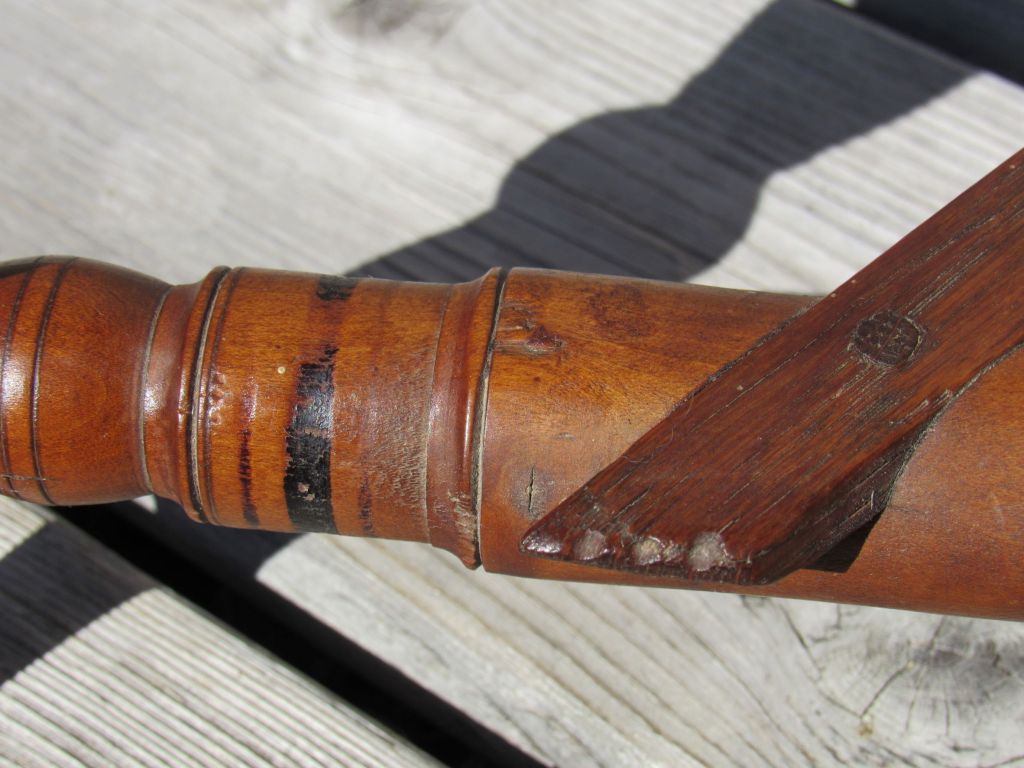
The turnings on the spokes and the flat-topped finials on the maidens and distaff
are also similar to Overholt’s wheels and to a group of other Bucks County makers, including D. Reiner, S. Reiner, I. Sellers, and I. Homsher. (P&T at 124-25).
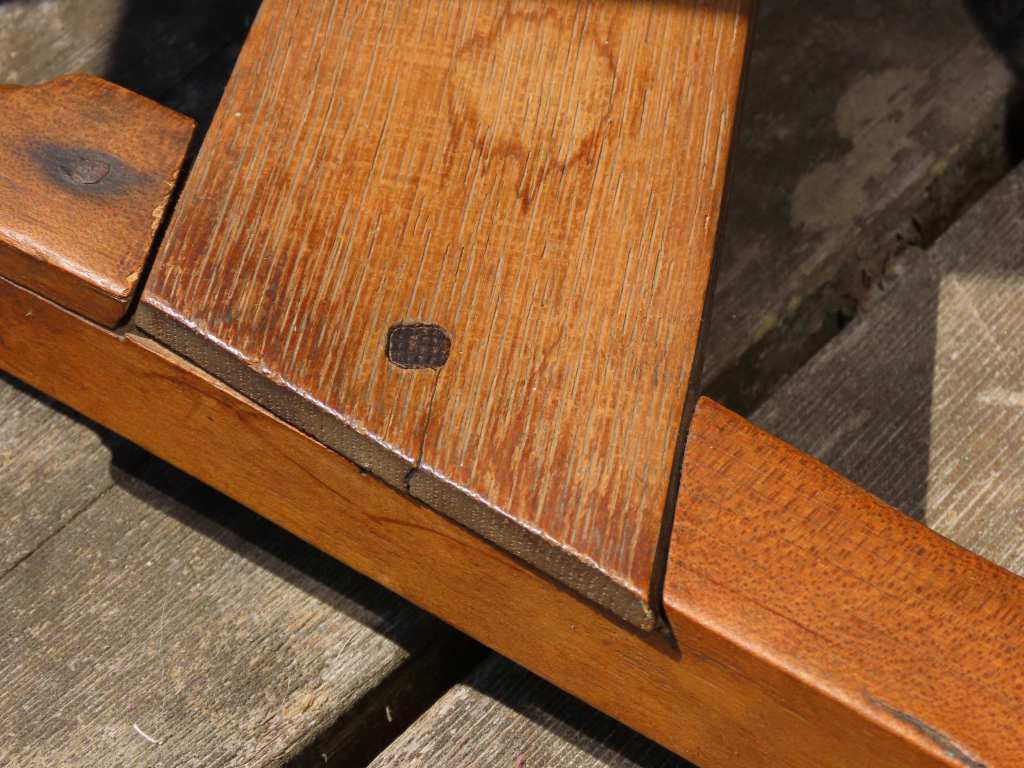
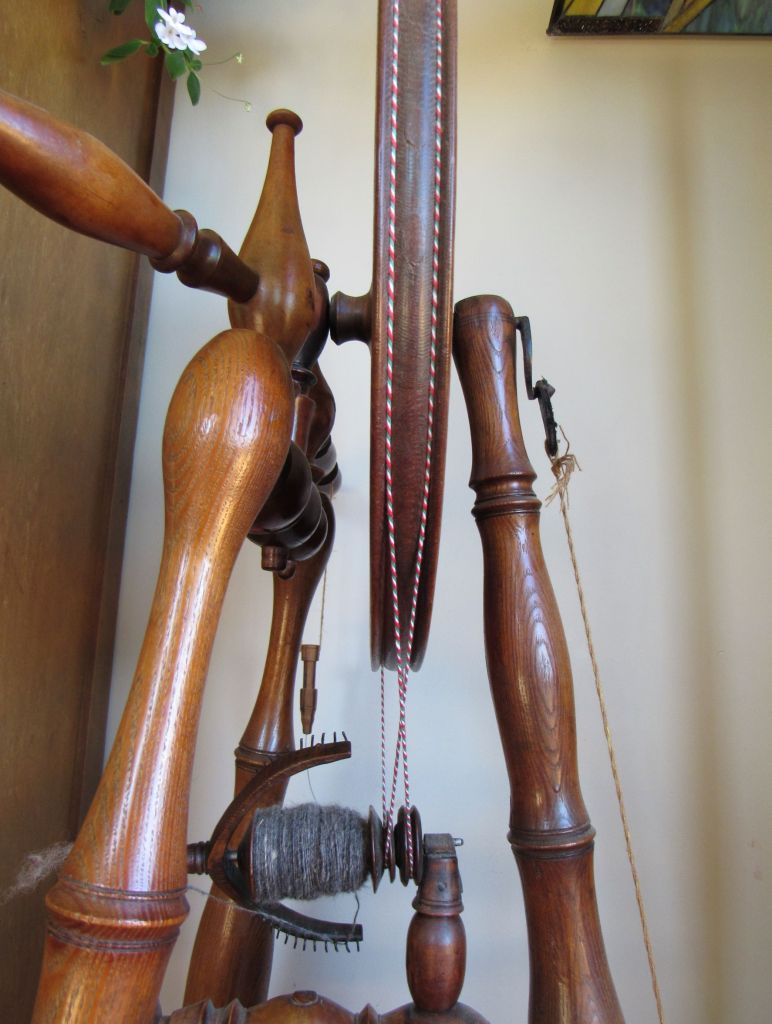
Those wheel makers, however, constructed the secondary upright supports to extend down to the legs, which is different than this wheel, where they only go to the table.
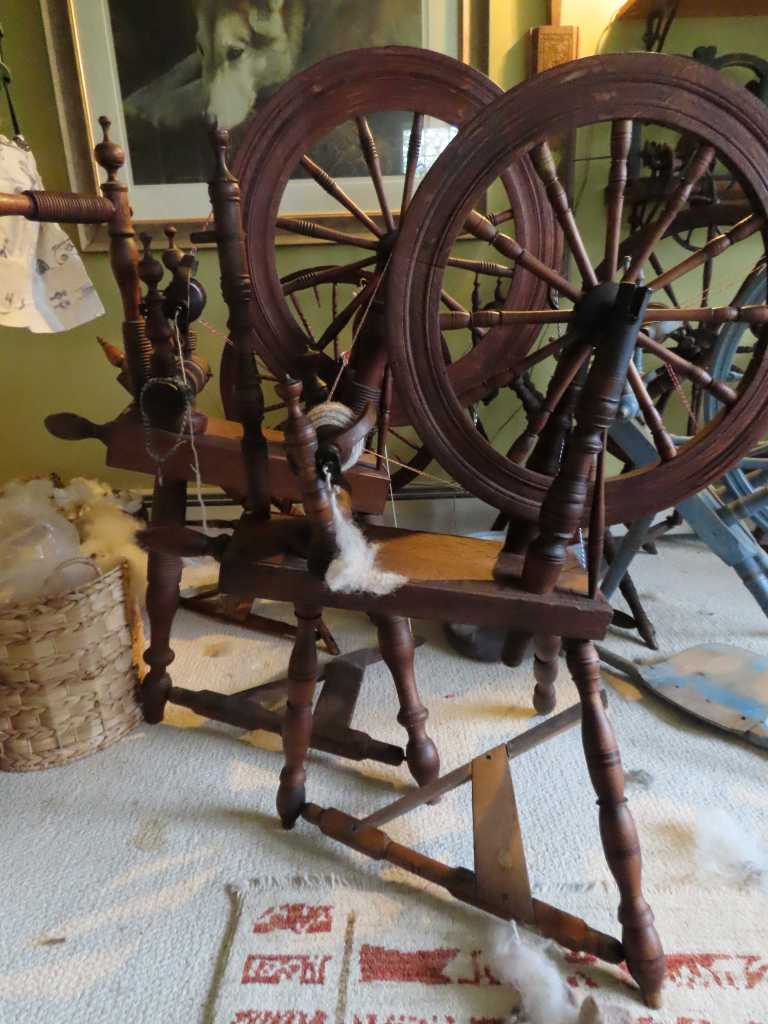
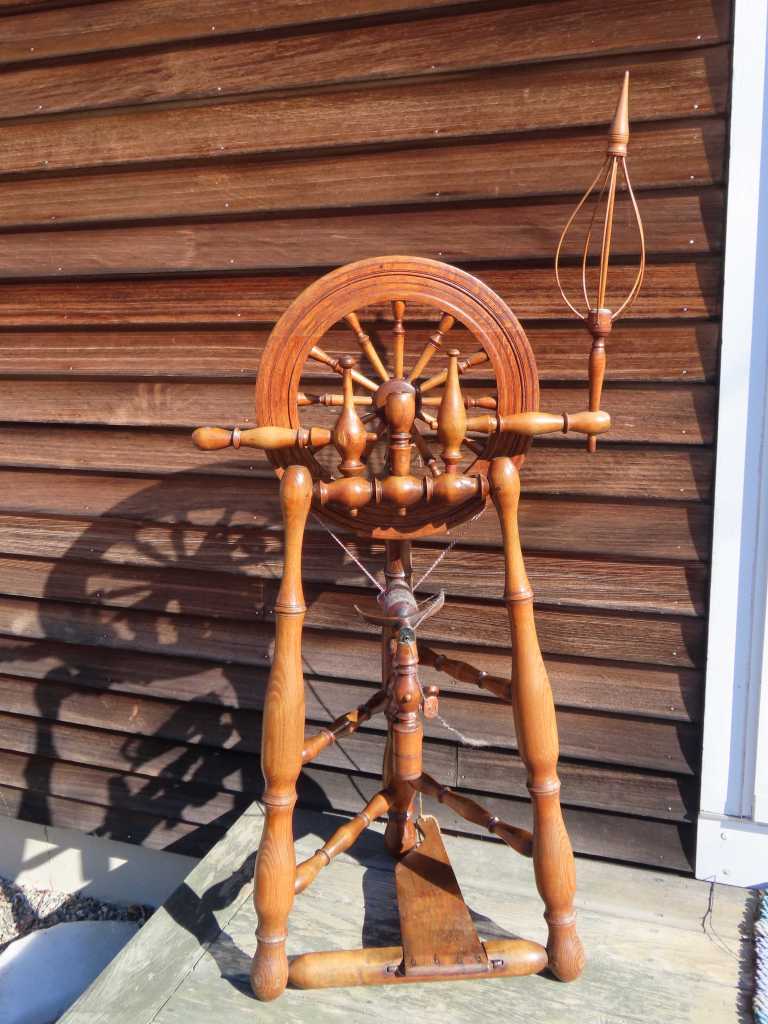
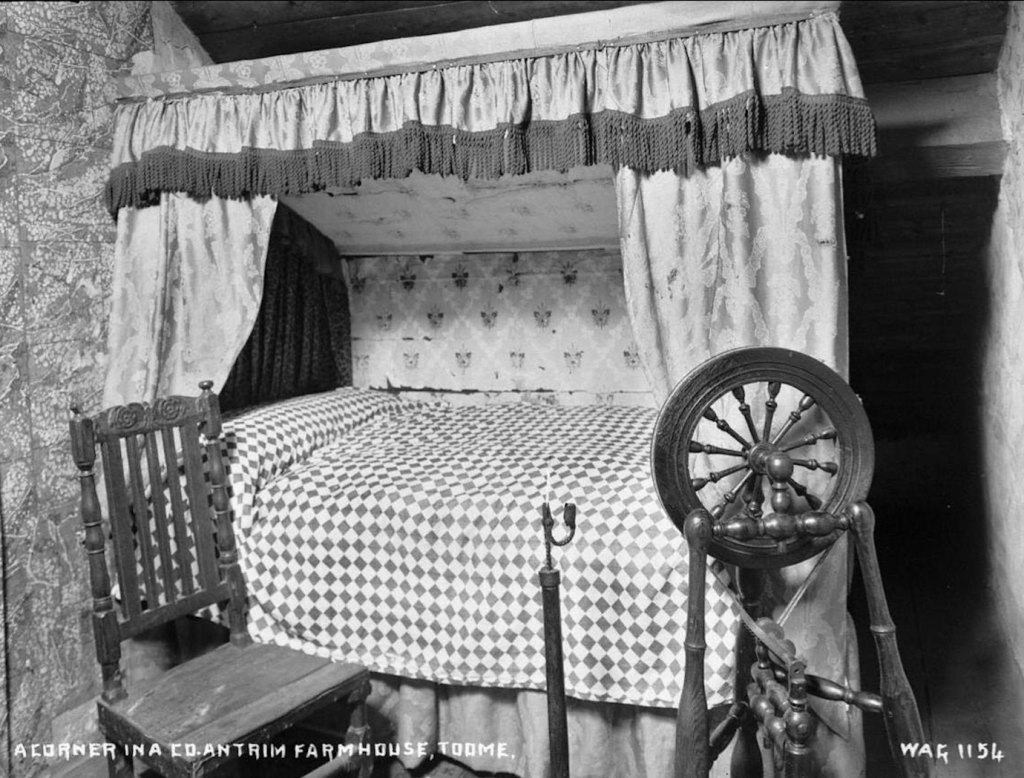
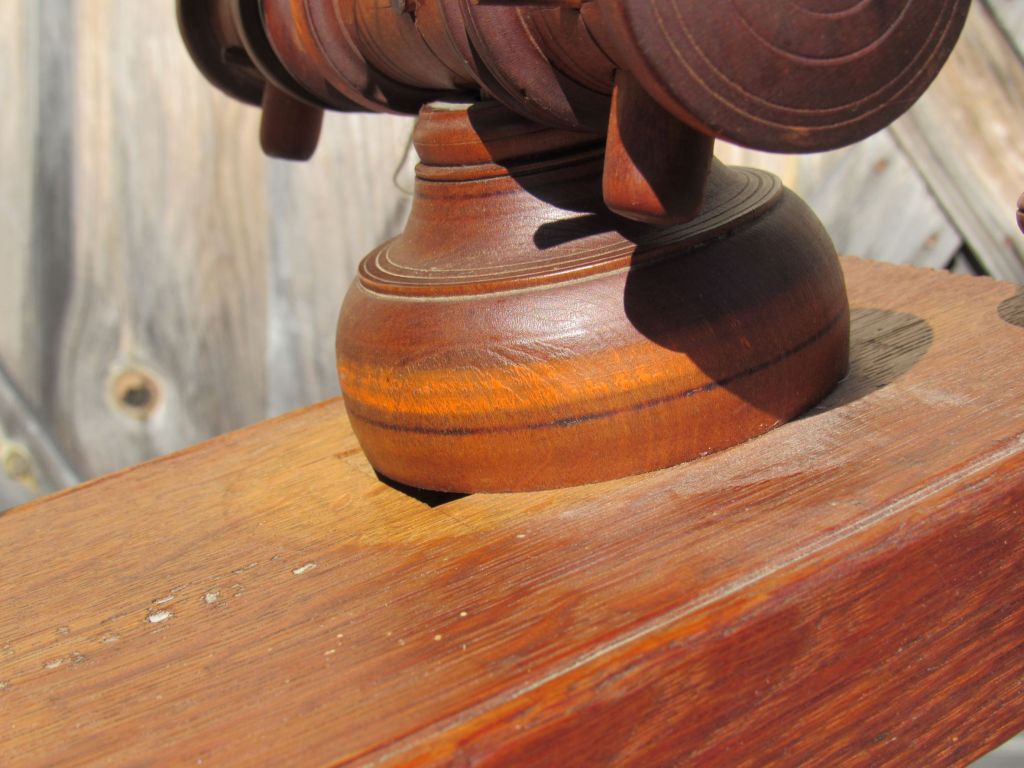
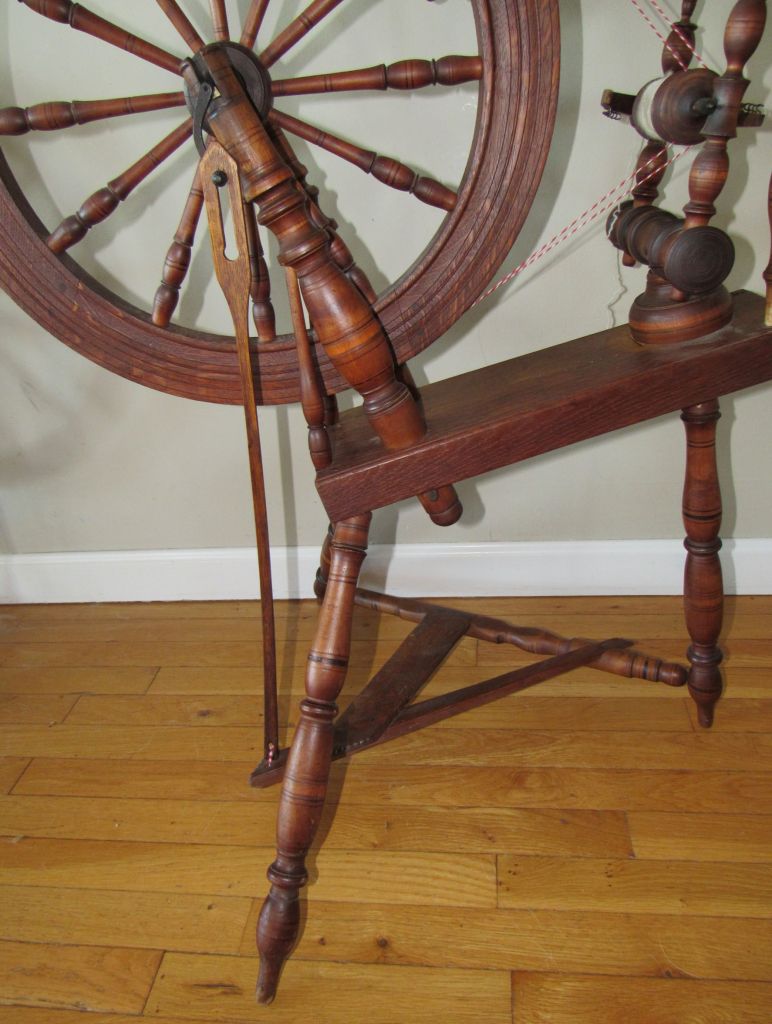
In fact, although this wheel is much smaller, the profile looks very much like my Irish wheel (see previous post “Handsome Molly”), with the double secondary supports holding the drive wheel in a very upright position quite close to the flyer assembly.
Although I searched in Berks, Bucks, Chester, Montgomery, and Lancaster counties, I could not come up with evidence of an IAM wheel maker in 1827. I hope there are enough clues to eventually lead us to this wheel’s maker. If so, it may give us a better understanding of the relationships between wheel makers in the area and how IAM and P. Wealand fit into their particular time and place.
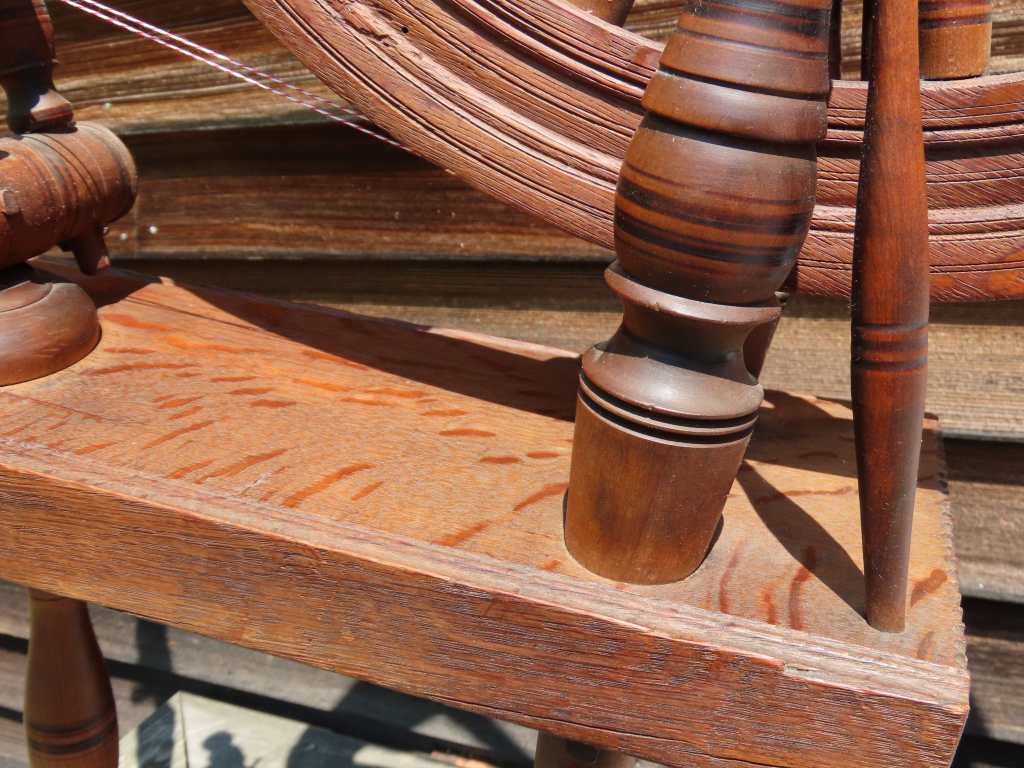
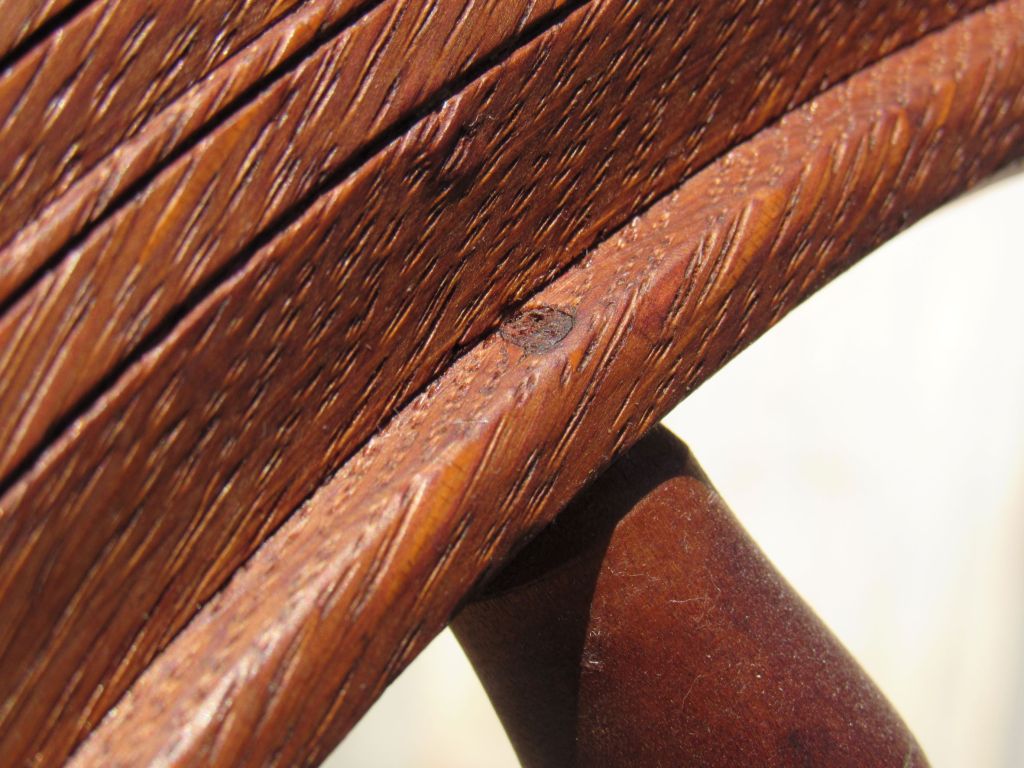
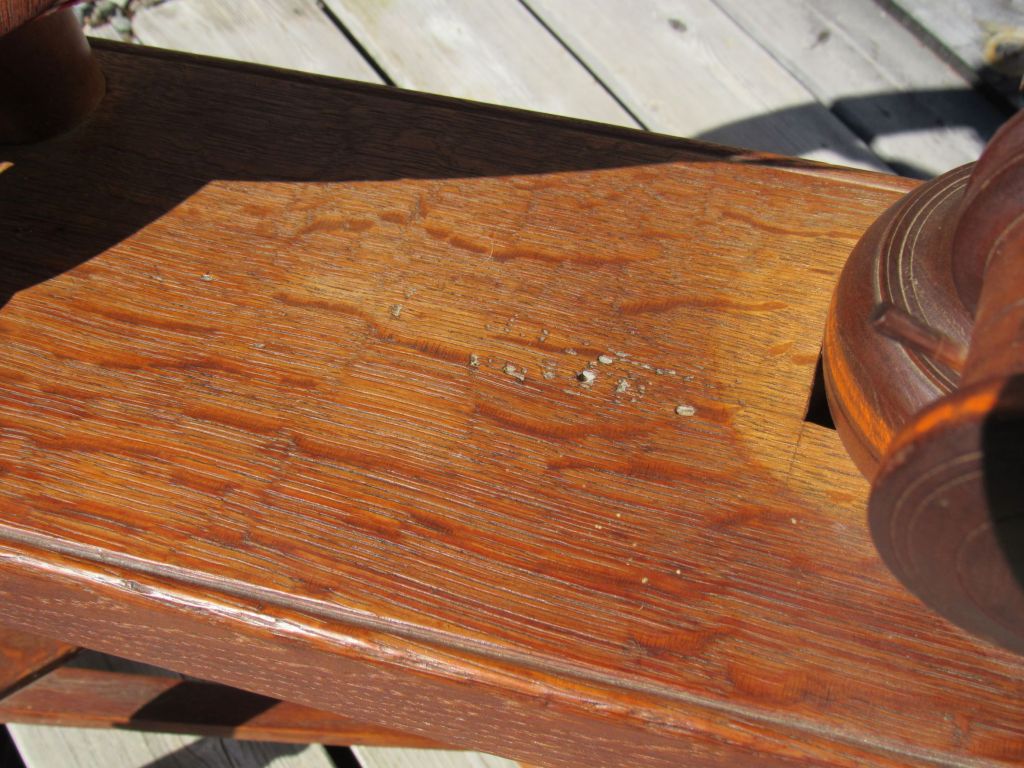
Whoever IAM was, he made a lovely wheel, highlighting the ray flecks in the table’s wood so that over two hundred years later, I appreciate the way they pop in the light every time I spin.
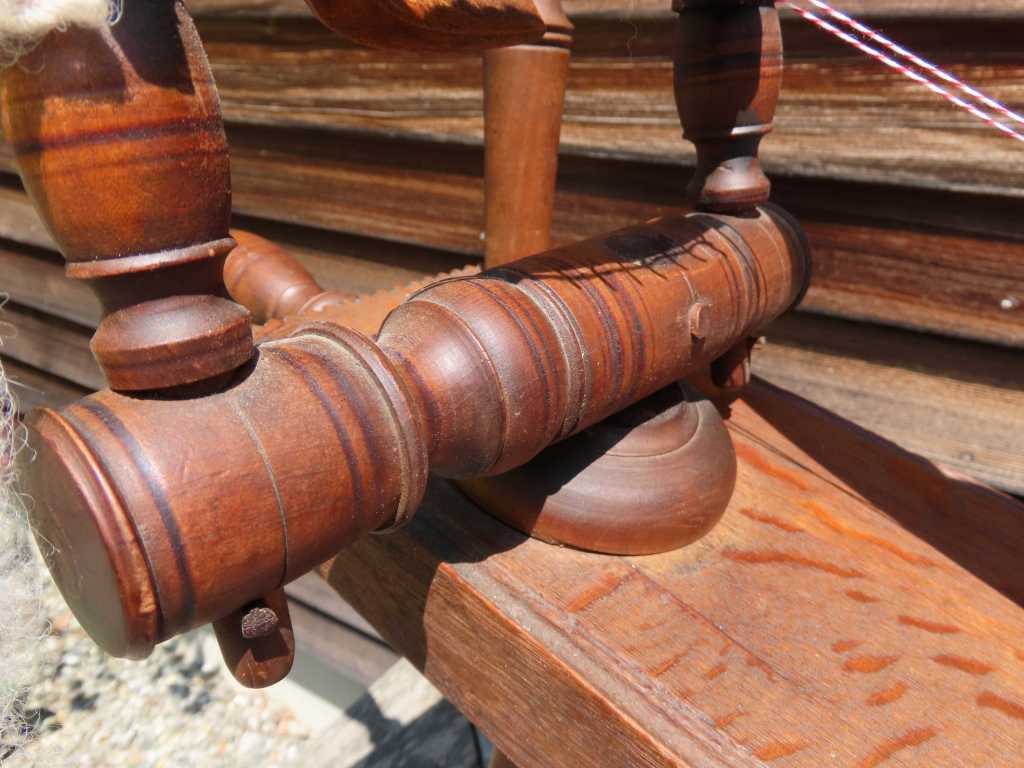
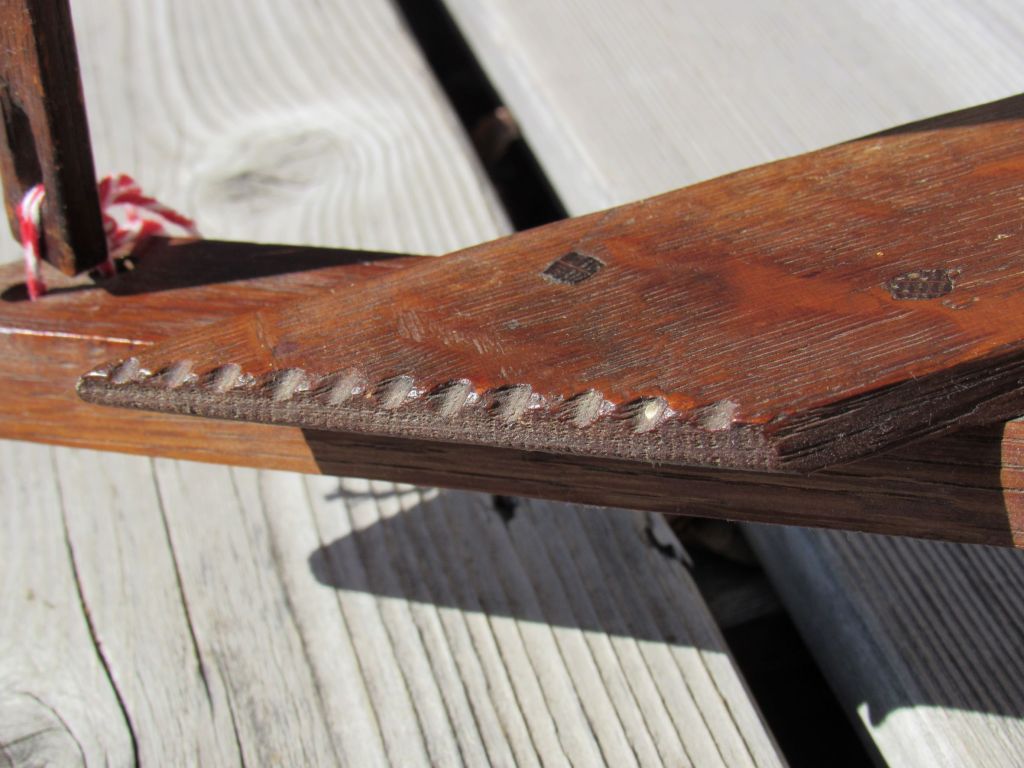
The wheel is beautifully constructed, with thoughtful decorative touches such as the chip carving,
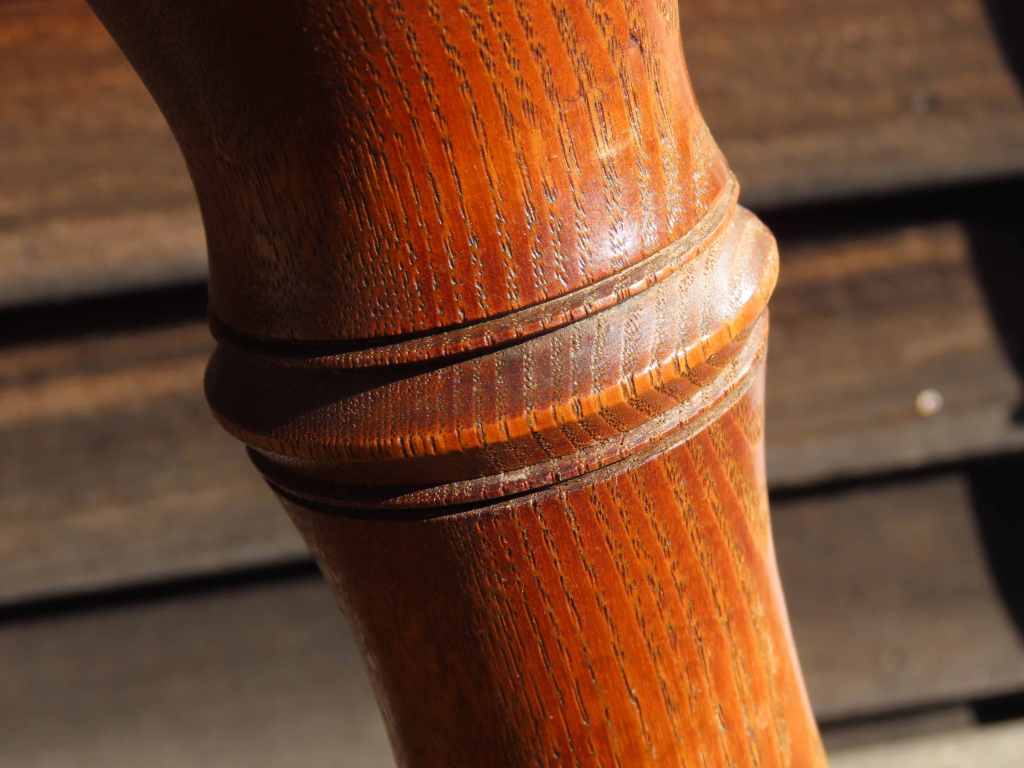
punched designs, burned ring marks,
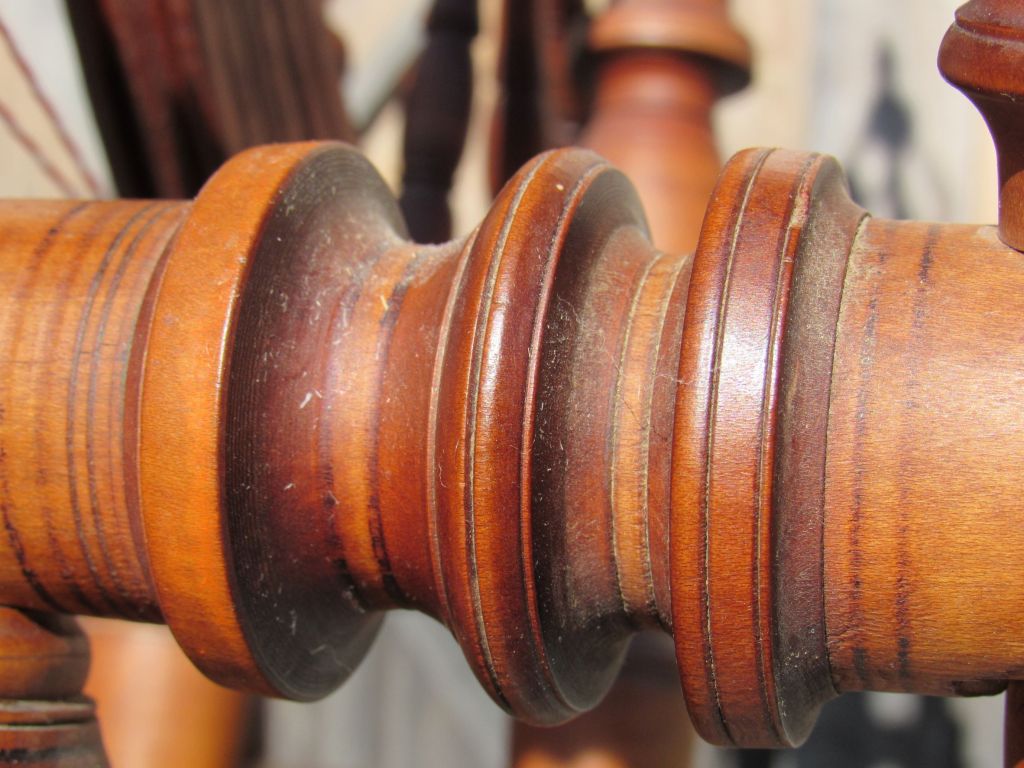
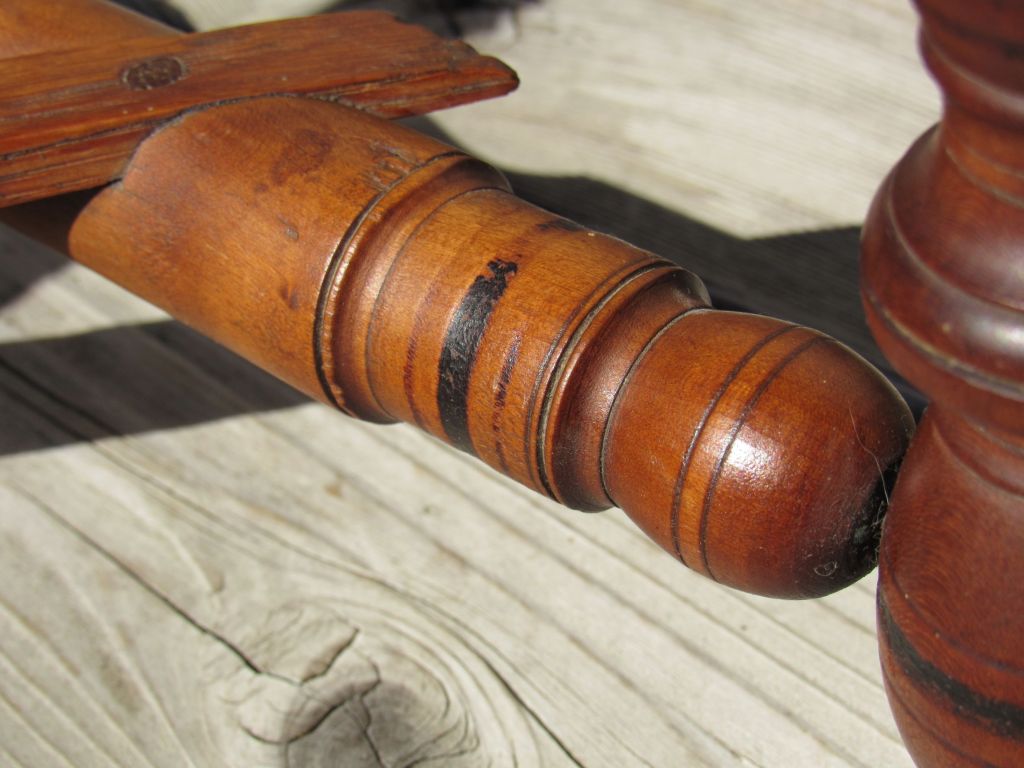
and pleasing turnings.
The grease stains show that the wheel was well used.
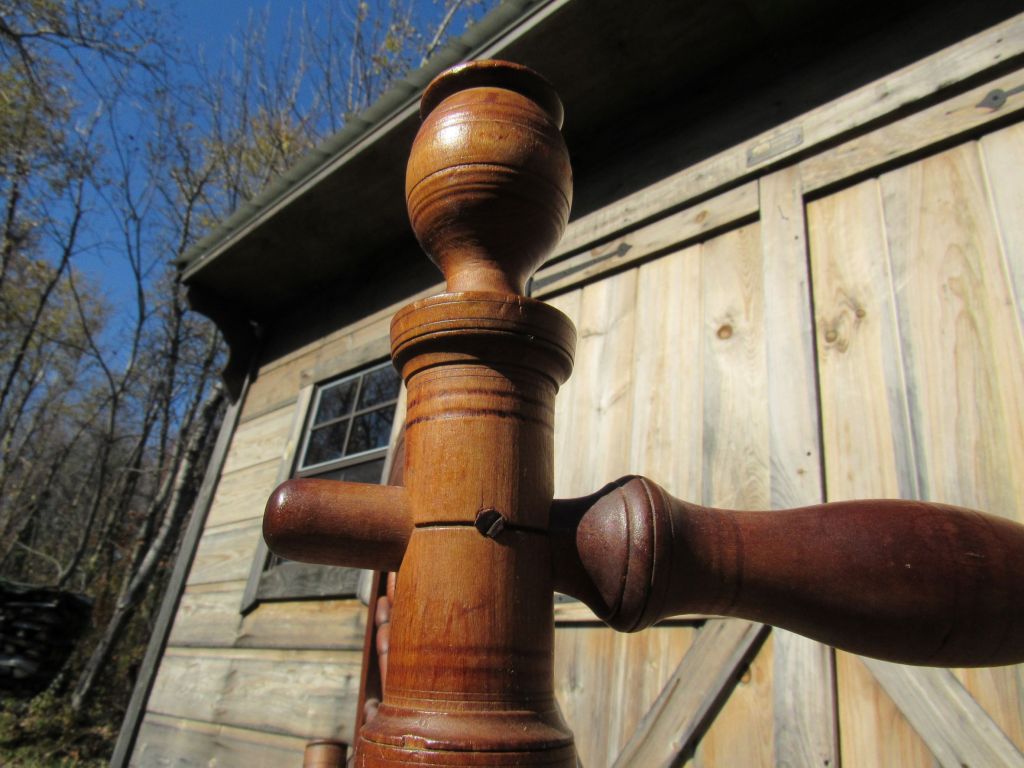
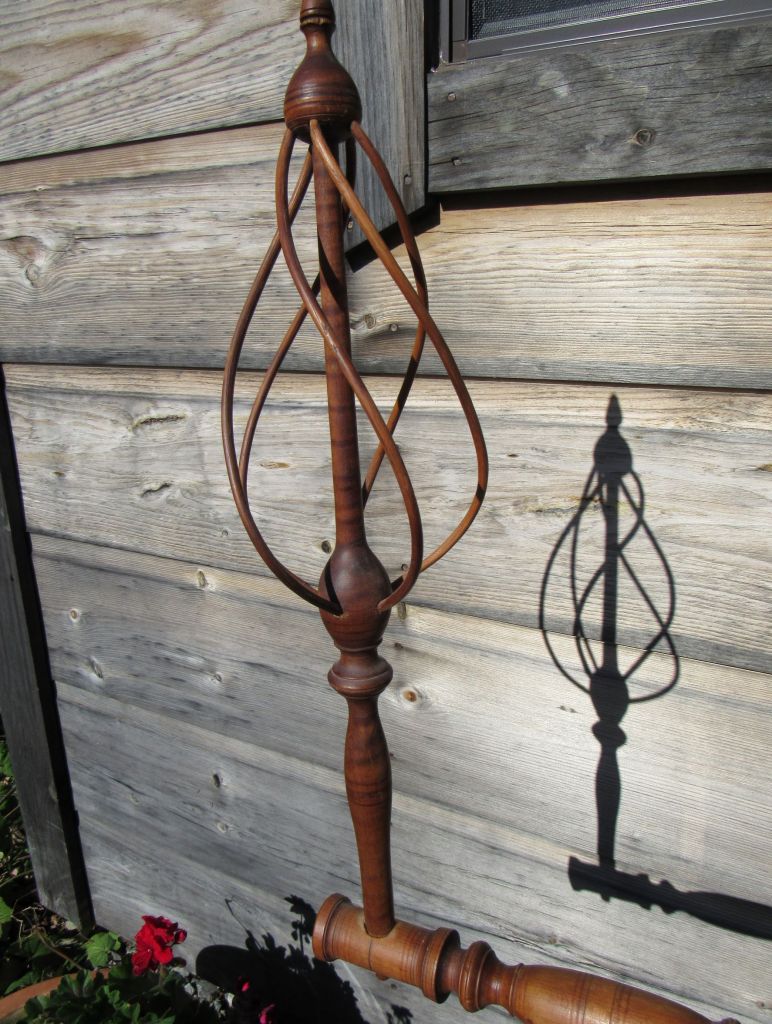
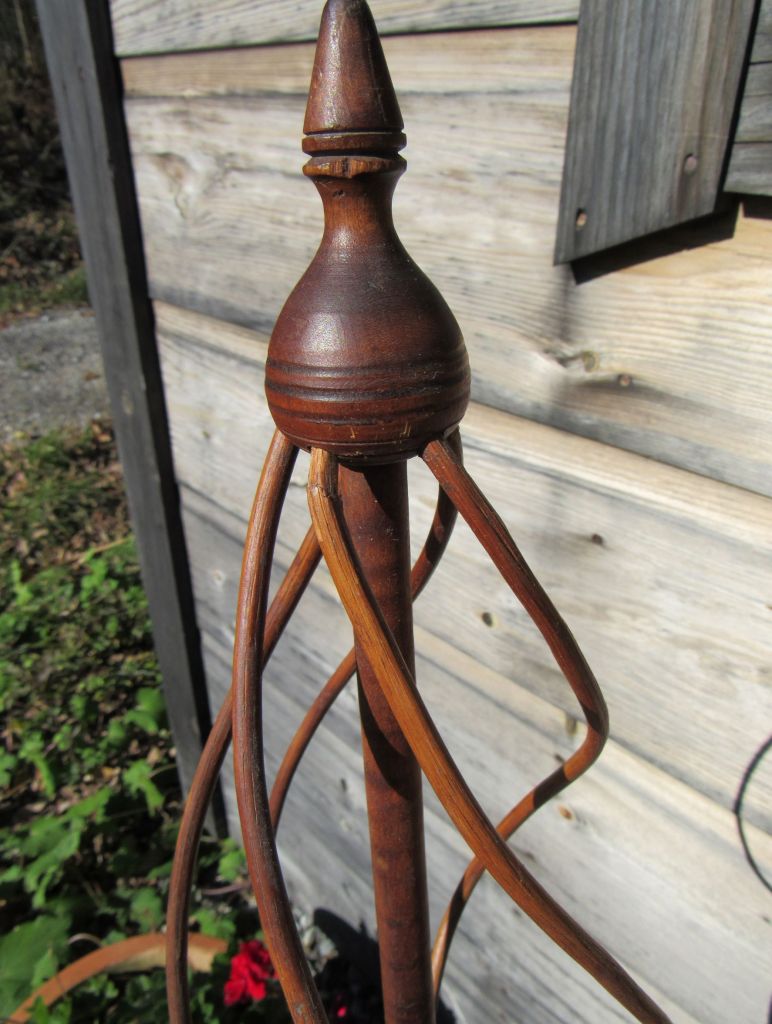
While the upper two parts of the distaff are gone, I am delighted that this part survived.
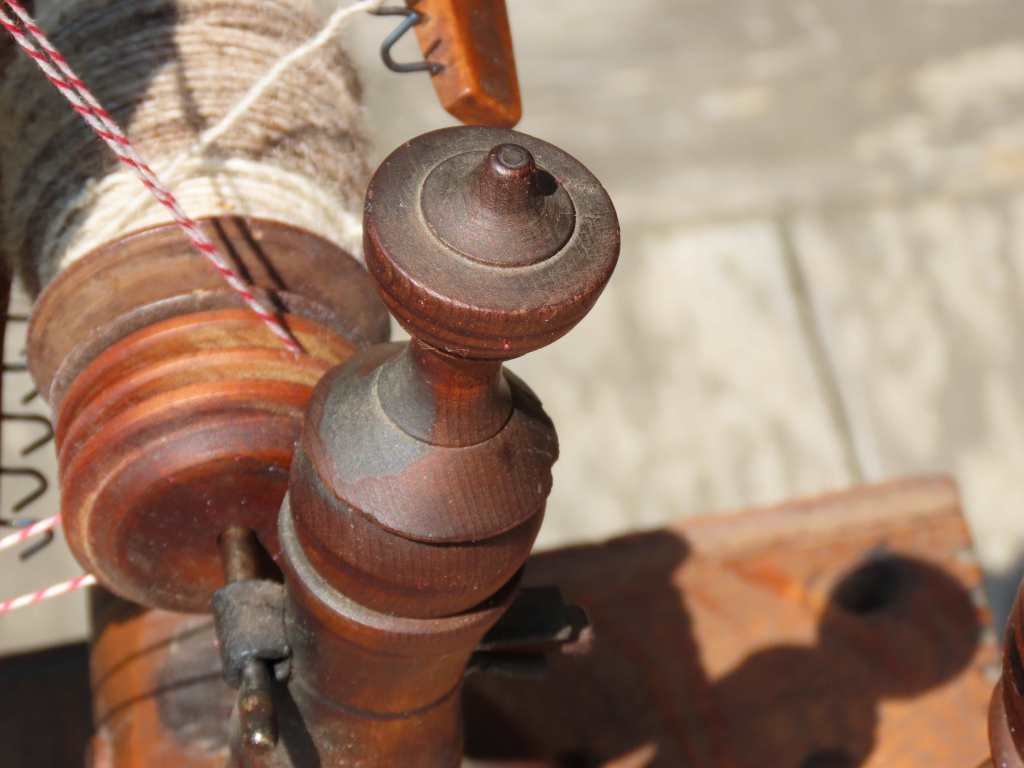
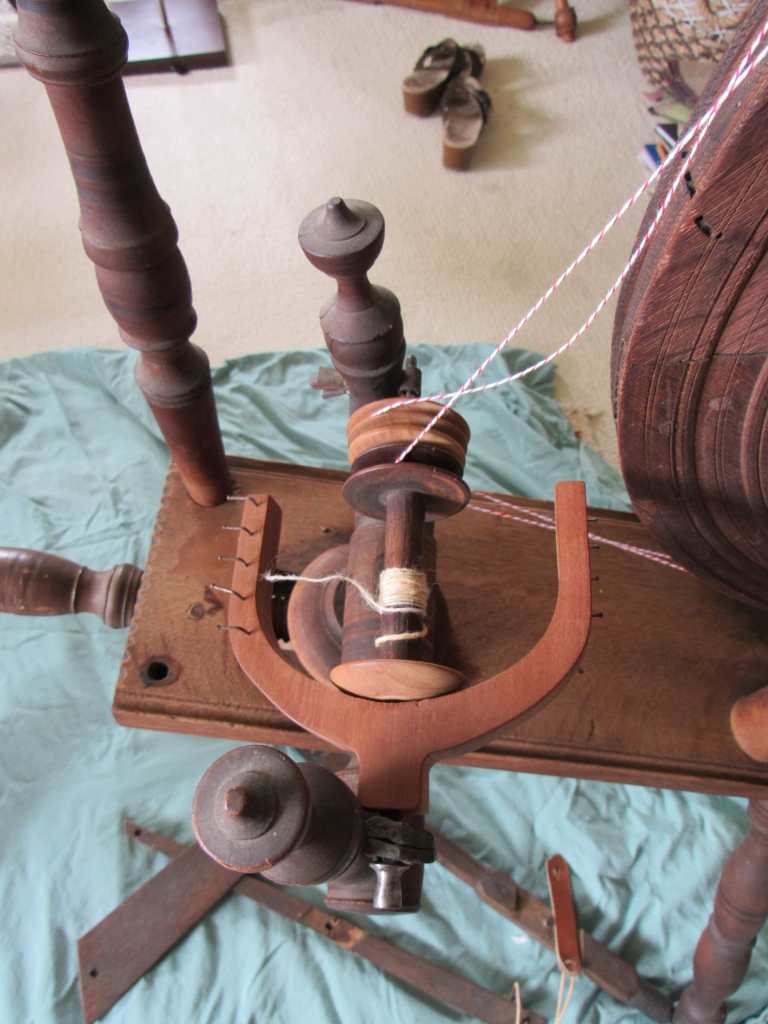
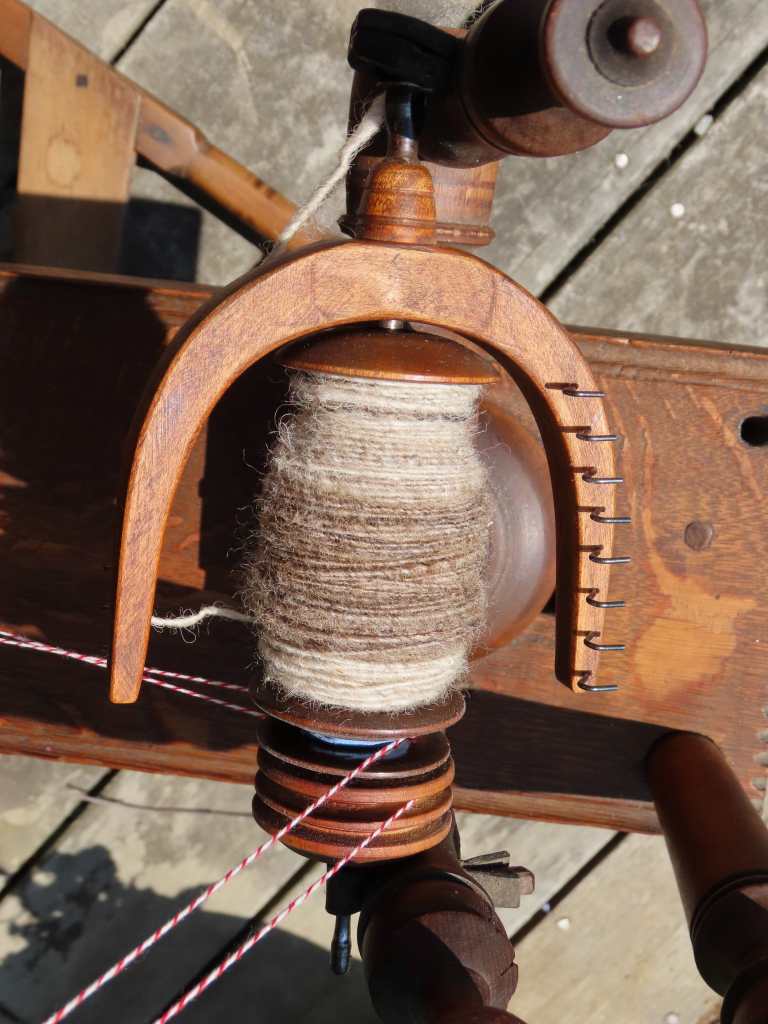
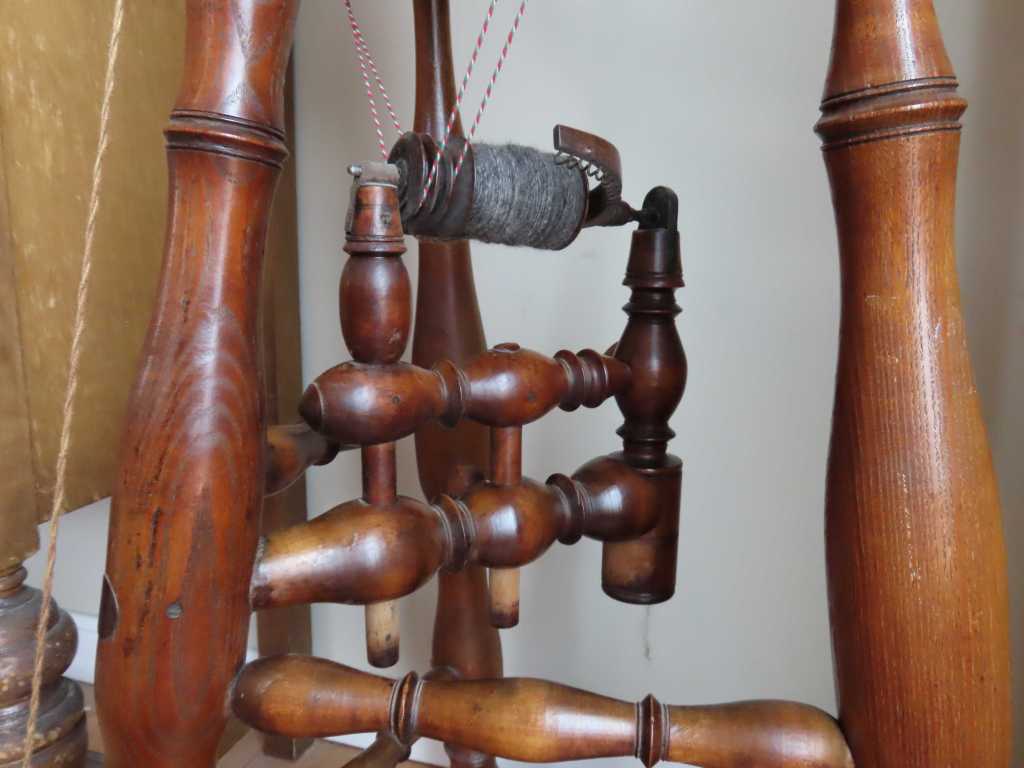
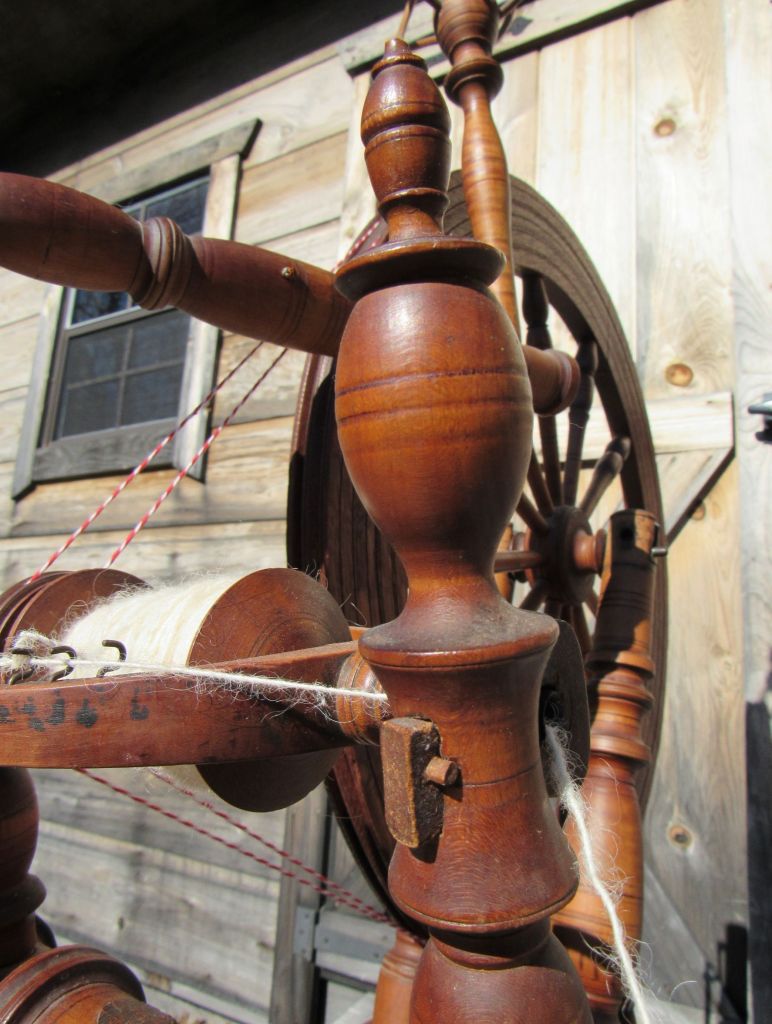
Sadly, the original flyer arms must have broken at some point. The mandrel appears to be original and perhaps the bobbin, but the clunky flyer arms seemed to be a fairly recent replacement,
so I had new ones made.
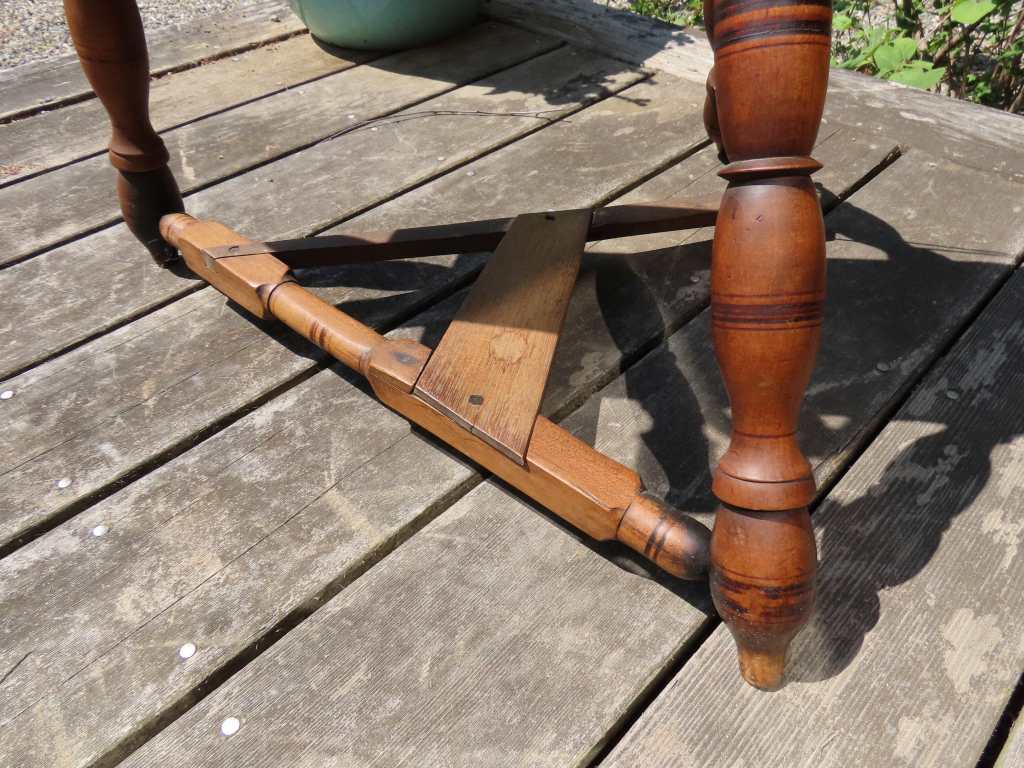
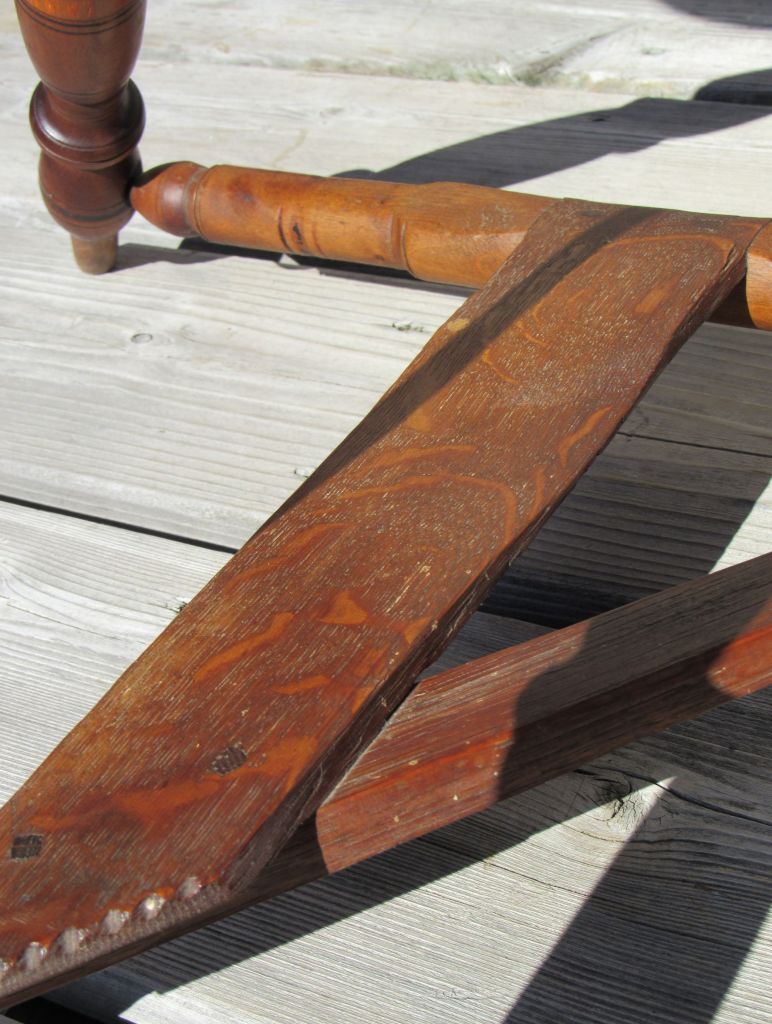
The treadle bars had some damage too (I actually broke one when I first spun on the wheel).
I repaired the treadle and with her new flyer arms, it is pure pleasure to spin on this wheel.
References:
Pennington, David and Taylor, Michael, Spinning Wheels and Accessories, Schiffer Publishing, Atglen, PA 2004, pp. 123-29.
ancestry.com for genealogical research and census records
Perhaps the most readily identifiable Pennsylvania wheel is the “Irish castle” wheel. Its distinctive style is best described by collector, Bill Leinbach: “The vertical lines, the splay of the long legs, the relationship between the drive wheel and the flyer bobbin assembly, all contribute to the magnificent display of this tripod temptress.” (Leinbach, SWS p. 6)
Aside from its harmonious lines, its height is impressive and its design practical, with long hefty legs providing a solid base with a small footprint. The solidity and stability allows for steady, even spinning, while the small footprint is welcome in tight living quarters.
While this wheel style has been found occasionally in other parts of this country, it flourished in Pennsylvania. Why and how this Irish wheel design was adopted by Pennsylvania German wheel makers remains something of a puzzle. Some have speculated that this style may have originated in Germany and migrated to Ireland, with the “castle” name having derived from the German town “Kassel.” (P&T, p. 56) On the other hand, wheel collector John Horner suggested that these wheels are named “castle” because of their shape and are “peculiar” to Ireland. (Ulster Museum, P. 21)
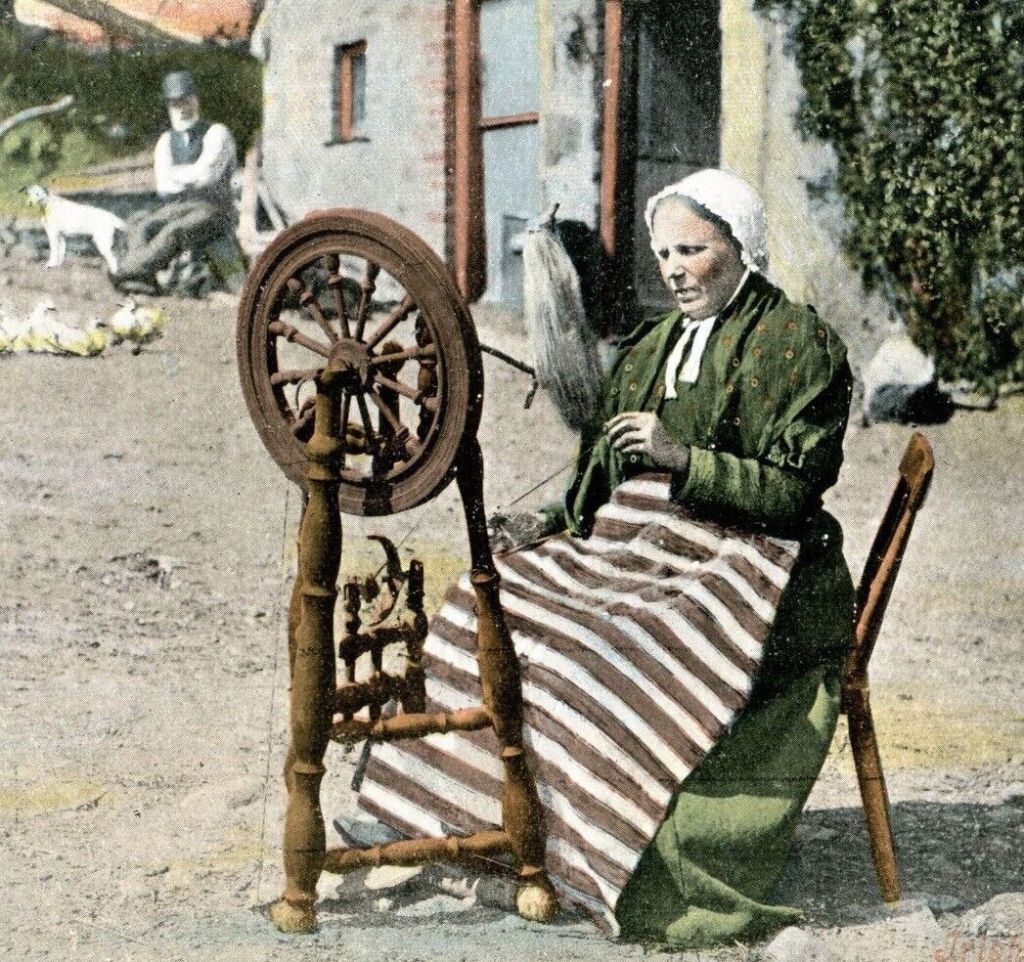
Patricia Baines notes that in Britain castle wheels refer to vertical wheels in which the drive wheel is above the flyer mechanism, with Scotland having its own castle wheel, different than the Irish. (Baines, p. 45). Whether born in Ireland or not, the sturdy three-legged Irish castle wheel was an integral part of 19th century life in northern Ireland, especially in Donegal and Antrim counties, used early on for flax and later for wool spinning into the 20th century. (Baines, p 144-46, P & T, p. 53)
Spinning linen in northern Ireland—notice the spokes
While some castle wheels were brought over from Ireland to Pennsylvania and other states, the majority that we find in this country appear to have been made here, primarily by Pennsylvania wheel makers of German descent.
Danner wheel for sale a few years ago
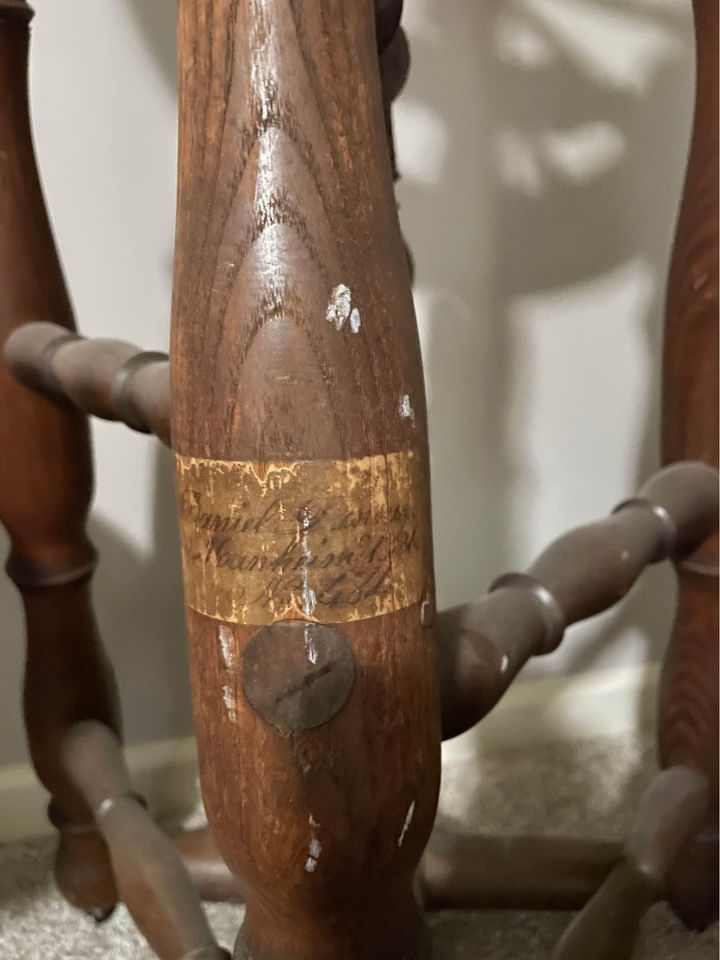
Probably the most well-known is Daniel Danner, who signed and dated many of his wheels with a paper label pasted onto the back leg. Of course, most of those labels have not survived, but his wheels have distinctive qualities that identify them as Danner wheels.
Paper label on Danner sale wheel
Danner was born in Manheim in Lancaster County, Pennsylvania in 1803. His father, Adam, was a weaver. Daniel married Elizabeth Hartman in 1833 and they had five children, only two of whom survived to be adults. (Leinbach, SWS, p. 6)
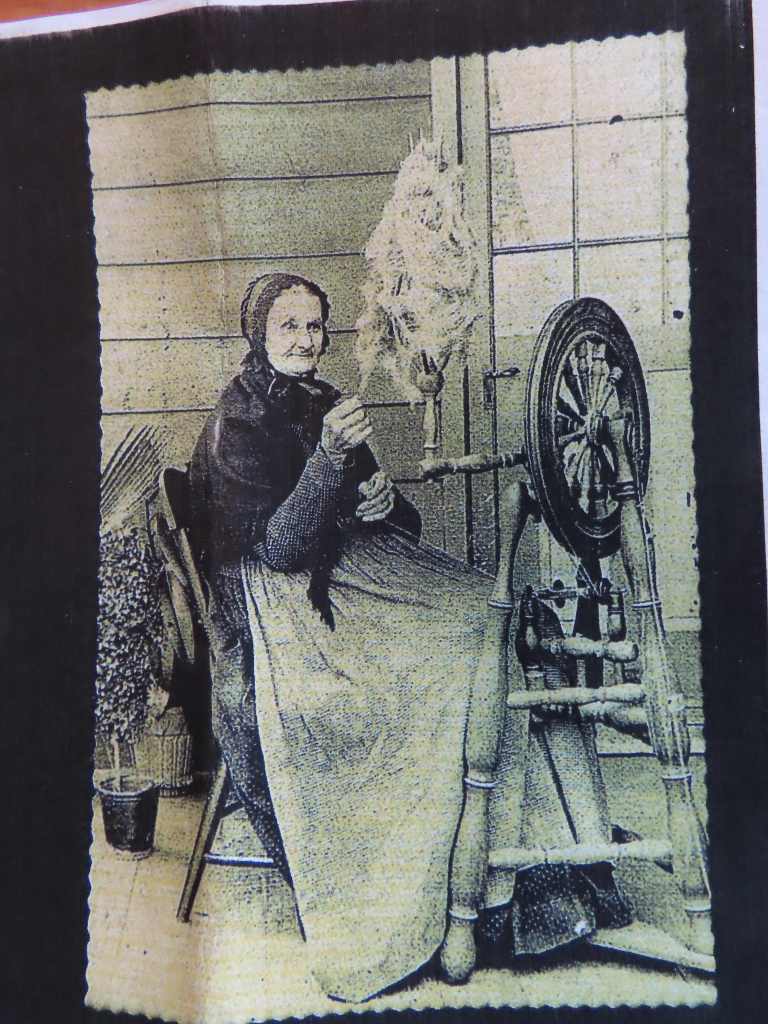
Danner’s wife Elizabeth spinning flax on one of his wheels. Notice the label on the back leg.
Fortunately, Danner kept daybooks, which show that he made wheels for over 40 years, from 1821 until at least the early 1860s. He made great wheels, saxony-style wheels, and what he called “cassel” wheels. Perhaps this was a phonetic spelling of “castle” (his daybooks were written in English, not German), or it could be an indication that these wheels did have a German origin. As with so many spinning wheel makers, Danner was not limited to wheel making, but made and repaired all types of household and farm items, including reels and swifts. About forty percent of his wheels were castle wheels, which he priced at $4.00, fifty cents more than his regular flax wheels.
There is no definitive answer as to why Danner and other Pennsylvania Germans were making Irish Castle style wheels. Perhaps there were similar wheels remembered from Germany—although I am not aware of anyone actually identifying a German wheel of this style. Perhaps he was influenced by an Irish wheelmaker, such as Samuel Humes. Humes, born in 1753—considerably older than Danner–came to Lancaster County from Antrim, Ireland. Danner’s saxony-style flax wheels were very similar to Humes’ wheels, almost copies.
Whether he did this with Humes’ permission or not remains a question. I am not aware of evidence that Humes made Irish castle wheels, but it is certainly a possibility and other wheel makers in the area, including Danner, may have copied the style from him. It is also possible that Irish Castle wheels were simply a response to market demand.
When I started digging into genealogy research on Danner, I found several family trees on ancestry.com that had Danner’s father, Adam, as born and living part of his life in Shelby, North Carolina. Because that is a region with many Scots-Irish immigrants, I was excited to think that might offer some explanation for Danner’s adoption of this style.
As it turns out, I believe that is a different Adam Danner and Daniel’s family likely did not venture outside of Pennsylvania. But it got me looking into Scots-Irish settlement in Pennsylvania and I found Scots-Irish immigrants from Antrim and nearby counties settled in many of the same areas in Pennsylvania as the Germans.
Perhaps they sought this style wheel from the local German wheel makers. While I have only seen a few pages of Danner’s day book, in those, it appears that the surnames of most of his customers were of German origin, but with a smattering of English and Irish names, including “a new flyre” for Barb Donoven. (McMahon, p. 16). So, it is possible that, at least initially, these wheels may have been made for Irish customers seeking this wheel style. We just do not know.
While probably the most well-known, Danner was not the only one making this style wheel in Pennsylvania. Some did not sign their wheels and will remain a mystery. Samuel Henry, however, another maker of German descent, did stamp his name on at least some of his unique and elaborate castle style wheels—quite different from Danner’s.
Although unmarked, this appears to be a Henry wheel that came up for sale last year
Another intriguing maker is usually referred to as the “Landisville” maker because several of his wheels showed up in that area of Pennsylvania.
According to Bill Leinbach, Clarke Hess, a well-known Pennsylvania historian and collector, believed that perhaps the Landisville wheels can be attributed to Johannes Berg or his son Jacob Berg, based at least in part on probate inventory records. Hess died several years ago and his extensive collection was auctioned off. In Lot 5525 of Clarke’s on-line auction collection, a sampler was identified as made by Maria Berg, daughter of “Turner” Jacob Berg of West Donegal Township, son of immigrant Andreas Berg. I do not know if this is the same Jacob Berg that Clarke had been researching—there are multiple Jacob Bergs in Lancaster County–but it is a clue worth pursuing.
Donegal Township had a large number of Irish settlers, so might have been fertile ground for these wheels and is not far from where Danner was making his wheels in Manheim, Pennsylvania. That may be important because, apparently, multiple wheels have been found with bodies made by Danner and drive wheels made by the “Landisville” maker. Bill Leinbach suggests that may indicate that they knew each other or even worked together at some point. This is an area ripe for more research.
My wheel, Elizabeth, which came from Bill Leinbach, is one of those combination wheels. The body has classic Danner features, but the drive wheel appears to have been made by the Landisville maker. Danner’s drive wheels were made of four equal pieces and had “shotgun shell and olive” spokes—a perfect descriptive term because that is just what they look like.
Danner drive wheel
The Landisville/perhaps Berg maker constructed his drive wheels with two long and two short sections (felloes) and spokes closely resembling those on wheels from Ireland—they look like wine goblets to me.
The drive wheel on my wheel–notice how similar the spokes are to the earlier photograph of the Irish wheel
For an excellent visual comparison and description of wheels made by Danner, the Landisville maker, and Samuel Henry, I recommend Michael Taylor’s article “Castle Wheels in Lancaster County, PA.” listed below.
While there is no label on my wheel, the body appears to be a beautiful example of Danner’s work. The long flat treadle fits around the back leg,
and is attached to the axle with a long cord and leather top—typical of Irish wheels.
While the legs are heavy, they are gracefully curved and highlight the wood grain.
The top cross bar has two holes. Danner traditionally used one for the distaff and the other for a reeling pin. Having two holes allows the spinner to place the distaff on either side and also provided a place to mount a water dish for flax spinning. I am fortunate to have two distaff supports, one on each side.
Danner had some variations in the turnings for the distaff supports. I believe the left hand one is typical of Danner’s wheels,
but am not sure if the other one is also made by him or some other maker.
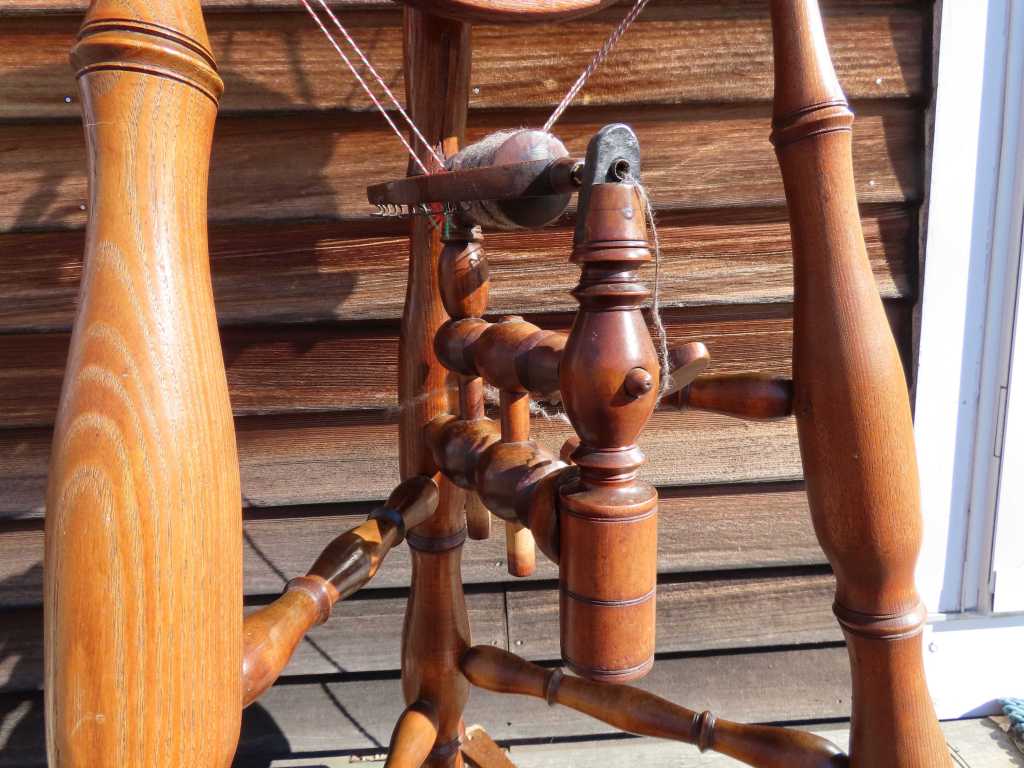
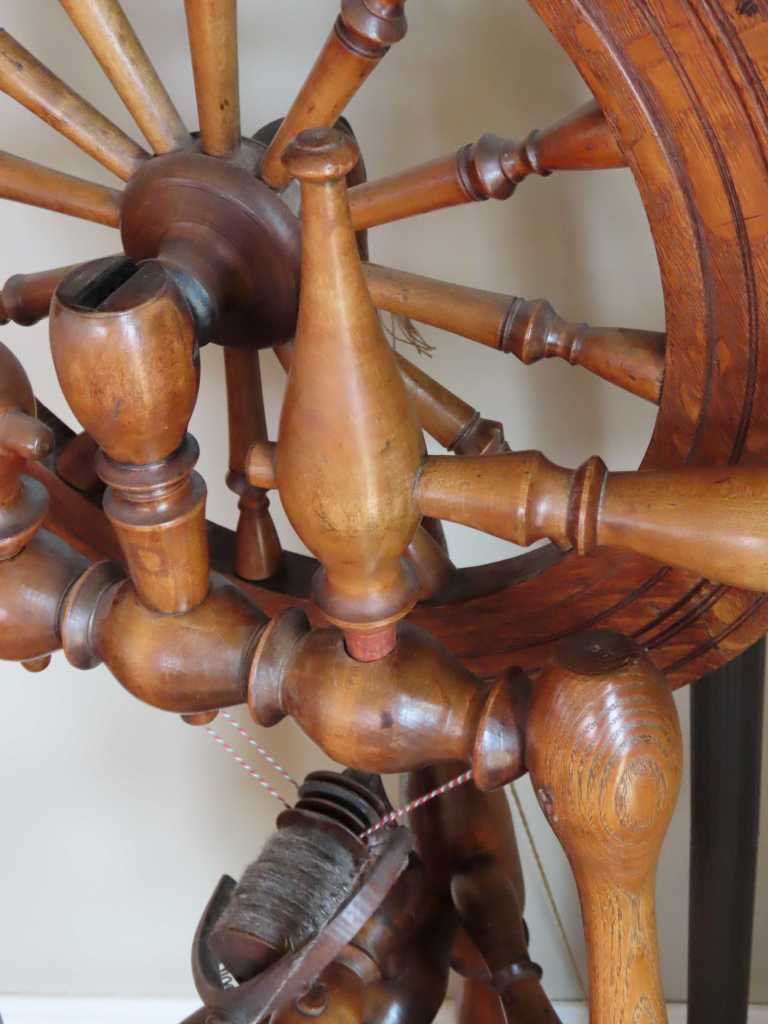
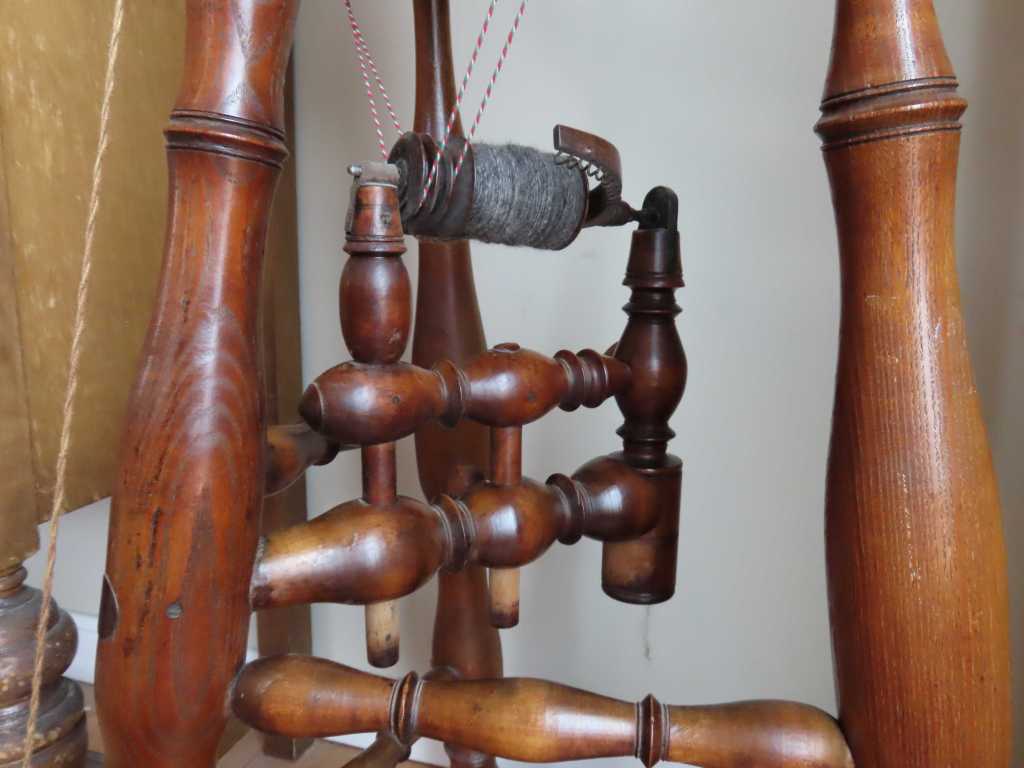
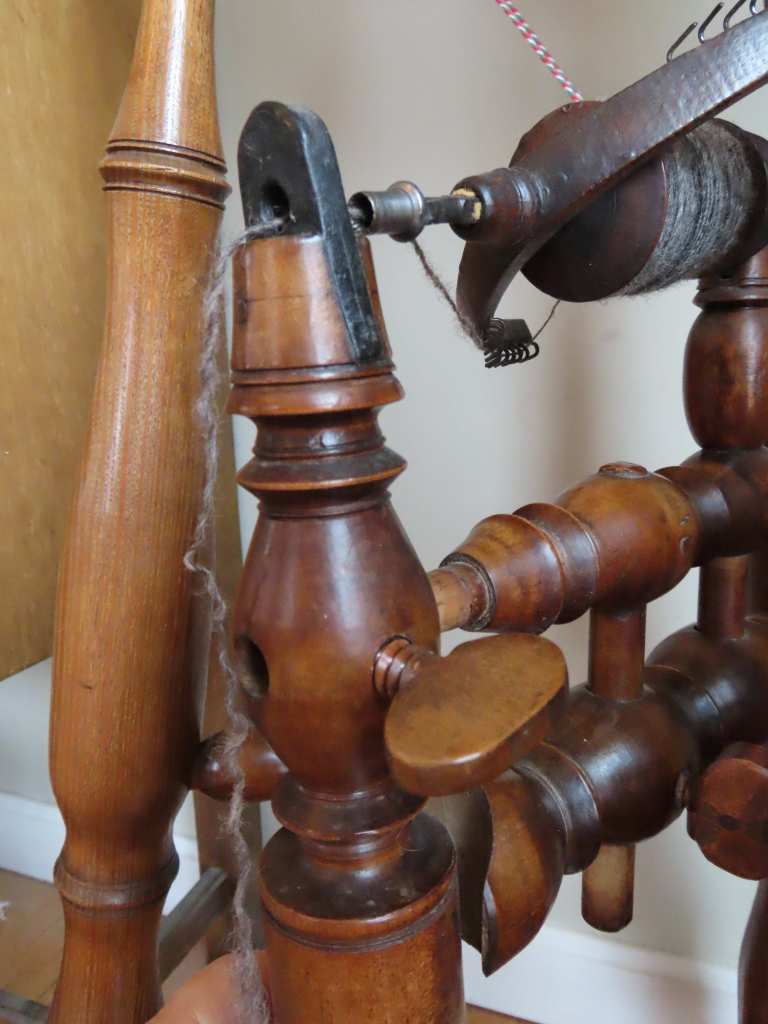
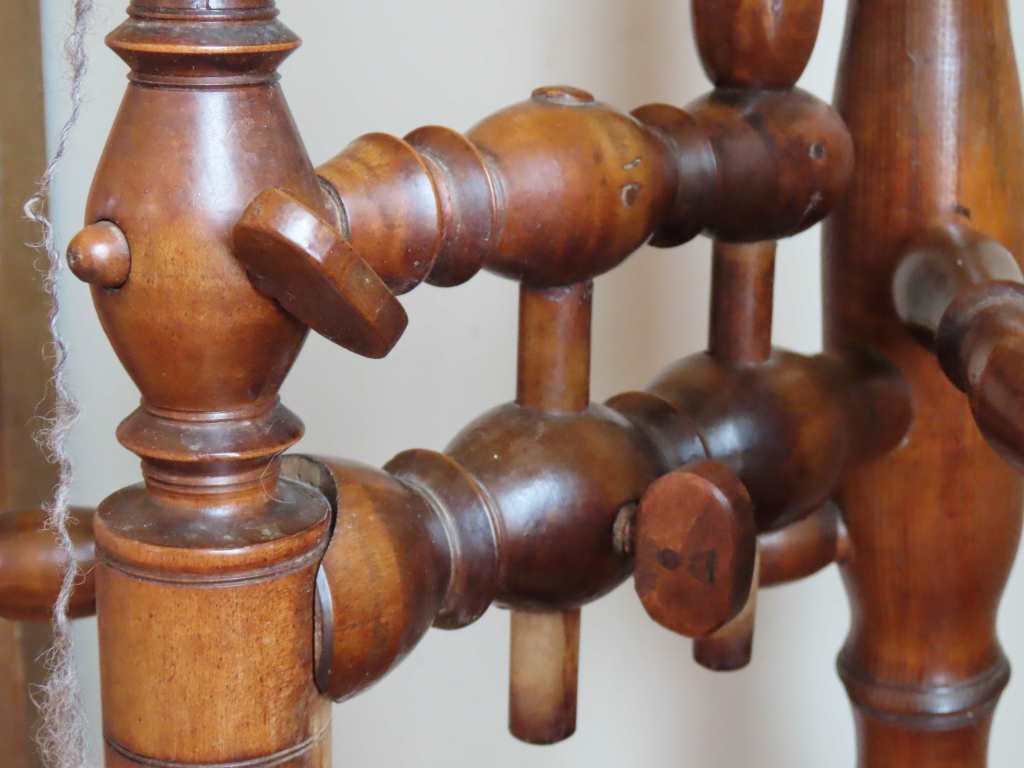
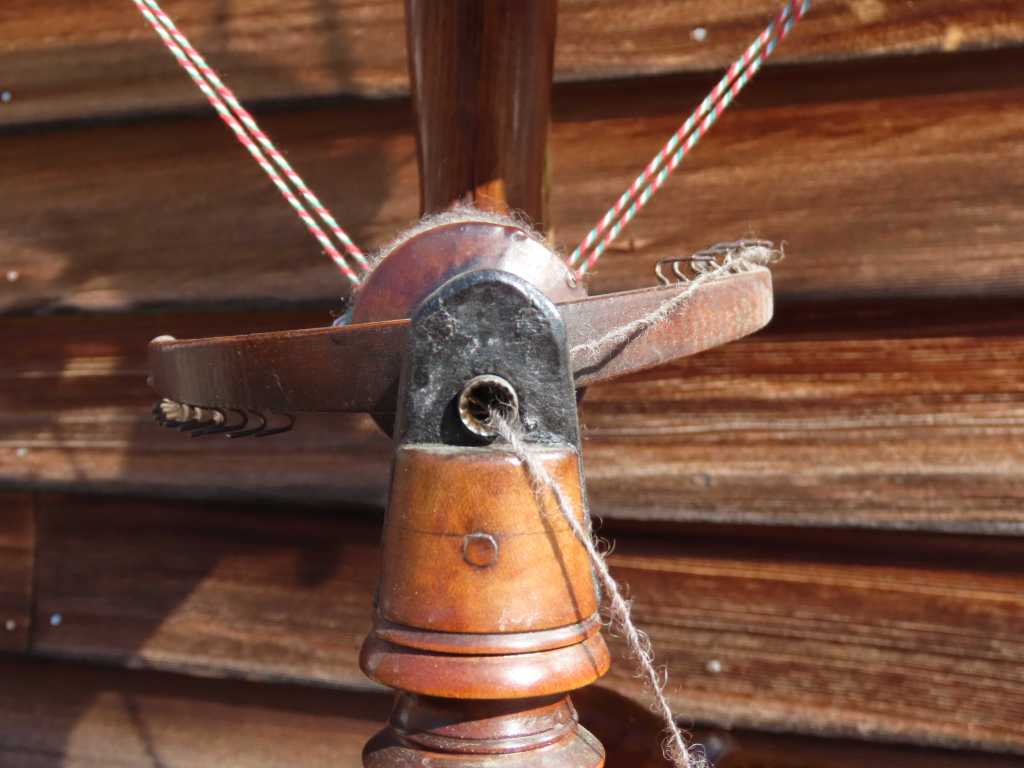
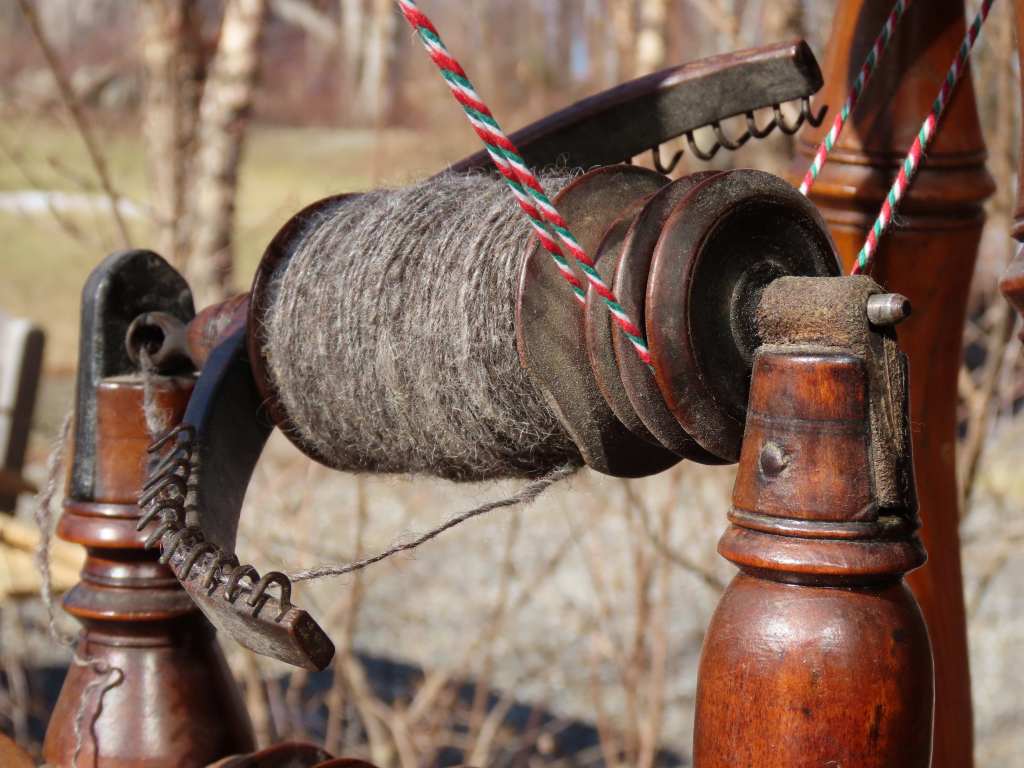
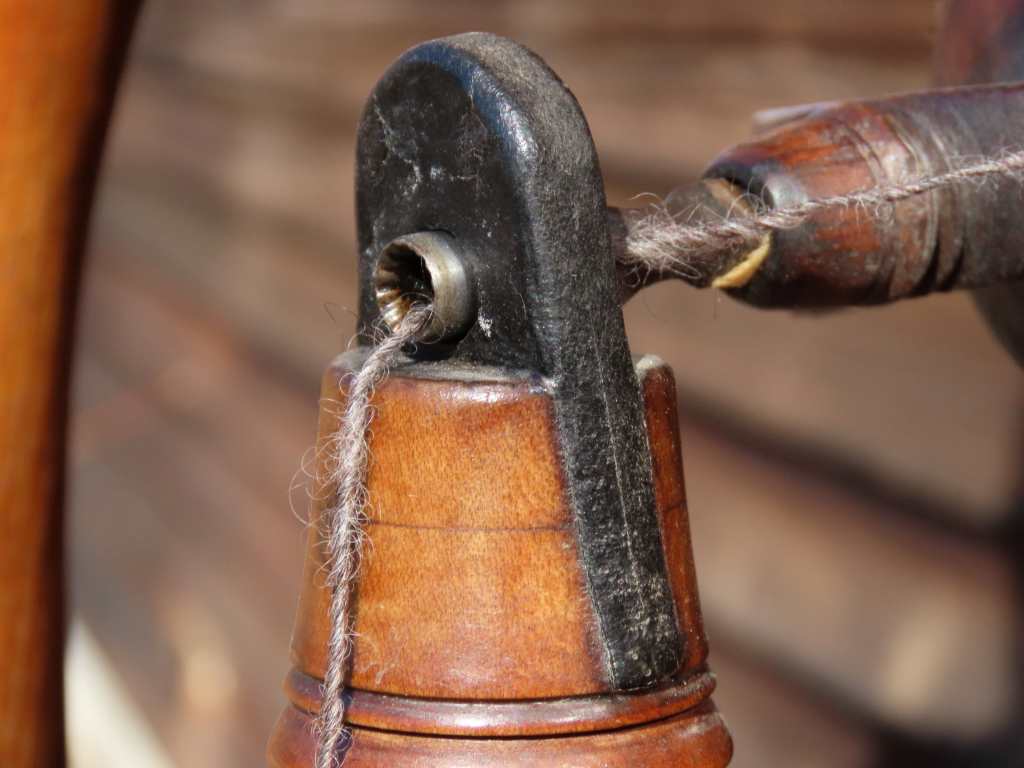
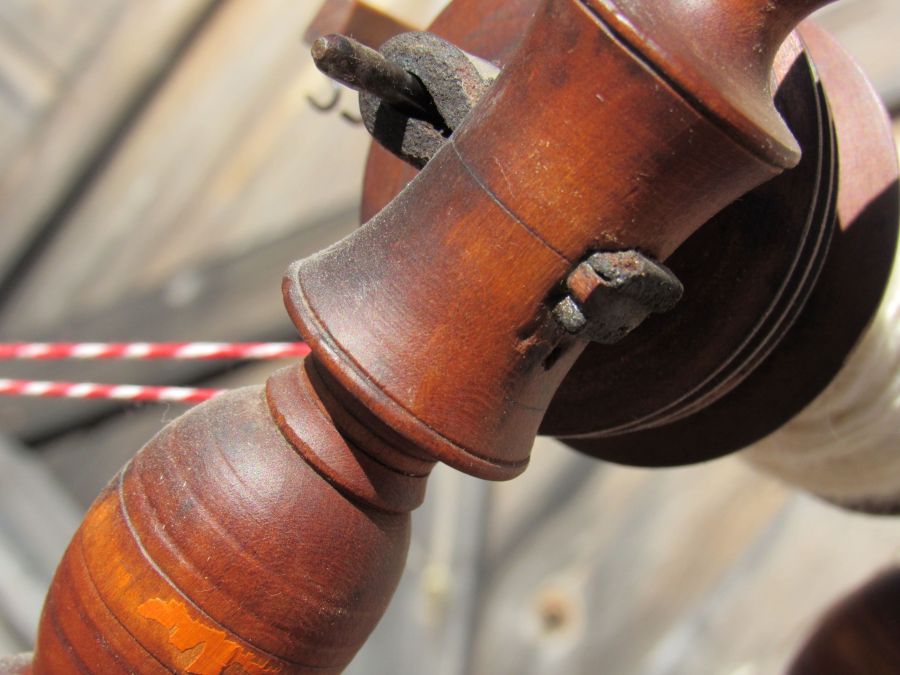
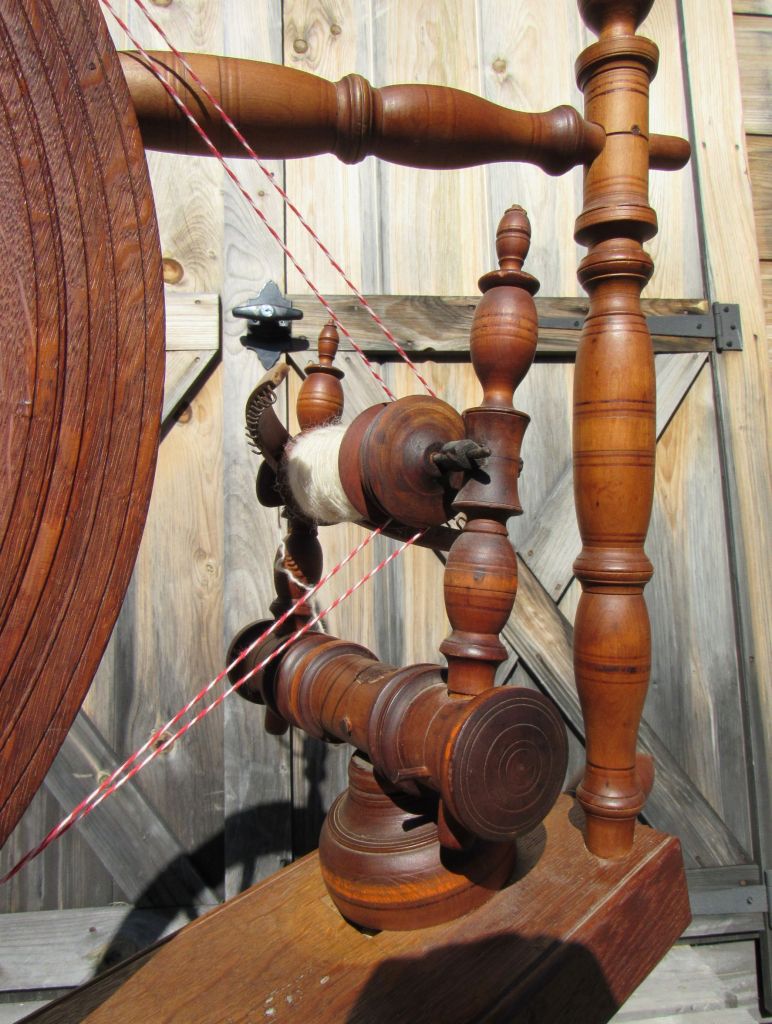
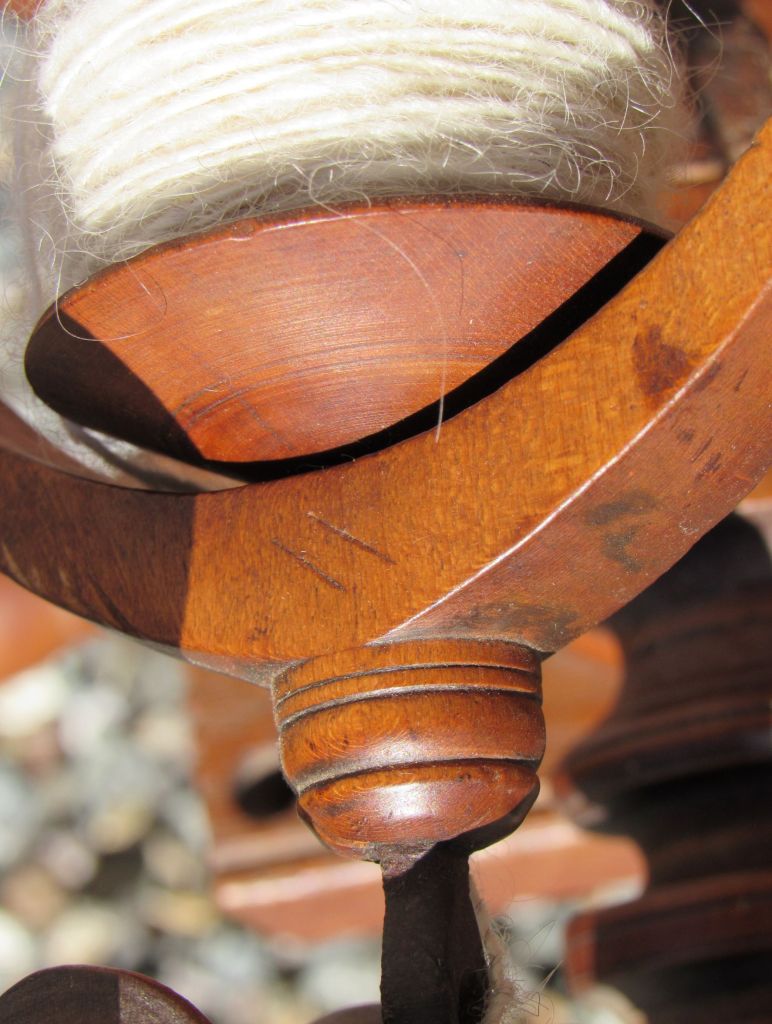
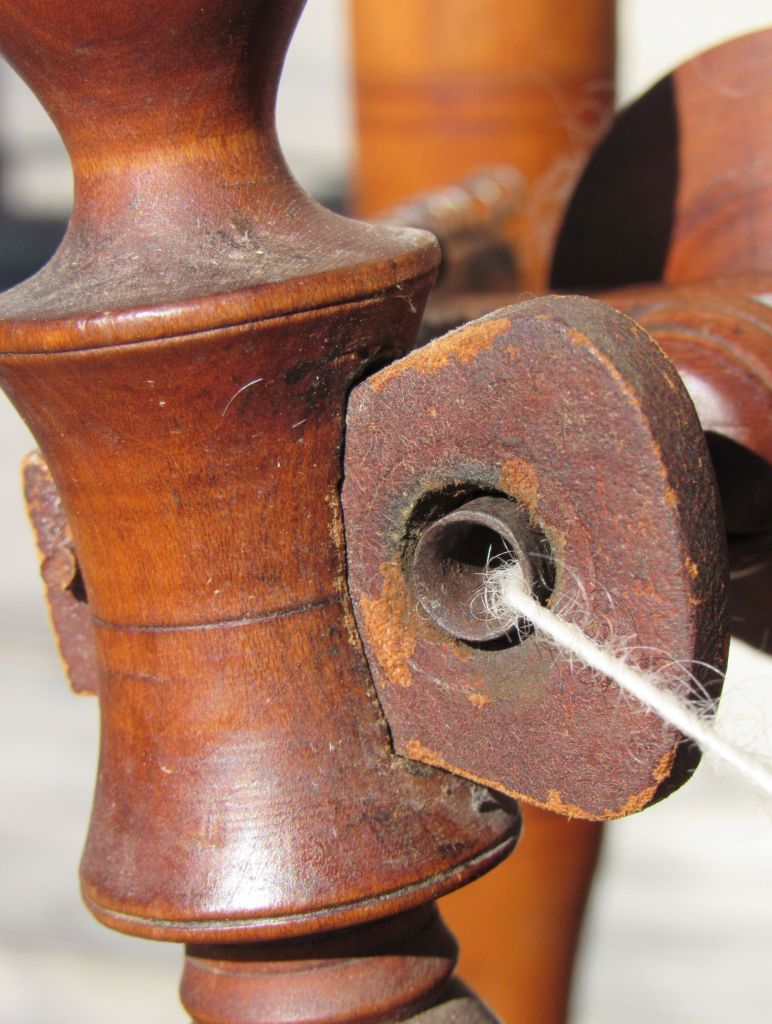
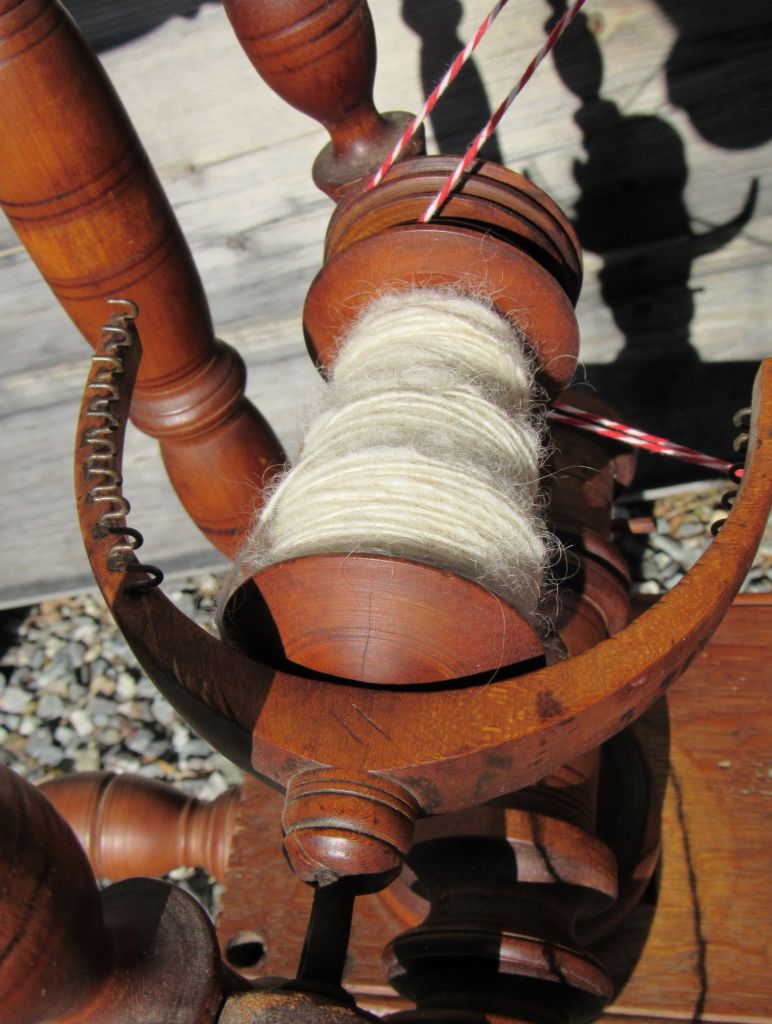
The flyer set up is ingenious.
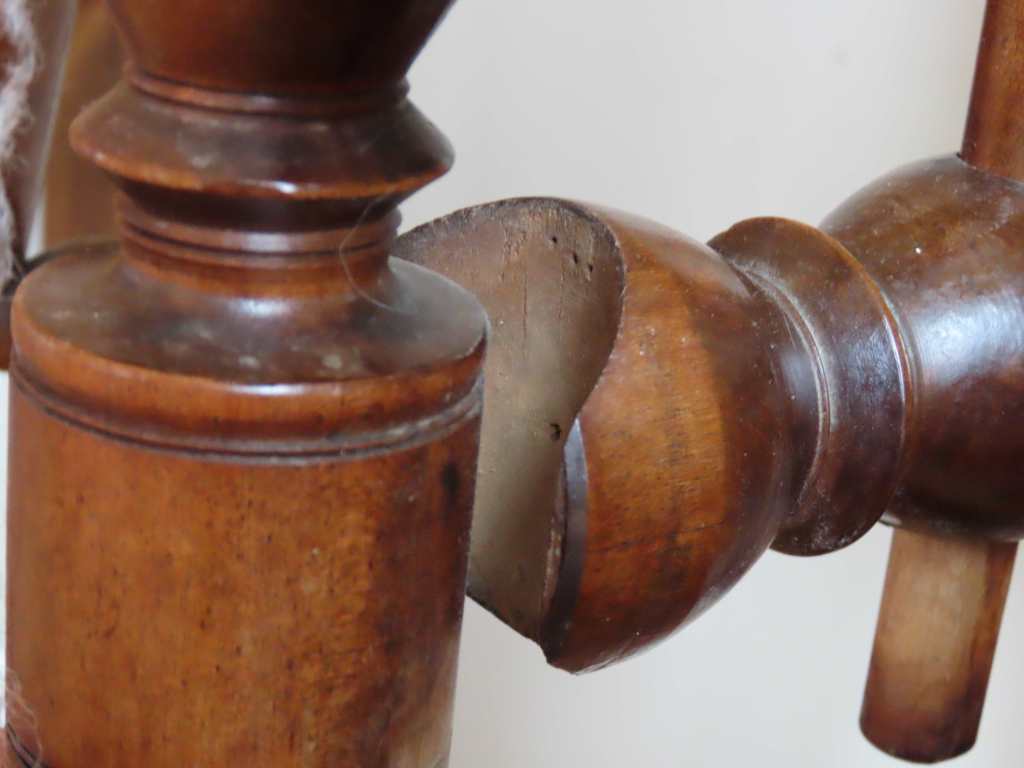
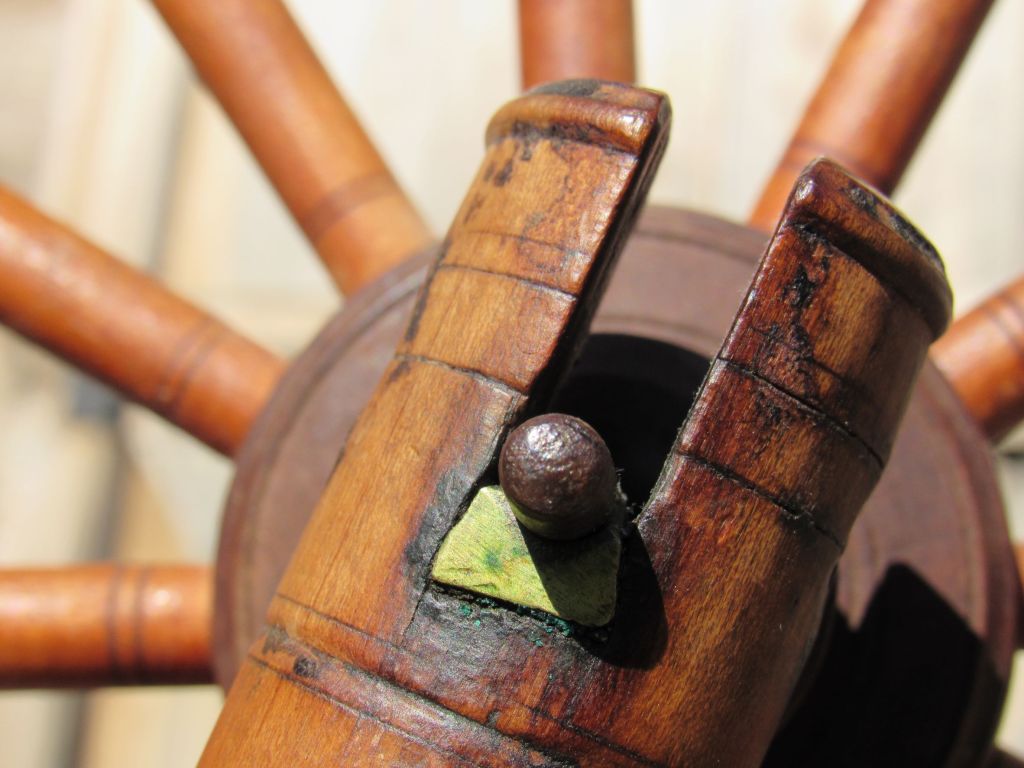
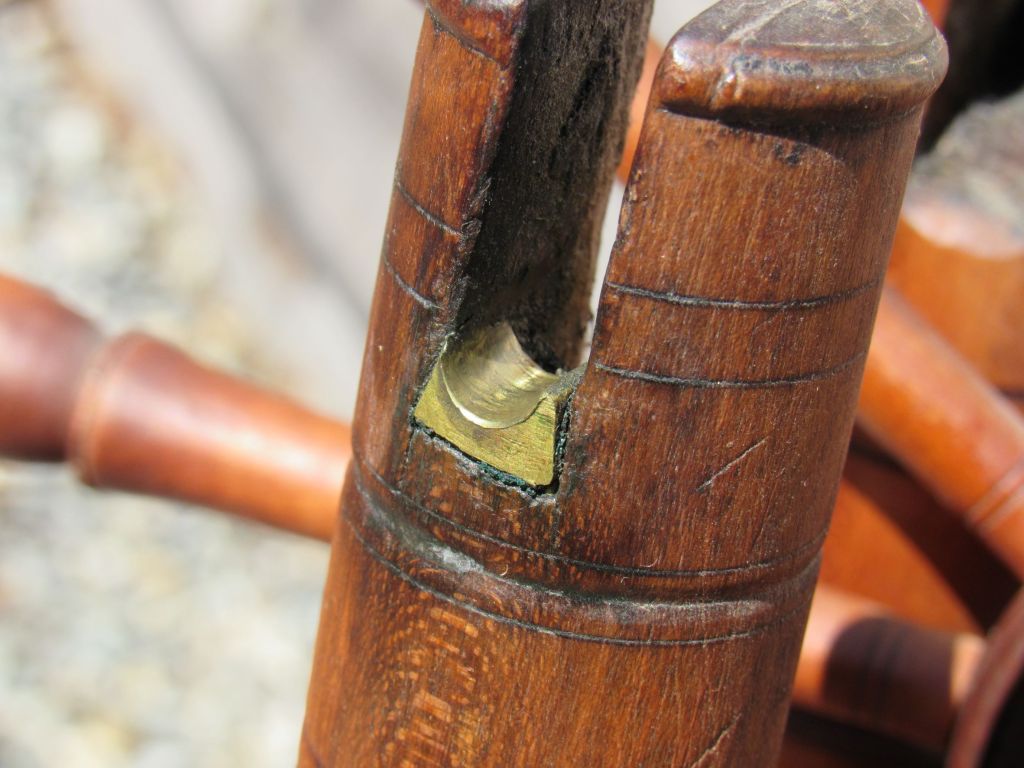
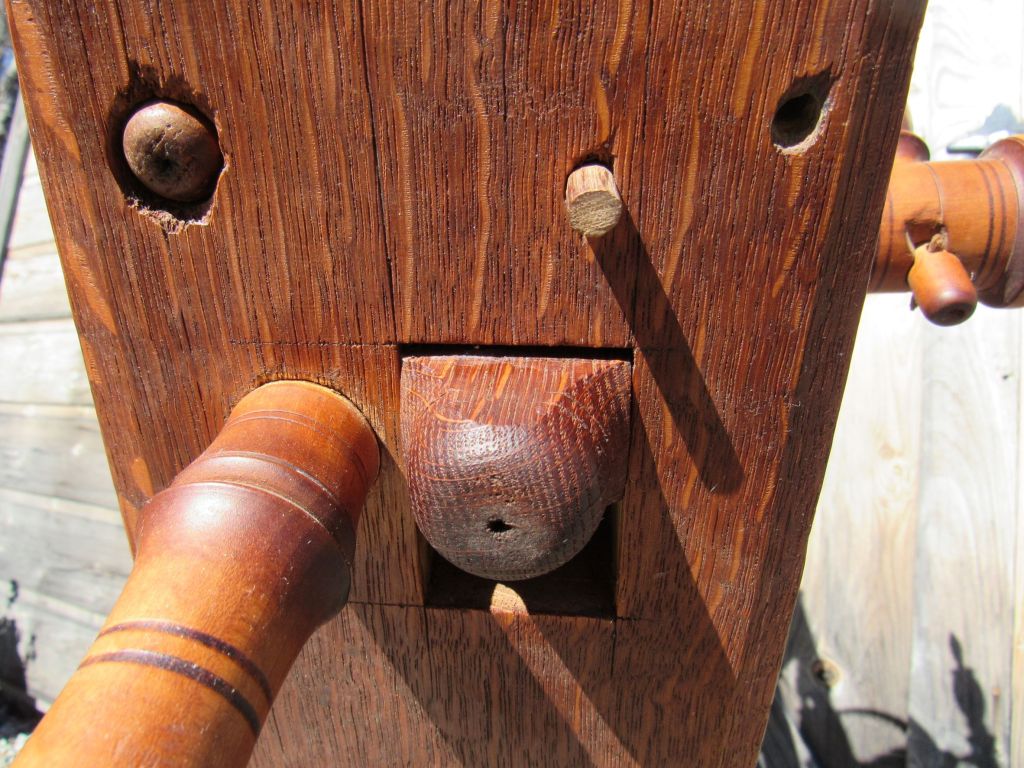
One wooden key releases the end flyer bearing so that the flyer can be removed.
The other raises a central bar to control tension.
The flyer hooks are seated opposite to most flyers, in other words, the hooks are on the top right side and lower left side of the flyer when looking down the arm, in contrast to the usual configuration of right on top of the left arm and below the right.
According to Patricia Baines, this was the way the flyers were usually made on castle wheels in Ireland. She suggests that this may have originally been to facilitate spinning flax in the “S” direction. (Baines, p. 146) It is interesting to see how that unusual feature seems to have been carried over from Ireland to many of the castle wheels made in Pennsylvania.
While most makers of these wheels were in Pennsylvania, a few wheels have appeared in New England, too, including one signed “M. Wood.” That name is intriguing because we know of two New England wheel-making brothers, Phineas and Obadiah Wood (see previous post “Scarlet”). Could M. Wood be related?
There is still so much research to be done on American castle wheels—to pin down who made them and why. But there is already a tremendous amount of research that has been done. I only skimmed the surface here. The articles and books listed below were my references and contain much more in-depth and complete background and analysis. I highly recommend them.
Descriptions and photographs do not do justice to the beauty and fine craftsmanship of this wheel. A heartfelt thank-you to Bill Leinbach for entrusting me with this amazing wheel, for his generosity in sharing time and knowledge, and for the photograph of Elizabeth Danner.
References:
Leinbach, William A., “Daniel Danner: The Man Behind the Wheel,” The Spinning Wheel Sleuth, Issue 4, January 1994, pp. 6-8.
McMahon, James D., “Daniel Danner Woodturner: An Early 19th Century Rural Craftsman in Central Pennsylvania,” Pennsylvania Folklife; Vol. 43, No. 1, Fall 1993., pp. 8-19.
Taylor, Michael, “Humes, Danner, and Killian Flax Wheels,” The Spinning Wheel Sleuth, Issue 35, January 2007, pp. 2-4.
Taylor, Michael, “Castle Wheels in Lancaster County, PA,” The Spinning Wheel Sleuth, Issue 93, July 2016, pp. 2-4.
Baines, Patricia, Spinning Wheels, Spinners & Spinning, B. T Batsford, Ltd, London, 1977, pp. 144-46.
Pennington, David and Taylor, Michael, Spinning Wheels and Accessories, Schiffer Publishing Ltd., Atglen, PA 2004, pp. 53-59.
Thompson, G.B., Spinning Wheels (The John Horner Collection), Ulster Museum, Belfast 1976.
Ancestry.com for genealogies of the Danner and Berg families in Pennsylvania.
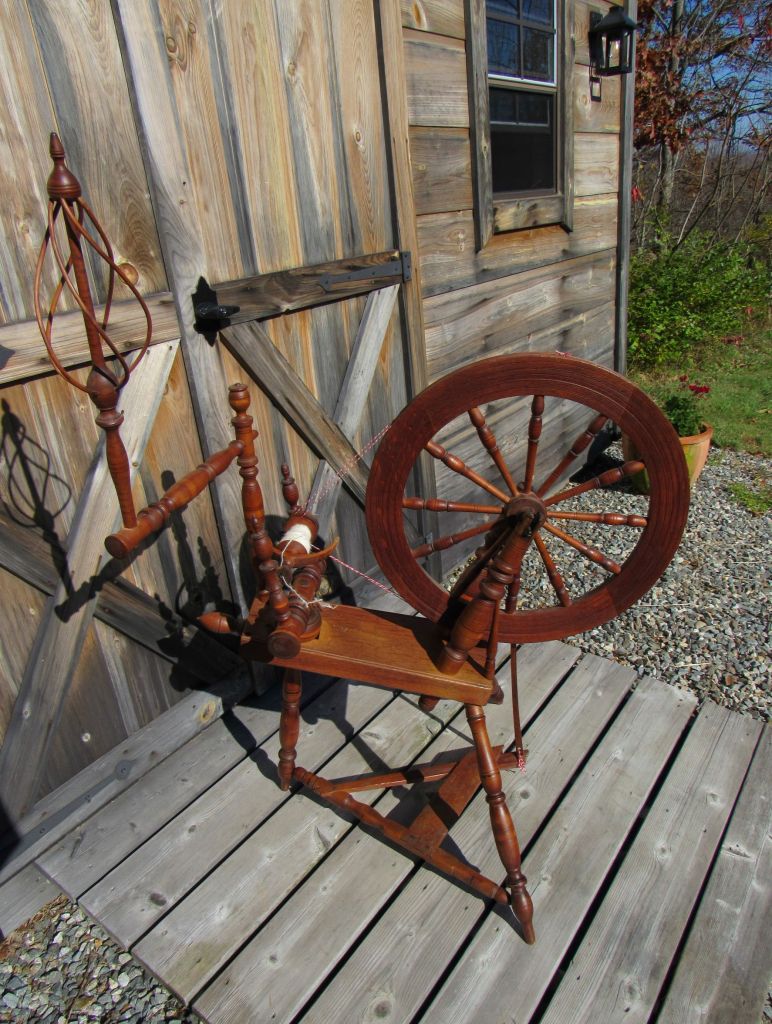
Jacob Fox made beautiful spinning wheels. Yet, despite the fact that many fine examples of his wheels survive, I have been unable to find out very much about the man himself.
He was born Jacob Fuchs in 1788, in Berks County, Pennsylvania, son of Johann Michael Fuchs and Anna Margaretha Schwartzhaupt. Jacob’s father, Johann, was born in Hesse, Germany in 1749 and arrived in Pennsylvania as a young man in 1773. Jacob’s mother, Anna Margaretha, also of German descent, was born in Berks County in 1760.
At some point Jacob Fuchs anglicized his name to “Fox.” He married Catherine Batteiger (also spelled Potteiger) in 1815. They resided in Upper Tulpehocken Township, in Berks County, where they had several daughters, and Jacob had his workshop. Jacob died in 1862, leaving a shop that still contained his woodworking tools and branding irons. (Goyne Evans, Am. Windsor Furn. p. 222, fn. 70).
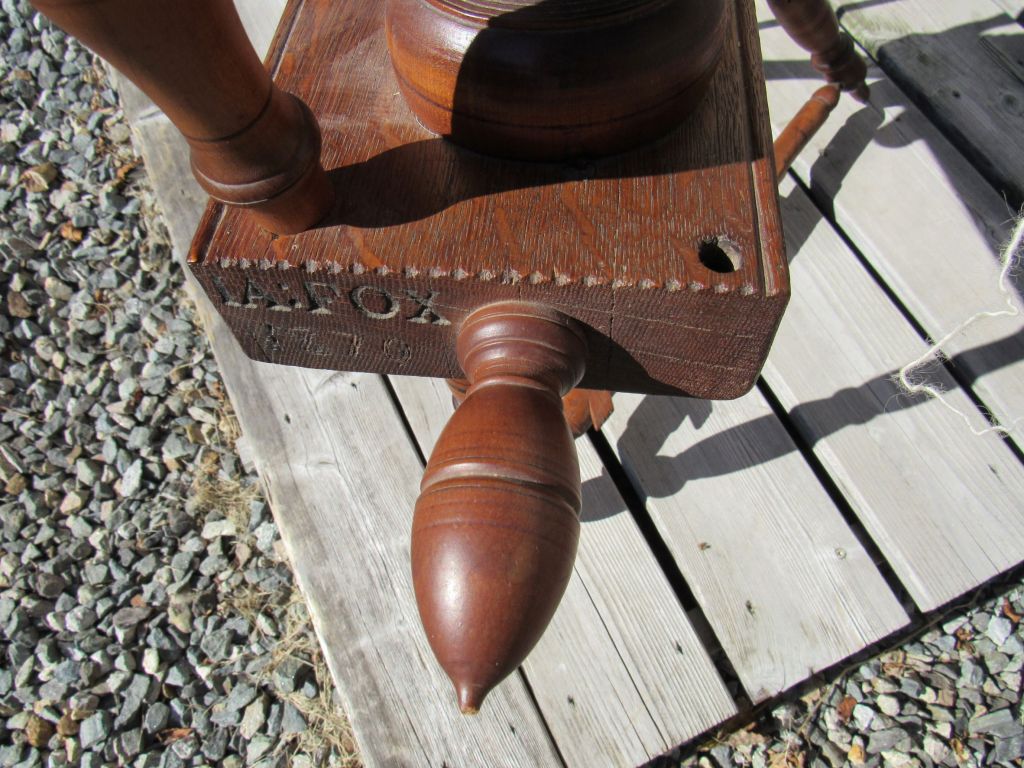
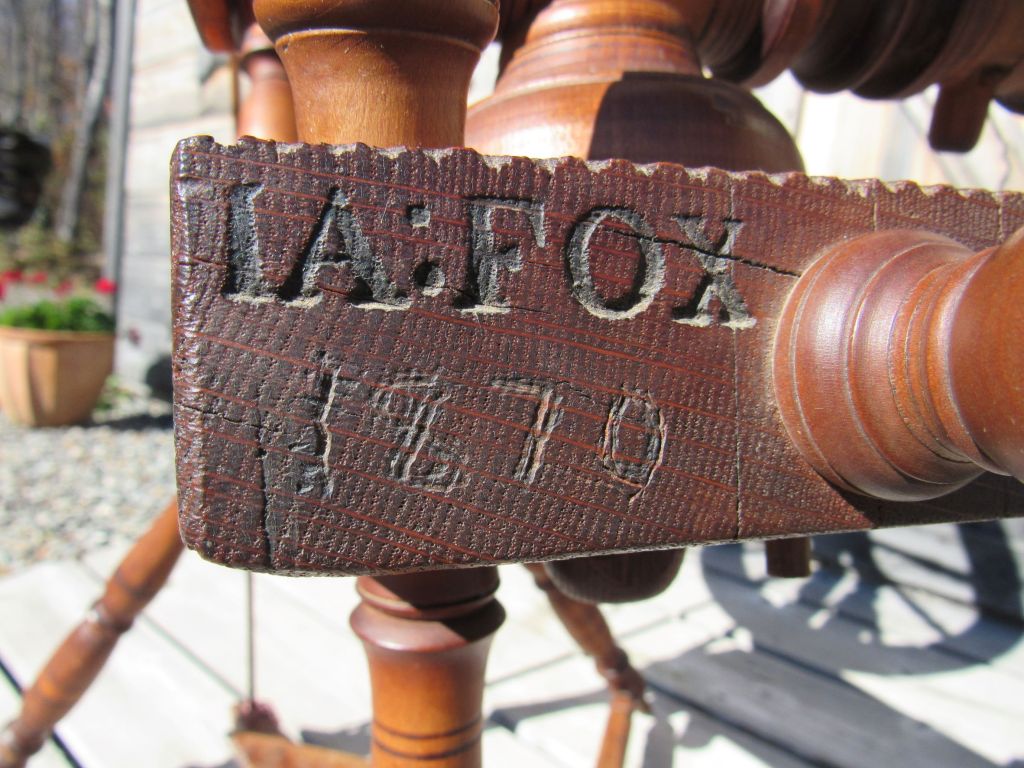
“Like many artisans of the period, Fox was both a farmer and a craftsman …” (Bartlett, pp. 28-29) He made Windsor chairs, marking them with the same brand as on my wheel, “IA: FOX.” (Goyne Evans, Am. Windsor Furn. pp. 102-03, 221).
“The work of Jacob Fox in Berks County is interesting as typical of provincial interpretations of prevailing Philadelphia style, which proved popular among his local patrons. Fox made both bow-back and square-back chairs with turned work ranging from the full baluster to full bamboo style.” (Bartlett, p. 29)
In 1839, Fox had a new branding iron made, changing his mark from “IA: FOX” to “J. FOX”. Although Fox did not date his wheels, because his branding iron has a date on its side, the changed mark serves as a demarcation for wheels made before and after 1839.
Aside from this rather bare-bones “he-was-born-he-worked-he-died” life summary, I found little information to bring Jacob Fox to life. Perhaps his wheels must speak for him. We can see from them Fox’s meticulous attention to detail and quality.
From a business perspective, he appeared to have an eye for his market. As with his chair making, Fox’s wheels were made in the style popular for his time and place. His wheels share certain distinctive features with other Berks County wheels marked “D. Kunkel,” “D.S.,” “H.S.,” and “J. Jacob.” (P&T, p. 127).
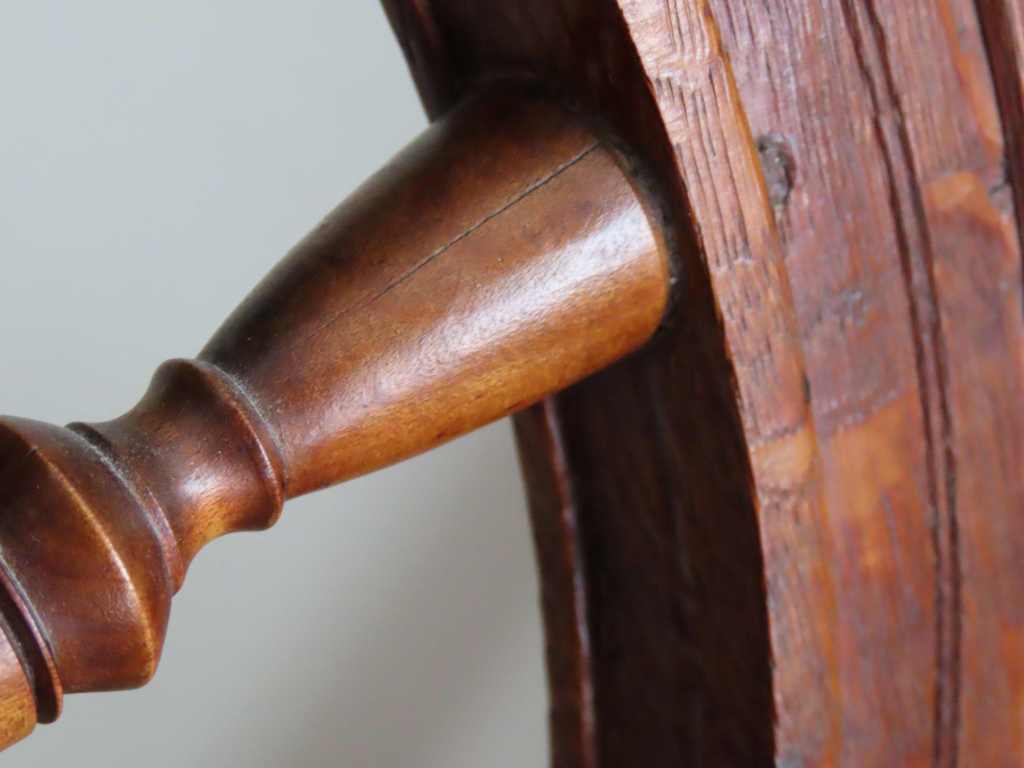
Those construction features included secondary upright supports on both sides, snugly fitted and pegged flush in the table,
and drive wheels constructed of four roughly equal sections,
each section, or felloe, tightly joined
and double pegged.
Another unusual feature, popular in eastern and central Pennsylvania, was a hole through the table’s spinner side for a reeling pin. (Taylor, SWS p.7)
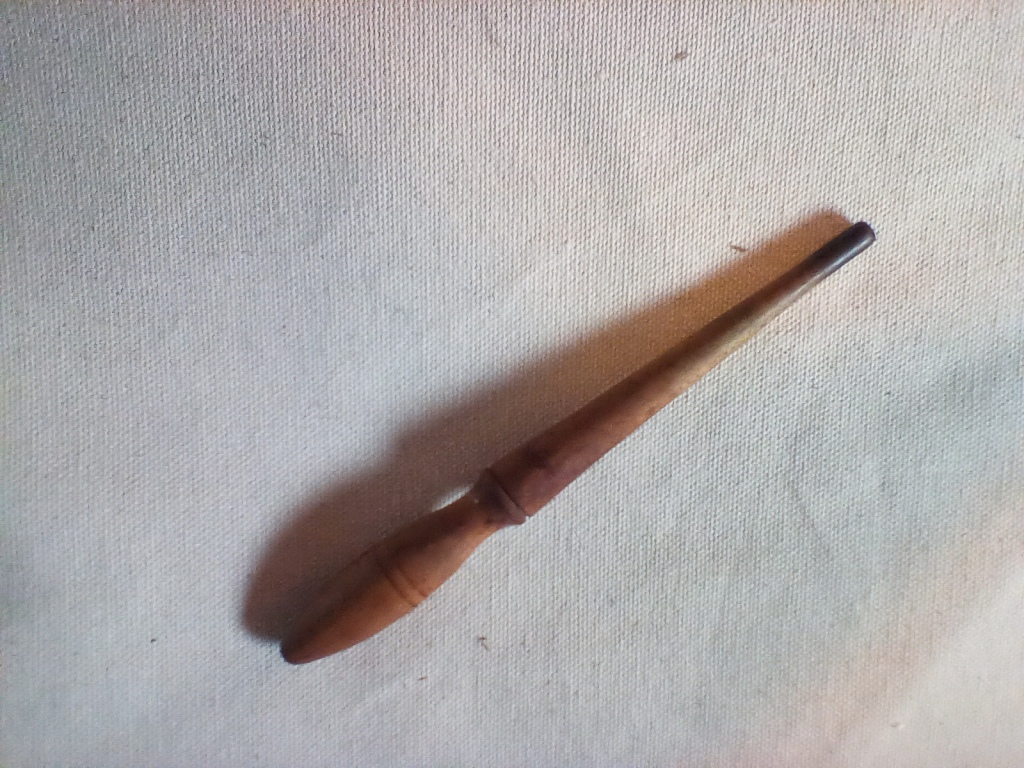
Reeling pins were turned wooden pins about the size of a finger. It is believed they were used for guiding the spun thread when unwinding it from the wheel’s bobbin onto a reel. The theory is that it saved fingers from friction burn (think of rope-burn on a finer scale) and cuts made by fast-reeling flax thread. It seems like something a city women with soft hands might have used but less likely to be in high demand from farm women, whose hands likely were well-callused and work-hardened enough not to be bothered by unwinding flax.
Ester’s reeling pin is gone, but the hole is a reminder of how quickly we lose knowledge about wheel design and use at particular times and places. Why are holes for reeling pins found in only a small area of the country? Was it a tradition brought from a German region? Were reeling pins used in other parts of this country, but without storage holes? Or were they a nineteenth century local fad?
While Fox’s wheels share similarities with other area wheel makers, his wheels also have a certain flair that mark them as his creations. From hub,
to axle bearings,
to spokes
to the underside,
the materials, construction, and design are superb.
The wheels have a finely-finished quality,
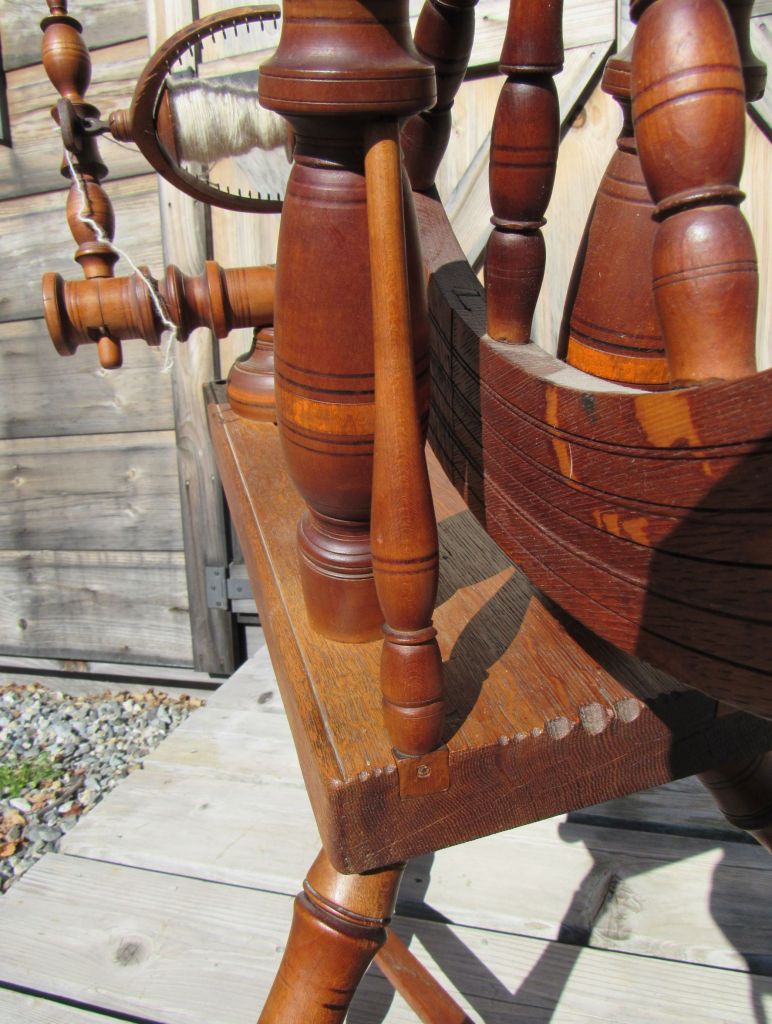
exuberantly decorated with brilliant orange painted bands,
contrasted with black bands.
The feet are elegantly pointed
and the small-large-small chip carving on the table end gives a special touch.
His attention to the smallest details is remarkable.
Even the ends of the treadle bars have chip carvings.
The distaff arm is pegged in place to keep the distaff from flopping over when in use.
And the under-table portion of the wheel uprights are turned, beautifying a largely hidden part of the wheel–an unusual feature that makes him and his wheels stand out.
This wheel has seen some significant use,
with obvious wear on the treadle
and dent marks on the table.
Such marks have been the cause of much discussion in online antique wheel groups. They are often seen on Scandinavian wheels and the general consensus seems to be that small knives or other utensils were spiked into the table under the drive band to help guide or separate it, although often the marks do not look big enough to hold a knife upright for long.
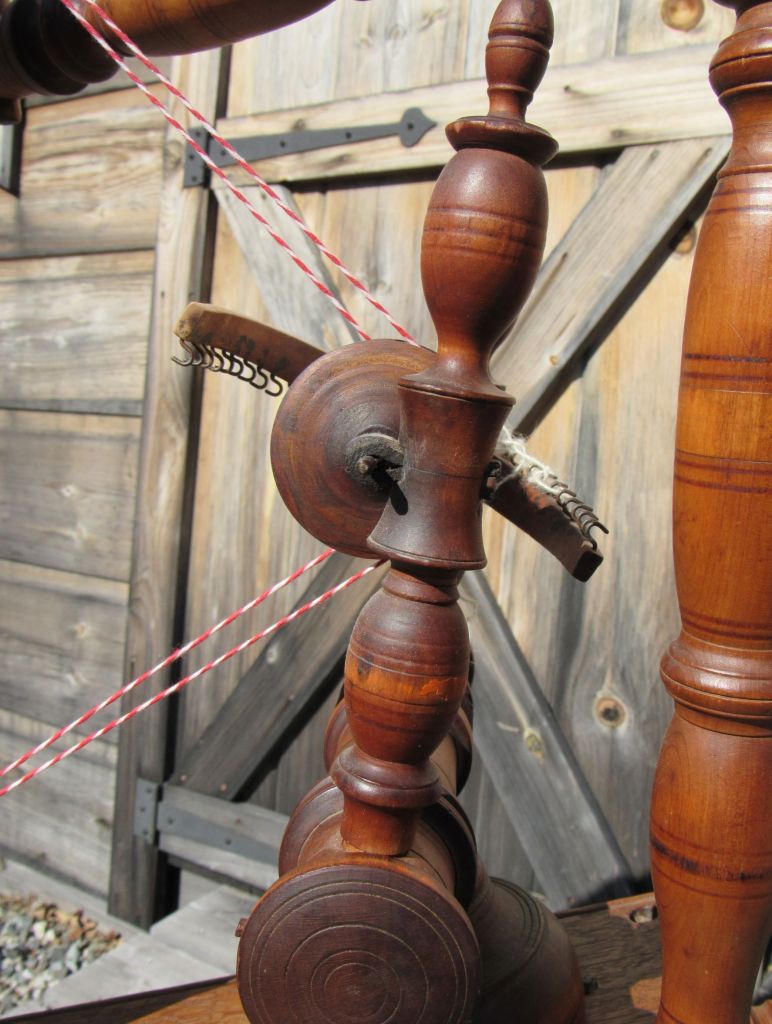
The flyer fits well and matches the wheel. It has some wear
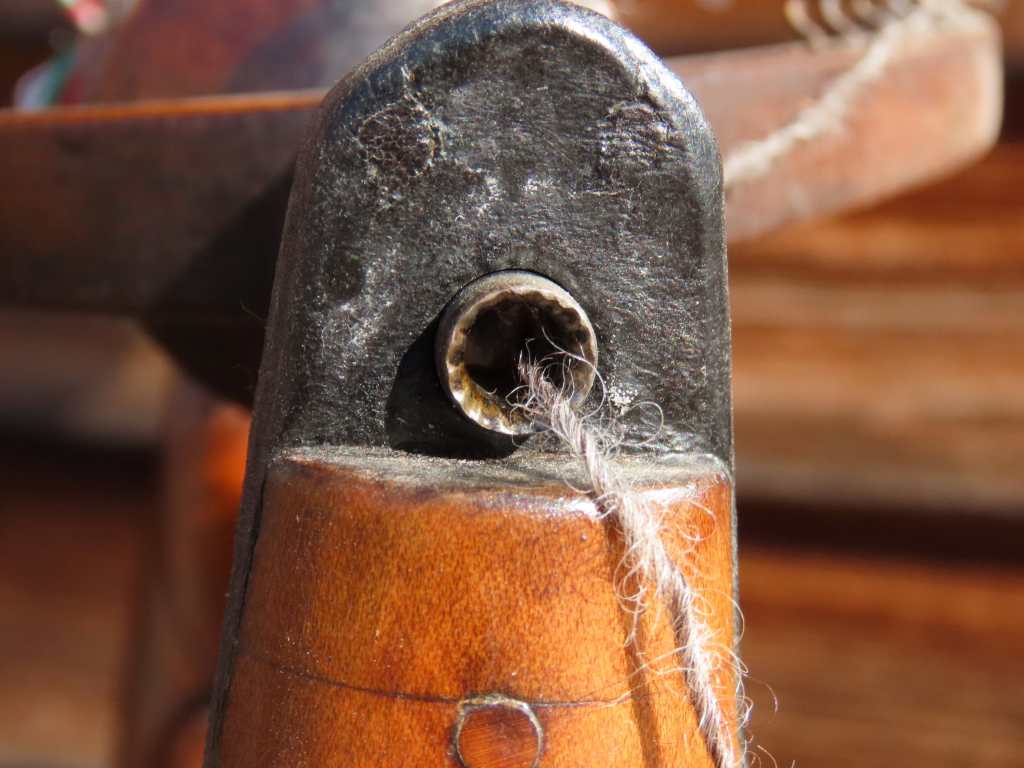
but is in overall good condition with a smooth orifice
and a moderate wingspan (not as wide as many Pennsylvania flyers). It could be original, or not.
The distaff appears to match the wheel, but, again, I do not know if it is original.
Since Ester has Fox’s early stamp, we know the wheel was made before 1839, and this distaff looks as if it might be newer than that.
The footman is intriguing because it is elegantly curved. But, without seeing other similar Fox footmen, I doubt if it is original.
As for the date carved crudely carved under Fox’s mark, it appears to have originally been 1770 and then changed to 1880.
Both dates are puzzling, because Fox would have been 15 in 1770 and dead in 1880. Still, it is part of the wheel’s history and mystery.
This wheel is a testament to the power of material things and the importance of preserving them. While there seem to be few written details about Jacob Fox, his branding iron and his wheels give us clues about him and his life. He lives on in them.
January 6, 2023 edited to add:
After posting this, I heard from two owners of J. Fox wheels, both of whom confirmed that Ester’s distaff is consistent with others on Fox wheels and likely original. In addition, Bill Leinbach sent this photo of Fox reeling pin (thanks Bill):
References:
Taylor, Michael, “Reeling Pins,” The Spinning Wheel Sleuth, Issue #115, January 2022, pp. 7-8
Bartlett, Louisa, Curator, A Cultural Celebration: Arts of the Berks County Pennsylvania Germans From a Private Collection, paper available online from exhibit June 12-Sept. 26, 2010, pp. 28-29.
Goyne Evans, Nancy, American Windsor Furniture, Specialized Forms, Hudson Hills Press, New York, N.Y. 1997.
Goyne Evans, Nancy, Windsor-Chair Making in America, From Craft Shop to Consumer, University Press of New England, Lebanon, N.H. 2006. Fox’s dated brand is pictured on page 80.
Pennington, David and Taylor, Michael, Spinning Wheels and Accessories, Schiffer Publishing, Atglen, PA 2004, pp. For a wonderful discussion of eastern Pennsylvania wheels see Chapter 11, pp. 123-29.
 Exquisite Machinery