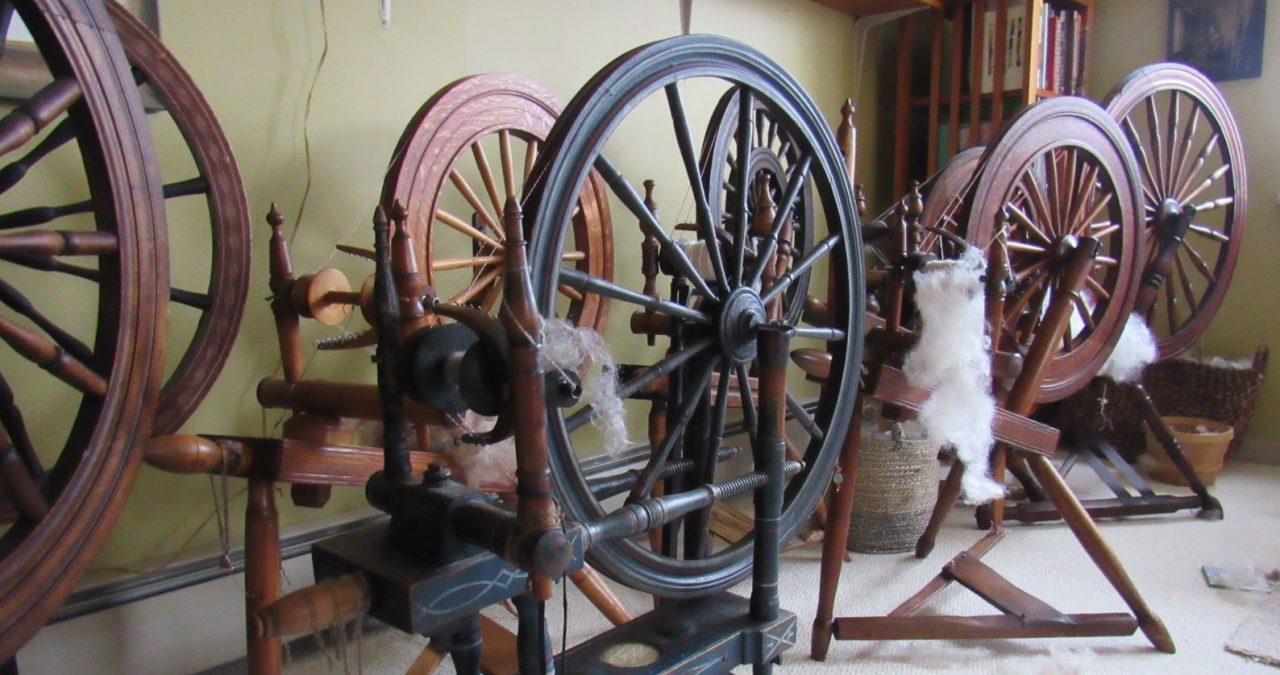
Antique wheels present so many puzzles. Connecticut double flyer wheels, for example. Why was there a sudden surge in manufacture of these wheels in the late 1700s and early 1800s? Was there a need for increased spinning production in that particular region at that time? Or did they simply become fashionable—a personal advertisement of spinning prowess?

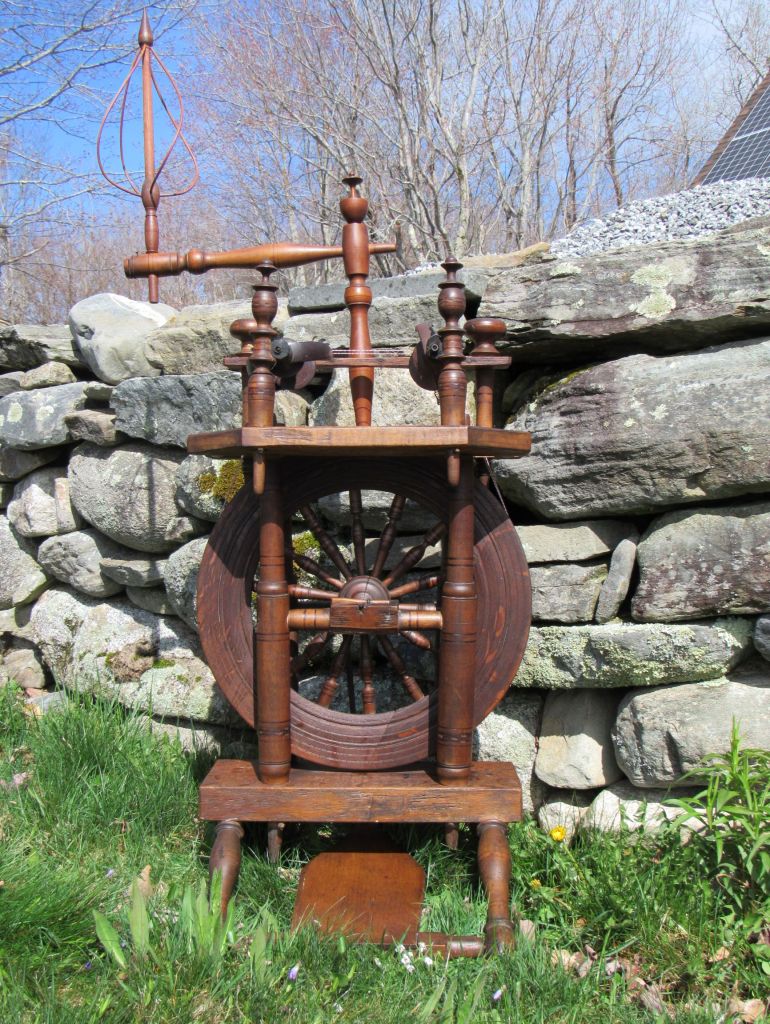
These wheels, compact uprights with two flyers supported above the drive wheel, have been referred to as “gossip wheels,” based on a lovely, but mistaken, notion that two spinners could work side by side at one wheel, chatting as they spun. For most double flyers, however, reality was much less cozy and serene—they were a means to increase production, not socialization. One spinner, two hands, two flyers—double the product.

Or almost double—apparently a good spinner could increase her production by about fifty or seventy-five percent. I have great admiration for those spinners. It’s not easy to spin with only one hand for each flyer—especially with flax. Spinning a fine, consistent linen thread requires an even pull-down from the distaff (and very careful dressing of the distaff), a way to smooth out inevitable lumps and thicknesses, and a way to moisten the thread as it is spun.

Tough enough with two hands, let alone one. And once single-handed spinning is mastered—with right hand and left–then one must co-ordinate each hand to spin at the same time—but separately. Despite that challenge, these wheels were very popular for several decades in Connecticut.
Were all of the users competent with two flyers, I wonder? Most double flyer wheels can be used with only one flyer, so perhaps they were considered versatile—with an option of using one or both flyers. They also are compact and attractive, which may have contributed to their appeal.
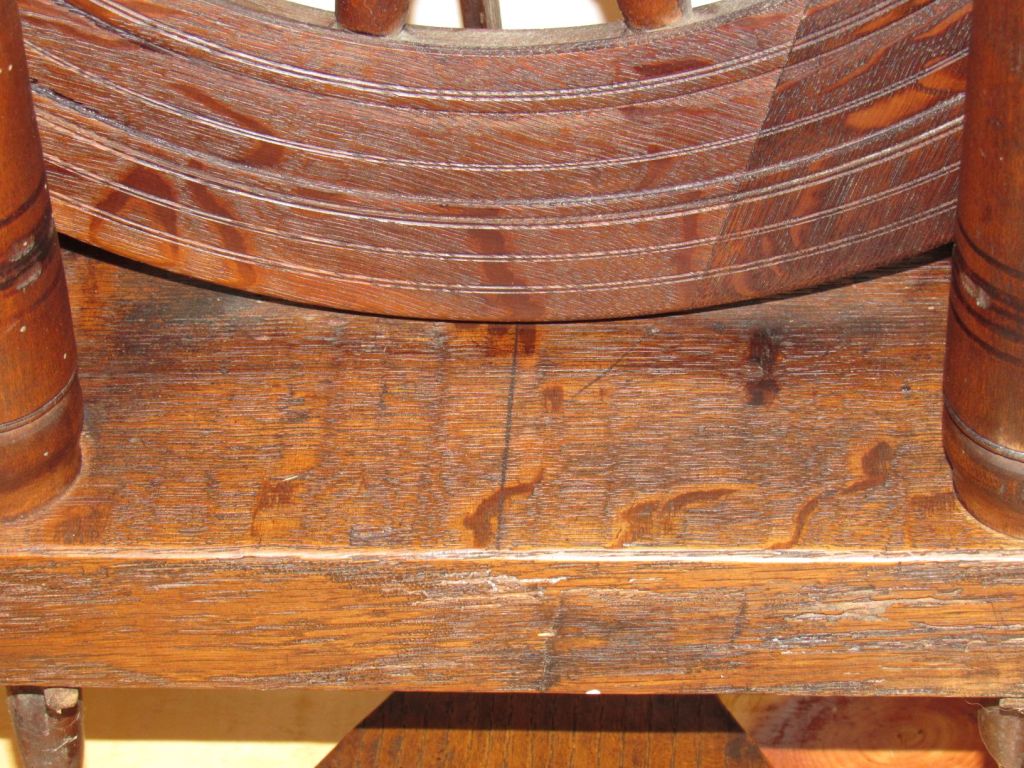
In any case, my double-flyer does not appear to have seen much use, so perhaps the wheel was more aspirational than practical for her owner.
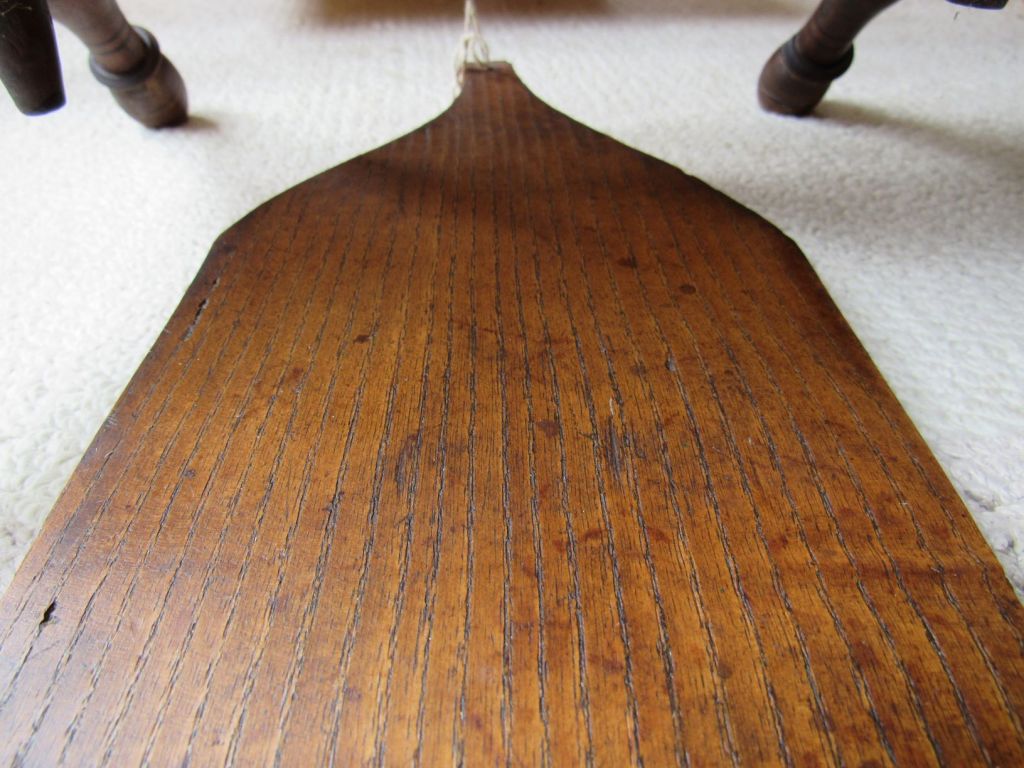
There is no maker’s mark, but the wheel bears the hallmarks of the Sanford family (see previous post “Big Bear” for more on the Sanfords).
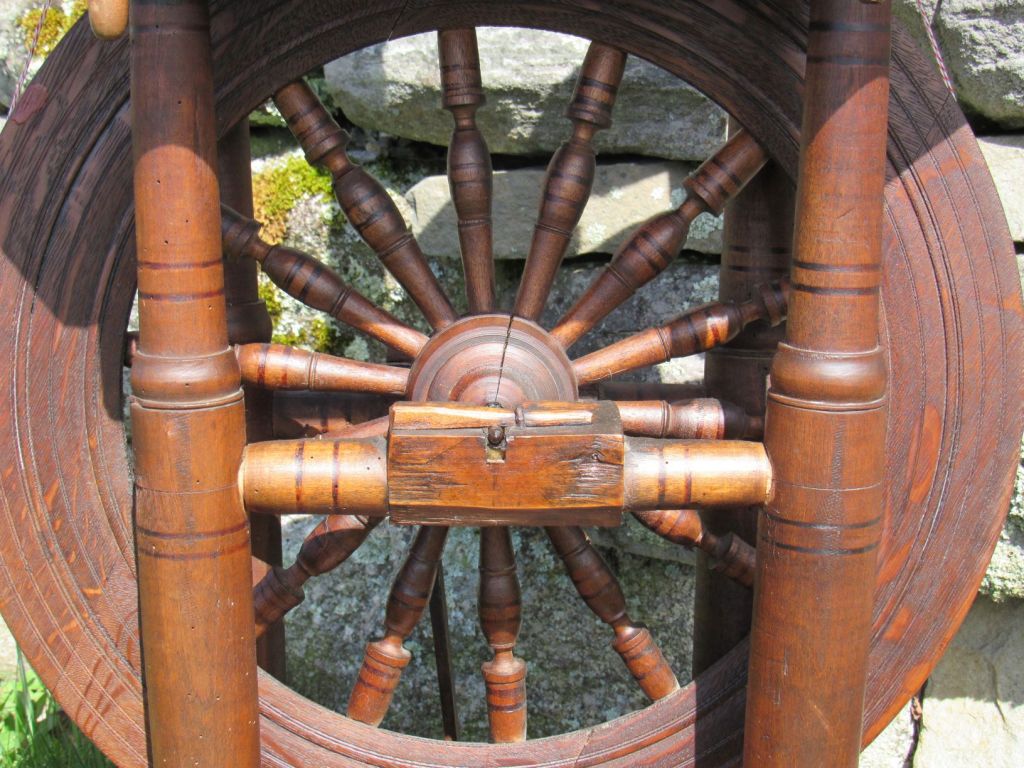
Sanford double flyers are characterized by cross posts supporting the wheel axle rather than upright supports favored by other area wheelmakers such as Silas Barnum, Solomon Plant, John Sturdevant, Jr., and J. Platt.

The Sanford wheels also have a simple top table—with a straight angle corner cut. In contrast, most of the other wheelmakers’ top tables have curved corners and half-rounds at the base of the maidens. J. Platt’s wheels had the unusual combination of upright supports with a Sanford-like top table and L. Judson’s wheels shared the Sanford characteristics.
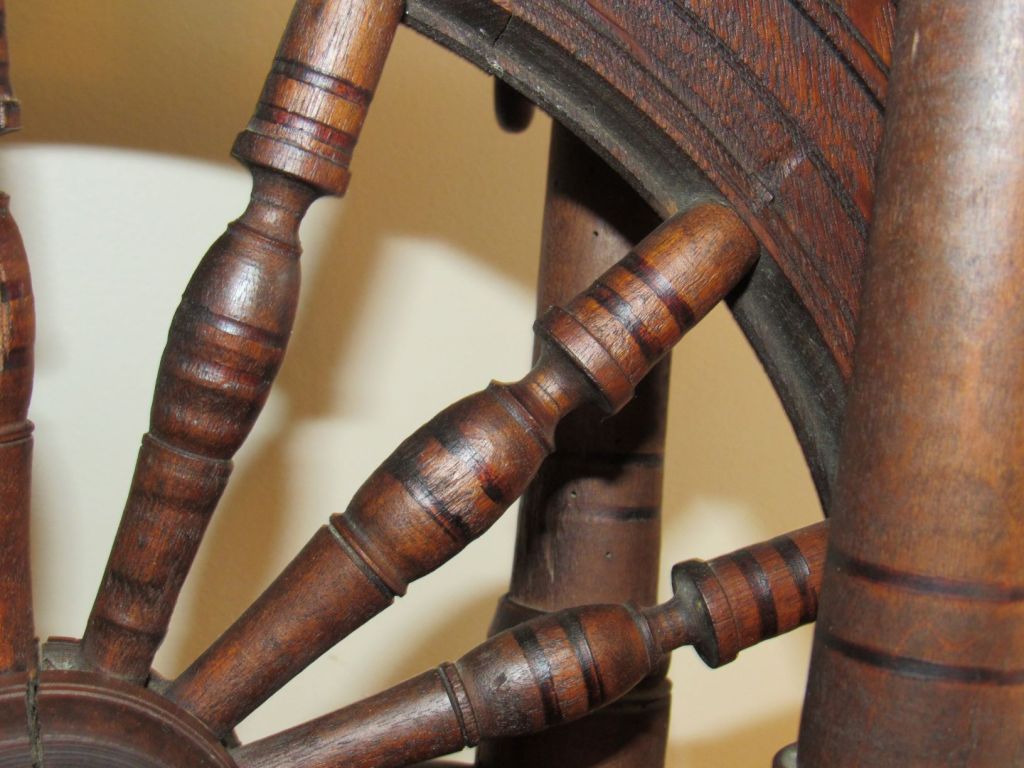
My wheel has spokes characteristic of the early Sanford wheels—the later ones had simpler spokes—and the typical black bands with diamond chip carvings.
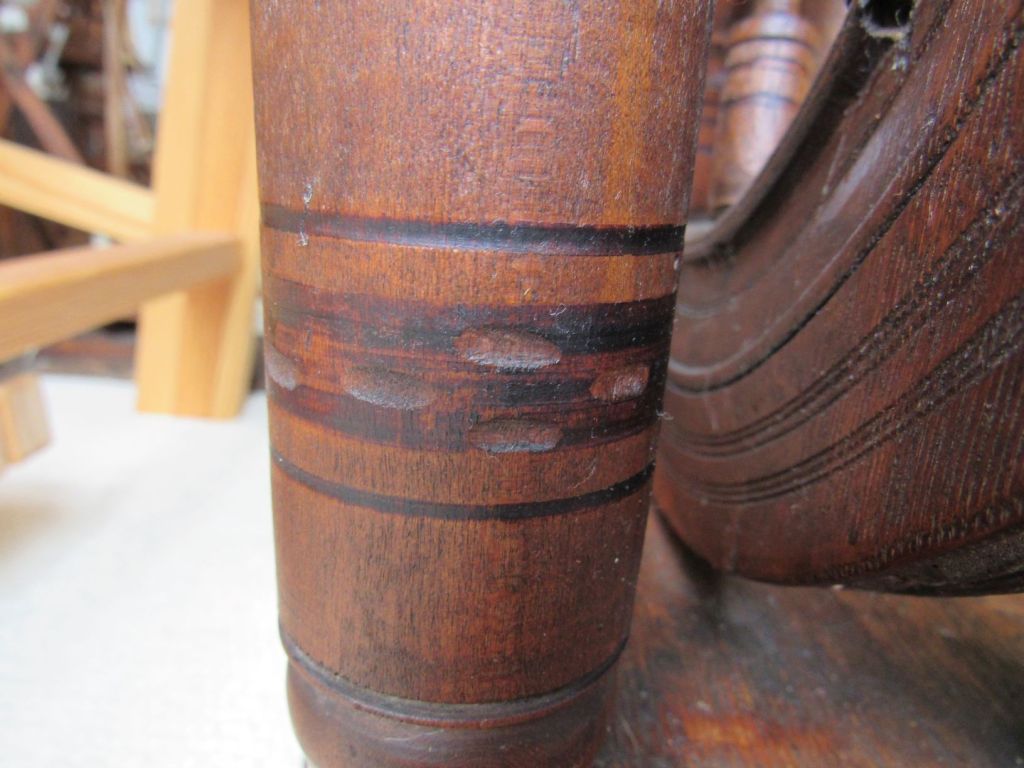
Neither flyer appears to be original and the bird cage distaff looks as if it was made fairly recently. A straight, truncheon-style distaff would have been more typical for these wheels.

The distaff support assembly is absolutely beautiful and also likely not original to this wheel. The wood, finish, and rings are quite different than the wheel body and the really elegant turnings suggest that they came from a different wheel.

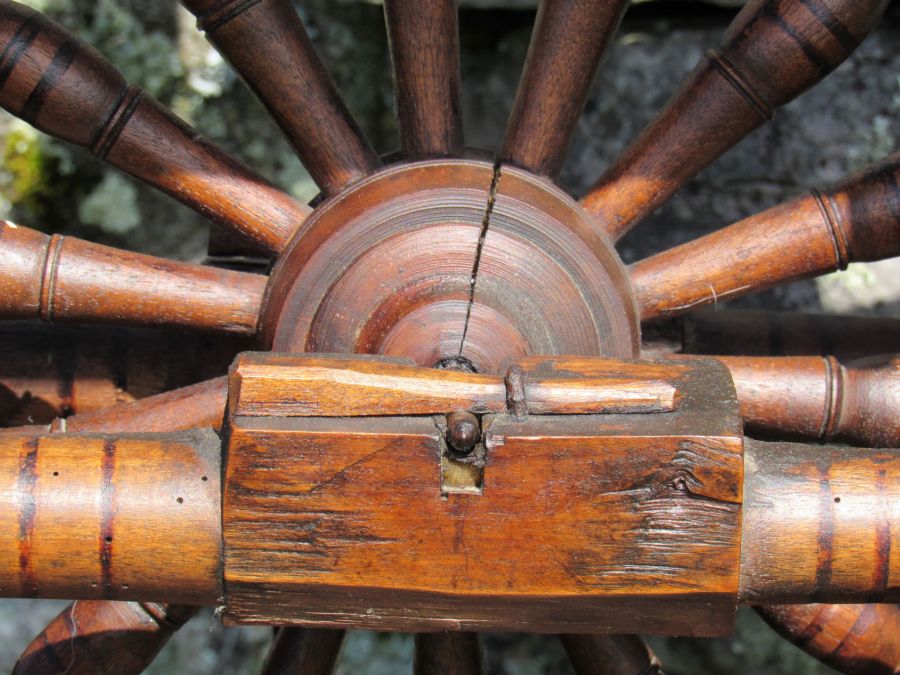
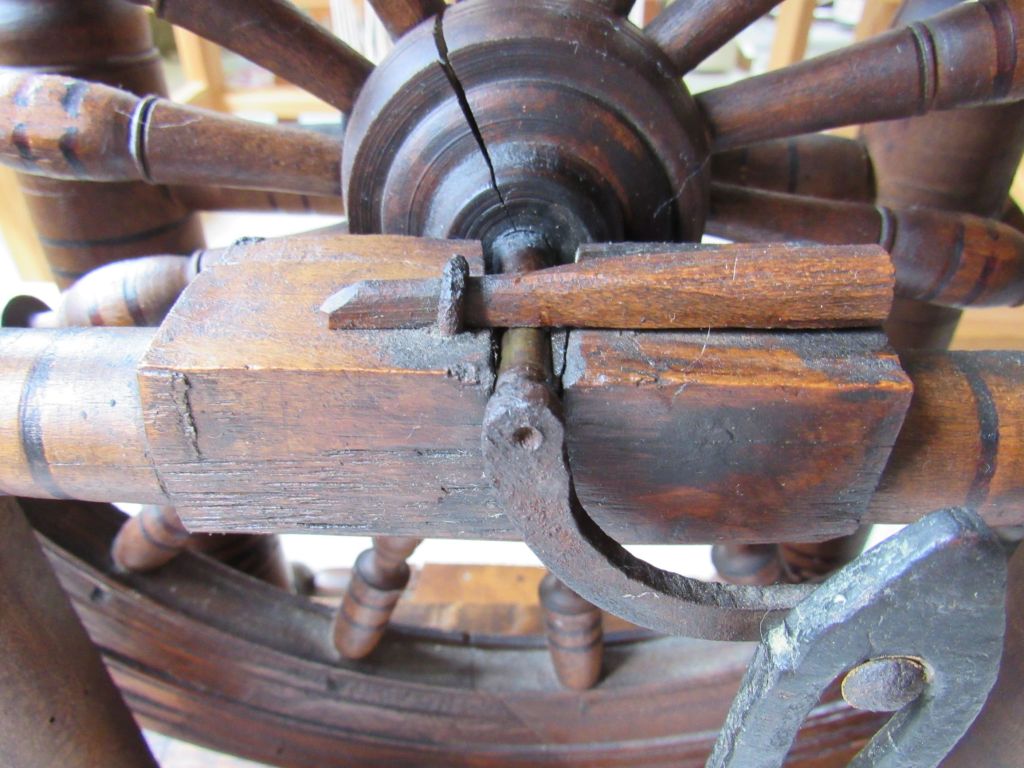
The wood on the wheel table is quite coarse-grained
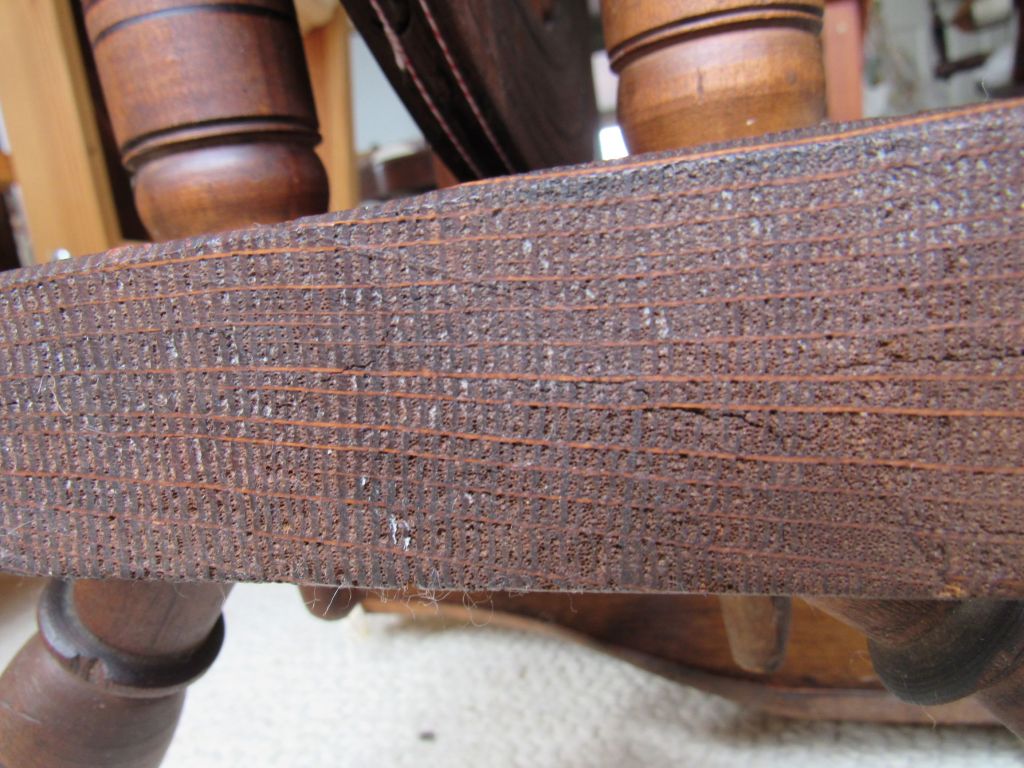
and one of the tension knobs still has a bit of bark on it.

Although the flyers are not original, they fit and work nicely. The wheel is in remarkably good shape and a spinning beast. Now, I need to learn to keep up with her.
Update December 2020: Recently someone questioned me about the assertion that a spinner could not double production on one of these wheels. I thought it would be worthwhile to include here some sources for that contention. In her article “The Double Flyer Spinning Wheel” in Issue #6 of the Spinning Wheel Sleuth, Joan Cummer wrote: “Although sometimes used for spinning wool, the double flyer wheels were especially employed for spinning flax. A spinner could not double her single flyer production but if very competent could produce 150% to 175% of her single flyer yardage per hour.”
In Patricia Baines’ book, “Spinning Wheels, Spinners & Spinning,” (1977) she wrote that double flyer wheels were “mostly found where flax spinning was an industry, as it was thought of as a wheel essentially for helping the poor to earn more money and to speed up production although it could not actually double the output.” (p. 151). Baines cited H. E. Von Rettich’s Spinnradtypen, Vienna, 1895, for the proposition that “a spinning wheel with treadle produced 350 metres per hour and one with two flyers 498 metres per hour,” while noting that the validity of these measurements is necessarily dependent on the skill of the spinner.
And, a little book, “The Tale of the Spinning Wheel,” by Elizabeth Cynthia Barney Buel, quotes from an 1801 advertisement in a Connecticut newspaper, the Hartford Courant, by local wheel maker Joel Baldwin , saying “Two handed wheels are highly recommended to young women, as they can spin one third faster on them.” (p. 39) The book was published in 1903 and is a fascinating glimpse spinning and textile production. A free e-book version can be found here: https://www.gutenberg.org/files/58950/58950-h/58950-h.htm?fbclid=IwAR1TgJdVNGMxNgxaeHuk2MBD2Uh5wurV6D008O-FnGJcHYr6_bdxA64ZKXw.
An article in “The Journal for Weavers, Spinners, and Dyers” Winter 2020 from the UK, titled “A Window Onto the Linen Industry in Eighteenth Century Scotland,” by Hilary Miller, also discussed output from double flyer wheels in Scotland. The article notes that, according to the Old Statistical Account (OSA)–information from Scottish parishes–a spinner on a double flyer wheel could spin nearly one third more and of better quality than on a single flyer wheel, or near twice as much, but of a coarser quality. (p. 20).
 Exquisite Machinery