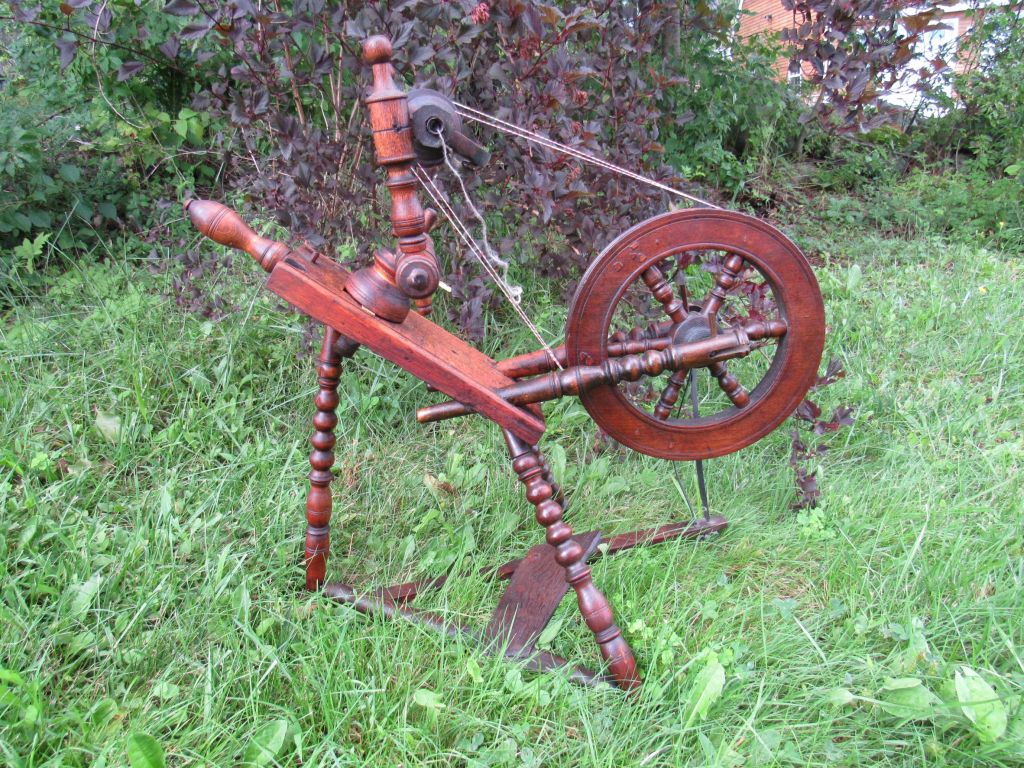
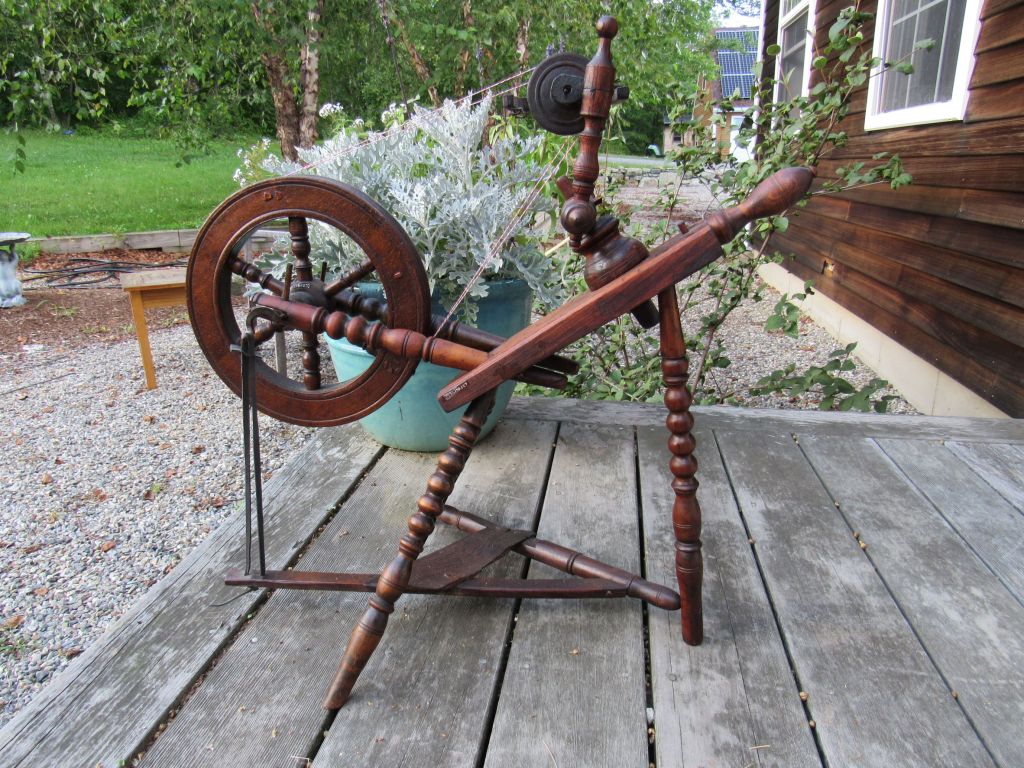
If the wheel in the previous post, Green Linnet, is the oldest I have owned, this wheel, Hermione, is the smallest.
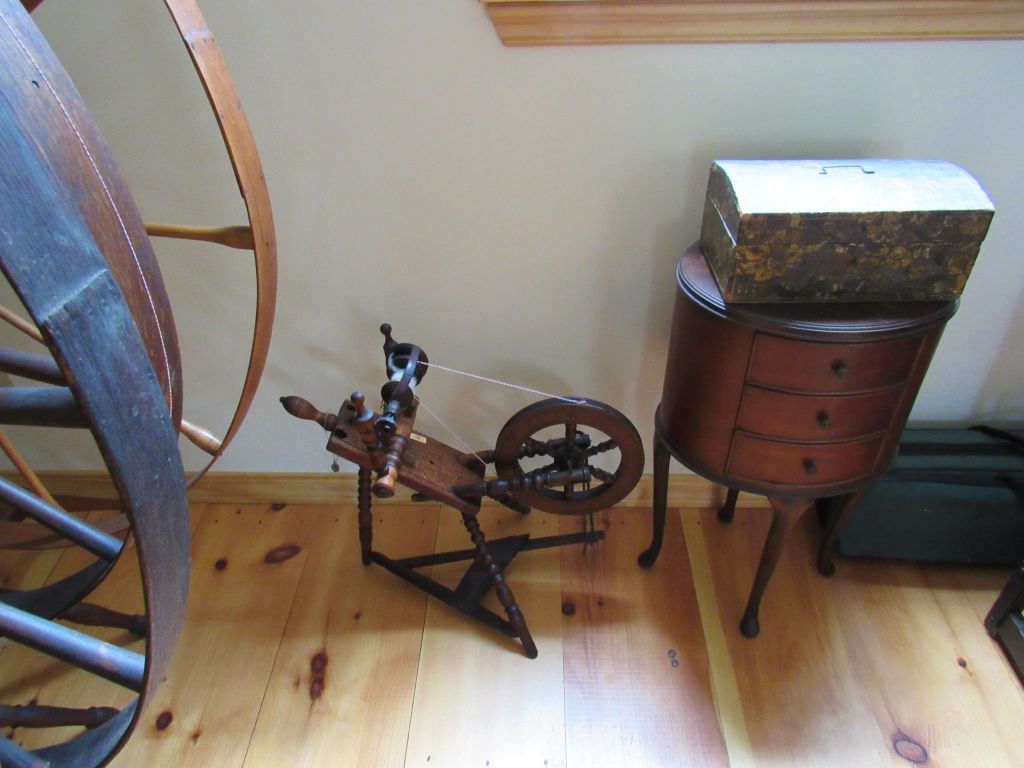
It is hard to convey just how tiny this wheel is and photos cannot capture how little it weighs.
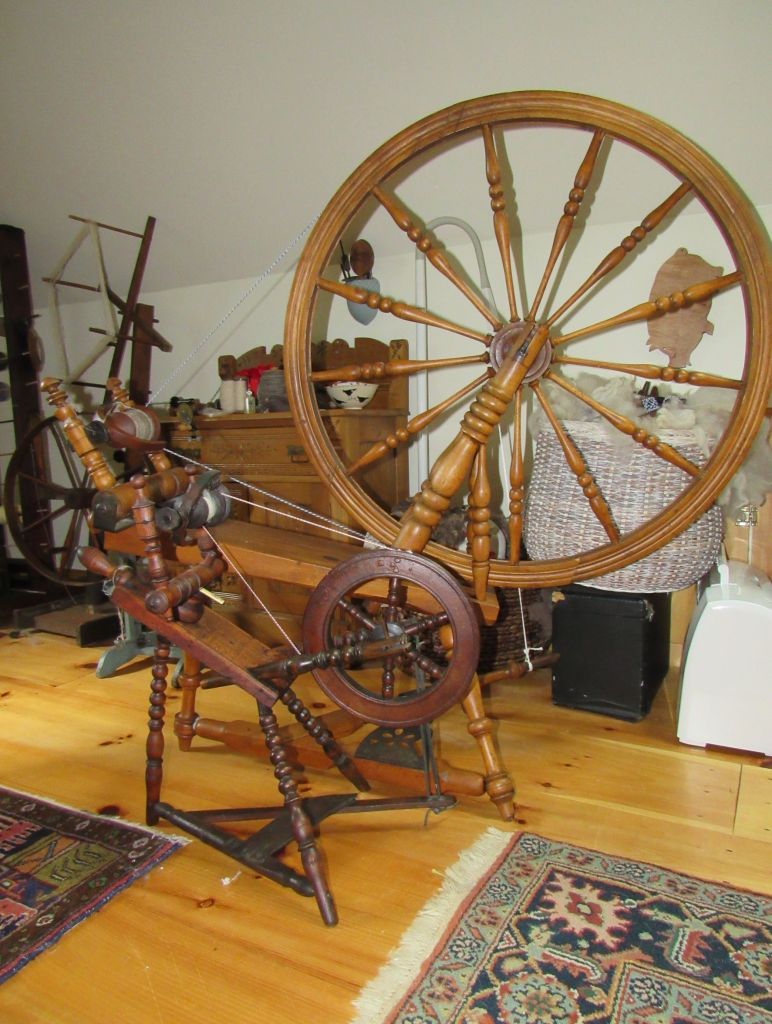
Such small wheels are often advertised these days as children’s wheels, which generally is considered an inaccurate description, since apparently children rarely got wheels of their own but learned to spin on full-sized wheels.
Nevertheless, we do know that there were great wheels scaled down in size for children, so it is entirely possible that some small flax wheels were made for children, also.
I do not dispute that children’s wheels were a rarity. This wheel probably was intended for and used by adults. But, I like to think that it may have been used, at least at some point in its history, by a child. Because, if ever a wheel would appeal to a child, this is it. At less than 24 inches tall, under 5 pounds, and beautifully turned, it would have been a powerful lure for a child to learn to spin.
And what a good teacher it would have been. The wheel is an excellent, responsive spinner. Despite its almost toy-like quality, it has a full-sized flyer assembly and spins like a much larger wheel.
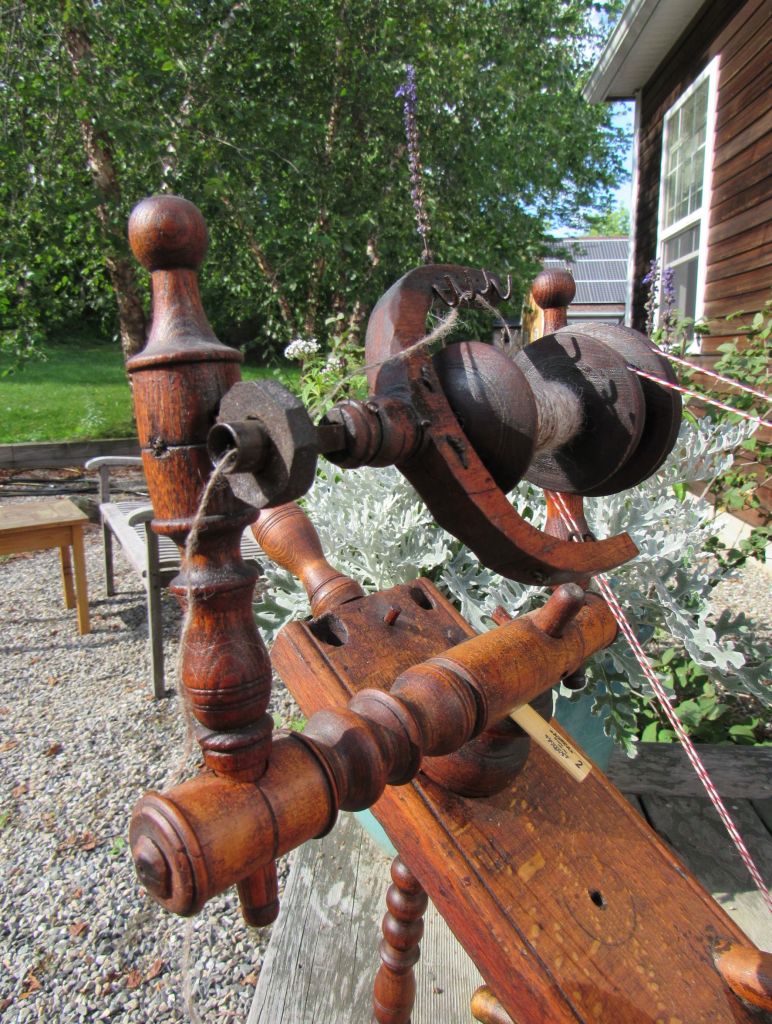
Even though the drive wheel is petite, it does not require frantic treadling for a smooth, even uptake, but has a nice, easy rhythm. The orifice height is 21 ½ inches, only two inches lower than some of my other small flax wheels.
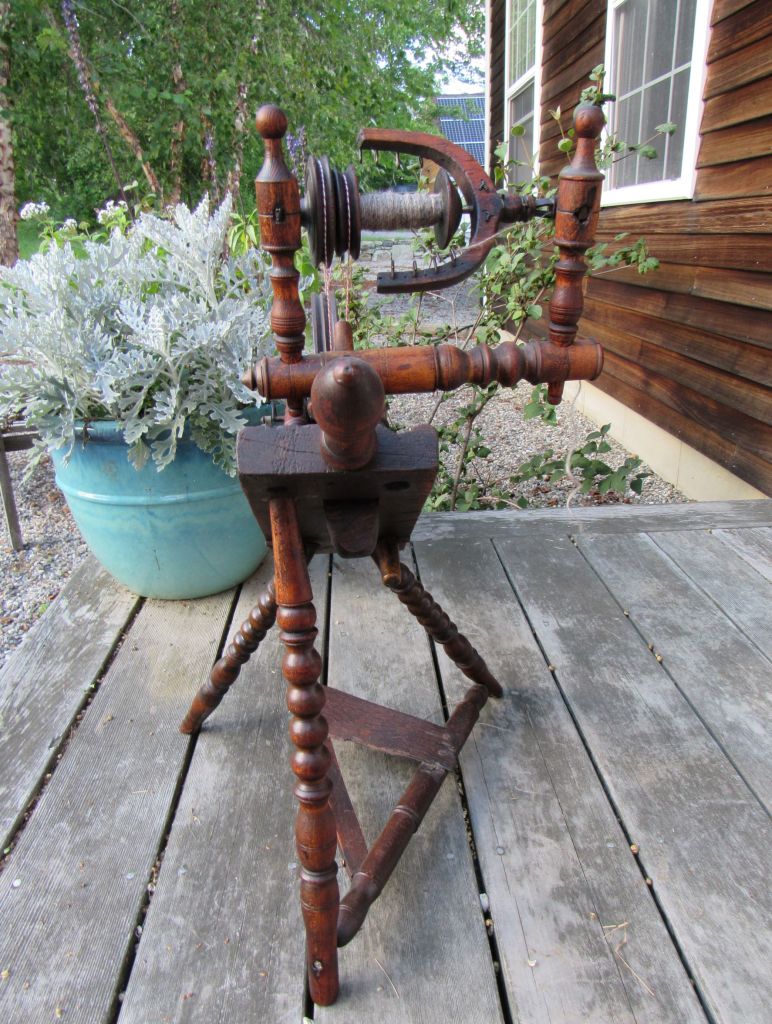
Its main advantage for an adult user would have been portability and ease of storage. Its slanted stance gives it a tiny footprint. Combine that with its feather weight and it can easily travel anywhere and be tucked in a corner or lifted to the top of a wardrobe when not in use.
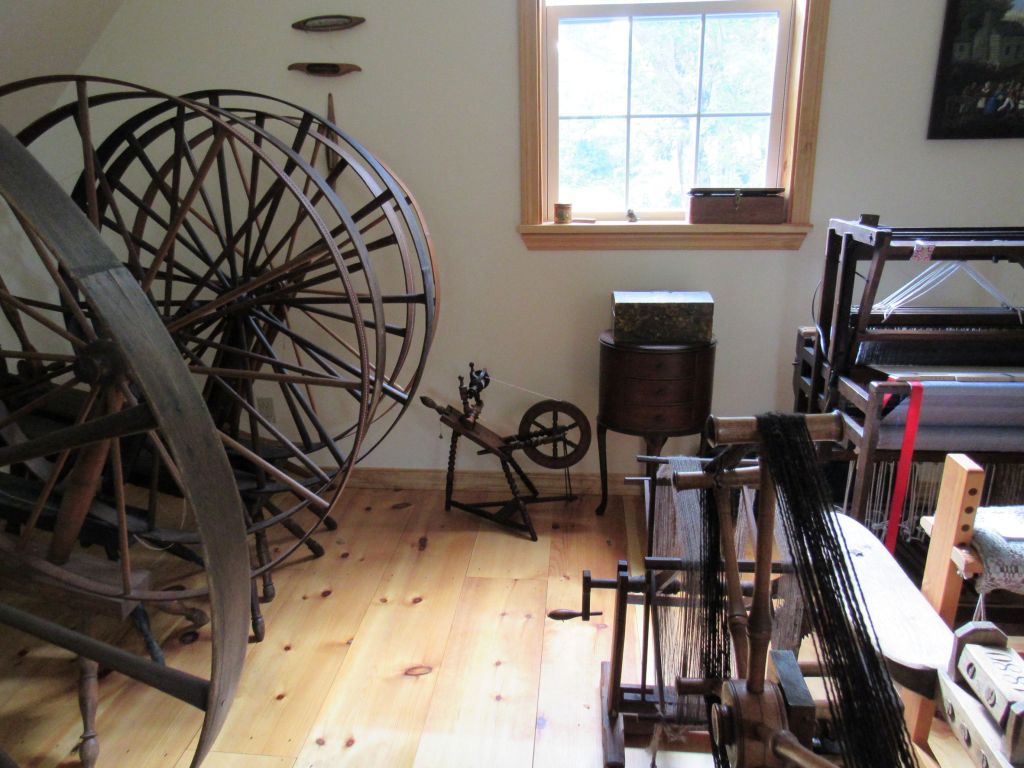
As with several of my wheels, this one was part of Joan Cummer’s collection, auctioned off after the American Textile History Museum closed. It is Wheel #127 in Cummer’s “A Book of Spinning Wheels,” on pages 274-75
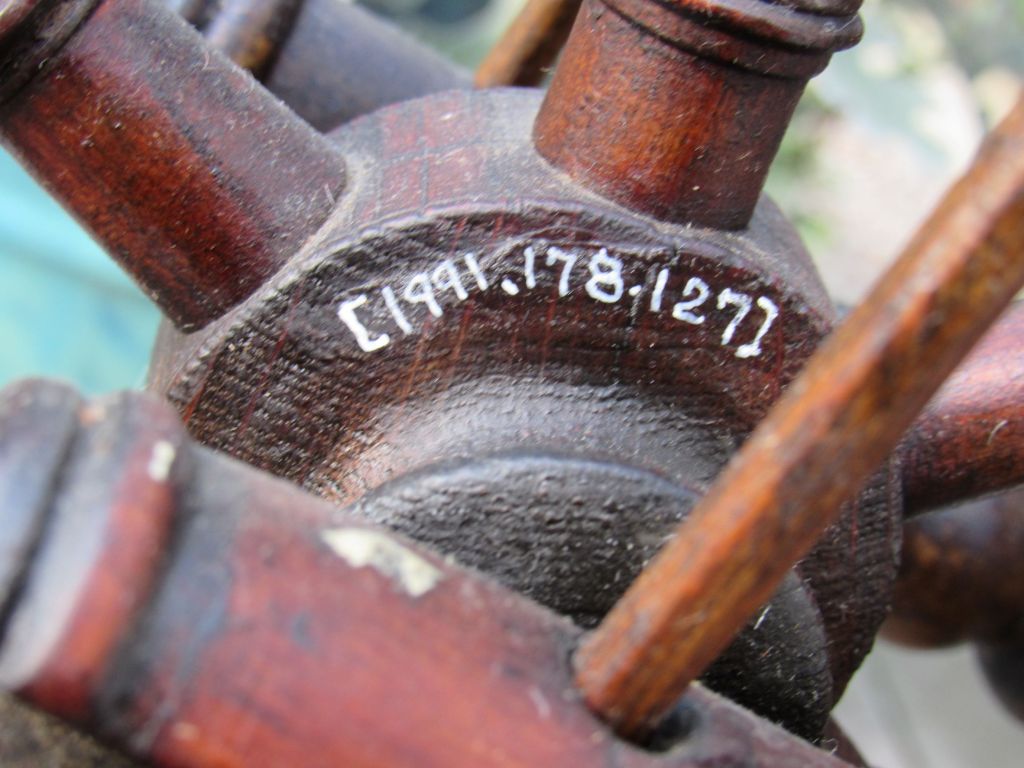
It is hard to pin down the origins of this wheel–in time or place. According to Cummer, the wheel was thought to have originated in England or northern Europe in the late eighteenth or early nineteenth century.
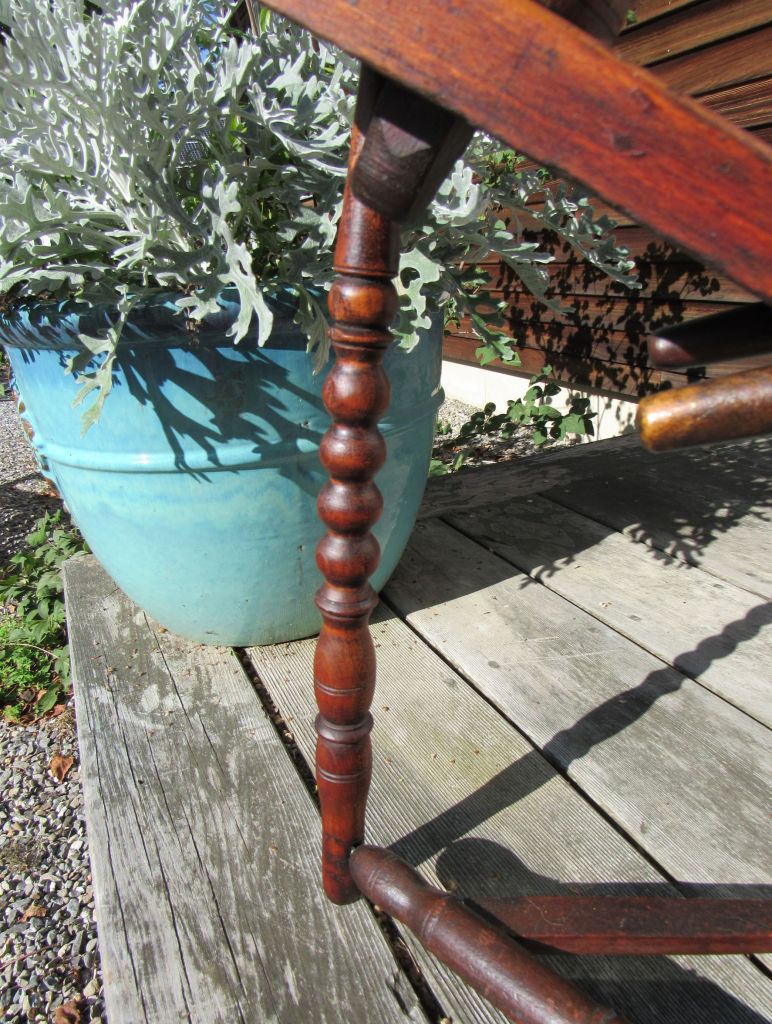
I would love to know how Cummer came to her conclusions. Tiny Saxony-style wheels are most often associated with Germany and eastern Europe and usually are not thought to be as old the eighteenth century. But this wheel does have a bit of a unique style. Based on the series of ball or bead turnings on the legs, Cummer may have compared this wheel to an English wheel made by Richard Arkwright, probably in the middle of the 18th century (for a photo of Arkwright’s wheel see Baines, Spinning Wheels, Spinners & Spinning, p. 124) to conclude that it could be an early English wheel.
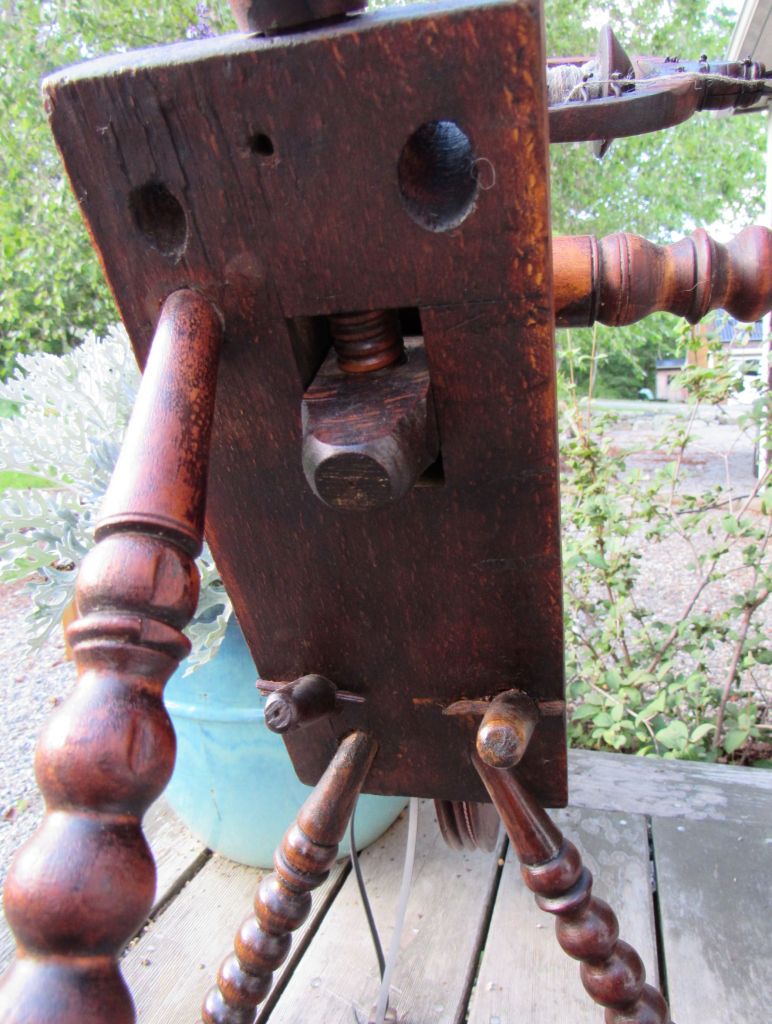
Nevertheless, the turnings are not really much help in accurate dating. Patricia Baines calls such turnings “knob turnery” and notes that it “could suggest the Cromwell period, nearly 100 years before” the estimated date of Arkwright’s wheel, while also noting that it is found on spinning wheels known to have been made in the nineteenth century. (Spinning Wheels, Spinners and Spinning, p. 123).

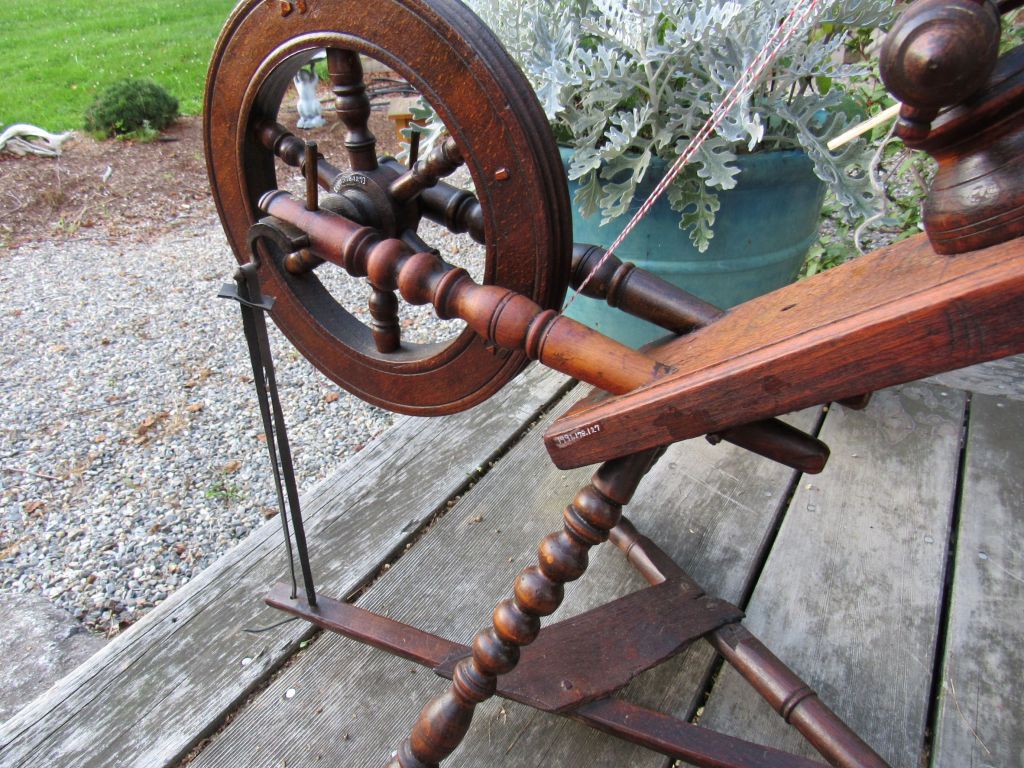
Nor do the turnings help much in determining place of origin. The legs’ series of knobs, balls, or beads (also referred to as “bubble” turnings by some) resemble those found on many Dutch and some German and Scandinavian wheels. Moreover, the drive wheel is scattered with decorations of a type found most commonly on small German and eastern European wheels.
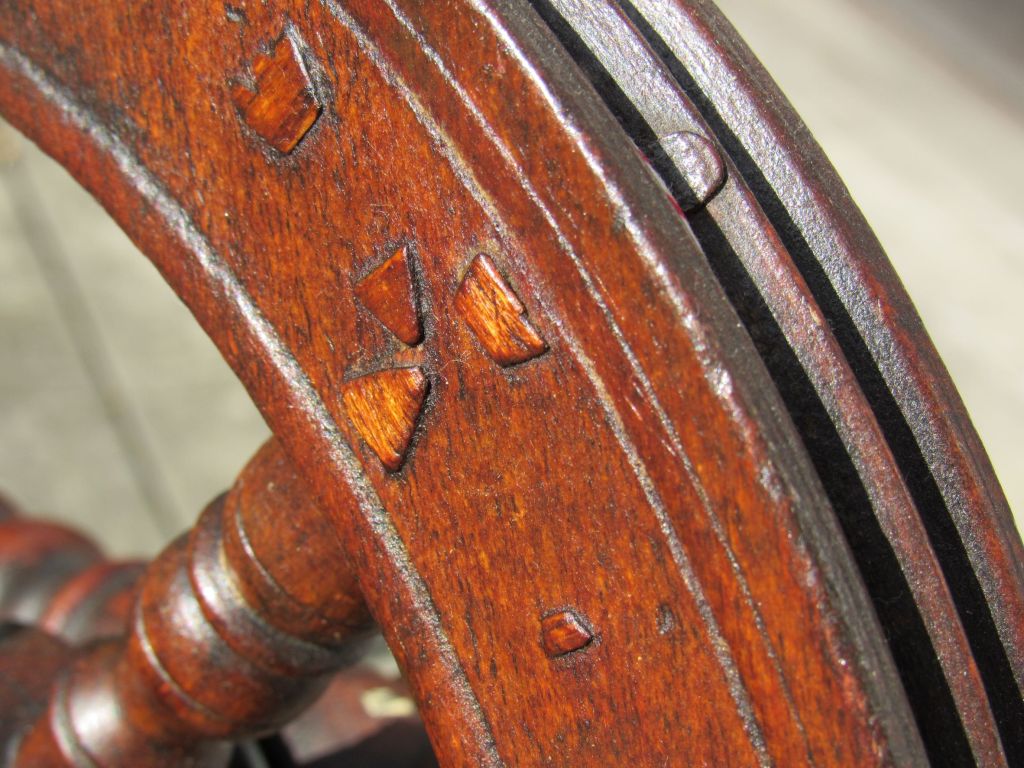
They are raised and appear to have been glued on, many resembling small tulips or crowns.
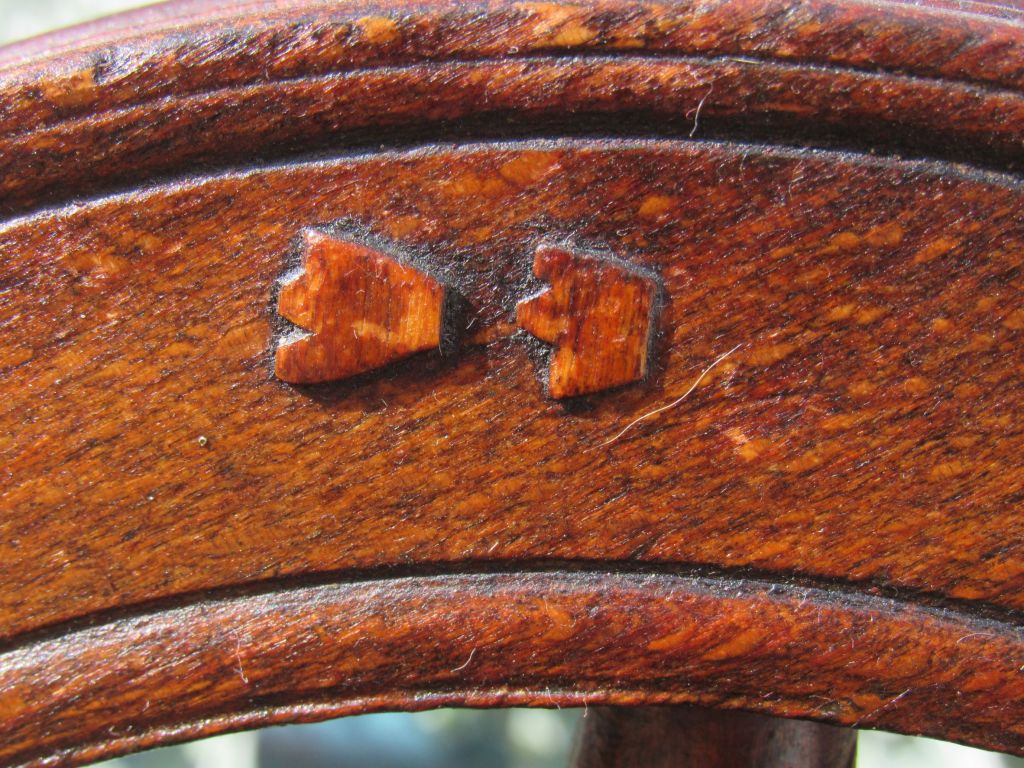
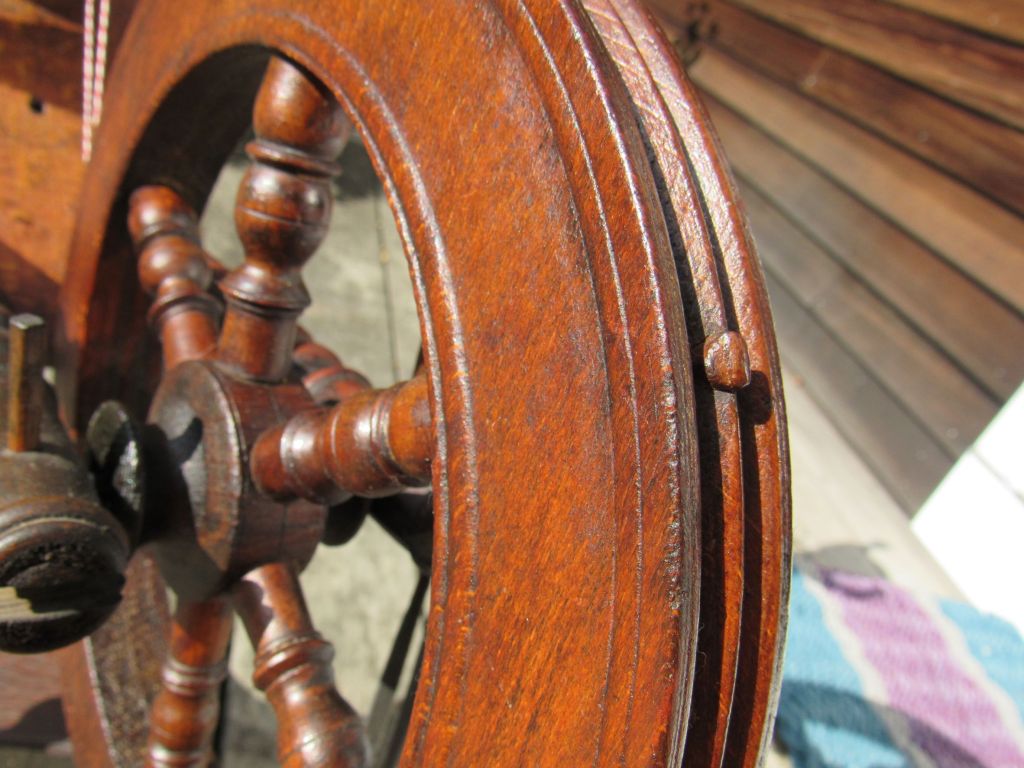
Another interesting feature is the drive wheel construction.
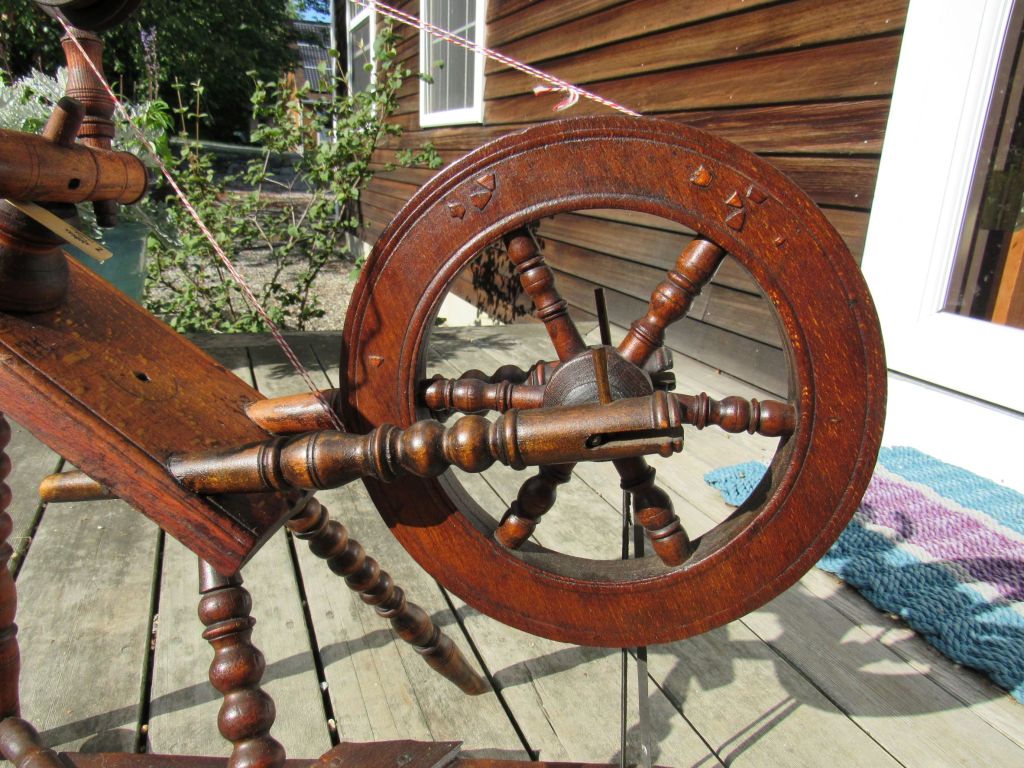
It is made from one piece of wood, with no joins, and the pegs for the spokes are driven directly, straight down, through the middle of the rim. I don’t know whether this construction is indicative of a certain region.
But, we can tell that the wheel likely came from a flax-spinning region. As Cummer notes, there are two holes in the table–one for a distaff and the other for a water vessel for flax spinning.
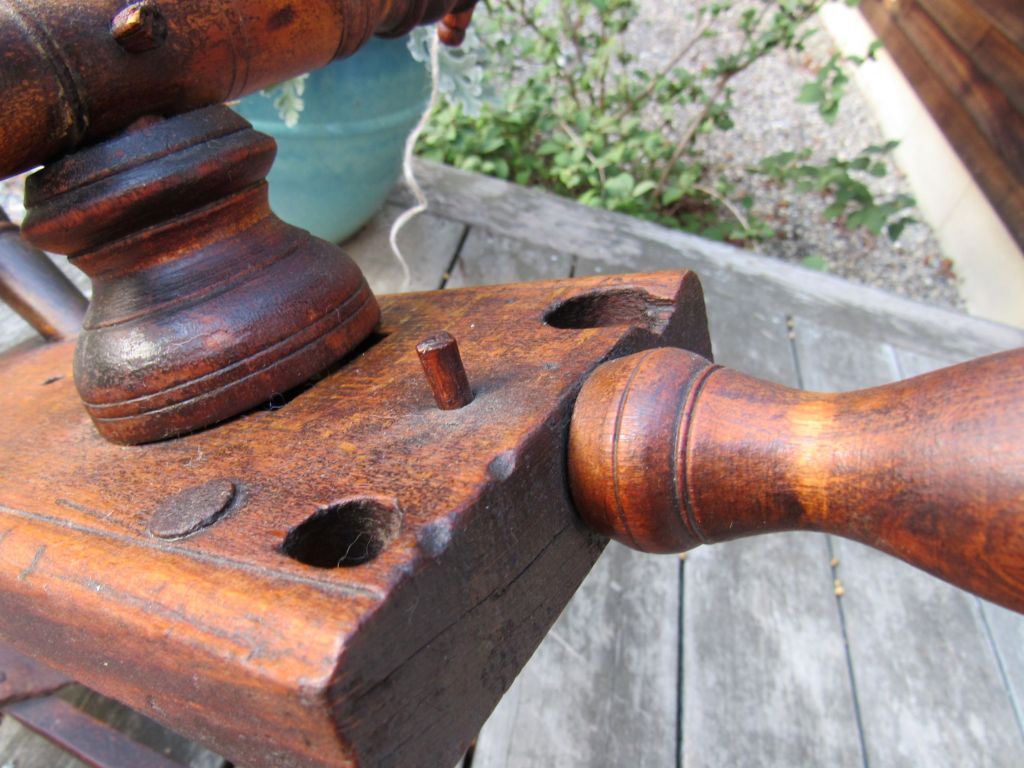
The wheel is versatile, however, with an orifice and bobbin large enough for spinning wool as well as flax.
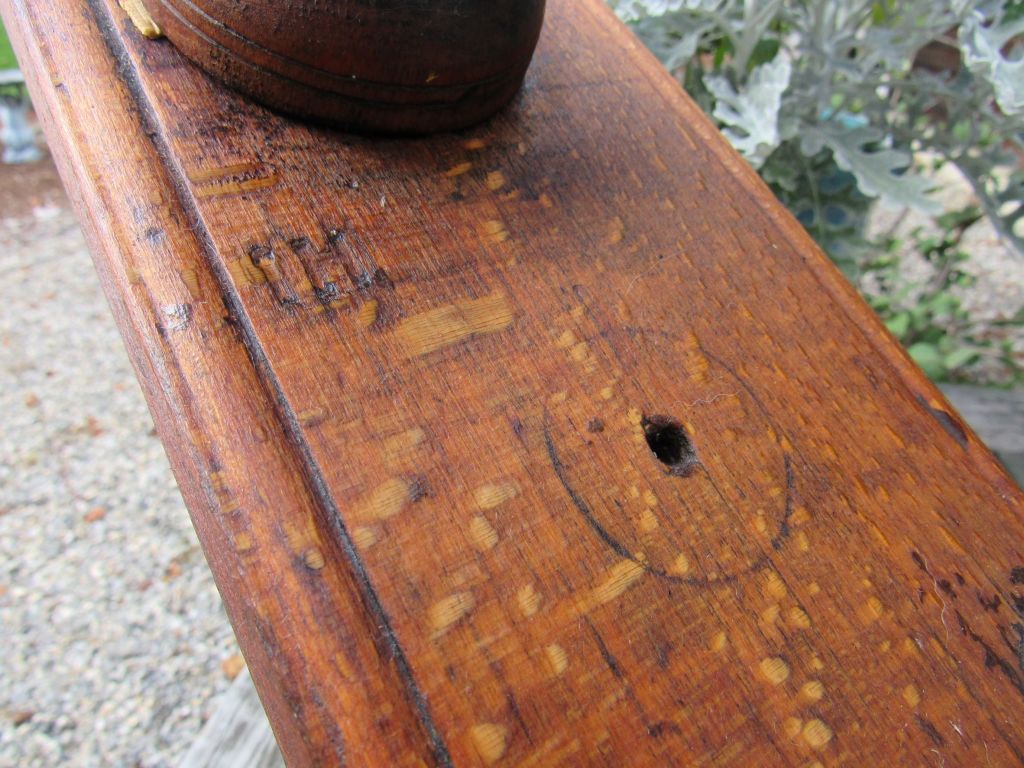
The table also has a small hole with a circular mark that likely had a decorative medallion at some point, another feature sometimes found on German wheels and other European wheels.
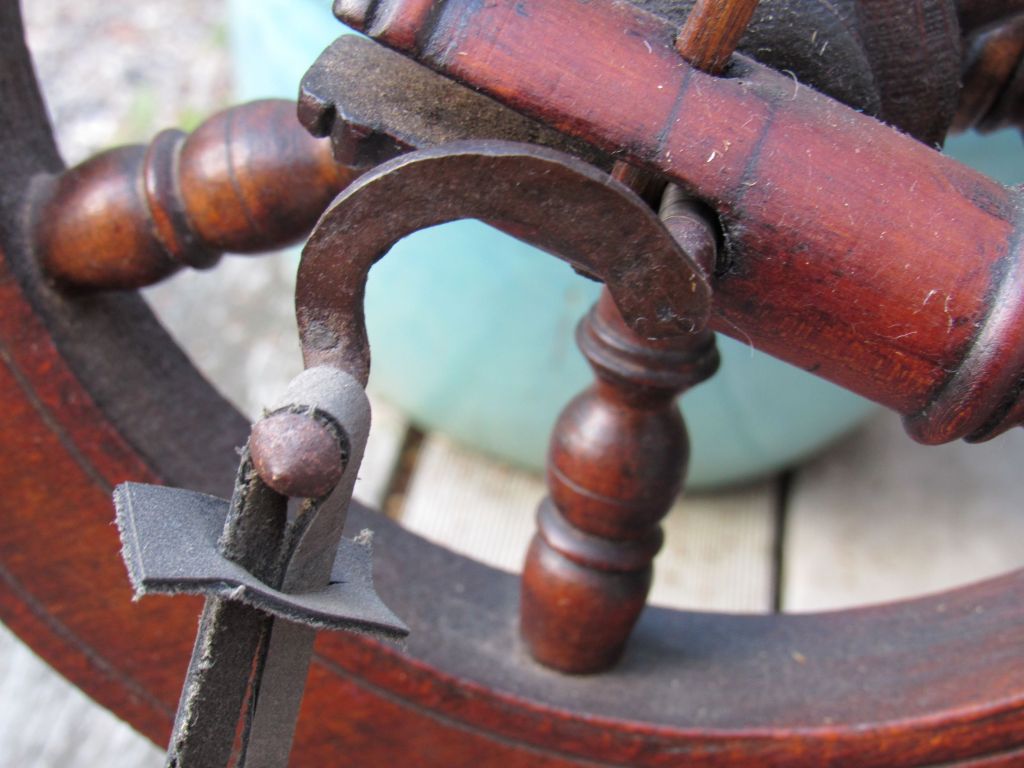
Although its origins likely will never be pinned down, it is a delightful wheel and was easy to bring back to life. When I bought it, the footman was a broken thin leather strap that had been doubled up. It was stiff, severely cracked with age, and falling apart, so I replaced it with new leather in the same design.
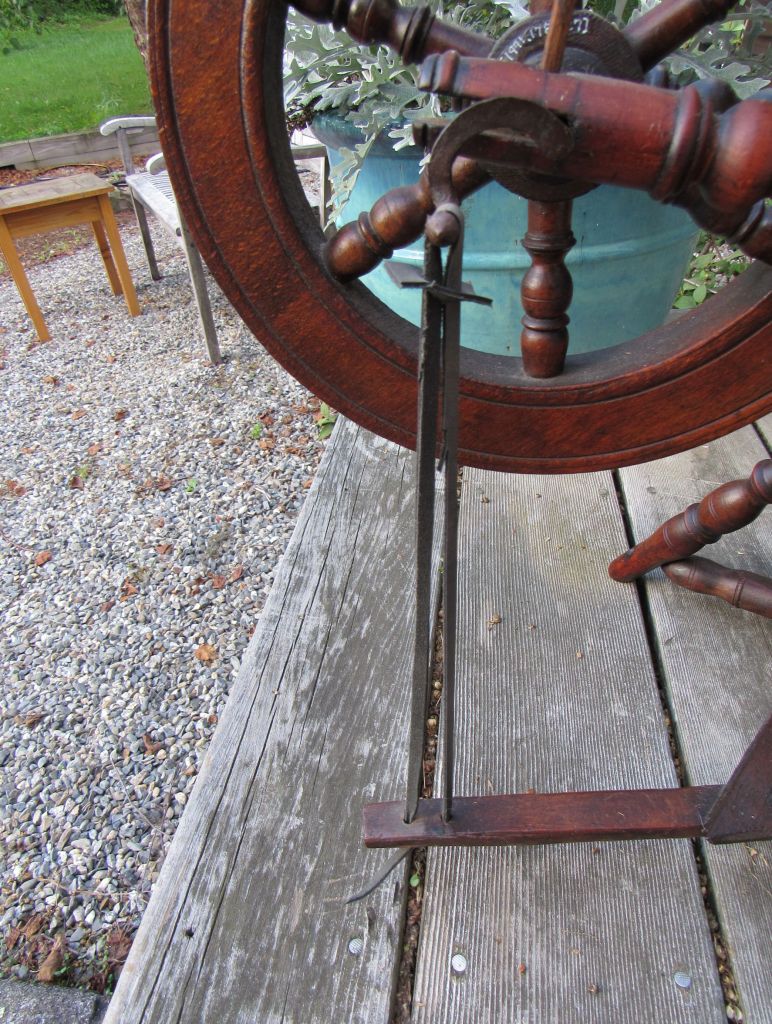
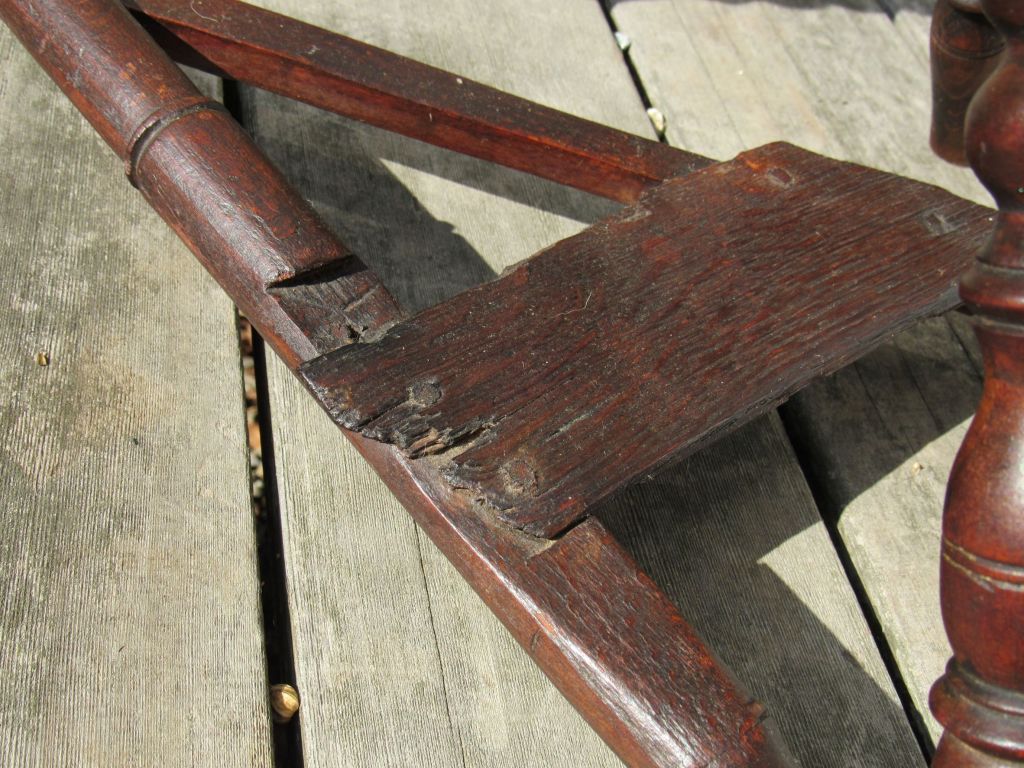
The treadle has seen a lot of wear and one edge is partly broken off.
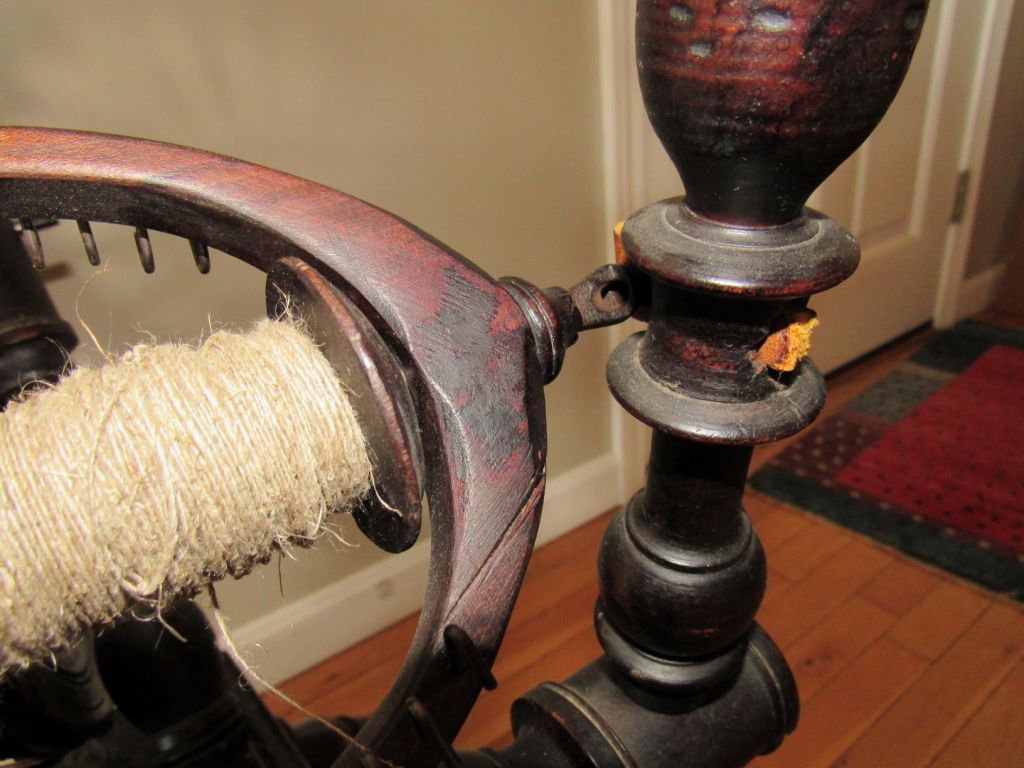
I originally thought that the bobbin was a replacement because it comes well short of taking up its allotted space on the mandrel.
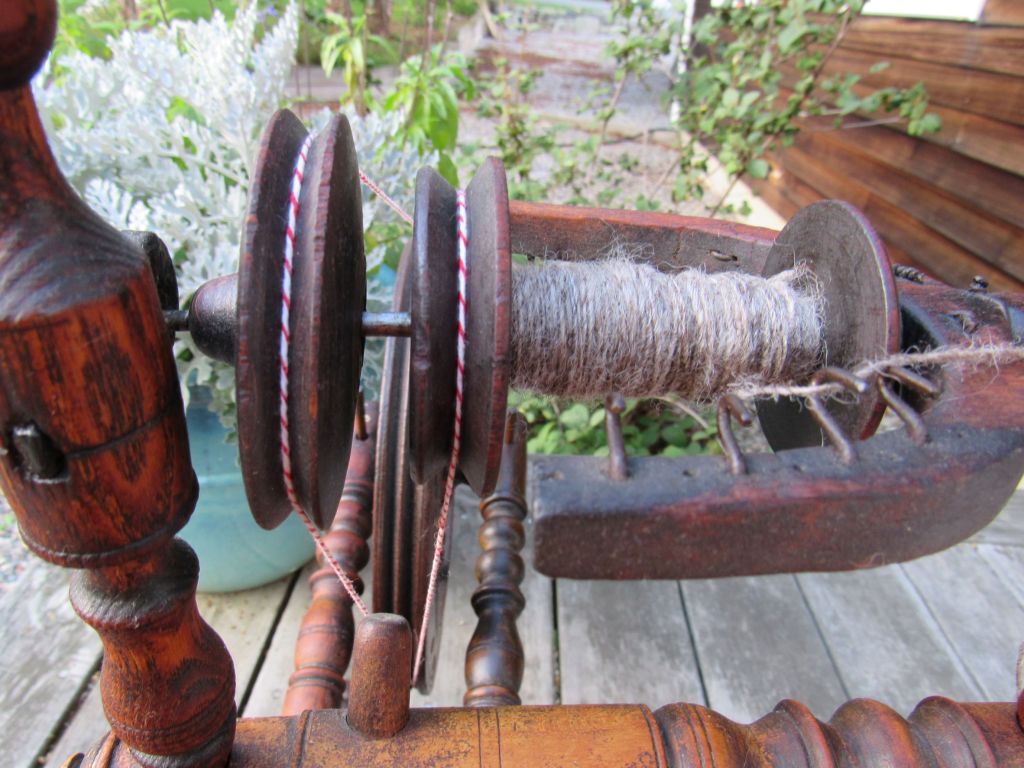
But its wood appears to match that of the spindle whorl and the hub, all of which have eye-catching reddish grain rings.
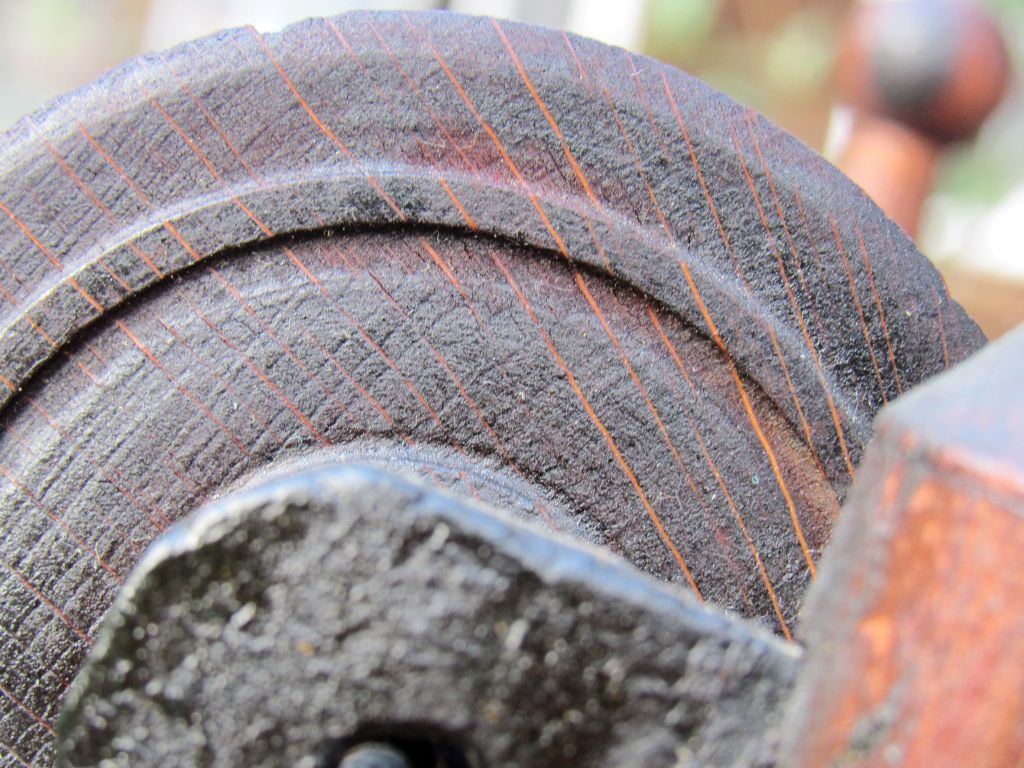
It is apparent that the wheel was well-used and valued for its sweet spinning because of the careful repairs. Screws have been added in strategic places
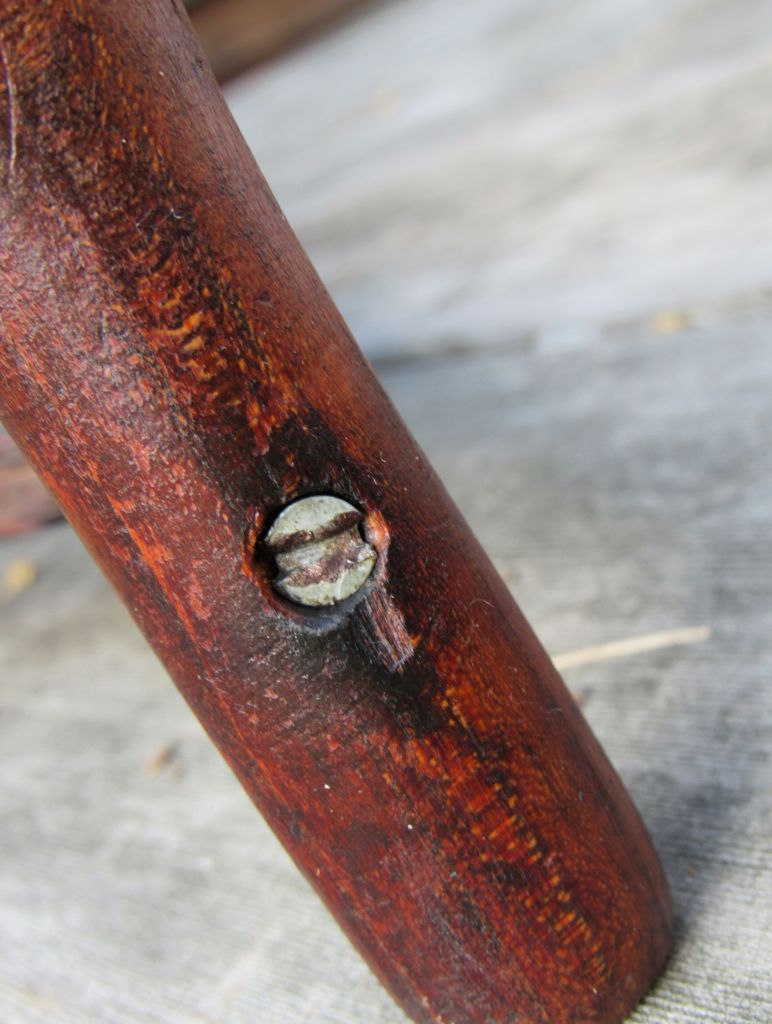
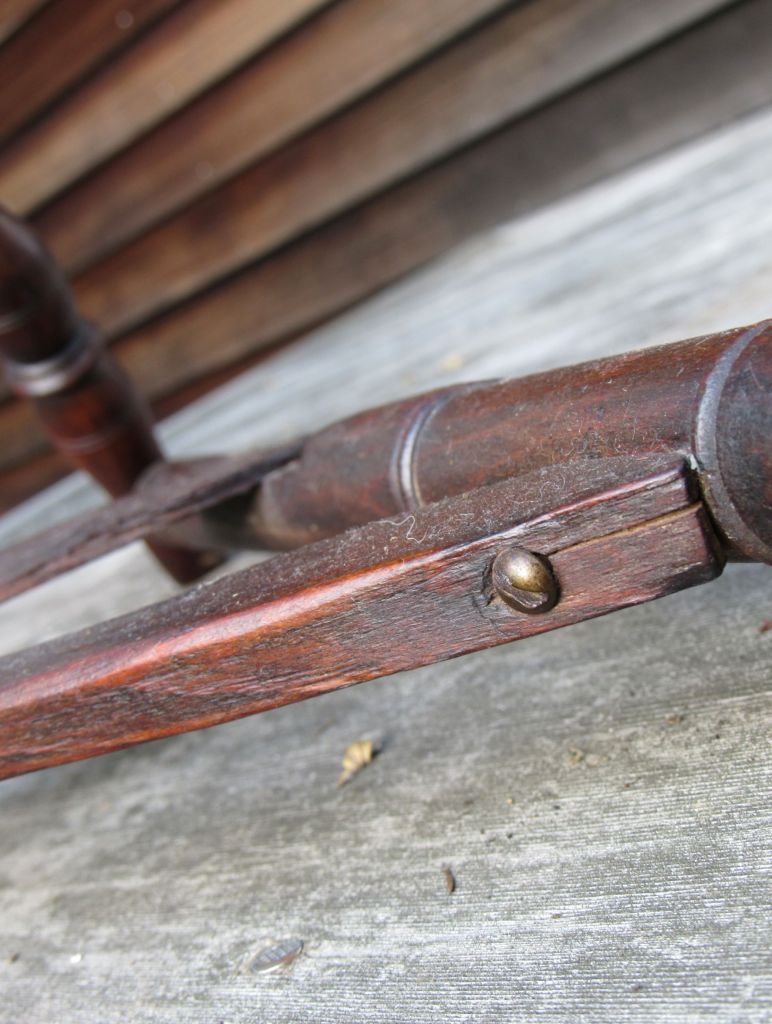
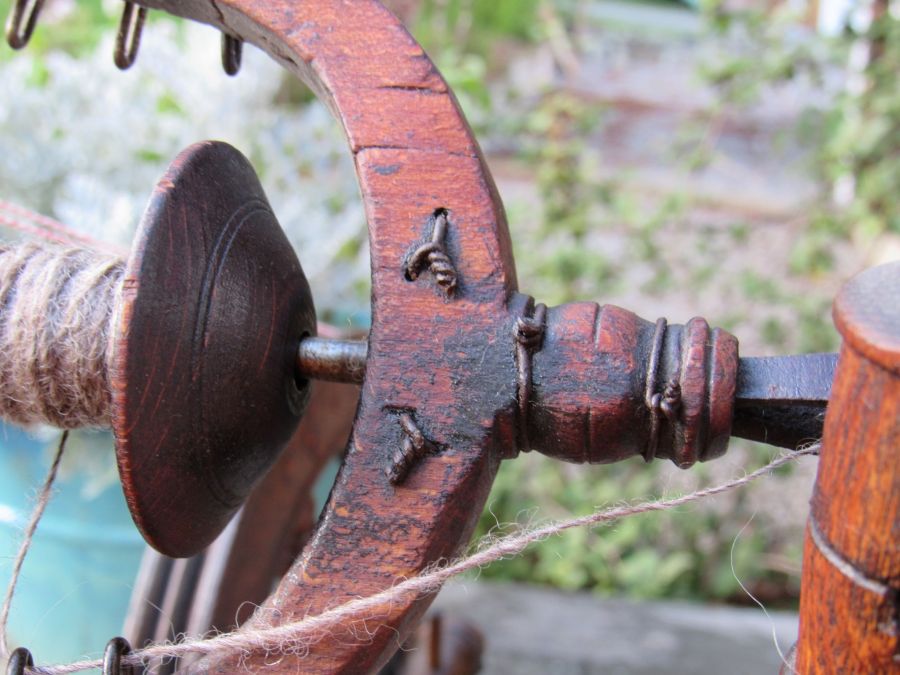
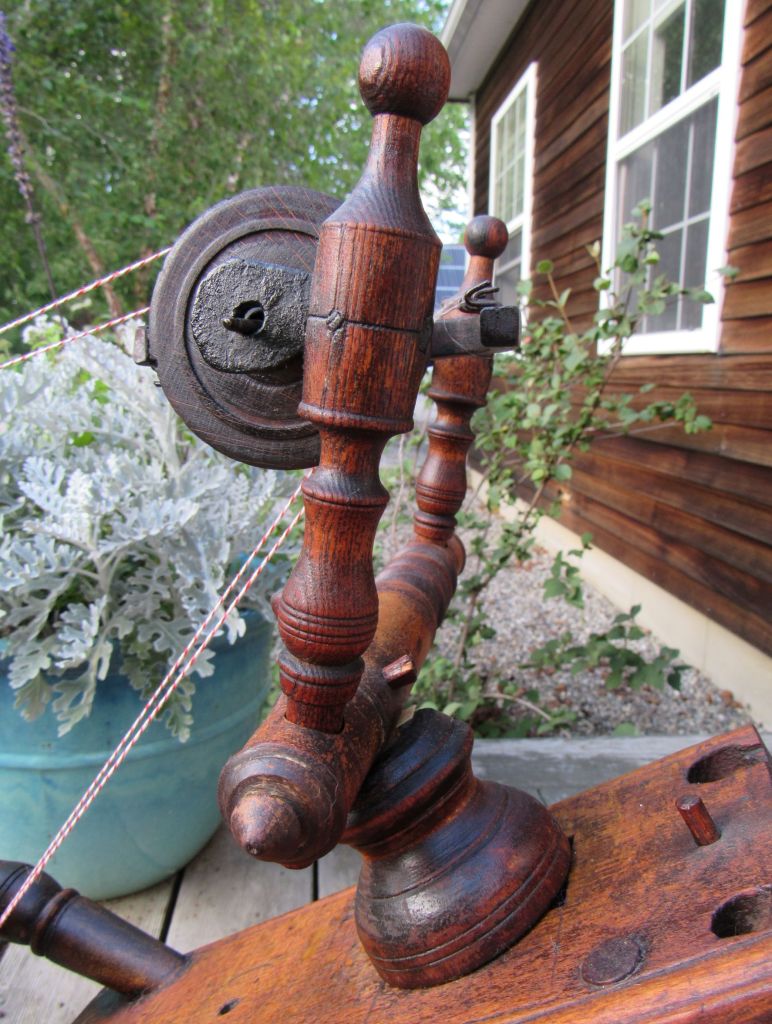
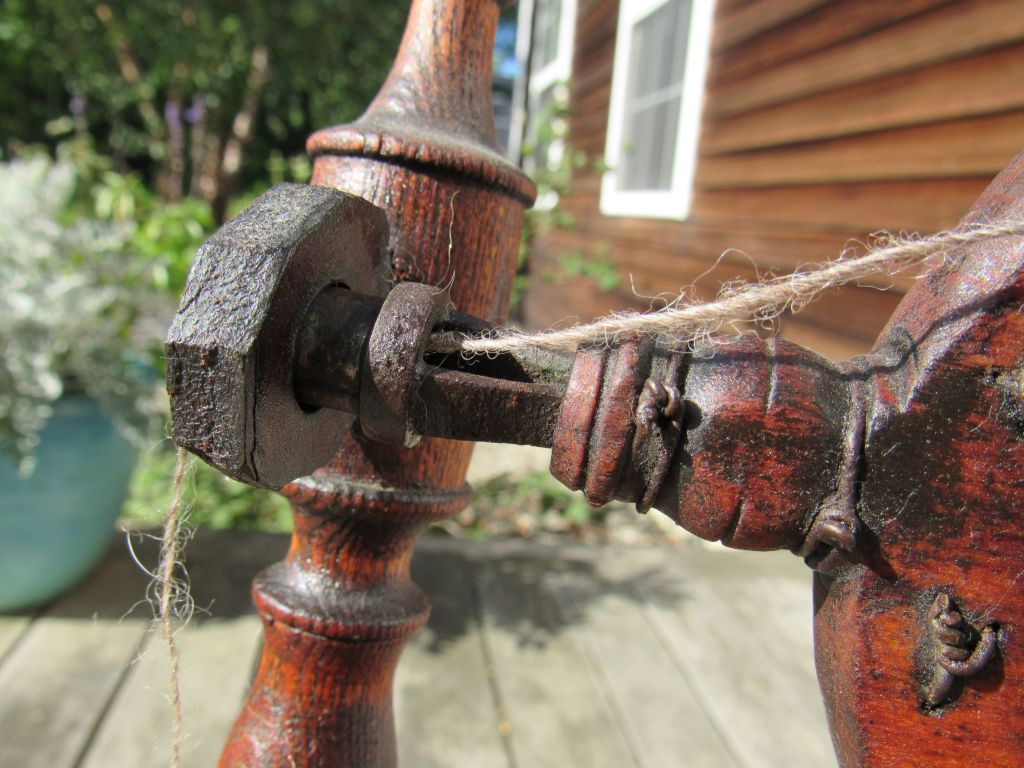
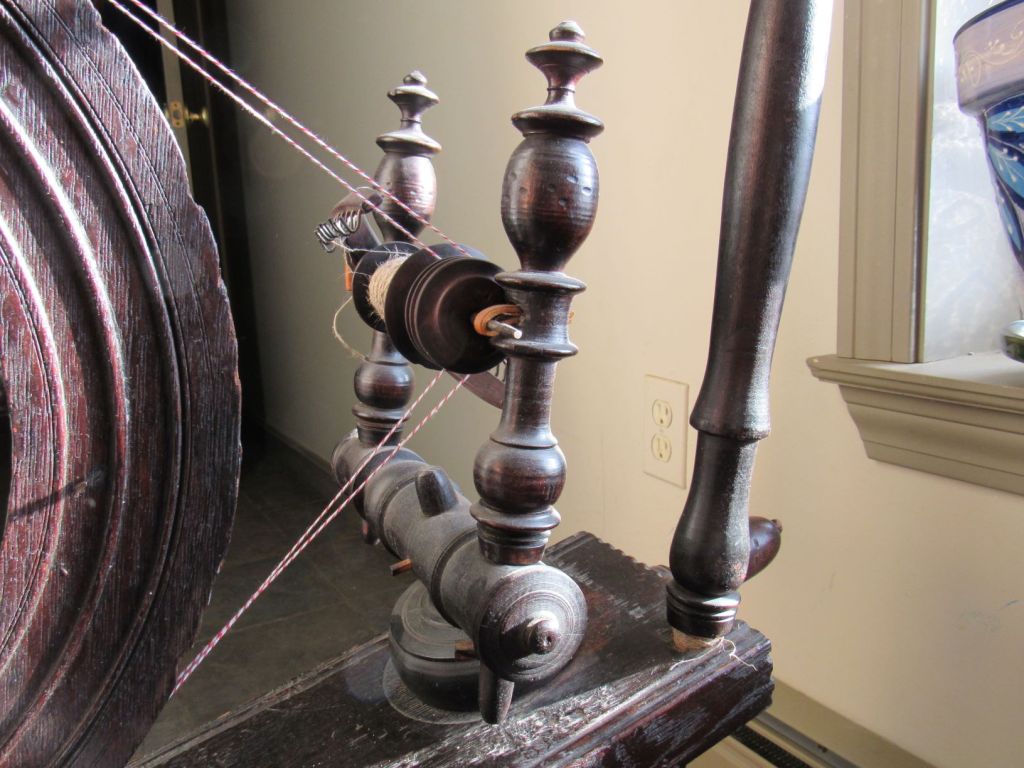
But the most interesting repairs are to the flyer assembly.
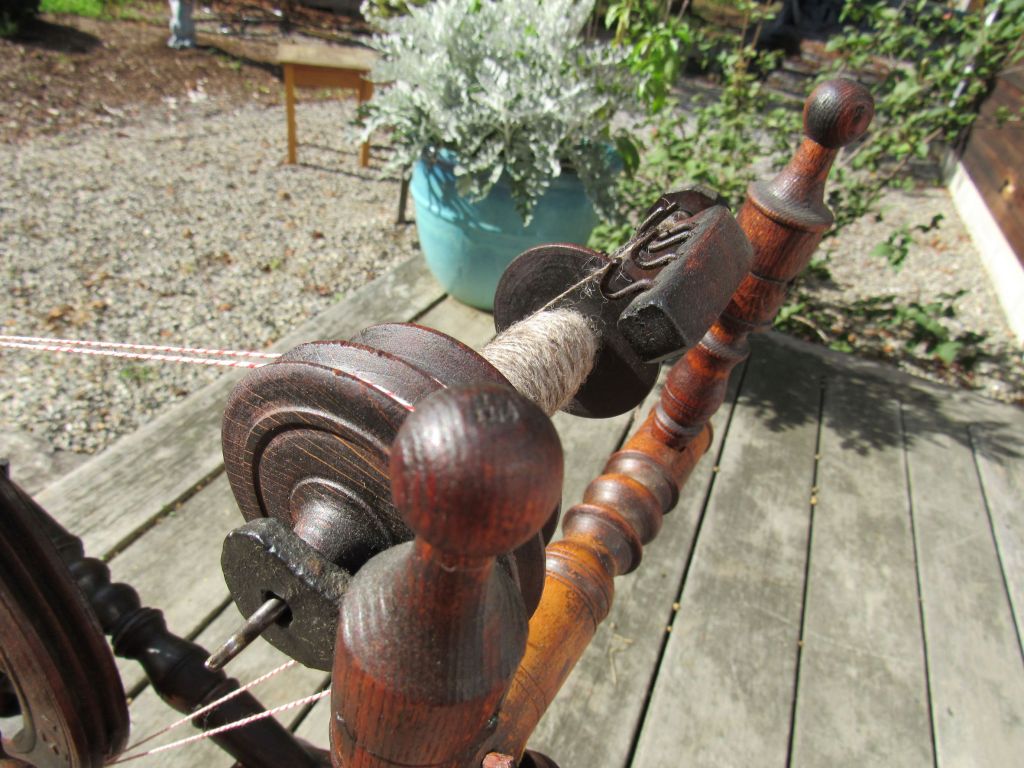
The flyer hooks apparently are replacements, set into holes adjacent to the originals.
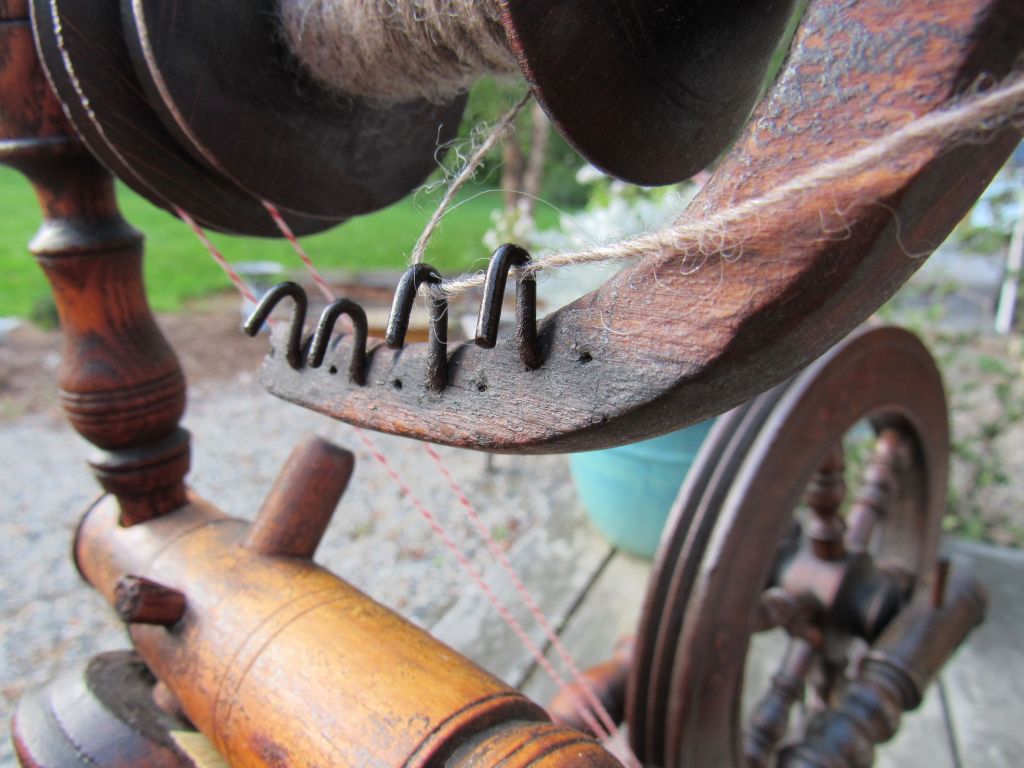
And, at some point, the flyer was pretty well shattered,
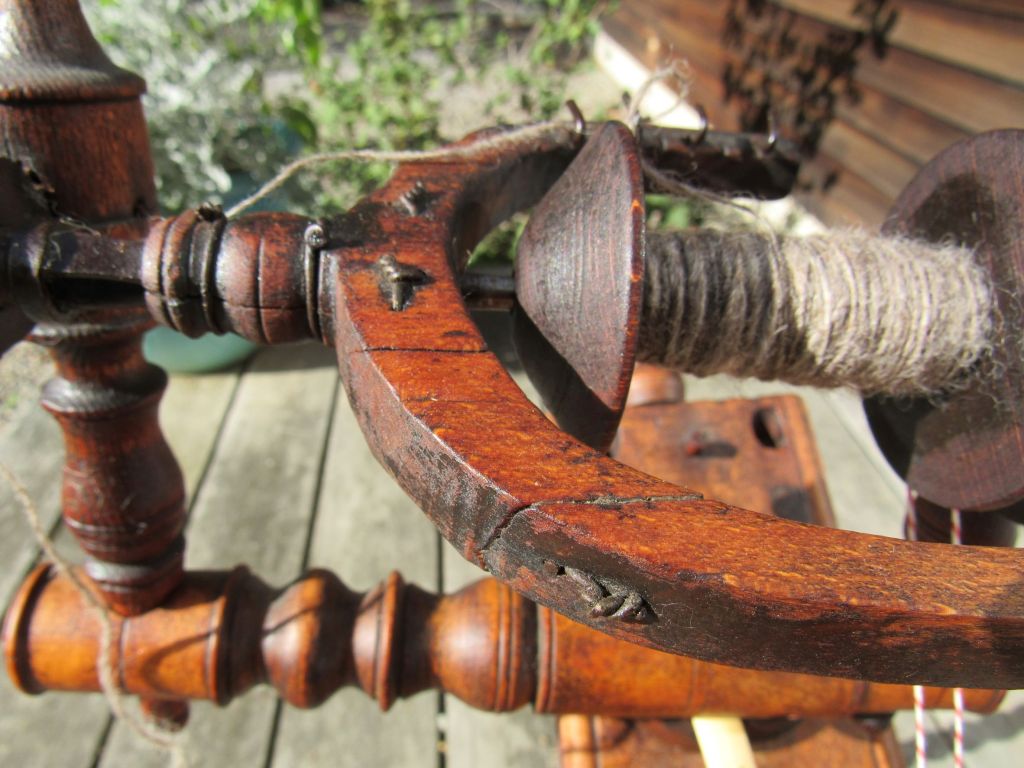
with a break down the center and a broken arm.
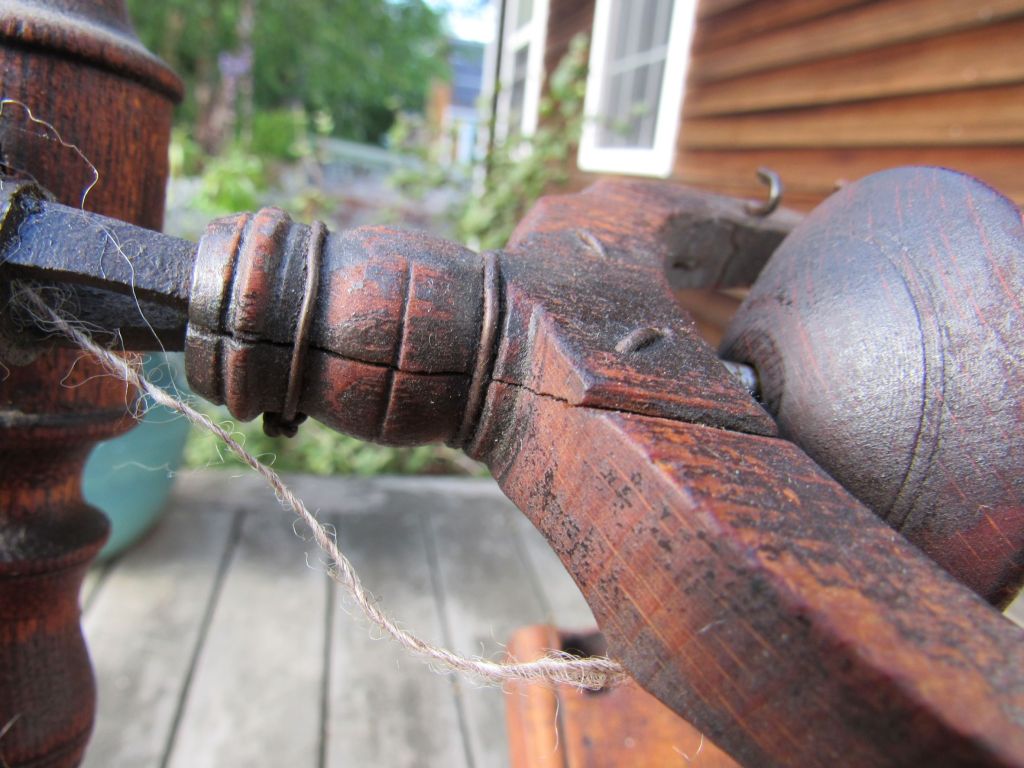
The breaks are neatly repaired with wire,
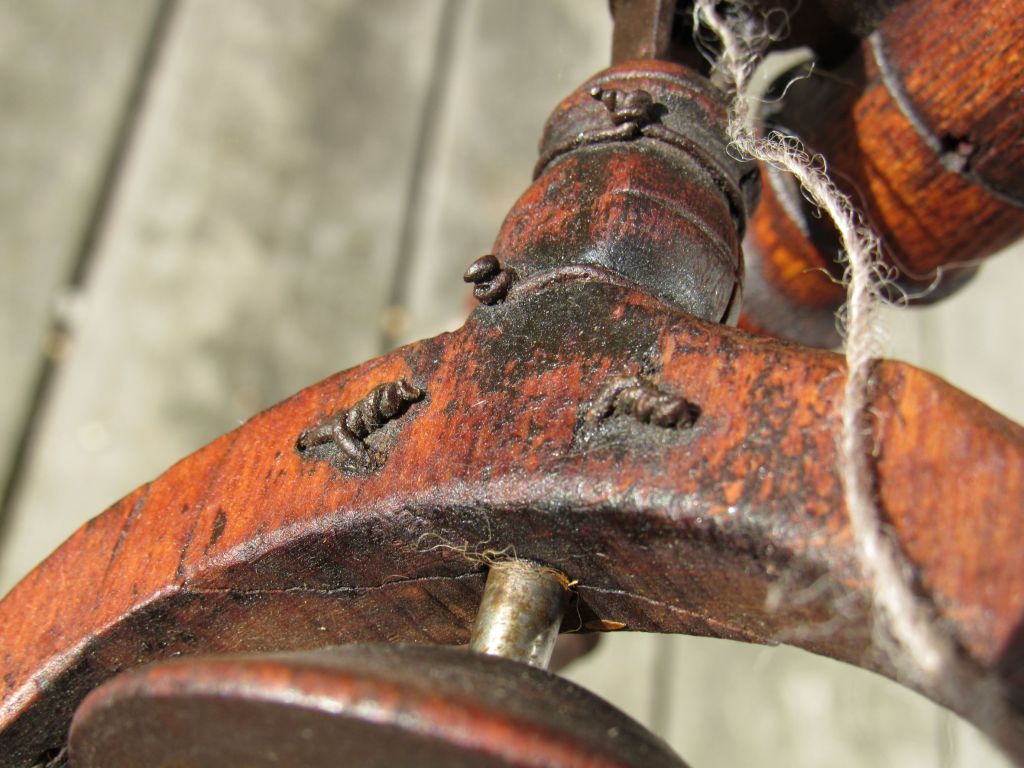
doubled through and tightly wrapped.
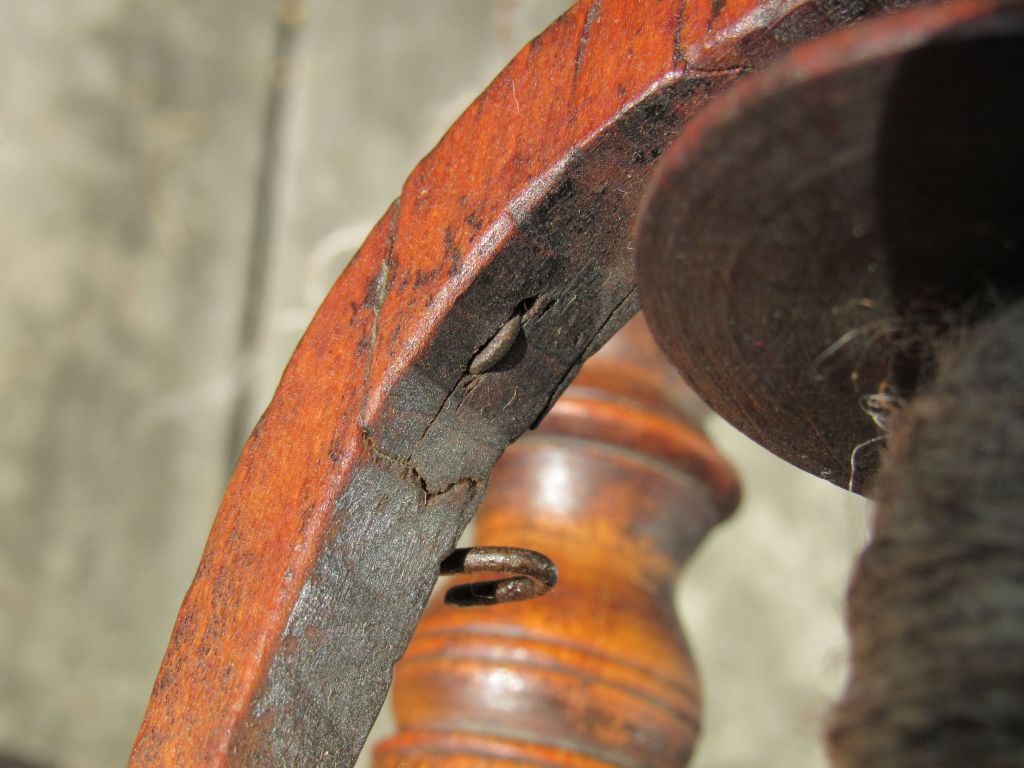
The arm break also appears to have a small nail as back up.

Years of usage grime have settled in around the wires, indicating the flyer repair is an old one. Such a thorough and effective repair speaks eloquently for someone’s desire to keep this wheel spinning.
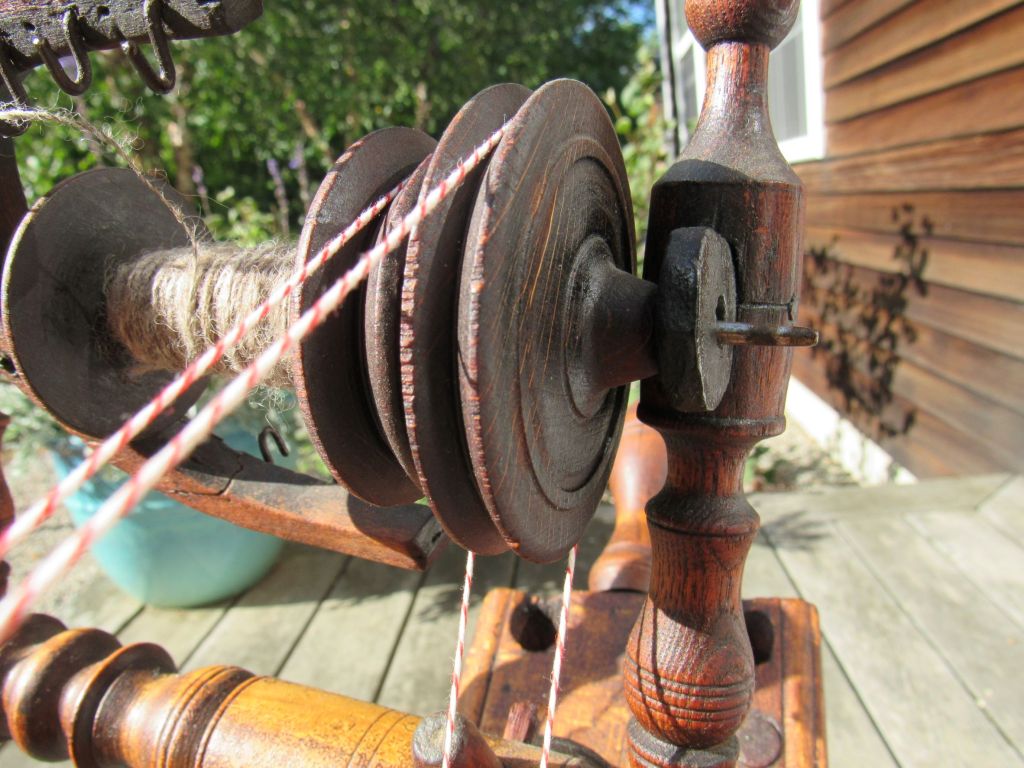
I hope that whoever it was would be satisfied and content to know that it is spinning still.
February 2022 update: I just read “Silas Marner, The Weaver of Raveloe,” written by George Eliot (Mary Anne Evans) in 1860 about a linen weaver working in England at the end of the 18th and early 19th century. The first line of the book starts with: “In the days when the spinning-wheels hummed busily in the farmhouses–and even great ladies, clothed in silk and threadlace, had their toy spinning-wheels of polished oak …” Perhaps wheels such as Hermione were such “toy” wheels, ornamenting the houses of those who really did not need to use them except for casual spinning.
For further reference see:
Baines, Patricia, Spinning Wheels, Spinners & Spinning, Anchor Press Ltd, London, 1977, pp. 123-25.
Cummer, Joan, A Book of Spinning Wheels, Peter E. Randall, Portsmouth, N.H. 1984, pp. 274-75.


 Exquisite Machinery