Collecting and rescuing antique wheels is like hunting or foraging. The hunt starts with scanning a parade of sale and auction photographs in hopes of finding unique and interesting wheel quarry. Because sale photos are often dark, blurry, and taken from a distance, details of construction and decoration can be obscured. It is easy to take a quick look, pass by, and miss out on a treasure.
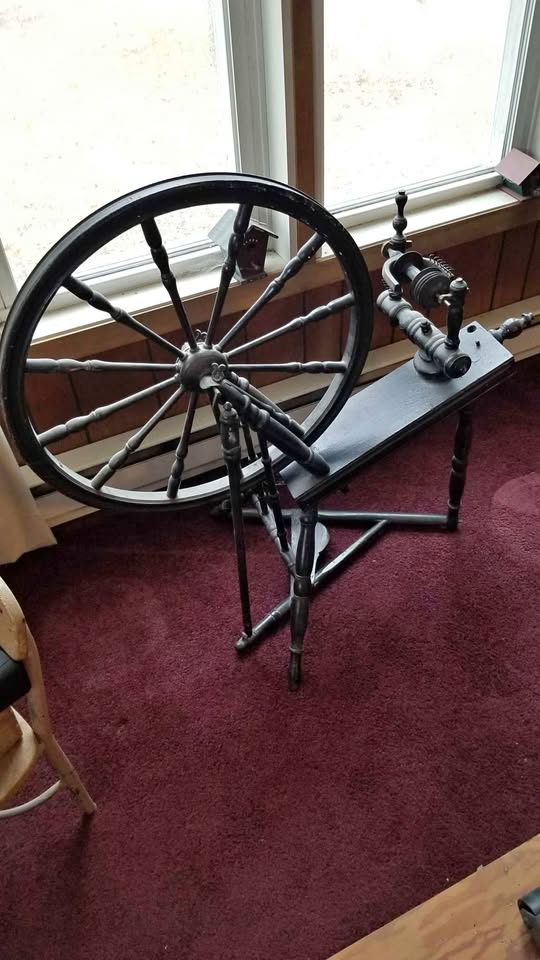
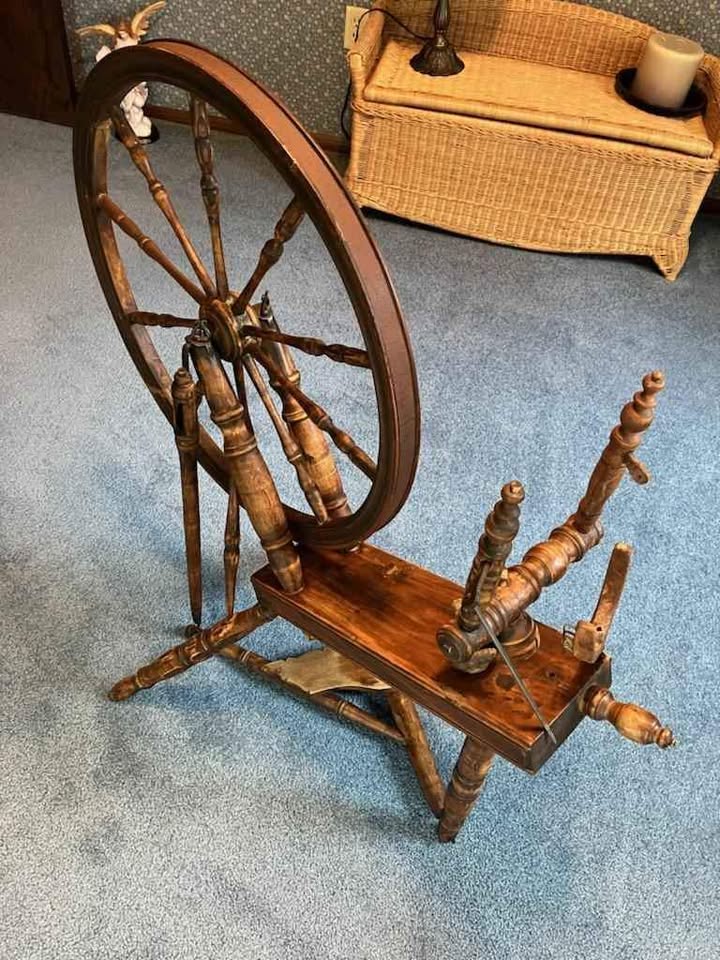
Hjordis sale photo
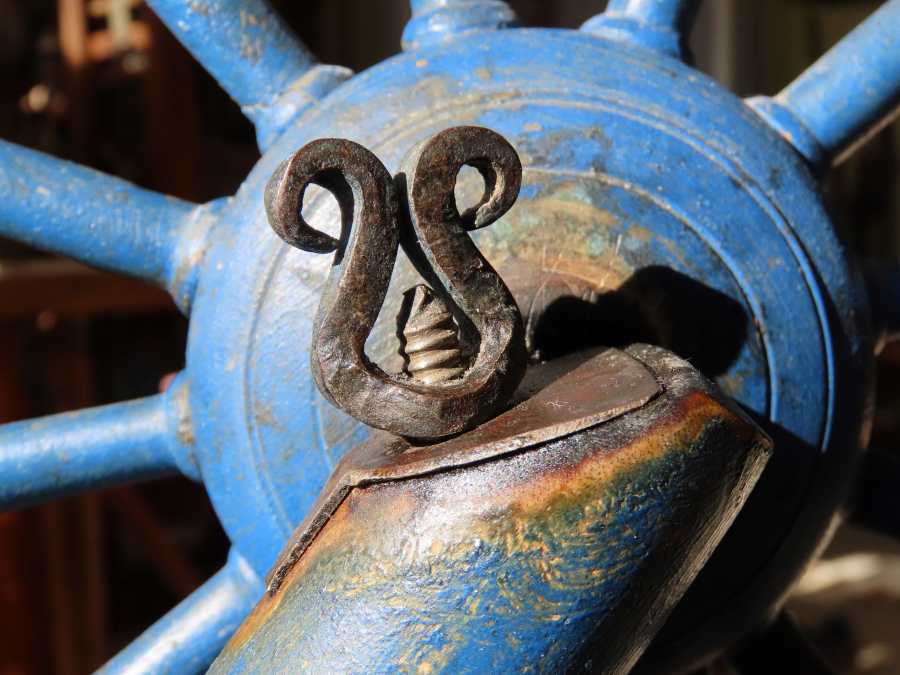
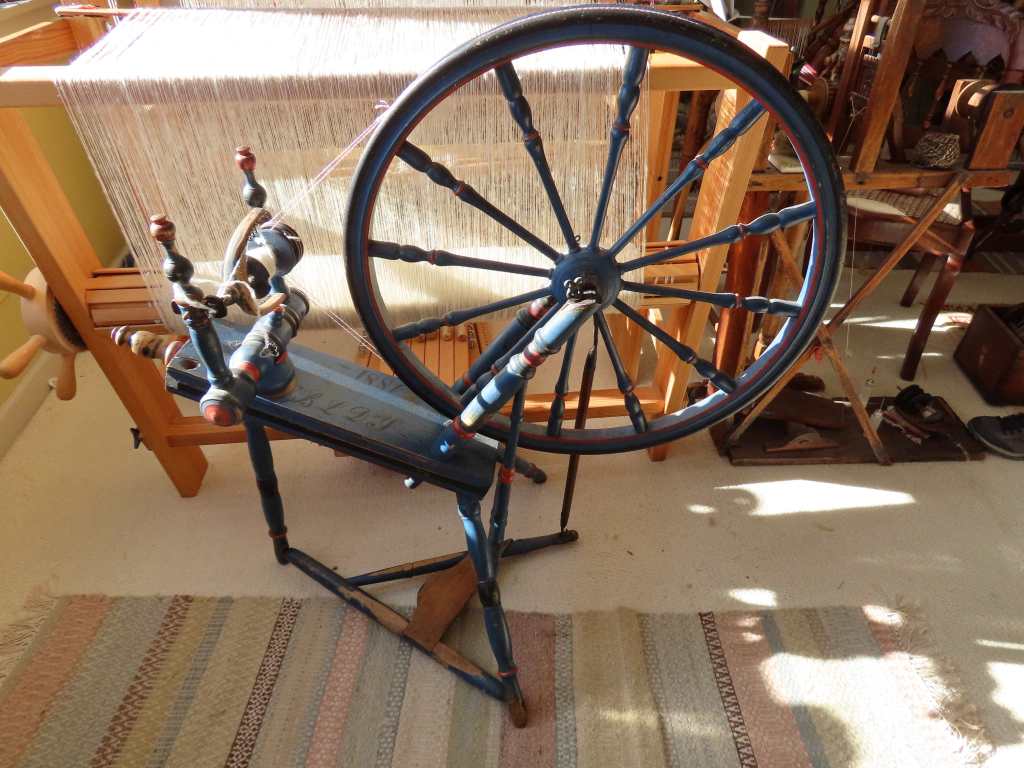
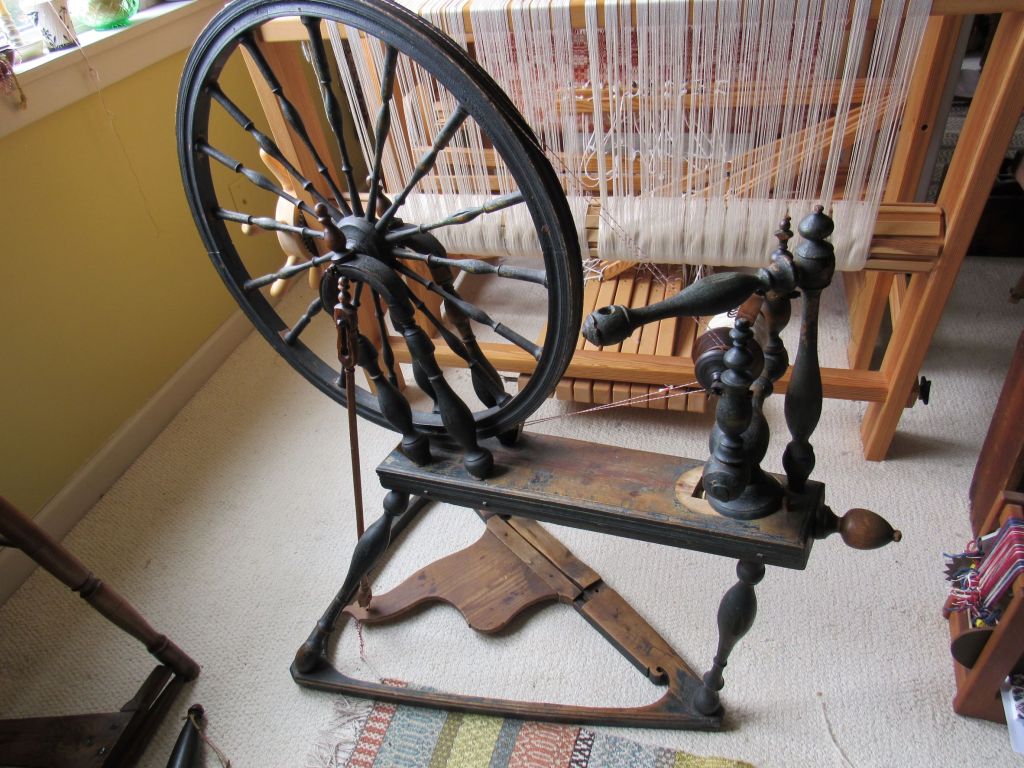
Hjordis is a treasure that could easily have been overlooked. The sale photo showed a pretty painted wheel, likely Scandinavian. At first glance, it was hard to make out the gorgeous lyre-shaped nut on top of the upright–an indication that this wheel is something special.
The axle and footman seemed oddly out of whack in the photo, but it was hard to make out why. Fortunately, my friend, Sherran Pak, had spotted this wheel online. The sale price was ridiculously high, but since it was close to where she lived, and our curiosity was high, she went to have a look at it. Curiosity satisfied and interest piqued even more, we waited until the price eventually came down and, with Sherran’s help, I was able to rescue Hjordis.
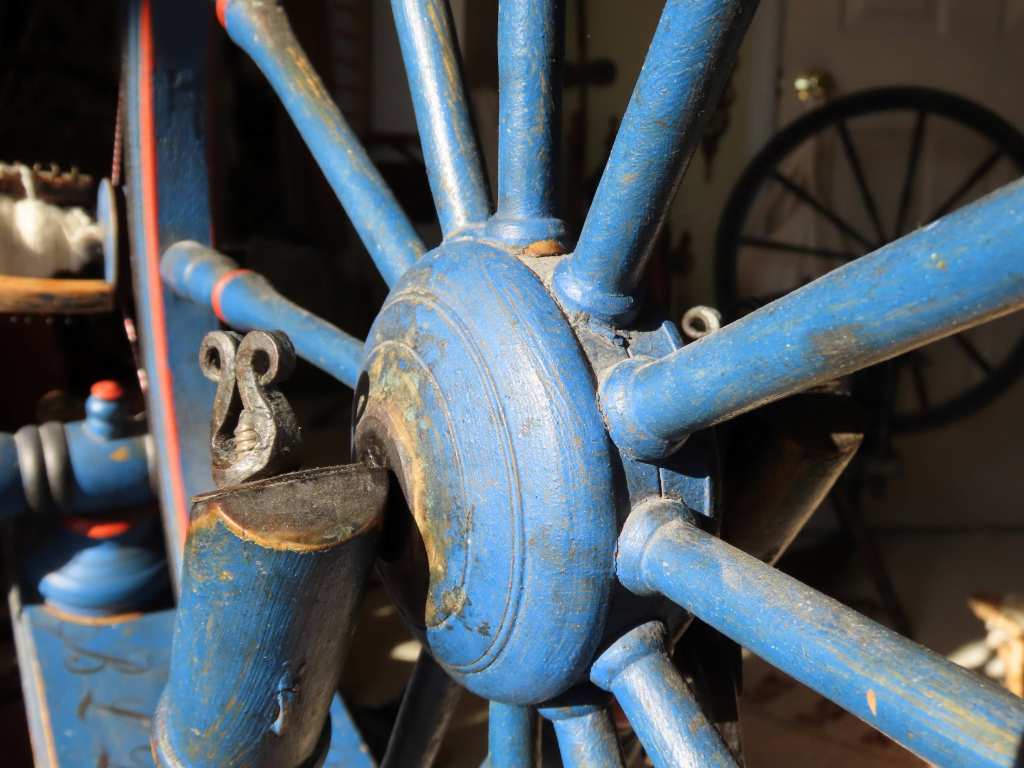
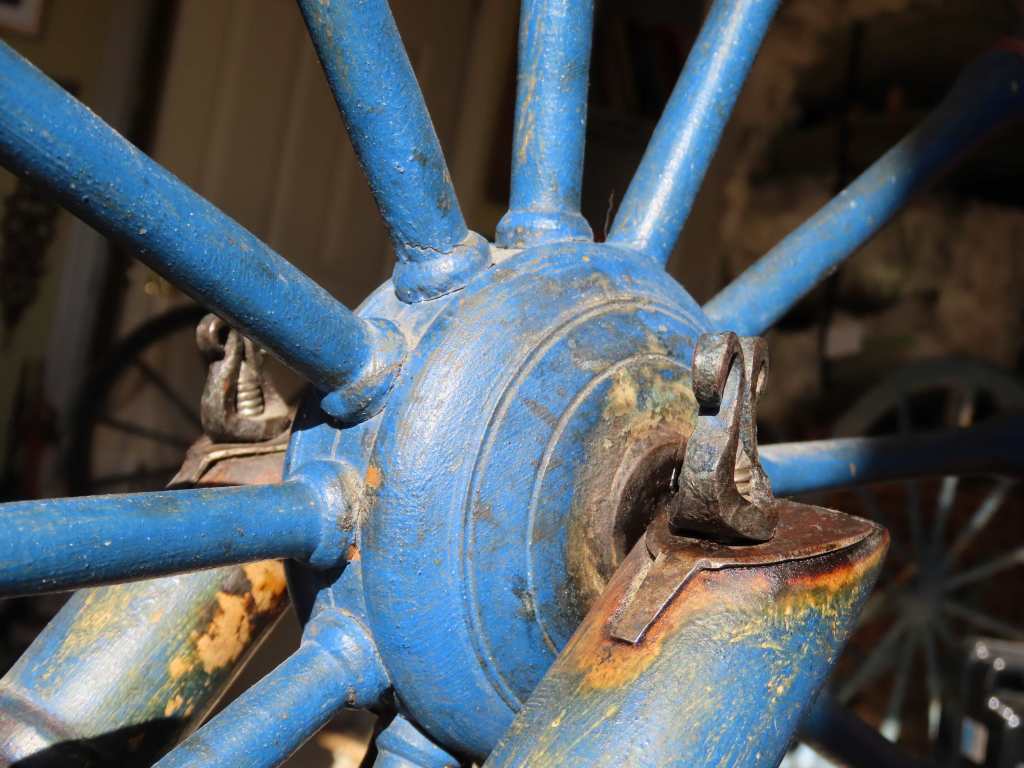
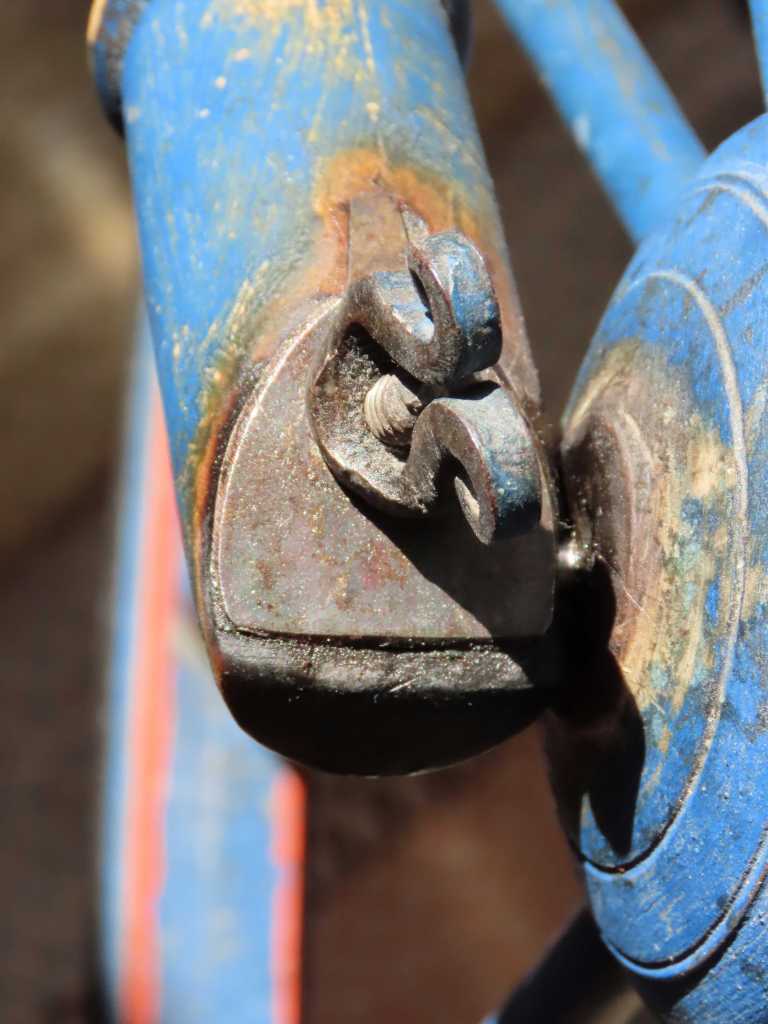
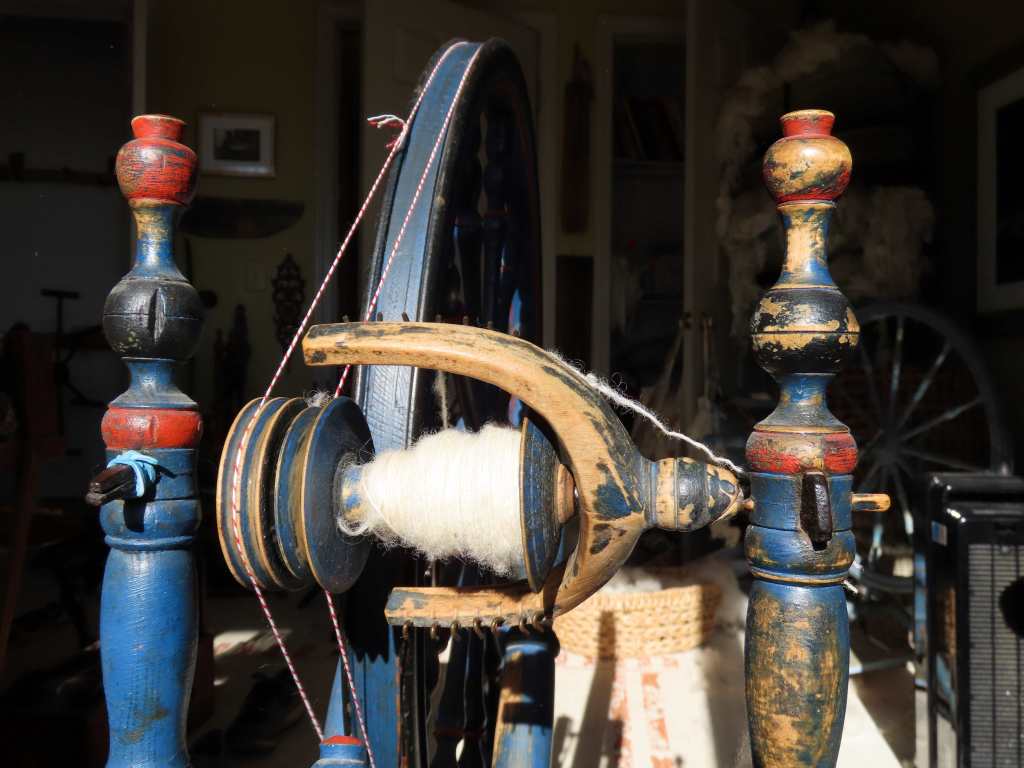
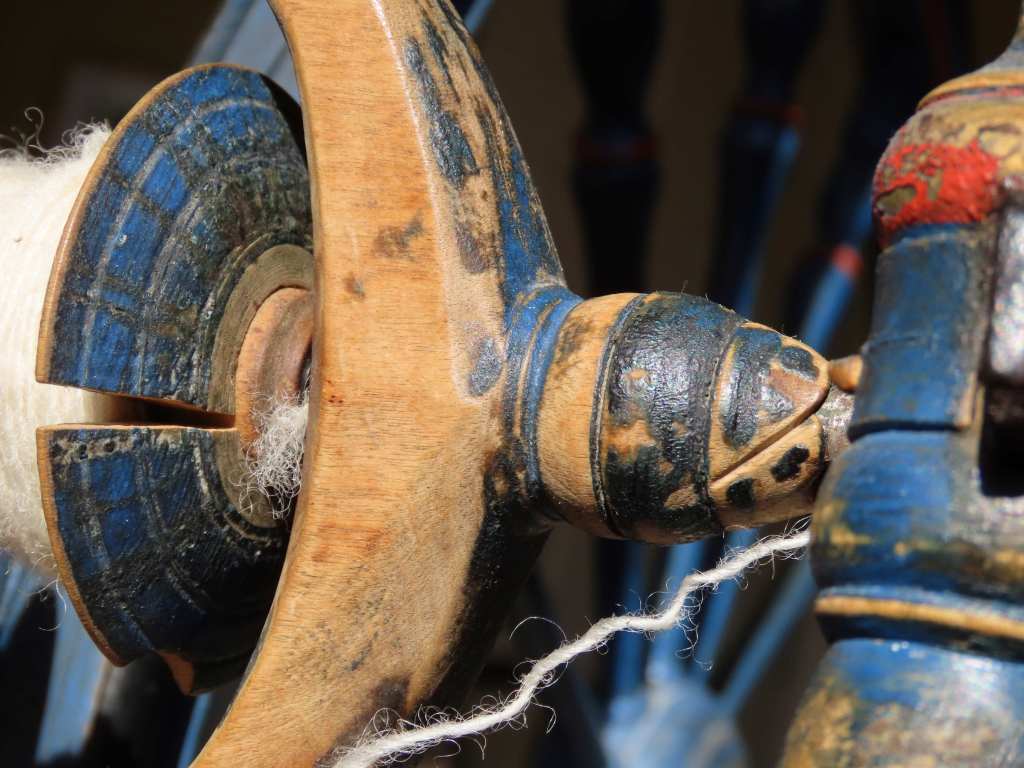
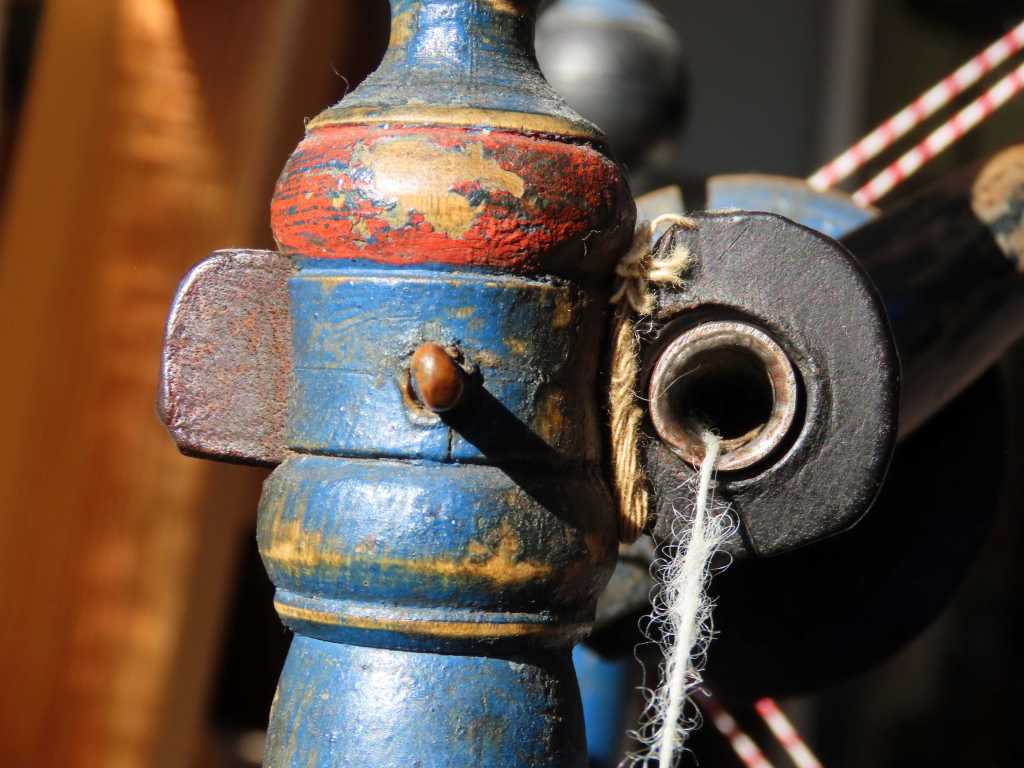
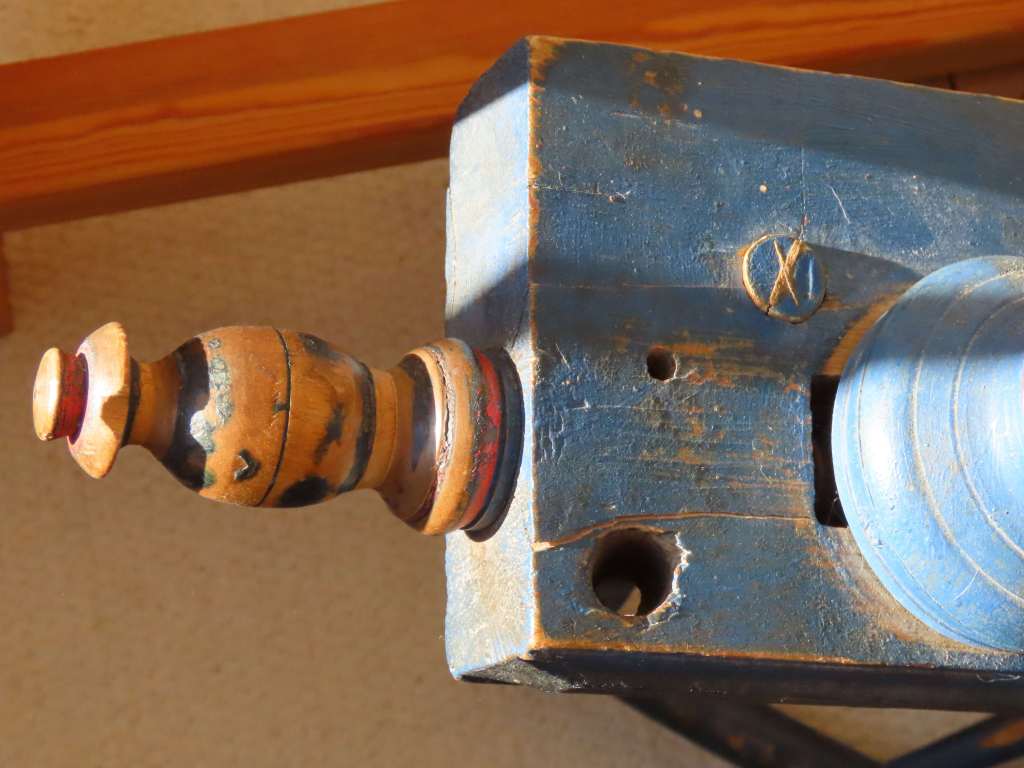
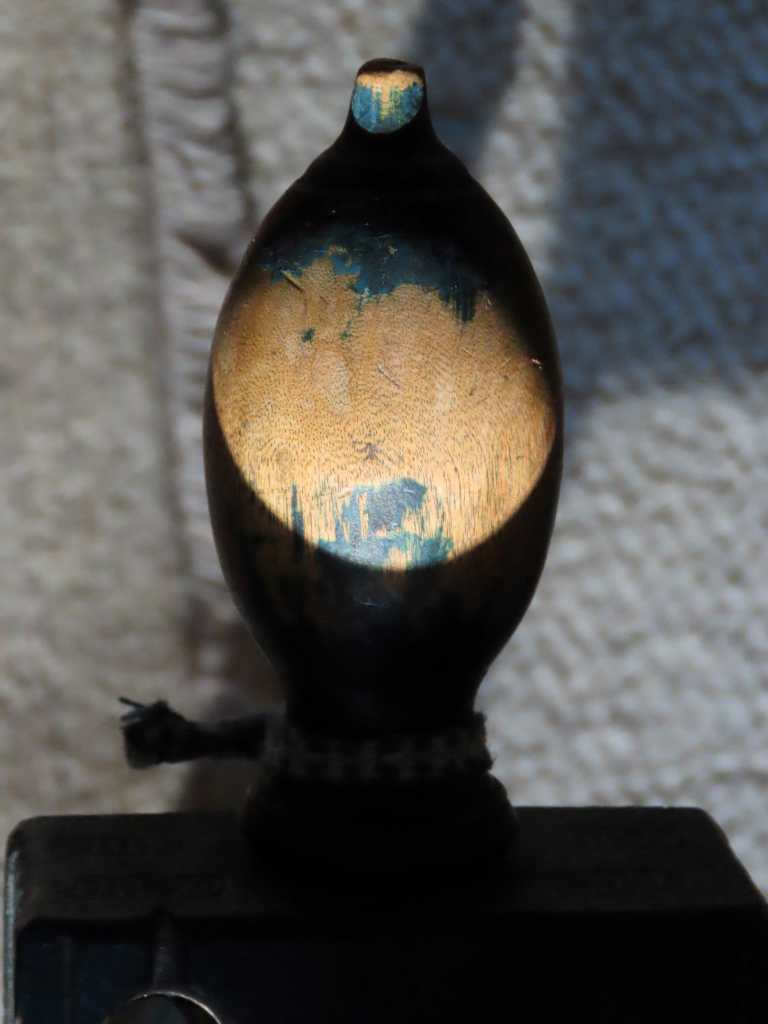
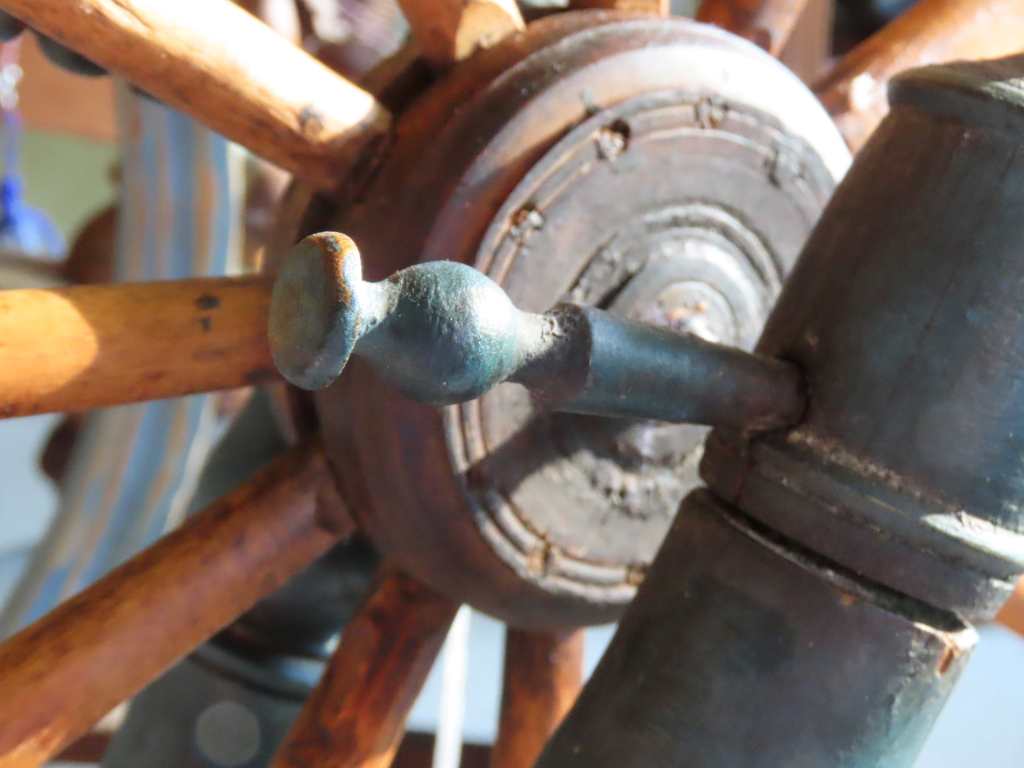
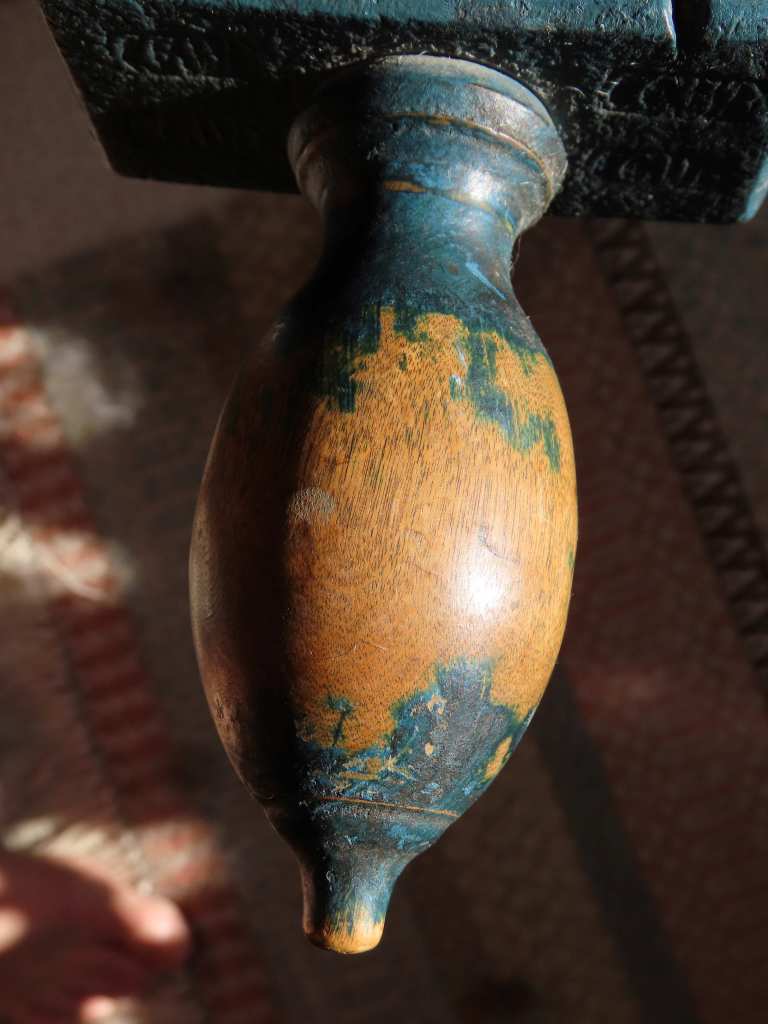
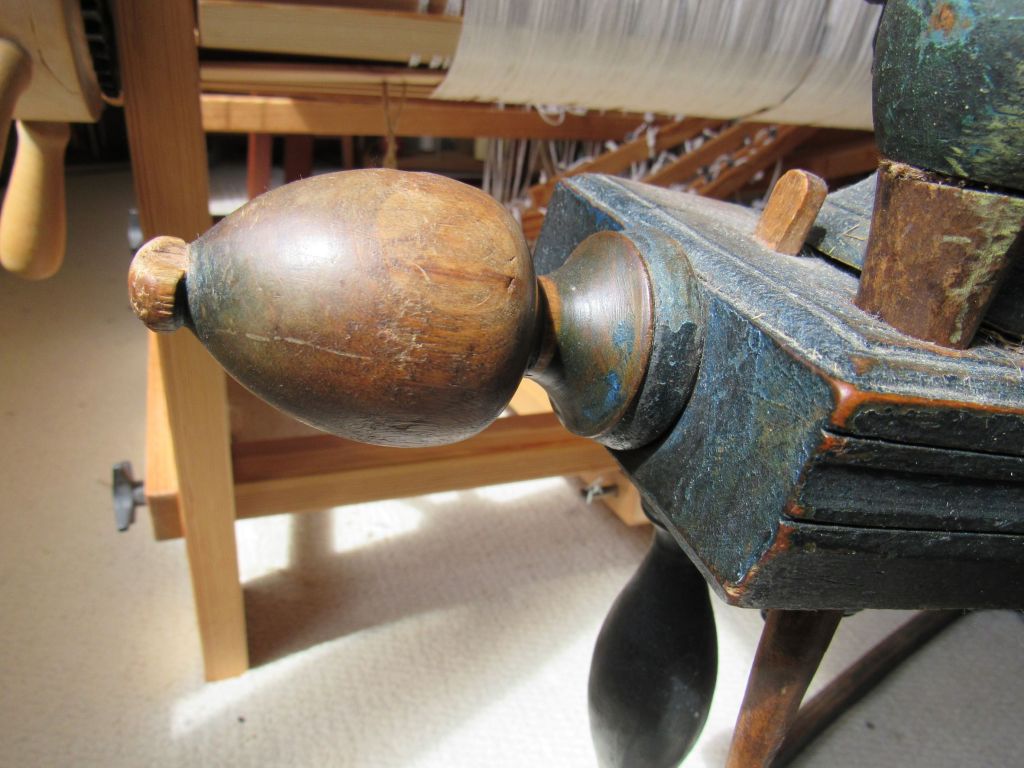
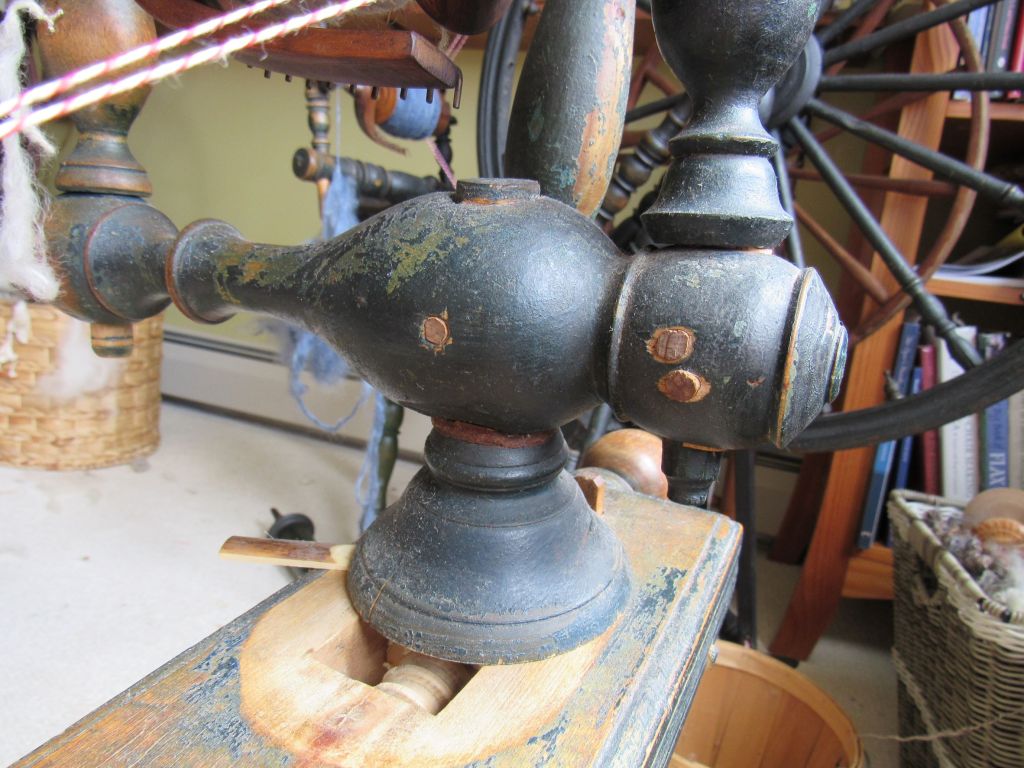
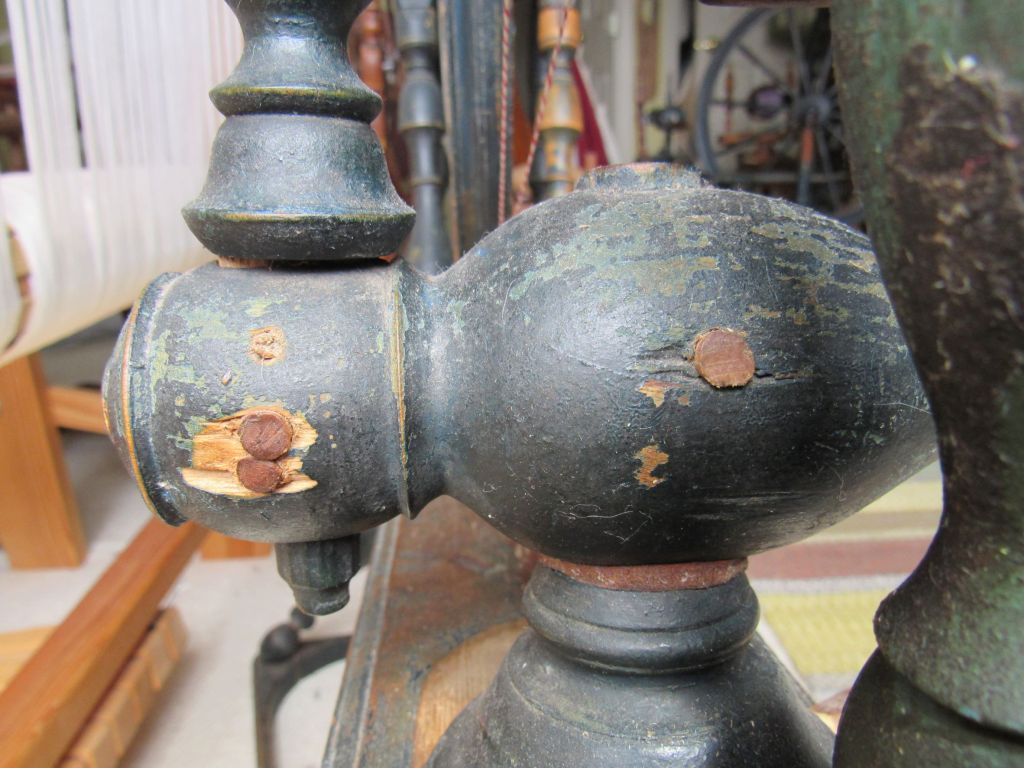
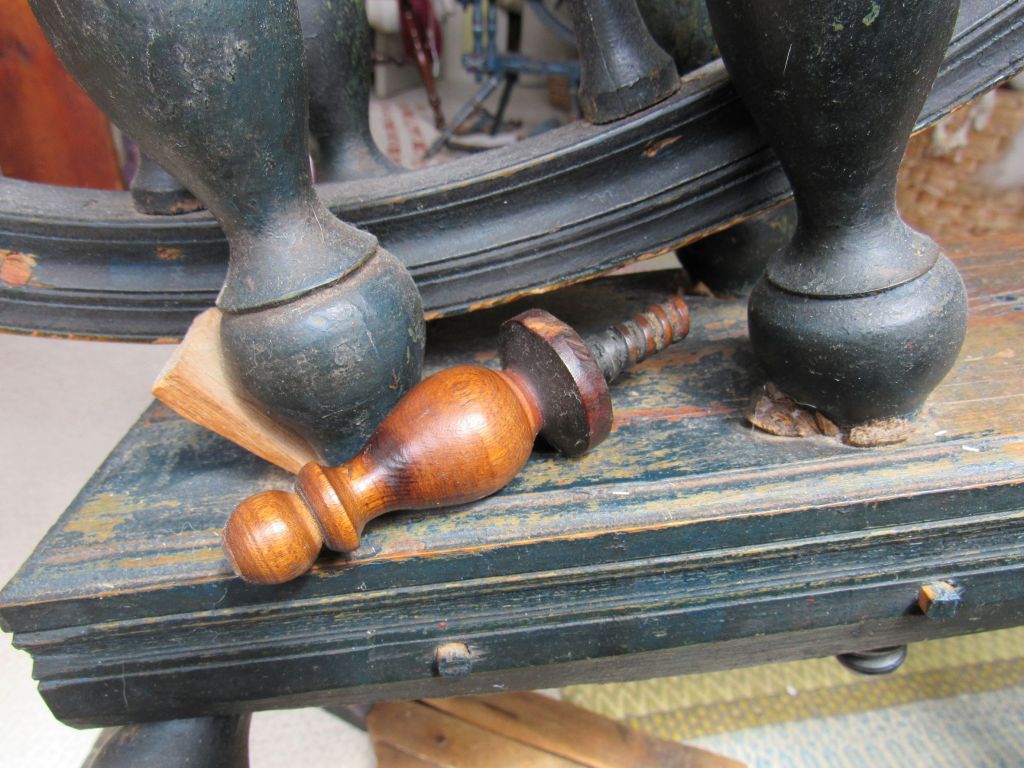
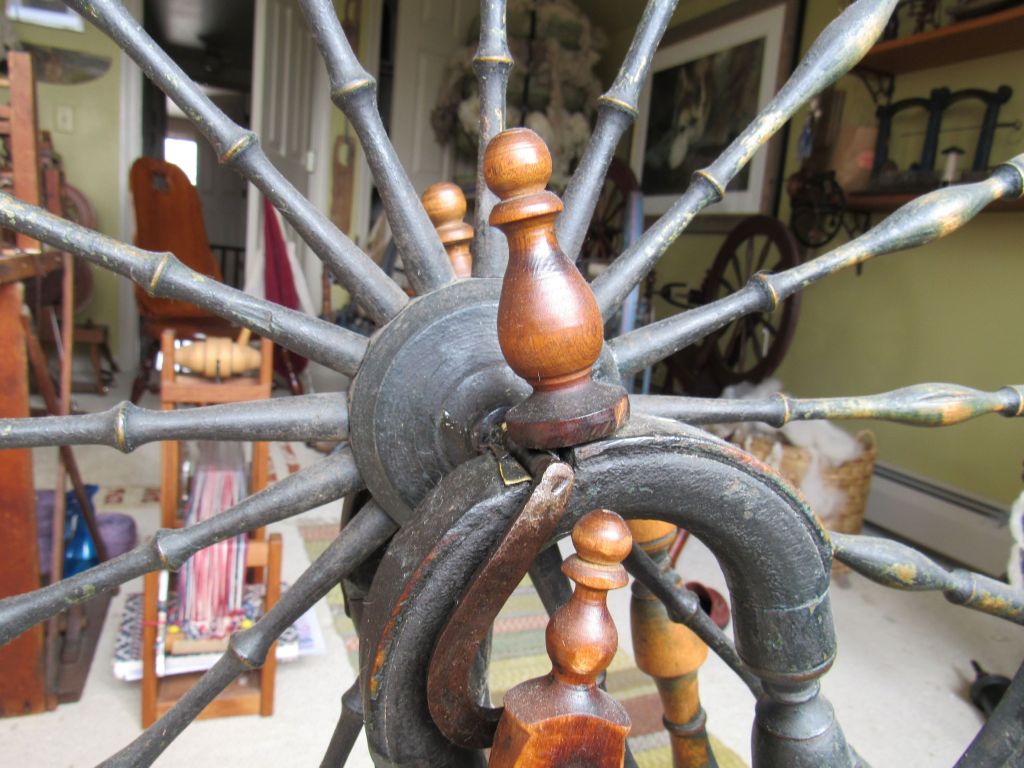
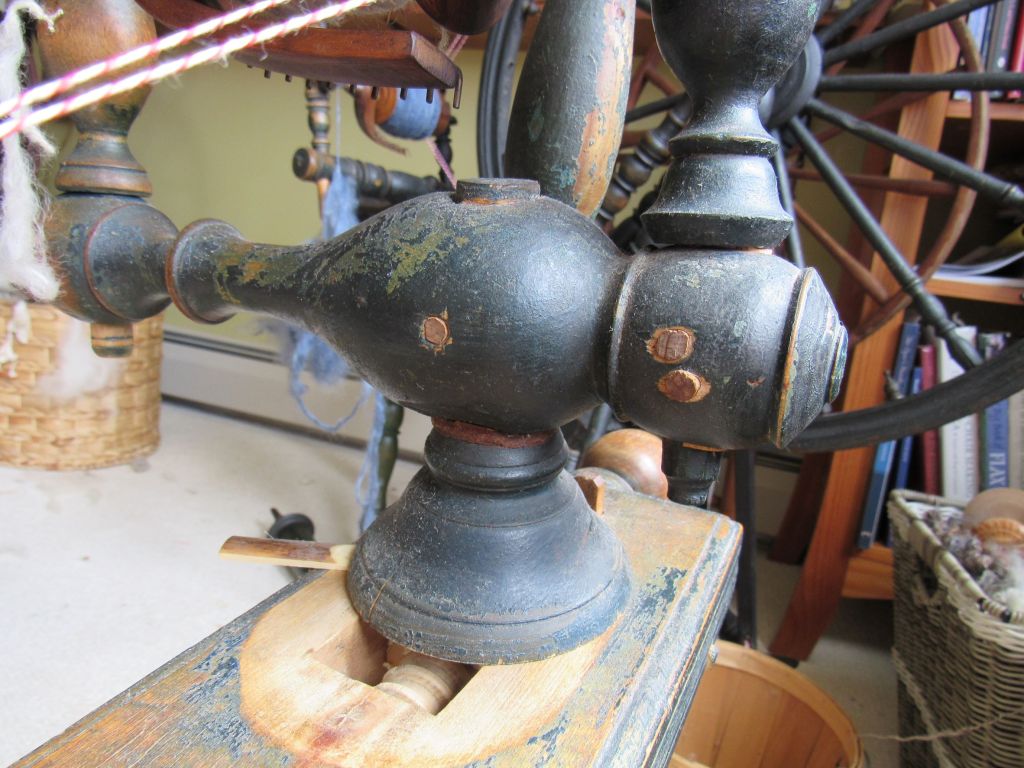
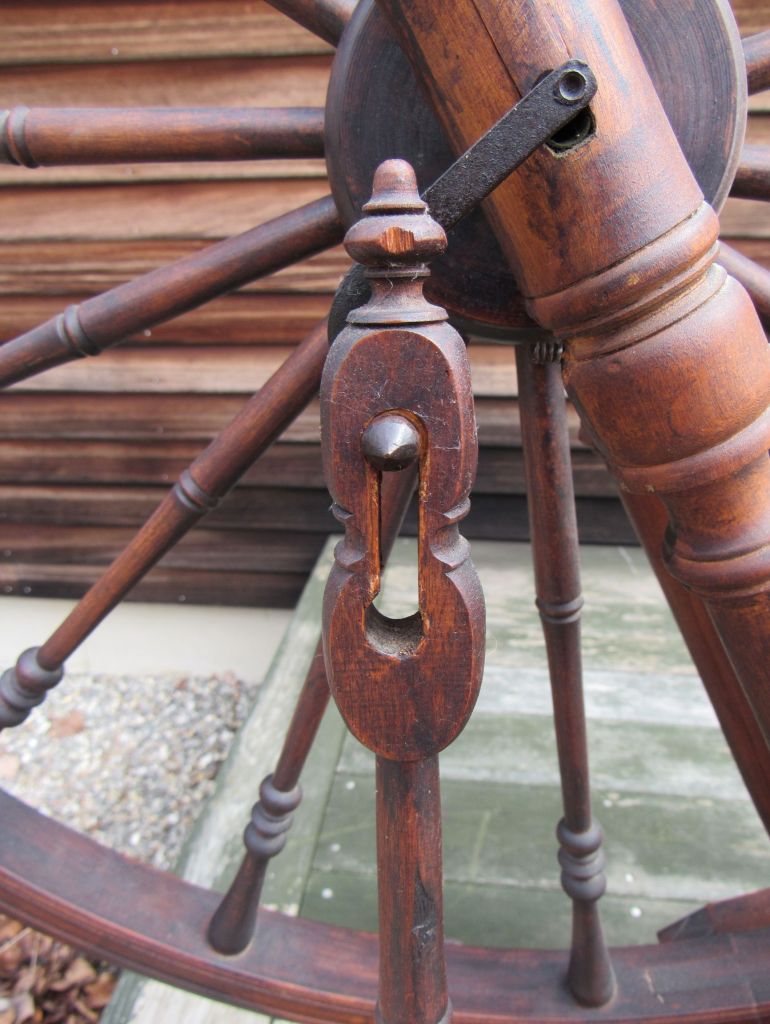
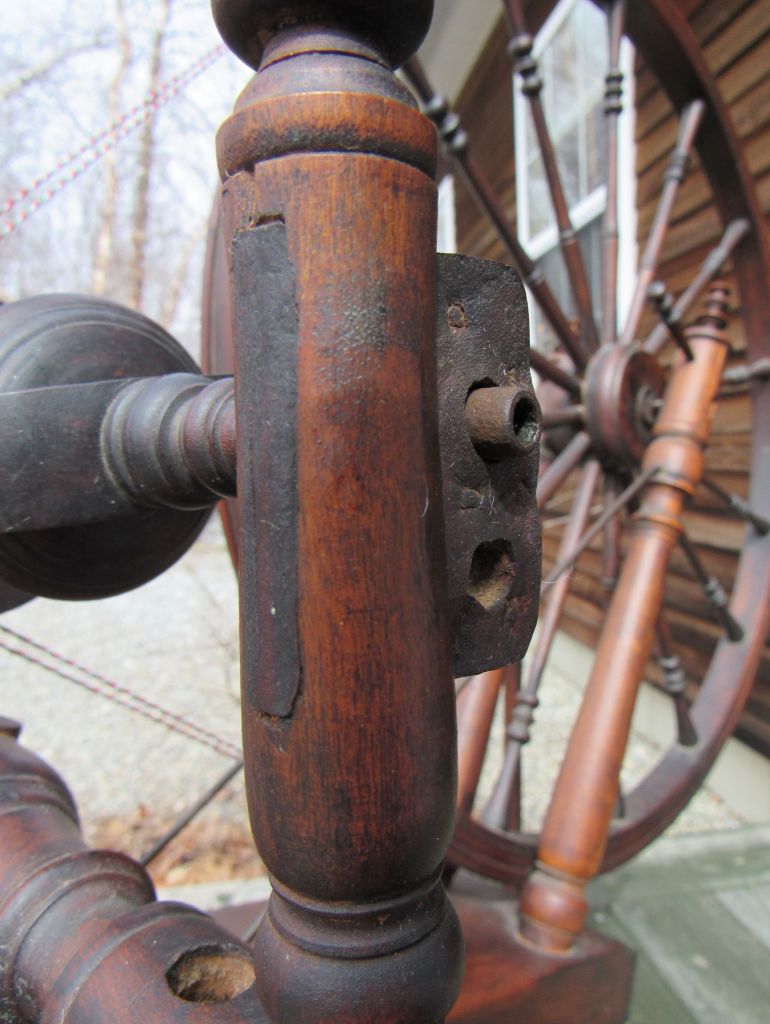
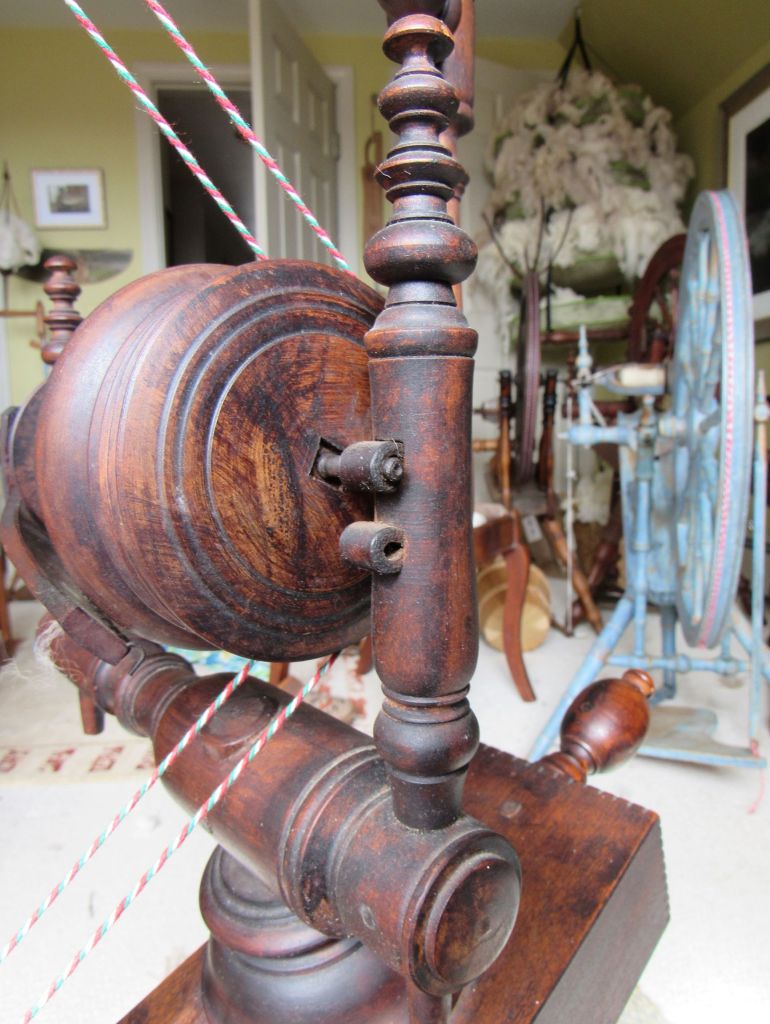
The lyre-shaped nuts were even more stunning in person than I expected. They sit like twin guardians on top of the metal plates securing the axle ends.
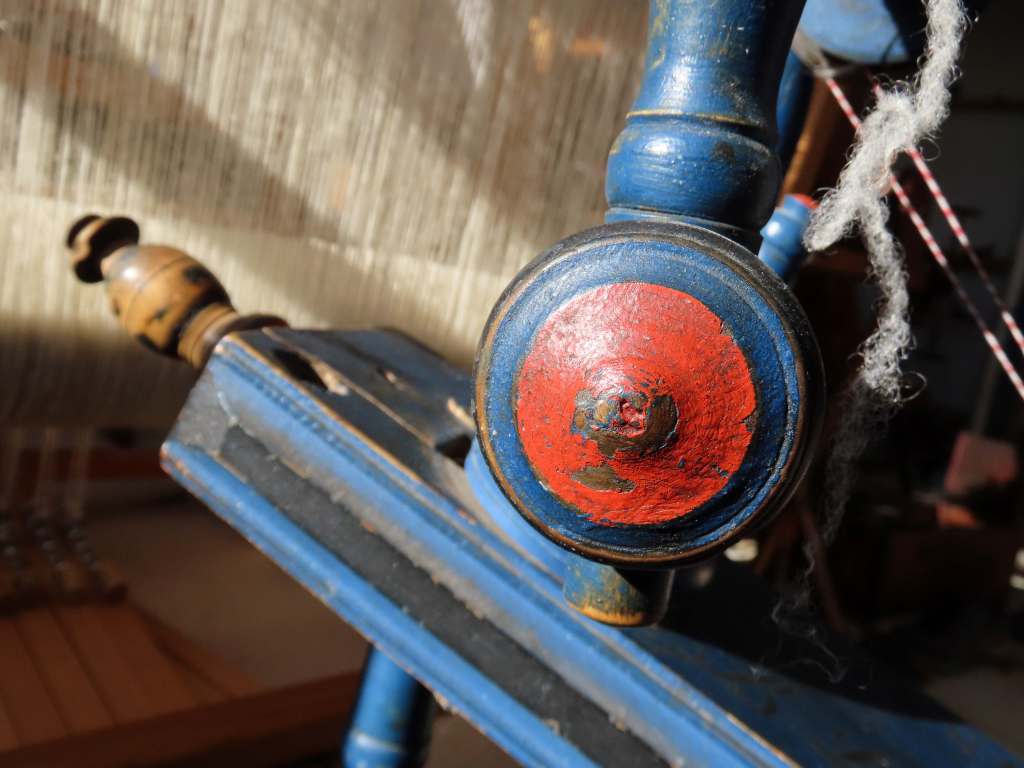
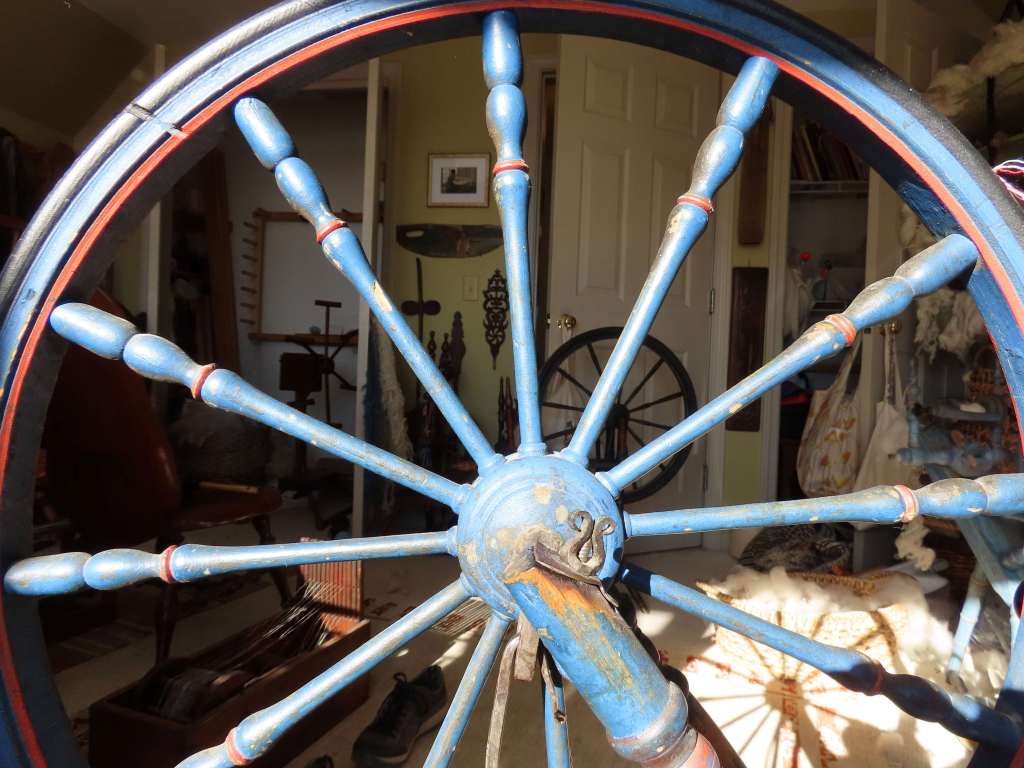
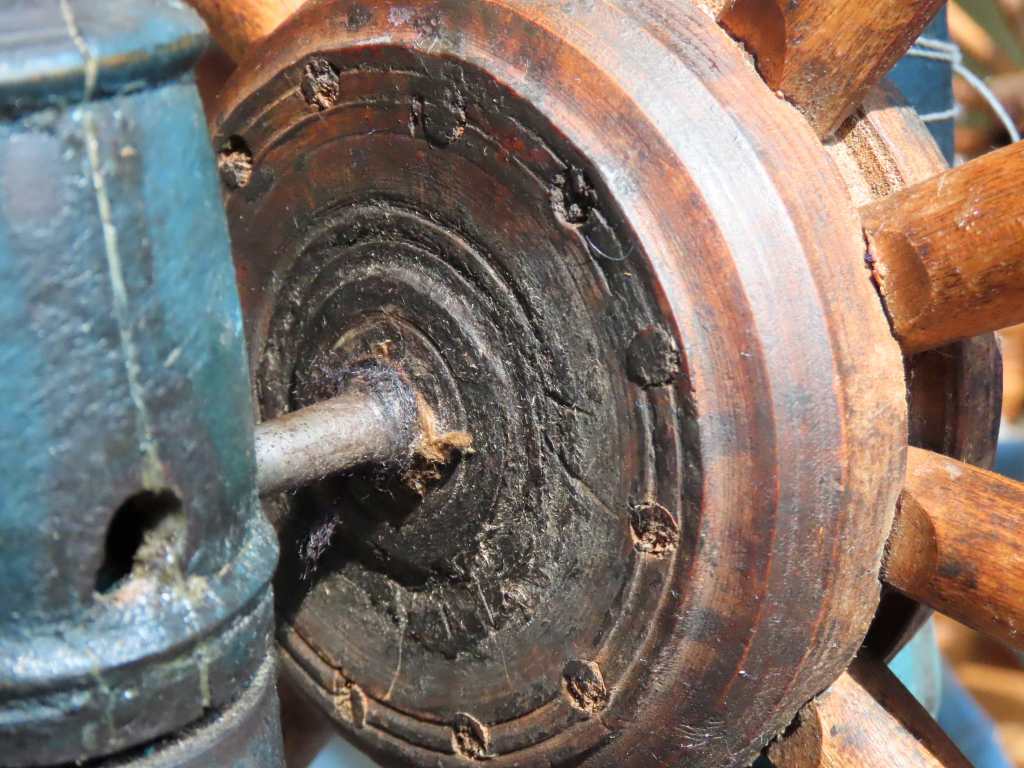
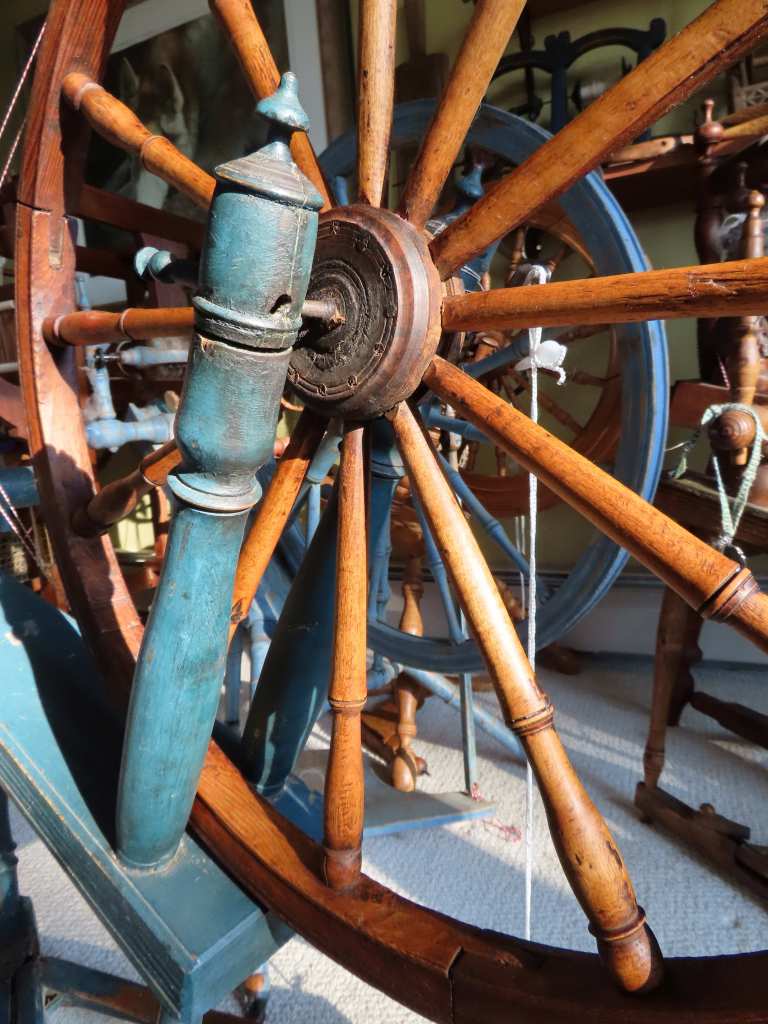
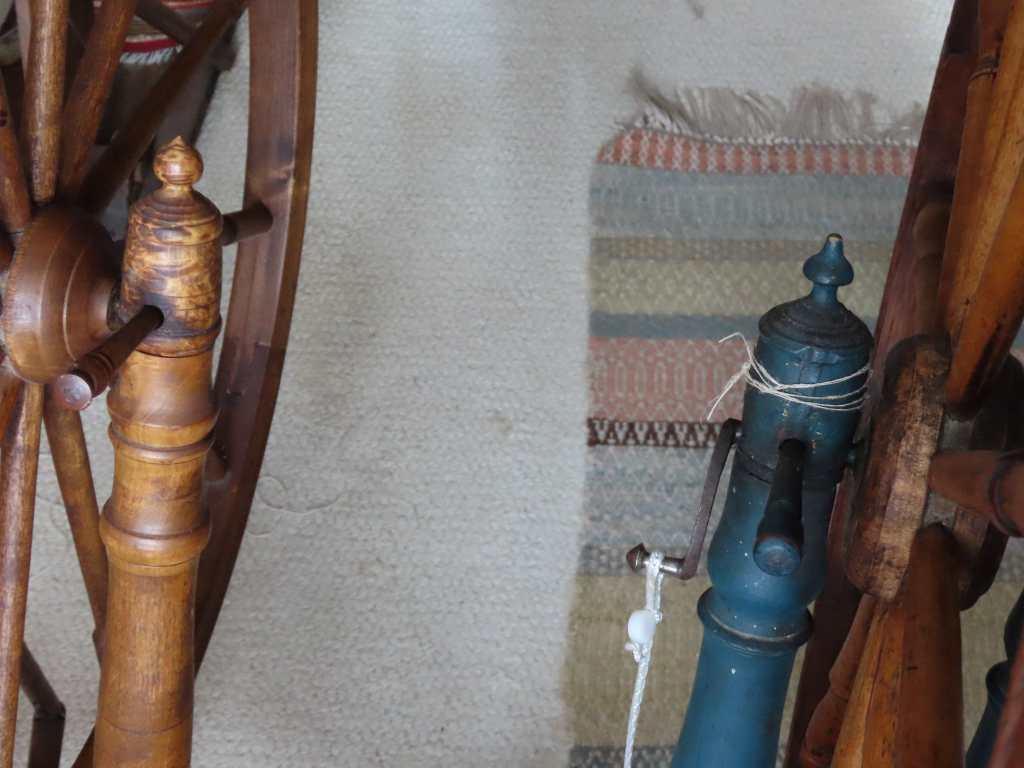
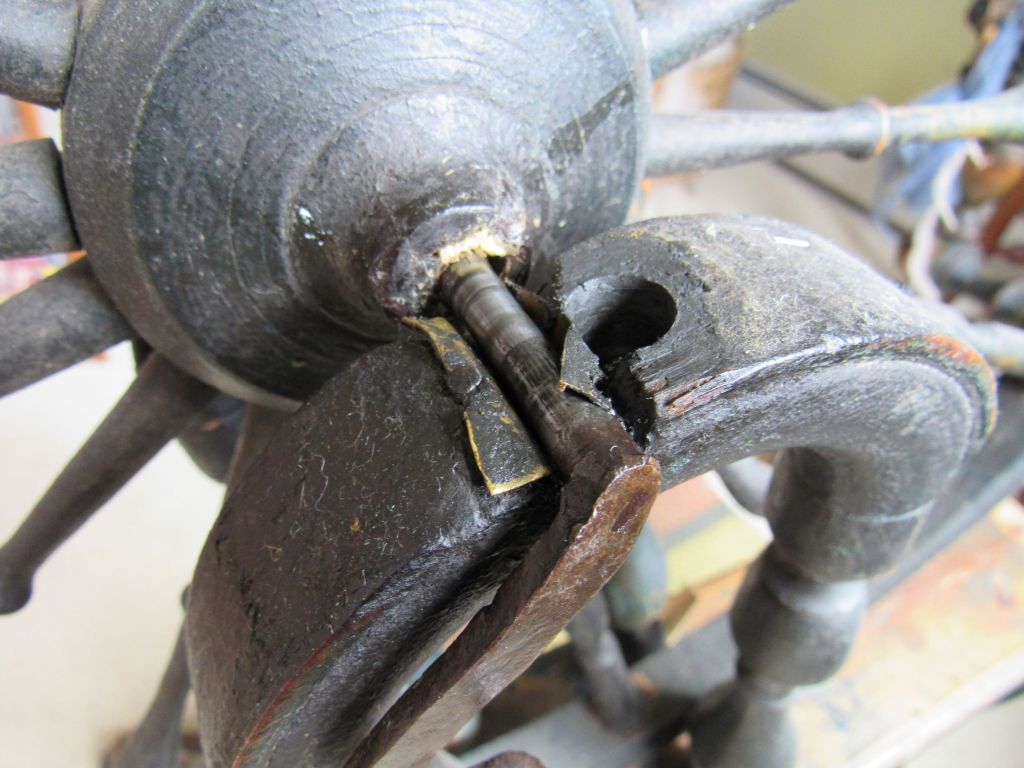
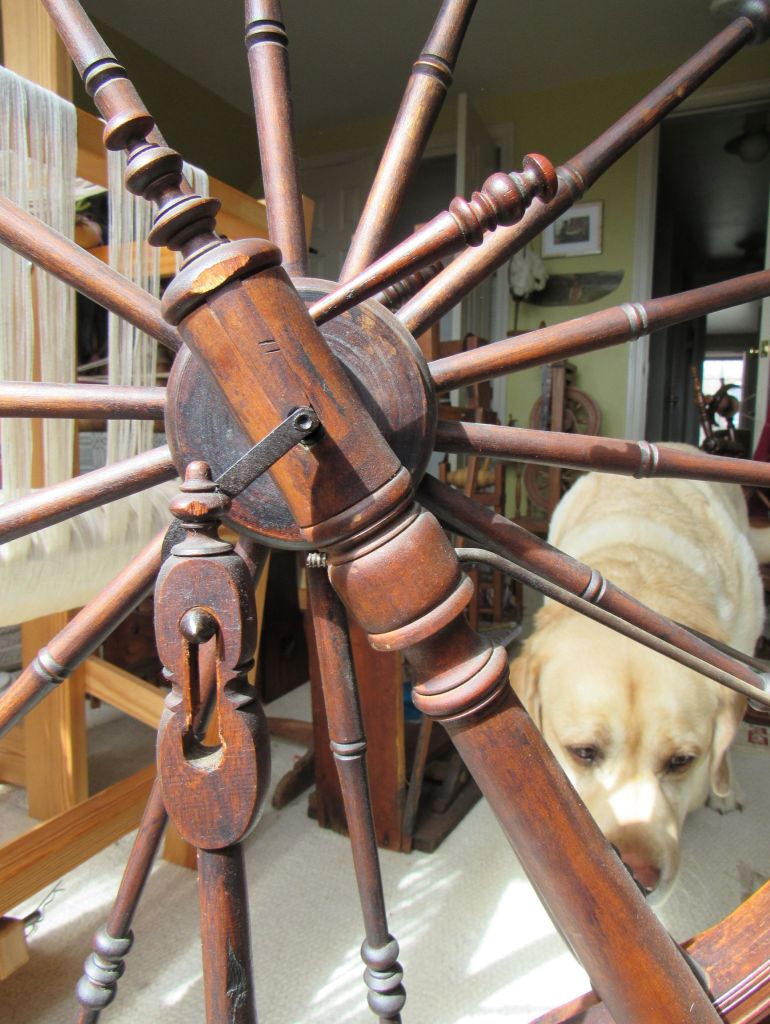
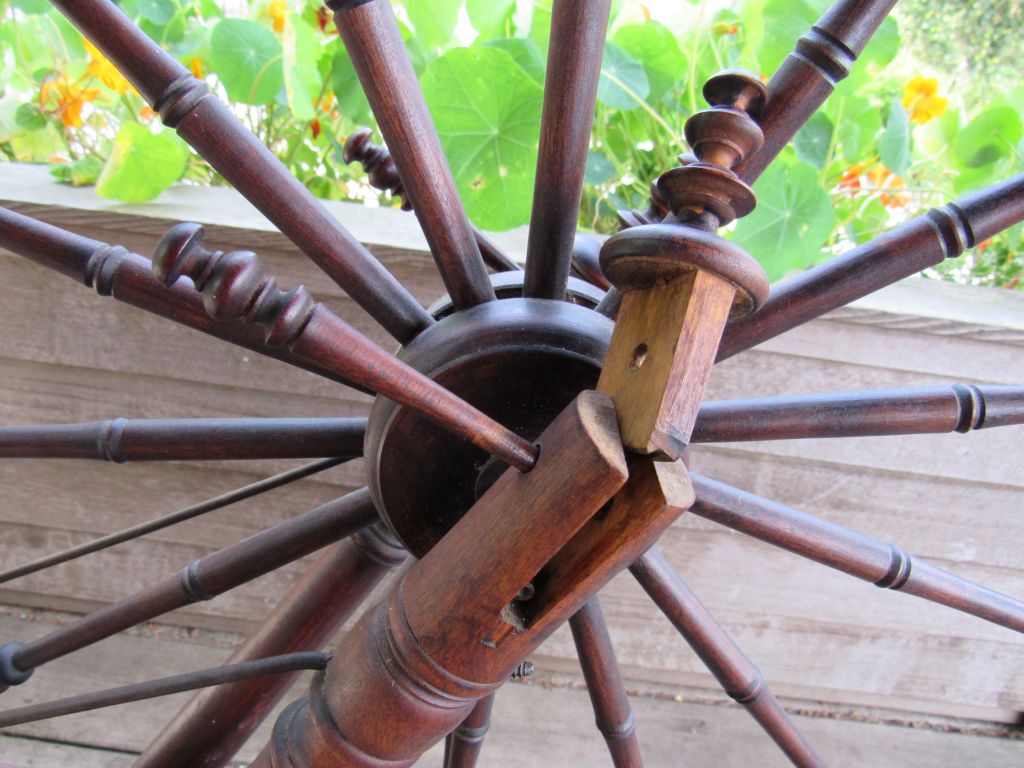
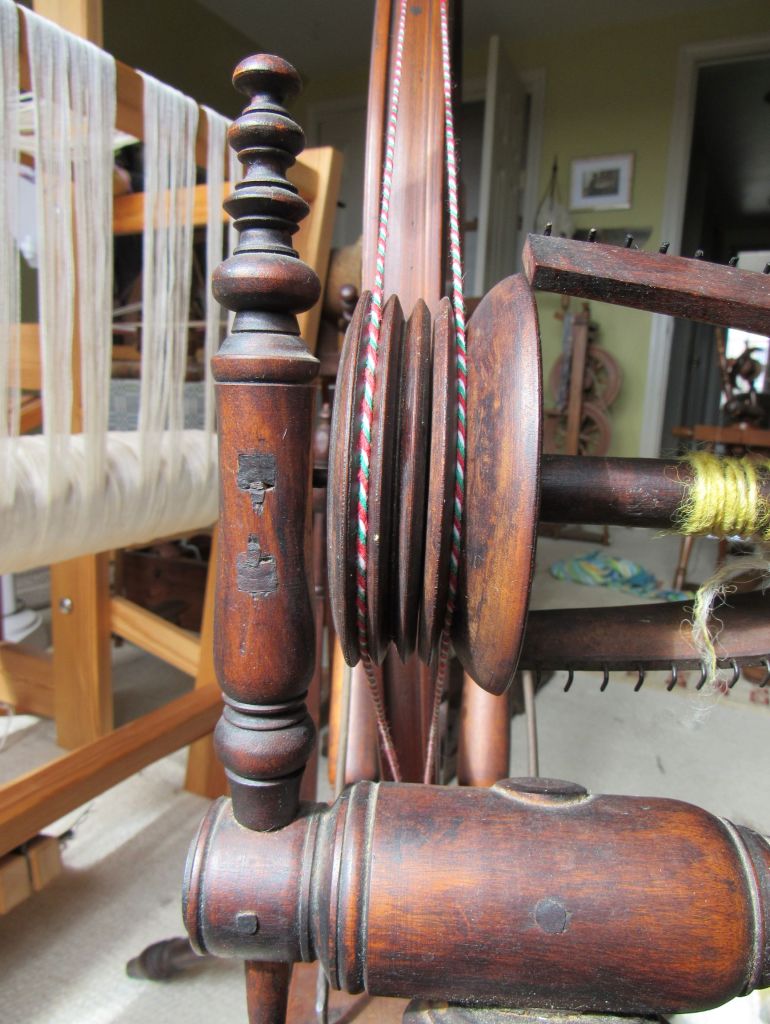
But, an even more unusual feature was the wheel’s internal crank.
It was what confused us in looking at the sale photos. While internal cranks are found on many double-table Norwegian wheels, they are very rare on saxony-style wheels. Samuel Morison, in Vermont, used them on some of his saxony-style wheels, but aside from his wheels, they are scarce. So I was thrilled to find this beautiful example.
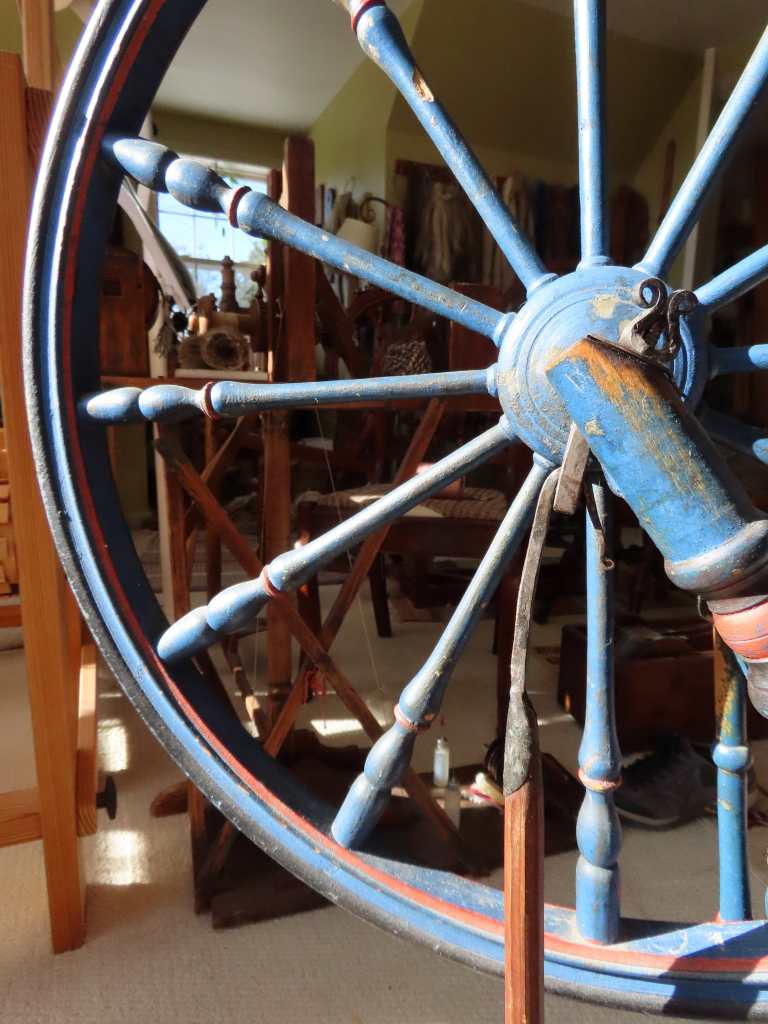
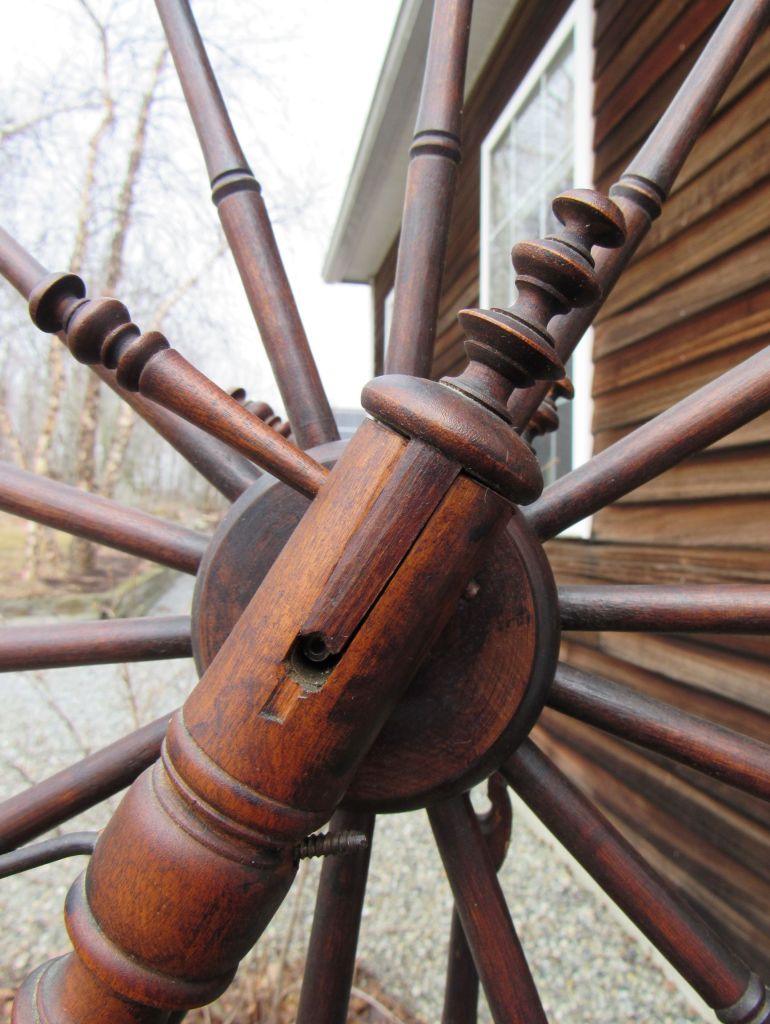
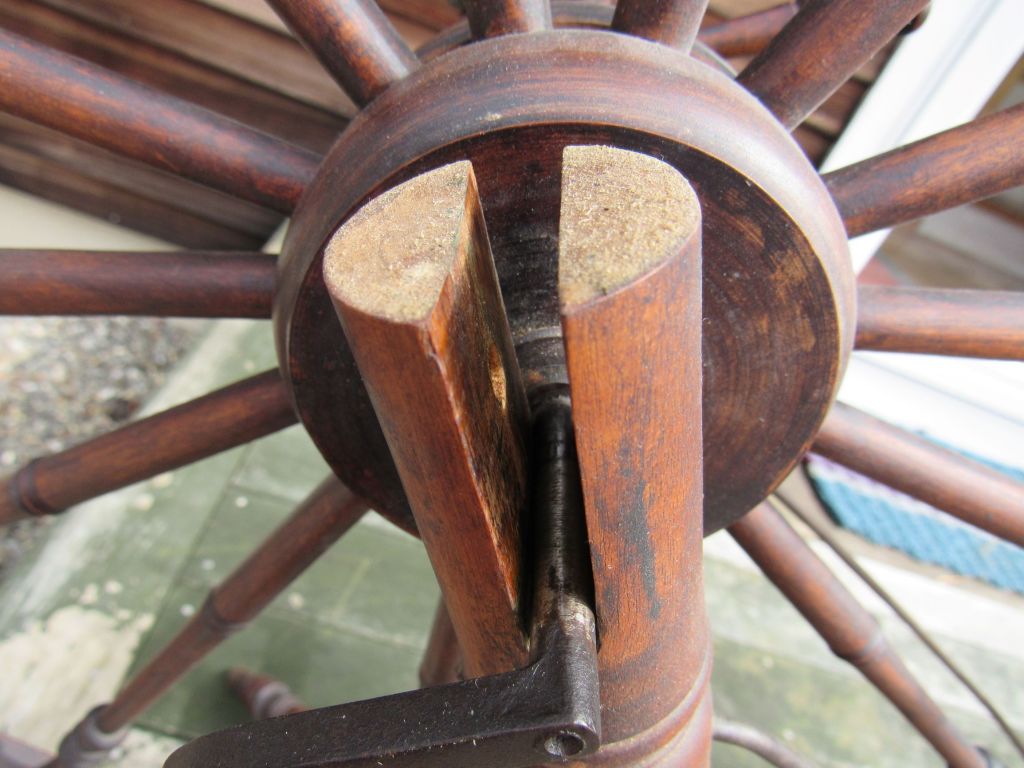
The inside part of the crank is actually embedded into the wheel hub. I would love to know why some wheel makers experimented with internal cranks. Is there any advantage to them? One disadvantage is that a traditional style footman is not ideal because it cannot easily be popped on and off the axle.
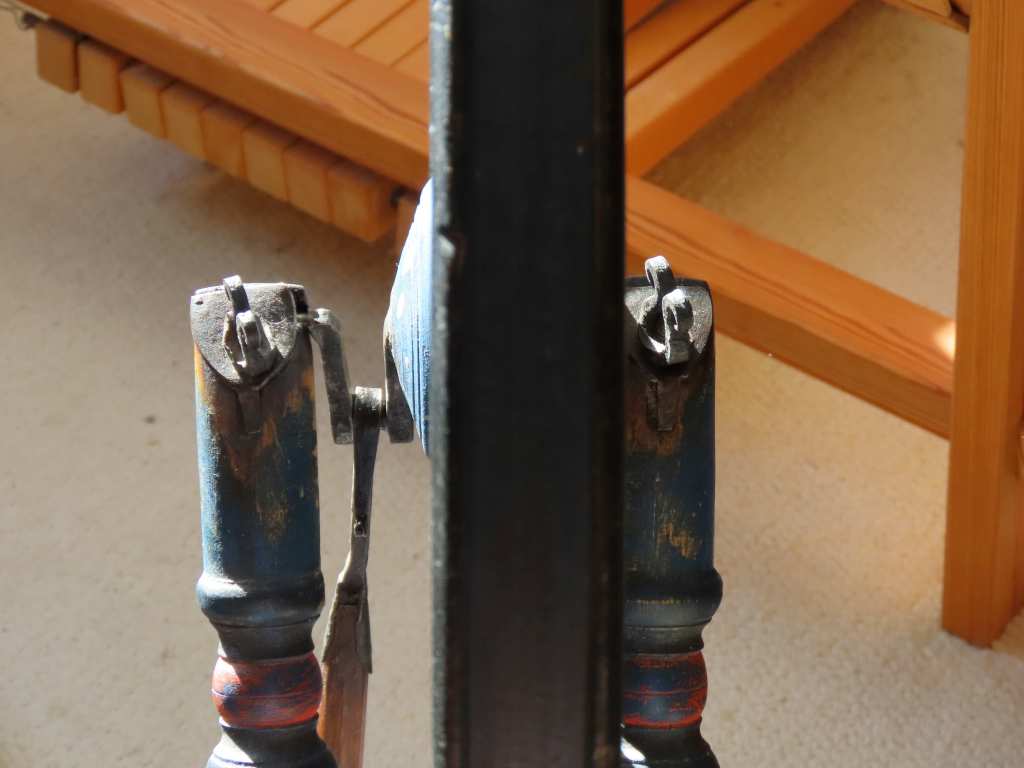
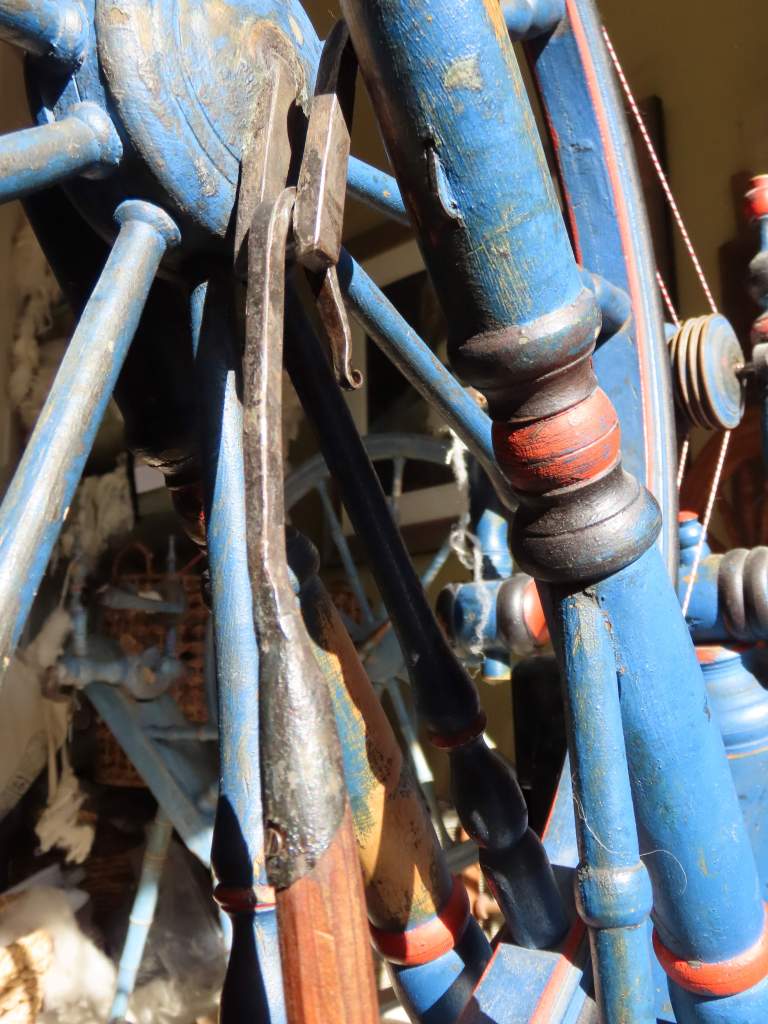
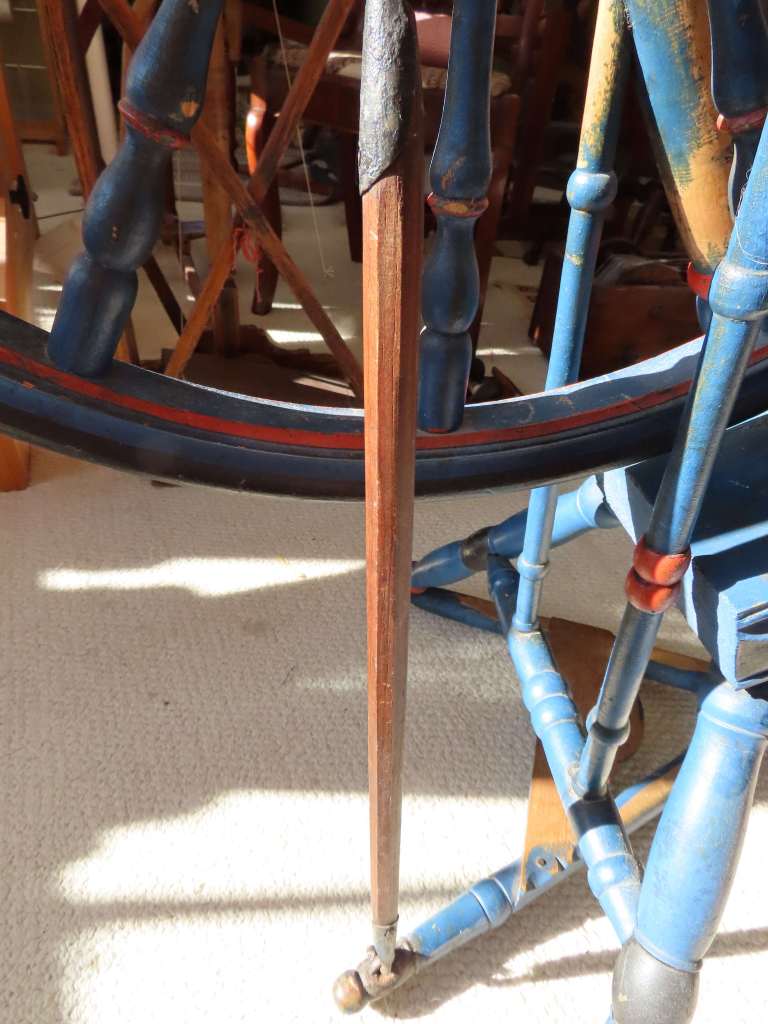
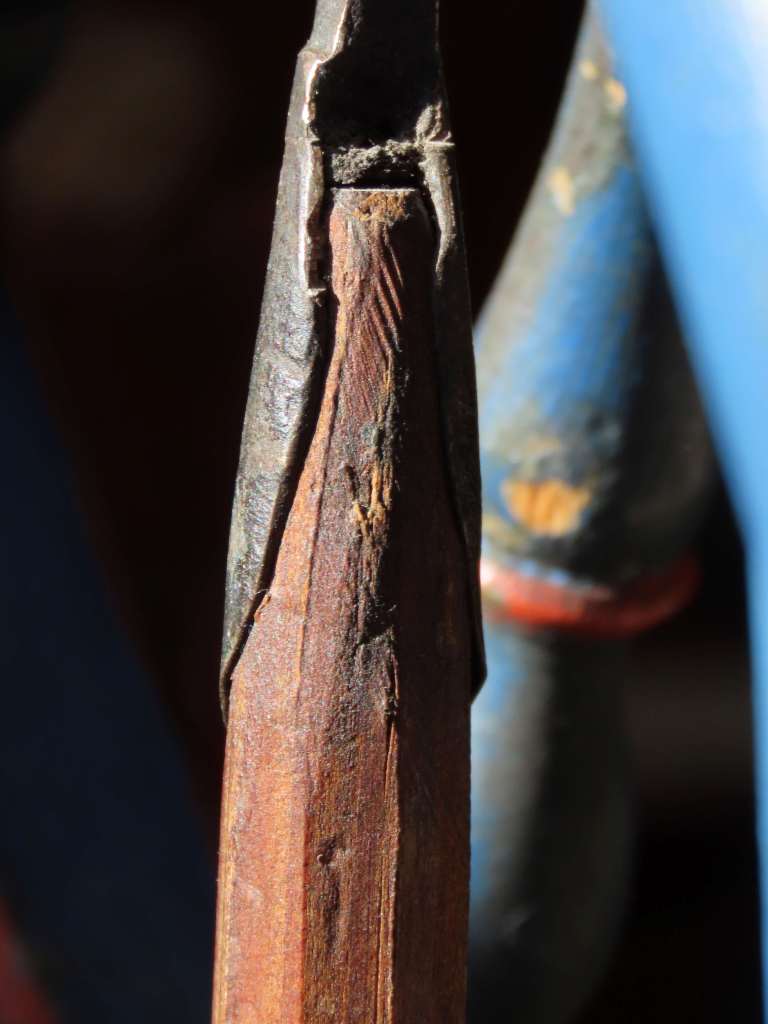
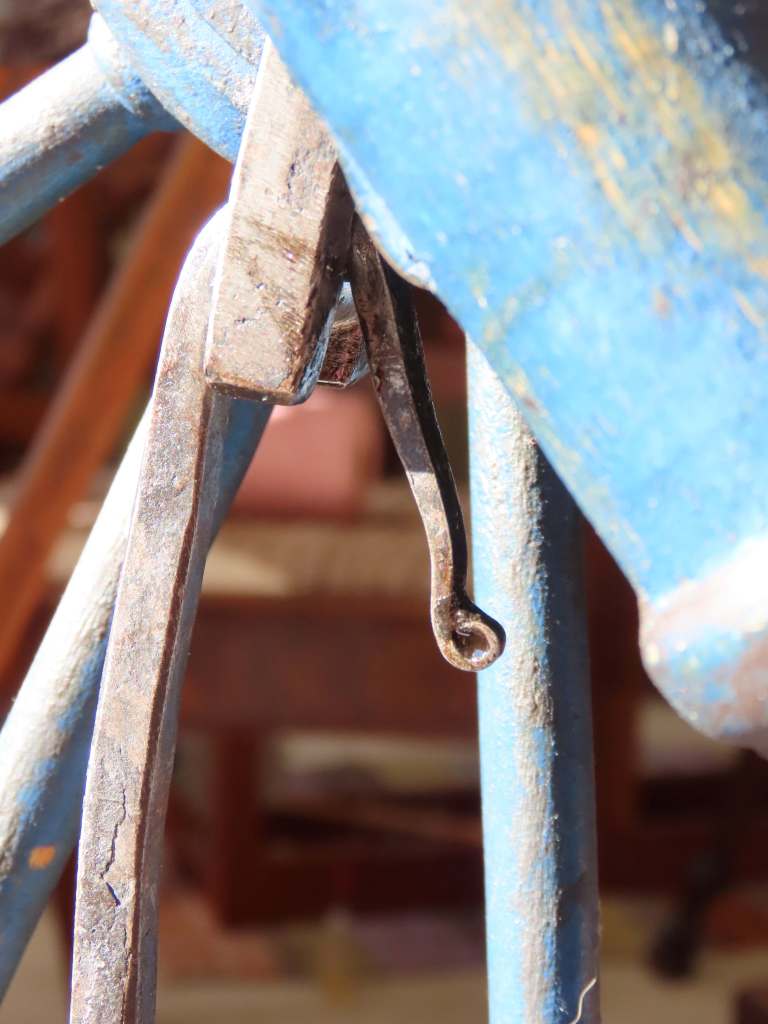
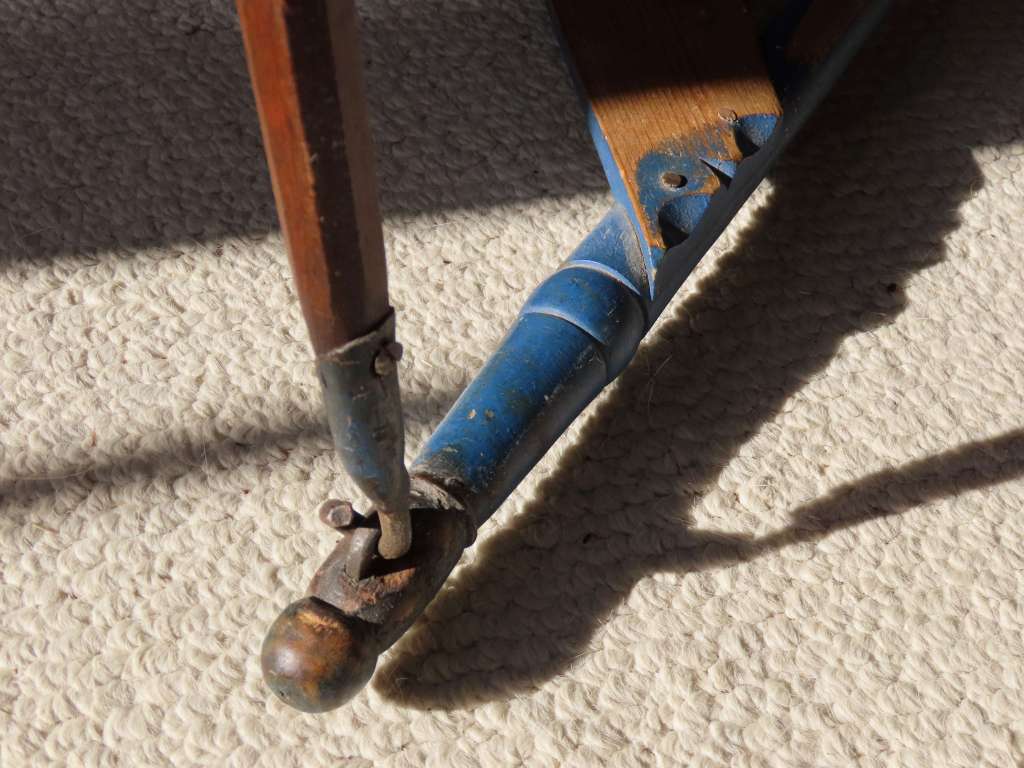
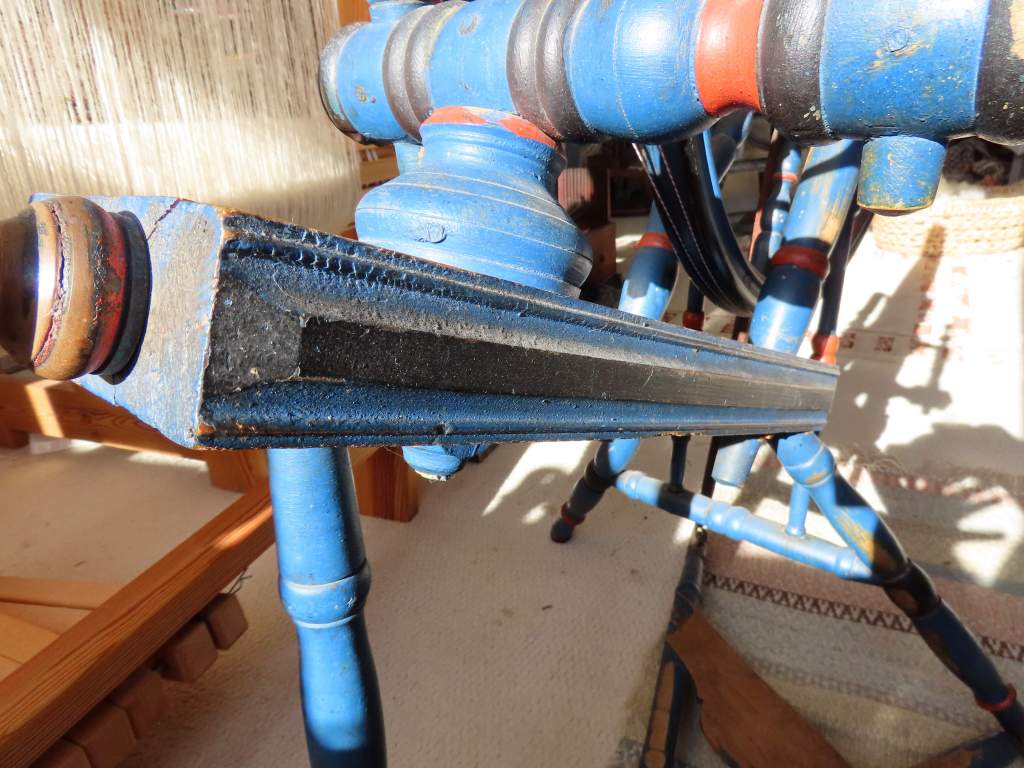
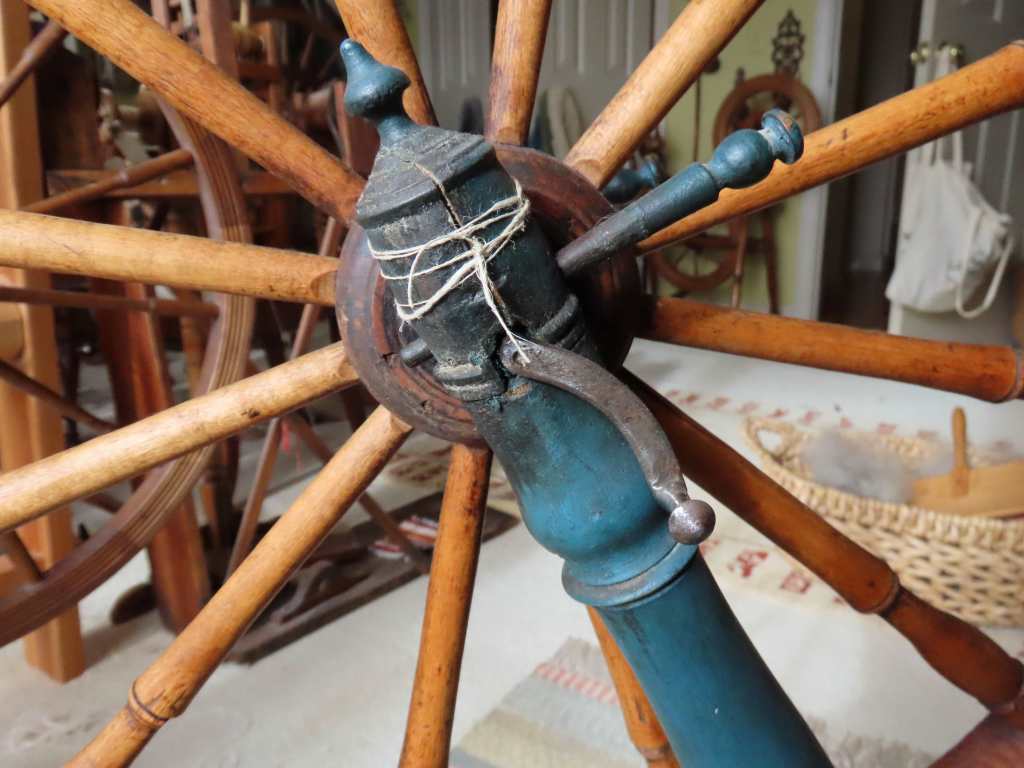
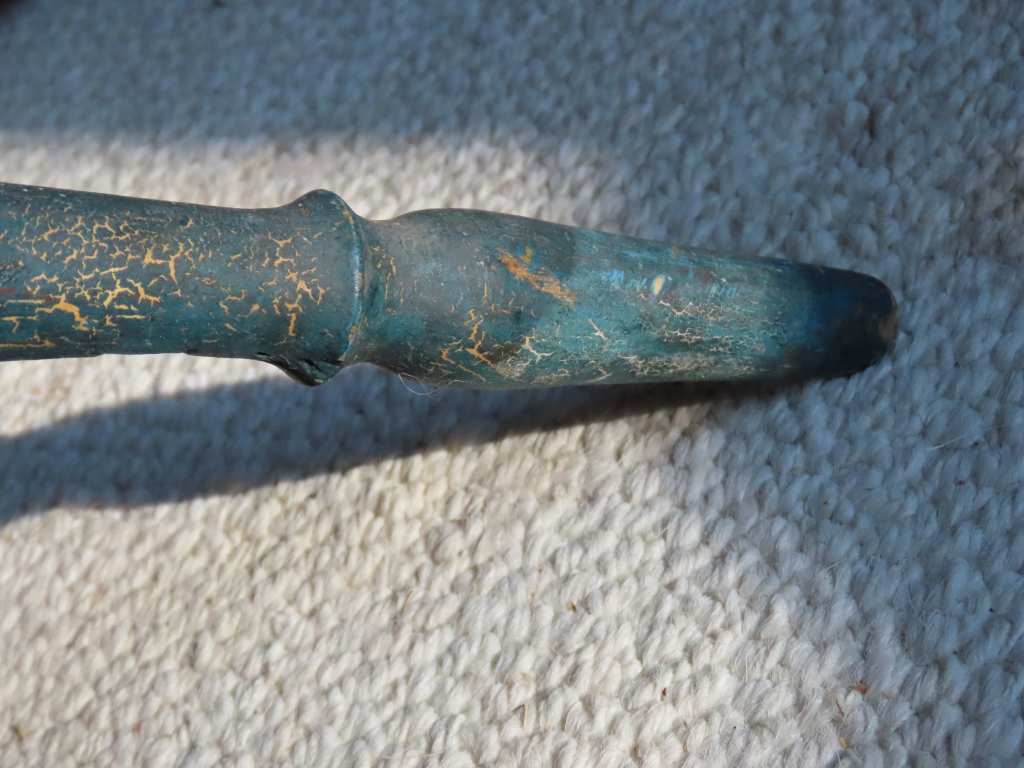
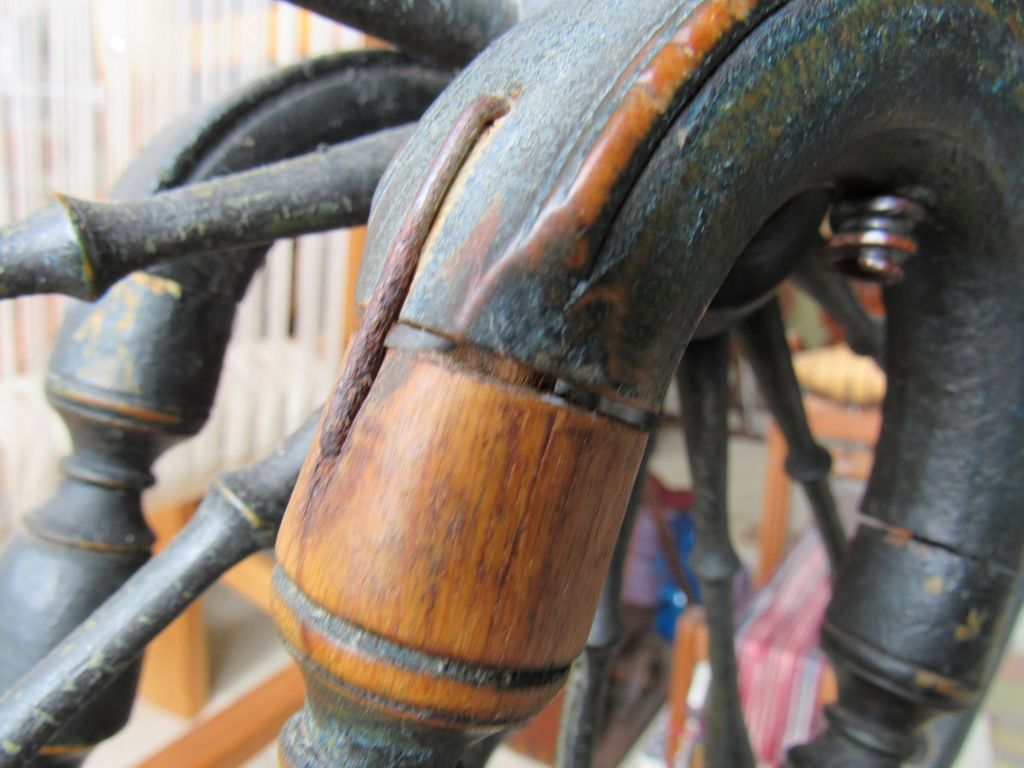
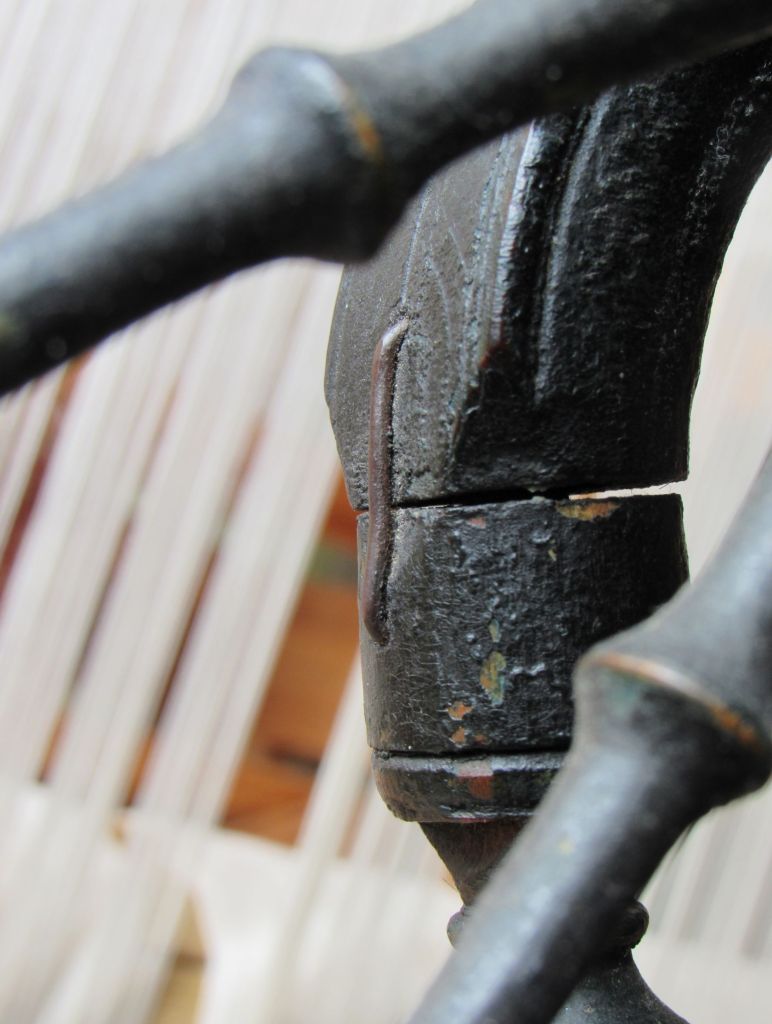
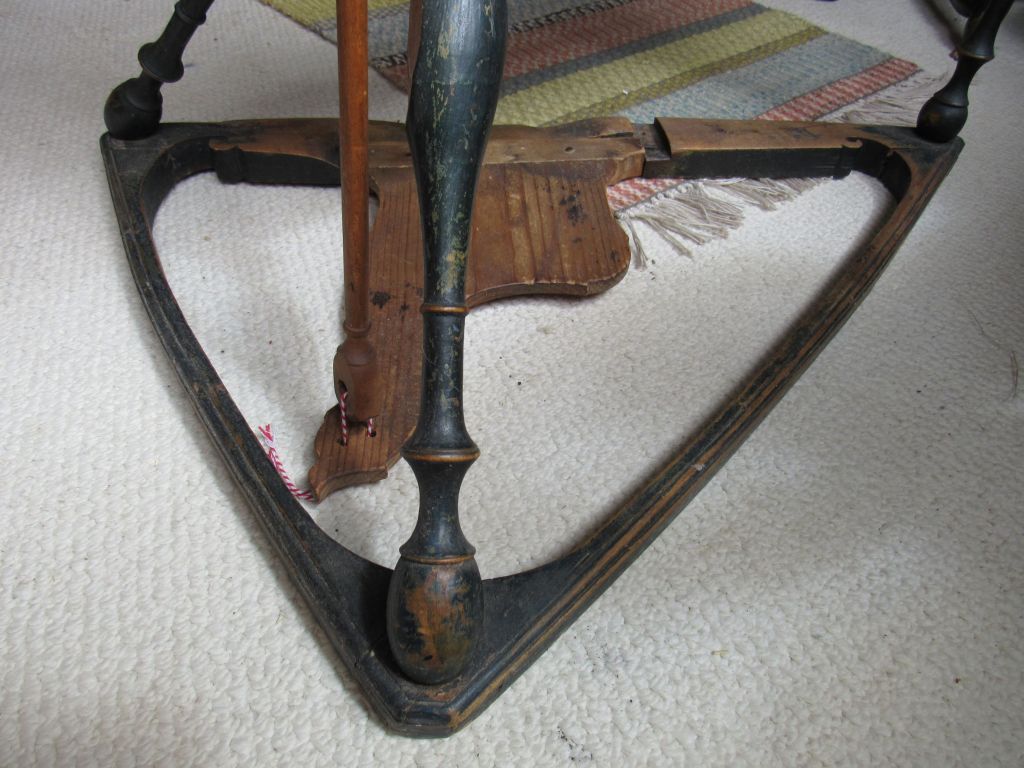
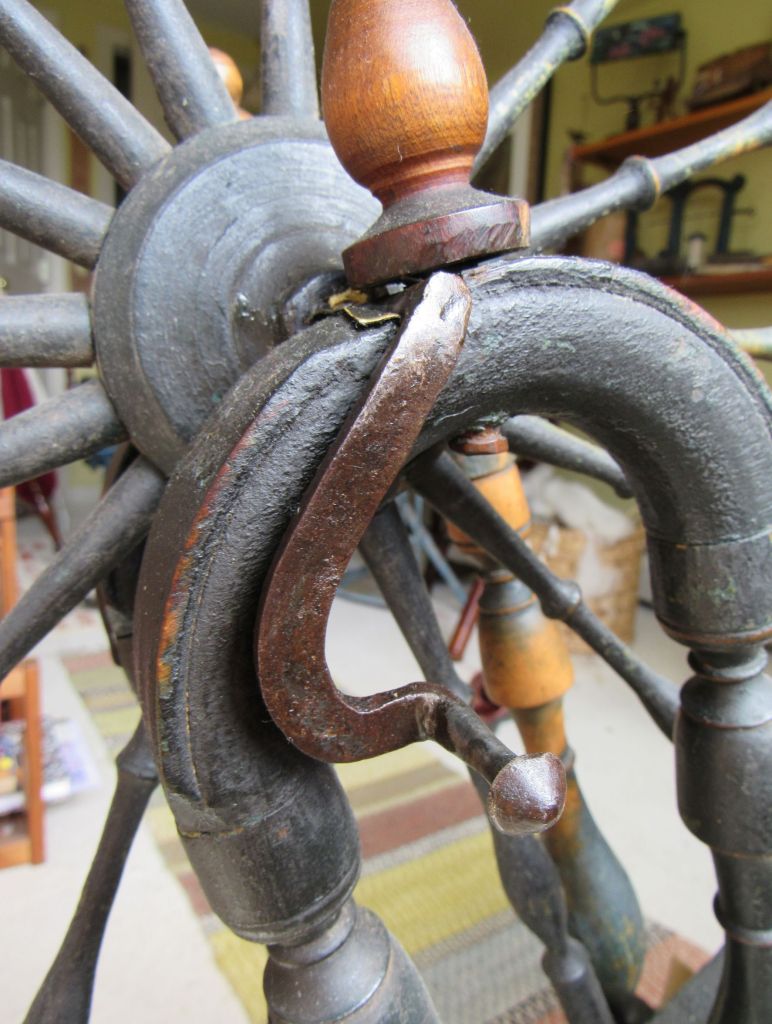
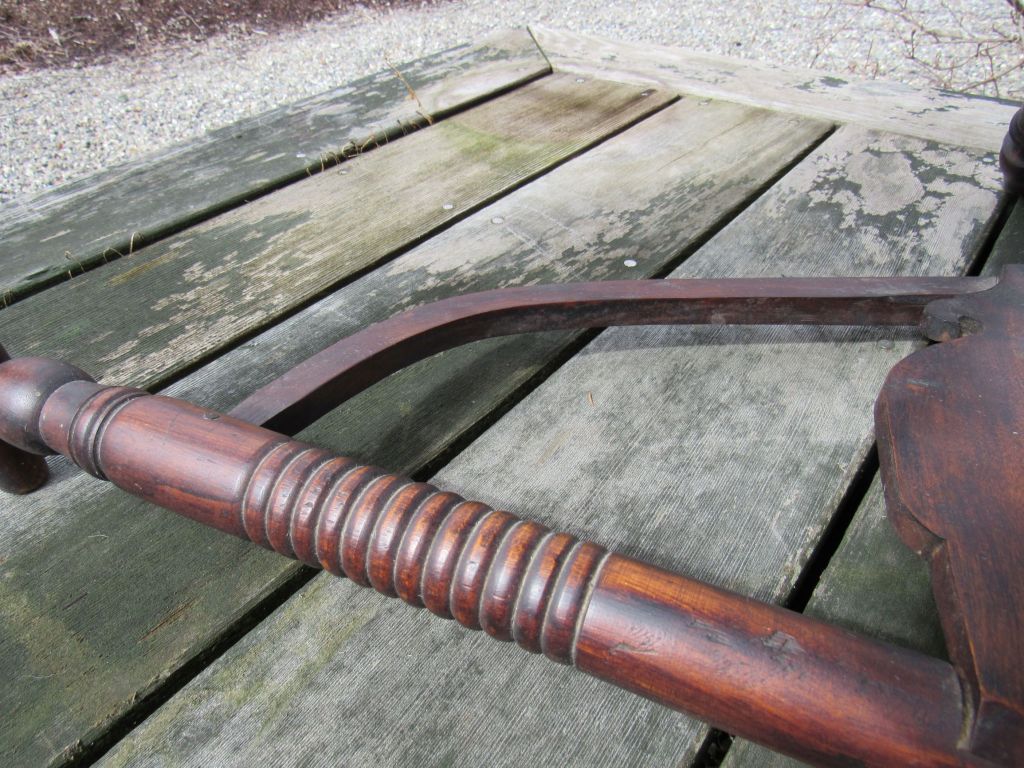
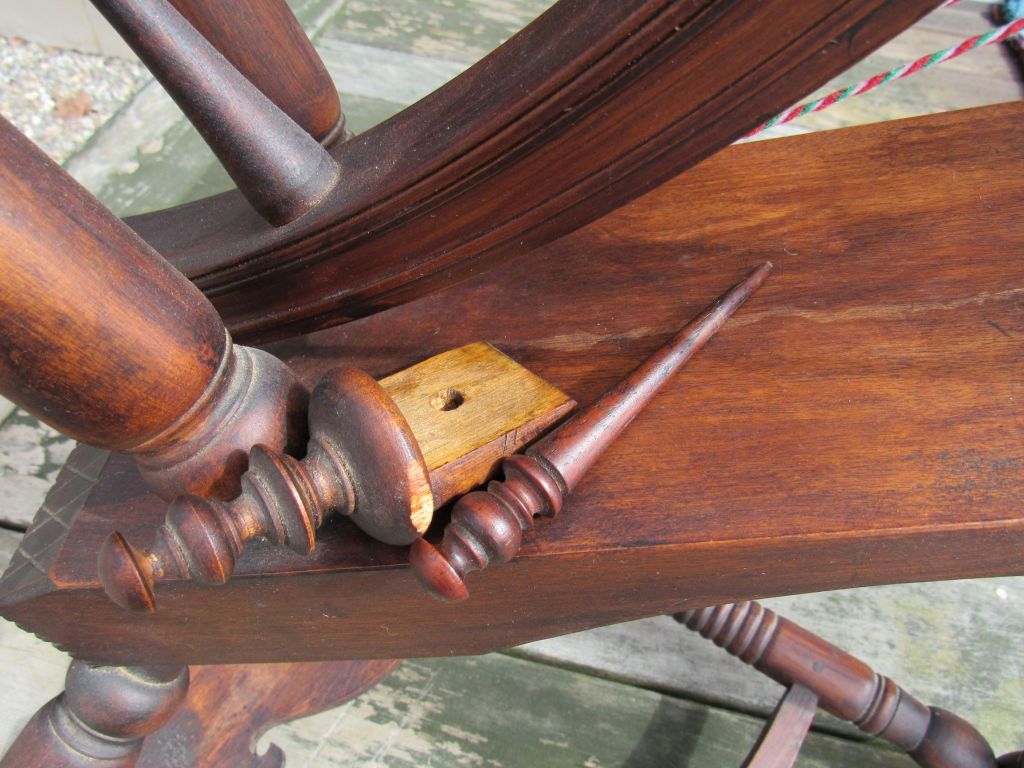
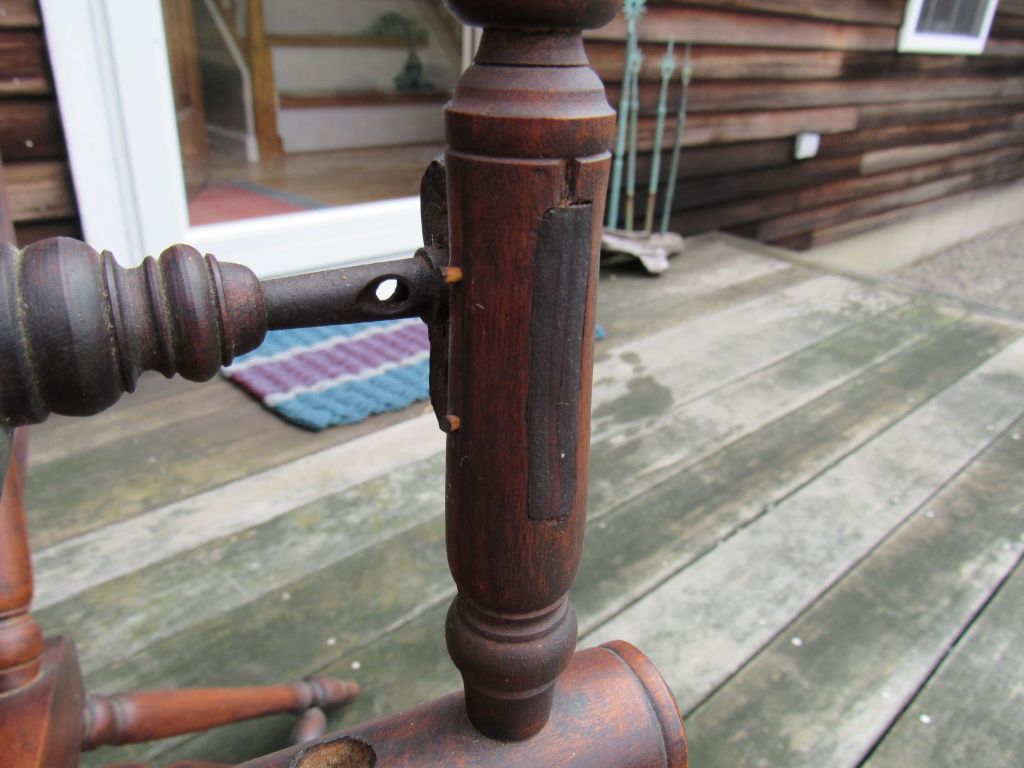
Hjordis’s maker solved that problem by crafting a special footman. A multi-sided wooden shaft is topped with what looks like a metal hood, partially surrounding the wood.
The hood is topped by a long metal piece that hooks over the internal crank and ends in a lovely curl.
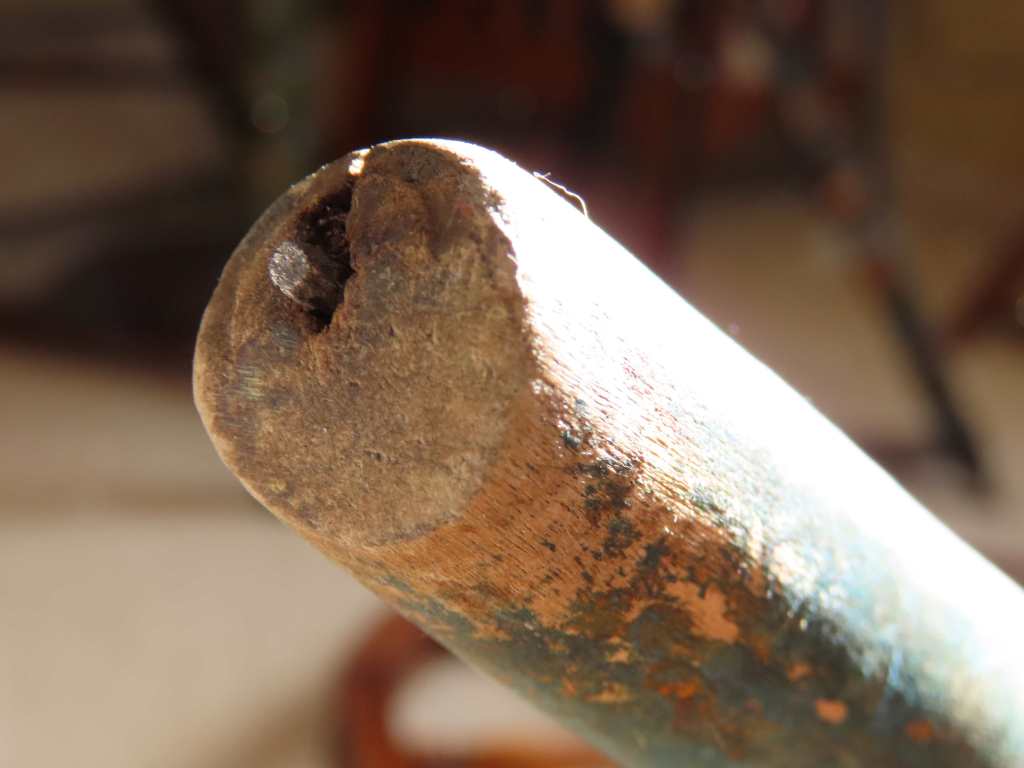
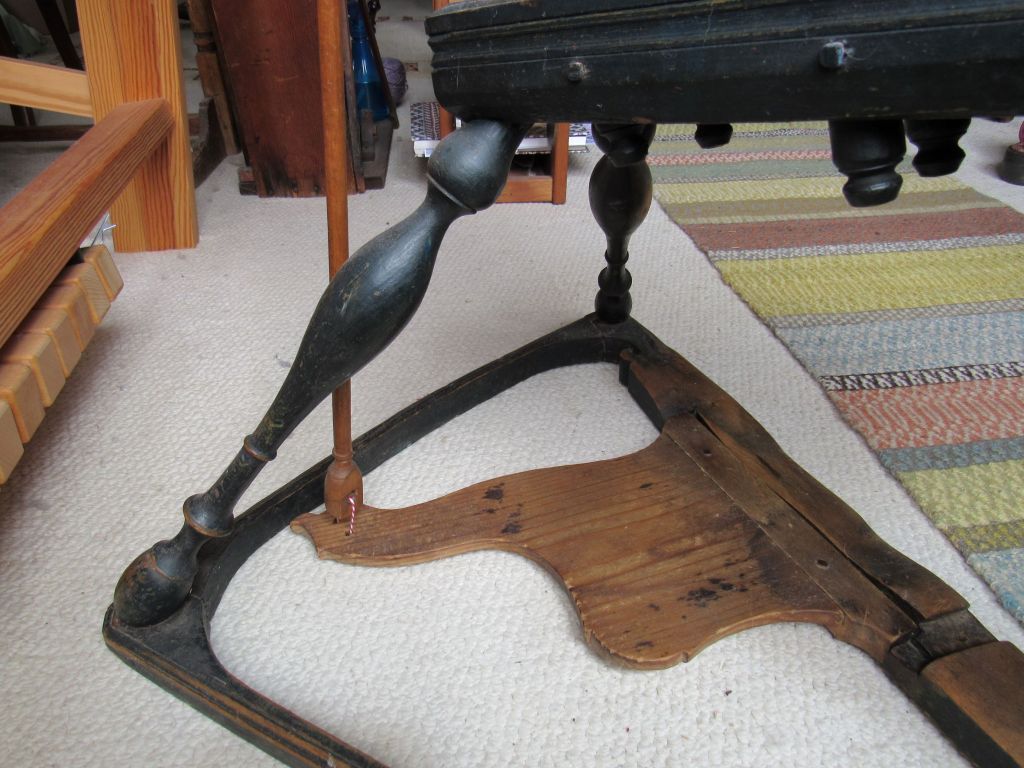
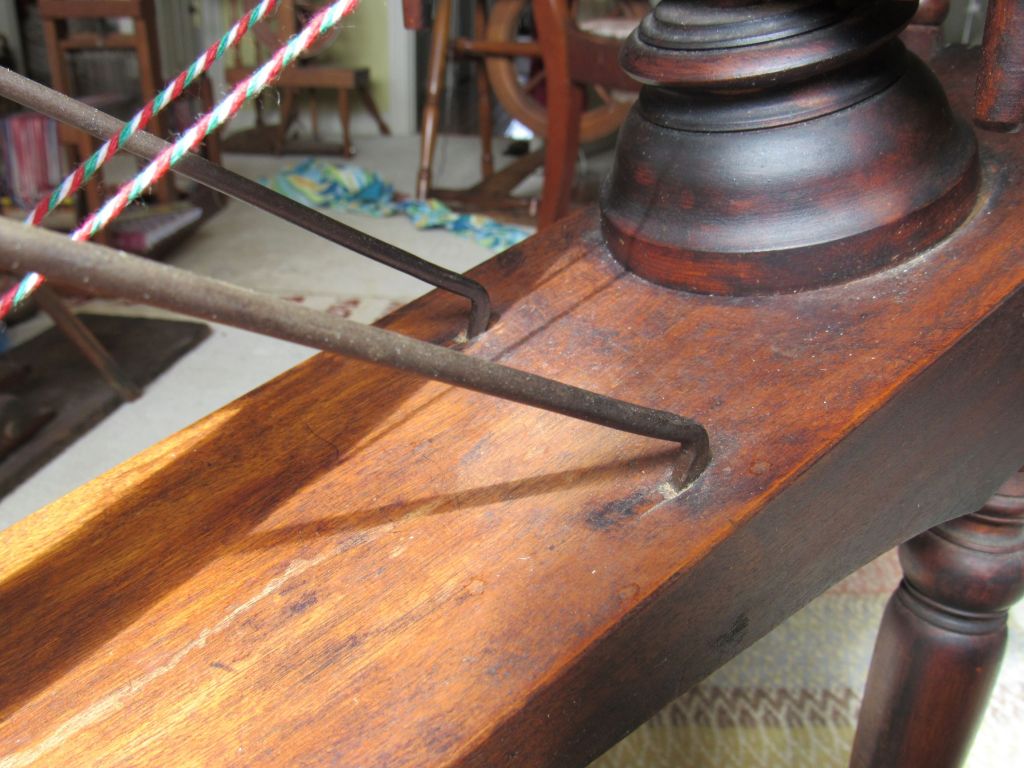
The bottom end of the footman also is encased in metal with a small metal hook attaching it to a metal piece on the treadle bar.
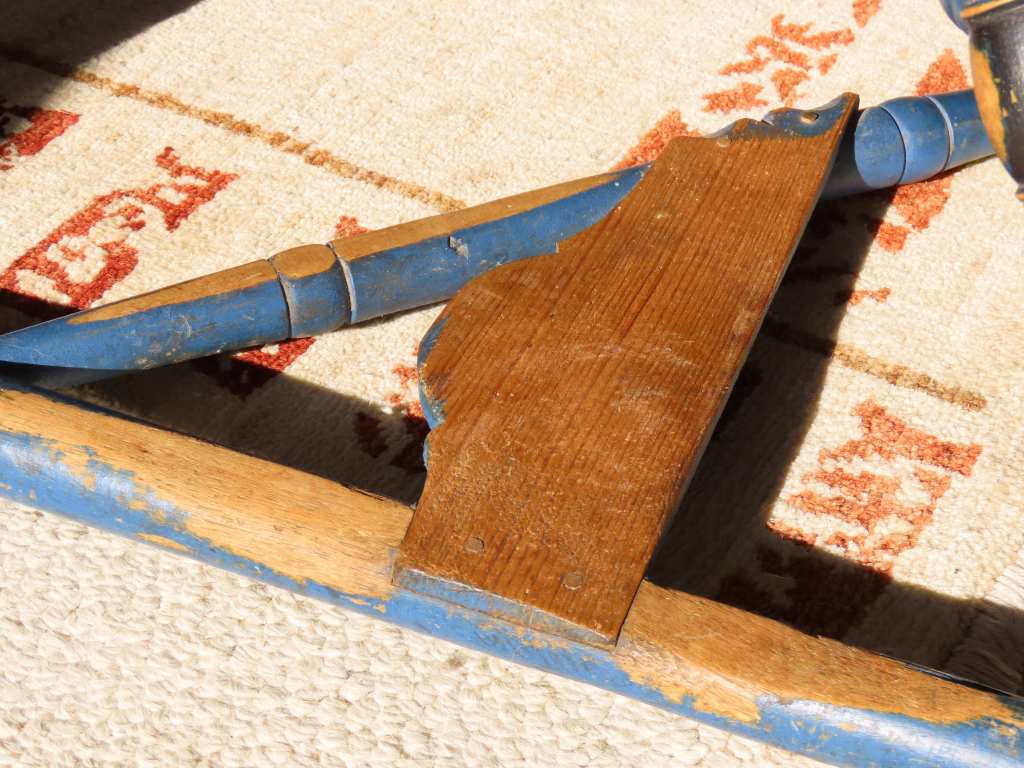
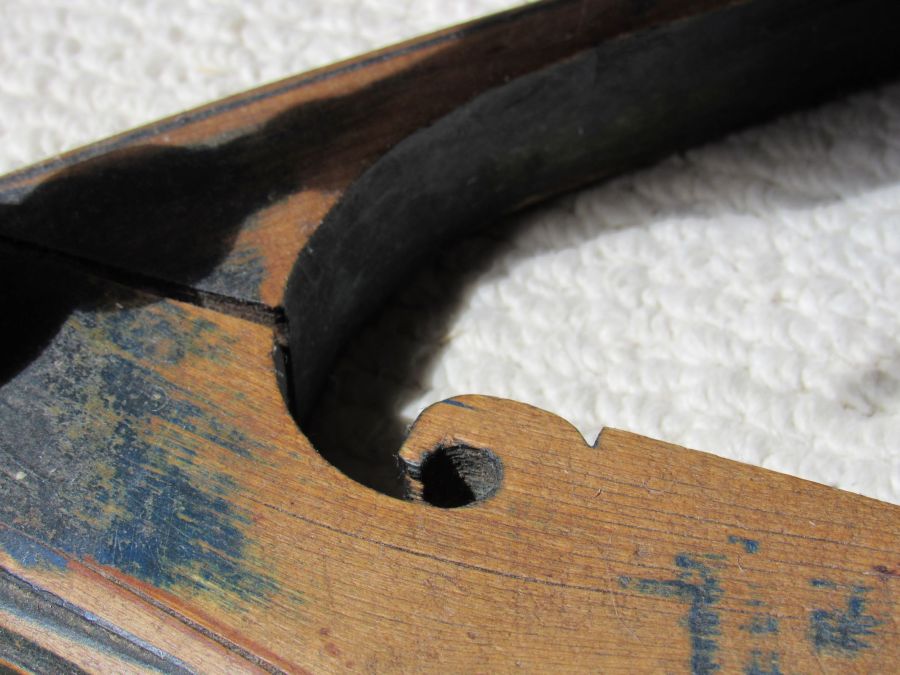
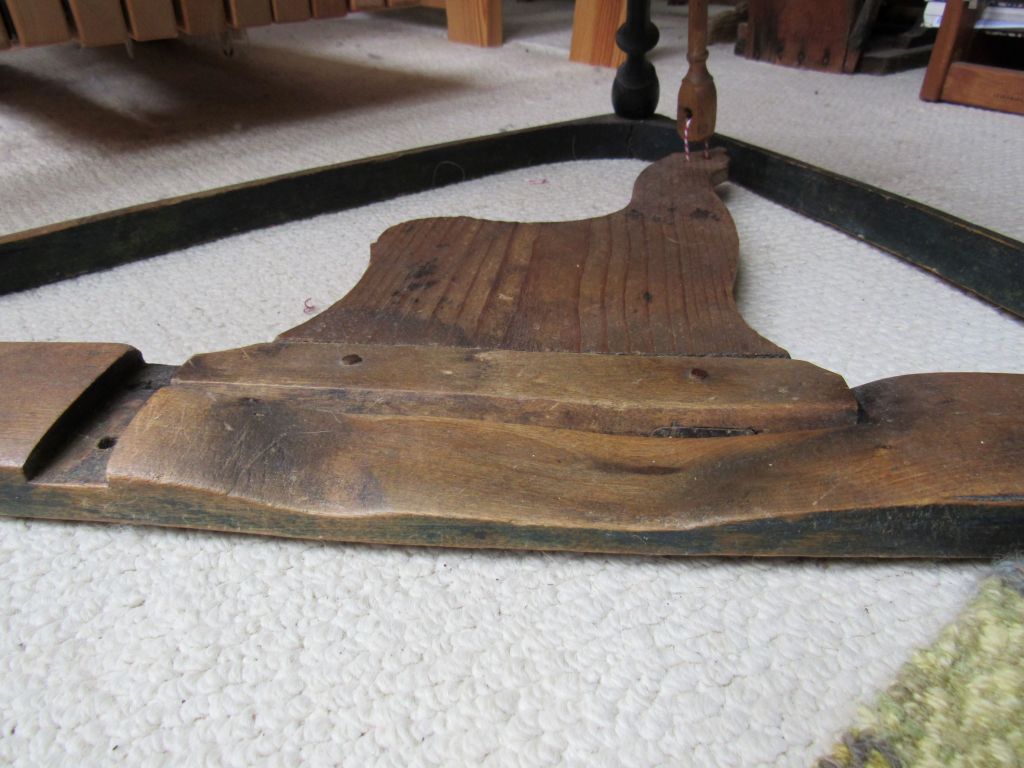
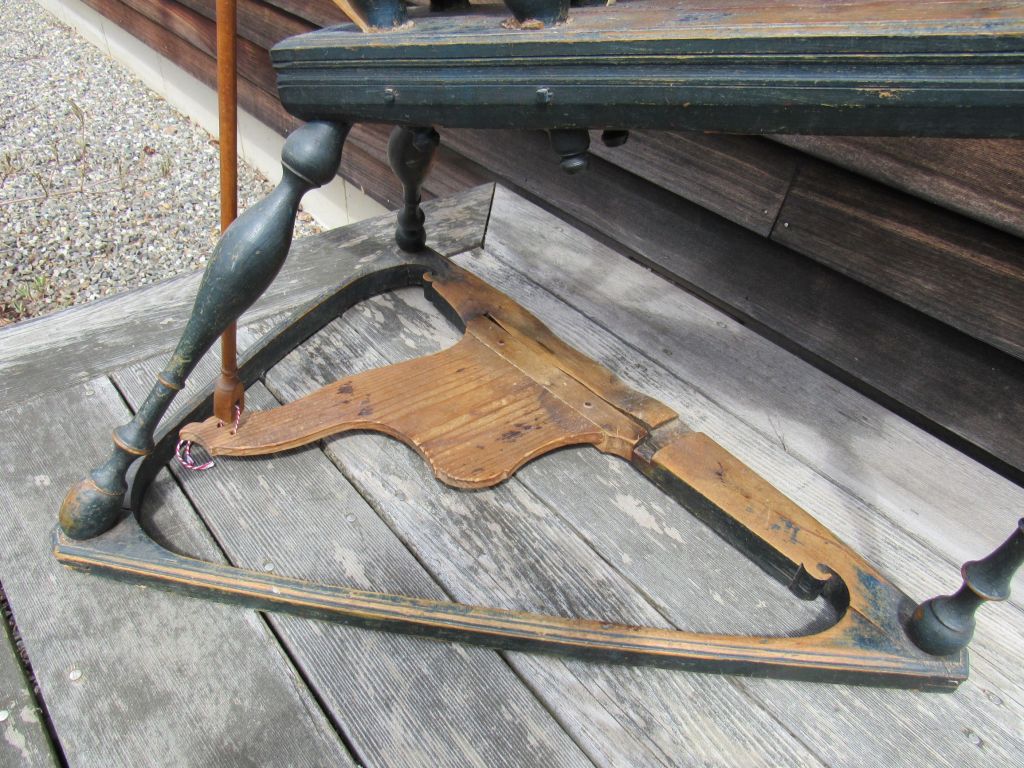
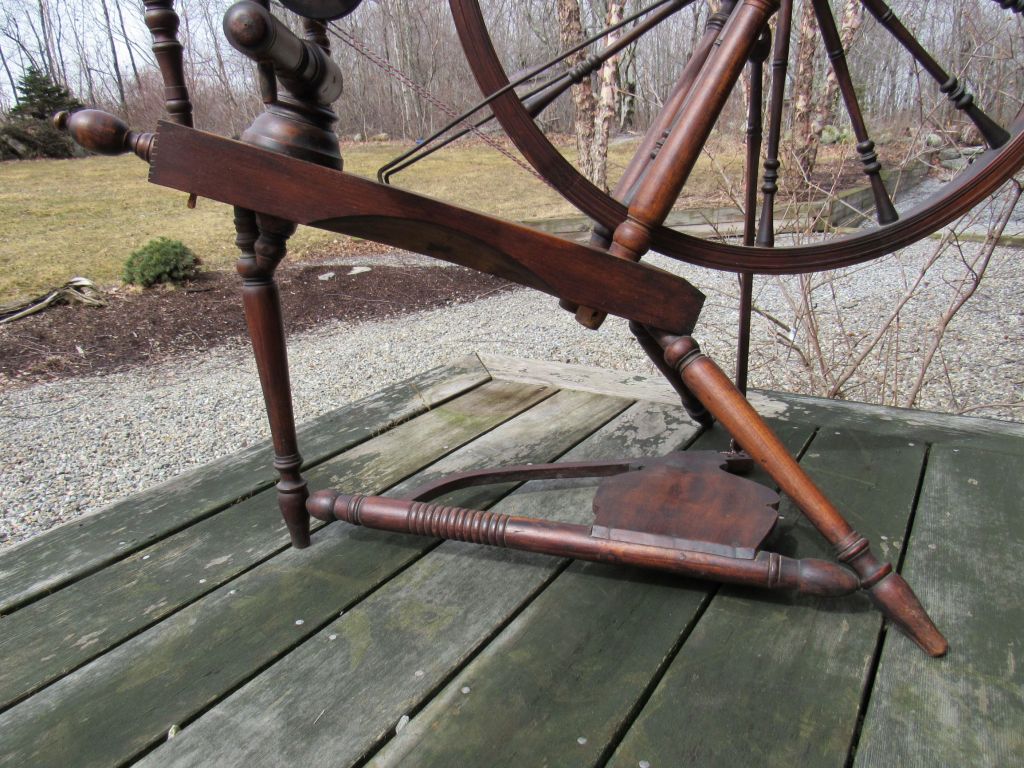
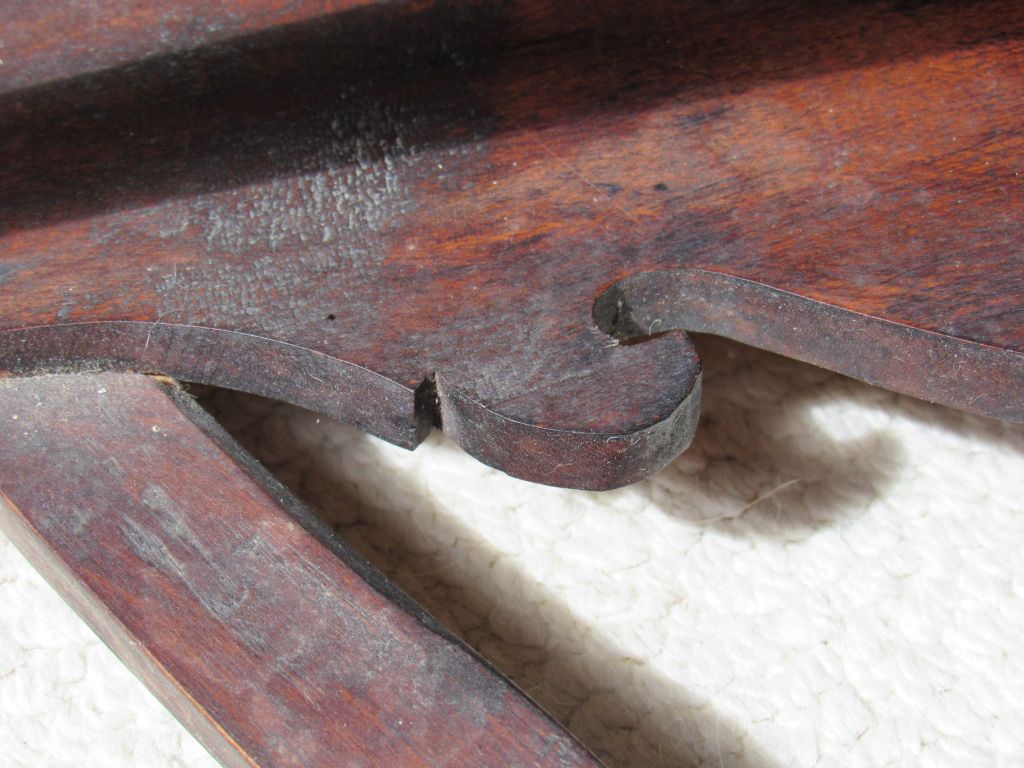
So much beautiful work went into this footman. Likewise, the treadle is no plain wood piece, but shaped with a decorative flourish at the end.
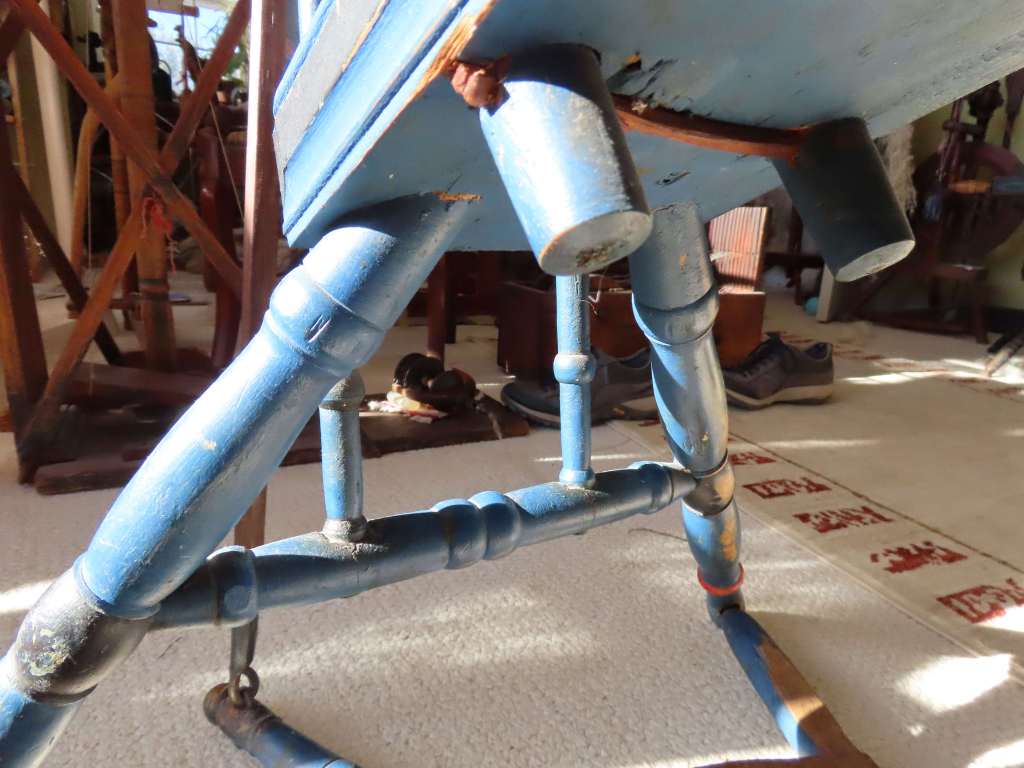
The wheel end has a cross-bar between the wheel-end legs with supports extending to the wheel uprights.
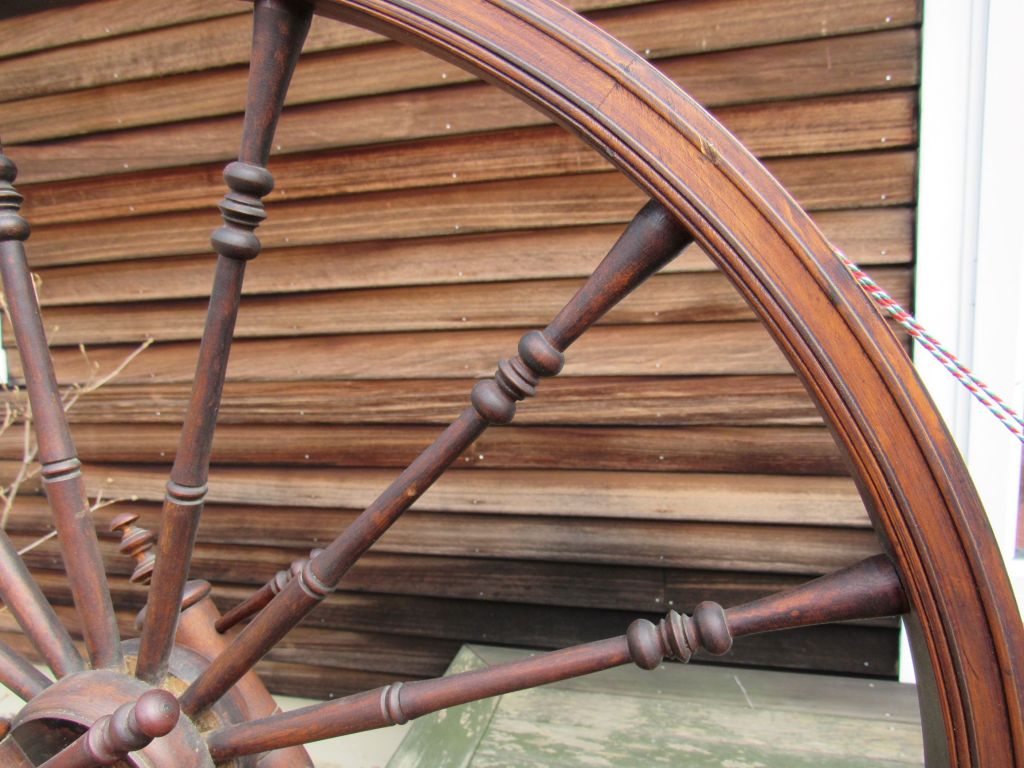
The drive wheel has 12 spokes,
set on the flat inner rim
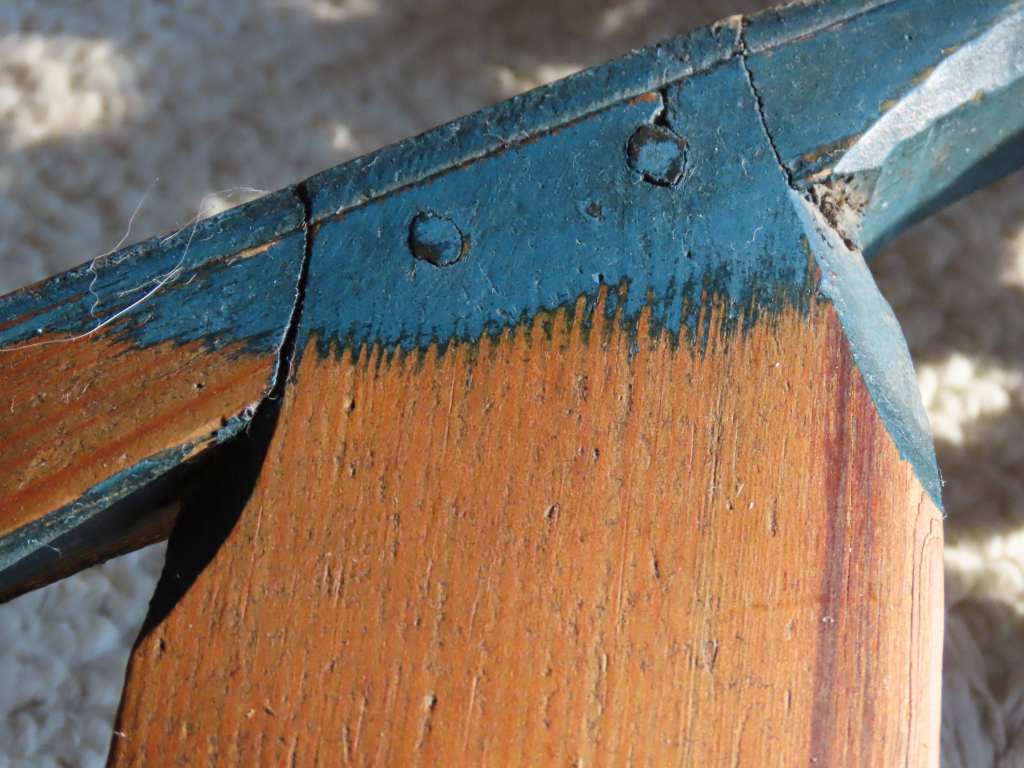
with a nail or peg securing them at an angle through the side of the rim.
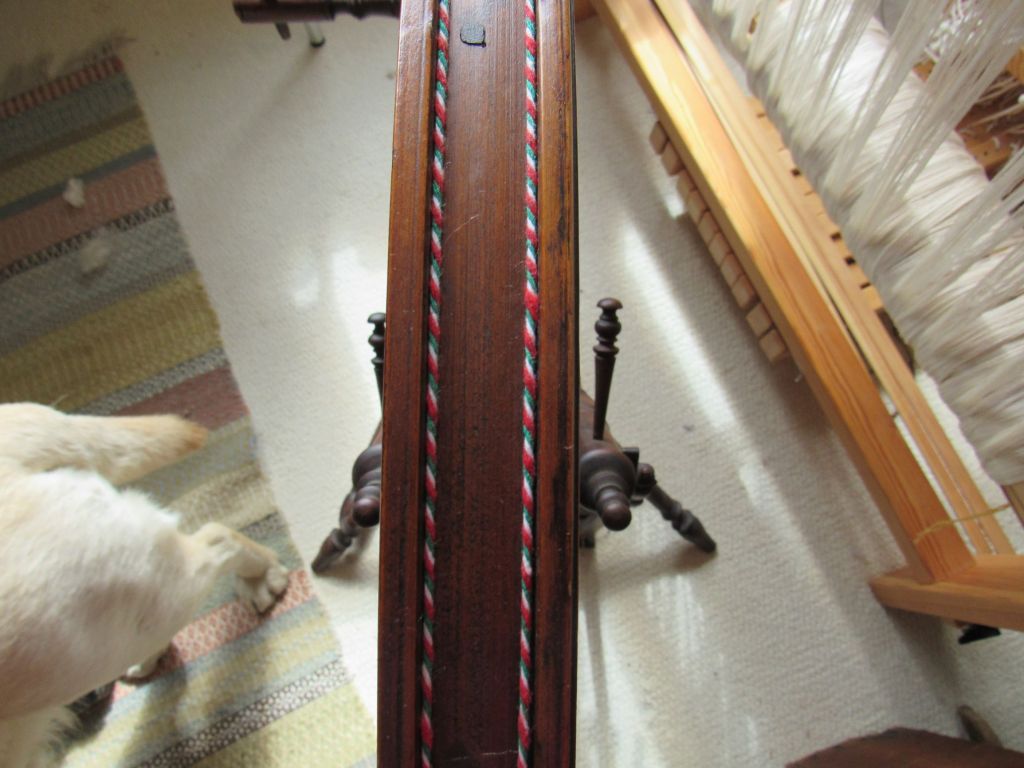
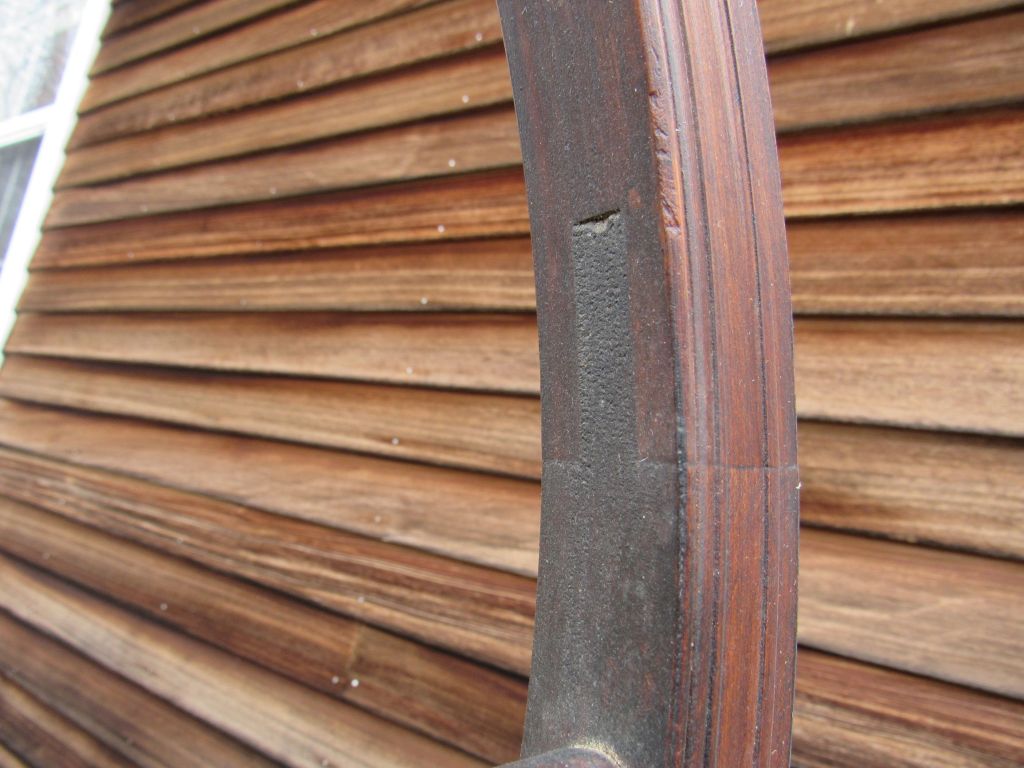
The rim itself is four sections. The sections are fitted together with tongues (long on the top, shorter inside) going in opposite directions on two sections, fitting into grooves on the other two sections.
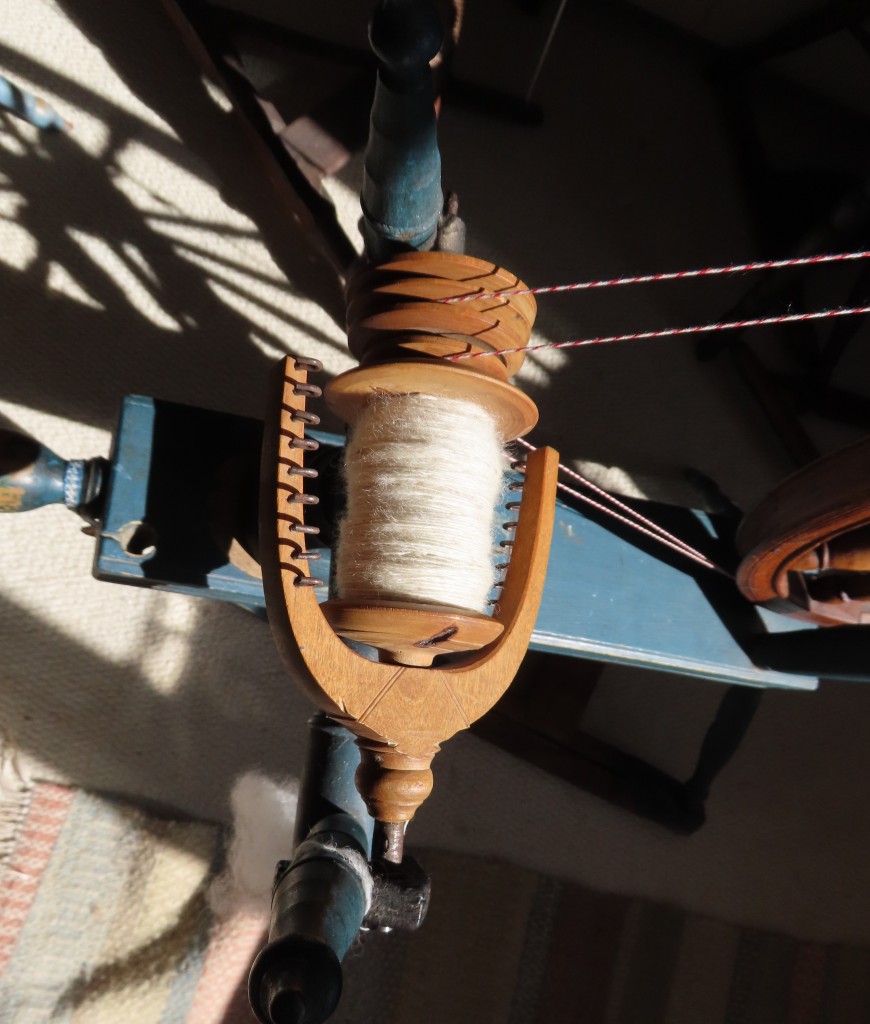
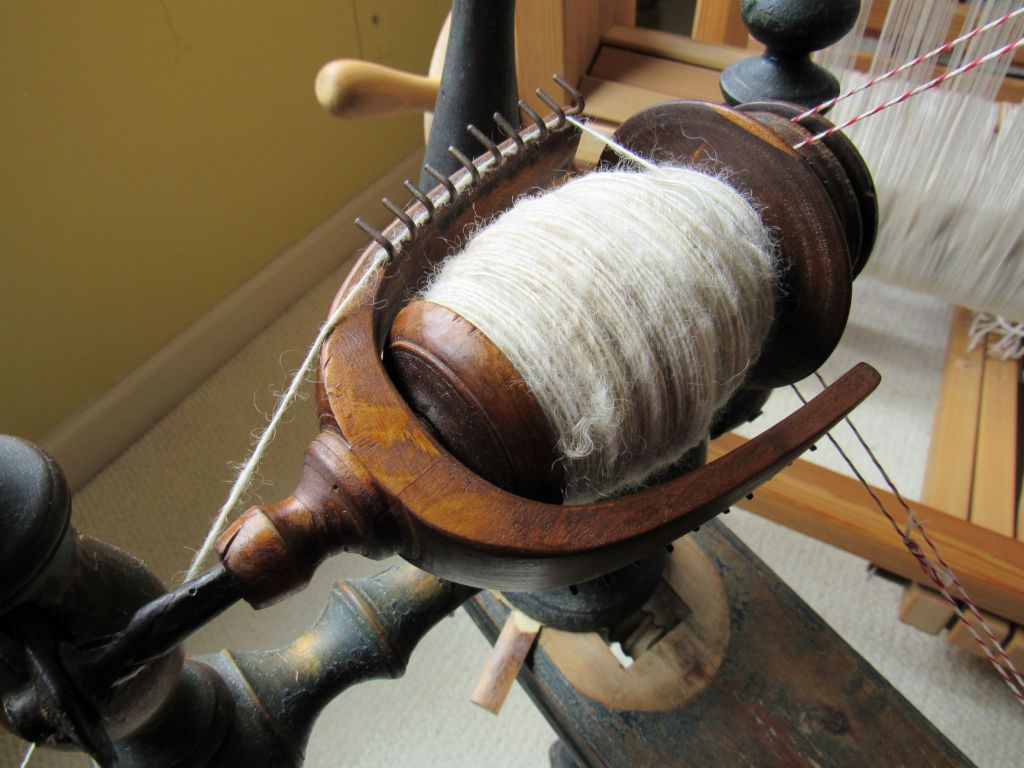
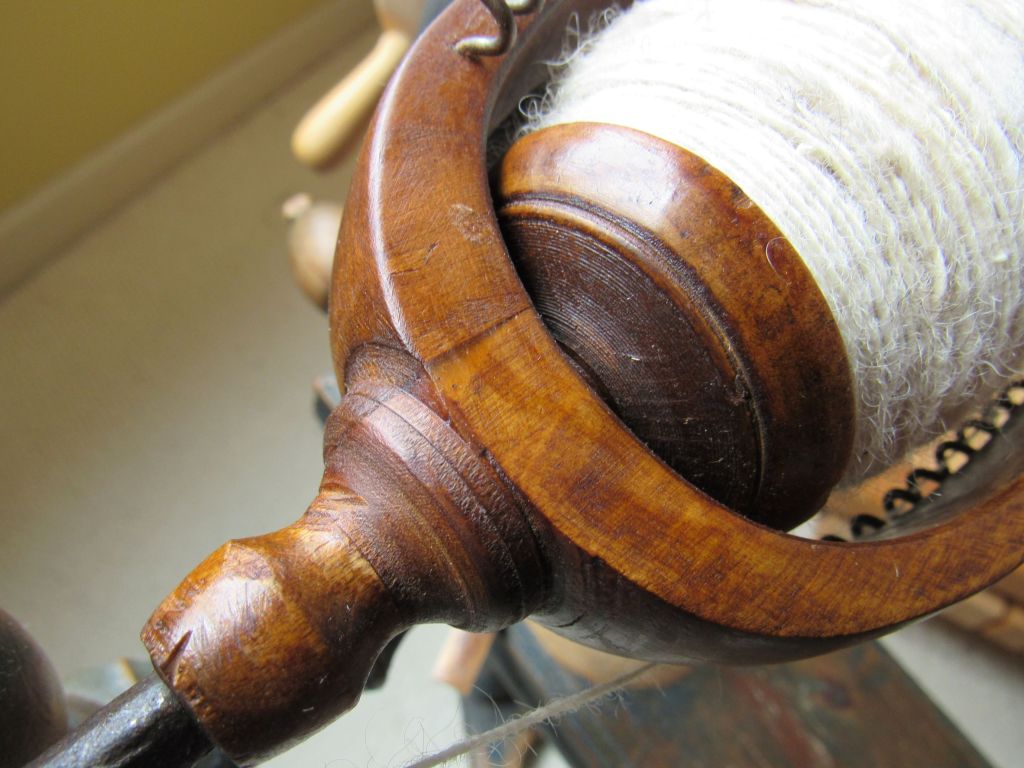
Hjordis has seen a lot of use but her flyer assembly is still going strong.
Her bobbin is cracked and there is a deep groove in the flyer front near the orifice.
Her whorl screws on righty-tighty, lefty-loosey, the opposite of most North American wheels, but found on many Norwegian wheels.
Her back leather bearing is a little droopy, but works well. The previous owner put an elastic band on it.
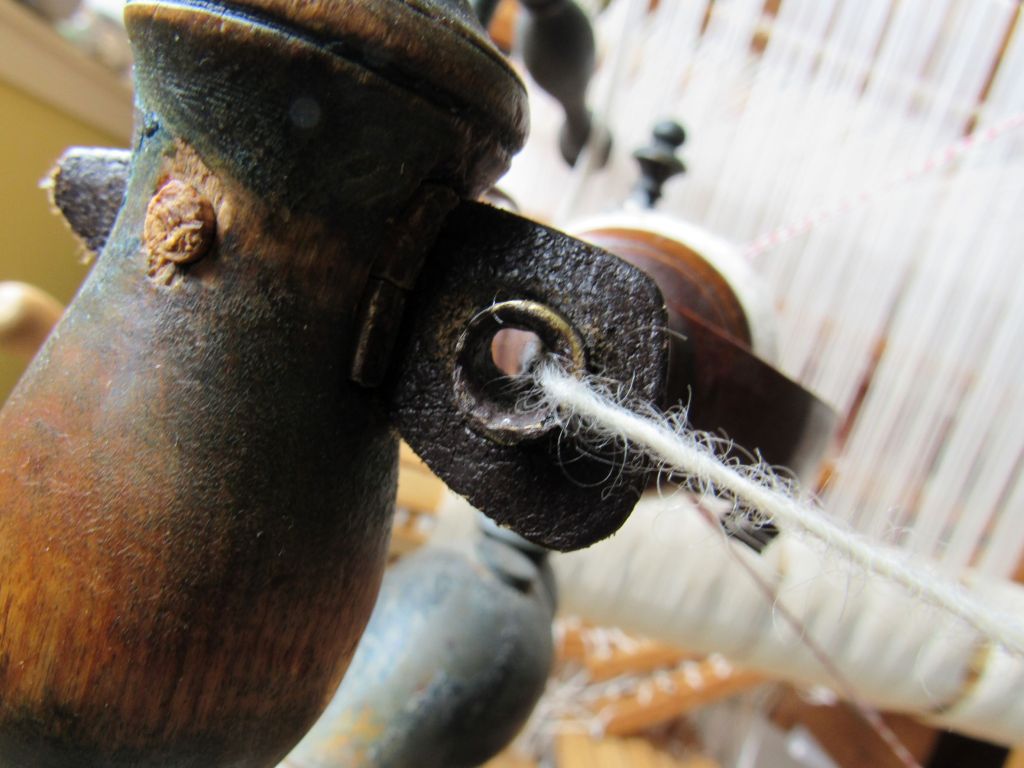
The orifice is quite smooth and the front bearing secured with some old yarn or twine.
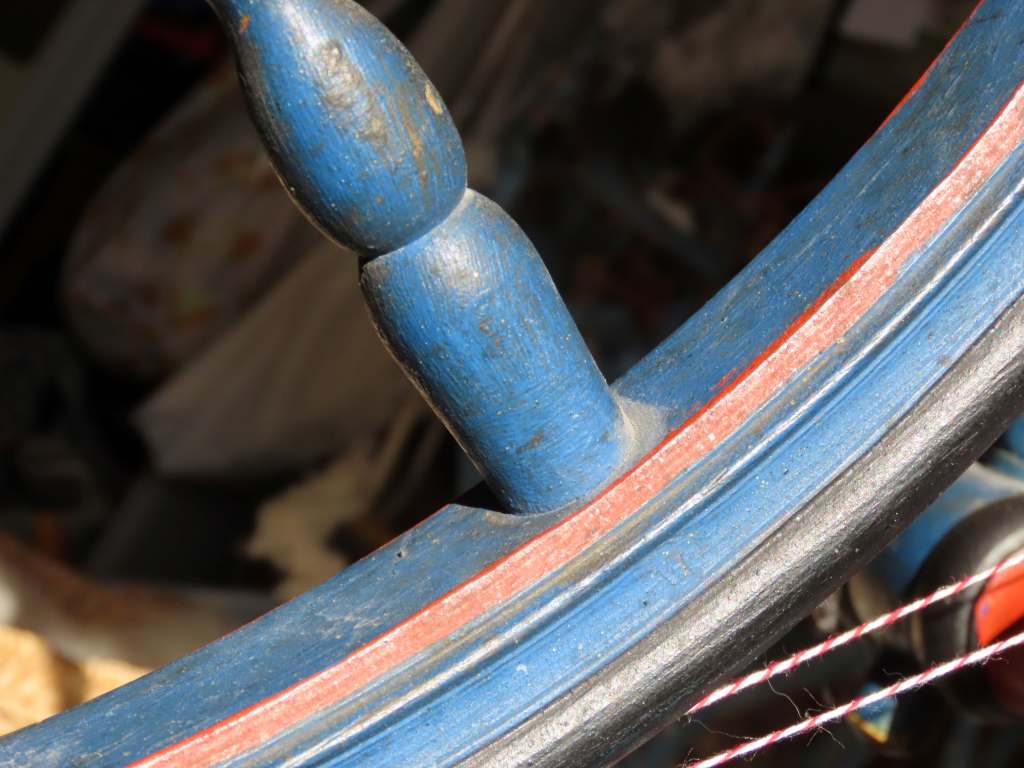
Her paint colors are vivid,
but, in some areas, applied a little sloppily,
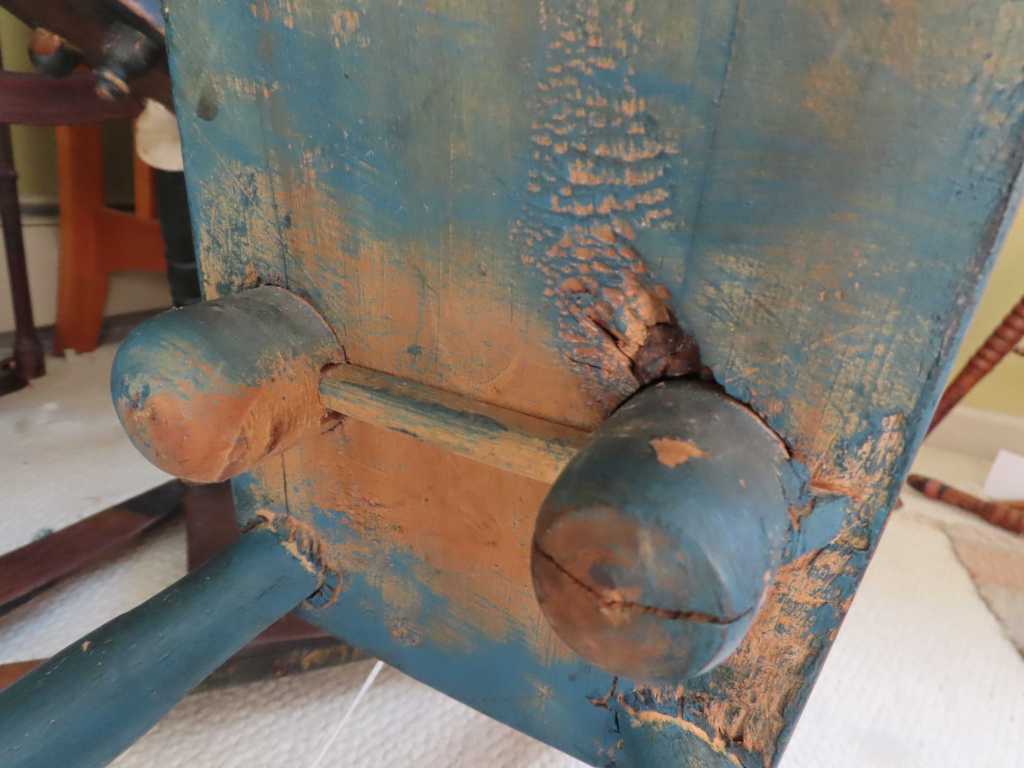
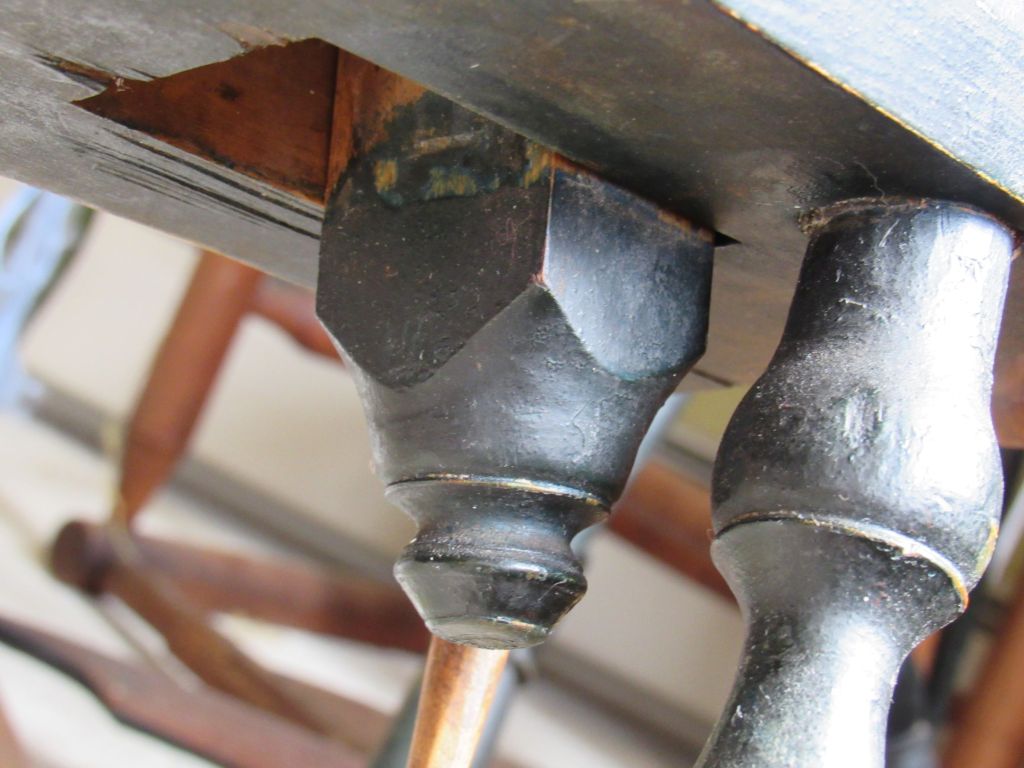
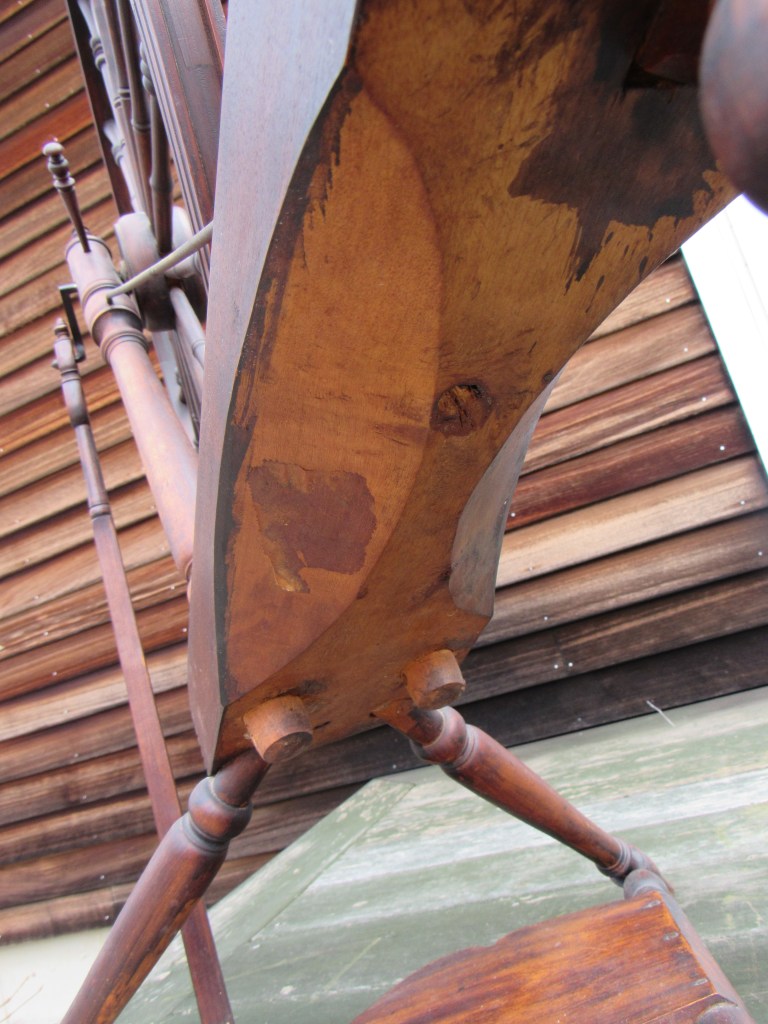
which is interesting, since the underside of the table is painted, something many makers do not bother with.
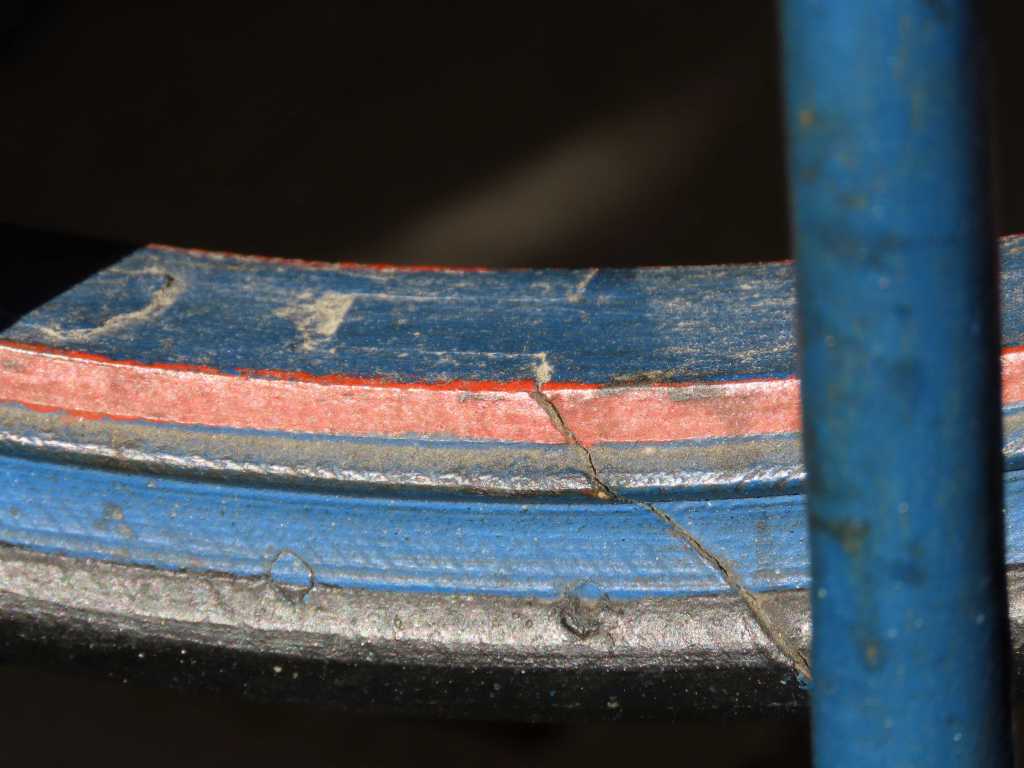
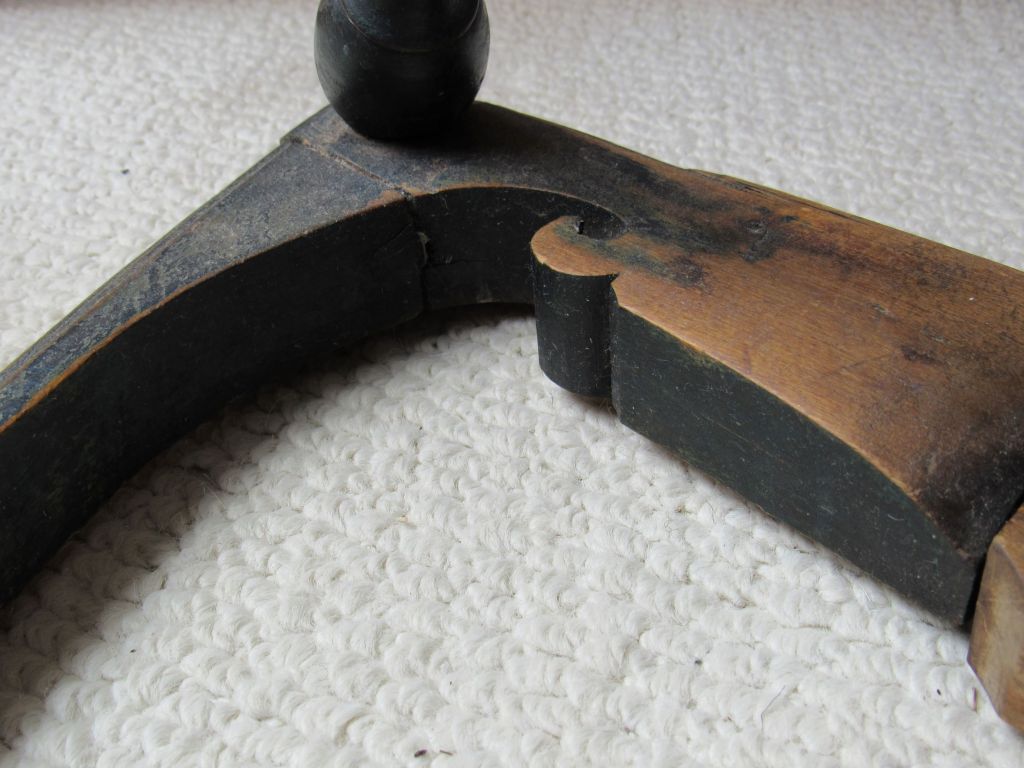
There is a crack in the table that I need to repair and a distaff hole on the spinner side.
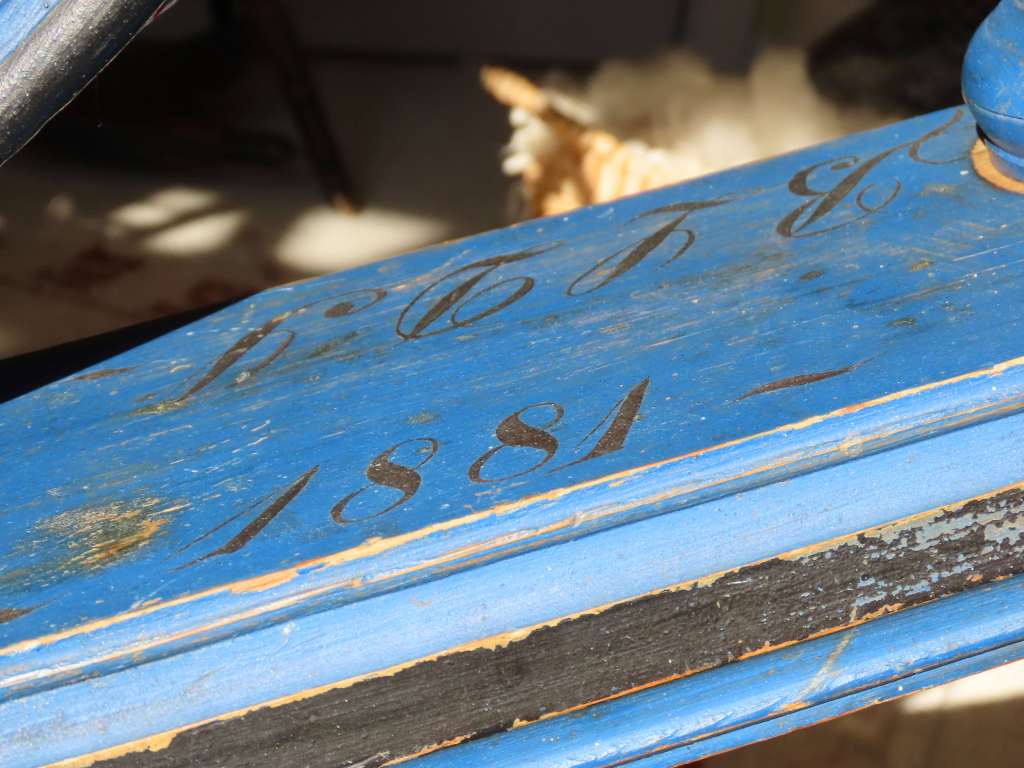
The table bears a date and initials in elegant script.
Aside from the date, I have not been able to find out much about the wheel’s origins. I believe that she is Norwegian for a few reasons. The internal crank and righty-tighty whorl point in that direction and there have been a few other wheels that have come up for sale with sellers indicating they are Norwegian. These wheels do not have an internal crank, but do have the unusual lyre-shaped nuts and metal upright-tops.
For sale in IowaFor sale in Minnesota, no internal crank but the treadle is very similar to Hjordis’s
Although these wheels likely were made by the same maker, only Hjordis has the internal crank and creative footman, which kicks her up a notch. I am very grateful that she was not passed by in the hunt.
While in Dalarna, Sweden last summer, one particular wheel style kept appearing at various places I visited. I first noticed this style in the collection at Sätergläntan, the craft school I was attending for a daldräll weaving course. I was especially interested in the collection’s two turned-table, metal-clad wheels described in my last post, “Torvi.”
The turned-table wheels at Sätergläntan
Even as I was marveling over those wheels, however, another caught my eye. It was the maidens I noticed first—they were so much like those on the turned-table wheels.
The similar wheel in the collection
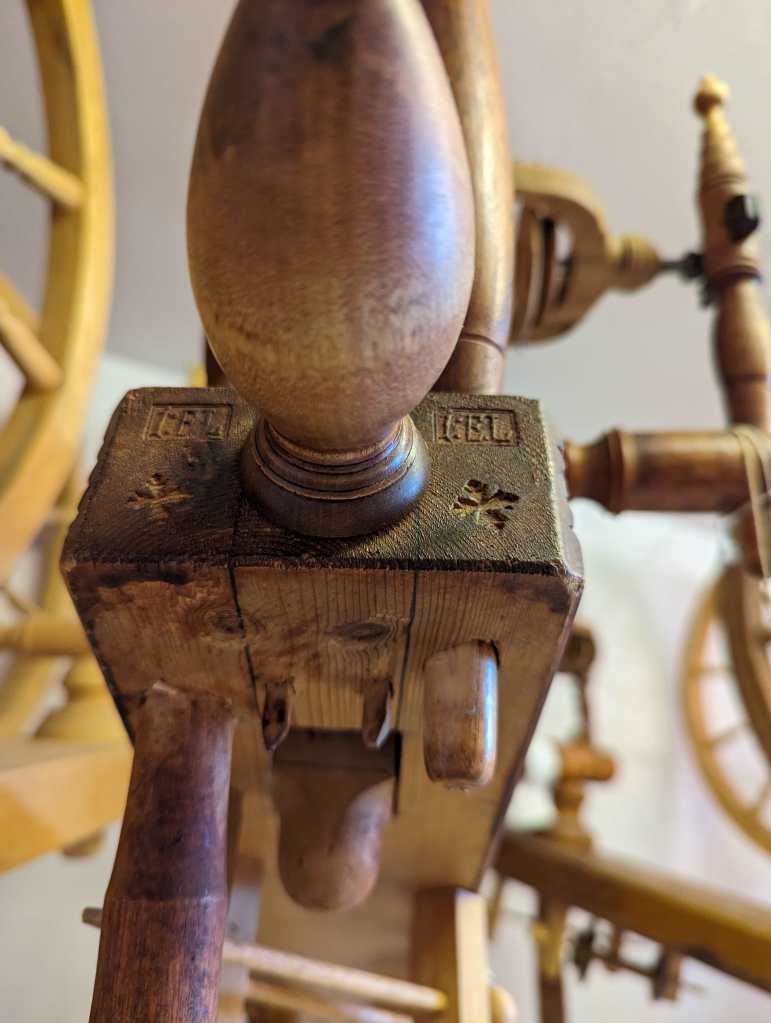
And not just the maidens–the unusual treadle set up, the legs and feet, the axle caps, the table-side grooves, and the spokes and drive wheel– all were remarkably similar to the turned-table wheels. The maker’s mark was different, though—an I (or J): E.L, with some star/sunburst stamps.
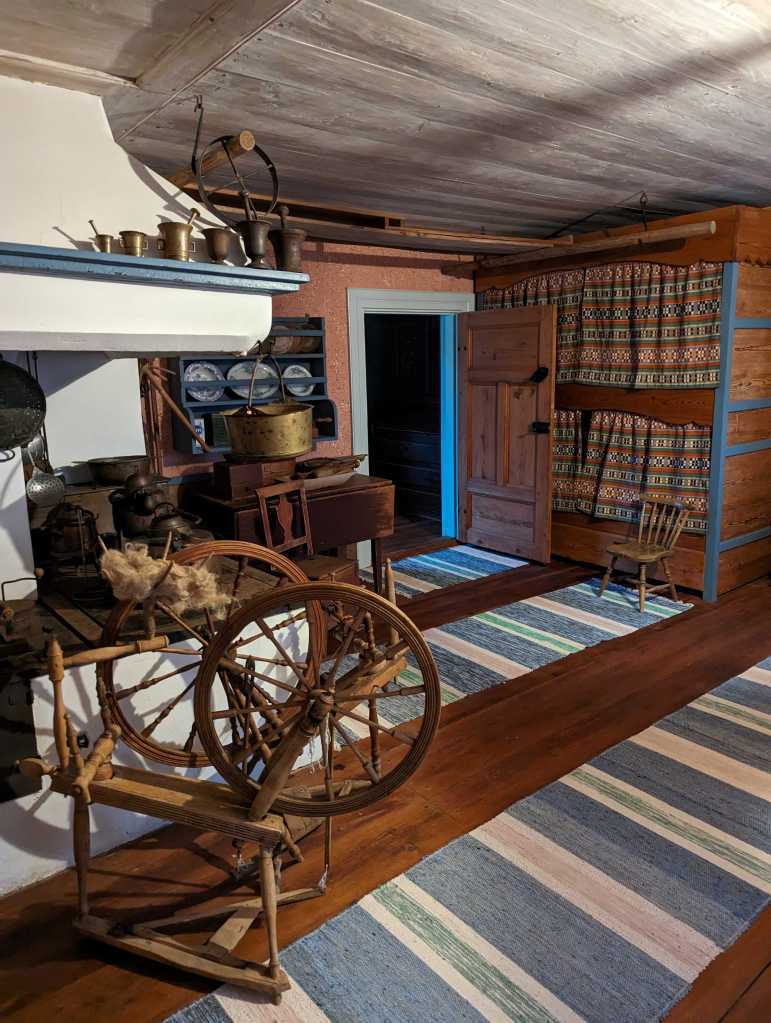
Later that week, we took a trip to the home of Anna Thomasson, a weaver who co-wrote a book on daldräll weaving. While there, we were treated to a tour of the home of the mother of Swedish poet Erik Axel Karlfeldt, which is next to Anna’s studio in southern Dalarna. As soon as we entered the house, there it was—another wheel of this style.
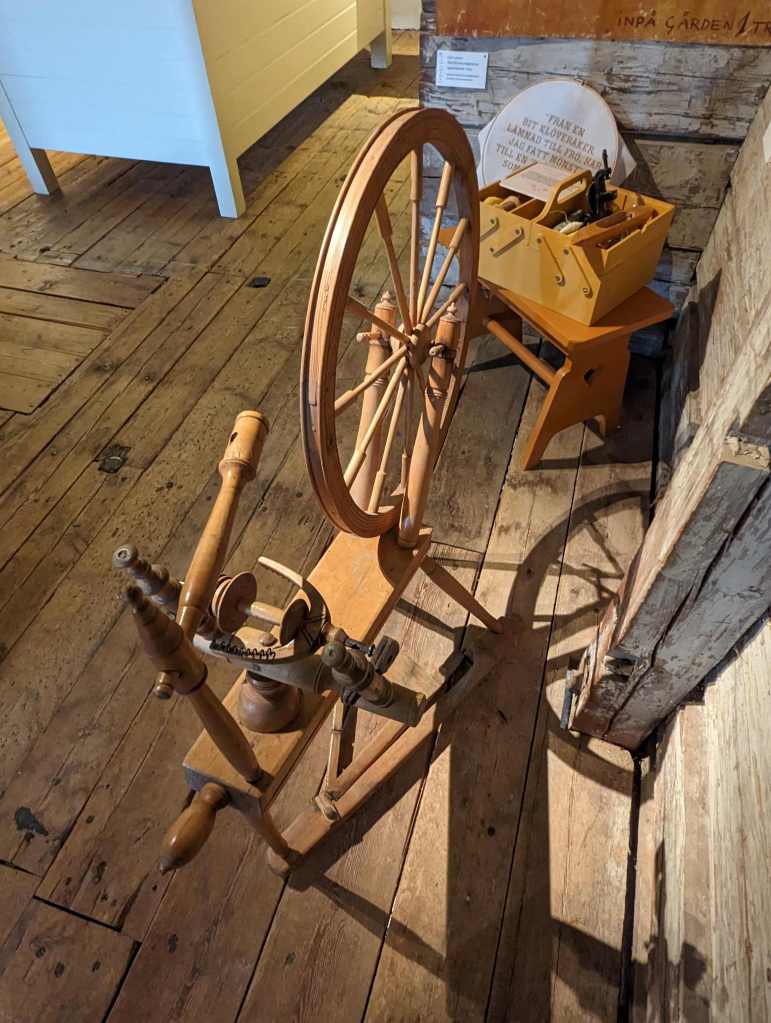
Seeing it there made me realize that I had seen others a few days earlier, when visiting the museum home of artists Carl and Karin Larsson in Sundborn, near Falun (post on this visit is here: Sweden, Part 1). While we were not allowed to take photos in the Larsson house, I was sure that one of the wheels there was this style (I have since confirmed it through photos in books). And there was a second one at the nearby exhibit on Karin Larsson and her textiles, which I was able to photograph.
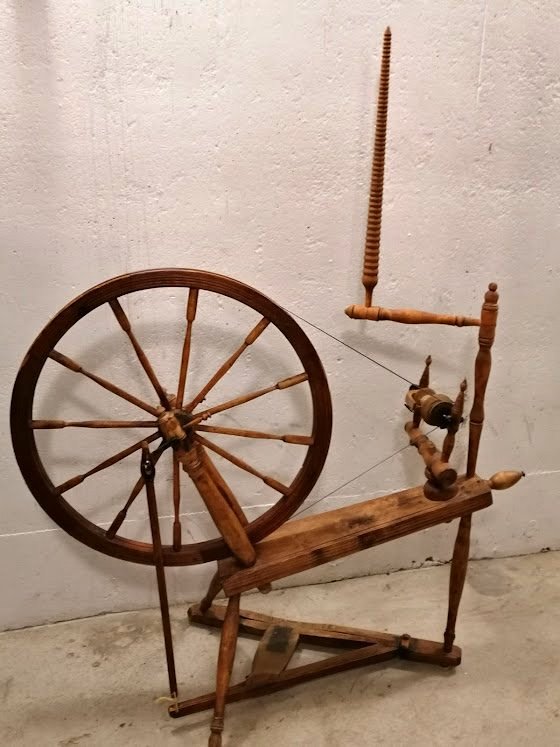
When I returned home, I found that these wheels pop up regularly on Facebook Marketplace in Dalarna. This one said that it was owned by a great-grandmother born in 1893 and from somewhere near Falun.
The Dalarna Museum in Falun also has one, recorded as being from the Husby/Hedemora area, which is in Dalarna, southeast of Falun. (Dalarna museum wheel link). Skansen, Stockholm’s wonderful open-air museum, has another, with the maker’s initials “CWB,” but no information as to where it came from. (Skansen wheel link). With so many of these wheels in the Dalarna area, I was puzzled that there did not seem to be any definitive information on where they were made.
Ulla and Torvi side-by-side–surely they are related
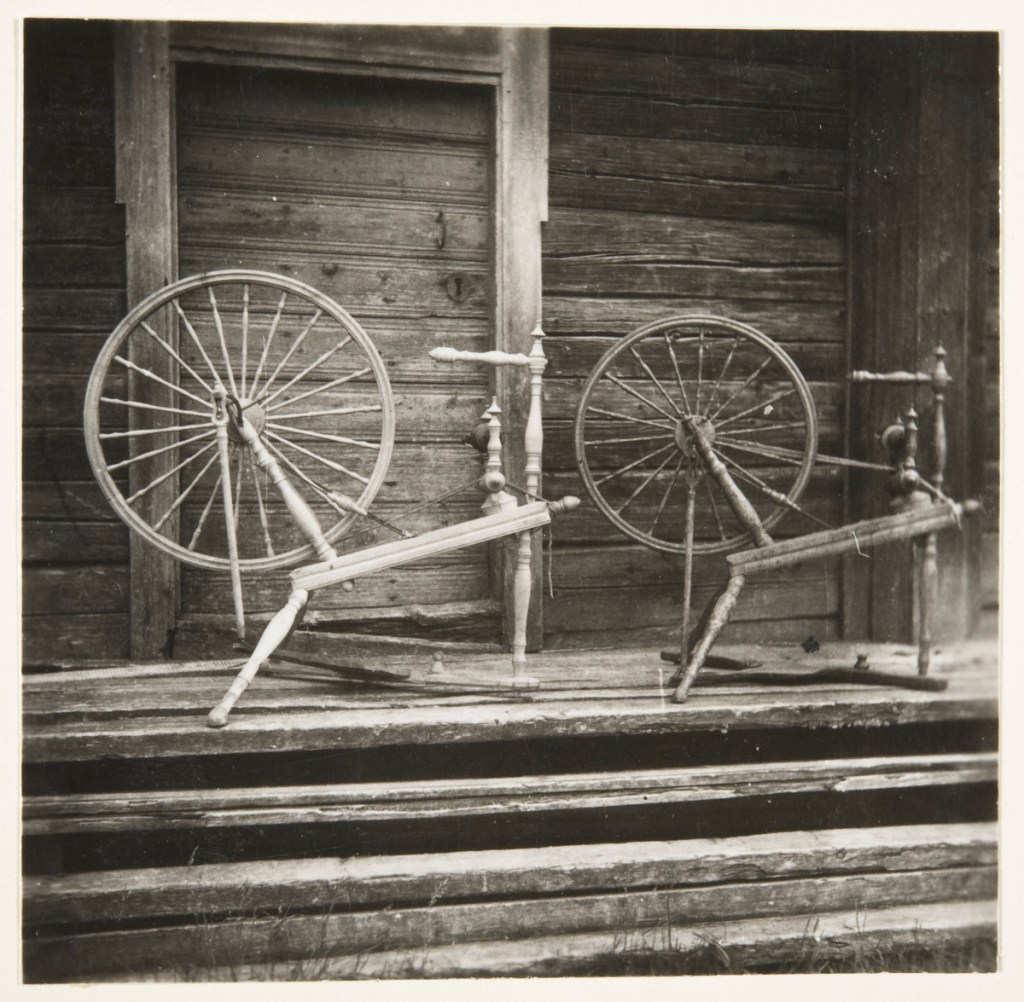
From the 18th to 20th centuries, Scandinavia had well-known centers of wheel-making, usually in an area with good water power, where multiple wheel-makers, sometimes as many as fifty or more (often related), produced wheels for generations. The distinctive Finnish Kiikkalainen wheels and Norwegian Gylland wheels are good examples. Sweden had several wheel-making centers, including Solberga, Hyssna, and Hjulbäck. Each area’s wheels were immediately recognizable for their particular style and features, but with small variations by the different makers.
Many of these regionally-styled wheels were marketed outside of the areas in which they were made and, perhaps for that reason, many were marked by the wheelmakers. So, while the wheel’s style and features advertised the area in which it was made, it was the initials that advertised the individual maker.
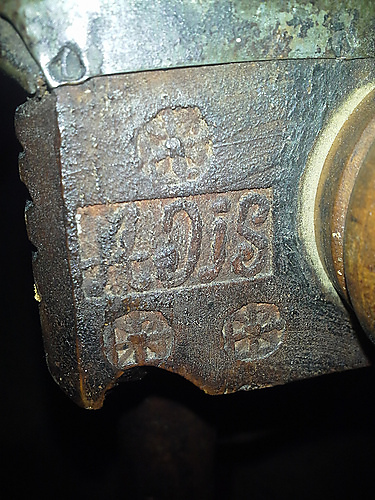
One of the maker’s marks for the turned table wheels–“AGIS” or “AGJS“
It seems likely that these Dalarna wheels were made in this same pattern, with multiple wheel-makers in an area making similar wheels. But what area? I am sure there are people Sweden who would be able to immediately identify where these were made, but I have not found them yet. Perhaps I will get lucky and one will read this post. I hope so. In the meantime, a clue has emerged. I found a wheel in same style as Ulla in an old Facebook post. It apparently has some metal on the rim, the initials “GI (or J) S,” several star/sunburst stamps and “Stigsbo” stamped on the table end. Stigsbo is a town on the eastern edge of Dalarna, close to Stjärnsund. In commenting on the wheel, Kirsi Manni, who lives in Dalarna, indicated that wheels made in Stärnsund Parish often have the star stamps on them since “stjärna” means “star” in Swedish. Could the Stigsbo wheel, with similar initials to the turned-table wheels be made by the same maker?
Another maker’s mark on a turned table wheel–probably “AGIS”
But why has only one wheel been found with a place name on it? From what I understand, Stigsbo today is tiny–were there multiple wheelmakers in the area, but spread out, perhaps in the triangle between Stigsbo, Falun, and Hedemora? My research has been hindered by my poor Swedish language skills. Nevertheless, I have not been able to find anything discussing this area as a hotbed of wheel-making. Unfortunately, I have not been able to make contact with owner of the Stigsbo wheel to get permission to post photos. But the initials bear a resemblance to the first example above.
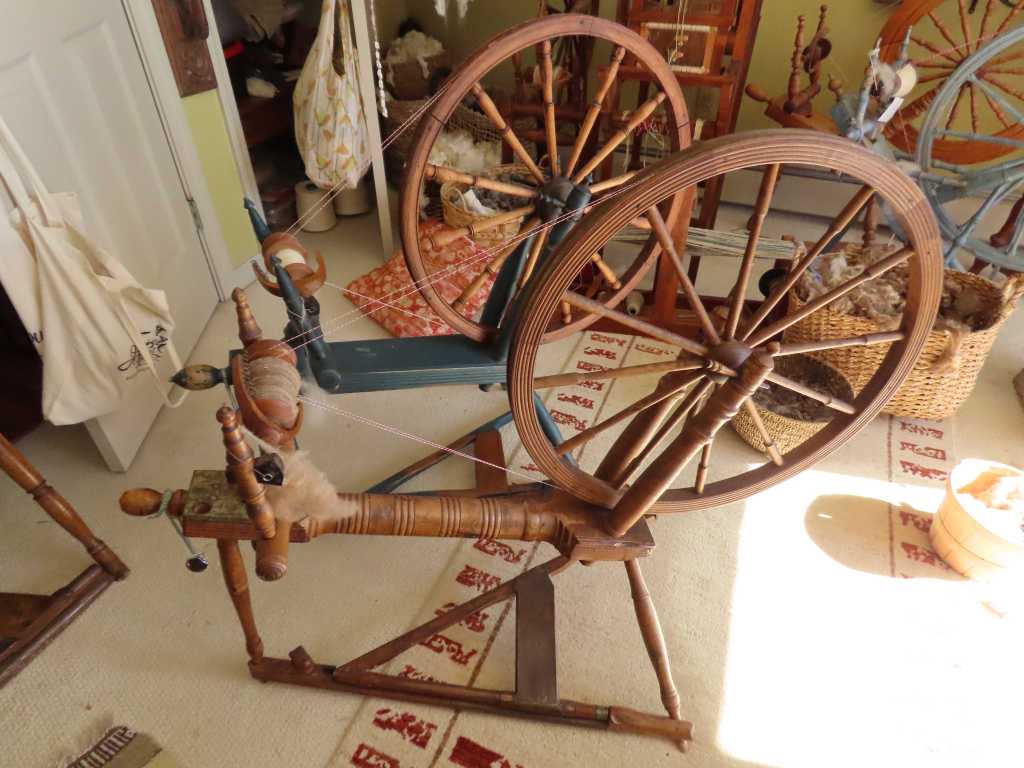
So, the mystery lingers as to where these wheels were made. Oddly enough, while researching them, one came up for sale in Massachusetts. It is highly unusual to find any Swedish wheels for sale in New England, so I jumped on it.
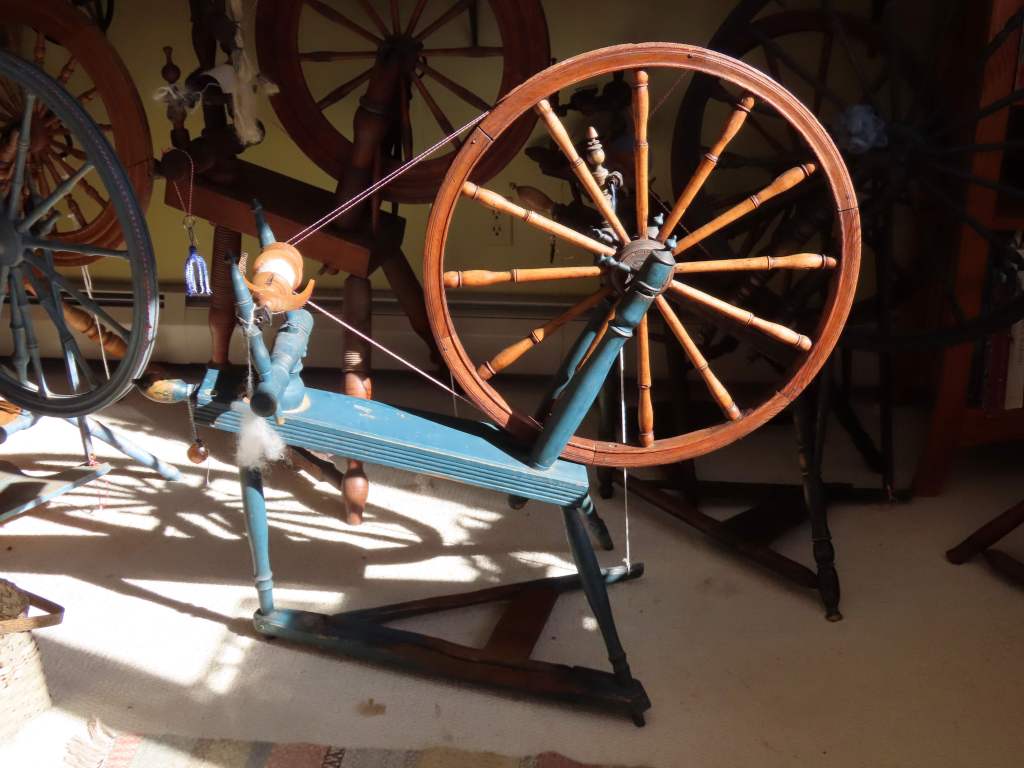
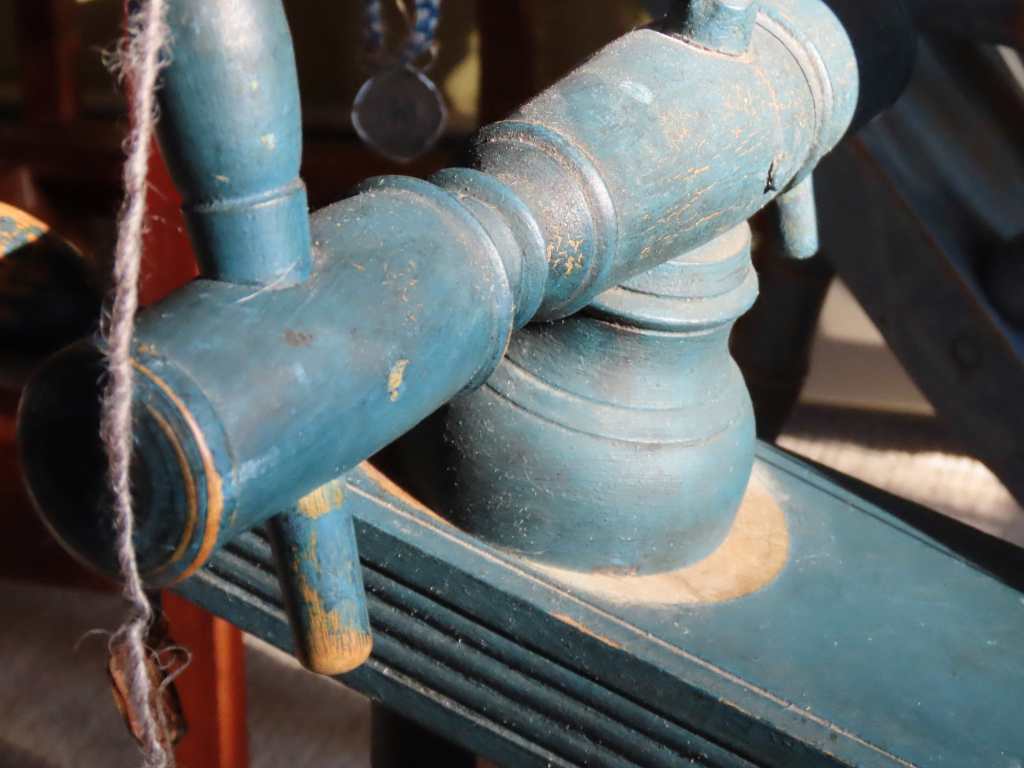
Painted a greenish-blue, with an unpainted drive wheel and flyer for contrast, Ulla is a beauty and spins almost as effortlessly as her relative, Torvi.
The drive wheel was very dark with old oil and dirt, but cleaned up to reveal striking wood grain.
It does not have the simple spokes of the other wheels of this style.
And the drive wheel fits oddly between the uprights, leading me to believe it may be a replacement.
The spokes are pegged through the outside of the rim, which is probably how they are pegged on Torvi, although we cannot tell because Torvi’s rim is covered in metal.
The hub construction is quite interesting and there appears to be some hemp or other material around the axle where it goes through the hub.
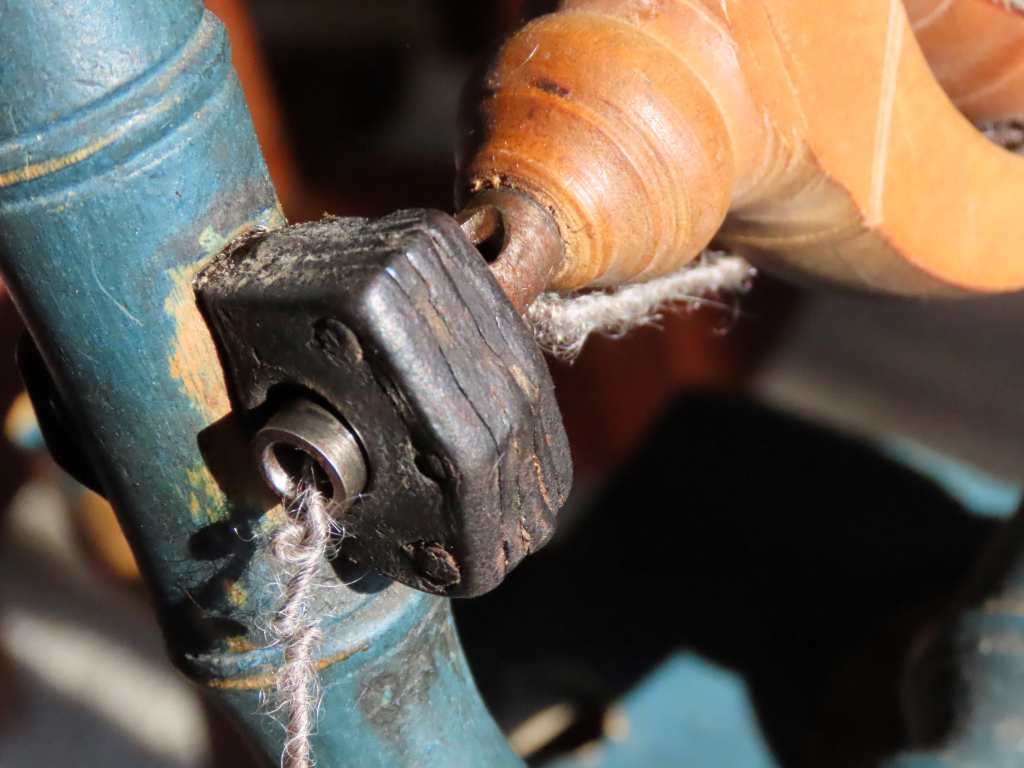
It has the distinctive style of axle cap found on these wheels.
One is cracked almost through, so I temporarily wrapped it with some linen.
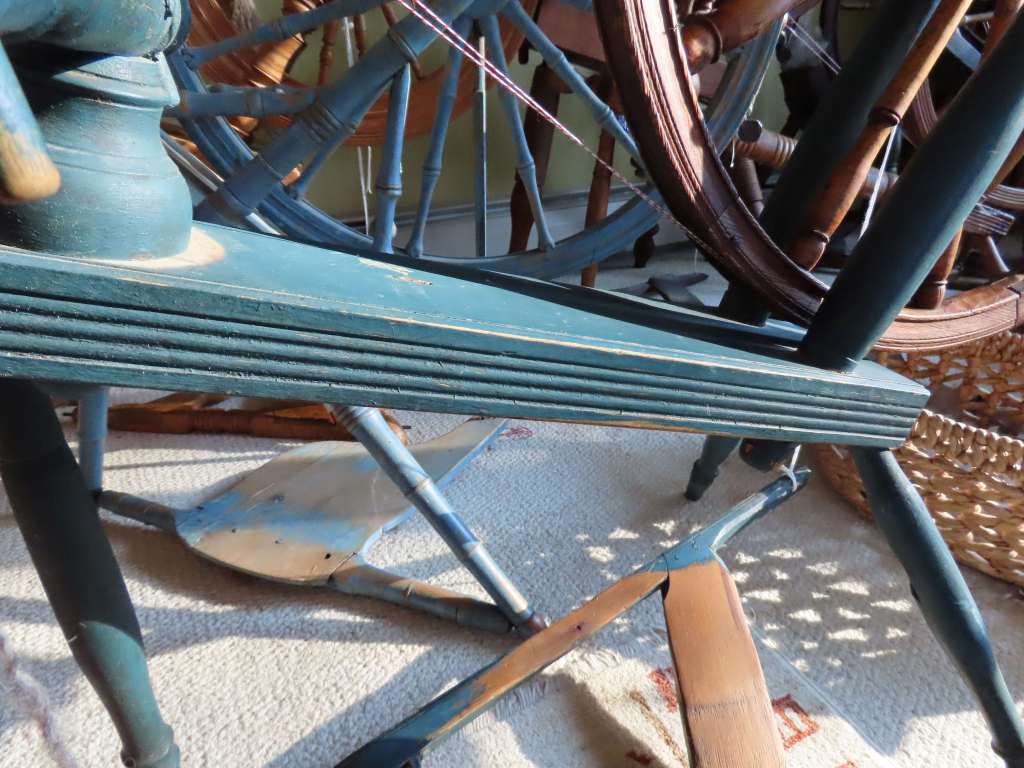
The table sides are grooved
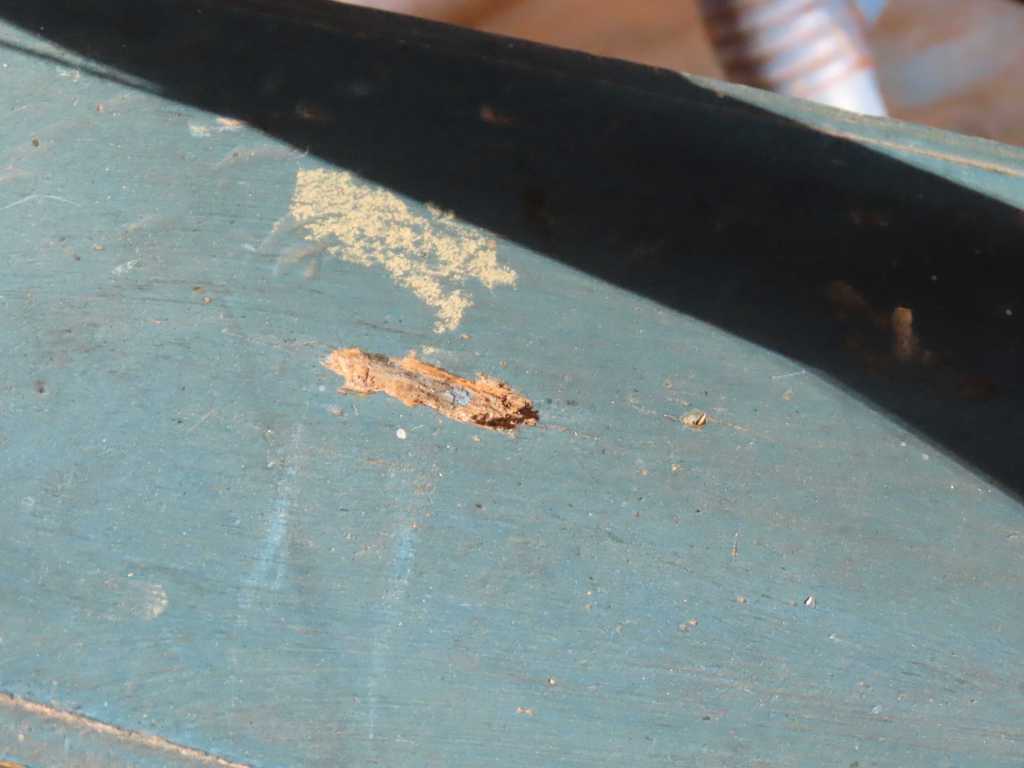
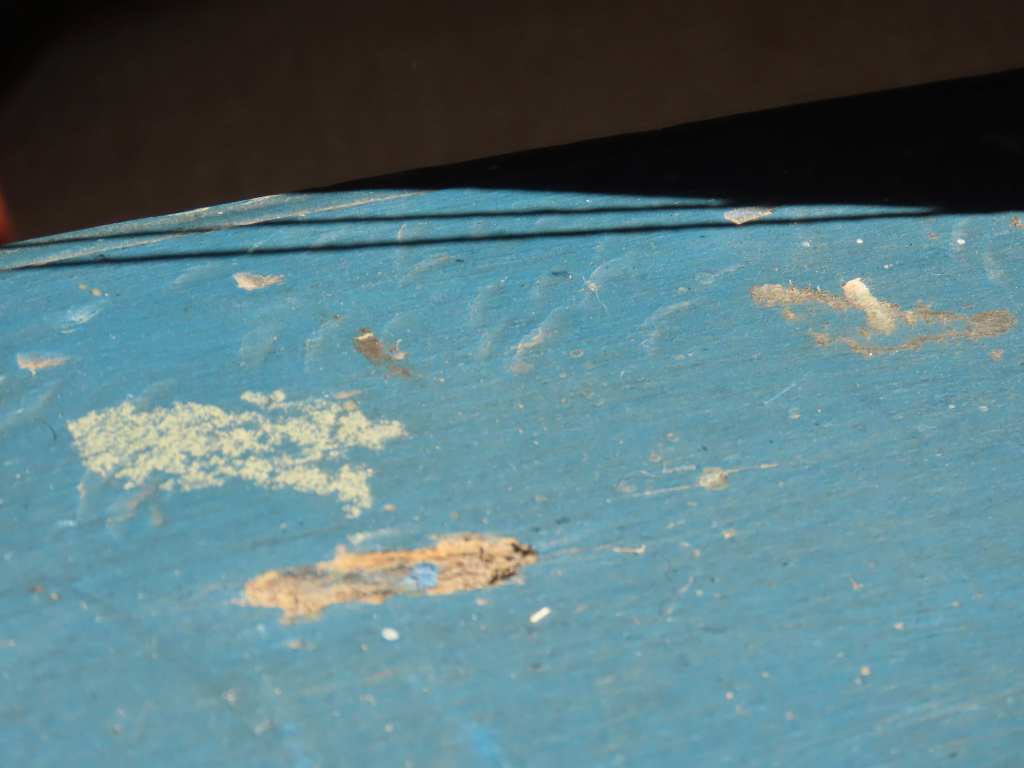
and there is a gouge in the middle, which is presumed to be from a knife or other tool, used to manipulate the drive band cross, perhaps for plying (I have not yet seen a definitive explanation for why the knife was used—only speculation).
There are also fainter semi-circular marks on the table that seem to show up from time to time on wheels–a history of a spinner’s habit of tapping something, perhaps the orifice end of the flyer, on the table for some unknown purpose.
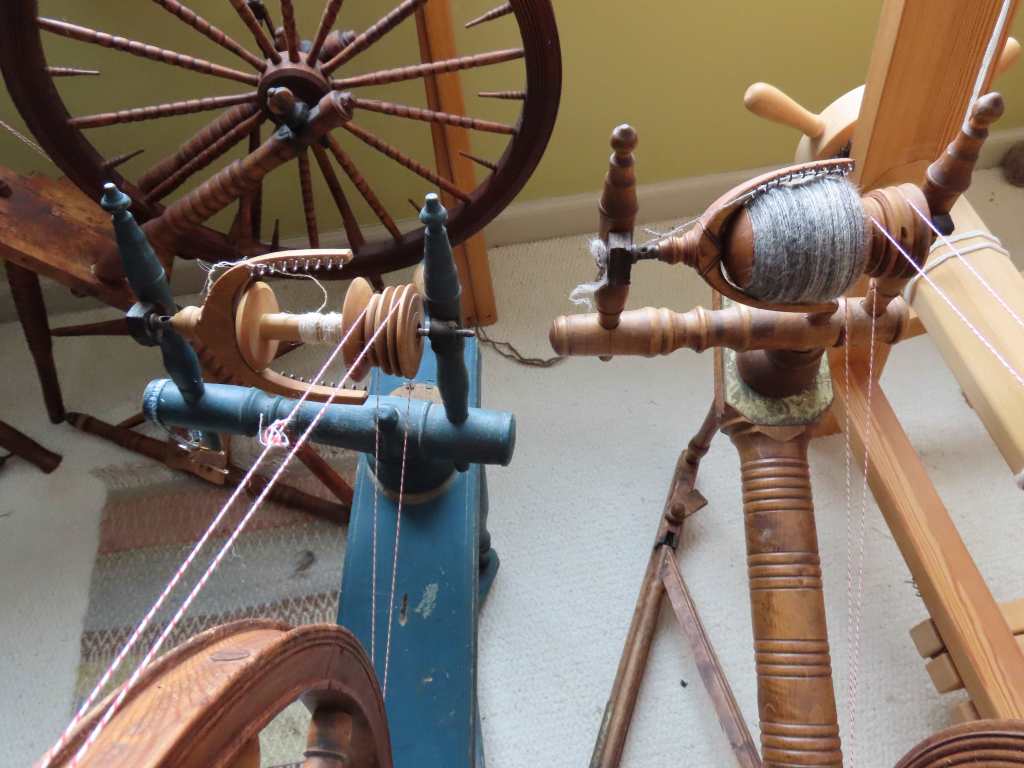
The four-layer leather flyer bearings secured with metal are typical for Swedish wheels.
The flyer is in wonderful shape
and, given the amount of wear on the treadle, might be a replacement or second or third flyer made for the wheel.
Most of the wheels I have seen of this style show extensive wear on the treadles. They must have been real work horses. Ulla’s drop-in treadle and pointy toes are characteristic of this style.
Interestingly, the non-spinner side leg has a metal spike, just like Torvi.
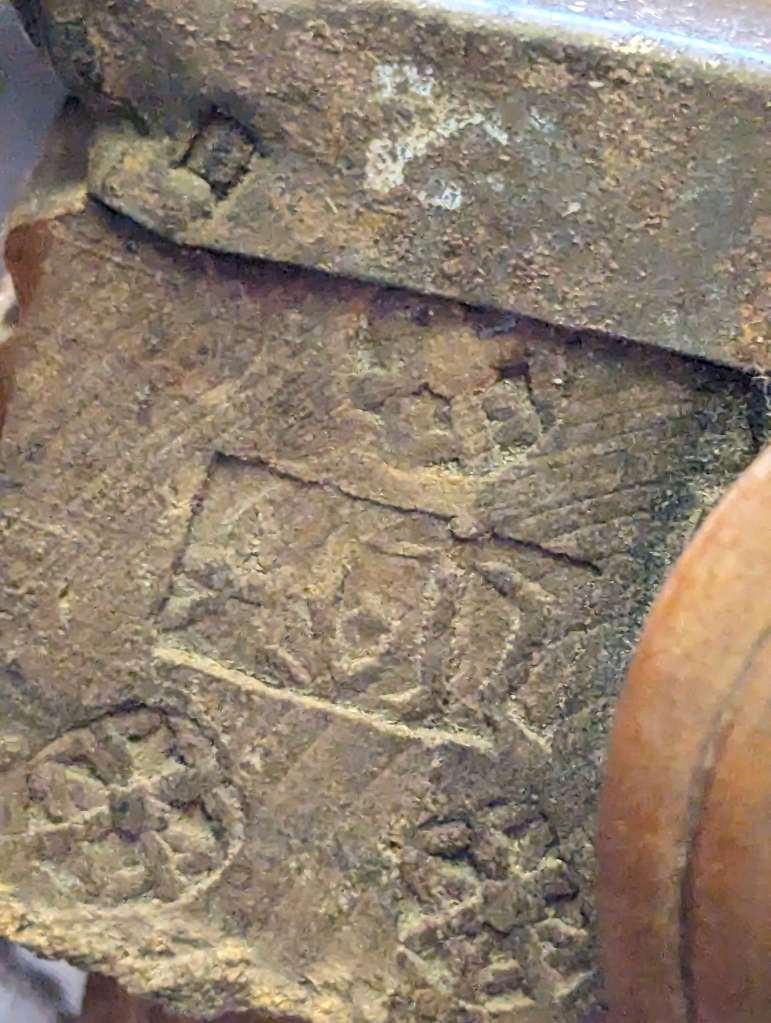
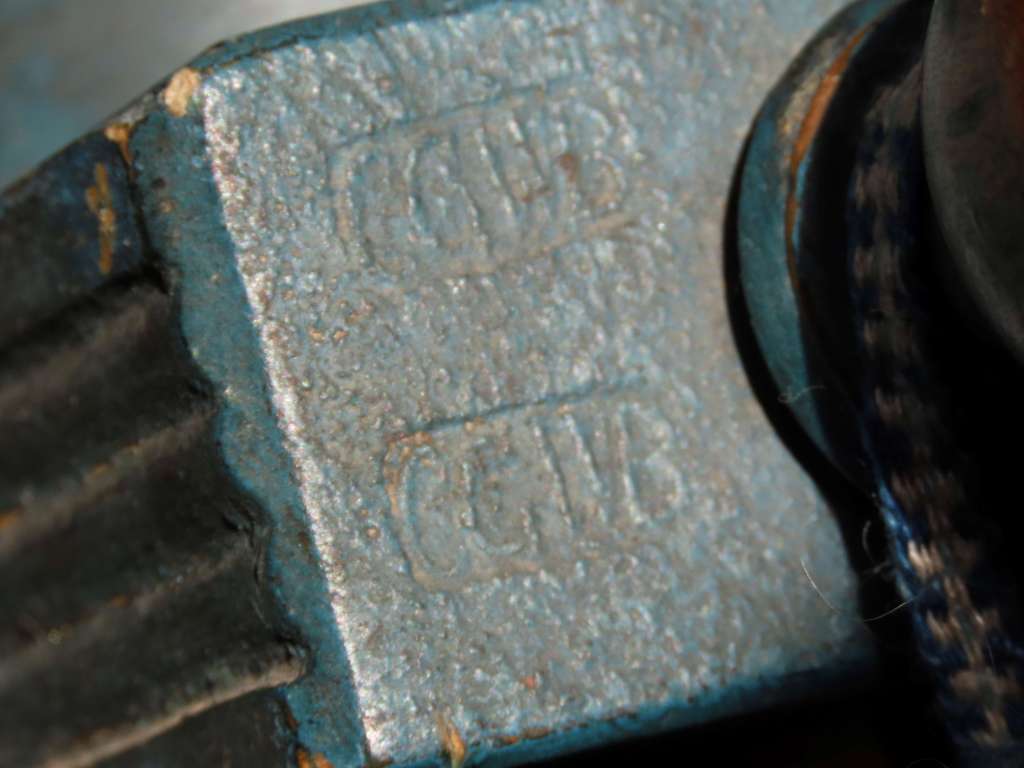
The maker’s initials are a little hard to make out, but appear to be “CGWB.”
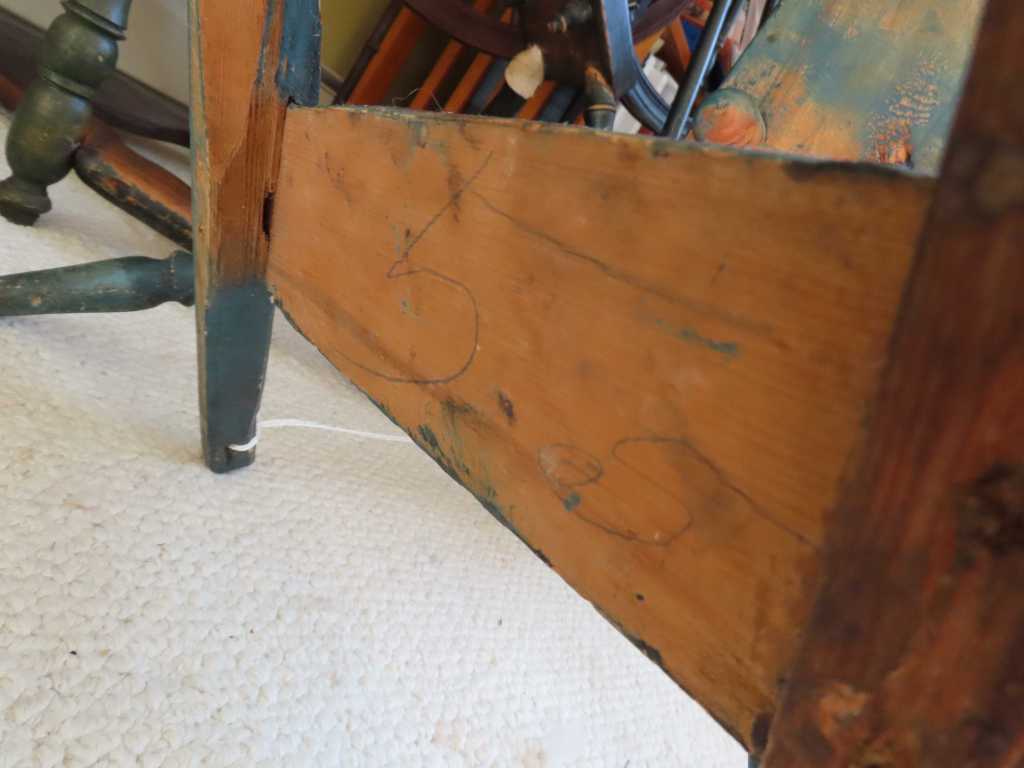
It is stamped twice on each side of the tension knob, but there are no star/sunburst stamps. The bottom of the treadle is marked in pencil “55.”
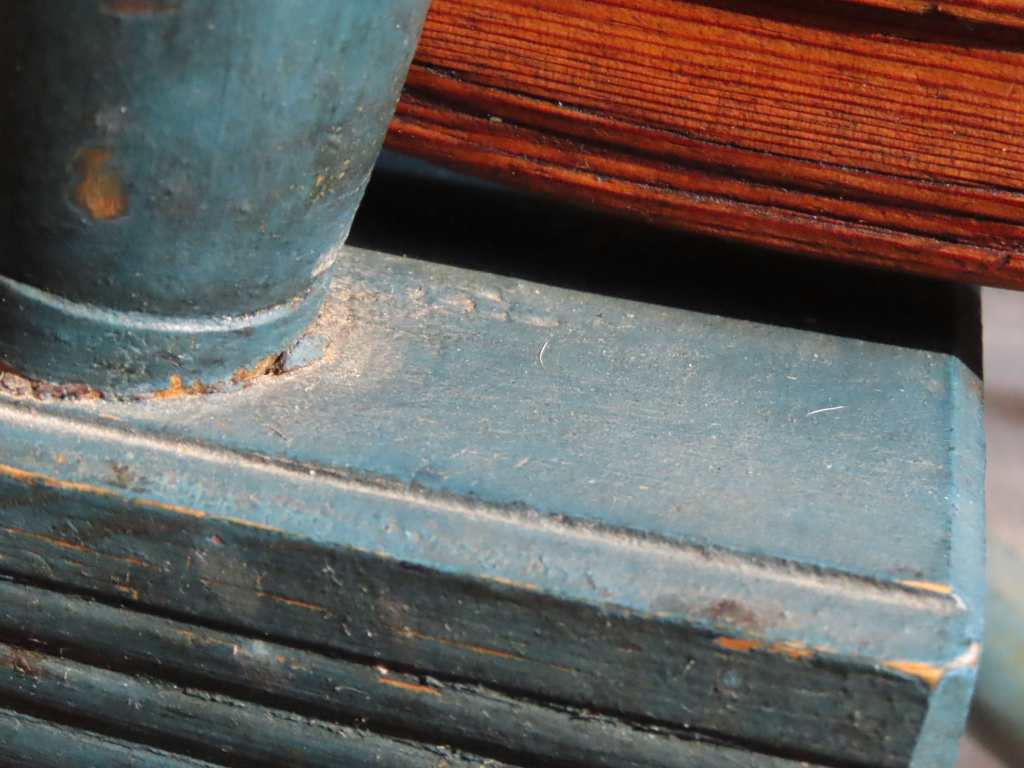
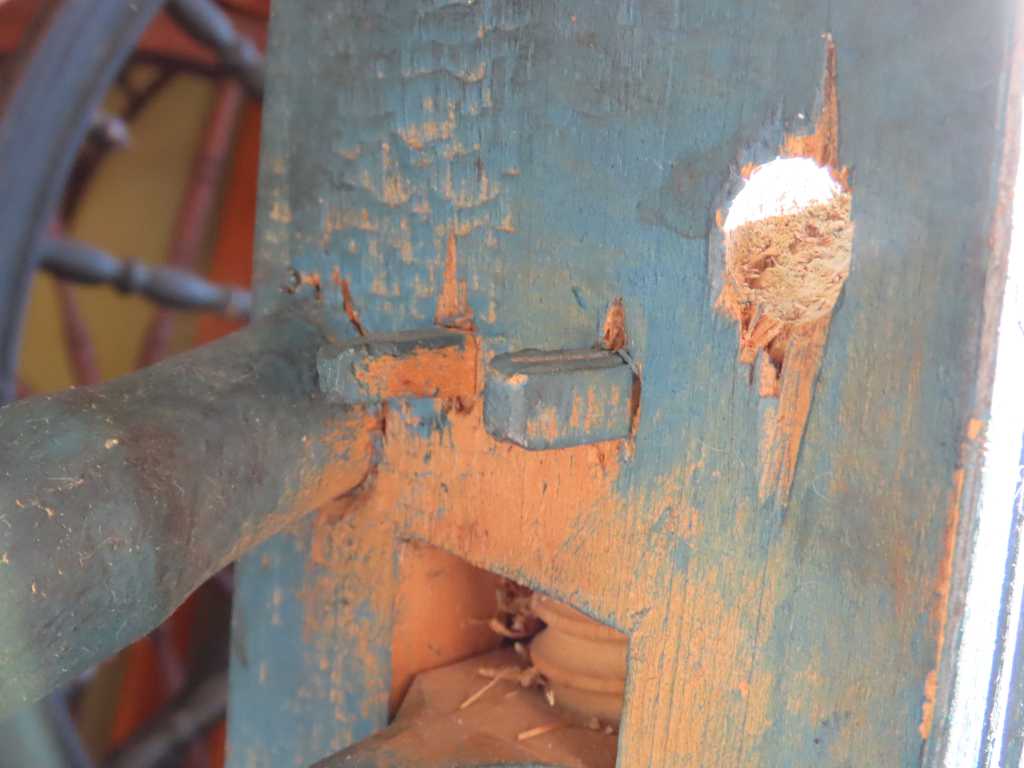
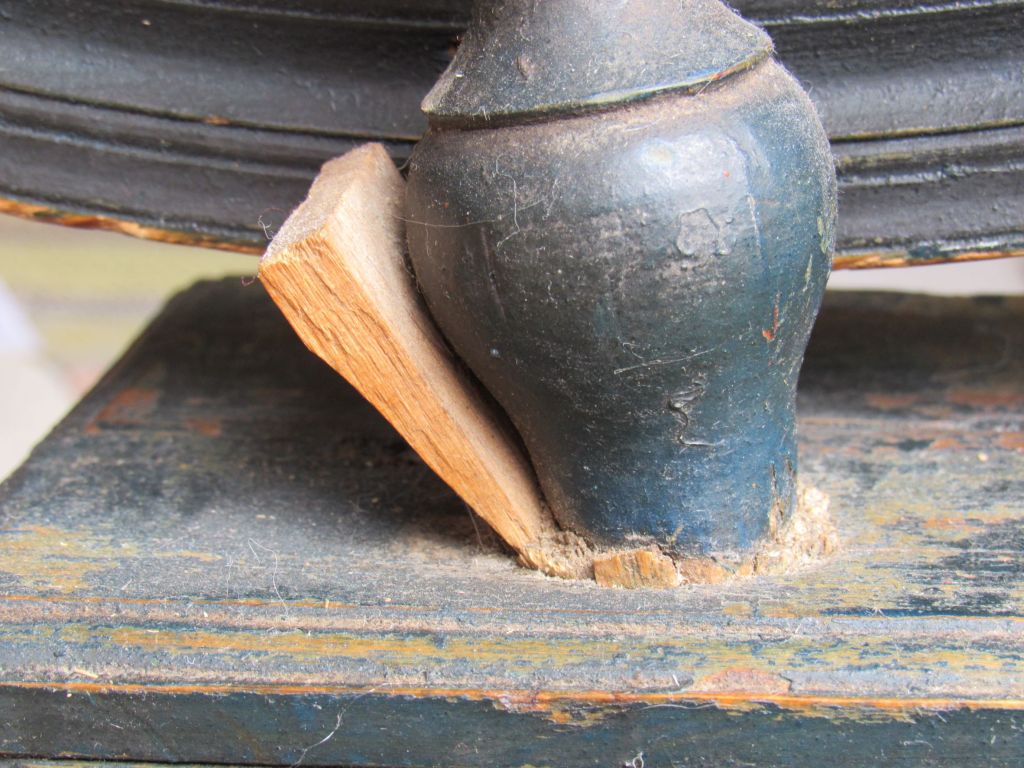
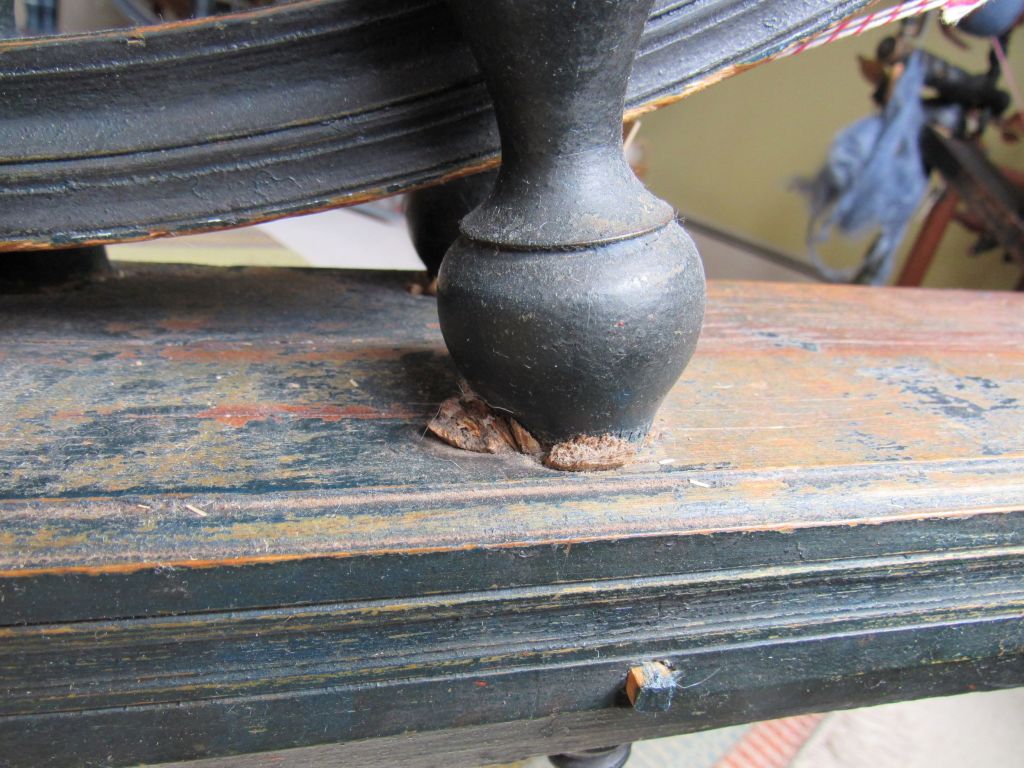
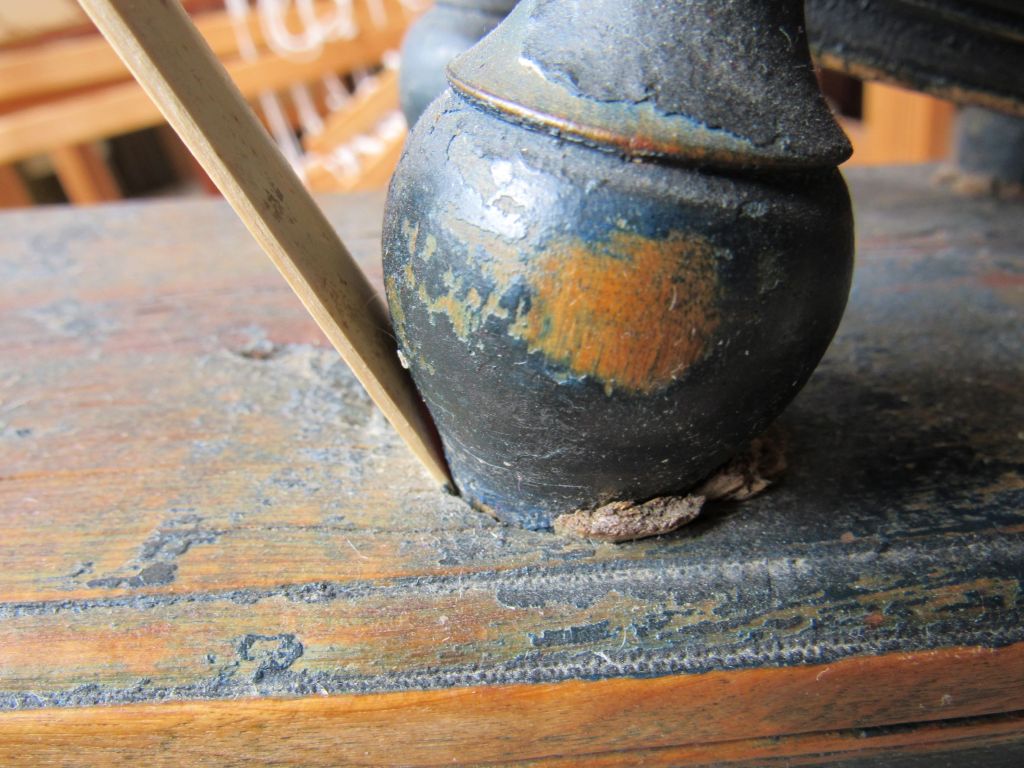
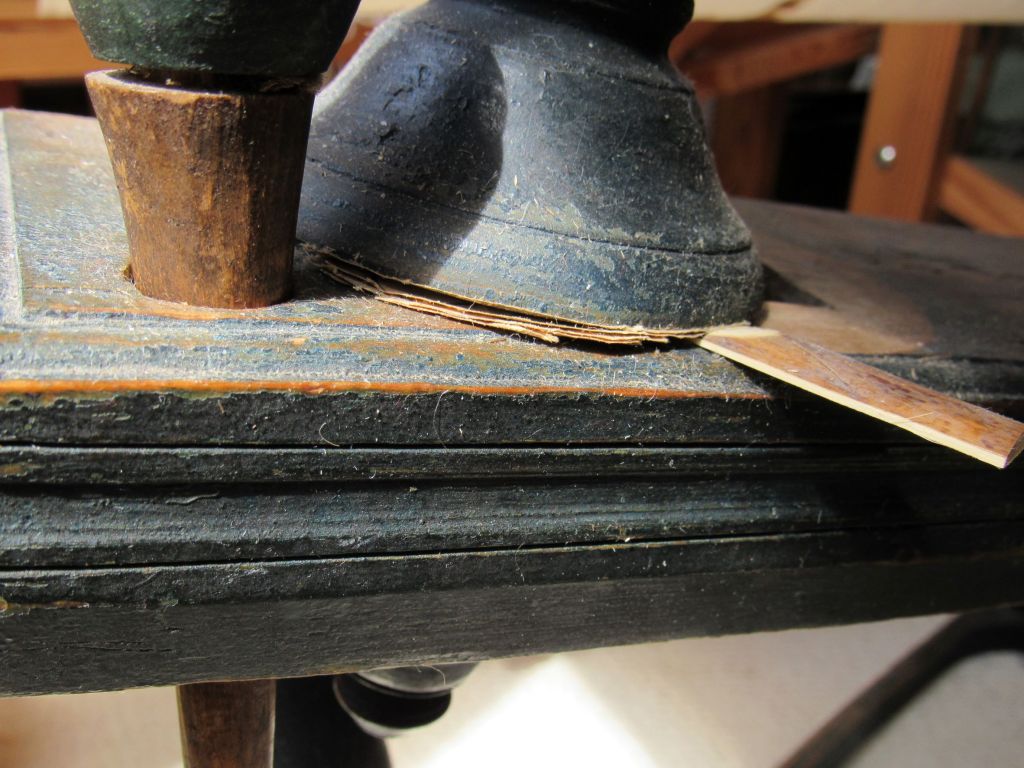
I did not remove the legs or the uprights to check for numbers (as Torvi has) because they were tightly shimmed in place before the wheel was painted.
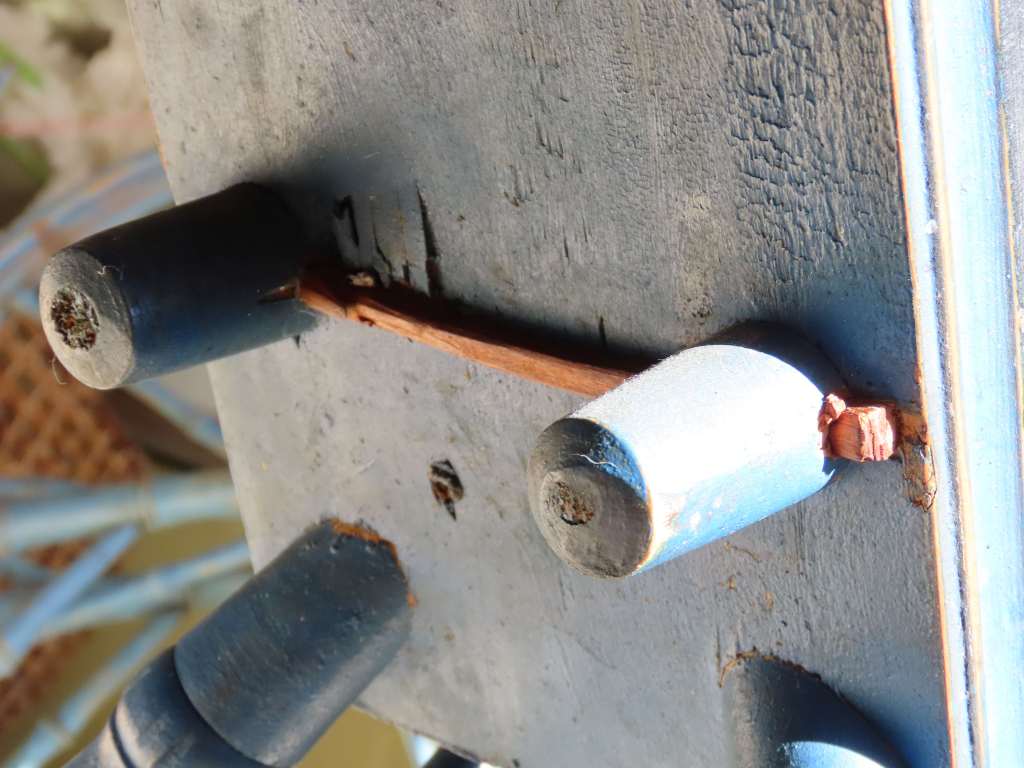
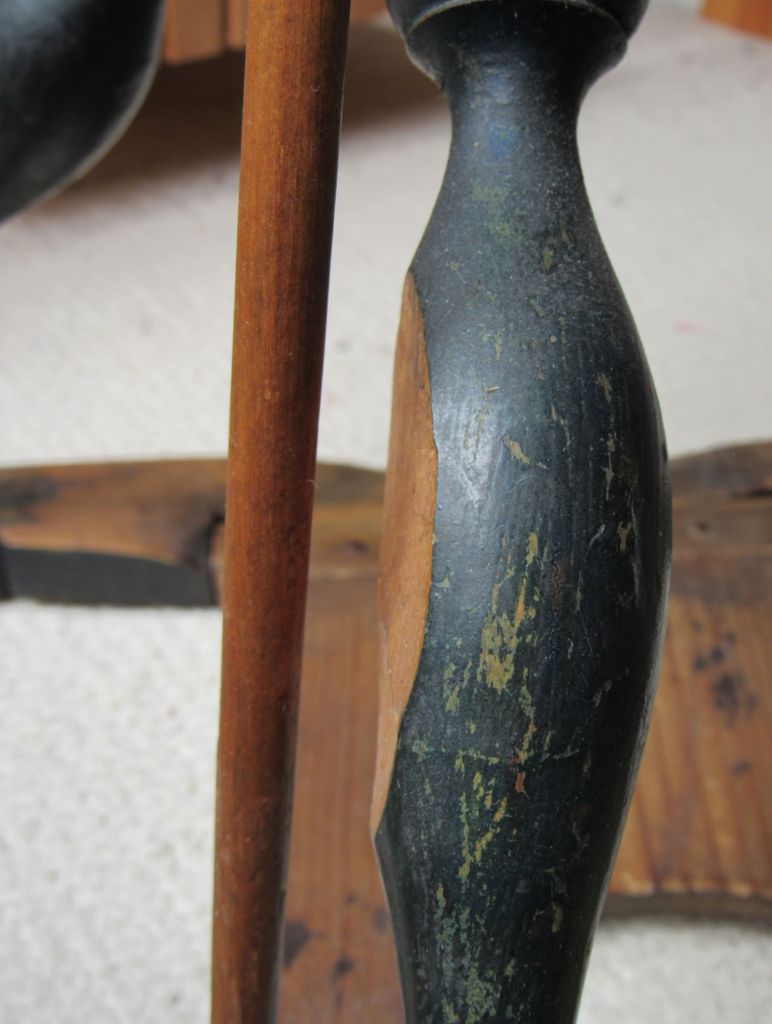
You can see the shim for the upright, which has been painted over
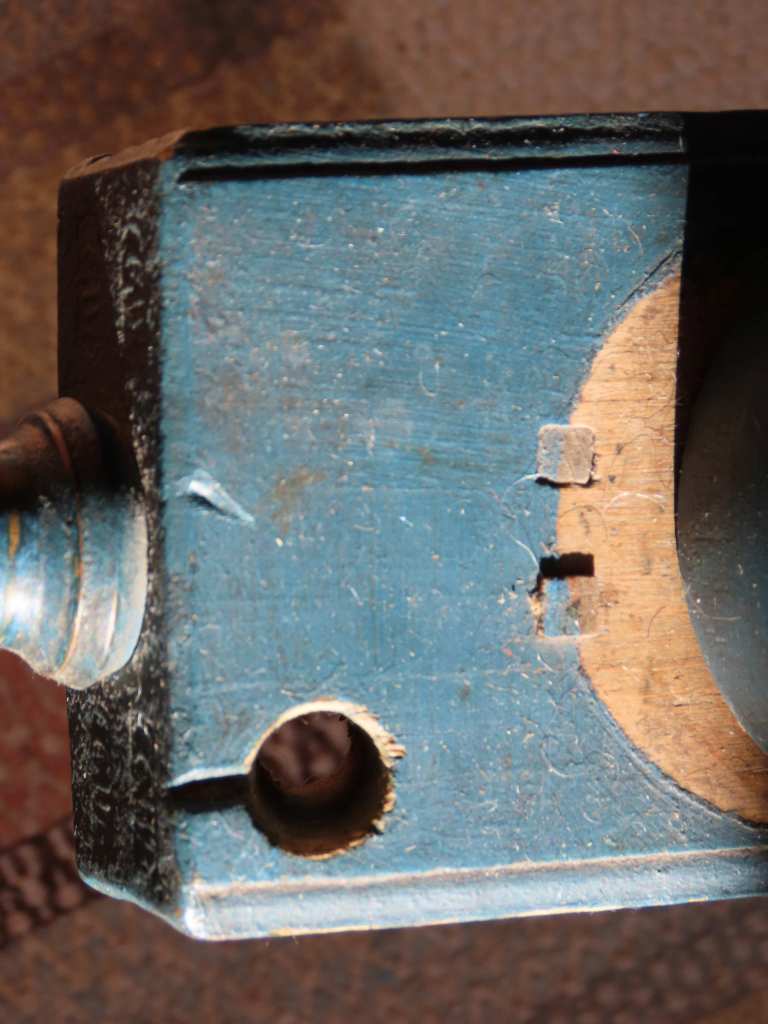
As with the turned-table wheels, there are two keeper pegs for the tension screw.
But, in contrast with Torvi, there is no wooden screw and nut under the mother-of-all.
The uprights are secured under the table with one piece of wood through both.
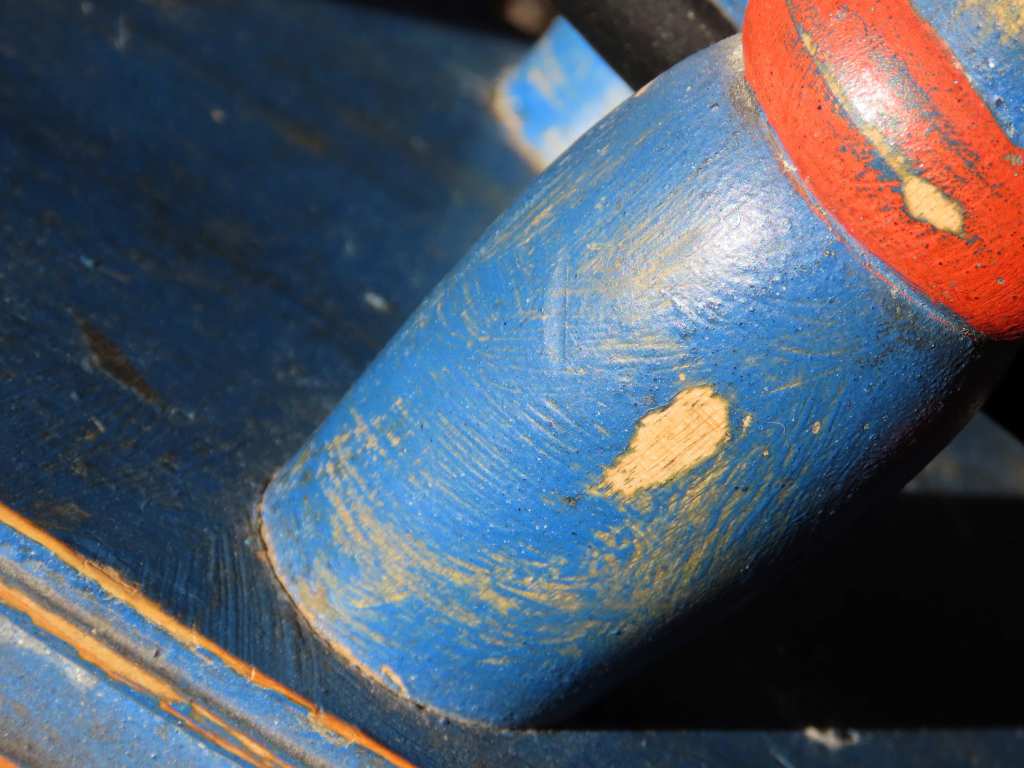
The paint shows wear in all the expected places and enhances the interest and beauty of the wheel.
With all of the similarities between these Ulla-style wheels and the Torvi turned-table style wheels, it looks as if they all were made in the same region, but with multiple makers. If we can pinpoint with some certainty the town or towns where these wheels were made, it will make it worthwhile to research the maker’s initials to try to determine who they were. Stigsbo will be a starting place. If any one has more clues, however small, please let me know.
While many Finnish wheels found in North America, including those in the two previous posts, likely were made in the 1900s, occasionally some older ones come along.
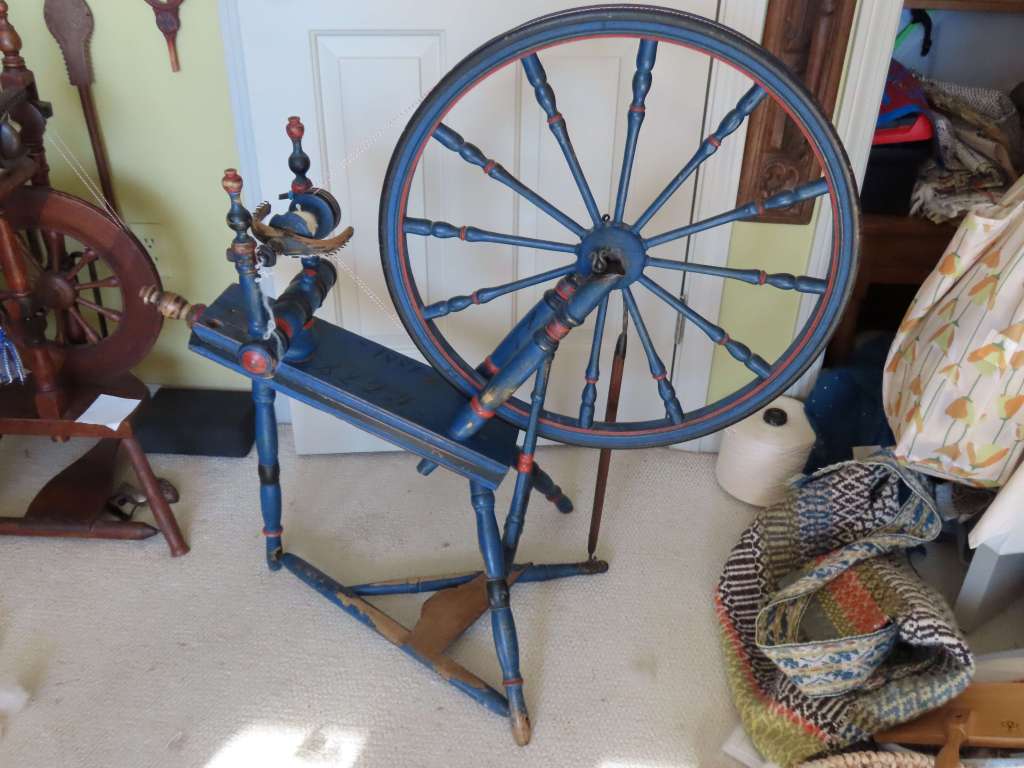
This curvaceous green beauty, which I found in Pennsylvania, was probably made in the mid- to late-1800s.
There does not seem to be any dispute that this style wheel, with its distinctive treadle design and abundant curves, is Finnish, but its specific origin remains unclear.
One advertisement, with a wheel marked 1855, indicated that the wheel was from the southeast coast of Finland, but I have not been able to confirm that.
Although several of these wheels have been posted on the Finnish Rukkitaivas Facebook group, so far, as far as I know, no one has identified a maker or region where they were made.
As with many other Finnish wheels, these wheels have double arched uprights and treadles set into the treadle bar, rather than pivoting from the legs.
On mine, there are metal pins attaching the uprights to the arch, on the spinner-side only.
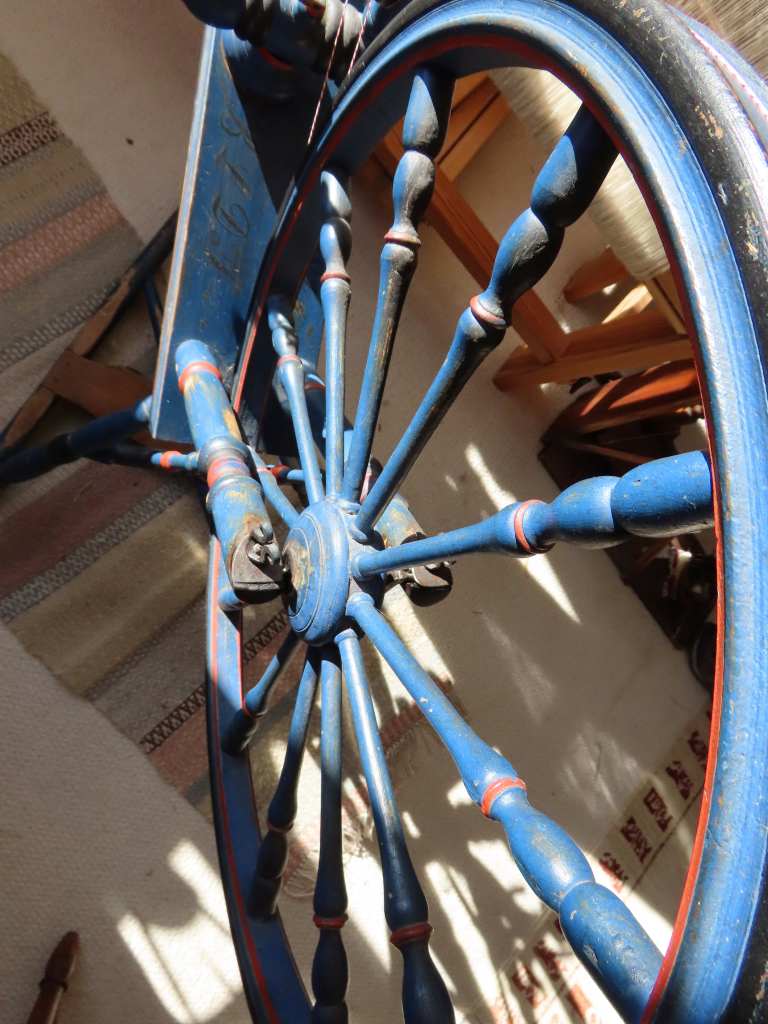
The drive wheels have from 16 to 20 delicate-looking spokes, giving them an almost spider-web look.
What makes these wheels stand out most, however, is the overall curvaceousness.
From the bulbous mother-of-all and legs
to the swooping treadle triangle embellished with curls,
there is not a straight line to be seen.
Even the tension knob looks pregnant.
The treadle itself is an unusual exaggerated shape,
with chamfered edges underneath.
The sculptured treadle pad is set into a base with mortise and tenon joints.
That base, which has the treadle pins, is then set into the spinner-side treadle bar, which extends between the legs.
The recess for the tension-end treadle pin is supposed to have a small wooden piece and wooden pin, covering the treadle pin, which on my wheel is missing.
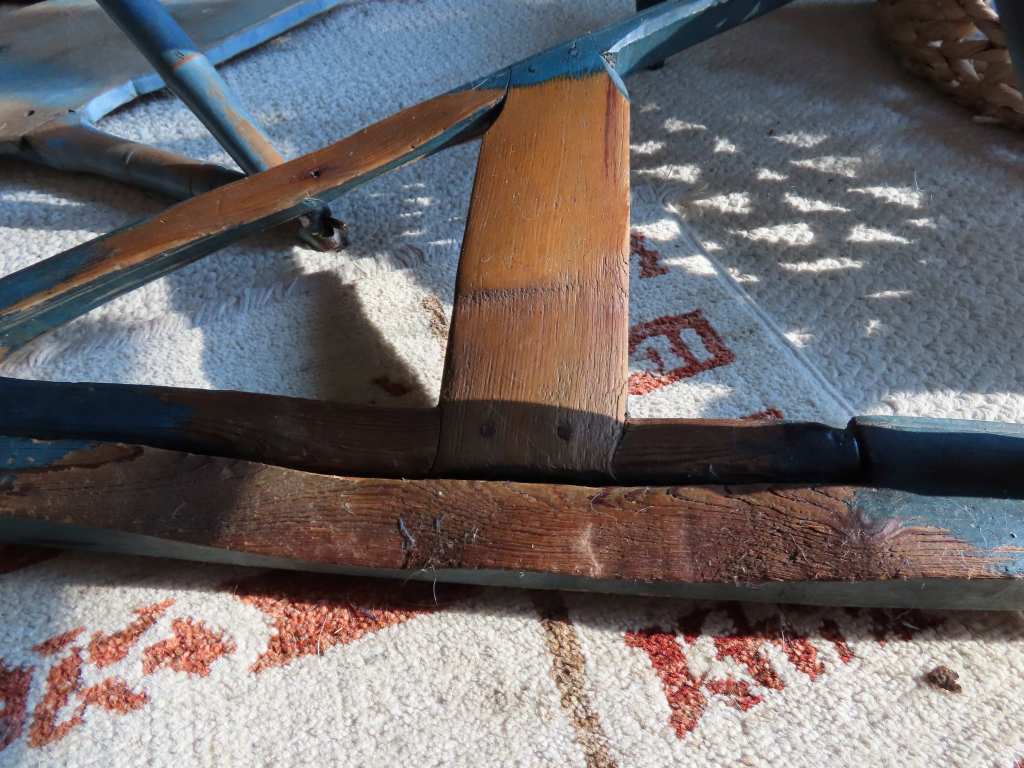
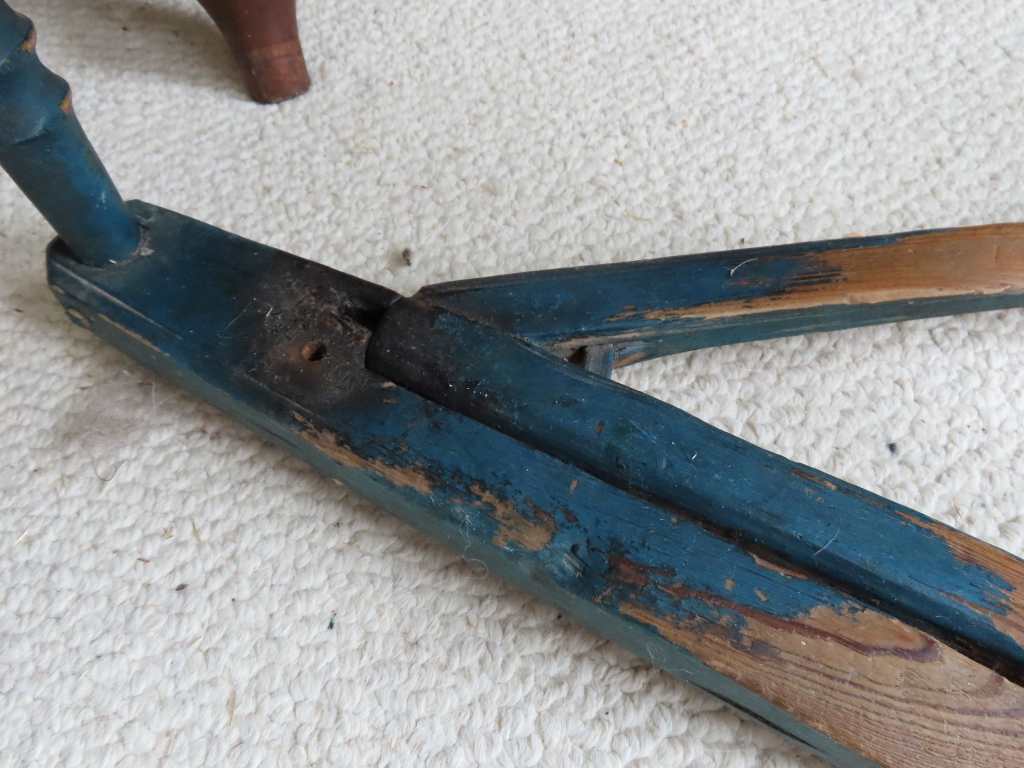
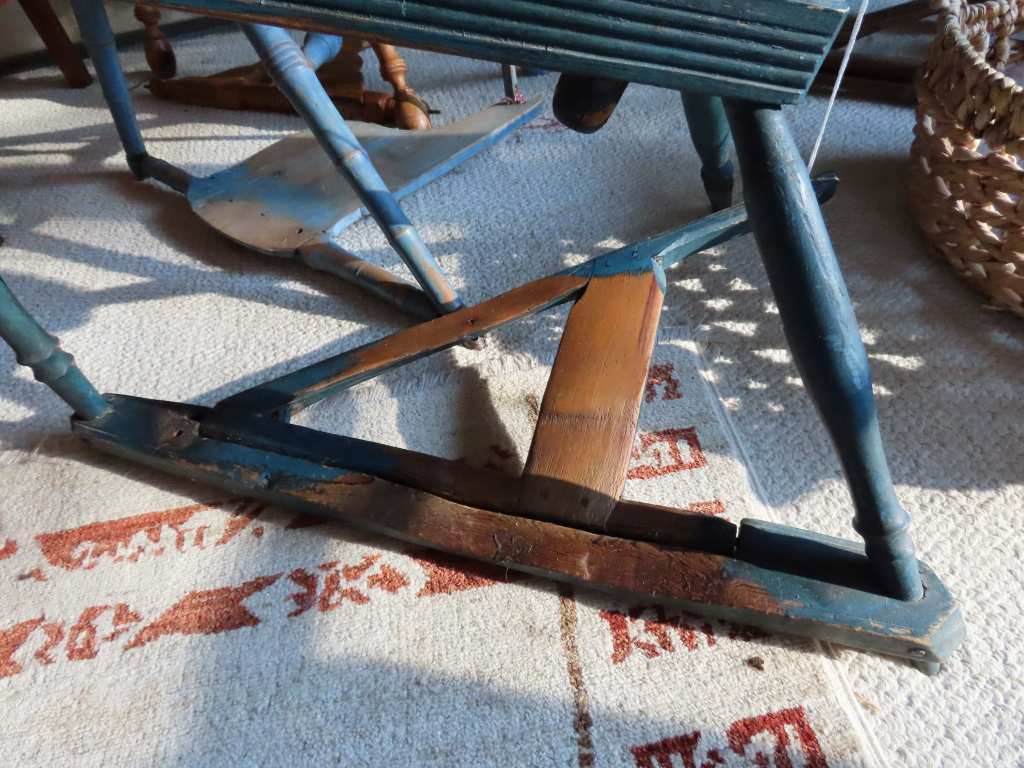
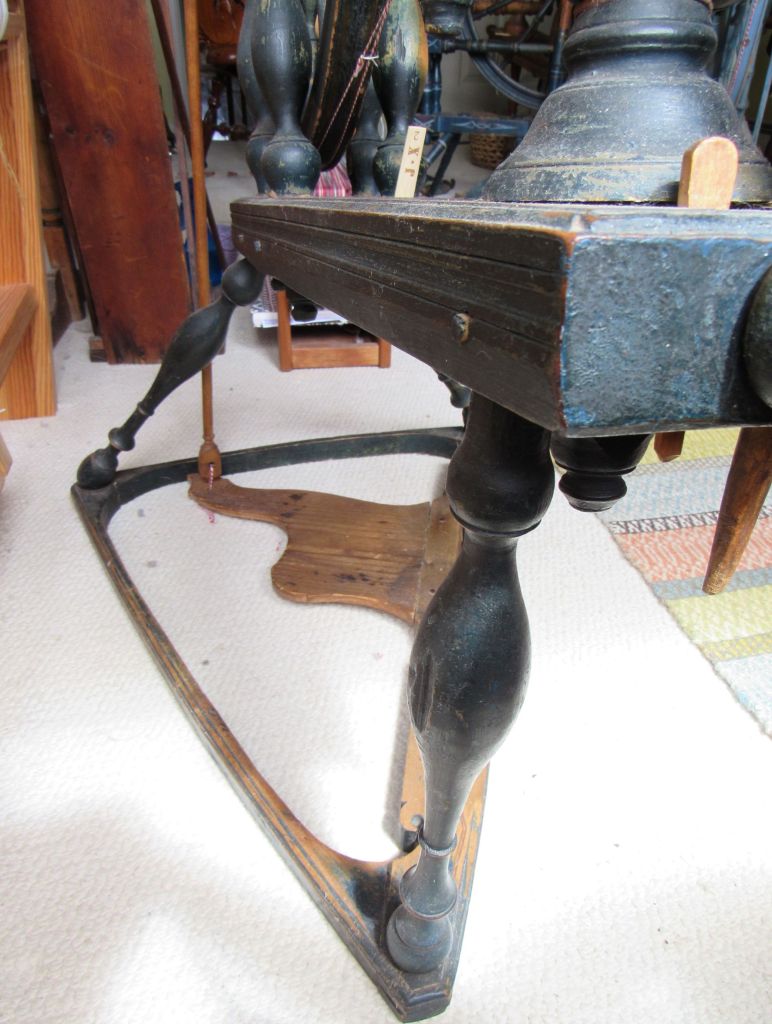
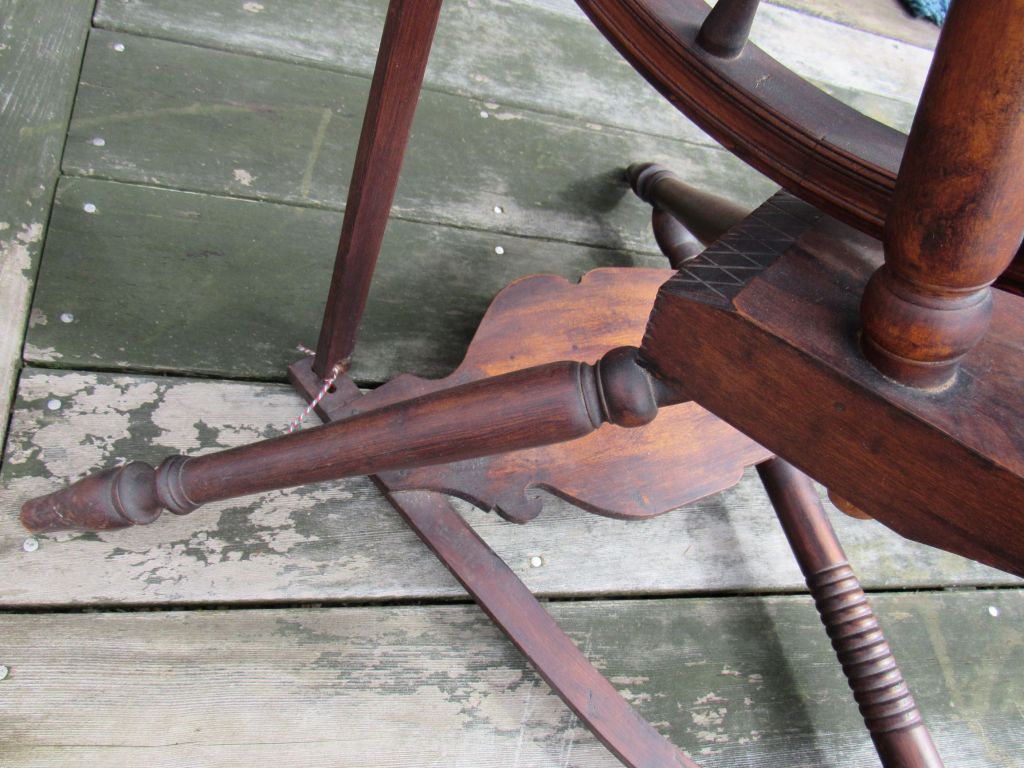
Curved bars run between all of the legs, with the feet set into the corners.
While most of the dozen or so photos I have seen of this style wheel closely resemble Tuulikki, there are some variations. The 20-spoke wheels seem to be a little larger than those with 16 spokes and have metal wires running from the table to the wheel uprights, similar to those on Impi, in the previous post.
Most are painted, including the underside. Some have painted dates or initials, and some are slightly more embellished. I suspect they were all made by the same wheel maker, or perhaps a family of wheel makers, but, on the other hand, this could have been a regional style used by several wheel makers.
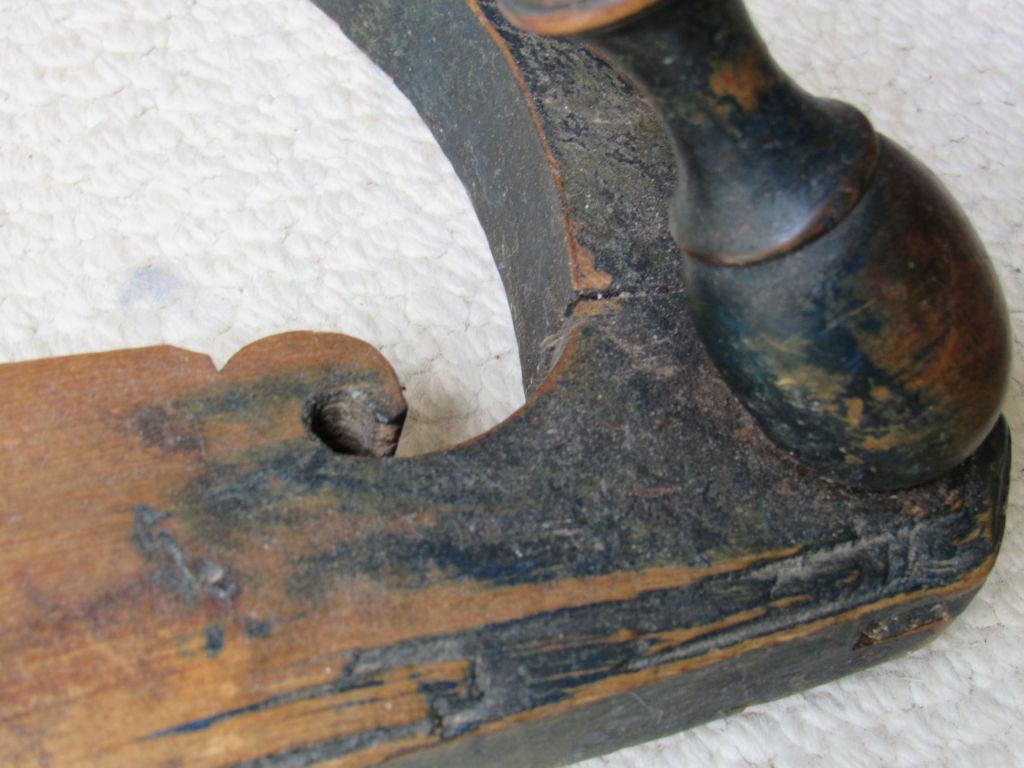
As with most wheels from the mid-1800s, Tuulikki has seen a lot of use. The wear on the treadle is interesting. The treadle bar is very worn down, with two concave areas (more pronounced on the right side).
Where the treadle meets the bar, there is little wear, with wear showing again on the treadle before the swoop. It could be that the treadle is a replacement, but I have seen other wheels with a similar wear pattern. Interestingly, this Finnish treadle design creates a pivot of two pieces of wood that tends to pinch the foot when spinning barefoot. Which leads me to wonder if it was unusual to spin barefoot in Finland. On this wheel, the wear pattern could be explained by a spinner wearing shoes or boots with small heels neatly resting on the treadle bar, with an instep high enough to span the pinch-zone–an area with no wear–and then wear again where the ball of the foot rested on the treadle.
In any case, there is no question that this wheel was heavily used. There was one large shim on an upright when I bought it.
Closer inspection showed that every upright was heavily shimmed in the past–all broken off through time.
I have placed two clarinet reed shims of my own.
There is paper shimming under the collar and multiple pegs in the maidens,
all designed to keep the wheel tight and in working order.
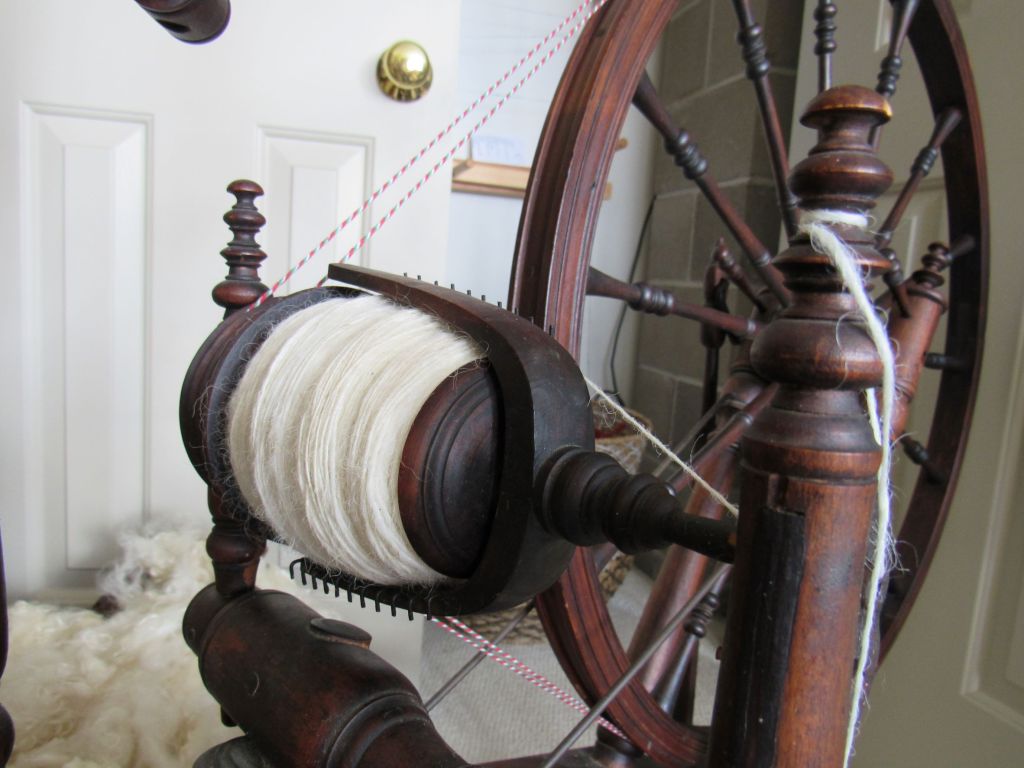
The flyer is beautiful, but was in rough shape when I got it, missing an arm and a good part of the bobbin.
It has some fluting on the orifice and wear marks on the mandrel. After an expert repair, it is back to work.
The axle bearings are thin metal, a bit crumbled,
with unpainted wooden keeper screws for the axle, providing the paint/no paint contrast that I love on so many Scandinavian wheels.
The top of the footman matches the keeper screws–a beautiful feature.
So much thought went into this wheel that I found it strange that the leg by the footman had its ample curve sheared off to make room for the footman. Again, this may be a sign that the treadle is a replacement, and slightly bigger than the original (it does look larger than the treadle on the Minneapolis wheel shown earlier).
The axle was loose in the hub when I bought it, but, with expert direction, I was able to do a shim repair myself. Not something I want to mess with very often.
The distaff shaft extends way below with table.
Tuulikki came without the top part of the distaff, so I bought a truncheon style one that is a good match.
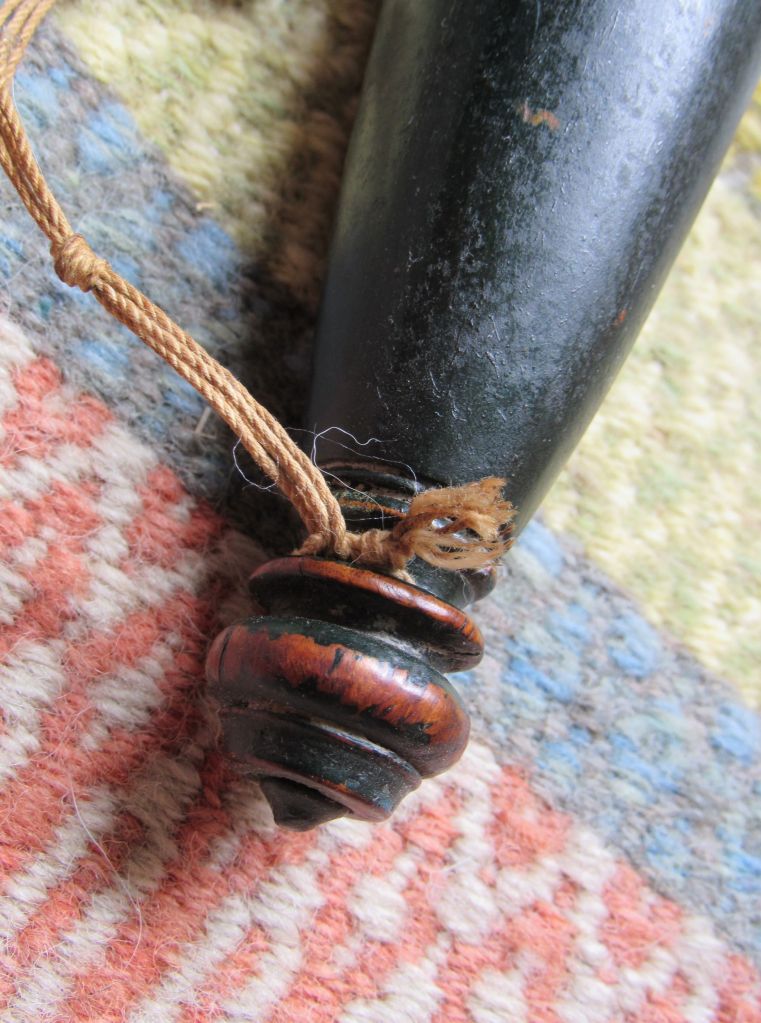
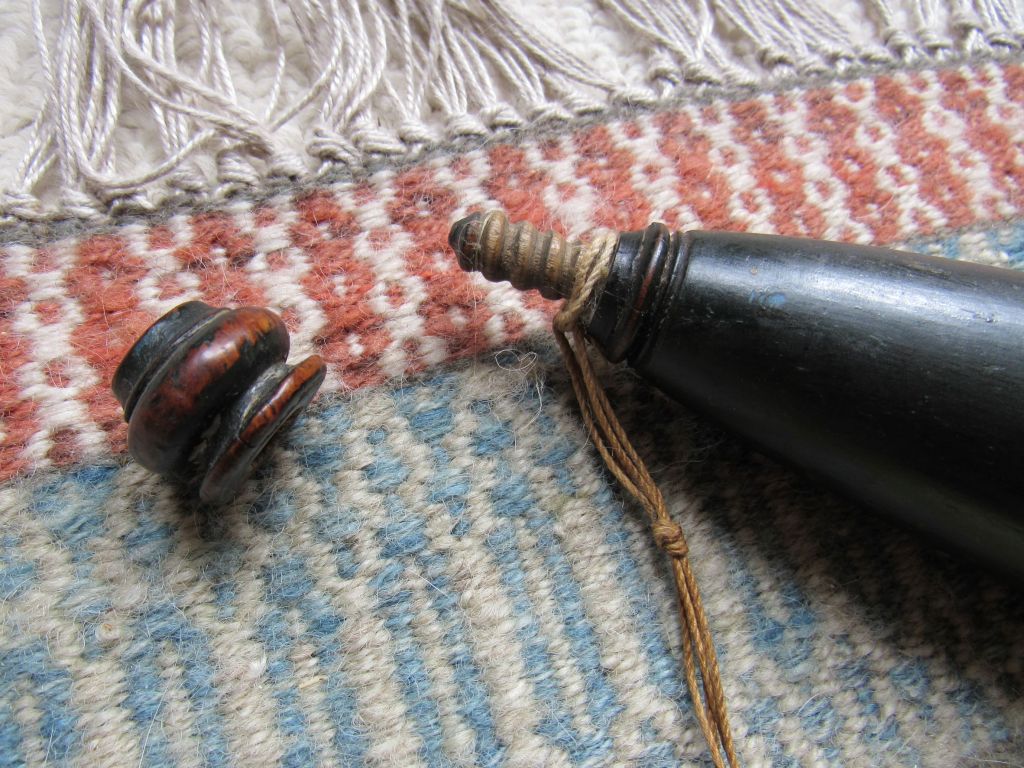
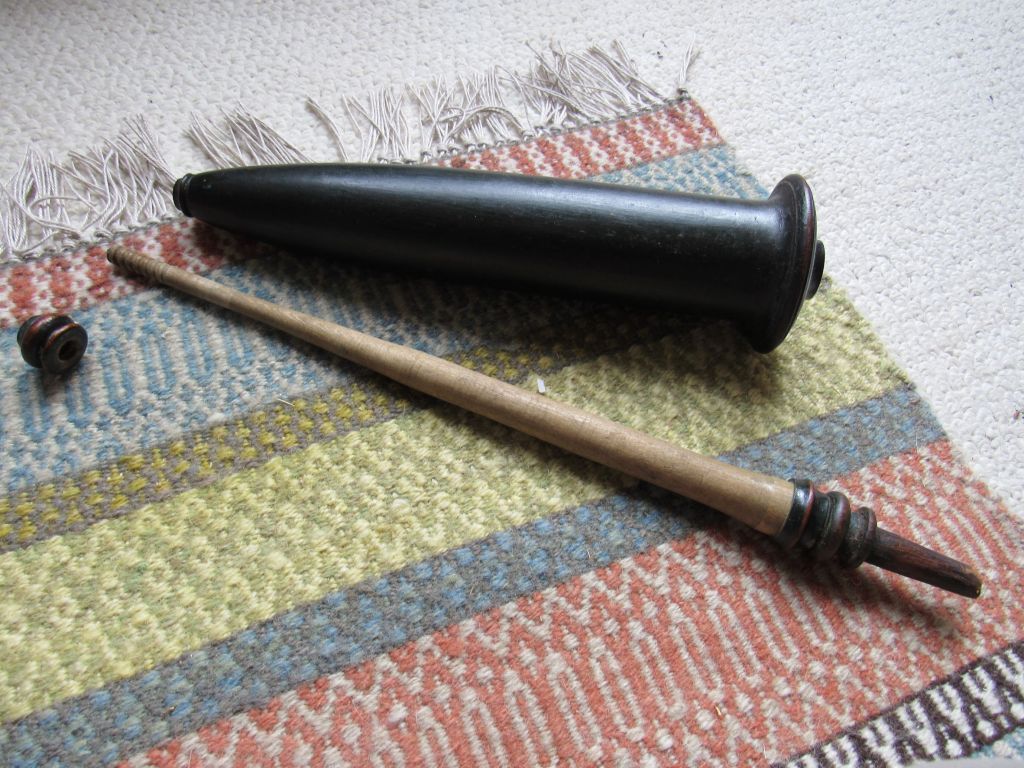
I was surprised to find that the top of the distaff unscrews
and the outer portion can be removed from the core.
I do not know if that helps for dressing the distaff or if there is some other reason for this feature. If any one knows, please let me know.
This wheel was created with a real eye toward beauty. But she is a great spinner, too, and has been maintained, with various fixes, as a working machine. I am privileged to be part of the chain of people who have worked on and spun with this special wheel.
Update June 9, 2025: Thanks to folks on Ravelry, a wheelmaker in Lapua, Finland has been identified who made wheels somewhat similar to this style. Juho Pelanteri (1847-1923) was a third generation wheelmaker who made the wheels in the photo below. These wheels have some features in common with Tuulikki–many fine spokes, generous turnings, wide curvy treadles and often painted–but have different uprights, larger drive wheels, and metal struts. Pelanteri (also referred to as Johan Pelander), with his father and grandfather made about 60 wheels a year–3000 in total. museum link for photos here
This beautiful wheel is Finnish. In fact, even though there is no maker’s mark, I know with certainty who made it. That is a rarity in the wheel world. I found it for sale on Cape Cod. Despite the fact that it had been in the seller’s home all his life, he knew nothing about its history.
Because the wheel looked Scandinavian, I asked him about his family background. Sure enough, they are Scandinavian, mostly Norwegian, he thought. When I got the wheel home, I realized that it was in pristine condition—probably never used for spinning.
In addition, it looked relatively new compared to my other wheels, most of which were made in the 1800s. It seemed likely that the wheel was made in the 1900s, which made we wonder if it was Finnish, because Finland, like Quebec, had significant spinning wheel production in the early to mid-1900s.
Fortunately, there is a Finnish wheel collector on Facebook, Sauli Rajala, with a page called “Rukkitaivas ‘Spinning Wheel Heaven’ Kiikka,” in which he photographs wheels that he collects in and around the Kiikka region of Finland. As of March 2022, he has rescued more than 1600 wheels. They are so abundant in his area, which was once a thriving center of wheel making, that they are often given away. One day I saw a wheel on his page that looked just like mine.
He knew the area in which he had found it, but no other details. A few months later, another similar wheel showed up, but no one seemed to know anything definitive about where the wheels were made. Of course, I may have missed huge chunks of information since I speak no Finnish and Facebook translations range from hilarious to vaguely obscene. I’ve come to understand some of the wonky translations, such as “Rukki,” the Finnish word for spinning wheel, which translates as “rye” and “lantern” is the translation for flyers.
Translated posts usually go something like these: “The roller has to spin an obstacle with a krake and a lantern in the leather earrings,” and “the between the thighs must not be at all tight so that bike is not an obstacle.” Translations are littered with “bitches,” “wheelbarrows,” and “the Polish side.” Let’s just say that the translation feature is usually more laugh-inducing than illuminating. So, although I was fairly confident this wheel was Finnish, that was the extent of my knowledge.
Until recently, when someone posted in the Rukkitaivis Facebook group a wheel similar–but slightly different–than mine, with the information that her aunt said it had come from central Finland. I posted a photo of my wheel asking if she thought it would have come from the same region. In response, I was amazed to hear from Marja Tolonen, who said that my wheel had been made by her grandfather, Hannes Rantila, who shipped a batch of wheels to America for sale in 1922.
Marja’s father, Edvard, grandfather, Hannes, and great-grandfather, Sakari Rantila, all made spinning wheels in Manniskylä, Keuruu. Sakari started making wheels in 1845. He could read and write and kept a record of all the wheels and other turnings he sold.
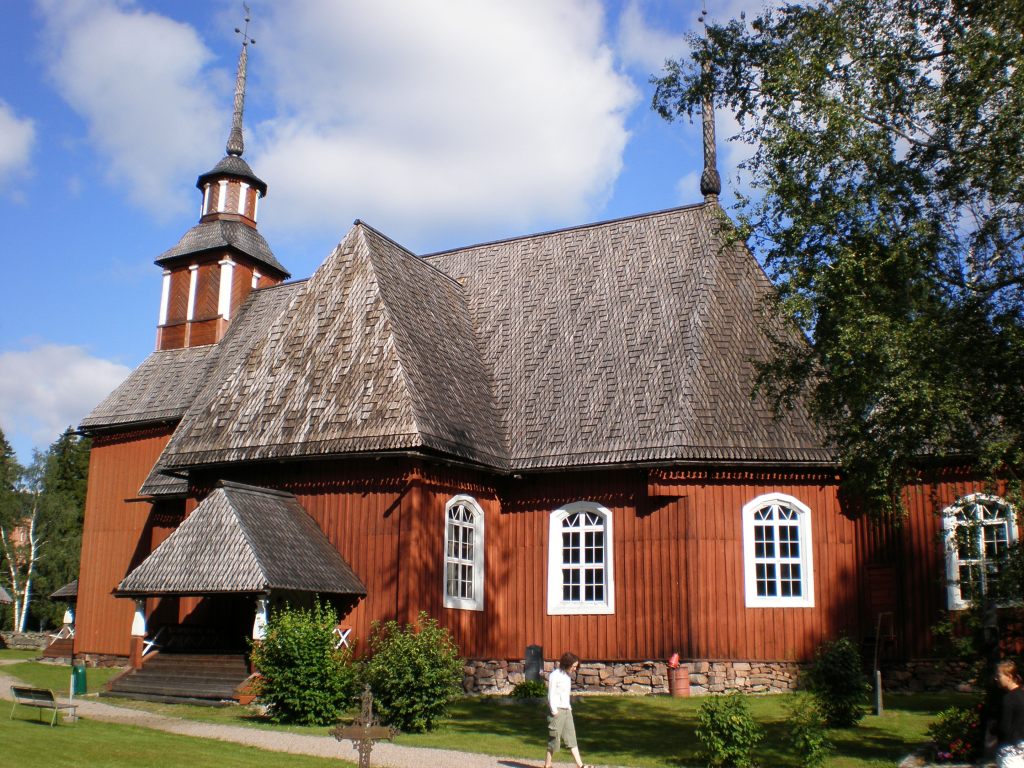
Sakari’s son, who was Marja’s grandfather, Hannes, continued Sakari’s work. Hannes had five sons, all of whom made wheels. Two of them, Nikolai and Gideon, stayed home and worked as carpenters through their lives, including working on renovations of the old church in Keuruu. I assume it is this church, famous in the area, originally built in the 1750s.
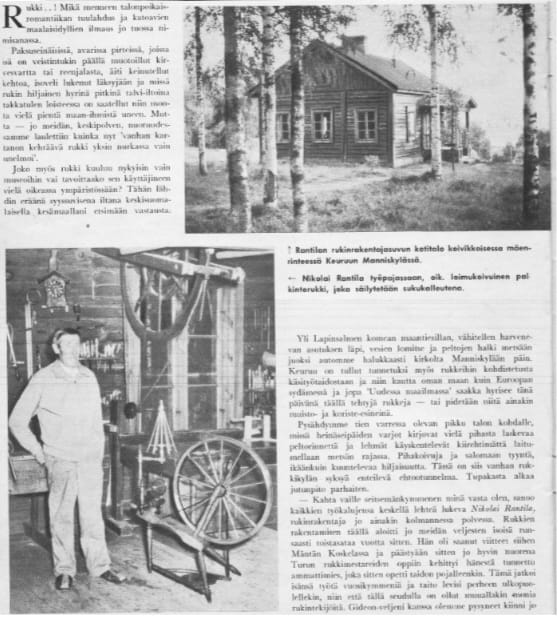
This link has photographs of the incredible painted woodwork inside: Travels in Finland and abroad. Nikolai lived to age 94 and continued in his old age to make small wooden objects. Marja shared this article with the Rukkitaivas group, from a 1958 Pellervo magazine in Finland.
The picture in the article shows the Rantilas’ house, where her father was born and the wheels were made. The man showing the wheel was Nikolai.
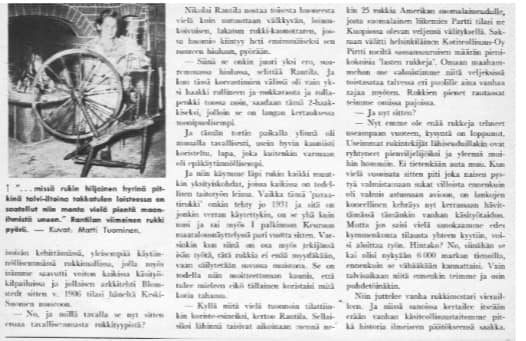
The woman spinning was Gideon’s wife, Auna. Unfortunately, the text is blurry, but Sauli and Marta provided the key information from it. This is a wheel made by Hannes in 1931, which appears to be identical to mine, except for the stain color.
The Rantilas were not the only wheel makers in Keuruu. Another branch of the family also made wheels. Nikolai’s grandfather, whom I believe was named Adam (Aatami), had a brother, Samuel Kingelin, who along with his son, Samuel Saukkomäki, also made wheels. The wheels were quite similar, with just slight differences in their decoration.
With all of the hours I spend researching spinning wheels, following fruitless leads and hitting dead ends, it felt slightly surreal to have this rich trove of wheel history fall into my lap as the result of a single facebook query. And it adds a whole layer of richness to spinning on wheel when you know something of its maker and history.
While I cannot be absolutely certain that my wheel was part of the 1922 batch that Hannes sent to America, chances are good that it was. My wheel looks as if it was never touched for spinning, but always used as decoration. That makes sense, since hardly anyone still spun on wheels in the early 1900s in this country. It seems more likely that someone would have bought one of Hannes’ shipped wheels once it was here, rather than taking the effort and expense to personally ship the wheel over from Finland. But, however it arrived, it has been lovingly taken care of since then.
I would love to know the reason Hannes Rantila marketed these wheels in America in 1922. Were they a decorative Scandinavian touch for homes at the end of the Arts and Crafts movement? A taste of a Carl Larsson interior, perhaps? Because, if ever a wheel elevates traditional craftsmanship to art, this one does.
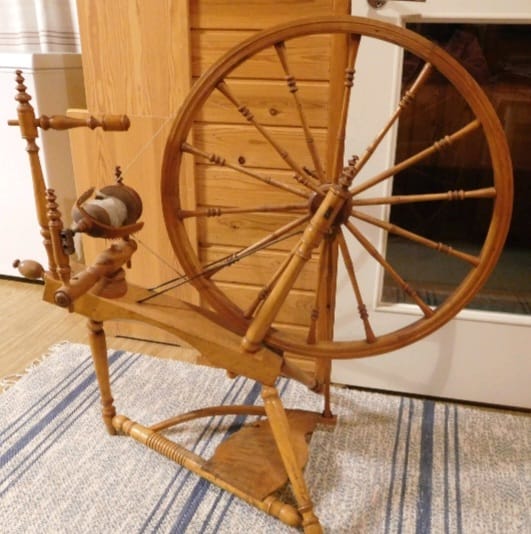
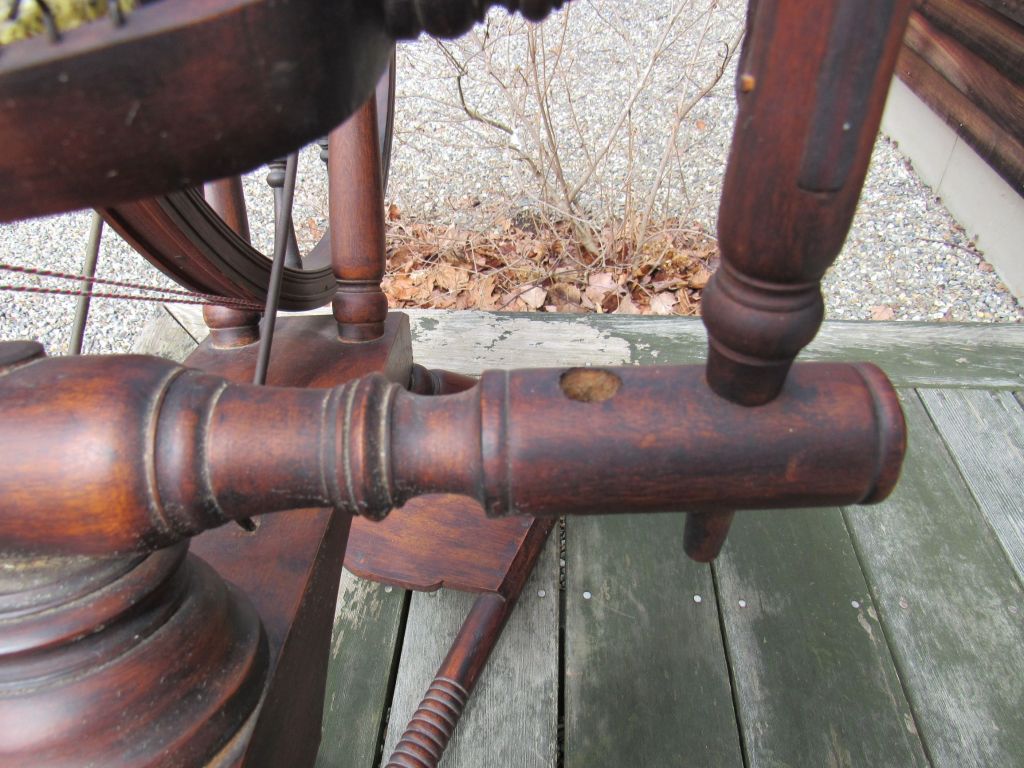
It has a graceful, low-to-the-ground stance, with scooped cutouts under both sides of the table.
The far side cutout has the remains of what looks like a paper label. The stain finish is uneven, so I wonder if the wheels were shipped here unfinished, to be stained or painted as the customer desired. Turnings, angles, and curves are juxtaposed into a happy web of parts.
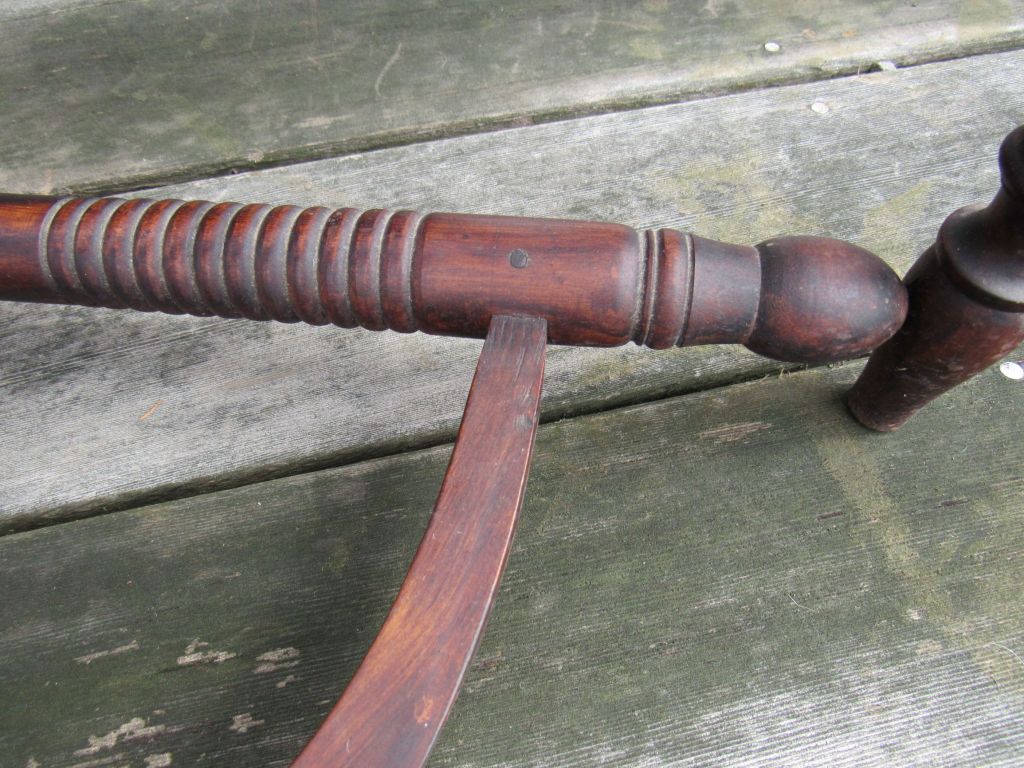
The large treadle has curves and swirls cut into the edges
and is attached with a swooping bar,
both features found in earlier Finnish wheels.
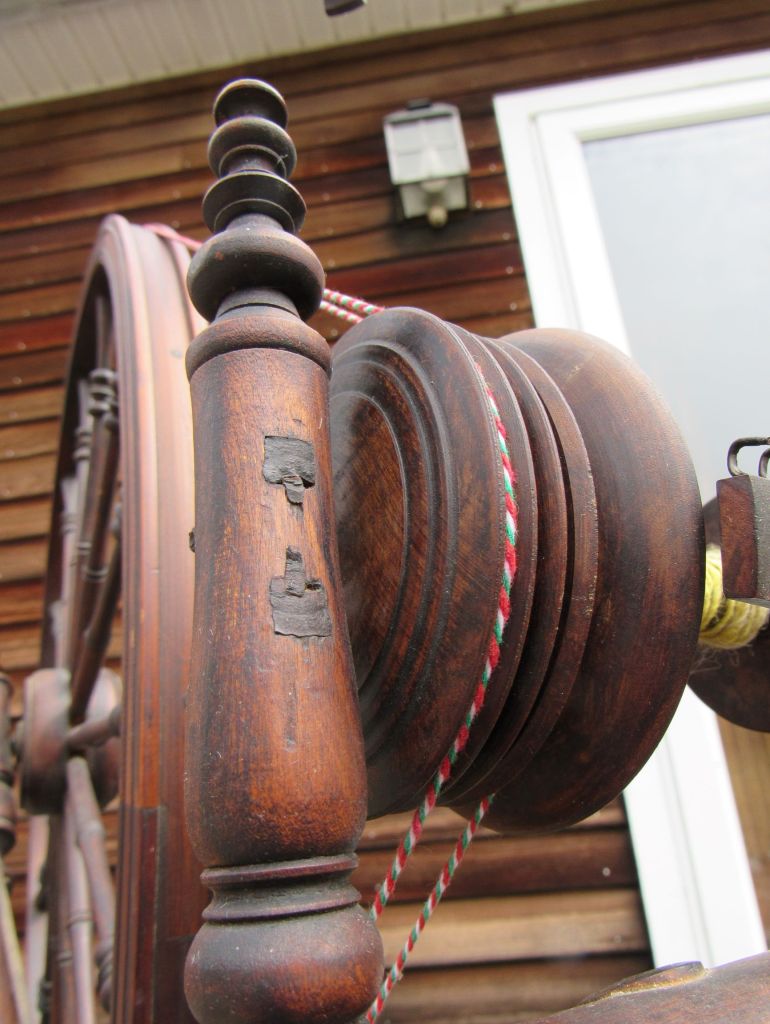
The turnings on the maidens and spokes are harmonious and eye-catching.
The spokes are pegged through the drive wheel rim, which has a wide single groove for the drive band.
The drive wheel is constructed of six joined pieces with radial edges.
The uprights have deep cuts for the axle,
capped with decorative pegged inserts on both sides.
Thick guy wires run from table to uprights—again a characteristic of some older Finnish wheels.
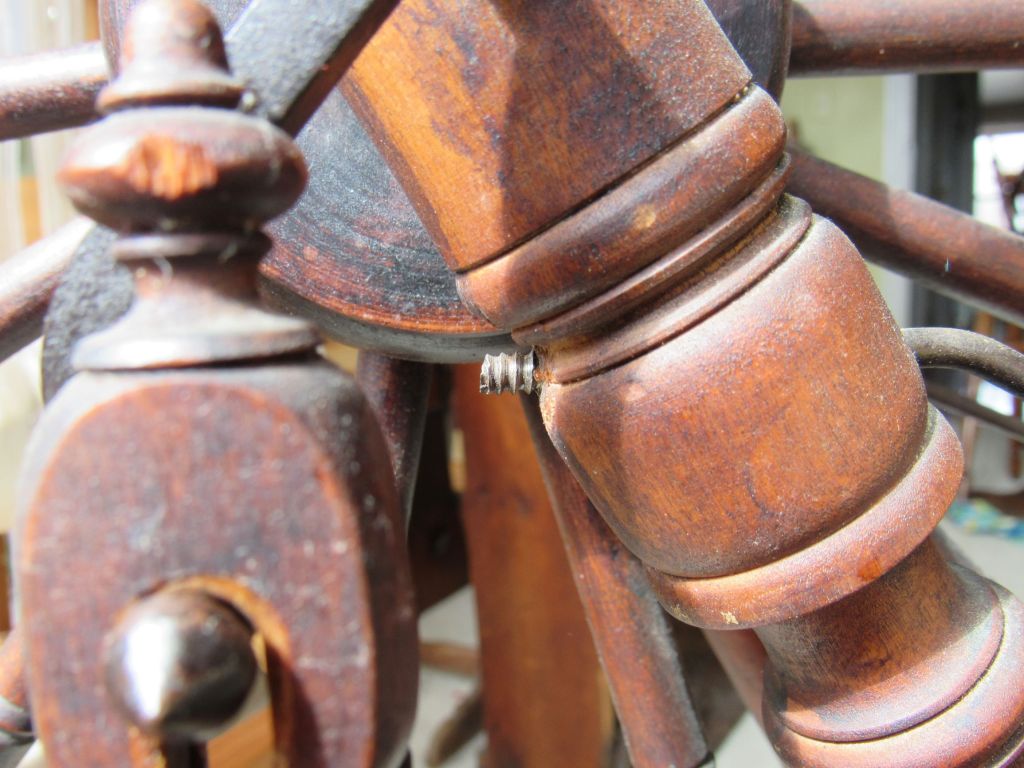
The upright ends are threaded.
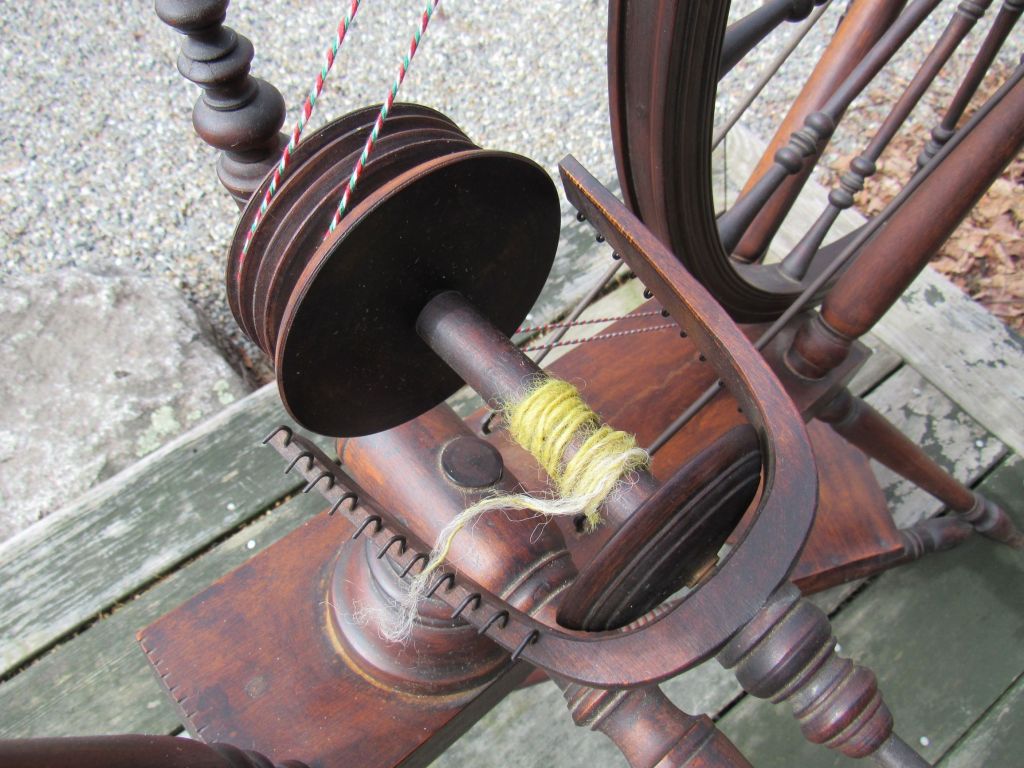
One of the most interesting features of this spinning wheel is that it is designed to accommodate two different sized flyer assemblies.
Some Scandinavian wheels accomplish this by having two-sided leather bearings, which can hold different sized flyers on either side of the maidens. Others have a spinner-side maiden that slides back and forth on the mother-of-all, so that shorter and longer flyer assemblies can be switched out. This design is a little different.
There are two holes on top of each other in the spinner-side leather bearing and two looped bearings on the far side.
The leathers are sheared flush with the maidens in the back and the double-holed one has two small wooden pegs securing it through the side of the maiden.
There is an extra hole in the mother-of-all so that the spinner-side maiden can be moved closer to the other maiden.
That maiden has a small, easily removable peg in the bottom.
This design allows the spinner to readily change from a large bobbin and flyer assembly to a smaller one. My wheel came with only one flyer. It is humongous.
I cannot imagine spinning flax on it, so I am assuming that the large flyer was intended for wool spinning and a smaller one for flax spinning. It is also possible that the larger flyer assembly was used for plying. Whatever the intent, it is a nice, ingenious set-up.
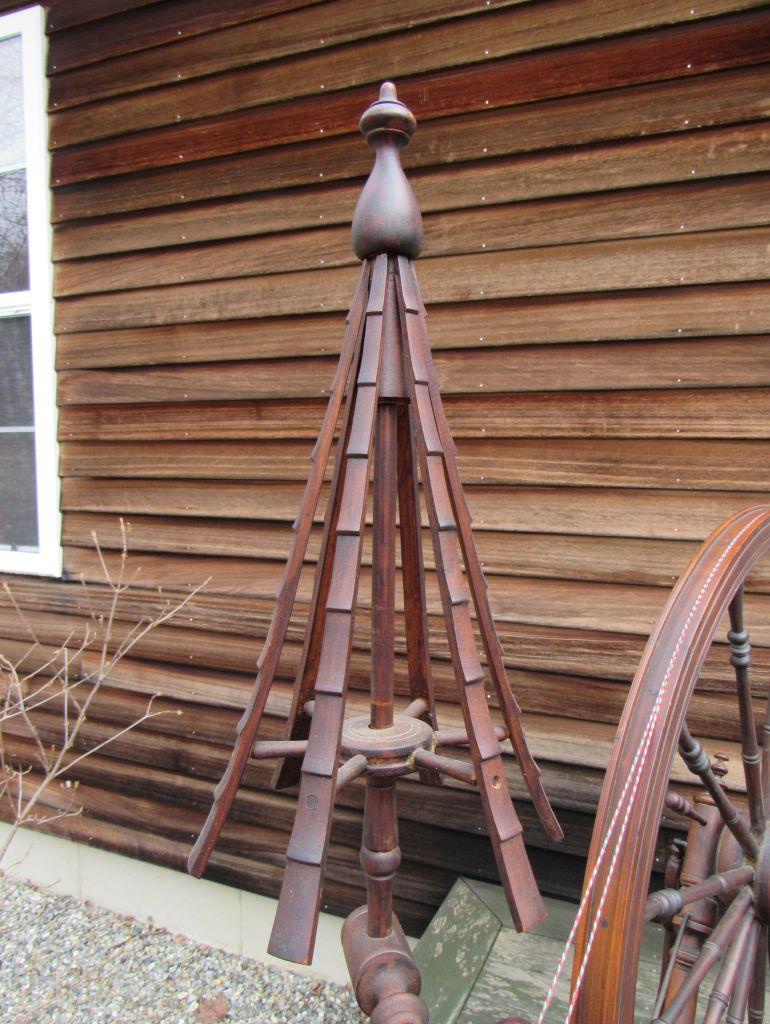
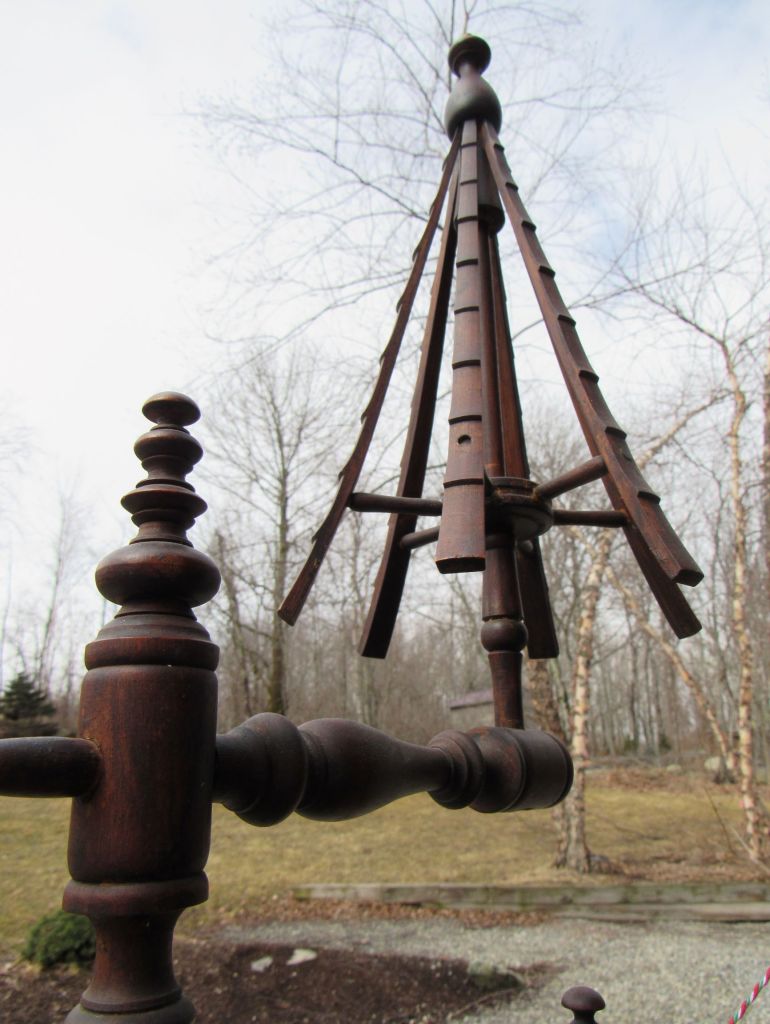
The crowning touch, of course, is the distaff. It tops the wheel like a perfect Christmas tree.
The wheel is just so over-the-top pretty, when I brought it home I was little apprehensive about how it would spin. I knew nothing about the maker then, so feared it might have been made more for decoration than for spinning. It only took a few treadles, however, to realize that this wheel was a true Finnish production wheel, designed to spin with ease and speed.
It is pure pleasure to look at and to use. Thank you Hannes.
And great thanks–kiitos–to Marja and Sauli. I apologize if I muddled any of the details in translation.
Update, March 23, 2022:
I learned a little more from Marja about the Rantilas. She told me that Hannes Rantila won a First Prize for his wheels at the 1922 Exhibition in Tampere, Finland. I found a piece describing the Tampere Exhibition: “Plans had also been made to organise the 12th general agricultural fair in Tampere in 1922. Eventually that fair merged with the third national fair, albeit in a truncated form. The architectural design for the fair was commissioned from architect Alvar Aalto. The fair exhibited mainly products from the wood industry and the home industry as well as the machining industry. The audience could also see competitions related to craftsmanship and exhibitions ranging from carving a shaft of an axe to patching a pair of mittens. The stands of Tampere businesses received much attention.” (for citation, see below). After Hannes’ win at Tampere, he received an order from a businessman (arranged through a brother in Kuopio) for 10 spinning wheels to be sent to America. After sending the first shipment, more were ordered and Hannes eventually sent a total of 25 wheels. I believe Hannes also sent some wheels to Germany.
Also interesting is the family name. From what I understand, in the early- and mid-19th century, surnames were fluid, even for an individual, and Finnish families did not have fixed family surnames. So, each individual in a family might have a different surname—some patronymic, some based on a trade, or place. When Sakari, Marja’s great-grandfather, started making wheels in 1845, believing a craftsman should have a fixed surname, he chose “Rantila” based on a shortened version of the name of the beach estate where he lived. It is an unusual surname and his wheel-making son and grandsons all kept it. As a result, these wheels can accurately be referred to as Rantila wheels.
The quote above is from: Hietala, Marjatta; Kaarninen, Mervi, “The foundation of an information city : education and culture in the development of Tampere,” (Tampere University Press, 2005).




















 Exquisite Machinery