
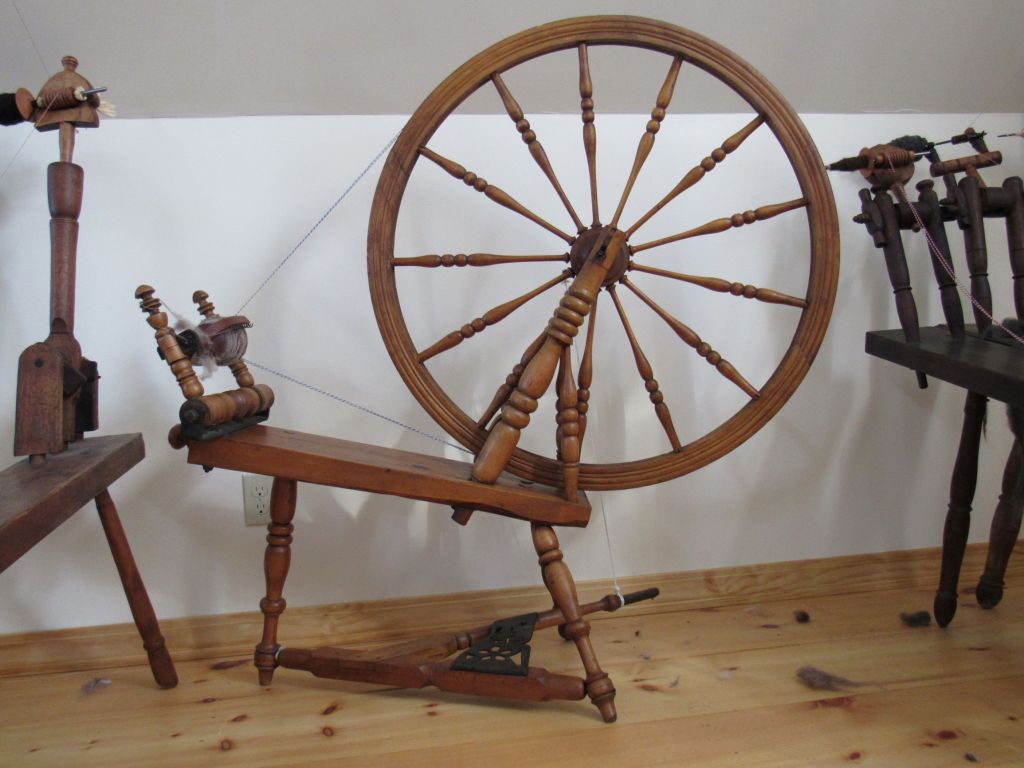
Fleur is an extraordinary Quebec wheel. She is a formidable presence—large and golden, with eye-catching curves.

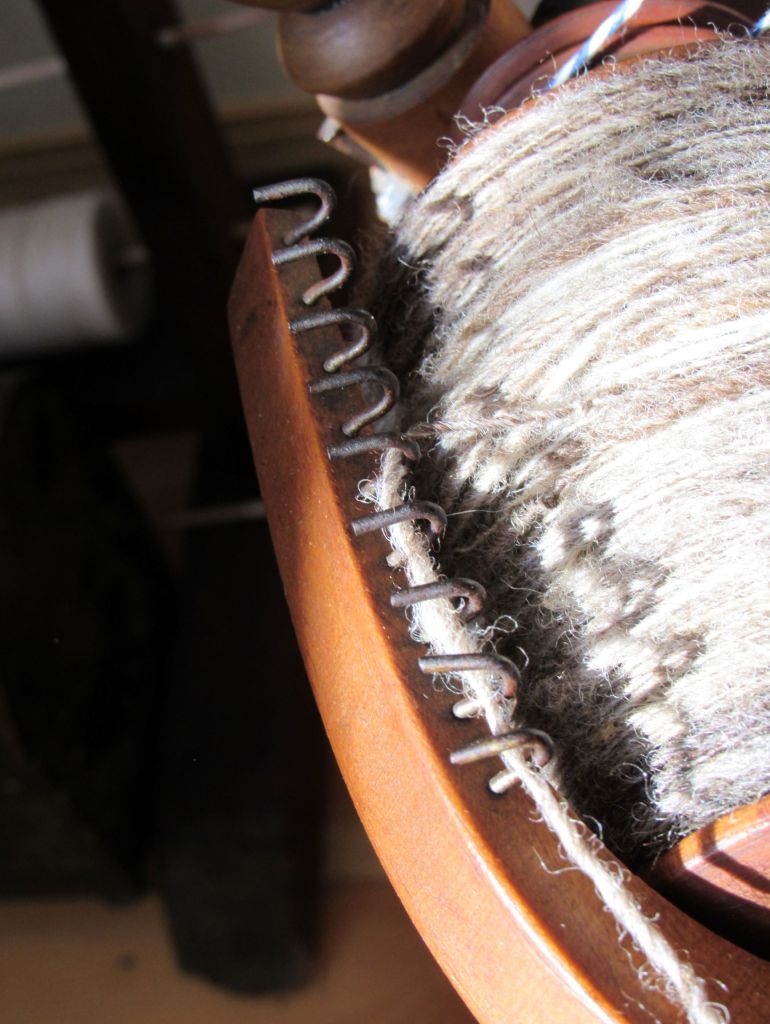
She looks little used, with no wear marks and smooth hooks,
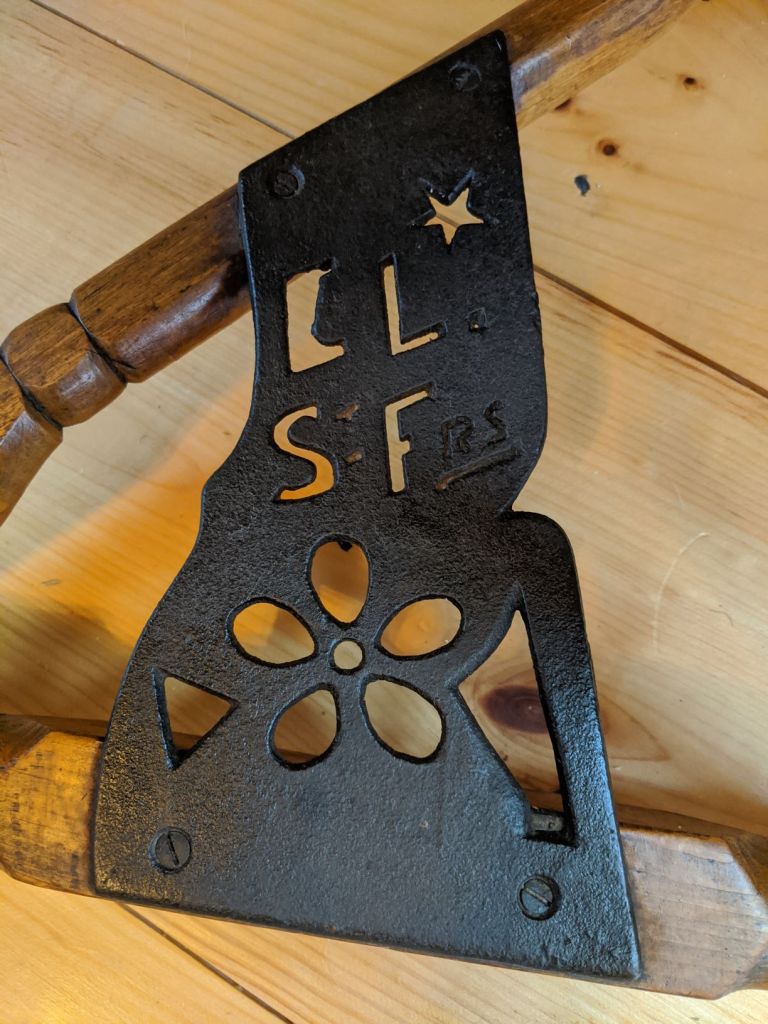
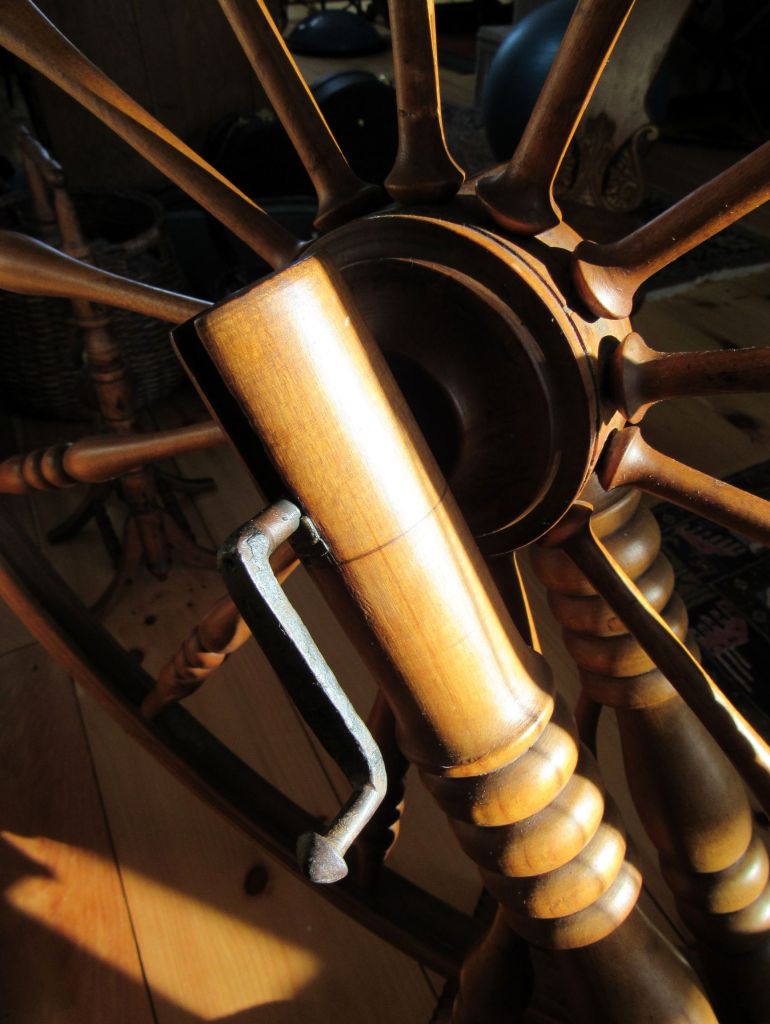
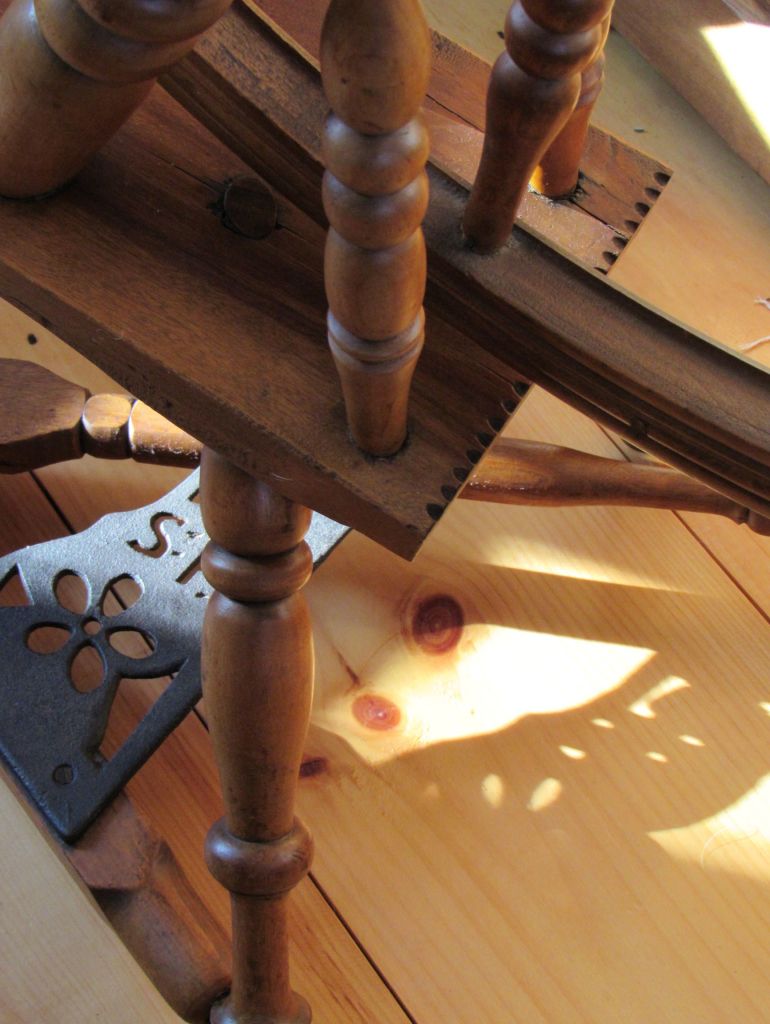
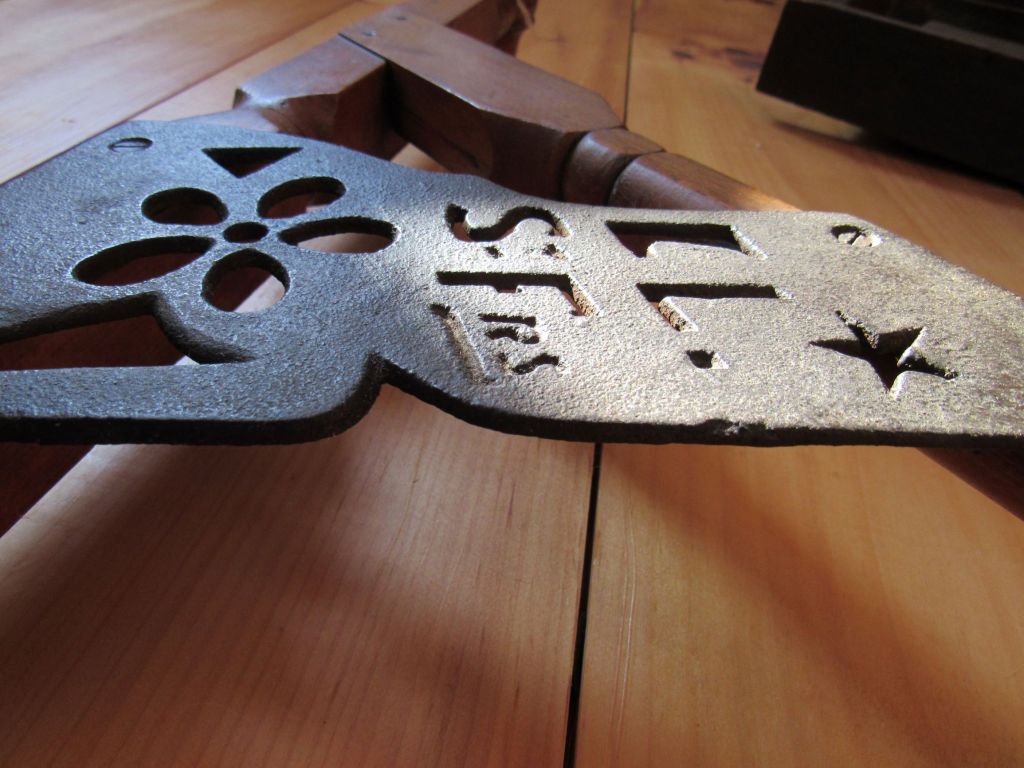
and is probably the best spinner in all of my flock of wheels. Her treadle is her most unusual feature. It is metal, with whimsical cut outs that include a flower, star, and “EL. St. Frs.”
A sister wheel, owned by Linda Martin, was featured in Issue #89 of The Spinning Wheel Sleuth newsletter (July 2015). The article was written by Martin and Caroline Foty, describing Martin’s wheel and Foty’s research into the wheel maker.
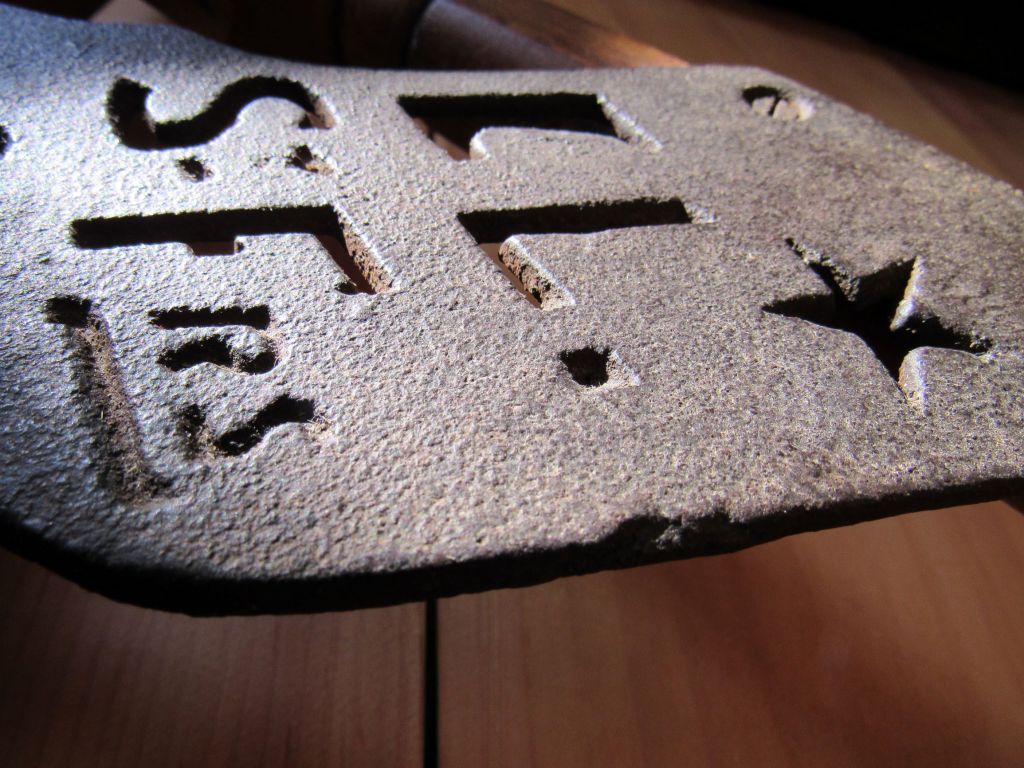
Working from the letters on the treadle—in effect a maker’s mark—Foty concluded that the wheel likely was made by Elie Laporte from St. Francois-du-Lac, Yamaska, Quebec.
Laporte’s village, St. Francois-du-Lac, is located on the St. Francois river, near where it meets Lac St. Pierre, a wide portion of the St. Lawrence River. It was founded as French Jesuit mission for the purpose of converting the local Abenaki and other First Nations people to Catholicism. According to Foty’s research, Elie Laporte had native ancestry through his great grandmother.
During the colonial period in New England, St. Francis, as it was known there, was feared as a launching point for raids against colonial settlements and the place to which captives from those raids were brought to be adopted or ransomed. In 1759, during the French and Indian War, Roger’s Rangers attacked St. Francis, killing most of the inhabitants and burning it to the ground. It was eventually rebuilt and resettled.
Elie Laporte was born there in 1845, to a carpenter (menuisier) and wheel maker father, Pierre, and mother, Angele Gill (whose great-grandparents were from Massachusetts).
Elie had three daughters, one of whom, Hermelina, migrated to Lowell, likely to work in the mills, and married there. Laporte died in 1919.

Laporte’s wheels have a different look than other Quebec wheels of the era, with a thick, low slung table, and distinctive maidens.
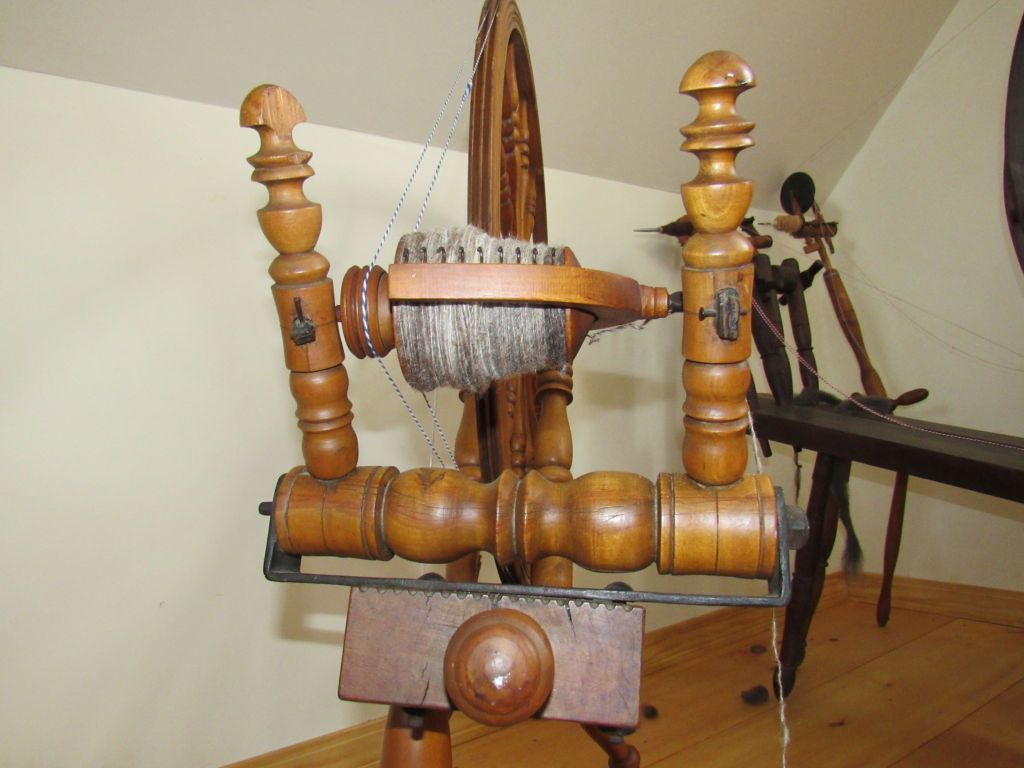
Interestingly, a wheel maker a generation earlier, Jean Baptiste Houle (1828-1884), from a neighboring town in Yamaska, made wheels with a similar profile, table and maidens. Houle marked his wheels with “JBH” on the end of the table.
Whether there was any working relationship between the two men is unknown at this point, but, at the very least, it seems likely that Houle’s wheels had some influence on Laporte’s style. If so, Laporte kicked things up a notch creating truly exquisite machines, with a personal touch of whimsy.
I became interested Laporte’s wheels because of their similarity to a group of very large Quebec wheels, affectionately referred to as Madame Maximes or Big Berthas (the subject of the next post). So, when a Laporte wheel came up for sale in Virginia on Facebook, I was over the moon.
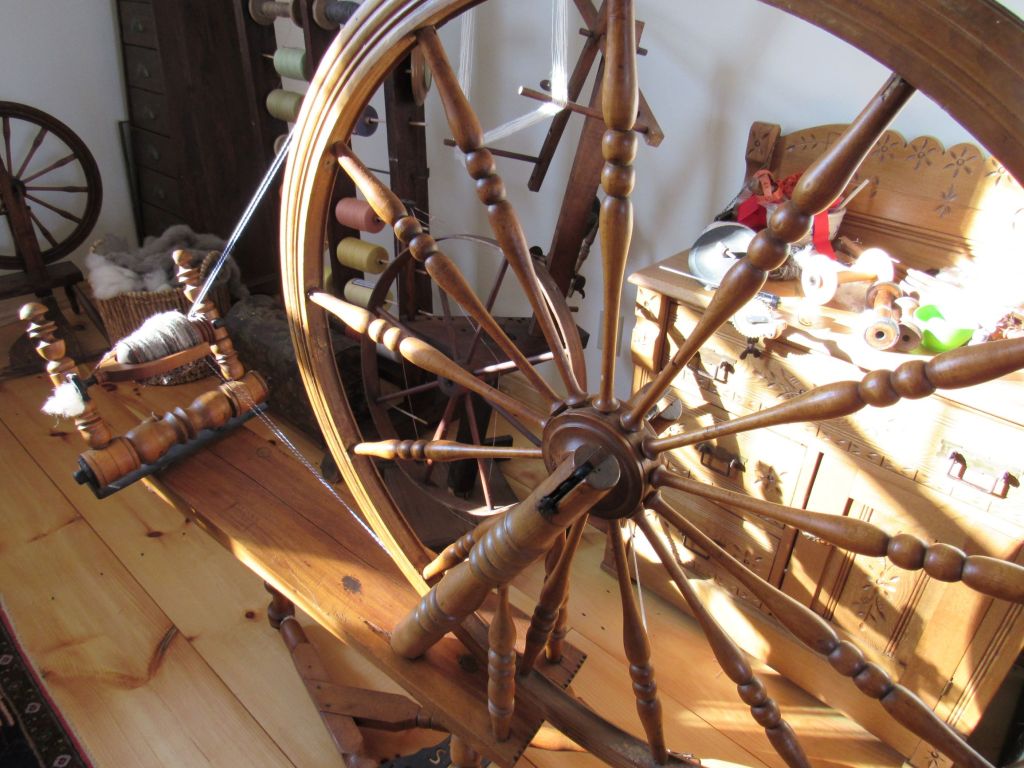
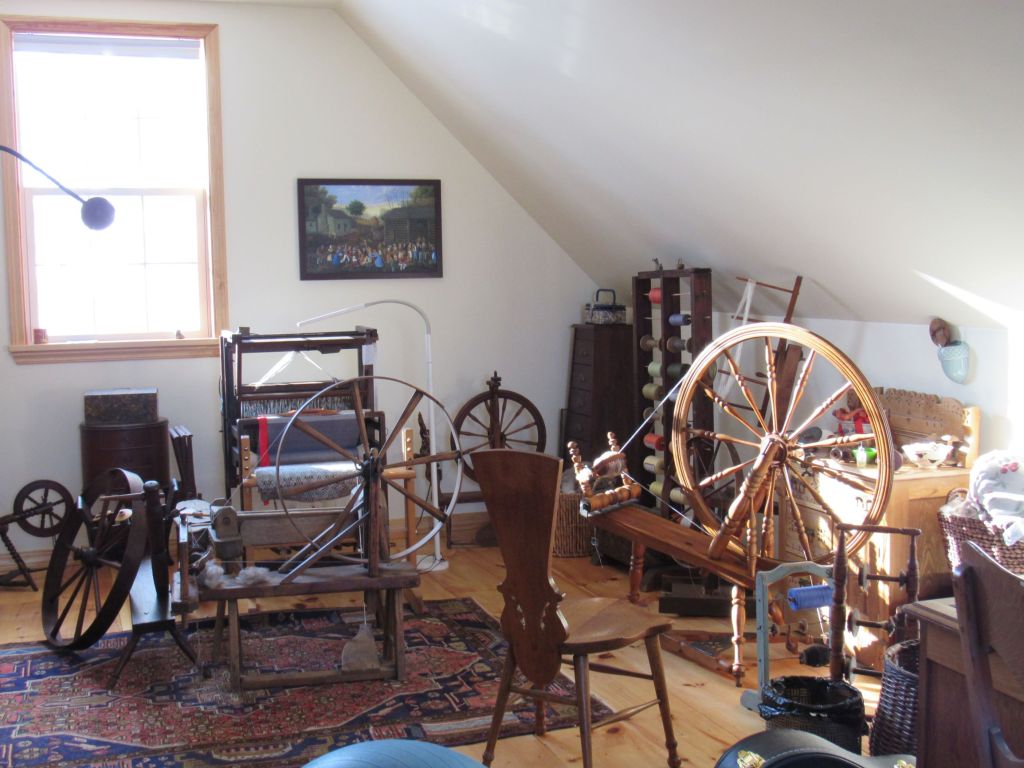
The seller and a wonderful wheel railroad volunteer met at Red Stone Glen in Pennsylvania and the wheel headed north to Maine. My first reaction when I picked it up was that it was huge, with a 34 inch diameter drive wheel, and 28 ½ inch long table. She makes the very large wheel in my last post, Zotique, seem almost petite, with a 30 inch diameter wheel and 23 inch long table, and dwarfs Patience, the Shaker wheel below.
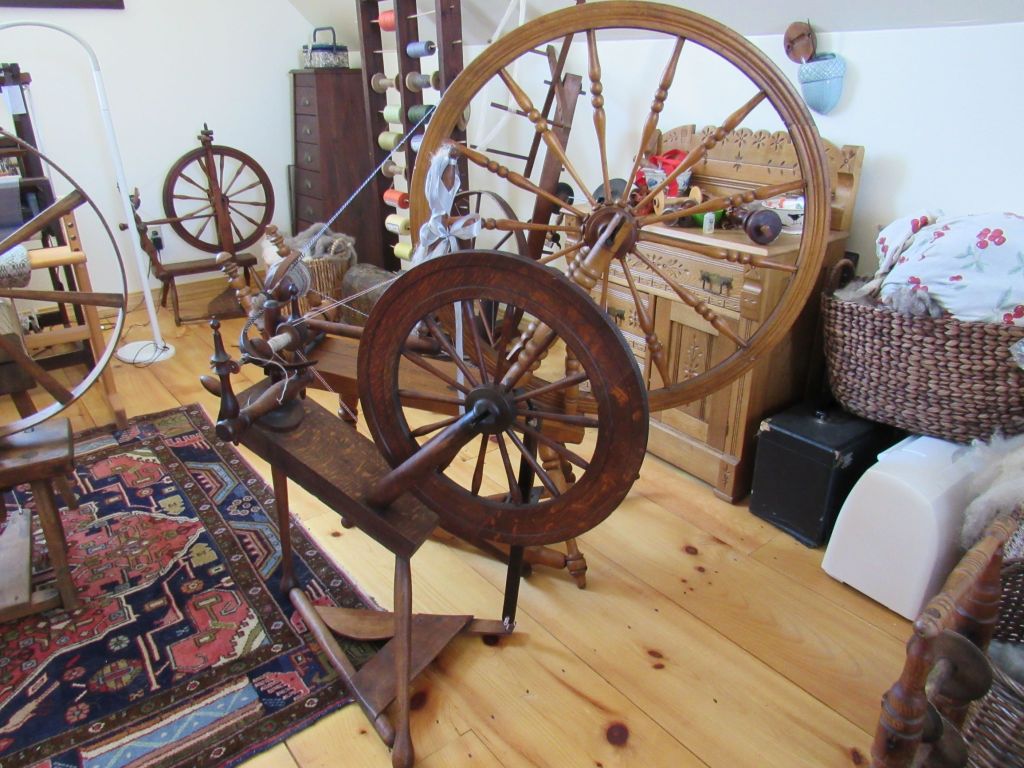
Fleur’s wood is very blonde, with some interesting reddish grain along the mother-of-all.
She lights up a room.
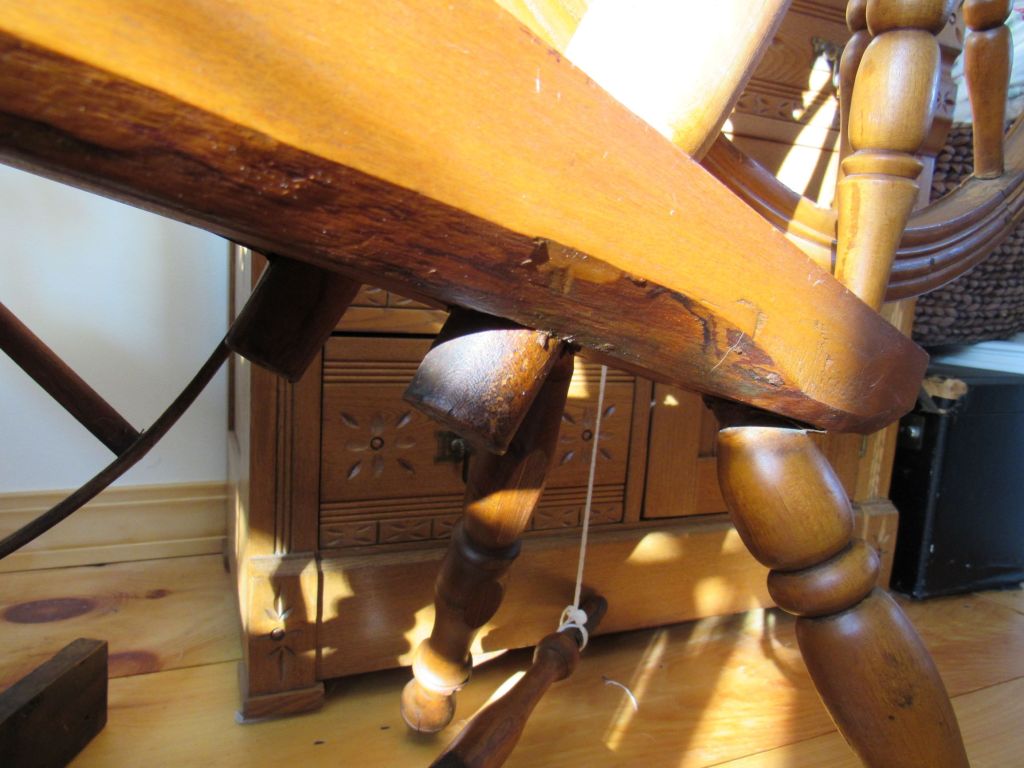
For all the careful workmanship on this wheel, there is evidence of practicality, as with so many Quebec wheels. The lumber used for the table has a rough edge, just stripped of bark and smoothed a little.
Many of the nails holding the spokes are loose and some of the spokes have been moved.
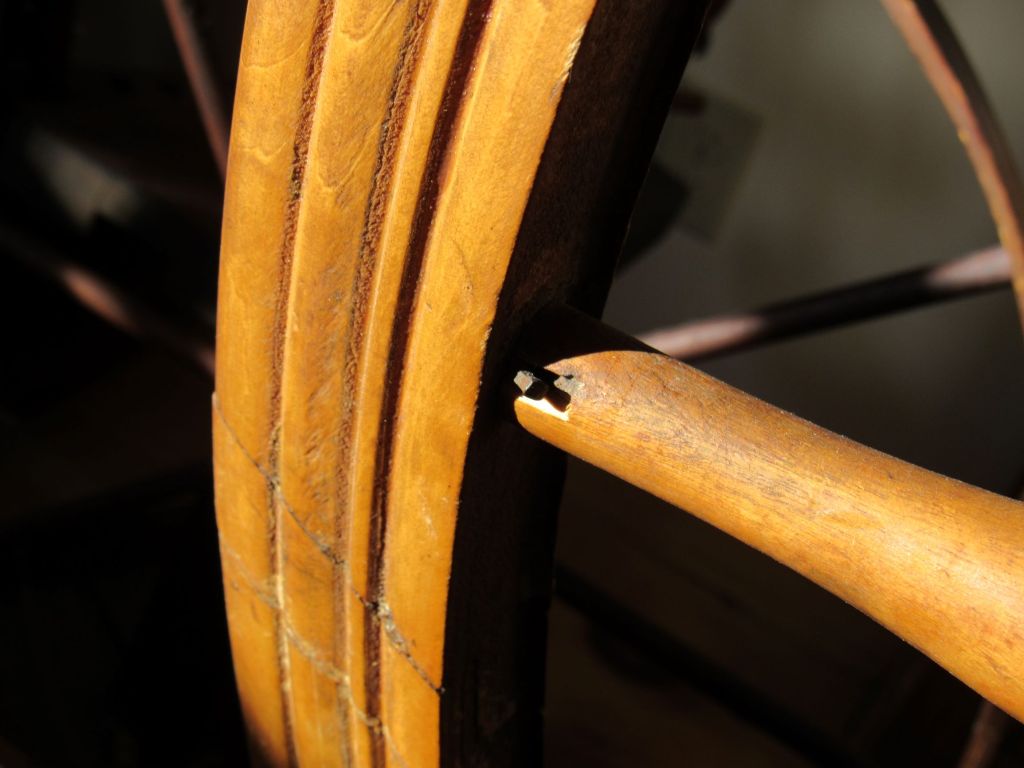
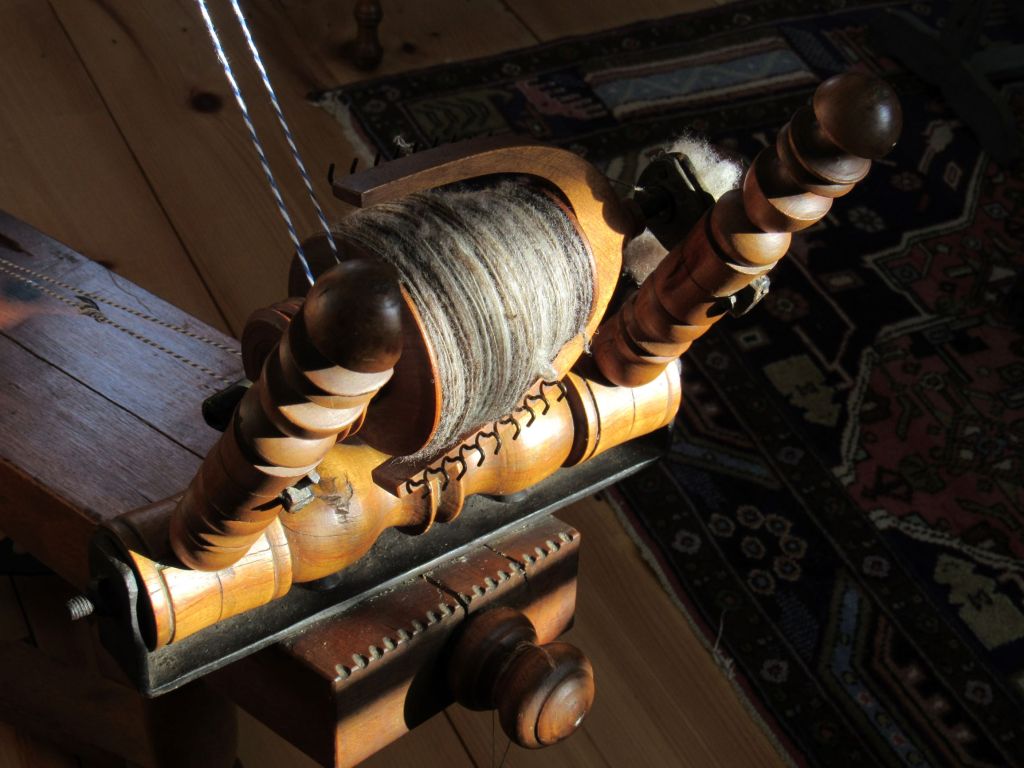
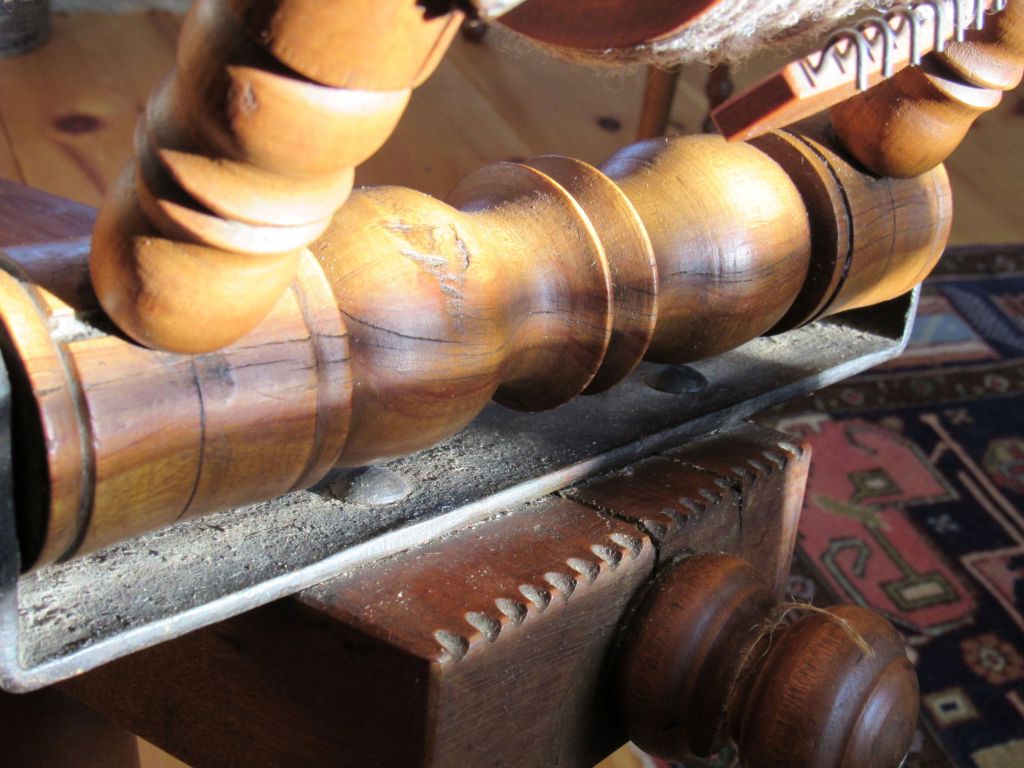
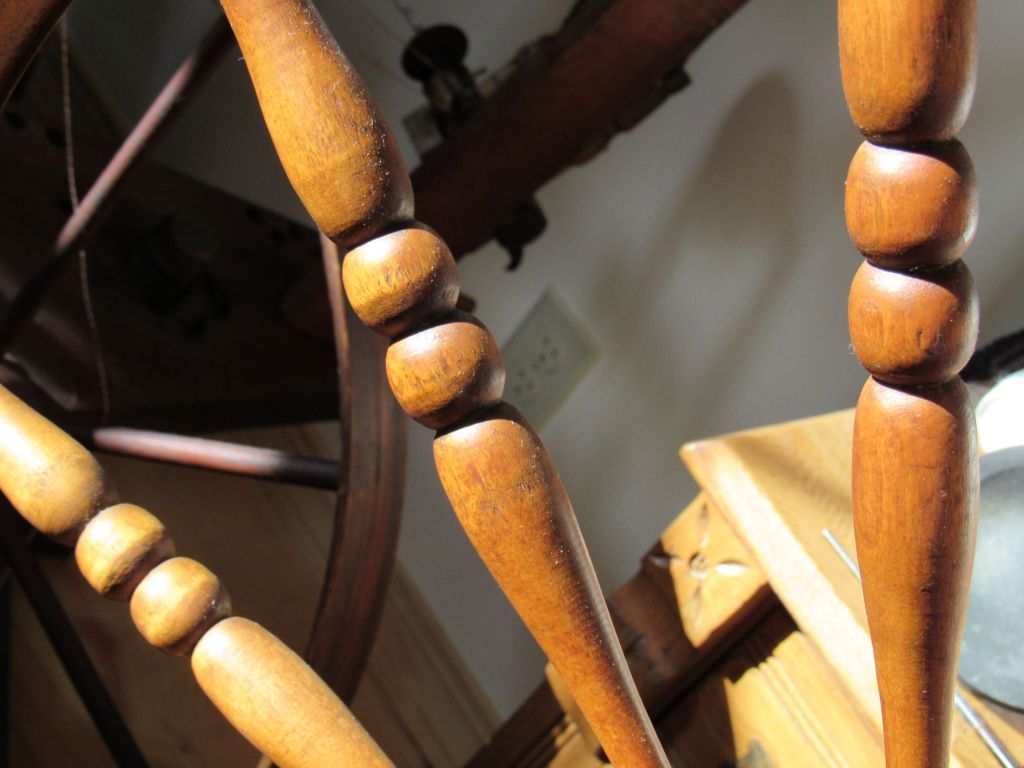
The turnings are very distinctive, with fat feet,
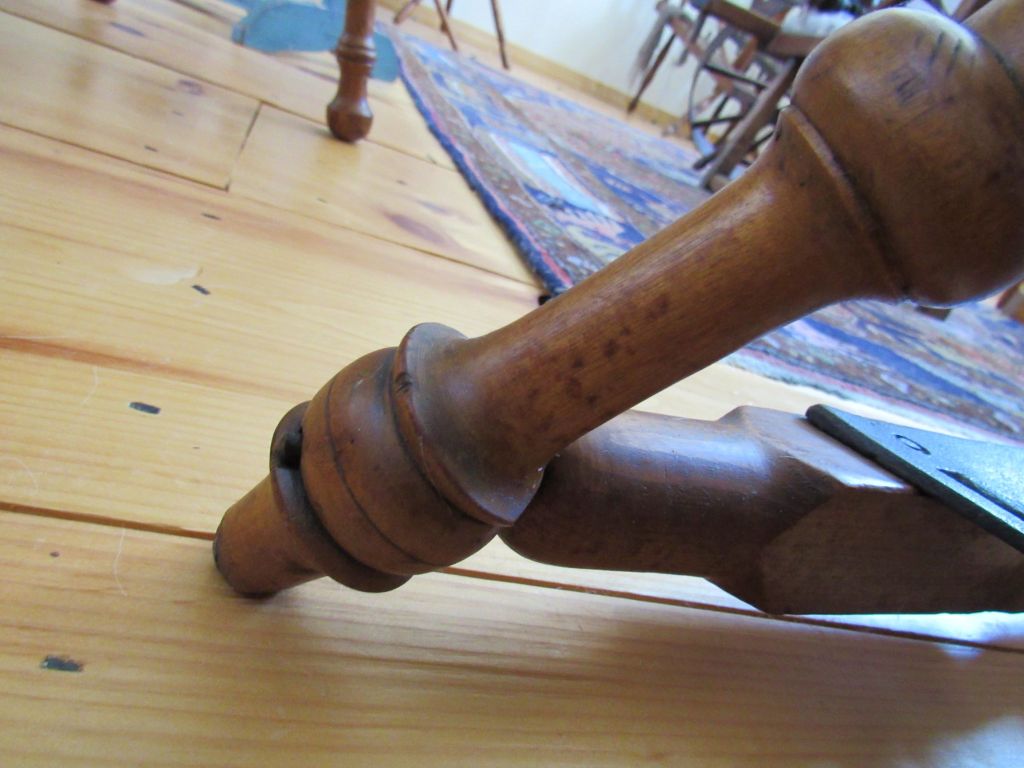
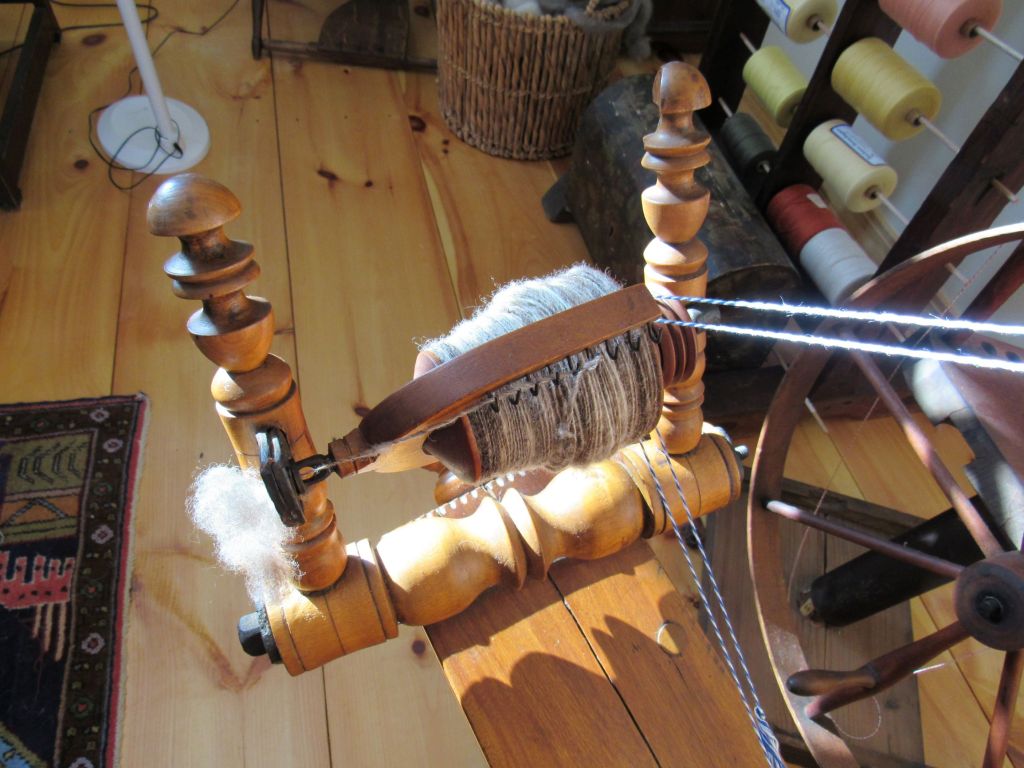
and unusual maidens.
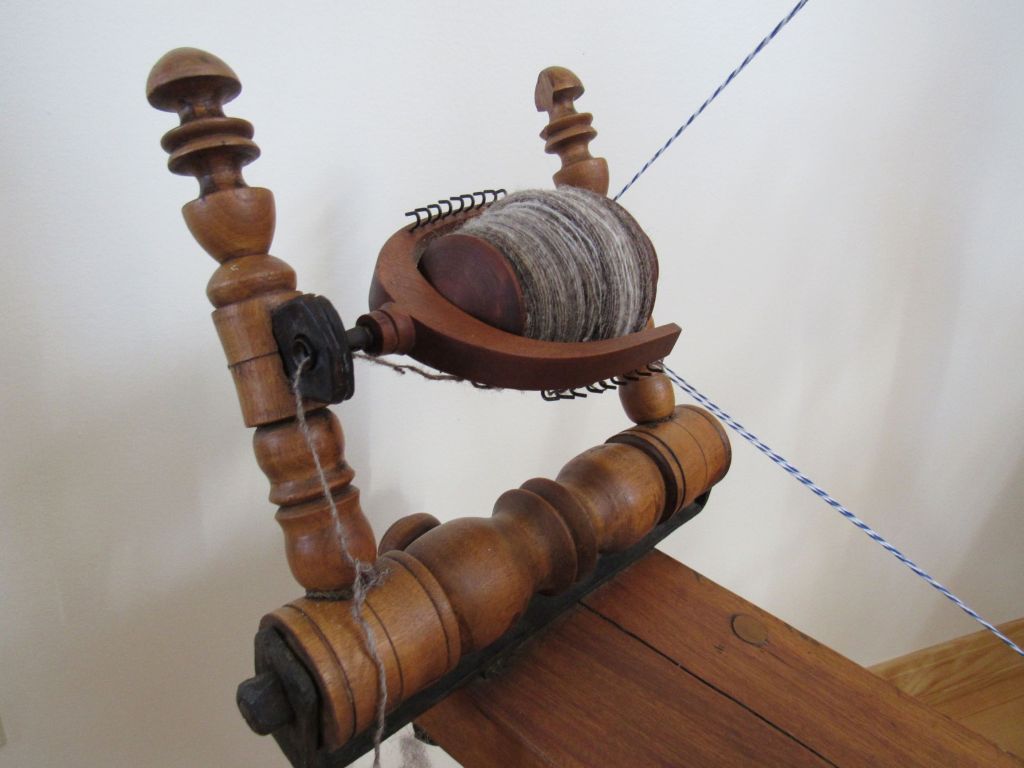
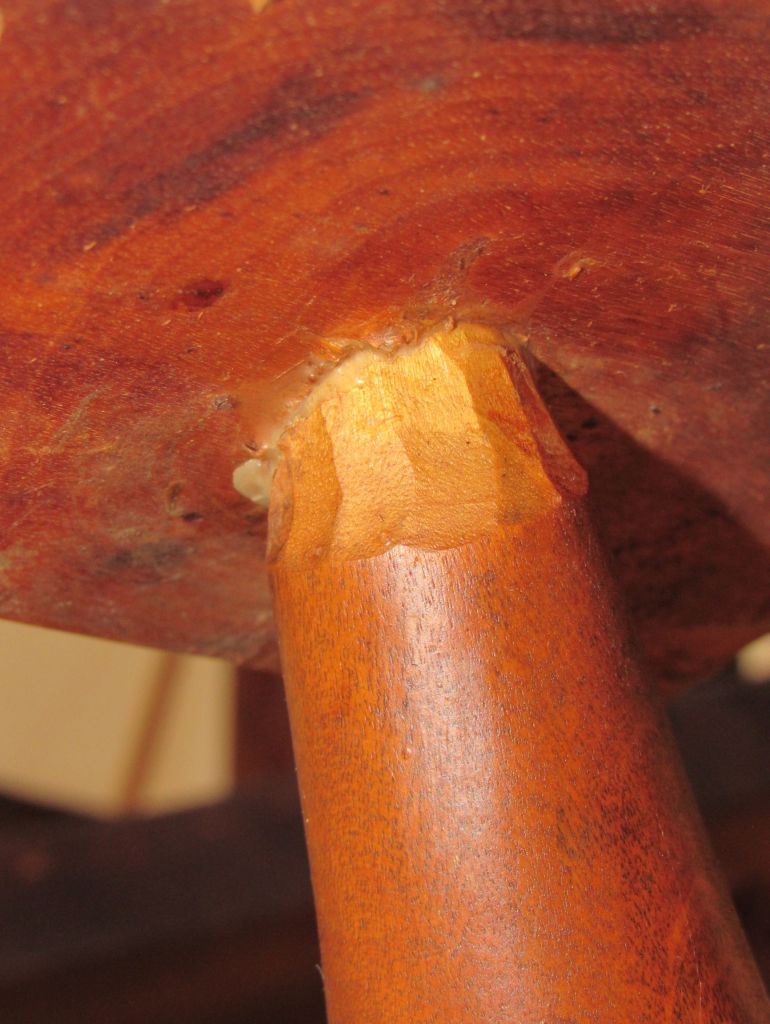
The non-spinner side leg on mine does not match the others, probably a replacement that was whittled down to fit into the table.
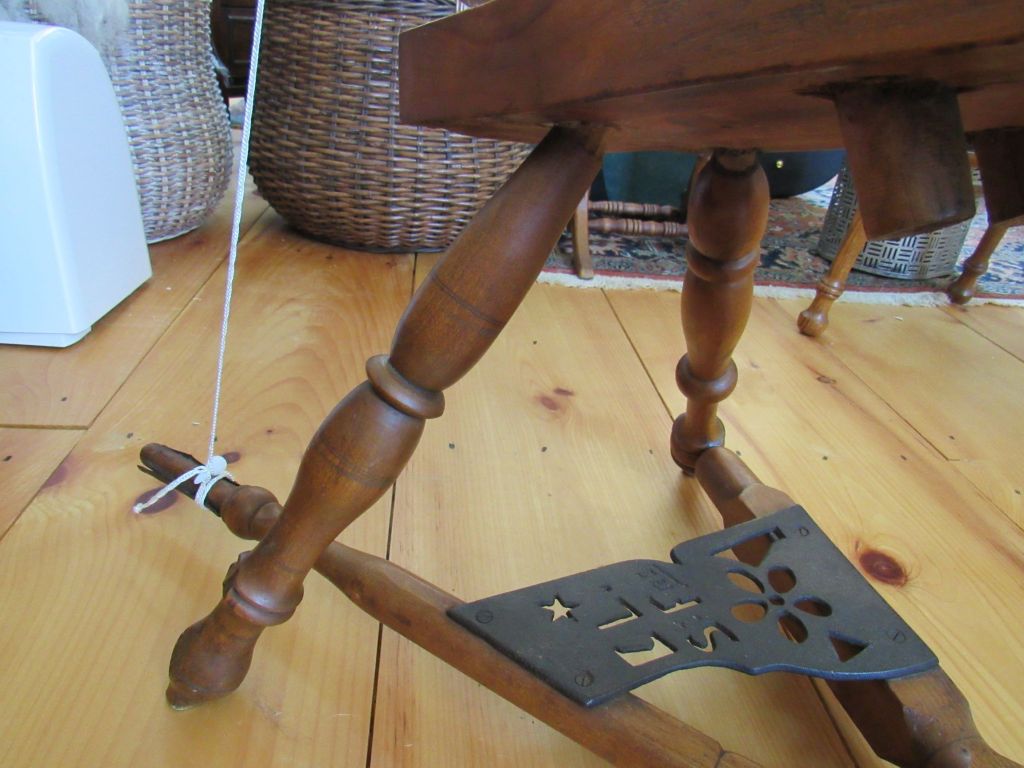
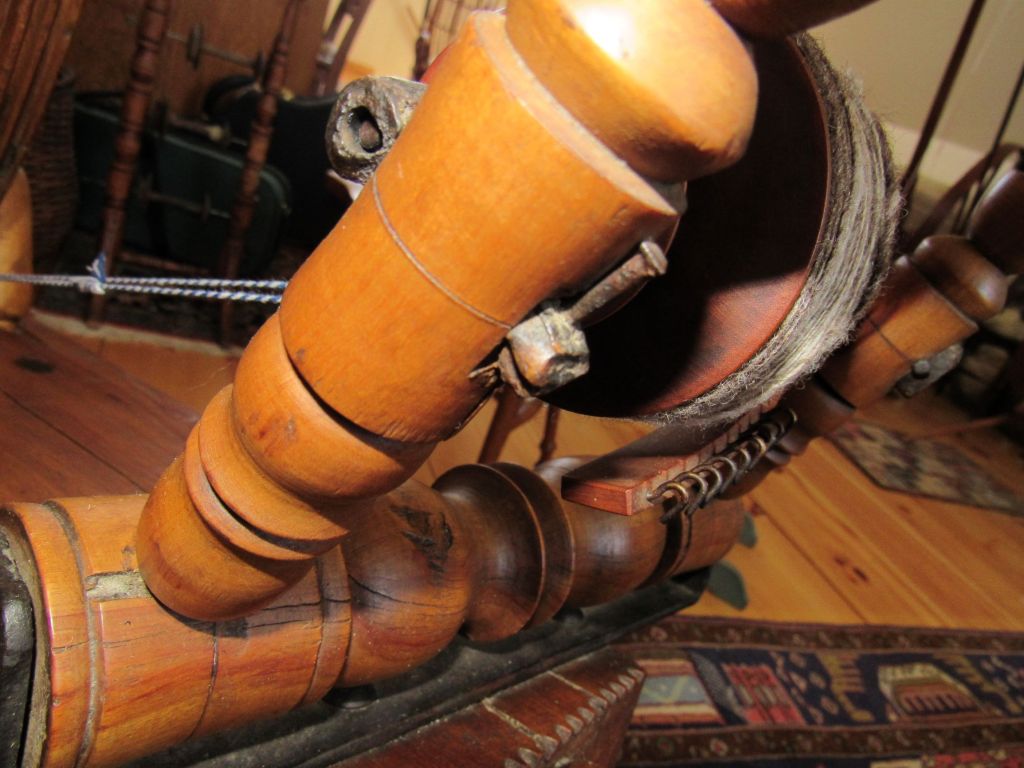
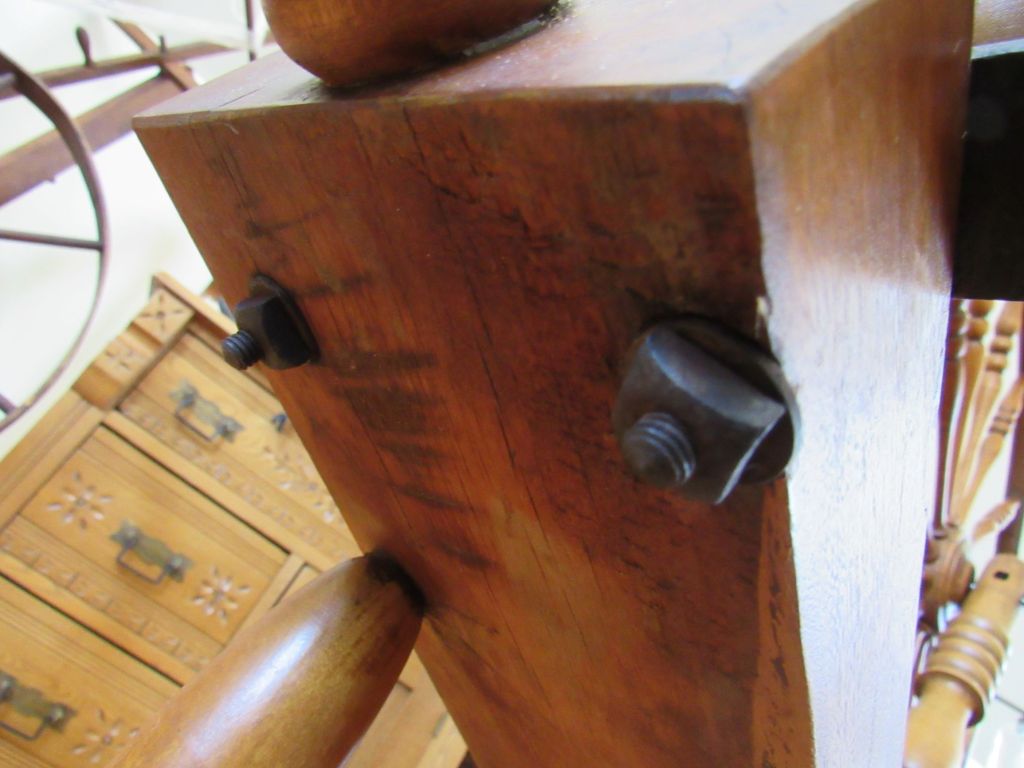
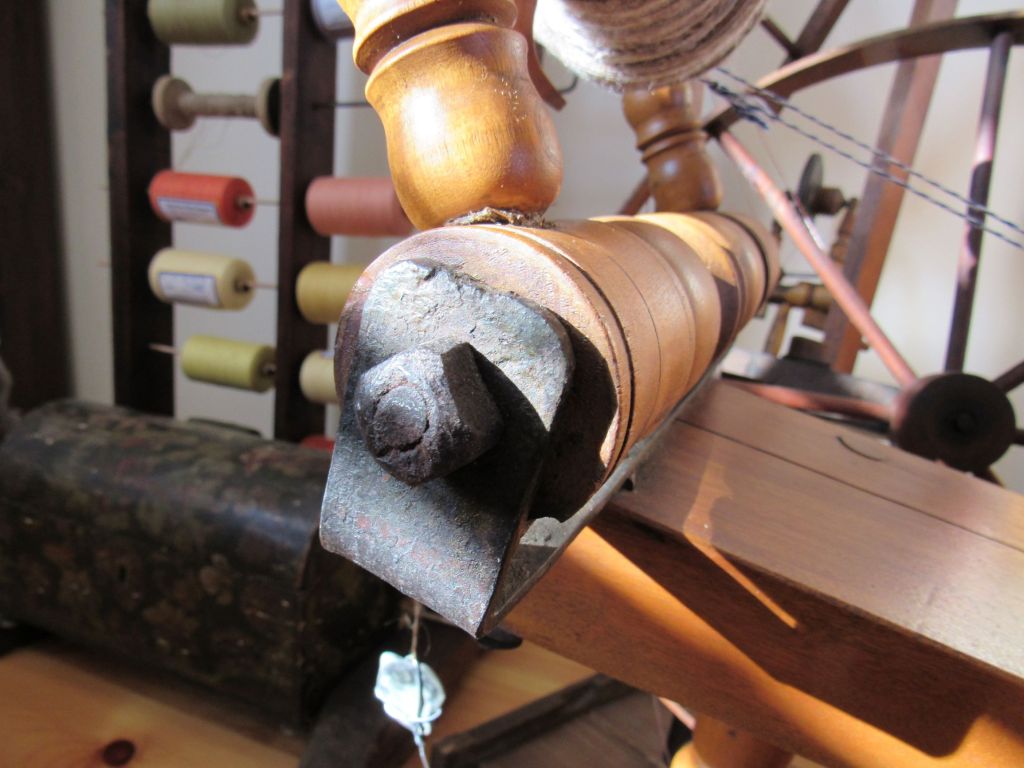
The tilt tension system has a simple flat metal bar attached—at an angle—to the table
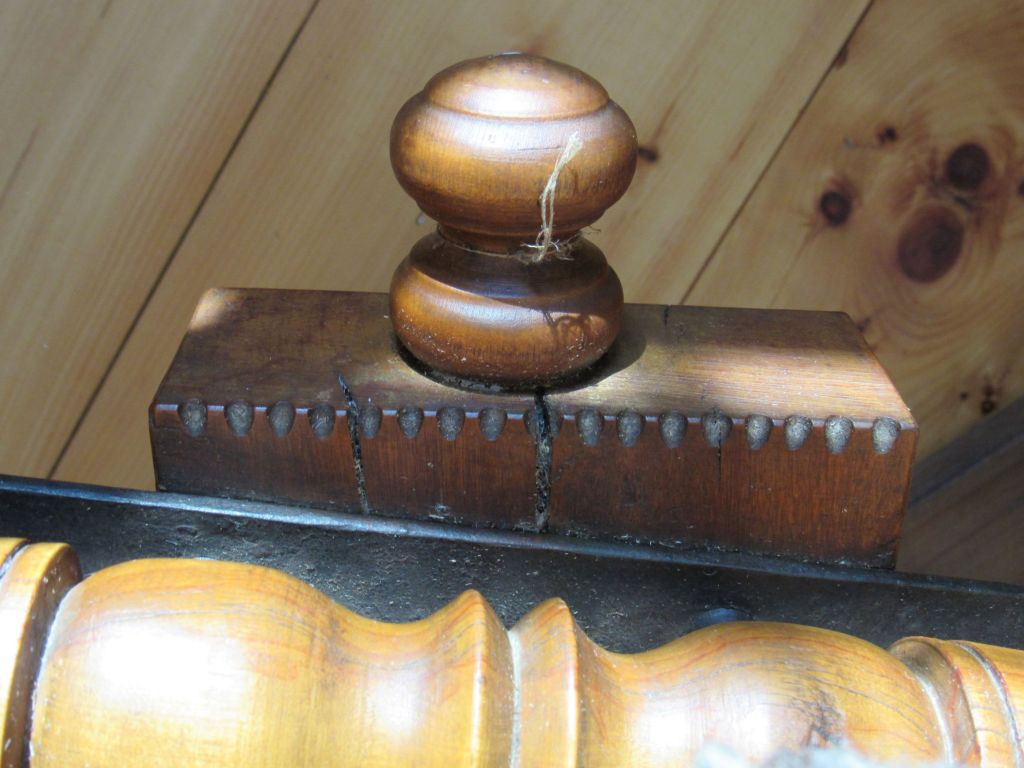
with two bolts underneath
and adjusted with nuts at the end of the mother-of-all.
The orifice is smooth.
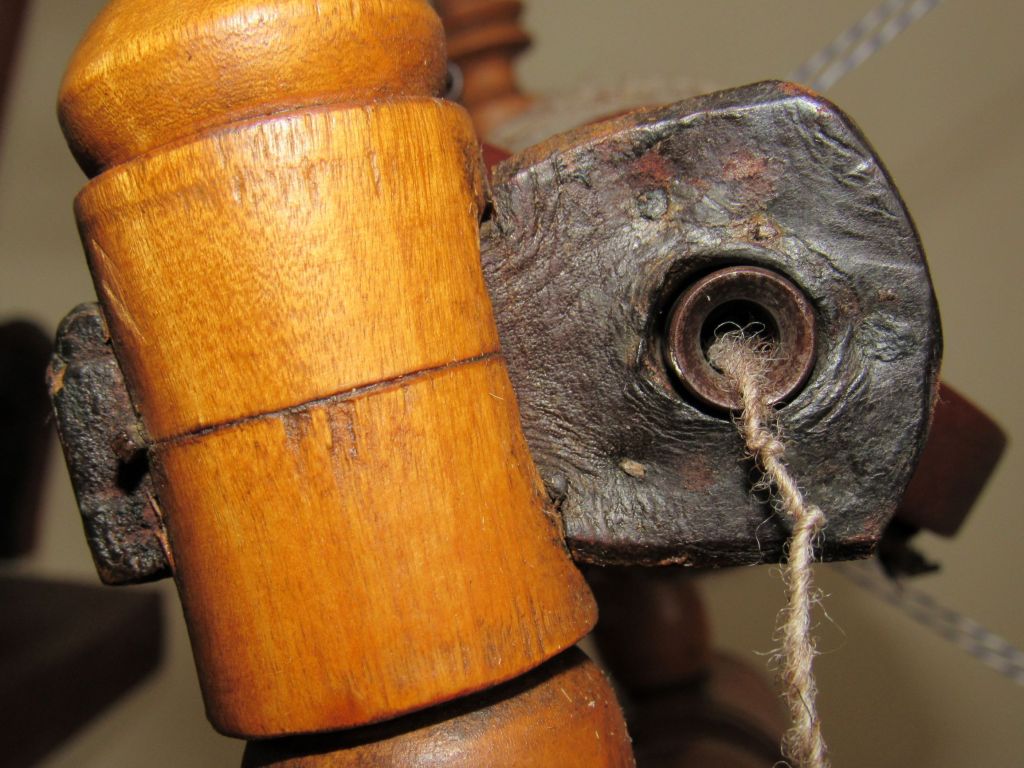
Each upright has a secondary support and the axle sits in deep cuts in the uprights.
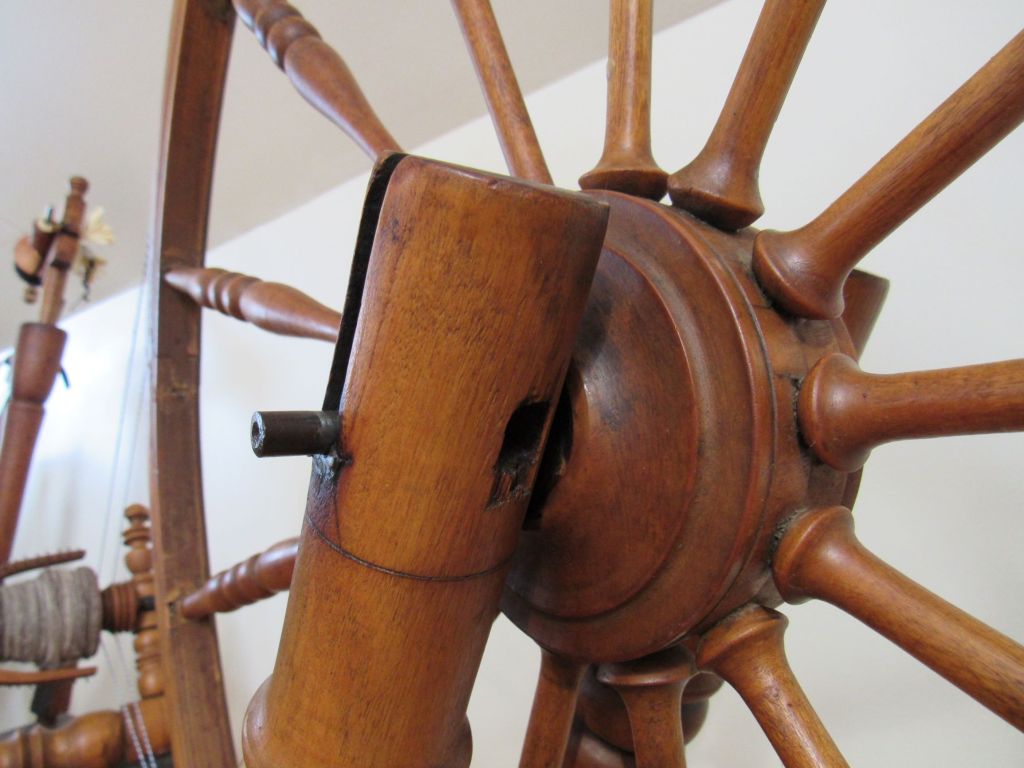
The drive wheel rim is narrow
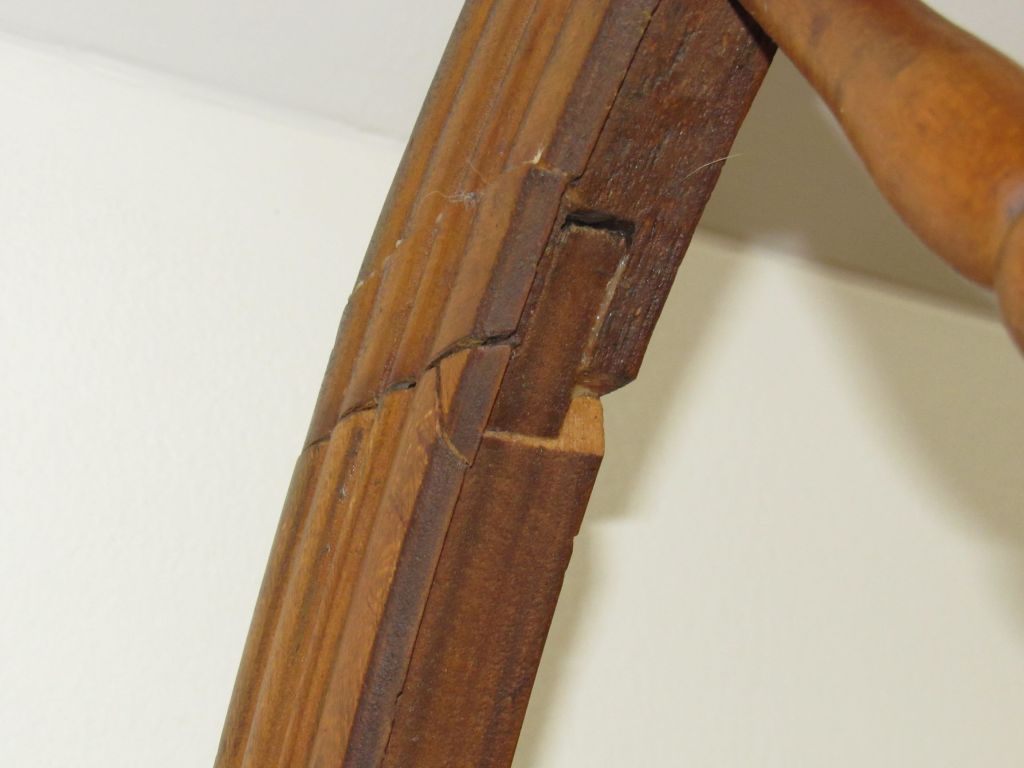
and the rim joins have a jigsaw puzzle look.
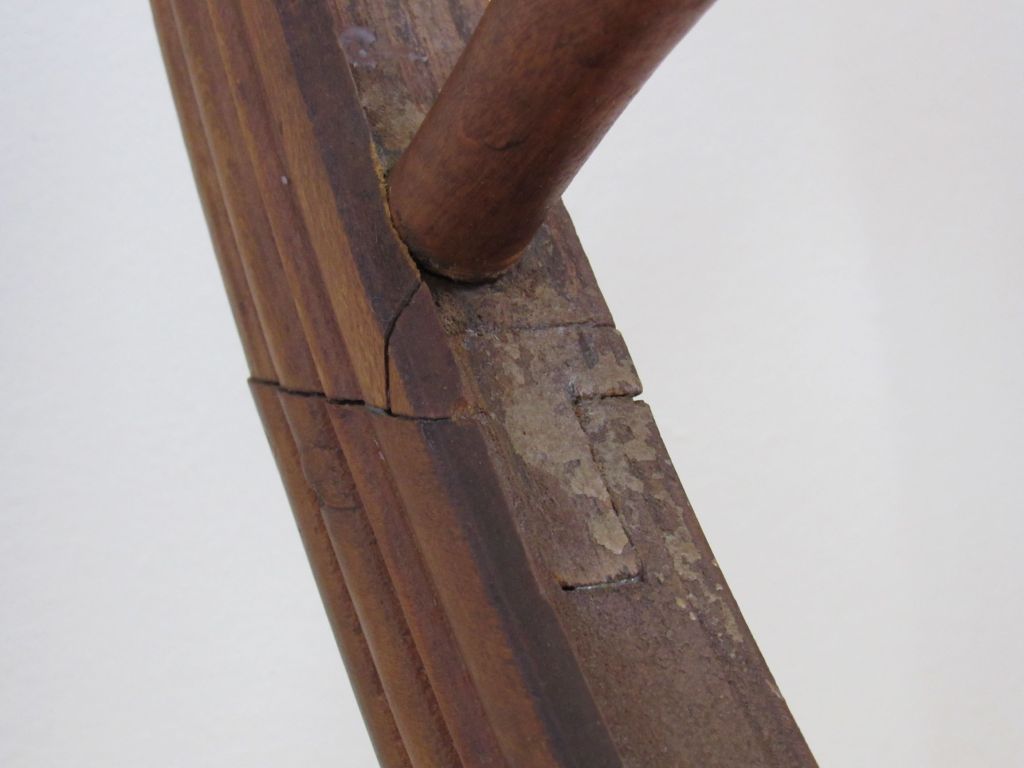
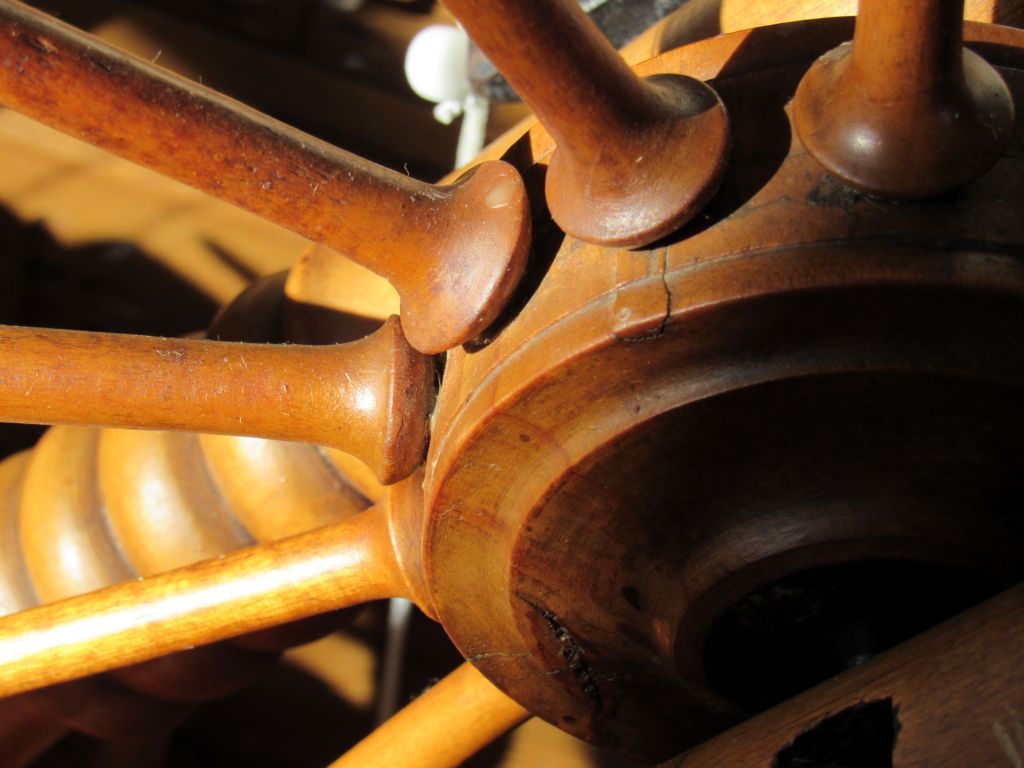
The spokes are lovely,
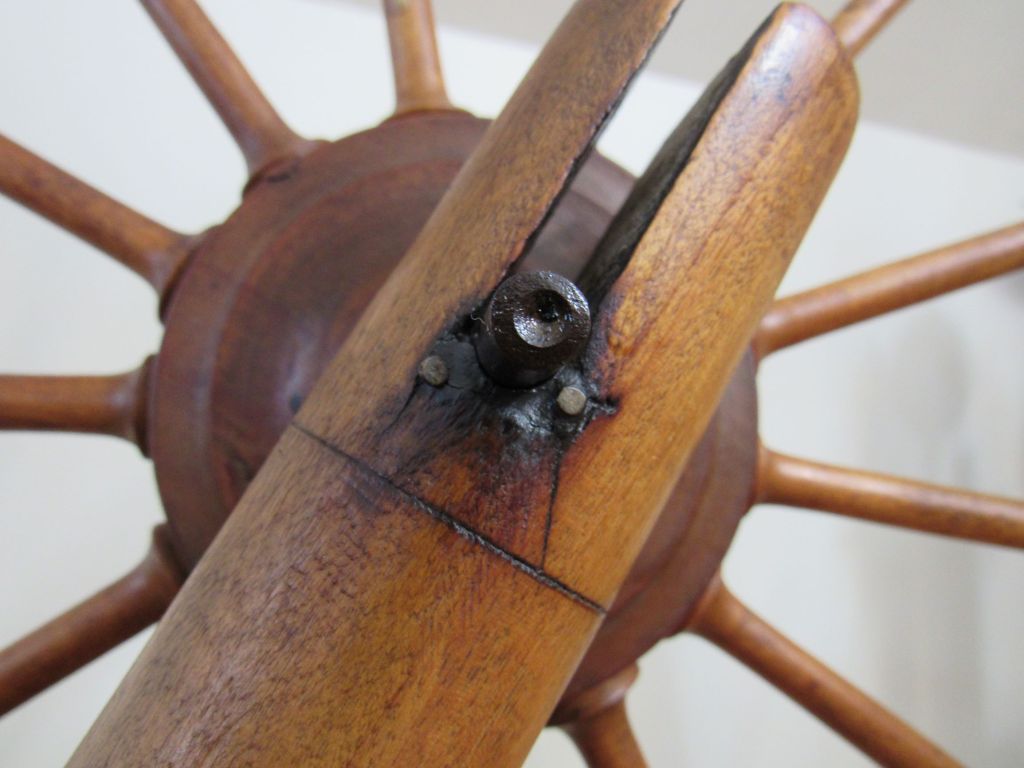
joining the hub like upside-down blossoms.
The rounded treadle support bar extends quite far past the legs,
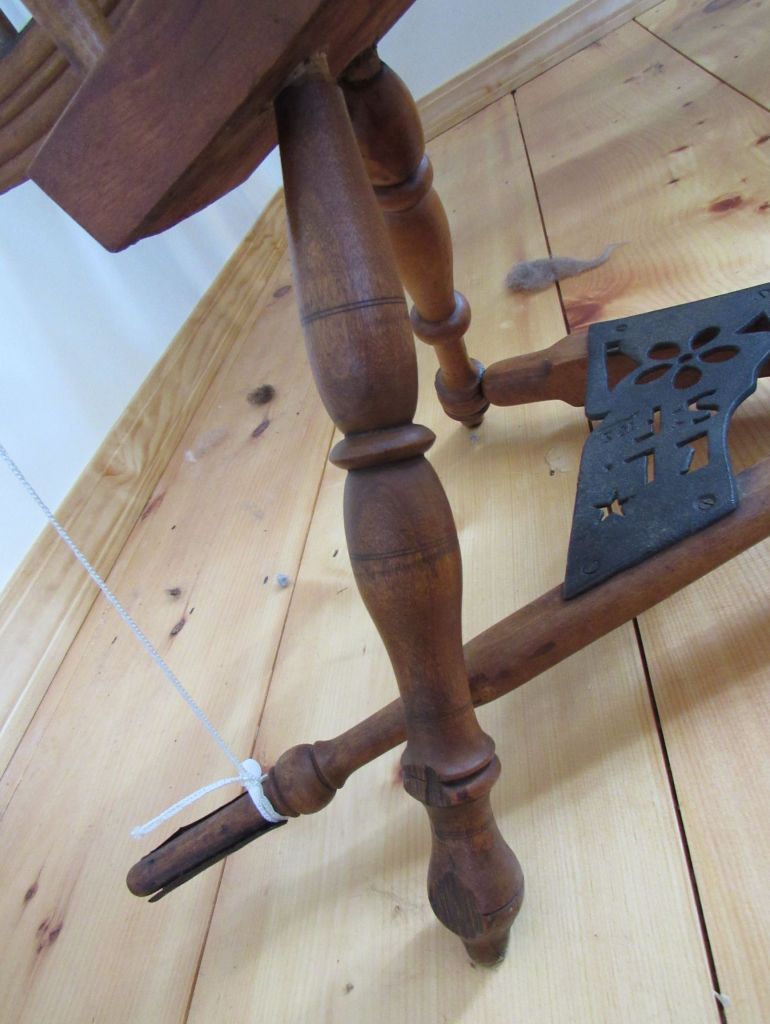
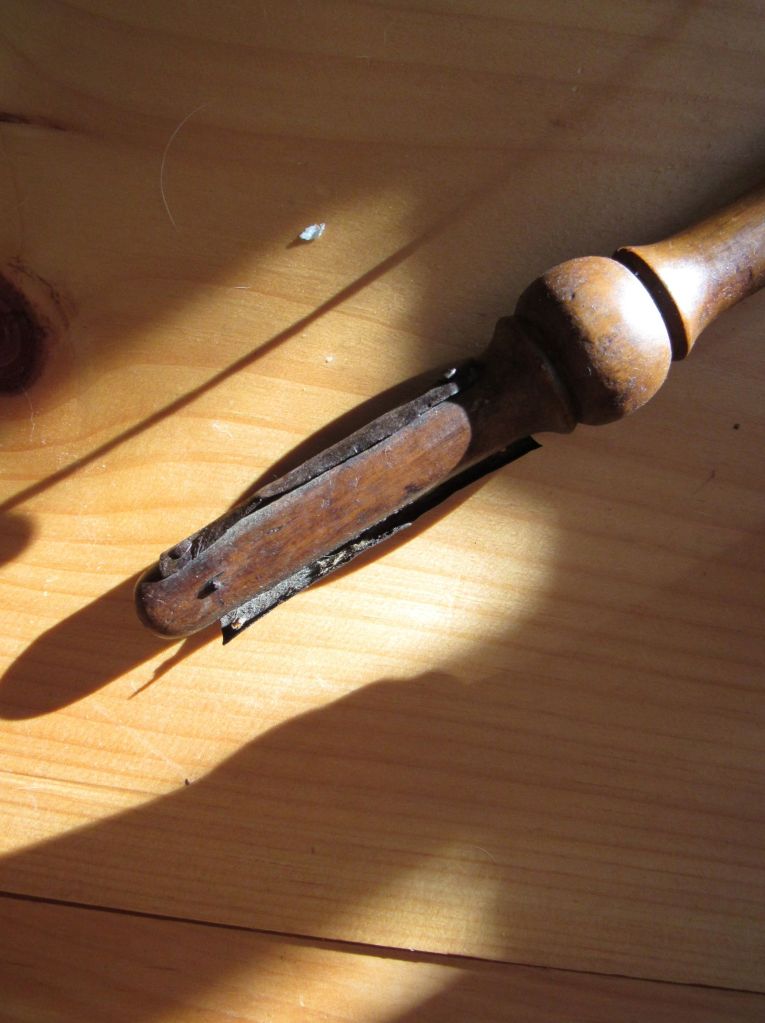
with a metal sheath underneath, perhaps (as Martin suggested in her article) to protect the wood from a metal footman.
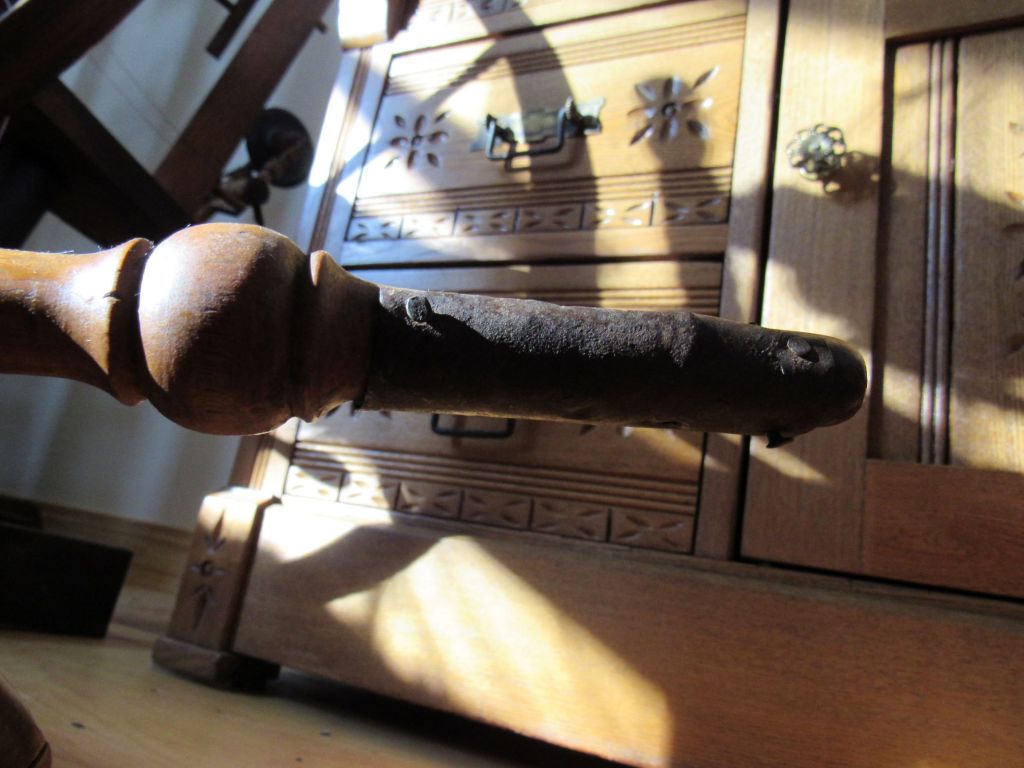
It is the treadle, though, in the end, that makes me want so badly to know more about Elie Laporte.
References:
Foty, Caroline, Fabricants de Rouets— this book is available for sale as a downloadable PDF by contacting “Fiddletwist” by message on Ravelry.
Foty, Caroline and Martin, Linda, “Finding Elie Laporte,” The Spinning Wheel Sleuth #89 (July 2015).
 Exquisite Machinery
Oh Brenda, she is a beauty. The patina is gorgeous. Her metal, intricate cut treadle is spectacular alone with those spoke details. A rare find has found a wonderful home. Your research is so inspiring. Thank you for sharing.
LikeLike
She is a beauty and I could spin on her all day long. The research on Laporte is all Caroline’s though, not mine! Although I’m the one who thinks Laporte, Houle, and the Madame Maxime’s are related.
LikeLike
What a beautiful wheel. Do you know of any others out there besides Linda’s?
Susanne
LikeLike
I really love this wheel. There was a partial wheel that showed up on Ravelry some years ago, with the same treadle. And another similar wheel for sale in Rhode Island a few years ago had a cut out treadle, but with different designs. It looked like the same maker, but the photo wasn’t very good, so it was hard to see details. The sale photo is on Ravelry and I wrote the woman who said she might be buying it, but never heard back from her.
LikeLike
What specifically is it about the way it performs that makes it your favorite wheel to spin on?
Do you know if the bobbin and flyer whorls are original, and if so, what they measure?
LikeLike
It is fast, smooth, responsive, and has a wonderful treadling feel. But, more than that, there is an indefinable connection I feel with some wheels. I think a friend described it best when she said that a wheel “talked to her.” This wheel just sings to me. The bobbin and flyer whorls appear to be original–I’ll have to check their measurements for you. You want the circumference of the grooves?
LikeLike
Rosemary, The whorl is about 15 cm (about 6 inches) and the bobbin is about 12 cm (4 3/4 inches).
LikeLike
Hi: I’m a semi-retired slightly disabled furnituremaker. Lately, to keep myself busy, I’ve been making CAD drawings of a variety of Craft equipment.
I ask you for no money, I do not charge for access to my drawings, but I do ask for donations after people look at them.
So, getting to it, Do you have any wheels you particularly like that you would like to see drawn up as 3D CAD that people in the future could use to make copies? Or wheels in such bad shape that you want them reproduced in CAD for preservation?
I hope you are well
stay safe
Karl F Newman
karlfnewmanwood.work
kaisaerpren@gmail.com
LikeLike
Hi Karl, I’ve seen your posts on Facebook. I don’t have any wheels that I’d like drawn up now, but I will keep you in mind! Thanks, Brenda
LikeLike