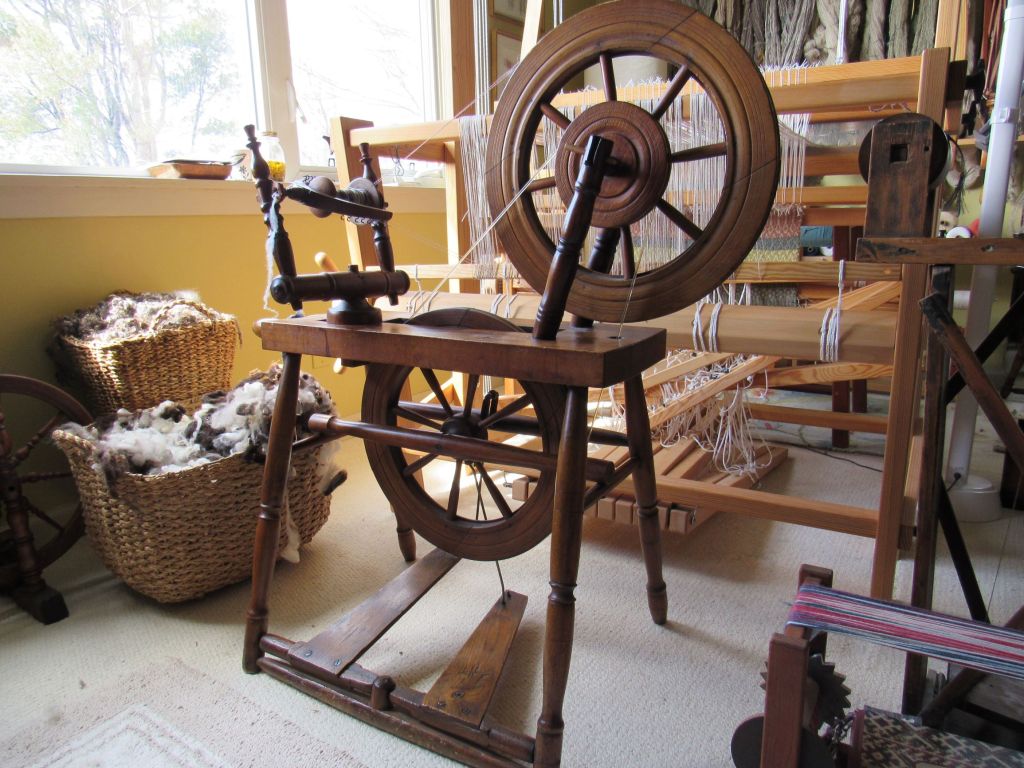
Quebec wheels are famously fast spinners, but this double-treadle accelerated wheel kicks it up a notch. All types of innovations were made to spinning wheels in the 1800s in a quest for increased production. The addition of a second wheel accelerates the flyer’s rotational speed and double treadles also create speed and sufficient power and momentum to keep both wheels moving easily.

Two wheels, two treadles–well-designed and enormously fun to use.
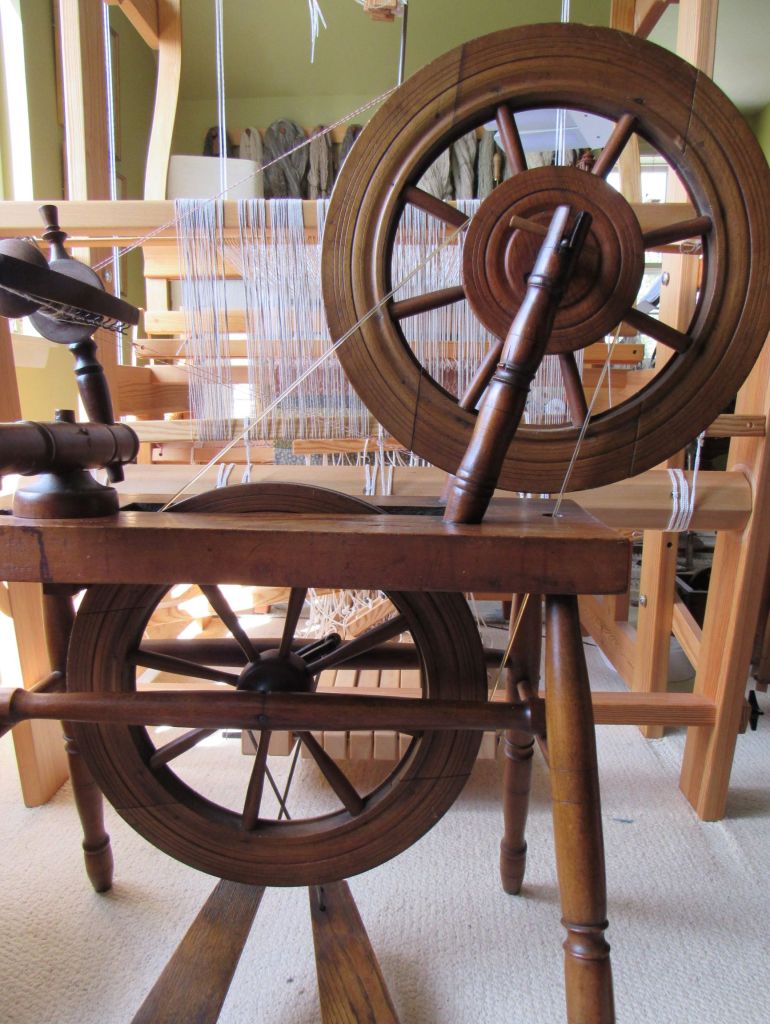
Double treadle, double wheel designs surged in popularity in New England and New York in the early 1800s. But most, such as the so-called Connecticut chair wheels, or Alpheus Webster’s patented wheels, were upright wheels, with two wheels stacked vertically, one on top of the other. In contrast, these Quebec wheels have their own style. They are more horizontal, with drive wheels configured in a fashion reminiscent of the small hand-cranked Turkish wheels.
These wheels are fast, efficient, and easy to use, so I would have expected them to be quite popular. But there do not seem to be many that have survived. Some are marked “J. L’Heureux,” a maker who is believed to be Jules L’Heureux (1833-1918) from L’Acadie, an area southwest of Montreal.
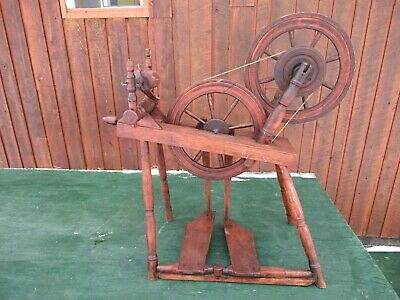
L’Heureux also made more typical saxony-style wheels. His accelerated wheels came in both screw-tension and tilt-tension styles. It is not known if the screw-tensions pre-dated the tilt-tensions.
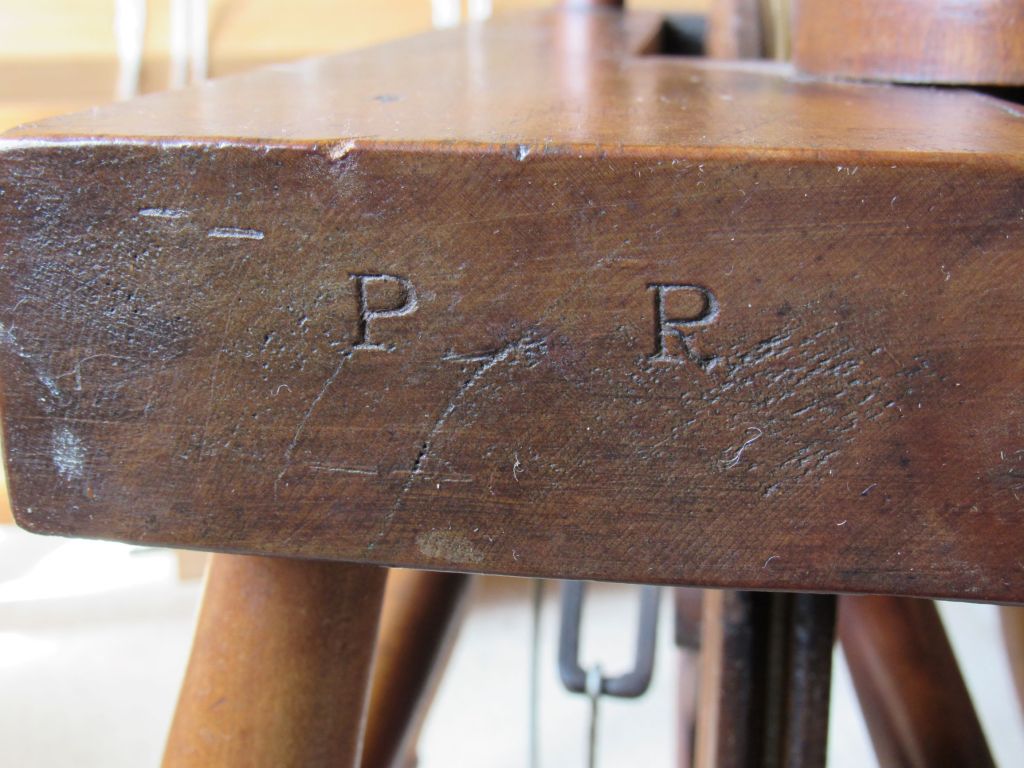
Other wheels are marked simply with “MR” or “PR.” To date, no one has discovered who these makers are, although their wheels are almost identical, so it is likely that they were related and perhaps worked together. The MR and PR wheels look much like those made by L’Heureux, even down to the maidens.
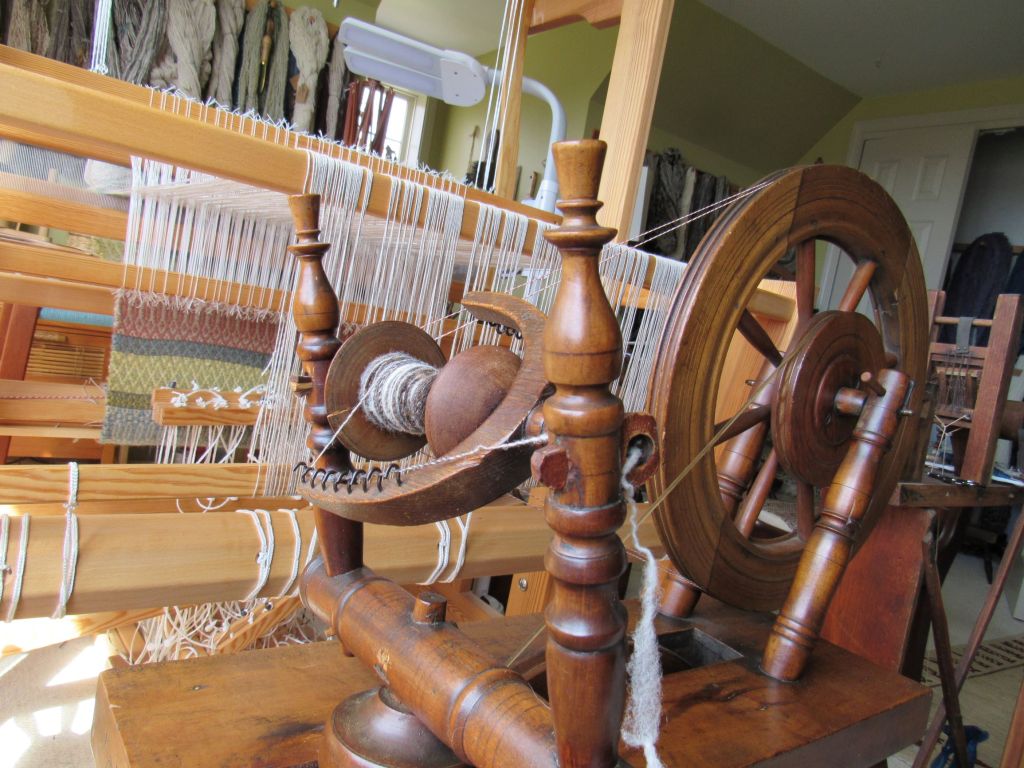
The biggest differences are that L’Heureux wheels have a slanted table and the lower wheel’s axle rests on the table.

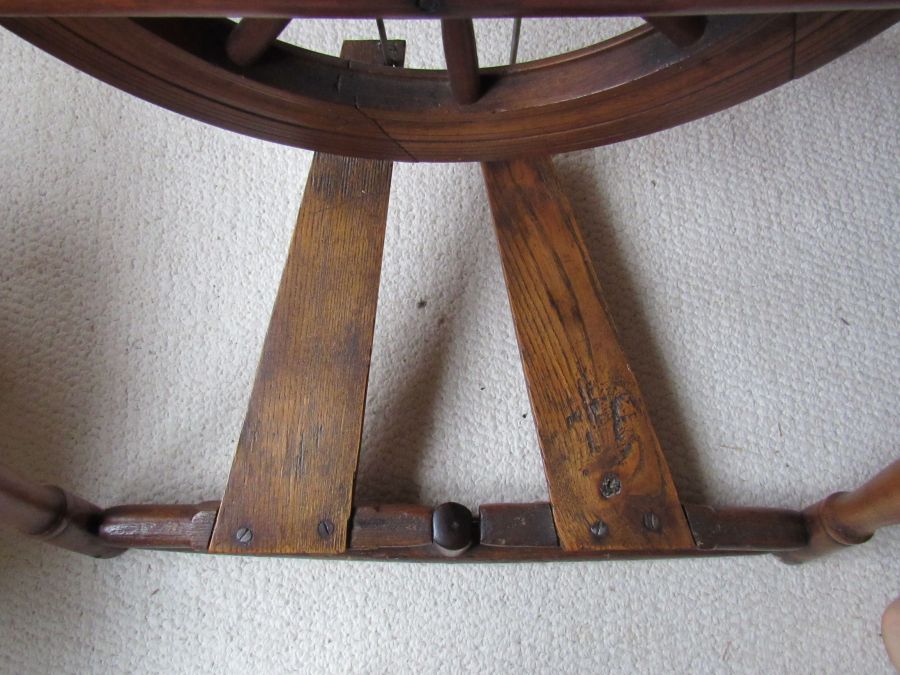
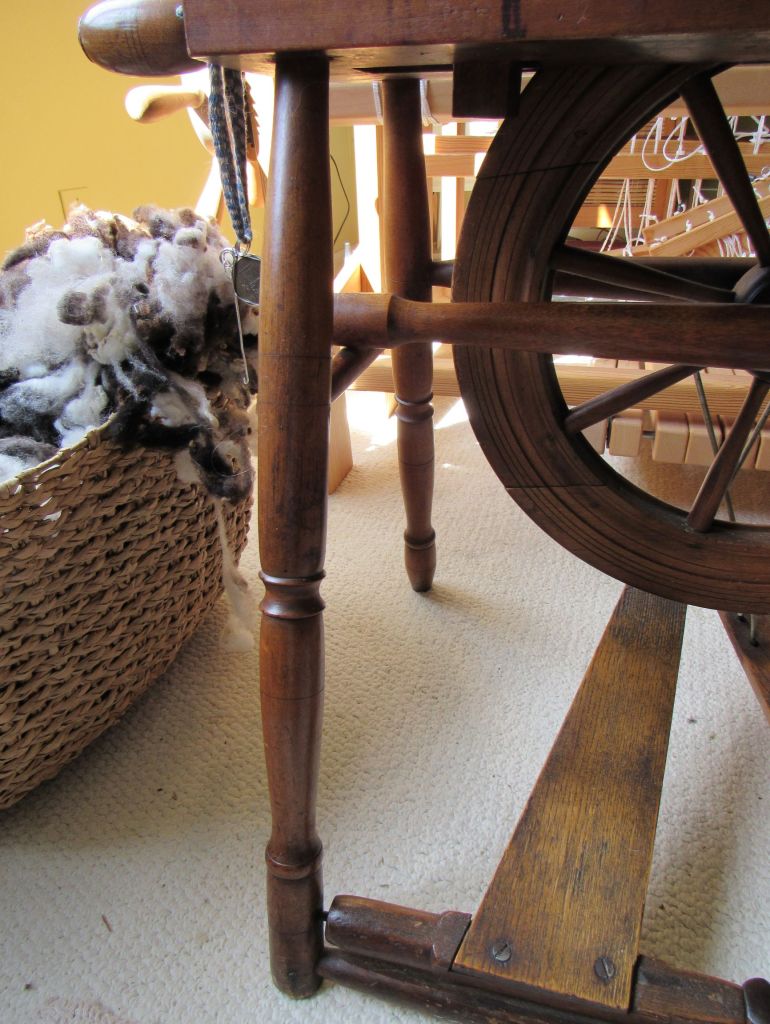
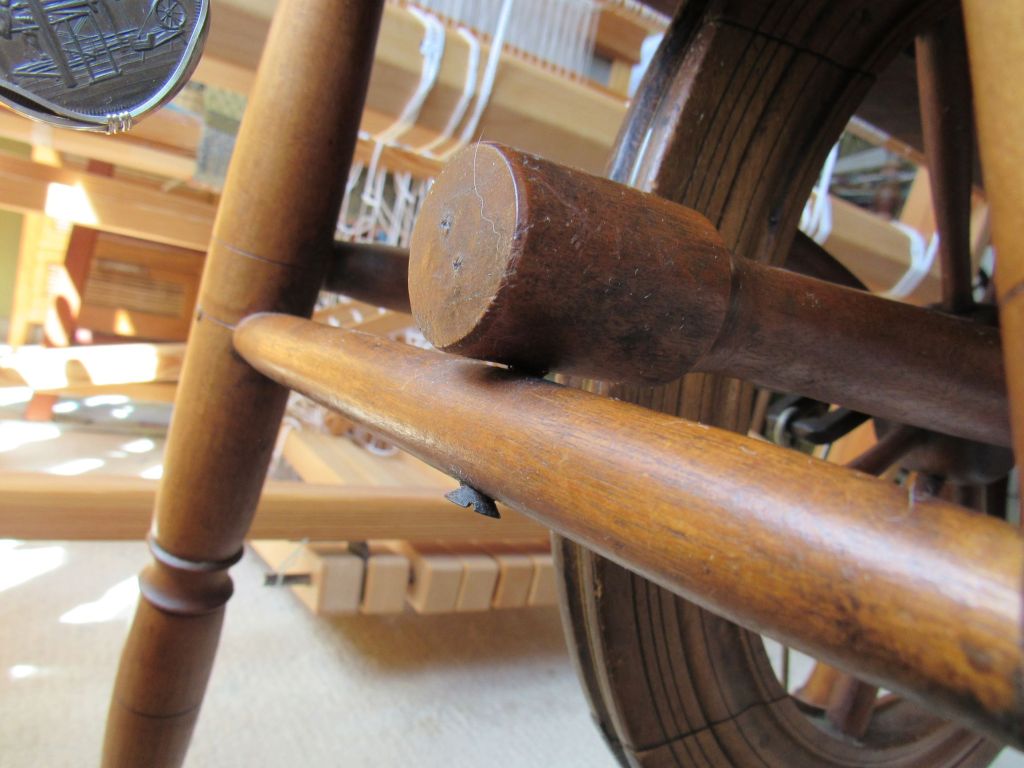
In contrast, the MR/PR wheels have a flat table and the axle of the lower wheel is supported by crossbars below the table, rather than the table itself,


leaving just a tiny part of the rim peeking above the table.

It seems probable that these wheels, like those of L’Heureux, were made in Quebec.
So, I was interested to see one in a postcard from Upper Canada Village, an Ontario living history museum that seeks to depict live in a rural “English” Canadian setting in 1866.

Were these wheels used in Ontario or is this one at the Village simply because it is an antique?
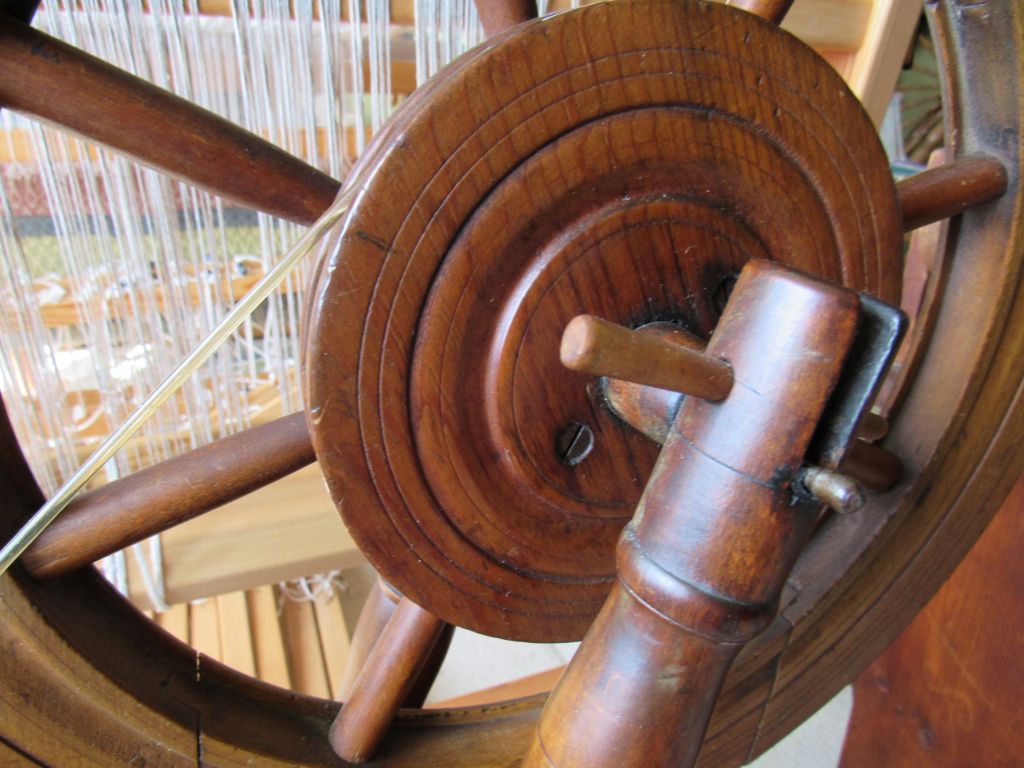
My wheel is marked “PR” and was Wheel No. 97 in Joan Cummer’s collection.

As mentioned in earlier blog posts, Cummer had donated her collection to the American Textile History Museum, and some of her wheels were auctioned off when the museum closed. I was lucky enough to buy this wheel at auction. Like all of the MR and PR wheels that have shown up so far, it has a screw tension system.

Because these particular accelerated wheels do not have tilt-tension or large drive wheels, they do not fall in the limited definition of a Canadian Production Wheel (CPW), even though they are speed demons, specifically designed for fast and easy production.
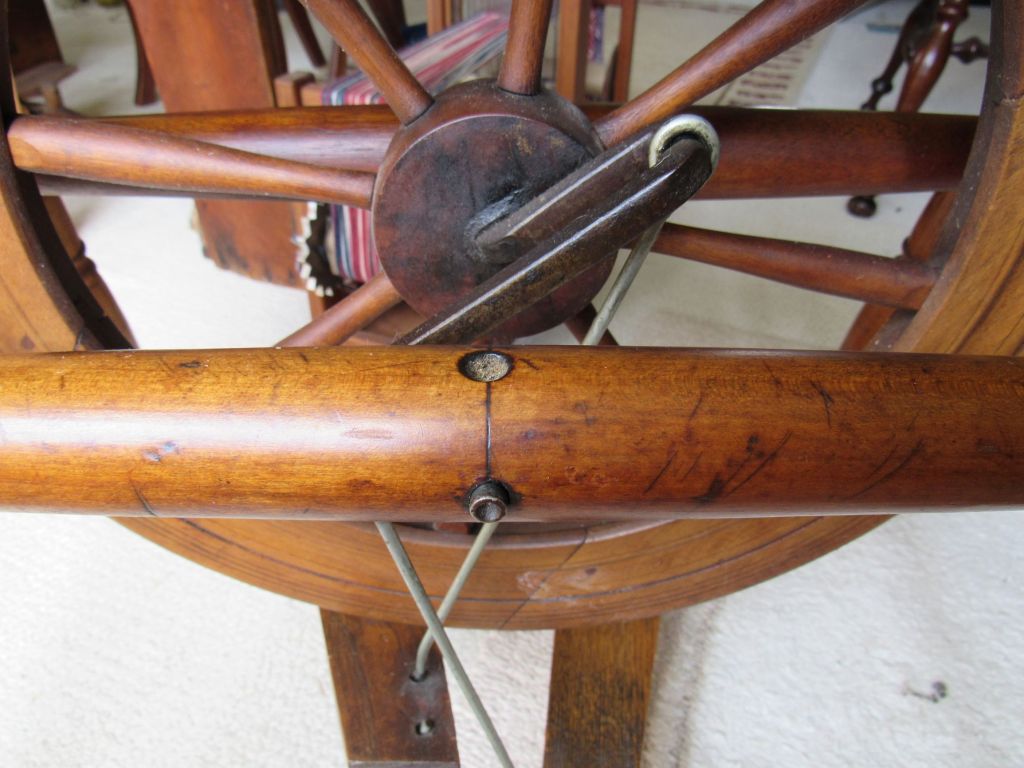
When I brought the wheel home, it took some time to find drive bands that worked. The top wheel has a single double drive band to the bobbin and whorl, just as in a double drive saxony wheel.

The lower wheel is attached to the treadles with an S-shaped axle and to a hub extension on the upper wheel with a single drive band.
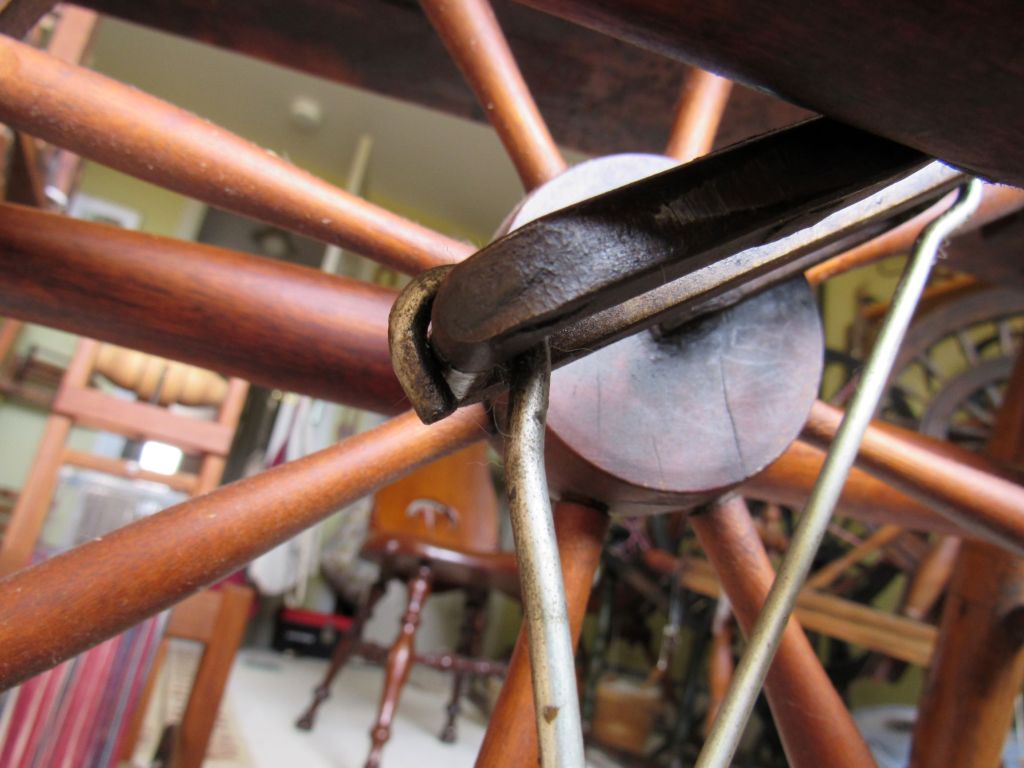
The band connecting the two wheels needs to have sufficient grip to get momentum going for the upper wheel.
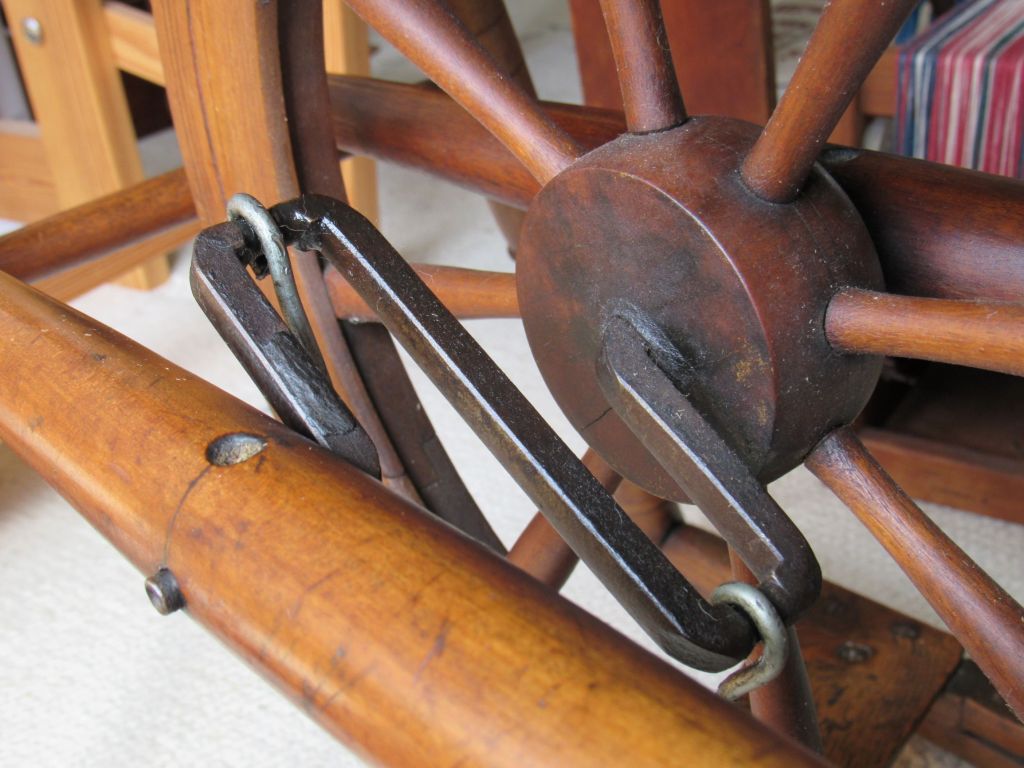
I tried everything—different sizes of waxed and rosined cotton and leather bands. One problem was getting a good fit because the drive band must be threaded through a hole in the table before being knotted or spliced.
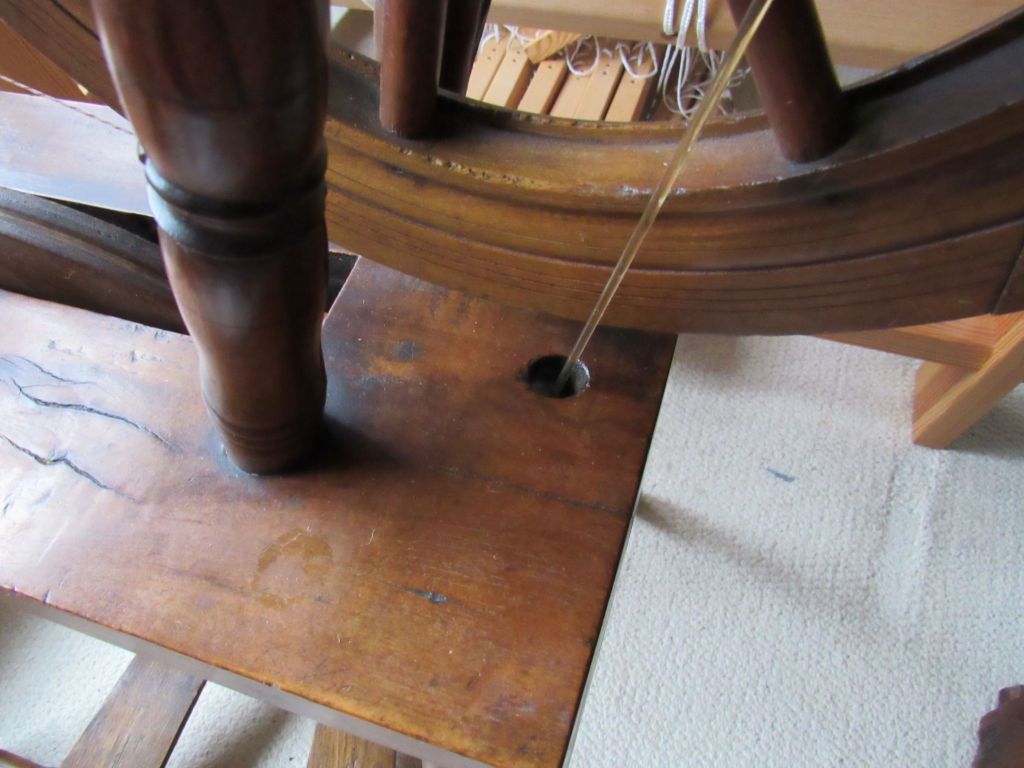
Nothing worked particularly well—the wheel was sluggish and treadling hard. I finally settled on the unauthentic modern poly-cord. It is easy to fit (and refit as it stretches) and works extremely well. Once I had that settled, the wheel just flew.

Because this wheel is such a fast and productive spinner, I wanted to use it to its full potential.
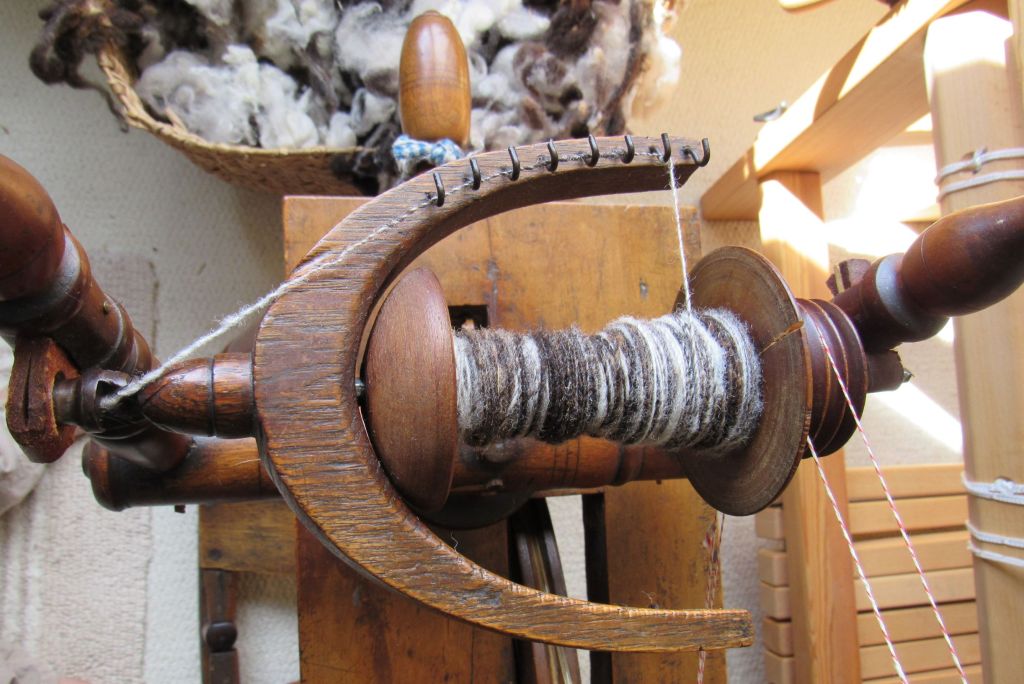
I usually spin a modified long draw, with my whole body angled toward the left side of a wheel. Double treadles make that a bit more awkward. So, inspired by the Upper Canada Village postcard, I decided this would be a good wheel for learning to switch hands to do a long draw across my lap.
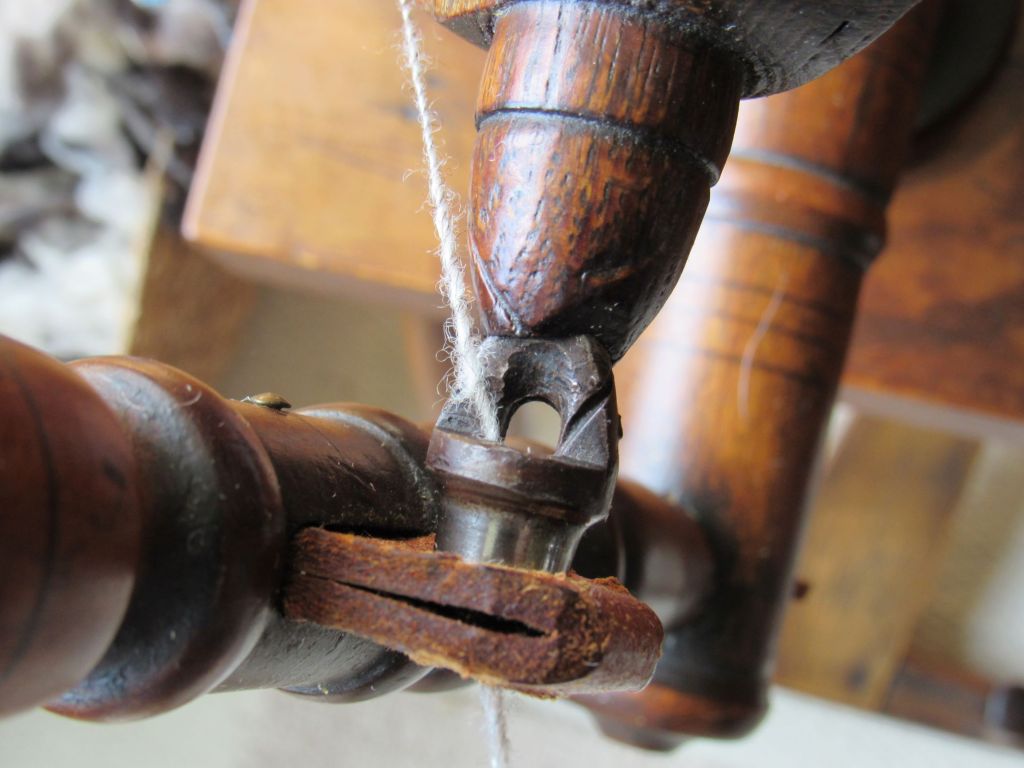
But I was startled to find that when the yarn is drafted across the lap and entering the orifice at about a 45 degree angle, the yarn starts to vibrate and make a buzzing sound. Not a small vibration and buzz either, but a real hand-tingling, bee-buzzing, zipper-sounding, what-is-going-on-here phenomenon.
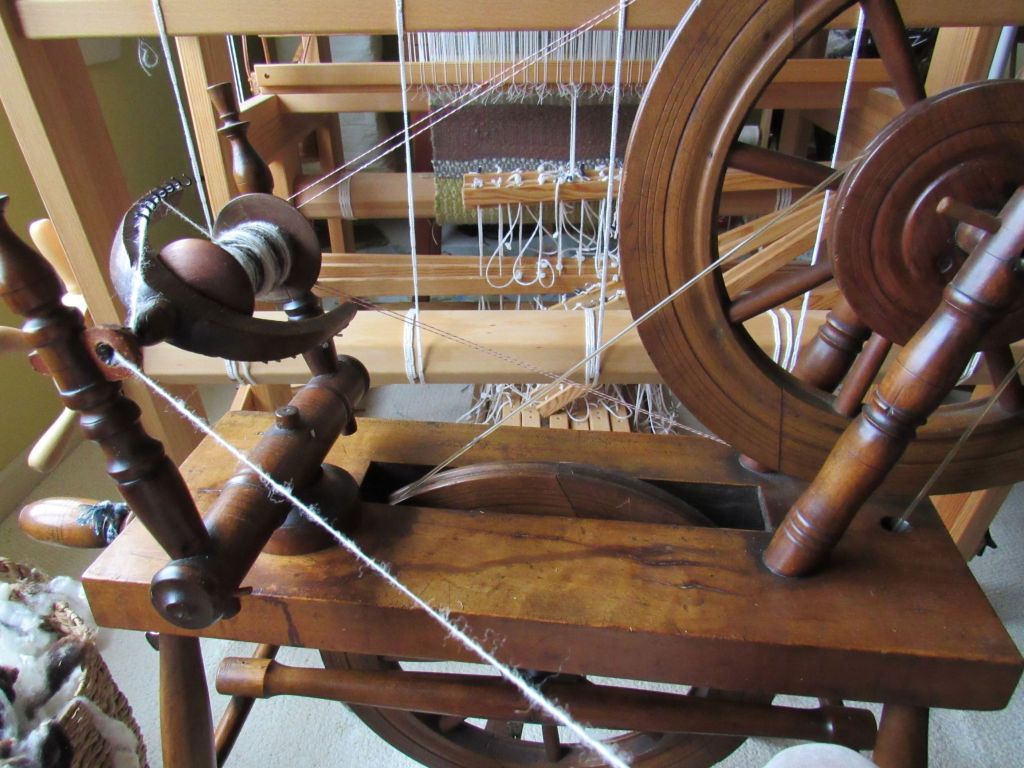
I suspected it had to do with the orifice, which is heavily fluted. There has been debate on Ravelry and other forums about whether orifice fluting is the result of wear or was a design feature to enhance the quality of spun fiber. I am in the camp that the fluting was an intentional design for a specific purpose.
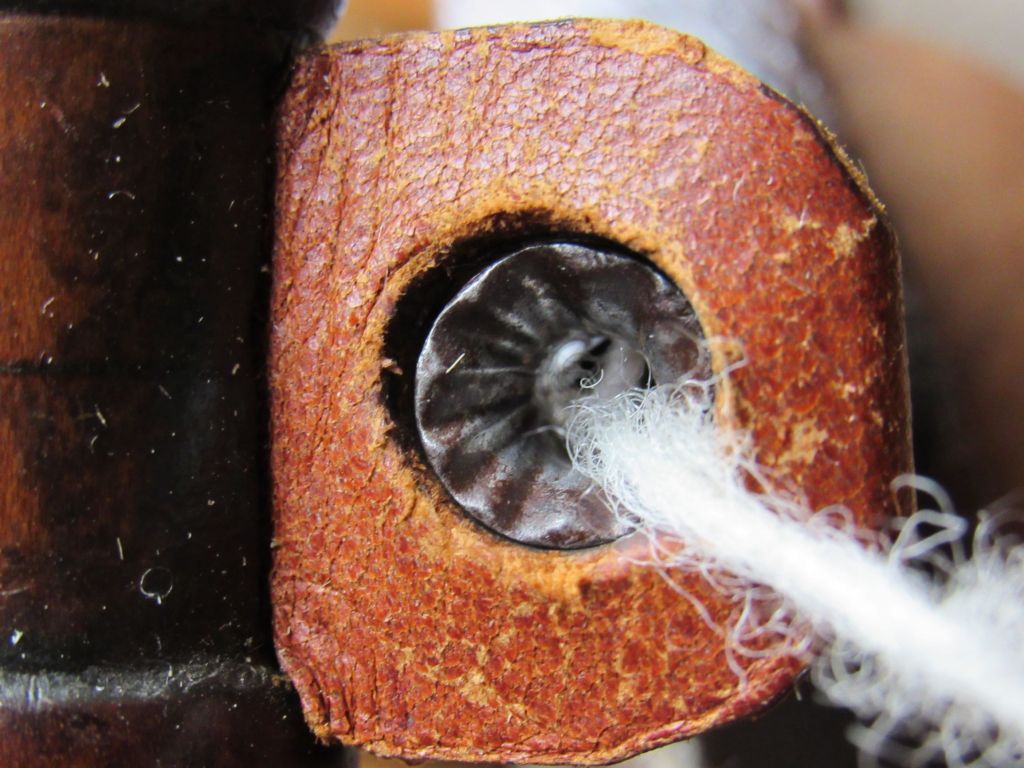
Does the fluting create a resonant frequency that creates a tighter twist, for example? I have several wheels with fluted orifices—mostly from Quebec, Nova Scotia, and Norway. After experienced the yarn vibration on this wheel, I tried them out with the yarn entering at the same angle and found that all of them create a similar vibration and buzz, although none as intense as the very fast accelerated wheel. I could not recreate the same effect on the non-fluted orifice wheels that I tried. I am fascinated by this phenomenon and would love to hear from other spinners who have experienced it and from anyone who might be able to shed light on the physics involved.
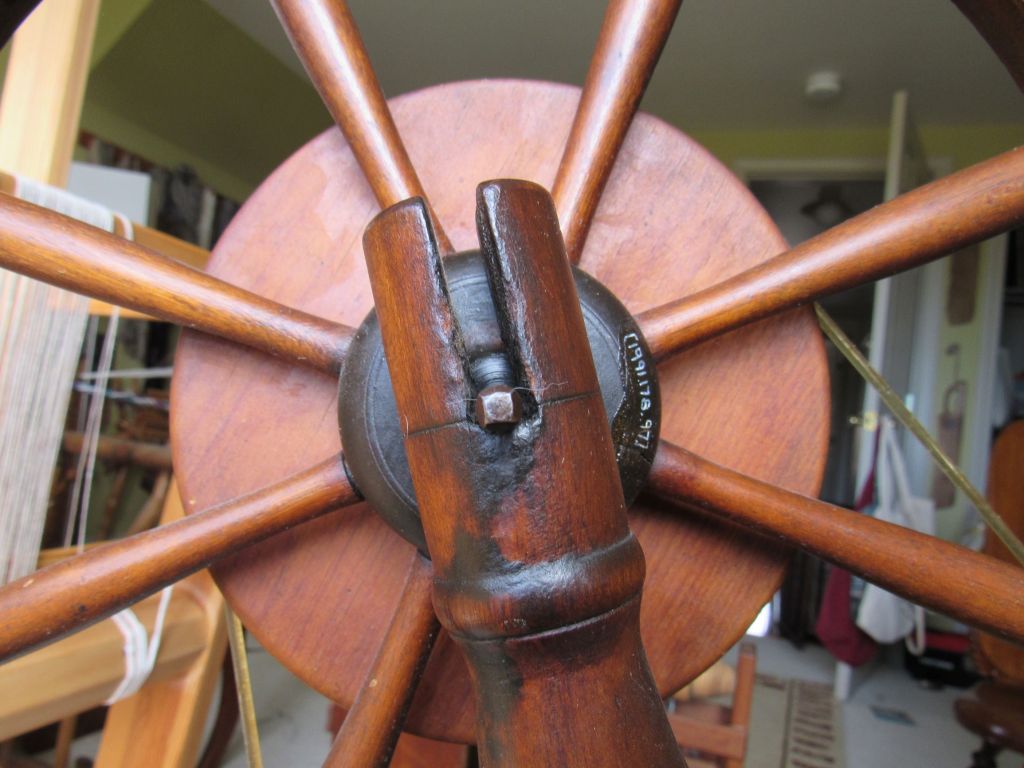
In any case, this wheel is a delight.

May 2, 2021 update: After posting this, Rosemary Jacobs contacted me about her Quebec accelerated wheel. She bought it on Long Island around 1988 and passed it on to some Vermont spinners in 2016. What fascinates me about her wheel is that it looks just like a L’Heureux wheel, but, from the left photo, does not appear to have his prominent maker’s mark.
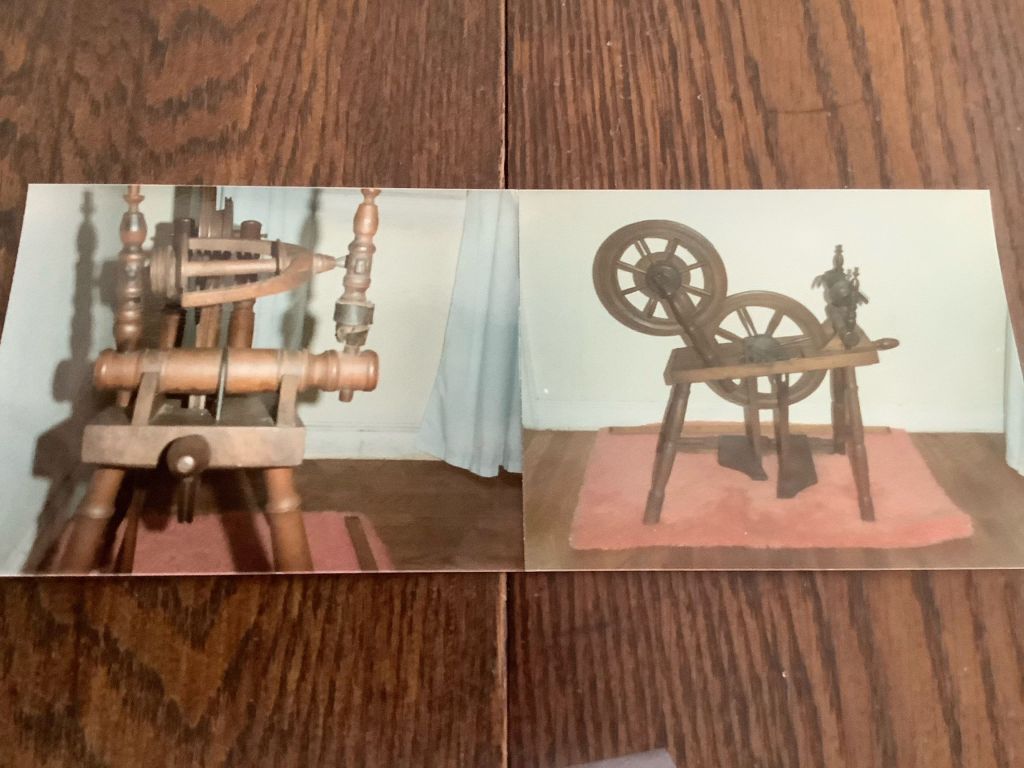
Thanks to Rosemary Jacobs for sharing the photos and information on her wheel.
January 3, 2026 update: Louise Gagnon in Quebec has done a lot of research on PR and found that he was Pierre Roy of L’Acadie. She has gathered information about him from his descendants. Interestingly, L’Heureux lived about a mile away from Roy and was younger. I believe that Louise is hoping to write a piece on what she has found on Roy. If she does, I will update this again. Thank you Louise for the work you have done in finding the maker of these marvelous wheels.
My references for information on Quebec accelerated wheels:
Buxton-Keenlyside, Judith, Selected Canadian Spinning Wheels in Perspective: An Analytical Approach, National Museum of Canada, Ottawa, 1990, pp. 175-78.
Cummer, Joan, A Book of Spinning Wheels, Peter E. Randall, Portsmouth, N.H. 1984, pp. 210-11.
Foty, Caroline, Fabricants de Rouets— this book is available for sale as a downloadable PDF by contacting “Fiddletwist” by message on Ravelry.
Pennington, David A. and Michael B. Taylor. Spinning Wheels and Accessories. Atglen, PA: Schiffer Publishing, Ltd., 2004, pp. 61-78.
 Exquisite Machinery
What an amazing wheel! I think I saw Flopsy or Mopsy outside an antique shop in Montreal in the 1960s, and I took a photo but didn’t (alas) investigate further.
I asked my husband about the vibrations – he asked for a demonstration of how yarn goes through a normal orifice, studied it closely and asked questions about whether the yarn if held from the side would bump over the flutings or go around with them (I said bump over). Then he did some calculations of how many vibrations per second there would be on my wheel (not as fast as yours!) and came up with a very high number like vibrations of the sound of a high note on the piano.
The usual tuning is A440, which means the A nearest middle C makes 440 vibrations per second. He thought it would be higher than that on your wheel (someone with perfect pitch could perhaps tell you what note it is) and that that might well have an effect on the yarn. Unfortunately he had no idea what the effect might be!
LikeLike
Fred has just come up with a theory about the vibrations. What if some musically knowlegeable wheel-maker in the past thought he’d like to help spinners judge how fast they were spinning, and hence how much twist they were putting in. So he put the flutings in and a spinner would know, if the pitch dropped, to treadle a bit faster. If the note got higher, slow down a bit.
And perhaps a few makers thought this would be a good selling point. But before too long, they found spinners were quite happy just to be aware of the number of treadles they were doing compared to how fast they were letting the yarn wind on, and keep the twist consistent that way.
I can’t honestly say I believe a word of it but I suppose stranger things have happened
LikeLike
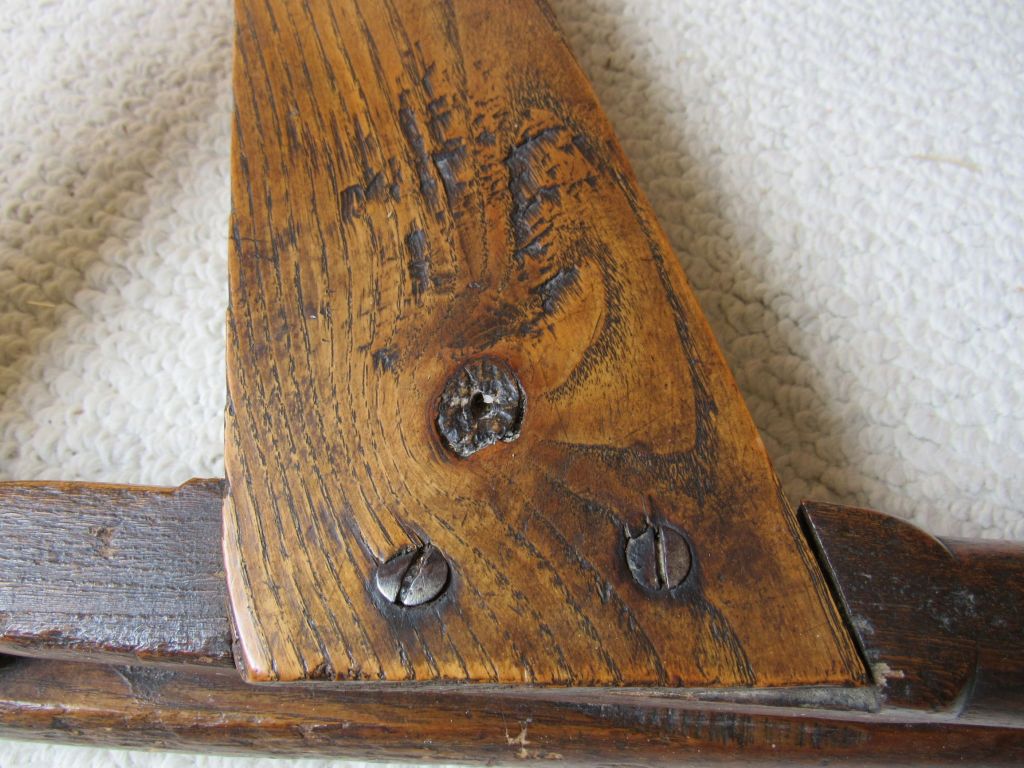
I went back and looked at your photo of Flopsy (or Mopsy) and it is a twin. I love the big knot on the table of that one. Thank Fred for putting his brain on this puzzle! I agree that the thread would bump over the flutings. I will have to see how the pitch changes with different treadlings. I guess I should make a video of it. I’m fascinated by these flutings–so far Fred’s theory is the only one I know of–so I’ll do a little experimentation. Of course, there is a whole group of people who believe the fluting is from wear on the orifice. So much we don’t know. Do you have any wheels in NZ with fluted orifices?
LikeLike
On looking at your photo, Fred couldn’t imagine those flutings being made by wear. Neither can I. And no, no fluted orifices in New Zealand, or in Australia as far as I know. Of course our wheel-making history goes back only to the 1800s, and there’s precious little remaining even of that.
LikeLike
Yep, I agree about the wear. Also, fluted orifices tend to come on wheels of certain makers and certain regions, which also goes against the wear theory.
LikeLike
I’m about to hit the road (on a wheel railroad trip–bringing 6 wheels down to Pennsylvania and 7 wheels back)–but came across this article. I haven’t had time to pursue this further, but thought it might be relevant: http://www.fibtex.lodz.pl/57_16_58.pdf.
LikeLike