

Truus is a striking combination of form and function.
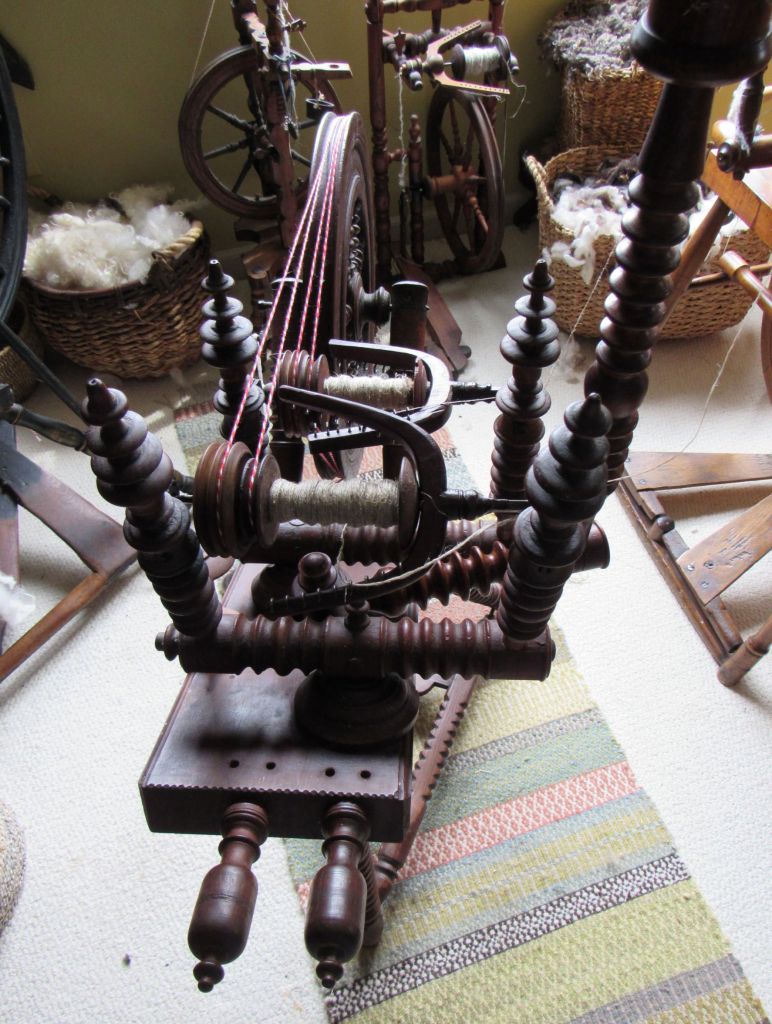
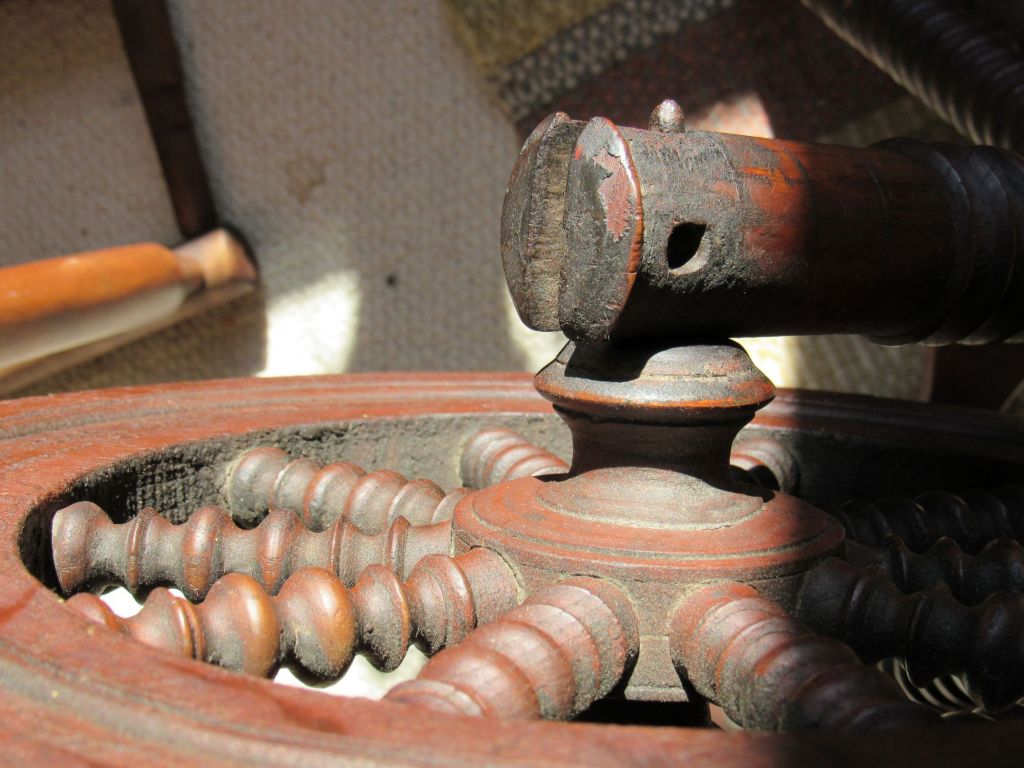
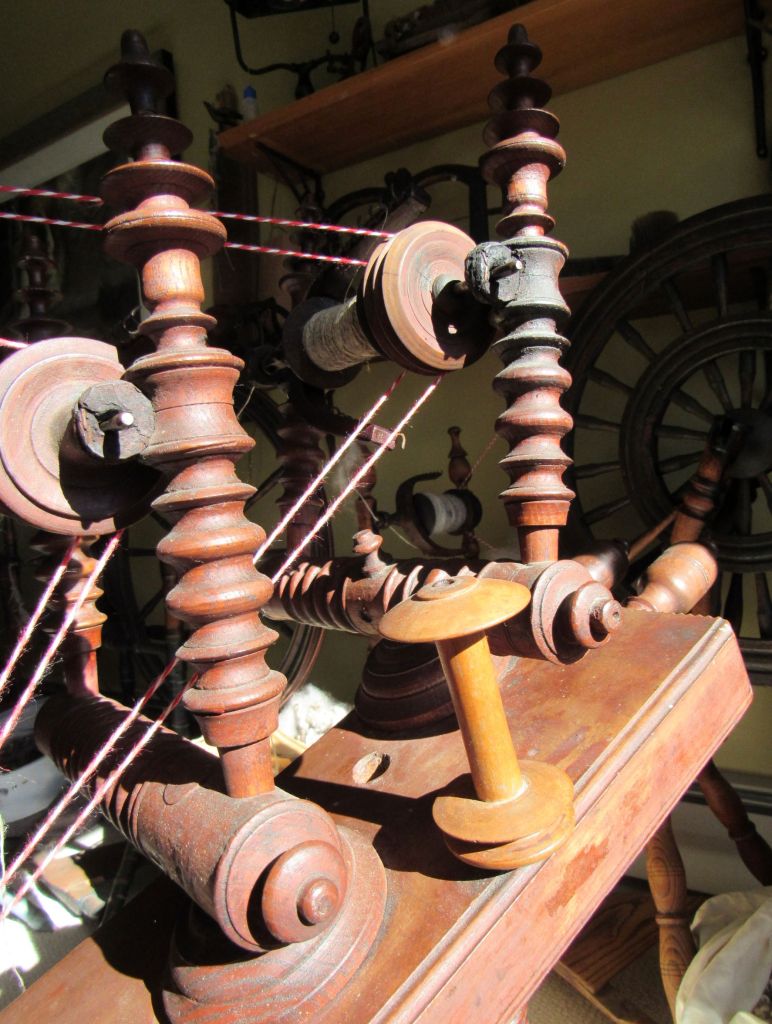
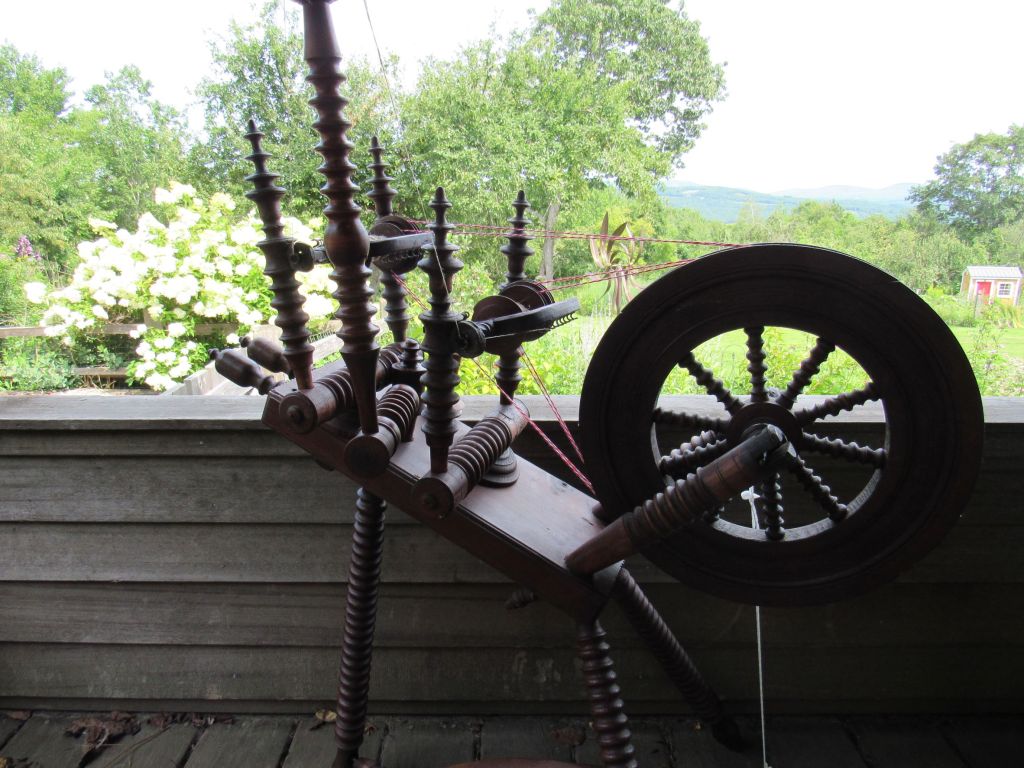
The turnings on this Dutch wheel are almost mesmerizing, especially when light strikes them through a window. Long and short rows of ridges at various angles, topped by four maiden spires—wheel sculpture.
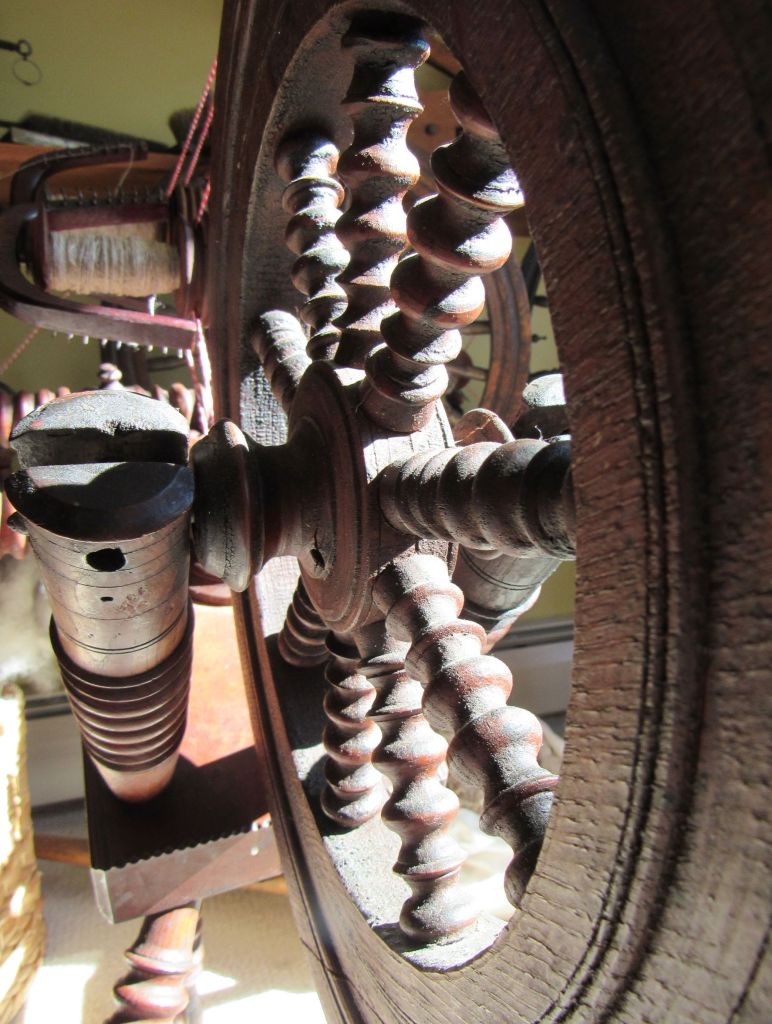
In a dim interior before electric lights, candle and fire light would have highlighted and accentuated the ridges, creating an intricate interplay of light, dark, and shadow. Today, even in a room full of beautiful wheels, this one captures the light, becoming the center of attention.
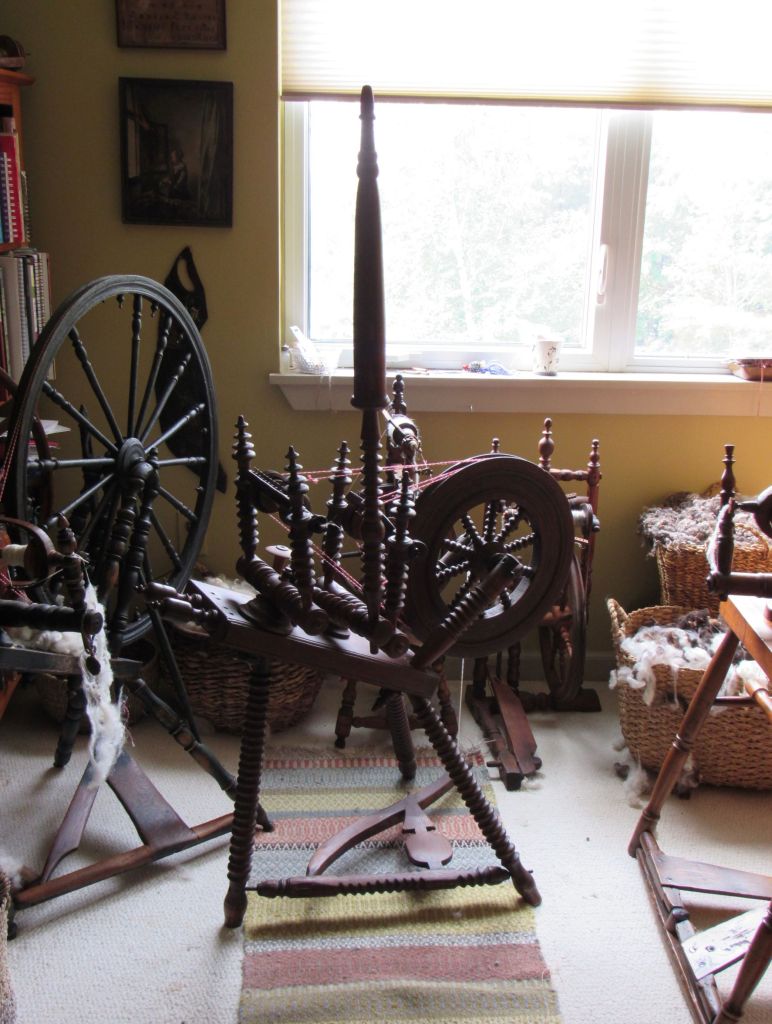
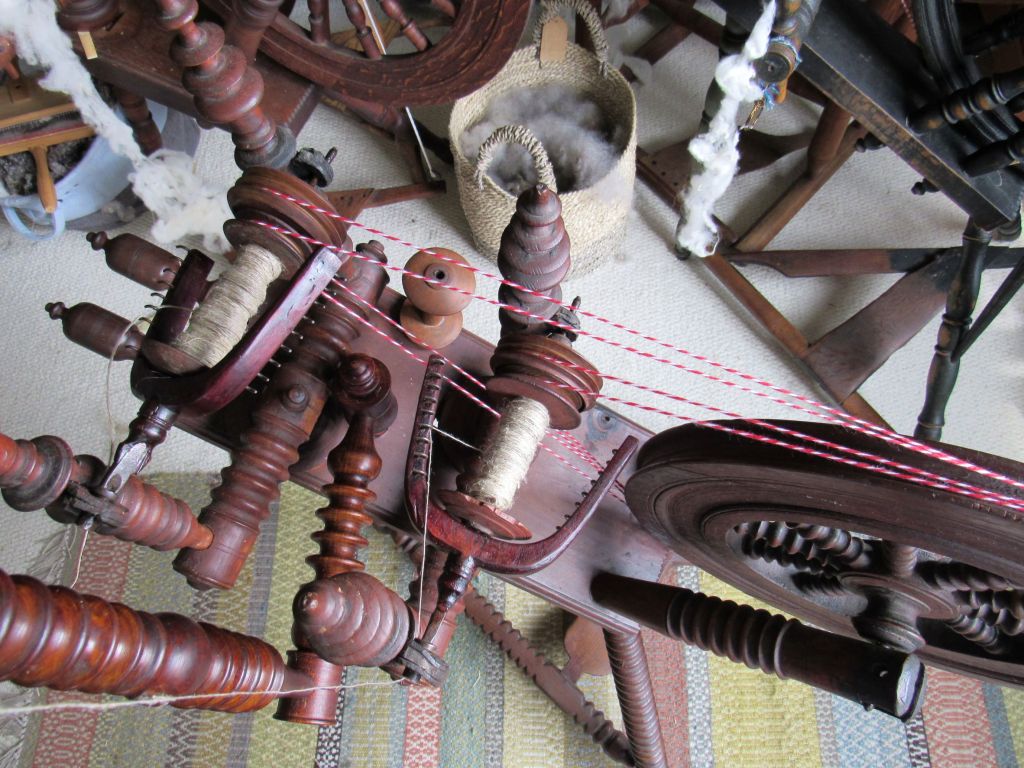
Not only a treat for the eyes, it is a little workhorse. With two flyers, side by side, a spinner can spin flax at a much greater rate than with a single flyer (for more information on a double flyer wheel’s increased production, see the end of the earlier post “Louisa Lenore”).
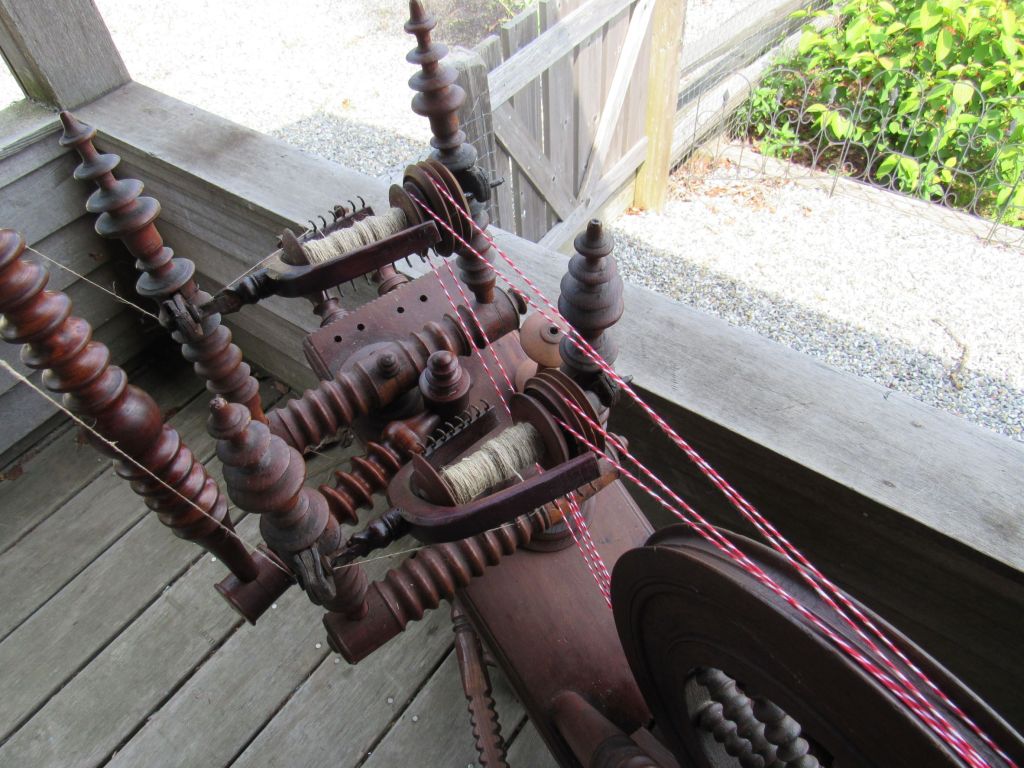
This wheel’s design is especially nice for two handed spinning because each flyer has a separate tension system, which allows the spinner to fine tune the tension of each flyer to closely synchronize their uptake rates.
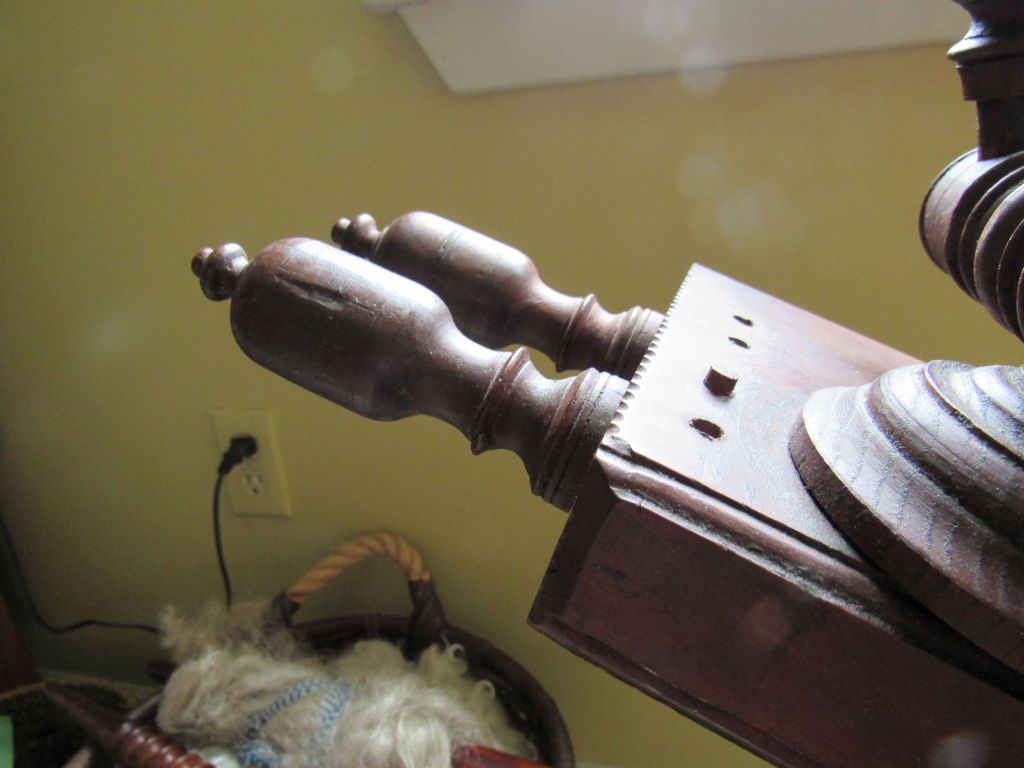
In comparison, the tensioning on Connecticut double flyer wheels seems crude, because each tension adjustment has some effect on both flyers, making it more difficult to find that sweet uptake spot, especially if one of the flyers is a replacement. I have spun on several different styles of double flyer wheels and, to me, this one is by far the easiest to achieve consistent two-handed spinning. It is a very sweet flax spinner.

Historically, Dutch wheels were made in a variety of styles, reflected in a richness of paintings.
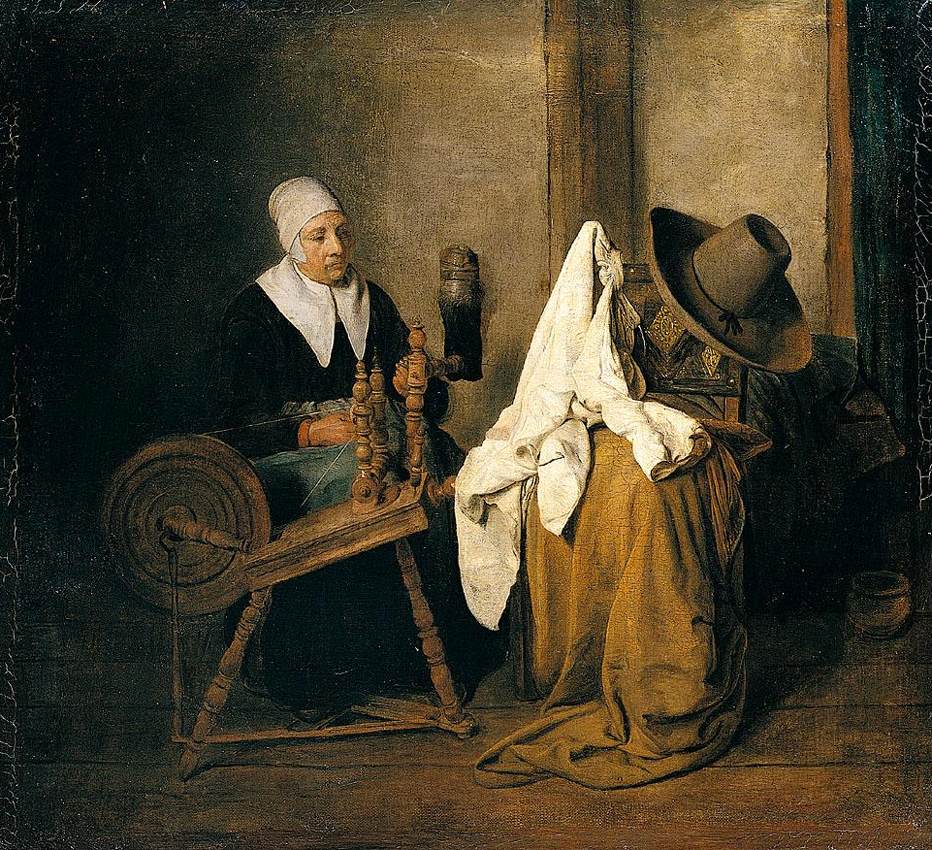
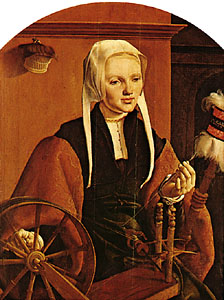
Most of the Dutch double-flyers, however, seem to look much like Truus, with small variations. These postcards of double flyers are entitled “Geldersch Binnenhuisje.”
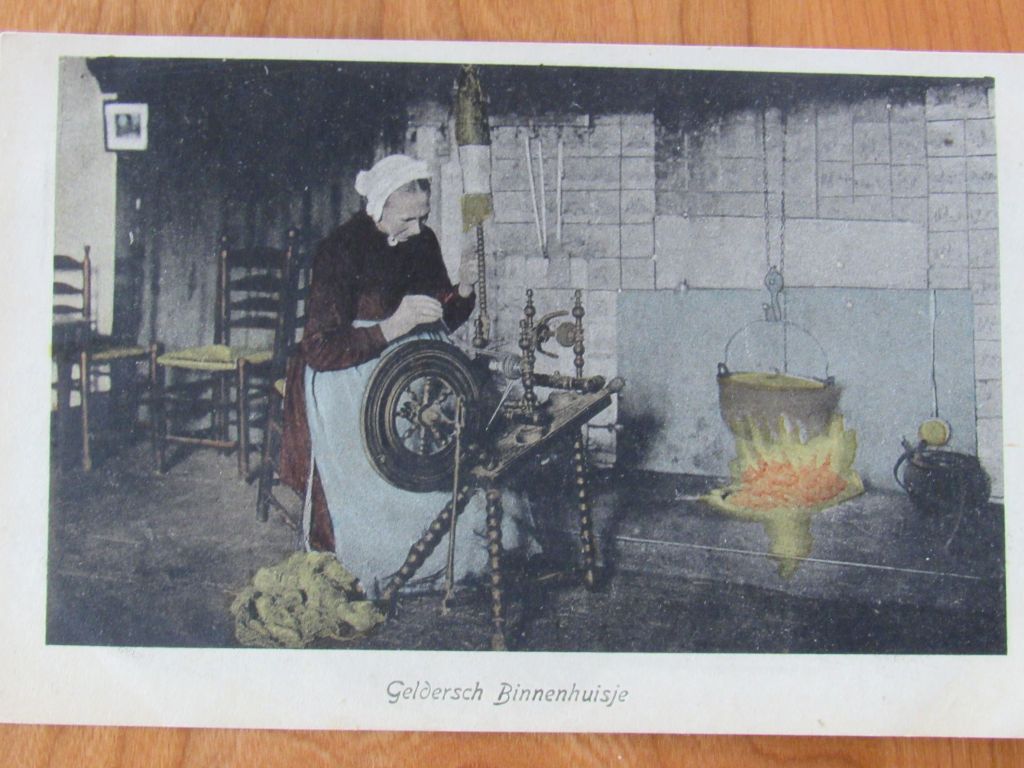
Binnenhuisje is a home’s interior and, I believe, Geldersch refers to the province of Gelderland, in the east central area of the Netherlands.
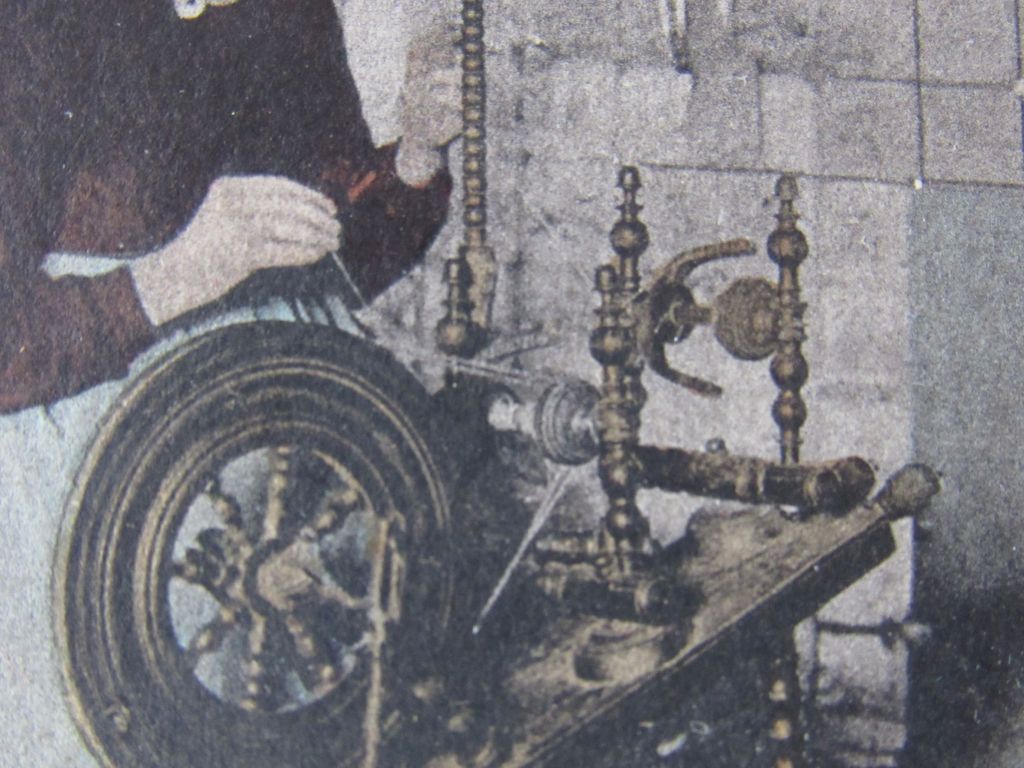
This woman appears to have threads going to both flyers but only one flyer seems to have a drive band or any accumulation of thread.
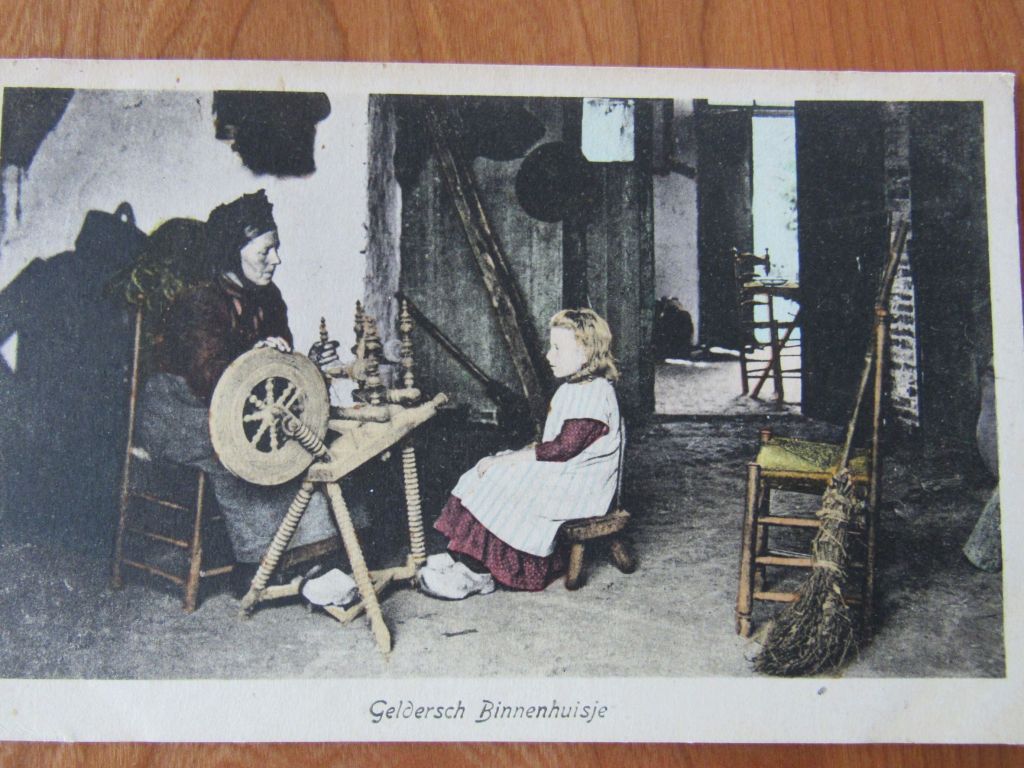
The wheel in the above postcard does not even have a footman, but it is a lovely and instructive prop. My favorite card, identifying a woman spinning flax on a wheel with a reel, is intriguing because the wheel appears to be almost identical to Truus, right down to the bobbin holders.
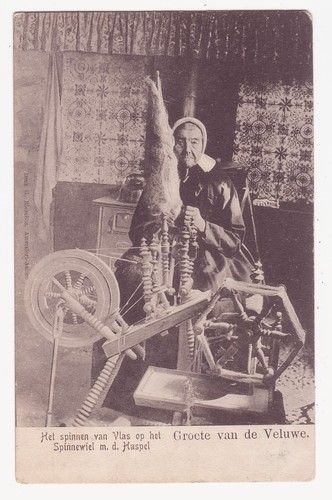
The card reads, “Groete van de Veluwe,” meaning “Greetings from Veluwe”–a region in the Gelderland. Perhaps these wheels were a Gelderland style. And, possibly, many were made by the same maker. Several identical, or nearly so, wheels have turned up in widely different locations around the world. One wheel, featured in Issue #65 of the Spinning Wheel Sleuth, and looking just like Truus, was found in Australia. According to the article, that wheel had “W&H” or “M&H” handwritten on the base of the upright forks. (SWS #65, pp.9-10). Interestingly, another sister wheel, bought in Gelderland, was posted on Ravelry about seven years ago, with an “HW” stamped on the end of the table. As far as I know, no one has identified “HW” or determined if he may have been a primary maker of these wheels.
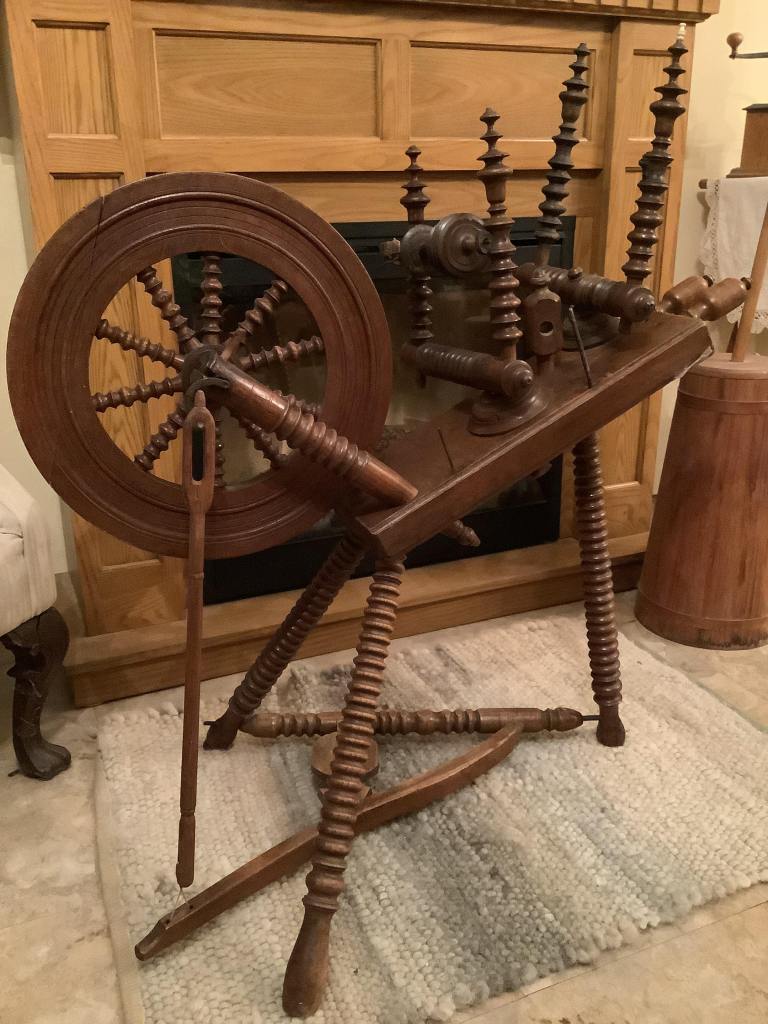
Several similar wheels have been found around the United States, but, as far as I know, no others have maker’s marks.
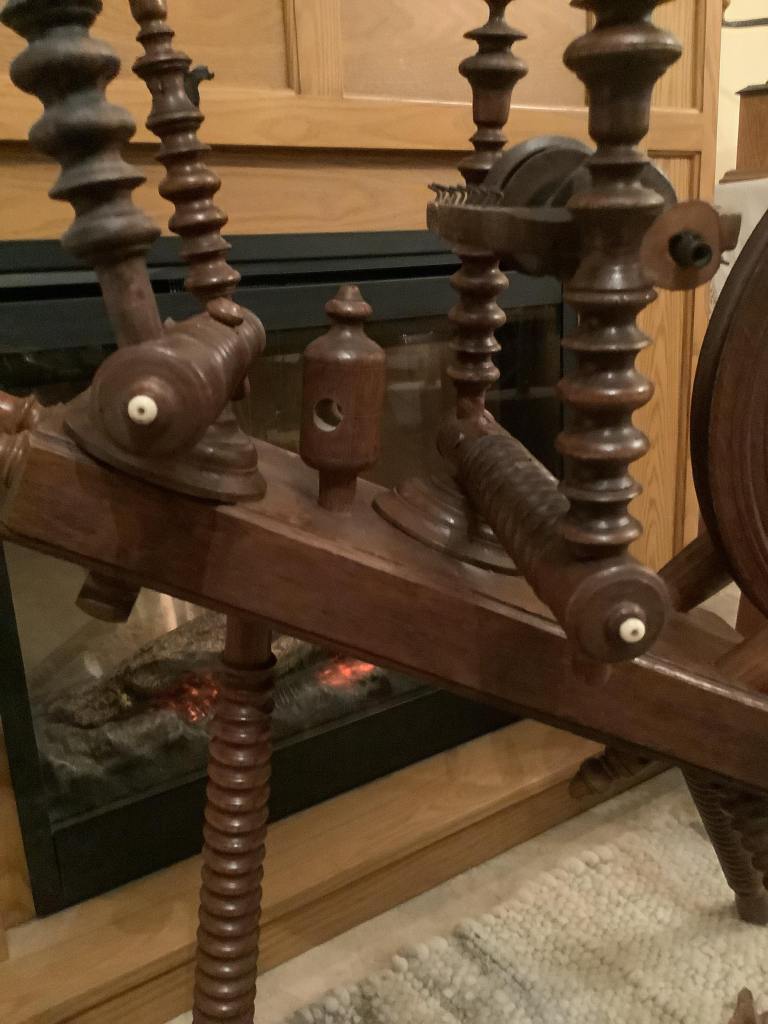
A few have some ornamentation, perhaps ceramic or porcelain, including the wheel above owned by Ginnie Schirmer in Kansas. Aside from the bits of ornament, her wheel looks just like Truus, although it has an axle pin, perhaps original.
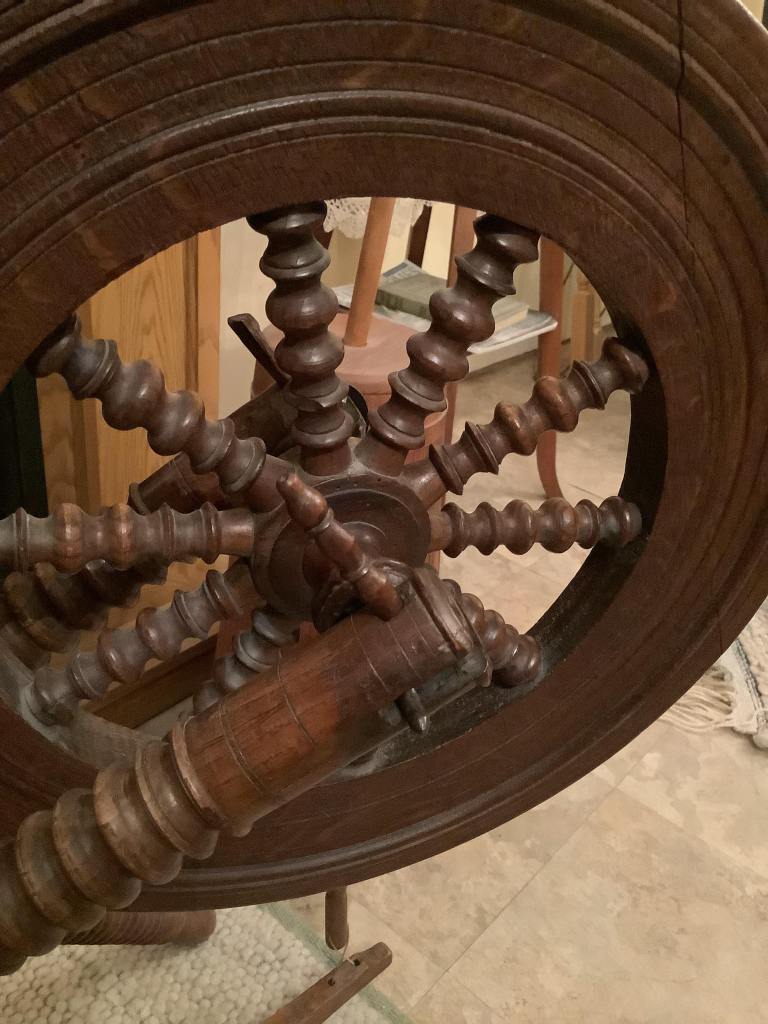
Truus’ axles came pinless.
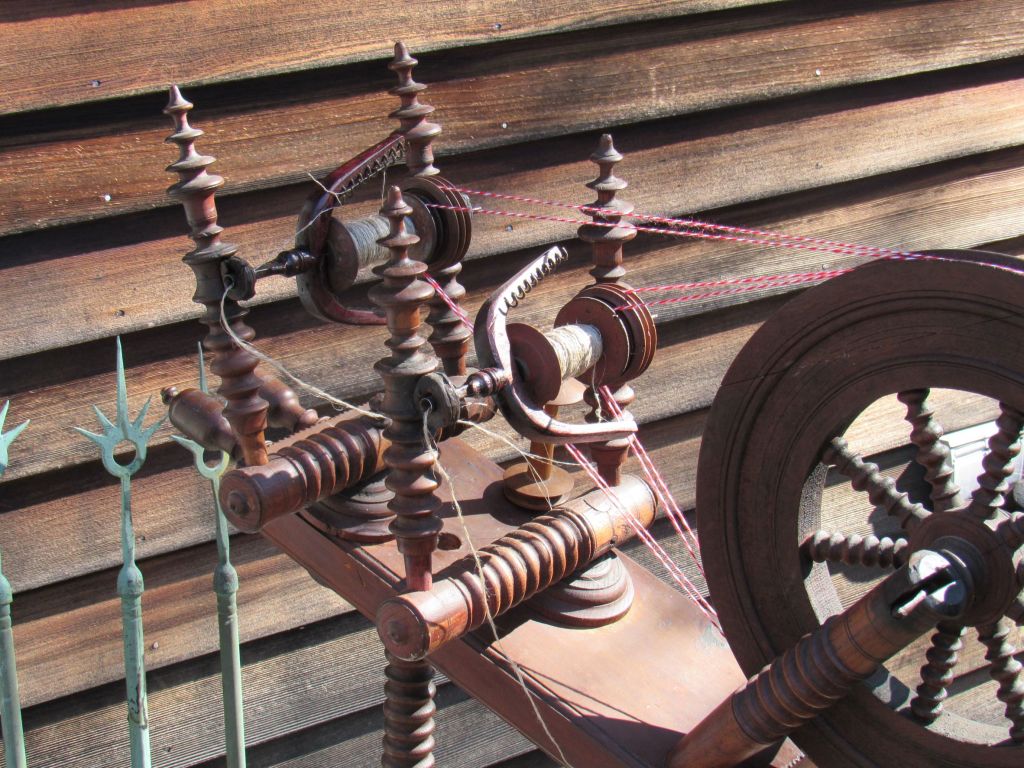
True to her Dutch roots, Truus turned up for sale in Michigan, in an area heavy with Dutch immigrants. A wonderful woman in Michigan (now a friend) kindly picked her up, fostered, and eventually railroaded her east. The wheel was in pretty good shape but had no distaff parts and both flyers were split down the middle at the orifice end.
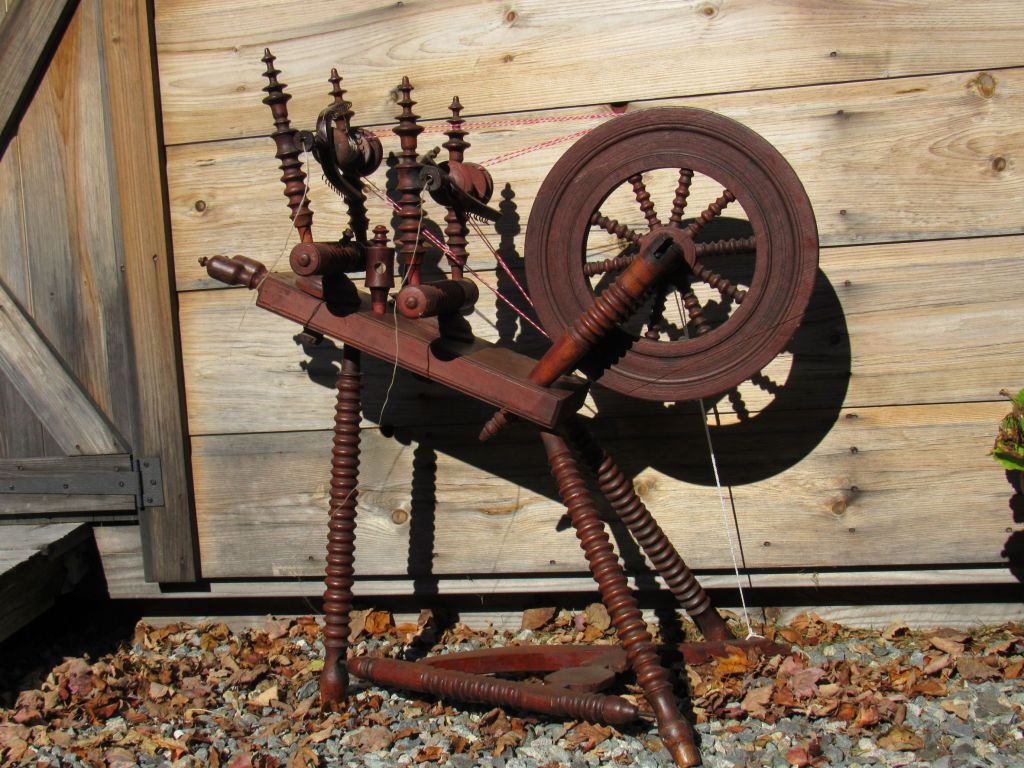
I was thrilled, though, to have both flyers, damaged or not. I sent her off to John Sturdevant at SpiritWood for repair and to have a distaff made. When John started the flyer repair, he was surprised to discover, in a mandrel section that had been covered by the wooden flyer, the name “R. Picard” engraved the metal on both flyers.
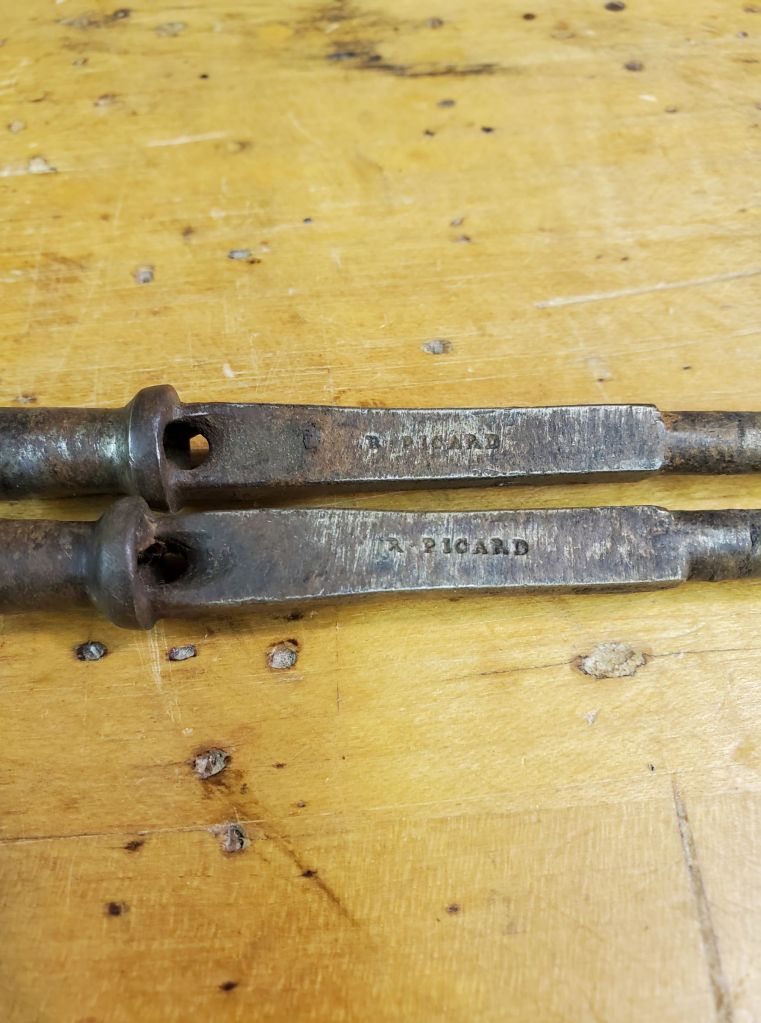
Try as I might, the only R. Picard I have been able to find is a Raphael Picard, who founded a watchmaking company in 1837 in La Chaux-de-Fonds, Switzerland. It seems unlikely that he would have made spinning wheel mandrels for Dutch wheels. But perhaps there is some family connection.
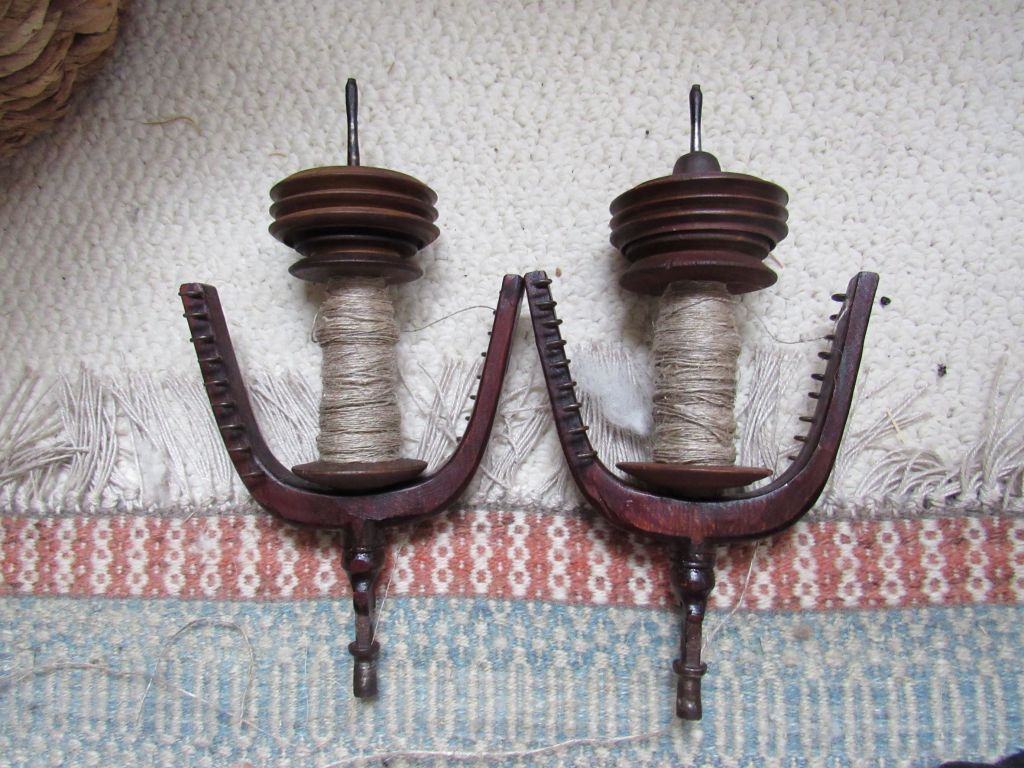
While Picard’s engraving shows that both flyers likely are original, they are not identical. One is slightly longer and has a nipple end on its whorl.
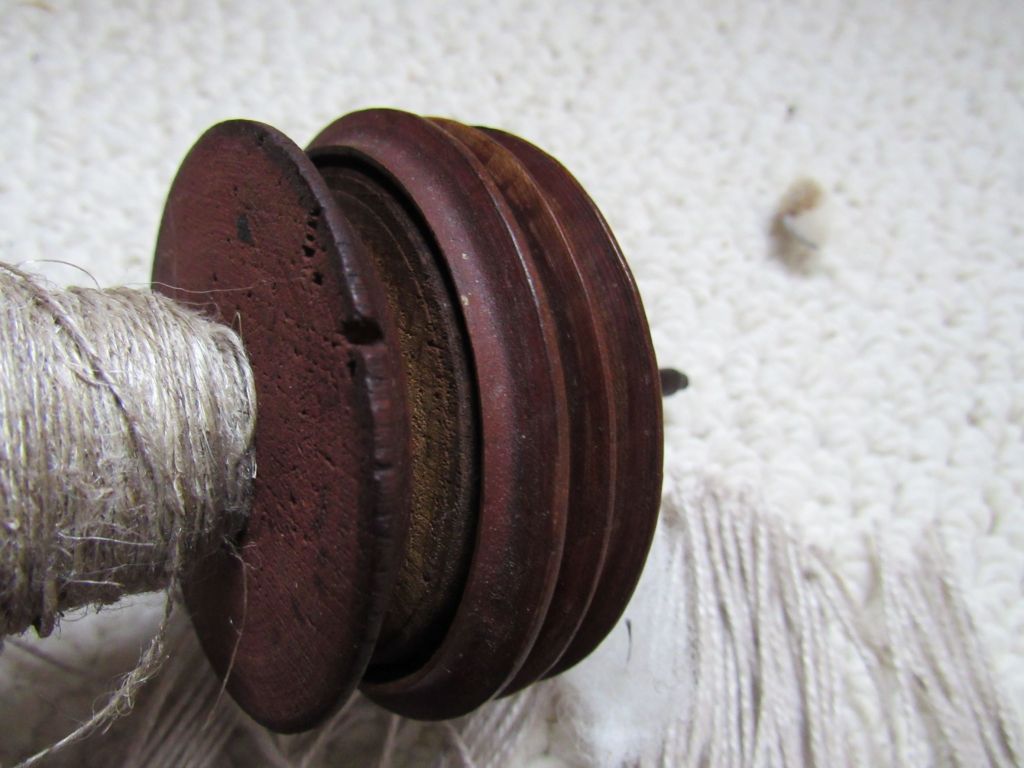
Both whorls have a feature sometimes seen on Scandinavian wheels—a lipped recess on the flyer whorl in which the bobbin neatly nests.

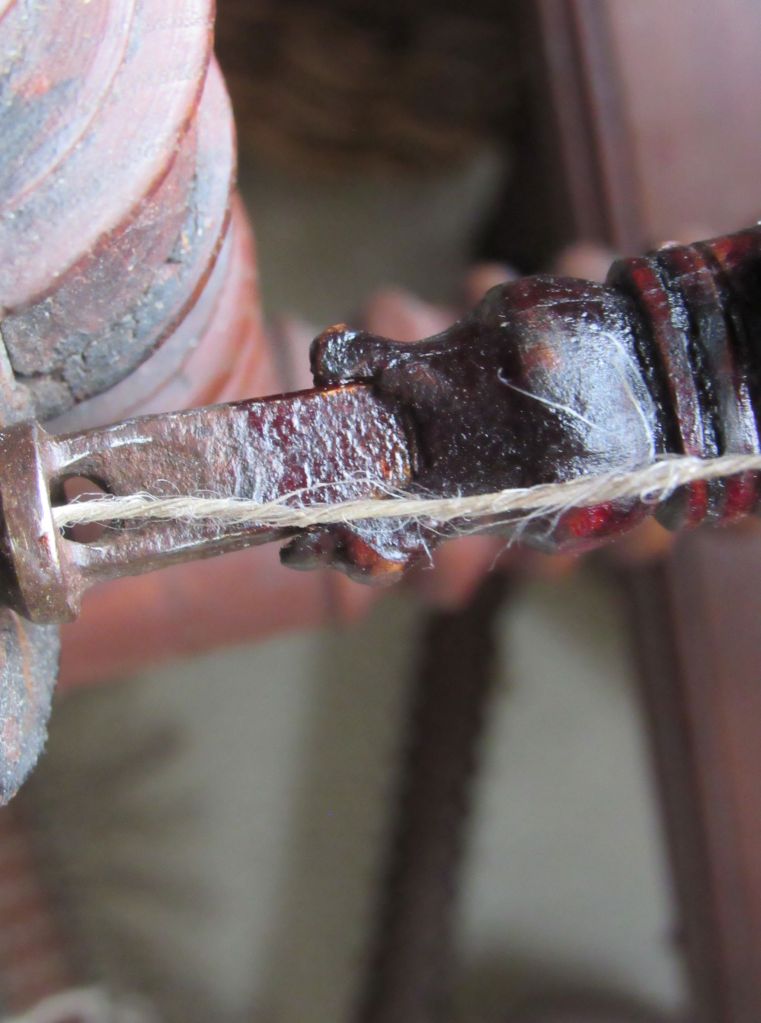
On both flyers, the wood is cut back from the mandrel on both sides near the orifice.
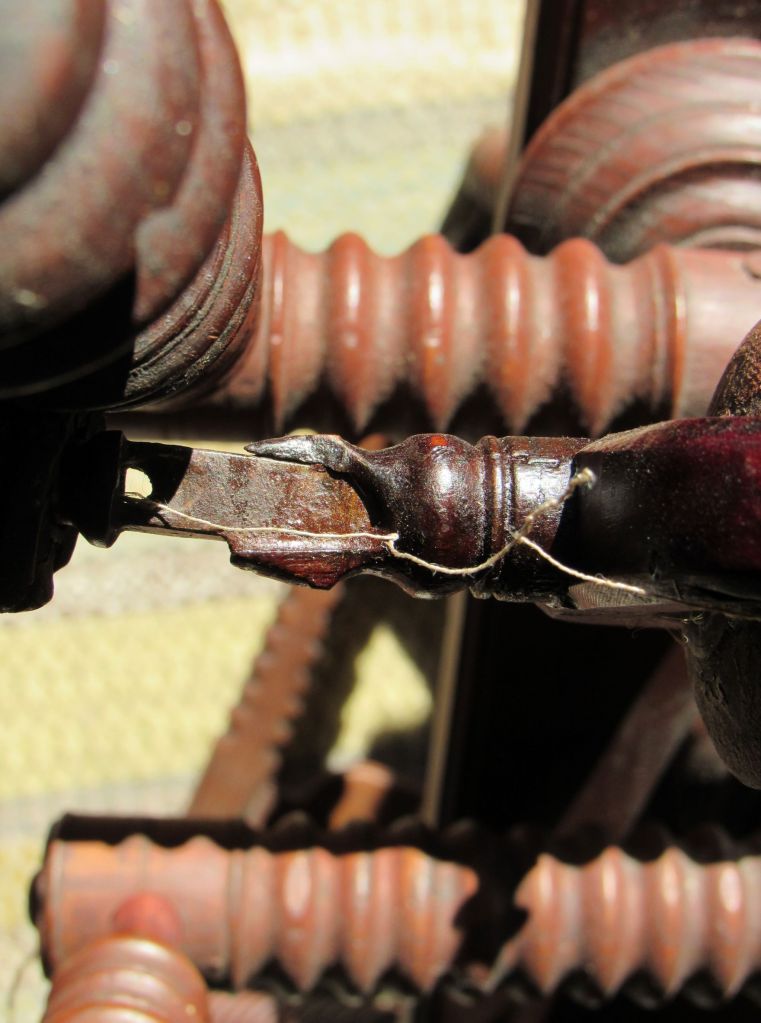
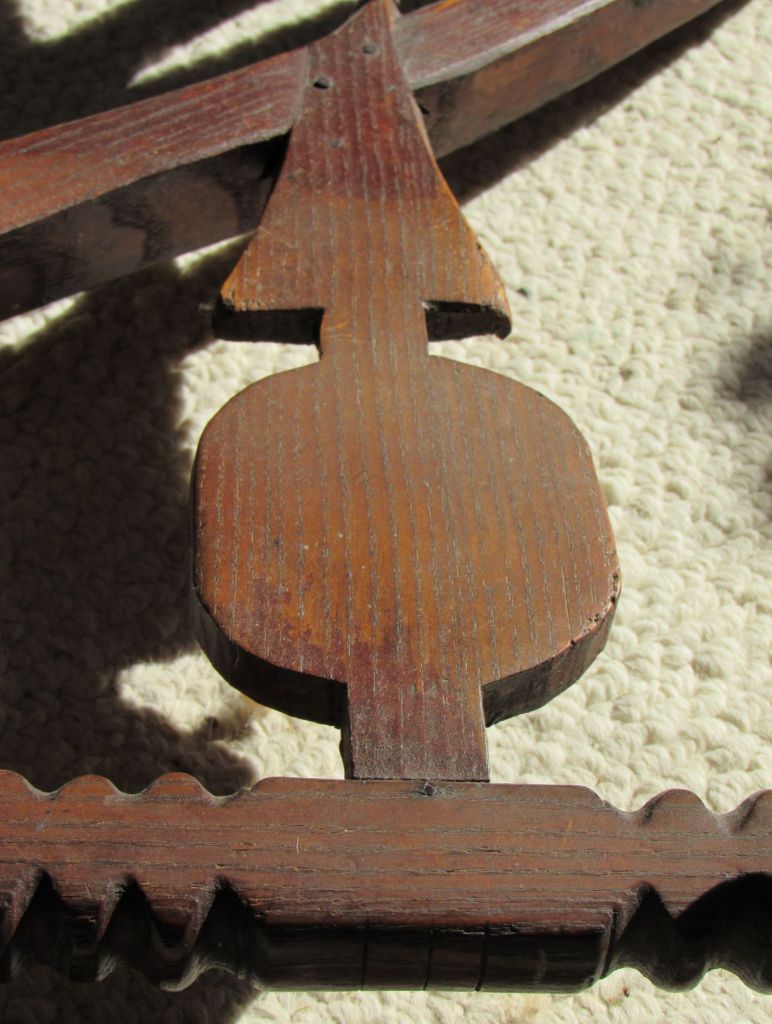
Another distinctive feature of these sister wheels is a curved treadle bar

and arrow-ended treadle.
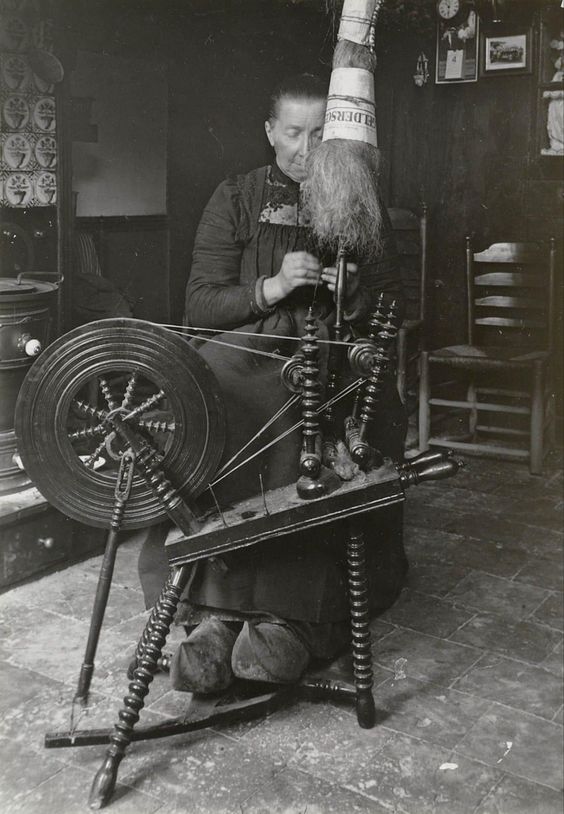
My wheel has wear showing that it was treadled with both feet, perhaps with wooden klompen as in this postcard.
The ends of the treadle bars look handcarved,
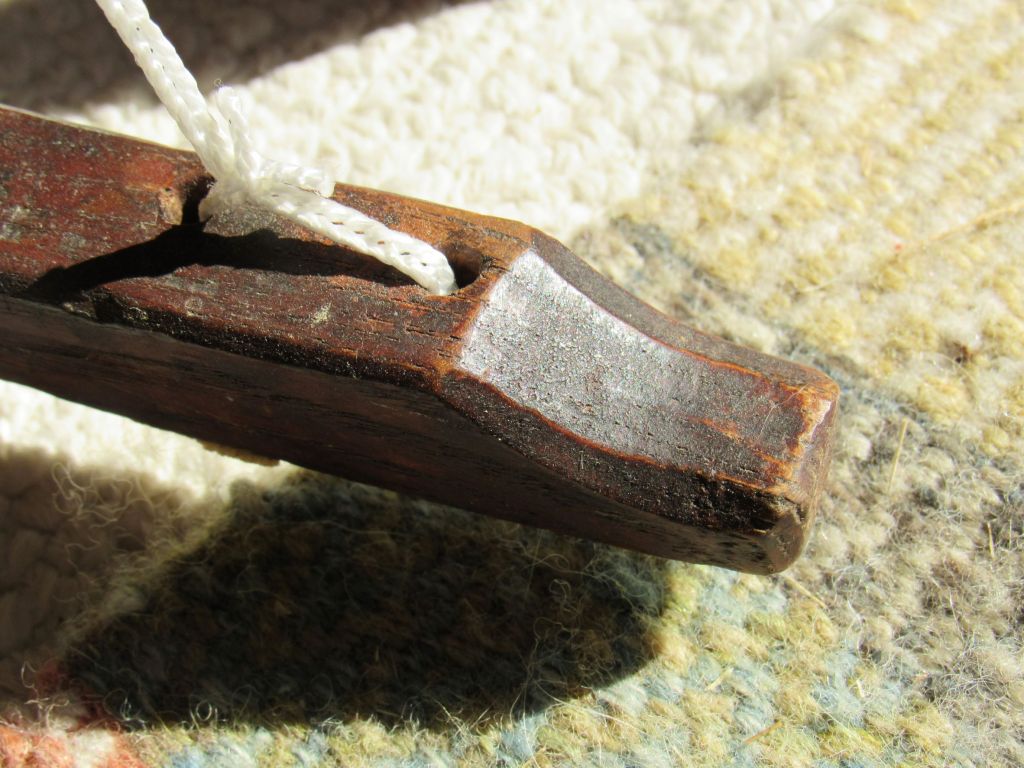
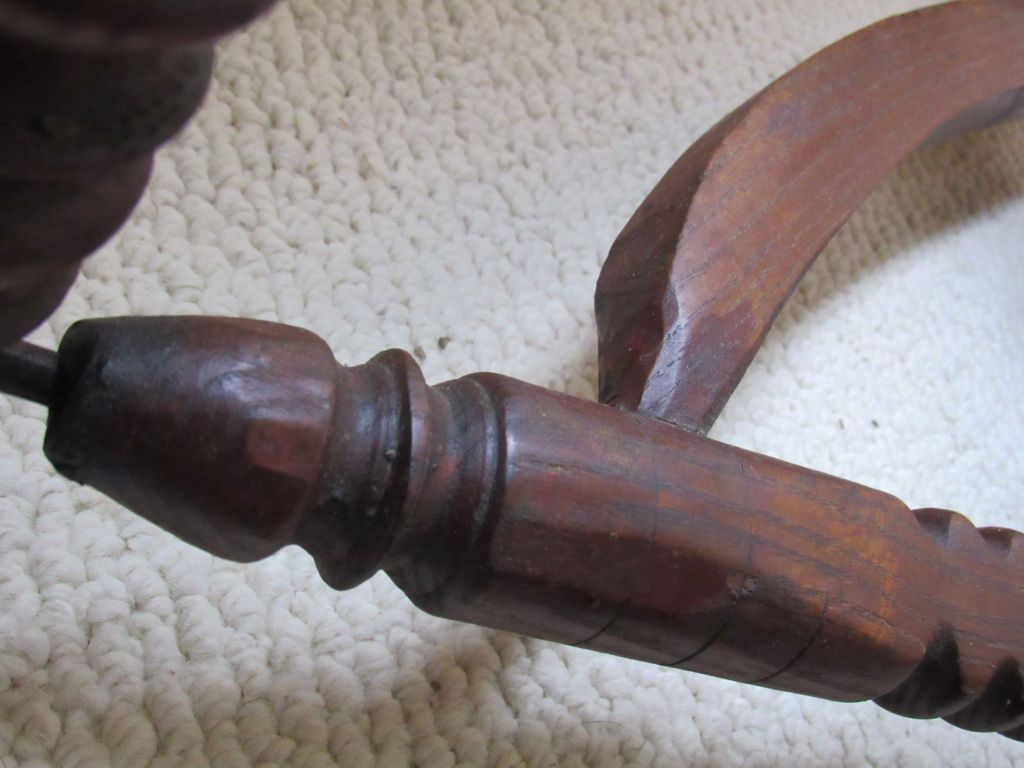
as are the tension knob pegs,
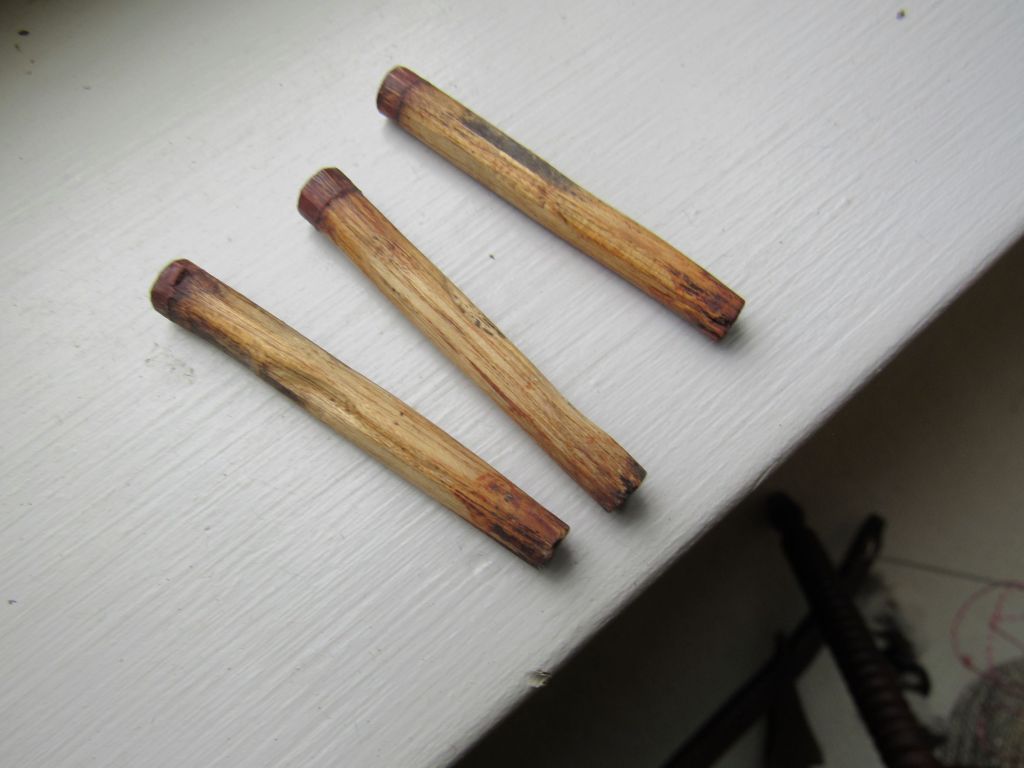
which fit so perfectly in the holes that I’m still working on matching the pegs back to the correct holes. If they are lined up just right, they do not need to be hammered in.
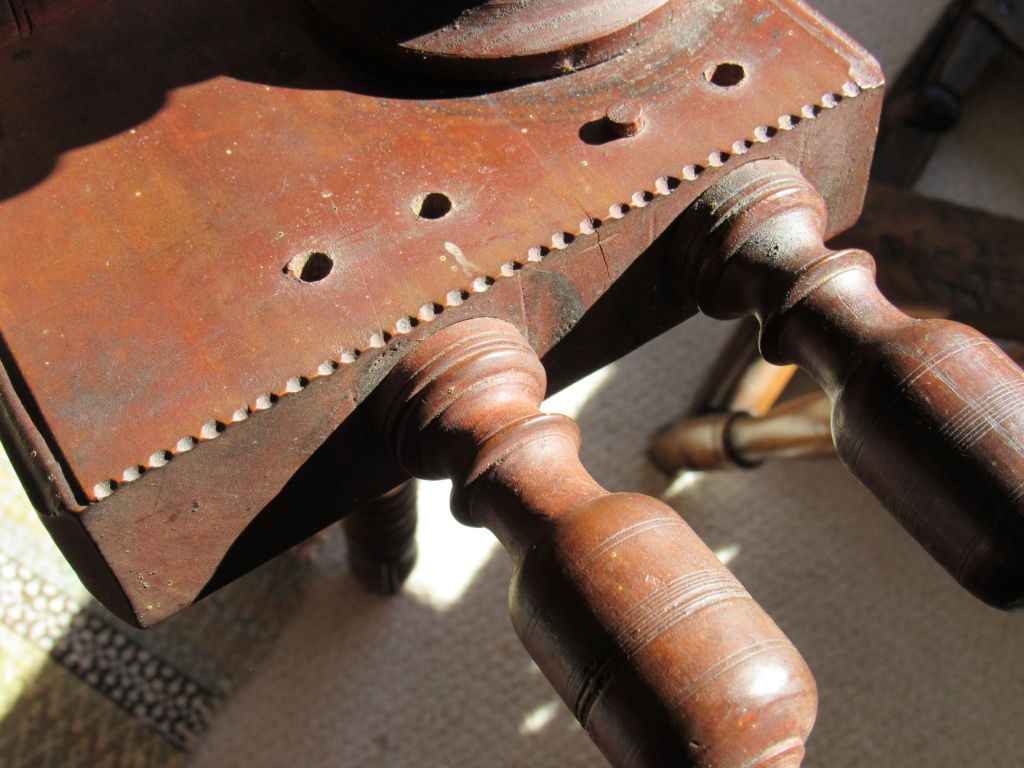
Decorative touches are everywhere,
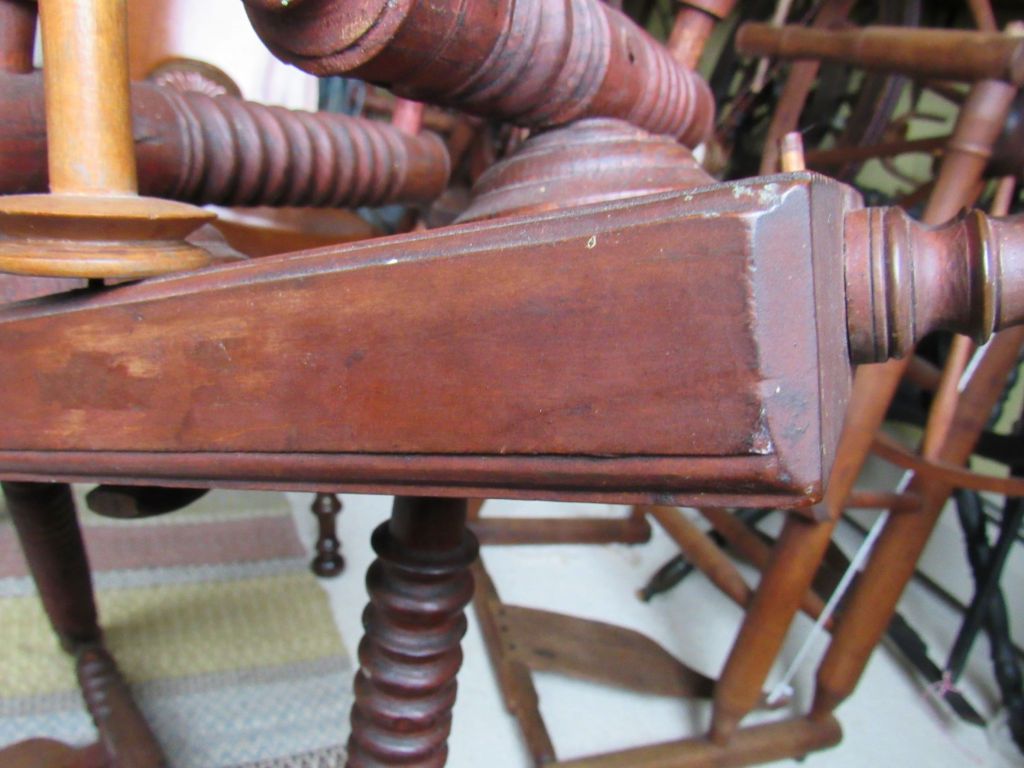

except for the drive wheel rim,
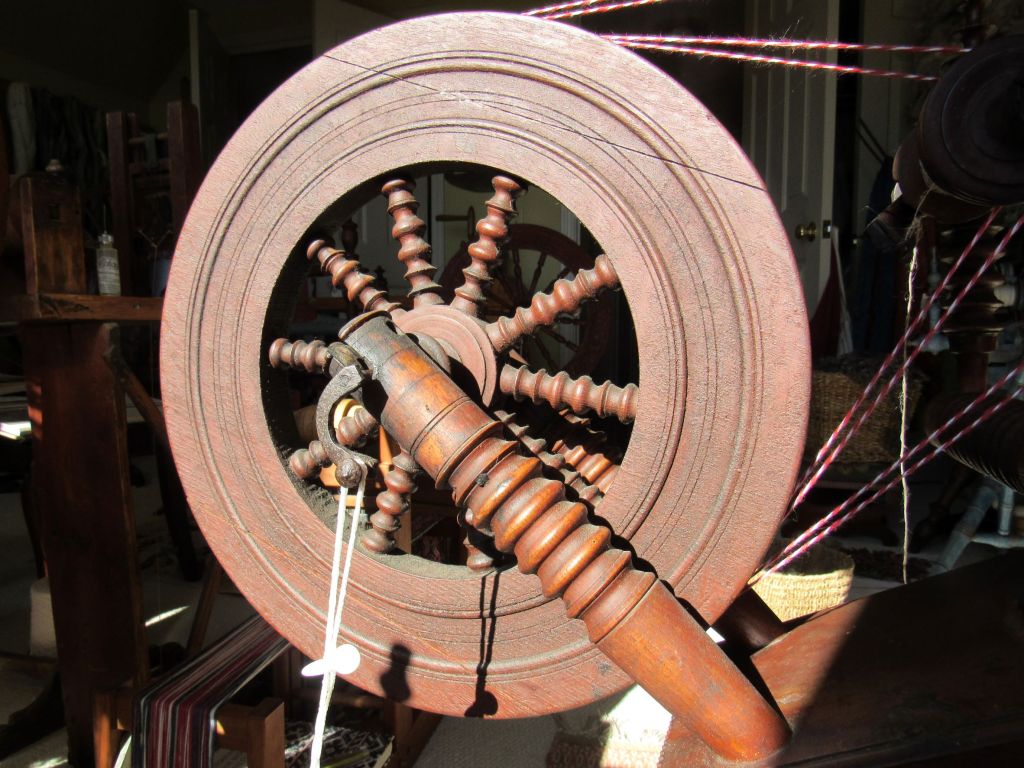
which has simple four-part construction.
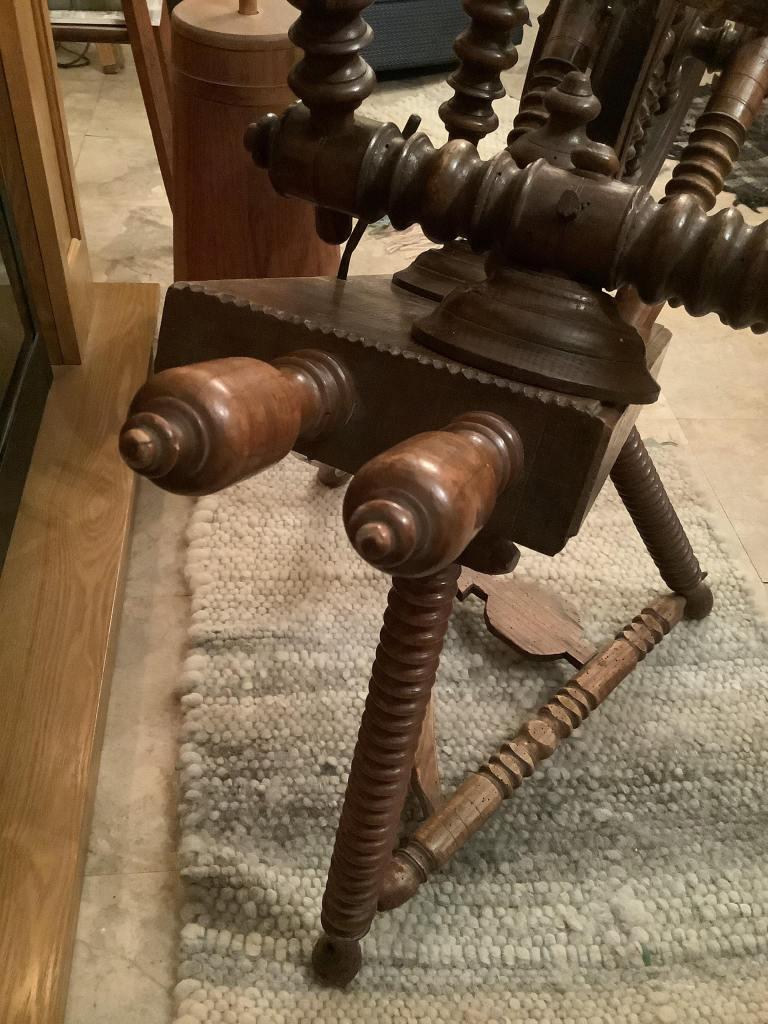
The mother-of-all collar on the uphill side extends past the table

and has a strong grain.
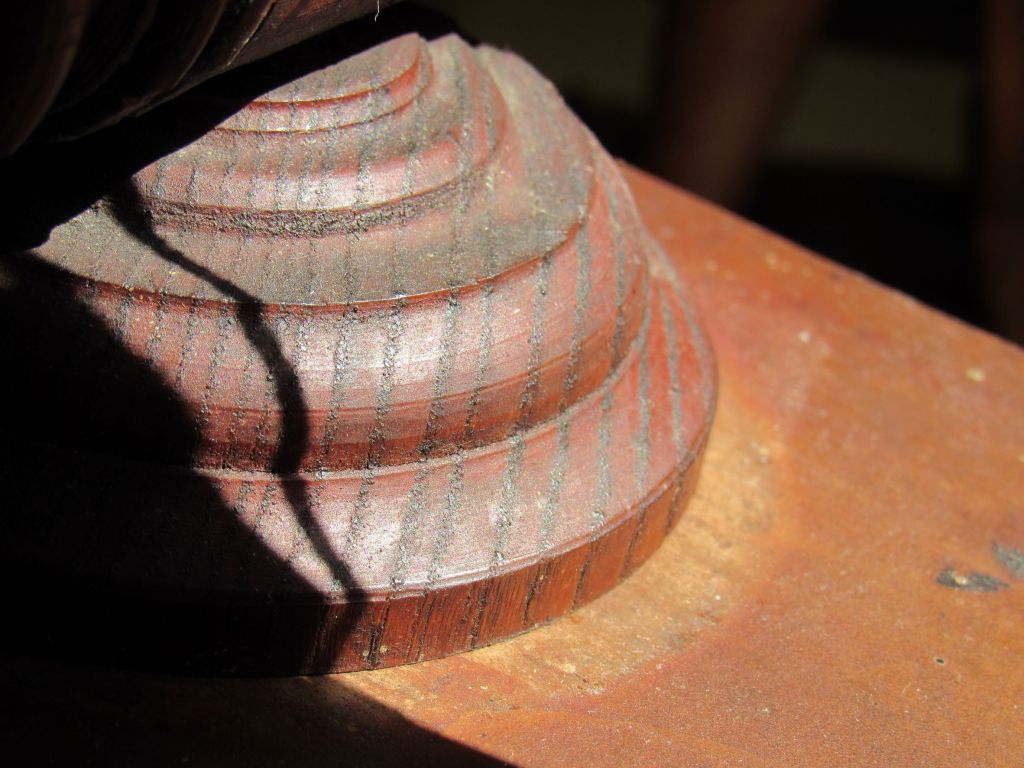
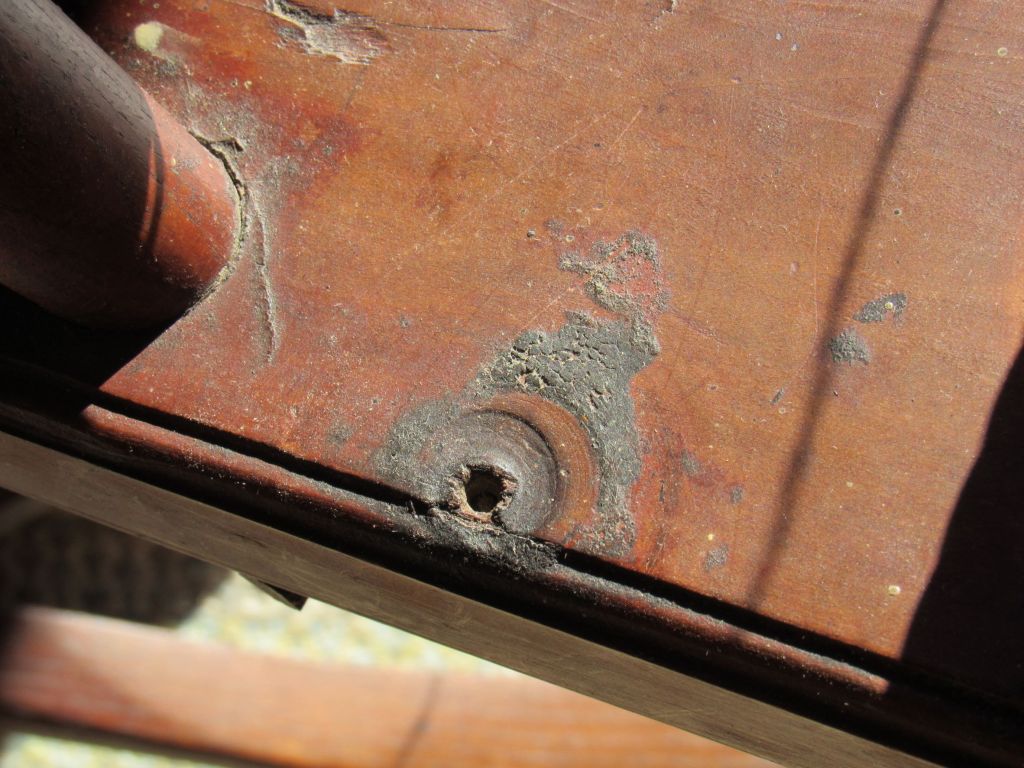
Several areas have traces of red paint
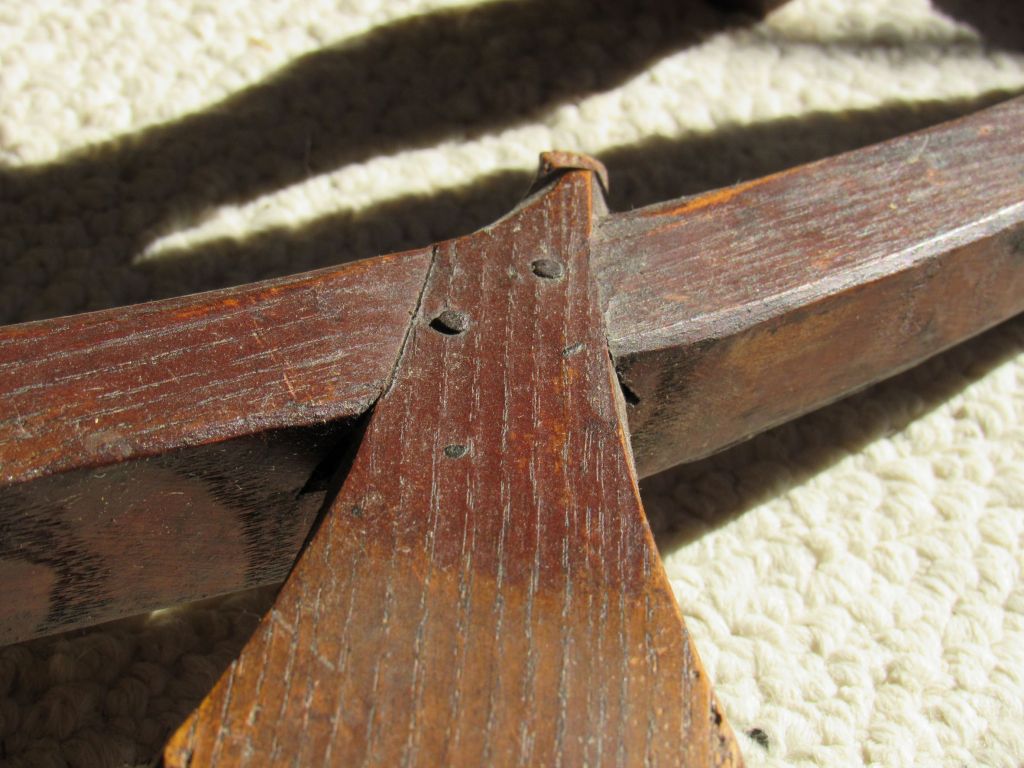
and others are grease-encrusted.
There were two metal upright rods for storing bobbins along the non-spinner side,

but one has broken off.
Each flyer has its own drive band
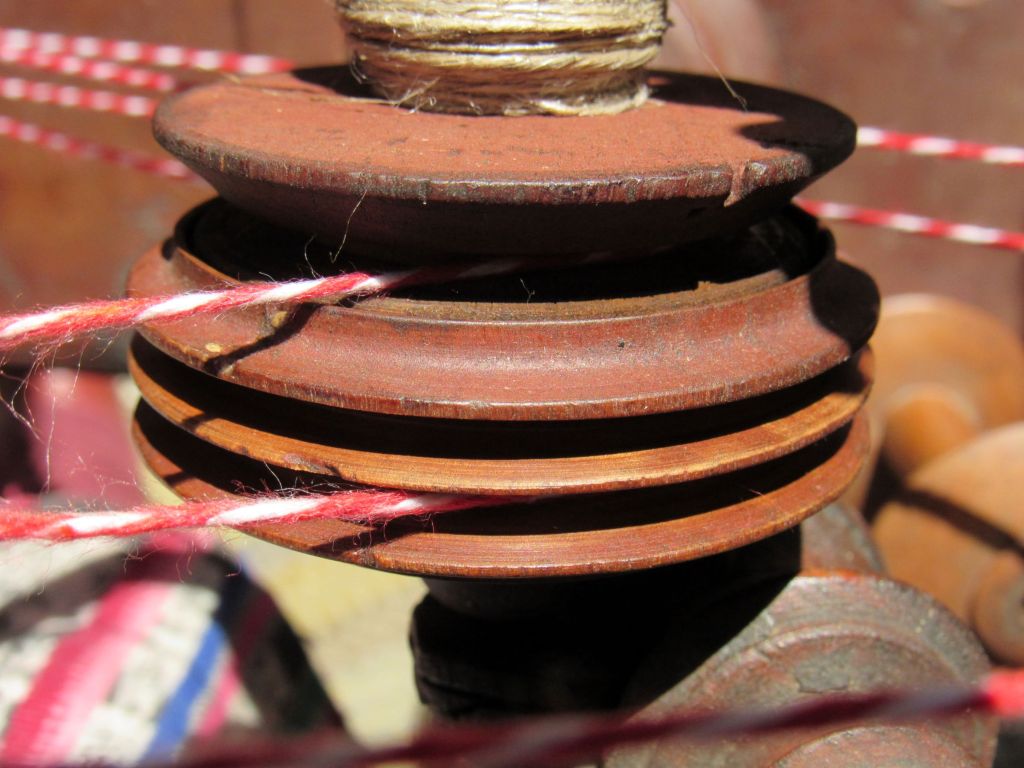
and they seem to happily accommodate each other on the drive wheel without any fiddling on my part.
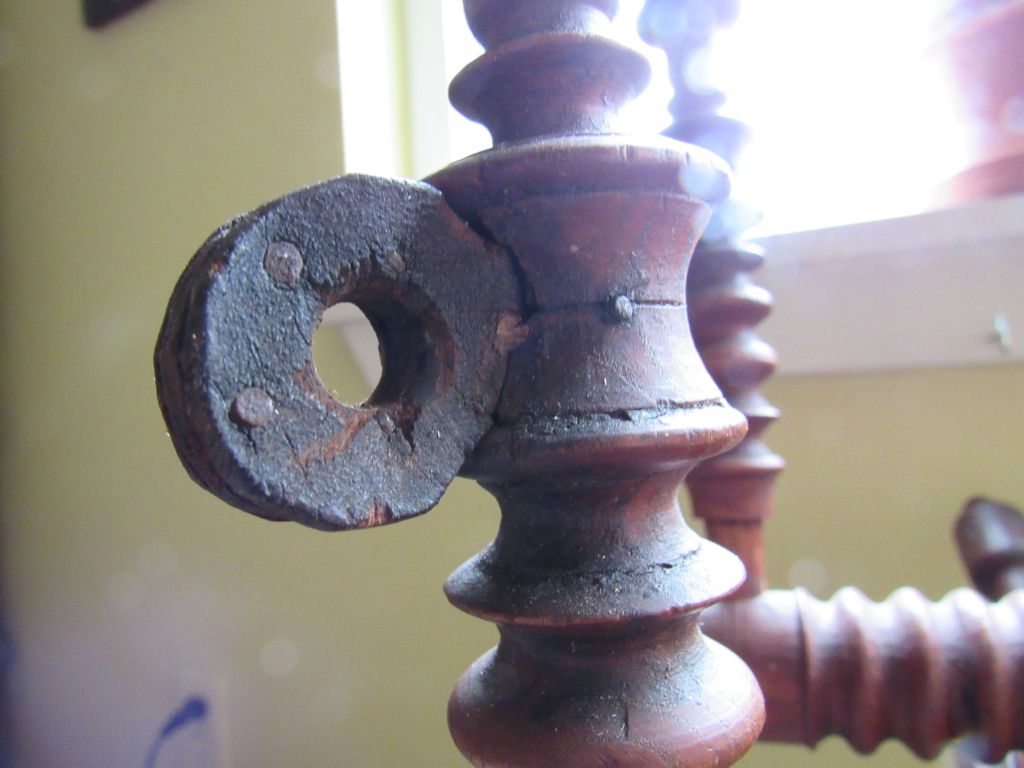
The leather flyer bearings are three layers held together with metal rivets.
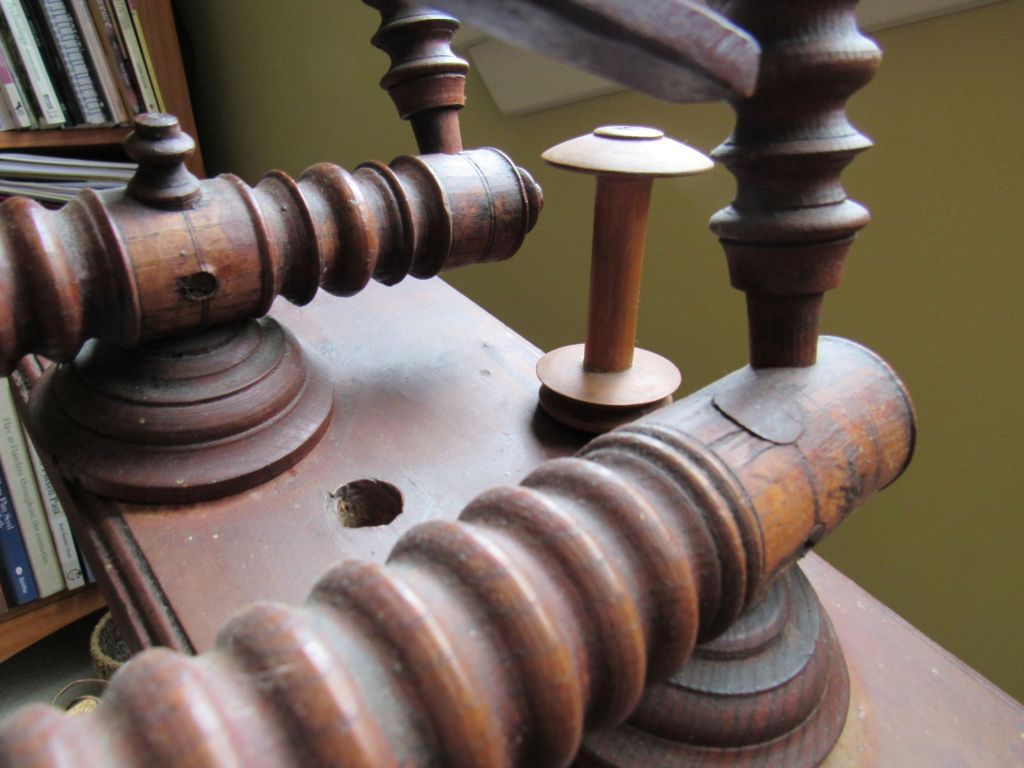
The distaff hole is between the two flyers.
There is not much room for the lowest distaff piece.
In deciding on the distaff design, I worked with John.

I examined wheel photos and a friend kindly sent me photos and measurements from a wheel in Canada. I am delighted with how it turned out.
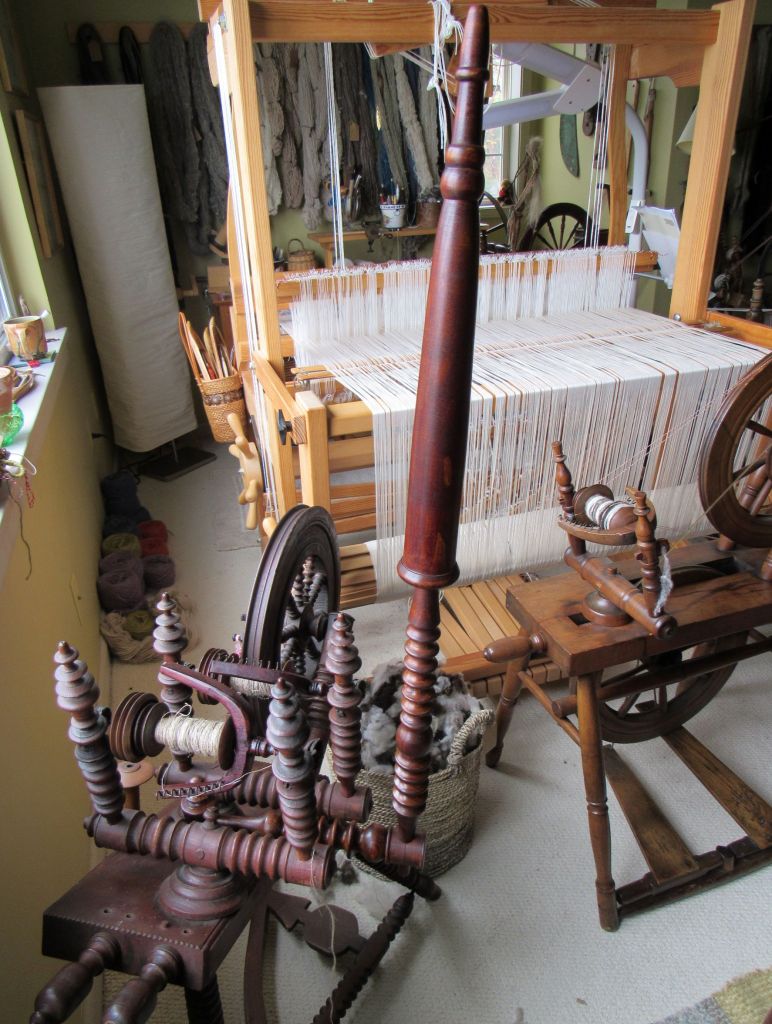
I understand why these wheels have ended up so far from where they were made. They were a perfect combination of desirable features–lightweight, portable, and beautiful in form, while performing their function brilliantly as efficient and pleasurable spinners.
Thank you to John, Rita, and Gordon for helping me to bring this wheel back to life and to Ginnie for sharing photos of her wheel.
For more information see:
Feldman-Wood, Florence, Two Double-Flyer Dutch Spinning Wheels, The Spinning Wheel Sleuth, Issue #65, July 2009.
SpiritWood’s link: https://www.spinningwheelrepairs.com/
 Exquisite Machinery
This amazing wheel reminds me of the cathedral in Milan. And it spins! You have done an amazing job of bringing it back to its youth. I love that you don’t stint on photos. So often there’s one little area I want to see more of, and, lo!, you have it.
Excellent lighting and clear focus.
LikeLike
Hi Brenda, I was wondering if your friend has made any progress in restoring Green Linnet. That wheel tugs at my heart, and I can’t wait to see her restored and in her glory.
Thanks, Debby
Virus-free. http://www.avast.com
On Sun, Oct 31, 2021 at 4:11 PM Exquisite Machinery wrote:
> Brenda posted: ” Truus is a striking combination of form and function. > The turnings on this Dutch wheel are almost mesmerizing, especially when > light strikes them through a window. Long and short rows of ridges at > various angles, topped by four ma” >
LikeLike
I will check with her and follow up!
LikeLike
Debby,
Green Linnet has had her bobbin, whorl, and flyer cleaned, fixed, and made ready to spin. She still needs to have her leg fixed. I will post photos of her when she is spinning again.
LikeLike
It does have an architectural quality to it, doesn’t it? I had to look up a photo of the Milan cathedral and see what you mean. It is hard to describe how this wheel plays with the light and almost seems to glow in the sun. It is good to hear that you appreciate the large number of photos. I try to cover everything but don’t want to overwhelm with photos, so hope its a decent balance. Good to hear from you and keep the comments coming, I appreciate the feedback.
LikeLike
Good lord. I have this exact same wheel! Do you have any idea of date?
LikeLike
Good question. I don’t know but would guess late 1800s to early 1900s. Where did you find your wheel?
LikeLike
Brenda I bought mine in a little village in the Cotswolds in UK. The lady I bought it from said it was her husbands great great grandmothers snd they came from Yorkshire.
The gentleman who is mending my broken flyer and the measurements has worked out that it’s probably from the time that the Dutch switched to metric so between 1820 and 1869.
Mine is practically identical to yours apart from a few variations in the top set of maidens.
I can send you a picture if you’re interested.
LikeLike
That’s fascinating. Since identical (or almost so) wheels keep turning up from time to time, I assume they are from the same maker. I wish we could find out more about who it is. Your time frame is a clue, though!
LikeLike
You do find the most fascinating wheels (there are definitely not too many photos)! And she spins so well while looking so wonderful. As a flax ignoramus in a country with about 5 times more sheep than people, I can’t help wondering if she would ever have been used for spinning wool.
LikeLike
That’s a good question. I am not aware of any tradition of double-flyer wool spinning. When flax is properly dressed on the distaff there is a certain resistance in drawing it out that makes two-handed spinning feasible. I’m not sure if you could achieve something similar with wool. Of course, the wheel can be used with a single flyer, for wool or flax. If this wheel was brought to Michigan by Dutch immigrants, it certainly seems likely that they may have used it for flax and wool. I think I’ll do a little more research! I know you have a native flax in New Zealand, but it isn’t used for fiber, right? Was fiber flax ever grown there or was wool so abundant that flax would have been too much work to be worth it?
Thanks for comment on photos. It is nice to know that they are helpful.
LikeLike
NZ native flax (phormium tenax, Māori harakeke pronounced something like ha-ra-keh-keh) is botanically nothing like linen flax. The first Europeans here used it mostly for ropes and such.
Here’s a nice link about harakeke:
https://collections.tepapa.govt.nz/topic/3623
It has been much used in Māori textiles. When the first Polynesians arrived here they found a colder climate than they were used to, and no handy palm leaves, so they developed the use of harakeke for everything from basketry and fish-traps to finely woven (actually twined) cloaks.
This is an article by a noted weaver who studied the techniques:
https://digitalcommons.unl.edu/cgi/viewcontent.cgi?article=1146&context=tsaconf
The craft is still practised today, both in traditional ways and and developing along more modern lines. There is some crossover between Māori and European-tradition weaving, with a lot of us taking an interest and having a bit of instruction.
LikeLiked by 1 person
I love the postcard that shows the Klompen. Do you know much about the tradition of wooden shoes? (I ask, since I recently stumbled upon one clog being sold on etsy. Seller asserts that the maker has carved their name on the sole of the shoe. I would thin that the wearer might have done that, but what are your thoughts?) Looking at the distaff dressed with flax, it seems to me, that there is something different going on there, other than the ribbons. Is it possibly newspapers that are tucked in between the flax and the ribbon there? Surprising!
LikeLike
I don’t know anything about whether a maker would put his name on klompen, but like you would think it more likely that the it’s the name of the wearer. As for the distaff, yes, it is not unusual to have paper or something similar as an underlying layer in dressing the flax on a truncheon style distaff. I’ve tried it without much success!
LikeLike
I am currently repairing a Dutch double flyer wheel similar to Truus. Could I get the measurements for length and width at the bell on the distaff? Thanks so much!
LikeLike
The top part of the distaff is 16,” the bell is 2″ across. The height from the top of the arm supporting the distaff assembly to the tip of the distaff is 28.” Hope that helps!
LikeLike