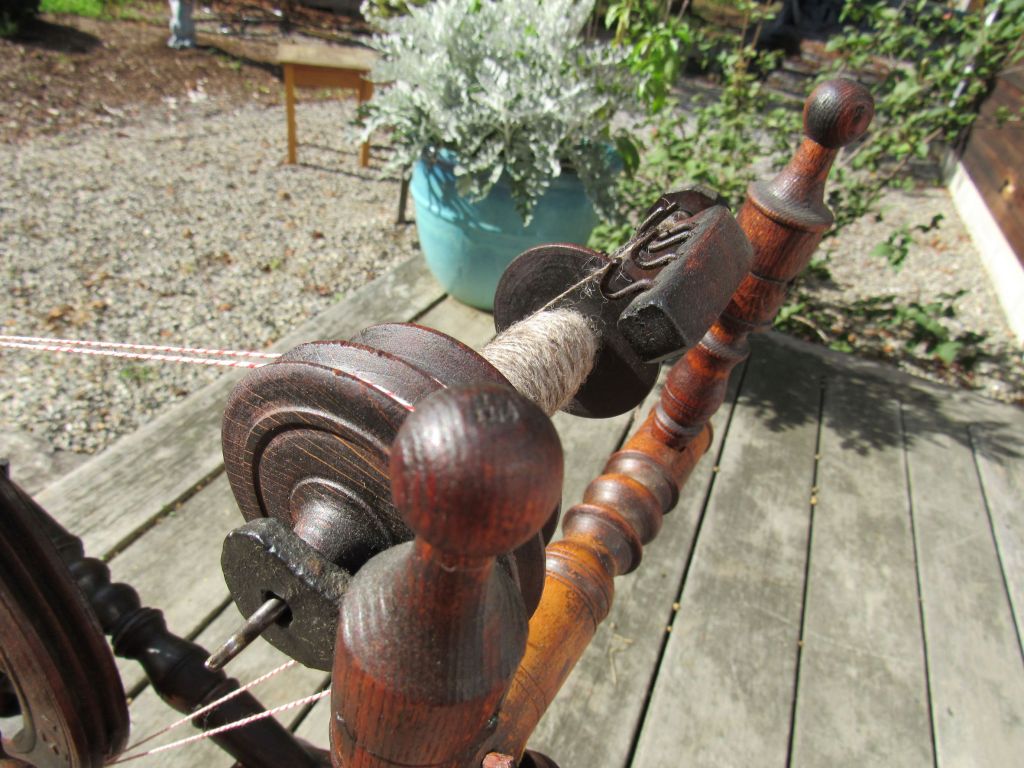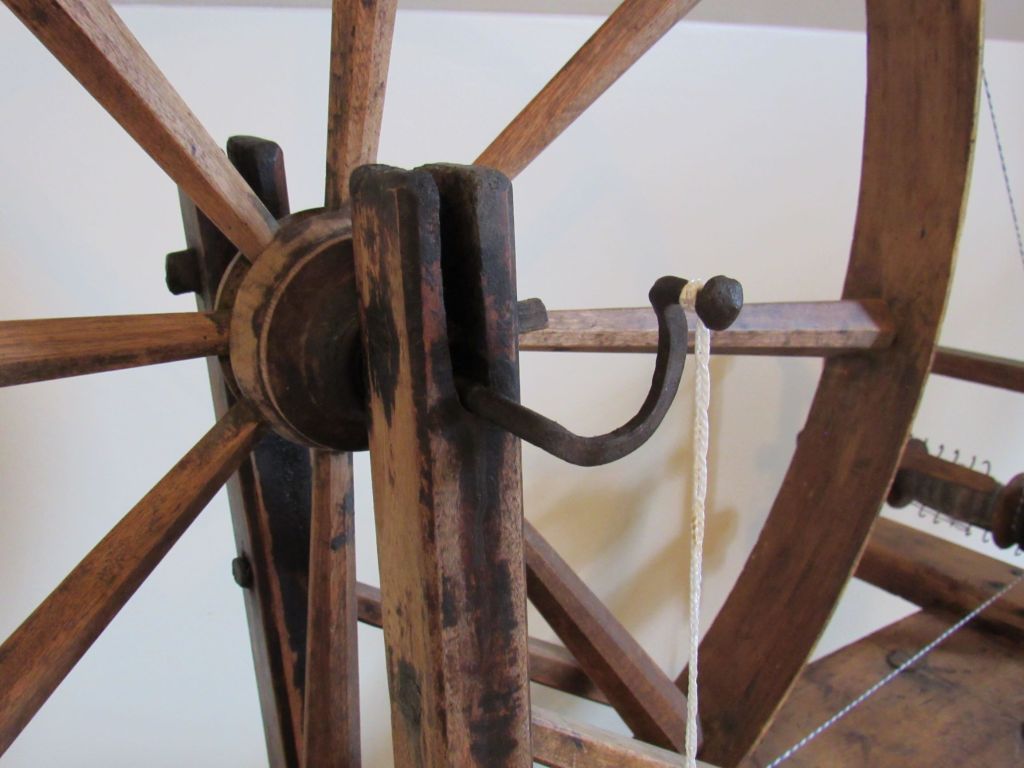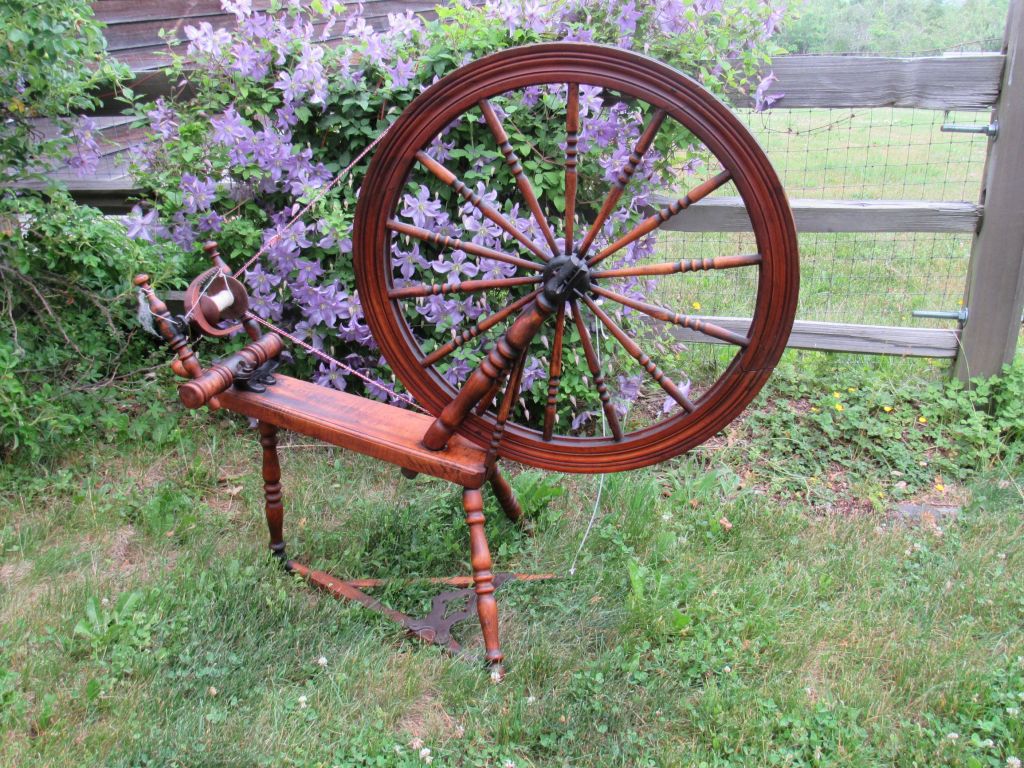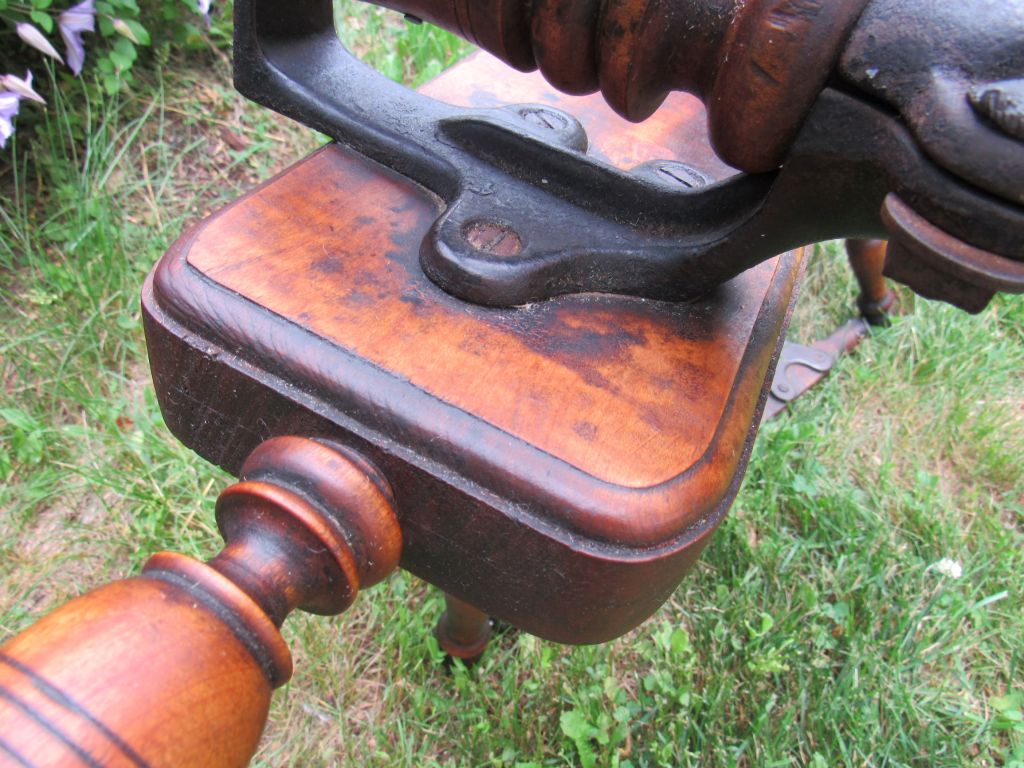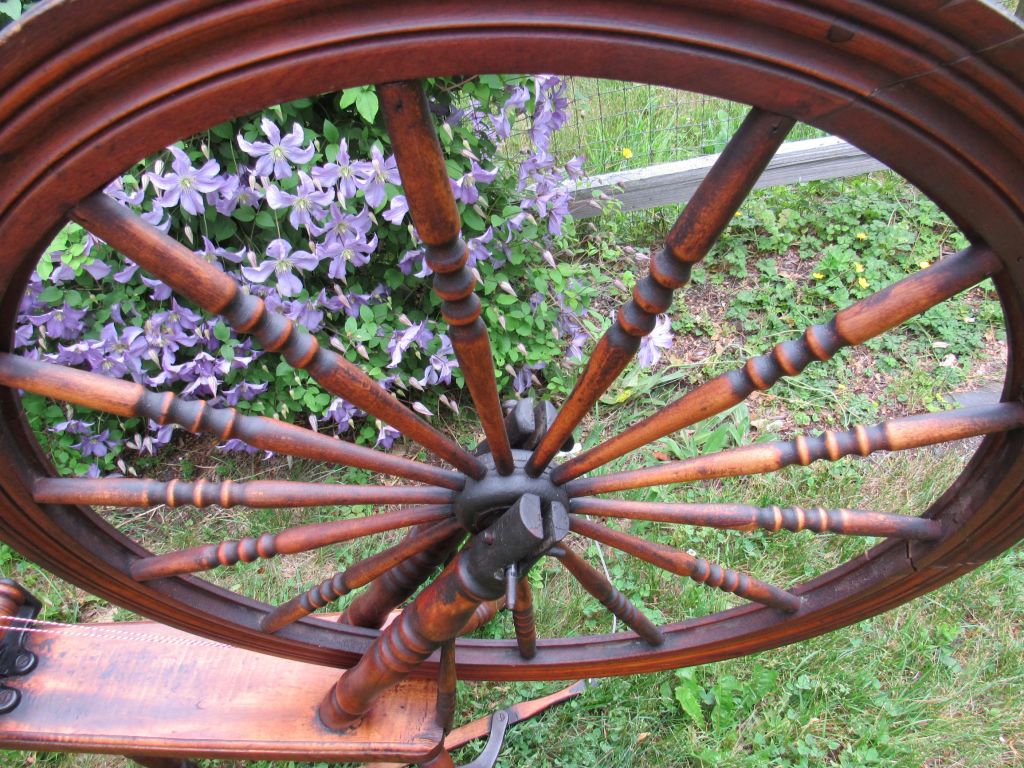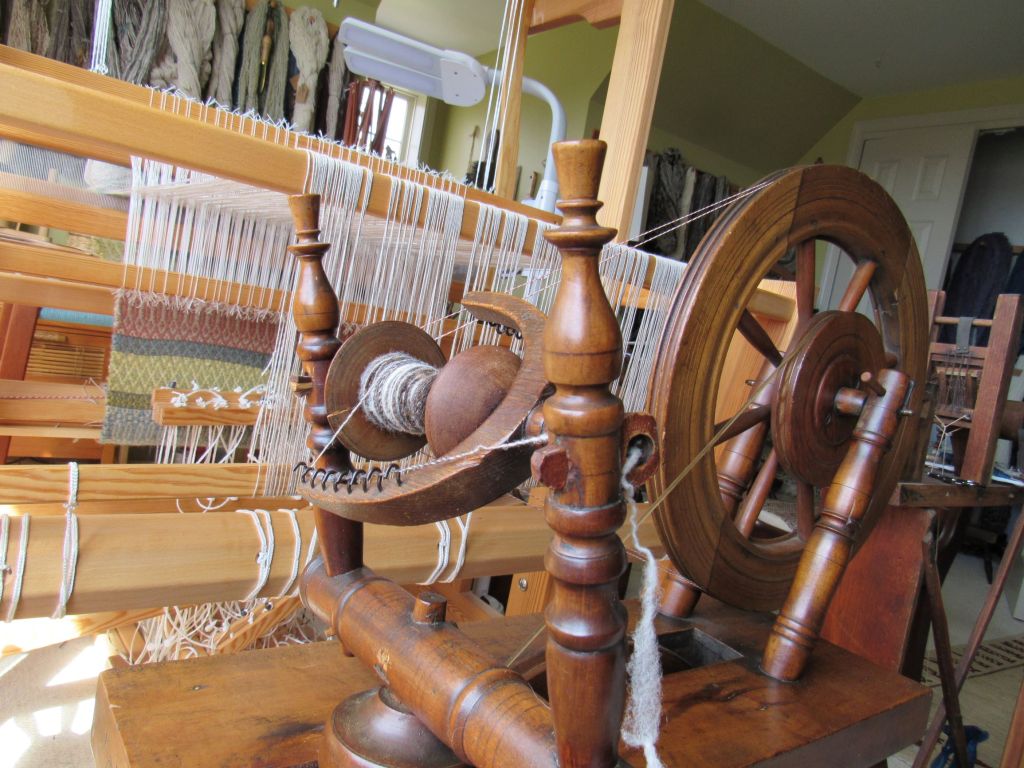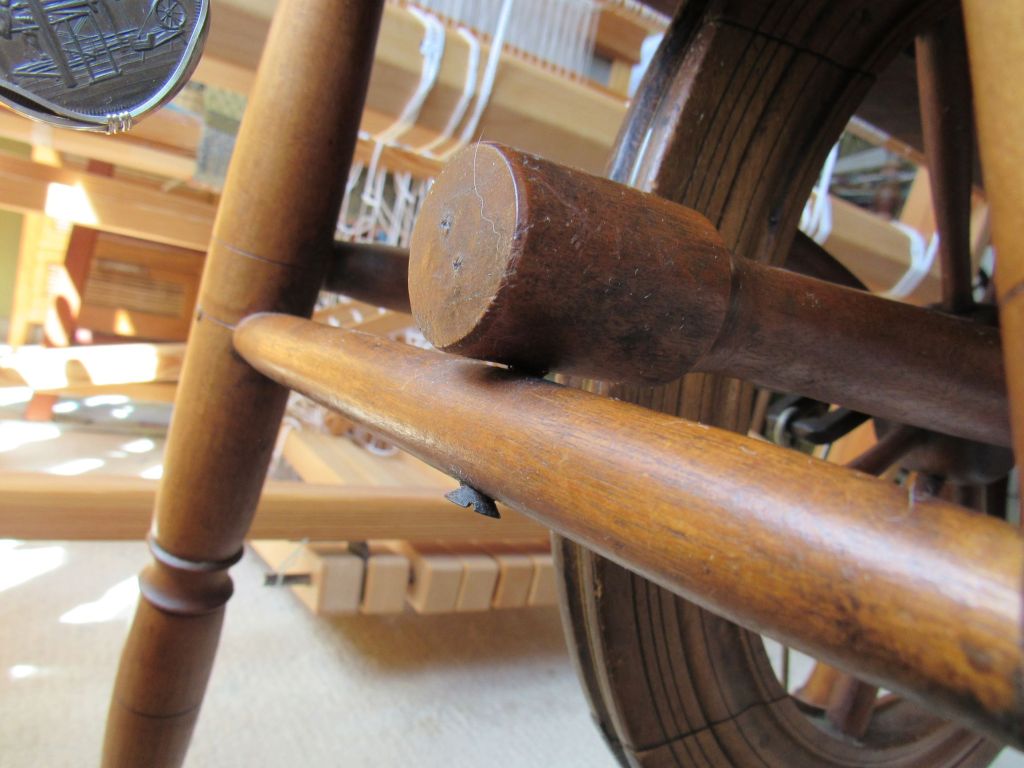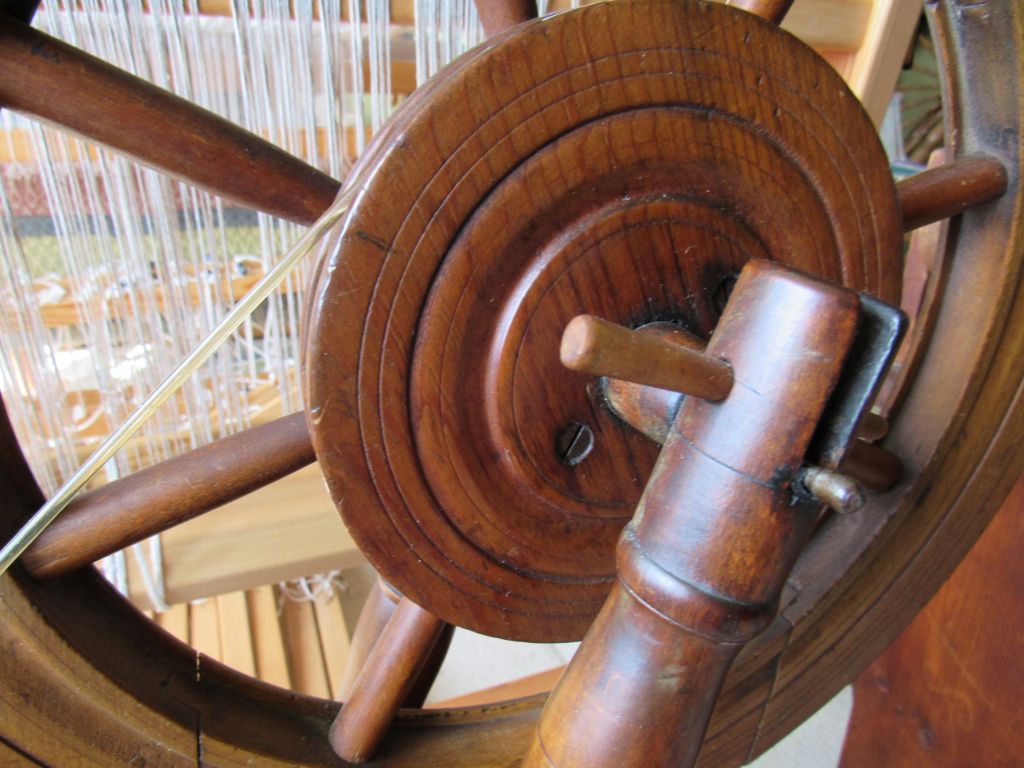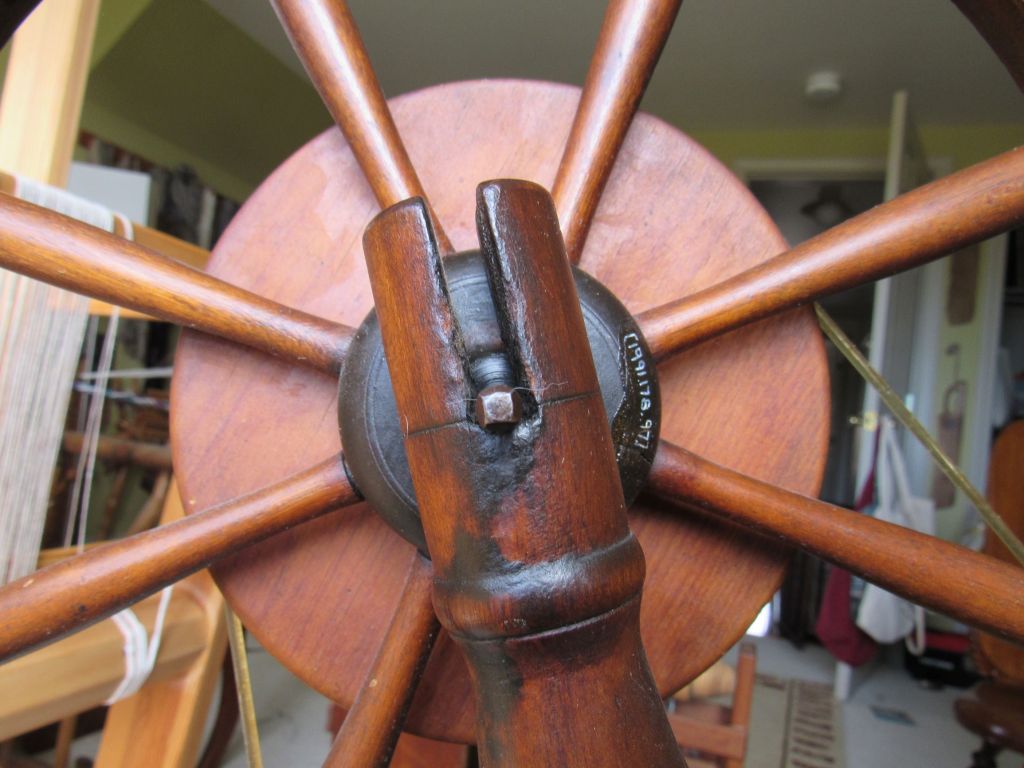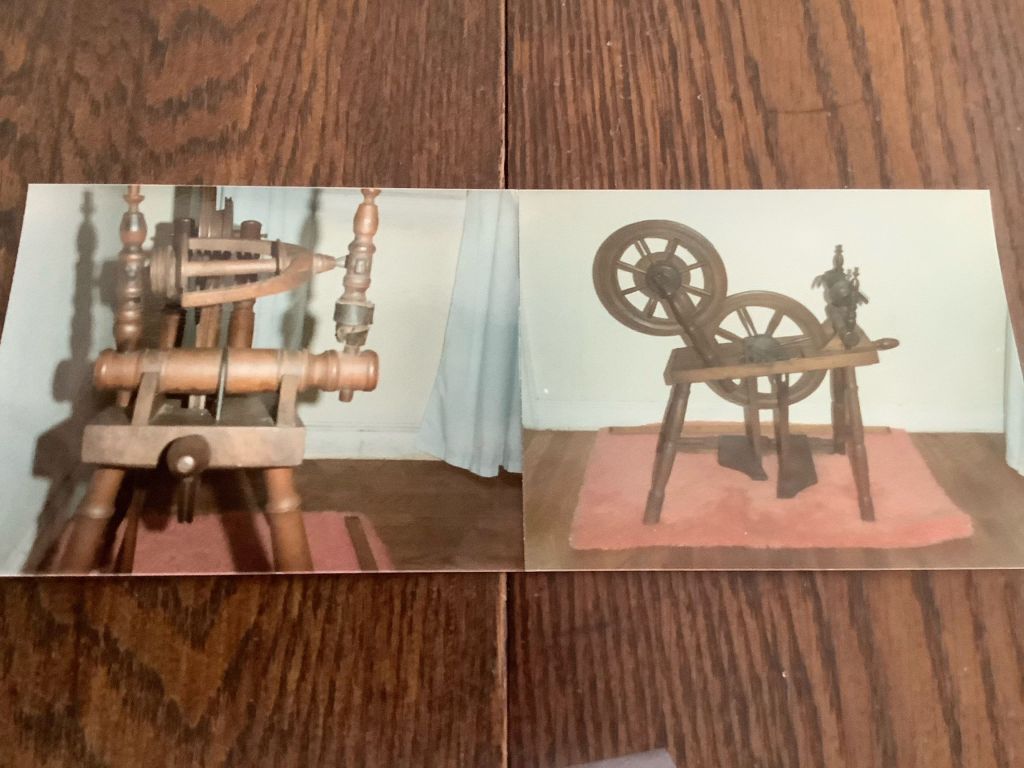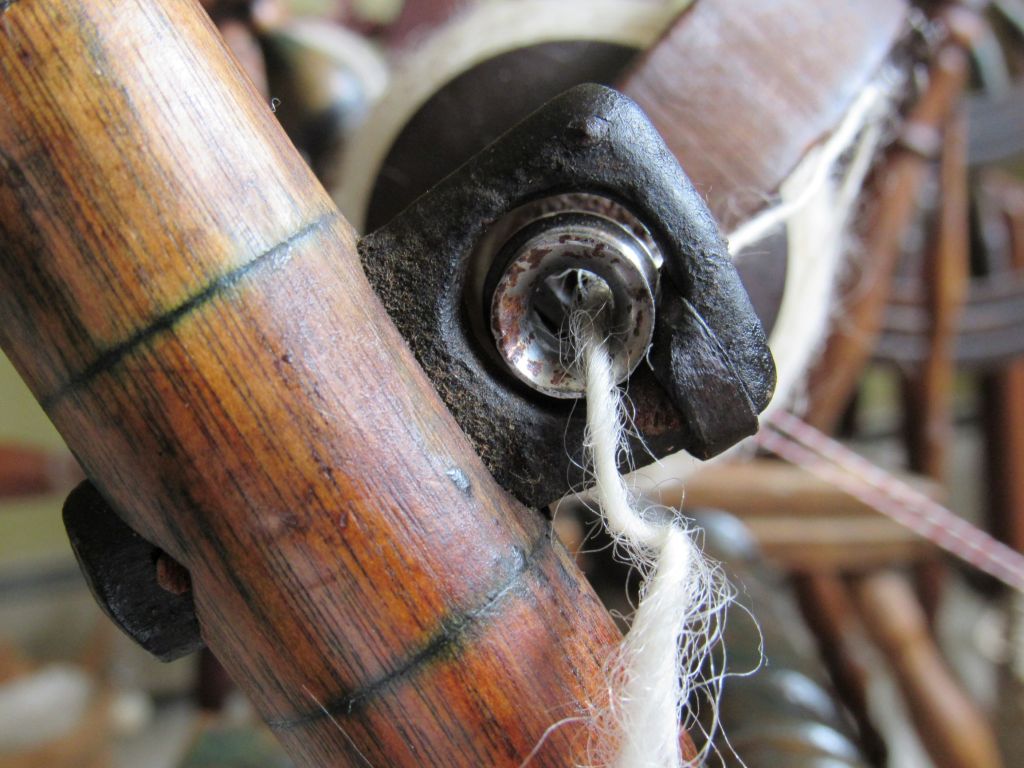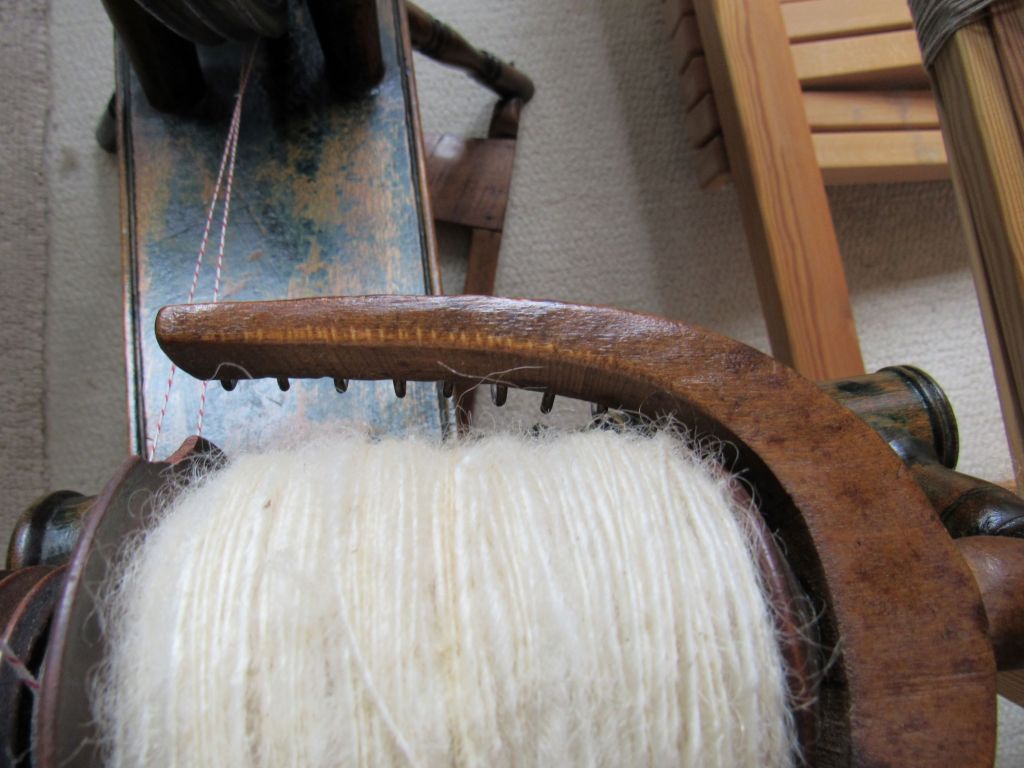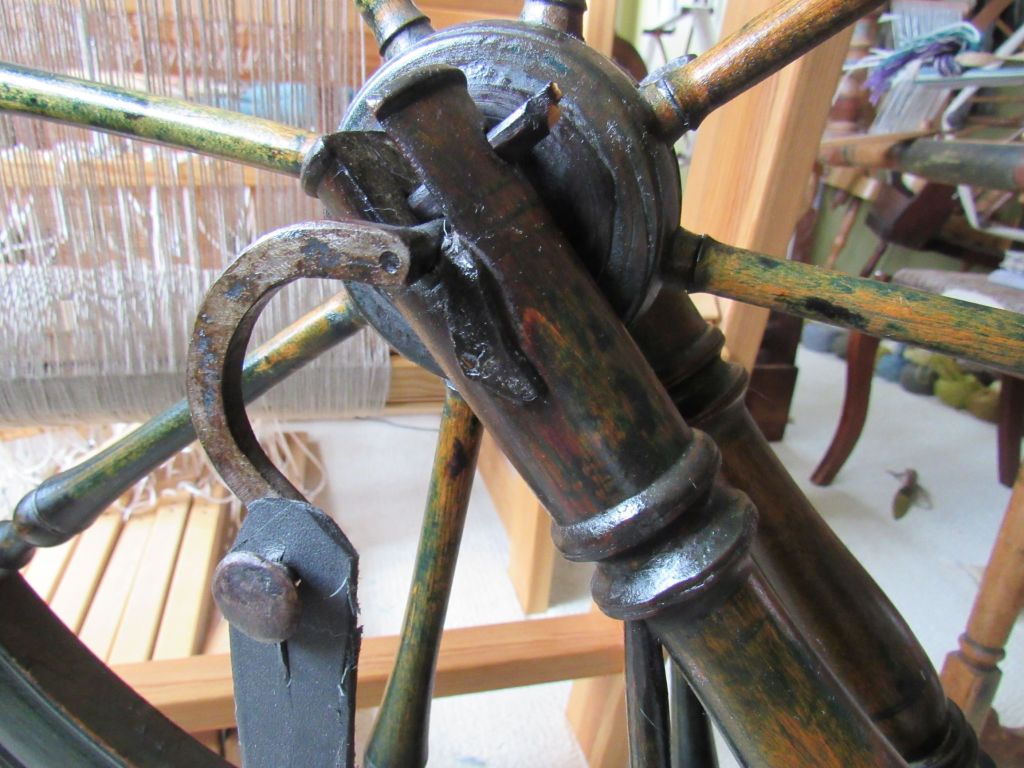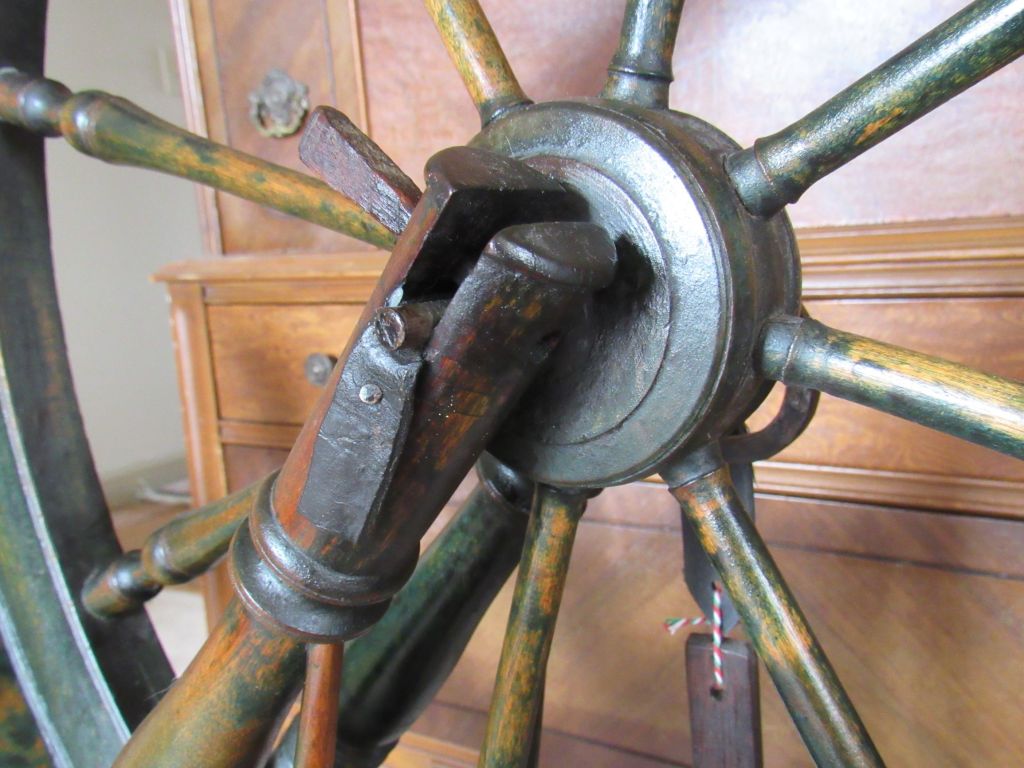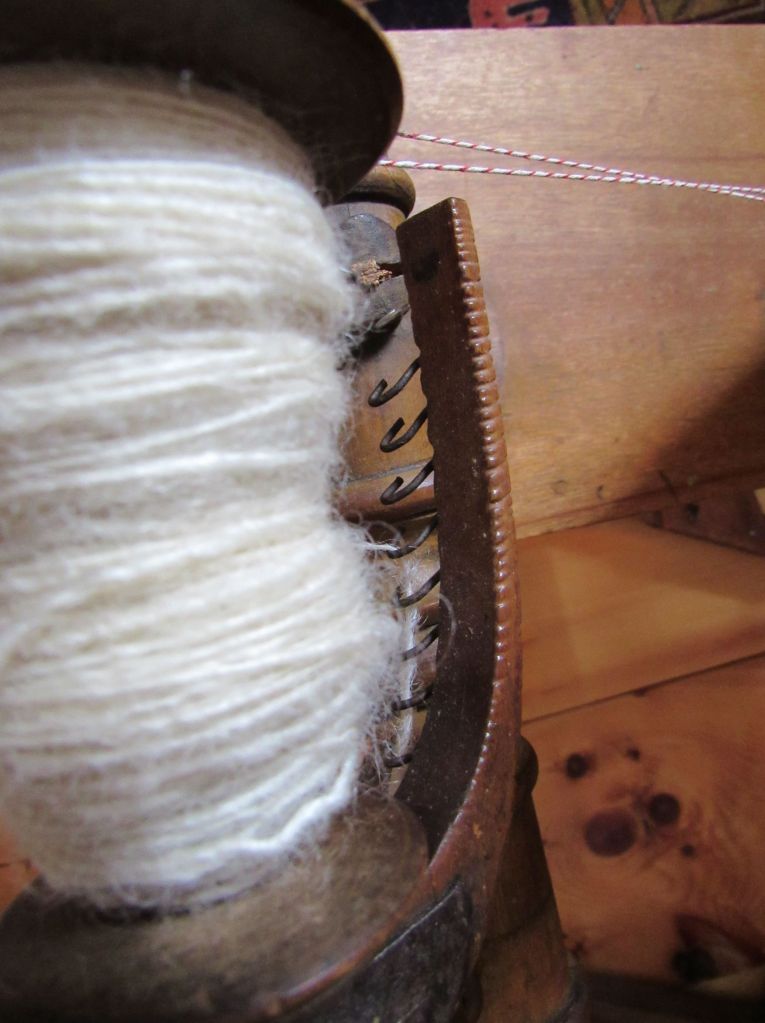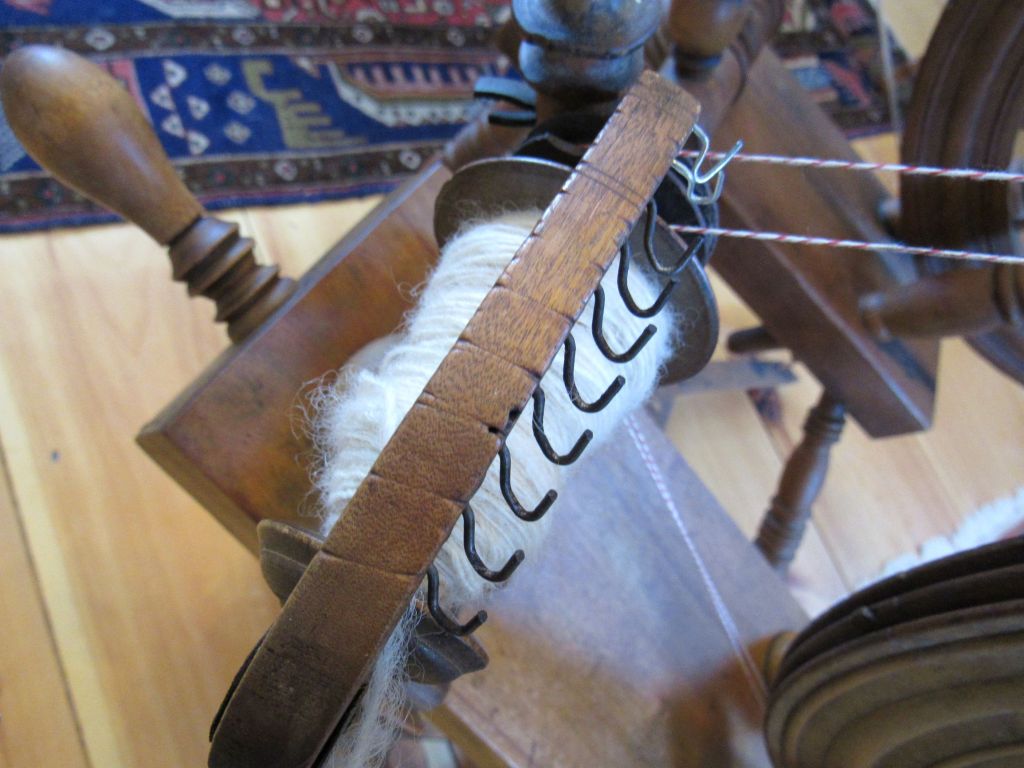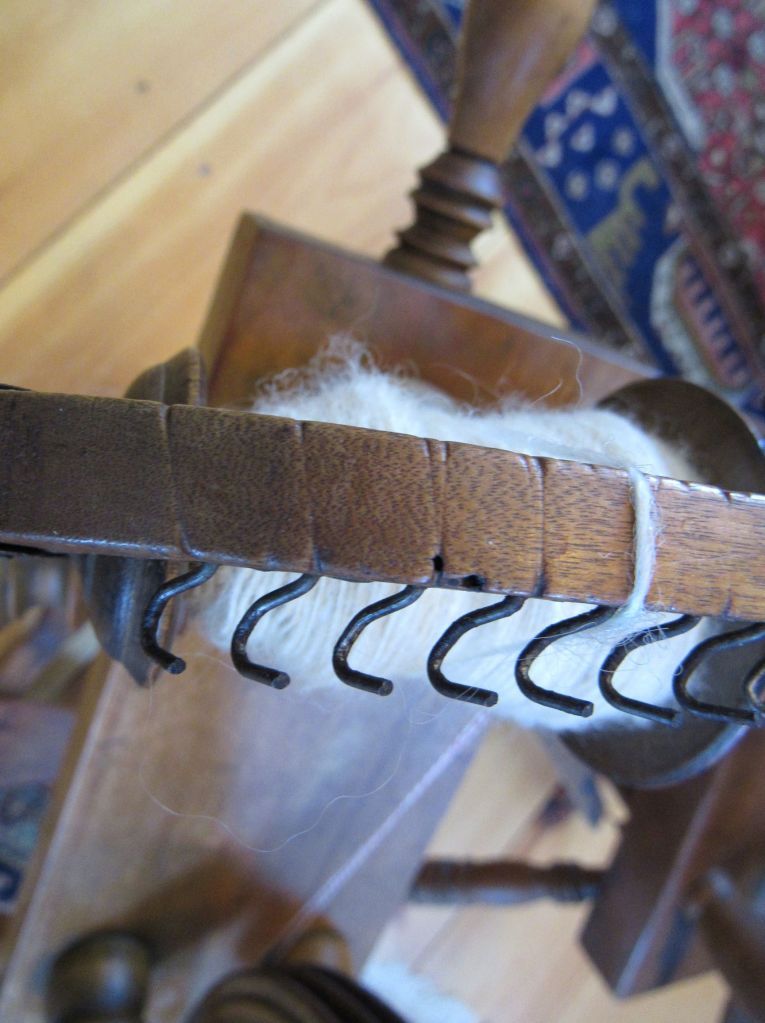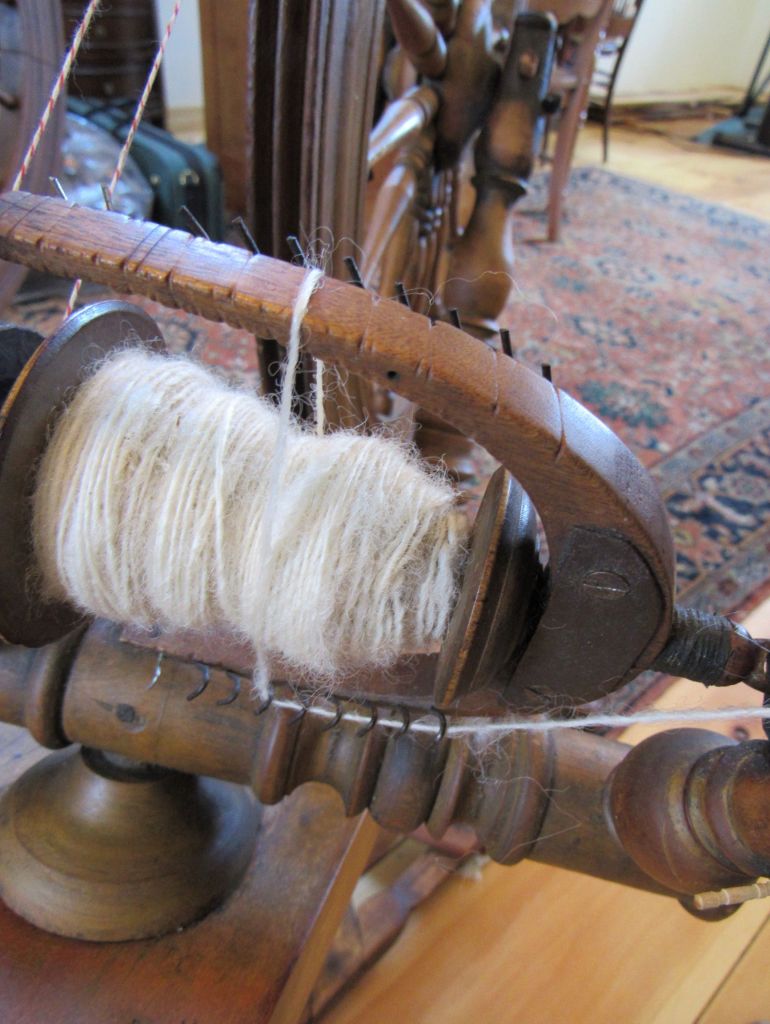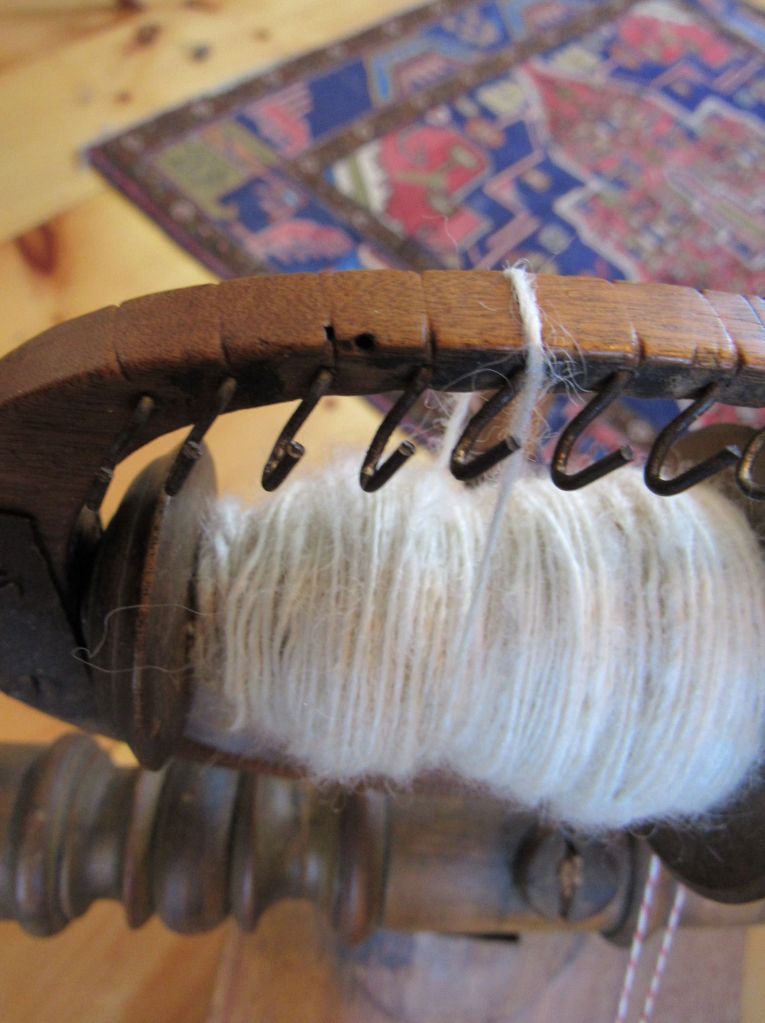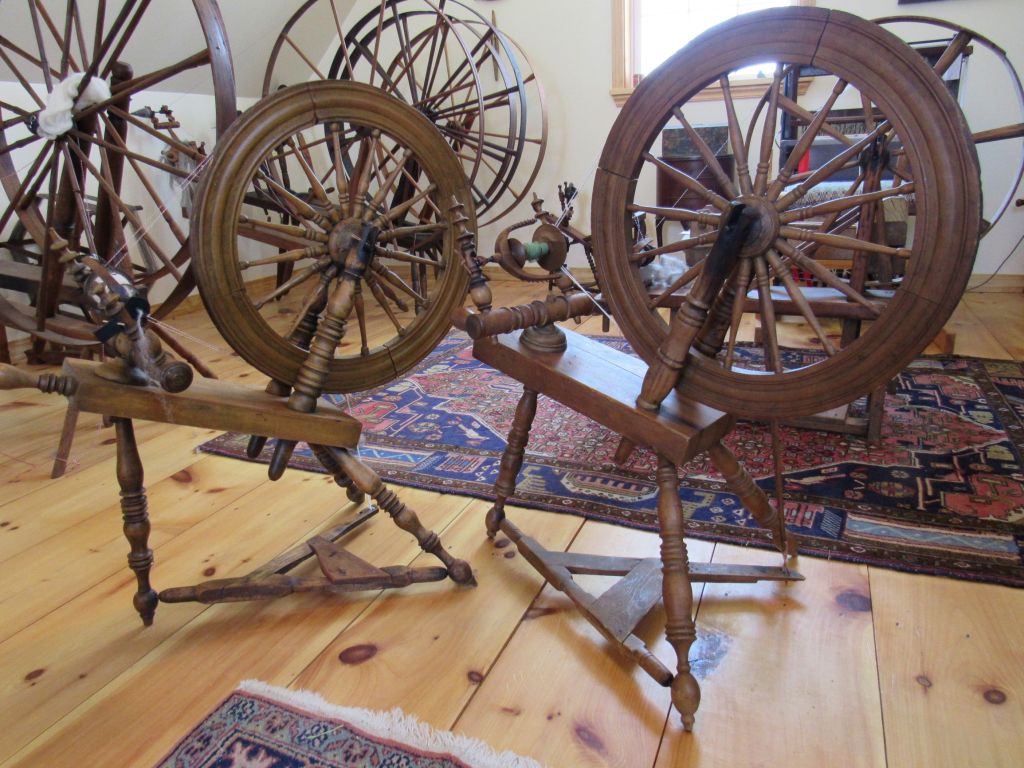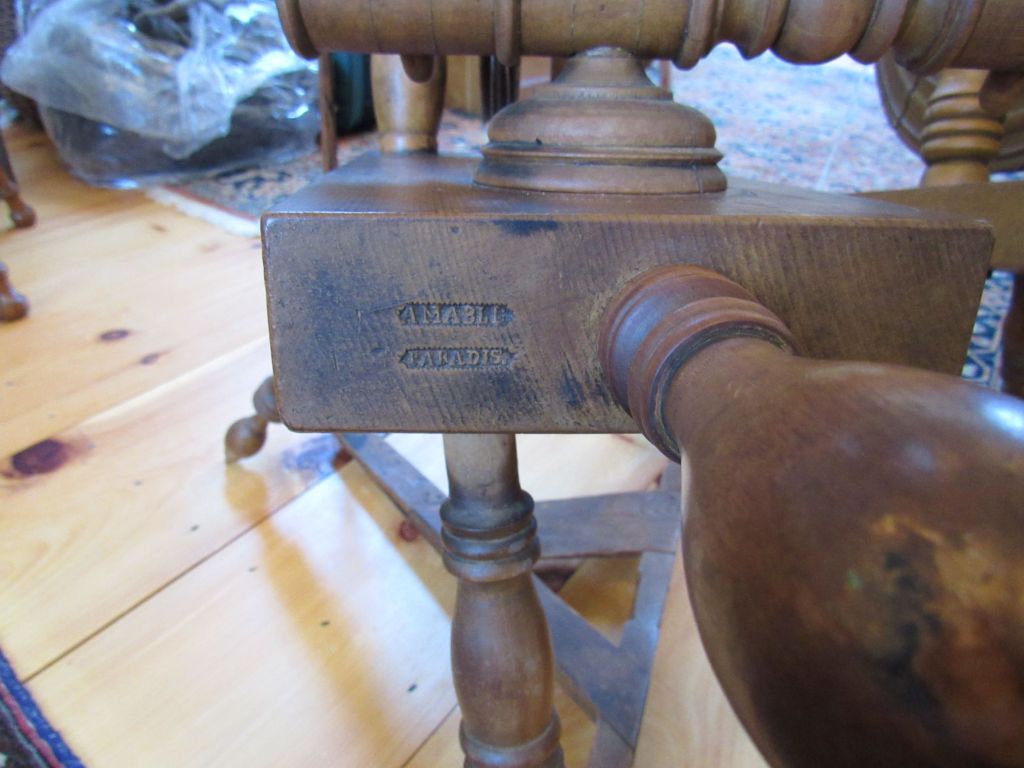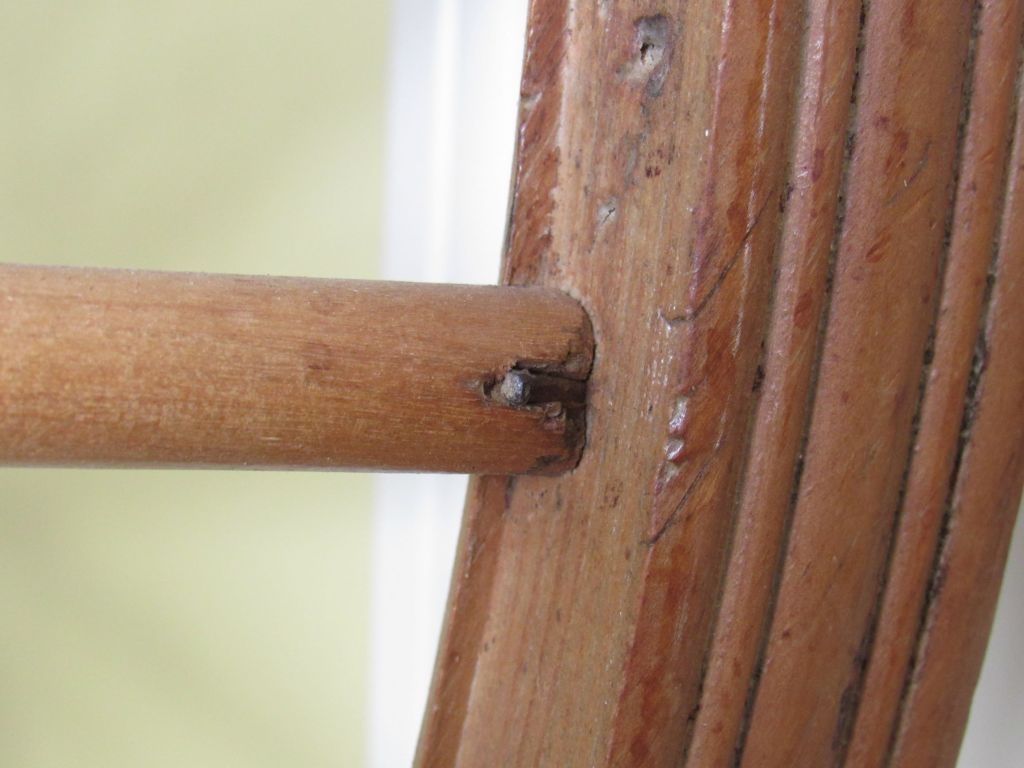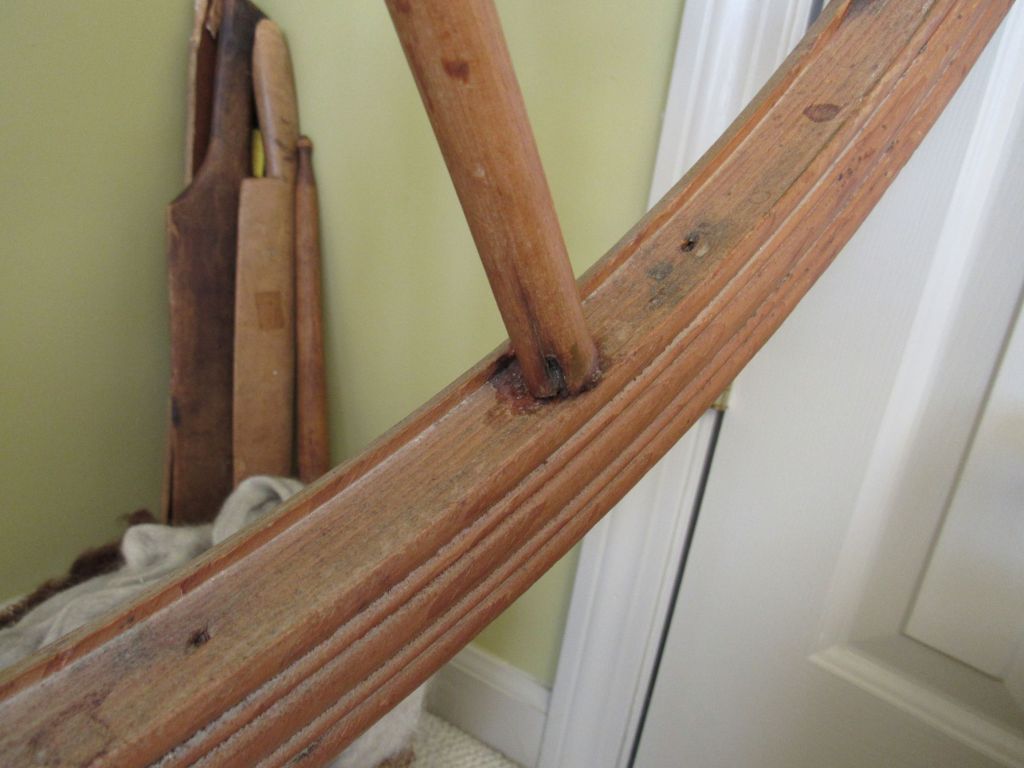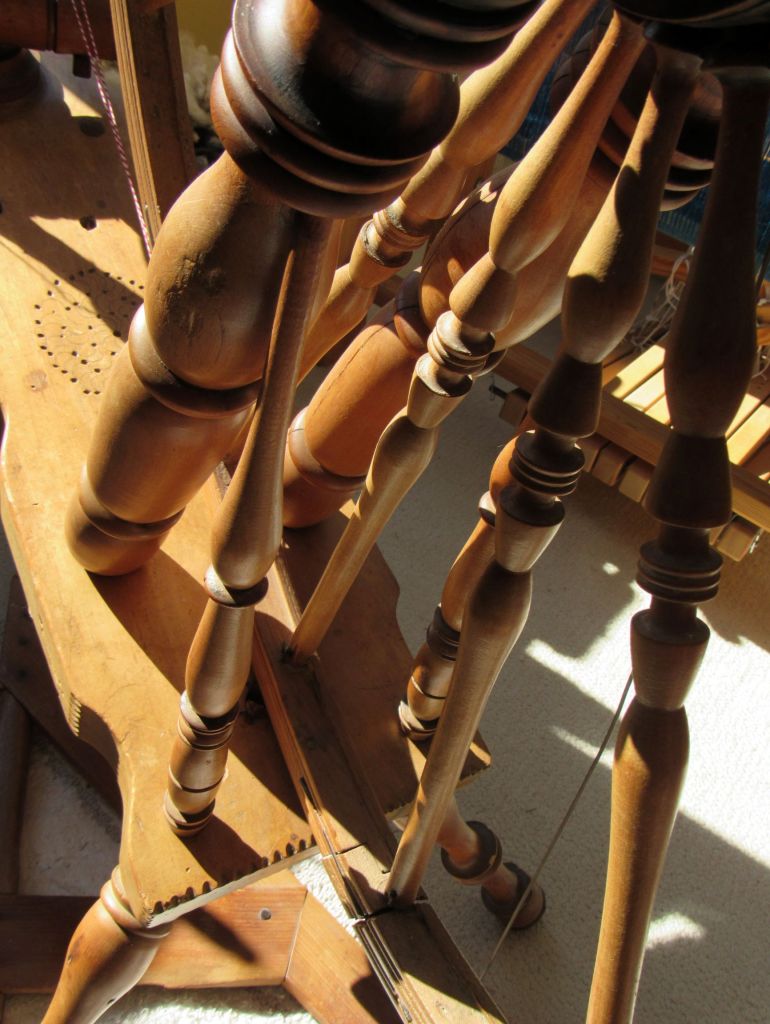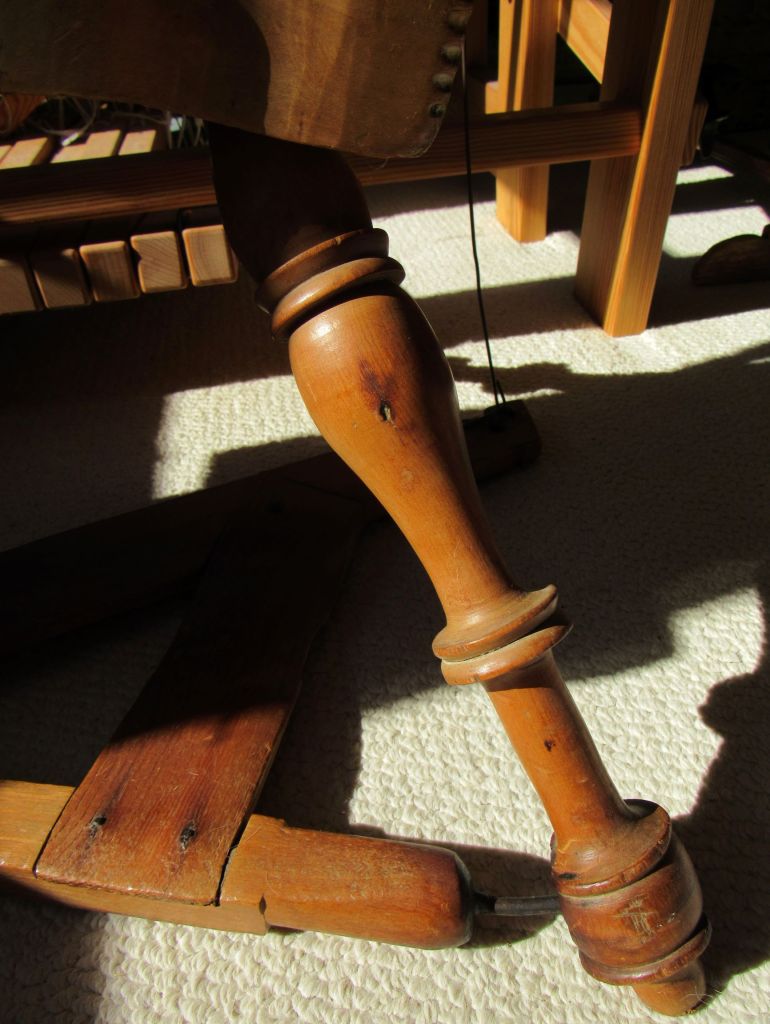
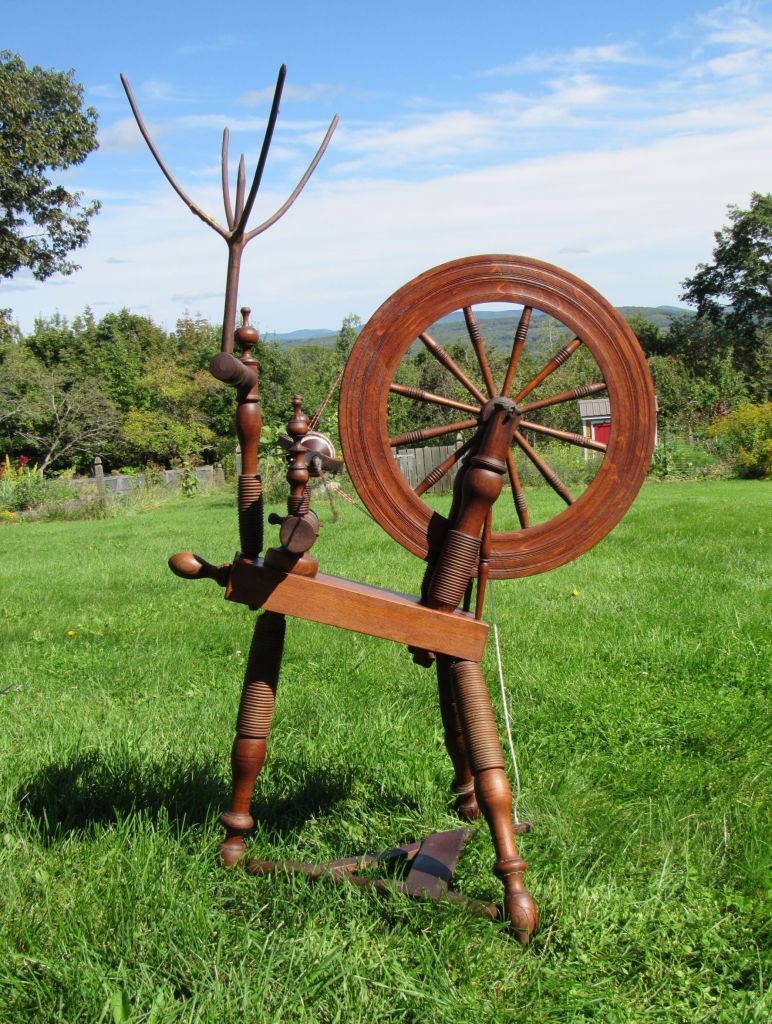
Handsome Molly

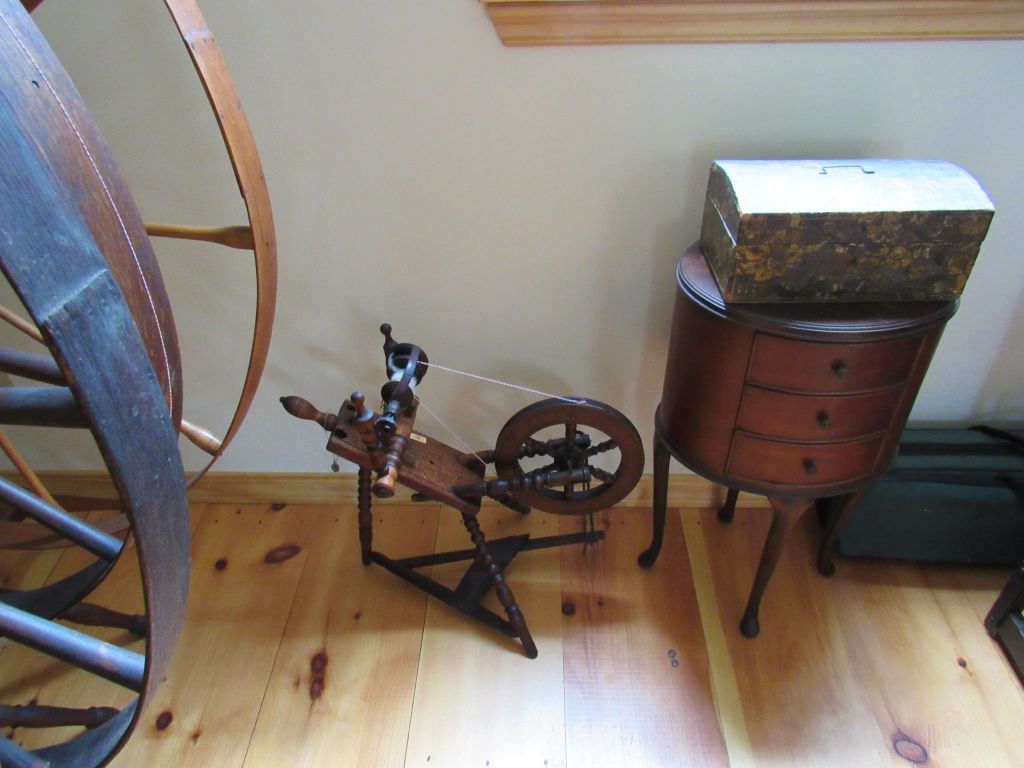
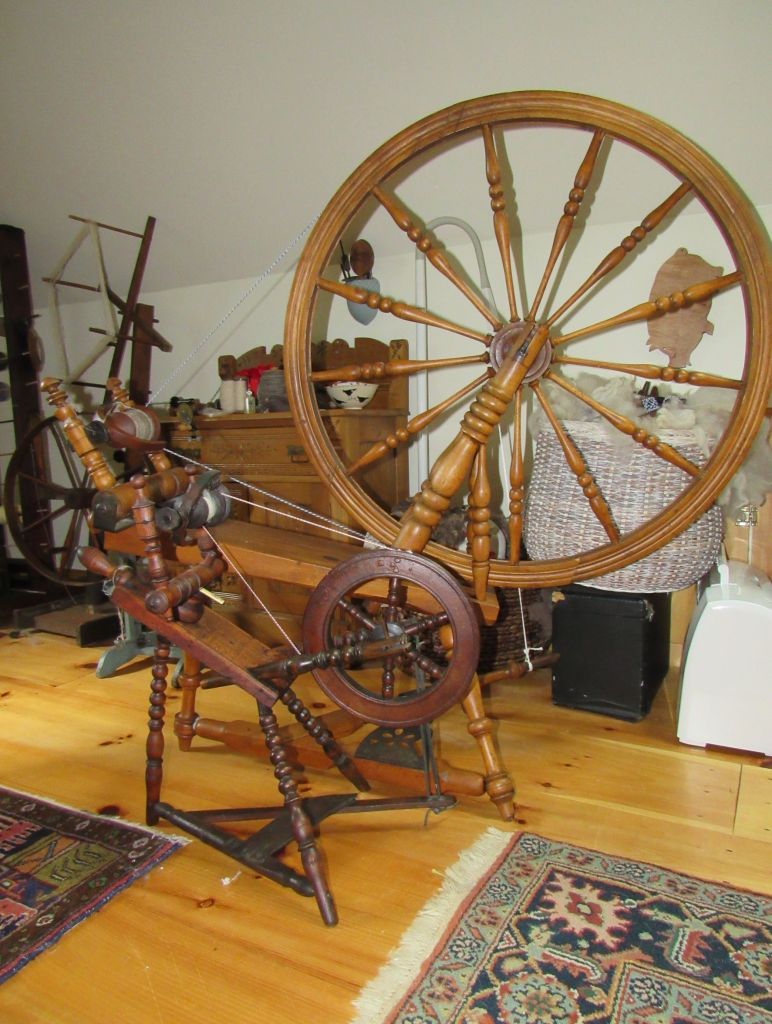
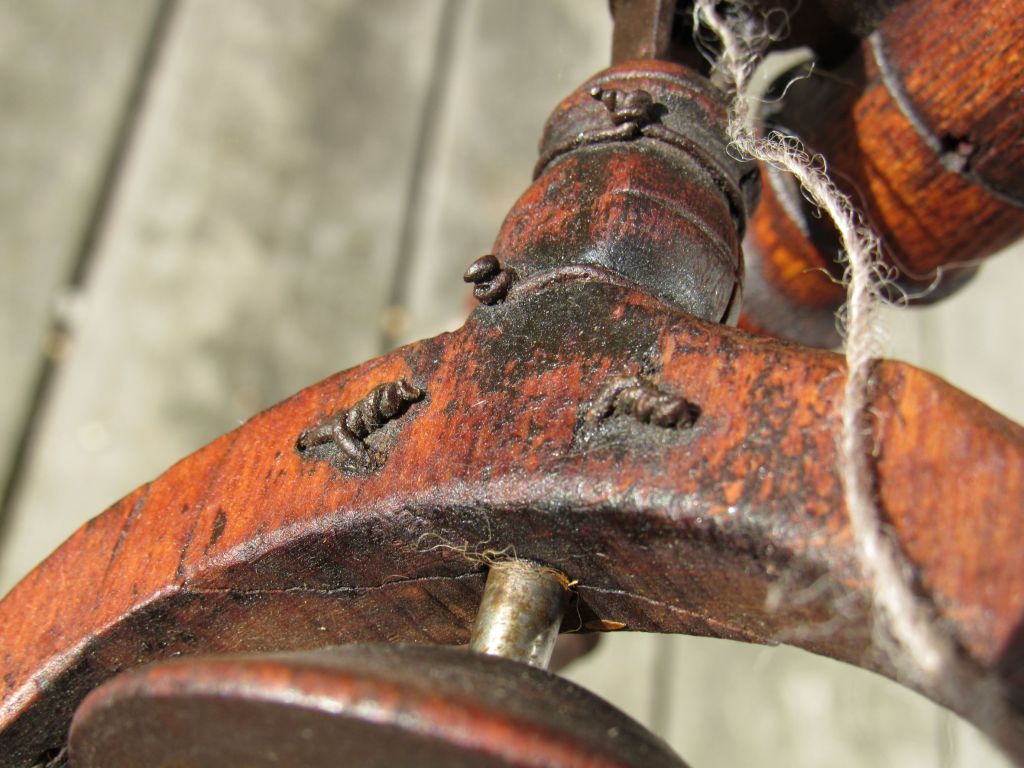
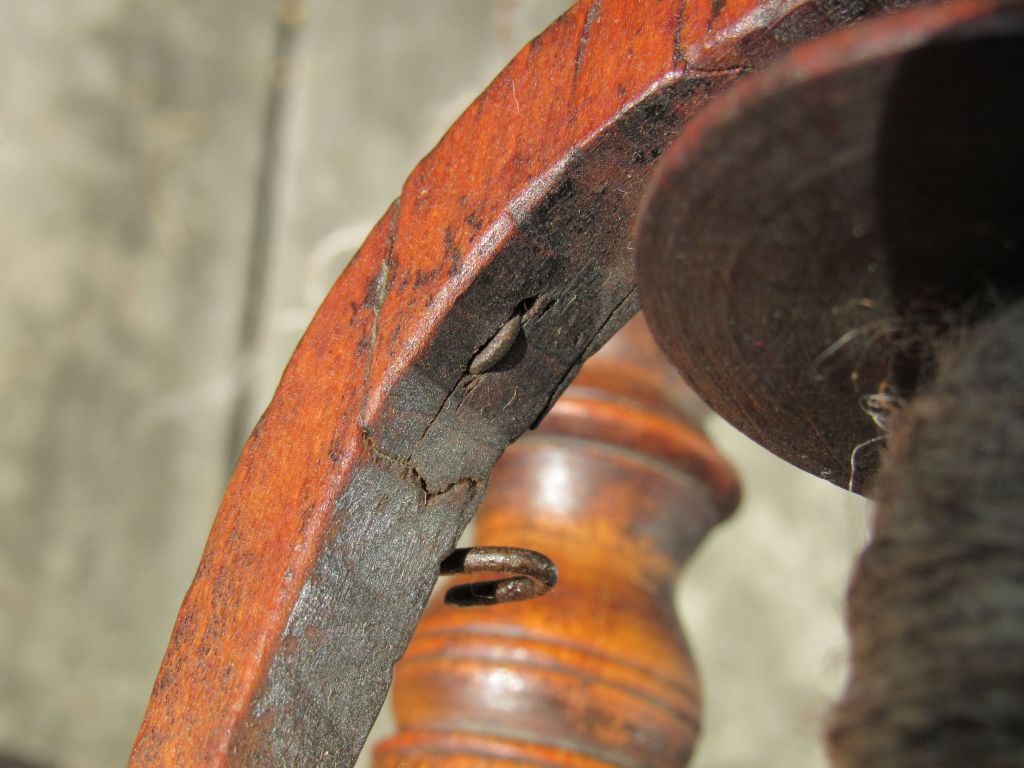
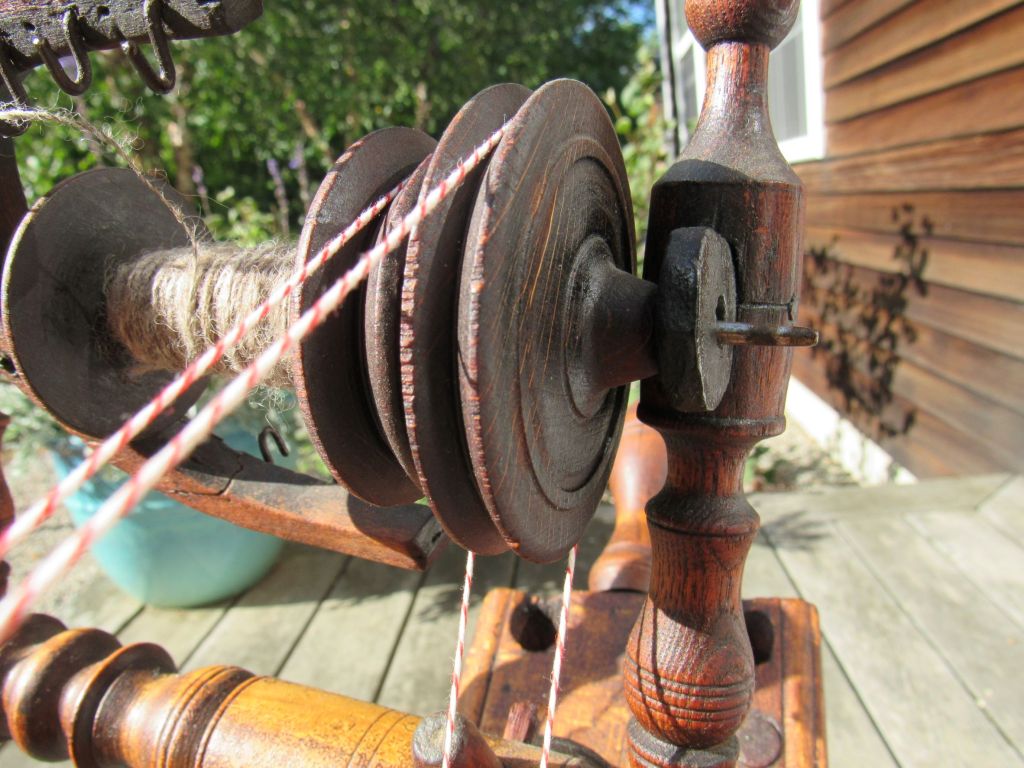
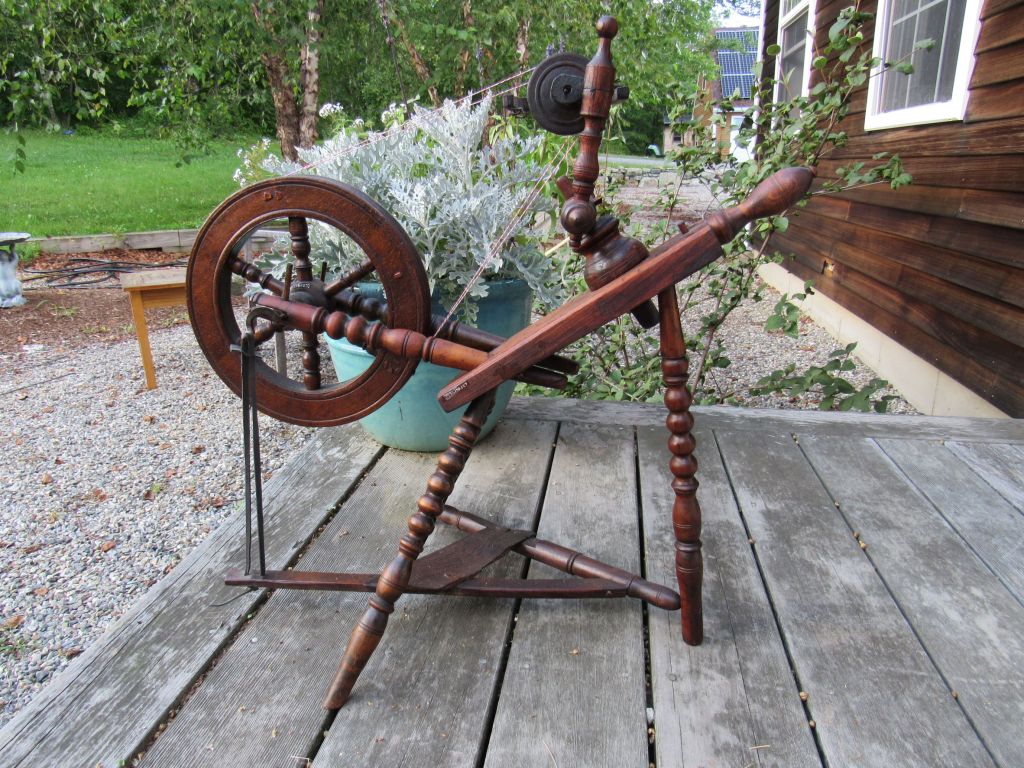
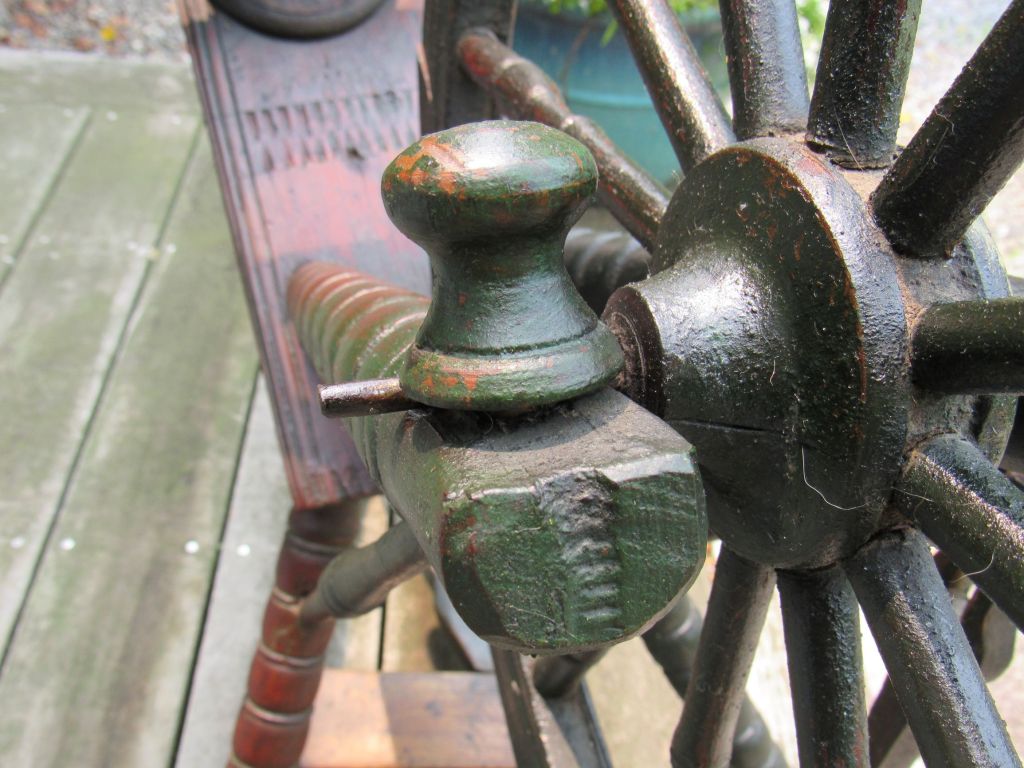
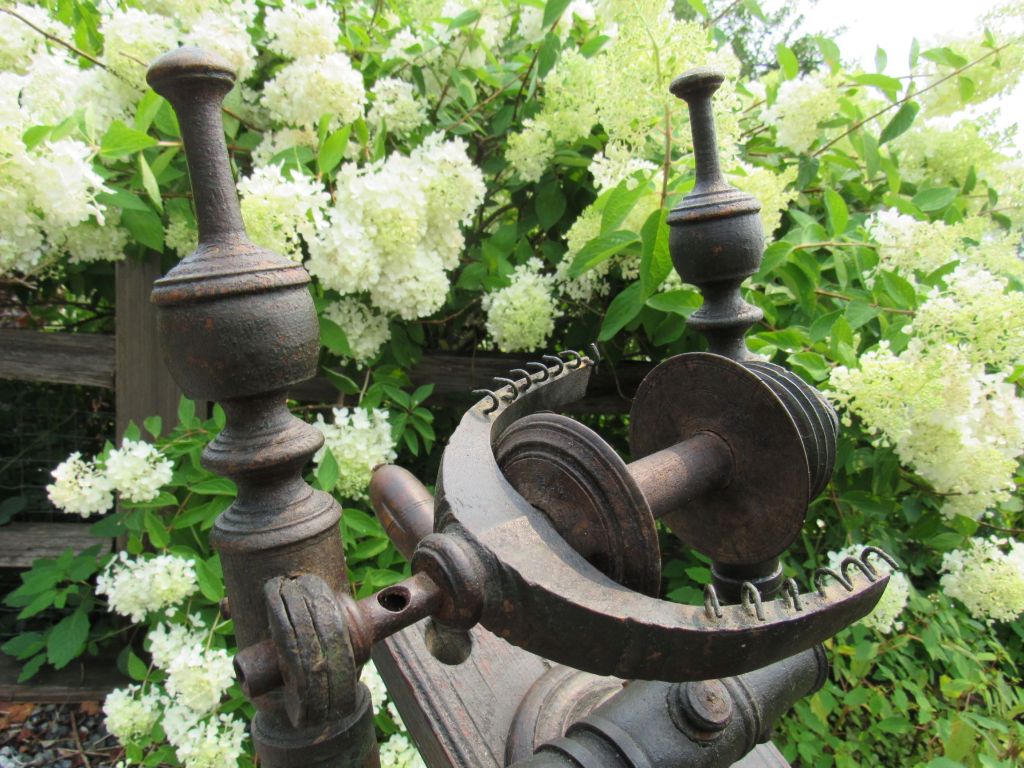
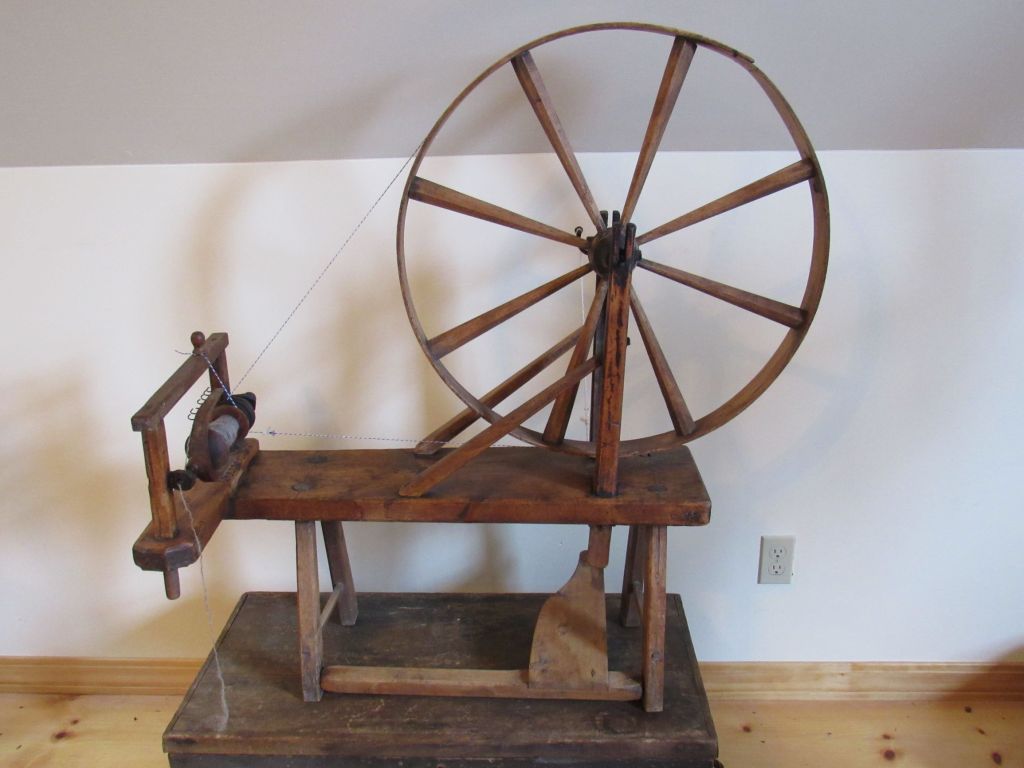
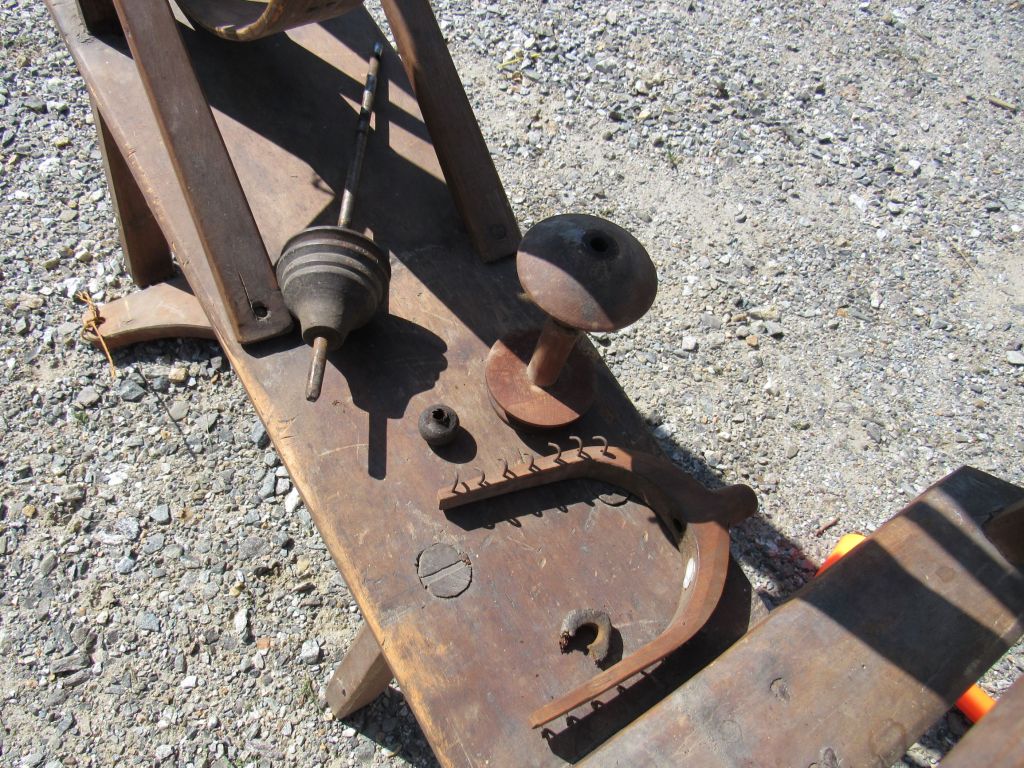
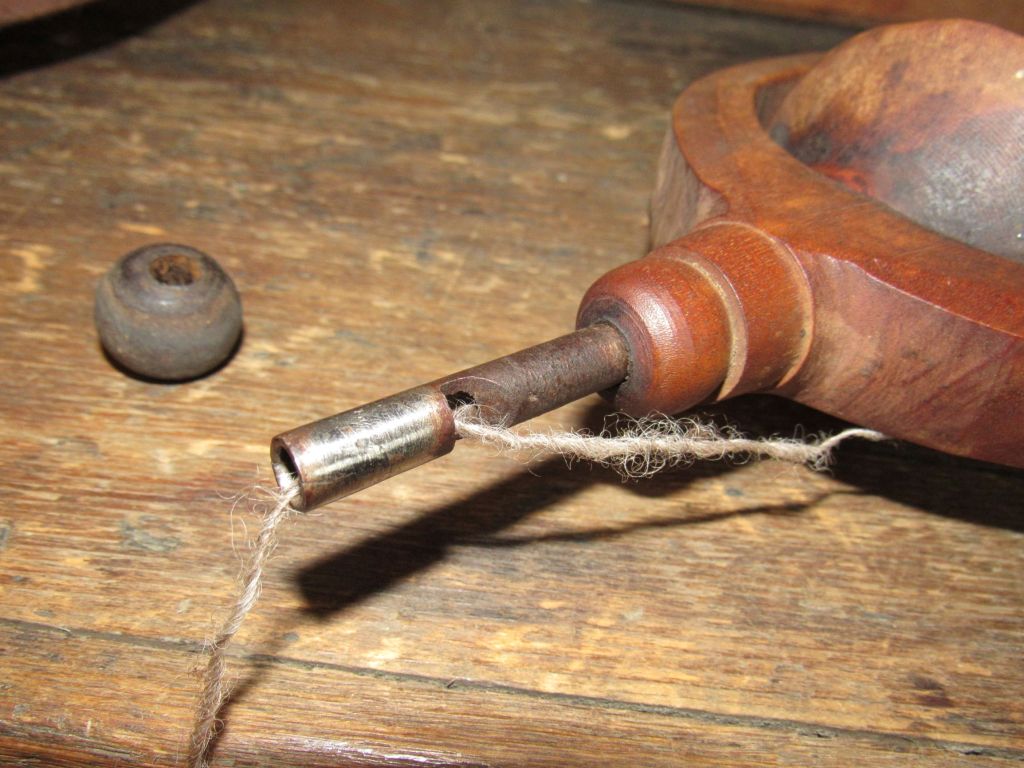
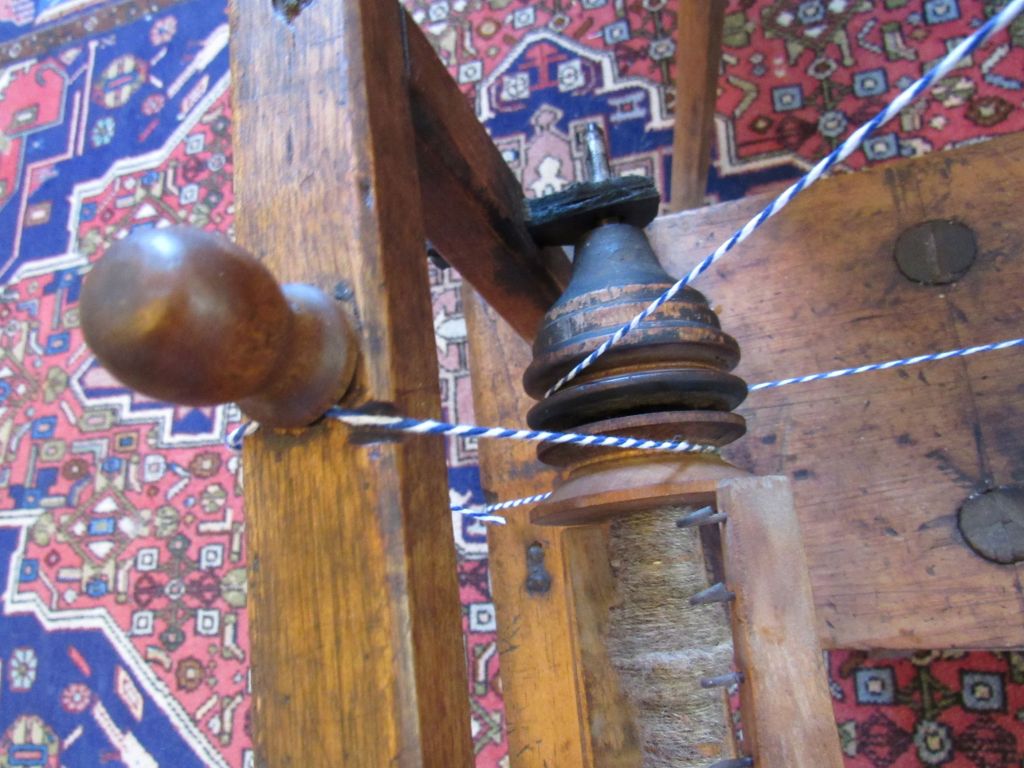
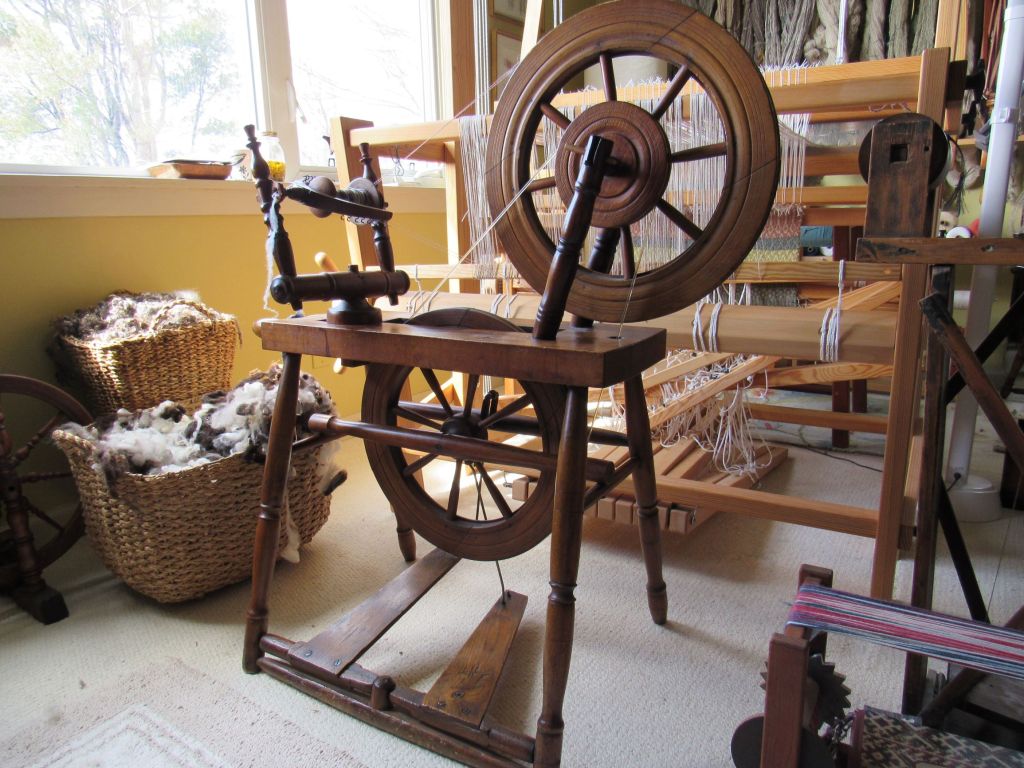
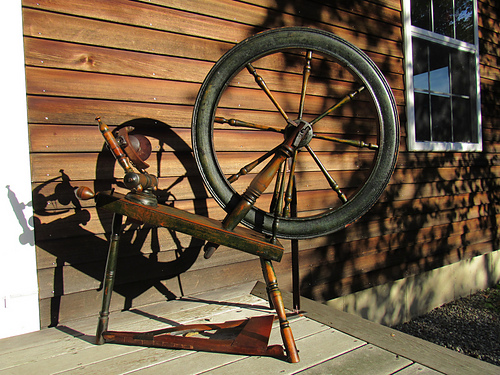
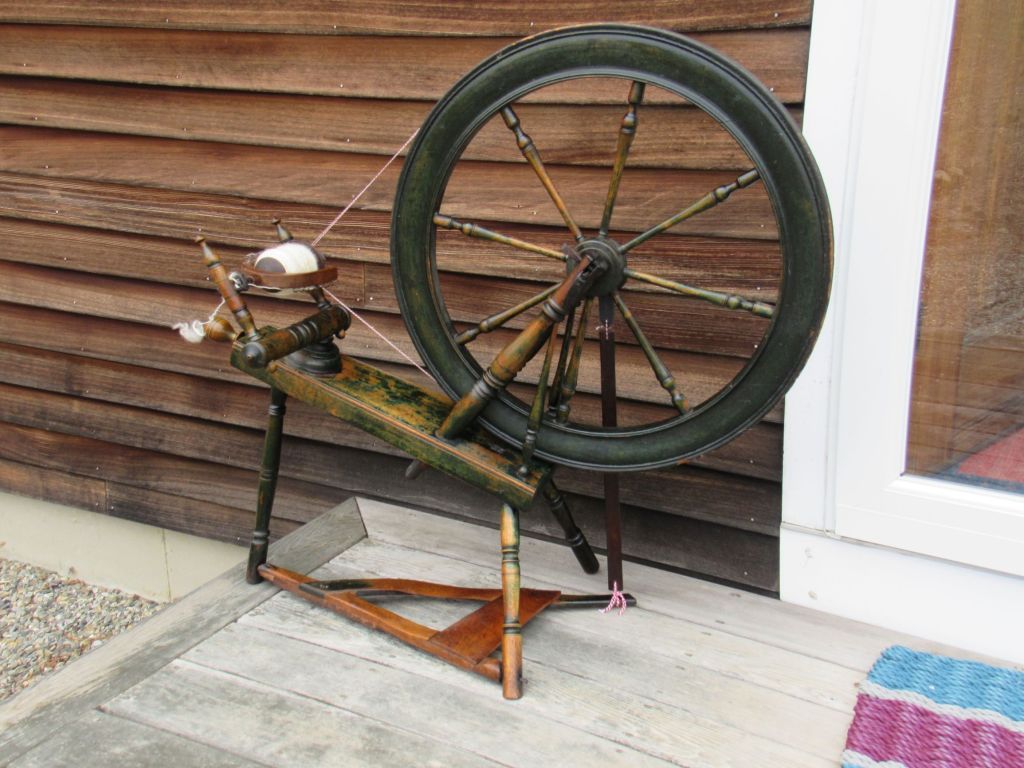
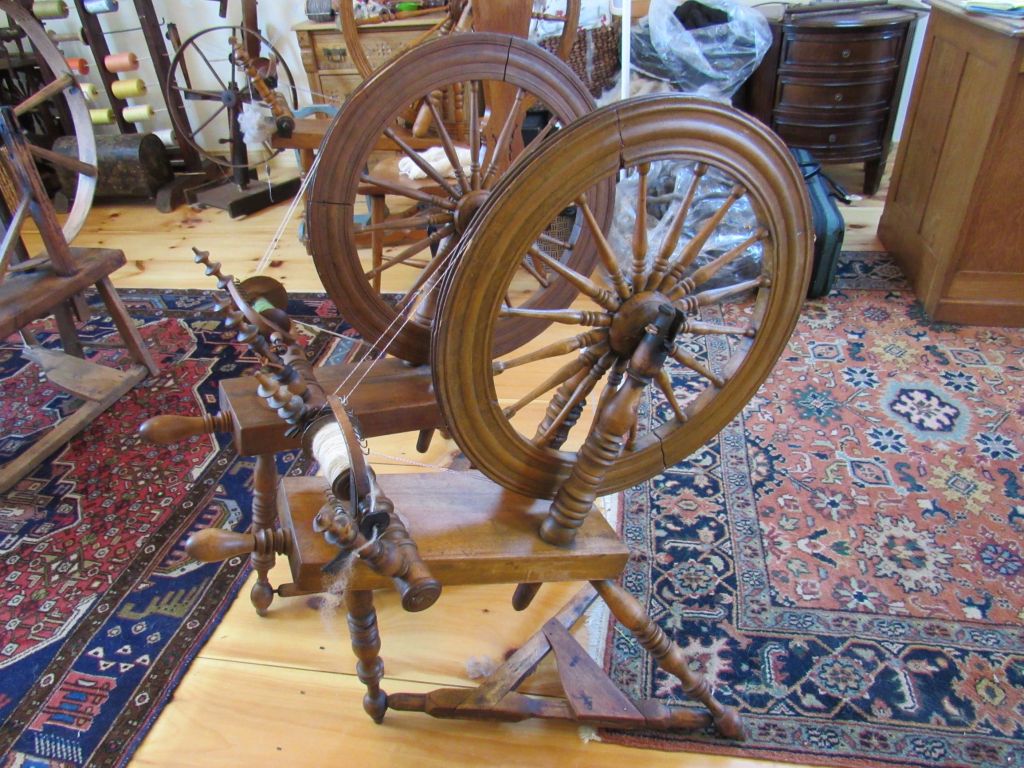
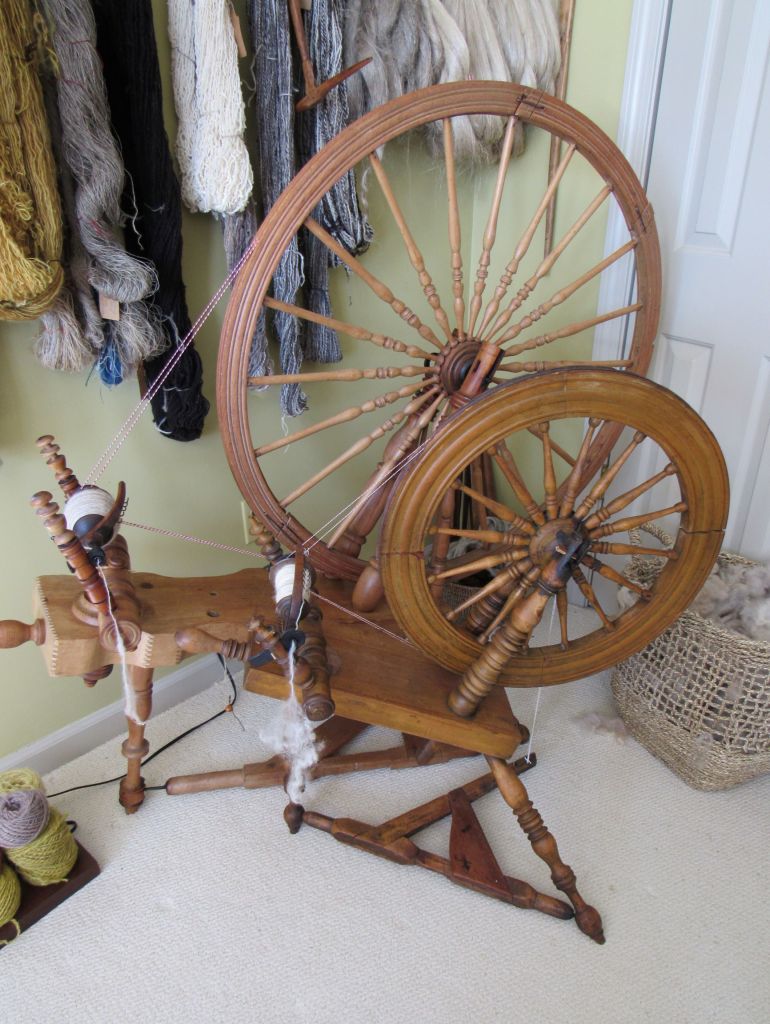
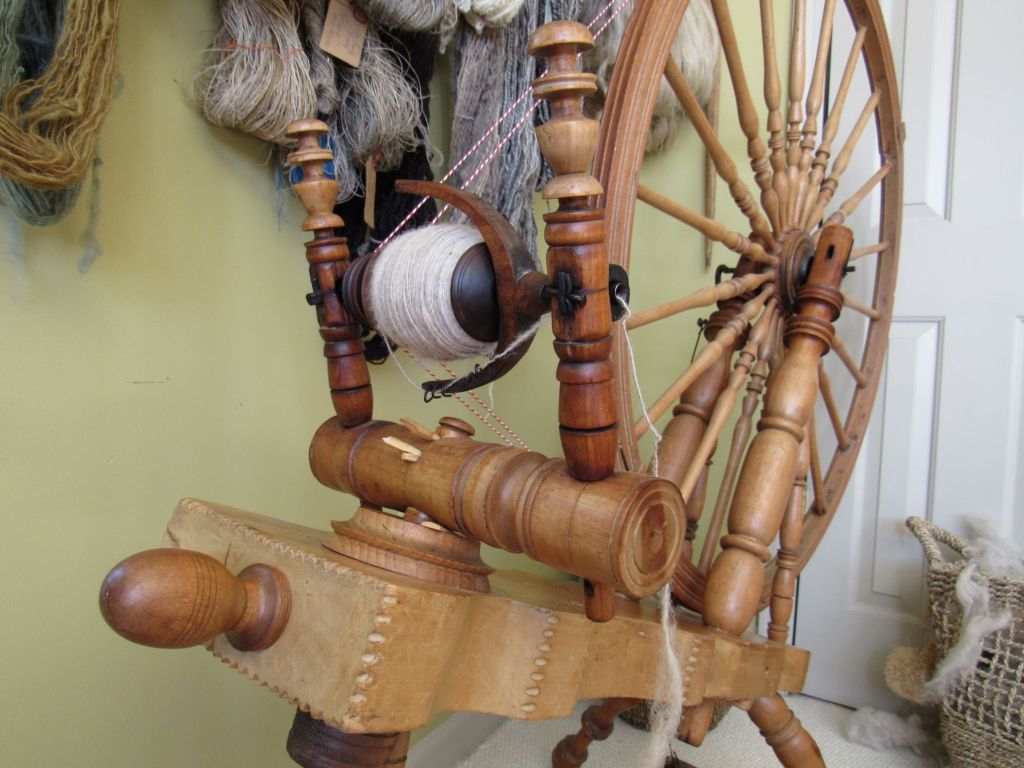
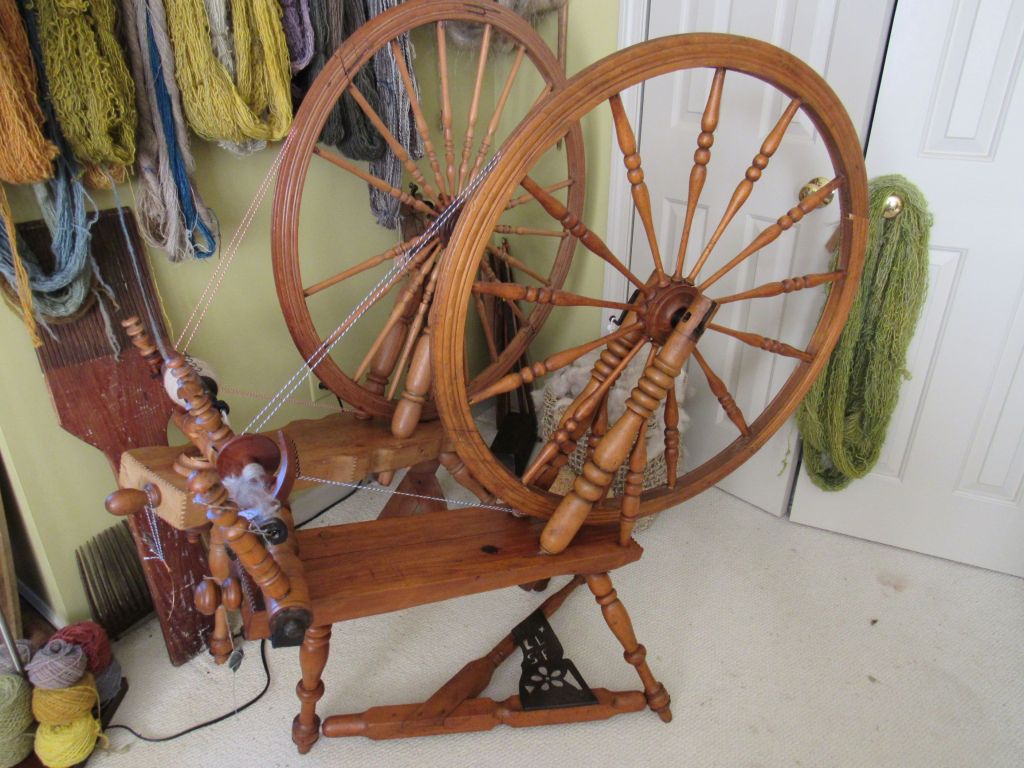
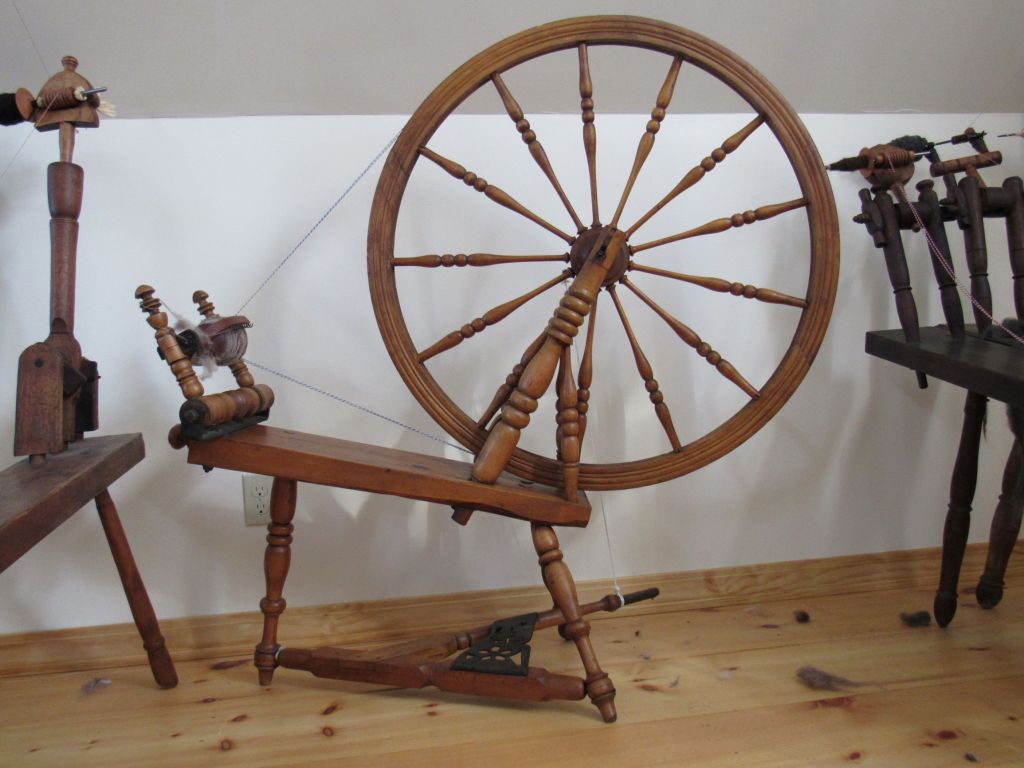
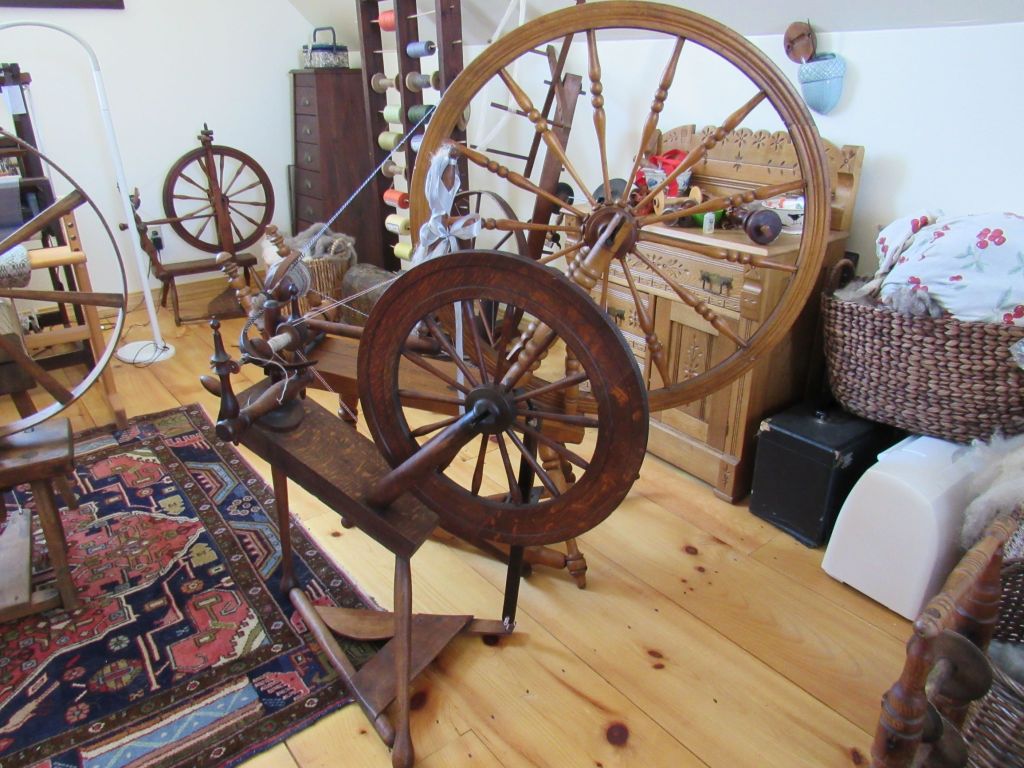
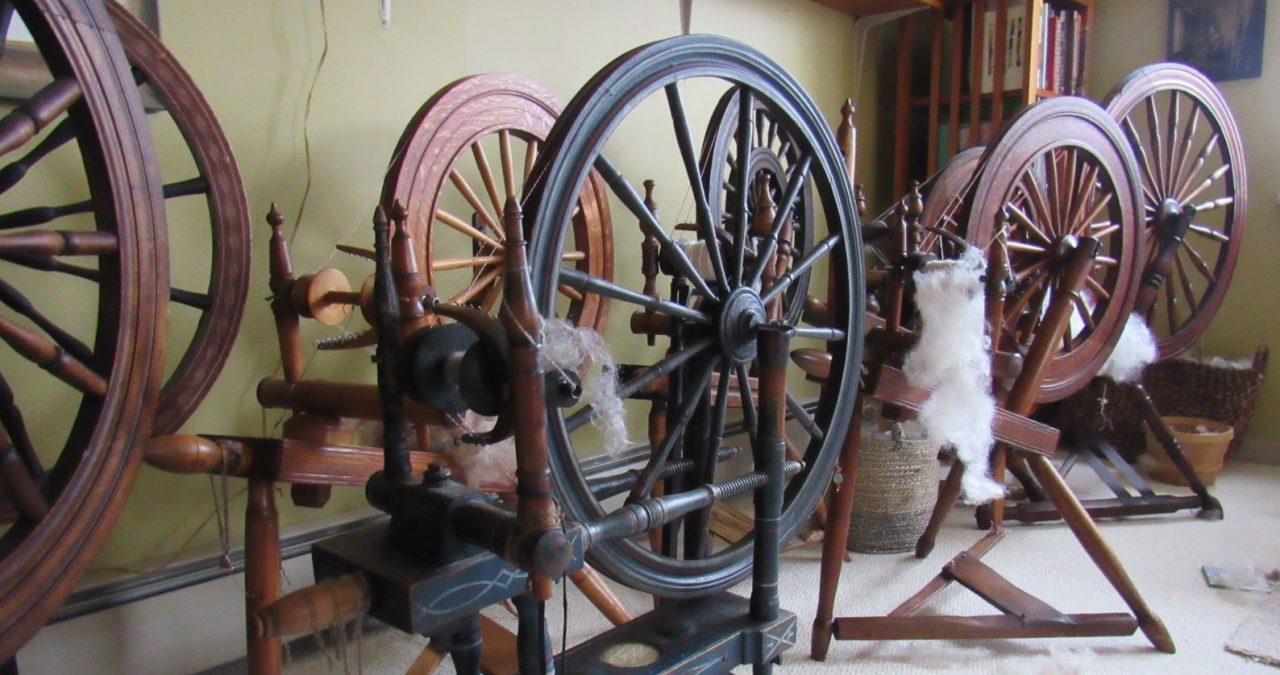
I know little about the history of this stately wheel. A woman in southern Maine kindly gave it to me. She had bought it from a woman–not a spinner–who decided to sell it because it was taking up space on her porch. How and when this wheel made its way to New England likely will remain a mystery.

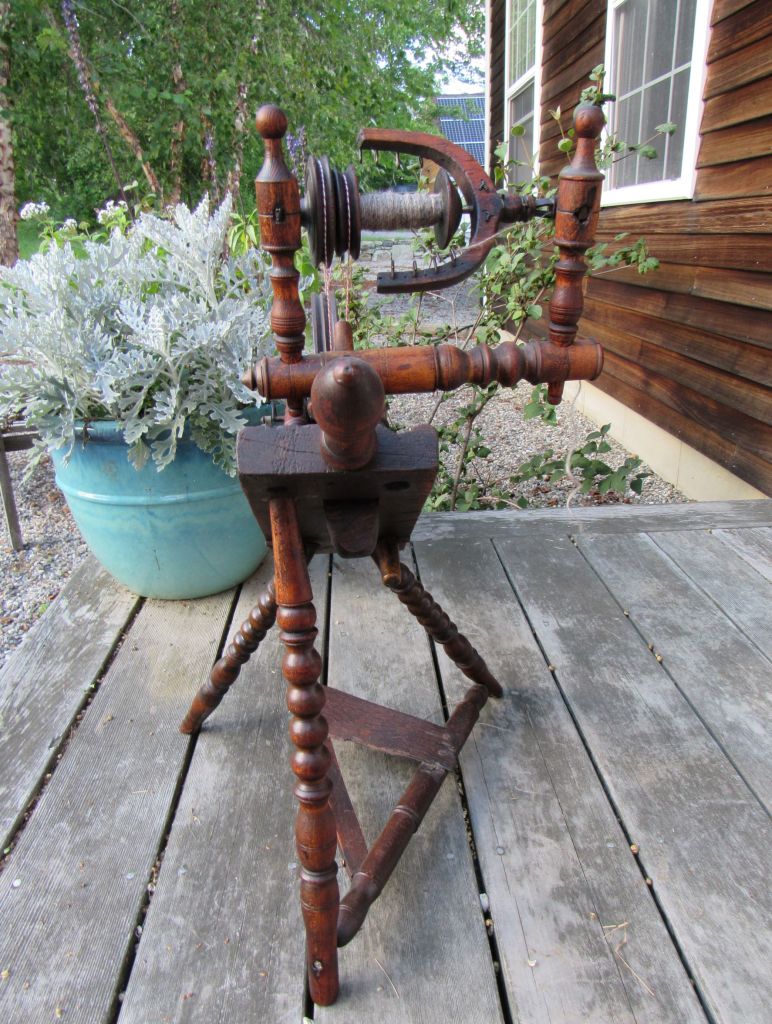
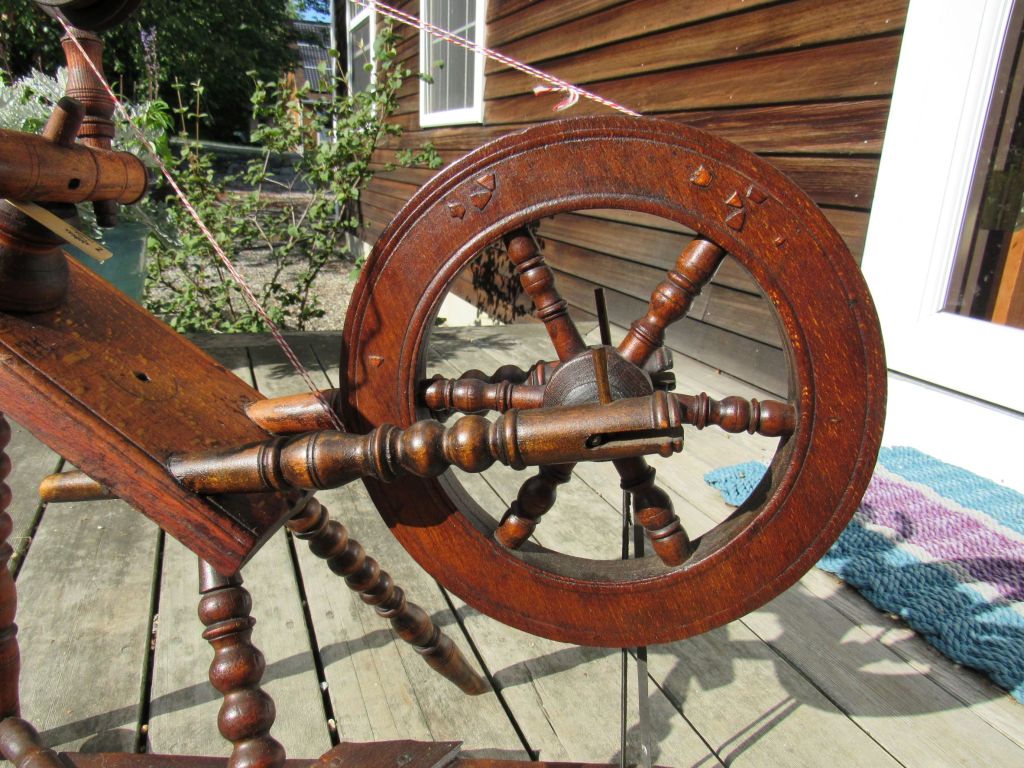
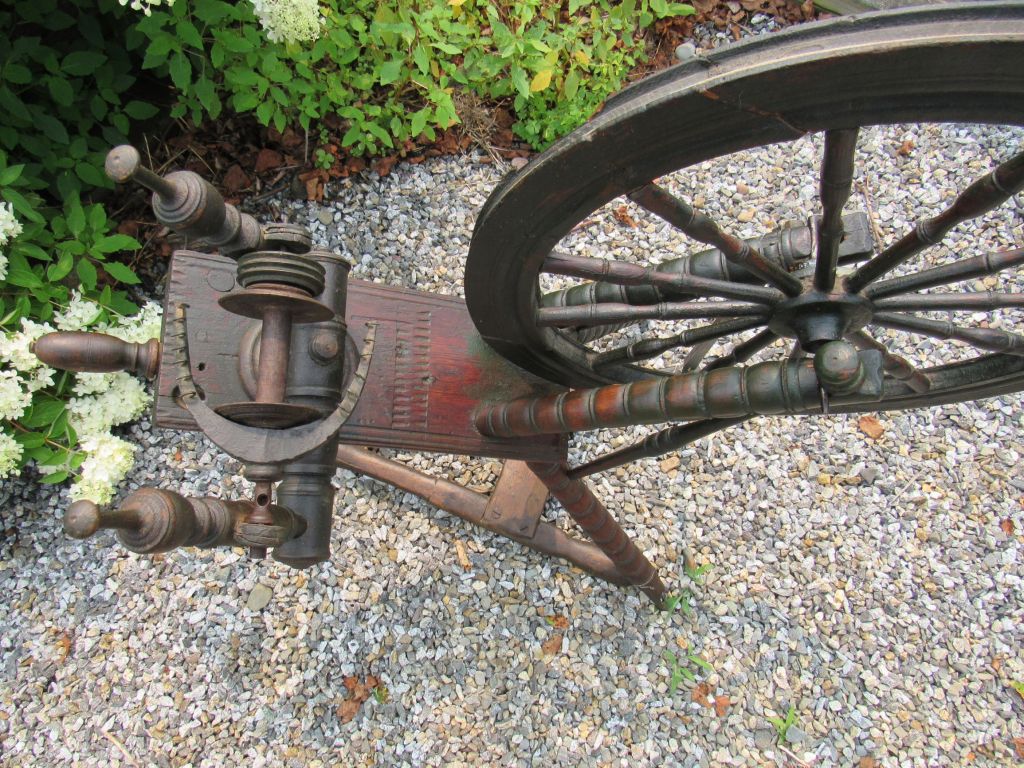
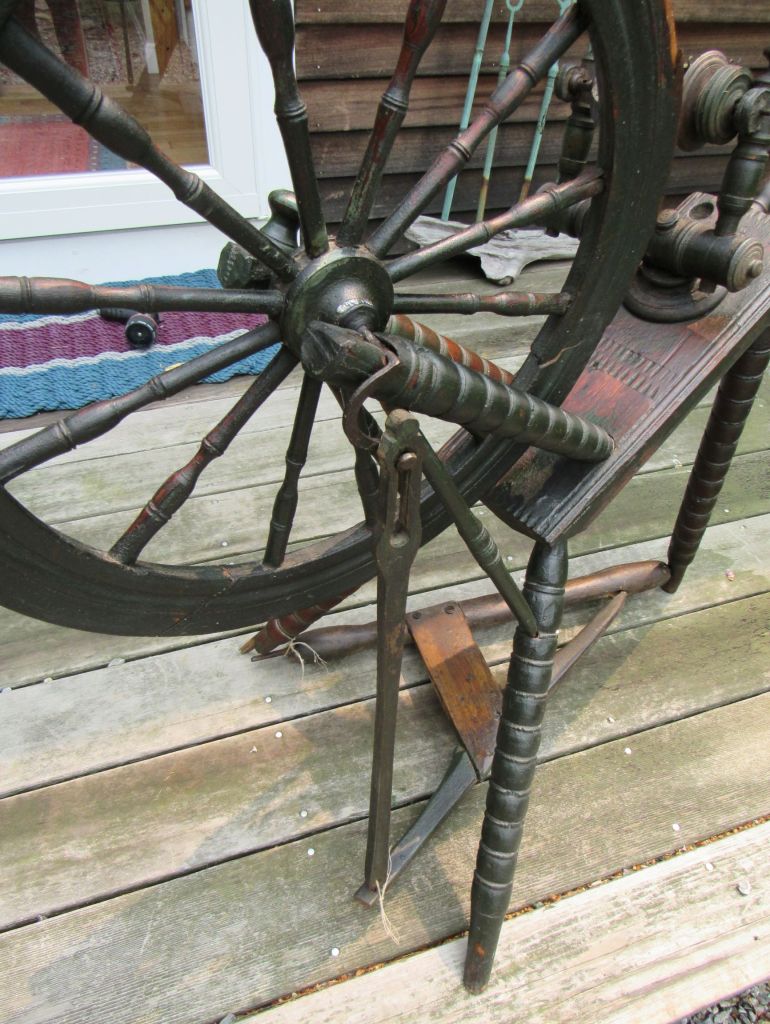
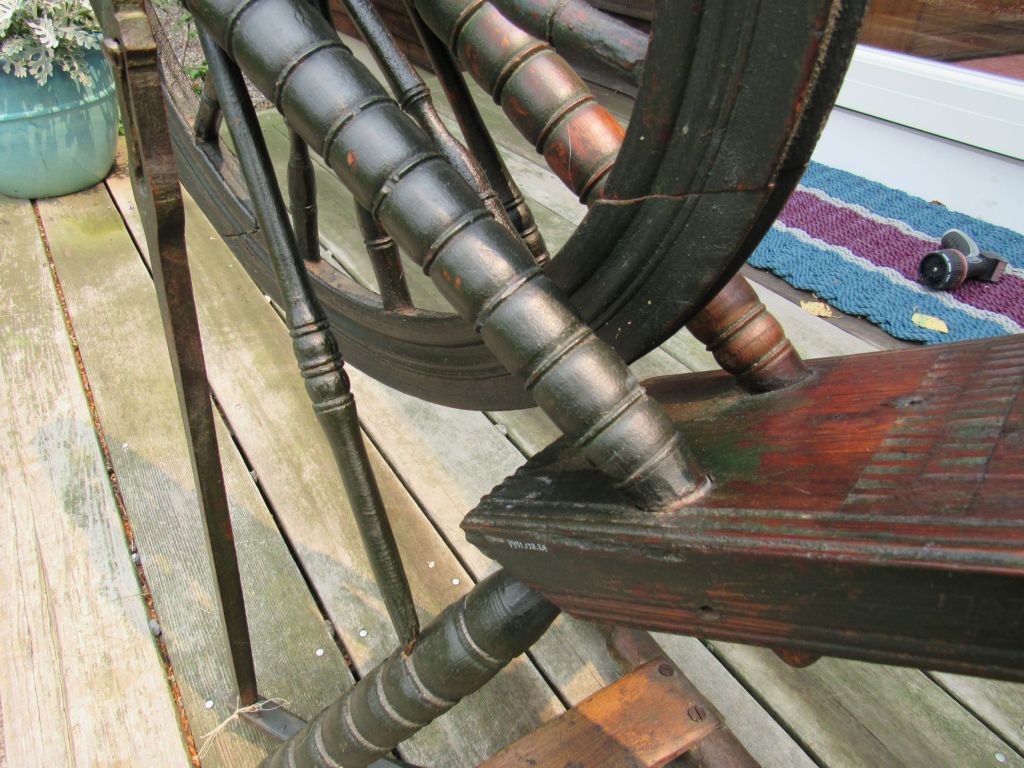
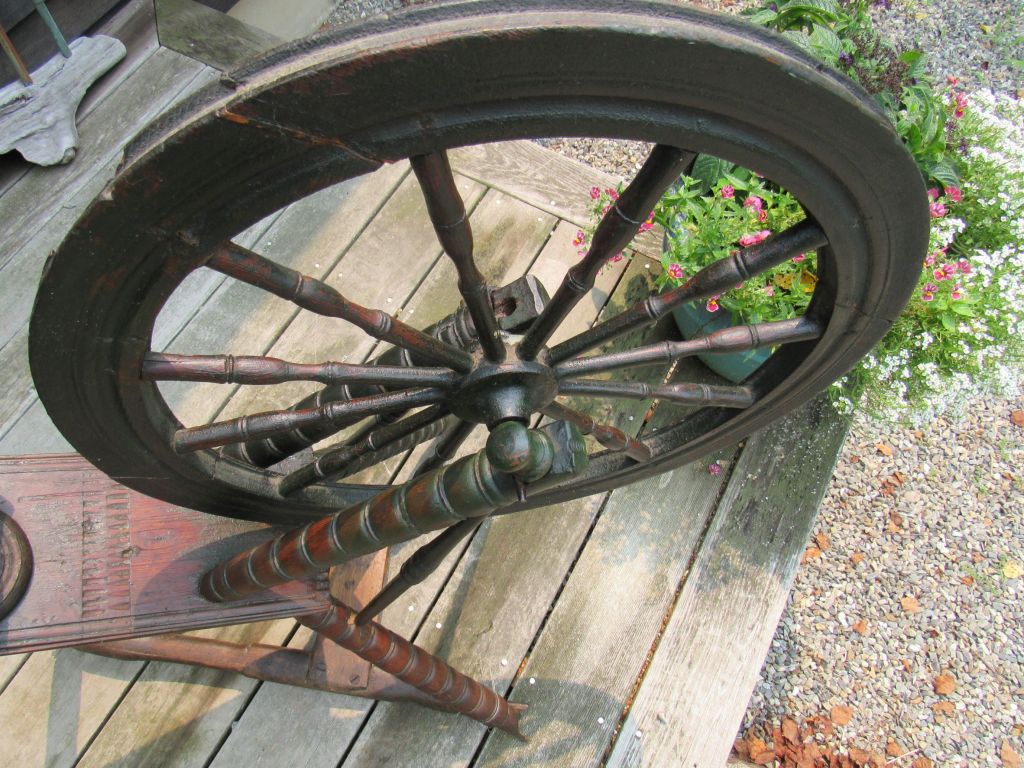
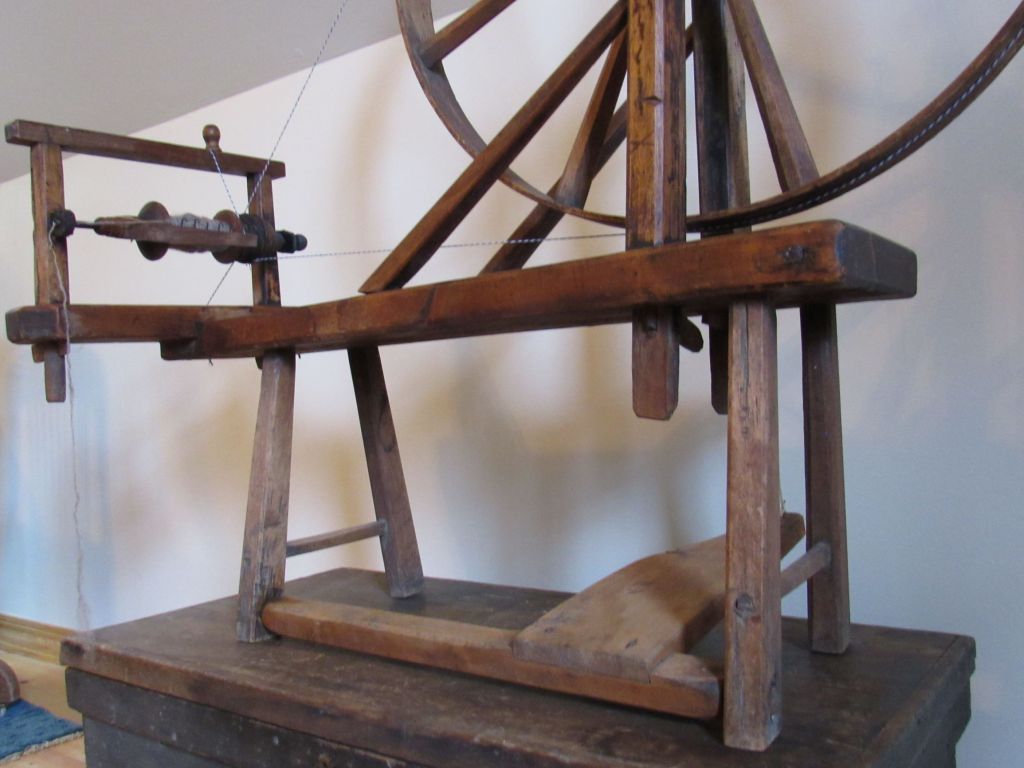
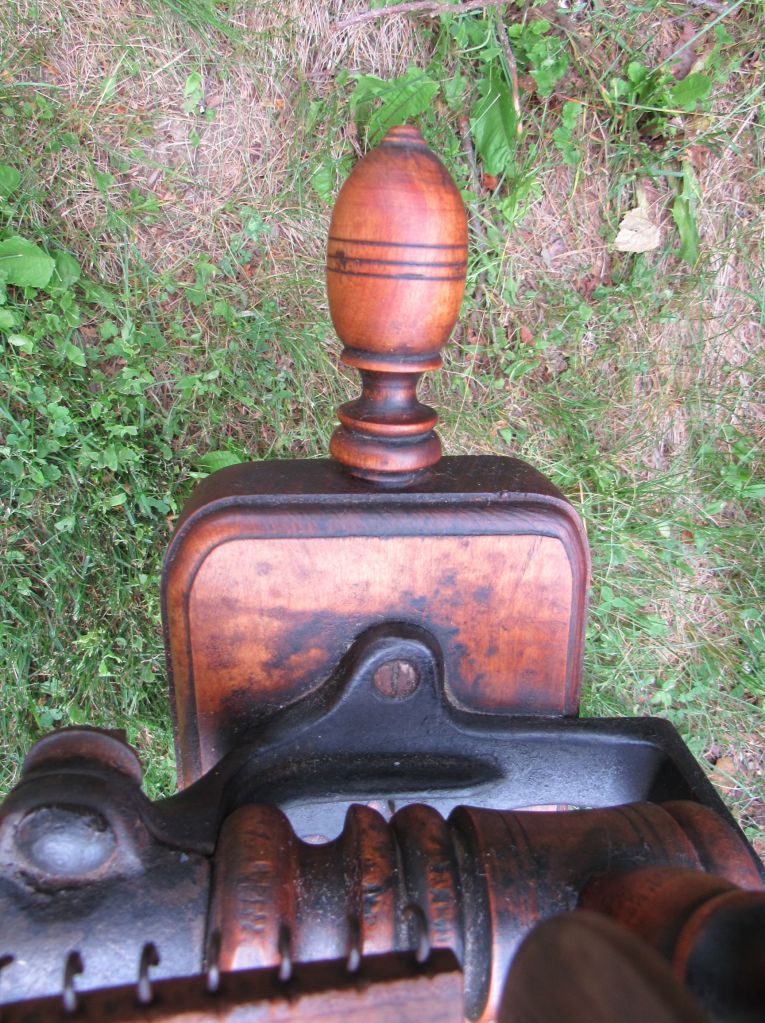
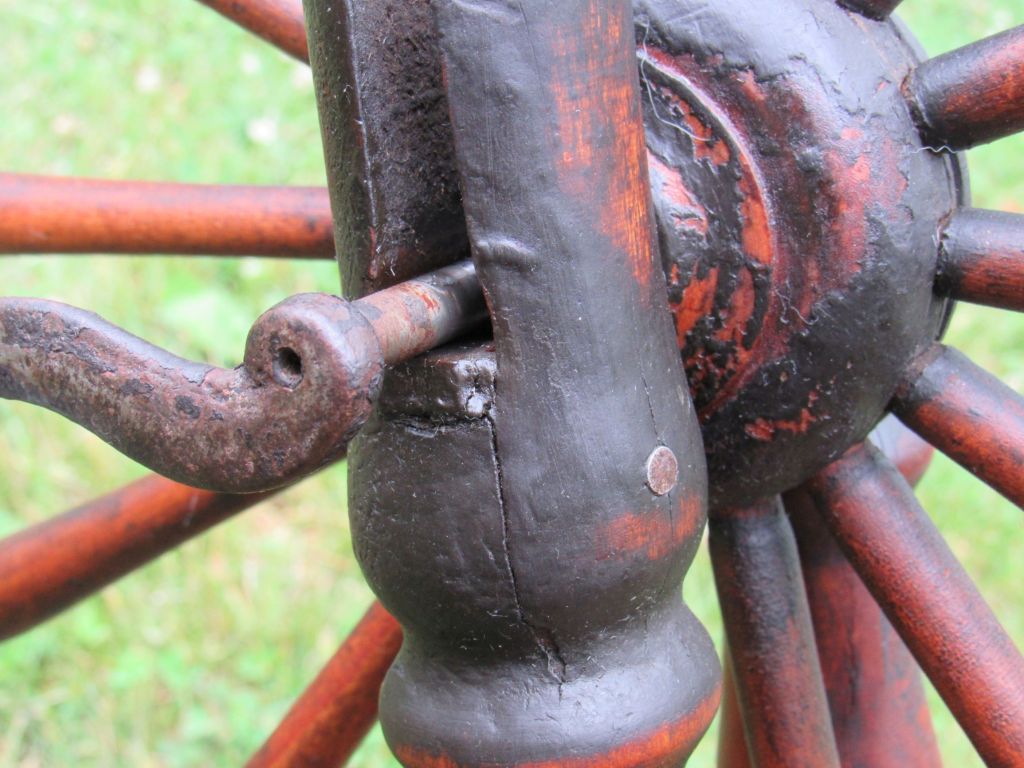
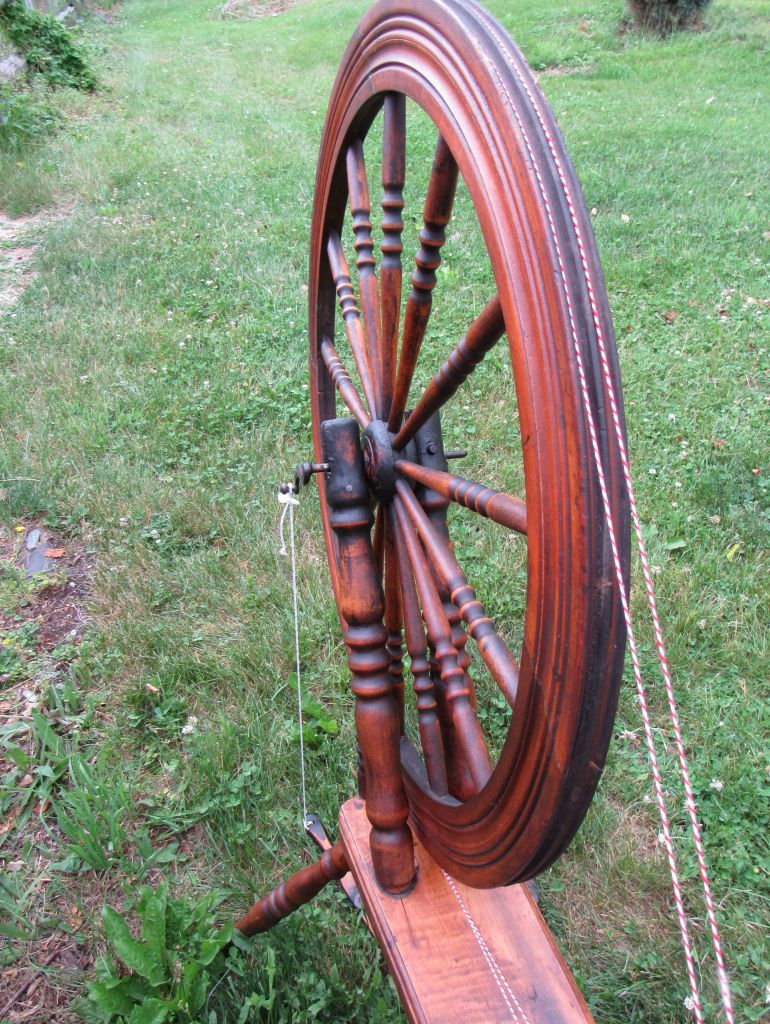
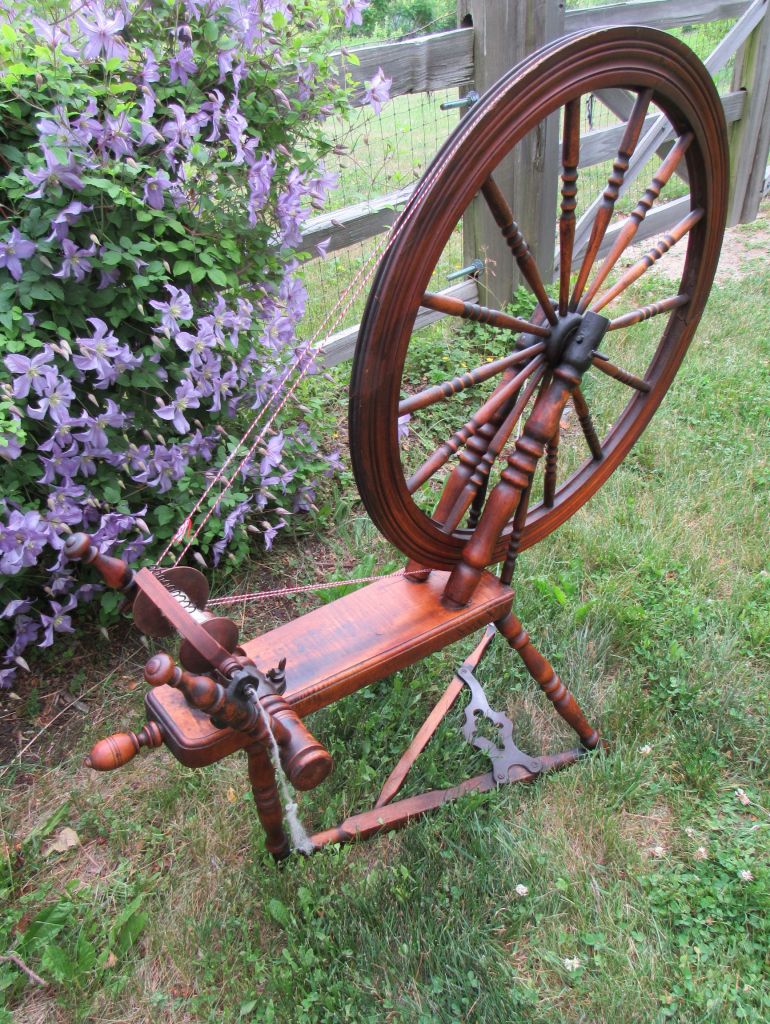
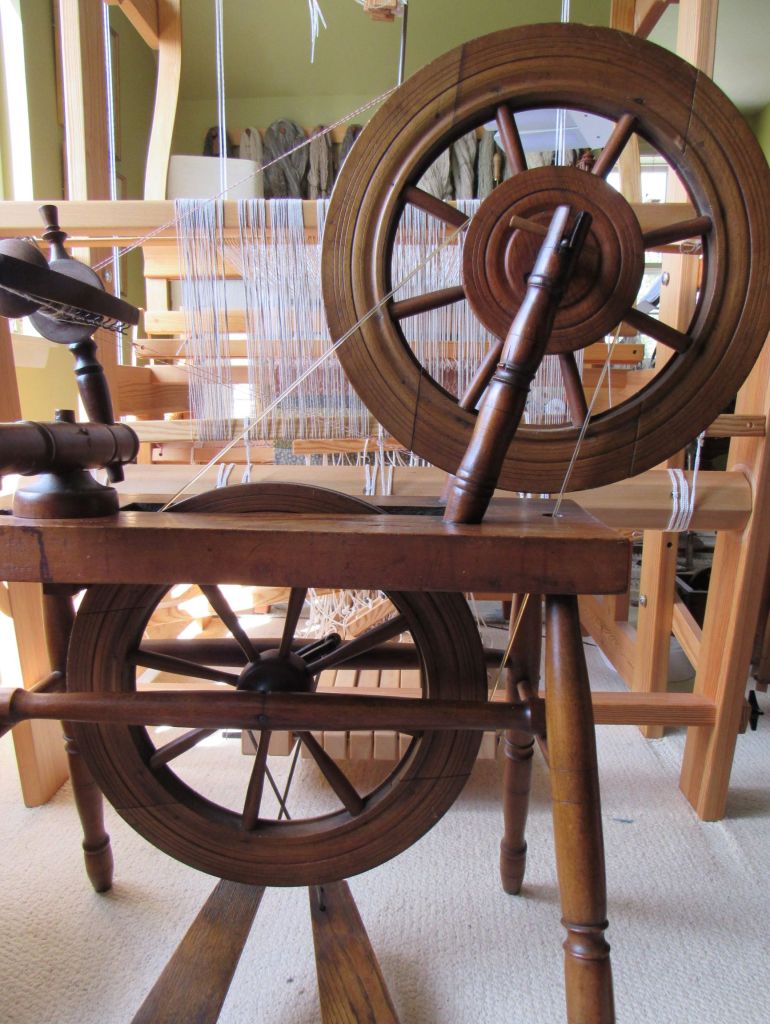
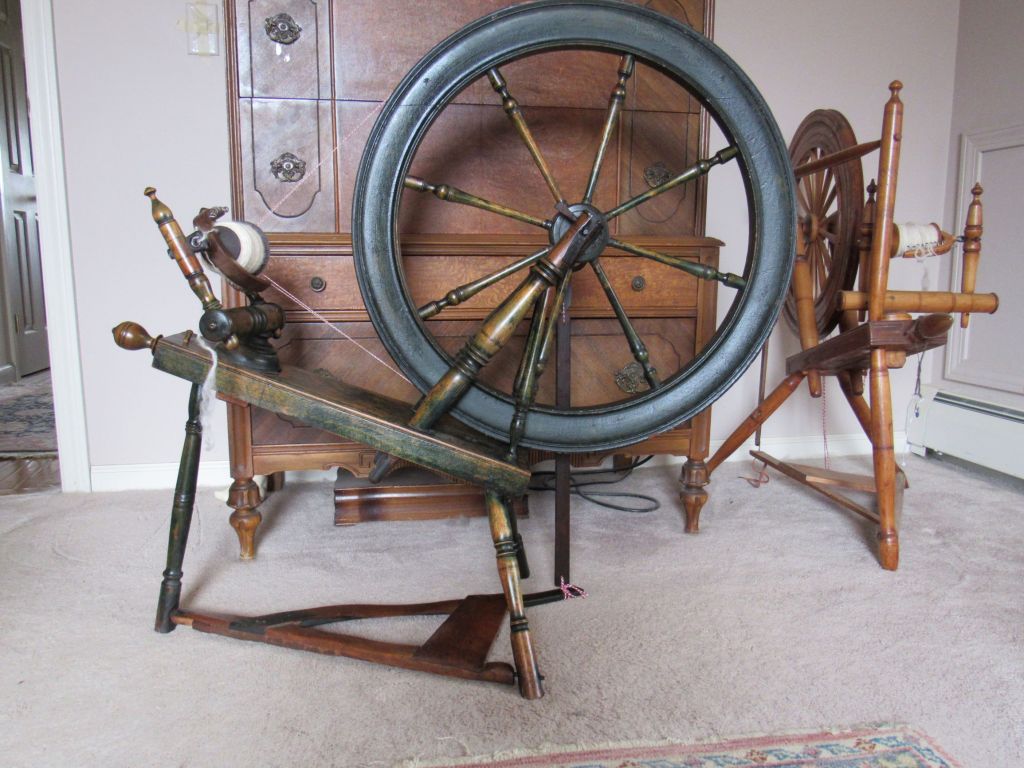
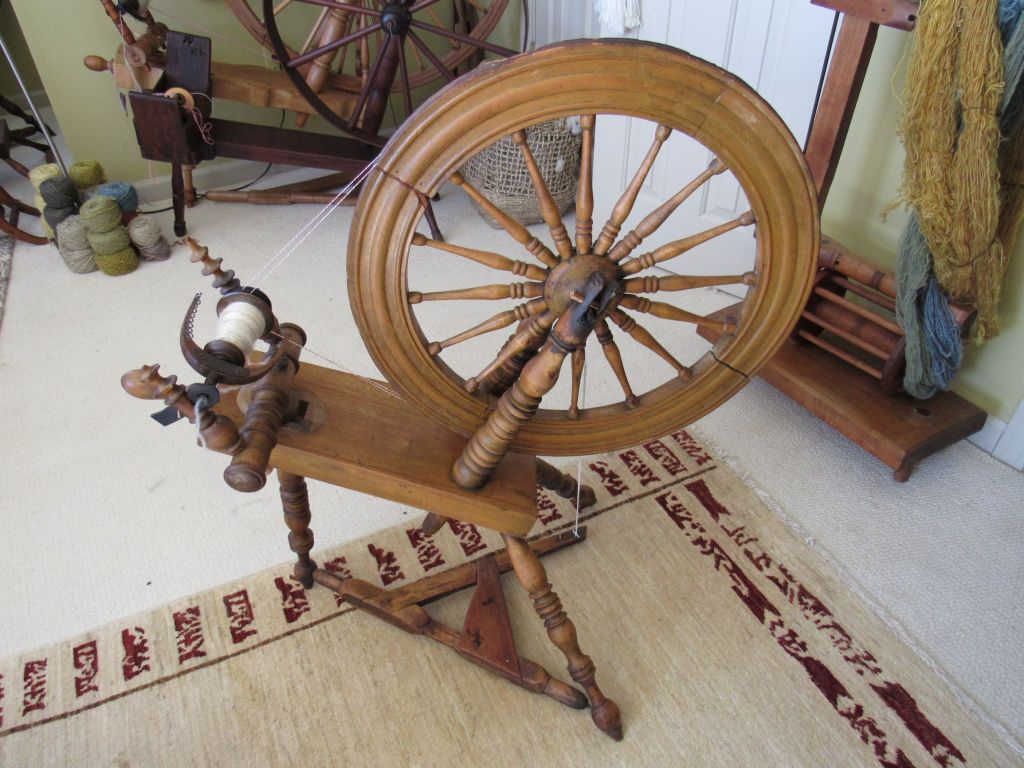
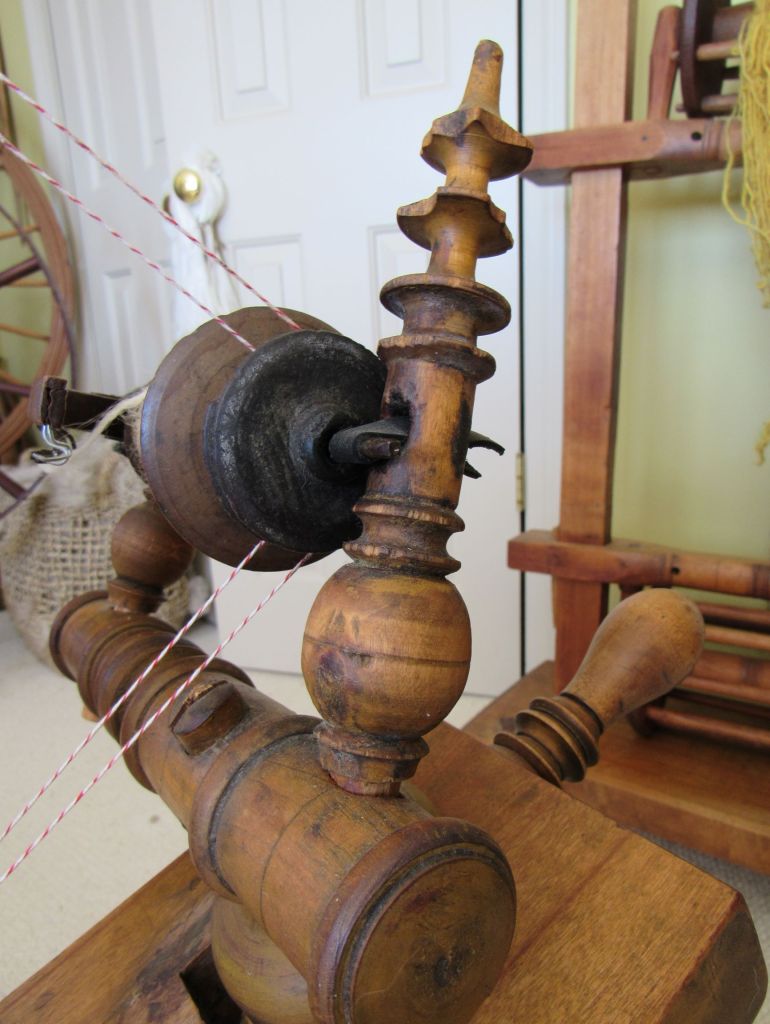
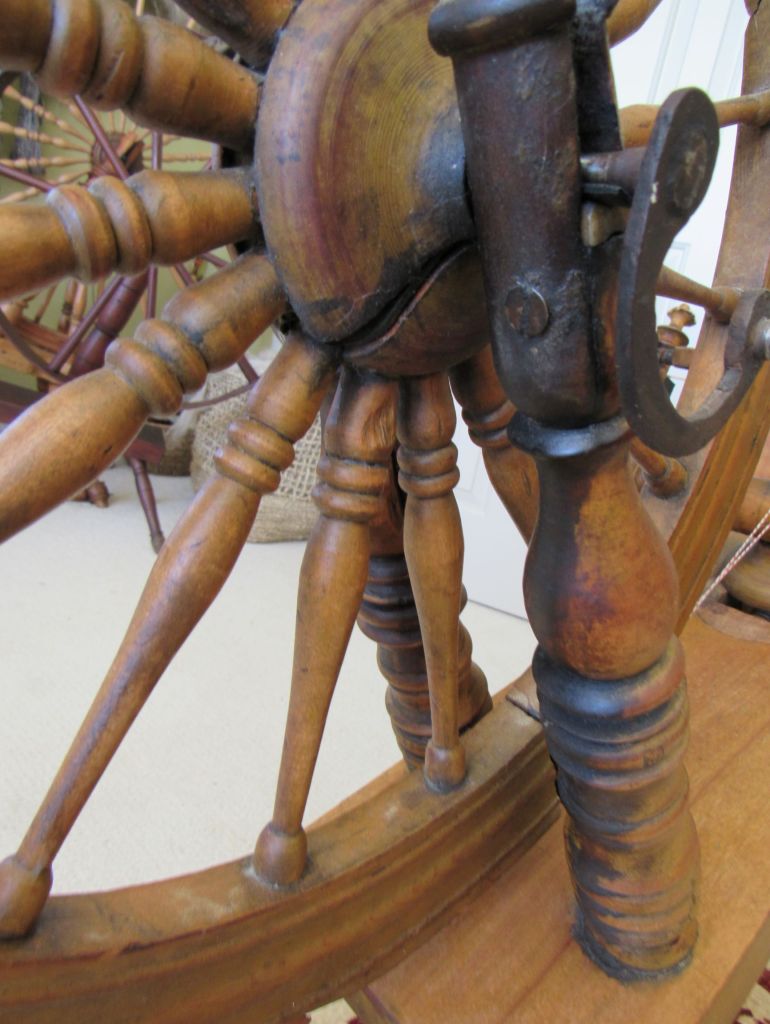
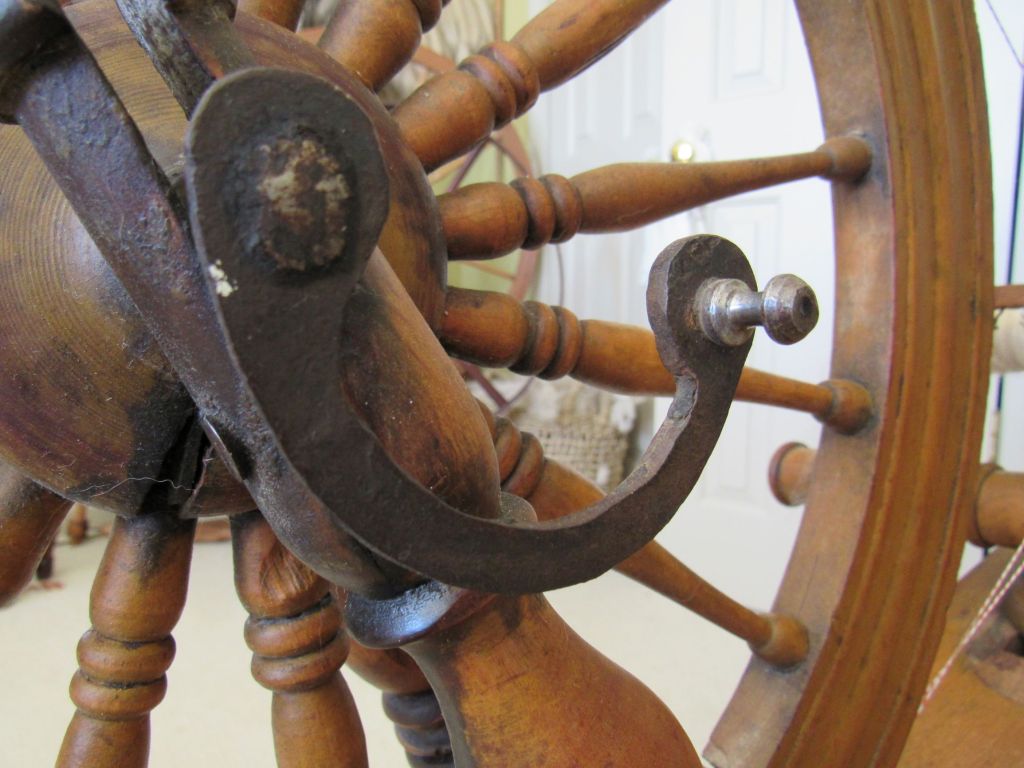
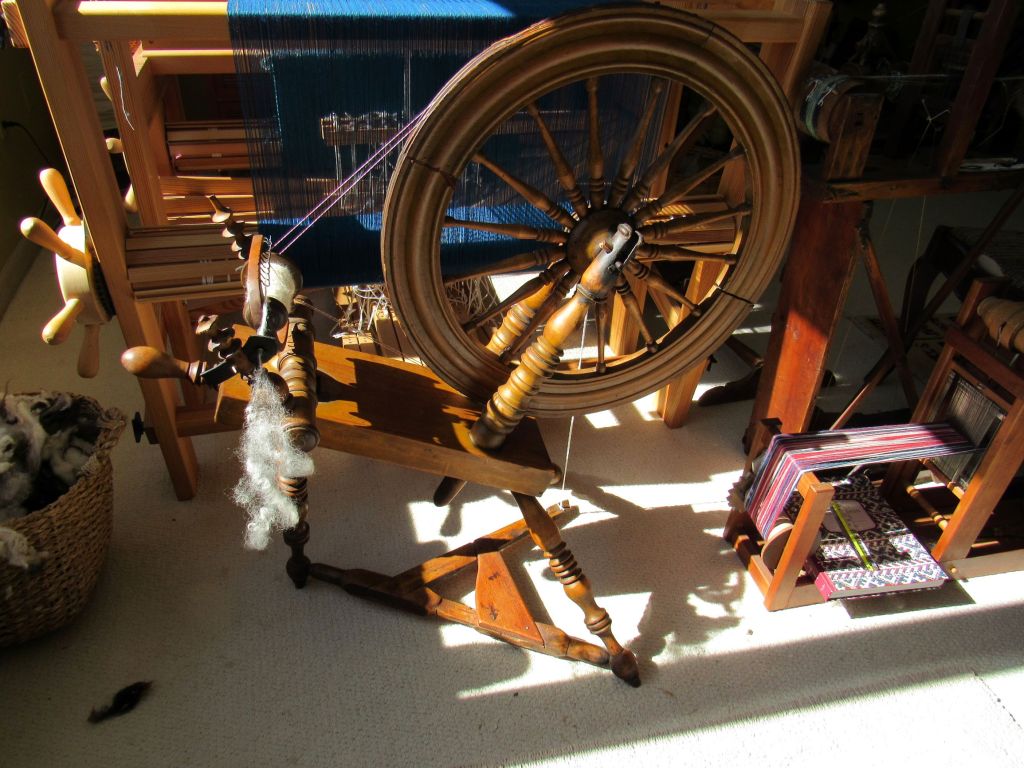
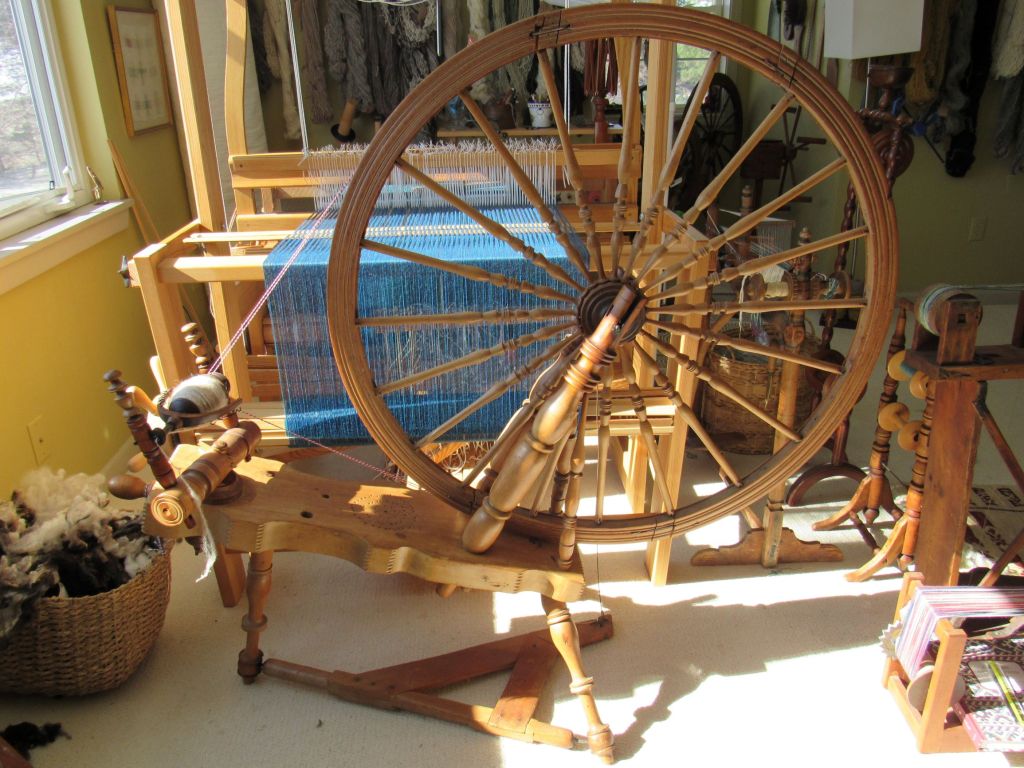
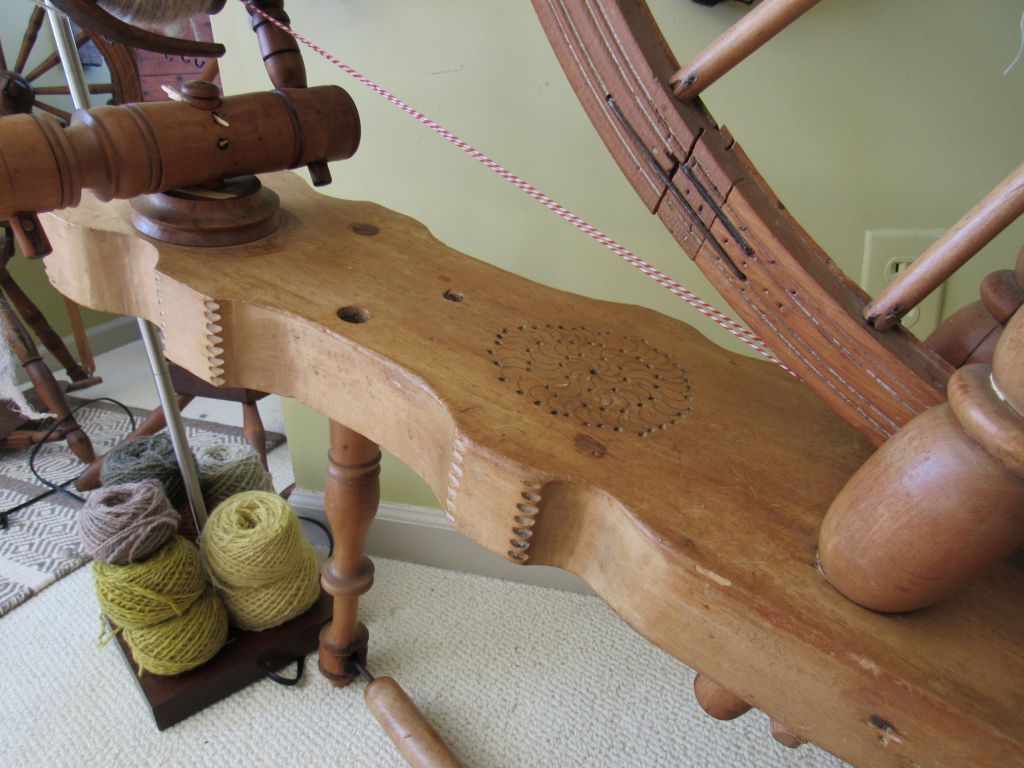
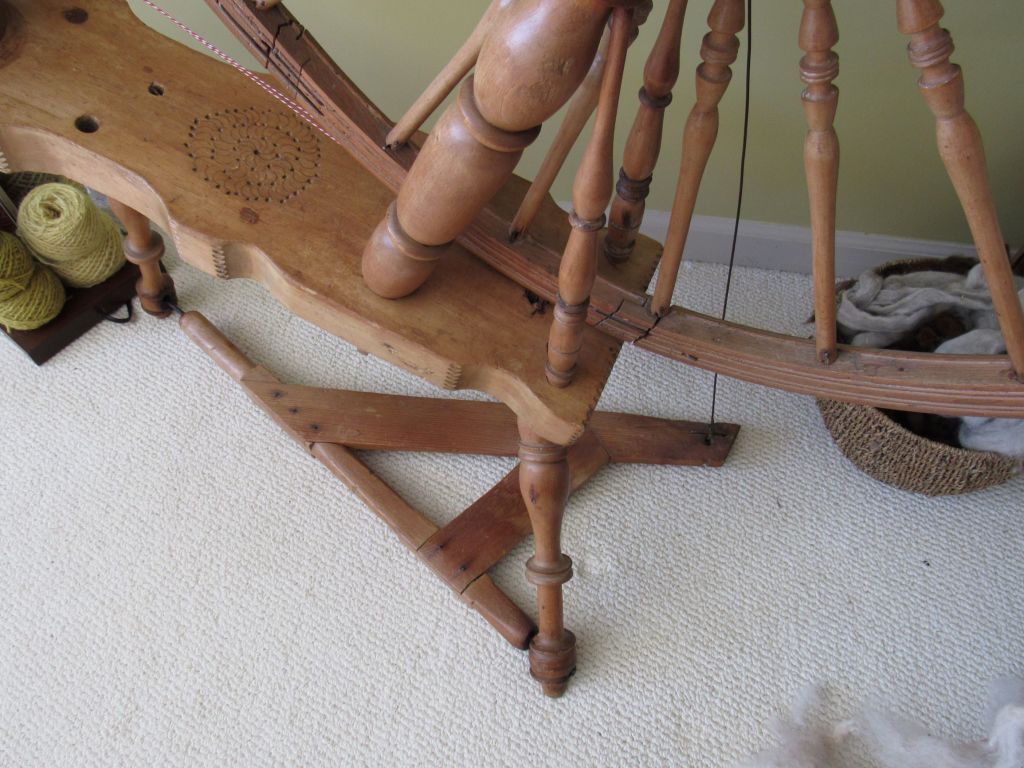
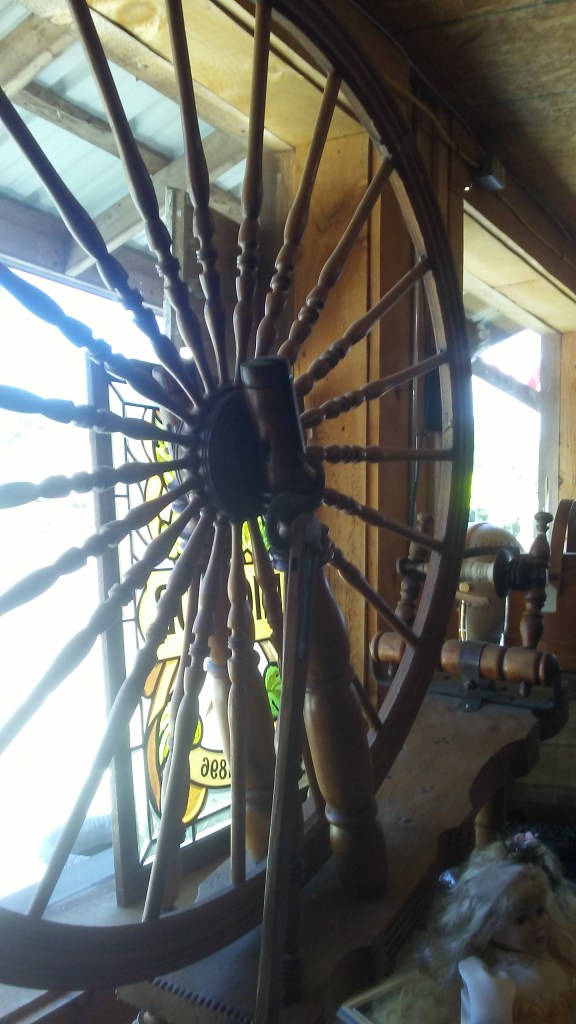
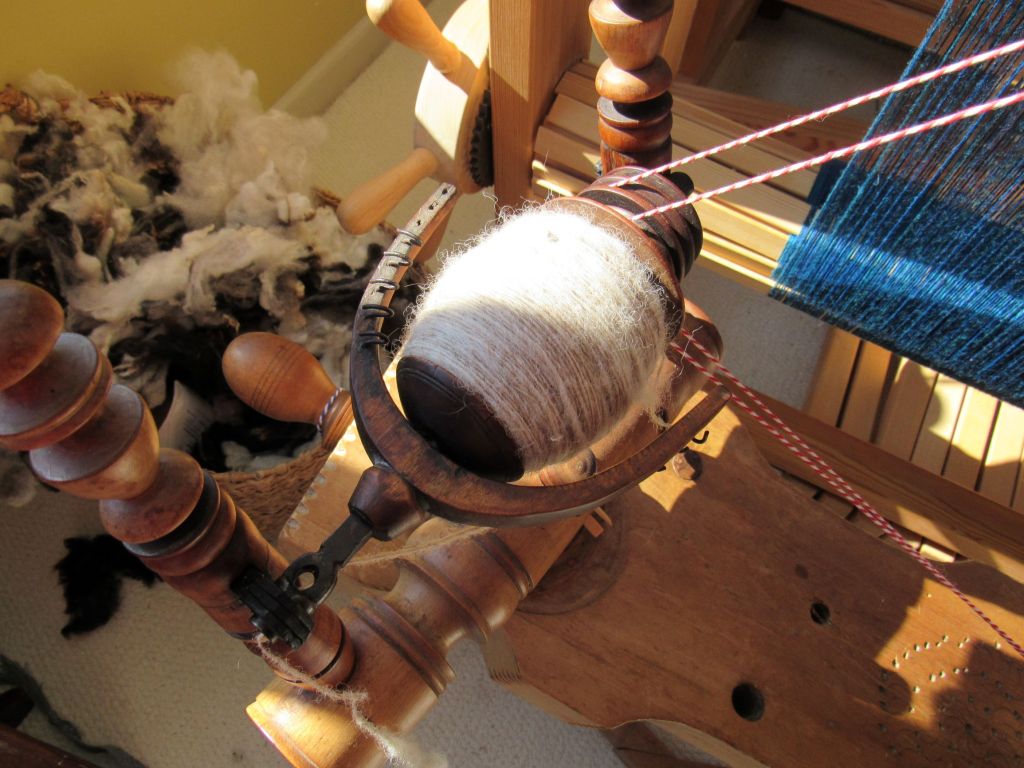
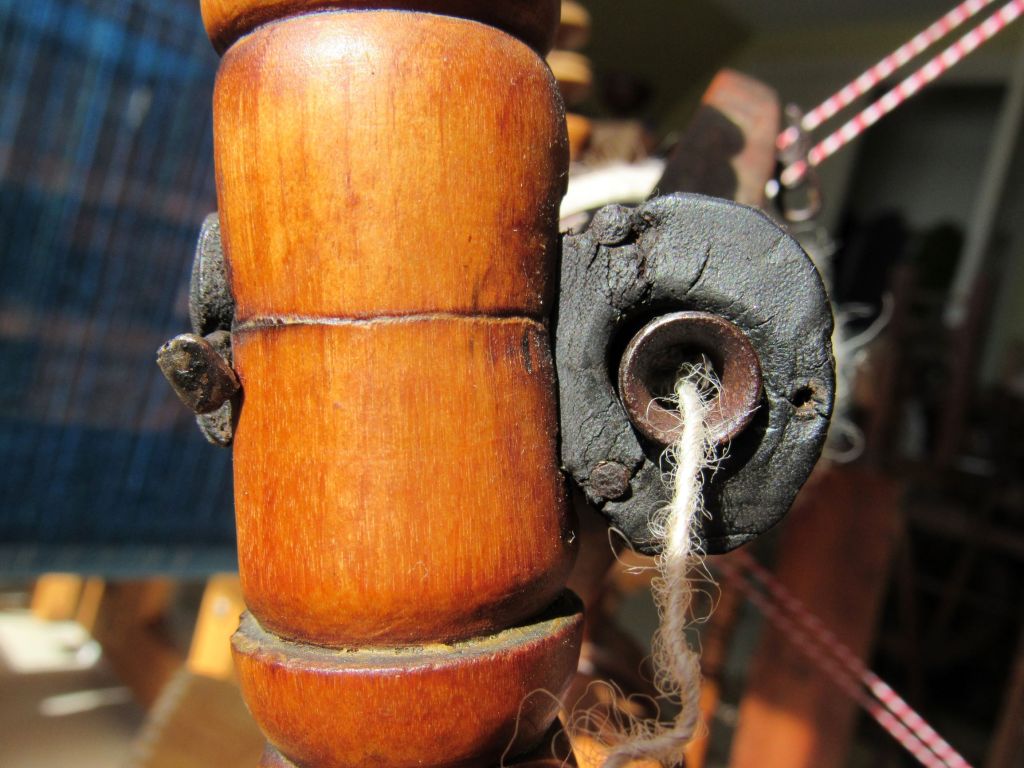
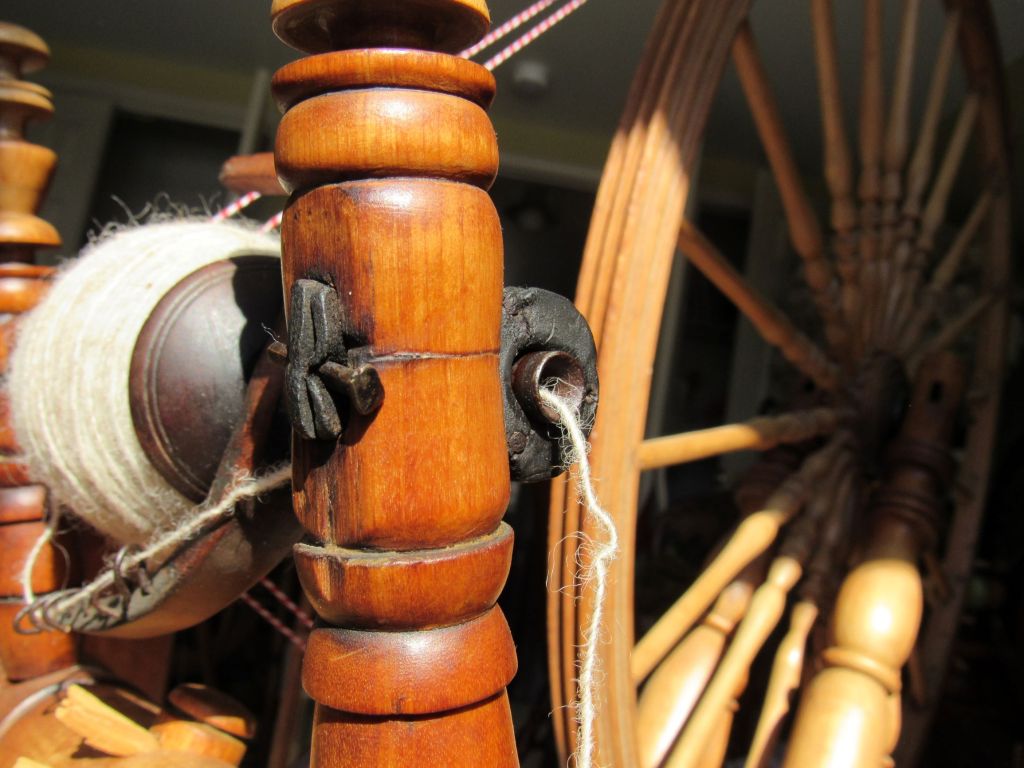
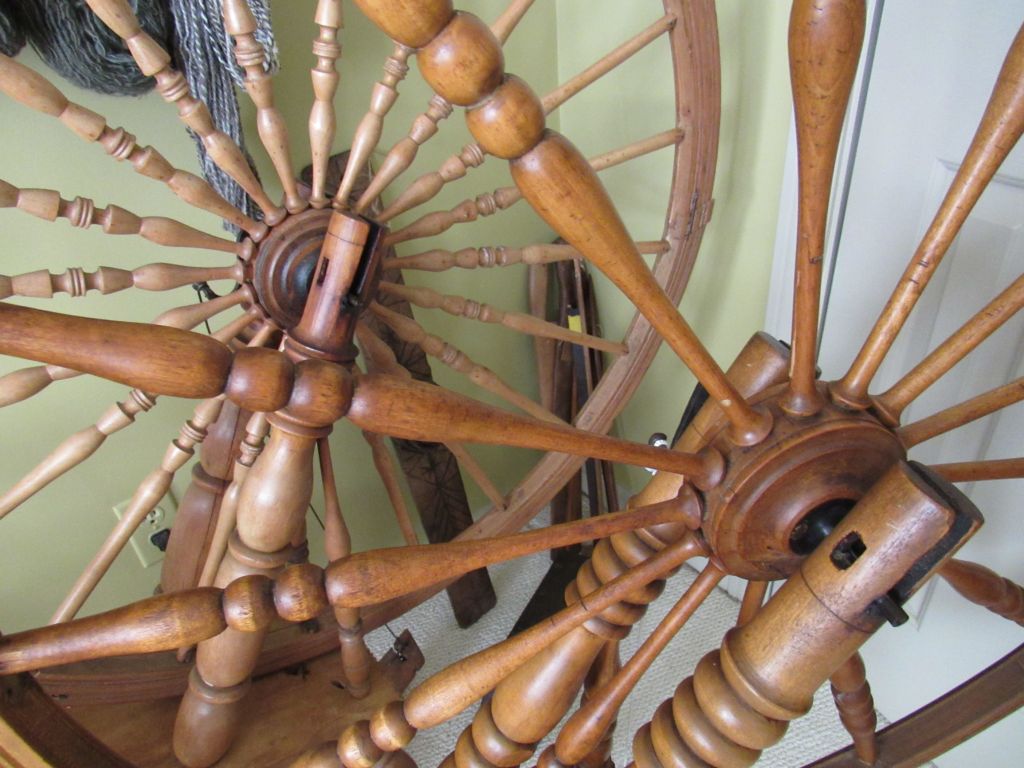
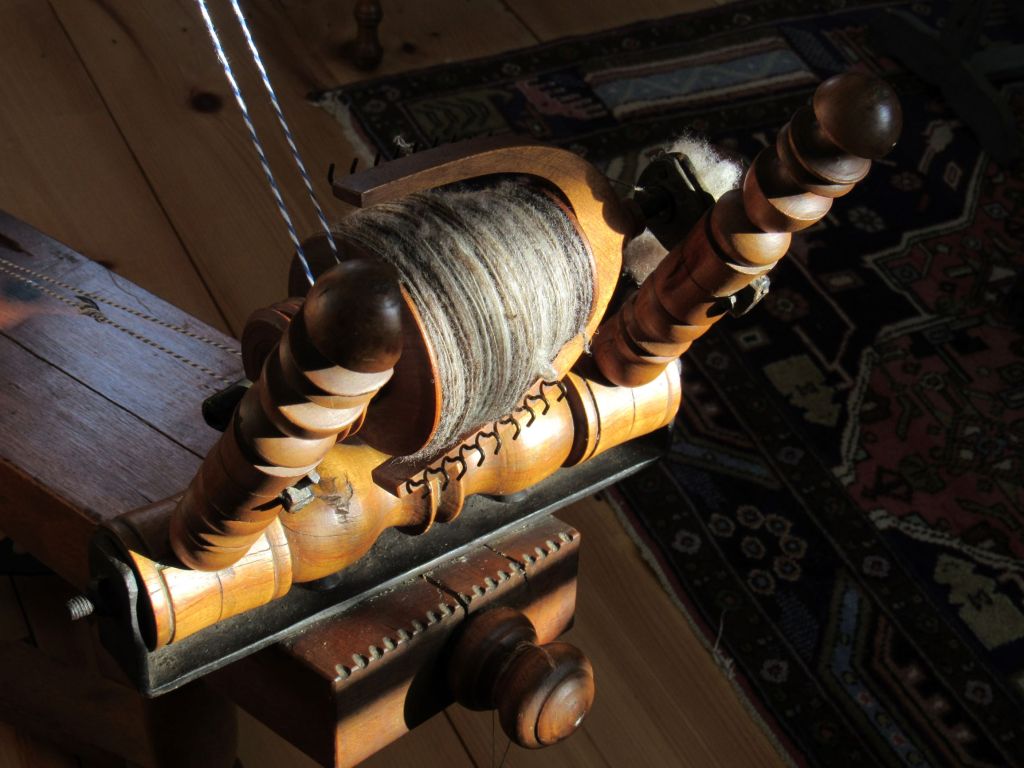
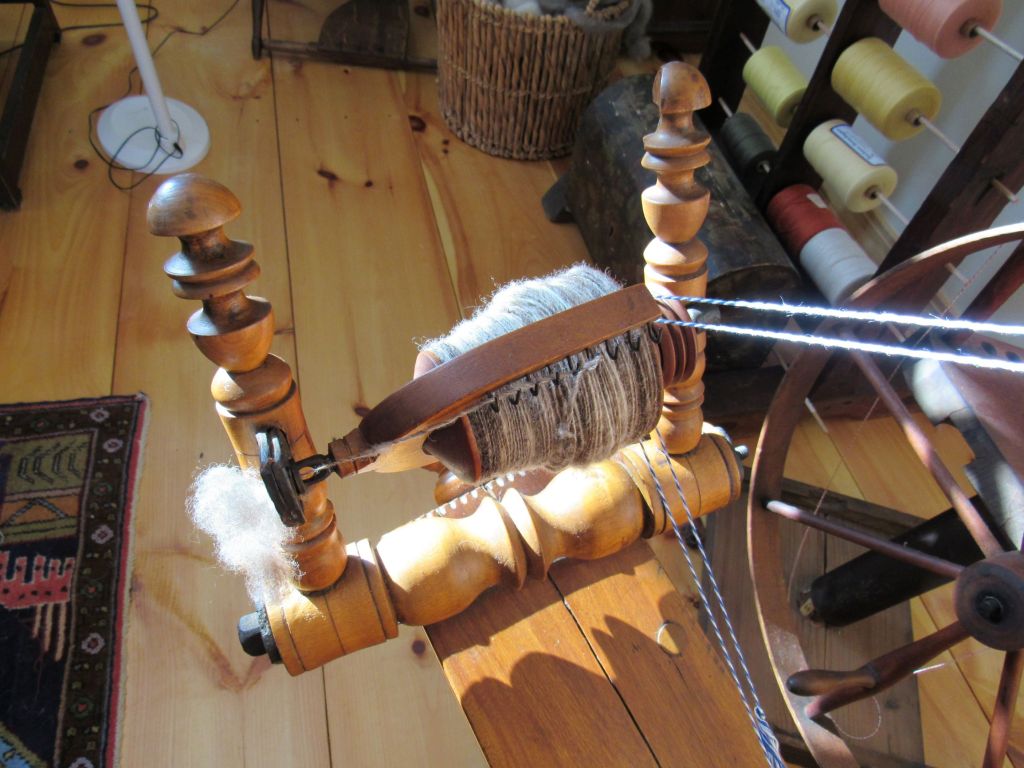
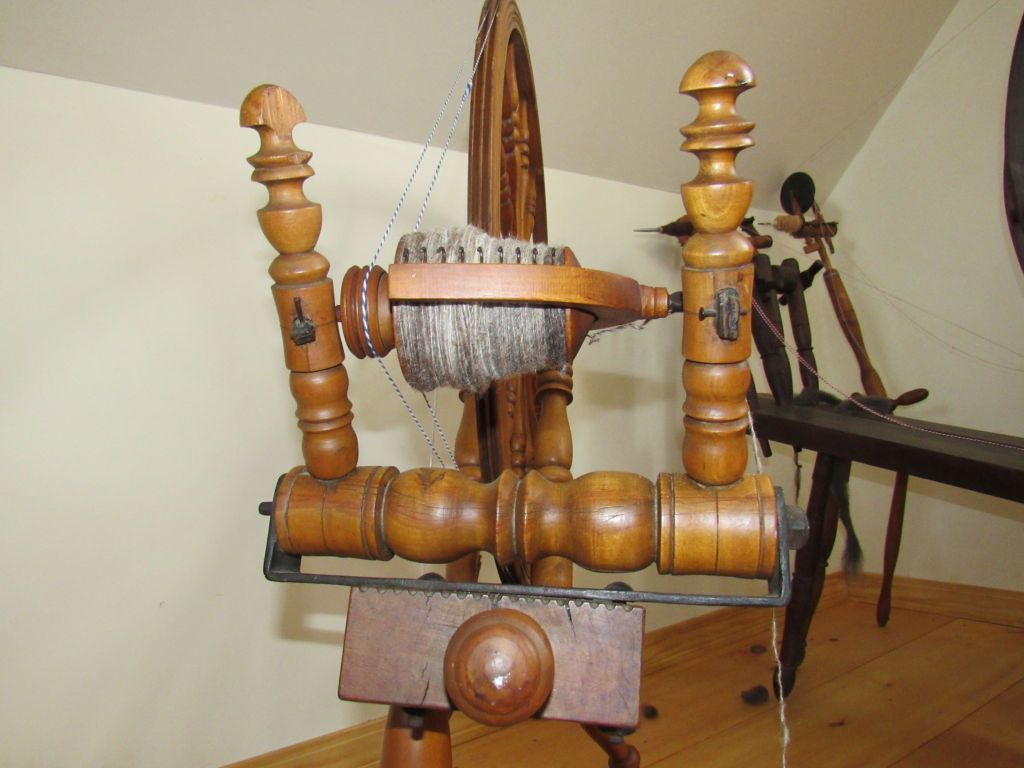
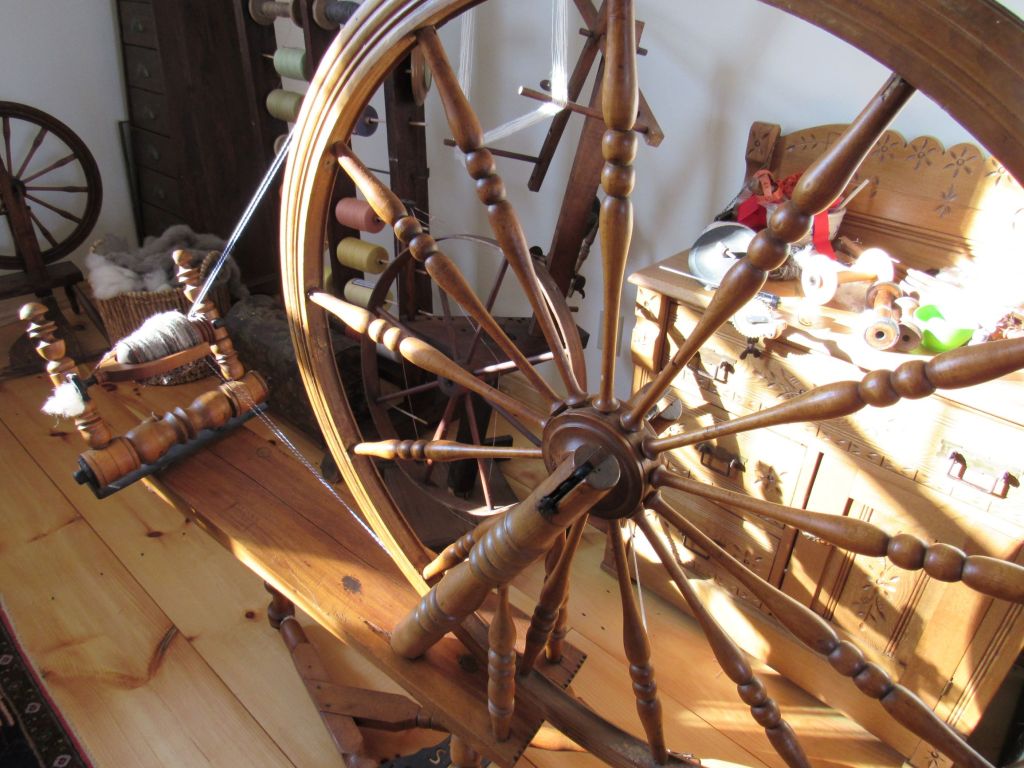
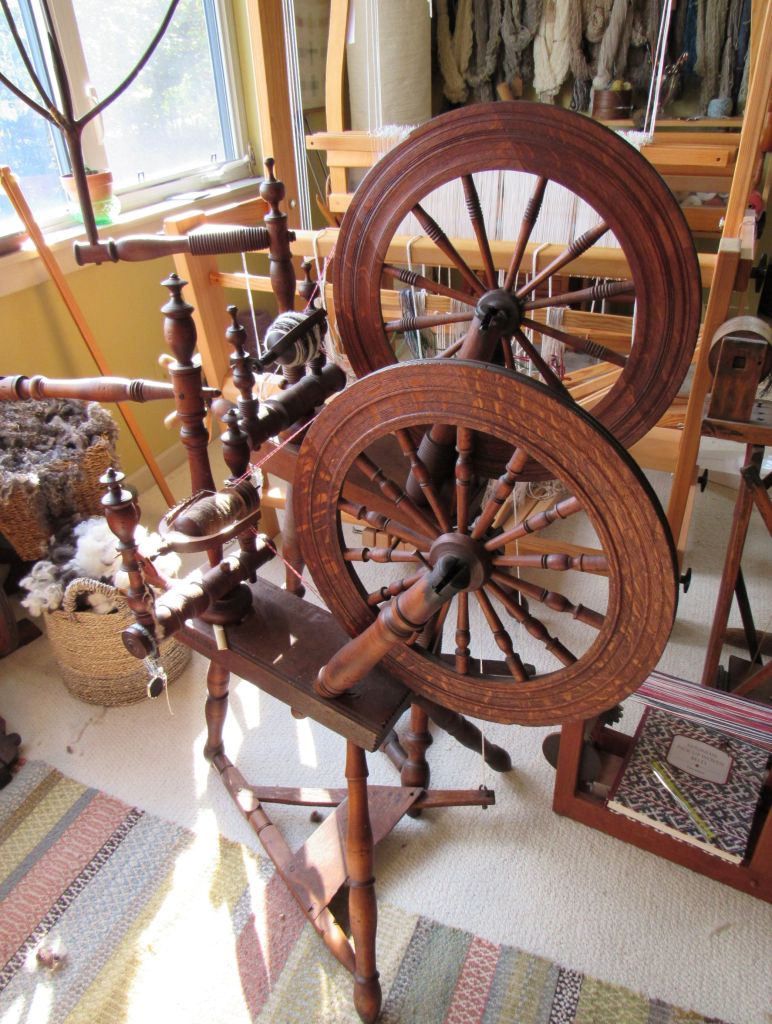
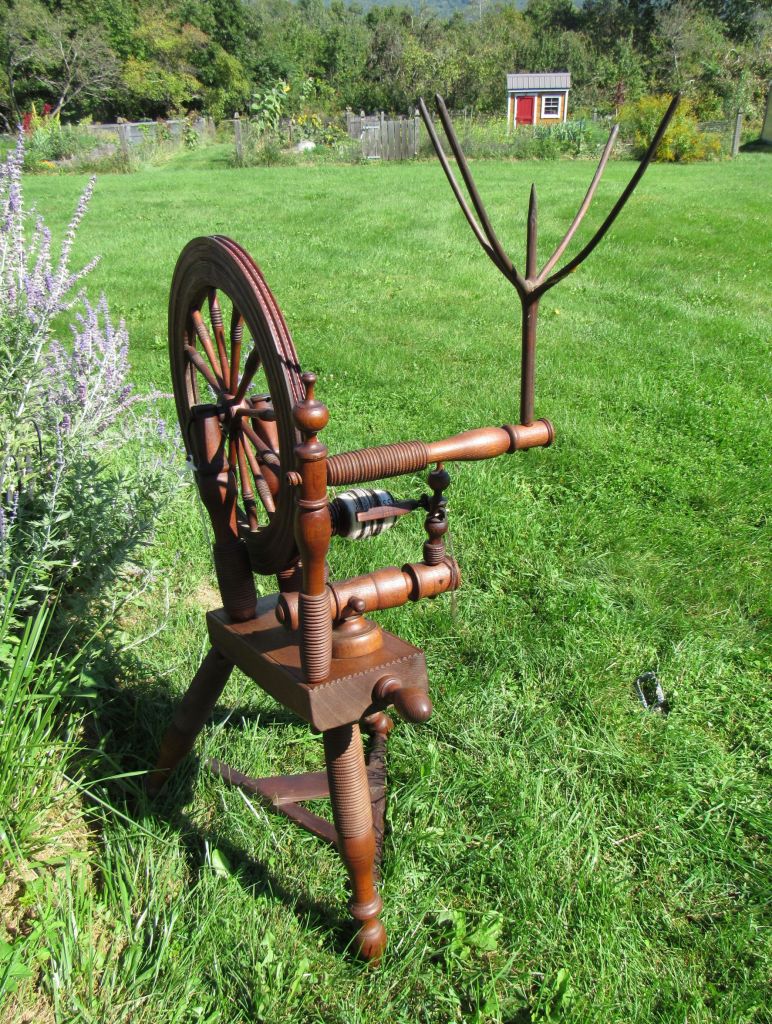
It almost certainly came from Ireland originally. It has the distinctive characteristics of an Irish wheel of this style–upright stance,

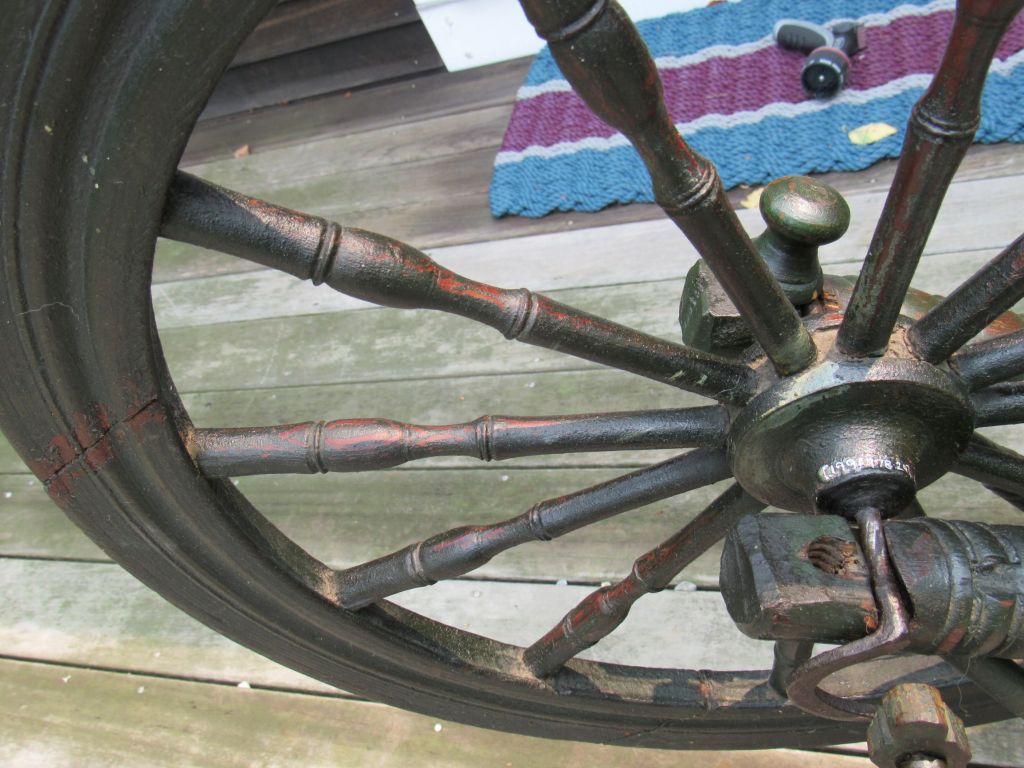
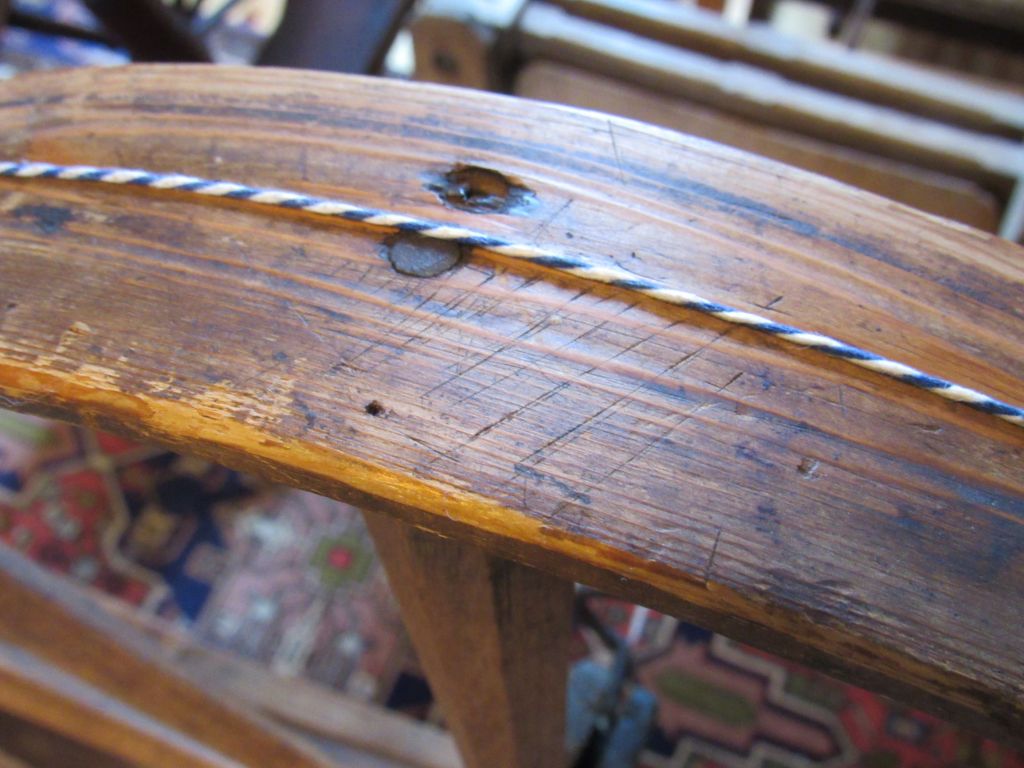
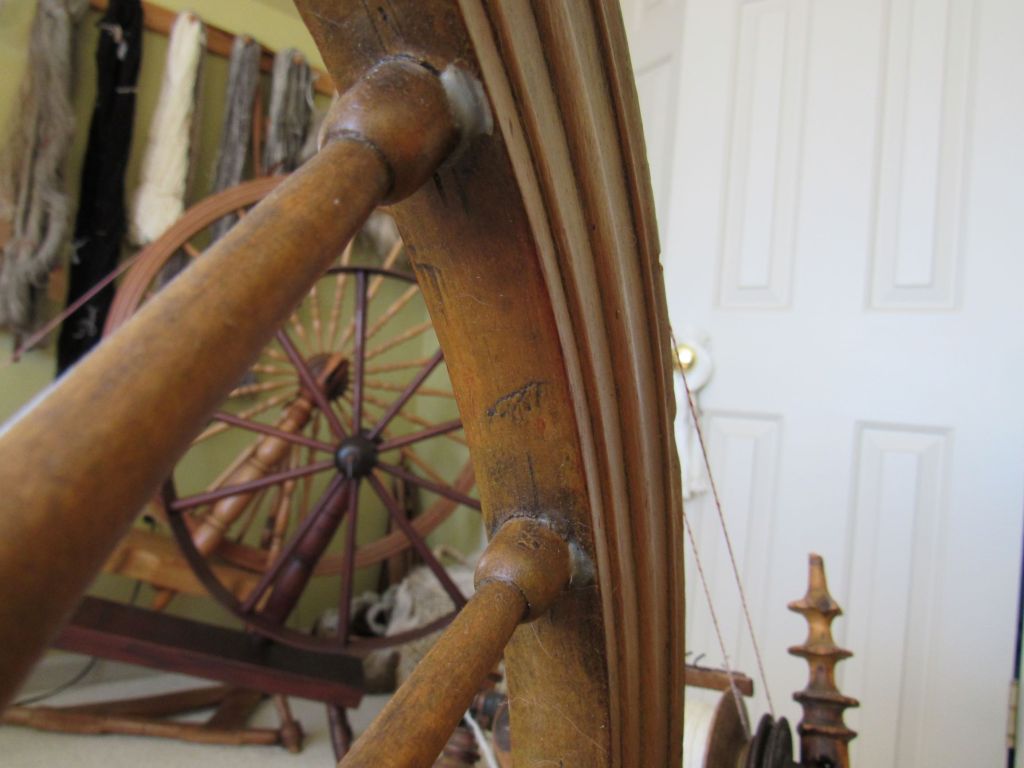
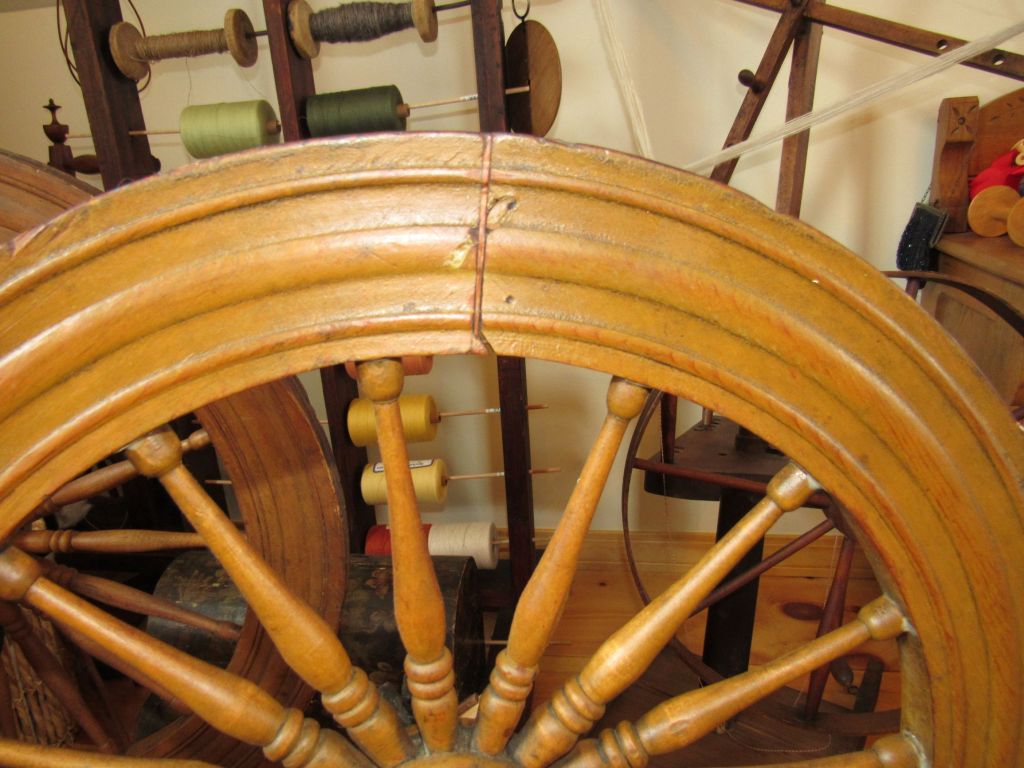
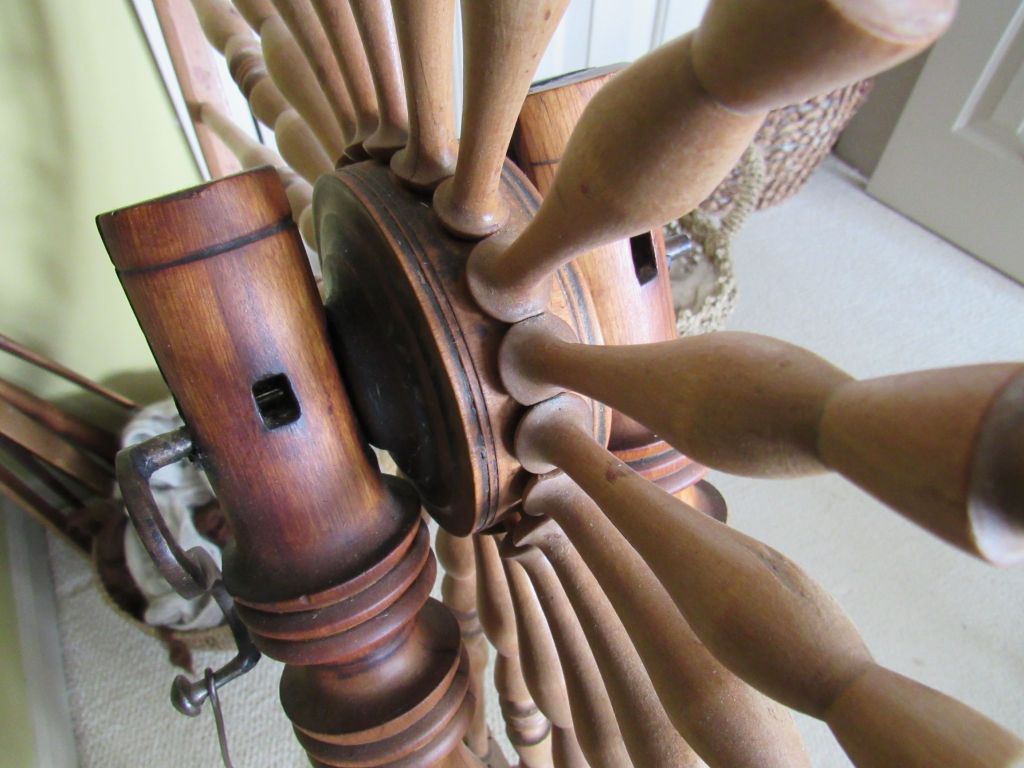
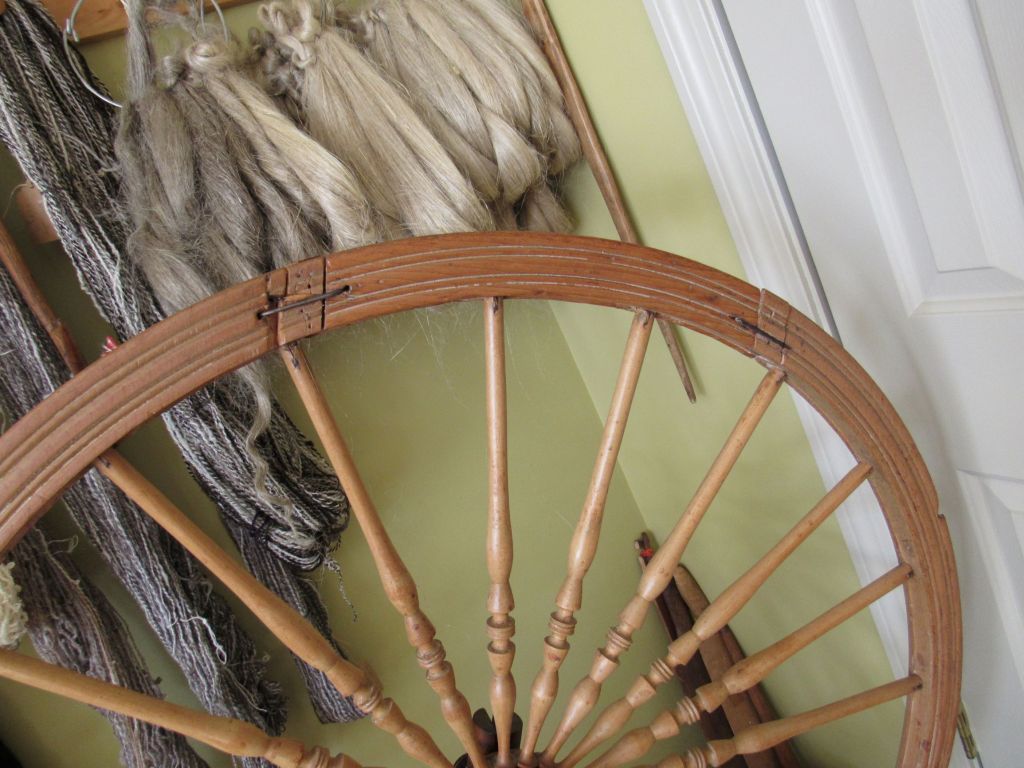
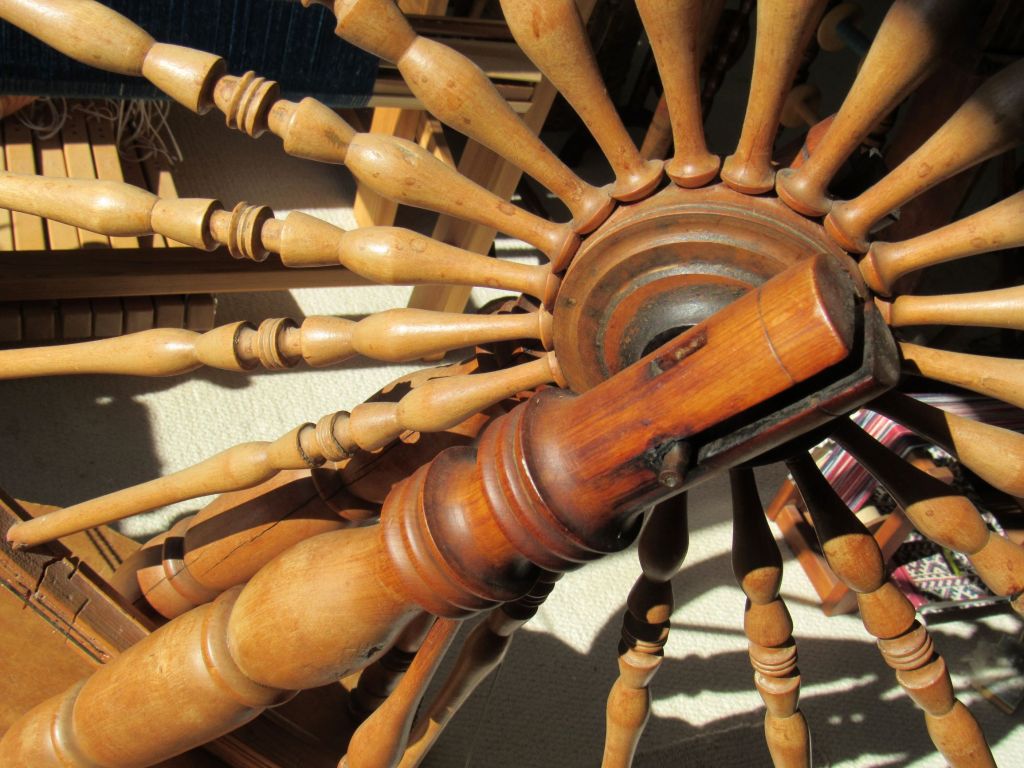
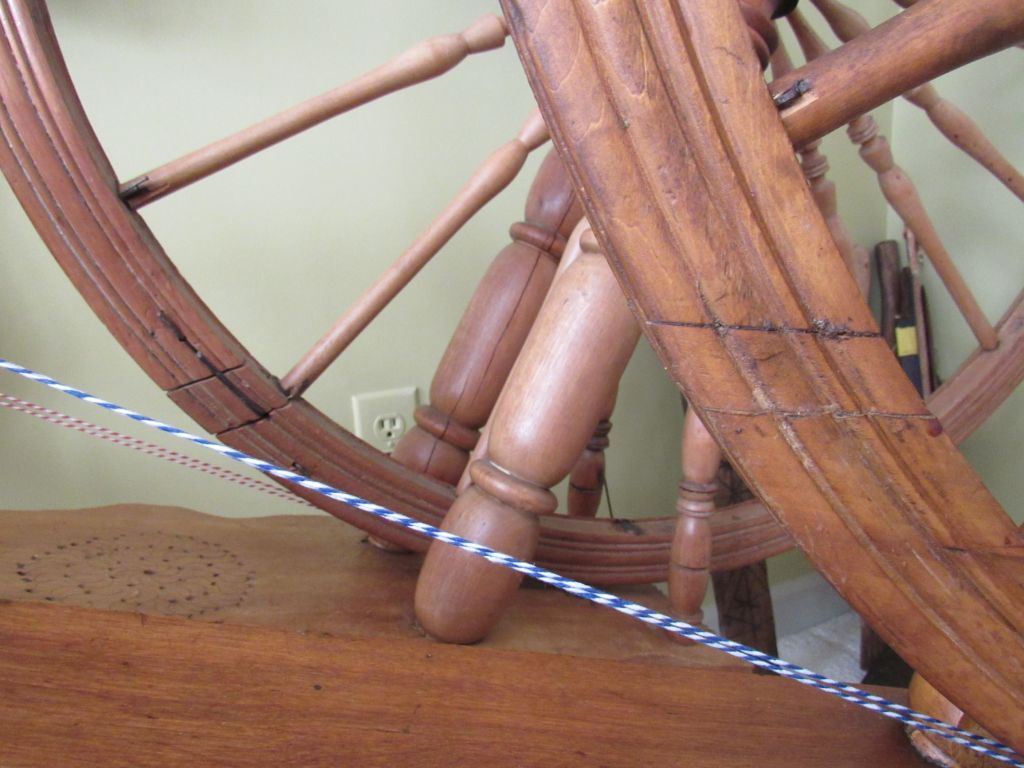
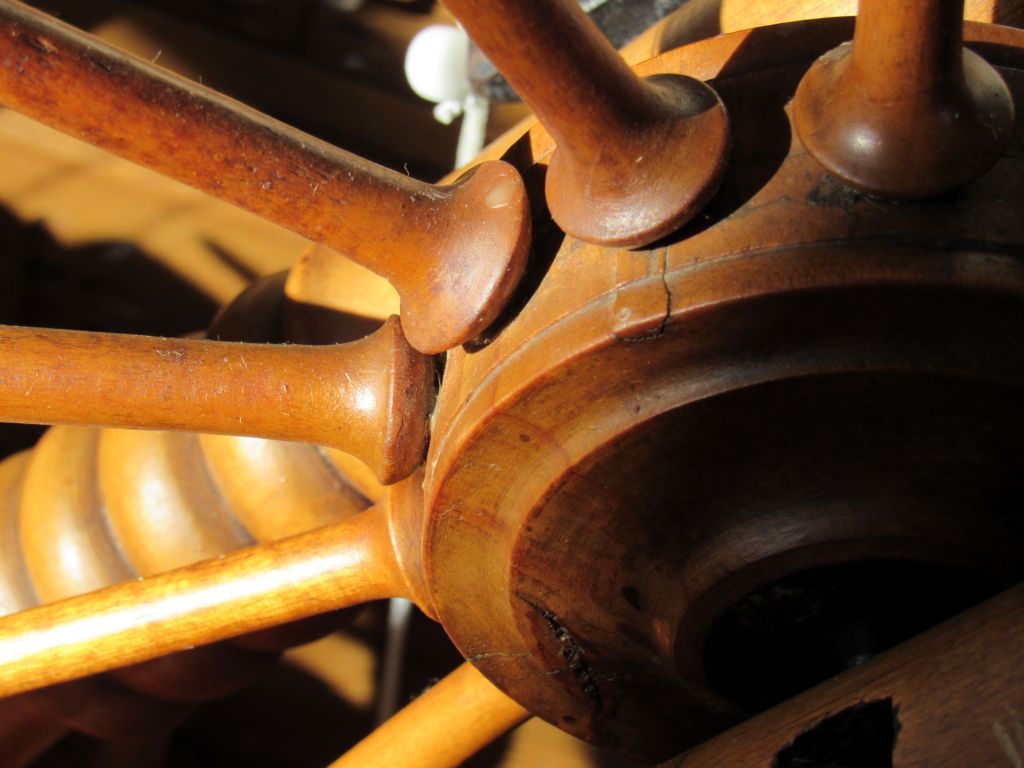
a drive wheel that sits close to the flyer but high off the table,

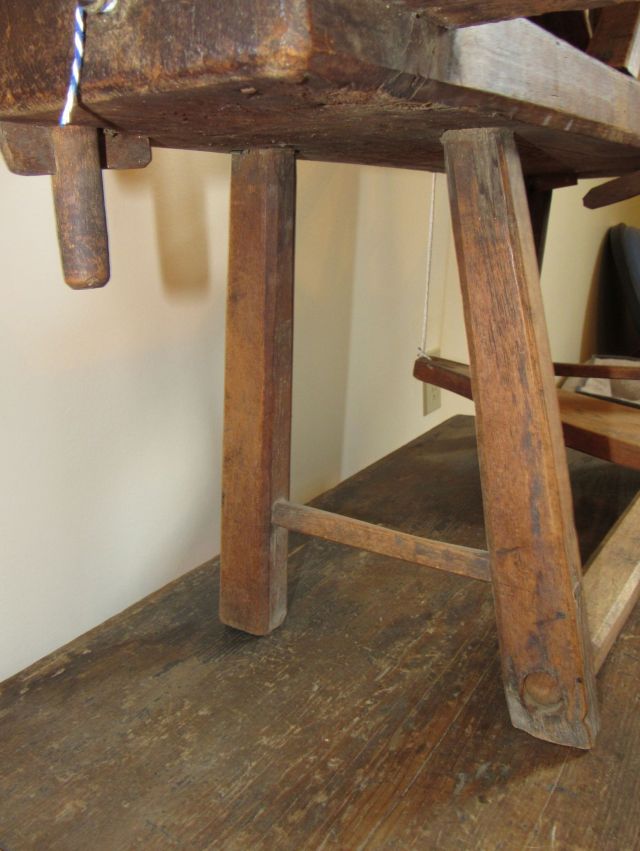
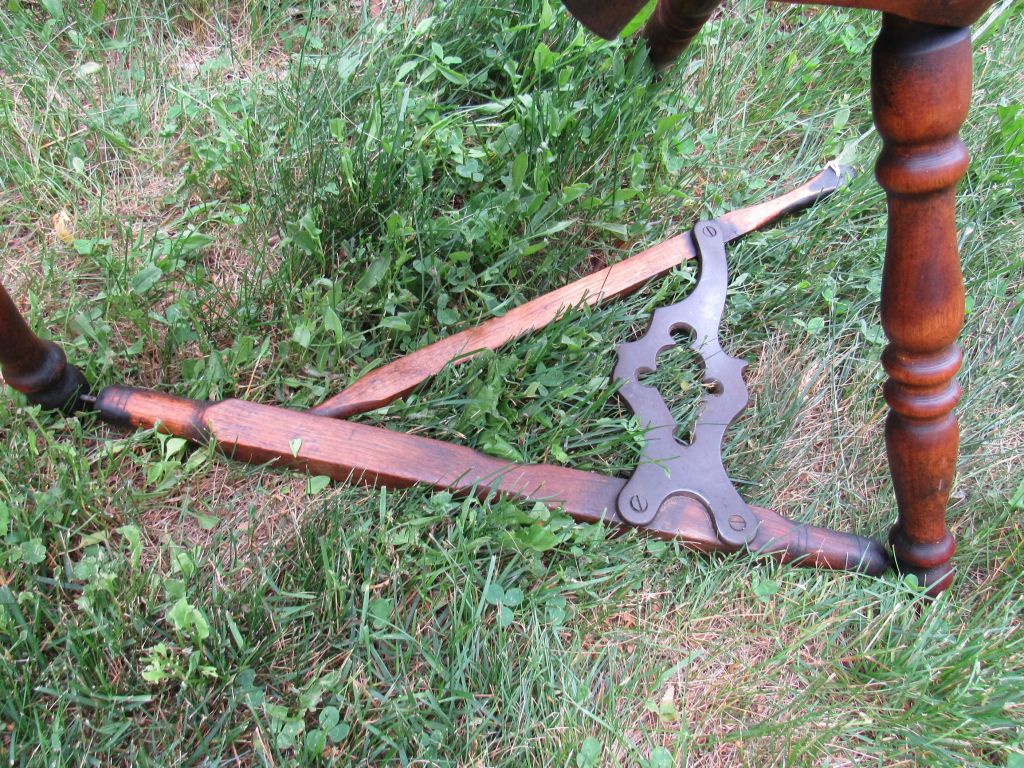
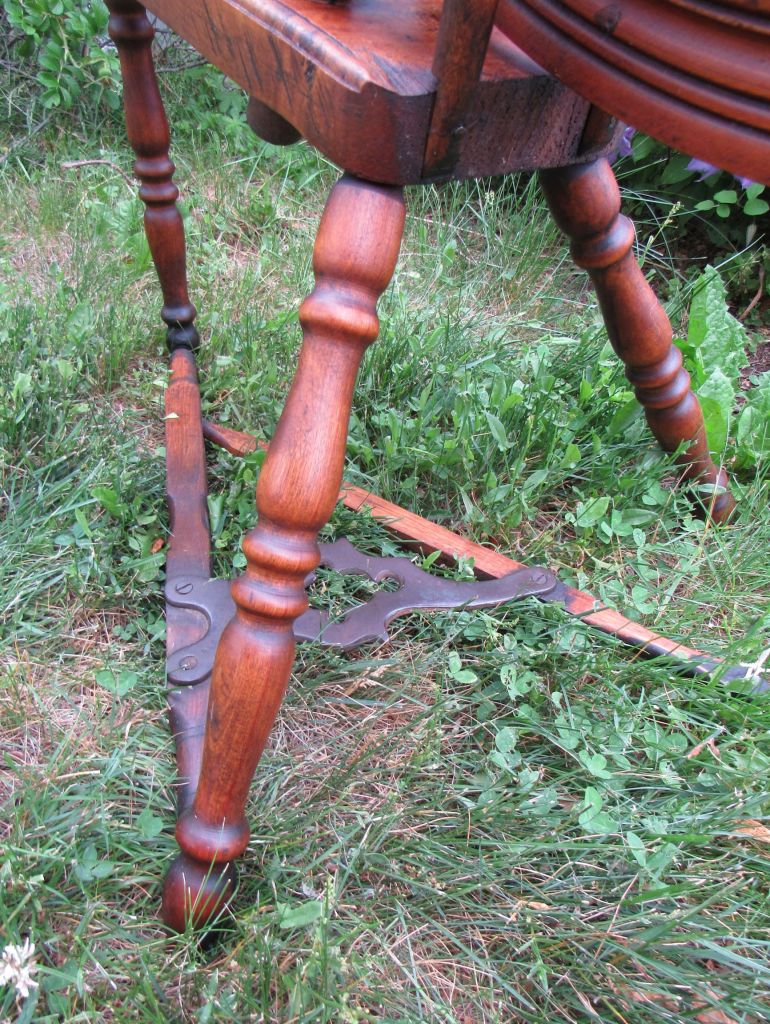
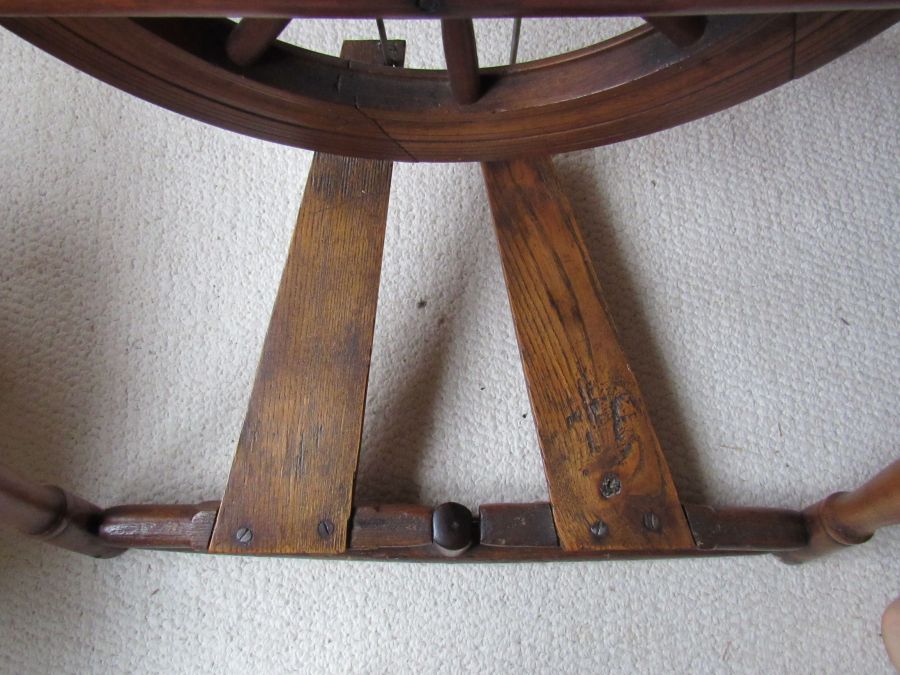
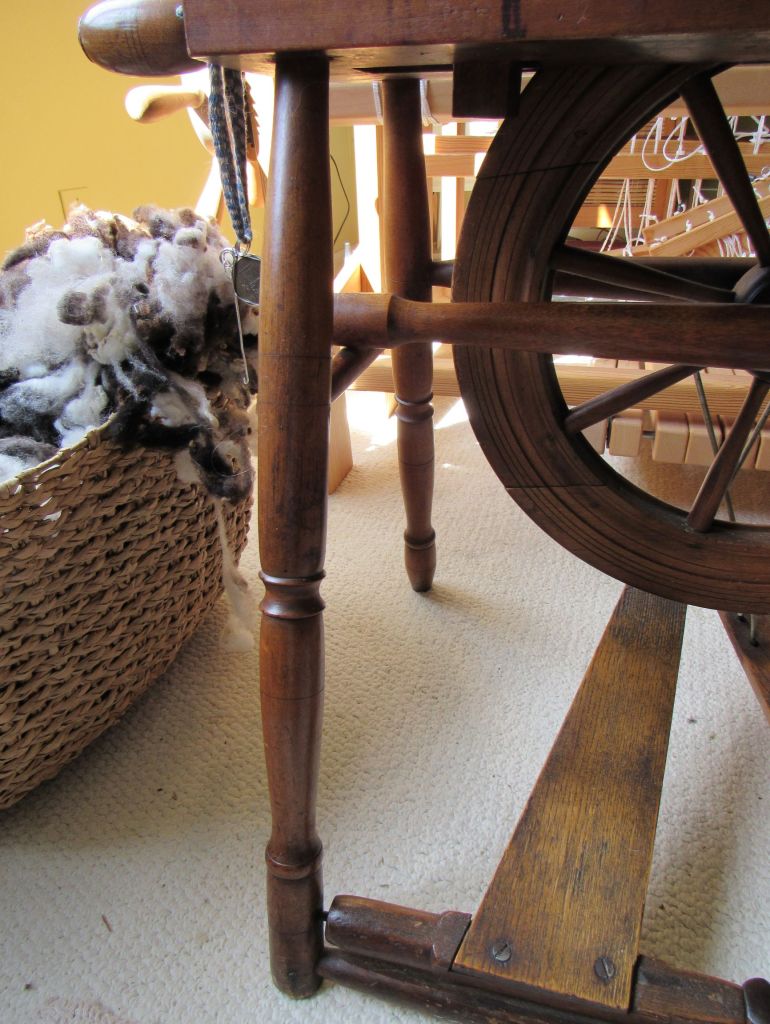
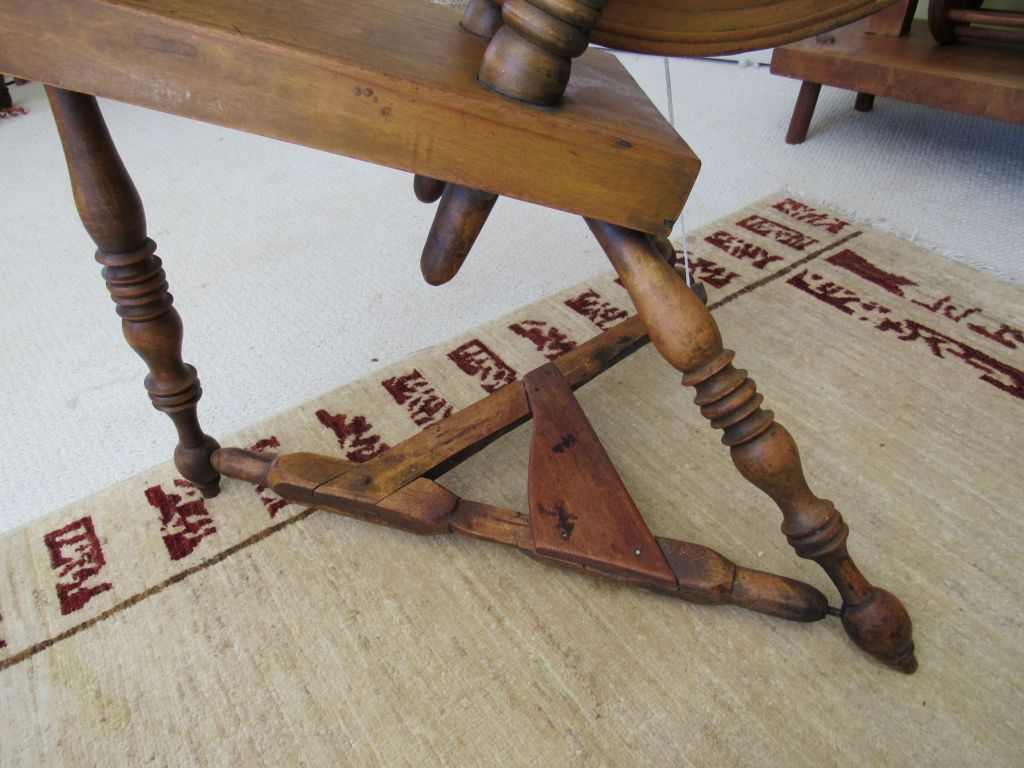
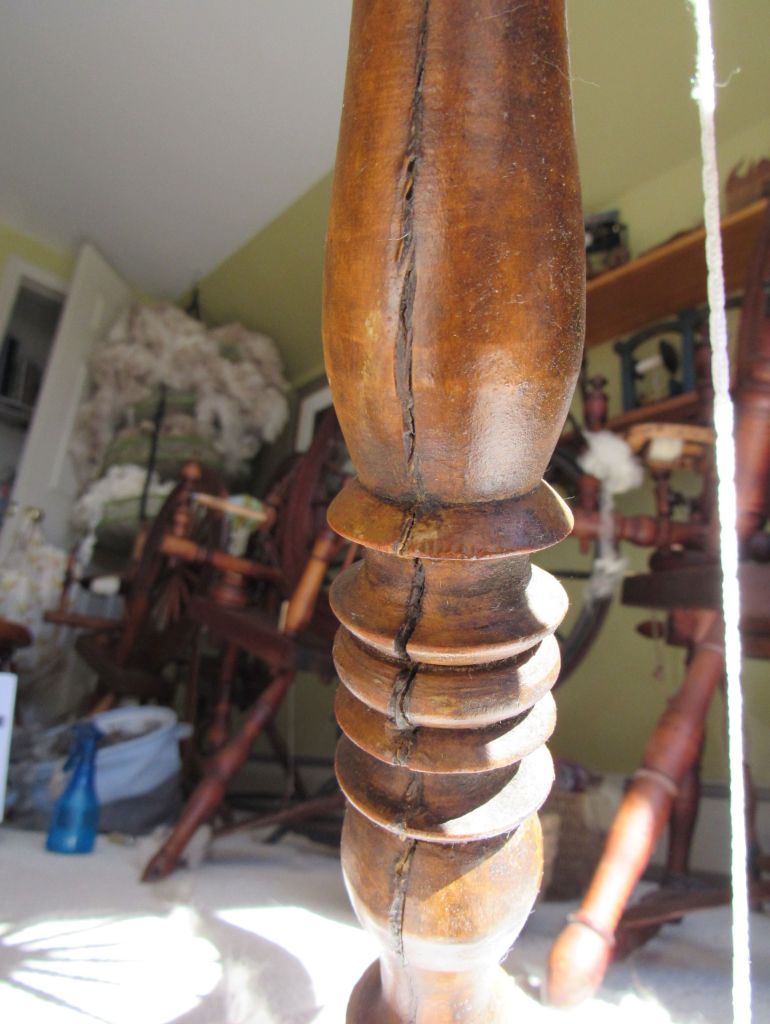
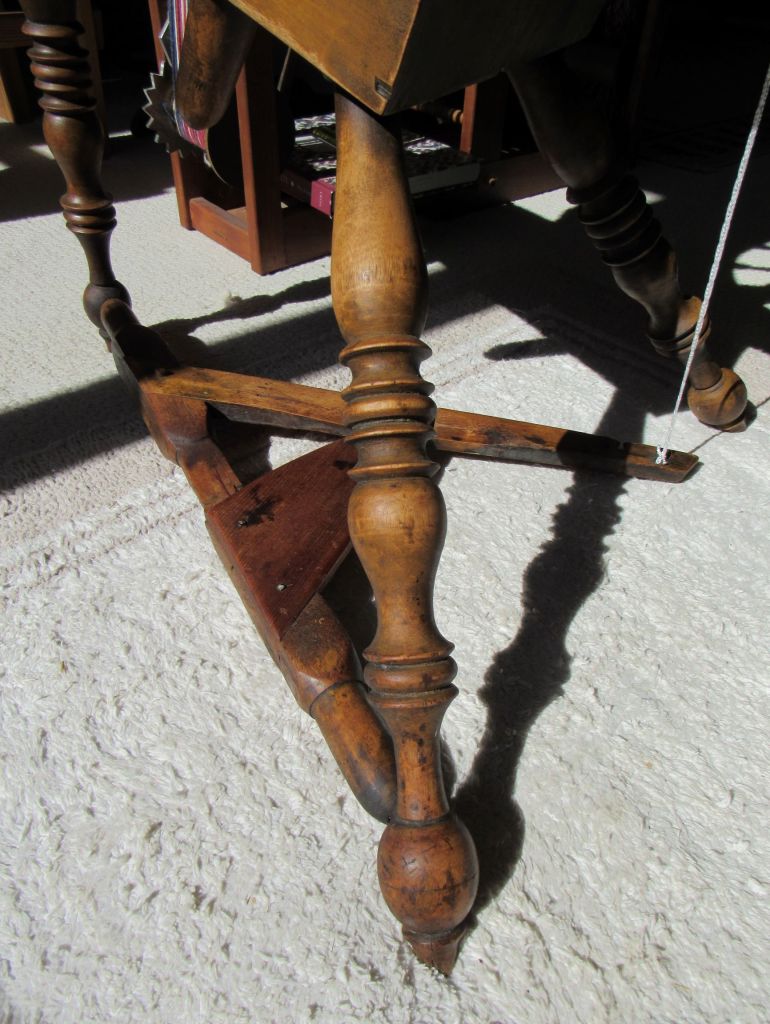
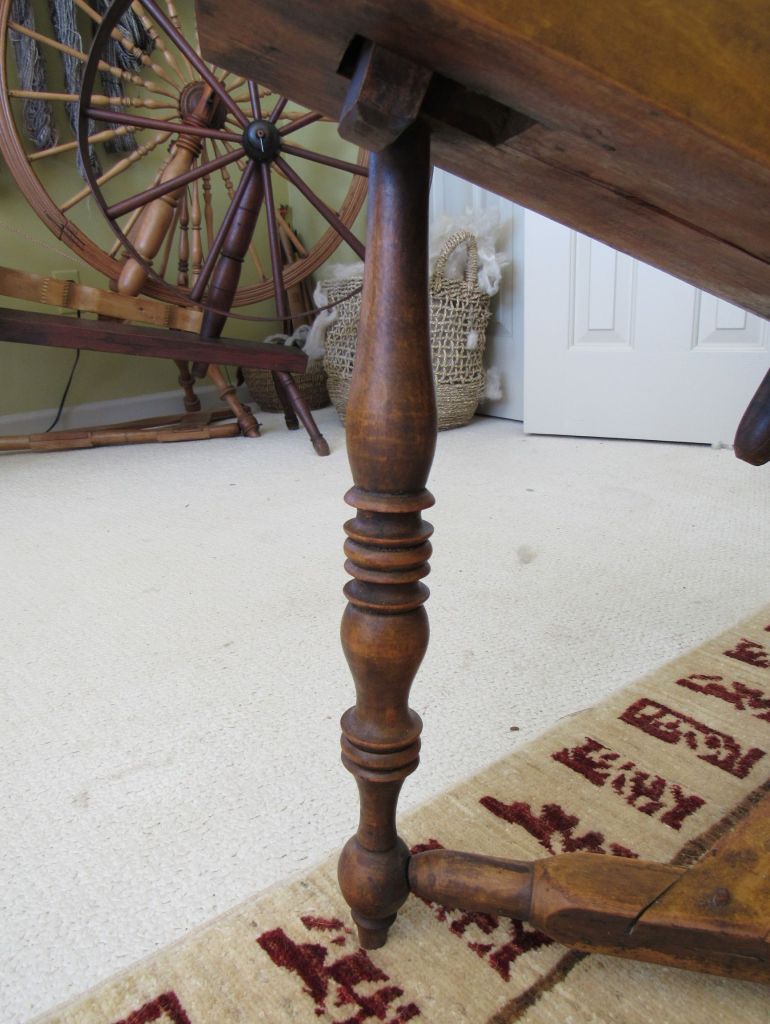
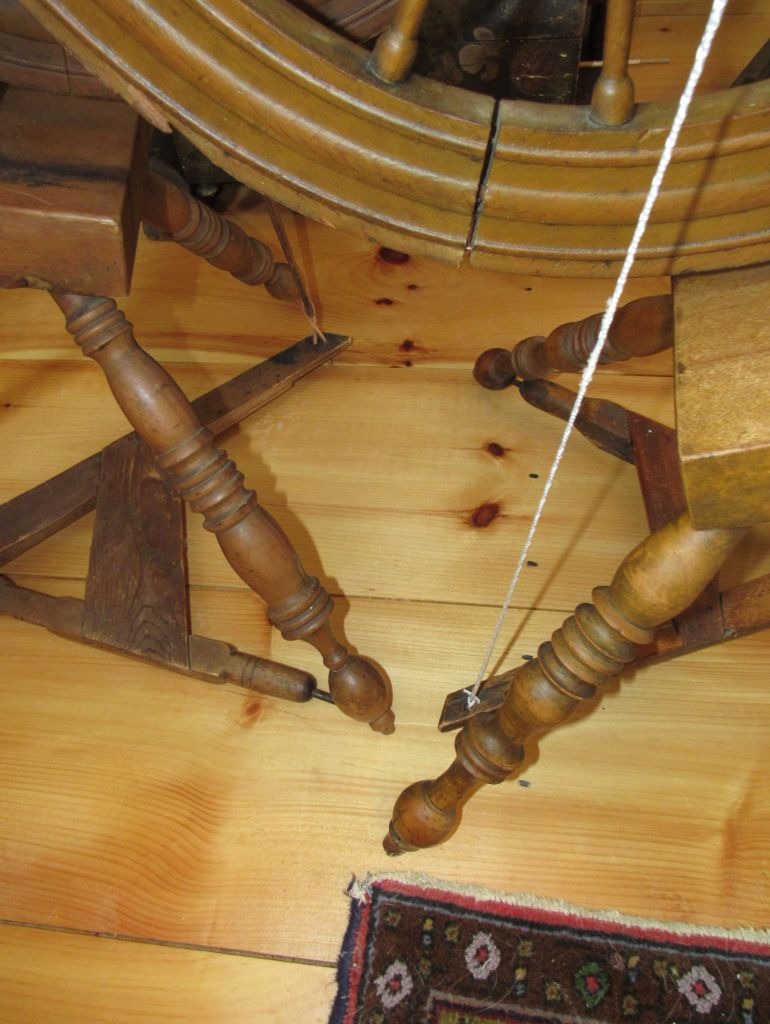
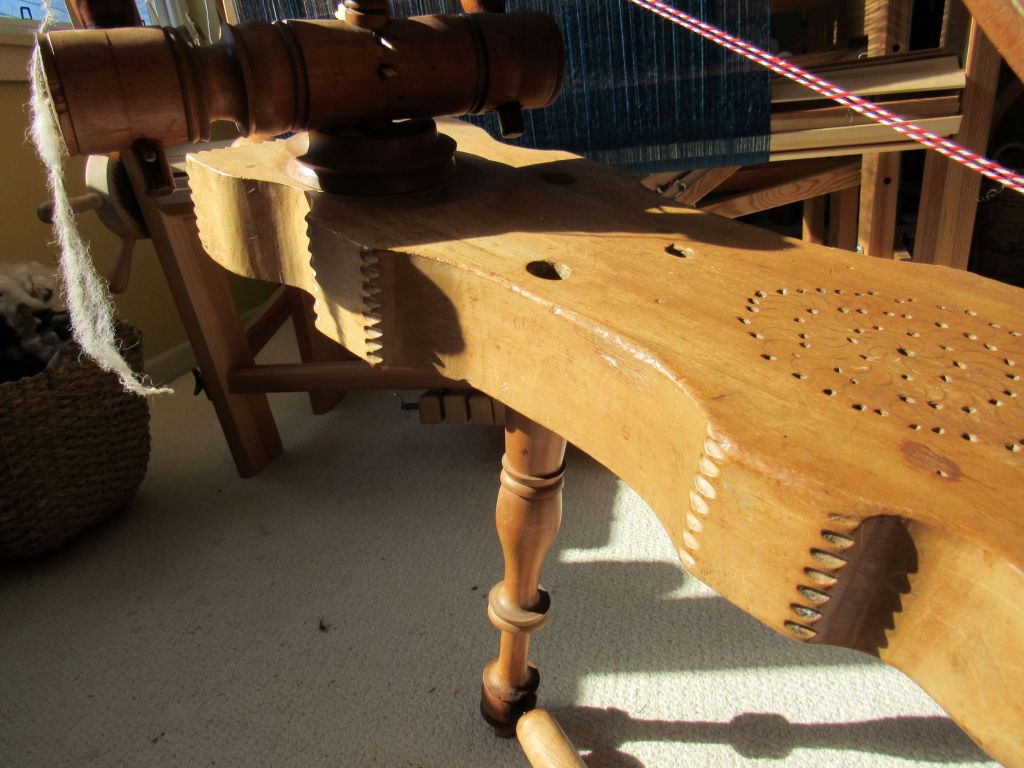
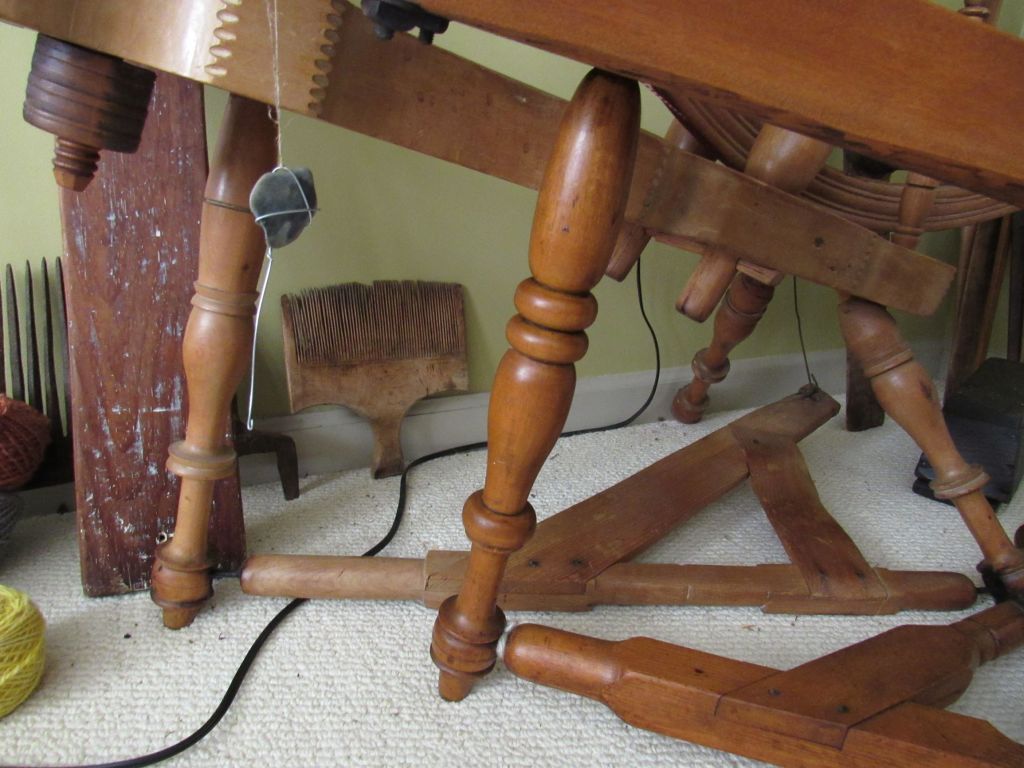
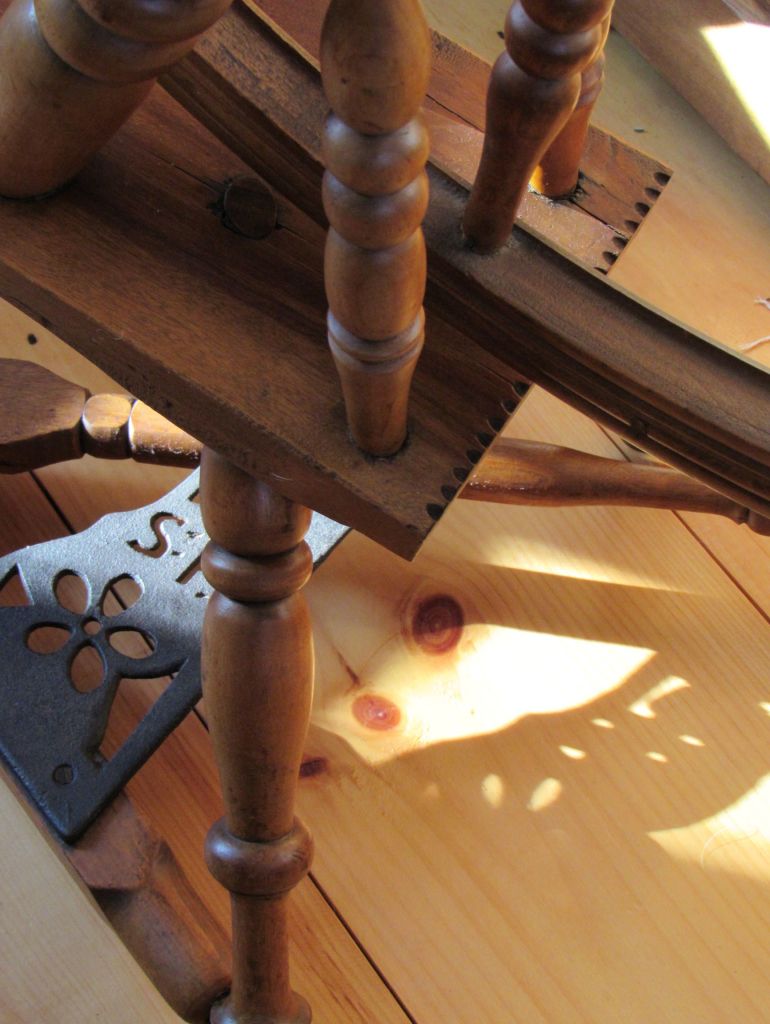
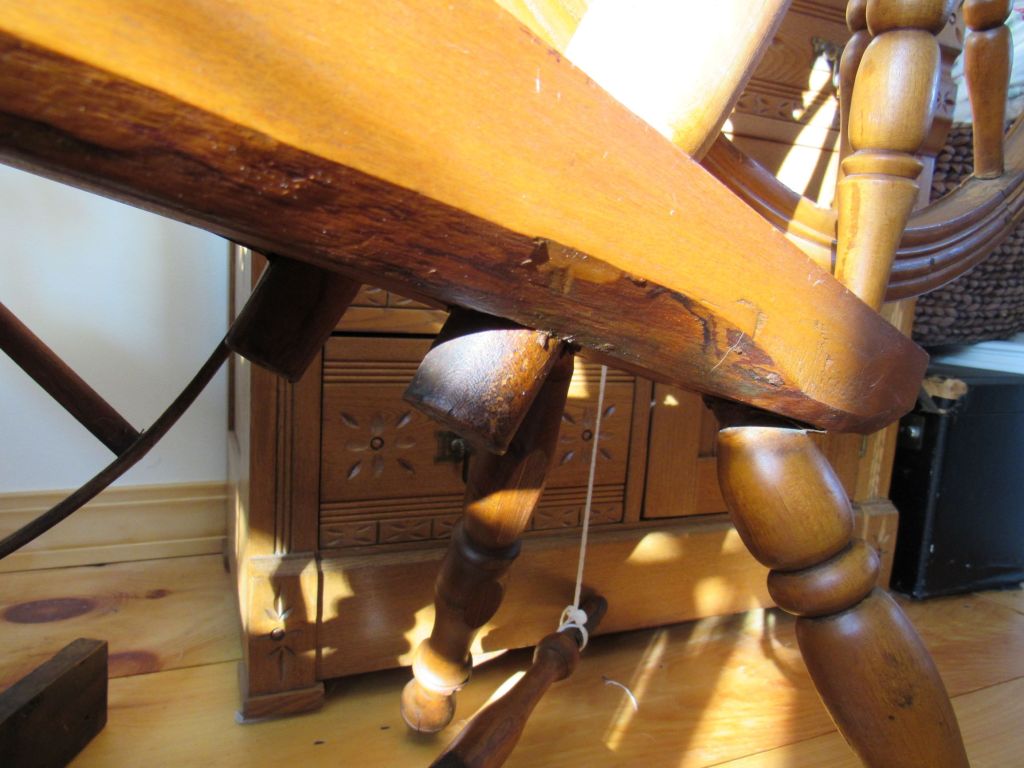
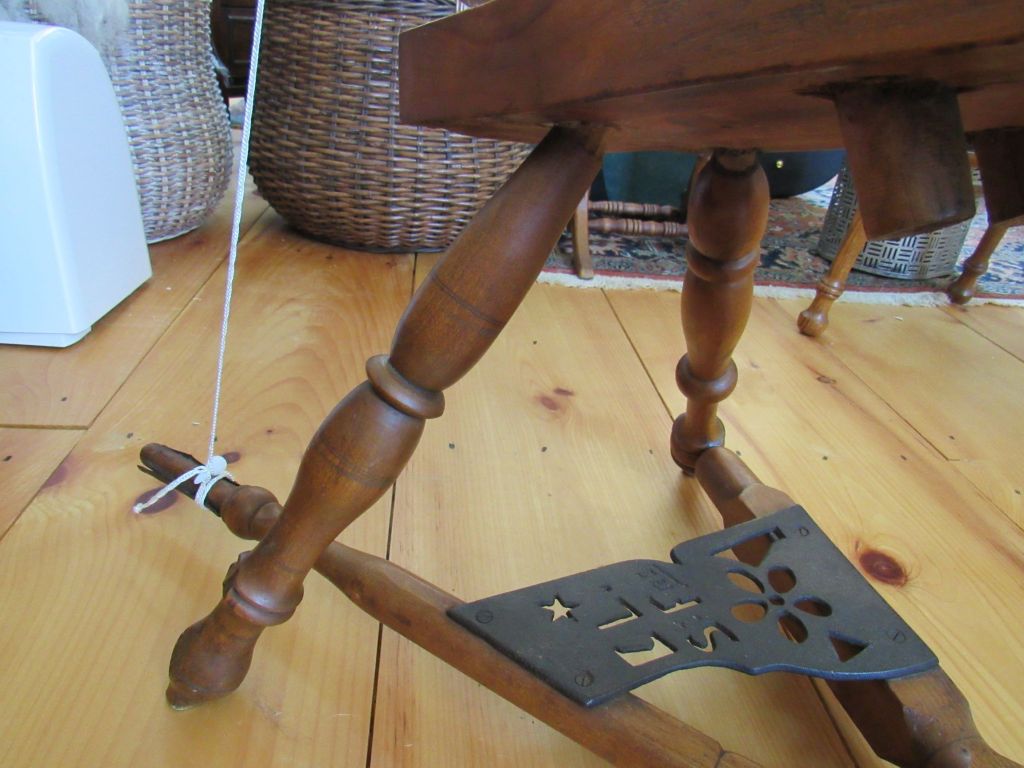
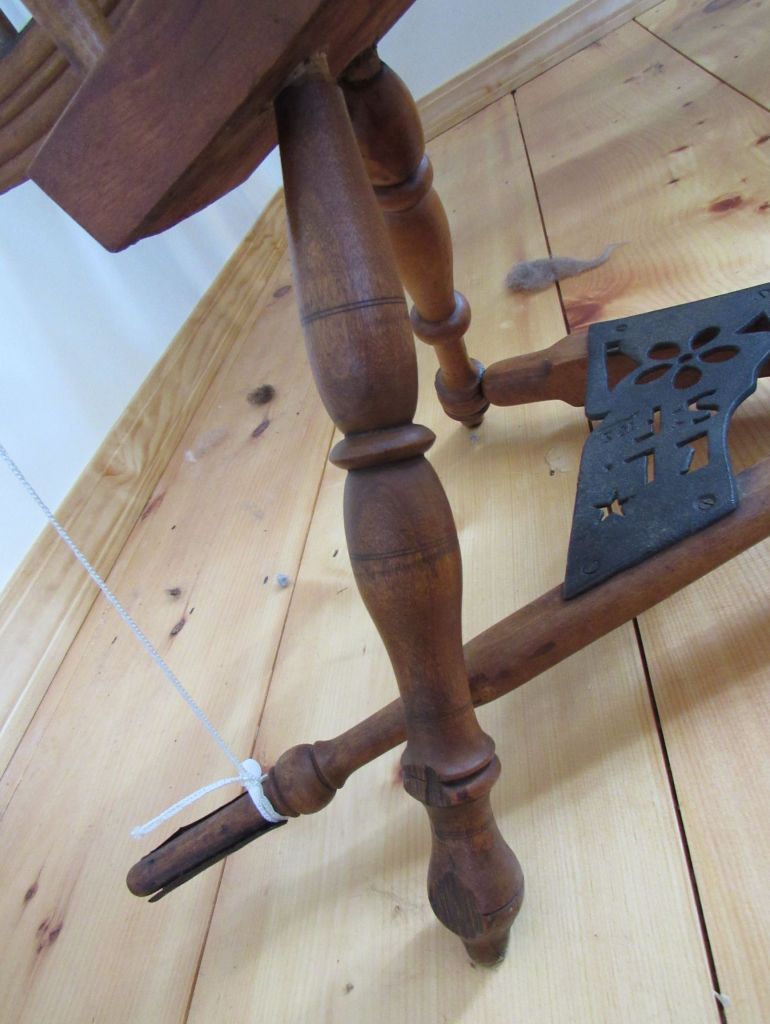
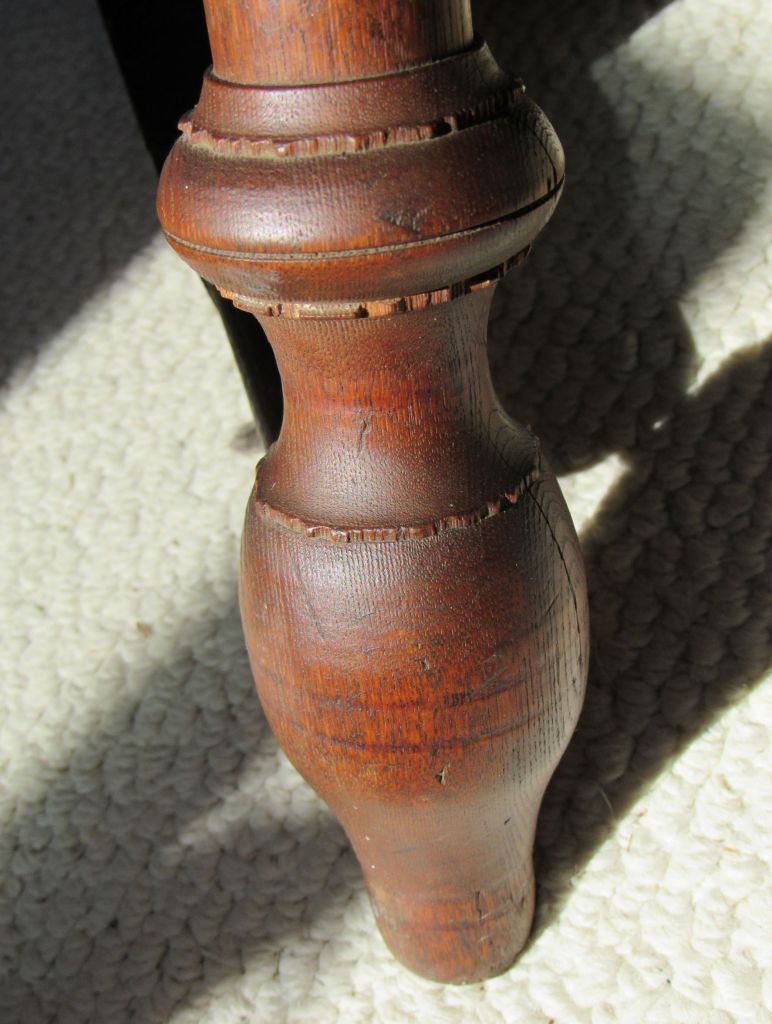
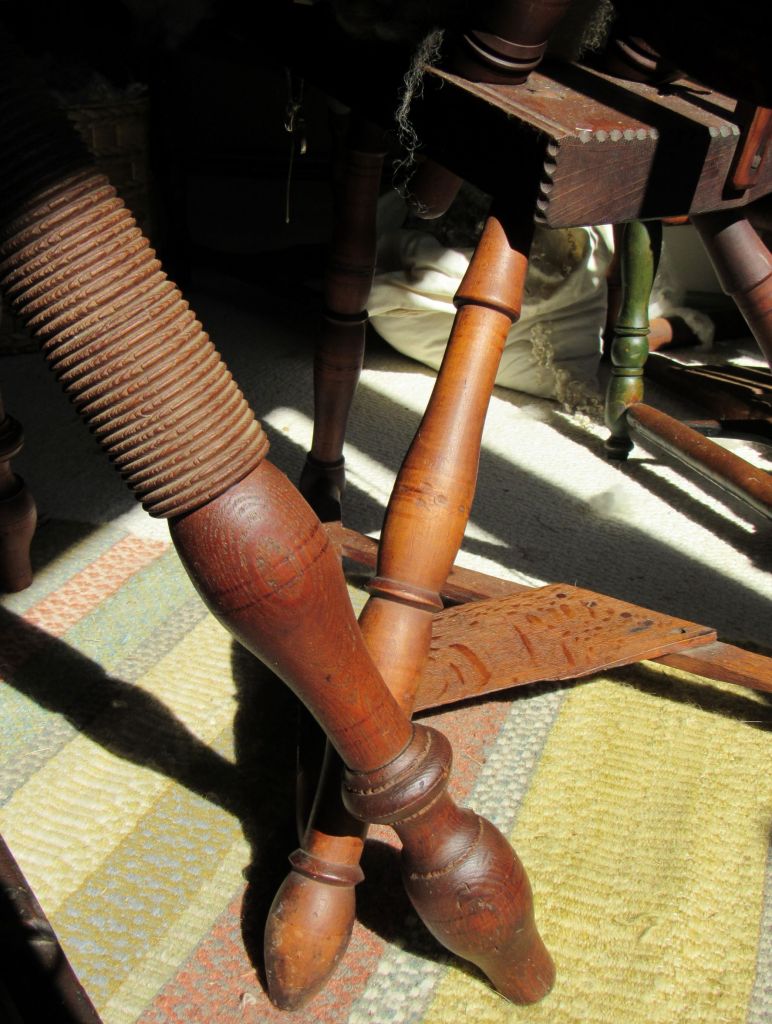
thick, solid legs,
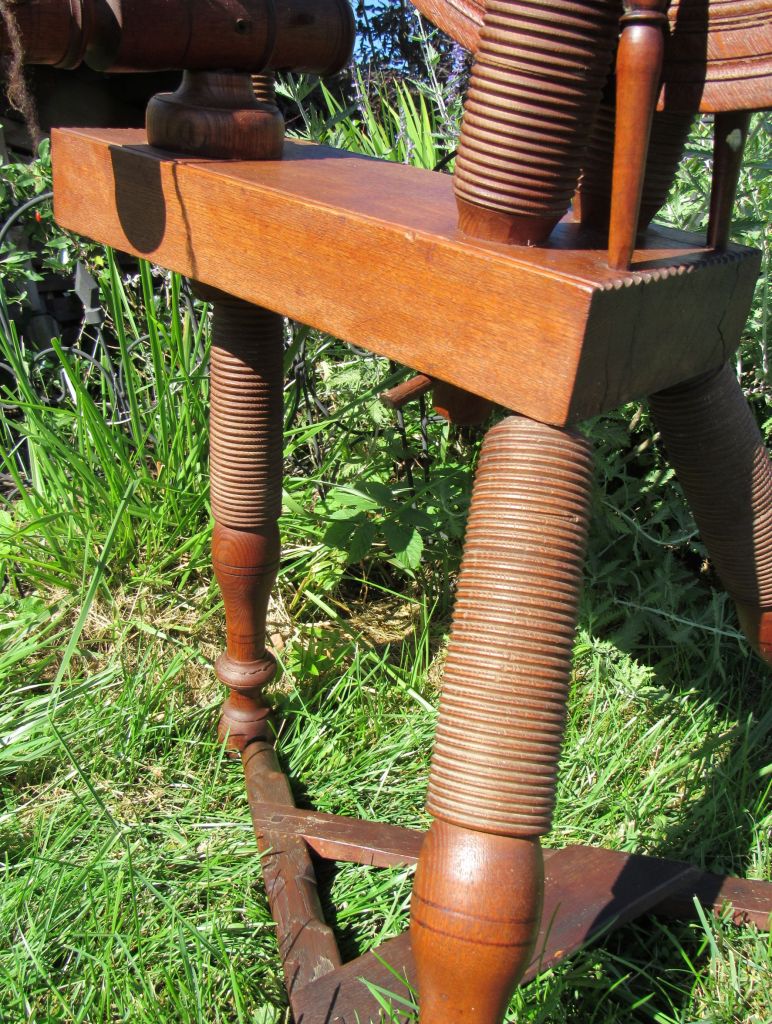
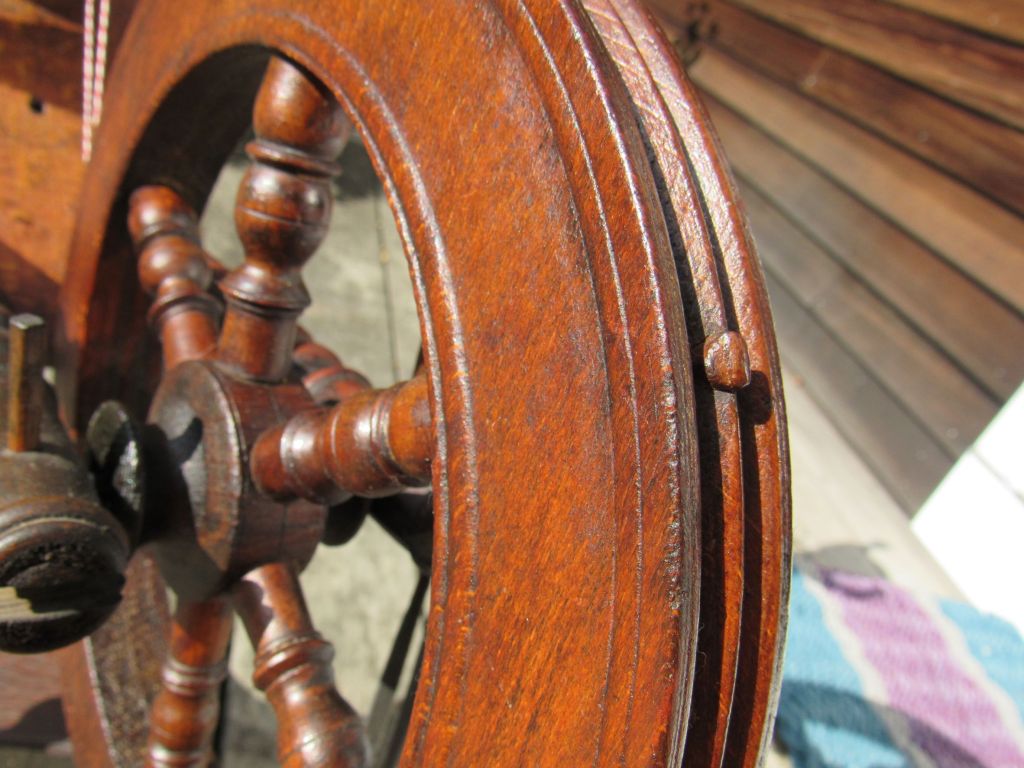
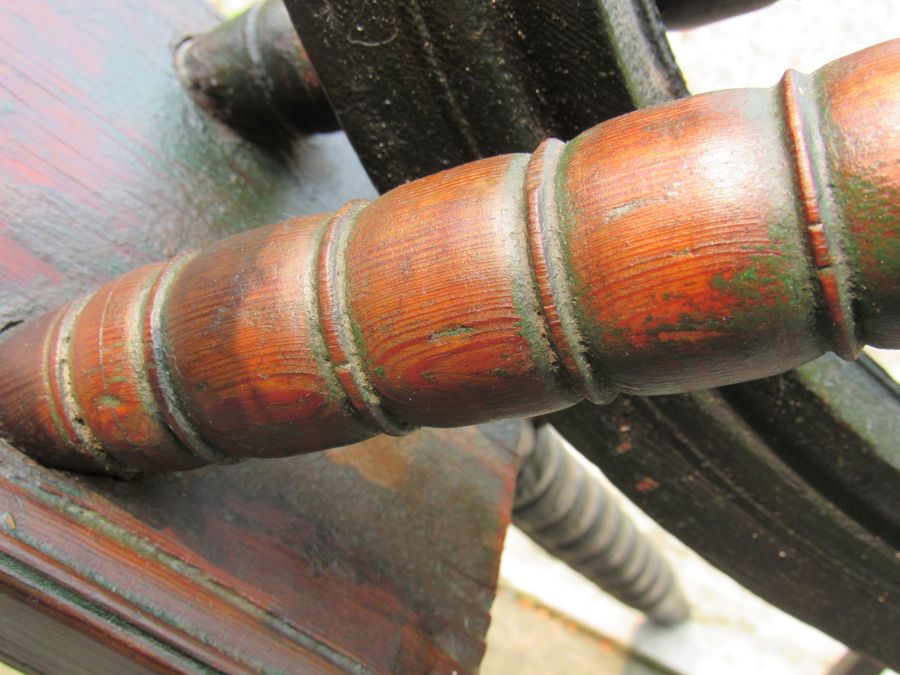
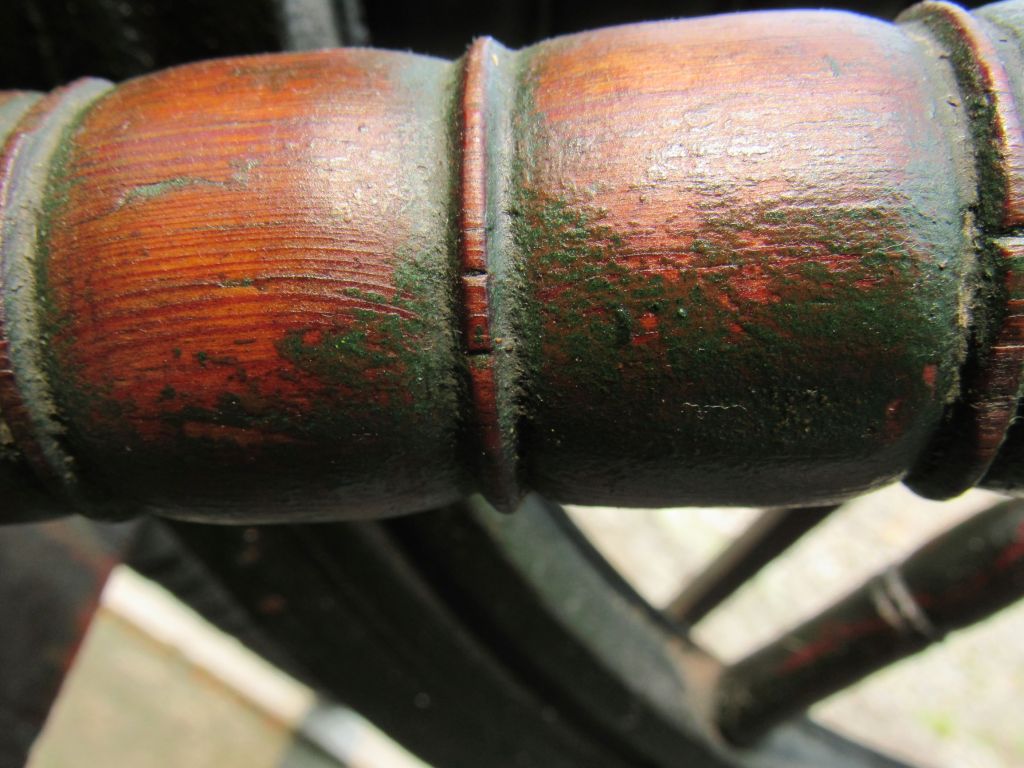
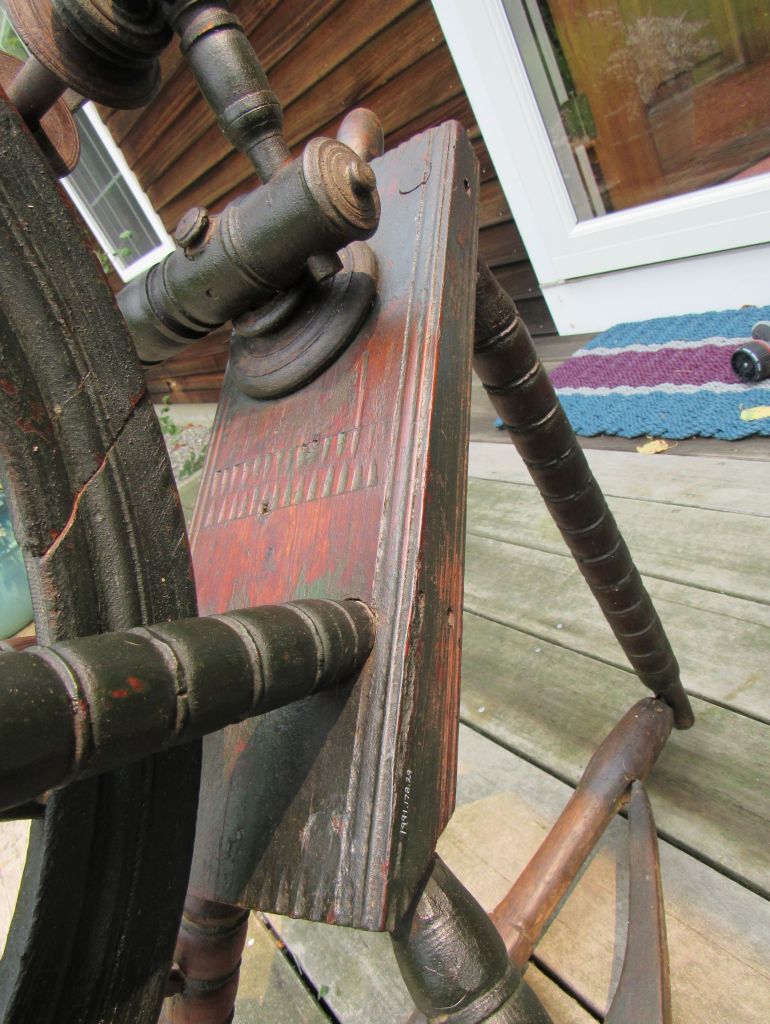
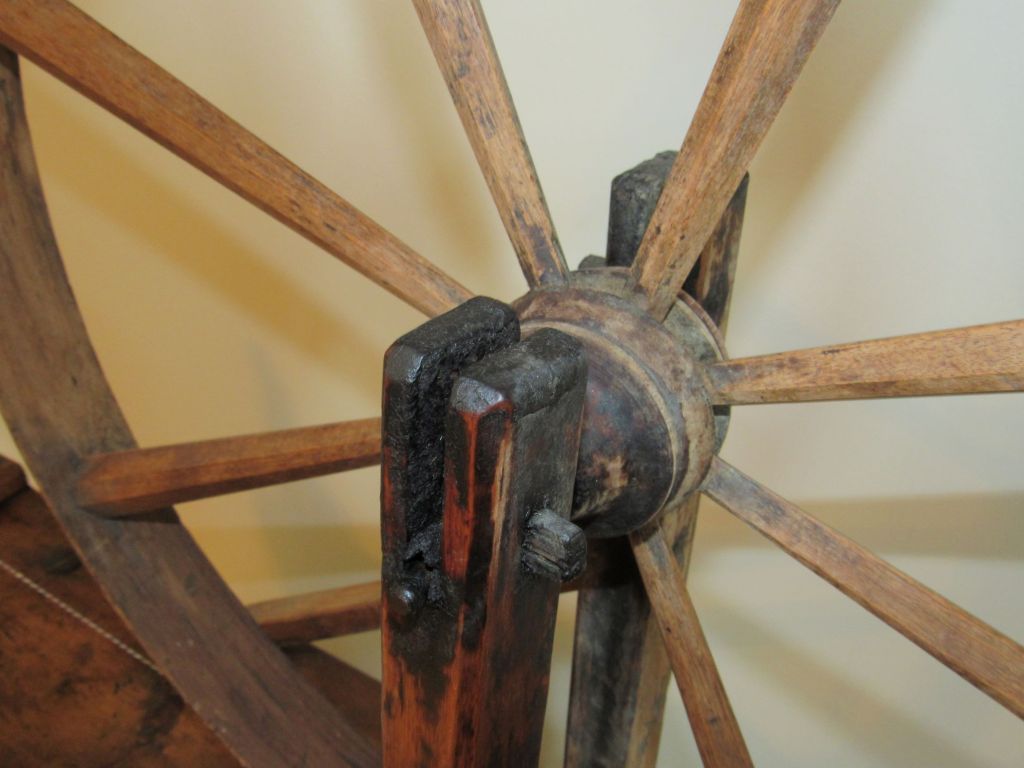
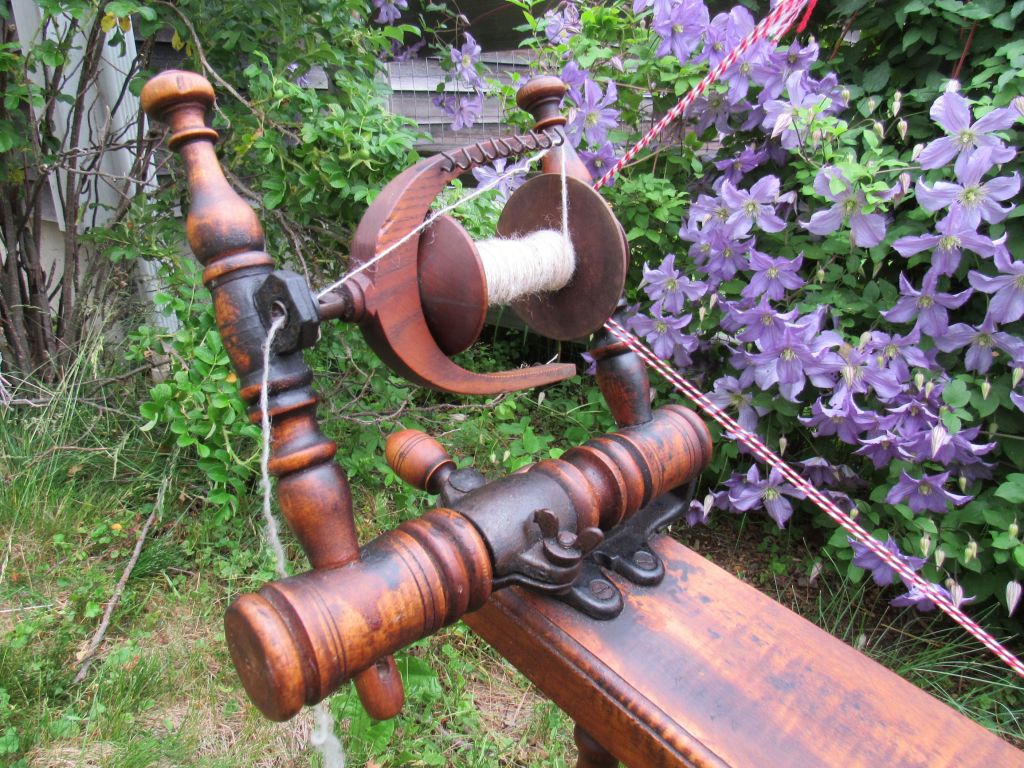
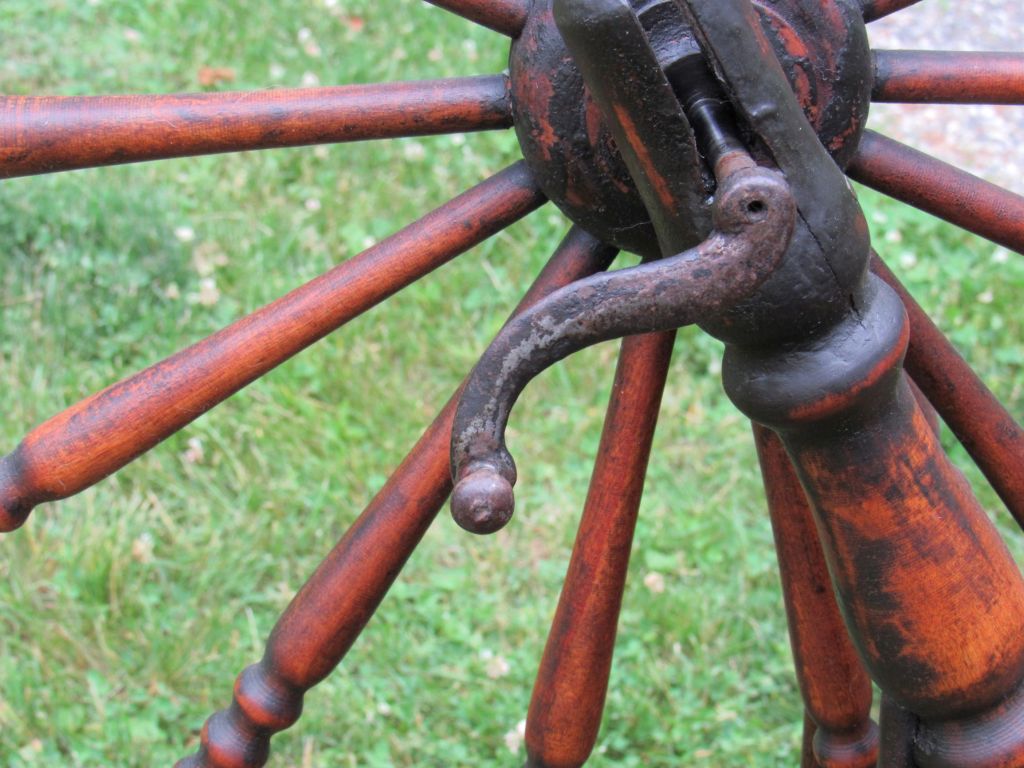
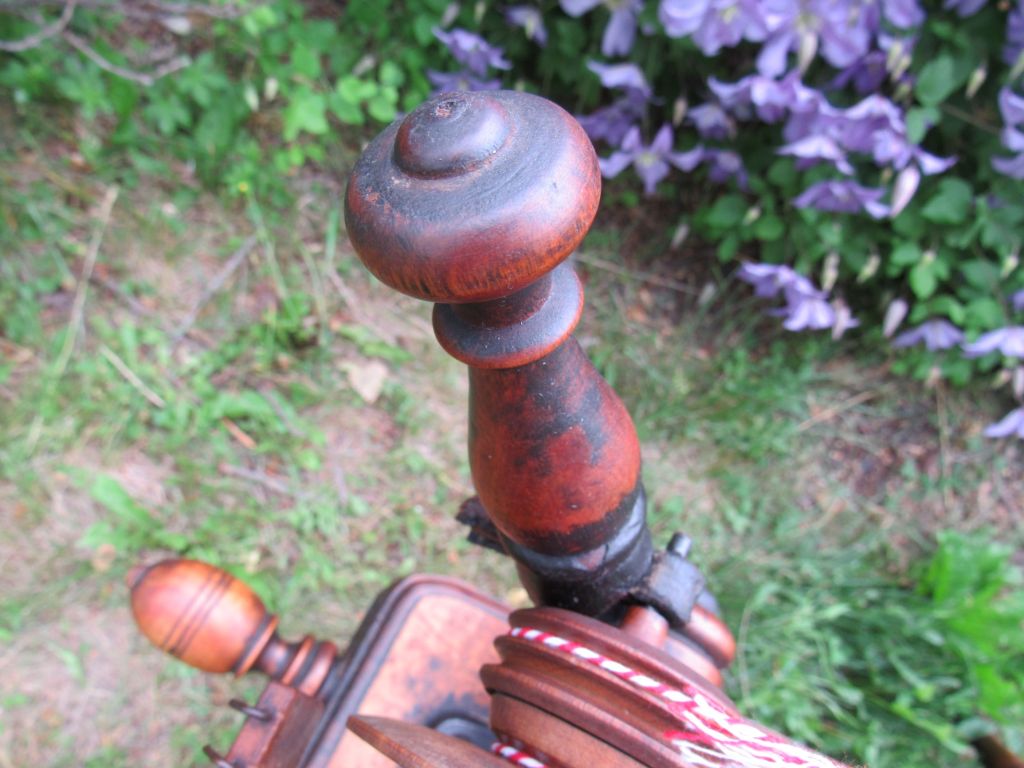
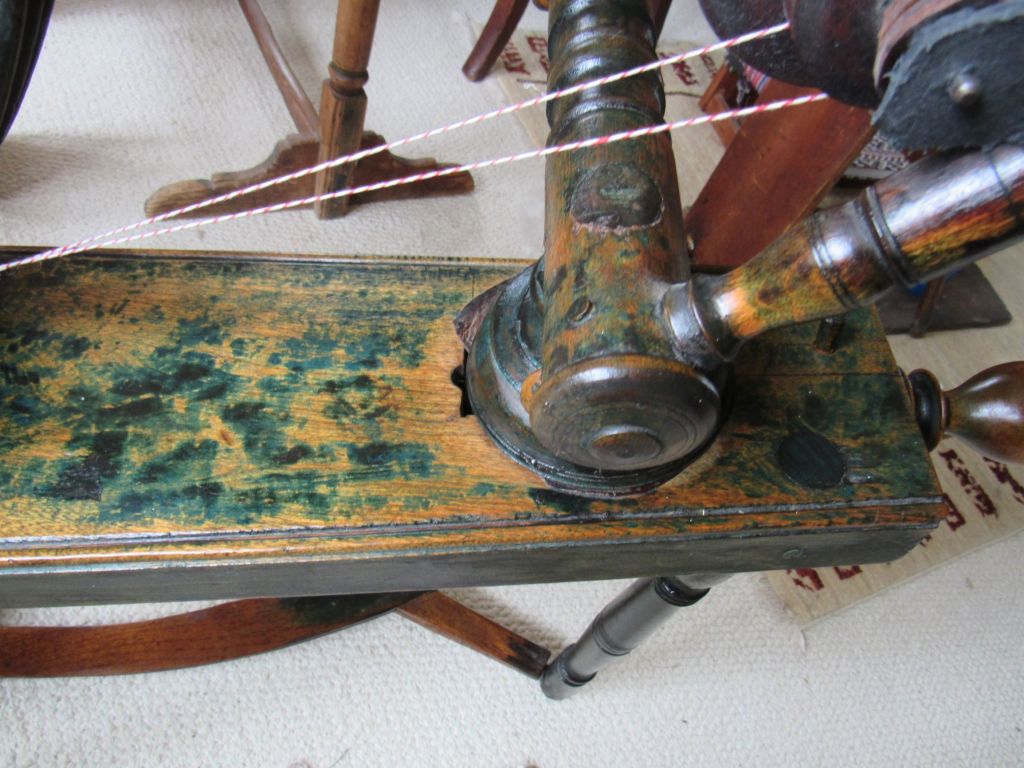
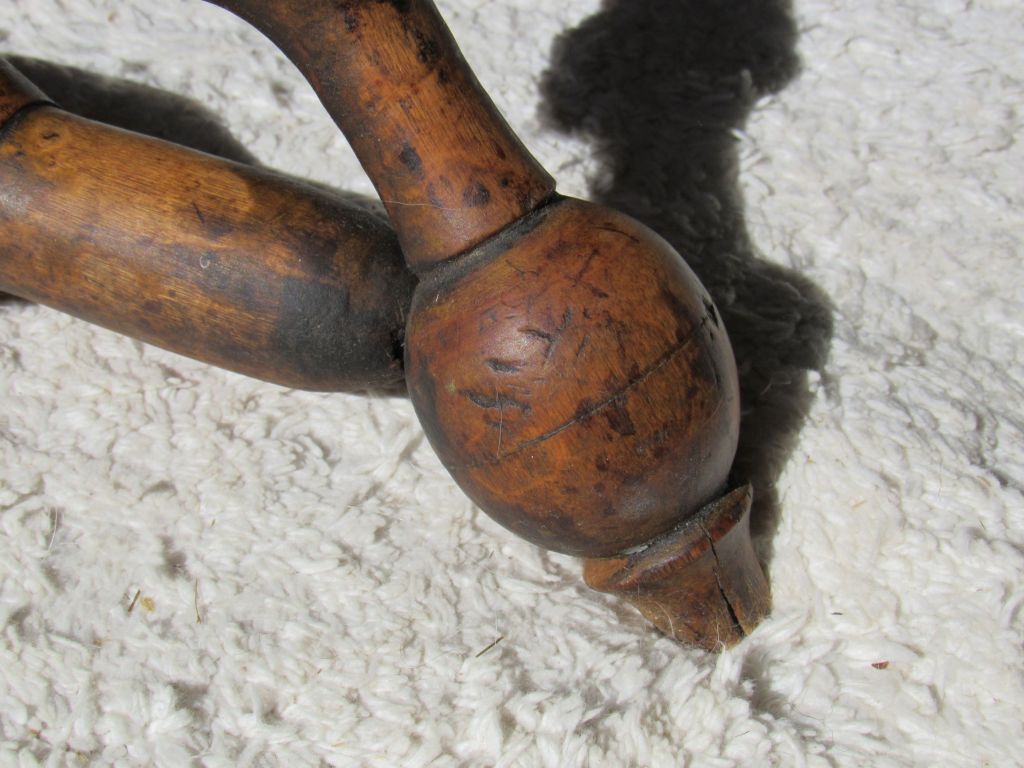
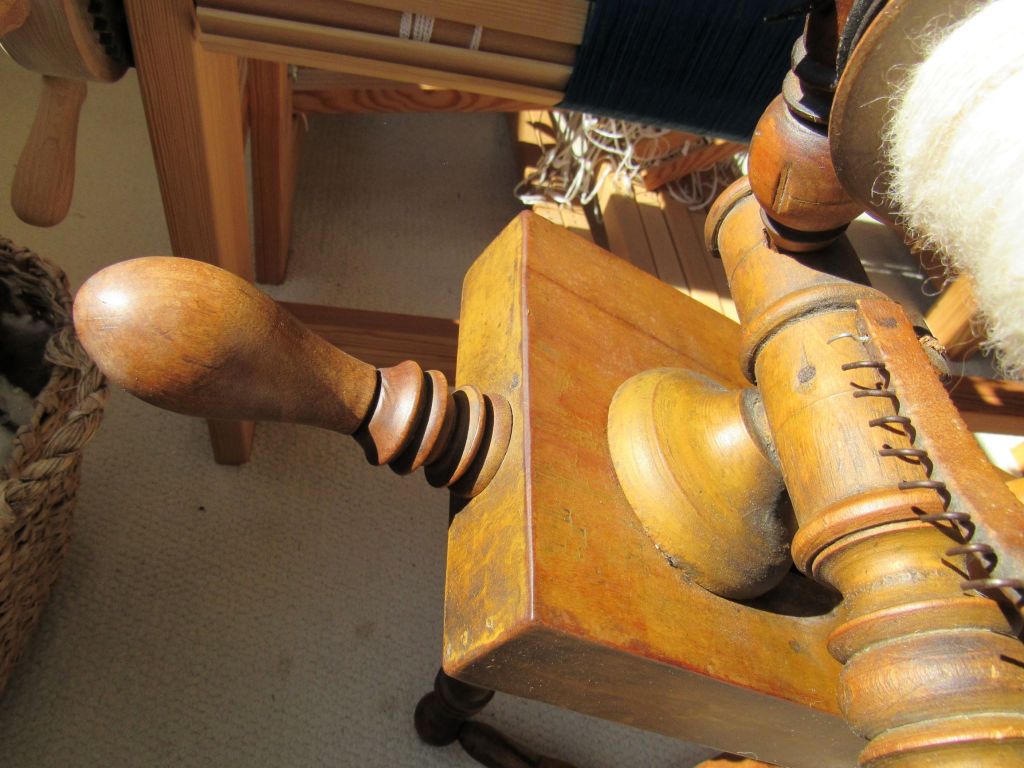
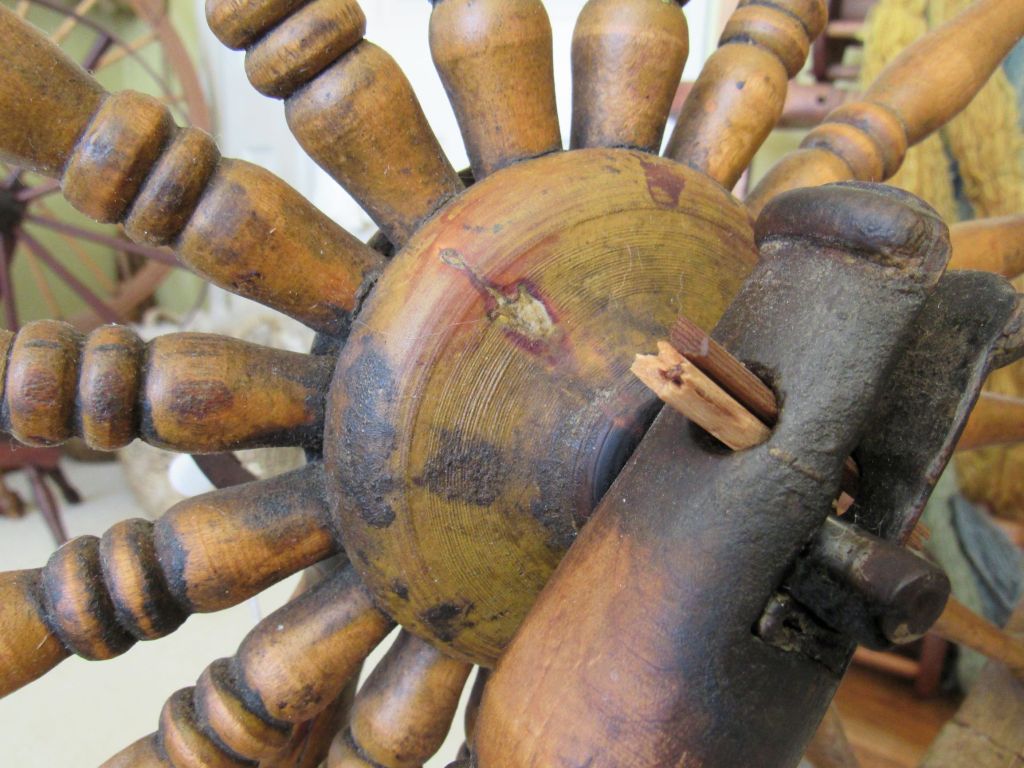
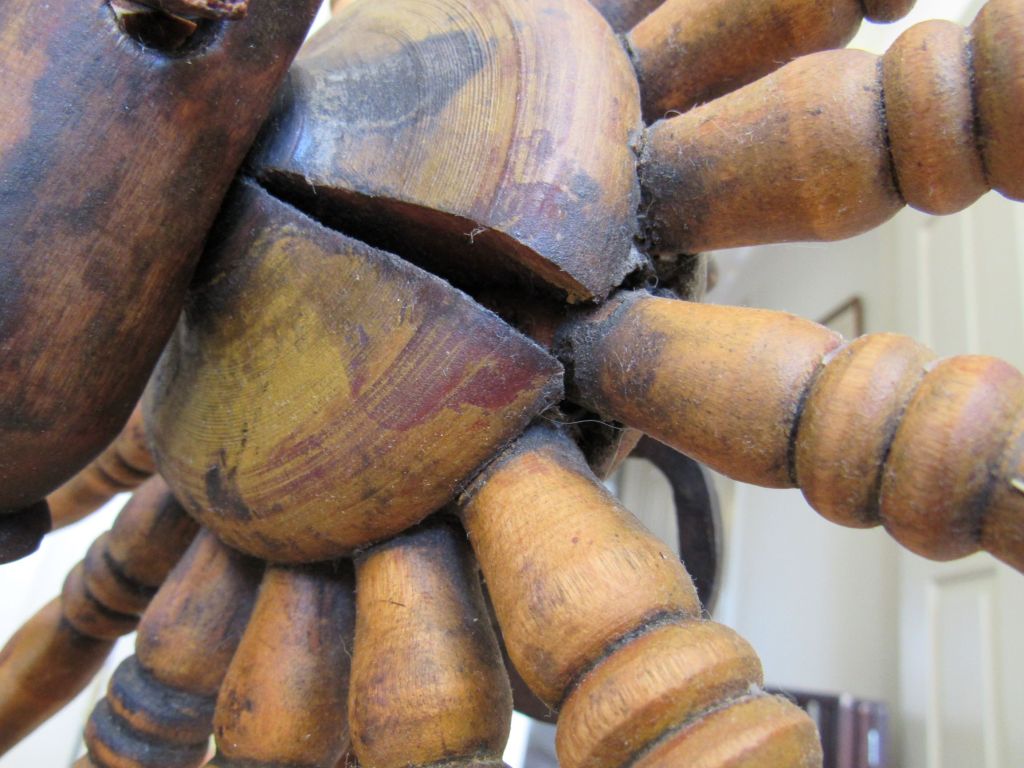
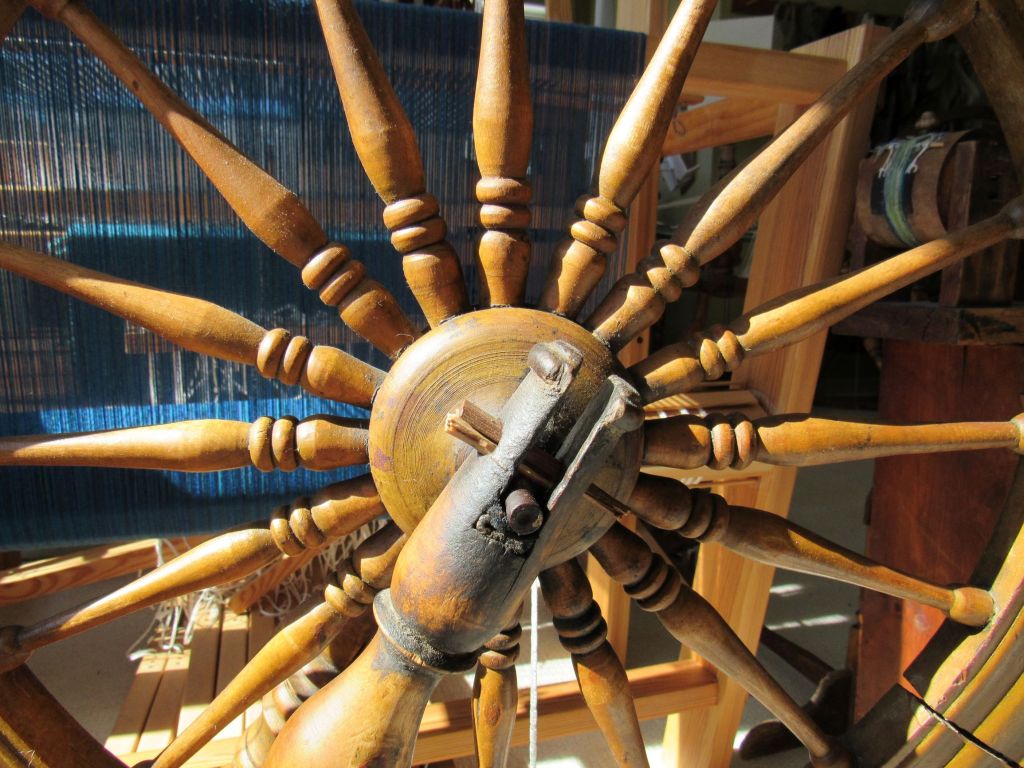
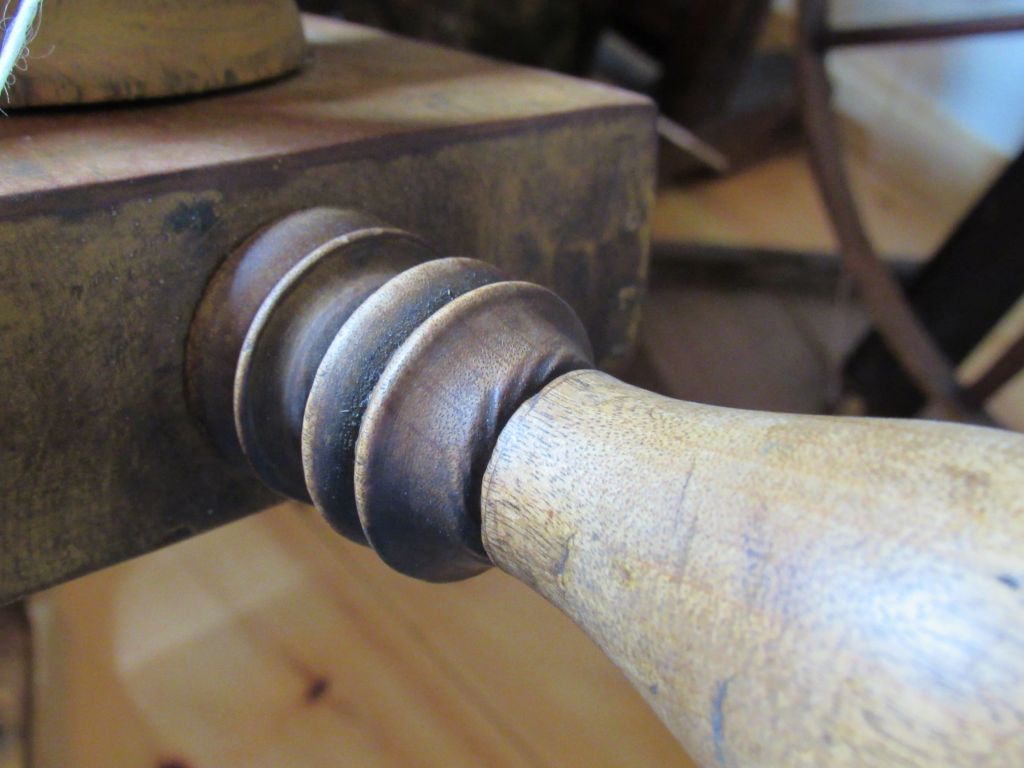
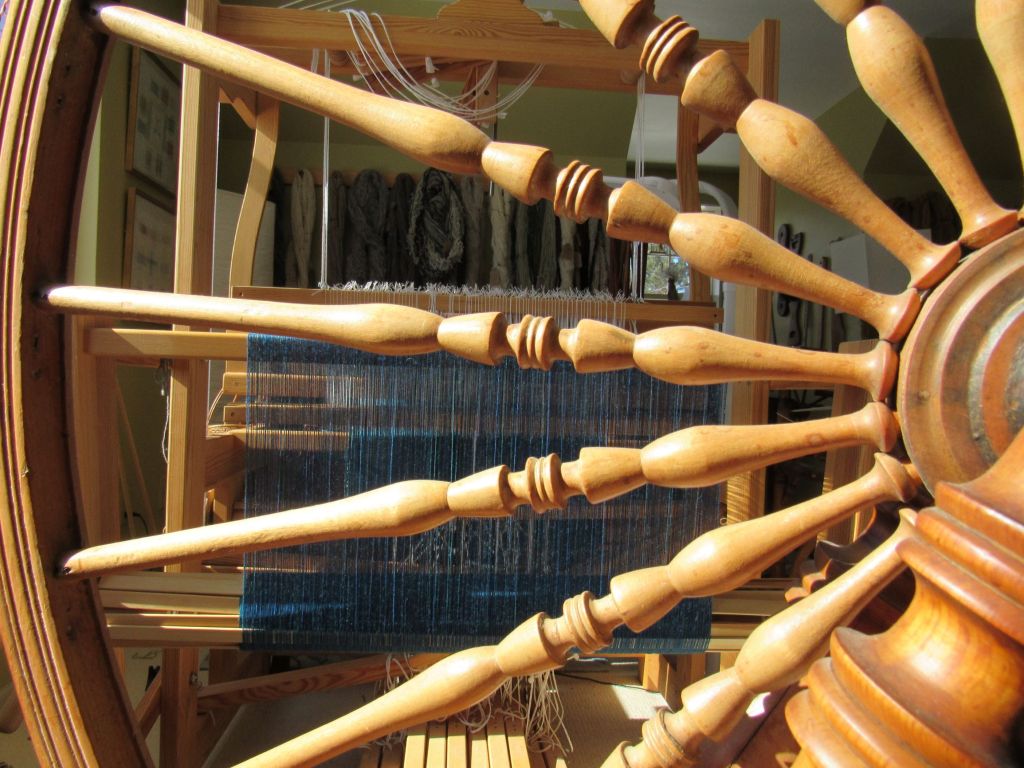
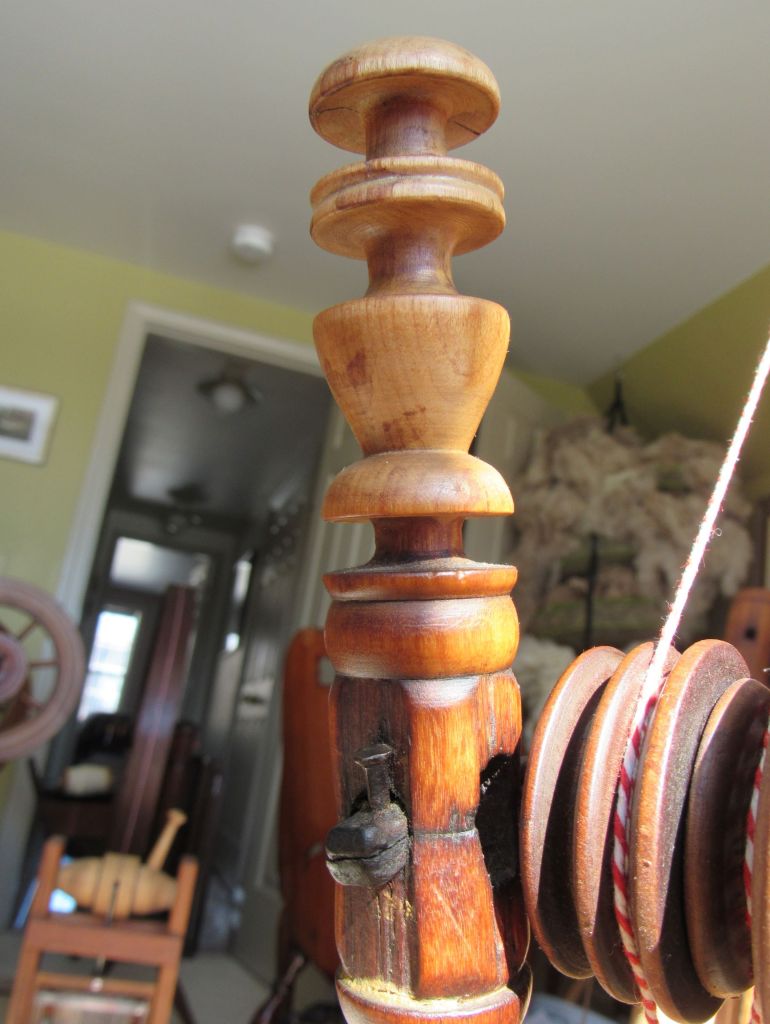
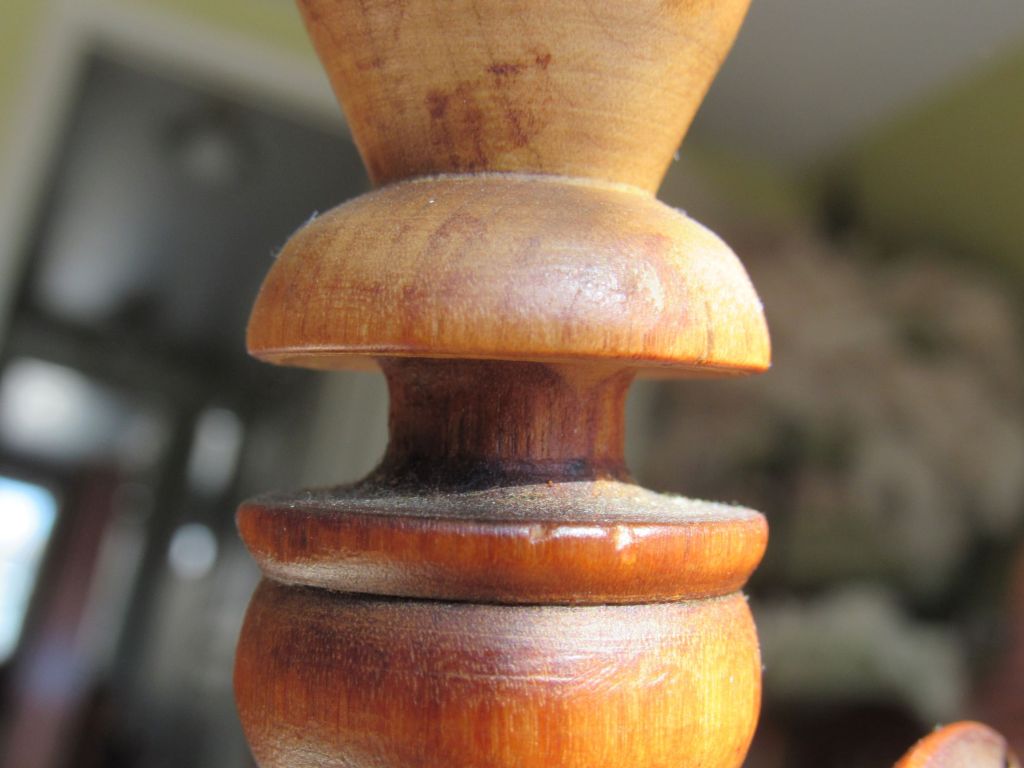
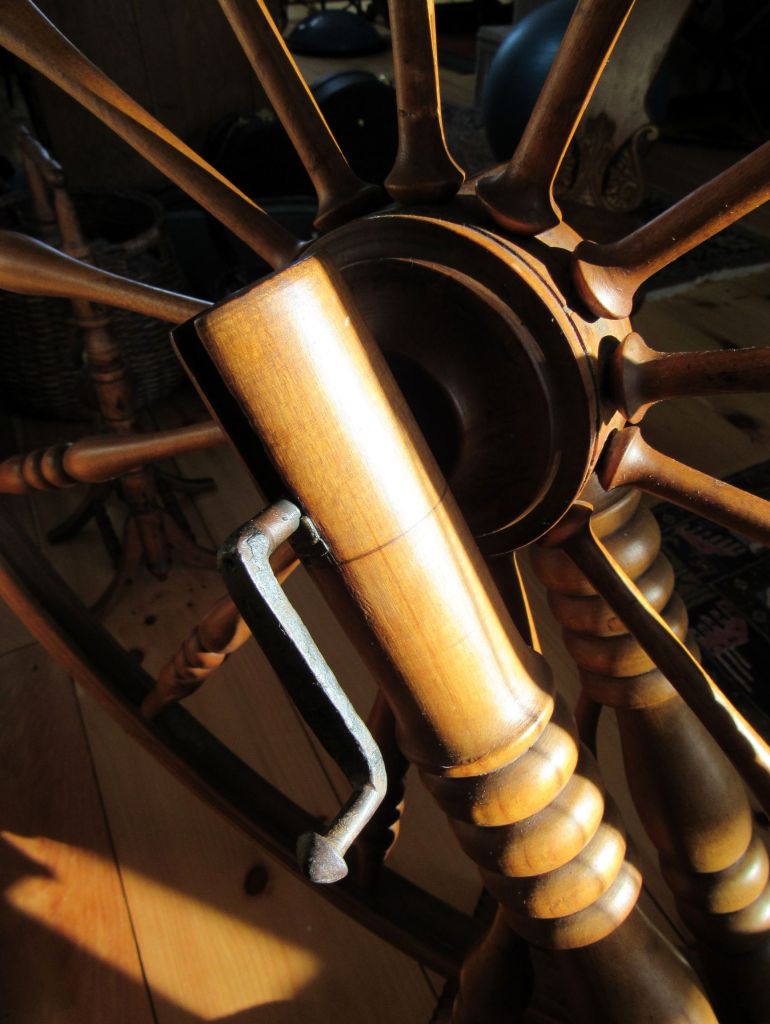
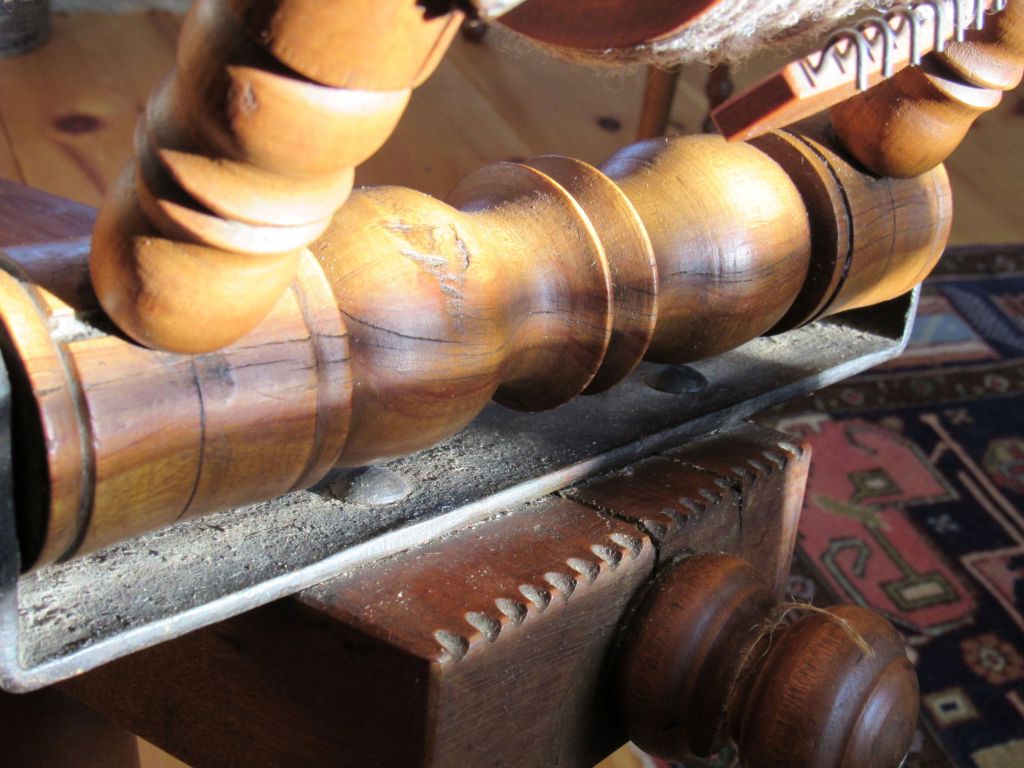
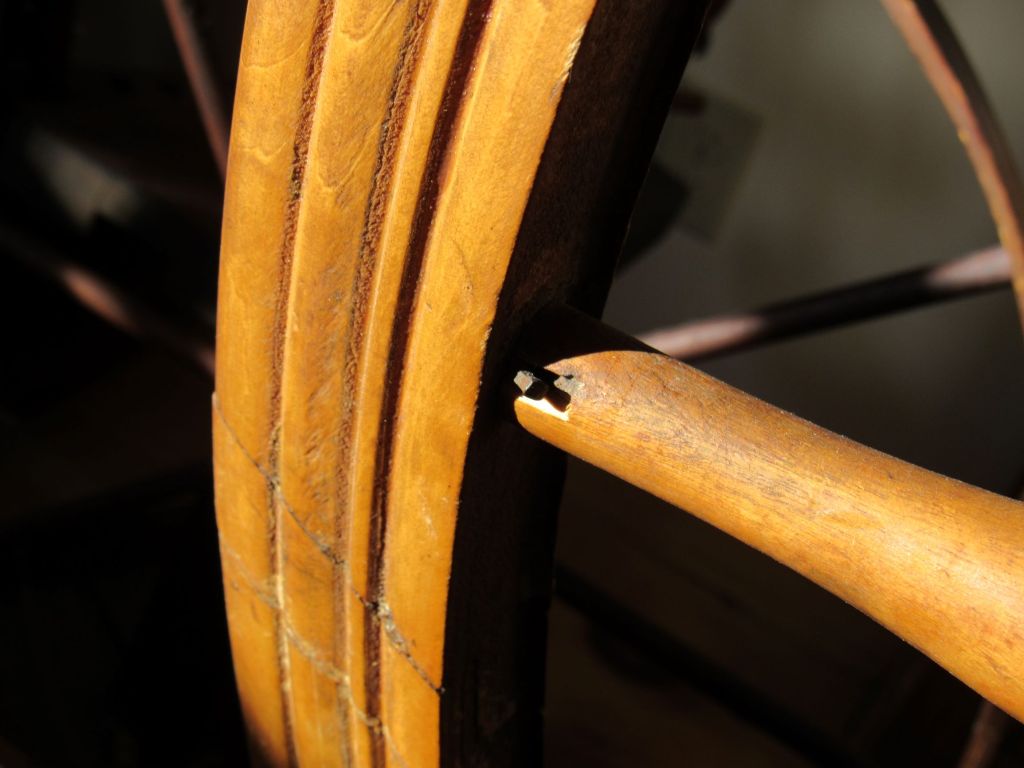
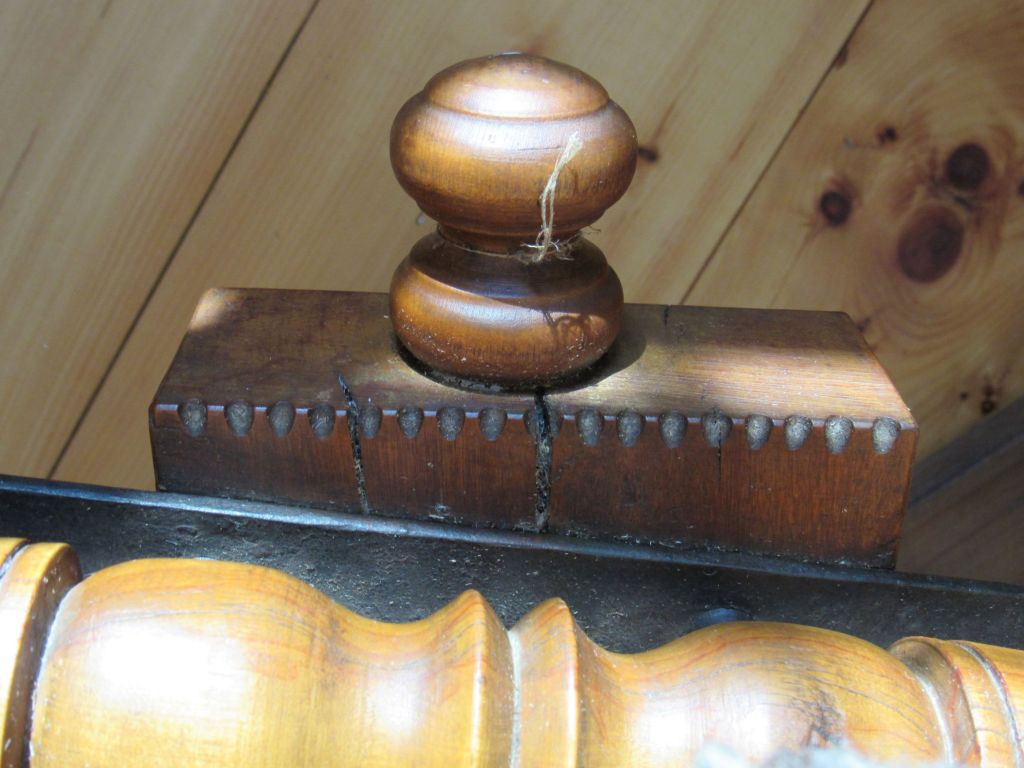
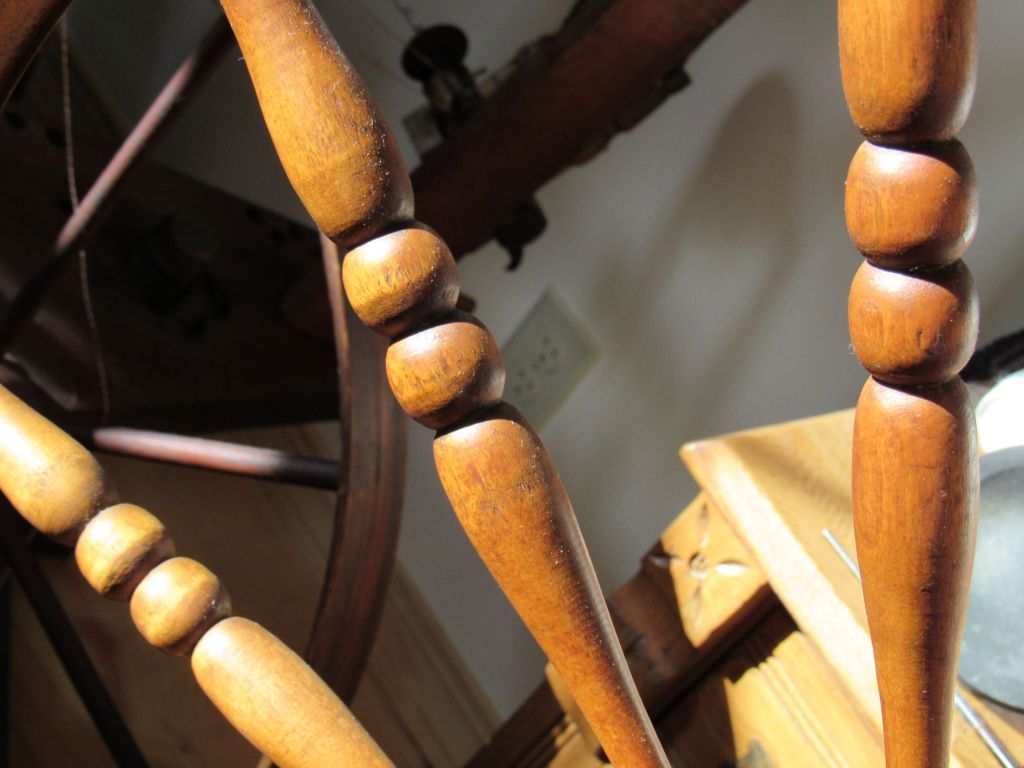
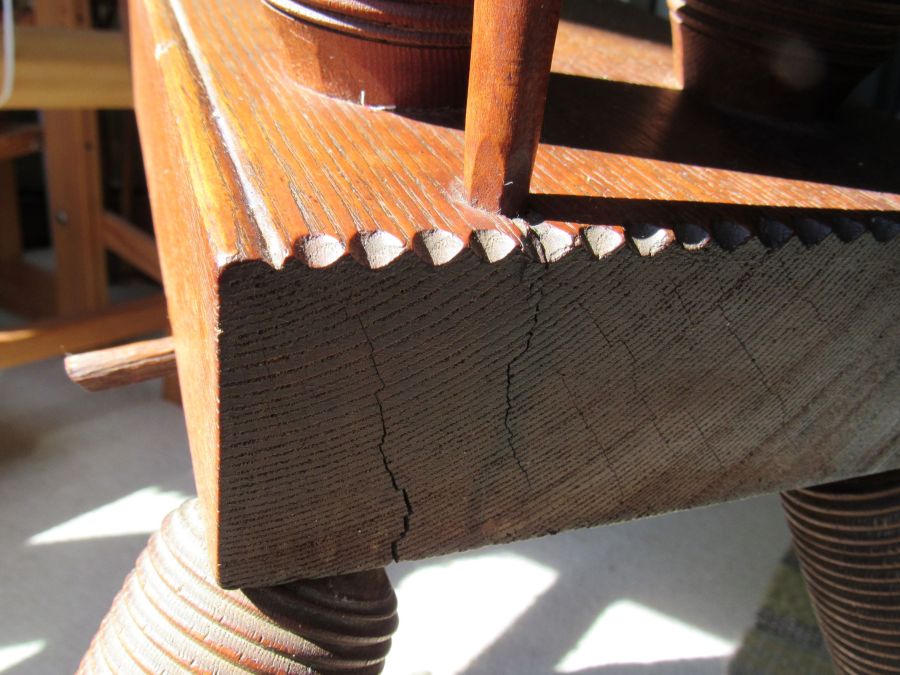
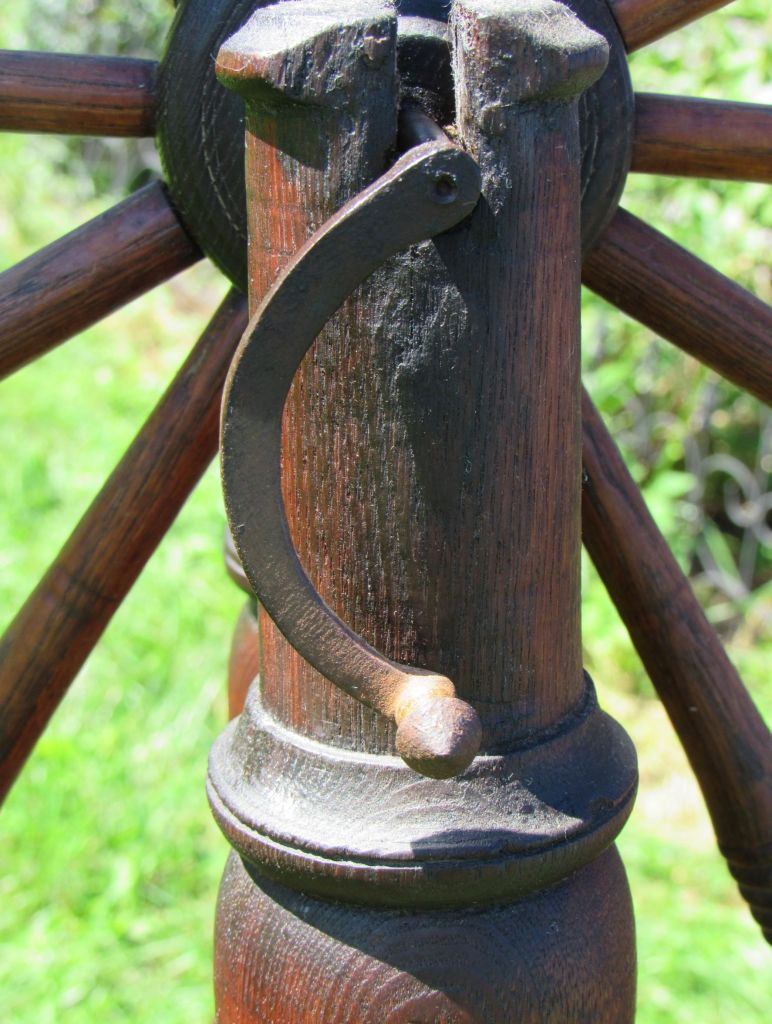
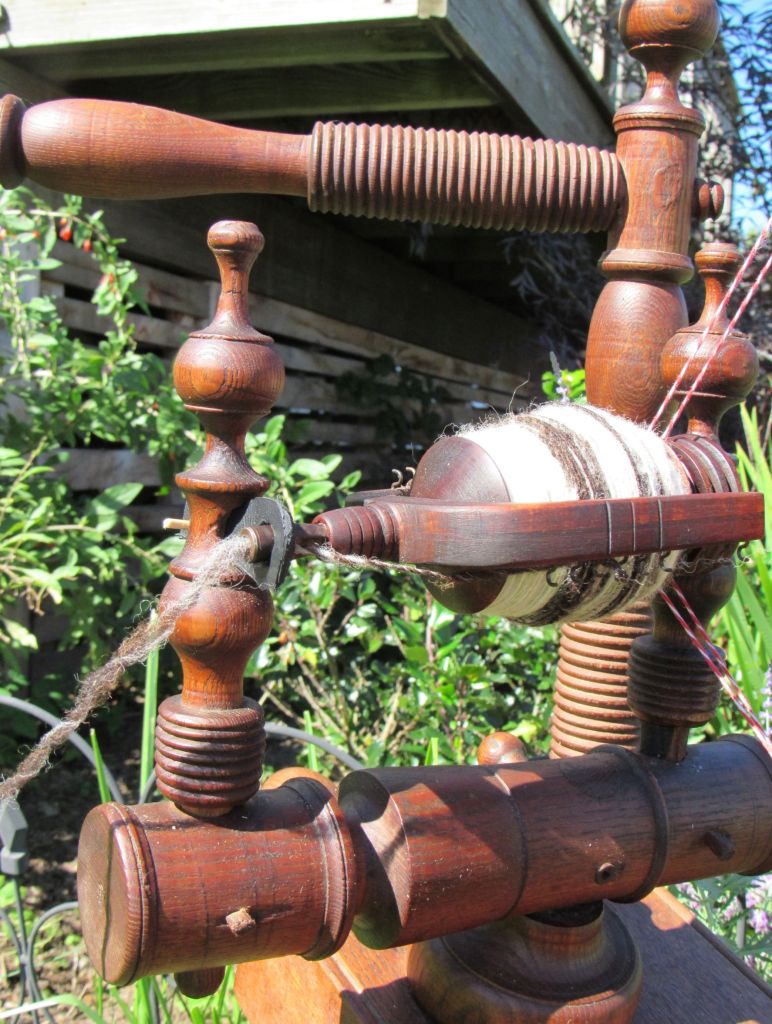
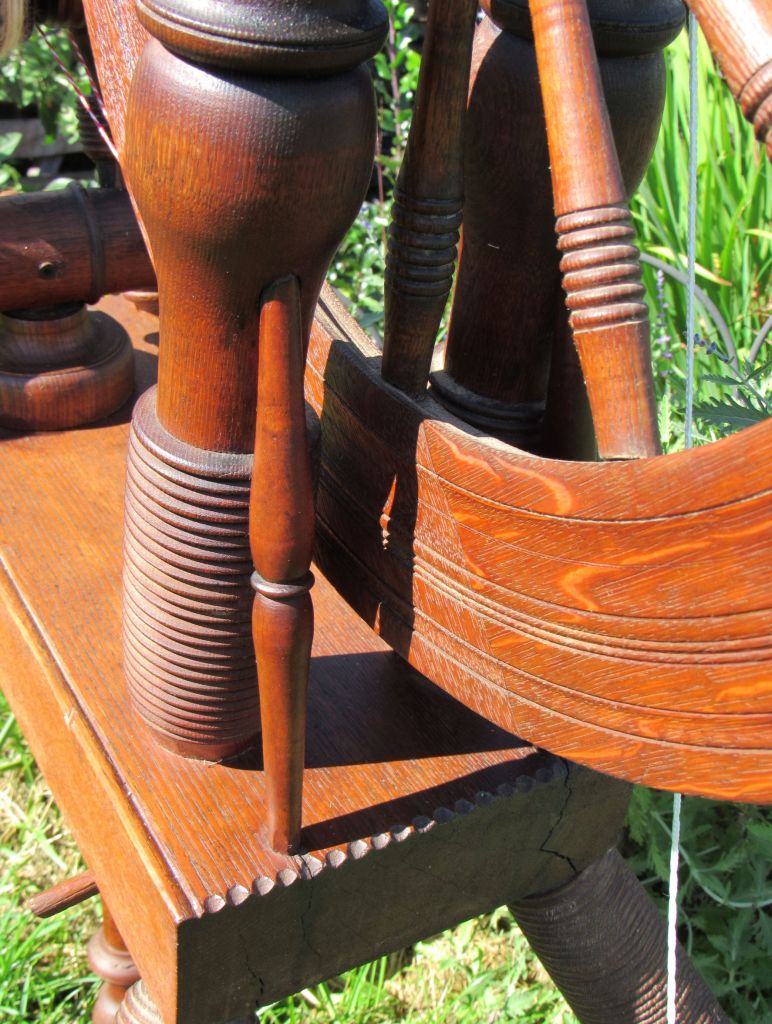
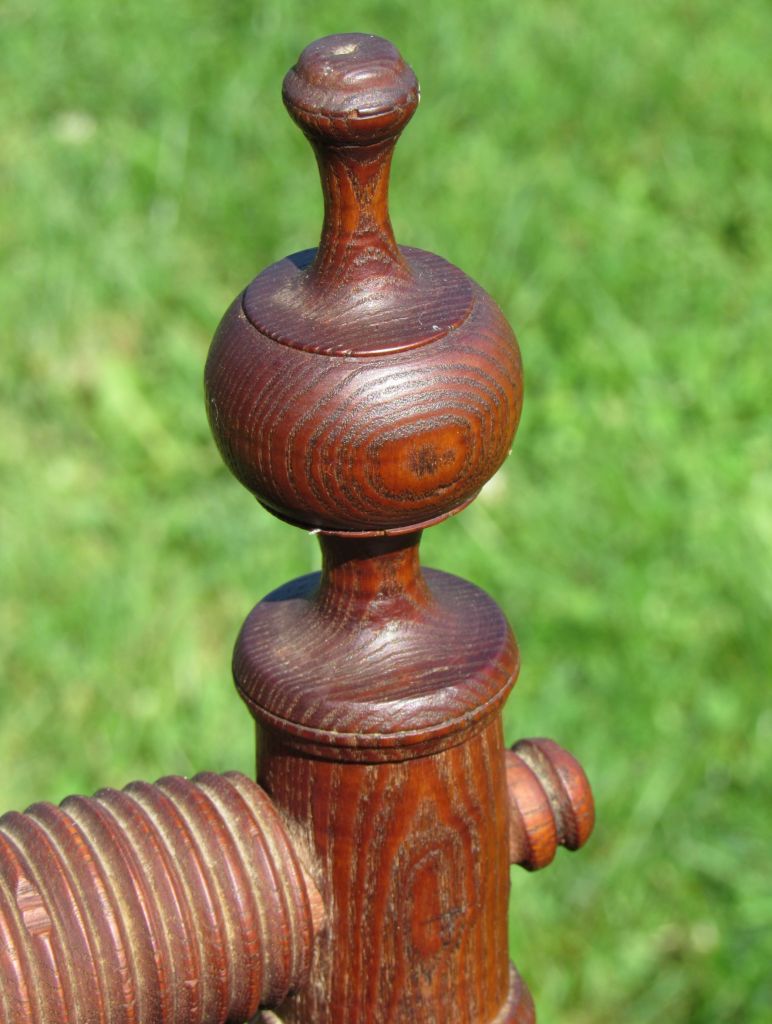
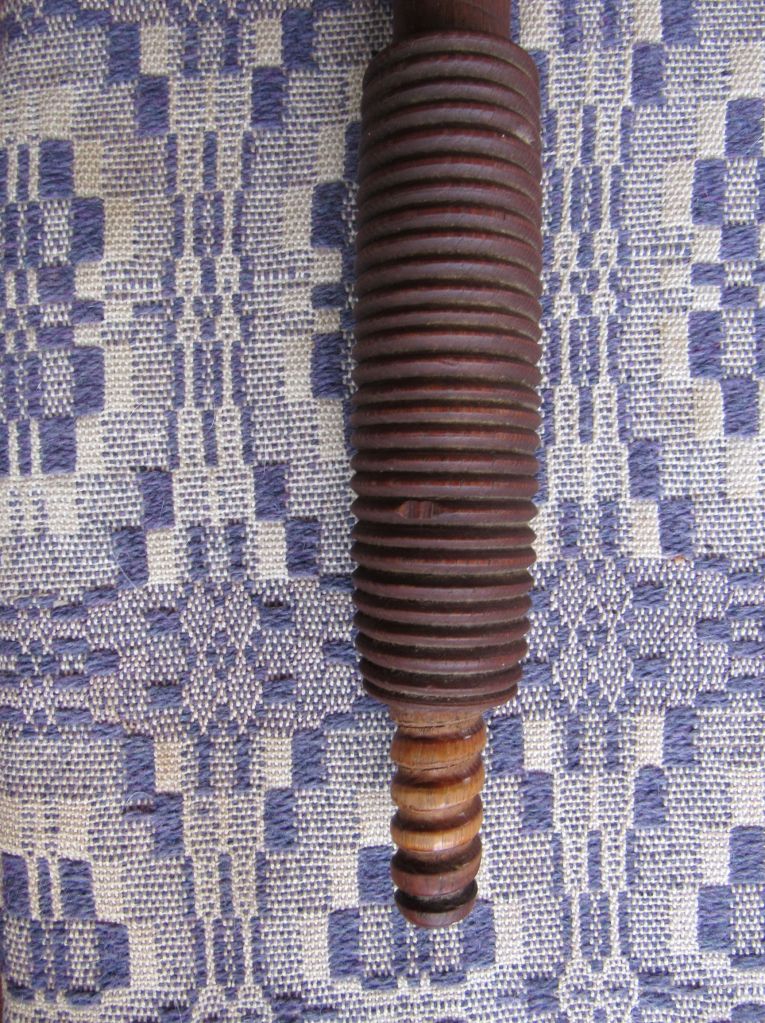
and amazing reed turnings, row upon row of tiny ridges that look like perfect smocking.

Old postcards and photographs show a variety of similar wheels being used in Ireland.
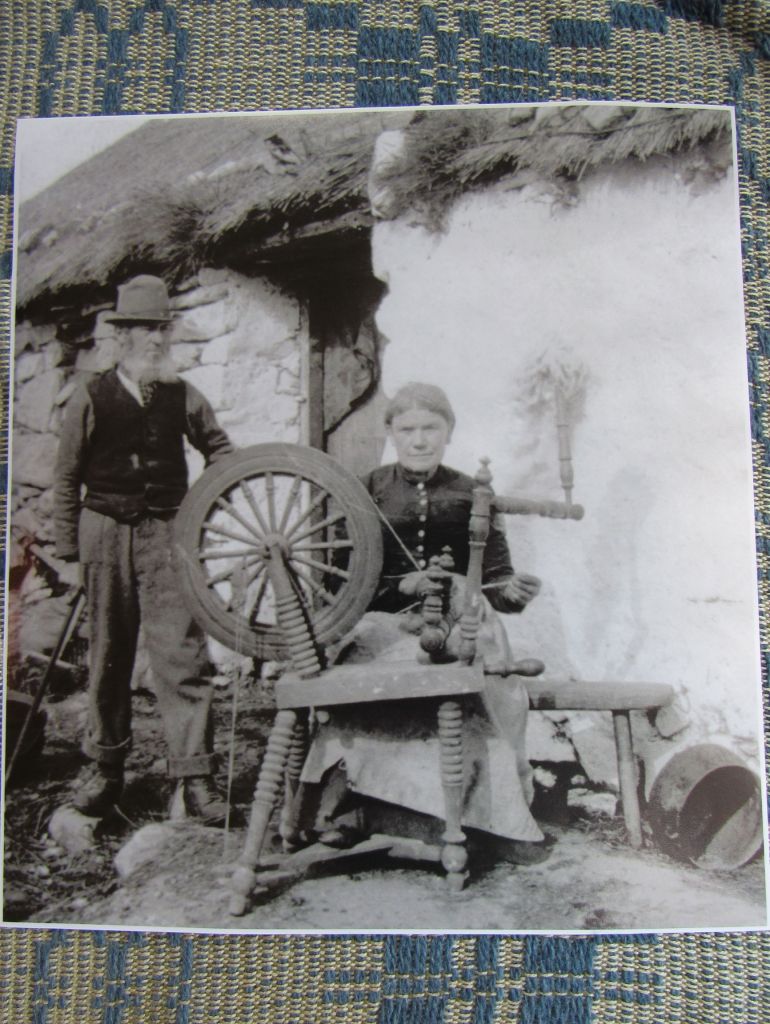
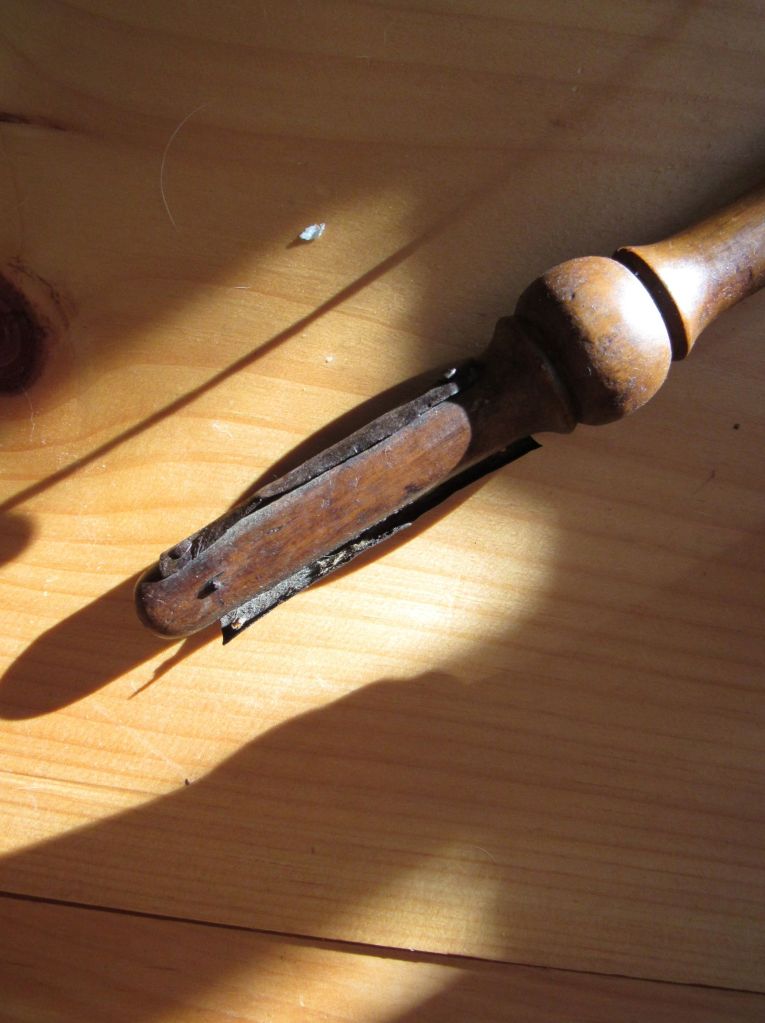
Interestingly, in these photographs, most of the footmen are string or cord (usually with a leather piece attaching to the axle) rather than wood, a contrast with North American wheels.

When starting to research this wheel, I posted a photograph on Instagram. Fortunately, Johnny Shiels, a third-generation wheel maker in Donegal, saw the photo and thoughtfully reached out. He sent me a photo of a very similar antique wheel from Donegal. And, his IG account spinningwheels.ie revealed photos of other lovely old Donegal wheels that he has restored.
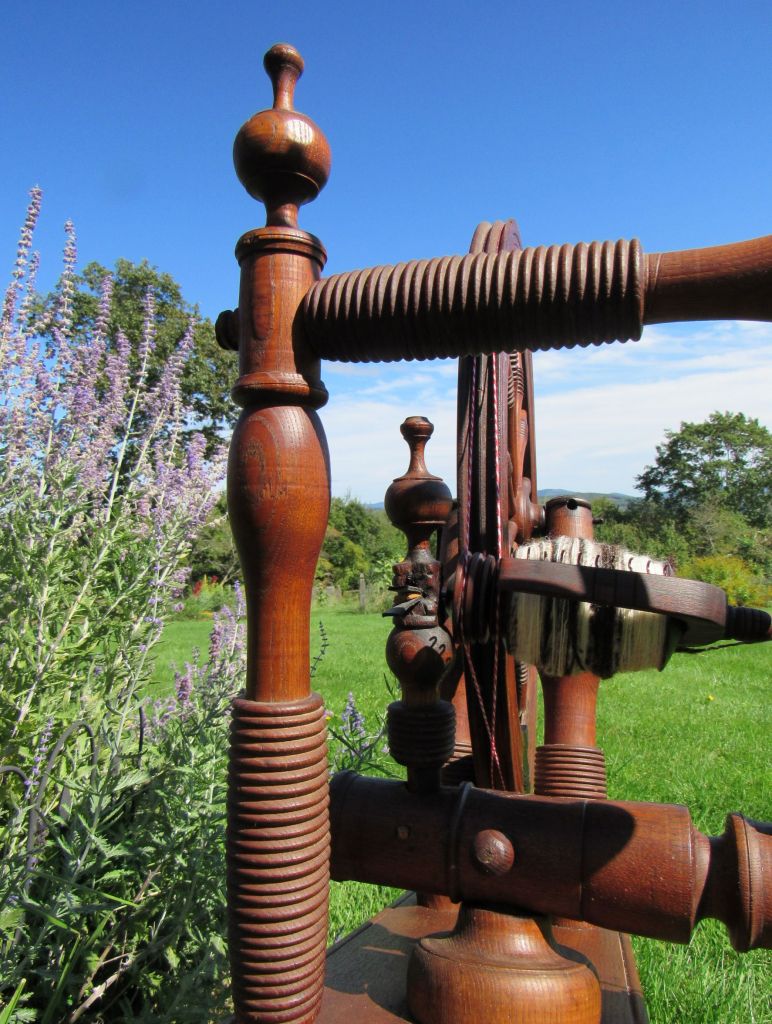
This style wheel, which we usually refer to as a “Saxony” in North America, is known in Ireland as a “Low Irish” or “Dutch wheel.” Actually, early Connecticut probate records from the 18th and early 19th century often referred to them as Dutch wheels, too. These wheels were introduced to Ireland from Holland by Thomas Wentworth, later the Earl of Stafford, in the 17th century to encourage linen production.

While originally intended for flax spinning, they later also would be used for spinning wool.
Ireland also had spindle-style great wheels, often called “long wheels” for wool spinning. The wheel style that we, in this country, most often associate with Irish flax spinning, however, is the upright “castle” wheel. I have been curious as to whether the different styles were regional.
Were castle wheels and Dutch wheels both used throughout Ireland, or were they exclusive to different areas? And, were the turnings on the Dutch wheels specific to certain towns or counties?
The only information I have found so far is in the booklet from the Ulster Museum, which indicates that castle wheels were principally found in Ulster, explaining that they were “confined in distribution to the northern counties. The design provides good rigidity which is essential to efficient spinning.” Id.
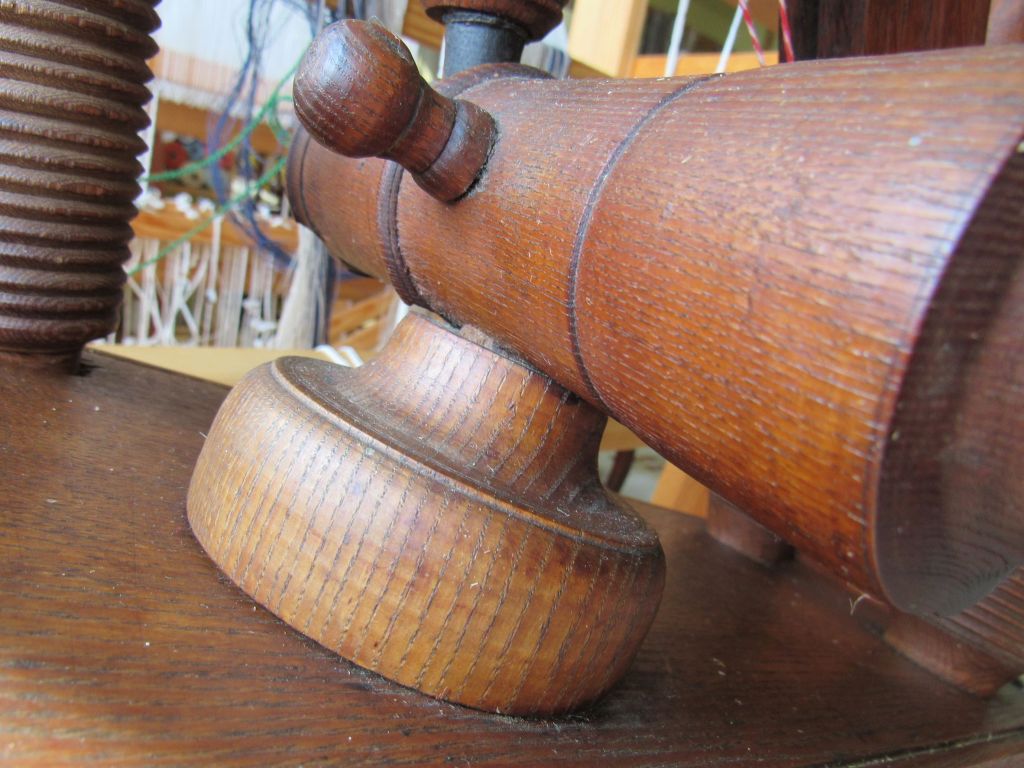
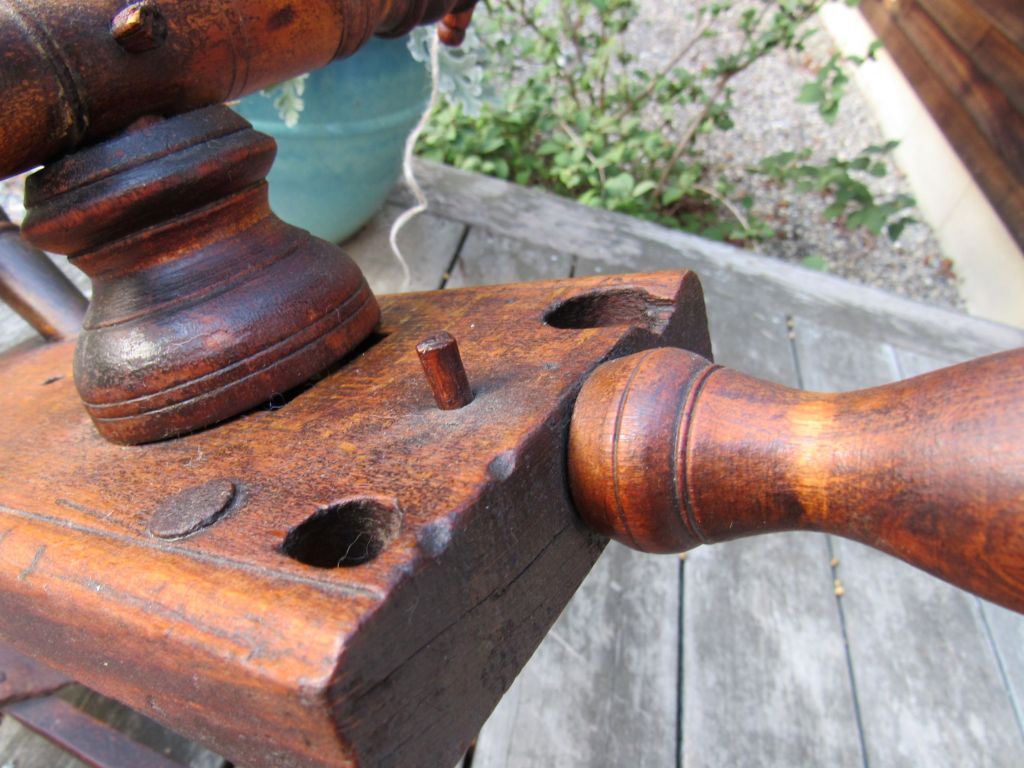
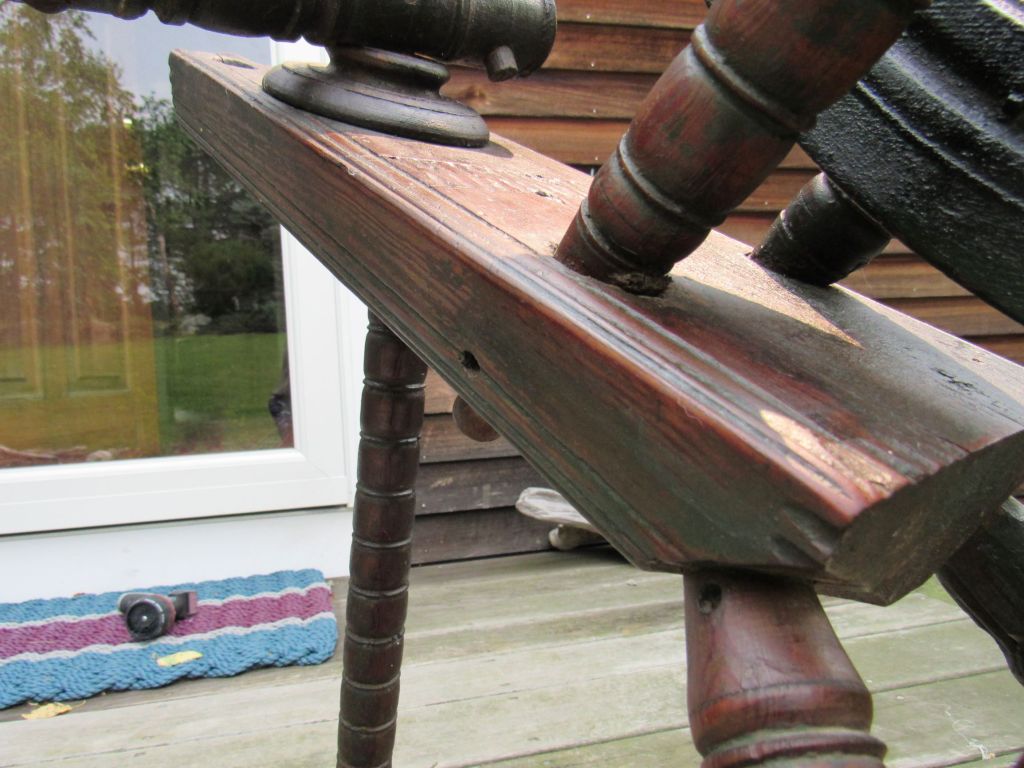
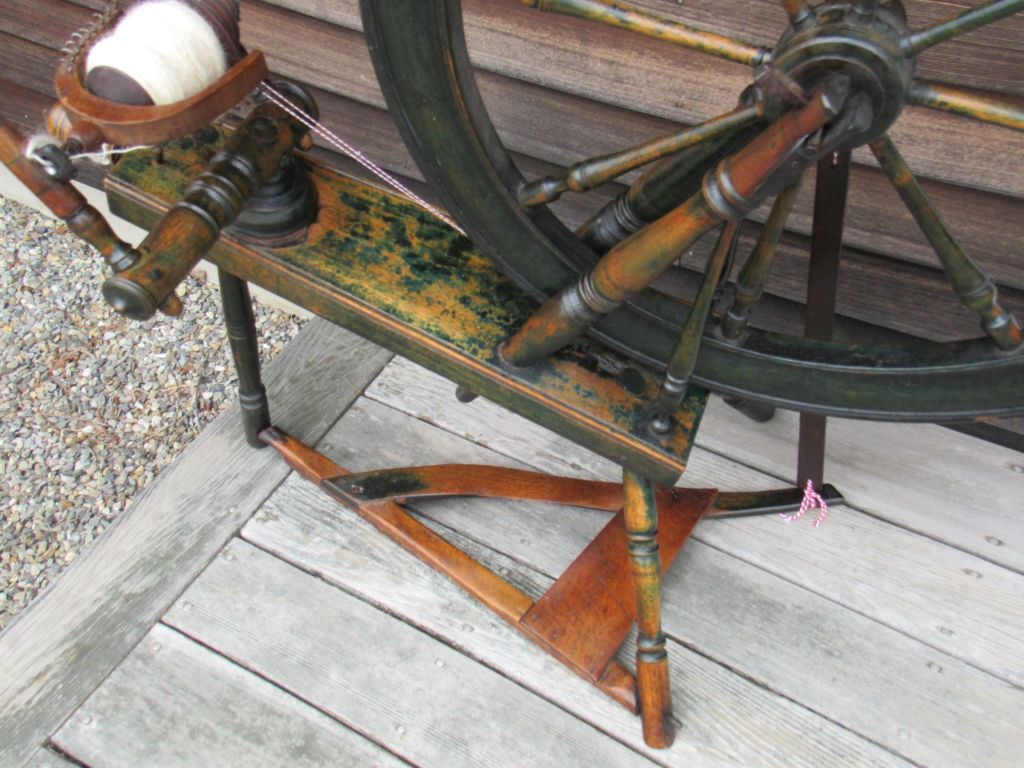
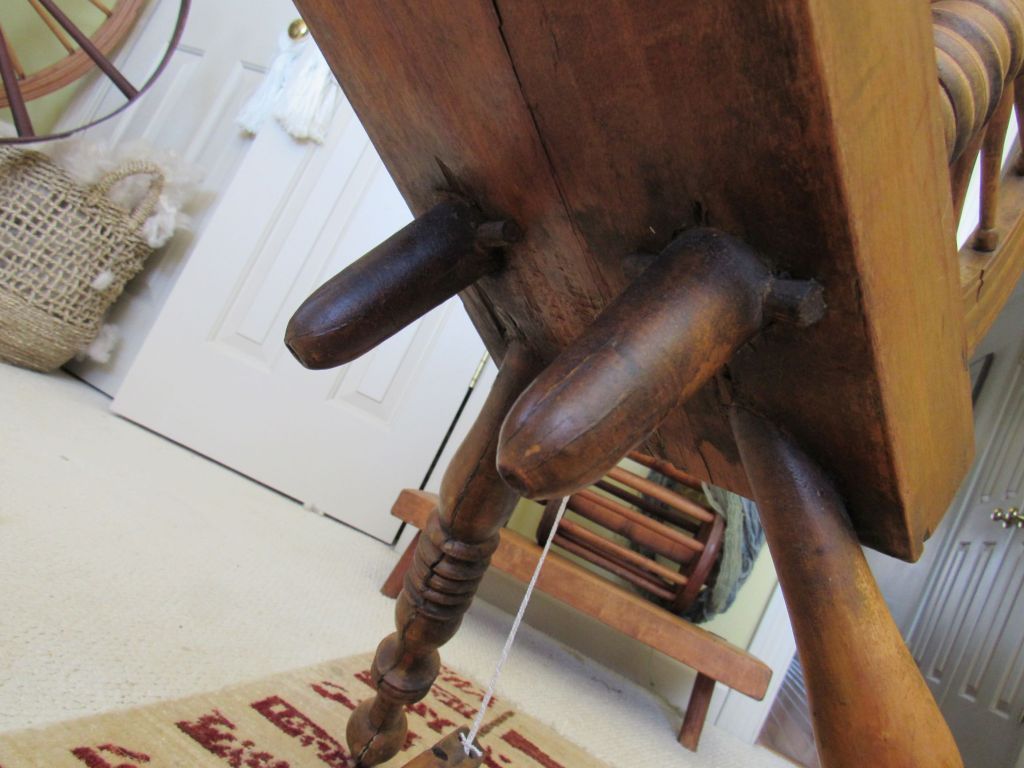
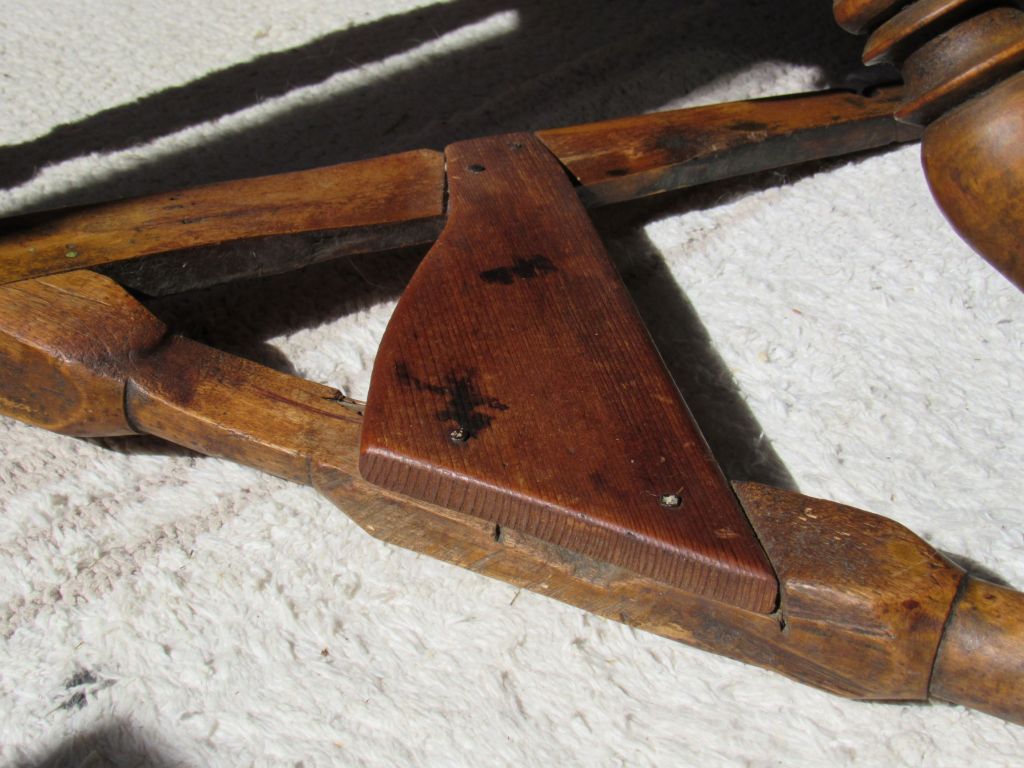
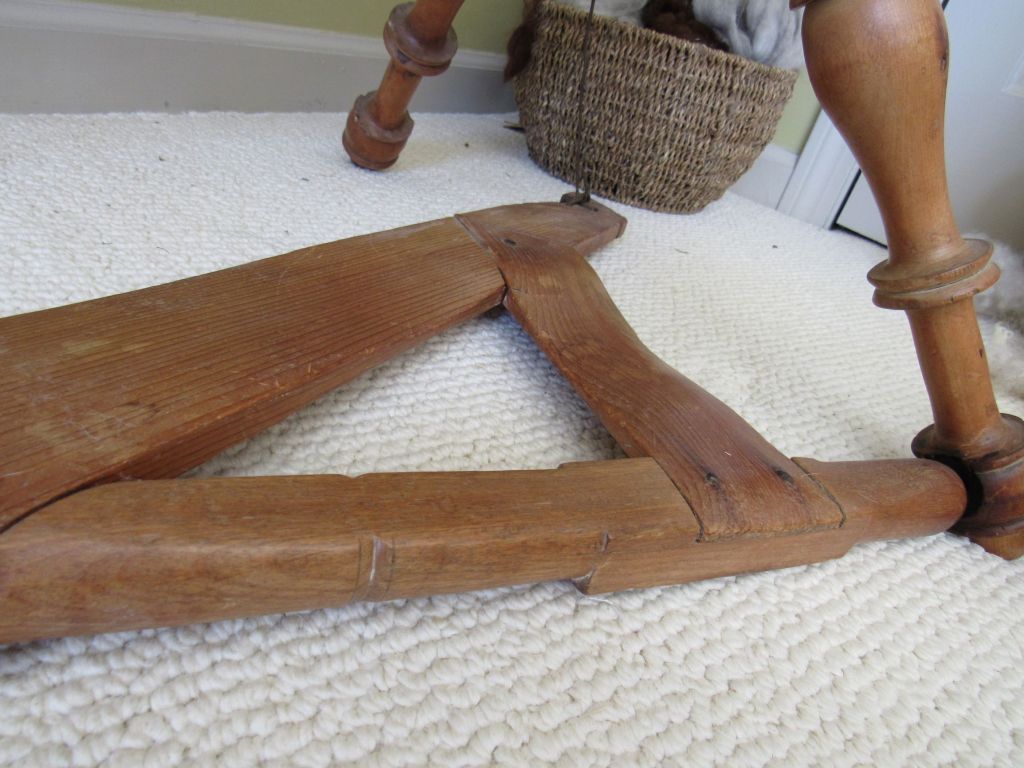
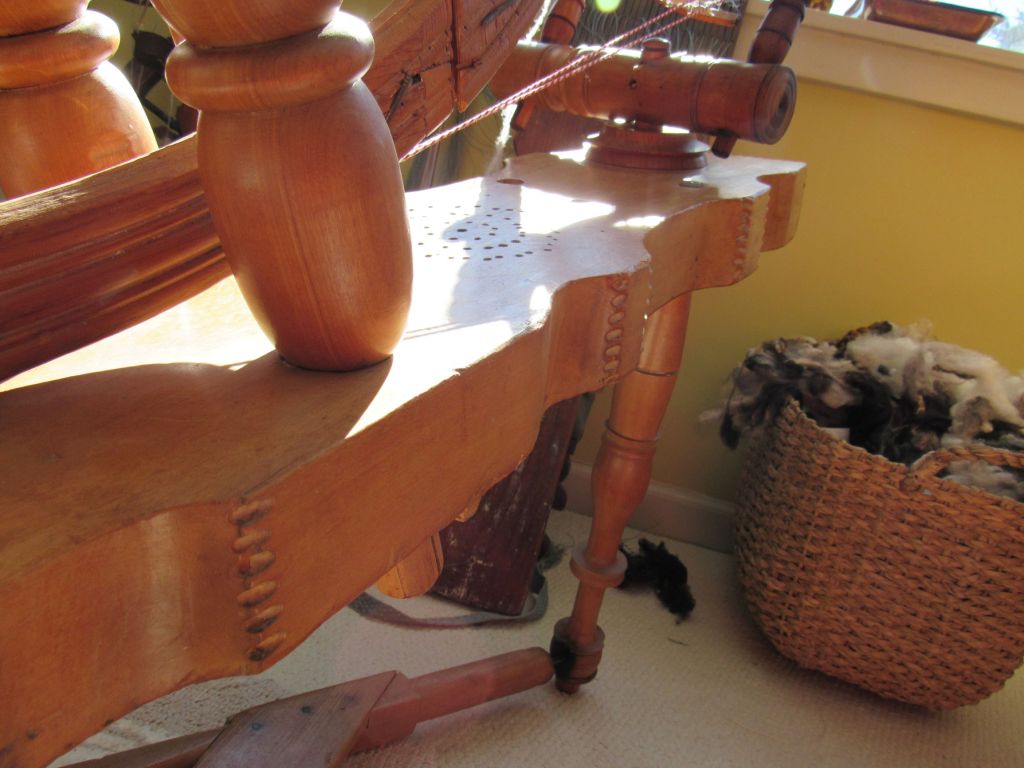
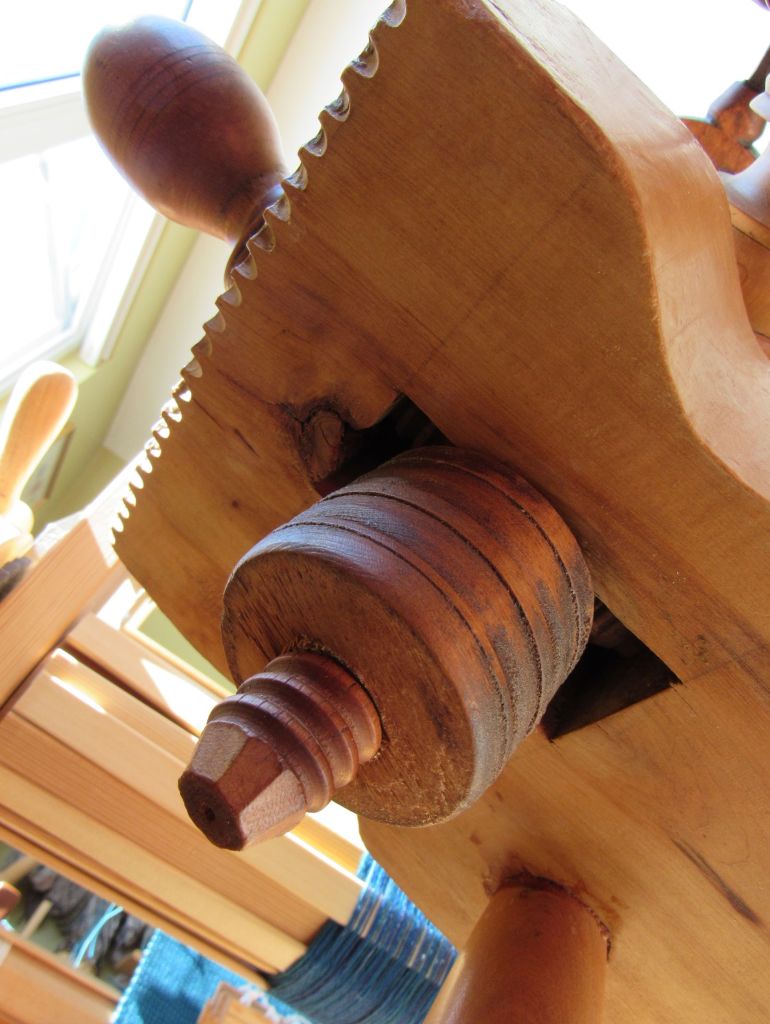
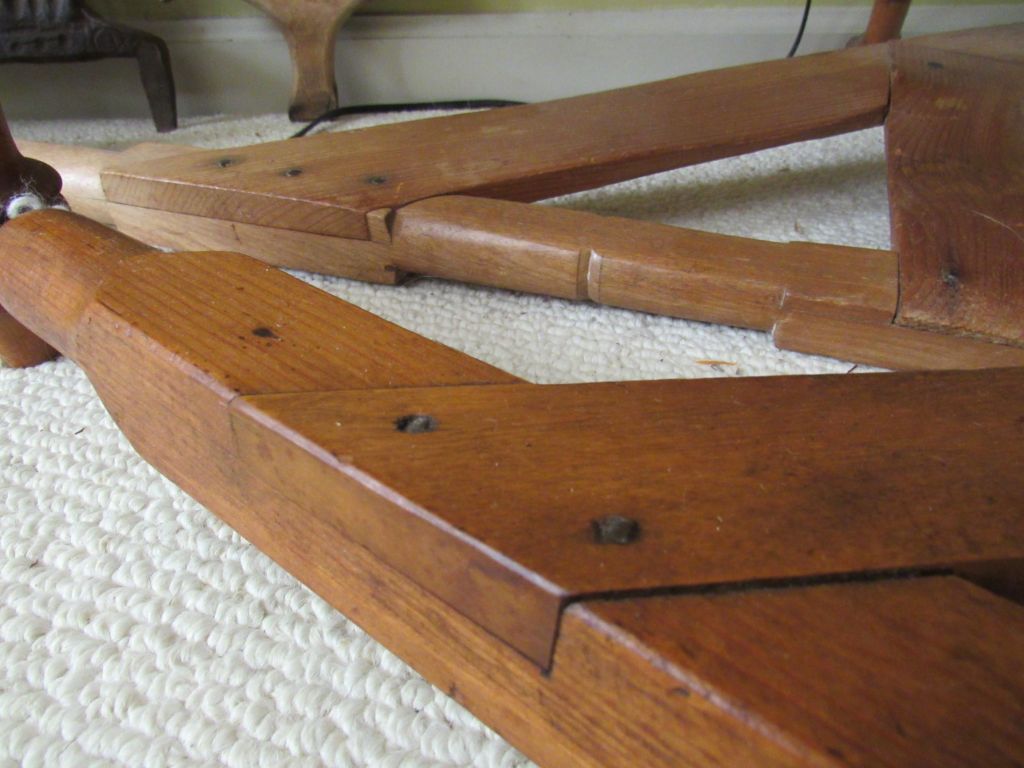
The same stability applies to Handsome Molly, but derives from sheer size and weight. It is a remarkably large wheel, with long legs of substantial girth, and a wide heavy table.

It measures 43 1/2 inches tall, with an orifice height of 29 1/2 inches. The table is an ample 7 1/4 inches wide and upright circumference is 8 1/4 inches.
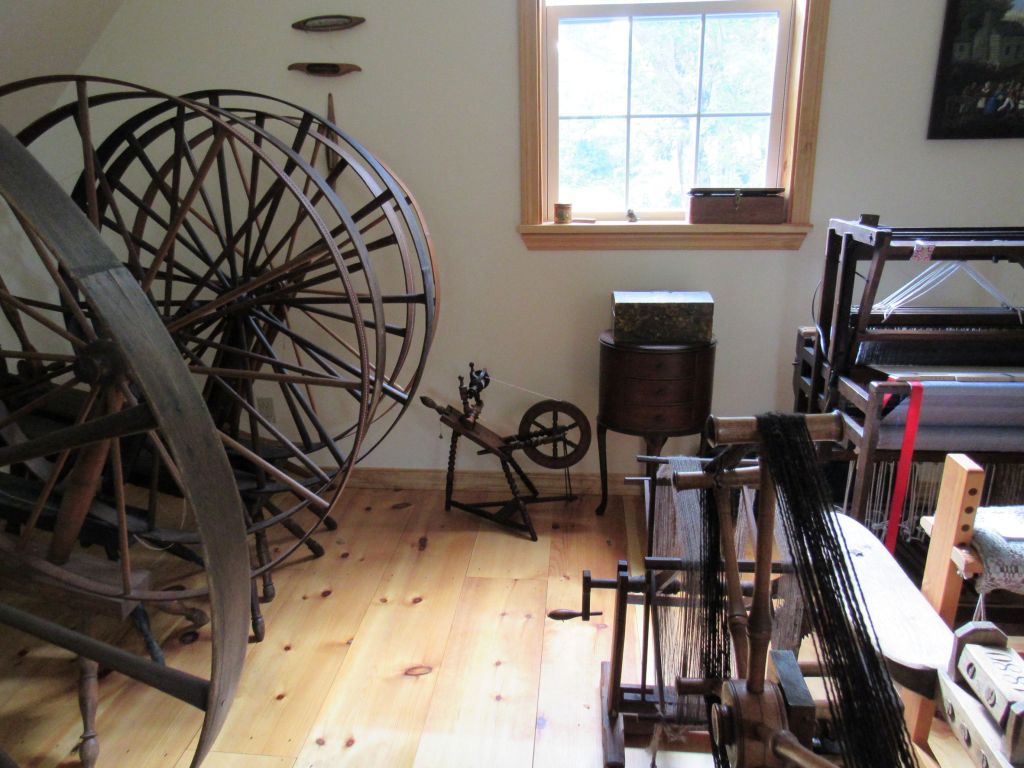
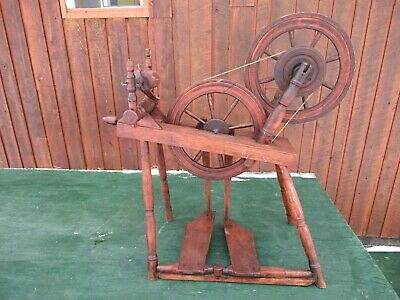
For comparison, it is almost a full foot taller than a typical Connecticut flax wheel made by Silas Barnum.
The legs on the Barnum wheel look puny compared to Molly’s generous proportions.
There is something about the sheer mass of this wheel that does affect spinning–giving a certain lightness and ease. Pure pleasure. There are signs of use on the wheel, but it is difficult to tell how much.
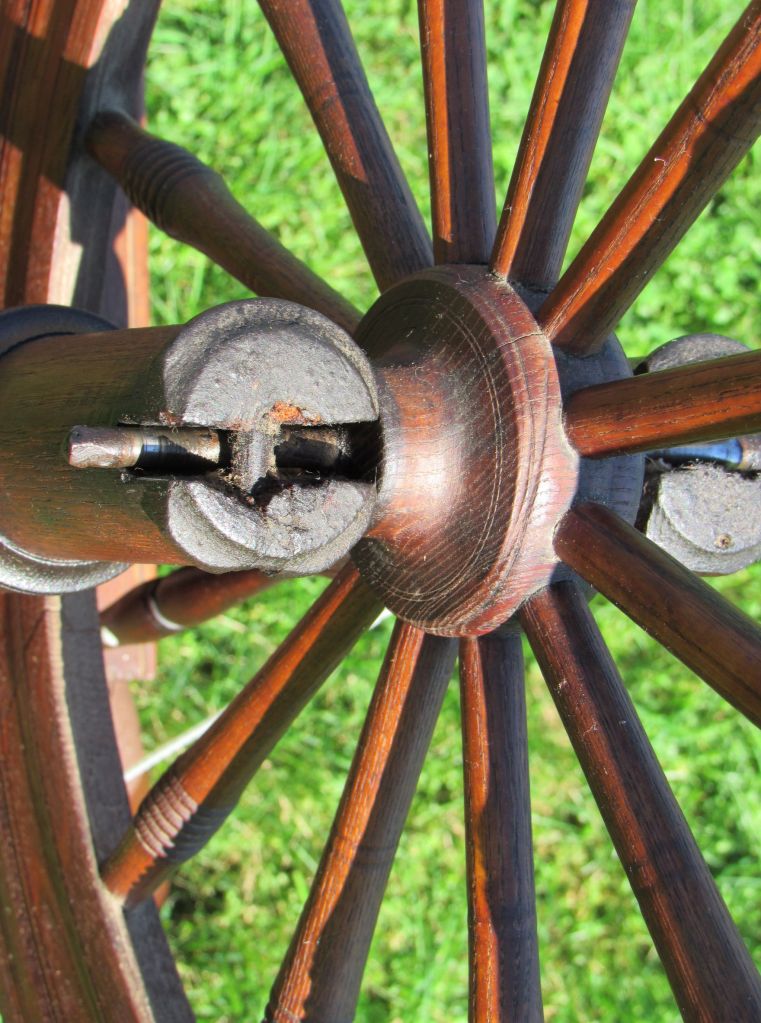
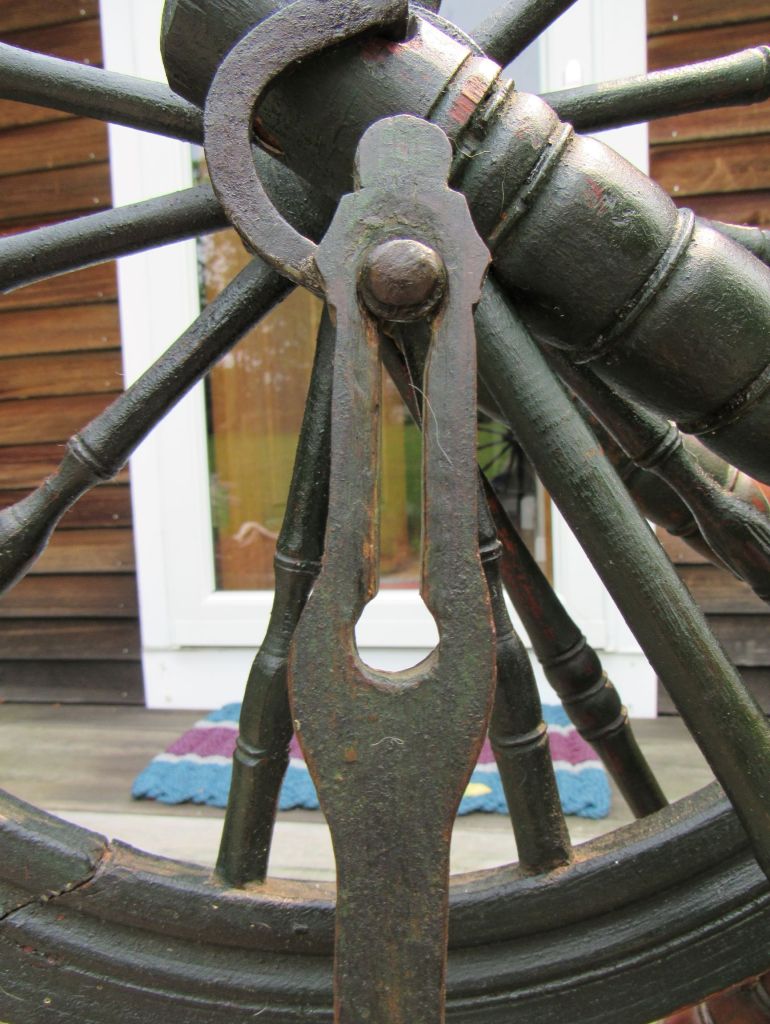
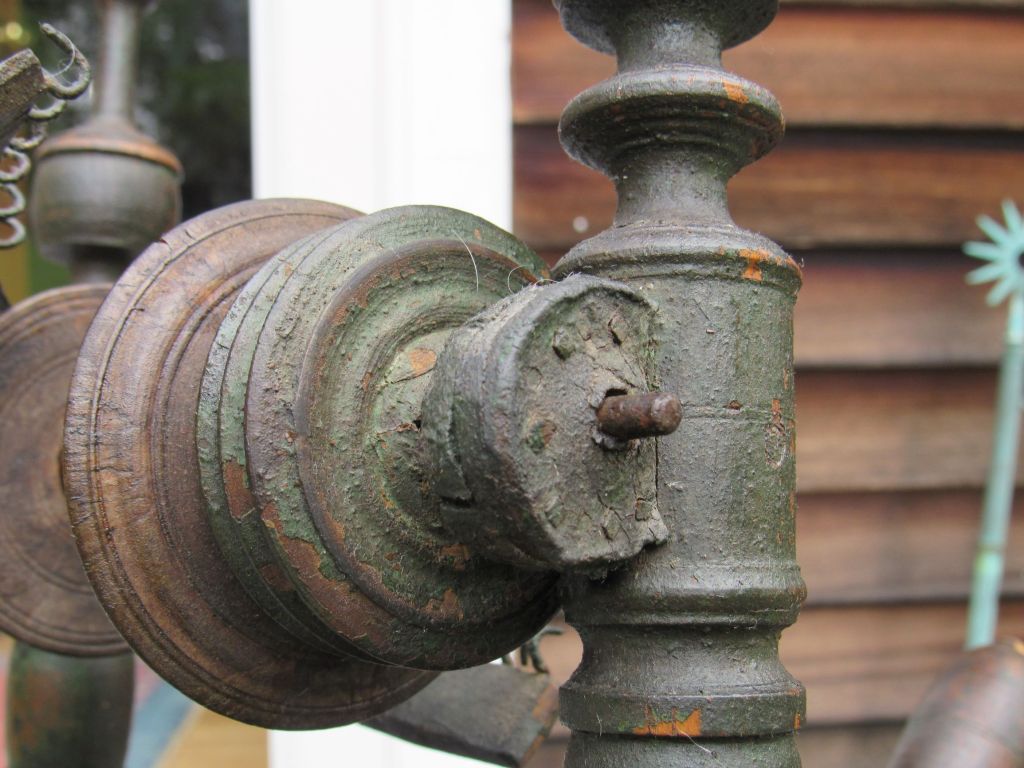
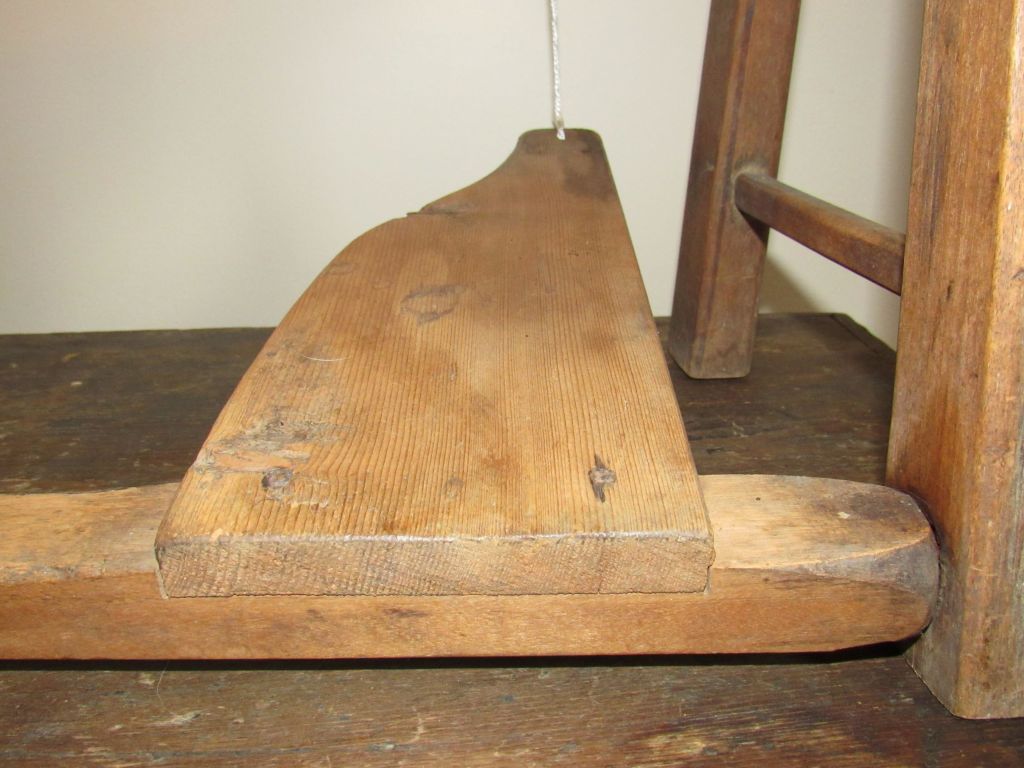
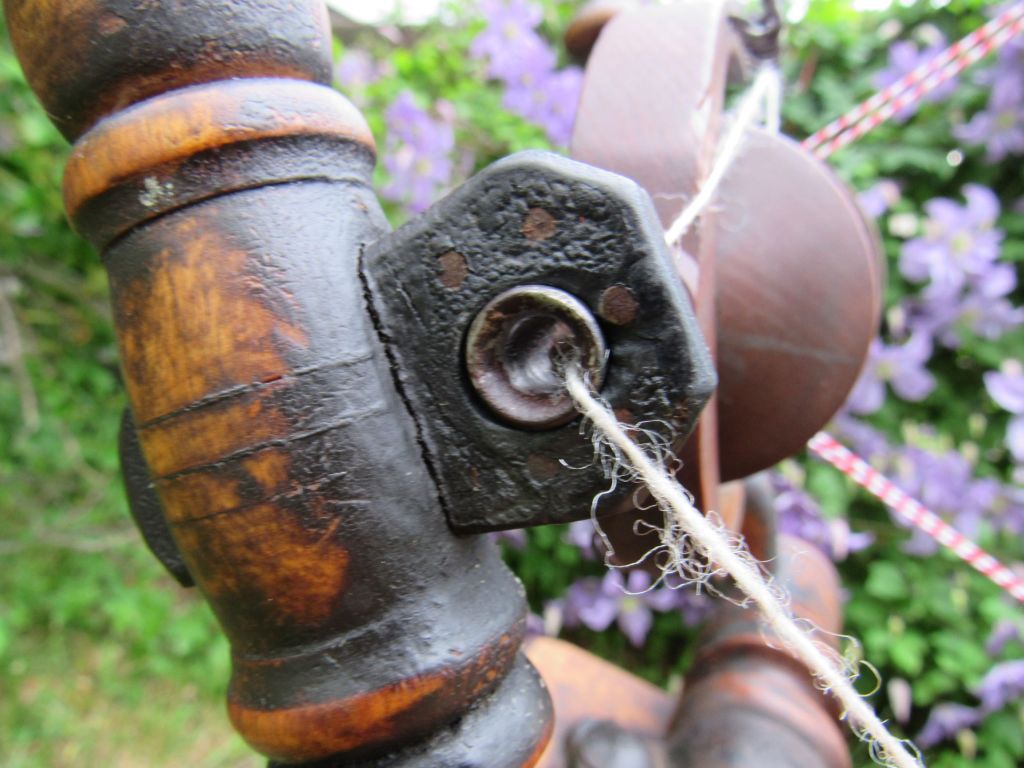
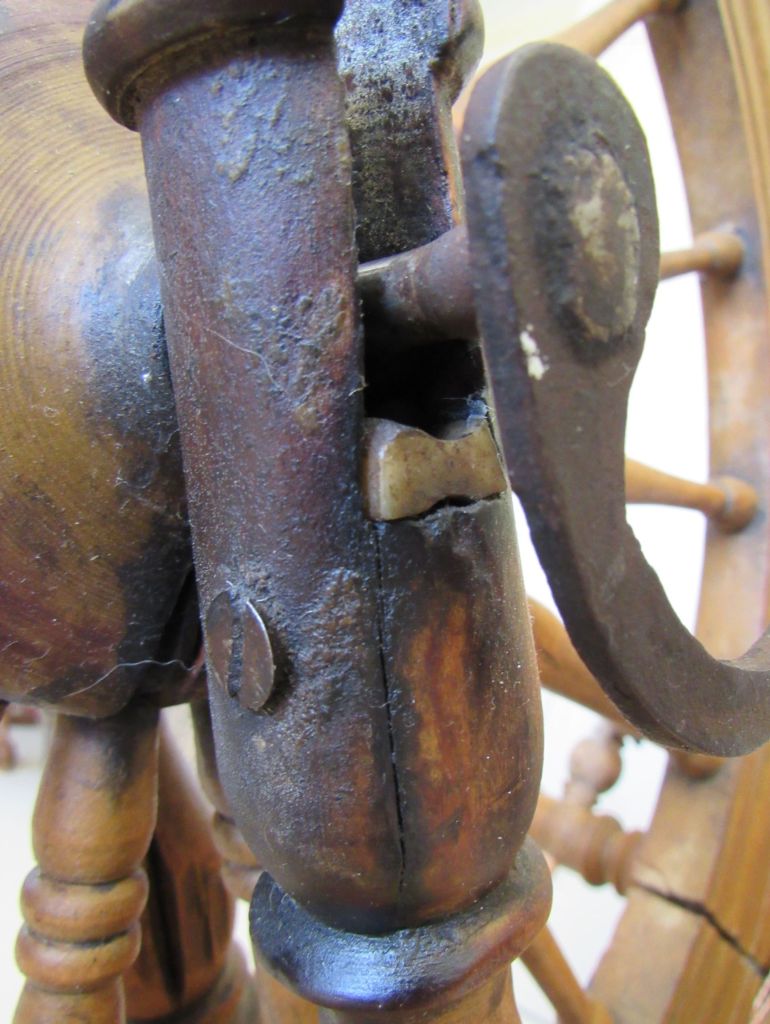
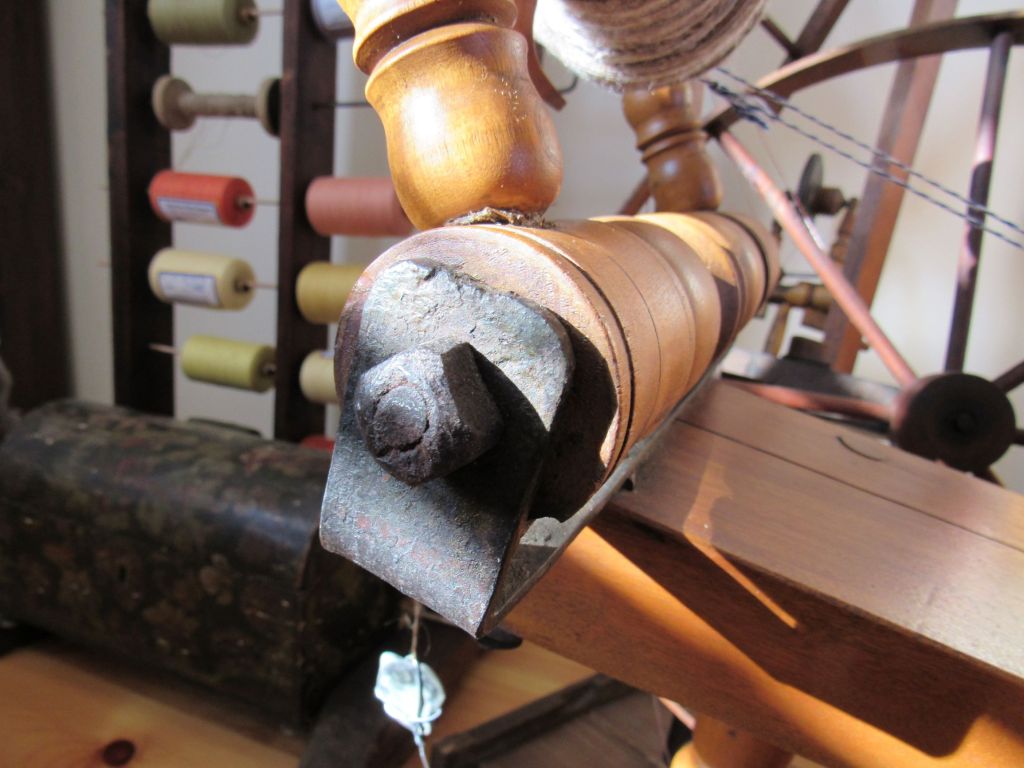
There are grease marks around the axles and some signs of treadle wear.

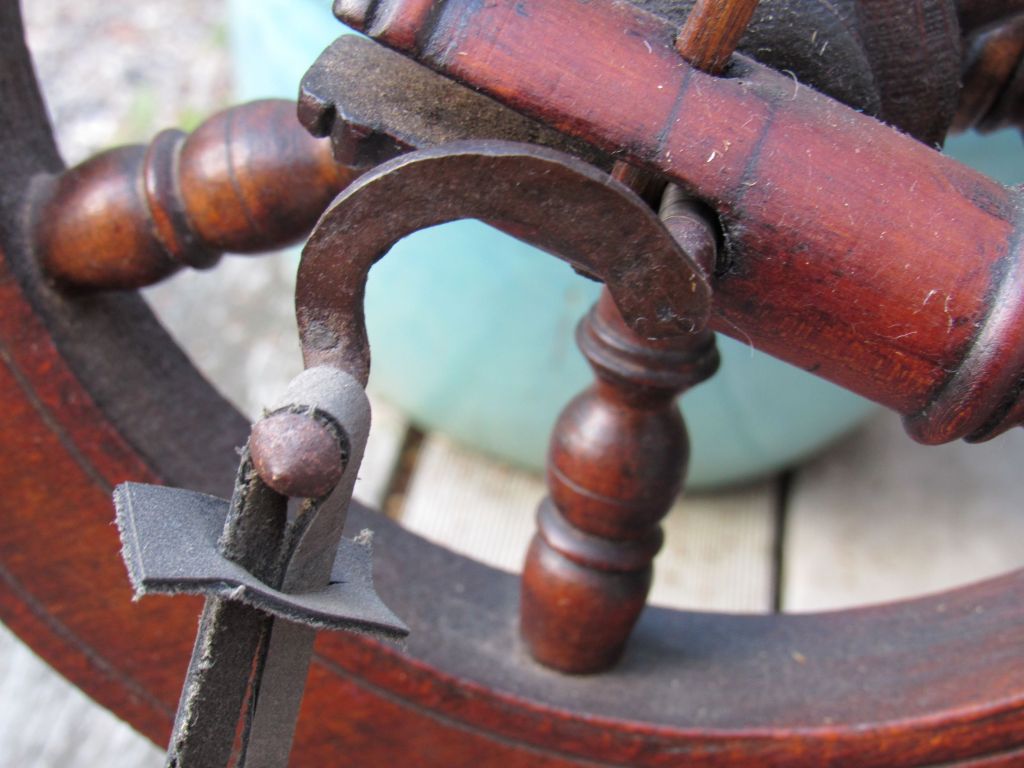
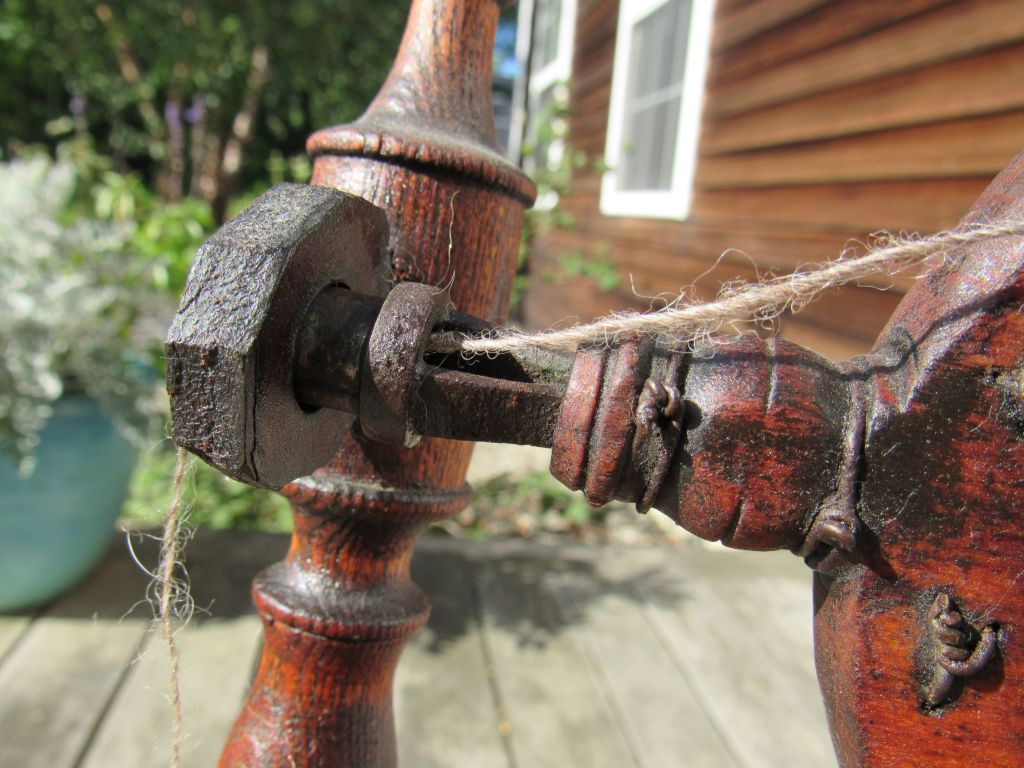
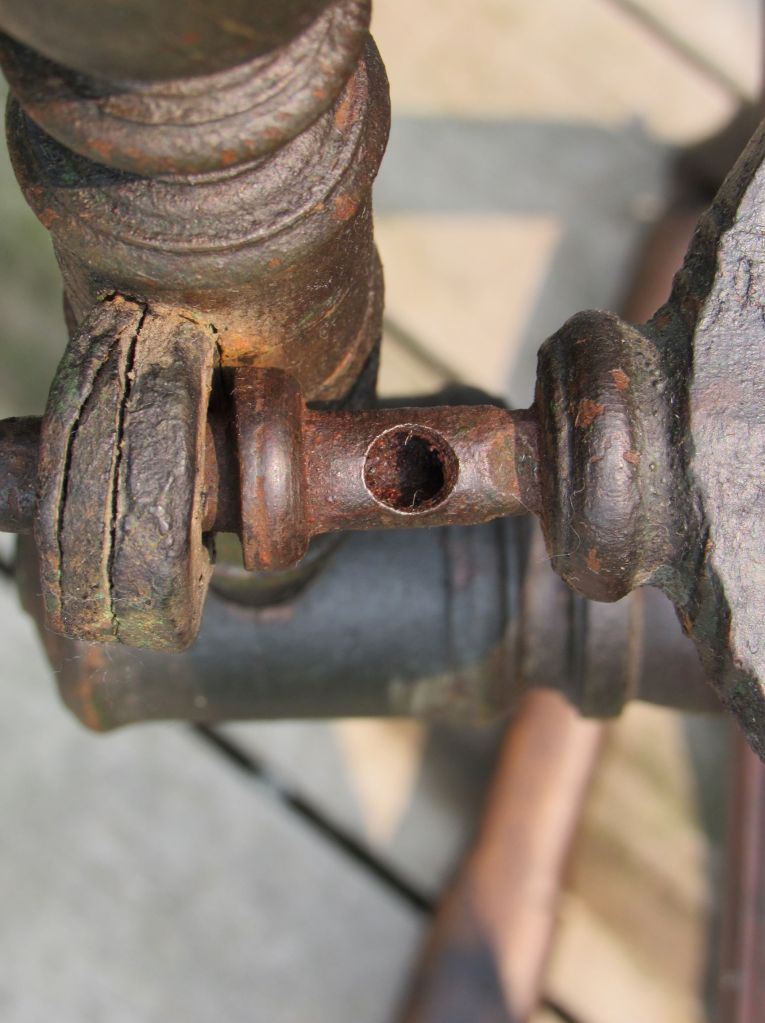
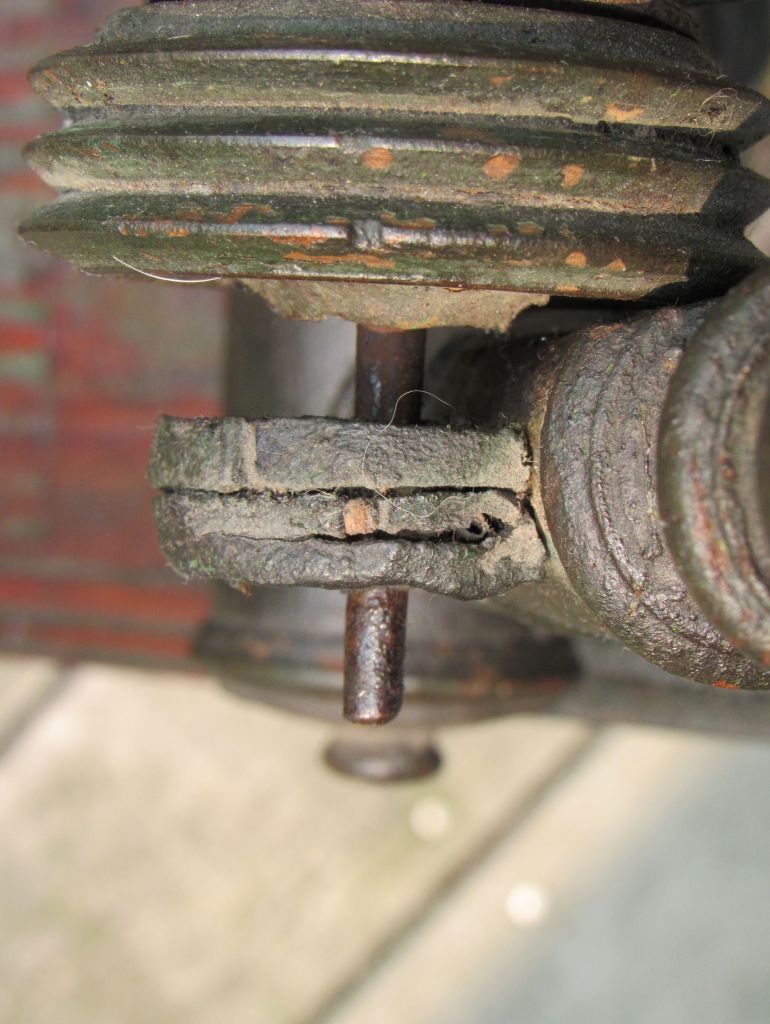
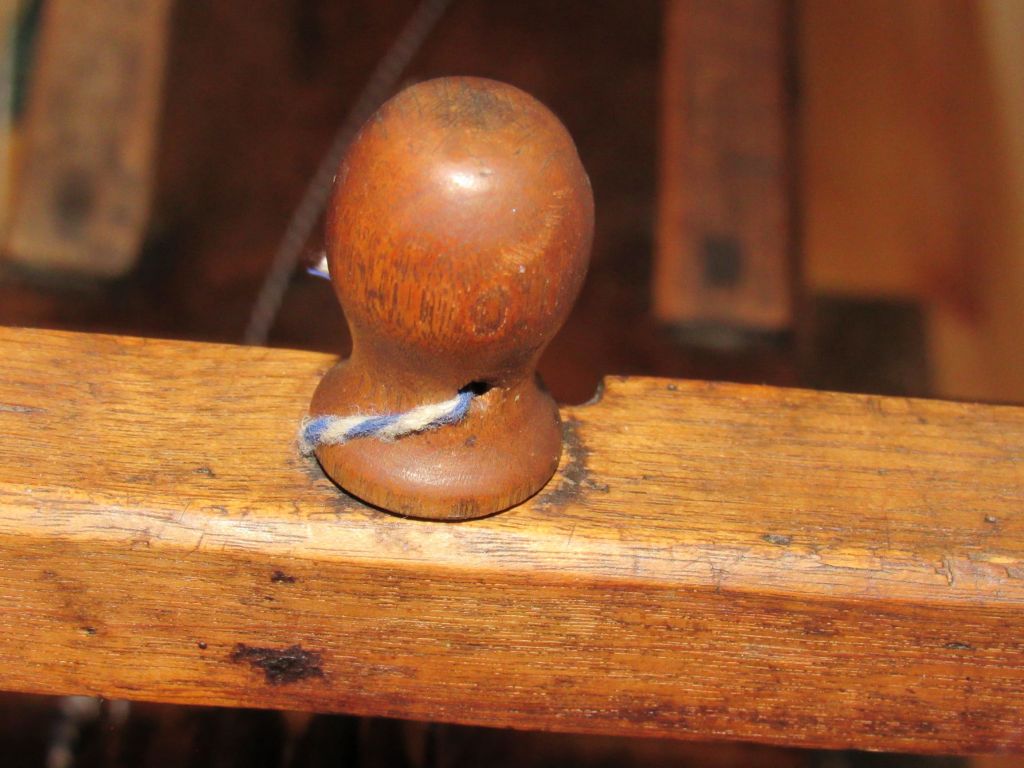
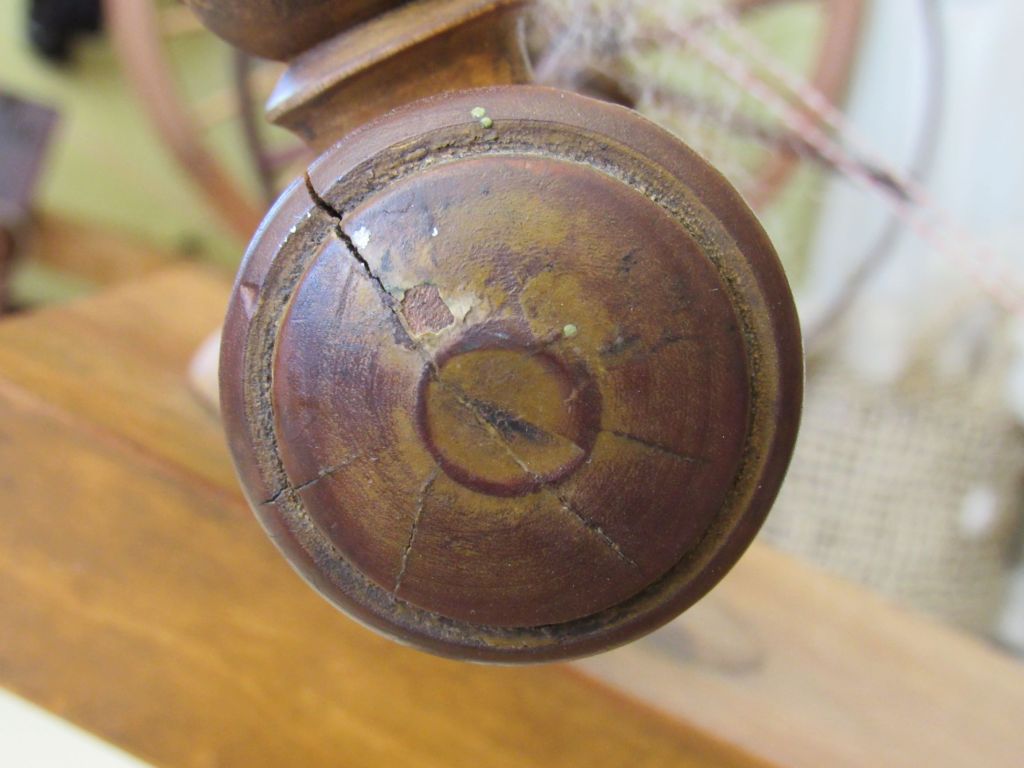
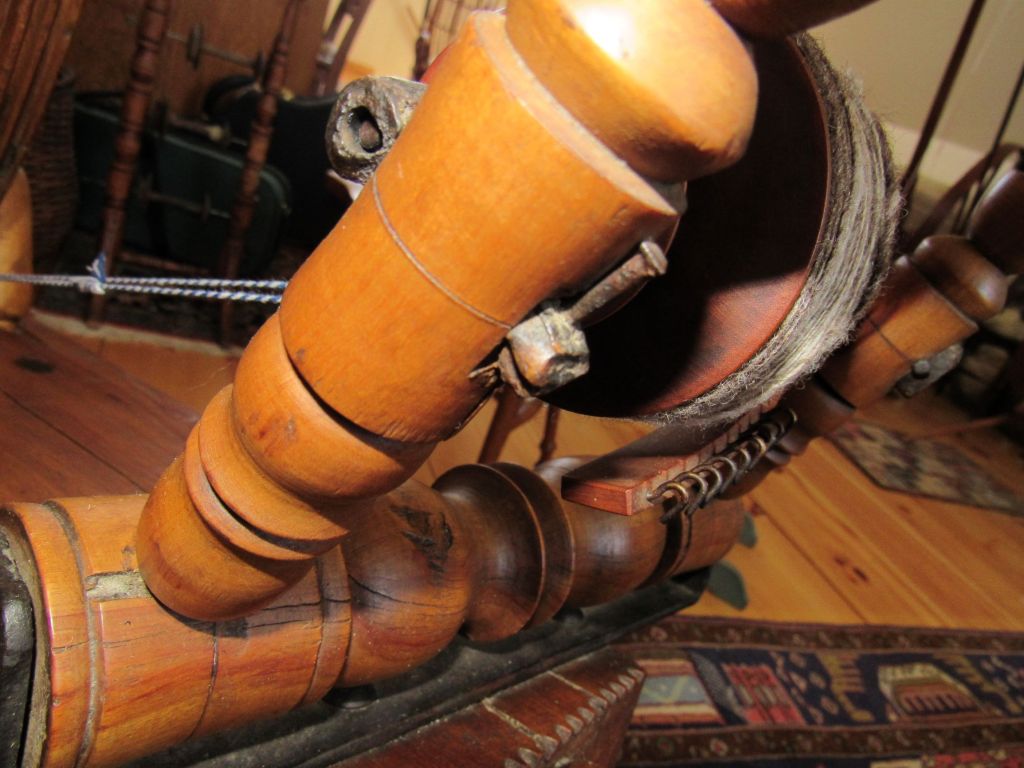
There appear to be some wear marks, from winding off perhaps, on the tension knob. The groove over the fat part of the knob looks just like the puzzling groove on the wheel Adelaide’s knob in a previous post.

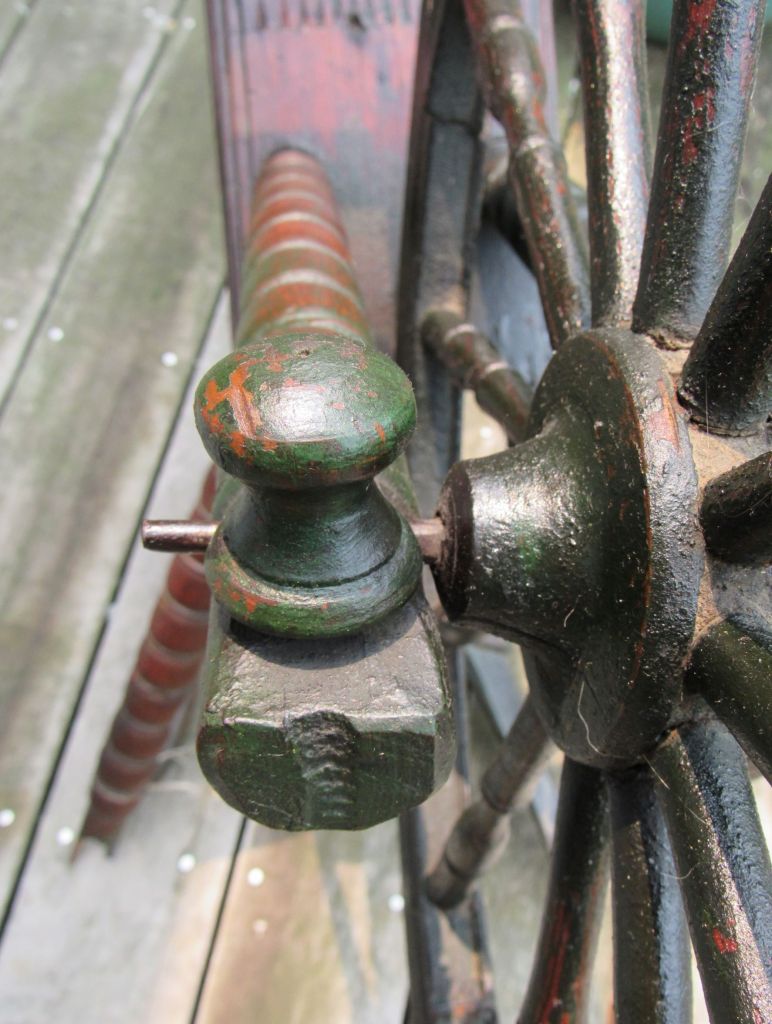
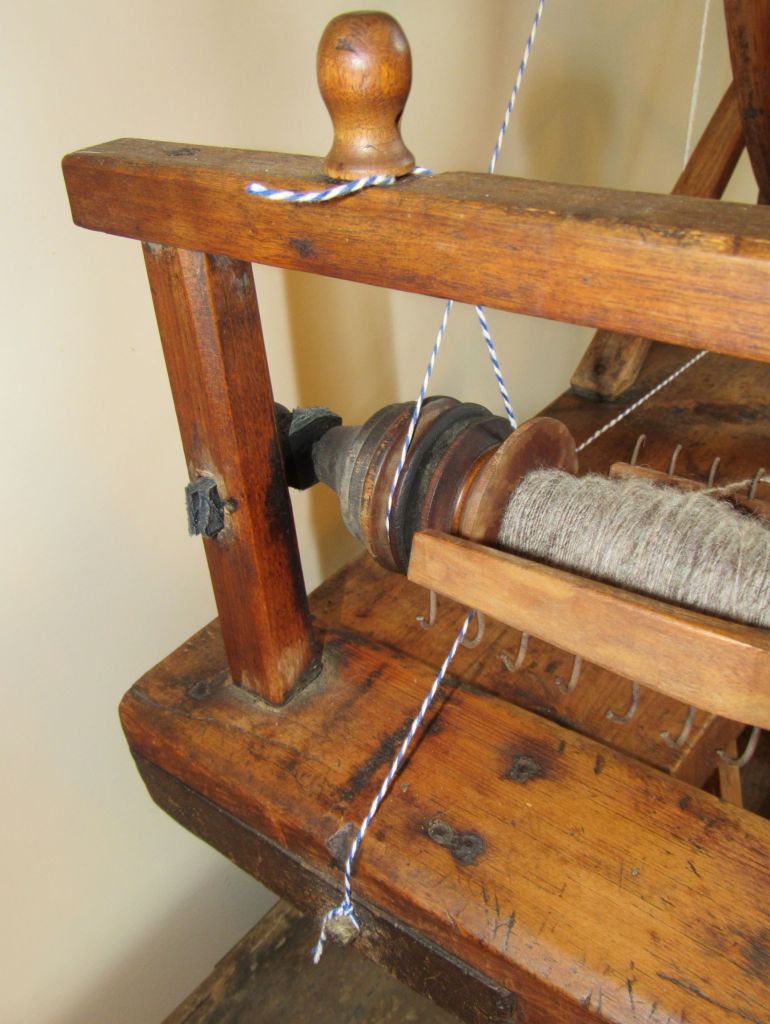
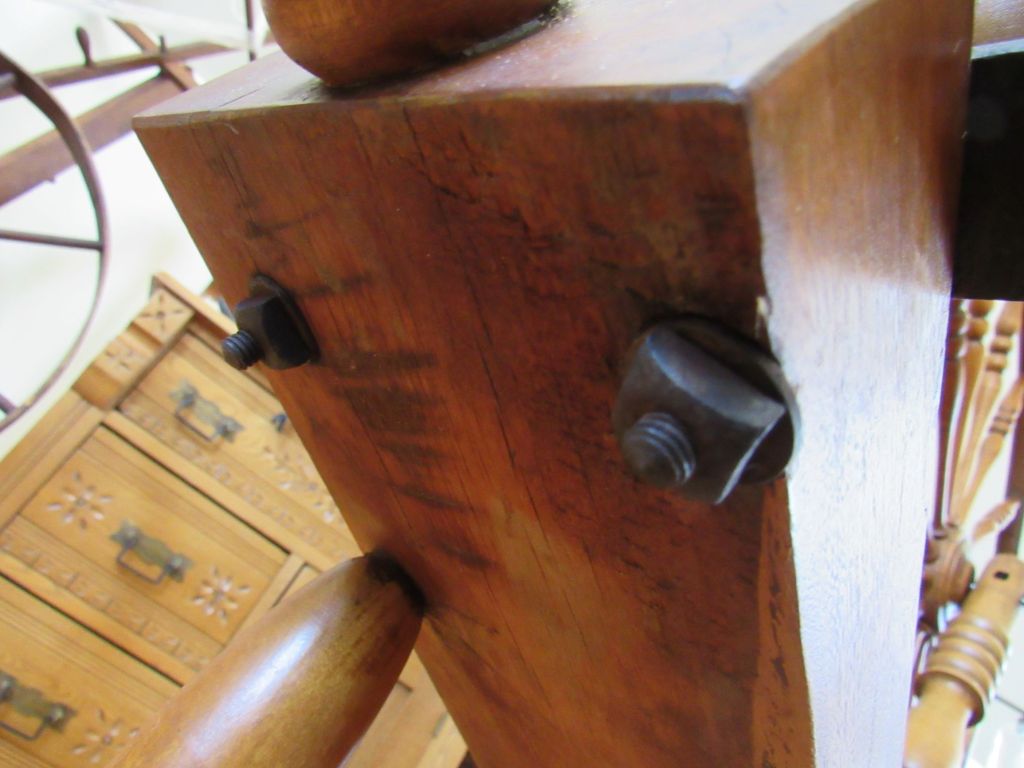
Both maidens are pegged through the mother-of-all and do not turn.

They are in good condition and look much like the maidens on Green Linnet, in a previous post.
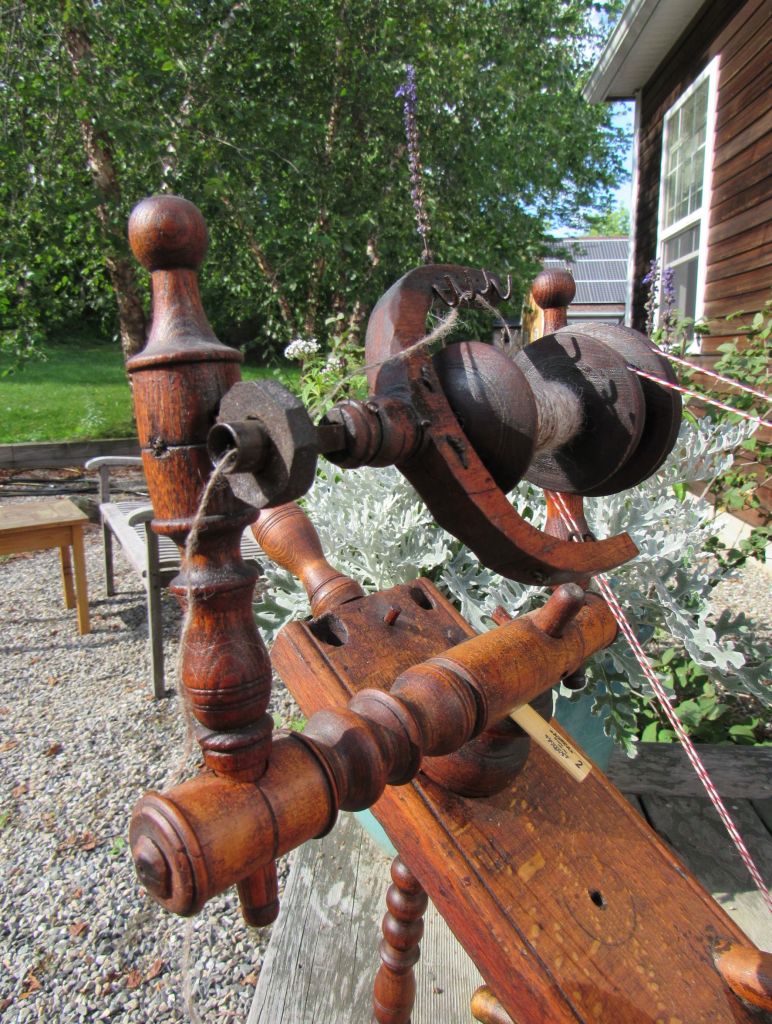
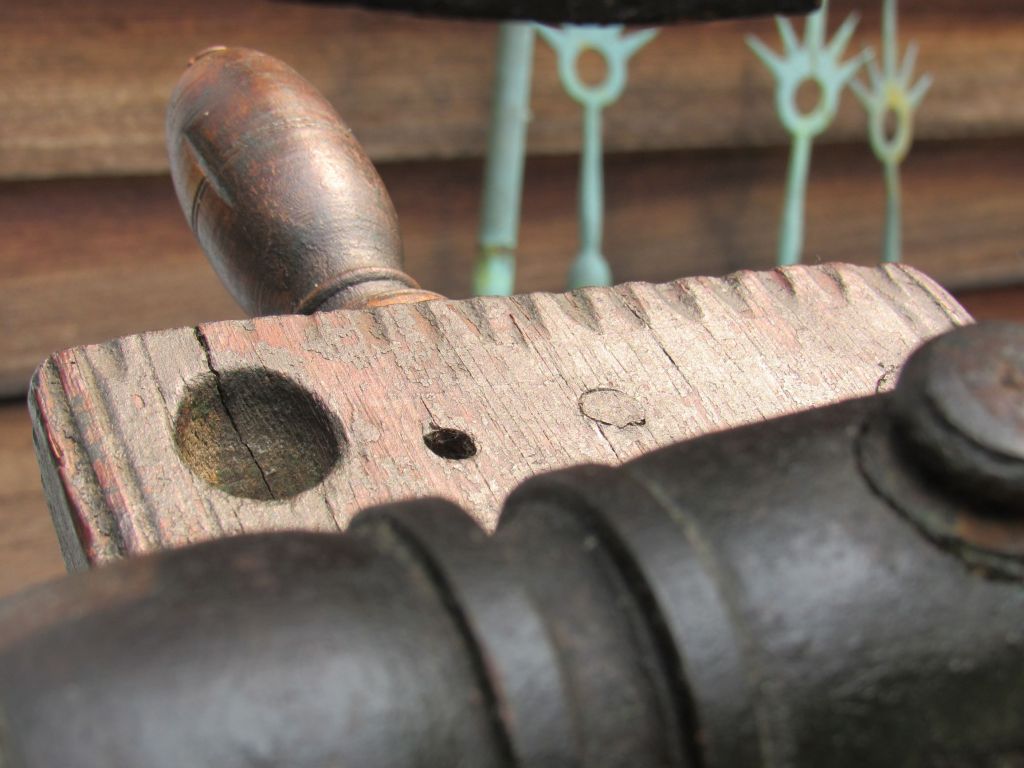
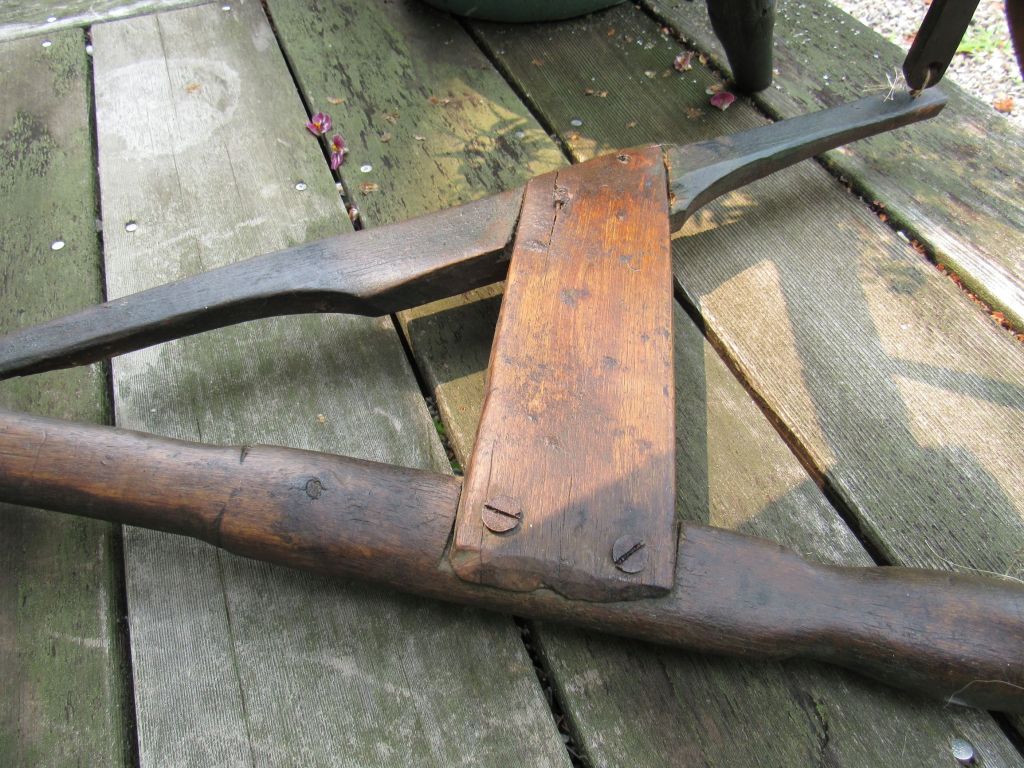
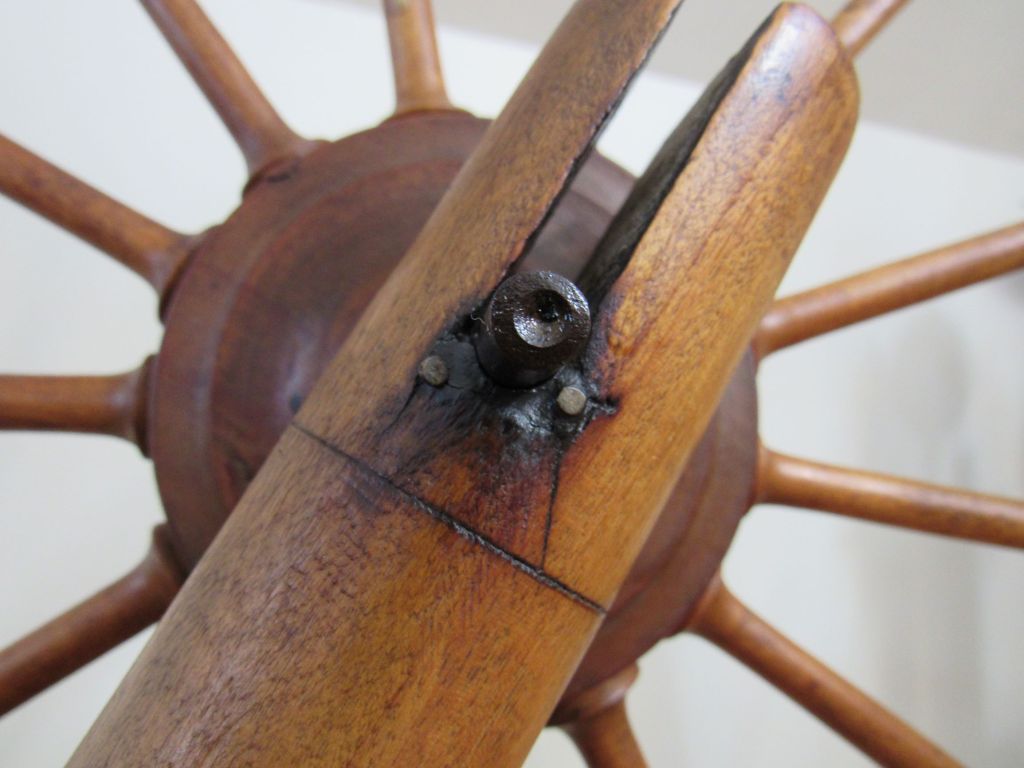
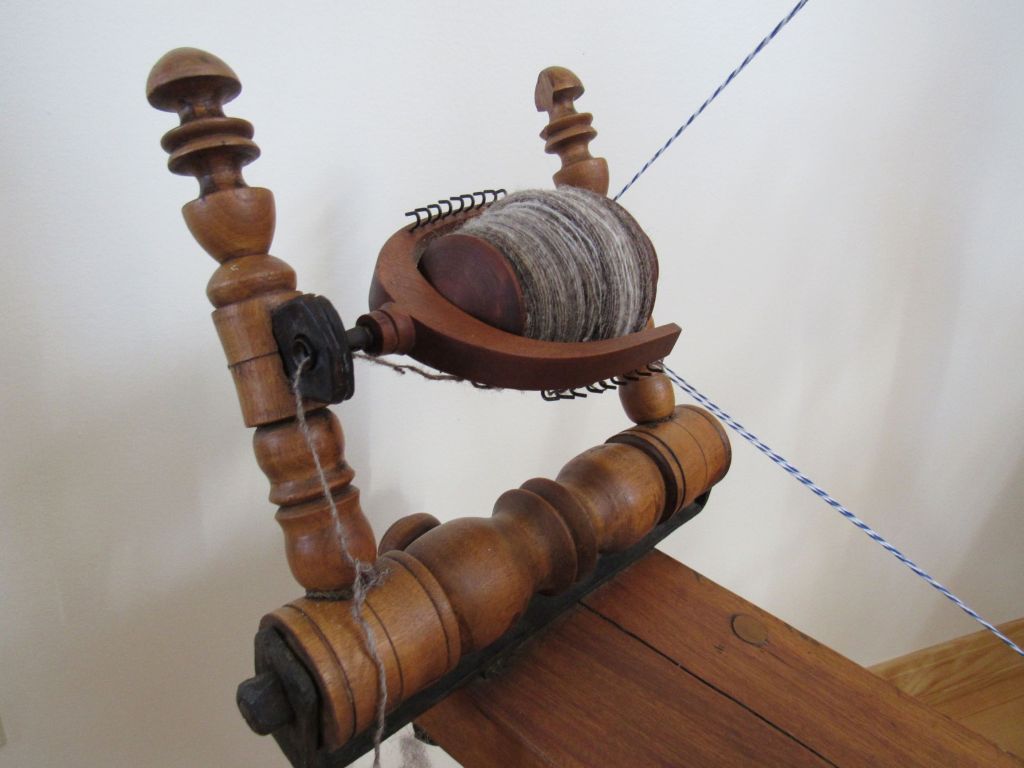
The distaff is made from a tree branch, typically used for spinning tow.
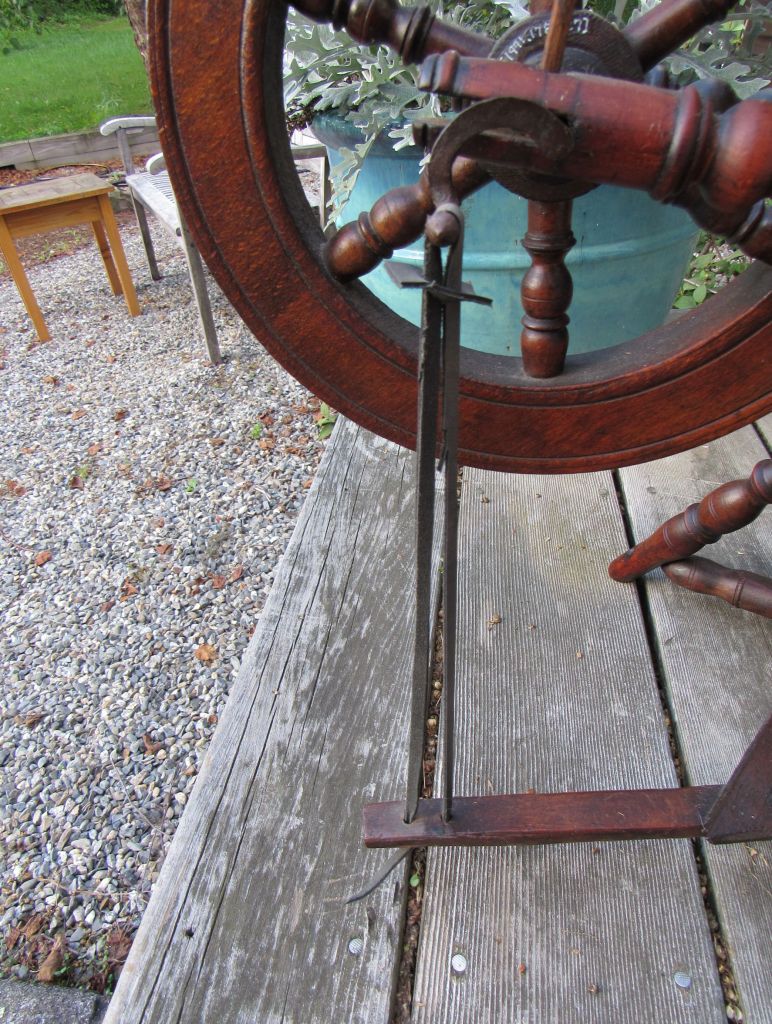
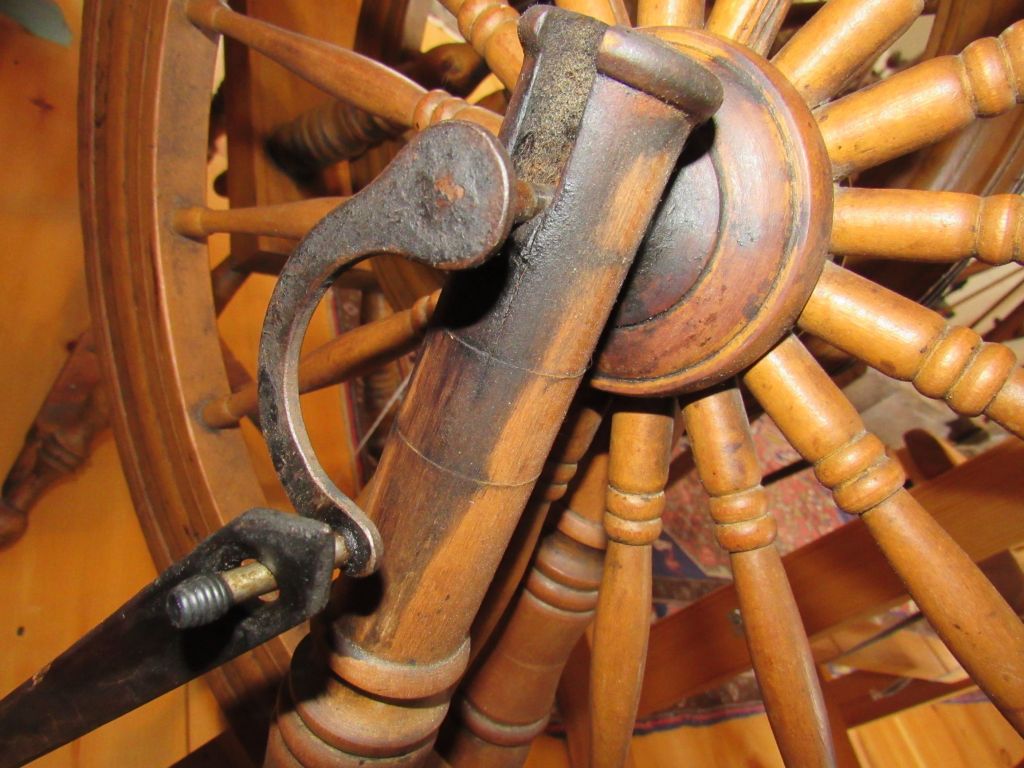
The distaff cross-support threads into the upright.
That is a feature I have never seen before, but brilliant to keep the distaff full of flax from tipping over while spinning (which it can do–I speak from experience).
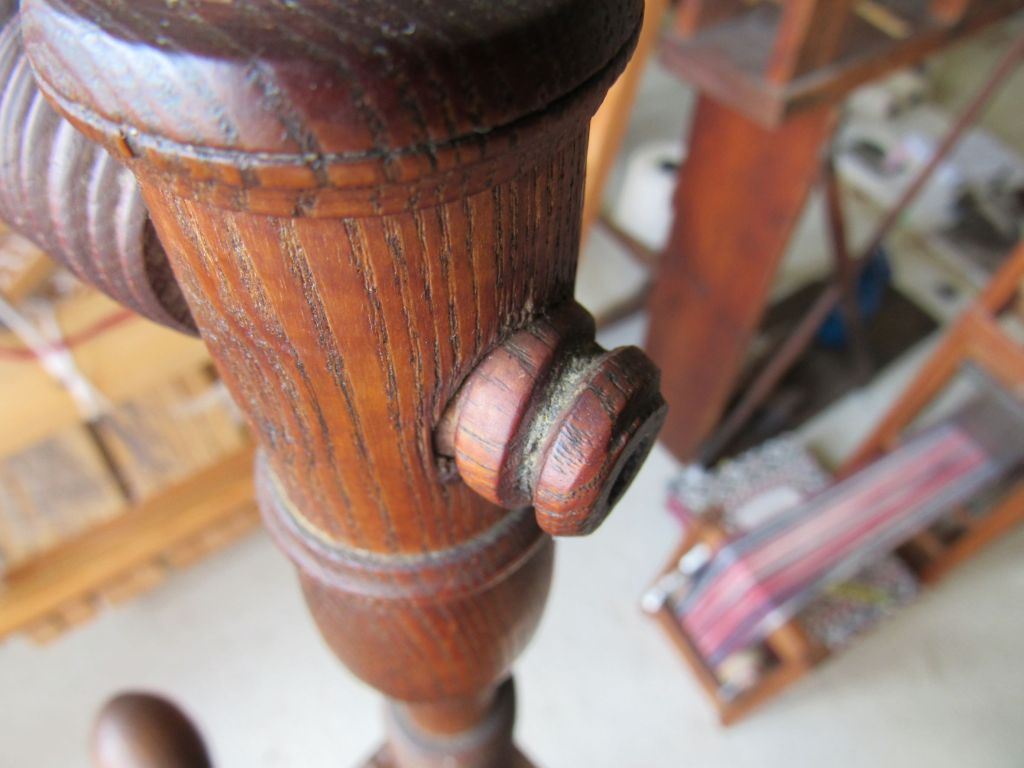
The cross support also has what appear to be wear marks from thread or yarn, again, perhaps from winding off.

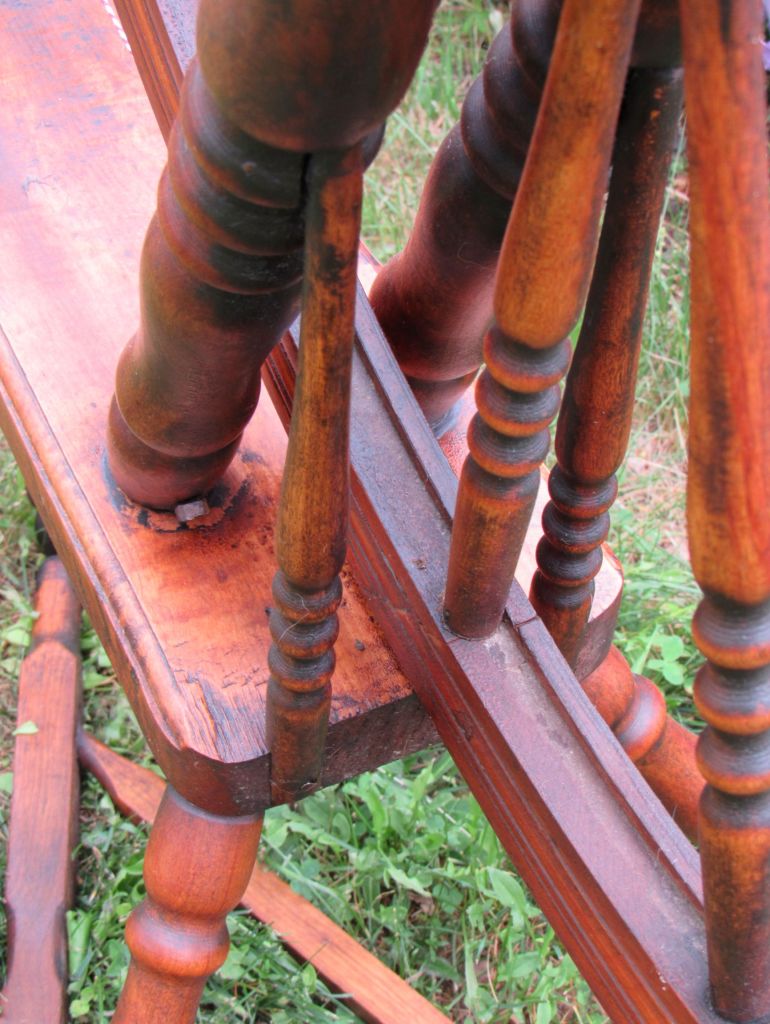
There are secondary upright supports on both sides, extending to the table.
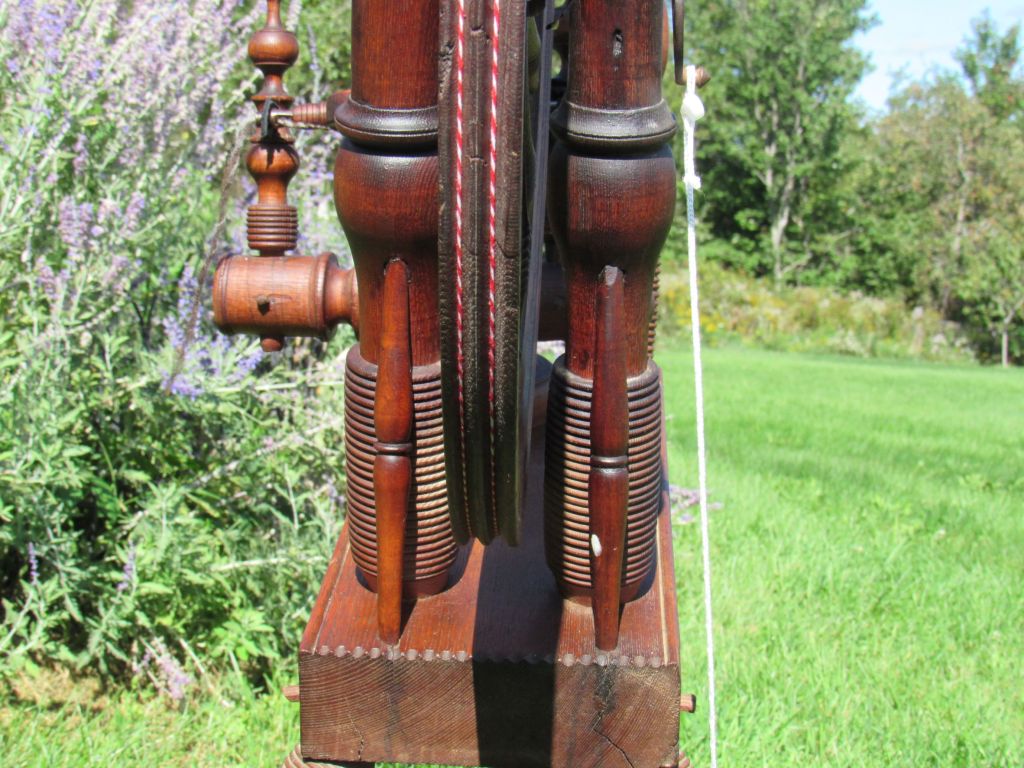
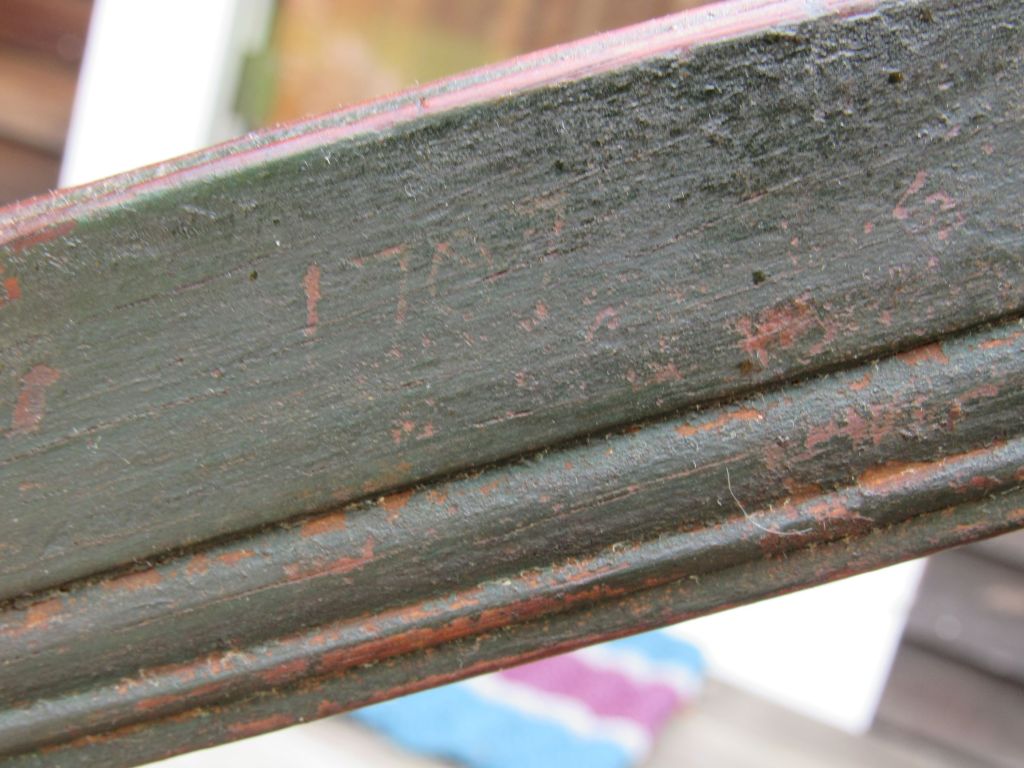
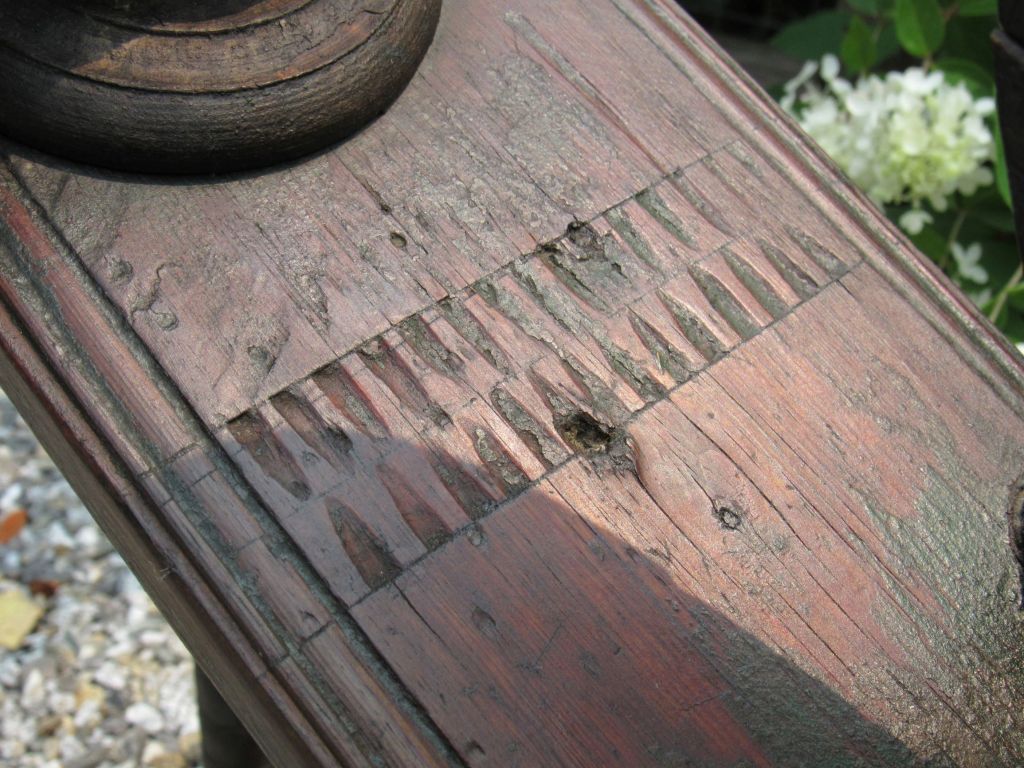
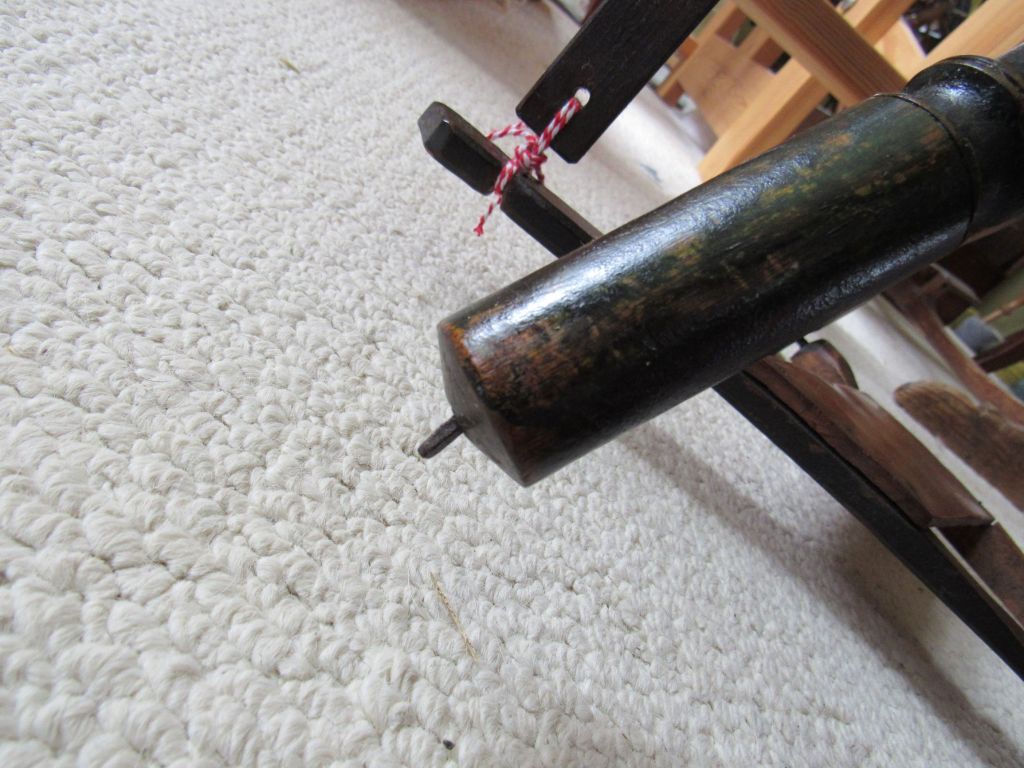
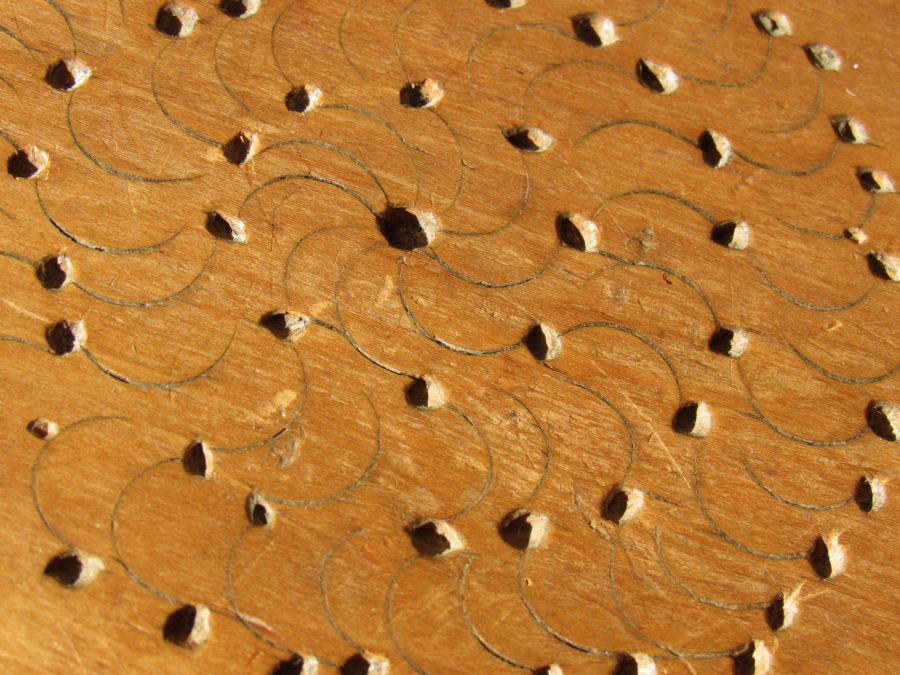
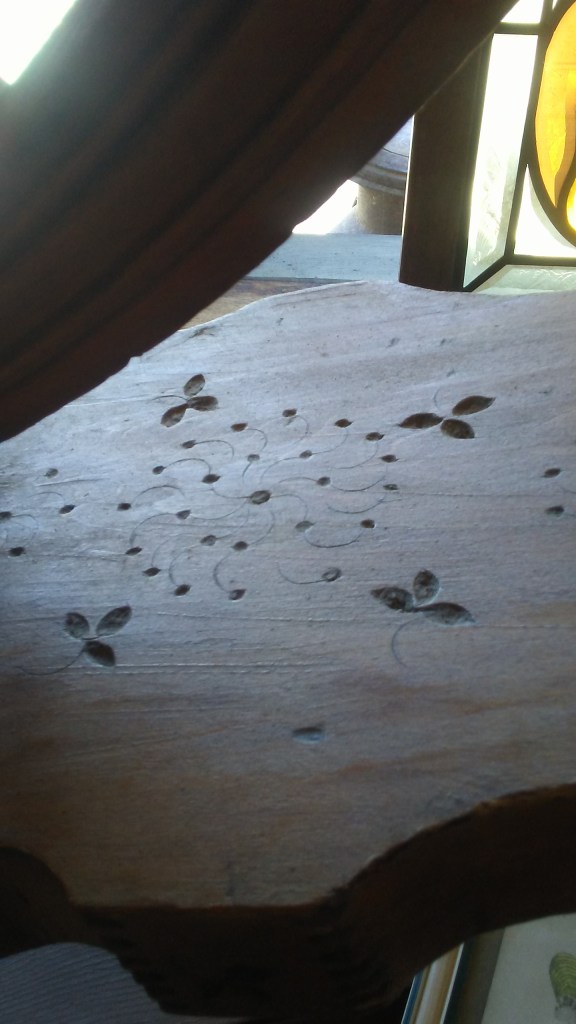
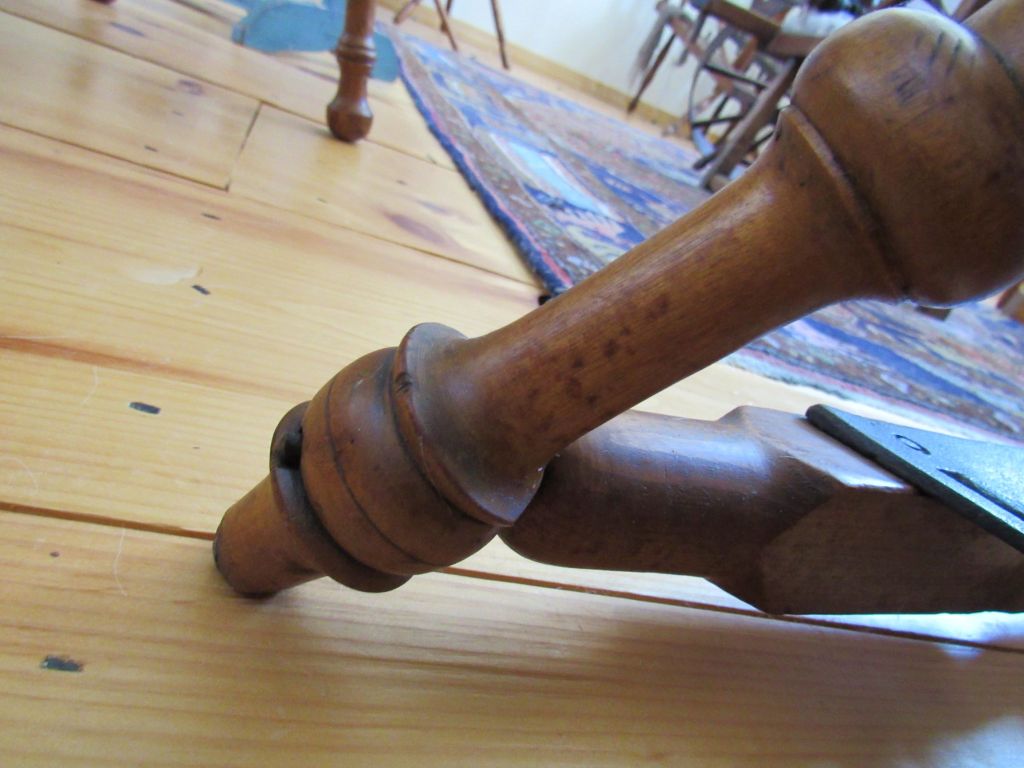
Decorative marks ring the uprights and legs, both burned and incised.

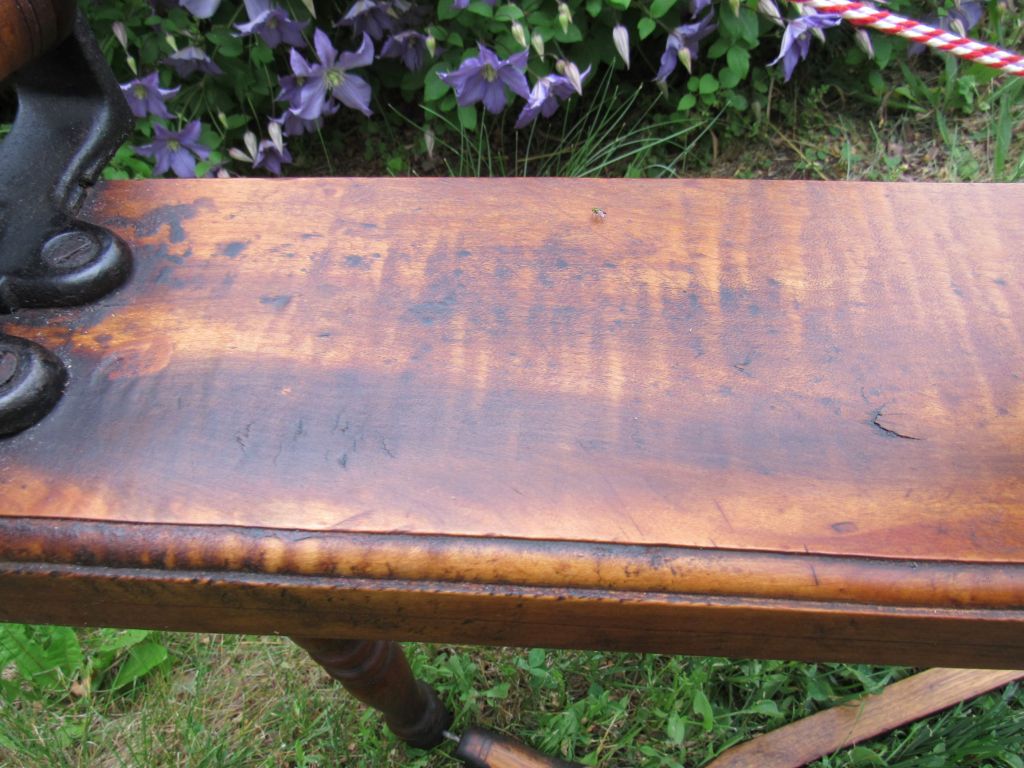
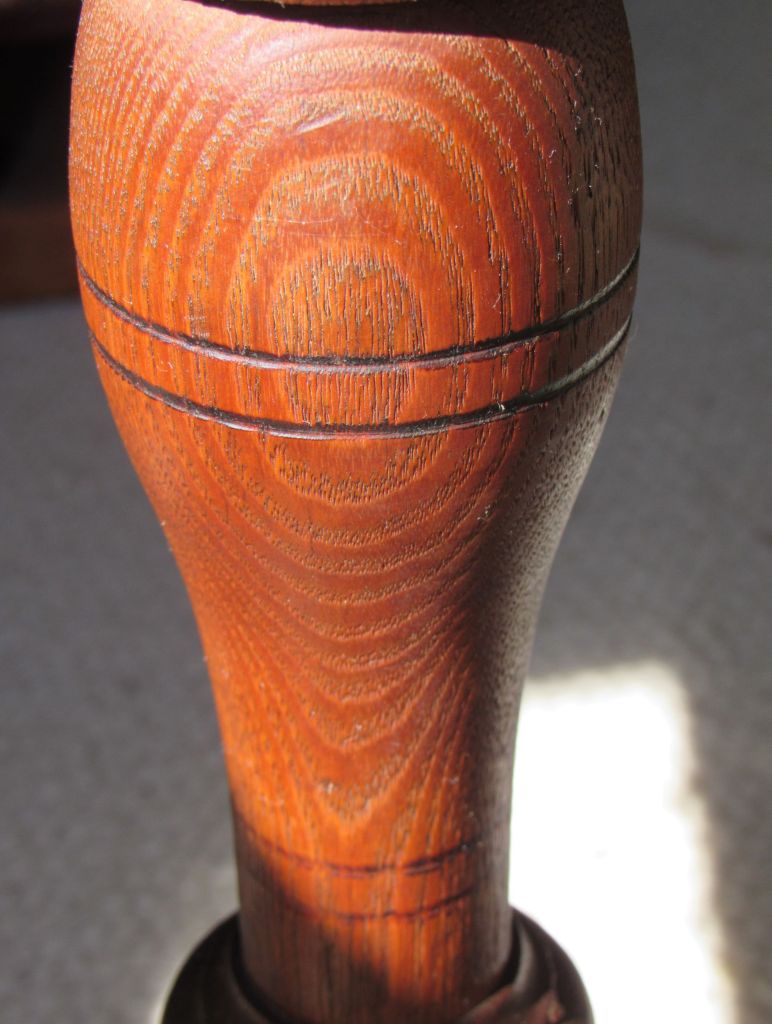
The wood grain is interesting, somewhat wide and coarse
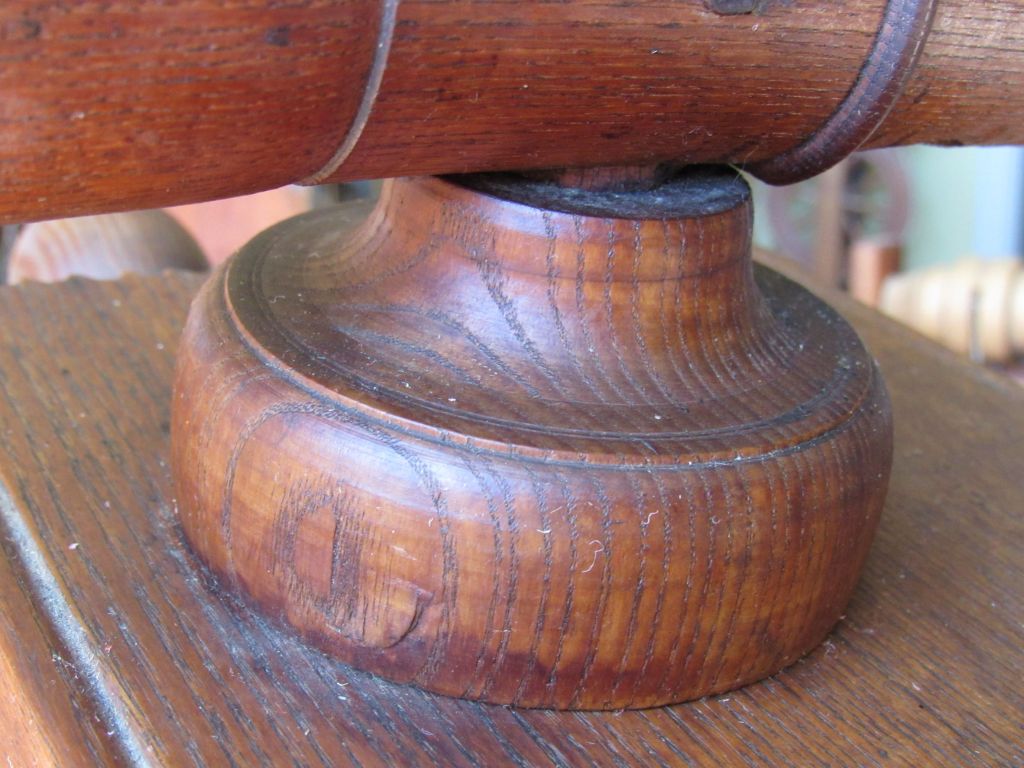
–perhaps oak, ash or a mix?
I do not have the original flyer yet. It still exists, but has been stored away and the hunt is on to find it. I am hoping that it will give more clues as to whether this wheel was brought to this country for use or for decoration. It cannot have been easy or cheap to transport across the Atlantic. But, I totally understand why someone would go to the trouble, because it is a magnificent piece of machinery.
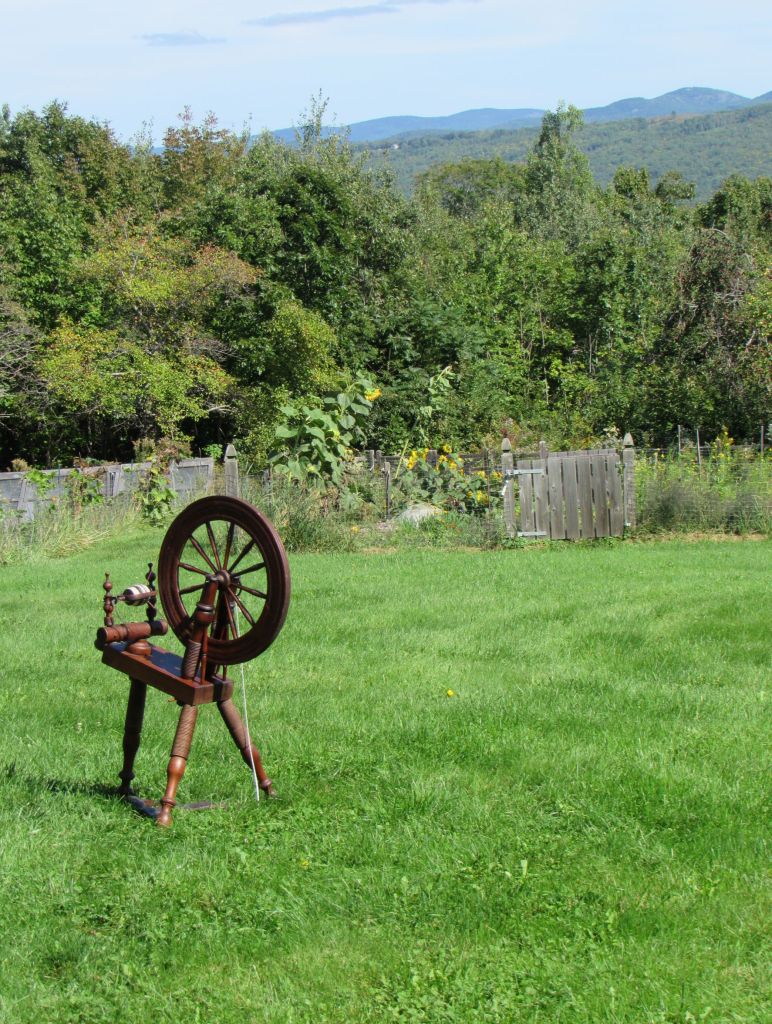
I am extremely grateful that this wheel is now taking up space in my home. And, it is not relegated to the porch, but in a place of honor, creating beautiful yarn.
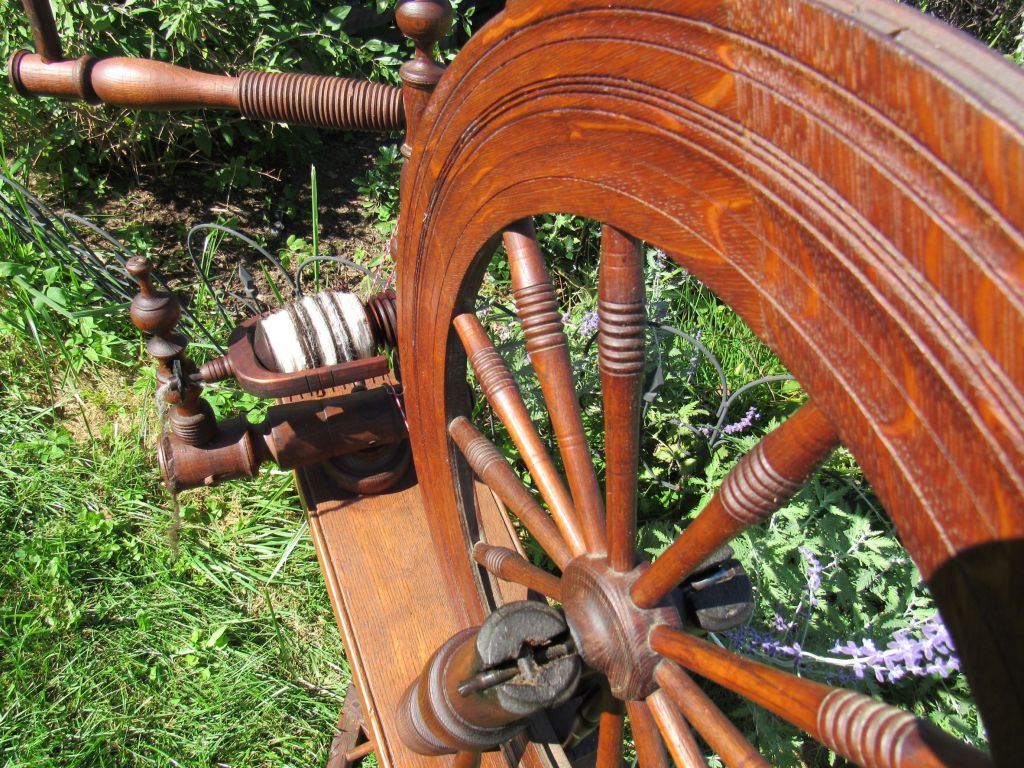
October 2021 update: Joan Cummer had a somewhat similar wheel in her collection, Wheel No. 30. In describing the wheel, she notes: “This wheel was made in the late eighteenth or early nineteenth century in Ireland. The turnings are Sheraton period with extremely fine reed turnings on the distaff … This has been a well made and very heavy wheel.” Cummer, Joan Whittaker, A Book of Spinning Wheels, Peter E. Randall, Portsmouth, NH, 1994 (pp. 72-73).

For more information see:

Johnny Shiels Inishowen Spinning Wheels, website here.

Evans, Nancy Goyne, American Windsor Furniture, Hudson Hills Press, New York, NY, 1997 (p. 214).

Ulster Museum, Spinning Wheels (The John Horner Collection); Ulster Museum, Belfast, Ireland 1976.
Hermione

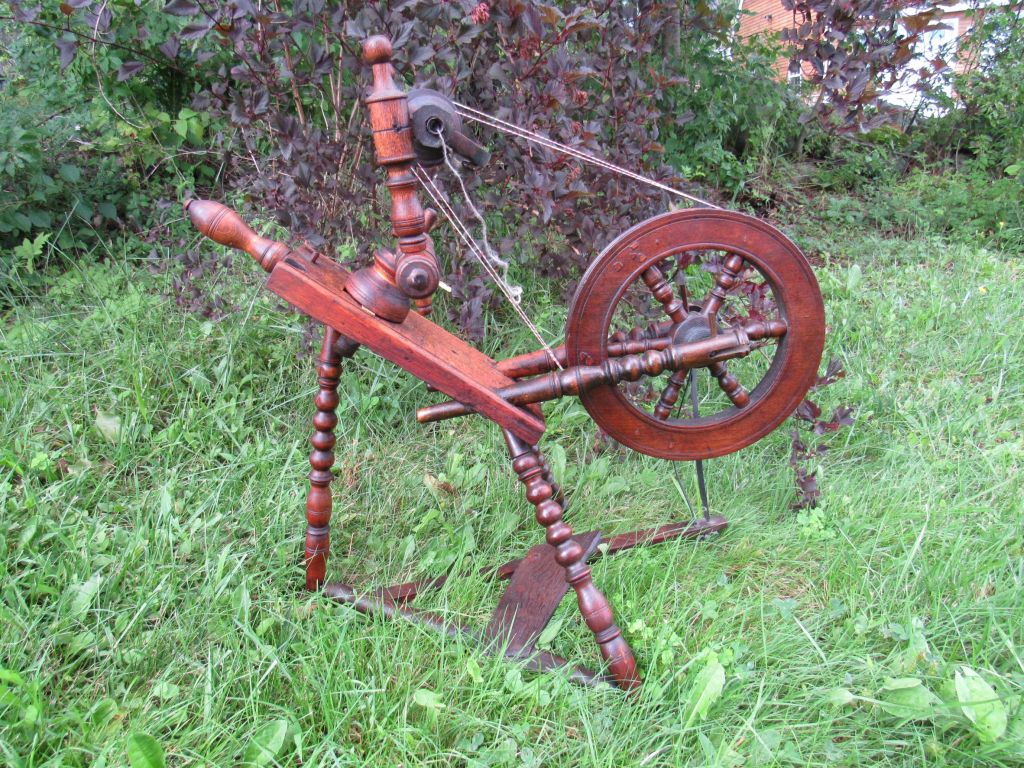
If the wheel in the previous post, Green Linnet, is the oldest I have owned, this wheel, Hermione, is the smallest. 

It is hard to convey just how tiny this wheel is and photos cannot capture how little it weighs. 

Such small wheels are often advertised these days as children’s wheels, which generally is considered an inaccurate description, since apparently children rarely got wheels of their own but learned to spin on full-sized wheels. 

Nevertheless, we do know that there were great wheels scaled down in size for children, so it is entirely possible that some small flax wheels were made for children, also.   

I do not dispute that children’s wheels were a rarity. This wheel probably was intended for and used by adults. But, I like to think that it may have been used, at least at some point in its history, by a child.  Because, if ever a wheel would appeal to a child, this is it.   At less than 24 inches tall, under 5 pounds, and beautifully turned, it would have been a powerful lure for a child to learn to spin. 

And what a good teacher it would have been. The wheel is an excellent, responsive spinner.  Despite its almost toy-like quality, it has a full-sized flyer assembly and spins like a much larger wheel.

Even though the drive wheel is petite, it does not require frantic treadling for a smooth, even uptake, but has a nice, easy rhythm.  The orifice height is 21 ½ inches, only two inches lower than some of my other small flax wheels. 

Its main advantage for an adult user would have been portability and ease of storage.  Its slanted stance gives it a tiny footprint.  Combine that with its feather weight and it can easily travel anywhere and be tucked in a corner or lifted to the top of a wardrobe when not in use.

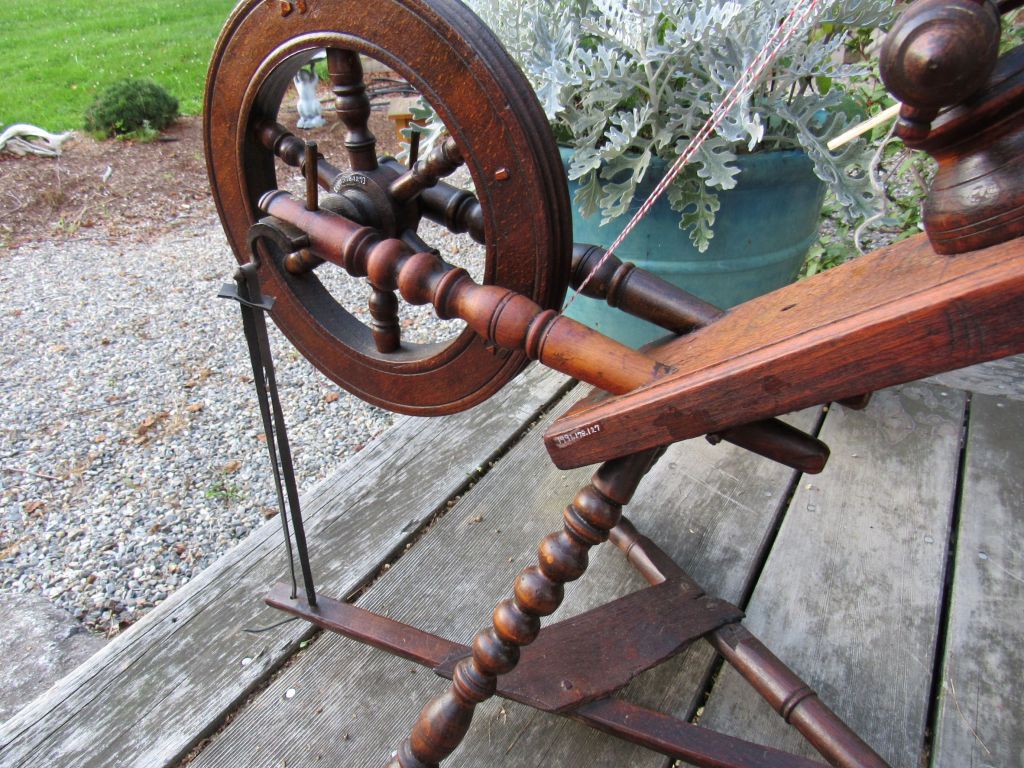
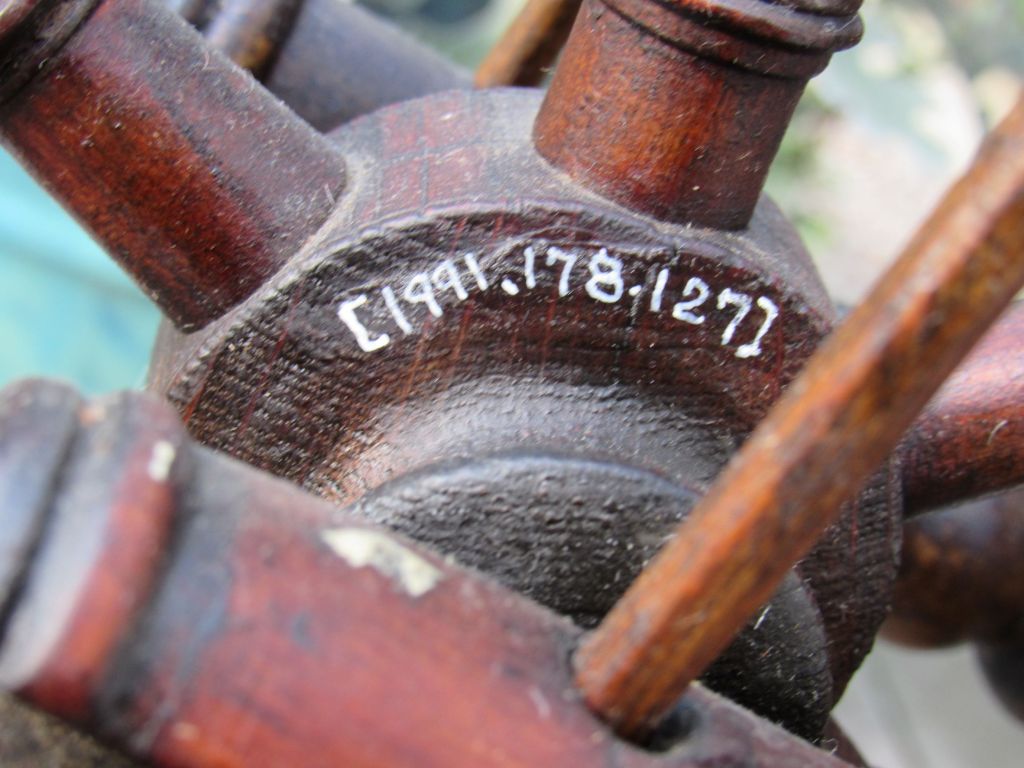
As with several of my wheels, this one was part of Joan Cummer’s collection, auctioned off after the American Textile History Museum closed.  It is Wheel #127 in Cummer’s “A Book of Spinning Wheels,” on pages 274-75

It is hard to pin down the origins of this wheel–in time or place.  According to Cummer, the wheel was thought to have originated in England or northern Europe in the late eighteenth or early nineteenth century.

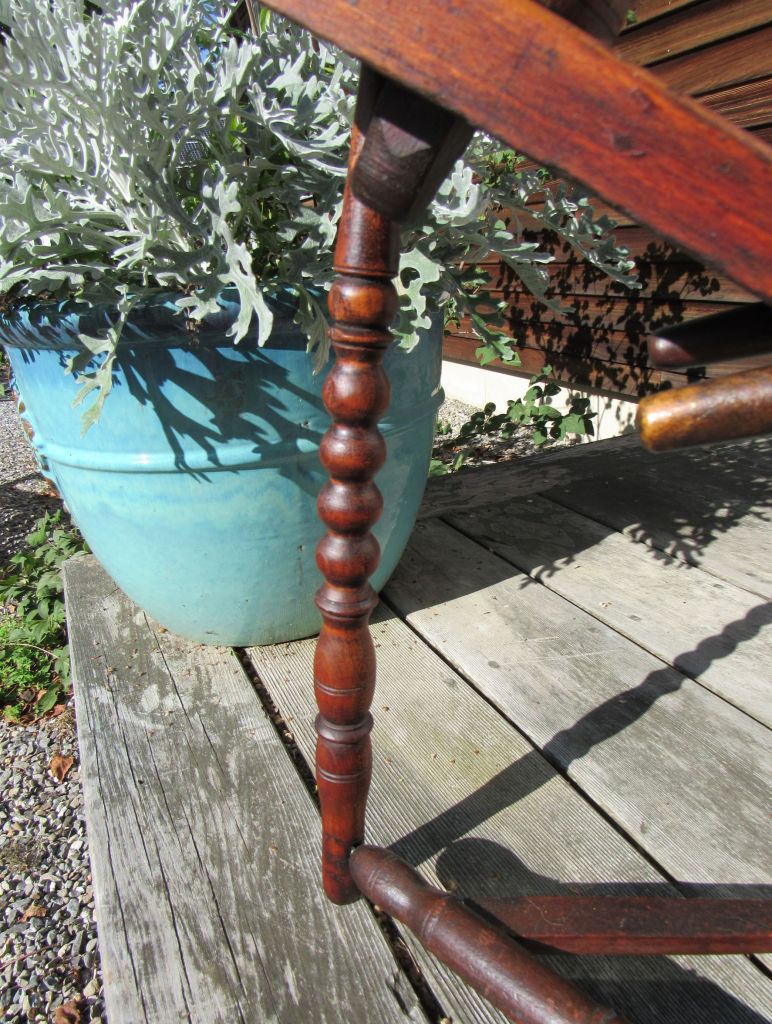
I would love to know how Cummer came to her conclusions. Tiny Saxony-style wheels are most often associated with Germany and eastern Europe and usually are not thought to be as old the eighteenth century. But this wheel does have a bit of a unique style. Based on the series of ball or bead turnings on the legs, Cummer may have compared this wheel to an English wheel made by Richard Arkwright, probably in the middle of the 18th century (for a photo of Arkwright’s wheel see Baines, Spinning Wheels, Spinners & Spinning, p. 124) to conclude that it could be an early English wheel. 

Nevertheless, the turnings are not really much help in accurate dating. Patricia Baines calls such turnings “knob turnery” and notes that it “could suggest the Cromwell period, nearly 100 years before” the estimated date of Arkwright’s wheel, while also noting that it is found on spinning wheels known to have been made in the nineteenth century. (Spinning Wheels, Spinners and Spinning, p. 123).

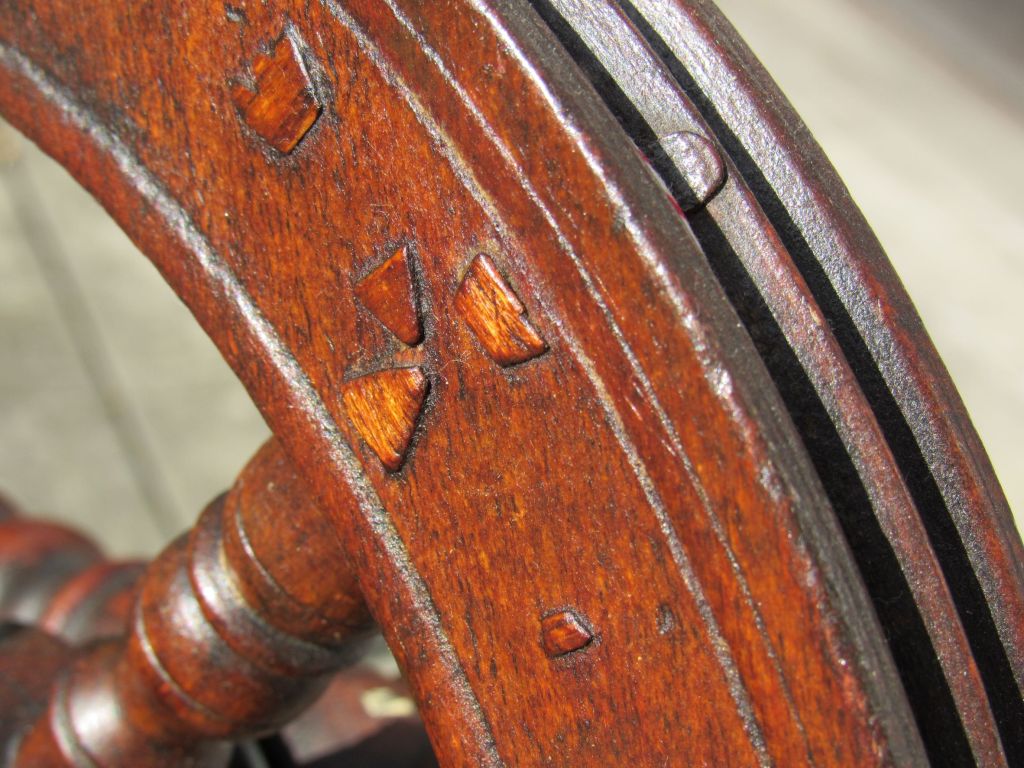
Nor do the turnings help much in determining place of origin. The legs’ series of knobs, balls, or beads (also referred to as “bubble” turnings by some) resemble those found on many Dutch and some German and Scandinavian wheels. Moreover, the drive wheel is scattered with decorations of a type found most commonly on small German and eastern European wheels. 

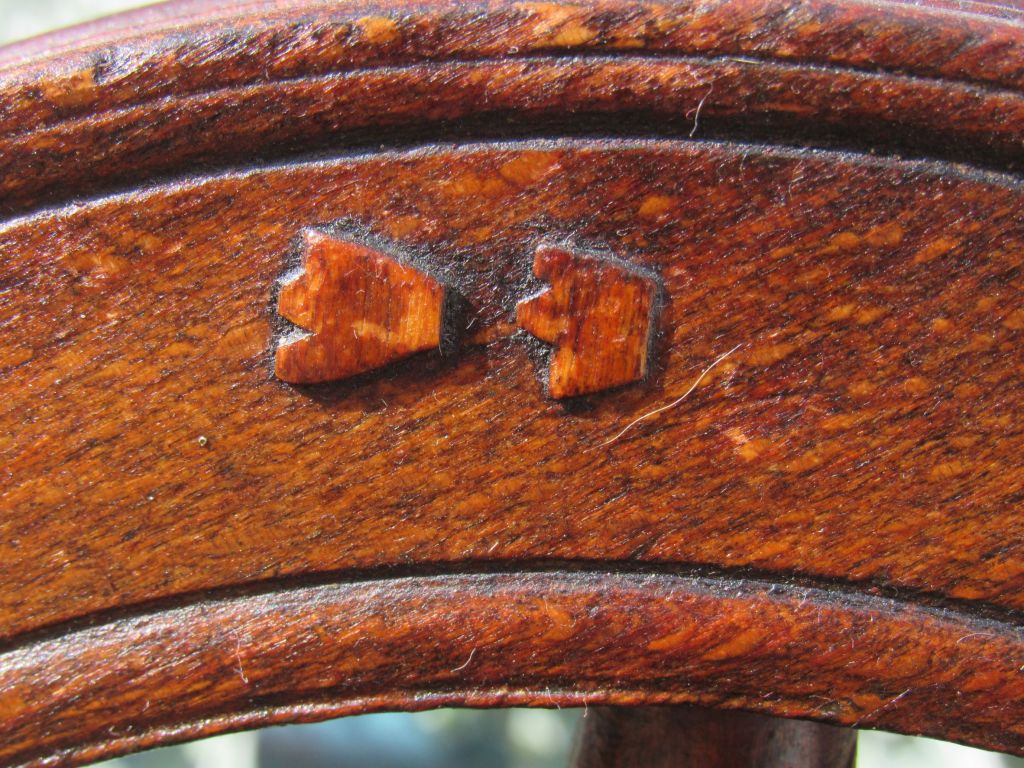
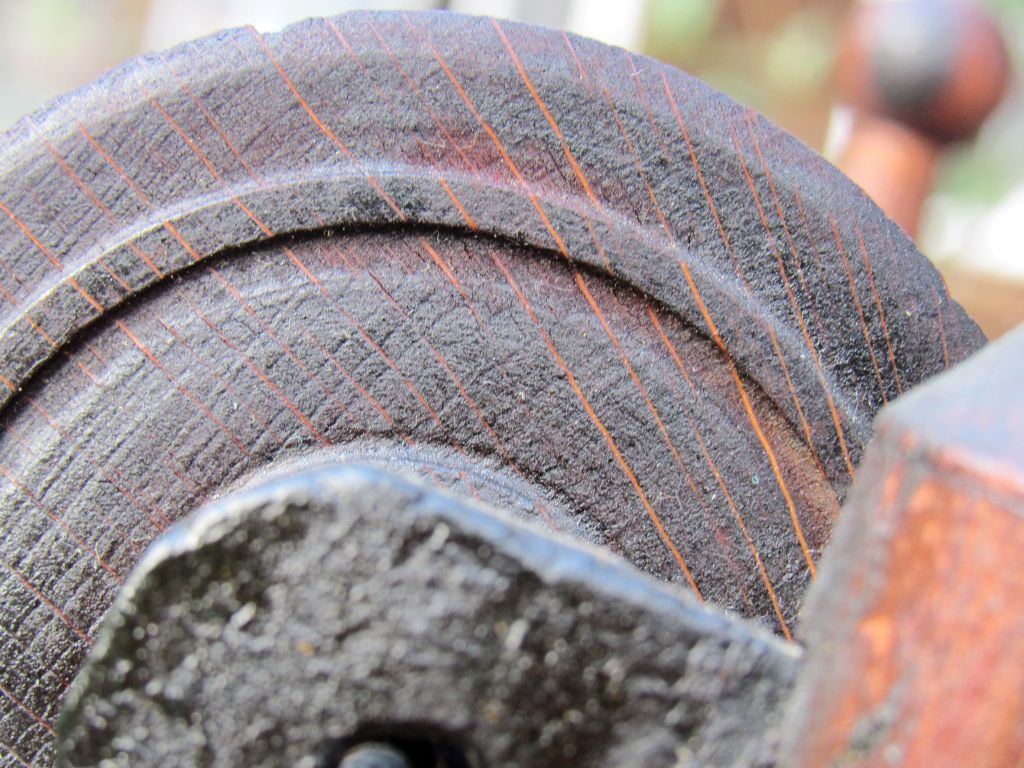
They are raised and appear to have been glued on, many resembling small tulips or crowns. 

Another interesting feature is the drive wheel construction. 

It is made from one piece of wood, with no joins, and the pegs for the spokes are driven directly, straight down, through the middle of the rim.  I don’t know whether this construction is indicative of a certain region.

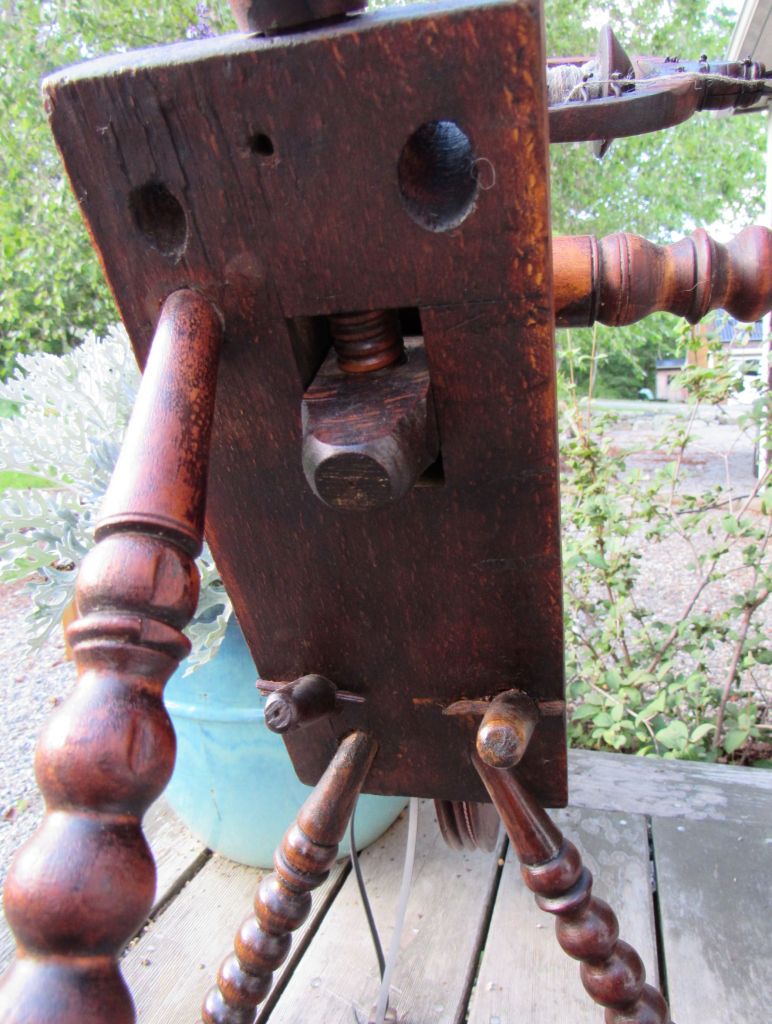
But, we can tell that the wheel likely came from a flax-spinning region. As Cummer notes, there are two holes in the table–one for a distaff and the other for a water vessel for flax spinning.  

The wheel is versatile, however, with an orifice and bobbin large enough for spinning wool as well as flax. 

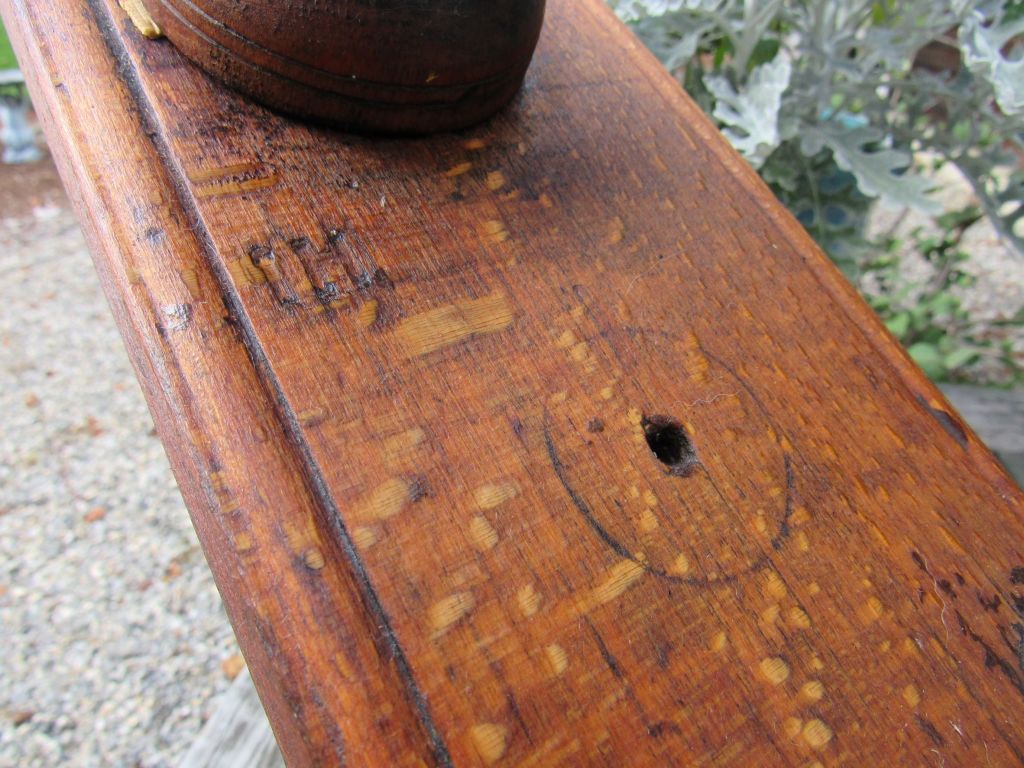
The table also has a small hole with a circular mark that likely had a decorative medallion at some point, another feature sometimes found on German wheels and other European wheels. 

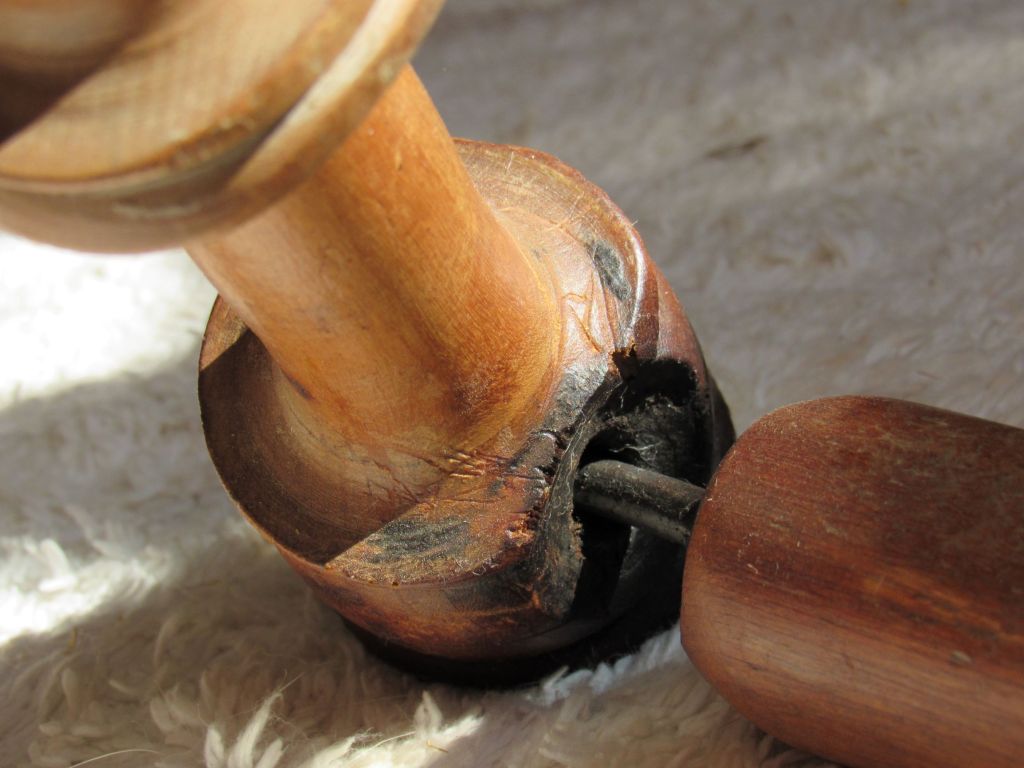
Although its origins likely will never be pinned down, it is a delightful wheel and was easy to bring back to life. When I bought it, the footman was a broken thin leather strap that had been doubled up.  It was stiff, severely cracked with age, and falling apart, so I replaced it with new leather in the same design.  

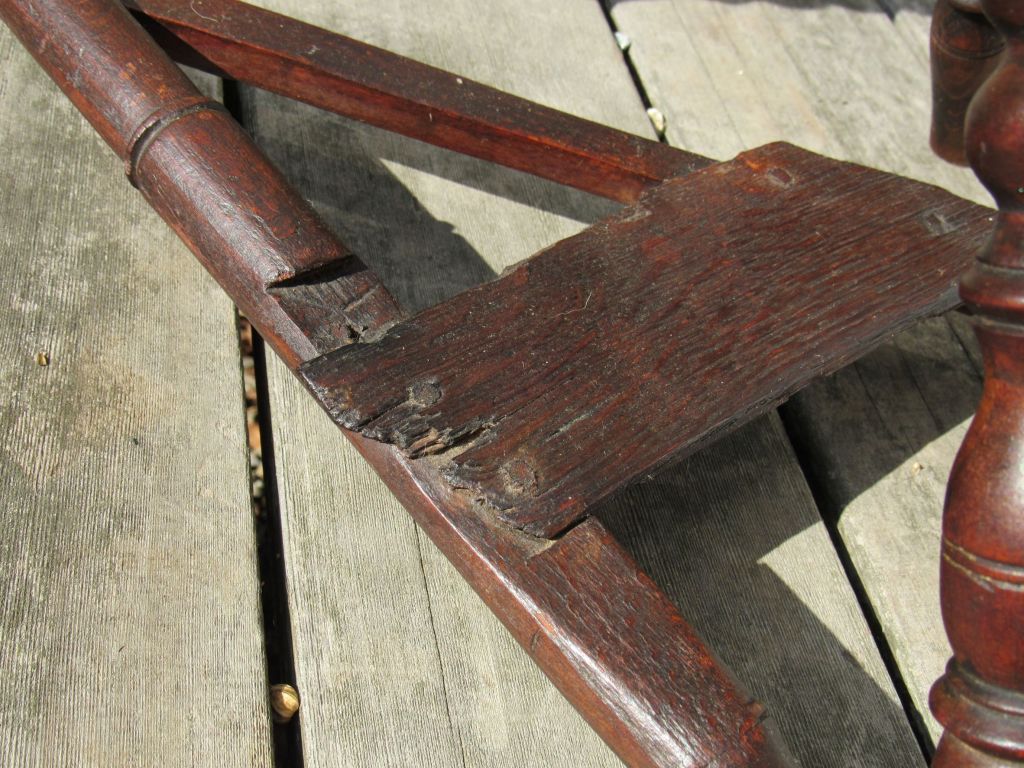
The treadle has seen a lot of wear and one edge is partly broken off.  

I originally thought that the bobbin was a replacement because it comes well short of taking up its allotted space on the mandrel. 

But its wood appears to match that of the spindle whorl and the hub, all of which have eye-catching reddish grain rings.    

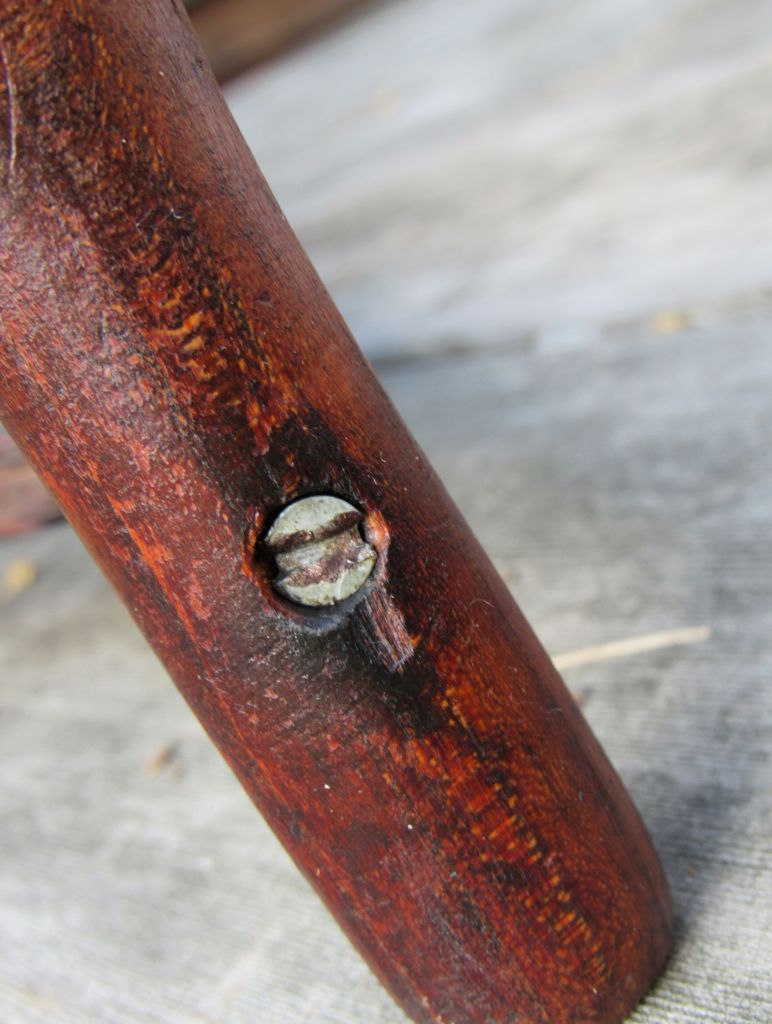
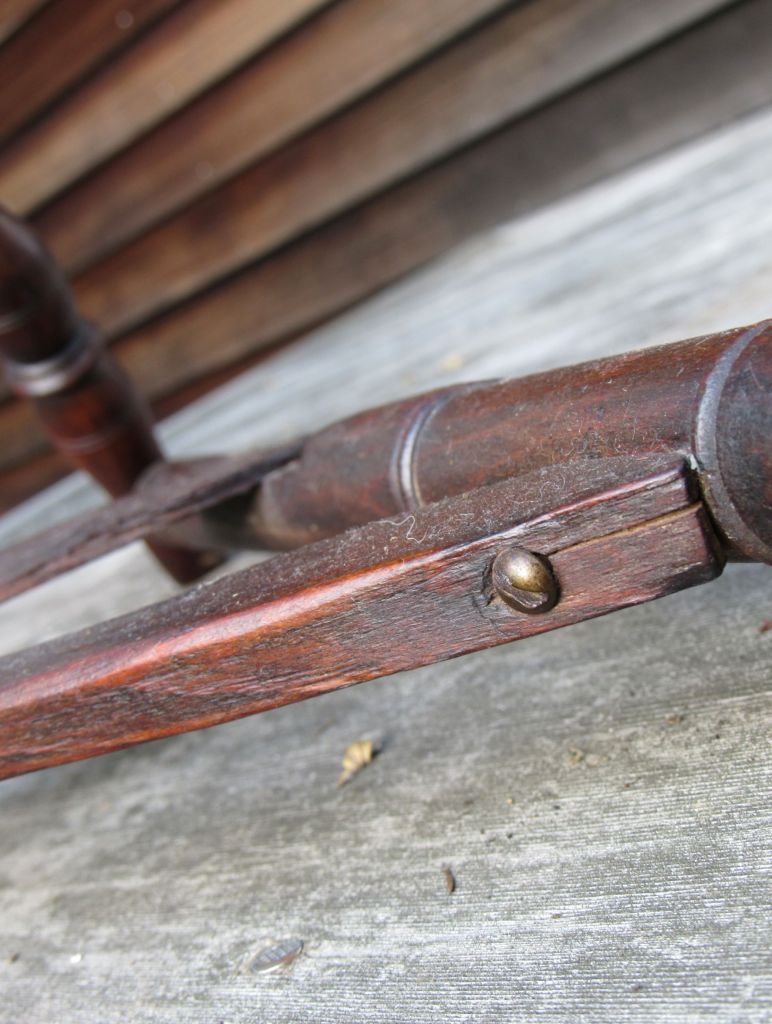
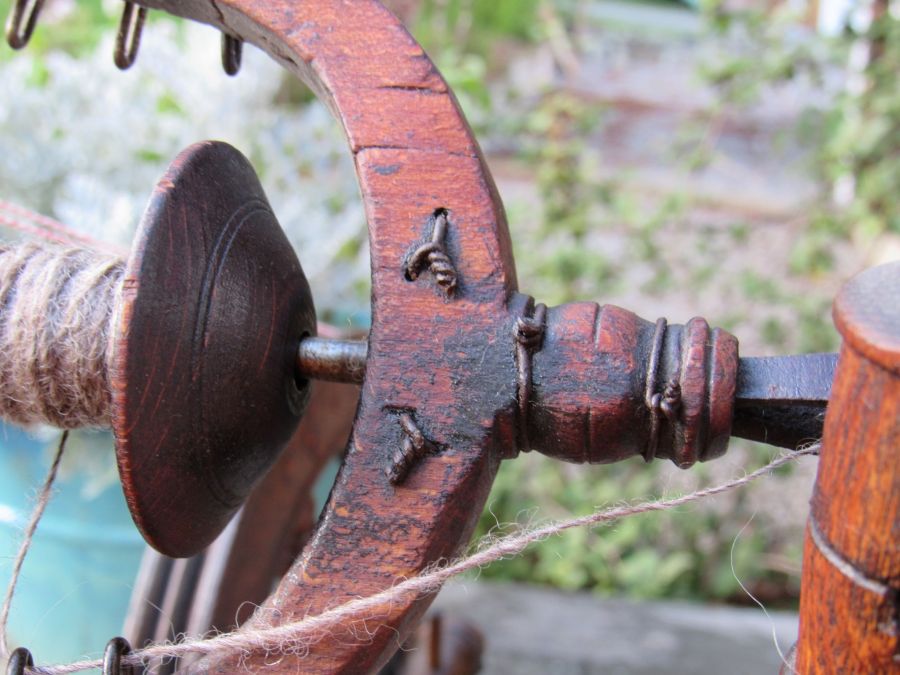
It is apparent that the wheel was well-used and valued for its sweet spinning because of the careful repairs. Screws have been added in strategic places

But the most interesting repairs are to the flyer assembly. 

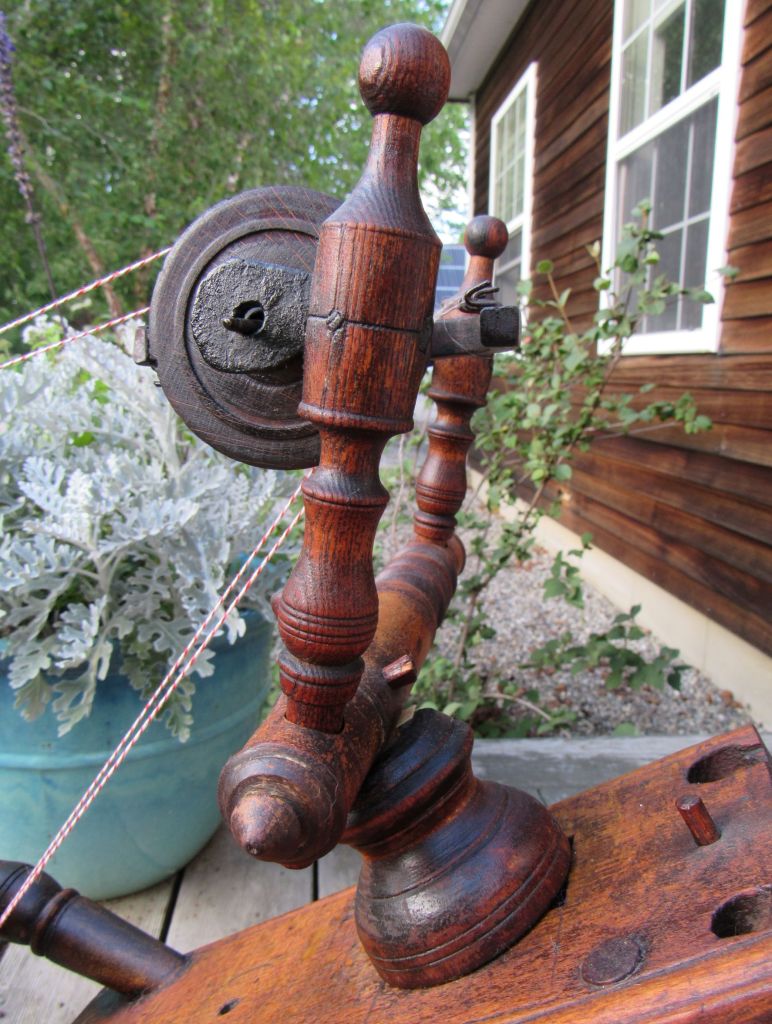
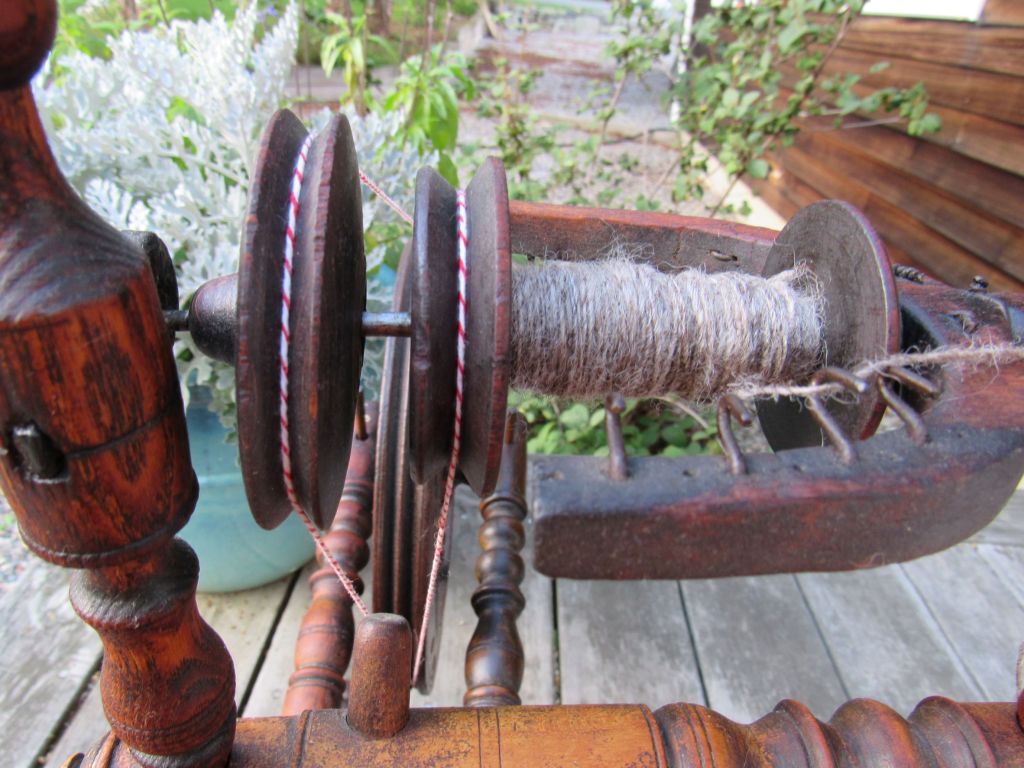
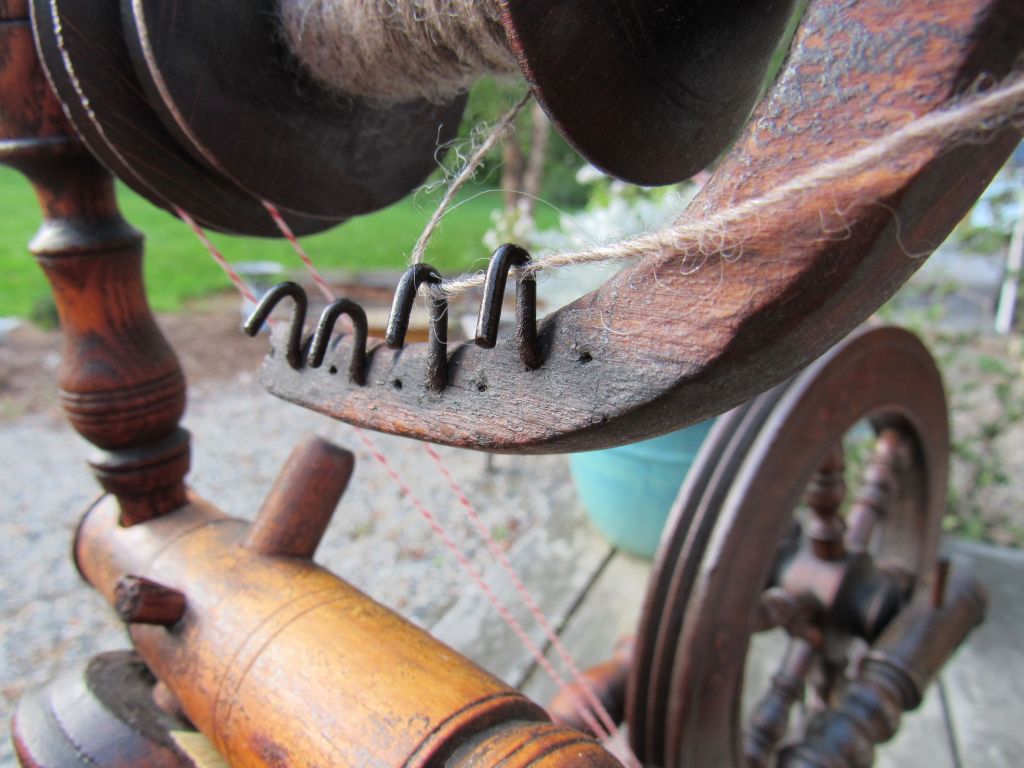
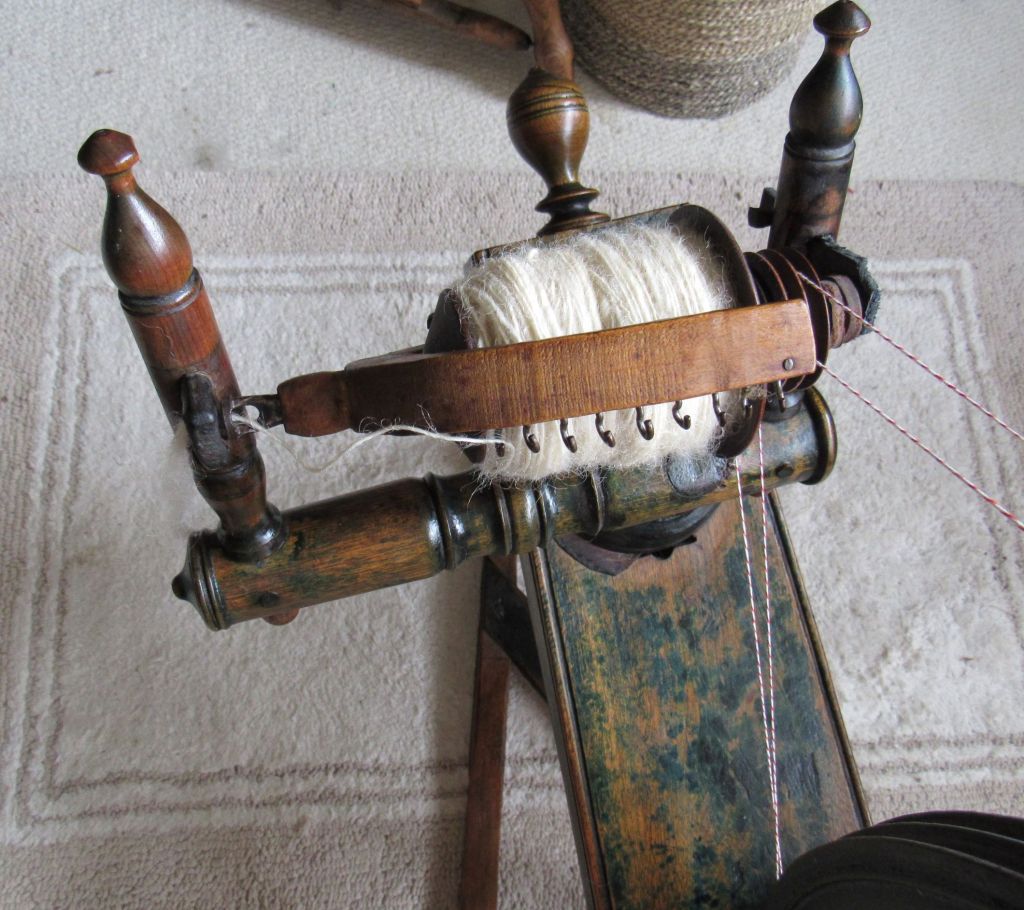
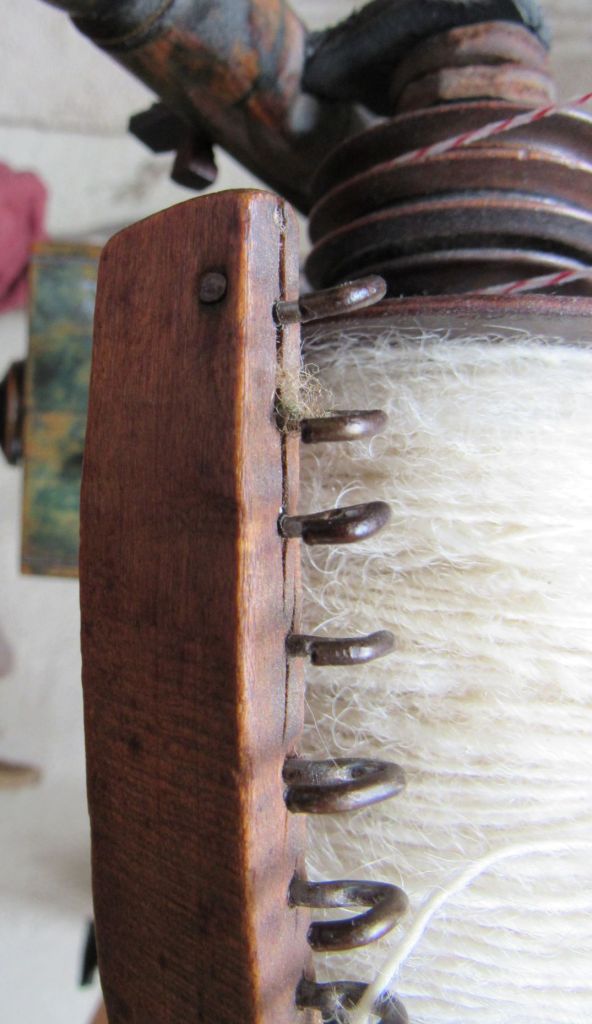
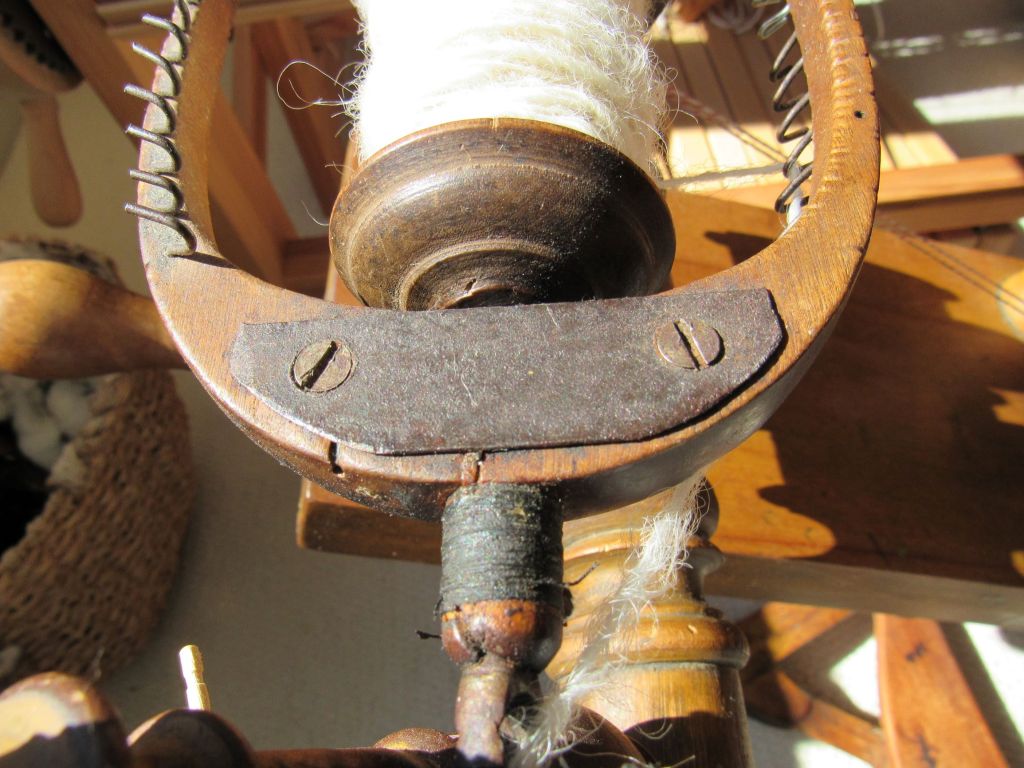
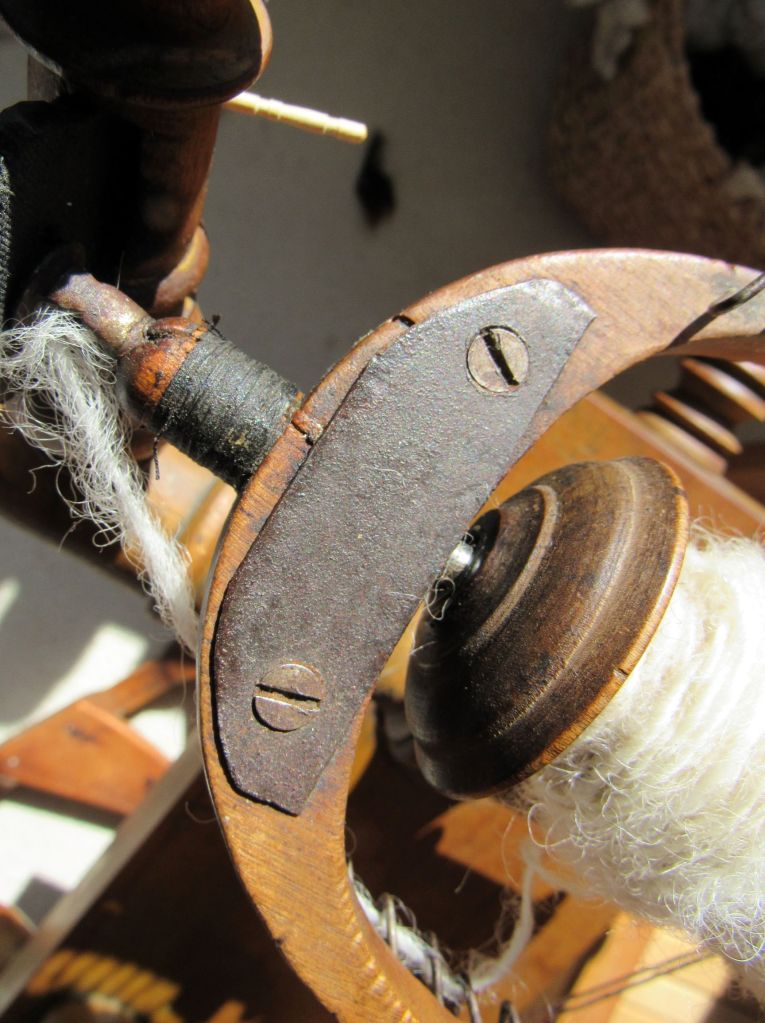
The flyer hooks apparently are replacements, set into holes adjacent to the originals. 

And, at some point, the flyer was pretty well shattered,

with a break down the center and a broken arm. 

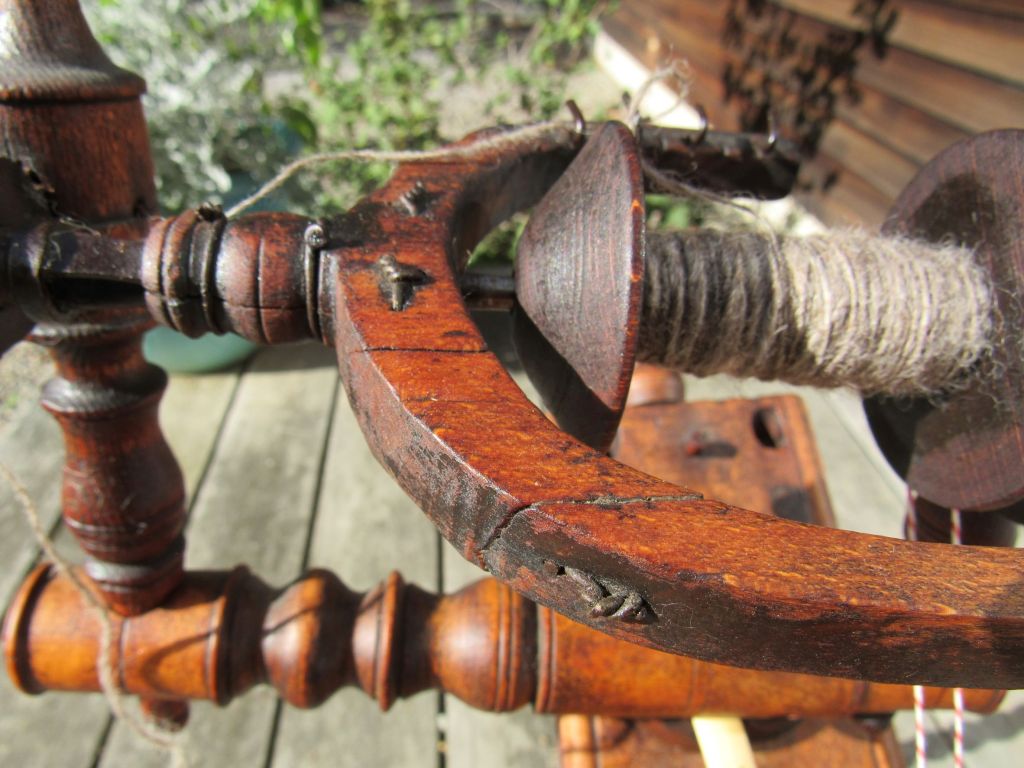
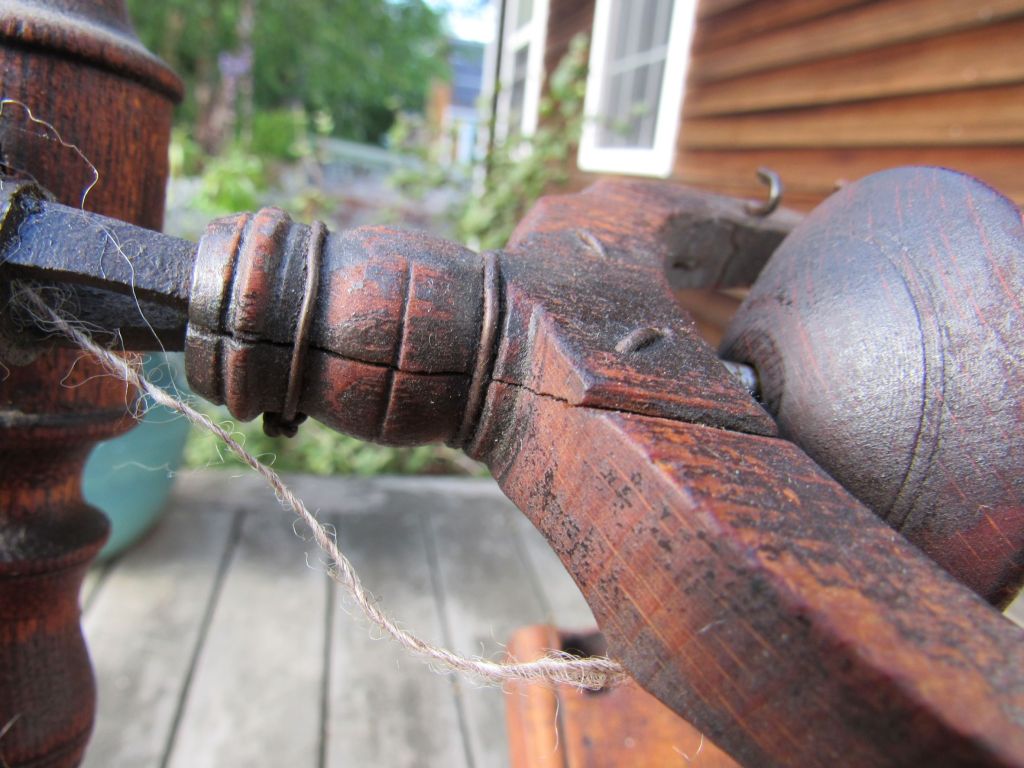
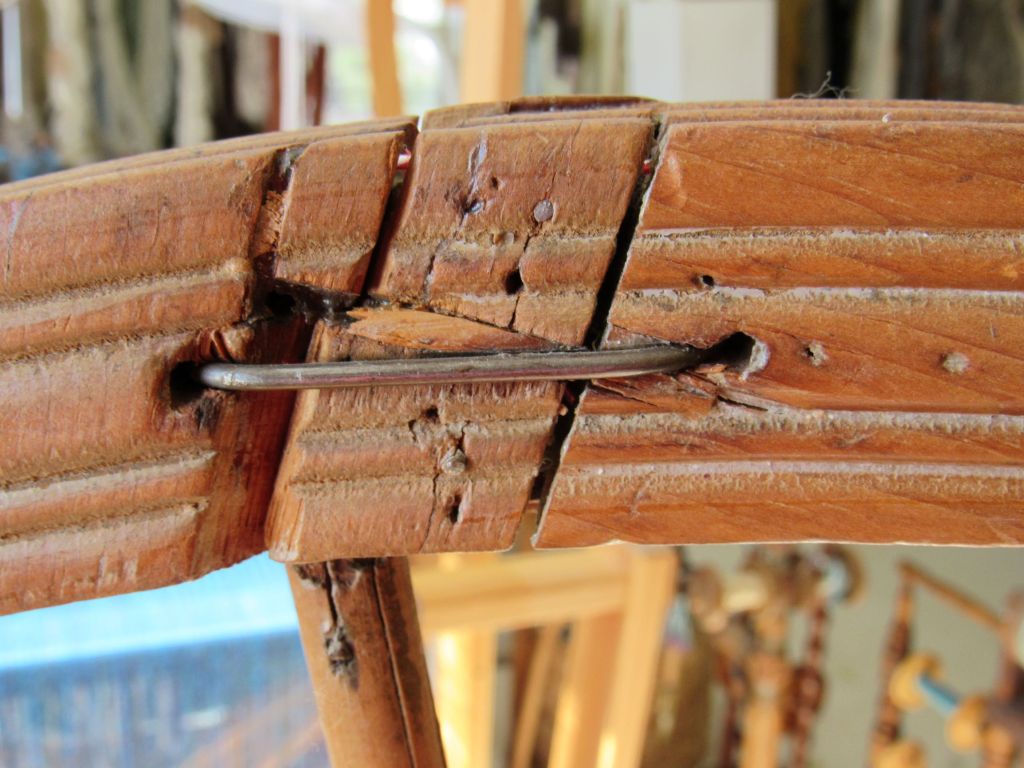
The breaks are neatly repaired with wire,

doubled through and tightly wrapped. 

The arm break also appears to have a small nail as back up. 

Years of usage grime have settled in around the wires, indicating the flyer repair is an old one. Such a thorough and effective repair speaks eloquently for someone’s desire to keep this wheel spinning. 

I hope that whoever it was would be satisfied and content to know that it is spinning still. 

February 2022 update: I just read “Silas Marner, The Weaver of Raveloe,” written by George Eliot (Mary Anne Evans) in 1860 about a linen weaver working in England at the end of the 18th and early 19th century. The first line of the book starts with: “In the days when the spinning-wheels hummed busily in the farmhouses–and even great ladies, clothed in silk and threadlace, had their toy spinning-wheels of polished oak …” Perhaps wheels such as Hermione were such “toy” wheels, ornamenting the houses of those who really did not need to use them except for casual spinning.

For further reference see:

Baines, Patricia, Spinning Wheels, Spinners & Spinning, Anchor Press Ltd, London, 1977, pp. 123-25.

Cummer, Joan, A Book of Spinning Wheels, Peter E. Randall, Portsmouth, N.H. 1984, pp. 274-75.

Green Linnet

This is an old wheel.  It was part of Joan Cummer’s collection, auctioned off when Lowell’s American Textile History Museum closed.  I was the only person to bid on this wheel at the auction and bought it because Cummer believed it to be the oldest wheel in her collection. 

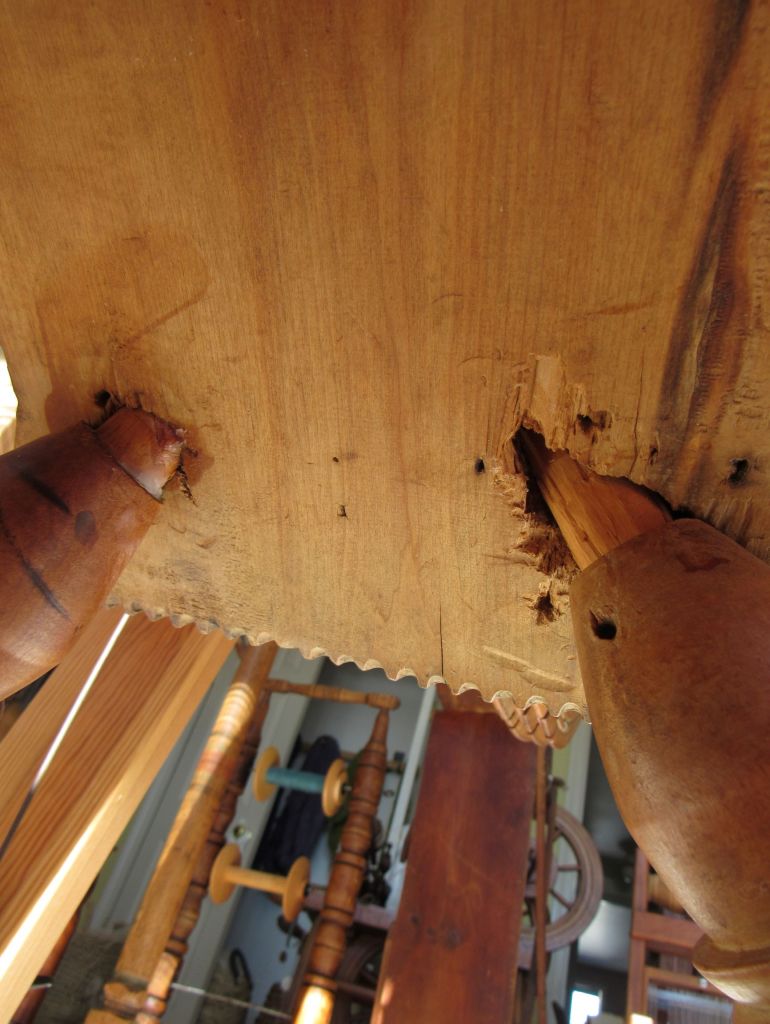
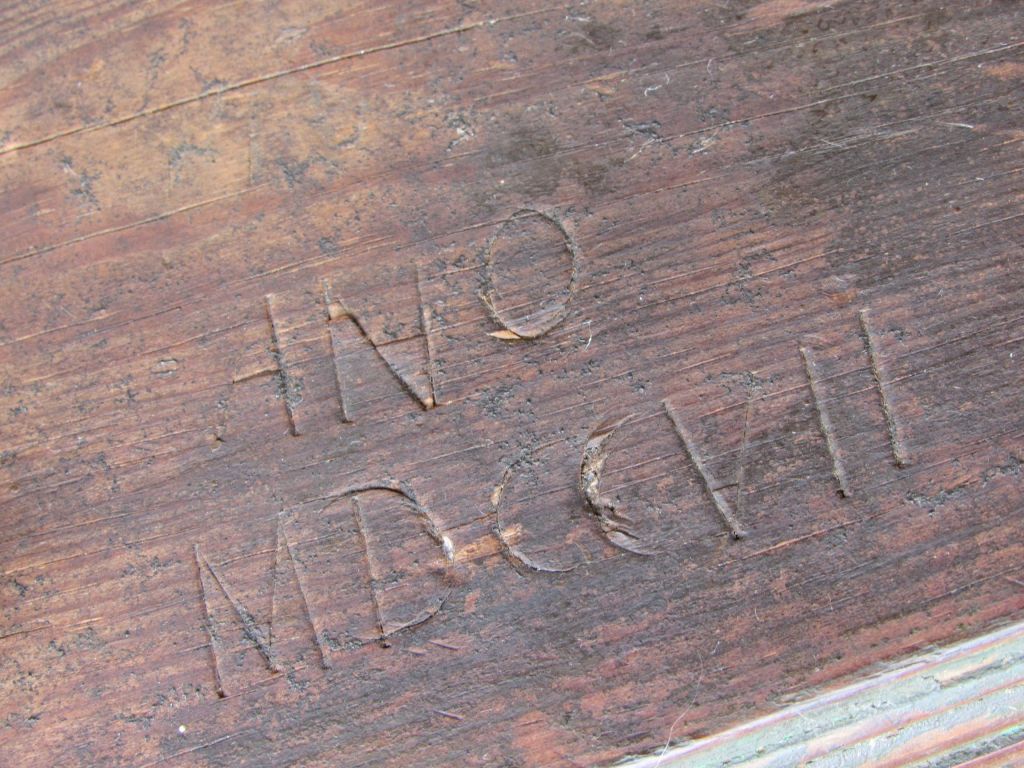
The underside of the table has a carved date in Roman Numerals of 1707, and the same date is faintly inscribed on the table’s side. 

The wheel is No. 29 in Cummer’s collection and, in her description, she did not question the date, noting that it was compatible with the wheel’s William and Mary turnings. 

According to Cummer, the wheel was believed to have been brought to New England from England. 

I do not know if the wheel is really that old or if it was from England—it has some Scandinavian-style features.

Unfortunately, we do not have many surviving wheels from the early 18th century for comparison and I have not been able to find any similar wheels in paintings. 

I like to think it is over three hundred years old. 

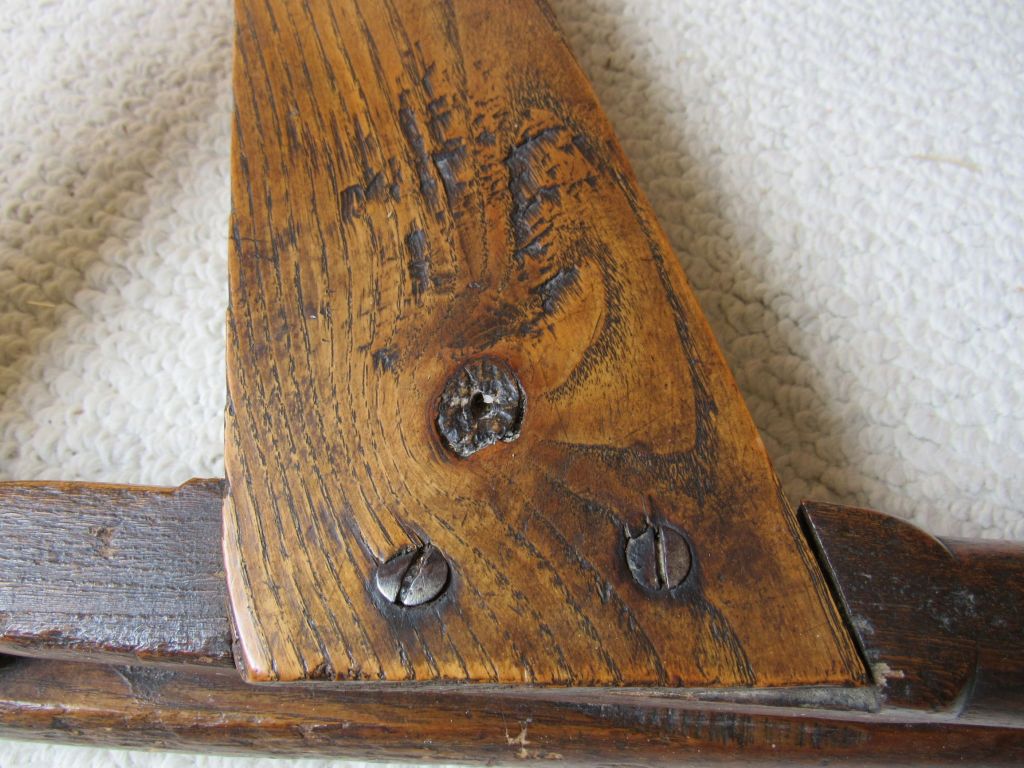
Knotted wood on the inside of one leg

But, even if not quite that old, it has been through a lot. 

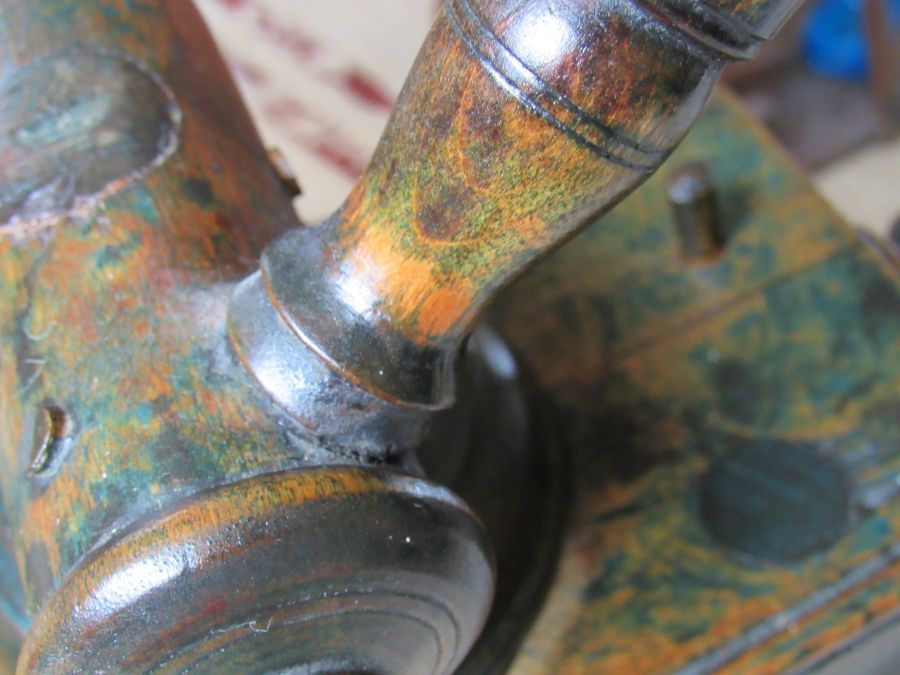
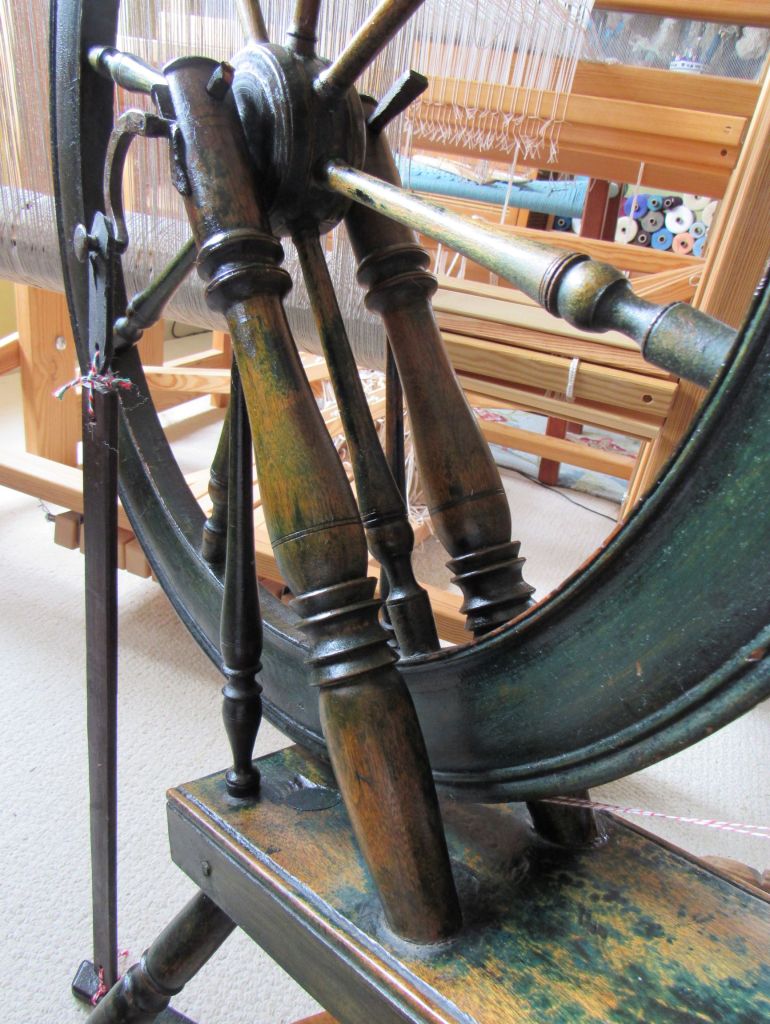
As Cummer commented, there seems to be at least one layer of green paint that, while old, is not original. 

The wood that shines through is a beautifully grained reddish color. 

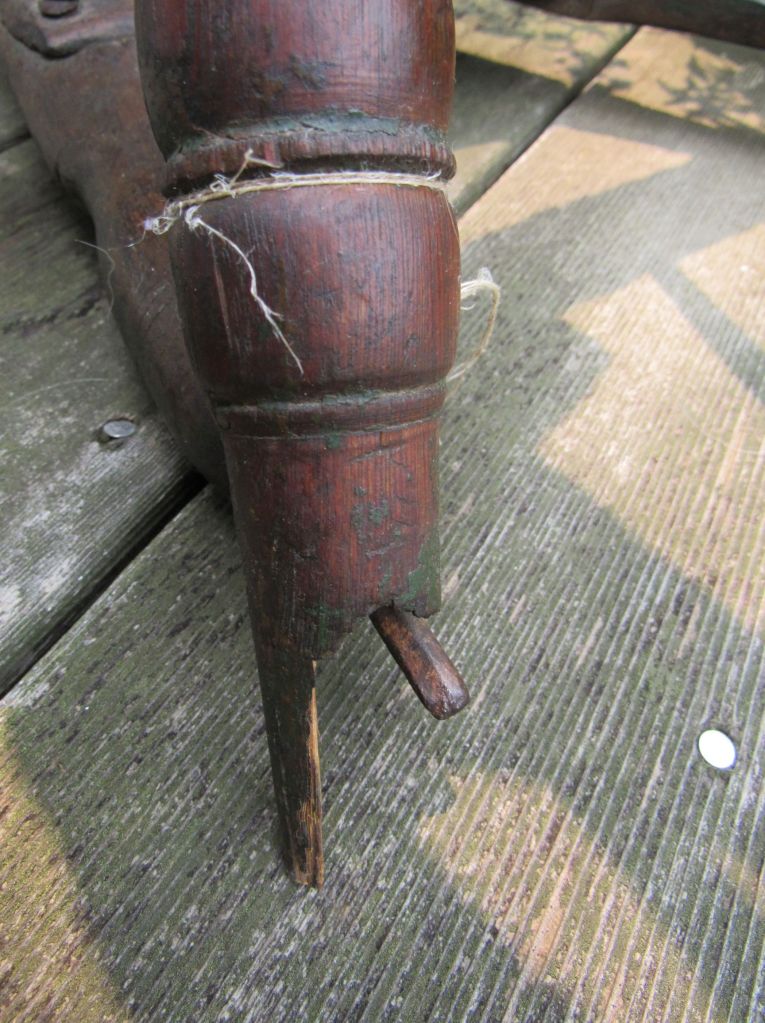
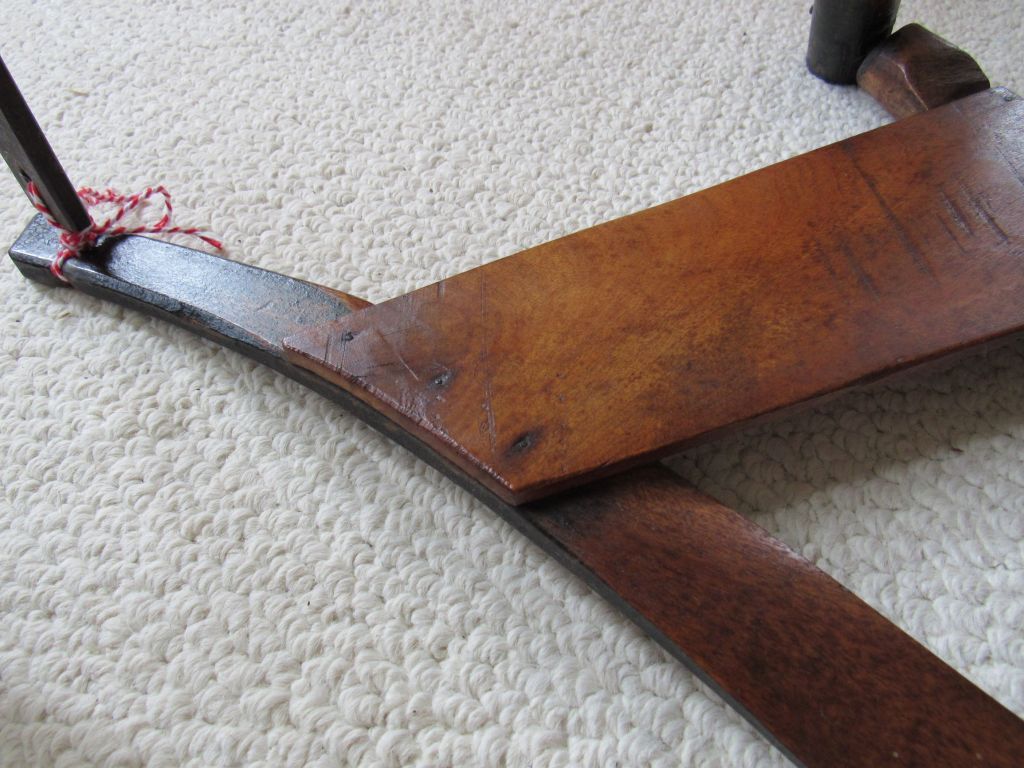
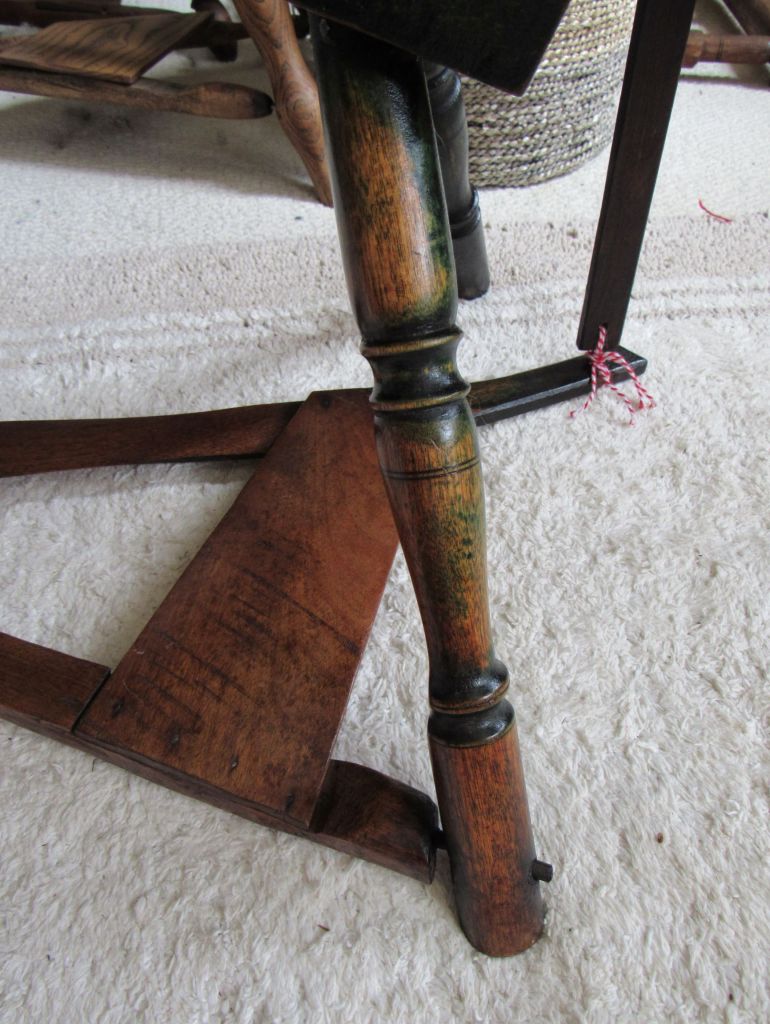
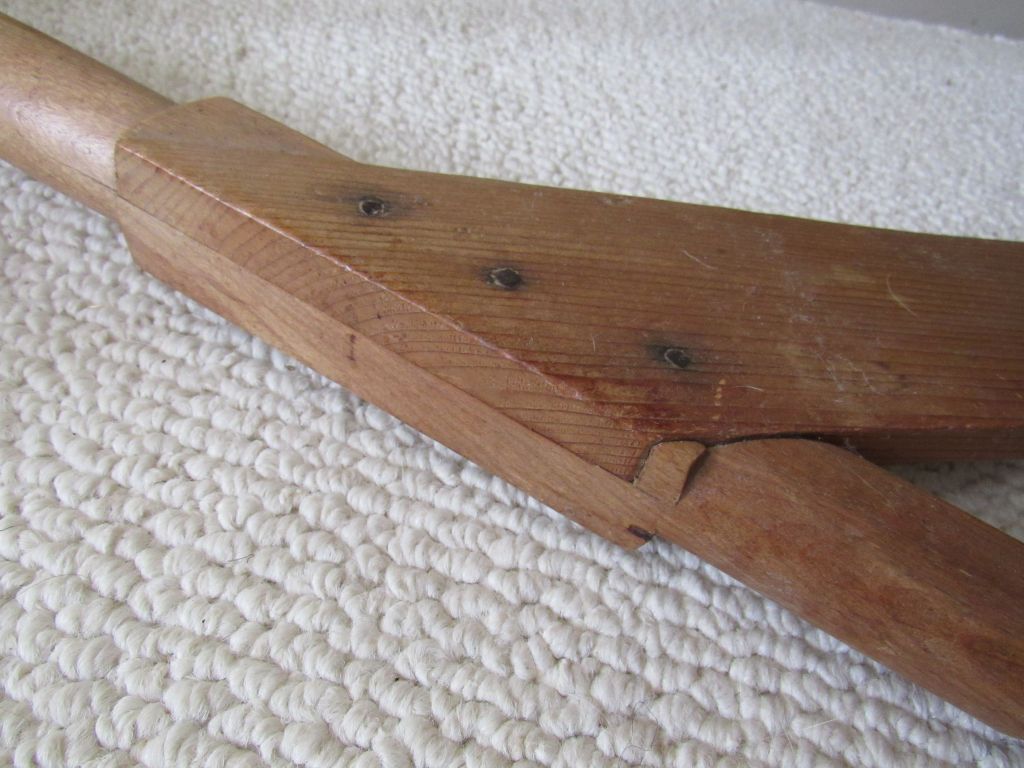
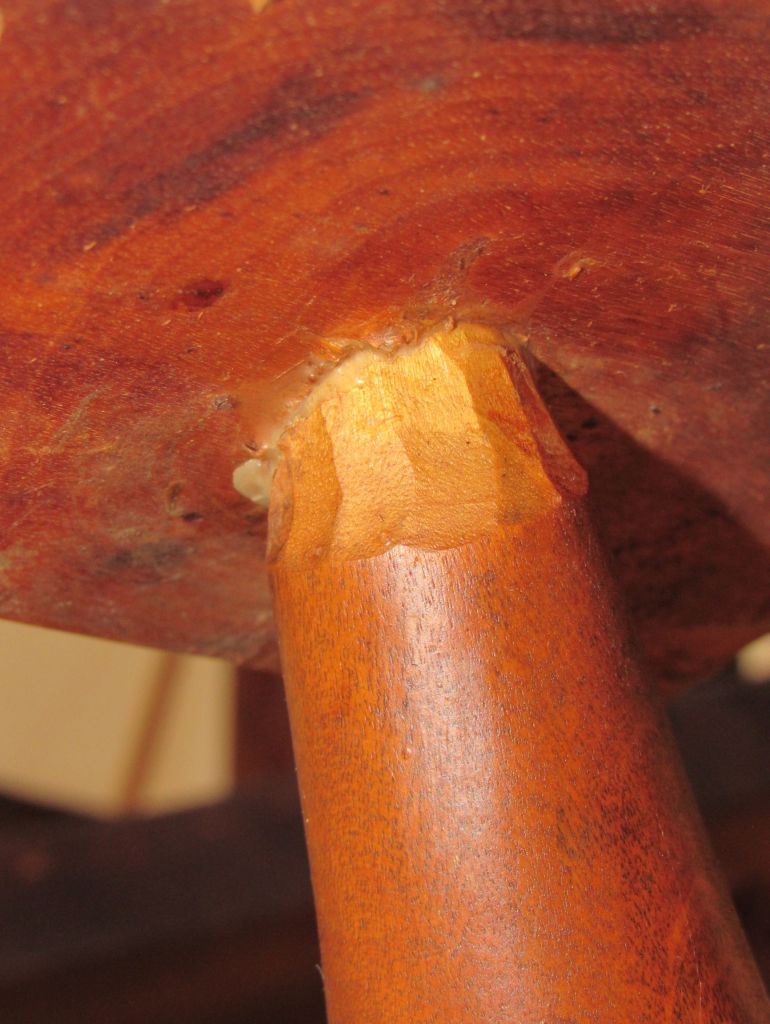
The two secondary upright supports rise from the legs and fall out at the slightest jiggle. One foot is completely broken out where the treadle bar rod was inserted. 

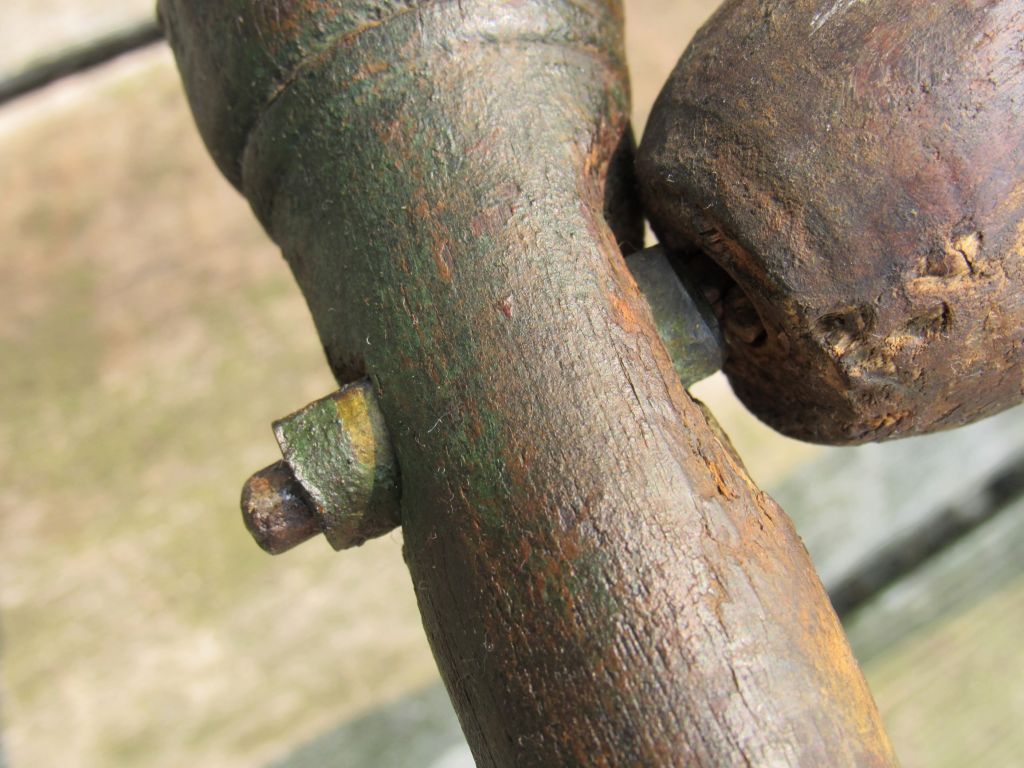
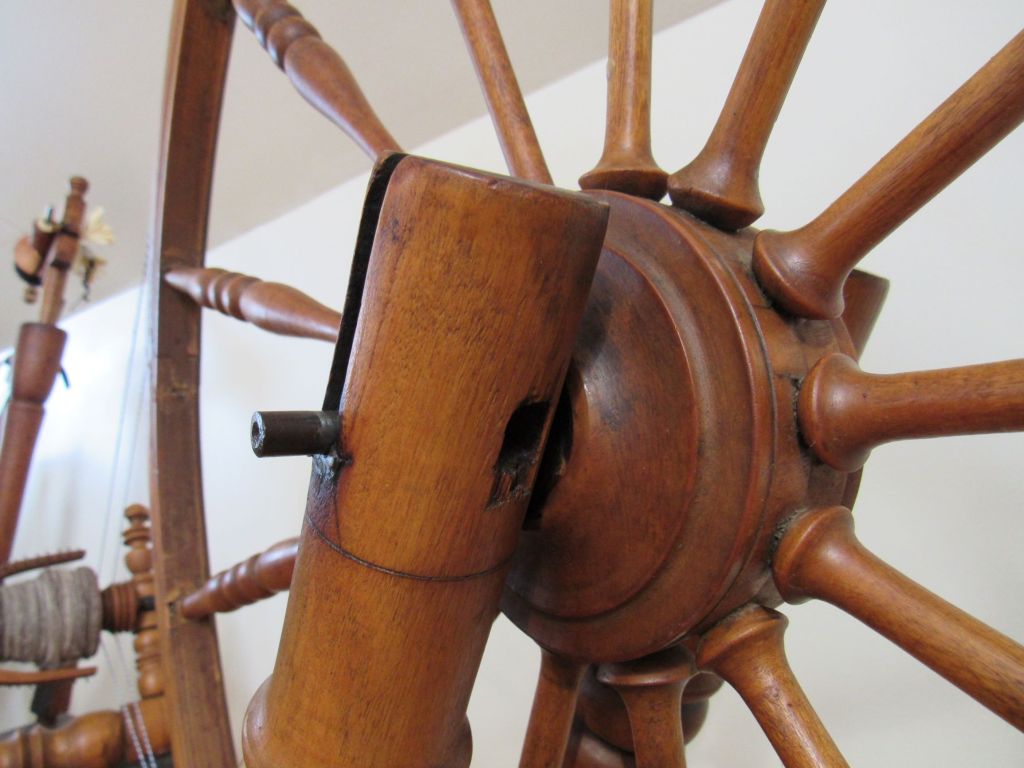
In the leg at the other end, the bar is supported by a metal tube inserted through the wood.

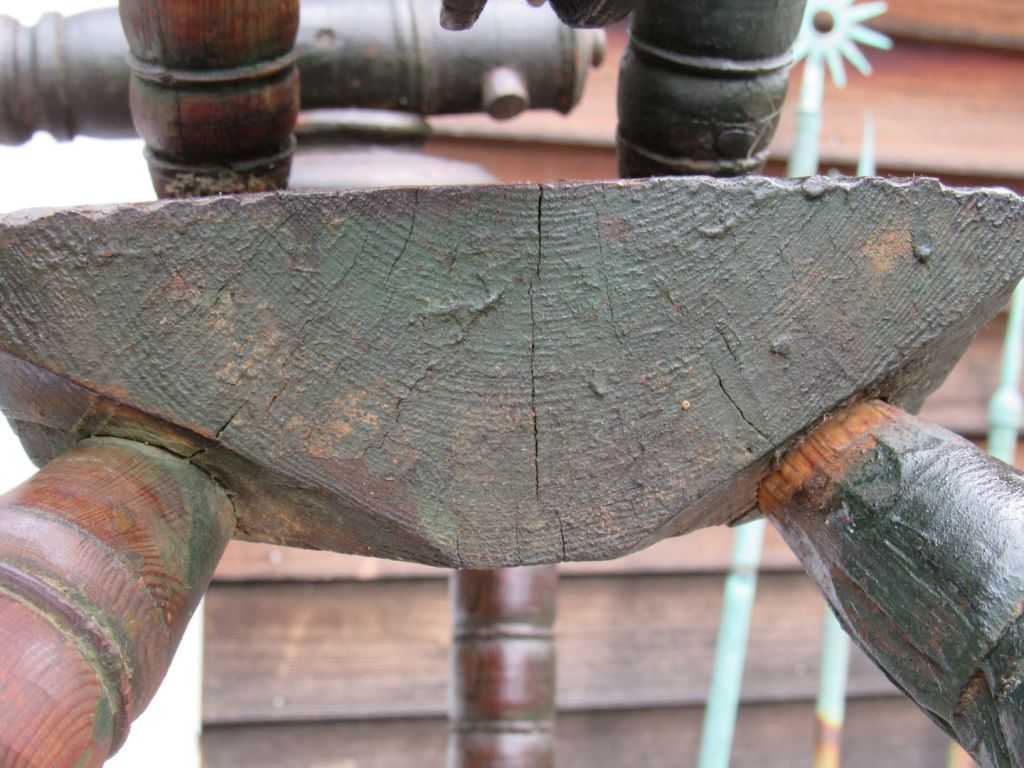
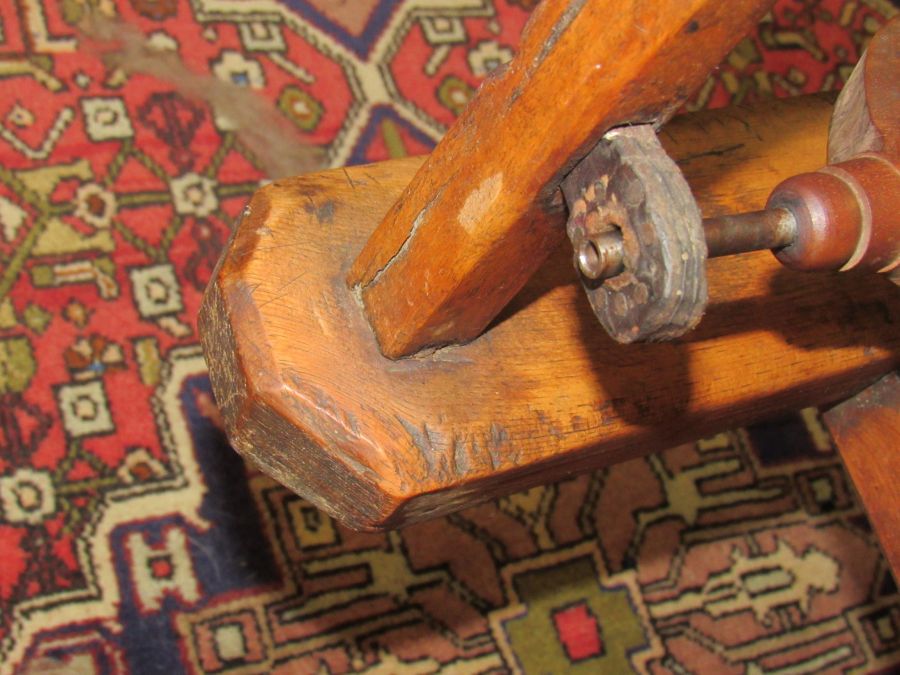
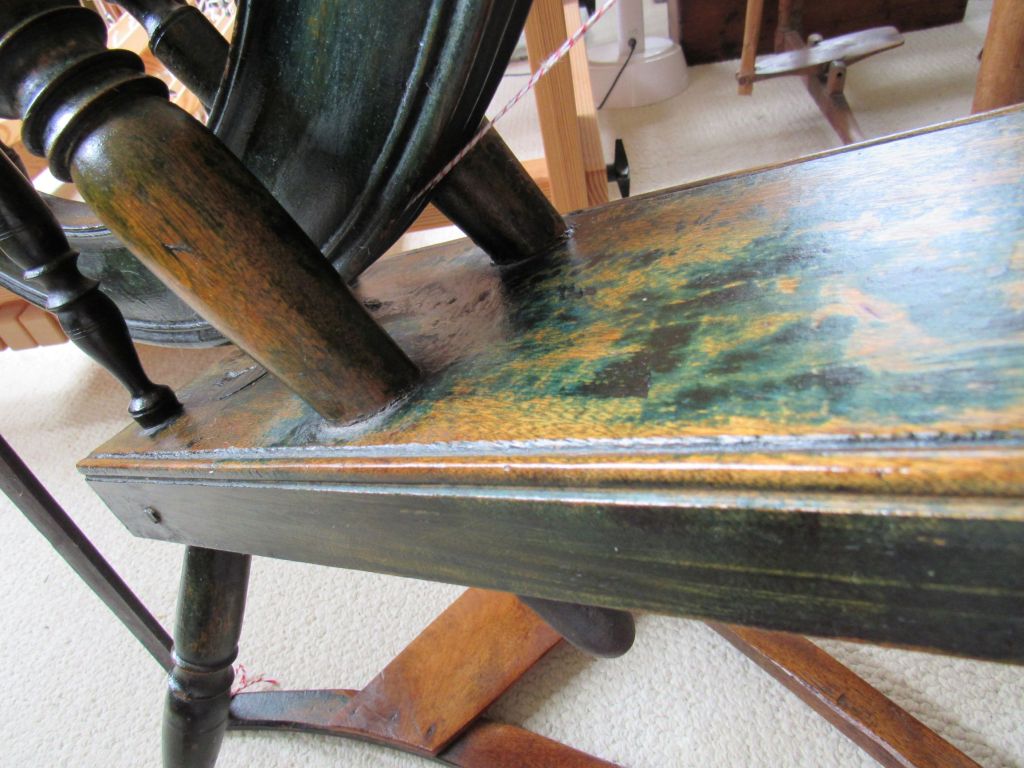
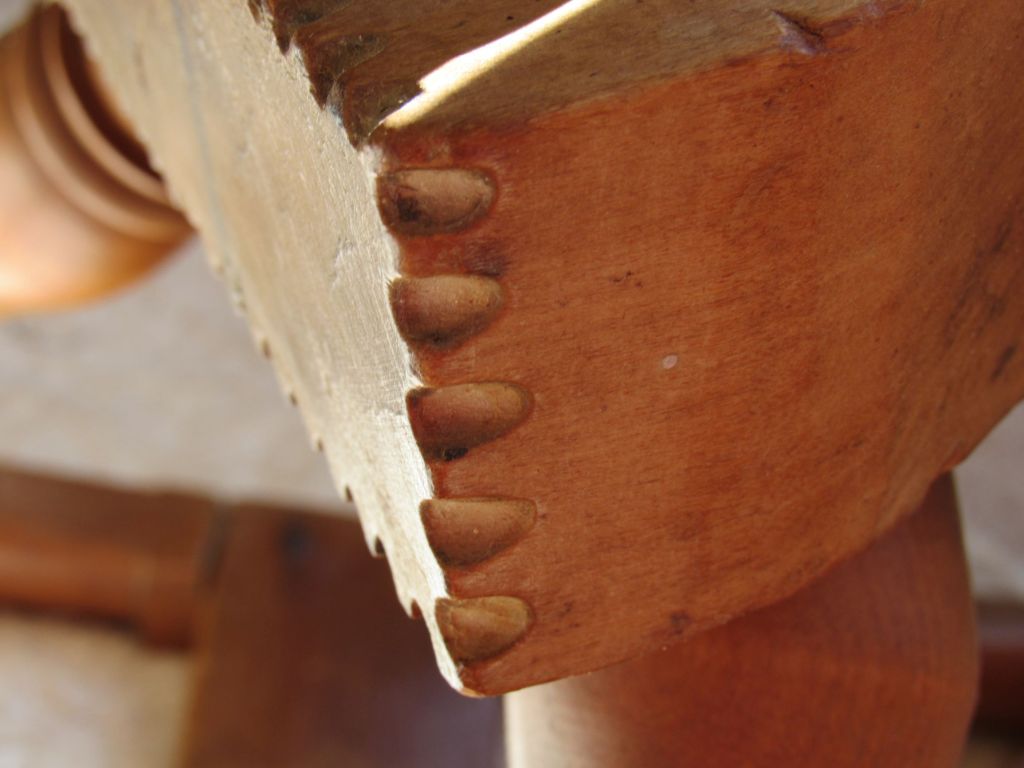
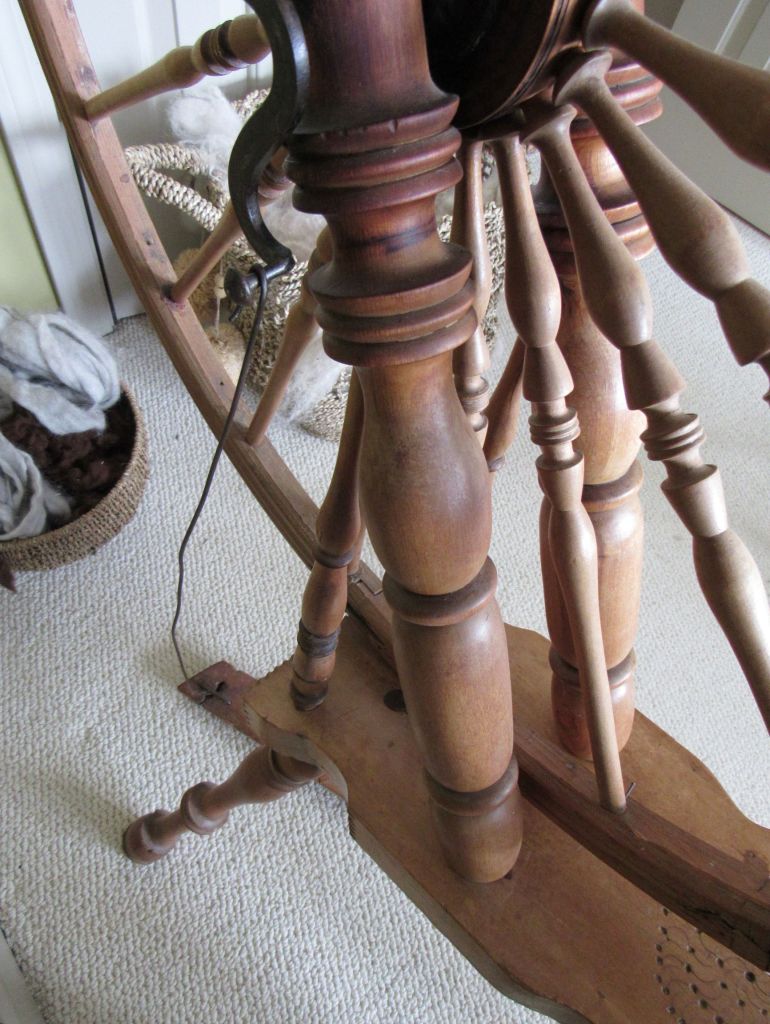
The wheel’s slanty stance is a result of the legs being inserted into angular cuts on the table’s downhill side. 

The circular tree rings are visible on the end of the table. 

The axle is held in place with a large screwed wooden pin,

although the back one is missing.  There are carvings on the table

and at both ends,

a distaff hole,

and multiple grooves down the sides. 

The treadle bars are thick and give plenty of support for two footed treadling. Yet, they are graceful, too. The treadle is now attached with large screws.

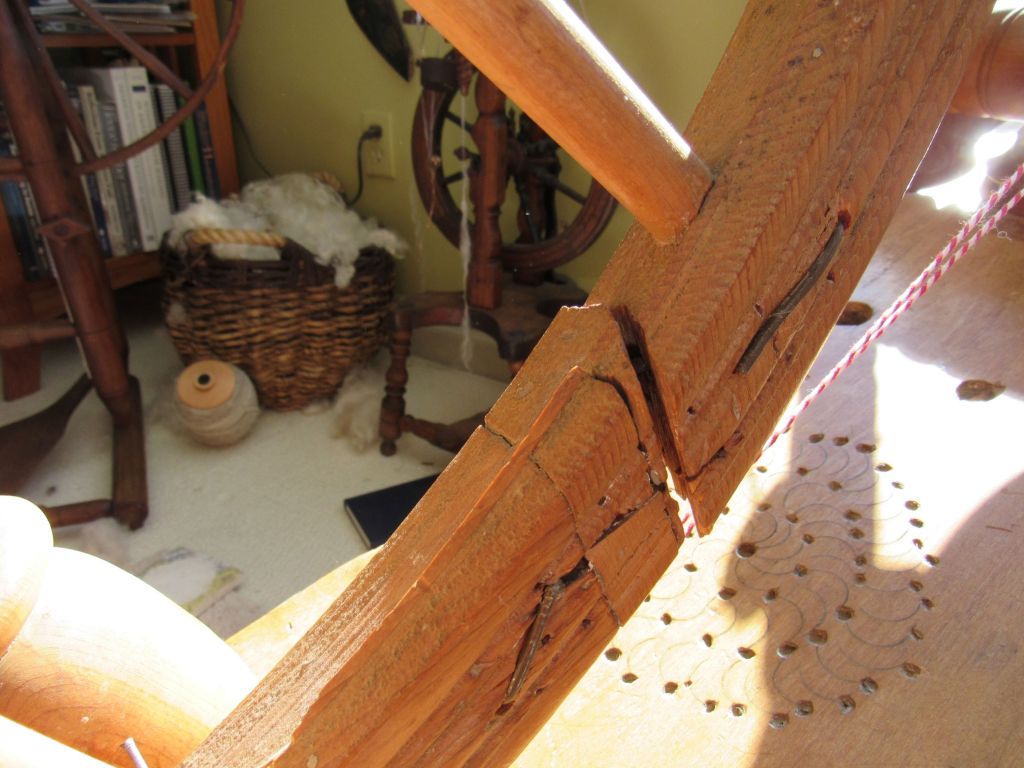
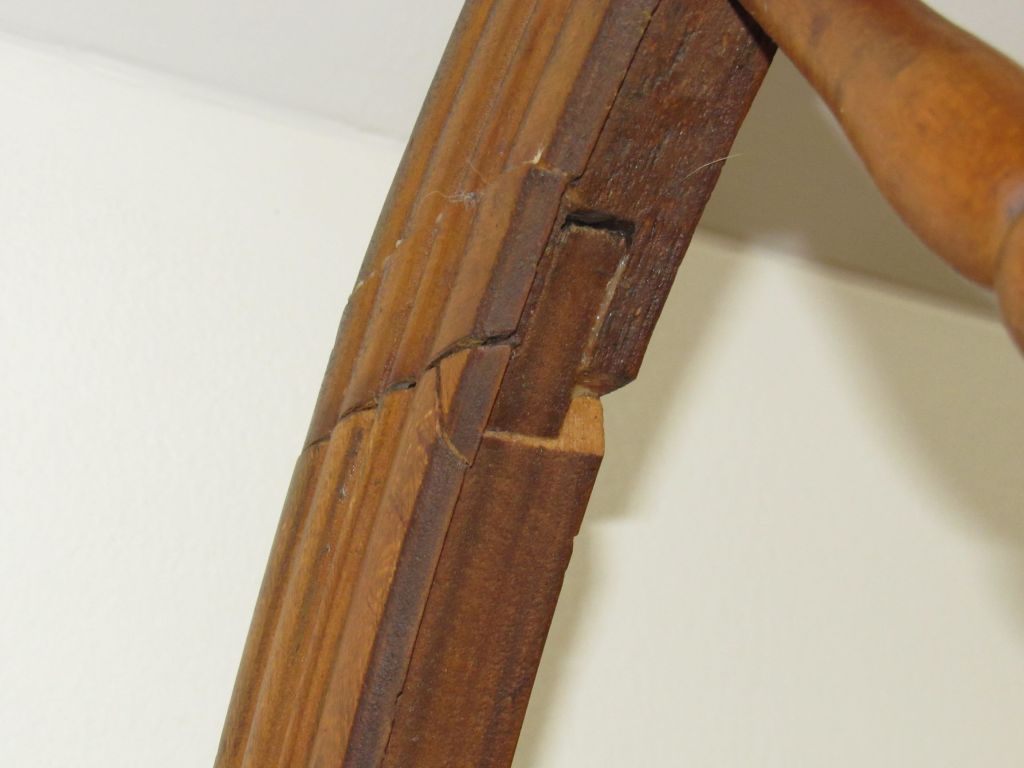
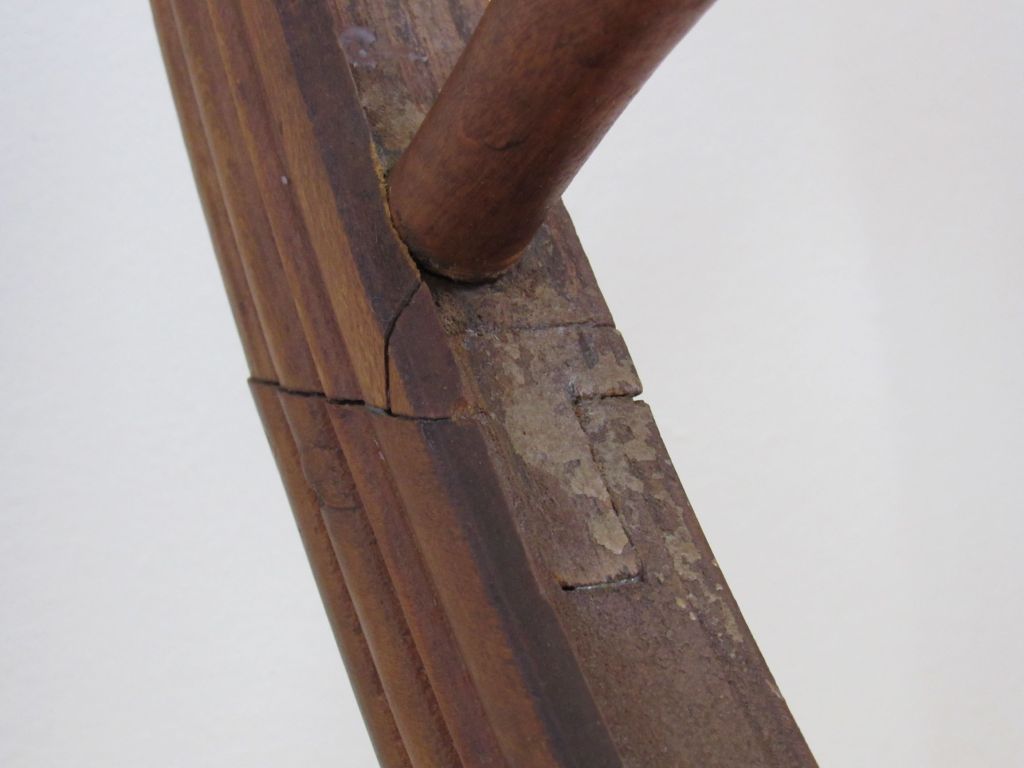
 The wheel rim is four parts with a thin shim piece in one join.

The elongated tops of the maidens are particularly lovely. 

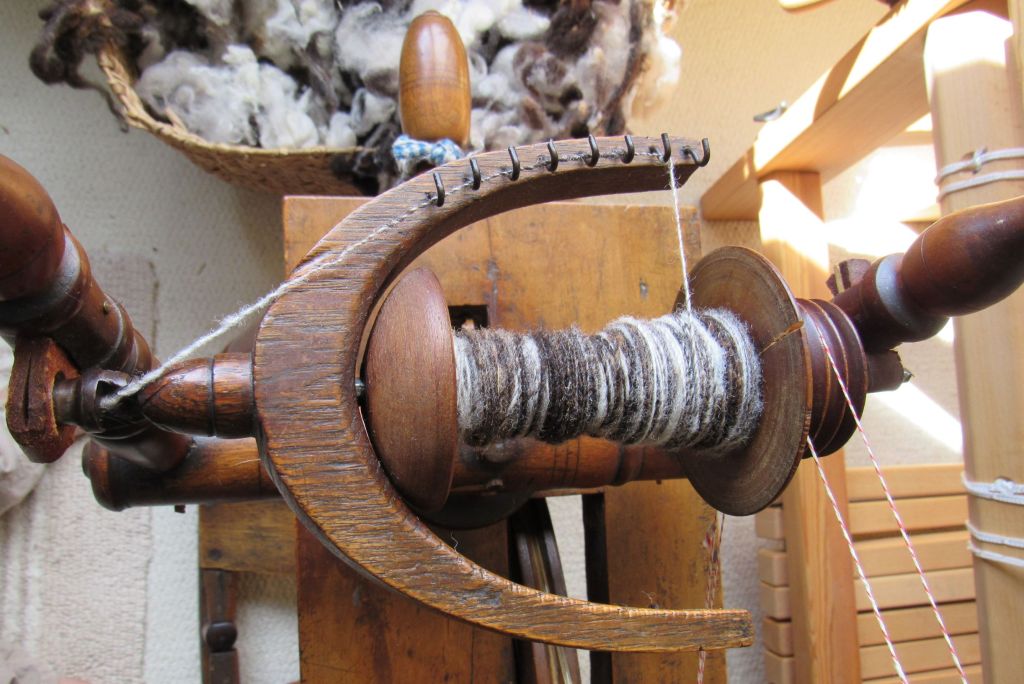
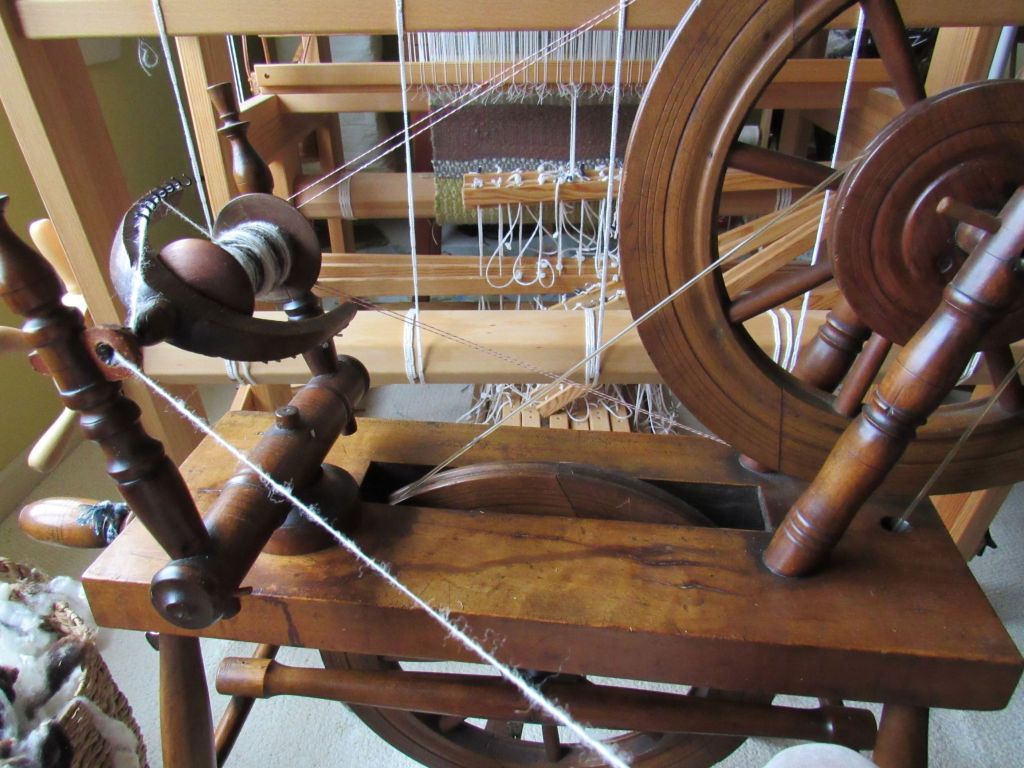
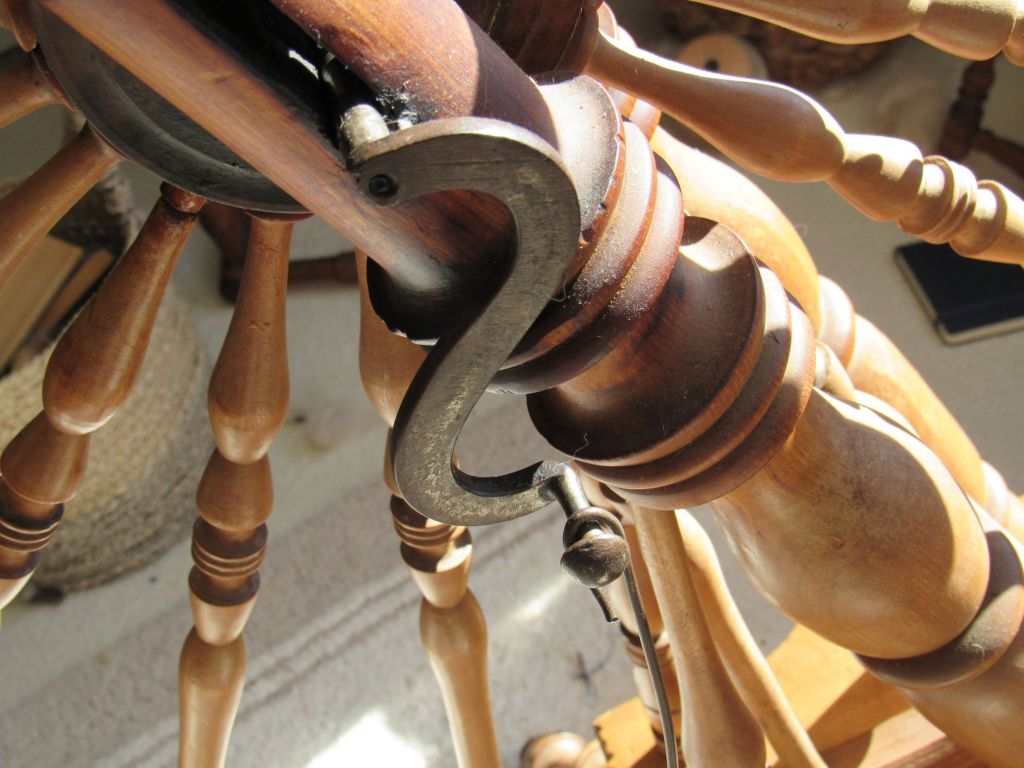
The flyer assembly is in good shape

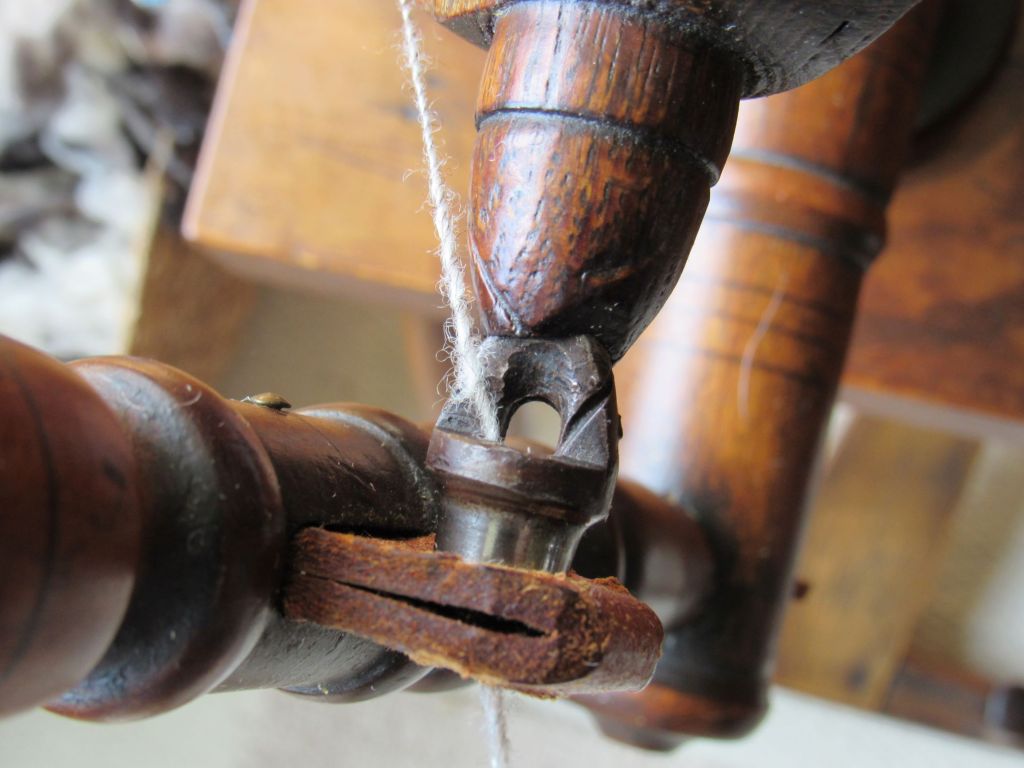
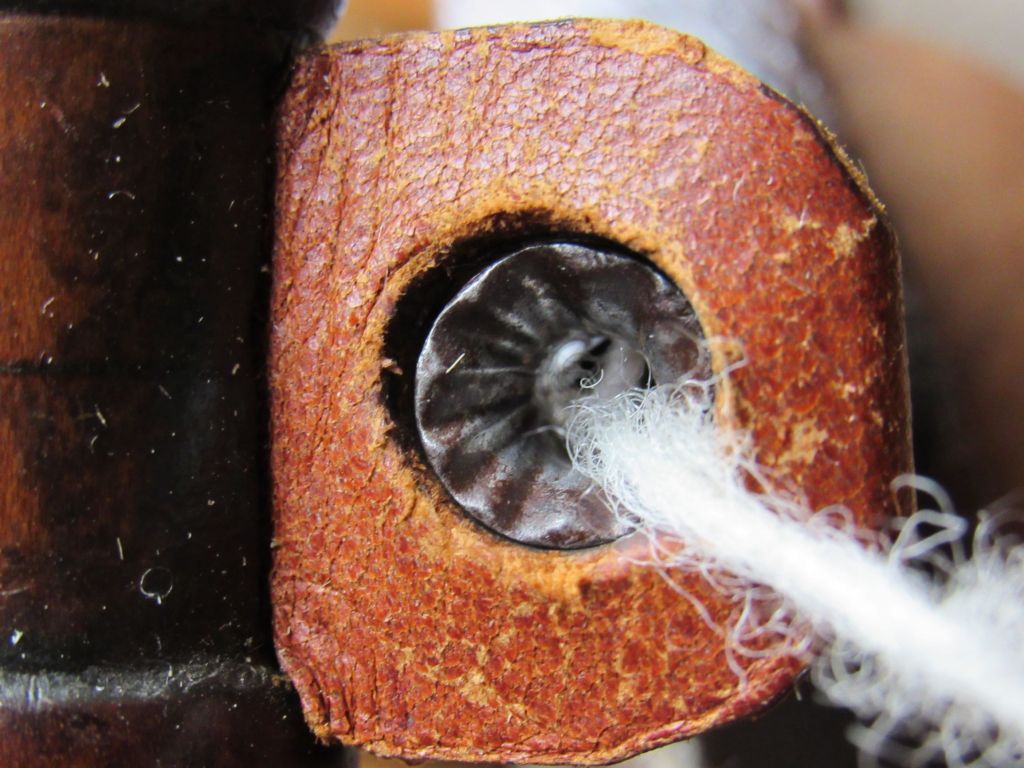
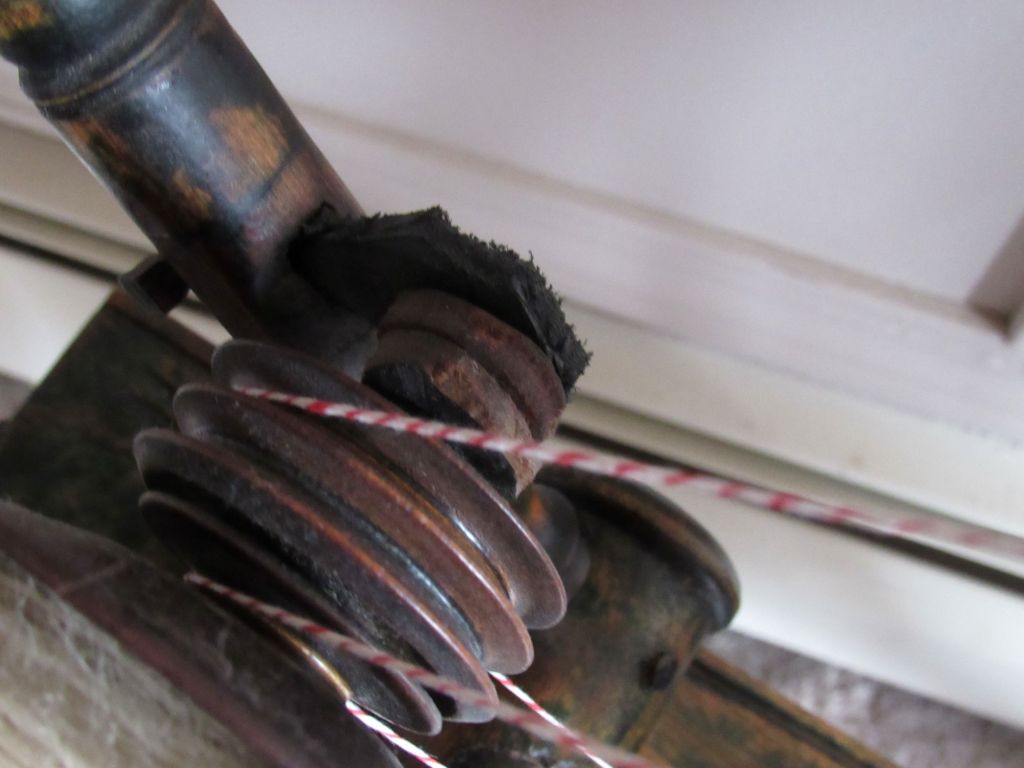
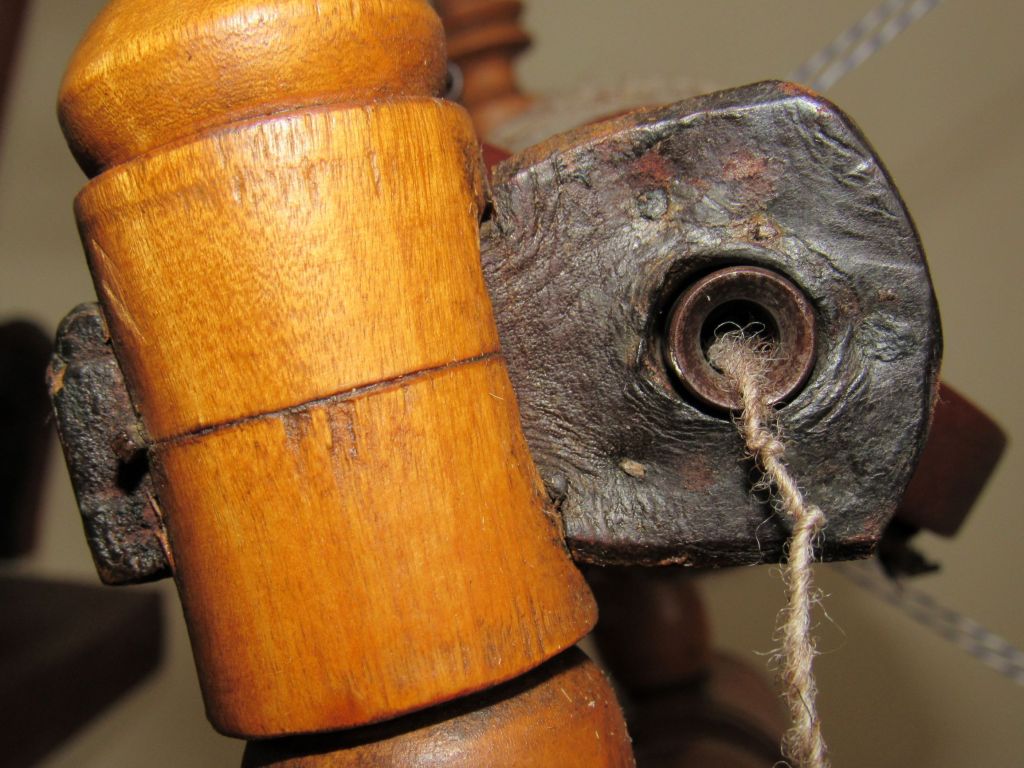
with three-layered leather flyer bearings held together with rivets. 

It appears that the green paint was slathered over everything at some point, including the flyer hooks and leather bearings.

It is an unusual, intriguing wheel and I am always on the lookout for others like it so that we might be able to better establish its age and origin. 

For further reference see:

Cummer, Joan, A Book of Spinning Wheels, Peter E. Randall, Portsmouth, N.H. 1984, pp. 70-71.

Angelina Baker

Early Quebec wheels probably had little resemblance to the large, metal-clad production wheels associated with Quebec today.  It is likely that many were flat rim wheels, which are still found in Quebec, Ontario, and New England.

The origin of these flat rim wheels is a bit of a mystery.  Some likely came from the Acadian settlements in Canada, but it is doubtful that they are all Acadian.  Many Quebec settlers came from the northwest of France, and, interestingly, these wheels resemble the flat rim wheels of Normandy.

Le Rouet, Gr. de Leleux
This image and the one above have one leg resting on a rock. Is there some reason for this (other than a fix for a damaged leg)? If any one knows, please leave a message at the end of this post.

Whatever their origin, Quebec flat-rim wheels are thought to date from the late 18th century into the early 19th century.  They come in various forms.  Some have treadles, some are hand-cranked. 

Tables may be flat or sloped, often with four legs, but sometimes three.  Their profile is distinctive—a long, wide, sturdy table, shortish legs, with an outsized drive wheel and flyer set-up. 

In fact, some wheels of this style are not flat-rimmed but have drive wheels like those on saxony-style wheels, looking almost apologetically out-of-place atop the squat wheel bodies. 

The flyers and tension systems on these wheels set them apart from other antique wheels. 

Most are not double drive, but have some form of “scotch” tension, with a single drive band for the whorl and a brake on the bobbin, usually adjusted with a small knob inserted in a hole in a bar over the flyer assembly.

 My wheel is unusual because, aside from the flyer assembly, it has no turned parts. 

Aside from the hub, nothing is round.

The spokes, legs, uprights, and upright supports are all straight-sided with chamfered edges. 

The spokes are particularly nice, six-sided and tapered. 

Old nail holes indicate that the rim was re-positioned at some point. 

The table is sturdy and flat. 

The lines of the wheel—all edges and tapers—are very beautiful and quite unique. 

The flyer is large, held in place with a small removable piece on one end. 

As with many of these flat-rim wheels, rather than having a removable whorl and fixed arms,

the whorl is fixed on the shaft, while the arms and bobbin can be removed. 

The shaft is a smooth cylinder with a single cut-out for the yarn to emerge onto the arms. 

This style orifice often is referred to as a whistle-cut or train-whistle because it looks like the half-circle cut out on steam engine whistles.

A single drive band rounds the whorl, while another band is attached to a nail on the end of the table, rounds the bobbin, with the other end held in place by a peg in the crossbar above the flyer. 

There are grooves at each end for the band to ride in. 

When the band is inserted in a hole through the peg, it can be tightened by turning the peg, which adjusts the amount of drag on the bobbin. 

Once the tension is adjusted to its sweet spot, my wheel spins beautifully, although the treadling takes a little more effort than with most wheels.  The treadle is supported only by the wooden back bar. 

And, in contrast with most treadled wheels, that back bar does not have metal rods on each end to serve as the turning pivots in the legs.  Instead, the wooden ends of the bar extend into the legs. 

The wood-on-wood action in treadling creates a little more resistance than I am used to, so I usually use two feet which works well with the sturdiness of this wheel.

These wheels look a lot like bobbin winders and many were converted to that use.  So, it is always a treat when one turns up with all its spinning parts. 

Especially when it bears the hand of an artist who was not willing to settle for utility alone, and, without a lathe, created something that pleases the eyes as well as the hands.

For more information on flat-rim wheels, see:

Burnham, Harold and Dorothy, Keep Me Warm One Night, Early Handweaving in Eastern Canada, University of Toronto Press, 1972, p. 34.

Buxton-Keenlyside, Judith, Selected Canadian Spinning Wheels in Perspective: An Analytical Approach, National Museum of Canada, Ottawa, 1990, pp. 206-09.

Cummer, Joan, A Book of Spinning Wheels, Peter E. Randall, Portsmouth, N.H. 1984, pp. 178-79.

Foty, Caroline, “Flat-Rim Spinning Wheels,” The Spinning Wheel Sleuth, Issue #80 (April 2013).

Rosanna

Rosanna was a bonus wheel.  I did not want her.  I had more than enough large Quebec wheels.  I was interested, instead, in the great wheel stored alongside her in a shed.  Her owners desperately wanted to clear both out–along with a clock reel–and gave me such a discounted price that ended up taking all three. 

I thought I would just clean her up, get her spinning, and find her a new home.  I did not expect to become attached.  But she was one of those wheels that just clicked with me spinning-wise.  She is a powerhouse spinner that loves a fast long draw.  So, I kept her quite a bit longer than I expected, just for the great pleasure of spinning on her.

When I first brought her home, she did not look very promising.  She had clearly been in the shed for a long time and was dry, spidery, and dirty. I took off the worst of the deeply encrusted grime with turpentine and linseed oil, unstuck her whorl, oiled her up, and away she went. 

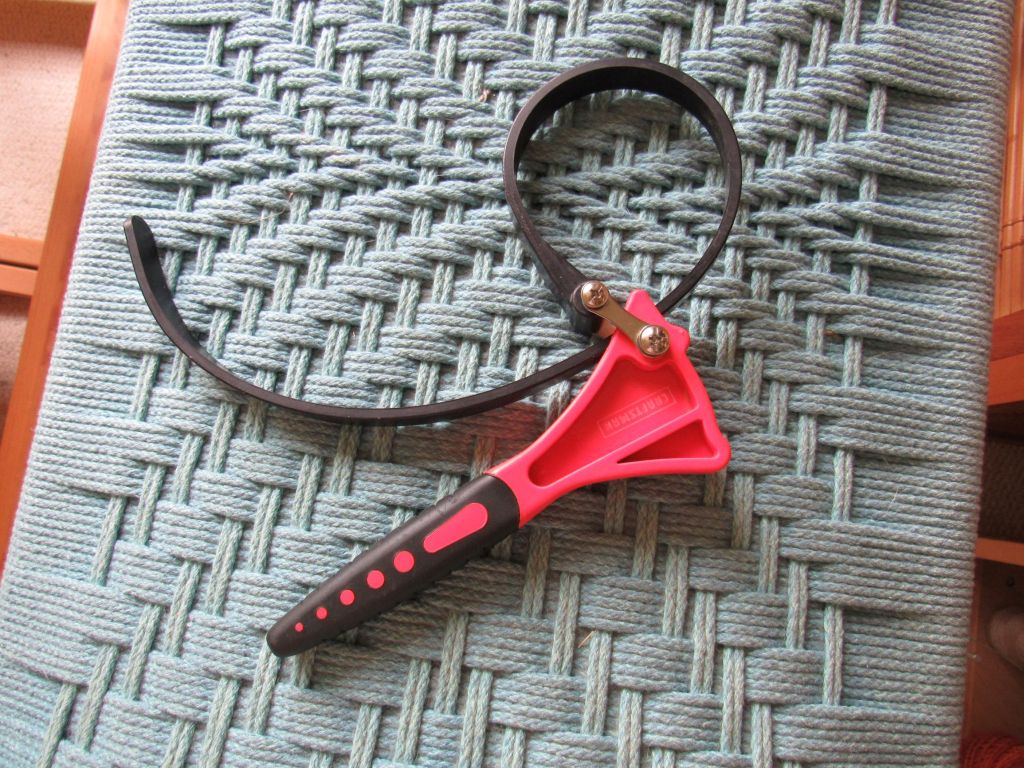
As an aside, everyone who rescues and rehabilitates old wheels should have a rubber strap wrench in their tool box. 

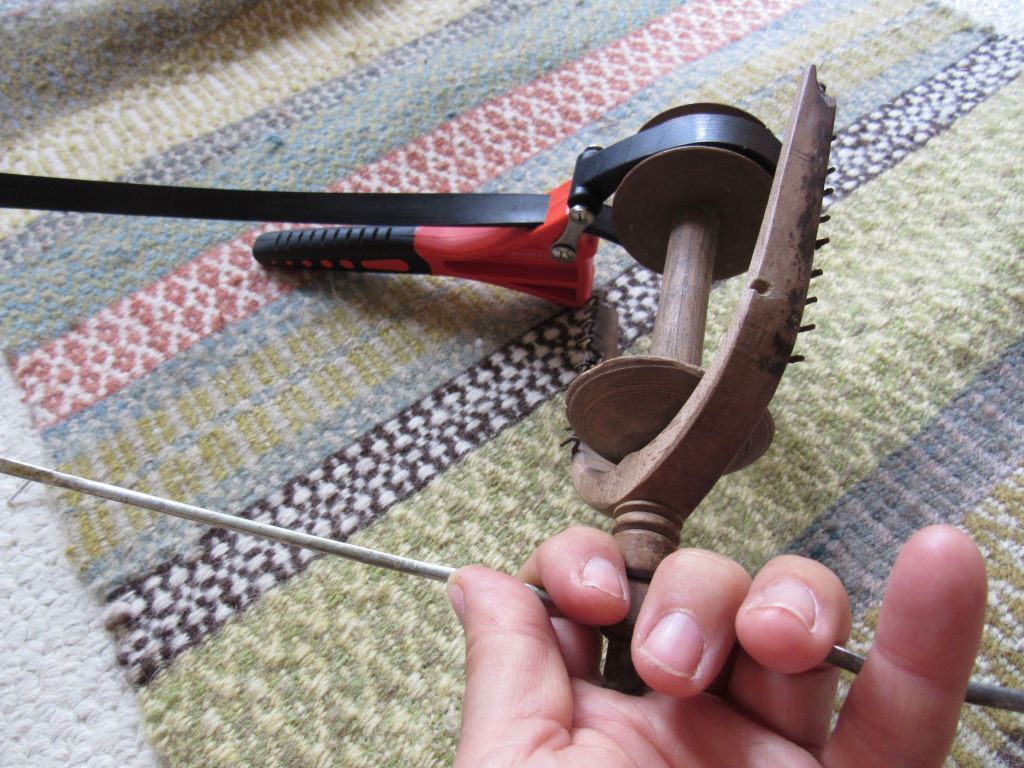
They are inexpensive and work miracles on stuck whorls.  Just put a knitting needle, skewer, or something similar through the orifice holes to hold onto (rather than the too-readily-breakable flyer arms),

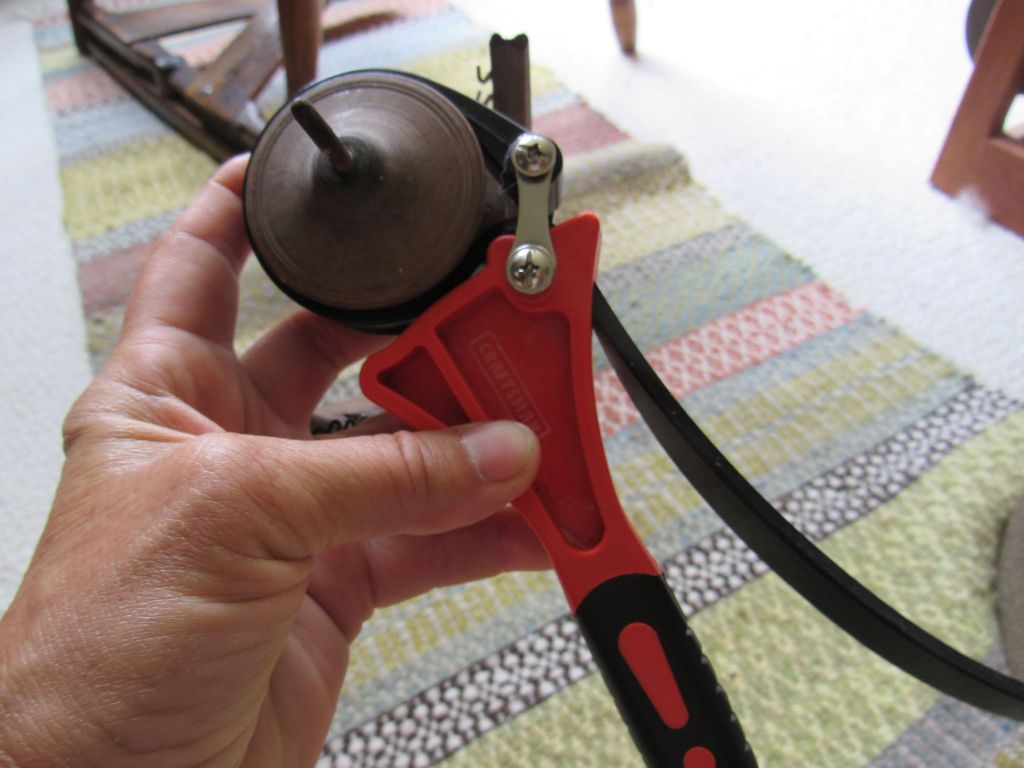
fit the rubber strap around the whorl, and gently twist with the wrench.  

Almost all antique whorls are threaded opposite to what we are used to—so turning to the left generally tightens the whorl and turning to right loosens it.  The wrench gives great leverage and the rubber strap will not mark or scratch the whorl.  No muss, no fuss, no wait.

Being such a wonderful spinner—a true production wheel–it is not surprising that Rosanna shows signs of long use.  She was heavily greased around all of her moving parts—now well shrouded in black residue.  Her front upright was long ago shimmed with nail. 

Her rear upright appears to have been nailed to secure a crack. 

Her bobbin is slightly short, giving a bit of chatter.  The flyer assembly does not look as worn as I would expect, given the rest of the wheel, so probably is a replacement.

She is one of the few Quebec wheels that I own that fits in the definition of a CPW.  She has tilt-tension,

a classic fleur-de-lis metal treadle,

and a large 31-inch drive wheel. 

She has no discernible maker’s mark but has features of wheels made by the Laurence family (father Simeon and sons Louis and Clement) near St. Hyacinthe, Quebec.  Laurence wheels are characterized by their beautiful beveled and beaded edges,

“s” curve cranks,

secondary upright supports front and back,

pear-shaped feet,

and “flying saucer” maidens.  

Some wheels with these same features, however, have been found with a stamp by maker Michel Cadorette.  The Laurence and Cadorette families were intertwined with family and wheel-making ties.  So, as with so many wheels without a maker’s mark, we cannot know with certainty who made this one—likely a Laurence, but possibly Cadorette.  In any case, she is quite a presence.

After spinning on her all winter, I am finally ready to move her on.  She is going to a good home, where I hope she will give her new owner many more years of spinning pleasure.  Much better than all those years sitting idle in a shed.

For more information on Laurence and Cadorette wheels, see:

Foty, Caroline, Fabricants de Rouets— this book and a photo supplement are available for sale as a downloadable PDF by contacting “Fiddletwist” by message on Ravelry.

Pierre Lapin

Quebec wheels are famously fast spinners, but this double-treadle accelerated wheel kicks it up a notch.  All types of innovations were made to spinning wheels in the 1800s in a quest for increased production. The addition of a second wheel accelerates the flyer’s rotational speed and double treadles also create speed and sufficient power and momentum to keep both wheels moving easily. 

Two wheels, two treadles–well-designed and enormously fun to use. 

Double treadle, double wheel designs surged in popularity in New England and New York in the early 1800s.  But most, such as the so-called Connecticut chair wheels, or Alpheus Webster’s patented wheels, were upright wheels, with two wheels stacked vertically, one on top of the other.  In contrast, these Quebec wheels have their own style. They are more horizontal, with drive wheels configured in a fashion reminiscent of the small hand-cranked Turkish wheels. 

These wheels are fast, efficient, and easy to use, so I would have expected them to be quite popular.  But there do not seem to be many that have survived.  Some are marked “J. L’Heureux,” a maker who is believed to be Jules L’Heureux (1833-1918) from L’Acadie, an area southwest of Montreal. 

A L’Heureux accelerated wheel that was advertised on eBay

L’Heureux also made more typical saxony-style wheels.  His accelerated wheels came in both screw-tension and tilt-tension styles.  It is not known if the screw-tensions pre-dated the tilt-tensions. 

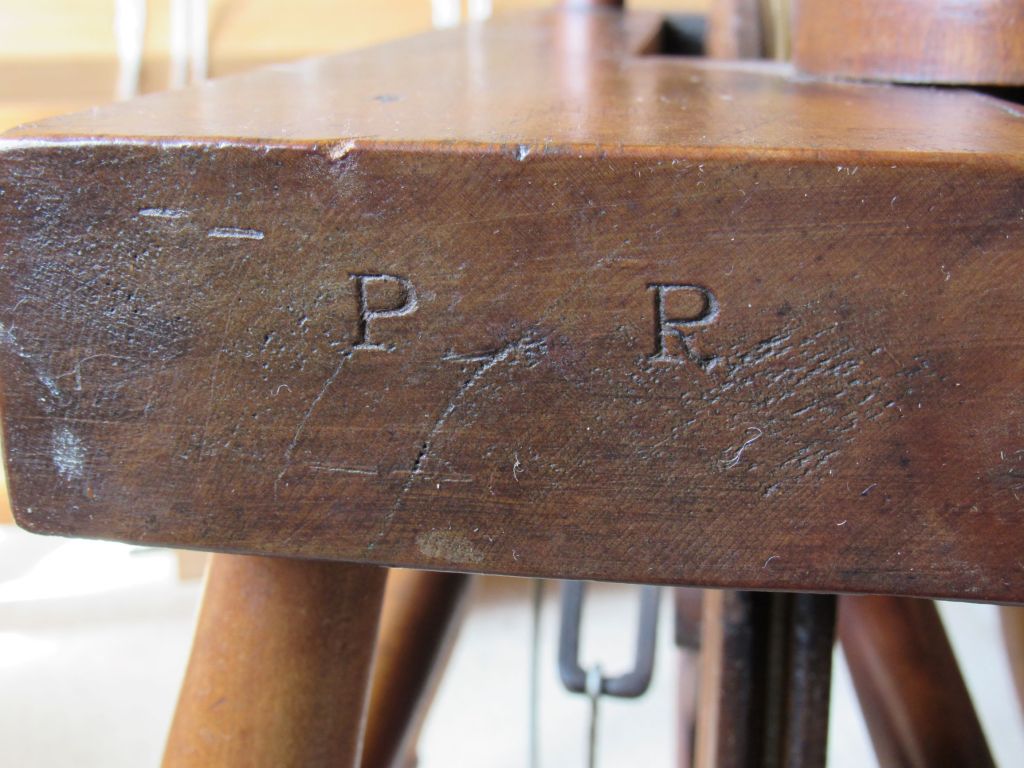
Other wheels are marked simply with “MR” or “PR.”  To date, no one has discovered who these makers are, although their wheels are almost identical, so it is likely that they were related and perhaps worked together.  The MR and PR wheels look much like those made by L’Heureux, even down to the maidens. 

The biggest differences are that L’Heureux wheels have a slanted table and the lower wheel’s axle rests on the table.

In contrast, the MR/PR wheels have a flat table and the axle of the lower wheel is supported by crossbars below the table, rather than the table itself,

leaving just a tiny part of the rim peeking above the table. 

It seems probable that these wheels, like those of L’Heureux, were made in Quebec. 

So, I was interested to see one in a postcard from Upper Canada Village, an Ontario living history museum that seeks to depict live in a rural “English” Canadian setting in 1866. 
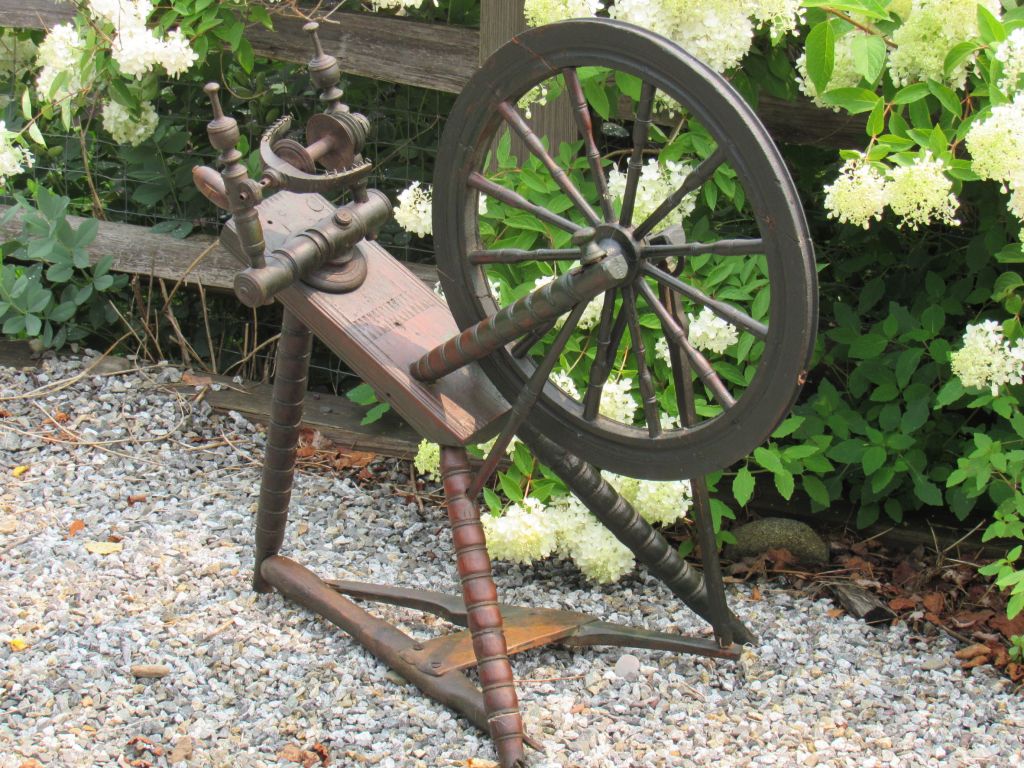
Were these wheels used in Ontario or is this one at the Village simply because it is an antique?   

My wheel is marked “PR” and was Wheel No. 97 in Joan Cummer’s collection. 
As mentioned in earlier blog posts, Cummer had donated her collection to the American Textile History Museum, and some of her wheels were auctioned off when the museum closed.  I was lucky enough to buy this wheel at auction.  Like all of the MR and PR wheels that have shown up so far, it has a screw tension system.   

Because these particular accelerated wheels do not have tilt-tension or large drive wheels, they do not fall in the limited definition of a Canadian Production Wheel (CPW), even though they are speed demons, specifically designed for fast and easy production.

When I brought the wheel home, it took some time to find drive bands that worked.  The top wheel has a single double drive band to the bobbin and whorl, just as in a double drive saxony wheel. 

The lower wheel is attached to the treadles with an S-shaped axle and to a hub extension on the upper wheel with a single drive band. 

The band connecting the two wheels needs to have sufficient grip to get momentum going for the upper wheel. 

I tried everything—different sizes of waxed and rosined cotton and leather bands.  One problem was getting a good fit because the drive band must be threaded through a hole in the table before being knotted or spliced. 

Nothing worked particularly well—the wheel was sluggish and treadling hard.  I finally settled on the unauthentic modern poly-cord.  It is easy to fit (and refit as it stretches) and works extremely well.  Once I had that settled, the wheel just flew. 

Because this wheel is such a fast and productive spinner, I wanted to use it to its full potential. 

I usually spin a modified long draw, with my whole body angled toward the left side of a wheel.  Double treadles make that a bit more awkward.  So, inspired by the Upper Canada Village postcard, I decided this would be a good wheel for learning to switch hands to do a long draw across my lap.  

But I was startled to find that when the yarn is drafted across the lap and entering the orifice at about a 45 degree angle, the yarn starts to vibrate and make a buzzing sound.  Not a small vibration and buzz either, but a real hand-tingling, bee-buzzing, zipper-sounding, what-is-going-on-here phenomenon. 

The vibration/buzz angle

I suspected it had to do with the orifice, which is heavily fluted.  There has been debate on Ravelry and other forums about whether orifice fluting is the result of wear or was a design feature to enhance the quality of spun fiber.  I am in the camp that the fluting was an intentional design for a specific purpose. 

Does the fluting create a resonant frequency that creates a tighter twist, for example?  I have several wheels with fluted orifices—mostly from Quebec, Nova Scotia, and Norway.  After experienced the yarn vibration on this wheel, I tried them out with the yarn entering at the same angle and found that all of them create a similar vibration and buzz, although none as intense as the very fast accelerated wheel.  I could not recreate the same effect on the non-fluted orifice wheels that I tried.  I am fascinated by this phenomenon and would love to hear from other spinners who have experienced it and from anyone who might be able to shed light on the physics involved.   

In any case, this wheel is a delight.

I am not sure what was attached to the wheel table here

May 2, 2021 update: After posting this, Rosemary Jacobs contacted me about her Quebec accelerated wheel. She bought it on Long Island around 1988 and passed it on to some Vermont spinners in 2016. What fascinates me about her wheel is that it looks just like a L’Heureux wheel, but, from the left photo, does not appear to have his prominent maker’s mark.
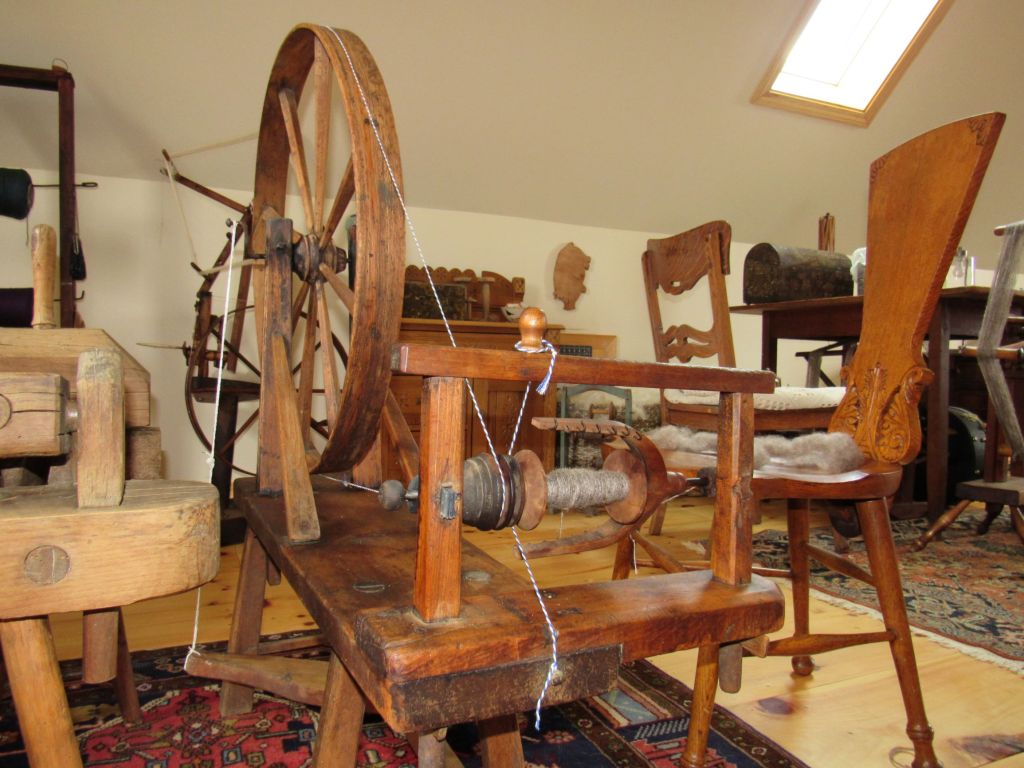
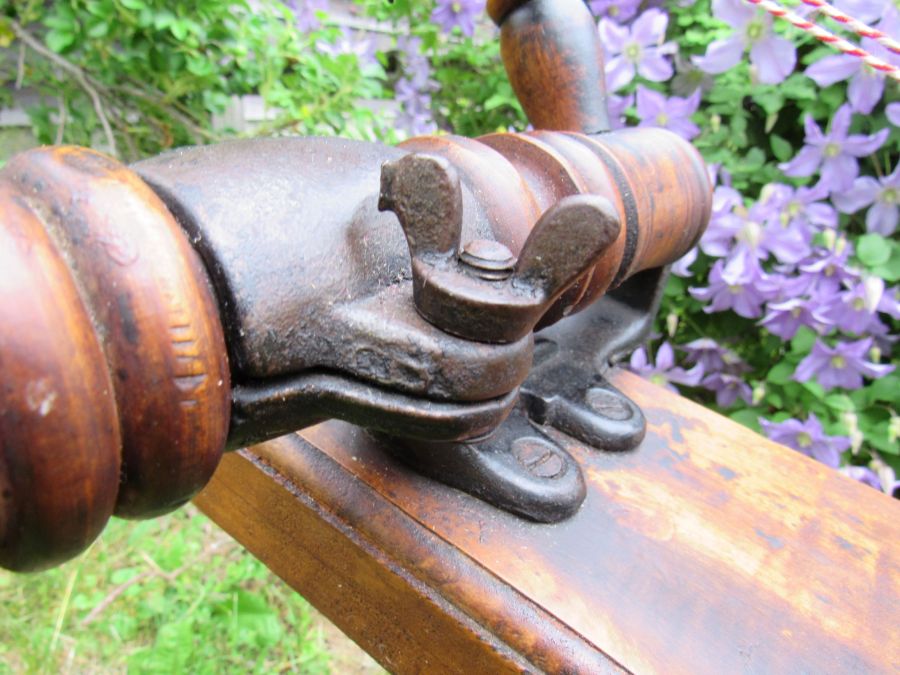
Rosemary does not recall if there was a maker’s mark on the wheel and does not have access to the wheel now. This wheel is a reminder to me, however, that some Quebec accelerated wheels were unmarked. Joan Cummer had one in her collection, Wheel No. 96 (pp. 208-209). That wheel, however, did not look as if it was made by L’Heureux (the maidens were different, for example) and Rosemary’s does. It’s also interesting to note that the footmen on most of these wheels appear to be wooden, not metal, as mine are.

Thanks to Rosemary Jacobs for sharing the photos and information on her wheel.

My references for information on Quebec accelerated wheels:

Buxton-Keenlyside, Judith, Selected Canadian Spinning Wheels in Perspective: An Analytical Approach, National Museum of Canada, Ottawa, 1990, pp. 175-78.

Cummer, Joan, A Book of Spinning Wheels, Peter E. Randall, Portsmouth, N.H. 1984, pp. 210-11.

Foty, Caroline, Fabricants de Rouets— this book is available for sale as a downloadable PDF by contacting “Fiddletwist” by message on Ravelry.

Pennington, David A. and Michael B. Taylor. Spinning Wheels and Accessories. Atglen, PA: Schiffer Publishing, Ltd., 2004, pp. 61-78.

Adelaide

Many Quebec wheels are painted—usually a mustard yellow or, less often, shades of orange, red, and sometimes black.  Only very occasionally does a green wheel turn up. 

Adelaide is one of them.  Her paint now is mottled and looks as if the original paint job has been touched up over the years. 

But the remnants of green, worn down to lustrous wood grain make her a wheel of rare beauty. 

She is a screw-tension wheel, with no discernible maker’s mark, but carries the typical characteristics of a Bisson wheel. 

Joseph Bisson (1823-1901) (Oct. 2021 edit–this should read Louis Bisson, not Joseph–my apologies!) was a wheel maker in the Beauce area south of Quebec City.  Many, if not most, of his wheels carry a maker’s mark.  His older brother, Vital, also made wheels, but none have been found with Vital’s mark.  Some wheels have been found with a “Joseph Bisson FJ” mark, which may have been Vital’s son.  (see Fabricants de Rouet, below).

Bisson wheels have a distinctive style.  Their drive wheels and treadle assemblies are immediately recognizable.  The drive wheels are spare, with only 8 spokes. Something about them is very visually appealing. 

As is the treadle support, with its graceful curve. It is an attractive and practical feature, allowing for easy two-footed treadling. 

This wheel shows the most wear from a left foot on the treadle bar curve. 

The wear on the treadle itself is only on the right edge.  I love how the treadle is cut to match the curve in the support bar.

Bisson tables typically are grooved down both sides, 

with secondary supports on each wheel upright. 

Shortish legs have simple turnings.

Adelaide’s non-spinner side leg has a large nail protruding from the bottom to keep the wheel from sliding across the floor.

Aside from the drive wheels and treadles, Bisson flyers also are unique among the Quebec wheels.  Rather than splaying outward like a wishbone, the flyer arms run parallel to the shaft and each other and have a small ridge running down the center of the flyer.  Unfortunately, I do not have a photograph of a Bisson flyer since this wheel qualifies as a mélange wheel, with a replacement flyer.  

One sign that it is a replacement flyer (aside from the fact that it doesn’t look like a Bisson flyer) is that someone inserted two thick pieces of leather as washer spacers to make the replacement flyer align properly with the drive wheel. 

One flyer arm is cracked and has been repaired by pinning it with a small piece of metal. 

The orifice is bell-shaped, but without fluting. 

The orifice has wear marks on each side from the spun yarn running out to the flyer arms.

There are wear marks on the inside edges of the flyer arms, likely from winding off, and an odd groove in the tension screw.

 I cannot tell if it is from wear or simply an accidental gouge.

Each side has a piece of leather acting as an axle bearing.   

Another ancient piece of leather sits under the mother-of-all collar, keeping it tight and aligned. 

The footman was attached to the crank with a piece of leather and string, which I had to replace because it was cracked beyond repair. 

Adelaide had belonged to the seller’s grandmother.  The family had kept the wheel lovingly wrapped up for years, sparing her the fate of so many wheels relegated to basements, barns, and garages to become spider condominiums.  As a result, she survived in remarkably good condition, green paint and all.

For more information on the Bisson family and their wheels, see:

Foty, Caroline, Fabricants de Rouets— this book and a photo supplement are available for sale as a downloadable PDF by contacting “Fiddletwist” by message on Ravelry.

Hortense

While Olympe (previous post) is my biggest Quebec wheel, Hortense is my smallest.  She is unmarked, but likely made by a member of the Paradis family.   This multi-generational Quebec wheel-making family was centered in St. Andre, Kamarouska, on the St. Lawrence river northeast of Quebec City. 

There are wheels marked by Amable Paradis (1811-1891), his sons Phillipe, Amable Balthasar (Balt), and Aram Baptiste.  In addition, some of Amable’s other sons, his brother, Antoine, and a third generation, including Alfred and Lucien, also were wheel makers.  They were a productive clan, turning out wheels for many decades.  There is much more information about this interesting family in Caroline Foty’s book Fabricants de Rouet. 

Although a few other Quebec wheels share some characteristics of Paradis family wheels, Hortense appears to be a fairly classic Paradis.  She is small,

with screw tension, pagoda (or Jetson) maidens, distinctive spoke turnings, and yellow paint. 

Hortense turned up at a local auction, offered with a great wheel.  She was in rough shape, but her perky stance captivated me.  I am a sucker for wheels that resemble dogs in a “play with me” position, and she certainly has that look. 

Besides, no one bid on her.  I could not leave her behind.  So, for $20, this little survivor and a great wheel came home with me. 

Hortense is loaded with character. While her color is primarily yellow, she has splashes and undertones of red peeking through. 

She was a hard worker, carrying evidence of long years of use and repeated repairs. 

Those repairs were worth it because she continues to be a lovely little spinner.

She has cracks and knots and battered maidens. 

Her hub is gruesomely cracked,

with what appears to be a wedge of stiff leather inserted on one side. 

Despite the yawning crack, the axle remains solid in the hub, with no slippage.  

 A gap in the drive wheel also has a thin piece of wood inserted. 

Many of the spokes have been messily glued to the rim. 

The wheel uprights–

black to the table with dripping grease residue–extend quite far below and are pegged under the table.

The axle bearings appear to be horn, or possibly bone,

and there is a screw in the side of the rear upright that may have been used to stabilize a crack. The little treadle is not original–its treadle supports are well worn, but it is not.

She has lovely legs.

The flyer probably broke clear in half and was repaired with glue, a thick thread wound around the orifice end,

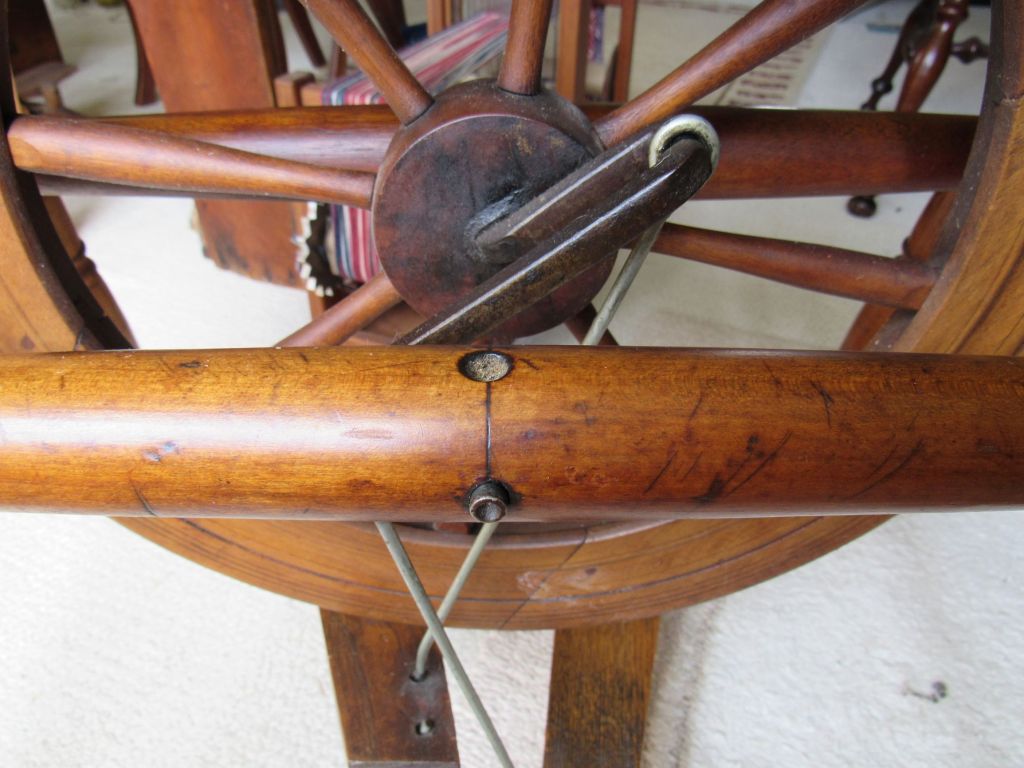
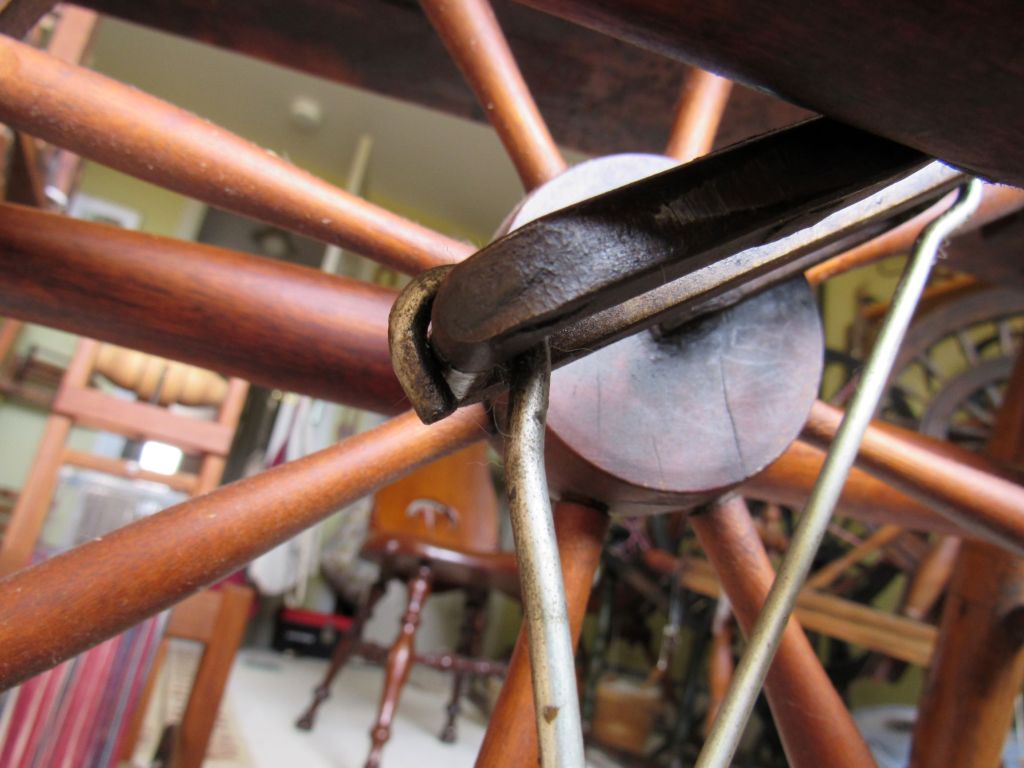
and metal plates screwed on to both sides. 

There are two types of wear marks on the flyer arms.  There are a series of close-set ridges on the inside of each arm—marks that are found on many old wheels. 

As explained in an earlier post, “Zotique,” I suspect these ridges were made from winding yarn off the bobbins rather than cross-lacing.   

Winding off

Hortense has some wear marks on her tension screw that could be from winding off around the screw.

What is most interesting about Hortense’s flyer, though, is a second type of more unusual wear marks that go across the flyer arms. 

These marks appear to be consistent with those made by cross lacing. 

Cross lacing
Cross lacing

As I said in the “Zotique” post, I am just speculating about how these marks were made and would love to hear thoughts from others on this.

Hortense on the left, marked Amable Paradis on the right

I recently picked up a marked Amable Paradis that I am fostering for a friend and will move along on the first leg of a wheel railroad. 

Because Hortense looks quite old, I had thought she was likely made by Amable, but when seeing her side-by-side with the marked wheel, there were more differences than I had expected.  The cranks are similar,

Hortense crank
Amable crank

as are the rims,

Amable rim
Hortense rim

and, while the legs and spokes have the same overall design, they are different. 

Hortense has a more raked stance with a shorter, more tilted table, more bubbly spokes, and slightly more dramatic turnings.  She is a bit like a caricature of the Amable–everything is slightly more exaggerated. It would be fascinating to put a whole line up of Paradis family wheels together to compare the differences.  Maybe someday. 

Thank you to Sherran Pak for allowing me to use photos of her Amable Paradis wheel.

For further information on the Paradis family and their wheels see: 

Foty, Caroline, Fabricants de Rouets— this book and a photo supplement are available for sale as a downloadable PDF by contacting “Fiddletwist” by message on Ravelry.

Olympe

Olympe is a magnificent giantess of a wheel.  She is from Quebec, but her maker remains a mystery.  There are several similar wheels likely made by the same maker, although no two are quite alike.  Caroline Foty wrote an article about them in The Spinning Wheel Sleuth, fittingly entitled “A Family of Wheels of Unknown Origin.”  In it, she documents her wheel, No. 94 from Joan Cummer’s collection, and seven other wheels of varying sizes and configurations that share the characteristics of this wheel family–a low-slung profile, short legs, and fine, sharp distinctive turnings on the maidens, legs, and spokes—all features very different from other Quebec wheels. 

Several of the wheels are huge and adorned with whimsical carved flowers and sunbursts.  The enormous ones have been affectionately referred to as Big Bertha or Madame Maxime wheels. 

For some reason, these wheels seem to appear in my life.  I encountered the first one at an auction selling items from the American Textile History Museum (ATHM).  It was Cummer’s wheel No. 94, soon to be Foty’s.  A sister wheel, not quite so large, No. 95 in Cummer’s collection, had been donated by the ATHM to the Marshfield School of Weaving for their Textile Collection (photos can be found here: https://marshfieldschoolofweaving.omeka.net/items/show/121).  But perhaps because No. 94 had a broken flyer, it went to auction. 

My wheel, not No. 94

I was interested in other wheels that night and was done bidding fairly early.  But I was staying overnight and was trying to track the ATHM items to see where they went and for how much, so hung in to the bitter end.  Cummer’s wheel was one of the very last items up for bid, after almost everyone had left or was packing up, and I was relieved when Foty’s remote bid was the winner, knowing it would have the best of homes. 

Olympe

By then I felt almost motherly toward the wheel and, because of her large size, made sure she was stowed safely out of harm’s way for pick up later that week.  It had been a fun evening admiring the giantess, but I did not expect to see another in my lifetime. 

Olympe

Less than six months after the auction, I was picking up a loom in central Maine for a friend and stopped by an antique store.  I was astonished to see in the front window another one of the giantess wheels. 

The antique store wheel

It was decorated with trefoils and sunbursts and its original screw tension had been replaced by what looked like a tilt-tension from a Vezina wheel.  It appeared to have 21 spokes and, of course, I was besotted.  What followed was an extremely unpleasant series of exchanges with the antique dealer.  He had the wheel marked for sale at a very high price and when I offered him something lower (but still high), he basically refused to sell it to me at any price.  When my husband stopped by the shop some months later, the wheel was gone from the window and the owner said that it had sold.  I wish I knew where it was. 

This sunburst is a small version of Olympe’s. The trefoils are found on two of the big wheels.

I still had that wheel on my mind when my daughter and grandchildren came for a visit in December that year.  They wanted to see Quebec City and before the trip I, of course, took a look at Kijiji, Canada’s version of Craigslist, to see if there were any interesting wheels for sale.  I was gobsmacked to find, way at the end with the oldest listings, another giantess wheel, that had been languishing for months unsold.  What are the odds for that?

On the second day of our Quebec visit, a granddaughter and I drove over the bridge to Ile d’Orleans and had a wonderful visit with the wheel’s owner, a Francophone woman with an artist husband.  She collected antiques and had owned the wheel for decades, but knew nothing of its earlier history. 

She had another beautiful wheel for sale, but it was all I could do to fit the giantess in the car along with my daughter and three grandchildren. 

After a lot of luggage rearranging, we managed to get it in the car and home it came.  The drive wheel was bizarrely cobbled together and canted crazily in different directions, making me a little dubious that it would hold up to spinning. 

But the treadle and supporting bar were very worn, so clearly had been heavily used in the past. 

And, sure enough, despite the wonky drive wheel, it spins beautifully and has an added almost fairy-tale quality of making me feel like I have shrunk to child-sized dimensions when I sit down to spin. 

The wheel is huge. 

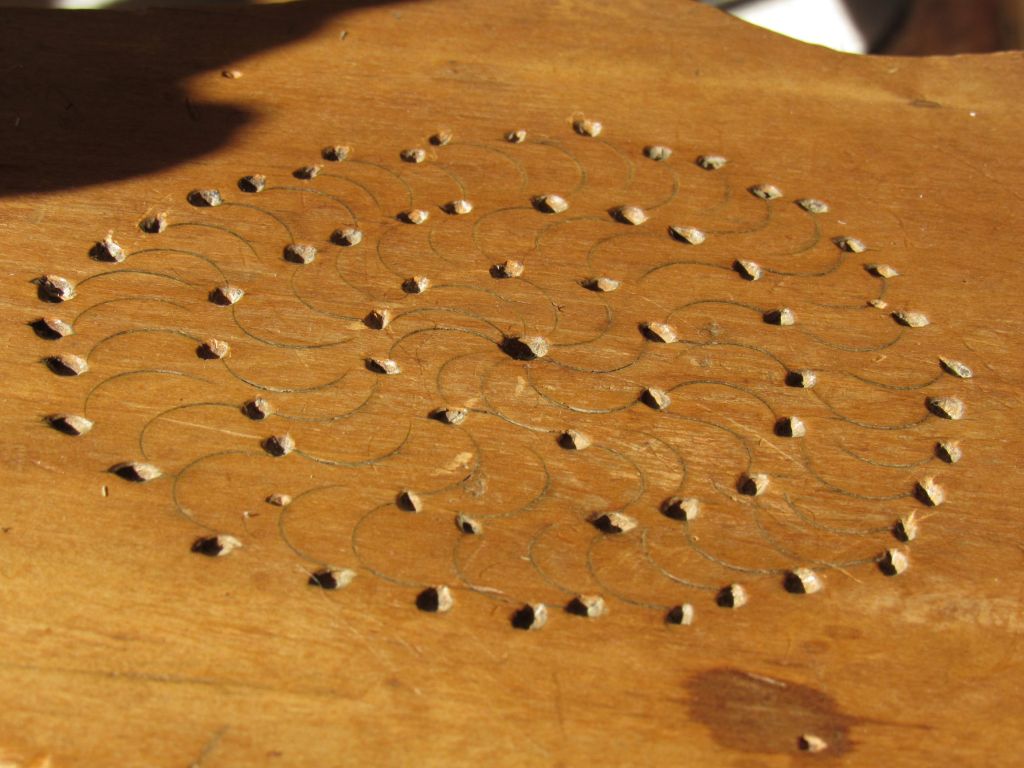
The table is 31” long, with a squiggly, dotted sunburst in the middle

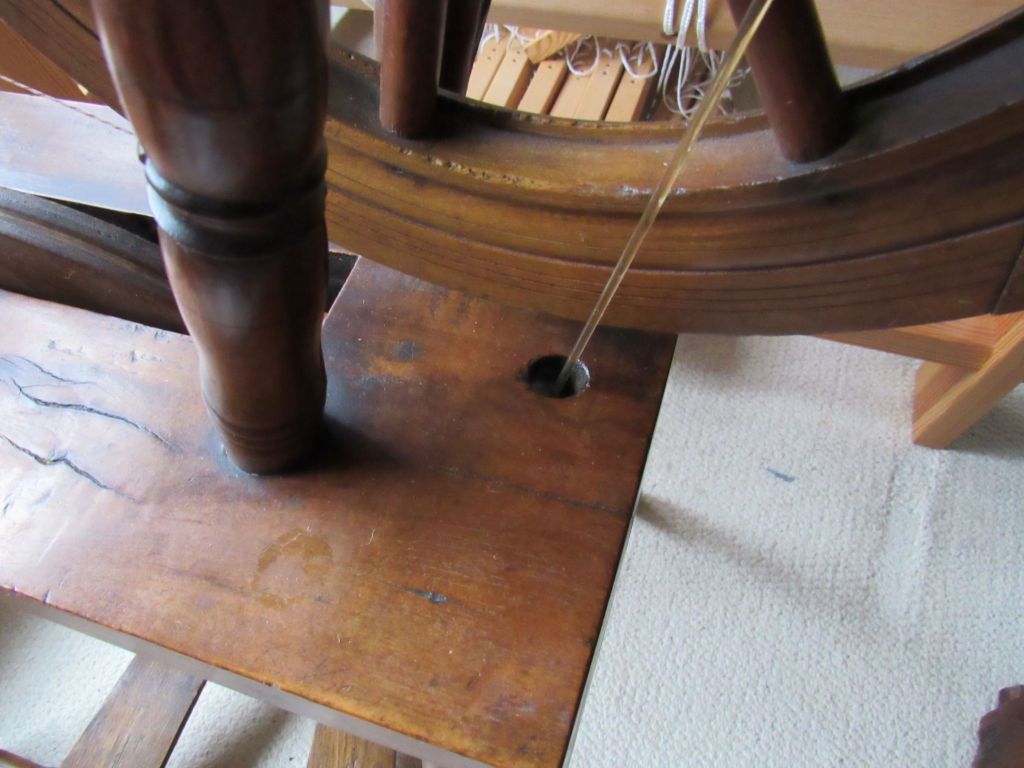
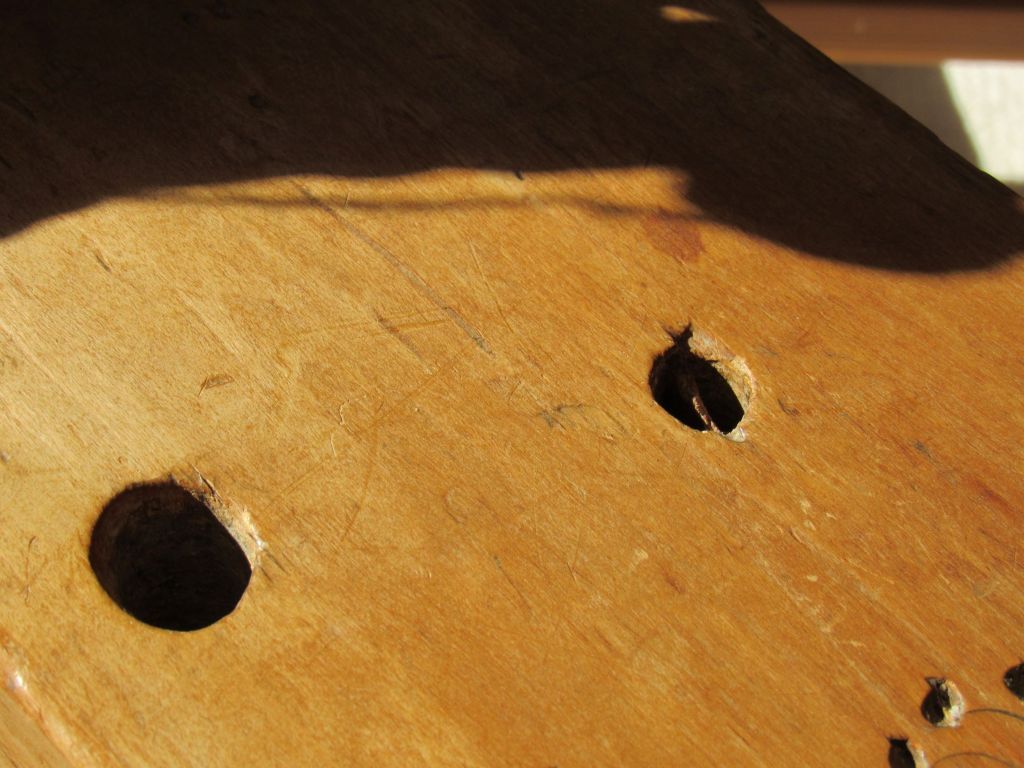
and two holes—possibly for a distaff and water dish for spinning flax.  No ordinary production wheel.

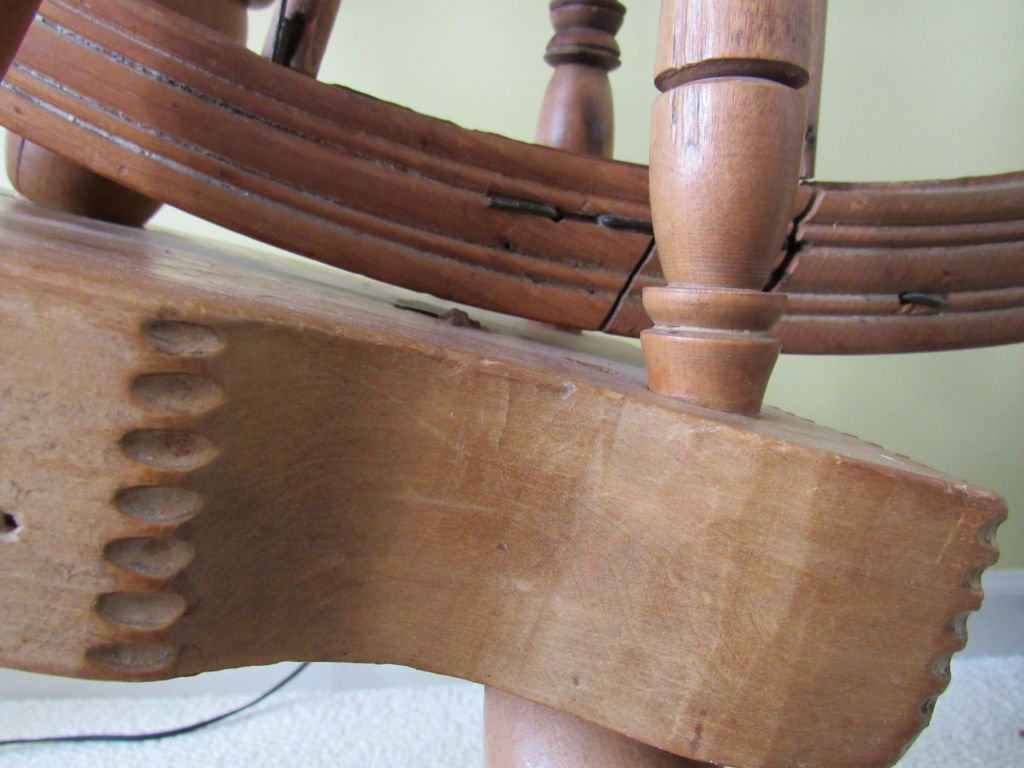
The sides curve in and out, with barely-visible chisel marks on the curved portions

and chip carvings along the flat edges and ends. 

The 38” drive wheel has twenty exquisite spokes

—so many that there is barely room for them in the hub, especially with their upside-down blossom shape. 

The drive wheel rim is relatively narrow, made of two long and two short pieces. 

The joins are unusual and include a smaller piece of wood between the main pieces

with thick metal wire reinforcements that likely were added well after the wheel was made. 

The wheel itself barely clears the table.

One spoke was broken, but repairable, and others were loose, many with nails protruding–some barely hanging on. 

It looks as if the spokes were re-positioned on the rim at some point. 

They are cut at angle where they butt up against a narrow lip. 

The wheel uprights measure an impressive 7 ½” circumference. 

They are held in place under the table with large pegs. 

There are secondary upright supports on both sides. 

The wheel has relatively short legs—only 13” at the downhill end—with chubby feet. 

In contrast with the fine work on the rest of the wheel, the hole for one of the legs is rather crudely dug out. 

There is a graceful S-shaped crank

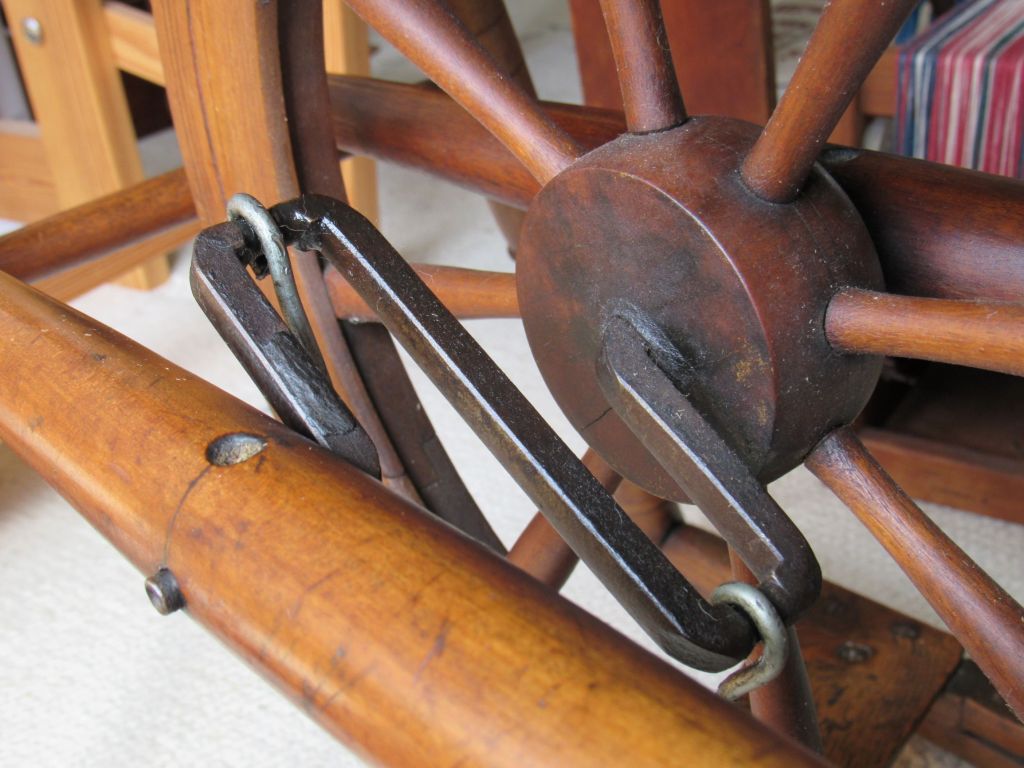
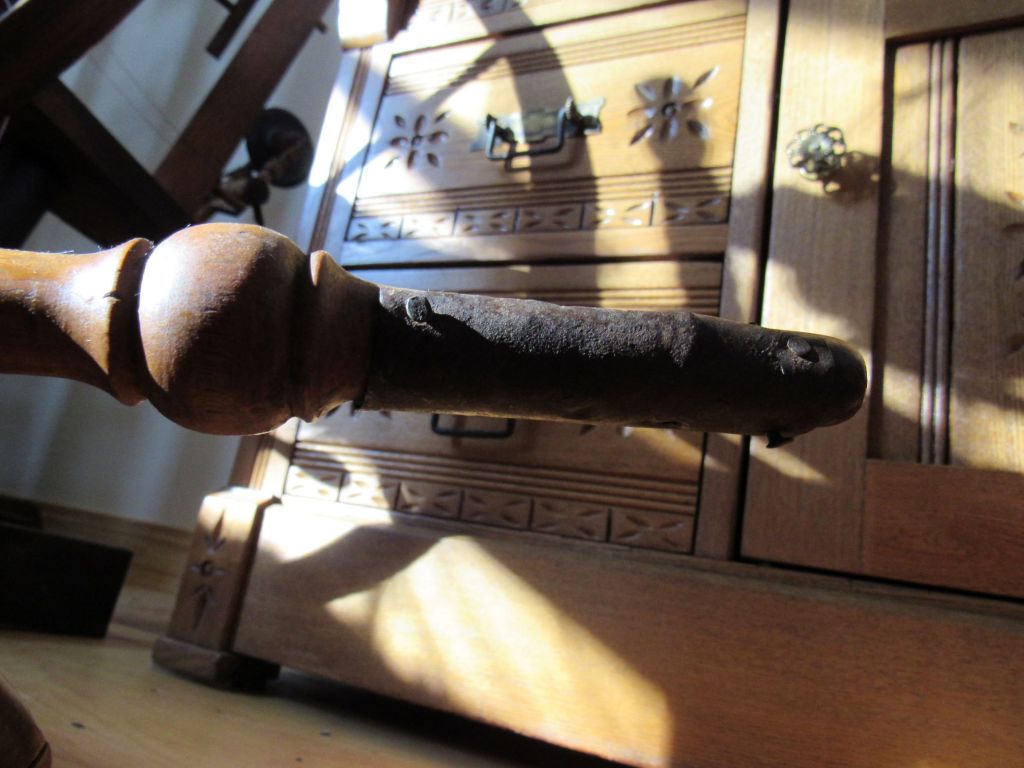
and metal footman

and a beautifully made treadle and treadle bar, wide enough for the two-footed treadling that keeps the momentum smooth and easy for such a big wheel. 

The maidens are unusually lovely and a hallmark of this wheel family. 

Interestingly, the top parts of the maidens are very light and the lower parts much darker. 

At first, I thought that the tops were a different wood type attached to a darker wood below.  But there is no join, so perhaps they were stained differently for decorative effect.  

The mother-of-all is secured by a large nut underneath the table—something more often seen in Scandinavian wheels than Quebec wheels. 

The orifice is smooth–not fluted. 

Because the wheel has a screw tension, and very large drive-wheel, under the current definition, it is not considered to be a Canadian Production Wheel (CPW) even though it spins very fast and fine. 

It is a wheel of flair, elegance, and whimsy, designed to be noticed.

One reason this family of wheels is fascinating is because they are so different from other Quebec wheels. In her book, Cummer suggested that they may have been made in the Eastern Townships of Quebec, which had a heavier English influence than other areas of Quebec. 

But the wheels have no maker’s mark and there does not appear to be any evidence, other than speculation, that they are from the Eastern Townships.  What interests me, however, is the similarity of these wheels to others that do have maker’s marks—most specifically to those made by Elie Laporte (featured in the last post “Fleur”).  It was the spokes that first caught my attention—the upside-down blossom shape where they meet the hub. 

The only time I have ever seen such spokes is on the mystery wheels and Laporte wheels.  Looking at the wheels side by side, so many other similarities are striking—the low profile, the large size,

the distinctive maidens,

the legs, the treadle joins,

the rims,

the deep cuts for the axles, the secondary upright supports. 

Could Laporte have made all of these wheels? 

Or could his father, who was also a wheel maker, have made the earlier screw tension wheels, while Elie carried on with tilt-tensions?  Or was this a wheel style from the Yamaska area, where Laporte made his wheels? 

We know of another similarly-styled wheel made by Jean Baptiste Houle (marked “JBH”), who also lived in Yamaska, in a town near Laporte’s.  It is a screw tension with the wooden nut underneath, short legs, similar (but slightly different) maidens, chip carved ends, and a heavy long table with an odd rectangular hole cut in it.  Houle (1818-1884) was a generation earlier than Laporte (1845-1919).  Could there be some connection? 

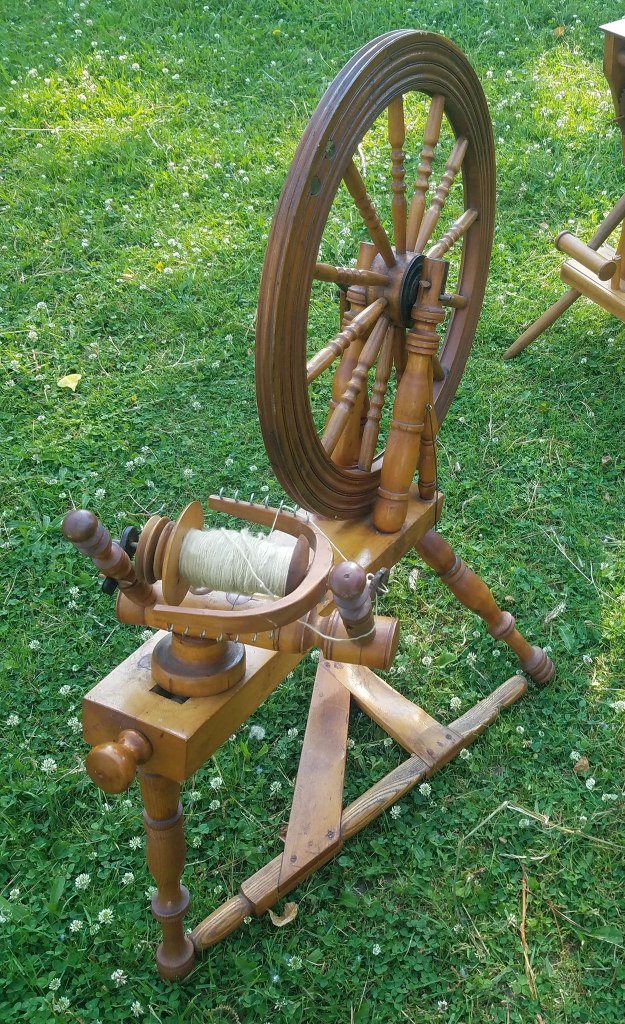
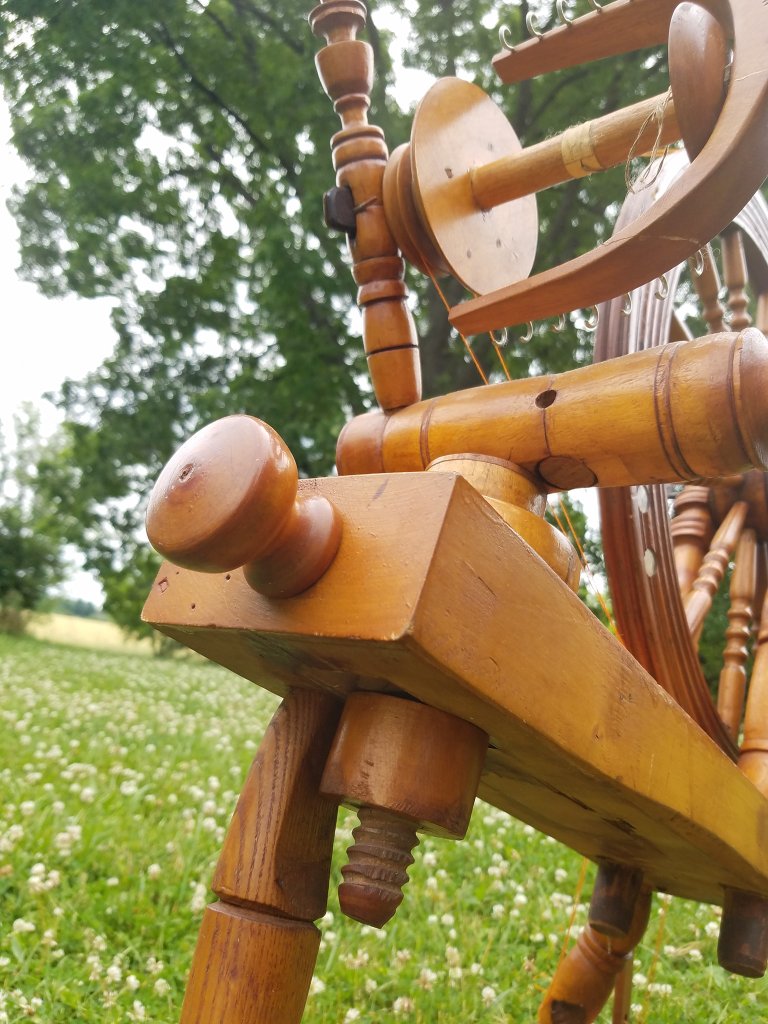
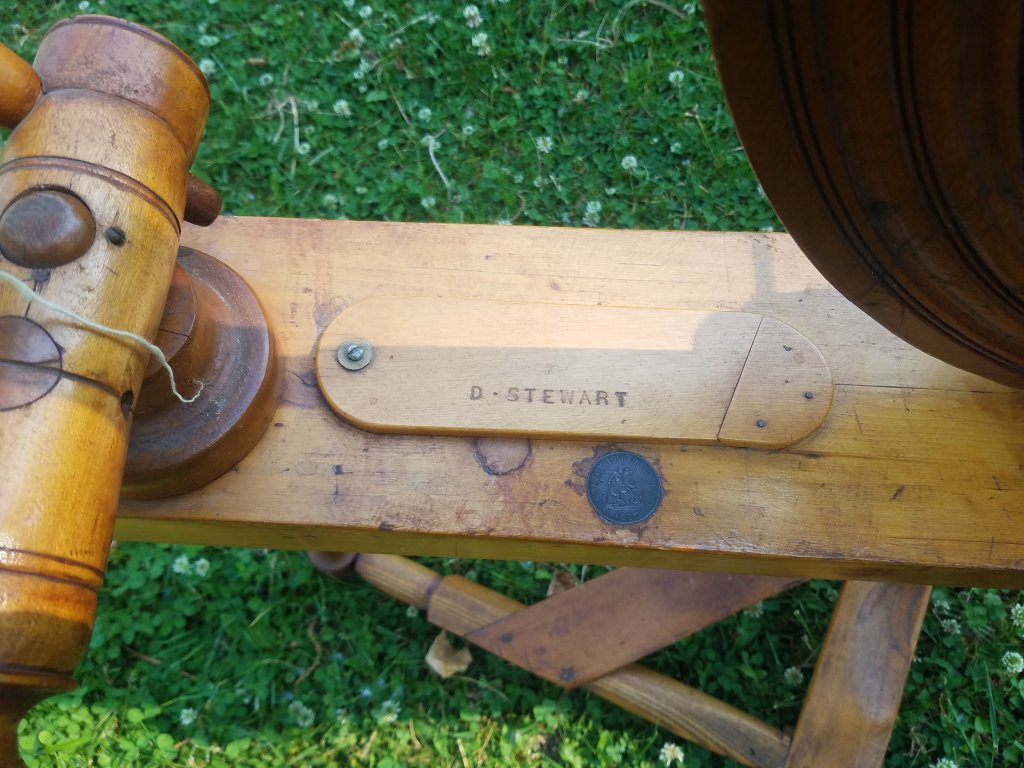
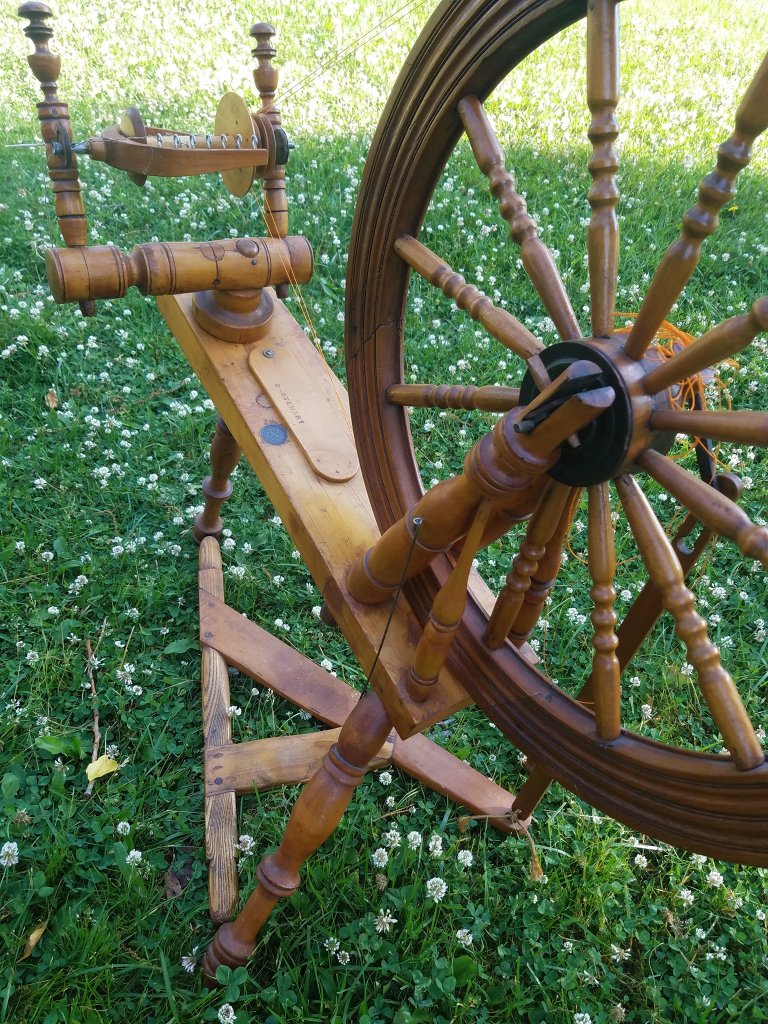
Another intriguing wheel surfaced on Facebook several months ago and shares some similarities with these wheels.  It is a screw tension with the unusual wooden nut under the table and has similar maidens, legs, and treadle construction. 

The table has a cut out box in it, with a cover stamped with the name “D. Stewart” and an embedded 1857 coin marked with “Bank of Upper Canada.” 

The end of the wheel also had the name stamp and an accompanying reel had another embedded coin.  From the style of the stamp, which is different than most maker’s marks, it seems likely that it is the name of the wheel owner rather than maker.  But, who knows?  This wheel looks newer than the others and remains a mystery.  But its similarities to the others suggest there may be some connection. 

For now, Olympe and her family wheels remain a mystery, but it feels as if we are getting closer to solving it.

Thank you to Lisa Pohl Davis for allowing me to use the photos of her D. Stewart wheel.

For more information on this family of wheels:

Cummer, Joan, A Book of Spinning Wheels, Peter E. Randall, Portsmouth, N.H. 1984. Wheels 94 and 95 are on pages 204-207.

Foty, Caroline, “A Family of Wheels of Unknown Origin,” The Spinning Wheel Sleuth, #100 (April 2018).

Fleur

Fleur is an extraordinary Quebec wheel.  She is a formidable presence—large and golden, with eye-catching curves. 

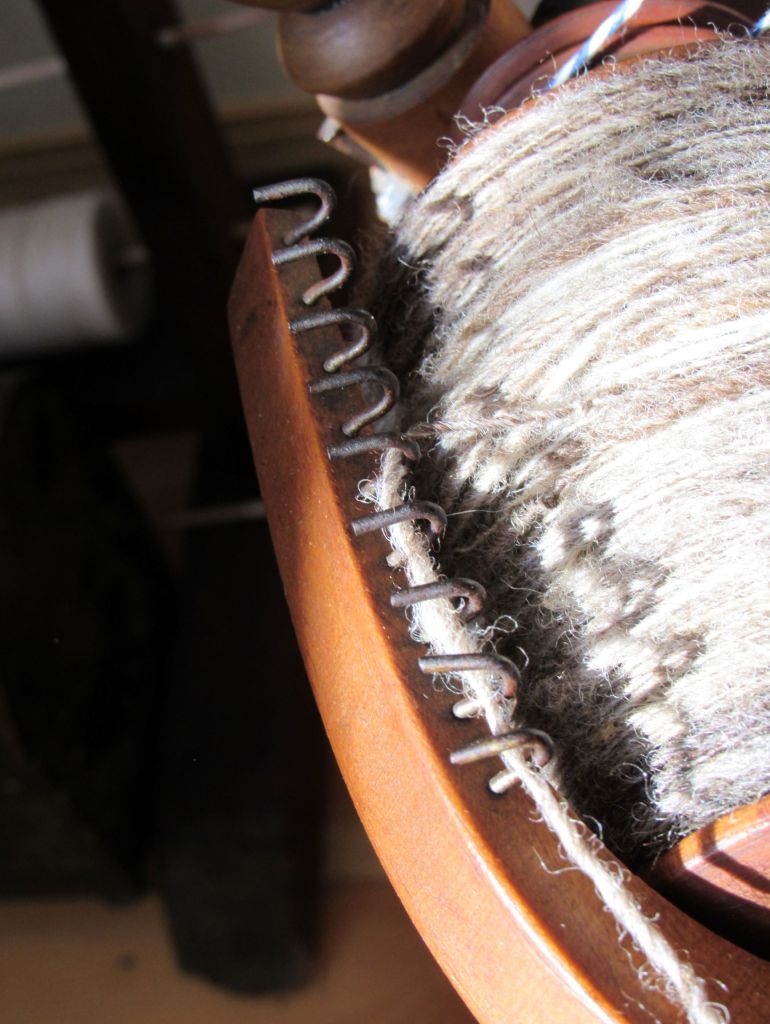
She looks little used, with no wear marks and smooth hooks,

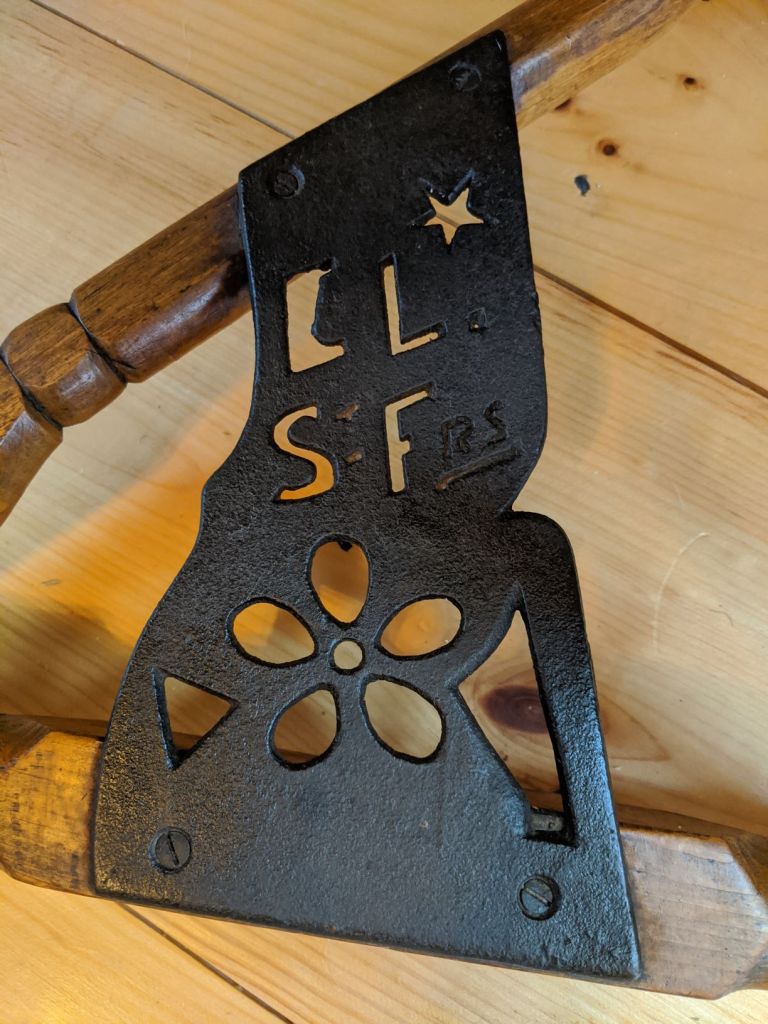
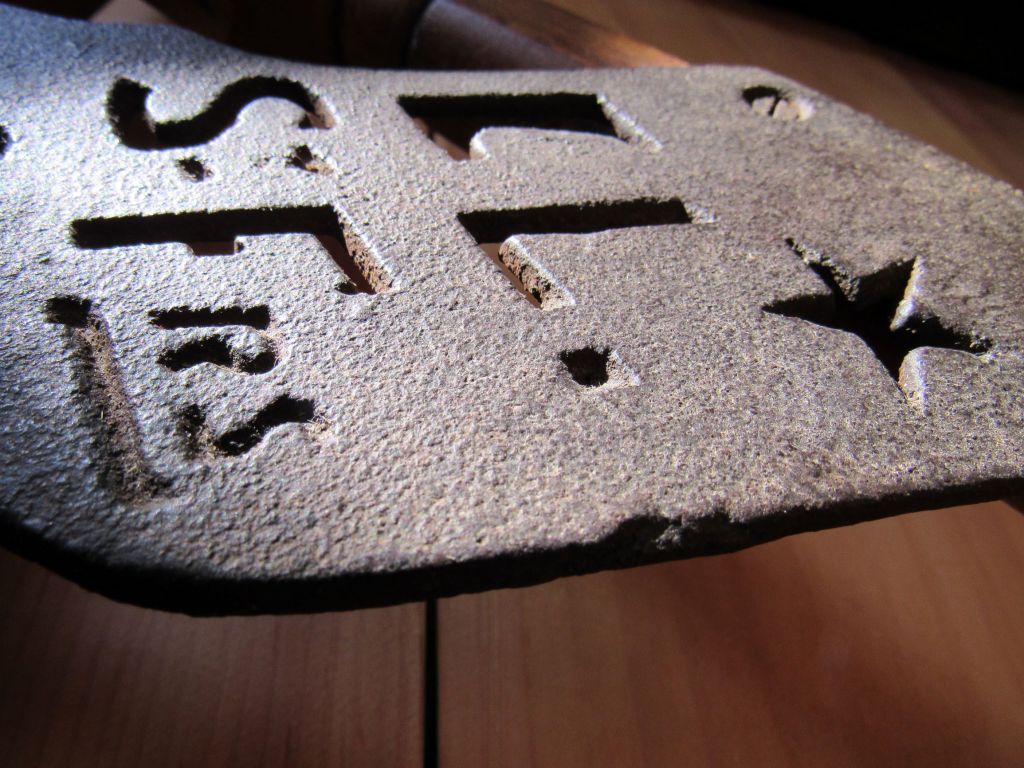
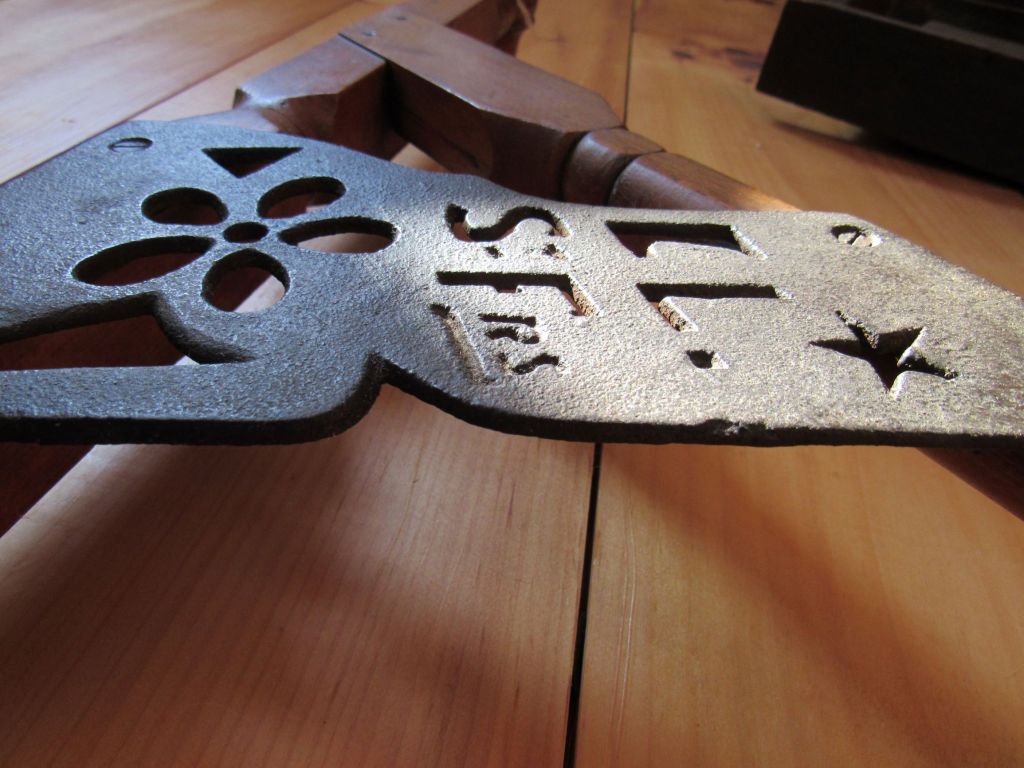
and is probably the best spinner in all of my flock of wheels.  Her treadle is her most unusual feature.  It is metal, with whimsical cut outs that include a flower, star, and “EL. St. Frs.” 

A sister wheel, owned by Linda Martin, was featured in Issue #89 of The Spinning Wheel Sleuth newsletter (July 2015).  The article was written by Martin and Caroline Foty, describing Martin’s wheel and Foty’s research into the wheel maker. 

Working from the letters on the treadle—in effect a maker’s mark—Foty concluded that the wheel likely was made by Elie Laporte from St. Francois-du-Lac, Yamaska, Quebec. 

Laporte’s village, St. Francois-du-Lac, is located on the St. Francois river, near where it meets Lac St. Pierre, a wide portion of the St. Lawrence River.  It was founded as French Jesuit mission for the purpose of converting the local Abenaki and other First Nations people to Catholicism. According to Foty’s research, Elie Laporte had native ancestry through his great grandmother. 

During the colonial period in New England, St. Francis, as it was known there, was feared as a launching point for raids against colonial settlements and the place to which captives from those raids were brought to be adopted or ransomed.  In 1759, during the French and Indian War, Roger’s Rangers attacked St. Francis, killing most of the inhabitants and burning it to the ground.  It was eventually rebuilt and resettled. 

Elie Laporte was born there in 1845, to a carpenter (menuisier) and wheel maker father, Pierre, and mother, Angele Gill (whose great-grandparents were from Massachusetts). 

Elie had three daughters, one of whom, Hermelina, migrated to Lowell, likely to work in the mills, and married there.  Laporte died in 1919. 

Laporte’s wheels have a different look than other Quebec wheels of the era, with a thick, low slung table, and distinctive maidens.

Interestingly, a wheel maker a generation earlier, Jean Baptiste Houle (1828-1884), from a neighboring town in Yamaska, made wheels with a similar profile, table and maidens.  Houle marked his wheels with “JBH” on the end of the table. 

Whether there was any working relationship between the two men is unknown at this point, but, at the very least, it seems likely that Houle’s wheels had some influence on Laporte’s style.  If so, Laporte kicked things up a notch creating truly exquisite machines, with a personal touch of whimsy. 

I became interested Laporte’s wheels because of their similarity to a group of very large Quebec wheels, affectionately referred to as Madame Maximes or Big Berthas (the subject of the next post).  So, when a Laporte wheel came up for sale in Virginia on Facebook, I was over the moon. 

The seller and a wonderful wheel railroad volunteer met at Red Stone Glen in Pennsylvania and the wheel headed north to Maine.  My first reaction when I picked it up was that it was huge, with a 34 inch diameter drive wheel, and 28 ½ inch long table. She makes the very large wheel in my last post, Zotique, seem almost petite, with a 30 inch diameter wheel and 23 inch long table, and dwarfs Patience, the Shaker wheel below.

Fleur’s wood is very blonde, with some interesting reddish grain along the mother-of-all. 

She lights up a room.

For all the careful workmanship on this wheel, there is evidence of practicality, as with so many Quebec wheels. The lumber used for the table has a rough edge, just stripped of bark and smoothed a little.

Many of the nails holding the spokes are loose and some of the spokes have been moved.

The turnings are very distinctive, with fat feet,

and unusual maidens. 

The non-spinner side leg on mine does not match the others, probably a replacement that was whittled down to fit into the table.

The tilt tension system has a simple flat metal bar attached—at an angle—to the table

with two bolts underneath

and adjusted with nuts at the end of the mother-of-all. 

The orifice is smooth.

Each upright has a secondary support and the axle sits in deep cuts in the uprights. 

The drive wheel rim is narrow

and the rim joins have a jigsaw puzzle look. 

The spokes are lovely,

joining the hub like upside-down blossoms. 

The rounded treadle support bar extends quite far past the legs,

with a metal sheath underneath, perhaps (as Martin suggested in her article) to protect the wood from a metal footman.

It is the treadle, though, in the end, that makes me want so badly to know more about Elie Laporte. 

References:

Foty, Caroline, Fabricants de Rouets— this book is available for sale as a downloadable PDF by contacting “Fiddletwist” by message on Ravelry.

Foty, Caroline and Martin, Linda, “Finding Elie Laporte,” The Spinning Wheel Sleuth #89 (July 2015).