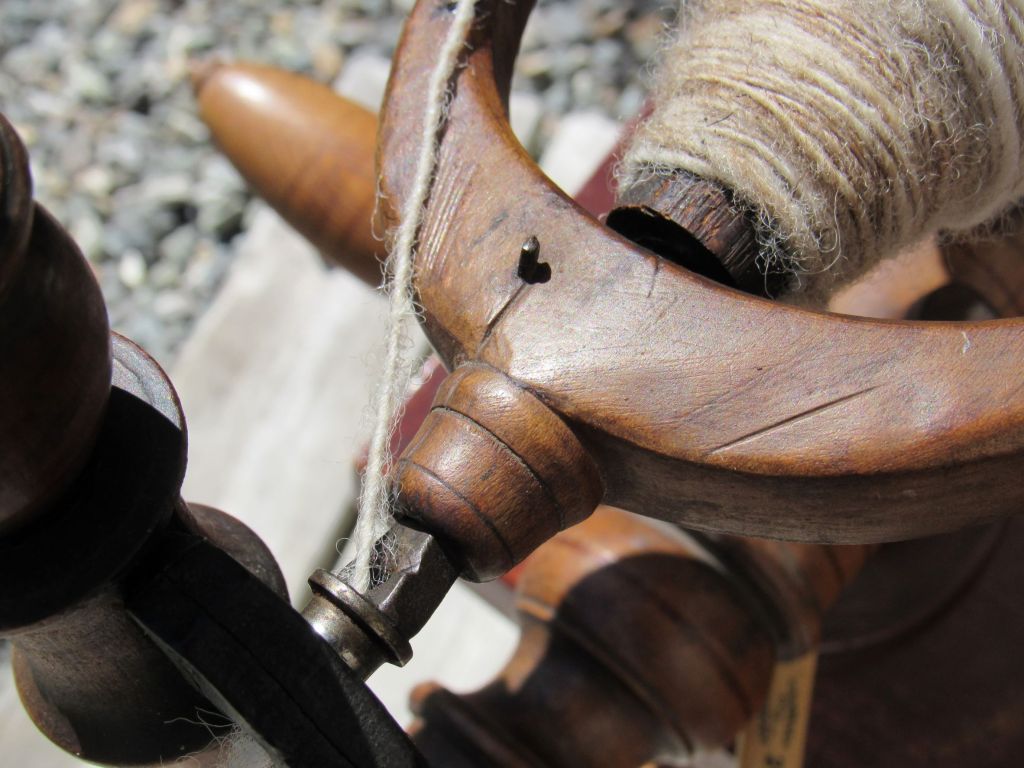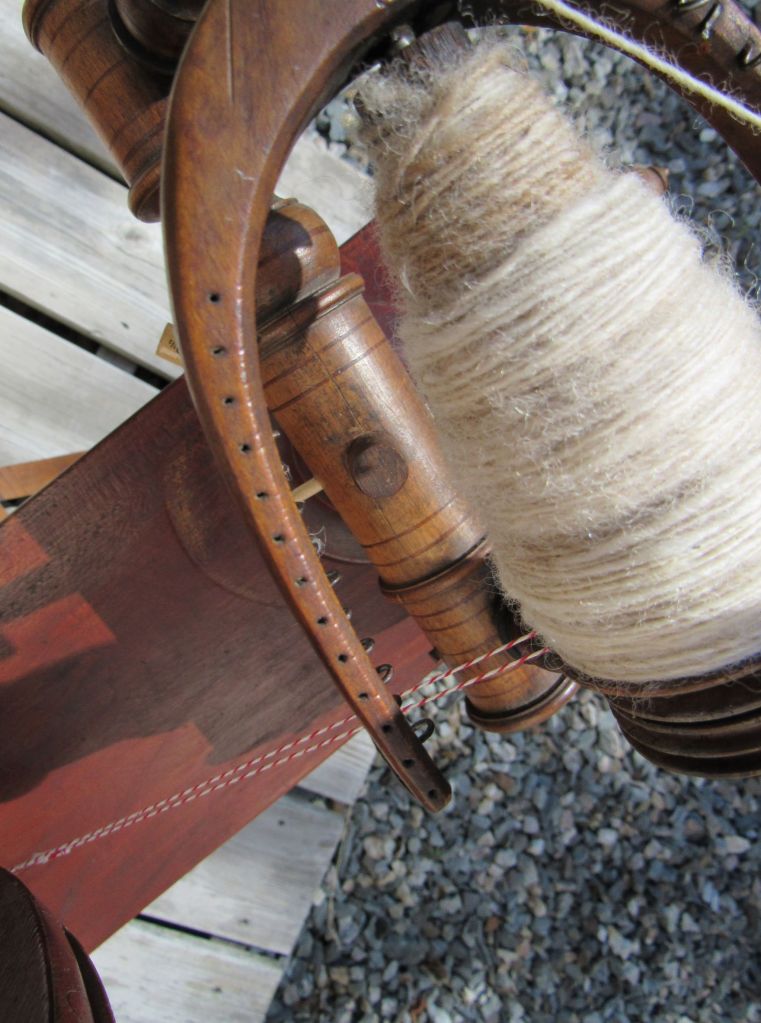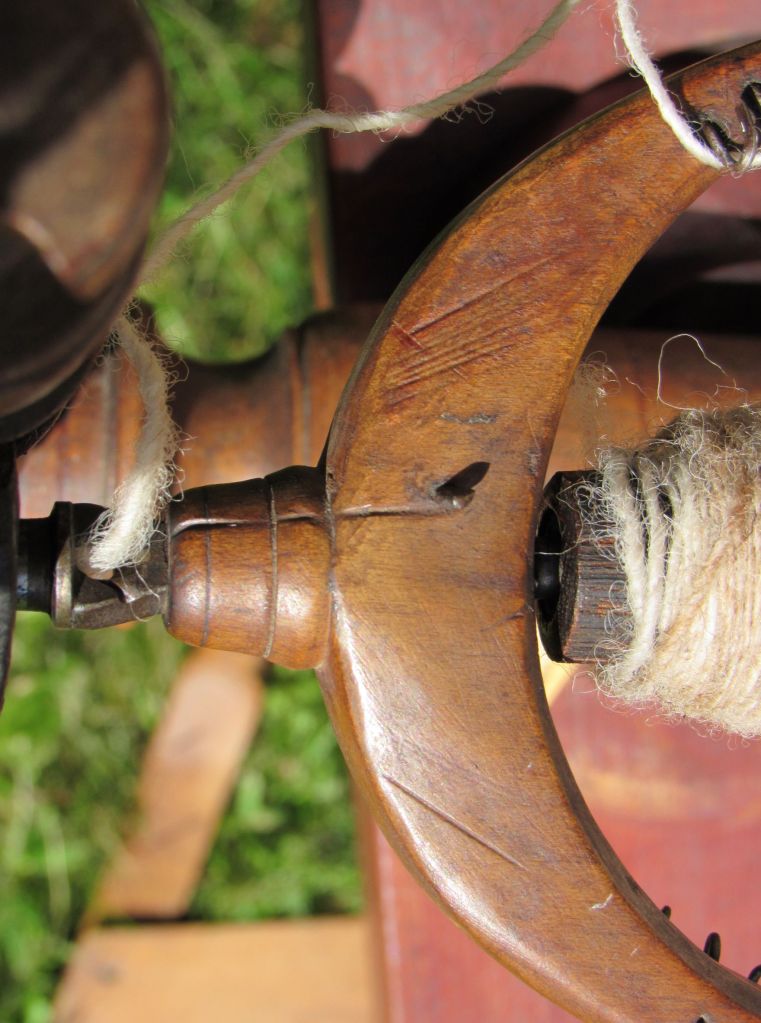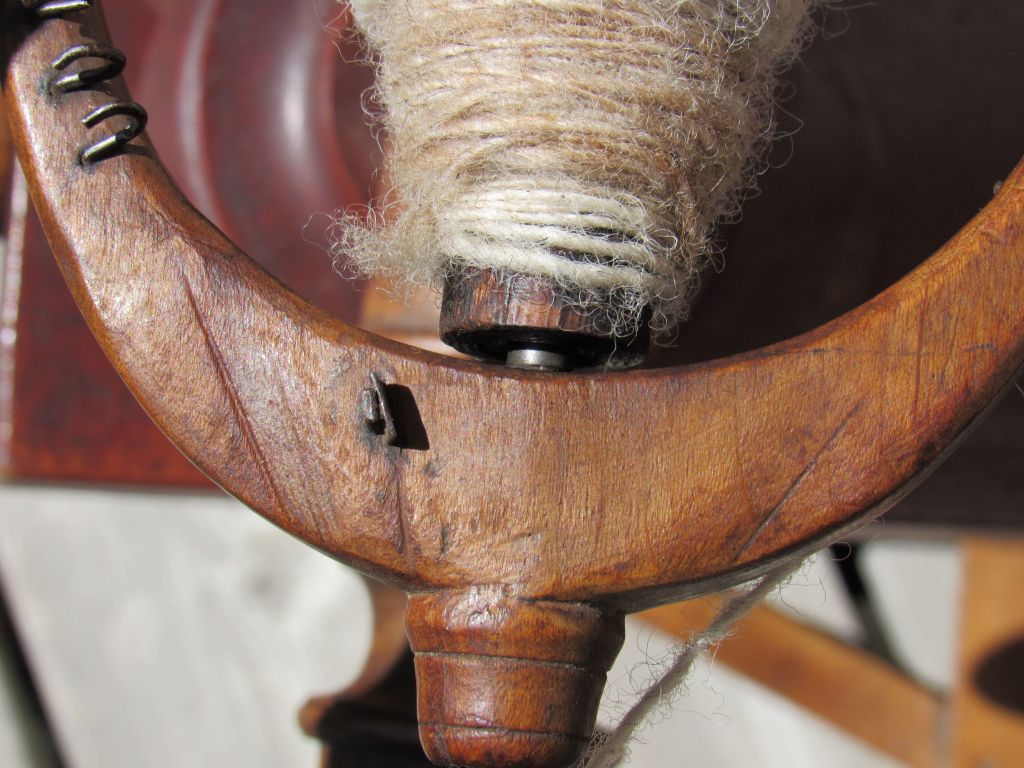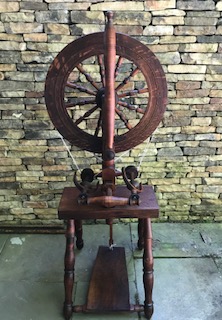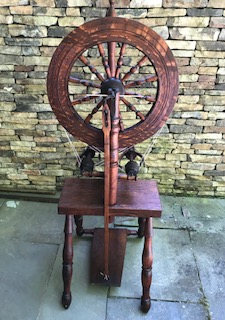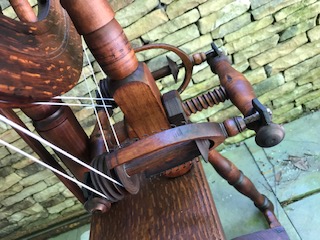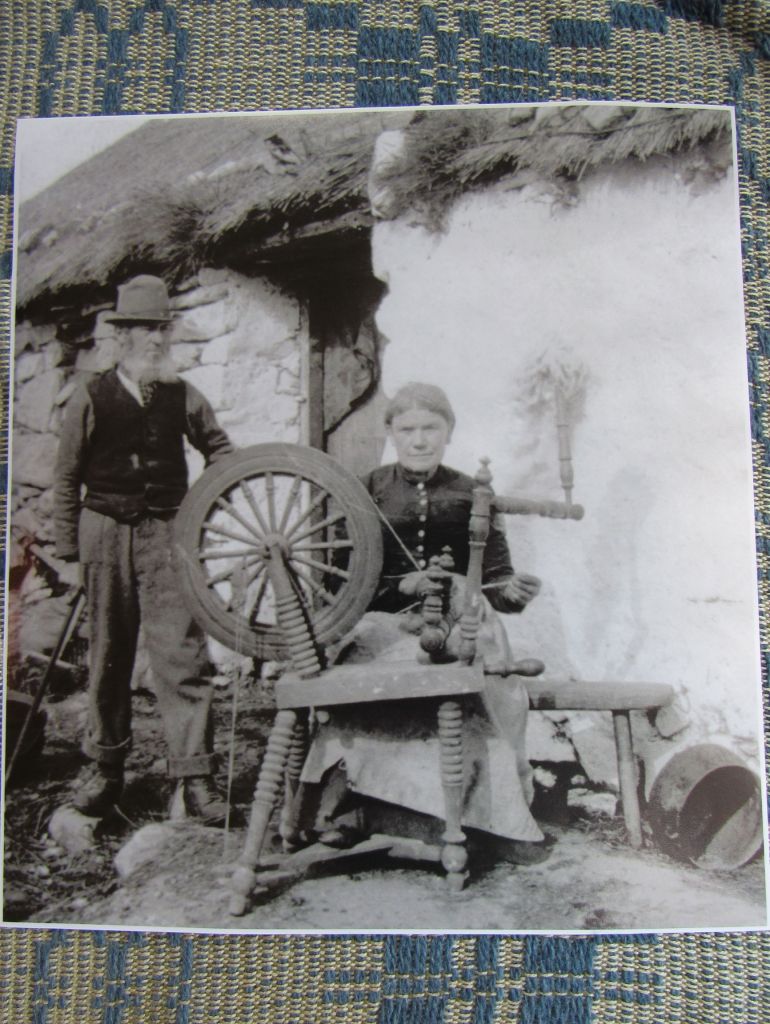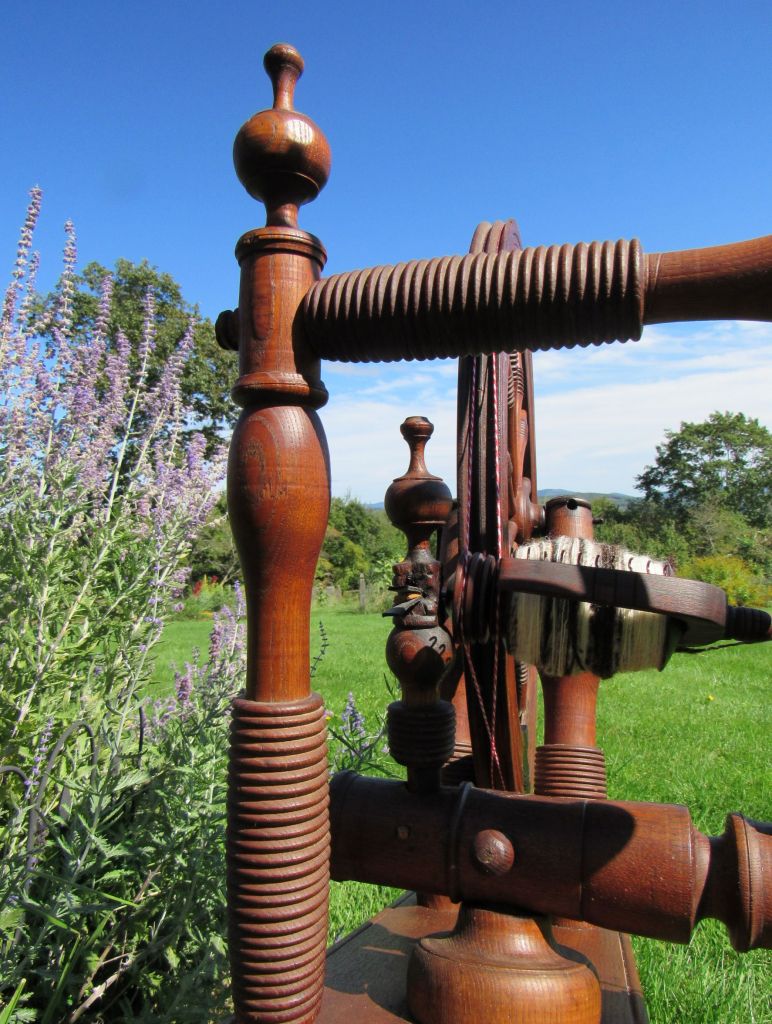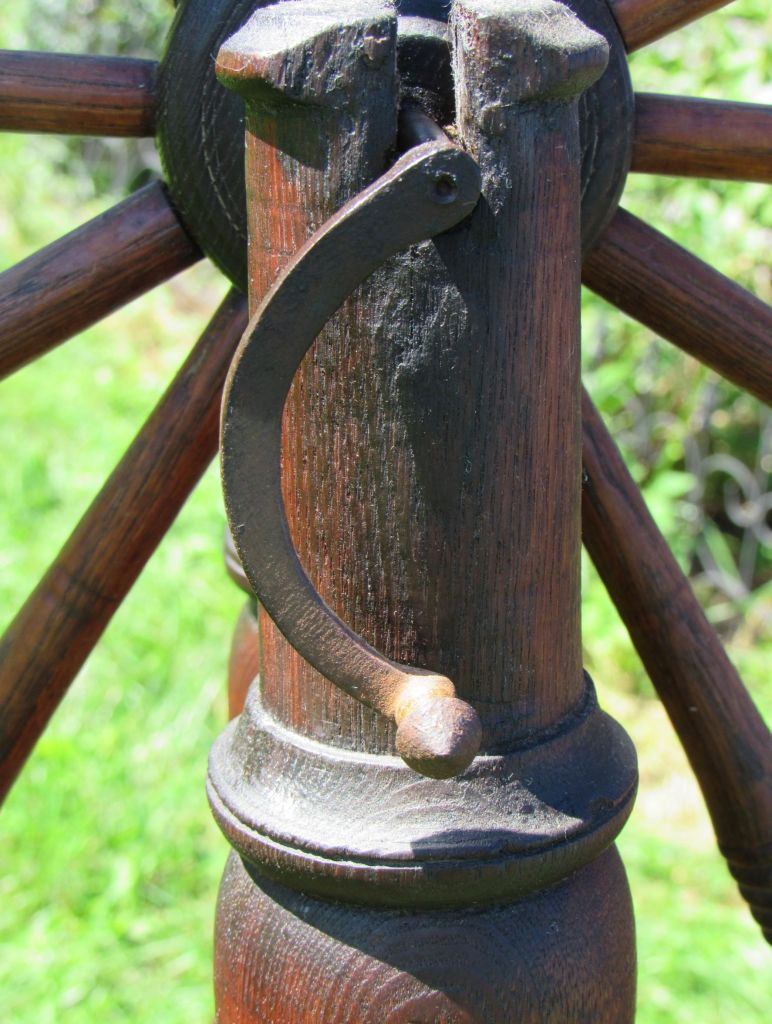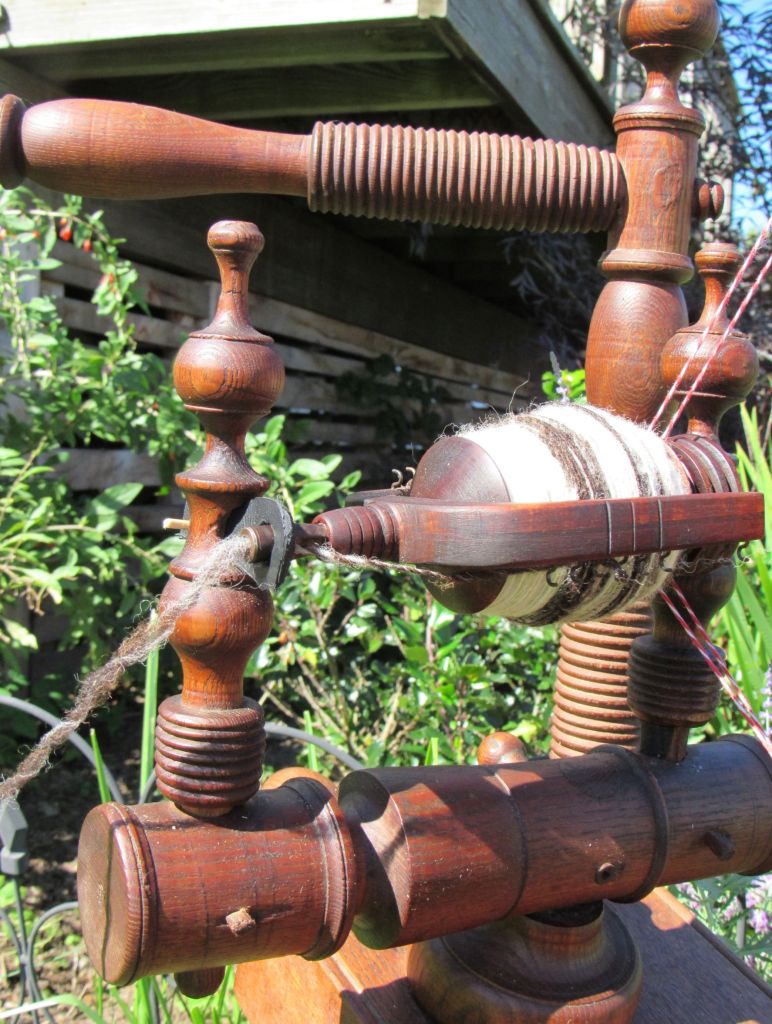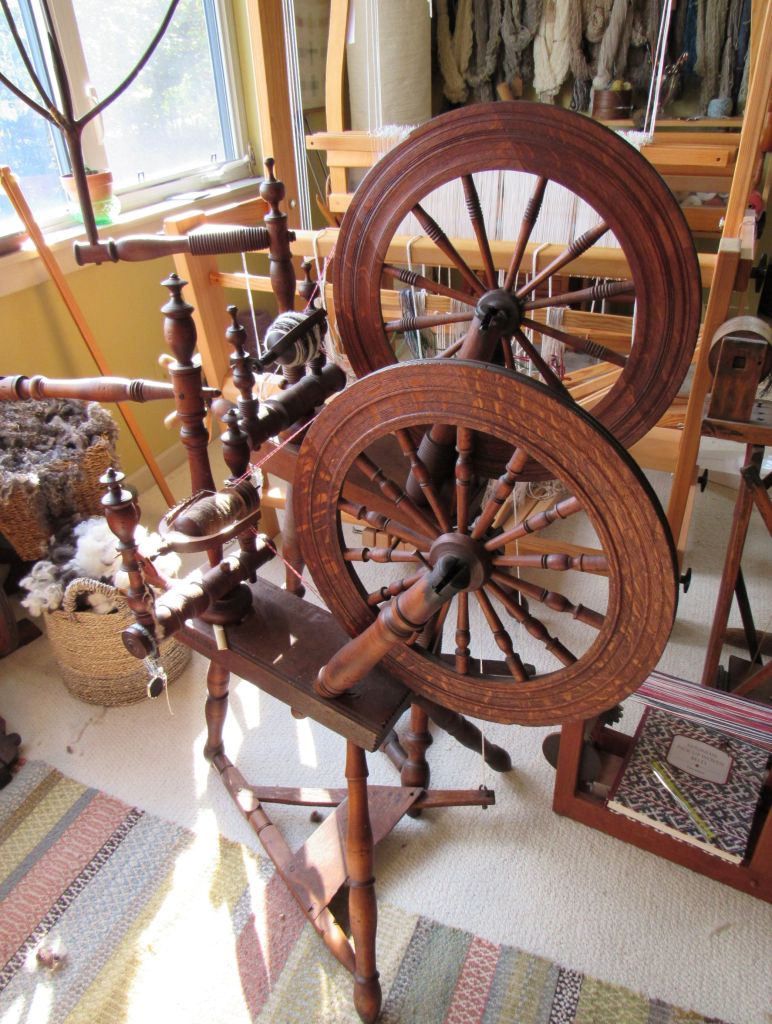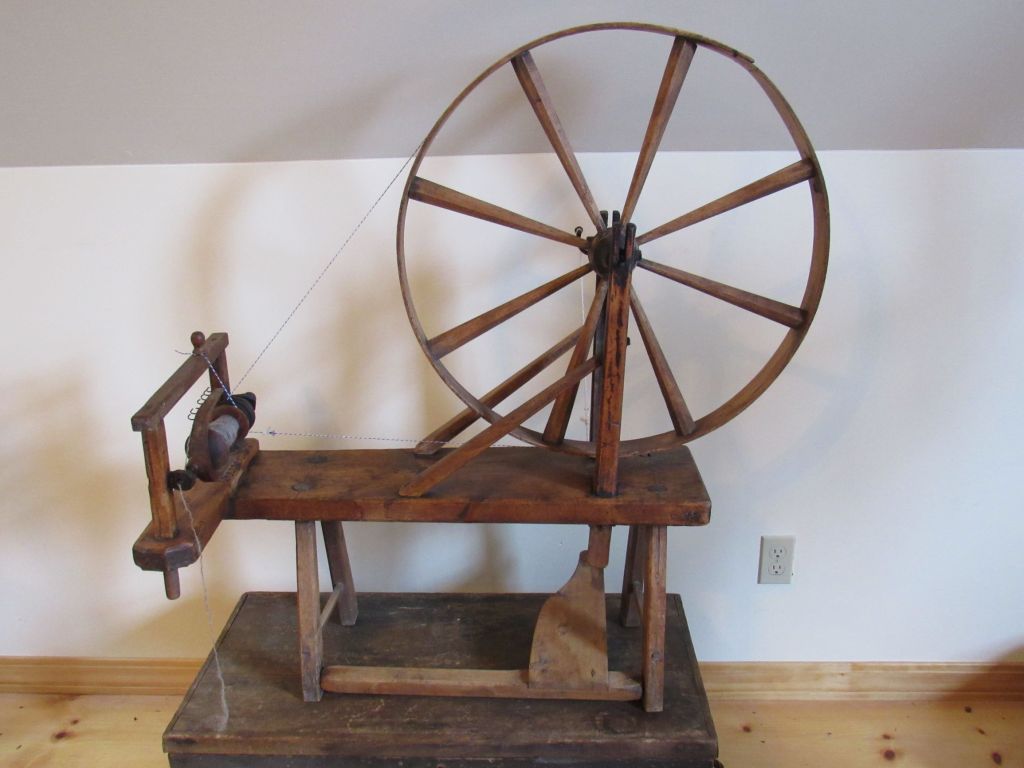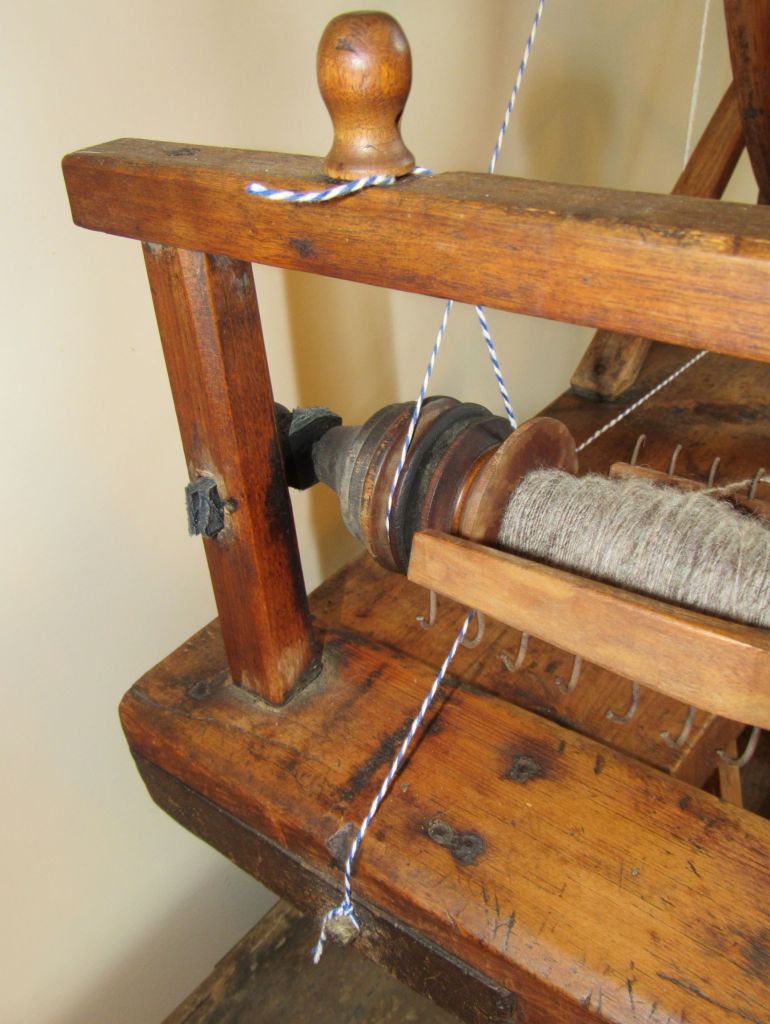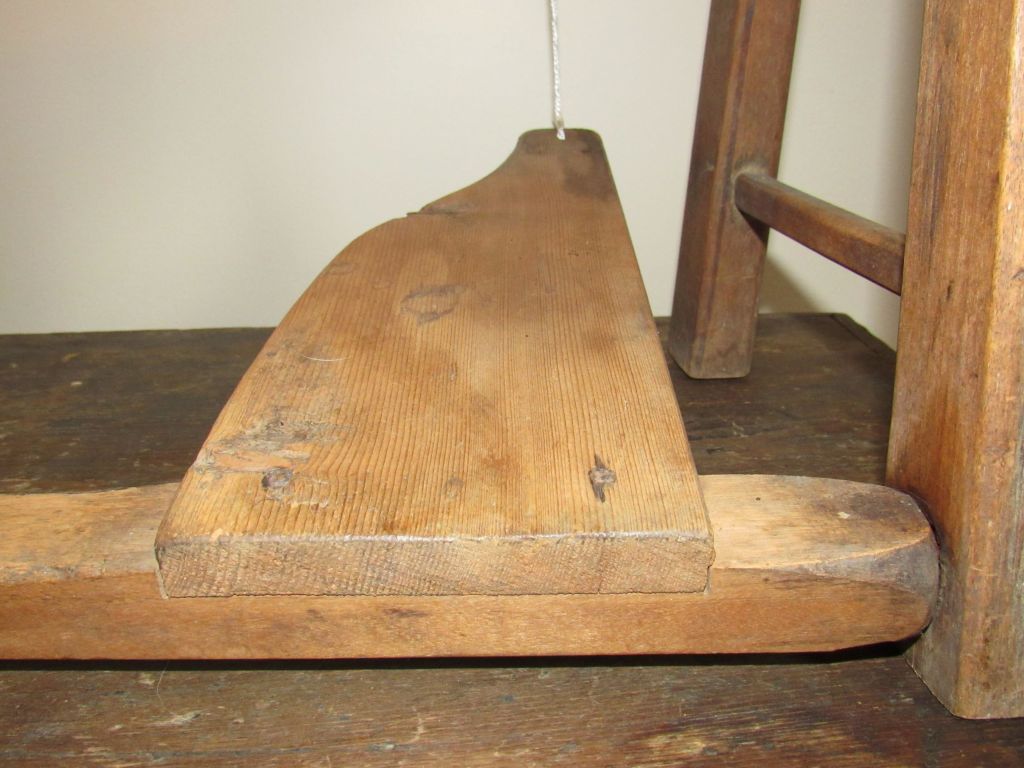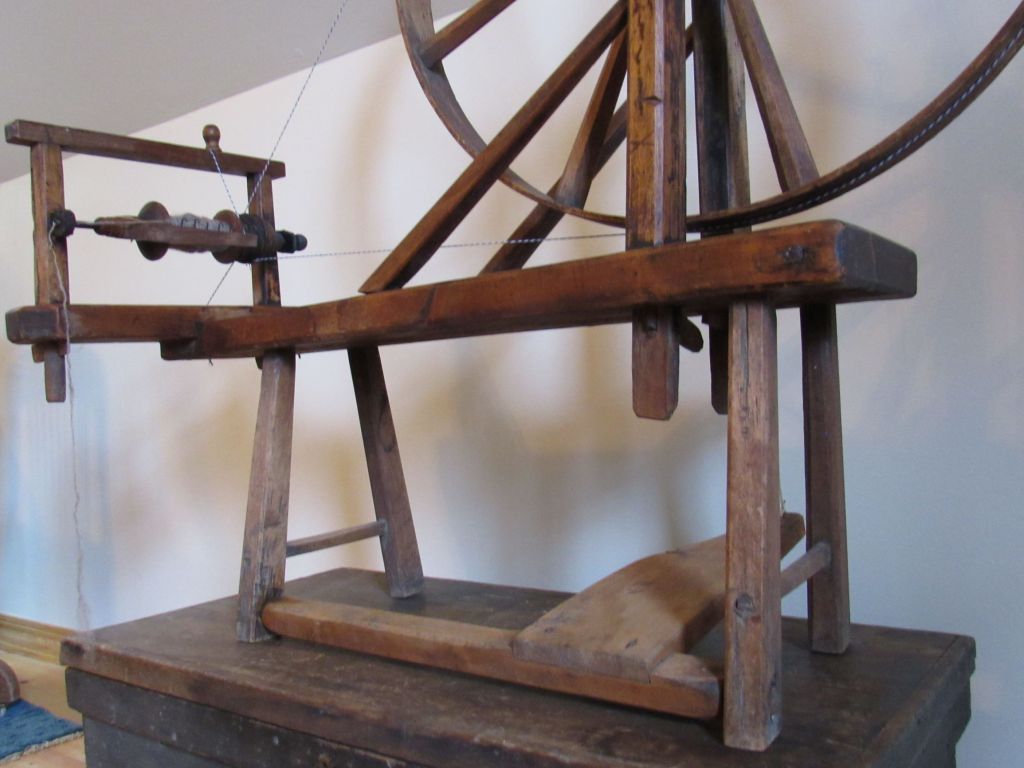
Jocasta

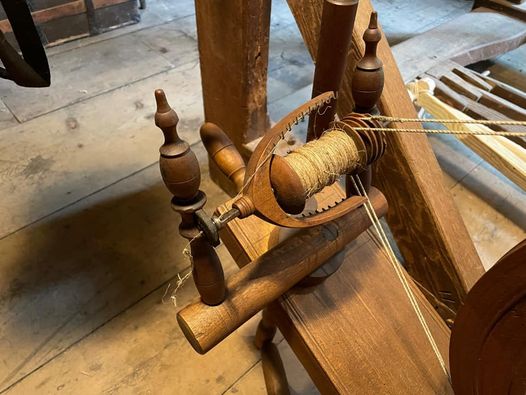
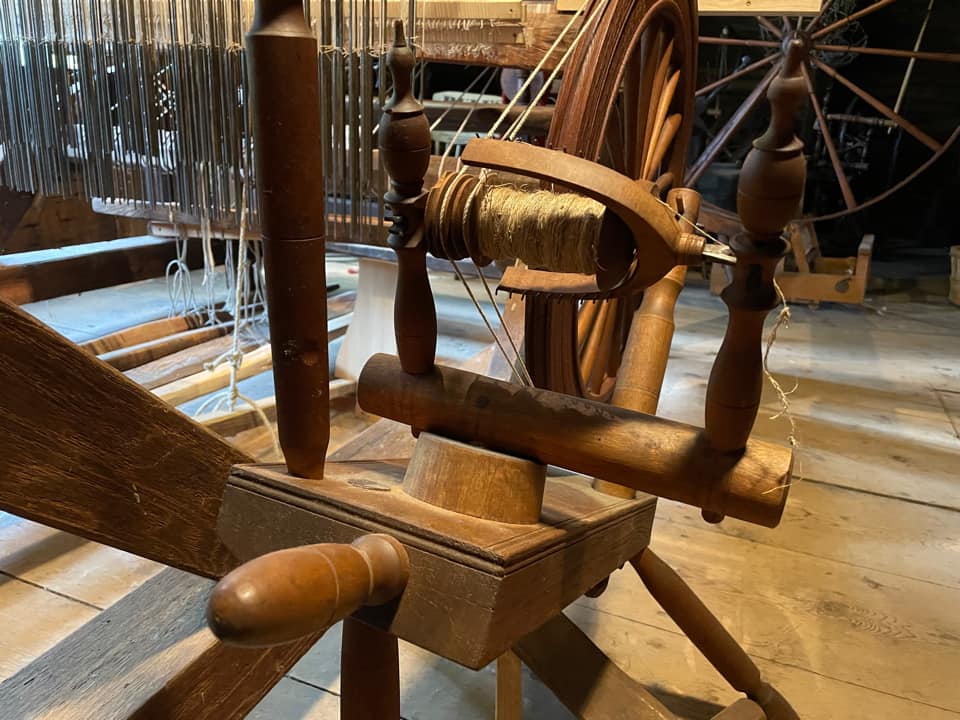
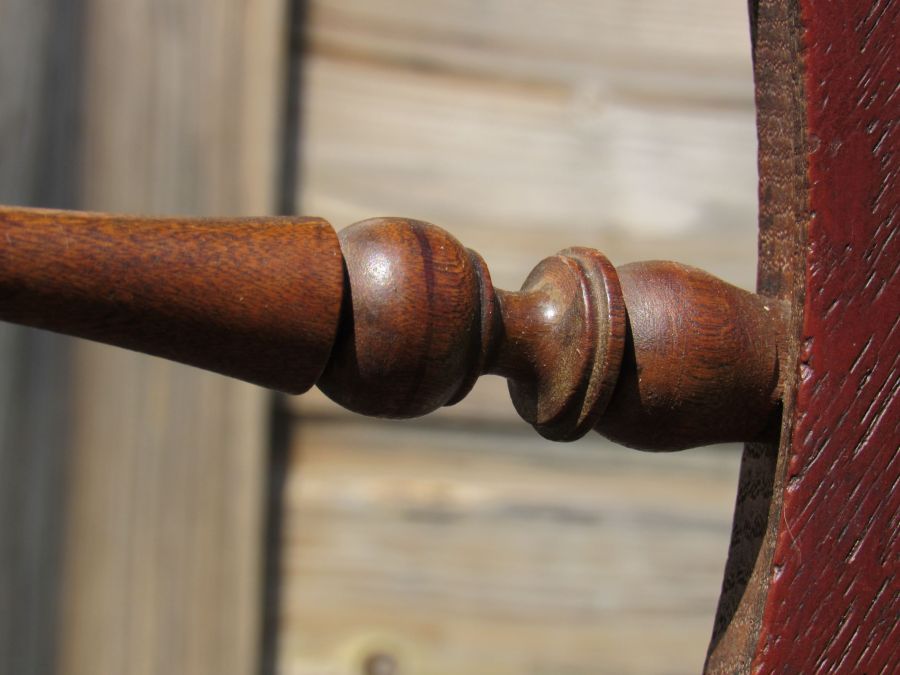
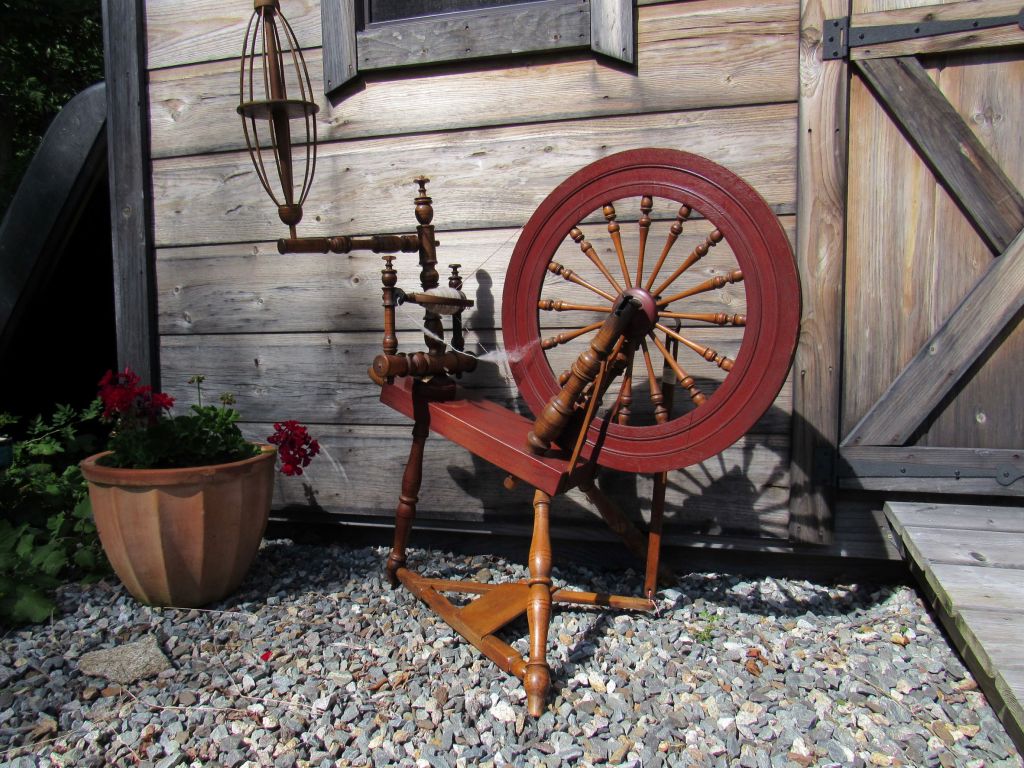
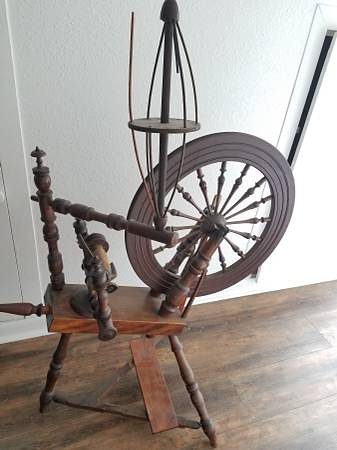
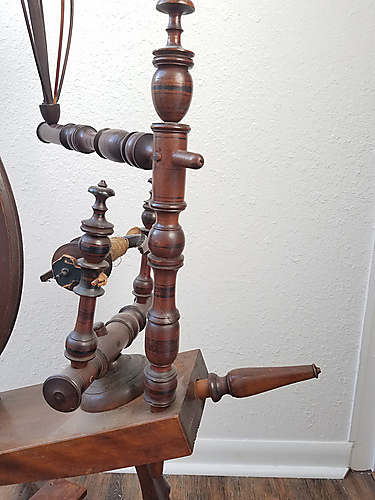
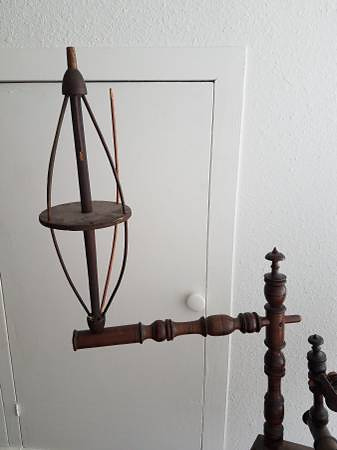
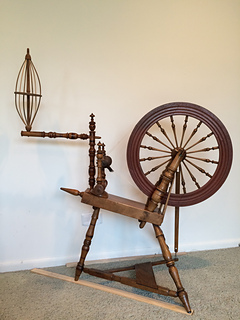
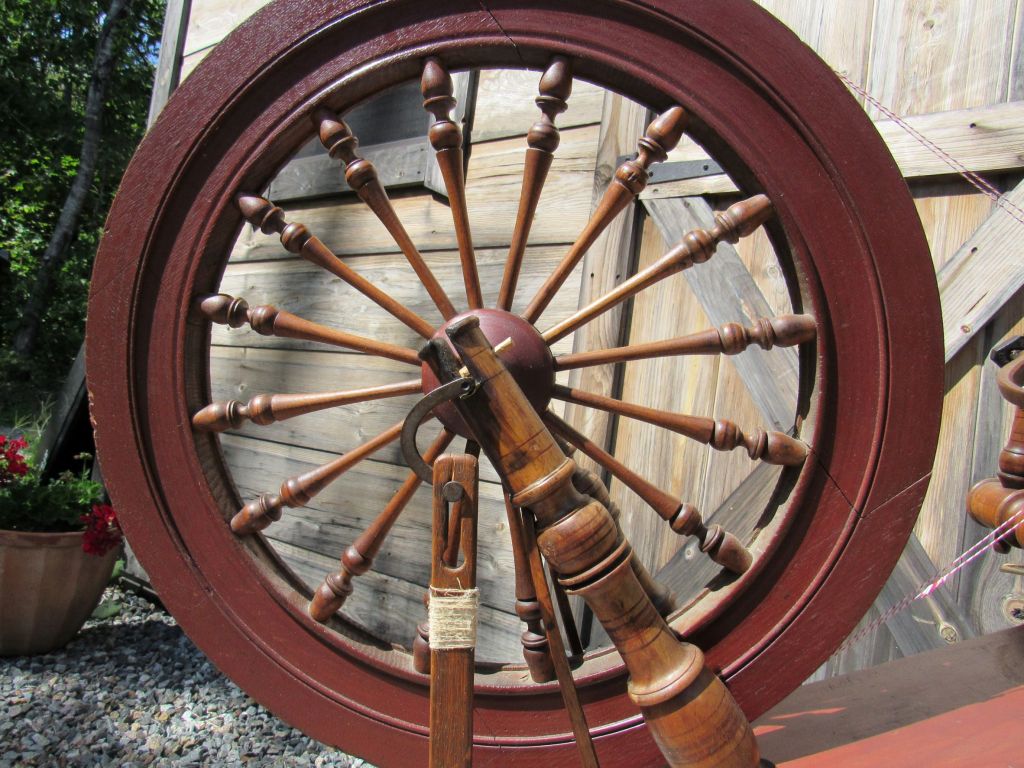
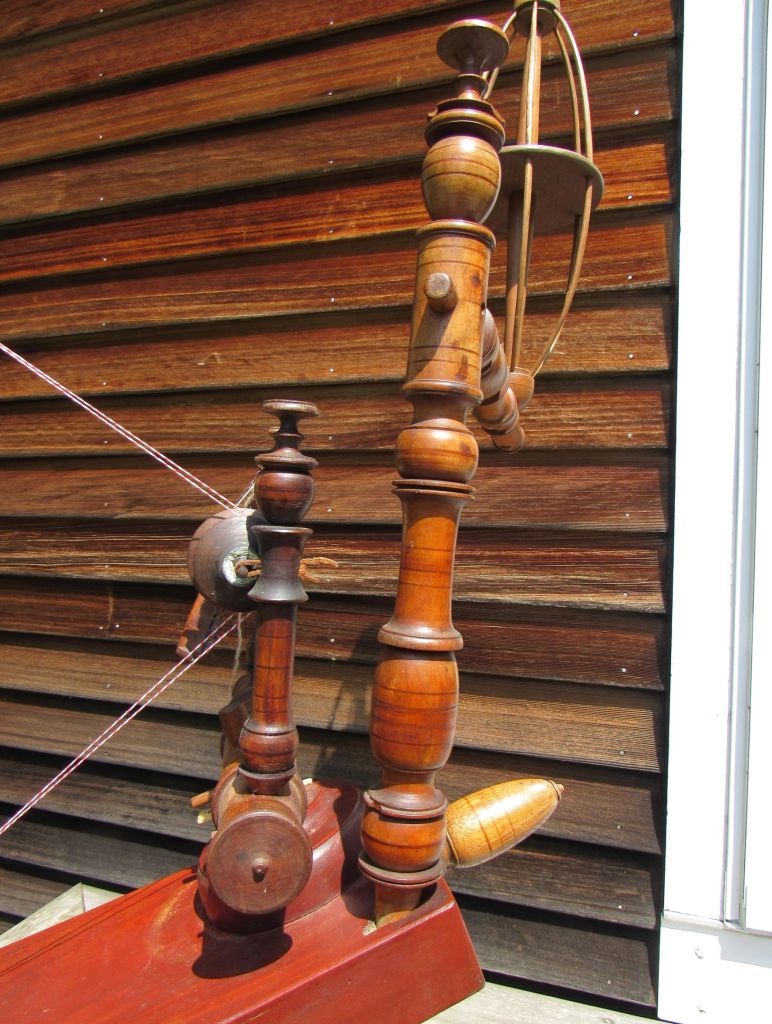
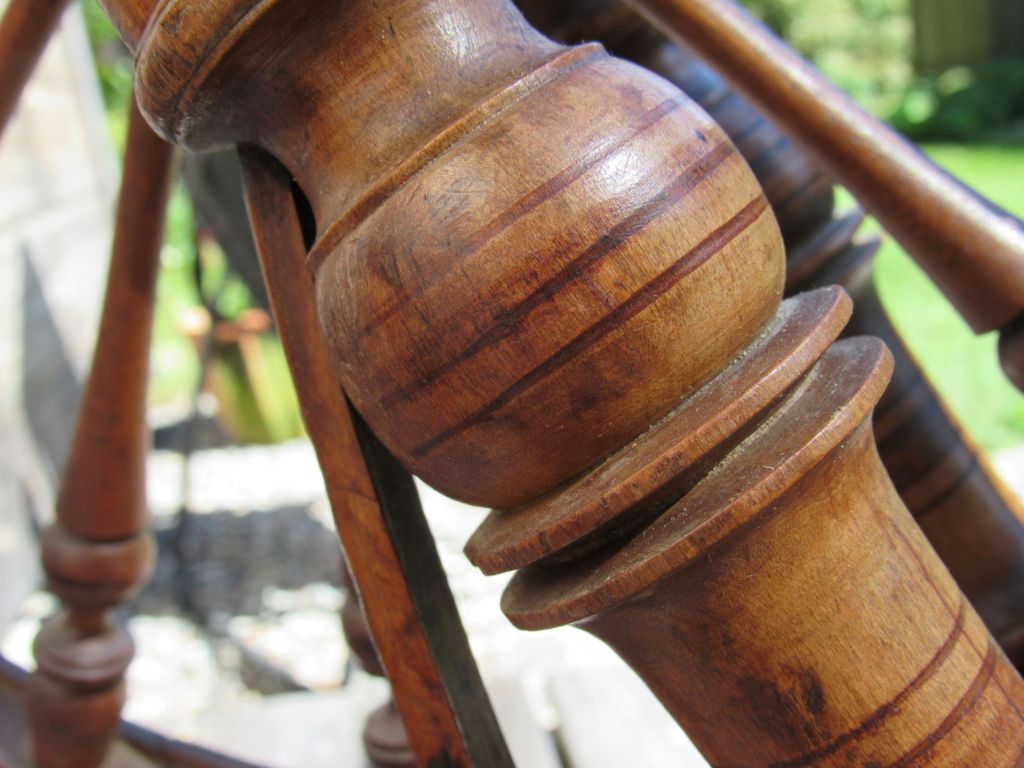
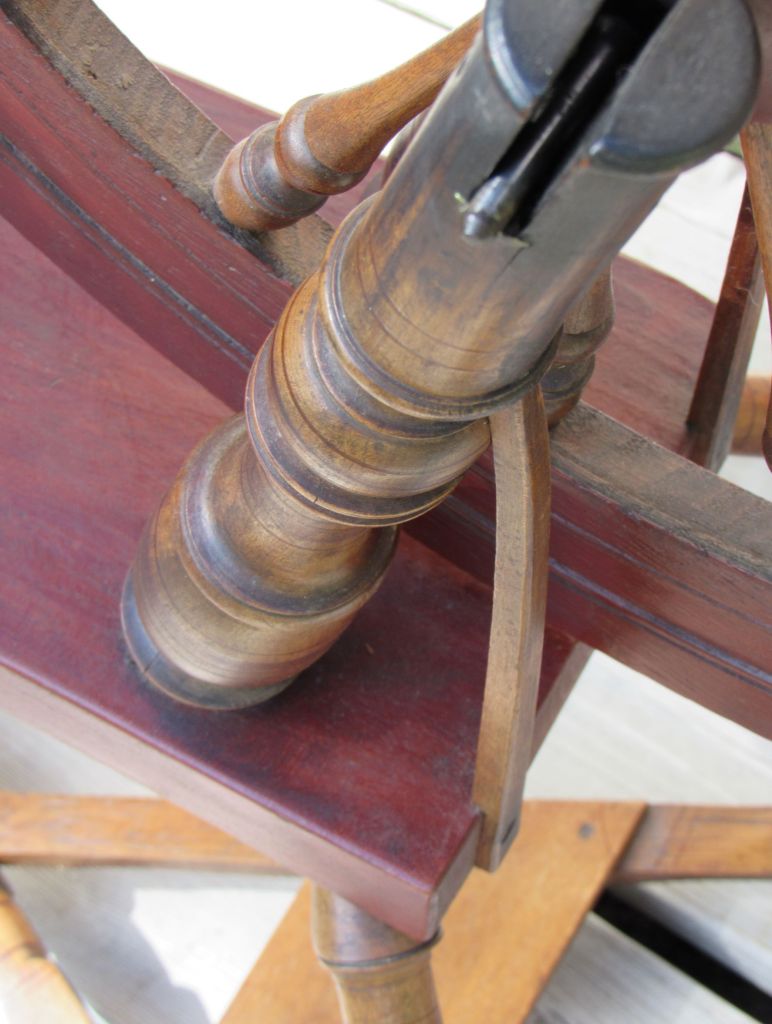
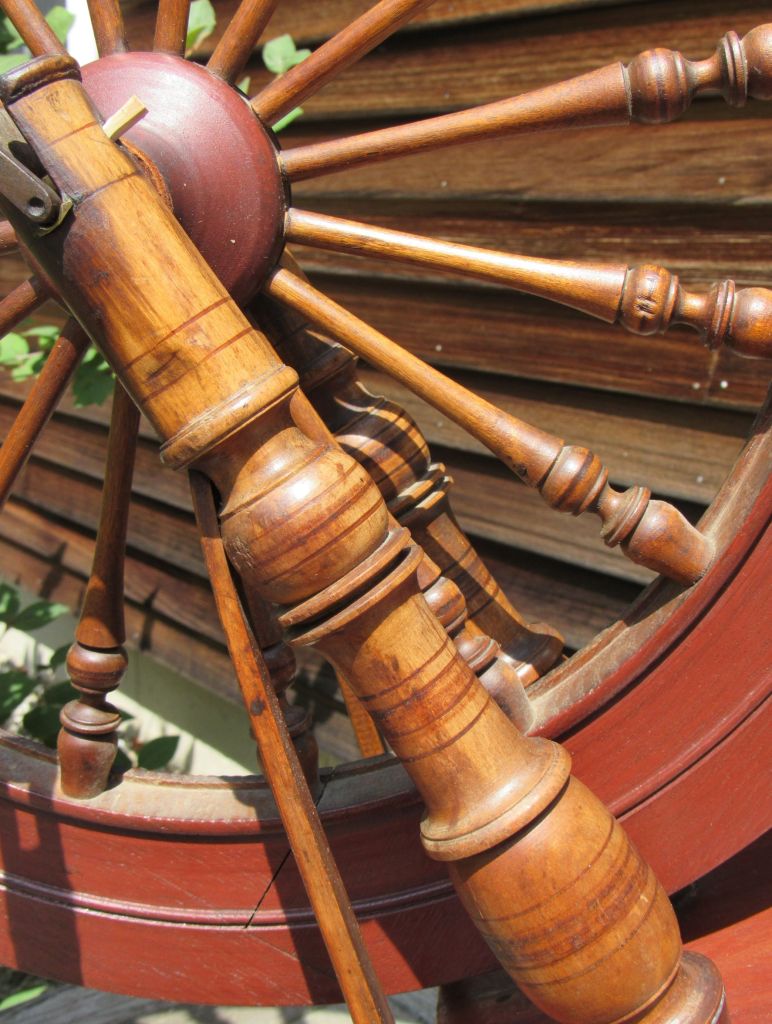
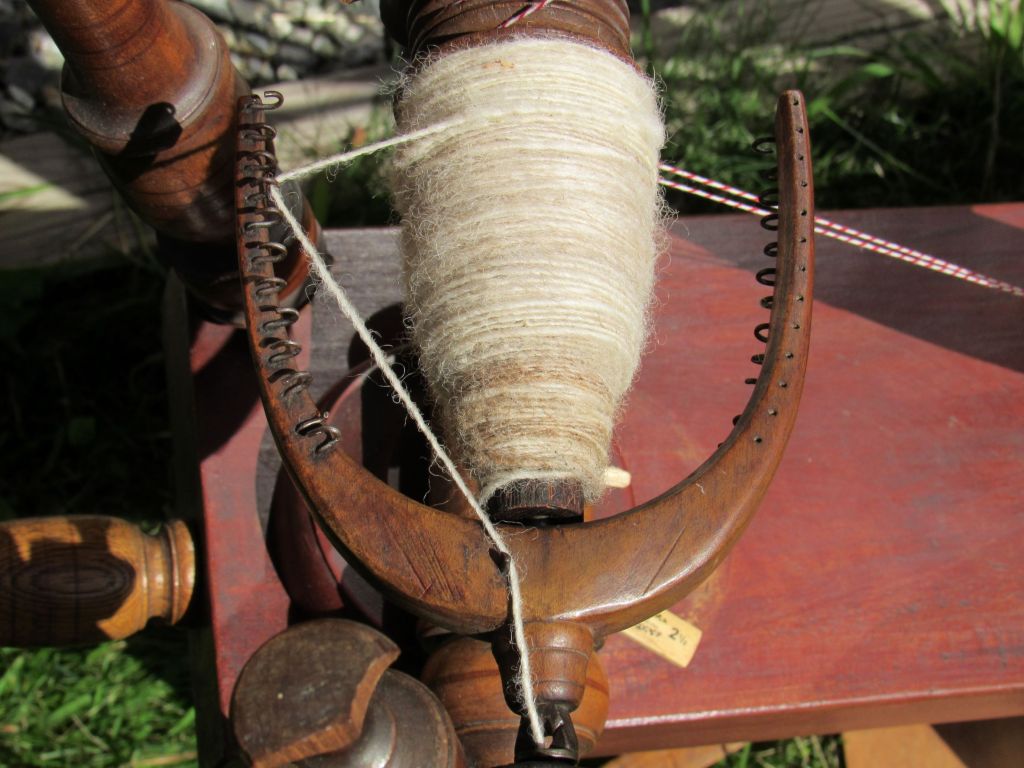
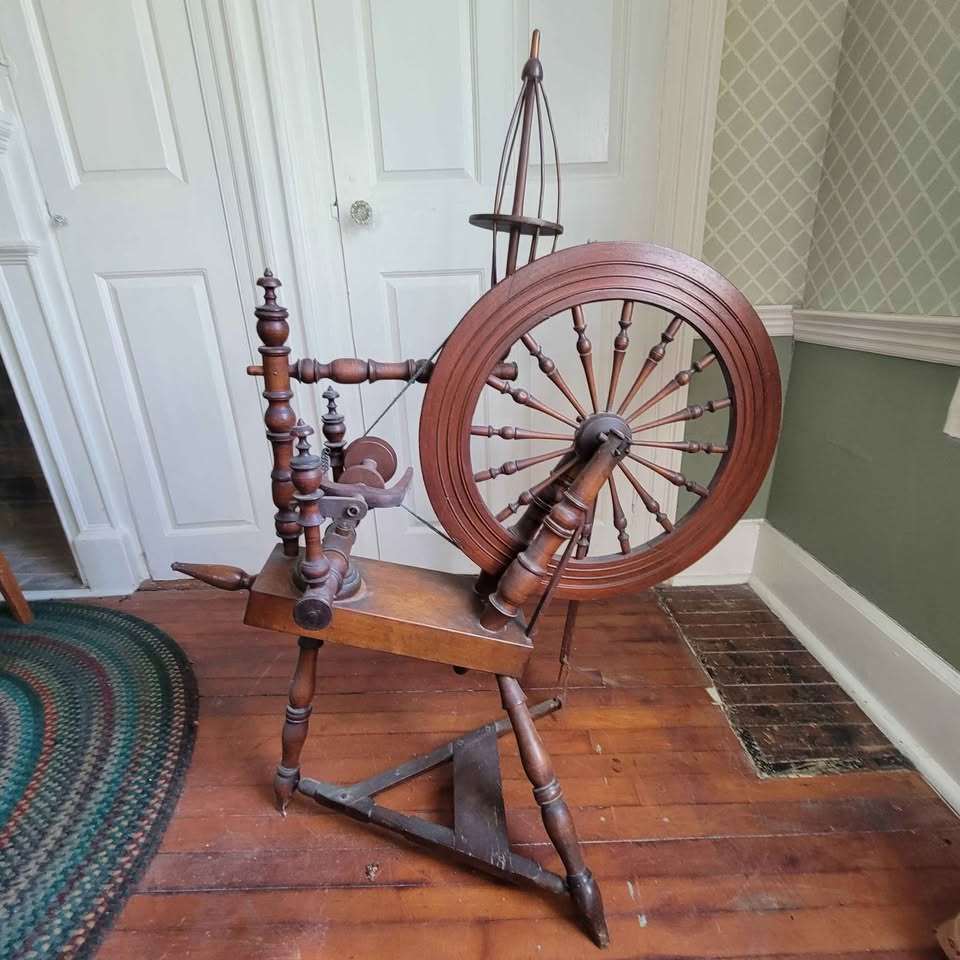
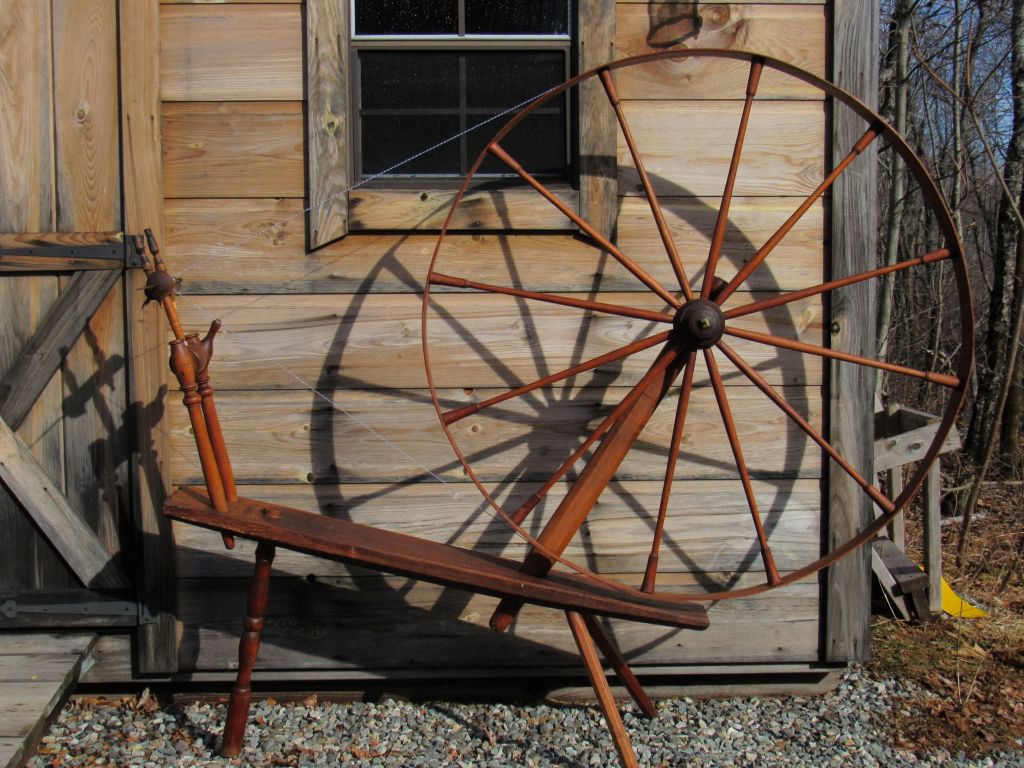
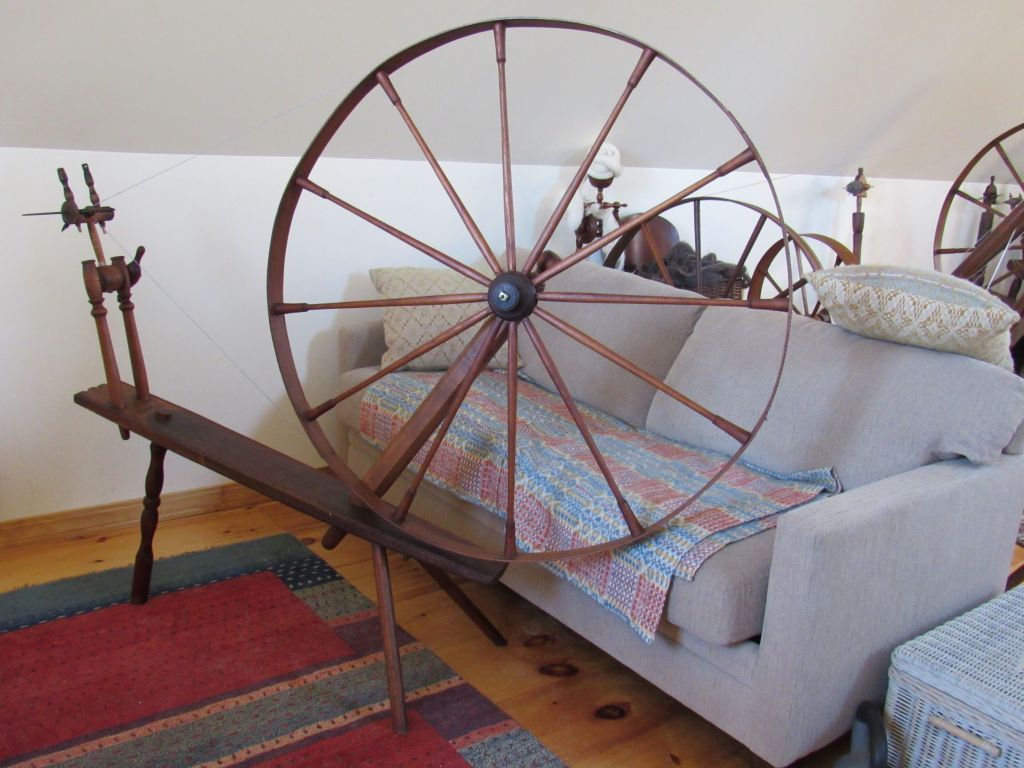
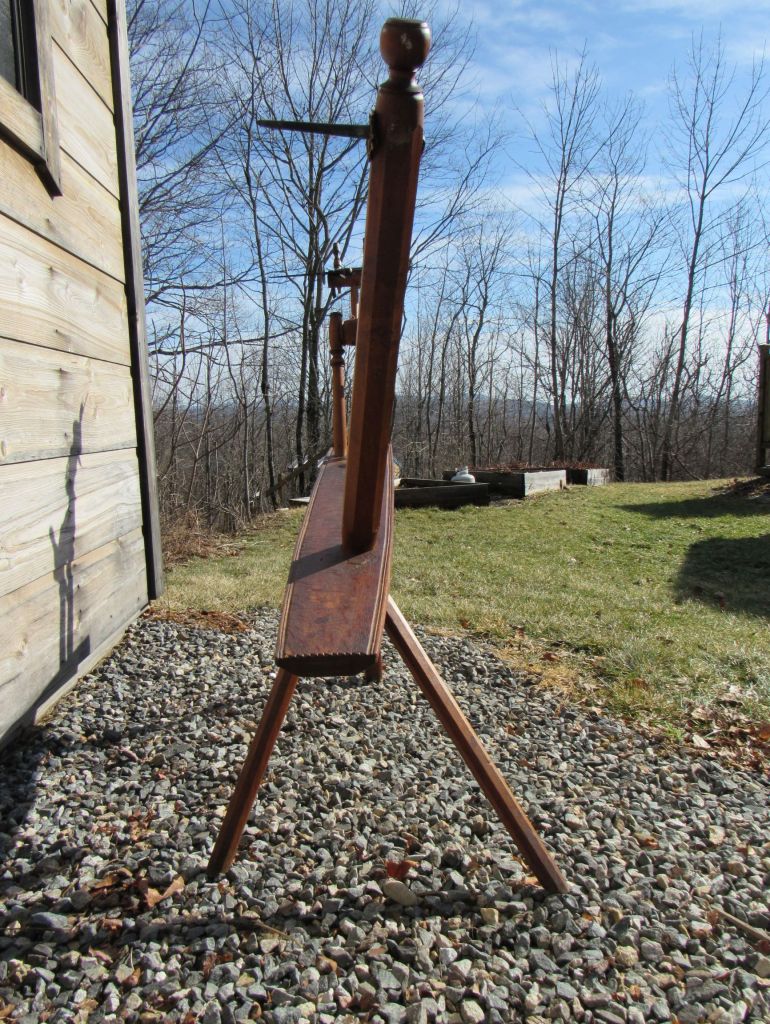
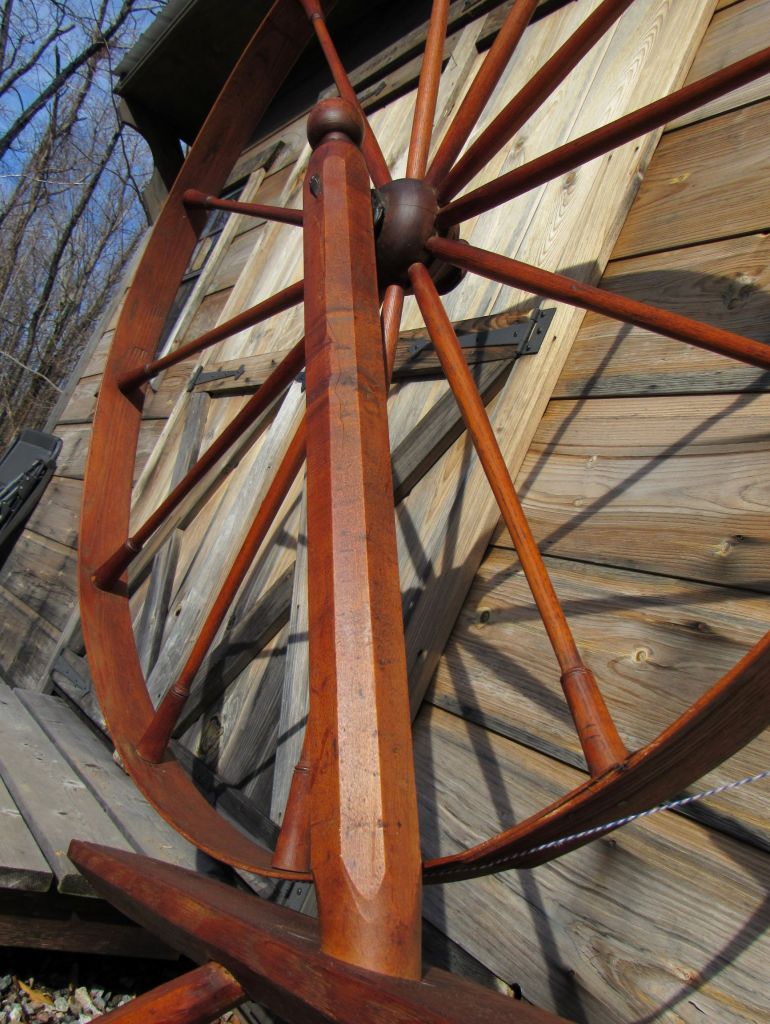
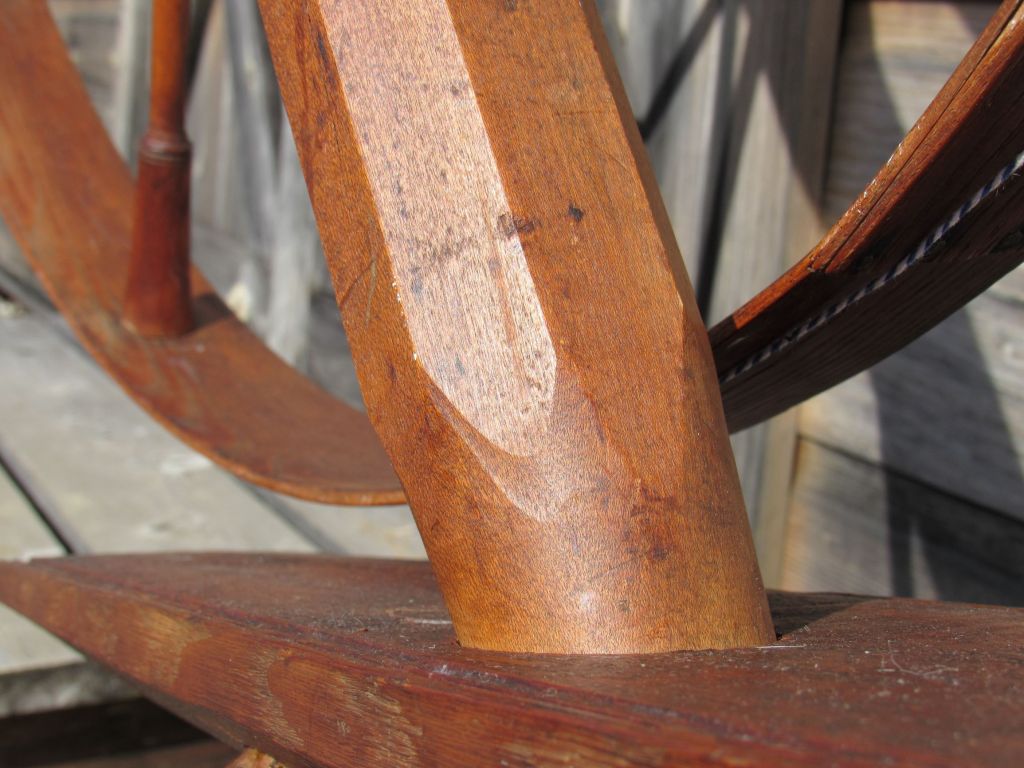
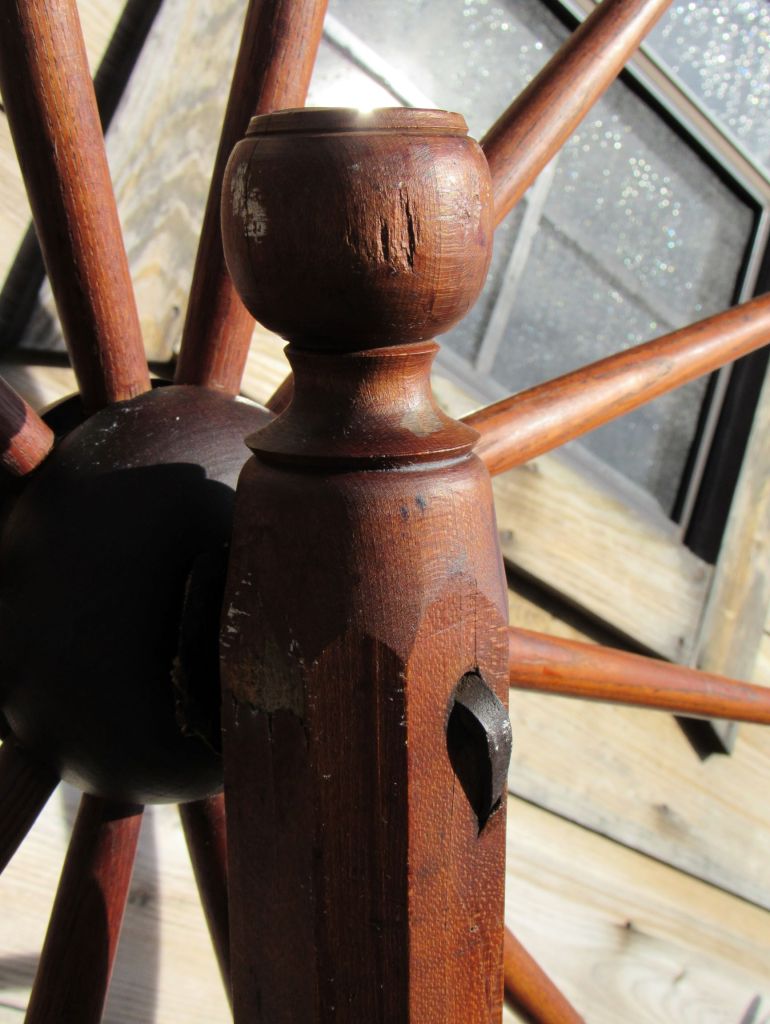
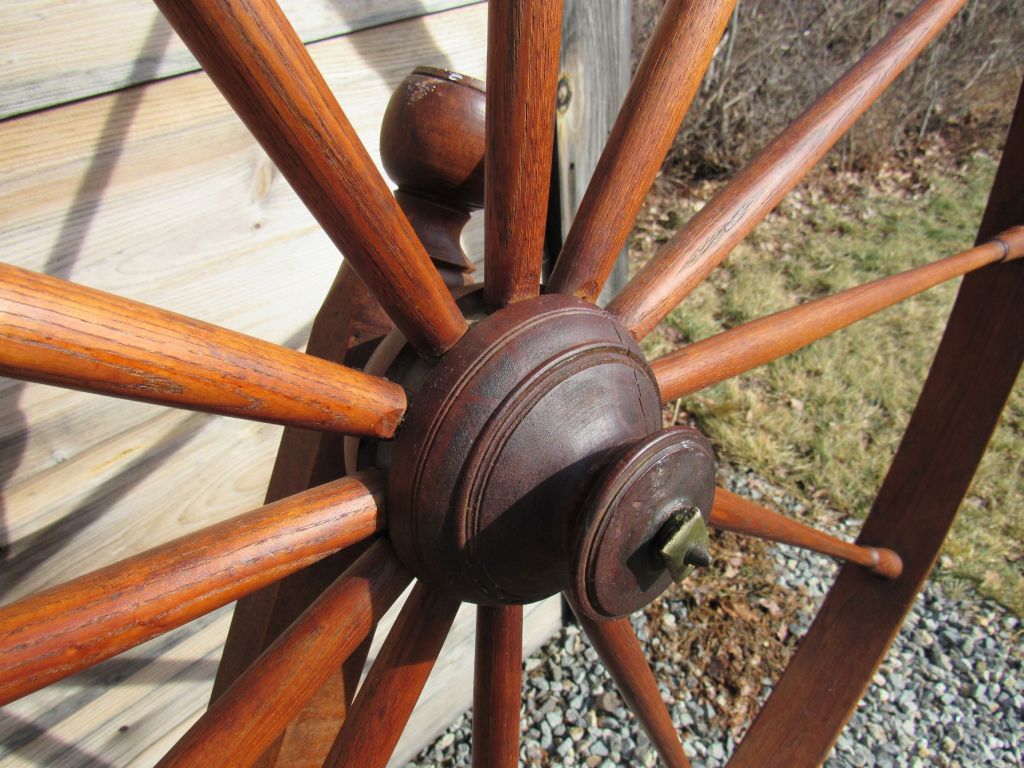
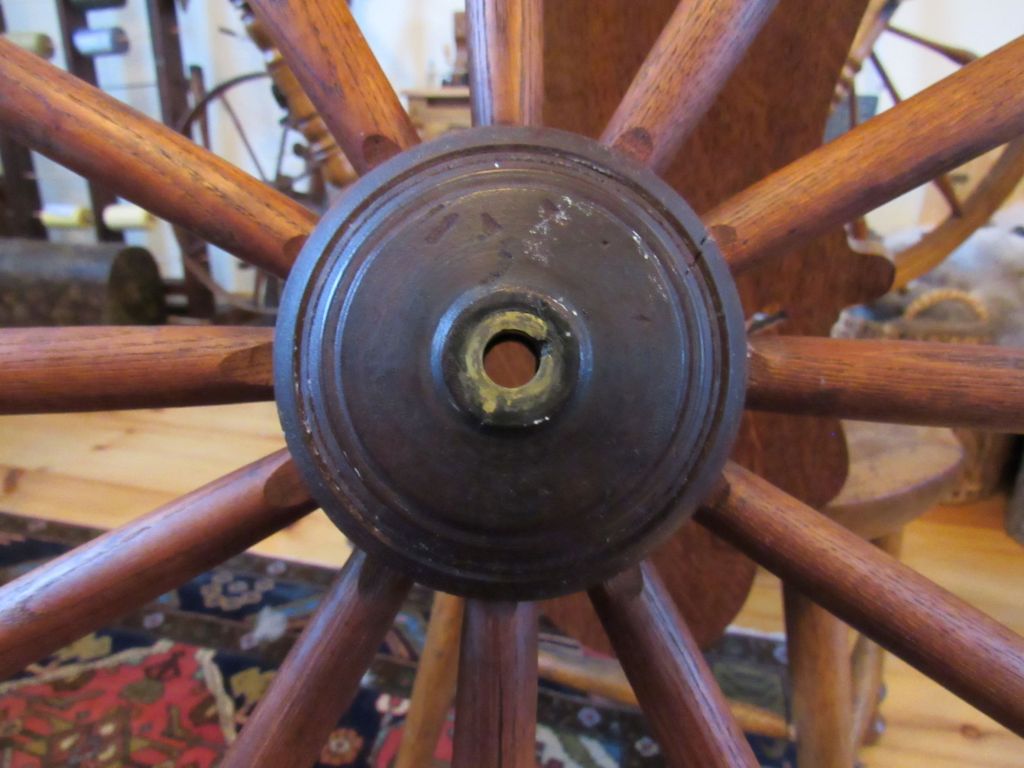
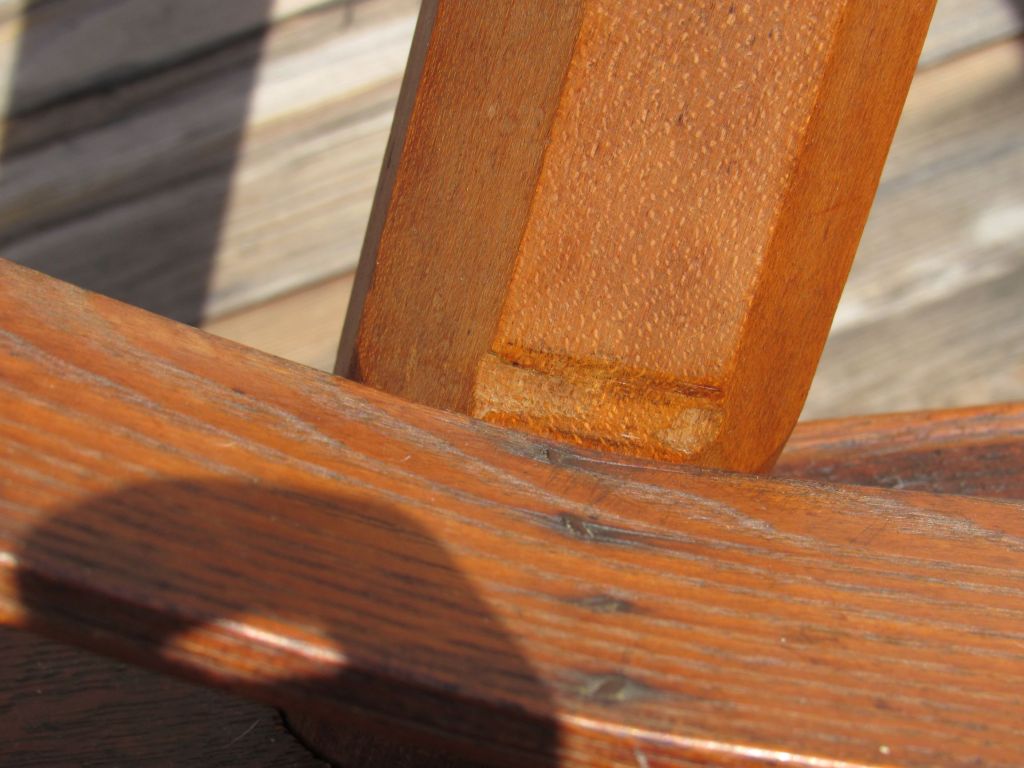
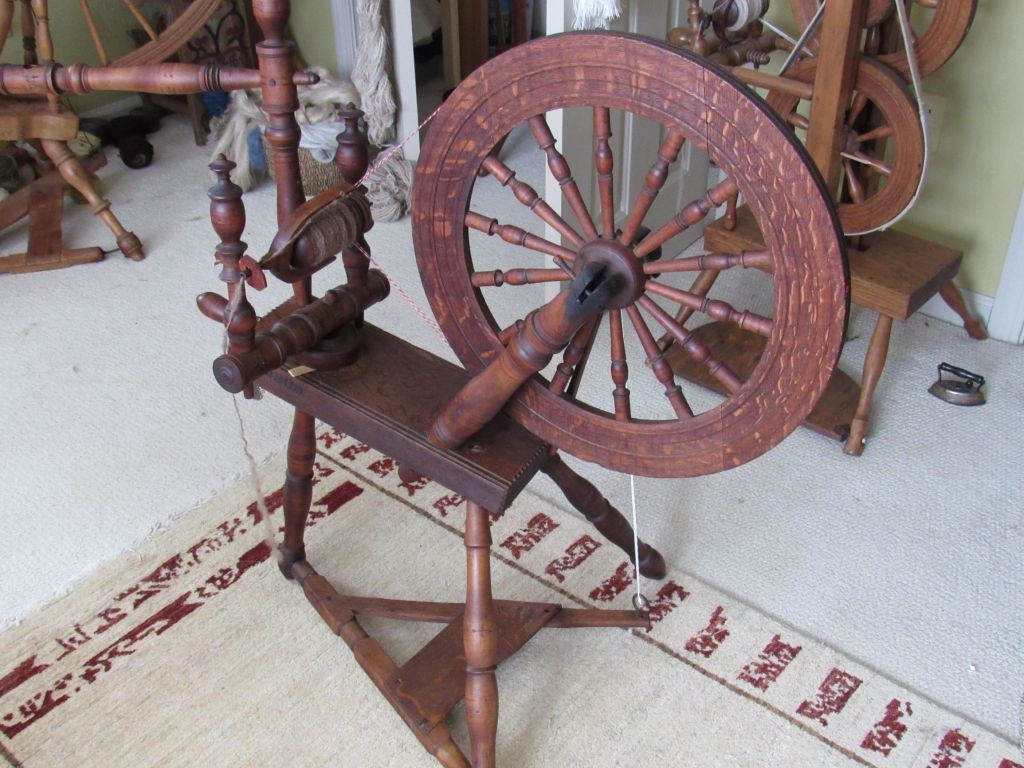
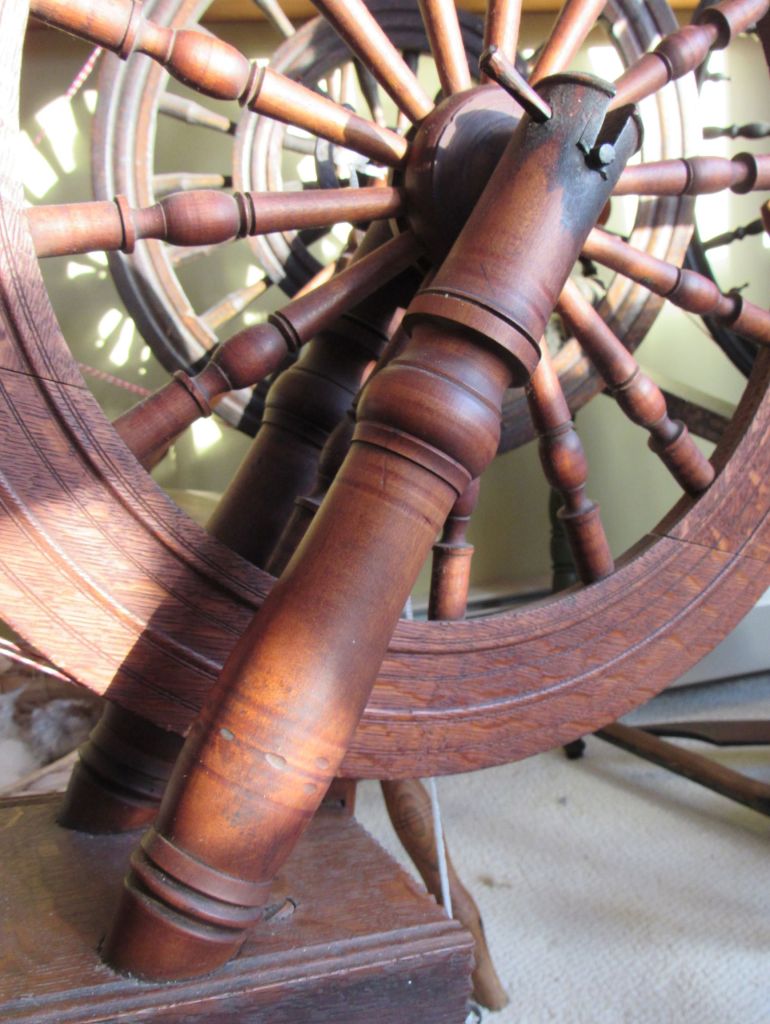
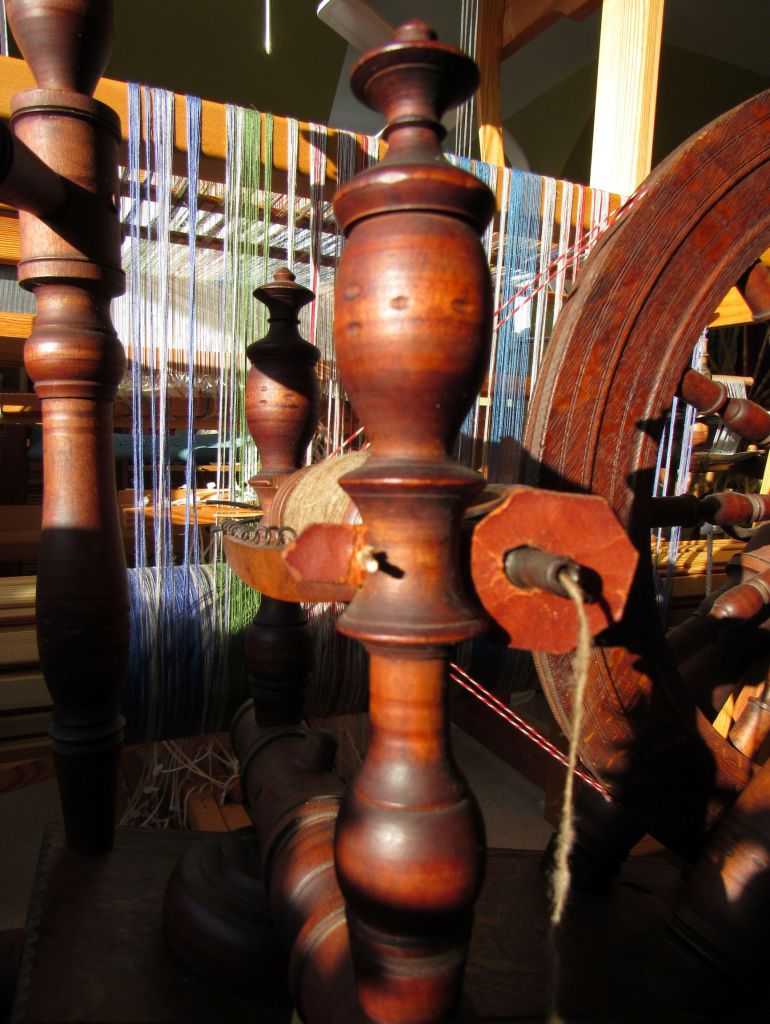
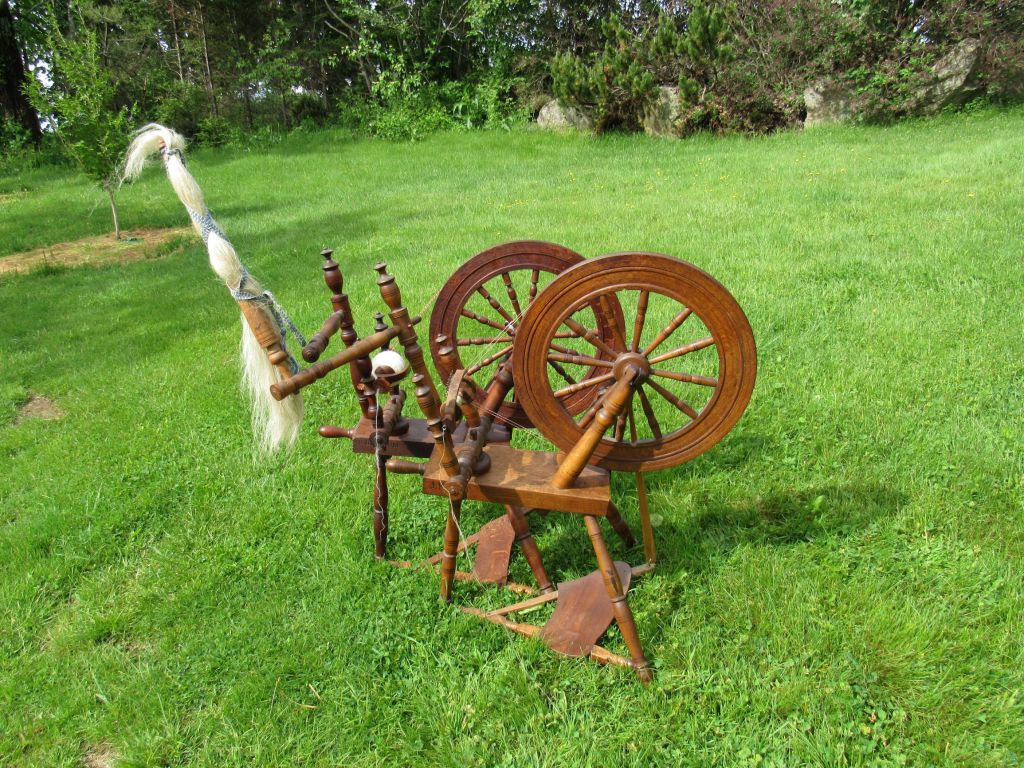
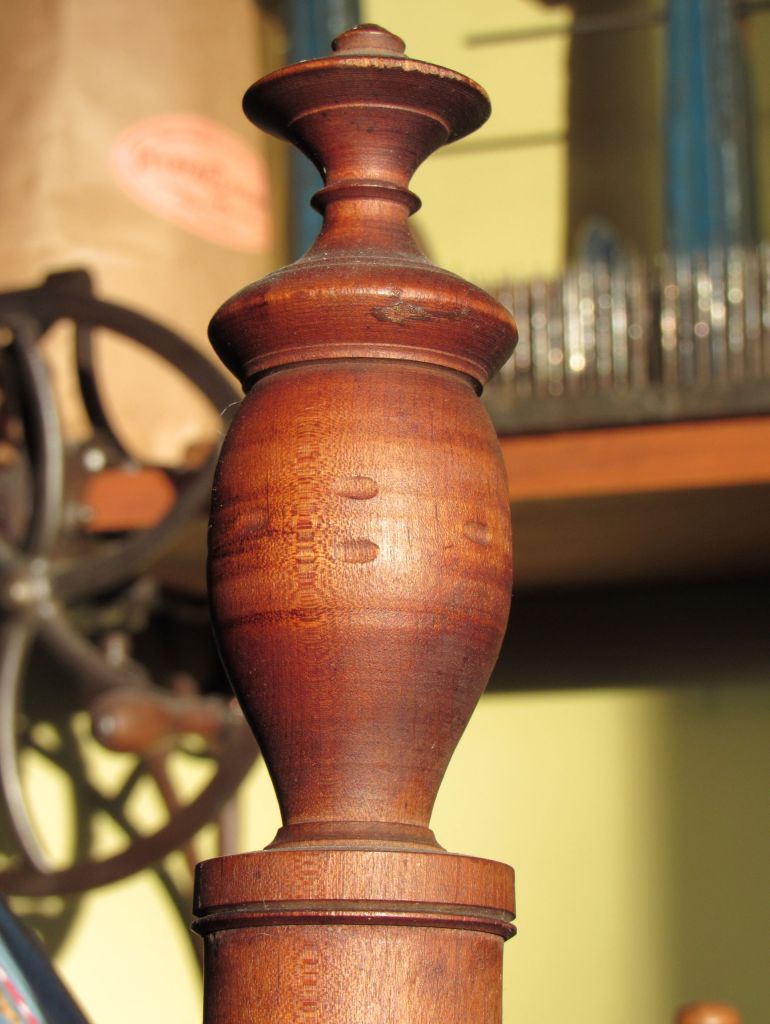
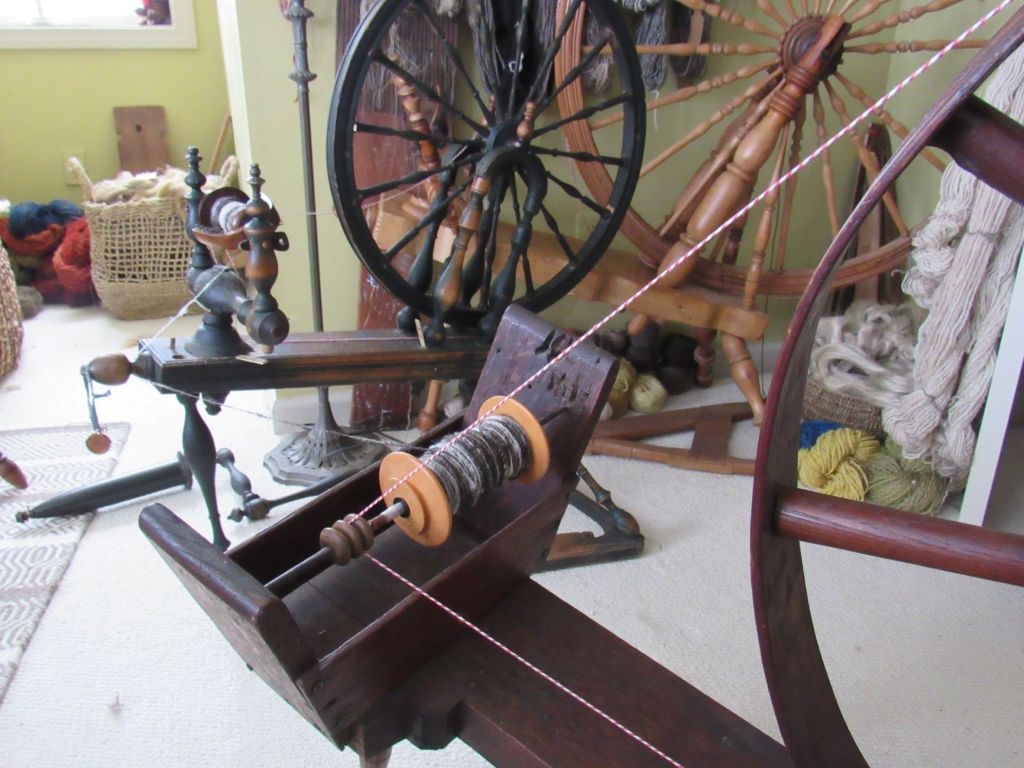
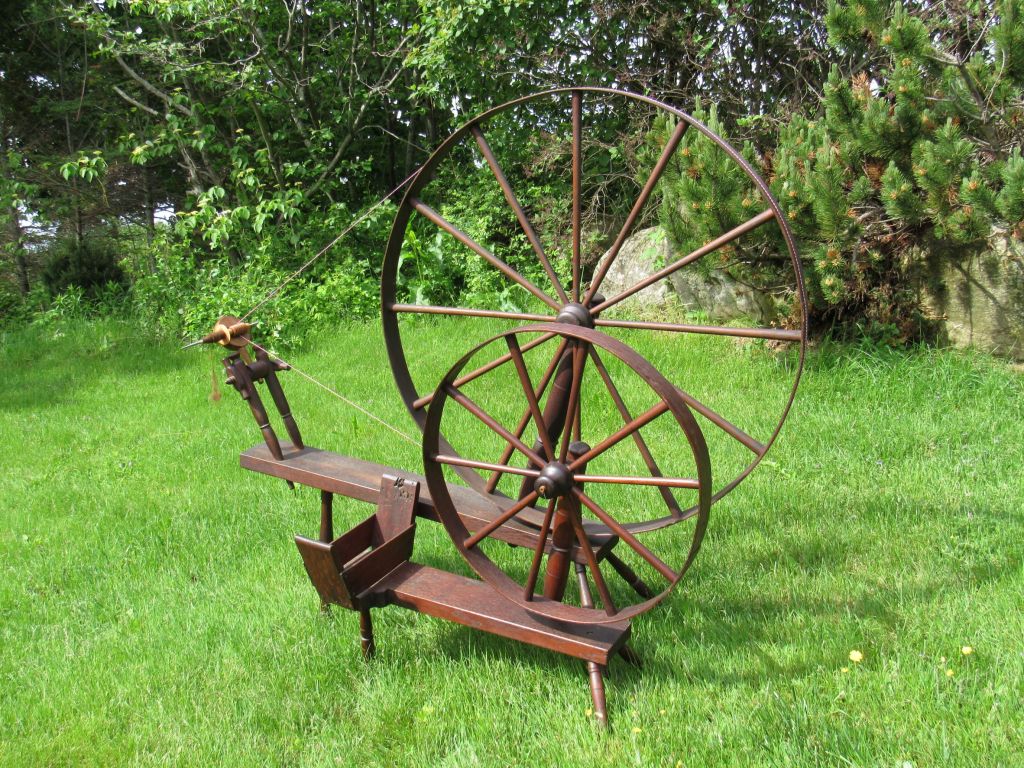
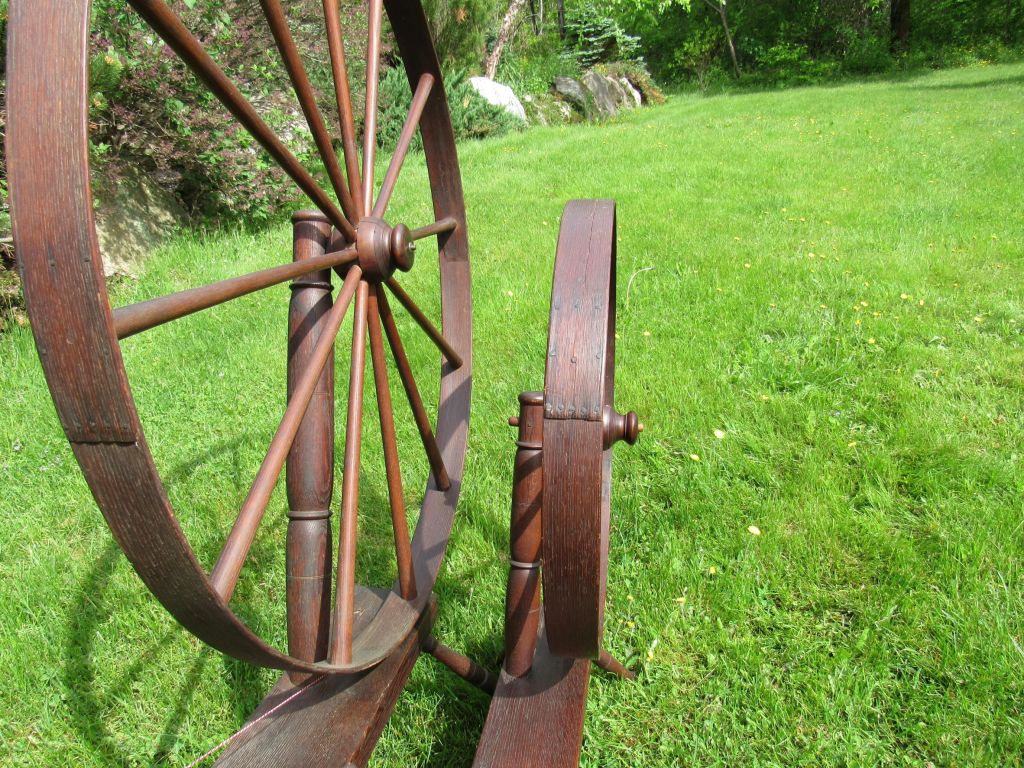
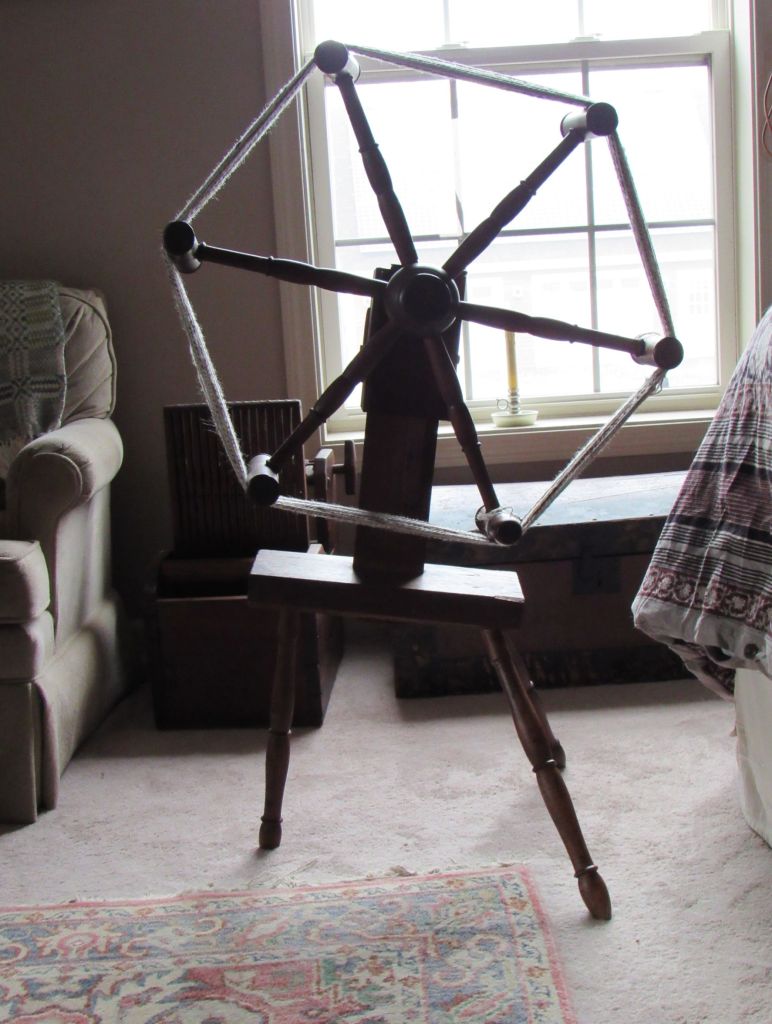
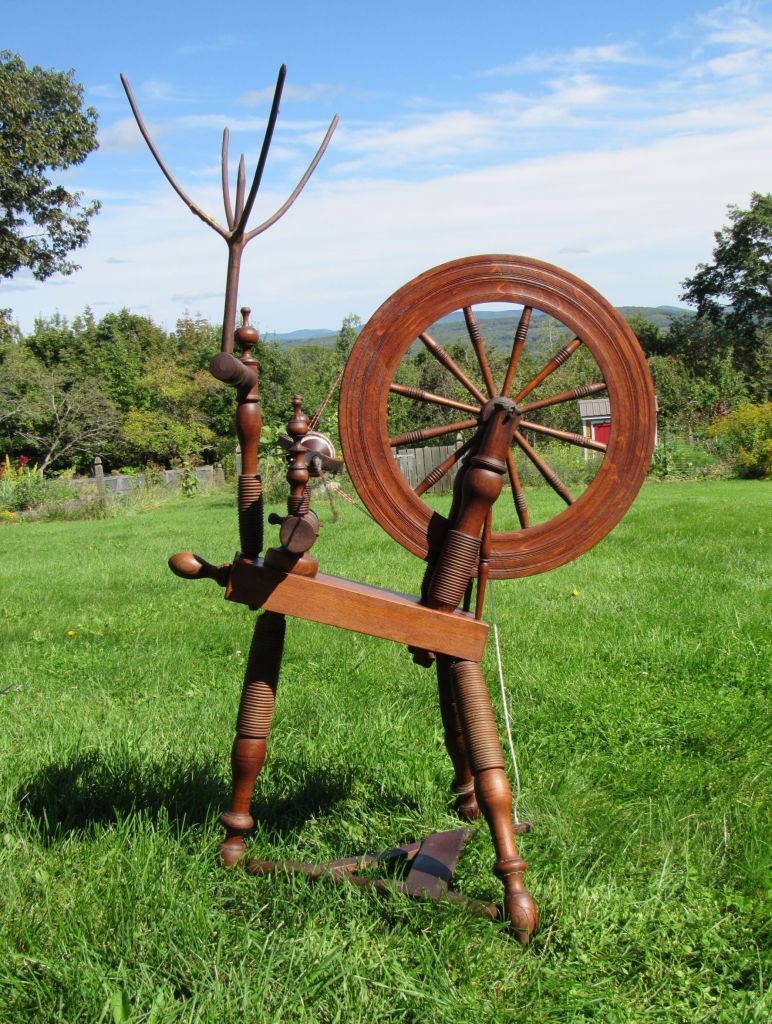
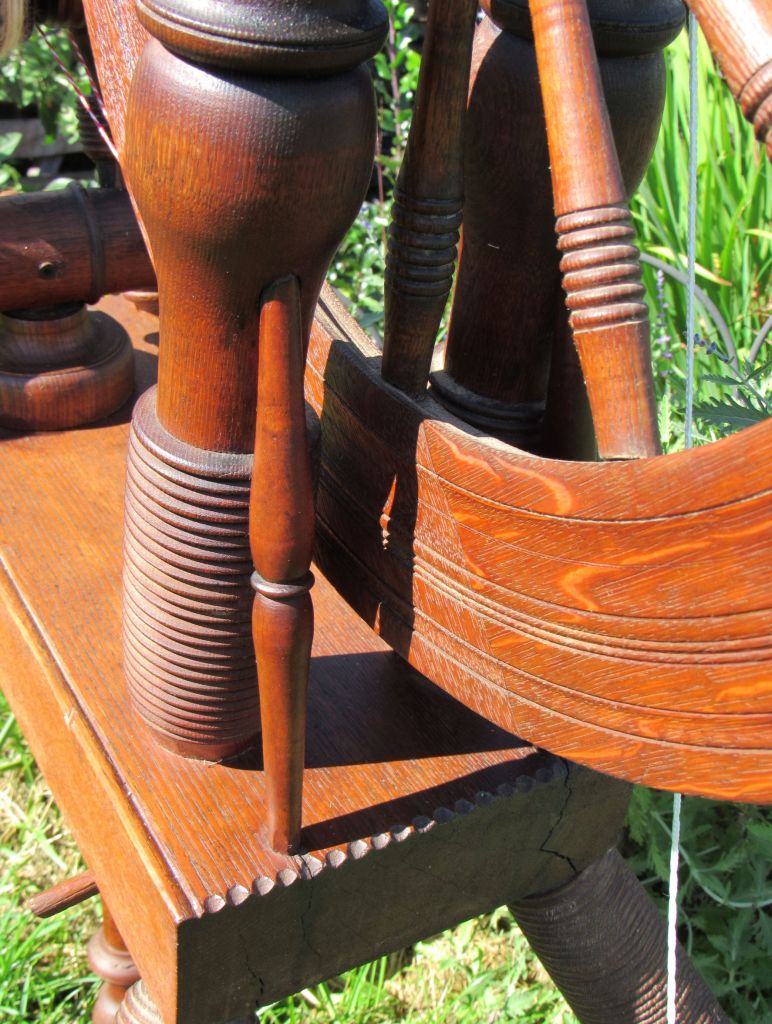
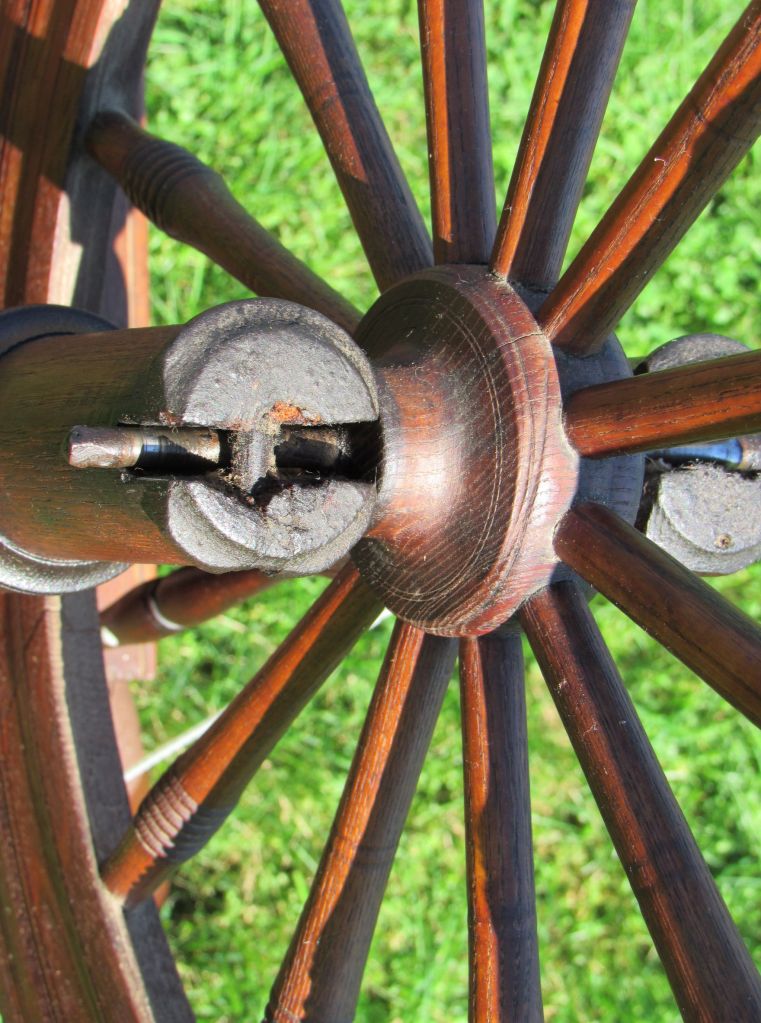
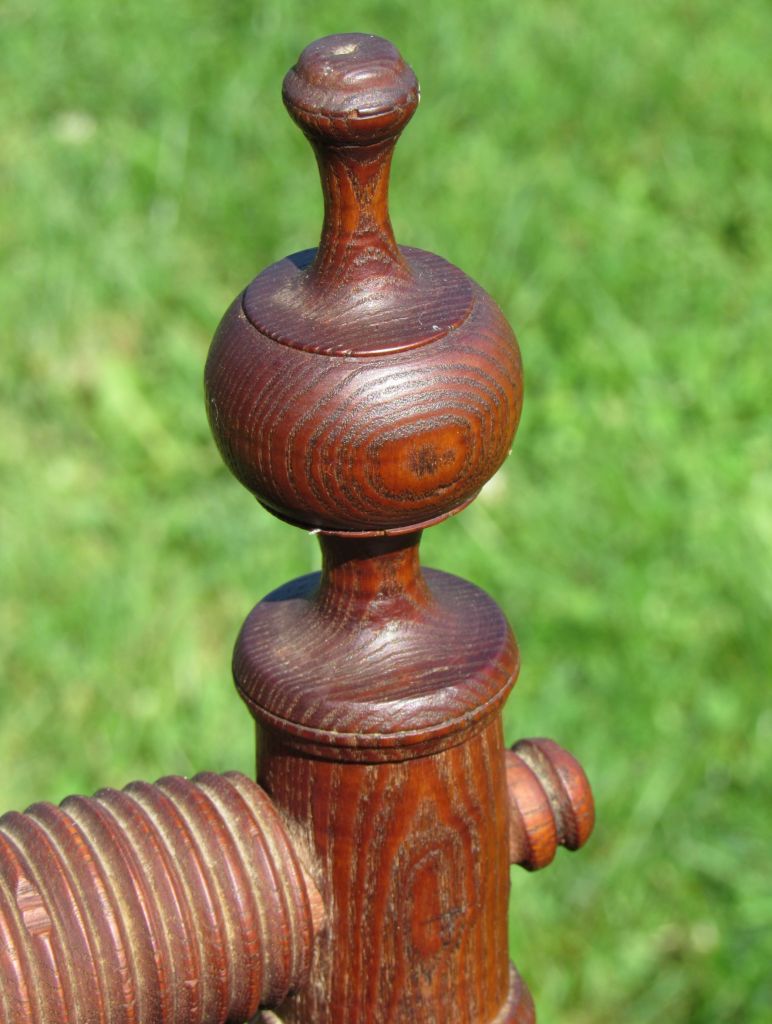
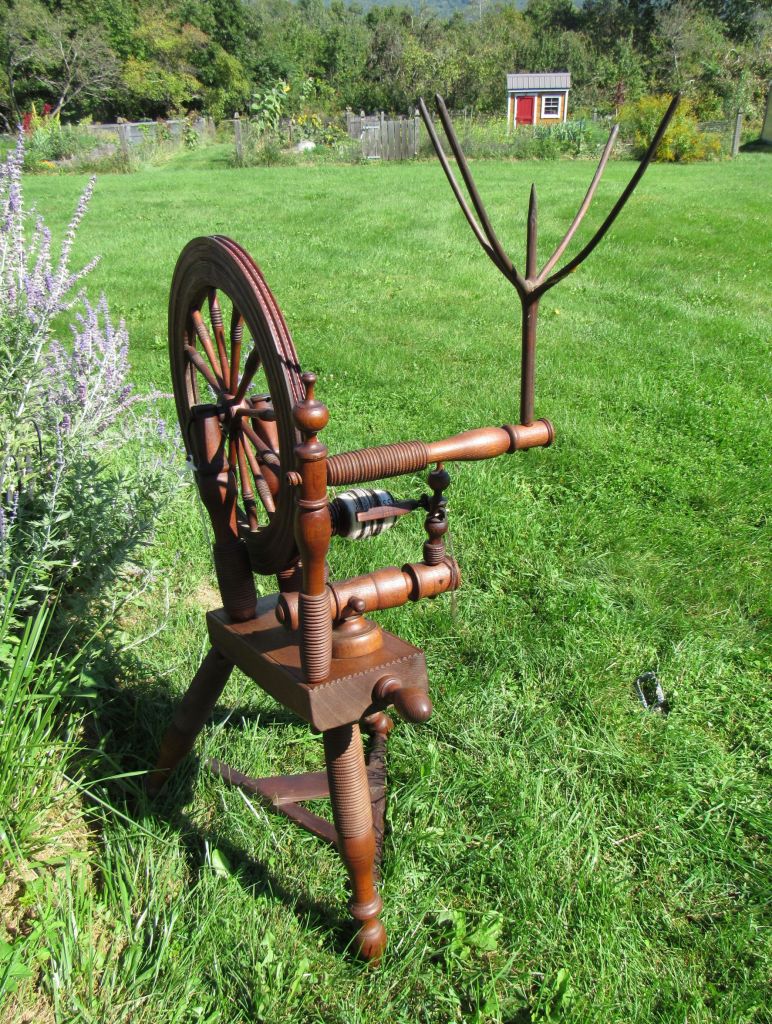
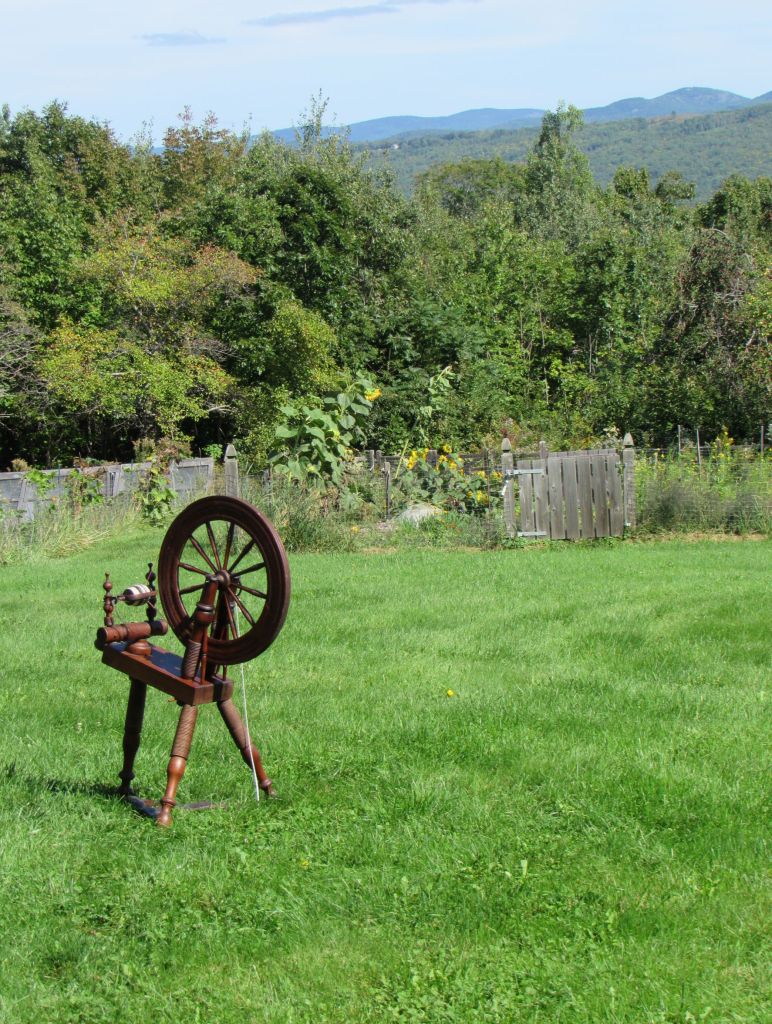
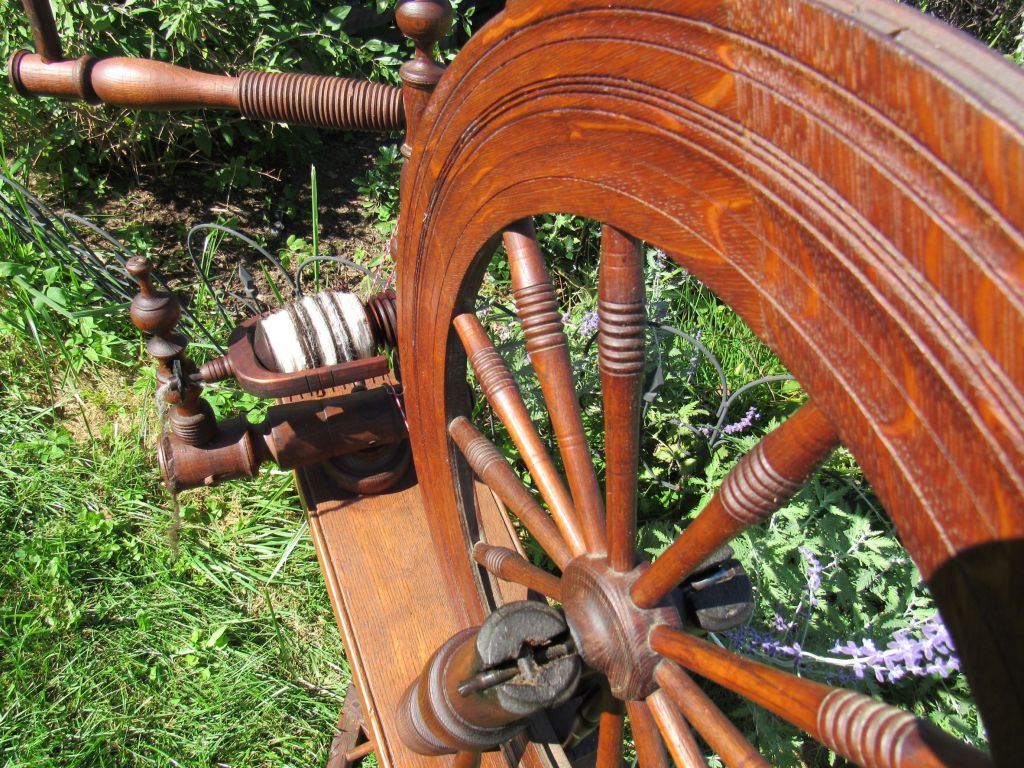
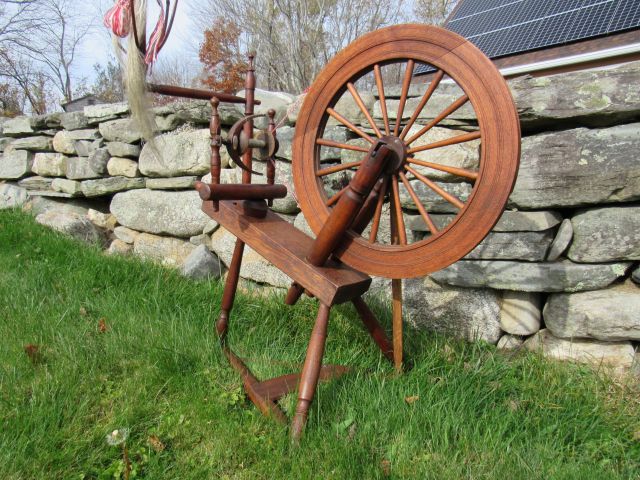
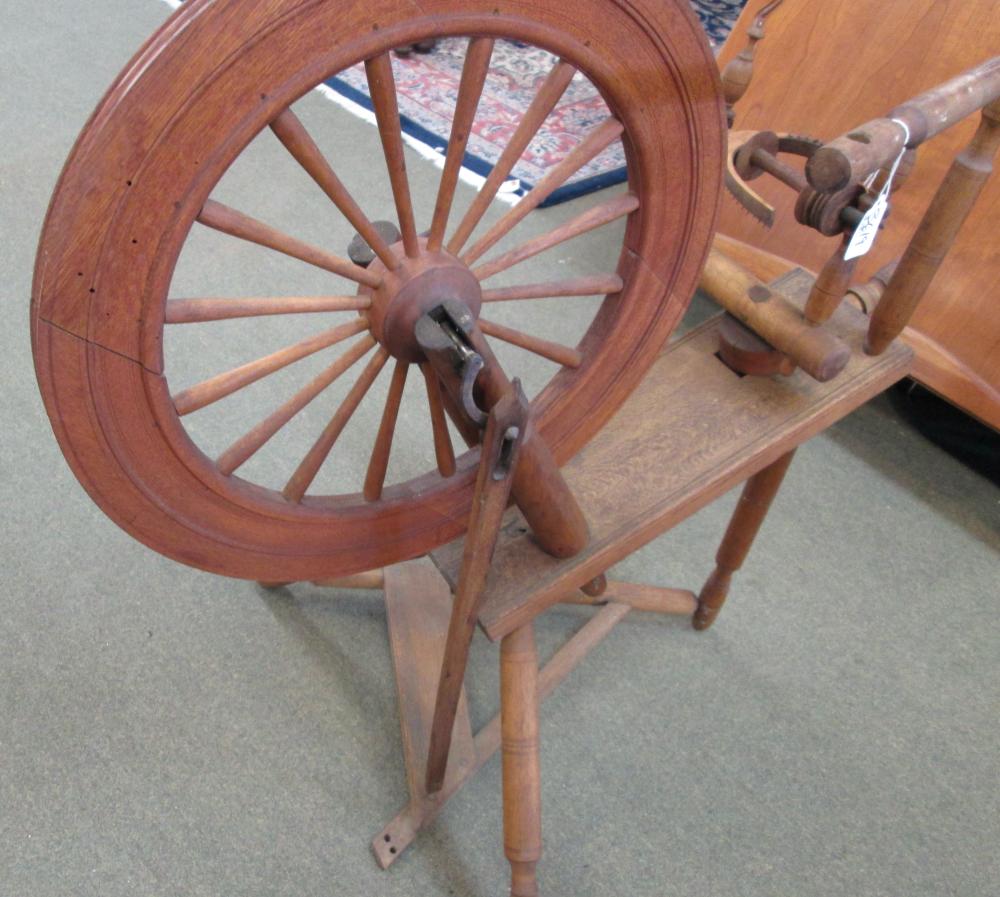
This New England wheel is a striking contrast to Scarlet, the wheel in the previous post.  Although both wheels likely were made in Vermont, they represent two ends of the decorative spectrum.  While Scarlet flaunts her beauty, with ornate turnings from spokes to legs, Jocasta is spare, with sleek lines and only subtle touches of adornment. 
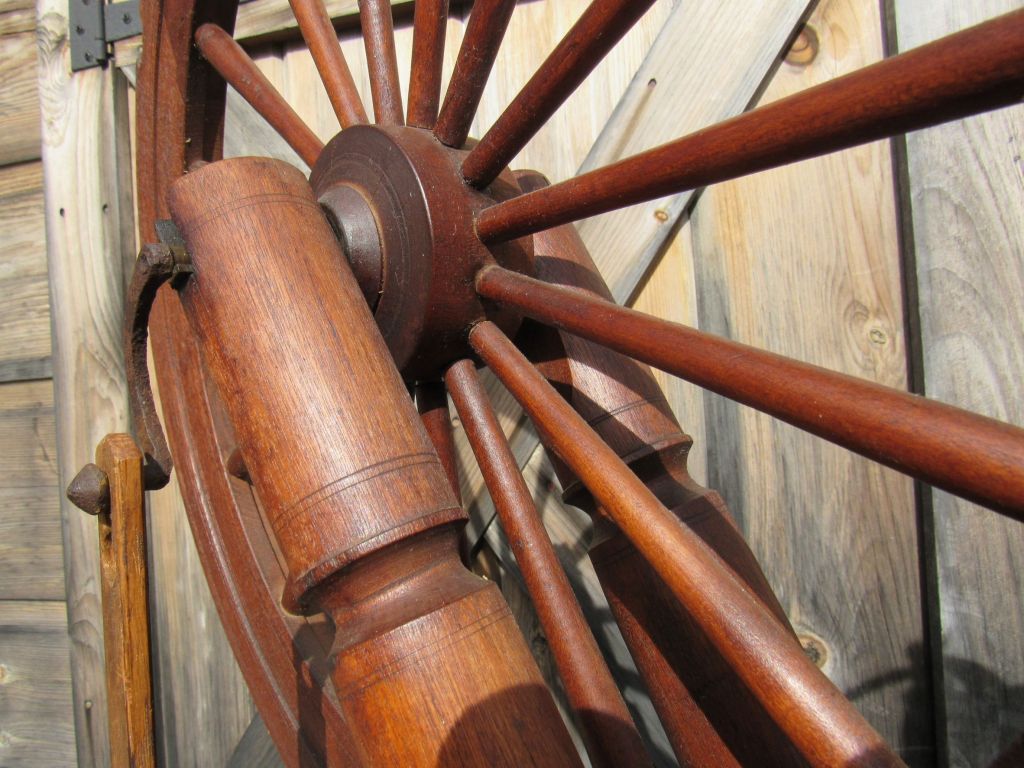
Like many northern New England wheels, Jocasta shows the influence of the area’s Shakers, whose wheels popularized simple turnings and clean lines.  (see previous post “Patience”)
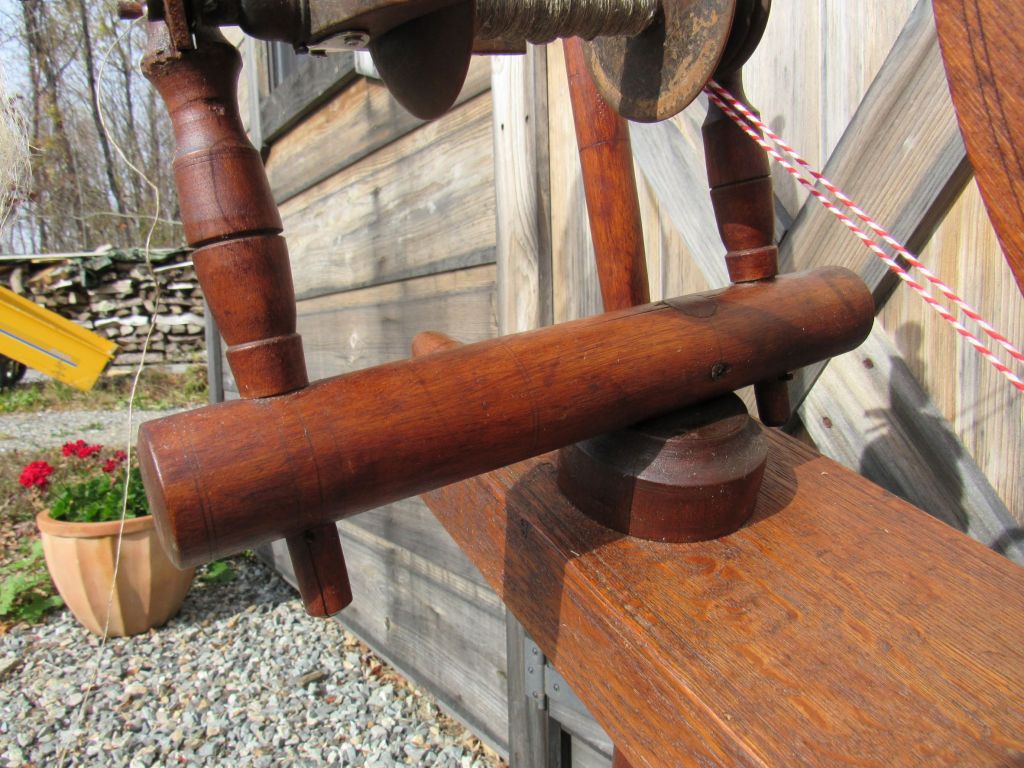
Beginning in the 1790s, the Shakers manufactured thousands of wheels at their communities in New Hampshire and in southern Maine.   Many non-Shaker wheel makers nearby were influenced by the understated Shaker style.  Traditional turnings in the Scottish or German style became toned down and smoothed out. Jocasta is a good example of that transition, with very Shaker-like lines, but retaining remnants of a Scottish heritage.
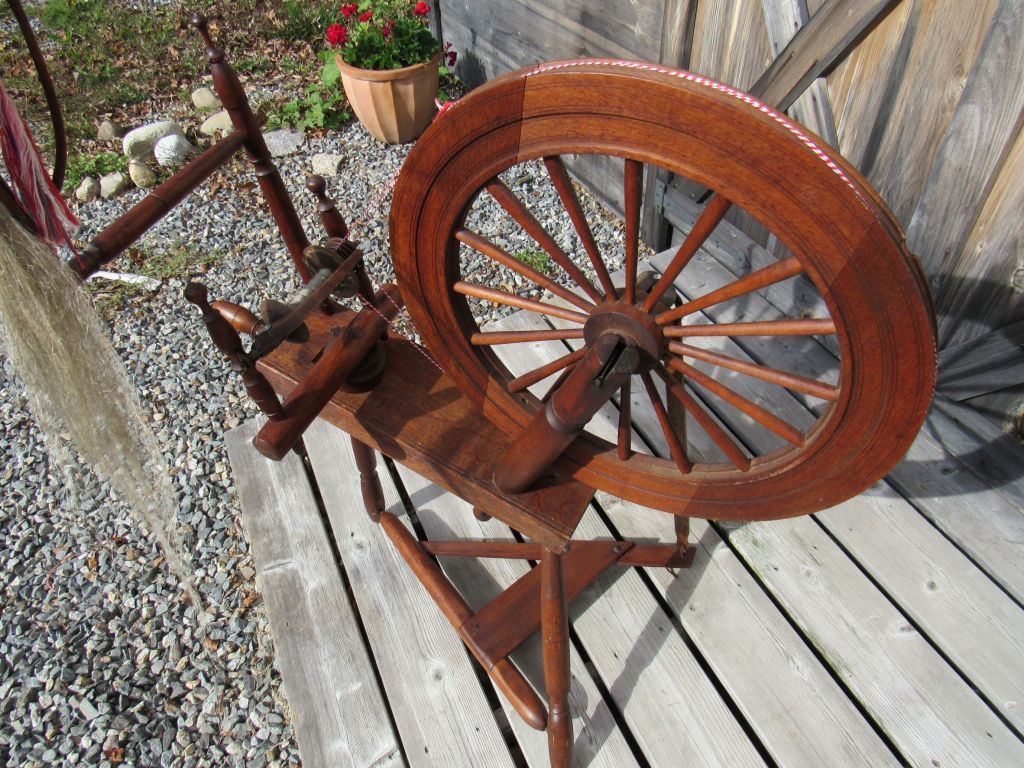
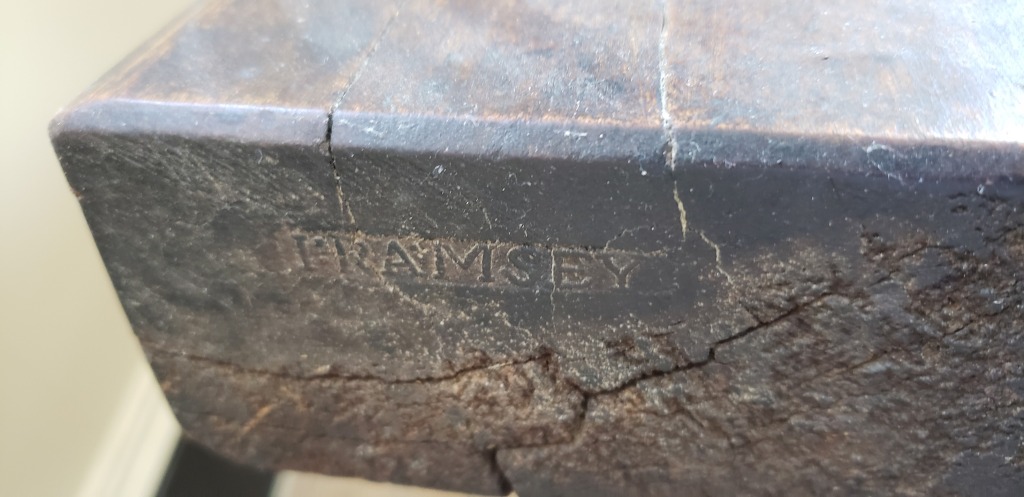
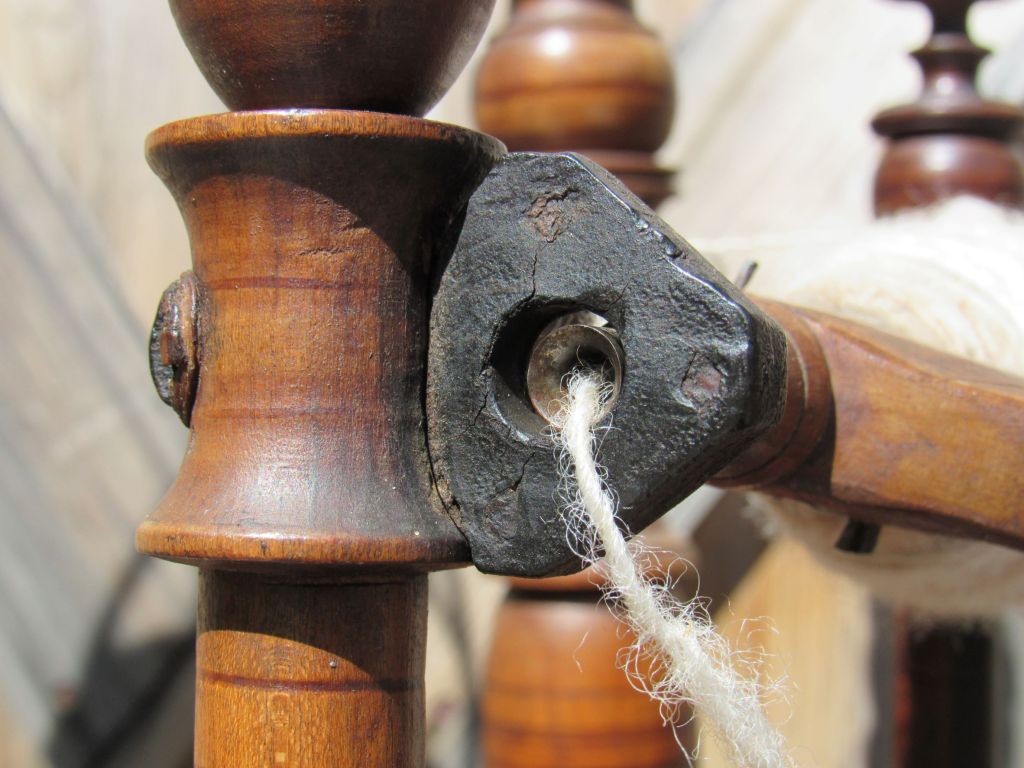
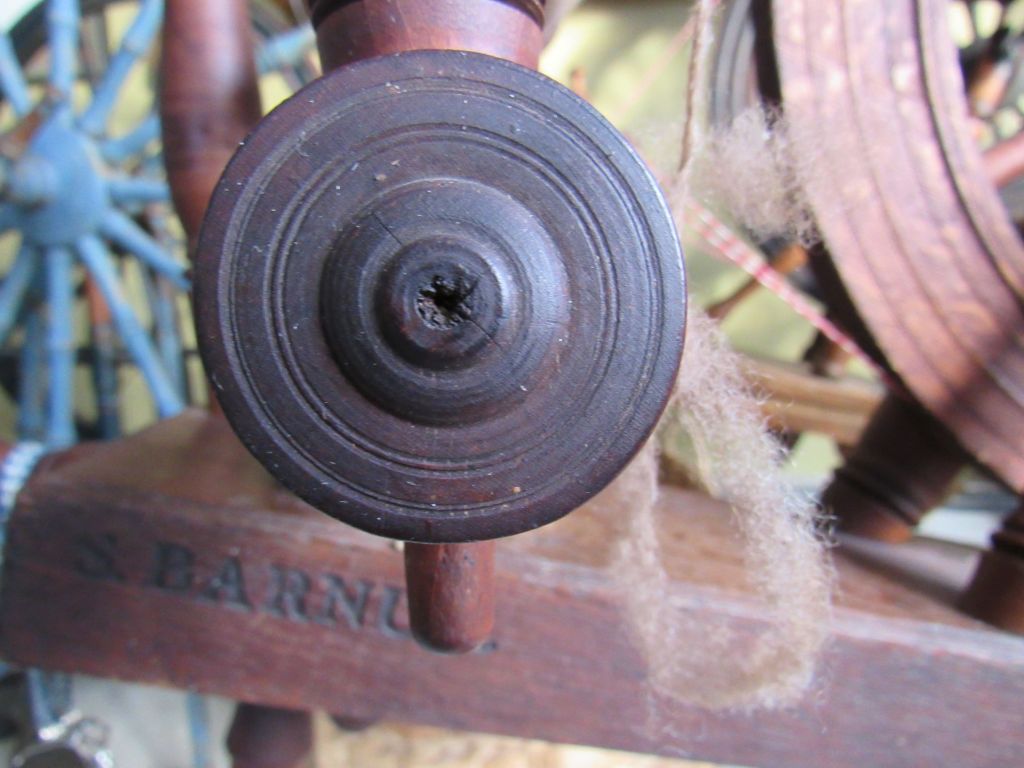
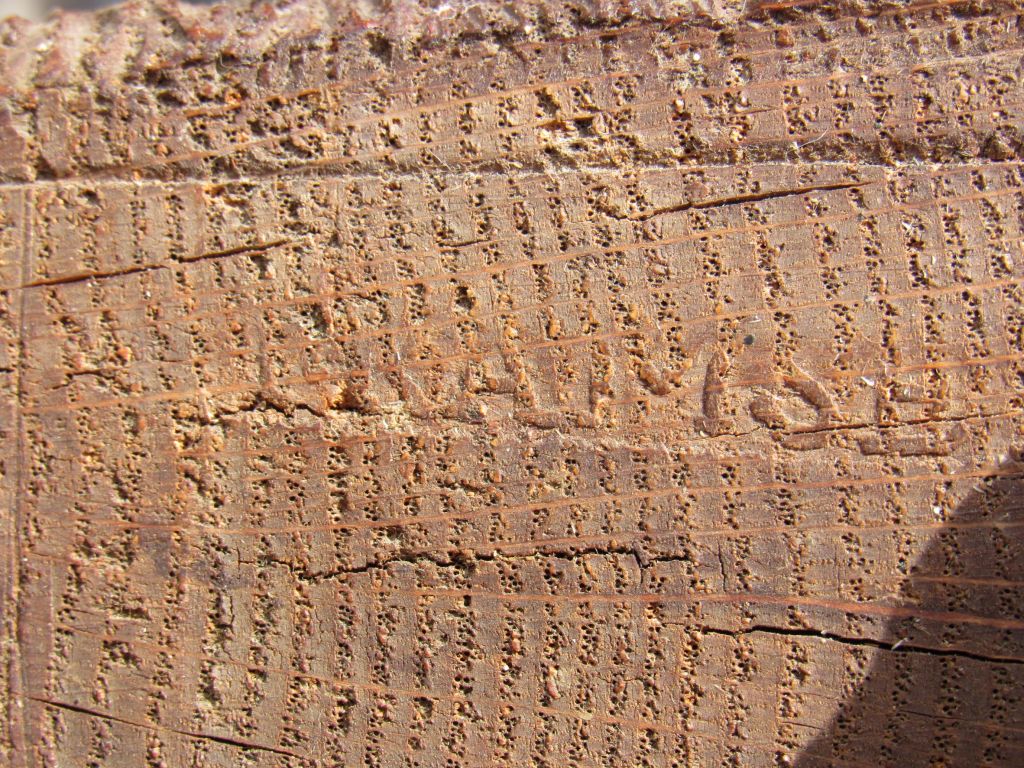
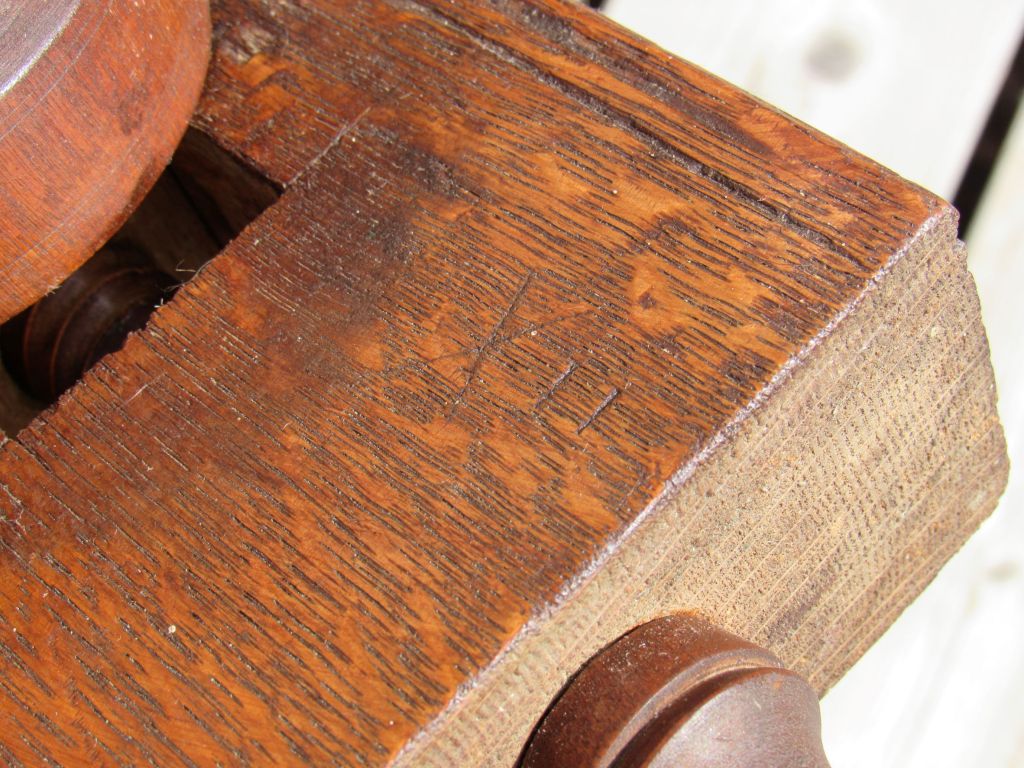
I bought Jocasta several years ago at an antique mall in Searsport, Maine, intrigued by her faint maker’s mark.  Mostly worn off and very hard to see under the store’s dim lights, it was not a mark that I recognized.  Looking closer when I brought her home, I thought the mark might be “Ramsey.”
I was familiar with wheel maker Hugh Ramsey, from Holderness, New Hampshire (1754-1831).  His father, James, lived in Londonderry, New Hampshire, a town settled by Scots-Irish who developed it into an early center of New England linen production.  (Feldman-Wood pp. 4-5)  Londonderry had numerous wheel makers, including the Gregg brothers, Daniel Miltimore, John Ferguson, and James Anderson (who, with his brothers, later founded the Shaker Alfred Lake spinning wheel business).  (Taylor pp. 2-4) The Londonderry wheels, some made as early as the 1750s and 60s, usually were 16-spoked and decoratively turned into heavy curves in the Scottish tradition.  (Taylor p. 3) Hugh Ramsey’s wheels retained the basic style of the Londonderry wheels, but his turnings were less ornate. 
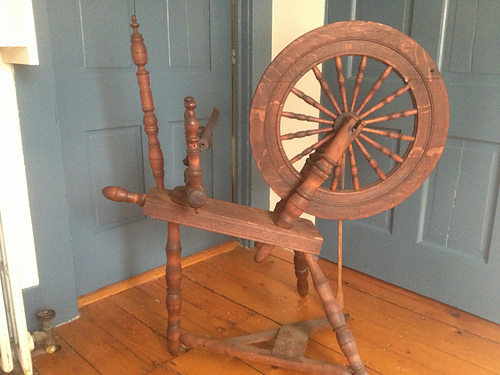
Hugh Ramsey wheel

Not as clean and spare as Jocasta, but moving in that direction.  He did not sign his wheels with “Ramsey,” but rather his initials, “HR.”  (Feldman-Wood p. 5) 
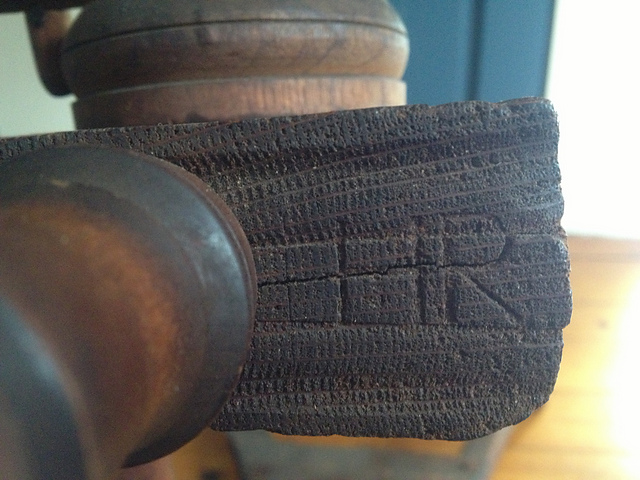
Hugh Ramsey maker’s mark

While it was apparent that Jocasta was not made by Hugh Ramsey, I wondered if the maker might be related to him. 
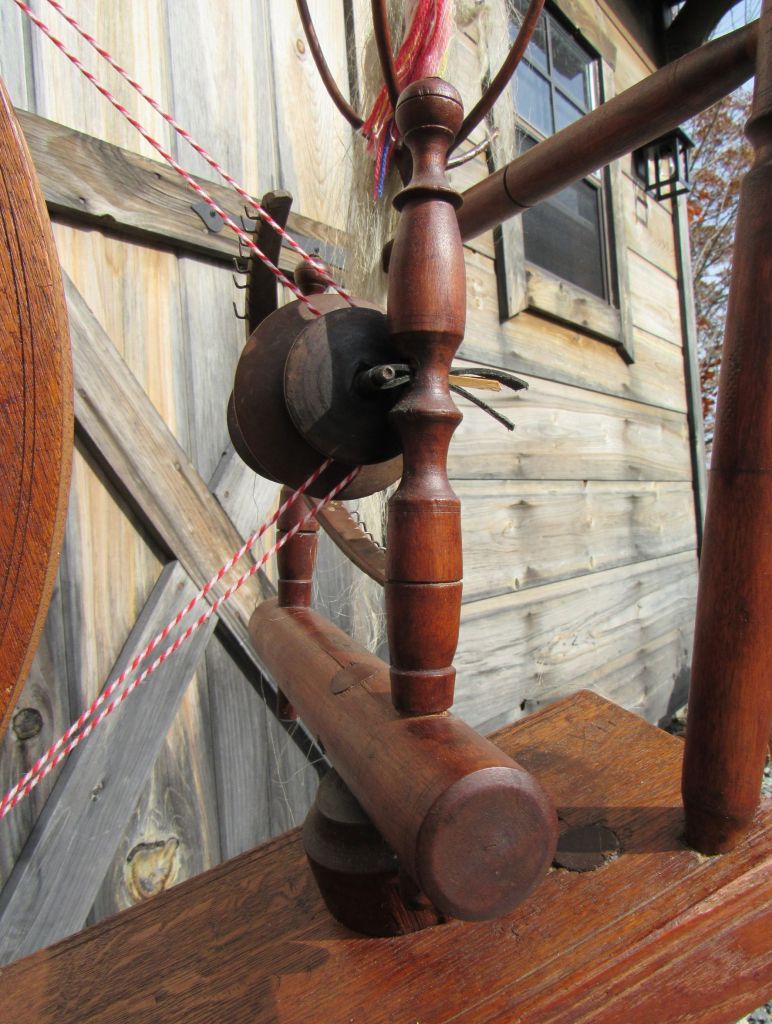
I first looked for a Londonderry connection because Jocasta’s maidens resemble some of those on the Londonderry wheels.  Could Hugh’s father, James, have other wheel-making sons? 
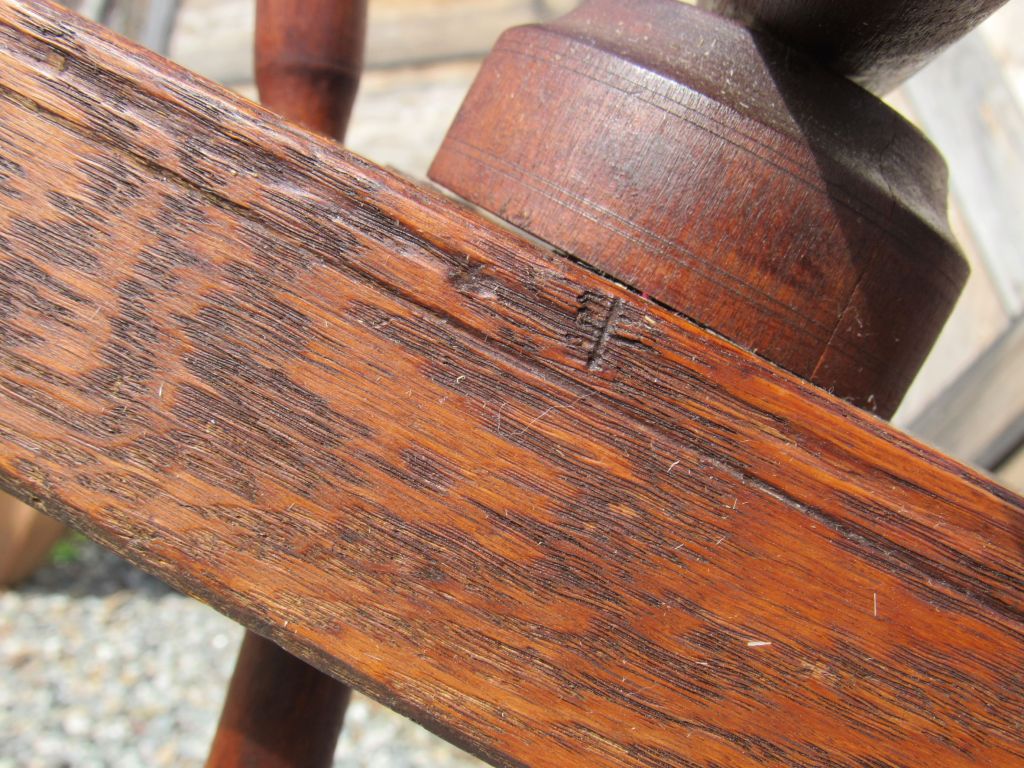
I did some quick research and did not find any obvious wheel makers among Hugh’s many brothers.  Research was complicated by the fact that the family spelled their name as “Ramsey” or “Ramsay” with no apparent pattern. 
I abandoned the research for another day, which came about a year later, when I noticed Jocasta’s twin in the book of Joan Cummer’s wheel collection. It is wheel No. 59 in Cummer’s book, described as 18th or early 19th century and “a typical New Hampshire wheel of that time.” (Cummer pp. 134-35) Like Jocasta, it was marked “Ramsey.” Cummer’s Ramsey wheel was donated to the American Textile History Museum and put up for auction after the museum closed.  Fortunately, we have some photos of it from that auction. 
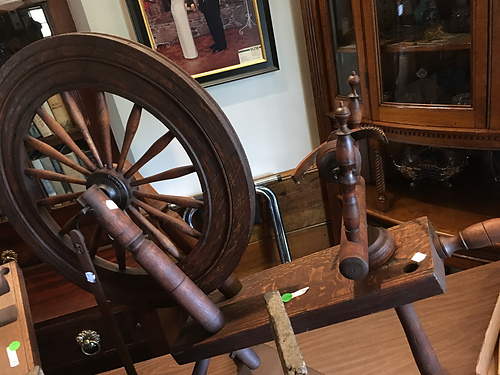
Joan Cummer’s wheel at auction

Unfortunately, I do not know who bought it.  I also found that Cummer’s wheel is referenced under wheel maker William Ramsey in Pennington & Taylor’s wheel maker list.  (Pennington & Taylor Appendix)  I did a quick online search on William Ramsey, found nothing helpful, and left it at that. 
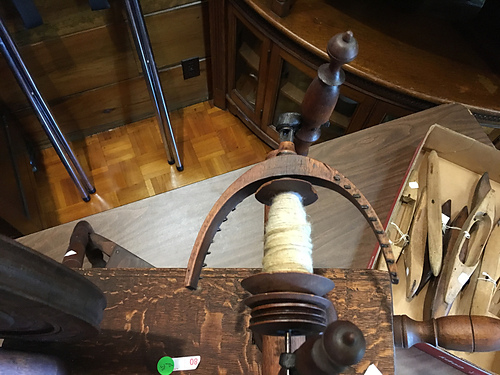
Cummer’s Ramsey wheel

My sporadic, unproductive research was given a jump-start, however, when, a few months later, Gina Gerhard posted a James Ramsey great wheel on Facebook, with a photograph of the maker’s mark. 
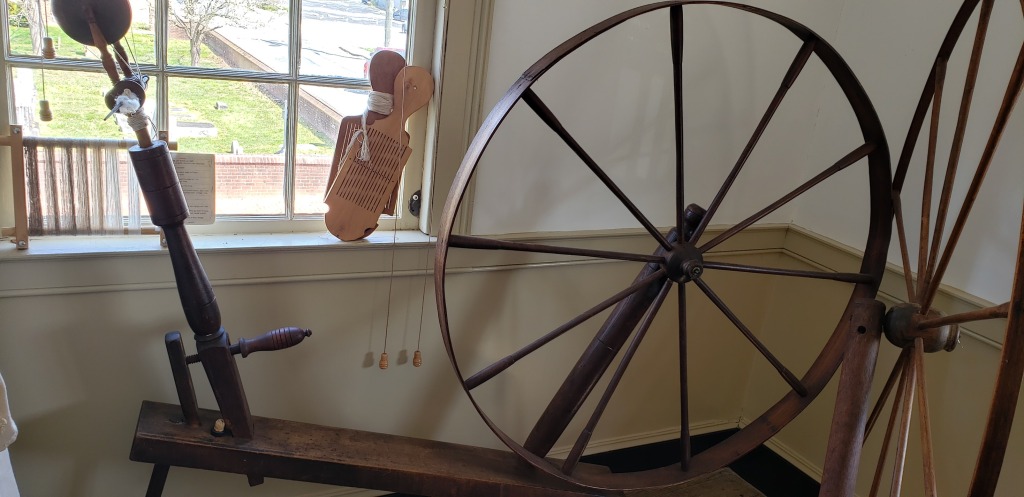
Gina’s James Ramsey great wheel
James Ramsey mark on Gina’s wheel, the letter “I” was sometimes used for a “J” in wheel marks

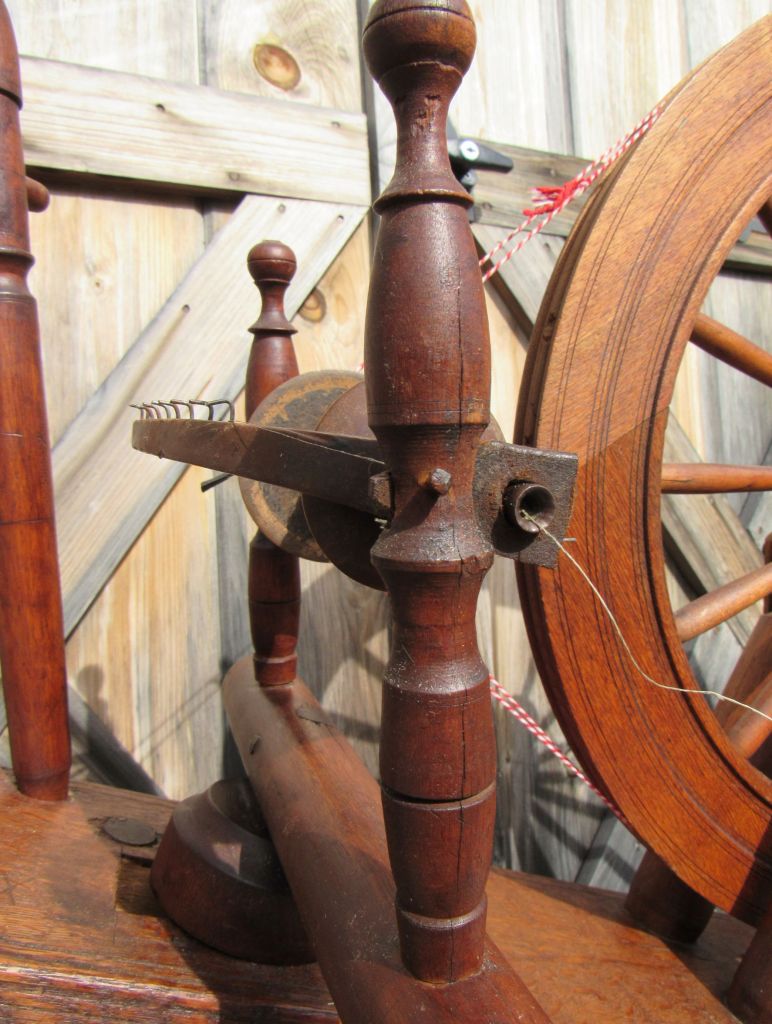
Although the mark is worn on Jocasta,
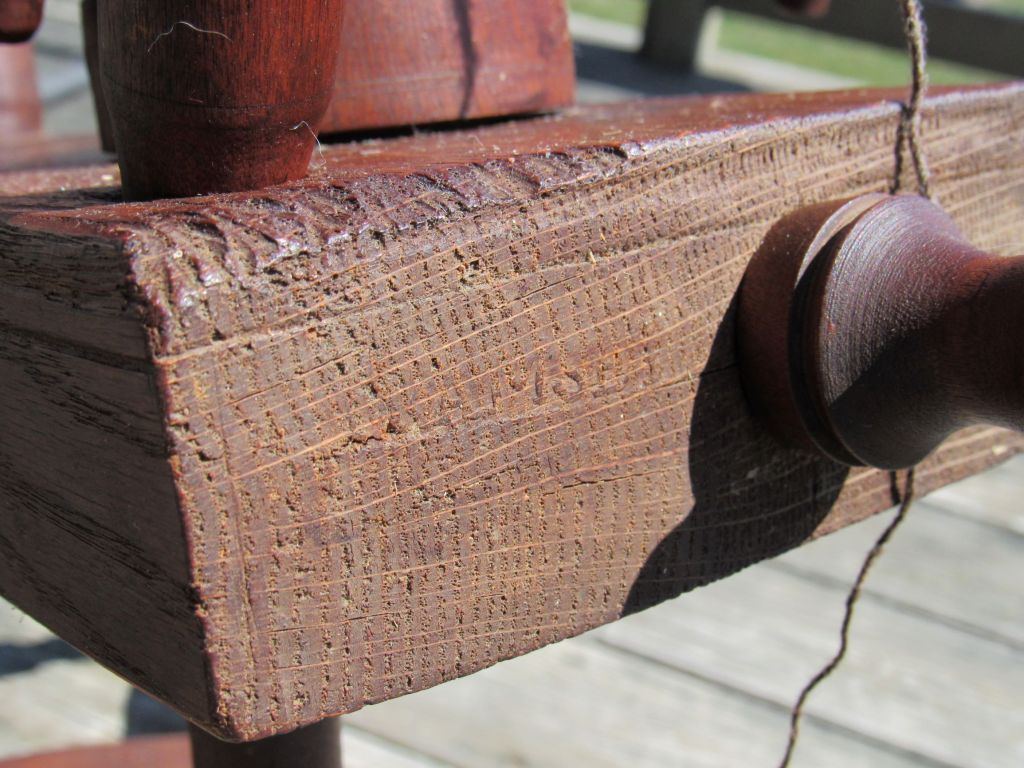
what is left appears to be the same as the mark on Gina’s wheel, even down to the little bobble on the tail of the letter “S.” But the first letter is almost completely worn off of Jocasta. 
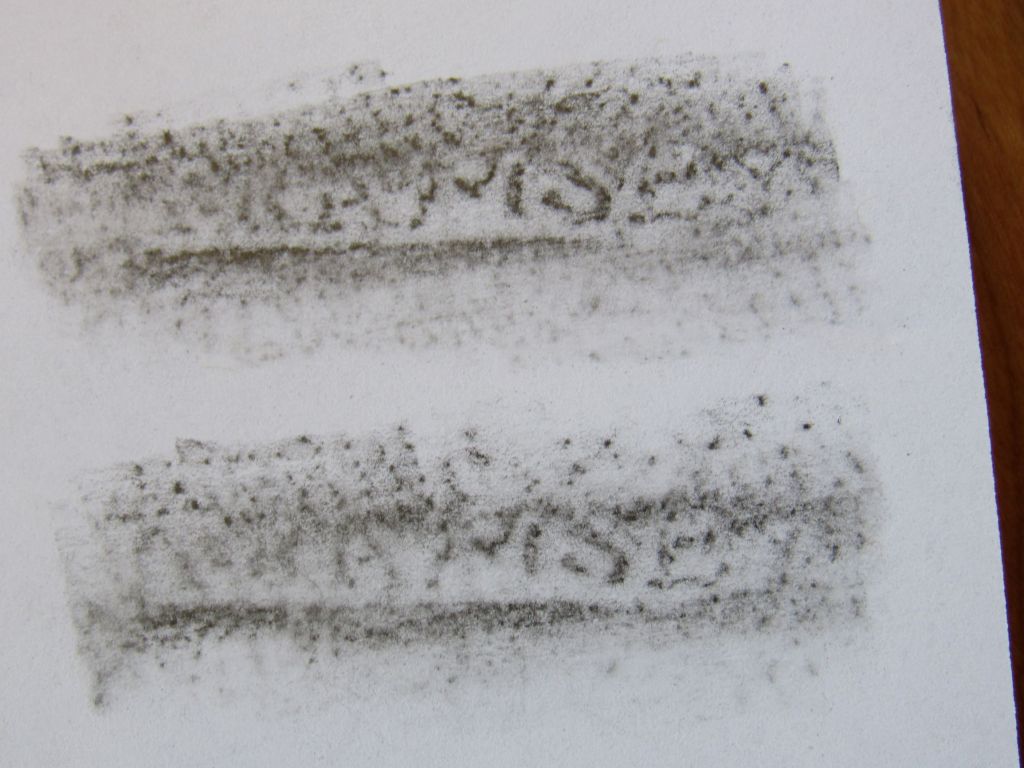
I think I can see an “I” with one of the double dots, as on Gina’s wheel. But it is hard to be sure.
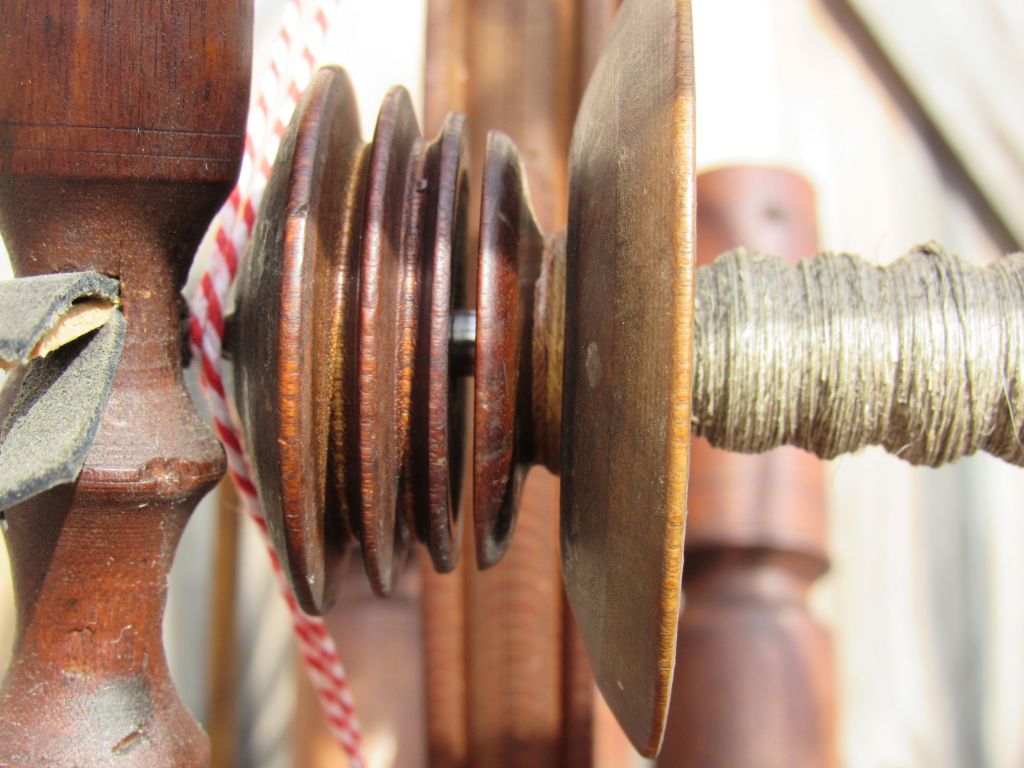
To compound the puzzle, around this time, collector Craig Evans sent me a photo of a wheel that looks much like Jocasta, but marked with “JR.” 
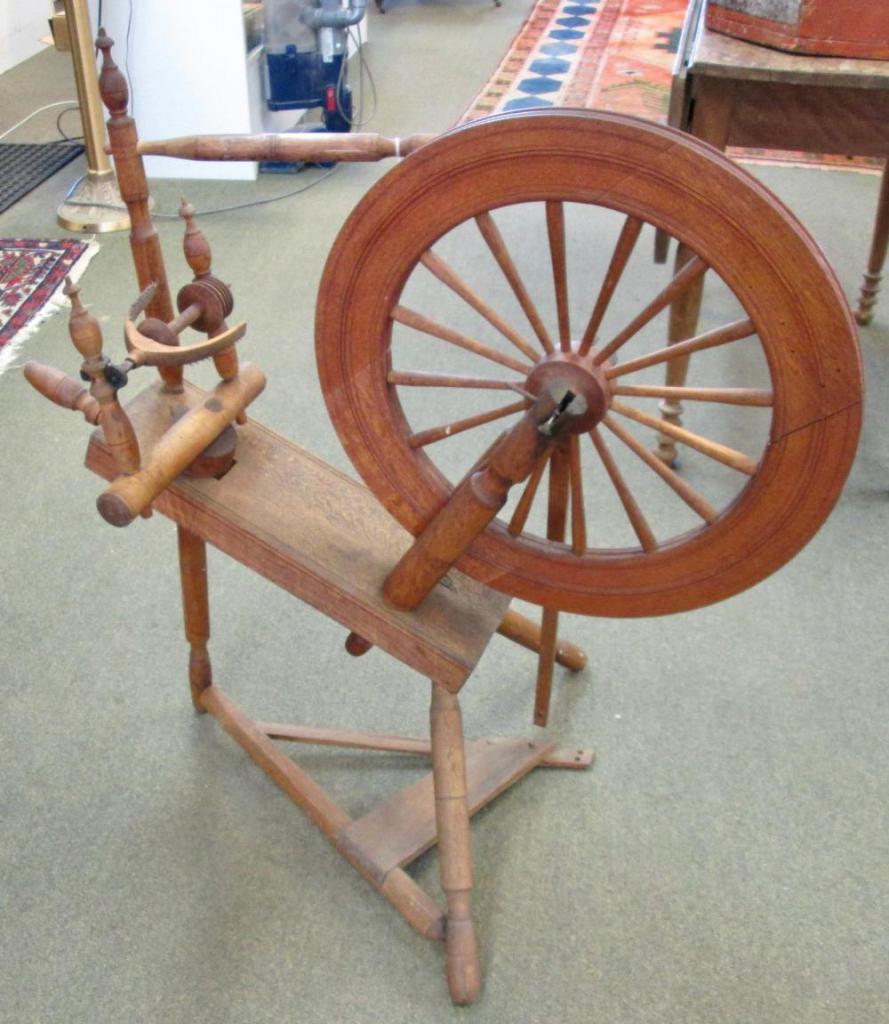
“JR” marked wheel

Could James Ramsey have changed stamps at some point? Was there another J. Ramsey wheel maker in the family—or a different JR altogether? 
“JR” marked wheel

At this point, I wanted to find a confirmed James Ramsey flax wheel.  He was from St. Johnsbury, Vermont, so I wrote to their History & Heritage Center, but did not get a response.  For the third time, I abandoned the research—this time for about a year. 
I took it up again last month when I decided to do this blog post. 
Both Gina and Craig mentioned that wheel collector, Sue Burns, had donated a James Ramsey wheel to the Fairbanks Museum in St. Johnsbury.  I wrote to the museum and found that they had disbanded their wheel collection and had given the Ramsey wheel to one of three other museums, most likely the St. Johnsbury History & Heritage Center.   
So, I wrote to the History Center again, and this time immediately got a response.  It turns out that the only Ramsey wheel donated by Sue Burns was a great wheel, not a flax wheel.  
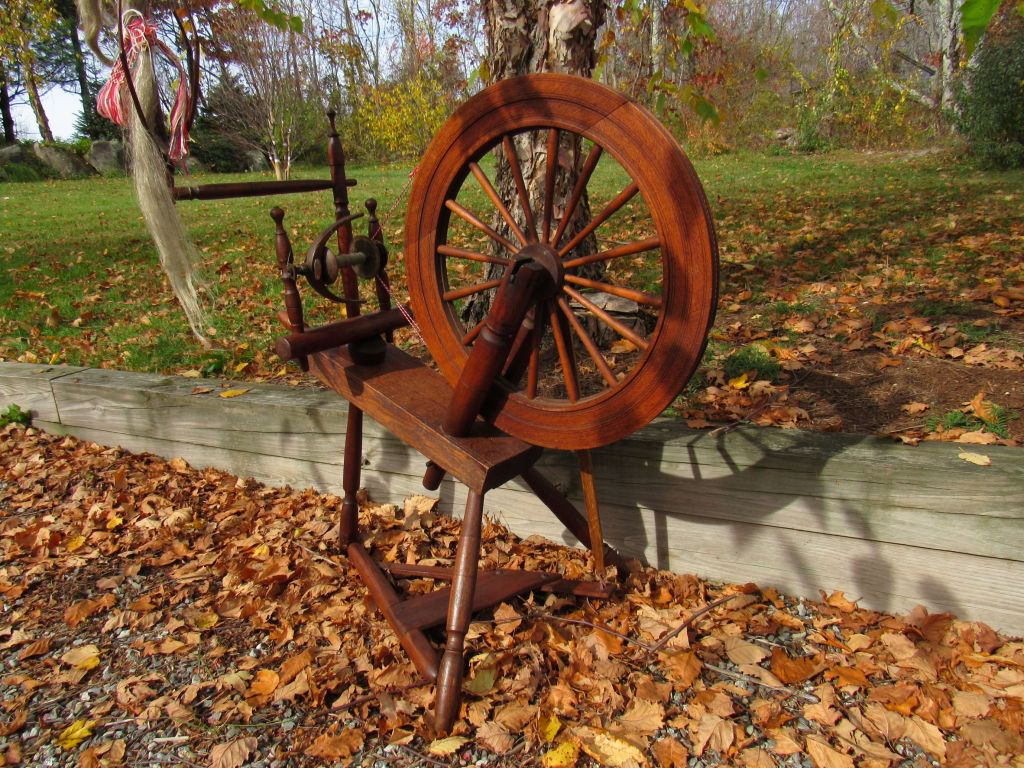
Without seeing a confirmed James Ramsey flax, I cannot be sure that this wheel was made by him. Nevertheless, given what we can see of the maker’s mark, it appears very likely that Jocasta was made by James Ramsey.    
Edward Fairbanks’ 1914 history of St. Johnsbury provides an interesting portrait of James Ramsey. He came to St. Johnsbury in 1817, where he took over a previously built grist mill.
“Ramsey was a character, a large, bony Scotchman, with a fund of droll stories which he delighted to tell to the neighbors and over which he would shake with honest laughter.”  (Fairbanks p. 146)
Ramsey settled his family near the mill, set up a carding machine in the home and, in 1820, with a partner, also built a sawmill. 
James Ramsey had served in the war of 1812, with the rank of Captain.  “Cap’t Ramsey as time went on built a new house.  He became a stiff anti-slavery man and his house was one of the underground railway stations, so called, where runaway slaves were taken in and helped on their way to Canada” (Fairbanks pp. 146-47)
During demolition of the home in the 1930s, a second windowless cellar was discovered under the regular cellar—an underground railroad stop that actually was underground.  (Caledonian Record article).
“Ramsey also became a spinning wheel manufacturer; his wheels for spinning domestic flax were considered a superior product; with oil stained red rims and cranks and spindles of best hard Swede stock.”  (Fairbanks pp. 146-47)  His advertisement shows the range of his products:
“Improved Patent Accelerating Wheel Head $1.13 each–Manufactured by James Ramsay–Cast Steel Set in Brass–Will Require Frequent Oiling–Spinning Wheels of every kind; Quilling Wheels, reels, shuttles,–And Spools may be had at the –Shop in St. Johnsbury, Caledonia County, Vermont–All warranted good or no sale.” (Caledonian Record article)
James died in 1860 in St. Johnsbury before seeing his youngest son, John, die in the Civil War in 1862. 
This glimpse into Ramsey’s life and personality made me even more curious as to where he came from and whether he was related to Hugh Ramsey. So, I took another stab at genealogical research on ancestry.com and this time hit pay dirt.  According to several family trees, Hugh Ramsey was born in Londonderry, New Hampshire, to parents James and Elizabeth, alongside twelve other children. 
Hugh had seven brothers, named John, Robert, David, James Jr., Matthew, William, and Jonathan.  Hugh’s brother William (1750-1823), like Hugh, left Londonderry, and by 1800 or so was living in Vermont. 
William’s second son, James, was born in Londonderry in 1778, married Hepzibah Crossfield in 1805 in Surry, Vermont, and by 1817 moved to St. Johnsbury, where he and Hebzibah eventually had eight children and he made spinning wheels.  So, it turns out that James, our St. Johnsbury wheel maker, is Hugh Ramsey’s nephew. 
Interestingly, one genealogy showed James’ father, William, making spinning wheels in Walpole, New Hampshire, based on a listing in the U. S. Craftsperson files, which cited a 1797 advertisement selling wheels and seeking an apprentice. 
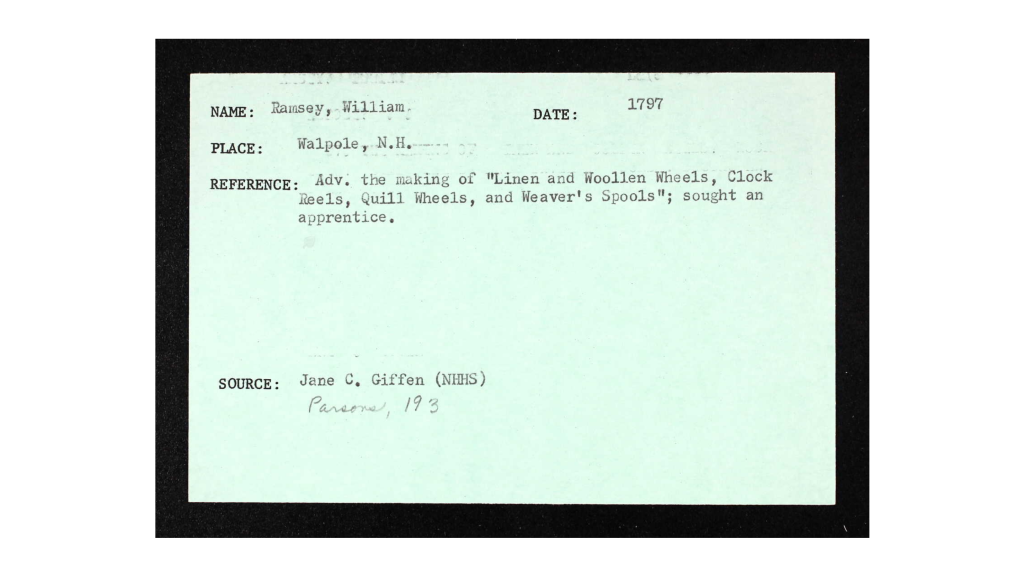
I have not been able to find any other evidence, however, that this William (James’ father) lived in Walpole, although it’s certainly possible. 
It is also possible that it was James’ brother, not his father, who made wheels in Walpole because The History of Walpole’s genealogy section lists William Ramsey, “wheelwright,” his wife, Elizabeth Hibbard, and their two oldest children as residents.  (Frizzell vol II, p. 237).
The William who married Elizabeth Hibbard was James’ brother, born in 1782.  If the 1797 date is accurate in the Craftsperson files, he would have been only 15 or 16 at the time, which seems quite young to setting up business and seeking an apprentice. 
So, my on-again, off-again research sparked by one flax wheel with a worn maker’s mark continues.  More research is needed to confirm that Jocasta was made by James Ramsey, to determine which William was making wheels in Walpole, and to figure out how the JR marked wheels fit into the picture.
While wheel maker research never seems to be completed—each discovery reveals new paths and wrinkles to explore–it also turns up unexpected treasures, such as this fascinating excerpt from the 1914 History of St. Johnsbury:

Spinning and Weaving

These were necessary accomplishments in the department of woman’s industry.  As soon as wool and flax could be raised on the clearings the spinning wheel was started and later the loom, and all the clothing of the settlement was of homespun made in the family kitchens.  After 1800 nearly every well to do family would have either wheel or loom or both, the girls became skilled spinners and the mothers wrought firmly woven fabrics on their heavy looms.
An average day’s work would be to card and spin four skeins of seven knots each, forty threads to a knot, two yards in length.  Flax spun on the little wheel would be two double skeins of fourteen knots each.  When enough was spun for a web of twenty yards it was boiled out in ashes and water and well washed; then spooled and warped ready to weave into cloth, for various garments.  Table cloths and towels were woven in figures, dress goods from flax, colored and woven in checks.
The volume to which this family industry attained is expressed in the returns given for the year 1810.  During that year, the women of St. Johnsbury turned off from their looms 16,505 yards of linen cloth, 9,431yards of woolen, 1797 yards of cotton cloth.  A total of 27,733 yards.”  (Fairbanks pp. 138-39) “After some years [in the 1820s and 30s] mills began to be set up in different parts of the town [for dressed cloth] … Many of the women however continued to manufacture their own cloth.”  (Fairbanks pp. 139-140)
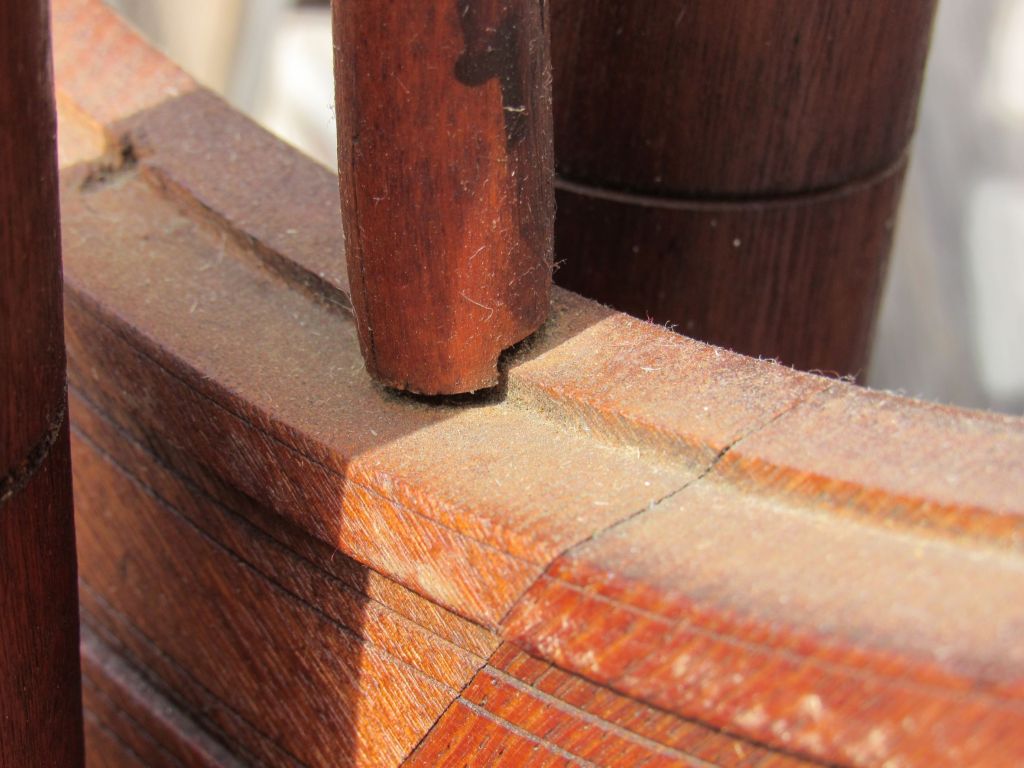
With such a large volume of spinning, it is no wonder that so many antique wheels bear marks of heavy wear.  Jocasta was well used
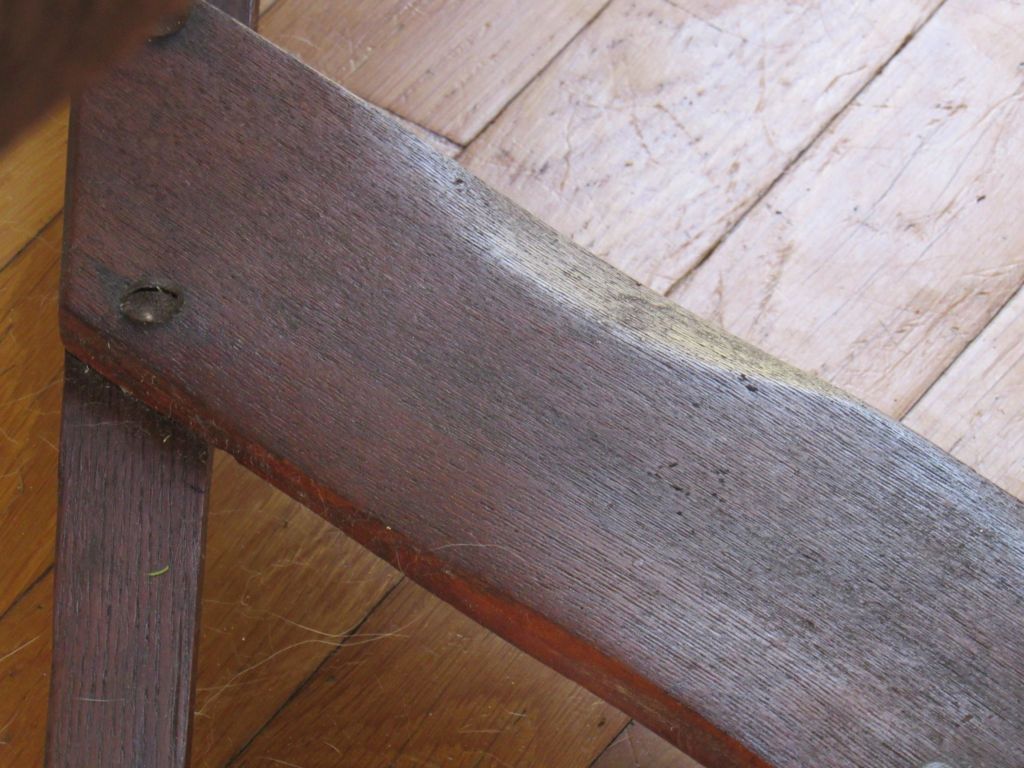
and has been one of the very best wheels for spinning fine flax in my flock.
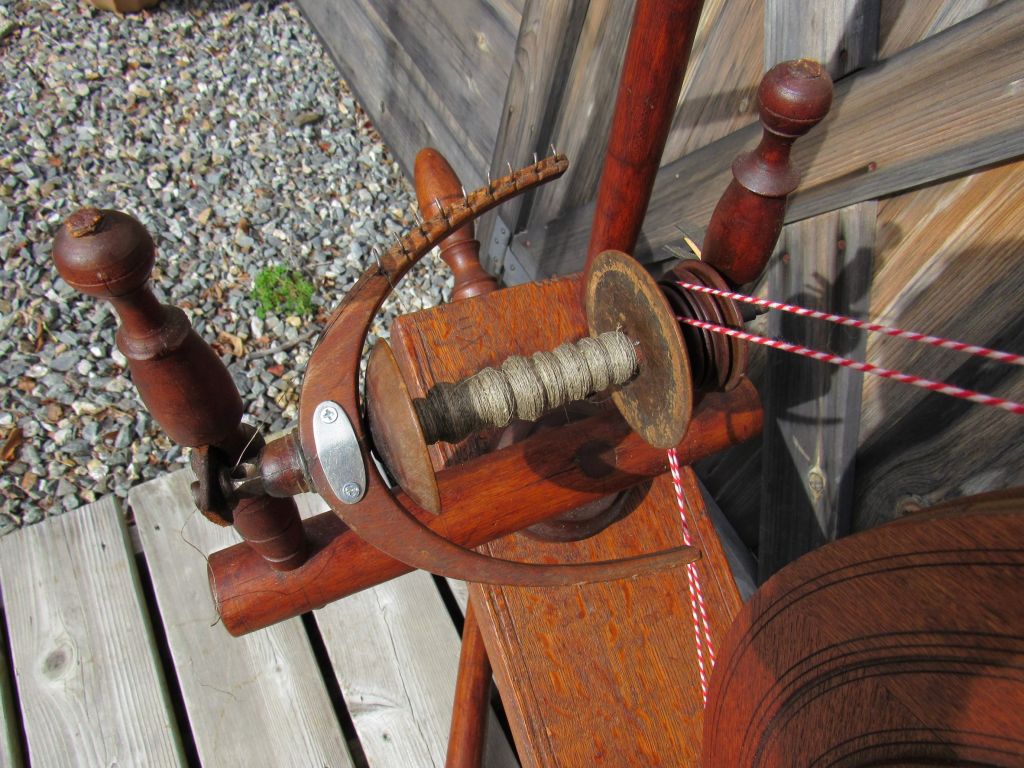
If anyone has more information on James Ramsey and his wheels, please let me know.

Thank you to Craig Evans (JR wheel), Gina Gerhard (Ramsey great wheel), and Krysten Morganti (Cummer wheel and Hugh Ramsey wheel) for allowing me to use their photographs.  Also, thanks to Gina for her research on James Ramsey.

The Fairbanks Museum & Planetarium in St. Johnsbury, the St. Johnsbury History & Heritage Center, and the Old Stone House Museum & Historical Village all helped in my attempt to locate a confirmed James Ramsey wheel. I am very appreciative that they took the time to respond to my questions.
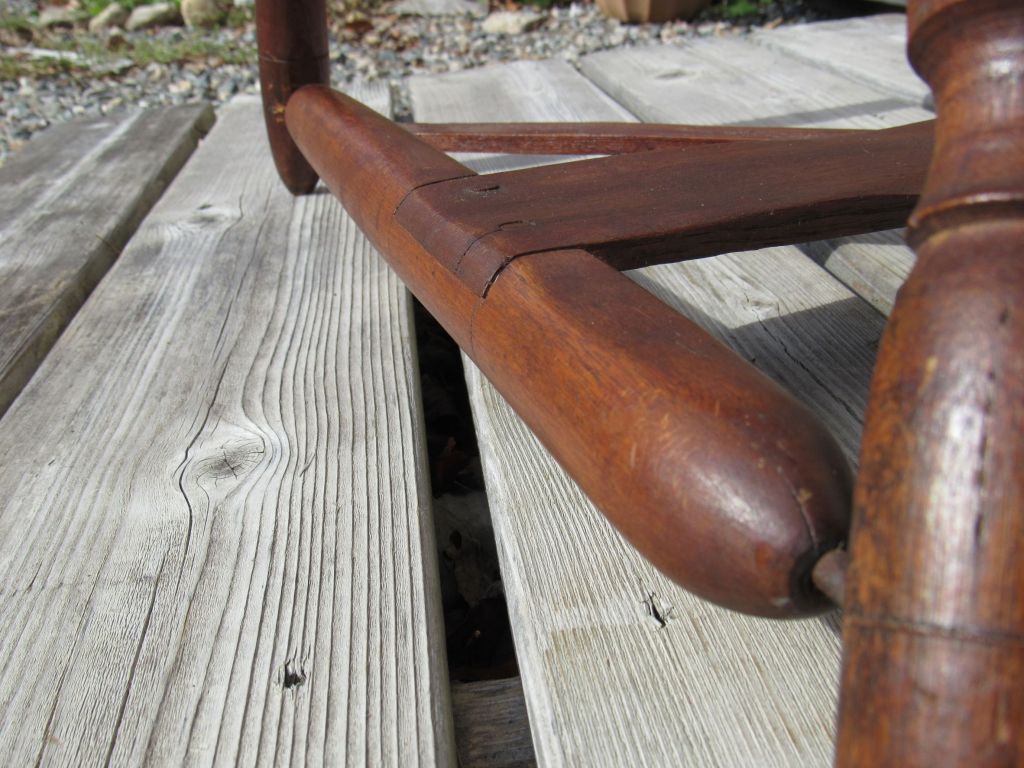
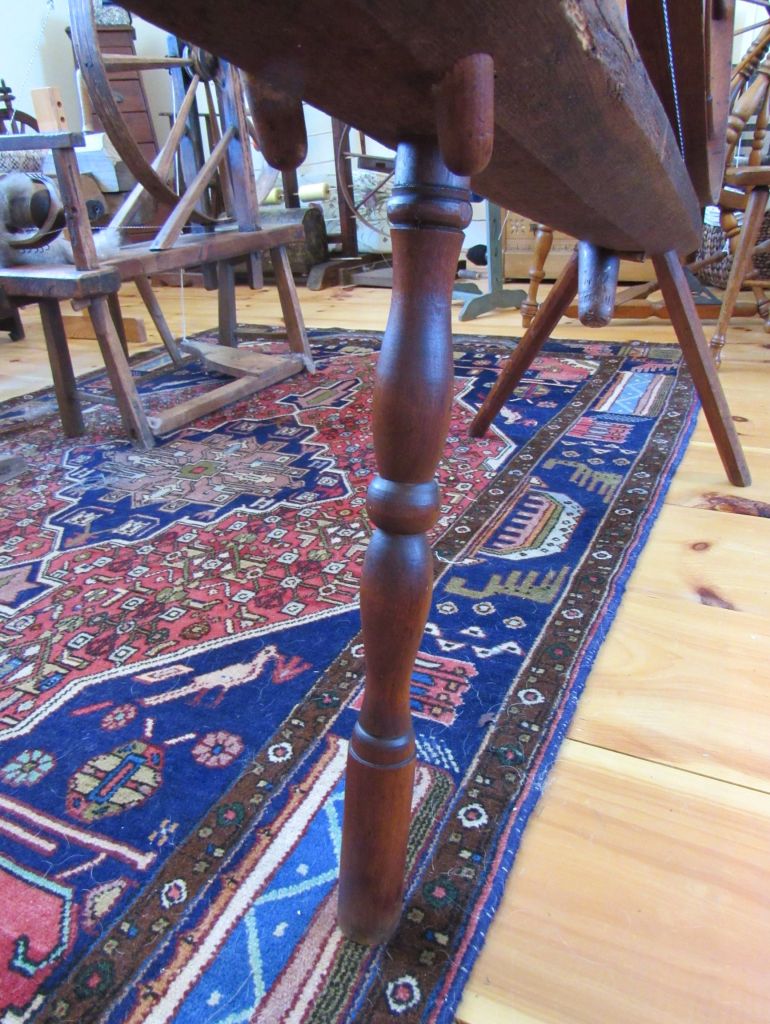
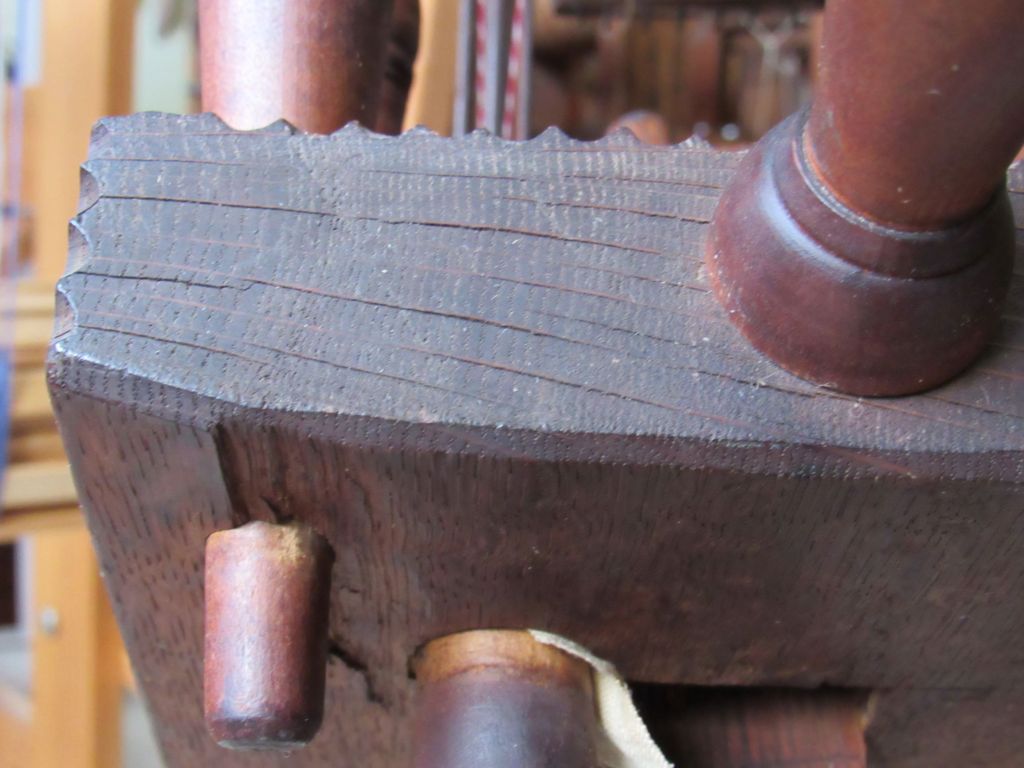
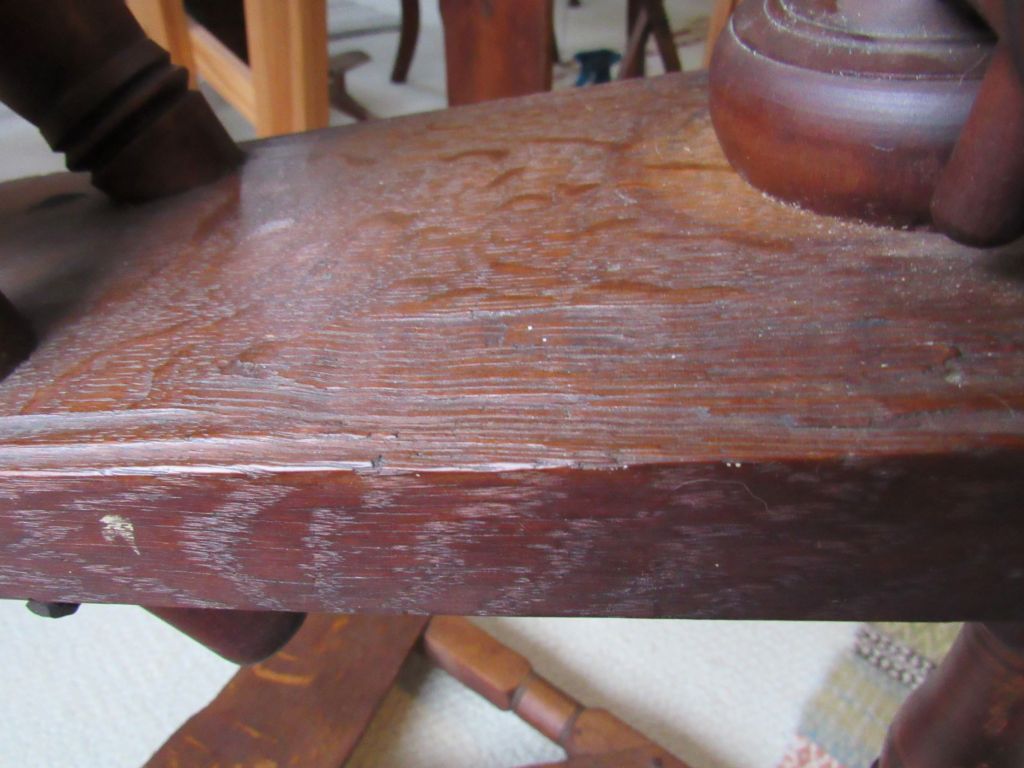
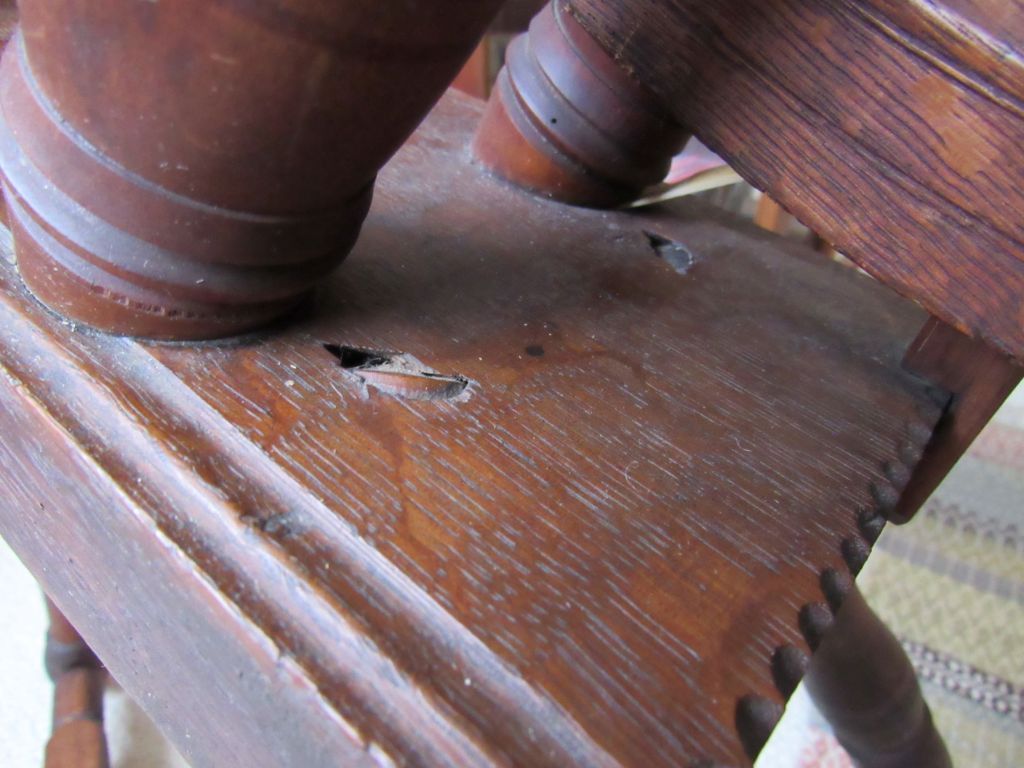
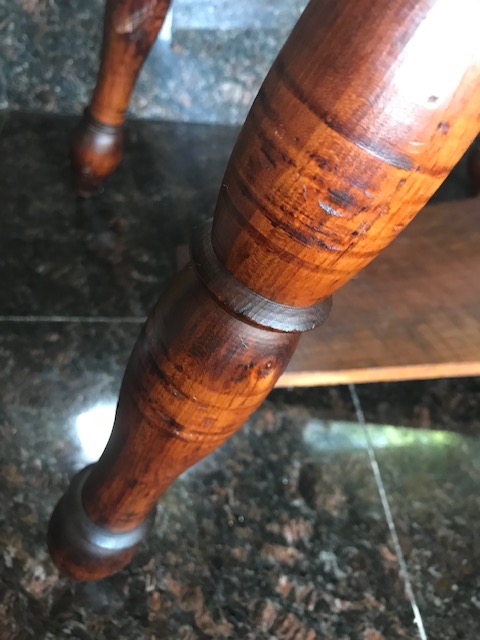
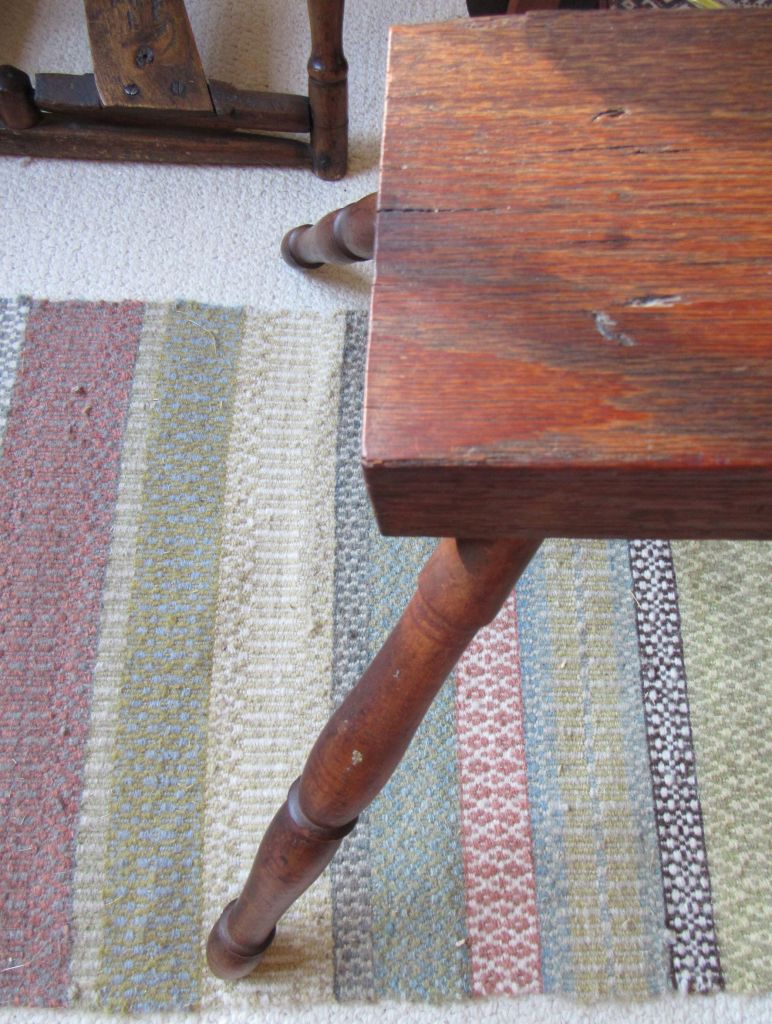
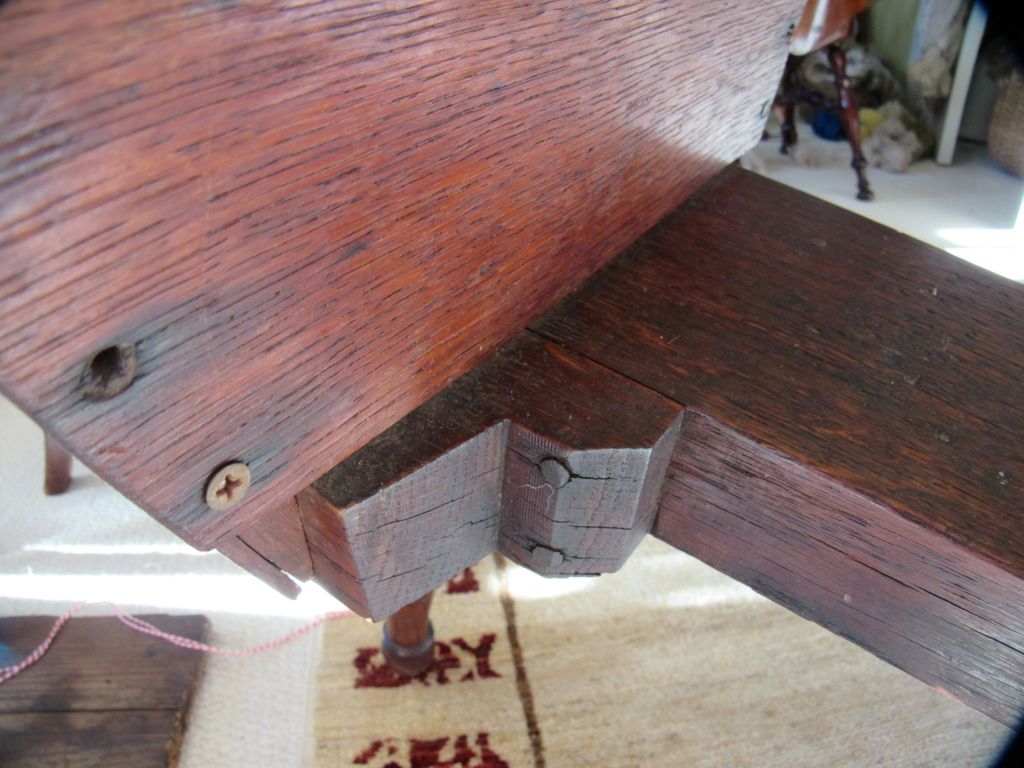
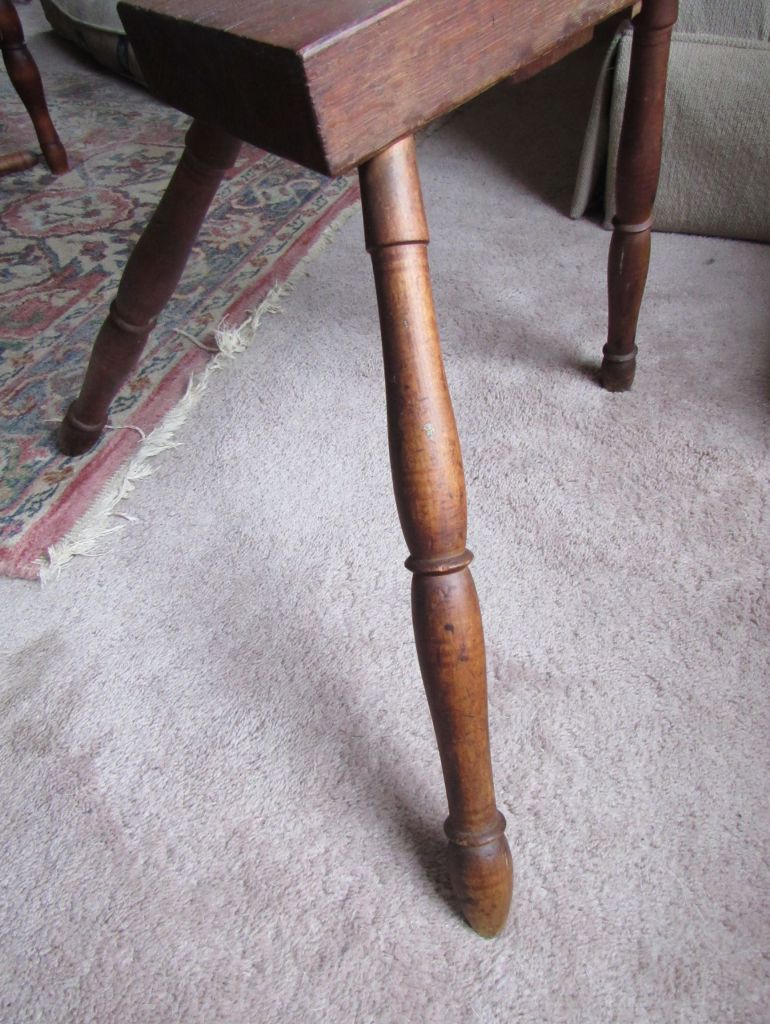
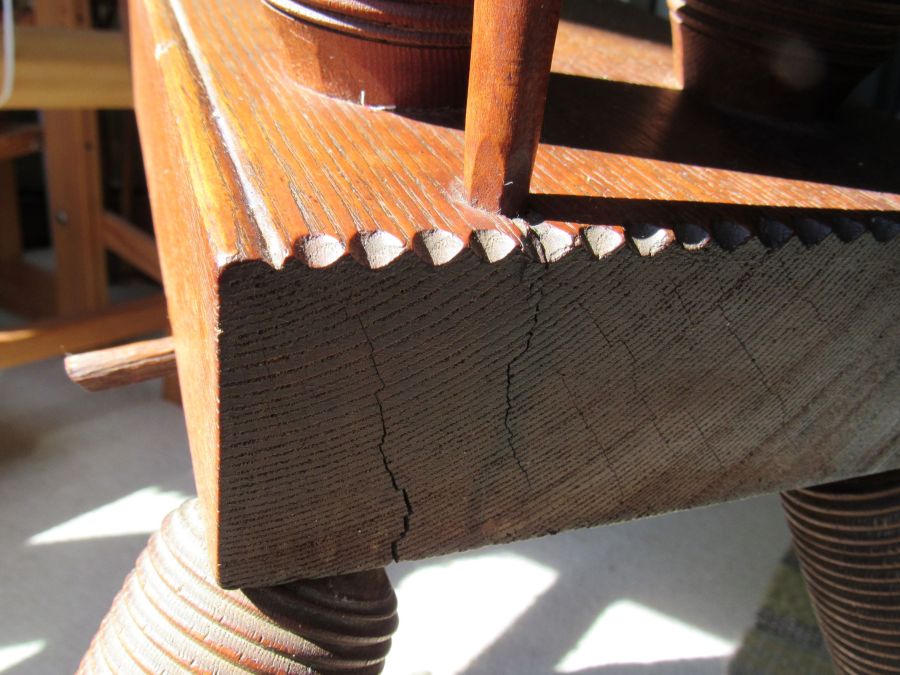
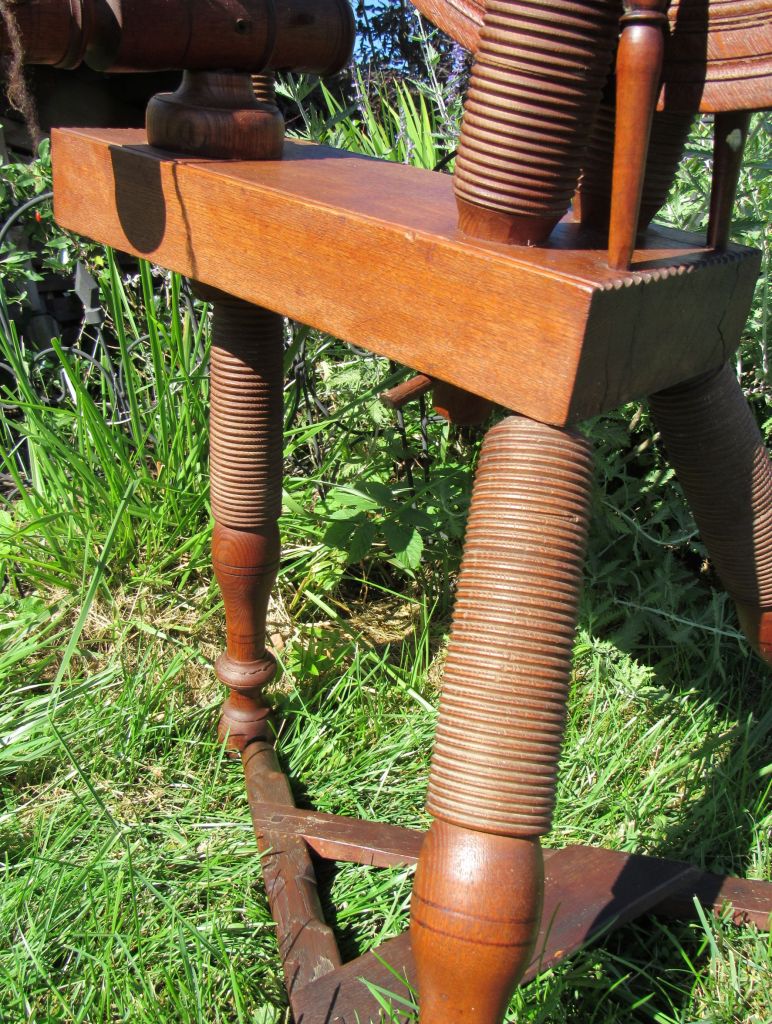
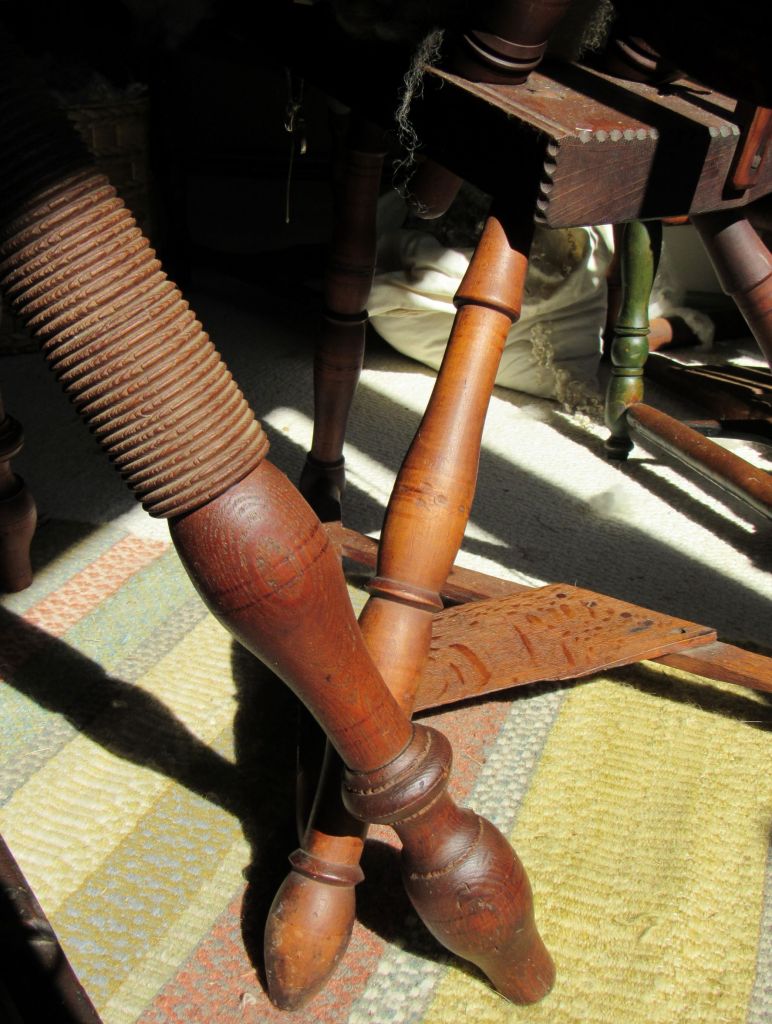
Edited to add on November 17, 2022: After I posted this, Vermont weaver, Justin Squizzero (The Burroughs Garret), sent me photos (below) of one of his wheels, which is unmarked and from a Vermont collector. While it has some minor differences from Jocasta and Craig’s “JR” wheel, it has some remarkable similarities. The legs, in particular, have the same turnings at the “ankles” and it has similar grooves down the sides of the table top. Those particular features set these three wheels apart from Shaker wheels, which have smooth legs and tables. Notably, the S. Cheney wheels also share the ankle turnings and table grooves (see previous post “Sweet Cicely and Chancey”). So, while these particular wheels at first glance almost appear to be Shaker wheels, they all share the same deviations from Shaker wheel design. That suggests some connection between these three wheels. Were they made by the same person at different times, by related wheel makers, or was there some geographical market influence over the non-quite-Shaker style? Fascinating. Thanks Justin.
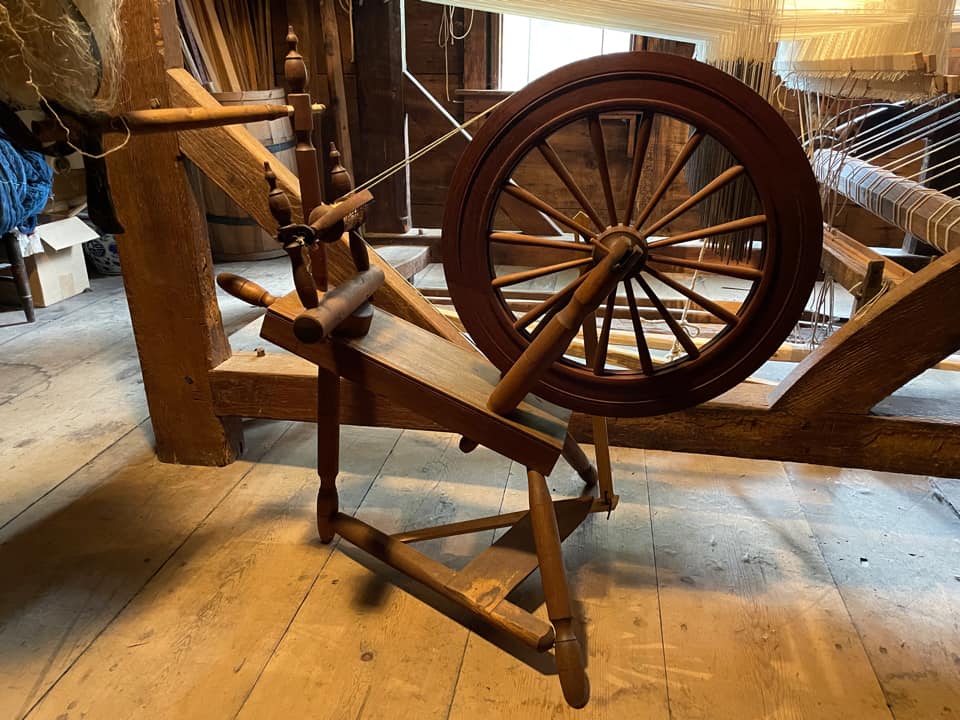
Justin’s wheel
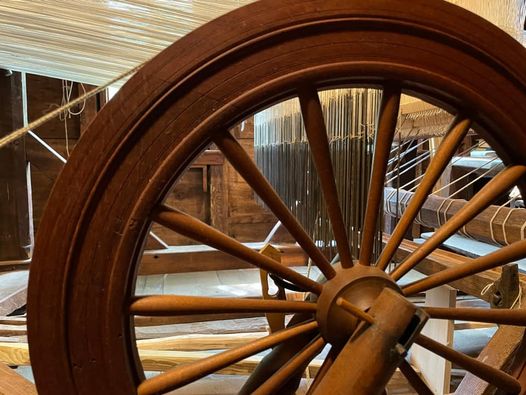
The drive wheel on Justin’s unmarked wheel
The maidens are similar, but different, on Justin’s wheel
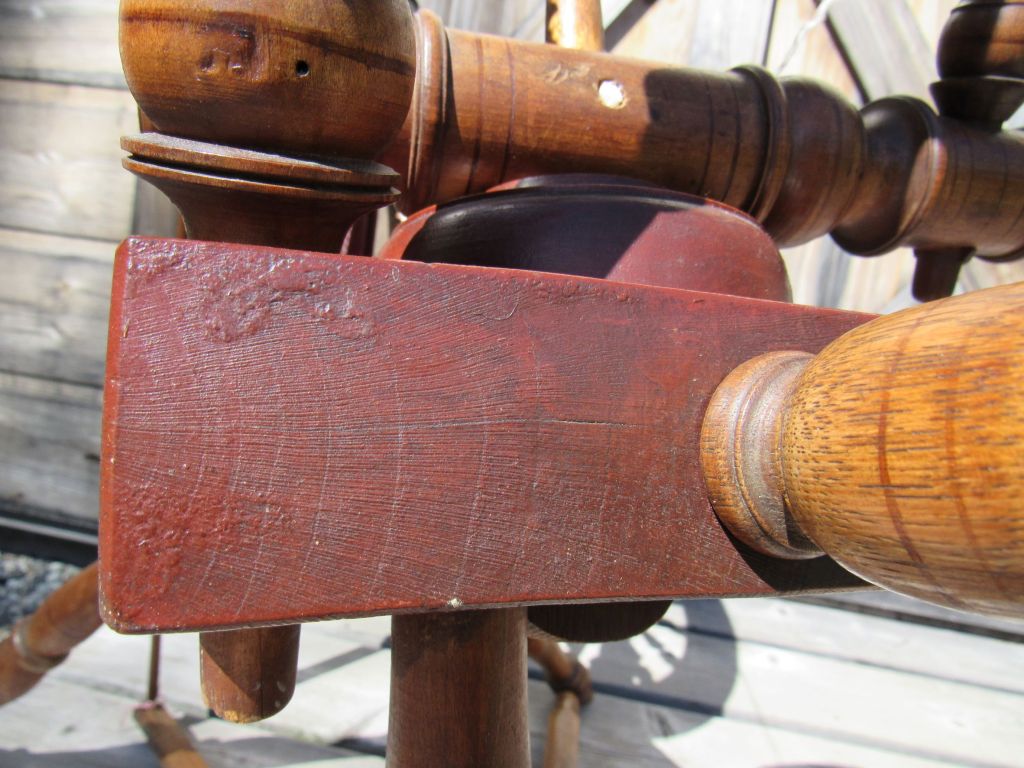
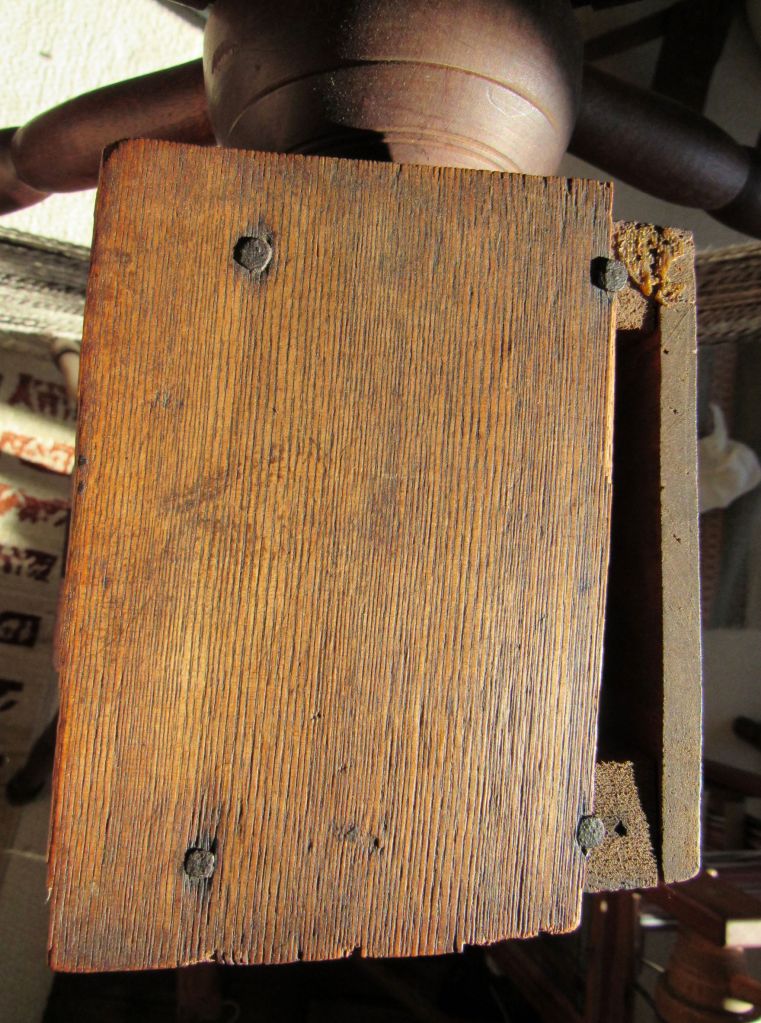
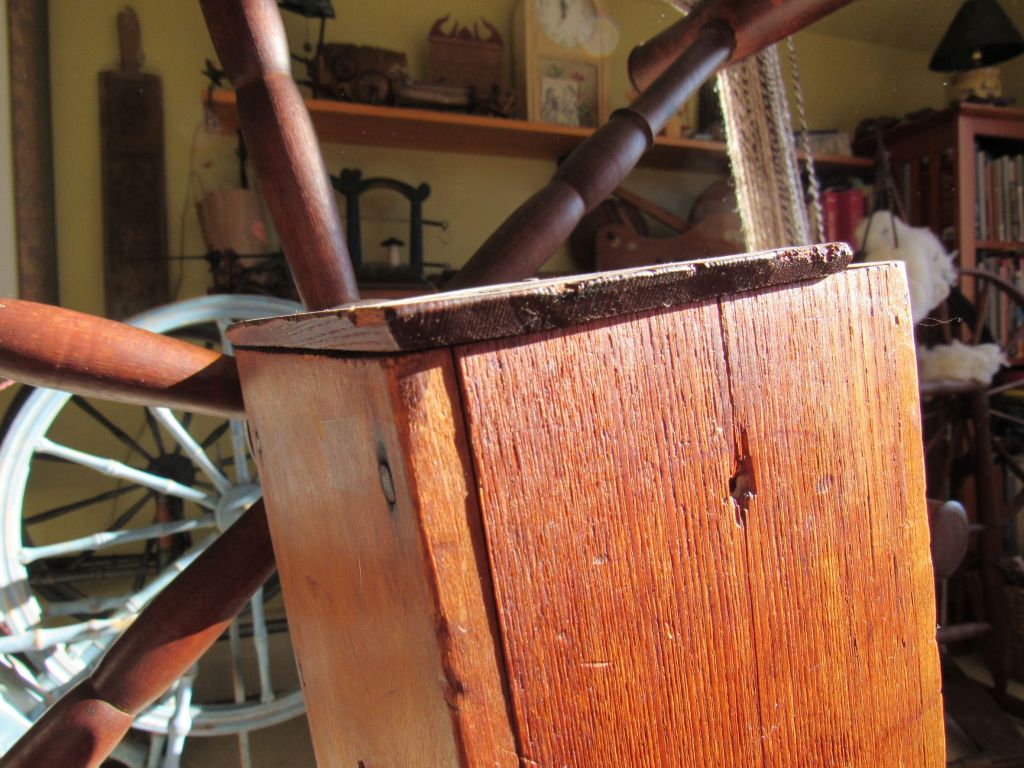
The grooves down on the top and sides of the table are like Jocasta’s, but unlike Shaker wheels

References: 

Feldman-Wood, Florence, “Hugh Ramsey, Spinning Wheel Maker,” The Spinning Wheel Sleuth, Issue $48, April 2005, pp. 4-5.

Taylor, Michael, “Londonderry, NH, Flax Wheels,” The Spinning Wheel Sleuth, Issue #48, April 2005, pp. 2-4.

St. Johnsbury History & Heritage Center, Caledonian Record newspaper, February 1, 2012. 

Merrimack Valley Textile Museum, All Sorts of Good Sufficient Cloth: Linen-Making in New England 1640-1860, Merrimac Valley Textile Museum, North Andover, Mass., 1980. 

Cummer, Joan, A Book of Spinning Wheels, Peter E. Randall, Portsmouth, N.H. 1984.

Fairbanks, Edward, The Town of St. Johnsbury Vermont, The Cowles Press, St. Johnsbury, VT 1914.

Frizzell, Martha McDanolds, A History of Walpole, New Hampshire, Vol. II, Vermont Printing Co. 1963.

Pennington, David & Taylor, Michael, Spinning Wheels & Accessories, Schiffer Publishing, Altglen, PA, 2004.

Ancestry.com for research on Ramsey genealogy
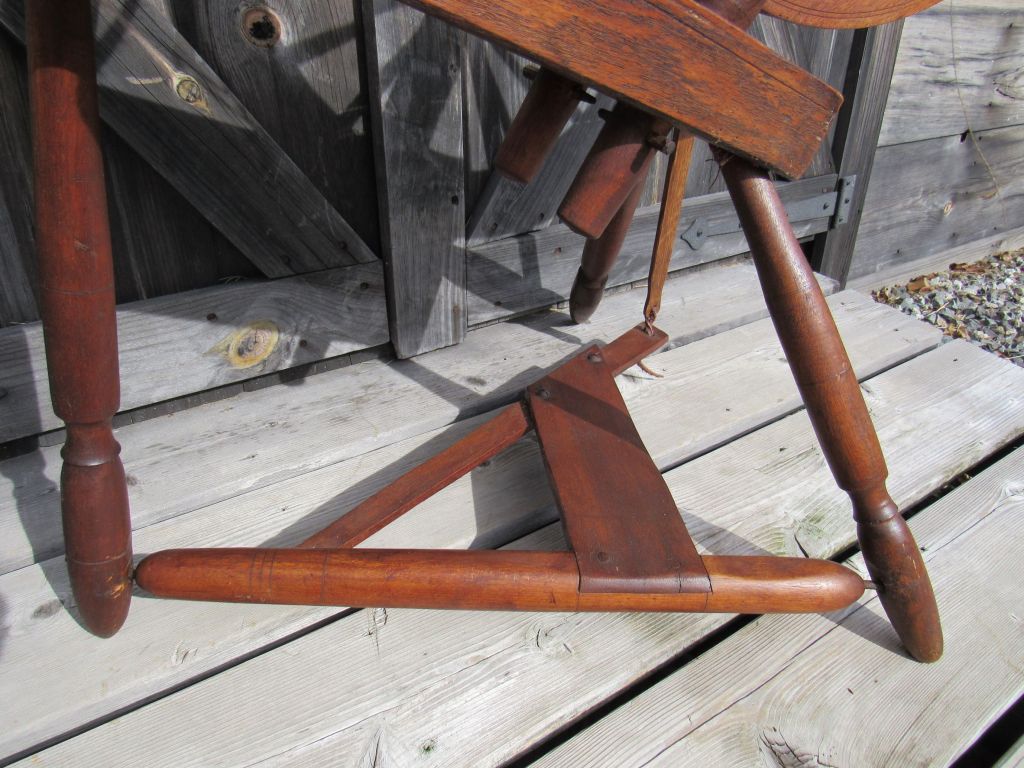
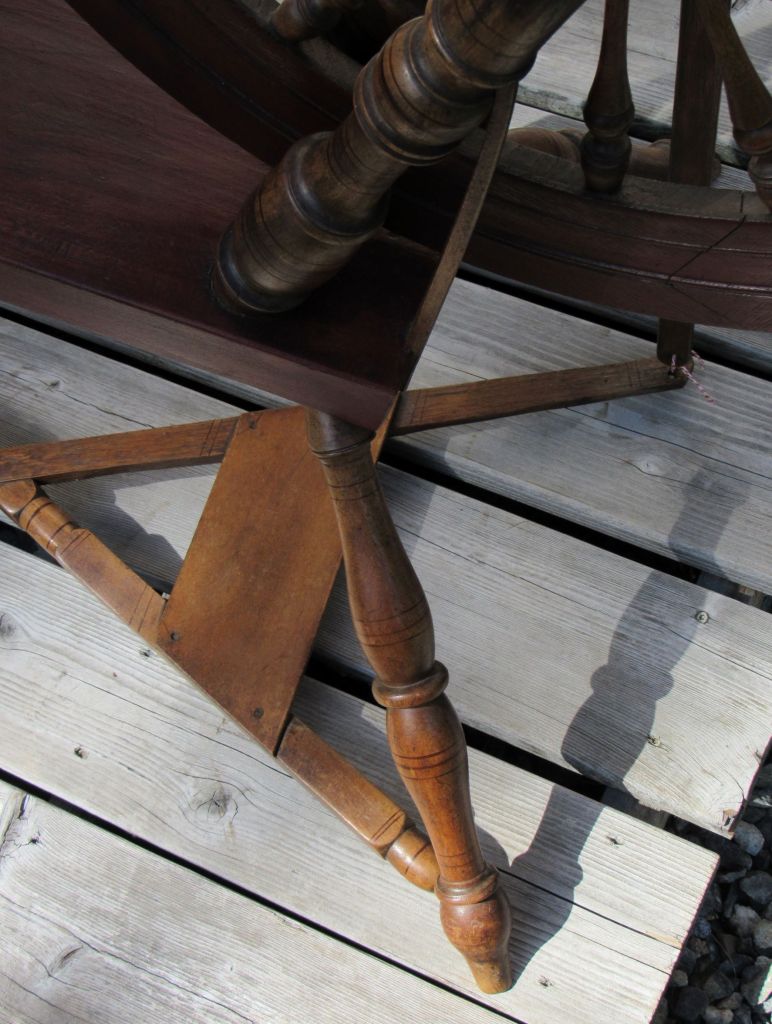
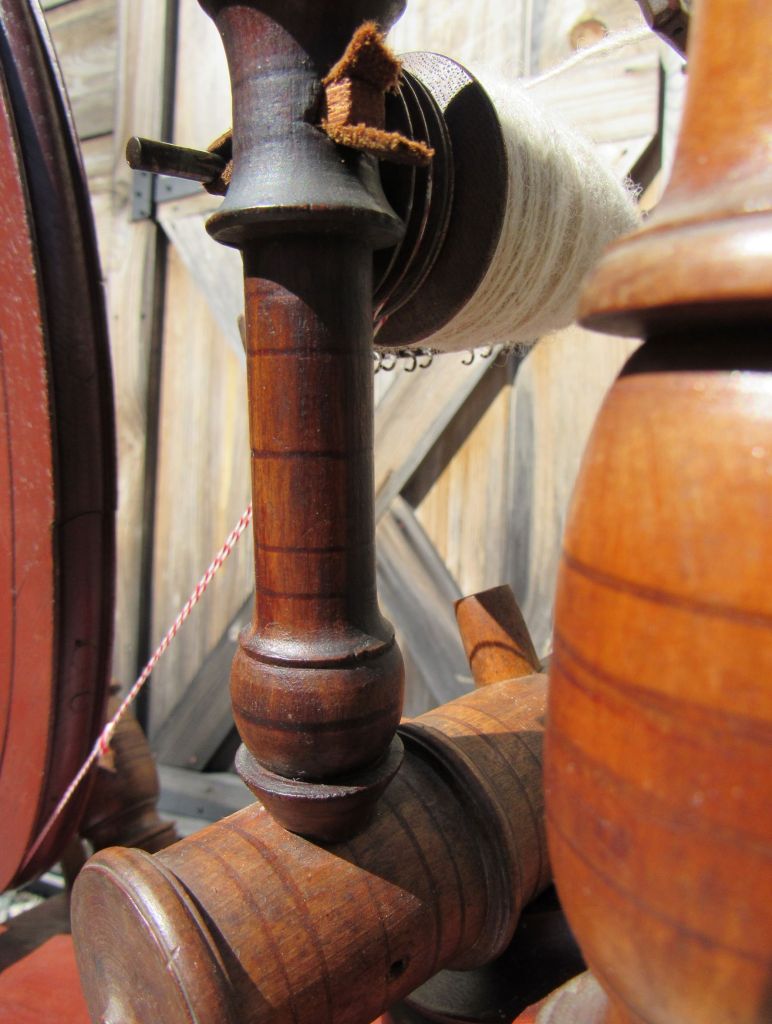
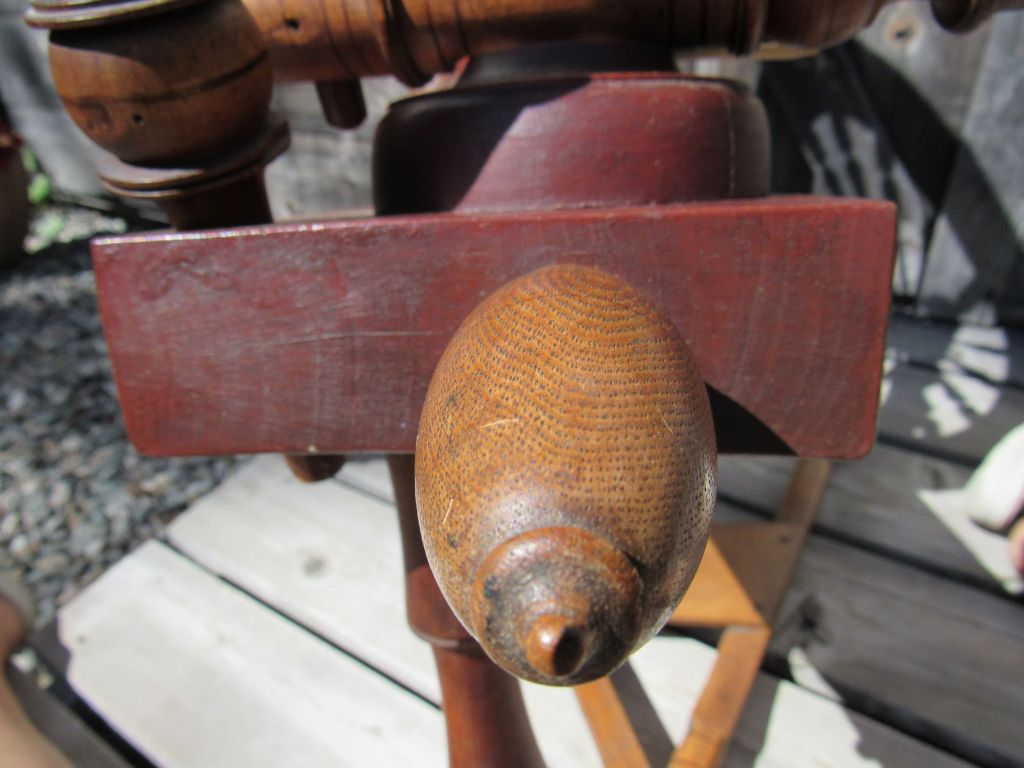
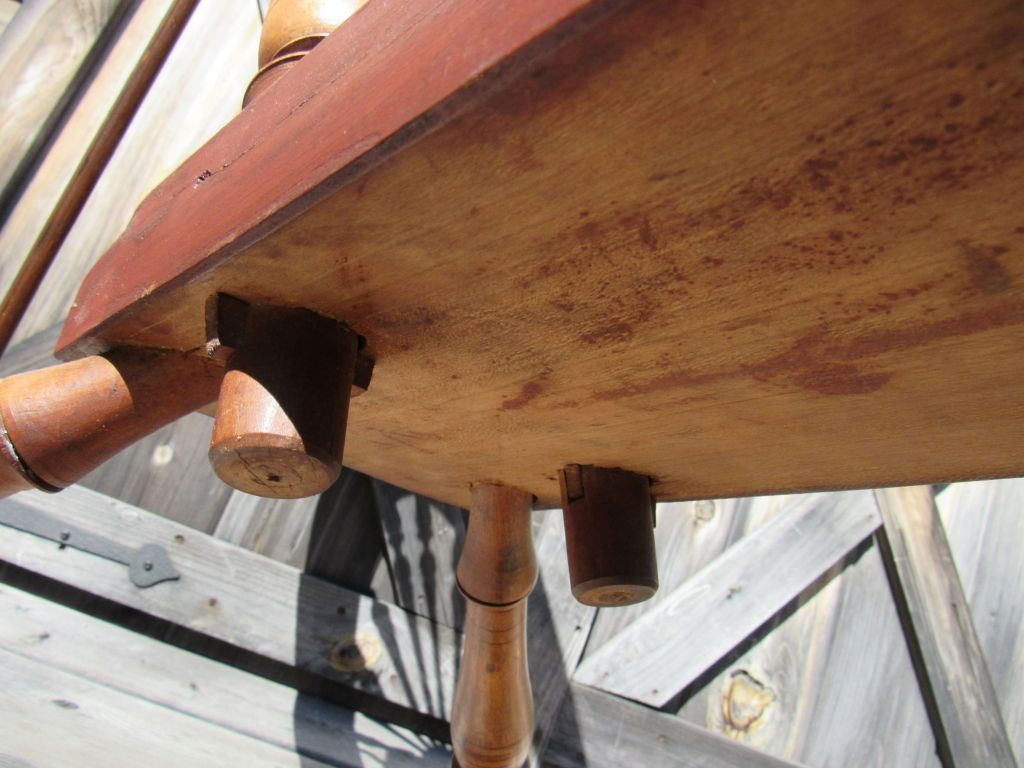
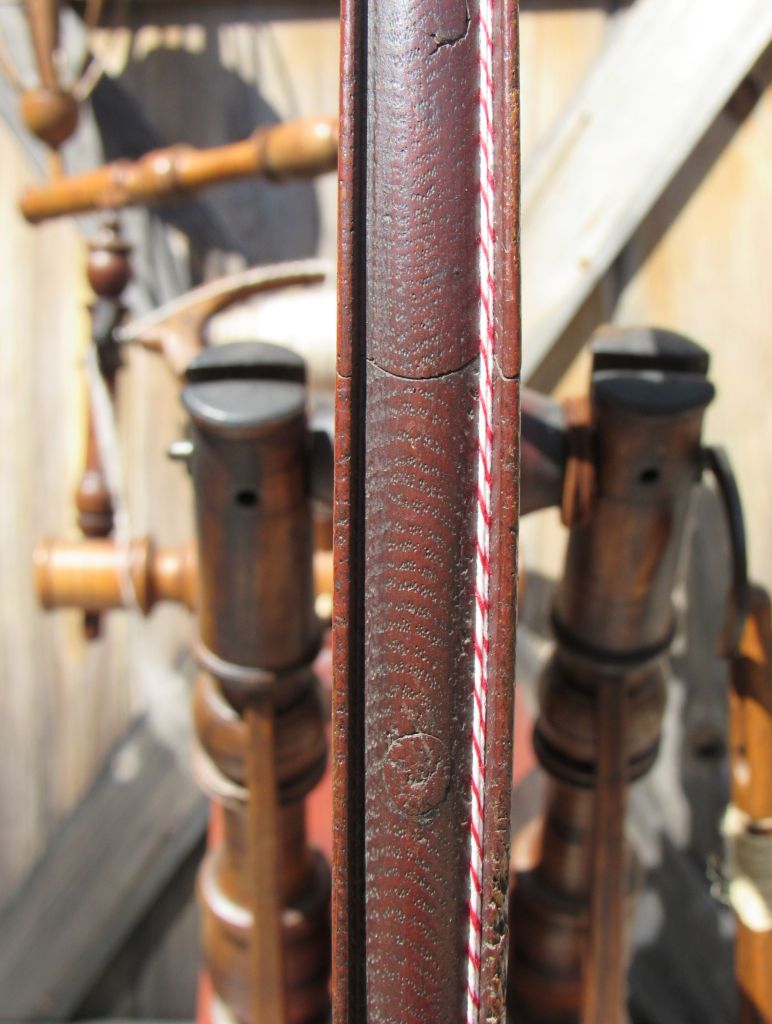
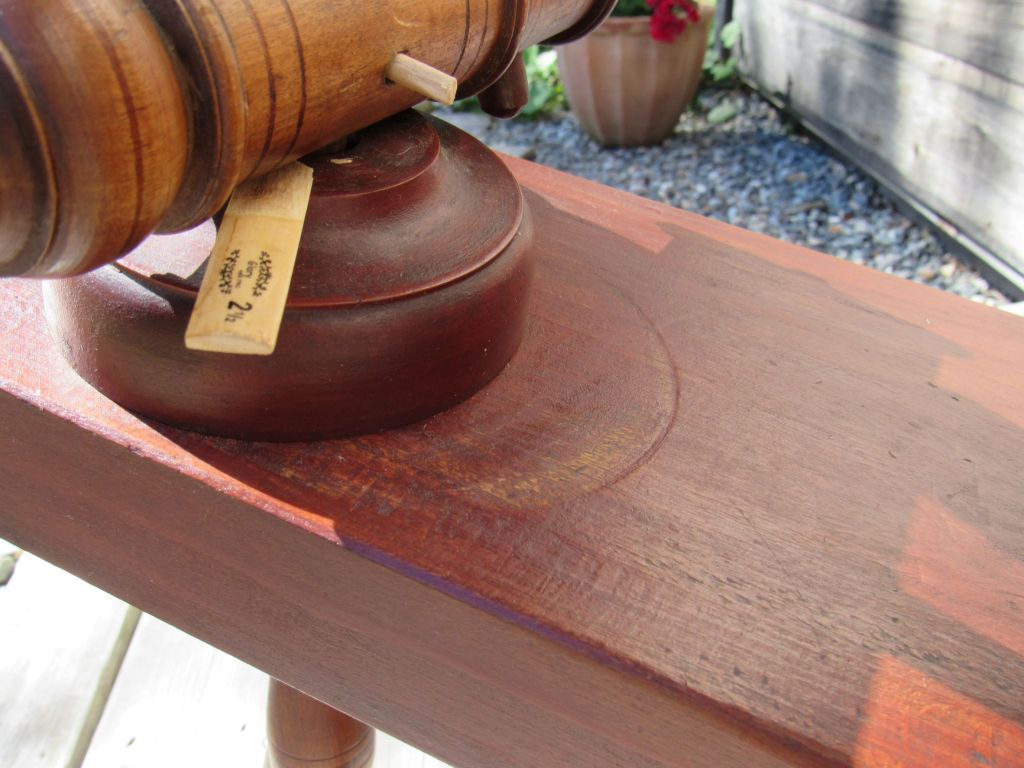
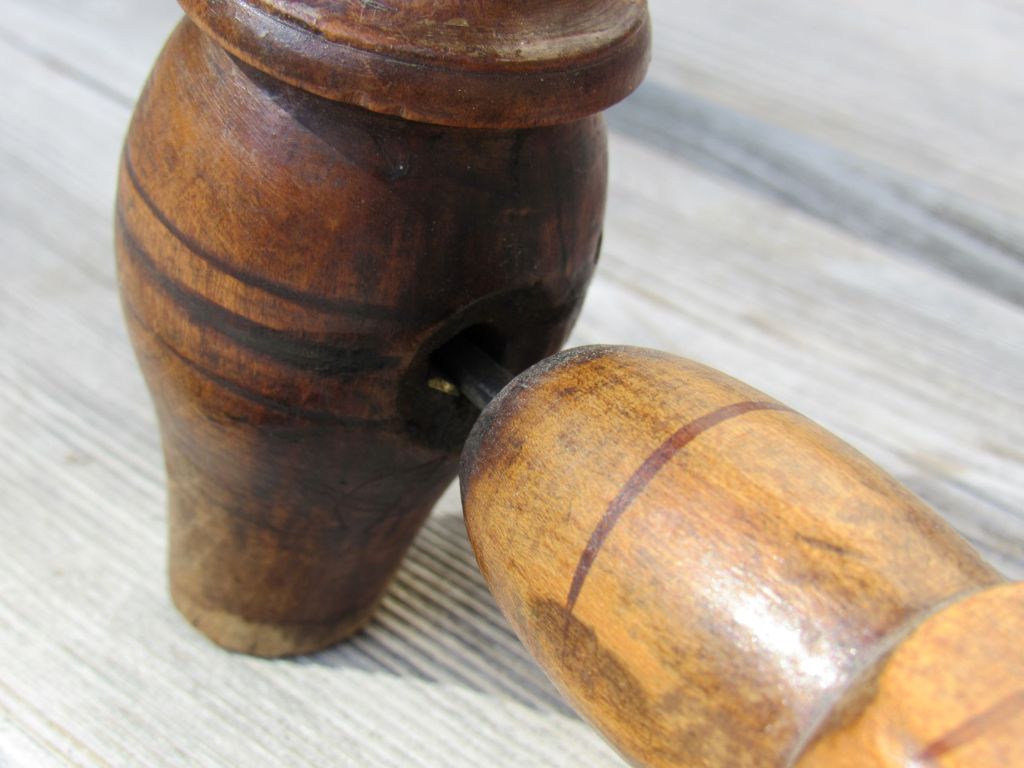
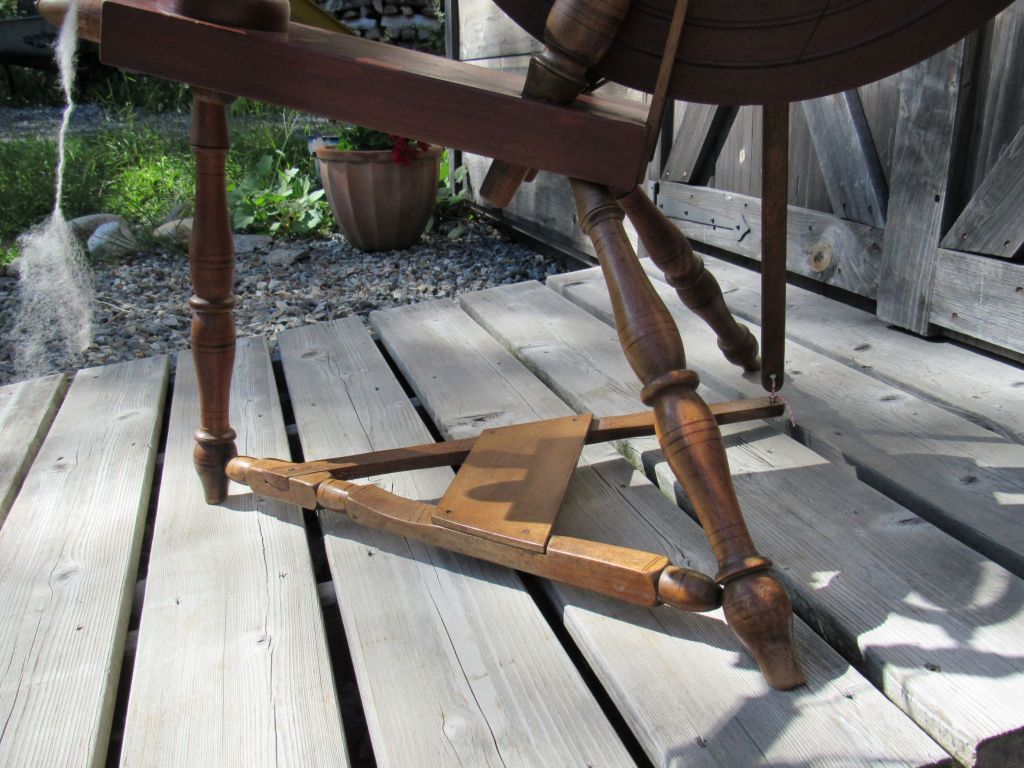
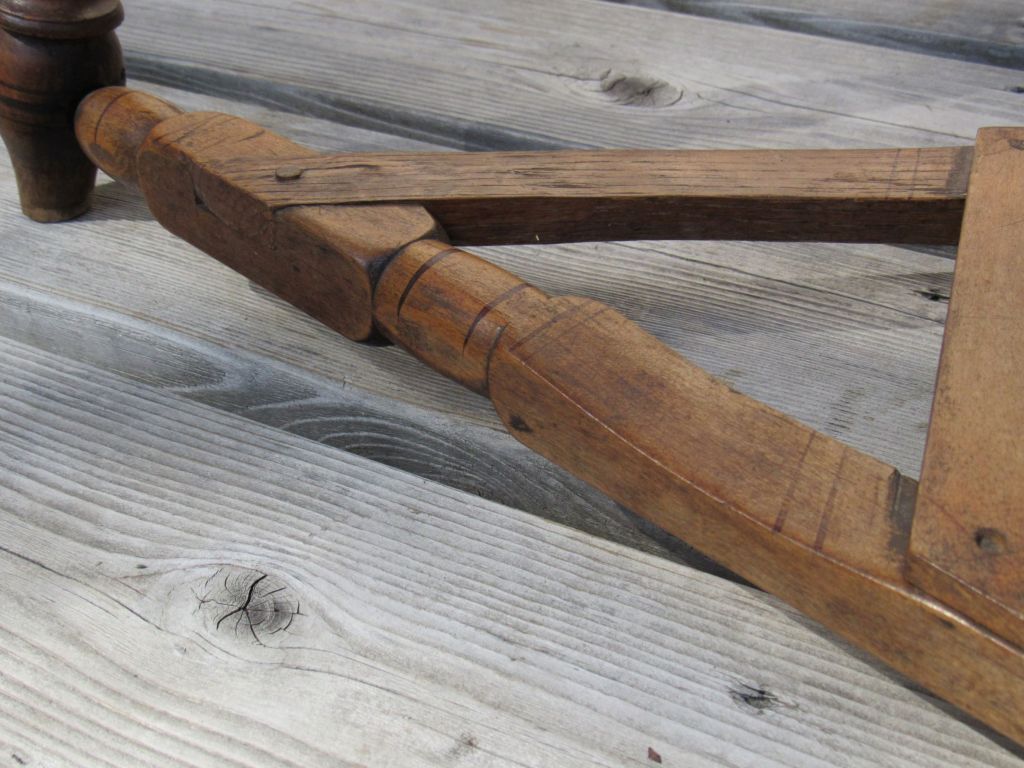
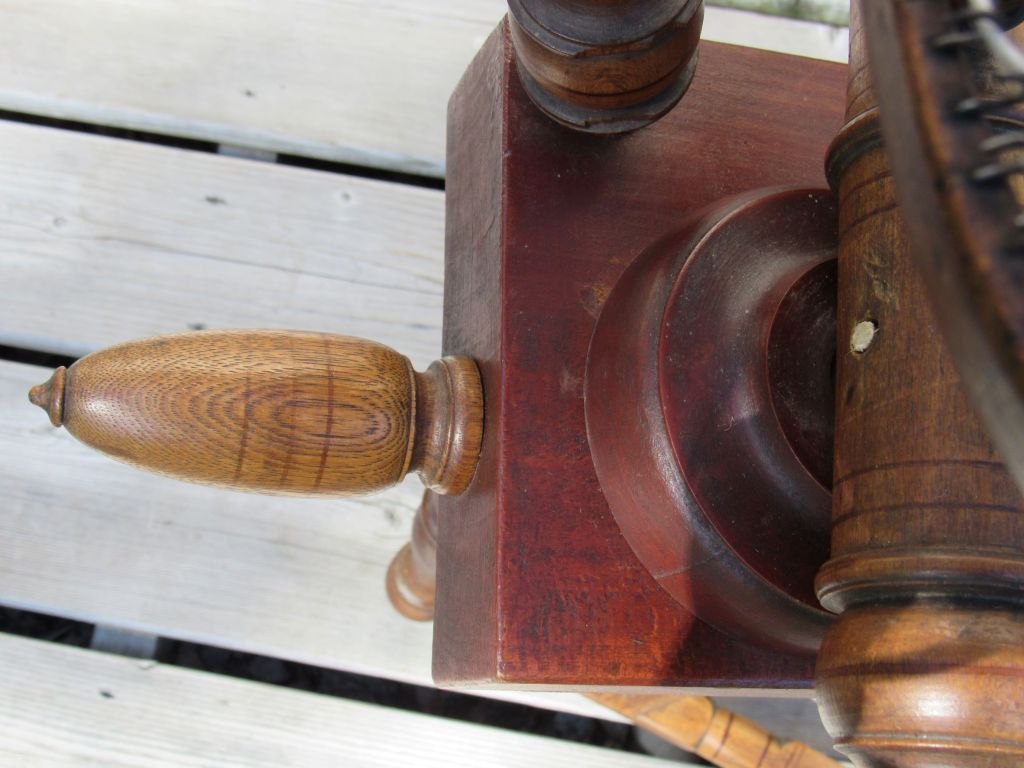
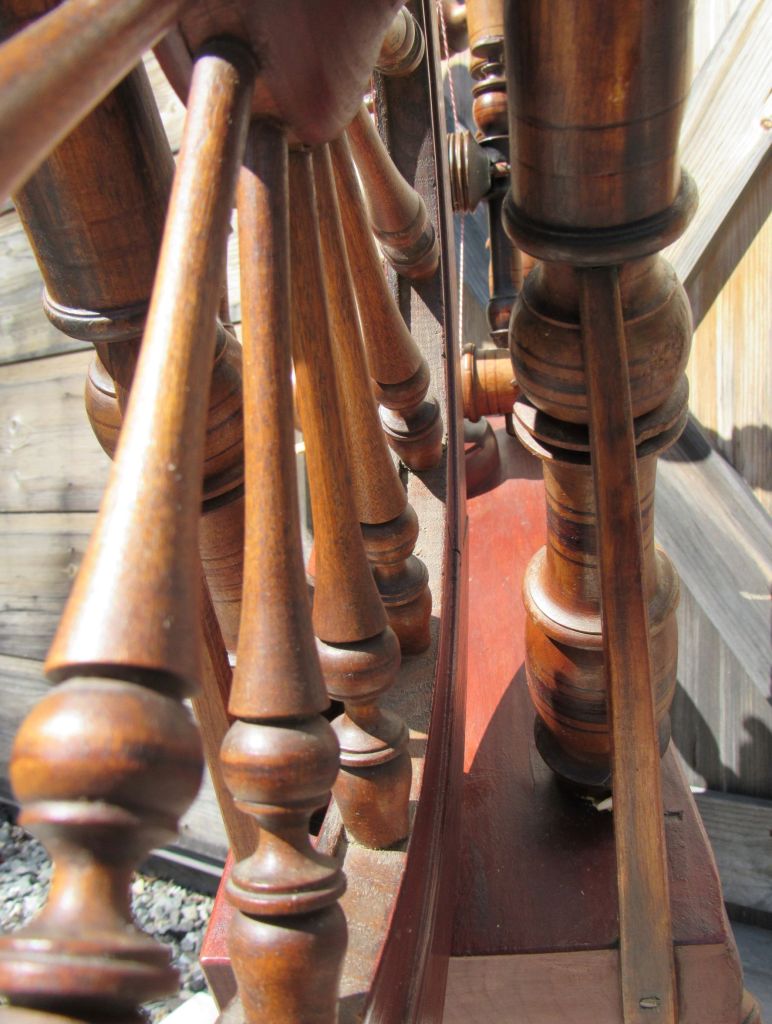
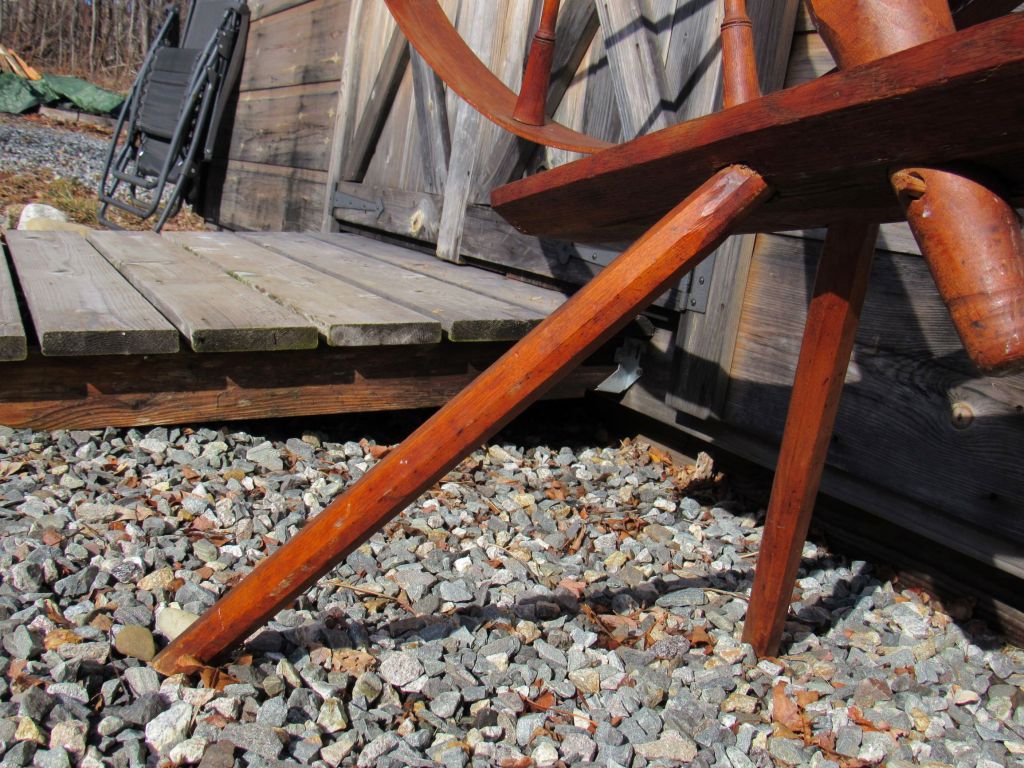
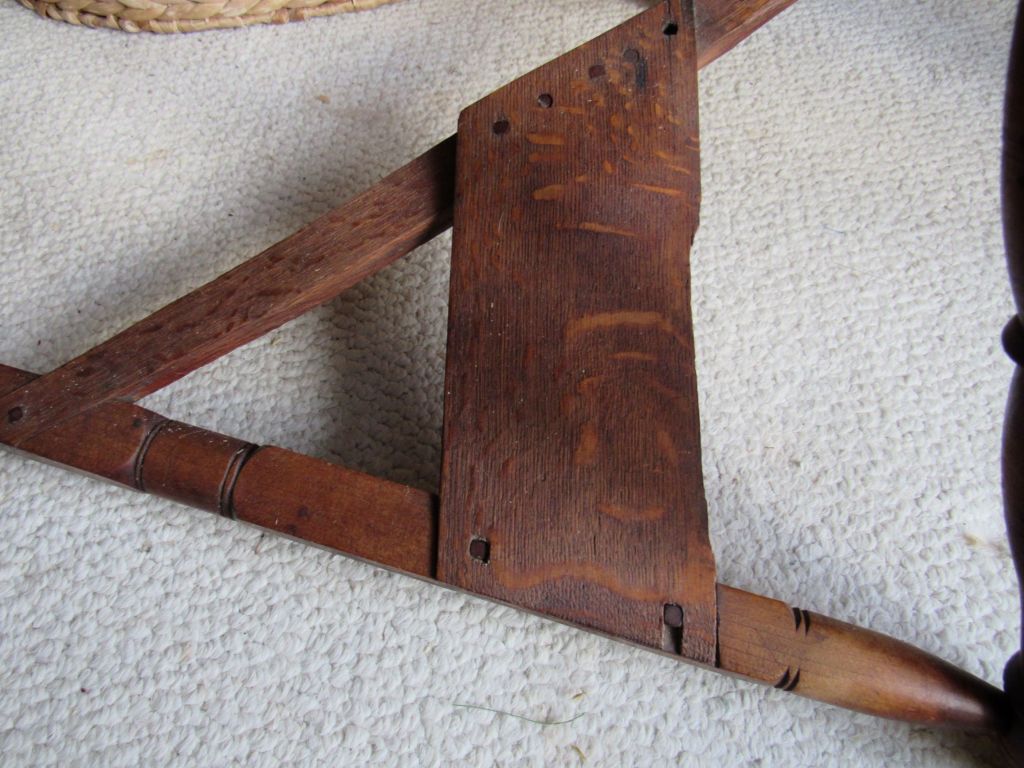
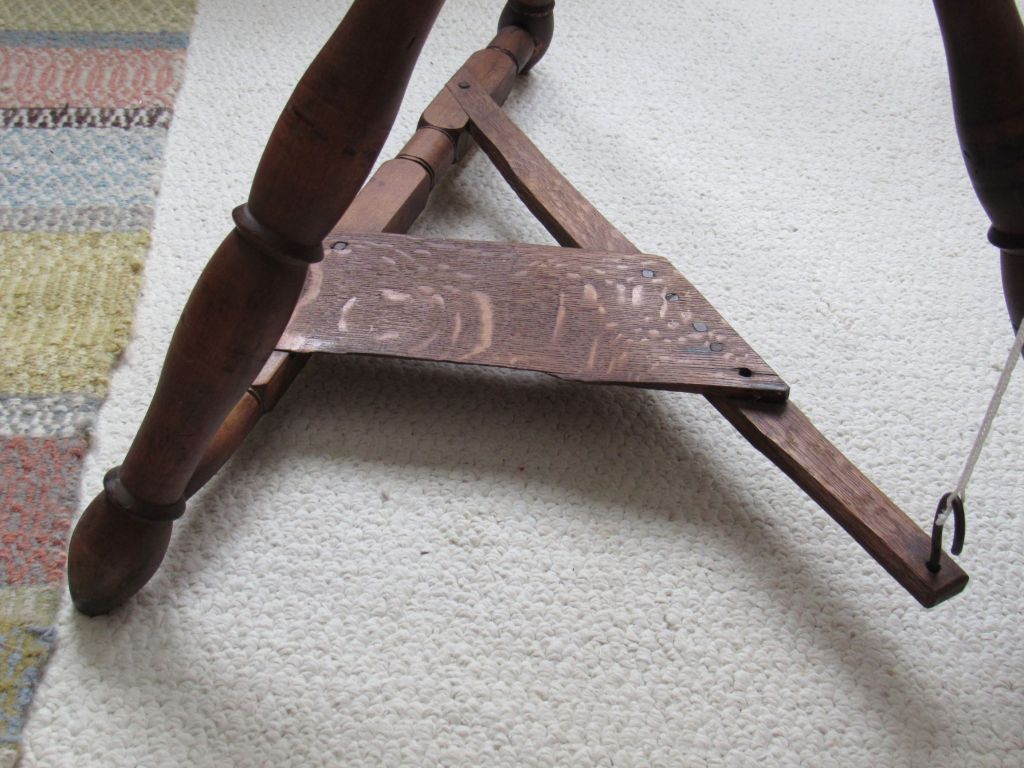
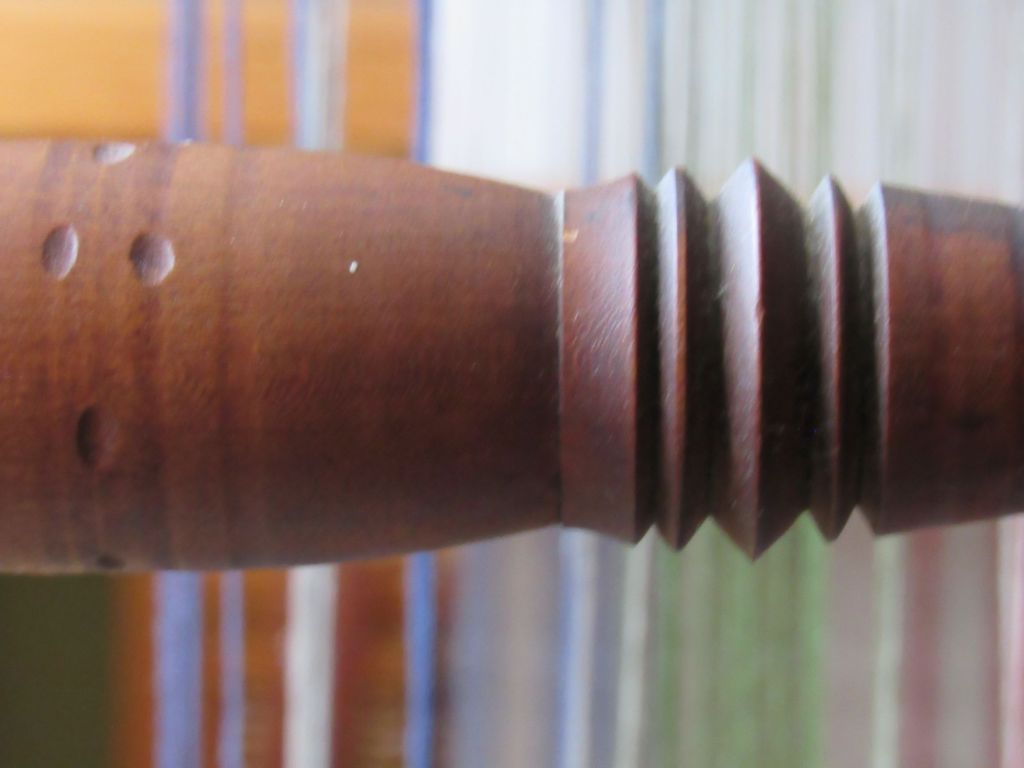
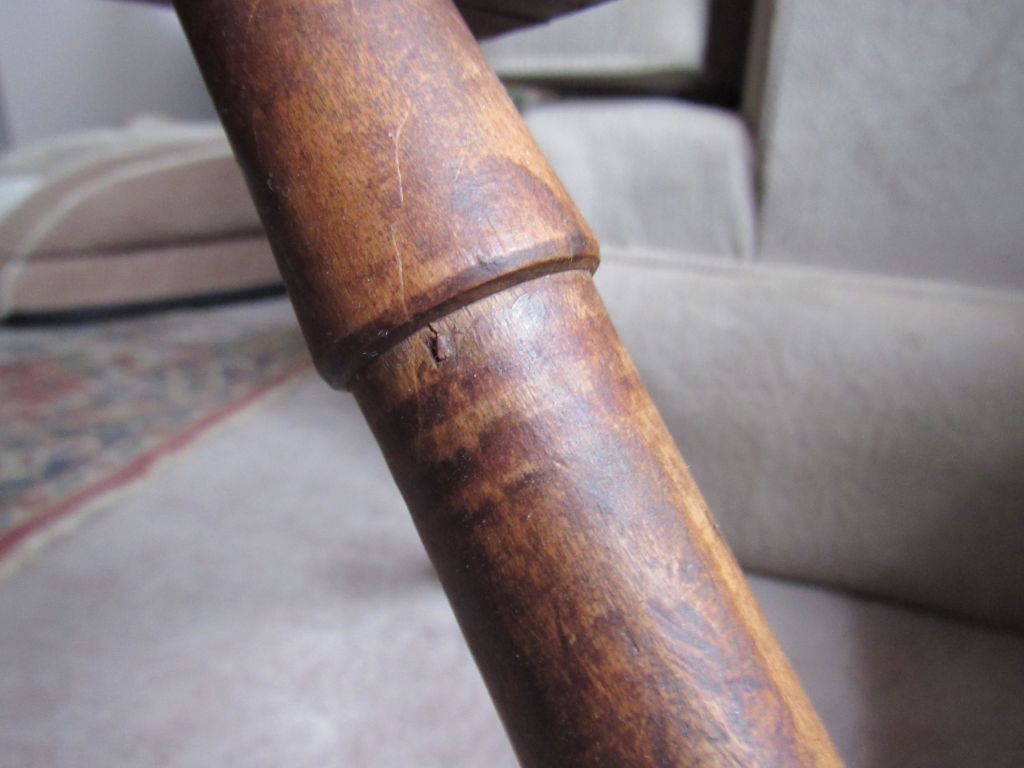
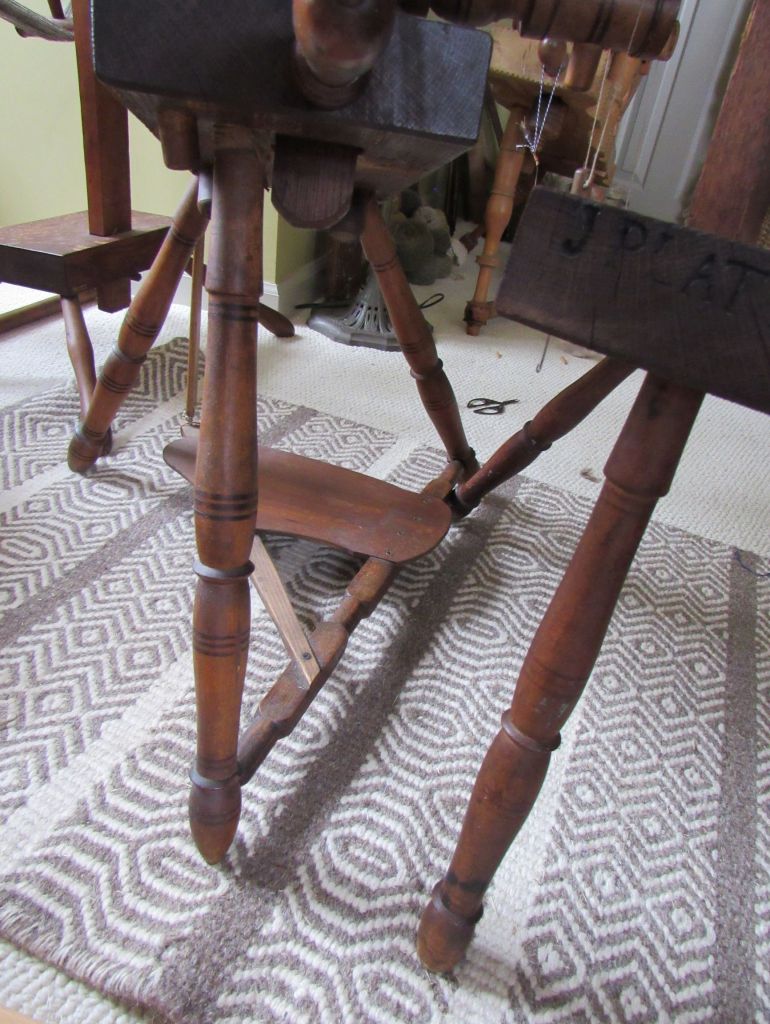
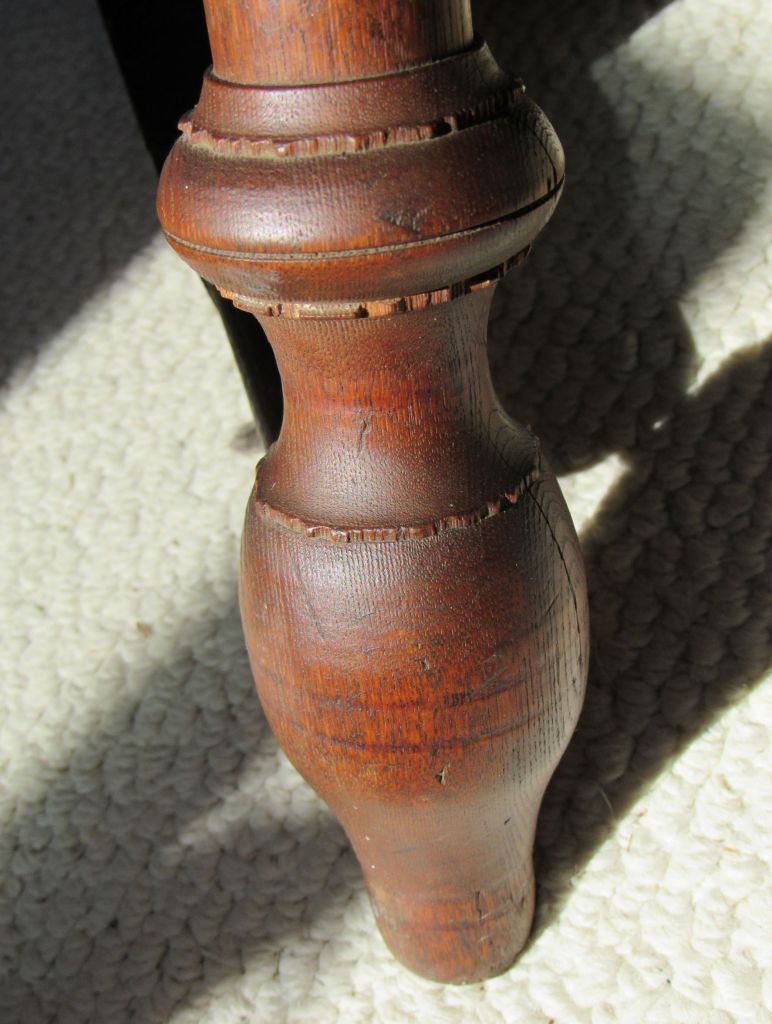
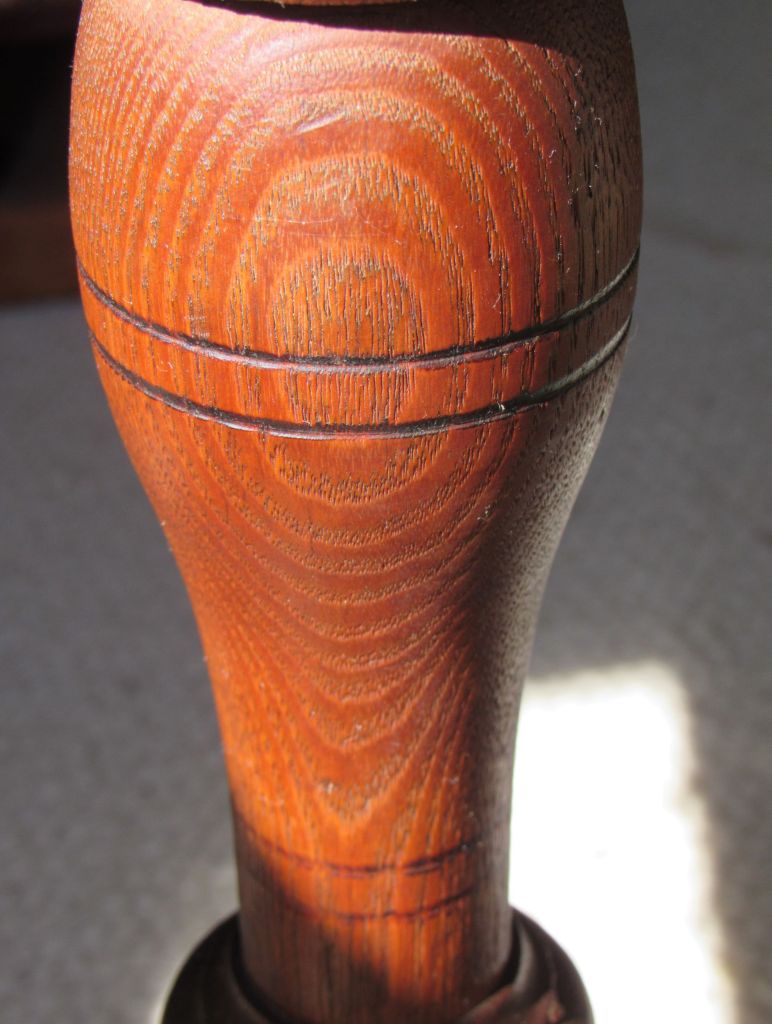
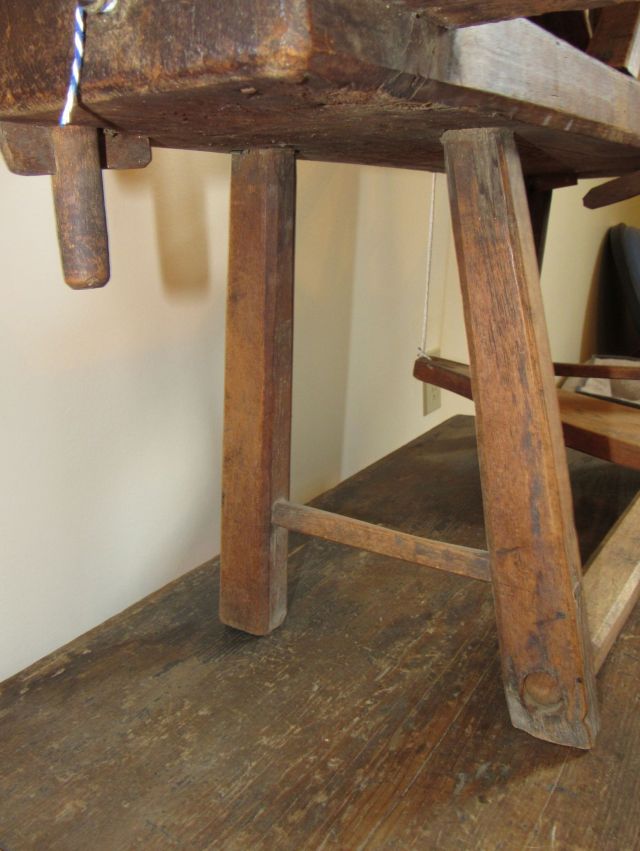
Jocasta’s legs

Scarlet

There are different types of challenges in determining who made specific antique wheels.  Some wheels, such as Woody Hill in the previous post, have a maker’s mark, but we cannot track down the maker.  Others, such as Scarlet, appear to be from a known maker, but have no maker’s mark. 
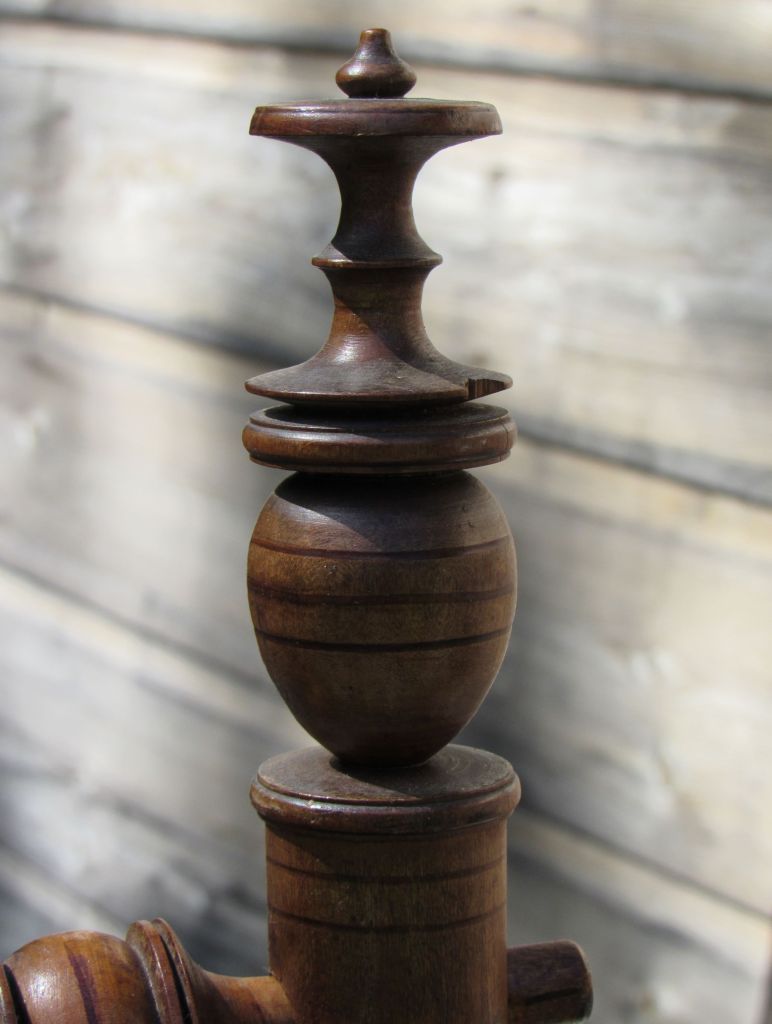
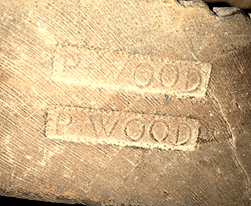
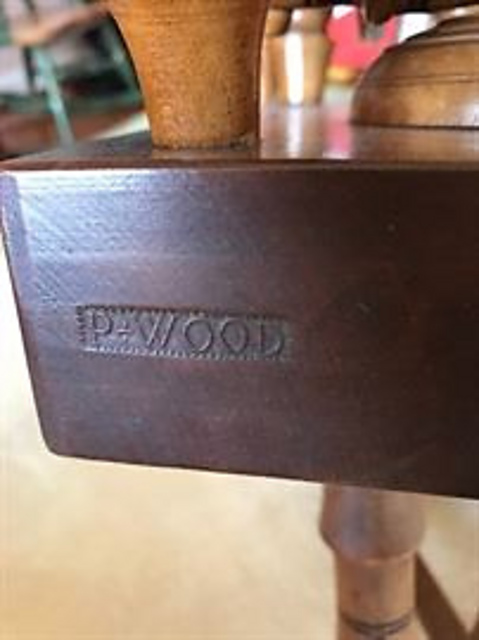
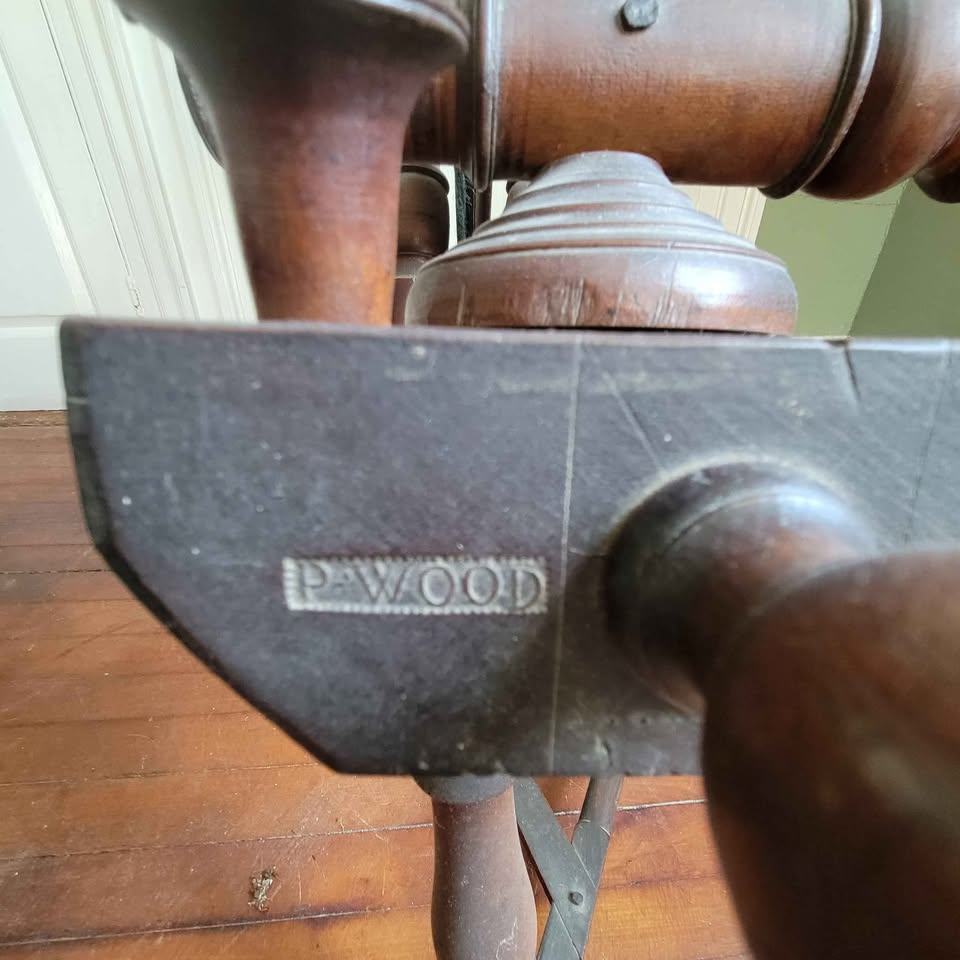
Only a handful of wheels have surfaced in the antique wheel world that look like Scarlet. Of those, most have the maker’s mark, “P Wood,” stamped on the table’s end grain.  

Phineas Wood’s makers mark, found on great wheel in Massachusetts

Try as I might to find remnants of a mark, it looks as if Scarlet’s end grain bears only paint.  

Yet this striking wheel, highly decorated and finely turned, shares so many characteristics with the marked wheels, it is reasonable to presume that she was made by the same wheel maker, Phineas Wood (1767-1847), of Dover, Vermont.    

Thanks to several researchers, we know something about Wood’s life.  Quite a few of his great wheels, both marked and unmarked, are still around.  In an article in Issue 90 of the Spinning Wheel Sleuth, Susan Hector traced her journey researching her P Wood great wheel.  (“Identifying a Phineas Wood Great Wheel,” pp. 4-5).  She confirmed that the “P Wood” mark belonged to Dover’s wheel maker, Phineas Wood. 

Dover–in southeast Vermont, north of Wilmington and west of Newfane–is best known these days as home to ski area, Mount Snow.  An early history noted that “the surface of the town is exceeding uneven, and a view from some of its highest hills present to the eye scenes both picturesque and grand,” with streams “which afford several small mill privileges,” and soil that “is hard of cultivation, yet some good crops are produced thereon, and the hillsides afford excellent grazing.” (Vermont Historical Gazetteer, “Dover” pp. 337-356). 

“M.O. Howe’s house interior with spinning wheel and trunks” Newfane, Vermont 1913, Peter C. Thayer photograph(the wheel appears to be a Phineas Wood wheel)

Phineas came to Vermont from Massachusetts, where he was born in Mendon in 1767, the son of Solomon Wood (who died in Uxbridge in 1820).  Phineas’ younger brother, Obadiah Wood, born in 1773, also made spinning wheels and chairs. “After the establishing of factories along the streams and the use of power in making furniture, [Obadiah] went to work for various shops in the wood working business. It is claimed that he was the first bobbin maker in this country. His business grew to extensive proportions, and he had orders from the South American countries and other distant points. He established a large and prosperous industry in making bobbins.” (Historic Homes and Institutions of Worcester County, p. 67). Obadiah “was largely a self-educated man, well read, and holding well-considered but firm opinions on matters of public policy. He was a skillful mechanic and sagacious business man” and a member of the Society of Friends.  Id. 

Phineas, like Obadiah, appears to have been a skillful mechanic, with an inclination toward business. Phineas was married in Mendon in 1791, to Chloe Hazeltine. Chloe’s father moved to Wardsboro, Vermont (near Dover) around 1795 and Phineas shows up in Vermont on the 1800 census. So he likely moved to Dover, or nearby, between 1791 and 1800. In about 1820, when he was in his 50s, Phineas set up a carding machine in the “Goose City” part of Dover, raised geese, and established a goose-down factory where ten “female employees plucked geese and made their feathers into down-filled mattresses and pillow.” (Historical Gazetteer, “Manufacturers;” SWS, Issue #90, p. 5, citing Deerfield Valley News article) 

“Interior of house with spinning wheel” Newfane, Vermont, 1909, Porter C. Thayer photograph

Phineas Wood’s great wheels are known for their fine workmanship and attention to detail, although the details often differ from wheel to wheel.  Some, such as Susan’s, have flat-topped double upright spindle supports.  Many of his great wheels, however, have unusual round-topped double upright supports, such as the one pictured below and another described in Grace Hatton’s blog here: http://antique-spinning-wheels.blogspot.com/2011/06/p-wood-great-wheel.html.

P. Wood wheel sold in Omaha, Nebraska

While there are quite a few examples of Wood’s great wheels, very few of his flax wheels have come to light. The following four photos are of a marked P Wood flax wheel for sale a few years ago, which were posted on Ravelry.

Perhaps the best example, though, is one that turned up in the Midwest–a marked wheel in even more pristine condition than Scarlet. It is through this wheel’s owner, Julie, that I learned on Ravelry about Phineas Wood and his wheels.

Julie’s wheel
The mark on Julie’s wheel

As these wheels show, Phineas Wood approached his flax wheels with creativity and an emphasis on beauty. They must have been time-consuming to make. Presumably their price reflected all that work, which makes me wonder how many were made, who bought them, and if they were prized for their looks as much as their spinning.

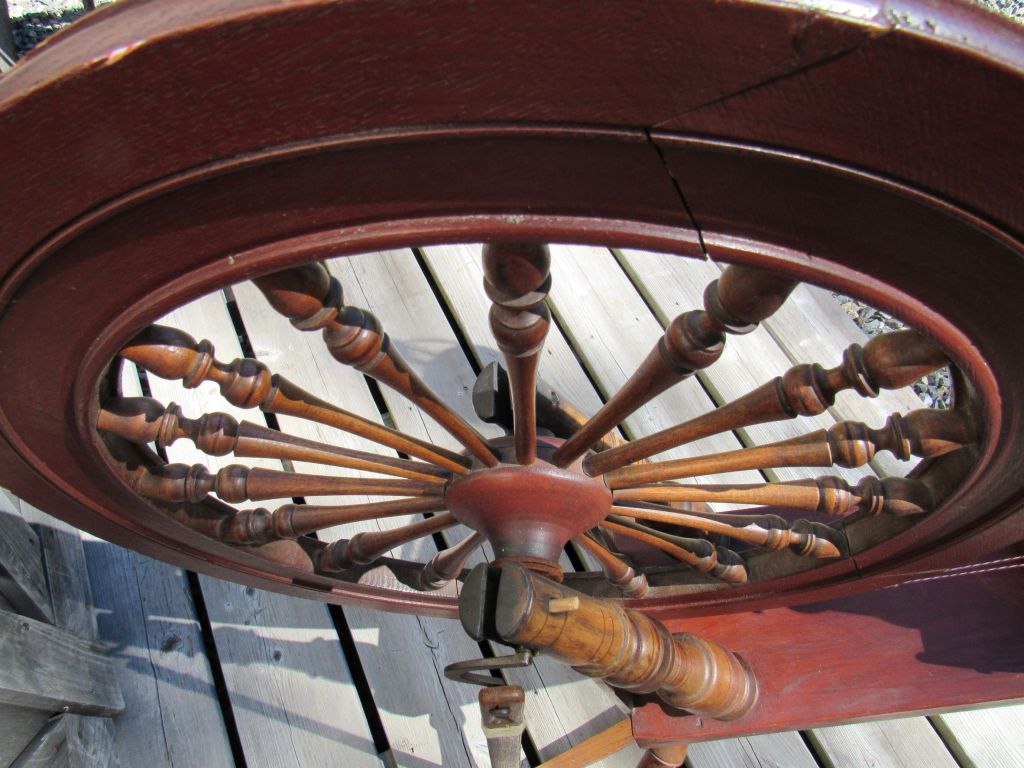
While we cannot be absolutely sure that Scarlet was made by Phineas Wood, her turnings, spokes, upright supports, bearings, and distaff all point in that direction.  Like the marked Wood wheels, she has 16 beautifully turned spokes. 

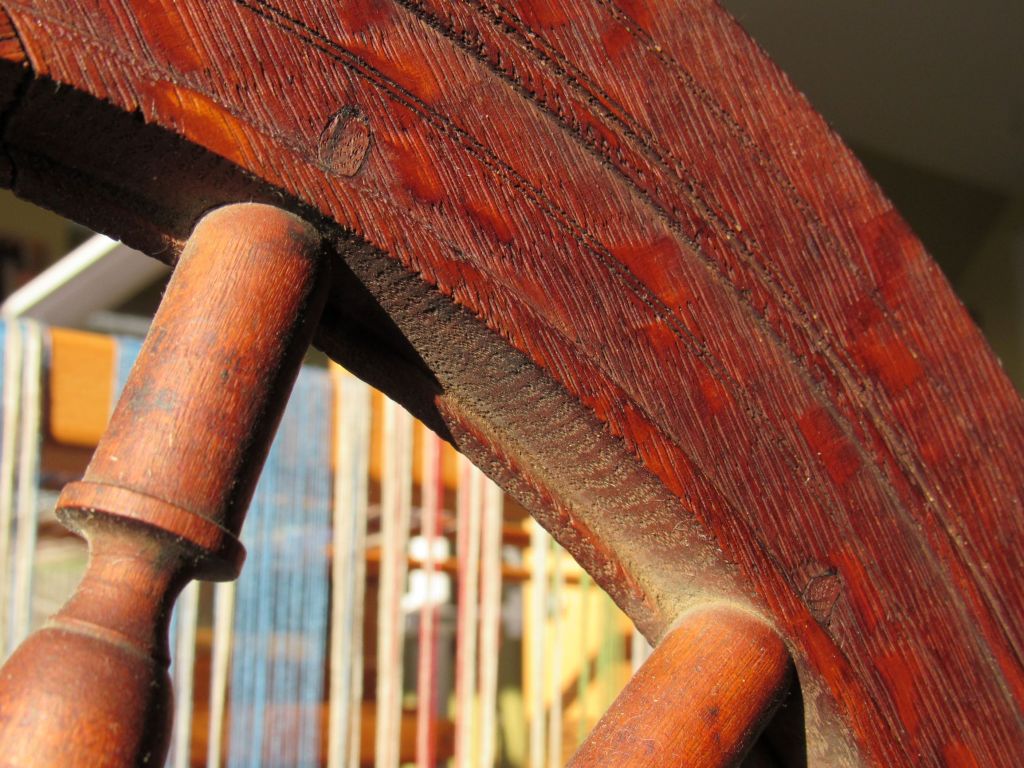
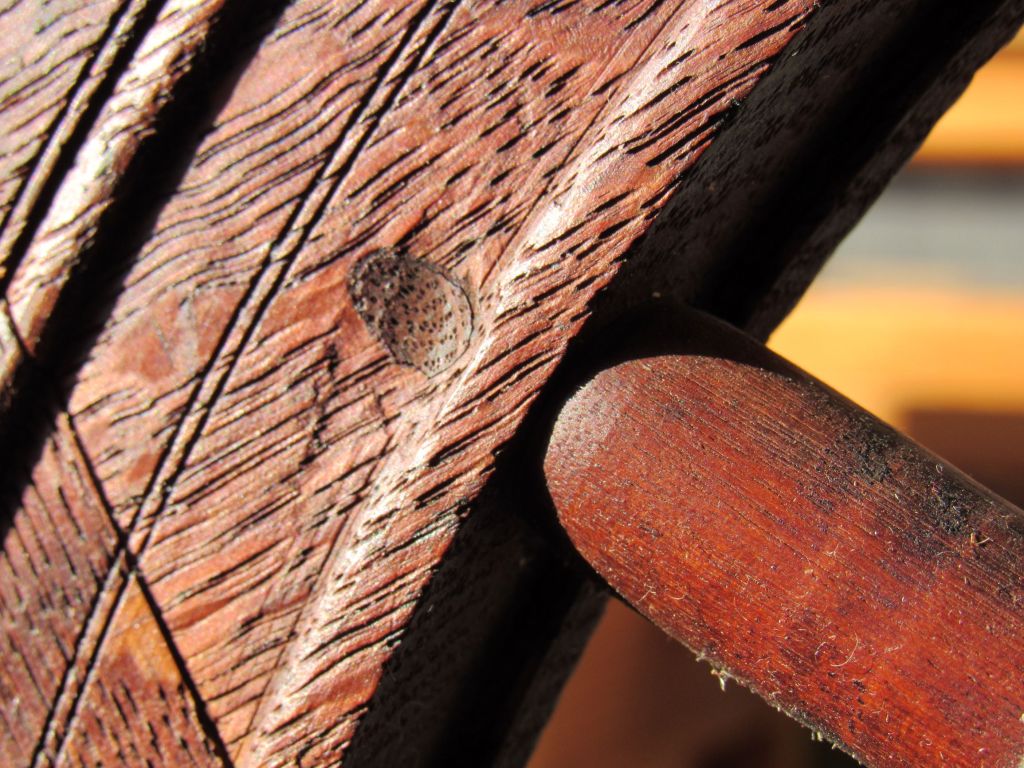
Each spoke has a delicate tiny cut-out at the end where it fits onto the drive wheel rim. 

Each slightly different in size, depending on how the spoke hits the rim edge. 

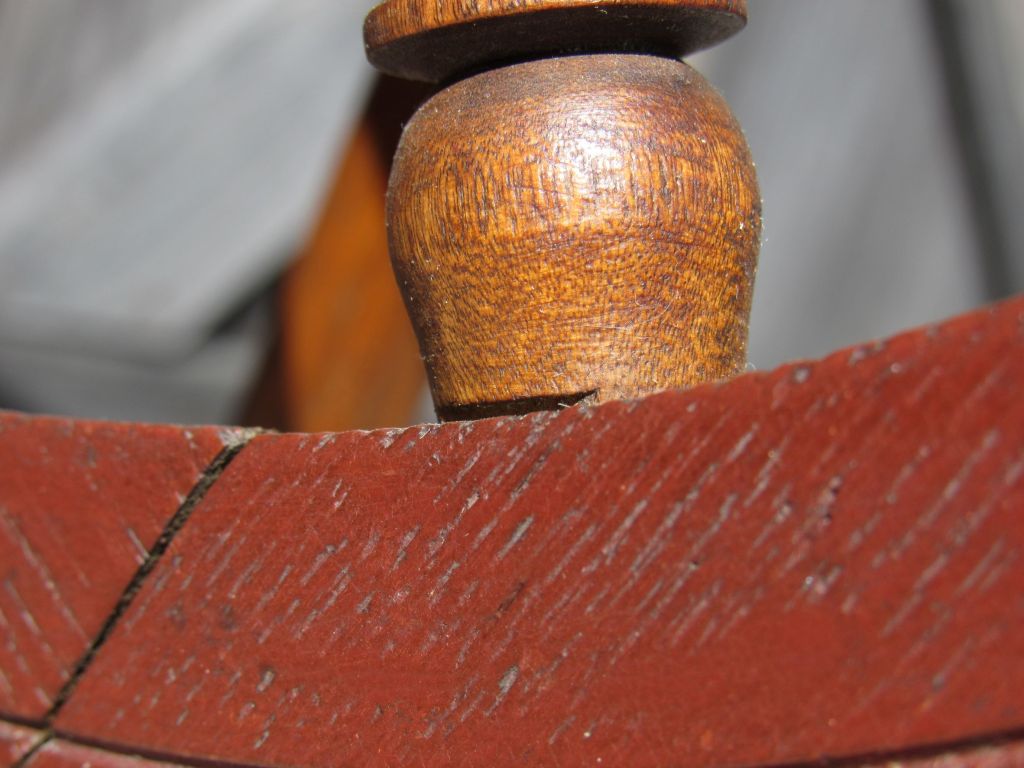
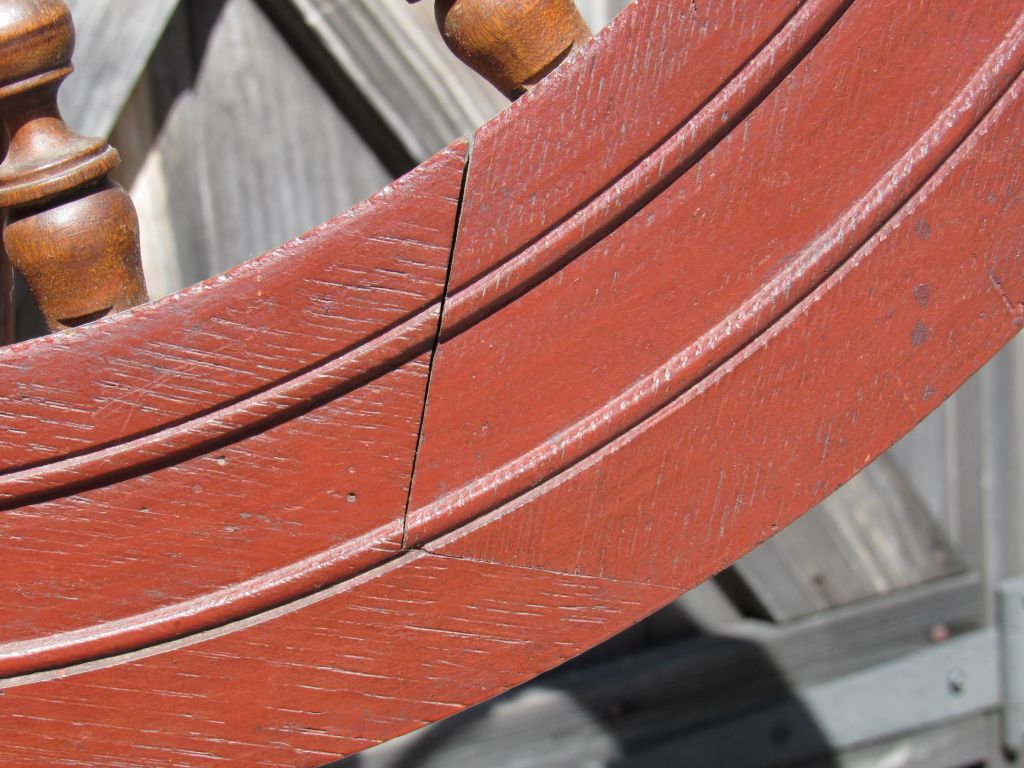
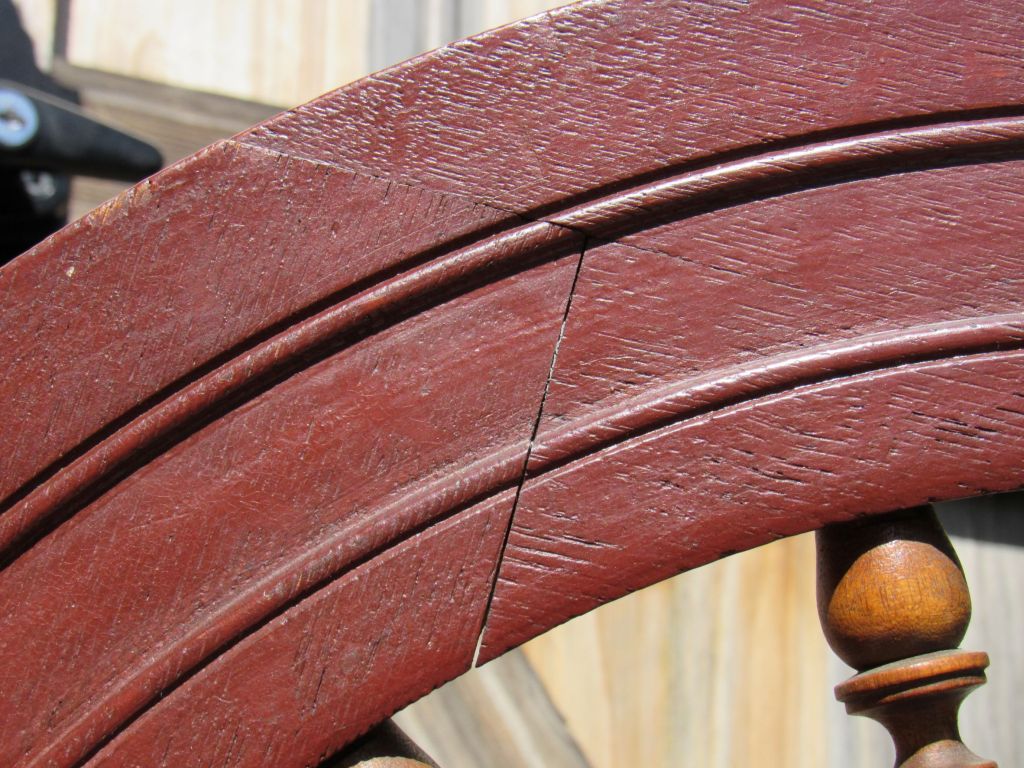
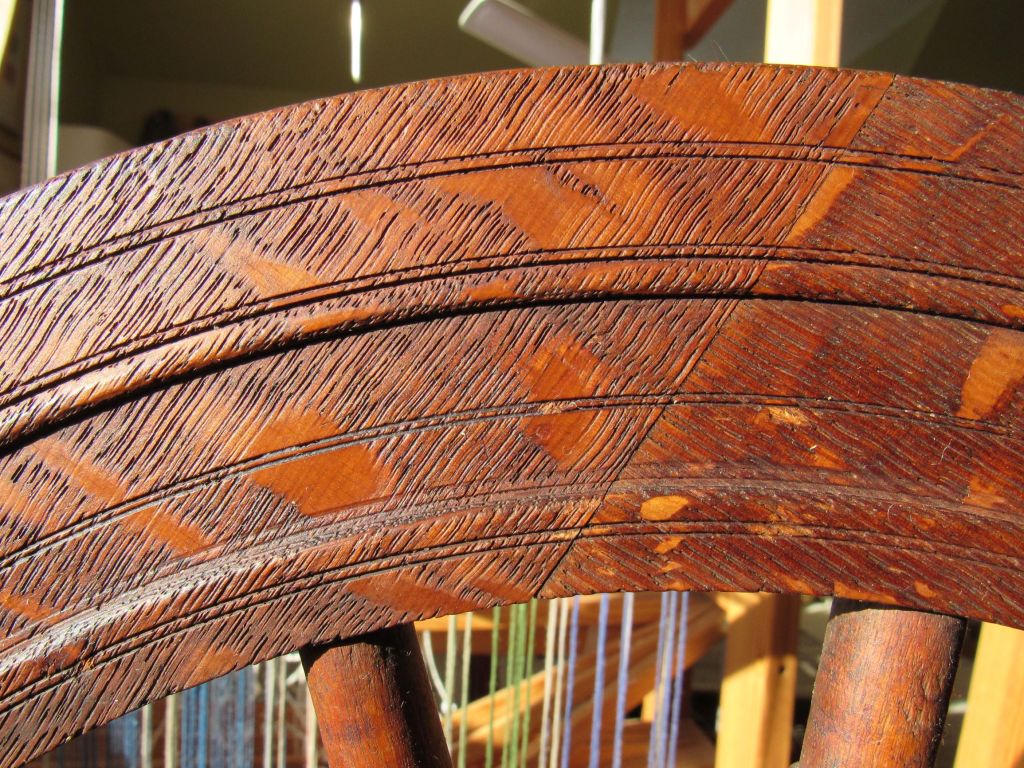
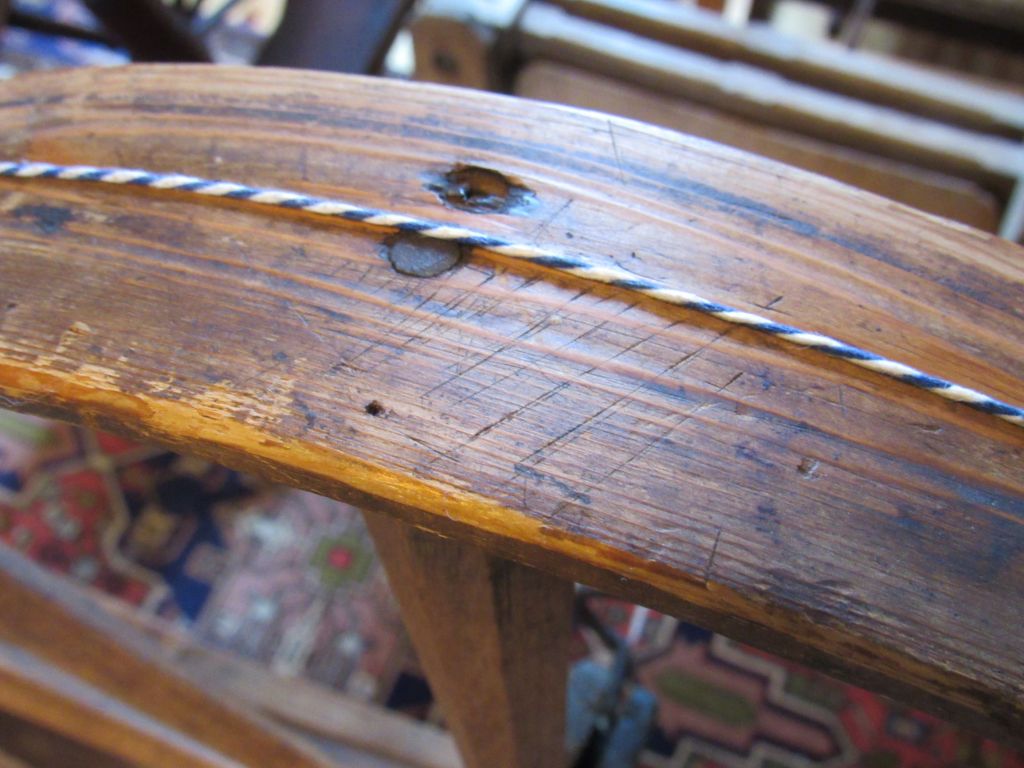
The rim was constructed in four parts, each with a V-shaped join. 

Scarlet’s red paint is a bit of a mystery.  Some Wood wheels have red paint or remnants of red paint, but Scarlet’s paint looks relatively new. 

Perhaps someone painted over original paint years after the wheel was made. 

Interestingly, the edge of the drive wheel, where the band runs, is a dark reddish color, but does not really appear to have been painted.

There is some wear to the paint around the MOA collar,

and the dark stains running down the wheel uprights are usually a sign that grease was used for lubricating the axle.

Although the stain is more of a discoloration of the wood than a build up of layers of grease seen on many wheels.

The metal axle bearings are in good shape, although the axle alignment is askew, with these leather washers added by someone before me

and this bit of leather on the bearing added by me, to bring the wheel into alignment. 

A feature I have not noticed on other wheels is metal bearings in the leg holes for the treadle bar pins. 

A brilliant touch. 

The treadle and bars look immaculate, with the decorative striping,

even down to flourishes at the treadle corners, showing no wear. 

The treadle bar is concave to the left of the treadle. 

In some wheels, the treadle bar is actually worn to a curve there as the result of a spinner treadling with both feet.  But in this case, the decorative stripes on the curve are not worn, so it appears that the concave portion was part of the treadle bar design.  

Scarlet’s tension knob and feet are a different style than those on other Wood wheels—rounder and shorter. Her overall turnings,

however, are consistent with the other wheels,

ornate, with decorative lines on every possible curve. 

Perhaps the finest features, to me, are the upright supports—one on each side. 

They arc down to the table, in a curve that just hugs the plump round upright turns.

Spinning wheel as sculpture. 

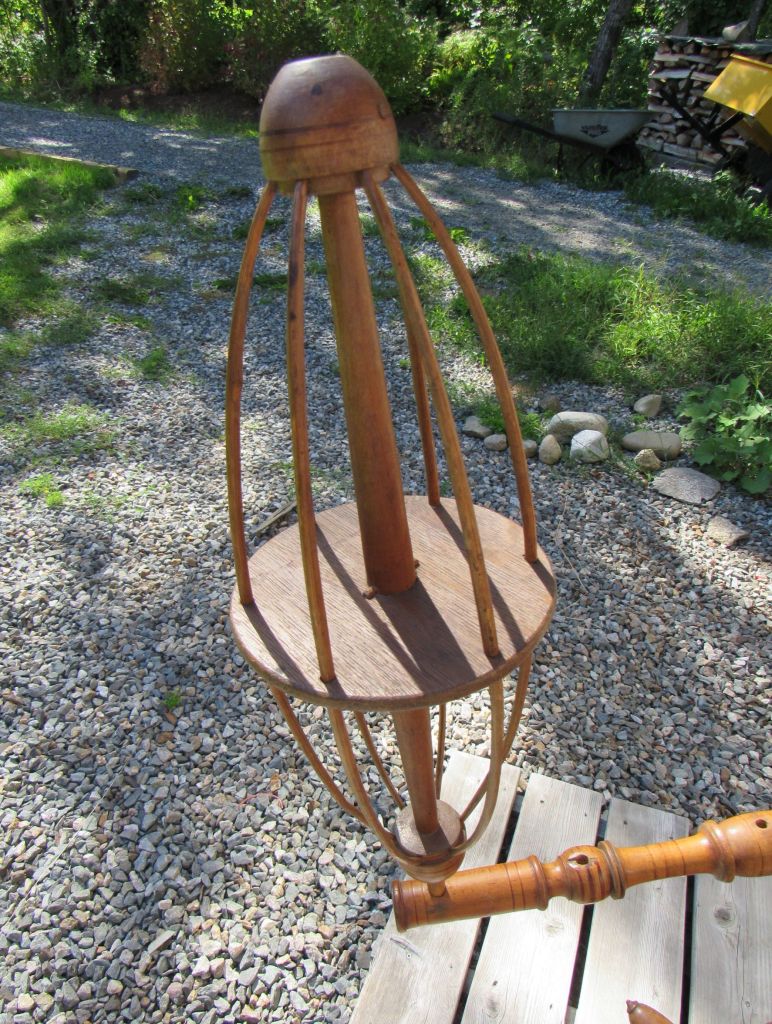
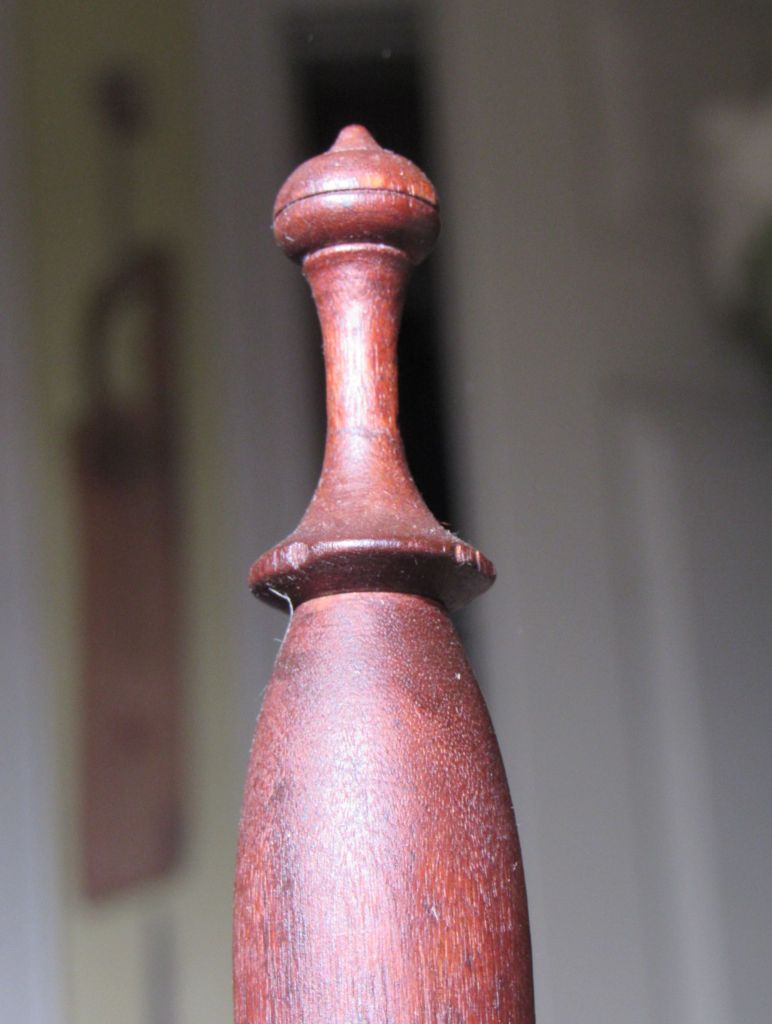
Scarlet’s cage distaff also seems to match those on the marked wheels. 

At first, I thought it was a later addition,

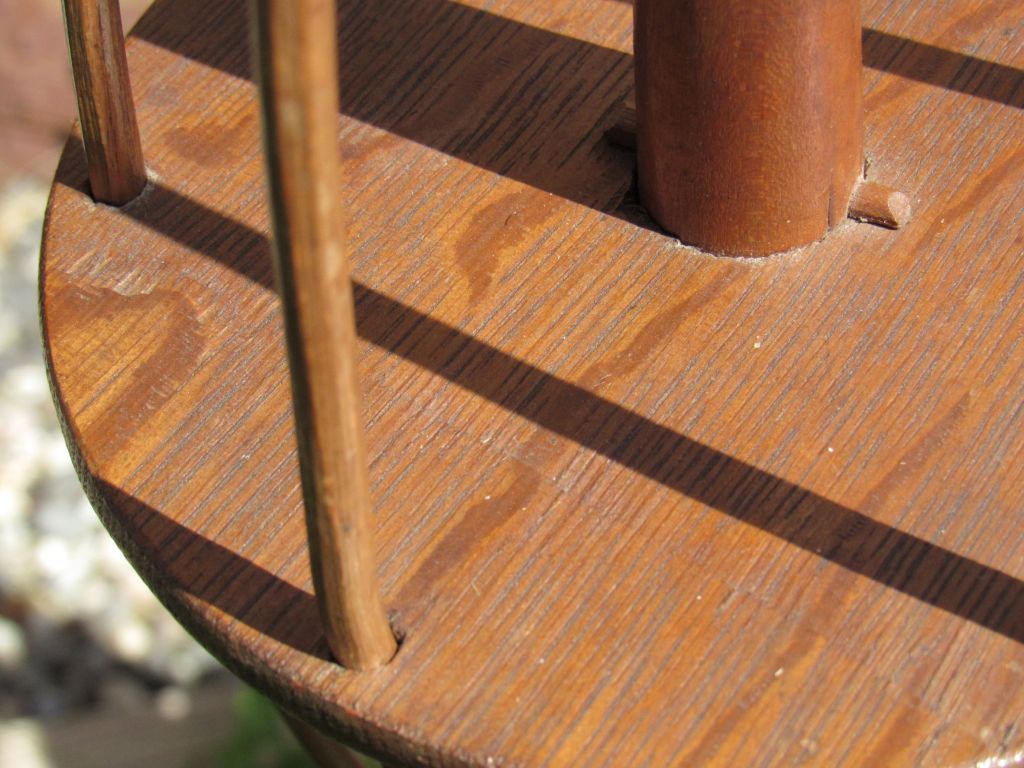
because it was in such good condition and the center disc is made of wood that has an oddly modern feel to it. 

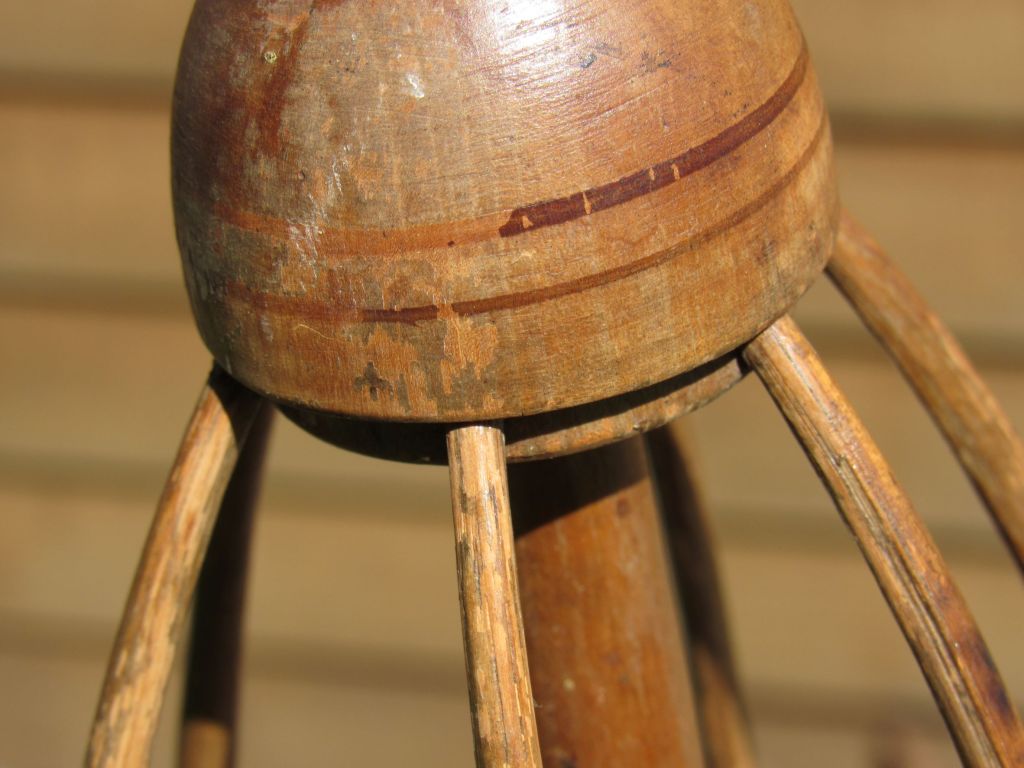
But, the striping looks original and matches the rest of the wheel. 

The horizontal distaff support arm has two holes in it, likely for a bobbin holder. 

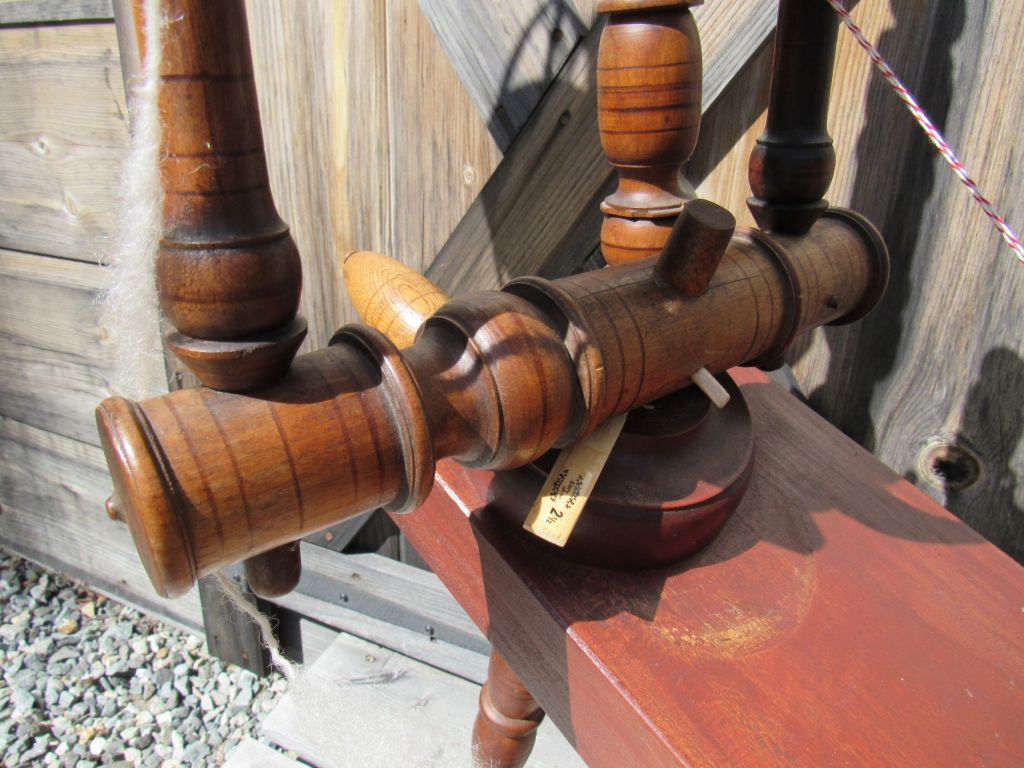
I am not sure, but I do not think that any of the marked wheels have this feature. The far side maiden is held in place with a peg, but the spinner side is un-pegged, which leaves it free to turn for removal of the flyer.

The ornate turnings on the distaff support and maidens, again, reflect Wood’s style. 

As does the spinner-side flyer bearing. 

A laminated two-piece leather bearing,

with rivets, it is cut and secured in the back exactly like Wood’s marked wheels. 

Here is a photograph of Julie’s marked wheel for comparison of the spinner-side flyer bearing.

Julie’s wheel

In contrast with the rest of the wheel, the flyer shows more wear,

so may not be original to this wheel. 

The bobbin is missing the flyer end portion. 

What is most interesting about the flyer, though, are the metal protrusions just to the left of the orifice hole on each side. 

There are thread wear marks running from the orifice hole along these metal pieces. 

Could the metal act as guides, allowing the spinner to run the thread along them directly onto the far hooks of the flyer—a more direct path than running along the whole row of hooks?  Or would the yarn have bumped up too much against the missing bobbin end?

The yarn follows the wear path along the metal perfectly. It is only speculation on my part, but without the spinners who used these wheels to teach us, we have to learn from wear marks. 

I would love to hear other people’s thoughts on this. 

We are fortunate to know so much about Phineas Wood and his wheels.  But there is still so much we do not know. Are there any wheels attributed to Obadiah? Did the brothers make similar wheels? Did they ever work together? Did Phineas make wheels in Massachusetts, with or without Obadiah? When did Phineas actually move to Vermont? Why did he move there? Did Obadiah mark his wheels? So many questions.   

I am very grateful to Julie and Miranda for their research on Phineas Wood and his wheels. Special thanks to Miranda for finding the Porter Thayer photos. And thank you to Julie for allowing me to use photos of her wheel and her research into Phineas and his brother Obadiah. For those interested, there is more information on Phineas Wood on Ravelry in the Antique Spinning Wheel group.

References:

Hector, Susan M., “Identifying a Phineas Wood Great Wheel,” The Spinning Wheel Sleuth, Issue 90, Oct 2014, pp. 4-5.

Crane, Ellery Bicknell, Historic Homes and Institutions and Genealogical and Personal Memoirs of Worcester County, Massachusetts, with a History of Worcester Society of Antiquity (Volume 2) online.

Vermont Historical Gazetteer, Vol. V, The Towns of Windham County, Collated by Abby Maria Hemenway, published by Mrs. Carrie E. H. Page, Brandon, VT 1891.

Ancestry.com for family trees and records on Phineas and his Hazeltine in-laws.

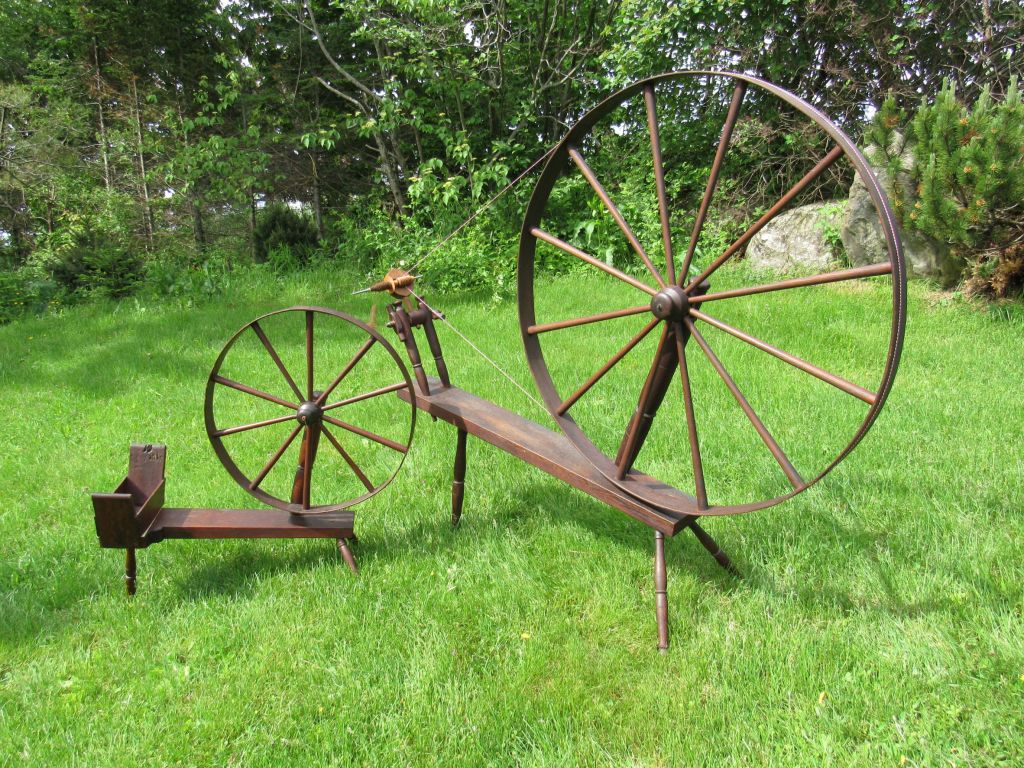
Theodosia Bunce (Dosia)

This wheel invites questions.  I would love to be able to sit down with its maker and ask why he constructed it the way he did.  Why this way, why that–what are the reasons behind his design?  Fortunately, in this case, we know something about the maker. 

He appears to have been thoughtful and innovative–a build-a-better-mousetrap kind of man.  So, his wheels perhaps can tell us something about 19th century ergonomics in designing great wheels for greater ease and efficiency in spinning.    

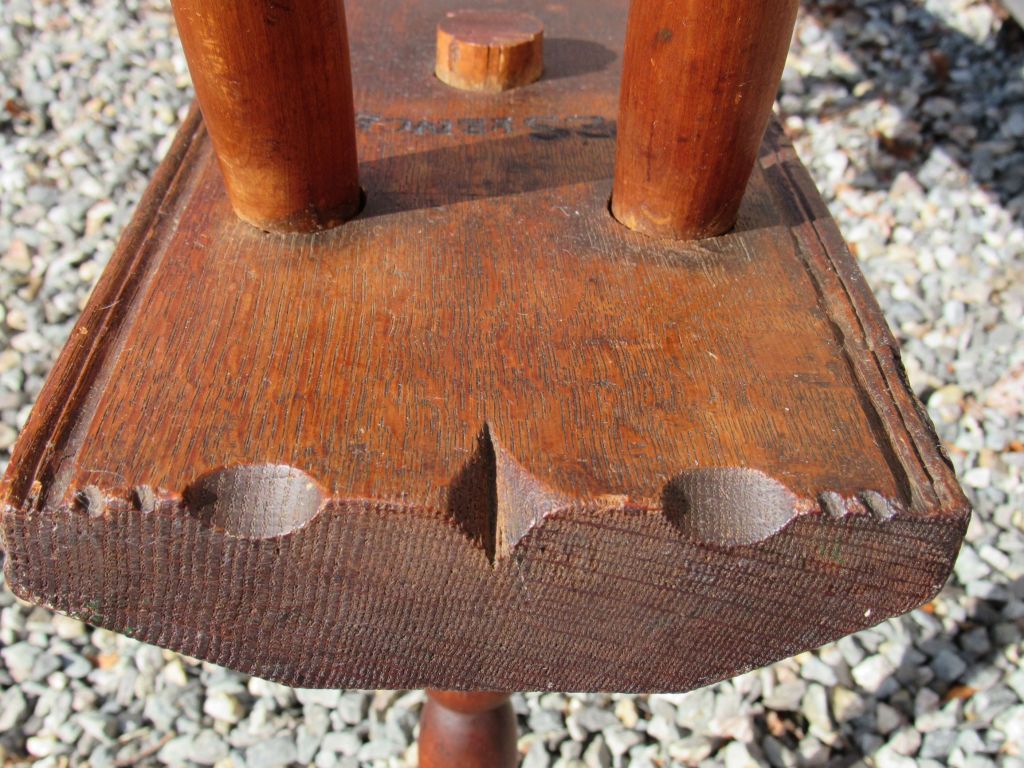
The most striking feature, at first glance, is not the wheel design, but the dark red paint on the table.  It does not run the whole length, but ends in a graceful curve near the spindle end, topped by and highlighting the maker’s name,“E. Spencer.” 

It is a nice touch by this intriguing man.  On some of Spencer’s wheels, his name in the stamp runs straight across. On others, such as this one, the name roughly follows the curve of the paint. Elizur Spencer was born in 1779 in New Hartford, Connecticut.  Around 1803-04, he moved to Sandisfield, a western Massachusetts town on the Connecticut border, with his wife Mary (called Polly).  According to this wonderful article by a local Sandisfield historian: Elizur Spencer of Sandisfield., Mass., and His Remarkable Apple Parer, Spencer was: “the most skilled artisan-woodworker who ever lived in Sandisfield and probably for many miles around.”  (p. 2). 

The article goes on to say: “By all accounts Elizur, a humble man and a helpful and generous neighbor, was a wonder. Town historian George Shepard in 1885 remembered him as a prolific, first-rate craftsman who made important things to improve everyday life. Shepard wrote that Spencer made ‘spinning wheels, quill wheels, reels, swifts and paring machines.’  He added that Spencer ‘used a small stream to the south to power his turning shop.’” (p. 3) 

Spencer’s house, a dam and small reservoir, and remnants of his shop still stand.  After his wife’s death in 1822, in addition to his wheel and tool making, Spencer farmed and raised his three teenage daughters.  The “paring machine” referred to in the article was an apple parer, which could be used right- or left-handed, an innovation that must have been fairly unusual for his time.   

Spencer’s great wheels likewise have unusual design features.  Aside from the red paint, the thing that immediately stands out is the mismatched legs.  The spindle-end leg is beautifully turned, sleek and rounded, with a well-balanced design. 

In contrast, the wheel-end legs are chamfered, a leg style often associated with early or relatively primitive wheels because they could be made without a lathe.  

Why would Spencer chamfer the wheel-end legs rather than turn them?  Perhaps the answer lies in this photo. 

The spinner-side leg is much shorter than the back-side leg—only 16 1/2 inches compared to 19 1/2 inches—making it difficult to match turnings on those legs in a way that would look good.  It is pure speculation, but perhaps chamfering was an easier and more visually appealing way to deal with the three-inch difference in leg length.  As for why the wheel-end legs have differing lengths, it is a feature seen on some great wheels. 

It is generally assumed that the spinner side leg is shorter and tucked a bit under the table to better keep it out of the way of the spinner.  Spencer’s wheels appear to reinforce that theory because the whole wheel appears designed to allow the spinner to easily and smoothly move back and forward while spinning. The legs are set in the angled undersides of the table. 

The table narrows as it approaches the wheel end–a good feature for long skirts, giving them a little more room and less of sharp end to catch against.  Interestingly, both sides of the table narrow, but the spinner’s side narrows more. 

Did Spencer narrow the spinner’s side to accommodate the spinner and then narrow the other side—but less so—to provide a balanced look to the table?  I do not know, but am really intrigued by his decisions balancing utility and beauty. 

Another apparent spinner accommodation is Spencer’s tilted drive wheel post.  And, it is almost absurdly tilted.  Again, the theory is that a tilted post or a tilted axle moves the upper part of the drive wheel away from the spinner, giving more room for the spinner’s arm and shoulder to move with ease.  It seems as if it would cause problems with the drive band, but it works. 

Everything about this wheel seems to be spinner-conscious, designed to provide for free movement of legs and arms.  But it makes for an oddly lovely lopsidedness when viewed from the end. 

Does the long dancer-like leg on the non-spinner side provide compensation for the weight of the drive wheel tilt? 

And, what about the wheel post—chamfered along its length with a turned top?  Was that an aesthetic choice, combining the chamfering from the wheel-end legs, with the lovely turning on the leg and posts on the spindle end?  Underneath the table, the edges are beveled. 

Everywhere, even under the table, the quality of workmanship is impressive.  The wheel is, as the apple-parer article described, “exquisite.” 

Many wheel makers put chip carving on table ends. 

But, on one end, Spencer put this personal flourish on his wheels. 

It is actually this particular detail that captured my heart.  I admire that unique touch—a signature of a little extra beauty. 

Spencer made flax wheels, too, but I have only seen photographs of one of them.   I would love to know whether his flax wheels had any innovative touches. 

He also made accelerated heads, complete with his label (he had a similar label on his apple peelers).  Mine looks as if it could be made by him, but without the label, I can’t be sure. 

It is missing the accelerator wheel and whorl, so I use it as a direct drive. 

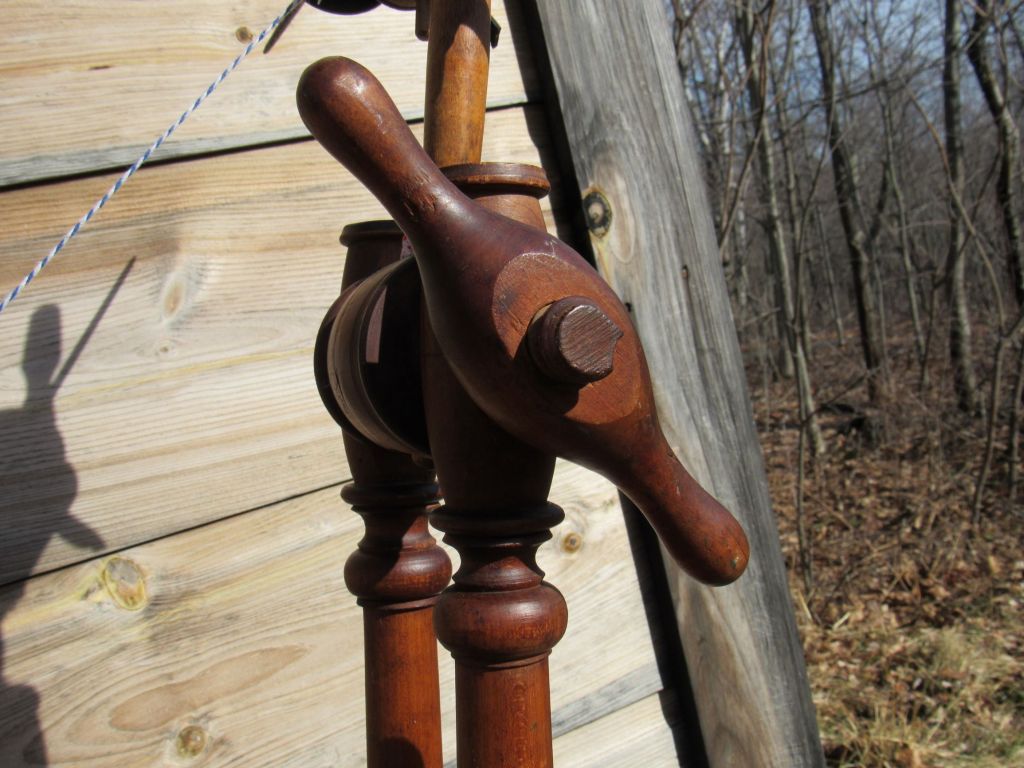
The wheel has the double upright barrel tension that was typical for Connecticut and upstate New York great wheels. 

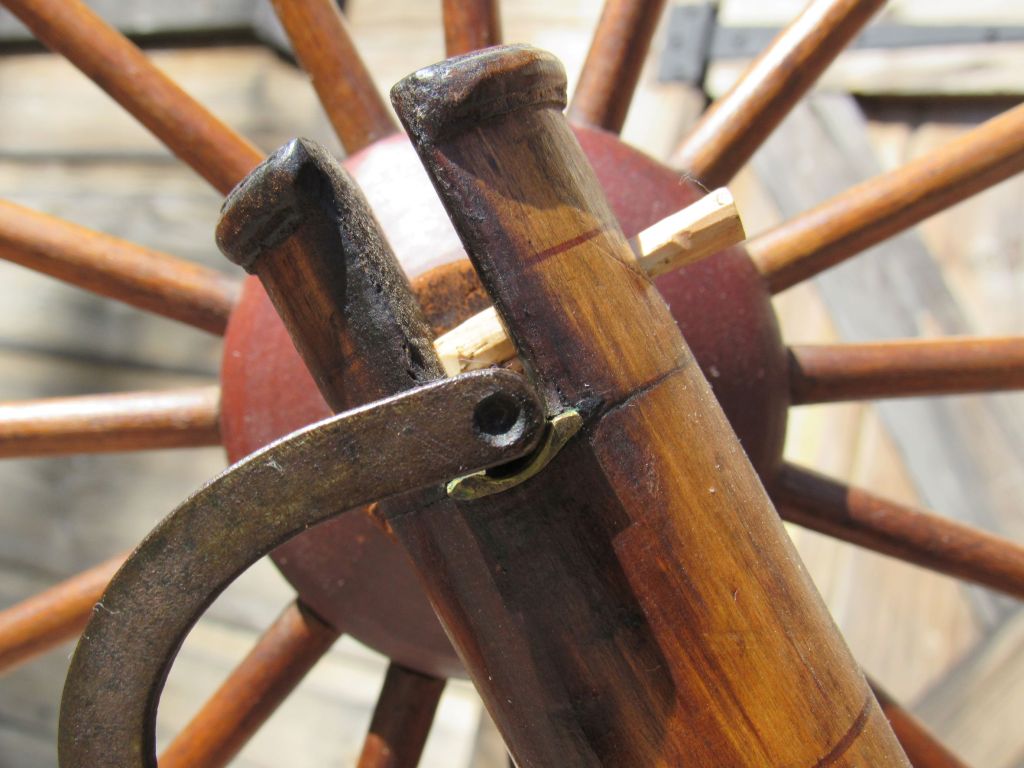
The tension tightening handle has smooth curves that feel good in the hand. 

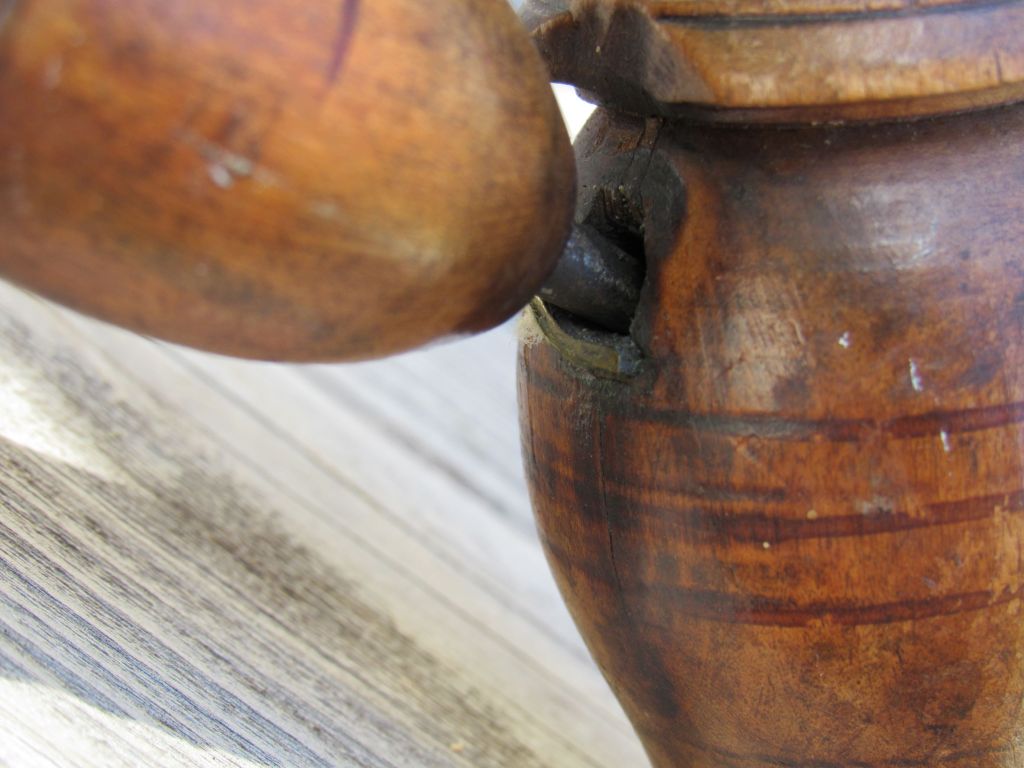
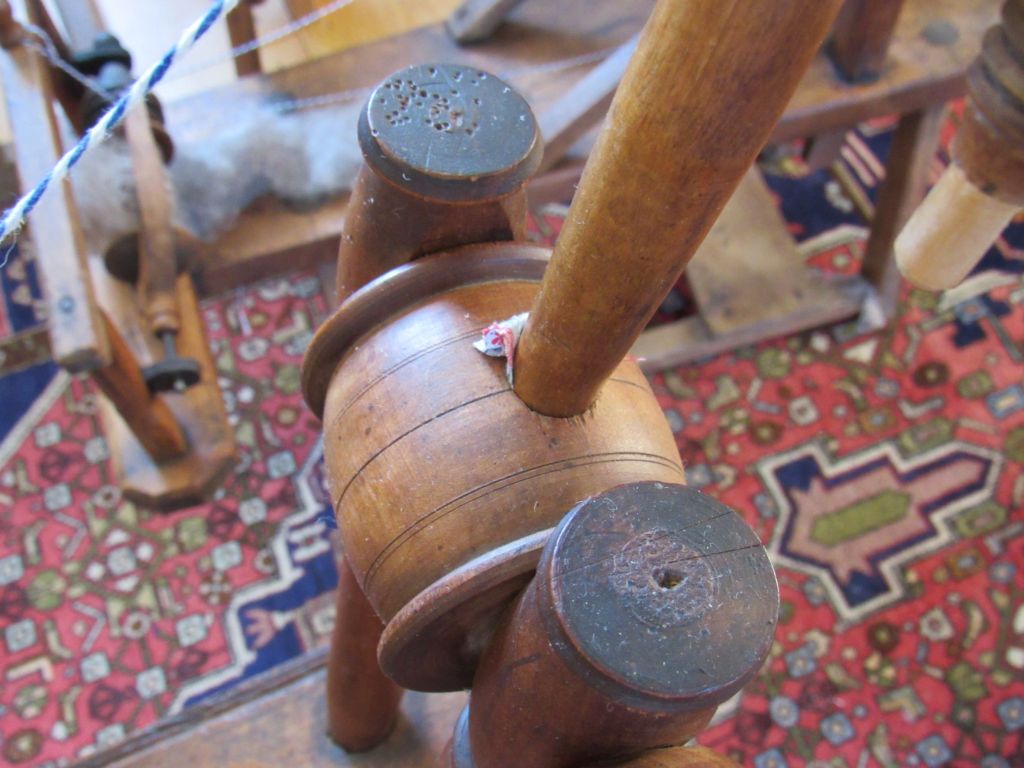
The top of the spinner-side post has dents that look as if they may have been made by the spindle end, but I do not know the reason why the spindle would have been hit against the post–perhaps to help remove it from the bearings?

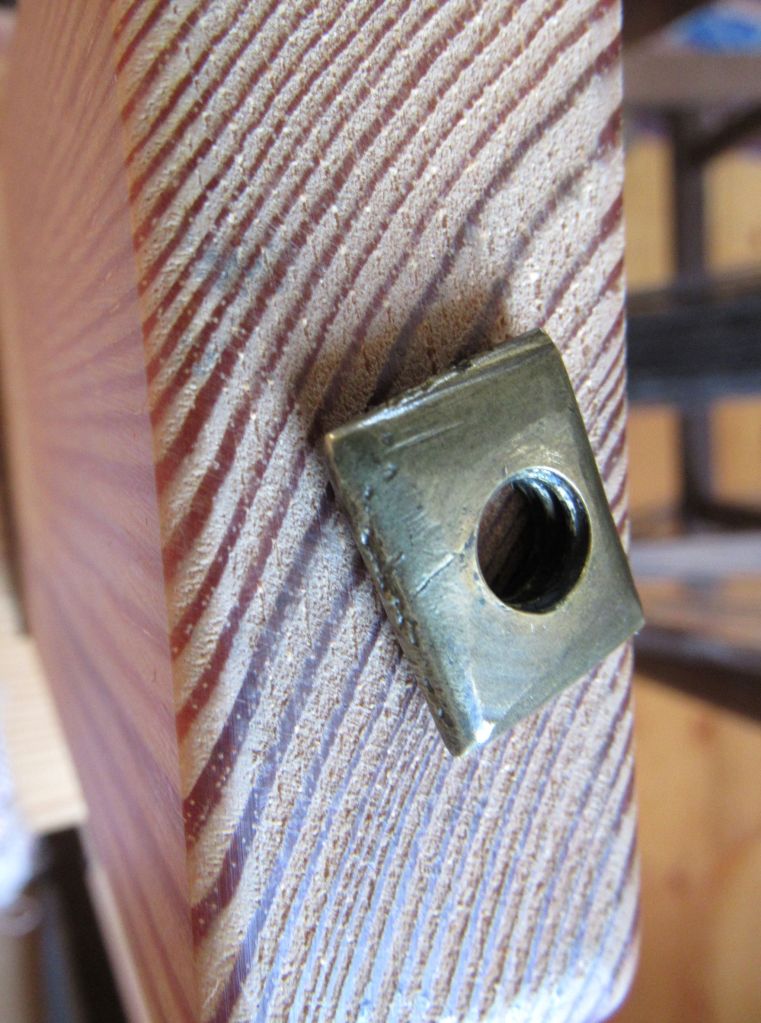
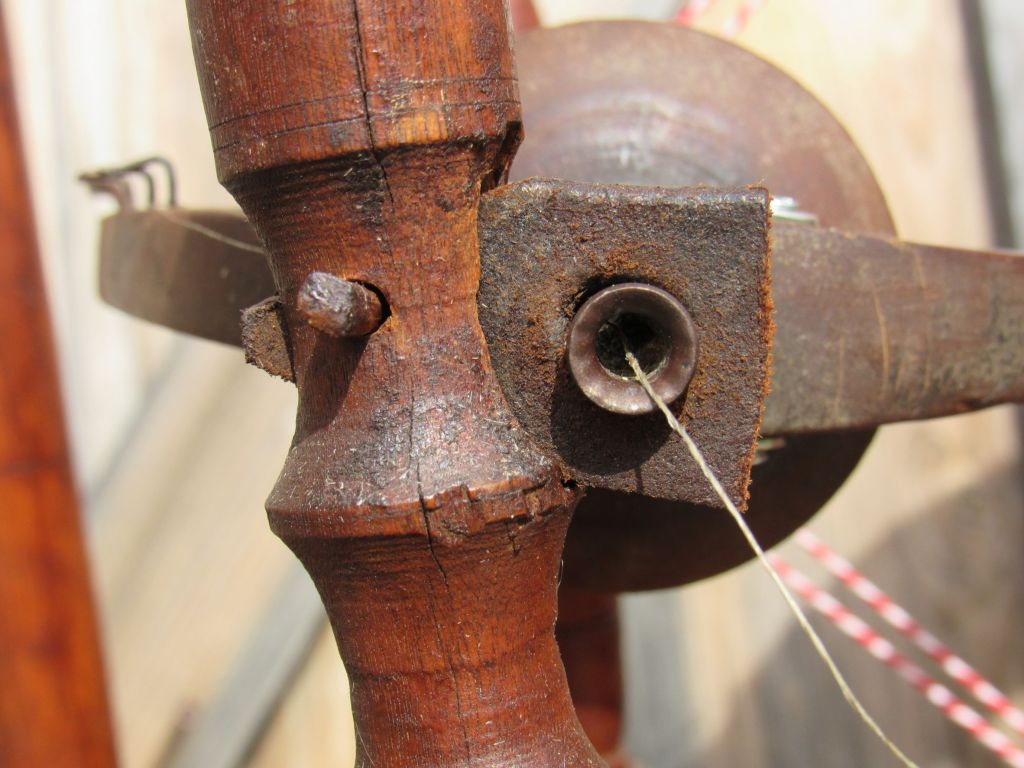
The axle is threaded on the end,

with a smooth-edged old nut that looks handmade. 

The backside of the axle is flattened and hammered into the upright post.

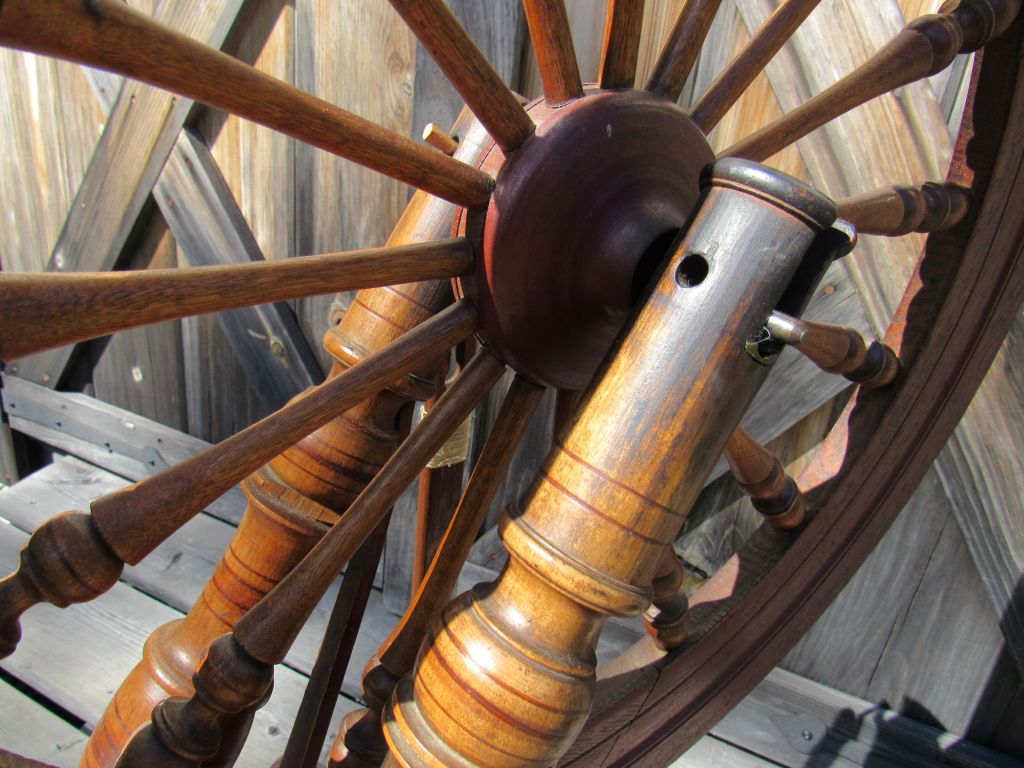
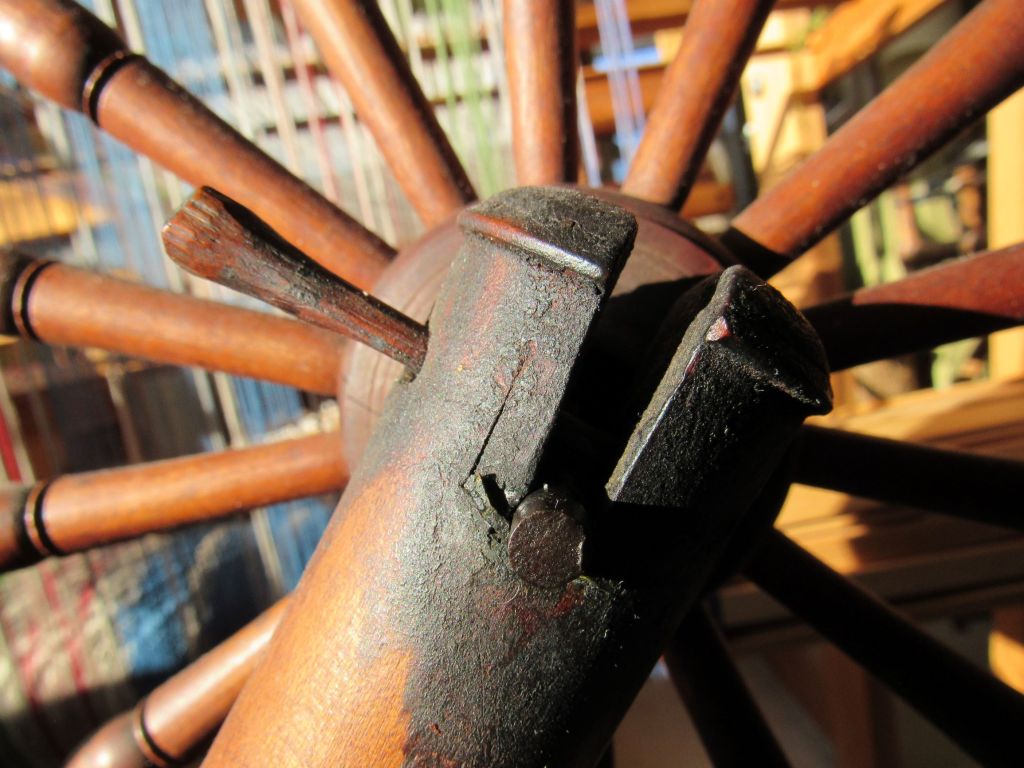
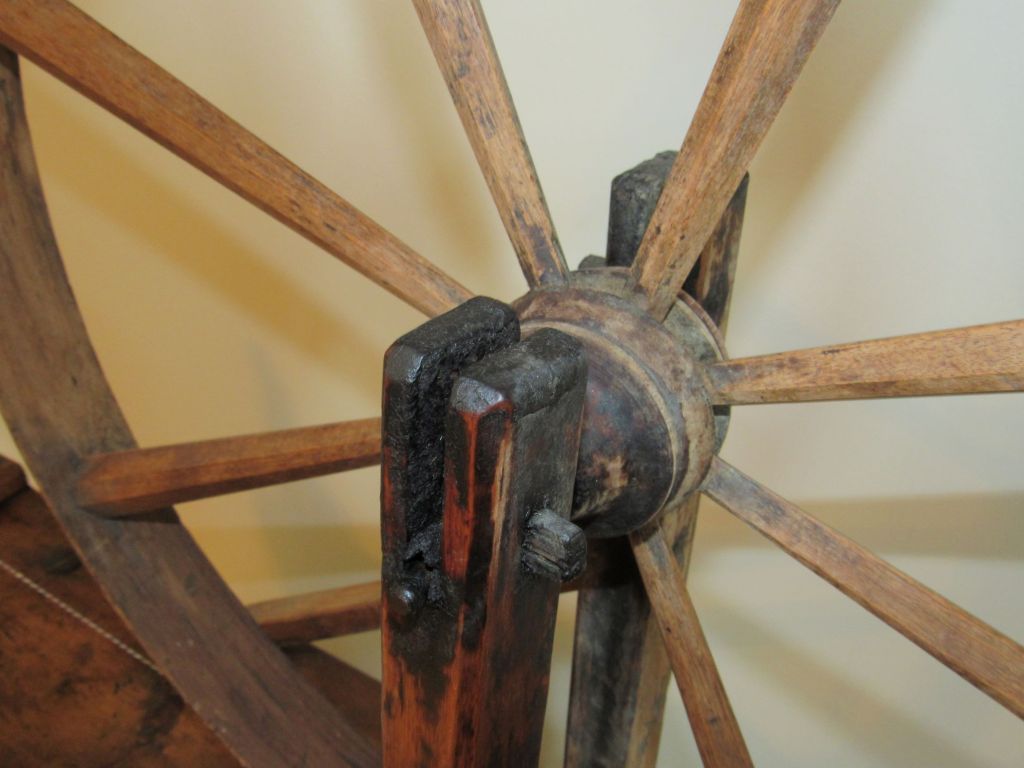
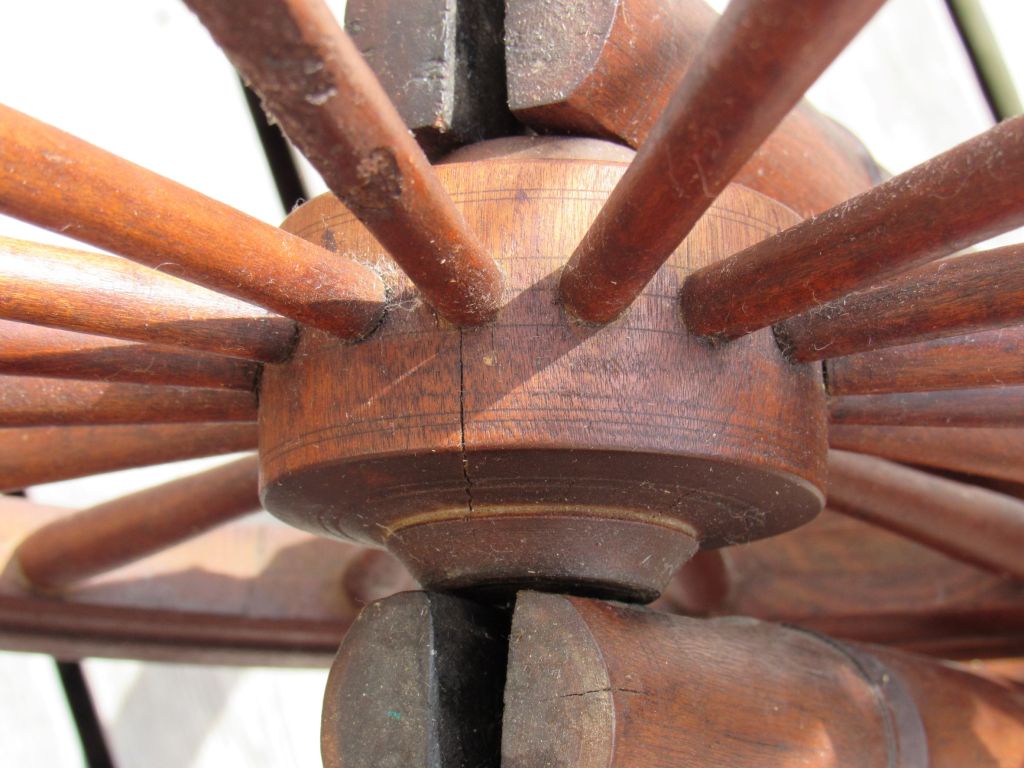
The hub is hefty, with the spokes perfectly fitted into a wide groove.

Brass bearings are fitted into both sides of the hub.

The only flaw I have seen on this wheel is that the bottom of the upright post shows where the wheel rim scraped against it.  I cannot tell if the groove is from wear or whether it may have been carved out to give the rim some extra room.

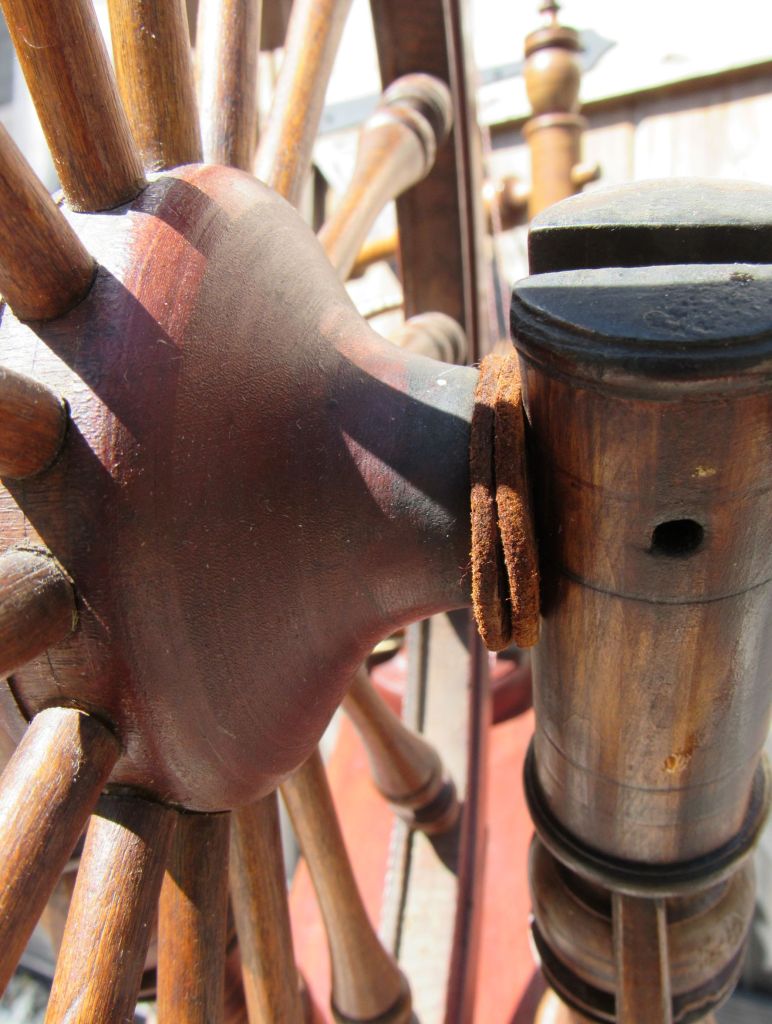
At some point, someone added a few layers of leather and canvas, apparently to hold the hub out far enough so that the wheel clears the upright. 

The drive wheel rim is tight, without loose or wobbly spokes. 

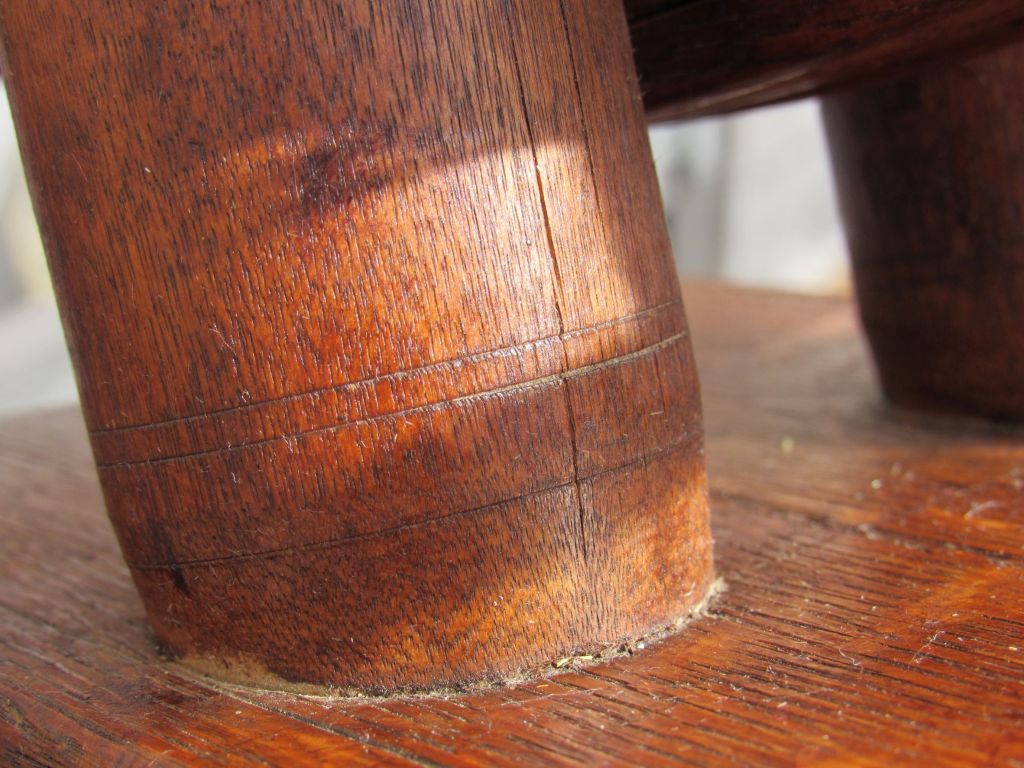
The wheel-end legs are flush with the table top

but the spindle-end leg protrudes above it.  I wondered if it had eventually worked its way upward, but it is painted on its side, indicating that it probably was that way originally. 

Some Spencer great wheels have the same protruding leg-top as mine, and others are flush.  It seems odd to have it protrude.  Could it have been intended as a rolag holder?  That is how I use it.  Because, I use this wheel a lot. 

It is an amazing wheel for spinning, elevating the spinner’s dance to something very graceful and almost effortless.   If I could meet with Spencer, after grilling him about his design choices, I would thank him for making such an exquisite machine.   

For more information on Elizur Spencer, follow the link to this article:

Bernard, Ronald, “Elizur Spencer of Sandisfield, Mass., and His Remarkable Apple Parer,” published in the Apple Parer Journal, January 8, 2017.

Thanks to Miranda for finding this article and making it available on Ravelry.

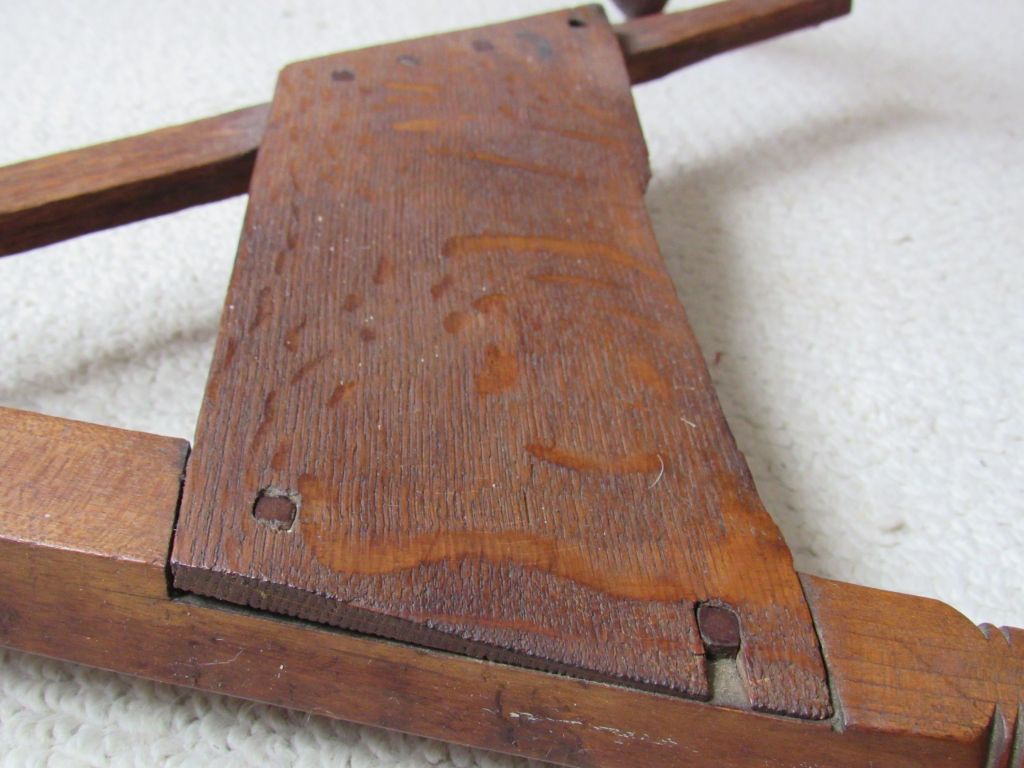
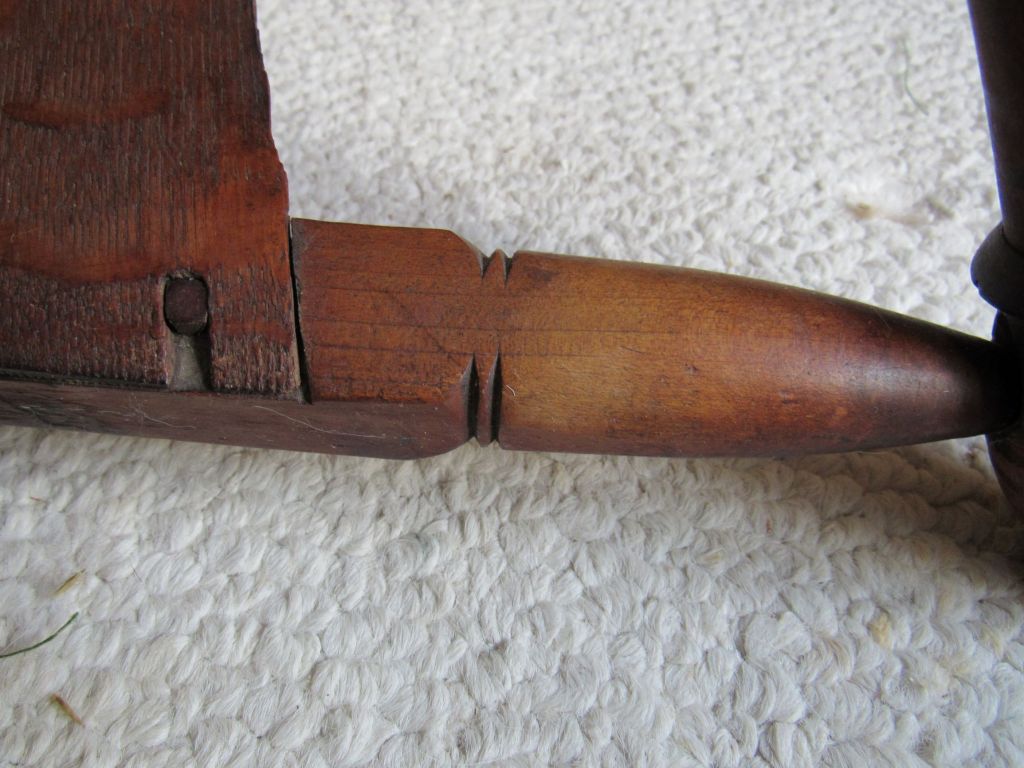
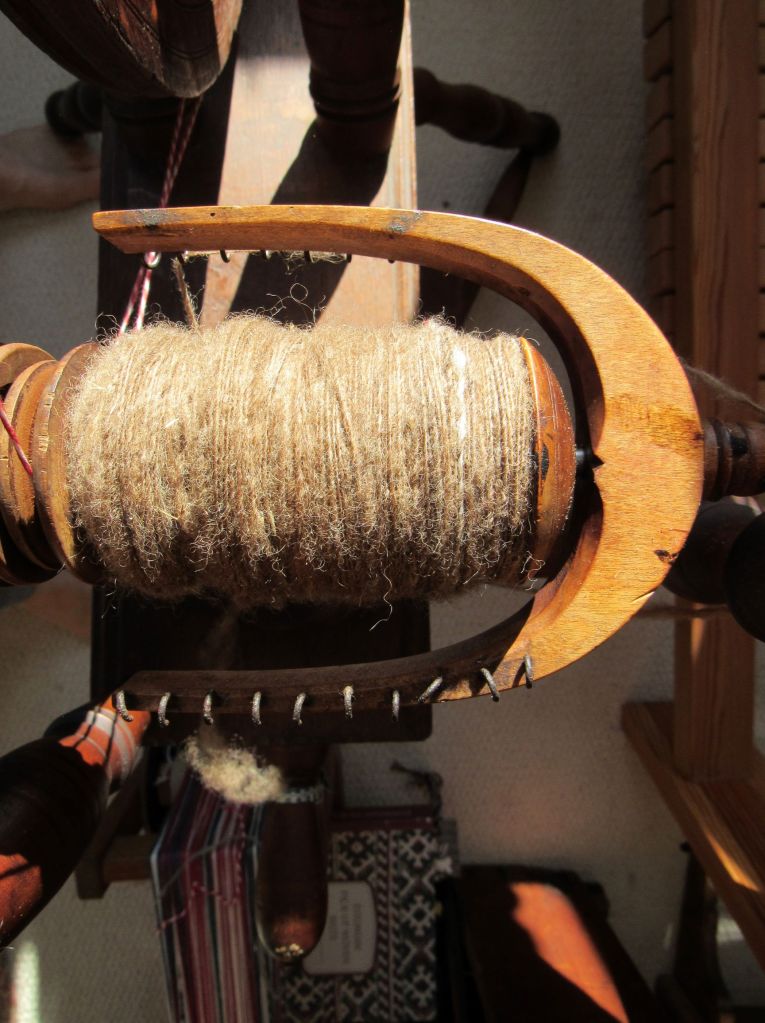
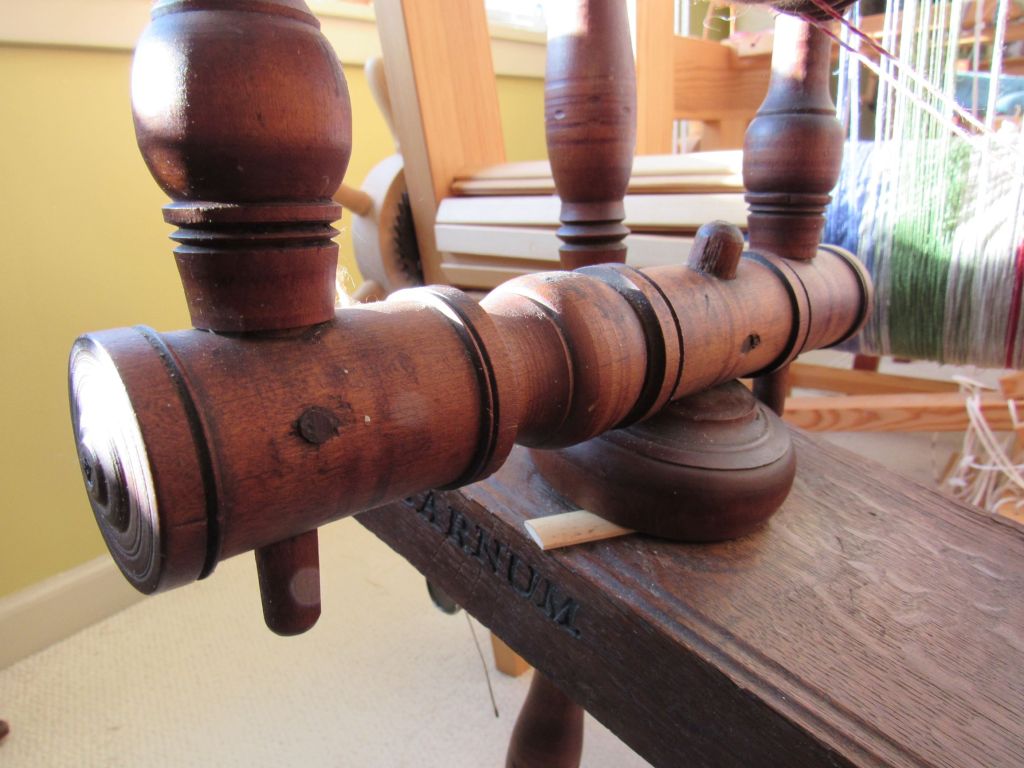
Olive Peck

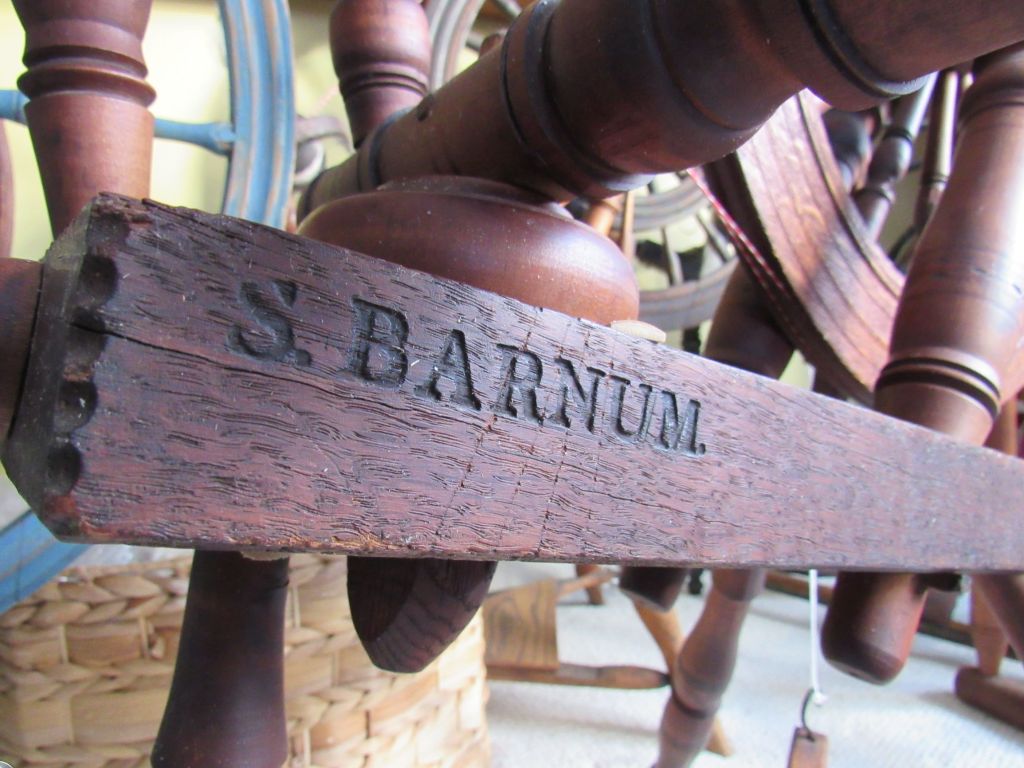
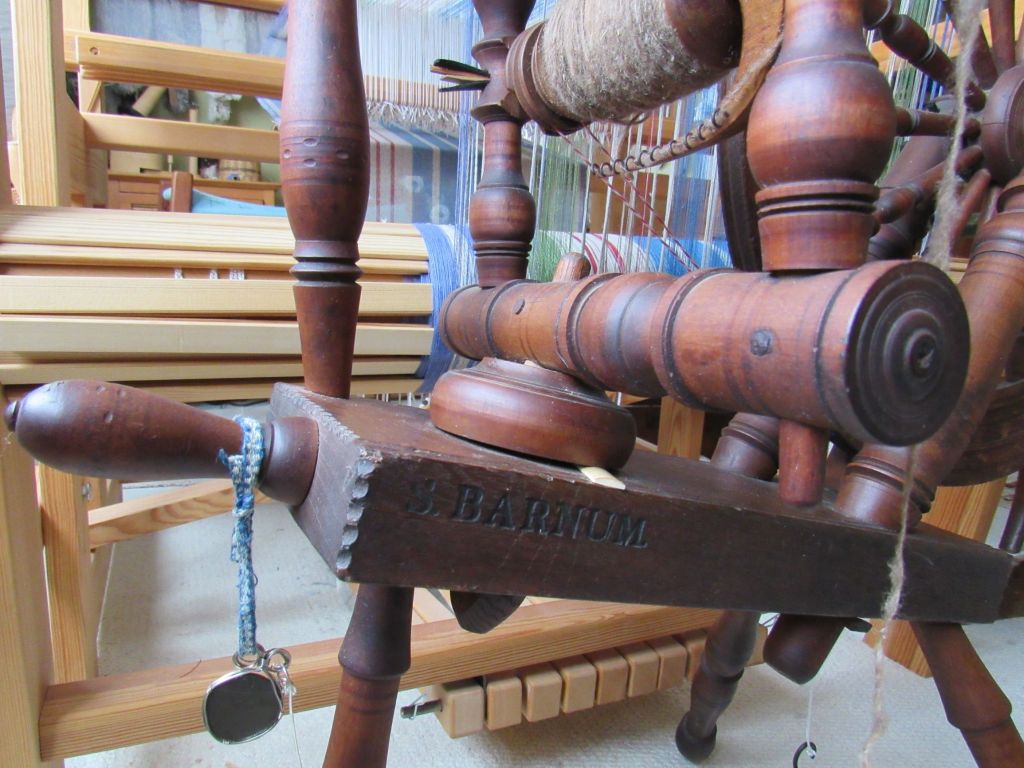
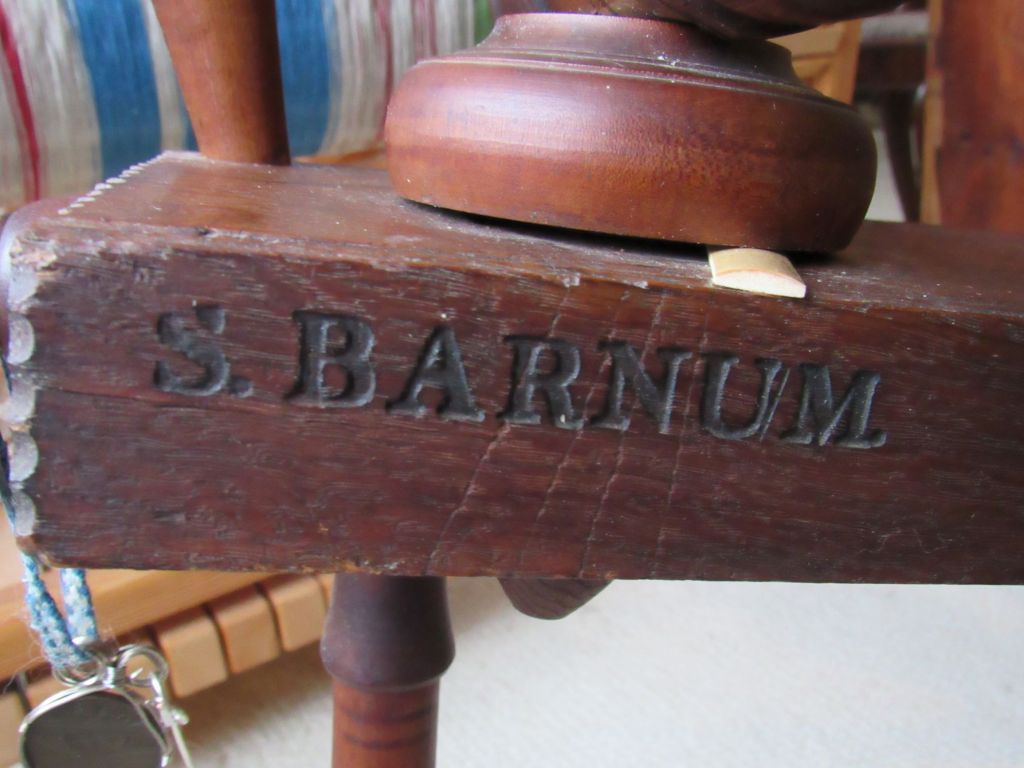
This wheel—made more than two hundred years ago—is a testament to the superb skills of Connecticut wheel makers in the late 18th and early 19th century.  It was made by Silas Barnum (1775-1828), one of a group of wheel makers from southwest Connecticut, who are most well-known today for their double flyer wheels. 

From this group, the most well-known are Solomon Plant, the Sanfords, the Sturdevants, and Silas Barnum.  The earliest, born in the 1740s, included Solomon Plant and Samuel Sanford, two men who likely were making wheels before the Revolution.  A second generation, born in the 1760s and 70s, arose with John Sturdevant, Jr., Isaac Sanford (Samuel’s son), and Silas Barnum, who, in turn, were followed by another generation, born in the 1790’s, including Beardsley Sanford (Samuel’s great-nephew), Elias Bristol Sanford (Isaac’s son), Josiah Sanford (Samuel’s son by his second wife), and John Sanford Sturdevant (John Sturdevant Jr.’s son). 

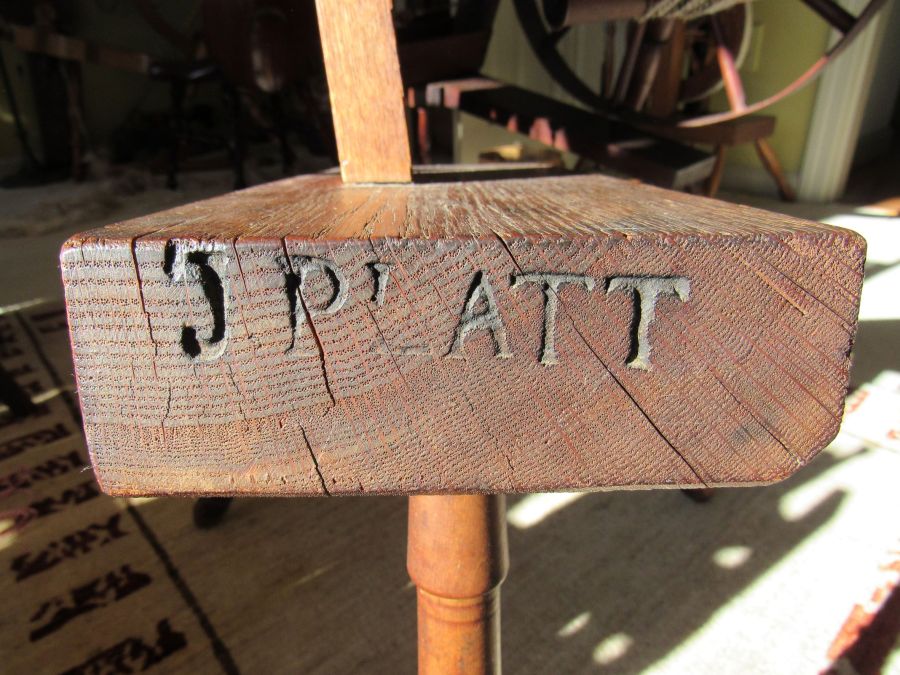
J. Platt appears to have been part of this group, too, but, as far as I know, no one has determined just who he was.  These men, and a few others, made wheels of a distinctive style, recognizable immediately as having come from a particular time and place in our history.   

For more on these wheel makers, see the previous posts: “Mindful Pond” (Solomon Plant); “Louisa Lenore” (Sanfords); and “Katherine the Witch,” “Mercy,” and “Judith and Prudence” (J. Platt). 

To help keep these wheel makers sorted out, in a previous post about Silas Barnum, “Big Bear,” I included a timeline, map, and family history that helps to understand how these particular wheel makers were connected.  All of them were from families that settled on the Connecticut shore in the 17th century and gradually migrated inland. 

Their family names are found repeatedly, along with Platts, Pecks, Smiths, Beardsleys, and others, in the history of this area.  Silas’s mother was a Sturdevant, his older sister, Sarah, married wheel maker, John Sturdevant, Jr.  Their son (Silas’s nephew), John Sanford Sturdevant (likely named after his Sanford grandmother) was also a wheel maker.  Silas married Martha Platt, although whether she was related to wheelmaker J. Platt remains a mystery. 

While there is ample evidence of family relationships between Barnum and other Connecticut wheel makers, we know little about their working relationships.  Did Barnum work with his brother-in-law, Sturdevant, Platt, or any others?  How well did these men know each other?  Was their wheel making competitive or cooperative, or a likely mix of the two?  We just do not know. 

We know that Barnum, the Sanfords, the Sturdevants, and likely Platt, worked in neighboring towns and their wheels share some remarkable similarities, so there was cross-pollination, but it would be fascinating to know more about the interplay of design influences, creativity, innovation, and marketing. 

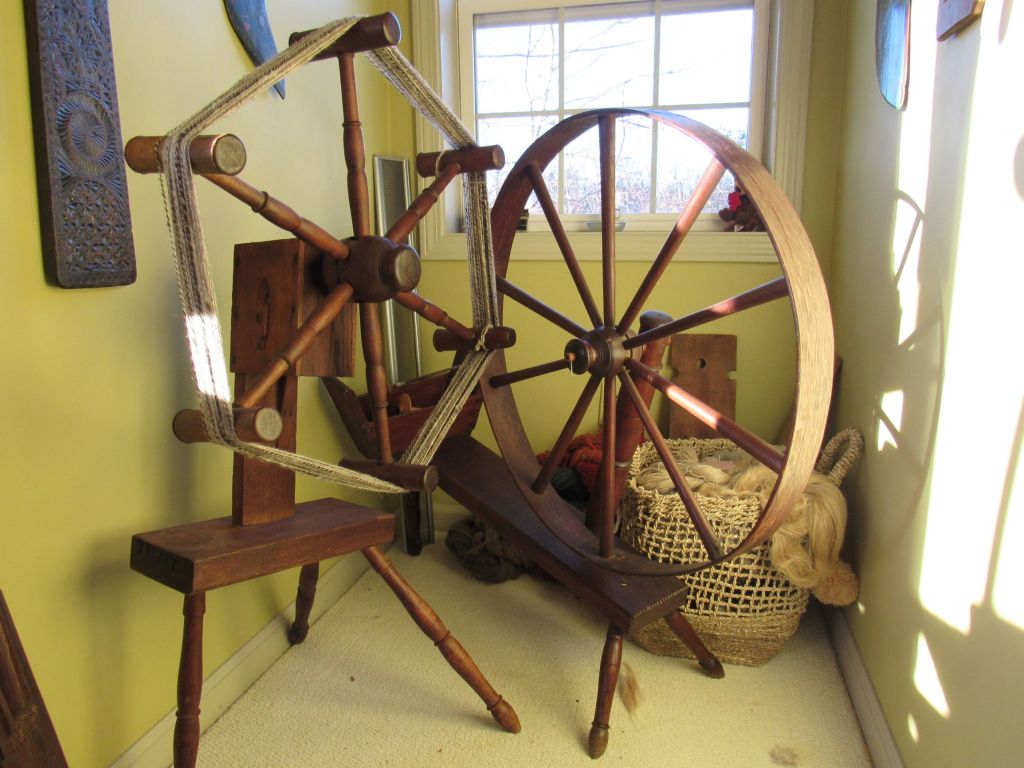
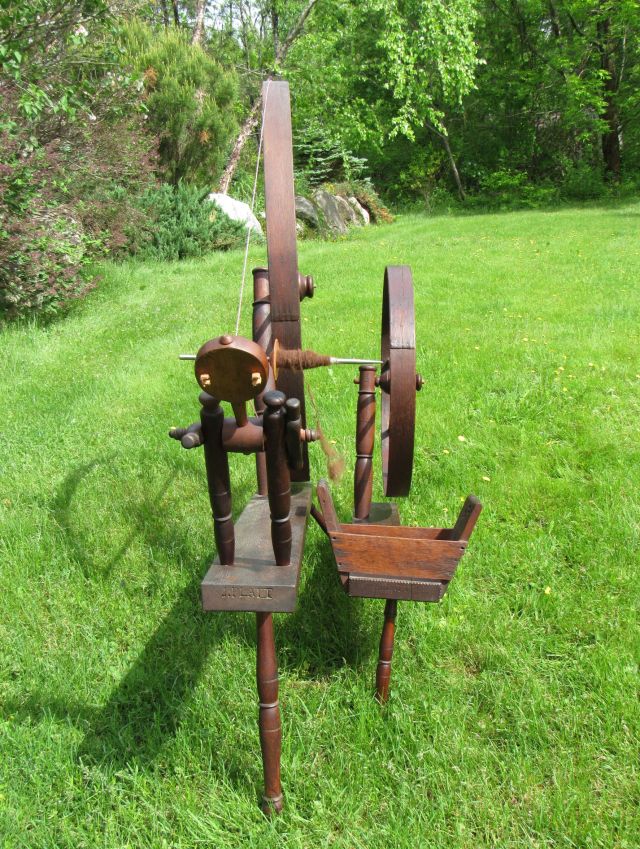
Platt in the front (with new treadle), Barnum in the back

For example, in trying to determine how J. Platt fit into this group, I was struck by the remarkable similarities between Platt and Barnum’s great wheels (see “Big Bear”), which seemed to indicate some relationship between the two men.  But, when I found Barnum’s flax wheel, I was surprised by how different it was to Platt’s in the details.  

Was the difference one reflecting the time they were made or just the personal style of the makers? 

Barnum’s wheel is more finely and elaborately turned and has the small chip carvings dotted on decorative black bands so typical of these Connecticut wheels (but missing from Platt’s).

The spokes, also, are different.

Barnum’s spokes are more elaborate. He used the wonderfully-named “shotgun shell and olive” style, often found on Connecticut and Pennsylvania wheels of this era. 

Despite these differences, though, both wheels share the same overall look and excellent craftsmanship typical of this group of wheel makers.

Barnum’s fine work on this wheel is illustrated by the spokes. 

They rest up against the rim lip, with pegs cut perfectly flush with the drive rim. 

Who knew a spoke peg could be a thing of beauty?

Despite the wheel’s impressive age, not a spoke has a wiggle or gap, and the drive wheel is perfectly solid, straight and aligned.  The drive rim’s four parts have different patterns of shining ray flecks that glow in the sun. 

There are fine turnings on the maidens and distaff (the top part is missing). 

In contrast, the table is a bit more crude,

appearing to have been cut from an imperfect chunk of lumber, with one bottom edge at an angle and a concave area on the top.  

Perhaps Barnum chose it for the grain, which, as with the drive rim, has highly contrasting fleck.   

The table underside is smooth, without scribe marks. 

The wheel end legs stick up through the table. 

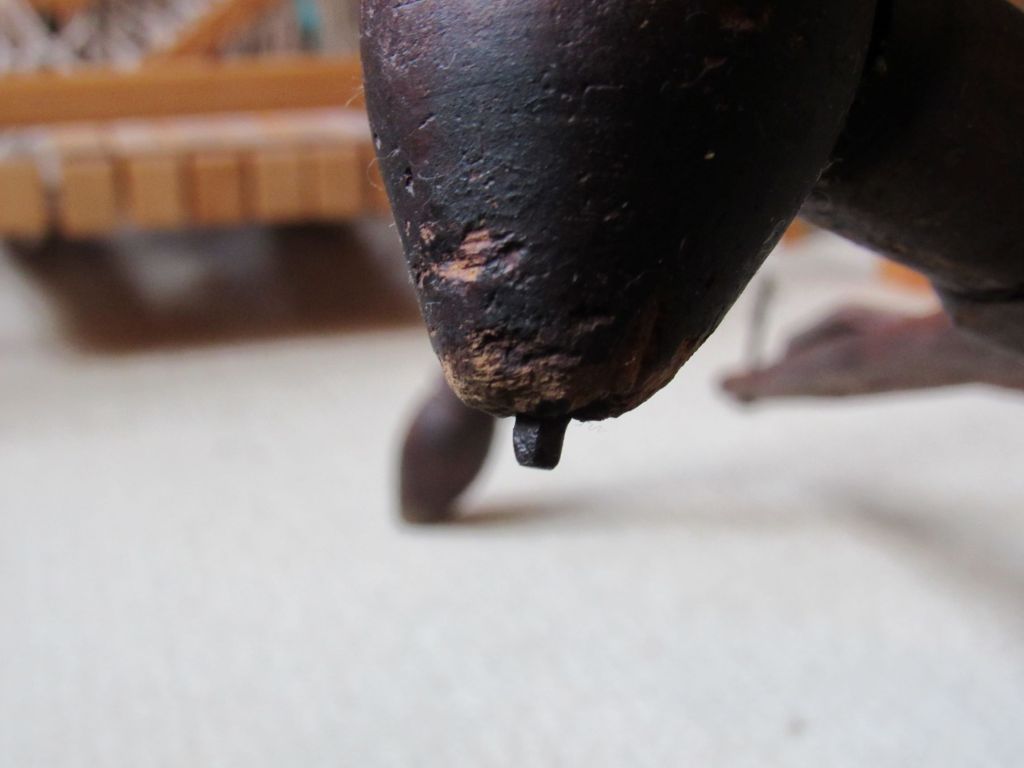
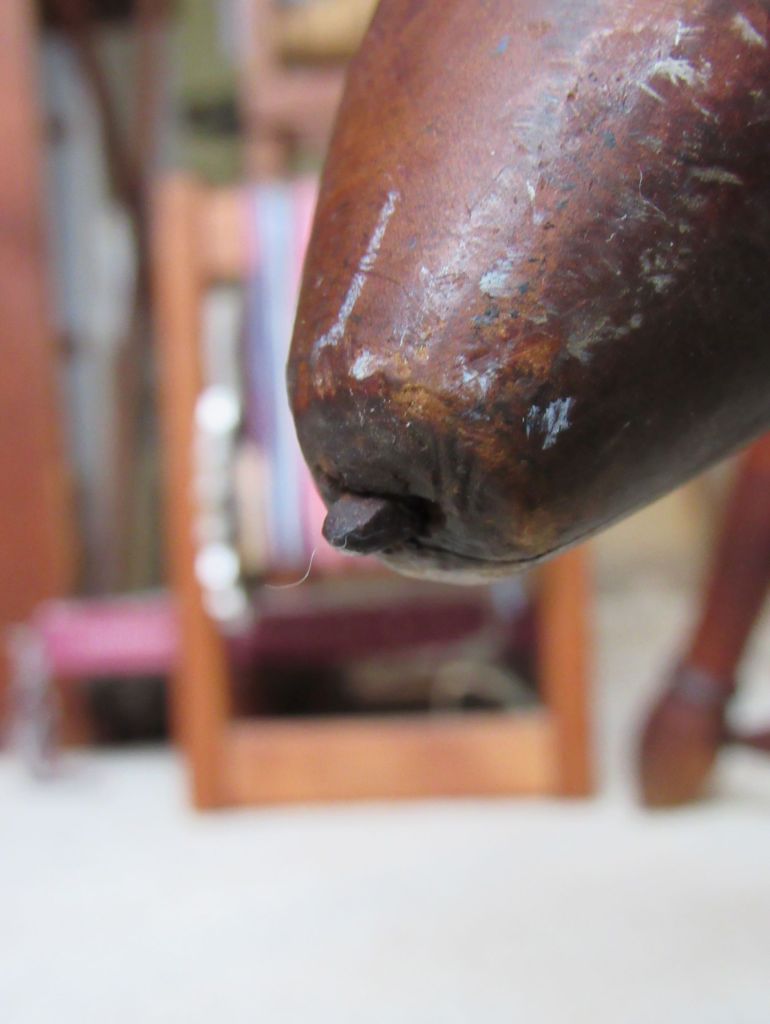
Each leg as a nail in the bottom, which is fairly unusual, in my experience. 

I often find one in the far-side leg, but seldom in all legs. 

The wheel shows considerable use,

but is in excellent working condition.

The treadle is almost worn through at the front

and right side edge and bar. 

The original flyer assembly is missing.  It came with a funky one that likely was made in the 1970s or so.  I replaced it with one that fits perfectly and has its own elegant style, well-suited to the wheel. 

The spinner-side maiden is pegged into the mother-of-all

but the far-side one only has small peg underneath,

which keeps it in the mother-of-all but allows it to turn for easy flyer removal of the flyer. 

The tension knob shows no signs of wear from being used for winding off. 

There is one unturned secondary upright support that runs to the table. 

This is a common feature seen on these Connecticut wheels.  There are chip carvings on both ends of the table

and deep double grooves down each side. 

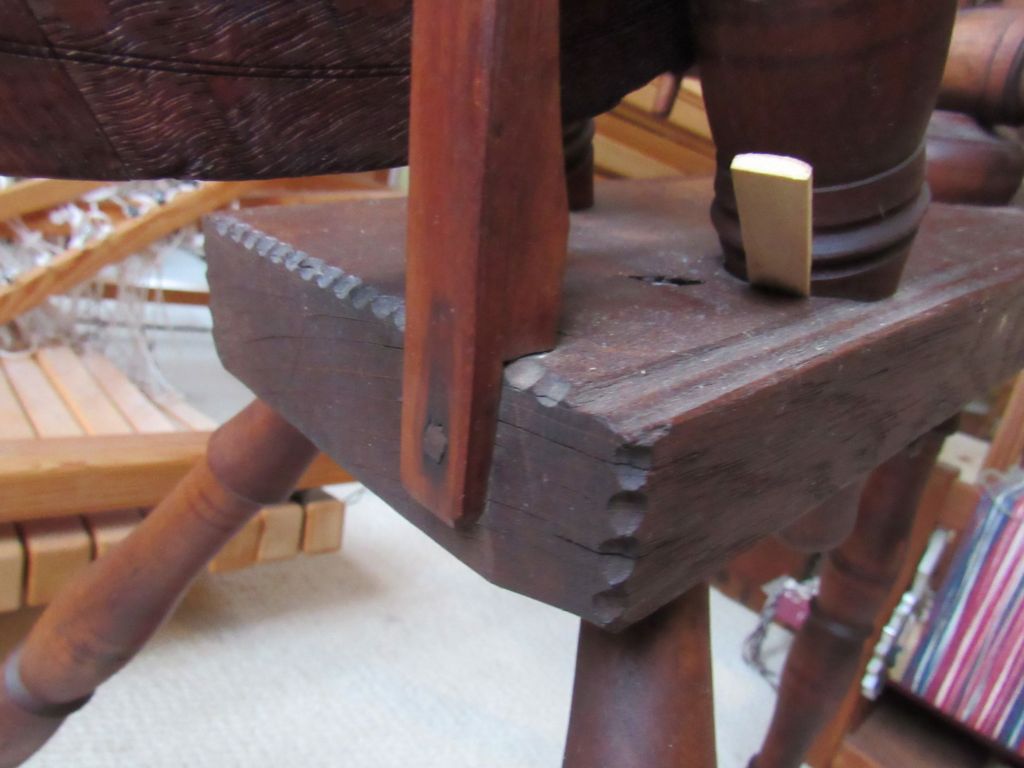
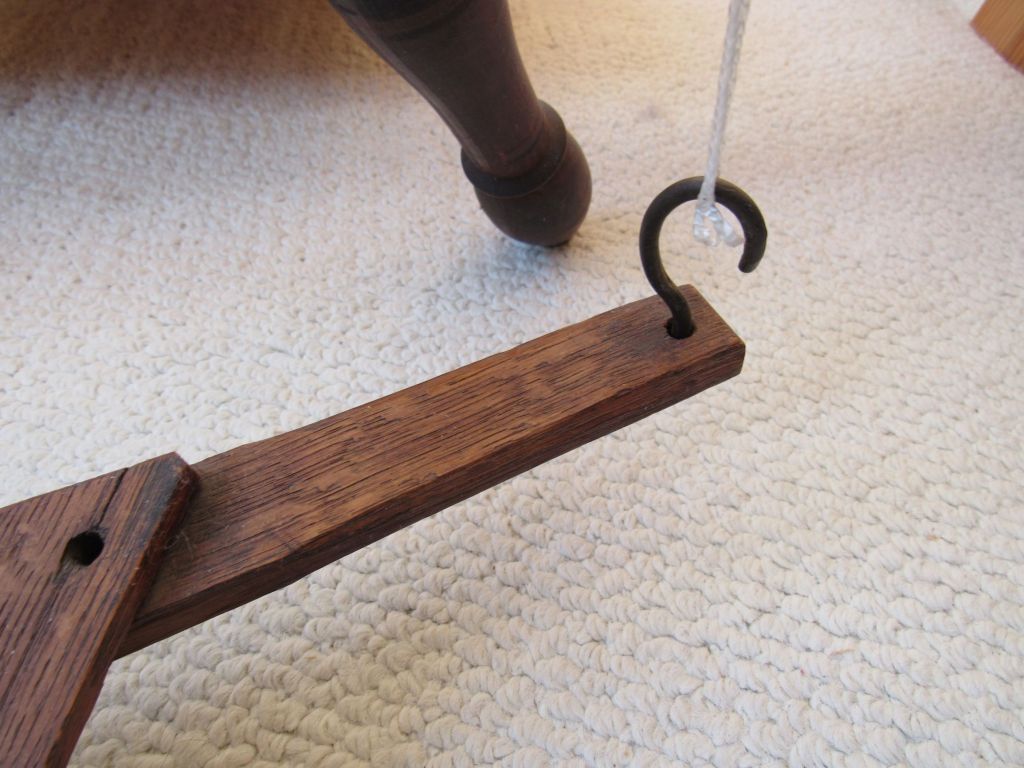
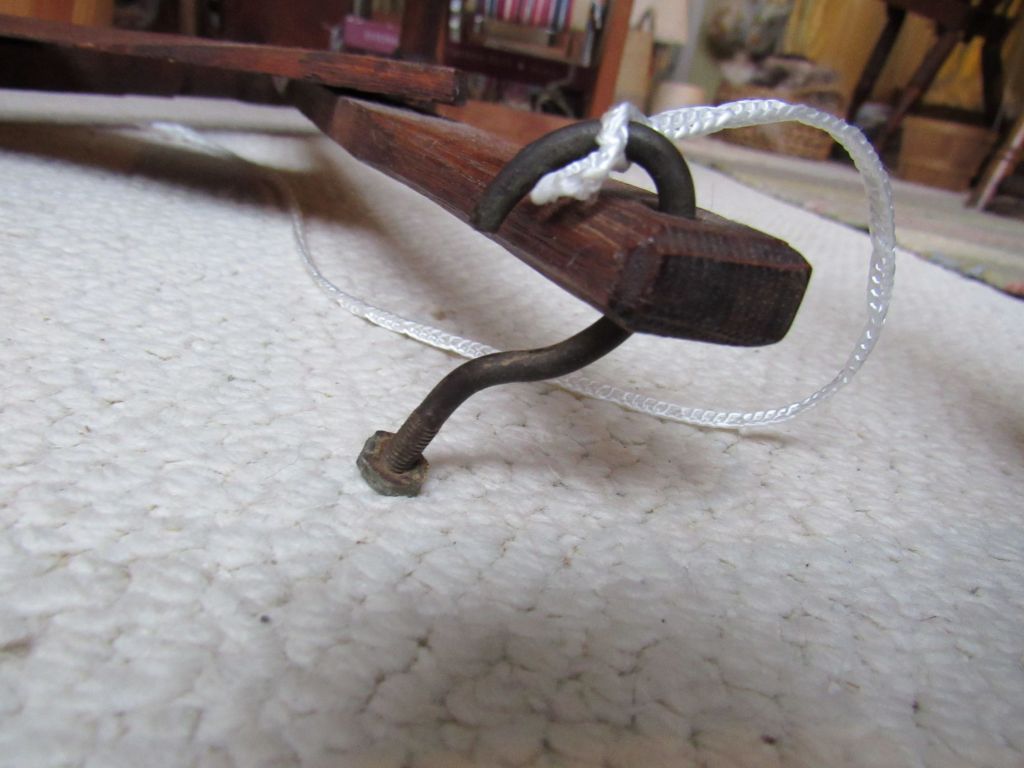
It came with a rawhide footman attached to the treadle bar with a metal hook with a nut underneath. 

As I mentioned earlier, Barnum’s life spanned the period at the end of the first generation and beginning of the next generation of these Connecticut wheel makers. 

To some extent, this must have been a transition period.  His spokes and turnings are similar to Solomon Plant’s, but a little more refined. 

The olive and shotgun shell spoke was found on the early Sanford wheels and those of John Sturdevant Jr. and Solomon Plant.  But, the later Sanford wheels evolved to have simpler spokes and finials, which according to Pennington & Taylor’s book “Spinning Wheels and Accessories,” this evolution reflected the change in style to plainer turnings for furniture in the 1810s to 1830s (p. 81). 

 Barnum did, interestingly, venture into a style of double flyer wheel that the later generation of Sanfords embraced, with the wheel above the flyers rather than below.

Kelley’s wheel

In discussing this style wheel, Pennington & Taylor highlight one made by Elias Bristol (E.B.) Sanford, who was born 16 years after Barnum (p. 82-83).  E. B. Sanford apparently patented the wheel in 1816.  It had unusual metal flyers, but the tension system looks very similar to a wheel signed by Barnum, which was discovered languishing in a North Carolina junk shop by Kelley Dew a few years ago. 

Kelley generously shared photos of her wheel,

showing similarities to E.B. Sanford’s, even down to the unusual decorative black marks on the wheel post. 

There are differences in the wheels,

but enough similarities to indicate that one maker influenced the other. 

Elias Bristol would have been about twenty-five years old when his patent was granted, while Barnum would have been forty-one. 

Did the older Barnum first make his wheel and then Elias Bristol improved and patented it? 

Or did Barnum take from Elias Bristol’s design, possibly without the patented parts?  Who knows? 

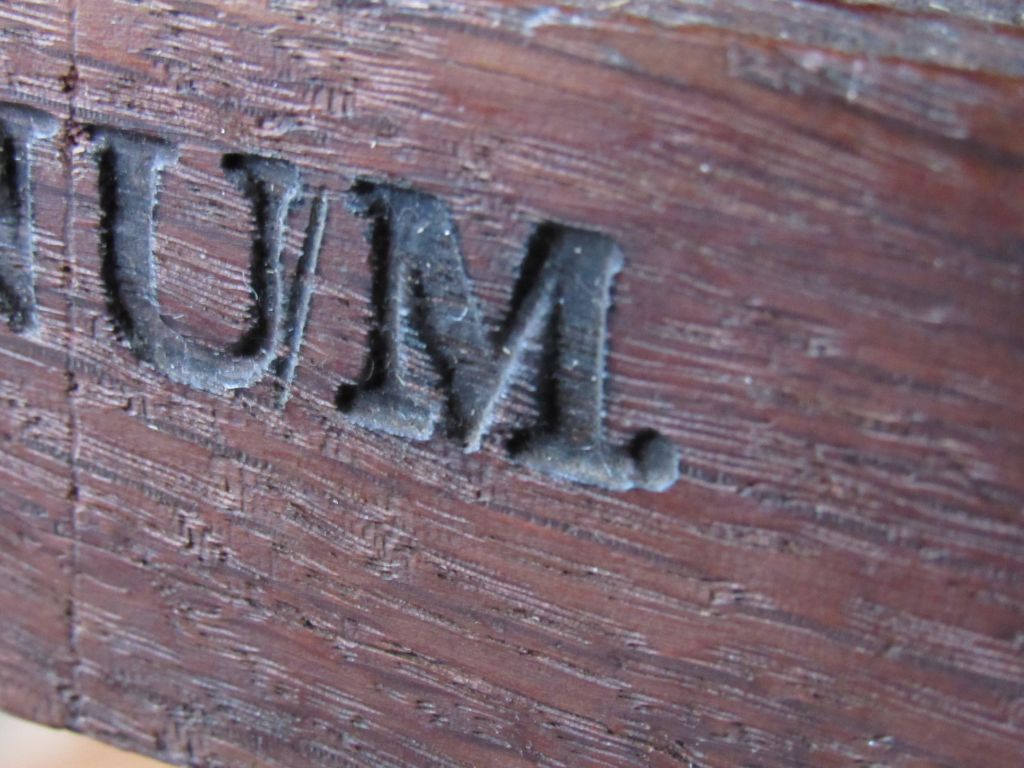
The “N” on the stamp is worn down, possibly indicating this was a late wheel of Barnum’s

Fascinating to think about, though.    

The letters are crisp on Olive Peck’s Barnum stamp

I am still hoping to learn more about Silas Barnum. 

I knew that I had Barnums in my Connecticut family background and recently learned that my great, great, great, great grandmother, Hannah Barnum Baxter, was Silas Barnum’s older cousin. 

She married and moved to upstate New York before Silas was born, so likely never knew him.  But spinning on a wheel made by someone sharing a small part of my ancestry gives me a special thrill of connection.  

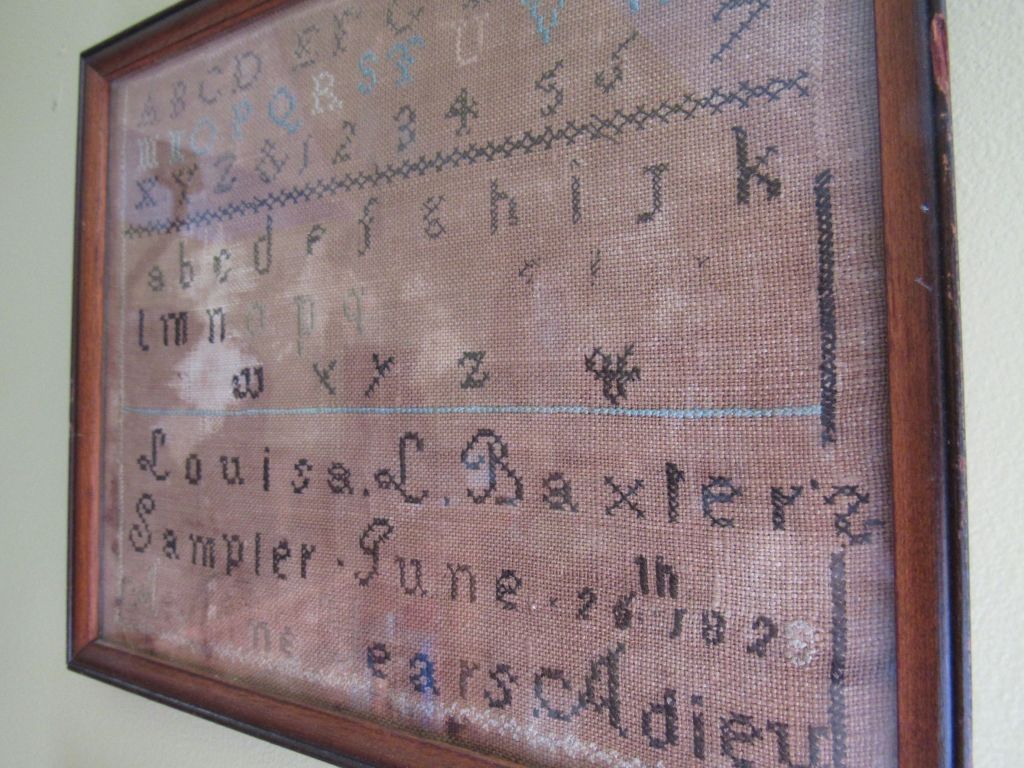
My great, great grandmother’s sampler. Silas Barnum was cousin to her grandmother, Hannah Barnum Baxter.

Thank you to Kelley Dew for allowing me to share her photographs of her stunning Barnum double flyer wheel.

For more information

Bacheller, Sue and Feldman-Wood, Florence, “S. Barnum and J. Sturdevant Double Flyer Wheels,” The Spinning Wheel Sleuth, Issue #31, January 2001 (and “Update” Issue #32, April 2001).

Pennington, David A. and Michael B. Taylor. Spinning Wheels and Accessories. Atglen, PA: Schiffer Publishing, Ltd., 2004, pp. 81-83.   

Judith and Prudence

Despite a lot of research, I have not been able to identify the elusive J. Platt. 

It seems pretty certain that he was a Connecticut wheel maker working in the late 18th and early 19th century.  His wheels share characteristics with those made by a group of wheel makers in Fairfield and Litchfield counties, including the Sanfords, the Sturdevants, and Silas Barnum.  Those wheel makers, and various branches of Platts, were connected with a web of marriages through several generations.

Surely, J. Platt fits in with them somehow, but just how remains a mystery. For those interested in more details of my Platt research, I am including a reference below to my article in the Spinning Wheel Sleuth.  In short, there are several candidates, but each possibility lacks that final bit of evidence to put the hunt over the top from theory to probability.

Judith, Mercy, and Katherine the Witch

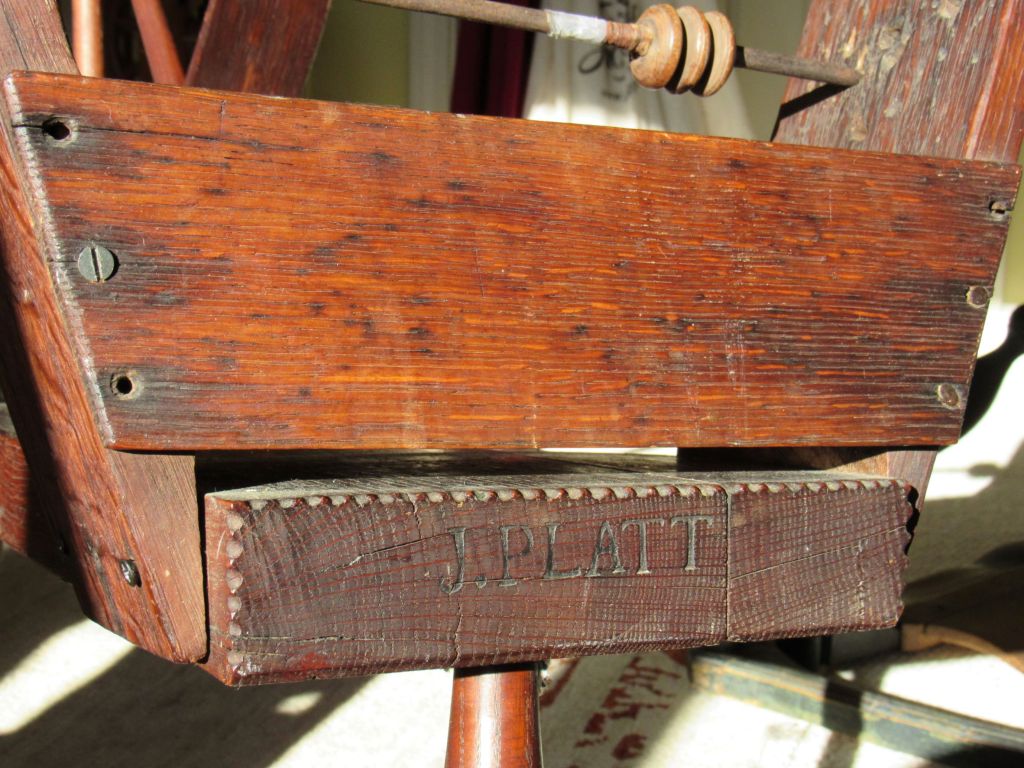
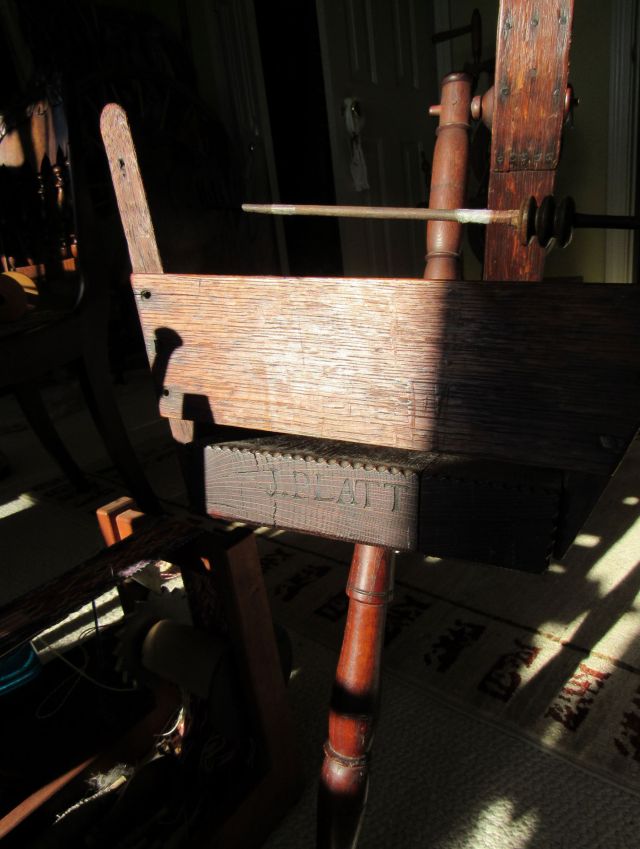
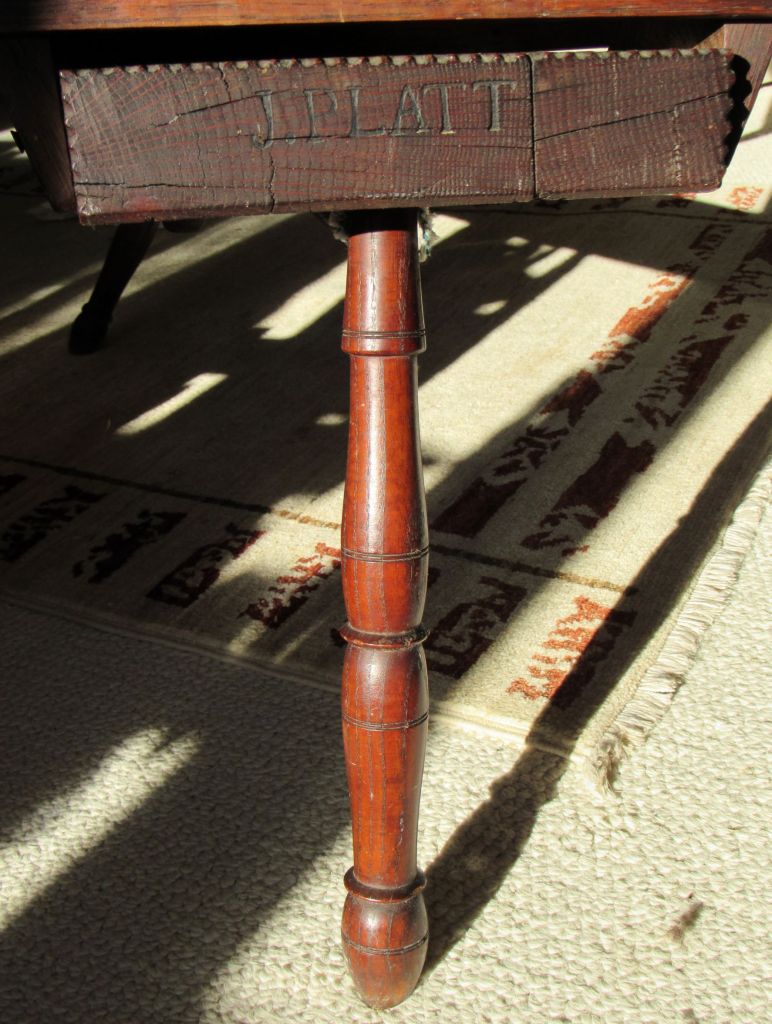
I have already written two posts in this blog about J. Platt wheels.  “Katherine the Witch,” my first wheel, continues to be my workhorse for flax spinning.  “Mercy,” a lovely great wheel, bears a striking resemblance to Silas Barnum’s work.  I never really expected to find any more Platt wheels, so was gobsmacked when a marked bobbin winder turned up in Maryland. 

Bobbin winders are rarely marked, so I could not believe my luck.  And, as it turns out, there was a lot of luck involved.  When I contacted the seller, he said that he would have to see if he still had it because he thought he had thrown it out.  My heart dropped.  Apparently, he cruises estate sales and auctions for things to resell on-line. 

He had been given two bobbin winders at an estate sale and, having no idea what they were, threw them into a storage unit.  When he needed more room, he decided to throw them out.  Fortunately, his wife convinced him to save the one with the name on it and to try to sell it.  I shudder to think how close this winder came to oblivion. 

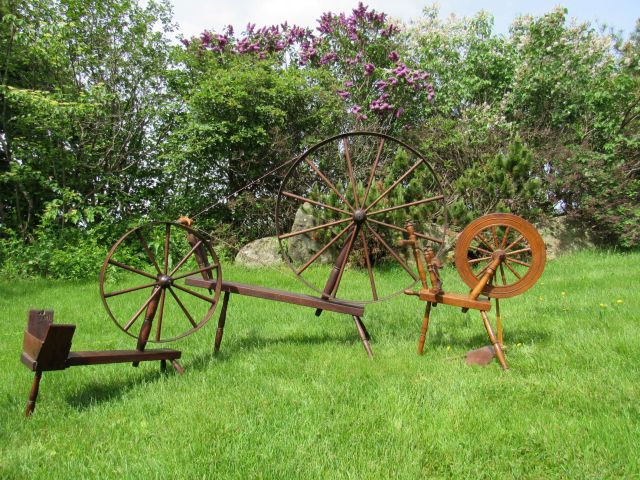
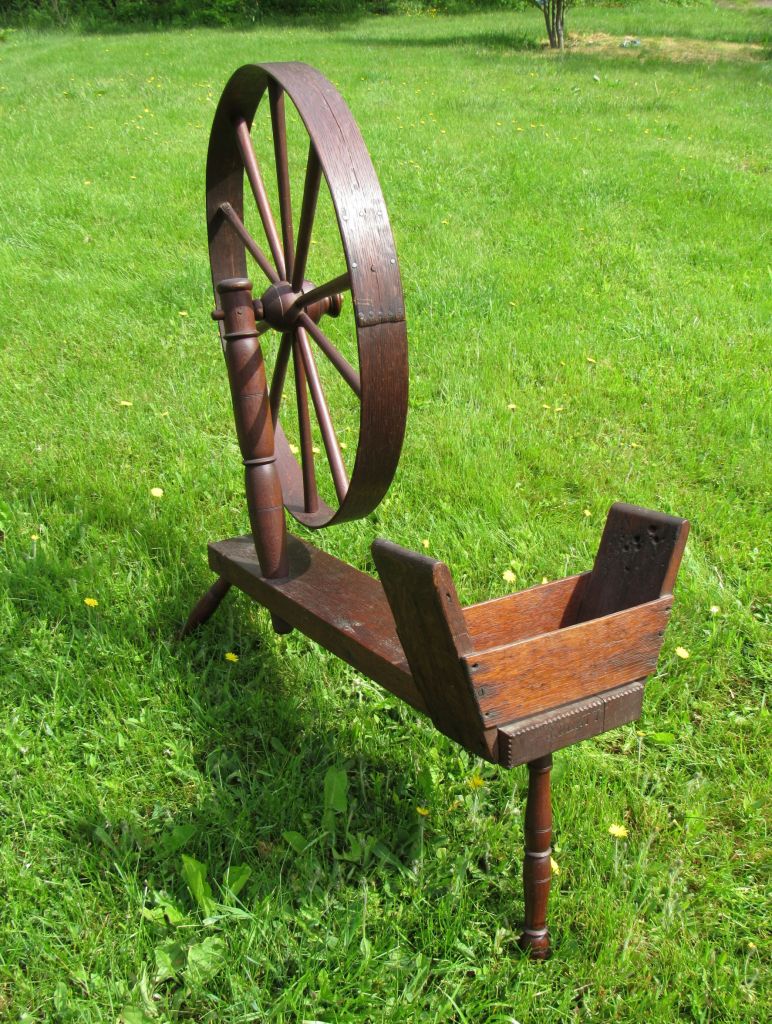
Instead, it was rescued, named Judith, and joined my family of Platt wheels. Although it could be over two hundred years old, it now works regularly, doing what it was intended to do.

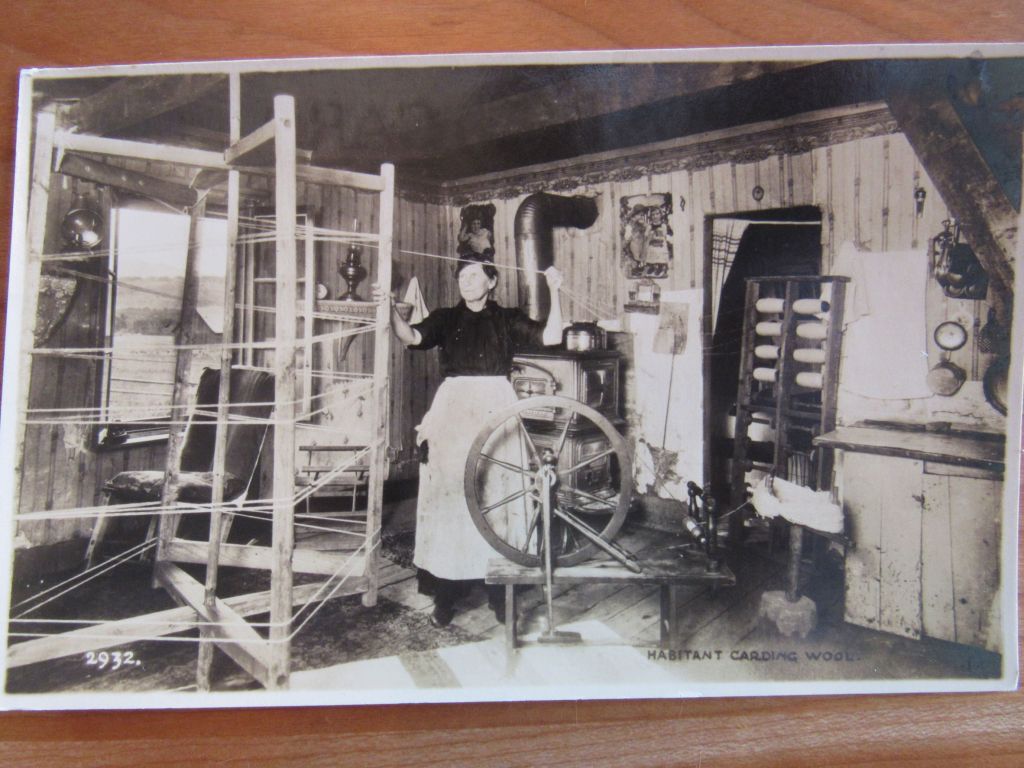
Bobbin winders, such as this one, were used by weavers to wind bobbins (or spools).  Once wound, the bobbins were mounted on a skarne (also called a spool rack or creel), which allowed for efficient warp winding, with multiple threads wound on the warping rods or mill at the same time.  This marvelous photo of a Quebec woman shows her bobbin winder being filled from a skein on a swift and the bobbins mounted on a skarne from which she draws eight warp threads at once to wind on to her huge warping mill. 

Unfortunately, when this photo was made into a postcard, it was inaccurately labeled “Habitant Carding Wool.”   

In contrast with the Quebec winder in the photo, J. Platt’s has a flat rim

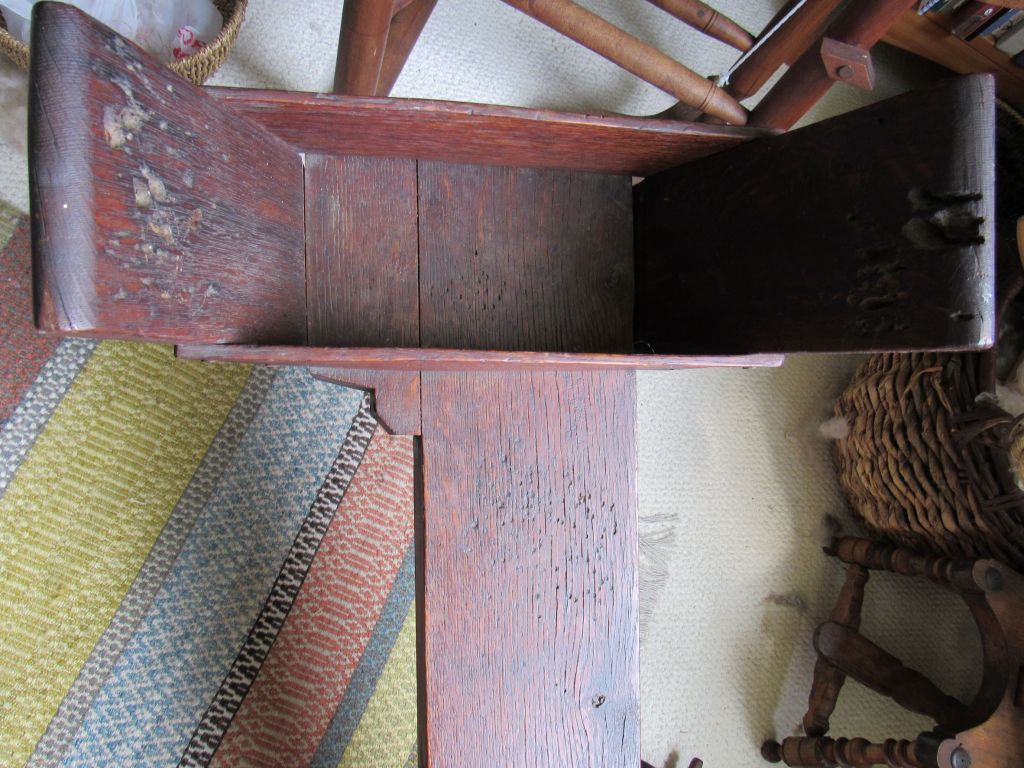
and a box for the spindle. Box-style winders are often found in New England.  I was fascinated to see a similar winder on a 1792 Conder token from Norwich, England, a town famous for its handweavers who produced the beautiful silk and wool Norwich shawls. 

Platt’s bobbin winder could have been made around the same time.  

The box is convenient for holding empty (or full) bobbins. 

Some boxes have supports for the spindle ends, but many, like Platt’s, are just plain wood with gouges made for the spindle tips through use. 

This bobbin winder did not have a spindle when I got it, but I found one to fit. 

I have not used it yet for winding bobbins for weaving, but regularly use it to wind singles off my wheels onto extra bobbins for plying. 

These winders were also used to fill bobbins for weaving shuttles. Perhaps there were spindles of different diameters or lengths to accommodate the smaller bobbins used in shuttles, which might explain why there is a wide variety of depth and placement of holes in the box ends.  

The winder looks a lot like a miniature Platt great wheel, with similar turnings. 

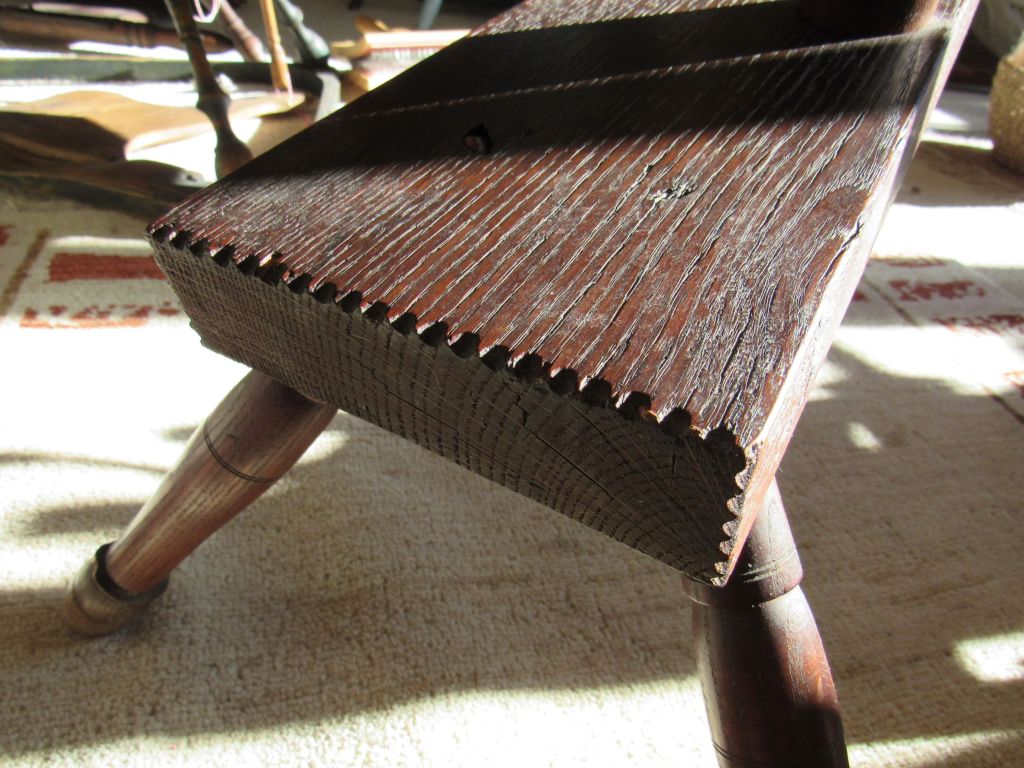
Unlike Platt’s wheels, however, it has scalloped carvings on the table ends. 

The inside of the box and the table are covered with indentations, perhaps from tapping the spindle end to loosen the bobbin for removal. 

The axle is wooden, with a broken end when I got it. 

My husband made a beautiful repair. 

The inside of the hub is just smooth wood, with no sign of a metal or leather bearing. 

The legs have incised rings, rather than the dark burned-on rings of Platt’s flax wheel and winders. 

Winder leg
Reel legs

There is an interesting corner piece nailed in next to the box.  I do not know if there is a functional reason for it, but it looks nice.

While I had never expected to find a Platt bobbin winder, I had been keeping my eye out for a Platt reel.  When one appeared in Vermont, I jumped on it and, with the help of several people, got it to Maine. 

The reel, named Prudence, has six arms and a slanted table—an unusual feature found on some Connecticut reels.  (see Pennington & Taylor, p. 161, Fig 14-6).  I am not sure of the reason for the slant, perhaps for ease of storage or some particular positioning for winding off from a wheel.  It certainly makes for a very stable reel. 

The legs and winder arms have faint traces of dark rings and the legs are, in general, similar to those on Platt’s flax wheel. 

But neither the table nor the legs are the same sizes as those on the wheel. 

The top, which has a broken edge, is flat, without any knob for carrying. 

It holds a two-yard skein and the arms, like the top, are plain, without a handle for turning. 

A simple clock hand on one side of the gear box measures rotations. While the reel arms turn clockwise, the clock hand turns counter-clockwise.

The other side of the gear box is unadorned.

The gears run smoothly and the click mechanism still works beautifully, making its “thwack” every forty rotations. 


The wooden clicker being pulled by the metal pin on the gear before the click

After the click–the metal pin that triggers the click

The hub is pegged on the axle and nicely turned. 

The arm crosspieces have lips on the ends, except for one, “the stranger,” which has one smooth end to allow for removal of the skein.

After I got the wheel home and cleaned up, I sent photos of it to another Platt enthusiast, Cindy Lincoln, in Massachusetts. She has been restoring a Platt winder and used this one as a model.  In return, she sent me some photos from Ron Walter in Pennsylvania of a John Sturdevant reel in his collection. 

Ron Walter’s Sturdevant reel

The Platt and Sturdevant winders are remarkably similar, with the tilted bench, and lack of carrying knob and winding handle. It gives another possible clue into the identity of J. Platt.  I now will be digging deep into Platt and Sturdevant connections. 

Underside of the Platt reel

Although we still do not know J. Platt’s identity, as far as I know, he is the only Connecticut wheel maker from whom we have marked examples of all of the five major spinning tools. 

We know of several marked great wheels and reels, at least two marked single-flyer flax wheels, one marked double-flyer wheel, and my one bobbin winder.  Quite a legacy.  I am hoping one day to find a Platt double-flyer wheel for a Platt full house.

Thanks to Cindy Lincoln and Ron Walter for the Sturdevant reel photographs, to Tina M. for finding, picking up, and railroading the bobbin winder, to Jessie R. for finding and picking up the reel, to Nora R., Andrea M. and Amy T. for the reel railroad, and to Jan C. for the spindle. 

For more information see:

Page, Brenda, “The Search for J. Platt,” The Spinning Wheel Sleuth, Issue #113, July 2021, pp. 1-6.

Pennington, David A. and Michael B. Taylor. Spinning Wheels and Accessories. Atglen, PA: Schiffer Publishing, Ltd., 2004, p, 161.   

Flax Hackles

Hackling is the final step in processing flax for spinning into linen. 

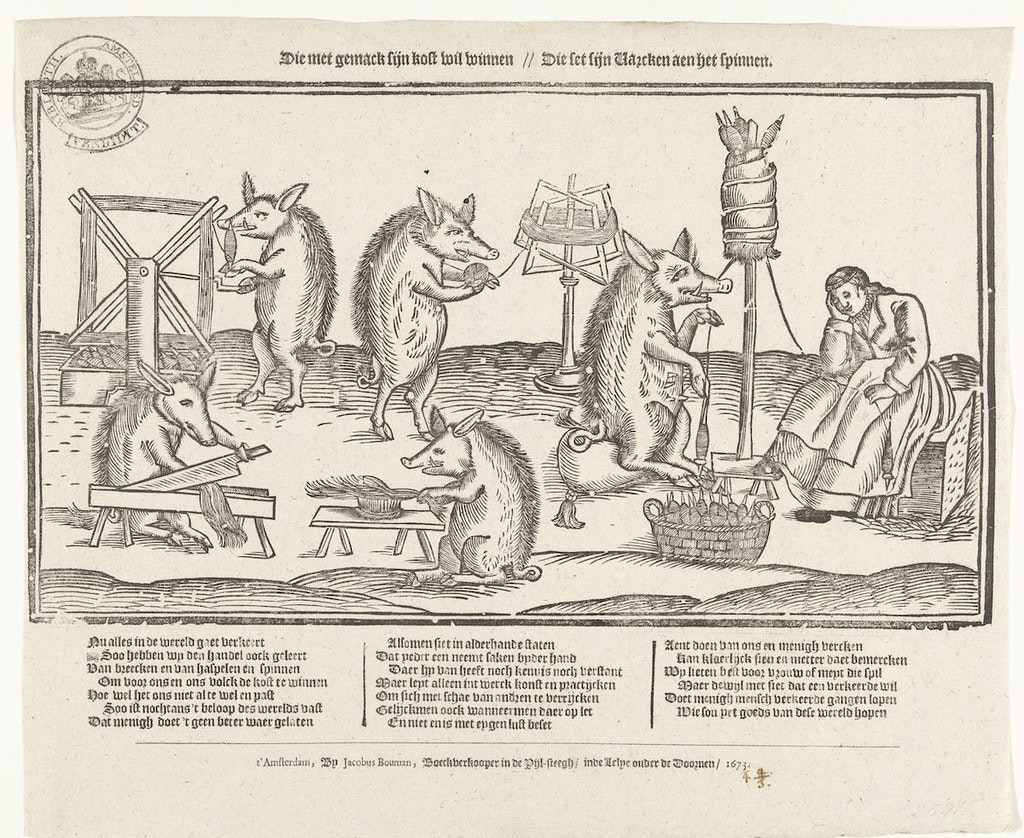
1673 Dutch Print of pigs processing flax to linen thread

Processing requires many steps. At about ninety days from planting, flax plants are pulled and dried.  The seeds are removed by rippling, the woody portions broken down through retting and crushed by breaking,

After breaking

and separated from the fiber by scutching (to learn much more about these processes, see the previous posts “A Ripple and Breaks” and “Scutching Knives”).  

After scutching

Finally, to further refine, soften, and clean the fiber, it is combed through hackles, also known as heckles, hatchels, and hetchels. 

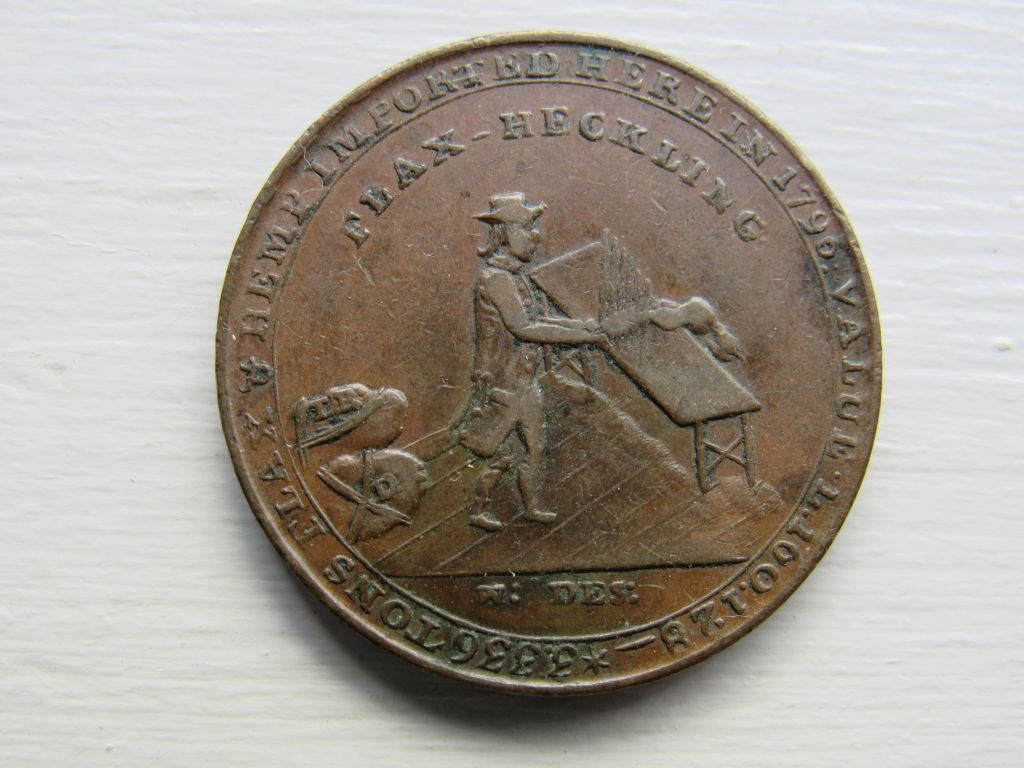
This 1797 Conder token from Dundee Scotland shows “Flax Heckling,” noting the amount of flax and hemp (3,336? tons) imported in 1796

Hackling separates coarser, shorter fiber, called “tow,” from the longer line fibers, which are the most desirable for spinning.

Hackling also removes the small woody bits of boon or shive still clinging to the fiber, and splits ribbony pieces into finer filaments. 

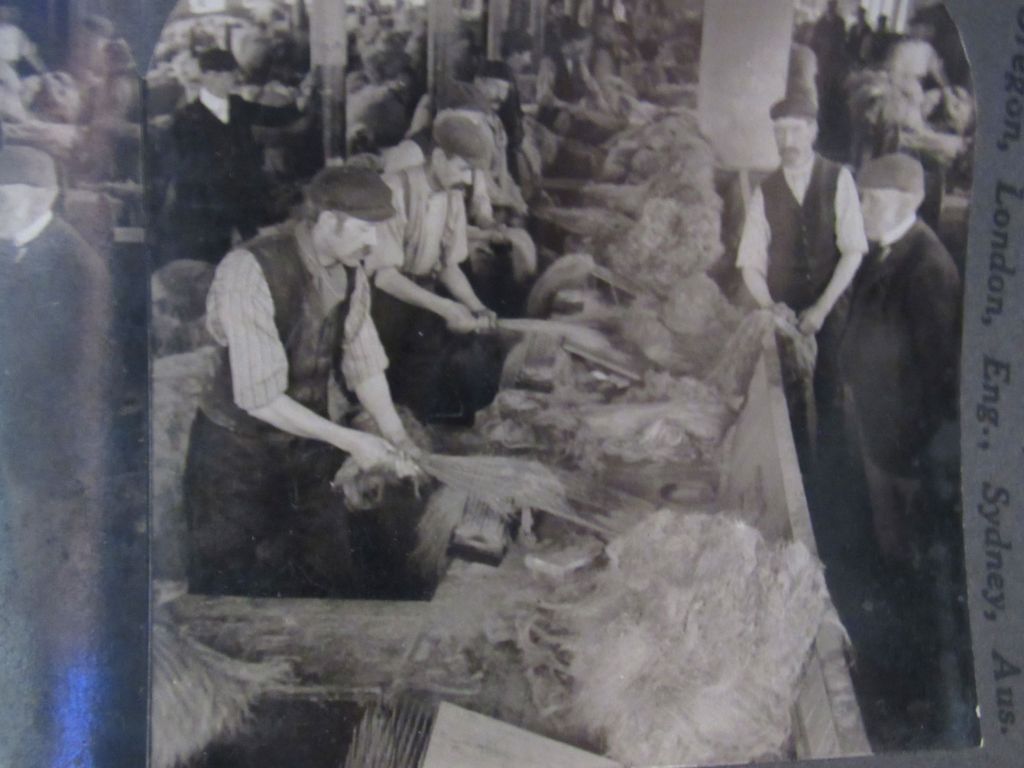
Irish linen production–a hackling line

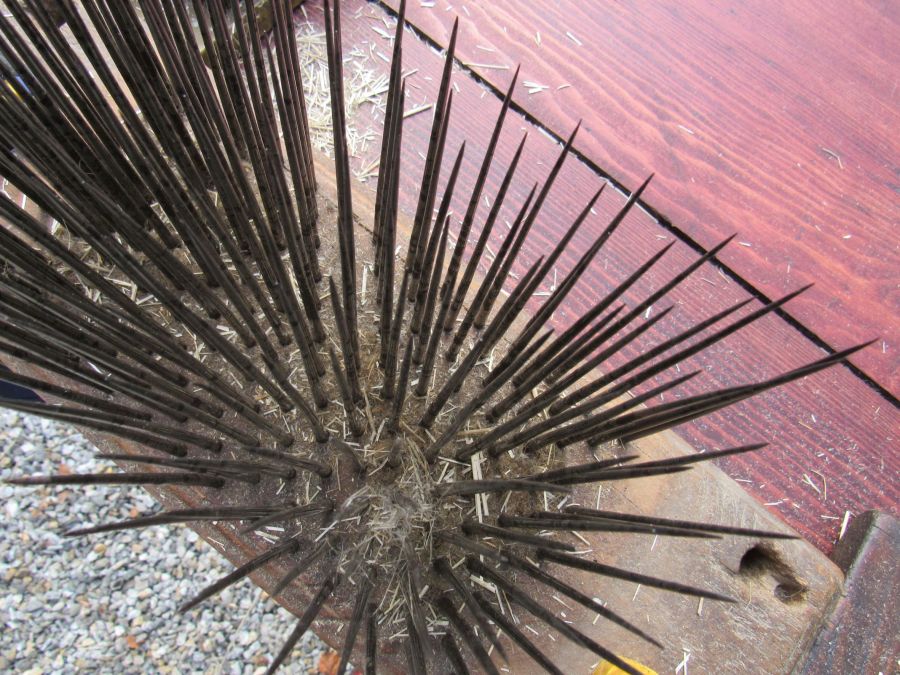
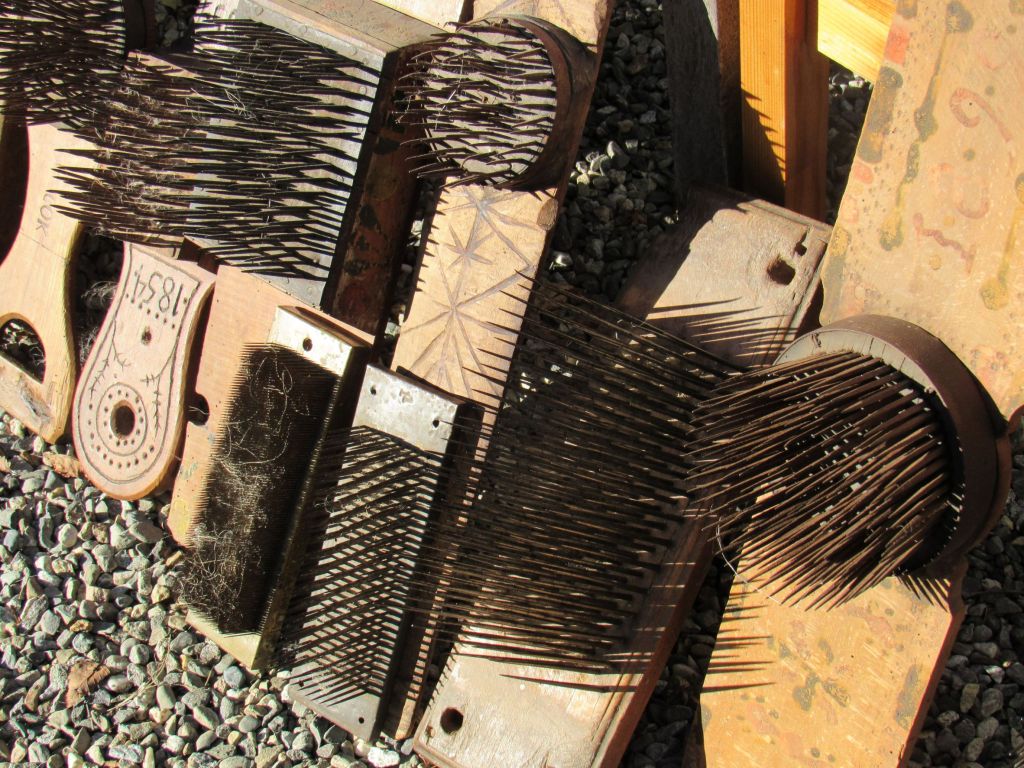
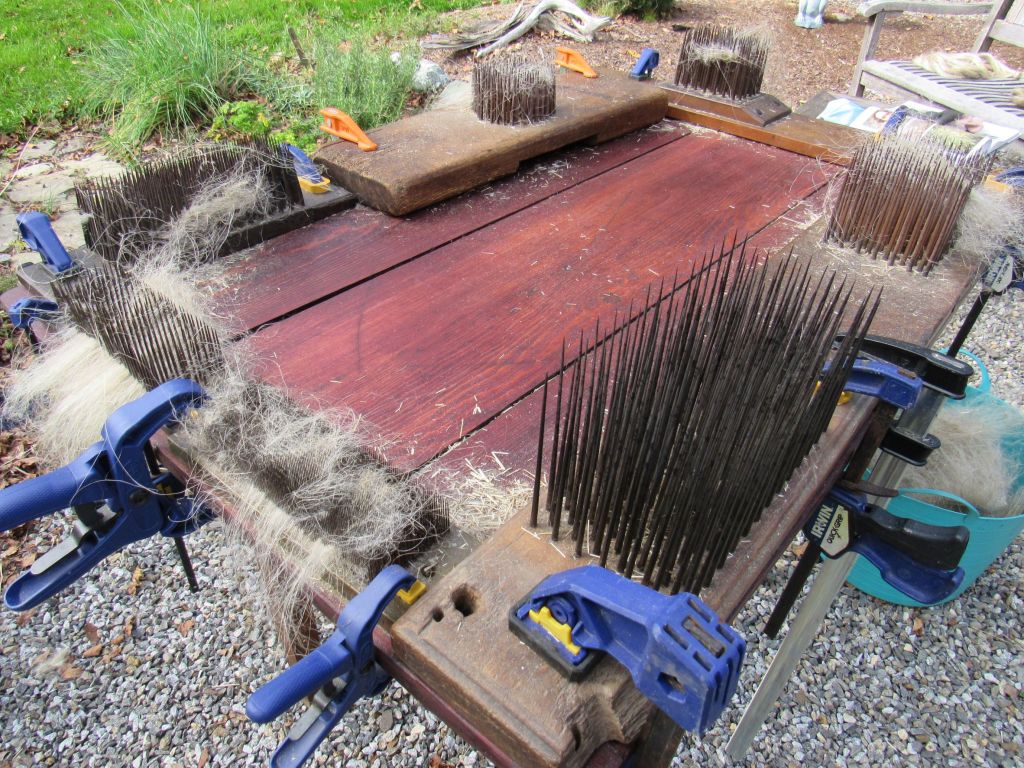
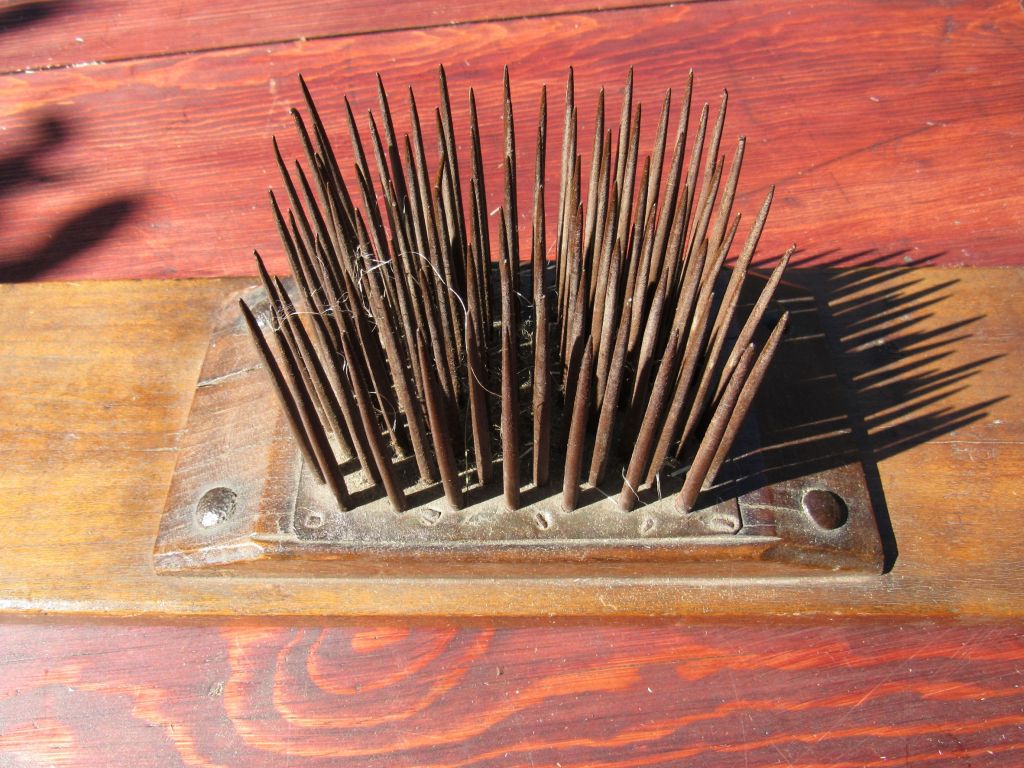
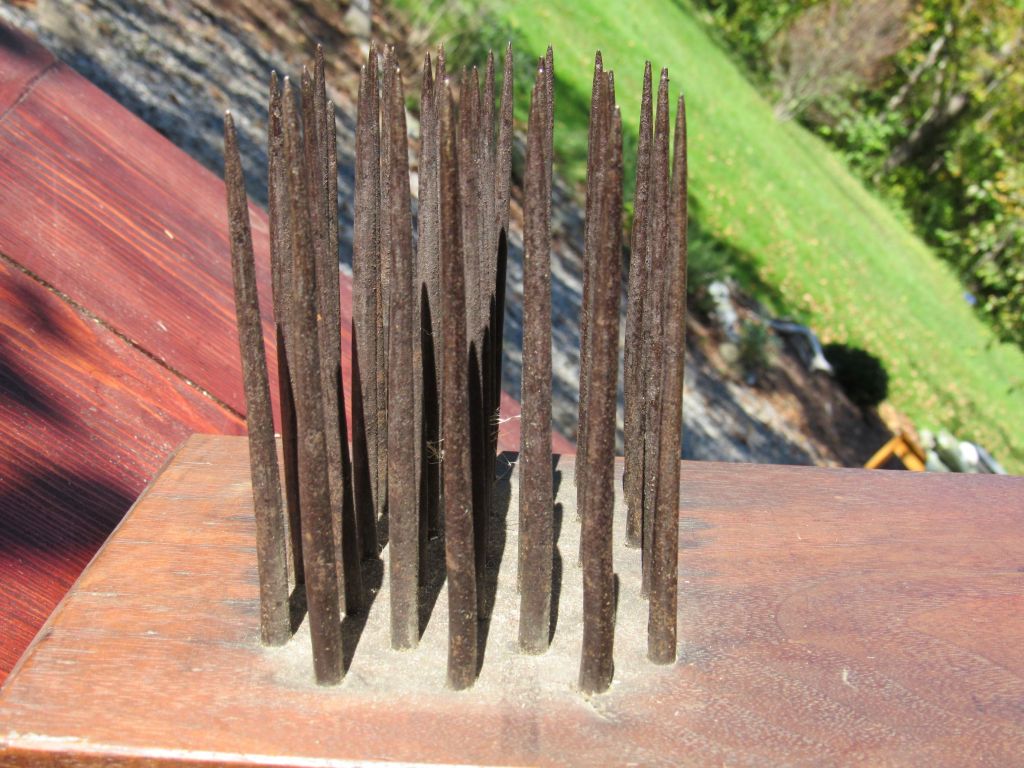
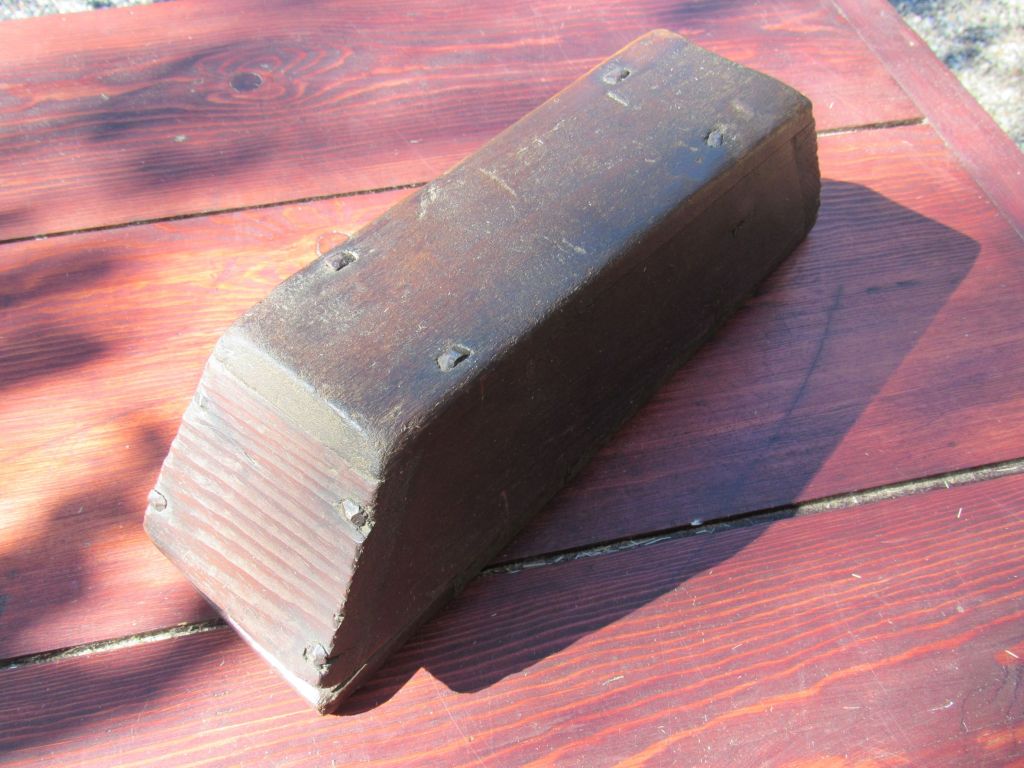
Hackles come in as great a variety as the people who made them. All sport sharp–often very sharp–tines. But tines are of different sizes, shapes, lengths, and densities. 

Ideally, several hackles are used, starting with large tines, spread far apart for the initial combing, and progressing to a medium density comb and then one with smaller, finer, more closely-spaced tines. 

William Hincks illustration of Irish linen industry, plate IV, 1783

But, it is possible to get good results with one medium hackle, which likely often was all that was available.

I am fortunate because hackles are very easy to find in Maine.  They turn up regularly at antique stores and barn sales.  I have been able to pass on many hackles to others interested in processing their own flax and still have every gradation available for processing my own. 

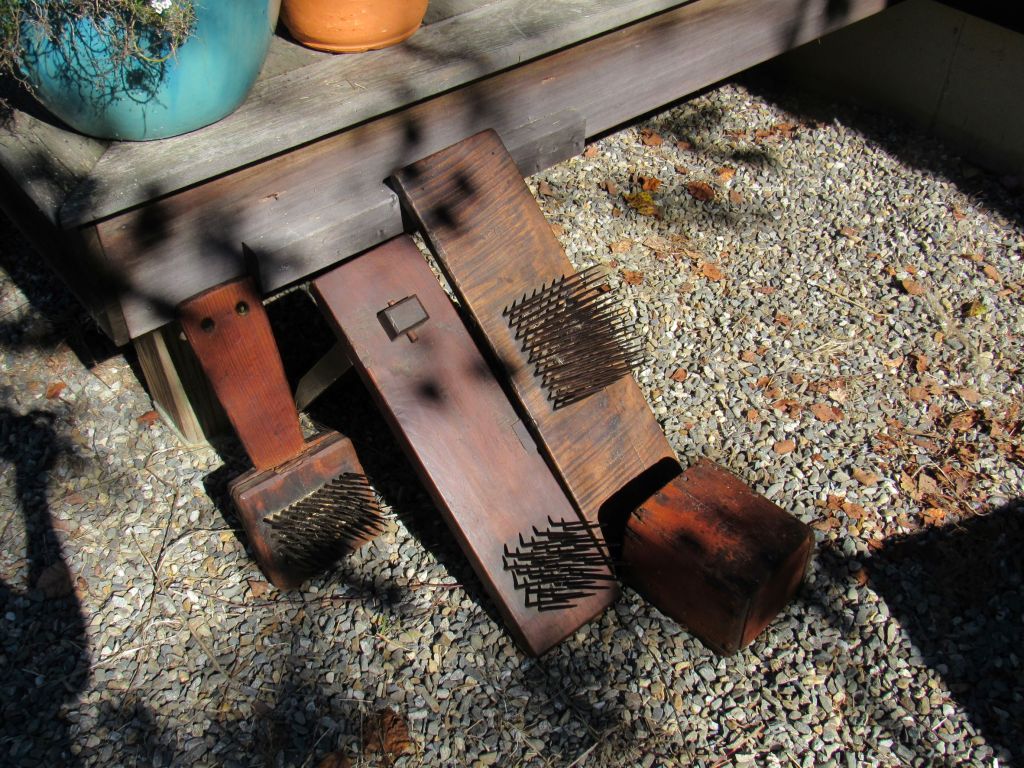
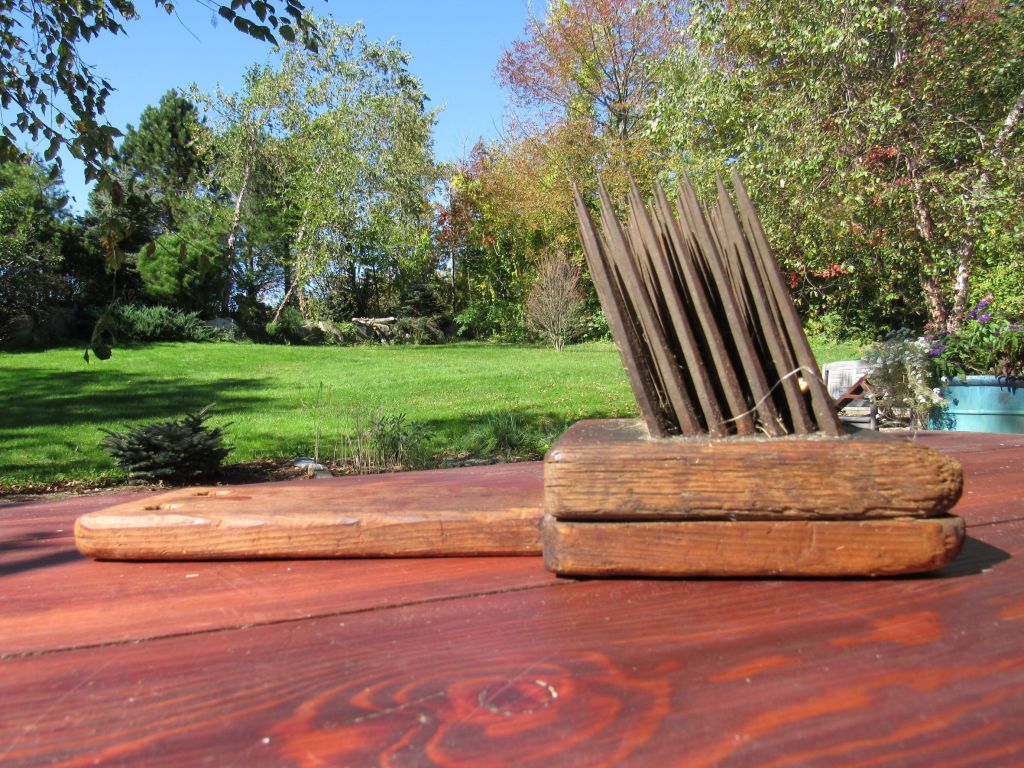
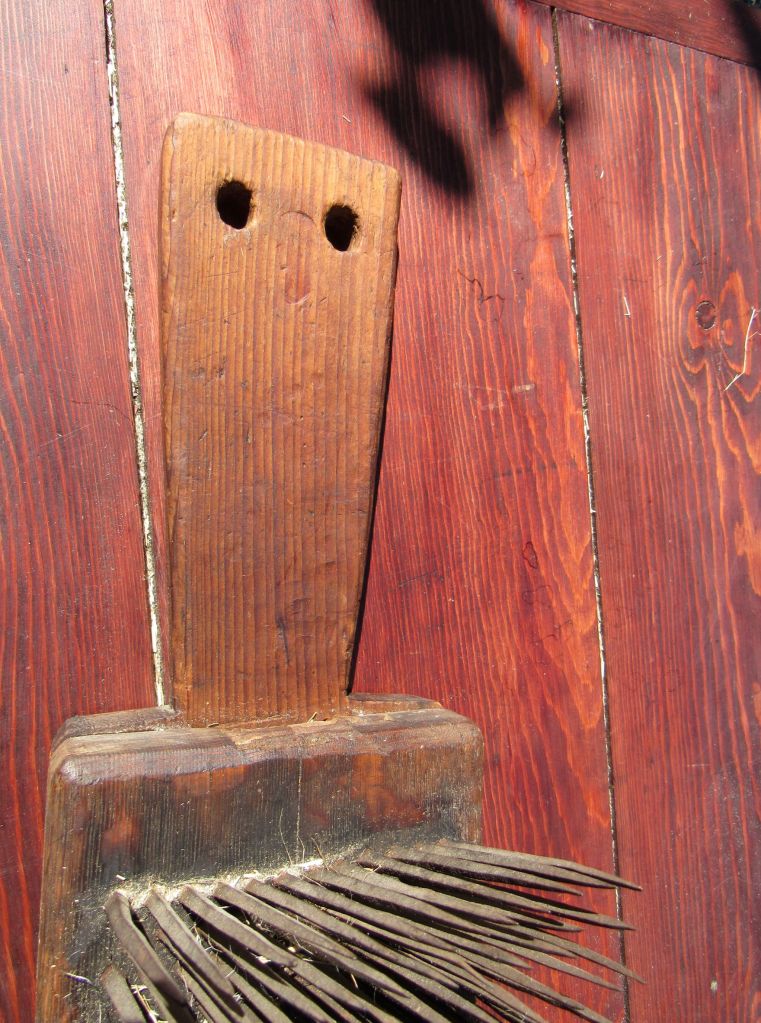
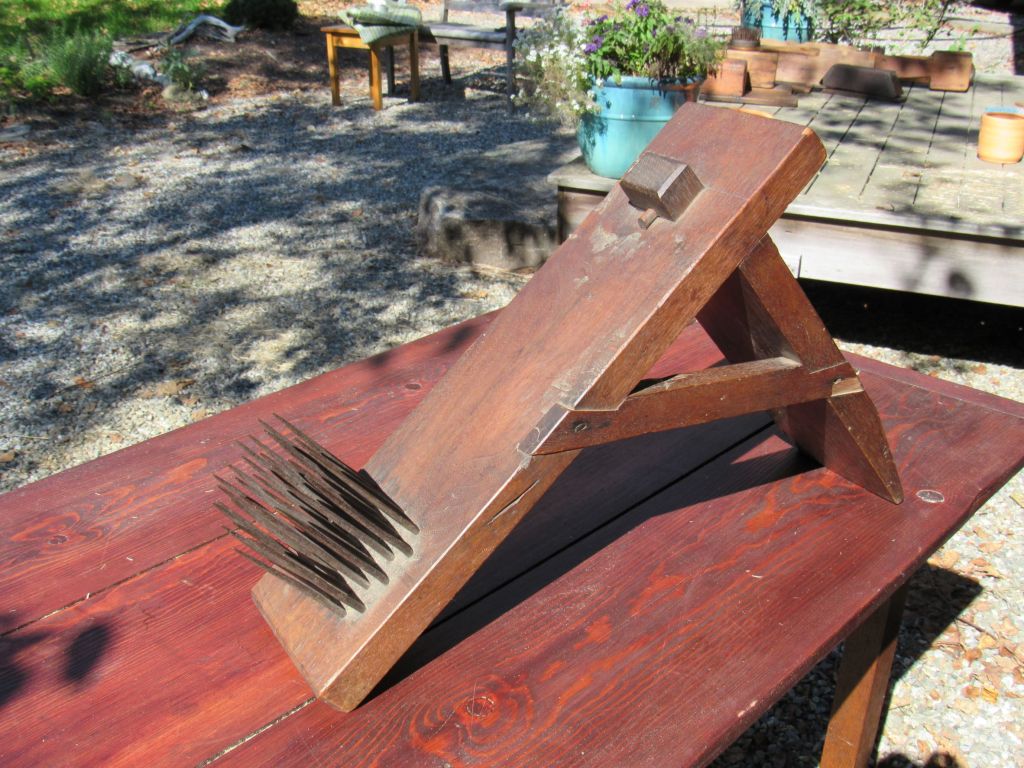
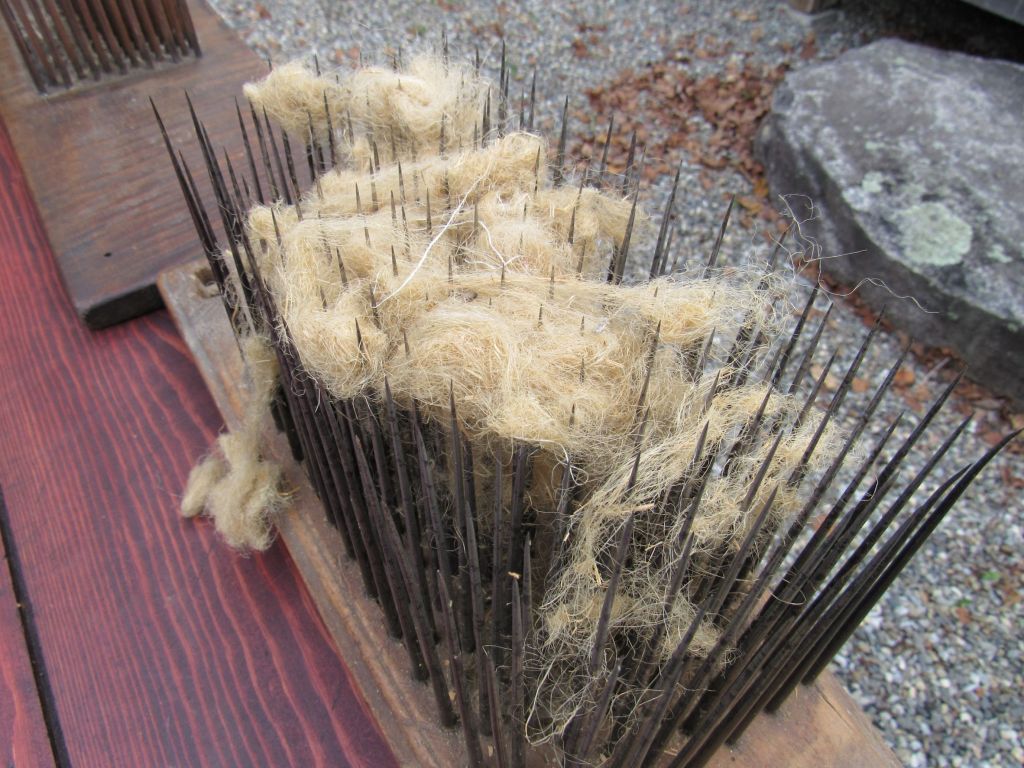
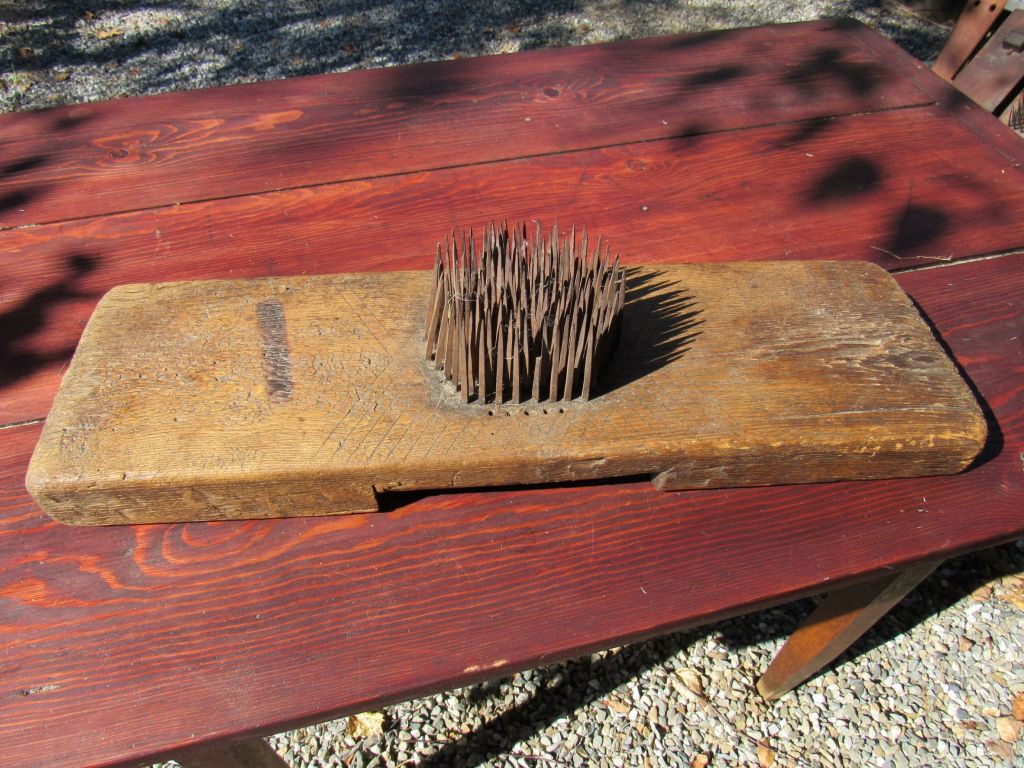
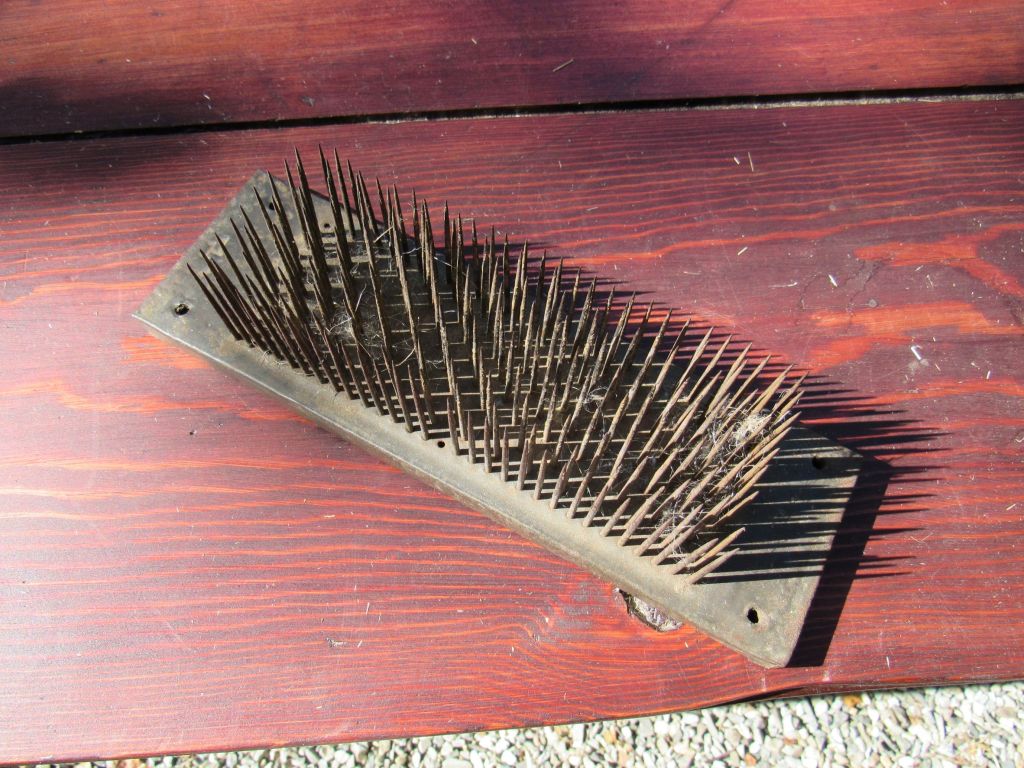
The three hackles above are a coarse grade and the ones I use for the first combing passes to remove the roughest tow and boon.  The largest has huge angled tines and a handle.

It would make a formidable weapon.

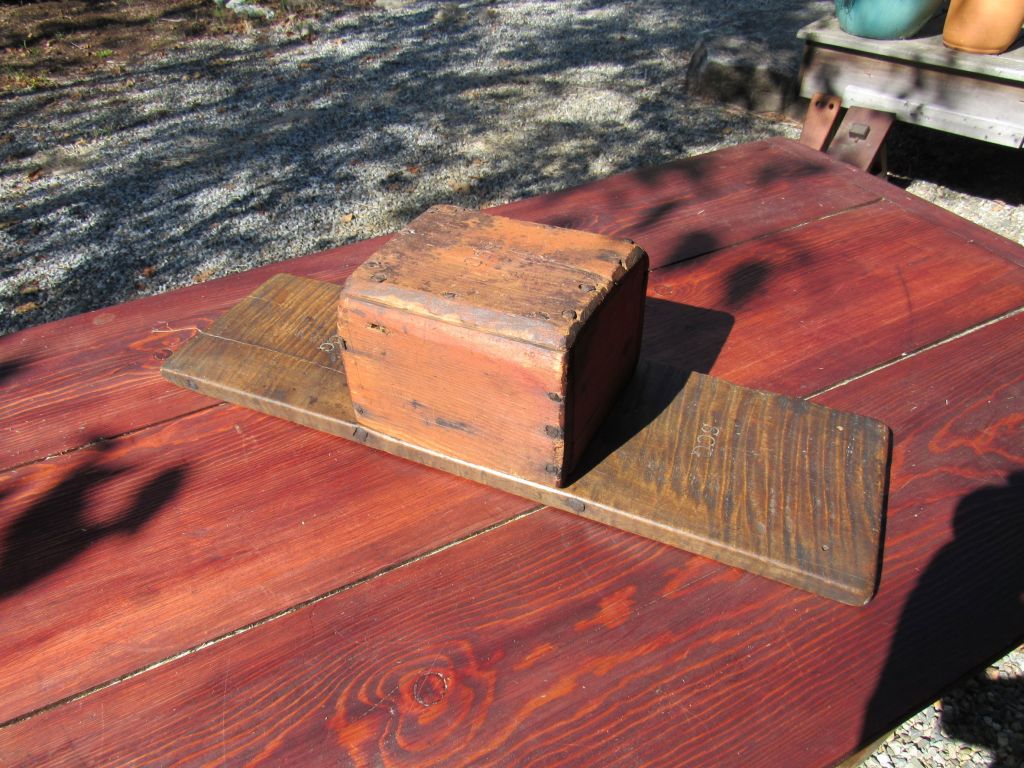
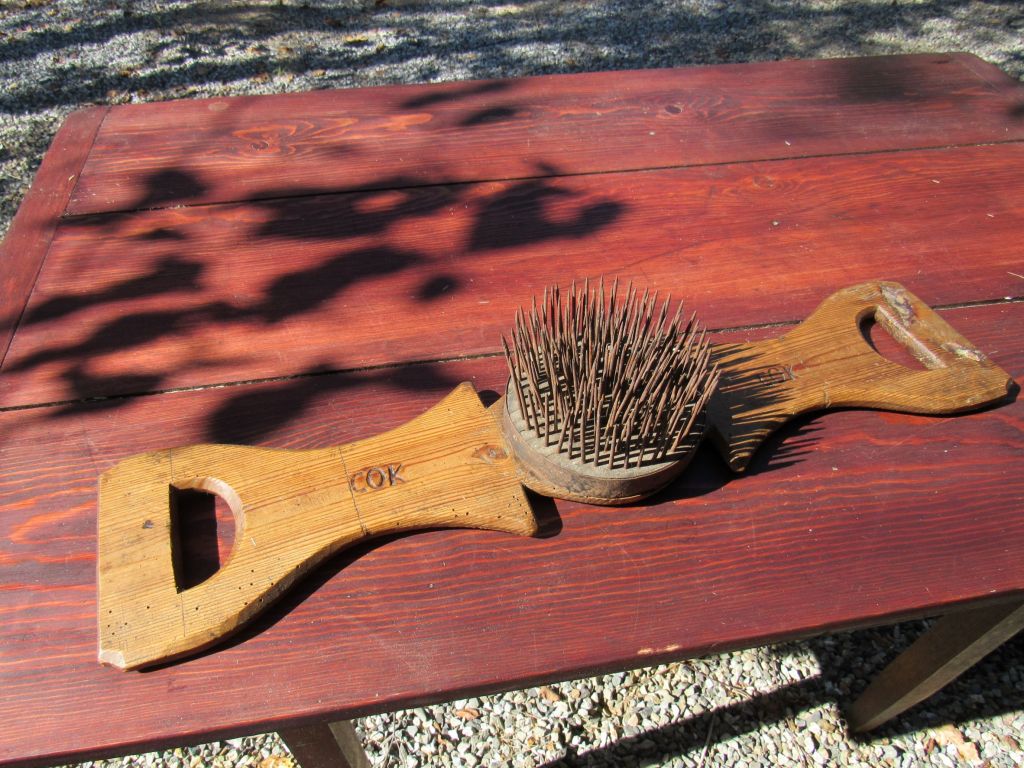
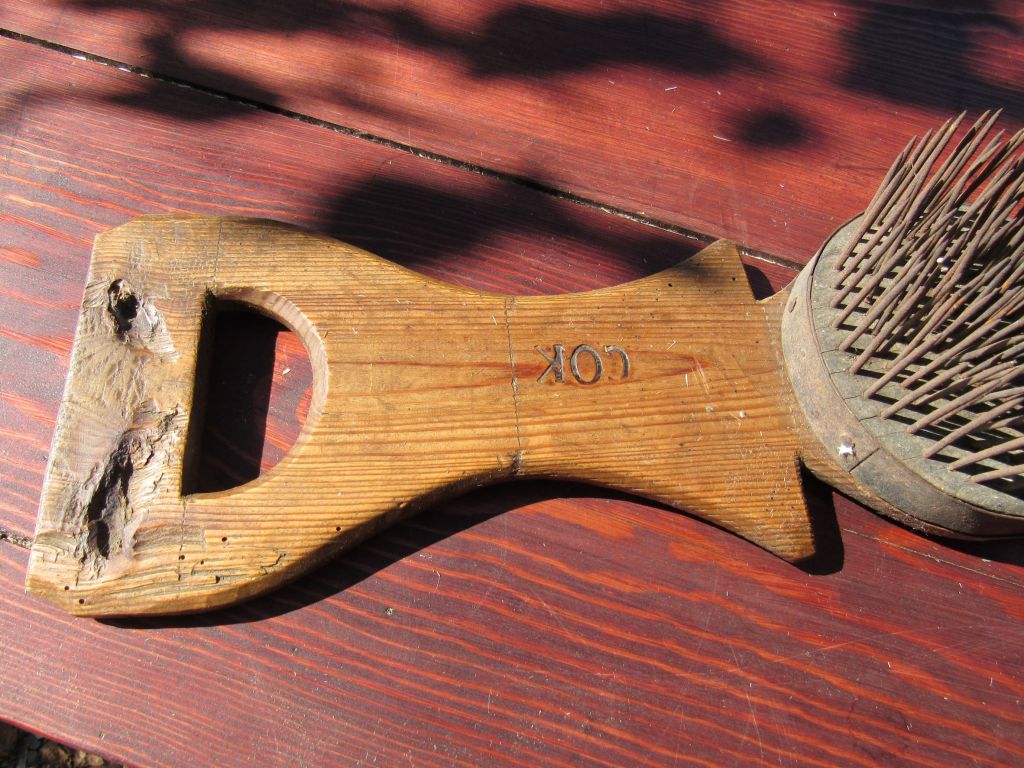
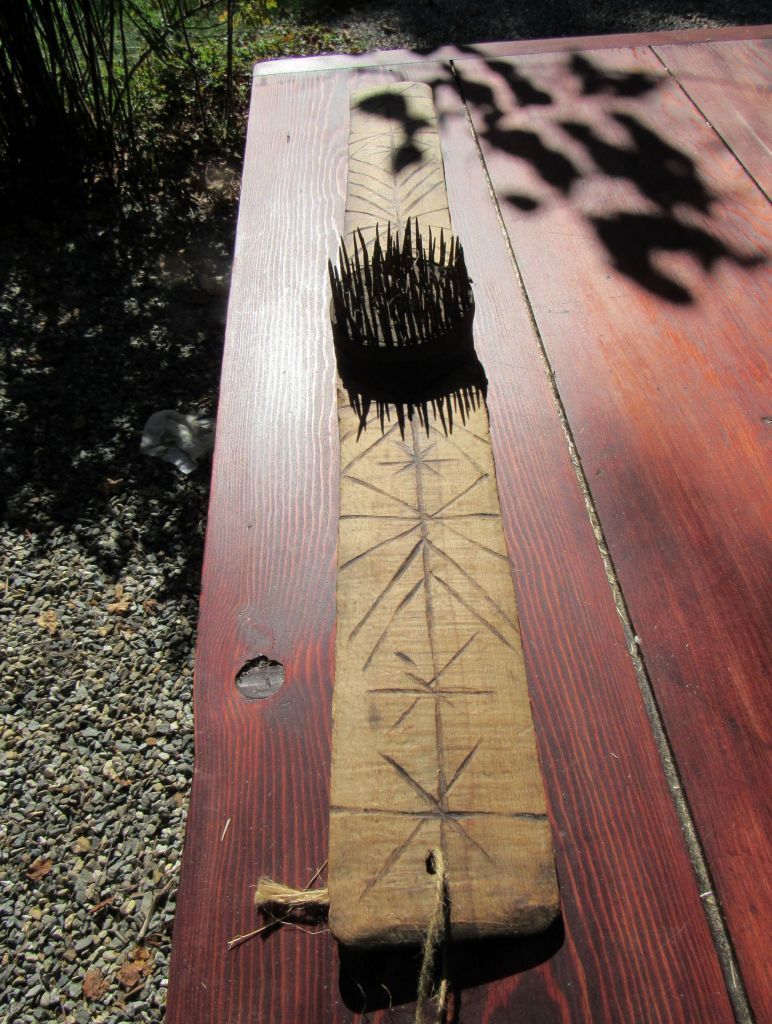
Most hackles in this country were designed to be secured to a table or plank for use.  But this one is unusual, being free-standing, which makes it easy to move around and to use while sitting.  This one is my favorite for the first comb.

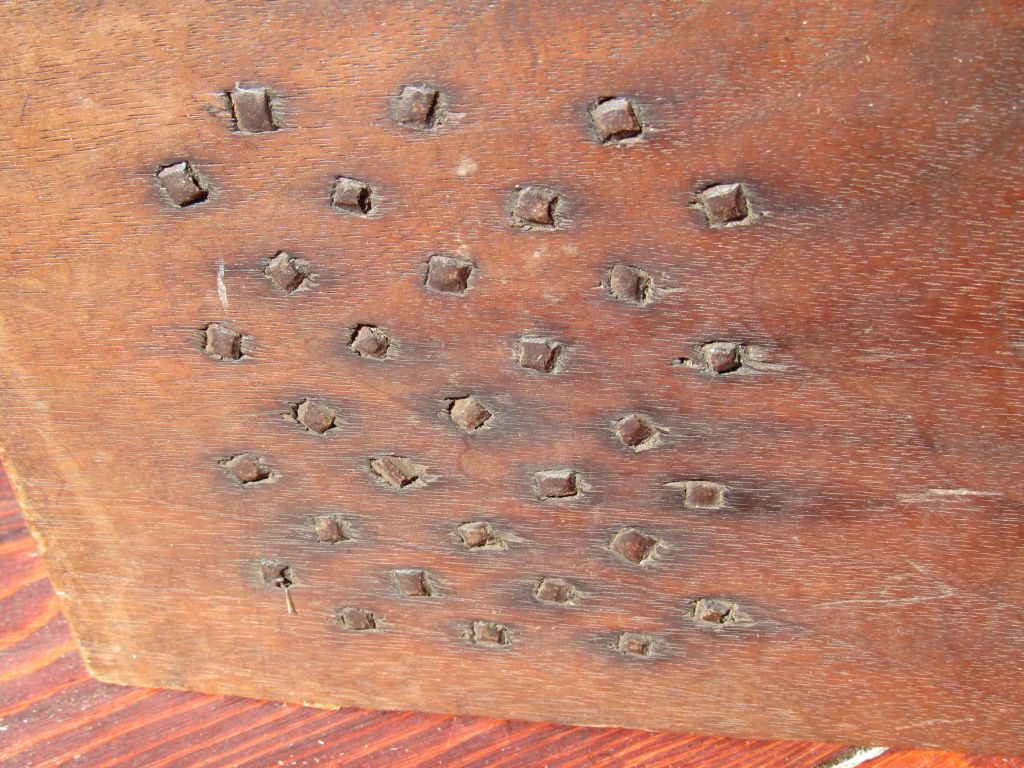
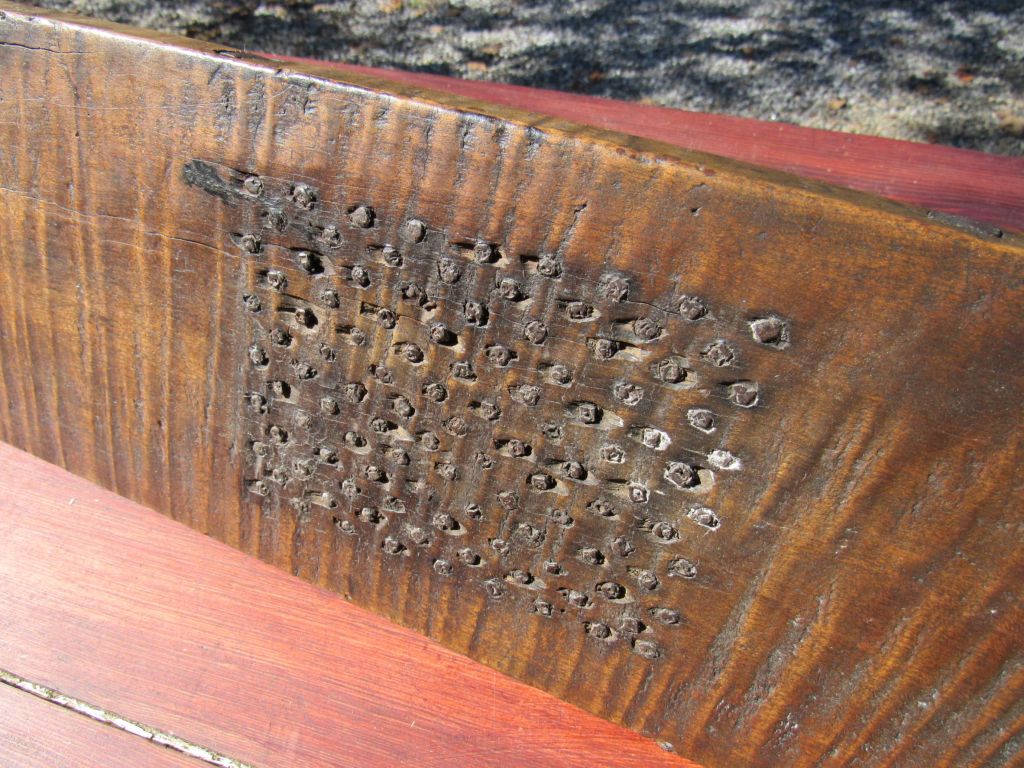
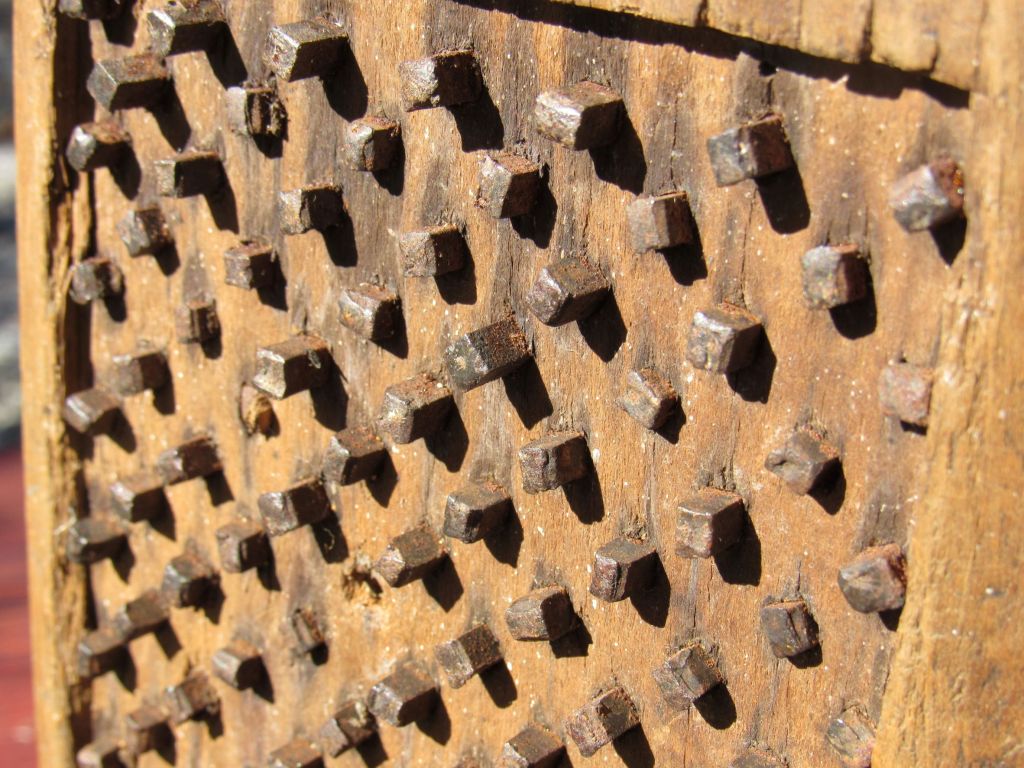
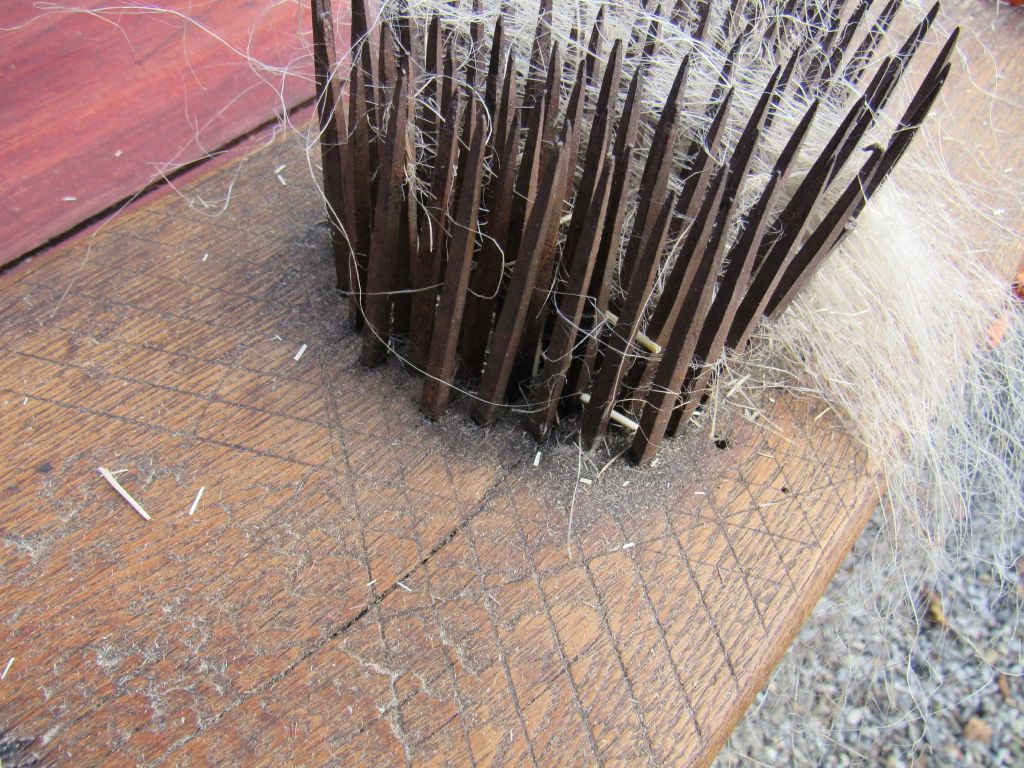
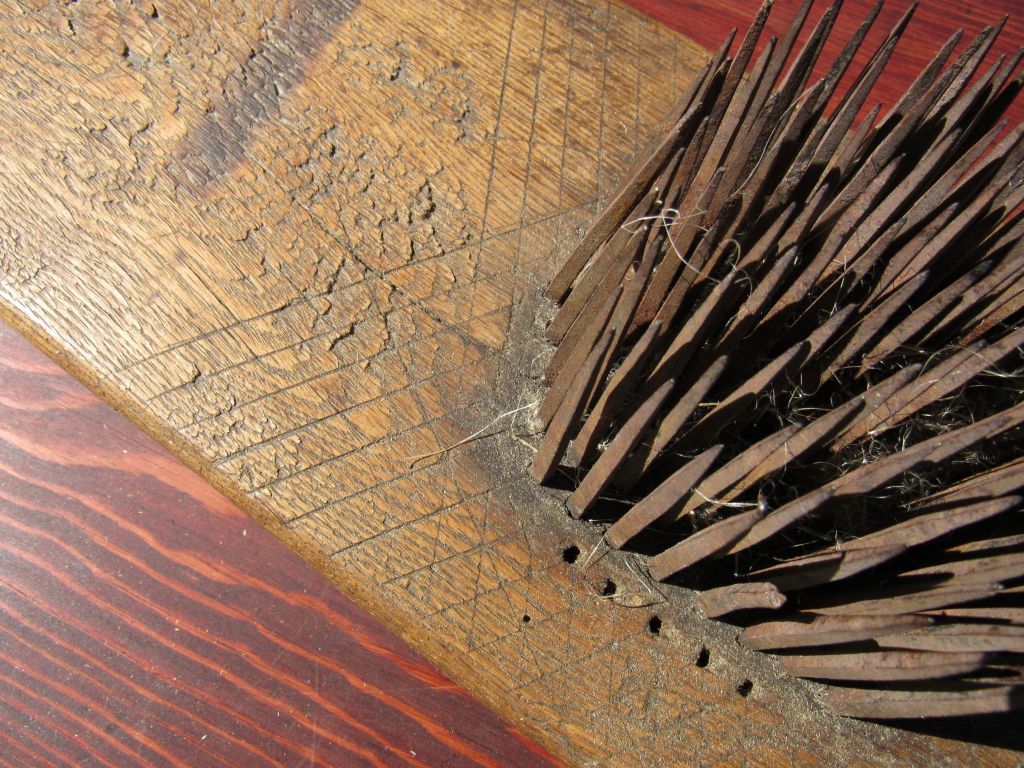
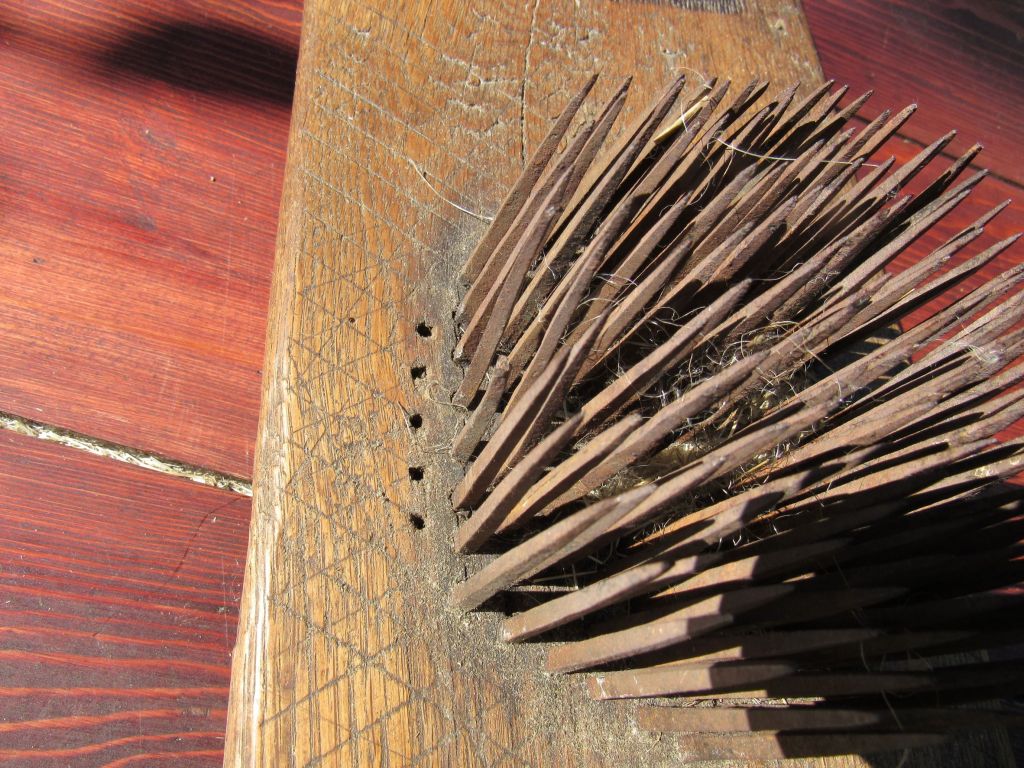
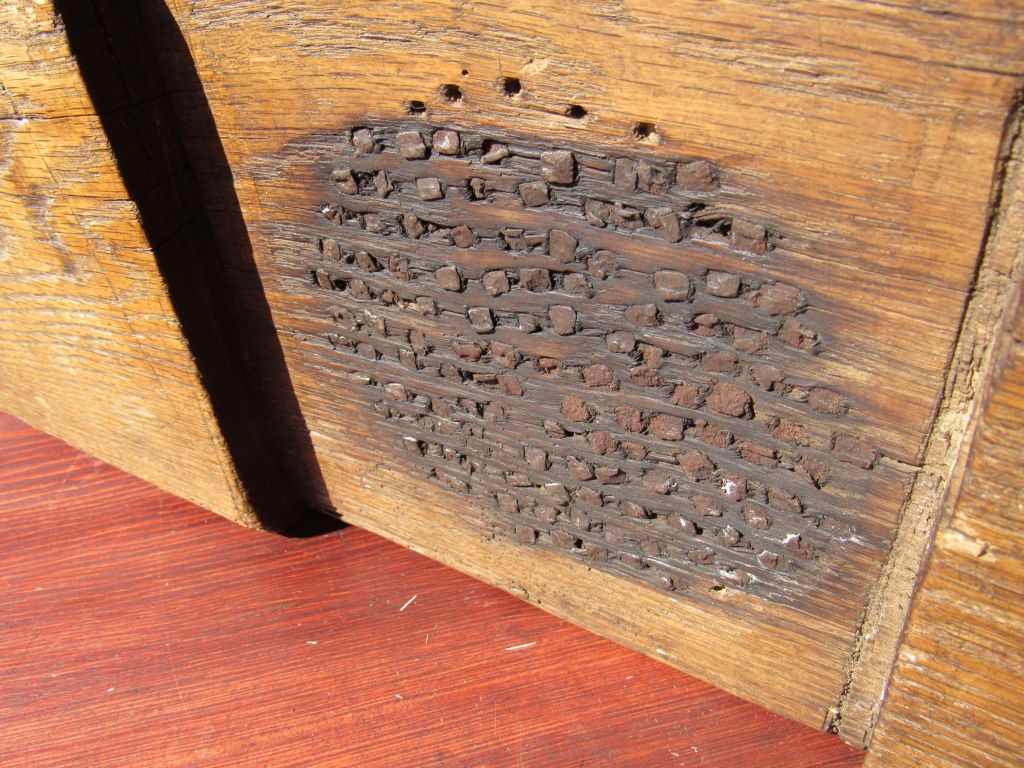
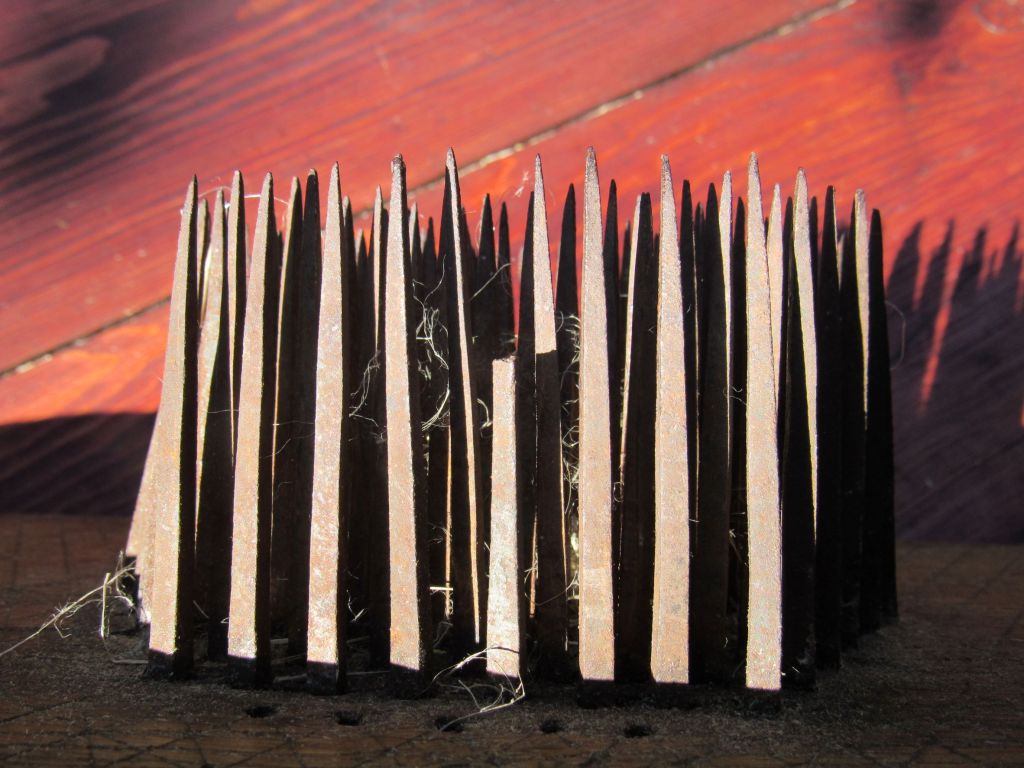
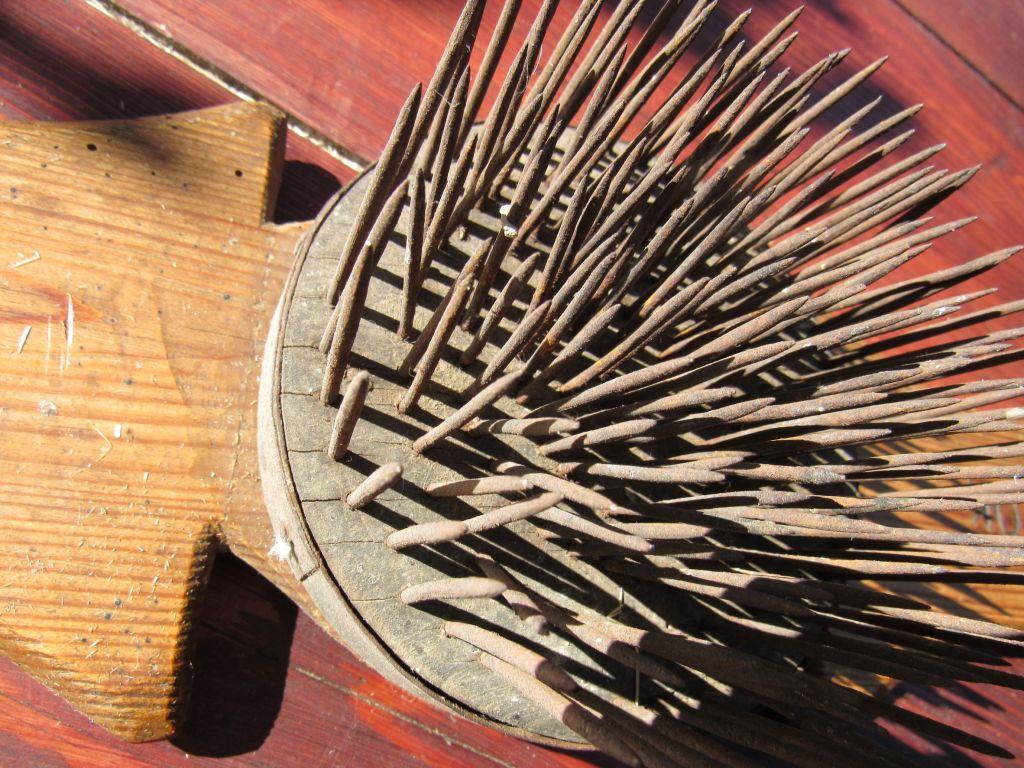
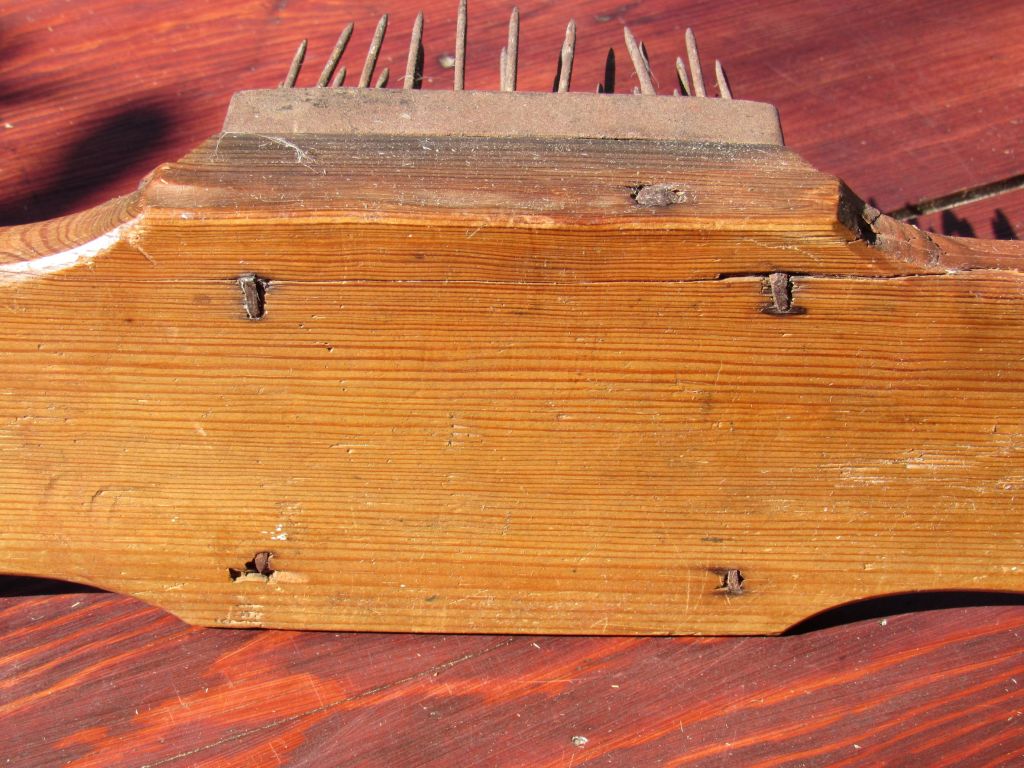
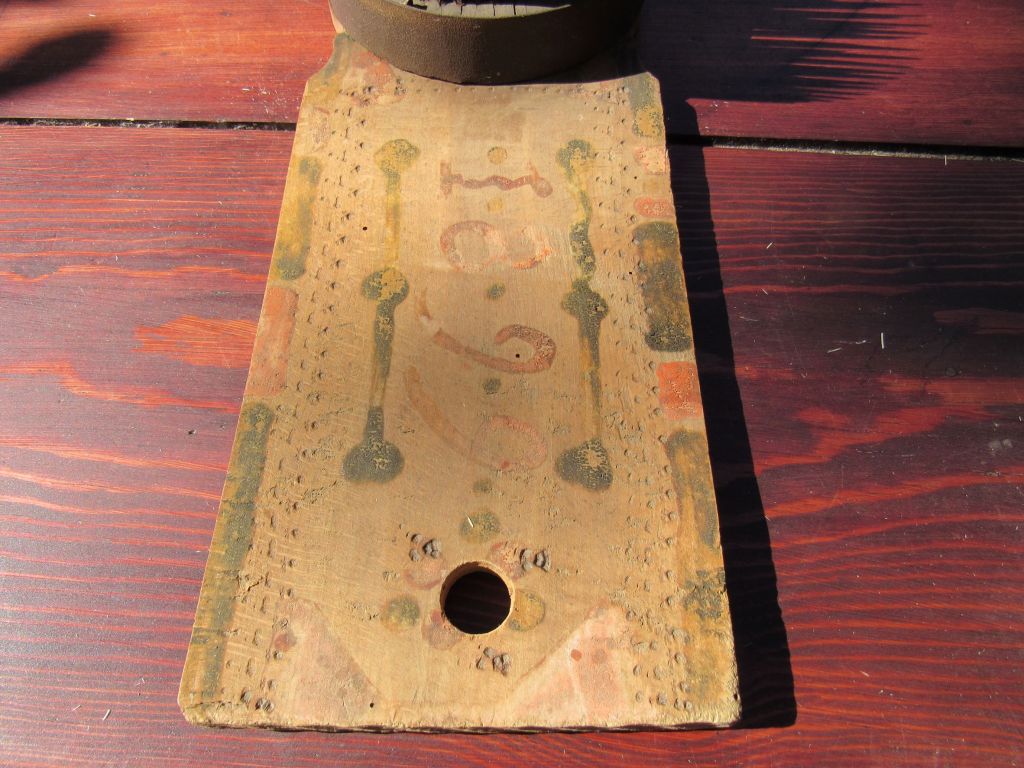
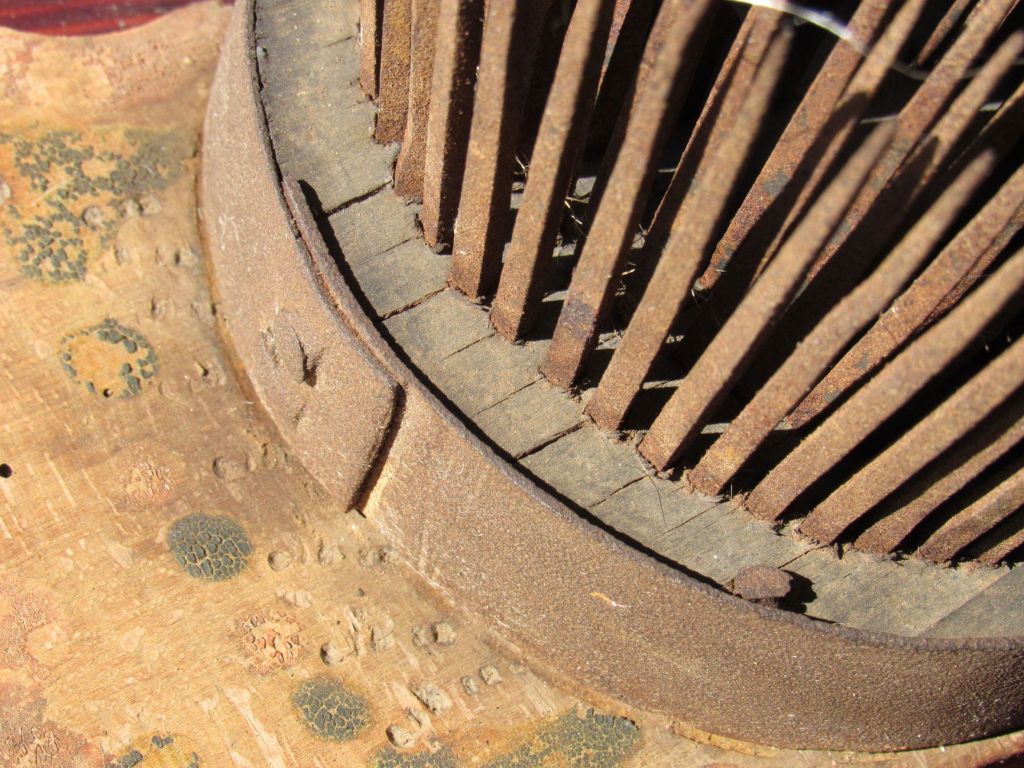
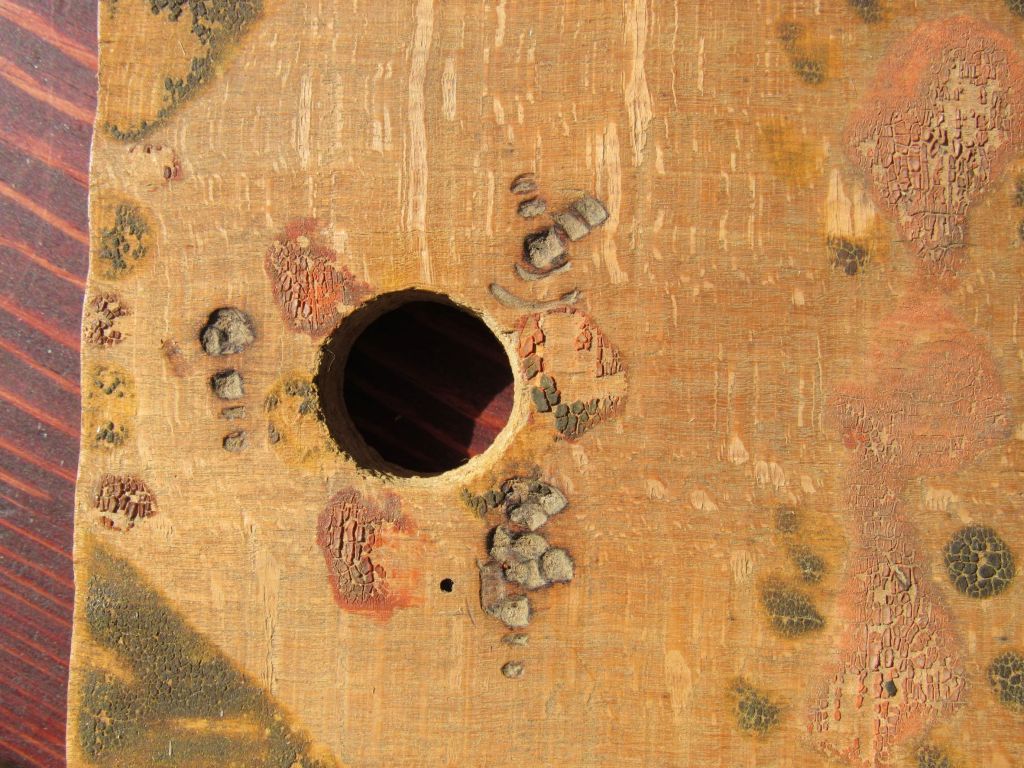
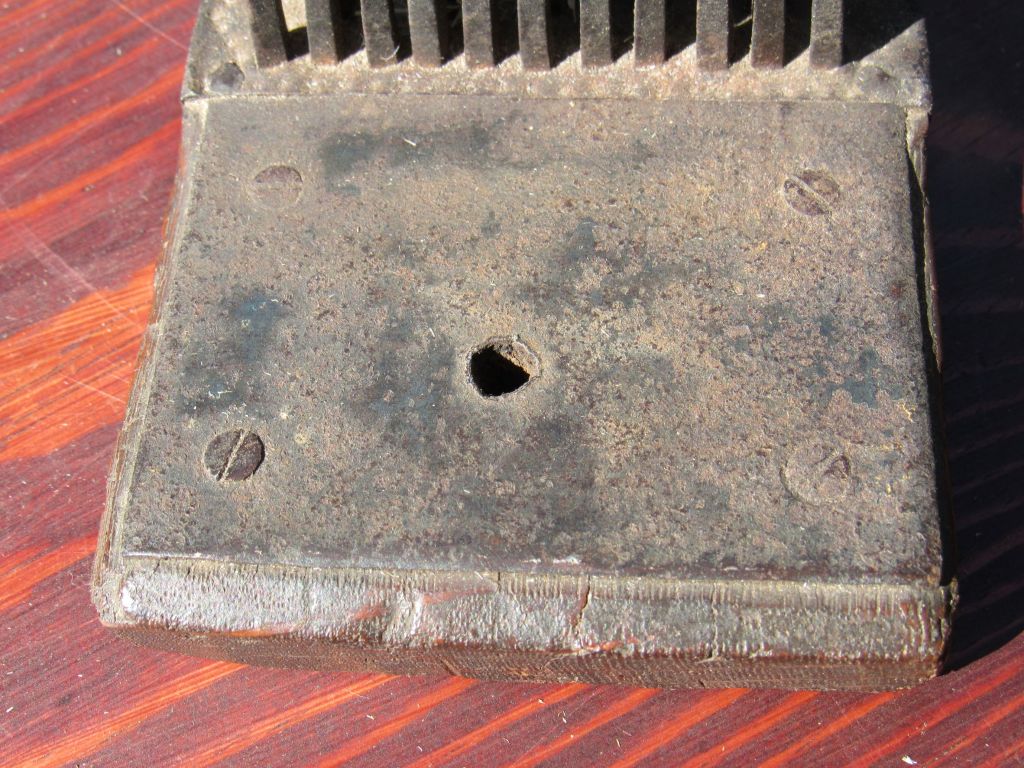
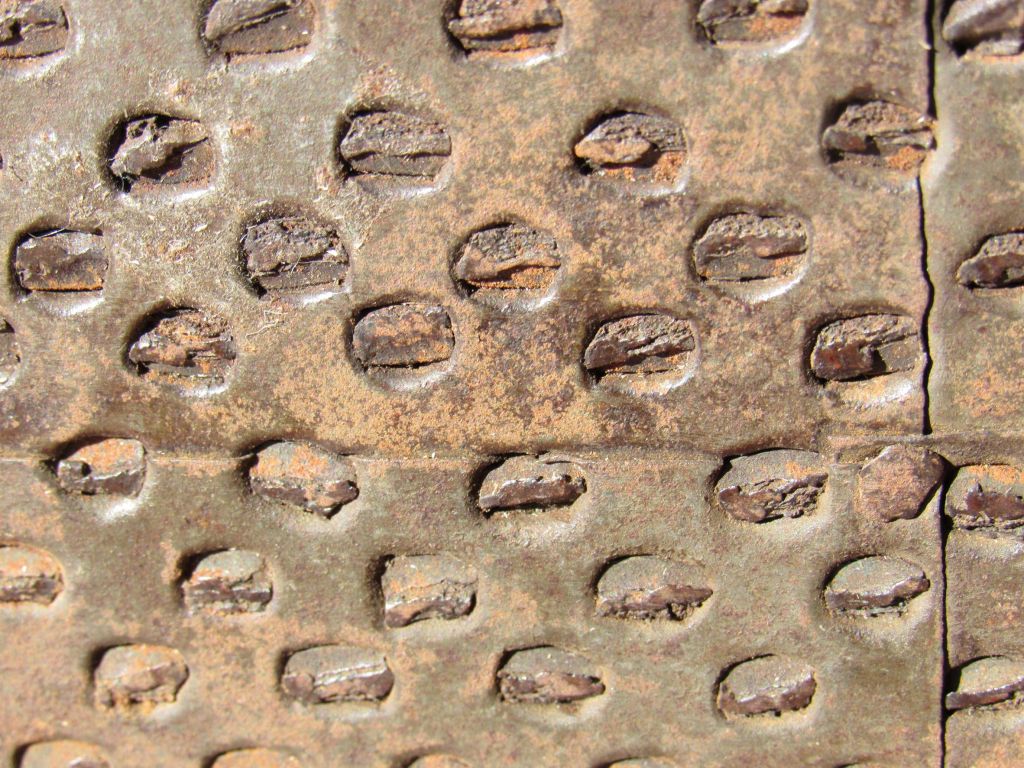
Typically, nails for tines were heated and driven through green wood, which would secure them tightly after drying.  It’s always interesting to examine the backside of hackles. I know very little about nails, unfortunately, so am unable to translate nail types into any useful information about when or where specific hackles were made.

Some tines are square, others rounded. I have not been able to determine any real pattern for the difference. Hackles from New England seem to come in both varieties.

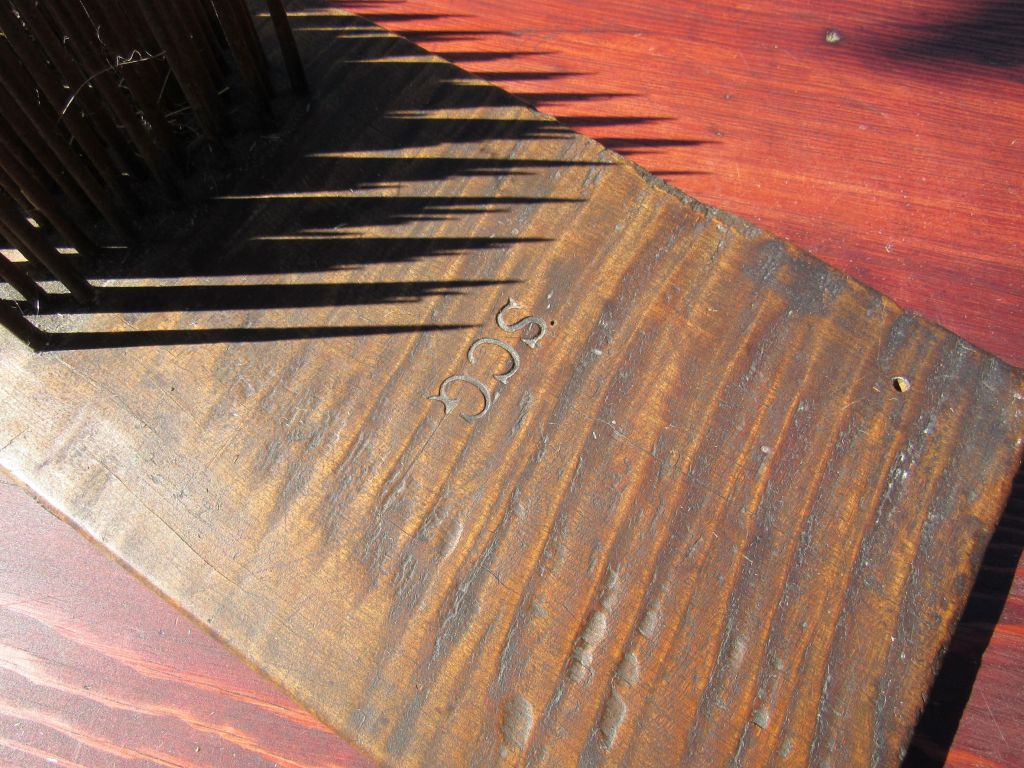
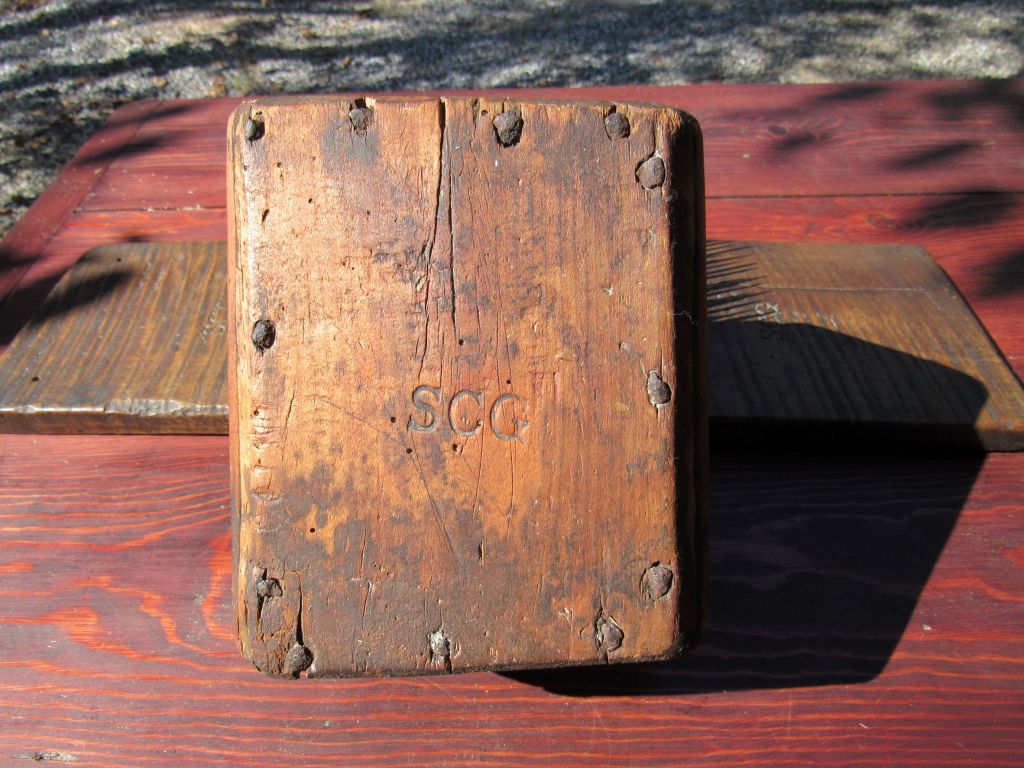
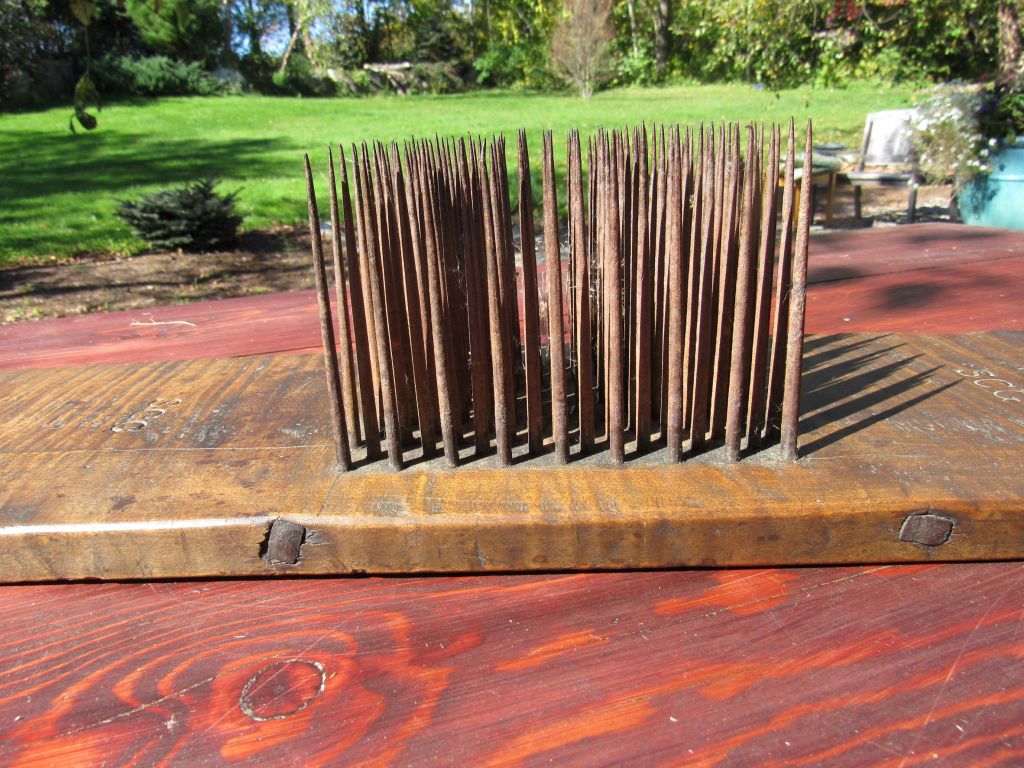
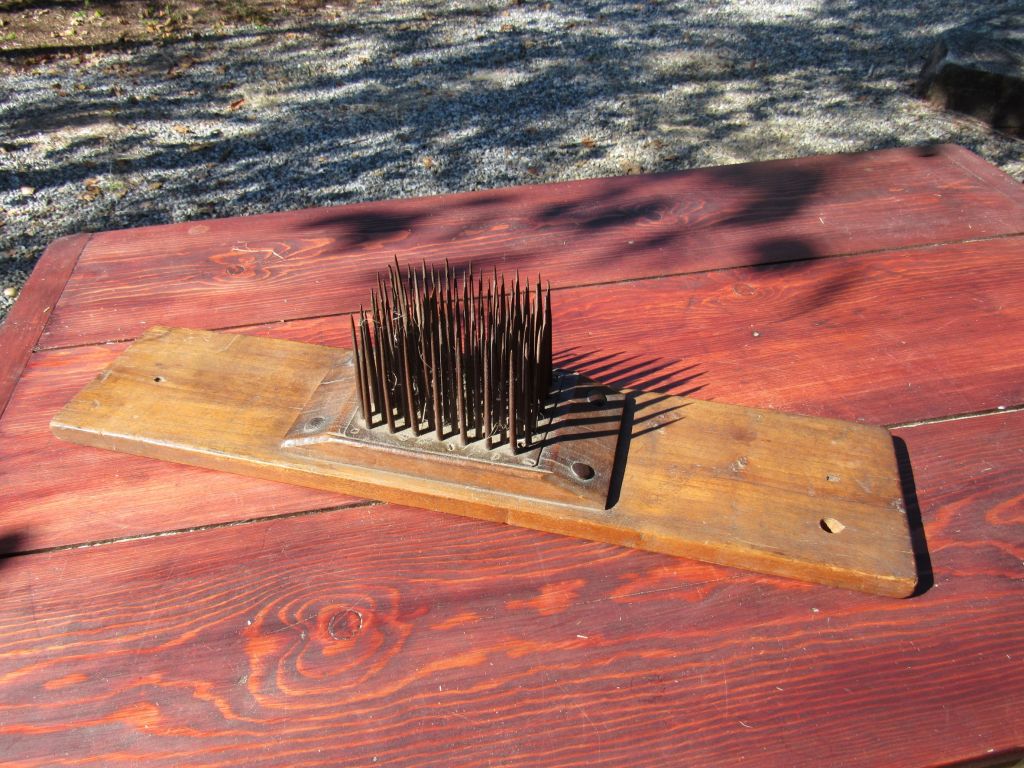
This lovely set of hackles is made of tiger maple,

is initialed,

and has a cover.

It is a coarse to medium size, with round tines.

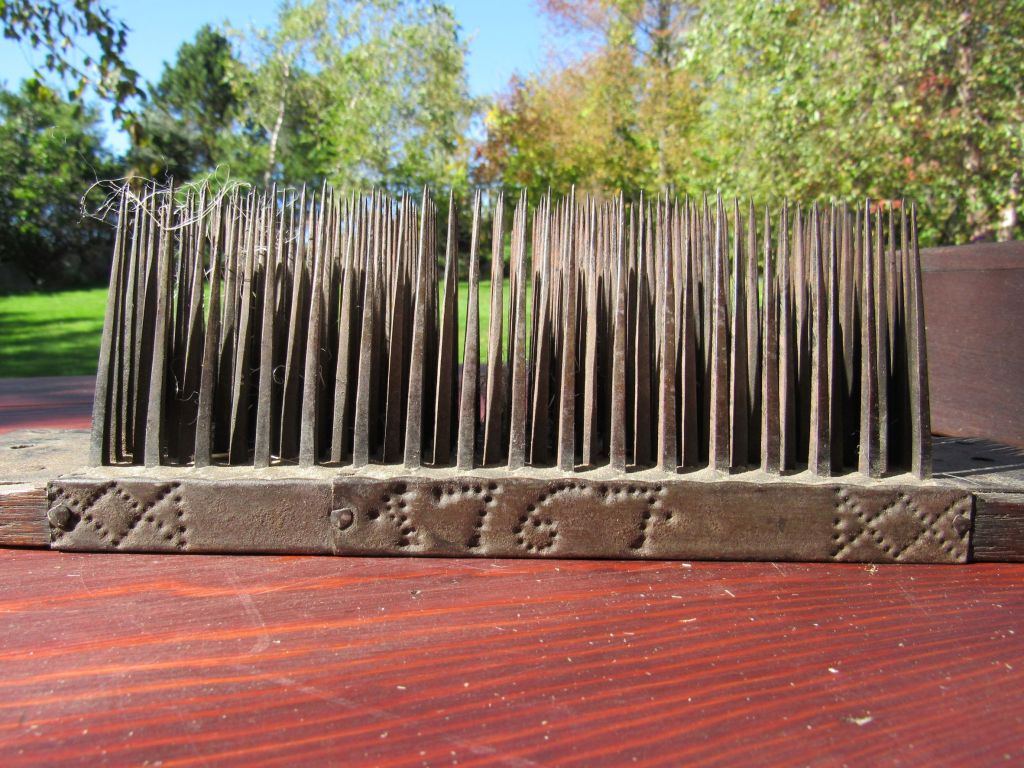
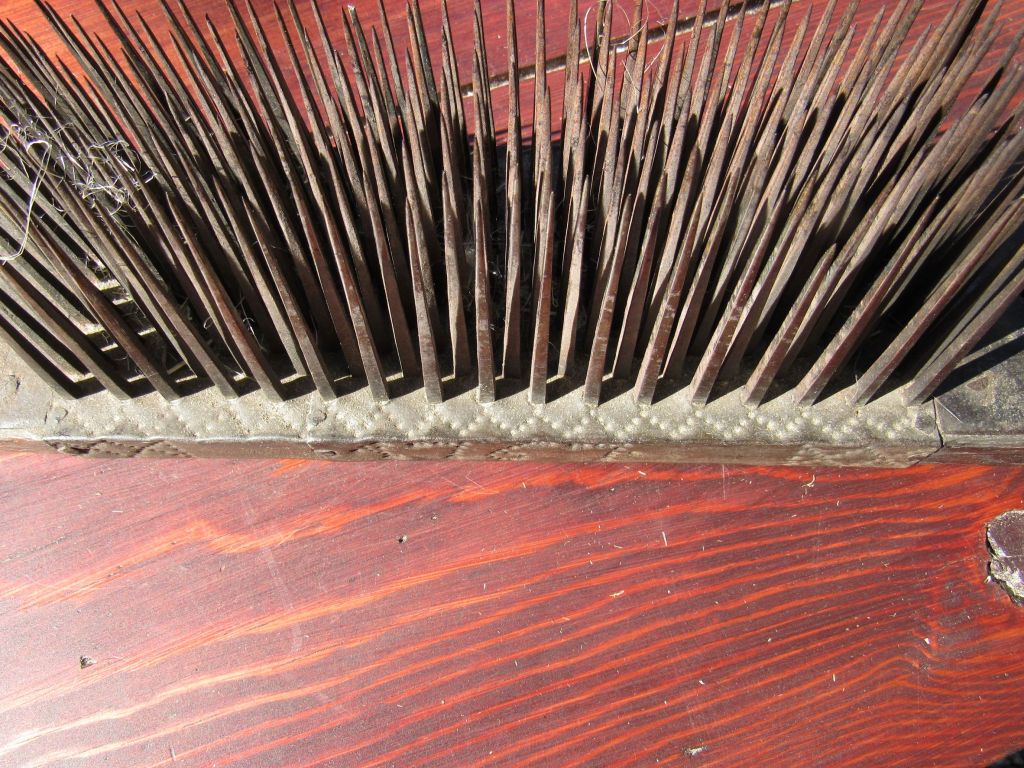
This is a nice medium set, with a sheet of metal where the tines emerge, apparently used to help keep the wood from cracking.

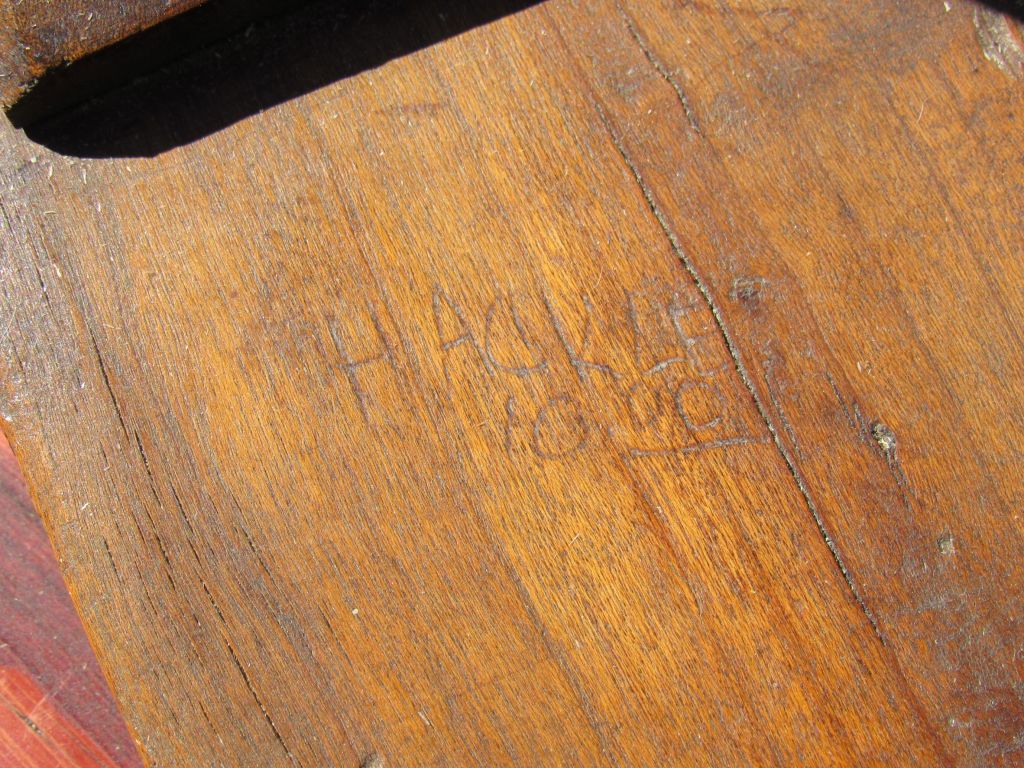
On the underside is a faint incision of “Hackle 10.00,” indicating that “hackle” probably has been the term used in this area for some time. I found it at Maine antique mall and, when I went to check out, the man behind the counter asked if I had seen the other set with a cover. I hadn’t and what a treasure it turned out to be.

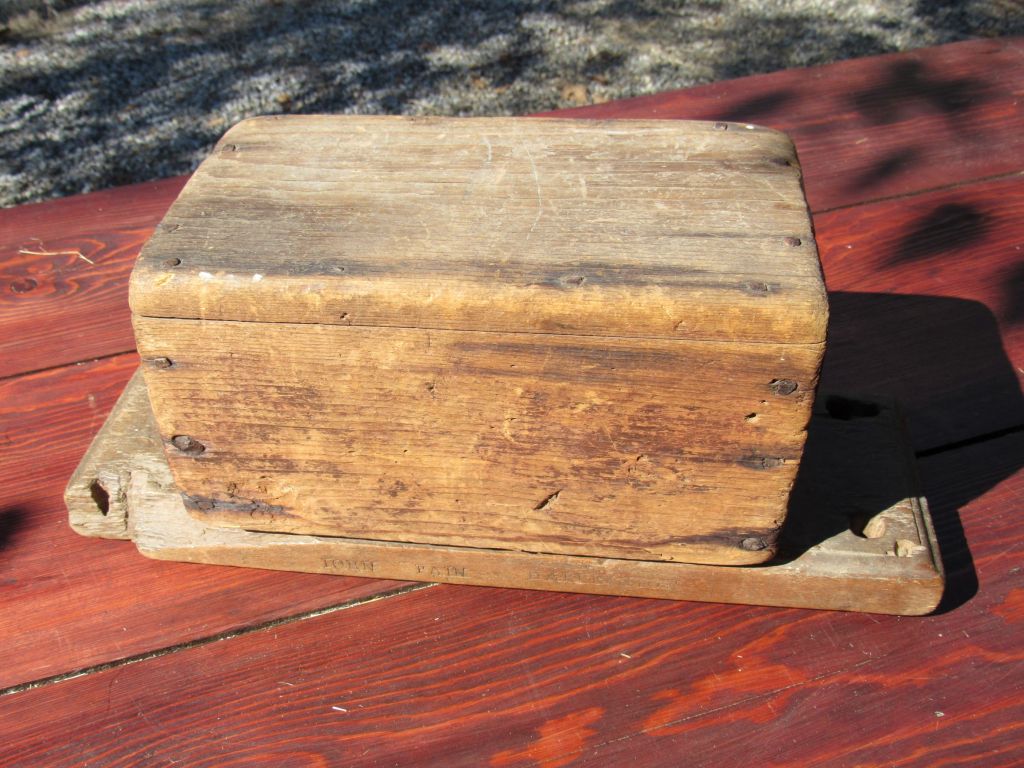
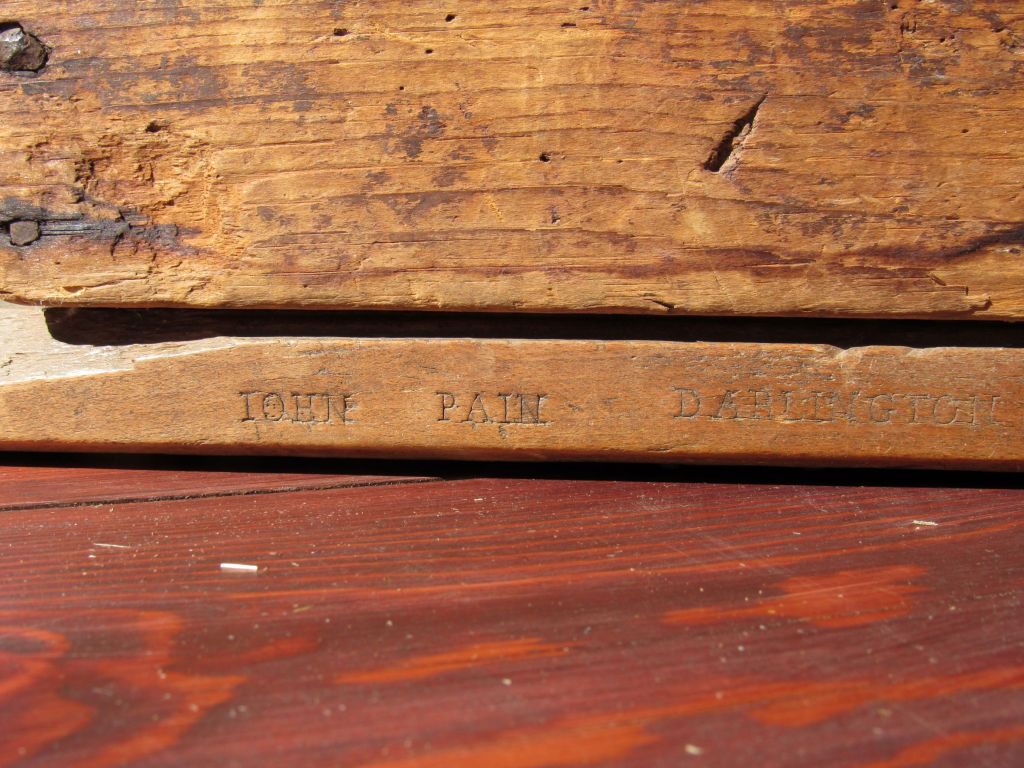
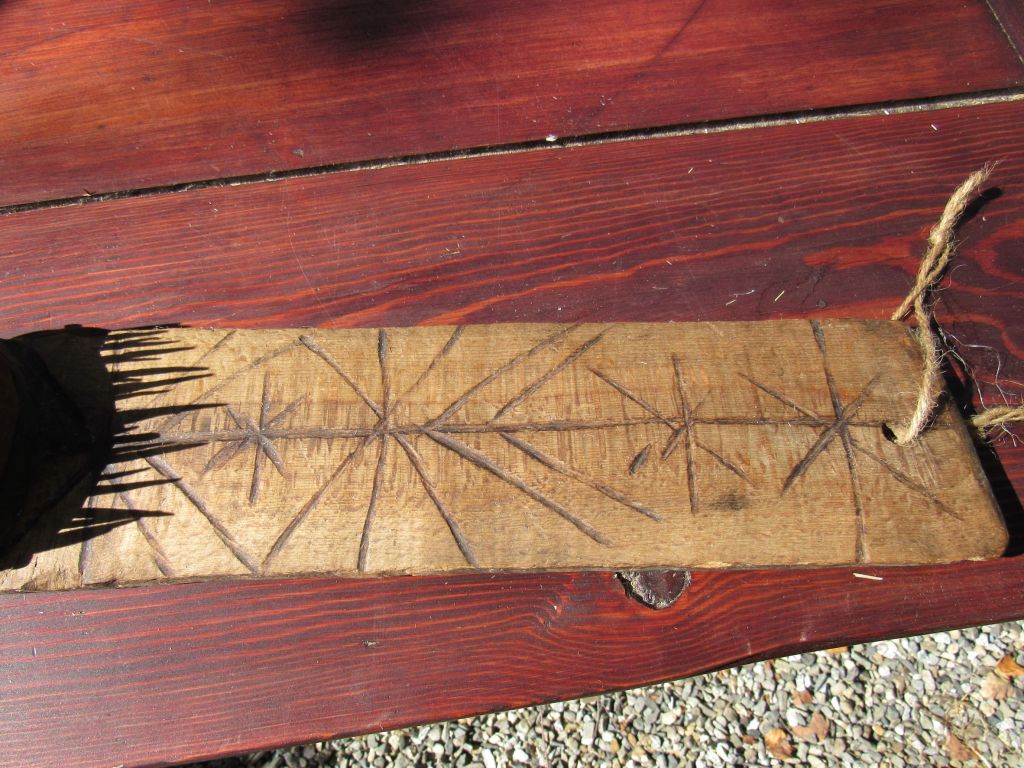
One side has the name “John Pain Darlington.”

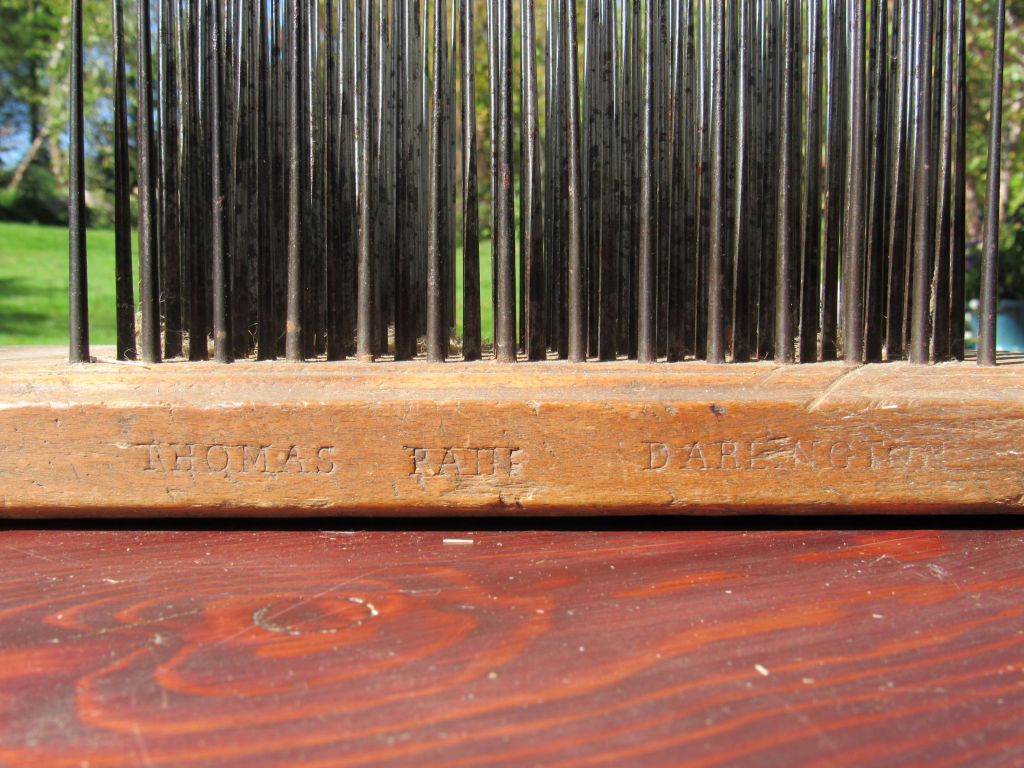
On the other side, is the name “Thomas Paine Darlington.” Darlington is an old Maine name, but I have not yet pinned these two down. Given the “Thomas Paine,” I’m hoping this dates from the 1700s. (See Update below for more information.)

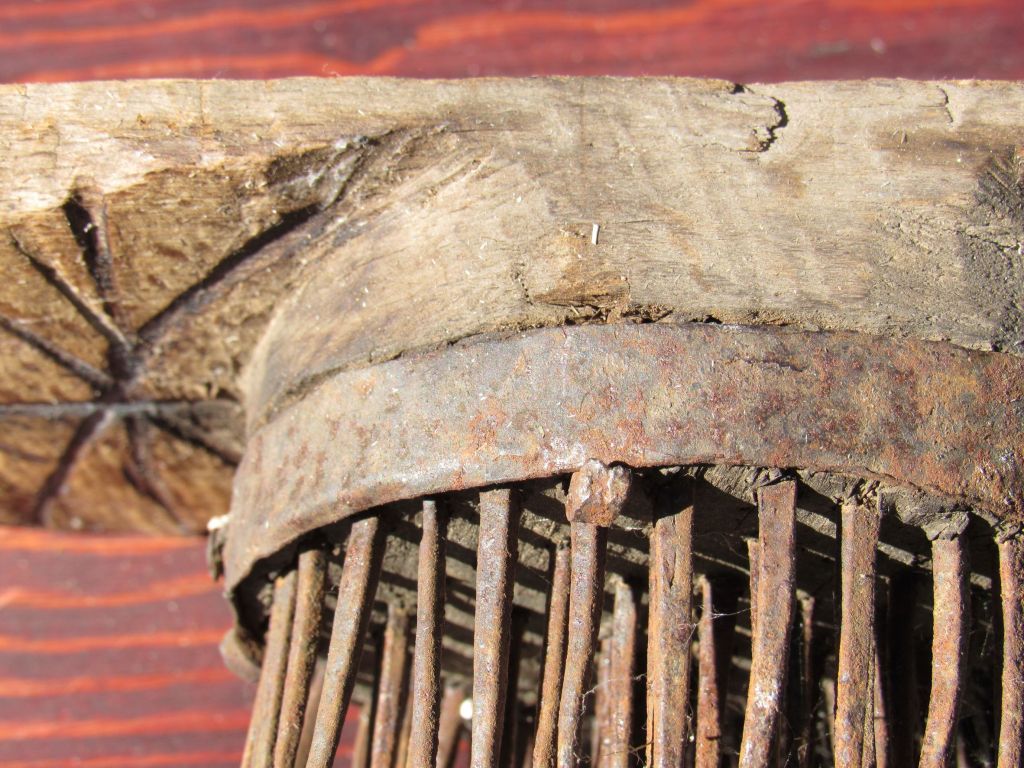
The back side is amazing. And when the cover was lifted, the longest, sharpest tines I have ever seen were revealed.

The cover inside is scarred from the tines, as are all the hackle covers that I have seen.

There was old flax on it when I bought it, complete with pieces of boon.

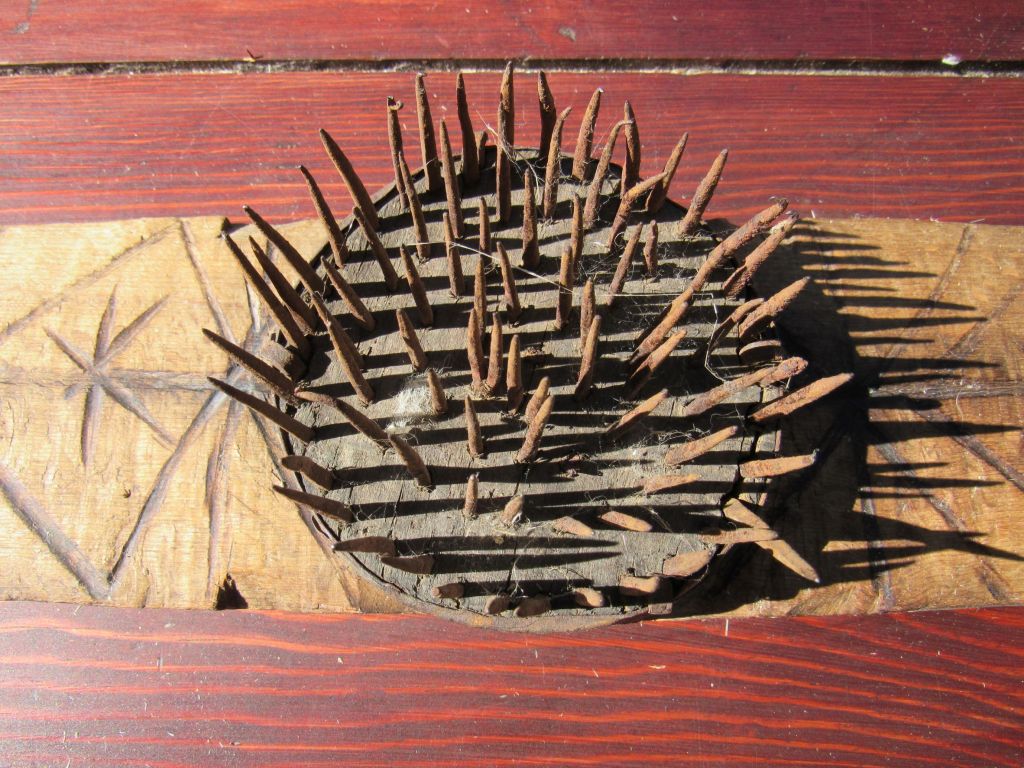
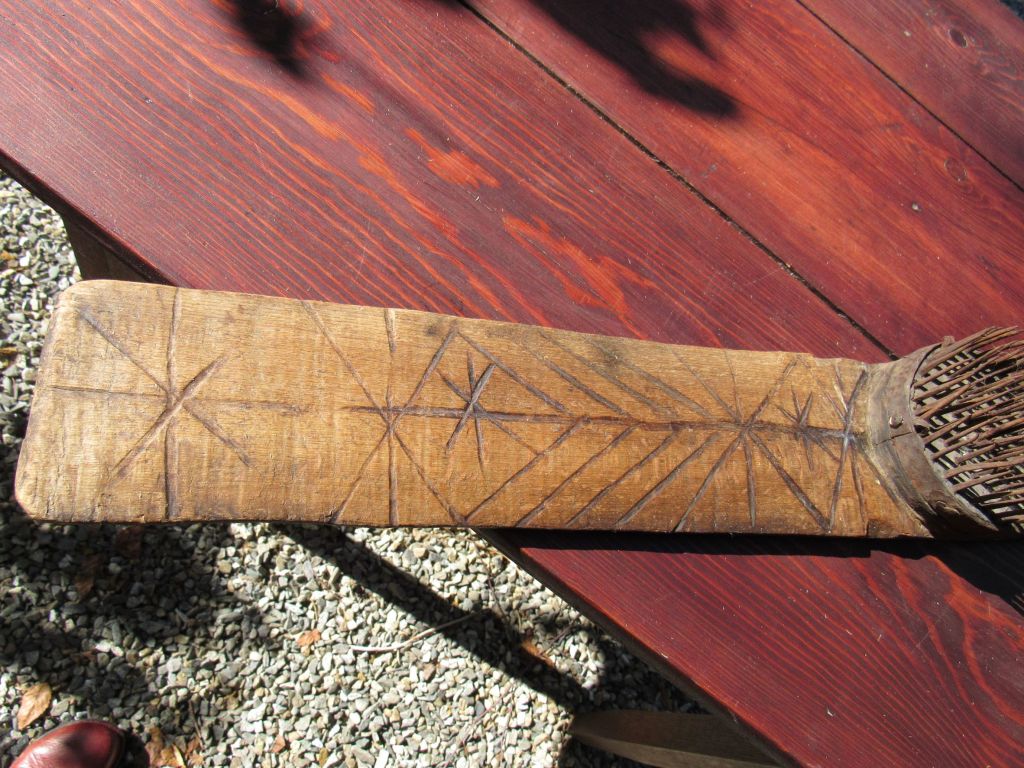
Most of the New England hackles I have seen have tines in a square or rectangular pattern. The one below one has a circle of tines, something more often seen in European and Scandinavian hackles.

It is on a thick plank of coarsely-grained wood, perhaps chestnut, with amazing scribe lines marking tine placement.

The blank holes probably were pre-drilled and then left empty, as shown by the darkened area on the underside, perhaps a result of heated nails.

The next two hackles are European, probably Scandinavian.

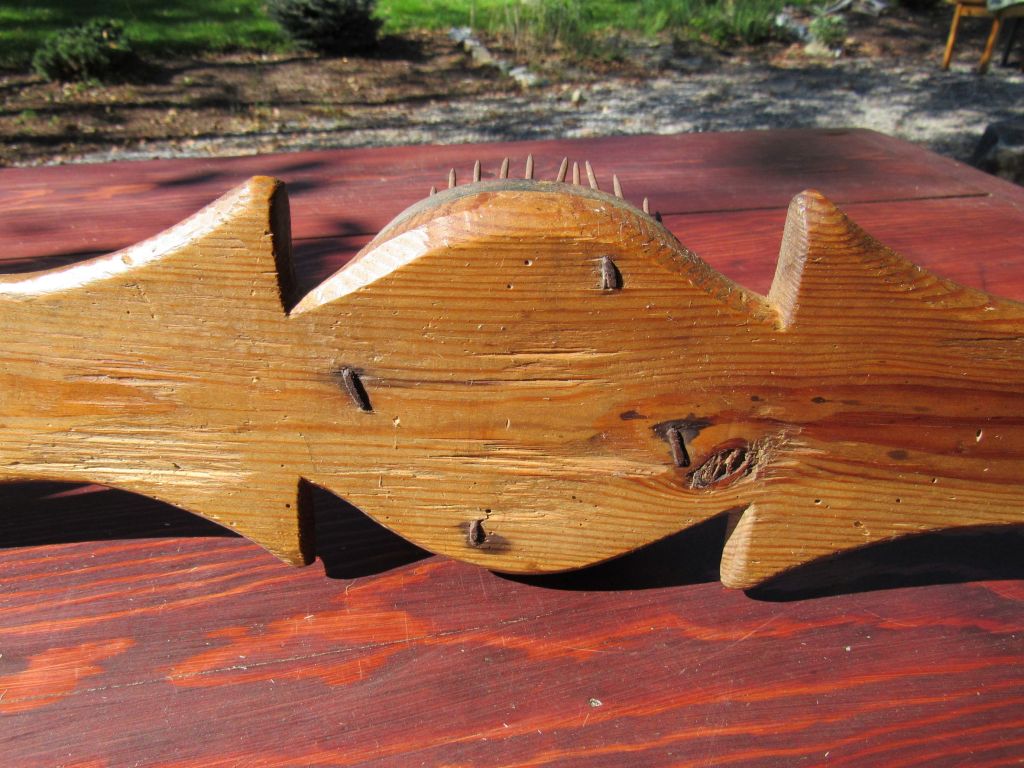
This style hackle was used while seated, held at an angle between the legs, anchored with a foot or board at the lower opening.

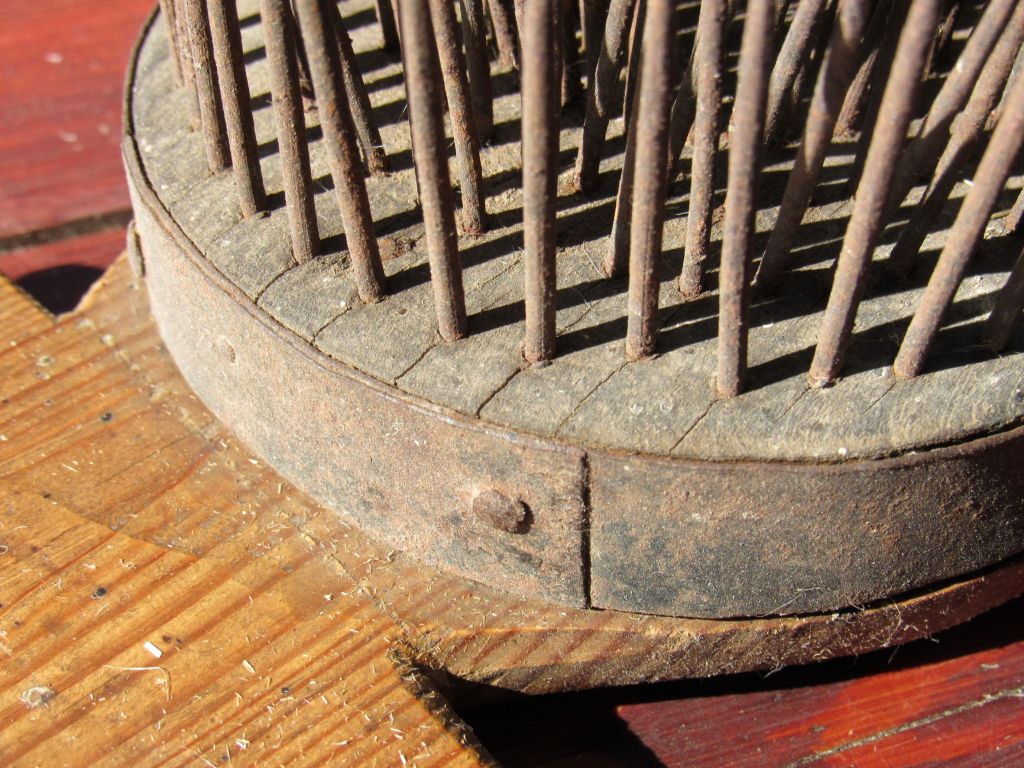
This style, with nails emerging through a separate wooden disc secured by a metal band, does not seem to hold the tines as securely as those where the nails are driven through the body of the hackle itself. As a result, the tines become skewed with use.

The tine disc is held to the body with nails bent over in the back.

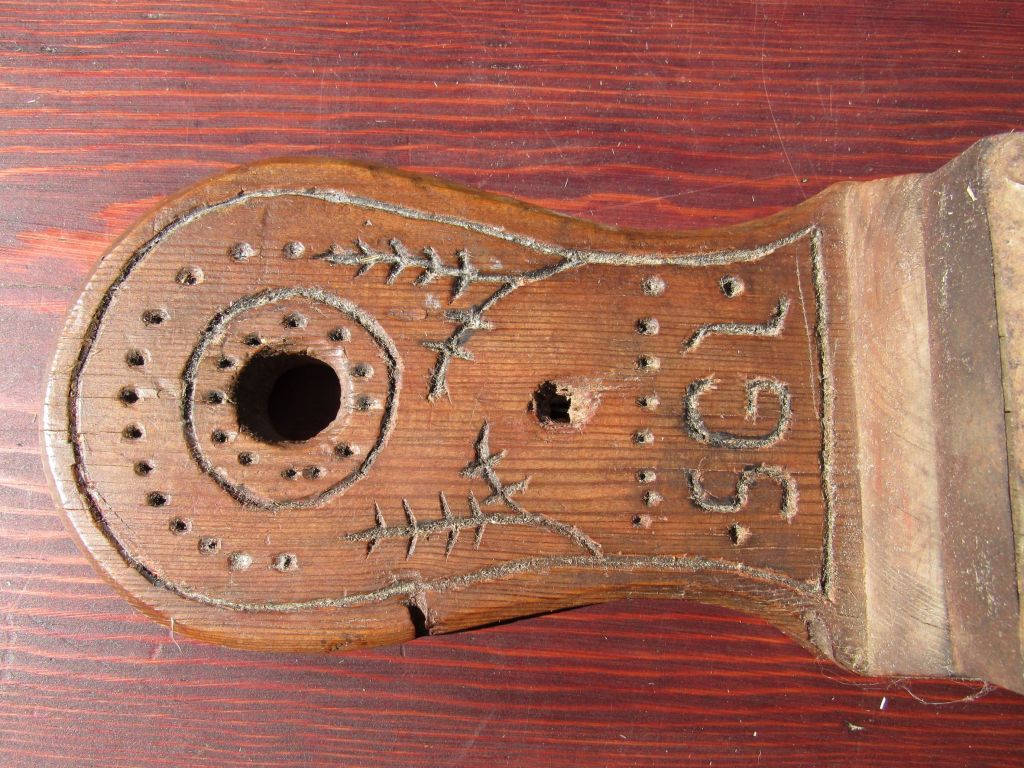
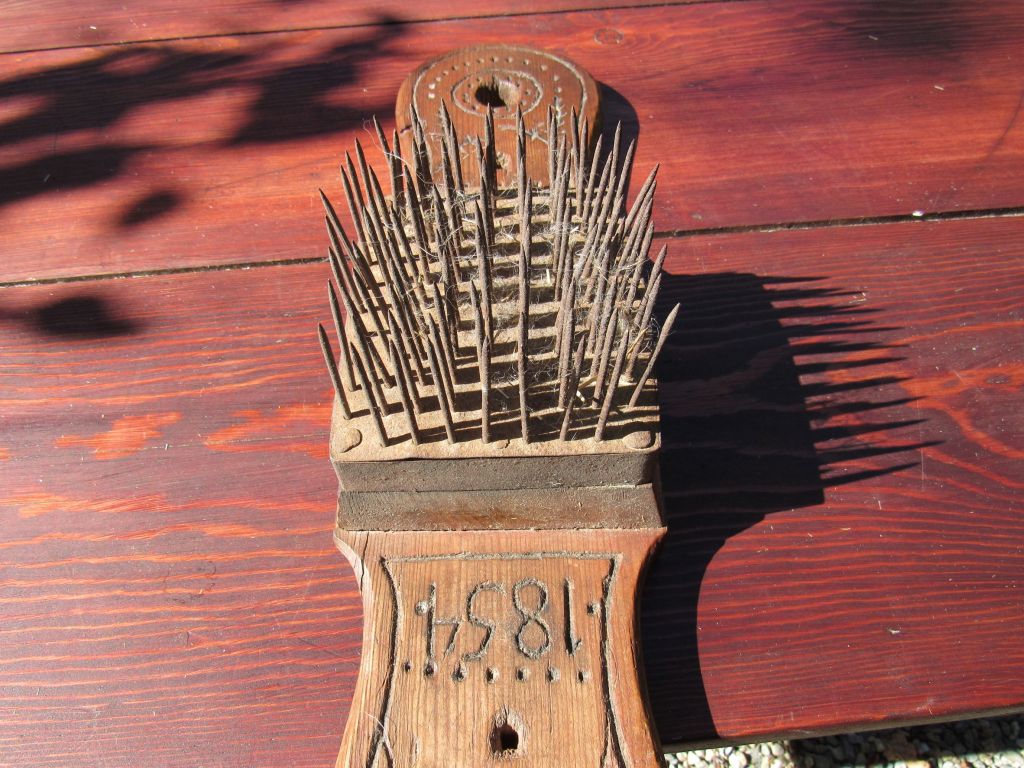
This beauty is initialed and dated. I like to think that the decorative carved plants are flax.

I believe the next set of hackles is eastern European.

It is very long and narrow.

The raised area for the tine disc is hand carved.

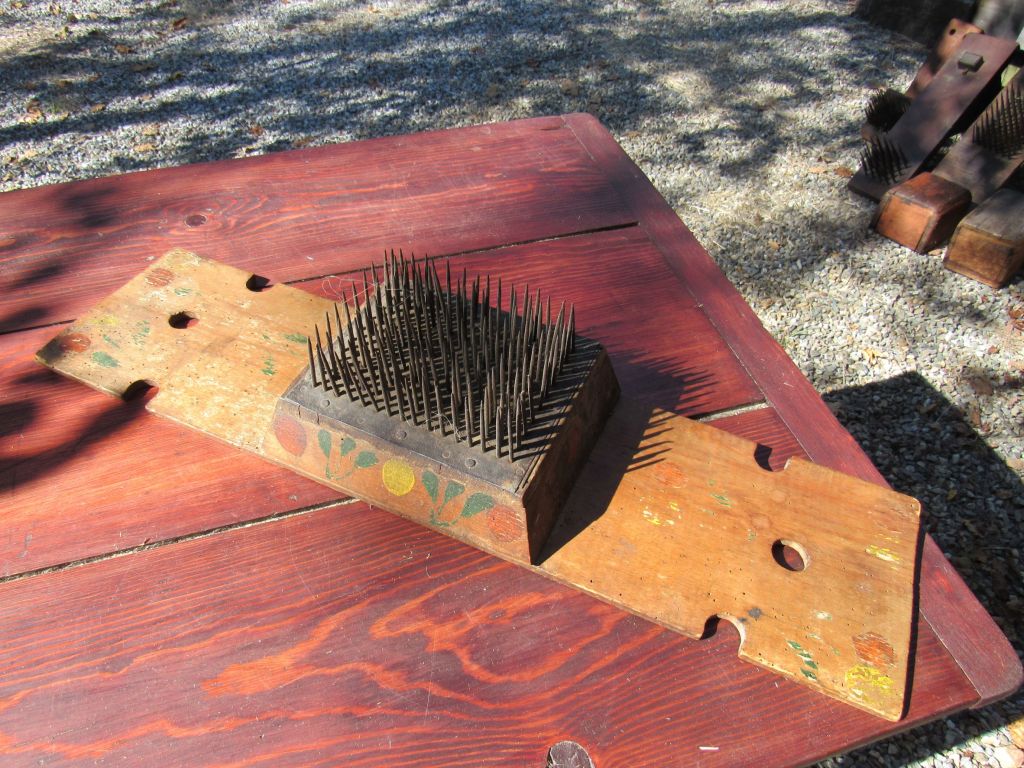
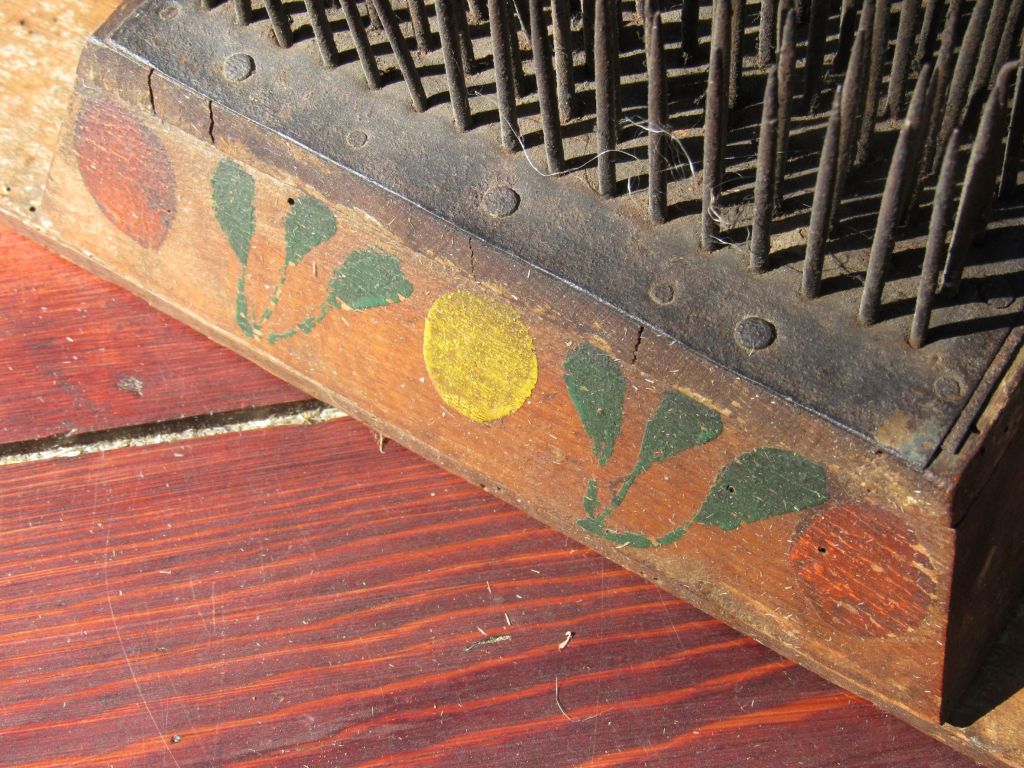
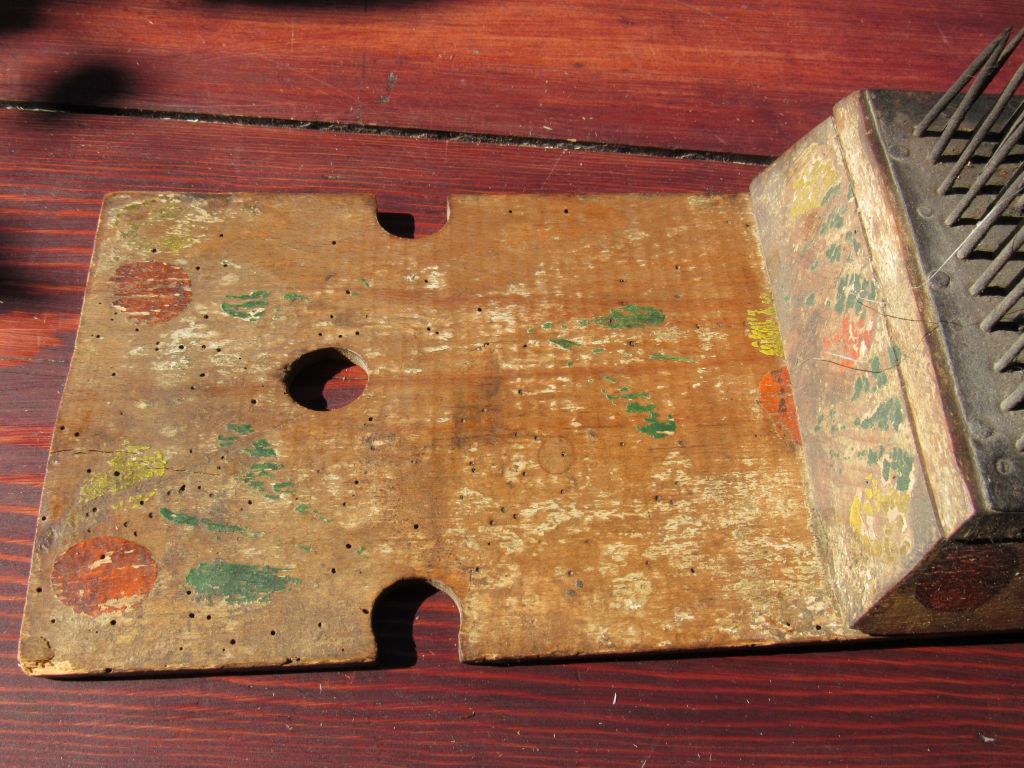
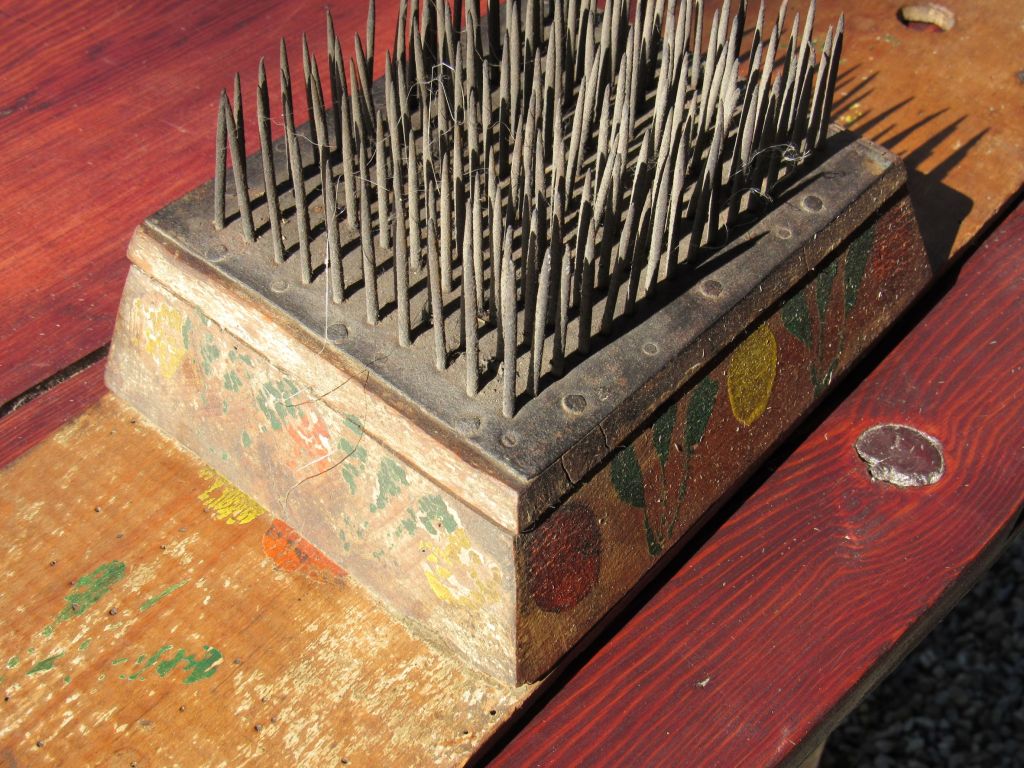
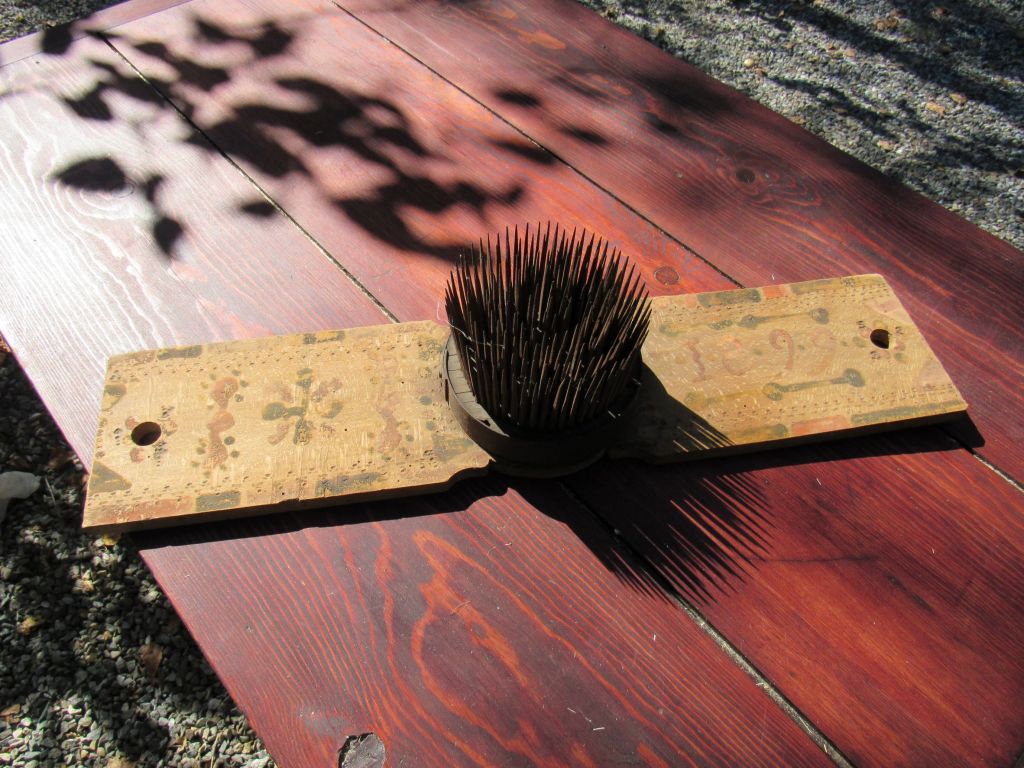
Occasionally painted hackles turn up. These two came to me from Pennsylvania but I do not know if they were made there.

I have seen this particular paint design on several identical hackles for sale in Pennsylvania.

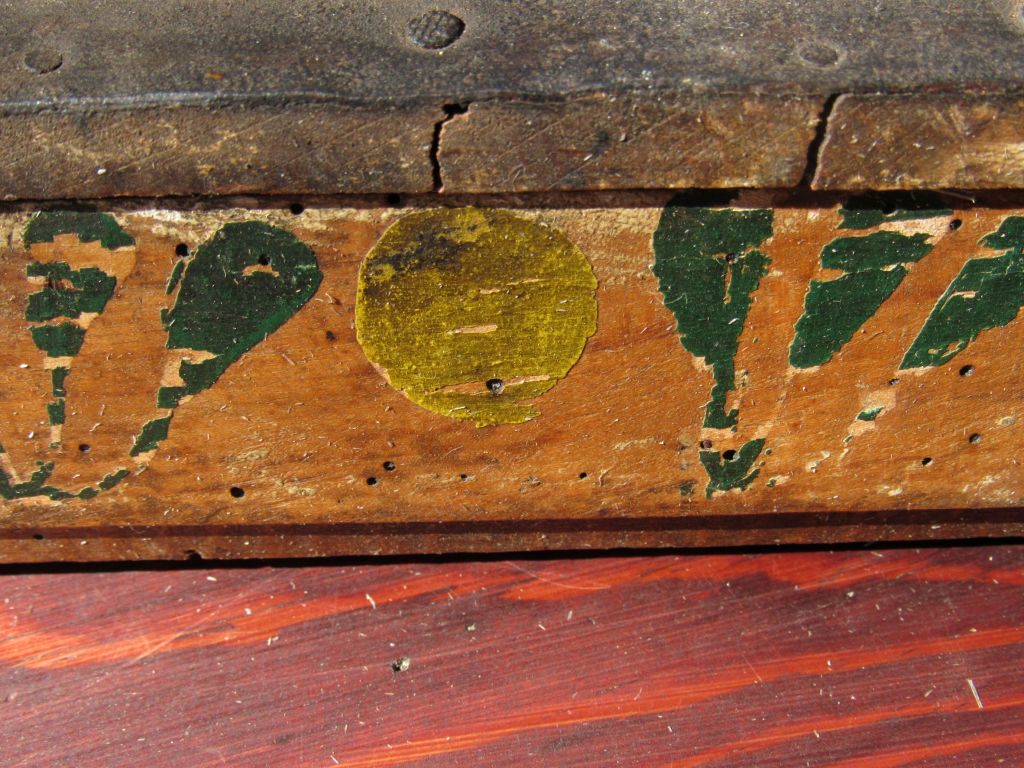
This one is dated 1899 and has the same tine design as the Scandinavian hackles.

It is in excellent condition.

It is decorated with little indentation carvings along with the painting.

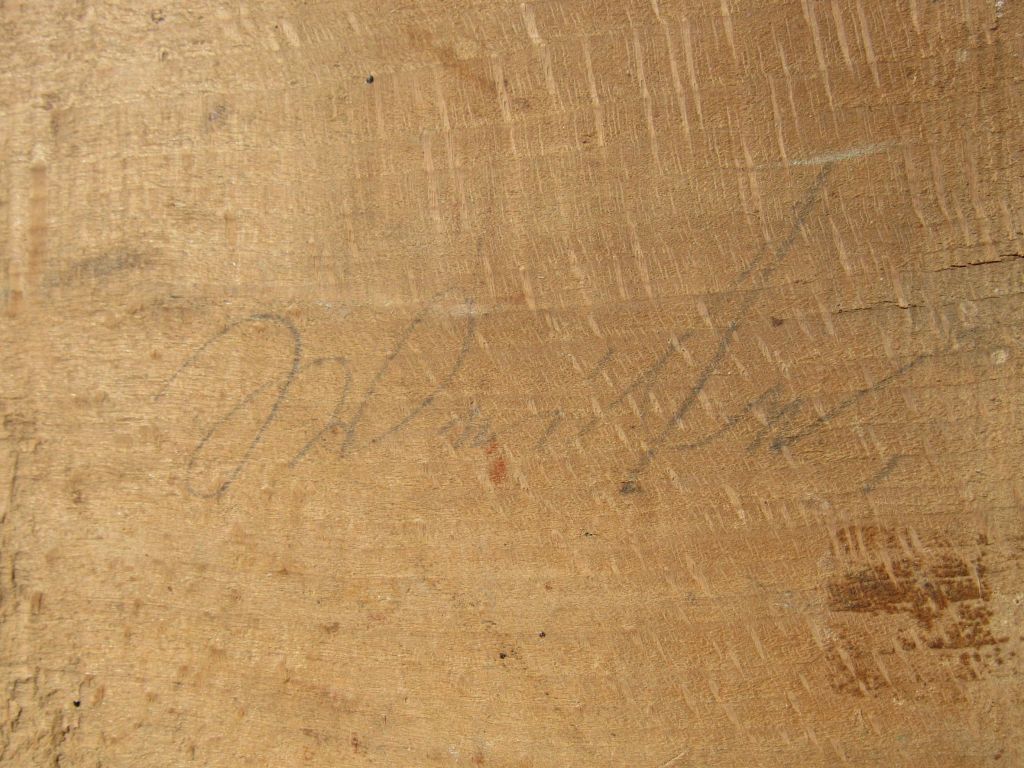
There is penciled writing on the back that I cannot decipher.

I have three sets of fine hackles. They are much harder to find than the mediums.

This one has beautiful reddish wood for the cover.

It is dated 1767 on both sides and has decorative punchwork along the metal edges.

The wooden ends are covered with metal plates, giving a more durable and steady surface for securing the smaller hackle to a table.

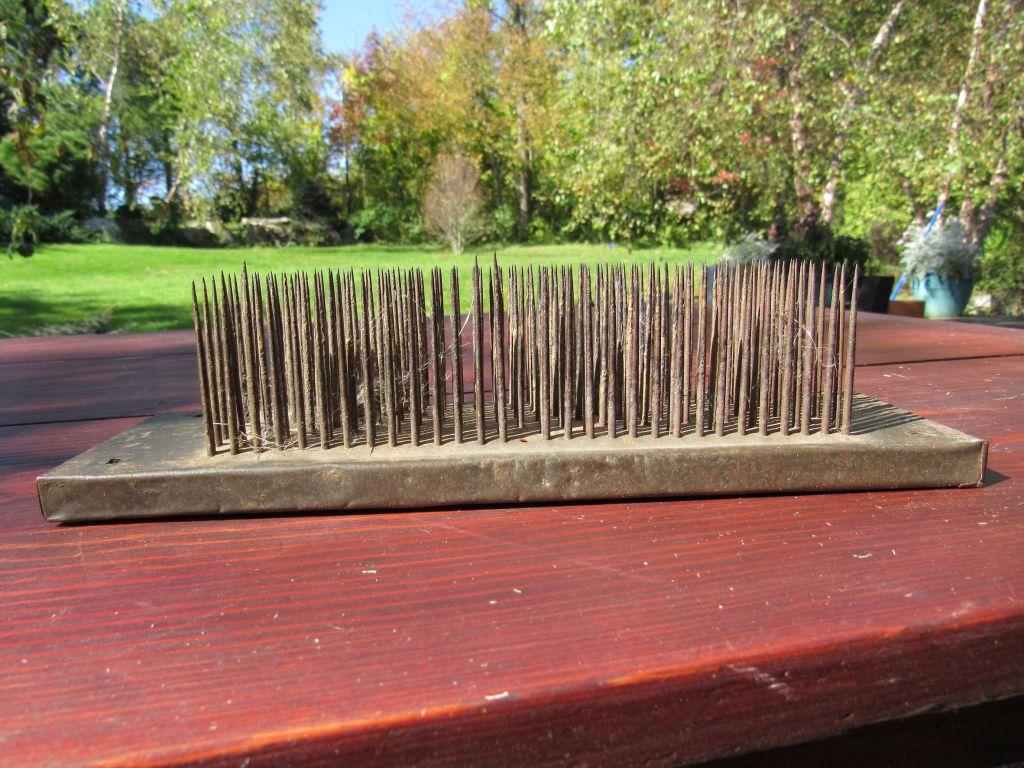
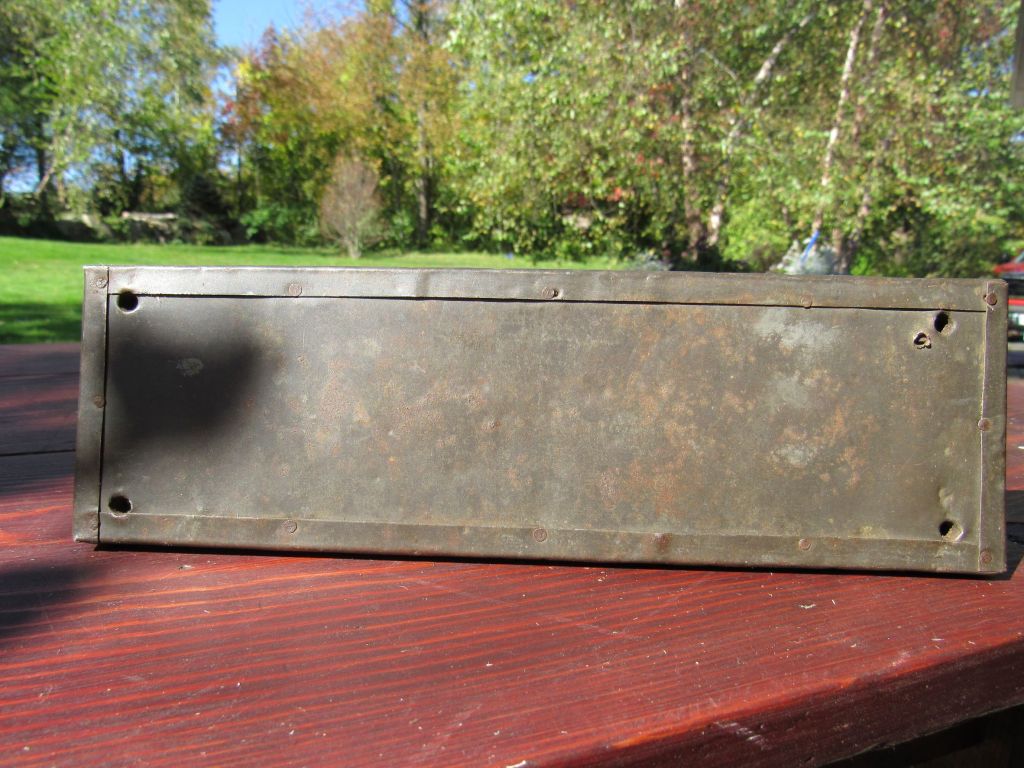
The next set is quite small and fine, with the whole hackle body covered in metal. I have seen three sets like this one in New England, all identified as hackles.

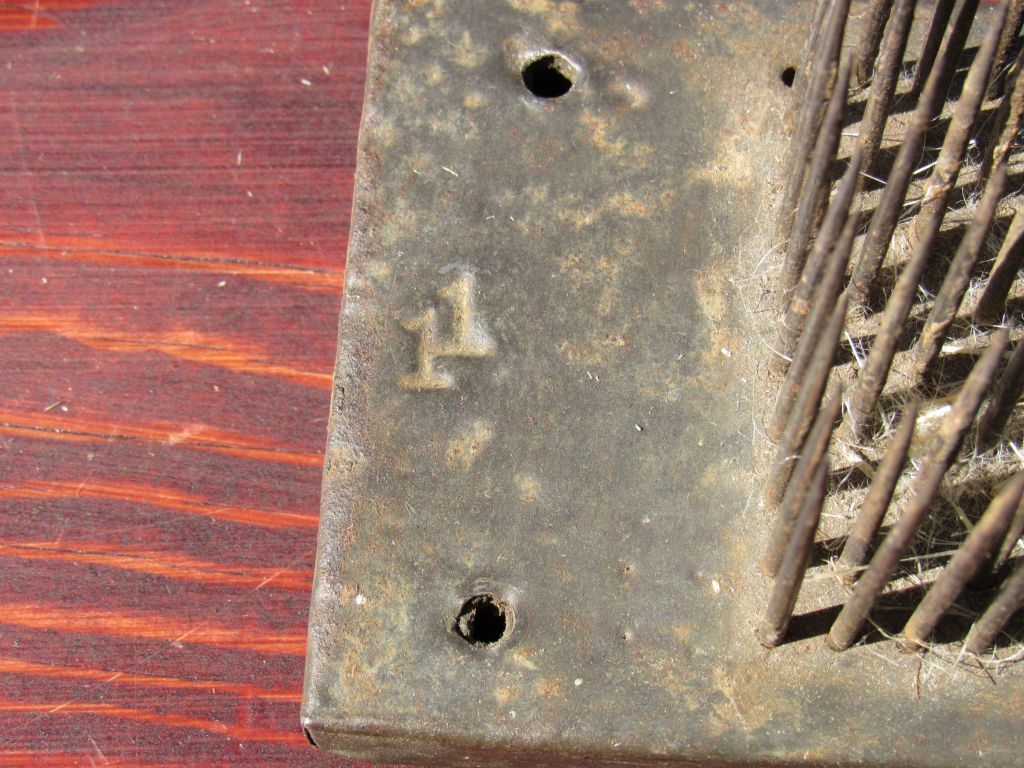
They all had a number stamped in the end, likely a grade of tine size.

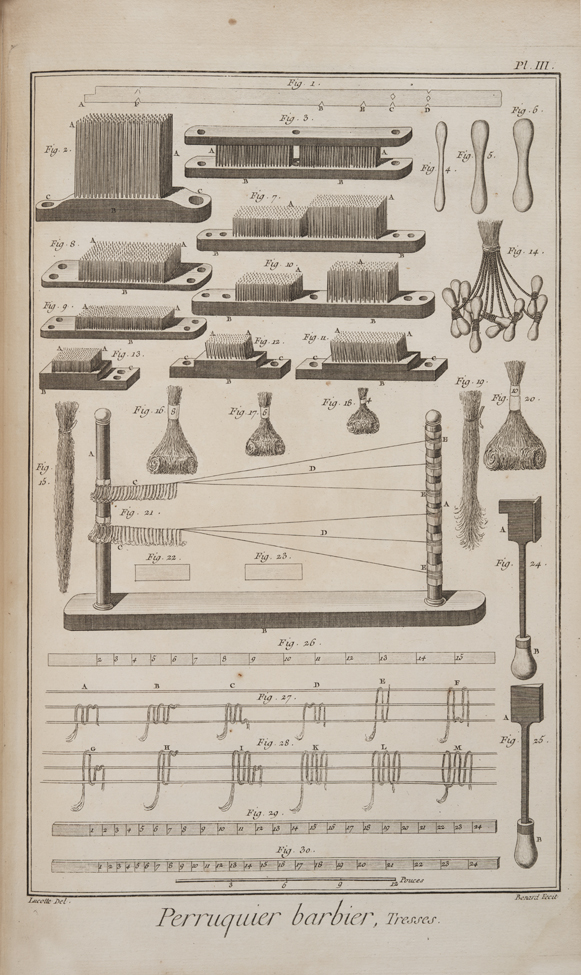
Recently, someone posted in a Facebook flax group an advertisement for modern wigmaking hackles. They looked a lot like this one. Diderot’s Encyclopedia of manufacturing in 18th century France, included this illustration of wigmaking tools. So perhaps these very small hackles were used for wigmaking rather than flax processing. Or maybe not.

A plate from Diderot’s Encyclopedie

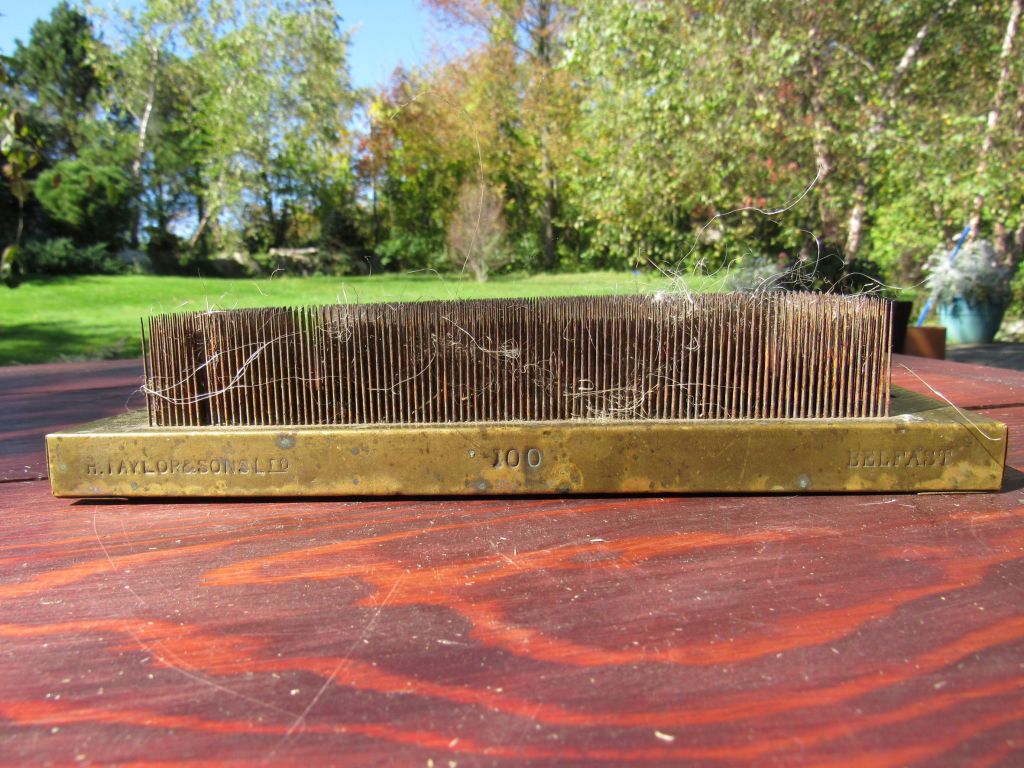
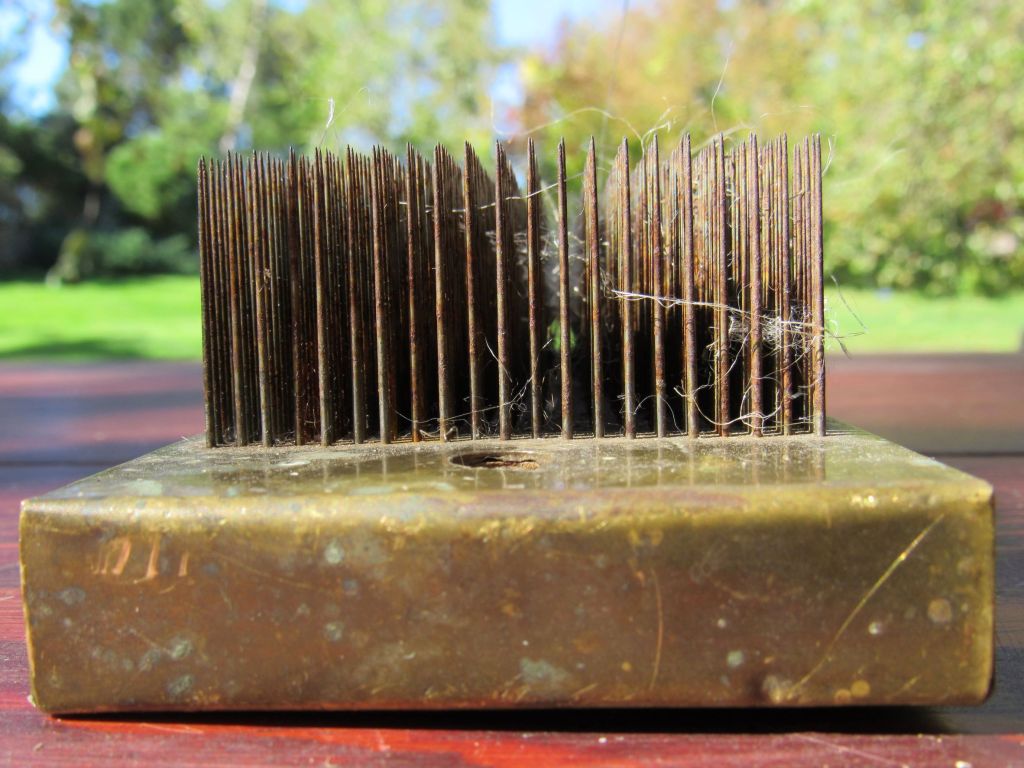
The finer the hackle, the finer and cleaner the flax for spinning. This is the finest hackle I have ever seen.

It’s a gorgeous tool.

Research turned up H. Taylor & Sons in a 1901 Belfast/Ulster street directory. Henry Taylor manufactured hackles, gills and wood card clothing, leather belting, and pickers.

Extremely fine, closely set tines were bound in brass.

On the downside, hackles this fine remove a lot of perfectly usable line flax. On the upside, they produce a gorgeous product, without a hint of boon in sight.

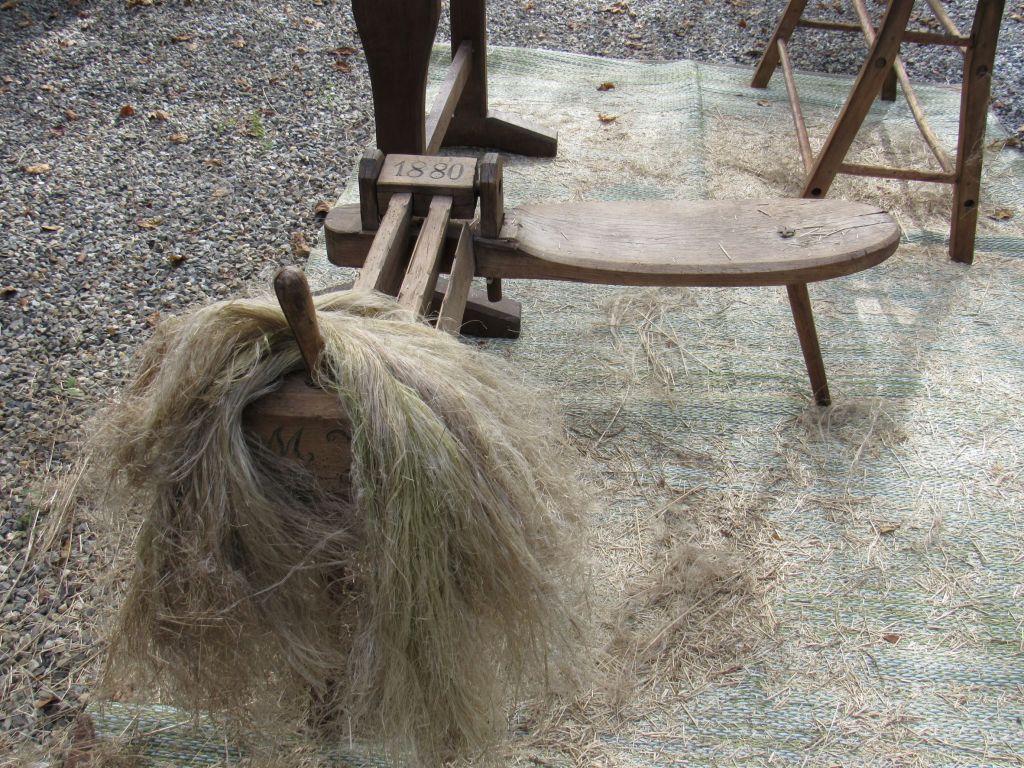
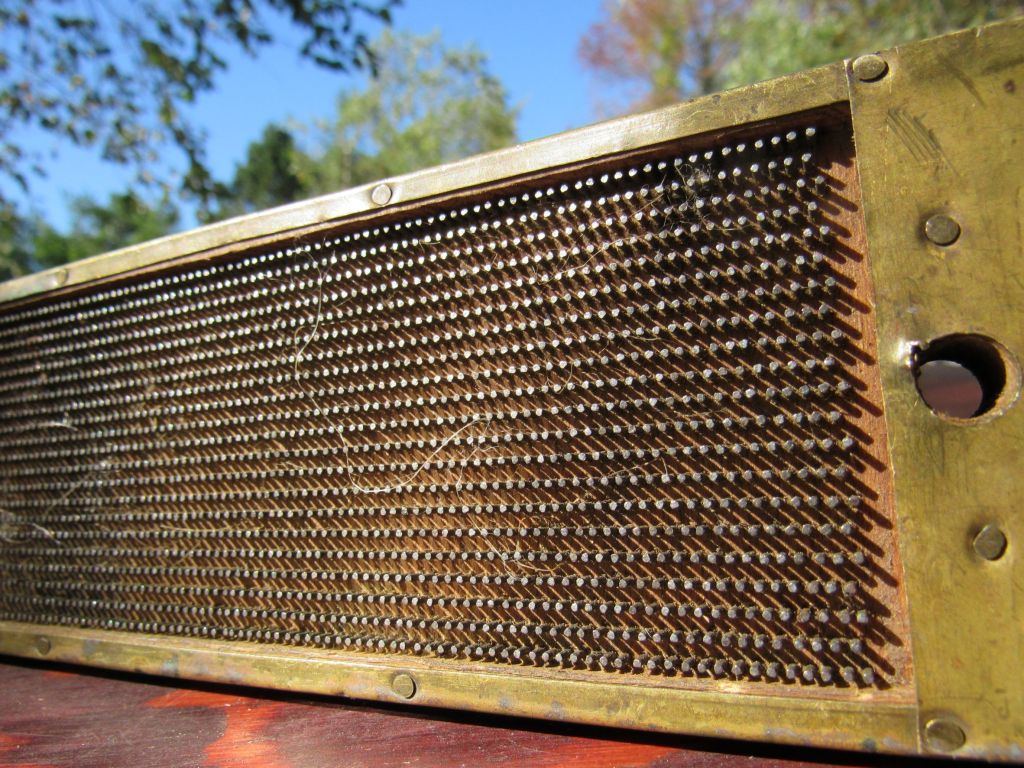
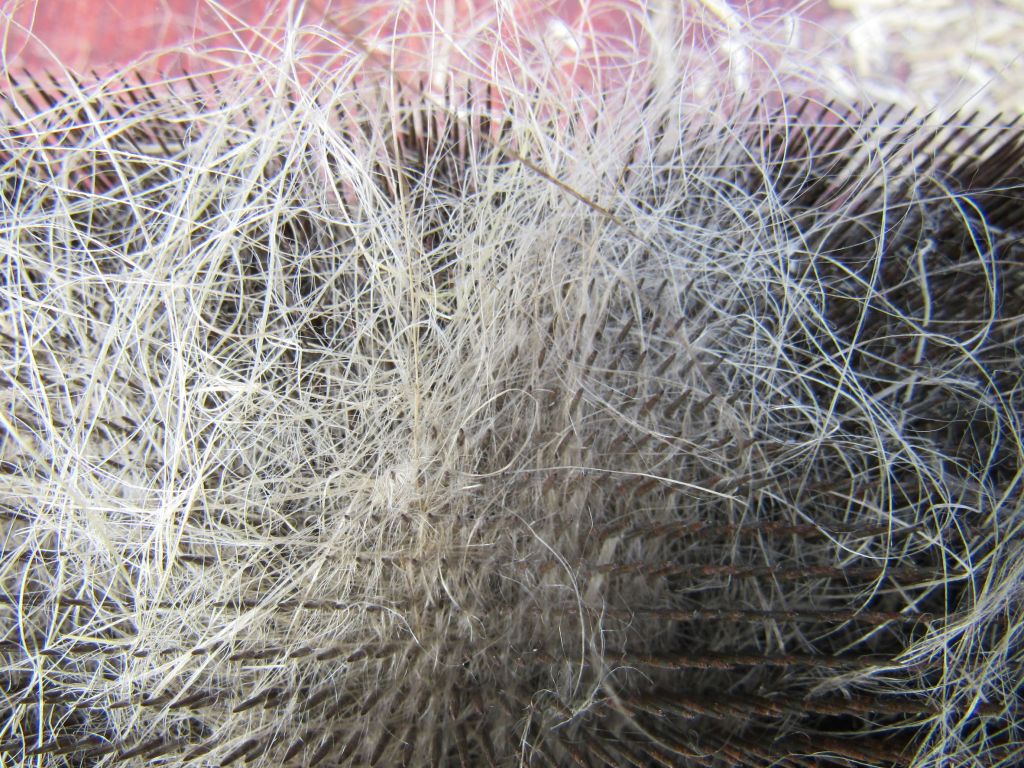
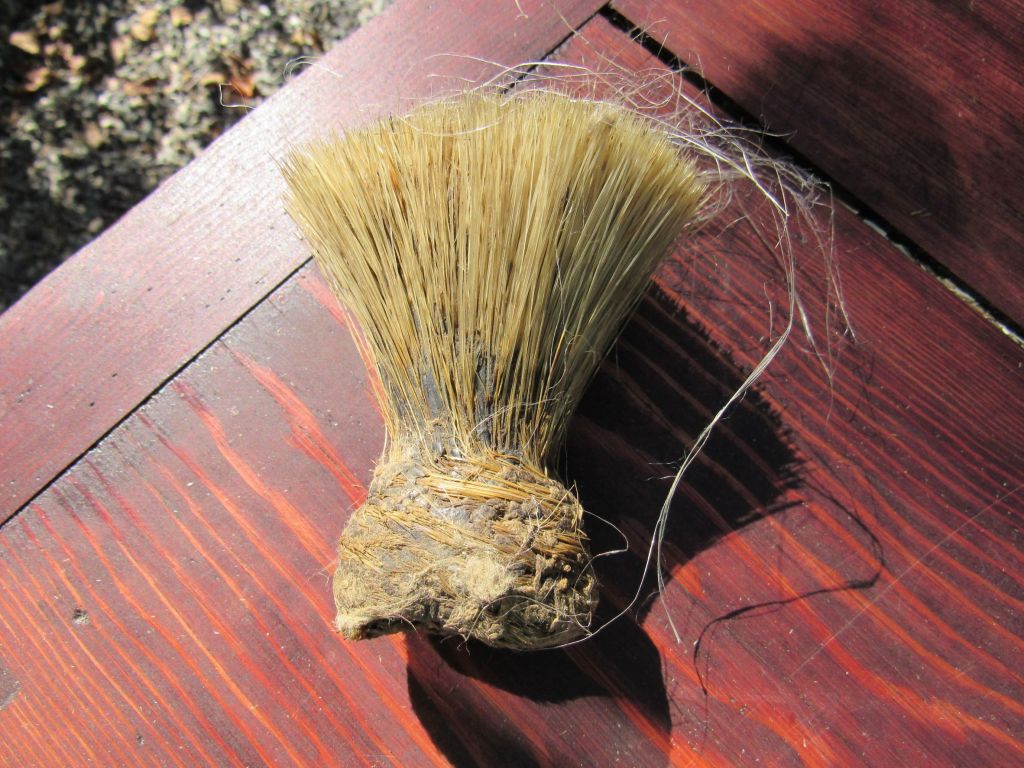
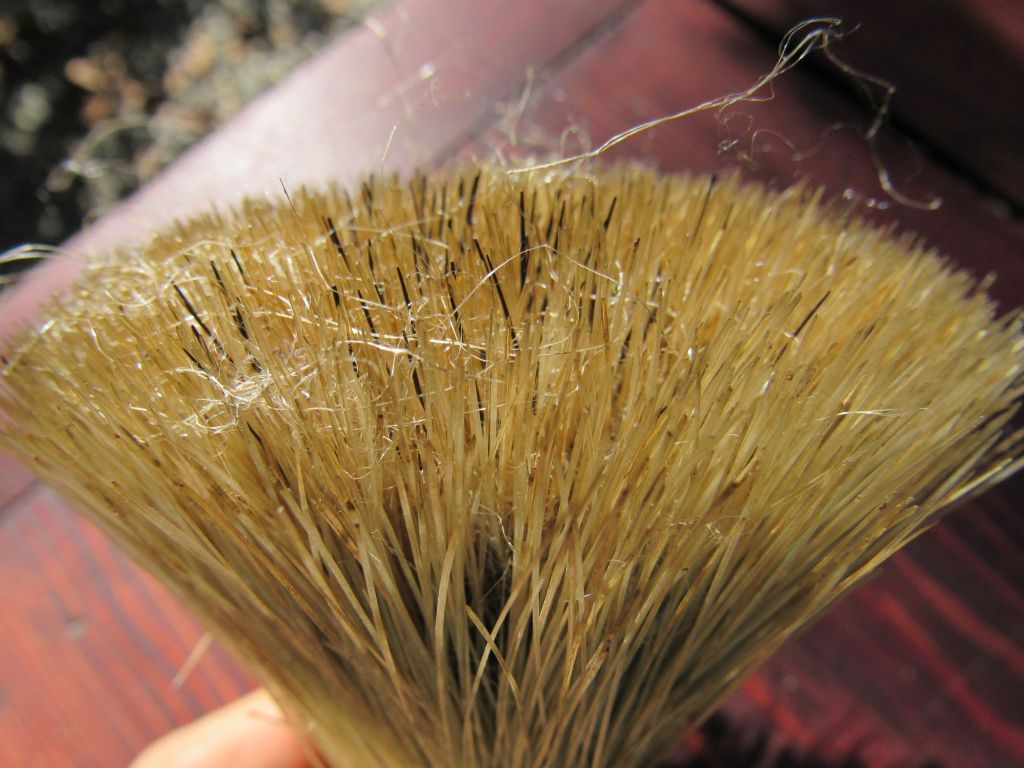
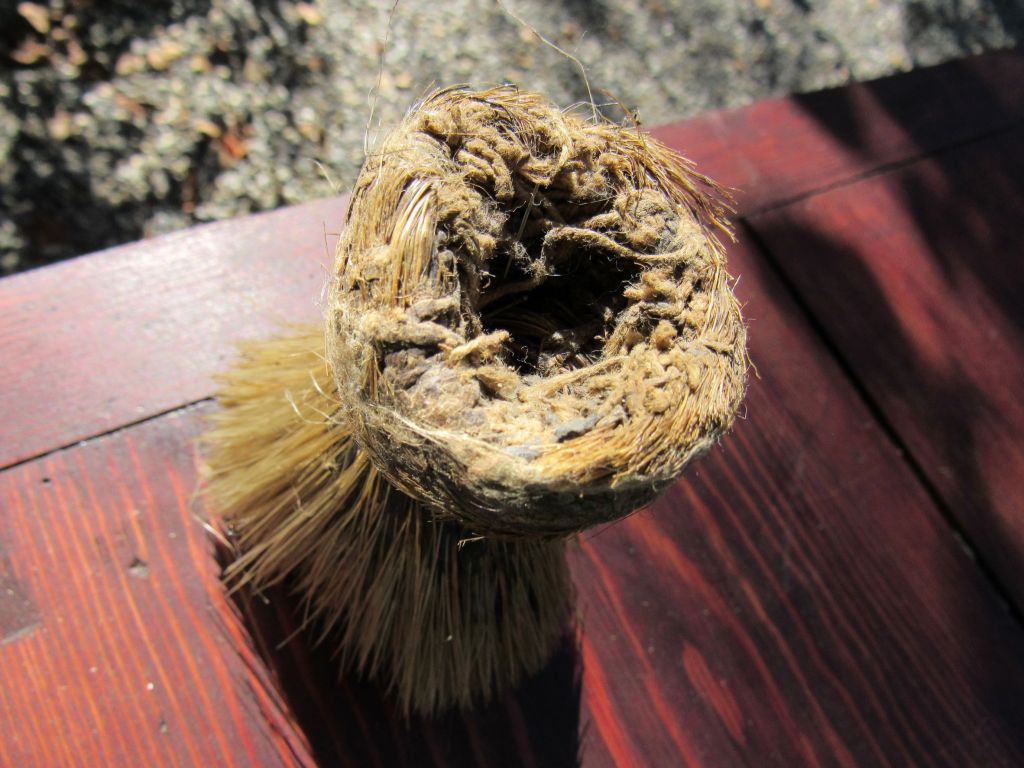
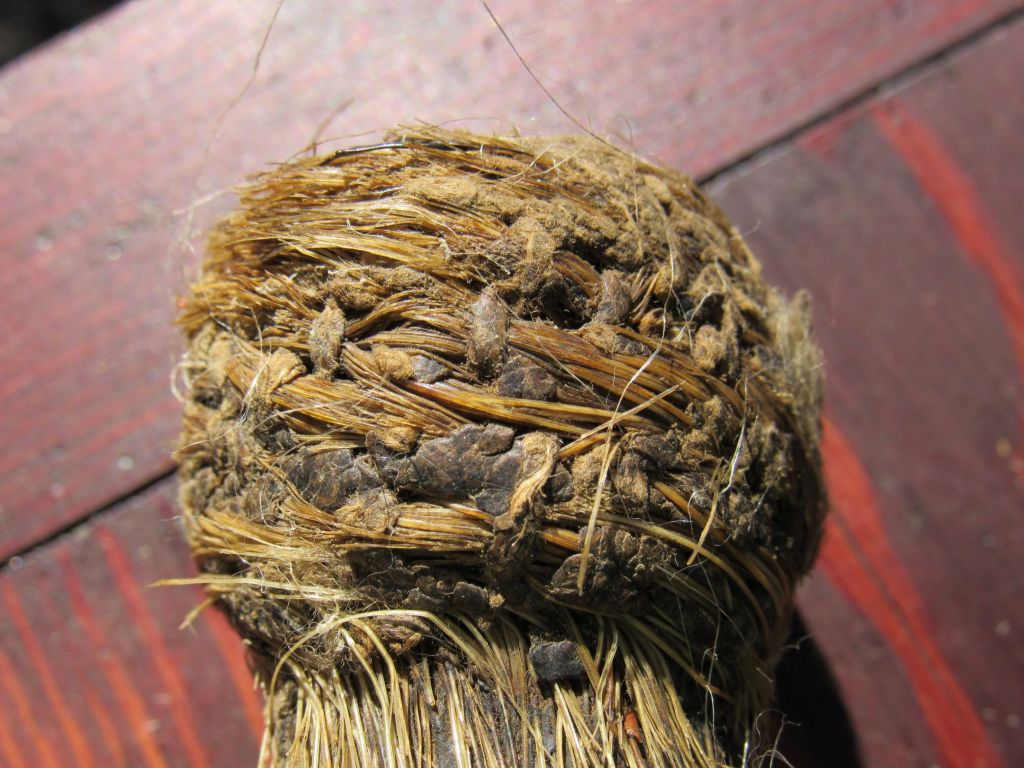
After hackling, in some parts of the world, the final step is brushing. As far as I know, this was not a practice used in New England but a finishing touch given to fine flax in parts of Sweden, Finland, and Belgium.

Flax brushes were typically made of boar bristles, with a handle bound with linen thread, tar and resin.

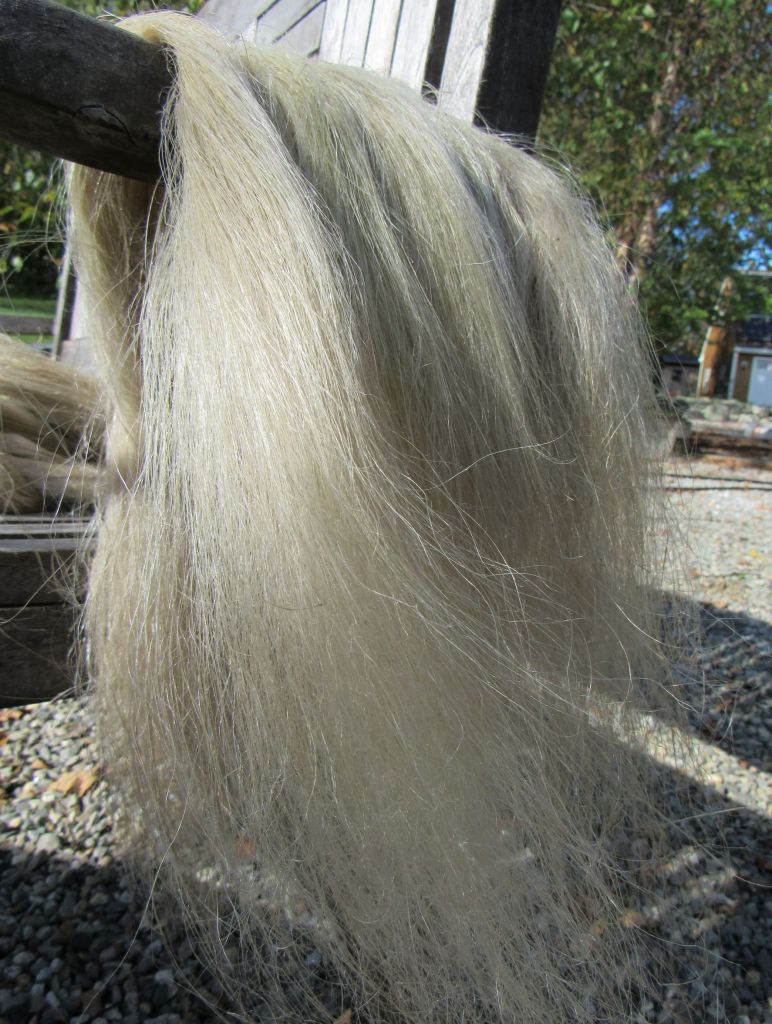
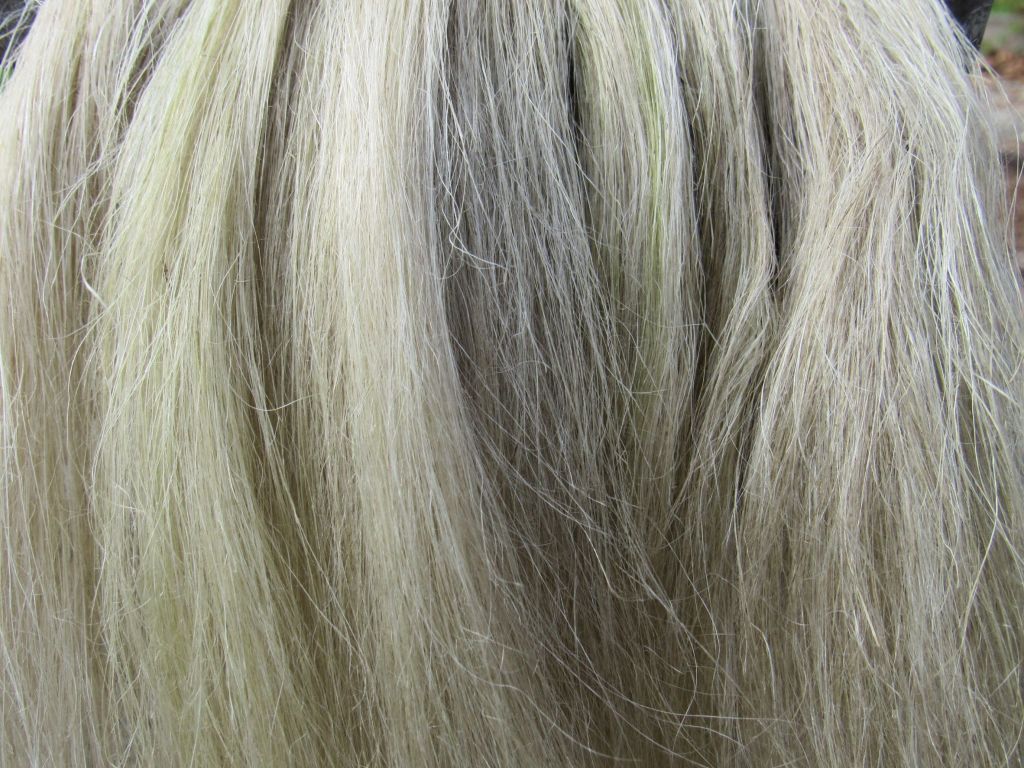
Using it on nicely hackled flax is a bit like brushing a horse’s tail.

And results in a final product of fine, shiny line flax ready for spinning.

November 19, 2021 Update: In the middle of the night after posting this, I realized I had not recently read over the articles on hackles in The Spinning Wheel Sleuth. A bad oversight. This morning, I found a clue to the “Darlington” hackle in an article by Carlton Stickney, who has an absolutely amazing collection of hackles. One of the hackles featured in Carlton’s article was marked “Ridsdale Porter Darlington.” The lettering on the hackle side matches the lettering on my hackle marked with “John Pain Darlington” and “Thomas Pain(e) Darlington.” Carlton’s research found that Ridsdale and Porter were “forgers, makers and grinders of Heckle-pins in Darlington for several years.” (p. 9) Darlington is in Durham, England.

I immediately started researching John and Thomas Pain and found reference to “Catherine Pain” listed as a Hecklemaker in Durham, in the Universal British Directory of Trade, Commerce & Manufacture (post 1791, pre 1800). In the Durham Probate Records (1776-1799), I found reference to both “Catherine Pain & Co.” and “John Pain” as hecklemakers in Darlington. I have not yet found the exact probate dates or a relationship between John and Catherine. Nor have I found a relationship between the Pains and Ridsdale or Porter. Because the printing of the word “Darlington” on the hackles looks so similar, however, it would seem there was some relationship there.

No wonder I could not find Thomas and John Darlington in my Maine research. I was barking up the wrong tree. I will continue the research and post updates.

See: Stickney, Carlton, “Flax Tools,” The Spinning Wheel Sleuth #96 (April 2017).

For more information on flax processing and hackles:

Henzie, Suzie, “Three Hackles,” The Spinning Wheel Sleuth #54, (October 2006).

Burnham, Harold B. and Dorothy K., ‘Keep me warm one night,’ Early handweaving in eastern Canada, Univ. of Toronto Press, Toronto and Buffalo, 1972.

Dewilde, Bert, Flax in Flanders Throughout the Centuries, Lannoo, Tielt, Belgium, 1987.

Heinrich, Linda, Linen From Flax Seed to Woven Cloth, Schiffer Publishing, Atglen, PA, 1992.

Meek, Katie Reeder, Reflections From a Flaxen Past, Pennannular Press Int’l, Alpena, Mich., 2000.

Merrimack Valley Textile Museum, All Sorts of Good and Sufficient Cloth, Linen-Making in New England 1640-1860, Merrimack Valley Text. Mus., North Andover, Massachusetts, 1980.

Zinzendorf, Christian and Johannes, The Big Book of Flax, Schiffer Publishing, Atglen, PA, 2011.

For more information on flax brushes see Josefin Waltin’s blog “For the Love of Spinning.” https://waltin.se/josefinwaltinspinner/flax-brush/

Handsome Molly

I know little about the history of this stately wheel. A woman in southern Maine kindly gave it to me. She had bought it from a woman–not a spinner–who decided to sell it because it was taking up space on her porch. How and when this wheel made its way to New England likely will remain a mystery.

It almost certainly came from Ireland originally. It has the distinctive characteristics of an Irish wheel of this style–upright stance,

a drive wheel that sits close to the flyer but high off the table,

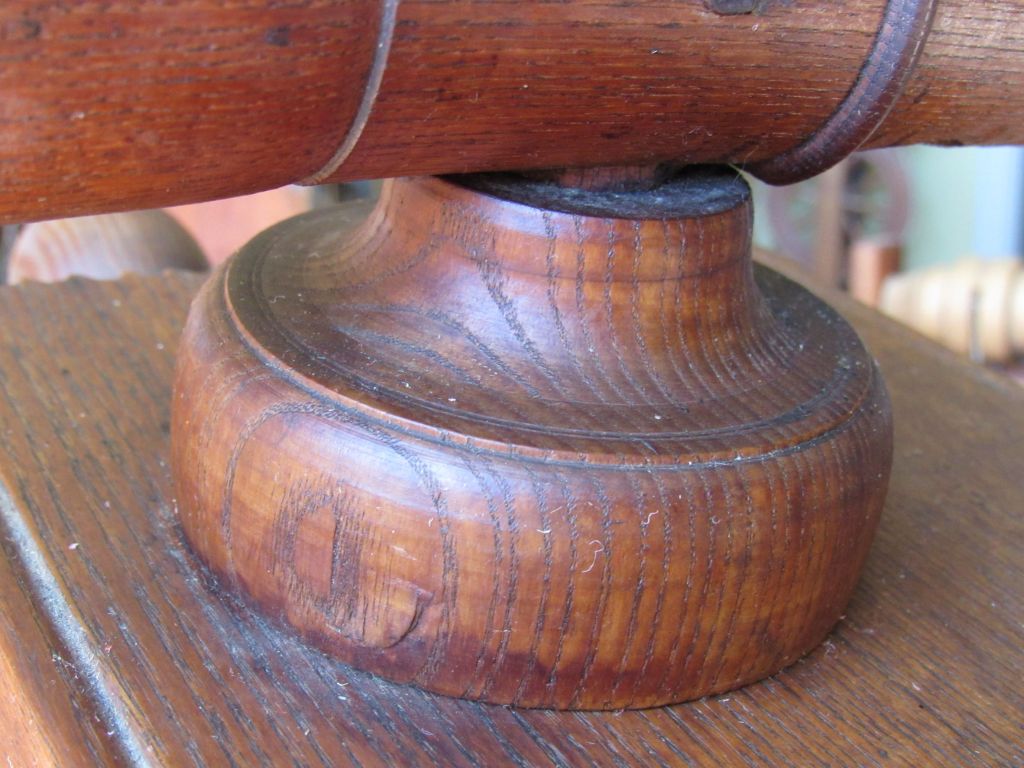
thick, solid legs,

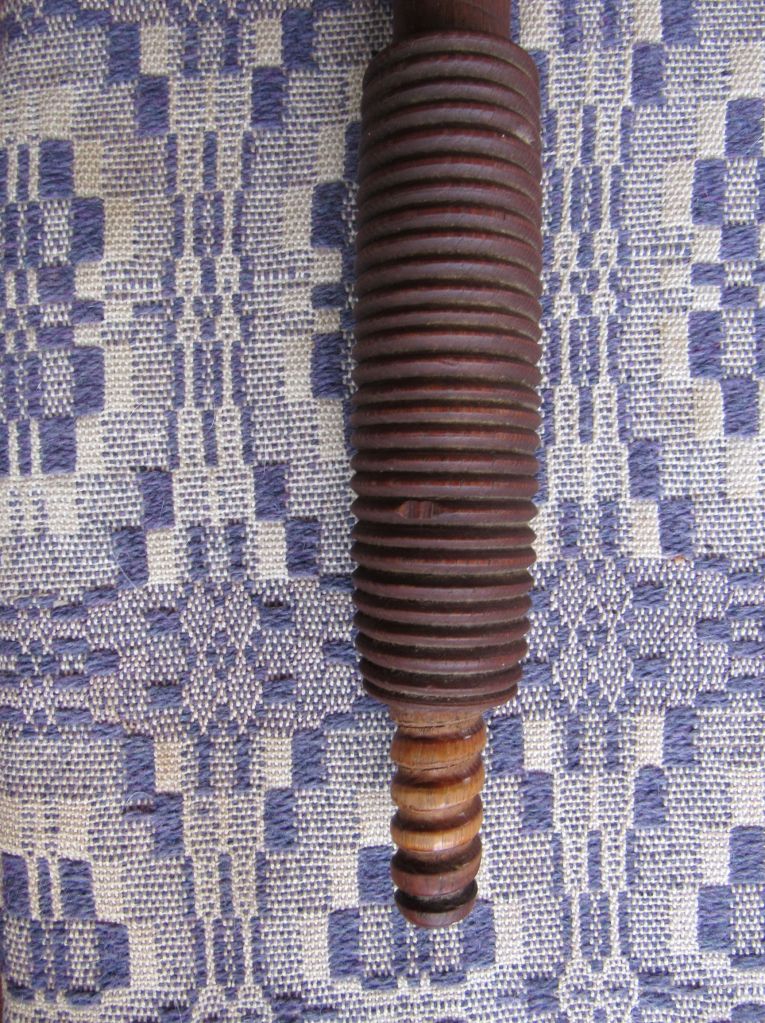
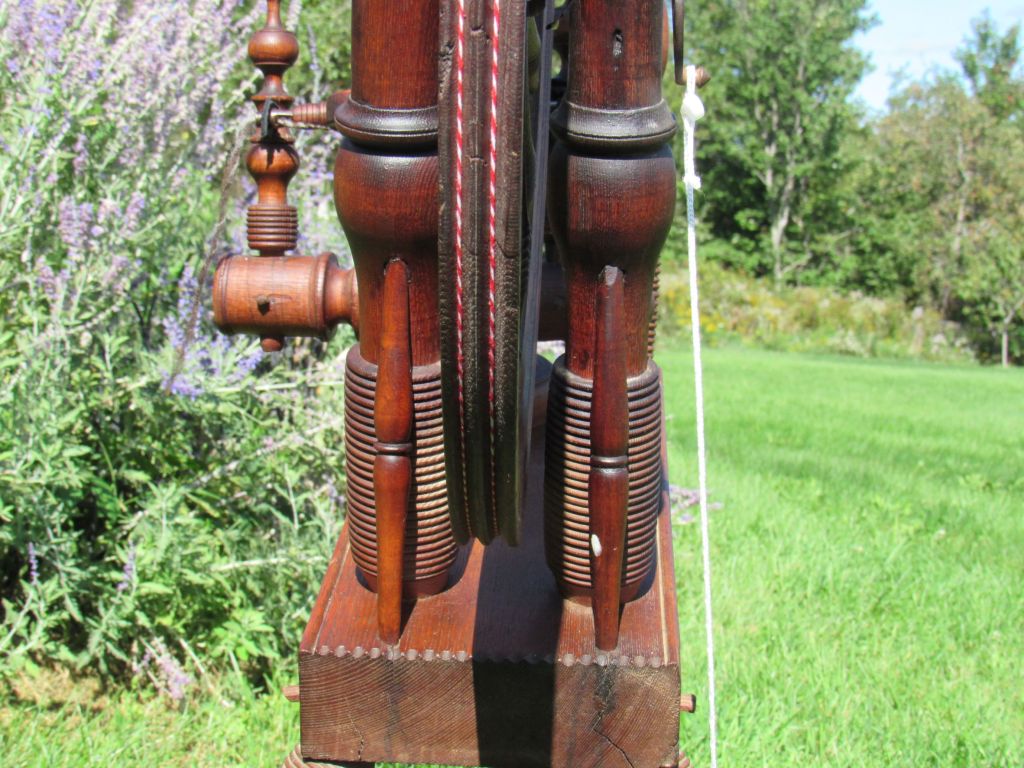
and amazing reed turnings, row upon row of tiny ridges that look like perfect smocking.

Old postcards and photographs show a variety of similar wheels being used in Ireland.

Interestingly, in these photographs, most of the footmen are string or cord (usually with a leather piece attaching to the axle) rather than wood, a contrast with North American wheels.

When starting to research this wheel, I posted a photograph on Instagram. Fortunately, Johnny Shiels, a third-generation wheel maker in Donegal, saw the photo and thoughtfully reached out. He sent me a photo of a very similar antique wheel from Donegal. And, his IG account spinningwheels.ie revealed photos of other lovely old Donegal wheels that he has restored.

This style wheel, which we usually refer to as a “Saxony” in North America, is known in Ireland as a “Low Irish” or “Dutch wheel.” Actually, early Connecticut probate records from the 18th and early 19th century often referred to them as Dutch wheels, too. These wheels were introduced to Ireland from Holland by Thomas Wentworth, later the Earl of Stafford, in the 17th century to encourage linen production.

While originally intended for flax spinning, they later also would be used for spinning wool.

Ireland also had spindle-style great wheels, often called “long wheels” for wool spinning. The wheel style that we, in this country, most often associate with Irish flax spinning, however, is the upright “castle” wheel. I have been curious as to whether the different styles were regional.

Were castle wheels and Dutch wheels both used throughout Ireland, or were they exclusive to different areas? And, were the turnings on the Dutch wheels specific to certain towns or counties?

The only information I have found so far is in the booklet from the Ulster Museum, which indicates that castle wheels were principally found in Ulster, explaining that they were “confined in distribution to the northern counties. The design provides good rigidity which is essential to efficient spinning.” Id.

The same stability applies to Handsome Molly, but derives from sheer size and weight. It is a remarkably large wheel, with long legs of substantial girth, and a wide heavy table.

It measures 43 1/2 inches tall, with an orifice height of 29 1/2 inches. The table is an ample 7 1/4 inches wide and upright circumference is 8 1/4 inches.

For comparison, it is almost a full foot taller than a typical Connecticut flax wheel made by Silas Barnum.

The legs on the Barnum wheel look puny compared to Molly’s generous proportions.

There is something about the sheer mass of this wheel that does affect spinning–giving a certain lightness and ease. Pure pleasure. There are signs of use on the wheel, but it is difficult to tell how much.

There are grease marks around the axles and some signs of treadle wear.

There appear to be some wear marks, from winding off perhaps, on the tension knob. The groove over the fat part of the knob looks just like the puzzling groove on the wheel Adelaide’s knob in a previous post.

Both maidens are pegged through the mother-of-all and do not turn.

They are in good condition and look much like the maidens on Green Linnet, in a previous post.

The distaff is made from a tree branch, typically used for spinning tow.

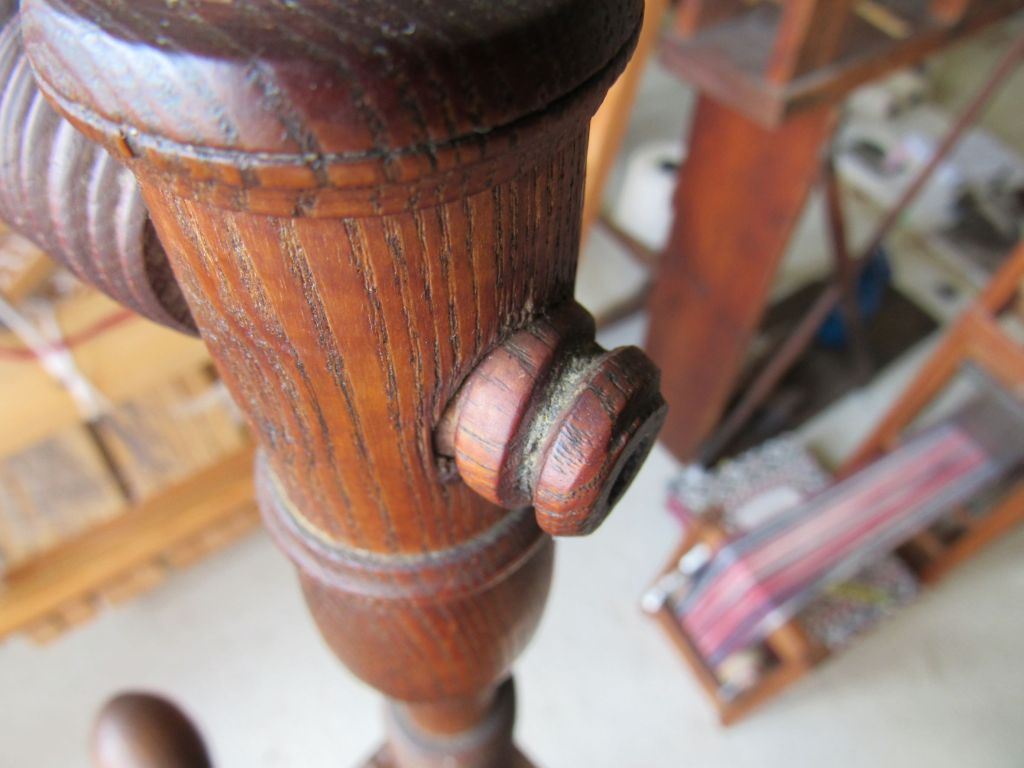
The distaff cross-support threads into the upright.

That is a feature I have never seen before, but brilliant to keep the distaff full of flax from tipping over while spinning (which it can do–I speak from experience).

The cross support also has what appear to be wear marks from thread or yarn, again, perhaps from winding off.

There are secondary upright supports on both sides, extending to the table.

Decorative marks ring the uprights and legs, both burned and incised.

The wood grain is interesting, somewhat wide and coarse

–perhaps oak, ash or a mix?

I do not have the original flyer yet. It still exists, but has been stored away and the hunt is on to find it. I am hoping that it will give more clues as to whether this wheel was brought to this country for use or for decoration. It cannot have been easy or cheap to transport across the Atlantic. But, I totally understand why someone would go to the trouble, because it is a magnificent piece of machinery.

I am extremely grateful that this wheel is now taking up space in my home. And, it is not relegated to the porch, but in a place of honor, creating beautiful yarn.

October 2021 update: Joan Cummer had a somewhat similar wheel in her collection, Wheel No. 30. In describing the wheel, she notes: “This wheel was made in the late eighteenth or early nineteenth century in Ireland. The turnings are Sheraton period with extremely fine reed turnings on the distaff … This has been a well made and very heavy wheel.” Cummer, Joan Whittaker, A Book of Spinning Wheels, Peter E. Randall, Portsmouth, NH, 1994 (pp. 72-73).

For more information see:

Johnny Shiels Inishowen Spinning Wheels, website here.

Evans, Nancy Goyne, American Windsor Furniture, Hudson Hills Press, New York, NY, 1997 (p. 214).

Ulster Museum, Spinning Wheels (The John Horner Collection); Ulster Museum, Belfast, Ireland 1976.

Angelina Baker

Early Quebec wheels probably had little resemblance to the large, metal-clad production wheels associated with Quebec today.  It is likely that many were flat rim wheels, which are still found in Quebec, Ontario, and New England.

The origin of these flat rim wheels is a bit of a mystery.  Some likely came from the Acadian settlements in Canada, but it is doubtful that they are all Acadian.  Many Quebec settlers came from the northwest of France, and, interestingly, these wheels resemble the flat rim wheels of Normandy.

Le Rouet, Gr. de Leleux
This image and the one above have one leg resting on a rock. Is there some reason for this (other than a fix for a damaged leg)? If any one knows, please leave a message at the end of this post.

Whatever their origin, Quebec flat-rim wheels are thought to date from the late 18th century into the early 19th century.  They come in various forms.  Some have treadles, some are hand-cranked. 

Tables may be flat or sloped, often with four legs, but sometimes three.  Their profile is distinctive—a long, wide, sturdy table, shortish legs, with an outsized drive wheel and flyer set-up. 

In fact, some wheels of this style are not flat-rimmed but have drive wheels like those on saxony-style wheels, looking almost apologetically out-of-place atop the squat wheel bodies. 

The flyers and tension systems on these wheels set them apart from other antique wheels. 

Most are not double drive, but have some form of “scotch” tension, with a single drive band for the whorl and a brake on the bobbin, usually adjusted with a small knob inserted in a hole in a bar over the flyer assembly.

 My wheel is unusual because, aside from the flyer assembly, it has no turned parts. 

Aside from the hub, nothing is round.

The spokes, legs, uprights, and upright supports are all straight-sided with chamfered edges. 

The spokes are particularly nice, six-sided and tapered. 

Old nail holes indicate that the rim was re-positioned at some point. 

The table is sturdy and flat. 

The lines of the wheel—all edges and tapers—are very beautiful and quite unique. 

The flyer is large, held in place with a small removable piece on one end. 

As with many of these flat-rim wheels, rather than having a removable whorl and fixed arms,

the whorl is fixed on the shaft, while the arms and bobbin can be removed. 

The shaft is a smooth cylinder with a single cut-out for the yarn to emerge onto the arms. 

This style orifice often is referred to as a whistle-cut or train-whistle because it looks like the half-circle cut out on steam engine whistles.

A single drive band rounds the whorl, while another band is attached to a nail on the end of the table, rounds the bobbin, with the other end held in place by a peg in the crossbar above the flyer. 

There are grooves at each end for the band to ride in. 

When the band is inserted in a hole through the peg, it can be tightened by turning the peg, which adjusts the amount of drag on the bobbin. 

Once the tension is adjusted to its sweet spot, my wheel spins beautifully, although the treadling takes a little more effort than with most wheels.  The treadle is supported only by the wooden back bar. 

And, in contrast with most treadled wheels, that back bar does not have metal rods on each end to serve as the turning pivots in the legs.  Instead, the wooden ends of the bar extend into the legs. 

The wood-on-wood action in treadling creates a little more resistance than I am used to, so I usually use two feet which works well with the sturdiness of this wheel.

These wheels look a lot like bobbin winders and many were converted to that use.  So, it is always a treat when one turns up with all its spinning parts. 

Especially when it bears the hand of an artist who was not willing to settle for utility alone, and, without a lathe, created something that pleases the eyes as well as the hands.

For more information on flat-rim wheels, see:

Burnham, Harold and Dorothy, Keep Me Warm One Night, Early Handweaving in Eastern Canada, University of Toronto Press, 1972, p. 34.

Buxton-Keenlyside, Judith, Selected Canadian Spinning Wheels in Perspective: An Analytical Approach, National Museum of Canada, Ottawa, 1990, pp. 206-09.

Cummer, Joan, A Book of Spinning Wheels, Peter E. Randall, Portsmouth, N.H. 1984, pp. 178-79.

Foty, Caroline, “Flat-Rim Spinning Wheels,” The Spinning Wheel Sleuth, Issue #80 (April 2013).