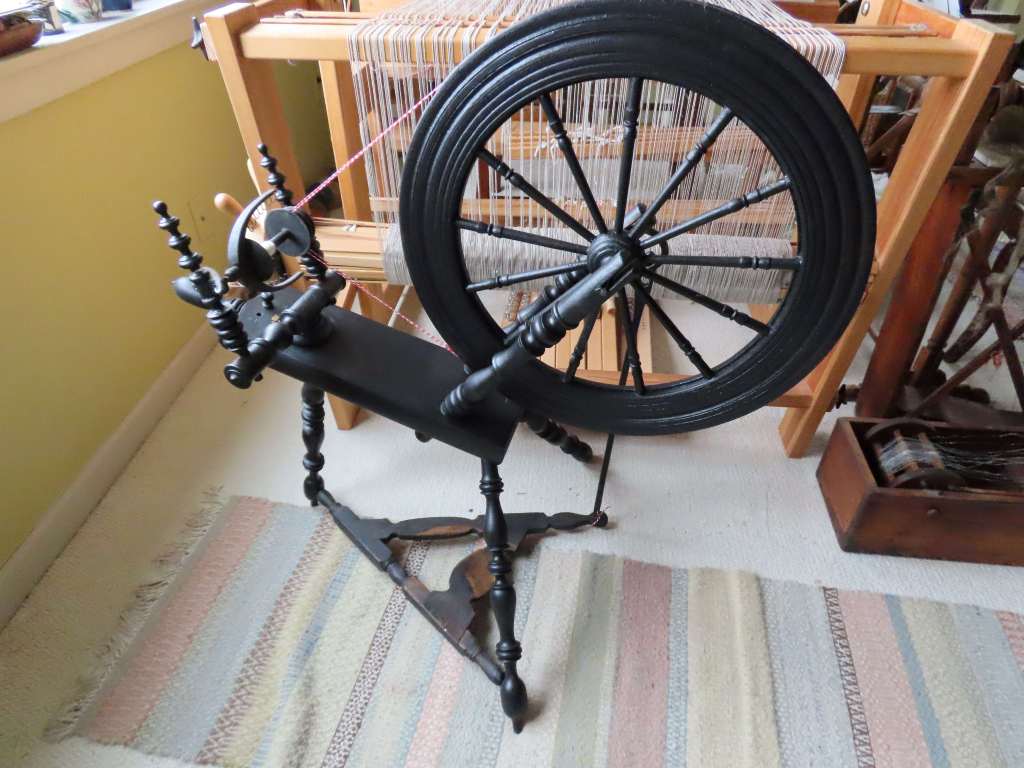
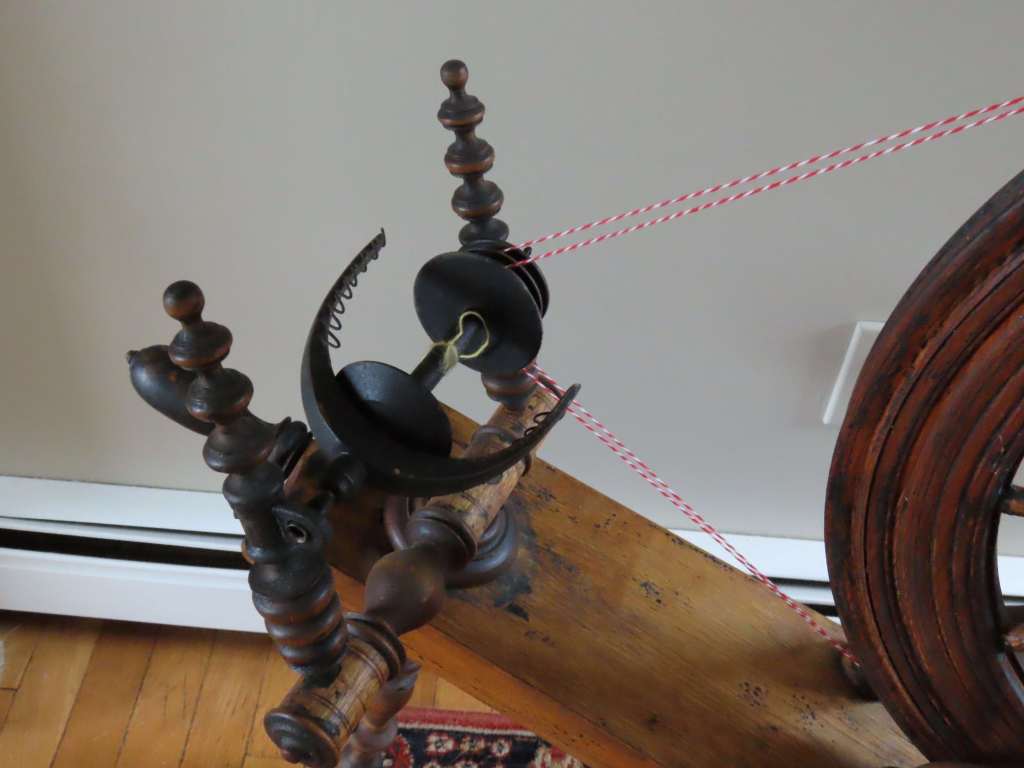
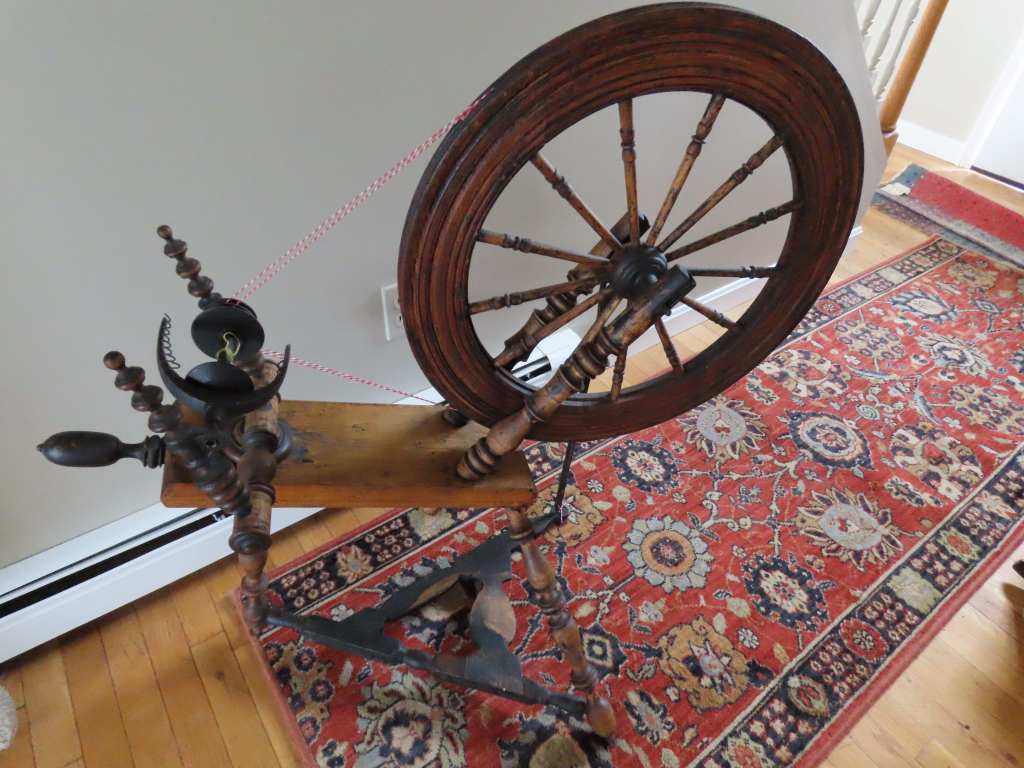
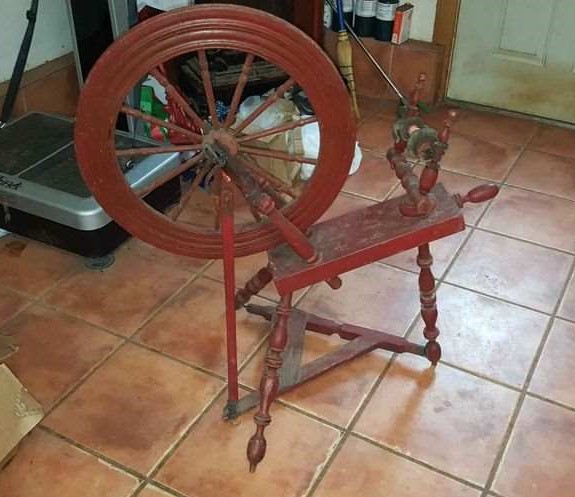
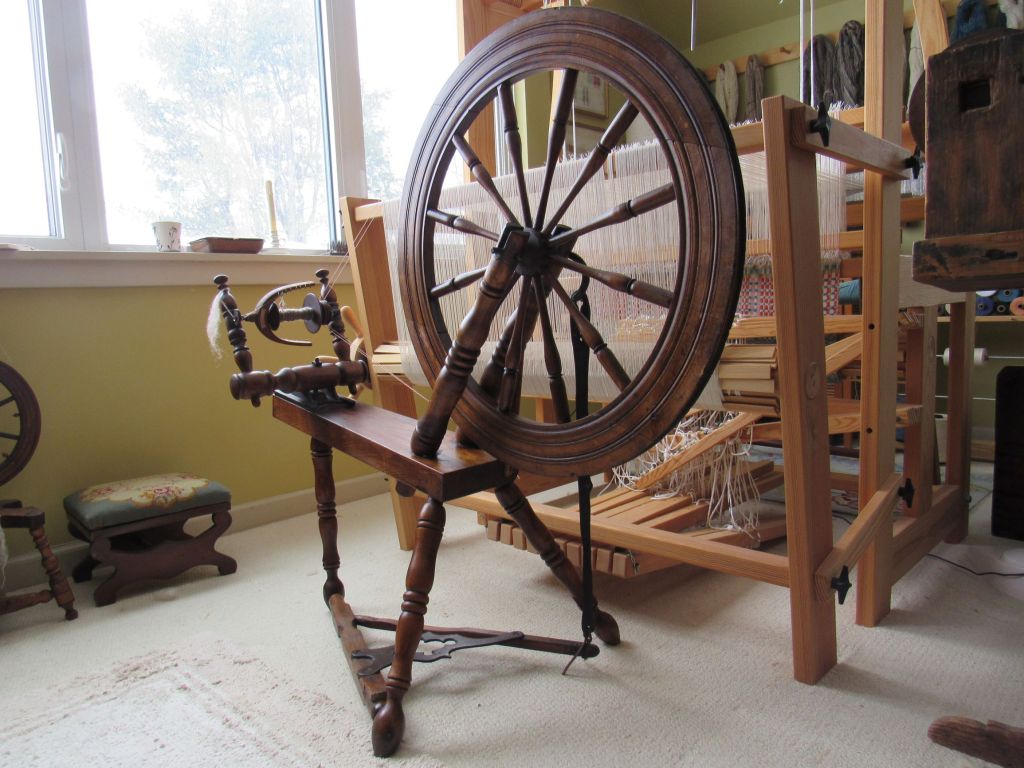
I bought Cocodris years ago from a woman in Bath, Maine. She told me that her grandfather had traded a gun for the wheel somewhere in the northern reaches of Maine.
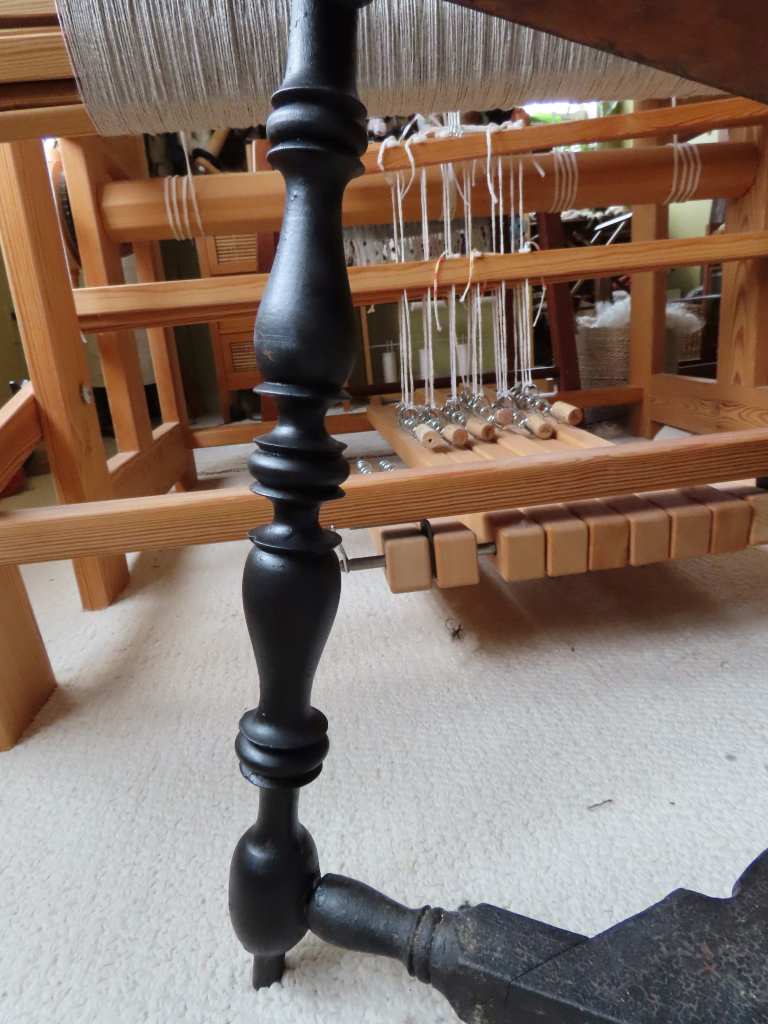
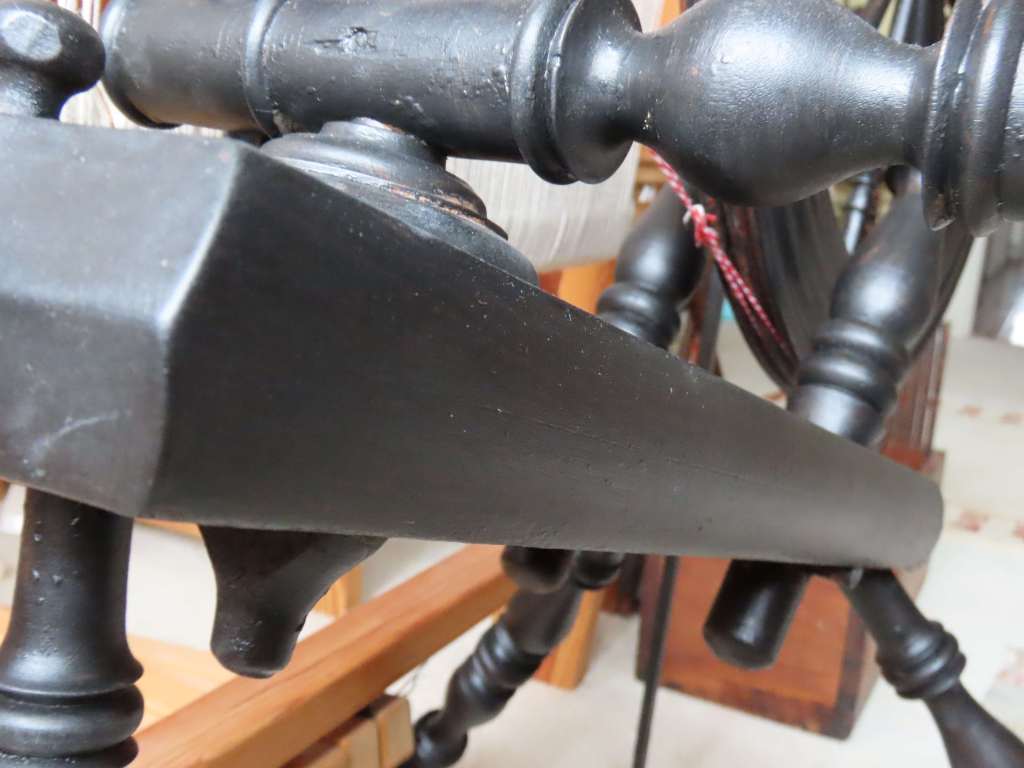
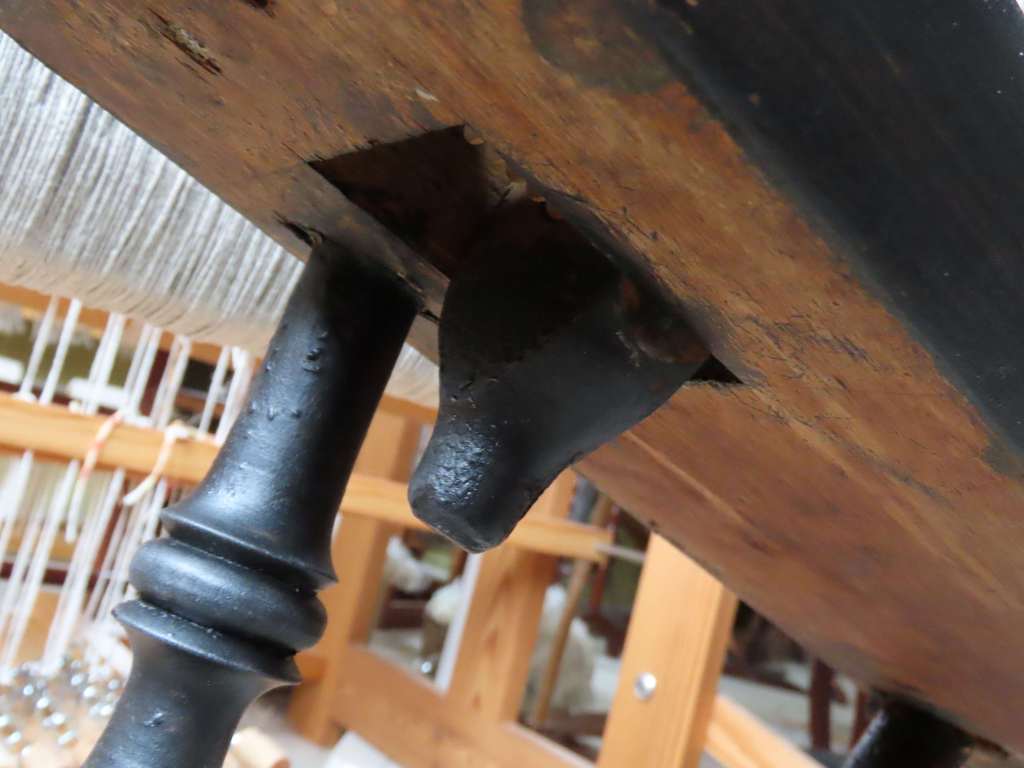
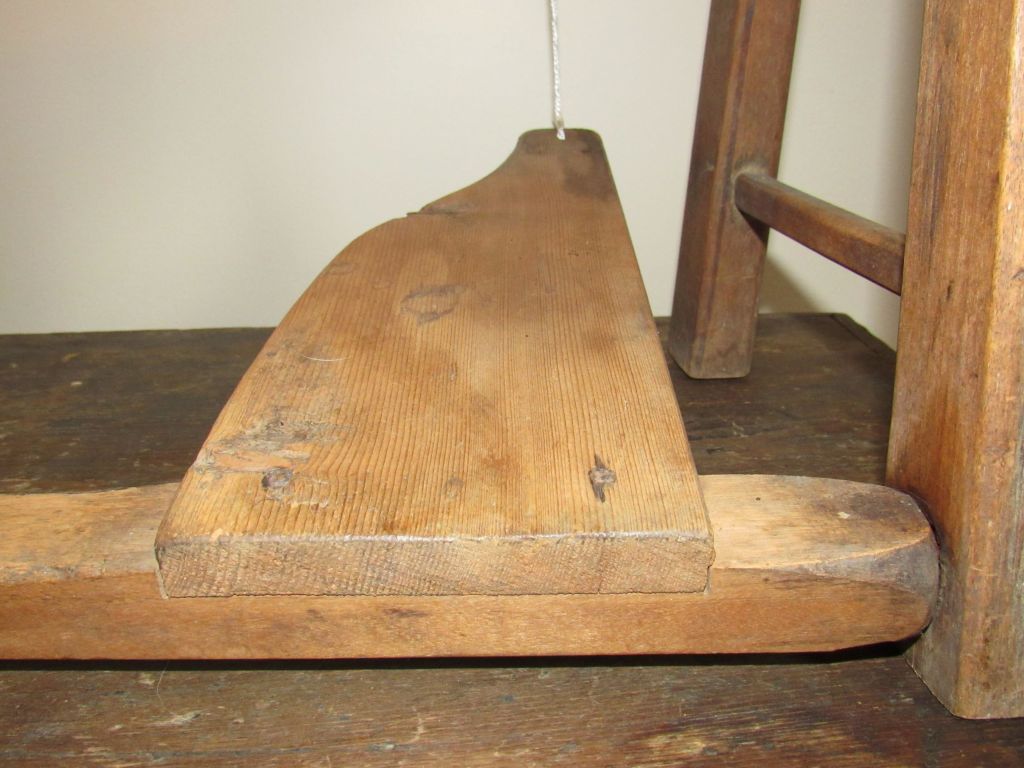
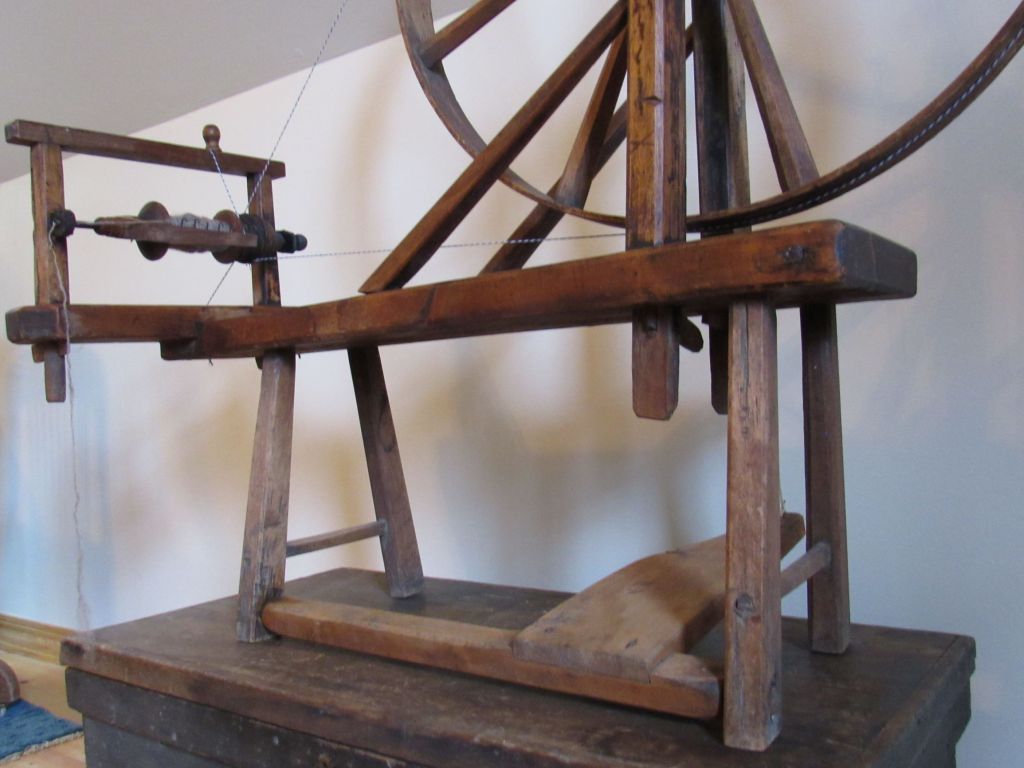
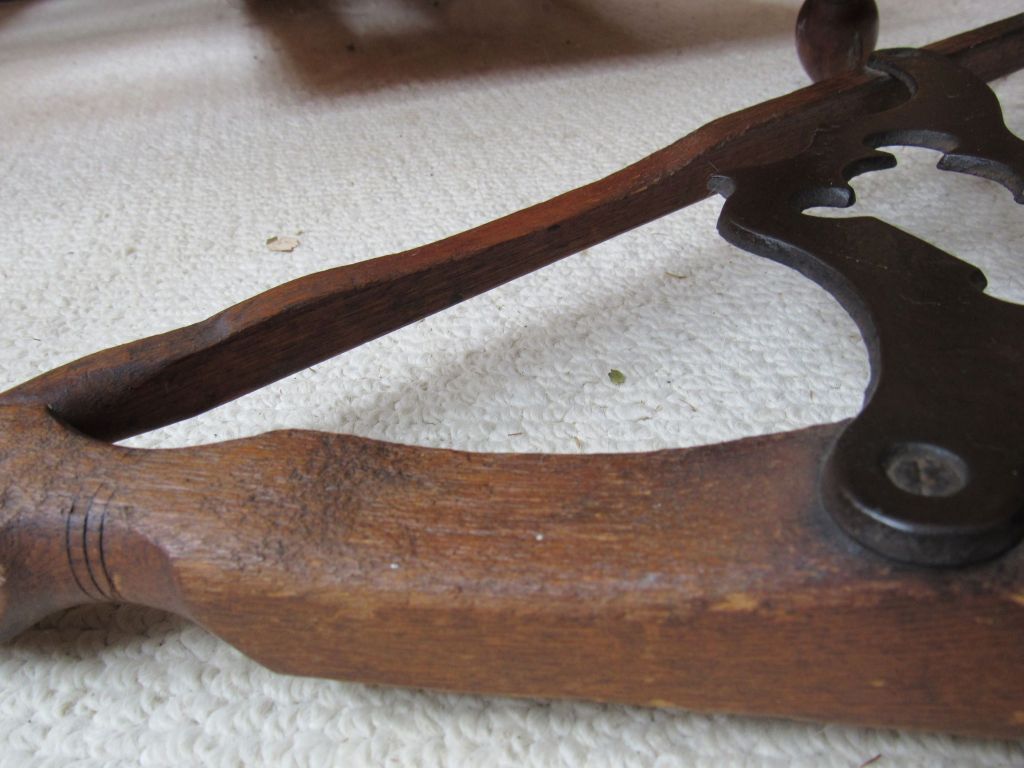
I was attracted by the beautiful treadle curves, an oddly whimsical touch, especially for a wheel found in Maine.
The paint was a bit startling, though.
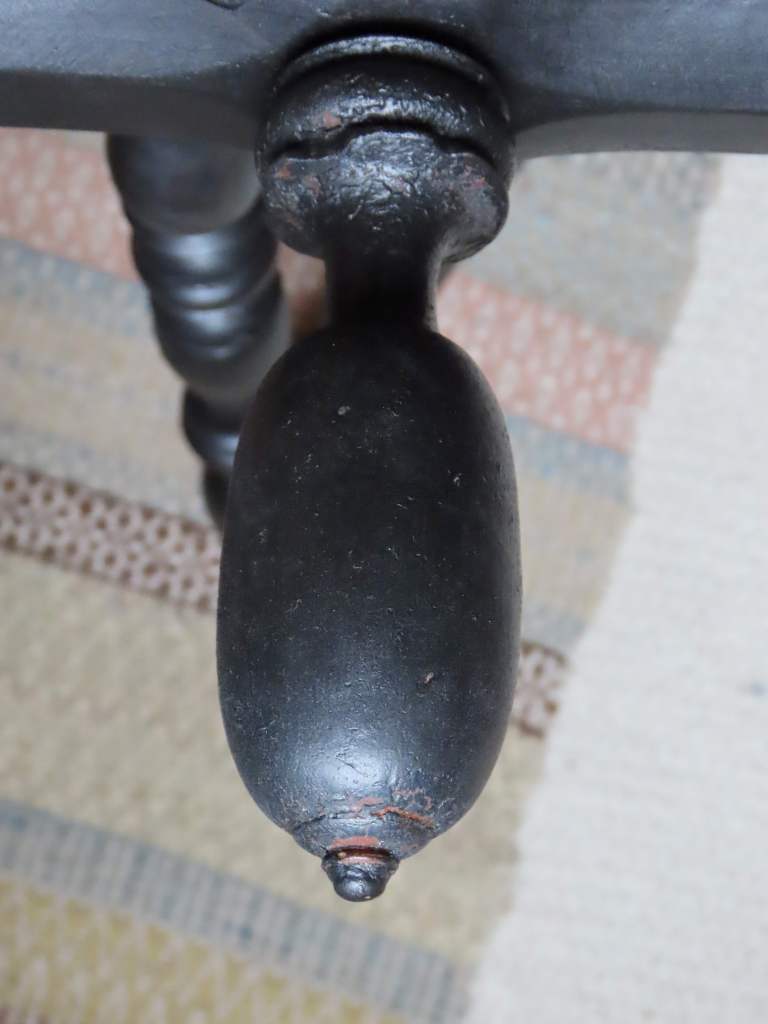
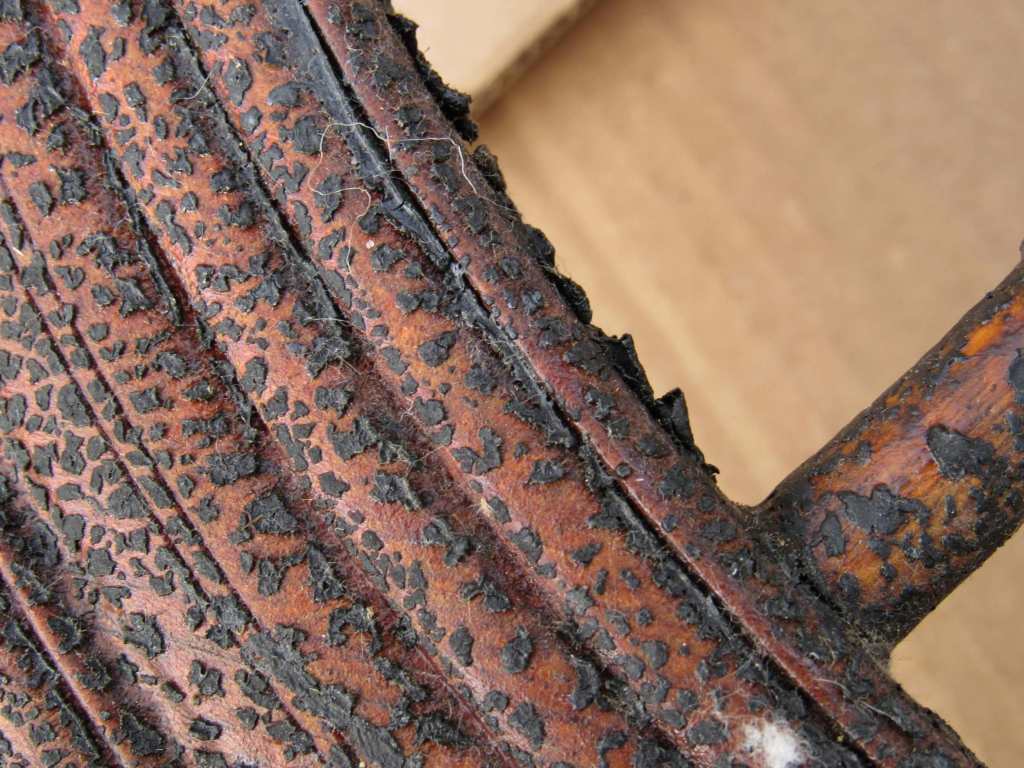
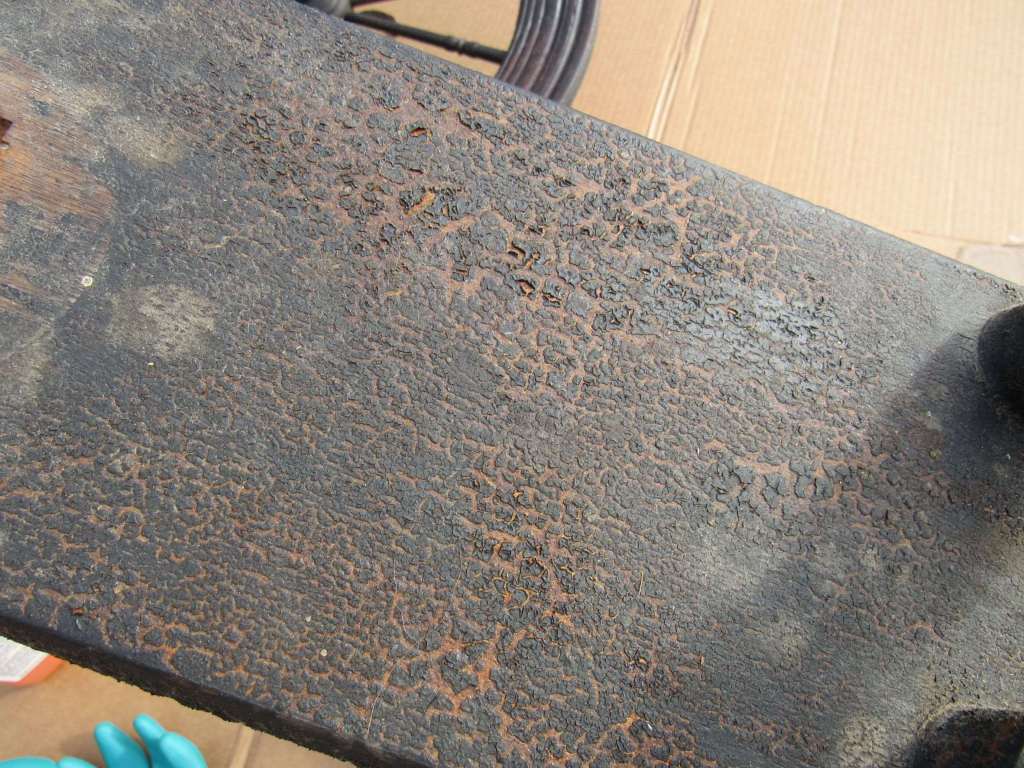
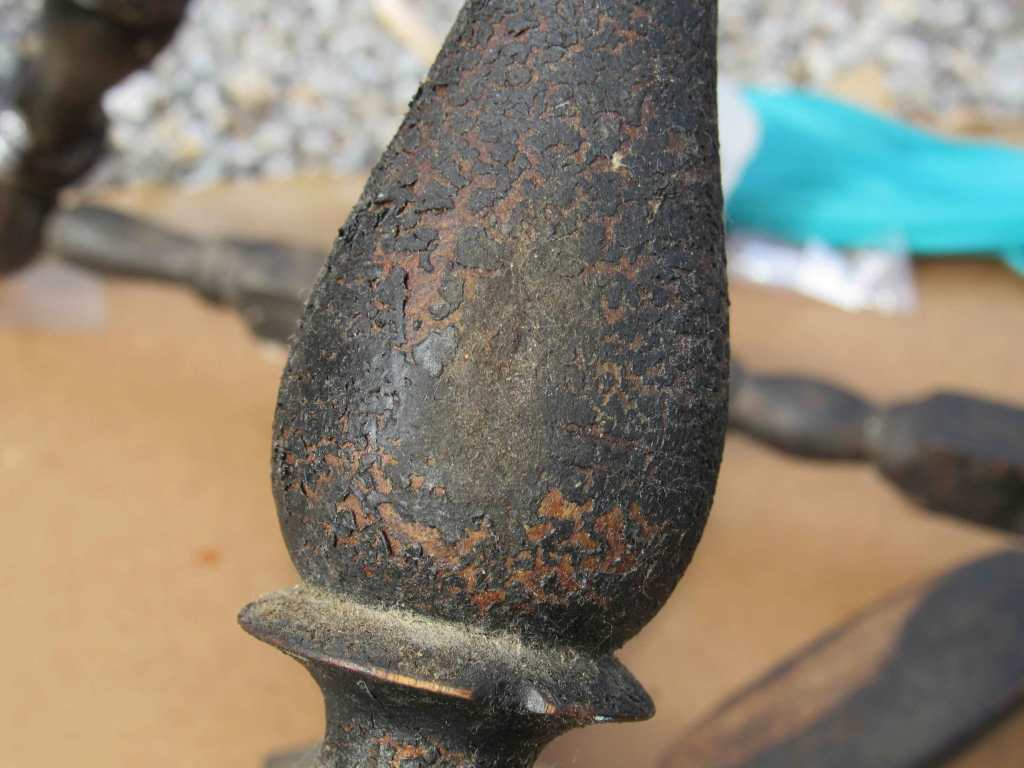
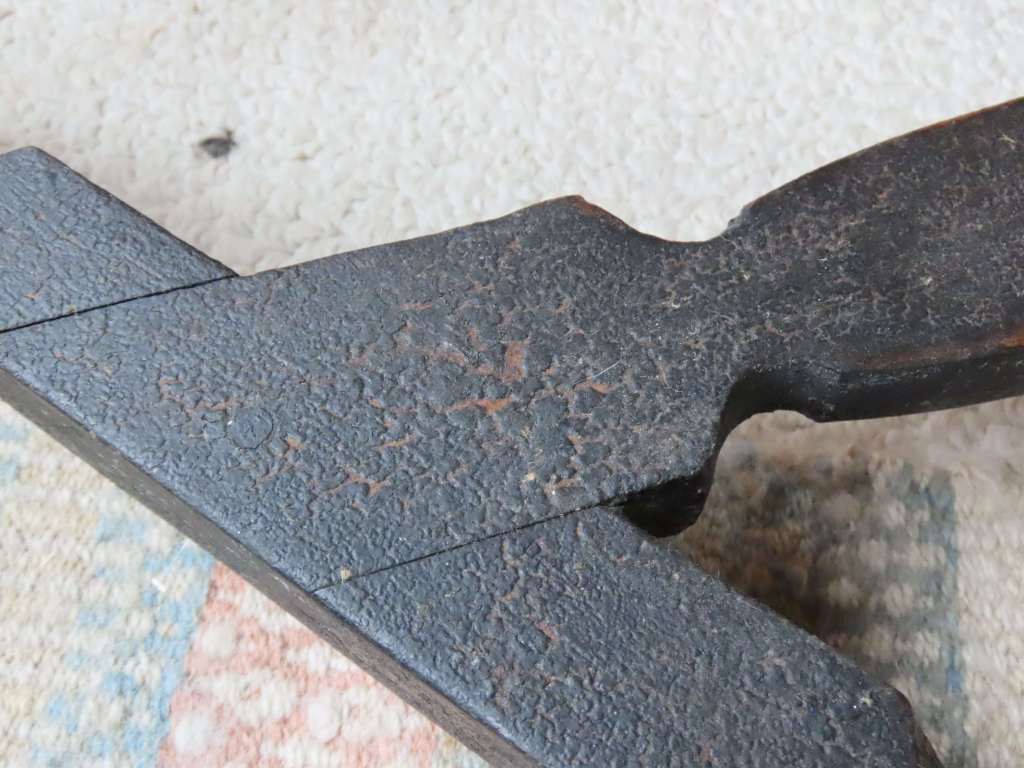
Cracked and peeling, bits almost exploded off the surface,
leaving a trail of black paint crumbs behind. While I rather liked the alligatored look, I was not enthusiastic about the paint litter so decided that I needed to address it.
I tried every suggested non-stripping tactic for alligatored finishes, but nothing worked.
I finally decided to use a citrus stripper and at least remove the worst of the flaking areas.
What a nightmare. Let’s just say that the paint won. I was trying for a mixed look—some parts painted, some showing the wood.
Instead, I ended up with a wheel that looked as if it had a terrible skin disease.
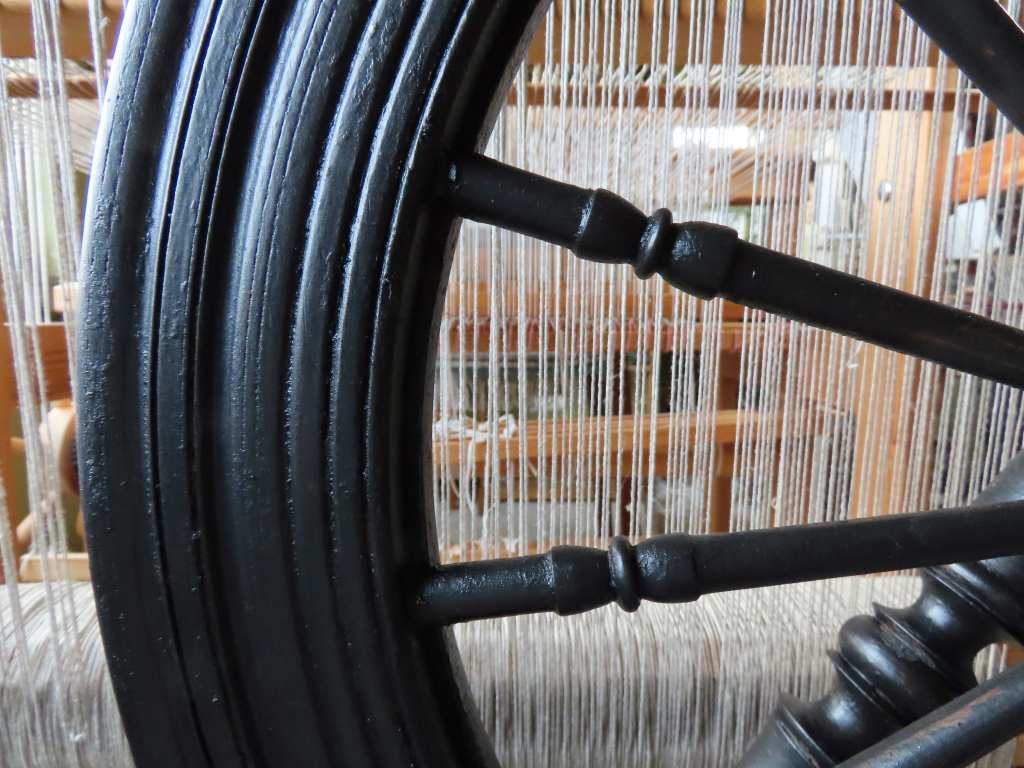
Rather than trying to strip it more, I repainted it, all except for the treadle parts and flyer, which I had not stripped.
They still have the original paint and wear.
It is a bit messy, slightly weird looking, and needs some touch up,
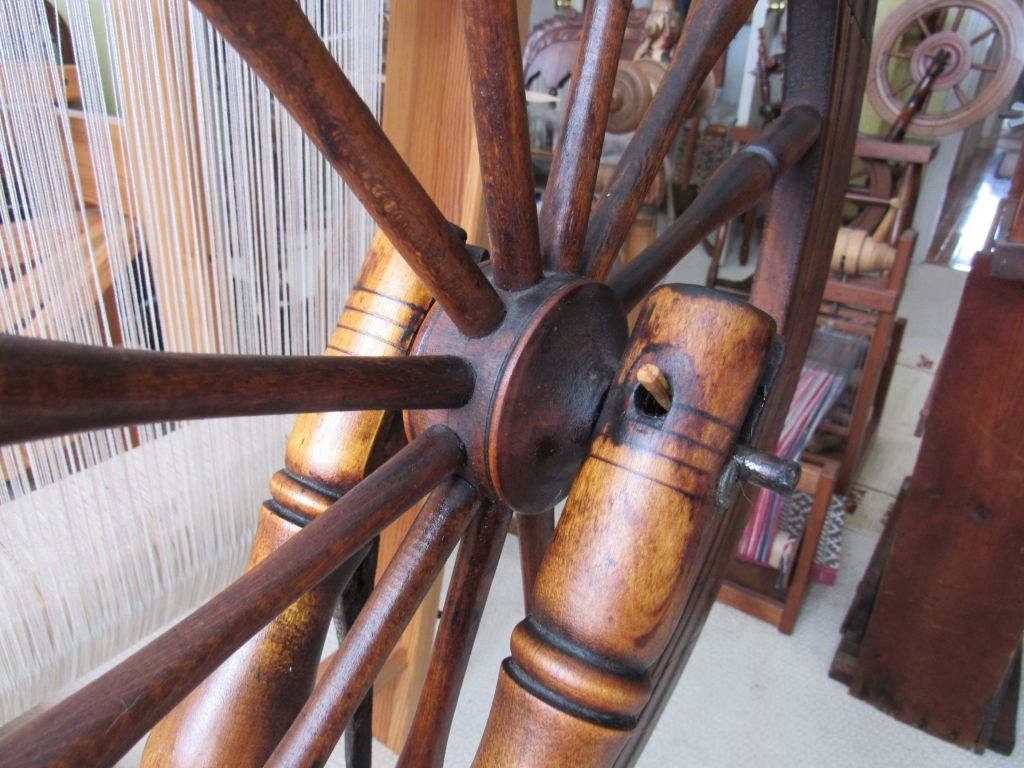
but the black paint highlights the wheel’s beautiful turnings.
And, as is often the case, those turnings started showing up elsewhere. I began to notice similar wheels coming up for sale. While the wheels had individual differences, most had “bowtie” spokes
and legs that resembled the Quebec Paradis wheels.
New Brunswick wheel for sale on kijiji–bowtie spokes and three-tiered maidens
The maidens generally came in two styles—three-tiered like Cocodris’ maidens, or bobble-topped like those on Philomene, the wheel in the previous post.
South Carolina wheel for sale on FB–bowtie spokes, Philomene-style maidens, paintedFor sale on FB–bowtie spokes and Philomene-style maidens
When I acquired Philomene and started researching her maker, Thomas Michaud, it became apparent that this style wheel was commonly found in the upper St. John River Valley, on the border between northern Maine and New Brunswick.
Philomene–made by Thomas Michaud, discussed in previous post
I suspect that most were made by Thomas Michaud and his wheel-making brothers, Hubade/Ubald and Francois Regis (see the previous post “Philomene”). But, since almost none are marked, we can only surmise that they are related based on similarity of features.
Cocodris’ maidens, for example, are like those on Diane Howes’ marked Thomas Michaud wheel (with a few less tiers).
Maidens on Diane’s Michaud wheel, discussed in previous post
The curved table sides,
the under-table MOA post
and scribe marks,
and the flyer scribe marks also are similar.
CocodrisPhilomene
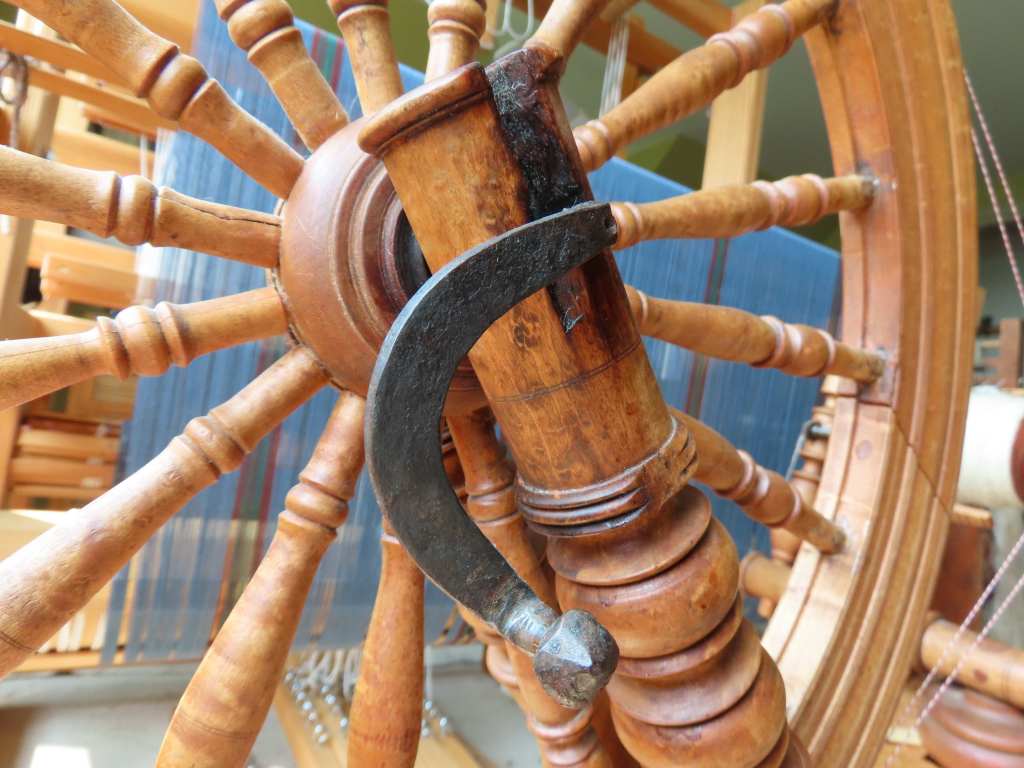
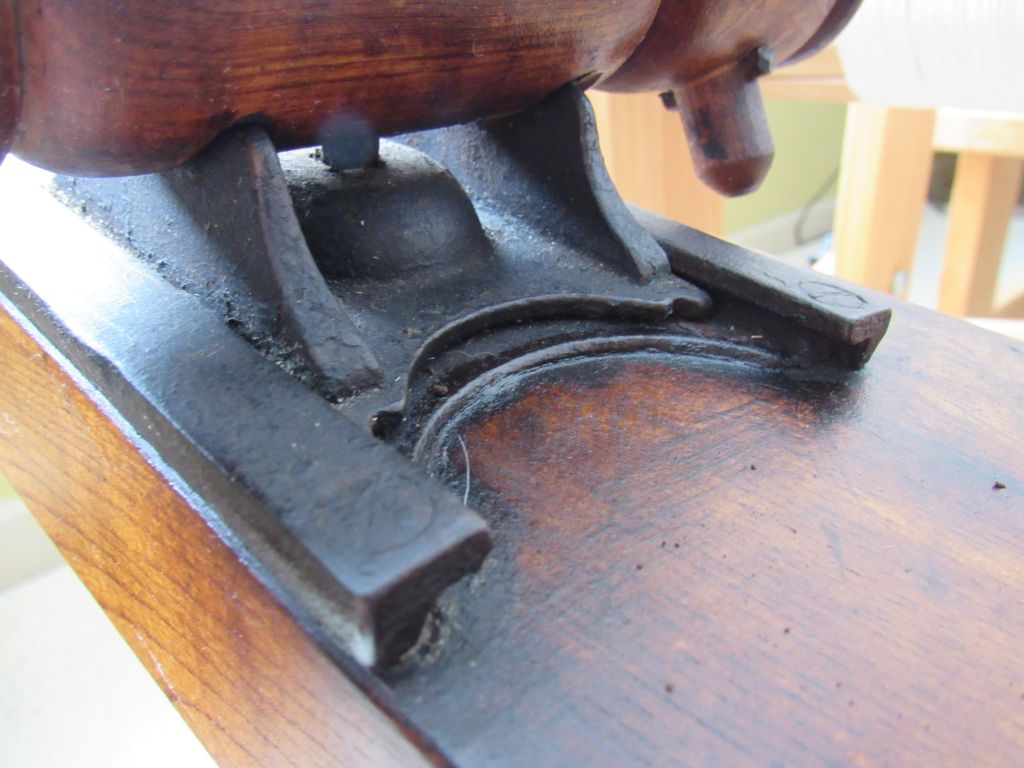
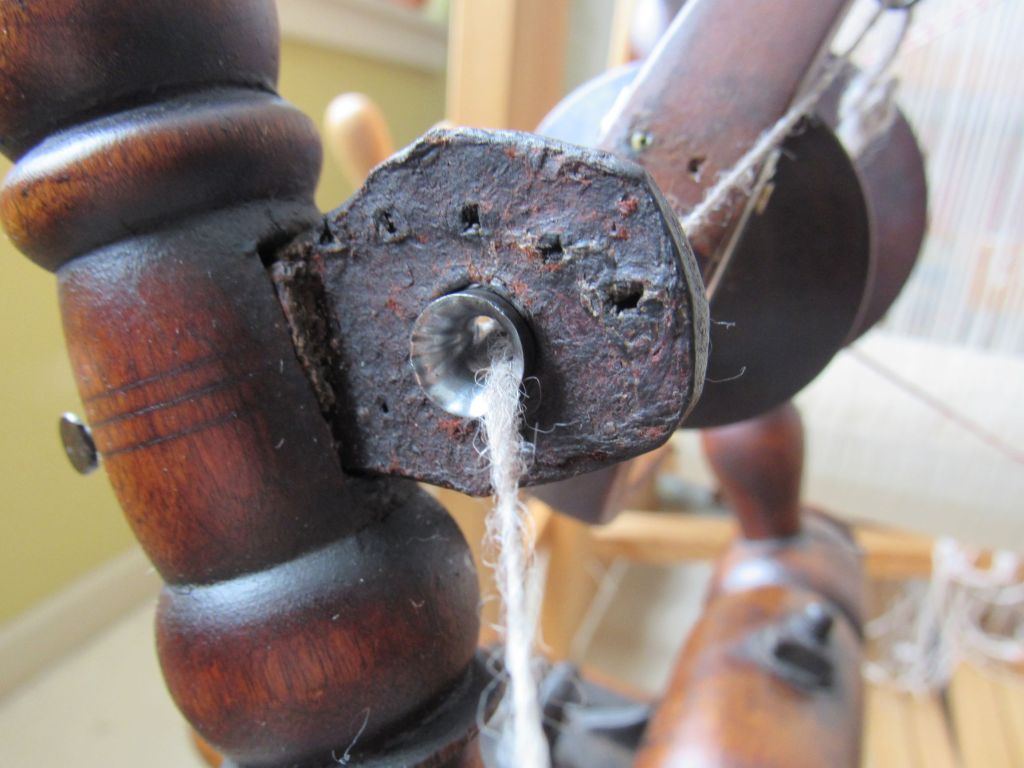
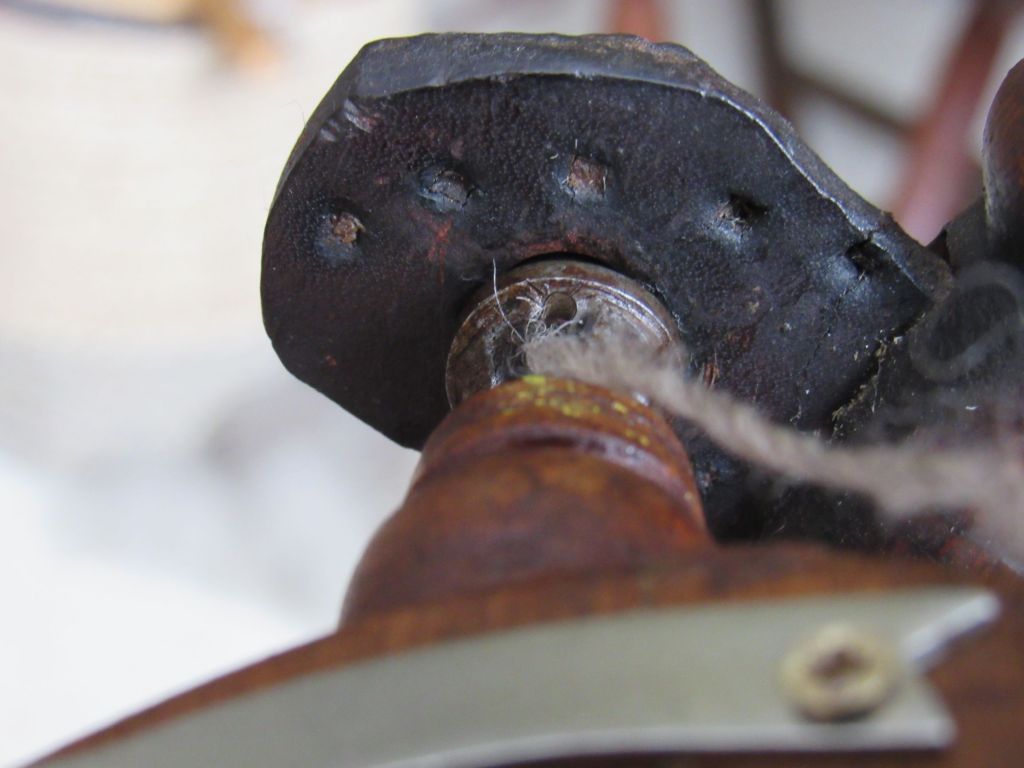
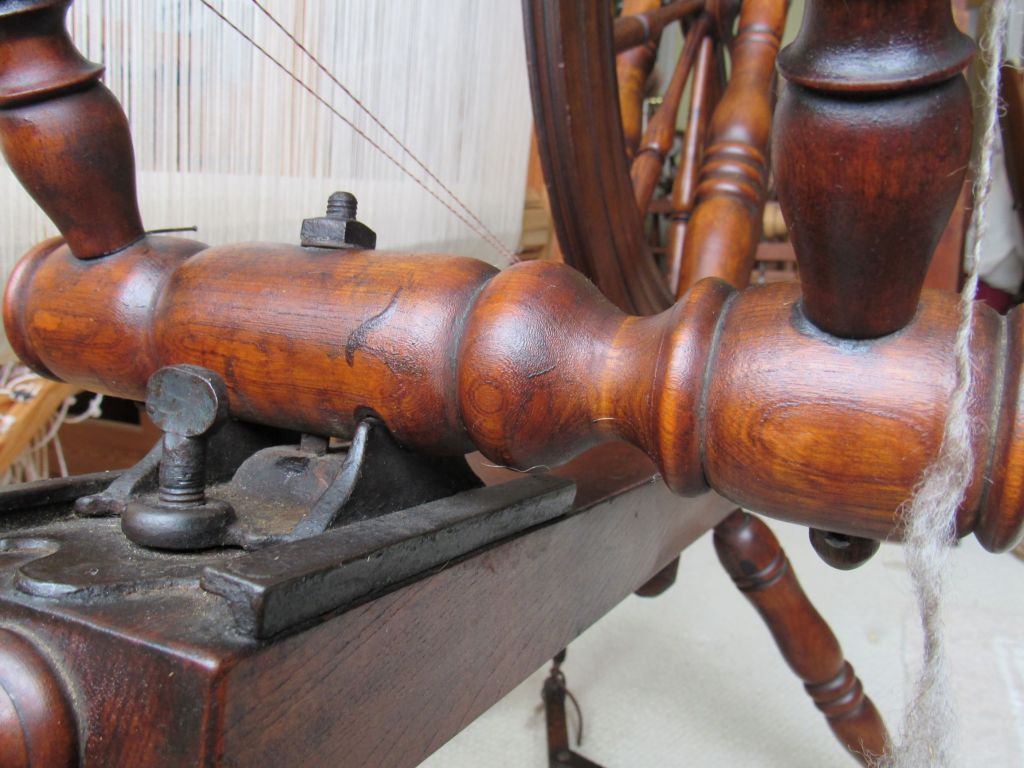
Cocodris and Philomene share somewhat unusual metal work,
CocodrisPhilomene
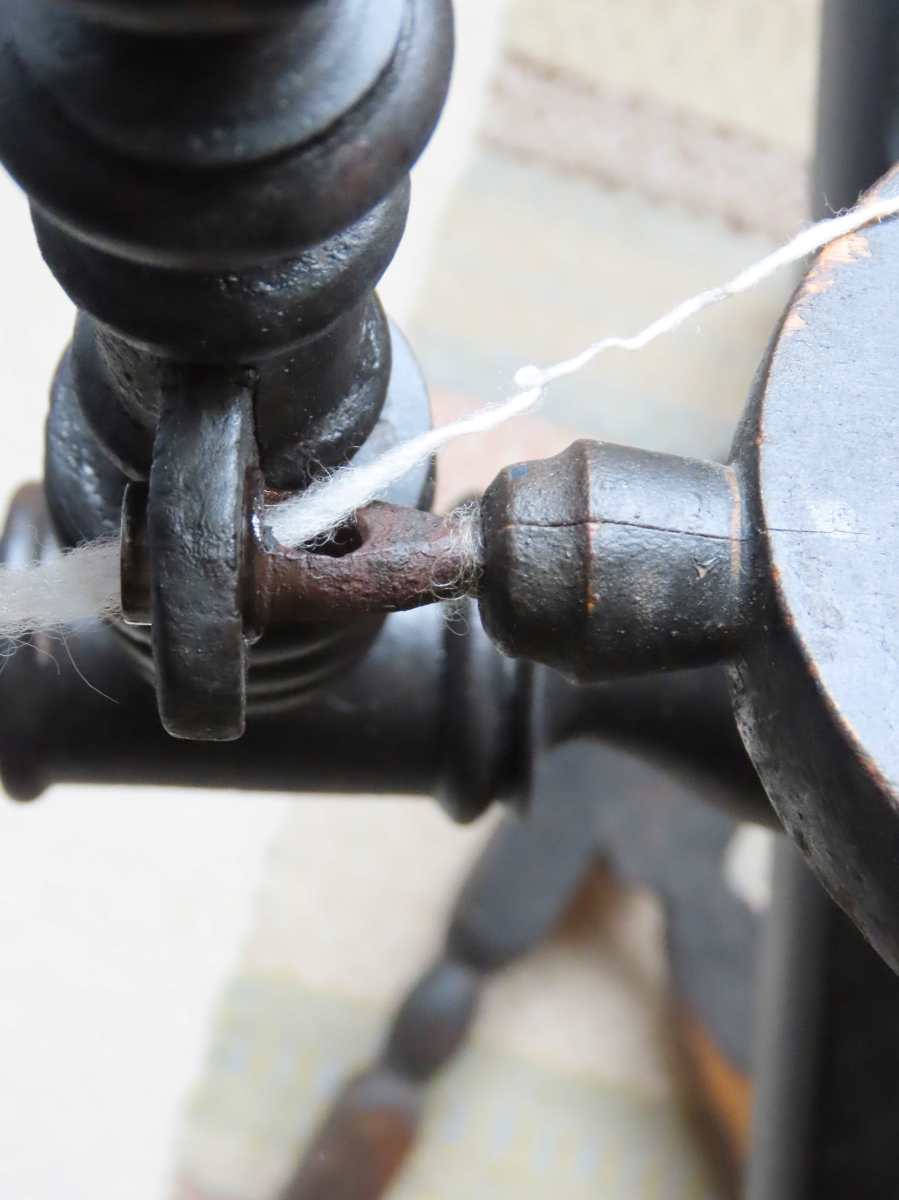
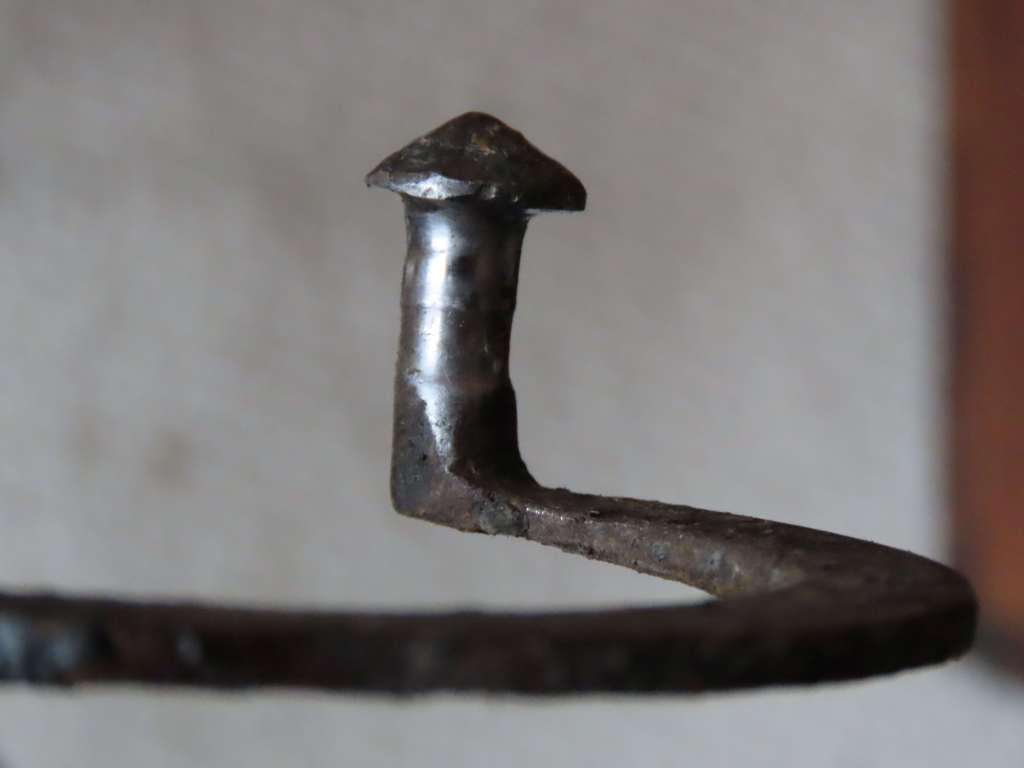
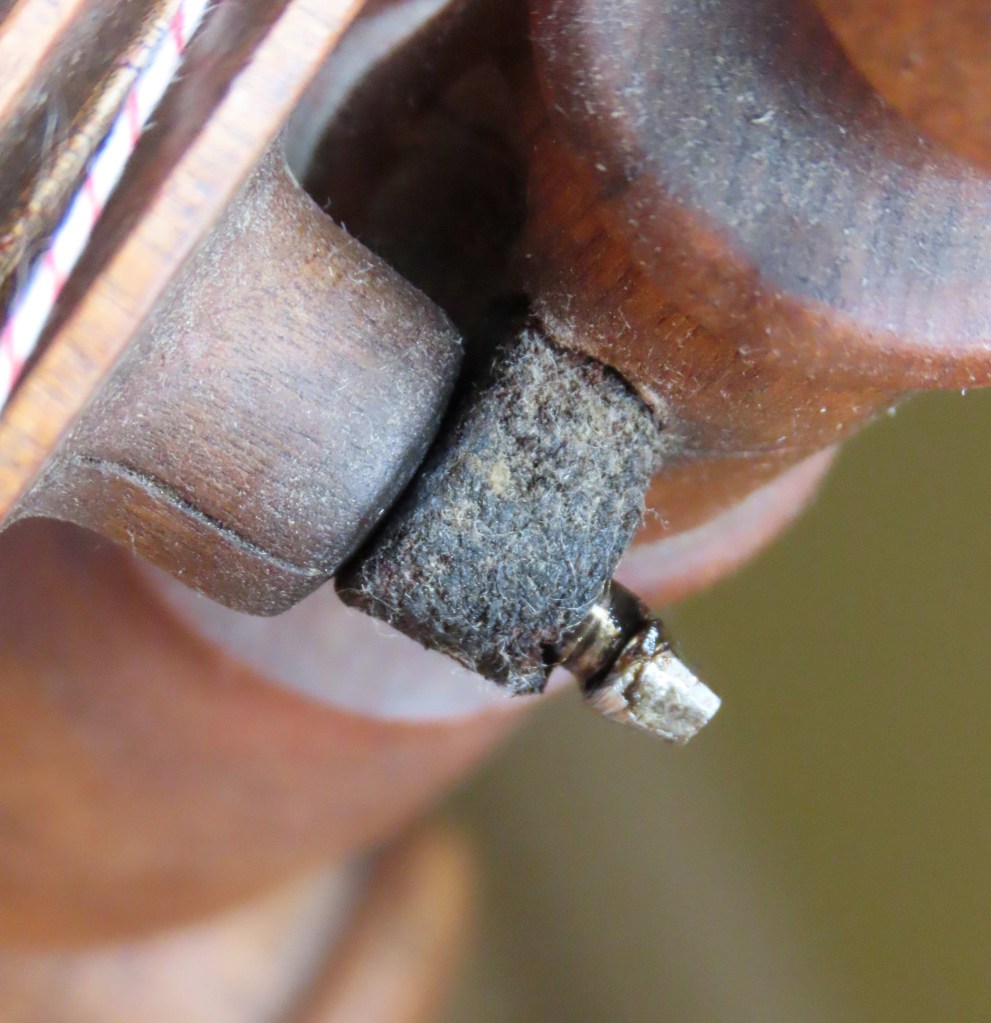
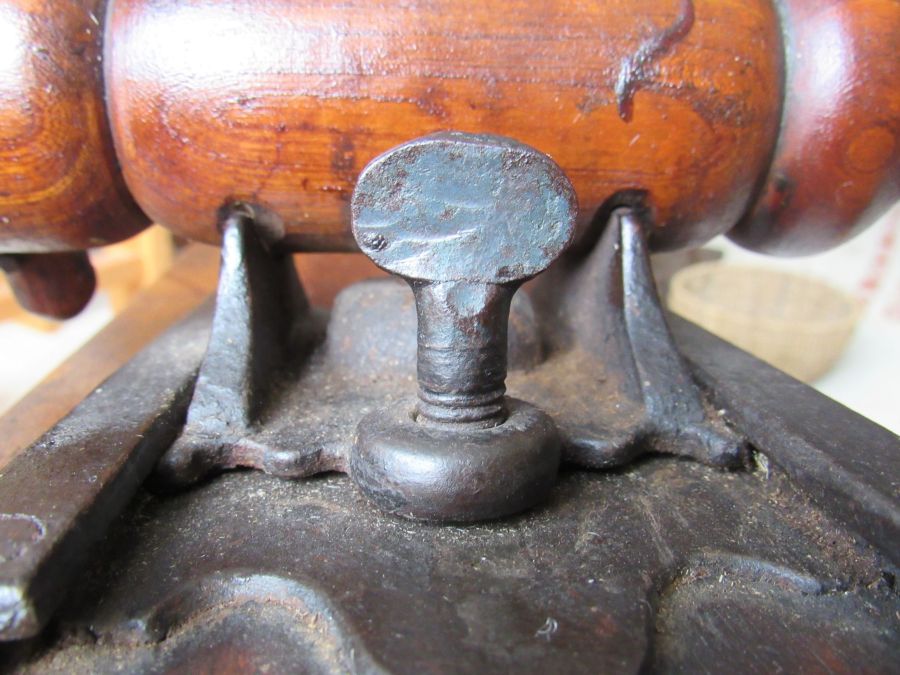
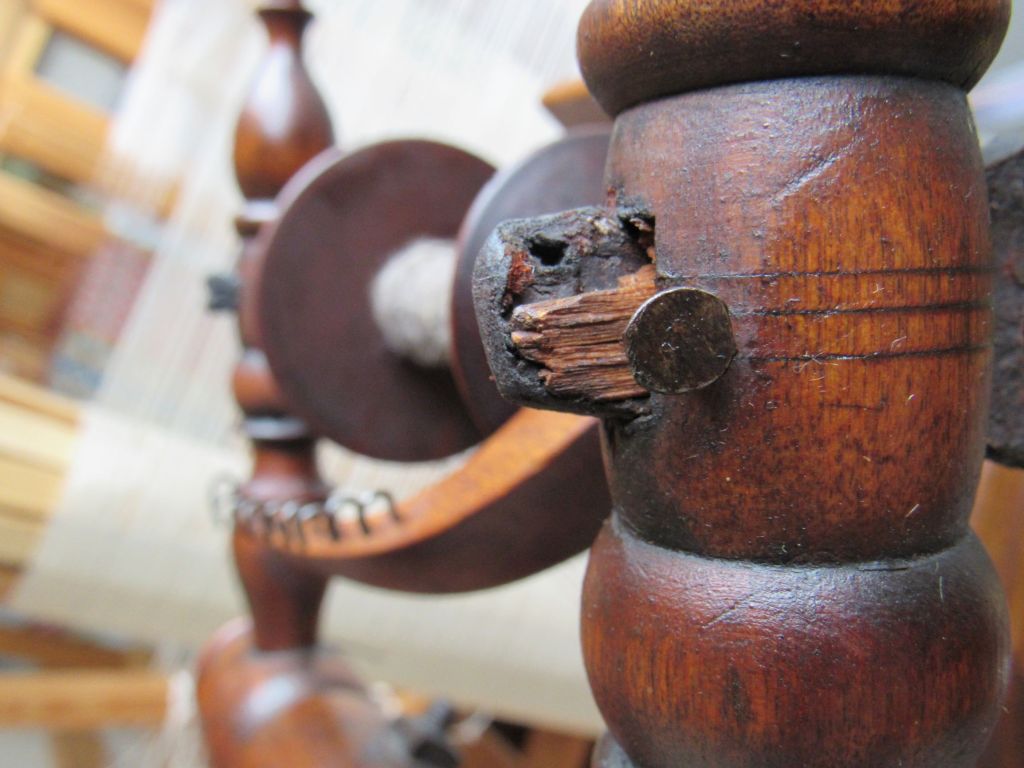
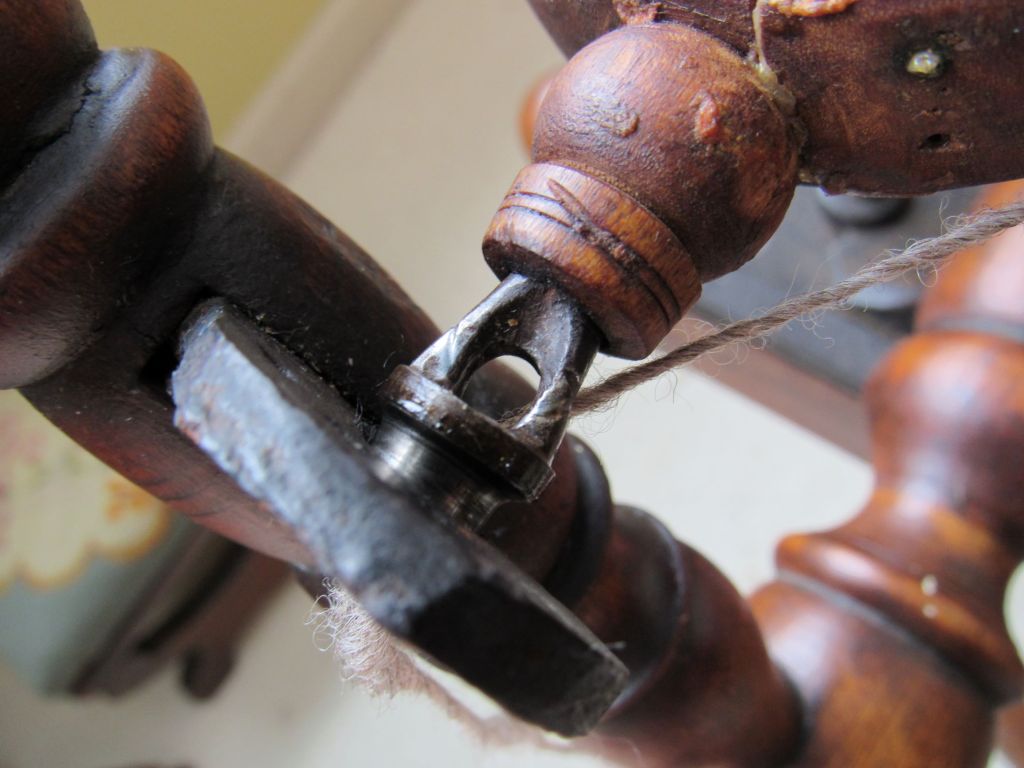
having distinctive angled knobs at the mandrel ends
CocodrisPhilomene
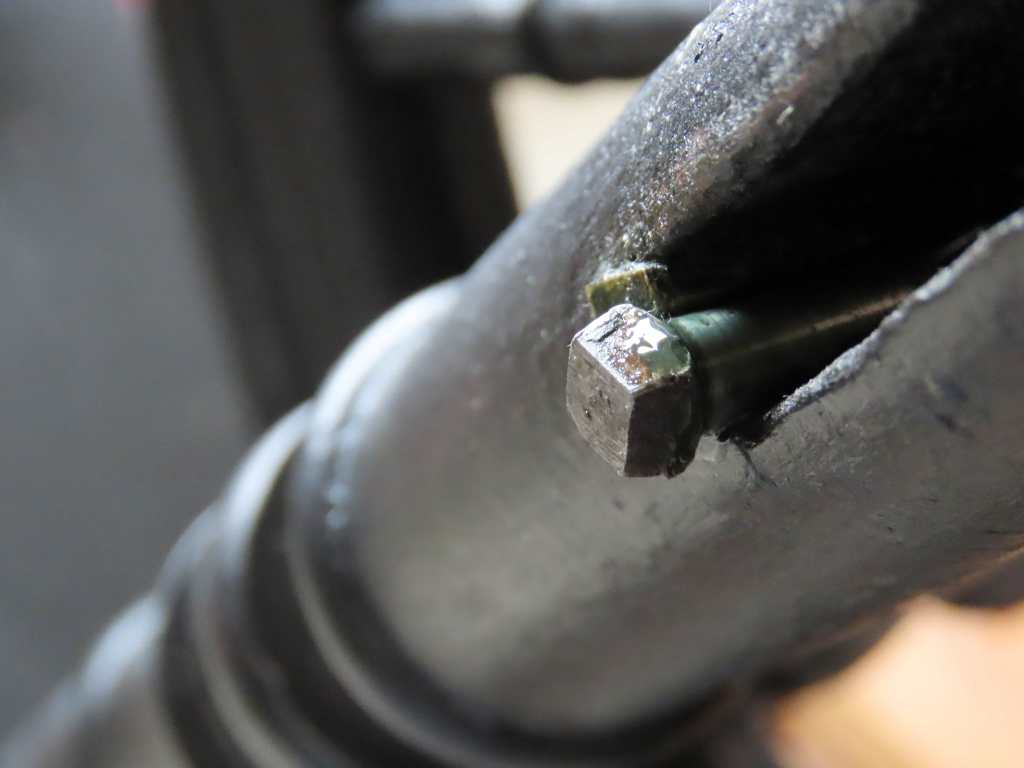
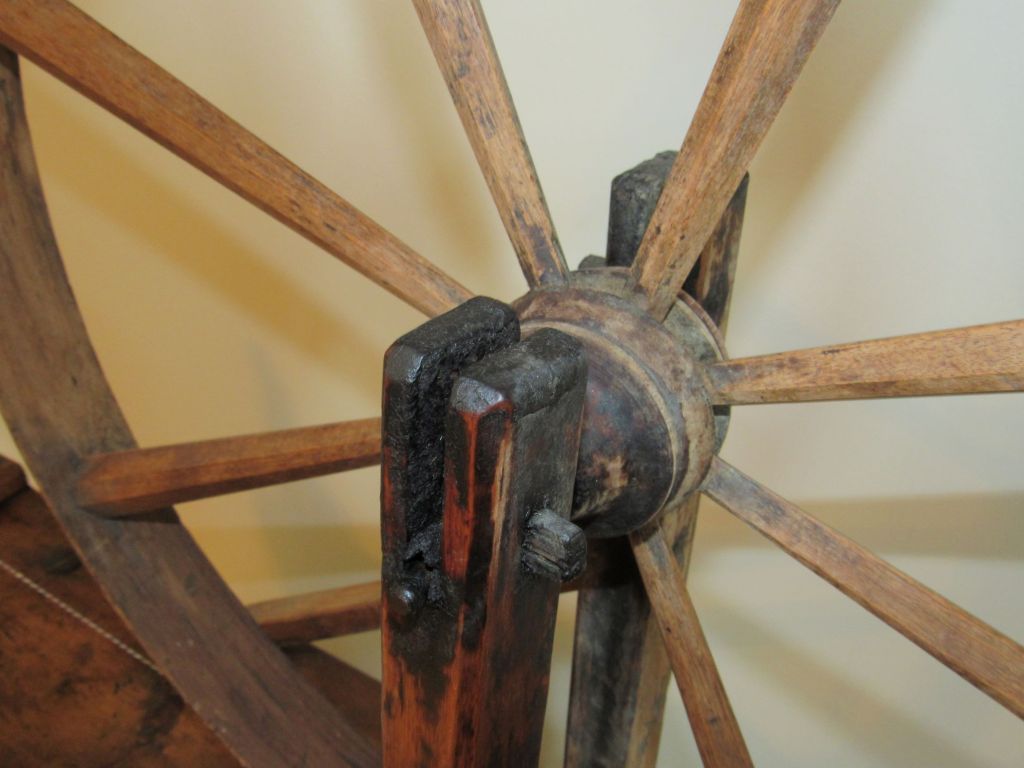
and squared axle ends.
CocodrisPhilomene
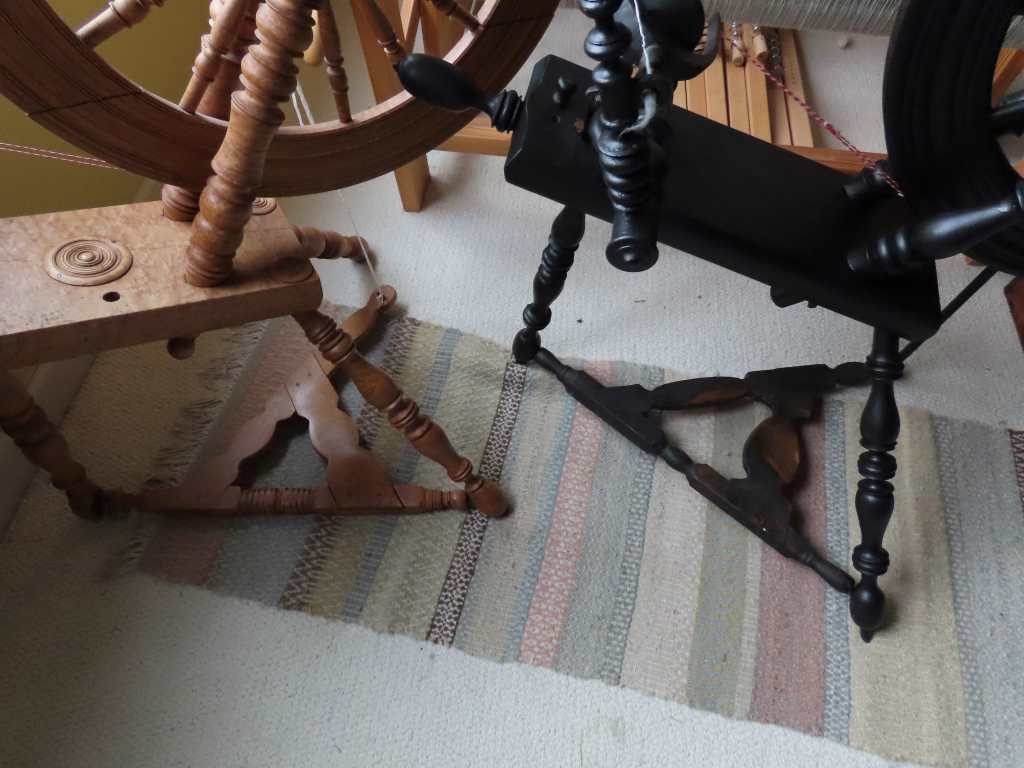
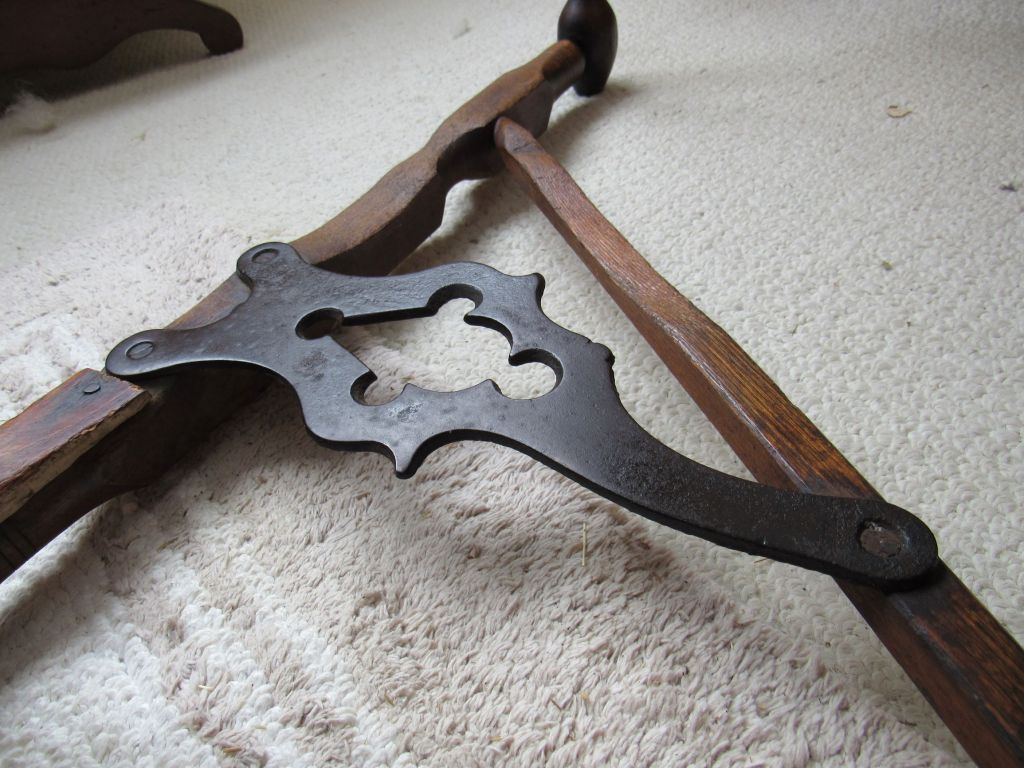
But, the most compelling similarity is the lovely treadle design.
It is so unusual and rare that it makes me think that Cocodris likely was made by Thomas Michaud. Even the wheels’ heavy treadle wear matches.
In fact, Cocodris is an even better spinner than Philomene—quiet and steady, perfect for fine singles.
Although one upright is skewed toward the spinner (it’s in tight) and the drive wheel does not directly align with the whorl, she is smooth, fast, and delightful to use.
Early Quebec wheels probably had little resemblance to the large, metal-clad production wheels associated with Quebec today. It is likely that many were flat rim wheels, which are still found in Quebec, Ontario, and New England.
The origin of these flat rim wheels is a bit of a mystery. Some likely came from the Acadian settlements in Canada, but it is doubtful that they are all Acadian. Many Quebec settlers came from the northwest of France, and, interestingly, these wheels resemble the flat rim wheels of Normandy.
Le Rouet, Gr. de LeleuxThis image and the one above have one leg resting on a rock. Is there some reason for this (other than a fix for a damaged leg)? If any one knows, please leave a message at the end of this post.
Whatever their origin, Quebec flat-rim wheels are thought to date from the late 18th century into the early 19th century. They come in various forms. Some have treadles, some are hand-cranked.
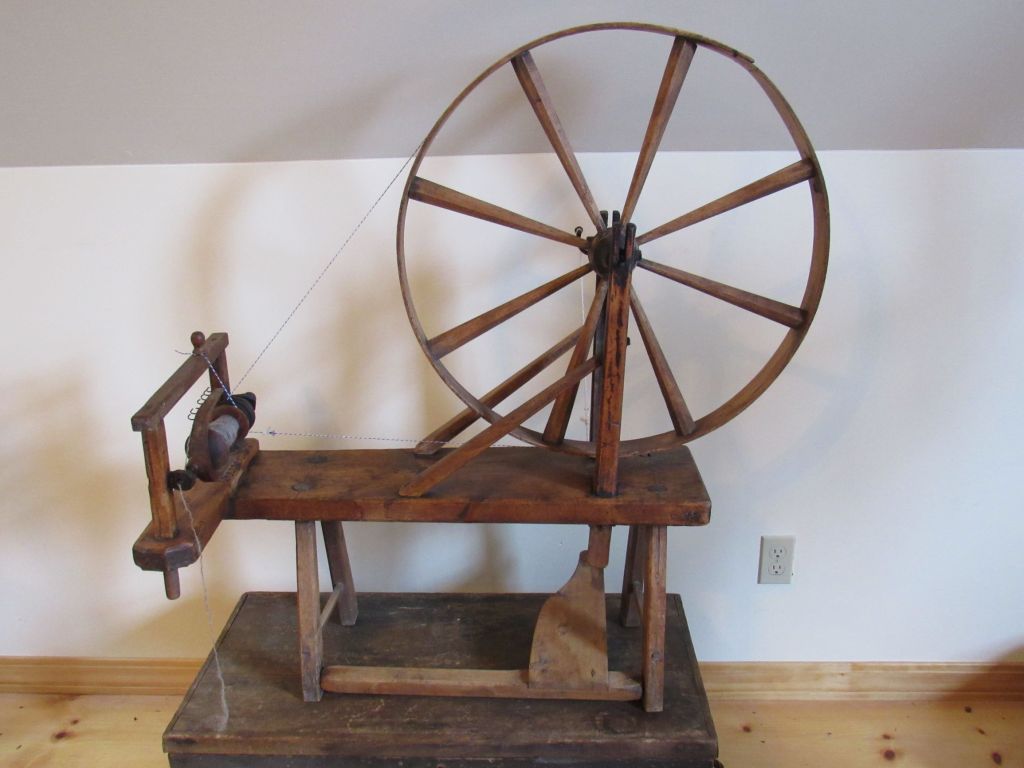
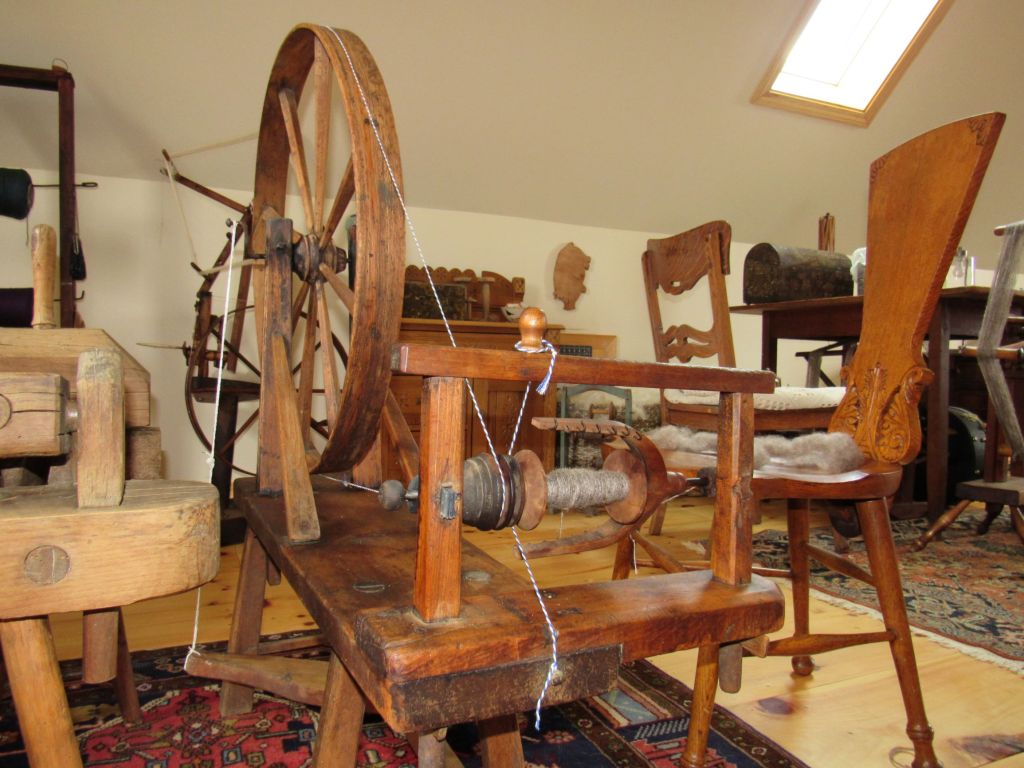
Tables may be flat or sloped, often with four legs, but sometimes three. Their profile is distinctive—a long, wide, sturdy table, shortish legs, with an outsized drive wheel and flyer set-up.
In fact, some wheels of this style are not flat-rimmed but have drive wheels like those on saxony-style wheels, looking almost apologetically out-of-place atop the squat wheel bodies.
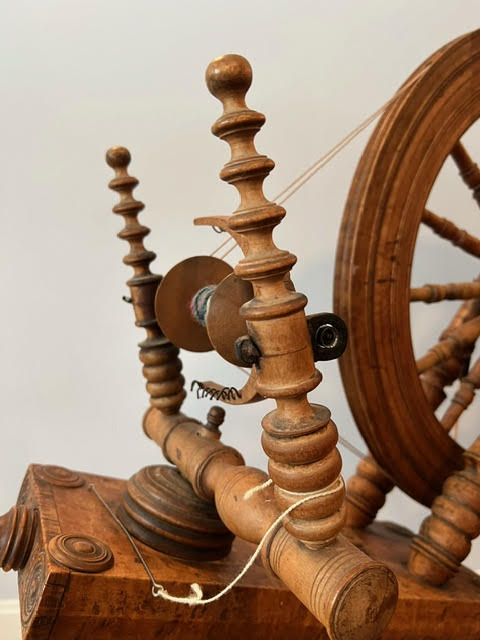
The flyers and tension systems on these wheels set them apart from other antique wheels.
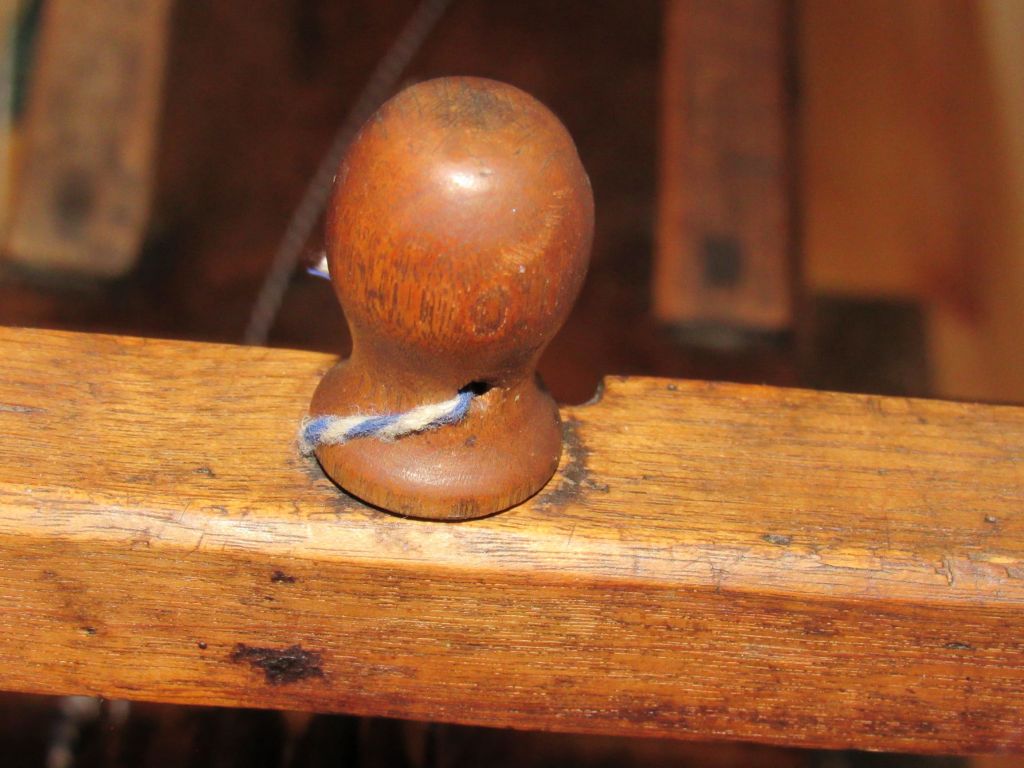
Most are not double drive, but have some form of “scotch” tension, with a single drive band for the whorl and a brake on the bobbin, usually adjusted with a small knob inserted in a hole in a bar over the flyer assembly.
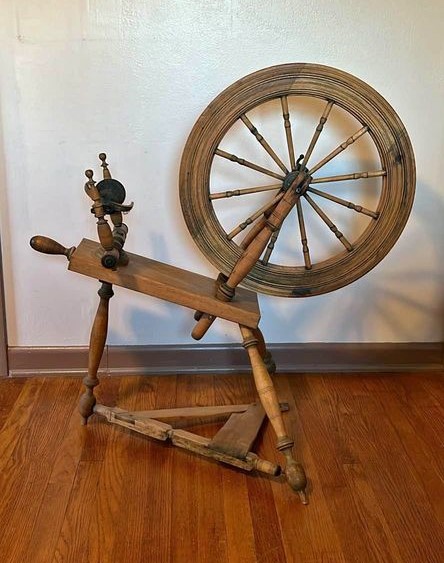
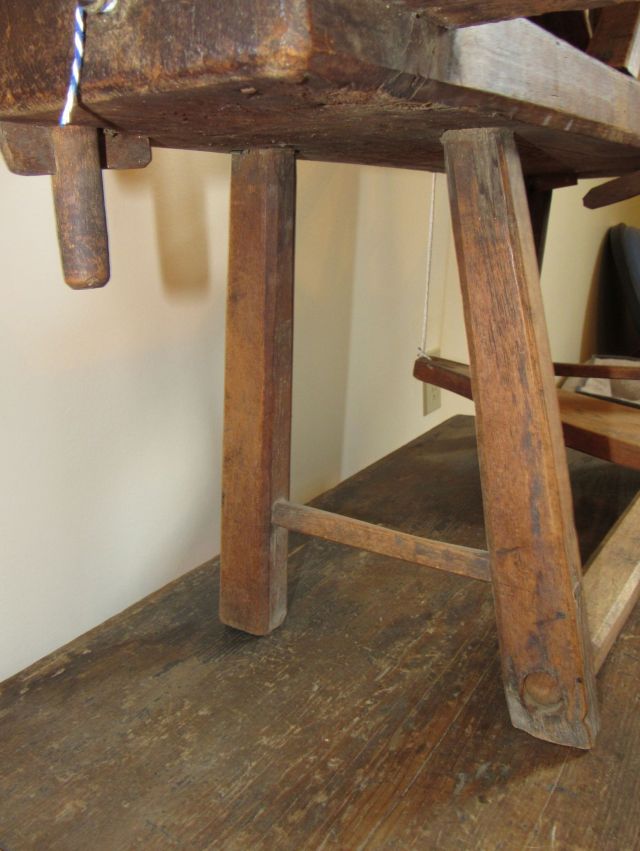
My wheel is unusual because, aside from the flyer assembly, it has no turned parts.
Aside from the hub, nothing is round.
The spokes, legs, uprights, and upright supports are all straight-sided with chamfered edges.
The spokes are particularly nice, six-sided and tapered.
Old nail holes indicate that the rim was re-positioned at some point.
The table is sturdy and flat.
The lines of the wheel—all edges and tapers—are very beautiful and quite unique.
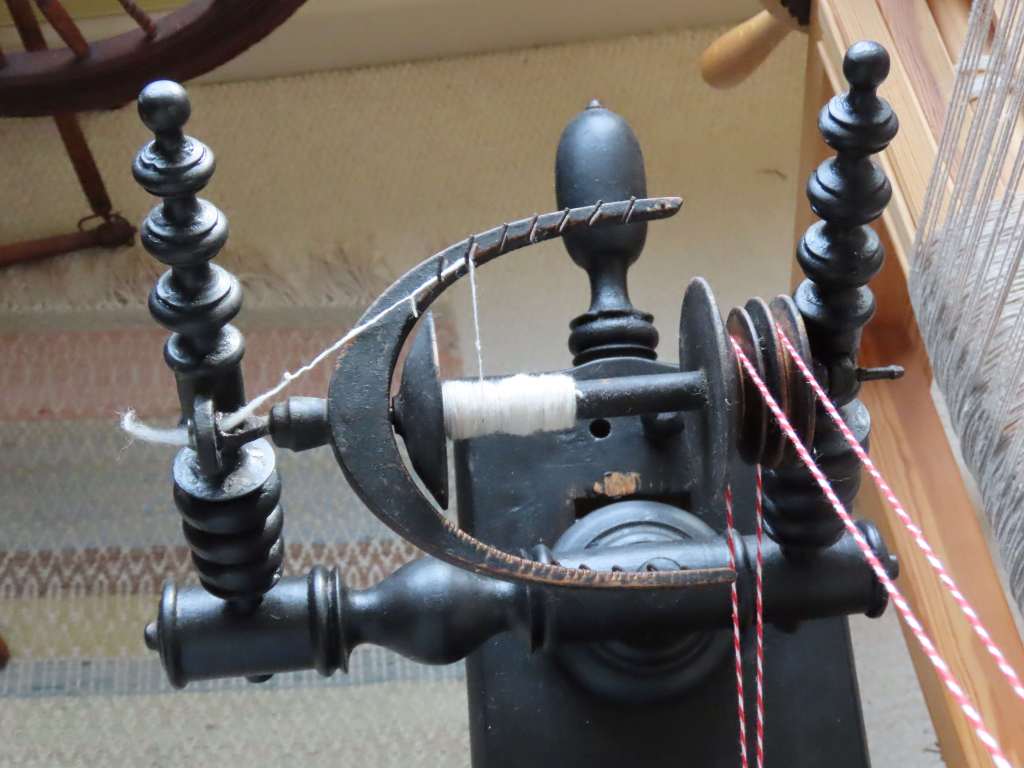
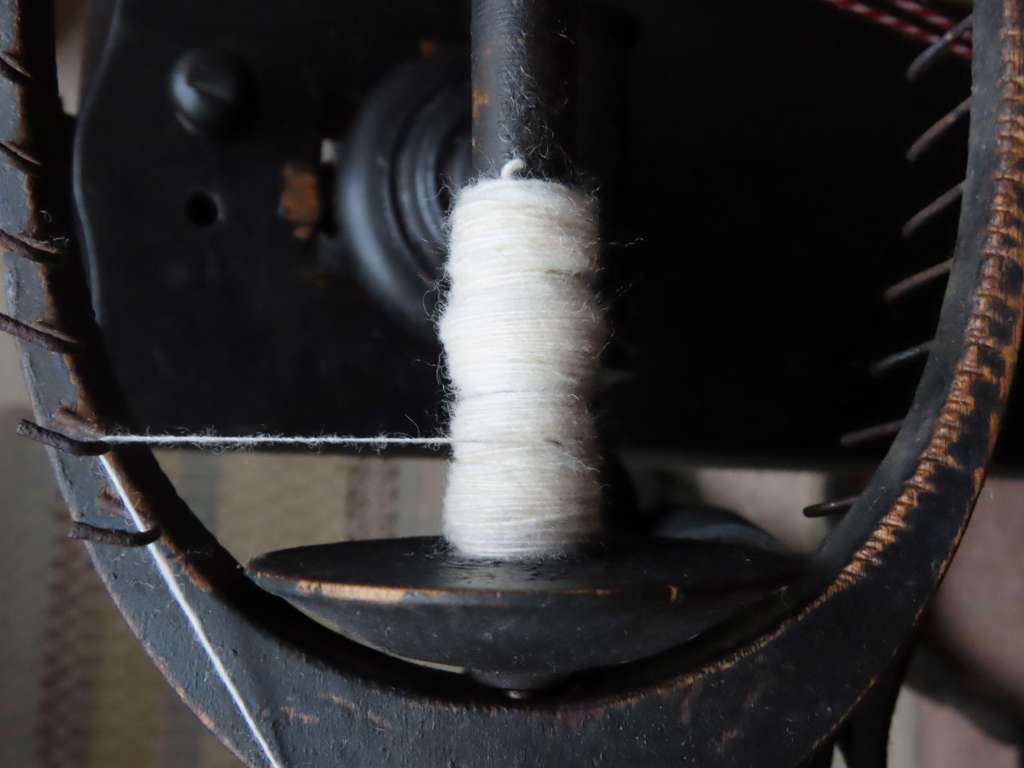
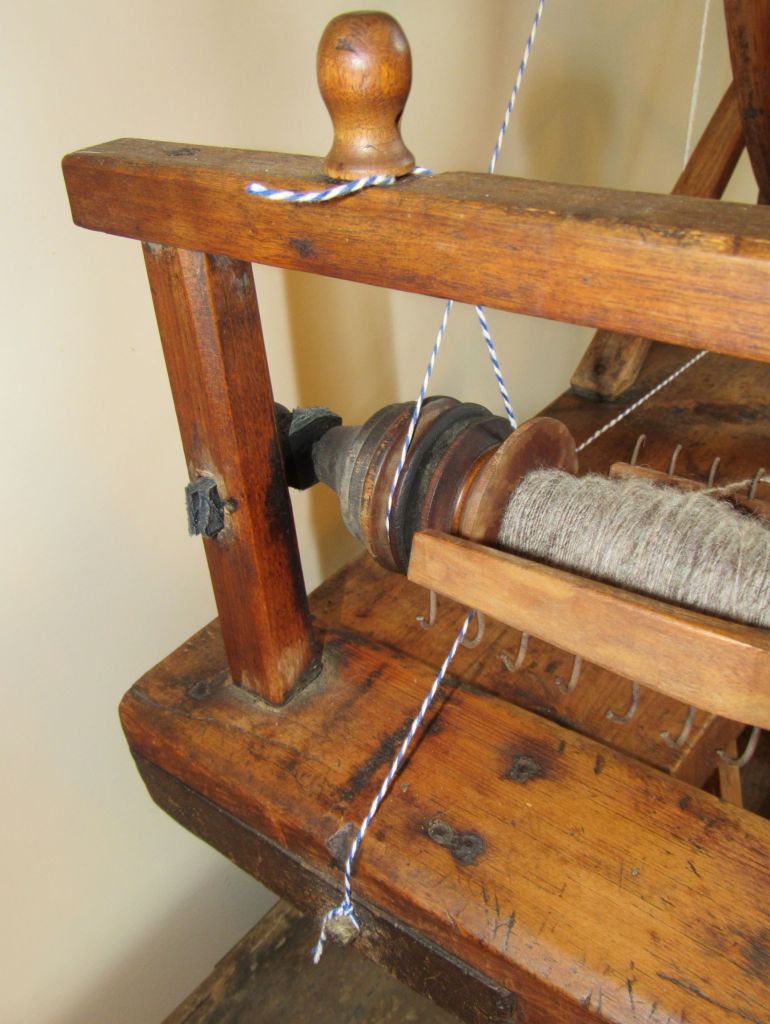
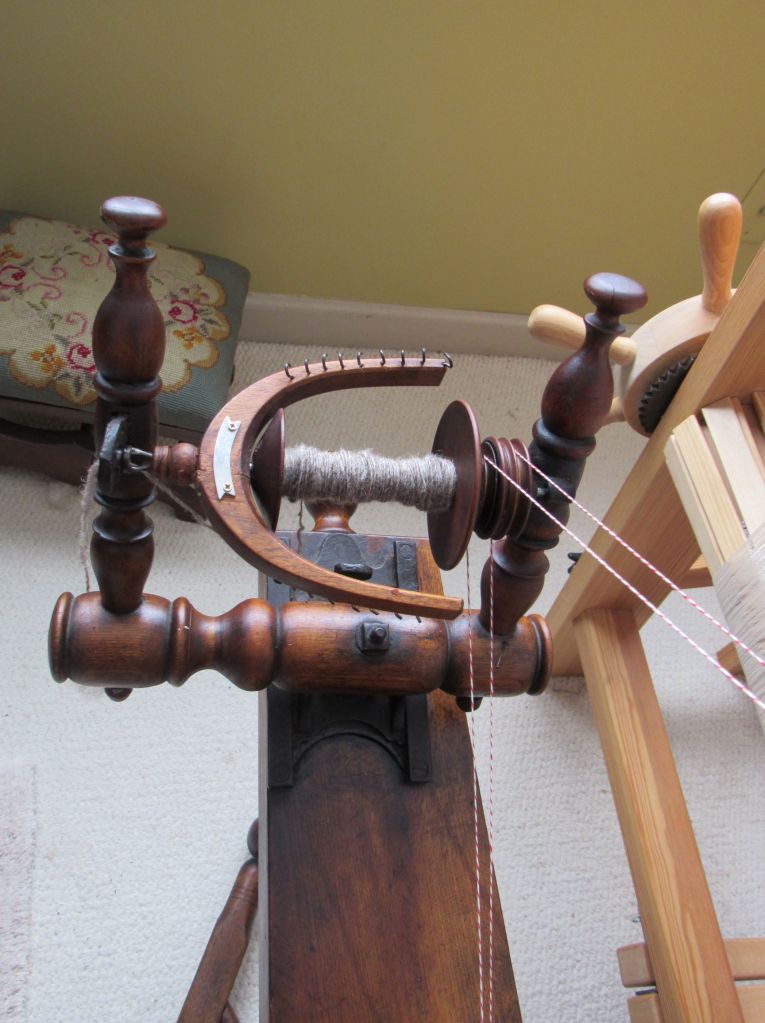
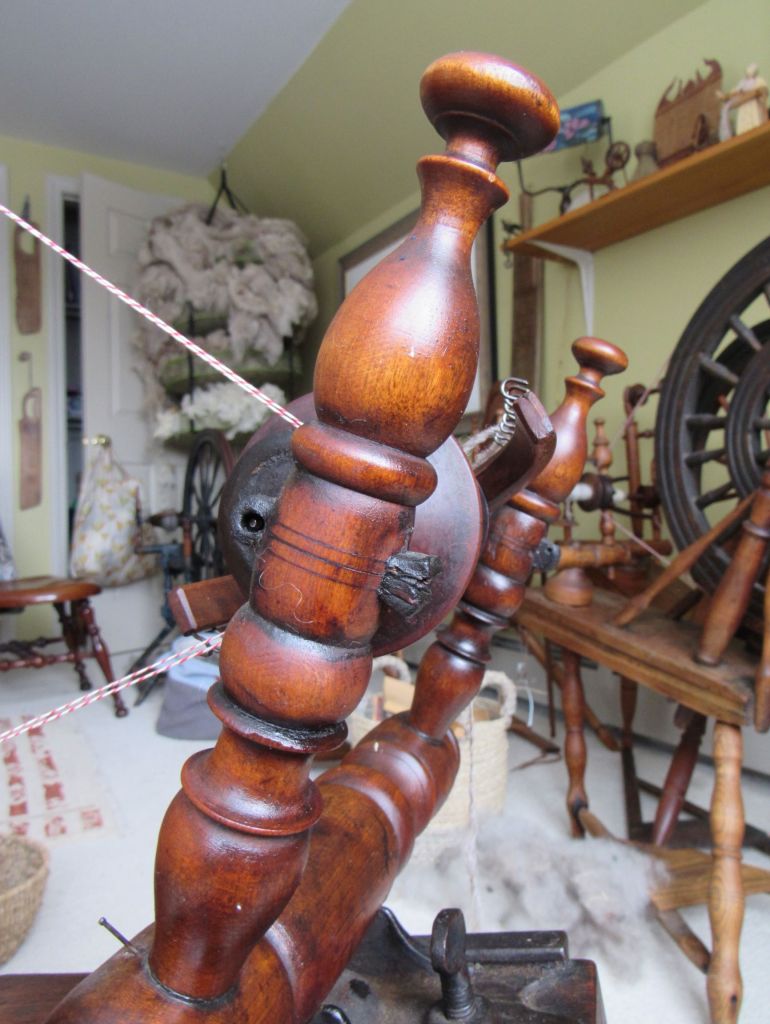
The flyer is large, held in place with a small removable piece on one end.
As with many of these flat-rim wheels, rather than having a removable whorl and fixed arms,
the whorl is fixed on the shaft, while the arms and bobbin can be removed.
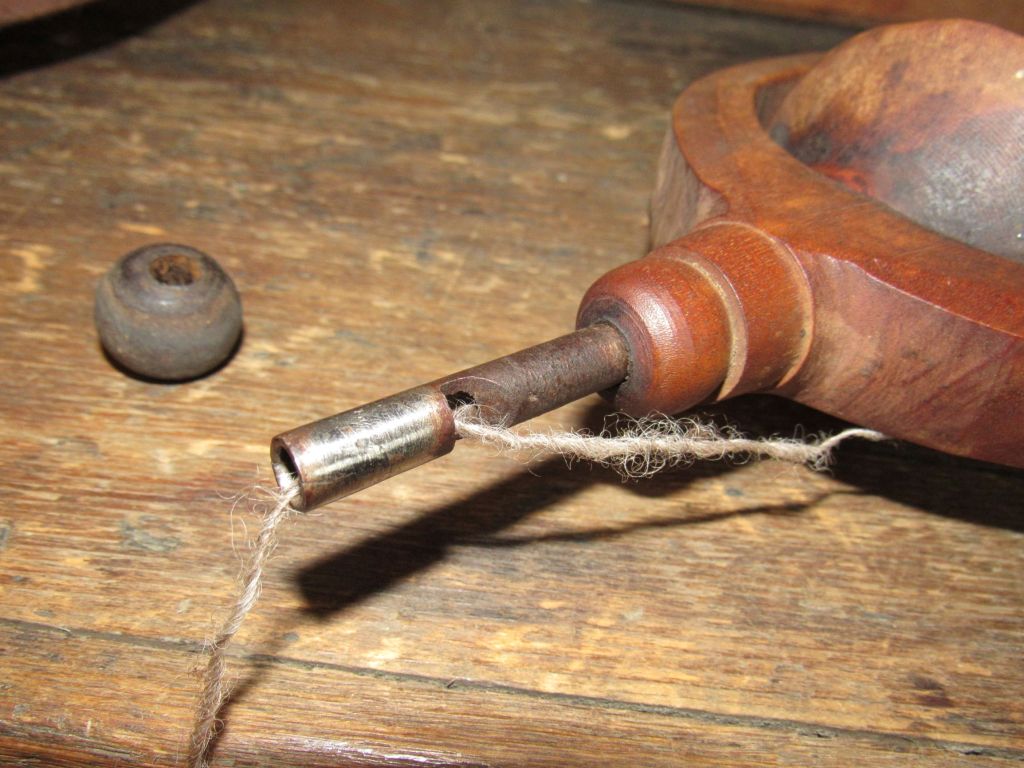
The shaft is a smooth cylinder with a single cut-out for the yarn to emerge onto the arms.
This style orifice often is referred to as a whistle-cut or train-whistle because it looks like the half-circle cut out on steam engine whistles.
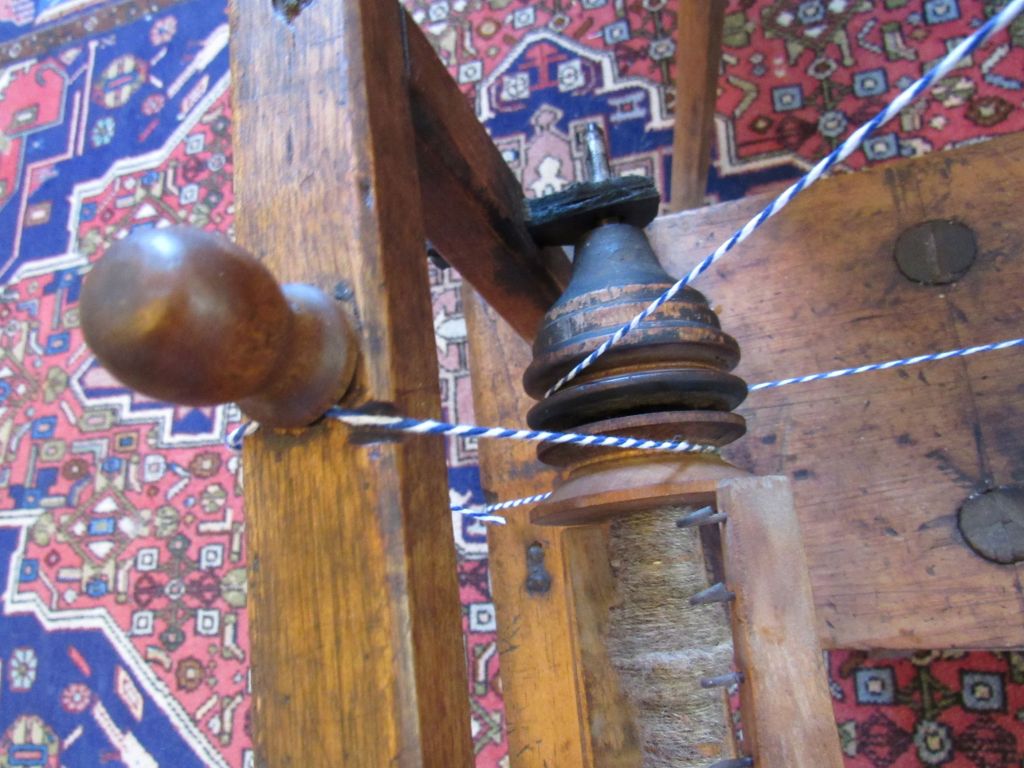
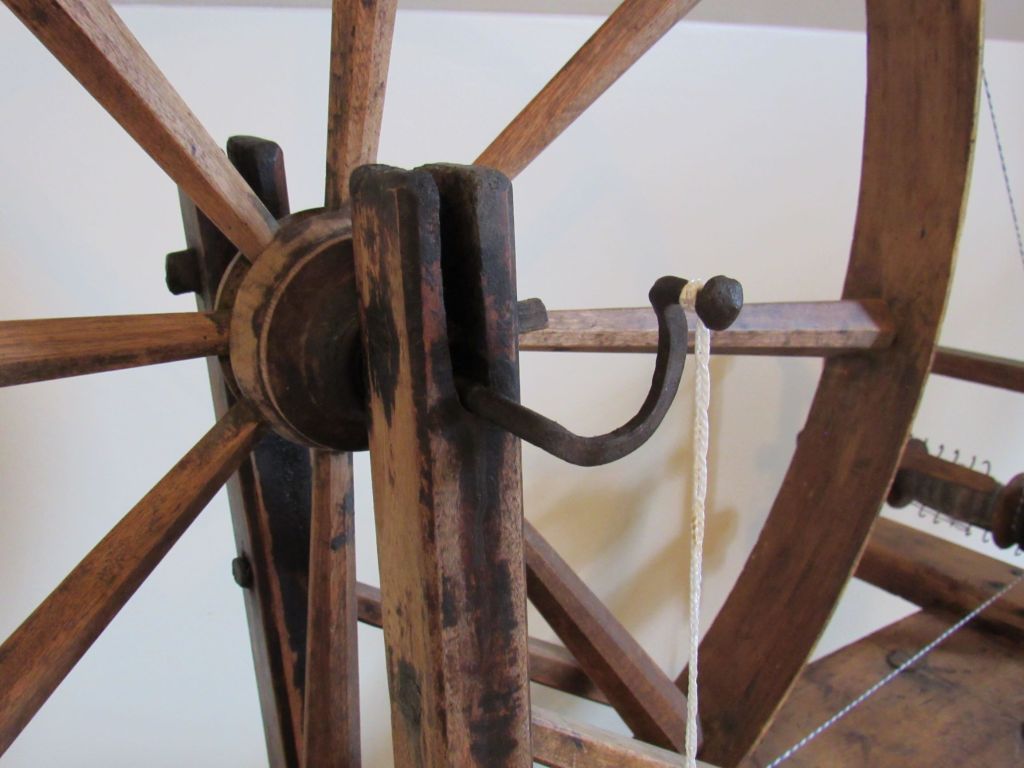
A single drive band rounds the whorl, while another band is attached to a nail on the end of the table, rounds the bobbin, with the other end held in place by a peg in the crossbar above the flyer.
There are grooves at each end for the band to ride in.
When the band is inserted in a hole through the peg, it can be tightened by turning the peg, which adjusts the amount of drag on the bobbin.
Once the tension is adjusted to its sweet spot, my wheel spins beautifully, although the treadling takes a little more effort than with most wheels. The treadle is supported only by the wooden back bar.
And, in contrast with most treadled wheels, that back bar does not have metal rods on each end to serve as the turning pivots in the legs. Instead, the wooden ends of the bar extend into the legs.
The wood-on-wood action in treadling creates a little more resistance than I am used to, so I usually use two feet which works well with the sturdiness of this wheel.
These wheels look a lot like bobbin winders and many were converted to that use. So, it is always a treat when one turns up with all its spinning parts.
Especially when it bears the hand of an artist who was not willing to settle for utility alone, and, without a lathe, created something that pleases the eyes as well as the hands.
For more information on flat-rim wheels, see:
Burnham, Harold and Dorothy, Keep Me Warm One Night, Early Handweaving in Eastern Canada, University of Toronto Press, 1972, p. 34.
Buxton-Keenlyside, Judith, Selected Canadian Spinning Wheels in Perspective: An Analytical Approach, National Museum of Canada, Ottawa, 1990, pp. 206-09.
Cummer, Joan, A Book of Spinning Wheels, Peter E. Randall, Portsmouth, N.H. 1984, pp. 178-79.
All of the wheels I have documented so far have been from New England—specifically Connecticut and Maine. But many of my favorite wheels are Canadian. I have wheels from Ontario, Quebec, Nova Scotia, and Prince Edward Island. They differ hugely in style, but every single one is a splendid spinner.
Probably the most widely known Canadian wheels are from Quebec and now commonly referred to as “Canadian Production Wheels” or CPWs. Caroline Foty, in her book about these wheels, “Fabricant de Rouets,” defines them as double-drive saxony-style wheels with very large drive wheels measuring 27-30 inches in diameter, and having a tension mechanism (usually with metal components), which tilts or slides along the table rather than the more typical wooden screw tension system.
The general time of manufacture was 1875-1935, a period of innovation in wheel design in an attempt to make home spinning more productive and efficient. And CPWs were productive–wonderfully suited to spinning wool fast and fine. But the wheels that fall within the CPW definition are not the only Quebec wheels designed for fast production. Many of the wooden screw tension wheels are extremely fast spinners–some have drive wheel diameters larger than any CPWs, and others have two drive wheels for accelerated speed. So, another way to more precisely categorize Quebec wheels, is: screw-tension, tilt-tension, slide-tension, accelerated, and flat-rim (which sometimes have screw tension and sometimes scotch tension).
Zinnia Rue is a Quebec slide-tension wheel. Her drive wheel is smaller than most CPWs, at just 26 inches.
She appears to have been made by Ferdinand Napoleon Vezina (1841-1898) of Vercheres, Quebec, who likely developed this tension system. Faint remnants of his “F.N. Vezina Vercheres” stamp on the wheel’s table can just barely be discerned.
Trust me, you can make out bits of the mark.
Ferdinand was part of a family of wheel makers, carpenters, and inventors, including his uncle Joseph, brothers Pierre and Charles, nephew Polycarpe, and son Antoine Emile. Their last name was variously spelled Vezina, Visina, and Vesina (seeFabricants de Rouet, pp. 96-110, for extensive information on the Vezina family).
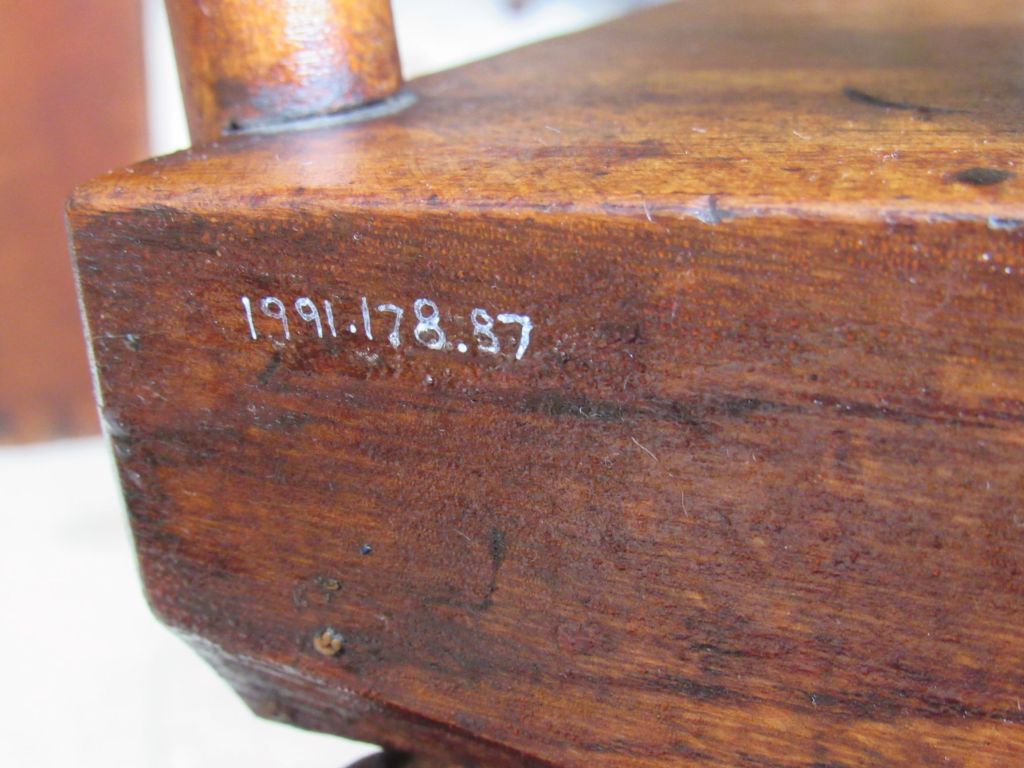
This beautiful wheel was part of Joan Cummer’s collection. It is wheel No. 87 on page 190 of her book, and in its description, she notes that it is slightly smaller than the usual “Great Canadian” wheels—her term for CPWs. Cummer purchased the wheel from an Antrim, New Hampshire antique dealer and later donated it, along with the rest of her collection to the American Textile History Museum.
It was put up for auction after the museum closed, when I purchased it and brought it home. There were two Cummer Quebec wheels up for auction that night and I was intending to bid on the other one. But when my foot met the treadle on this one, to see if the wheel turned true, I was immediately drawn to it. It is funny how some wheels don’t speak to me at all and others suck me right in. This wheel is a wonderful spinner and I am hoping to pass her on to a friend who has been looking for a CPW and will give her a good home.
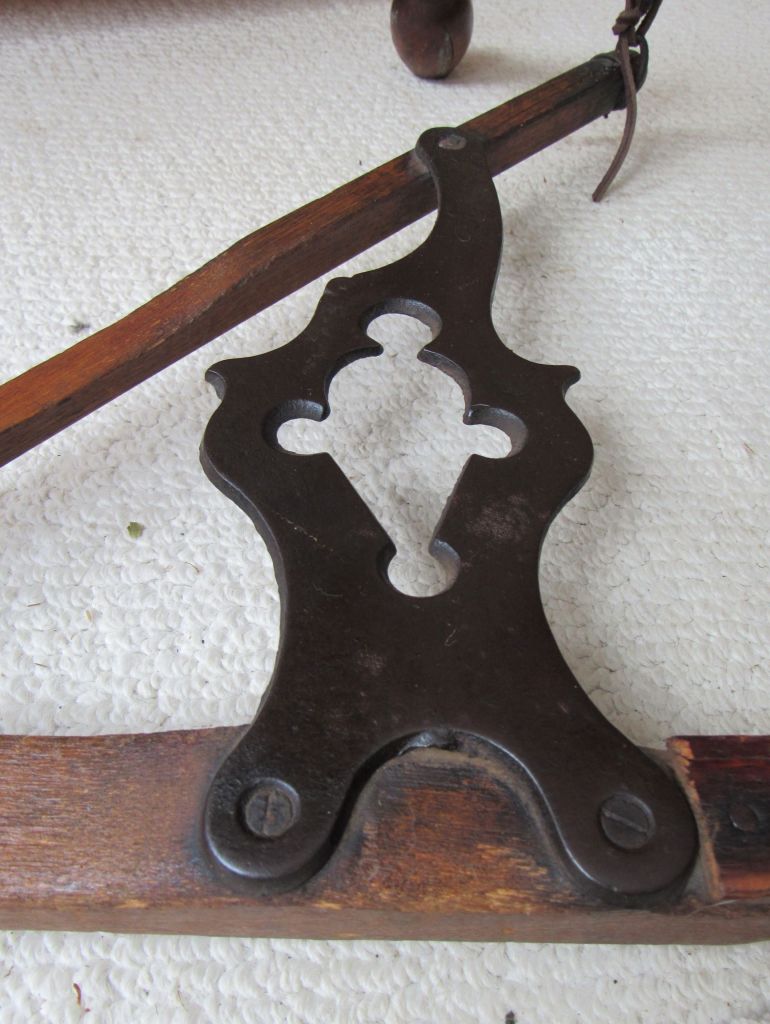
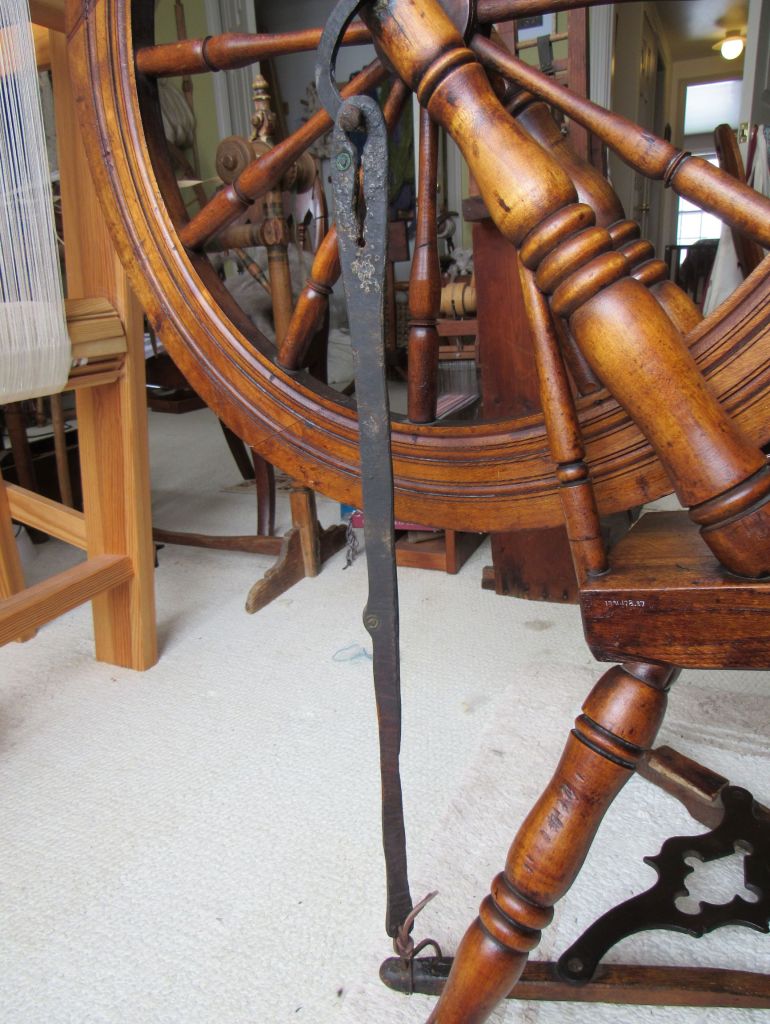
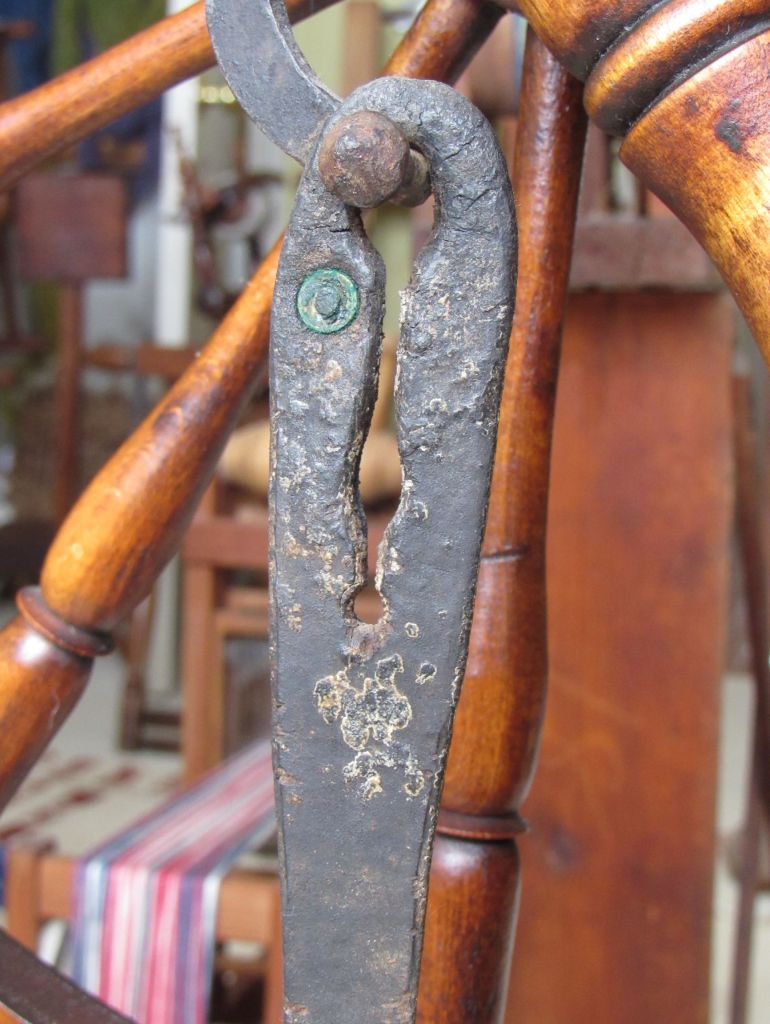
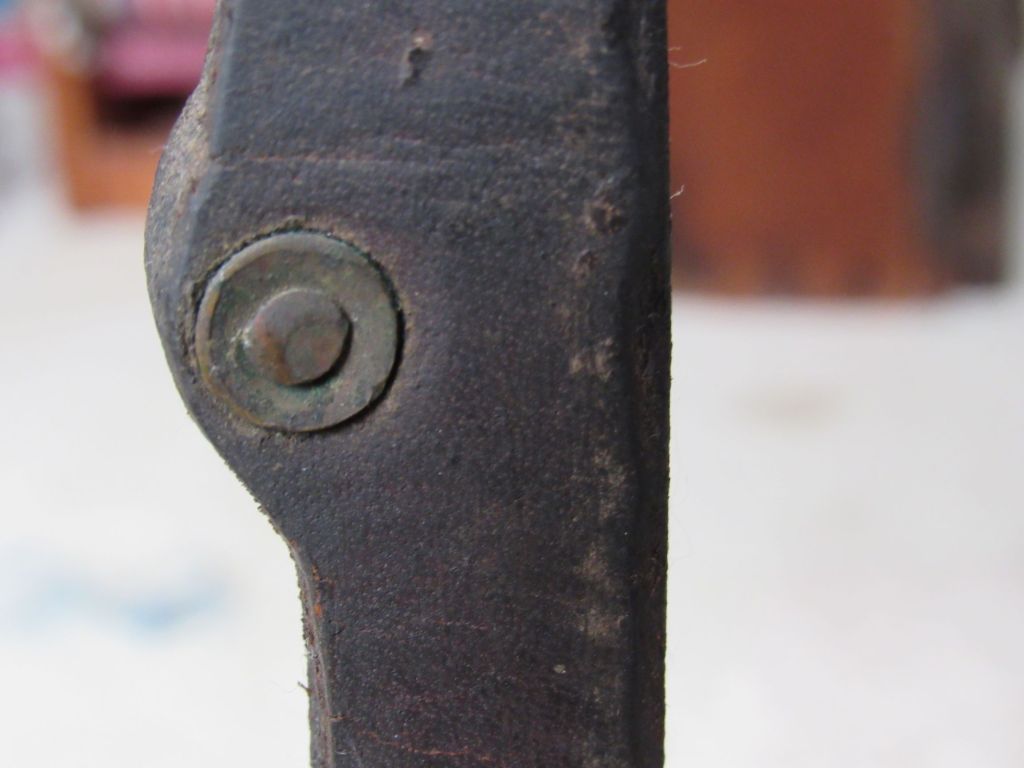
She has the common fleur-de-lis style metal treadle and a leather footman
with old greenish (copper?) rivets,
which perhaps was part of a harness originally.
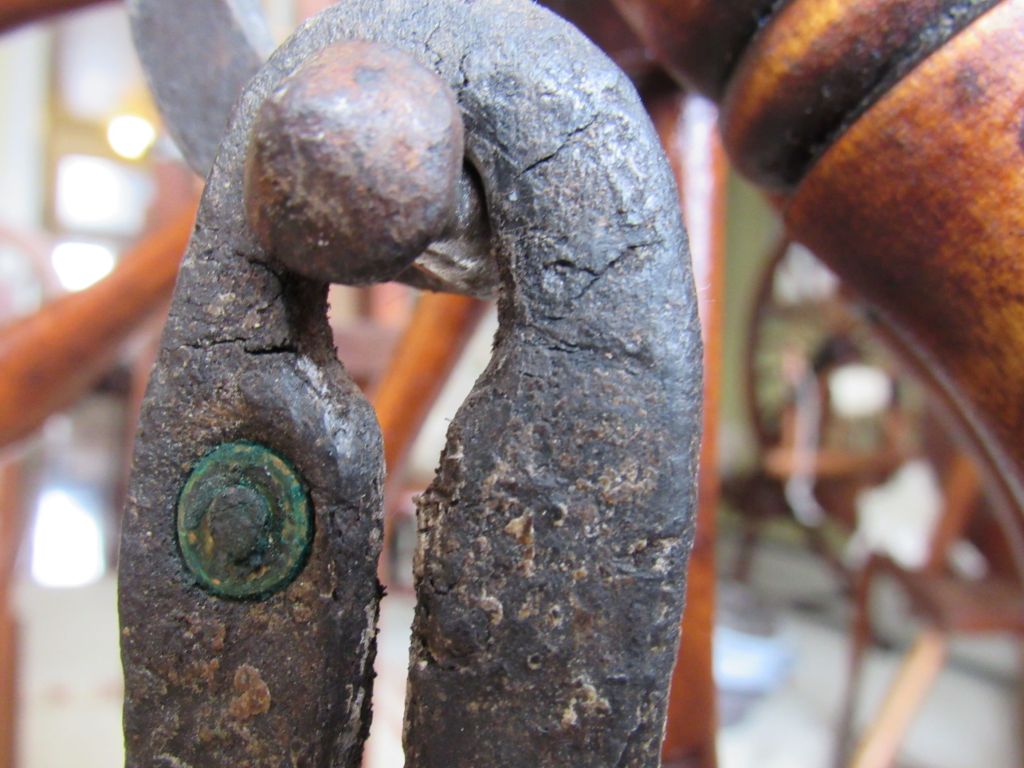
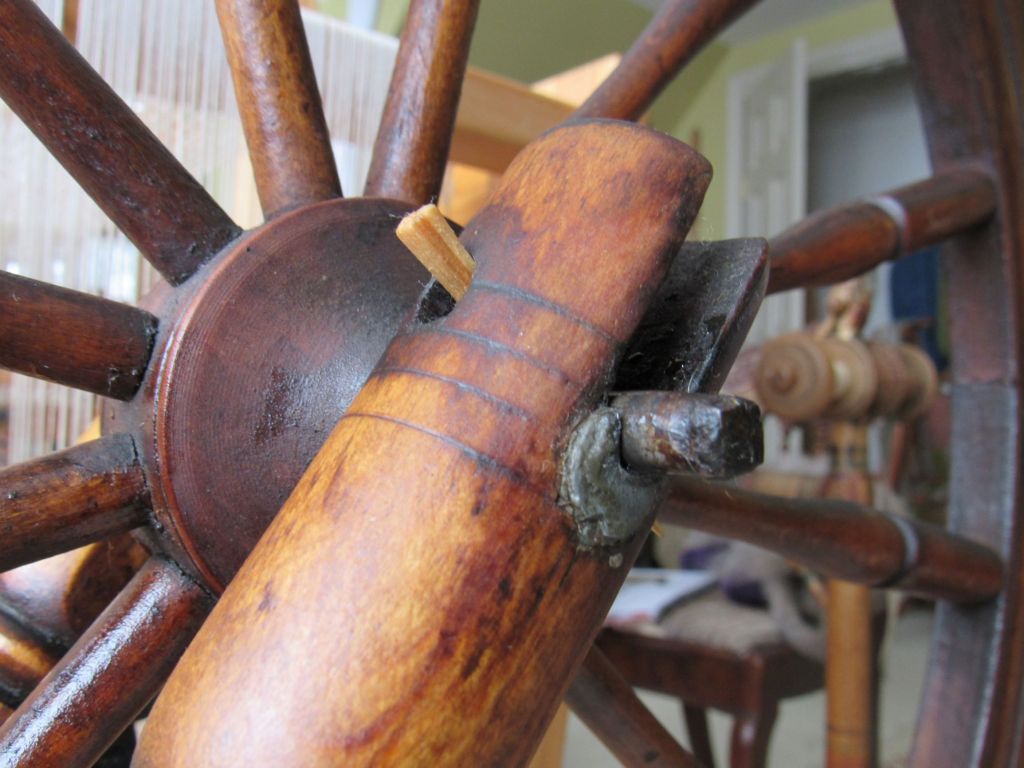
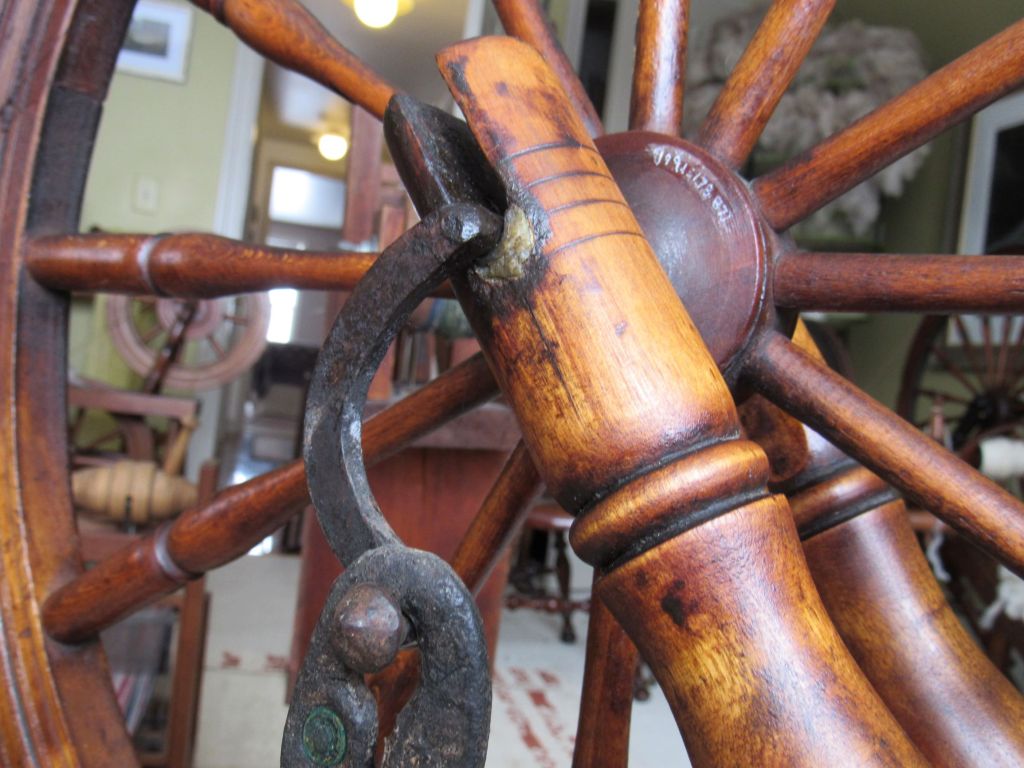
The footman is attached to a to a loop in a wire twisted around the treadle bar.
The front axle bearing has the color and texture of lead,
but the back one is more yellowish.
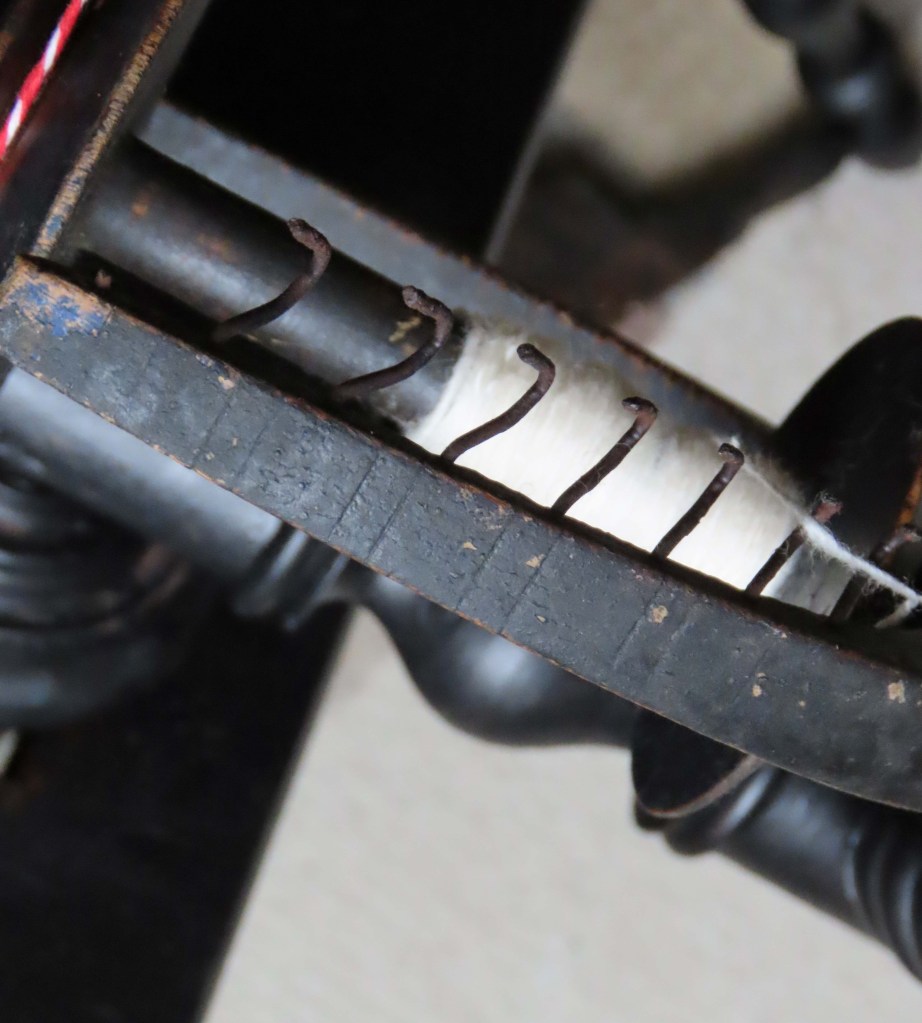
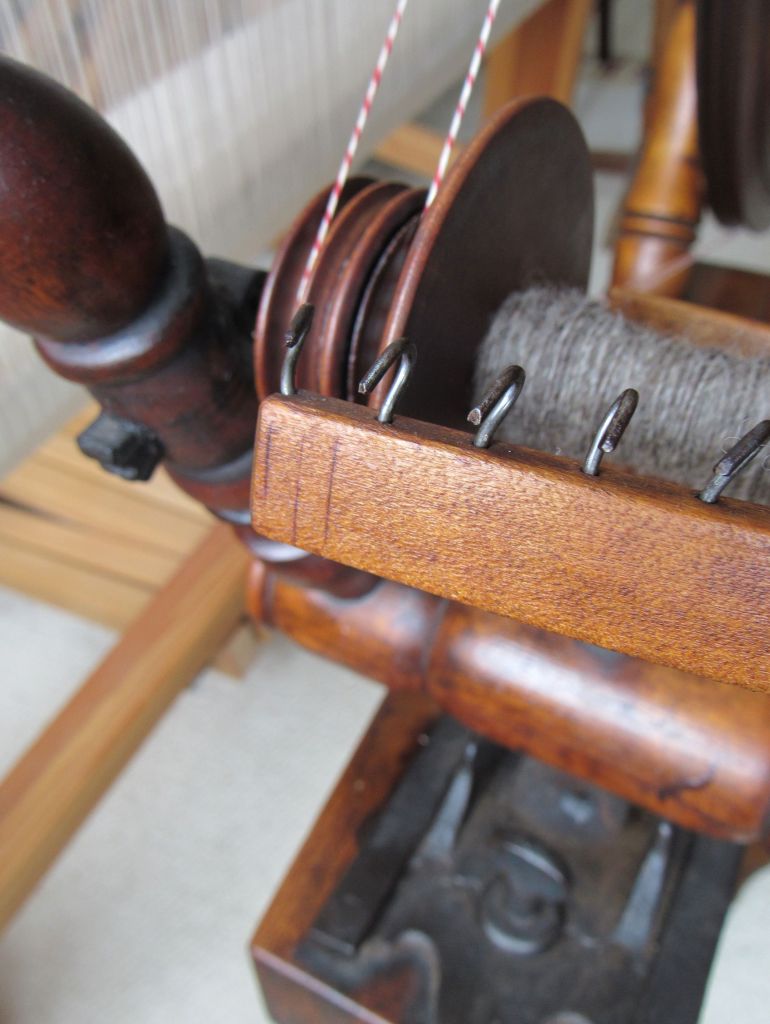
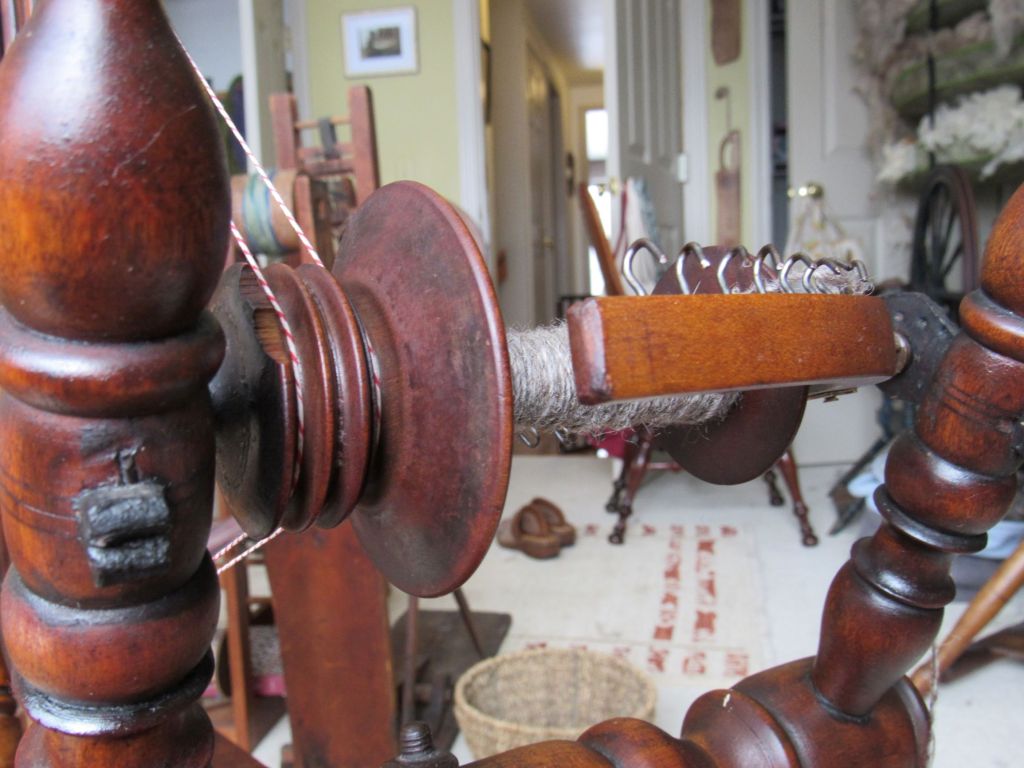
The flyer was broken and glued and repaired (I since added some metal plates, as back up to the glue) but the arms, interestingly, do not have any wear lines on them and the hooks are in great shape.
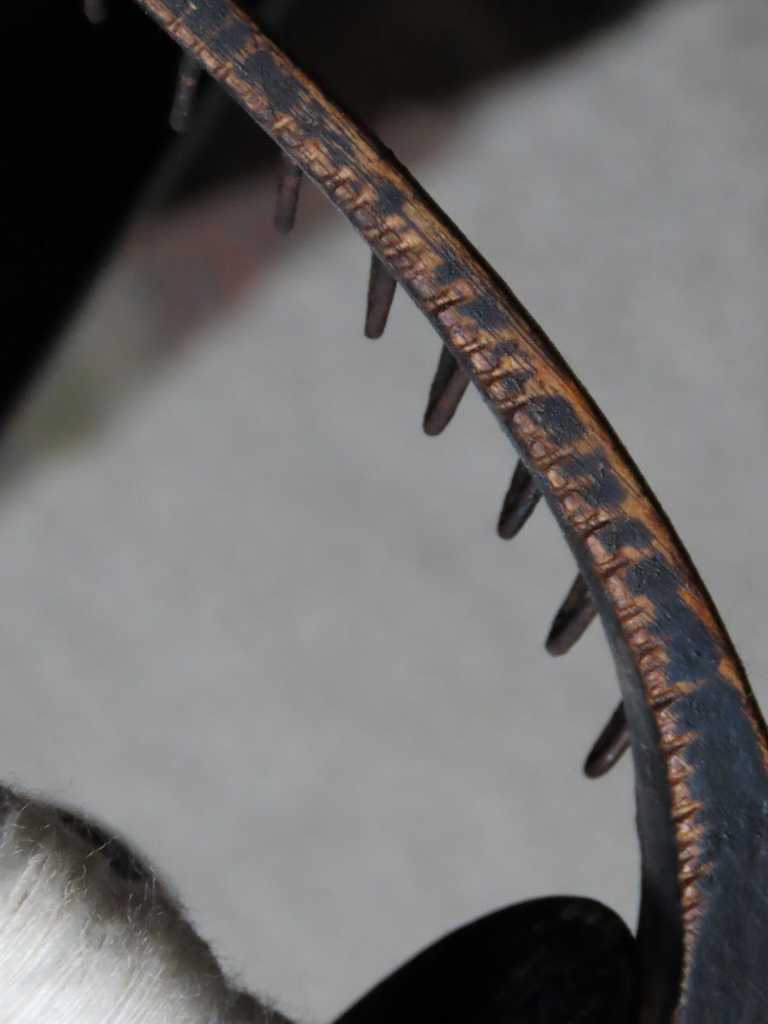
The orifice does, however, show wear with some deep grooves where the yarn emerges.
The orifice is bell-shaped and fluted, something seen on many Canadian wheels.
There has been debate about the fluting, with some people arguing that it is a result of wear. On my wheels, the bell shape and fluting go together and appear to be a deliberate manufacturing feature. Wear, as with the deep groove in this wheel’s orifice, looks different to my eyes.
This indentation in the orifice is where the yarn runs coming out to the arms. It appears to be from constant wear.
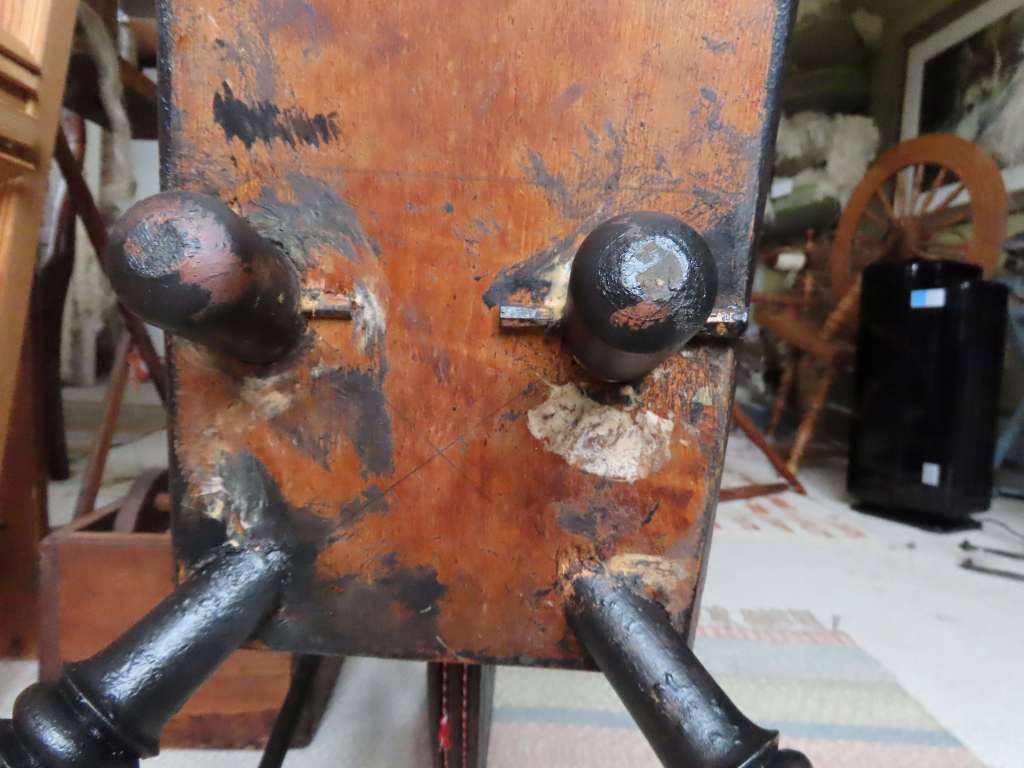
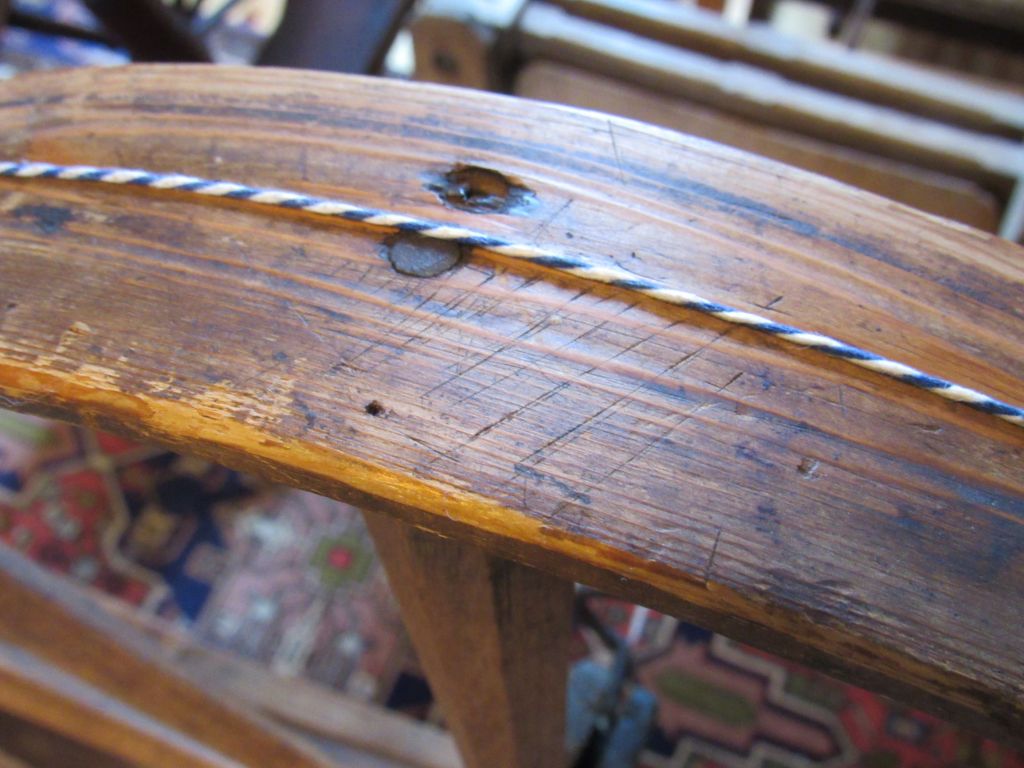
The treadle bars also show lots of wear, indicating that the user probably used both feet to treadle.
There is an added wooden piece on the treadle bar.
I’m not sure if it was intended to elevate the foot or if it had some other purpose.
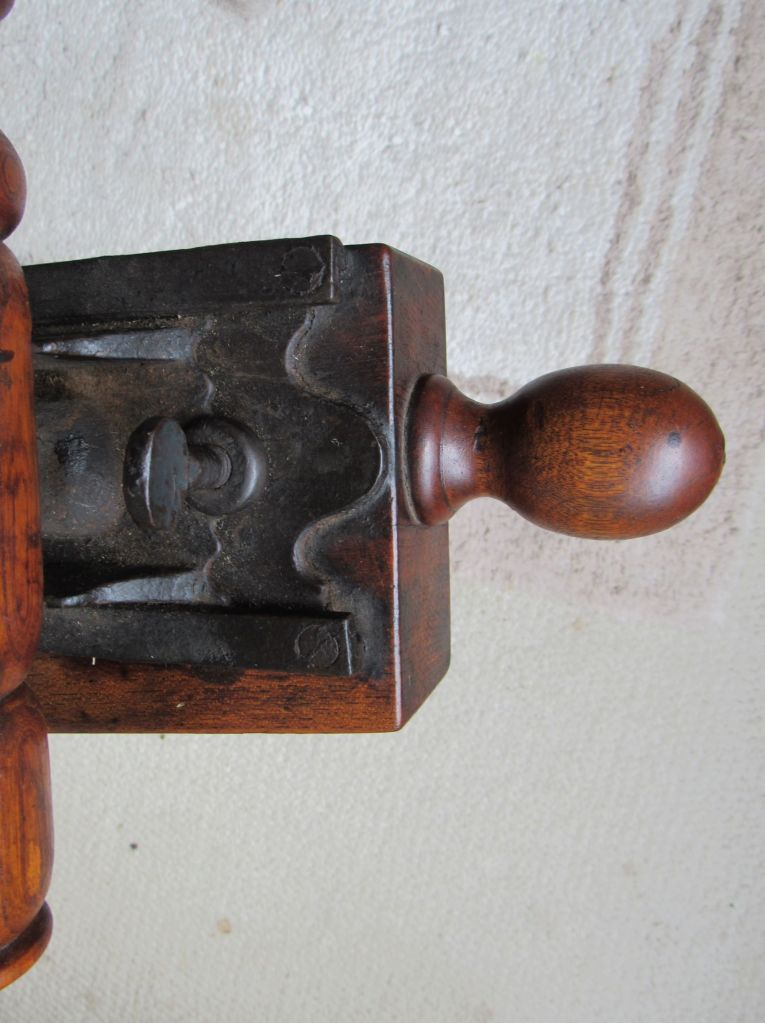
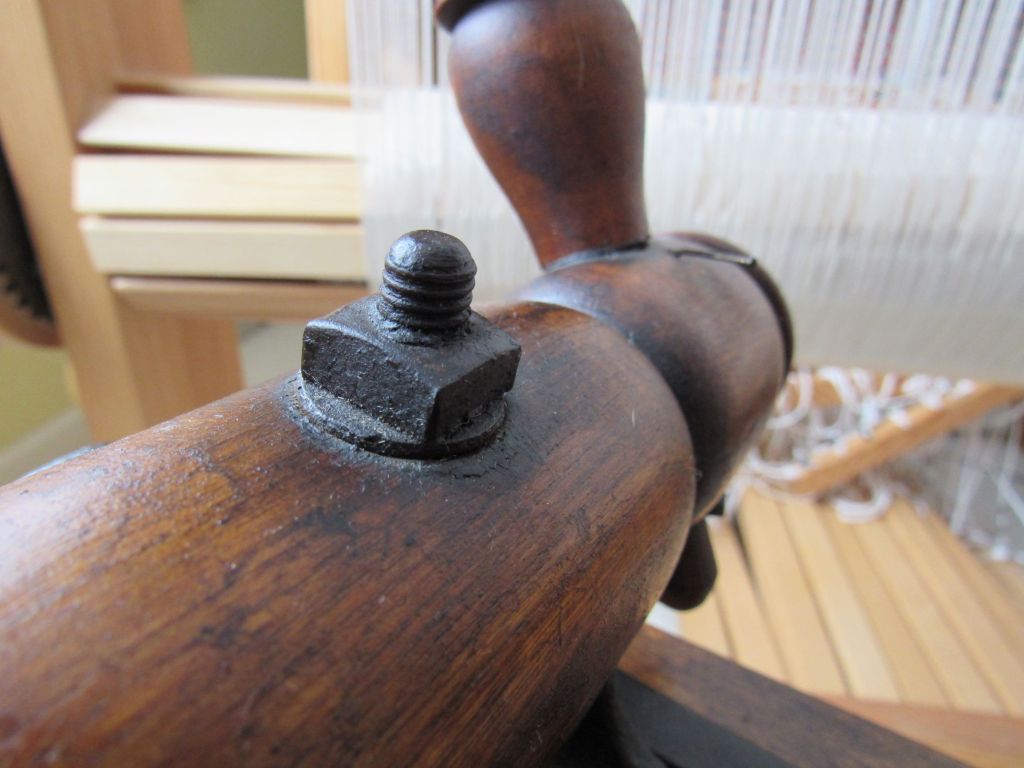
While the slider and tilt tension wheels did away with the need for wooden tension screws, they retained a sort of residual non-functioning screw that serves as a handle to pick up and carry the wheel.
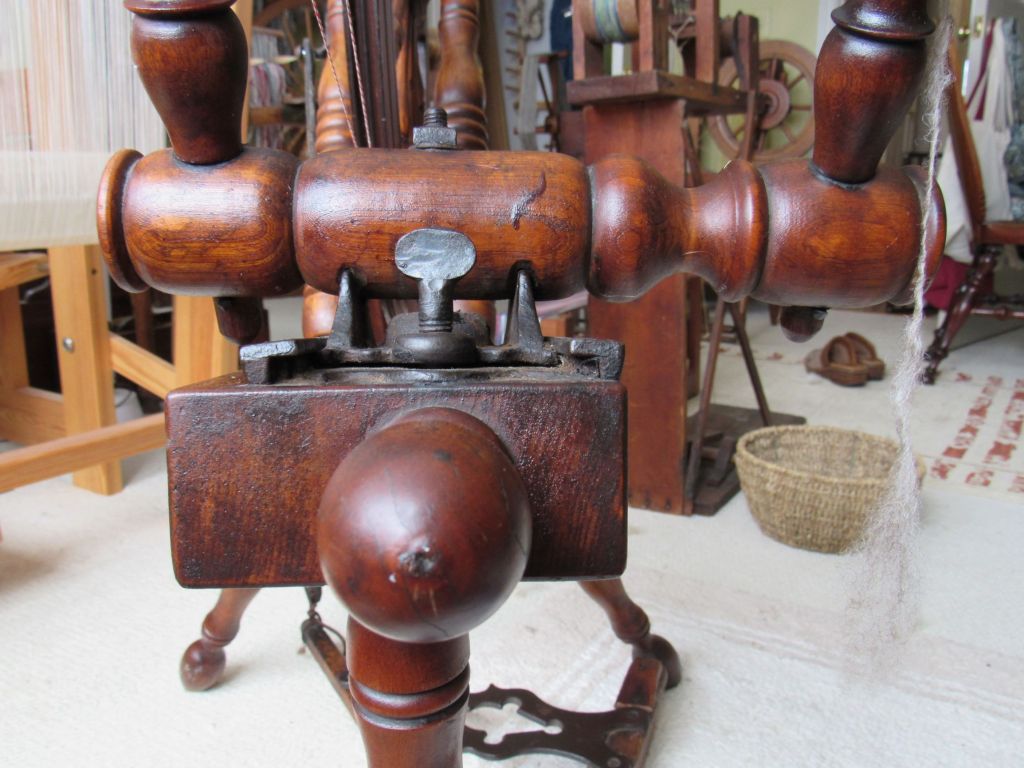
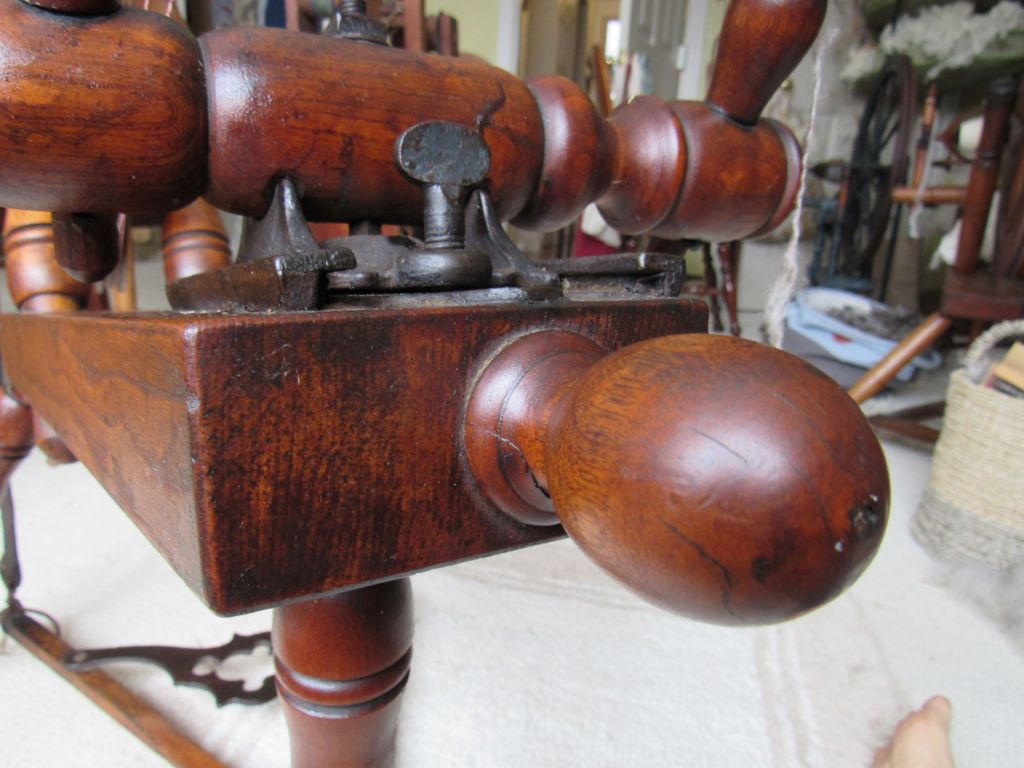
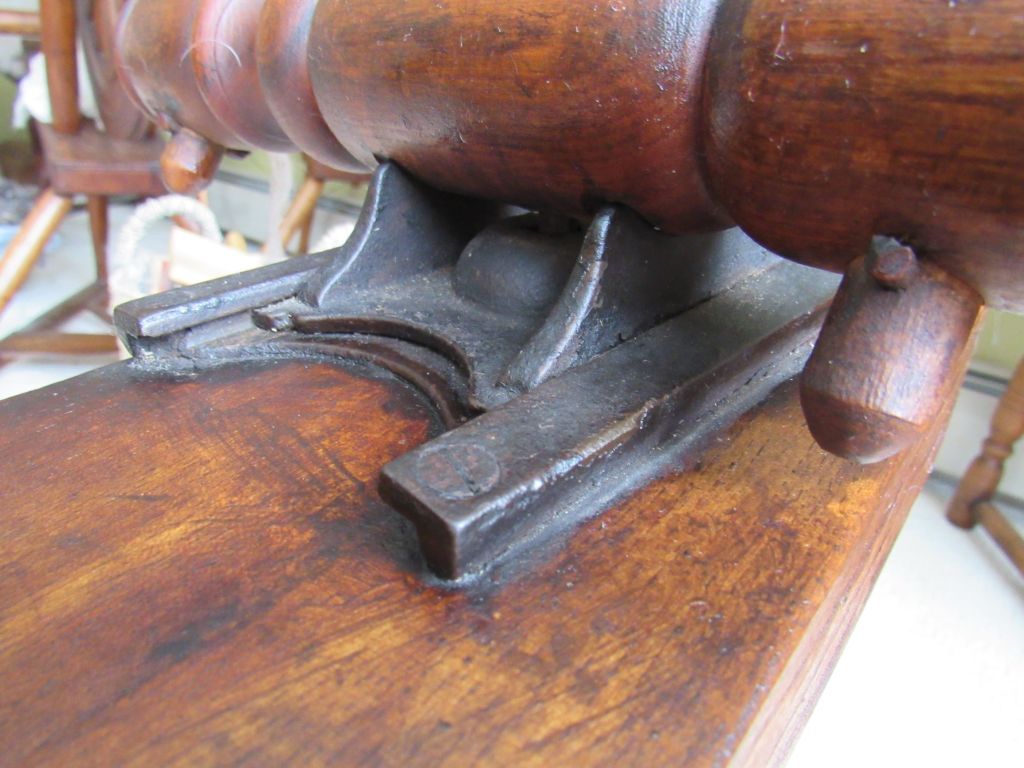
I love the slider tension on this wheel—just loosen the wing nut and the MOA can be moved in very small increments.
The slider has two parts—one part, bolted to the table, has runner on each end to contain the second part which is bolted to the mother-of-all.
The slider aligns with the spinner side of the wedge-shaped table.
I am a little surprised that this tension style it did not become more popular. Francois Bordua, the creative Quebec wheel maker whose wheels sometimes sported Christmas tree and eagle treadles, also used a slider tension (marked with his initials) on some of his wheels, but slider tensions do not show up very often.
The maidens have a typical Vezina look.
The leather flyer bearings appear to be quite old, perhaps original,
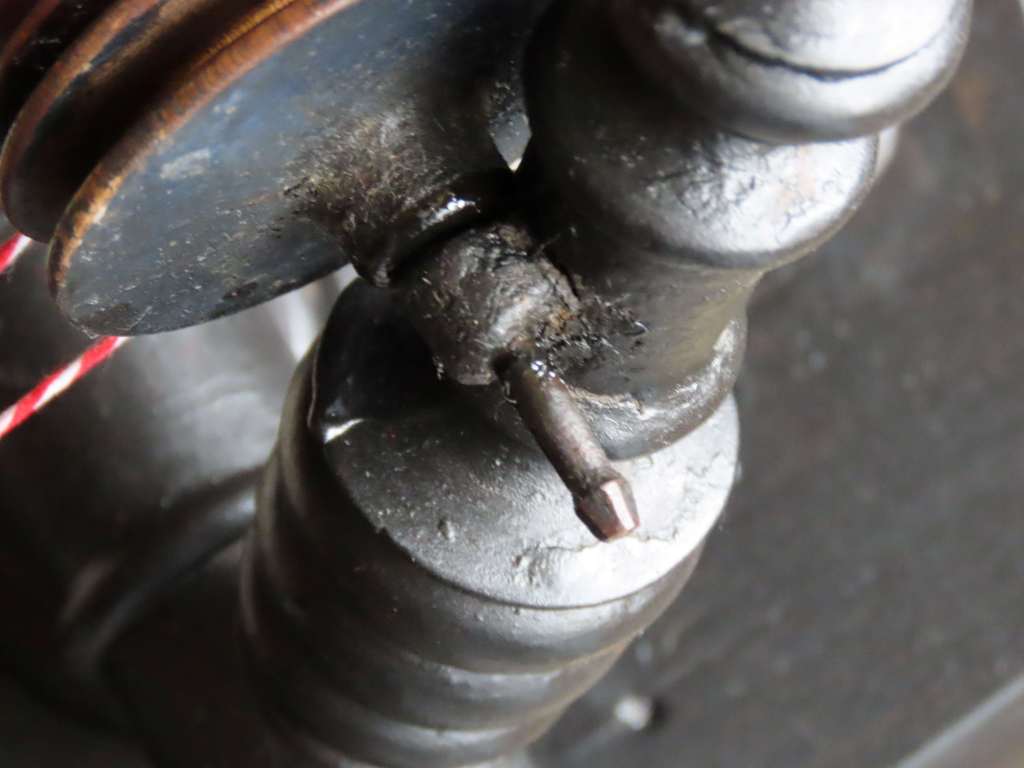
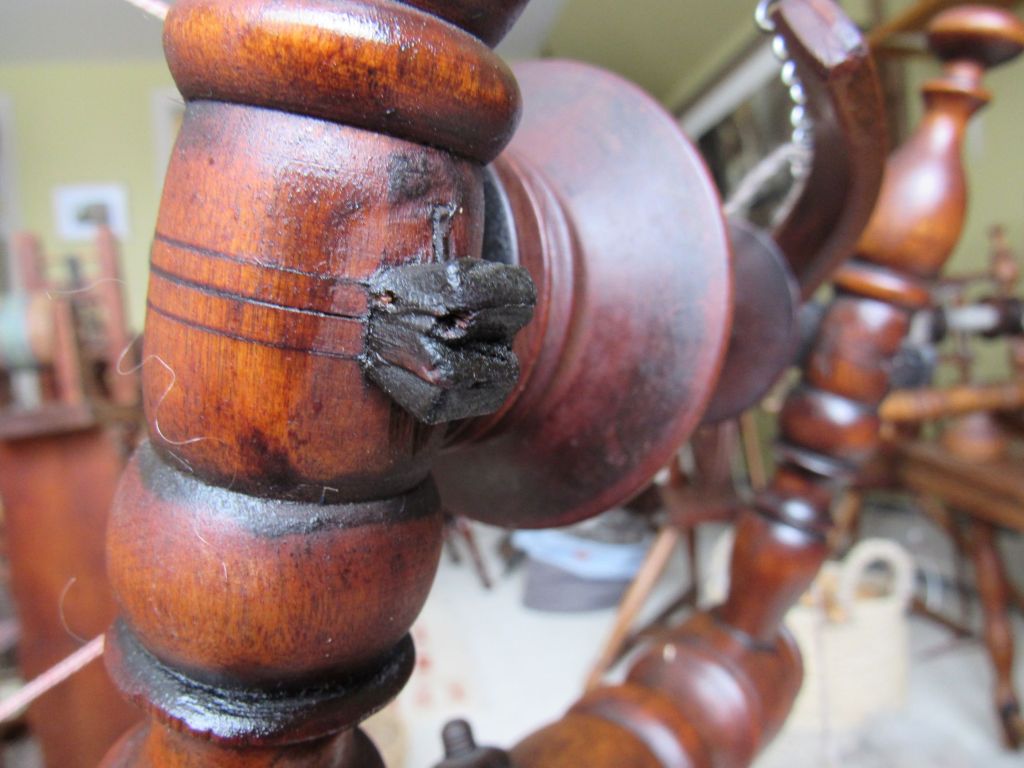
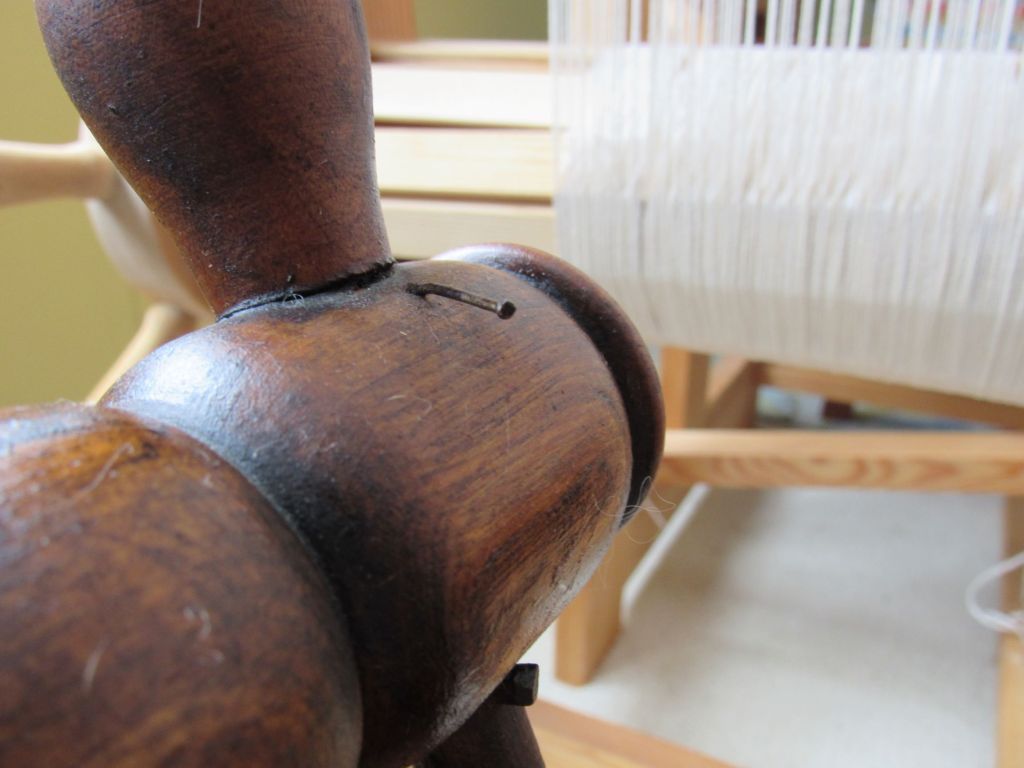
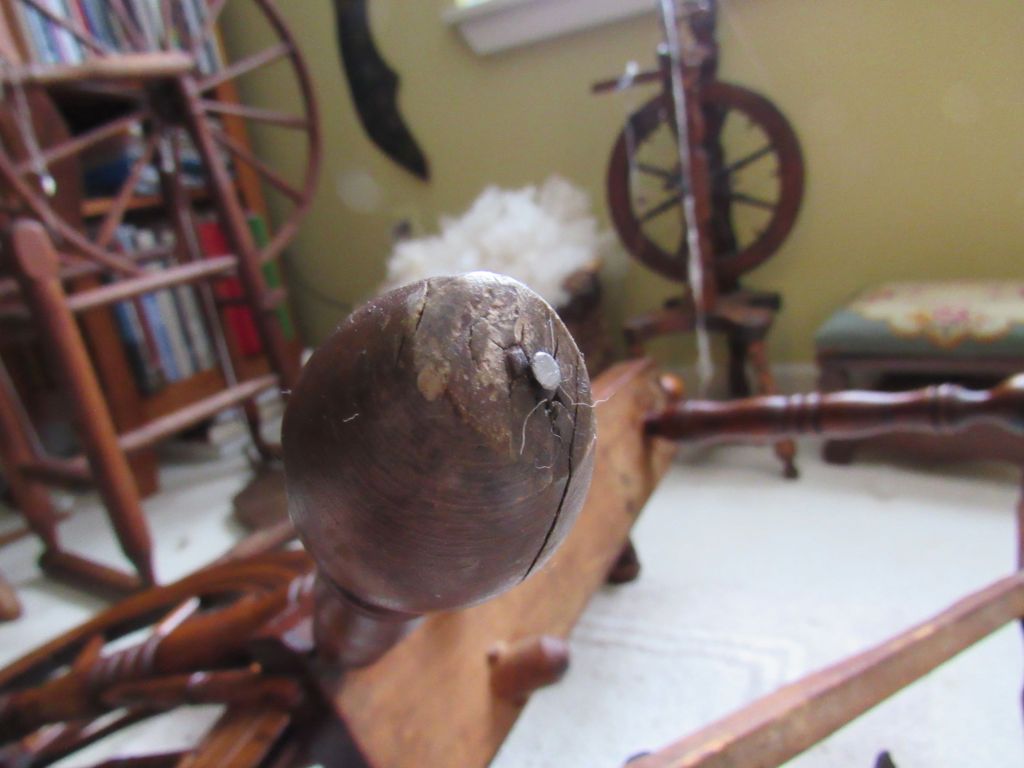
and there is an odd thin nail sticking out of the MOA.
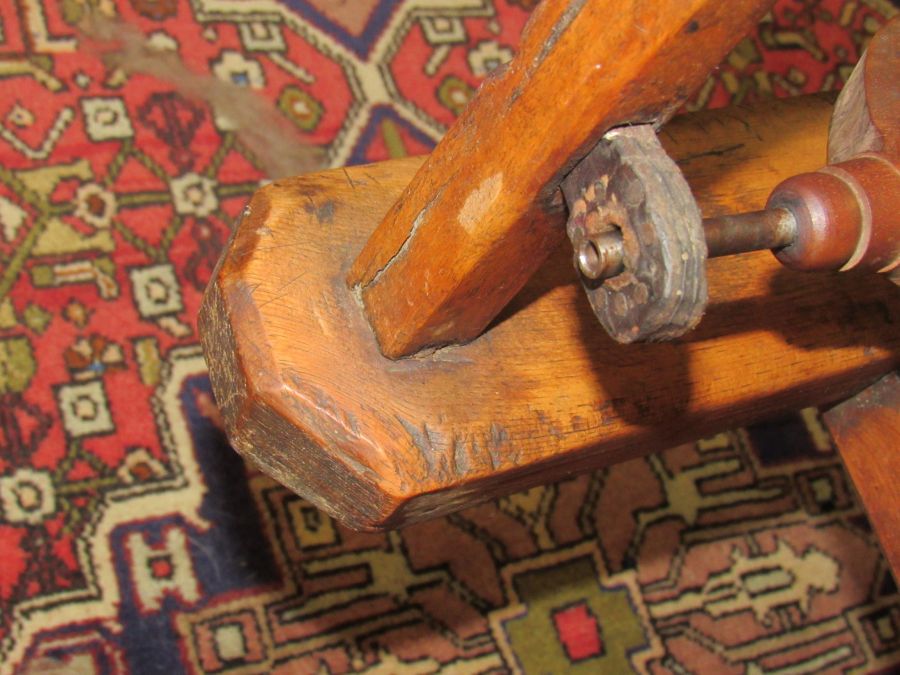
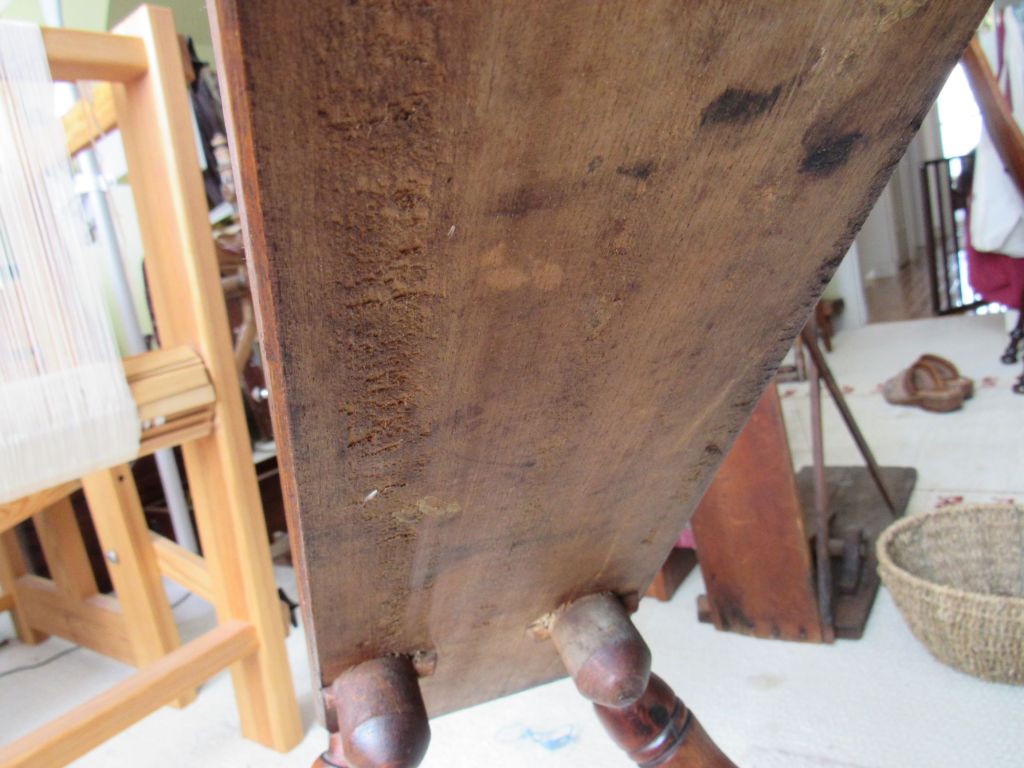
Its purpose is a puzzlement. There also is a nail—what looks like 2 nails, actually, one quite old—in the bottom of the non-spinner side leg, presumably to keep the wheel from sliding across the floor.
The wheel underside has some rough spots.
There is one upright support on the non-spinner side of the wheel.
The drive wheel is a bit of a puzzle. Most Vezina wheels have spokes with two or three beads and the earlier ones are even more ornate.
These simple spokes show up occasionally on Quebec wheels of several different makers, but are fairly unusual.
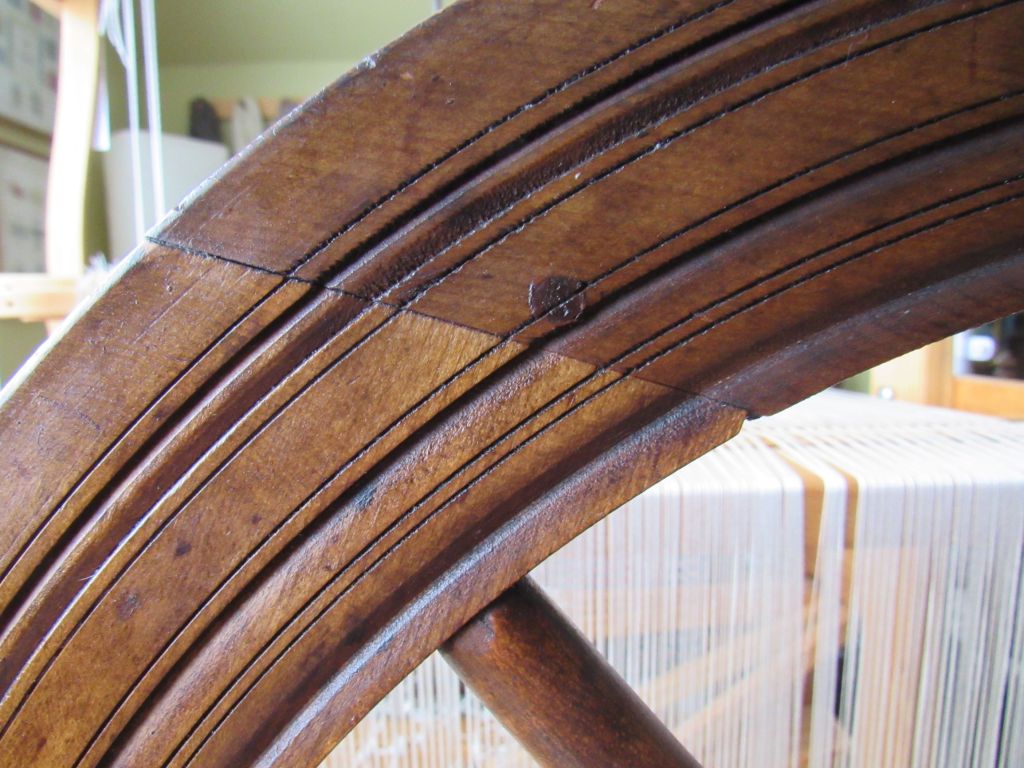
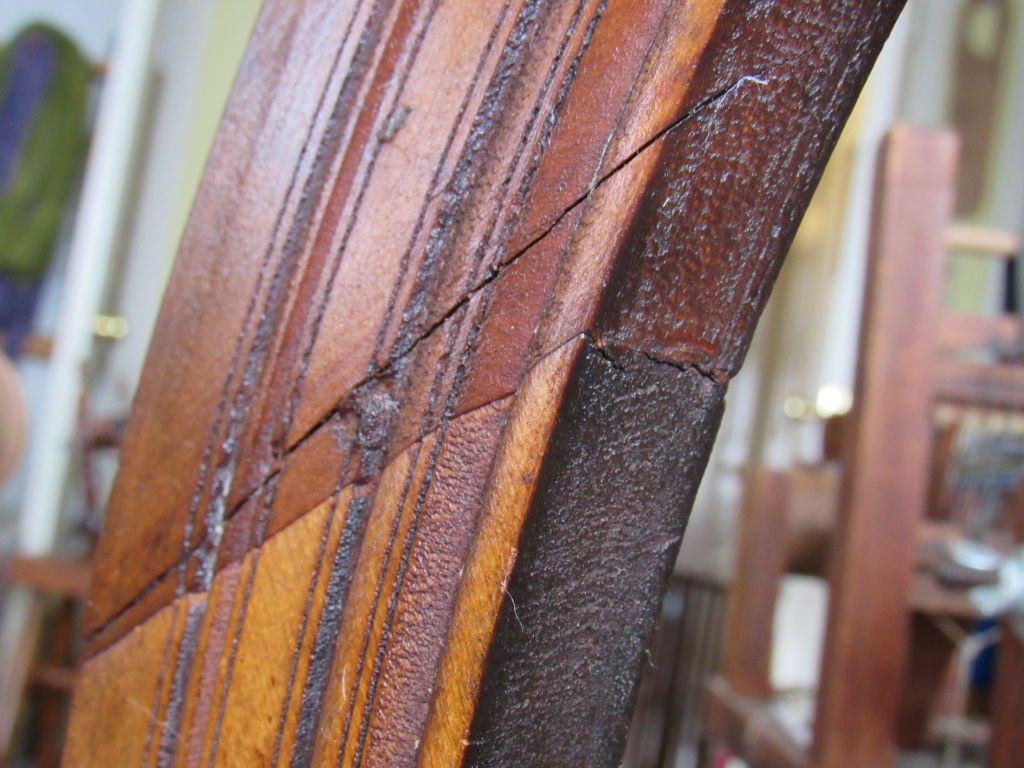
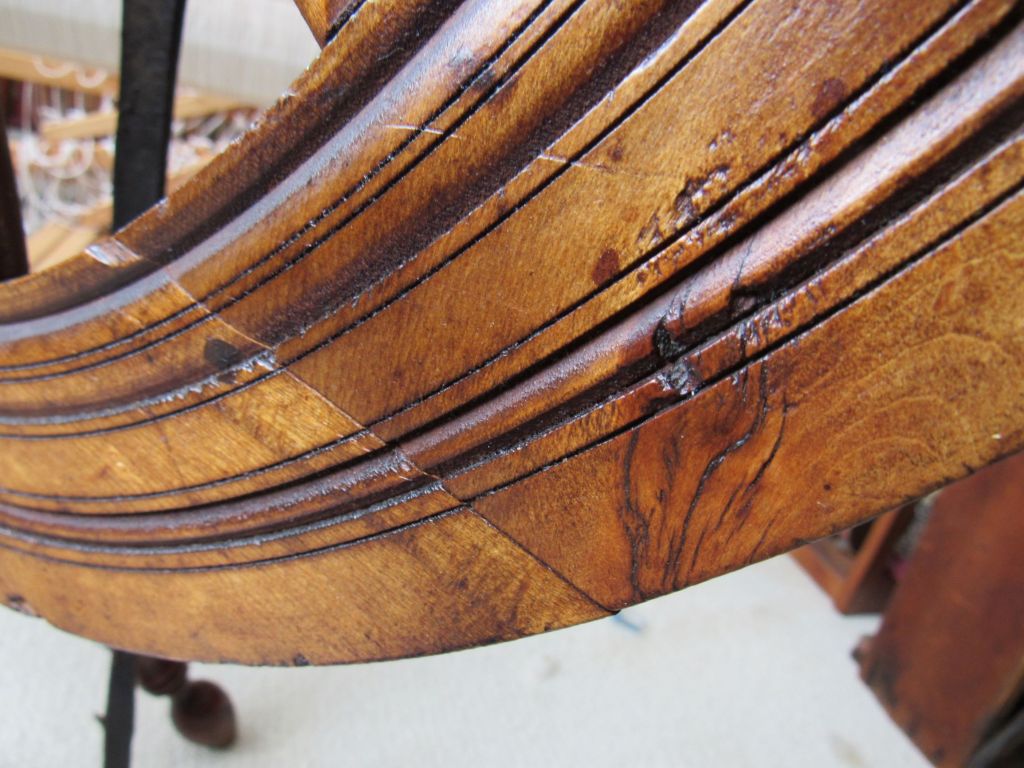
Oddly, both of my Vezina wheels have this spoke style. The drive wheel rim also is not typical of Vezina wheels, which tend to have a simple three mound “quilted” rim. This one is more interesting.
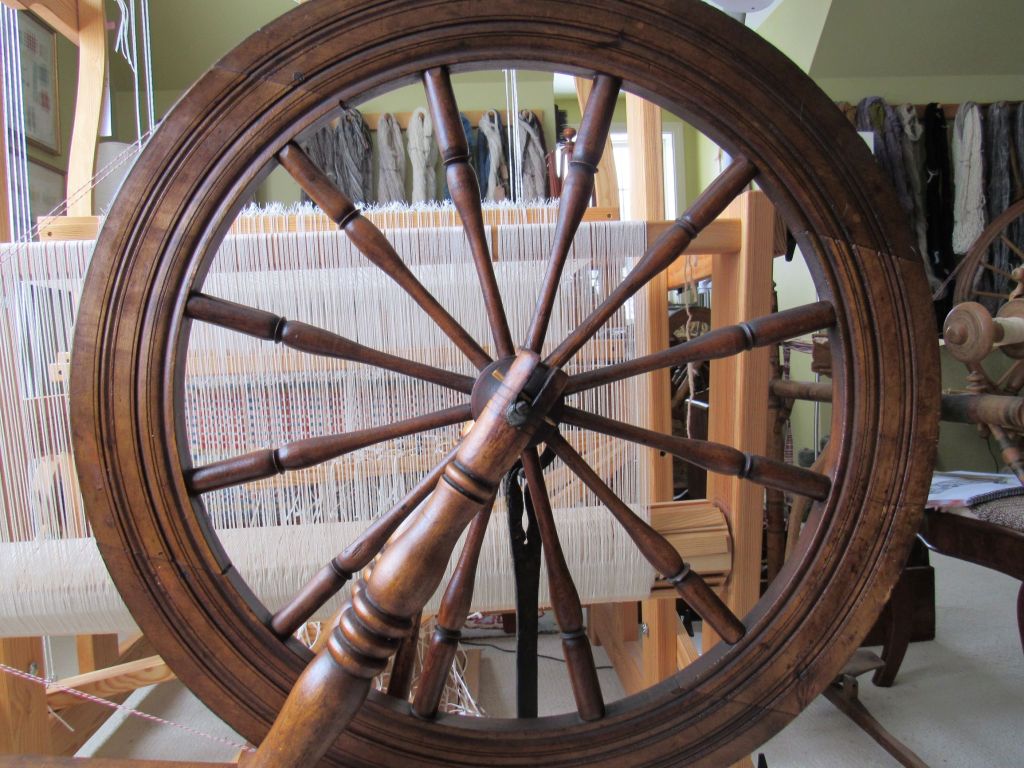
While drive wheels and other parts were often mixed and matched as needed, this particular drive wheel is not associated with any particular maker, as far as I know. The drive wheel is multi-colored, with most of the wood being dark, but some being light. The rest of the wheel also has different shades of wood. And the drive wheel look as if it belongs.
So, I am inclined to think it is original, but it is hard to say. Original or not, it carries a mark of the maker, whoever he may be. There is a saw mark on the rim where it looks as if a cut was started at the wrong angle but then used with mistake intact.
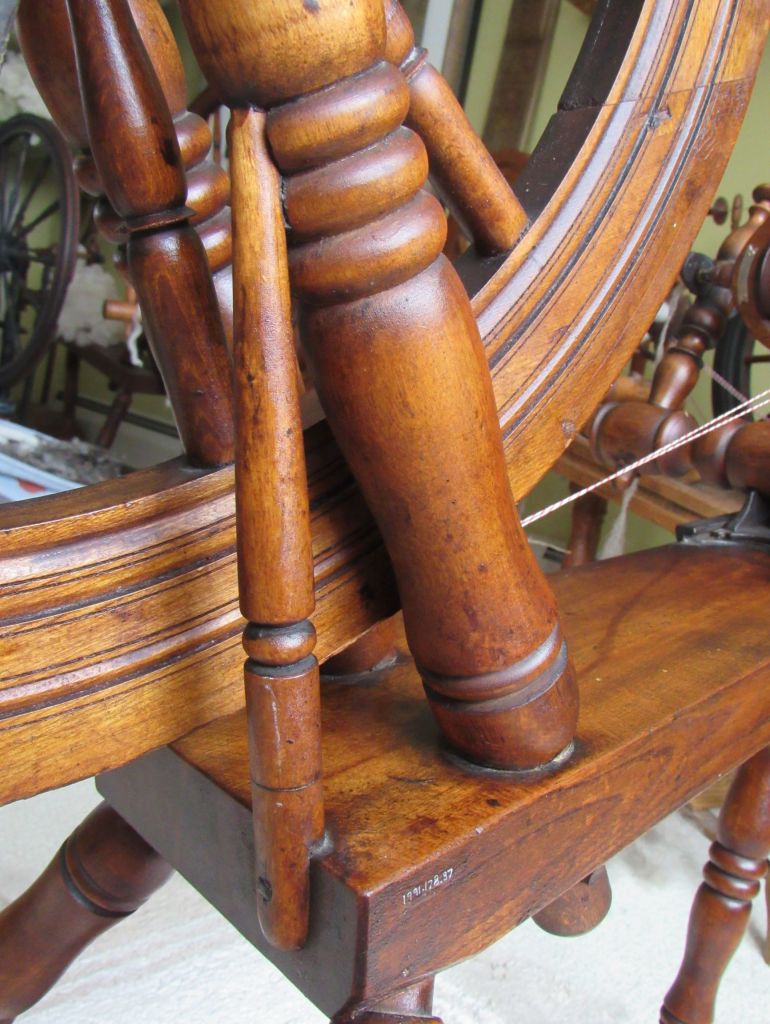
Another feature of this wheel is the wood itself.
Quebec production wheels were turned out at a great rate with a good price.
Beauty in wood was not a prime consideration. Yet, this wheel’s wood is worth a slow look and appreciation.
For more information on Canadian wheels see:
Burnham, Harold B. and Dorothy K., ‘Keep Me Warm One Night’ Early Handweaving in eastern Canada, Univ. of Toronto Press, Toronto and Buffalo, 1972.
Buxton-Keenlyside, Judith, Selected Canadian Spinning Wheels in Perspective: An Analytical Approach, National Museum of Canada, Ottawa, 1990
Cummer, Joan, A Book of Spinning Wheels, Peter E. Randall, Portsmouth, N.H. 1984
Foty, Caroline, Fabricants de Rouets— this book is available for sale as a downloadable PDF by contacting “Fiddletwist” by message on Ravelry.





























 Exquisite Machinery